Infiniti Q50 (2023 year). Manual in english - page 2
 

  Index      Manuals     Infiniti Q50 (2023 year). Manual in english


Search            copyright infringement  


Content      ..      1      2      3      ..


Infiniti Q50 (2023 year). Manual in english - page 2


1-22

Safety — Seats, seat belts and supplemental restraint system

JVR0473X

If you answered no to any of these ques-
tions, the child should remain in a booster
seat using a three-point type seat belt.

NOTE:

Laws in some communities may follow
different guidelines. Check local and state
regulations to confirm your child is using the
correct restraint system before traveling.

WARNING

Never let a child stand or kneel on any
seat and do not allow a child in the cargo
area. The child could be seriously injured
or killed in a sudden stop or collision.

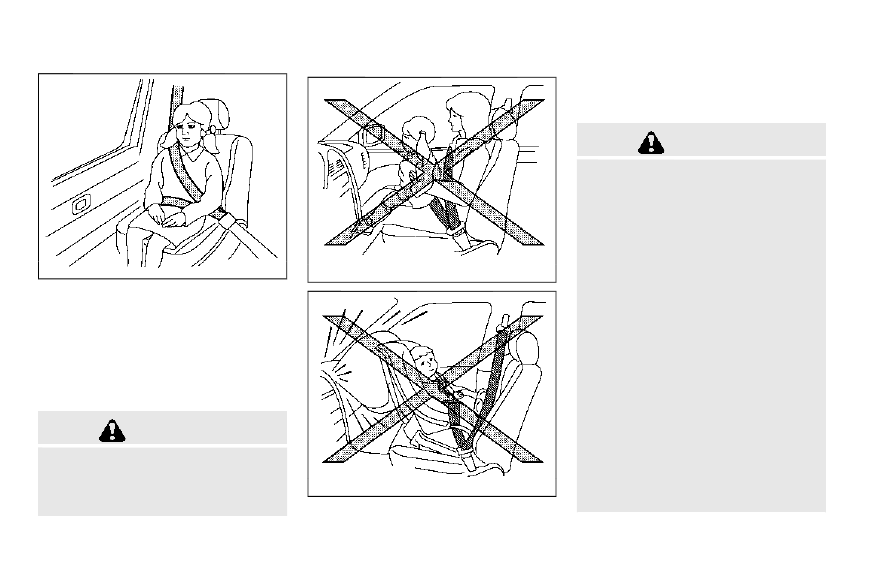
SSS0099

SSS0100

PRECAUTIONS ON CHILD RE-
STRAINTS

WARNING

.

Failure to follow the warnings and
instructions for proper use and in-
stallation of child restraints could
result in serious injury or death of a
child or other passengers in a sudden
stop or collision:

— The child restraint must be used

and installed properly. Always
follow all of the child restraint
manufacturer’s instructions for
installation and use.

— Infants and children should never

be held on anyone’s lap. Even the
strongest adult cannot resist the
forces of a collision.

— Do not put a seat belt around

both a child and another passen-
ger.

— INFINITI recommends that all

child restraints be installed in the
rear seat. Studies show that chil-
dren are safer when properly re-
strained in the rear seat than in
the front seat. If you must install a

CHILD RESTRAINTS

CarManuals2.com

-------------------------------------------------------------------------------------------------------------------------------------------------------------

forward-facing child restraint in
the front seat, see “Forward-
facing child restraint installation
using the seat belts” (P.1-35).

— Even with the INFINITI Advanced

Air Bag System, never install a
rear-facing child restraint in the
front seat. An inflating air bag
could seriously injure or kill a child.
A rear-facing child restraint must
only be used in the rear seat.

— Be sure to purchase a child re-

straint that will fit the child and
vehicle. Some child restraints may
not fit properly in your vehicle.

— Child restraint anchor points are

designed to withstand loads from
child restraints that are properly
fitted.

— Never use the anchor points for

adult seat belts or harnesses.

— A child restraint with a top tether

strap should not be used in the
front passenger seat.

— Keep seatbacks as upright as

possible after fitting the child
restraint.

— Infants and children should al-

ways be placed in an appropriate

child restraint while in the vehicle.

.

When the child restraint is not in use,
keep it secured with the LATCH
system or a seat belt. In a sudden
stop or collision, loose objects can
injure occupants or damage the ve-
hicle.

CAUTION

A child restraint in a closed vehicle can
become very hot. Check the seating
surface and buckles before placing a
child in the child restraint.

This vehicle is equipped with a universal child
restraint anchor system, referred to as the
LATCH (Lower Anchors and Tethers for
CHildren) system. Some child restraints in-
clude rigid or webbing-mounted attach-
ments that can be connected to these
anchors.
For details, see “Lower Anchors and Tethers
for CHildren System (LATCH)” (P.1-24).
If you do not have a LATCH compatible child
restraint, the vehicle seat belts can be used.
Several manufacturers offer child restraints
for infants and small children of various
sizes. When selecting any child restraint,

keep the following points in mind:

.

Choose only a restraint with a label

certifying that it complies with Federal
Motor Vehicle Safety Standard 213 or
Canadian Motor Vehicle Safety Stan-
dard 213.

.

Check the child restraint in your vehicle to

be sure it is compatible with the vehicle’s
seat and seat belt system.

.

If the child restraint is compatible with

your vehicle, place your child in the child
restraint and check the various adjust-
ments to be sure the child restraint is
compatible with your child. Choose a
child restraint that is designed for your
child’s height and weight. Always follow
all recommended procedures.

.

If the combined weight of the child and

child restraint is less than 65 lbs (29.5
kg), you may use either the LATCH
anchors or the seat belt to install the
child restraint (not both at the same
time).

.

If the combined weight of the child and

child restraint is greater than 65 lbs (29.5
kg), use the vehicle’s seat belt (not the
lower anchors) to install the child re-
straint.

.

Be sure to follow the child restraint

manufacturer’s instructions for installa-
tion.

Safety — Seats, seat belts and supplemental restraint system

1-23

CarManuals2.com

-------------------------------------------------------------------------------------------------------------------------------------------------------------

1-24

Safety — Seats, seat belts and supplemental restraint system

All U.S. states and Canadian provinces or
territories require that infants and small
children be restrained in an approved child
restraint at all times while the vehicle is
being operated. Canadian law requires the
top tether strap on forward-facing child
restraints be secured to the designated
anchor point on the vehicle.

JVR0188X

Models with rear seat folding

SSS0567

Models without rear seat folding

Lower Anchors and Tethers for
CHildren System (LATCH)

Your vehicle is equipped with special anchor
points that are used with the LATCH (Lower
Anchors and Tethers for CHildren) system
compatible child restraints. This system may
also be referred to as the ISOFIX or ISOFIX
compatible system. With this system, you do
not have to use a vehicle seat belt to secure
the child restraint unless the combined
weight of the child and child restraint
exceeds 65 lbs (29.5 kg). If the combined
weight of the child and child restraint is
greater than 65 lbs (29.5 kg), use the
vehicle’s seat belt (not the lower anchors)
to install the child restraint. Be sure to follow
the child restraint manufacturer’s instruc-
tions for installation.
The LATCH anchor points can be used to
install child restraints in either of the rear
outboard seating positions or in the center
rear seating position. Please refer to the
following section of this Owner’s Manual for
specific information about installing a child
restraint in the center rear seating position
using the LATCH anchors.

CarManuals2.com

-------------------------------------------------------------------------------------------------------------------------------------------------------------

LATCH lower anchor

WARNING

Failure to follow the warnings and
instructions for proper use and installa-
tion of child restraints could result in
serious injury or death of a child or other
passengers in a sudden stop or collision:

.

Only attach LATCH system compa-
tible child restraints to the lower
anchors shown in the illustration.
(See the following sections of this
Owner’s Manual for installation gui-
dance.)

.

Inspect the lower anchors by insert-
ing your fingers into the lower anchor
area. Feel to make sure there are no
obstructions over the anchors such as
seat belt webbing or seat cushion
material. The child restraint will not
be secured properly if the lower
anchors are obstructed.

Child restraint anchorages are designed
to withstand only those loads imposed
by correctly fitted child restraints. Under
no circumstances are they to be used to
attach adult seat belts, or other items or
equipment to the vehicle. Doing so could
damage the child restraint anchorages.

The child restraint will not be properly
installed using the damaged anchorage,
and a child could be seriously injured or
killed in a collision.

SSS0637

LATCH lower anchor location

Models without rear seat folding:

The LATCH lower anchors are located at the
rear of the seat cushion near the seatback. A
label is attached to the seatback to help you
locate the LATCH lower anchors.

Safety — Seats, seat belts and supplemental restraint system

1-25

CarManuals2.com

-------------------------------------------------------------------------------------------------------------------------------------------------------------

1-26

Safety — Seats, seat belts and supplemental restraint system

WAB0039X

Models with rear seat folding:

The LATCH lower anchors are located
behind the cover. Flip and fold the cover,
and fix it with the hook-and-loop fastener as
shown. A label is attached to the seatback to
help you locate the LATCH lower anchors.

WAB0130X

LATCH in the center rear seating
position

There are no LATCH anchors dedicated to
the center rear seating position. However,
the inboard LATCH anchors belonging to
the two outboard seating positions (indi-
cated by the arrows) can be used together to
secure a CRS in the center rear seating
position. These anchors are separated by a
distance

of 15.6 in (395 mm). Before

attempting to secure a CRS in this seating
position, ensure that the CRS manufac-
turer’s instructions permit the use of LATCH
anchors with the spacing indicated above.
(These are sometimes referred to as “shared
anchors” or “borrowed anchors”.)

CRS with rigid lower attachments cannot be
installed in the center seat. This type of CRS
should only be installed in the outboard
seating positions.

WARNING

Never attach two CRS attachments to
the same LATCH anchor. This may over-
load the anchor in a collision, which could
increase the risk of the occupant’s
serious injury or death.

When installing the CRS in the center
rear seating position with the inboard
LATCH anchors, be careful to ensure any
occupant or CRS in the outboard seating
positions is properly restrained using the
vehicle seat belt and there is no inter-
ference with the center CRS installation.
If the outboard occupants cannot be
properly restrained, consider using the
vehicle seat belt to restrain the CRS in
the center seating position, or moving
the CRS to another position instead.

CarManuals2.com

-------------------------------------------------------------------------------------------------------------------------------------------------------------

SSS0643

LATCH webbing-mounted attachment

Installing child restraint LATCH
lower anchor attachments

LATCH compatible child restraints include
two rigid or webbing-mounted attachments
that can be connected to two anchors
located at certain seating positions in your
vehicle. With this system, you do not have to
use a vehicle seat belt to secure the child
restraint. Check your child restraint for a
label stating that it is compatible with
LATCH. This information may also be in
the instructions provided by the child re-
straint manufacturer.

SSS0644

LATCH rigid-mounted attachment

When installing a child restraint, carefully
read and follow the instructions in this
manual and those supplied with the child
restraint.

JVR0258X

Top tether anchor point locations

Anchor points are located on the rear parcel
shelf.

If you have any questions when installing a
top tether strap child restraint on the rear
seat, it is recommended you visit an
INFINITI retailer for this service.

The child restraint top tether strap must be
used when installing forward facing child
restraints with the LATCH lower anchor
attachments or seat belts. (See “Installing
top tether strap” (P.1-34).)

Safety — Seats, seat belts and supplemental restraint system

1-27

CarManuals2.com

-------------------------------------------------------------------------------------------------------------------------------------------------------------

1-28

Safety — Seats, seat belts and supplemental restraint system

WARNING

Child restraint anchorages are designed
to withstand only those loads imposed
by correctly fitted child restraints. Under
no circumstances are they to be used to
attach adult seat belts, or other items or
equipment to the vehicle. Doing so could
damage the child restraint anchorages.
The child restraint will not be properly
installed using the damaged anchorage,
and a child could be seriously injured or
killed in a collision.

REAR-FACING CHILD RE-
STRAINT INSTALLATION USING
LATCH

For additional information, refer to all
Warnings and Cautions in the “Child safety”
and “Child restraints” sections before instal-
ling a child restraint.
Do not use the lower anchors if the com-
bined weight of the child and the child
restraint exceeds 65 lbs (29.5 kg). If the
combined weight of the child and the child
restraint is greater than 65 lbs (29.5 kg), use
the vehicle’s seat belt (not the lower an-
chors) to install the child restraint. Be sure to
follow the child restraint manufacturer’s

instructions for installation.
Follow these steps to install a rear-facing
child restraint using the LATCH system:
1. Position the child restraint on the seat.

Always follow the child restraint manu-
facturer’s instructions.

SSS0648

Rear-facing web-mounted — step 2

2. Secure the child restraint anchor attach-

ments to the LATCH lower anchors.
Check to make sure the LATCH attach-
ment is properly attached to the lower
anchors.

CarManuals2.com

-------------------------------------------------------------------------------------------------------------------------------------------------------------

SSS0649

Rear-facing rigid-mounted — step 2

SSS0639

Rear-facing — step 3

3. For child restraints that are equipped

with webbing-mounted attachments, re-
move any additional slack from the
anchor attachments. Press downward
and rearward firmly in the center of the
child restraint with your hand to com-
press the vehicle seat cushion and seat-
back while tightening the webbing of the
anchor attachments.

SSS0650

Rear-facing — step 4

4. After attaching the child restraint, test it

before you place the child in it. Push it
from side to side while holding the child
restraint near the LATCH attachment
path. The child restraint should not move
more than 1 inch (25 mm), from side to
side. Try to tug it forward and check to
see if the LATCH attachment holds the
restraint in place. If the restraint is not
secure, tighten the LATCH attachment
as necessary, or put the restraint in
another seat and test it again. You may
need to try a different child restraint or
try installing by using the vehicle seat
belt (if applicable). Not all child restraints
fit in all types of vehicles.

Safety — Seats, seat belts and supplemental restraint system

1-29

CarManuals2.com

-------------------------------------------------------------------------------------------------------------------------------------------------------------

1-30

Safety — Seats, seat belts and supplemental restraint system

5. Check to make sure the child restraint is

properly secured prior to each use. If the
child restraint is loose, repeat steps 1
through 4.

REAR-FACING CHILD RE-
STRAINT INSTALLATION USING
THE SEAT BELTS

WARNING

The three-point seat belt with Auto-
matic Locking Retractor (ALR) must be
used when installing a child restraint.
Failure to use the ALR mode will result in
the child restraint not being properly
secured. The restraint could tip over or
be loose and cause injury to a child in a
sudden stop or collision. Also, it can
change the operation of the front pas-
senger air bag. See “Front passenger air
bag and status light” (P.1-50).

For additional information, refer to all
Warnings and Cautions in the “Child safety”
(P.1-20) and “Child restraints” (P.1-22)
before installing a child restraint.
Do not use the lower anchors if the com-
bined weight of the child and the child
restraint exceeds 65 lbs (29.5 kg). If the

combined weight of the child and the child
restraint is greater than 65 lbs (29.5 kg), use
the vehicle’s seat belt (not the lower an-
chors) to install the child restraint. Be sure to
follow the child restraint manufacturer’s
instructions for installation.
Follow these steps to install a rear-facing
child restraint using the vehicle seat belts in
the rear seats:

SSS0100

Rear-facing — step 1

1.

Child restraints for infants must be used
in the rear-facing direction and there-
fore must not be used in the front seat.

Position the child restraint on the seat.
Always follow the restraint manufac-
turer’s instructions.

CarManuals2.com

-------------------------------------------------------------------------------------------------------------------------------------------------------------

SSS0654

Rear-facing — step 2

2. Route the seat belt tongue through the

child restraint and insert it into the buckle
until you hear and feel the latch engage.
Be sure to follow the child restraint
manufacturer’s instructions for belt
routing.

SSS0655

Rear-facing — step 3

3. Pull the shoulder belt until the belt is fully

extended. At this time, the seat belt
retractor is in the Automatic Locking
Retractor (ALR) mode (child restraint
mode). It reverts to the Emergency
Locking Retractor (ELR) mode when
the seat belt is fully retracted.

SSS0656

Rear-facing — step 4

4. Allow the seat belt to retract. Pull up on

the shoulder belt to remove any slack in
the belt.

Safety — Seats, seat belts and supplemental restraint system

1-31

CarManuals2.com

-------------------------------------------------------------------------------------------------------------------------------------------------------------

1-32

Safety — Seats, seat belts and supplemental restraint system

SSS0657

Rear-facing — step 5

5. Remove any additional slack from the

seat belt; press downward and rearward
firmly in the center of the child restraint
to compress the vehicle seat cushion and
seatback while pulling up on the seat
belt.

SSS0658

Rear-facing — step 6

6. After attaching the child restraint, test it

before you place the child in it. Push it
from side to side while holding the child
restraint near the seat belt path. The
child restraint should not move more
than 1 inch (25 mm), from side to side.
Try to tug it forward and check to see if
the belt holds the restraint in place. If the
restraint is not secure, tighten the seat
belt as necessary, or put the restraint in
another seat and test it again. You may
need to try a different child restraint. Not
all child restraints fit in all types of
vehicles.

7. Check to make sure that the child

restraint is properly secured prior to each

use. If the seat belt is not locked, repeat
steps 1 through 6.

After the child restraint is removed and the
seat belt fully retracted, the ALR mode (child
restraint mode) is canceled.

FORWARD-FACING CHILD RE-
STRAINT INSTALLATION USING
LATCH

For additional information, refer to all
Warnings and Cautions in the “Child safety”
and “Child restraints” sections before instal-
ling a child restraint.
Do not use the lower anchors if the com-
bined weight of the child and the child
restraint exceeds 65 lbs (29.5 kg). If the
combined weight of the child and the child
restraint is greater than 65 lbs (29.5 kg), use
the vehicle’s seat belt (not the lower an-
chors) to install the child restraint. Be sure to
follow the child restraint manufacturer’s
instructions for installation.
Follow these steps to install a forward-
facing child restraint using the LATCH
system:
1. Position the child restraint on the seat.

Always follow the child restraint manu-
facturer’s instructions.

CarManuals2.com

-------------------------------------------------------------------------------------------------------------------------------------------------------------

SSS0645

Forward-facing web-mounted — step 2

2. Secure the child restraint anchor attach-

ments to the LATCH lower anchors.
Check to make sure the LATCH attach-
ment is properly attached to the lower
anchors.
If the child restraint is equipped with a
top tether strap, route the top tether
strap and secure the tether strap to the
tether anchor point. See “Installing top
tether strap” (P.1-34). Do not install child
restraints that require the use of a top
tether strap in seating positions that do
not have a top tether anchor.

SSS0646

Forward-facing rigid-mounted — step 2

3. The back of the child restraint should be

secured against the vehicle seatback.
If necessary, adjust or remove the head
restraint to obtain the correct child
restraint fit. If the head restraint is
removed, store it in a secure place.

Be

sure to reinstall the head restraint when
the child restraint is removed.

See “Head

restraints/headrests” (P.1-8) for head
restraint adjustment information.
If the seating position does not have an
adjustable head restraint and it is inter-
fering with the proper child restraint fit,
try another seating position or a differ-
ent child restraint.

SSS0647

Forward-facing — step 4

4. For child restraints that are equipped

with webbing-mounted attachments, re-
move any additional slack from the
anchor attachments. Press downward
and rearward firmly in the center of the
child restraint with your knee to com-
press the vehicle seat cushion and seat-
back while tightening the webbing of the
anchor attachments.

5. Tighten the tether strap according to the

manufacturer’s instructions to remove
any slack.

Safety — Seats, seat belts and supplemental restraint system

1-33

CarManuals2.com

-------------------------------------------------------------------------------------------------------------------------------------------------------------

1-34

Safety — Seats, seat belts and supplemental restraint system

SSS0638

Forward-facing — step 6

6. After attaching the child restraint, test it

before you place the child in it. Push it
from side to side while holding the child
restraint near the LATCH attachment
path. The child restraint should not move
more than 1 inch (25 mm), from side to
side. Try to tug it forward and check to
see if the LATCH attachment holds the
restraint in place. If the restraint is not
secure, tighten the LATCH attachment
as necessary, or put the restraint in
another seat and test it again. You may
need to try a different child restraint. Not
all child restraints fit in all types of
vehicles.

7. Check to make sure the child restraint is

properly secured prior to each use. If the
child restraint is loose, repeat steps 1
through 6.

WAB0131X

Anchor point
Top tether strap

Installing top tether strap

WARNING

Child restraint anchorages are designed
to withstand only those loads imposed
by correctly fitted child restraints. Under
no circumstances are they to be used to
attach adult seat belts, or other items or
equipment to the vehicle. Doing so could
damage the child restraint anchorages.
The child restraint will not be properly
installed using the damaged anchorage,

CarManuals2.com

-------------------------------------------------------------------------------------------------------------------------------------------------------------

and a child could be seriously injured or
killed in a collision.

The child restraint top tether strap must be
used when installing forward-facing child
restraints with the LATCH lower anchor
attachments.
First, secure the child restraint with the
LATCH lower anchors.
1. Position the top tether strap

over the

seatback.
If necessary, raise or remove the head
restraint or headrest to position the top
tether strap over the top of the seatback.
If the head restraint or headrest is
removed, store it in a secure place. Be
sure to reinstall the head restraint or
headrest when the child restraint is
removed.

See “Head restraints/headrests” (P.1-
8) for head restraint or headrest adjust-
ment, removal and installation informa-
tion.

2. Secure the tether strap to the tether

anchor point

as shown.

3. Tighten the tether strap according to the

manufacturer’s instructions to remove
any slack.

If you have any questions when installing a
top tether strap, it is recommended you

visit an INFINITI retailer for this service.

FORWARD-FACING CHILD RE-
STRAINT INSTALLATION USING
THE SEAT BELTS

WARNING

The three-point seat belt with Auto-
matic Locking Retractor (ALR) must be
used when installing a child restraint.
Failure to use the ALR mode will result in
the child restraint not being properly
secured. The restraint could tip over or
be loose and cause injury to a child in a
sudden stop or collision. Also, it can
change the operation of the front pas-
senger air bag. See “Front passenger air
bag and status light” (P.1-50).

SSS0640

Forward-facing (front passenger seat) —

step 1

For additional information, refer to all
Warnings and Cautions in the “Child safety”
and “Child restraints” sections before instal-
ling a child restraint.
Do not use the lower anchors if the com-
bined weight of the child and the child
restraint exceeds 65 lbs (29.5 kg). If the
combined weight of the child and the child
restraint is greater than 65 lbs (29.5 kg), use
the vehicle’s seat belt (not the lower an-
chors) to install the child restraint. Be sure to
follow the child restraint manufacturer’s
instructions for installation.
Follow these steps to install a forward-
facing child restraint using the vehicle seat

Safety — Seats, seat belts and supplemental restraint system

1-35

CarManuals2.com

-------------------------------------------------------------------------------------------------------------------------------------------------------------

1-36

Safety — Seats, seat belts and supplemental restraint system

belt in the rear seats or in the front
passenger seat:
1.

If you must install a child restraint in the
front seat, it should be placed in a
forward-facing direction only. Move
the seat to the rearmost position. Child
restraints for infants must be used in the
rear-facing direction and, therefore,
must not be used in the front seat.

2. Position the child restraint on the seat.

Always follow the child restraint manu-
facturer’s instructions.
The back of the child restraint should be
secured against the vehicle seatback.
If necessary, adjust or remove the head
restraint or headrest to obtain the
correct child restraint fit. If the head
restraint or headrest is removed, store it
in a secure place.

Be sure to reinstall the

head restraint or headrest when the
child restraint is removed.

See “Head

restraints/headrests” (P.1-8) for head
restraint or headrest adjustment, re-
moval and installation information.
If the seating position does not have an
adjustable head restraint or headrest
and it is interfering with the proper child
restraint fit, try another seating position
or a different child restraint.

SSS0360B

Forward-facing — step 3

3. Route the seat belt tongue through the

child restraint and insert it into the buckle
until you hear and feel the latch engage.
Be sure to follow the child restraint
manufacturer’s instructions for belt
routing.
If the child restraint is equipped with a
top tether strap, route the top tether
strap and secure the tether strap to the
tether anchor point (rear seat installation
only). See “Installing top tether strap”
(P.1-38). Do not install child restraints
that require the use of a top tether strap
in seating positions that do not have a
top tether anchor.

SSS0651

Forward-facing — step 4

4. Pull the shoulder belt until the belt is fully

extended. At this time, the seat belt
retractor is in the Automatic Locking
Retractor (ALR) mode (child restraint
mode). It reverts to Emergency Locking
Retractor (ELR) mode when the seat belt
is fully retracted.

CarManuals2.com

-------------------------------------------------------------------------------------------------------------------------------------------------------------

SSS0652

Forward-facing — step 5

5. Allow the seat belt to retract. Pull up on

the shoulder belt to remove any slack in
the belt.

SSS0653

Forward-facing — step 6

6. Remove any additional slack from the

seat belt; press downward and rearward
firmly in the center of the child restraint
with your knee to compress the vehicle
seat cushion and seatback while pulling
up on the seat belt.

7. Tighten the tether strap according to the

manufacturer’s instructions to remove
any slack.

SSS0641

Forward-facing — step 8

8. After attaching the child restraint, test it

before you place the child in it. Push it
from side to side while holding the child
restraint near the seat belt path. The
child restraint should not move more
than 1 inch (25 mm), from side to side.
Try to tug it forward and check to see if
the belt holds the restraint in place. If the
restraint is not secure, tighten the seat
belt as necessary, or put the restraint in
another seat and test it again. You may
need to try a different child restraint. Not
all child restraints fit in all types of
vehicles.

9. Check to make sure the child restraint is

properly secured prior to each use. If the

Safety — Seats, seat belts and supplemental restraint system

1-37

CarManuals2.com

-------------------------------------------------------------------------------------------------------------------------------------------------------------

1-38

Safety — Seats, seat belts and supplemental restraint system

seat belt is not locked, repeat steps 2
through 8.

JVR0192X

Forward-facing — step 10

10. If the child restraint is installed in the

front passenger seat, place the ignition
switch in the ON position. The front
passenger air bag status light

should

illuminate. If this light is not illuminated,
see “Front passenger air bag and status
light” (P.1-50).

Move the child restraint

to another seating position.

Have the

system checked. It is recommended you
visit an INFINITI retailer for this service.

After the child restraint is removed and the
seat belt is fully retracted, the ALR mode
(child restraint mode) is canceled.

WAB0131X

Anchor point
Top tether strap

Installing top tether strap

WARNING

Child restraint anchorages are designed
to withstand only those loads imposed
by correctly fitted child restraints. Under
no circumstances are they to be used to
attach adult seat belts, or other items or
equipment to the vehicle. Doing so could
damage the child restraint anchorages.
The child restraint will not be properly
installed using the damaged anchorage,

CarManuals2.com

-------------------------------------------------------------------------------------------------------------------------------------------------------------

and a child could be seriously injured or
killed in a collision.

The child restraint top tether strap must be
used when installing forward-facing child
restraints with the seat belts.
First, secure the child restraint with the seat
belt.
1. Position the top tether strap

over the

seatback.
If necessary, raise or remove the head
restraint or headrest to position the top
tether strap over the top of the seatback.
If the head restraint or headrest is
removed, store it in a secure place. Be
sure to reinstall the head restraint or
headrest when the child restraint is
removed.

See “Head restraints/headrests” (P.1-
8) for head restraint or headrest adjust-
ment, removal and installation informa-
tion.

2. Secure the tether strap to the tether

anchor point

as shown.

3. Tighten the tether strap according to the

manufacturer’s instructions to remove
any slack.

If you have any questions when installing a
top tether strap, it is recommended you
visit an INFINITI retailer for this service.

BOOSTER SEATS

For additional information on installing a
booster seat in your vehicle, follow the
instructions outlined in this section.

Precautions on booster seats

WARNING

If a booster seat and seat belt are not
used properly, the risk of a child being
injured or killed in a sudden stop or
collision greatly increases:

.

Make sure the shoulder portion of
the belt is away from the child’s face
and neck and the lap portion of the
belt does not cross the stomach.

.

Make sure the shoulder belt is not
behind the child or under the child’s
arm.

.

A booster seat must only be installed
in a seating position that has a lap/
shoulder belt.

LRS0455

Booster seats of various sizes are offered by
several manufacturers. When selecting any
booster seat, keep the following points in
mind:

.

Choose only a booster seat with a label

certifying that it complies with Federal
Motor Vehicle Safety Standard 213 or
Canadian Motor Vehicle Safety Stan-
dard 213.

.

Check the booster seat in your vehicle to

be sure it is compatible with the vehicle’s
seat and seat belt system.

Safety — Seats, seat belts and supplemental restraint system

1-39

CarManuals2.com

-------------------------------------------------------------------------------------------------------------------------------------------------------------

1-40

Safety — Seats, seat belts and supplemental restraint system

LRS0453

.

Make sure the child’s head will be

properly supported by the booster seat
or vehicle seat. The seatback must be at
or above the center of the child’s ears.
For example, if a low back booster seat

is chosen, the vehicle seatback must be

at or above the center of the child’s ears.
If the seatback is lower than the center
of the child’s ears, a high back booster
seat

should be used.

LRS0464

.

If the booster seat is compatible with

your vehicle, place your child in the
booster seat and check the various
adjustments to be sure the booster seat
is compatible with your child. Always
follow all recommended procedures.

All U.S. states and Canadian provinces or
territories require that infants and small
children be restrained in an approved child
restraint at all times while the vehicle is
being operated.

The instructions in this section apply to
booster seat installation in the rear seats or
the front passenger seat.

Booster seat installation

WARNING

To avoid injury to child, do not use the
lap/shoulder belt Automatic Locking
Retractor (ALR) mode when using a
booster seat with the seat belts.

For additional information, refer to all
Warnings and Cautions in the “Child safety”,
“Child restraints” and “Booster seats” sec-
tions earlier in this section before installing a
child restraint.
Follow these steps to install a booster seat in
the rear seat or in the front passenger seat:

CarManuals2.com

-------------------------------------------------------------------------------------------------------------------------------------------------------------

SSS0640

1.

If you must install a booster seat in the
front seat, move the seat to the rear-
most position.

2. Position the booster seat on the seat.

Only place it in a forward-facing direc-
tion. Always follow the booster seat
manufacturer’s instructions.

LRS0454

Front passenger position

3. The booster seat should be positioned on

the vehicle seat so that it is stable.
If necessary, adjust or remove the head
restraint or headrest to obtain the
correct booster seat fit. If the head
restraint or headrest is removed, store
it in a secure place.

Be sure to reinstall

the head restraint or headrest when the
booster seat is removed.

See “Head

restraints/headrests” (P.1-8) for head
restraint or headrest adjustment, re-
moval and installation information.
If the seating position does not have an
adjustable head restraint or headrest
and it is interfering with the proper

booster seat fit, try another seating
position or a different booster seat.

4. Position the lap portion of the seat belt

low and snug on the child’s hips. Be sure
to follow the booster seat manufac-
turer’s instructions for adjusting the seat
belt routing.

5. Pull the shoulder belt portion of the seat

belt toward the retractor to take up
extra slack. Be sure the shoulder belt is
positioned across the top, middle portion
of the child’s shoulder. Be sure to follow
the booster seat manufacturer’s instruc-
tions for adjusting the seat belt routing.

6. Follow the warnings, cautions and in-

structions for properly fastening a seat
belt shown in “Seat belts” (P.1-12).

Safety — Seats, seat belts and supplemental restraint system

1-41

CarManuals2.com

-------------------------------------------------------------------------------------------------------------------------------------------------------------

1-42

Safety — Seats, seat belts and supplemental restraint system

JVR0192X

7. If the booster seat is installed in the front

passenger seat, push the ignition switch
to the ON position. The front passenger
air bag status light

may or may not

illuminate depending on the size of the
child and the type of booster seat used.
See “Front passenger air bag and status
light” (P.1-50).

PRECAUTIONS ON SUPPLE-
MENTAL RESTRAINT SYSTEM

This Supplemental Restraint System (SRS)
section contains important information con-
cerning the following systems:

.

Driver and passenger front-impact sup-

plemental air bags (INFINITI Advanced
Air Bag System)

.

Front seat-mounted side-impact supple-

mental air bag

.

Roof-mounted curtain side-impact and

rollover supplemental air bag

.

Seat belt with pretensioner

Supplemental front-impact air bag system:

The INFINITI Advanced Air Bag System can
help cushion the impact force to the head
and chest of the driver and front passenger
in certain frontal collisions.

Front seat-mounted side-impact supple-
mental air bag system:

This system can help

cushion the impact force to the chest and
pelvis area of the driver and front passenger
in certain side impact collisions. The side air
bag is designed to inflate on the side where
the vehicle is impacted.

Roof-mounted curtain side-impact and roll-
over supplemental air bag system:

This

system can help cushion the impact force
to the head of occupants in front and rear
outboard seating positions in certain side

impact or rollover collisions. In a side impact,
the curtain air bags are designed to inflate
on the side where the vehicle is impacted. In
a rollover, the curtain air bags on both sides
are designed to inflate and remain inflated
for a short time.
Curtain air bags are also designed to inflate
in certain types of rollover collisions or near
rollovers. As a result, certain vehicle move-
ments may cause the curtain air bags to
inflate.
These supplemental restraint systems are
designed to

supplement

the crash protection

provided by the driver and passenger seat
belts and are

not a substitute

for them. Seat

belts should always be correctly worn and
the occupant seated a suitable distance
away from the steering wheel, instrument
panel and door finishers. (See “Seat belts”
(P.1-12) for instructions and precautions on
seat belt usage.)

The supplemental air bags operate only
when the ignition switch is in the ON
position.

After pushing the ignition switch to the ON
position, the supplemental air bag warning
light illuminates. The supplemental air bag
warning light will turn off after about 7
seconds if the systems are operational.

SUPPLEMENTAL RESTRAINT SYSTEM

CarManuals2.com

-------------------------------------------------------------------------------------------------------------------------------------------------------------

SSS0131B

SSS0132B

WARNING

.

The front air bags ordinarily will not
inflate in the event of a side impact,
rear impact, rollover, or lower sever-
ity frontal collision. Always wear
your seat belts to help reduce the
risk or severity of injury in various
kinds of accidents.

.

The front passenger air bag will not
inflate if the passenger air bag status
light is lit. See “Front passenger air
bag and status light” (P.1-50).

.

The seat belts and the front air bags
are most effective when you are
sitting well back and upright in the
seat with both feet on the floor. The
front air bags inflate with great
force. Even with the INFINITI Ad-
vanced Air Bag System, if you are
unrestrained, leaning forward, sitting
sideways or out of position in any
way, you are at greater risk of injury
or death in a crash. You may also
receive serious or fatal injuries from
the front air bag if you are up against
it when it inflates. Always sit back
against the seatback and as far-away
as practical from the steering wheel
or instrument panel. Always use the
seat belts.

Safety — Seats, seat belts and supplemental restraint system

1-43

CarManuals2.com

-------------------------------------------------------------------------------------------------------------------------------------------------------------

1-44

Safety — Seats, seat belts and supplemental restraint system

.

The driver and front passenger seat
belt buckles are equipped with sen-
sors that detect if the seat belts are
fastened. The Advanced Air Bag
System monitors the severity of a
collision and seat belt usage then
inflates the air bags as needed. Fail-
ure to properly wear seat belts can
increase the risk or severity of injury
in an accident.

.

The front passenger seat is equipped
with occupant classification sensors
(weight sensors) that turn the front
passenger air bag OFF under some
conditions. These sensors are only
used in this seat. Failure to be
properly seated and wearing the seat
belt can increase the risk or severity
of injury in an accident. See “Front
passenger air bag and status light”
(P.1-50).

.

Keep hands on the outside of the
steering wheel. Placing them inside
the steering wheel rim could increase
the risk of injury if the front air bag
inflates.

SSS0007

SSS0006

SSS0008

SSS0009

CarManuals2.com

-------------------------------------------------------------------------------------------------------------------------------------------------------------

SSS0099

SSS0100

WARNING

.

Never let children ride unrestrained
or extend their hands or face out of
the window. Do not attempt to hold
them in your lap or arms. Some
examples of dangerous riding posi-
tions are shown in the illustrations.

.

Children may be severely injured or
killed when the front air bags, side air
bags or curtain air bags inflate if they
are not properly restrained. Pre-
teens and children should be properly
restrained in the rear seat, if possible.

.

Even with the INFINITI Advanced Air
Bag System, never install a rear-
facing child restraint in the front
seat. An inflating front air bag could
seriously injure or kill your child. See
“Child restraints” (P.1-22) for de-
tails.

SSS0059A

SSS0188A

Safety — Seats, seat belts and supplemental restraint system

1-45

CarManuals2.com

-------------------------------------------------------------------------------------------------------------------------------------------------------------

1-46

Safety — Seats, seat belts and supplemental restraint system

SSS0140

SSS0162

SSS0159

WARNING

Front seat-mounted side-impact supple-
mental air bags and roof-mounted cur-
t a i n s i d e - i m p a c t a n d r o l l o v e r
supplemental air bags:

.

The side air bags ordinarily will not
inflate in the event of a frontal
impact, rear impact, rollover or lower
severity side collision. Always wear
your seat belts to help reduce the risk
or severity of injury in various kinds
of accidents.

.

The curtain air bags ordinarily will
not inflate in the event of a front

impact, rear impact, or lower severity
side collision. Always wear your seat
belts to help reduce the risk or
severity of injury in various kinds of
accidents.

.

The seat belts, side air bags and
curtain air bags are most effective
when you are sitting well back and
upright in the seat. The side air bag
and curtain air bag inflate with great
force. Do not allow anyone to place
their hand, leg or face near the side
air bag on the side of the seatback of
the front seat or near the side roof
rails. Do not allow anyone sitting in
the front seats or rear outboard seats
to extend their hand out of the
window or lean against the door.
Some examples of dangerous riding
positions are shown in the previous
illustrations.

.

When sitting in the rear seat, do not
hold onto the seatback of the front
seat. If the supplemental side air bag
inflates, you may be seriously injured.
Be especially careful with children,
who should always be properly re-
strained. Some examples of danger-
ous riding positions are shown in the
illustrations.

CarManuals2.com

-------------------------------------------------------------------------------------------------------------------------------------------------------------

.

Do not use seat covers on the front
seatbacks. They may interfere with
side air bag inflation.

Safety — Seats, seat belts and supplemental restraint system

1-47

CarManuals2.com

-------------------------------------------------------------------------------------------------------------------------------------------------------------

1-48

Safety — Seats, seat belts and supplemental restraint system

JVR0514X

1.

Crash zone sensor

2.

Supplemental front air bag modules
(INFINITI Advanced Air Bags)

3.

Front seat-mounted side-impact sup-
plemental air bags

4.

Occupant classification sensors
(weight sensors)

5.

Occupant classification system control
unit

6.

Roof-mounted curtain side-impact and
rollover supplemental air bags

7.

Roof-mounted curtain side-impact and
rollover supplemental air bag inflators

8.

Pressure sensors in door

9.

Air bag Control Unit (ACU)

10. Satellite sensors
11. Seat belts with pretensioners
12. Lap outer pretensioners

INFINITI ADVANCED AIR BAG
SYSTEM (front seats)

WARNING

To ensure proper operation of the pas-
senger’s Advanced Air Bag System, ob-
serve the following items.

.

Do not allow a passenger in the rear
seat to push or pull on the seatback
pocket.

.

Do not place heavy loads heavier
than 9.1 lbs. (4 kg) on the seatback,
head restraint or in the seatback
pocket.

.

Make sure that there is nothing
pressing against the rear of the seat-
back, such as a child restraint in-
stalled in the rear seat or an object
stored on the floor.

.

Make sure that there is no object
placed under the front passenger
seat.

CarManuals2.com

-------------------------------------------------------------------------------------------------------------------------------------------------------------

.

Make sure that there is no object
placed between the seat cushion and
center console or between the seat
cushion and the door.

.

Be sure that the front passenger seat
does not contact the rear seat, in-
strument panel, etc., or the head
restraint does not contact the roof.

.

Confirm the operating condition with
the front passenger air bag status
light.

.

If you notice that the front passenger
air bag status light is not operating
as described in this section, it is
recommended you visit an INFINITI
retailer to check the passenger seat
Advanced Air Bag System.

.

Until you have confirmed with a
retailer that your passenger seat
Advanced Air Bag System is working
properly, position the occupants in
the rear seating positions.

.

Do not position the front passenger
seat so it contacts the rear seat. If the
front seat does contact the rear seat,
the air bag system may determine a
sensor malfunction has occurred and
the front passenger air bag status
light may illuminate and the supple-
mental air bag warning light may

flash.

This vehicle is equipped with the INFINITI
Advanced Air Bag System for the driver and
front passenger seats. This system is de-
signed to meet certification requirements
under U.S. regulations. It is also permitted in
Canada.

All of the information, cautions and

warnings in this manual apply and must be
followed.

The driver supplemental front-impact air
bag is located in the center of the steering
wheel. The front passenger supplemental
front-impact air bag is mounted in the
instrument panel above the glove box. The
front air bags are designed to inflate in
higher severity frontal collisions, although
they may inflate if the forces in another type
of collision are similar to those of a higher
severity frontal impact. They may not inflate
in certain frontal collisions. Vehicle damage
(or lack of it) is not always an indication of
proper front air bag operation.
The INFINITI Advanced Air Bag System has
dual stage air bag inflators. The system
monitors information from the crash zone
sensor, the Air bag Control Unit (ACU), seat
belt buckle switches and the occupant
classification sensors (weight sensors). In-
flator operation is based on the severity of a
collision and seat belt usage for the driver.

For the front passenger, the occupant
classification sensors are also monitored.
Based on information from the sensors, only
one front air bag may inflate in a crash,
depending on the crash severity and whether
the front occupants are belted or unbelted.
Additionally, the front passenger air bag
may be automatically turned OFF under
some conditions, depending on the informa-
tion provided by the occupant classification
sensors. If the front passenger air bag is
OFF, the front passenger air bag status light
will be illuminated. (See “Front passenger air
bag and status light” (P.1-50) for further
details.) One front air bag inflating does not
indicate improper performance of the sys-
tem.
If you have any questions about your air bag
system, it is recommended you visit an
INFINITI retailer to obtain information
about the system. If you are considering
modification of your vehicle due to a dis-
ability, you may also contact an INFINITI
retailer. Contact information is contained in
the front of this Owner’s Manual.
When a front air bag inflates, a fairly loud
noise may be heard, followed by release of
smoke. This smoke is not harmful and does
not indicate a fire. Care should be taken not
to inhale it, as it may cause irritation and
choking. Those with a history of a breathing
condition should get fresh air promptly.

Safety — Seats, seat belts and supplemental restraint system

1-49

CarManuals2.com

-------------------------------------------------------------------------------------------------------------------------------------------------------------

1-50

Safety — Seats, seat belts and supplemental restraint system

Front air bags, along with the use of seat
belts, help to cushion the impact force on the
head and chest of the front occupants. They
can help save lives and reduce serious
injuries. However, an inflating front air bag
may cause facial abrasions or other injuries.
Front air bags do not provide restraint to the
lower body.
Even with INFINITI advanced air bags, seat
belts should be correctly worn and the driver
and passenger seated upright as far as
practical away from the steering wheel or
instrument panel. The front air bags inflate
quickly in order to help protect the front
occupants. Because of this, the force of the
front air bag inflating can increase the risk of
injury if the occupant is too close to, or is
against, the air bag module during inflation.
The front air bags deflate quickly after a
collision.

The front air bags operate only when the
ignition switch is in the ON position.

After pushing the ignition switch to the ON
position, the supplemental air bag warning
light illuminates. The supplemental air bag
warning light will turn off after about 7
seconds if the system is operational.

JVR0192X

Front passenger air bag and status
light

WARNING

The front passenger air bag is designed
to automatically turn OFF under some
conditions. Read this section carefully to
learn how it operates. Proper use of the
seat, seat belt and child restraints is
necessary for most effective protection.
Failure to follow all instructions in this
manual concerning the use of seats, seat
belts and child restraints can increase
the risk or severity of injury in an

accident.

CarManuals2.com

-------------------------------------------------------------------------------------------------------------------------------------------------------------

Status light:

The front passenger seat is equipped with an
occupant classification sensors (weight sen-
sors) that turn the front passenger air bag on
or off depending on the weight applied to
the front passenger seat. The status of the
front passenger air bag (ON or OFF) is
indicated by the front passenger air bag
status light

which is located on the

instrument panel.
After the ignition switch is placed in the ON
position, the front passenger air bag status
light illuminates for about 7 seconds and
then turns off or remains illuminated de-
pending on the front passenger seat occu-
pied status. The light operates as follows:

Safety — Seats, seat belts and supplemental restraint system

1-51

CarManuals2.com

-------------------------------------------------------------------------------------------------------------------------------------------------------------

1-52

Safety — Seats, seat belts and supplemental restraint system

CONDITION

DESCRIPTION

PASSENGER AIR BAG STATUS LIGHT

(

)

FRONT PASSENGER AIR BAG STATUS

Empty

Empty front passenger seat

ON

(illuminated)

INHIBITED

Nobody/Somebody

Bag or Child or Child Restraint or Small

Adult in the front passenger seat

ON

(illuminated)

INHIBITED

Adult

Adult in the front passenger seat

OFF

(dark)

ACTIVATED

CarManuals2.com

-------------------------------------------------------------------------------------------------------------------------------------------------------------

In addition to the above, certain objects
placed on the front passenger seat may also
cause the light to operate as described
above depending on their weight.
For additional information related to the
normal operation and troubleshooting of
this occupant classification sensor system,
please refer to “Normal operation” (P.1-54)
and “Troubleshooting” (P.1-55).

Front passenger air bag:

The front passenger air bag is designed to
automatically turn OFF when the vehicle is
operated under some conditions as de-
scribed below in accordance with U.S.
regulations. If the front passenger air bag
is OFF, it will not inflate in a crash. The driver
air bag and other air bags in your vehicle are
not part of this system.
The purpose of the regulation is to help
reduce the risk of injury or death from an
inflating air bag to certain front passenger
seat occupants, such as children, by requiring
the air bag to be automatically turned OFF.
Certain sensors are used to meet the
requirements.
The occupant classification sensor in this
vehicle is a weight sensor. It is designed to
detect an occupant and objects on the seat
by weight. For example, if a child is in the
front passenger seat, the Advanced Air Bag
System is designed to turn the passenger air

bag OFF in accordance with the regulations.
Also, if a child restraint of the type specified
in the regulations is on the seat, its weight
and the child’s weight can be detected and
cause the air bag to turn OFF.
Front passenger seat adult occupants who
are properly seated and using the seat belt
as outlined in this manual should not cause
the passenger air bag to be automatically
turned OFF. For small adults it may be
turned OFF, however, if the occupant takes
his/her weight off the seat cushion (for
example, by not sitting upright, by sitting on
an edge of the seat, or by otherwise being
out of position), this could cause the sensor
to turn the air bag OFF. Always be sure to be
seated and wearing the seat belt properly
for the most effective protection by the seat
belt and supplemental air bag.
INFINITI recommends that pre-teens and
children be properly restrained in a rear seat.
INFINITI also recommends that appropriate
child restraints and booster seats be prop-
erly installed in a rear seat. If this is not
possible, the occupant classification sensor
is designed to operate as described above to
turn the front passenger air bag OFF for
specified child restraints as required by the
regulations. Failing to properly secure child
restraints and to use the ALR mode may
allow the restraint to tip or move in a
collision or sudden stop. This can also result

in the passenger air bag inflating in a crash
instead of being OFF. For additional infor-
mation, refer to “Child restraints” (P.1-22)
for proper use and installation.
If the front passenger seat is not occupied,
the passenger air bag is designed not to
inflate in a crash. However, heavy objects
placed on the seat could result in air bag
inflation, because of the object’s weight
detected by the occupant classification
sensor. Other conditions could also result in
air bag inflation, such as if a child is standing
on the seat, or if two children are on the
seat, contrary to the instructions in this
manual. Always be sure that you and all
vehicle occupants are seated and restrained
properly.
Using the front passenger air bag status
light, you can monitor when the front
passenger air bag is automatically turned
OFF.
If an adult occupant is in the seat but the
front passenger air bag status light is
illuminated (indicating that the air bag is
OFF), it could be that the person is a small
adult, or is not sitting on the seat properly or
not using the seat belt properly.
If a child restraint must be used in the front
seat, the front passenger air bag status light
may or may not be illuminated, depending on
the size of the child and the type of child

Safety — Seats, seat belts and supplemental restraint system

1-53

CarManuals2.com

-------------------------------------------------------------------------------------------------------------------------------------------------------------


Content      ..      1      2      3      ..