FM 10-450-4 MULTISERVICE HELICOPTER SLING LOAD: SINGLE-POINT LOAD RIGGING PROCEDURES (September 2003) - page 14
FM 10-450-4/MCRP 4-23E, VOL II/NWP 3-04.12/AFJMAN 11-223, VOL II/
COMDTINST M13482.2
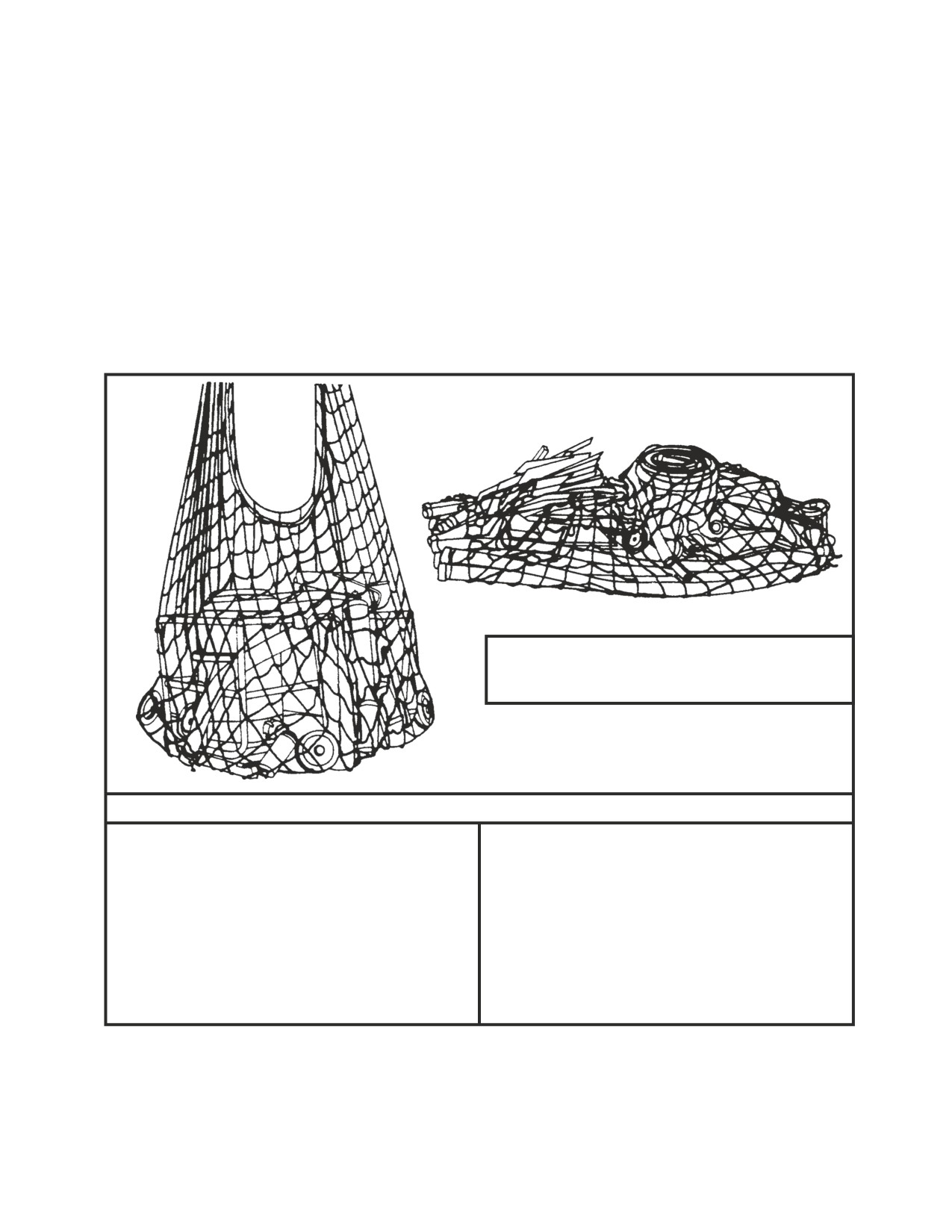
(f) Secure all signs on a pallet and secure with Type
team then moves clear of the load but remains close to the
III nylon cord. Center the net on net #5. Secure four fire
load as the helicopter removes slack from the sling legs.
extinguishers on a second pallet and center on the net.
When successful hookup is assured, the hookup team
Pile all remaining hoses on the pallets.
quickly exits the area underneath the helicopter to the
designated rendezvous point.
(3) Hookup. The hookup team stands alongside the
load. The static wand person discharges the static elec-
(4) Derigging. Derigging is the reverse of the prepa-
tricity with the static wand. The hookup person places
ration and rigging procedures in steps d (1) and d (2).
the apex fitting onto the aircraft cargo hook. The hookup
NOTE: If both loads are being moved as one load, place
both sling set apex fittings on a 25,000-pound capacity
apex fitting.
RIGGING STEPS
Load 1
Load 2
1. Loop the chain end of one sling leg through the apex
1. Loop the chain end of one sling leg through the apex
fitting of net 1 and insert link 3 in the grab hook.
fitting of net 3 and insert link 3 in the grab hook.
2. Loop the chain end of three sling legs through the
2. Loop the chain end of one sling leg through the apex
apex fitting of net 2 and insert link 3 in the grab hook.
fitting of net 4 and insert link 3 in the grab hook.
3. Loop the chain end of two sling legs through the
apex fitting of net 5 and insert link 3 in the grab hook.
Figure 19-2. 60,000-Gallon Fuel System Supply Point
19-4

FM 10-450-4/MCRP 4-23E, VOL II/NWP 3-04.12/AFJMAN 11-223, VOL II/
COMDTINST M13482.2
19-4. One to Six 250-Gallon Water Drums
a. Applicability. The following items in Table 19-3 are suitable for sling load by all ARMY helicopters with suitable lift
capacity:
Table 19-3. One to Six 250-Gallon Water Drums
MAX
RECOMMENDED
LINK COUNT
NOMENCLATURE
WEIGHT
SLING SET
AIRSPEED
FRONT/REAR
(POUNDS)
(KNOTS)
One Drum, Fabric, Water, 250-Gallon
2,210
10K
3
80
Two Drums, Fabric, Water, 250-Gallon
4,420
10K
3/3
80
Three Drums, Fabric, Water,
6,630
10K
3/20
80
250-Gallon
Four Drums, Fabric, Water, 250-Gallon
8,840
10K
3/3
80
Five Drums, Fabric, Water, 250-Gallon
11,050
10K
3/3/33
80
Six Drums, Fabric, Water, 250-Gallon
13,260
10K
3/3/22
80
b. Materials. The following materials are required to
propriate) and rotate the hubs of each drum so a clevis is
rig this load:
positioned at the top.
(1) Sling set (10,000-pound capacity) with 2 addi-
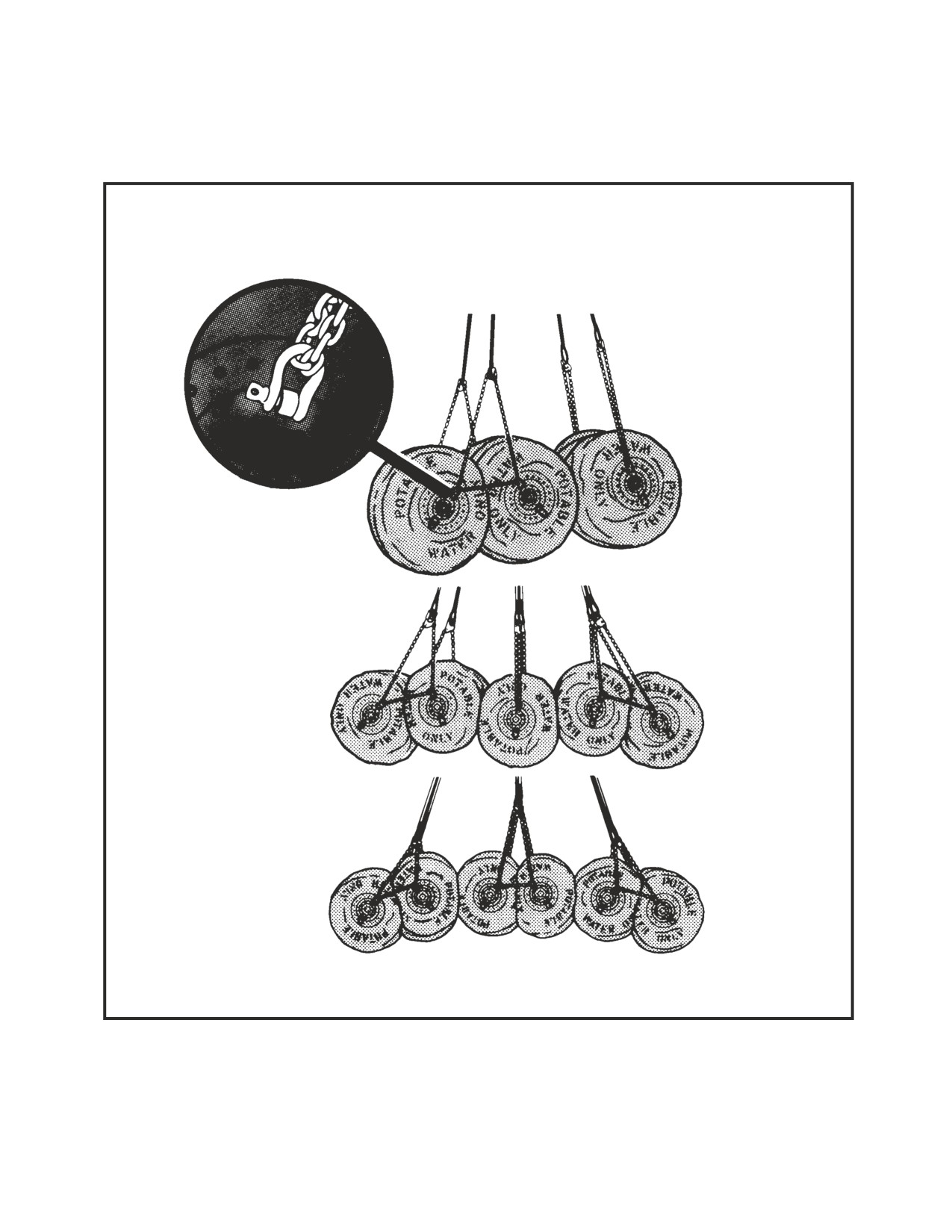
(2) Rigging. Rig the load according to the steps in
tional sling legs.
Figure 19-3.
(2) Tape, adhesive, pressure-sensitive, 2-inch wide
NOTE: Route the sling legs so the odd numbered sling
roll.
legs are to one side of the drum(s) and the even numbered
sling legs are to the other side.
(3) Cord, nylon, Type III, 550-pound breaking strength.
(3) Hookup. The hookup team stands alongside the
(4) Webbing, cotton, 1/4-inch, 80-pound breaking
load. The static wand person discharges the static elec-
strength.
tricity with the static wand. The hookup person places
the apex fitting onto the aircraft cargo hook. The hookup
(5) Apex fitting (25,000-pound capacity).
team then moves clear of the load but remains close to the
load as the helicopter removes slack from the sling legs.
c. Personnel. One person can prepare and rig one drum
When successful hookup is assured, the hookup team
in 5 minutes; add 5 minutes for each additional drum.
quickly exits the area underneath the helicopter to the
designated rendezvous point.
d. Procedures. The following procedures apply to this
load:
(4) Derigging. Derigging is the reverse of the prepa-
ration and rigging procedures in steps d (1) and d (2).
(1) Preparation. Align all drums side by side (if ap-
19-5
FM 10-450-4/MCRP 4-23E, VOL II/NWP 3-04.12/AFJMAN 11-223, VOL II/
COMDTINST M13482.2
Figure 19-3. One to Six 250-Gallon Water Drums
19-6
FM 10-450-4/MCRP 4-23E, VOL II/NWP 3-04.12/AFJMAN 11-223, VOL II/
COMDTINST M13482.2
RIGGING STEPS
ONE DRUM
from Table 19-3 in the grab hook. Repeat with sling leg 4 on the
1. Position apex fitting beside the drum. Route sling legs 1 and
other side of the drums.
3 to one side of the drum and sling legs 2 and 4 to the other side.
FIVE DRUMS
2. Loop the chain end of the sling legs through the clevis at
1. Configure a six-leg sling set using a 25,000-pound capacity
the top of the hub. Place the correct link from Table 19-3 in the
apex fitting and six sling leg assemblies.
grab hook.
2. Position apex fitting on top of the drums. Route outer sling
NOTE: A single drum may be moved using a two-leg sling
legs 1 and 2 to the front drum, middle sling legs 3 and 4 to the rear
set.
drum and inner sling legs 5 and 6 to the center drum.
TWO DRUMS
3. Loop the chain end of sling leg 1 through the left clevis on
1. Position apex fitting beside or on top of the two drums.
outer drum and through the left clevis of an adjacent drum. Place
Route outer sling legs 1 and 2 to the front drum and inner sling
the correct link from Table 19-3 in the grab hook. Repeat with
legs 3 and 4 to the rear drum.
sling leg 2 on the right side of the drums.
2. Loop the chain end of the sling leg through the appropri-
4. Loop the chain end of sling leg 3 through the left clevis on
ate clevis at the top of the hub for each drum. Place the correct
outer drum and through the left clevis of an adjacent drum. Place
link from Table 19-3 in the grab hook.
the correct link from Table 19-3 in the grab hook. Repeat with
sling leg 4 on the right side of the drums.
THREE DRUMS
1. Position apex fitting beside or on top of the drums. Route
5. Loop the chain end of sling leg 5 through the top clevis of
outer sling legs 1 and 2 to the front drum and inner sling legs 3
the center drum. Place the correct link from Table 19-3 in the
and 4 to the rear drum.
grab hook. Repeat with sling leg 6 on the right side of the drum.
Secure the excess chain with Type III nylon cord.
2. Loop the chain end of sling leg 1 through the clevis at the
top of the outer drum and through the clevis at the top of the
SIX DRUMS
center drum. Place the correct link from Table 19-3 in the grab
1. Configure a six-leg sling set using a 25,000-pound capacity
hook.
apex fitting and six sling leg assemblies.
3. Loop the chain end of sling leg 3 through the clevis at the
2. Position apex fitting on top of the drums. Route outer sling
top of the hub of the outer drum. Place the correct link from
legs 1 and 2 to the front drum, middle sling legs 3 and 4 to the rear
Table 19-3 in the grab hook. Repeat with sling leg 4 on the other
drum and inner sling legs 5 and 6 to the center drum.
side of the drum. Secure the excess chain with Type III nylon
cord.
3. Loop the chain end of sling leg 1 through the left clevis on
outer drum and through the left clevis of an adjacent drum. Place
FOUR DRUMS
the correct link from Table 19-3 in the grab hook. Repeat with
1. Position apex fitting beside or on top of the drums. Route
sling leg 2 on the right side of the drums.
outer sling legs 1 and 2 to the front drum and inner sling legs 3
and 4 to the rear drum.
4. Loop the chain end of sling leg 3 through the left clevis on
outer drum and through the left clevis of an adjacent drum. Place
2. Loop the chain end of sling leg 1 through the clevis at the
the correct link from Table 19-3 in the grab hook. Repeat with
top of the outer drum and through the clevis at the top of the
sling leg 4 on the right side of the drums.
next inner drum. Place the correct link from Table 19-3 in the
grab hook. Repeat with sling leg 2 on the other side of the
5. Loop the chain end of sling leg 5 through the top clevis of
drums.
both center drums. Place the correct link from Table 19-3 in the
grab hook. Repeat with sling leg 6 on the right side of the drums.
3. Loop the chain end of sling leg 3 through the clevis
Secure the excess chain with Type III nylon cord.
at the top of the hub of the rear outer drum and through the
clevis at the top of the next inner drum. Place the correct link
Figure 19-3. One to Six 250-Gallon Water Drums (continued)
19-7
FM 10-450-4/MCRP 4-23E, VOL II/NWP 3-04.12/AFJMAN 11-223, VOL II/
COMDTINST M13482.2
THIS PAGE INTENTIONALLY LEFT BLANK
19-8

FM 10-450-4/MCRP 4-23E, VOL II/NWP 3-04.12/AFJMAN 11-223, VOL II/
COMDTINST M13482.2
CHAPTER 20
SUITABLE SINGLE-POINT RIGGING PROCEDURES FOR SHELTERS
20-1. Introduction
This chapter contains rigging procedures for single-point
Paragraphs 20-2 and 20-3 give detailed instructions for
lift of shelters that are suitable for sling load. Each rigging
rigging loads.
procedure is found in a paragraph that includes a descrip-
tion of the load, materials required for rigging, and steps
NOTE: Reach Pendants may be used on all single point
to complete the procedure. An applicability paragraph is
loads. A static discharge person is not required when
also a part of each paragraph and identifies the suitable
using a Reach Pendant.
loads. The suitable single-point rigging procedures for
shelters are in this section.
20-2. Tool Set, Aviation Maintenance, SE 1, Airmobile
a. Applicability. The following item in Table 20-1 is suitable for sling load by all ARMY helicopters with suitable lift
capacity:
Table 20-1. Tool Set, Aviation Maintenance, SE 1, Airmobile
MAX
RECOMMENDED
LINK COUNT
NOMENCLATURE
WEIGHT
SLING SET
AIRSPEED
FRONT/REAR
(POUNDS)
(KNOTS)
Tool Set, Aviation Maintenance,
3,030
10K
30/30
90
SE 1, Airmobile
b. Materials. The following materials are required to
d. Procedures. The following procedures apply to this
rig this load:
load:
(1) Sling set (10,000-pound capacity).
(1) Preparation. Prepare the load using the following
steps:
(2) Tape, adhesive, pressure-sensitive, 2-inch wide
roll.
(a) Secure the tongue in the UP position with Type
III nylon cord. Secure the safety chains and hoses to the
(3) Cord, nylon, Type III, 550-pound breaking strength.
tongue with tape or Type III nylon cord. Secure the jack
handles in position with tape or Type III nylon cord.
(4) Webbing, cotton, 1/4-inch, 80-pound breaking
strength.
(b) Pad the rear axle on each side of the towing pintle
and secure the padding with tape or Type III nylon cord.
(5) Felt sheet, cattle hair, Type IV, 1/2-inch or suitable
substitute.
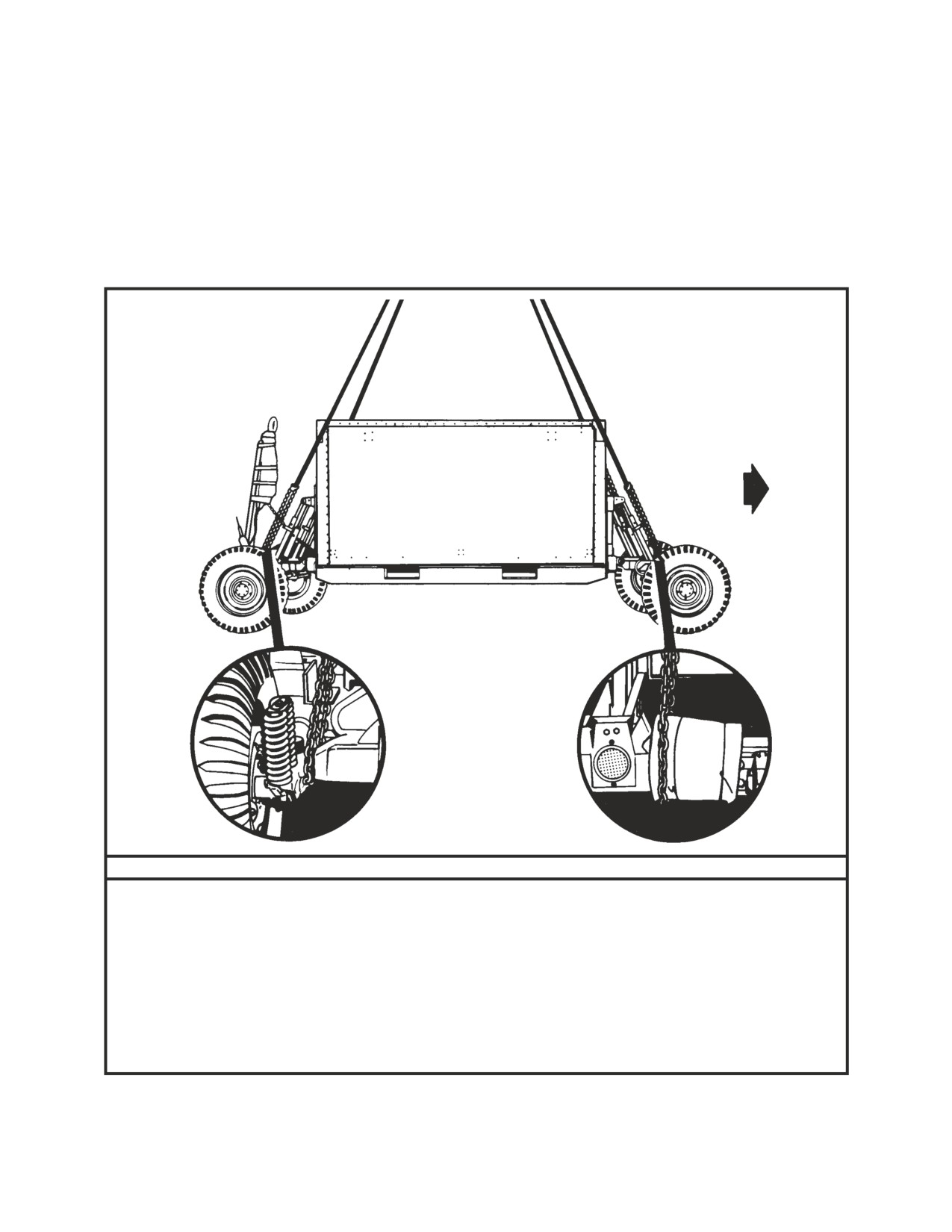
(2) Rigging. Rig the load according to the steps in
Figure 20-1.
c. Personnel. Two persons can prepare and rig this
load in 15 minutes.
(3) Hookup. The hookup team stands on top of the
tool set. The static wand person discharges the static
20-1
FM 10-450-4/MCRP 4-23E, VOL II/NWP 3-04.12/AFJMAN 11-223, VOL II/
COMDTINST M13482.2
electricity with the static wand. The hookup person places
quickly exits the area underneath the helicopter to the
the apex fitting onto the aircraft cargo hook. The hookup
designated rendezvous point.
team then moves clear of the load but remains close to the
load as the helicopter removes slack from the sling legs.
(4) Derigging. Derigging is the reverse of the prepa-
When successful hookup is assured, the hookup team
ration and rigging procedures in steps d (1) and d (2).
RIGGING STEPS
1. Position apex fitting on top of the tool set. Route
3. Loop the chain end of sling leg 3 around the padded
outer sling legs 1 and 2 to the front (tongue end) of the
area on the left rear axle. Place the correct link from Table
tool set and inner sling legs 3 and 4 to the rear. Sling legs
20-1 in the grab hook. Repeat with sling leg 4 and the
1 and 3 must be on the left side of the load.
right rear axle. Secure the excess chain with Type III nylon
cord.
2. Loop the chain end of sling leg 1 around the left front
axle just inside the suspension spring. Place the correct
4. Cluster and tie or tape (breakaway technique) all sling
link from Table 20-1 in the grab hook. Repeat with sling
legs together on top of the tool set to prevent entangle-
leg 2 and the right front axle. Secure the excess chain with
ment during hookup and lift-off.
Type III nylon cord.
Figure 20-1. Tool Set, Aviation Maintenance, SE 1, Airmobile
20-2
FM 10-450-4/MCRP 4-23E, VOL II/NWP 3-04.12/AFJMAN 11-223, VOL II/
COMDTINST M13482.2
20-3. Shop, Portable, Aircraft Maintenance (SPAM)
a. Applicability. The following item in Table 20-2 is suitable for sling load by all ARMY helicopters with suitable lift
capacity:
Table 20-2. Shop, Portable, Aircraft Maintenance (SPAM)
MAX
RECOMMENDED
LINK COUNT
NOMENCLATURE
WEIGHT
SLING SET
AIRSPEED
FRONT/REAR
(POUNDS)
(KNOTS)
Shop, Portable, Aircraft Maintenance
5,425
10K
3/3
60
b. Materials. The following materials are required to
(a) Secure all vents and doors with tape or Type III
rig this load:
nylon cord.
(1) Sling set (10,000-pound capacity).
(b) Secure the fold-out safety cable with tape or
Type III nylon cord.
(2) Tape, adhesive, pressure-sensitive, 2-inch wide
roll.
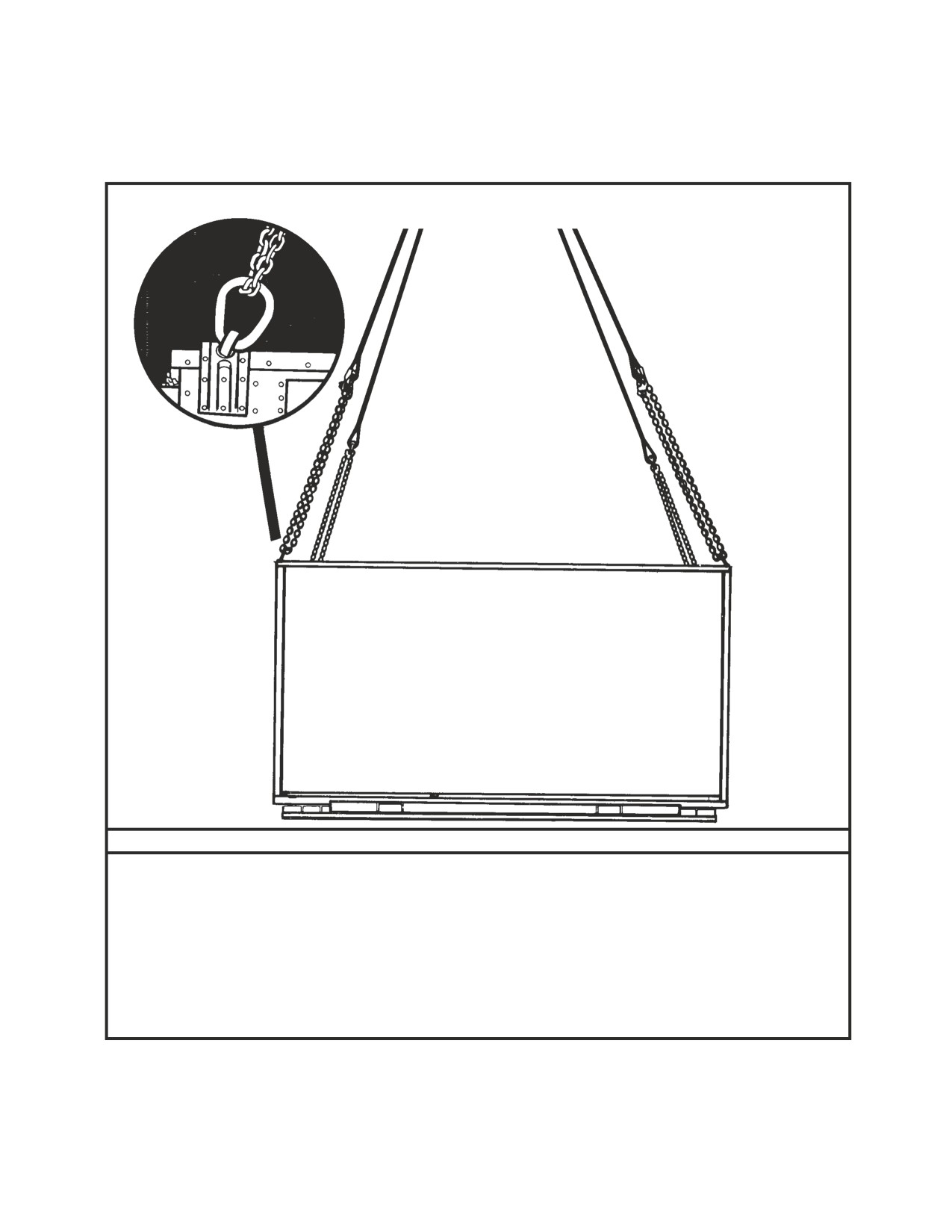
(2) Rigging. Rig the load according to the steps in
Figure 20-2.
(3) Cord, nylon, Type III, 550-pound breaking strength.
(3) Hookup. The hookup team stands on top of the
(4) Webbing, cotton, 1/4-inch, 80-pound breaking
SPAM. The static wand person discharges the static elec-
strength.
tricity with the static wand. The hookup person places
the apex fitting onto the aircraft cargo hook. The hookup
c. Personnel. Two persons can prepare and rig this
team then moves clear of the load but remains close to the
load in 5 minutes.
load as the helicopter removes slack from the sling legs.
When successful hookup is assured, the hookup team
d. Procedures. The following procedures apply to this
quickly exits the area underneath the helicopter to the
load:
designated rendezvous point.
(1) Preparation. Prepare the load using the following
(4) Derigging. Derigging is the reverse of the prepa-
steps:
ration and rigging procedures in steps d (1) and d (2).
20-3
FM 10-450-4/MCRP 4-23E, VOL II/NWP 3-04.12/AFJMAN 11-223, VOL II/
COMDTINST M13482.2
RIGGING STEPS
1. Position apex fitting on top of the shop. Route outer
3. Loop the chain end of sling leg 3 through the left rear
sling legs 1 and 2 to the front (door end) of the tool set and
lift ring. Place the correct link from Table 20-2 in the grab
inner sling legs 3 and 4 to the rear. Sling legs 1 and 3 must
hook. Repeat with sling leg 4 and the right rear lift ring.
be on the left side of the load.
4. Cluster and tie or tape (breakaway technique) all sling
2. Loop the chain end of sling leg 1 through the left
legs together on top of the shop to prevent entanglement
front lift ring. Place the correct link from Table 20-2 in the
during hookup and lift-off.
grab hook. Repeat with sling leg 2 and the right front lift
ring.
Figure 20-2. Shop, Portable, Aircraft Maintenance (SPAM)
20-4
FM 10-450-4/MCRP 4-23E, VOL II/NWP 3-04.12/AFJMAN 11-223, VOL II/
COMDTINST M13482.2
CHAPTER 21
SUITABLE SINGLE-POINT RIGGING PROCEDURES FOR CONTAINERS
21-1. Introduction
This chapter contains rigging procedures for single-point
Paragraphs 21-2 and 21-3 give detailed instructions for
lift of containers that are suitable for sling load. Each
rigging loads.
rigging procedure is found in a paragraph that includes a
description of the load, materials required for rigging, and
NOTE: Reach Pendants may be used on all single point
steps to complete the procedure. An applicability para-
loads. A static discharge person is not required when
graph is also a part of each paragraph and identifies the
using a Reach Pendant.
suitable loads. The suitable single-point rigging proce-
dures for containers are in this section.
21-2. One CONEX Container
a. Applicability. The following items in Table 21-1 are suitable for sling load by all ARMY helicopters with suitable lift
capacity:
Table 21-1. One CONEX Container
MAX
RECOMMENDED
LINK COUNT
NOMENCLATURE
WEIGHT
SLING SET
AIRSPEED
FRONT/REAR
(POUNDS)
(KNOTS)
Box, Metal, Shipping, CONEX, 270
1,560
10K
3/3
60
cubic feet
Box, Metal, Shipping, CONEX, 295
2,140
10K
3/3
60
cubic feet
b. Materials. The following materials are required to
d. Procedures. The following procedures apply to this
rig this load:
load:
(1) Sling set (10,000-pound capacity).
(1) Preparation. Prepare the load using the following
steps:
(2) Tape, adhesive, pressure-sensitive, 2-inch wide
roll.
(a) Close the doors.
(3) Cord, nylon, Type III, 550-pound breaking strength.
(b) Secure the doors by routing CGU-1/Bs around
the entire container.
(4) Webbing, cotton, 1/4-inch, 80-pound breaking
strength.
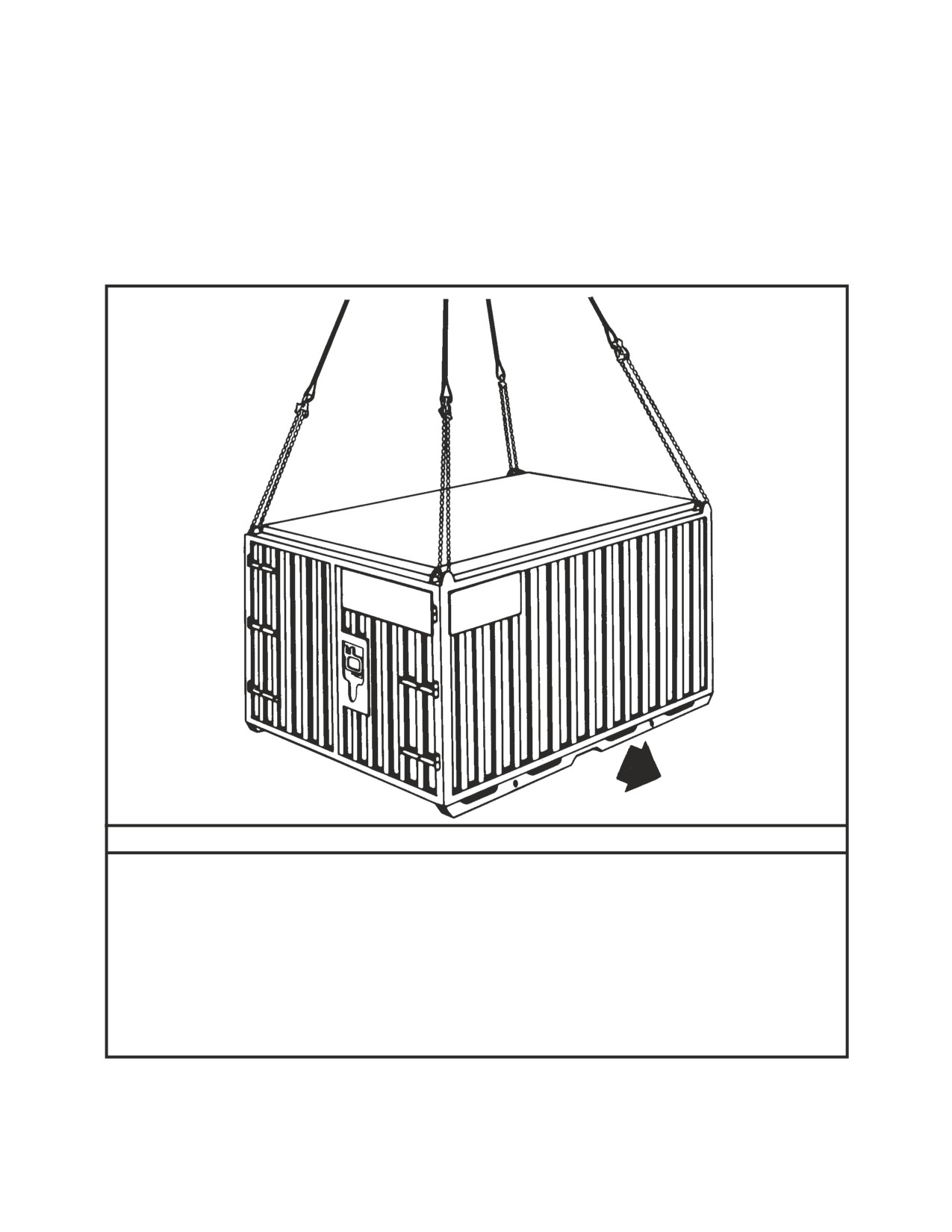
(2) Rigging. Rig the load according to the steps in
Figure 21-1.
(5) Tie-down strap CGU-1/B.
(3) Hookup. The hookup team stands on top of the
c. Personnel. One person can prepare and rig this load
container. The static wand person discharges the static
in 10 minutes.
21-1
FM 10-450-4/MCRP 4-23E, VOL II/NWP 3-04.12/AFJMAN 11-223, VOL II/
COMDTINST M13482.2
electricity with the static wand. The hookup person places
quickly exits the area underneath the helicopter to the
the apex fitting onto the aircraft cargo hook. The hookup
designated rendezvous point.
team then moves clear of the load but remains close to the
load as the helicopter removes slack from the sling legs.
(4) Derigging. Derigging is the reverse of the prepa-
When successful hookup is assured, the hookup team
ration and rigging procedures in steps d (1) and d (2).
RIGGING STEPS
1. Position apex fitting on top of the container. Route
3. Loop the chain end of sling leg 3 through the left rear
outer sling legs 1 and 2 to the front of the load and inner
lift provision. Place the correct link from Table 21-1 in the
sling legs 3 and 4 to the rear. Sling legs 1 and 3 must be on
grab hook. Repeat with sling leg 4 and the right rear lift
the left side of the load.
provision.
2. Loop the chain end of sling leg 1 through the left
4. Cluster and tie or tape (breakaway technique) all sling
front lift provision. Place the correct link from Table 21-1
legs together on top of the container to prevent entangle-
in the grab hook. Repeat with sling leg 2 and the right
ment during hookup and lift-off.
front lift provision.
Figure 21-1. One CONEX Container
21-2

FM 10-450-4/MCRP 4-23E, VOL II/NWP 3-04.12/AFJMAN 11-223, VOL II/
COMDTINST M13482.2
21-3. Two CONEX Containers
a. Applicability. The following items in Table 21-2 are suitable for sling load by all ARMY helicopters with suitable lift
capacity:
Table 21-2. Two CONEX Containers
MAX
RECOMMENDED
LINK COUNT
NOMENCLATURE
WEIGHT
SLING SET
AIRSPEED
FRONT/REAR
(POUNDS)
(KNOTS)
Two Boxes, Metal, Shipping, CONEX,
10,000
10K
3/60/3
95
270 cubic feet
Two Boxes, Metal, Shipping, CONEX,
10,000
10K
3/60/3
95
295 cubic feet
b. Materials. The following materials are required to
(a) Position the containers side by side with the
rig this load:
doors facing the same direction.
(1) Sling set (10,000-pound capacity) with two addi-
(b) Close and secure the doors by routing CGU-1/
tional sling leg assemblies.
Bs around the entire container.
(2) Tape, adhesive, pressure-sensitive, 2-inch wide
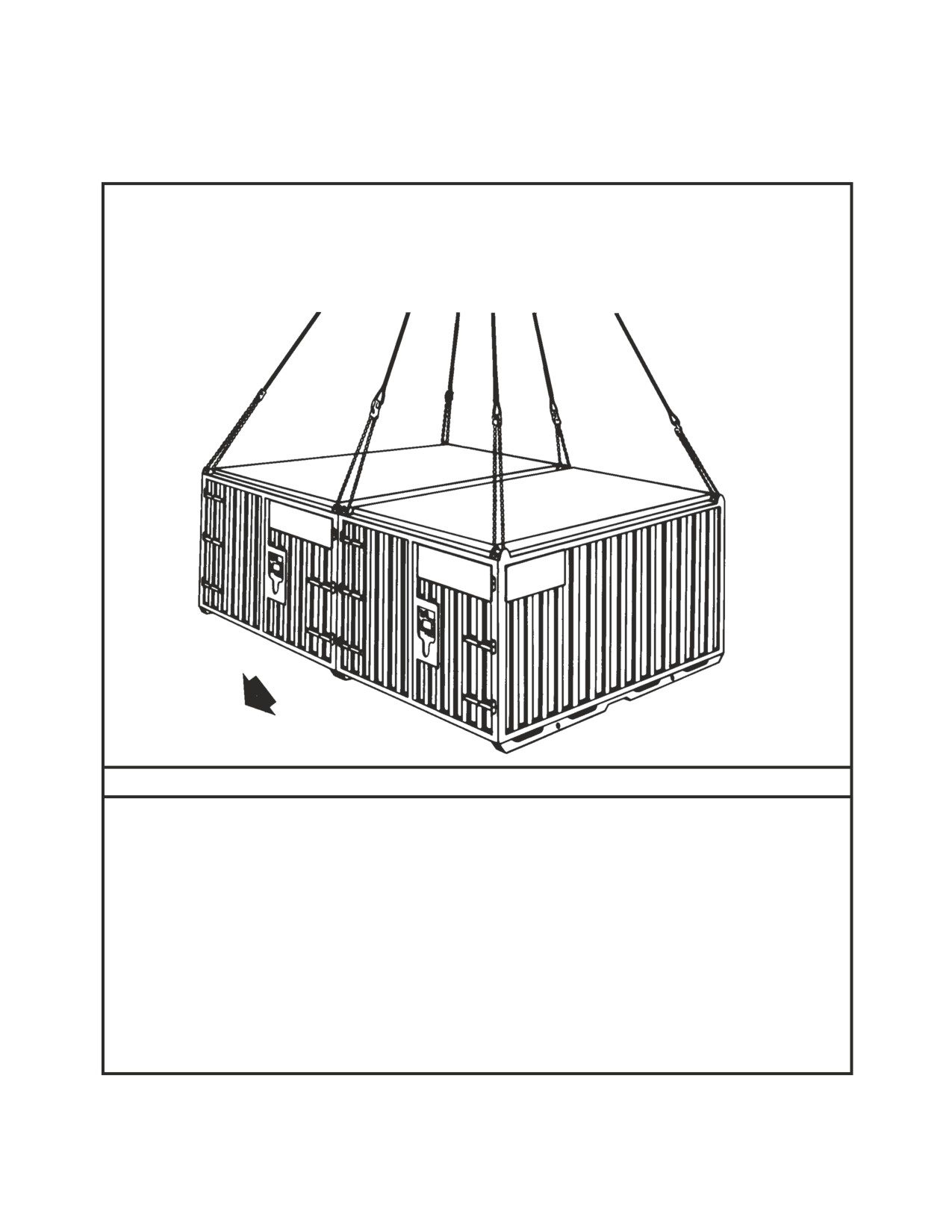
(2) Rigging. Rig the load according to the steps in
roll.
Figure 21-2.
(3) Cord, nylon, Type III, 550-pound breaking strength.
(3) Hookup. The hookup team stands on top of the
containers. The static wand person discharges the static
(4) Webbing, cotton, 1/4-inch, 80-pound breaking
electricity with the static wand. The hookup person places
strength.
the apex fitting onto the aircraft cargo hook. The hookup
team then moves clear of the load but remains close to the
(5) Tie-down strap CGU-1/B.
load as the helicopter removes slack from the sling legs.
When successful hookup is assured, the hookup team
c. Personnel. Two persons can prepare and rig this
quickly exits the area underneath the helicopter to the
load in 20 minutes.
designated rendezvous point.
d. Procedures. The following procedures apply to this
(4) Derigging. Derigging is the reverse of the prepa-
load:
ration and rigging procedures in steps d (1) and d (2).
(1) Preparation. Prepare the load using the following
steps:
21-3
FM 10-450-4/MCRP 4-23E, VOL II/NWP 3-04.12/AFJMAN 11-223, VOL II/
COMDTINST M13482.2
RIGGING STEPS
1. Configure a six-leg sling set by adding the two addi-
4. Loop the chain end of sling leg 3 through the left rear
tional sling legs to the sling set.
lift provision on the left container. Place the correct link
from Table 21-2 in the grab hook. Repeat with sling leg 4
2. Position apex fitting on top of the containers. Route
and the right rear lift provision.
outer sling legs 1 and 2 to the front (door end) of the
containers, middle sling legs 3 and 4 to the rear, and inner
5. Loop the chain end of sling leg 5 through the front
sling legs 5 and 6 to the center of the containers. Sling
inboard lift provision of both containers. Place the cor-
legs 1, 3, and 5 must be on the left side of the load.
rect link from Table 21-2 in the grab hook. Repeat with
sling leg 6 and the rear inboard lift provisions. Secure the
3. Loop the chain end of sling leg 1 through the left
excess chain with Type III nylon cord.
front lift provision of the left container. Place the correct
link from Table 21-2 in the grab hook. Repeat with sling
6. Cluster and tie or tape (breakaway technique) all sling
leg 2 and the right front lift provision.
legs together on top of the containers to prevent entangle-
ment during hookup and lift-off.
Figure 21-2. Two CONEX Containers
21-4
FM 10-450-4/MCRP 4-23E, VOL II/NWP 3-04.12/AFJMAN 11-223, VOL II/
COMDTINST M13482.2
CHAPTER 22
SUITABLE SINGLE-POINT RIGGING PROCEDURES FOR RADAR EQUIPMENT
22-1. Introduction
This chapter contains rigging procedures for single-point
Paragraph 22-2 gives detailed instructions for rigging the
lift of radar equipment that is suitable for sling load. Each
load.
rigging procedure is found in a paragraph that includes a
description of the load, materials required for rigging, and
NOTE: Reach Pendants may be used on all single point
steps to complete the procedure. An applicability para-
loads. A static discharge person is not required when
graph is also a part of each paragraph and identifies the
using a Reach Pendant.
suitable loads. The suitable single-point rigging proce-
dures for radar equipment is in this section.
22-2. AN/MPQ-4A Radar Set
a. Applicability. The following items in Table 22-1 are suitable for sling load by all ARMY helicopters with suitable lift
capacity:
Table 22-1. AN/MPQ-4A Radar Set
MAX
RECOMMENDED
LINK COUNT
NOMENCLATURE
WEIGHT
SLING SET
AIRSPEED
FRONT/REAR
(POUNDS)
(KNOTS)
Radar Set, Trailer-Mounted,
AN/MPQ-4A without 55-Gallon Drum
6,290
10K
3/55
80
of Fuel
Radar Set, Trailer-Mounted,
AN/MPQ-4A with 55-Gallon Drum of
6,690
10K
3/55
80
Fuel
b. Materials. The following materials are required to
c. Personnel. Two persons can prepare and rig this
rig this load:
load in 30 minutes.
(1) Sling set (10,000-pound capacity).
d. Procedures. The following procedures apply to this
load:
(2) Tape, adhesive, pressure-sensitive, 2-inch wide
roll.
(1) Preparation. Prepare the load using the following
steps:
(3) Cord, nylon, Type III, 550-pound breaking strength.
(a) Place the radar set in the travel mode. Secure the
(4) Webbing, cotton, 1/4-inch, 80-pound breaking
safety chains and the air hoses to the trailer tongue with
strength.
tape or Type III nylon cord.
(5) Webbing, nylon, tubular, 1/2-inch.
(b) Secure the handles of the rear outriggers and all
pins with tape.
(6) Padding, felt, 1/2- x 24- x 60-inch (2 sheets), 1/2- x
30- x 36 (1 sheet).
22-1
FM 10-450-4/MCRP 4-23E, VOL II/NWP 3-04.12/AFJMAN 11-223, VOL II/
COMDTINST M13482.2
(c) Place a 24- x 48-inch sheet of felt padding over
(3) Hookup. The hookup team stands on the trailer
the receiver-transmission group and secure with tape.
fenders. The static wand person discharges the static
electricity with the static wand. The hookup person places
(d) Place two sheets of felt side by side on top of the
the apex fitting onto the aircraft cargo hook. The hookup
reflector, tape the centerline, and secure in place with Type
team then moves clear of the load but remains close to the
III nylon cord routed from one step over the receiver-
load as the helicopter removes slack from the sling legs.
transmission group and reflector to the other step.
When successful hookup is assured, the hookup team
quickly exits the area underneath the helicopter to the
(e) Secure the fuel drum with 1/2-inch tubular nylon
designated rendezvous point.
to the step.
(4) Derigging. Derigging is the reverse of the prepa-
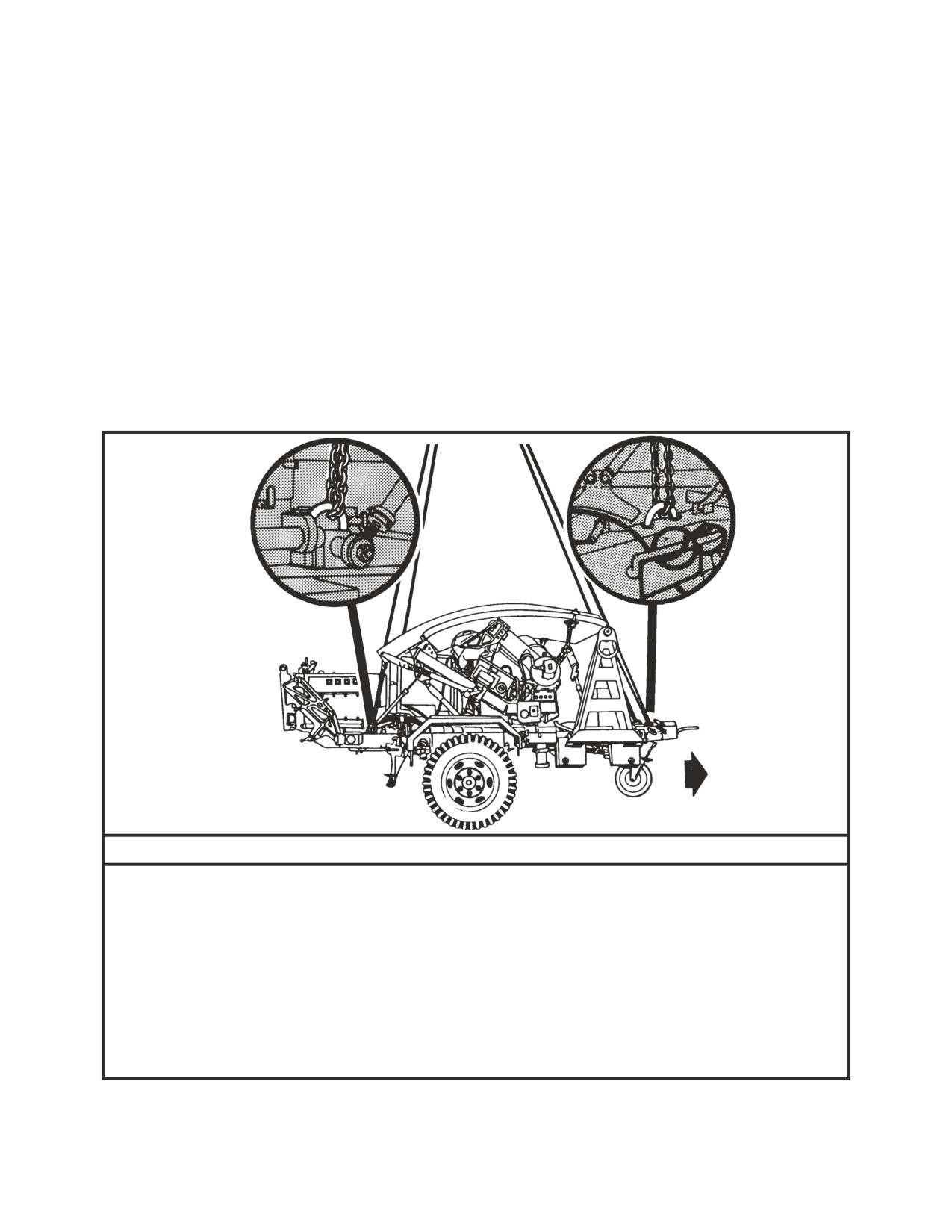
(2) Rigging. Rig the load according to the steps in
ration and rigging procedures in steps d (1) and d (2).
Figure 22-1.
RIGGING STEPS
1. Position apex fitting on top of the reflector. Route
3. Loop the chain end of sling leg 3 through the left rear
outer sling legs 1 and 2 to the front (tongue end) of the
lift provision located aft of the receiver-transmission
load and inner sling legs 3 and 4 to the rear. Sling legs 1
group. Place the correct link from Table 22-1 in the grab
and 3 must be on the left side of the load.
hook. Repeat with sling leg 4 and the right rear lift provi-
sion.
2. Loop the chain end of sling leg 1 through the left
front lift provision located on the tongue. Place the cor-
4. Cluster and tie or tape (breakaway technique) all sling
rect link from Table 22-1 in the grab hook. Repeat with
legs together to prevent entanglement during hookup and
sling leg 2 and the right front lift provision. If a fuel drum
lift-off.
is being moved, route sling legs 1 and 2 through the lu-
nette instead of the lift provisions.
Figure 22-1. AN/MPQ-4A Radar Set
22-2
FM 10-450-4/MCRP 4-23E, VOL II/NWP 3-04.12/AFJMAN 11-223, VOL II/
COMDTINST M13482.2
CHAPTER 23
SUITABLE SINGLE-POINT RIGGING PROCEDURES FOR GENERATOR SETS
23-1. Introduction
Paragraphs 23-2 and 23-3 give detailed instructions for
This chapter contains rigging procedures for single-point
rigging loads.
lift of generator sets that are suitable for sling load. Each
rigging procedure is found in a paragraph that includes a
NOTE: Reach Pendants may be used on all single point
description of the load, materials required for rigging, and
loads. A static discharge person is not required when
steps to complete the procedure. An applicability para-
using a Reach Pendant.
graph is also a part of each paragraph and identifies the
suitable loads. The suitable single-point rigging proce-
dures for generator sets are in this section.
23-2. Trailer Mounted Generators
a. Applicability. The following items in Table 23-1 are suitable for sling load by all ARMY helicopters with suitable lift
capacity:
Table 23-1. Trailer Mounted Generators
MAX
RECOMMENDED
LINK COUNT
NOMENCLATURE
WEIGHT
SLING SET
AIRSPEED
FRONT/REAR
(POUNDS)
(KNOTS)
Generator Set, 5KW, PU-620/M
2,840
10K
3/50
85
Mounted on M116 Trailer
Generator Set, 10KW, PU-619
3,530
10K
30/30
120
Mounted on M105 Trailer
Generator Set, 10KW, PU-304
4,110
10K
40/50
100
Mounted on M105 Trailer
NOTE: The PU-619/M generator set mounted on the
c. Personnel. Two persons can prepare and rig this
M105 trailer is NOT CURRENTLY APPROVED FOR
load in 15 minutes.
LIFT WITH THE ORIGINAL LIFT PROVISIONS.
d. Procedures. The following procedures apply to this
b. Materials. The following materials are required to
load:
rig this load:
(1) Preparation. Prepare the load using the following
(1) Sling set (10,000-pound capacity).
steps:
(2) Tape, adhesive, pressure-sensitive, 2-inch wide
(a) Remove the canvas cover and secure on top of
roll.
the generator with Type III nylon cord.
(3) Cord, nylon, Type III, 550-pound breaking strength.
(b) Secure the 5-gallon gas cans with Type III nylon
cord.
(4) Webbing, cotton, 1/4-inch, 80-pound breaking
(c) Engage the parking brakes.
strength.
23-1
FM 10-450-4/MCRP 4-23E, VOL II/NWP 3-04.12/AFJMAN 11-223, VOL II/
COMDTINST M13482.2
(d) Secure the safety chains, air hoses, and
The static wand person discharges the static electricity
intervehicular cable to the tongue with tape or Type III
with the static wand. The hookup person places the apex
nylon cord.
fitting onto the aircraft cargo hook. The hookup team
then moves clear of the load but remains close to the load
(e) Inspect the lift provisions for cracks in the welds.
as the helicopter removes slack from the sling legs.
When successful hookup is assured, the hookup team
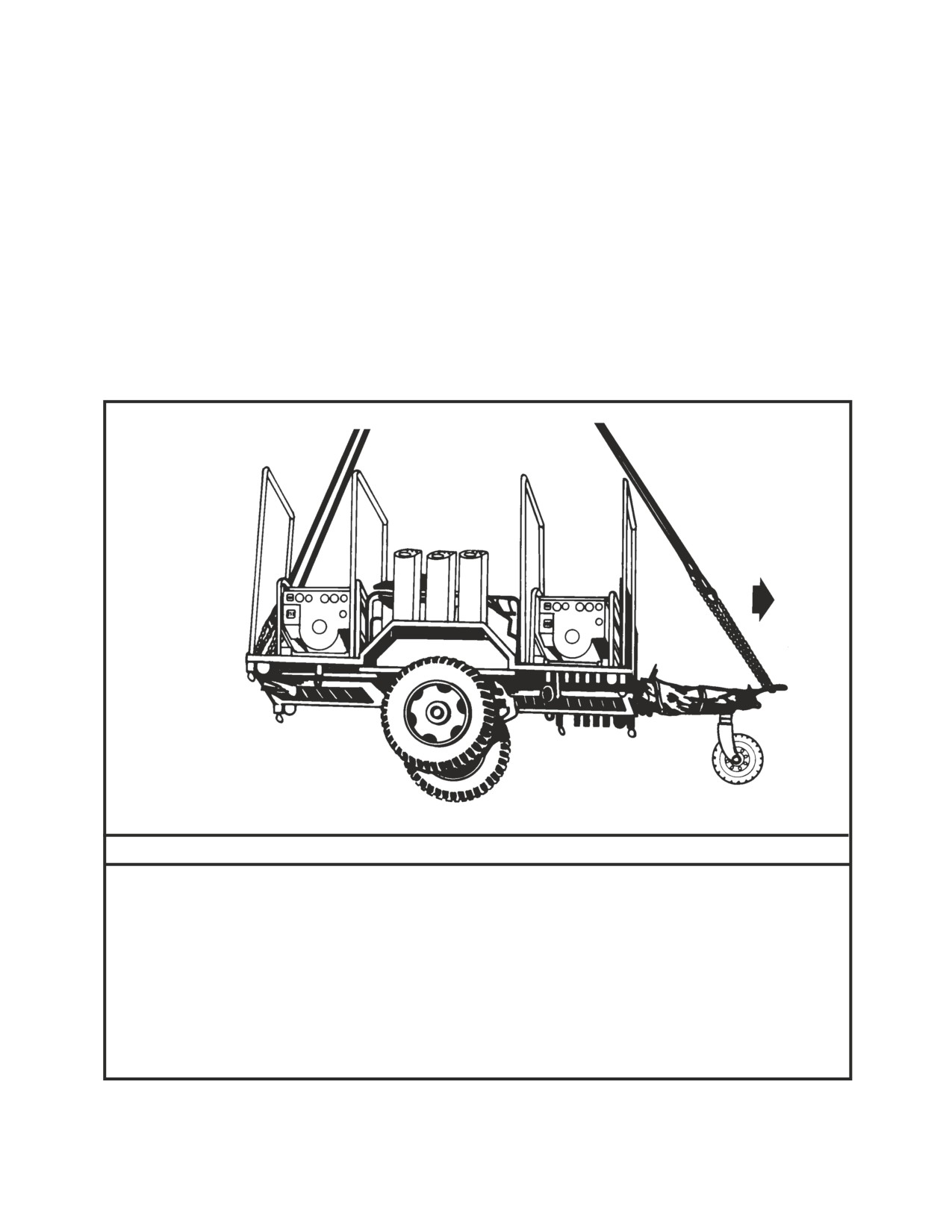
(2) Rigging. Rig the load according to the steps in
quickly exits the area underneath the helicopter to the
Figure 23-1.
designated rendezvous point.
(3) Hookup. The hookup team stands on the trailer.
(4) Derigging. Derigging is the reverse of the prepa-
ration and rigging procedures in steps d (1) and d (2).
RIGGING STEPS
1. Position apex fitting on top of the trailer. Route outer
3. Loop the chain end of sling leg 3 through the left rear
sling legs 1 and 2 to the front of the load in front of bow 1
lift provision. Place the correct link from Table 23-1 in the
and inner sling legs 3 and 4 to the rear between bows 3
grab hook. Repeat with sling leg 4 and the right rear lift
and 4. Sling legs 1 and 3 must be on the left side of the
provision. Secure the excess chain with Type III nylon
load.
cord.
2. Loop the chain end of sling leg 1 through the lunette.
4. Cluster and tie or tape (breakaway technique) all sling
Place the correct link from Table 23-1 in the grab hook.
legs together to prevent entanglement during hookup and
Repeat with sling leg 2. Secure the excess chain with Type
lift-off.
III nylon cord.
Figure 23-1. Trailer Mounted Generators
23-2
FM 10-450-4/MCRP 4-23E, VOL II/NWP 3-04.12/AFJMAN 11-223, VOL II/
COMDTINST M13482.2
23-3. 7.5KW Generator Set
a. Applicability. The following item in Table 23-2 is suitable for sling load by all ARMY helicopters with suitable lift
capacity:
Table 23-2.
7.5KW Generator Set
MAX
RECOMMENDED
LINK COUNT
NOMENCLATURE
WEIGHT
SLING SET
AIRSPEED
FRONT/REAR
(POUNDS)
(KNOTS)
Generator Set, Wheel Mounted,
810
10K OR 5K Net
3
80
7.5KW
b. Materials. The following materials are required to
steps:
rig this load:
(a) Tie the tow bar in the raised position with Type
(1) One sling leg from a 10,000-pound capacity sling
III nylon cord.
set with apex fitting.
OR
(b) Secure the safety chains, air hoses, and
intervehicular cable to the tongue with tape or Type III
(2) Net, cargo (5,000-pound capacity).
nylon cord.
(3) Tape, adhesive, pressure-sensitive, 2-inch wide
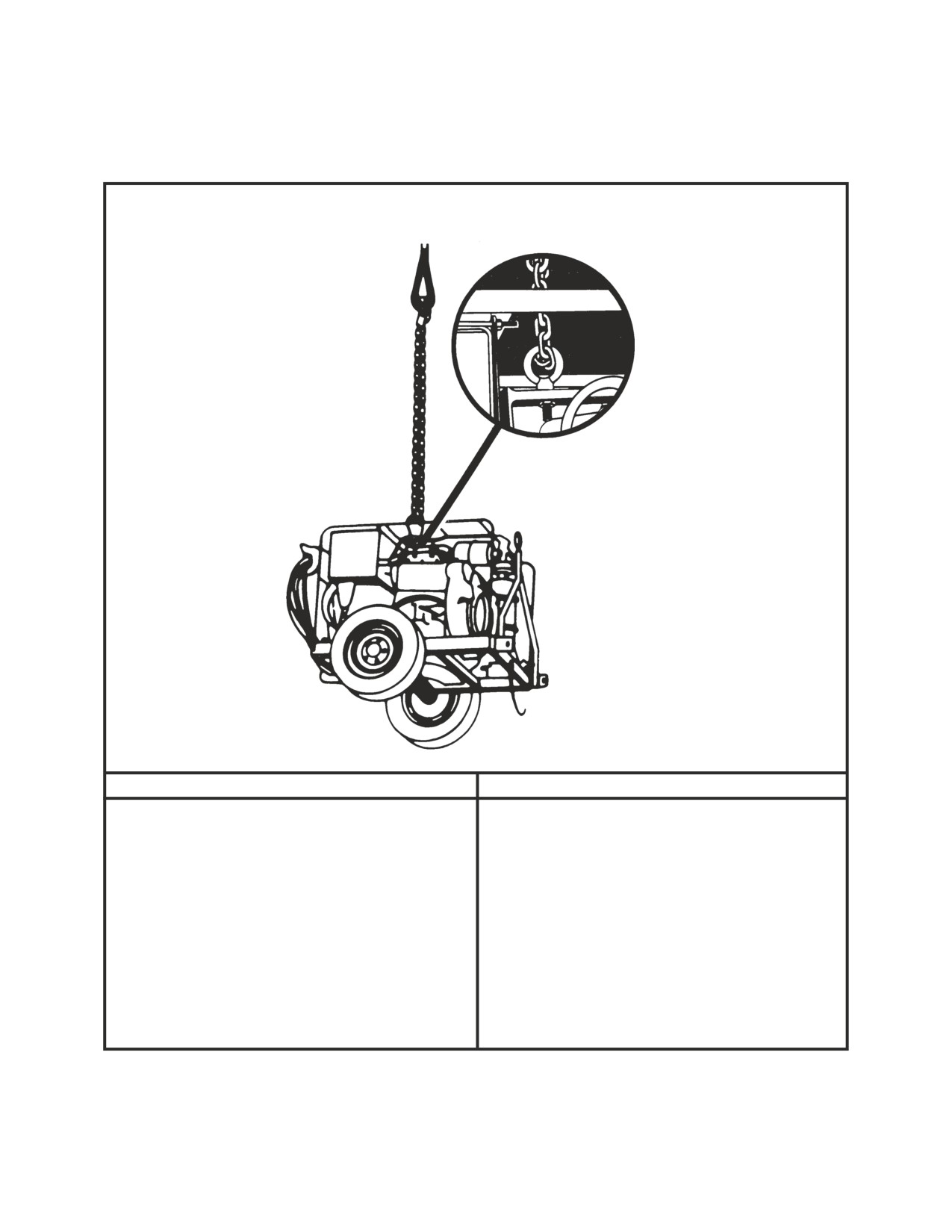
(2) Rigging. Rig the load according to the steps in
roll.
Figure 23-2.
(3) Cord, nylon, Type III, 550-pound breaking strength.
(3) Hookup. The hookup team stands beside the
generator. The static wand person discharges the static
(4) Webbing, cotton, 1/4-inch, 80-pound breaking
electricity with the static wand. The hookup person places
strength.
the apex fitting onto the aircraft cargo hook. The hookup
team then moves clear of the load but remains close to the
c. Personnel. One person can prepare and rig this load
load as the helicopter removes slack from the sling legs.
in 5 minutes.
When successful hookup is assured, the hookup team
quickly exits the area underneath the helicopter to the
d. Procedures. The following procedures apply to this
designated rendezvous point.
load:
(4) Derigging. Derigging is the reverse of the prepa-
(1) Preparation. Prepare the load using the following
ration and rigging procedures in steps d (1) and d (2).
23-3
FM 10-450-4/MCRP 4-23E, VOL II/NWP 3-04.12/AFJMAN 11-223, VOL II/
COMDTINST M13482.2
RIGGING STEPS FOR SLING LEG
RIGGING STEPS FOR CARGO NET
1. Position apex fitting beside the generator set.
1. Spread the net out flat on the ground. Center the
generator on the net.
2. Loop the chain end of the sling leg through the lift
provision located on top of the generator. Place the cor-
2. Close and rig the net in accordance with FM 10-450-
rect link from Table 23-2 in the grab hook. Repeat with
3.
sling leg 2. Secure the excess chain with Type III nylon
cord.
3. Tape the sling leg to the upper frame to prevent
entanglement during hookup and lift-off.
Figure 23-2. 7.5KW Generator Set
23-4

FM 10-450-4/MCRP 4-23E, VOL II/NWP 3-04.12/AFJMAN 11-223, VOL II/
COMDTINST M13482.2
CHAPTER 24
SUITABLE SINGLE-POINT RIGGING PROCEDURES FOR MISCELLANEOUS
EQUIPMENT
24-1. Introduction
This chapter contains rigging procedures for single-point
Paragraphs 24-2 through 24-6 give detailed instructions
lift of miscellaneous equipment that is suitable for sling
for rigging loads.
load. Each rigging procedure is found in a paragraph that
includes a description of the load, materials required for
NOTE: Reach Pendants may be used on all single point
rigging, and steps to complete the procedure. An applica-
loads. A static discharge person is not required when
bility paragraph is also a part of each paragraph and iden-
using a Reach Pendant.
tifies the suitable loads. The suitable single-point rigging
procedures for miscellaneous equipment are in this sec-
tion.
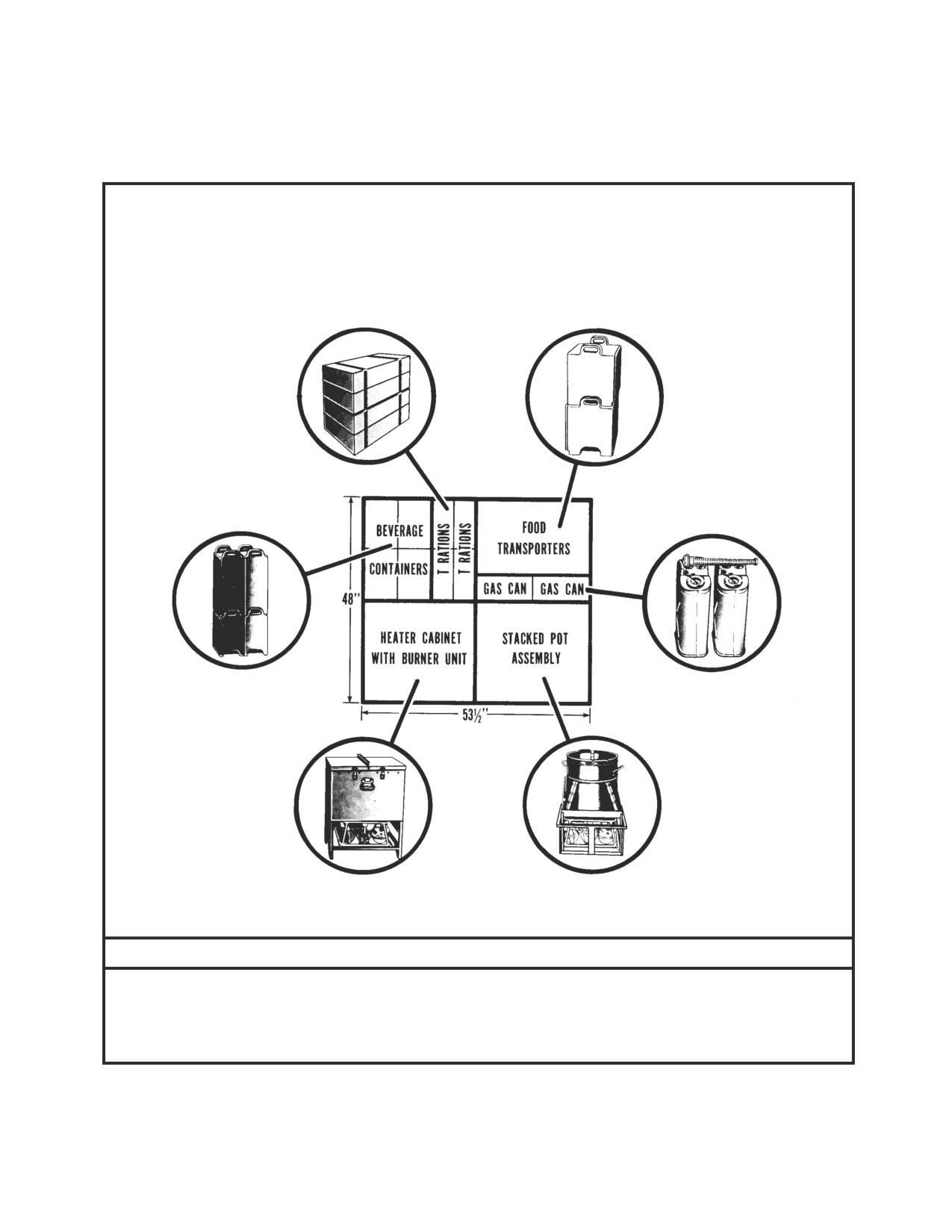
24-2. Company Level Field Feeding Kit
a. Applicability. The following items in Table 24-1 are suitable for sling load by all ARMY helicopters with suitable lift
capacity:
Table 24-1. Company Level Field Feeding Kit
MAX
RECOMMENDED
LINK COUNT
NOMENCLATURE
WEIGHT
SLING SET
AIRSPEED
FRONT/REAR
(POUNDS)
(KNOTS)
Company Level Field Feeding Kit with
A-22 Cargo Bag
8 Cases of T-Rations and Fuel/Water
950
with one 10K
3
80
Containers at 75% full
sling leg
(7) Padding, felt or suitable substitute.
b. Materials. The following materials are required to
rig this load:
(8) Webbing, nylon, tubular, 1/2-inch, 1000-pound
breaking strength..
(1) One sling leg from a 10,000-pound capacity sling
set.
c. Personnel. Two persons can prepare and rig this
load in 30 minutes.
(2) Bag, cargo, A-22.
d. Procedures. The following procedures apply to this
(3) Tape, adhesive, pressure-sensitive, 2-inch wide
load:
roll.
(1) Preparation. Prepare the load using the following
(3) Cord, nylon, Type III, 550-pound breaking strength.
steps:
(4) Webbing, cotton, 1/4-inch, 80-pound breaking
(a) Drill a 3/4-inch hole along the edge of the ply-
strength.
wood skid 8 inches from each corner.
(6) Skid board, plywood (53 1/2- x 48- x 3/4-inch)
24-1
FM 10-450-4/MCRP 4-23E, VOL II/NWP 3-04.12/AFJMAN 11-223, VOL II/
COMDTINST M13482.2
(b) Thread an 8-foot length of 1/2-inch tubular ny-
(g) Place the two gas cans (not stacked) between
lon through the holes in each corner from bottom to top.
the food transporters and the pot assembly.
This webbing is used to tie the skid board to the A-22
cargo bag suspension sling.
(h) Pad the lantern and place it on top of the gas
cans.
(c) Position the A-22 cargo bag and cover on top of
the skid board. While facing the long side of the skid
(i) Stack the four beverage transporters with the two
board, place the heater cabinet with its burner unit in the
tall containers on top in the last corner.
near left corner, set in about 1/2-inch from either side.
Secure the burner to the cabinet frame with Type III nylon
(j) Stack the four boxes of T-rations between the
cord.
food transporters and the beverage transporters.
(d) Place the water jugs, toolbox, fire extinguisher,
(k) Place the table across the heater cabinet and the
cutting board, tray pack opener, and water sterilizing bag
pot assembly. Level the table with blocks of wood or
in the heater cabinet. Pad as necessary and close and
scrap honeycomb.
secure the cover.
(2) Rigging. Rig the load according to the steps in
(e) Moving counterclockwise, place the stacked pot
Figure 24-1.
assembly, including pots and burner, next to the heater
cabinet. The burner should be parallel to the long side of
(3) Hookup. The hookup team stands beside the A-
the plywood. Place the extra pot cover on the burner
22 cargo bag. The static wand person discharges the
before stacking the pot cradle on the stand. Pad between
static electricity with the static wand. The hookup person
the heater cabinet and pot assembly. Secure the compo-
places the apex fitting onto the aircraft cargo hook. The
nents of the pot assembly together with Type III nylon
hookup team then moves clear of the load but remains
cord.
close to the load as the helicopter removes slack from the
sling legs. When successful hookup is assured, the
(f) Moving counterclockwise, place the two large
hookup team quickly exits the area underneath the heli-
food transporters in the next corner. The long side should
copter to the designated rendezvous point.
be flush with the long side of the skid board. Place two
boxes of T-rations in each transporter.
(4) Derigging. Derigging is the reverse of the prepa-
ration and rigging procedures in steps d (1) and d (2).
24-2
FM 10-450-4/MCRP 4-23E, VOL II/NWP 3-04.12/AFJMAN 11-223, VOL II/
COMDTINST M13482.2
RIGGING STEPS
1. Close and secure the A-22 cargo bag in accordance
2. Route the chain end of the 10,000-pound capacity
with the procedures in FM 10-450-3.
through the suspension clevis of the A-22 cargo bag.
Place the correct link from Table 24-1 in the grab hook
Figure 24-1. Company Level Field Feeding Kit
24-3
FM 10-450-4/MCRP 4-23E, VOL II/NWP 3-04.12/AFJMAN 11-223, VOL II/
COMDTINST M13482.2
24-3. 350-GPM Pump Assembly
a. Applicability. The following item in Table 24-2 is suitable for sling load by all ARMY helicopters with suitable lift
capacity:
Table 24-2. 350-GPM Pump Assembly
MAX
RECOMMENDED
LINK COUNT
NOMENCLATURE
WEIGHT
SLING SET
AIRSPEED
FRONT/REAR
(POUNDS)
(KNOTS)
Pump Assembly, 350-GPM
1,165
10K
50/50
60
b. Materials. The following materials are required to
(a) Secure the engine cover and any other loose
rig this load:
equipment with Type III nylon cord.
(1) Sling set (10,000-pound capacity).
(b) Slide the tow bar all the way in and secure with
safety pins.
(2) Tape, adhesive, pressure-sensitive, 2-inch wide
roll.
(2) Rigging. Rig the load according to the steps in
Figure 24-2.
(3) Cord, nylon, Type III, 550-pound breaking strength.
(3) Hookup. The hookup team stands beside the
(4) Webbing, cotton, 1/4-inch, 80-pound breaking
pump. The static wand person discharges the static elec-
strength.
tricity with the static wand. The hookup person places
the apex fitting onto the aircraft cargo hook. The hookup
c. Personnel. Two persons can prepare and rig this
team then moves clear of the load but remains close to the
load in 10 minutes.
load as the helicopter removes slack from the sling legs.
When successful hookup is assured, the hookup team
d. Procedures. The following procedures apply to this
quickly exits the area underneath the helicopter to the
load:
designated rendezvous point.
(1) Preparation. Prepare the load using the following
(4) Derigging. Derigging is the reverse of the prepa-
steps:
ration and rigging procedures in steps d (1) and d (2).
24-4
FM 10-450-4/MCRP 4-23E, VOL II/NWP 3-04.12/AFJMAN 11-223, VOL II/
COMDTINST M13482.2
RIGGING STEPS
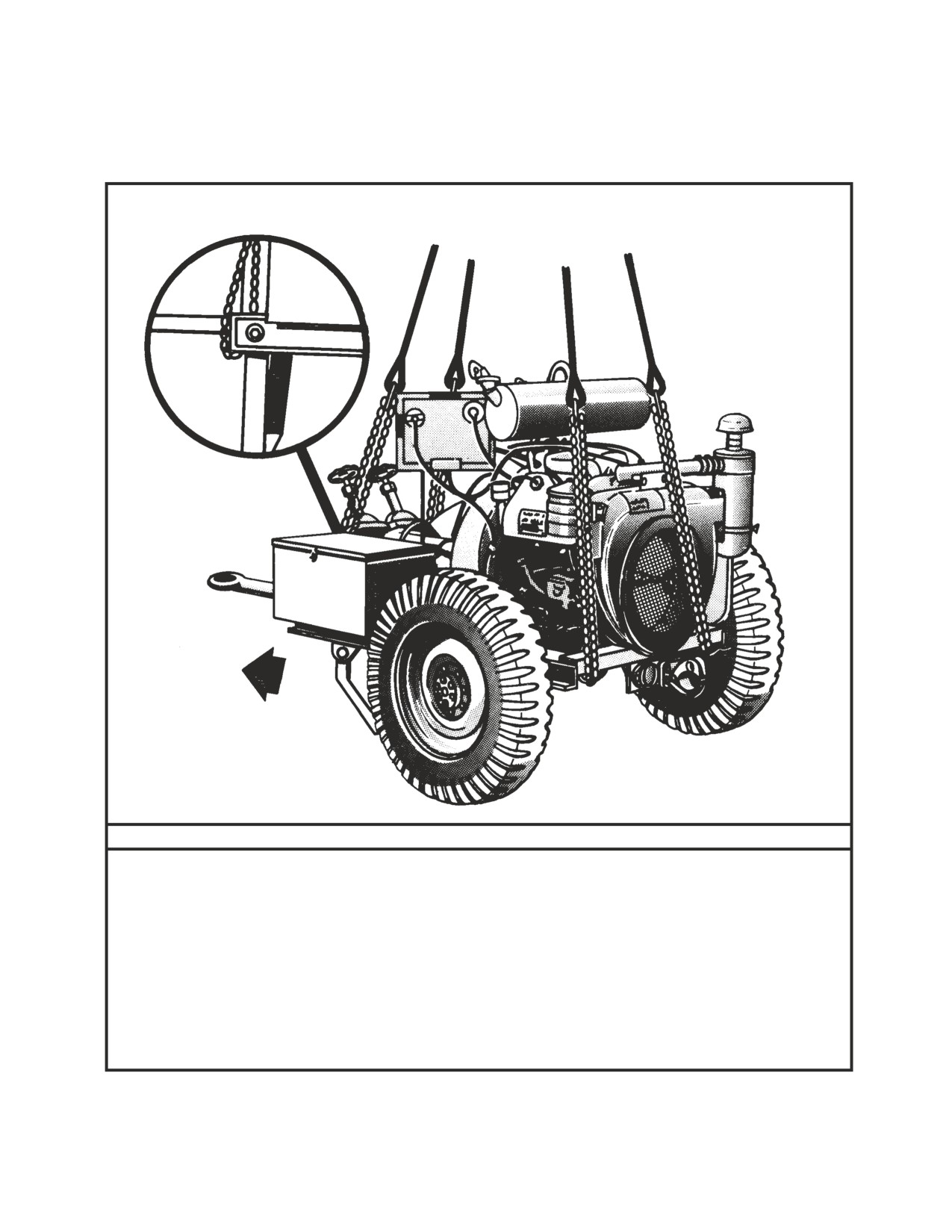
1. Position apex fitting on top of the pump. Route outer
3. Loop the chain end of sling leg 3 around the left rear
sling legs 1 and 2 to the front of the load and inner sling
corner of the frame and through the rings on the bottom of
legs 3 and 4 to the rear. Sling legs 1 and 3 must be on the
the frame. Place the correct link from Table 24-2 in the
left side of the load.
grab hook. Repeat with sling leg 4 and the right rear cor-
ner of the frame. Secure the excess chain with Type III
2. Loop the chain end of sling leg 1 around the left front
nylon cord.
corner of the frame and through the rings on the bottom of
the frame. Place the correct link from Table 24-2 in the
4. Pull each grab hook up and tie to the top corner of the
grab hook. Repeat with sling leg 2 and the right front
load. Cluster and tie or tape (breakaway technique) all
corner of the frame. Secure the excess chain with Type III
sling legs together to prevent entanglement during hookup
nylon cord.
and lift-off.
Figure 24-2. 350 GPM Pump Assembly
24-5

FM 10-450-4/MCRP 4-23E, VOL II/NWP 3-04.12/AFJMAN 11-223, VOL II/
COMDTINST M13482.2
24-4. Light Tactical Floating Raft Bridge
a. Applicability. The following items in Table 24-3 are suitable for sling load by all ARMY helicopters with suitable lift
capacity:
Table 24-3. Light Tactical Floating Raft Bridge
MAX
RECOMMENDED
LINK COUNT
NOMENCLATURE
WEIGHT
SLING SET
AIRSPEED
FRONT/REAR
(POUNDS)
(KNOTS)
M796, 4-Ton Bolster Trailer with Eight
10,620
25K
3/13
80
Half-Pontoons and Cradle
Eight Half-Pontoons and Cradle
6,000
10K
3/3
80
LTR Superstructure, Light Bundle
5,250
10K
3/3
80
LTR Superstructure, Medium Bundle
7,000
10K
3/3
80
LTR Superstructure, Heavy Bundle
10,000
25K
3/3
80
Two Motors and Mounting Brackets
1,290
5K Cargo Net
N/A
80
b. Materials. The following materials are required to
(3) LTR (light bundle).
rig this load:
(a) Sling set (10,000-pound capacity).
(1) Bolster trailer with pontoons and cradle:
(b) Tape, adhesive, pressure-sensitive, 2-inch wide roll.
(a) Sling set (25,000-pound capacity).
(c) Cord, nylon, Type III.
(b) Tie-down assemblies (10,000-pound capacity) (6 each).
(d) Webbing, cotton, 1/4-inch.
(c) Tie-down strap, cargo, CGU-1/B (as required)
(e) Webbing, nylon, tubular, 1/2-inch.
(d) Webbing, cotton, 1/4-inch.
(f) Panel, deck (4 each).
(e) Tape, adhesive, pressure-sensitive, 2-inch wide roll.
(g) Panel, filler, deck (8 each).
(f) Cord, nylon, Type III.
(h) Panel, filler, short deck (6 each).
(2) Pontoons and cradle:
(i) Panel, end, ramp (2 each).
(a) Sling set (10,000-pound capacity).
(j) Assembly, articulating (2 each).
(b) Tape, adhesive, pressure-sensitive, 2-inch wide roll.
(k) Curb, normal (4 each).
(c) Cord, nylon, Type III.
(l) Curb, short (6 each).
(d) Webbing, cotton, 1/4-inch.
24-6
FM 10-450-4/MCRP 4-23E, VOL II/NWP 3-04.12/AFJMAN 11-223, VOL II/
COMDTINST M13482.2
(m) Cable, 5/8-inch, 26-feet long (2 each).
(j) Curb, normal (8 each).
(n) Clamp, cable, 5/8-inch (8 each).
(k) Curb, short (12 each).
(o) Turnbuckle, 5/8- x 24-inch (2 each).
(l) Cable, 5/8-inch, 40-feet long (2 each).
(4) LTR (medium bundle).
(m) Clamp, cable, 5/8-inch (8 each).
(a) Sling set (10,000-pound capacity).
(n) Turnbuckle, 5/8- x 24-inch (2 each).
(b) Tape, adhesive, pressure-sensitive, 2-inch wide roll.
(o) Assembly, articulating (4 each).
(c) Cord, nylon, Type III.
(6) Two motors and mounting brackets:
(d) Webbing, cotton, 1/4-inch.
(a) Net, cargo (5,000-pound capacity).
(e) Webbing, nylon, tubular, 1/2-inch.
(b) Tape, adhesive, pressure-sensitive, 2-inch wide roll.
(f) Panel, deck (6 each).
(c) Cord, nylon, Type III.
(g) Panel, filler, deck (6 each).
(d) Webbing, cotton, 1/4-inch.
(h) Panel, filler, short deck (2 each).
(e) Webbing, nylon, tubular, 1/2-inch.
(i) Panel, end, ramp (4 each).
c. Personnel. Eleven persons can prepare and rig these loads
in the following time:
(j) Curb, normal (6 each).
(1) Bolster trailer with pontoons and cradle, 30 minutes.
(k) Curb, short (4 each).
(2) Pontoons and cradle, 20 minutes.
(l) Cable, 5/8-inch, 26-feet long (2 each).
(3) LTR (light bundle), 20 minutes.
(m) Clamp, cable, 5/8-inch (8 each).
(4) LTR (medium bundle), 25 minutes.
(n) Turnbuckle, 5/8- x 24-inch (2 each).
(5) LTR (heavy bundle), 30 minutes.
(5) LTR (heavy bundle).
(6) Two motors and mounting brackets, 10 minutes.
(a) Sling set (25,000-pound capacity).
d. Procedures. The following procedures apply to these
(b) Tape, adhesive, pressure-sensitive, 2-inch wide roll.
loads:
(c) Cord, nylon, Type III.
(1) Preparation. Prepare the loads using the following
steps:
(d) Webbing, cotton, 1/4-inch.
(a) Bolster trailer with pontoons and cradle:
(e) Webbing, nylon, tubular, 1/2-inch.
1. Secure the pontoons on the cradle and trailer accord-
(f) Panel, deck (8 each).
ing to the operator's manual.
(g) Panel, filler, deck (16 each).
2. Secure both sides of the cradle to the trailer with tie-
downs.
(h) Panel, filler, short deck (12 each).
3. Under the bottom pontoon and on top of the cradle,
(i) Panel, end, ramp (4 each).
secure the cradle to the trailer by wrapping one tie-down strap
24-7
FM 10-450-4/MCRP 4-23E, VOL II/NWP 3-04.12/AFJMAN 11-223, VOL II/
COMDTINST M13482.2
around the cradle and trailer frame at each side of the load
(d) LTR superstructure (medium bundle):
in the vicinity of the rear wheels. Repeat this procedure at
the forward wheels.
1. Place two timbers on the ground as shoring ap-
proximately 6 feet apart.
(b) Pontoons and cradle: Secure the pontoons to
the cradle according to the operator's manual.
2. Lay both cables on the ground parallel to and on
the outside of the timbers.
(c) LTR superstructure (light bundle):
3. Stack two parallel sets of deck panels, three
1. Place two timbers on the ground as shoring ap-
panels high, with male ends facing in same direction.
proximately 6 feet apart.
4. Place two end ramp panels, butt end to butt end,
2. Lay both cables on the ground parallel to and on
on top of each stack of deck panels.
the outside of the timbers.
5. Place deck filler panels between deck panels.
3. Stack the four deck panels on the timbers. Face
the deckplates of the bottom and third panels down and
6. Close off ends of deck panels by lacing 1/2-inch
the second and top panels up. All male ends must be in
tubular nylon webbing across ends of stacks.
the same direction.
7. Place three normal curbs on each side of load,
4. Connect the two articulating assemblies and
alternating short curbs in between the normal curbs.
place them on top of the stack of deck panels.
8. Bring cables up over load, route each end
5. Place two end ramp panels, butt end to butt end,
through turnbuckle, secure each end with two cable clamps,
on top of the articulating assemblies.
and tighten turnbuckle.
6. Place six deck filler panels in the space between
CAUTION
the bottom and second deck panels.
Do not over tighten the cables as damage to
the load will occur.
7. Place remaining two deck filler panels, six short
deck filler panels, and six short curbs in the space be-
9. Tie each short curb to the turnbuckle with nylon
tween the third and top deck panels.
webbing.
8. Place the four normal curbs in the space be-
10. Tie the two cables together with 1/2-inch tubu-
tween the top deck panel and the articulating assemblies.
lar nylon webbing.
9.
Close off the ends of the deck panels and
(e) LTR superstructure (heavy bundle):
articulating assemblies by lacing 1/2-inch tubular nylon
webbing across the ends of the stack.
1. Place two timbers on the ground as shoring ap-
proximately 6 feet apart.
10. Bring cables up over load, route each end
through the turnbuckle, secure each end with two cable
2. Lay both cables on the ground parallel to and on
clamps, and tighten turnbuckle.
the outside of the timbers.
CAUTION
3. Configure two light bundle stacks side-by-side
and secure each end of the load with cables.
Do not over tighten the cables as damage to
the load will occur.
(2) Rigging. Rig the load according to the steps in
Figure 24-3.
11. Tie the two cables together with 1/2-inch tubu-
lar nylon webbing.
24-8
FM 10-450-4/MCRP 4-23E, VOL II/NWP 3-04.12/AFJMAN 11-223, VOL II/
COMDTINST M13482.2
(3) Hookup. The hookup team stands on top of the
removes slack from the sling legs. When successful
pontoons, on top of the superstructure bundles, or along-
hookup is assured, the hookup team quickly exits the area
side the cargo net, depending on the load. The static
underneath the helicopter to the designated rendezvous
wand person discharges the static electricity with the static
point.
wand. The hookup person places the apex fitting onto the
aircraft cargo hook. The hookup team then moves clear of
(4) Derigging. Derigging is the reverse of the prepa-
the load but remains close to the load as the helicopter
ration and rigging procedures in steps d (1) and d (2).
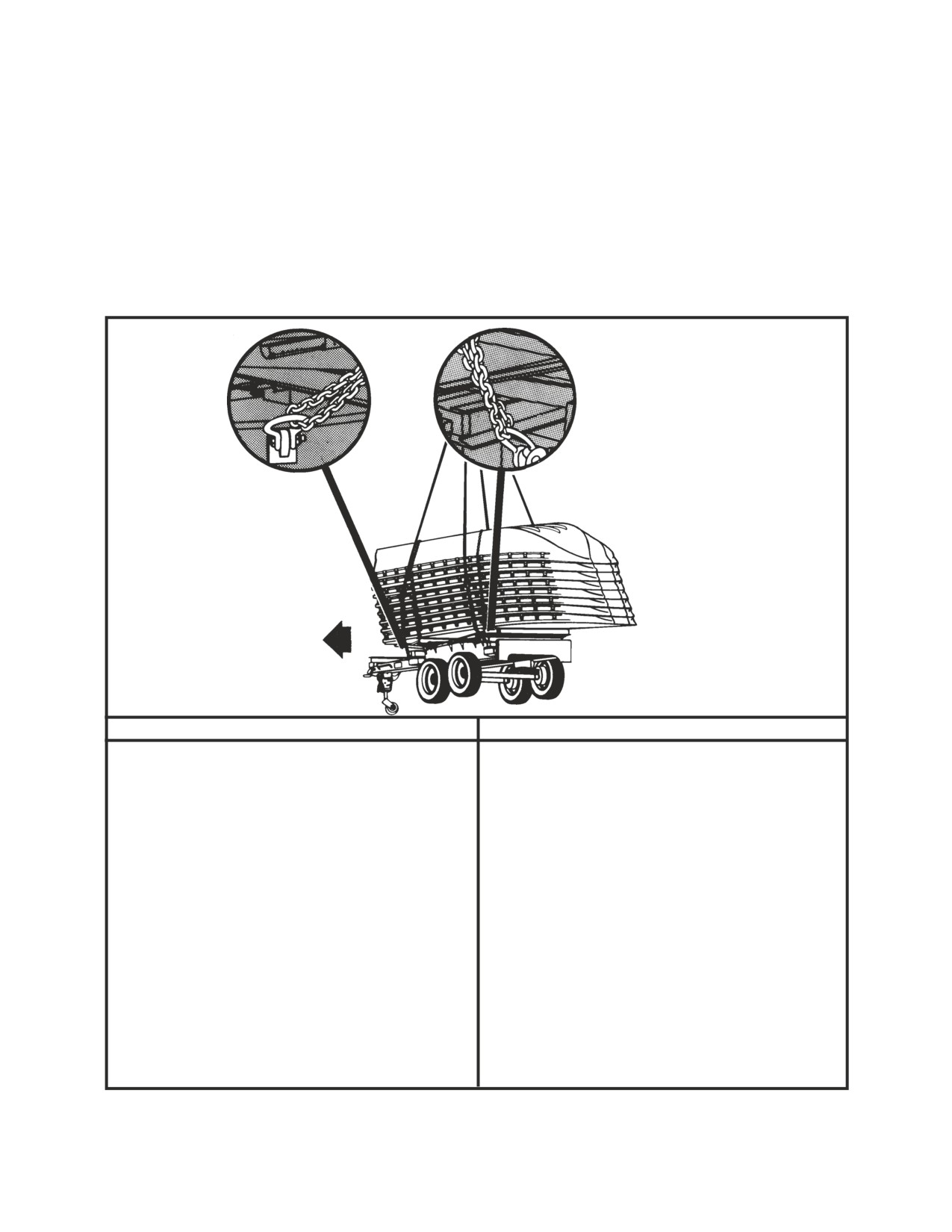
RIGGING STEPS-BOLSTER TRAILER
RIGGING STEPS CRADLE AND PONTOONS ONLY
1. Position apex fitting on top of the pontoons. Route outer
1. Position apex fitting on top of the pontoons. Route outer
sling legs 1 and 2 to the front of the trailer and inner sling legs 3
sling legs 1 and 2 to the front of the trailer and inner sling legs 3
and 4 to the rear. Sling legs 1 and 3 must be on the left side of the
and 4 to the rear. Sling legs 1 and 3 must be on the left side of the
load.
load.
2. Loop the chain end of sling leg 1 through the left front lift
2. Loop the chain end of sling leg 1 through the left front lift
provision mounted on the left front corner of the frame. Place
provision located on the cross beam of the cradle. Place the
the correct link from Table 24-3 in the grab hook. Repeat with
correct link from Table 24-3 in the grab hook. Repeat with sling
sling leg 2 and the right front corner of the trailer.
leg 2 and the right front lift provision.
3. Loop the chain end of sling leg 3 through the left rear lift
3. Loop the chain end of sling leg 3 through the left rear lift
provision mounted on the left rear corner of the trailer. Place the
provision located on the cross beam of the cradle. Place the
correct link from Table 24-3 in the grab hook. Repeat with sling
correct link from Table 24-3 in the grab hook. Repeat with sling
leg 4 and the right rear corner of the trailer. Secure the excess
leg 4 and the right rear lift provision.
chain with Type III nylon cord.
4. Pull each grab hook up and tie to one of the boat rails with
4. Pull each grab hook up and tie to one of the boat rails with
1/4-inch cotton webbing. Cluster and tie or tape (breakaway
1/4-inch cotton webbing. Cluster and tie or tape (breakaway
technique) all sling legs together to prevent entanglement during
technique) all sling legs together to prevent entanglement during
hookup and lift-off.
hookup and lift-off.
Figure 24-3. Light Tactical Floating Raft Bridge
24-9
FM 10-450-4/MCRP 4-23E, VOL II/NWP 3-04.12/AFJMAN 11-223, VOL II/
COMDTINST M13482.2
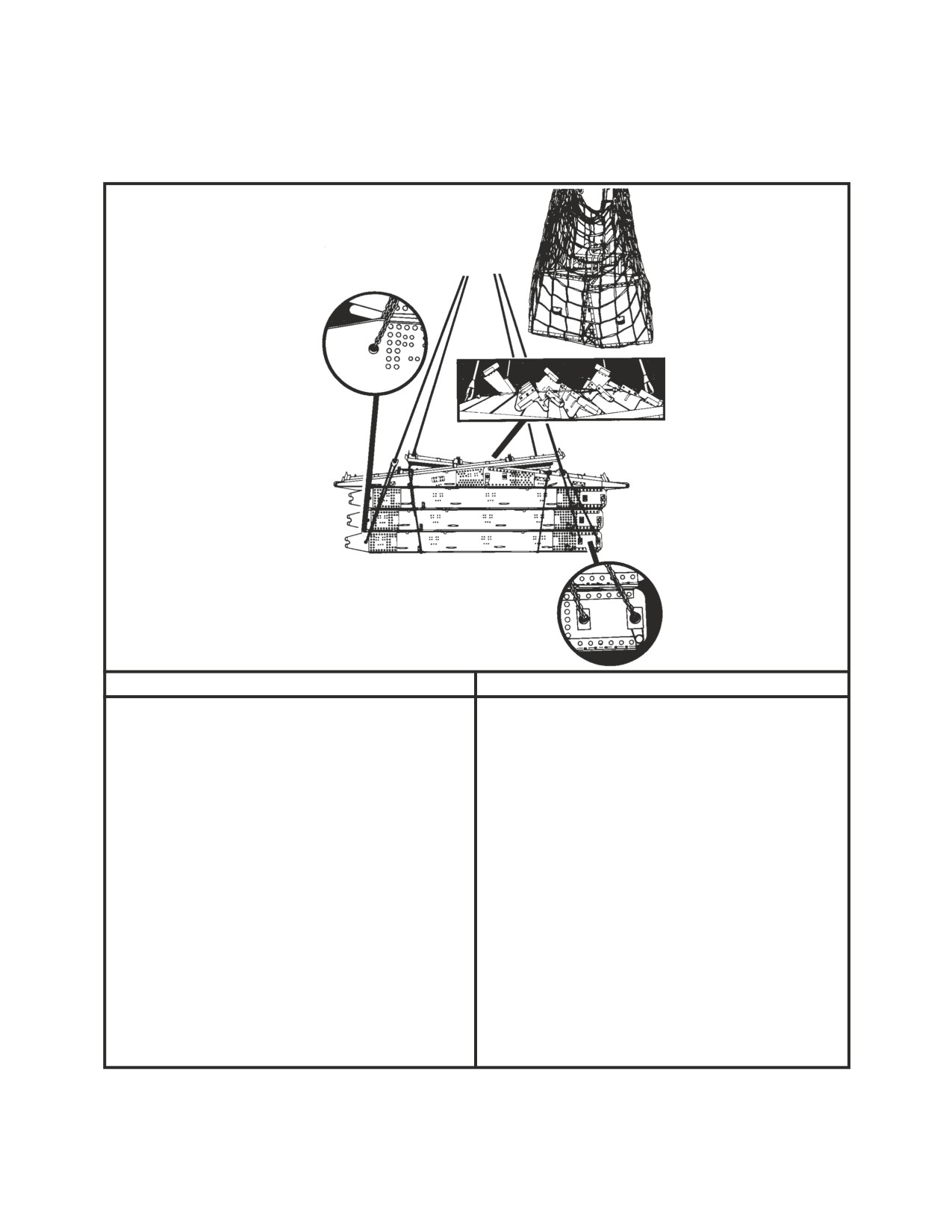
RIGGING STEPS- LTR (LIGHT, MEDIUM, & HEAVY)
RIGGING STEPS- MOTORS & BRACKETS
1. Position apex fitting on top of the load. Route outer sling
1. Spread the 5,000-pound capacity cargo net on the ground.
legs 1 and 2 to the female end of the deck panels and inner sling
legs 3 and 4 to the male ends. Sling legs 1 and 3 must be on the
2. Secure the motors, pins, paddles, and miscellaneous items
left side of the load.
in the containers. Secure the lid closed with Type III nylon cord.
2. Loop the chain end of sling leg 1 through the inside hole
3. Center the containers on the cargo net.
and back out through the outside hole of the bottom deck panel.
Place the correct link from Table 24-3 in the grab hook. Repeat
4. Place the mounting brackets on top of the containers.
with sling leg 2 on the opposite side of the load.
5. Rig and close the cargo net in accordance with
3. Loop the chain end of sling leg 3 through the hole at the
FM 10-450-3.
male end of the bottom deck panel. Place the correct link from
Table 24-3 in the grab hook. Repeat with sling leg 4 on the
opposite side of the load.
4. Remove the safety pins and place them in the boat motor
box or safety tie them with Type III nylon cord.
5. Cluster and tie or tape (breakaway technique) all sling legs
together to prevent entanglement during hookup and lift-off.
Figure 24-3. Light Tactical Floating Raft Bridge (continued)
24-10
FM 10-450-4/MCRP 4-23E, VOL II/NWP 3-04.12/AFJMAN 11-223, VOL II/
COMDTINST M13482.2
24-5. Medium-Span Bridge
a. Applicability. The following item in Table 24-4 is suitable for sling load by all ARMY helicopters with suitable lift
capacity:
Table 24-4. Medium-Span Bridge
MAX
RECOMMENDED
LINK COUNT
NOMENCLATURE
WEIGHT
SLING SET
AIRSPEED
FRONT/REAR
(POUNDS)
(KNOTS)
Bridge Erection Set, Medium Girder
13,800
25K
5/5
60
Section
b. Materials. The following materials are required to
(1) Preparation. Prepare the load using the following
rig this load:
steps:
(1) Sling set (25,000-pound capacity).
(a) Position the ramp sections on top of the bridge
main structure. Secure with tie-down straps.
(2) Multiloop line, Type XXVI nylon, 12-foot, 4-loop
(4 each).
(b) Secure the four pieces of padding on the bottom
side at each corner where the nylon straps are choker-
(3) Tape, adhesive, pressure-sensitive, 2-inch wide
hitched.
roll.
(2) Rigging. Rig the load according to the steps in
(4) Cord, nylon, Type III, 550-pound breaking strength.
Figure 24-4.
(5) Webbing, cotton, 1/4-inch, 80-pound breaking
(3) Hookup. The hookup team stands on top of the
strength.
bridge center. The static wand person discharges the
static electricity with the static wand. The hookup person
(6) Padding, felt or suitable substitute.
places the apex fitting onto the aircraft cargo hook. The
hookup team then moves clear of the load but remains
(7) Clevis, large (4 each).
close to the load as the helicopter removes slack from the
sling legs. When successful hookup is assured, the
(8) Tie-down strap, cargo, CGU-1/B (as required).
hookup team quickly exits the area underneath the heli-
copter to the designated rendezvous point.
c. Personnel. Six persons can prepare and rig this load
in 30 minutes.
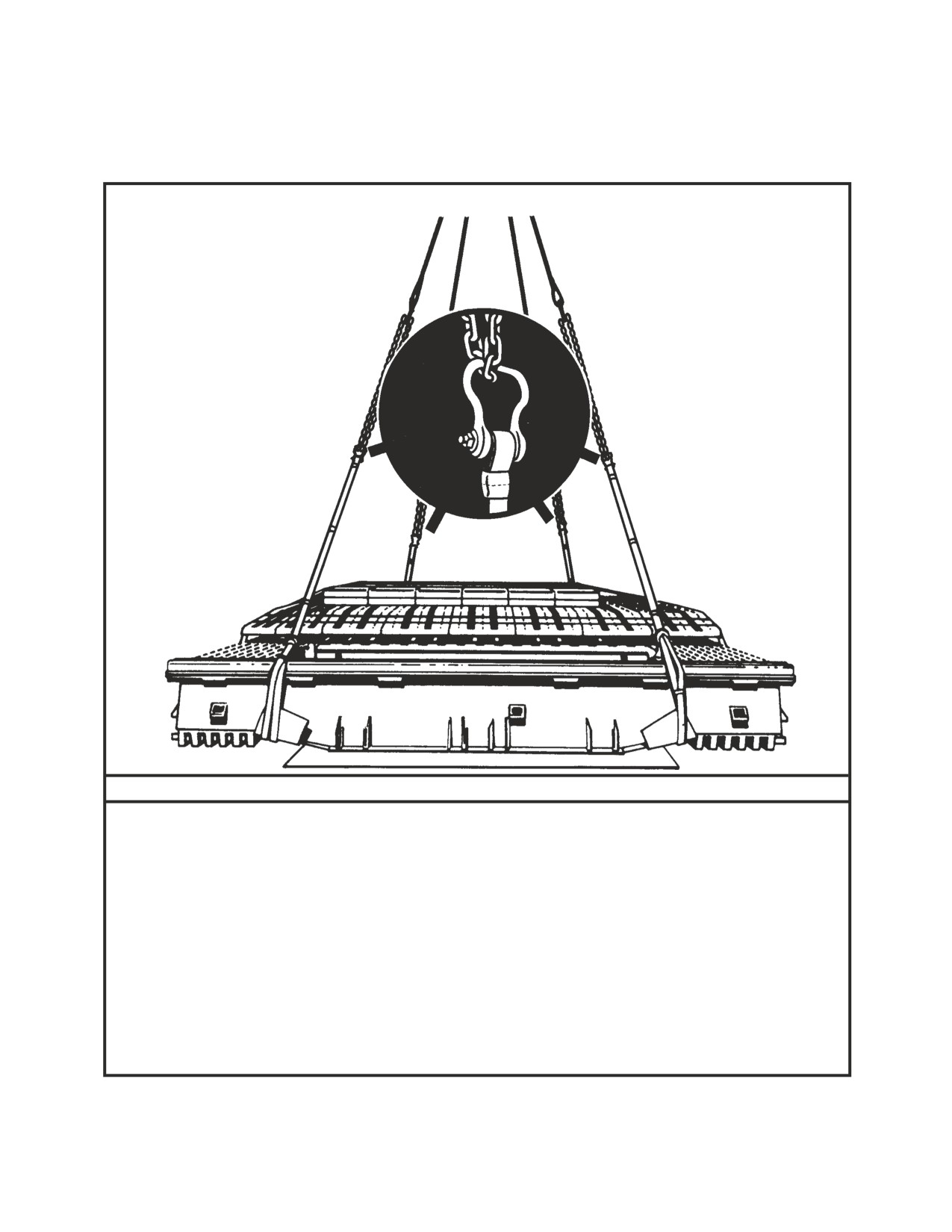
(4) Derigging. Derigging is the reverse of the prepa-
ration and rigging procedures in steps d (1) and d (2).
d. Procedures. The following procedures apply to this
load:
24-11
FM 10-450-4/MCRP 4-23E, VOL II/NWP 3-04.12/AFJMAN 11-223, VOL II/
COMDTINST M13482.2
RIGGING STEPS
1. Position apex fitting on top of the bridge. Route outer
bridge . Place the correct link from Table 24-4 in the grab
sling legs 1 and 2 to the front of the load and inner sling
hook. Repeat with sling leg 2 and the right front corner of
legs 3 and 4 to the rear. Sling legs 1 and 3 must be on the
the bridge.
left side of the load.
5. Loop the chain end of sling leg 3 through the large
2. Choker-hitch a 12-foot, 4-loop, Type XXVI nylon
clevis on the 12-foot sling on the rear left corner of the
sling through the opening in each corner of the bridge.
bridge . Place the correct link from Table 24-4 in the grab
hook. Repeat with sling leg 4 and the right rear corner of
3.
Insert a large clevis in the running end of each 12-
the bridge.
foot sling. Ensure the bolt runs through the sling and the
nut is tight on the bolt.
6. Cluster and tie or tape (breakaway technique) all sling
legs together to prevent entanglement during hookup and
4. Loop the chain end of sling leg 1 through the large
lift-off.
clevis on the 12-foot sling on the front left corner of the
Figure 24-4. Medium-Span Bridge
24-12
FM 10-450-4/MCRP 4-23E, VOL II/NWP 3-04.12/AFJMAN 11-223, VOL II/
COMDTINST M13482.2
24-6. M4T6 Bridge
a. Applicability. The following item in Table 24-5 is suitable for sling load by all ARMY helicopters with suitable lift
capacity:
Table 24-5. Medium-Span Bridge
MAX
RECOMMENDED
LINK COUNT
NOMENCLATURE
WEIGHT
SLING SET
AIRSPEED
FRONT/REAR
(POUNDS)
(KNOTS)
Bridge, Floating, Aluminum, Highway
Type, Deck-Balk Superstructure on
9,000
25K
4/4
50
Pneumatic Floats, M4T6
b. Materials. The following materials are required to
(1) Preparation. Ensure all components are securely
rig this load:
attached together.
(1) Sling set (25,000-pound capacity).
(2) Rigging. Rig the load according to the steps in
Figure 24-5.
(2) Tape, adhesive, pressure-sensitive, 2-inch wide
roll.
(3) Hookup. The hookup team stands on top of the
bridge. The static wand person discharges the static elec-
(3) Cord, nylon, Type III, 550-pound breaking strength.
tricity with the static wand. The hookup person places
the apex fitting onto the aircraft cargo hook. The hookup
(4) Webbing, cotton, 1/4-inch, 80-pound breaking
team then moves clear of the load but remains close to the
strength.
load as the helicopter removes slack from the sling legs.
When successful hookup is assured, the hookup team
c. Personnel. Two persons can prepare and rig this
quickly exits the area underneath the helicopter to the
load in 10 minutes.
designated rendezvous point.
d. Procedures. The following procedures apply to this
(4) Derigging. Derigging is the reverse of the prepa-
load:
ration and rigging procedures in steps d (1) and d (2).
24-13
FM 10-450-4/MCRP 4-23E, VOL II/NWP 3-04.12/AFJMAN 11-223, VOL II/
COMDTINST M13482.2
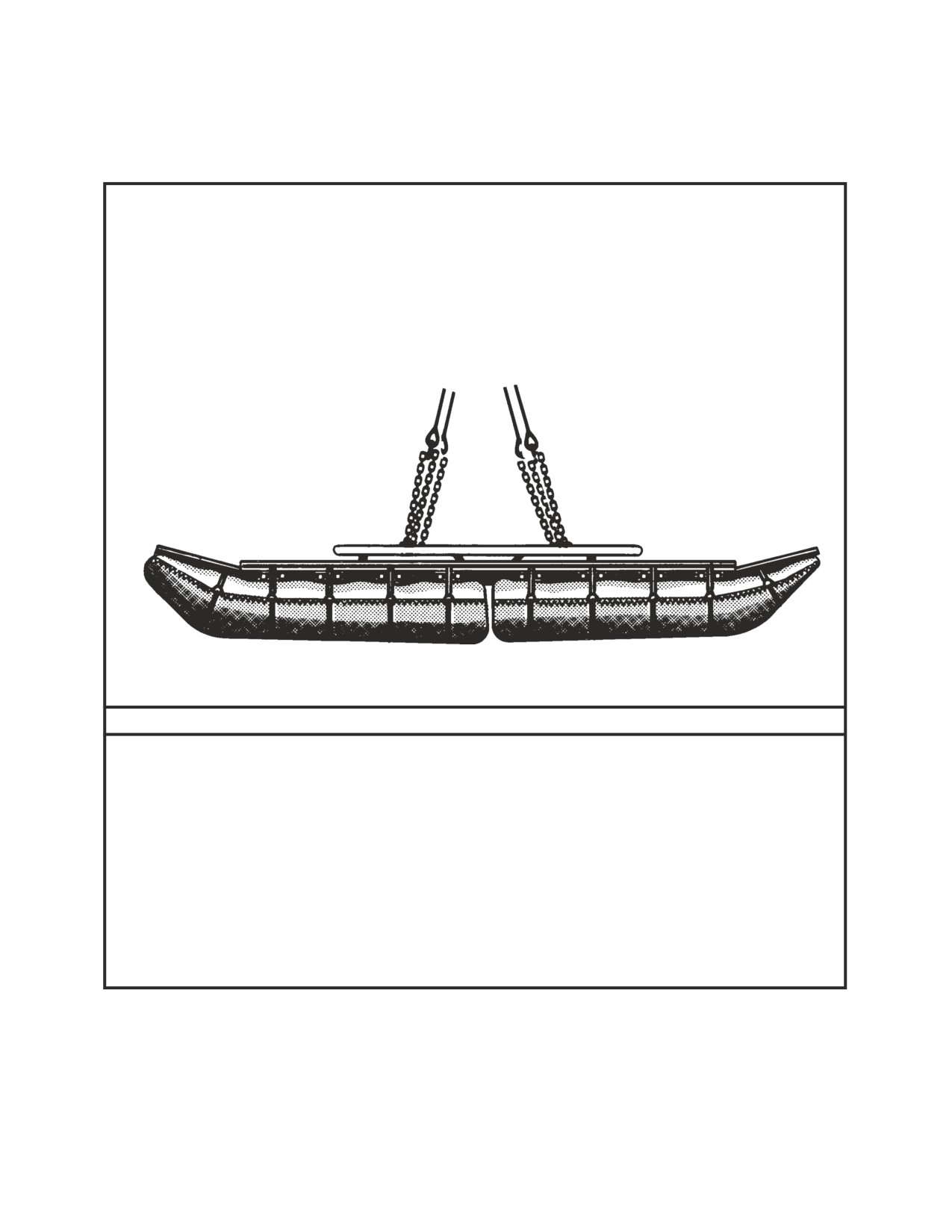
RIGGING STEPS
1. Position apex fitting on top of the center of the bridge.
3. Loop the chain end of sling leg 3 around the seventh
Route outer sling legs 1 and 2 to the forward end of the
balk connection pin from the rear end on the left balk
balk connecting stiffener and inner sling legs 3 and 4 to
connecting stiffener. Place the correct link from Table 24-
the rear. Sling legs 1 and 3 must be on the left side of the
5 in the grab hook. Repeat with sling leg 4 and the sev-
load.
enth connection pin from the rear end of the right balk
stiffener.
2. Loop the chain end of sling leg 1 around the seventh
balk connection pin from the forward end on the left balk
4. Cluster and tie or tape (breakaway technique) all sling
connecting stiffener. Place the correct link from Table 24-
legs together to prevent entanglement during hookup and
5 in the grab hook. Repeat with sling leg 2 and the sev-
lift-off.
enth connection pin from the forward end of the right balk
stiffener.
Figure 24-5. M4T6 Bridge
24-14
C3, FM 10-450-4/MCRP 4-23E, VOL II/NWP 3-04.12/AFJMAN 11-223, VOL II/
COMDTINST M13482.3A
APPENDIX A
NATIONAL STOCK NUMBERS FOR SLINGS,
NETS, AND SPARE PARTS
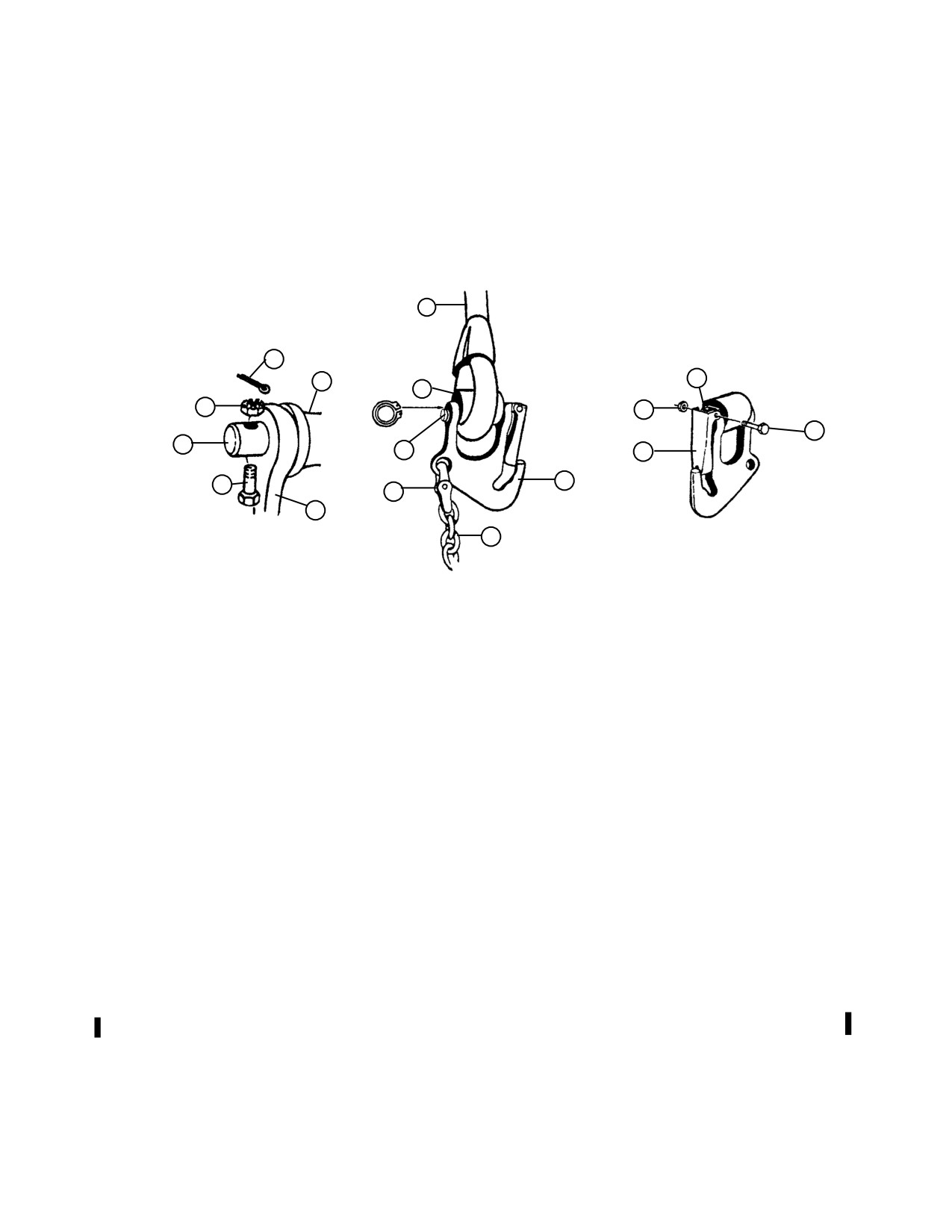
10,000-POUND CAPACITY SLING SET AND COMPONENTS
7
6
3
12
9
5
15
13
14
2
10
11
4
8
17
1
16
10,000- or 25,000-Pound Capacity Sling Set (Circled Numbers Correspond with NSNs of Identified Part)
NSN
PART NUM BER
DESCRIPTION
Qty
1670-01-027-2902
38850-00001-043
SlingSetAssemblyComp
l
t
1 ea
1
4030-01-048-4045
38850-00004-045
Apex Fitting Assembly
1 ea
2
5315-01-115-3482
38850-00008-101
Pin, Apex Fitting
1 ea
3
5365-01-235-0908
38850-00015-104
Spacer, Apex
1 ea
4
5306-00-944-1536
NAS1306-16D
Bolt
1 ea
5
5310-00-207-9274
AN 320C6
Nut, Caste
l
1 ea
6
5315-00-2341864
MS 24665-302
Cotter Pin
1 ea
7
1670-01-047-6814
38850-00009-055
Rope Assembly, Black
4 ea
8
4030-01-048-4046
38850-00011-041
Grabhook Assembly
4 ea
9
5364-01-109-2543
38850-00015-101
Spacer, Grabhook
4 ea
10
5315-01-121-0497
38850-00008-103
Pin, Spacer
4 ea
11
4030-01-100-1684
38850-00017-101
Keeper, Grabhook
4 ea
12
5360-01-115-6833
38850-00019-101
Keeper, Spring
4 ea
13
5365-01-046-3670
MS 3217-1050
Snap Ring
4 ea
14
5306-00-771-7621
NAS 1303-21
Bolt, Shear
4 ea
15
5310-00-807-1467
MS 21042-3
Nut, Lock
4 ea
16
4010-01-058-4772
38850-00053-101
Chain, 8-foot Length
4 ea
17
4010-01-231-3388
5770415
Link, Coupling
4 ea
18
8460-00-606-8366
Mil-41835
KitBag,
l
1 ea
A-1
C3, FM 10-450-4/MCRP 4-23E, VOL II/NWP 3-04.12/AFJMAN 11-223, VOL II/
COMDTINST M13482.3A
25,000-POUND CAPACITY SLING SET AND COMPONENTS
NSN
PART NUM BER
DESCRIPTION
Qty
1670-01-027-2900
38850-00001-044
SlingSetAssemblyComp
l
t
1 ea
1
4030-01-048-4044
38850-00004-046
ShackleAssembly
1 ea
2
5315-01-119-9065
38850-00008-102
Pin, Apex Fitting
1 ea
3
1670-01-235-0907
38850-00015-105
Spacer, Apex
1 ea
4
5306-00-944-2659
NAS1306-22D
Bolt
1 ea
5
5310-00-207-9274
AN 320C6
Nut, Caste
l
1 ea
6
5315-00-234-1864
MS 24665-302
Cotter Pin
1 ea
7
1670-01-047-6815
38850-00009-056
Rope Assembly
4 ea
8
4030-01-048-4047
38850-00011-046
Grabhook Assembly
4 ea
9
1670-01-109-2544
38850-00015-102
Spacer, Grabhook
4 ea
10
5315-01-121-2874
38850-00008-104
Pin, Spacer
4 ea
11
4030-01-100-1685
38850-00017-102
Latch, Safety Hook
4 ea
12
5360-01-115-6833
38850-00019-101
Keeper, Spring
4 ea
13
5365-00-261-3918
MS 3217-1075
Snap Ring
4 ea
14
5306-00-771-7621
NAS 1303-21
Bolt, Shear
4 ea
15
5310-00-807-1467
MS 21042-3
Expanded Washer
4 ea
16
4010-01-058-4771
38850-00053-102
Chain, 8-foot Length
4 ea
17
4010-01-041-9751
664241
Link, Coupling
4 ea
18
8460-00-606-8366
Mil-41835
KitBag,
l
1 ea
A-2
C1, FM 10-450-4/MCRP 4-23E, VOL II/NWP 3-04.12/AFJMAN 11-223, VOL II/
COMDTINST M13482.3A
15,000-POUND CAPACITY MULTILEG SLING ASSEMBLY
NSN
PART NUM BER
DESCRIPTION
Qty
Sling, multi-legassemb
y
1670-00-902-3080
3900061
1
ea
T
AMCN B2030
5365-00-946-8719
AC6000292
Web Ring assem bly
1 ea
1670-00-719-6243
MS24553-1
Link Assem bly, Web Ring
1 ea
1670-00-946-8631
3110167
Sling legassem
l
4 ea
NA
391
1
Keeper, 5-inch,
l
4 ea
NA
391
1
Keeper, 6 1/4-inch,
l
4 ea
1670-00-719-6343
MS 24553-1
Link assembly, sling
l
1 ea
NA
31610
Grab
l
4 ea
NA
FE7623-3
Keeper, grab
l
4 ea
NA
34012-18
Spring keeper, grab
l
4 ea
5310-00-167-0818
NAS1145f0363f
Washer keeper, grab
l
4 ea
5315-00-812-3765
MS20392-2033
Pin, keeper, grab
l
4 ea
5315-00-839-2325
MS24665-132
Cotter pin, keeper, grab
l
4 ea
NA
31
1
Coupling
l
4 ea
NA
34080-4
Ch
i
4 ea
A-3
C1, FM 10-450-4/MCRP 4-23E, VOL II/NWP 3-04.12/AFJMAN 11-223, VOL II/
COMDTINST M13482.3A
40,000-POUND CAPACITY SLING SET AND COMPONENTS
NSN
PART NUM BER
DESCRIPTION
Qty
3940-01-183-21
18
TAMCN
SlingSetAssemblyCom
l
1 ea
4030-01-199-9562
FE8109-1
Apex shackle assembly
1 ea
N
A
FE8109-5
Shackle
1 ea
N
A
FE8109-3
Pin, shackle, apex
1 ea
N
A
FE8109-2
Spacer, shackle, apex
1 ea
5306-00-763-7931
NAS1306-21D
Bolt, shear
1 ea
5310-00-176-81
10
AN320-6
Nut, castellated, plain, hex
1 ea
5315-00-234-1864
MS24665-302
Cotter Pin
1 ea
3940-01-194-9364
JETSWMC-2000
Sling
l
4 ea
4030-01-197-1629
FE8103-1
Shackle assembly
4 ea
N
A
FE8103-4
Spacer, grab
l
4 ea
5306-00-151-1482
AN12-42
Bolt, grablink
4 ea
5310-00-167-1292
AN310-12
Nut, plain, castellated, plain, hex
4 ea
5315-00-285-7161
MS20392-2033
Pin, cotter
4 ea
N
A
34012-18
Spring, keeper, grab
l
4 ea
5310-00-167-0818
AN960-10
Washer, keeper, grab
l
4 ea
5315-00-839-2325
MS24665-132
Cotter pin, keeper, grab
l
4 ea
4010-01-081-51
14
577-0815
Link, Coupling
4 ea
N
A
607050
Chain, 8-foot
4 ea
A-4
C1, FM 10-450-4/MCRP 4-23E, VOL II/NWP 3-04.12/AFJMAN 11-223, VOL II/
COMDTINST M13482.3A
FLAT WEB NYLON SLINGS
TYPE X NYLON AERIAL DELIVERY SLING
NSN
Description
3940-00-675-5001
Sling, endless donut, 10-inch
1670-00-393-0460
Ring assembly, 25,000-pound capacity
TYPE XXVI NYLON MULTILOOP LINE
NSN
Description
1670-01-062-6301
2-loop, 3 foot
1670-01-062-6306
4-loop, 3 foot
1670-01-062-6304
2-loop, 9 foot
1670-01-062-6305
4-loop, 9 foot
1670-01-063-7760
2-loop, 11 foot
1670-01-062-6310
4-loop, 11 foot
1670-01-062-6303
2-loop, 12 foot
1670-01-062-6307
4-loop, 12 foot
1670-01-063-7761
2-loop, 16 foot
1670-01-062-6308
4-loop, 16 foot
1670-01-062-6302
2-loop, 20 foot
1670-01-064-4453
4-loop, 20 foot
1670-01-062-6309
4-loop, 28 foot
1670-01-062-6313
3-loop, 60 foot
1670-01-064-4454
6-loop, 60 foot
1670-01-062-6311
2-loop, 120 foot
1670-01-062-6312
6-loop, 120 foot
1670-01-107-7651
3-loop, 140 foot
ROUNDSLINGS
NSN
CAPACITY
LENGTH
1670-01-388-6789
5,300-pound
8 foot
1670-01-388-8480
8,400-pound
8 foot
1670-01-388-3845
5,300-pound
17 foot
1670-01-388-8479
8,400-pound
17 foot
1670-01-388-3917
13,200-pound
30 foot
1670-01-388-3901
21,200-pound
65 foot
1670-01-388-3965
21,200-pound
70 foot
A-5
C1, FM 10-450-4/MCRP 4-23E, VOL II/NWP 3-04.12/AFJMAN 11-223, VOL II/
COMDTINST M13482.3A
5,000- AND 10.000-POUND CAPACITY CARGO NETS AND COMPONENTS
NSN
Part Number
Description
Qty
1670-01-058-3811
6018-5
Net, 5,000-pound capacity,
1 ea
LIN N02776, TAMCN J3121
1670-01-058-3810
6018-10
Net, 10,000-pound capacity,
1 ea
LIN N02708, TAMCN J3120
1670-01-070-5276
6019
Apex fitting
1 ea
1670-01-067-9989
6020
Hook
4 ea
4020-01-118-5826
M7515-7N
Repair cord, used on
As req
part no. 6018-5
4020-01-119-5994
6018-20
Repair cord, used on
As req
part no. 6018-10
8030-01-152-2286
WB460-23
Antiabrasion compound,
As req
olive drab
8030-01-154-2327
WB460-7012
Antiabrasion compound,
As req
black
1080-00-108-1155
13226EO964-2
Transportease
1 ea*
8460-00-606-8366
MIL-K-41835
Kit bag, flyers
1 ea*
* Alternate NSN is 1080-00-107-8580. These cases are designed and marked for use with the
camouflage screen. Camouflage system markings should be replaced with “Helicopter External Cargo
Net, 10,000-pound capacity.”
PROTECTIVE EQUIPMENT
NSN
Description
4240-00-052-3776
Eye goggles
8415-01-158-9445
Gloves, electrical workers, size 9
8415-01-158-9446
Gloves, electrical workers, size 10
8415-01-158-9447
Gloves, electrical workers, size 11
8415-01-158-9448
Gloves, electrical workers, size 12
8415-00-268-7859
Gloves, leather
4240-00-759-3290
Headset (USAF)
4240-00-762-2582
Headset (USAF)
8415-00-071-8786
Helmet, flight deck (USN/USMC/USAF)
6515-00-137-6345
Plugs, ear, hearing protection
A-6
C1, FM 10-450-4/MCRP 4-23E, VOL II/NWP 3-04.12/AFJMAN 11-223, VOL II/
COMDTINST M13482.3A
MISCELLANEOUS EQUIPMENT AND MATERIAL
NSN
Description
4030-00-360-0304
Clevis assembly, small, MS 70087-1
5305-00-726-2553
Bolt, Screw Cap, Hexagon Head
5310-00-835-2037
Nut, Plain, Hexagon
4030-00-678-8562
Clevis assembly, medium, MS 70087-2, Shackle
5305-00-940-8069
Bolt, Screw Cap, Hexagon Head
5310-00-842-1190
Nut, Plain, Hexagon
4030-00-090-5354
Clevis assembly, large, MS 70087-3, Shackle
5305-00-177-5617
Bolt, Screw Cap, Hexagon Head
5310-00-891-3428
Nut, Plain, Hexagon
4020-00-240-2146
Cord, nylon, Type III, 550-pound breaking strength
8305-00-958-3685
Felt sheeting, 1/2-inch thick, 30-inch wide
8305-00-191-1101
Felt sheeting, 1/2-inch thick, 60-inch wide
7510-00-079-0286
Ink, marking, parachute, orange-yellow, marker
7520-00-634-6583
Ink, marking, parachute, orange-yellow, liquid
7510-00-230-2734
Ink, marking, parachute, strata-blue, marker
7520-00-286-5362
Ink, marking, parachute, strata-blue, liquid
5825-00-917-3738
Light, beacon, beanbag
6260-01-074-4230
Light, chemical wand, 30-minute glow time, Yellow
6260-00-106-7478
Light, chemical wand, 6-hour glow time, Green
6260-01-074-4229
Light, chemical wand, 12-hour glow time, Green
1670-00-783-5988
Link assembly, Type IV
1670-00-212-1149
Rachet, Adjustable, Assembly, Tiedown
1670-00-516-8405
Tiedown, Cargo, Aircraft, 10,000-pound capacity
1670-00-753-3928
Pad, energy-dissipating, honeycomb
8135-00-664-6958
Padding, cellulose, 20-inch by 60-foot
8135-00-808-6446
Padding, cellulose, 24-inch by 125-foot
8345-00-174-6865
Panel, marker, red-yellow, VS-17, orange
4020-00-231-2581
Rope, 3/8-inch, TR605, Natural
4020-00-968-1357
Rope, fibrous, 1/2-inch, MIL-R-17343
6850-00-264-9038
Solvent, dry cleaning, PD-680
7510-00-266-5016
Tape, adhesive, pressure-sensitive, 2-inch wide roll, green
A-7