FM 3-11.3 PROCEDURES FOR CHEMICAL, BIOLOGICAL, RADIOLOGICAL, AND NUCLEAR CONTAMINATION AVOIDANCE (FEBRUARY 2006) - page 7
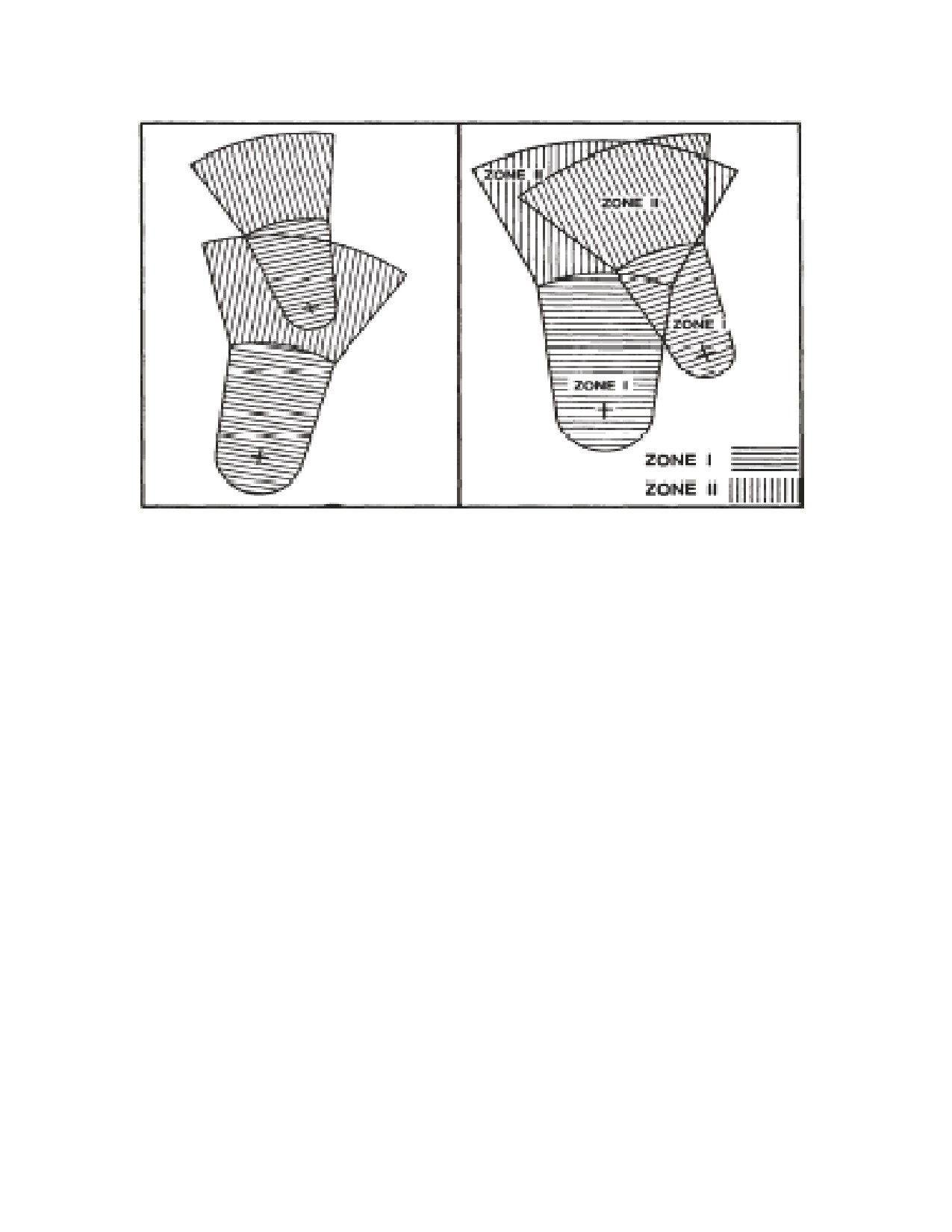
Figure G-12. Multiple-Burst Detailed Fallout Prediction (Example)
(2) Required Items. To construct a simplified fallout prediction, the unit
requires the following items:
(a) Current EDM.
(b) NBC2 NUC report.
(c)
M5A2 simplified fallout predictor (see Figure G-13, page G-26, and
Figure G-14, page G-27).
(d) Downwind distance zone of immediate concern nomogram.
2 February 2006
FM 3-11.3/MCRP 3-37.2A/NTTP 3-11.25/AFTTP(I) 3-2.56
G-25
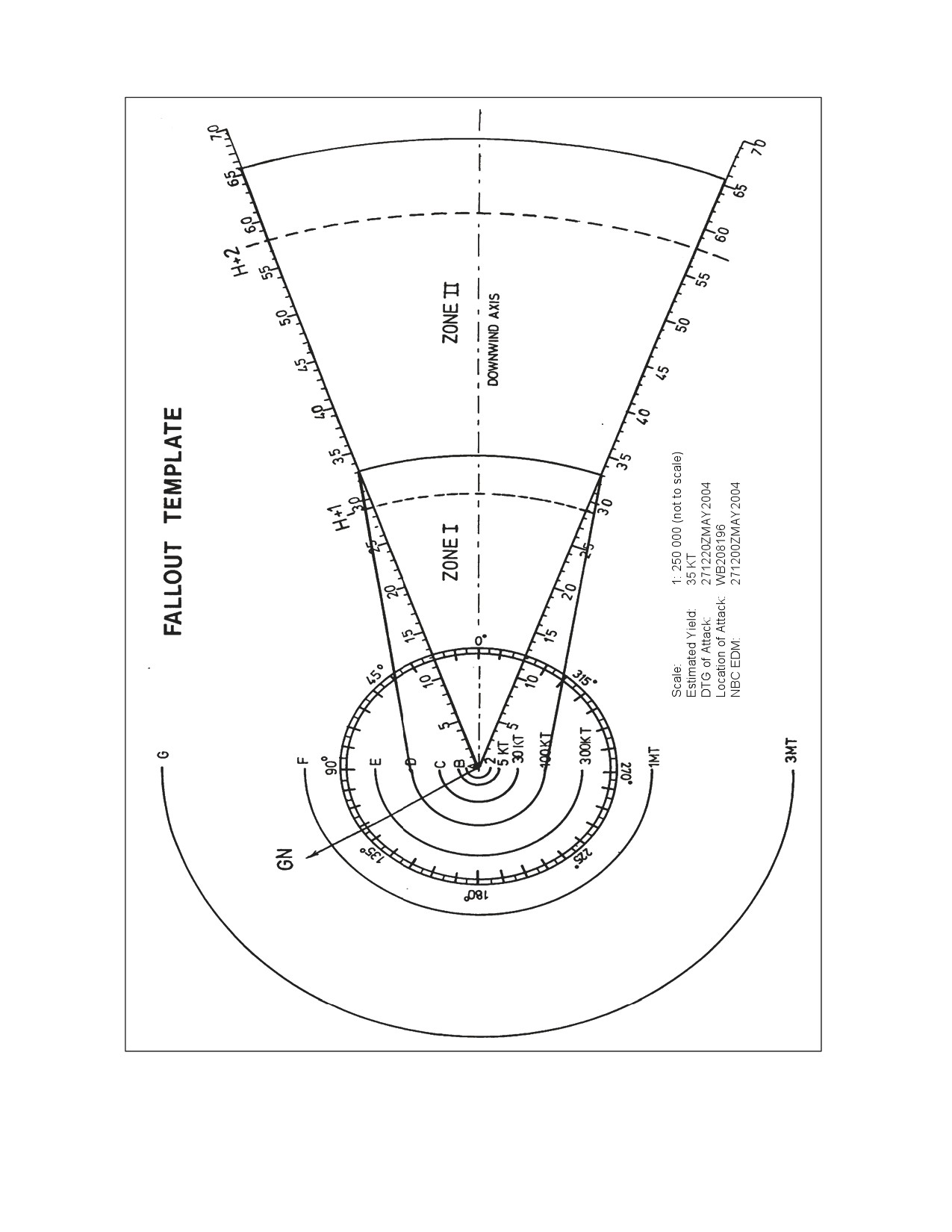
Figure G-13. Simplified Fallout Template With Fallout Prediction
G-26
FM 3-11.3/MCRP 3-37.2A/NTTP 3-11.25/AFTTP(I) 3-2.56
2 February 2006
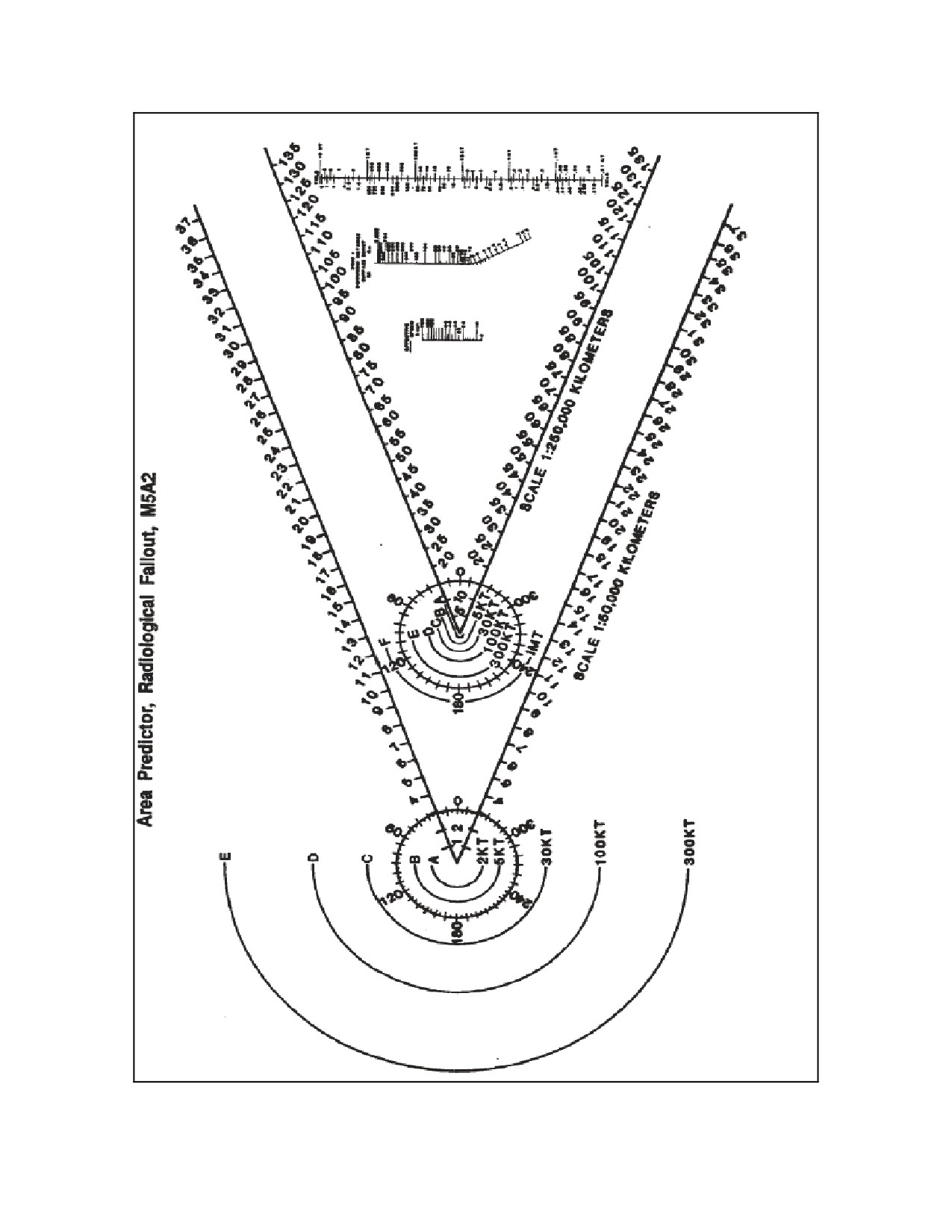
Figure G-14. Simplified Fallout Template, M5A2 (Example)
2 February 2006
FM 3-11.3/MCRP 3-37.2A/NTTP 3-11.25/AFTTP(I) 3-2.56
G-27

(3)
EDM Yield Groups. There are seven standard yield groups for which the
EDM (see Table G-1) provides plotting information. These yield groups are listed as lines
ALPHAM through GOLFM on the EDM. The following information is provided by each
yield group:
Table G-1. Preselected Yield Groups
is
≤
ALPHAM
≤
2 KT
is
>
≤
BRAVOM
2 KT
5 KT
is
>
≤
CHARLIEM
5 KT
30 KT
is
>
≤
DELTAM
30 KT
100 KT
is
>
≤
ECHOM
100 KT
300 KT
is
>
≤
FOXTROTM
300 KT
1,000 KT (1 MT)
is
>
≤
GOLFM
1,000 KT
3,000 KT (3 MT)
(a) The first three digits (ddd) contain the downwind direction for the
particular yield group in degrees grid from GN.
(b) The next three digits (sss) contain the EWS, in kph.
(c)
The last three digits (***) represent the expanded angle, in degrees,
between the left and right radial lines. They are only reported when the angle from the
wind vector plot exceeds 40°. (Last digit in ADP [NATO ADatP-3 Data Base] format—7
digit total vice 9 EDM line.)
NOTE: The first three digits could represent the downwind distance of Zone I
measured in km if the wind speed is below 8 kph for the respective EDM line (see
Figure G-15, page G-29).
G-28
FM 3-11.3/MCRP 3-37.2A/NTTP 3-11.25/AFTTP(I) 3-2.56
2 February 2006
(d) To calculate the data, use the detailed procedure discussed later in
this appendix with 2 KT for ALPHAM, 5 KT for BRAVOM, 30 KT for CHARLIEM, and so
on.
Example: NBC EDM
AREA/RRRRR// (area of validity)
ZULUM/ddttttZMMMYYYY/ (DTG when winds were measured)
UNIT/LLL/DDD/SSS/-//
ALPHAM
/-/ddd/sss/***
BRAVOM
/-/ddd/sss/***
CHARLIEM
/-/ddd/sss/***
DELTAM
/-/ddd/sss/***
ECHOM
/-/ddd/sss/***
FOXTROTM
/-/ddd/sss/***
GOLFM
/-/ddd/sss/***
ZULUM (ddttttZMMMYYYY) is the DTG at which the real winds for the wind vector plot
were measured (e.g., 020600ZJUN2004 is the 2nd day of June 2004 at 0600Z ).
UNIT (LLL/DDD/SSS/-//) are the units of measurement being used (e.g., LLL = (KM), DDD
= degrees grid (DGG), and SSS = KPH). DDD is the effective downwind direction in
degrees, and SSS is the effective downwind speed in kph (e.g., ALPHAM 080025 is a
downwind direction of 80 degrees, and 25 is an effective downwind speed of 25 kph, valid
for yields of 2 KT or less. If ALPHAM was 004, LLL ( /-/ ) would be the downwind distance
of Zone I (4 km).
(4)
M5A2 Fallout Predictor. The M5A2 fallout predictor is a transparent
device used to outline the zones of hazard resulting from surface bursts for the preselected
yield groups.
(a) The M5A2 fallout predictor is composed of two simple predictors and a
nomogram for determining the downwind distance of Zone I.
(b) One predictor is drawn to a scale of 1:50,000; the other predictor is
drawn to a scale of 1:250,000. Each predictor contains preselected yield groups (A, B, C, D,
and E—1:50,000 and A, B, C, D, E, and F—1:250,000). Each simplified predictor consists of
three major parts:
•
Azimuth dial for orientation.
•
Semicircles depicting stabilized nuclear-cloud radii drawn around GZ.
This shows the area of contamination for each of the preselected yield groups.
•
A map scale calibrated in km along two radial lines extending out
from the center of the azimuth dial.
G-30
FM 3-11.3/MCRP 3-37.2A/NTTP 3-11.25/AFTTP(I) 3-2.56
2 February 2006
(5)
Types and Cases of Simplified Fallout Prediction. There are three cases for
simplified fallout prediction: one is normal and two are special. They are defined by the
number of digits that are contained on the specific yield group being used.
(a) Six Digits, Normal Case. Under normal conditions, the wind speed
will be 8 kph or more. When wind speeds are 8 kph or greater (>8 kph), 6 digits will be
given on the EDM. These 6 digits are used to prepare the simplified fallout prediction. To
prepare a simplified fallout prediction depicting a 6-digit normal case, see Figure G-12,
page G-25.
•
Determine the yield of the weapon. This information is located on line
NOVEMBER of the NBC2 NUC report.
•
Use the yield and determine which line of the EDM will be used to
prepare the simplified fallout prediction.
Example: 50 KT = Line DELTA of the EDM; the yield is more than 30 KT, but less than
100 KT.
DELTA is
>
30 KT
≤
100 KT
•
Utilize the first three digits (ddd) from the EDM, and draw a line from
GZ, through the appropriate wind direction on the azimuth dial. Label this GN. Record the
downwind direction (ddd) on the M5A2.
•
Utilize the EWS (sss on EDM) and the yield (not the yield group), and
determine the downwind distance zone of immediate concern (see Figure G-16, page G-32).
Align the two known values (EWS and yield). This will allow the reading of the Zone I
distance.
•
Draw an arc between the radial lines of the predictor at the
appropriate distance downwind from GZ for Zone I. Double this distance, and draw a
second arc downwind from GZ for Zone II. Zone II is always twice Zone I. Label Zone I and
Zone II.
•
Draw left and right tangents from the cloud radius line for the yield
group to the points of the intersection of the radial lines and Zone I arc of the predictor.
•
Draw a series of dashed arcs at distances equal to the EWS (sss)
within Zones I and II. For example, EWS = 15 kph, then H+1 (1 hour after the burst)
would be drawn (dashed arc) at 15 km, H+2 at 30 km, and H+3 at 30 km. However, if the
extent of Zone II were 29 km, then (in this example) there would be only two time-of-arrival
arcs (H+1 and H+2). If a time-of-arrival arc coincides with a zone boundary, extend the
zone boundary with a dashed line and label it with the appropriate time of arrival (e.g.,
H+2 and extent of Zone II were 30 km).
•
Place the center of the azimuth dial on the predictor over the
estimated GZ on the map. Rotate the predictor around the GZ point until the GN line is
pointing toward GN.
•
The predictor is now oriented, and the area predicted to be covered by
fallout can now be evaluated.
(b) Three Digits, Circular Special Case. Generally, when the wind speed
is less than 8 kph, fallout will not go in a definite direction and will return primarily
around GZ. The following is how to prepare a simplified fallout prediction depicting a 3
digit circular case:
2 February 2006
FM 3-11.3/MCRP 3-37.2A/NTTP 3-11.25/AFTTP(I) 3-2.56
G-31
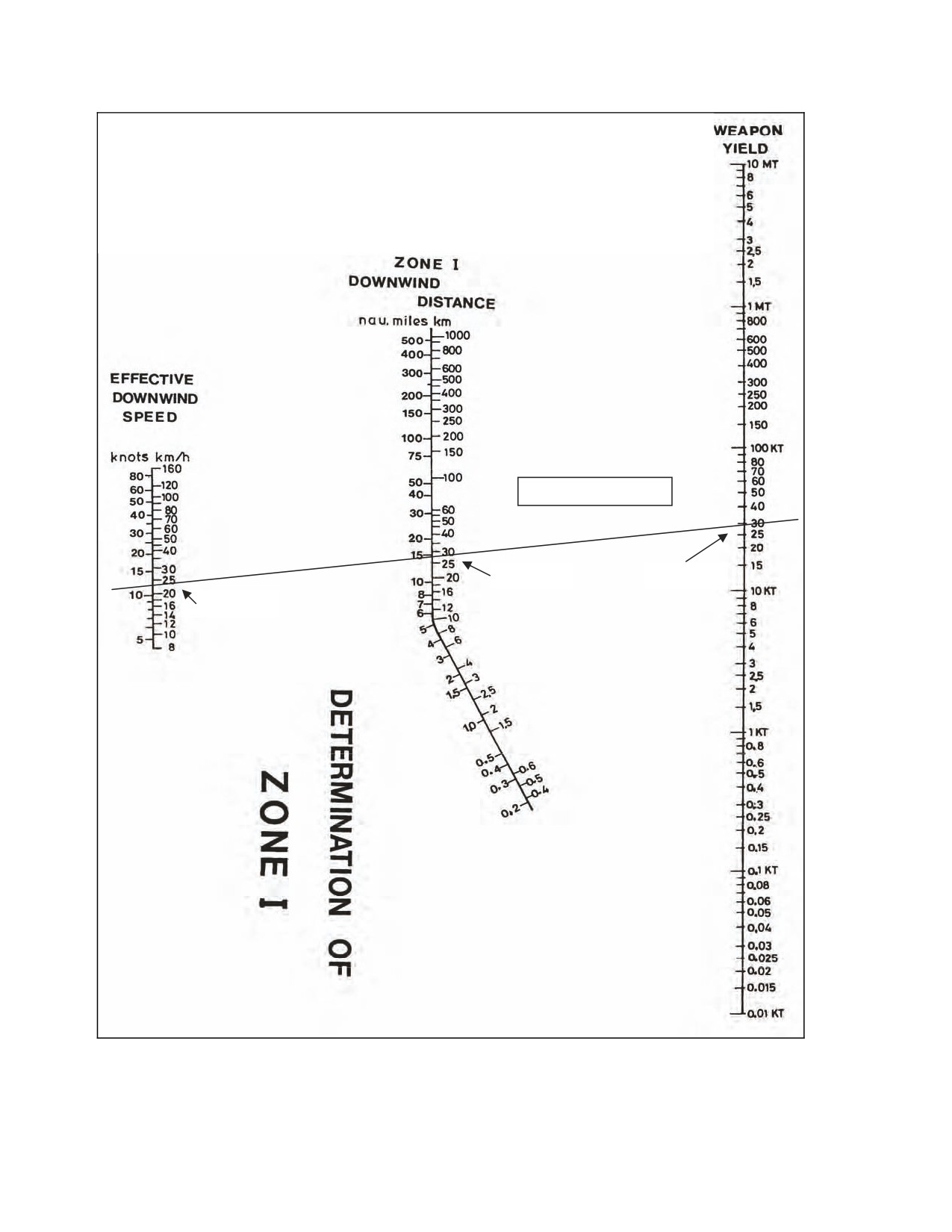
Situation: Determine the downwind distance of Zone I.
-EWS from line YANKEE of the NBC2 Report is 029 km/h.
-Estimated yield from line NOVEMBER of the NBC2 Report is 35 KT.
-Align the hairline from left to right, placing it on 29 km/h, keeping the hairline in place at 29
km/h; align it also with the yield of 35 KT on the left scale.
Read the middle scale for the distance to Zone I of 33 km. Note that this will be rounded to
the nearest whole number. NOTE: Hairline may not be to scale.
Figure G-16. Determination of Zone I, Downwind Distance (Example)
G-32
FM 3-11.3/MCRP 3-37.2A/NTTP 3-11.25/AFTTP(I) 3-2.56
2 February 2006
•
Whenever wind speeds are less than 8 kph three (LLL) digits will
appear on the EDM line item. This indicates the prediction will have a circular pattern.
•
At GZ on the M5A2 predictor, draw a circle equal to the radius
reported on the EDM. Label this radius Zone I.
•
Double the distance of Zone I, and draw a circle, using the same center
(GZ) used for Zone I. Label it Zone II.
(c)
Nine Digits, Special Case, Expanded Angles. When 9 digits (7 in ADP
format) are reported in the EDM line, the angle reported is greater than 40°. The
prediction is plotted in the same manner as a normal case, except the left and right radial
lines are expanded equally from the preset 40° angle, to include all radioactive hazards.
Radial lines are expanded from GZ to the end of Zone II. (Example: If the expanded angle
is (***) 60 degrees or (*) 6, expand the radial lines 30 degrees on each side of the reference
line.)
(6)
Time of Arrival.
(a) Estimate the time of arrival of the fallout at a specific distance from
GZ by dividing the distance by the EWS. The formula looks like this:
Distance from GZ (km)
= Time of Arrival
EWS (kph)
(b) For operational purposes, the following rules of thumb may be applied
to the actual arrival of fallout:
•
The actual arrival of fallout may occur as early as one-half of the
estimated time of arrival. That is, if the estimated time of arrival of the fallout is H+4
hours, the actual arrival may occur as early as H+2 hours.
•
If the actual arrival of fallout has not occurred at twice the estimated
arrival time (or 12 hours, whichever is earlier), it may be assumed that the area will not
receive fallout.
f.
Ship Fallout Template. A fallout template, particularly designed for use on
ships, is shown in Figure G-17 and Figure G-18 (pages G-34 and G-35). The ship fallout
template is similar to the M5A2 fallout predictor (Figure G-14, page G-27) used by forces on
land. The main difference is that the semicircles upwind of GZ on the ship fallout template
do not refer to preselected weapon yield cloud radii.
2 February 2006
FM 3-11.3/MCRP 3-37.2A/NTTP 3-11.25/AFTTP(I) 3-2.56
G-33
NOT TO SCALE
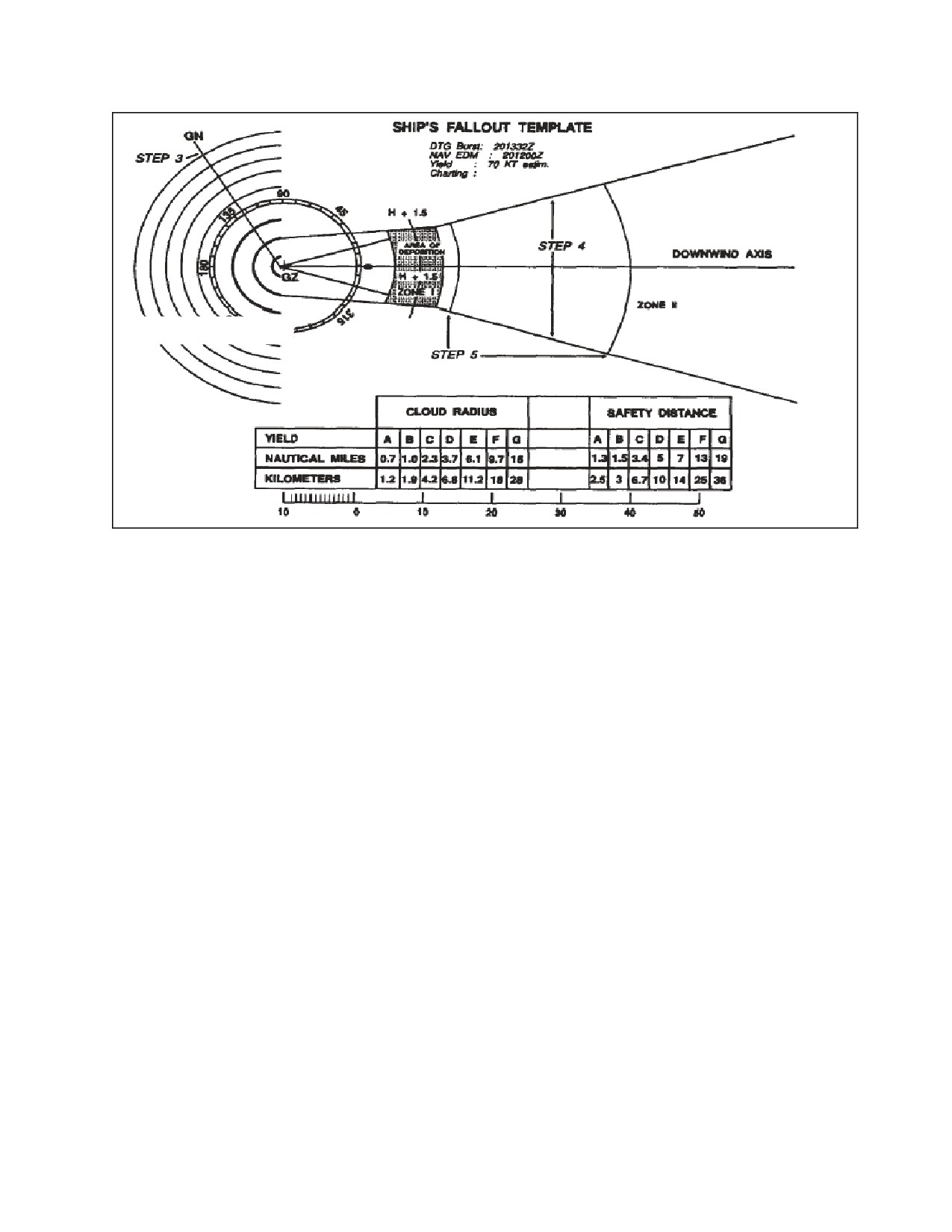
Figure G-17. Ship Fallout Template (Example)
(1)
Safety Distance. Determining the safety distance begins with determining
the fallout area at a specific time after detonation. Fallout will not occur simultaneously
within the predicted fallout area. It will commence in the vicinity of GZ and may be
expected to move down the fallout pattern (downwind direction) with an approximate speed
of the effective wind. The approximate zone in which deposition at the surface is taking
place at a specific time after the detonation may be determined by the use of the following
procedures:
(a) Step 1. Multiply the effective downwind speed by the time (in hours)
after the detonation.
(b) Step 2. Add the safety distance obtained from the template (for the
standard yield groups) to the distance found in Step 1 to allow for finite cloud size,
diffusion, and wind fluctuations.
(c)
Step 3. On the plot (template), with GZ as center and the two
distances obtained from Step 2 as radii, draw two arcs across the fallout pattern. The zone
enclosed between these two arcs will, in most cases, contain the area of deposition at a
specific time after the detonation.
G-34
FM 3-11.3/MCRP 3-37.2A/NTTP 3-11.25/AFTTP(I) 3-2.56
2 February 2006
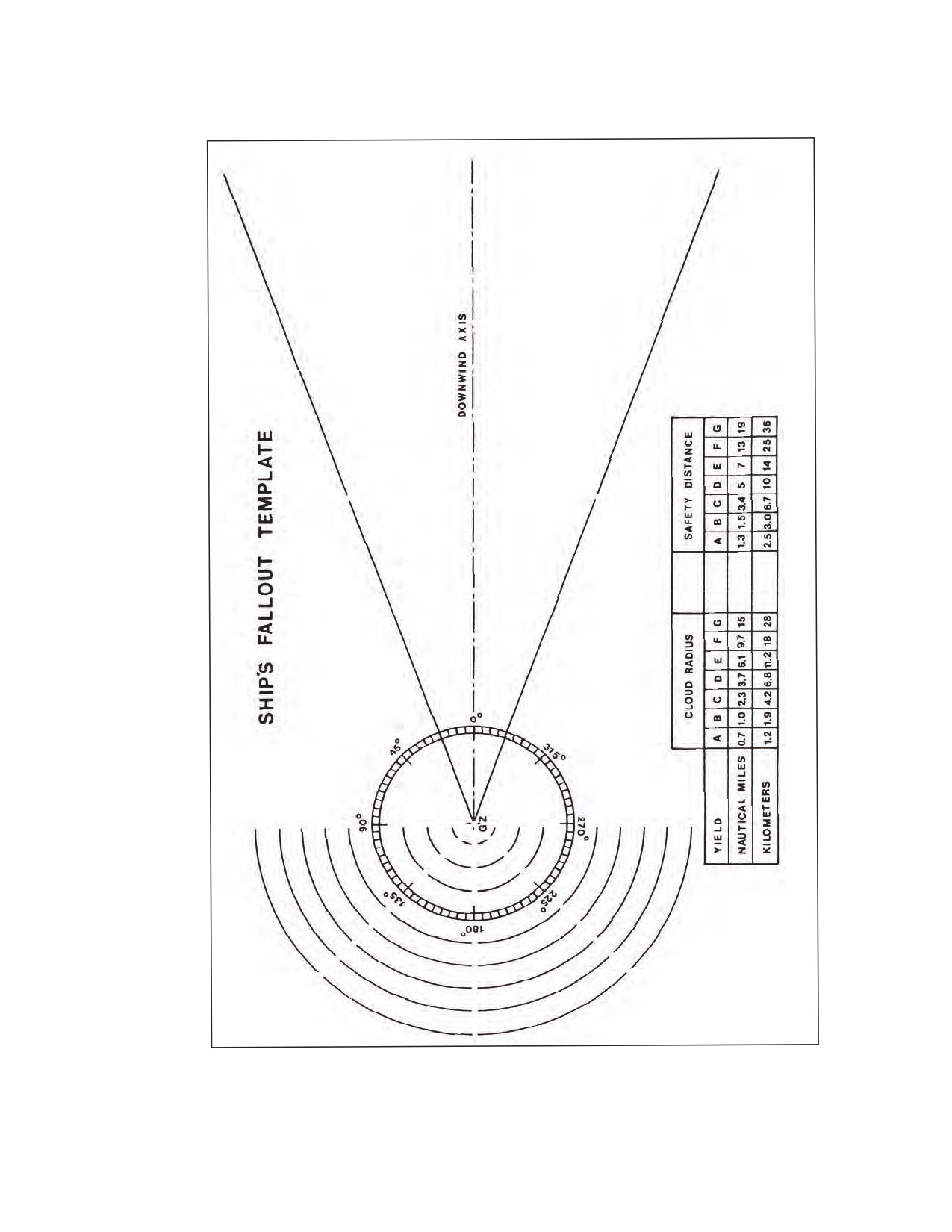
Figure G-18. Ship Fallout Template
2 February 2006
FM 3-11.3/MCRP 3-37.2A/NTTP 3-11.25/AFTTP(I) 3-2.56
G-35
(2)
Fallout Plotting from the NAV EDM and Observations. Example: A ship
has received the NAV EDM. At 201332Z, a nuclear burst is observed from the ship, and
based upon the observations taken from the ship, the yield is estimated to be 70 KT and the
estimated GZ is 56°00’ N-12° 00’ E. A NAV NBC1 NUC report is transmitted as required,
and the ship will have to prepare a fallout prediction, using the simplified procedures:
(a) Step 1. As the yield is estimated only on the basis of observation, the
yield estimation may not be accurate. So, to be on the safe side, the greatest yield group in
which the estimated yield is contained should be used. Seventy KT is in yield group
DELTA, and the largest yield in this group is 100 KT. Therefore, 100 KT will be used for
the fallout prediction.
(b) Step 2. Select the data contained in the DELTA yield group in the
NAV EDM: DELTA 122016, meaning that the effective downwind direction is 122° and the
effective downwind speed is 16 knots.
(c)
Step 3. On the template, draw the GN line from GZ through 122° on
the compass rose (see Figure G-19).
(d) Step 4. From the nomogram in Figure G-16, page G-32, determine the
downwind distance of Zone 1 to be 30 nautical miles. The Zone II downwind distance is
double this distance, or 60 nautical miles from GZ, in effective downwind direction.
(e) Step 5. Using GZ as the center and the Zone I and Zone II distances
as radii (to the appropriate chart scale), draw two arcs between the radial lines. From the
template, read the cloud radius to be 3.7 nautical miles and draw a semicircle upwind of
GZ, using GZ as center and 3.7 nautical miles as radius. The preprinted semicircles may be
helpful. From the intersections of the Zone I arc with the radial lines, draw lines to connect
with the ends of the semicircle.
(f)
S tep 6. Determine the area where the deposit of fallout is estimated
to take place at a specific time after the detonation. Multiply the effective downwind speed
by the time (hours after detonation)—l.5 hours after the burst (H+1.5 hours): 16 knots
times 1.5 hours = 24 nautical miles. With GZ as the center and 24 nautical miles as the
radius, draw a dotted arc across the fallout plot. This arc represents the middle of the area
where the fallout may be expected to reach the surface at H+1.5 hours after the detonation.
To allow for finite cloud size, diffusion, and wind fluctuations, a certain distance ahead of
and behind this line must be added to determine the area where, in most circumstances,
the fallout will be deposited at the surface at H+1.5 hours. This is the safety distance.
From the table printed on the template, find the safety distance for yield group DELTA
(100 KT) to be 5 nautical miles. Add and subtract 5 nautical miles to and from 24 nautical
miles:
24 + 5 = 29 nautical miles, and 24 - 5 = 19 nautical miles
Draw two arcs across the fallout pattern, using the two distances as radii and GZ as the
center. The area confined by the two arcs and the crosswind boundaries of the fallout area
defines the approximate area of fallout deposit at 1.5 hours after the detonation. Complete
the fallout prediction plot by indicating the following on the fallout template: NAV EDM
used, yield, GZ, and geographic chart number (scaling).
G-36
FM 3-11.3/MCRP 3-37.2A/NTTP 3-11.25/AFTTP(I) 3-2.56
2 February 2006
5.6 km
109 o
22 km
8.4 km
GZ to CB
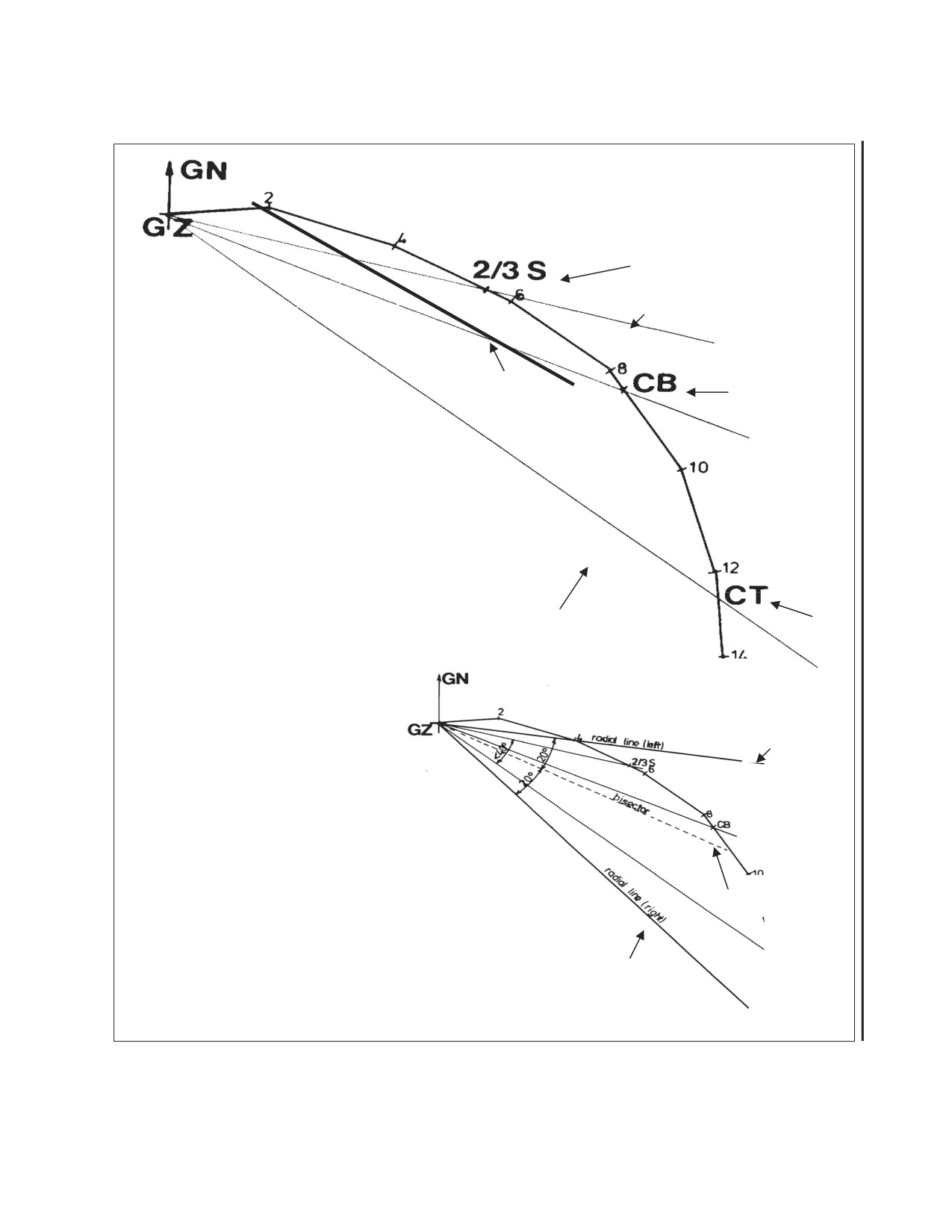
NOTE: The left (109o) and right (136o) lateral
limits are less than a 40o angle
(136o - 109o = 27o).
For detailed fallout prediction, the warning
angle must be at least 40o. Add the angles,
divide by 2, add 20o, and subtract 20o to
obtain the new left and right lateral limits.
136o + 109o = 245o (246o)
246o / 2 = 123o (Bisected angle)
123o + 20o = 143o (Right lateral limit)
123o - 20o = 103o (Left lateral limit)
136 o
12.8 km
New lateral limits
will be annotated on the
wind vector plot, detailed
fallout prediction
work sheet Figure G-18,
page G-35, and the NBC3 report.
103 o
123 o
143 o
Figure G-19. Wind Vector Plot with Cloud and Stem Radial Lines (50 KT) (Example)
30 April 2009 FM 3-11.3/MCWP 3-37.2A/NTTP 3-11.25/AFTTP(I) 3-2.56, C1
G-37
g.
Detailed Fallout Prediction.
(1)
Purpose. The purpose of the detailed fallout prediction is to provide the
subordinate units an immediate warning of the predicted contamination resulting from a
nuclear detonation. The commander will use the detailed fallout prediction in the tactical
decision-making process.
(2)
Procedures. The CBRN cell is responsible for preparing and plotting the
detailed fallout predictions. The fallout prediction work sheet provides the CBRN cell with
a standard work sheet for recording the nuclear burst (surface) information data.
Completing the fallout prediction work sheet is the first step in drawing the prediction. Use
the steps listed below to complete the work sheet.
(a) Step 1. Obtain a current wind vector plot. Before any bursts occur, the
wind vector plots are drawn. Refer to Appendix D for detailed information regarding wind
vector plotting (see Figure G-19, page G-37).
(b) Step 2. Complete a detailed fallout prediction work sheet. Using an
NBC2 NUC report, determine the nuclear-burst information. Record this information on
the work sheet (see Figure G-20).
•
Lines ALFA, BRAVO, and ECHO are transcribed from the NBC2
NUC report.
•
Lines CHARLIE and DELTA are used if the enemy burst or friendly
burst data is unknown. When enemy or friendly burst information is unknown, assume
that a worst case (100 percent fission yield [FY]) scenario has occurred and enter a 1 on line
CHARLIE. When the height of burst (HOB) is unknown, enter a 0 (zero) on line DELTA,
which represents a worst case HOB.
•
A friendly burst with known data information will come from the fire
support element (target analyst) delivering the weapon. The data will include the weapon
yield, FY/total yield (TY) ratio, HOB, GZ coordinates, DTG of the attack, and strike serial
number.
(c)
Step 3. Determine the cloud parameters. Using the yield of the
weapon from line ECHO and the nomogram (Figure G-21, page G-40), locate the yield on
the right- or left-hand scale. Place a straightedge (hairline) on the yield, and align the
values on both scales. Read and record all cloud parameter values on lines FOXTROT
through JULIET of the fallout prediction work sheet.
NOTE: The following steps are exactly the same as the steps used in making an
EDM (refer to Appendix D for more information regarding EDMs).
(d) Step 4. Determine the lateral limits of the prediction using the wind
vector plot. Mark the points representing the cloud top height and the two-thirds stem
height. Draw radial lines from the GZ point through these height points.
NOTE: If the wind vectors between the two-thirds stem height point and the
cloud top height point fall outside the radial lines drawn from GZ, expand the
angle formed by these two radial lines to include these outside wind vectors.
G-38
FM 3-11.3/MCWP 3-37.2A/NTTP 3-11.25/AFTTP(I) 3-2.56, C1
30 April 2009

NUCLEAR FALLOUT PREDICTION WORK SHEET - SURFACE BURST
NOTE: Complete the work sheet to provide information for the NBC3 NUC report. Line out unused units of measure in the far right-hand column.
DELTA (DD TTTTZ MMM
A.
TOB (DTG) (from the NBC2 NUC report)
_______120657ZDEC2004_______
YYYY)
(Local or ZULU time)
FOXTROT (yy zzzzzz)
B.
GZ coordinates (from the NBC2 NUC report)
________WB764766____________
(Actual or estimated)
FY/TY ratio (from target analysis for STRIKWARN only)
_____________1_______________
C.
(If known, enter #; if unknown or for enemy attack, enter 1)
HOB (from target analysis for STRIKWARN only)
D.
_____________0_______________
Meters
(If known, enter #; if unknown or for enemy attack, enter 0)
E.
Yield
(from NBC2 NUC report)
____________50_______________
KT or MT
F.
Cloud top height (use Figure G-21, page G-40)
____________12.8______________
103 meters or feet
G.
Cloud bottom height (use Figure G-21)
_____________8.4______________
103 meters or feet
H.
2/3 stem (Use Figure G-21.)
_____________5.6______________
103 meters or feet
PAPAB - rr (KM) (round up to
I.
Stabilized cloud radius (use Figure G-21)
_____________06______________
nearest whole number)
J.
Time of fall from cloud bottom (Use Figure G-21)
____________2.38______________
Hours (round to nearest
hundredth)
NOTE: Plot F, G, and H on the current wind vector plot. Measure the distance from GZ to the cloud bottom height.
K.
Radial line distance from GZ to cloud bottom height
____________22_______________
KM
EWS (from the NBC2 NUC report)
PAPAB - sss
L.
K
=
22
(KM/H) (round to the nearest
J
2.38
____________009______________
whole number)
M.
Downwind Distance of Zone I
(use Figure G-22, page G-42, with E
PAPAB - xxx
and L)
____________022______________
(KM) (round to nearest whole
number)
N.
Adjustment calculation of downwind distance of Zone I
FY/TY Factor (C) ____1____ x HOB (D) _____1____
=
______________1______________
Use Figure G-23, page G-43. Use Figure G-22, page 42.
(If unknown or for enemy attack, enter 1 and 1.)
O.
Adjustment of downwind distance of Zone I
PAPAB - xxx
____________022______________
(KM) (round to nearest whole
number)
NOTE: Ensure that the lateral limit angle (angle between left and right radial lines) is > 400 . If it is not, add azimuths, divide the sum by 2, and add 200 to
each azimuth. These are the new radial lines. Ensure that the new azimuths are entered below.
PAPAB - dddd
P.
Azimuth of left radial line
___________ 0103_____________
(mils or degrees)
PAPAB - cccc
Q.
Azimuth of right radial line
____________0143_____________
(mils or degrees)
R.
NBC3 NUC Report
ALFA
(AAA)
_____________N001____________
(Strike serial number)
DELTA
(DD TTTTZ MMM YYYY)
_________120657ZDEC2004______
(Local or ZULU time)
FOXTROT
(yy zzzzzz)
____________WB764766_________
(Actual or estimated)
PAPAB
(sss xxx rr) *
009 022 06
(Azimuths of radial lines -
(dddd cccc)**
0103 0143___________
mils or degrees)
* sss
- EWS (KM/H) * xxx - Downwind Distance of ZONE I (KM) * rr - Cloud Radius (KM)
**dddd - Left Radial Line
**cccc
- Right Radial Line
Figure G-20. Detailed Fallout Prediction Work Sheet (Example)
2 February 2006
FM 3-11.3/MCRP 3-37.2A/NTTP 3-11.25/AFTTP(I) 3-2.56
G-39
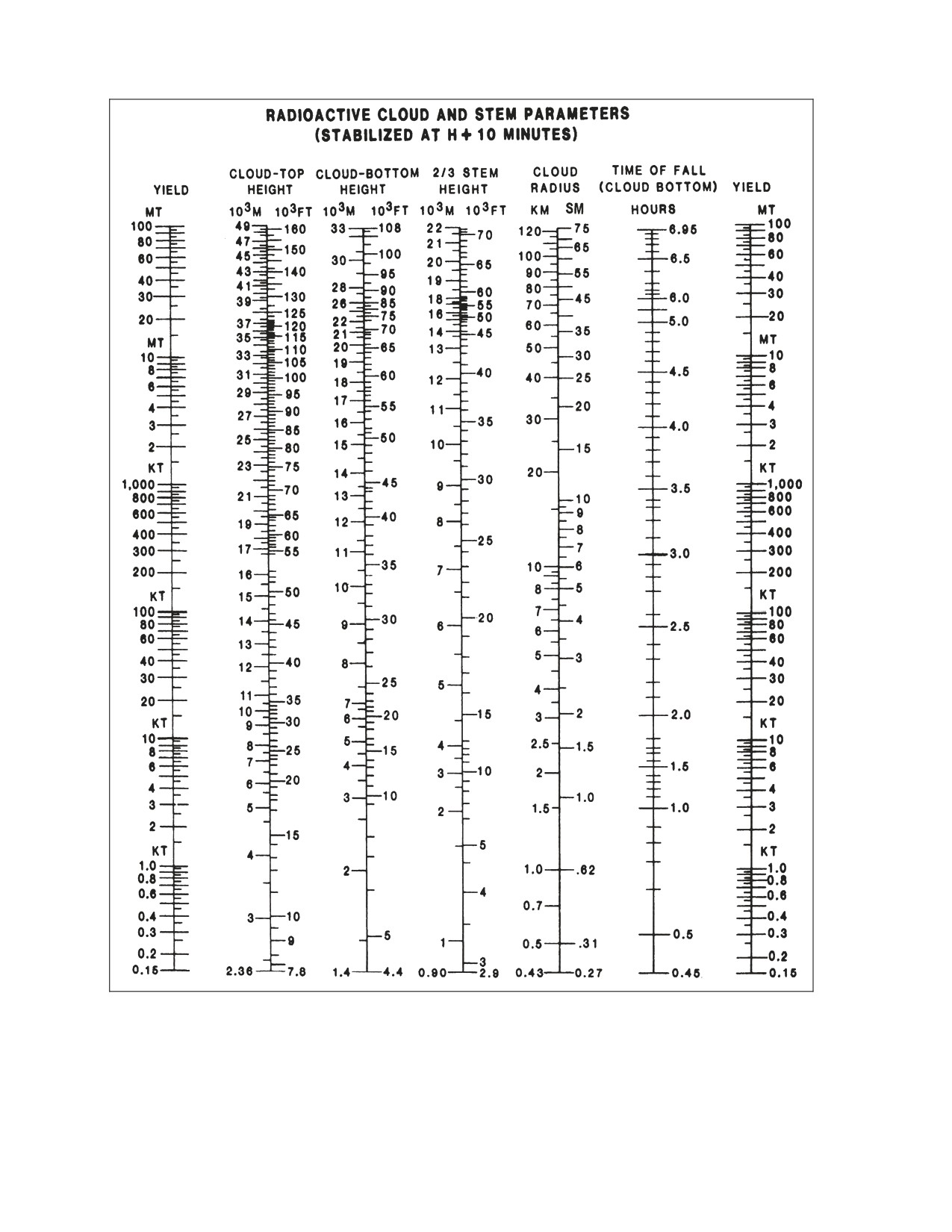
Figure G-21. Stabilized Cloud and Stem Parameters for Detailed Fallout Prediction (Example)
G-40
FM 3-11.3/MCRP 3-37.2A/NTTP 3-11.25/AFTTP(I) 3-2.56
2 February 2006
(e) Step 5. Determine the effective wind speed (EWS). Mark the cloud
bottom height on the wind vector plot, and measure the length of the radial line (in km)
from GZ. Record this value on line KILO of the work sheet. Transfer the values from line
KILO and line JULIET to line LIMA. Compute the EWS using the following formula:
EWS = Radial Line Distance From GZ to CB Height (KM)
Time of Fall From CB (HR)
Round this number to the nearest km. (Example: 21.5 = 22; 22.4 = 22.)
NOTE: If the EWS is less than 8 kph, it is a special case. When the wind speed is
less than 8 kph, always use an 8 kph wind speed in Step 6 below.
(f)
Step 6. Determine the downwind distance of Zone I and Zone II.
Align a straightedge (hairline) from the yield on the right-hand scale (line ECHO of the
fallout prediction work sheet) to the EWS on the left-hand scale (line LIMA of the fallout
prediction work sheet) using Figure G-22, page G-42. Where the straightedge intersects the
center scale, read the downwind distance of Zone I. Record this on line MIKE of the fallout
prediction work sheet.
(g) Step 7. Obtain the FY/TY ratio from the nuclear target analyst. The
FY/TY ratio is expressed as a percentage. It states the percent of the weapon explosive
ability that is contributed by the fission process. The remainder of the weapon yield is
derived from fusion. This is significant in the fallout prediction. The fusion portion of the
weapon does not create residual contamination. Thus, a weapon with a FY/TY ratio of 0.6
means that 60 percent is fission and 40 percent is fusion. A crude comparison could be that
this weapon will make 40 percent less fallout than a weapon with the same size yield that
is 100 percent fission. If the FY/TY ratio is known, obtain the FY/TY adjustment factor
from the nomogram (Figure G-23, page G-43). The following describes how to use the
nomogram:
•
Lay a straightedge (hairline) from the TY on the left-hand scale to the
value of the FY/TY ratio on the right-hand scale. Where the straightedge intersects with
the center scale, read the FY/TY adjustment factor. Record the FY/TY ratio on line
NOVEMBER of the work sheet.
•
Assume the yield to be 100 percent fission, and use an FY/TY
adjustment factor of 1 if the FY/TY ratio is unknown. Record the FY/TY adjustment factor
on line NOVEMBER of the work sheet.
•
Obtain the HOB adjustment factor from the nomograms (see Figures
G-24 and G-25, pages G-44 and G-45) if the HOB is known. To use the nomogram, lay a
straightedge (hairline) from the yield on the left-hand scale to the value of the HOB on the
center scale. At the intersection of the straightedge with the right-hand scale, read the
HOB adjustment factor. Record the HOB adjustment factor on line NOVEMBER of the
work sheet.
•
Assume a zero HOB, and use an HOB adjustment factor of 1 HOB if
HOB is unknown. Record HOB on line NOVEMBER of the work sheet.
•
Obtain the adjusted downwind distance of Zone I. Multiply line MIKE
by line NOVEMBER; the result will be the adjusted downwind distance of Zone I and is
entered on line OSCAR of the work sheet.
2 February 2006
FM 3-11.3/MCRP 3-37.2A/NTTP 3-11.25/AFTTP(I) 3-2.56
G-41
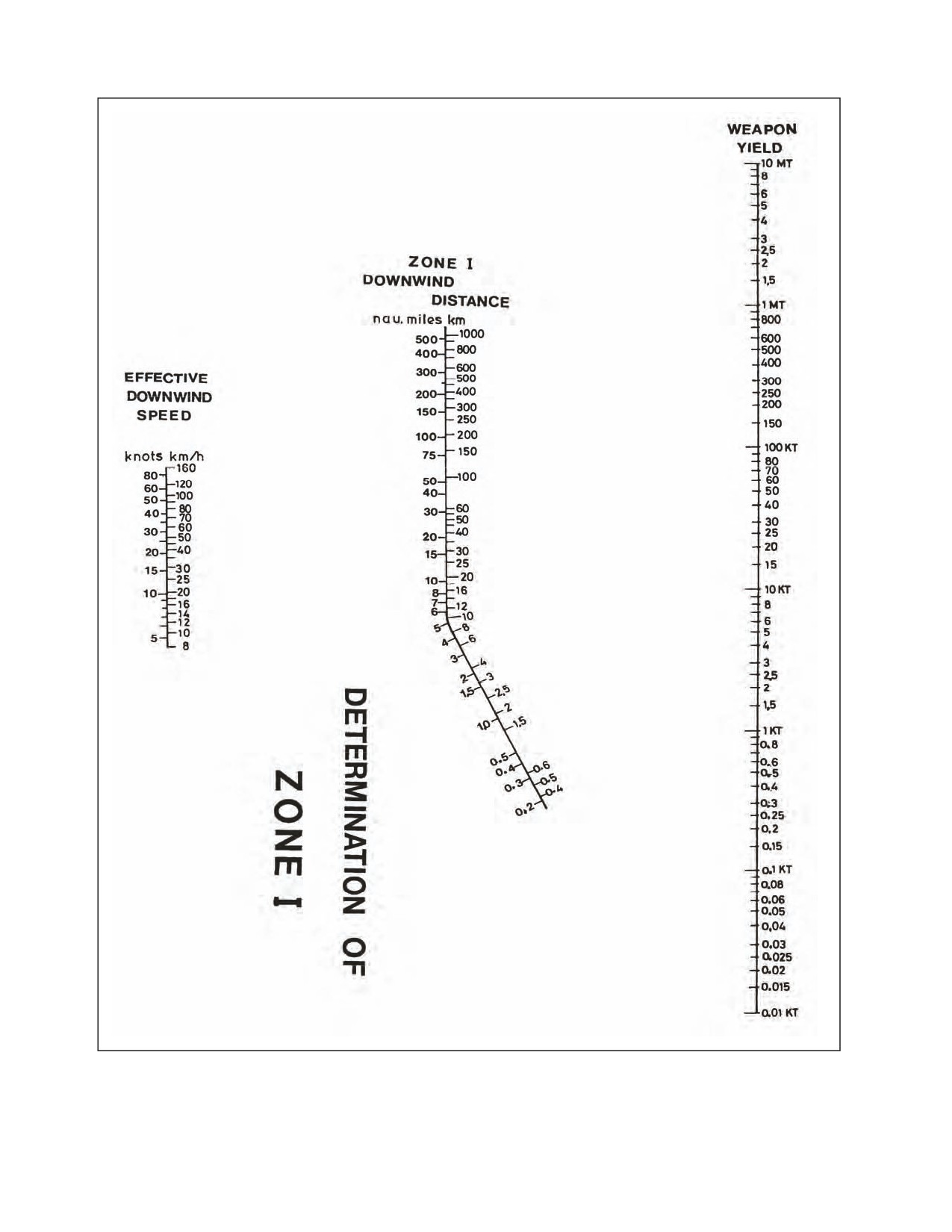
Figure G-22. Determination of Zone I, Downwind Distance (Example)
G-42
FM 3-11.3/MCRP 3-37.2A/NTTP 3-11.25/AFTTP(I) 3-2.56
2 February 2006
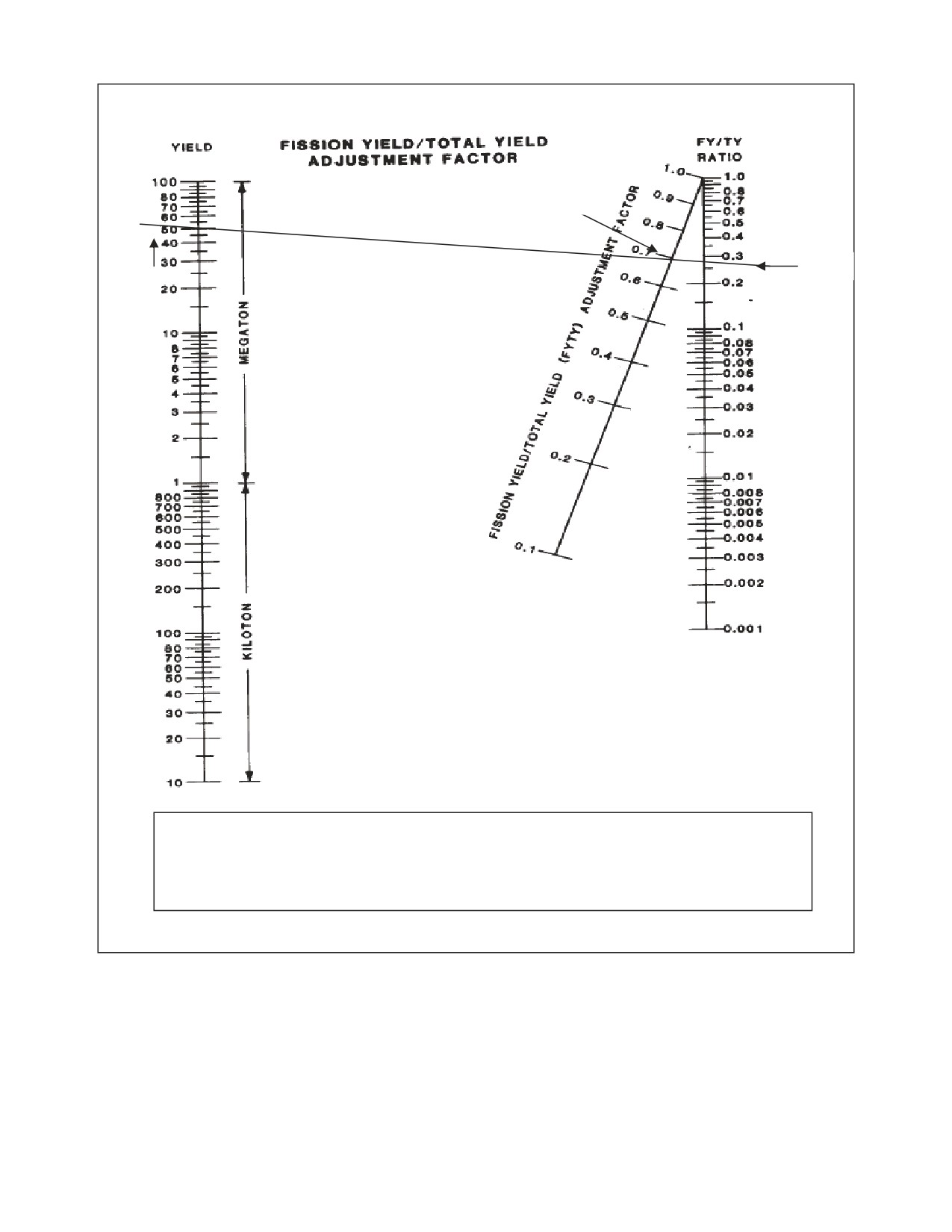
0.7
50 KT
0.27
For an FY/TY ratio of 0.27, the FY/TY adjustment factor would be 0.7. Align the hairline from left to
right, using the yield of 30 KT on the left-hand scale. Keeping the hairline in place on 50 KT, align the
hairline with the FY/TY ratio of 0.27 on the right-hand scale. Read the FY/TY adjustment factor scale
as 0.7.
Figure G-23. FY/TY Adjustment Factor (Example)
2 February 2006
FM 3-11.3/MCRP 3-37.2A/NTTP 3-11.25/AFTTP(I) 3-2.56
G-43
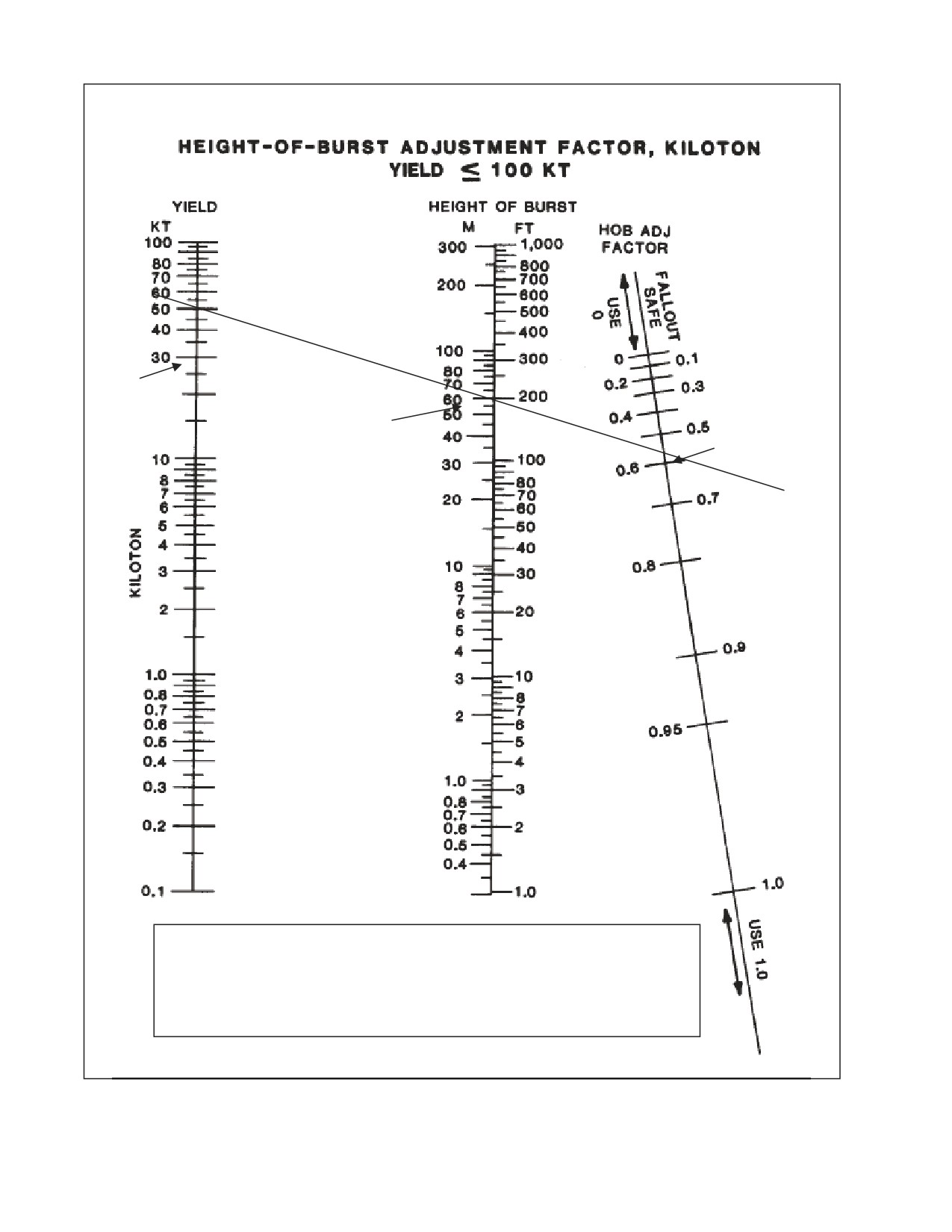
50 KT
60 M
0.57
For an HOB of 60 m, the HOB adjustment factor would be 0.57. Align the hairline
from left to right, using the yield of 50 KT on the left-hand scale. Keeping the
hairline in place on 50 KT, align the hairline with the HOB of 60 m on the middle
scale. Read the HOB adjustment factor scale as 0.57.
Figure G-24. HOB (Kiloton) Adjustment Factor (Example)
G-44
FM 3-11.3/MCRP 3-37.2A/NTTP 3-11.25/AFTTP(I) 3-2.56
2 February 2006
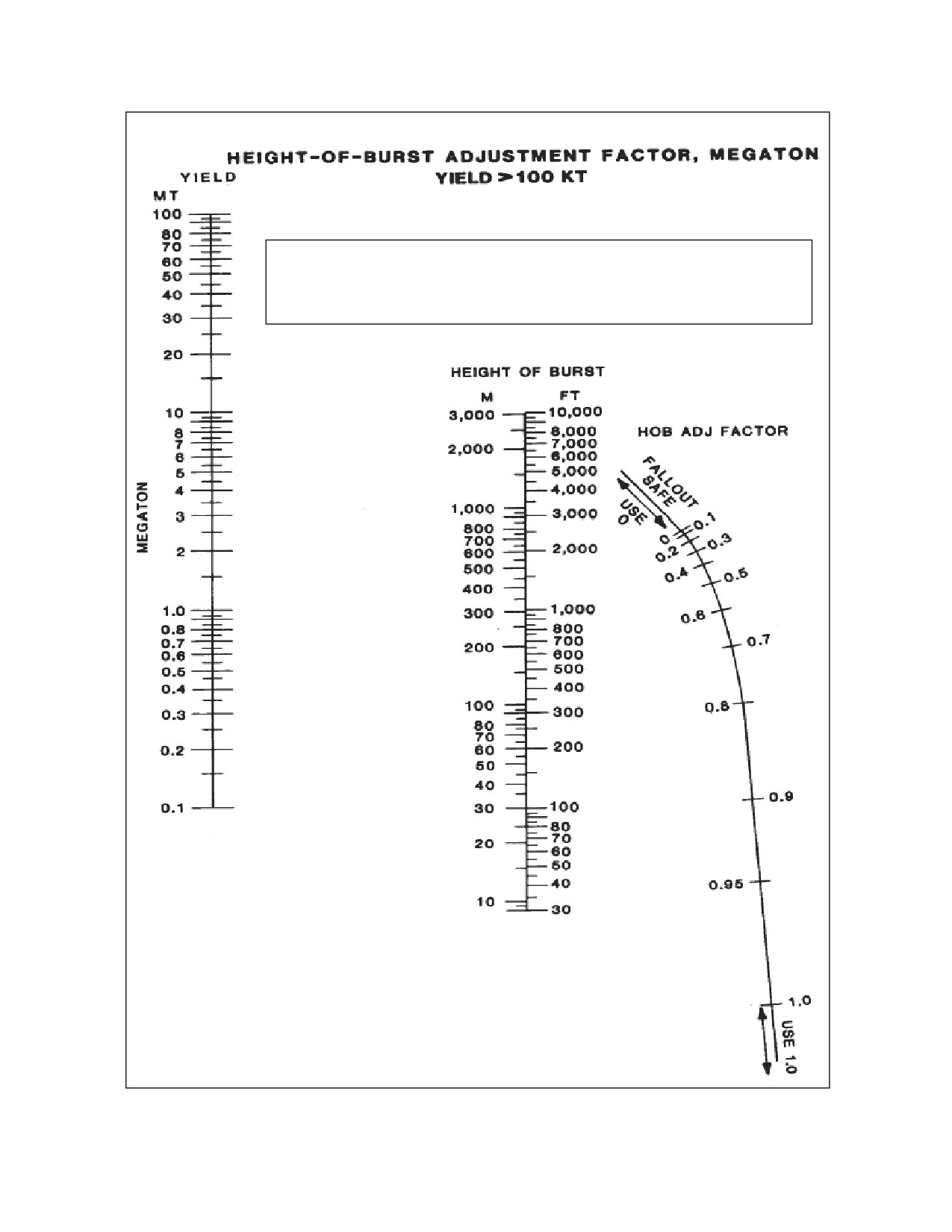
If the yield of the weapon was greater than 100 KT, this nomogram would
be used. This nomogram would be used in the same manner as if the yield
were less than 100 KT.
Figure G-25. HOB (Megaton) Adjustment Factor (Example)
2 February 2006
FM 3-11.3/MCRP 3-37.2A/NTTP 3-11.25/AFTTP(I) 3-2.56
G-45
NOTE: If the EWS is less than 8 kph, the detailed prediction is now complete.
Prepare the NBC3 NUC report (line ROMEO of the work sheet) as described in
Step 9. If the wind speed is greater than or equal to 8 kph, go to Step 8.
(h) Step 8. Construct left and right radial lines. Measure the angle
formed by the radial lines drawn from GZ to the cloud top height and two-thirds stem
height.
NOTE: If the radial lines have been expanded to include vectors between the two-
thirds stem height and the cloud top height, this angle must be measured.
•
If the angle formed is 40° or greater, measure the azimuths (in mils or
degrees from GZ) of the final left and right radial lines and record them on lines PAPA and
QUEBEC of the work sheet.
•
If the angle formed is less than 40°, bisect the angle (add azimuths
together and divide by 2) and expand the angle formed by the two radial lines to 40° (20° on
each side of the bisected azimuth). (See note in Figure G-19, page G-37).
(i)
Step 9. Prepare the NBC3 NUC report. Complete line ROMEO of the
work sheet. The report will always include the following line items:
•
Line ALPHA: This line is the strike serial number. The strike serial
number is assigned by the CBRN cell at the operations center responsible for the area in
which the strike occurs.
•
Line DELTA: (DDTTTTZMMMYYYY) This line is the DTG of the
burst, with DD (day), TTTT (H-hour) in local or ZULU time (state which), MMM (month),
and YYYY (year).
•
Line FOXTROT: (yyzzzzzz) This line is the actual or estimated (state
which) coordinates of GZ. The letters “yy” represent the appropriate 100,000-meter grid
square, and the letters “zzzzzz” represent coordinates of the GZ within this grid square.
•
Line PAPAB: (sssxxxrr ddddcccc) This line is the prediction
dimensions and the azimuths of the two radial lines to the nearest mil or degree from GZ.
The letters “sss” represent the EWS to the nearest kph. The letters “xxx” represent the
downwind distance of Zone I to the nearest km. The letters “rr” represent the radius of the
stabilized cloud (GZ circle) to the next higher km if the value is not a whole number. The
letters “dddd” represent the azimuth of the left radial line, and the letters “cccc” represent
the azimuth of the right radial line (mils or degrees).
•
This line will contain only three digits (xxx) when the special
case of low winds (less than 8 kph) exists.
7.
NBC3 NUC Report
The NBC3 NUC report is vital to effectively disseminating the estimated travel of
fallout across the battlespace.
a.
General. The NBC3 NUC report reflects the predicted zones of contamination
for a nuclear surface burst. It is based on the NBC2 NUC report and a current wind vector
plot. Users of the NBC3 NUC reports are not limited to the use of the line items shown in
the example (see Figure G-26). Other line items may be added as appropriate.
G-46
FM 3-11.3/MCRP 3-37.2A/NTTP 3-11.25/AFTTP(I) 3-2.56
2 February 2006

(1)
Purpose. The purpose of the NBC3 NUC report is to report immediate
warning of the predicted contamination and hazard areas to higher, subordinate, and
adjacent units.
(2)
Message Precedence. All other messages, after the initial NBC1 NUC
report has been sent, should be given a precedence, which reflects the operational value of
the contents. Normally IMMEDIATE would be appropriate.
NBC3 NUC Report
Line Item
Description
Cond*
Example
ALFA
Strike serial number
M
ALFA/US/A234/001/N//
DELTA
DTG of attack or detonation and
M
DELTA/201405ZSEP2005//
attack end
FOXTROT
Location of attack or event
M
FOXTROT/32UNB058640/EE//
GOLF
Delivery and quantity information
O
GOLF/SUS/AIR/1/BOM/4//
HOTEL
Type of nuclear burst
O
HOTEL/SURF//
NOVEMBER
Estimated nuclear yield, in KT
O
NOVEMBER/50//
OSCAR
Reference DTG of contour lines
O
PAPAB
Detailed fallout hazard prediction
M
PAPAB/019KPH/33KM/5KM/
parameters
272DGG/312DGG//
PAPAC
Radar-determined external contour of
O
PAPAC/32VNJ456280/32VNJ456119/
radioactive cloud
32VNJ556182/32VNJ576200/
32VNJ566217/32VNJ456280//
PAPAD
Radar-determined downwind direction
O
PAPAD /030DGT//
of radioactive cloud
XRAYB*
Predicted contour information
C
YANKEE
Downwind direction and downwind
O
YANKEE/270DGT/015KPH//
speed
ZULU
Actual weather conditions
O
ZULU/4/10C/7/5/1//
GENTEXT
General text
O
*The Cond column shows that each line item is operationally determined (O), mandatory (M), or conditional (C).
Note: XRAYB is prohibited if OSCAR is not used.
Figure G-26. Sample NBC3 NUC Report
b.
Plotting Detailed Fallout Predictions (NBC3 NUC) (see Figure G-27, page G-48).
(1)
Step 1. Identify the map scale to be used. Obtain a sheet of overlay paper or
other transparent material. Mark a GZ location and GN.
(2)
Step 2. Examine line PAPAB. Starting at the GZ location, draw the left
(dddd) and right (cccc) radials line measured from GZ.
(3)
Step 3. From line PAPAB, determine the downwind distance of
Zone I (xxx).
(a) Starting from GZ, draw an arc between the radial lines with a radius
equal to the distance of Zone I. Label this area Zone I.
(b) Draw a second arc between the radial lines at twice the radius as the
downwind distance of Zone II. Label this area Zone II.
30 April 2009 FM 3-11.3/MCWP 3-37.2A/NTTP 3-11.25/AFTTP(I) 3-2.56, C1
G-47
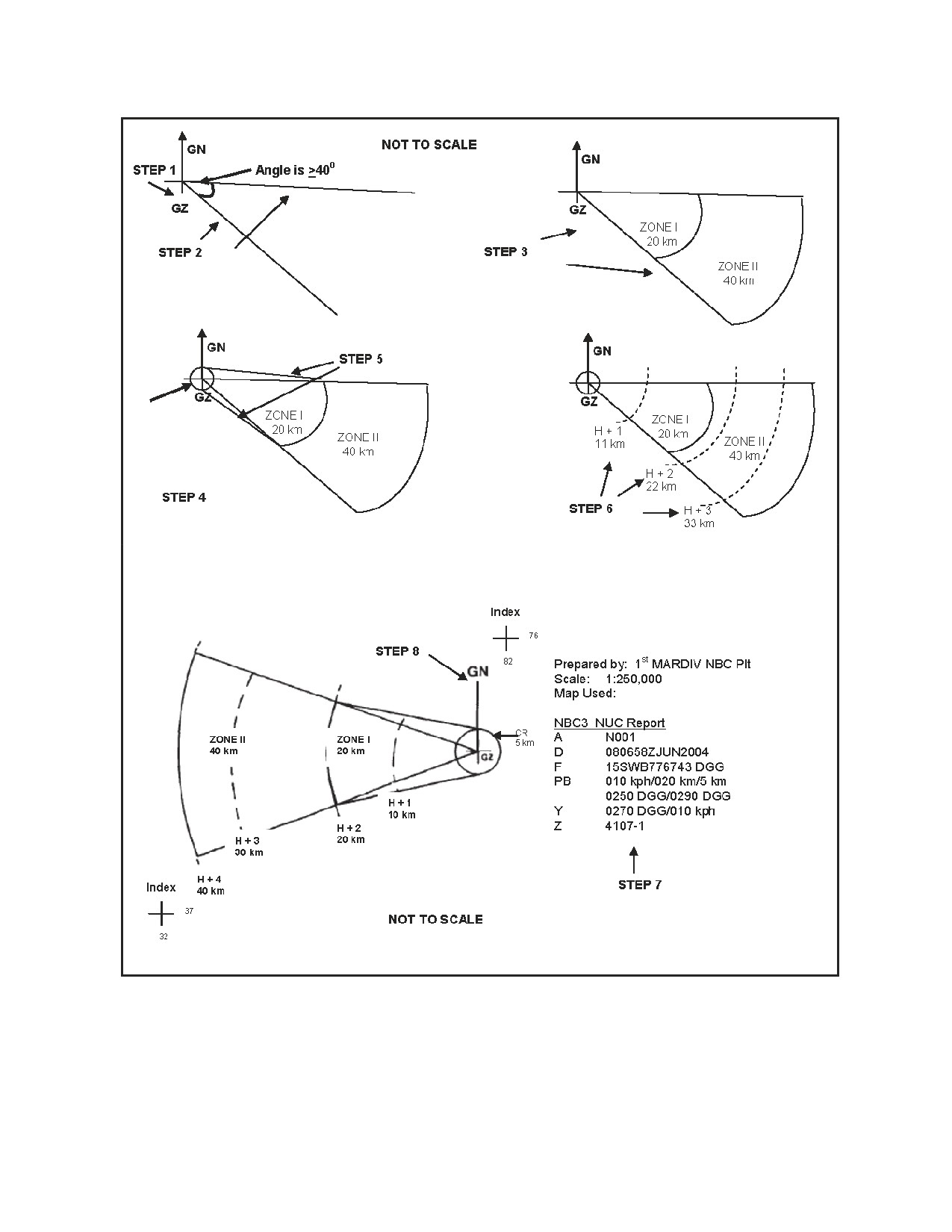
Figure G-27. Detailed Fallout Prediction
G-48
FM 3-11.3/MCWP 3-37.2A/NTTP 3-11.25/AFTTP(I) 3-2.56, C1
30 April 2009

(4)
S tep 4. From line PAPAB, determine the size of the cloud radius (rr).
Using GZ as the center, draw a circle with a radius equal to the stabilized cloud radius.
(5)
S tep 5. Draw tangent lines from the outer edge of the cloud radius to the
points of intersection of the radial lines with the Zone I arc.
(6)
Step 6. From line PAPAB, determine the EWS (sss).
(a) Beginning at GZ, draw as many dashed time-of-arrival arcs between
the radial and tangent lines as will fit inside the prediction within Zones I and II.
(b) Label the dashed arcs as hours after the burst: H+1, H+2, and so on.
H+1 is the closest arc to GZ.
(c)
If a time-of-arrival arc coincides with a Zone I or II arc, extend the
zone boundary with a dashed line.
(7)
S tep 7. Add marginal information to the plot. This should be all of the
known information about the attack (see Figure G-28).
(8)
S tep 8. Orient the prediction to the map, and evaluate the hazard (see
Figure G-27).
NOTE: If the NBC3 NUC report (line PAPAB) only contains Zone I (xxx), follow
the steps below (see Figure G-28):
(9)
S tep 1. Identify the map scale to be used. Obtain a sheet of overlay paper
or other transparent material. Mark a GZ. A GN line is not necessary.
(10) Step 2. The three digits shown on line ZULU is the radius of a circle for
Zone I. Using the GZ as the center, draw a circle with a radius equal to the Zone I distance.
Label this area Zone I. Draw a second circle at twice this radius for Zone II. Label this
area Zone II.
(11) Step 3. Add marginal information to the plot. This should be all known
information about the attack.
(12) Step 4. Orient the prediction to the map and evaluate the hazard.
NOT TO SCALE
ZONE II
Prepared by: 1st MARDIV NBC Platoon
32 km
Scale:
1:250,000
Map Used:
ZONE I
NBC3 Report
16 km
A
N002
D
070700ZJUN2004
GZ
F
15SWB770740 DGG
PB
016Km
Y
0270 DGG/007 kph
Z
4107-1
Figure G-28. Example Detailed Fallout Prediction With Wind Speed Less Than 8 kph
2 February 2006
FM 3-11.3/MCRP 3-37.2A/NTTP 3-11.25/AFTTP(I) 3-2.56
G-49
c.
Contamination Prediction System for Merchant Ships at Sea.
(1)
Significance of CBRN Warnings.
(a) Radioactive fallout from nuclear explosions on sea and land targets,
particularly from the latter, may affect large areas of adjacent waters.
(b) The areas affected will depend on the prevailing wind conditions, and
any ship close to or approaching these areas will be in grave danger. It is therefore
essential that the ships should be warned of the fallout hazards and contamination in order
that the following may occur:
•
Passive-defense measures, such as switching on the wash-down
systems, may be taken.
•
Course may be altered to avoid the danger zones, if necessary.
(2)
MERWARN System to Ships at Sea.
(a) A simplified contamination warning system has been established
throughout NATO for broadcasting, via MERCOMMS and coastal radio stations, warnings
of a contamination that is dangerous to merchant shipping. This system calls for the
origination by NATO naval authorities.
(b) A MERWARN NBC3 NUC report will be issued after a nuclear attack
producing fallout. It gives fallout data for a specific explosion or a series of explosions,
which will be identified in the report. NBC3 NUC reports are issued as soon as possible
after the attack and at 6-hour intervals (to the nearest hour) thereafter for as long as the
fallout danger exists. They contain information that enables the ship to plot the danger
area.
(c)
The standard format of a MERWARN NBC3 NUC report contains
lines ALFA, DELTA, FOXTROT, and PAPAB of the military NBC3 NUC report (see
Appendix D for additional MERWARN information).
(d) The MERWARN NBC3 NUC report has the following structure:
•
MERWARN NBC3 NUC report.
ALFA
Strike serial number (as defined by the naval
authority)
DELTA
DTG of detonation
FOXTROT Location of attack (LAT and LONG or geographical
place name)
PAPAB
EWS (3 digits and unit of measurement), downwind
distance of Zone I (3 digits and unit of measurement),
cloud radius (2 digits and unit of measurement), left
and right radial lines of the predicted fallout hazard
area (3 digits and unit of measurement each)
Example:
MERWARN NBC3 NUC Report
ALFA/US/NBCC/02-001/N//
G-50
FM 3-11.3/MCRP 3-37.2A/NTTP 3-11.25/AFTTP(I) 3-2.56
2 February 2006
DELTA/021405ZSEP1999//
FOXTROT/451230N014312E/AA//
PAPAB
/012KTS/028NM/02NM/272DGT/312DGT//
•
MERWARN NBC3 NUC Report, Plain Language Format: The
MERWARN NBC3 standard format may not be suitable after a multiple nuclear attack
which produces fallout from several bursts in a large or complex target area. In such cases,
warnings will be plain language statements of a more general nature, indicating the area
affected and the expected movement of the fallout.
Example:
MERWARN NBC3 NUC Report
ALFA/UK/02-001/N//
DELTA/021405ZSEP1999//
Fallout extends from Glasgow area to eastern Ireland at
021405Z and is spreading westwards at 12 knots. Irish
Sea is likely to be affected within an area of 60 nautical
miles of the British coast.
(e) MERWARN Diversion Order. In addition to the origination of
MERWARN NBC3 NUC messages, naval authorities may, if circumstances dictate,
broadcast general diversion orders based on the fallout threat, merchant ships proceeding
independently will be passed evasive routing instructions of a more general nature, using
the standard naval shipping identifier MERWARN diversion order.
Example:
MERWARN Diversion Order
English Channel closed. All shipping in North Sea remain
north of 052 degrees N until 031500ZSEP1999.
(3)
Precedence of NBC Messages. All MERWARN NBC messages should be
given the precedence FLASH (Z) to ensure the rapid handling on any military circuit
between the originating authority and the MERCOMMS and/or coastal radio stations. This
precedence should not be used where the rules for the use of the international safety signal
(“TTT” for chemical warfare [CW] and “security” for voice circuits) apply.
NOTE: Adjacent MERWARN originators are responsible for relaying information
to coast earth stations/coast radio stations under their control as necessary.
(4)
Danger Zones. All shipping in waters out to 200 nautical miles from any
coast at the outset of war must be regarded as an area of possible fallout danger from
nuclear attacks on shore.
(5)
Plotting MEWARN NBC3 NUC Report. Plot this report in the same
manner as “Fallout Plotting from NAV EDM and Observations” (paragraph 6f[2]), using the
ship fallout template (see Figure G-29, page G-52).
2 February 2006
FM 3-11.3/MCRP 3-37.2A/NTTP 3-11.25/AFTTP(I) 3-2.56
G-51
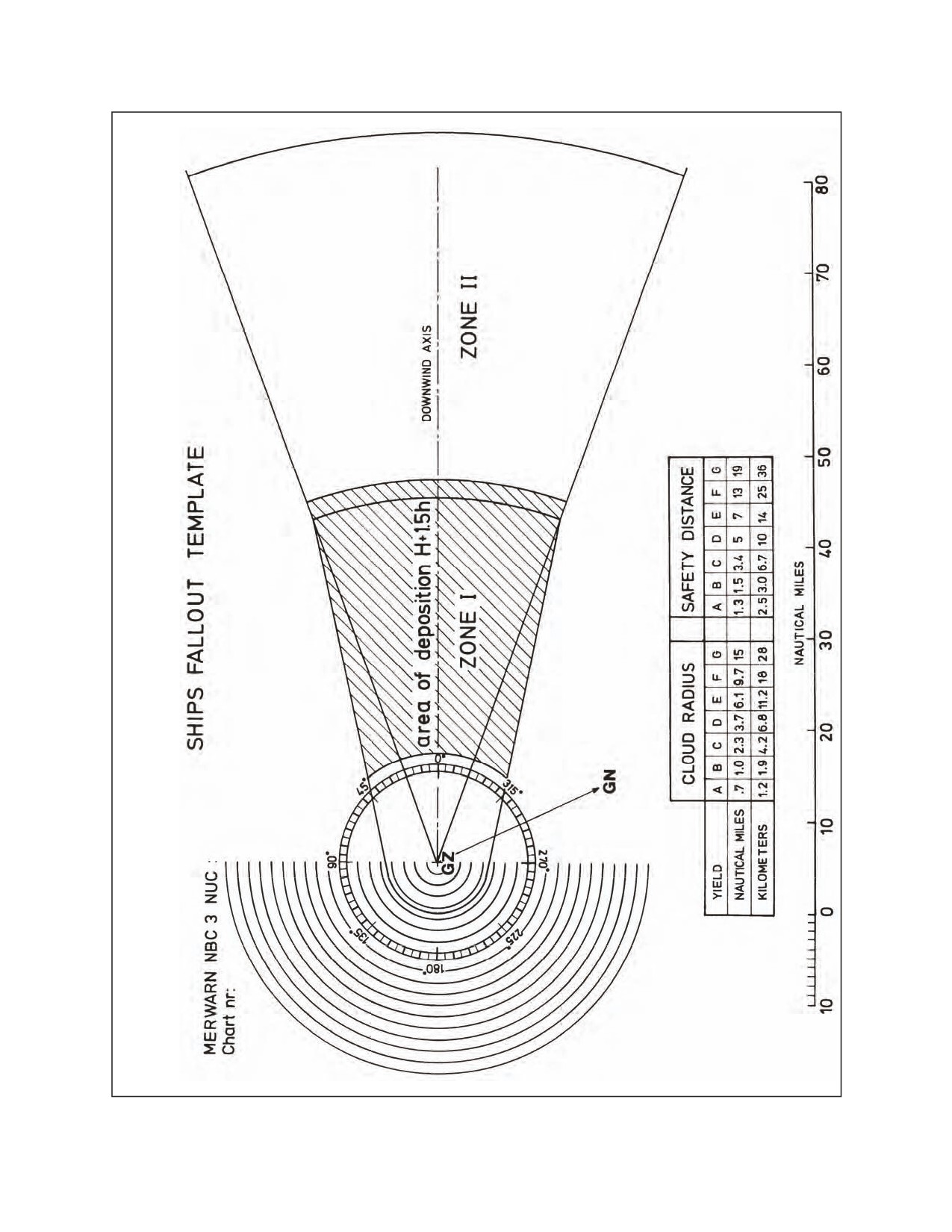
Figure G-29. Shipboard Fallout Template (Example)
G-52
FM 3-11.3/MCRP 3-37.2A/NTTP 3-11.25/AFTTP(I) 3-2.56
2 February 2006
d.
Time of Completion of Fallout.
(1)
Most contaminated particles in a radioactive cloud rise to considerable
heights. Therefore, fallout may occur over a large area. It may also last for an extended
period of time. A survey conducted before the fallout is complete would be inaccurate
because contaminants would still be suspended in the air. For this reason (and the hazard
to surveying personnel), nuclear surveys are not conducted before completion of fallout.
(2)
An estimate of the time of completion (Tcomp) of fallout for a particular
location may be determined using a mathematical equation. The time (in hours) after a
burst when the fallout will be completed at any specific point is approximately 1.25 times
the time of fallout arrival (in hours after burst). Add the time (in hours) required for the
nuclear cloud to pass over. This is expressed by using the following formula:
(2 x cloud radius)
Tcomp = (1.25 x Tarrival) +
EWS
Example: For a given location, the following data has been determined:
•
Time of detonation = H.
•
Time of arrival = H+2 hours (time of arrival is determined by dividing the
distance from GZ to the given point by the EWS).
•
Cloud diameter = 4 km (2 x cloud radius) (cloud diameter/radius [rr] is
determined from Figure G-20, page G-39, or from line item PAPAB of the NBC3 NUC
report).
•
EWS = 20 kph (EWS [sss] is determined from Figure G-19, page G-38, or
from line item PAPAB of the NBC3 NUC report).
4 km
Tcomp = (1.25 x 2 hr) +
20 kph
Tcomp = 2.5 hr + 0.2 hr
Tcomp = 2.7 hr
Therefore, fallout for the given location is expected to be complete by H+2.7 hours.
NOTE: To convert 2.7 hours into clock time, multiply 0.7 by 60. The product in
this example is 42. Therefore, Tcomp is 2 hours and 42 minutes.
(3)
The actual completion of fallout can be determined if a peak NBC4 NUC
report is received from the AOI. For detailed information regarding nuclear reconnaissance,
monitoring, and survey, refer to Multiservice Tactics, Techniques, and Procedures for
Nuclear, Biological, and Chemical Reconnaissance.
8.
NBC4 NUC Report
The NBC4 NUC report is a key tool used by units to define the type and extent of the
contamination.
a.
Locating and Reporting Nuclear Contamination.
(1)
Fallout predictions provide a means of defining possible areas of a nuclear
contamination. Militarily significant fallout is expected to occur only within the predicted
area. However, the prediction does not indicate exactly where the fallout will occur or what
30 April 2009 FM 3-11.3/MCWP 3-37.2A/NTTP 3-11.25/AFTTP(I) 3-2.56, C1
G-53

the dose rate will be at a specific location. Rainout or washout can also increase nuclear
contamination on the ground, creating local hot spots. Areas of neutron-induced radiation
can also be caused by low air bursts.
(2)
Before planning operations in a nuclear environment, commanders must be
aware of these residual contamination hazards. The information required for such planning
is derived from the equations and nomograms given in the following sections and in
Appendixes J and K. The basic information needed is contained in NBC4 NUC reports.
They provide information on the actual measured contamination in the form of dose rates.
b.
Message Precedence. All other messages, after the initial NBC1 NUC report has
been sent, should be given a precedence, which reflects the operational value of the
contents. Normally, IMMEDIATE would be appropriate (see Figure G-30 for a sample
NBC4 NUC report).
NBC4 NUC Report
Line Item
Description
Cond*
Example
ALFA
Strike serial number
O
ALFA/US/A234/001/N//
KILO
Crater description
O
KILO/UNK//
QUEBEC
Location of reading/sample/detection and
M
QUEBEC/32VNJ481203/GAMMA/-//
type of sample/detection
ROMEO
Level of contamination, dose rate trend
M
ROMEO/7CGH/DECR/DN//
and decay rate trend
SIERRA
DTG of reading or initial detection of
M
SIERRA/202300ZSEP1997//
contamination
TANGO
Terrain/vegetation information
O
WHISKEY
Sensor information
O
WHISKEY/POS/POS/YES/HIGH//
YANKEE
Downwind direction and downwind speed
O
YANKEE/270DGT/015KPH//
ZULU
Actual weather conditions
O
ZULU/4/10C/7/5/1//
GENTEXT
General text
O
-
*The Cond column shows that each line item is operationally determined (O) or mandatory (M).
Figure G-30. Sample NBC4 NUC Report
(1)
The location is sent as UTM or LAT/LONG grid coordinates; the level of
contamination reading is expressed in cGy/h.
(2)
Lines QUEBEC, ROMEO, and SIERRA may be repeated as many times as
necessary to give a specific picture of the contamination throughout an area. A zero dose
rate may also be reported on line ROMEO, and it is an extremely valuable piece of
information in determining the extent and duration of the contamination.
G-54
FM 3-11.3/MCWP 3-37.2A/NTTP 3-11.25/AFTTP(I) 3-2.56, C1
30 April 2009

(3)
Only outside unshielded dose (OD) rates are reported by the unit, and the
DTG is reported in Zulu time. Certain abbreviations are associated with the dose rate to
describe the circumstances surrounding the contamination. Note that the definition of line
ROMEO includes information on the dose rate trend and the relative or actual radiation
decay rate. The dose rate must be reported, while the latter two items are optional. They
require evaluation, which may be done above unit level. A monitor cannot provide this
information.
c.
Shielding. Shielding reduces the effects of gamma radiation on personnel and
equipment. The denser the material is, the better the shield. Low-density materials are as
effective as higher-density materials when the total thickness of the low-density material is
increased. It is not possible for gamma radiation to be completely absorbed. However, if
enough material is placed between the individual and the radiation source, the dose rate
can be reduced to negligible proportions.
(1)
Shielding Principles.
(a) Density. Density is defined as the number of molecules or mass per
unit of volume.
(b) Half-Thickness. This is the amount of material required to reduce the
dose rate by one-half. See Table G-2 for selected half-thicknesses.
Table G-2. Half-Thicknesses (X ½) of Materials
Material
Half-Thickness (Inches)
Steel
0.7
Concrete
2.2
Earth
3.3
Wood
8.8
(c)
Total Thickness. This is the actual thickness of the shielding material.
(d) Position of the Shield. The closer the shield is to the source, the better.
(e) Dose Rate Buildup. The dose rate buildup is produced by the shield.
The shield causes radiation to scatter; therefore, the closer to the shield, the higher the dose
rate.
(2)
Shielding Materials.
(a) Earth. Earth is the most common shielding material. About 1 foot of
earth makes an adequate shield.
(b) Concrete. About 6 to 8 inches of concrete makes a good shield.
(c)
Steel. Tanks and amtracks are very good shields against radiation.
(d) Buildings. Wood or brick buildings make good shields.
(3)
Effectiveness. The effectiveness of a given material in decreasing radiation
intensity is measured in units of half-value layer thickness (half-thickness). This unit is
30 April 2009 FM 3-11.3/MCWP 3-37.2A/NTTP 3-11.25/AFTTP(I) 3-2.56, C1
G-55
defined as the thickness of any material which reduces the dose rate of gamma radiation to
one-half its unshielded value.
NOTE: If personnel are surrounded by a 6-inch concrete wall (half-thickness) and
the gamma radiation outside is 200 cGy/h, they would receive gamma radiation at
the rate of 100 cGy/h. The addition of another 6 inches reduces the rate to 50
cGy/h. Each succeeding half-thickness of concrete would reduce the radiation.
d.
Measuring Nuclear Data.
(1)
Measurements of nuclear data must be taken in accordance with the unit
SOP. Measurements can be taken directly from an unshielded position if dose rates are low
enough or from a shielded position, such as a shelter or vehicle.
(2)
When the indirect technique is used, most of the readings are taken inside
the vehicle or shelter. However, at least one outside reading is necessary to determine the
TF, which relates the readings inside to the unshielded values outside. The latter readings
are to be reported since they are necessary for further calculations pertaining to troops in
the open or other vehicles or shelters.
(3)
To determine the TF, both the inside and outside readings must be taken
after fallout is complete. Calculate the TF using the following formula:
inside shielded dose (ID) rate
TF =
OD rate
NOTE: The TF is always less than 1. It can be determined from the measurement
of the dose.
(4)
The readings taken inside the vehicle or shelter represent the ID. These
readings must be converted to OD before reporting. Readings are converted using the
following formula:
OD = ID / TF
(5)
A precalculated list of TFs is contained in national manuals, an example of
which is shown in Table G-3. This information is not used by unit CBRN defense personnel
when calculating or reporting OD rates. Its principal use is to establish the relative
shielding ability of one shelter, structure, or vehicle as compared to another. It is also used
for instructional and practice purposes.
(6)
These factors are for the most exposed, occupied location. They are not
based on dose rates from fallout; they are based on gamma radiation from cobalt-60. Since
cobalt-60 radiation is almost twice as strong as the radiation from fallout, the actual TF
should be much lower (more protection).
(7)
In some cases the term CF is used. It is always the reciprocal of the TF. The
formula to convert a TF to a CF is:
1
OD
CF =
=
TF
ID
G-56
FM 3-11.3/MCWP 3-37.2A/NTTP 3-11.25/AFTTP(I) 3-2.56, C1
30 April 2009
Table G-3. TFs and CFs
Environmental Shielding
TF
CF
Environmental Shielding
TF
CF
Vehicles
Engineer Equipment
M1 tank
0.04
25.00
M9 ACE
0.3
3.33
M48 tank
0.02
50.00
Grader
0.8
1.25
M60 tank
0.04
25.00
Bulldozer
0.5
2.00
M2 IFV
0.20
5.00
Scraper
0.5
2.00
M3 CFV
0.20
5.00
Structures
M93 NBC reconnaissance vehicle
0.20
5.00
Frame house
0.30-0.8
3.33-1.25
M113 armored personnel carrier
0.30
3.33
Basement
0.05-0.1
20.00-
10.00
M109 self-propelled howitzer
0.20
5.00
Multistory Building (Apartment Type)
M548 cargo vehicle
0.70
1.43
Upper stories
0.01
100
M88 recovery vehicle
0.09
11.11
Lower stories
0.10
10
M577 command post carrier
0.30
3.33
Concrete Blockhouse Shelter
M551 armored reconnaissance
0.20
5.00
9-in walls
0.007-
142.86-
airborne assault vehicle
0.090
11.11
M728 combat engineer vehicle
0.04
25.00
12-in walls
0.0001-
10,000.00-
0.03
33.33
Helicopters (Parked)
24-in walls
0.0001-
10,000-500
0.0020
OH-58
0.8
1.25
Shelter, Partly Above Ground
UH-60
0.7
1.43
With 2-ft earth cover
0.005-
200-50.00
0.020
CH-47
0.6
1.67
With 3-ft earth cover
0.001-
1,000.00-
0.005
200.00
Trucks
Urban areas (in open)
*0.7000
1.43*
HMMWV
0.5
2.00
Woods
*0.8000
1.25*
¼-ton
0.8
1.25
Underground shelters (3-ft
0.0002
5,000.00
earth cover)
¾-ton
0.5
2.00
Foxholes
0.1000
10.00
CUCV
0.5
2.00
* These factors apply to aerial survey dose rates.
2½-ton
0.5
2.00
4-ton to 7-ton
0.5
2.00
NOTE: For vehicles in which AN/VDR2s have been installed, the users need only verify that the correct
attenuation factor (equivalent to the CF) has been entered and then read the OD directly off the display.
2 February 2006
FM 3-11.3/MCRP 3-37.2A/NTTP 3-11.25/AFTTP(I) 3-2.56
G-57
e.
Surveys.
(1)
Air-Ground Correlation Factors (AGCFs). An AGCF is required for
calculating surface dose rates from aerial dose rates taken in an aircraft during a survey.
The AGCF relates a ground dose rate reading to a reading taken at approximately the same
time in an aircraft at survey height over the same point on the surface.
(2)
The AGCF is calculated as shown below:
ground dose rate
AGCF =
aerial dose rate
Example:
surface dose rate
=
20 cGy/h
aerial dose rate
=
5 cGy/h
(200 feet survey height)
20 cGy/h
AGCF =
5 cGy/h
AGCF = 4
(3)
By multiplying the readings taken in the aircraft at a survey height by the
AGCF, the surface level reading can be approximated. These values are to be reported in
the NBC4 NUC report. The formula to determine ground dose rate is:
Ground dose rate = Air dose rate x AGCF
f.
Reporting Instructions. Monitoring data to be sent to other units/HQ is
transmitted as an NBC4 NUC report.
(1)
Automatic Reports. According to the SOPs, units in the contaminated area
submit certain monitoring reports automatically. These provide the minimum essential
information for warning, hazard evaluation, and survey planning. Reports are sent
through specified channels to reach the CBRN cell. The automatic reports are the initial,
peak, and special reports specified by the CBRN cell or required by commanders for
operational purposes.
(2)
Initial Report. After noting a dose rate of 1 or more cGy/h outside,
defensive measures according to the SOPs are implemented and the unit formats an NBC4
NUC report (Figure G-31) containing the code "INIT" (for initial) in line ROMEO. The first
report is used at the CBRN cell to confirm the fallout prediction. The dose rate cannot be
converted to H+1 at this time.
NBC4 NUC
NBC4 NUC
NBC4 NUC
QUEBEC/32UNB156470/GAMMA//
QUEBEC/32UNB156470/GAMMA//
QUEBEC/32UNB156470/GAMMA//
ROMEO/1CGH/INIT//
ROMEO/35CGH/PEAK//
ROMEO/25CGH/DECR//
SIERRA/021200ZAUG2005//
SIERRA/021400ZAUG2005//
SIERRA/021530ZAUG2005//
Figure G-31. Sample NBC4 NUC Reports
(3)
Peak Report. After the initial contamination is detected, the unit monitor
continuously records dose rates according to the time intervals specified in unit SOP. The
dose rate rises until it reaches a peak, and then it decreases. In some cases, the dose rate
G-58
FM 3-11.3/MCRP 3-37.2A/NTTP 3-11.25/AFTTP(I) 3-2.56
2 February 2006
may fluctuate for a short time before beginning a constant decrease. When the
measurement continues to decrease, the monitor takes an inside reading and then an
outside reading for the TF calculation. First, the inside reading is recorded. Within 3
minutes, the monitor goes to the outside location. After all information is recorded, the
CBRN defense team calculates the TF and applies it to the highest dose rate. It then
formats the NBC4 NUC report. The word "PEAK" is used in line ROMEO.
(4)
Special Reports. Other standing instructions may establish the
requirement for special NBC4 NUC reports. The CBRN cell evaluates these special reports
and invites command attention to areas or conditions of serious concern. The operational
situation, unit radiation status, and similar considerations determine the criteria for
special reports, which cannot be specified here. Generally, this report may be required
when the surface dose rate goes above a specified value. When the dose rate increases after
showing continuous decrease, a special report must be sent. Special reports may be
required after a specified period of time if the unit remains in the area.
(5)
Directed Reports. Selected units in the contaminated area will be directed
to submit additional NBC4 NUC reports. The CBRN cell uses these reports to evaluate a
nuclear-contamination hazard, the decay rate of fallout, and how long the decay rate (and
the contamination overlay) will remain valid. They are used to determine the H-hour (if
unknown) and the soil type in neutron-induced areas. Reliable calculations are directly
related to the precision of the dose rate measurement. Tactical decisions and personnel
safety depend on the accuracy of these measurements. The assessment of further
development of the contamination situation depends on this data. An error in dose rate
measurements means a similar error in all following calculations.
(6)
Series Reports. A series report consists of a series of dose rate readings
taken at the same location at time intervals specified in the unit SOP after the peak dose
rate has been recorded. The location must remain constant. The report contains each
reading and the time it was taken. The report contains the word “series” in line GENTEXT.
(7)
Summary Reports. The summary report shows the radiation distribution
throughout the unit AOR. The locations for the readings are selected by the unit according
to the distribution of its elements and the extent or variety of the area terrain. The time
each reading was taken is reported. The word “summary” is given in line GENTEXT.
(8)
Verification Reports. The verification report is a unit response to a direct
request. If data are lacking from a specific location near or in the unit area, the CBRN cell
may request a verification report. It may also be requested to confirm abnormal readings
reported earlier. A verification report is not a retransmission of the earlier report, but a
check of the actual conditions of the area. The unit tasked with the submission of a
verification report receives specific instructions as to the location from which a reading is
desired. The word “verify” is used in line GENTEXT to indicate a verification report.
(9)
Trends. Dose rate trends are—
(a) INIT—initial reading
(b) PEAK—peak reading
(c)
DECR—decreasing since last reading
(d) INCR—increasing since last reading
(e) SAME—same
2 February 2006
FM 3-11.3/MCRP 3-37.2A/NTTP 3-11.25/AFTTP(I) 3-2.56
G-59
9.
Evaluation of Nuclear Information
After the NBC4 NUC reports are available, they must be evaluated with regard to the
actual hazard encountered by the troops. The aim is to predict the expected dose rates and
accumulated dosages for possible missions within the contaminated area. Theoretically,
once a nuclear hazard has been identified, the contamination existing at any future time
can be calculated using simple decay relationships and other calculations. The following
calculations are shown below:
•
Calculation of H hour.
•
Decay of fallout.
•
Decay rate (n).
•
Validity time for decay rate (Tp).
•
Normalization factor (NF).
•
Overall correction factor (OCF).
a.
Calculation of H hour or Time of Burst (TOB). Calculate H hour mathematically,
using the following procedures:
•
Step 1. Set up the formula as follows:
T1 = Time after H hour at which reading Ra was made.
Ta = Time peak reading was measured.
Tb = Time last reading was measured.
Tb - Ta = interval between readings Ra and Rb.
Ra = Peak reading.
Rb = La st read ing.
n = Decay rate.
Tb - Ta
T1 =
(Ra/Rb)1/n-1
•
Step 2. Place known values in the formula.
•
Step 3. Divide 4.75 by 3.06 and T1 = 1.55.
b.
Fallout Determination of Decay. The dose rate at any location in a fallout area
does not remain constant. It decreases with time according to the Kaufmann equation,
which describes the decay of fallout after it has completely settled to the ground. Where—
R2 = Dose rate at the location at the time of reading.
R1 = Dose rate (normalized to H+1) at the location.
t1
= H+1.
t2
= Time, in hours, after H hour that R2 was measured.
G-60
FM 3-11.3/MCRP 3-37.2A/NTTP 3-11.25/AFTTP(I) 3-2.56
2 February 2006
n = Decay rate.
•
The dose rate and total dose calculations cannot be performed until the decay
rate is known. The true decay rate will not be known immediately. Accurate
determination must wait until several sets of NBC4 NUC reports are available.
•
The decay rate of fallout depends on many factors. These factors include the
following:
—Height and type of burst.
—Type of weapon (fission, fission-fusion, or fission-fusion-fission).
—Type of active materials, construction, and structural materials
within the weapon.
—Type and quantity of materials vaporized or sucked up into the
fireball.
—“Salting” the weapon to produce a slow decay.
—When fallout overlaps fallout.
—Soil type.
•
The decay rate varies with time. Generally, the decay rate becomes slower as
time passes.
•
The same decay rate may not be present across the entire fallout area. The
pattern, as a whole, will have an average value, which may vary from position to position.
The amount of variation in the decay rate for fallout is expected to range from 0.2 to 2.0.
The lower values are assumed for “salted” weapons.
•
Decay calculations are valid only if the dose rate readings are made after the
completion of fallout. While fallout is still arriving, the Kaufmann equation is not valid.
•
Because of the delay in determining the actual decay rate, an assumed decay
rate of n = 1.2, referred to as standard decay, is used by all units until informed otherwise
by the CBRN cell. When the actual decay rate has been established by the CBRN cell, it
will be sent as line ROMEO on the NBC4 or NBC5 NUC report. The assumed normal
decay rate of n = 1.2 is used in many simplified nuclear calculation procedures. The
optimum time of exit calculations are also based on n = 1.2.
NOTE: In the equations of the following sections, all times are given in hours
after the burst. The information given in corresponding line items of the CBRN
messages (e.g., SIERRA) must be converted appropriately when moving from
calculation to reporting or vice versa.
c.
Determination of Decay Rate.
(1)
7:10 Rule. For every seven-fold increase in time, radiation will decay by a
factor of 10.
(2)
Standard Decay (n = 1.2). When no decay rate is given or there is no way to
determine a decay rate, the standard decay rate of 1.2 will be used by the control center in
their computations.
2 February 2006
FM 3-11.3/MCRP 3-37.2A/NTTP 3-11.25/AFTTP(I) 3-2.56
G-61
(3)
Nonstandard Decay (n does not equal 1.2). Anything other than 1.2 is
considered nonstandard. Decay rates greater than 1.2 decay faster than standard. Decay
rates less than 1.2 decay slower than standard.
(4)
Decay Constant (Rate, Exponent) (n). The decay rate (n) is a changing
factor we must adjust to throughout CBRN operations. It changes as short-lived fission
products die off, with the rate slowing down as time goes on. The decay rate may not be the
same from pattern to pattern or from one location to another within the same pattern.
There are two methods of determining the decay rate—pocket calculator and graphical.
The following steps utilize the calculator method. The Kaufmann equation is the preferred
method of determining the decay rate. A scientific calculator is required.
(a) Step 1. From the report, determine the Ra, Rb, Ta, and Tb.
Where—
Ra = Peak dose rate (cGy/h) measured.
Rb = Last measured dose rate (cGy/h) available on the report.
Ta = Time in hours (after H hour) that Ra was measured.
Tb = Time in hours (after H hour) that Rb was measured.
(b) Step 2. Set up the formula as follows:
log(Ra/Rb)
n =
log(Tb/TA)
(c) Step 3. Place known values in the formula.
NOTE: Information was provided from the nuclear data sheet.
log(Ra/Rb)
log(52/17)
log(3.059)
0.486
n =
=
=
=
=
1
log(Tb/Ta)
log(9/3)
log(3.000)
0.477
(d) Step 4. Solve for n. The decay rate is rounded to the nearest single
decimal place (tenth).
d.
Period of Validity for the Decay Rate (n). The period of validity is a
mathematical calculation that determines how long the decay rate is valid due to the
various aspects discussed earlier regarding the decay of fallout. The period of validity is
calculated as follows:
(1)
Step 1. From the series report, determine the Ta and Tb. Where—
Tp
Period of validity decay rate (n).
3
Constant.
Ta
Time in hours (after H hour) that Ra was measured.
Tb
Time in hours (after H hour) that Rb was measured.
(2)
Step 2. Set up the formula as follows:
G-62
FM 3-11.3/MCRP 3-37.2A/NTTP 3-11.25/AFTTP(I) 3-2.56
2 February 2006
Tp = 3(Tb - Ta) + Tb
(3)
Step 3. Place known values in the formula.
(4)
Step 4. Solve for Tp.
TOB = 090400Z
Tp = +
24
092800 = 100400Z (DTG)
Example: Given TOB = 010100ZJUN2004, Ta = 9, and Tb = 3.
NOTE: Information was provided from the nuclear data sheet.
Tp = 3 (Tb-Ta) + Tb
Tp = 3 (9-3) + 9
Tp = 3 (6) + 9
Tp = 18 + 9 = 27 hours
Tp + TOB = 27 hours + 010100ZJUN2004 = 020400ZJUN2004
(5)
Step 5. Add the Tp value to the TOB. This will give the DTG of when n is
no longer valid.
e.
Normalizing Factor (NF).
(1)
Once the decay rate (n) is determined, the nuclear reading may be
normalized to H+1 readings. This normalized reading is commonly referred to as the R1
reading. Simply stated, it is mathematically determining what the dose rate reading was
at any given location 1 hour after the burst.
(2)
Survey teams and monitors take readings at various times after the burst.
These readings may be 15 minutes or 10 hours after the burst. Any reading that is not
recorded 1 hour after a burst (H+1) is commonly referred to as an Rt reading. To perform
nuclear calculations and make decisions on the nuclear battlefield, all readings must be
represented using the same time reference.
(3)
To determine the NF, use the following steps:
(a)
Step 1. From the NBC4 NUC report or nuclear data sheets,
determine the decay rate, dose rate reading, and time measured of the reading you desire to
be normalized to H+1. When normalizing readings from ground survey reports, you must
use midtime for your computations. Midtime is simply the middle time between the
beginning and end of the ground survey. For example, if a survey starts at 1030 and ends
at 1100, the midtime for calculating the NF is 1045.
(b)
Step 2. Set up the formula as follows:
R1 = NF x R2
NF = (T2)n
2 February 2006
FM 3-11.3/MCRP 3-37.2A/NTTP 3-11.25/AFTTP(I) 3-2.56
G-63
R1
= Normalized dose rate reading at H+1.
R2
= Dose rate reading at any other time.
NF
= Normalization factor.
T2
= Time reading taken, in hours, after the burst.
n
= Decay rate.
(c)
Step 3. Solve for NF.
Example: A peak dose rate of 100 cGy/h was measured at H+2 in a fallout area where the
decay rate is 1.2. Normalize the dose rate to a reference time of H+1.
Solution:
Calculate NF = (T2)n
NF = 21.2 = 2.30 (2.297 rounded to the nearest hundredth)
Calculate R1 = NF x R2
R1 = 2.30 x 100 cGy/h = 230 cGy/h (normalized dose rate reading at
H+1)
f.
Outside Correlation Factor (OCF). When calculating survey data, combining the
NF and CF reduces the number of required calculations. This additional step is called the
OCF. To compute the OCF, use the following steps:
•
The OCF formula is—
Aircraft: NF x AGCF = OCF
Vehicle: NF x VCF = OCF
•
The OCF is rounded to the nearest hundredth.
•
The OCF is used instead of the NF. The OCF will convert shielded readings to
unshielded readings normalized to H+1. Multiply the OCF by the dose rate reading. This
unshielded H+1 reading (R1) is always rounded to the nearest whole number and written in
the “Do Not Use” column of the nuclear data sheet.
10. NBC5 NUC Report
The NBC5 NUC report (Figure G-32) is a vital part of ensuring that the COP is
maintained. It provides information vital to the commander.
a.
Purpose. The NBC5 NUC report is used to pass along information on areas of
actual contamination. This report can include areas of possible contamination, but only if
actual contamination coordinates are included in the report.
G-64
FM 3-11.3/MCRP 3-37.2A/NTTP 3-11.25/AFTTP(I) 3-2.56
2 February 2006

b.
Message Precedence. All other messages, after the initial NBC1 NUC report has
been sent, should be given a precedence, which reflects the operational value of the
contents. Normally, IMMEDIATE would be appropriate.
NBC5 NUC Report
Line Item
Description
Cond*
Example
ALFA
Strike serial number
O
ALFA/US/A234/001/N//
DELTA
DTG of attack or detonation and
O
DELTA/201405ZSEP2005//
attack end
OSCAR
Reference DTG for estimated contour
M
OSCAR/201505ZSEP2005//
lines
XRAYA*
Actual contour information
M
XRAYA/5CGH/32UND620475/
32UND662522/32UND883583/
32UND830422/32UND620475//
XRAYB*
Predicted contour information
O
XRAYB/75/100CGH/32UND621476/
32UND621477/32UND622477/
32UND622476/32UND621476//
YANKEE
Downwind direction and downwind
O
YANKEE/270DGT/015KPH//
speed
ZULU
Actual weather conditions
O
ZULU/4/10C/7/5/1//
GENTEXT
General text
O
-
*The Cond column shows that each line item is operationally determined (O) or mandatory (M).
Figure G-32. Sample NBC5 NUC Report
c.
Plotting Data and Producing an NBC5 NUC Report.
(1)
Contaminated areas are shown on the nuclear contamination situation
map, and information about them must be passed to other units and HQ. The most
expeditious means for this is the nuclear contamination overlay.
(2)
The preparation of such an overlay is described below:
(a) After all available information from monitoring and surveying has
been plotted on a map as normalized (H+1, unshielded ground dose rates [R1]), contour
lines for the standard dose rates can be drawn on a nuclear contamination overlay.
(b) When constructing the nuclear contamination overlay, there are
factors that locally affect the contamination pattern.
(c)
This is particularly true between points in an aerial survey. These
include topographic features, such as bluffs or cuts, heavily built-up or wooded areas, and
bodies of water. For example, a large river will carry away any fallout landing in it, leaving
its path relatively free of contamination. Also, the contamination hazard near a lake will be
lower than expected. The fallout particles will sink to the bottom of the lake, and the water
2 February 2006
FM 3-11.3/MCRP 3-37.2A/NTTP 3-11.25/AFTTP(I) 3-2.56
G-65