FM 4-20.137 RIGGING FORWARD AREA REFUELING EQUIPMENT (FARE) AND ADVANCED AVIATION FORWARD AREA REFUELING SYSTEM (AAFARS, JUNE 2003) - page 1
*FM 4-20.137 (FM 10-537)
TO 13C7-1-19
FIELD MANUAL
HEADQUARTERS
NO. 4-20.137
DEPARTMENT OF THE ARMY
TECHNICAL ORDER
DEPARTMENT OF THE AIRFORCE
NO. 13C7-1-19
WASHINGTON, DC, 10 June 2003
Airdrop of Supplies and Equipment:
Rigging Forward Area Refueling Equipment
(FARE) and Advanced Aviation Forward Area
Refueling System (AAFARS)
Contents
Page
Preface
viii
Introduction
ix
Chapter 1
Rigging FARE for Low Velocity Airdrop On Type V Platform
Section I
Rigging FARE with Two 500-Gallon Fuel Drums
Description of Load
1-1
Preparing Platform
1-1
Preparing Honeycomb
1-3
Building Container for FARE
1-4
Preparing and Stowing FARE in Container
1-8
Securing Container
1-14
Positioning and Lashing Container
1-16
Attaching Lifting Slings
1-20
Placing and Lashing Fuel Drums
1-21
Installing Suspension Slings
1-25
Stowing Cargo Parachutes
1-26
Installing Extraction System
1-27
Distribution Restrictions: Approved for public release; distribution is unlimited.
*This publication supercedes FM 10-537, dated 28 February 1983
i
FM 4-20.137/TO 13C7-1-19
Page
Installing Parachute Release System
1-29
Placing Extraction Parachute
1-30
Installing Provisions for Emergency Restraints
1-30
Marking Rigged Load
1-30
Equipment Required
1-30
Section II
Rigging FARE in an M101 Series, 3/4-Ton Trailer
Description of Load
1-34
Preparing Platform
1-34
Building and Placing Honeycomb Stacks
1-35
Preparing Trailer
1-41
Positioning Trailer
1-51
Lashing Trailer
1-53
Installing Suspension Slings
1-54
Building and Installing Cargo Parachute Stowage Platform
1-55
Stowing Cargo Parachutes
1-57
Installing Extraction System
1-58
Installing Parachute Release System
1-60
Placing Extraction Parachute
1-61
Installing Provisions for Emergency Restraints
1-61
Marking Rigged Load
1-61
Equipment Required
1-61
Section III
Rigging FARE in an M998, 1/4-Ton Truck (HMMWV)
Description of Load
1-65
Preparing Platform and Truck
1-65
Preparing Cargo Bed
1-65
Placing FARE In Cargo Bed
1-67
Securing FARE
1-70
Securing Accessories
1-72
Section IV
Rigging FARE With Seven 500-Gallon Fuel Drums on a 32-Foot Platform
Description of Load
1-74
Preparing Platform
1-74
Building and Positioning Honeycomb
1-76
Positioning and Lashing Drums
1-78
Preparing FARE
1-87
Installing Lifting Slings and Positioning FARE Containers
1-88
Lashing FARE Containers to Platform
1-88
Installing Suspension Slings
1-93
Safety Tieing Suspension Slings
1-94
Building and Installing Cargo Parachute Stowage Tray
1-95
Preparing and Stowing Cargo Parachutes
1-97
Installing the Extraction System
1-98
Installing Parachute Release System
1-99
Placing Extraction Parachute
1-100
Installing Provisions for Emergency Restraints
1-100
ii
FM 4-20.137/TO 13C7-1-19
Page
Marking Rigged Load
1-100
Equipment Required
1-100
Chapter 2
Rigging the 350-GPM Wheel-Mounted POL Pumping Assembly with
Filter/ Separator
Description of Load
2-1
Preparing Platform
2-1
Preparing Honeycomb
2-3
Positioning Honeycomb Stacks
2-7
Preparing the Pump Assembly and Filter/Separator
2-8
Positioning the Pump Assembly and Filter/Separator
2-12
Lashing the Pump Assembly and Filter/Separator to the Platform
2-15
Constructing the Parachute Stowage Tray and Load Cover
2-17
Installing the Suspension Slings and Deadman's Tie
2-19
Preparing, Stowing, and Restraining Cargo Parachutes
2-20
Installing the Extraction System
2-21
Installing Parachute Release System
2-23
Placing Extraction Parachute
2-24
Installing Provisions for Emergency Restraints
2-24
Marking Rigged Load
2-24
Equipment Required
2-24
Chapter 3
Rigging 500-Gallon Drums with the 350-GPM Wheel-Mounted POL Pumping
Assembly, Filter/ Separator Assembly, and Hose Box
Section I
Rigging Three 500-Gallon Drums
Description of Load
3-1
Preparing Platform
3-1
Preparing Honeycomb
3-3
Positioning Honeycomb Stacks
3-11
Building the Equipment Hose Box
3-12
Positioning Equipment Hose Box
3-13
Storing Equipment in Equipment Hose Box
3-14
Lashing Equipment Hose Box To Platform
3-15
Preparing and Positioning Fuel Separator
3-17
Lashing Separator to Platform
3-18
Positioning and Lashing the Drums
3-19
Preparing and Positioning the Pump
3-23
Lashing Pump to the Platform
3-24
Covering the Pump
3-25
Installing Suspension Slings and Safety Ties
3-26
Building and Positioning Parachute Stowage Platform
3-27
Preparing and Stowing Cargo Parachutes
3-28
Installing the Extraction System
3-29
Installing the Cargo Parachute Release System
3-30
Placing Extraction Parachute
3-31
Installing Provisions for Emergency Restraints
3-31
Marking Rigged Load
3-31
iii
FM 4-20.137/TO 13C7-1-19
Page
Equipment Required
3-31
Section II
Rigging Four 500-Gallon Drums
Description of Load
3-35
Preparing Platform
3-35
Preparing Honeycomb
3-37
Positioning Honeycomb Stacks
3-39
Building Equipment Hose Box
3-40
Positioning Equipment Hose Box
3-40
Storing Equipment in the Equipment Hose Box
3-40
Lashing Equipment Hose Box to Platform
3-40
Preparing and Positioning Fuel Separator
3-42
Lashing Fuel Separator to Platform
3-42
Positioning and Lashing Drums
3-43
Preparing and Positioning the Pump
3-49
Lashing the Pump to the Platform
3-49
Covering the Pump
3-50
Installing Suspension Slings and Safety Ties
3-50
Building and Positioning Parachute Stowage Platform
3-51
Preparing and Stowing Cargo Parachutes
3-52
Installing the Extraction System
3-53
Installing the Parachute Release System
3-54
Placing Extraction Parachute
3-55
Installing Provisions For Emergency Restraints
3-55
Marking Rigged Load
3-55
Equipment Required
3-55
Section III
Rigging Five 500-Gallon Drums
Description of Load
3-59
Preparing Platform
3-59
Preparing Honeycomb
3-61
Positioning Honeycomb Stacks
3-62
Building Equipment Hose Box
3-63
Positioning Equipment Hose Box
3-63
Storing Equipment in the Equipment Hose Box
3-63
Lashing Equipment Hose Box to Platform
3-63
Preparing and Positioning Fuel Separator
3-65
Lashing Fuel Separator to Platform
3-65
Positioning and Lashing the Drums
3-66
Preparing and Positioning Pump
3-73
Lashing the Pump to the Platform
3-73
Installing Suspension Slings and Safety Ties
3-74
Covering the Pump
3-75
Building and Positioning Parachute Stowage Platform
3-76
Preparing and Stowing Cargo Parachutes
3-77
Installing the Extraction System
3-78
Installing the Parachute Release System
3-79
Placing Extraction Parachute
3-80
iv
FM 4-20.137/TO 13C7-1-19
Page
Installing Provisions for Emergency Restraints
3-80
Marking Rigged Load
3-80
Equipment Required
3-80
Section IV
Rigging Six 500-Gallon Drums
Description of Load
3-85
Preparing Platform
3-85
Preparing Honeycomb
3-87
Positioning Honeycomb Stacks
3-88
Building Equipment Hose Box
3-89
Positioning Equipment Hose Box
3-89
Storing Equipment in the Equipment Hose Box
3-89
Lashing Equipment Hose Box to Platform
3-89
Positioning and Securing Parachute Stack
3-91
Positioning and Lashing the Drums
3-92
Preparing and Positioning the Pump
3-103
Lashing Pump to Platform
3-105
Building, Positioning, and Lashing the Separator Box to the Platform
3-106
Constructing and Positioning the Release Platform
3-112
Installing Suspension Slings and Safety Ties
3-113
Building and Positioning Parachute Stowage Platform
3-115
Preparing and Stowing Cargo Parachutes
3-116
Installing the Extraction System
3-117
Installing the Parachute Release System
3-118
Placing Extraction Parachute
3-119
Installing Provisions for Emergency Restraints
3-119
Marking Rigged Load
3-119
Equipment Required
3-119
Chapter 4
Rigging AAFARS For Low Velocity Airdrop On Type V Platform
Section I
Rigging AAFARS withThree 500-Gallon Drums Fuel Drums
Description of Load
4-1
Preparing Platform
4-1
Preparing Honeycomb
4-3
Positioning Honeycomb Stacks
4-4
Building the Equipment Boxes
4-5
Preparing Equipment for Equipment Boxes
4-7
Positioning Equipment Boxes
4-19
Positioning and Securing Equipment in Equipment Boxes
4-20
Lashing the Equipment Boxes to the Platform
4-25
Positioning and Lashing the Drums
4-31
Building and Positioning Release Platform
4-39
Installing Suspension Slings and Safety Ties
4-40
Preparing and Stowing Cargo Parachutes
4-41
Installing the Extraction System
4-42
Installing the Cargo Parachute Release System
4-43
Placing Extraction Parachute
4-44
v
FM 4-20.137/TO 13C7-1-19
Page
Installing Provisions for Emergency Restraints
4-44
Marking Rigged Load
4-44
Equipment Required
4-44
Section II
Rigging AAFARS with Four 500-Gallon Fuel Drums
Description of Load
4-48
Preparing Platform
4-48
Preparing and Positioning Honeycomb Stacks
4-50
Building the Equipment Boxes
4-50
Preparing Equipment for Equipment Boxes
4-50
Positioning Equipment Boxes
4-50
Positioning Equipment in Equipment Boxes and Securing Boxes
4-50
Lashing the Equipment Boxes to the Platform
4-50
Positioning and Lashing Drums
4-57
Installing Release Platform, Suspension Slings and Safety Ties
4-64
Preparing and Stowing Cargo Parachutes
4-66
Installing the Cargo Parachute Release System
4-67
Installing the Extraction System
4-68
Placing Extraction Parachute
4-69
Installing Provisions for Emergency Restraints
4-69
Marking Rigged Load
4-69
Equipment Required
4-69
Section III
Rigging AAFARS with Five 500-Gallon Fuel Drums
Description of Load
4-73
Preparing Platform
4-73
Preparing Honeycomb
4-75
Positioning Honeycomb Stacks
4-76
Building the Equipment Boxes
4-77
Preparing Equipment for Equipment Boxes
4-77
Positioning Equipment Boxes
4-77
Positioning Equipment in Equipment Boxes and Securing Boxes
4-77
Lashing the Equipment Boxes to the Platform
4-78
Positioning and Lashing the Drums
4-84
Building and Positioning Release Platform
4-92
Installing Suspension Slings and Safety Ties
4-93
Preparing and Stowing Cargo Parachutes
4-94
Installing the Extraction System
4-95
Installing the Cargo Parachute Release System
4-96
Placing Extraction Parachutes
4-97
Installing Provisions for Emergency Restraints
4-97
Marking Rigged Load
4-97
Equipment Required
4-97
vi
FM 4-20.137/TO 13C7-1-19
Page
Section IV
Rigging AAFARS with Six 500-Gallon Fuel Drums
Description of Load
4-101
Preparing Platform
4-101
Preparing Honeycomb
4-103
Positioning Honeycomb Stacks
4-104
Positioning and Lashing the Drums
4-105
Building the Equipment Boxes
4-116
Preparing Equipment for Equipment Boxes
4-119
Positioning Equipment Boxes
4-122
Positioning and Securing Equipment in Equipment Boxes
4-124
Lashing the Equipment Boxes to the Platform
4-130
Building and Positioning Release Platform
4-136
Installing Suspension Slings and Safety Ties
4-137
Securing the Suspension Slings
4-138
Preparing and Stowing Cargo Parachutes
4-141
Installing the Extraction System
4-142
Installing the Cargo Parachute Release System
4-143
Placing Extraction Parachutes
4-144
Installing Provisions for Emergency Restraints
4-144
Marking Rigged Load
4-144
Equipment Required
4-144
Section V
Rigging AAFARS with Seven 500-Gallon Fuel Drums
Description of Load
4-149
Preparing Platform
4-149
Preparing Honeycomb
4-151
Positioning Honeycomb Stacks
4-152
Positioning and Lashing the Drums
4-153
Building the Equipment Boxes
4-166
Preparing Equipment for Equipment Boxes
4-166
Positioning Equipment Boxes
4-166
Positioning and Securing Equipment in Equipment Boxes
4-166
Lashing the Equipment Boxes to the Platform
4-166
Installing Suspension Slings and Safety Ties
4-170
Securing the Suspension Slings
4-170
Preparing and Stowing Cargo Parachutes
4-172
Building and Positioning Release Platform
4-173
Installing the Extraction System
4-174
Installing the Cargo Parachute Release System
4-175
Placing Extraction Parachutes
4-176
Installing Provisions for Emergency Restraints
4-176
Marking Rigged Load
4-176
Equipment Required
4-176
Appendix A
Appendix A-1
Glossary
Glossary-1
References
References-1
vii
Preface
This manual tells and shows how to prepare and rig the following configurations of the Forward Area
Refueling Equipment (FARE) Systems, the 4-inch, 350-GPM Wheel-Mounted Pumping Assembly, and
the Advanced Aviation Forward Area Refueling System (AAFARS) for low-velocity airdrop from a C-
130, C-141, C-17, and C-5 aircraft.
User Information
The proponent of this publication is HQ TRADOC. You are encouraged to report any errors or omis-
sions and to suggest ways of making this a better manual. Army personnel, send your comments on
DA Form 2028 directly to:
Director
Aerial Delivery and Field Services Department
USA Quartermaster Center and School
1010 Shop Road
Fort Lee, Virginia 23801-1502
Air Force personnel, send your reports on AFTO Form 22 through:
Headquarters
Air Mobility Command (AMC/DOKT)
402 Scott Drive
Scott AFB, Illinois 62225-5302
Air Force personnel in Special Operations Command, send your reports on AFTO Form 22 through:
HQ AFSOC/DOXT
100 Bartley Street, Suite 260
Hurlburt Field, Florida 32544-5273
to:
Director
Aerial Delivery and Field Services Department
USA Quartermaster Center and School
1010 Shop Road
Fort Lee, Virginia 23801-1502
Also send information copy of AFTO Form 22 to:
WR-ALC/LKCB
460 Richard Ray Blvd Suite 221
Robins AFB, Geogia 31098-1640
viii
Introduction
This manual shows and tells how to rig the forward area refueling equipment (FARE),
to include the rigging of hazardous material--gasoline, JP4, and diesel fuel. The
FARE is rigged with the following:
Trailers. M101, M101A1, 3/4-ton, two-wheel trailers for low-velocity
airdrop from C-130, C-141, C-5, and C-17 aircraft.
Two Fuel Drums. Two 500-gallon collapsible fuel drums for low-velocity airdrop
from C-130, C-141, C-5, and C-17 aircraft.
Seven Fuel Drums. Seven 500-gallon collapsible fuel drums for low-velocity
airdrop from C-130, C-141, C-5, and C-17 aircraft.
Vehicle. M998, 1 1/4-ton truck (HMMWV) for low-velocity airdrop from C-130,
C-141, C-5, and C-17 aircraft.
This manual shows and tells how to rig the 4-inch, 350 GPM wheel-mounted pumping
assembly, to include the rigging of hazardous material-- gasoline, JP4, and diesel fuel.
The 4-inch, 350-GPM wheel-mounted pumping assembly is rigged with the following:
Pumps and Separators. Two 4-inch, 350-GPM wheel-mounted pumping assem-
blies and two separators are rigged for low-velocity airdrop from C-130, C-141,
C-5, and C-17 aircraft.
Three Fuel Drums. Three 500-gallon collapsible fuel drums for low-velocity
airdrop from C-130, C-141, C-5, and C-17 aircraft.
Four Fuel Drums. Four 500-gallon collapsible fuel drums for low-velocity air-
drop from C-130, C-141, C-5, and C-17 aircraft.
Five Fuel Drums. Five 500-gallon collapsible fuel drums for low-velocity air-
drop from C-130, C-141, C-5, and C-17 aircraft.
Six Fuel Drums. Six 500-gallon collapsible fuel drums for low-velocity airdrop
from C-130, C-141, C-5, and C-17 aircraft.
This manual shows and tells how to rig the Advanced Aviation Forward Area Refu-
eling System (AAFARS), to include the rigging of hazardous material-- gasoline, JP4,
and diesel fuel. The AAFARS is rigged with the following:
Three Fuel Drums. Three 500-gallon collapsible fuel drums for low-velocity
airdrop from C-130, C-141, C-5, and C-17 aircraft.
ix
Four Fuel Drums. Four 500-gallon collapsible fuel drums for low-velocity
airdrop from C-130, C-141, C-5, and C-17 aircraft.
Five Fuel Drums. Five 500-gallon collapsible fuel drums for low-velocity
airdrop from C-130, C-141, C-5, and C-17 aircraft.
Six Fuel Drums. Six 500-gallon collapsible fuel drums for low-velocity
airdrop from C-130, C-141, C-5, and C-17 aircraft.
Seven Fuel Drums. Seven 500-gallon collapsible fuel drums for low-velocity
airdrop from C-130, C-141, C-5, and C-17 aircraft.
The following conditions must be met when rigging these loads:
CAUTION:
There must be no more than 432 gallons of liquid in each
drum when rigged for low-velocity airdrop. Do not pressurize
drums with air.
Hazardous Material. When included as a part of these loads, fuel must be
packaged, marked, and labeled as described in AFMAN(I) 24-204/TM 38-250.
Weight. Each drum of fuel MUST be weighed to learn its exact weight, as
the drum has no gauge to measure the liquid content. For computing liquid
weight per US gallon, 6 pounds are used for gasoline, 6.4 pounds for JP4 fuel,
6.7 pounds for JP8 fuel, and 6.68 pounds for diesel fuel. When empty, the drum
weighs 250 pounds.
CAUTION:
Because the fuel drum is flexible, it will rebound upon
ground impact and the lashings may be broken. This could
free the drum and allow it to roll off the platform and create
a possible hazard in the immediate area.
Manuals. A copy of this manual must be available to the joint airdrop
inspectors during the before- and after-loading inspections.
NOTICE of EXCEPTION:
The procedures in this manual for installing the Suspension
Sling Safety Ties may differ from those in FM 4-20.102/
NAVSEA SS400-AB-MMO-010/TO 13C7-1-5. An exception
to FM 4-20.102/ NAVSEA SS400-AB-MMO-010/TO 13C7-1-5
is granted. The procedures in this manual MUST be followed.
x
FM 4-20.137/TO 13C7-1-19
Chapter 1
Rigging FARE For Low -Velocity Airdrop On Type V
Platform
SECTION I - RIGGING FARE WITH TWO 500-GALLON FUEL DRUMS
DESCRIPTION OF LOAD
1-1. The Forward Area Refueling Equipment (FARE) is rigged on a 12-foot, type
V platform with two G-11 cargo parachutes. There are two collapsible fuel
drums as an accompanying load. When empty, each drum weighs 250 pounds.
Each drum is filled with 432 gallons of liquid. Overall length is 162 inches.
Width is 108 inches. Height is 70 inhes. Center of balance is 72 inches
Notes: 1. For drums filled with a liquid other than gasoline, use Table 1-1 to
recompute the weight.
2. If the load varies from the one shown, the weight, height, CB, tipoff
curve, and parachute requirements must be recomputed.
3. Do not pressurize drums with air.
Table 1-1. Weight of Drum When Filled with Liquid
Total Weight of D rum w ith
Fuel
Weight Per Gallon
432 Gallons of Liquid
Gasoline
6 Pounds
2,842 Pounds
JP-4
6.4 Pounds
3,015 Pounds
JP-8
6.7 Pounds
3,145 Pounds
Diese l
6.68 Pounds
3,136 Pounds
Water
8.3 Pounds
3,835 Pounds
PREPARING PLATFORM
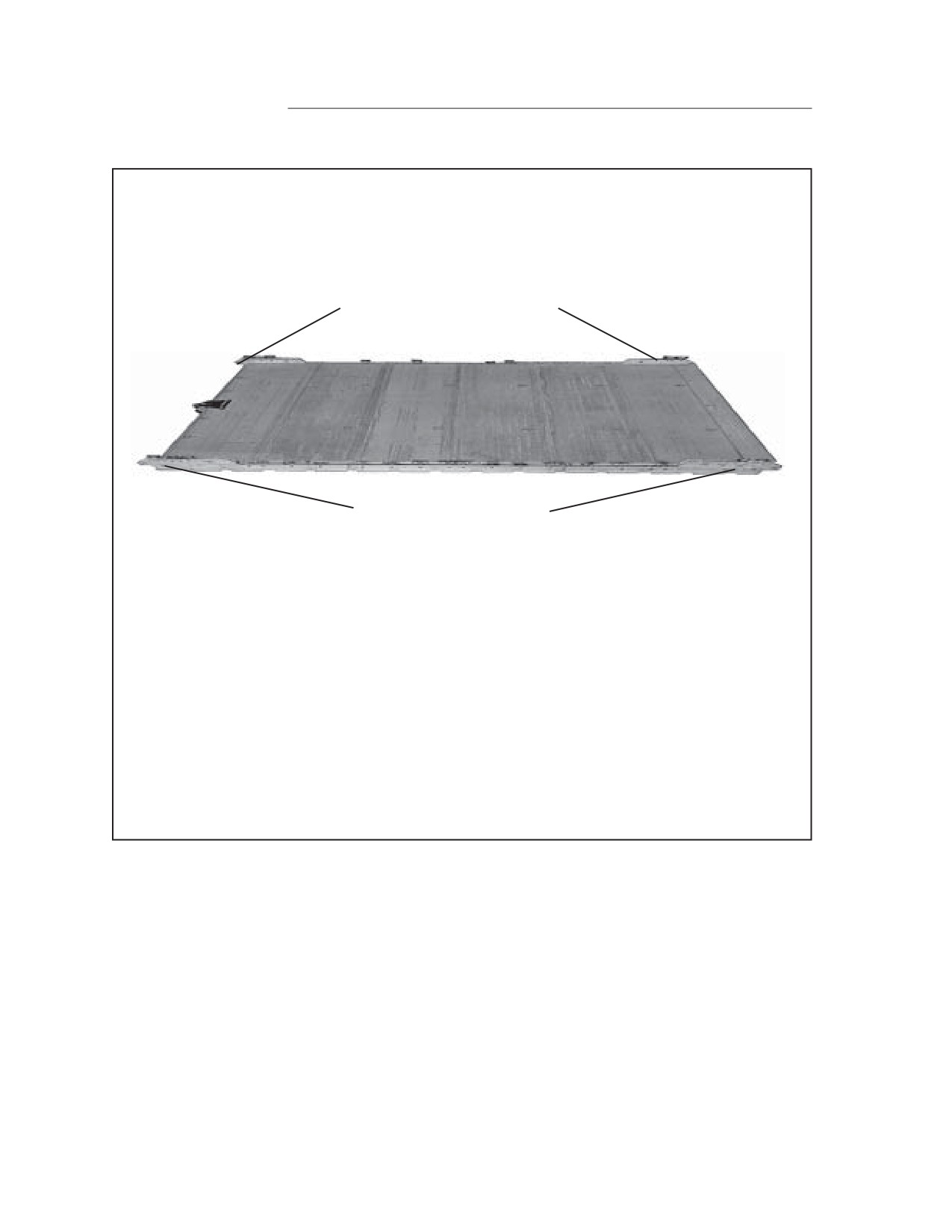
1-2. Prepare a 12-foot type V airdrop platform using four tandem links and 40 tie-
down clevises as shown in Figure 1-1.
Notes: 1. The nose bumper may or may not be installed.
2. Measurements given in this section are from the front edge of the
platform, NOT from the front edge of the nose bumper.
1-1
FM 4-20.137/TO 13C7-1-19
CLEVISES 20A THROUGH 1A
FRONT
REAR
CLEVISES 20 THROUGH 1
Steps:
1. Inspect, or assemble and inspect, the platform as outlined in TM 10-1670-268-
20&P/TO 13C7-52-22.
2. Install a tandem link on the front of each platform side rail using holes 1, 2, and
3.
3. Install a tandem link on the rear of each platform side rail using holes 22, 23,
and 24.
4. Install a tie-down clevis to bushings 1, 2, and 3 on each front tandem link.
5. Starting at the front of each platform side rail, install a tie-down clevis to the
bushings bolted to holes 5, 6, 7, 9, 10, 11, 14, 15, 16, 17, 18, 19, 20, and 21.
6. Install a tie-down clevis to bushings 2, 3, and 4 on each rear tandem link.
7. Starting at the front of the platform, number the clevises bolted to the right side
from 1 through 20 and those bolted to the left side from 1A through 20A.
Figure 1-1. Platform Prepared
1-2
FM 4-20.137/TO 13C7-1-19
PREPARING HONEYCOMB
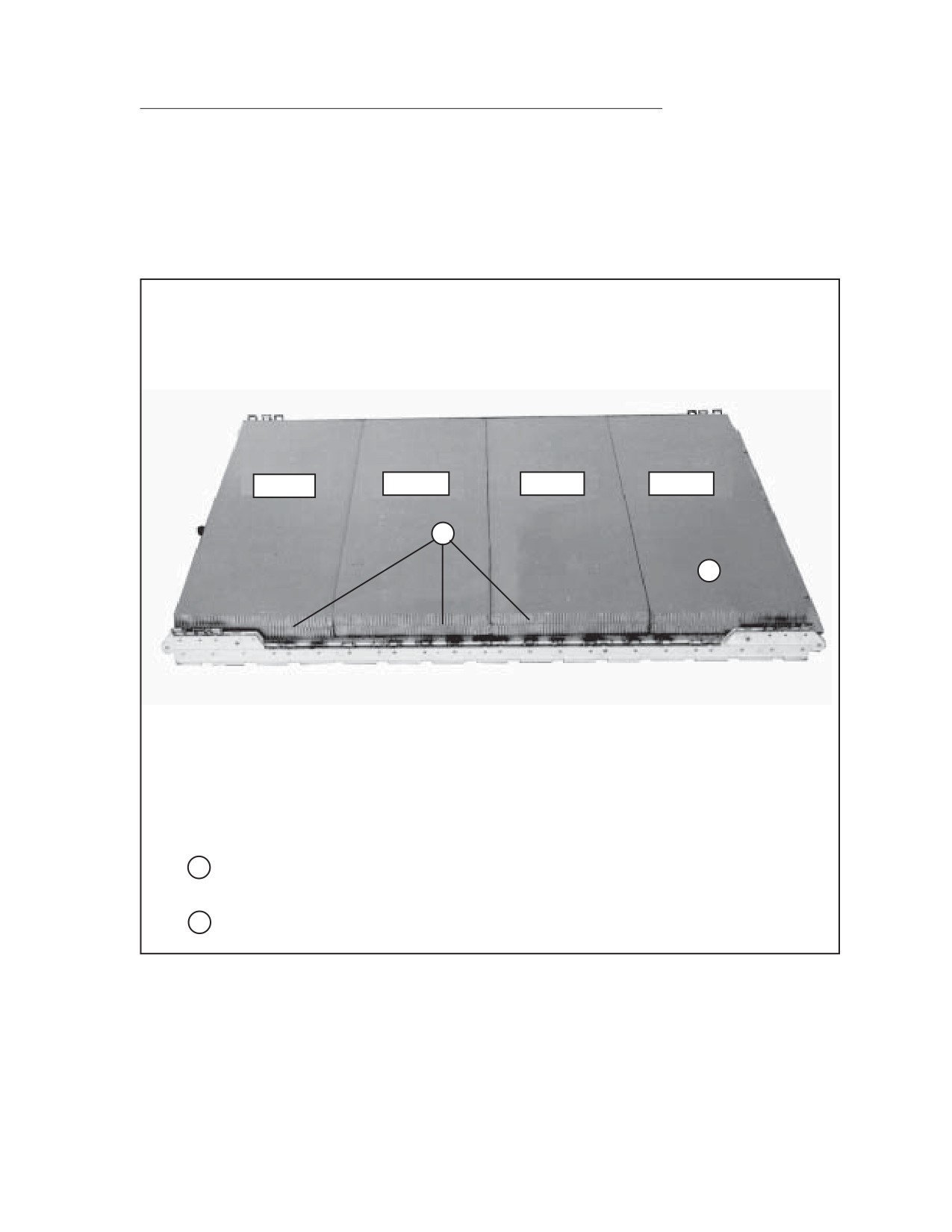
1-3. Place eight 96- by 36-inch pieces of honeycomb on the platform as shown in
Figure 1-2.
REAR
Stack 4
Stack
3
Stack 2
Stack 1
FRONT
2
1
1
Place two 96- by 36-inch pieces of honeycomb flush with the front edge of the
platform.
2
Place three more sets of 96- by 36-inch pieces of honeycomb against those placed
in step 1 above.
Figure 1-2. Honeycomb Placed on Platform
1-3
FM 4-20.137/TO 13C7-1-19
BUILDING CONTAINER FOR FARE
1-4. Build the container to stow the FARE as described below and as shown in
Figure 1-3.
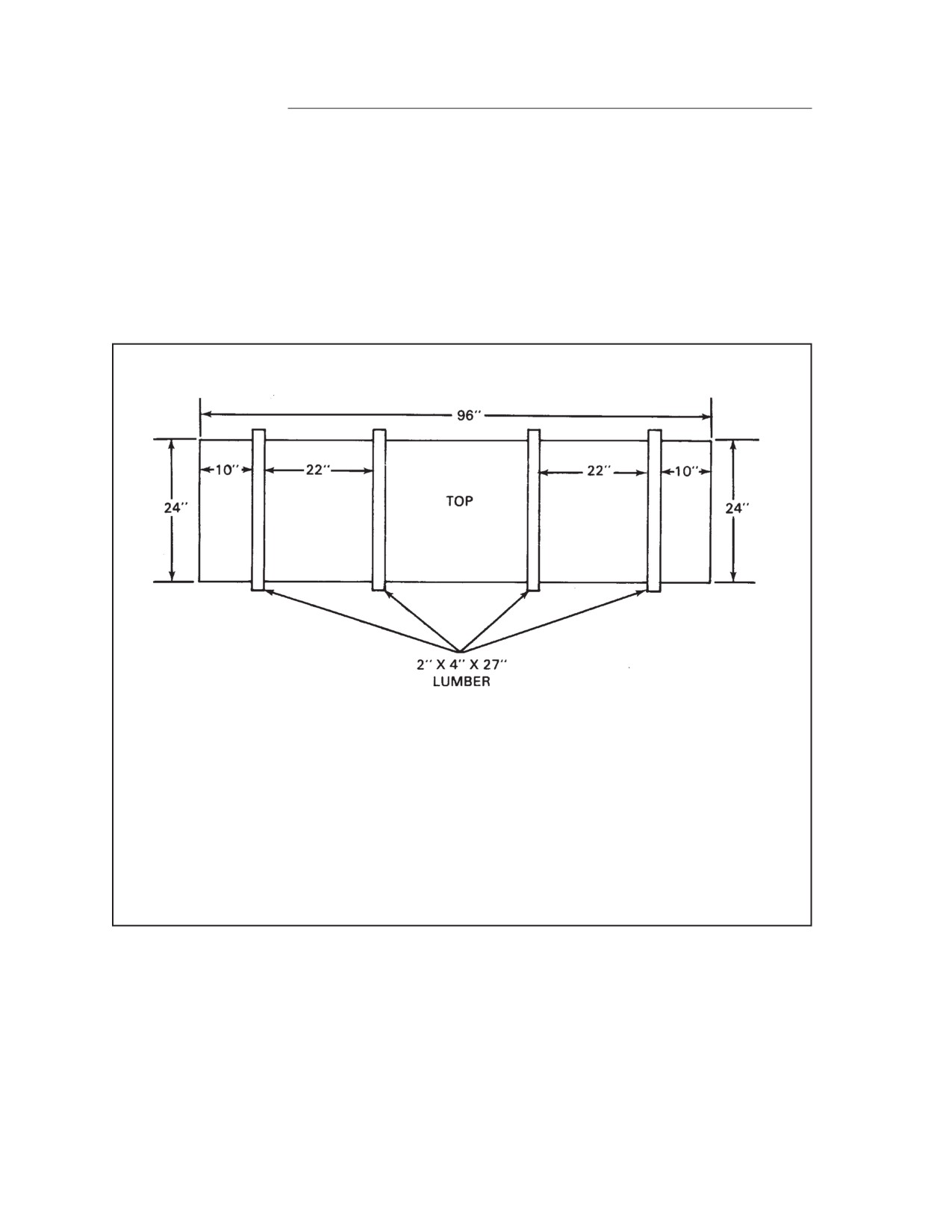
a. BUILDING TOP. Build the top for the container as shown in Figure 1-3.
Note: This drawing is not drawn to scale.
Steps:
1. Cut a 3/4- by 24- by 96-inch piece of plywood.
2. Cut four 2- by 4- by 27-inch pieces of lumber.
3. Place the 2- by 4-inch pieces of lumber so that they overhang on each side about
1 1/2 inches over the plywood.
4. Nail a 2- by 4-inch piece of lumber 10 inches from the 24-inch sides using eight-
penny nails.
5. Nail a 2- by 4-inch piece of lumber 22 inches from the lumber placed in step 4
above using eightpenny nails.
Figure 1-3. Top for FARE Container Built
1-4
FM 4-20.137/TO 13C7-1-19
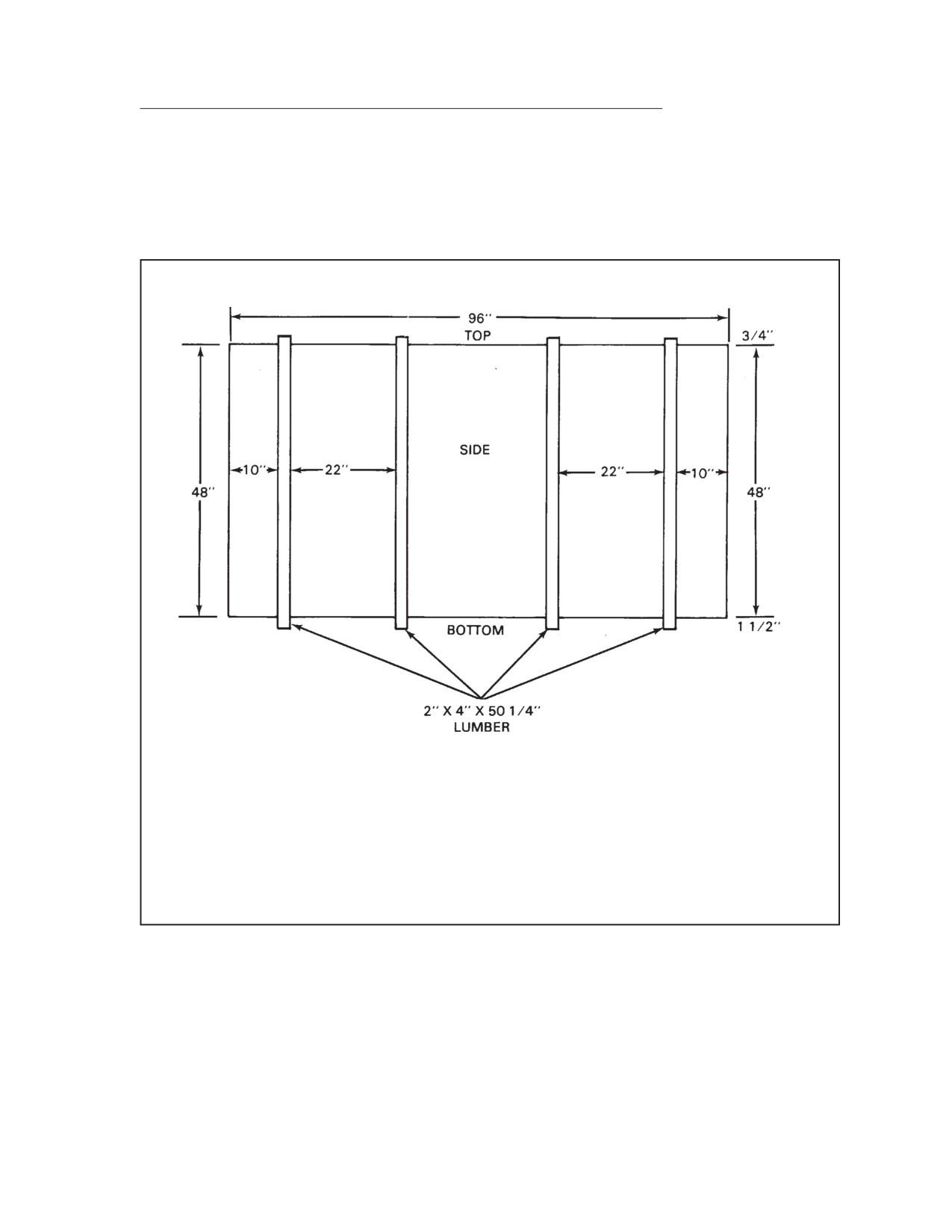
b. BUILDING SIDES. Build the sides for the container as shown in
Figure 1-4.
Note: This drawing is not drawn to scale.
Steps:
1. Use two 3/4- by 48- by 96-inch pieces of plywood.
2. Cut eight 2- by 4- by 50 1/4-inch pieces of lumber.
3. Place the 2- by 4-inch pieces of lumber so that the top overhangs 3/4 inch and
the bottom overhangs 1 1/2 inches over the plywood.
4. Nail a 2- by 4-inch piece of lumber 10 inches from the 48-inch sides using eight-
penny nails.
5. Nail a 2- by 4-inch piece of lumber 22 inches from the lumber placed in step 4
above using eightpenny nails.
Figure 1-4. Sides for FARE Container Built
1-5
FM 4-20.137/TO 13C7-1-19
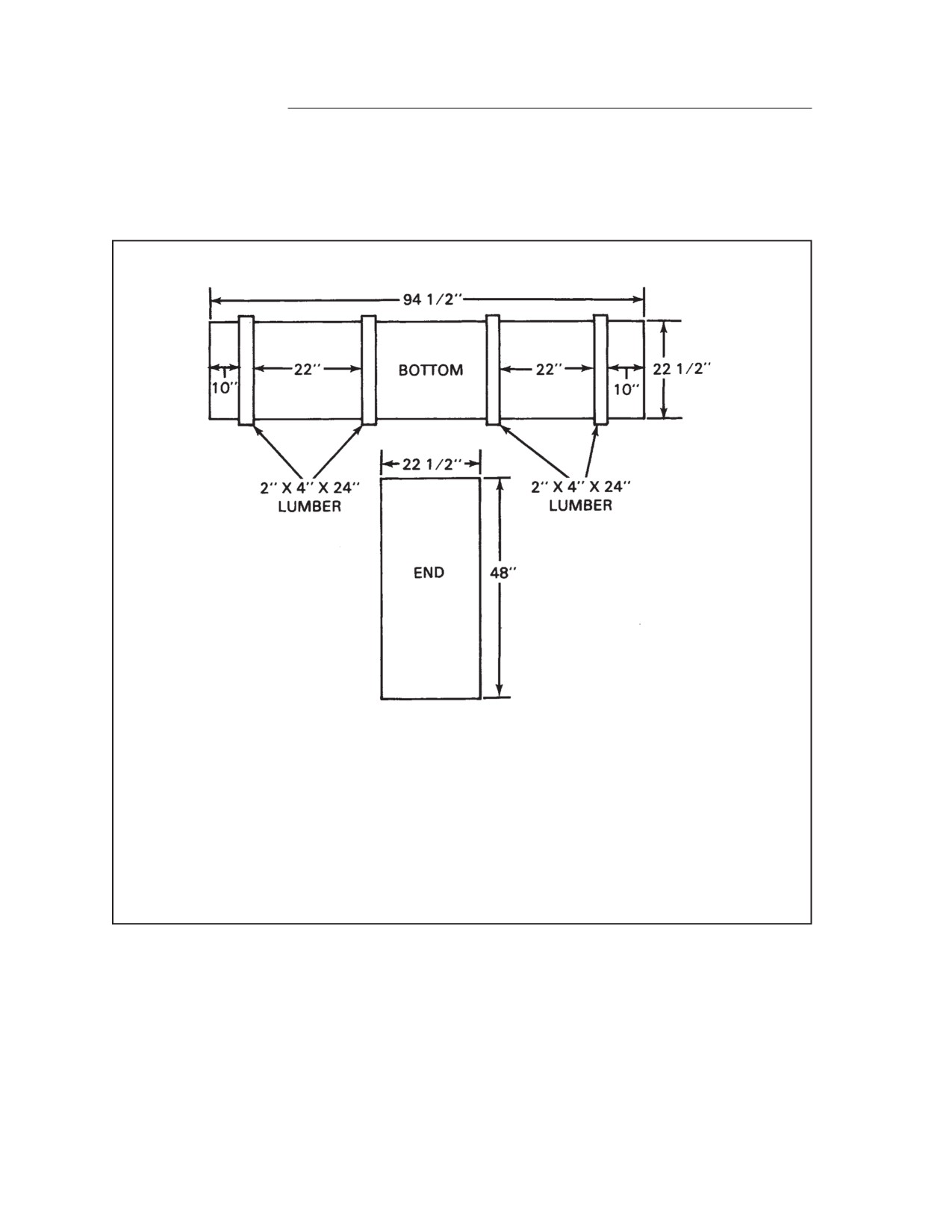
c. BUILDING BOTTOM AND ENDS. Build the bottom and ends for the
container as shown in Figure 1-5.
Note: This drawing is not drawn to scale.
Steps:
1. Cut a 3/4- by 22 1/2- by 94 1/2-inch piece of plywood.
2. Cut four 2- by 4- by 24-inch pieces of lumber.
3. Place the 2- by 4-inch pieces of lumber so that they overhang 3/4 inch over the
plywood.
4. Nail a 2- by 4-inch piece of lumber 10 inches from the 22 1/2-inch sides using
eightpenny nails.
5. Nail a 2- by 4-inch piece of lumber 22 inches from the lumber placed in step 4
above using eightpenny nails.
6. Cut two 3/4- by 22 1/2- by 48-inch pieces of plywood to be used as end pieces.
Figure 1-5. Bottom and Ends for FARE Container Built
1-6
FM 4-20.137/TO 13C7-1-19
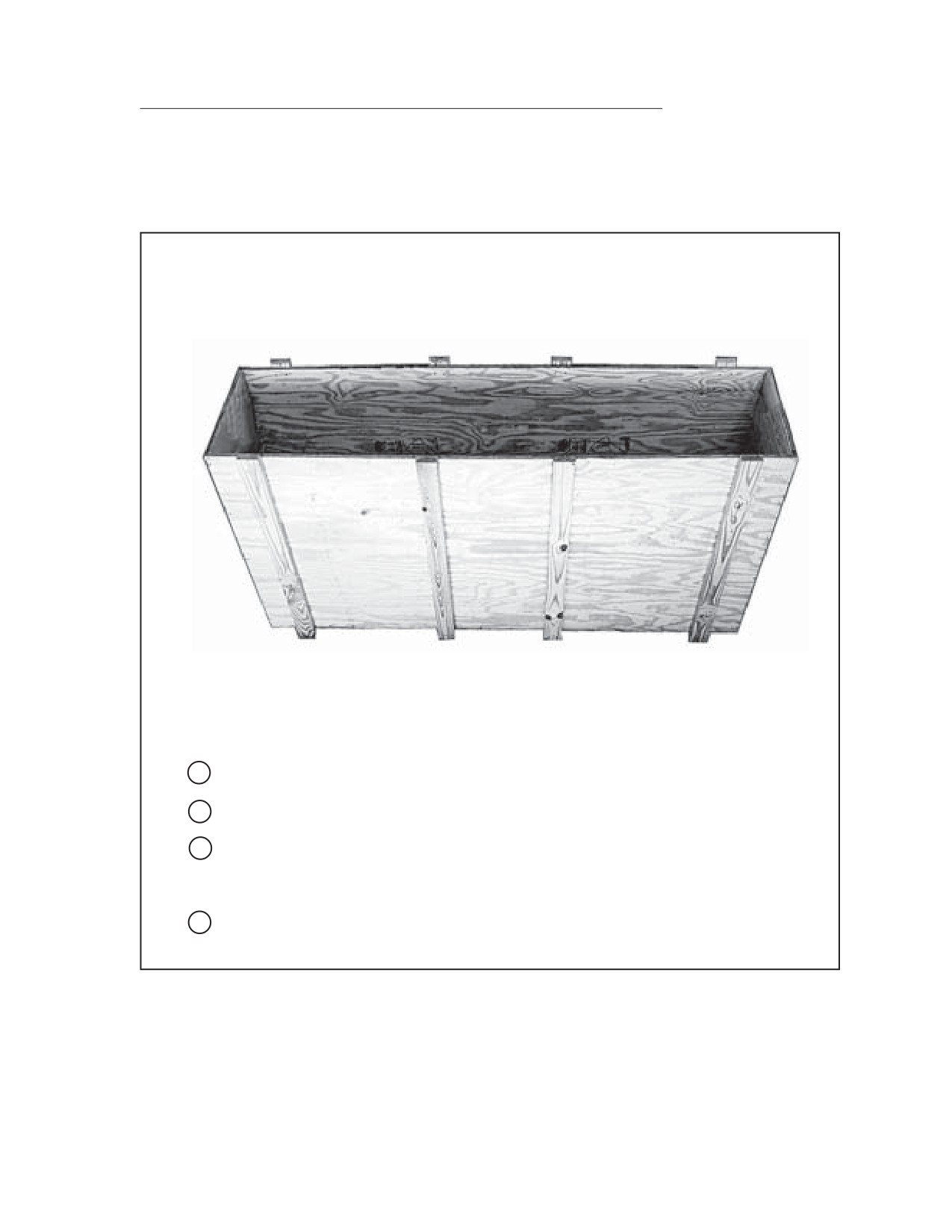
d. ASSEMBLING CONTAINER. Assemble the container for FARE as
shown in Figure 1-6.
REAR
RIGHT
LEFT
FRONT
1
Place the bottom piece (not shown) on the floor.
2
Nail the end pieces to the bottom piece.
3
Nail the side pieces so that the end pieces are inside the sides.
Note: Matching of the lumber is critical to ensure sturdiness.
4
Nail the pieces of lumber on the side pieces to the pieces of lumber on the bottom
piece (not shown).
Figure 1-6. Container Assembled
1-7
FM 4-20.137/TO 13C7-1-19
PREPARING AND STOWING FARE IN CONTAINER
1-5. Prepare the components of the FARE and stow them in the container as
described below.
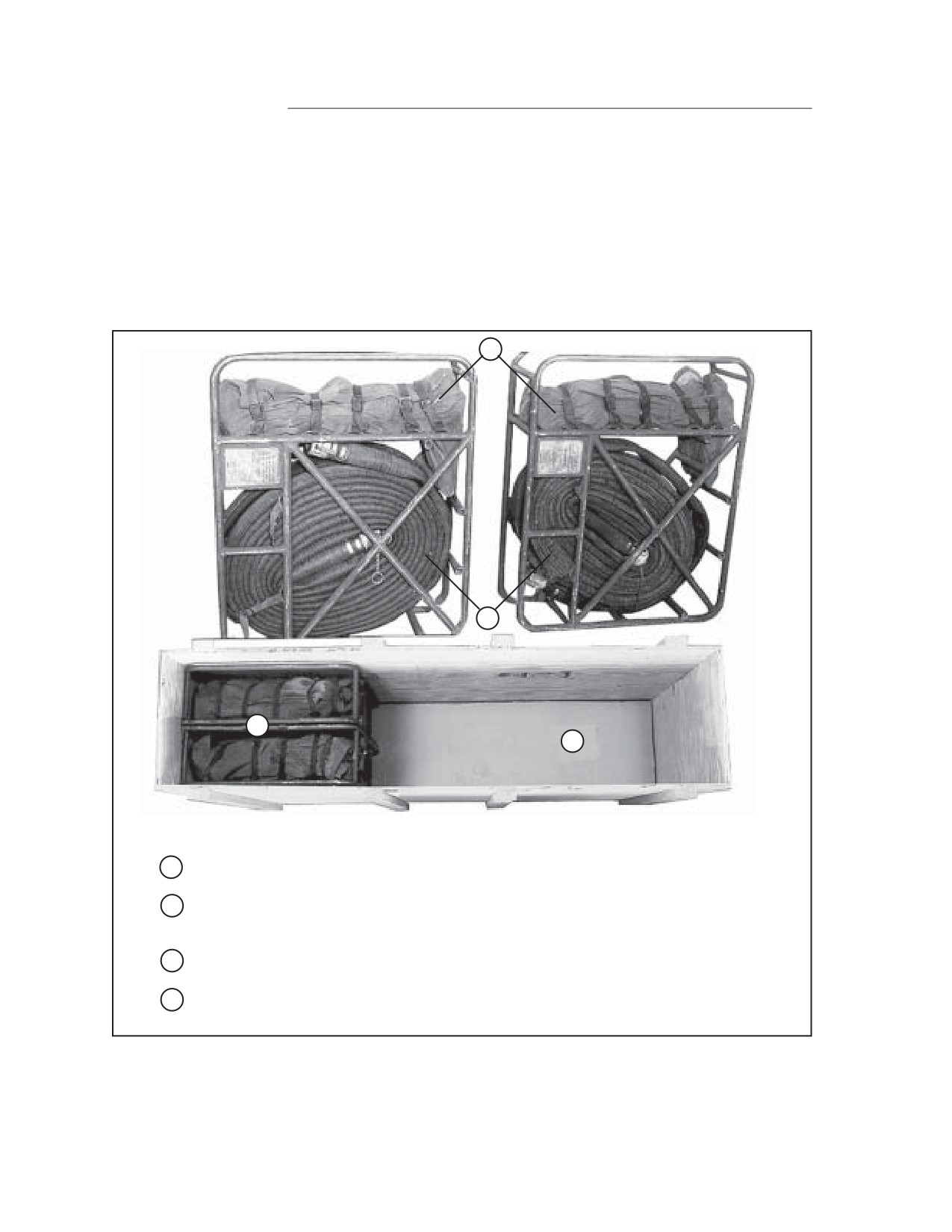
a. PREPARING DISCHARGE HOSE FRAME ASSEMBLY. Prepare
the discharge hose frame assemblies, and stow them in the container as
shown in Figure 1-7.
2
1
REAR
RIGHT
LEFT
4
3
FRONT
1
Roll the discharge hoses and place them in the discharge hose frame assemblies.
2
Place the discharge hose accessory fittings into the accessory fittings storage
compartment.
3
Place a 22- by 94-inch piece of honeycomb in the bottom of the container.
4
Place the two discharge hose frame assemblies in the right side of the container.
Figure 1-7. Discharge Hose Frame Assemblies Prepared and Stowed
1-8
FM 4-20.137/TO 13C7-1-19
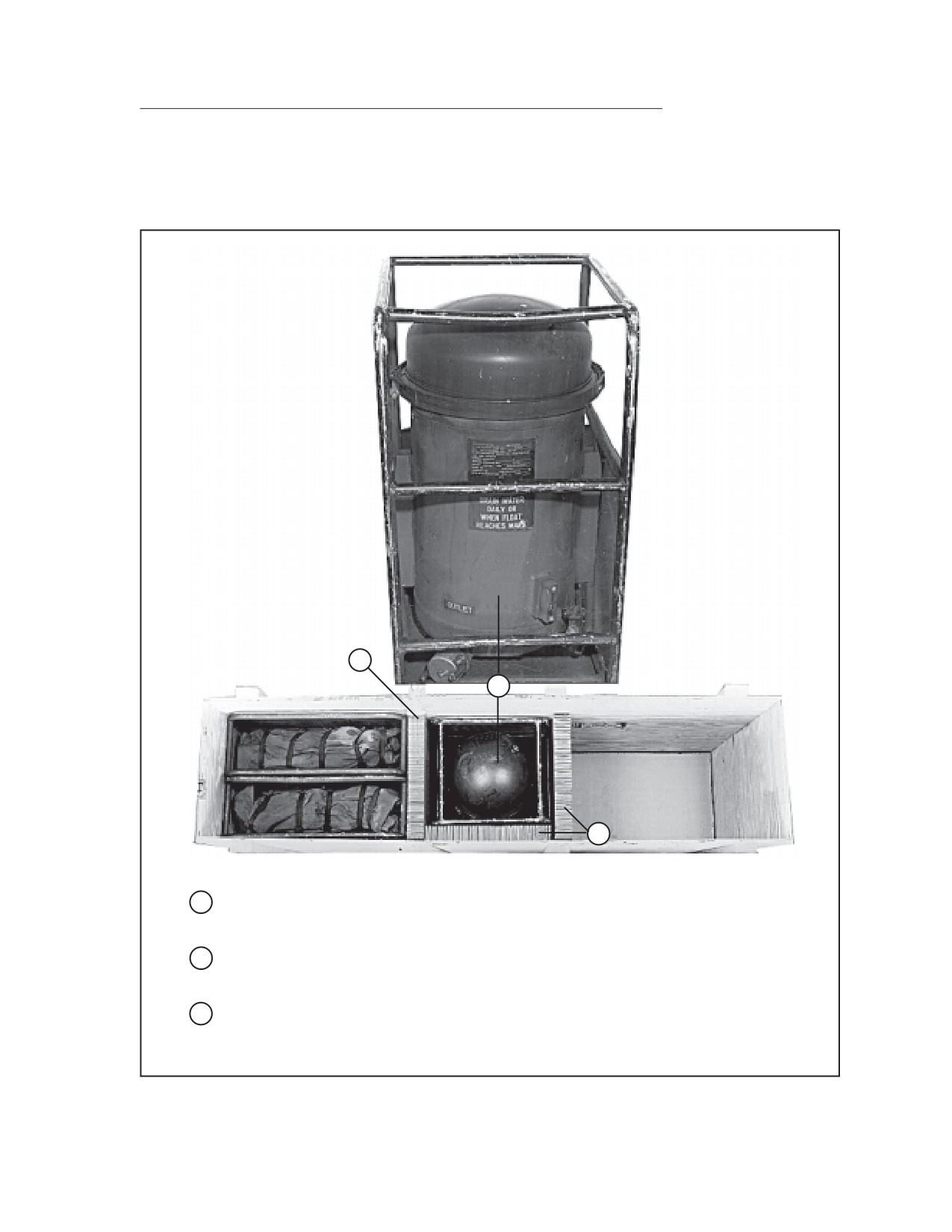
b. PREPARING FILTER/SEPARATOR ASSEMBLY. Prepare the fil-
ter/ separator assembly and stow it in the container as shown in Figure 1-8.
1
2
REAR
LEFT
RIGHT
3
FRONT
1
Place a 22- by 36-inch piece of honeycomb against the discharge hose frame
assemblies.
2
Place the filter/separator assembly in the frame against the rear of the con-
tainer and flush against the honeycomb placed in step 1 above.
3
Use two 22- by 36-inch pieces of honeycomb. Place one piece in front of the
filter/separator assembly frame and another against the left side of the filter/
separator assembly frame.
Figure 1-8. Filter/Separator Assembly Prepared and Stowed
1-9
FM 4-20.137/TO 13C7-1-19
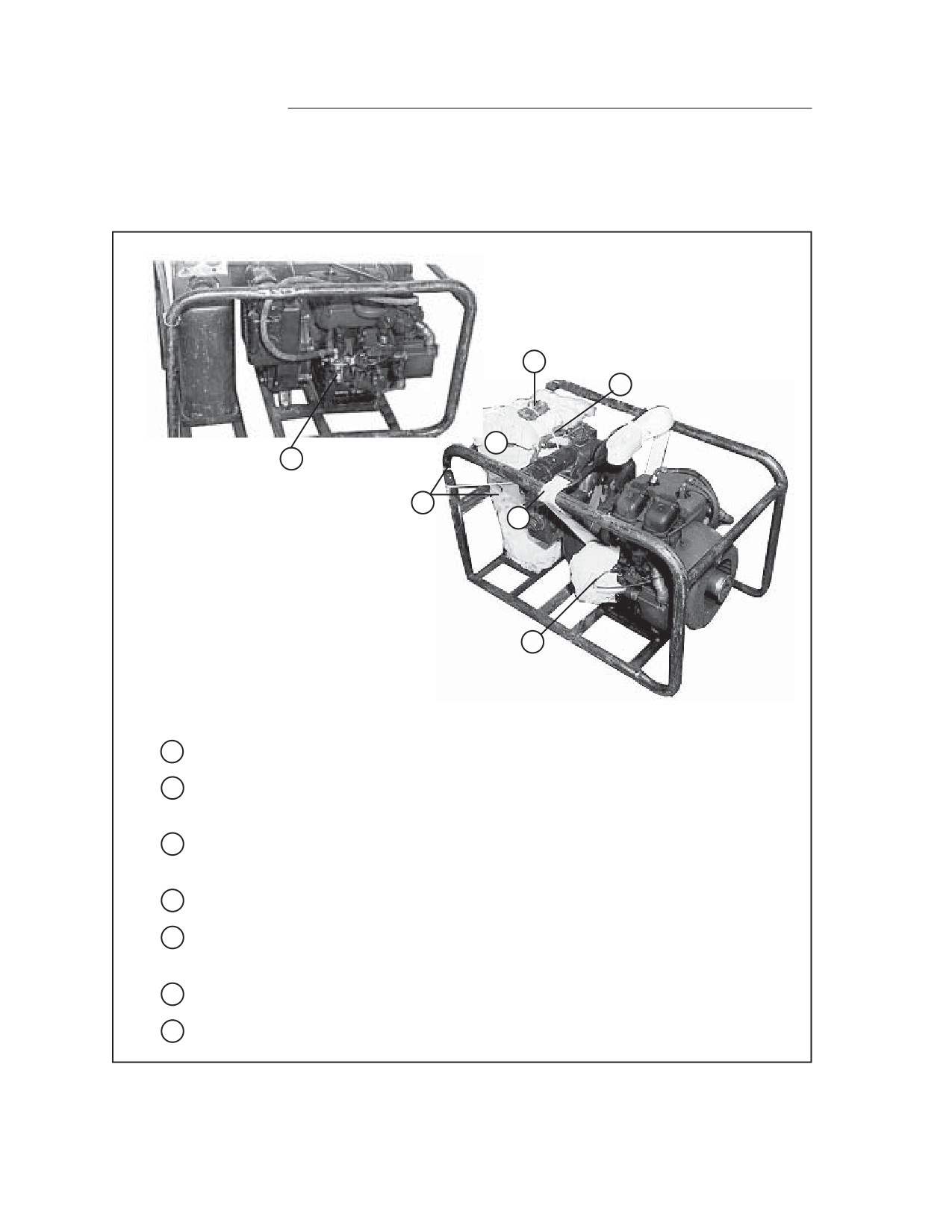
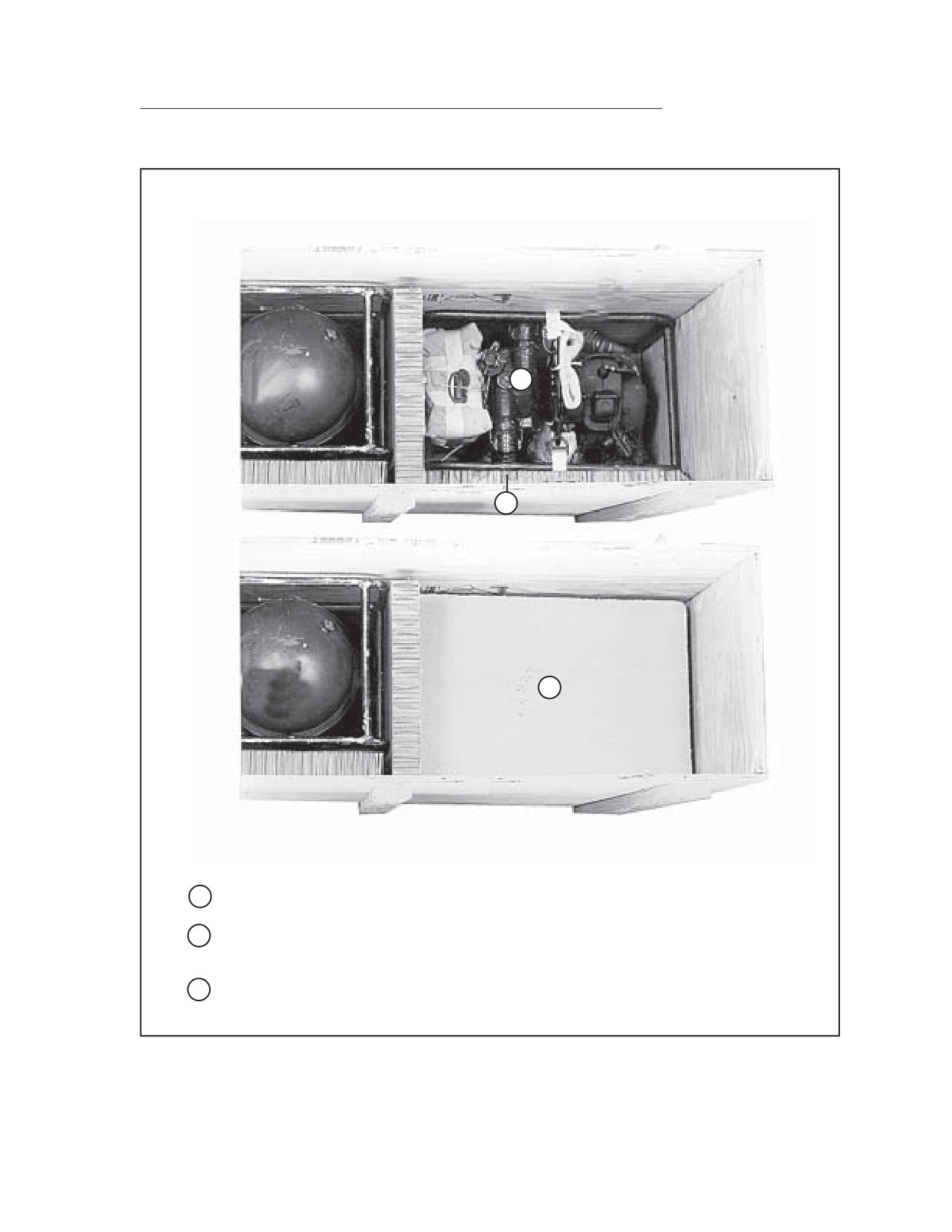
c. PREPARING PUMP/ENGINE ASSEMBLY. Prepare the pump/
engine assembly for stowing as shown in Figure 1-9 and stow it in the
container as shown in Figure 1-10.
7
6
4
1
5
3
2
1
Remove and drain the liquid from the fuel filter.
2
Replace the filter and wrap it with cellulose wadding. Tape the wadding in
place.
3
Pass a 15-foot lashing between the pump and engine. Secure the ends with a D-
ring and a load binder on top of the engine assembly frame.
4
Wrap a 5-gallon fuel can with cellulose wadding. Tape the wadding in place.
5
Set the can inside the engine assembly frame. Secure it in place with the
retainer lashings or a length of type III nylon cord.
6
Secure the fuel line to the fuel can using a length of type III nylon cord.
7
Secure the starting rope to the top of the fuel can with a length of type III nylon
cord.
Figure 1-9. Pump/Engine Assembly Prepared
1-10
FM 4-20.137/TO 13C7-1-19
REAR
LEFT
RIGHT
1
FRONT
2
REAR
RIGHT
LEFT
3
FRONT
1
Place the pump/engine assembly into the left side of the container.
2
Place a 22- by 32-inch piece of honeycomb between the pump/engine assembly
and the front of the container.
3
Place another 22- by 32-inch piece of honeycomb over the pump/engine assem-
bly.
Figure 1-10. Pump/Engine Assembly Stowed
1-11
FM 4-20.137/TO 13C7-1-19
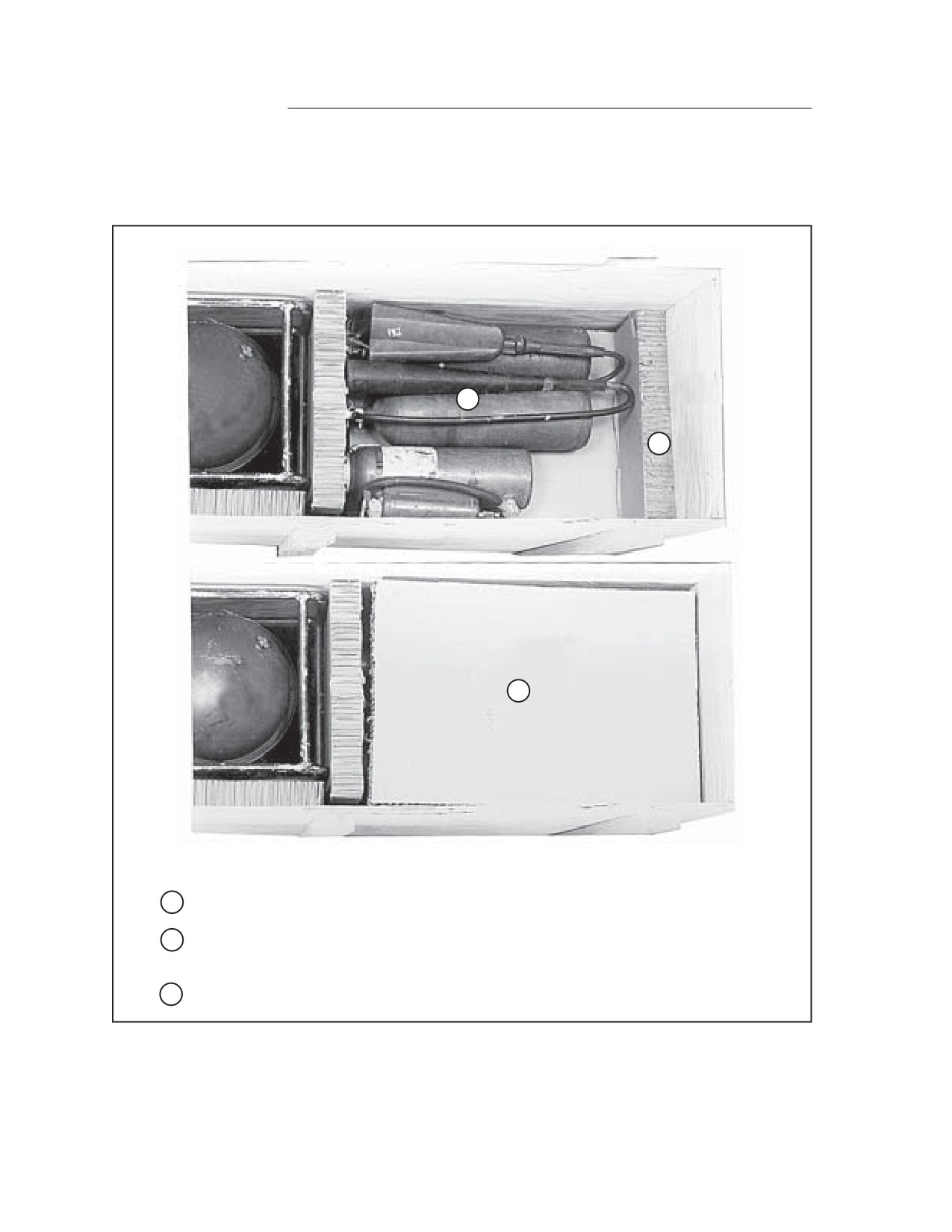
d. STOWING FIRE EXTINGUISHERS. Stow the fire extinguishers in
the container as shown in Figure 1-11.
REAR
RIGHT
1
LEFT
2
FRONT
REAR
LEFT
RIGHT
3
FRONT
1
Place three fire extinguishers on the 22- by 32-inch piece of honeycomb.
2
Place an 8- by 22-inch piece of honeycomb between the fire extinguishers and
the left side of the container.
3
Cover the fire extinguishers with a 22- by 32-inch piece of honeycomb.
Figure 1-11. Fire Extinguishers Stowed
1-12
FM 4-20.137/TO 13C7-1-19
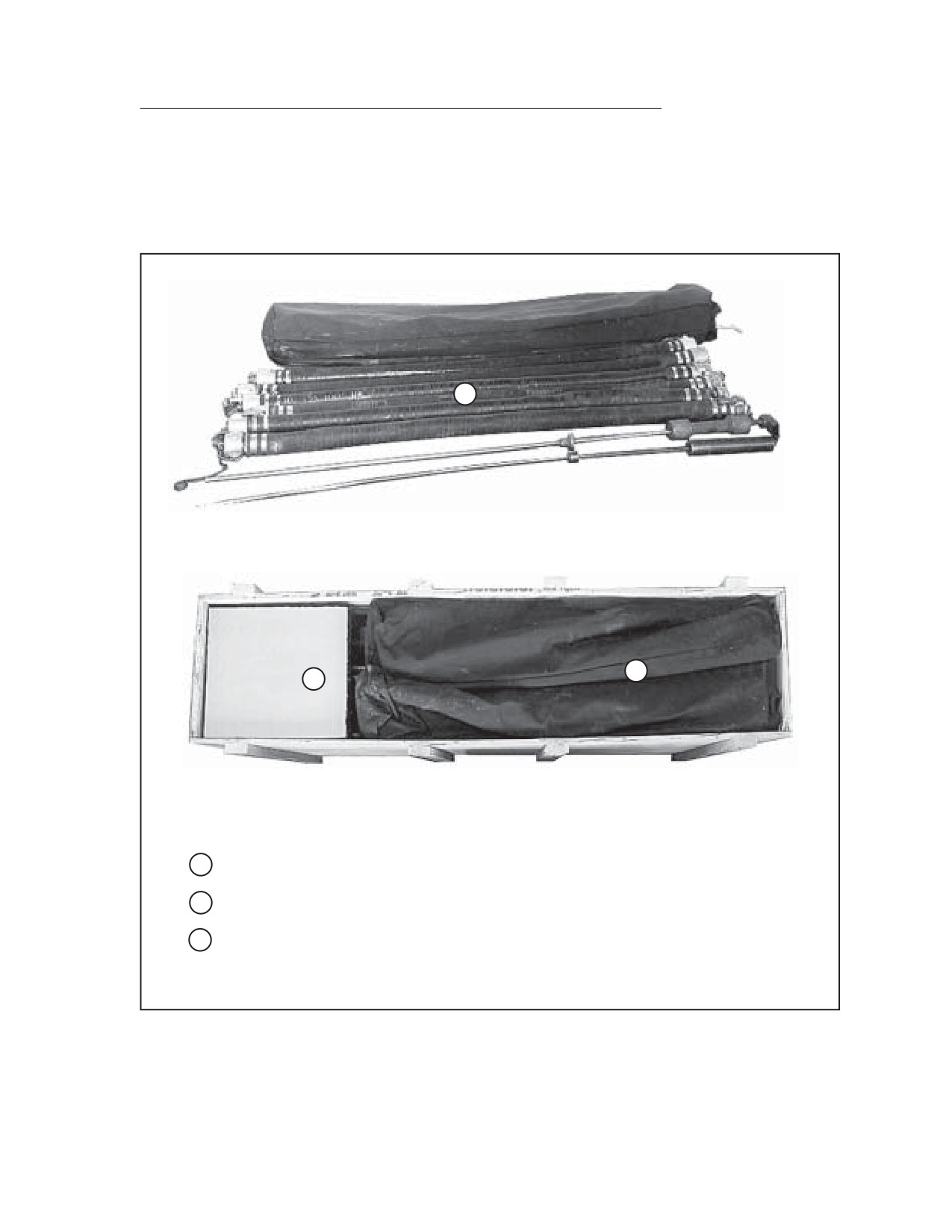
e. PREPARING AND STOWING GROUND RODS, SUCTION HOSES,
AND SUCTION HOSE BAGS. Prepare the ground rods, suction
hoses,and suction hose bags for stowing. Stow the suction hose bags in the
container as shown in Figure 1-12.
1
REAR
LEFT
RIGHT
2
3
FRONT
1
Place two ground rods and six suction hoses into each suction hose bag.
2
Place the two suction hose bags into the left side of the container.
3
Place a 22- by 23-inch piece of honeycomb between the suction hose bags and the
right side of the container.
Figure 1-12. Ground Rods, Suction Hoses, and Bags Prepared and Stowed
1-13
FM 4-20.137/TO 13C7-1-19
SECURING CONTAINER
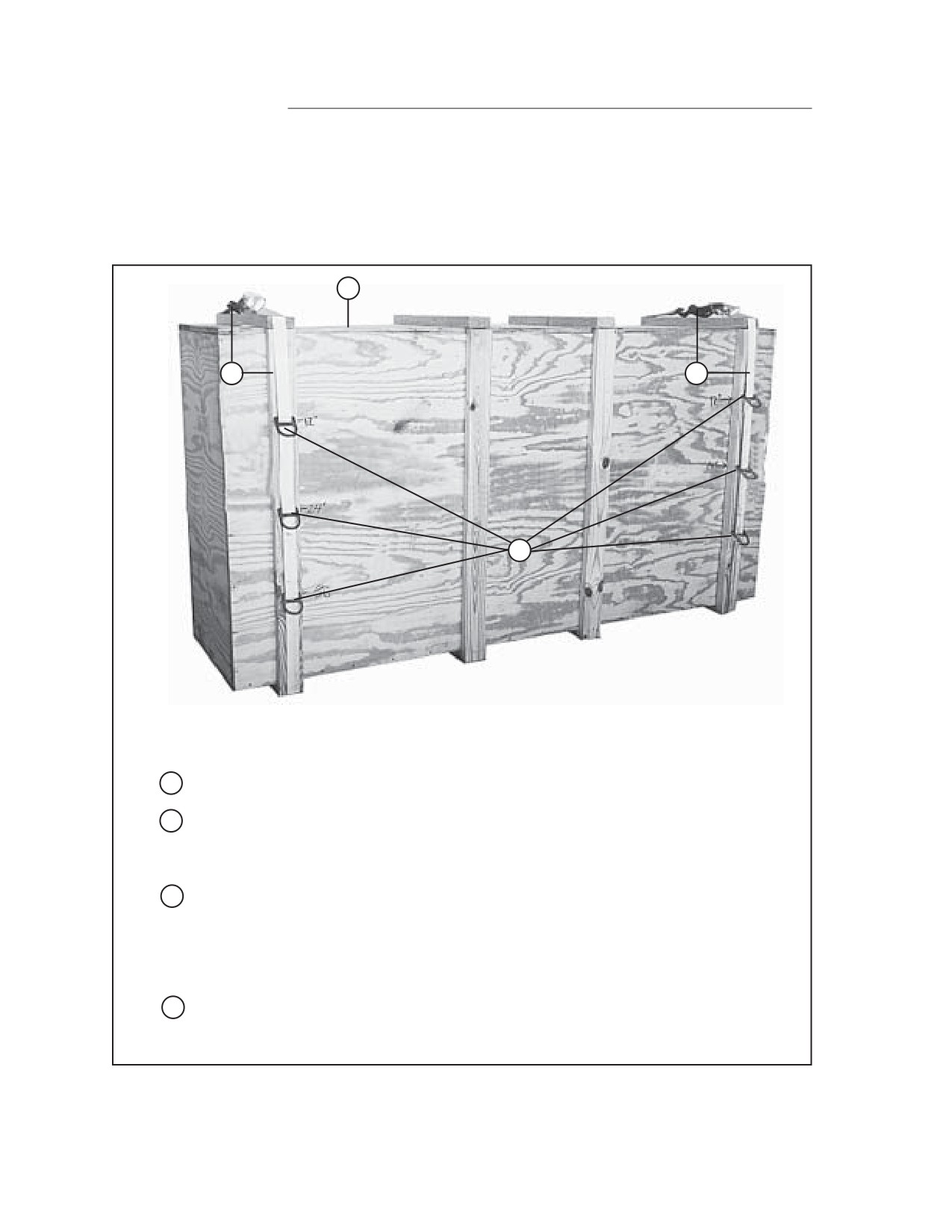
1-6. Use ten 15-foot tie-down assemblies to secure the container as shown in
Figure 1-13.
1
4
3
RIGHT
LEFT
2
FRONT
1
Set the top (built in Figure 1-3) on the container.
2
Starting at the top of the container, mark 12 inches, 24 inches, and 36 inches
along the 2- by 4-inch pieces of lumber on each end of the container. Repeat for the
rear of the container.
3
Slide six D-rings on a 30-foot lashing. Run the lashing around the 2- by 4-inch
pieces of lumber on the left side of the container. Position a pre-positioned D-ring
at the 12-inch, 24-inch, and 36-inch marks on the front and rear of the container.
Secure the lashing according to FM 4-20.102/NAVSEA SS400-AB-MMO-010/TO
13C7-1-5 on top of the container.
4
Repeat step 3 above on the right side of the container. Secure the lashing accord-
ing to FM 4-20.102/NAVSEA SS400-AB-MMO-010/TO 13C7-1-5 on top of the con-
tainer.
Figure 1-13. Container Secured
1-14
FM 4-20.137/TO 13C7-1-19
7
RIGHT
LEFT
6
5
FRONT
5
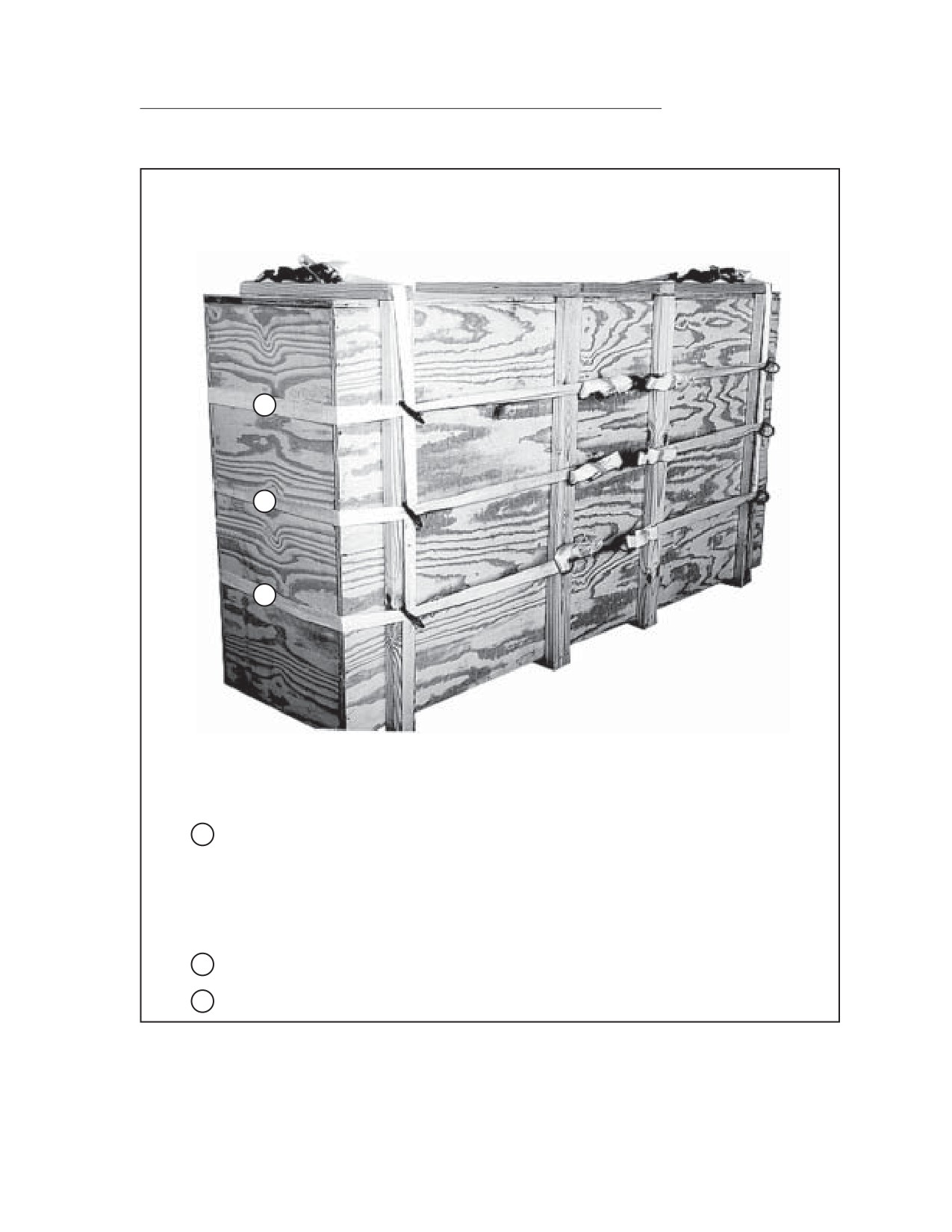
Form one 30-foot lashing according to FM 4-20.102/NAVSEA SS400-AB-MMO-
010/TO 13C7-1-5. At the 36-inch mark, pass one end of the lashing around the left
side of the container through the small opening of the D-ring. Repeat this proce-
dure for the right side of the container. Secure the lashing with a D-ring and a
load binder according to FM 4-20.102/NAVSEA SS400-AB-MMO-010/TO 13C7-1-5
to the front of the container.
6
Repeat step 5 above at the 24-inch mark.
7
Repeat step 5 above at the 12-inch mark.
Figure 1-13. Container Secured (continued)
1-15
FM 4-20.137/TO 13C7-1-19
POSITIONING AND LASHING CONTAINER
1-7. Position the container and lash it to the platform as described below.
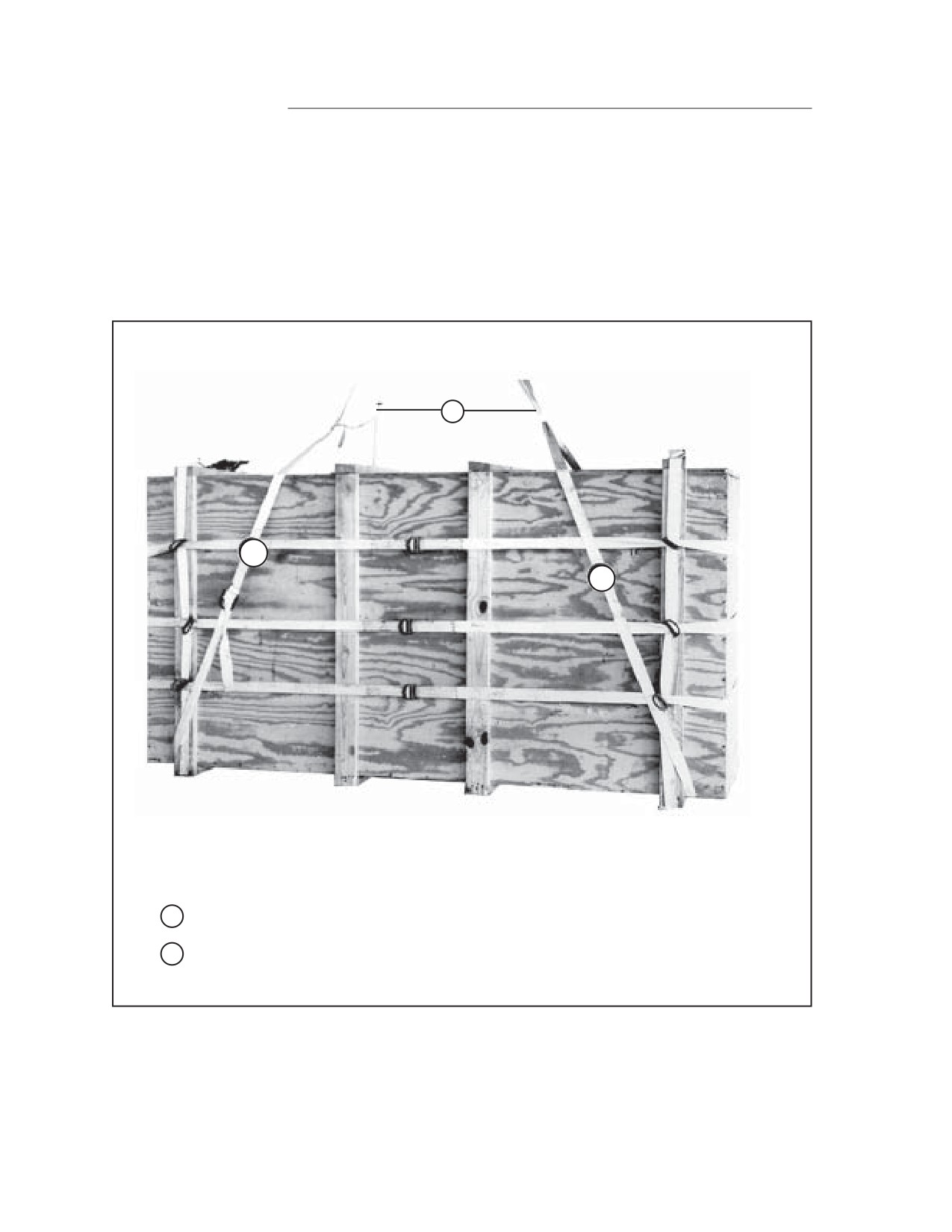
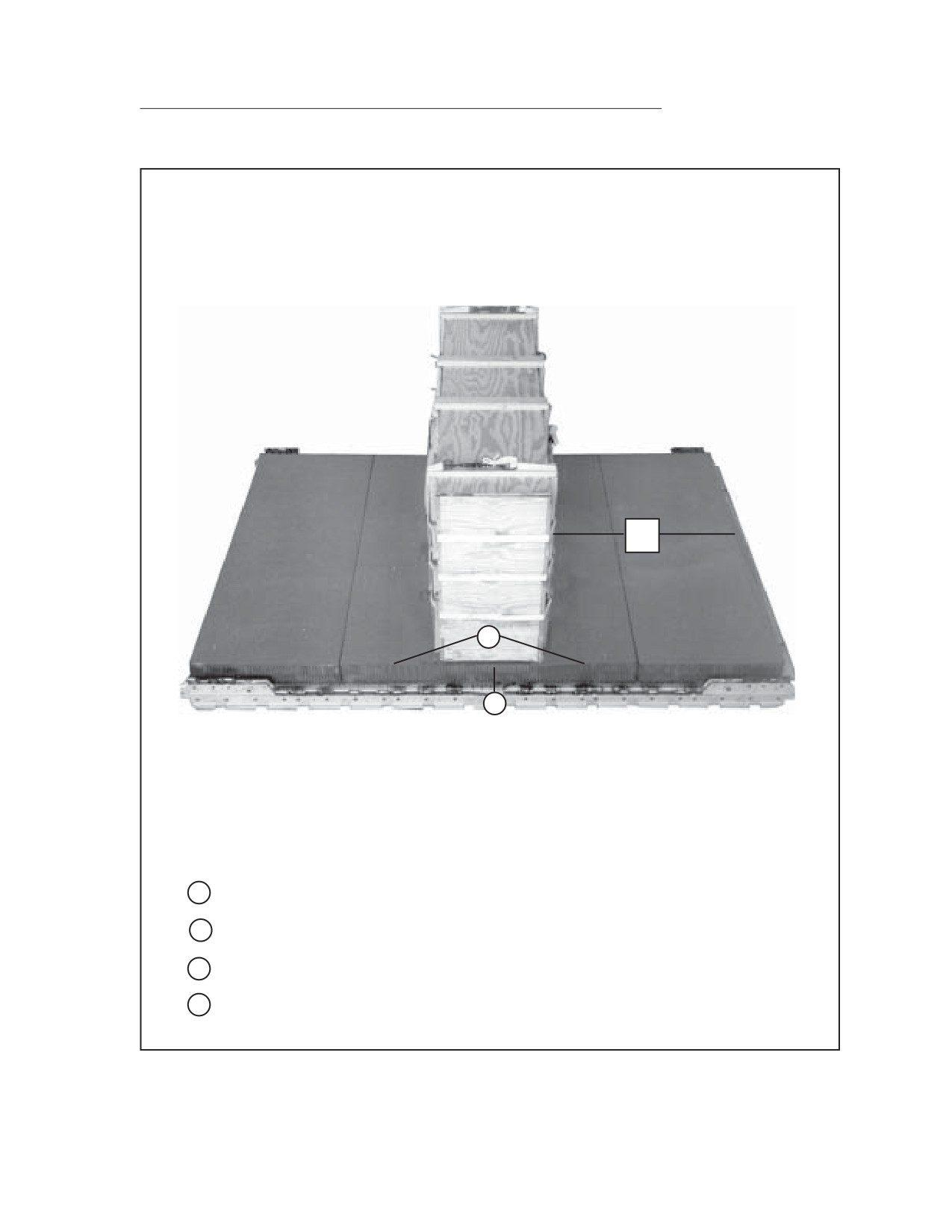
a. POSITIONING CONTAINER. Position the container on the platform
as shown in Figure 1-14.
2
1
1
1
Pass one 15-foot lashing around each end of the container.
2
Pass the running end through it’s own D-ring and secure with two half hitches
forming an apex.
Figure 1-14. Container Positioned
1-16
FM 4-20.137/TO 13C7-1-19
60”
4
3
3
Place an 11 1/4-inch mark on both sides on the bottom of the container.
4
Center the centering marks between honeycomb stacks 2 and 3.
5
Lift and center the container between honeycomb stacks 2 and 3 (not shown).
6
Make sure the front of the container is 60 inches from the front edge of honeycomb
stack 1.
Figure 1-14. Container Positioned (continued)
1-17
FM 4-20.137/TO 13C7-1-19
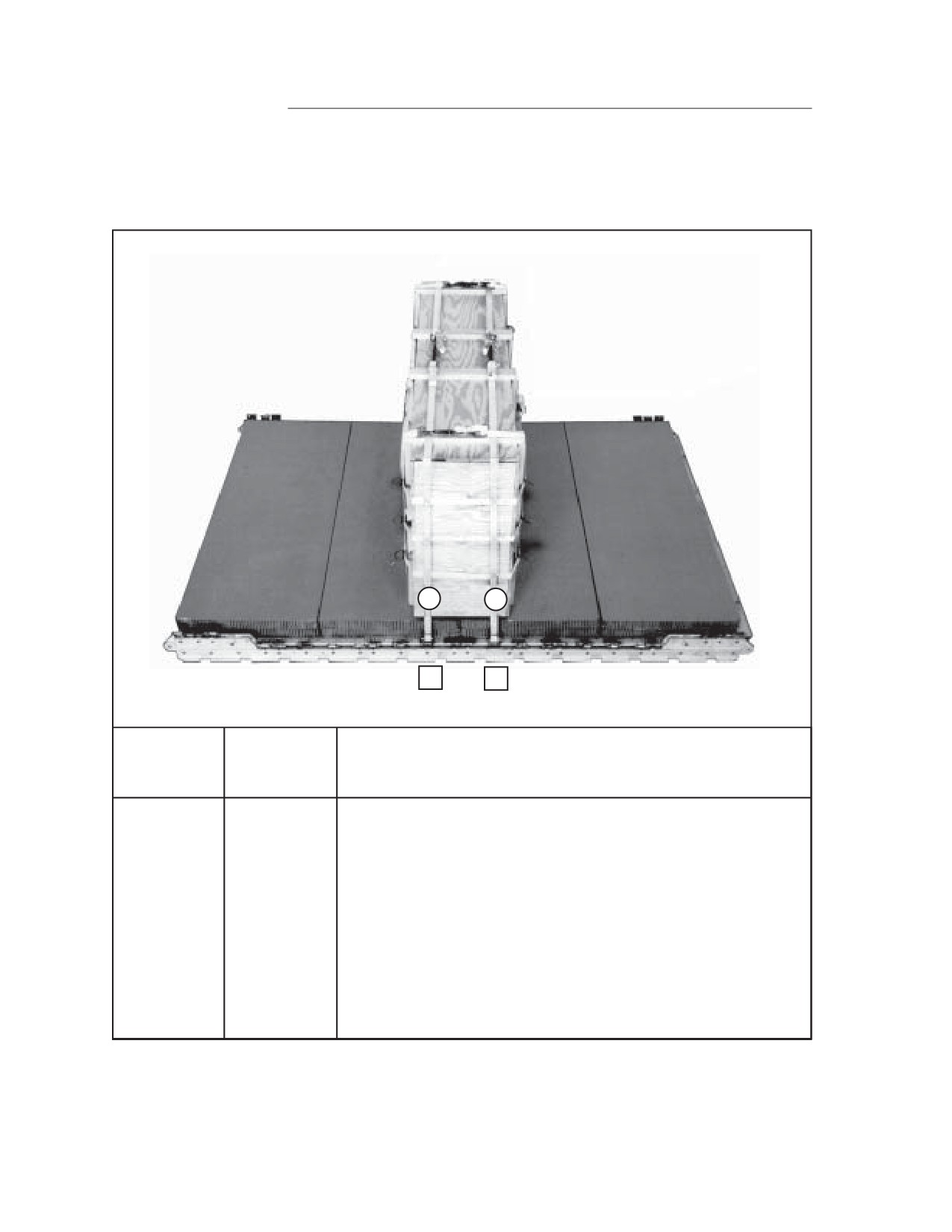
b. LASHING CONTAINER. Use sixteen 15-foot tie-down assemblies to
lash the container to the platform as outlined in FM 4-20.102/NAVSEA
SS400-AB-MMO-010/TO 13C7-1-5 and as shown in Figure 1-15.
2
1
10
9
Tie-dow n
Lashing
Clevis
Number
Number
Instructions
Pass lashing:
1
9
Through clevis and back through its ow n D-ring.
9A
Through clevis and back through its ow n D-ring. Fasten
lashing on top of the container with tw o D-rings and a loa d
binder.
2
10
Through clevis and back through its ow n D-ring.
10A
Through clevis and back through its ow n D-ring. Fasten
lashing on top of the container with tw o D-rings and a loa d
binder.
Figure 1-15. Container Lashed to Platform
1-18
FM 4-20.137/TO 13C7-1-19
3
4
5
6
5
7
4
8
3
16
15
14
6
5
4
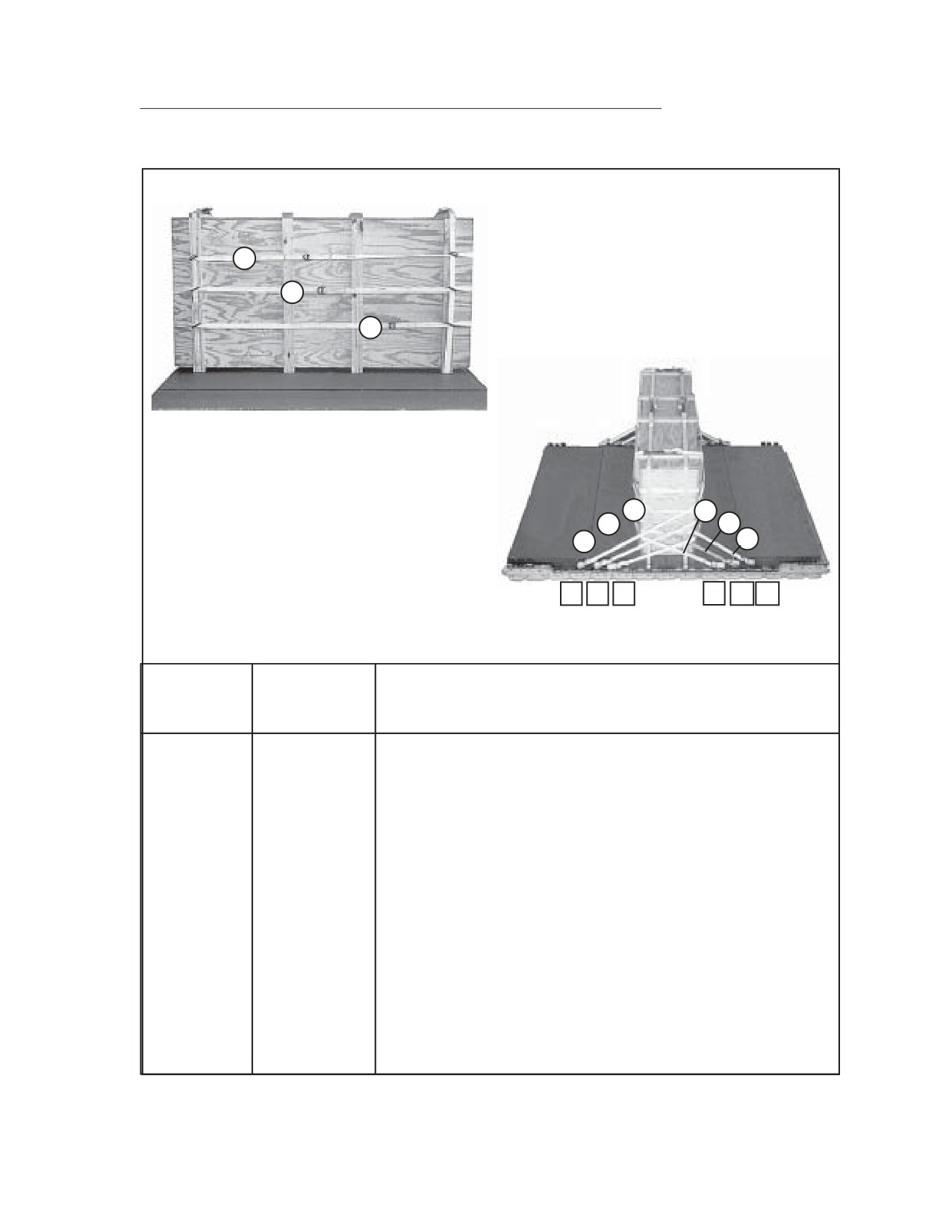
Tie-dow n
Lashing
Clevis
Number
Number
Instructions
Pass lashing:
3
4 and 4A
Around the rear of the container using the top row of D-
rings.
4
5 and 5A
Around the rear of the container using the middle row of D-
rings.
5
6 and 6A
Around the rear of the container using the bottom row of
D-rings.
6
14 and 14A
Around the front of the container using the bottom row of
D-rings.
7
15 and 15A
Around the front of the container using the middle row of
D-rings.
8
16 and 16A
Around the front of the container using the top row of D-
rings.
Figure 1-15. Container Lashed to Platform (continued)
1-19
FM 4-20.137/TO 13C7-1-19
ATTACHING LIFTING SLINGS
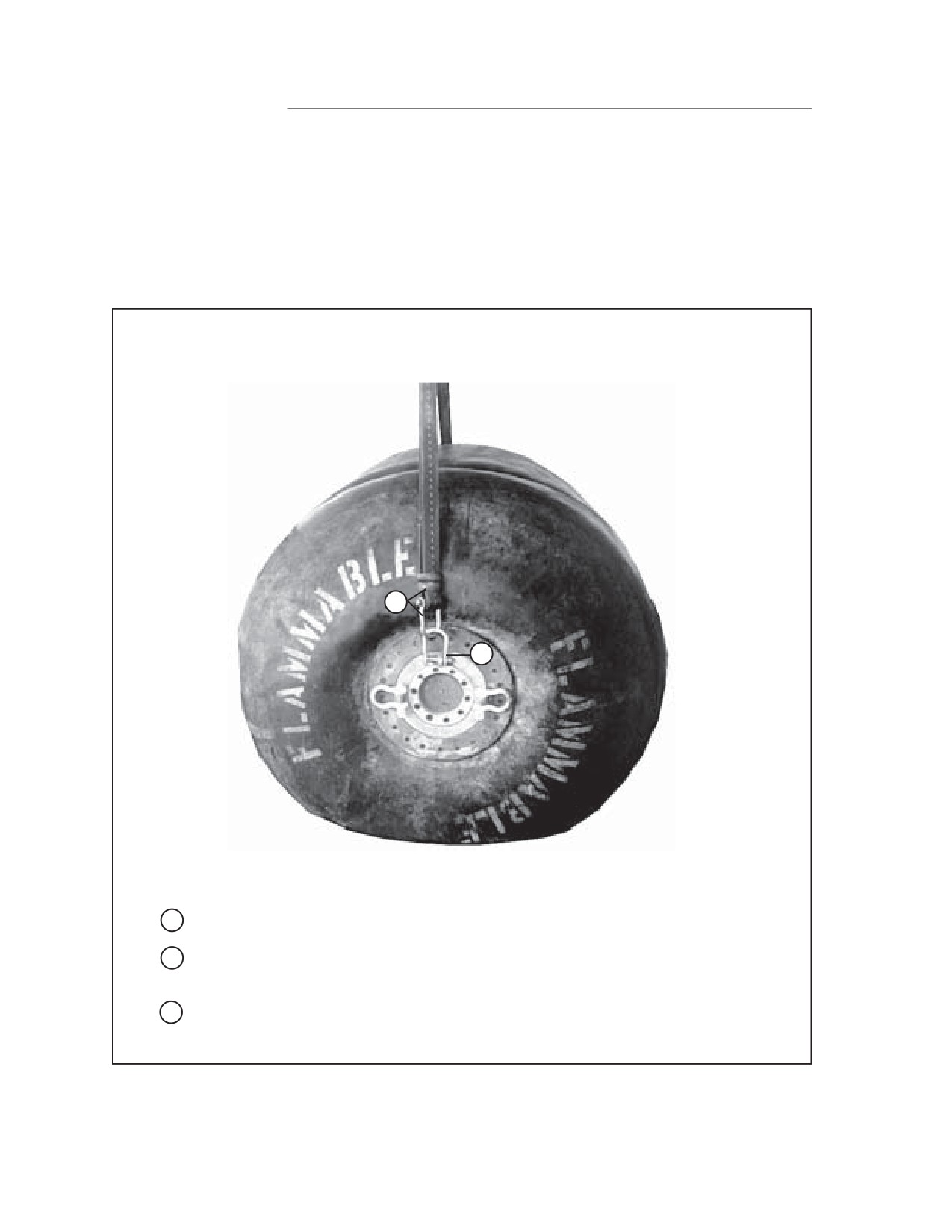
1-8. Attach the lifting slings to each fuel drum using four clevises and two 9-foot
(2-loop), type XXVI nylon webbing slings as shown in Figure 1-16.
2
1
1
Bolt a clevis to the center shackle of the swivel plate.
2
Route a clevis through the center clevis bolted to the shackle. Bolt the clevis to
a 9-foot sling.
3
Repeat steps 1 and 2 on the opposite side of the fuel drum and for the remaining
fuel drum (not shown).
Figure 1-16. Lifting Slings Installed
1-20
FM 4-20.137/TO 13C7-1-19
PLACING AND LASHING FUEL DRUMS
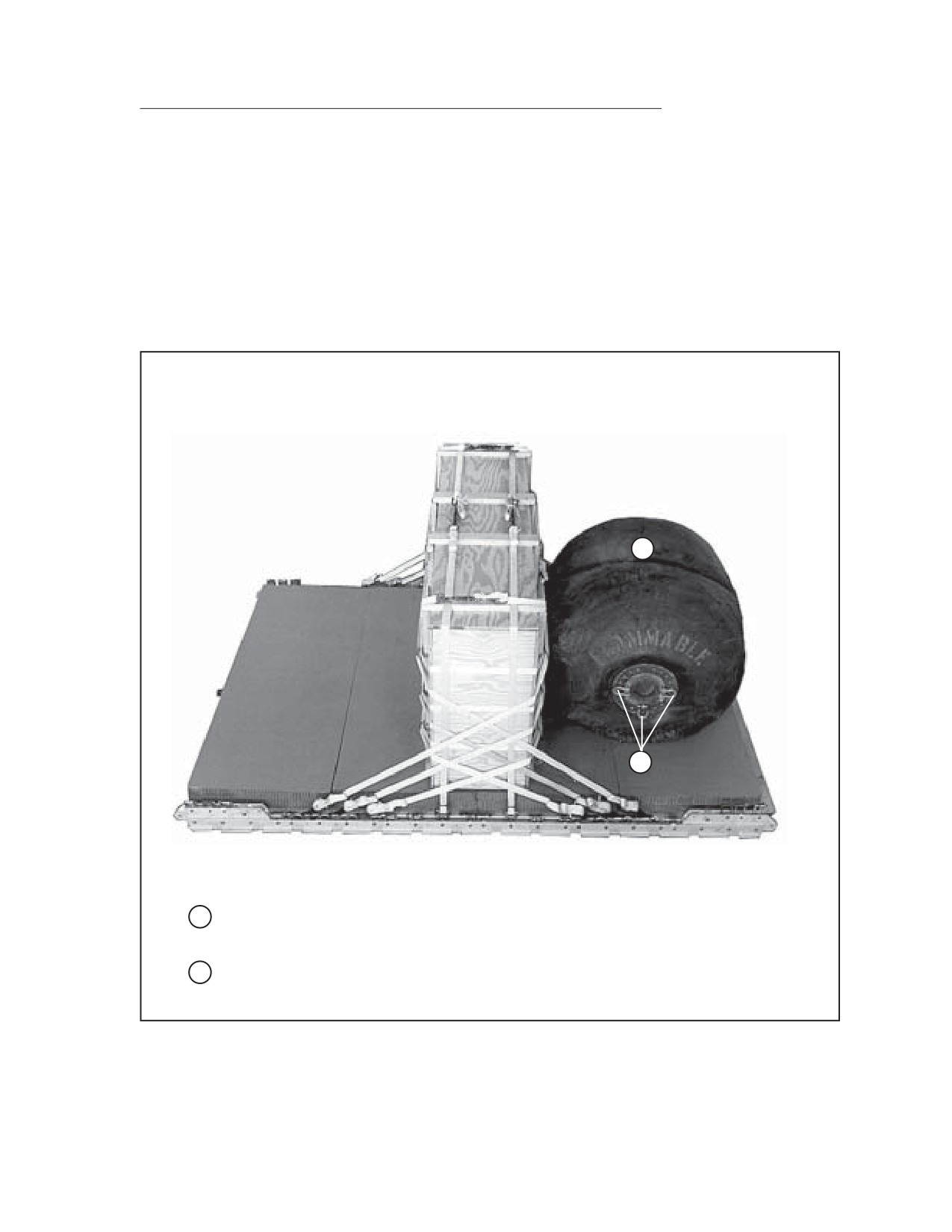
1-9. Place and lash the fuel drums on the platform as described below.
a. FRONT FUEL DRUM. Place the front fuel drum on the platform as
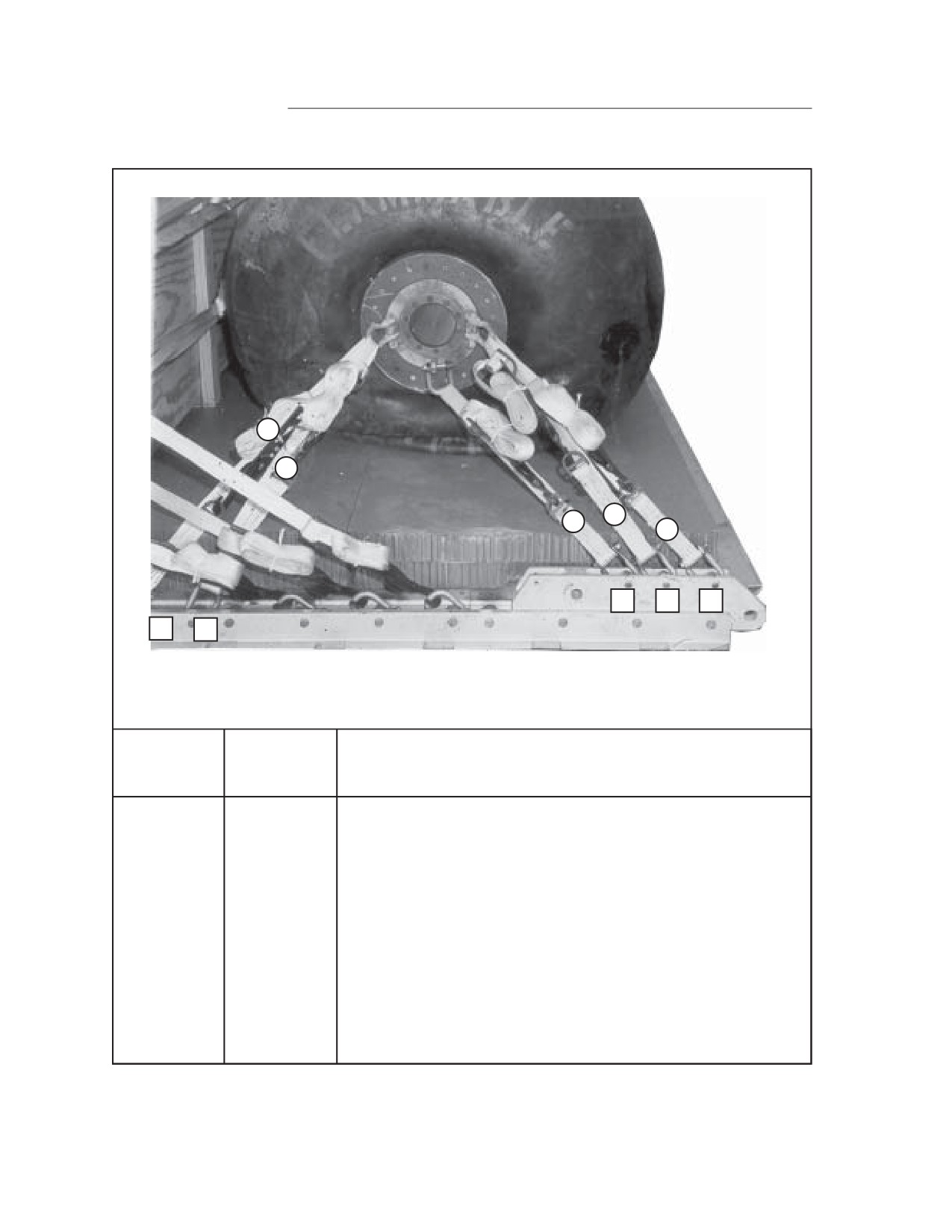
shown in Figure 1-17. Lash the front fuel drum to the front of the plat-
form as shown in Figure 1-18. Secure the ends of the lashings with a D-
ring and a load binder according to FM 4-20.102/NAVSEA SS400-AB-MMO-
010/TO 13C7-1-5.
1
2
1
Center the drum on the front of the platform. Place the drum flush against the
container.
2
Remove the lifting slings (not shown). Make sure the shackles on the drums
are parallel to the platform and the center clevis is in the bottom position.
Figure 1-17. Front Fuel Drum Placed on Platform
1-21
FM 4-20.137/TO 13C7-1-19
9
7
3
5
1
3
2
1
8
7
Tie-dow n
Lashing
Clevis
Number
Number
Instructions
Pass lashing:
1
1
Through right front shackle.
2
1A
Through left front shackle.
3
2
Through right front shackle.
4
2A
Through left front shackle.
5
3
Through right center clevis.
6
3A
Through left center clevis.
7
7
Through right rear shackle.
8
7A
Through left rear shackle.
9
8
Through right rear shackle.
10
8A
Through left rear shackle.
Figure 1-18. Front Drum Lashed to Platform
1-22
FM 4-20.137/TO 13C7-1-19
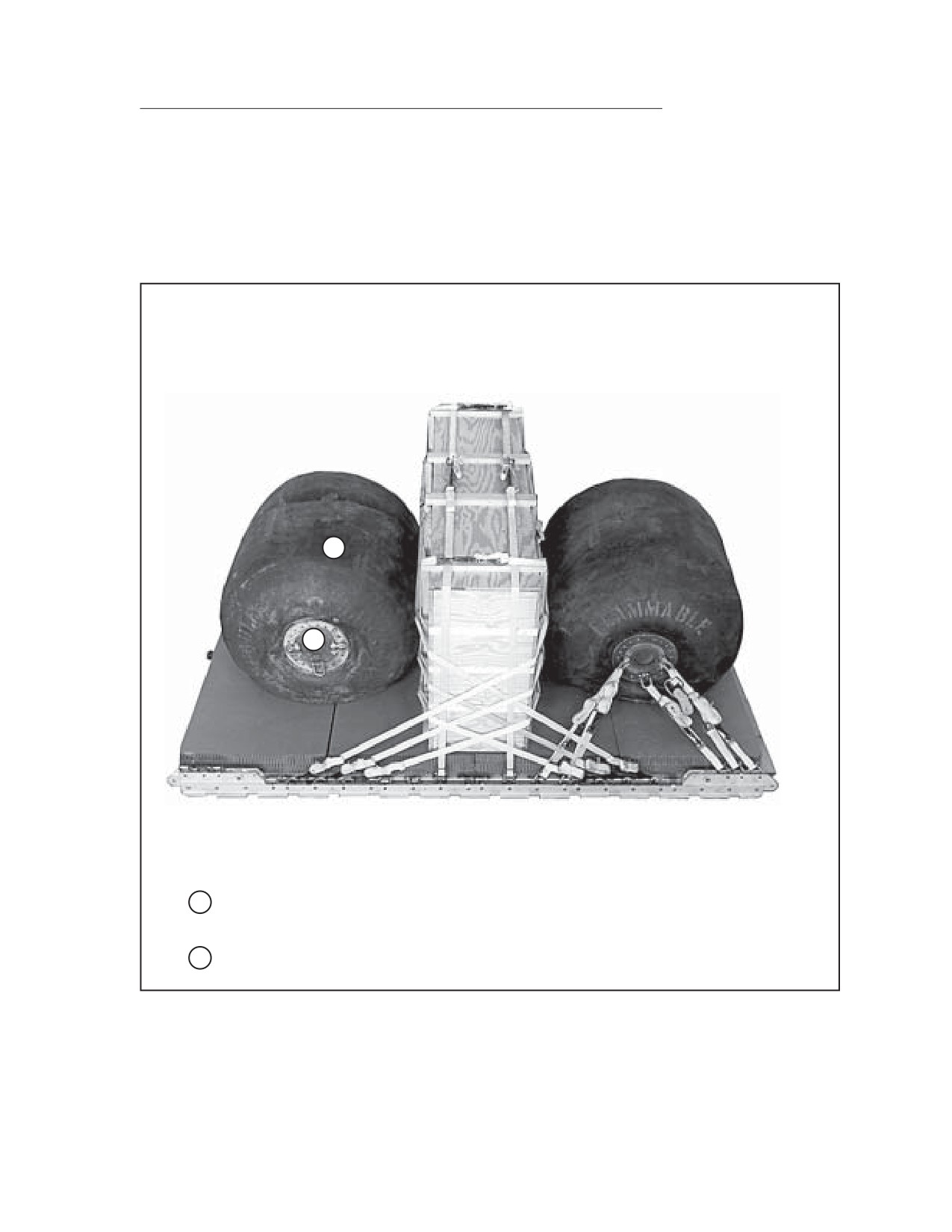
b. REAR FUEL DRUM. Place the rear fuel drum on the platform as shown
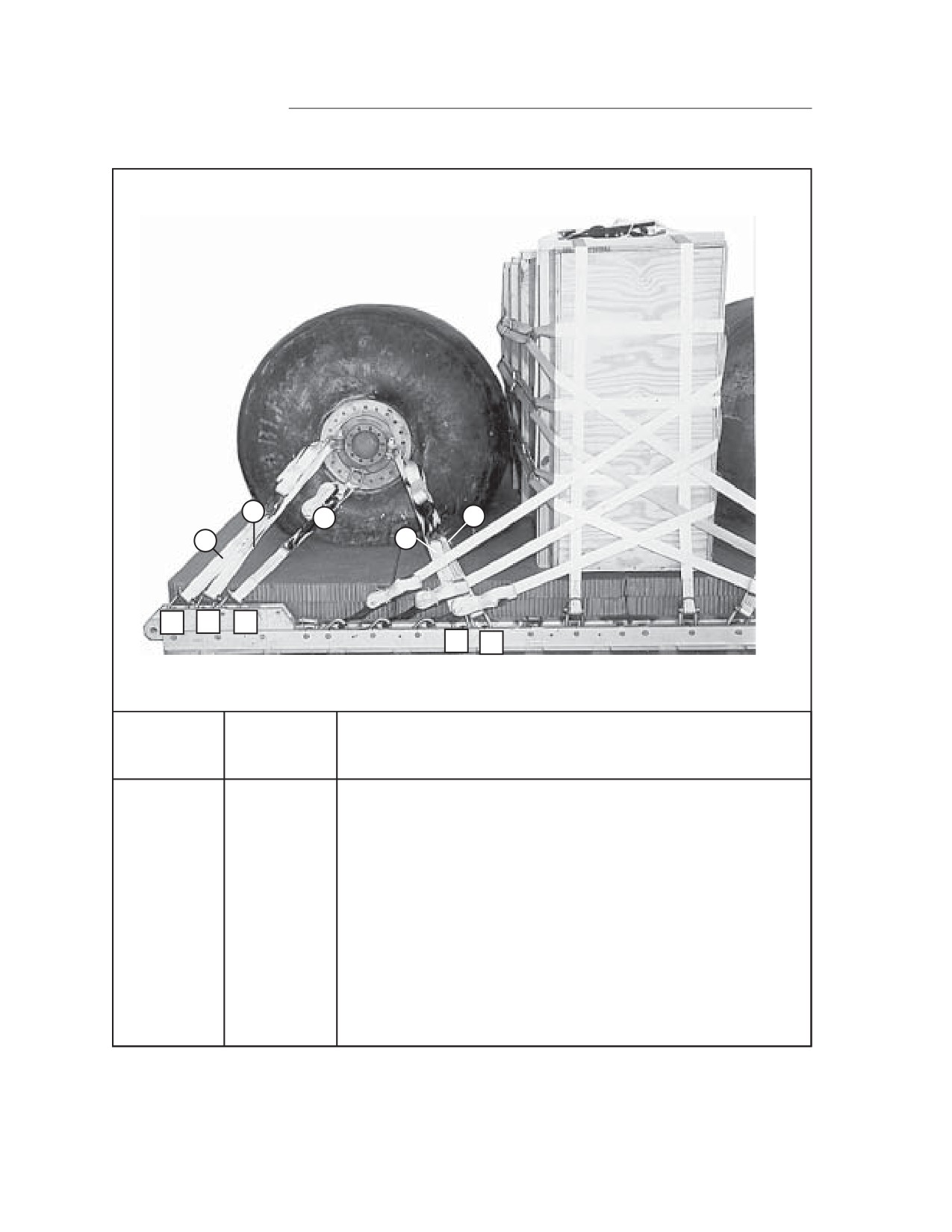
in Figure 1-19. Lash the rear fuel drum to the rear of the platform as
shown in Figure 1-20. Secure the ends of the lashings with a D-ring and
a load binder according to FM 4-20.102/NAVSEA SS400-AB-MMO-010/
TO 13C7-1-5.
1
REAR
FRONT
2
1
Center the drum on the rear of the platform. Place it flush against the con-
tainer.
2
Remove the lifting slings (not shown). Make sure the shackles on the drums
are parallel to the platform and the center clevis is in the bottom position.
Figure 1-19. Rear Fuel Drum Placed on Platform
1-23
FM 4-20.137/TO 13C7-1-19
7
1
5
9
3
20
19
18
13
12
Tie-dow n
Lashing
Clevis
Number
Number
Instructions
Pass lashing:
1
12
Through right front shackle.
2
12A
Through left front shackle.
3
13
Through right front shackle.
4
13A
Through left front shackle.
5
18
Through right center clevis.
6
18A
Through left center clevis.
7
19
Through right rear shackle.
8
19A
Through left rear shackle.
9
20
Through right rear shackle.
10
20A
Through left rear shackle.
Figure 1-20. Rear Fuel Drum Lashed to Platform
1-24
FM 4-20.137/TO 13C7-1-19
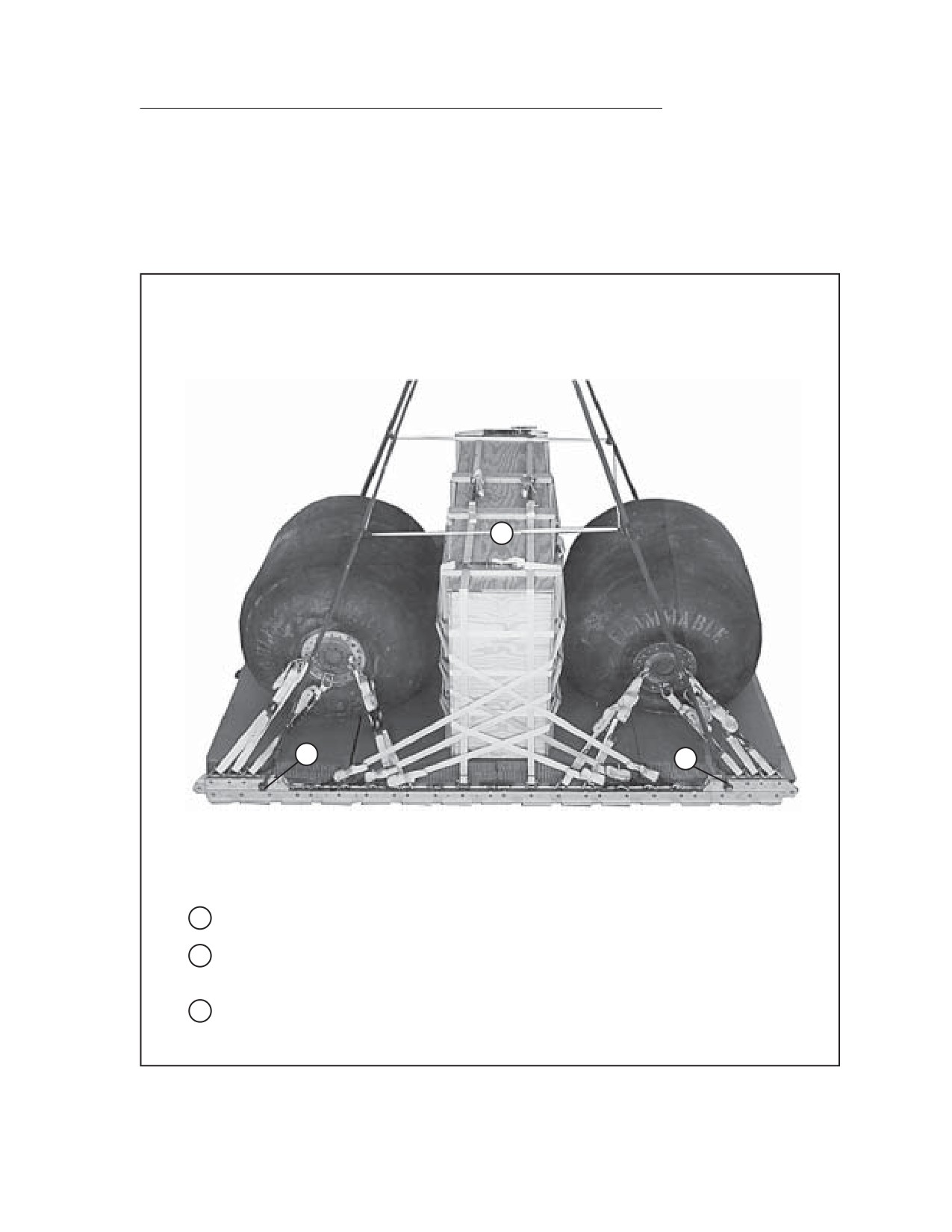
INSTALLING SUSPENSION SLINGS
1-10. Install four large suspension clevises and four 12-foot (2-loop), type XXVI
nylon webbing slings to the tandem links as shown in Figure 1-21.
3
1
1
1
Bolt a 12-foot sling to each tandem link using a large suspension clevis.
2
Raise the suspension slings to their full length using a lifting provision (not
shown).
3
Safety the slings with a deadman’s tie according to FM 4-20.102/NAVSEA
SS400-AB-MMO-010/TO 13C7-1-5.
Figure 1-21. Suspension Slings Installed
1-25
FM 4-20.137/TO 13C7-1-19
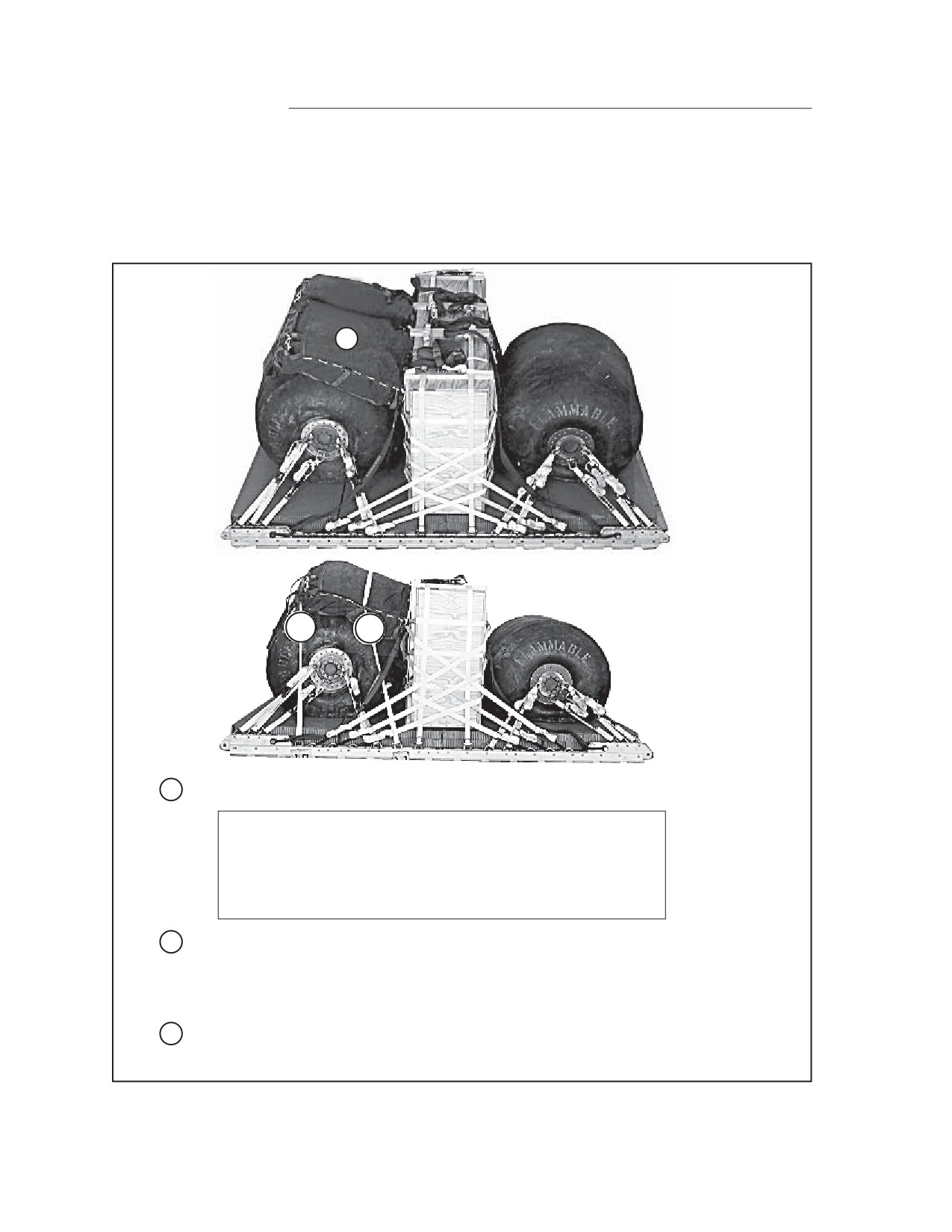
STOWING CARGO PARACHUTES
1-11. Prepare, place, and restrain two G-11 cargo parachutes according to FM 4-
20.102/NAVSEA SS400-AB-MMO-010/TO 13C7-1-5 and as shown in Figure 1-
22.
1
3
2
1
Place the cargo parachutes on top of the rear fuel drum.
CAUTION
As an exception to the FM 4-20.102/NAVSEA SS400-AB-
MMO-010/TO 13C7-1-5 parachute restraint system, two re-
straint streaps will be used on this load.
2
Secure the parachutes according to FM 4-20.102/NAVSEA SS400-AB-MMO-010/
TO 13C7-1-5 using two lengths of type VIII nylon webbing. Attach one length of
webbing from clevises 11 and 11A using a trucker’s hitch according to FM 4-
20.102/NAVSEA SS400-AB-MMO-010/TO 13C7-1-5.
3
Attach the second length of webbing from clevises 17 and 17A using a trucker’s
hitch according to FM 4-20.102/NAVSEA SS400-AB-MMO-010/TO 13C7-1-5.
Figure 1-22. Cargo Parachutes Stowed
1-26
FM 4-20.137/TO 13C7-1-19
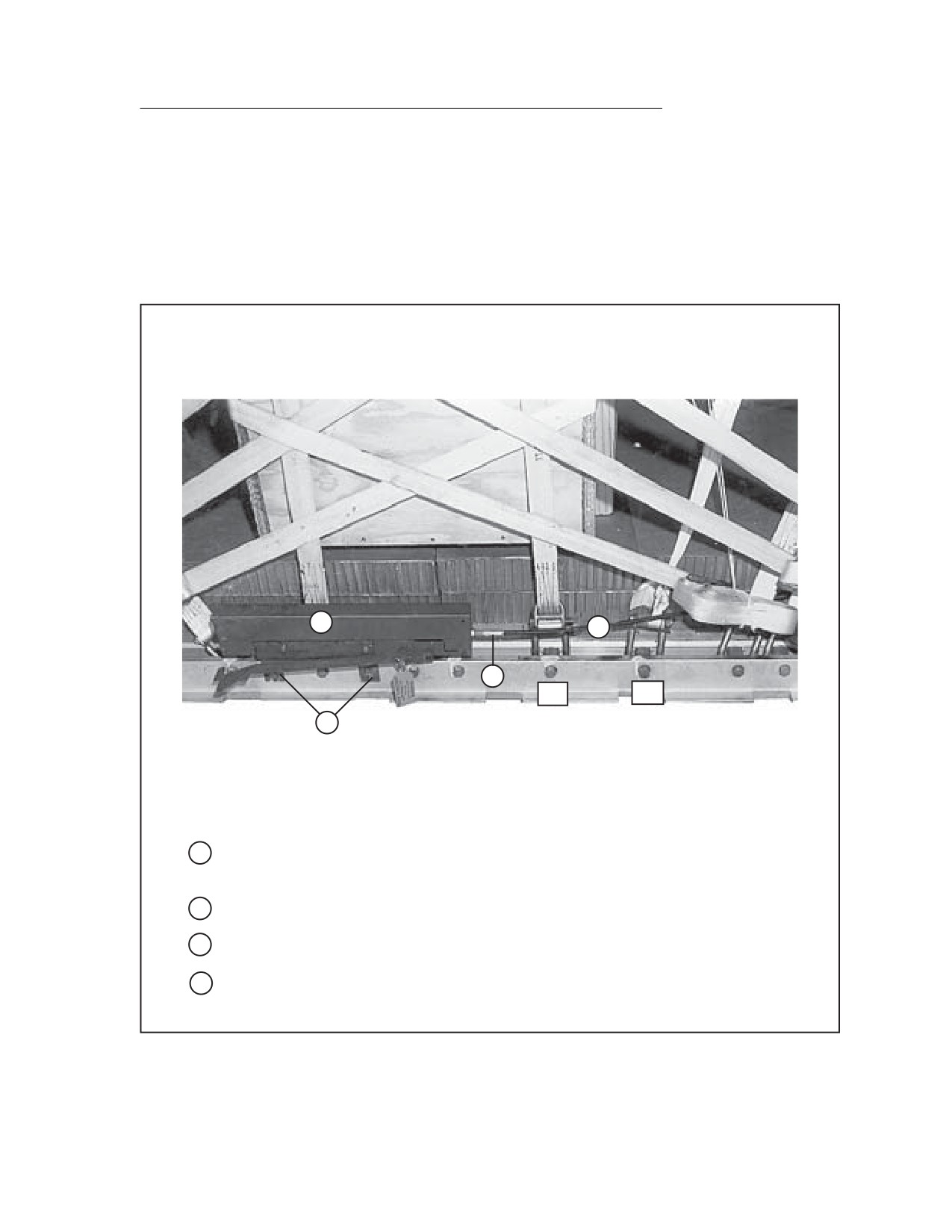
INSTALLING EXTRACTION SYSTEM
1-12. Install the Extraction Force Transfer Coupling (EFTC) extraction system
according to FM 4-20.102/NAVSEA SS400-AB-MMO-010/TO 13C7-1-5 and as shown
in Figure 1-23.
3
4
2
10A
11A
1
1
Install the actuator mounting brackets to the rear EFTC mounting holes on the
left side rail.
2
Install a 12-foot cable to the actuator assembly.
3
Attach the actuator assembly to the mounting brackets.
4
Route the cable from the actuator assembly between clevises 11A and 12A
toward the rear of the platform.
Figure 1-23. Extraction System Installed
1-27
FM 4-20.137/TO 13C7-1-19
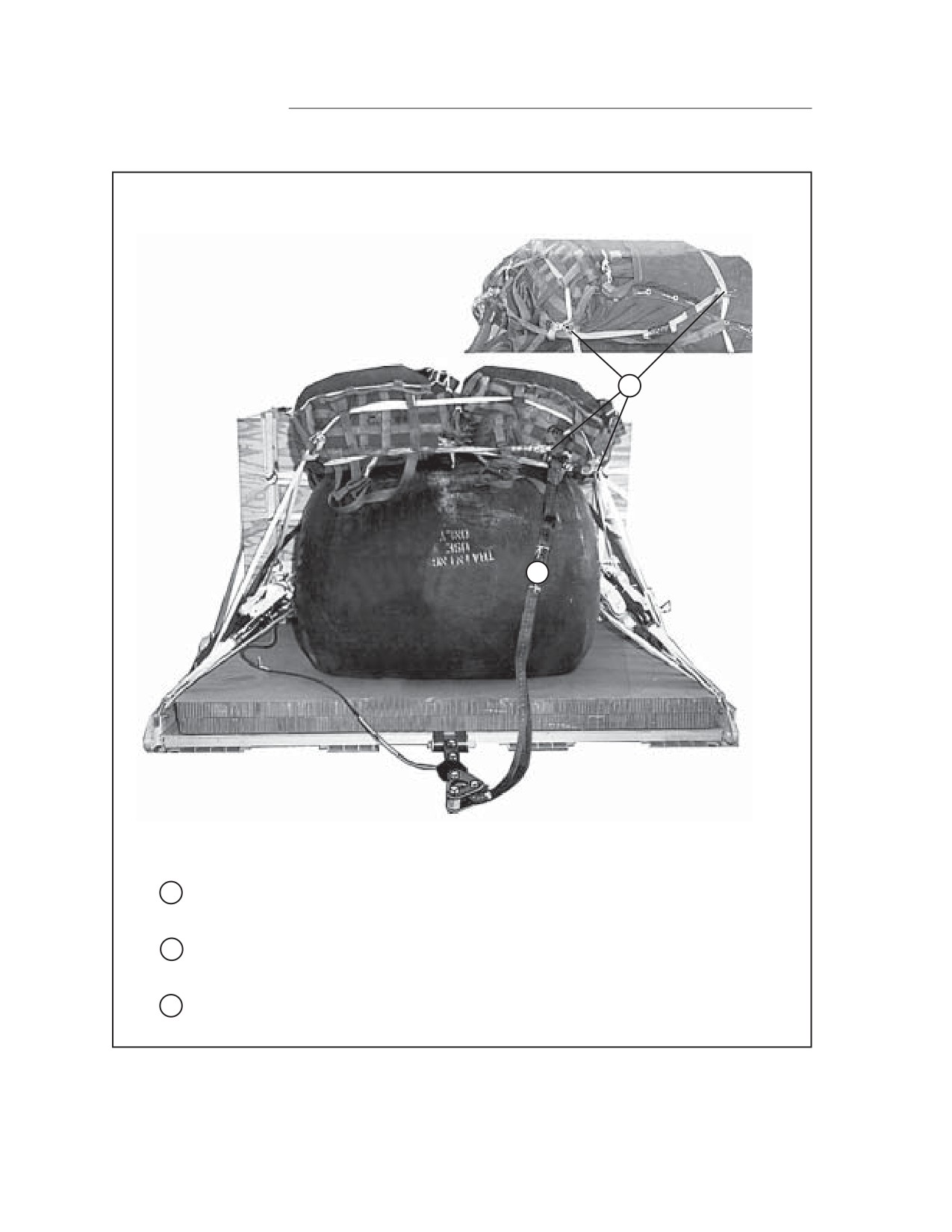
6
7
5
Safety the 12-foot cable to lashing 18A with a piece of type I, 1/4-inch cotton
webbing (not shown).
6
Cluster the parachute bridles on a large clevis, and install the release knives
according to FM 4-20.102/NAVSEA SS400-AB-MMO-010/TO 13C7-1-5.
7
Use a 9-foot (2-loop), type XXVI nylon webbing sling for the deployment line.
Figure 1-23. Extraction System Installed (continued)
1-28
FM 4-20.137/TO 13C7-1-19
INSTALLING PARACHUTE RELEASE SYSTEM
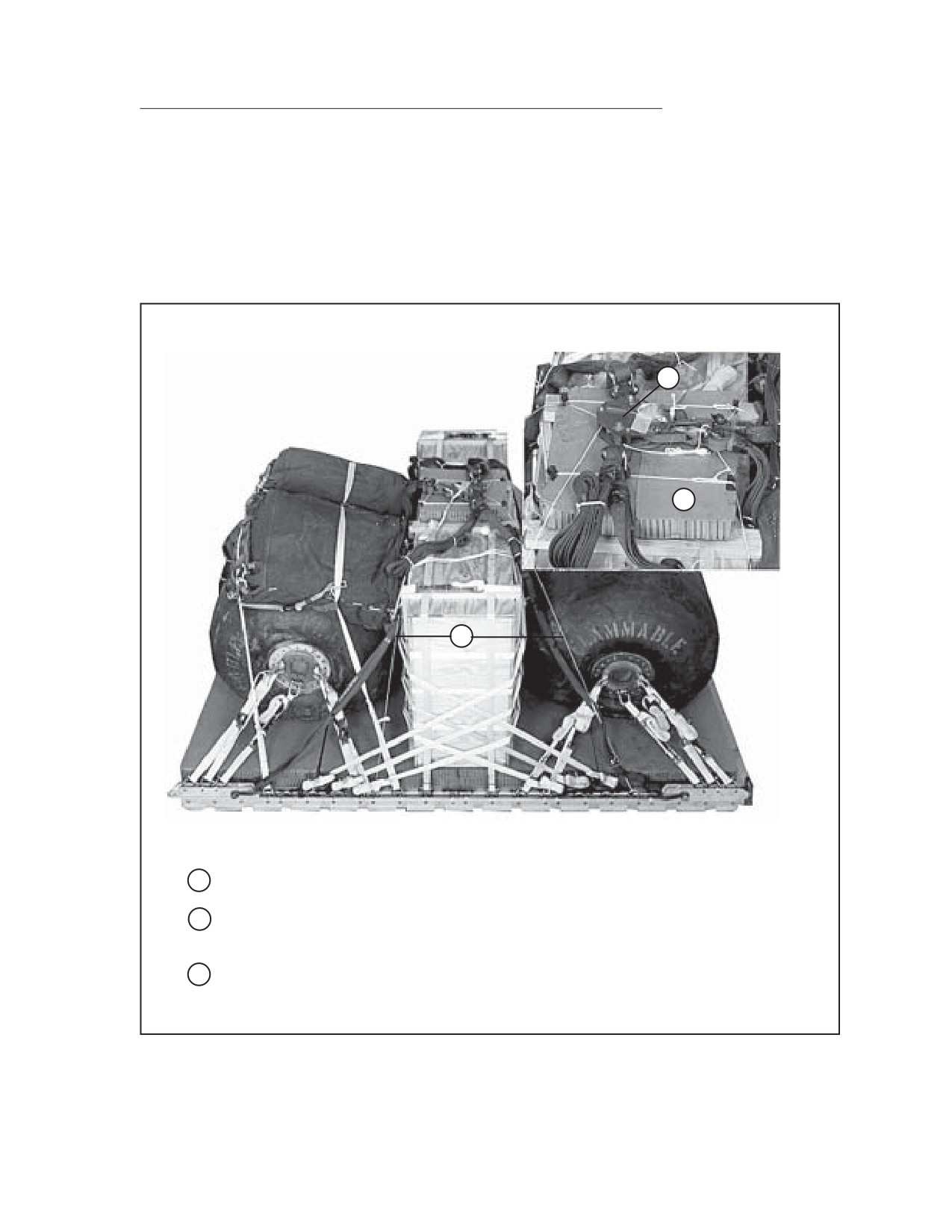
1-13. Prepare and attach an M-1 cargo parachute release according to FM 4-
20.102/NAVSEA SS400-AB-MMO-010/TO 13C7-1-5 and as shown in Figure 1-
24.
2
1
3
1
Place a 24- by 24-inch piece of honeycomb on top of the container.
2
Place the M-1 cargo parachute release on top of the honeycomb and attach it
according to FM 4-20.102/NAVSEA SS400-AB-MMO-010/TO 13C7-1-5.
3
Secure the M-1 cargo parachute release according to FM 4-20.102/NAVSEA
SS400-AB-MMO-010/TO 13C7-1-5 with a length of type III nylon cord to clevises
4, 4A, 12, and 12A.
Figure 1-24. Parachute Release Attached
1-29
///////////////////////////////////////