FM 4-02.7 MULTISERVICE TACTICS, TECHNIQUES, AND PROCEDURES FOR HEALTH SERVICE SUPPORT IN A CHEMICAL, BIOLOGICAL, RADIOLOGICAL, AND NUCLEAR ENVIRONMENT (JULY 2009) - page 7
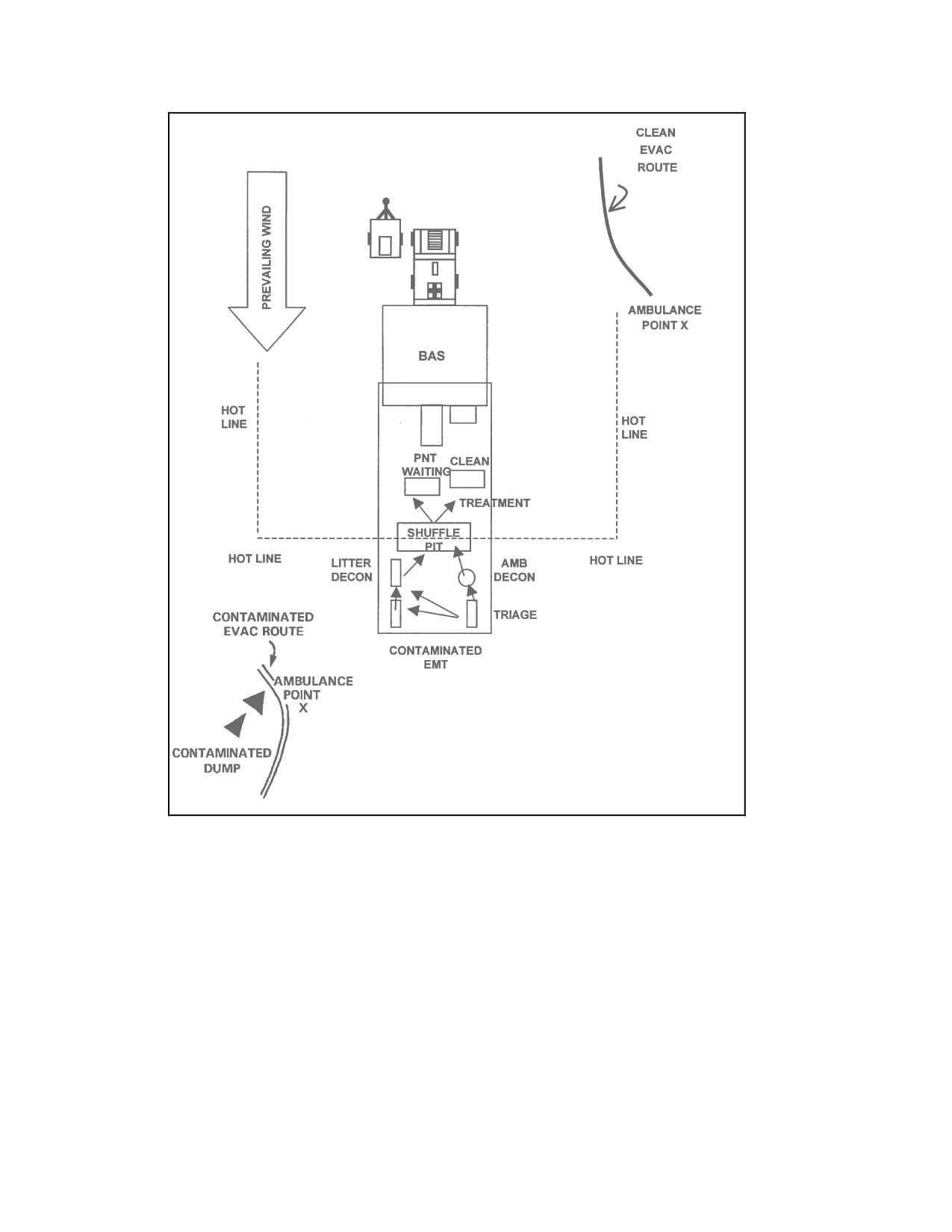
Figure XI-2. Battalion Aid Station Using the Chemical Biological Protective Shelter
6. Brigade Support Medical Company Role 2 Medical Treatment Facility in a
Chemical Biological Protective Shelter
a. To establish a BSMC Role 2 MTF using the CBPS, four shelters are set up. The four
shelters are complexed as shown in Figure XI-3. With four CBPS systems set up and
operational, a total of 1,200 sq ft of work area is available. The contaminated triage,
decontamination, and contaminated treatment areas are separated from the clean
treatment/waiting area by a hot line with a shuffle pit. Overhead covering is provided as
described for the BAS. Patients are admitted through the EMT litter or ambulatory airlock.
Patients are released through the patient holding airlocks. This aids in controlling entry and
exits; thus preventing the introduction of contamination into the systems. At least eight
15 July 2009
FM 4-02.7/MCRP 4-11.1F/NTTP 4-02.7/AFTTP 3-42.3
XI-9
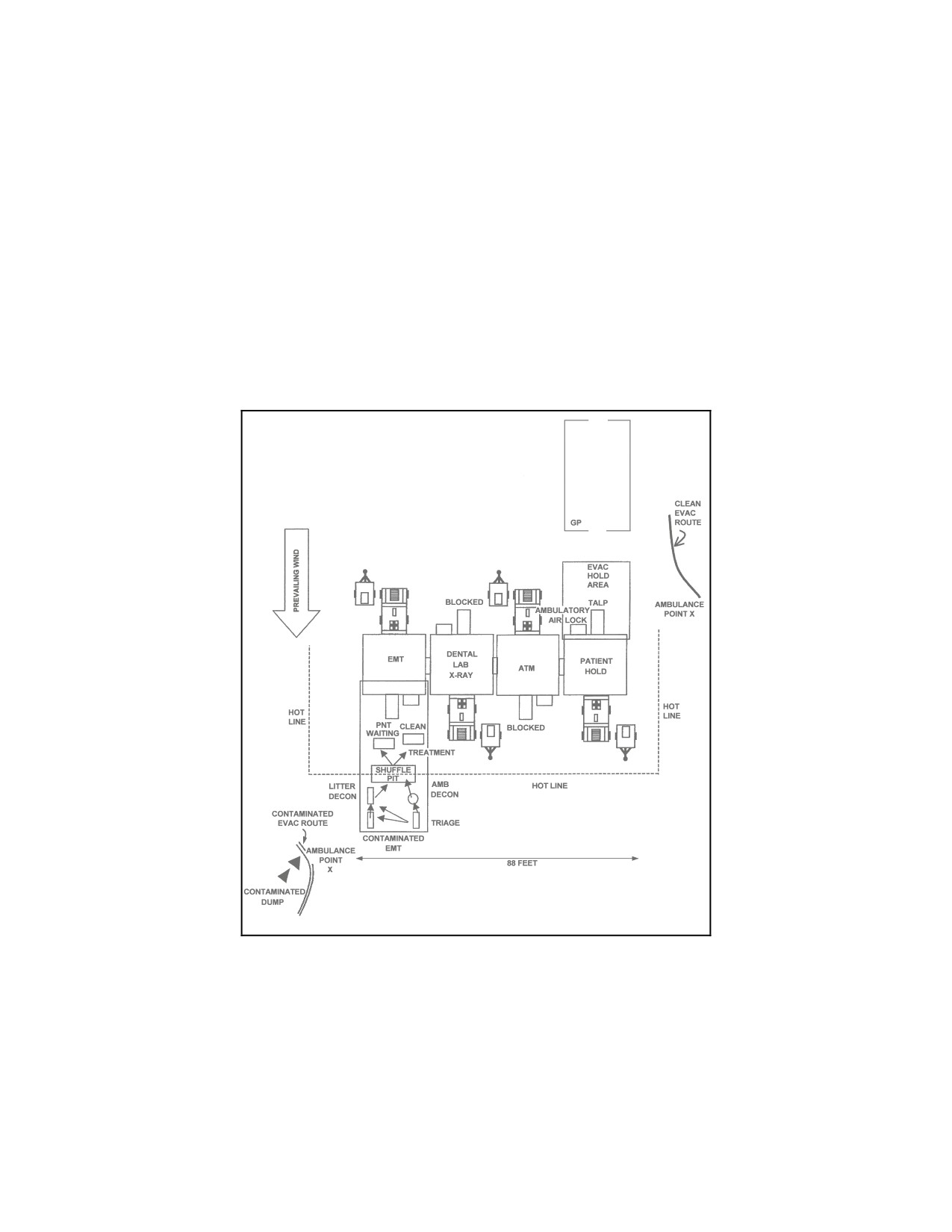
nonmedical augmentation personnel from supported units are required to perform patient
decontamination under medical supervision at the BSMC Role 2 MTF.
b. In the event that the overpressure system fails on a system that is in use with
entry/exit airlocks, move to the available shelter with an entry/exit airlock in the same
direction for use as the entry/exit until the failed system can be restored.
• Example 1: At the BAS Role 1 MTF, if the EMT system fails, move to the ATM
shelter to receive patients until the EMT system has been restored.
• Example 2: At the BSMC Role 2 MTF, if the patient hold system fails, move exits
to the dental/laboratory/x-ray shelter until the patient hold system can be
restored.
• Example 3: At the FST, if the postoperative system fails, use the preoperative
shelter until the postoperative system can be restored. These options will allow
patient care operations to continue until the failed system can be restored.
Figure XI-3. Chemical Biological Protective Shelter Configuration as a Brigade Support
Medical Company Role 2 Medical Treatment Facility
7. Forward Surgical Team in a Chemical Biological Protective Shelter
a. To establish an FST using the CBPS system, follow the procedures for the BSMC
Role 2 MTF except only three CBPS systems are set up. With three CBPS systems set up
and operational, a total of 900 sq ft of work area is available (Figure XI-4). When the FST is
located forward in support of a medical company and operating in the CB mode, the FST
XI-10
FM 4-02.7/MCRP 4-11.1F/NTTP 4-02.7/AFTTP 3-42.3
15 July 2009
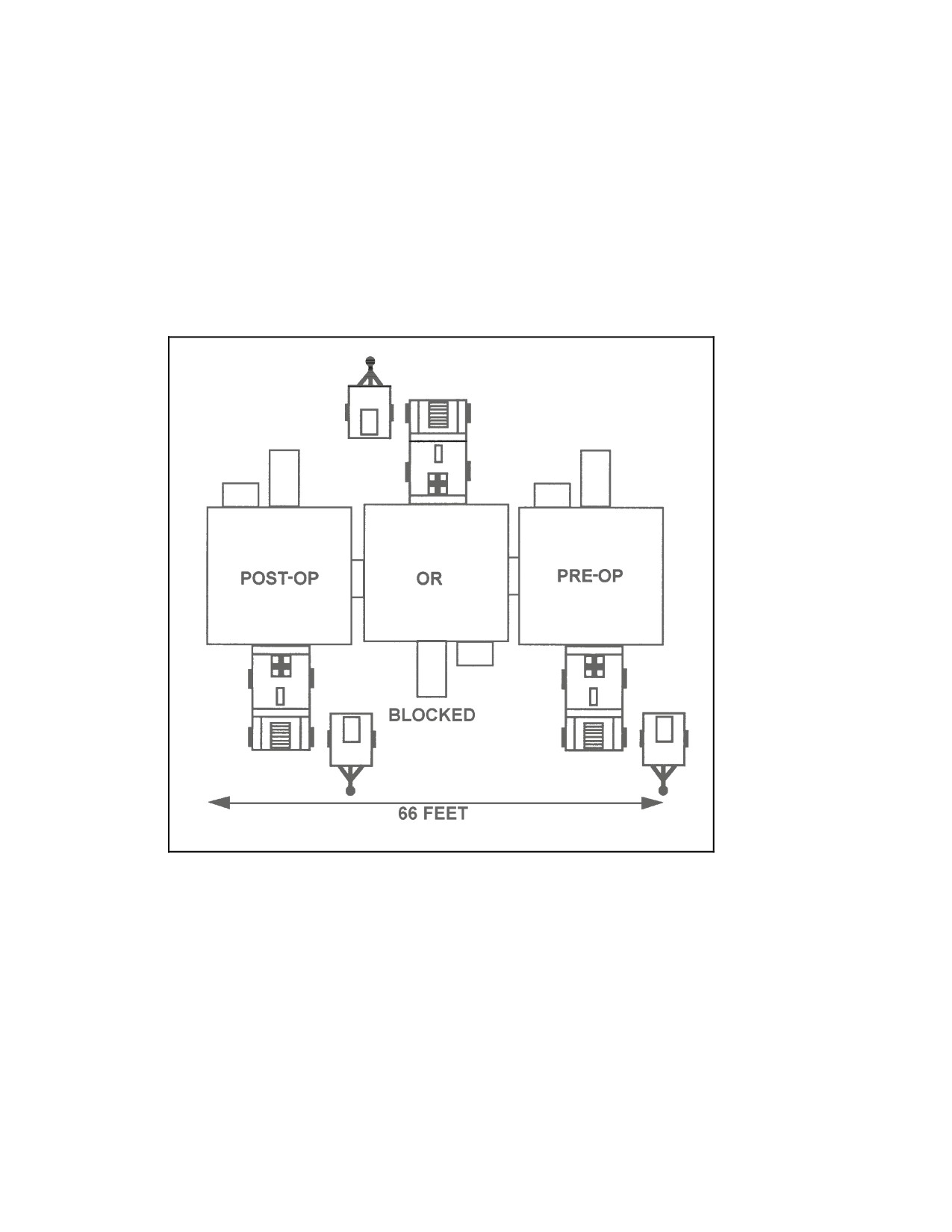
systems are connected to the Role 2 MTF of the supported BSMC. Figure XI-5 shows the
FST and BSMC Role 2 MTF connected.
b. When operating in the CB mode with the BSMC, all patients are received through the
EMT airlock of the BSMC Role 2 MTF. The patients are triaged in the BSMC Role 2 MTF
and, based upon their injuries, they are routed to the treatment area of the Role 2 MTF or to
the FST for surgical care. Patients released from the FST for evacuation are placed in a
PPW and processed through the litter airlock in the FST recovery section. Patient
decontamination is performed at the PDS operated by the BSMC Role 2 MTF. The FST
cannot operate in a CB environment without being complexed with the BSMC Role 2 MTF.
They do not have any patient decontamination capabilities.
Figure XI-4. Forward Surgical Team Configuration for Operations in Conventional Mode
15 July 2009
FM 4-02.7/MCRP 4-11.1F/NTTP 4-02.7/AFTTP 3-42.3
XI-11
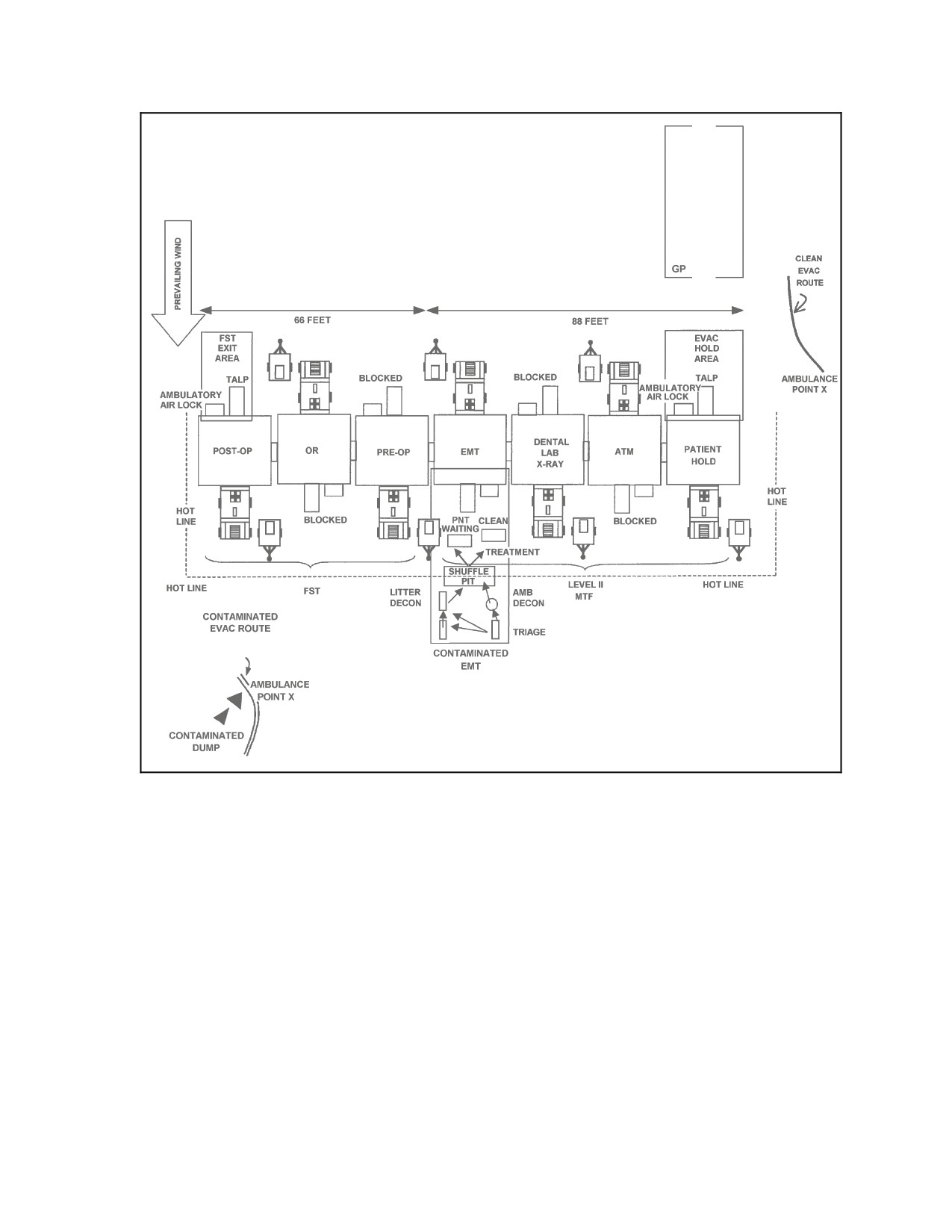
Figure XI-5. Forward Surgical Team and Brigade Support Medical Company Role 2
Medical Treatment Facility Configuration for Operations in a Chemical,
Biological, Radiological, and Nuclear Environment
8. Employment of the Chemically Protected Deployable Medical Systems and
Simplified Collective Protection Systems
a. When the threat of CBRN action is anticipated in the AO, the CPDEPMEDS
components must be set up as the CSH is being established. The system cannot be set up
in a hospital that has already been established. The M28 liners must be installed during the
CPDEPMEDS erection process. To establish CPS in a DEPMEDS-equipped hospital, follow
the procedures as described in TM 10-5410-283-14&P. Figure XI-6 presents one layout of
the DEPMEDS-equipped patient care area of a MF2K CSH hospital unit base employing the
CPDEPMEDS with an internal water supply system. Figure XI-7 presents a layout of the
patient care area of the DEPMEDS-equipped portion of an 84-bed MRI hospital. Figure XI-8
presents a layout of the patient care area of the DEPMEDS-equipped portion of a 164-bed
MRI hospital.
XI-12
FM 4-02.7/MCRP 4-11.1F/NTTP 4-02.7/AFTTP 3-42.3
15 July 2009
b. When employing CPDEPMEDS, provisions for waste disposal and protected water
and food supplies within the system are established. Additionally, Class VIII supplies must
be protected from contamination. Supplies not in use or needed in the protected operational
areas are stored in medical chests, shipping containers, or wrapped in layers of plastic that
are inside covered areas, such as closed MILVANs or tents.
c. When contamination is present, only open these storage areas for operational area
emergency resupply. Use plastic sheeting or other leak-proof material to provide an
additional barrier between the supplies and the contamination. Wrap supplies in plastic or
other barrier material for movement from the storage area to the resupply airlock of the
CPDEPMEDS.
d. A water supply system with distribution hoses is established inside the CPDEPMEDS
areas (Figure XI-6). Pumps continuously circulate the water from the storage tank through
the hose system back to the storage tank. The continuous circulation ensures that the
chlorine residual is maintained in the water supply. Personnel in areas that are not included
in the continuous flow system must draw water from the system and carry it to their work
areas in 5-gallon water cans or other containers. Water resupply is accomplished by
passing a hose through the utility port at the end of the TEMPER and M28 liner for
connection to the water transport vehicle. The ends of both hoses must be decontaminated
with a 5 percent chlorine solution before connecting them together. The vehicle must have
a tank or water supply container that is CBRN protected to ensure that the water supplied is
free of CBRN contamination.
e. Rations, as determined by the hospital commander, should be available within the
protected area for personnel and patients. Under emergency conditions the commander
can authorize feeding patients MRE rations for limited periods of time (up to 72 hours), if
they are able to chew and swallow. However, attempts must be made to ensure the
required types of rations for patient feeding are available in the CPS. The rations can be
stored in any available space; however, the rations must be protected from exposure to
possible contaminants, especially liquids. Ration control measures are established to
ensure that the rations are only consumed as provided for in the hospital TSOP.
f.
Two CB protected latrine systems are included in the CPDEPMEDS. The latrines
contain bedpan wash areas. The waste from the latrines is collected in an outside receiving
container.
g. Solid waste (including medical) must be placed in plastic bags. Seal the top of the
bags to prevent spillage, odors, or spread of infections/disease. Never overfill the bags;
always leave enough room in the bag to make a good seal. Place the sealed bags in the
supply airlock. Inside personnel ensure that the inner door to the airlock is closed. Outside
personnel check to ensure that the inner airlock door is closed before opening the outside
door. Remove the bags and take them to the designated waste collection/disposal site.
Disposal may be by burial on site or by transport to a designated disposal facility.
h. All liquid waste produced within the CPDEPMEDS is collected through a piped liquid
waste system to a central collection container. The waste container for the latrines may be
used to collect the liquid waste from the operational areas of the CPDEPMEDS.
15 July 2009
FM 4-02.7/MCRP 4-11.1F/NTTP 4-02.7/AFTTP 3-42.3
XI-13
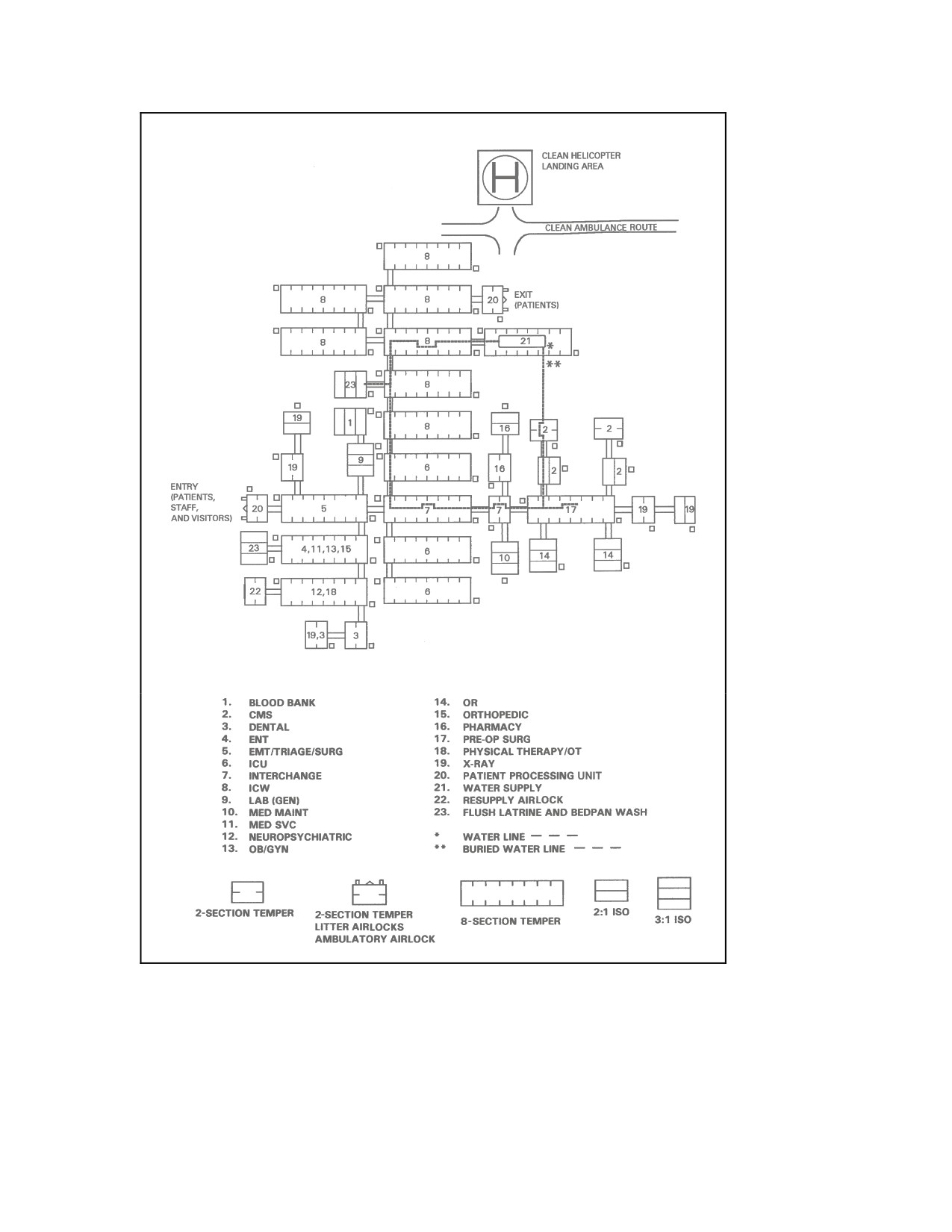
* Internal Water Distribution System
** Trenched And Buried Line
Figure XI-6. Sample Layout of a Medical Force 2000 Combat Support Hospital (Unit Base)
Employing Chemically Protected Deployable Medical System
XI-14
FM 4-02.7/MCRP 4-11.1F/NTTP 4-02.7/AFTTP 3-42.3
15 July 2009
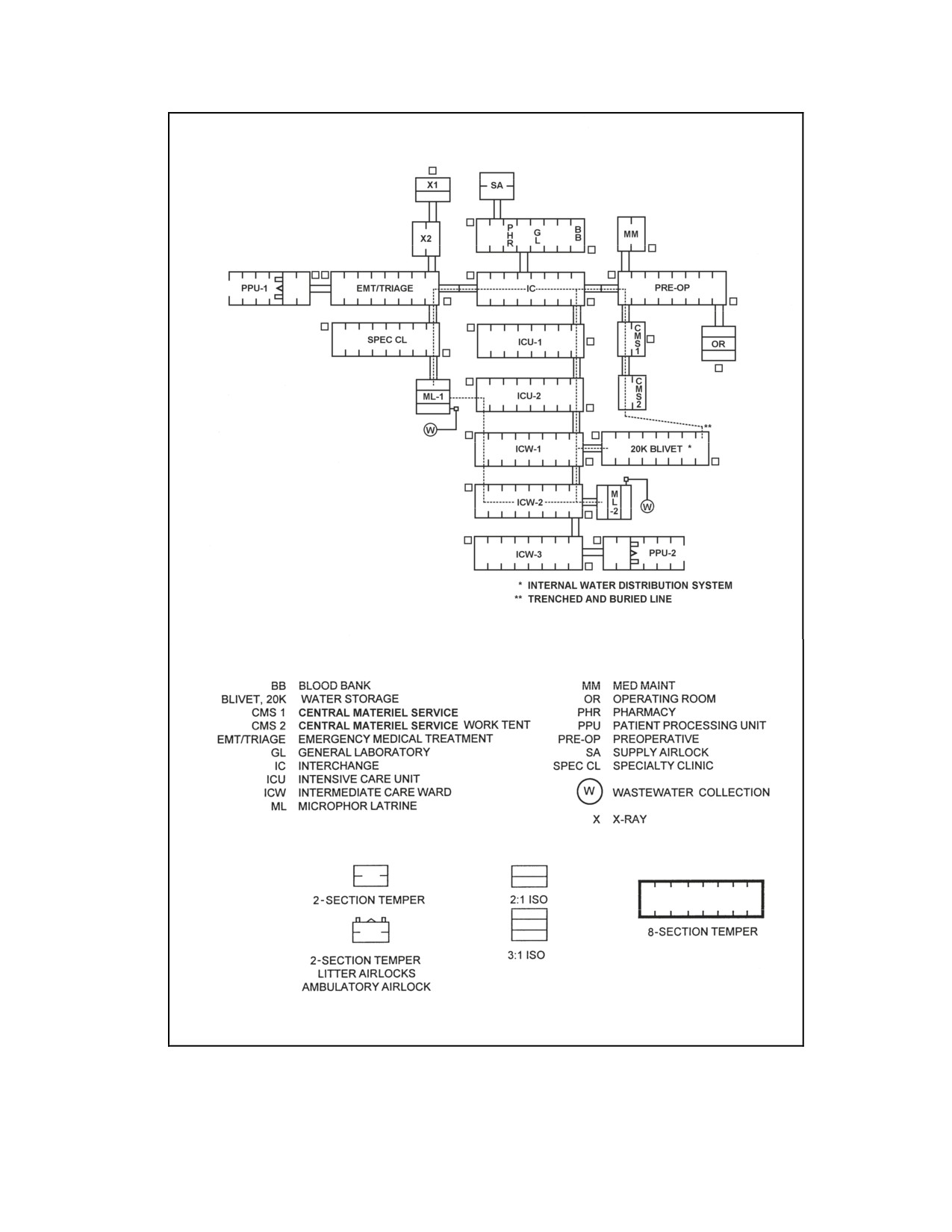
Figure XI-7. Sample Layout of an 84-Bed Medical Reengineering Initiative Hospital
Employing Chemically Protected Deployable Medical System
15 July 2009
FM 4-02.7/MCRP 4-11.1F/NTTP 4-02.7/AFTTP 3-42.3
XI-15
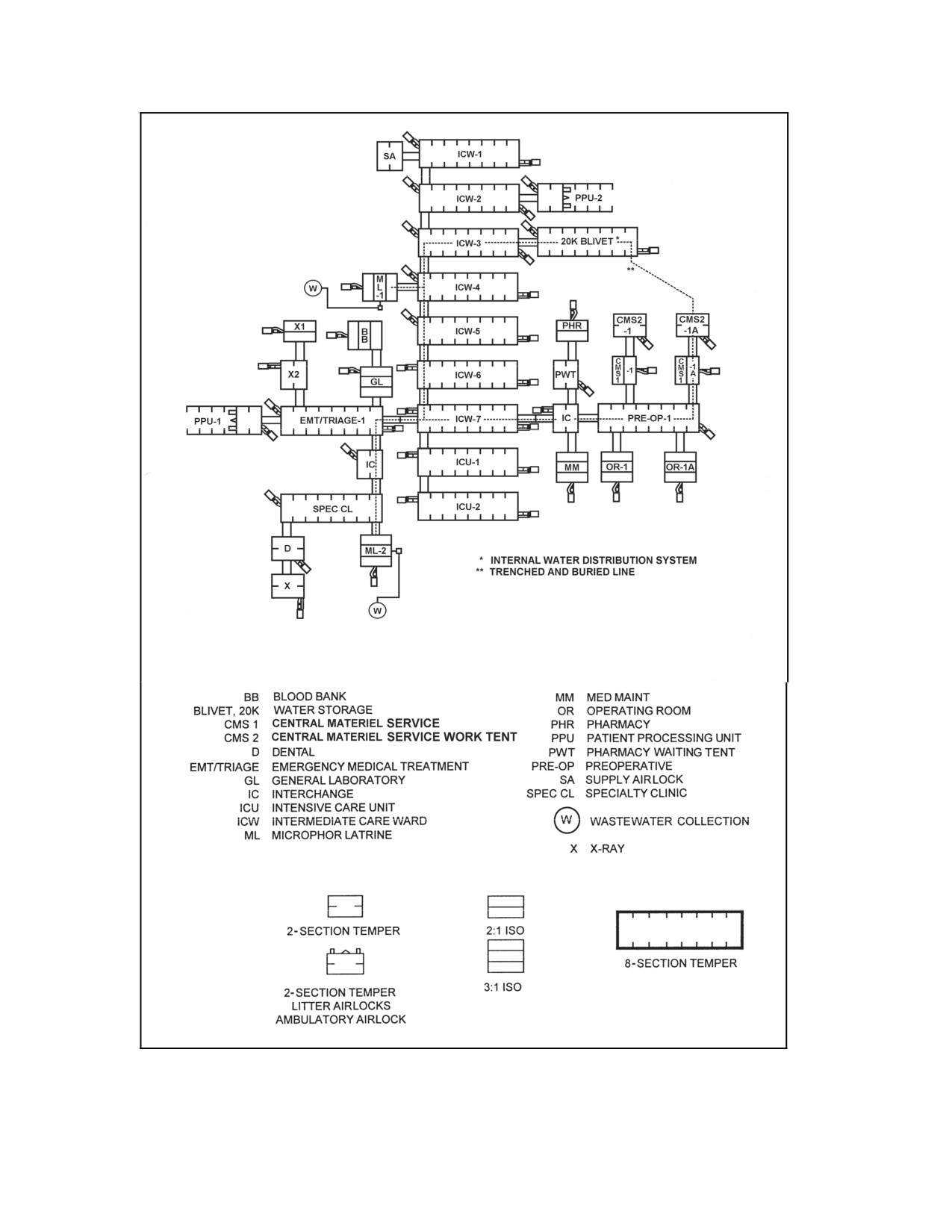
Figure XI-8. Sample Layout of a 164-Bed Medical Reengineering Hospital Employing
Chemically Protected Deployable Medical System
XI-16
FM 4-02.7/MCRP 4-11.1F/NTTP 4-02.7/AFTTP 3-42.3
15 July 2009
9. Chemically/Biologically Protecting the International Organization for
Standardization Shelter
To chemically/biologically protect the ISO shelters, seal all seams and openings of the
ISO to prevent the entry of CB agents. The seals connecting the various sides and floor of
the shelter must be of CB protected material; thus providing a seal to the shelter. When the
seals are not of a CB protected material, the seams must be taped to provide a CB
protected barrier over the soft seals. Any openings not being used for introduction of
support power lines, water lines or wastewater lines must be sealed to prevent entry of CB
agents. All access panels must be securely closed to prevent entry of vapors.
10. Chemically/Biologically Protecting the Vestibules
The vestibules connect TEMPERs to TEMPERs, ISOs to ISOs, and ISOs and
TEMPERs. To harden the vestibules, install the CB liners inside and fasten the ends to the
liners of the TEMPER or to the doors of the ISOs. Vestibule liner connectors are provided
for use at the entry of each ISO.
11. Chemically/Biologically Protecting Air Handler Equipment
a. The FDECU is a chemically/biologically protected ECU. It is a heat pump (reversing
mechanical refrigeration system) intended for use in cooling, heating, dehumidifying,
filtering, and circulating air for portable shelters, tents, and vans in order to satisfy
equipment and personnel climate control requirements. The system can be operated
without the CB filters. When required to operate in the CB mode, the fresh air intake on the
FDECU is closed and the CB filter blower is turned on drawing fresh air through the filters to
support the FDECU and to provide clean air for the CPS. Additionally, recirculation filters
are placed within the shelter system to remove any agent that may have entered through
any of the entry/exit areas or through breaches in the shelter system.
b. When heaters are required, they must be chemically/biologically protected to prevent
entry of contamination. The CB filter units are connected to the fresh air intake side of the
heater and the heated air discharge side of the heater is connected to the air supply of the
TEMPER/ISO. For more information on FDECU, refer to Army TM 9-4120-411-14/Air
Force Technical Manual (Technical Order) 35E9-314-1.
12. Establish Collective Protection Shelter Using the M20 Simplified Collective
Protection System
a. The M20 SCPE is used to establish a CPS within a room of opportunity or inside a
tent; however, the available space will be limited by tent poles and other components of the
tent. Currently, this system only provides ambient temperature air.
b. The SCPE provides a clean-air shelter for use against chemical and BW agents and
radioactive particles. It is lightweight and mobile and it allows unit commanders to convert
existing structures into protected working or rest area. The SCPE can be used as a
temporary rest and relief shelter (for example, as a break area for medical personnel) or as
a C2 center. It provides a contamination-free environment in which 10 Service members
can work, eat, or rest without wearing an IPE. The M20 can be erected without the liner
using only the PE and blower compartment. Places such as a bank vault or warehouse
freezer are examples of where an M20 without liner can be placed. Any cracks or holes will
need to be sealed in the doorway. A bib section is available that will fit between the PE and
the frame of any door, and when taped down, seals the entrance from outside
15 July 2009
FM 4-02.7/MCRP 4-11.1F/NTTP 4-02.7/AFTTP 3-42.3
XI-17
contamination. Entry and exit restrictions remain the same. For guidance on maintenance
and parts of the SCPE see TM 3-4240-288-12&P/NAVFAC P-475. The M20 does not have
a litter airlock. Only staff or ambulatory patients can enter.
13. Patient Decontamination
Patients admitted into the MTF must be free of contamination. Therefore, a casualty
decontamination area must be established near the MTF. The casualty decontamination
area should be provided with an overhead cover as described for the CBPS system, except
that it does not overlap the entry to the hospital. Also, consideration must be given to the
location of other operations at the hospital site when establishing the casualty
decontamination area. However, the area must be close enough to the entry/exit of the
CPS to protect the patients from the environment and reduce their exposure to
recontamination. The entry/exit area must have overhead cover to protect patients awaiting
access to the CPS. See Chapter V for setting up a patient decontamination area and for
decontamination procedures.
14. Operations, Entry, and Exit Guidelines
The following are the operations, entry, and exit guidelines to prepare a unit SOP for the
operation of CPS systems. When using these guidelines, the following should be
considered:
• Location of the shelter (flat, hilly, or rocky ground).
• General climate of the AO (high and low temperature variations during operation).
• Information on setting up, striking, and operating the CPS is contained in the
equipment publications.
• Where applicable, special procedures are provided in these publications for setting
up in both clean and CB vapor hazard areas. The CPDEPMEDS is not set up in a
CB vapor hazard area. The commander will determine which procedures to use.
• During operations, periodic checks are made of the atmosphere within the shelter.
These checks are made by using available chemical agent detection equipment and
material to determine if chemical agent penetration has occurred. Should chemical
agent penetration occur, all personnel must mask; then ensure that patients are
protected until the agent has been purged from the shelter.
15. Decontamination of Entrance Area
a. Normally, the MTF will not operate in a CB vapor hazard environment. However, if
the MTF must remain in an area on a temporary basis and liquid agent contamination is
present, the immediate area around the entrance must be decontaminated. To
decontaminate the area around the entrance, use one or more of the following methods:
• Turn over about 2 inches of soil.
• Remove the top 1-inch layer of soil containing the liquid agent. Use the
CAM/ICAM or M8 detector paper to check the area after the topsoil is removed to
ensure complete agent removal.
• Add several inches of clean soil or sand.
• Mix STB into the top 1/2 to 1 inch of soil.
• Use decontamination solution 2 (DS2) on contaminated hard-surfaced areas or
frozen ground.
XI-18
FM 4-02.7/MCRP 4-11.1F/NTTP 4-02.7/AFTTP 3-42.3
15 July 2009
b. All personnel (staff and patients) must be decontaminated before they are permitted
entry into the CPS. Use chemical detection equipment to check for the presence of
contamination on individuals and their equipment; also check for presence of contamination
on individual weapons if they are allowed in the CPS. Normally, weapons will not be
allowed in the patient care areas, but will be stored outside near the entry/exit point.
Thorough decontamination is critical in preventing contamination transfer into the CPS.
c. When a chemical agent is detected, follow the procedures in Chapter V for patient
decontamination and FM 3-11.5/MCWP 3-37.3/NTTP 3-11.26/AFTTP(I) 3-2.60 for other
personnel and equipment decontamination before entering the CPS. All contaminated
clothing and equipment are placed in the contaminated dump. If weapons are evacuated
with the patient, they are decontaminated and held by the MTF (administrative personnel or
hospital supply) for disposition instructions.
d. Decontamination must be thorough; procedures must be strictly followed. Failure to
do so can contaminate the interior of the MTF and injure medical treatment personnel; thus
reducing their mission support capabilities.
WARNINGS
1. Always purge the airlock before opening the inner
door, if the outer door has been opened.
2. When operating in a toxic environment, never open
the outer and inner doors of the airlocks at the
same time.
16. Entry/Exit for the Collective Protection Shelter System
a. Ambulatory Personnel.
(1) Entry procedures.
(a) Ambulatory patients and others remove their MOPP (except their mask),
BDUs/ACUs, and boots outside the airlock/personnel processing unit. This procedure
reduces the amount of possible contamination entering the airlock.
(b) A check is made to ensure that the ambulatory airlock/personnel
processing unit is empty and the inner door is closed.
(c) The individual enters the airlock/personnel processing unit and closes the
outer door.
(d) The airlock/personnel processing unit is purged for 3 minutes. At the end
of the purge cycle, the individual checks for contamination. If contaminated, the individual
must return to the outside and decontaminate his skin; then return to the airlock/personnel
processing unit and repeat the purge cycle and contamination check. If no contamination is
detected, the individual removes the protective mask and then removes the filter from the
mask. The filter is then disposed of in the designated contaminated trash bag. The
protective mask is placed in a separate clean plastic bag. The plastic bag is sealed and
labeled. The individual opens the inner airlock/personnel processing unit door and enters
the CPS; the plastic bag is carried into the shelter with the individual.
(2) Exit procedures.
15 July 2009
FM 4-02.7/MCRP 4-11.1F/NTTP 4-02.7/AFTTP 3-42.3
XI-19
(a) A check is made to ensure that the ambulatory airlock/personnel
processing unit is empty and the outer door is closed.
(b) The individual enters the airlock/personnel processing unit and closes the
inner door.
(c) The individual puts on his protective mask; then exits through the outer
door.
(d) The individual puts on his BDU/ACU and boots then assumes the
established MOPP level before departing the immediate area of the exit door.
WARNING
Do not open the outer door until after donning the
protective mask.
Notes: 1. If ambulatory patients that enter the collective protection shelter system
become litter patients, they must be placed in PPW when released since the
MTF does not have replacement MOPP ensembles for patient issue.
2. Exits between patients must be spaced so that at least a 3 minute purge
of the airlock/personnel processing unit is accomplished before the inside
door is opened. Only open the doors long enough to permit passage.
b. Litter Patients Entry Procedures. These procedures also apply when using the
Tunnel Airlock Litter Patient.
(1) An outside medical personnel notifies an inside medical personnel that a litter
patient is ready for admission.
(2) The inside medical personnel ensure that the inner litter airlock door is closed.
The outside medical personnel open the outer airlock door and place the litter on the litter
rails/stands when using the TALP or on the floor; the patient is pushed into the airlock
headfirst; then the outer door is closed. After a purge time of 3 minutes, medical personnel
inside the CPS opens the inner door to ensure that the patient is free of contamination. The
patient is checked by placing the CAM/ICAM nozzle/M8 near absorptive surfaces, such as
the patient’s hair. If no contamination is detected, the medical personnel remove the
patient’s protective mask and then remove the filter from the mask. The filter is then
disposed of in the designated contaminated trash bag. The protective mask is placed in a
separate clean plastic bag. The plastic bag is sealed and labeled and placed in between the
patient’s legs or, when using the TALP, beside the patient’s head or on the litter where it is
accessible to the patient. The inside medical personnel removes the patient from the airlock
and position him on treatment litter stands, or moves him to the treatment area.
(3) Patients received at the treatment facility in the PPW are checked for
contamination; if they are free of contamination, they may be processed through the litter
airlock in the PPW. The inside medical personnel ensure that the inner litter airlock door is
closed. The outside medical personnel open the outer airlock door and place the litter on
the litter rails/stands when using the TALP or on the floor and push the patient into the litter
airlock headfirst, then close the outer door.
(4) Purge the airlock for 3 minutes. After the purge time, medical personnel inside
of the CPS open the inner airlock door and use the CAM/ICAM/M8 to check the patient to
XI-20
FM 4-02.7/MCRP 4-11.1F/NTTP 4-02.7/AFTTP 3-42.3
15 July 2009
ensure that he is free of contamination. If no contamination is found, the inside medical
personnel remove the patient from the airlock. As the patient is removed from the airlock,
the PPW is opened and rolled inside out so that any desorbing vapors are adsorbed by the
charcoal layer. The inside medical personnel remove the patient from the airlock and
position him on litter stands. The patient is transferred to a clean litter; then moved to the
treatment area.
(5) The receiving litter and PPW are returned to the outside. The PPW must be
disposed in the contaminated waste dump. Decontaminate the litter and return it to the litter
pool.
Note: Should contamination be found when monitoring the airlock, repeat the purge
cycle, and then retest for contamination. All vapor hazards must be
eliminated before the patient is moved into the CPS. Repeating the purge
cycle may NOT be possible if the patient is in need of immediate lifesaving
care. The patient may have to be returned to the outside treatment area for
immediate care.
c. Exit Procedures.
(1) The litter patient is placed in a PPW. A battery-operated blower unit with a CB
filter is attached to the PPW to provide fresh air to the patient; thus reducing the heat load
on the patient and the carbon dioxide buildup inside the PPW.
(2) An inside medical personnel notifies an outside medical personnel that the
patient is ready to exit the shelter. Outside medical personnel ensures that the outer airlock
door is closed. The patient is placed in the litter airlock feet first. The inner airlock door is
closed. The outside medical personnel opens the outer door and removes the patient.
(3) Staff, visitors, or ambulatory patients exit through the ambulatory airlock.
Before entering the airlock, each individual must ensure that the outer airlock door is closed.
The individual enters the airlock and closes the inner door; puts on his protective mask and
exits through the outer door. The individual puts on his BDU/ACU and boots, and then
assumes the established MOPP level before departing the immediate area of the exit door.
WARNING
Do not open the outer door until the inner door
has been closed. Do not allow patients in PPW to
remain in direct sunlight for more than 5 to 10
minutes. Remaining in direct sunlight can cause
severe heat load on patients.
Note: Exits must be spaced at least 3 minutes apart to allow for a complete purge
cycle of the airlock.
d. Resupply of Protected Areas. Resupply of protected areas is accomplished by
placing contamination-free supplies or equipment on a litter and passing it through the litter
airlock, or processing it through the supply airlock. The litter airlock must be purged for 3
minutes. The supplies must be checked for contamination before they are removed and
placed within the CPS. The supply airlock must be purged for the stated time as outlined in
the supporting TM; usually
45 minutes. Again the supplies must be checked for
contamination before they are removed and placed within the CPS.
15 July 2009
FM 4-02.7/MCRP 4-11.1F/NTTP 4-02.7/AFTTP 3-42.3
XI-21
This page intentionally left blank.
Appendix A
CHEMICAL, BIOLOGICAL, RADIOLOGICAL, AND NUCLEAR
CASUALTY ESTIMATION
1. Decision Support Tool
Medical planners’ estimates (such as casualty, logistics, evacuation, and personnel
cross leveling) must be modified for the CBRN environment. Estimates of CBRN medical
workloads can be found in the AMedP-8 Publication. A number of new decision support
tools under development have various levels of capability to estimate the number and types
of casualties from CBRN events. Data from these models can be used to develop medical
estimates. Information such as units affected, number of casualties, and severity and time
course of illness can be obtained in order to estimate the medical force structure necessary
and Class VIII requirements and to develop and wargame medical support COAs.
2. Casualty Estimates
The joint tool approved for calculating medical requirements is the medical analysis tool
(MAT). However, the MAT includes the capability to generate medical requirements for
CBRN casualties. The DMSB develops task, time, and treater files for use in the MAT for
various CBRN casualty profiles. These files can be used to determine Class VIII equipment
and supply requirements. The Services are responsible for generating their respective
casualty estimates and tracking casualty rates for contingency operations. In the USAF, this
is the responsibility of the planning and operations communities.
3. Joint Effects Model
a. The JEM provides for a near real-time visualization of CBRN hazards on the
operational environment. The Army’s capability to detect, identify and report CBRN hazards
is improving. However, the capability to accurately project areas of contamination on the
operational environment is still limited to ATP-45(C) standards. This improved situational
awareness will better enable commanders to protect forces in the actual areas of
contamination; continue the mission unencumbered with forces that previously would have
been falsely warned and placed in MOPP 4; and conserve limited decontamination assets.
b. The JEM supports the JWARN. The JWARN will receive data from sensor platforms
or manually. This data will be formatted by JWARN and made available to JEM. The
analyzed data and resulting hazard predictions will be transmitted to JWARN in order to
provide hazard warning to forces and the facilities that are potentially affected. Planning for
such events is accomplished by chemical staff sections at the tactical, operational, and
strategic levels of Army and Joint forces using the planning modes of the JEM.
c. The JEM will be a resident on all air defense artillery and C4ISR systems and stand
alone personal computers and laptop computer systems of the Chemical Corps staff
sections within the chemical brigade, corps, EAC, JTF, and unified combatant commands. It
will interoperate with the Army Battle Command Systems. It will provide forces with an
integrated comprehensive analysis and response capability, which will minimize the effects
of hostile air and missile attacks employing CBRN agents. In addition, automatic or manual
input weather data can be used as necessary/required. The JEM Block I will predict the
probability of contamination following the use of CBRN WMD by hostile forces, the
deliberate release of toxic inhalation hazard (TIH) by hostile forces, and the unintentional
release of CBRN/TIH materials resulting from offensive strike missions by US or Allied
forces. The JEM Block I will combine the unique capabilities of the three existing models
15 July 2009
FM 4-02.7/MCRP 4-11.1F/NTTP 4-02.7/AFTTP 3-42.3
A-1
designated as DOD interim standards: vapor, liquid and solid tracking, HPAC, and
Downwind Distance/Dispersion Puff.
d. The JEM will output basic computation of the transport and diffusion. It will compute
other effects
(absorption, adsorption, desorption), chemical reaction, decay, or
neutralization) and determine the toxic hazard for a given breathing rate, skin exposure, or
protection level. It will display graphical output and map the hazard onto a population
density. Block II of JEM will add the capability to predict hazard areas and probabilities of
contamination from intercepts of ballistic missiles carrying WMD payloads and from CBRN
events occurring in urban areas.
e. The JEM can also be used as an operational planning tool designed to allow the
chemical staff and with coordination, the medical staffs at operational and strategic theater
levels of war to conduct analysis of potential impact of TIH and CBRN threats on critical
locations (such as aerial port of debarkation [APOD]/sea port of debarkation [SPOD] and
other fixed-sites) and population base on friendly operations. Such information will be useful
to the commander in formulating the CBRN defense plans and in selecting defensive
posture and procedures, as well as asset allocation for such operations.
4. Joint Operational Effects Federation Model
a. The joint operational effects federation (JOEF) model, scheduled for fielding in FY 09
will provide advance planning and analysis capability, as well as a near real-time dynamic
staff action support tool capability, including reach back. The JOEF will accurately depict
the CBRN warfare environment, including sensor/system deployment and the operational
effects and impacts on personnel, equipment, and operations. It will provide a computer-
based, federated software system capable of providing deliberate planning support for the
development of CBRN defense (CBRND) operational plans and near real-time decision aids
in a combat environment. The federated capability approach will allow the JOEF to be
tailored to specific user needs. The JOEF also supports incident management users by
providing an information management system that supplies information to aid in limiting the
adverse consequences of the incident as it relates to CBRND.
b. The JOEF will provide information on operational effects, impacts, and risks
associated with CBRN events on current and future operations, across all networked C4I
systems. It will provide decision support tools and software sets that will assist operational
planners in the following CBRND-related tasks:
• Determining the operational effectiveness of proposed systems.
• Recommending operational units for a mission.
• Developing TTPs.
• Training, planning, and preparing for military operations.
c. The system will enable the operational commander to more efficiently execute what if
planning scenarios and facilitate the evaluation of COAs, to include branches and sequels.
d. The JOEF will support mission environments at the strategic, operational, and
tactical levels of warfare in deliberate and crisis-action planning, as well as incident and
incident management. The CBRND planners on the JFC staff are the primary users of
JOEF. It will accept a variety of automatic inputs (such as JEM, intelligence, logistics, and
medical), as well as manual inputs. It will support all warfare domains in all phases of
operation, including mobilization, employment, sustainment, and redeployment.
Additionally, JOEF will be used to perform analysis in support of operational planning and to
conduct wargaming and training activities.
A-2
FM 4-02.7/MCRP 4-11.1F/NTTP 4-02.7/AFTTP 3-42.3
15 July 2009
(1) There are five mission essential functions performed by JOEF:
• Operational effects.
• Risk evaluation and assessment.
• Planning support.
• Resource allocation.
• Medical support.
(2) The JOEF implements these functionalities to provide an enhanced CBRND
capability for the warfighter.
e. The JOEF will focus on the operational mission environment. The operational
mission environment users consist of war planners, theater planners, fixed-site forces,
mobile forces, and medical support. It will support these operational users in their deliberate
planning by supplying impact and risk estimates of CBRN threats and potential CBRN
events. It will also support these operational users in their deliberate planning by simulating
work processes and determining mission measures of effectiveness resulting from their
TTPs when encountering CBRN hazards. It will also support these operational users during
incident management by supplying recommended actions in near real time from the
deliberate plans and the analysis of mission effectiveness resulting from established, as well
as tailored, TTPs.
f.
The JOEF will support tactical mission environment users in deliberate and, to a
lesser degree, crisis action planning by calculating resources needed, by recommending
COAs, and by providing deliverables such as checklists and impact and risk assessments.
It will support these users in their near real-time crisis planning during and after a CBRN
event by supplying CM tools and services. The JOEF decision support tools will
complement the decision support tools provided by the JWARN at the tactical level of
warfare in current operations, as well as during CM phases. Although JOEF will be capable
of supplying higher resolution decision support products into the tactical level, as well as into
the strategic level, planners will use it with a focus at the operational level and in the
deliberate planning and early crisis action phases of an operation.
g. The JOEF will include a casualty estimation tool capable of enabling prior planning
for medical operations in a CBRN environment and will provide the medical planner with a
tool set to estimate CBRN casualties from which casualty rates, medical force structure, and
medical logistics requirements can be determined.
15 July 2009
FM 4-02.7/MCRP 4-11.1F/NTTP 4-02.7/AFTTP 3-42.3
A-3
Appendix B
HEALTH SERVICE SUPPORT CHEMICAL, BIOLOGICAL,
RADIOLOGICAL, AND NUCLEAR ANNEX TO AN OPERATION
PLAN/OPERATION ORDER
1. Medical Chemical, Biological, Radiological, and Nuclear Staff Officer
Planning for Health Service Support in a Chemical, Biological, Radiological,
and Nuclear Environment
a. PURPOSE. To establish standardized procedures for medical CBRN staff officer
planning, preparing for, detecting, reporting, and providing preventive/protective measures
for CBRN/TIM hazards. To establish planning procedures for conducting HSS in CBRN/TIM
environments. Also, to establish procedures for providing technical guidance/support to
leadership before, during, and after a CBRN/TIM event.
b. PROCEDURES. Medical CBRN staff officers prepare the list of equipment and
procedural guidelines for HSS operations under CBRN/TIM conditions.
(Provide a list of
radiological detection devices, chemical agent detection/identification kits/devices,
components of biological sample/specimen collection, and shipping containers. Provide
guidelines/references for operating detection/identification devices.)
(1) Planning actions for use before a CBRN/TIM event.
(Provide preventive/
protective measures that the leadership can employ to reduce the health effects of a
CBRN/TIM event. Also, provide preventive/protective measures that leadership can employ
to reduce the health effects of existing CBRN/TIM hazards/contamination in an AO. Provide
HSS leadership with procedures that can be employed to protect their unit and patients.)
(2) Planning action for use during a CBRN/TIM event.
(Provide preventive/
protective measures that the leadership can employ to reduce the health effects of a
CBRN/TIM event. Provide HSS leadership with procedures that can be employed to protect
their unit and patients.)
(3) Planning actions for use after a CBRN/TIM event.
(Provide preventive/
protective measures that line leadership can employ to reduce/mitigate the health effects of
a CBRN/TIM event on the force. Provide HSS leadership with procedures that can be
employed to mitigate the effects on their unit and patients.)
(4) Planning actions for PVNTMED support for CBRN/TIM events.
(Provide types
and numbers of PVNTMED units/personnel required to perform PVNTMED missions during
such events. Describe mission requirements for units/personnel preparing for and reacting
to the event. Describe types of samples/specimens required and how samples/specimens
must be collected, preserved, packaged, and shipped to supporting medical laboratory for
analysis. Describe detection/monitoring equipment required for the event.)
(5) Planning actions for veterinary support for CBRN/TIM events.
(Provide types
and numbers of veterinary units/personnel required to perform the veterinary service
missions during such events. Describe mission requirements for units/personnel preparing
for and reacting to the event. Describe types of samples/specimens required and how
samples/specimens must be collected, preserved, packaged, and shipped to supporting
medical laboratory for analysis. Describe food contamination and decontamination
procedures. Describe detection/monitoring equipment required for the event.)
(6) Planning actions for medical laboratory support for CBRN/TIM events.
(Provide
requirements for medical laboratory support for a CBRN/TIM event. Describe types of
15 July 2009
FM 4-02.7/MCRP 4-11.1F/NTTP 4-02.7/AFTTP 3-42.3
B-1
laboratory test/procedures required to provide command verification on the use of a suspect
CBRN device/weapon. Provide medical laboratory reporting requirement. Examples:
Provide report to command surgeon; JTF/Service component commander; senior
commander in affected operational area).
(7) Planning actions for HSL support for CBRN/TIM events.
(Determine
requirements for HSS support units and personnel. Describe types of Class VIII supplies
required to support HSS response to an event. Example: Numbers of chemical agent
patient decontamination MESs, chemical agent patient treatment sets, number of packets of
chemical agent pretreatment tablets required, and chemoprophylaxis required for personnel
exposed to a biological agent.)
(8) Planning actions for COSC/BH support for CBRN/TIM events.
(Provide
requirements for COSC/BH support units/personnel. Describe where and how COSC/BH
personnel will provide their support in response to the event.)
(9) Planning for medical treatment of CBRN/TIM event casualties.
(Provide
requirements for medical evacuation and treatment
[including emergency dental care]
support units/personnel. Provide requirements for nonmedical personnel to perform patient
decontamination at the PDS and MTF. Describe where and how evacuation and treatment
personnel will provide their support in response to the event, to include supervision of
patient decontamination procedures.)
c. COORDINATION REQUIREMENTS.
(Provide requirements for support such as
who should transport/escort samples/specimens from unit of origin to the supporting medical
laboratory and on to the CONUS definitive laboratory. Example: The
22d Chemical
Battalion Technical Escort [TE] normally provides transportation and escort for suspect
CBRN samples, in their absence describe who will provide this service. Provide
requirements for numbers of personnel required to perform patient decontamination at
supporting MTFs. Describe decontamination support requirements for medical units;
especially hospitals and major HSL facilities.)
d. REPORTS. (Describe types of reports required and frequency of reporting on CBRN
aspects of CBRN/TIM events. Reports should provide, at a minimum, aspects of event and
recommended preventive/protective actions needed to prevent or minimize casualties.)
2. Sample Format for the Health Service Support Plan for Chemical,
Biological, Radiological, and Nuclear Operations
(Classification)
Copy of copies
Headquarters
Location
Date, time, and zone
Name of OPLAN and OPLAN number
References: List all maps, overlays, charts, or other documents required to understand the
plan. Reference to a map will include the map series number and country or
geographic area, if required; sheet number and name, if required; edition; and
scale.
(Classification)
B-2
FM 4-02.7/MCRP 4-11.1F/NTTP 4-02.7/AFTTP 3-42.3
15 July 2009
(Classification)
1. SITUATION (Provide information essential to understanding the plan.)
a. General. Describe the CBRN environment that would establish the probable pre-
conditions for execution of the plan.
b. Area of Concern.
(1) Area of Responsibility.
(Describe the command surgeon’s area of responsi-
bility. A map may also be included as an attachment.)
(2) Area of Interest.
(Describe the general area of interest covered by the
command surgeon’s concept and/or basic plan. This description should address all air,
ground, and sea areas that directly affect the HSS operation. A map may also be included
as an attachment.)
(3) Operational Area.
(Describe the specific areas covered in each option
contained in the command surgeon’s concept and/or basic plan. Maps may also be included
as attachments.)
c. Deterrent Options.
(Delineate deterrent options desired to include those
categories specified in the current command surgeon’s concept and/or basic plan. Specific
units and resources to include possible diplomatic, informational, or economic deterrent
options accomplished by non-DOD agencies that would support HSS mission
accomplishment.)
d. Enemy Forces.
(Emphasis on capabilities bearing on the plan by terrorist
groups, insurgents, host nation forces, or other opposition groups or political factions found
in a particular country.)
e. Friendly Forces.
(Emphasis is also placed on CBRN HSS functions and
responsibilities for higher and adjacent units. Are HSS facilities susceptible to CBRN
weapons?)
(1) Identify friendly forces centers of gravity.
(The health of the command can
have a significant impact on the volume of casualties from CBRN weapons.)
(2) Describe the operations of unassigned forces, other than those tasked to
support this operation.
(A composite risk management assessment of current and projected
operations of unassigned forces in a CBRN environment determines if adequate HSS
systems are capable of providing proper operational support.)
(3) List the specific tasks of friendly forces that would directly support HSS
execution.
(Identify the remaining medical units and list their respective tasks and
missions.)
f. Assumptions.
(List all assumptions, including common HSS assumptions that,
should they occur or not occur as expected, would invalidated the entire plan.)
g. Legal Considerations. (List those significant HSS legal considerations on which
the plan is based.)
(Classification)
15 July 2009
FM 4-02.7/MCRP 4-11.1F/NTTP 4-02.7/AFTTP 3-42.3
B-3
(Classification)
2. MISSION
(Statement of the overall HSS mission and type of activity to be
supported.)
3. EXECUTION
a. Concept of operations.
(The concept of operations describes how the com-
mand surgeon sees the actions of subordinate units fitting together to accomplish the HSS
mission. The command surgeon ensures that the concept of HSS operations in a CBRN
environment is consistent with the commander’s intent and that of the next two higher
headquarters. The concept of operations describes any other details the command surgeon
considers appropriate to clarify the concept of operations and ensures unity of effort. When
an operation involves two or more clearly distinct and separate phases, the concept of
operations may be prepared in subparagraphs describing each phase.)
(1) Commander’s Intent.
(Describe the command surgeon’s intent, and the
intent by phase. Describe the desired end state.)
(2)
General.
(Base the HSS concept of operations on the commander’s
estimate of the situation.)
(3) Deployment.
(Summarize the HSS concept of operations to place HSS
forces, equipment, and medical supplies in the operational area.)
(4) Employment.
(Describe the concept of how the HSS forces are employed in
each of the phases contained in the OPLAN.)
b. Tasks.
(1)
(List the HSS tasks assigned to each element of the supported and support-
ing commands.)
(2)
(State the HSS tasks that each Services is expected to provide for another.)
c. Coordinating Instructions.
(List the instructions applicable to two or more
Services or organizations that are necessary for proper coordination.)
4. ADMINISTRATION AND SUPPORT
a. Concept of Support. (Refer to TSOP or another annex whenever practical.)
b. Logistics. (Provide special instructions applicable to HSS units. Also consider
stockage levels for all classes of supply, as units will be operating in an austere environment
created by CBRN weapons and at extended distances from the full complement of
sustainment and logistics resources.)
(1) Health service logistics (to include blood and blood products).
(Provide
special Class VIII supplies and equipment for patient decontamination and treatment.)
(a) Requirements.
(For sustaining US, allied, coalition, or host nation
forces and other eligible beneficiaries are addressed in subparagraph [3] below.)
(Classification)
B-4
FM 4-02.7/MCRP 4-11.1F/NTTP 4-02.7/AFTTP 3-42.3
15 July 2009
(Classification)
(b) Procurement.
(Provide detailed information on resupply and stockage
levels required and/or contracting support for the operation.)
(c) Storage.
(Special procedures and equipment requirements for main-
taining storage and the appropriate shelf life of medical materials in a contamination free
environment should be included.)
(d) Distribution.
(This should include the method of distribution and any
limitations or restrictions that are applicable.
Additionally, if special transportation
requirements exist, they should also be noted.)
(2) Supplies required to accomplish HSS operations in a CBRN environment.
(This includes humanitarian assistance, disaster relief, or HSS missions.)
(a) Requirements. (Includes estimates of the population to be supported or
the number of patients anticipated to be treated.)
(b) Coordination.
(Interservice, allied forces, US agencies, coalition forces,
host nation government, the nongovernmental organizations, and international organizations
should be included.)
(3) Other HSL matters.
(Address any requirements for sustaining US, allied,
coalition, or host nation forces and other eligible beneficiaries.)
(4) Transportation and Movements. (This includes medical use of various trans-
portation means.)
(a) General.
(Transportation availability in a contaminated and noncon-
taminated environment.)
(b) Ground.
(The availability of ground evacuation assets to sustain US
forces should be discussed. Coordination for use of allied, coalition, or host nation forces
evacuation assets should also be included.)
(c) Rail.
(If available, the treatment locations could be established along
the railway, or it could provide a means for the civilian population to travel to a treatment
area, or to move the medical team and equipment.)
(5) Water.
(Considerations should include both inland and at sea transportation
requirements or assets and the availability of shipboard facilities for evacuation and
treatment.)
(6) Air.
(The availability of AE support for the supported force should be dis-
cussed. Additionally, the assessment of AE requirements for a host nation or US-backed
group, the development of a medical evacuation system, and the training of appropriate
personnel to operate in a CBRN environment.)
c. Services.
(1) Services to HSS units and facilities.
(Include information on the following
services: laundry, bath, utilities, fire fighting, construction, real estate, graves registration,
mortuary affairs, religious, personnel, and finance.)
(2) Medical equipment maintenance. (Include decontamination of equipment.)
(Classification)
15 July 2009
FM 4-02.7/MCRP 4-11.1F/NTTP 4-02.7/AFTTP 3-42.3
B-5
(Classification)
5. COMMAND AND SIGNAL
a. Command.
(State the map coordinates for the command post (CP) locations
and at least one future location for each CP. Identify the chain of command if not addressed
in unit SOPs.)
b. Signal.
(Include the headquarters location and movements, liaison
arrangements, recognition and identification instructions, and general rules concerning the
use of communications and other equipment, if necessary. Use an annex when
appropriate.)
s/___________________________
t/
(Commander/Command Surgeon)
Appendixes
DISTRIBUTION: (Is determined locally.)
(Classification)
B-6
FM 4-02.7/MCRP 4-11.1F/NTTP 4-02.7/AFTTP 3-42.3
15 July 2009
Appendix C
SERVICE-SPECIFIC TASKS LIST
1. United States Army Tasks List
a. This is not a comprehensive listing of HSS CBRN tactical-level collective tasks. The
listed Army Universal Task List (AUTL) (FM 7-15) complements the Universal Joint Task List
(UJTL) by providing tactical-level Army-specific CBRN tasks. The AUTL—
• Provides a common, doctrinal structure for collective tasks that support Army
tactical missions and operations performed by Army units and staffs.
• Articulates what tasks the Army performs to accomplish missions, but does not
describe how success occurs.
• Applies to all four types of military operations (offense, defense, stability, and civil
support).
• Provides standard definitions and helps establish a common language and
reference system for all tactical echelons (from company to corps) and tactical
staff sections.
b. Army tactical tasks (ARTs) apply at the tactical level of war. Although the AUTL
emphasizes tasks performed by Army units, the Army does not go to war alone. Therefore,
the AUTL includes tactical tasks typically performed by other Services to support Army
forces.
(1) ART 5.3.2 Conduct Nuclear, Biological, and Chemical (NBC) Defense. Defend
against NBC weapons using the principles of avoidance, protection, and decontamination.
The ART 5.3.2 includes protection from agents deliberately or accidentally released. An
example of an accidentally released agent is toxic chemicals leaking from factory storage
containers due to collateral damage.
(FM 3-100) (Superseded by FM 3-11.) (United States
Army Chemical School [USACMLS])
(2) ART 5.3.2.1.1 Employ Contamination Avoidance. Take measures to avoid or
minimize the effects of NBC attacks and reduce the effects of NBC hazards. By taking
measures to avoid the effects of NBC attacks, units can reduce their protective posture and
decrease the likelihood and extent of decontamination required.
(FM 3-3) (Superseded by
3-11.3.) (USACMLS)
(3) ART
5.3.2.1.5 Use Individual/Collective Nuclear, Biological, and Chemical
Protective Equipment. Take action that allows Soldiers to survive and continue the mission
under NBC conditions. (FM 3-4) (Superseded by FM 3-11.4.) (USACMLS)
(4) ART 5.3.2.2 Decontaminate Personnel and Systems. Make any person (US
military, coalition military, civilians, and EPWs), object, or area safe by absorbing,
destroying, neutralizing, making harmless, or removing nuclear, biological, or chemical
material/agents clinging to or around it.
(FM 3-5) (superseded by FM 3-11.5) (USACMLS)
This includes ART 5.3.2.2.1 Perform Immediate Decontamination; ART 5.3.2.2.2 Perform
Operational Decontamination; and ART 5.3.2.2.3 Perform Thorough Decontamination.
(5) ART 5.3.2.2.4 Perform Area Decontamination. Decontaminate fixed sites and
terrain to restore the area to an acceptable level of readiness and effectiveness, while
conducting the mission. Limit the spread and transfer of contamination, restore mission
essential functioning, and open accessibility for entry and exit to key facilities. Fixed sites
include command posts, signal facilities, supply installations and points, depots,
15 July 2009
FM 4-02.7/MCRP 4-11.1F/NTTP 4-02.7/AFTTP 3-42.3
C-1
pre-positioned materiel, airfields, and port facilities.
(FM 3-5) (Superseded by FM 3-11.5.)
(USACMLS)
(6) ART 5.3.2.2.5 Perform Patient Decontamination. Decontaminate patients who
are unable to decontaminate themselves through the systematic removal of clothing and
contaminants. A patient decontamination team consisting of nonmedical personnel from the
supported unit performs patient decontamination. The patient decontamination team
operates under the supervision of medical personnel to ensure the decontamination process
causes no further injury to the patient.
(FM 4-02.7) (See Chapter V of this publication.)
(USAMEDDC&S)
(7) ART 6.5 Provide Force Health Protection In A Global Environment. Force
health protection in a global environment (FHPGE) is a continuum of care and prevention
from predeployment, to deployment, to postdeployment. The FHPGE mission (executed by
the HSS system) starts with service entry and is focused on maintaining a fit and effective
Soldier during garrison operations and while deployed. Provision of these services
stretches from the forward edge of an operational area through the national level sustaining
base medical facilities. The challenge will be to simultaneously provide health care support
to deploying forces, provide health care services to the sustaining base, establish an
effective HSS system within the theater, and support the potential for lesser conflicts and/or
support and sustainment operations. Additionally, post conflict health care support is
required for redeployment and demobilization. Force health protection in a global
environment identifies AMEDD required capabilities to support operational warfighting
concepts across the operational continuum. (FM 4-02) (USAMEDDC&S)
(8) ART 6.5.1 Provide Combat Casualty Care. Casualty care encompasses a
number of AMEDD functional areas. It groups organic and area medical support,
hospitalization, the treatment aspects of dental care and mental health
(MH)/neuropsychiatric (NP) treatment, clinical laboratory services, and the treatment of NBC
patients.
(FM 4-02) (USAMEDDC&S) The preventative aspects of dentistry and COSC are
addressed under ART 6.5.4, Provide Casualty Prevention.
(9) ART 6.5.1.1 Provide Medical Treatment (Organic and Area Medical Support).
Provide medical treatment (organic and area medical support) for all units within the AO.
Examine and stabilize patients. Evaluate wounded and DNBI. Examine the general
medical status to determine treatment and medical evacuation precedence.
(FM 4-02)
(USAMEDDC&S)
(10) ART 6.5.1.2 Provide Hospitalization. Hospitalization resources are MTFs which
are capable of providing inpatient care and services. Hospitalization continues the medical
care provided at Levels I and II of the HSS system. It also provides a far forward surgical
capability which provides essential care in theater, outpatient services, and ancillary support
(pharmacy, clinical laboratory, radiology services, and nutrition care). Within theater, the
hospitalization capability includes returning those patients to duty within the limits of the
theater evacuation policy. This conserves the fighting strength by returning trained
manpower to the tactical commander. It also provides stabilizing care to facilitate the
evacuation of those patients who will not recover from their injuries or illnesses within the
stated theater evacuation policy to facilities capable of providing required care. Theater
hospitals may be augmented with hospital augmentation teams to provide specific specialty
care.
(FM 4-02.10) (USAMEDDC&S)
(11) ART 6.5.1.3 Provide Dental Services. Prevent and treat dental disease and
injury. ART 6.5.1.3 includes providing operational dental care, which consists of emergency
dental care and essential dental care, and comprehensive care which is normally only
C-2
FM 4-02.7/MCRP 4-11.1F/NTTP 4-02.7/AFTTP 3-42.3
15 July 2009
performed in fixed facilities in CONUS or in at least a Level III facility.
(FM 4-02.19)
(USAMEDDC&S)
(12) ART 6.5.1.4 Provide Clinical Laboratory Services. Perform clinical laboratory
diagnostic procedures in support of medical treatment activities.
(FM
4-02.10)
(USAMEDDC&S)
(13) ART
6.5.1.5 Provide Mental Health/Neuropsychiatric Treatment. Provide
medical treatment for mental health and neuropsychiatric medical conditions.
(FM 8-51)
(Superseded by FM 4-02.51.) (USAMEDDC&S)
(14) ART 6.5.2 Provide Medical Evacuation (Air/Ground). Evacuate sick, injured, or
wounded personnel (US, allied, coalition, and host nation forces, enemy prisoners of war,
detained/retained personnel, and when authorized, civilian personnel) from the point of
injury or wounding to a medical treatment facility in a timely and efficient manner while
providing en route medical care. (FM 8-10-6) (Superseded by FM 40-2.2.) (USAMEDDC&S)
(15) ART 6.5.2.1 Provide Medical Regulating Support. Medical regulating entails
identifying the patients awaiting evacuation, locating the available hospital beds, and
coordinating the transportation means for movement. The formal medical regulating
systems begin at Level III hospitals. (FM 8-10-6) (See also FM 4-02.2.) (USAMEDDC&S)
(16) ART 6.5.3 Provide Medical Logistics. Provide Class VIII medical materiel,
medical equipment maintenance (to include medical peculiar repair parts), optical fabrication
and repair, and blood management for all US Army forces. When serving as the AO single
integrated medical logistics manager, supply of medical materiel will be extended to other
Services. (FM 4-02.1) (USAMEDDC&S)
(17) ART 6.5.3.1 Provide Medical Equipment Maintenance and Repair. Provide
medical equipment maintenance and repair of deployed medical equipment.
(FM 4-02.1)
(USAMEDDC&S)
(18) ART 6.5.3.2 Provide Optical Fabrication. Provide manufacturing of single and
multivision lens and eyewear repair. (FM 4-02.1.) (USAMEDDC&S)
(19) ART 6.5.4 Provide Casualty Prevention. Casualty prevention is the AMEDD’s
integrated and focused approach enabling the Army to promote and sustain a healthy and fit
force and to prevent casualties from disease, nonbattle injuries, NBC, occupational and
environmental health
(OEH) hazards, and combat operational stress reactions. It
encompasses capabilities from the following AMEDD functional areas
(preventive
medicine—including medical surveillance and occupational and environmental health
surveillance—veterinary services—including the food inspection and animal care missions,
and the prevention of zoonotic diseases transmissible to man), COSC prevention, dental
services (preventive dentistry), and laboratory services (area medical laboratory support).
(FM 4-02) (USAMEDDC&S)
(20) ART
6.5.4.1 Provide Preventive Medicine Support. Prevent disease and
nonbattle injuries through the establishment of preventive medicine programs such as, field
hygiene and sanitation, disease surveillance, immunizations, chemoprophylaxis, and
education in personal protective measures. (FM 4-02.17) (USAMEDDC&S)
(21) ART 6.5.4.2 Perform Medical Surveillance. Perform medical surveillance, to
include the collection and analysis of health status and medical threat information before,
during, and following deployment. Ensure common awareness of potential medical threats
and monitor implementation of preventive medicine measures.
(FM
4-02.17)
(USAMEDDC&S)
15 July 2009
FM 4-02.7/MCRP 4-11.1F/NTTP 4-02.7/AFTTP 3-42.3
C-3
(22) ART
6.5.4.3 Perform Occupational and Environmental Health Hazard
Surveillance. Perform occupational and environmental health (OEH) hazard surveillance.
(FM 4-02.17) (USAMEDDC&S)
(23) ART 6.5.4.4 Provide Veterinary Services. Serve as the DOD executive agent
for veterinary services for all Services. Perform food safety surveillance, which includes
food hygiene and quality assurance, inspection of Class I sources, microbial analysis of
food, and temperature monitoring of transported and stored food supplies, and to assess
potential health hazards in the AO; identify, evaluate, and assess animal diseases of military
significance; and provide complete veterinary health care to DOD MWDs and any other
government-owned animals in the AO.
(FM 8-10-18)
(Superseded by FM 4-02.18.)
(USAMEDDC&S)
(24) ART
6.5.4.5 Provide Combat and Operational Stress Control Prevention.
Provide COSC prevention by establishing prevention programs, conducting critical event
debriefings, and providing consultation and educational services.
(FM 8-51) (Superseded
by FM 4-02.51.) (USAMEDDC&S)
(25) ART 6.5.4.6 Provide Area Medical Laboratory Services. Identify, evaluate, and
assess health hazards in the AO. This task includes providing endemic disease laboratory
services, occupational and environmental laboratory services, and NBC laboratory services.
(FM 4-02) (USAMEDDC&S)
(26) ART 6.5.4.7 Provide Preventive Dentistry Support. Military preventive dentistry
incorporates primary, secondary, and tertiary preventive measures taken to reduce or
eliminate oral conditions that decrease a Soldier’s fitness to perform his mission and cause
absence from duty. (FM 4-02.19) (USAMEDDC&S)
2. United States Air Force Task List
a. Air Force Tasks Pertaining to Health Service Support in a Nuclear, Biological, and
Chemical Environment:
• Appendix C of AFDD 1-1 includes a comprehensive framework for expressing all
Air Force tasks (AFT); however, it is not a comprehensive list of every task
performed by the Air Force. Air Force organizations are authorized and
encouraged to add to or modify these tasks as needed to express their mission-
specific activity.
• Commanders can also refer to Air Force Medical Service CONOPS and AFTTPs
for the most current Air Force guidance related to operations in a CBRN
environment. This will also assist in the development of mission-essential task
lists (METLs) as outlined in AFDD 1-1.
b. The following sampling of AFTs is pertinent to HSS operations in an NBC threat
environment. This list is not comprehensive. The narrative under the AFTs is provided to
serve as a guide to initiate ideas to develop METLs that include HSS NBC concerns.
(1) The AFT 3.1.1.1.2 Perform Surveillance. Carry out procedures for the collection
of NBC data obtained from sampling and HSS systems to evaluate disease trends,
incorporating information from decontamination teams and MTFs in the AO to determine
NBC agent type.
(2) The AFT 5.1.4 Plan Airlift Functions. Appropriate timing for the deployment of
HSS and EMDT assets in theater to meet a possible NBC threat. Coordinate HSS medical
evacuation scenarios where there are NBC casualties with infectious diseases or other NBC
C-4
FM 4-02.7/MCRP 4-11.1F/NTTP 4-02.7/AFTTP 3-42.3
15 July 2009
contaminants. Coordinate with USTRANSCOM for staging and movement of NBC-
contaminated casualties as well as timed movement of HSS assets into and out of the TO.
(3) The AFT 5.4 Provide Air and Space Expeditionary Force (AEF) Capabilities.
Ensure adequate predeployment training is performed to include self-aid and buddy care
related to NBC, IPE wear and mask fit tested, inoculation, and training to enhance
knowledge of NBC threat. Predeployment medical assessments for ASETF assets
conducted. Medical staff trained in the treatment of the NBC casualty. Wartime medical
decontamination team personnel are trained adequately. Equipment and supplies needed
for the adequate care of the NBC casualty are available and ready for deployment.
Equipment sets are inventoried and complete. Decontamination equipment is complete.
Health service support assets know how to access reachback resources for information and
assets to treat NBC casualties. The HSS assets that provide NBC surveillance are
adequately trained and equipped.
(4) The AFT 5.4.1 Perform AEF Functions. The HSS deployable assets rehearsed
and equipment ready for immediate deployment. Programs in place to measure readiness
of personnel and equipment/supply assets. Programs in place to maintain HSS at home
facility with reduced staffing.
(5) The AFT 5.4.2 Educate and Train AEF Forces. Training cadre for medically
related NBC issues identified at unit level. Units using training tools supplied by Air
Force/Army/Navy related to NBC protection/casualty management. Trainers familiar with
how to access training tools that are currently developed by all Services. Adequate
predeployment training performed to include self-aid and buddy care related to NBC, IPE
wear and mask fit tested, inoculation, and training to enhance knowledge of NBC threat.
Medical staff trained in the treatment of the NBC casualties. The EMDT personnel trained
adequately in triage, lifesaving treatment, and casualty/foodstuff decontamination
procedures. The EMDT teams trained using their real world equipment sets. Adequate and
appropriate equipment/supplies available for training to manage NBC casualties. Trainers
identified to teach others about NBC issues. Health service support assets know how to
access reachback resources for information and assets to treat NBC casualties once
deployed. Health service support assets who provide NBC surveillance are adequately
trained and equipped.
(6) The AFT 5.4.3 Equip AEF Forces. Equipment and supplies needed for the
adequate care of the NBC casualty are available and ready for deployment. The NBC-
related equipment sets are inventoried and complete. Decontamination equipment is
complete. Health service support assets that provide NBC surveillance are adequately
equipped. Supplies and equipment is adequate for training to ensure EMDT and medical
personnel are trained to manage NBC mass casualty situations.
The EMDT
decontamination equipment is in good working order or procedures are in place to ensure
prompt repair/replacement so that equipment package is deployment ready at all times.
(7) The AFT 5.4.4 Plan AEF Functions. Examine individual readiness of personnel
assigned to deployable UTCs, equipment, and supply requirements related to NBC.
Coordinate planning with other AEF agencies to ensure HSS can operate in an NBC-
contaminated environment. Procedures in place to ensure that HSS information collected,
relating to NBC, is shared with other AEF agencies and that HSS is active in the AEF
planning process. Systems in place to assess HSS readiness related to NBC issues.
Coordination with CE for decontamination site lay down to ensure correct drainage, water
resupply approaches cleared, power hook up and contaminated waste disposal.
Coordination for water resupply for decontamination operations.
15 July 2009
FM 4-02.7/MCRP 4-11.1F/NTTP 4-02.7/AFTTP 3-42.3
C-5
(8) The AFT 6.1 Provide the Capability to Ready the Force. Health service support
assets organized, trained, and equipped for all situations where NBC casualties will be
received. Health service support trained/equipped to work in noncontaminated and
contaminated environment with minimal equipment assets. The EMDT trained to
decontaminate casualties without water resources. Health service support assets trained
and equipped to operate for a sustained period in an NBC-contaminated environment or in
an environment that is receiving contaminated casualties. The HSS assets trained to work
in a situation with minimal infrastructure and in a forward area.
(9) The AFT
6.1.1.8 Provide Repairable and Consumables.
Procedures
appropriately assess NBC supply needs for HSS to include decontamination supplies, water
for decontamination, and medical care consumables such as additional bandages, splints,
and airways to replace contaminated items. Adequate supplies of mask filters and filters for
chemically protected ASETF facilities on hand to provide for sustained operations in an
NBC-contaminated environment.
Adequate supplies of antidotes and antiseizure
medications available for the treatment of NBC casualties. Systems in place to provide
ongoing assessment of these items and restocking as needed.
(10) The AFT 6.1.1.9 Perform Maintenance. Health service support maintenance
providers are familiar with repair of EMDT decontamination equipment or ready access to
those who can repair. Reachback system established for prompt replacement of
nonrepairable items.
(11) The AFT 6.1.1.13 Train a Quality Force. Health service support personnel
proficient in NBC training. Medical staff proficient in caring for NBC casualties. Medical staff
assigned to UTCs adequately trained to care for NBC casualties according to guidelines of
AFTTP 3-42.3.
(12) The AFT 6.1.1.20 Support Joint Training. Health service support personnel
familiar with procedures/practices of other Services related to NBC issues. Programs in
place to encourage joint HSS training related to NBC.
(13) The AFT 6.1.1.22 Perform Organizational Performance Assessments. Evaluate
effectiveness of care for NBC casualties and EMDT decontamination operations. Develop
quantifiable measures for efficiency of decontamination/treatment operations.
(14) The AFT 6.1.1.22.3 Perform Task Assurance Assessments. Programs in place
to measure an organization’s ability to meet their HSS NBC-related tasks as derived from
their METL.
(15) The AFT 6.1.2 Educate and Train Forces to Ready the Force. Requirements
driven, high quality programs related to NBC issues are developed incorporated at unit.
Health service support personnel receive NBC related training to treat NBC casualties. The
EMDT trained to perform decontamination with and without decontamination equipment
package. Utilization of existing, preprepared, DOD NBC medical management training
resources.
(16) The AFT 6.2 Provide the Capability to Protect the Force. Health service support
assets prepared to carry out force protection measures related to the NBC threat to include
NBC surveillance, NBC detection, and HSS operational plans and procedures related to
NBC for the protection of the AEF in all locations, under normal and adverse conditions.
Health service support involvement with monitoring of AEF food and water supplies for NBC
contamination.
C-6
FM 4-02.7/MCRP 4-11.1F/NTTP 4-02.7/AFTTP 3-42.3
15 July 2009
(17) The AFT 6.2.1 Protect the Force. Policies in place to maintain the health of
HSS personnel, protect supplies and personnel from NBC contamination, and protect water
and food sources from NBC contamination or sabotage. The HSS tracking of disease.
Engineering controls and procedural controls to protect AEF and medical assets from NBC
threat. Physical security of the MTF.
(18) The AFT 6.2.1.1 Conduct Occupational Health, Safety, and Community Health
Programs. Provide occupational and community health surveillance to ensure healthful and
safe working and living conditions. Procedures/policies to conduct surveillance for NBC
agents in the environment. Sampling, analysis, monitoring, and training to ensure
survivability. Engineering controls, procedural controls, or personal protective equipment if
warranted by exposure levels to protect AEF and medical assets from NBC threat.
(19) The AFT 6.2.1.2 Perform Force Protection. Health service support coordination
to ensure active security programs designed to protect against sabotage/attack using NBC
agents. Accomplished through planned and integrated application of combative terrorism,
physical security, OPSEC, personal protective services, as supported by intelligence,
counterintelligence, and other security programs. This task includes defensive, active, and
offensive force protection operations and counter-measures designed to minimize the
effects of or recovery from hostile activities or natural occurrences. The application of force
protection includes all actions intended to deter, detect, and defeat hostile acts against
USAF treasures of airpower. This can include a combination of conventional and NBC
threats.
(20) The AFT 6.2.1.4 Utilize and Maintain Forces to Protect the Force. Consider
readiness of HSS EMDT if there are requirements from AEF and MTF for these personnel to
help provide security to protect the force in an NBC threat environment.
(21) The AFT 6.3.1 Prepare the Operational Environment. Appropriate use of
trained bio-environmental and public health UTC to assess potential HSS laydown area.
Consideration of NBC threat. Consider area needed for set up of EMDT decontamination
operations to include contamination runoff, storage area for contaminated waste, area for
water bladders, routing of water resupply trucks, triage areas, and distance from supported
MTF. Consideration of relative wind direction in NBC threat environment to place MTF
upwind of decontamination area. Health service support close coordination with CE assets
to provide hardening of MTF facilities if an NBC artillery/rocket attack threat is expected
should also be part of this planning.
(22) The AFT 6.3.1.1.2 Determine Local Contracting Capability. Determine the
availability of commercial support capability and propensity for support in the event of NBC
contamination of the HSS facility. Determine if adequate water supplies are available for
NBC decontamination operations. Find out if these contracted services can be supplied in
an NBC-contaminated environment and, if not, develop alternative plans.
(23) The AFT 6.3.1.1.3 Determine Facilities Availability. Determine the areas’
facilities suitability and availability if area is in NBC attack. Suitability of facilities as
hardened protection against NBC threat. Capability of facilities to be modified to provide
protection in the event of an NBC attack or area contamination.
(24) The AFT
6.3.1.2.2 Tailor Force Packages. Health service support force
packages properly prioritized with adequate decontamination capability to meet an NBC
threat if the force is deployed to an operational area that has a high likelihood of an NBC
attack. Decontamination teams are staged early enough in the time-phased deployment.
Adequate medical personnel packages are in place to treat casualties from an NBC attack.
15 July 2009
FM 4-02.7/MCRP 4-11.1F/NTTP 4-02.7/AFTTP 3-42.3
C-7
The EMDT staffing is adequate to sustain decontamination operations for long periods of
time considering anticipated NBC casualties, weather, and other factors.
(25) The AFT
6.3.1.4.4 Determine Resupply Routes and Channels. Consider
resupply of atropine and antiseizure medications in high nerve agent threat area. Resupply
of protective mask filters and protective garments, resupply of bandages that will need to be
replaced due to chemical contamination, and resupply of NBC surveying supplies.
(26) The AFT 6.6.1 Sustain the Force. Provisions for replacement of HSS staff
affected by NBC attack. Ability of HSS assets to operate in contaminated environment.
(27) The AFT 6.6.1.4 Perform Medical Support Activities. Management of NBC
casualties in the AO for short and long durations, management of infectious patients not
ready for air evacuation, and maintains medical care in an NBC-contaminated environment.
(28) The AFT 6.6.1.9 Provide Services Support. Health service support coordination
with Services support for management of NBC contaminated waste. Coordination between
HSS and mortuary affairs in NBC environment.
(29) The AFT 6.6.1.9.1 Provide Food Service Support. Health service support
assets assist in management/decontamination of NBC contaminated food supplies.
(30) The AFT 6.6.1.11 Provide Water. Provide adequate amounts of safe drinking
water. Coordination of water for EMDT decontamination. Determine potability of source
and adequacy of treatment through sampling for NBC components. Routinely monitor
distribution system for indicators of contamination. Recommend emergency treatment or
alternative sources, as needed. Ensure bottled water is from approved source.
(31) The AFT 6.7 Provide the Capability to Recover the Force. Consider HSS health
survey process for redeploying AEF forces. Units must perform needed decontamination of
equipment and supplies, and dispose of contaminated items and contaminated waste.
Sustained health follows up related to NBC issues after deployment in a contaminated area.
3. United States Navy Tasks List
a. The US Navy does not consider CBRN a universal task, but a condition. Unlike the
US Army and US Air Force, the US Navy does not have a Service specific task list that
addresses CBRN.
b. The below tasks are HSS Navy METL which can be used as a blanket set of Naval
tactical tasks (NTA) to reflect CBRN.
(1) Navy Tactical Task
4.12 Provide Health Services. To preserve, promote,
improve, conserve, and restore the mental and physical well being of the force and other
designated populations. This task includes providing emergency and routine health care to
all personnel; advising commanders on the state of health, sanitation and medical readiness
of deploying forces on a continual basis; maintaining health and dental records; keeping a
current mass casualty plan; training personnel in basic and advanced first aid; maintaining
medical intelligence information files; implementing preventive medicine measures; and
ensuring combat readiness of health care personnel assigned to various wartime platforms
through continuous training.
(JPs
3-02,
3-02.13-07.3,
4-0,
4-02-series,
5-00.2; Naval
Doctrine Publication [NDP] 4; Navy Warfare Publication [NWP] 4-02-series; MCWP 4-11.1)
(2) NTA
4.12.1 Perform Triage. To classify incoming casualties by level of
treatment required.
(JPs 4-0, 4-02-series; NDP 4; NWP 4-02-series; MCWP 4-11.1; FMFM
4-50)
C-8
FM 4-02.7/MCRP 4-11.1F/NTTP 4-02.7/AFTTP 3-42.3
15 July 2009
(3) NTA 4.12.2 Provide Ambulatory Health Care. To provide routine, acute, and
emergent health services to individuals.
(JPs 4-0, 4-02-series; NDP 4; NWP 4-02-series;
MCWP 4-11.1)
(4) NTA 4.12.3 Provide Surgical and Inpatient Care. To provide resuscitative and
surgical care and inpatient services.
(JPs 4-0, 4-02-series; NDP 4; NWP 4-02-series;
MCWP 4-11.1)
(5) NTA 4.12.4 Provide Dental Care. To provide routine, acute, and emergent
dental services and care to individuals and provide advice and assistance to commanders
as required. (JPs 4-0, 4-02-series; NDP 4; NWP 4-02-series; MCWP 4-11.1)
(6) NTA 4.12.5 Coordinate Patient Movement. To coordinate the evacuation of the
sick and wounded and to obtain consultation and assistance from remote sources.
(JPs
4-0, 4-02-series; NDP 4; NWP 4-02-series; MCWP 4-11.1)
(7) NTA
4.12.6 Provide Industrial and Environmental Health Services. To
implement and monitor occupational and environmental hazard abatement measures. Task
includes HAZMAT management, storage, and disposal. (JPs 4-0, 4-02-series; NDP 4; NWP
4-02-series; MCWP 4-11-1)
(8) NTA 4.12.7 Maintain Records. To maintain health and dental records, and
other documentation relating to the provision of health care.
(JPs 4-0, 4-02-series; NDP 4;
NWP 4-02-series; MCWP 4-11.1)
(9) NTA 4.12.8 Obtain and Analyze Medical Information. To review, catalog, and
report information obtained in the course of current operations to include communicable
diseases, epidemiological data, chemical and biological agents, and other useful
information.
(JPs 4-0, 4-02-series; NDP 4; NWP 4-02-series; MCWP 4-11.1)
(10) NTA 4.12.9 Train Medical and Nonmedical Personnel. To provide training in
first aid, preventive medicine and in advanced skills to support medical response to mass
casualty situations and operation specific threats.
(JPs 4-0, 4-02-series; CJCSI 3500.01;
NDP 4; NWP 4-02-series; MCWP 4-11.1)
(11) NTA 4.12.11 Provide Medical Staff Support. To advise the commander on
matters relating to the state of health, sanitation, and medical readiness.
(JPs 3-0, 4-0,
4-02-series; NDP 4; NWP 4-02-series; MCWP 4-11.1)
(12) NTA 4.12.12 Perform Level II/III Medical Support. To provide and support large
scale and Level III medical care for forces ashore (to include hospital [T-AH class] ships and
embarked fleet surgical teams in amphibious shipping). (JPs 1, 3-0, 4-0, 4-02; NDP 4; NWP
4-02-series; MCWP 4-11.1)
4. United States Marine Corps Tasks List
a. The USMC has a standardized, doctrinally based HSS tasks list required in a CBRN
environment.
b. The USMC tasks pertaining to HSS in a CBRN environment are as follows:
(1) Marine Corps Task (MCT) 6.4 Operate in a CBRNE Environment. To integrate
CBRNE and NBC defense measures designed to detect, defeat, and minimize the effects of
CBRNE or NBC attacks. Units occupying bases in the joint rear area must plan and train to
perform their missions in a CBRNE or NBC environment, if necessary. The three
fundamentals of CBRNE and NBC defense are contamination avoidance, protection, and
decontamination. To ensure the detection, warning, and reporting of and protection against
15 July 2009
FM 4-02.7/MCRP 4-11.1F/NTTP 4-02.7/AFTTP 3-42.3
C-9
NBC threats in the operational area.
(JPs 3-0, 3-10.1 [superseded by 3-10]; MCRPs 3-37A,
3-37B, 3-37.1A, 3-37.2B, 3-37.2C)
(2) MCT 6.4.1 Conduct CBRNE Operations. To plan operations or to operate in an
area where an adversary has the capability of employing CBRNE weapons or toxic industrial
materials (TIMs) may be encountered which produce effects similar to a CBRNE weapon.
The force plans, trains and prepares to conduct mission operations while preventing the
adversary from employing CBRNE weapons. If prevention fails, the force uses networked
detection systems to locate the hazard, take necessary protective actions, and
decontaminate as necessary. Activities such as post-hostility remediation, preparing
equipment for redeployment and final disposal in situ or removal of an adversary’s residual
CBRNE weapon capability are also included.
(MCRPs 3-37A, 3-37B, 3-37.1A, 3-37.1B,
3-37.1C, 3-37.2A, 3-37.2B, 3-37.2C; MCWP 3-37, 3-37.1, 3-37.2, 3-37.3, 3-37.4, 3-37.5;
UJTL-Chairman of the Joint Chiefs of Staff Manual [CJCSM] 3500.04C)
(3) MCT 6.4.2 Conduct CBRNE Initial Incident Response Operations. The CBIRF
was established by direction of the Commandant of the Marine Corps as a result of
Presidential Decision Directive
39
(PDD-39), to conduct operations managing the
consequences of CBRNE materials or weapons use by terrorists. The CBIRF unit has state-
of-the art monitoring and detection equipment for identifying, sampling and analyzing NBC
hazards, including TIM. It is self-contained, self-sufficient and rapidly deployable providing
force protection and/or mitigation in the event of WMD incidents. The CBIRF is prepared to
no-notice WMD incidents with a rapidly deployable Initial Response Force (IRF) and a
follow-on force if required.
(MCRPs 3-37A, 3-37B, 3-37.1A, 3-37.1B, 3-37.1C, 3-37.2A,
3-37.2B, 3-37.2C; MCWPs 3-37, 3-37.1, 3-37.2, 3-37.3, 3-37.4, 3-37.5; FM 3-11 [FM 3-100];
NWP 3-11-series; AFTTP [I] 3-2.42)
(4) MCT 6.4.3 Conduct Chemical, Biological, Radiological, and Toxic Industrial
Chemical Agent Detection, Identification, Monitoring and Sampling Operations. To conduct
detection, identification, monitoring and sampling operations of TIM, particularly TIC and TIB
material, and/or TIR material. These chemicals could interfere significantly across the range
of military operations. The TIC is corrosive and can damage eyes, skin, respiratory tract,
and equipment. Release of TIC is most dangerous at night because typical nighttime
weather conditions produce high concentrations that remain close to the ground for
extended distances. Once a TIC situation has occurred, detection efforts conducted by
CBIRF to determine the extent and duration of residual hazards and decontamination and
contamination containment actions need to be implemented. To obtain information by visual
observation, or other detection methods, about the activities and resources of an enemy or
about the meteorologic, hydrographic, or geographic characteristics of a particular area. To
detect and identify NBC hazards including finding gaps and detours around NBC-
contaminated areas. NBC reconnaissance, which provides the information for identifying
NBC hazards, is part of the overall intelligence collection effort.
(JPs 1, 3-0, 3-02, 3-03,
3-01.4 [superseded by 3-01], 3-11, 3-13, 3-15, 3-51 [superseded by 3-13.1]; MCRPs 3-37A,
3-37B, 3-37.1A, 3-37.1B, 3-37.1C, 3-37.2A, 3-37.2B, 3-37.2C; MCWPs 3-37, 3-37.1, 3-37.2,
3-37.3, 3-37.4, 3-37.5; FMFM 13; FM 3-11.4 [FM 3-4]; NDP 1, 4; NWP 3-series; NTTP 3-11-
series; AFTTP [I] 3-2.46)
(5) MCT 6.4.4 Conduct CBRNE Reconnaissance and Decontamination Operations.
Marine Corps unit capabilities are based on unit equipment and training in NBC detection,
protection, reconnaissance and decontamination operations. Marine Corps units have
organic NBC personnel and equipment within each organization, down to the battalion and
squadron levels. The NBC personnel-intensive tasks
(such as NBC reconnaissance
operations) are performed by additional duty Marines from within the unit. The Marine
C-10
FM 4-02.7/MCRP 4-11.1F/NTTP 4-02.7/AFTTP 3-42.3
15 July 2009
Corps uses the same NBC defense equipment as other Services. The NBC reconnaissance
teams can detect and locate most NBC hazards and provide unit commanders with
information about where contamination may or may not be present. Collected surveys and
data are forwarded to higher headquarters via communications nets (for example, radio,
digital nets, and the JWARN). Decontamination tasks include absorbing, destroying,
neutralizing, making harmless, or removing chemical or biological agents, or by removing
radioactive material clinging to or around a person, object, or area.
(JPs 1, 3-0, 3-02, 3-03,
3-01,
3-11,
3-13,
3-15,
3-51 [superseded by 3-13.1]; MCRPs 3-37A, 3-37B, 3-37.1A,
3-37.1B, 3-37.1C, 3-37.2A, 3-37.2B, 3-37.2C; MCWPs 3-37, 3-37.1, 3-37.2, 3-37.3, 3-37.4,
3-37.5; FMFM 13; FM 3-11.4 [FM 3-4]; NDP 1, 4; NWP 3-series; NTTP 3-11.27; AFTTP [I]
3-2.46)
(6) MCT
6.4.5 Conduct Enhanced NBC Operations. To conduct enhanced
defensive and protective operations in an environment in which there is deliberate or
accidental use of NBC weapons or agents. Protective measures are taken to keep NBC
hazards from having an adverse effect on personnel, equipment, or critical assets and
facilities. To obtain information by visual observation, or other detection methods, about the
activities and resources of an enemy or about the meteorological, hydrographic, or
geographic characteristics of a particular area. To detect and identify NBC hazards
including finding gaps and detours around NBC-contaminated areas. NBC reconnaissance,
which provides the information for identifying NBC hazards, is part of the overall intelligence
collection effort. To take measures to avoid or minimize NBC attacks and reduce the effects
of NBC hazards. By taking measures to avoid the effects of NBC attacks, units can reduce
their protective postures and decrease the likelihood and extent of decontamination
required.
(JPs 1, 3-0, 3-02, 3-03, 3-01, 3-11, 3-13, 3-15, 3-51 [superseded by 3-13.1];
MCRPs 3-37A, 3-37B,3-37.1A, 3-37.1B, 3-37.1C, 3-37.2A, 3-37.2B, 3-37.2C; MCWPs 3-37,
3-37.1, 3-37.2, 3-37.3, 3-37.4, 3-37.5; FMFM 13; FM 3-11 [FM 3-100]; NDP 1, 4; NWP
3-series; NTTP 3-11-series; AFTTP [I] 3-2.42)
(7) MCT
6.4.6 Provide NBC Defense. To provide the methods, plans, and
procedures involved in establishing and exercising defensive measures against the effects
of an attack by NBC weapons or radiological warfare agents. It encompasses both the
training for, and the implementation of these methods, plans and procedures, and ensures
the detection, warning, and reporting of and protection against NBC threats in the
operational area.
(JPs 1, 3-0, 3-02, 3-03, 3-01, 3-11, 3-13, 3-15, 3-13.1; MCRPs 3-37A,
3-37B, 3-37.1A, 3-37.1B, 3-37.1C, 3-37.2A, 3-37.2B, 3-37.2C; MCWPs 3-17, 3-37, 3-37.1,
3-37.2,
3-37.3,
3-37.4,
3-37.5; FM 3-11 [FM 3-100]; NDP 1, 4; NWP 3-series; NTTP
3-11.27; AFTTP [I] 3-2.46)
15 July 2009
FM 4-02.7/MCRP 4-11.1F/NTTP 4-02.7/AFTTP 3-42.3
C-11
This page intentionally left blank.
Appendix D
SERVICE-SPECIFIC CHEMICAL, BIOLOGICAL, RADIOLOGICAL,
AND NUCLEAR DEFENSE CAPABILITIES
1. Service-Specific CBRN Defense Capabilities Descriptions
This appendix contains brief descriptions of Service-specific CBRN defense capabilities
(not all-inclusive).
2. United States Army Chemical, Biological, Radiological, and Nuclear
Defense Capabilities
a. United States Army Special Medical Augmentation Response Team.
(1) The SMARTs provide a rapidly available asset to compliment the need to cover
the full spectrum of military medical response locally, nationally, and internationally. These
teams are organized by the USAMEDCOM and its subordinate commands; they are not
intended to supplant TOE units assigned to FORSCOM or other Army commands.
(2) The USAMEDCOM, regional medical commands
(RMCs), USACHPPM,
USAMRMC, and US Army Veterinary Command (USAVETCOM) commanders organize
SMART using their TDA assets. These teams enable the commander to field standardized
modules in each of the SMART functional areas to meet the requirements of the mission.
(3) The SMARTs are currently undergoing transformation and are being
restructured to meet USAMEDCOM mission requirements. The current approved types of
SMARTs include—
• Emergency Medical Response (SMART-EMR).
• Chemical/Biological/Radiological/Nuclear (SMART-CBRN).
• Stress Management (SMART-SM).
• Medical Command, Control, Communications, and Telemedicine (SMART-
MC3T).
• Pastoral Care (SMART-PC).
• Preventive Medicine (SMART-PM).
• Burn (SMART-B).
• Veterinary (SMART-V).
• Health Systems Assessment and Assistance (SMART-HS).
• Aeromedical Isolation (SMART-AI).
• Logistics (SMART-LOG).
• Smallpox Emergency Response (SMART-SER).
• Smallpox Specialized Treatment (SMART-SST).
• Investigational New Drug (SMART-IND).
• Radiological Advisory Medical Team (RAMT).
(4) These teams provide military support to civil authorities during disasters, civil-
military operations (CMO), and humanitarian and emergency services incidents occurring in
the US, its territories and possessions, and OCONUS unified command AORs.
(5) The SMART will be standardized and formalized within the TDA assets of the
USAMEDCOM and its subordinate commands.
15 July 2009
FM 4-02.7/MCRP 4-11.1F/NTTP 4-02.7/AFTTP 3-42.3
D-1
(6) Requests for assistance may be generated from any governmental
organization. These sources may include—
• Department of Homeland Security.
• Department of Health and Human Services.
• United States Northern Command.
• United States Joint Forces Command.
• Federal Emergency Management Agency and local civil agencies.
• Environmental Protection Agency.
(7) Imminently serious conditions resulting from any civil emergency or attack may
require immediate response by military commanders. All USAMEDCOM tasking are sent
through the Assistant Chief of Staff, Operations (G3).
(8) The USAMEDCOM determines the composition of each team and identifies the
specialty specific equipment required to accomplish the mission. The composition of the
team is task-organized based on the METT-TC and medical risk analysis in order to provide
the appropriate level of response and technical augmentation to civil and military authorities.
This information is provided to its subordinate commands through appropriate command
policy statements, directives, or the SOP. These teams may be comprised of active duty
military, DOD civilians, or contractors, as determined by the commander.
(9) Within 12 hours of notification, the SMART will be alerted, issued a warning
order (WARNORD), and assembled; within 12 hours of the WARNORD the SMART will be
capable of deploying. The SMART are not capable of 24-hour continuous operations. To
conduct continuous operations the deployed SMART require augmentation/reinforcement of
both personnel and materiel or support from follow-on medical specialty personnel.
b. Preventive Medicine Services.
(1) On the operational environment, PVNTMED services will be in greater demand
than at any other time, especially under BW conditions. Preventive medicine personnel will
be called upon to assist the commander in determining the health hazards associated with
nuclear fallout; the safety of drinking water in a CBRN environment; as well as determining
when to use prophylaxis, pretreatments, immunizations, and other PMM associated with
CBRN warfare. Preventive medicine personnel must be aware of the health threat in the
AO. They must continually update their medical and OEH surveillance activities to identify
disease trends (endemic and epidemic), potential disease vectors, and the susceptibility of
troops to these diseases.
(2) Under CBRN conditions, diseases may manifest that exist in the area, but were
not being transmitted to personnel. However, due to the reduced health status of personnel
from exposures to or from stress-related CBRN conditions, the troops begin to suffer their
effects. The appearances of diseases or arthropods not known to exist in the AO are
indicators that BW agents have been used. The PVNTMED section of medical brigades and
MEDCOMs receive supporting laboratory BW samples/specimen reports. They analyze,
consolidate, and report finding to support their headquarters, subordinate commands, and
adjacent commands. They ensure that chain of custody protocols are maintained by
medical laboratory personnel. For details on PVNTMED operations, see FM 4-02.17.
c. Preventive Medicine Section.
(1) The PVNTMED sections of the medical companies perform analysis on water
sources and supplies to determine the presence or absence of CBRN/TIM contamination.
Based upon their findings, the water is released for consumption or is restricted from use
D-2
FM 4-02.7/MCRP 4-11.1F/NTTP 4-02.7/AFTTP 3-42.3
15 July 2009
until it is treated (usually by water production personnel using the reverse osmosis water
purification unit. They also collect arthropods, water, and ice samples for suspect BW agent
contamination for supporting medical laboratory analysis. See FM 4-02.12 and FM 4-02.17
for more information on the AML. They monitor, analyze, and report medical laboratory
findings on CBRN samples/specimens and monitor chain of custody documentation. They
conduct medical and OEH surveillance activities. They conduct limited entomological
surveys to determine the existence of disease-vectoring arthropods in the AO. They inspect
food service facilities to determine the extent, if any, of CBRN contamination. They evaluate
the unit’s—
• Immunization status.
• Use of prophylaxis for specific diseases (such as antimalarial tablets) (see
TM 4-02.33), for nuclear radiation exposure (such as granisetron for nausea
and vomiting) (see FM 4-02.283/NTRP 4-02.21/AFMAN 44-161(I)/MCRP
4-11.1B), and for BW agents
(such as ciprofloxacin for postexposure
chemoprophylaxis for anthrax) (see FM 8-284/NTRP 4-02.23 (NAVMED P-
5042)/AFMAN (I) 44-156/MCRP 4-11.1C).
• Use of SNAPP tablets, if warranted.
• Application of personal hygiene and field sanitation procedures (FM 21-
10/MCRP 4-11.1D).
(2) Based upon their findings, they provide recommendations for corrective actions
to the commanders. They assist in training US Army unit field sanitation teams (FM 4-
25.12); however, they are not members of the unit field sanitation team. They conduct
medical and OEH surveillance activities for their command (FM 4-02.17).
d. Preventive Medicine Detachment.
The PVNTMED detachment provides PVNTMED services on an area support basis to units
within their assigned AO. These services include, but are not limited to—
• Conducting water surveillance including CBRN contamination.
• Collecting water samples suspected of CBRN/TIM contamination for analysis by
supporting medical laboratory.
• Performing food service sanitary inspections.
• Conducting medical and OEH surveillance and providing epidemiological
consultation.
• Conducting pest (arthropod and rodent) surveys and surveillance.
• Conducting arthropod control operations.
• Conducting occupational and industrial hygiene surveys.
• Advising commanders on the application of PMM.
• Training the supported units’ field sanitation teams.
e. The United States Army Medical Research Institute of Chemical Defense. The
USAMRICD is actively engaged in support to homeland defense. The Institute stood up a
course to prepare international partners to respond effectively to incidents involving WMD,
and the Public Health Service included the Medical Management of Chemical and Biological
Casualties Course as required training for its Emergency Management Teams (EMATs).
The USAMRICD is actively engaged with both the military and the civilian medical and first
responder communities in order that they be fully equipped and confident in their ability to
medically manage chemical agent incidents.
f.
The United States Army Medical Research Institute of Infectious Diseases. The
USAMRIID has spearheaded research to develop medical solutions—vaccines, drugs,
15 July 2009
FM 4-02.7/MCRP 4-11.1F/NTTP 4-02.7/AFTTP 3-42.3
D-3
diagnostics, and information—to protect Service members and civilians from biological and
infectious threats. The USAMRIID’s unique capabilities include BSL-3 and -4 laboratories,
expertise in the generation of biological aerosols for testing candidate vaccines and
therapeutics, and fully-accredited animal research facilities.
The USAMRIID works
alongside the CDC and the WHO and supports the FBI, Department of Homeland Security,
and other agencies in their role as a reference laboratory that sets the standards for
identification of biological agents.
g. Area Medical Laboratory. The AML deploys on order worldwide in tailored teams to
conduct health threat detection, confirmation and medical surveillance for CBRNE
occupational/environmental health and endemic diseases and CM to protect and sustain the
health of the force across full spectrum operations. There are currently two AMLs in the US
Army inventory; the 1st and 9th AML. For more information on the AML, refer to Chapter
VII.
h. The Mortuary Affairs Center. The Mortuary Affairs Center provides expert advice
and assistance, in conjunction with the medical and medical examiners’ offices, on
managing, treating, and handling contaminated casualties.
3. United States Marine Corps Chemical, Biological, Radiological, and Nuclear
Defense Capabilities
a. The Chemical Biological Incident Response Force is an organic element of the II
Marine expeditionary force
(MEF), Marine Forces Command.
All requests for
support/training must be processed through the chain of command.
b. When directed, the CBIRF forward-deploys and/or responds to a credible threat of a
CBRN incident in order to assist local, state, or federal agencies and designated CCDRs in
the conduct of CM operations by providing capabilities for agent detection and identification;
casualty search, rescue, and personnel decontamination; and emergency medical care and
stabilization of contaminated personnel.
c. The CBIRF’s mission is lifesaving. They conduct crisis management/rescue and
recovery operations in the aftermath of CBRN incidents. The particular emphasis is on
turning contaminated victims into clean patients.
d. The CBIRF consists of approximately 450 Marines, Sailors, civilian employees, and
contractors. For garrison/training purposes, it is organized into three permanent companies:
headquarters and service company and two reaction force companies. For operations,
CBIRF will task organize as required. For immediate response, it has two standing task-
organized IRFs. If the situation dictates the standing force can be modified to either reduce
or expand on the capabilities below.
e. Each IRF maintains the following capabilities:
(1) All Hazard Reconnaissance. These are two-man teams capable of detecting
and identifying CW agents, TICs, BW agents, and radiological hazards. These personnel
are capable of operating in PPE Levels A, B, C, and D. Standard detection equipment
consists of CWA detectors (CAM; M256 kits), multigas meters (Multi-RAE; colormetric
tubes), radiation detectors
(AN/VDR-2; AN/PDR-77; DMC
2000S), portable gas
chromatograph/mass spectrometer
(hazardous air pollutants on site
[HAPSITE]), and
biological detection systems (Handheld assays [HHA], RAPIDS; Enzyme-Linked Immuno
Sorbent Assay), as well as a mobile laboratory platform containing a university grade gas
chromatography-mass spectrometry.
D-4
FM 4-02.7/MCRP 4-11.1F/NTTP 4-02.7/AFTTP 3-42.3
15 July 2009
(2) Casualty Search and Extraction. The initial teams consist of 40 personnel down
range for the specific purpose of locating and extracting victims from a contaminated area.
These extractors are qualified in all levels of PPE. Extract teams have M-Gators (all terrain
vehicles) with trailers, wheeled stretchers and Sliding Kendrick’s Extraction Devices for
victim transportation.
(3) Medical. The medical team consists of a physician (emergency or occupational
medicine), physician’s assistant, independent duty corpsman, and eight additional
corpsmen. The medical team initiates treatment in the hot or warm zone
(scenario
dependent). Members are capable of operating in Level B, C, and D PPE. Treatment
continues through decontamination triage to medical stabilization. Each IRF has trauma
supplies for approximately 50 critical or 100 moderate-to-minor patients and carries the
equivalent of 1,500 Mark I Nerve Agent Antidote Kits.
(4) Decontamination. Fifteen personnel establish a full decontamination line in
approximately 10 minutes and establish zone monitoring to ensure zone integrity. All
equipment is stored in one 14-ft box truck. When established the full decontamination line
can process 65 to 75 nonambulatory, 200 to 225 ambulatory, and 30 to 45 response force
per hour.
(5) Technical Rescue. This team is compromised of 14 personnel certified in
confined space, collapsed structure, trench, advanced rope, and vehicle rescue. The team
can conduct operations in Level B, C, and D.
(6) Explosive Ordnance Disposal. This is a three man team capable of explosive
ordnance disposal (EOD) operations in PPE Levels A, B, C, and D. All personnel are
trained extensively in rendering safe IEDs with emphasis on chemical and biological IEDs.
The team has standard EOD response equipment, as well as a remote ordnance
neutralization system robot, a foam mitigation system, and a search and reconnaissance
suit-5 (SRS-5) and EOD-8 bomb suit.
(7) Command, Control, Communications, Computers, and Intelligence.
Communications equipment and technicians provide continuous secure/nonsecure voice,
facsimile (FAX), radio, and data connectivity to the IRF. The communications equipment
ranges from individual handheld very-high or ultrahigh frequency radios to mobile satellite
terminals. The IRF is supported by a mobile command center and a tactical command
center that link the IRF to its home-base operations post and other national and local
emergency response organizations.
(8) Logistics. The IRF arrives as a self-sustaining force. All functions of logistics
are resident within the IRF. In addition, the support staff has contracting officials that
possess the capability to put large support contracts into immediate action. The only
resource the IRF requires at the incident site is a water source. The water source can be a
fire hydrant, a pumper/tanker truck, or a standing body of water.
f.
The first concept of the CBIRF is based on a no-notice response where an attack
has been conducted and the first responders are requesting help. Under that concept,
CBIRF employs the IRF. The IRF, as described above, is a task-organized 120-man force
on two hour alert. A 10 person assessment team can deploy within one hour.
(1) Vehicle/Fixed Wing Option: Within two hour of the alert, IRF can be mounted
on 22 commercial vehicles and be ready to deploy by road march. If air deployment is
required, it deploys to the aerial port of embarkation (APOE). All vehicles are packed to
embarkation specifications, so if C-5 or C-17 aircraft are available, the vehicles simply drive
onto the aircraft after joint inspection. If these aircraft are not available, the IRF can palletize
15 July 2009
FM 4-02.7/MCRP 4-11.1F/NTTP 4-02.7/AFTTP 3-42.3
D-5