MCWP 3-16.3 FM 6-50 TTP for the Field Artillery Cannon Gunnery - page 10
 

  Главная      Manuals     MCWP 3-16.3 FM 6-50 TTP for the Field Artillery Cannon Gunnery


Search            copyright infringement  


Content      ..     8      9      10      11     ..


MCWP 3-16.3 FM 6-50 TTP for the Field Artillery Cannon Gunnery - page 10


FM 6-50, MCWP 3-1.6.23

(2) Failure to waterproof lines at the point of connection

may cause loss of digital communications in wet weather.

The plug-in terminal strip for GDU lines can be permanently

mounted in a waterproof ammunition can with a hole drilled

in the bottom for the lines to pass through. Once the lines

are connected, the lid can be closed.

(3) The terminal strip should be centrally located so

that each weapon uses no more than 400 meters of wire

(one DR-8).

(4) Units must use a precise track plan and closely

supervise movement of ammunition resupply vehicles to

prevent damage or destruction of wire. Repair by splicing

is unacceptable.

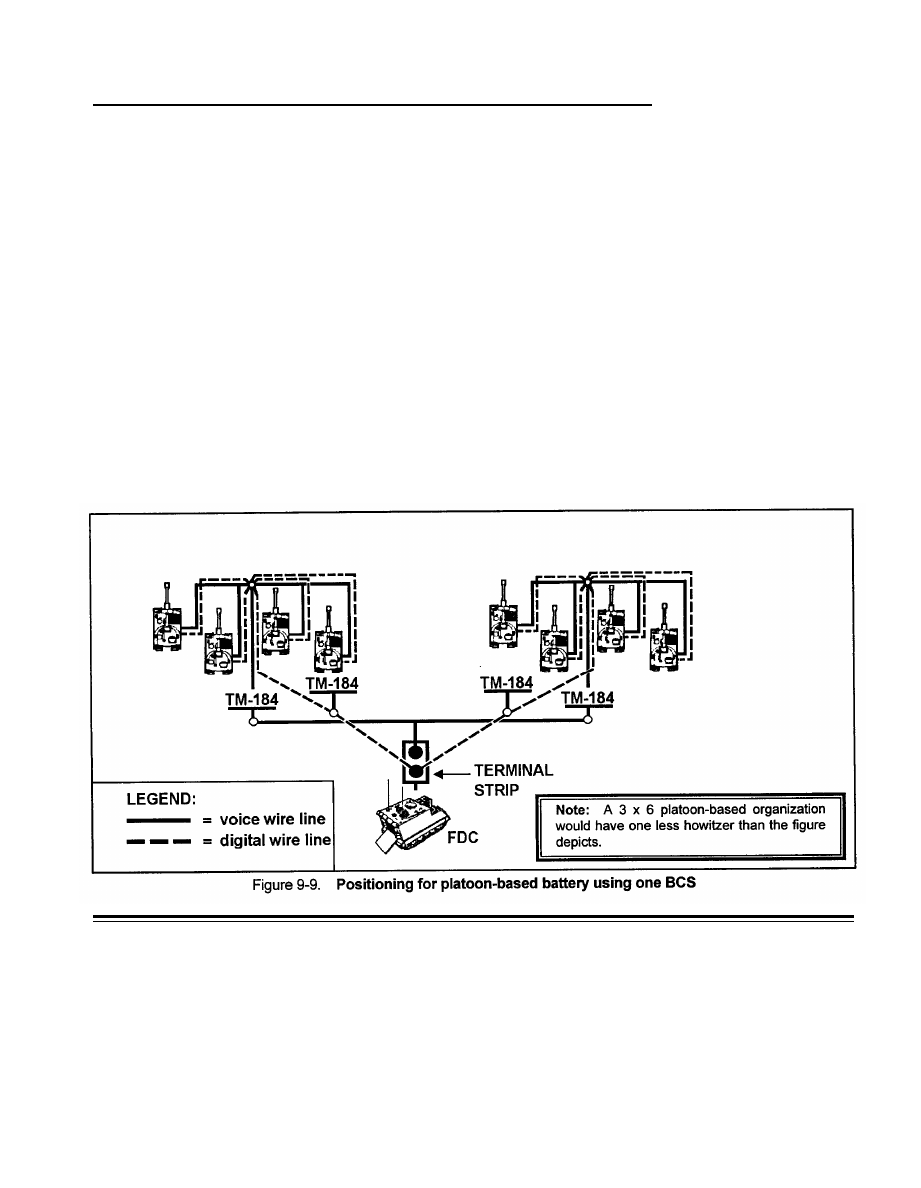
(5) Special positioning considerations for a platoon-

based battery using one BCS is in Figure 9-9.

(6) Two wire lines must go to each gun-one voice and

one digital. TA-312s should not be hooked up on the digital

line once digital traffic begins.

h. NICAD Batteries. 

Nickel-cadmium (NICAD) batteries

used in the GDU must be completely discharged before they

are recharged. These batteries have a memory; unless they

are discharged, they ultimately refuse to accept a recharge.
i. Digital Fire Commands. 

The section chief must view

the entire digital fire command on every round. If in a

hurry, he may see only charge, deflection, and quadrant.

This creates obvious problems when FFE is entered or when

shell, fuze, and/or fuze setting is changed.

j. Training.

Observer, FDC, and howitzer section

personnel must frequently participate in digital fire request

loop training to get the maximum benefit from the BCS.

The training set, fire observation (TSFO) is a tool which

aids in this training.
k. AN/PRC-68 or AN/PRC-126 and GDU. 

The AN/PRC-68

or AN/PRC-126 (or other VHF-FM radio) can be connected to

the case assembly, thus dispensing with wire to the GDU. Cables

W33 or W34 are used for the signal, and W34 or W34A are

used for power. (See TM 11-7440-283-12-2 and paragraphs 9-4

and 9-5 of this publication.)

9-9

-------------------------------------------------------------------------------------------------------------------------------------------------------------

FM 6-50, MCWP 3-1.6.23

CHAPTER 10

AMMUNITION

a.

10-1. REFERENCES

The 

combination of current and developmental ammunition

with that being developed makes it essential that battery

supervisors keep current on the latest changes. The following

references will help them:

TM 9-1300-251-20, Table 3-2, gives detailed information

on ammunition component inspection criteria. Chapter 3

explains how to correct any deficiencies noted. Appendix

M indicates what maintenance the crew and ammunition

sections are authorized to perform.
b. TM 

43-0001-28 gives detailed characteristics of primers,

projectiles, propellants, and fuzes. It includes combination

and compatibility charts for all artillery weapons and

ammunition components.

c. 

TM 9-1300-206 gives detailed information on complete

precautions for handling artillery ammunition.
d. 

The operator’s manual for the weapon system gives

information on the ammunition authorized for use with that

system.

e. 

Appendix M to this publication outlines characteristics

of FA cannons, and Appendix N discusses interchangeability

of ammunition for those weapons.

10-2. EXTERIOR COMPONENTS OF

AN ARTILLERY PROJECTILE

Since the first projectile was manufactured, the demand for

greater accuracy and greater range has influenced projectile

design. Without specifically constructed shapes and exterior

parts, there would be no standard ballistic characteristics for

any group or type of projectiles.

A lack of ballistic

standardization would prevent the computation of firing

tables.

Modern projectiles are designed for maximum

stability and minimum air resistance in flight. The exterior

components of an artillery projectile are shown in Figure

10-1 and explained below.

a. Eyebolt Lifting Plugs and Fuze Well Plugs. 

A

separate-loading projectile has an eyebolt lifting plug. Other

types of projectiles have metal hex-head or plastic closing

plugs. The plug is for lifting; to keep the fuze well clean,

dry, and free of foreign matter; and to protect the fuze well

threads. The plug is removed, and the appropriate fuze is

inserted at the firing position.

Some special-purpose

semifixed projectiles are issued with the fuzes already

assembled in the projectile.

b. Ogive. 

The ogive is the curved portion of a projectile

between the fuze well and the bourrelet. It streamlines the

forward portion of the projectile. The curve of the ogive

usually is the arc of the circle, the center of which is located

in a line perpendicular to the axis of the projectile and the

radius of which is generally 6 to 11 calibers.
c. Bourrelet.

The bourrelet is an accurately machined

surface that is slightly larger than the body and located

immediately to the rear of the ogive. It centers the forward

part of the projectile in the tube and bears on the lands of

the tube. When the projectile travels through the bore, only

the bourrelet and the rotating band of the projectile bear on

the lands of the tube.
d. Body.

The body is the cylindrical portion of the

projectile between the bourrelet and the rotating band. It

is machined to a smaller diameter than the bourrelet to reduce

the projectile surface in contact with the lands of the bore.

The body contains most of the projectile filler.
e. Rotating Band. 

The rotating band is a cylindrical ring

of comparatively soft metal that is pressed into a knurled,

or roughened, groove near the base of the projectile. It

mates with the forcing cone of the tube to eliminate gas

wash (blow-by) and to provide forward obturation. The

rotating band, in conjunction with the rifling of the tube,

imparts spin to the moving projectile. A properly rammed

separate-loading projectile is held in the tube at all angles

of elevation by the wedging action of the rotating band against

the forcing cone.

10-1

-------------------------------------------------------------------------------------------------------------------------------------------------------------

FM 6-50, MCWP 3-1.6.23

f. Obturating Band. 

On some projectiles, there is a nylon

obturating band below the rotating band to help in forward

obturation. Two examples of 155-mm projectiles with this

type of a band are the illuminating round and the

high-explosive rocket-assisted round.
g. Base. 

The base is that portion of the projectile below

the rotating band or obturating band. The most common

type is known as the boattail base. This type of base

streamlines the base of the projectile, gives added stability

in flight, and minimizes deceleration by reducing the

vacuum-forming eddy currents in the wake of the projectile

as it passes through the atmosphere,

h. Base Cover. 

The base cover is a metal cover that is

crimped, caulked or welded to the base of the projectile. It

prevents hot gases of the propelling charge from coming in

contact with the explosive filler of the projectile through

possible flaws in the metal of the base.

10-3. PROJECTILE PAINTING

AND MARKING

The main reason for painting a projectile is to prevent rust.

However, painting is also used to identify the various types

of ammunition.
a. Identification. 

The basic colors used for many years

were olive drab (OD) for high-explosive rounds, gray for

chemical rounds, blue for practice rounds, and black for

drill rounds. A system of contrasting color markings or

bands in addition to the basic color has also been used to

identify the particular type of high explosive or chemical

used as a filler. Color coding of recently produced projectiles

is somewhat different. For example, illuminating and smoke

rounds are no longer painted gray, the basic color for chemical

shells. Illuminating rounds are now painted basically white

or olive drab, and the smoke rounds are painted green. The

basic color for dummy ammunition has been changed to

bronze.
b. Weight.

Variations in weight are inherent in the

manufacture of projectiles. Since a high degree of accuracy

is required in artillery firing, one must compare the data

stenciled on the projectile (Figure 10-2) with the data provided

in the firing tables to obtain the proper ballistic corrections.

The weight zone marking symbols for projectiles are shown

in Table 10-1.
c. Ammunition Lot Number. 

When ammunition is

manufactured, an ammunition lot number is assigned in

accordance with pertinent specifications. This lot number

is an essential part of the ammunition marking. When the

size of the item permits, this lot number is stamped or marked

on the item itself and on all packing containers. The lot

number is required for all records, including reports on the

ammunition condition and functioning and on any accidents

in which the ammunition is involved. To ensure uniform

functioning, all the components in any one lot are

manufactured under conditions as nearly identical as

practicable. When semifixed ammunition is fired, successive

rounds should be of the same lot number so that maximum

accuracy is obtained. When separate-loading ammunition

is fired, successive rounds should consist of projectiles of

the same lot number, propelling charges of the same lot

number, fuzes of the same lot number, and primers of the

same lot number.
d. National Stock Numbers and Department of Defense

Ammunition Code. 

National stock numbers (for example,

NSN 1320-00-529-7331) have replaced the old Federal stock

numbers (FSNs), the old ammunition identification codes

(AIC), and ordnance stock numbers. Each item of supply

has a different national stock number. The first four digits

of a national stock number are always the Federal supply

classification (FSC) to which the item belongs. The next

two digits identify the country of origin. Continental United

States, for example, uses 00 and 01. Some of the other

NATO countries use their assigned digits, such as 12 for

Germany, 15 for Italy, and 21 for Canada to mention just

a few. The next seven digits constitute the national item

identification number (NHN). The dash between the third

and fourth digits of the NIIN serves to reduce errors in

transmitting. Each item has a different NIIN. A Department

of Defense identification code (DODIC) is added as a suffix

to the national stock number; for example, 1320-00-529-7331

(D544). The Department of Defense ammunition code

(DODAC) is made up of eight characters—the four-character

FSC code number and the DODIC. For example, 1320-D544,

a typical DODAC, consists of FSC class 1320 and DODIC

D544, which identifies a 155-mm HE projectile M107, and

the NSN 1320-00-529-7331 indicates that the projectiles are

packed eight per wooden pallet. The same DODIC suffixed

to more than one NSN indicates items that are

interchangeable. (See Appendix N.)

10-2

-------------------------------------------------------------------------------------------------------------------------------------------------------------

FM 6-50, MCWP 3-1.6.23

10-4. CARE AND HANDLING OF

AMMUNITION

a. 

If ammunition is to function properly, it must be handled

properly. Some of the basic principles of proper handling

are listed below:

(1) Never tumble, drag, throw,

projectiles or boxes of projectiles.

(2) Do not allow smoking, open

or drop individual

flames, or other fire

hazards around ammunition storage areas.

(3) Inspect each round before it is loaded for firing.

Dirty ammunition can damage the weapon, cause the breech

not to close, or affect the accuracy of the round.

(4) Keep the ammunition dry and cool.
(5) Never make unauthorized alterations or mix

components of one lot with another.

(6) If a round has been rammed and then must be

extracted, return it to the battalion ammunition section. The

rotating band or the fuze may be damaged and should not

be fired.

(7) Leave the eyebolt lifting plug or closing plug

screwed into the fuze well until the round is to be fuzed.
b. Care and handling of projectiles, fuzes, propelling

charges, flash reducers, primers, and cartridge cases are

discussed in paragraphs 10-5 through 10-10.

10-5. PROJECTILES

a. 

Projectiles must be inspected to ensure the following

conditions:

(1) There is no leakage of the contents.
(2) The projectile is correctly assembled.

(3) The rotating band is in proper condition. If the

rotating band is stained or discolored, that minor deficiency

can be removed with fine sandpaper or steel wool. Projectiles

with rotating bands which have minor dents or cuts can be

fired. However, if dents or cuts go through the band, the

round should be rejected by the using unit. The grommets

must be secured and tight to prevent nicks and scarring of

the rotating band or obturation band.

b. Most HE projectiles issued for use with proximity VT

fazes are standard projectiles with deep fuze cavities to

accommodate the longer VT fuze. Each of these projectiles

is issued with a removable supplementary charge so that

the projectile may be used with an impact, a mechanical

time or a long intrusion (VT) fuze. The supplementary charge

is removed only when the projectile is used with a long

intrusion VT fuze. It must be in place when the projectile

is used with a mechanical time fuze, impact fuze, or short

intrusion VT fuze.

10-3

-------------------------------------------------------------------------------------------------------------------------------------------------------------

FM 6-50, MCWP 3-1.6.23

CAUTION

Do not try to remove the supplementary charge by

any means other than the lifting loop. If the charge

cannot be removed by the lifting loop, the round may

be disposed of or fired with an impact or an MTSQ

fuze. The deep cavity maybe lined with a paper tube

and bottom cup, which help support the high-explosive

filler. This lining should not be removed at any time.

c. Because of their contents, toxic chemical and the WP

shells require special handling and storage.

(1) Chemical rounds.

(a) When toxic chemicals are being fired, all personnel

in the area should wear protective masks and anyone handling

the shell should wear gloves.

(b) An ample supply of decontaminating agents should

be available in case they are needed.

(c) If possible, these shells should be stored away from

other types of ammunition and downwind of the battery area.

(2) White phosphorus. WP rounds (except for the M825

and M825A1) should be stored upright on their base at all

times. The filler of these rounds will melt at a temperature

of 111.4°F. As a result, the filler shifts and the ballistic

characteristics of the rounds change. The WP shell should

be in an area free of any combustible materials and away

from other ammunition if possible. (This also applies to the

M825 projectiles.)

10-6. FUZES

a. 

The specific fuzes available for each weapon are

discussed in the technical manual for the weapon.
b. 

Fuzes are sensitive to shock and must be handled with

care.

c. 

Before fuzing a round, inspect the threads of the fuze

and fuze well for cleanliness and serviceability.

d. 

The fuze should be screwed into the fuze well slowly

until flush with the nose of the projectile. Using the M16

or Ml8 fuze wrench (as appropriate), back the fuze up

one-quarter turn, then snap the fuze wrench back to secure

the fuze.

e. After tightening the fuze, ensure that there is no gap

between the nose of the projectile and the fuze. If a gap

exists, remove the fuze from the projectile and segregate

both from the ammunition. Premature detonation may occur

if a fuze is not properly seated.

f. 

A projectile fuzed with a time fuze should not be lifted

with a hand around the fuze. A slip of the hand might

change the fuze setting.
g. 

Normally, fuzes containing superquick elements should

not be used during rainstorms or hailstorms. They may

detonate if struck by rain or hail. However, a new rain

insensitive fuze, M739A1, has been developed and is

available to be fired through storms with reduced possibility

of premature functioning.

Note: 

Units must be aware of the ammunition

restrictions that apply to their caliber of weapons.

Restrictions are in the technical manual for the

weapon.

h. 

To prevent the accidental functioning of the

point-detonating elements of fuzes M564 and M548, the

fuzes must not be dropped, rolled, or struck under any

circumstances. Special care must be taken to ensure that a

fuzed round does not strike the breech of a weapon during

loading.
i. 

Any mechanical time fuze that is set and not fired must

be reset to SAFE; and the safety wires (if applicable) must

be replaced before the fuze is repacked in the original carton.

Note: Never fire a projectile without a fuze or with a

fuze that is not authorized for that projectile.

10-7. PROPELLING CHARGES

a. 

Procedures for preparing and verifying propelling

charges are published in respective weapon technical

manuals. These procedures are safe, simple, and easy to

train.

CAUTION

When firing multiple-round missions, the possibility

of firing an incorrect charge is greater than when firing

single-round missions because of increased tempo

and because sections are rarely allowed to fire

multiple-round missions during training. Procedures

in the weapon technical manual always must be used.

b. 

Propelling charges, or powder, like other components

of ammunition, must be kept cool and dry. Powder containers

must be closed tight to keep moisture out.
c. 

Propellant bags must be firm, clean, and well laced or

tied; and the increments must be inserted in the proper

sequence.

10-4

-------------------------------------------------------------------------------------------------------------------------------------------------------------

FM 6-50, MCWP 3-1.6.23

d. 

Propellant must be inspected before the charge is

prepared. The following are examples of things to check:

Missing increments, extra increments and/or incorrect

sequencing (order) of increments.
Increment bags. Bags must not be damaged to the

extent that black powder or propellant spills out.
Rotting (chemical odor).
The red igniter pad on the base of the base charge

(155-mm propelling charges).

e. 

Do not fire unused powder increments. They should

be removed to some storage area (commonly called a powder

pit) preferably 30 to 40 feet from the nearest weapon, until

they can be burned or otherwise disposed of. The procedures

for burning powder are discussed below:

(1) For safety, select a burning site at least 200 feet

from grass and loose debris as well as personnel and

equipment.

(2) Determine the direction of the wind.
(3) Place charge increments in a single layer row not

more than 12 inches wide.

(4) Arrange the row so that the powder will burn into

the wind (Figure 10-3).

(5) Lay a train of combustible material about 15 feet

long, perpendicular to, and at the downwind end of the row

of charge increments. Light this train at the end farthest

from the increments (Figure 10-3).
f. Burning powder creates a very large flash and a lot of

smoke. In a tactical environment, the platoon leader must

ensure that burning powder does not compromise the

camouflage and concealment effort,

10-8. FLASH REDUCERS

a. 

For some propellants, separate flash reducers containing

black powder and potassium sulfate must be used to reduce

flash at night. The flash reducers speed up the combustion

of unburned propellant gases, which helps prevent excessive

muzzle blast.
b. 

Flash reducers absorb moisture readily, so they must

be kept dry. Keep them off of damp ground and sealed in

their containers until needed for use.
c. 

Destroy flash reducers as shown in Figure 10-3. Flash

reducers the highly flammable. It is critical that they be

disposed of properly to prevent injury.
d. 

The M119A2 charge 7 red bag propellent for 155 mm

is manufactured with flash reducers attached. Do not remove

these from the propelling charge.

10-9. PRIMERS

a. 

Primers are sensitive to both shock and moisture. Primers

for separate-loading ammunition should be kept away from

the propellant bags and left in their sealed containers until

needed.

Note: 

Older series propellants may contain the

MK4A2 primer. This primer is not authorized to be

fired with any howitzer currently in use. Ensure that

these primers are not fired and are turned in to the

ammunition section.

b. 

Primers for semifixed ammunition are attached to the

base of the cartridge case. The best way to protect them

is to leave them covered with a fiber container cap until

needed.
c. 

Before use, inspect all primers for signs of corrosion.

If a seal has been broken, it is very likely that the primer

has been affected by moisture and should be turned in.

10-10. CARTRIDGE CASES

a. The 

cartridge case of semifixed ammunition should be

checked for corrosion. Light brown staining is normal

oxidation; but black, green, yellow, or white stains mean

heavy corrosion, which must be cleaned off as soon as

possible (see Figure 10-4, page 10-6).

b. 

Cartridges must be checked for cracks, bulges, and burs.

c. 

The primer must be flush with the base of the cartridge.

If it sticks out too far, it is dangerous. If it sits in too far,

the round will not fire. (See Figure 10-5, page 10-6.)

10-5

-------------------------------------------------------------------------------------------------------------------------------------------------------------

FM 6-50, MCWP 3-1.6.23

10-11. SEGREGATION OF

AMMUNITION LOTS

a. 

Different lots of propellant burn at different rates and

give different effects in the target area. For this reason, the

registration corrections derived from one lot do not

necessarily apply to another lot. Ammunition must be

segregated by lot.
b. 

The FDC designates the lot of ammunition to be fired

for each mission (or it is standardized). Therefore, the lot

designator should be prominently displayed for each stack

of ammunition.
c. 

Whether stored in the field, on vehicles, or at an

ammunition supply point (ASP), different lots of ammunition

must be conspicuously marked.

10-12. FIELD STORAGE OF AMMUNITION

a. The 

four greatest hazards to ammunition in the battery

area are weather, enemy fire, improper handling, and careless

10-6

smokers. Regardless of the method of storage, these hazards

must be considered.

Specific storage techniques are

discussed later, but here are some general considerations:

(1) Stack ammunition by type, lot number, and weight

zone (Figure 10-6).

(2) If ammunition is being stored on the ground, use

good strong dunnage at least 6 inches high under each stack

(Figure 10-7).

(3) Keep the ammunition dry and out of direct sunlight

by storing it in a vehicle or covering it with a tarpaulin.

Be sure adequate ventilation is provided (Figure 10-8).

-------------------------------------------------------------------------------------------------------------------------------------------------------------

FM 6-50, MCWP 3-1.6.23

(4) Provide ammunition, if off-loaded, as much

protection from enemy indirect fires as time and available

materials allow. If sandbags are used for protection, keep

the walls at least 6 inches from the stacks and the roof at

least 18 inches from the stacks to ensure proper ventilation.
b. 

Particular attention must be paid to ammunition

temperature. Most ammunition components can be stored

at temperatures as low as -80°F for periods of not more

than 3 days and as high as +160°F for periods of not more

than 4 hours per day. An increase in malfunctions may be

experienced with some VT fuzes when the temperature is

below 0° or above 120°F. Powder temperature affects the

muzzle velocity of a fired round and is a matter of frequent

concern to the FDC. At least two howitzer sections should

be designated to keep track of the powder temperature. A

powder thermometer is inserted into the top powder increment

in the canister, and care must be taken to ensure the

thermometer does not touch metal.

Note: 

Cannon sections must be careful not to fire

the powder thermometer.

c. 

Only enough ammunition to meet current needs should

be prepared for firing.

10-13. STORAGE AND

TRANSPORTATION

TECHNIQUES

a. 

In SP units, the M992 combat ammunition tracked vehicle

is the companion vehicle to the howitzer. It serves as an

area from which to service the weapon as well as a storage

area for ammunition. This vehicle should be positioned with

its howitzer and replenished in the battery area by the

ammunition section. Ammunition should be left in pallets

until needed for use.

Note: 

Be sure pallets are adequately cribbed and

secured to prevent them from shifting during

movement.

b. 

To increase the ammunition-carrying capability of

cannon batteries, additional M332 ammunition trailers are

authorized in the TOE. Although mobility may be degraded

somewhat, an M332 trailer should be pulled by each of the

ammunition vehicles currently shown in various TOEs.

These are the M992 and the 2½-and 5-ton trucks. These

1½-ton trailers can—

Increase organic hauling capability,
Facilitate resupply and backhaul operations, and

Permit ammunition component segregation (to reduce

the battery’s vulnerability to counterfire).

c. 

In towed units, the prime mover, loaded with ammunition,

should be positioned near the howitzer. Ammunition should

be left loaded until it is prepared for firing. Other ammunition

is stored on the battery ammunition section vehicles, or at

a battery ammunition dump. The establishment of a battery

ammunition dump is a matter of command decision, because

it seriously impairs the mobility of the battery.
d. 

Appendix E provides the load plan for the M925 5-ton

truck for Ml 98 units.
e. The M992A1 CATV has specific storage locations for

ammunition components depicted in its operator manual (TM

9-2350-267-10).
f. 

The artillery uses the 11 ton heavy expanded-mobility

tactical truck (HEMTT), heavy expanded-mobility

ammunition trailer (HEMATT), and the palletized load

system (PLS) for transporting large quantities of ammunition.

10-14. ACCIDENTS

Generally, firing accidents are serious, so all supervisory

personnel should know the immediate action to be taken.
a. 

If the ammunition or equipment presents further danger,

move all personnel out of the area.

b. 

Do not change any settings on, or modify the position

of, the weapon in any way until an investigation has been

completed.
c. 

Record the lot number of the ammunition involved in

the accident or malfunction, and report it to the battalion

ammunition officer. If there is good reason to suspect a

particular lot of ammunition, its use should be suspended.
d. 

If it is suspected that the propellant was ignited with

no recoil of the tube, misfire procedures must follow. Perhaps

no projectile was loaded and the propellant is still burning.

10-15. MISFIRE PROCEDURES

Misfires do occur. When they do, there are certain actions

that must be taken within specific time limits. For that

reason, personnel must be thoroughly familiar with the misfire

procedures for their weapon system. These procedures are

in AR 75-1 and weapons technical manual for the appropriate

weapons.

10-16. TRAINING

a. 

Traditionally, ammunition training has been a weak area.

Cannoneers seldom practice setting time fuzes or cutting

propellant charges until the battery goes to the field to conduct

live firing. There are several training extension course (TEC)

10-7

-------------------------------------------------------------------------------------------------------------------------------------------------------------

FM 6-50, MCWP 3-1.6.23

lessons on ammunition to enhance individual training. Also,

cutting charges, loading, and firing. Keep an up-to-date

your Training and Audiovisual Support Centers (TASCs)

TASC catalog, and take advantage of these devices.

have a wide selection of ammunition training materials.

10-17. AMMUNITION PLANNING GUIDE

b. 

Collective training is enhanced by using training rounds,

which are available through the local TASC. New training

Tables 10-2 through 10-4, pages 10-9 through 10-11, give

rounds are constantly introduced into the training aids

information on ammunition available for various FA

inventory. These rounds are designed to train the entire

weapons. (Figure 10-9 provides a list of acronyms and

howitzer crew--from loading ammunition to setting fuzes,

abbreviations for Tables 10-2 through 10-4.)

10-8

-------------------------------------------------------------------------------------------------------------------------------------------------------------

FM 6-50, MCWP 3-1.6.23

10-9

-------------------------------------------------------------------------------------------------------------------------------------------------------------

FM 6-50, MCWP 3-1.6.23

10-10

-------------------------------------------------------------------------------------------------------------------------------------------------------------

FM 6-50, MCWP 3-1.6.23

10-11

-------------------------------------------------------------------------------------------------------------------------------------------------------------

FM 6-50, MCWP 3-1.6.23

CHAPTER 11

SAFETY PROCEDURES

11-1. RESPONSIBILITIES

AR 385-63, Chapter 11, implements the chain-of-command

safety concept. Under this concept, the firing battery chain

of command is responsible for safety during firing, training,

and combat. This chapter reinforces AR 385-63. However,

if local range regulations are more restrictive than the material

in this chapter, the local range regulation must be followed.

Specific responsibilities for safety are fixed as discussed

below.
a. Commanders of Field Artillery Units 

Commanders

establish and maintain a safety training and certification

program for their personnel. The purpose of this program

is to train and quality individual members of the firing battery

in the safety procedures for their specific areas of

responsibility. When the responsible artillery commander

is satisfied that the individual members are qualified to

perform the safety duties as required in the firing battery,

he certifies them as competent to perform those duties.

Sample tests for qualification of safety personnel are in

Appendix O.

b. Battalion Commander. The 

FA battalion commander

is responsible for safety during all phases of a firing exercise

under his control. The commander selects, trains, and

certifies the personnel necessary to assist him in discharging

this responsibility. These personnel include, but are not

limited to, the firing battery commander, executive officer,

fire direction officer, firing platoon leader, chief of firing

battery, gunnery sergeant, FDC chief computer, and howitzer

chief of section. If any position is not filled by a command

safety-certified person, another person who is certified and

qualified to fill that position performs the safety checks.

Note: 

The title of platoon leader and platoon

sergeant (in the platoon-based unit) also pertains to

executive officer and chief of firing battery/USMC

battery gunnery sergeant (in the battery-based unit).

c. Officer in Charge. 

The officer in charge (OIC) is the

battery commander or his command safety-certified direct

representative. The OIC is responsible for all aspects of

safety in the firing unit and on the assigned firing range.

Before the firing exercise, the range control officer provides

the OIC the required safety data and any firing limitations.

The OIC verifies that the unit is in the proper firing position.

He supervises the conversion of the safety data into a safety

diagram and ensures that this diagram is verified by another

command safety-certified person.

The safety diagram

provides right and left direction limits, minimum and

maximum quadrant elevations for authorized charges, and

minimum safe fuze times. The safety diagram, modified

as necessary by minimum QE, is given to the appropriate

members of the firing battery. The OIC is responsible for

ascertaining locations of friendly personnel who may

inadvertently be exposed to artillery fires. He ensures

dissemination of this information to subordinate XOs, platoon

leaders, FDOs, chiefs of firing battery, platoon sergeants,

gunnery sergeants, and chiefs of section, as appropriate, so

they are aware of potential situations which might result in

fratricide.
d. Firing Platoon Leader. 

The firing platoon leader is

responsible for the safety practices of the firing element.

He will ensure that the chiefs of section have safety data.

He determines the lowest QE that can be safely fired from

his firing position and ensures that projectiles clear all visible

crests (min QE) (see Chapter 6). He is assisted by the FDO,

platoon sergeant, and the gunnery sergeant.
e. Fire Direction Officer.

The FDO has primary

responsibility for computing safety data and ensuring all

safety diagrams are updated after registrations and receipt

of current met data. He is responsible for plotting the impact

area on a map or chart in the FDC. He is assisted in his

duties by the chief computer. He ensures all firing data are

within prescribed safety limits before they are sent to the

firing sections. He adjusts minimum QE for intervening

crests.
f. Platoon Sergeant.

The platoon sergeant helps the

platoon leader in his duties. He performs many of the platoon

leader’s duties in his absence. His main responsibilities are

laying the platoon, performing the duties as platoon leader,

and working in shifts with the platoon leader.
g. Howitzer Section Chief. 

The section chief supervises

all practices that take place at or near his weapon. These

include verifying that the announced safe data are applied

to his weapon and that the proper charge, fuze, and projectiles

are fired. He has the final responsibility for the firing of

his weapon.

h. Range Control Officer. 

The range control officer gives

the OIC of the firing unit the following safety data:

The grid coordinates of the firing position.
The lateral safety limits.

11-1

-------------------------------------------------------------------------------------------------------------------------------------------------------------

FM 6-50, MCWP 3-1.6.23

The minimum and maximum ranges.
The authorized ammunition to be fired (fuze, projectile

and charge).
The maximum ordinate (high angle or low angle).
The hours during which the firing may be conducted.

11-2. DUTIES OF SAFETY PERSONNEL

A separate battery safety officer is not required during the

firing of field artillery. Normally, the platoon leader will

perform these functions. The platoon leader is not required

to verify all data placed on the on-carriage fire control

equipment. He may use safety stakes, safety tape, or physical

constraints on the weapon to ensure that the safety limits

are not exceeded. All key personnel must be thoroughly

familiar with six references: AR 385-63, FM 6-40, FM

6-50, TM 43-0001-28, the appropriate TM for the weapon,

and local range regulations. In case of conflict, local range

regulations always take precedence.

Note: 

These references are guidelines that may be

used in developing units’ SOPs.

a. 

Specific duties of safety personnel before firing are, but

are not limited to, 

the following:

(1) Verify that the data the range control officer gives

the OIC apply to the unit firing, that the unit is in the correct

location, and that the data are correct. (OIC and safety

officer)

(2) Compute and verify the safety diagram. (At least

2 safety-certified personnel, normally the platoon leader and

FDO)

(3) Ensure that all personnel and equipment are clear

from surface danger area E before firing (see AR 385-63

for the dimensions of surface danger area E for specific

weapon systems).

(4) Check the DA Form 581 (Request for Issue and

Turn-In of Ammunition) and range safety card to ensure

that only authorized ammunition is fired. (Platoon leader

or platoon sergeant)

(5) Ensure no safety violations occur at or near the

weapon(s). (All members of the firing unit)

(6) Check the weapons for correct boresighting.

(Section chief)

(7) Verify the lay of the battery. (Platoon leader or

platoon sergeant)

(8) Compute and verify MIN QE. (Platoon leader or

FDO)

(9) Compare minimum QE with the QE for minimum

range shown on the safety diagram. Use the larger of the

two as the minimum QE. (Platoon leader or FDO)

(10) Verify that the section chief has safety data (safety

T). Ensure section chiefs are advised of all friendly personnel

in the area that may inadvertently be exposed to FA direct

or indirect fires. (Platoon leader or platoon sergeant)

(11) Supervise and check the emplacement of safety

aids (stakes, tape, and other devices). (Platoon leader, platoon

sergeant, or gunnery sergeant)

(12) Verify that range clearance has been obtained.

(Platoon leader or FDO)
b. 

Specific duties of safety personnel during firing are,

but are not limited to, 

the following:

(1) Verify the serviceability of ammunition. (Section

chief)

(2) Supervise key safety personnel in the performance

of their duties. (OIC or safety officer)

(3) Verify that the charges, projectiles, and fuzes being

fired are only those prescribed on the safety card. (Section

chief, platoon leader, or platoon sergeant)

(4) Visually inspect to ensure that the correct shell-fuze

combination, time if required, and charge are properly

prepared and loaded on each round. Verify that the correct

number of remaining powder increments are removed to the

powder pit before loading and firing each round. (Section

chief)

(5) Verify that rounds are not fired below the minimum

QE or above the maximum QE. (Section chief, platoon

leader, or platoon sergeant)

(6) Verify that rounds are not fired outside the lateral

(deflection) safety limits specified on the safety card.

(Section chief, platoon leader, or platoon sergeant)

(7) Verify that time-fuzed rounds are not fired with

fuze settings that are less than the minimum time prescribed

on the safety diagram. (Section chief, platoon leader, or

platoon sergeant)

(8) On all commands that are unsafe to fire, command

CHECK FIRING 

and give the reason(s) why the command

is unsafe. (Section chief)

11-2

-------------------------------------------------------------------------------------------------------------------------------------------------------------

FM 6-50, MCWP 3-1.6.23

EXAMPLES

UNSAFE TO FIRE, 3 MILS OUTSIDE RIGHT SAFETY

LIMIT AND 20 MILS ABOVE MAXIMUM QUADRANT

ELEVATION.

and

UNSAFE TO FIRE, 5 MILS BELOW MINIMUM

QUADRANT ELEVATION.

(9) Recompute and issue updated safety Ts under the

following conditions: (FDC)

When a registration is completed.
When met conditions change.
When restrictions change.

(10) Suspend firing when any unsafe condition exists.

(Any person who sees an unsafe act) Examples of unsafe

conditions are as follows:

Powder bags exposed to fire.
Personnel smoking near pieces of ammunition.
Improper handling of ammunition.
Time fuze previously set and not reset to safe.
Personnel or aircraft directly in front of the

weapon.
Primer inserted into the firing assembly before breech

is closed (separate-loading ammunition).

Failure to inspect powder chamber and bore after each

round is fired.
Failure to swab powder chamber after each round of

separate-loading ammunition is fired.

c. 

Specific duties of safety personnel after firing are, but

are not limited to, 

the following:

(1) Verify that unused powder increments are disposed

of at an approved place in the correct manner.

(2) Verify that all unfired ammunition is properly

accounted for, repacked, and returned to the ammunition

resupply point.

(3) Verify police of the firing position.
(4) Verify that all safety Ts are collected and properly

disposed of.

11-3. SAFETY AIDS

a. 

From the range safety card, the fire direction officer

prepares a safety diagram and safety Ts for use by the

safety-certified personnel. Safety aids are used to ensure

that only safe data are fired from the position. Two such

safety aids are the safety stakes and safety tape. These aids

are then used as a visual check to ensure that the howitzer

is laid within safety limits.
b. 

Emplace safety aids for the M101A1 howitzer as follows:

(1) Deflection safety aids.

(a) Set off the left deflection limit on the pantel using

the non-slipping scale. Traverse the tube to establish the proper

sight picture on the aiming point.

(b) Place the safety stake against the left side of the

tube, and drive it firmly into the ground.

(c) Mark the right deflection limit in the same manner,

but emplace the safety stake on the right side of the tube.

(2) Quadrant Elevation Safety Aids.

(a) Set off the maximum QE on the range quadrant.
(b) Mark the elevation scale with a piece of tape in line

with the index mark.

c.

as

(c) Mark the minimum QE in the same manner.

Emplace safety aids for the M 102 or M119A1 howitzer

follows:

(1) Deflection safety aids.

(a) Set off the left deflection limit on the pantel

by using the deflection counter. Traverse the tube to establish

the proper sight picture on the aiming point.

(b) Emplace the safety stake against the right side of

the lunette and drive it firmly into the ground.

(c) Mark the right deflection limit in the same manner,

but emplace the safety stake on the left side of the lunette.

(2) Deflection safety aids (M119A1).

(a) Lay in the center of traverse (A, Figure 11-1, page

11-4).

(b) Determine the left limit and traverse the tube to the

maximum left. Traverse the carriage right until the tube is at the

left limit. Emplace the left limit safety stake as shown in B, Figure

11-1.

(c) Determine the right limit, and traverse the tube to

the maximum right. Traverse the carriage left until the tube is at

the right limit. Emplace the right limit safety stake as shown in

C, 

Figure 11-1.

11-3

-------------------------------------------------------------------------------------------------------------------------------------------------------------

FM 6-50, MCWP 3-1.6.23

(3) Quadrant elevation safety aids.

(a) Use the cam follower as an index mark.
(b) Set off the maximum QE on the fire control

quadrant. Elevate the tube until the bubbles center in the

elevation level vials.

(c) Mark the cam with apiece of tape in line with the

cam follower.

(d) Mark the minimum QE in the same manner.

d. 

Emplace safety tape on the M198 howitzer as follows:

(1) Deflection safety aids.

(a) With the tube parallel to the azimuth of lay,

(deflection 3200) place apiece of tape over the azimuth counter

(bottom carriage).

(b) Set off the left deflection limit on the pantel by

using the deflection counter. Traverse the tube to establish the

proper sight picture on the aiming point.

(c) Using a straightedge, draw a line on the tape placed

on the bottom carriage directly below the azimuth counter index

mark found on the upper carriage. Record the left deflection limit

next to that line.

(d) Mark the right deflection limit in the same manner.

(2) Quadrant elevation safety aids.

(a) With the tube elevated at 0 mils, place a piece of

tape on the trunnion support, and draw a straight line as an index.

(b) Set off the minimum QE on the fire control quadrant.

Elevate the tube until the bubble centers in the elevation level

vial.

(c) Place a piece of tape on the quadrant mount. Draw

a line across from the index line established on the trunnion

support. Record the minimum QE next to that line.

(d) Mark the maximum QE in the same manner.

e. 

Emplace safety aids on the M109A2-A5 howitzer as

follows:

(1) Deflection safety aids. These may be marked on

the exterior and/or interior of the hull.

(a) Make an index mark on the top carriage with a piece

of tape.

(b) Set off the left deflection limit on the pantel using

the reset counter. Traverse to pickup a proper sight picture on

the aiming point.

(c) Place a piece of tape on the bottom of the carriage

directly under the index mark.

(d) Mark the right deflection limit in the same manner.

(2) Quadrant elevation safety aids. These may be

marked on the exterior or the interior of the weapon. Emplace

the safety aids on the interior of the weapon, as shown in

paragraph d(2) above. Mark the exterior of the weapon as

follows:

(a) Mark an index on the tube with a piece of tape.
(b) Set off the maximum QE on the fire control

quadrant. Elevate the tube until the bubble centers in the elevation

level vial.

(c) Place a mark on the top carriage in line with the

index mark.

(d) Mark the minimum QE in the same manner.

11-4. SAFETY COMPUTATIONS

a. 

Information on manual safety computations is in FM

6-40, Appendix B.

b. 

Safety can be computed by computer, using the

automated range safety system (ARSS).

11-4

-------------------------------------------------------------------------------------------------------------------------------------------------------------


Content      ..     8      9      10      11     ..