MCWP 3-16.3 FM 6-50 TTP for the Field Artillery Cannon Gunnery - page 8


  Главная      Manuals     MCWP 3-16.3 FM 6-50 TTP for the Field Artillery Cannon Gunnery


Search            copyright infringement  


Content      ..     6      7      8      9     ..


MCWP 3-16.3 FM 6-50 TTP for the Field Artillery Cannon Gunnery - page 8


FM 6-50, MCWP 3-1.6.23

5-20
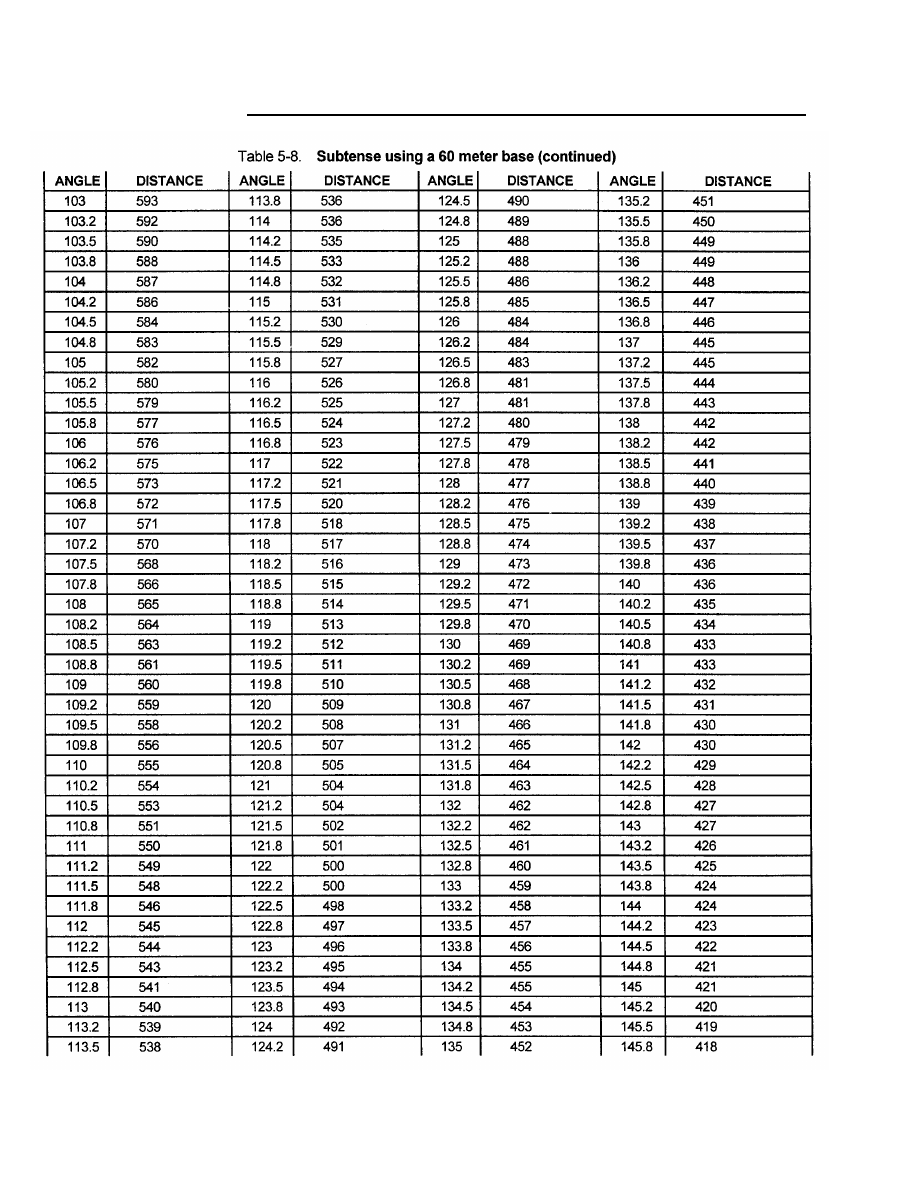
-------------------------------------------------------------------------------------------------------------------------------------------------------------

FM 6-50, MCWP 3-1.6.23

5-21

-------------------------------------------------------------------------------------------------------------------------------------------------------------

FM 6-50, MCWP 3-1.6.23

5-22

-------------------------------------------------------------------------------------------------------------------------------------------------------------

FM 6-50, MCWP 3-1.6.23

5-11. AUTOMATED COMPUTATIONS

a. 

The BCS and LCU allow battery commanders to disperse

their howitzers over larger position areas than ever before.

BCS and BUCS have weapon location routines that allow

us to determine the grid location and altitude of each howitzer

by simply entering the azimuth, distance, and vertical angle

to the howitzer from the orienting station (mnemonic

ORSTA). Thus, we can use this application to help us

determine grid locations and altitudes to traverse stations

while performing a graphic traverse.
b. 

Location and altitude at each of the traverse stations

are determined by entering a number of successive polar

coordinates (direction, distance, and vertical angle) in the

weapon location tile.

5-12. AFU INPUT FOR GRAPHIC

TRAVERSE USING BUCS, REV 1

Note: 

ST 6-40-31 is the user’s manual for BUCS

Rev 1. Any Rev 1 read only memory (ROM) can be

used for this procedure. The caliber of weapon

system does not matter.

The only information

required in the database to begin this procedure is the

map modification (MAPMOD).

Follow the steps and information in Table 5-9 to determine

location and altitude with BUCS.

5-23

-------------------------------------------------------------------------------------------------------------------------------------------------------------

FM 6-50, MCWP 3-1.6.23

5-24

-------------------------------------------------------------------------------------------------------------------------------------------------------------

FM 6-50, MCWP 3-1.6.23

5-13. ALTITUDE DETERMINATION

In the absence of altitude data provided by battalion surveyors,

altitude is obtained directly from the map.

Once the

coordinates of the desired point have been determined by

the precision lightweight GPS receiver, graphic resection or

graphic traverse, the altitude of this point is taken from the

map sheet. Normally, altitude can be considered to be

accurate to half the contour interval.

5 - 2 5

-------------------------------------------------------------------------------------------------------------------------------------------------------------

FM 6-50, MCWP 3-1.6.23

CHAPTER 6

MINIMUM QUADRANT ELEVATION

6-1. RESPONSIBILITIES

The platoon leader is responsible for determining the lowest

quadrant elevation that can be safely fired from his platoon

position that will ensure projectiles clear all visible crests.

Note: 

All references to platoon leader will apply to

the executive officer as well. Also, the gunnery

sergeant is responsible for these same duties prior to

the platoon’s occupation of position.

6-2. ELEMENTS OF COMPUTATION

Use of the rapid fire tables (Appendix K) is the fastest method

of computing minimum quadrant elevation (min QE).

Manual computations are more accurate than the rapid fire

tables and must be used if the sum of the vertical angle and

the angle needed for a 5-meter clearance is greater than 300

mils. The tables were not constructed for the value of the

sum of Angles 1 and 2 to exceed 300 mils. Figure 6-1

shows the elements of minimum quadrant elevation.
a. 

Piece-to-crest range (PCR) is the horizontal distance

between the piece and the crest, expressed to the nearest 100

meters.

Procedures for measurement are discussed in

b. 

Angle 1, Figure 6-1, is the angle of site to crest for the

weapon. See paragraph 6-3 for measuring procedures. The

largest site to crest will not necessarily yield the largest

minimum quadrant.
c. 

Angle 2, Figure 6-1, is the vertical angle required to

clear the top of the crest. For quick, time, and unarmed

proximity (VT) fuzes, a vertical clearance of 5 meters is

used. For armed VT fuzes, see paragraph 6-6.
d. 

Angle 3, Figure 6-1, is the complementary angle of site

(comp site). It is the comp site factor (from the TFT, Table

G) for the appropriate charge at the piece-to-crest range

multiplied by the sum of Angles 1 and 2. If the PCR is

not a listed value, use the next higher listed PCR. Site (si)

is the sum of Angles 1, 2, and 3.
e. 

Angle 4, Figure 6-1, is the elevation for the appropriate

charge corresponding to the PCR. A large PCR may cause

the value of Angle 4 to override the effects of site to crest

(Angle 1).

Therefore,  minimum quadrant must be

computed for each weapon and each charge to be tired.

f. 

Angle 5, Figure 6-1, is a safety factor equivalent to the

value of 2 forks (from the TFT, Table F) for the appropriate

charge at the PCR.
g. 

The greatest sum of Angles 1-5, Figure 6-1, is the

paragraph 6-4.

minimum quadrant elevation for the charge computed.

6-1

-------------------------------------------------------------------------------------------------------------------------------------------------------------

FM 6-50, MCWP 3-1.6.23

6-3. MEASURING ANGLE

OF SITE TO CREST

During advance party operations, site to crest is measured

with the M2 compass or M2A2 aiming circle (refer to chapter

4 for these procedures). If the M2 compass is used, add

20 mils to allow for the accuracy of the M2 compass. During

position improvement, the chief of section verifies the angle

of site to the crest and reports it to the platoon leader. To

verify the angle of site to crest, the chief of section, sights

along the bottom edge of the bore, has the tube traversed

across the probable field of fire and has the tube elevated

until the line of sight clears the crest at the highest point.

He then centers all bubbles on the elevation mount, and

reads the angle of site to the crest from the elevation counter.

The angle of site is read and expressed to the nearest whole

mil. This angle of site and PCR are reported as part of the

section chief’s report (paragraph 2-20).

6-4. MEASURING PIECE-TO-CREST

RANGE

a. 

There are five methods that can be used to measure

piece-to-crest range:

(1) Taping, the most accurate method, is normally too

time consuming.

(2) Subtense is fast and accurate.
(3) Map measurement is fast and accurate if the

obstacle can be located (for example, a lone tree will not

appear on a map).

(4) Pacing is time-consuming and dependent on the

distance and accessibility to the crest.

(5) Estimation is least accurate, but it is used when

other methods are not feasible.
b. 

Regardless of the method used, PCR must be verified

by the gunnery sergeant or platoon leader before computing

minimum quadrant elevation. He can do this by measuring

by one of the five methods listed above and comparing the

results.

6-5. COMPUTATION FOR FUZES OTHER

THAN ARMED VARIABLE TIME

a. 

The gunnery sergeant or platoon leader performs the

computations indicated in this section if the sum of angles

1 and 2, Figure 6-1, exceeds 300 mils or if the rapid fire

tables are not available. All angles are determined and

expressed to the next higher whole mil. He performs the

computation for all howitzers. The example below shows

his computations.

b. 

One howitzer section may report a sight to crest that is

unusually high. If the platoon leader determines that it is

due to a single narrow obstruction (such as a tree), that

piece may be called out of action when firing deflections

that would engage the obstruction. This would enable the

platoon to use the next lower minimum quadrant. Other

alternatives are to remove the obstruction or move the

weapon.

EXAMPLE

Gun 1 has a range to crest of 1,100 meters; the angle of

site to crest reported is +16 mils. Gun 1 is an M109A2

155-mm howitzer, and charge 3 green bag will be fired.

The platoon leader does the following:

Note: 

All computations are derived from AM-2 TFTs,

graphical firing tables (GFTs), and graphical site tables

(GSTs).

Angle 1: Records the angle of site reported by the

chief of section . . . . . . . . . . . . . . . . . . . . .  . . .+l6 mils
Angle 2: Determines the vertical clearance in mils.

He uses the GST to divide the vertical clearance in

meters (5 meters) by the PCR in thousands (1.1).

This value, read under the M gage point, is 4.6, and

is expressed to the next higher whole mil.

. . . . . . . . . . . . . . . . . . . . . . . . . . . . . . . . . . . . . . . . . . . . . . . . . . . . . . . . . . . . . .+5 mils

Note: 

The value for angle 2 can also be extracted from

the rapid fire tables (Appendix K).

Angle 3: Determines comp site by multiplying the

comp site factor corresponding to the piece-to-crest

range (or the next higher listed range in the TFT,

Table G, if that range is not listed) by the sum of

angles 1 and 2. Angle 1 + Angle 2 = +21. The

comp site factor corresponding to 1,500 meters

(range 1100 is not listed in Table G) is +0.010.

Therefore, +21 x 0.010= +0.210. Once a value for

comp site has been determined, it must be

expressed to the next higher whole mil.

. . . . . . . . . . . . . . . . . . . . . . . . . . . . . . . . . . . . . . . . . . . . . . . . . . . . +1 mil

Angle 4: Determines elevation for the PCR (TFT,

Table F, column 2). If this value is not a whole

number, it is expressed to the next higher whole mil

(74.1 expressed to 75) . . . . . . . . . . . . . . . . . . . . . . . . . ..+75 mils

Angle 5: Determines the value of 2 forks (TFT,

Table F, column 6) at PCR (2 x +2

mils) . . . . . . . . . . . . . . . . . . . . . . . . . . . . . . . . . .+4 mils

Total: Add angles 1-5 to determine the platoon

leader's minimum quadrant elevation.

16+5+1+75+4=101 mils QE, charge 3 GB

Therefore, the min QE for Gun #1, Chg 3GB, is 101 mils.

The platoon leader will compute the min QE for each

howitzer in his firing unit. The highest value is the XO

min QE for his tiring unit with this charge.

6-2

-------------------------------------------------------------------------------------------------------------------------------------------------------------

FM 6-50, MCWP 3-1.6.23

6-6. COMPUTING FOR ARMED VT

FUZES (LOW-ANGLE FIRE)

The 

method of computing the XO’s minimum QE for firing

a projectile fuzed with an M513, M514, M728, or M732

fuze depends on the method in which the fuze is used.
a. 

The proximity (VT) fuze is designed to arm 3 seconds

prior to the time set on the fuze; however, some VT fuzes

have armed as early as 5.5 seconds prior to the time set on

the fuze. Because of the probability of premature arming,

a safety factor of 5.5 seconds must be added to the time of

flight corresponding to the PCR. Since time on the setting

ring is set to the whole second, the time determined is

expressed up to the next higher whole second. A VT fuze

is designed so that it will not arm earlier than 2 seconds

time of flight, which makes it a bore-safe fuze.

b. 

In combat situations, the platoon leader determines the

minimum safe time and minimum quadrant elevation at the

piece-to-crest range. The QE determined for PD fuzed rounds

is safe for VT fuzes if the time set is greater than the min

safe time determined (paragraph a above). If the platoon

leader finds it necessary to fire a VT fuze with a time less

than the min safe time, the vertical clearance for the minimum

QE must be increased to ensure the fuze will not function

as it passes over the crest.
c. 

If the projectile is to be tired with the VT fuze set at

a time less than the minimum safe time, allowance must be

made for vertical clearance of friendly elements. Vertical

crest clearances for M513, M514, M728, and M732 VT

fuzes fired over ordinary terrain are shown in Table 6-1.

d. 

If the projectile is to be fired over marshy or wet terrain,

the average height of burst will increase. Therefore, the

vertical clearance shown in Table 6-1 should be increased

by 50 percent. If the projectile is to be tired over water,

snow, or ice, the vertical clearance shown in Table 6-1 should

be increased by 100 percent.
e. 

The minimum QE for fuze VT, when a fuze setting less

than the minimum safe time is fired, is based on PCR and

greater vertical clearance as indicated in Table 6-1 instead

of the 5 meters as stated in paragraph 6-2c.
f. The 

following is an example of computations to determine

minimum QE for armed VT fuzes.

EXAMPLE

The howitzer is a 155-mm M109A3, charge 4 green bag,

and armed variable time fuzes (M514) are to be fired.

The angle of site reported by the chief of section is +16

mils. The PCR is 1,700 meters. The platoon leader

computes the minimum QE as follows:

ANGLE 1: The angle of site to crest reported by the

chief of section  . . . . . . . . . . . . . . . . .+l6mils
ANGLE 2: The vertical clearance in mils. Divide the

vertical clearance in meters (100 meters) by the

PCR of 1,700 meters in thousands (1.7). By reading

under the M gage point of the GST, derive a value of

+59 . . . . . . . . . . . . . . . . . . . . . . . . . . . . . . . . . . . . . . . . . . . . . . . +59 mils
ANGLE 3: Comp site for PCR of 1,700 meters (FT

155-AM-2, Table G, charge 4 GB, column 12, range

2,000 meters gives a comp site factor of 0.010.) 16

+59 = 75. 75 x 0.010 = +0.750 expressed to the

next higher whole mil . . . . . . . . . . . . . . . . . . . .+1 mils
ANGLE 4: Elevation at PCR (TFT, Table F, column

2).(90.0).. . . . . . . . . . . . . . . . . . . . . . . . . . . .+9O mils
ANGLE 5: The value of 2 forks at PCR (TFT, Table

F, column 6). (2 x+2 mils) . . . . . . . . . . . . . . . +4 mils
Minimum safe time (time of flight [TOF] at the PCR =

5.6 + 5.5= 11.1 or 12.0 seconds)

. . . . . . . . . . . . . . . . . . . . . . . . . . . . . . . . . . . . . . . . . . . . . . . . . . . . . . . . . . . . . . 12.0 seconds

The MINIMUM QUADRANT ELEVATION FOR THIS

GUN IS 170 MILS, CHARGE 4 GREEN BAG, MINIMUM

SAFE TIME 12.0 SECONDS (M514), FUZE ARMED VT.
The platoon leader will compute the min QE for each gun

in his firing unit. The highest value is the XO min QE for

his firing unit with this charge.

g. 

If the fuze setting to be fired is equal to or greater

than 

the minimum safe time, the minimum QE determined

for fuzes quick and time applies. If the fuze setting to be

freed is less than the minimum safe time, the minimum

quadrant elevation determined for armed VT applies.
h. 

Table 6-2 is a recapitulation of the steps for computing

minimum quadrant elevation. It should be used as a reference

by the platoon leader and in training individuals to compute

minimum quadrant elevation.

i. 

The XO min QE is compared to the min QE to the

minimum range line as computed by the FDC. The greater

of these two values is placed on the safety T.

6-3

-------------------------------------------------------------------------------------------------------------------------------------------------------------

FM 6-50, MCWP 3-1.6.23

6-4

-------------------------------------------------------------------------------------------------------------------------------------------------------------

FM 6-50, MCWP 3-1.6.23

CHAPTER 7

FIRE COMMANDS AND FIRING REPORTS

7-1. DEFINITIONS

Fire commands are used by the FDC to give the howitzer

sections all the information necessary to start, conduct, and

cease tiring. In a battery without BCS, fire commands must

be sent by voice. In a battery using BCS, fire commands

are sent digitally from the computer to the gun display unit

(GDU) at the howitzer. Initial fire commands include all

elements necessary for orienting, loading, and tiring the piece.

Subsequent fire commands must include only those elements

that have changed, except quadrant elevation. Quadrant

elevation is given in every fire command and allows the

howitzer section to load and fire, if in a when ready (WR)

Note: 

Section chiefs must completely view the entire digital

fire command on every round. In the race to be first, they

may look only at charge, deflection, and quadrant elevation.

This creates obvious problems when the fire for effect (FFE)

is entered or if shell, fuze, and fuze setting are changed.

7-2. SEQUENCE OF FIRE COMMANDS

a. 

The elements of a fire command are always given in

the same sequence (Table 7-1).

This saves time and

confusion; each member of the section knows the sequence

and can anticipate what is coming next. This sequence allows

actions to occur at the same time. For example, the propellant

charge can be cut and the fuze set (if required) ‘while the

status.

deflection and quadrant are being set. 

-

7-1

-------------------------------------------------------------------------------------------------------------------------------------------------------------

FM 6-50, MCWP 3-1.6.23

b. 

Certain elements of the fire command may be standard

and these need not be sent on each subsequent fire command.

Quadrant elevation may never be standardized. It is given

in each fire command.

7-3. TYPES OF FIRE COMMANDS

a. Digital Fire Commands. 

Digital fire commands are

used by units equipped with BCS. The entire fire command

is displayed on the section chiefs assembly (SCA). Also

the deflection is displayed on the gunner’s gun assembly

(GA) and the quadrant elevation is displayed on the assistant

gunner’s GA. The section chief, however, still announces

the entire fire command, including the deflection and

quadrant. As a data check, the gunner and assistant gunner

read back the deflection and quadrant. The section chief

can recall specific parts of the fire command by depressing

the appropriate key on the SCA. (See Appendix L.)

b. Voice Fire Commands. 

Voice fire commands are used

by units without BCS, or in the event the equipment fails

to function properly. To facilitate the use of voice commands,

the FDC will provide the fire command standards to the

section chief when the unit first occupies the position. Fire

command standards are discussed in more detail in paragraph

7-24.
c. Degraded Digital Communications.

For BCS-

equipped units, digital communications are the primary means

for transmitting fire commands. If lost or degraded,

communications should be reestablished as soon as possible.

A solution to degraded digital communications is to use the

BCS purely as a technical fire direction computer and send

the data by voice.

(1) If one howitzer in the battery or platoon loses digital

communications, the FDC sends voice commands to that

howitzer. (All parties should try to reestablish the digital

capability.)

(2) If two or more howitzers lose digital

communications, the battery or platoon notifies them by voice

to go to the degraded GDU mode. The howitzers will ignore

GDU data and take all voice fire commands.

(3) In the degraded GDU mode, the FDC may compute

data, deflection and quadrant, from the base piece to center

of target and send data to the guns by voice.

(a) If the FDC uses TGPCs, these will be applied and

used until the command CANCEL TGPCs is given by the FDC.

This command is usually given after digital communications are

reestablished.

(b) Time permitting, FDC will send firing data for each

individual howitzer. When this occurs, FFE may be AT MY

COMMAND 

(AMC) to maintain the element of surprise and

achieve maximum effect on the target.

7-4. ELEMENTS OF THE

FIRE COMMAND

The elements of the fire command are discussed in paragraphs

7-5 through 7-15 below.

7-5. WARNING ORDER

A warning order is always announced to alert the firing unit

to the mission. In a BCS-equipped battery, the warning

order is a steady alarm signal from the case assembly of

the GDU, which indicates the start of the fire mission. The

section chief depresses the cycle key of his SCA to silence

the alarm and acknowledge the receipt of fire commands.

When a firing battery is using voice commands, a warning

order of FIRE MISSION is announced. The warning order

is not given in subsequent commands.

7-6. PIECES TO FOLLOW, PIECES TO

FIRE, AND METHOD OF FIRE

This 

element designates the weapons that will follow the

mission, the weapon(s) that will fire initially, and how they

will engage the target.
a. Pieces to follow 

tells the platoon who will follow the

commands given for an adjust-fire mission.  BATTERY

ADJUST 

or PLATOON ADJUST indicates that the mission

will be an adjust-fire mission and that all weapons will copy

the commands, follow the mission, and participate in the

FFE phase. Any weapon or number of weapons may be

announced in this element; for example, PLATOON

ADJUST 

or NUMBER 1 AND NUMBER 3 ADJUST.

In a BCS-equipped unit, the do not load (DNL) indicator

bars will be lit on the SCAs of those howitzers that are to

follow the mission. If the mission is an FFE mission, pieces

to follow is not given.
b. Pieces to fire 

indicates which weapon(s) will fire the

data given in the initial fire command. PLATOON

ADJUST, NUMBER 

3 indicates that during an adjust-fire

mission, Number 3 will fire the initial round of adjustment.

(1) In a BCS-equipped unit, the SCA of the piece(s)

to fire, (Number 3 in this example), would show 1RD ADJ

and the double indicator bars under the word FIRE would

light.

(2) A voice command would be NUMBER 3, 1

ROUND.

(3) If the mission were fire for effect, then PLATOON

would be sent.

7-2

-------------------------------------------------------------------------------------------------------------------------------------------------------------

FM 6-50, MCWP 3-1.6.23

c. Method of fire 

tells the firing piece(s) how many rounds

to fire. PLATOON ADJUST, NUMBER 3, 1 ROUND

indicates that during this adjust-fire mission Number 3 will

fire one round at the data given in the initial fire command.

PLATOON 1 ROUND 

indicates a FFE mission with all

weapons firing one round at the data given in the initial

fire command.

7-7. SPECIAL INSTRUCTIONS

Special instructions are used when actions that are different

from normal are required. Within the BCS-equipped battery,

restrictive commands  (DO NOT LOAD or AT MY

COMMAND) 

are signified by the double indicator bars

under DNL or AMC on the SCA. Other special instructions

such as high angle, (use) gunner’s quadrant, azimuth, or

zone and/or sweep fire, will be displayed as digital readout

in the window of the SCA when the special instruction key

of the SCA is depressed. When voice commands are used,

the FDC must announce the special instruction(s) to be

followed. The FDC will precede a special instruction with

the words SPECIAL INSTRUCTIONS.  When more than

one special instruction applies, restrictive commands should

be announced first.
a. DO NOT LOAD 

is a restrictive fire command that

prohibits loading and firing. The section may prepare the

projectile, charge, and fuze (if applicable) and lay the howitzer

for deflection; and set the quadrant elevation (or loading

elevation).

(1) Digital. Double bars are lit under DNL on the SCA.

When the round is to be fired, the double bars under FIRE

on the SCA are lit and the audible alarm sounds. The section

chief announces CANCEL DO NOT LOAD, QUADRANT

(so much). 

The howitzer is fired at the section chief’s

command unless otherwise restricted.

(2) Voice. The command from the FDC would be (so

many) ROUNDS, (special instruction) DO NOT LOAD.

To fire the rounds, the FDC commands CANCEL DO NOT

LOAD, QUADRANT (so much). 

This command allows

the guns to load if not otherwise restricted by special

instructions. The target number may be used in place of

the command QUADRANT to allow loading and firing of

preplanned targets and scheduled fires.  DO NOT LOAD

does not apply to the entire mission, it must be announced

with each initial or subsequent command.

Note: DO NOT LOAD 

is a standard special instruction in a

Copperhead priority mission. The Copperhead target of

opportunity mission is AT MY COMMAND.

b. AT MY COMMAND 

(or BY PIECE BY ROUND

AT MY COMMAND) 

is a restrictive command that

prohibits the battery from tiring until directed to do so by

the FDC.

(1) Digital. Double bars under AMC on the SCA are

lit. When the section is laid, the section chief presses the

READY key at the SCA. When the round is to be fired

the double bar under FIRE lights and the alarm sounds.

(2) Voice. The command from the FDC would be (so

many) ROUNDS, SPECIAL INSTRUCTIONS AT MY

COMMAND.

When directed to fire the rounds, the

section(s) would fire all the rounds specified in the method

of fire. The command BY PIECE AT MY COMMAND

would direct the sections to fire all the rounds specified in

the method of fire by section(s) as announced by the FDC.

The command BY ROUND, AT MY COMMAND would

direct the section(s) to fire each of the rounds in the method

of fire by volley as commanded by the FDC. The command

BY PIECE, BY ROUND, AT MY COMMAND 

combines

the control of both commands explained above. AT MY

COMMAND 

remains in effect until the FDC commands

CANCEL AT MY COMMAND 

(or BY PIECE or BY

ROUND AT MY COMMAND). AT MY COMMAND

may be cancelled at any time. If the FDC has announced

QUADRANT, 

the command would be CANCEL AT MY

COMMAND, QUADRANT (so much).
c. HIGH ANGLE 

is announced, or displayed as HA on

the SCA, to alert the section that the mission is to be fired

at an angle of elevation greater than 800 mils. Light artillery

weapons can be elevated before loading. Medium and heavy

artillery weapons normally must be loaded at loading

elevation.
d. USE GUNNER’S QUADRANT 

is announced, or

displayed as GQ on the SCA, when the FDC desires the

gunner's quadrant be used to set or check quadrant elevation.

This is more often used when tiring danger close or precision

fire missions, which require greater accuracy.
e. AZIMUTH 

is announced, or displayed as AZ on the

SCA, to alert the sections to a large shift in the direction

of fire. The command  AZIMUTH will be followed by the

azimuth in mils.
f. SWEEP (so many) MILS, (so many) DEFLECTIONS

commands a method of fire used when the standard sheaf

does not adequately cover the target and more width is

required. Sweep fire provides for tiring several deflections

with one quadrant.

(1) Digital. A sample SCA display for sweep fire is

S 105DF, which indicates sweep 10 mils, 5 deflections.

(2) Voice. A sample command is SWEEP 10 MILS,

5 DEFLECTIONS. 

The section chief computes the required

7-3

-------------------------------------------------------------------------------------------------------------------------------------------------------------

FM 6-50, MCWP 3-1.6.23

deflections and, after firing the displayed deflection, fires

the remaining deflections in any order or as directed by unit

SOP.

g. ZONE (so many) MILS, (so many) QUADRANTS

commands a method of fire used when the standard sheaf

does not adequately cover the target and more depth is

required. Zone fire provides for firing one deflection with

several quadrants.

(1) Digital. A sample SCA display for zone fire is Z

53QE; that is, zone, 5 mils, 3 quadrant elevations.

(2) Voice. A sample command is ZONE, 5 MILS, 3

QUADRANTS. 

The section chief computes the required

quadrant, fires the initial quadrant, and then fires the

remaining quadrants in any order or as directed by unit SOP.

h. SWEEP (so many) MILS, (so many)

DEFLECTIONS, ZONE (so many) MILS, (so many)

QUADRANTS 

commands a method of fire combining sweep

fire and zone fire. Sweep and zone fire provides for firing

several deflections and quadrants. On the SCA, the command

is displayed in the order listed above as the chief of section

presses the cycle key (that is, S   DF, Z   QE).  The chief

of section fires the displayed commands for deflection and

quadrant first and then fires all combinations of computed

deflections and quadrants, in any order or as directed by

unit SOP.

.

i. SPECIAL CORRECTIONS 

is announced or displayed

. .

on the SCA to alert the crew when a separate time, deflection,

and/or quadrant will be sent to or fired by one or more gun

sections.

(1) The words SPECIAL CORRECTION(S) should

precede any special corrections that apply in the fire

command. This command prevents misunderstanding and

unnecessary repetition of missed special corrections. If

SPECIAL CORRECTIONS 

is announced alone, it alerts

the sections that separate data will be sent to one or more

sections. Unit SOP and degree or training dictate how this

should be implemented.

(2) SPECIAL

CORRECTION,

NUMBER

(so-and-so) LEFT 

or RIGHT (so many mils) may be

announced. These corrections are applied by the specified

piece to the announced deflection and remain in effect until

changed (within a fire mission) or until the command END

OF MISSION 

is given. This command may be given

administratively, apart from fire commands; or it may be

announced in the special instructions element of a fire

command.

These corrections are in addition to any

corrections currently on the gunner’s aid.

(3) SPECIAL CORRECTION ON NUMBER

(so-and-so), OPEN 

or CLOSE (so many mils) may be

announced. Each piece (other than the piece specified) applies

7-4

-------------------------------------------------------------------------------------------------------------------------------------------------------------

FM 6-50, MCWP 3-1.6.23

a correction to the announced deflection on the gunner’s

aid.

Each section chief determines his correction by

multiplying the number of mils announced by the number

of pieces his piece is removed from the piece announced.

For example, the command  ON NUMBER 3, CLOSE 4

is given. Number 3 applies no correction. Number 1 applies

left 8. Number 2 applies left 4. Number 4 applies right

4. All guns fire the announced deflection after applying

their corrections to the gunner’s aid. These corrections are

applied to any corrections already on the gunner’s aid and

remain in effect until changed (within a fire mission) or

until the command END OF MISSION is given.

(4) SPECIAL CORRECTIONS, (LEFT, CENTER,

or RIGHT) SECTOR is announced when terrain gun

position corrections for other than the primary sector are

being used. If TGPCs are computed, the corrections for

primary sector are set on the gunner’s aid of all weapons.

These corrections are announced administratively and

recorded on the DA Form 5212-R. To change sectors, the

FDC commands (LEFT, CENTER or RIGHT) SECTOR.

Upon termination of the mission, the howitzer sections

reapply the corrections that were in effect before the mission.

(5) CANCEL TERRAIN CORRECTIONS  indicates

that all howitzer sections are to set their gunner’s aid counters

to zero. At the end of the mission, the TGPCs that were

in effect before the mission (usually the primary sector) will

be reapplied unless the FDC directs otherwise.

7-8. PROJECTILE

This element designates the type of projectile to be used in

the fire mission. The type of projectile that is to be prepared

and loaded is always displayed in the SCA. When voice

fire commands are being used, the projectile must be

announced when it differs from standard.

7-9. AMMUNITION LOT

Ammunition lot numbers should be coded for simplicity.

Separate-loading ammunition has two designators-the first

letter for projectile and the second letter for the propellant.

Semifixed ammunition has only a one-letter designation. The

lot designators are automatically displayed at the SCA. When

voice fire commands are used, the lot designators must be

announced when they differ from standard.

Note: 

Large-quantity lots are normally set aside to be fired

during registrations and missions when more uniform effect

is important. Small-quantity lots should be used for missions

when uniformed effect i

not critical. Each section will

segregate ammunition by lot and keep accurate record on

7-10. CHARGE

The charge indicates the amount of propellant to be used

and grants permission for the crew to cut the propellant.

Charge is automatically displayed on the SCA or announced

by the FDC. It is never standardized.

7-11. FUZE

The required fuze type is announced (for example, FUZE

TIME) 

or displayed on the SCA. The section chief

announces the fuze displayed on SCA. Fuze is announced

in subsequent command only when a change in type is desired.

Note: 

The GDU does not distinguish between M564 and

M582 mechanical time superquick (MTSQ) fuzes displayed

on the SCA. Unit SOPs must be established if both fuzes

are used for the same mission.

7-12. FUZE SETTING

If fuze quick is to be fired on the delay mode, DELAY is

announced by the FDC or displayed on the SCA. If the

fuze is a mechanical type (MT), MTSQ, or proximity (VT)

faze, the fuze setting is displayed automatically on the SCA.

Voice commands are announced; for example, FUZE TIME,

TIME 17.6 

or FUZE VT, TIME 17.0.

Note: 

If shell DPICM is to be fired in the self-registration

mode (SR), fuze setting black triangle (A) 98.0 must be

announced; for example, SHELL DPICM-SR, LOT DG,

CHARGE 4, FUZE TI, TIME BLACK TRIANGLE 98.0.

7-13. DEFLECTION

With voice commands, deflection is always announced as

four digits; for example, DEFLECTION 0321 (zero three

two one) and DEFLECTION 3300  (three three hundred).

Normally, deflection is displayed on the SCA as a four digit

value. If three numbers appear, assume the first number is

a zero. The section chief announces deflection using four

numbers. The gunner sets the announced, or displayed,

deflection on the panoramic telescope and traverses the tube

until he has a correct sight picture on the proper aiming

point (two step deflection method). When the section chief

announces deflection, the gunner reads back the deflection.

After the assistant gunner (AG) has reported QUADRANT

(so much), SET, 

the gunner will verify his sight picture,

ensure that his bubbles are centered, and reports

DEFLECTION (so much), READY.

7-14. QUADRANT ELEVATION
a. 

Quadrant elevation gives the section chief permission

to load and fire the round unless otherwise restricted by

special instructions or unsafe conditions. The AG sets off

DA Form 4513

7-5

-------------------------------------------------------------------------------------------------------------------------------------------------------------

FM 6-50, MCWP 3-1.6.23

the quadrant elevation announced by the FDC, or displayed

on his gun assembly (for example, QUADRANT 318). He

elevates the tube to that quadrant elevation after the projectile

has been loaded. When the section chief announces quadrant,

the AG reads back the quadrant that is set on the range

quadrant. After the AG has centered the bubbles on the

range quadrant, he reports QUADRANT (so much), SET.

b. 

To increase responsiveness, loading procedures may be

changed per the unit SOP, as follows:

(1) Round is loaded on deflection. This procedure can

be used when loading will not interfere with receipt of the

remaining fire commands.

(2) Adjusting piece loads subsequent rounds

immediately after tiring. This loading method can be used

for all projectile-fuze combinations not using a mechanical

time fuze. It is possible that the adjusting piece may not

have the correct projectile-fuze combination loaded when

entering FFE. If this occurs, the loaded round is fired and

the remaining FFE rounds are fired with the correct

projectile-fuze combination. At the end of the mission, the

chief of section reports to the FDC that his howitzer fired

ammunition not specified in the fire command.

EXAMPLE

Suppose the fire command was 3 ROUNDS VT IN

EFFECT. 

Number 4 fired one round with fuze quick and

two rounds with fuze VT. The chief of section reported

NUMBER 4 FIRED 1 QUICK AND 2 VT IN EFFECT. 

The

FDC then updates the ammunition count accordingly.

CAUTION

Do not leave rounds in a hot or warm tube for a period

longer than that specified by the technical manual for

the weapon.

(3) Nonadjusting pieces load the shell to be fired in

effect on receipt of the initial fire command. This procedure

also applies to all projectile-fuze combinations not using a

mechanical time or VT fuzes. When fuze VT is to be

fired in effect, the FDC calculates the VT fuze setting

corresponding to the initial target location and sends it to

the nonadjusting pieces. If terrain, weather, and enemy

capabilities permit, the FDC can, in wartime, send the VT

minimum safe time to the nonadjusting pieces.

Note: 

If a howitzer has automatically reloaded during

the adjust phase and END OF MISSION  is announced

before the FFE phase, the following precautions should

be taken:

Leave weapon laid on last fired data.

7-6

Announce to FDC NUMBER (so-and-so) IS LOADED.
Evaluate hot or cold tube situation.
Decide to compute safe data to shoot round, or unload

weapon.

7-15. METHOD OF FIRE FOR EFFECT

This element indicates the number of rounds and type of

ammunition to be used in effect. When applicable, it is

announced in the initial fire command after the quadrant

and must be announced before the last subsequent command

in an adjust fire mission. This is displayed automatically

on the SCA. With voice commands, it is announced after

quadrant elevation; for example, 2 ROUNDS, FUZE VT

IN EFFECT.

7-16. SPECIAL METHODS OF FIRE

There are voice fire commands that cannot be displayed on

the GDU SCA. Shown below are the commands and their

definitions.
a. CONTINUOUS FIRE 

is given when it is desired that

the howitzer crews continue to fire within the prescribed

rates of fire for their howitzer until the command CHECK

FIRING 

or CEASE LOADING is given.

b. FIRE AT WILL 

is used in a direct fire role, primarily

for perimeter defense.

The command is TARGET

(so-and-so), FIRE AT WILL. 

Howitzer crews fire under

the control of their section chief.

7-17. CHECK FIRING

The command  CHECK FIRING can be given by anyone,

but it should be used only in emergencies or if a safety

violation is noted. All firing ceases immediately. The

command may be given by voice, displayed on the SCA,

and/or given by hand signals all at the same time. Immediate

action must be taken to determine the nature of the check

fire and to correct the situation.

Note: 

To give the hand signal, raise your hand in front of

your forehead, palm to the front, and swing your hand and

forearm up and down several times in front of your face.

7-18. CEASE LOADING

The command CEASE LOADING  allows the firing battery

to fire rounds that have already been loaded, but no additional

rounds may be loaded. It is a voice command only, with

the exception of final protective fire (FPF) missions processed

with BCS.

-------------------------------------------------------------------------------------------------------------------------------------------------------------


Content      ..     6      7      8      9     ..