MCWP 3-16.3 FM 6-50 TTP for the Field Artillery Cannon Gunnery - page 6
 

  Главная      Manuals     MCWP 3-16.3 FM 6-50 TTP for the Field Artillery Cannon Gunnery


Search            copyright infringement  


Content      ..     4      5      6      7     ..


MCWP 3-16.3 FM 6-50 TTP for the Field Artillery Cannon Gunnery - page 6


FM 6-50, MCWP 3-1.6.23

b. 

The procedure for field-expedient declination of the M2

compass is as follows:

(1) Using the azimuth adjuster scale, set off the

grid-magnetic (G-M) angle (shown on the bottom of all

military maps).

(2) Once the G-M angle has been set off on the azimuth

scale, the M2 compass is declinated.

4-13. MEASURING AN AZIMUTH

AND SITE TO CREST WITH

THE M2 COMPASS

a. 

The procedure to measure an azimuth follows:

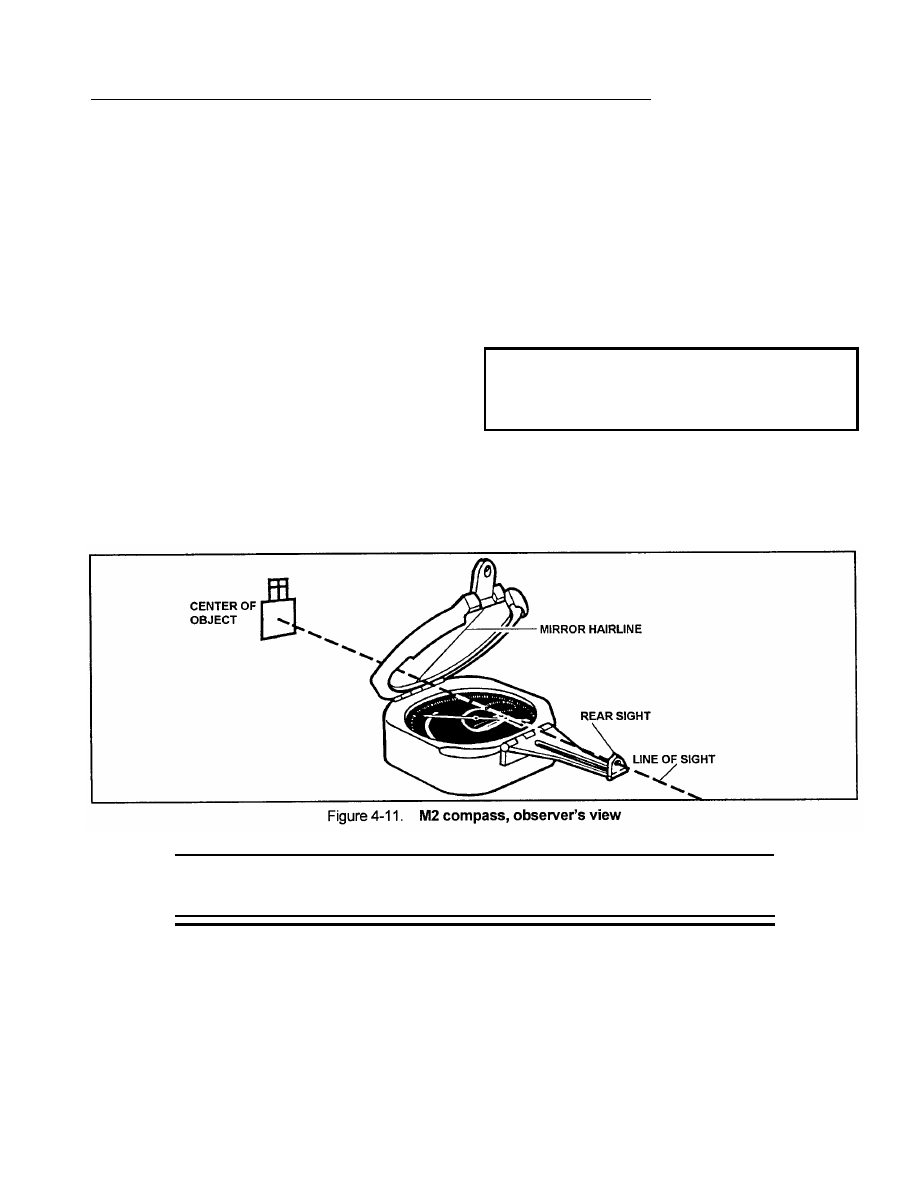
To read the azimuth scale by reflection, hold the compass

in both hands at eye level with arms braced against body

and with the rear sight nearest your eyes. Place the cover

at an angle of approximately 45° to the face of the compass

(Figure 4-11) so that the scale reflection can be viewed in

the mirror. Level the instrument by viewing the circular

level in the mirror. Sight on the desired object and read

the azimuth indicated on the reflected azimuth scale by the

south-seeking (black) end of the compass needle.

b. 

The procedure to measure site to crest follows:

Hold the compass on edge with both hands at eye level

with arms braced against the body and with the rear sight

nearest your eyes. Place the cover at approximately 45° to

the face of the compass (Figure 4-11) so that the elevation

scale reflection can be seen in the mirror. Sight on the

crest of the highest object in the sector of fire. Center the

elevation scale tubular level with the lever on the back of

the compass and by viewing the elevation scale in the mirror.

Read the elevation in mils on the elevation scale. Measure

the sight to crest two additional times, and record the average.

CAUTION

When measuring an azimuth be sure no magnetic

materials are near the compass.

4-14. CARE AND HANDLING

OF THE M2 COMPASS

The 

M2 compass will not stand rough handling or abuse.

Keep the compass in the carrying case (with the mirror side

facing in) protected from dust and moisture.

Section V

LAYING

4-15. PRINCIPLES OF LAYING

(1) As was mentioned previously, the aiming circle is

the primary means by which the cannon battery orients

a. 

Reciprocal laying is a procedure by which the 0-3200

line of one instrument and the 0-3200 line of another

weapons on the azimuth of fire. The aiming circle is used

to measure horizontal clockwise angles from the line of fire

instrument are laid parallel. To fully understand the principle

to the line of sight to a given aiming point. In reciprocal

behind reciprocal laying (Figure 4-12, page 4-12) you must

laying, the aiming point for the aiming circle is the howitzer

first understand several concepts and definitions.

panoramic telescope.

The pantel is used to measure

4-11

-------------------------------------------------------------------------------------------------------------------------------------------------------------

FM 6-50, MCWP 3-1.6.23

horizontal clockwise angles from the line of fire or the

rearward extension of the line of fire to the line of sight to

a given aiming point. In reciprocal laying, the aiming point

for the howitzer pantel is the aiming circle.

(2) The line of fire, as it relates to the principle of

reciprocal laying, is any line parallel to the azimuth of fire.

It is first established by the aiming circle in order that the

aiming circle can be used to orient the howitzer on the azimuth

of fire.

(3) The rearward extension of the line of tire is the

exact opposite of the line of fire.

(4) A deflection is defined as a horizontal clockwise

angle measured from the line of fire or the rearward extension

line of fire to the line of sight of a given aiming point with

the vertex of the angle at the pantel. That is to say, the

angular measurements taken when reciprocally laying with

the aiming circle and the howitzer pantel will always be

deflections.
b. 

The principle of reciprocal laying is based on the

following geometric theorem: given two lines cut by a

common transversal whose alternate interior angles are equal,

then those two lines are said to be parallel. The parallel

lines are the 0-3200 lines of the aiming circle and the line

of fire and rearward extension of the line of tire of the

howitzer. The common transversal is the line of sight

established between the aiming circle and the pantel. The

alternate interior angles are the deflections as read from the

instruments.

4-16. PROCEDURES FOR LAYING

a. 

When the 0-3200 line of the aiming circle is parallel

to the azimuth of fire, the instrument operator uses the upper

motion to sight on the lens of the pantel and reads the

deflection on the azimuth and azimuth micrometer scales.

He announces the deflection to the gunner on the howitzer.

Note: 

If the weapons are equipped with M12-series

deflection cannot exceed 3,200 mils.

Therefore the red numbers on the aiming circle are

used if the black numbers exceed 3,200 mils.

b. 

The gunner sets the announced deflection on the pantel.

He orders the howitzer to be shifted, and/or traverses the

tube, until the line of sight through the pantel is again on

the reflector of the aiming circle (2-step deflection method).

Note: 

Because the pantel is not directly over the

pivot point of the tube, the pantel displaces

horizontally. When the telescope has been sighted

on the aiming circle, the gunner reports READY FOR

RECHECK.

4 - 1 2

-------------------------------------------------------------------------------------------------------------------------------------------------------------

FM 6-50, MCWP 3-1.6.23

c. 

The instrument operator again sights on the lens of the

pantel and reads and announces the deflection.

This

procedure is repeated until the gunner reports a difference

of 0 mils between successive deflections. The piece has

then been laid.
d. 

If all pieces are not able to see the aiming circle, one

piece can lay others (reciprocal laying). The commands for

laying reciprocally from another howitzer are the same as

those given in paragraph 4-19. If weapons are equipped

with the M100-series panoramic telescopes, the readings

between any two weapons will be 3,200 mils apart. To

prevent confusion, the gunner on the laying piece adds or

subtracts 3,200 mils to or from his reading before announcing

it to another howitzer. If the howitzer to which the laying

gunner is referring is on his left, the gunner must add 3200.

If it is on his right, he must subtract 3200 (left, add; right,

subtract [LARS] rule). See Figure 4-13.
e. 

The methods by which the battery or platoon can be

laid are as follows:

(1) Orienting angle. This method requires the use of

an M2A2 aiming circle and a known azimuth established

by survey.

(2) Grid azimuth. This method requires the use of a

declinated M2A2 aiming circle.

(3) M2 compass. This method requires the use of a

declinated M2 compass.

(4) Aiming point-deflection. This method requires that

an aiming point at least 1,500 meters from the battery or

platoon position be visible.

(5) Howitzer back-lay. This method requires the use

of a declinated M2 compass and M2A2 aiming circle.
f. 

The deflection to each weapon should be recorded by

the instrument operator for use by the FDC.

Note: 

The chief of section supervises the laying

process and verifies all data after the gunner lays the

howitzer.

4-17. LAYING BY ORIENTING ANGLE

a. 

When occupying a position, it is preferable that all fire

support assets have survey data available to them. Common

survey enables units to mass fires more accurately. Survey

data will not always be available; therefore, all efforts should

be made to establish directional control as early as possible.
b. 

If survey is available, the following, as a minimum,

will be provided (Figure 4-14):

The orienting station (OS), with grid and altitude to

the station.
The azimuth of the orienting line (OL).
The description of the end of the orienting line (EOL).

4-13

-------------------------------------------------------------------------------------------------------------------------------------------------------------

FM 6-50, MCWP 3-1.6.23

c. 

Steps in orienting angle (OA) method are as follows:

(1) Using the plumb bob, position the aiming circle

over the orienting station.

(2) Compute the orienting angle (Figure 4-15) by

subtracting the azimuth of fire from the azimuth of the

orienting line (add 6,400 mils, if necessary).

(3) With the upper motion, set the orienting angle.
(4) Using the lower motion, sight on the EOL. The

0-3200 line is now parallel to the azimuth of fire.

(5) Using the upper motion, sight on the howitzer

pantel.
d. 

A quick check of survey data prior to laying the battery

is recommended, time permitting and METT-T dependent.

This check is done in a minimal amount of time and with

the same circle which is set up on the OS. Conduct this

check in the following manner:

(1) Confirm the location on the OS tag by map spot,

GPS, or the most accurate means available.

(2) On the upper motion, set off the declination constant.
(3) On the lower motion, float and center the needle.
(4) On the upper motion, sight in on the EOL. The

instrument reading should be the azimuth to the EOL ±10

mils.

EXAMPLE

Laying by Orienting Angle:

The battey is being laid on azimuth 0600. The azimuth to

the orienting line is 2000. Do the following:

Subtract azimuth of fire (0600) from the azimuth of the

orienting line (2000). This gives you the orienting angle

1400. (2000 - 0600 = 1400).

Set up the aiming circle over the orienting station.

Roughly orient the 0-3200 line along the azimuth of fire.

Using the upper motion, set off 1400.

Using the lower motion, sight on the end of the orienting

line. The line of sight now coincides with the orienting

line. Make certain that the index remains at 1400.

Now the 0-3200 line of the aiming circle has been

established in the desired direction; that is, on the

azimuth of fire. The next step is to lay the platoon by

using the upper motion. This makes the tubes of the

howitzers parallel to the 0-3200 line of the instrument.

The howitzers are oriented on the azimuth of fire.

e. 

Survey may not be available. To establish directional

control and lay units by the orienting angle method, the

orienting line must be established. Without survey, the

orienting line can be established by hasty survey techniques.

(See Chapter 5). Once the orienting line is established, the

steps shown in c above apply. The OS grid location and

altitude may be obtained by GPS, map spot or by hasty

traverse.

4-18. LAYING BY GRID AZIMUTH

a. 

If surveyed data are not available and

hasty survey is not possible, 

the next best method of

orienting the aiming circle is to use the magnetic needle.

Note: 

Laying by grid azimuth involves the use of

the magnetic needle of the aiming circle. The

instrument must be set up where it is free from

magnetic attractions. The minimum distances are as

follows:

Power lines and electronic

equipment . . . . . . . . . . . . . . . . . . . . . . . . . . . . . . . . . . . . . . . . . . . . . . . 150 meters

Railroad tracks, artillery, tanks,

and vehicles . . . . . . . . . . . . . . . . . . . . . . . . . . . . . . . . . . . . . . . .  75 meters

Barbed wire, personal weapons,

and small metallic objects . . . . . . . . . . . . . . . . . . . . . . 10 meters

4-14

-------------------------------------------------------------------------------------------------------------------------------------------------------------

FM 6-50, MCWP 3-1.6.23

b. 

To orient the aiming circle on a grid azimuth by using

the magnetic needle, complete the following steps:

(1) Determine the instrument reading (IR) to be placed

on the instrument by subtracting the azimuth of fire from

the declination constant (DC) of the aiming circle (add 6,400

mils to the declination constant, if necessary).

(2) Place this value on the upper motion.
(3) Using the lower motion, center the magnetic needle.

(See Figure 4-7.) The 0-3200 line is now parallel to the

azimuth of fire.

(All gunners identify the aiming point. Normally, pieces

are laid in the order of their readiness.)
Gunner of number 3:
NUMBER 3, AIMING POINT IDENTIFIED.
(Using the upper motion, the instrument operator turns the

head of the aiming circle until the line of sight is on the

pantel of the number 3. He then reads the azimuth and azimuth

micrometer scales.)
Instrument operator:

c. 

The next step is to lay the platoon reciprocally by using

NUMBER 3, DEFLECTION 3091.

the upper motion and sighting on the howitzer pantel.

EXAMPLE

Laying by Grid Azimuth:

The platoon is being laid on azimuth 3900. The DC of the

aiming circle is 0400 mils. (See Figure 4-16, page 4-16.)

Subtract the azimuth of fire from the declination

constant. The larger number (3,900 mils) cannot be

subtracted from the smaller number (0400 mils). So

6,400 mils must be added to the smaller number. Thus,

6400 + 0400 = 6800 mils; 6800 - 3900= 2900. The

horizontal, clockwise angle from the desired direction

of fire to magnetic north (aiming point) is 2,900 mils.

Roughly orient the 0-3200 line along the azimuth of fire.

Using the upper motion, set 2900 (black numbers).

Center the magnetic needle by using the lowrer motion.

This action places the 0-3200 line of the aiming circle

on grid azimuth 3900. Make certain that the index

remains at 2900.

After establishing the 0-3200 line of the aiming circle

on grid azimuth 3900, lay the battery reciprocally by

using the upper motion. This procedure places each

howitzer tube on grid azimuth 3900.

4-19. COMMANDS

The following commands are used in laying a platoon with

an aiming circle. The deflections announced are examples

only. For brevity, only the exchange between the instrument

operator and the gunner of number 3 is given.
Instrument operator:
PLATOON ADJUST,

AIMING POINT THIS

INSTRUMENT.

Gunner of number 3:
NUMBER 3, DEFLECTION 3091.

(The gunner, using the two-step deflection method, sets

the deflection on his sights and traverses the weapon until

he is sighted back on the aiming circle.)
Gunner of number 3:
NUMBER 3, READY FOR RECHECK.
(The instrument operator again turns the head of the aiming

circle until the line of sight is on the pantel of the number

3 and announces the deflection.)
Instrument operator:
NUMBER 3, DEFLECTION 3093.
Gunner of number 3:
NUMBER 3, DEFLECTION 3093, 2 MILS.
(This indicates a difference of 2 mils from the previous

deflection of 3091, which the gunner had placed on the

pantel. The gunner sets 3093 on the pantel and traverses

the tube until he is sighted on the aiming circle. Meanwhile,

the instrument operator may or may not proceed with the

laying of the other pieces. When the gunner of any piece

announces a difference of 10 mils or less, the instrument

operator normally continues to lay that particular piece until

it is laid to zero mils.)
The gunner then announces:
NUMBER 3, READY FOR RECHECK
Instrument operator:
NUMBER 3, DEFLECTION 3093.
Gunner of number 3:
NUMBER 3, DEFLECTION 3093, 0 MILS.

(When the deflection announced by the instrument operator

and the deflection on the pantel are identical, the howitzer

is laid.)
Instrument operator:
NUMBER 3 IS LAID.

4-15

-------------------------------------------------------------------------------------------------------------------------------------------------------------

FM 6-50, MCWP 3-1.6.23

4-20. LAYING BY ALTERNATE METHODS

Based on an ever-changing tactical environment, situations

could arise that would make it impractical or impossible to

use the primary methods of lay (orienting angle and grid

azimuth). In such cases, the firing element must be able

to keep supporting the maneuver forces. Alternate methods

of lay that give the unit this capability are discussed in

paragraphs 4-21, 4-22, and 4-23.

4-21. M2 COMPASS METHOD

a. 

Normally, this method of lay is used during a deliberate

occupation when an aiming circle is not available. The M2

compass is used to lay one howitzer. Once laid for direction,

that howitzer is used to reciprocally lay the remaining

howitzers.

b. 

The steps for laying with the M2 compass areas follows:

(1) Place the M2 compass on a stable object (such as

a collimator cover, and aiming circle tripod, or a mattock

handle) away from magnetic attractions.

Note:

Laying by the M2 compass method involves

the use of the magnetic needle of the compass. The

compass must be set up where it is free from

magnetic attractions. The minimum distances are as

follows:

High-tension power lines . . . . . . . . . . . . . . . . . . . . . . . 55 meters

Field gun, truck, tank . . . . . . . . . . . . . . . . . . . . . . . . . . 10 meters

Telegraph, telephone, or barbed wire . . . . . . . . . . . . . 10 meters

Machine gun . . . . . . . . . . . . . . . . . . . . . . . . . . . . . . . . . . . . . . . . . 2 meters

Steel helmet or rifle . . . . . . . . . . . . . . . . . . . . . . . . . . . . . 0.5 meter

(2) Measure the azimuth to the pantel of the howitzer

to be’ laid.

(3) Determine the deflection to the howitzer by

subtracting the azimuth of fire from the measured azimuth

(memory aid SAM).

Note: 

Memory aids for laying are in tables 4-2

through 4-5.

(4) Lay the howitzer by using the command NUMBER

(so-and-so) ADJUST, AIMING POINT THIS

INSTRUMENT, DEFLECTION (so much).
(The gunner, using the two-step deflection method, sets off

the announced deflection on the pantel and traverses the

tube to pick up a proper sight picture on the compass. He

then says NUMBER [so-and-so], AIMING POINT

IDENTIFIED, DEFLECTION [so much]. 

This howitzer

is now oriented on the azimuth of fire and is laid.)

(5) To lay the remaining howitzers, command:

NUMBER (so-and-so) IS LAID, PLATOON ADJUST,

AIMING POINT NUMBER (so-and-so).
(The gunner on number [so-and-so] would then reciprocally

lay the remaining howitzers in the platoon as outlined in

paragraph 4-16d, using the commands in paragraph 4-19.)
c. 

This method of lay has advantages and disadvantages

that must be considered before it is used.

(1) Advantages. The main advantage to using this

method is that all howitzers will be oriented parallel.

(2) Disadvantages. The compass is graduated every 20

mils and can be read to an accuracy of 10 mils. The accuracy

depends a great deal on the ability of the instrument operator.

4-16

-------------------------------------------------------------------------------------------------------------------------------------------------------------

FM 6-50, MCWP 3-1.6.23

EXAMPLE

Laying by M2 Compass:

The advance party is preparing a position for occupation on

an azimuth of 4550. Because of combat loss, no aiming

circle is available. The platoon leader has determined that

line of sight will exist between number 4 and the remaining

howitzers. The gunnery sergeant is told to lay number 4

upon occupation using the M2 compass method of lay. The

GSG takes a mattock handle from the advance party vehicle

and moves 100 meters to the left front of number 4 position.

Upon arrival of number 4, the GSG (using the mattock

handles as a stable platform for the compass) measures an

azimuth to the pantel of number 4, He subtracts the azimuth

of fire from the measured azimuth (adding 6,400 mils to the

measured azimuth if necessary).

Measured Azimuth

Azimuth of Fire

Deflection

The gunnery sergeant commands NUMBER 4 ADJUST,

AIMING POINT THIS INSTRUMENT, DEFLECTION 2580.

The gunner on number 4 uses the two step deflection method

to pick up line of sight on the compass and announces

NUMBER 4 AIMING POINT IDENTIFIED, DEFLECTION

2580.

The GSG commands NUMBER 4 IS LAID, PLATOON

ADJUST, AIMING POINT NUMBER 4.

0730

+6400

7130

-4550

2580

4-22. AIMING POINT-

DEFLECTION METHOD

a. 

Normally, the aiming point-deflection method of lay is

used during an emergency fire mission when the need to

expedite the mission is more critical than the need for

first-round accuracy. A distant aiming point (DAP) is

b. 

The steps for laying by the aiming point-deflection

method are as follows:

(1) Determine the azimuth from the center of the battery

or platoon to the DAP (scale from the map or measure with

a declinated compass, or use the BCS procedures in paragraph

F-11.)

(2) Derive the back-azimuth of fire by adding or

subtracting 3,200 mils to or from the azimuth of fire.

(3) Compute a deflection by subtracting the

back-azimuth of fire from the azimuth to the aiming point

(memory aid: AP-BAF).

(4) To lay the platoon, command PLATOON ADJUST,

AIMING   POINT   (description),   (location),

DEFLECTION (so much).
Each gunner, using the two-step deflection method, picks

up a line of sight to the DAP, and announces NUMBER

(so-and-so)

AIMING

POINT

IDENTIFIED,

DEFLECTION (so much).

(5) When all sections have reported, command  THE

PLATOON IS LAID.

Note: 

During an emergency mission, the X0 or FDO

will normally announce the initial fire commands

(charge and quadrant) to the adjusting piece. The

remaining fire commands will be determined and

issued by the FDC.

c. 

This method has advantages and disadvantages which

must be considered before its use.

(1) Advantages.

(a) It is a very rapid method of lay. It may be used

immediately upon occupation and only one command is required

to lay the entire firing element.

(b) Minimal preparation of the position is required.

required and must be at least 1,500 meters from the position.

(See paragraph D-4.) Also, all howitzers must be able to

(c) The DAP can be used as an aiming point.

pick up a line of sight to the DAP. A compass, or a map

(2) Disadvantages.

and protractor are the only equipment needed.

Note: 

The aiming point-deflection method can be

used for a deliberate occupation if an aiming circle or

an M2 compass is not available. If this method is

used for a deliberate occupation, it is desirable to lay

only one howitzer by using the DAP. Once that

howitzer is laid, the gunner reciprocally lays the

remainder of the firing element to ensure all howitzers

are oriented parallel.

(a) A DAP must be available.
(b) Line of sight to the DAP may be obscured by smoke,

fog, darkness, and so forth.

(c) Howitzers will not be laid parallel when oriented

with a common deflection to an aiming point, except when that

aiming point is on the left or right flank. If the DAP is to the tint

of the position, the sheaf will converge. If the DAP is to the rear

of the position, the sheaf will diverge. See Appendix D for further

discussion of aiming points.

4-17

-------------------------------------------------------------------------------------------------------------------------------------------------------------

FM 6-50, MCWP 3-1.6.23

EXAMPLE

Laying by Aiming Point-Deflection Method:

The XO receives an emergency fire mission while en route

to a new position and signals the convoy. The emergency

data base is input into a BUCS and the initial firing data are

determined. As the firing element approaches the position,

the XO notices that there is a water tower located about 4

km to the left flank of the position. Using his map, he scales

an azimuth to the water tower.

The XO pulls into position and aligns his vehicle in the general

direction of the azimuth of fire. While the howitzers are

moving into position, the XO determines the deflection to

announce. (He uses the memory aid AP-BAF.)

Azimuth of Fire

0150

±3200

+3200

Back azimuth of fire

3350

Azimuth to the aiming point

4925

Minus back azimuth of fire

-3350

Deflection to DAP

1575

After all howitzers are in position and the deflection has been

determined, the XO moves to the front of the position and

announces BATTERY ADJUST, AIMING POINT WATER

TOWER, LEFT FLANK, DEFLECTION 1575. 

Each gunner

performs the two-step deflection method, picking up a line

of sight to the DAP, and announces NUMBER (so-and-so)

AIMING POINT IDENTIFIED, DEFLECTION 1575.

When all sections have reported, the XO commands THE

BATTERY IS LAID.

The XO announces fire commands to the adjusting piece

to fire the initial round in the mission. The FDC announces

the remaining commands by voice.

4-23. HOWITZER BACK-LAY METHOD

a. 

Normally, the howitzer back-lay method of lay will be

used during an emergency fire mission. It should only be

used if the grid azimuth and aiming point-deflection methods

are not possible. An M2 compass and an aiming circle are

the only equipment needle

b. 

The steps for the howitzer back-lay method are as

follows:

(1) Determine the azimuth of fire by using the BCS or

LCU hip shoot procedures, or scale it from a map after

plotting the target and the proposed firing position.

(2) Mark the azimuth of fire with stakes and tape.
(3) Ensure adjusting piece positions are alongside (SP)

or over (towed) the marked azimuth, all other howitzers are

on line. Ensure the aiming circle is emplaced in the left

rear of the position area.

(4) FDC announces firing data to the adjusting piece,

and the first round is fired.

(5) The instrument operator on the aiming circle

commands NUMBER (so-and-so) (adjusting piece), IS

LAID, NUMBER (so-and-so) (adjusting piece), REFER,

AIMING POINT THIS INSTRUMENT.

(6) The adjusting piece gunner announces NUMBER

(so-and-so) (adjusting piece), AIMING POINT

IDENTIFIED, DEFLECTION (so much).

(7) The instrument operator sets the referred deflection

on the upper motion of the aiming circle. With the lower

motion, he sights on the pantel of the adjusting piece. The

0-3200 line on the aiming circle is now parallel to the howitzer

tube after firing the first round. He then lays the remaining

howitzers using the upper motion by commanding

PLATOON ADJUST,

AIMING POINT THIS

INSTRUMENT.

Note: 

Normally only one deflection will be read to

each howitzer, and the piece is laid.

(8) Internal battery communications (small-unit

transceiver, runners, or wire, whichever is the most expedient)

is established.

(9) The remaining battery/platoon vehicles establish a

perimeter defense to the rear of the gun line.

c. 

This method has advantages and disadvantages which

must be considered before its use.

(1) Advantages

(a) Firing capability with the adjusting piece is

immediate.

(b) Minimal preparation of position is required.

(2) Disadvantages

(a) Laying process is not as timely as other methods.
(b) If boresight errors exist at adjusting piece, these

will be passed onto the remaining howitzers.

4-18

-------------------------------------------------------------------------------------------------------------------------------------------------------------

FM 6-50, MCWP 3-1.6.23

EXAMPLE

Laying by Howitzer Back-Lay Method:

The firing platoon receives an emergency fire mission while

en route to a new position and signals the convoy. The BCS

operator inputs the target grid into a BCS. He determines

the azimuth of fire and the initial firing data using the BCS

emergency fire mission procedures. He gives this information

to the FDO and the platoon leader. Upon occupation of the

position, the platoon leader aligns his vehicle in the general

direction of fire. The platoon leader then marks the azimuth

of fire for the adjusting piece by using a strip of engineer

tape approximately the same length as the weapon system.

This tape should have a wooden stake on one end and a

nose plug on the other end. To mark the azimuth, the platoon

leader throws the nose plug in the direction of the azimuth

of fire. Then, using the M2 compass, he aligns the tape on

the azimuth of fire by moving the stake end of the tape. At

the same time the platoon leader is marking the azimuth,

these other actions are taking place:

The platoon sergeant takes the aiming circle to the left

flank of the firing position. He ensures he has moved

far enough to the left rear of the weapons so that he is

beyond the point where the left flank howitzer will be

positioned. He then sets up the aiming circle, levels it,

and is prepared to accept a referred deflection from the

adjusting piece.

The chief computer positions the FDC vehicle so that

the rear of the vehicle is facing the gun line. This allows

the FDC to observe the state of readiness of the firing

sections and announce voice tire commands.

The platoon leader quickly guides the adjusting piece

into position where the engineer tape is aligned along

the azimuth of fire. Self-propelled weapons drive

alongside the line, while towed howitzers are brought

in from the direction of fire and centered over the tape.

The adjusting piece is laid on the target as soon as it

is aligned on the engineer tape. The FDC has provided

firing data (charge and quadrant) to the platoon leader.

These are announced to the adjusting piece, and the

first round is fired. The gunner establishes an aiming

point.

As the adjusting piece is preparing to fire the first round,

all other howitzers are pulling on line. Positioning is

critical. Each chief of section must position his howitzer

so that his gunner can seethe aiming circle and where

the line of sight is not impaired for any other howitzer.

Immediately after the adjusting piece has tired the initial

round of adjustment, the platoon sergeant will command

NUMBER (so-and-so) 

(adjusting piece)  REFER,

AIMING POINT THIS INSTRUMENT.

Upon hearing the above comment, the gunner—

Note:

Using the azimuth knob, without moving the

tube, rotates the head of the pantel and sights

on the instrument (or object).
Checks the sight mount bubbles, centering

them as necessary, and rechecks the sight

picture.

Reads the deflection appearing on the azimuth

counter (M100-series pantels), azimuth and

azimuth micrometer scales (M12-series

pantels), or azimuth main and micrometer

scales (L7A2 pantel).
Announces 
NUMBER (so-and-so), AIMING

POINT IDENTIFIED, DEFLECTION (SO

much).

When referring to the second circle to verify initial

lay, the gunner must ensure that the tube is on the azimuth

of fire before he uses the above procedures.

The platoon sergeant sets the referred deflection on

the upper motion of the aiming circle and with the lower

motion, sights on the pantel of the adjusting piece. The

platoon sergeant is now ready to lay the remaining

pieces of the platoon.

Each gunner identifies the aiming point and receives

his deflection. The deflection is set off, the tube traversed

until his line of sight is back on the aiming circle, and

the piece is laid. In the interest of time, there normally

are no rechecks. If the initial target location was good

and if the platoon leader accurately laid out the azimuth

tape, the second volley may well be fire for effect.

An aiming point is established for each weapon.

The platoon sergeant should remain at the aiming circle

during the firing of the mission in case a weapon must

be re-laid or the lay of the platoon needs to be refined.

The platoon leader, using his M2 compass, should

visually check the gun line to ensure that there is no

gross error in the lay of the weapons.

4-24. ESTABLISHING AIMING POINTS

a. 

During deliberate and hasty occupations, after the battery

has been laid, the crew of each piece sets up the collimator

and/or emplaces aiming posts before the tube is moved. The

deflection at which the aiming points are established is

recorded by each gunner. The direction in which the battery

is initially laid and the corresponding common deflection

are used as references from which the FDC can derive firing

deflections for future targets.

4-19

-------------------------------------------------------------------------------------------------------------------------------------------------------------

FM 6-50, MCWP 3-1.6.23

Note: 

For further discussion on aiming points, see

paragraph D-4.

b. The 

collimator is the primary aiming point and is placed

4 to 15 meters from the sight of the weapon. When the

collimator is emplaced, 3 numbers (5, 0, 5) and 11 graduations

will be visible in the reticle. If possible, place the collimator

under cover to the left front or left rear of the weapon. See

Figure 4-17 for the proper sight picture.
c. 

When aiming posts are used, the far aiming post should

be placed 100 meters from the howitzer and the near aiming

post should be placed 50 meters from the howitzer. If the

situation or terrain limits placing the far aiming post 100

meters from the howitzer, place it out as far as possible and

place the near aiming post halfway between the howitzer

and the far aiming post.
d. 

As soon as the platoon is laid and the aiming point(s)

is (are) emplaced, the platoon leader should have the gunners

of all pieces refer to a distant aiming point if one is available.

A DAP must be at least 1,500 meters away. This DAP can

be used as the primary aiming point if something happens

to the collimator or aiming posts.
e. 

Close-in aiming points are moveable, established by

battery personnel, and can be seen at night. The DAP has

the advantage of being readily available upon occupation

of a firing position.
f. 

During an emergency occupation, it is recommended that

a distant aiming point be selected. If a DAP is not available,

then several other options can be used. Two examples are

as follows:

Set up the collimator.
Set up an aiming post at a point halfway between the

aiming circle and the pantel.

4-25. SAFETY AND VERIFYING

THE LAY OF THE PLATOON

a. 

Safety and verification of tasks by leaders are disciplines

that exist in the field artillery, regardless of whether operations

are performed in combat or in peacetime. For every task

that is performed, there is another person in a leadership

position (section chief, platoon sergeant, platoon leader or

XO, FDO, or BC) who verifies the accuracy of the action

performed, This system of double checks is inherent in all

operations and is not to be considered a limiting factor in

providing timely fire support. Therefore, commanders must

ensure that their units have a system of independent safety

checks. These checks ensure that all cannon battery and

platoon operations (for example, FDC mission processing

and orienting howitzers for direction) affecting firing is

checked by someone other than the person who performs

the action. Though most independent checks take place

before missions are received, performing independent

checks is a continuous process and must be rigidly

enforced to ensure fires are timely, accurate, and safe.

These checks may include, but are not limited to, the

following:

Verification of entered azimuth of lay (LCU or BCS)

by the FDO and the platoon leader.
Verification of target grid.
Verification of battery or platoon lay.
Verification of AFCS data (Paladin units only).
Verification of weapon location.
Verification of met data.

b. 

During a deliberate occupation, the lay of a unit is verified

immediately following the verification or conduct of

boresighting. It is the “S” step in TLABSPAP. The unit

SOPs will specify the method and sequence of verifying

lay during an emergency occupation.

4-20

-------------------------------------------------------------------------------------------------------------------------------------------------------------

FM 6-50, MCWP 3-1.6.23

c. 

After the platoon is laid, the platoon leader verifies the

lay by use of another M2A2 aiming circle referred to as

the verification circle. To verify lay of the platoon, the

following steps are taken:

(1) The platoon leader or designated safety officer sets

up and orients an M2A2 aiming circle by using a method

other than that used by the lay circle. However, in combat

situations, the BC may authorize the orientation of the

verification circle using the same method as the lay circle,

METT-T dependent. This aiming circle must be located

where it can be seen by all howitzers and should not be

any closer than 10 meters to the lay circle.

(2) The verification circle operator picks up a line of

sight on the lay circle. Then he commands, LAY CIRCLE

REFER, AIMING POINT THIS INSTRUMENT. 

The

lay circle operator will sight his instrument onto the

verification circle by use of the recording motion.

(3) If the lay circle and the verification circle deflections

are within 10 mils or as specified by local range regulations,

the instrument operator on the verification circle places the

deflection read by the lay circle on the upper motion of

the verification circle. With the lower motion, he sights

back on the lay circle. This serves to align the 0-3200 line

of the verification circle parallel to the 0-3200 line of the

lay circle.

Note: 

When an aiming circle is used to verify

another aiming circle for direction, the readings

between the two circle will be 3,200 mils apart (Figure

4-18).

This is because both circles measure

horizontal clockwise angles from the line of fire. To

prevent confusion remember that, if you see red, read

red.

(4) The instrument operator on the verification circle

commands PLATOON REFER, AIMING POINT THIS

INSTRUMENT.

All gunners refer and announce the

deflection to the verification circle. If the deflection referred

by a howitzer is within that tolerance given in the local

range regulations, the operator on the verification circle

announces that the howitzer is safe. Once all howitzers are

safe, the operator announces THE PLATOON IS SAFE.

Note: 

When referring to the verification circle to

verify lay, the gunner must ensure that the tube is on

the azimuth of fire before he uses the above

d. The 

platoon leader should walk the gun line and visually

check the tubes to ensure they are parallel. An M2 compass

should also be used to ensure the tubes are on the azimuth

of fire.

4-26. MEASURING VERTICAL ANGLES

a. 

Normally, vertical angles (VAs) from the M2A2 aiming

circle to the howitzers are measured during advance party

operations. The VA and distance from the orienting station

to each howitzer are required by FDC to determine piece

locations in BCS or LCU. The aiming circle can also be

used to determine sight to crest at each howitzer during

advance party operations.
b. The 

VA to a point is measured from the horizontal plane

passing through the horizontal axis of the instrument (M2A2

aiming circle). It is expressed as plus or minus, depending

on whether the point is above (plus) or below (minus) the

horizontal plane. It is measured to the height of instrument

which is about chest high on the average individual at the

gun position. The steps for measuring a VA are as follows:

(1) Using the circular leveling vial, ensure the aiming

circle is properly set up and leveled.

(2) Using the elevation knob, center the upper tubular

leveling vial. This yields a correction factor to be applied

to all measured vertical angles.

(3) Read and record the corrections from the elevation

scale. If black numbers are used, the correction factor is

plus; if red numbers are used, the correction factor is minus.

(4) While measuring the subtense (used to determine

distance), elevate or depress the telescope to place the

horizontal cross hair of the aiming circle on the chest of

the gun guide. The subtense method is described in paragraph

5-10a.

4-21

-------------------------------------------------------------------------------------------------------------------------------------------------------------

FM 6-50, MCWP 3-1.6.23

Note: 

If there was not enough time to measure VAs

during advance party operations, the instrument

operator can align the horizontal cross hair at chest

level of a cannoneer during occupation. The key is to

measure the VA at a height that approximates

instrument height.

(5) Read and record the value on the elevation and

. .

elevation micrometer scales to the nearest 1 mil.

(6) Subtract the correction (corr) factor from the reading

obtained in the preceding step. The result is the vertical

angle for that howitzer.

4-27. MEMORY AIDS

Tables 4-2 through 4-5 (page 4-24) show memory aids for

use in training personnel to lay the battery and/or platoon.

4-22

-------------------------------------------------------------------------------------------------------------------------------------------------------------

FM 6-50, MCWP 3-1.6.23

4-23

-------------------------------------------------------------------------------------------------------------------------------------------------------------

FM 6-50, MCWP 3-1.6.23

Section VI

MEASURING AND REPORTING DATA

4-28. ACCURACY

a. 

The accuracy of lay is directly related to the method

used to orient the howitzers on the azimuth of fire and the

alignment of the fire control equipment.
b. 

Measuring and reporting data provides us with a method

of correction for errors in the lay. The FDC may require

a check of weapon direction be made. Normally this check

is made after a registration or after survey control is

established. It serves to—

Check the data fired.
Check the accuracy of lay.

c. 

Weapon direction may be verified by-

Reporting the correct deflection.
Measuring the azimuth.
Measuring the orienting angle.

d. 

Reporting will reveal any sloppy procedures being used

by the gun crews, such as failure to level the bubbles and

improper sight picture. Measuring provides a check on the

accuracy of the lay. These checks must be made before

END OF MISSION is received at the firing weapon.

4-29. BACKWARD AZIMUTH RULE

a. 

The backward azimuth rule is a mathematical relationship

used to apply equal changes in angles used in the laying

process. This rule establishes the relationship between three

elements as follows:
An increase in deflection causes an equal decrease in

azimuth and an equal increase in orienting angle. A

decrease in deflection causes an equal increase in azimuth

and an equal decrease in orienting angle.
b. 

Using this rule and assuming that there are no errors

in the lay of the weapons, weapon direction may be verified.

4-30. REPORTING THE

CORRECT DEFLECTION

Upon completion of a mission, and before announcing  END

OF MISSION 

the FDC may request that the executive officer

or platoon leader report the correct deflection. To report,

the XO or platoon leader—

Goes to the weapon.

Checks the level of the bubbles (centers if necessary).

Checks for the correct sight picture (corrects if

necessary).

Reads the deflection from the pantel.

C A U T I O N

When making corrections to the sight picture or leveling

the bubbles, the tube must not be moved.

Reports the deflection read from the pantel to the FDC

as CORRECT DEFLECTION (so much).

EXAMPLE

Your platoon (M109A3, 155-mm SP) is laid on azimuth 5000

(orienting angle 0600), with a common deflection of 3200.

After firing a registration, FDC requests that the platoon

leader report the azimuth or orienting angle. The platoon

leader completes the required check sand reports CORRECT

DEFLECTION 3250. 

He then does the following:

Determines the change between the common deflection

and the correct deflection. (Common deflection= 3200;

correct deflection= 3250; increase = 50 mils.)

Applies the difference according to the backwards

azimuth rule to determine the azimuth tired. (Deflection=

+50 mils; azimuth= .50; mils; 5000 - 50 = 4950.)

Reports CORRECT AZIMUTH 4950.

4-31. MEASURING THE AZIMUTH

OF THE LINE OF FIRE

a. 

If a gun fires out of safe, the platoon leader or XO may

wish to determine the azimuth at which the round was fired.

This is the most common reason for measuring the azimuth

of the line of fire. Another reason is that a unit may use

a less desirable method of lay and then improve this method.

An example would be a unit that lays by the grid azimuth

method because there is no survey control. When survey

closes, the unit will want to know if the azimuth of fire it

has been firing on is different from the originally intended

azimuth of fire. There are two methods of measuring the

azimuth of the line of fire. The difference depends upon

whether or not survey control is available.

4-24

-------------------------------------------------------------------------------------------------------------------------------------------------------------

FM 6-50, MCWP 3-1.6.23

b. 

If the line of tire is being measured following a firing

incident, the crew of the howitzer in question will not move

the tube but will simply refer to the aiming circle. If, on

the other hand, the platoon leader wishes to measure the

azimuth of fire, he must first ensure that the tube of the

howitzer being measured is at lay deflection.

c. 

These steps are performed first, regardless of whether

or not survey control is available:

(1) The aiming circle operator—

Orients the 0-3200 line generally parallel to the tube

of the weapon.
Commands 
NUMBER (so-and-so) REFER,

AIMING POINT THIS INSTRUMENT.

Note: 

Memory aids for measuring and reporting are

in tables 4-6 through 4-8, page 4-28.

(2) The gunner measures the deflection to the aiming

circle without moving his tube and announces  NUMBER

(so-and-so),

AIMING

POINT

IDENTIFIED,

DEFLECTION (so much).

(3) The aiming circle operator—

Sets the announced deflection off on the upper

(recording) motion of the aiming circle.

Note: 

If the weapon has an M12-series sight, the

referred deflection may have to be set on the aiming

circle by using the red numbers. A general rule is that

if a weapon with an M12-series sight is left and

forward of the aiming circle, red numbers are used

when reading the aiming circle to lay the howitzer.

With the lower (nonrecording) motion, sights in on

the panoramic telescope.

Note: 

The 0-3200 line of the aiming circle is now

parallel to the tube of the firing weapon.

Note: 

Since the magnetic needle is being used, the

aiming circle must be declinated and set up away

from magnetic attractions.

(2) The value now on the upper motion is the instrument

reading. Subtract the instrument reading from the declination

constant. The difference is the azimuth of the line of fire

(az of the LOF). For a memory aid, see Table 4-6, page

4-28,

EXAMPLE

Your M198 platoon conducted an emergency occupation

using the howitzer backlay method to lay on an azimuth of

tire of 0900. You were instructed to stay in position and

continue answering calls for fire. The platoon is at end of

mission, and all howitzers have returned to their lay

deflections. You go to the aiming circle and measure an

instrument reading of 5750. The aiming circle has a

declination constant of 0300. Your final step is to solve for

the azimuth of the line of fire.

DC(+6400 if needed)- IR= az of the LOF

(0300+6400)-5750=0950

Your platoon howitzers were initially laid on 0950, but your

BCS or LCU currently has an azimuth of fire entry of 0900.

You have two options at this point

Leave the platoon laid on 0950, and have the FDC

correct the computer entries for azimuth of fire and

piece locations.

Re-lay the platoon on the originally intended azimuth

of 0900.

Note: 

The first option requires less time and effort

and is thus normally preferred if the tubes were laid

parallel. However, if the unit was laid by an alternate

method of lay where the tubes are not truly parallel,

then re-laying would be preferred.

(4) The final step at the aiming circle depends on whether

survey control is available. If it is not available, follow the

steps in subparagraph d below. If it is available, follow

those in subparagraph e below.

d. 

The following is the final step if survey control is not

available:

(1) The platoon leader, with the upper (recording)

motion, floats and centers the magnetic needle.

e. 

If survey control is available, the following is the final

step:

(1) The platoon leader with the upper (recording)

motion, sights in on the end of the orienting line.

(2) The value now on the upper motion is the orienting

angle. Subtract the orienting angle from the azimuth of the

orienting line. The difference is the azimuth of the line of

fire. For a memory aid, see Table 4-7, page 4-28.

4-25

-------------------------------------------------------------------------------------------------------------------------------------------------------------

FM 6-50. MCWP 3-1.6.23

EXAMPLE

Your battalion FDC has instructed you to continue firing from

your present position. A survey team is on its way to put

you on common survey. In preparation, you place an OS

marker directly below the aiming circle plumb bob. You also

establish an EOL at least 100 meters away. Upon closing,

the survey team provides you with a grid to your OS and an

azimuth to the EOL of 5,363 mils. With the howitzers at their

lay deflections, you now measure the OA of 4400. Your

final step is to solve for the azimuth of the line of fire.

OL (+ 6400 if needed) - OA = az of the LOF

5363-4400=0963

Your platoon howitzers have been laid on 0963 all along.

You have two options at this point:

Leave the platoon laid on 0963, and have the FDC

correct its computer entries for azimuth of fire and piece

locations.

Re-lay the platoon on the originally intended azimuth.

Note: 

The first option requires less time and effort

and is thus normally preferred if the tubes were laid

parallel. However, if the unit was laid by an alternate

method of lay where the tubes are not truly parallel,

then re-laying would be preferred.

4-32. CORRECTING BORESIGHT ERROR

a. 

If the battery or platoon is to deliver accurate fire, the

boresight of the weapon must be correct. Boresighting is

the process of ensuring that the optical axis of the weapon

sights are parallel to the cannon tube. The primary methods

of boresighting are the distant aiming point, test target, and

standard angle.

(1) If a howitzer is not in boresight, the tube is

disoriented in relation to the amount of boresight error. If

the sight is off to the right, the tube is disoriented by that

amount to the left. If the sight is off to the left, the tube

reflects that error to the right.

(2) Once a weapon is properly boresighted, the

deflection to an aiming point (aiming circle or collimator)

is reestablished. The angle (deflection) between aiming point

and pantel has not changed from when the weapon was

laid. The entire angle has simply rotated by the amount of

boresight error.

Since the angle has not changed, the

deflection recorded to the aiming point is set off on the

pantel and the tube is traversed onto the aiming point.

The relationship made at the time of lay is now reestablished.

It is improper, after correcting for boresight error, to move

(or fine tune) the aiming point to the tube in relation to

the deflection (numbers) originally established at the time

of lay.
b. 

Emergency occupation of a firing position may require

firing before boresight is verified and any error is corrected.

In such cases, the howitzers must verify boresight as soon

as possible. If this verification discloses an error (the 0-3200

line of the pantel and the howitzer tube are not parallel) the

platoon leader takes corrective actions after measuring the

error and reporting it to the FDC.
c. 

When a deflection is read from the pantel or when an

azimuth is measured, the deflection or azimuth determined

is that of the 0-3200 line of the pantel as read from the

azimuth counter. When the FDC requests the platoon leader

to MEASURE THE AZIMUTH, the azimuth requested is

that of the howitzer tube. If the howitzer is out of boresight,

the data derived is inaccurate by the amount of the error.

Note: 

If the howitzer in question was used to lay the

aiming circle or the rest of the howitzers, the other

howitzers are out of lay by the amount of error found.

The platoon leader should take corrective action to

orient them on the correct azimuth of lay (after all

howitzers have verified foresight).

d. 

Boresight is verified as discussed below.

(1) Howitzers with an alignment device.

(a) The azimuth counter (not the reset counter) and the

appropriate alignment device are used when verifying boresight.

The numerical error of boresight can be determined from the

azimuth counter. The amount of error is the difference between

the required deflection for the alignment device (according to the

-10 manual) and the deflection read (on the azimuth counter) once

the vertical hairline has been aligned.

(b) The backwards azimuth rule will be used to

determine the correct azimuth of the howitzer tube.

(c) Once the error has been measured and reported the

platoon leader directs the following actions to be taken to correct

the error.

Boresight the weapon.
Correct the azimuth of lay and piece location in

the FDC or re-lay the piece.

4-26

-------------------------------------------------------------------------------------------------------------------------------------------------------------


Content      ..     4      5      6      7     ..