MCWP 3-16.3 FM 6-50 TTP for the Field Artillery Cannon Gunnery - page 2
 

  Главная      Manuals     MCWP 3-16.3 FM 6-50 TTP for the Field Artillery Cannon Gunnery


Search            copyright infringement  


Content      ..      1      2      3      ..


MCWP 3-16.3 FM 6-50 TTP for the Field Artillery Cannon Gunnery - page 2


FM 6-50, MCWP 3-1.6.23

center, and the location of battery commander. It

also includes a contingency plan if the BC does

not return or report back by a predetermined time

or event.

Signal: Movement radio frequencies and net control

restrictions. Signals for immediate actions at the

halt and during movement.

b. 

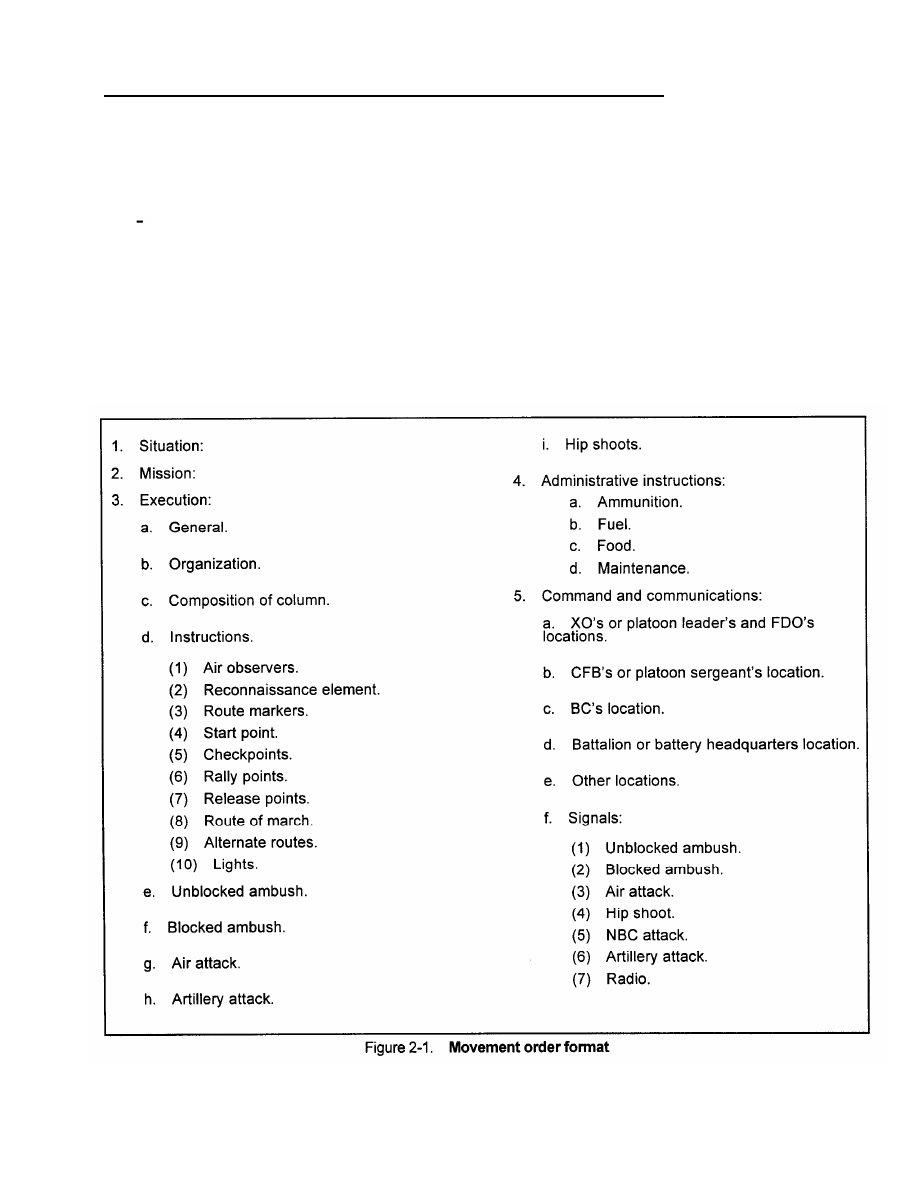
After being briefed by the BC, the platoon leader or

XO briefs the remaining key personnel by using the

movement order format in Figure 2-1.

2-12. ROUTE RECONNAISSANCE

a. 

After making a map inspection, planning the

the BC is now ready to make a ground reconnaissance.

Accompanied by the advance party, the BC or his

representative departs on the route reconnaissance.

The primary purpose of this reconnaissance is to

determine the suitability of the route of the units

movement. Items to be analyzed include possible

alternate routes, cover, concealment, location of

obstacles, likely ambush sites, contaminated areas,

route marking requirements, and the time and distance

required to traverse the route.

b. 

Once these areas are analyzed, any information

considered pertinent should be sent back to the firing

unit. Radio traffic must be carefully monitored to

ensure that information does not compromise unit

reconnaissance, and briefing the necessary personnel,

movement.

2-7

-------------------------------------------------------------------------------------------------------------------------------------------------------------

FM 6-50, MCWP 3-1.6.23

Section II

SELECTING THE NEW POSITION

2-13. POSITION SELECTION

CONSIDERATIONS

The BC selects a battery position or two firing platoon

position areas and the battery trains area (if needed). Once

the general areas have been determined, the gunnery sergeants

conduct the detailed RSOP of their respective position areas

and select alternate and supplementary positions. Position

selection considerations are discussed below.
a. Mission. 

This is the most important consideration. The

position must facilitate tire throughout the maximum area

of the supported maneuver force.
b. Communications.

The position must facilitate

communications with stations within assigned and monitored

radio nets.
c. Defilade. 

Defilade is protection from enemy observation

and direct fire weapons by use of a terrain mask. Defilade

positions should be used; however they should not be so

close to the mask that low-angle fire capabilities are restricted.
d. Defensibility. 

The position should facilitate both active

and passive defense so that it:

Can be entered without enemy observation.
Offers effective cover and concealment, with emphasis

on concealment. Also, survivability positions can also

be dug by engineers to enhance both cover and

concealment.
Avoids high-speed enemy approaches.
Has more than one entrance and exit route, preferably

in the rear of the position.

e. Trafficability. 

Soil should be firm enough to support

all vehicles.
f. Weather. 

The effects of weather on terrain must be

considered.
g. Survey Control. 

Survey must be established or it must

be available in a short amount of time.

2-14. TYPES OF POSITIONS

The BC or platoon leader must select primary, alternate,

and supplementary positions.
a. 

A primary position is one from which the firing element

will accomplish its assigned mission.

b. 

An alternate position is the one to which the unit moves

in case its primary position becomes untenable. Since the

unit will continue its mission from the alternate position, it

must meet the same requirements as the primary position

and should be far enough away to escape the effects of

enemy indirect fire on the primary position. It should be

reconnoitered and prepared for occupation. Each section

chief must know the route to the alternate position, because

movement to that position may be by section.
c. 

A supplementary position is one selected for

accomplishment of a specific mission, such as offset

registration, adjustment with a roving gun, or defense of

the primary position.

(1) Supplementary position(s) for defense should be

selected to cover likely enemy avenues of approach.

(2) Position(s) for offset registrations and roving guns

should be far enough away so that counterfire will not affect

the primary position.

Section III

ORGANIZING THE NEW POSITION

2-15. ADVANCE PARTY

with METT-T and the absence of enemy, mines, booby traps,

PREPARATIONS

NBC hazards, and so on. Natural cover must be used to

the maximum. Security is continuous throughout advance

a. 

Having arrived in the new position area, the advance

party operations.

party conducts a security sweep and prepares the position

for occupation. The purpose of the advance party security

b. 

The advance party is not normally manned or equipped

sweep is to perform position area reconnaissance to confirm

to clear areas of organized enemy activity, mines, or NBC

its suitability for occupation by the main body in accordance

hazards. If these threats or conditions are present in the

2-8

-------------------------------------------------------------------------------------------------------------------------------------------------------------

FM 6-50, MCWP 3-1.6.23

proposed position area, the advance party breaks contact

with any enemy forces or marks minefield and hazards and

moves on to find another position area.

The battery

commander can coordinate for additional assets, or augment

the advance party with internal assets, to provide the

additional ability to clear areas of small enemy forces,

obstacles, and minefield.

c. 

The following are some tactics, techniques, procedures,

and considerations units should incorporate when performing

advance party security sweeps.

(1) Maximum use of the senses:

(a) Sight. Advance party members look for:

Enemy personnel, vehicles, and aircraft.
Sudden or unusual movement.
Smoke or dust.
Engine exhaust fumes.
Unusual movement of farm or wild animals.
Vehicle tracks.
Signs or evidence of enemy occupation.
Recently cut foliage or vegetation.

Lights, fires, or reflections.
Muzzle flashes.

(b) Hearing. Advance party members listen for:

Running engines.
Track sounds.
Voices.
Metallic sounds.
Gunfire.
Dismounted movement through brush or woods.

(c) Smell. Advance party members smell for:

Cooking food.
Vehicle exhaust.
Burning petroleum products.
Burning tobacco products.

d. 

Advance parties use reconnaissance methods that they

have trained and rehearsed in detail. The correct

reconnaissance technique will maximize security and mission

accomplishment.

(1) Mounted reconnaissance of a position area should

be used when:

Terrain is open and provides maximum visibility.
Time is limited.
Very detailed reconnaissance is not required.
Minefield and obstacles in the area are not expected.
Enemy contact is not likely.

The advantages of a mounted reconnaissance include:

Speed.
The use of the advance party vehicle, depending on

which type of vehicle is used (radio, GPS, possible

armor protection, firepower).
Easy to break contact and move on.

The disadvantages of a mounted reconnaissance include:

Loss of stealth.
Loss of some reconnaissance detail.

(2) Dismounted reconnaissance is used when:

Detailed reconnaissance is required.
Maximum stealth is necessary.
Enemy contact is expected or likely.
Terrain is restrictive or is surrounded by wooded areas.
Time is not limited.
Mines are likely in the area.

The advantages of a dismounted reconnaissance include:

Allows the advance party to obtain detailed

information about the position area.
Less chance of enemy stay-behind forces remaining

undetected.
Allows for maximum security of the advance party.

The disadvantages of a dismounted reconnaissance include:

Time consuming.
Difficult to overwatch entire advance party with a

crew-served weapon.
Advance party is removed from the support of their

vehicle (comm, GPS, and so on).
More difficult to command and control.

(3) In reconnaissance by fire, advance parties place

direct tire on positions where there is a reasonable suspicion

of enemy occupation; the goal is to cause the enemy to

2-9

-------------------------------------------------------------------------------------------------------------------------------------------------------------

FM 6-50, MCWP 3-1.6.23

disclose his presence by movement or returning fire.

Advance parties use this technique when enemy contact is

expected and time is limited. Reconnaissance by fire does

not work in all cases. For example, disciplined troops in

prepared positions will not react to the advance party’s tires.

Some situations in which reconnaissance by fire may be

employed include:

Bunker complexes that mayor may not be occupied.

Existence of an obvious enemy kill zone.
Signs of recent enemy activity.

Key considerations for reconnaissance by fire include:

Indirect fire is very difficult to coordinate and requires

much more time to execute and control.
Direct fire will disclose the advance party’s location.
Requires a high degree of situational awareness to

ensure that no friendly units are fired upon or return

fire.

(4) Some situations might dictate a combination of

mounted and dismounted reconnaissance. In any case,

battery commanders and gunnery sergeants can use the

following guidelines to ensure maximum security and mission

accomplishment:

Always use an element with appropriate firepower to

overwatch the reconnaissance party.
If possible, use prominent terrain to gain a vantage

point to visually sweep the area with binoculars or

night vision devices prior to entering.
If dismounting, select a concealed, secure, dismount

site well outside the position area.
Develop and rehearse a contingency plan for each

security sweep.

e. 

The following are positioned in the battery or firing

platoon area:

Howitzer locations.
The aiming circle.
FDC or POC.
MX-155 or TM-184 terminal strip.

M8A1 automatic chemical agent alarm.

f. 

If the battery support elements are present, they will be

positioned with full consideration for survivability and

operability as the tactical situation dictates. FM 6-20-1

presents information and guidance on determining positions

for CSS elements.

2-16. FORMATIONS

a. 

The factors of METT-T must always be considered when

howitzers are emplaced. The main emphasis is on mission

and enemy. The artillery will most likely face a general

threat of counterfire, air attack, ground attack, and radio

electronic combat. To counter that threat, the BC or platoon

leader must consider techniques such as dispersion,

movement, hardening, and concealment when selecting

positions for his howitzer.

b. 

The enemy counterfire threat and air attack threat may

be so great that the BC or platoon leader will consider

dispersing his howitzers over a large area and maximizing

the natural cover and concealment offered by the local terrain.

This type of howitzer positioning is called terrain gun

positioning (Figure 2-2). The capabilities of the LCU and

battery computer system (BCS) to compute individual piece

locations have enhanced terrain gun positioning.
c. 

The enemy ground attack, guerrilla, and special forces

threats may cause the BC to position the howitzers in a

tight and defensible position area. Key personnel in the

battery must consider hardening and unit defense. The

diamond formation in platoon-based units (Figure 2-3) and

the star formation in battery-based units (Figure 2-4, page

2-12) are optimal in these circumstances. They provide

excellent 6400-mil firing and unit defense capabilities.

d. 

Linear formations such as the "line" and "lazy W" can

best be used during situations such as emergency and hasty

occupations which require immediate fire support. These

formations provide an optimum standard sheaf in the target

area and offer excellent command and control. However,

they are vulnerable to air attack. Position improvement such

as dispersion and concealment should be considered as time

and the tactical situation permit.

e. 

The bumper number of a particular howitzer section is

associated with each howitzer number (1 through 8). This

association does not change from position to position. If a

howitzer becomes disabled or lost en route to a new location,

its associated howitzer number and all other howitzer

numbers do not change. For example, once a weapon is

designated Number 7, it remains Number 7. The LCU and

BCS are initialized with individual howitzer muzzle velocity

data which corresponds to a specific howitzer. Use of this

procedure allows convenience in referring to pieces based

on location and at the same time eliminates the requirement

to vary the data base in each position.

numbered from right to left and from

facing the azimuth of fire.

The howitzers are

front to rear when

2-10

-------------------------------------------------------------------------------------------------------------------------------------------------------------

FM 6-50, MCWP 3-1.6.23

2-11

-------------------------------------------------------------------------------------------------------------------------------------------------------------

FM 6-50, MCWP 3-1.6.23

Section IV

PREPARATION FOR OCCUPATION

2-17. DAYTIME OCCUPATION

a. 

The BC finalizes his plan of occupation. He gives priority

to performing those tasks that facilitate immediate fire

support. The plan is not limited to, but should include, the

following:

The general location for the FDC or POC and howitzer

positions.
The azimuth of tire materialized by a terrain feature

or by pointing his vehicle in the direction of fire.
Entrance and exit points and guidance to the gunnery

sergeant for the track plan.
Guidance on the scheme of defense.

Location of the ground guide pickup point.

b. 

The first sergeant or gunnery sergeant establishes the

track plan, organizes the vehicle dispersal area, selects a

position for each element in the service area, and plans the

defense of the position. Considerations are as follows:

(1) Use existing roads.
(2) Select separate exit and entrance routes.
(3) Ensure routes follow natural terrain features such

as gullies and tree lines and take advantage of natural overhead

cover and concealment.

(4) Brief vehicle guides on the track plan. If

concealment is critical, the gunnery sergeant may dictate

2-12

-------------------------------------------------------------------------------------------------------------------------------------------------------------

FM 6-50, MCWP 3-1.6.23

the exact route of each vehicle. In SP units, sharp pivoting,

which will disrupt ground cover, must be avoided.
c. 

The gunnery sergeant does the following:

(1) He sets up and orients the aiming circle where it

will have line of sight to the howitzers. If survey is available,

he directs the survey team to emplace an orienting station

(ORSTA) where it will have line of sight to the howitzers

and an end of orienting line (EOL) where it can be easily

identified from the ORSTA. Additionally, he briefs the

survey team on any marking requirements, in addition to

unit SOP, necessary for the EOL. He then sets up the aiming

circle over the ORSTA and verifies survey, by measuring

the azimuth to the EOL (direction) and map spot/GPS

(position and altitude), before releasing the survey team.

(2) As soon as the gun guides emplace panoramic

telescope (pantel) marking stakes, the gunnery sergeant

measures and records the initial deflection to each stake and

(Figure 2-5). Priority is to announce the initial deflection

to each gun guide over the wire line to check communications.

If wire is not in, gun guides will come to the aiming circle

and record the initial deflection. The gun guide gives his

initial deflection to his gunner and section when the platoon

arrives.

(3) He determines the distance and the vertical angle

(VA) to each howitzer (see Chapter 4).

(4) Having determined the deflection, VA, and distance

from the aiming circle to each weapon, the gunnery sergeant

gives the data (Figure 2-5) to the FDC representative. The

data are applied to the M-17 plotting board for computation

of TGPCs (see Appendix D).

(5) He obtains site to crest and piece to crest range

from each gun guide. He then determines XO’s min QE for

the lowest preferred charge the unit expects to fire in the

position. Add a 20 mil safety factor to allow for the accuracy

records the azimuth (az) to the howitzer on DA Form 2698-R

of the M2 compass.

2-13

-------------------------------------------------------------------------------------------------------------------------------------------------------------

FM 6-50, MCWP 3-1.6.23

d. 

Each gun guide does the following:

be over the hole left by the pantel marking stake. The proper

(1) He emplaces the pantel marking stake in the

emplacement of the pantel marking stake and guide stakes

designated location. This stake marks the location of the

for SP units is shown in Figure 2-6 and for towed units in

Figure 2-7.

pantel of the weapon.

(2) He stops the weapon parallel to the guide stake or

(3) Lays wire from the TM-184 to his cannon position

tape so that when the weapon is emplaced, the pantel will

and hooks up to his TA-312 telephone.

2-14

-------------------------------------------------------------------------------------------------------------------------------------------------------------

FM 6-50, MCWP 3-1.6.23

(4) Receives and records the deflection to his pantel

marking stake.

(5) He helps the GSG determine the distance from the

aiming circle to his gun position. The primary means of

determining distance from the aiming circle to each howitzer

position is the subtense method, With this technique, the

gun guide positions a 2-meter subtense bar (see Table 5-6,

page 5-16) or M-16 rifle (see Table 5-7, page 5-17) over

the pantel marking stake while the GSG measures the angle.

If necessary, the gun guide paces the distance from his

howitzer position to the aiming circle and reports the distance

to the GSG. He double-checks the distance by pacing back

from the aiming circle to the pantel marking stake.

(6) He determines site to crest by using the M2 compass

or M2A2 aiming circle (see chapter 4). He then determines

piece-to-crest range and relays site to crest and piece-to-crest

range to the GSG.

(7) He walks the track plan as directed by the GSG.

He walks the selected route from the battery or platoon entry

point to the howitzer position and makes sure that there are

no obstacles. He uses the existing roads and trails. Selected

routes should follow natural terrain features, such as gullies

and tree lines, and should take advantage of cover and

concealment.

(8) He takes up a defensive position as directed by the

GSG.

(9) He and the other gun guides assemble at the pickup

point when directed by the GSG.
e. 

The FDC or POC representative does the following:

Emplaces the TM-184 (when the communications

representative is not present).
Lays wire from the TM- 184 to the FDC position.
Guides the FDC or POC vehicle into position.
Erects the OE-254 antenna.
Over a secure radio, relays survey and lay data to the

main body.

f. 

The communications representative does the following:

Emplaces the TM-184.
Ensures that all other wire lines are laid, tagged, and

properly connected to the TM-184, and lays wire to

the aiming circle.
Assists with erection of the OE-254 antenna.

Note:

The communications representative’s first

priority is to establish internal wire communications to

transmit firing data. His second priority is to establish

communications with outposts and make drops at

various other locations the GSG indicates.

2-18. LIMITED TIME PREPARATIONS

a. 

When the advance party has limited time to prepare a

position, the BC or GSG must establish priority tasks. As

a minimum, he must ensure the following:

(1) Cannon positions are selected.
(2) Aiming circle is set up.
(3) Cannon positions are prepared, to include placing

of howitzer and pantel marking stakes and recording of initial

deflections.

(4) Minimum essential internal wire communications

are established.

(5) Attempt is made to pass survey and lay data to the

main body.
b. 

Duties are decentralized. As soon as the BC or GSG

selects the position, the gun guides select positions for their

howitzers.
c. 

The battery commander’s or GSG’s driver is left at the

release point to guide the entire platoon into position. Gun

guides meet their vehicles as they approach their positions.
d. 

The FDC or POC representative and the GSG conduct

their normal duties as much as time permits.

2-19. NIGHT OCCUPATION

Night occupation priorities are similar to daylight

occupations. However, they require more planning, more

time, and additional techniques to ensure a smooth and orderly

occupation.
a. Gunnery Sergeant. 

The GSG is especially concerned

with noise and light discipline, security, and communications

between advance party members.

b. Gun Guides. 

Guides must be thoroughly briefed and

should pace their routes before and after darkness. They

should be equipped with filtered flashlights to guide the

vehicles. Color coding of individual howitzer sections will

facilitate section identification during night operations

(example:

first or fifth section-blue, second or sixth

section-red, third or seventh section-yellow, and forth or

eighth section-green). Light discipline must be controlled.

2-15

-------------------------------------------------------------------------------------------------------------------------------------------------------------

FM 6-50, MCWP 3-1.6.23

2-20. SECTION CHIEF’S REPORT

a. 

DA Form 5969-R (samples in Figures 2-8 and 2-9)

enables the platoon leader to consolidate information in

preparation of his report and in his determination and

verification of the minimum QE. The report should contain

the following information:

Date-time group (DTG).
Howitzer number and bumper number.

Azimuth of fire.
Lay deflection (from the lay circle or other howitzer

Crest object (such as a tree or ridge line).
Minimum quadrant elevation.
Maximum quadrant elevation.
Left and right deflection limits.
Propellant temperature.
Sensitive items.
Ammunition status, which consists of projectile types,

square weights, amounts, and lot numbers; fuze types

and amounts; and primer types and amounts.

number).
Distance from the lay circle to the howitzer.

b.  

The report is required for each position area or firing

point occupied. For centralized control of the report, the

Site to crest (in mils).

section chief will submit the report directly to the FDC.

The position commander and FDO will take necessary

Distance to crest (in meters).

actions.

2-16

-------------------------------------------------------------------------------------------------------------------------------------------------------------

FM 6-50, MCWP 3-1.6.23

2-17

-------------------------------------------------------------------------------------------------------------------------------------------------------------

FM 6-50, MCWP 3-1.6.23

Section V

TACTICAL MARCHES

2-21. METHODS OF MOVEMENT

A tactical march is the movement of a unit or elements of

a unit under actual or simulated combat conditions. There

are several methods of moving the platoon in a tactical

configuration. Each method has its specific advantages and

disadvantages. The BC or platoon leader decides which

method or combination of methods is best. The methods

discussed in this section are open column, close column,

infiltration, and terrain march.

2-22. OPEN COLUMN

The open column road movement is used for daylight

movements when there is an adequate road network that is

not overcrowded, when enemy detection is not likely, when

time is an important factor, and when there is considerable

travel distance involved. Vehicle interval in an open column

is generally 100 meters.
a. 

Advantages of this method are as follows:

Speed (the fastest method of march).

Reduced driver fatigue.
Improved vision on dusty roads.

Ease in passing individual vehicles.
Ease in dispersing vehicles as a passive defense

measure against an air attack.
Less chance of the entire unit being ambushed.

b. 

Disadvantages of this method are as follows:

Greater column length requires more road space.
Other traffic often becomes interspersed in the column.
Communication within the column is complicated.

2-23. CLOSE COLUMN

For close column movement, the vehicle interval is less than

100 meters. At night each driver can observe the "cat-eyes"

of the blackout markers on the vehicle in front of him and

maintain an interval of 20 to 50 meters (Figure 2-10). If

the driver sees two marker lights, the interval is too great.

If the driver sees eight marker lights, he is too close. If

the driver sees four marker lights, he is maintaining the

proper interval. During daylight, close column is used when

there is a need for maximum command and control; for

2-18

example, during periods of limited visibility or when moving

through built-up or congested areas.

a. 

Advantages of this method are as follows:

Simplicity of command and control.
Reduced column length.

Concentration of defensive firepower.

b. 

Disadvantages of this method are as follows:

Column is vulnerable to enemy observation and attack.
Strength and nature of the column are quickly apparent

to enemy observers.
Convoy speed is reduced.

Driver fatigue increases.

-------------------------------------------------------------------------------------------------------------------------------------------------------------

FM 6-50, MCWP 3-1.6.23

2-24. INFILTRATION

When the platoon moves by infiltration, vehicles are

dispatched individually or in small groups without reference

to a march table. This technique is time-consuming and

the vehicles are difficult to control. It is used when the

enemy has good target acquisition means and quick reaction

capabilities.
a. 

Advantages of this method are as follows:

Least vulnerable to hostile observation.
Ideal for covert operations.
Provides passive defense against air and artillery

attack.
Deceives the enemy as to the size of the unit.

b. 

Disadvantages of this method are as follows:

Time-consuming.
Most difficult to command and control.
Small elements are more vulnerable to ground attack.
Individual vehicles may get lost.

2-25. TERRAIN MARCH

The 

terrain march is an off-road movement. A unit using

this type of movement should travel close to tree lines, along

gullies, and close to hill masses (see Figure 2-11). A terrain

march should be conducted when enemy observation or

interdiction by artillery fire or air attack is likely. A platoon

may move safely on a road for some distance and change

to a terrain march at a point where enemy observation

becomes likely or vehicle congestion provides the enemy

an inviting target.
a. 

Advantages of this method are as follows:

Strength and nature of a column are difficult to

determine.
Avoids traffic.

Provides passive defense against air and artillery attack.

b. 

Disadvantages of this method are as follows:

Displacement time may be increased.
Ground reconnaissance is required.
Soil conditions may complicate this type of movement.
Improper movement leaves wheel or track marks to

the new position.
Extensive coordination is required to avoid traveling

through other unit areas. 

-

c. 

The battery using the terrain march may move in open

or close column or by infiltration. The battery can displace

either as a unit or by echelon. Continuous fire support is

essential.

2-19

-------------------------------------------------------------------------------------------------------------------------------------------------------------

FM 6-50, MCWP 3-1.6.23

Section VI

PREPARING FOR MOVEMENT

2-26. ORDERS

The details given in a march order depend on the time

available, the tactical situation, and traffic conditions. The

order may be supplemented by strip maps, sketches, and

march tables. The main items in a march order are based

on the battery commander’s reconnaissance order. They are

as follows:

Situation.

Mission.
Destination.
Organization, to include order of march and

composition of the column.

Instructions from the XO or platoon leader to the main

body. These should include start point, checkpoints,

designated rally points, release point, times for arrival

at and clearance of these points, rate of march, vehicle

interval, route of march, order of march, and review

of immediate actions to take in case of trouble.
General instructions regarding restrictions on use of

roads, maximum speed of march units, catch-up speeds,

alternate routes, detours, use of lights and any special

instructions regarding march discipline or defense

against air or ground attack.
Communication instructions regarding the use of radio,

messengers, flags, whistle or horn signals, pyrotechnic

signals, and hand and arm signals.

2-27. LOAD PLANS

A load plan prescribes efficient loading of personnel and

equipment for movement. Each vehicle should have one.

A good load plan is insurance that a unit will move into

the new position with all its equipment. The load plan for

a vehicle must be such that the equipment most essential

to the mission is loaded last. The load plan should be recorded

and graphically portrayed. Load plans should be identical

between like sections within the same battalion. The load

plan should be combat configured (complete rounds), based

on the "go to war" basic load. Steps in preparing the load

plan include the following:

Examining the battery TOE to determine the personnel,

equipment, and vehicles authorized for each section.

Carrying non-TOE property in the section responsible

for using it.
Listing the personnel and equipment to be carried in

each vehicle. Equipment should be located to facilitate

identification under blackout conditions.
Practice loadings to test the validity of the load plan.
Establishing a list of items that must be removed from.

the vehicle and carried forward if the vehicle becomes

disabled.
Using load plans. Operator manuals and Appendix

E of this publication present examples.
Indicating that howitzers and ammunition vehicles

use separate camouflage nets.

2-28. MOVEMENT PREPARATIONS

When the command PREPARE TO MARCH ORDER is

given, everything possible will be done to quickly displace

the unit. However, these actions must not hamper the ability

to continue to deliver tire. Actions may include, but are

not limited to, the following:
a. 

Stow section equipment.

Note: 

The collimator and any equipment or item

forward of the howitzers remains in place until receipt

of the final command MARCH-ORDER.

b. 

Upload all ammunition. Transload ammunition from

the ammunition vehicle to the howitzer to allow maximum

ammunition availability at the next position.
c. 

Stow camouflage nets.

d. 

Load all service elements (mess, maintenance, and so

forth).
e. 

Ensure that security is continuous.

2-29. ORGANIZATION OF THE COLUMN

The organization of the battery or platoon column varies

according to the tactical situation, the threat, and the position

area to be occupied.

The following points should be

considered:
a. 

In areas where enemy attack is probable, the cannons

should be dispersed throughout the entire column.

2-20

-------------------------------------------------------------------------------------------------------------------------------------------------------------

FM 6-50, MCWP 3-1.6.23

b. 

If feasible, there should be two air guards per vehicle.

d. 

Unit instructions should specify that some personnel fire

One scans the sky forward of the vehicle while the other

3-5 round bursts and some personnel fire on semiautomatic

scans the sky rearward.

to maintain continuous fire.

c. 

Machine guns should be distributed evenly throughout

e. 

The NBC detecting and monitoring equipment should

the column and should be aimed alternately to the left and

be located with the lead vehicle of the convoy. The unit

right sides of the route of march.

could upgrade its MOPP level during movement.

Section VII

CONDUCTING THE MARCH

2-30. MARCH DISCIPLINE

a. 

Officers and NCOs ride where they can best control the

march. The senior person in each vehicle is responsible for

ensuring that all orders concerning the march are carried

out.
b. 

Key personnel should disperse throughout the column.

This should preclude losing a disproportionate number of

these persons as a result of enemy action.
c. 

The column must keep moving. Procedures for the pick

up of mission-essential personnel and equipment if a vehicle

breaks down should be indicated in the unit SOP. For

example, the driver stays with the vehicle and the maintenance

representative stops to help. If the disabled vehicle cannot

be repaired in a reasonable time or recovered by the platoon,

the position and condition of the vehicle are reported to the

BC for recovery. The maintenance representative must

proceed along the route of march as soon as possible to be

available to the rest of the platoon.

d. 

Each vehicle commander is responsible to watch for

signs, markers, signals, and other traffic.

e. 

The specific objective of march discipline is to ensure

intelligent cooperation and effective teamwork by march

personnel. Teamwork includes the following:

Immediate and effective response to all signals.

Prompt relaying of all signals.

Obedience to traffic regulations and control personnel.

Use of cover, concealment, camouflage, dispersion,

blackout precautions, smoke, and other protective

measures against air, ground, armor, and NBC attack.

Maintaining correct speeds, positioning, and intervals

between vehicles within the column.

Ability to recognize route marking signals and signs.

2-31. CONVOY CONTROL MEASURES

The control measures discussed below help in convoy

movement:
a. 

The start point is normally a geographical feature

identifiable on the ground and on a map. The first vehicle

of the convoy must cross the start point at the specified

start time. The BC is responsible for determining the route

to the start point and the time it will take to get there. If

the unit is displacing as part of a battalion move, the start

point is also the point at which control of the marching

element is normally assumed by battalion.
b. 

Normally, a checkpoint is a geographical feature

identifiable on the ground and on a map. It is used in reporting

progress along the route of march. It may be used as a

target when planning fires in defense of the convoy.
c. 

Normally, the release point is normally a geographical

feature identifiable on the ground and on a map. The last

vehicle of a convoy must cross the RP at the specified time.

The BC is responsible for determining the route from the

RP to the new position area. If the unit is displacing as

part of a battalion move, the RP is also the point at which

control of the marching element is regained by the platoon.

The BC or GSG may send a vehicle from the advance party

to the release point to lead the unit into the new position

area.
d. 

pickup point is a location, normally within the

position, where the gun guide meets the howitzer and guides

it into position.
e. 

Normally, a rally point is a geographical feature

identifiable on the ground and on a map. It is used as a

point of assembly and recovery from dispersion due to enemy

attack. The designated rally point(s) should be located near

or on the alternate route to the new position.
f. Route marking 

aids in the move. The route-marking

detail marks the route by posting signs and/or personnel at

those critical locations where elements of the march might

2-21

-------------------------------------------------------------------------------------------------------------------------------------------------------------

FM 6-50, MCWP 3-1.6.23

make a wrong turn. Details concerning traffic control and

route marking are presented in FM 55-30 and FM 19-25.
g. Predetermined signals 

should be established to aid in

convoy control. Colored flags in daylight and flashlights

at night can aid in simple but important communications

within the column. (See FM 21-60.)

2-32. HALTS

a. 

During administrative marches, halts are made at regular

intervals or at selected sites. They allow personnel to rest,

to service the vehicles, and to check the loads. Normally,

halts are not scheduled for tactical marches.
b. 

During extended vehicle marches, wooded areas, built-up

areas, and appropriate terrain should be selected as halting

places. They provide concealment and do not present a

straight line of vehicles for attack by enemy aircraft. Avoid

stopping near crossroads, railroads, and other easily

identifiable reference points.

2-33. MARCH COLUMN CONTINGENCIES

a. Immediate Action Procedures. 

A unit must always

assume that it is a high-priority target and vulnerable to all

kinds of attack while moving. Preplanned immediate actions

can decrease vulnerability. In establishing immediate action

procedures, the BC or platoon leader should consider the

following:

The enemy situation-with what he expects to be

attacked.
The organic resources for countering the different types

of attack.
The nonorganic support available for countering

attacks.
The amount of time available for training the platoon

in the particular immediate actions (for example,

infantry squad tactics in response to a blocked ambush).
The type of communications to be employed with the

immediate actions-flags, radio, arm and hand signals,

and so forth.
How best to neutralize the attack.
Planned tires along the route of march.

In all cases of enemy attack, conduct immediate action

procedures and then report the situation to higher

headquarters.
b. March Column Under Artillery Attack. 

The

immediate actions in defense against hostile artillery fire

are to move out of the danger zone, report the situation to

higher headquarters, and request immediate counterfire. If

a platoon expects hostile artillery tire during the march, it

can reduce its vulnerability by moving-

By open column or infiltration.

Under the cover of darkness or during other periods

of reduced visibility.
By terrain march.

c. March Column Under Air Attack. 

In the event of

an air attack, all available personnel should engage the aircraft

immediately. On order of the convoy commander, the

column either disperses or halts. If ordered to halt, vehicles

should disperse alternately off both sides of the road. A

high-performance aircraft cannot be engaged effectively by

leading it with low-volume, independent small arms fire.

As the aircraft approach, all personnel fire their weapons

in the air to form a wall of bullets through which the aircraft

must fly.

d. Roadblocks. 

An element may be halted by a roadblock.

The maximum amount of firepower available, including

howitzer direct fire, should be placed immediately on the

roadblock and on both sides of the roadblock. If nonorganic

support, such as close air support, covering artillery, or armor

is available, it should be called on immediately to help. If

the roadblock cannot be neutralized, the unit must try to

disengage under cover of supporting fires.

Upon

disengaging, the element should meet at a designated rally

point and resume its march by an alternate route. An attempt

to crash vehicles through a roadblock before it is checked

for mines may result in unnecessary losses and a complete

blocking off of the road by disabled vehicles.

e. Ambush.

(1) There are two types of ambushes-blocked and

unblocked. Both must be countered in the same manner-get

out of the kill zone, neutralize the ambushing force with

firepower, and report.

(a) Blocked ambush. If the route is blocked, maximum

available fire should be placed immediately on the attacking

forces. Personnel in the kill zone should immediately dismount,

attack as infantry and report. Staying in the kill zone is the worst

course of action. The portion of the element that is not in the kill

zone must also react immediately. There are few ambushing

forces that can equal the organic firepower of an artillery unit.

Use the howitzers to place fire on the ambushing force; then roll

up the flanks of the enemy.

(b) Unblocked ambush. In an unblocked ambush, the

element should increase speed and move through the ambush

area while placing the maximum amount of small arms and

automatic weapons fire on the attackers and report.

2-22

-------------------------------------------------------------------------------------------------------------------------------------------------------------


Content      ..      1      2      3      ..