FM 3-55.93 LONG-RANGE SURVEILLANCE UNIT OPERATIONS (JUNE 2009) - page 7
Appendix A
DISQUALIFIERS
A-13. To be assessed as eligible for consideration, the LRS recruit's record must not indicate a history of
any one of the following:
• Disciplinary problems.
• Drug use.
• Alcohol abuse.
• Financial irresponsibility.
• Emotional instability.
CONDUCT OF ASSESSMENT
A-14. The LRSC normally conducts the RASP with the support of the R&S squadron. Techniques to
conduct the RASP include—
• Training by consolidating cadre/trainers at the LRSC,
• Training conducted by LRSD, or
• Training by consolidating cadre/trainers with the program administered by the insertion and
extraction section in the R&S squadron S-3 under the supervision of the LRSC.
A-15. To maintain test standards, the LRSC should not have individual LRS teams conduct the RASP.
The RASP is conducted quarterly. It is normally three weeks long, divided into three phases. Phase 1
includes both classroom instruction and physical training. Phase 2 is field instruction on critical skills.
Phase 3 is testing, evaluation, and conduct of the selection board.
SELECTION
A-16.
Soldiers selected for consideration as a LRS Soldier must meet—
• Earn at least 70 percent on the Army Physical Fitness Test in each event, within age groups.
• Meet height and weight or body fat standards in AR 600-9.
• Pass the Combat Water Survival Test.
• Complete 5-mile run within 40 minutes.
• Complete 12-mile foot march with LCE, weapon, and rucksack (with 35-pound load) within
3 hours.
• Pass a written test on map reading and land navigation.
• Complete practical exercises in day and night land navigation.
• Demonstrate proficiency following training in basic LRS team skills, including--
-- Communications.
-- Threat-equipment recognition.
-- Fieldcraft.
-- Patrolling.
-- Medical aid.
-- Planning and orders production.
• Pass psychological screening.
• Pass a comprehensive examination given by the unit selection review board.
A-4
FM 3-55.93
23 June 2009
Recruitment, Assessment, and Selection Program
REASSIGNMENT
A-17. Once the Soldier meets the RASP criteria for assignment to the LRSC, he must perform, and
continue to perform, his duties to LRSU standards.
90-DAY PROBATION
A-18. During the first 90 days of the Soldier's assignment to the LRSC, the commander should be
allowed to reassign him at any time, with adequate documentation, for failure to meet unit standards.
A-19. During the first 90 days it is recommended each Soldier attend the RSLC. Attendance and
graduation of the RSLC will greatly enhance the LRS Soldier skill set and provide a base for LRSU-
specific training.
SUBSEQUENT RELEASE AUTHORITY
A-20. After the 90-day probationary period, the LRS commander should be allowed to reassign any
Soldier whose performance or personal situation degrades the ability of the LRSU to accomplish
its mission.
23 June 2009
FM 3-55.93
A-5
Appendix B
Orders and Briefs
This appendix helps LRSU prepare orders (WARNO, OPORD, and FRAGO) and
briefs
(confirmation, mission analysis, decision, and mission concept briefs;
backbriefs; and debriefs).
Brief and order types are distinguished by--
• Time--When the order or brief occurs.
• Contents--What the order or brief includes.
Briefs are also distinguished by--
• Briefer.
• Briefee.
Section I. ORDERS
This section discusses the three types of orders (FM 1-02). A WARNO is a preliminary notice of an order or
action that is to follow. A OPORD is a directive issued by a commander to subordinate commanders for the
purpose of effecting the coordinated execution of an operation. A FRAGO is issued after an OPORD to change,
modify, or execute a branch or sequel to that order. WARNOs follow the five-paragraph OPORD format.
FRAGOs also follow the OPORD format, but seldom include all five paragraphs. For extensive changes, the
leader normally issues a new OPORD.
WARNING ORDER
B-1.
Leaders issue WARNOs as soon as they complete their initial assessment of the situation and
available time. Leaders do not wait for more information. They issue the best WARNO possible with the
information at hand and update it as needed with additional WARNOs. The WARNO follows the
five-paragraph OPORD format (Figure B-1 (page B-3) shows an example WARNO). The WARNO
contains as much information as possible. Normally an initial WARNO includes--
• Mission or nature of the operation.
• Time and place for issuing the OPORD.
• Units or elements participating in the operation.
• Specific tasks not addressed by unit SOP.
• Time line for the operation.
B-2.
The WARNO may also include--
• The higher unit's mission statement.
• Commander's intent.
• Commander's WARNO.
• Commander's operations brief or order.
• Task organization changes.
• Attachments/detachments.
• The unit AO.
• Initial intelligence requirements or CCIR.
23 June 2009
FM 3-55.93
B-1
Appendix B
•
Risk guidance.
•
ISR tasks and RFIs.
•
Initial movement instructions.
•
Security requirements.
•
Security measures.
•
Specific priorities.
•
Movement time to planning site.
•
Strength figures (for the XO and first sergeant) to support planning for movement and Class I.
•
Class I planning.
•
Coordination actions for communications.
•
Isolated Personnel Report (ISOPREP) DD Form 1833 TEST (V2).
•
Times for--
-- For personnel and equipment attachments (communications, transportation, and medic).
-- For communication exercise.
-- For vehicle inspections and dispatches.
•
Times and locations for--
-- For issue and turn-in of classified material.
-- For air-mission brief and coordination.
-- For issue of equipment.
-- For test-firing and zeroing of equipment (including night-vision devices).
-- For rehearsals (day or night, with or without equipment).
-- For distribution of ammunition.
-- For initial or final inspections.
-- For religious services.
-- For take-off and time on target.
B-2
FM 3-55.93
23 June 2009
Appendix B
FRAGMENTARY ORDER
B-4.
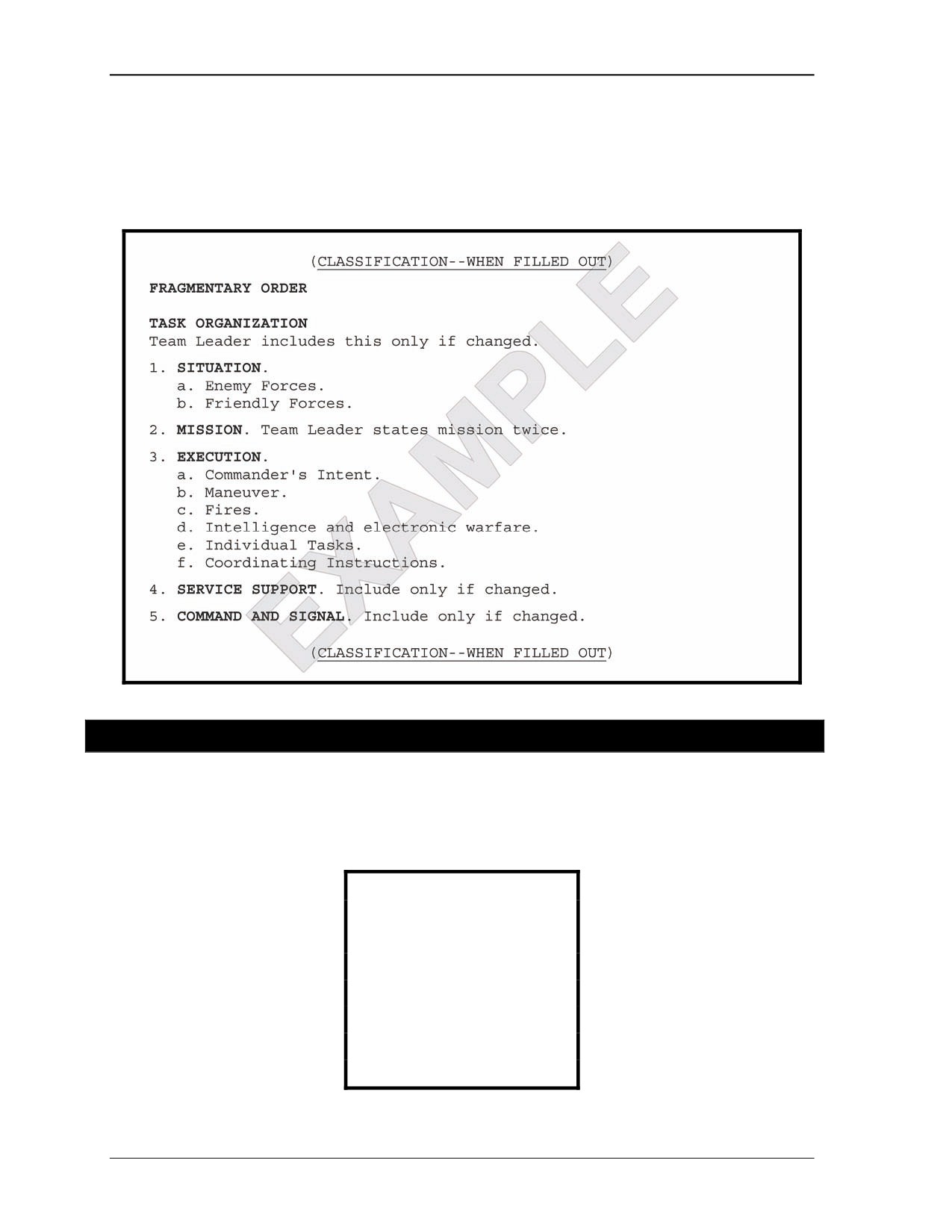
A FRAGO provides timely changes to existing orders. A FRAGO includes only the items that
have changed since the last OPORD. The items in the FRAGO follow the five-paragraph OPORD format.
However, a significantly changed mission or a brand new mission requires a new OPORD. Figure B-3
shows an example FRAGO.
Figure B-3. Example fragmentary order.
Section II. BRIEFS
Briefs are presentations of information from one leader to another, either up or down the chain of command.
TYPES
B-5.
Figure B-4 shows the types of briefs, and Table B-1 compares them based on who gives them to
whom and why, and on what elements each type must, should, or might include--
• Confirmation
• Mission Analysis
• COA Decision Brief
• Backbrief
• Initial GO/NO-GO Brief
• Mission Concept Brief
• Final GO/NO-GO Brief
• Debrief
Figure B-4. Brief types.
B-8
FM 3-55.93
23 June 2009

Orders and Briefs
Table B-1. Comparison of brief types.
Type
Purpose
Conditions
Briefer
Audience
Time
Elements
Con-
Ensure team
NA
Team leader
Company
NLT 30 minutes
•
Restatement of mission (if
firmation
understands
commander
after receipt of
specified in OPORD)
OPORD
(or unit rep)
Company
•
Restatement of commander's
before they
OPORD
intent
analyze
mission
•
Initial issues or concerns
•
Next key hard time
Mission
Extract all
Given a time--
Team leader
Commander
NLT 2 hours
•
Intent two levels up
Analysis
critical and
or an
or his
after receipt of
•
Specified tasks
pertinent data
operational
representative
Company
from OPORD
paced-
(IAW unit
OPORD
•
Implied tasks
and conduct
constrained
SOP, number
detailed MPF
environment--
of unit teams,
•
Facts about friendly, enemy,
before
and
and
terrain, time
developing
situational
operational
•
Assumptions about friendly,
team COAs
awareness
pace),
enemy, terrain, and time
or team only
•
Facts that could hinder
execution
•
Restatement of mission
Prepare team
Commander
Team leader
After team
•
Assumed risk by phase
leader to
(or rep)
leader's Mission
•
Criteria to evaluate (some
develop
Analysis (MA)
or all)
COAs
brief
•
Number of COAs to develop
•
Detailed instructions on
higher coordinations for
insertion and extraction
•
Approval of mission
statement
COA
Determine
Team leader
Commander
•
Intent of higher
Decision
best possible
or rep (PL,
•
Restated mission
Brief
COA for team
PSG,
execution
operations
•
Updated IPB (enemy
officer, or
SITEMP)
1SG,
depending on
•
COA table or matrix with
operational
criteria*
pace and
* Weighted criteria are allowed
number of
teams)
Team, if team
After team
• Residual risk by phase of the
leader does
completes
operation
not brief
MA--developing
• Strengths and weaknesses of
higher; team
COA and
each COA
then votes on
preparing for
COA.
COA decision
• Team's recommendation
brief takes about
2 hrs
• Issues and concerns
Commander
• Commander or rep chooses
or represent-
or refines COA
ative
23 June 2009
FM 3-55.93
B-9

Appendix B
Table B-1. Comparison of brief types (cont’d).
Type
Purpose
Conditions
Briefer
Audience
Time
Elements
Backbrief:
To instill
Audience
Team leader
Company
NLT 4 hours
•
Initial GO/NO-GO brief
confidence in
generally
commander
before insertion.
initial GO/
audience.
understands
and other
•
Team introductions (if
To assure
the mission
guests such
This gives the
NO-GO
needed).
them that
and knows
as R&S
detachment or
brief
team under-
the
Squadron or
company
•
Orientation to facility.
stands plan
presenters.
BFSB
commander time
thoroughly,
Commander,
to deliver the
and has
or other VIPs.
final GO/NO-GO
•
Announcement of who briefs
applied
brief to his
what topic.
contingencies
higher before
and proper
insertion.
•
Mission statement
risk mitigation
to ensure
•
Commander's intent
mission
success and
team
•
Concept of the operation
preservation.
(insertion, infiltration,
execution, fires, exfiltration,
abort criteria, extraction info,
and EPA)
•
Risk mitigation (by phase)
•
Team's recommendation
(issues and GO/NO-GO)
•
Commander's decision
(GO/NO-GO)
Mission
To obtain a
Company or
Decision
NLT 2 hours
•
Overall recommendation
concept
GO/NO-GO
detachment
maker
prior to insertion.
•
Purpose of NAI coverage
brief
decision
commander
is normally
This gives the
(BFSB S-2 ISR fusion
one of the
Final GO/
commander time
element Warrant Officer)
following:
NO-GO
to return to the
•
Enemy situation (BFSB S-2
brief
• LRSC Cdr
team's location
ISR fusion element Warrant
and inform them
• R&S
Officer)
of MIssion
Squadron
Concept Brief
•
Weather (BFBS S-2 weather
Cdr
results before
team)
insertion
• BFSB Cdr
•
Mission statement (LRS
commander)
•
Mission statement (if
applicable for aviation
commander supporting
insertion)
•
Concept of the operation
(intelligence, movement and
maneuver, fire support,
protection, sustainment, C2,
risk mitigation)
•
Decision (GO/NO-GO)
B-10
FM 3-55.93
23 June 2009

Orders and Briefs
Table B-1. Comparison of brief types (cont’d).
Type
Purpose
Conditions
Briefer
Audience
Time
Elements
Debrief
To gather any
Debriefer is
Team
NLT 4 hours
• Appropriate team logs,
unreported
officer from
members
after extraction,
cameras, recorded messages
intelligence
LRSU or
so team can
turned in
from the
external
collate patrol,
• Map
team, and to
supporting
R&S, and
create an
agency
communication
• Recorder (manual or
historical
(R&S
logs, and to
recording device)
record of the
Squadron
allow debriefing
mission
S-2 or BFSB
while information
• Communications
ISR fusion
might still remain
representative
element
fresh in the
• Debriefer in charge
member)
minds of team
members
CONFIRMATION BRIEF
B-6.
The leader gives a confirmation brief to ensure that he understands the company OPORD and to
focus the team's mission planning in the right direction. The confirmation brief should occur NLT 30
minutes after receipt of the OPORD. The confirmation brief should include three elements:
• Restated mission (team's mission statement).
• Restated commander's intent.
• Initial issues or concerns.
MISSION ANALYSIS BRIEF
B-7.
Figure B-5 through Figure B-9 (this page through B-15) show example formats for mission
analysis worksheets.
23 June 2009
FM 3-55.93
B-11
Orders and Briefs
DECISION BRIEF
B-8.
The decision brief occurs after the team has completed its initial mission planning. Team members
present possible courses of action (COAs) and the criteria for evaluating each. The team leader chooses
one COA, explains why he chose it, and then presents all of the COAs to the commander. The commander
can approve the selected COA or provide additional guidance to the team leader for continued COA
development. The decision brief should include these six elements:
• Restated mission (the team's mission statement).
• Restated commander's intent.
• Two to three courses of action on the objective.
• The team's recommended COA.
• Limitations and constraints.
• Any issues or concerns.
BACKBRIEF
B-9.
A backbrief is an informal transfer of information to one or more leaders, usually the commander
and his guests, about the impending and completed missions, respectively. The amount of information
briefed is usually set by SOP. All present should understand the mission before they arrive. The purpose of
the backbrief is only to demonstrate that the team understands the plan thoroughly and has applied
contingencies and proper risk mitigation procedures to ensure mission success and team preservation.
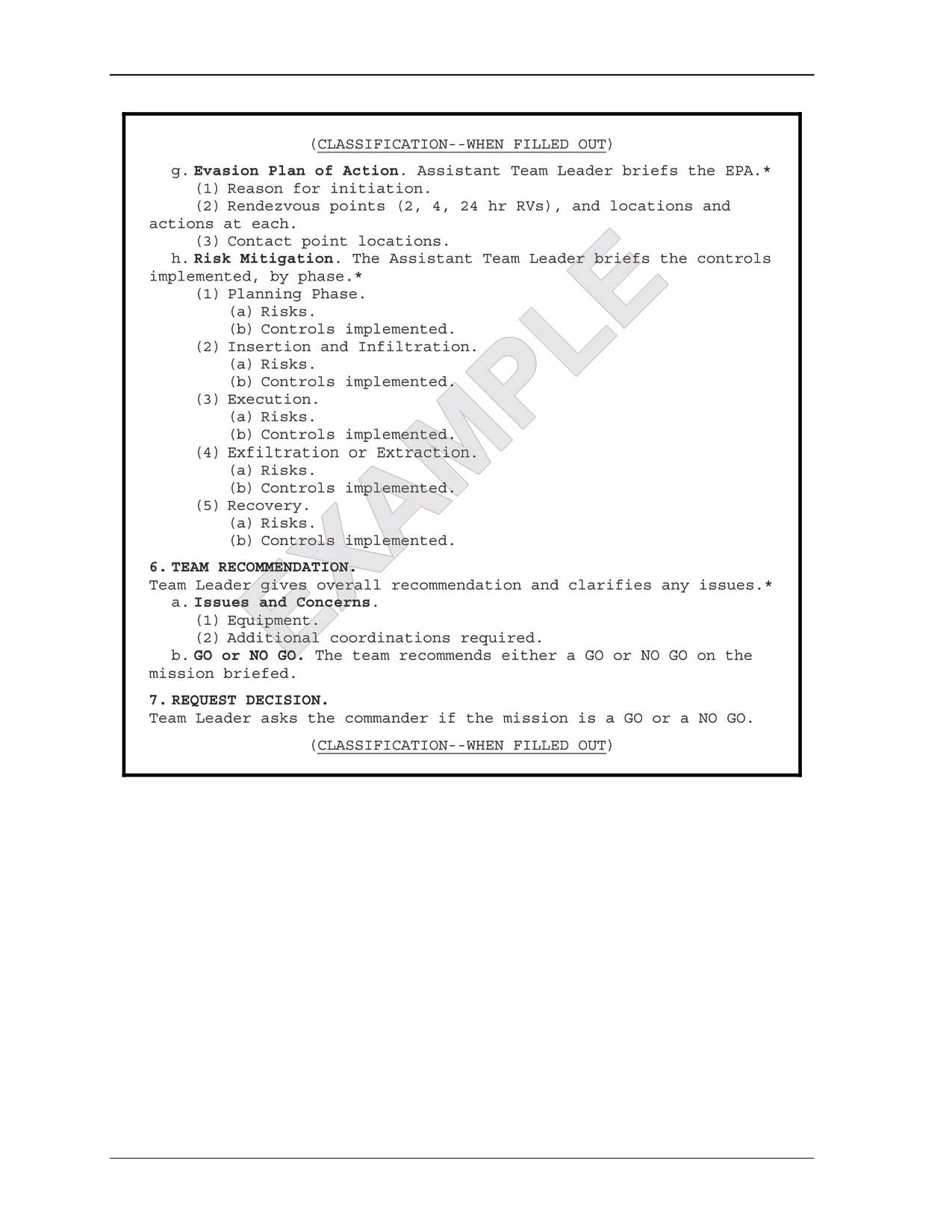
Figure B-10 shows an example backbrief format, with explanations.
23 June 2009
FM 3-55.93
B-17
Appendix B
Figure B-10. Example backbrief (continued).
MISSION CONCEPT BRIEF
B-10. Generally 2 to 12 hours before the planned insertion time, the company commander briefs the
appropriate decision makers on the mission concept to obtain a final "GO" or "NO GO" on the mission.
This gives the commander time to conduct movement back to the team to inform them of the decision and
any modified guidance before the planned insert time. The decision maker is normally the R&S squadron
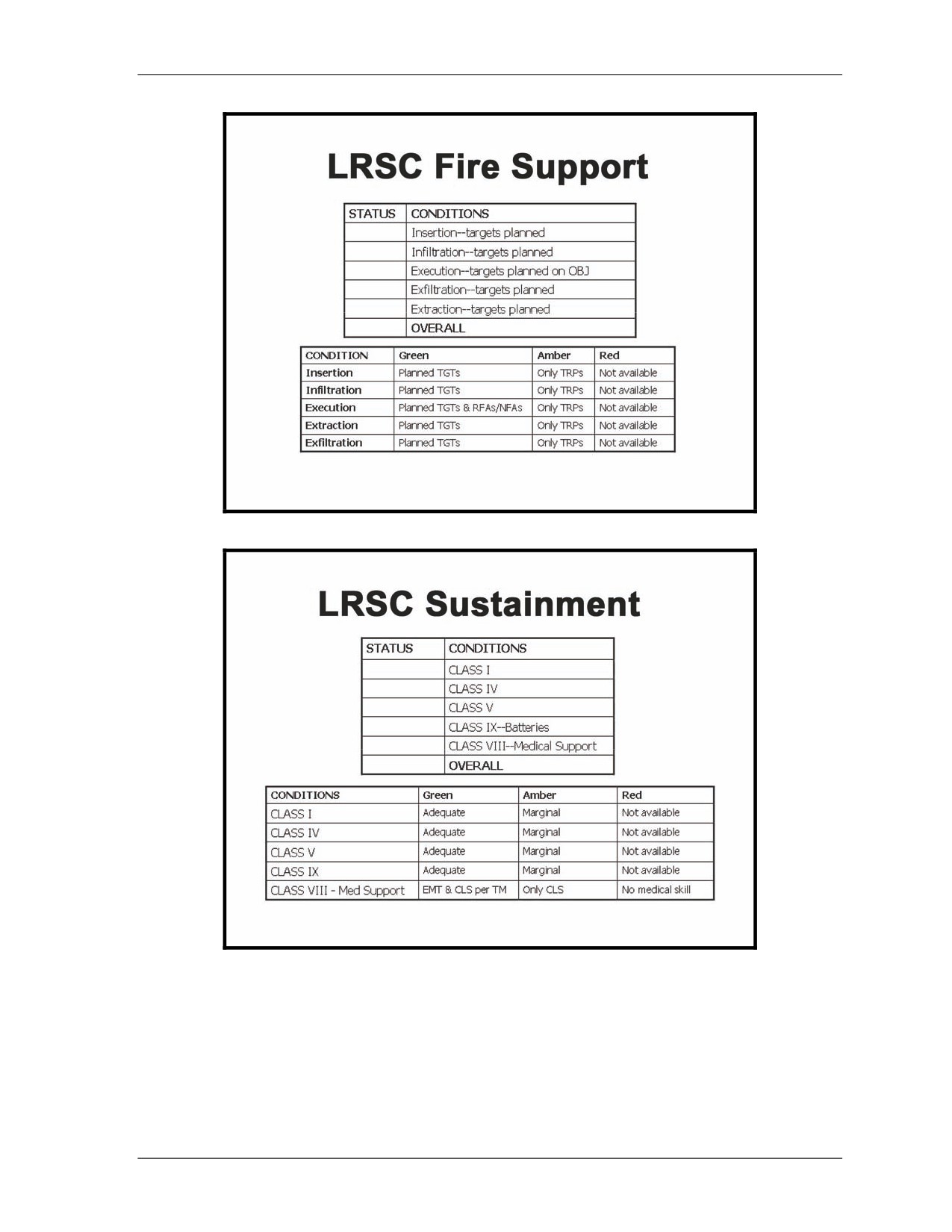
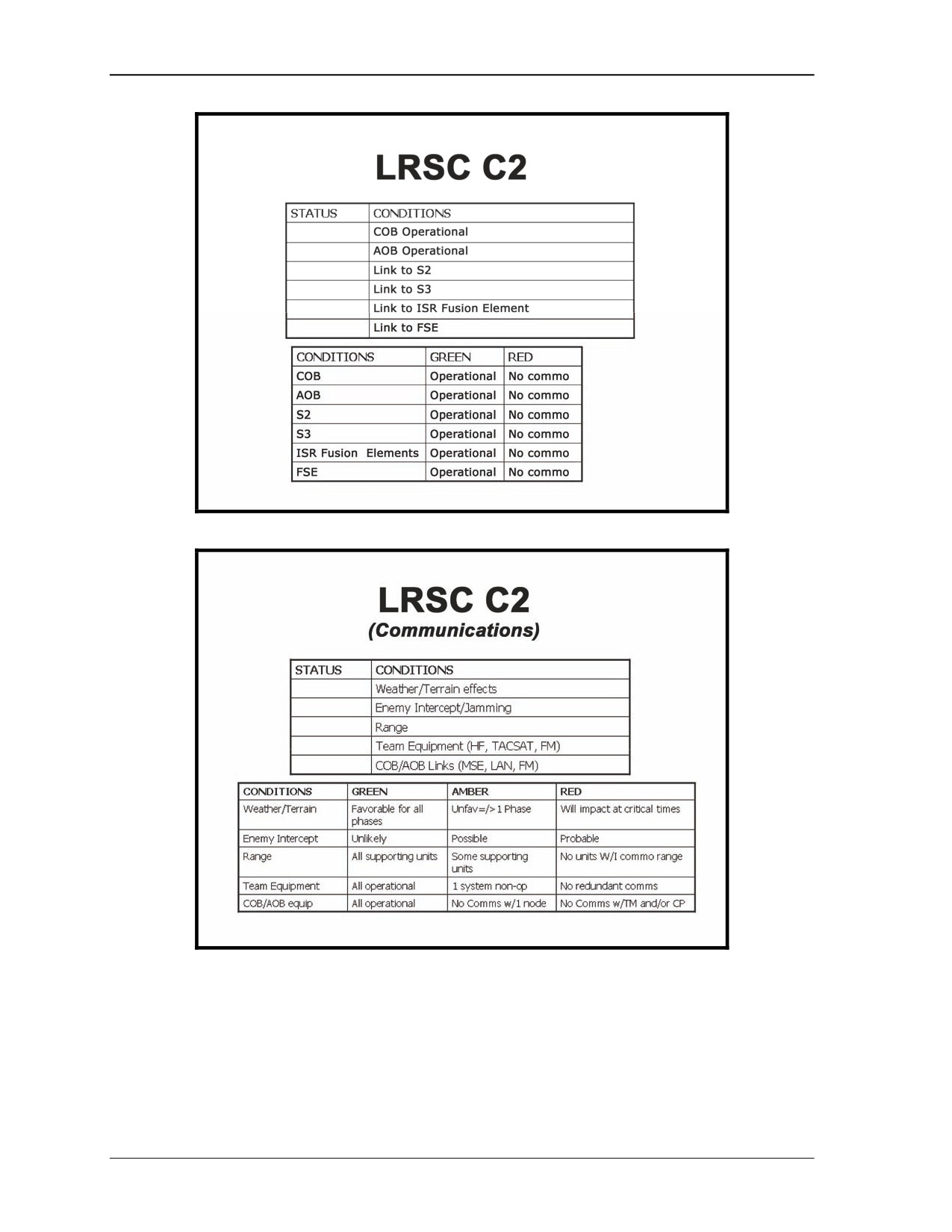
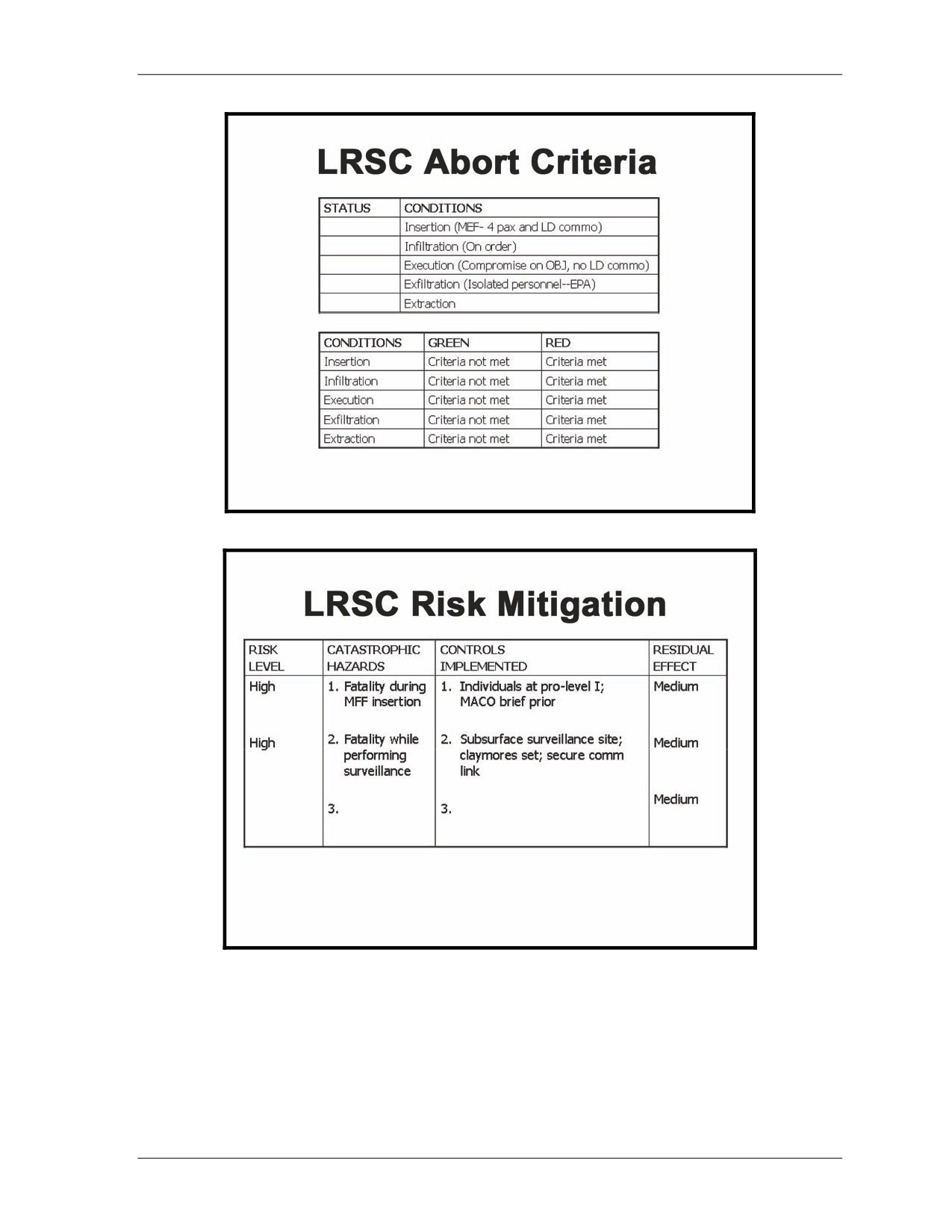
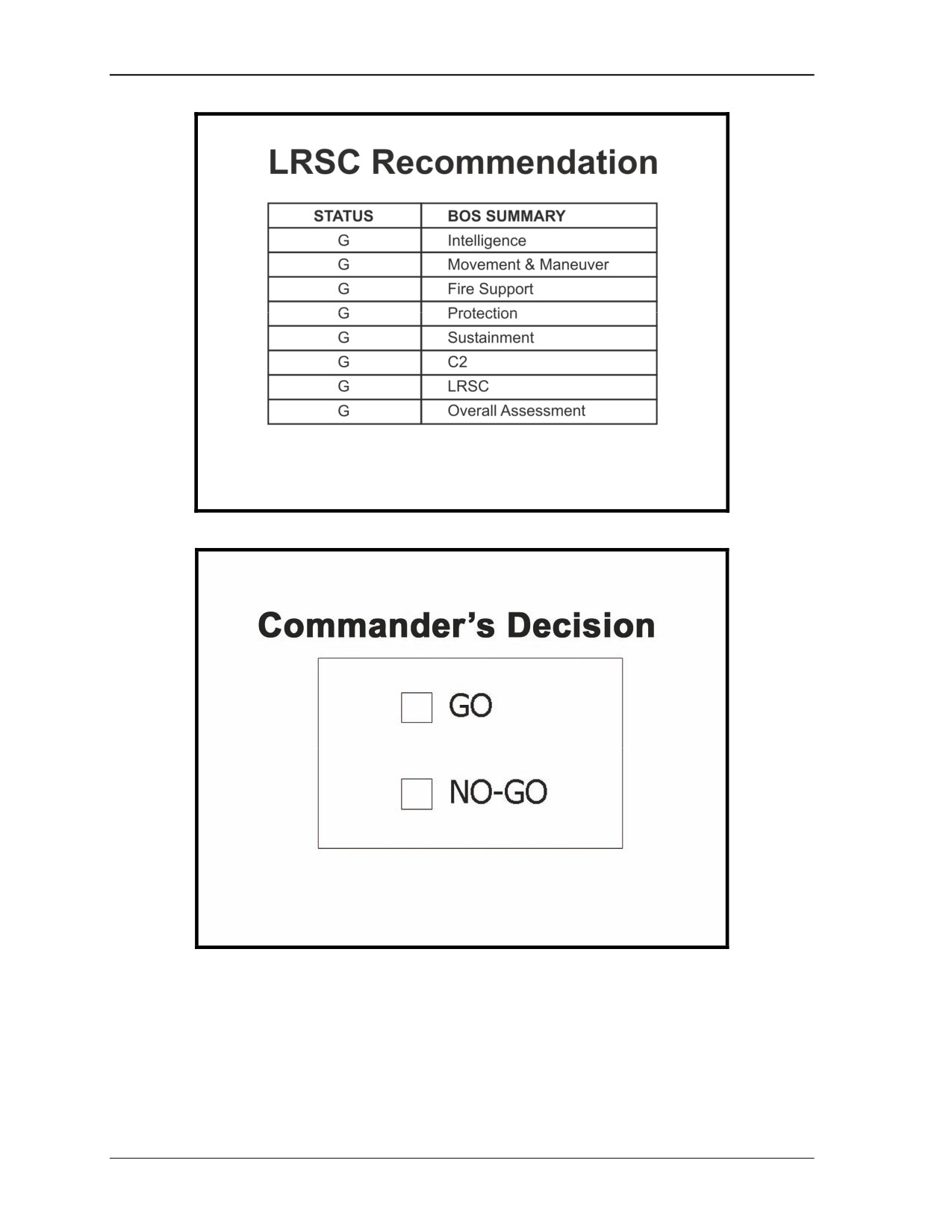
or BFSB commander. The mission concept brief includes the following elements, and an example brief is
shown in Figure B-11 through Figure B-38 (this page through page B-33).
• Overall recommendation.
• Purpose of NAI coverage (S-2 or ISR fusion element chief).
• Enemy situation (S-2).
• Weather (Air Force battlefield weather team).
• Mission statement (LRS commander).
B-20
FM 3-55.93
23 June 2009
Orders and Briefs
• Mission statement (if applicable for the aviation commander supporting the insertion).
• Concept of the operation (intelligence, movement and maneuver, fire support, protection,
sustainment, C2, risk mitigation).
• Request for decision (GO or NO GO).
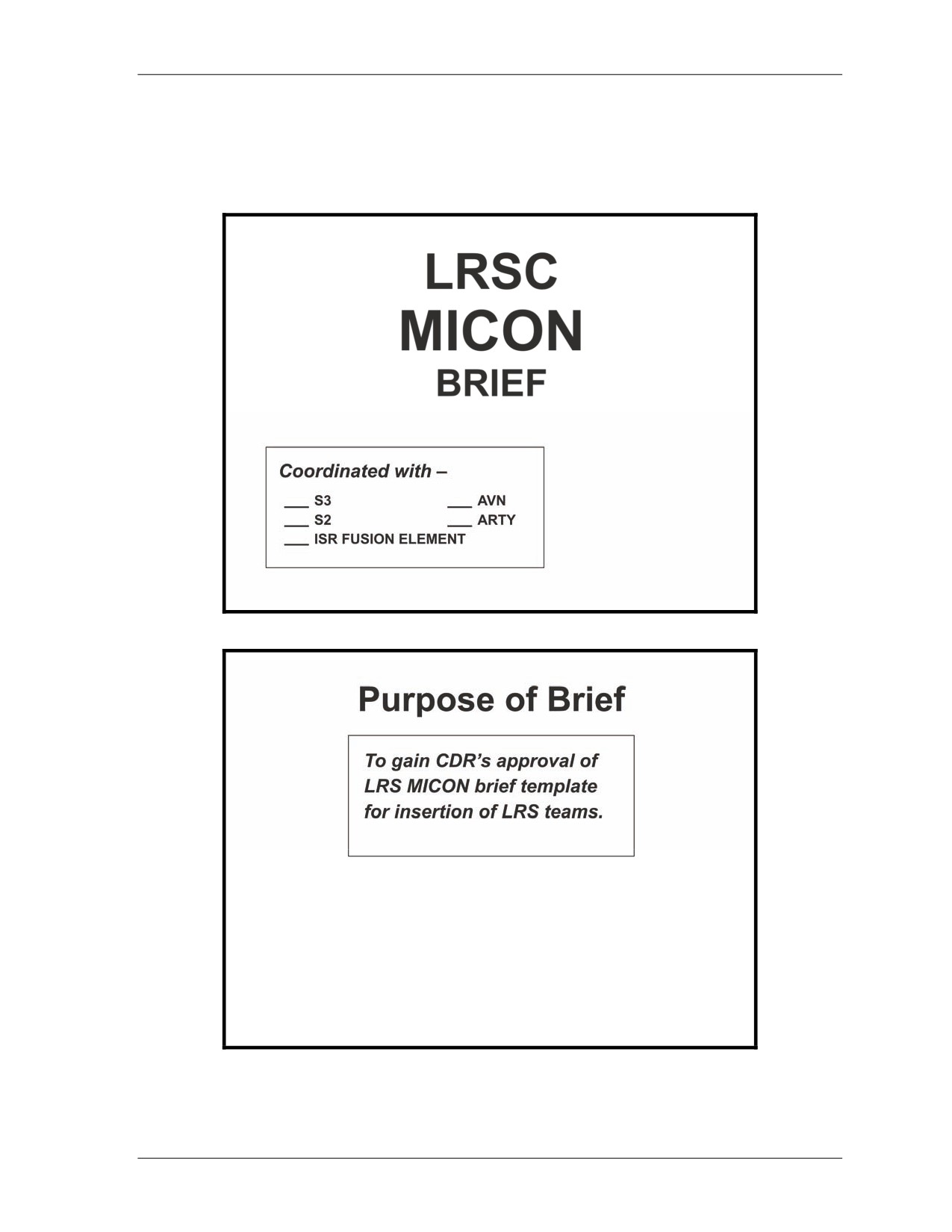
Figure B-11. Slide 1, LRSC mission concept brief.
Figure B-12. Slide 2, statement of purpose.
23 June 2009
FM 3-55.93
B-21
Appendix B
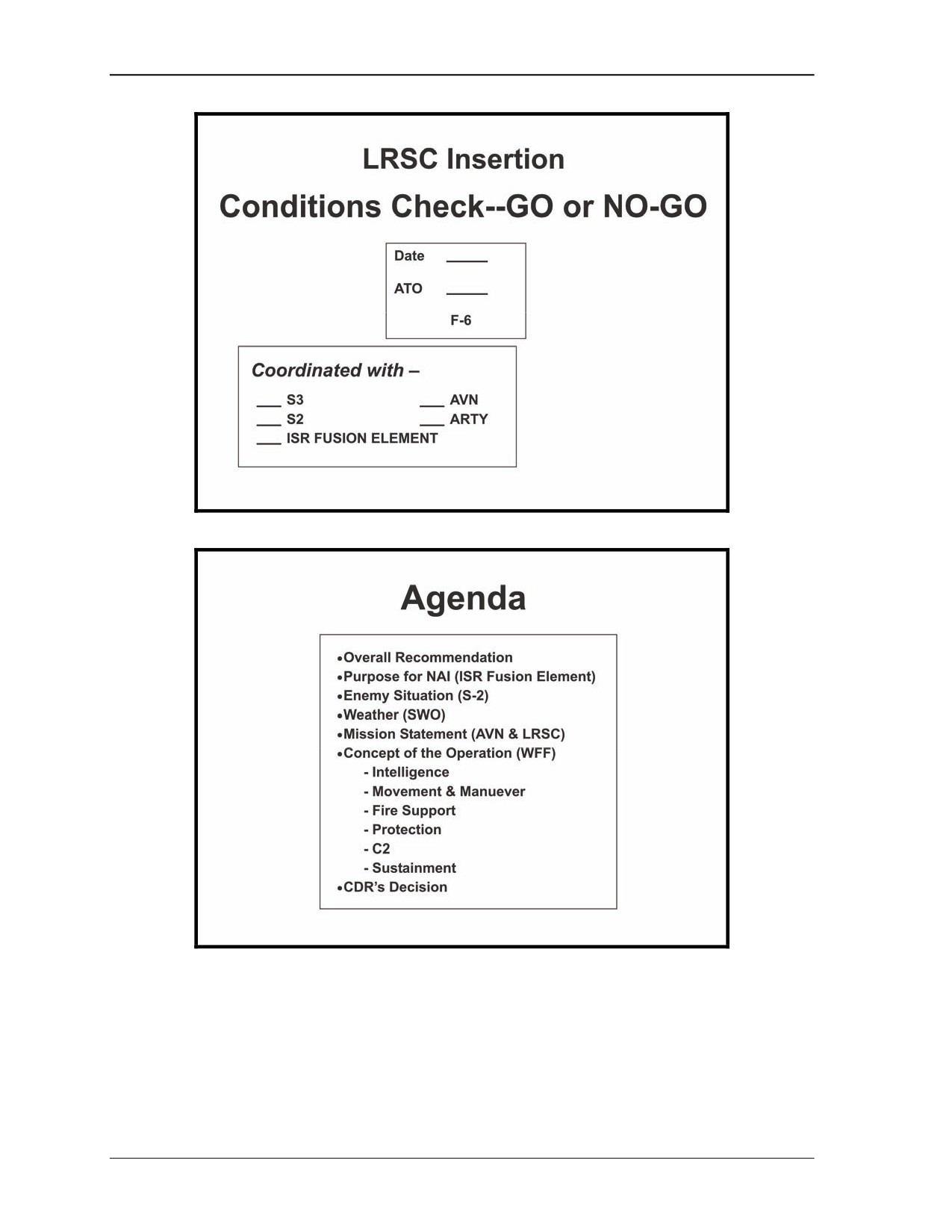
Figure B-13. Slide 3, LRSC insertion conditions check.
Figure B-14. Slide 4, agenda.
B-22
FM 3-55.93
23 June 2009
Orders and Briefs
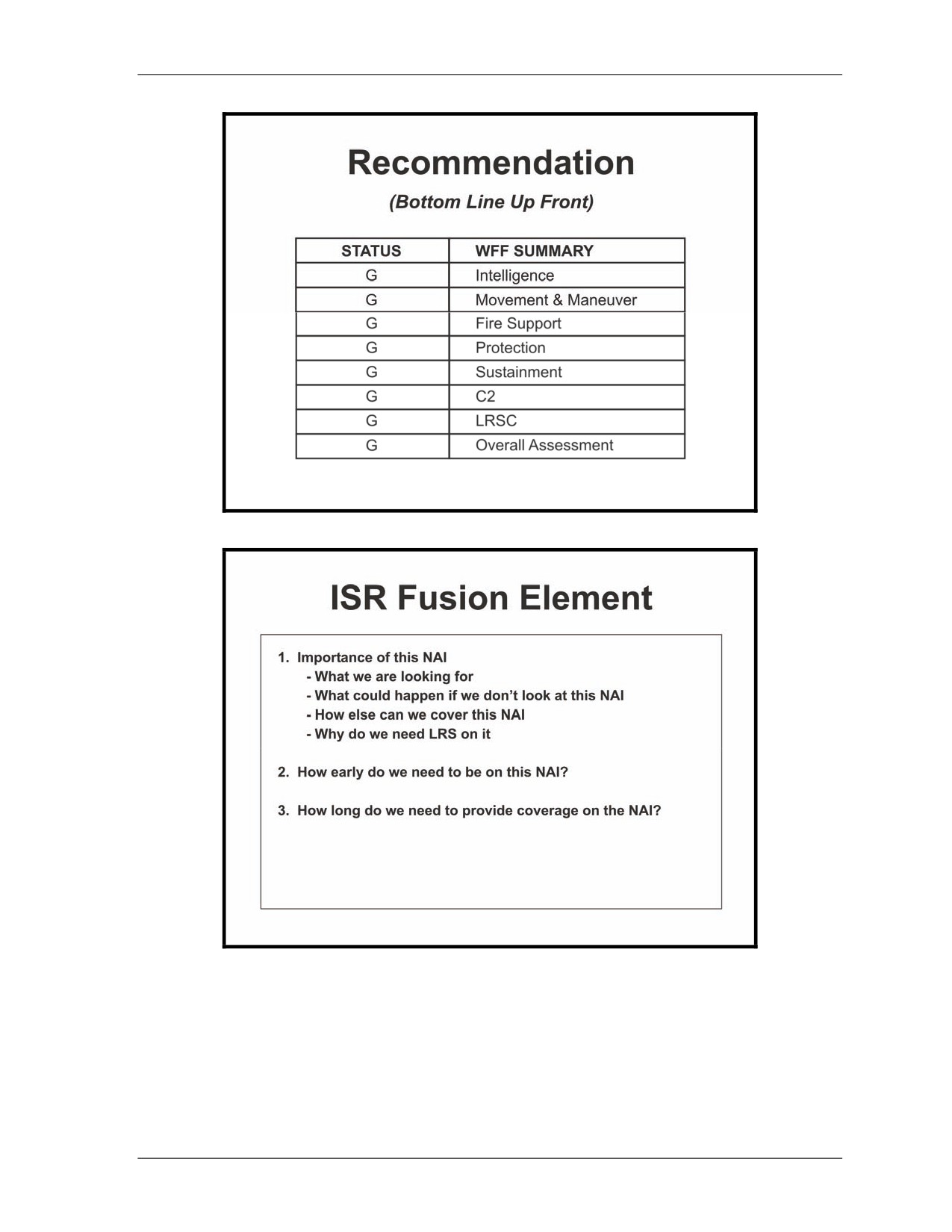
Figure B-15. Slide 5, recommendation.
Figure B-16. Slide 6, ISR fusion element.
23 June 2009
FM 3-55.93
B-23
Appendix B
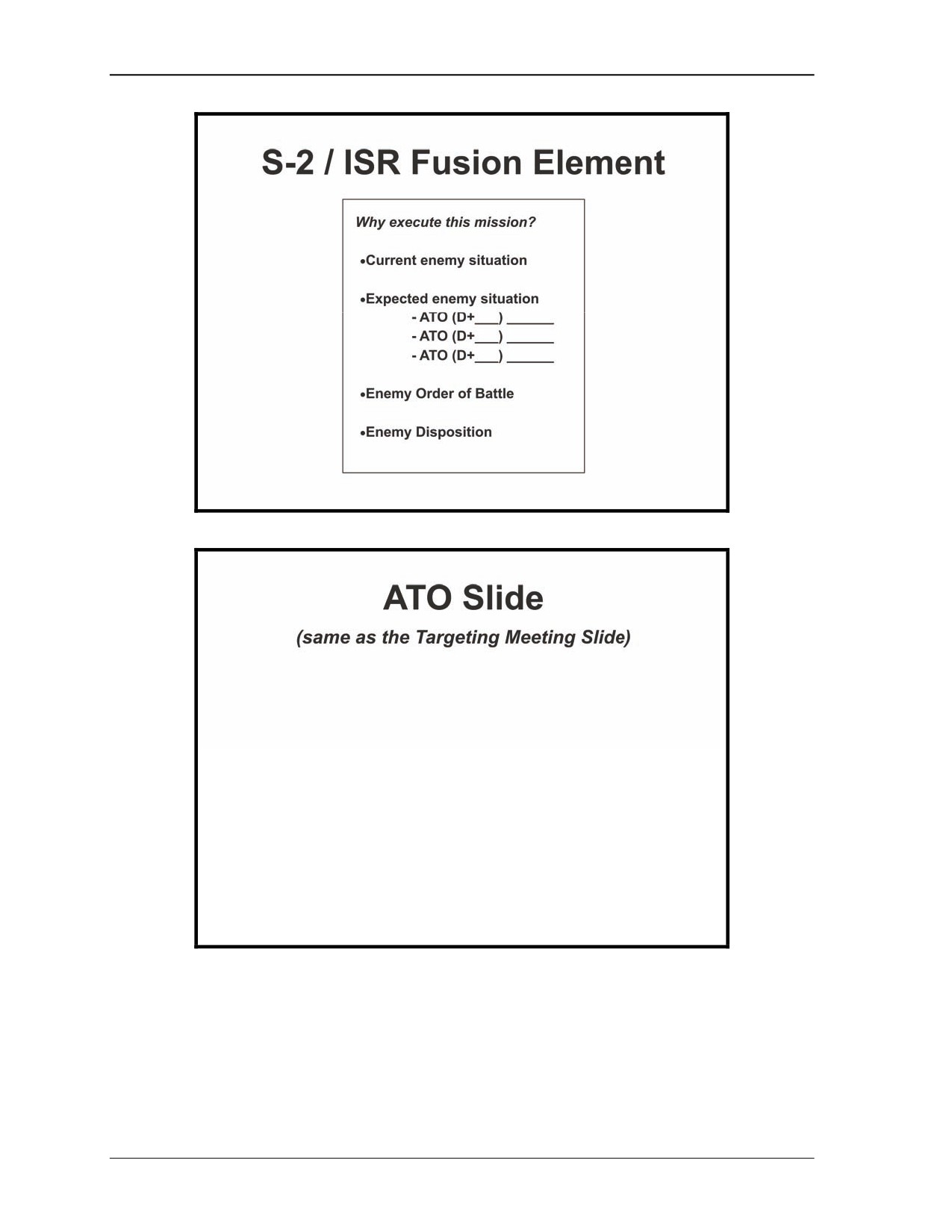
Figure B-17. Slide 7, S-2/ISR fusion element.
Figure B-18. Slide 8, ATO slide.
B-24
FM 3-55.93
23 June 2009
Orders and Briefs
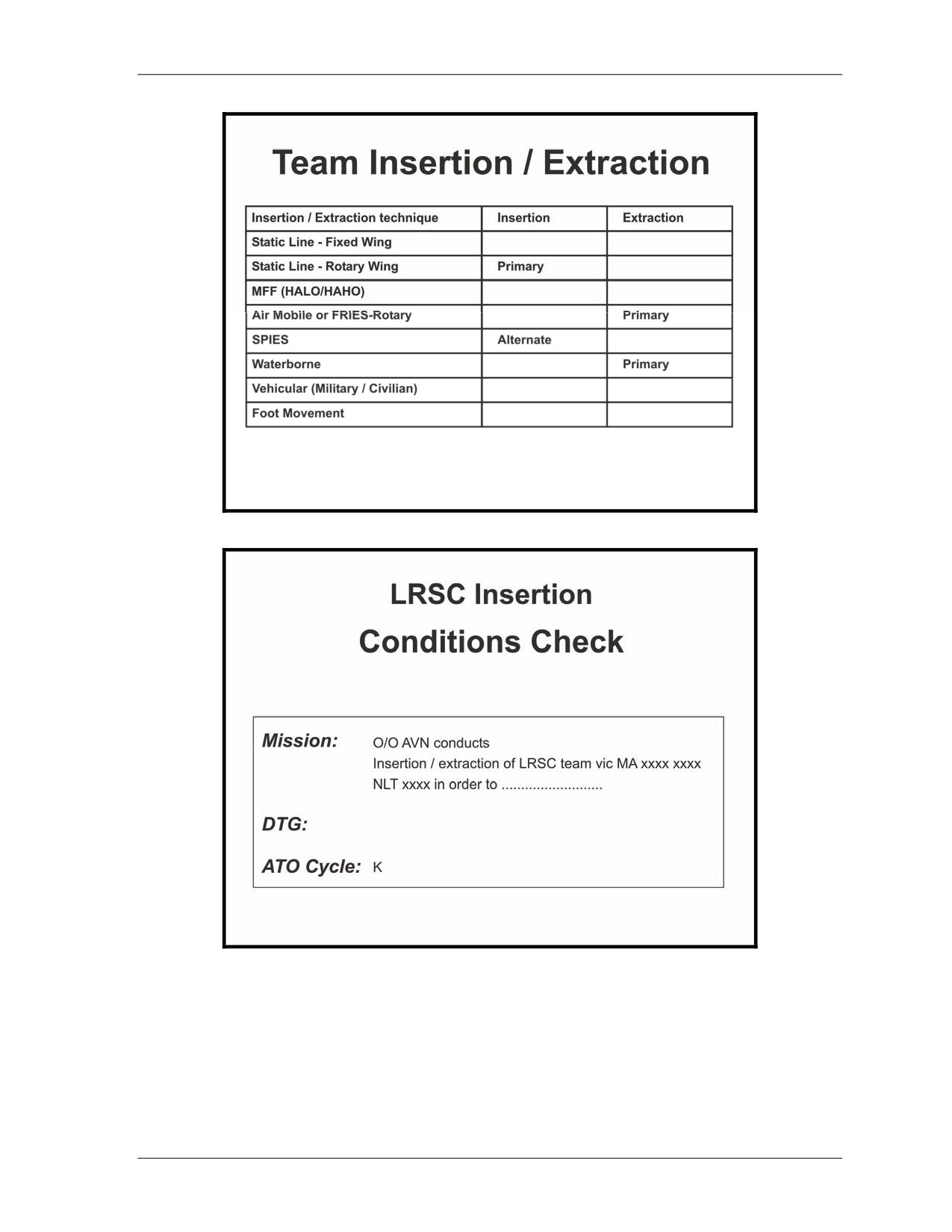
Figure B-19. Slide 9, team insertion and extraction.
Figure B-20. Slide 10, LRSC insertion conditions check.
23 June 2009
FM 3-55.93
B-25
Appendix B
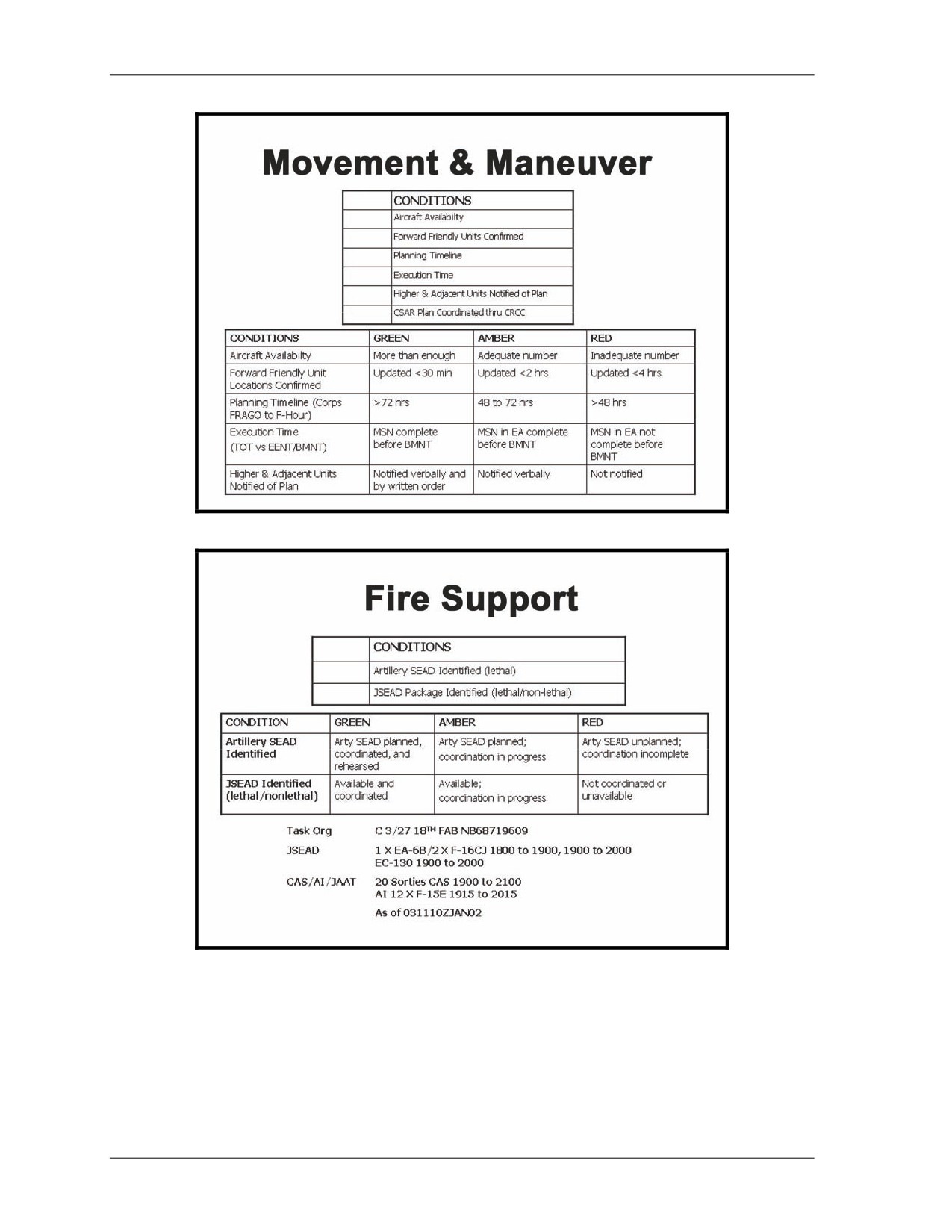
Figure B-21. Slide 11, movement and maneuver.
Figure B-22. Slide 12, fire support.
B-26
FM 3-55.93
23 June 2009
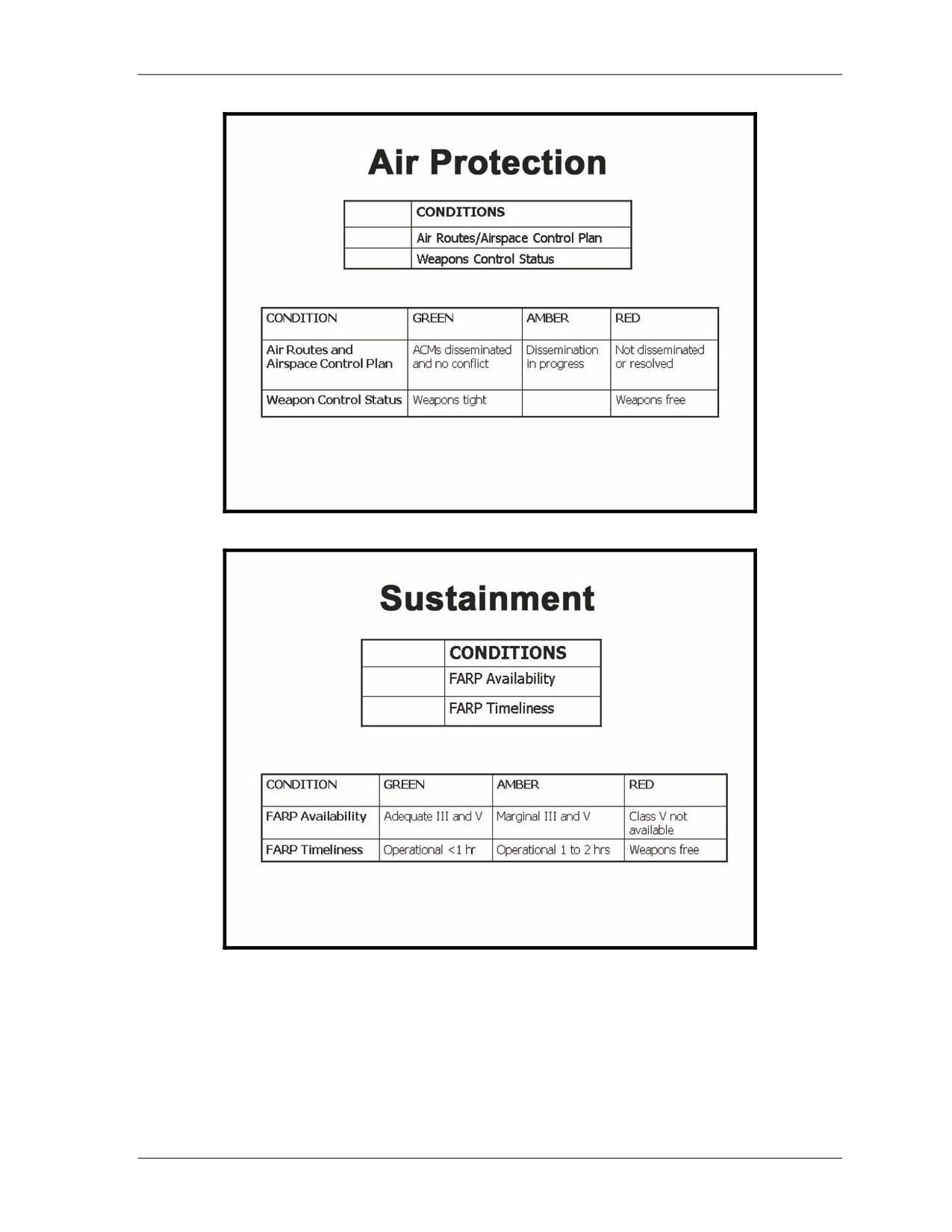
Orders and Briefs
Figure B-23. Slide 13, air protection.
Figure B-24. Slide 14, sustainment.
23 June 2009
FM 3-55.93
B-27
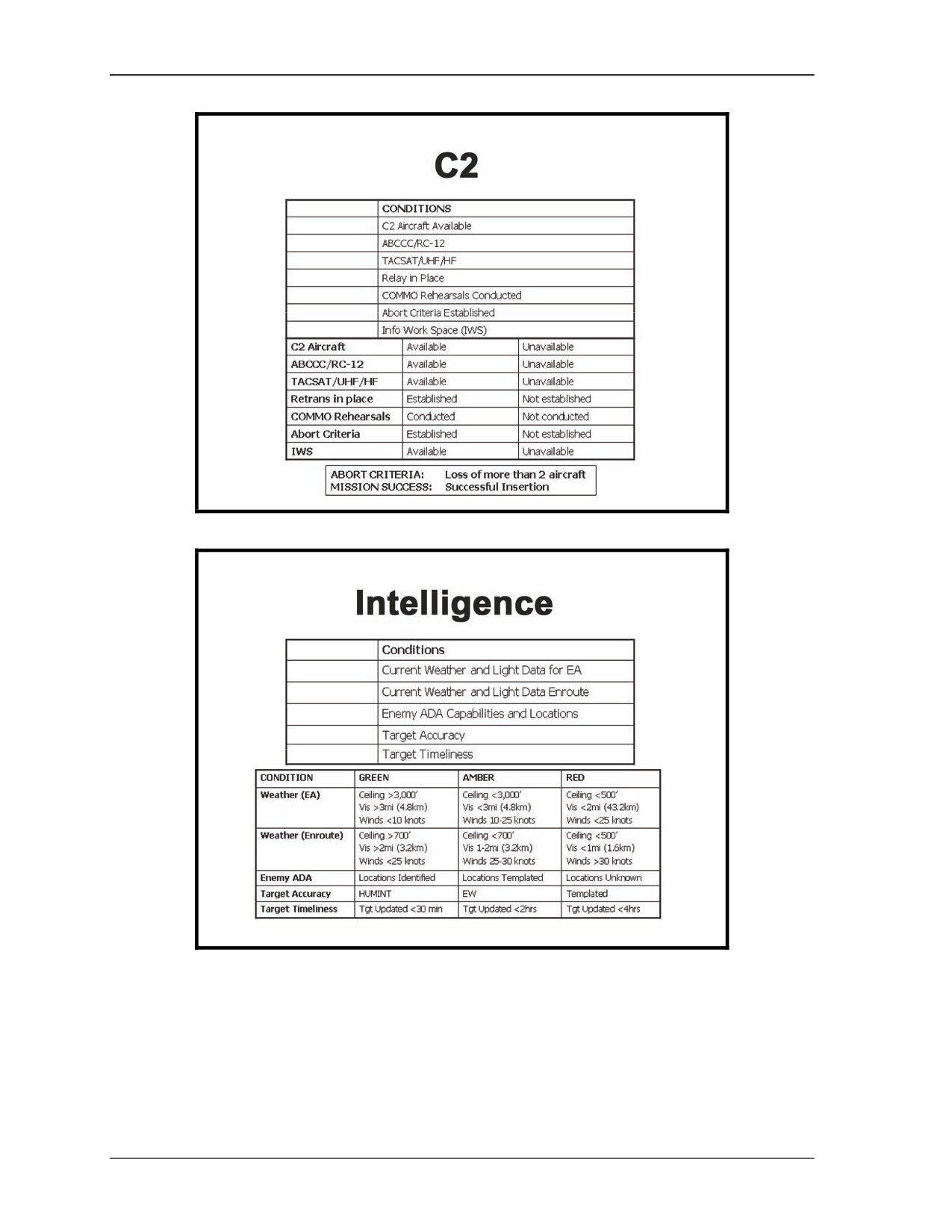
Appendix B
Figure B-25. Slide 15, command and control.
Figure B-26. Slide 16, intelligence.
B-28
FM 3-55.93
23 June 2009
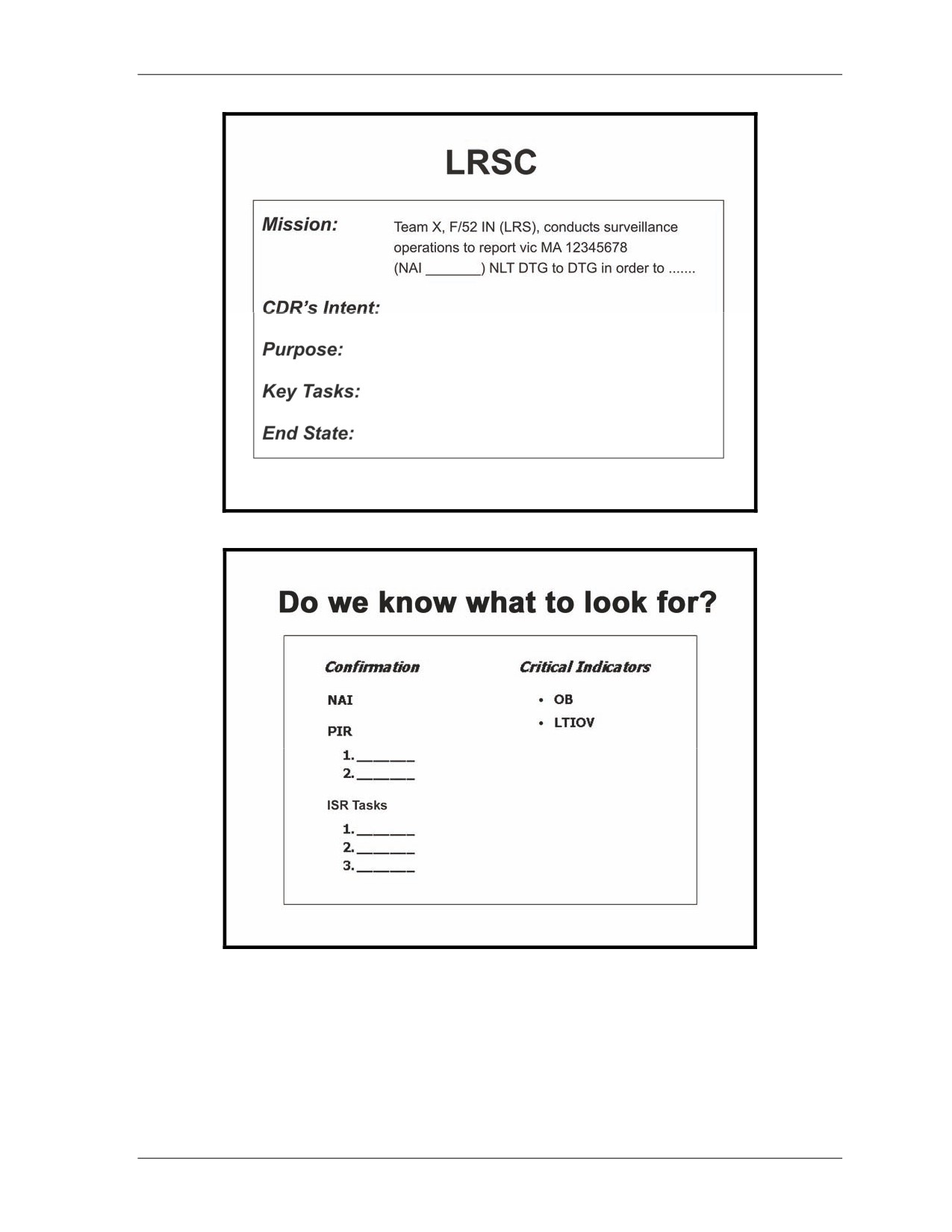
Orders and Briefs
Figure B-27. Slide 17, LRSC.
Figure B-28. Slide 18, "Do we know what to look for?"
23 June 2009
FM 3-55.93
B-29
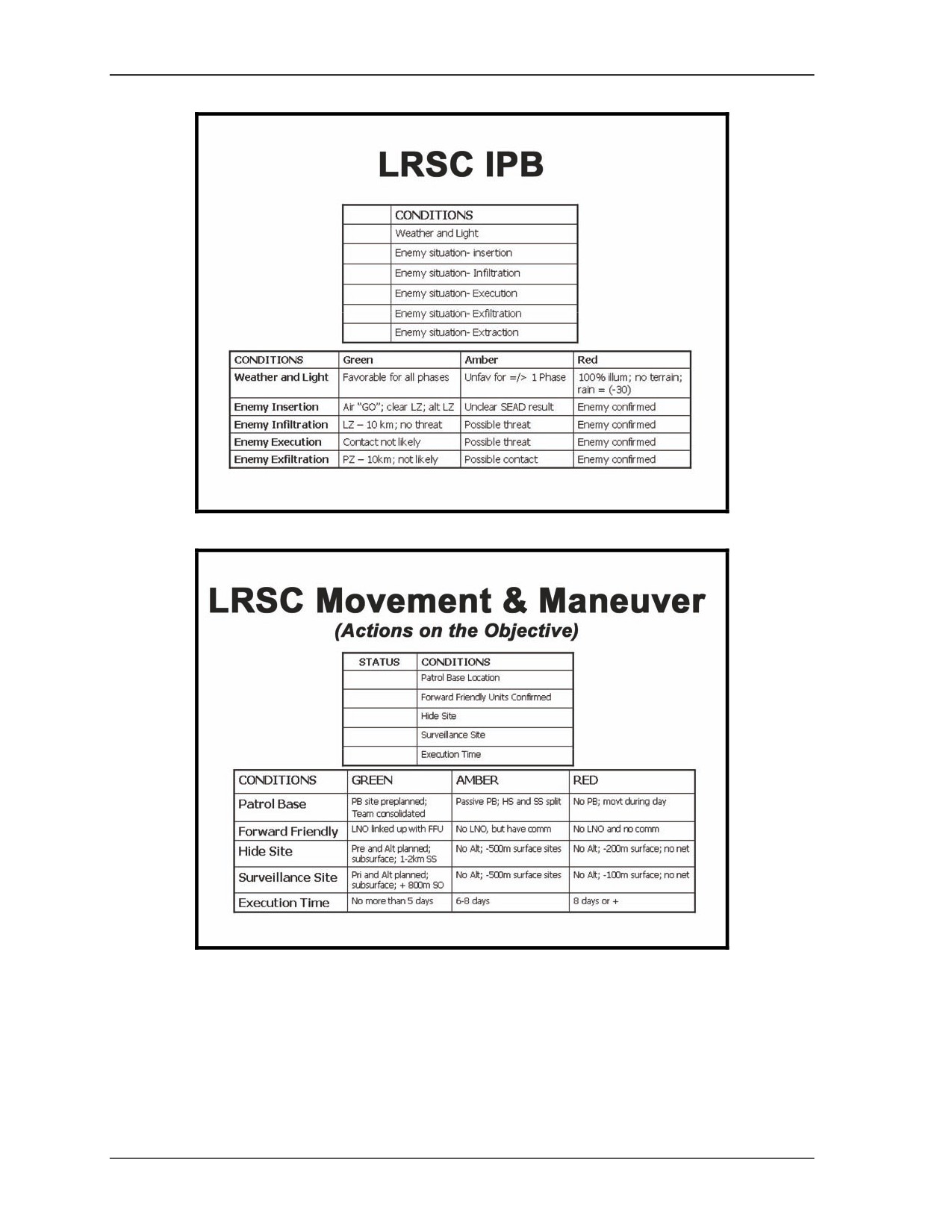
Appendix B
Figure B-29. Slide 19, LRSC IPB.
Figure B-30. Slide 20, LRSC maneuver.
B-30
FM 3-55.93
23 June 2009
Orders and Briefs
Figure B-31. Slide 21, LRSC fire support.
Figure B-32. Slide 22, LRSC sustainment.
23 June 2009
FM 3-55.93
B-31
Appendix B
Figure B-33. Slide 23, LRSC C2.
Figure B-34. Slide 24, LRSC C2, communications.
B-32
FM 3-55.93
23 June 2009
Orders and Briefs
Figure B-35. Slide 25, LRSC abort criteria.
Figure B-36. Slide 26, LRSC risk mitigation.
23 June 2009
FM 3-55.93
B-33
Appendix B
Figure B-37. Slide 27, LRSC recommendation.
Figure B-38. Slide 28, commander's decision.
DEBRIEF
B-11. The commander, his representative, or someone from the S-2 interviews, or debriefs, the team to
obtain information about the mission. A debrief is usually conducted just after the mission is over by the
commander, his representative, or by someone from the S-2. Figure B-39 shows an example debrief, and
Figure B-40 through Figure B-45, pages B-36 through B-48, show example annexes to the same debrief.
B-34
FM 3-55.93
23 June 2009
Appendix C
Planning Area Facilities and Sites
The goal of planning with limited access is to allow LRS teams an environment
without distractions and a reduced risk of mission compromise. Facilities include
fixed sites (best) or field sites.
FACILITIES
C-1.
Each LRSU benefits by having access to a secure planning facility. Ideally the facility should
enough space available to allow planning by the required number of teams to support operations. The
location and type of facility used depends on availability, security, and deployment requirements--detailed
planning is the same, regardless. Once the planning facility is established, the teams conduct detailed
mission planning. Access to the team is limited to such individuals as the team LNO, company commander,
BFSB and R&S squadron S-2 and others on the access roster. If available, the team rehearses in a secured
area nearby ideally on terrain similar to the area where they will operate.
FIXED SITE
C-2.
When available, the unit conducts detailed planning at a fixed site on its home installation.
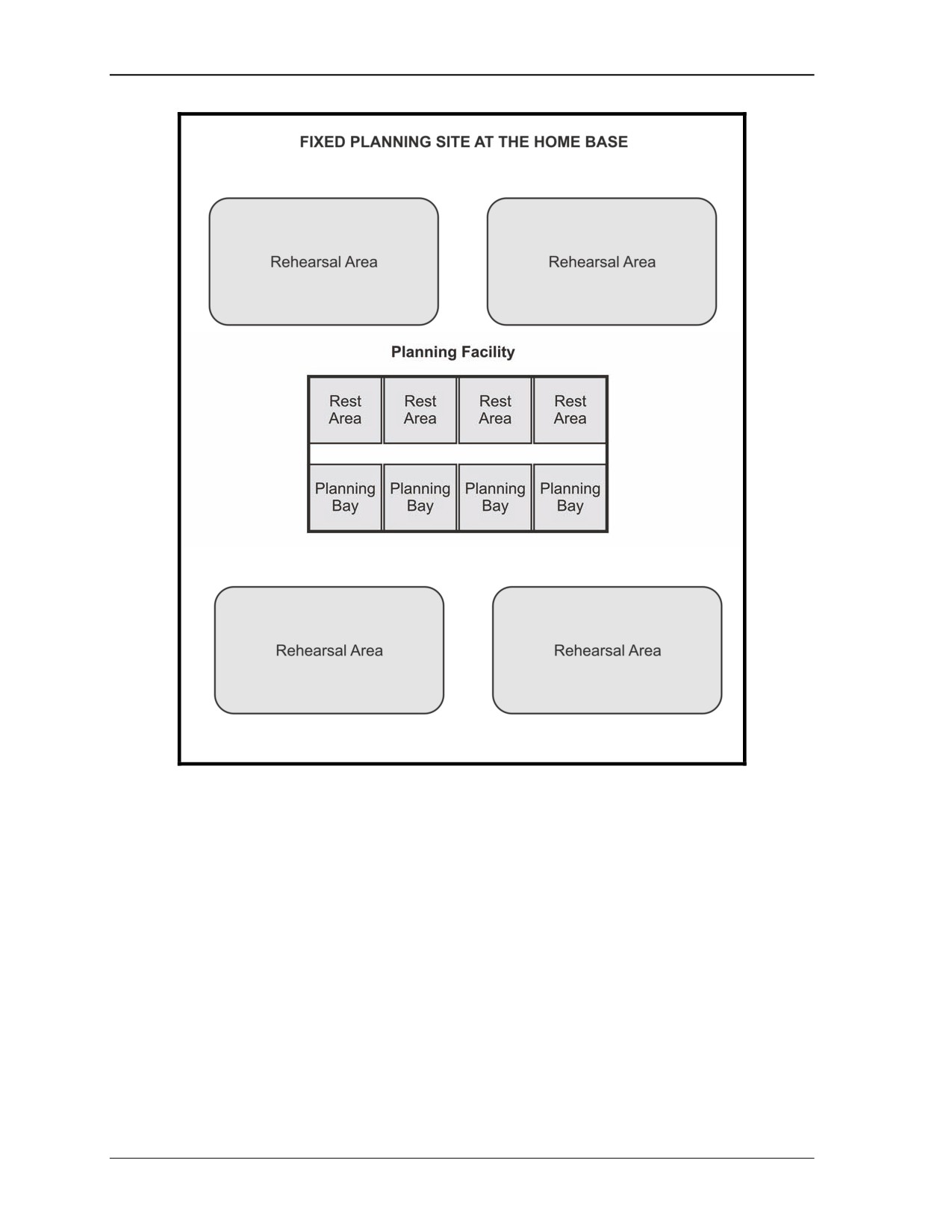
The next best option is to use a remote fixed site. The site should offer separate sleeping and planning areas
(Figure C-1).
SLEEPING AREAS
C-3.
Each sleeping area has electricity, heating, air conditioning (if possible), cots and showers.
PLANNING AREAS
C-4.
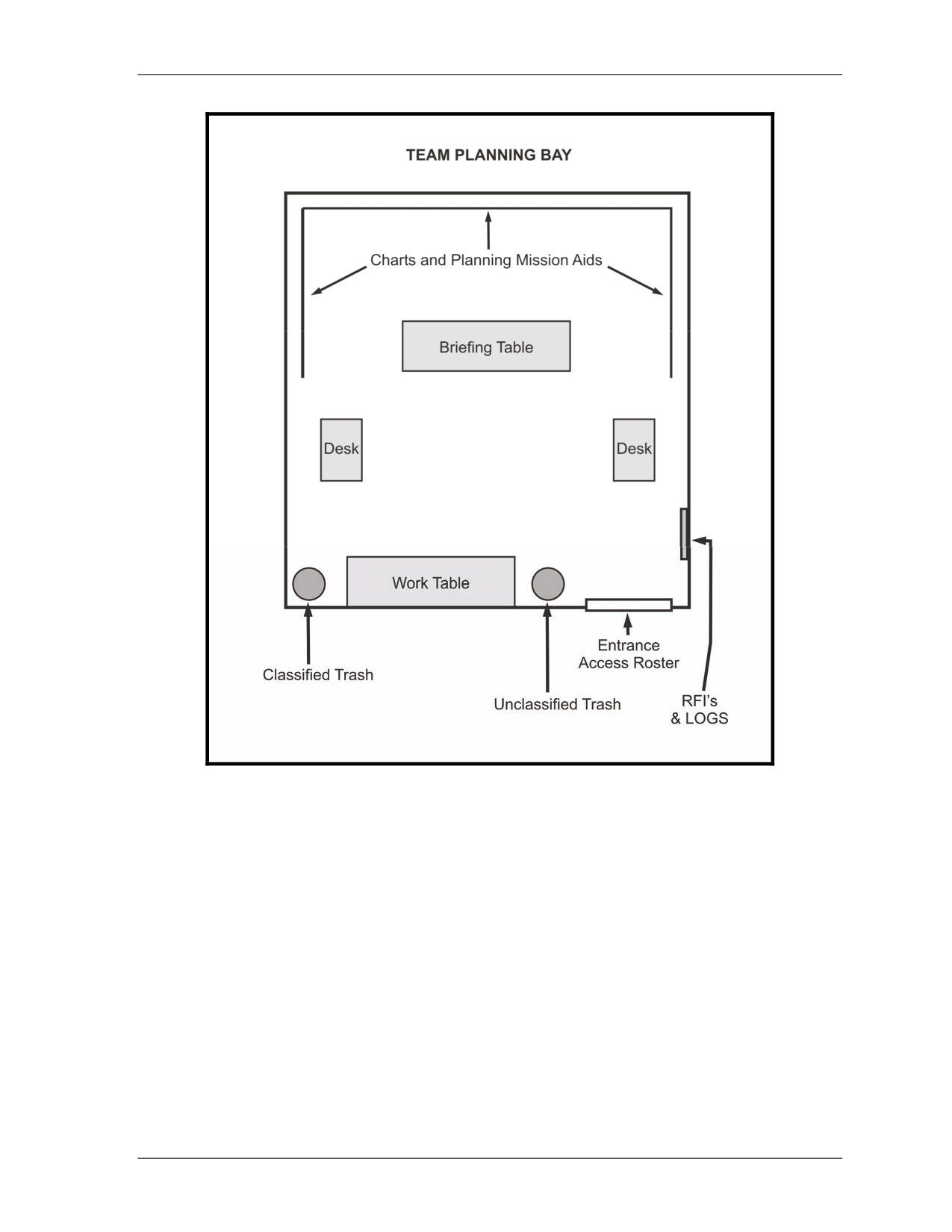
Each planning area should be large enough for a LRS team to plan the mission (Figure C-2). It
should have a place where the team can post all mission-essential information, a sand table, separate bins
for classified and unclassified trash, RFI logs, a time schedule, and an access roster.
COMBINED PLANNING AND SLEEPING AREAS
C-5.
Due to any number of constraints, the team must be able to adapt to limited space, and be ready to
live in the planning area.
FIELD SITE
C-6.
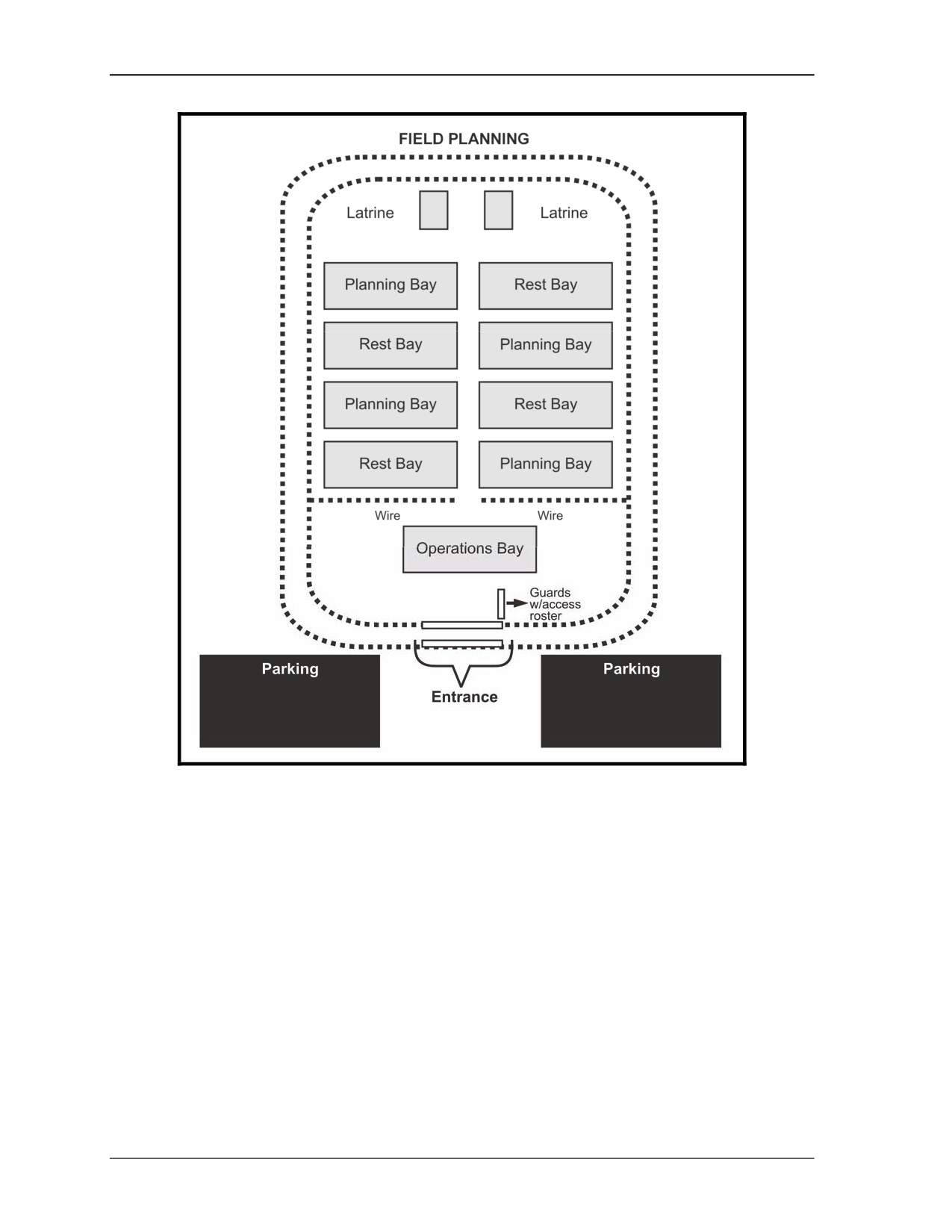
If no fixed site is available, or if the deployment plan dictates, the unit can conduct detailed
planning at a field site such as an aircraft hanger, a boat(s), or a tent(s) (Figure C-3). Everyone at the
planning site may be subject to the same restrictions and limitations--leaders, teams, and supporting
personnel. Each team needs--
• Separate field tents for planning and sleeping.
• Electrical source.
• Latrines.
• Passive and active security measures such as wire obstacles or guards.
• Site maintenance support.
• Communications with the LRSC operations section and with the rehearsal area.
• Planning aids.
23 June 2009
FM 3-55.93
C-1
Appendix C
Figure C-1. Example fixed site for planning.
C-2
FM 3-55.93
23 June 2009
Planning Area Facilities and Sites
Figure C-2. Example planning area.
23 June 2009
FM 3-55.93
C-3
Appendix C
Figure C-3. Use of intermediate staging area for planning.
C-4
FM 3-55.93
23 June 2009
Appendix D
Geographic Environments
Teams are greatly affected by extreme climates and terrain such as jungles, deserts,
mountains, extremely cold areas, and urban areas. Field manuals describe conditions
and operational techniques for each. Extreme temperatures, humidity, and elevations
also affect the lift capability of transporting aircraft.
JUNGLE OPERATIONS
D-1.
Dense jungle restricts ground and air observation as well as electronic surveillance. None of these
observation methods work well for collecting information on a dismounted surveillance target. Such a
target leaves little evidence that it has passed. LRS teams have the dismounted skills, stealth, and
communications needed to collect battlefield information under such conditions. (FM 90-5 provides more
information on jungle operations.)
INFILTRATION
D-2.
Dismounted, helicopter, and small boat insertion work well in jungle terrain. The limited
availability of LZs could require the team to insert by rappelling or FRIES. Careful coordination with
adjacent or friendly forward units is necessary for foot or boat movements to prevent fratricide.
EXFILTRATION
D-3.
Teams may be recovered by all available means, but communication and coordination are key
when operating in a jungle environment. Dismounted exfiltration routes must be coordinated before the
teams use them. Linkup operations with friendly forces require careful and deliberate coordination to the
lowest element possible (company or platoon). The SPIES is ideally suited for extraction of a team from
dense vegetation.
COMMUNICATIONS
D-4.
Dense vegetation, high humidity, and frequent rainfall make HF communications difficult. The
vegetation affects radio ranges and makes setting up antennas more difficult. Also, radio components
experience higher failure rates in wet environments. UHF TACSAT is best when there are holes in
the canopy.
DESERT OPERATIONS
D-5.
To survive in the desert, LRS teams must approach each task systematically so that it becomes a
habit. Weather and terrain are the main enemies in any military operation. However, in the desert, these
threats greatly increase (FM 90-3).
OPERATIONAL CONSIDERATIONS
D-6.
Leaders must consider the following in planning LRS operations in a desert environment:
Batteries
D-7.
Teams must test all batteries with a battery tester. The heat reduces battery life by one-third.
Teams must not leave batteries on the ground. The sand and other elements will cause a rapid drain of
power.
Water
D-8.
Teams can conduct operations for only a few days without a resupply or cache of water. During
the 24 hours before insertion, each Soldier must ensure he is fully hydrated. Each Soldier should carry a
minimum of 11 quarts of water, which is how much water he must drink each day when moving. This is
three 2-quart canteens plus one 5-quart bladder. Even when not moving, a Soldier in a desert environment
requires 7 quarts of water a day.
23 June 2009
FM 3-55.93
D-1
Appendix D
Insertion
D-9.
When inserting by helicopter, the team should consider using LZs that may provide a lower dust
signature such as a salt marsh or other hard-packed area. The distance from the LZ to the hide or
surveillance site must be carefully considered. Water consumption is a prime consideration.
Movement
D-10. Teams average 1 kmph/day and 3 kmph/night dismounted. They should use GPSs, because terrain
features may be few or shifting, and maps inaccurate. Walking on rocks and shale can help prevent the
enemy from tracking the team. Movement on wet or dark sand is generally quicker. Loose or dune sand
leaves clearer tracks and reduces movement speed.
Hide or Surveillance Site
D-11. Teams should consider locating hide and surveillance sites together due to potential extended
observation distances. Hide and surveillance sites can be camouflaged with a variety of materials including
the diamond desert net, burlap or bed sheets (color matched) pulled tight over a frame.
• Surveil from a point higher than the NAI; afternoon heat (between about 1100 and 1600 hours)
obscures optics at ground level due to the mirage effect, among other things. This makes
vehicles difficult to identify beyond 2 to 3 kms.
• To identify vehicles at night, consider moving the surveillance site to within 1 to 2 km of
the objective or NAI.
• When constructing subsurface hides, dig them in sandy soil. To prevent sides from caving in,
shore them up.
MOUNTAIN OPERATIONS
D-12. Irregular mountain topography normally provides good cover and concealment. Observation
varies depending on trees and scrub growth. Surveillance sites near ridges and peaks often provide broad
areas of observation. Helicopter movement of teams is often limited by altitude capability, erratic wind
conditions, and the lack of landing sites. Communications are generally difficult; relay stations might be
needed for communication between the teams and base stations (FM 3-97.6).
• During mountain operations, UHF TACSAT is best for primary communications, with HF as
secondary (FM 3-97.6).
• Use of mountaineering equipment is a must. Teams should also plan for scaling equipment and
other specialized gear.
• Teams must also be prepared to infiltrate by FRIES or SPIES due to rock formations.
HALO/HAHO insertion may also be considered if suitable DZs can be located.
COLD WEATHER OPERATIONS
D-13. In extreme cold, teams are hampered by the need to maintain body warmth. In deep snow, the
teams must operate on skis or snowshoes; dogsleds or skimobiles might also be required. Long-range
weather forecasts are an important planning consideration.
• Deep snow can conceal stationary surveillance sites, but increase the difficulty of orientation
and the concealment of moving teams.
• Magnetic storms, aurora effects, and ionosphere disturbances can seriously degrade radio
communications.
• Trafficability and load-bearing qualities of ice and snow crust are important planning
considerations.
• Survival is difficult in extreme winter conditions. To operate for extended periods at maximum
efficiency, the team must establish a warming area. They can use the heat from candles while in
D-2
FM 3-55.93
23 June 2009
Geographic Environments
a hide or surveillance site. Teams may require the use of extreme cold weather (ECW) sleeping
bags and tents. Goggles or dark glasses are required during operations due to the threat of
snow blindness.
• Northern summer conditions are characterized by long periods of daylight, numerous water
obstacles, and marshy areas. When aircraft or ground operations are restricted, the teams can
use boats designed to navigate northern waterways.
23 June 2009
FM 3-55.93
D-3
Appendix E
Contingency Plans
Operations seldom proceed as planned. LRSU operations are high risk conducted by
skilled and experienced Soldiers. Key to successful operations is the anticipation of
problems and opportunities that may arise. Visualizing and planning for
contingencies allow leaders to gain and maintain flexibility.
BRANCHES AND SEQUELS
E-1.
A contingency plan provides for major contingencies that can reasonably be anticipated during the
course of an operation in a particular geographic area. Contingency plans normally take the form of
branches and sequels.
BRANCHES
E-2.
A branch is a contingency plan (an option built into the basic plan) for changing the mission,
disposition, orientation, or direction of movement of the force to aid success of the current operation, based
on anticipated events, opportunities, or dispositions caused by enemy action. Branches are developed by
the LRSC, LRSD and the LRS team. For example: all three organization develop branch contingency plans
for loss of communications, the initiation of a LRS team E&R plan and the need to conduct resupply. The
LRS team will plan a branch in the case of compromise on the objective. The LRS team may also
anticipate a change of mission from surveillance to target acquisition if particular circumstances arise
during the conduct of a mission. LRS leaders must anticipate changes and plan accordingly.
SEQUELS
E-3.
A sequel is an operation that follows the current operation. They are future operations that
anticipate the possible outcomes--success, failure, or stalemate--of the current operation. Sequels are
normally not planned for below the LRSC level. The LRSC is normally alerted to the need to plan sequels
for employment of LRSDs or LRS teams based on orders from the BFSB or R&S squadron.
CONTINGENCY PLAN MATRIX
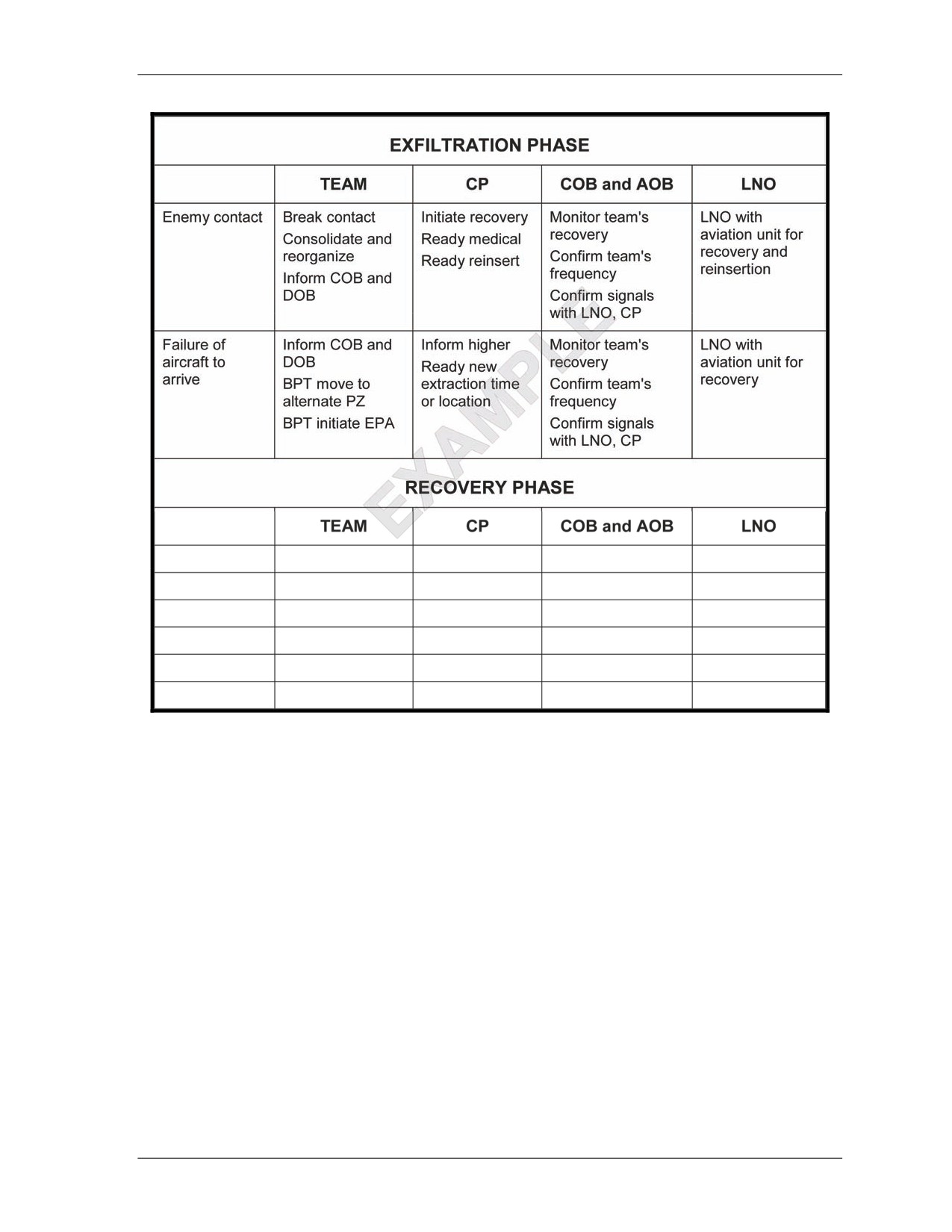
E-4.
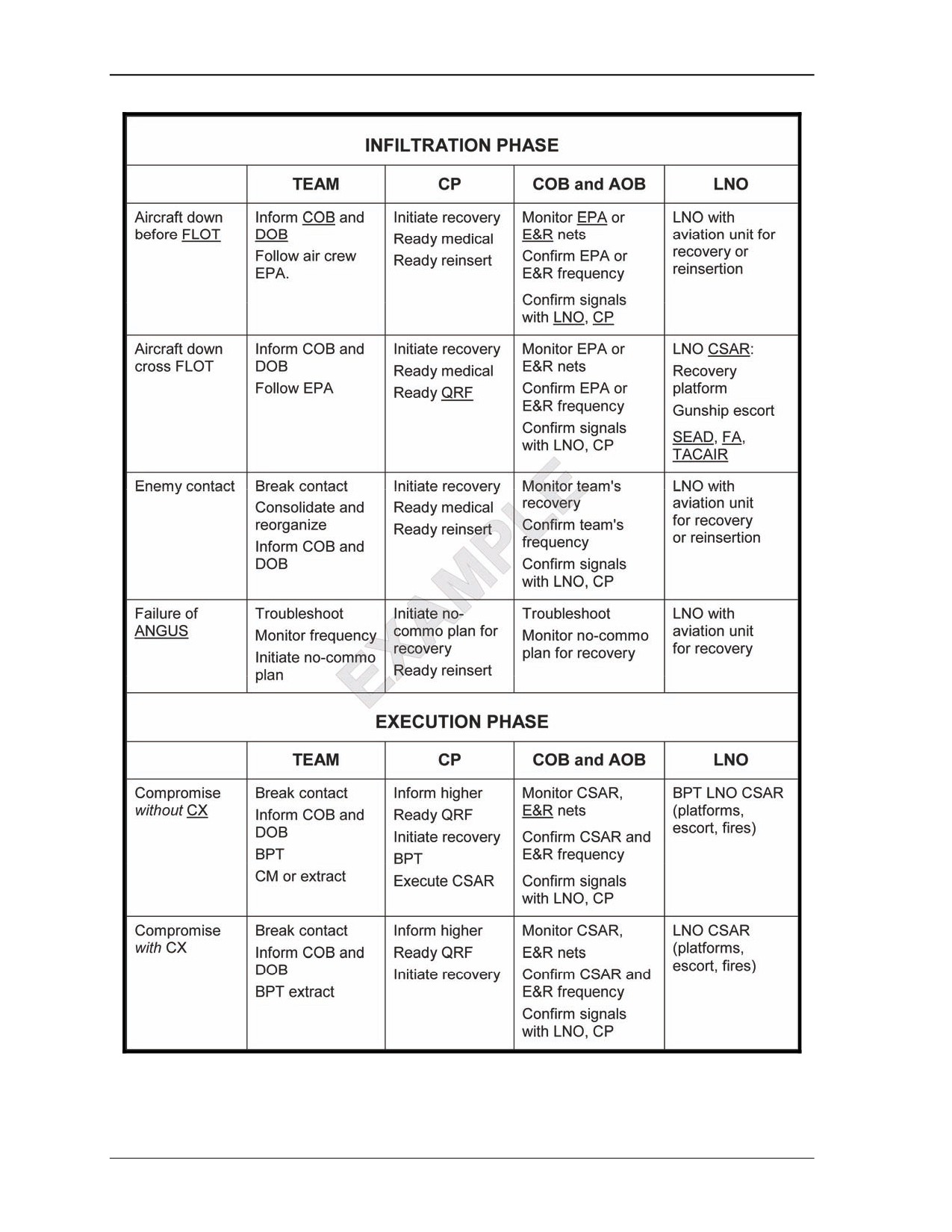
A contingency matrix can help LRS leaders plan, brief, and track contingencies. Leaders can
identify events by phase, schedule planning and briefing logically or chronologically, and effectively
execute and monitor contingencies. Figure E-1, shows an example completed contingency matrix.
23 June 2009
FM 3-55.93
E-1
Appendix E
Figure E-1. Example completed contingency matrix.
E-2
FM 3-55.93
23 June 2009
Contingency Plans
Figure E-1. Example completed contingency matrix (continued).
23 June 2009
FM 3-55.93
E-3
This page intentionally left blank.
Appendix F
Coordination for Army Aviation
This appendix provides an example OPORD
(Figure F-1) and annexes for
coordinating the following:
• Army aviation fire support (Figure F-2).
• Intelligence (Figure F-3).
• Rehearsal areas (Figure F-4).
• Vehicular movement (Figure F-5).
23 June 2009
FM 3-55.93
F-1

Appendix G
Hide and Surveillance Sites
During surveillance, which is the LRS team's primary mission, the team leader
reconnoiters, then selects positions for the surveillance and hide sites. Where to
construct the positions depends on his METT-TC analysis conducted during the
planning phase and his continued analysis once in the vicinity of the objective. The
two sites communicate by wire, VHF, or messenger.
Selected team members observe or surveil the objective from the surveillance site.
Some members rotate between the hide and surveillance sites. Others run the team's
HF or TACSAT directly from the hide site or from a separate location chosen
specifically for conducting communications.
SURFACE SITES
G-1.
The enemy situation may prohibit moving to a subsurface site, so camouflage must be done
correctly during occupation of both sites and improved when circumstances allow (Figure G-1).
Figure G-1. Two-man surface site using ghillie suits.
ADVANTAGES OF SURFACE SITES
• Simple construction.
• Few materials.
• Quick setup.
• Little soil removal if any.
• Optical standoff.
• Quick escape.
DISADVANTAGES OF SURFACE SITES
• Little protection from small-arms fire.
• No protection from indirect fires or CBRN hazards.
• Risk of compromise by dogs, civilians, and enemy patrols.
23 June 2009
FM 3-55.93
G-1
Appendix G
CONSTRUCTION MATERIALS FOR SURFACE SITES
• Natural vegetation.
• Ghille suits.
• Ground blinds.
• Poncho(s), waterproof.
• Yeti or camouflage net to prevent reflection.
• One 550-pound cord or bungee cords.
• Chicken wire (optional).
• Burlap or canvas cloth (optional).
CONSIDERATIONS FOR SURFACE SITES
G-2.
Team members--
• Avoid cutting vegetation, use man-made or natural camouflage.
• Keep equipment packed when not in use.
• Remain in uniform and keep on load-carrying equipment.
• Maintain security around the clock.
• Construct small, easy to conceal two-man site or,
• Construct three-man site for longer stays (one rests while others surveil).
• Rotate surveillance teams just after dark and just before daylight.
• Set up communications between the hide and surveillance sites.
• Take their rucksacks to the surveillance site.
• Remain in hide site during day when conditions only allow limited visibility surveillance.
• Use nets or natural camouflage to construct all-round concealment for the surveillance site.
Ensure that site is hidden from every angle, including overhead.
• Determine the location of the hide, surveillance, and communication (if used) sites, based on
METT-TC, but especially based on terrain.
• Try to change direction when moving from the hide site to the surveillance site. For example,
move in a dogleg or fishhook, or take an indirect route.
• Never wear a ghillie suit during movement, because pieces can rip off in vegetation and leave a
trail. Instead, put the suit on just before occupying the surveillance site.
HASTY SUBSURFACE SITES
G-3.
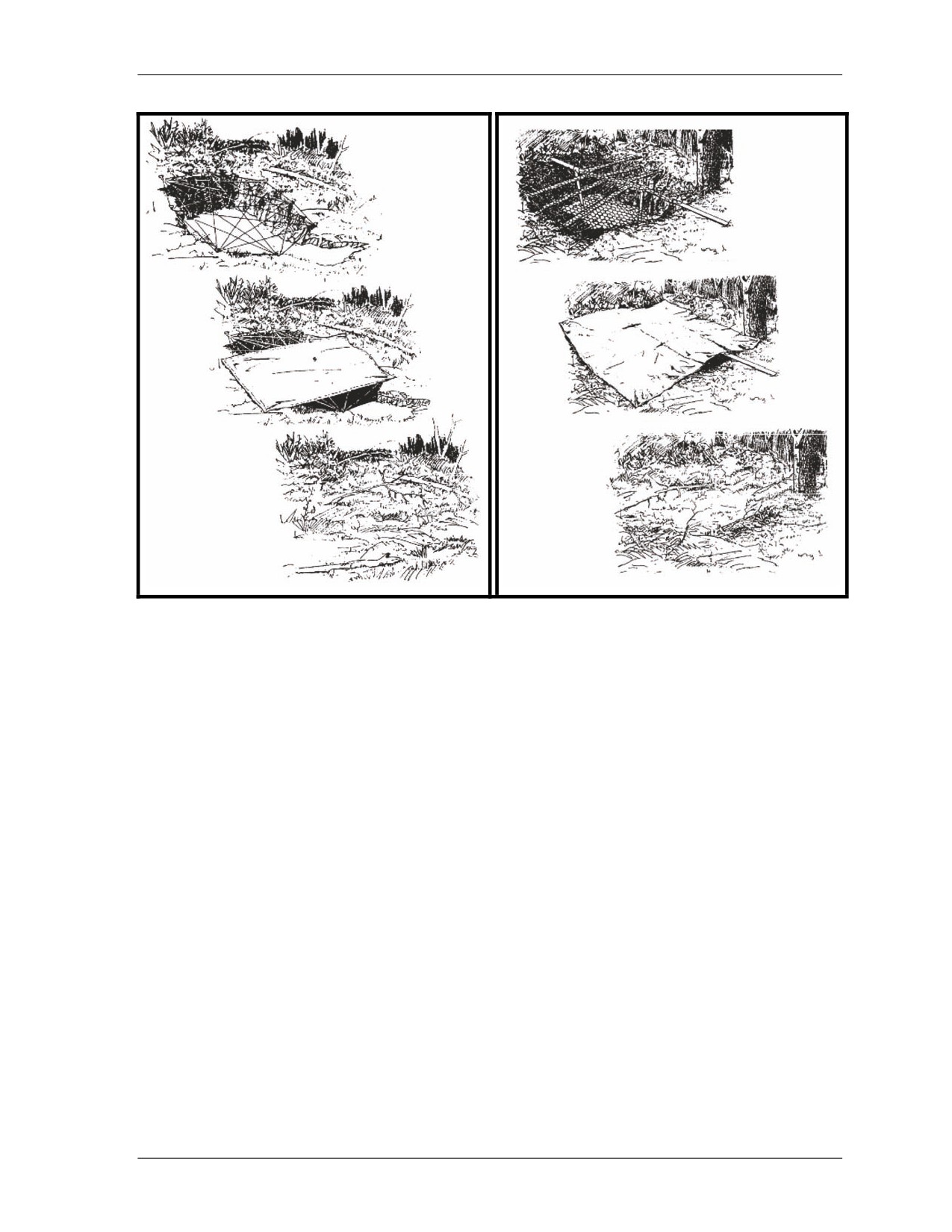
The team constructs a hasty subsurface site when they have too little time to construct a complete
subsurface site. A hasty subsurface site is especially useful in the absence of natural cover and
concealment. They plan the site so they can improve it to a full subsurface site as time and the situation
allow (Figure G-2 and Figure G-3).
G-2
FM 3-55.93
23 June 2009
Hide and Surveillance Sites
Figure G-2. Suspension line-weave site.
Figure G-3. Polyvinyl chloride site.
ADVANTAGES COMPARED TO SURFACE SITE
• Lower profile.
• Better protection against small-arms and indirect fires.
• Excellent camouflage.
DISADVANTAGES COMPARED TO SURFACE SITE
• Requires more construction tools.
• Challenge of concealing removed soil.
• Greater construction time.
• More construction noise.
CONSTRUCTION MATERIALS NEEDED
• Ponchos or other waterproofing material.
• Yeti or small camouflage net.
• Entrenching tool or D-handled shovels.
• One 550-pound or bungee cord.
• Sandbags.
• Polyvinyl chloride pipe with connectors.
• Fiberglass rod.
• Aluminum conduit.
23 June 2009
FM 3-55.93
G-3
Appendix G
• Plywood.
• Chicken wire (optional).
• Burlap or canvas (optional).
• Small saplings, stripped and lashed together in place of pipe or fiberglass rods.
FINISHED SUBSURFACE SITE
G-4.
The team generally uses finished subsurface sites for stay-behind missions and when they
anticipate having to remain underground for extended periods of time.
LOCATION
G-5.
Dig the site in a well-concealed area, away from enemy observation, and well away from any
populated areas.
CONSTRUCTION
G-6.
Use any available containers, such as rucksacks, sandbags, or socks, to remove the dirt. Some of
the removed soil will later be placed on top of the site. Leftover dirt must also be camouflaged.
Overhead Cover
G-7.
Overhead cover is constructed strong enough that it can be walked on.
Ingress and Egress
G-8.
Construct two sets of entrances and exits, primary and secondary (emergency), and cover and
conceal each.
Size of Site
G-9.
The site must accommodate the whole team. It must allow freedom of movement and have room
for separate and comfortable sleeping positions.
Materials
G-10. Materials needed depends on the design.
• Fifty 2 x 4 x 12's (2 inches by 4 inches by 12 feet boards).
• Six 4 x 4 x 6's (4 inches by 4 inches by 6 feet boards).
• Sufficient gravel to cover the floor.
• Eighteen inches of cover over entire site.
• Backhoe or Soldiers with shovels.
• Sandbags, 100 each.
• One large general-purpose tent to cover construction until complete.
ADVANTAGES OF SUBSURFACE SITES
• Little risk of compromise.
• Protection from artillery and small-arms weapons fire.
• Protection from nuclear attack.
• Excellent camouflage.
G-4
FM 3-55.93
23 June 2009