FM 6-0 COMMANDER AND STAFF ORGANIZATION AND OPERATIONS (MAY 2014) - page 7
Appendix C
[CLASSIFICATION]
(Change from verbal orders, if any)
Copy ## of ## copies
Issuing headquarters
Place of issue
Date-time group of signature
Message reference number
Include heading if attachment is distributed separately from the base order or higher-level attachment.
[Attachment type and number/letter] [(attachment title)] TO [higher-level attachment type and
number/letter, if applicable]
[(higher-level attachment title, if applicable)] TO OPERATION
PLAN/ORDER [number] [(code name)] [(classification of title)]
Example: EXHIBIT
1
(TRAFFIC CIRCULATION AND CONTROL) TO TAB C
(TRANSPORTATION) TO APPENDIX 1 (LOGISTICS) TO ANNEX F (SUSTAINMENT) TO
OPORD 3411 (OPERATION DESERT DRAGON) (UNCLASSIFIED)
References: Refer to higher headquarters’ OPLAN or OPORD and identify map sheets for operation
(Optional).
Time Zone Used Throughout the Order:
1. (U) Situation. Include information affecting the functional area that paragraph 1 of the OPLAN or
OPORD does not cover or that needs expansion.
a. (U) Area of Interest. Refer to Annex B (Intelligence) as required.
b. (U) Area of Operations. Refer to Appendix 2 (Operation Overlay) to Annex C (Operations).
(1) (U) Terrain. Describe aspects of terrain that impact functional area operations. Refer to
Annex B (Intelligence) as required.
(2) (U) Weather. Describe aspects of weather that impact functional area operations. Refer to
Annex B (Intelligence) as required.
c. (U) Enemy Forces. List known and templated locations and activities of enemy functional area
units for one echelon up and two echelons down. List enemy maneuver and other area capabilities that
will impact friendly operations. State expected enemy courses of action and employment of enemy
functional area assets. Refer to Annex B (Intelligence) as required.
d. (U) Friendly Forces. Outline the higher headquarters’ plan as it pertains to the functional area.
List designation, location, and outline of plan of higher, adjacent, and other functional area assets that
support or impact the issuing headquarters or require coordination and additional support.
e. (U) Interagency, Intergovernmental, and Nongovernmental Organizations. Identify and describe
other organizations in the area of operations that may impact the conduct of functional area operations
or implementation of functional area-specific equipment and tactics.
f.
(U) Civil Considerations. Describe critical aspects of the civil situation that impact functional
area operations. Refer to Annex K (Civil Affairs Operations) as required.
g. (U) Attachments and Detachments. List units attached or detached only as necessary to clarify
task organization. Refer to Annex A (Task Organization) as required.
h. (U) Assumptions. List any functional area-specific assumptions that support the development of
this attachment.
[page number]
[CLASSIFICATION
Figure C-3. Operation order or operation plan attachment format
C-22
FM 6-0
5 May 2014
Plans and Orders Formats
[CLASSIFICATION]
[Attachment type and number/letter] [(attachment title)] TO [higher-level attachment type and
number/letter, if applicable]
[(higher-level attachment title, if applicable)] TO OPERATION
PLAN/ORDER [number] [(code name)] [(classification of title)]
2. (U) Mission. State the mission of the functional area in support of the base plan or order.
3. (U) Execution.
a. (U) Scheme of Support. Describe how the functional area supports the commander’s intent and
concept of operations. Establish the priorities of support to units for each phase of the operation. Refer
to Annex C (Operations) as required.
b. (U) Tasks to Subordinate Units. List functional area tasks assigned to specific subordinate units
not contained in the base order.
c. (U) Coordinating Instructions. List only instructions applicable to two or more subordinate units
not covered in the base order.
4.
(U) Sustainment. Identify priorities of sustainment for functional area key tasks and specify
additional instructions as required. Refer to Annex F (Sustainment) as required.
5. (U) Command and Signal.
a. (U) Command. State the location of commander and key leaders.
b. (U) Control. State the functional area liaison requirements not covered in the base order.
c. (U) Signal. Address any functional area-specific communications requirements or reports. Refer
to Annex H (Signal) as required.
ACKNOWLEDGE: Include only if attachment is distributed separately from the base order.
[Commander’s last name]
[Commander’s rank]
OFFICIAL:
[Authenticator’s name]
[Authenticator’s position]
Either the commander or principal staff officer responsible for the functional area will sign attachments.
ATTACHMENT: List lower-level attachments as required.
DISTRIBUTION: Show only if distributed separately from the base order or higher-level attachments.
[page number]
[CLASSIFICATION]
Figure C-3. Operation order or operation plan attachment format (continued)
C-70. The example in figure C-4 on page C-24 provides the format and instructions for developing a
WARNORD. The example in figure C-5 on page C-25 provides the format and instructions for developing
a FRAGORD.
5 May 2014
FM 6-0
C-23
Appendix C
[CLASSIFICATION]
(Change from verbal orders, if any) (Optional)
Copy ## of ## copies
Issuing headquarters
Place of issue
Date-time group of signature
Message reference number
WARNING ORDER [number] Example: WARNING ORDER #8
(U) References: Refer to higher headquarters’ OPLAN or OPORD and identify map sheets for
operation (Optional).
(U) Time Zone Used Throughout the OPLAN/OPORD: (Optional).
(U) Task Organization: (Optional).
1. (U) Situation. The situation paragraph describes the conditions and circumstances of the operational
environment that impact operations in the following subparagraphs:
a. (U) Area of Interest.
b. (U) Area of Operations.
c. (U) Enemy Forces.
d. (U) Friendly Forces.
e. (U) Interagency, Intergovernmental, and Nongovernmental Organizations.
f. (U) Civil Considerations.
g. (U) Attachments and Detachments. Provide initial task organization.
h. (U) Assumptions. List any significant assumptions for order development.
2. (U) Mission. State the issuing headquarters’ mission.
3. (U) Execution.
a. (U) Initial Commander’s Intent. Provide brief commander’s intent statement.
b. (U) Concept of Operations. This may be “to be determined” for an initial WARNORD.
c. (U) Tasks to Subordinate Units. Include any known tasks at time of issuance of WARNORD.
d. (U) Coordinating Instructions.
4. (U) Sustainment. Include any known logistics, personnel, or health service support preparation tasks.
5. (U) Command and Signal. Include any changes to the existing order or state “No change.”
ACKNOWLEDGE:
[Commander’s last name]
[Commander’s rank]
OFFICIAL:
[Authenticator’s name]
[Authenticator’s position]
ANNEXES: List annexes by letter and title.
DISTRIBUTION: List recipients.
[page number]
[CLASSIFICATION]
Figure C-4. Warning order format
C-24
FM 6-0
5 May 2014
Plans and Orders Formats
[CLASSIFICATION]
(Change from verbal orders, if any) (Optional)
Copy ## of ## copies
Issuing headquarters
Place of issue
Date-time group of signature
Message reference number
FRAGMENTARY ORDER [number] to OPERATION PLAN/ORDER [number] [(code name)]—
[(classification of title)]
Example: FRAGORD
#1 TO OPORD
3411
(OPERATION DESERT DRAGON)
(UNCLASSIFIED)
(U) References: Refer to the higher order being modified.
(U) Time Zone Used Throughout the OPLAN/OPORD: (Optional)
1. (U) Situation. Include any changes to this paragraph or state “No change.”
2. (U) Mission. Include any changes to this paragraph or state “No change.”
3. (U) Execution. Include any changes to this paragraph or state “No change.”
a. (U) Commander’s Intent. Include any changes or state “No change.”
b. (U) Concept of Operations. Include any changes or state “No change.”
c. (U) Scheme of Movement and Maneuver. Include any changes or state “No change.”
d. (U) Scheme of Intelligence. Include any changes or state “No change.”
e. (U) Scheme of Fires. Include any changes or state “No change.”
f. (U) Scheme of Protection. Include any changes or state “No change.”
g. (U) Cyber Electromagnetic Activities. Include any changes or state “No change.”
h. (U) Stability Tasks. Include any changes or state “No change.”
i. (U) Assessment. Include any changes or state “No change.”
j. (U) Tasks to Subordinate Units. Include any changes or state “No change.”
k. (U) Coordinating Instructions. Include any changes or state “No change”
4. (U) Sustainment. Include any changes to this paragraph or state “No change.”
5. (U) Command and Signal. Include any changes to this paragraph or state “No change.”
ACKNOWLEDGE:
[Commander’s last name]
[Commander’s rank]
OFFICIAL:
[Authenticator’s name]
[Authenticator’s position]
ANNEXES: List annexes by letter and title. Army and joint OPLANs or OPORDs do not use Annexes I
and O as attachments and in Army orders label these annexes “Not Used.” Annexes T, X, and Y are
available for use in Army OPLANs or OPORDs and are labeled as “Spare.” When an attachment
required by doctrine or an SOP is unnecessary, label it “Omitted.”
DISTRIBUTION:
[page number]
[CLASSIFICATION]
Figure C-5. Fragmentary order format
5 May 2014
FM 6-0
C-25
Appendix C
C-71. If, on occasion, a FRAGORD has an annex as an attachment, order writers use the naming
convention for that attachment, for example “ANNEX A (TASK ORGANIZATION) to FRAGMENTARY
ORDER #1 to OPERATION ORDER 3411 (Operation Desert Dragon) (Unclassified).” (See figure C-6 for
a sample overlay order graphic with text.)
C-26
FM 6-0
5 May 2014
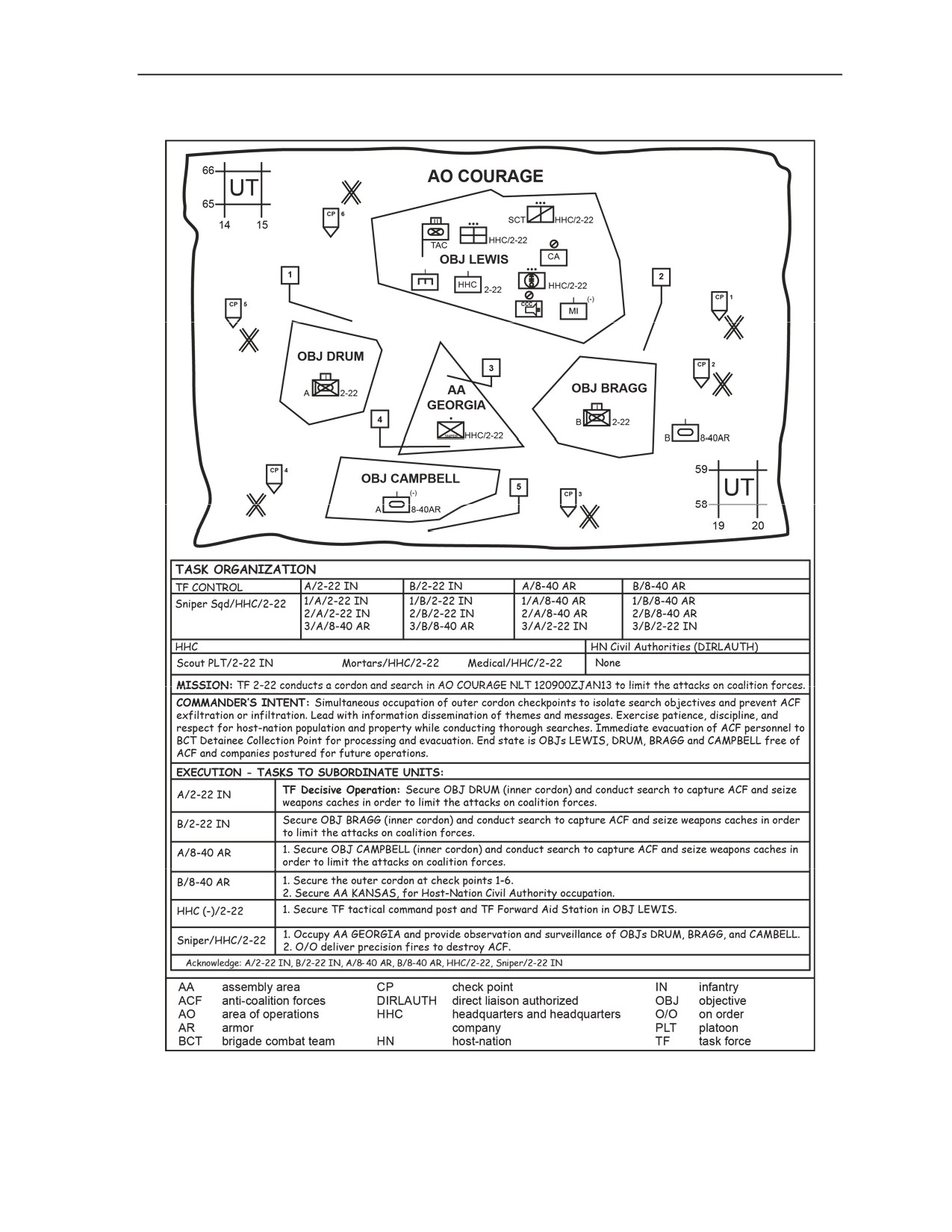
Plans and Orders Formats
Figure C-6. Example of overlay order graphic
5 May 2014
FM 6-0
C-27
This page intentionally left blank.
Appendix D
Annex Formats
This appendix provides commanders and staffs guidance and formats to build
annexes for plans and orders. This appendix lists 26 annexes and provides formats for
21 annexes. Two annexes are not used, annexes I and O. There are three annexes
designated as spares: annexes T, X, and Y. Commanders and staffs use these annexes
as required.
ANNEX A (TASK ORGANIZATION) FORMAT AND INSTRUCTIONS
D-1. This annex discusses the fundamentals of task organization and provides the format and instructions
for developing Annex A (Task Organization) to the base plan or order. This annex does not follow the
five-paragraph attachment format. Unit standard operating procedures (SOPs) will dictate development and
format for this annex.
FUNDAMENTAL CONSIDERATIONS
D-2. Task-organizing is the act of designing an operating force, support staff, or sustainment package of
specific size and composition to meet a unique task or mission (ADRP 3-0). Characteristics to examine
when task-organizing the force include, but are not limited to, training, experience, equipment,
sustainability, operational environment,
(including enemy threat), and mobility. For Army forces, it
includes allocating available assets to subordinate commanders and establishing their command and
support relationships. Command and support relationships provide the basis for unity of command in
operations. The assistant chief of staff, plans (G-5) or assistant chief of staff, operations (G-3 [S-3])
develops Annex A (Task Organization).
Note: Army command relationships are similar but not identical to joint command authorities
and relationships. Differences stem from the way Army forces task-organize internally and the
need for a system of support relationships between Army forces. Another important difference is
the requirement for Army commanders to handle the administrative control requirements.
D-3. Military units consist of organic components. Organic parts of a unit are those forming an essential
part of the unit and are listed in its table of organization and equipment (TOE). Commanders can alter
organizations’ organic unit relationships to better allocate assets to subordinate commanders. They also can
establish temporary command and support relationships to facilitate exercising mission command.
D-4. Establishing clear command and support relationships is fundamental to organizing any operation.
These relationships establish clear responsibilities and authorities between subordinate and supporting
units. Some command and support relationships (for example, tactical control) limit the commander’s
authority to prescribe additional relationships. Knowing the inherent responsibilities of each command and
support relationship allows commanders to effectively organize their forces and helps supporting
commanders understand their unit’s role in the organizational structure.
D-5. Commanders designate command and support relationships to weight the decisive operation and
support the concept of operations. Task organization also helps subordinate and supporting commanders
support the commander’s intent. These relationships carry with them varying responsibilities to the
subordinate unit by the parent and gaining units as discussed in paragraphs B-3 and B-10. Commanders
consider two organizational principles when task-organizing forces:
z
Maintain cohesive mission teams.
z
Do not exceed subordinates’ span of control capabilities.
5 May 2014
FM 6-0
D-1
Appendix D
D-6. When possible, commanders maintain cohesive mission teams. They organize forces based on
standing headquarters, their assigned forces, and habitual associations, when possible. When this is not
feasible, and commanders create ad hoc organizations, commanders arrange time for training and
establishing functional working relationships and procedures. Once commanders have organized and
committed a force, they keep its task organization unless the benefits of a change clearly outweigh the
disadvantages. Reorganizations may result in a loss of time, effort, and tempo. Sustainment considerations
may also preclude quick reorganization.
D-7. Commanders carefully avoid exceeding the span of control capabilities of subordinates. Span of
control refers to the number of subordinate units under a single commander. This number depends on the
situation and may vary. As a rule, commanders can effectively command two to six subordinate units.
Allocating subordinate commanders more units gives them greater flexibility and increases options and
combinations. However, increasing the number of subordinate units increases the number of decisions
commanders have to make. This slows down the reaction time among decisionmakers.
D-8. Running estimates and course of action (COA) analysis of the military decisionmaking process
provide information that helps commanders determine the best task organization. An effective task
organization—
z
Facilitates the commander’s intent and concept of operations.
z
Retains flexibility within the concept of operations.
z
Adapts to conditions imposed by mission variables.
z
Accounts for the requirements to conduct essential stability tasks for populations within an area
of operations.
z
Creates effective combined arms teams.
z
Provides mutual support among units.
z
Ensures flexibility to meet unforeseen events and to support future operations.
z
Allocates resources with minimum restrictions on their employment.
z
Promotes unity of command.
z
Offsets limitations and maximizes the potential of all forces available.
z
Exploits enemy vulnerabilities.
D-9. Creating an appropriate task organization requires understanding—
z
The mission, including the higher commander’s intent and concept of operations.
z
The fundamentals of offense, defense, stability, and defense support of civil authorities tasks
(see ADRP 3-0) and basic tactical concepts (see ADRP 3-90).
z
The roles and relationships among the warfighting functions.
z
The status of available forces, including morale, training, and equipment capabilities.
z
Specific unit capabilities, limitations, strengths, and weaknesses.
z
The risks inherent in the plan.
D-10. During COA analysis, commanders identify what resources they need, and where, when, and how
frequently they will need them. Formal task organization and the change from generic to specific units
begin after COA analysis when commanders assign tasks to subordinate commanders. Staffs assign tasks to
subordinate headquarters, determine if subordinate headquarters have enough combat power, and
re-allocate combat power as necessary. They then refine command and support relationships for
subordinate units and decide the priorities of support. Commanders approve or modify the staff’s
recommended task organization based on their evaluation of the factors listed in paragraphs D-8 and D-9
and information from running estimates and COA analysis as part of the military decisionmaking process.
In allocating assets, the commander and staff consider—
z
The task organization for the ongoing operation.
z
Potentially adverse effects of breaking up cohesive teams by changing the task organization.
z
Time necessary to re-align the organization after receipt of the task organization.
z
Limits on control over supporting units provided by higher headquarters.
D-2
FM 6-0
5 May 2014

Annex Formats
FORMAT AND INSTRUCTIONS
D-11. Annex A (Task Organization) of the operation plan (OPLAN) and operation order (OPORD) is one
of the annexes that does not follow the standard five-paragraph attachment format. (Refer to appendix C for
more information on OPLAN and OPORD attachments.) Task organization is typically displayed in a list
or an outline format following the unit listing convention shown in table D-1. (See table D-1 on pages D-3
through D-5.)
Table D-1. Army unit listing convention
Corps
Division
Brigade
Battalion
Company
Divisions
Brigade-size
Battalion TFs
Company teams
Platoons
ground units in
Separate
Battalions or
- Named teams
- Organic platoons
alpha-
maneuver
squadrons
in alphabetical
- Attached
numerical
brigades or
order
platoons
order
- Combined arms
battalions
- Letter
- Weapons
- Infantry
- Infantry
designated
squads
Combat
- Reconnaissance
- Armor
teams in
aviation
- Stryker
Company teams
alphabetical
brigades or
order
battalions
Battalion TF
Companies
Companies or
Special
- Named TFs in
Air cavalry
troops (in
operations
alphabetical
squadrons
alphabetical
forces
order
order)
MISO
- Numbered TFs
- Ranger
in numerical
- Infantry
- Special forces
order
- Armor
MISO
- Stryker
MISO
MISO
Combat
aviation
brigade
Special
operations
forces
- Ranger
- Special forces
Fires brigade
Fires brigade
Fires battalion
FA batteries
FA firing
platoons
USAF air
USAF air
USAF air support
Fire support
support unit
support unit
unit
team
Fire support
team
- Air defense
- Air defense
- Air defense
Mortar platoon
Mortar section
USAF air
support unit
- Air defense
- Air defense
Battlefield
Battlefield
CI teams
CI teams
CI teams
surveillance
surveillance
Ground sensor
Ground sensor
Ground sensor
brigade
brigade
teams
teams
teams
- MI
- MI
Human terrain
HUMINT teams
HUMINT teams
- Recon squads
- Recon squads
team
- Human terrain
- Human terrain
Scout platoon
team
team
HUMINT teams
TUAS platoon
Scout platoon
TUAS platoon
5 May 2014
FM 6-0
D-3

Appendix D
Table D-1. Army unit listing convention (continued)
Corps
Division
Brigade
Battalion
Company
MEB
MEB
Functional
Functional
Functional
battalions or
companies or
platoons and
Functional
Functional
companies or
batteries and
detachments
brigades
brigades
batteries and
detachments
- Air defense
- Air defense
- Air defense
detachments
- Air defense
- CBRN
- CBRN
- CBRN
- Air defense
- CBRN
- Engineer
- Engineer
- Engineer
- CBRN
- Engineer
- EOD
- EOD
- EOD
- Engineer
- EOD
- Military police
- Military police
- Military police
- EOD
- Military police
- Military police
Sustainment
Sustainment
Brigade support
Forward
Attached or
brigade
brigade
battalion
support
supporting
(attached
(attached
(attached or
company
functional
functional
functional
supporting
(attached or
platoons and
units are listed
units are listed
functional units
supporting
teams listed in
in alpha-
in alpha-
are listed first by
functional units
alpha-numerical
numerical
numerical
branch in
are listed first
order
order)
order)
alphabetical
by branch in
- Contracting
- Contracting
order and then in
alphabetical
- Finance
- Finance
numerical order)
order and then
- Ordnance
- Ordnance
in numerical
- Personnel
- Personnel
order)
services
services
- Transportation
- Transportation
- Quartermaster
- Quartermaster
Medical
Medical
brigade
brigade
(support)
(support)
D-4
FM 6-0
5 May 2014

Annex Formats
Table D-1. Army unit listing convention (continued)
Corps
Division
Brigade
Battalion
Company
Signal
Signal
Signal
Signal
Public Affairs
Public affairs
Public affairs
Public affairs
Civil Affairs
Civil affairs
Civil affairs
Civil affairs
PRT
PRT
PRT
PRT
MISO
MISO
MISO
MISO
Space
Space
Airfield
OGA (listed in
Operations
alphabetical
Theater Airfield
Theater Airfield
Battalion (AOB)
order with
Operations
Operations
reference to any
Group (TAOG)
Group (TAOG)
OGA (listed in
applicable
alphabetical
OGA, such as an
OGA (listed in
nonstandard
order with
FBI forensics
alphabetical
command and
reference to any
team (listed in
order with
support
applicable
alphabetical
reference to any
relationship)
nonstandard
order with
applicable
command and
reference to any
nonstandard
support
applicable
command and
relationship)
nonstandard
support
command and
relationship)
support
relationship)
AOB airfield operations battalion
MISO military information support operations
CBRN chemical, biological, radiological, and nuclear
OGA other governmental agencies
CI
counterintelligence
PRT
provincial reconstruction team
EOD
explosive ordnance disposal
TAOG
theater airfield operations group
FA
field artillery
TF
task force
HUMINT human intelligence
TUAS
tactical unmanned aerial system
MEB maneuver enhancement brigade
USAF
United States Air Force
MI
military intelligence
D-12. Order writers group units by headquarters. They list major subordinate maneuver units first (for
example, 2d ABCT; 1-77th IN; A/4-52d CAV). Order writers place them by size in numerical order. They
list brigade combat teams (BCTs) ahead of combat aviation brigades. In cases where two BCTs are
numbered the same, order writers use the division number (by type). For example, 1st ABCT (armored
brigade combat team) 1st Infantry Division (Mechanized) is listed before the 1st ABCT 1st Armored
Division (AD). In turn, the 1st ABCT 1st Armored Division is listed before the 1st ABCT 1st Cavalry
Division. Combined arms battalions are listed before battalions, and company teams before companies.
Order writers follow maneuver units with multifunctional supporting units in the following order: fires,
battlefield surveillance, maneuver enhancement, and sustainment. Supporting units (in alpha-numerical
order) follow multifunctional supporting units. For example, a medical brigade (support) is listed after a
functional engineer brigade but before a functional military police brigade. The last listing should be any
special troops units under the command of the force headquarters.
D-13. Order writers use a plus (+) symbol when attaching one or more subordinate elements of a similar
function to a headquarters. They use a minus symbol (-) when deleting one or more subordinate elements
of a similar function to a headquarters. Order writers always show the symbols in parenthesis. They do not
use a plus symbol when the receiving headquarters is a combined arms task force or company team. Order
writers do not use plus and minus symbols together (as when a headquarters detaches one element and
receives attachment of another); they use the symbol that portrays the element’s combat power with respect
to other similar elements. Order writers do not use either symbol when two units swap subordinate
elements and their combat power is unchanged. Here are some examples:
5 May 2014
FM 6-0
D-5
Appendix D
z
Within the 3-68th Combined Arms Battalion, C Company loses one platoon to A Company; the
battalion task organization will show A Co. (+) and C Co. (-).
z
Within the 3-68th Combined Arms Battalion, C Company swaps one platoon with A Company;
the battalion task organization will show Team A and Team C. (The teams can also be named for
their commanders, their unit nickname, or some other naming scheme.)
z
4-77th Infantry receives a tank company from 1-30th Armor; the BCT task organization will
show Task Force 4-77 IN and 1-30 AR (-).
z
Division and corps headquarters are always task organized. Therefore, order writers do not show
these headquarters with either the plus (+) or minus (-) symbol.
D-14. If applicable, order writers list task organizations according to phases of the operation. When the
effective attachment time of a nonorganic unit to another unit differs from the effective time of the plan or
order, order writers add the effective attachment time in parentheses after the attached unit—for example,
1-80 IN (OPCON 2 ABCT Phase II). They list this information either in the task organization (preferred) or
in paragraph 1c of the plan or order, but not both. For clarity, order writers list subsequent command or
support relationships under the task organization in parentheses following the affected unit—for example,
“...on order, OPCON (operational control) to 2 ABCT” is written (O/O OPCON 2 ABCT).
D-15. Long or complex task organizations are displayed in outline format in Annex A (Task Organization)
of the OPLAN or OPORD in lieu of being placed in the base plan or order. Units are listed under the
headquarters to which they are allocated or that they support in accordance with the organizational
taxonomy previously provided in this chapter. The complete unit task organization for each major
subordinate unit should be shown on the same page. Order writers only show command or support
relationships if they are other than organic or attached. Other Services and multinational forces recognize
and understand this format. Planners should use it during joint and multinational operations.
D-16. Order writers list subordinate units under the higher headquarters to which they are assigned,
attached, or in support. They place direct support (DS) units below the units they support. Order writers
indent subordinate and supporting units two spaces. They identify relationships other than attached with
parenthetical terms—for example, (GS) or (DS).
D-17. Order writers provide the numerical designations of units as Arabic numerals, unless they are shown
as Roman numerals. For example, an Army corps is numbered in series beginning with Roman numeral
“I”—for example, I Corps or XVIII Airborne Corps.
D-18. During multinational operations, order writers insert the country code between the numeric
designation and the unit name—for example, 3d (DE) Corps. (Here, DE designates that the corps is
German. ADRP 1-02 contains authorized country codes.)
D-19. Order writers use abbreviated designations for organic units. They use the full designation for
nonorganic units—for example, 1-52 FA (MLRS) (GS), rather than 1-52 FA. They specify a unit’s
command or support relationship only if it differs from that of its higher headquarters.
D-20. Order writers designate task forces with the last name of the task force (TF) commander (for
example, TF WILLIAMS), a code name (for example, TF DESERT DRAGON), or a number (for example,
TF 47 or TF 1-77 IN).
D-21. For unit designation at theater army level, order writers list major subordinate maneuver units first,
placing them in alpha-numerical order, followed by multifunctional brigades in the following order: fires,
intelligence, maneuver enhancement, sustainment, then followed by functional brigades in alpha-numerical
order, and any units under the command of the force headquarters. For each function following maneuver,
they list headquarters in the order of commands, brigades, groups, battalions, squadrons, companies,
detachments, and teams.
D-22. Figure D-1 (on pages D-7 through D-9) illustrates a sample Annex A (Task Organization) format and
provides a sample acronym list (on page D-9) for task organization.
D-6
FM 6-0
5 May 2014
Annex Formats
[CLASSIFICATION]
Place the classification at the top and bottom of every page of the attachments. Place the classification
marking at the front of each paragraph and subparagraph in parentheses. Refer to AR 380-5 for
classification and release marking instructions.
Copy ## of ## copies
Issuing headquarters
Place of issue
Date-time group of signature
Message reference number
Include the full heading if attachment is distributed separately from the base order or higher-level
attachment.
ANNEX A (TASK ORGANIZATION) TO OPERATION PLAN/ORDER [number] [(code
name)]—[issuing headquarters] [(classification of title)]
(U) References: List documents essential to understanding Annex A (Task Organization).
a. List maps and charts first. Map entries include series number, country, sheet names or numbers,
edition, and scale.
b. List other references in subparagraphs labeled as shown.
c. Doctrinal references for task organization include ADRP 3-0, ADRP 5-0, ADRP 6-0, FM 6-0,
JP 1, and JP 5-0.
(U) Time Zone Used Throughout the OPLAN/OPORD: Write the time zone established in the base
plan or order.
(U) Task Organization: Use the outline format for listing units as shown in the example below. (The
acronym list in this annex is helpful if attached units are unfamiliar with Army acronyms.) If applicable,
list task organization according to the phases of the operation during which it applies.
[page number]
[CLASSIFICATION
Figure D-1. Sample Annex A (Task Organization) format
5 May 2014
FM 6-0
D-7

Appendix D
[CLASSIFICATION]
ANNEX A (TASK ORGANIZATION) TO OPERATION PLAN/ORDER [number] [(code
name)]—[issuing headquarters] [(classification of title)]
(sample task organization)
2/52 ABCT
2/54 ABCT
116 ABCT (+)
1-31 IN (-)
4-77 IN
3-116 AR
1-30 AR (-)
8-40 AR
1-163 IN
1-20 CAV
3-20 CAV
2-116 AR
A/4-52 CAV (ARS) (DS)
2/C/4-52 CAV (ARS) (DS)
1-148 FA
2-606 FA (2x8)
2-607 FA
145 BSB
TACP/52 ASOS (USAF)
TACP/52 ASOS (USAF)
4/B/2-52 AV (GSAB) (TACON)
521 BSB
2/2/311 QM CO (MA)
105 BSB
4/2/311 QM CO (MA)
1/B/2-52 AV (GSAB) (TACON)
3/2/311 QM CO (MA)
4/577 MED CO (GRD AMB)
2/577 MED CO (GRD AMB)
2/B/2-52 AV (GSAB) (TACON)
844 FST
(attached)
843 FST
116 BSTB
842 FST
3/577 MED CO (GRD AMB)
366 EN CO (SAPPER) (DS)
2 BSTB
3 BSTB
1/401 EN CO (ESC) (DS)
31 EN CO (MRBC) (DS)
A 388 CA BN
2/244 EN CO (RTE CL) (DS)
63 EOD
1/244 EN CO (RTE CL) (DS)
52 EOD
2/244 EN CO (RTE CL) (DS)
763 EOD
1/301 MP CO
1/2/1/55 SIG CO (COMCAM)
2/2/1/55 SIG CO (COMCAM)
1/3/1/55 SIG CO (COMCAM)
2D MP PLT
RTS TM 1/A/52 BSTB
3D MP PLT
1/467 CM CO (MX) (S)
RTS TM 2/A/52 BSTB
52 CAB AASLT
C/388 CA BN
RTS TM 3/A/52 BSTB
HHC/52 CAB
116 MP PLT
RTS TM
1/B/1-31 IN (DIV QRF) (OPCON)
52 SUST BDE
87 IBCT
1-52 AV (ARB) (-)
52 BTB
1-80 IN
4-52 CAV (ARS) (-)
520 CSSB
2-80 IN
3-52 AV (ASLT) (-)
521 CSSB
3-13 CAV
2-52 AV (GSAB)
10 CSH
A/3-52 AV (ASLT) (DS)
1 (TUAS)/B/52 BSTB (-) (GS)
168 MMB
B/1-52 AV (ARB) (DS)
2/694 EN CO (HORIZ) (DS)
C/4-52 CAV (ARS) (-) (DS)
2-636 FA
52 HHB
A/3-52 FA (+)
52 FIRES BDE
A/1-30 AR (DIV RES)
TACP/52 ASOS (USAF)
HHB
35 SIG CO (-) (DS)
Q37 52 FA BDE (GS)
TAB (-)
154 LTF
99 BSB
1-52 FA (MLRS)
2/1/55 SIG CO (-)
845 FST
3-52 FA (-) (M109A6)
14 PAD
1/577 MED CO (GRD AMB)
1/694 EN CO (HORIZ) (DS)
388 CA BN (-) (DS)
3/B/2-52 AV (GSAB) (TACON)
1/2/311 QM CO (MA)
17 MEB 52 ID
87 BSTB
25 CM BN (-)
53 EOD
3/2/1/55 SIG CO (COMCAM)
700 MP BN
B/420 CA BN
7 EN BN
2 HCT/3/B/52 BSTB
2/2/1/55 SIG CO (COMCAM)
745 EN CO (MAC) (DS)
11 ASOS (USAF)
1/1/52 CM CO (R/D) (R)
2/467 CM CO (MX) (S)
1/1102 MP CO (DS)
4/A/52 BSTB
[page number]
[CLASSIFICATION]
Figure D-1. Sample Annex A (Task Organization) format (continued)
D-8
FM 6-0
5 May 2014
Annex Formats
[CLASSIFICATION]
ANNEX A (TASK ORGANIZATION) TO OPERATION PLAN/ORDER [number] [(code
name)]—[issuing headquarters] [(classification of title)]
(sample acronym list)
AASLT air assault
EOD
explosive
ordnance
MLRS
multiple
launch rocket
disposal
system
ABCT armored brigade combat
ESC
expeditionary sustainment
MMB
multifunctional
medical
team
command
battalion
FA
field artillery
MP
military police
AR
armor
FST
forward surgical team
MRBC
multi-role bridge company
ARB
attack
reconnaissance
GRD AMB ground ambulance
MX
mechanized
battalion
GS
general support
OPCON
operational control
ARS
attack
reconnaissance
GSAB
general support aviation
PAD
public affairs detachment
squadron
battalion
PLT
platoon
ASLT assault
HCT
human
intelligence
QM
quartermaster
ASOS air support operations
collection team
QRF
quick reaction force
squadron
HHB headquarters
and
R
reinforcing
AV
aviation
headquarters battalion
R/D
reconnaissance/
BDE
brigade
HHC headquarters
and
decontamination
BN
battalion
headquarters company
RES
reserve
BSB
brigade support battalion
HORIZ horizontal
RTE CL
route clearance
BSTB
brigade special troops
IBCT
infantry brigade combat
RTS
retransmission
battalion
team
S
smoke
BTB
brigade troop battalion
ID
infantry division
SIG
signal
CA
civil affairs
IN
infantry
SUST
sustainment
CAB
combat aviation brigade
LTF
logistics task force
TAB
target acquisition battery
CAV
cavalry
MA
mortuary affairs
TACON
tactical control
CM
chemical
MAC
mobility
augmentation
TACP
tactical air control party
CO
company
company
TM
team
COMCAM combat camera
MEB maneuver enhancement
TUAS
tactical unmanned aircraft
CSH combat support hospital
brigade
system
CSSB combat
sustainment
MED medical
USAF
United States Air Force
support battalion
DIV
division
DS
direct support
EN
engineer
[page number]
[CLASSIFICATION]
Figure D-1. Sample Annex A (Task Organization) format (continued)
5 May 2014
FM 6-0
D-9
Appendix D
ANNEX B (INTELLIGENCE) FORMAT AND INSTRUCTIONS
D-23. This annex provides fundamental considerations, formats, and instructions for developing Annex B
(Intelligence) to the base plan or order. This annex follows the five-paragraph attachment format (see figure
D-2).
D-24. Commanders and staffs use Annex B (Intelligence) to describe how intelligence supports the concept
of operations described in the base plan or order. The assistant chief of staff, intelligence (G-2 [S-2])
develops Annex B (Intelligence).
D-25. The purpose of Annex B (Intelligence) is to provide detailed information and intelligence on the
characteristics of the operational environment and to direct intelligence and counterintelligence activities.
Staffs use appendixes to provide detailed analysis of the operational environment and instructions from the
various intelligence disciplines. (See figure D-2 on pages D-10 through D-14.)
[CLASSIFICATION]
Place the classification at the top and bottom of every page of the attachments. Place the classification
marking at the front of each paragraph and subparagraph in parentheses. Refer to AR 380-5 for
classification and release marking instructions.
Copy ## of ## copies
Issuing headquarters
Place of issue
Date-time group of signature
Message reference number
Include the full heading if attachment is distributed separately from the base order or higher-level
attachment.
ANNEX B (INTELLIGENCE) TO OPERATION PLAN/ORDER [number] [(code name)]—
[issuing headquarters] [(classification of title)]
(U) References: List documents essential to understanding the attachment.
a. List maps and charts first. Map entries include series number, country, sheet names or numbers,
edition, and scale.
b. List other references in subparagraphs labeled as shown.
c. Doctrinal references for this annex include ADRP 2-0 and FM 6-0.
(U) Time Zone Used Throughout the Plan/Order: Write the time zone established in the base plan or
order.
1. (U) Situation. Include information affecting intelligence that paragraph 1 of the OPLAN or OPORD
does not cover or that needs expansion.
a. (U) Area of Interest. Describe the area of interest as it relates to intelligence.
b. (U) Area of Operations. Refer to Appendix 2 (Operation Overlay) to Annex C (Operations) as
required.
[page number]
[CLASSIFICATION]
Figure D-2. Sample Annex B (Intelligence) format
D-10
FM 6-0
5 May 2014
Annex Formats
[CLASSIFICATION]
ANNEX B (INTELLIGENCE) TO OPERATION PLAN/ORDER [number] [(code name)]—
[issuing headquarters] [(classification of title)]
(1) (U) Terrain. Describe the aspects of terrain that impact intelligence operations. Refer to
Tab A (Terrain) to Appendix 1 (Intelligence Estimate) to Annex B (Intelligence) as required.
(2) (U) Weather. Describe the aspects of weather that impact intelligence operations. Refer to
Tab B (Weather) to Appendix 1 (Intelligence Estimate) to Annex B (Intelligence) as required.
c. (U) Enemy Forces. List known and templated locations and activities of enemy intelligence units
for one echelon up and two echelons down. List enemy maneuver and other area capabilities that will
impact friendly intelligence operations. State expected enemy courses of action and employment of
enemy intelligence assets.
d.
(U) Friendly Forces. Outline the higher headquarters’ intelligence plan. List designation,
location, and outline the plan of higher, adjacent, and other intelligence organizations and assets that
support or impact the issuing headquarters or require coordination and additional support.
e. (U) Interagency, Intergovernmental, and Nongovernmental Organizations. Identify and describe
other organizations in the area of operations that may impact the conduct of intelligence operations or
implementation of intelligence-specific equipment and tactics. Refer to Annex V
(Interagency
Coordination) as required.
f.
(U) Civil Considerations. Describe the aspects of the civil situation that impact intelligence
operations. Refer to Tab C (Civil Considerations) to Appendix 1 (Intelligence Estimate) to Annex B
(Intelligence) and Annex K (Civil Affairs Operations) as required.
g. (U) Attachments and Detachments. List units attached or detached only as necessary to clarify
task organization. Refer to Annex A (Task Organization) as required.
h. (U) Assumptions. List any intelligence-specific assumptions that support the annex development.
2. (U) Mission. State the mission of intelligence in support of the base plan or order.
3. (U) Execution.
a.
(U) Scheme of Intelligence Support. Outline the purpose of intelligence operations and
summarize the means and agencies used in planning, directing, collecting, processing, exploiting,
producing, disseminating, and evaluating intelligence in support of the concept of operations. When
available and appropriate, integrate the resources of other Services and multinational forces. Refer to
the base plan or order and Annex C (Operations) as required.
b. (U) Tasks to Subordinate Units. List intelligence tasks assigned to specific subordinate units not
contained in the base plan or order. Use subparagraphs to list detailed instructions for each unit
performing intelligence functions.
c. (U) Counterintelligence. Refer to Appendix 2 (Counterintelligence) to Annex B (Intelligence).
d. (U) Coordinating Instructions. List only instructions applicable to two or more subordinate units
not covered in the base plan or order.
(1) (U) Requirements. Provide guidance for determining intelligence requirements (including
those of subordinate commanders), issuing orders, and issuing requests to information collection
agencies.
[page number]
[CLASSIFICATION]
Figure D-2. Sample Annex B (Intelligence) format (continued)
5 May 2014
FM 6-0
D-11
Appendix D
[CLASSIFICATION]
ANNEX B (INTELLIGENCE) TO OPERATION PLAN/ORDER [number] [(code name)]—
[issuing headquarters] [(classification of title)]
(a)
(U) Priority Intelligence Requirements. List the priority intelligence requirements
(PIRs) along with the latest time intelligence of value for each PIR.
(b)
(U) Friendly Force Information Requirements. List the friendly force information
requirements.
(c) (U) Requests for Information. Provide separate, numbered subparagraphs applicable to
each unit not organic or attached and from which intelligence support is requested, including multinational
forces.
(2) (U) Measures for Handling Personnel, Documents, and Material. Describe in the following
subparagraphs procedures for handling captured or detained personnel, captured documents, and
materiel.
(a) (U) Prisoners of War, Deserters, Repatriates, Inhabitants, and Other Persons. State
special handling, segregation instructions, and locations of the command’s and next higher
headquarters’ personnel collection points.
(b)
(U) Captured Documents. List instructions for handling and processing captured
documents from time of capture to receipt by specified intelligence personnel.
(c) (U) Captured Materiel. Designate items or categories of enemy materiel required for
examination. Include any specific instructions for processing and disposition (such as the effects of the
Geneva Conventions on the disposition of captured medical materiel). Give locations of the command’s
and next higher headquarters’ captured materiel collection points.
(d) (U) Documents or Equipment Required. List in each category the conditions under
which units can obtain or request certain documents or equipment. Items may include aerial
photographs and maps, charts, and geodesy (satellite) products.
(3) (U) Distribution of Intelligence Products. Identify and list in the following subparagraphs
any special request procedures for intelligence products in support of this operation. List in each
category the conditions under which units can obtain or request certain documents or equipment.
(a) (U) Special Request for Reports. Identify, list, or describe the following: periods that
routine reports and distribution address; updates to the threat and environment portions of the common
operational picture; formats and methods for push and pull intelligence support; and distribution of
special intelligence studies, such as defense overprints, photo intelligence reports, and order of battle
overlays.
(b) (U) Special Request Liaison Requirements. Identify, list, or describe the following
liaison requirements: periodic or special intelligence meetings and conferences and special intelligence
liaison, when indicated.
(4) (U) Other Instructions. Identify, list, or describe any other instructions not covered in the
above paragraphs.
4.
(U) Sustainment. Identify and list sustainment priorities for intelligence key tasks and specify
additional sustainment instructions as necessary, to include contractor support. Refer to Annex F
(Sustainment) as required.
[page number]
[CLASSIFICATION]
Figure D-2. Sample Annex B (Intelligence) format (continued)
D-12
FM 6-0
5 May 2014
Annex Formats
[CLASSIFICATION]
ANNEX B (INTELLIGENCE) TO OPERATION PLAN/ORDER [number] [(code name)]—
[issuing headquarters] [(classification of title)]
a. (U) Logistics. Identify unique sustainment requirements, procedures, and guidance to support
intelligence teams and operations. Specify procedures for specialized technical logistics support from
external organizations as necessary. Use subparagraphs to identify priorities and specific instructions
for logistics support for intelligence. Refer to Annex F
(Sustainment) and Annex P (Host-Nation
Support) as required.
b.
(U) Personnel. Identify intelligence unique personnel requirements and concerns, including
global sourcing support and contracted linguist requirements. Use subparagraphs to identify priorities
and specific instructions for human resources support, financial management, legal support, and
religious support. Refer to Annex F (Sustainment) as required.
c. (U) Health Service Support. Identify medical intelligence requirements of the area of operations
from the National Center for Medical Intelligence on health hazards to include endemic and epidemic
diseases, toxic industrial materials, and known disease vectors. Identify availability, priorities, and
instructions for medical care. Refer to Annex F (Sustainment) as required.
5. (U) Command and Signal.
a. (U) Command.
(1) (U) Location of the Commander and Key Leaders. State the location of the commander and
key intelligence leaders.
(2) (U) Succession of Command. State the succession of command if not covered in the unit’s
SOPs.
(3) (U) Liaison Requirements. State the intelligence liaison requirements not covered in the
base order or unit standard operating procedures (SOPs).
b. (U) Control.
(1)
(U) Command Posts. Describe the employment of intelligence-specific command posts
(CPs), including the location of each CP and its time of opening and closing.
(2) (U) Intelligence Coordination Line. Identify the intelligence coordination line.
(3) (U) Special Security. Identify special security office arrangements and coordination.
(4)
(U) Reports. List intelligence-specific reports not covered in SOPs. Refer to Annex R
(Reports) as required.
c. (U) Signal. Address any intelligence-specific communications requirements. Refer to Annex H
(Signal) as required.
[page number]
[CLASSIFICATION]
Figure D-2. Sample Annex B (Intelligence) format (continued)
5 May 2014
FM 6-0
D-13
Appendix D
[CLASSIFICATION]
ANNEX B (INTELLIGENCE) TO OPERATION PLAN/ORDER [number] [(code name)]—
[issuing headquarters] [(classification of title)]
ACKNOWLEDGE: Include only if attachment is distributed separately from the base order.
[Commander’s last name]
[Commander’s rank]
The commander or authorized representative signs the original copy of the attachment. If the
representative signs the original, add the phrase “For the Commander.” The signed copy is the
historical copy and remains in the headquarters’ files.
OFFICIAL:
[Authenticator’s name]
[Authenticator’s position]
Use only if the commander does not sign the original attachment. If the commander signs the original,
no further authentication is required. If the commander does not sign, the signature of the preparing
staff officer requires authentication and only the last name and rank of the commander appear in the
signature block.
ATTACHMENTS: List lower-level attachment (appendixes, tabs, and exhibits).
Appendix 1-Intelligence Estimate
Appendix 2-Counterintelligence
Appendix 3-Signals Intelligence
Appendix 4-Human Intelligence
Appendix 5-Geospatial Intelligence
Appendix 6-Measurement and Signature Intelligence
Appendix 7-Open-Source Intelligence
DISTRIBUTION: Show only if distributed separately from the base order or higher-level attachments.
[page number]
[CLASSIFICATION]
Figure D-2. Sample Annex B (Intelligence) format (continued)
D-14
FM 6-0
5 May 2014
Annex Formats
ANNEX C (OPERATIONS) FORMAT AND INSTRUCTIONS
D-26. This annex provides fundamental considerations, formats, and instructions for developing Annex C
(Operations) to the base plan or order. This annex follows the five-paragraph attachment format.
D-27. Commanders and staffs use Annex C (Operations) to describe and outline how this annex supports
the concept of operations described in the base plan or order. The G-5 or G-3 (S-3) develops Annex C
(Operations).
D-28. This annex describes the operation’s objectives. A complex operation’s concept of support may
require a schematic to show the operations objectives and task relationships. It includes a discussion of the
overall operations concept of support with specific details in element subparagraphs and attachments. It
refers to the execution matrix to clarify timing relationships among various operations tasks. This annex
also contains the information needed to synchronize timing relationships of each element related to
operations. It includes operations-related constraints, if appropriate. (See figure D-3 on pages D-15 through
D-20.)
[CLASSIFICATION]
Place the classification at the top and bottom of every page of the attachments. Place the
classification marking at the front of each paragraph and subparagraph in parentheses. Refer
to AR 380-5 for classification and release marking instructions.
Copy ## of ## copies
Issuing headquarters
Place of issue
Date-time group of signature
Message reference number
Include the full heading if attachment is distributed separately from the base order or higher-
level attachment.
ANNEX C (OPERATIONS) TO [OPERATION PLAN/ORDER [number]
[(code
name)]—[(classification of title)]
(U) References: List documents essential to understanding the attachment.
a. List maps and charts first. Map entries include series number, country, sheet names or
numbers, edition, and scale.
b. List other references in subparagraphs labeled as shown.
c. Doctrinal references for this annex are ADRP 3-0, ADRP 5-0, ADRP 6-0, and FM 6-0.
(U) Time Zone Used Throughout the Order: Write the time zone established in the base plan
or order.
1. (U) Situation. Include information affecting operations that paragraph 1 of the OPLAN or
OPORD does not cover or that needs expansion. If there is no new information from what is
contained in the base order then indicate this by stating “See base order.”
a. (U) Area of Interest. Describe the area of interest as it relates to operations. Reference
the digital overlay(s) within systems such as command post of the future. Refer to Annex B
(Intelligence) as required.
[page number]
[CLASSIFICATION]
Figure D-3. Sample Annex C (Operations) format
5 May 2014
FM 6-0
D-15
Appendix D
[CLASSIFICATION]
ANNEX C (OPERATIONS) TO [OPERATION PLAN/ORDER [number]
[(code
name)]—[(classification of title)]
b.
(U) Area of Operations. Refer to Appendix
2 (Operation Overlay) to Annex C
(Operations).
(1) (U) Terrain. Describe the aspects of terrain that impact operations. Refer to Annex
B (Intelligence) as required.
(2) (U) Weather. Describe the aspects of weather that impact operations. Refer to
Annex B (Intelligence) as required.
c.
(U) Enemy Forces. Identify and reference enemy overlays. First, list known and
templated locations and activities of enemy units for two echelons down. For example, a U.S.
division would address enemy battalions; a U.S. battalion would address enemy platoons.
Second, list enemy maneuver and other capabilities that will impact friendly operations. Third,
state the enemy most likely and most dangerous courses of action and employment of enemy
assets. A staff more easily understands these enemy courses of action when they are depicted in
sketches. Fourth, include an assessment of terrorist or criminal activities directed against U.S.
government interests in the area of operations. Refer to Annex B (Intelligence) and other
sources as required.
(Note: If conducting operations focused on stability or defense support of civil authorities,
change the title of this subparagraph to “Terrorist/Criminal Threats.”)
d.
(U) Friendly Forces. Subparagraphs outline the mission, commander’s intent, and
concept of operations for headquarters one and two command echelons above the unit.
Subparagraphs also provide the missions and concept of operations of flank units, supported
units, supporting units, and other units and organizations, such as special operations forces,
whose actions have a significant effect on the issuing headquarters or require coordination.
This subparagraph uses the same format as the base order and can be shortened by using the
phrase “See Base Order” if there is no change.
e. (U) Interagency, Intergovernmental, and Nongovernmental Organizations. Identify and
describe other organizations in the area of operations that may impact the conduct of the unit’s
operations or require support not identified in the base order. Also identify nongovernmental
organizations in the area of operations that want nothing to do with the U.S. military and are
not identified in the base order. Refer to Annex V (Interagency Coordination) as required.
f. (U) Civil Considerations. List all critical civil considerations that impact on the unit’s
operations, such as cultural or religious sensitivities to male Soldiers searching female
civilians, searching civilian homes at night, or resolving injury or damage claims not
established in the base order. Refer to Annex B (Intelligence) and Annex K (Civil Affairs
Operations) as required.
[page number]
[CLASSIFICATION]
Figure D-3. Sample Annex C (Operations) format (continued)
D-16
FM 6-0
5 May 2014
Annex Formats
[CLASSIFICATION]
ANNEX C (OPERATIONS) TO [OPERATION PLAN/ORDER [number]
[(code
name)]—[(classification of title)]
g. (U) Attachments and Detachments. List units attached or detached only as necessary to
clarify task organization. Do not repeat information already listed under Task Organization in
the base order or in Annex A (Task Organization). Try to put all information in the task
organization annex and state “See Annex A (Task Organization).” Otherwise, list units that
are attached or detached to the issuing headquarters. State when attachment or detachment is
effective, if different from the effective time of the operation plan or order, such as on-order, or
commitment of reserve forces. Use the term “remains attached” when units will be or have
been attached for some time. Refer to Annex A (Task Organization) as required.
h.
(U) Assumptions. List any operations-specific assumptions that support the annex
development.
2. (U) Mission. Enter the unit’s restated mission only if this annex is distributed separately
from the base order. It should contain a short description of the who, what (task), when, where,
and why (purpose) that clearly indicates the action to be taken and the reason for doing so. A
mission statement contains no subparagraphs. The mission statement covers on-order
missions, otherwise state “See base order.”
3. (U) Execution. Describe how the commander intends to accomplish the mission in terms of
the commander’s intent, an overarching concept of operations, scheme of employing
maneuver, assessment, specified tasks to subordinate units, and key coordinating instructions
in the subparagraphs below only if this annex is distributed separately from the base order.
Commanders ensure that their scheme of maneuver is consistent with their intent and that
of the next two higher echelon commanders. This paragraph and the operation overlay are
complementary, each adding clarity to, rather than duplicating, the other. Do not duplicate
information in unit subparagraphs and coordinating instructions contained in the base order.
Provide the primary tasks of maneuver units conducting the decisive operation and the purpose
of each. Next, state the primary tasks of maneuver units conducting shaping operations,
including security operations, and the purpose of each. For offensive-focused operations,
identify the form of maneuver. For defensive-focused operations, identify the type of defense.
For stability-focused operations, describe the role of maneuver units by primary stability tasks.
For defense support of civil authorities-focused operations, describe the role of maneuver units
by primary defense support of civil authorities support tasks. If the operation is phased,
identify the main effort by phase. Identify and include priorities for the reserves. Refer to
attached appendixes as required.
a. (U) Scheme of Movement and Maneuver. State the scheme of movement and maneuver
by describing the employment of maneuver units, such as divisions, brigade combat teams, and
combat aviation brigades in accordance with the concept of operations. Ensure that this
paragraph is consistent with the operation overlay in Appendix 2 (Operation Overlay) to
Annex C (Operations). Describe how the actions of subordinate maneuver units fit together to
accomplish the mission. The scheme of maneuver expands the commander’s selected course of
action and expresses how each maneuver element of the force will cooperate. As the
commander’s intent focuses on the end state, the scheme of maneuver focuses on the maneuver
tactics and techniques employed during the operation as well as synchronizes the actions of
each maneuver element.
[page number]
[CLASSIFICATION]
Figure D-3. Sample Annex C (Operations) format (continued)
5 May 2014
FM 6-0
D-17
Appendix D
[CLASSIFICATION]
ANNEX C (OPERATIONS) TO [OPERATION PLAN/ORDER [number]
[(code
name)]—[(classification of title)]
(1)
(U) Scheme of Mobility/Countermobility. State the scheme of
mobility/countermobility including priorities by unit or area. Refer to Annex G (Engineer) as
required.
(2) (U) Scheme of Battlefield Obscuration. State the scheme of battlefield obscuration,
including priorities by unit or area. Refer to Appendix 9 (Battlefield Obscuration) to Annex C
(Operations) as required.
(3) (U) Scheme of Information Collection. Describe how the commander intends to use
information collection to support the concept of operations. Include the primary objectives.
Refer to Annex L (Information Collection) as required.
b. (U) Assessment. Describe the priorities for assessment and identify the measures of
performance and effectiveness used to assess end state conditions and objectives. Refer to
Annex M (Assessment) as required.
c. (U) Tasks to Subordinate Units. List movement and maneuver tasks assigned to specific
subordinate units not contained in the base order. Each task must include who
(the
subordinate unit assigned the task), what (the task itself), when, where, and why (purpose).
Use a separate subparagraph for each unit. List units in sequence of task organization. Place
tasks that affect two or more units in paragraph 3d of this annex.
d.
(U) Coordinating Instructions. List only instructions applicable to two or more
subordinate units not covered in the base plan or order.
4. (U) Sustainment. Describe priorities of sustainment by unit or area. Highlight subordinate
allocations of command-regulated classes of supply that impact movement and maneuver, such
as controlled supply rates. Include instructions for deployment or redeployment. Identify
priorities of sustainment for operations key tasks and specify additional instructions as
required. Refer to Annex F (Sustainment) as required.
a.
(U) Logistics. Use subparagraphs to identify priorities and specific instructions for
logistics support. Refer to Annex F (Sustainment) and Annex P (Host-Nation Support) as
required.
b. (U) Personnel. Use subparagraphs to identify priorities and specific instructions for
human resources support, financial management, legal support, and religious support. Refer to
Annex F (Sustainment) as required.
c. (U) Health Service Support. Identify availability, priorities, and instructions for medical
care. Refer to Annex F (Sustainment) as required.
[page number]
[CLASSIFICATION]
Figure D-3. Sample Annex C (Operations) format (continued)
D-18
FM 6-0
5 May 2014
Annex Formats
[CLASSIFICATION]
ANNEX C (OPERATIONS) TO [OPERATION PLAN/ORDER [number]
[(code
name)]—[(classification of title)]
5. (U) Command and Signal. List information in this paragraph and its subparagraphs only if
annex distributed separately from base order, otherwise state “Same as base order.”
a. (U) Command.
(1) (U) Location of Commander and Key Leaders. State the location of the commander
and key leaders.
(2) (U) Succession of Command. State the succession of command if not covered in the
unit’s SOPs.
(3) (U) Liaison Requirements. State the liaison requirements not covered in the base
order.
b. (U) Control.
(1) (U) Command Posts. Describe the employment of command posts (CPs), including
the location of each CP and its time of opening and closing.
(2) (U) Reports. List reports not covered in standard operating procedures (SOPs).
Refer to Annex R (Reports) as required.
c. (U) Signal. Address any communications requirements. Refer to Annex H (Signal) as
required.
ACKNOWLEDGE: Include only if attachment is distributed separately from the base order.
[Commander’s last name]
[Commander’s rank]
The commander or authorized representative signs the original copy of the attachment. If the
representative signs the original, add the phrase “For the Commander.” The signed copy is
the historical copy and remains in the headquarters’ files.
OFFICIAL:
[Authenticator’s name]
[Authenticator’s position]
Use only if the commander does not sign the original attachment. If the commander signs the
original, no further authentication is required. If the commander does not sign, the signature of
the preparing staff officer requires authentication and only the last name and rank of the
commander appear in the signature block.
[page number]
[CLASSIFICATION]
Figure D-3. Sample Annex C (Operations) format (continued)
5 May 2014
FM 6-0
D-19
Appendix D
[CLASSIFICATION]
ANNEX C (OPERATIONS) TO [OPERATION PLAN/ORDER [number]
[(code
name)]—[(classification of title)]
ATTACHMENT: List lower-level attachment (appendixes, tabs, and exhibits).
Appendix 1-Army Design Methodology Products
Appendix 2-Operation Overlay
Appendix 3-Decision Support Products
Appendix 4-Gap Crossing Operations
Appendix 5-Air Assault Operations
Appendix 6-Airborne Operations
Appendix 7-Amphibious Operations
Appendix 8-Special Operations
Appendix 9-Battlefield Obscuration
Appendix 10 -Airspace Control
Appendix 11 -Rules of Engagement
Appendix 12-Cyber Electromagnetic Activities
Appendix 13-Military Information Support Operations
Appendix 14-Military Deception
Appendix 15-Information Operations
DISTRIBUTION: Show only if distributed separately from the base order or higher-level attachments.
[page number]
[CLASSIFICATION]
Figure D-3. Sample Annex C (Operations) format (continued)
D-20
FM 6-0
5 May 2014
Annex Formats
ANNEX D (FIRES) FORMAT AND INSTRUCTIONS
D-29. This annex provides fundamental considerations, format, and instructions for developing Annex D
(Fires) to the base plan or order. This annex follows the five-paragraph attachment format.
D-30. Commanders and staffs use Annex D (Fires) to describe how fires support the concept of operations
described in the base plan or order. The chief of fires (fire support officer) develops Annex D (Fires).
D-31. This annex describes the fires concept of support objectives. A complex fires concept of support may
require a schematic to show the fires objectives and task relationships. It includes a discussion of the
overall fires concept of support with the specific details in element subparagraphs and attachments. It refers
to the execution matrix to clarify timing relationships among various fires tasks. This annex also contains
the information needed to synchronize timing relationships of each element related to fires. It includes
fires-related constraints, if appropriate. (See figure D-4 on pages D-21 through D-26.)
[CLASSIFICATION]
Place the classification at the top and bottom of every page of the attachments. Place the classification
marking at the front of each paragraph and subparagraph in parentheses. Refer to AR 380-5 for
classification and release marking instructions.
Copy ## of ## copies
Issuing headquarters
Place of issue
Date-time group of signature
Message reference number
Include the full heading if attachment is distributed separately from the base order or higher-level
attachment.
ANNEX D (FIRES) TO OPERATION PLAN/ORDER [number] [(code name)]—[issuing
headquarters] [(classification of title)]
(U) References: List documents essential to understanding the attachment.
a. List maps and charts first. Map entries include series number, country, sheet names or numbers,
edition, and scale.
b. List other references in subparagraphs labeled as shown.
c. Doctrinal references for this annex include the ADRP 3-09, FM 3-09, FM 3-36, FM 3-60,
FM 6-0, FM 6-20-40, and FM 6-20-50.
(U) Time Zone Used Throughout the Plan/Order: Write the time zone established in the base plan or
order.
1. (U) Situation. Include information affecting fires that paragraph 1 of the OPLAN or OPORD does
not cover or that needs expansion.
a.
(U) Area of Interest. Describe the area of interest as it relates to fires. Refer to Annex B
(Intelligence) as required.
b. (U) Area of Operations. Refer to Annex C (Operations) as required.
[page number]
[CLASSIFICATION]
Figure D-4. Sample Annex D (Fires) format
5 May 2014
FM 6-0
D-21
Appendix D
[CLASSIFICATION]
ANNEX D (FIRES) TO OPERATION PLAN/ORDER [number] [(code name)]—[issuing
headquarters] [(classification of title)]
(1)
(U) Terrain. Describe the aspects of terrain that impact fires. Refer to Annex B
(Intelligence) as required.
(2)
(U) Weather. Describe the aspects of weather that impact fires. Refer to Annex B
(Intelligence) as required.
c. (U) Enemy Forces. List known and templated locations and activities of enemy fires units for one
echelon above and two echelons below the unit. List enemy maneuver, indirect fire/counterfire, air, and
electronic warfare threats and other capabilities that will impact friendly fires operations. State
expected enemy courses of action and employment of enemy fires assets. Refer to Annex B (Intelligence)
as required.
d. (U) Friendly Forces. Outline the higher headquarters’ fires plan. List designation, location, and
outline the plan of higher, adjacent, and other fires organizations and assets that support or impact the
issuing headquarters or require coordination and additional support.
e. (U) Interagency, Intergovernmental, and Nongovernmental Organizations. Identify and describe
other organizations in the area of operations that may impact the conduct of fires or implementation of
fires-specific equipment and tactics. Refer to Annex V (Interagency Coordination) as required.
f.
(U) Civil Considerations. Describe the aspects of the civil situation that impact fires. Refer to
Annex B (Intelligence) and Annex K (Civil Affairs Operations) as required.
g. (U) Attachments and Detachments. List fires resources attached or under operational control to
the unit by higher headquarters and any units detached or under operational control to other
headquarters. Refer to Annex A (Task Organization) as required.
h. (U) Assumptions. List any fires-specific assumptions that support the annex development.
2. (U) Mission. State the mission of fires in support of the base plan or order.
3. (U) Execution.
a.
(U) Scheme of Fires. Describe how fires support the commander’s intent and concept of
operations. Establish the priorities of fires to units for each phase of the operation. The scheme of fires
must be concise but specific enough to clearly state what fires are to accomplish in the operation. The
scheme of fires must answer the “who, what, when, where, and why” of the fires to be provided, but
provide enough flexibility to allow subordinate commanders to determine the “how” to the maximum
extent possible by ensuring necessary procedural and positive control. The scheme of fires may include a
general narrative for the entire operation that should address the fire support task and purpose,
allocation of assets, positioning guidance for fire support assets and observers, and attack guidance to
include the entire scalable range of effects (lethal to nonlethal effects). Add subparagraphs addressing
fire support tasks for each phase of the operation use the following format: task, purpose, execution, and
assessment in matrix form. Refer to the base plan or order and Annex C (Operations) as required.
(1) Task, Purpose, Execution, and Assessment: The example below provides a sample matrix
for task, purpose, execution, and assessment, to be used at the discretion of the commander. See local
SOPs for additional guidance and details.
[page number]
[CLASSIFICATION]
Figure D-4. Sample Annex D (Fires) format (continued)
D-22
FM 6-0
5 May 2014

Annex Formats
[CLASSIFICATION]
ANNEX D (FIRES) TO OPERATION PLAN/ORDER [number] [(code name)]—[issuing
headquarters] [(classification of title)]
Sample matrix for each fire support task
PHASE: State the phase of the operation.
TASK (what): State the supported/maneuver commander task and the type(s) of effects the fires unit
must provide for that phase of the operation (suppress, neutralize, interdict, divert, exploit, deny, delay,
deceive, disrupt, degrade, destroy, obscuration, or screening).
PURPOSE (why): State the supported/maneuver commander purpose and the desired end state for the
targeted enemy formation/function/capability. (There may be more that one task/purpose per phase.)
Priority of fire: State the priority of fire to subordinate units for all fires assets under the unit’s
command or control.
Allocations: List any additional assets assigned to subordinates for planning. Some examples are
primary targets, radar zones, and attack aviation.
Positioning Guidance: Provide positioning guidance to assets such as mortars or observers required
for execution.
Restrictions: List all restrictions for the phase.
Target Information: Target number, trigger, location, observer, delivery, attack guidance, and
communications (TTLODAC) refined by executer.
Fire
Target
Trigger
Location
Observer
Delivery
Attack
Communications
Support
Number
Guidance
Task
List the
List the
State the
Give the
State the
State the
State the
State the frequency
task
target
trigger
location
observer
delivery
attack
and
number
number or
(tactical/
of the
of the
system for
guidance/
communications net
the target
type of
technical)
target.
target
the target
method of
the target will be
supports.
target.
for the
(primary
(primary
engagement
called in on
target.
and
and
for the
(primary, alternate,
alternate).
alternate).
target.
contingency, or
emergency).
b. (U) Scheme of Field Artillery Support. Describe the scheme of cannon, rocket, and missile fires
in support of operations. Include specific tasks to subordinate field artillery headquarters. Address any
potential requirements for massing fires that may affect organic, direct support, or reinforcing fires
units. Identify the timing and duration of specific identified fire plans, such as counterfire, preparations,
suppression of enemy air defenses, or joint suppression of enemy air defenses. Refer to Appendix 4
(Field Artillery Support) to Annex D (Fires) as required.
[page number]
[CLASSIFICATION]
Figure D-4. Sample Annex D (Fires) format (continued)
5 May 2014
FM 6-0
D-23
Appendix D
[CLASSIFICATION]
ANNEX D (FIRES) TO OPERATION PLAN/ORDER [number] [(code name)]—[issuing
headquarters] [(classification of title)]
(1) (U) Organization for Combat. Provide direction for the proper organization for combat,
including the unit designation, nomenclature, and tactical task.
(2)
(U) Miscellaneous. Provide any other information necessary for planning not already
mentioned. Other information in this subparagraph may include changes to the targeting numbering
system, the use of pulse repetition frequency codes, positioning restrictions, and a position area overlay.
c. (U) Scheme of Air Support. Briefly describe the maneuver commander’s guidance for the use of
air power. Refer to Appendix 5 (Air Support) to Annex D (Fires) as required.
(1) (U) Organization for Combat. Provide direction for the proper organization for combat,
including the unit designation, nomenclature, and tactical task.
(2) (U) Air Interdiction Operations. Briefly describe the joint force air component commander’s
intent for air interdiction. Describe the maneuver commander’s air interdiction concept and priorities
for target attack within the area of operations.
(3) (U) Close Air Support Operations. Provide the allocation and distribution of close air
support sorties by subordinate unit. Provide the desired method for planning close air support
(immediate or pre-planned) or any special control arrangements.
(4) (U) Air Reconnaissance Operations. Provide the concept for use of reconnaissance aircraft
if resources are provided by the joint force air component commander. Refer to Annex L (Information
Collection).
(5)
(U) Miscellaneous. Provide any other information necessary for planning not already
mentioned, including the following:
(a) The air tasking order’s effective time.
(b) Deadlines for submission of air interdiction, close air support, reconnaissance
aircraft, and electronic warfare aircraft requests.
(c) The mission request numbering system as it relates to the target numbering system.
(d) The joint suppression of enemy air defenses tasking from the joint force land
component commander.
(e) Reference to essential airspace control measures (coordinating altitude, target
areas, low level transit route requirements, and so on) identified in Annex C (Operations).
d. (U) Scheme of Naval Fire Support. Describe the concept for use of naval fire support. Include
specific tasks to supporting units. Include trajectory limitations or minimum safe distances. Refer to
Appendix 6 (Naval Fire Support) to Annex D (Fires) as required.
(1) (U) Organization for Combat. List the grouping or organization for combat, including the
following:
(a) (U) Identify and list the allocation of observers and spotters.
(b) (U) Identify and list the allocation of ships to units.
[page number]
[CLASSIFICATION]
Figure D-4. Sample Annex D (Fires) format (continued)
D-24
FM 6-0
5 May 2014
Annex Formats
[CLASSIFICATION]
ANNEX D (FIRES) TO OPERATION PLAN/ORDER [number] [(code name)]—[issuing
headquarters] [(classification of title)]
(2)
(U) Miscellaneous. Provide any other information necessary for planning not already
mentioned.
e.
(U) Battlefield Obscuration Support. Describe the concept for use of artillery smoke and
battlefield obscuration. Refer to Annex C (Operations) as required.
f. (U) Target Acquisition. Provide information pertaining to the employment and allocation of fires
target acquisition systems and assets. Refer to Appendix 3 (Targeting) and Appendix 4 (Field Artillery
Support) to Annex D (Fires) as required.
g.
(U) Tasks to Subordinate Units. List fires tasks assigned to specific subordinate units not
contained in the base order.
h. (U) Coordinating Instructions. List only instructions applicable to two or more subordinate units
not covered in the base plan or order. Provide subordinates and adjacent units the following information
to coordinate fires:
(1) A clear definition of the boundary of the operational area if not specified in the basic plan.
This area may be identified by phase if it is a phased operation.
(2) Targeting products.
(3) Fire support coordination measures.
(4) The time of execution of program of fires relative to H-hour (counterfire, preparations or
counterpreparations, joint suppression of enemy air defenses), if needed.
(5) Rules of engagement specific to fires.
4. (U) Sustainment. Identify sustainment priorities for fires key tasks and specify additional sustainment
instructions as necessary. Describe critical or unusual sustainment actions that might occur before,
during, and after the battle to support the commander’s scheme of fires. Refer to Annex F (Sustainment)
as required.
a. (U) Logistics. Use subparagraphs to identify priorities and specific instructions for fires logistics
support. Refer to Annex F (Sustainment) and Annex P (Host-Nation Support) as required.
(1) (U) Supply. Identify the location of ammunition transfer holding points and ammunition
supply points. Refer to Annex F (Sustainment) as required.
(2)
(U) Allocation of Ammunition. List the allocation of cannon, rocket, and missile
ammunition for each phase of the operation based on the amount of Class V available. Refer to Annex F
(Sustainment) as required.
b.
(U) Personnel. Use subparagraphs to identify priorities and specific instructions for human
resources support, financial management, legal support, and religious support. Refer to Annex F
(Sustainment) as required.
c. (U) Health Service Support. Identify ground and air medical evacuation requirements and the
availability, priorities, and instructions for medical care. Refer to Annex F (Sustainment) as required.
[page number]
[CLASSIFICATION]
Figure D-4. Sample Annex D (Fires) format (continued)
5 May 2014
FM 6-0
D-25
Appendix D
[CLASSIFICATION
ANNEX D (FIRES) TO OPERATION PLAN/ORDER [number] [(code name)]—[issuing
headquarters] [(classification of title)]
5. (U) Command and Signal.
a. (U) Command.
(1) (U) Location of the Commander and Key Leaders. State the location of the commander and
key fires leaders.
(2) (U) Succession of Command. State the succession of command if not covered in the unit’s
SOPs.
(3) (U) Liaison Requirements. State the fires liaison requirements not covered in the base
order.
b. (U) Control.
(1)
(U) Command Posts. Describe the employment of maneuver units and fires-specific
command posts, including the location of each command post and its time of opening and closing.
(2) (U) Reports. List fires-specific reports not covered in standard operating instructions. Refer
to Annex R (Reports) as required.
c.
(U) Signal. Address any fires-specific communications requirements. Identify the current
standard operating instructions edition. Refer to Annex H (Signal) as required.
[Commander’s last name]
[Commander’s rank]
ACKNOWLEDGE: Include only if attachment is distributed separately from the base order.
The commander or authorized representative signs the original copy of the attachment. If the
representative signs the original, add the phrase “For the Commander.” The signed copy is the
historical copy and remains in the headquarters’ files.
OFFICIAL:
[Authenticator’s name]
[Authenticator’s position]
Use only if the commander does not sign the original attachment. If the commander signs the original,
no further authentication is required. If the commander does not sign, the signature of the preparing
staff officer requires authentication and only the last name and rank of the commander appear in the
signature block.
ATTACHMENTS: List lower-level attachment (appendixes, tabs, and exhibits).
Appendix 1-Fire Support Overlay
Appendix 2-Fire Support Execution Matrix
Appendix 3-Targeting
Appendix 4-Field Artillery Support
Appendix 5-Air Support
Appendix 6-Naval Fire Support
Appendix 7-Air and Missile Defense
DISTRIBUTION: Show only if distributed separately from the base order or higher-level attachments.
[page number]
[CLASSIFICATION]
Figure D-4. Sample Annex D (Fires) format (continued)
D-26
FM 6-0
5 May 2014
Annex Formats
ANNEX E (PROTECTION) FORMAT AND INSTRUCTIONS
D-32. This annex provides fundamental considerations, formats, and instructions for developing Annex E
(Protection) to the base plan or order. This annex follows the five-paragraph attachment format.
D-33. Commanders and staffs use Annex E (Protection) to describe how protection supports the concept of
operations described in the base plan or order. This annex describes how the commander intends to
preserve the force through the protection tasks (listed in this annex’s appendixes). The chief of protection
or a designated staff officer (engineer; chemical, biological, radiological, and nuclear; air and missile
defense; or provost marshal) develops Annex E (Protection). The surgeon provides the chief of protection
with input for Appendix 10 (Force Health Protection).
D-34. This annex describes the protection concept of support objectives. A complex protection concept of
support may require a schematic to show the protection objectives and task relationships. This annex
includes a discussion of the overall protection concept of support, with the specific details in element
subparagraphs and attachments. It refers to the execution matrix to clarify timing relationships among
various protection tasks. This annex also contains information needed to synchronize timing relationships
of each element related to protection. It includes protection-related constraints, if appropriate. (See figure
D-5 on pages D-27 through D-33.)
[CLASSIFICATION]
Place the classification at the top and bottom of every page of the attachments. Place the classification
marking at the front of each paragraph and subparagraph in parentheses. Refer to AR 380-5 for
classification and release marking instructions.
Copy ## of ## copies
Issuing headquarters
Place of issue
Date-time group of signature
Message reference number
Include the full heading if attachment is distributed separately from the base order or higher-level
attachment.
ANNEX E (PROTECTION) TO OPERATION PLAN/ORDER [number] [(code name)]—[issuing
headquarters] [(classification of title)]
(U) References: List documents essential to understanding the attachment.
a. List maps and charts first. Map entries include series number, country, sheet names or numbers,
edition, and scale.
b. List other references in subparagraphs labeled as shown.
c. Doctrinal references for protection include ADRP 3-0, ADRP 3-37, ADRP 3-90, AR 385-10,
AR 525-13, AR 525-28, AR 530-1, ATP 3-37.34, ATP 4-32, DA Pamphlet 385-10, FM 3-01, FM 3-11,
FM 3-13, FM 3-50.1, FM 4-02.7, FM 4-02.17, FM 4-02.18, FM 4-02.19, FM 4-02.51, FM 5-19, and
FM 6-0.
[page number]
[CLASSIFICATION]
Figure D-5. Sample Annex E (Protection) format
5 May 2014
FM 6-0
D-27
Appendix D
[CLASSIFICATION]
ANNEX E (PROTECTION) TO OPERATION PLAN/ORDER [number] [(code name)]—[issuing
headquarters] [(classification of title)]
(U) Time Zone Used Throughout the Plan/Order: Write the time zone established in the base plan or
order.
1.
(U) Situation. Provide situational information affecting the protection tasks and systems that
paragraph 1 of the OPLAN or OPORD does not cover or that needs expansion.
a.
(U) Area of Interest. Describe the area of interest as it impacts protection. Identify area of
interest characteristics and hazards (including health hazards) that require coordinated protection
actions to preserve the force. Refer to Annex B (Intelligence) as required.
b. (U) Area of Operations. Describe the area of operations as it impacts protection. Identify and
describe the area of operation’s characteristics and hazards that require coordinated protection actions
to preserve the force. Refer to Annex C (Operations) as required.
(1) (U) Terrain. Describe the aspects of terrain that impact protection operations. Identify
terrain features in the area of interest and area of operations that create a hazard or enhance the threat.
Specify protection actions that may be required as a result of the terrain. Identify terrain that may
benefit protection capabilities. Refer to Annex B (Intelligence) as required.
(2) (U) Weather. Describe the aspects of weather that impact protection operations, tasks, and
systems. Refer to Appendix 2 (Safety) to Annex E (Protection) and Annex B (Intelligence) as required.
c. (U) Enemy Forces. List known and templated locations and activities of enemy protection units
for one echelon up and two echelons down. List enemy maneuver and other area capabilities that will
impact friendly operations. State expected enemy courses of action and employment of enemy protection
assets. Include consideration of civil disturbances and criminal acts. Narrow the focus to offensive-
minded threats that require planning, resources, and actions to protect the force. Refer to Annex B
(Intelligence) as required.
d. (U) Friendly Forces. Outline the higher headquarters’ protection plan. List designation, location,
and outline of plan of higher, adjacent, and other protection assets that support or impact the issuing
headquarters or require coordination and additional support. List areas of the operation most
vulnerable to enemy attack or adverse influence.
e. (U) Interagency, Intergovernmental, and Nongovernmental Organizations. Identify and describe
other organizations in the area of operations that may impact the conduct of protection operations or
impact protection specific equipment and tactics. Outline the results of the risk management process to
mitigate the risk of fratricide. Enhance continual situational understanding by frequently updating data
of friendly forces. Describe the method and timing of the data updates. Refer to Annex V (Interagency
Coordination) as required.
f.
(U) Civil Considerations. Describe the aspects of the civil situation that impact protection
operations. Refer to Annex B (Intelligence) and Annex K (Civil Affairs Operations) as required.
g. (U) Attachments and Detachments. List units attached or detached only as necessary to clarify
task organization. Refer to Annex A (Task Organization) as required.
h. (U) Assumptions. List any protection-specific assumptions that support the annex development.
2. (U) Mission. State the protection mission in support of the base plan or order.
3. (U) Execution.
[page number]
[CLASSIFICATION]
Figure D-5. Sample Annex E (Protection) format (continued)
D-28
FM 6-0
5 May 2014
Annex Formats
[CLASSIFICATION]
ANNEX E (PROTECTION) TO OPERATION PLAN/ORDER [number] [(code name)]—[issuing
headquarters] [(classification of title)]
a.
(U) Scheme of Protection. Describe how the protection tasks and systems support the
commander’s intent and concept of operations. Establish the priorities of support to units for each phase
of the operation. If required information for a specific protection task or system is brief, include it in this
paragraph and eliminate the associated appendix. Refer to the base order and Annex C (Operations) as
required.
(1) (U) Operational Area Security. State the scheme of operational area security and overall
area security objective. Describe how operational area security supports the commander’s intent, the
maneuver plan, and protection priorities. Direct how each element of the force will cooperate to
accomplish operational area security and tie that to support of the operation with the task and purpose
statement. Discuss how operational area security orients on the force, installation, route, area, or asset
to be protected. Discuss how operational area security is often an economy of force role assigned in
some manner to many organizations. Discuss how operational area security is often designed to ensure
the continued conduct of sustainment operations and to support decisive and shaping operations.
Describe how forces engaged in area security operations saturate an area or position on key terrain to
provide protection through early warning, reconnaissance, or surveillance and guard against
unexpected enemy attack with an active response. Discuss the role of response forces in the operational
area security scheme. Refer to Appendix 1 (Operational Area Security) to Annex E (Protection) as
required.
(2)
(U) Safety. Describe how mission-dictated safety program requirements support the
commander’s intent and concept of operations. Describe how safety tasks and functions are prioritized
to eliminate or mitigate hazards on a greatest risk first basis to support the unit. Refer to Appendix 2
(Safety) to Annex E (Protection) as required.
(3) (U) Operations Security. Describe how operations security applies to all operations. All
units conduct operations security to preserve essential secrecy from threat exploitation, and support the
commander’s intent and concept of operations. Describe the general concept and any additional
operations security measures with other staff and command elements, and synchronize with adjacent
units. Refer to Appendix 3 (Operations Security) to Annex E (Protection) as required.
a. (U) Identify actions that can be observed by threat intelligence systems.
b. (U) Determine indicators of threat intelligence that systems might obtain which could be
interpreted or pieced together to derive critical information in time to be useful to the threat.
c. (U) Describe how to execute measures that eliminate or reduce (to an acceptable level)
the vulnerabilities of friendly actions.
(4)
(U) Intelligence Support to Protection. Describe how providing intelligence supports
measures that the command takes to remain viable and functional by protecting itself from the effects of
threat activities. Describe how it also provides intelligence that supports recovery from threat actions. It
includes analyzing the threats, hazards, and other aspects of an operational environment and using the
intelligence preparation of the battlefield process to describe the operational environment and identify
threats and hazards that may impact protection. Refer to Appendix 4 (Intelligence Support to Protection)
to Annex E (Protection) as required.
(5) (U) Physical Security. Describe how physical security consists of physical measures that are
designed to safeguard personnel; to prevent unauthorized access to equipment, installations, material,
and documents; and to safeguard them against espionage, sabotage, damage, and theft. Refer to
Appendix 5 (Physical Security Procedures) to Annex E (Protection) as required.
[page number]
[CLASSIFICATION]
Figure D-5. Sample Annex E (Protection) format (continued)
5 May 2014
FM 6-0
D-29
Appendix D
[CLASSIFICATION]
ANNEX E (PROTECTION) TO OPERATION PLAN/ORDER [number] [(code name)]—[issuing
headquarters] [(classification of title)]
(6) (U) Antiterrorism. State the overall antiterrorism objective. Describe how the commander
envisions antiterrorism measures in support of the scheme of protection that supports the concept of
operations in the base order. It should stress detection, deterrence, and mitigation of the terrorist threat
in the applicable environment (in-transit, on a base, during operations, and in protection of host-nation
and local civilians). Refer to Appendix 6 (Antiterrorism) to Annex E (Protection) as required.
(7)
(U) Police Operations. Describe how police operations encompass policing and the
associated law enforcement activities to control and protect populations and resources and to facilitate
the existence of a lawful and orderly environment. Describe how police operations are conducted across
the range of military operations. As the operation transitions and the operational environment stabilizes,
civil control efforts are implemented and the rule of law is established. Refer to Appendix 7 (Police
Operations) to Annex E (Protection) as required.
(8) (U) Survivability Operations. Describe how personnel and physical assets have inherent
survivability qualities or capabilities that can be enhanced through various means and methods. When
existing terrain features offer insufficient cover and concealment, survivability can be enhanced by
altering the physical environment to provide or improve cover and concealment. Describe how natural
or artificial materials may be used as camouflage to confuse, mislead, or evade the enemy or adversary.
Refer to Appendix 8 (Survivability Operations) to Annex E (Protection) as required.
(9)
(U) Force Health Protection. Describe how force health protection supports the
commander’s intent and concept of operations. Establish the priorities of support to units for each phase
of the operation. Identify and describe medical defensive measures to be taken (chemoprophylaxis,
pretreatments, and barrier creams) in the event of chemical, biological, radiological, and nuclear
operations. Identify and describe any chemoprophylaxis requirements for endemic diseases (such as
malaria). Describe medical and occupational and environmental health surveillance activities which
will be established. Identify and describe food safety and food defense activities to include inspection of
Class I rations. Refer to Appendix 9 (Force Health Protection) to Annex E (Protection) as required.
(10) (U) Chemical, Biological, Radiological and Nuclear Defense. Describe how the chemical,
biological, radiological, and nuclear defense unit supports the commander’s intent and concept of
operations. Establish the priorities of support to units or the concept for employing chemical, biological,
radiological, and nuclear defense units for each phase of the operation. Detail the priority of chemical,
biological, radiological, and nuclear defense reconnaissance support to the maneuver forces based on
the mission and chemical, biological, radiological, and nuclear defense threat. Focus on the
commander’s guidance, mission, and intent. Emphasize how chemical, biological, radiological, and
nuclear defense operations affect readiness and warfighting capability. Refer to Appendix 10 (Chemical,
Biological, Radiological, and Nuclear Defense) to Annex E (Protection) as required.
(11) (U) Explosive Ordnance Disposal. Describe how explosive ordnance disposal supports the
commander’s intent and concept of operations. Establish the priorities of explosive ordnance disposal
support to units for each phase of the operation. Refer to Appendix 11 (Explosive Ordnance Disposal) to
Annex E (Protection) as required.
(12) (U) Coordinate Air and Missile Defense. Describe how air and missile defense protects the
force from missile attack, air attack, and aerial surveillance by ballistic missiles, cruise missiles,
conventional fixed- and rotary-wing aircraft, and unmanned aircraft systems. Indirect-fire protection
systems protect forces from threats that are largely immune to air defense artillery systems. Describe
how protection cell planners coordinate with the air defense airspace management cell for air and
missile defense for the protection of the critical asset list and defended asset list and for other air and
missile defense protection as required. Refer to Appendix 12 (Coordinate Air and Missile Defense) to
Annex E (Protection) as required.
[page number]
[CLASSIFICATION]
Figure D-5. Sample Annex E (Protection) format (continued)
D-30
FM 6-0
5 May 2014
Annex Formats
[CLASSIFICATION]
ANNEX E (PROTECTION) TO OPERATION PLAN/ORDER [number] [(code name)]—[issuing
headquarters] [(classification of title)]
(13)
(U) Personnel Recovery. Describe the manner in which subordinate units execute
personnel recovery operations in support of the mission, including phasing and the principal tasks to
accomplish. This narrative of how the operation will proceed includes support from host-nation,
coalition, and multinational forces and capabilities. Discuss the roles of specialized personnel recovery
assets from other Services and special operations forces (for unconventional assisted recovery). Refer to
Appendix 13 (Personnel Recovery) to Annex E (Protection) as required.
(14) (U) Detainee and Resettlement. Describe how detainee and resettlement operations are
conducted by military police to shelter, sustain, guard, protect, and account for populations (detainees,
dislocated civilians, and U.S. military prisoners) as a result of military or civil conflict and natural or
man-made disasters or to facilitate criminal prosecution. Refer to Appendix
14
(Detainee and
Resettlement) to Annex E (Protection) as required.
b. (U) Tasks to Subordinate Units. List protection tasks assigned to specific subordinate units not
contained in the base order.
c. (U) Coordinating Instructions. List only instructions applicable to two or more subordinate units
not covered in the base plan or order. Identify any nonstandard operating procedure type of information
that will enhance protection by coordinated actions. Examples include personnel identification, vehicle
identification, and control measures. Provide additional coordinating instructions for the following:
(1) (U) Critical Asset List. Identify, assess, and prioritize all critical assets and develop a
critical asset list for a given area of operations.
(2) (U) Defended Asset List. Develop measures (forces and procedures) to mitigate threats
against critical assets. The defended asset list is a listing of those assets from the critical asset list
prioritized by the joint force commander to be defended with the resources available.
(3) (U) Criticality Assessment. The criticality assessment identifies key assets that are required
to accomplish a mission. It addresses the impact of a temporary or permanent loss of key assets or the
unit ability to conduct a mission. It should also include high-population facilities (recreational centers,
theaters, sports venues) which may not be mission-essential. It examines the costs of recovery and
reconstitution, including time, expense, capability, and infrastructure support. The staff gauges how
quickly a lost capability can be replaced before giving an accurate status to the commander.
(4)
(U) Vulnerability Assessment. The vulnerability assessment identifies physical
characteristics or procedures that render critical assets, areas, infrastructures, or special events
vulnerable to known or potential threats and hazards. The staff addresses
“who” or “what” is
vulnerable and “how” it is vulnerable.
(5) (U) Capability Assessment. Capability assessment of an organization determines its current
capacity to perform protection tasks based on the integrated material and nonmaterial readiness of the
assets. A capability assessment considers the mitigating effects of existing manpower, procedures, and
equipment. It is especially important in identifying capability gaps, which may be addressed to reduce
the consequences of a specific threat or hazard.
(6) (U) Essential Elements of Friendly Information.
(a) (U) Date-time group, location, size, disposition, and flight path of aviation units in the
area of operations.
[page number]
[CLASSIFICATION]
Figure D-5. Sample Annex E (Protection) format (continued)
5 May 2014
FM 6-0
D-31
Appendix D
[CLASSIFICATION]
ANNEX E (PROTECTION) TO OPERATION PLAN/ORDER [number] [(code name)]—[issuing
headquarters] [(classification of title)]
(b) (U) Date-time group, location, size, disposition, and mobility of units in the area of
operations.
(c) (U) Location and disposition of command nodes.
(d) (U) Sustainment plans and sustainment operations.
(e)
(U) Methods of locating and neutralizing enemy weapons of mass destruction and
tactical ballistic missile capabilities.
(f)
(U) Sustainment, operational, intelligence, command, control, and communication
limitations and vulnerabilities.
(g) (U) Vulnerabilities that could be exploited to recue or eliminate international support
of ongoing operations.
(6)
(U) Risk Reduction Control Measures. Provide the required information in the blank
spaces.
(a) (U) Air and Missile Defense Warning: _______________________________________
(b) (U) Air and Missile Defense Weapon Control Status: ___________________________
(c) (U) Operational Exposure Guidance:________________________________________
(d) (U) Mission-Oriented Protective Posture: ____________________________________
(e) (U) Force Protection Level: _______________________________________________
(f) (U) Information Operations Condition Level: __________________________________
(g) (U) Operations Security: __________________________________________________
4. (U) Sustainment. Identify priorities of sustainment for key protection tasks and specify additional
instructions as required. Refer to Annex F (Sustainment) as required.
a. (U) Logistics. Use subparagraphs to identify priorities and specific instructions for protection
logistics support. Refer to Annex F (Sustainment) and Annex P (Host-Nation Support) as required.
b.
(U) Personnel. Use subparagraphs to identify priorities and specific instructions for human
resources support, financial management, legal support, and religious support. Refer to Annex F
(Sustainment) as required.
c. (U) Health Service Support. Identify availability, priorities, and instructions for medical care.
Address treatment and medical evacuation issues affecting protection forces and synchronize health
threat reporting and statistics
(such as the disease and nonbattle injury rate). Refer to Annex F
(Sustainment) as required.
5. (U) Command and Signal.
a. (U) Command.
(1) (U) Location of the Commander and Key Leaders. State the location of the commander and
key protection leaders.
(2) (U) Succession of Command. State the succession of command if not covered in the unit’s
standard operating procedures.
[page number]
[CLASSIFICATION]
Figure D-5. Sample Annex E (Protection) format (continued)
D-32
FM 6-0
5 May 2014
Annex Formats
[CLASSIFICATION]
ANNEX E (PROTECTION) TO OPERATION PLAN/ORDER [number] [(code name)]—[issuing
headquarters] [(classification of title)]
(3)
(U) Liaison Requirements. State the protection liaison requirements not covered in the unit’s
standard operating procedures.
b. (U) Control.
(1)
(U) Command Posts. Describe the employment of protection-specific command posts,
including the location of each command post and its time of opening and closing.
(2) (U) Reports. List protection-specific reports not covered in standard operating procedures.
Refer to Annex R (Reports) as required.
c.
(U) Signal. Address any protection-specific communications requirements. Refer to Annex H
(Signal) as required.
[Commander’s last name]
[Commander’s rank]
ACKNOWLEDGE: Include only if attachment is distributed separately from the base order.
The commander or authorized representative signs the original copy of the attachment. If the
representative signs the original, add the phrase “For the Commander.” The signed copy is the
historical copy and remains in the headquarters’ files.
OFFICIAL:
[Authenticator’s name]
[Authenticator’s position]
Use only if the commander does not sign the original attachment. If the commander signs the original,
no further authentication is required. If the commander does not sign, the signature of the preparing
staff officer requires authentication and only the last name and rank of the commander appear in the
signature block.
ATTACHMENTS: List lower-level attachment (appendixes, tabs, and exhibits). When an attachment
required by doctrine or a standard operating procedure is unnecessary, label it “Omitted.” Unit
standard operating procedures will dictate attachment development and format. Common attachments
include the following:
Appendix 1-Operational Area Security
Appendix 2-Safety
Appendix 3-Operations Security
Appendix 4-Intelligence Support to Protection
Appendix 5-Physical Security
Appendix 6-Antiterrorism
Appendix 7-Police Operations
Appendix 8-Survivability Operations
Appendix 9-Force Health Protection
Appendix 10-Chemical, Biological, Radiological, and Nuclear Defense
Appendix 11-Explosive Ordnance Disposal
Appendix 12-Coordinate Air and Missile Defense
Appendix 13-Personnel Recovery
Appendix 14-Detainee and Resettlement
DISTRIBUTION: Show only if distributed separately from the base order or higher-level attachments.
[page number]
[CLASSIFICATION]
Figure D-5. Sample Annex E (Protection) format (continued)
5 May 2014
FM 6-0
D-33