FM 4-20.105 AIRDROP OF SUPPLIES AND EQUIPMENT: DUAL ROW AIRDROP SYSTEMS (SEPTEMBER 2003) - page 2
FM 4-20.105/TO 13C7-1-51
FITTING D-RINGS
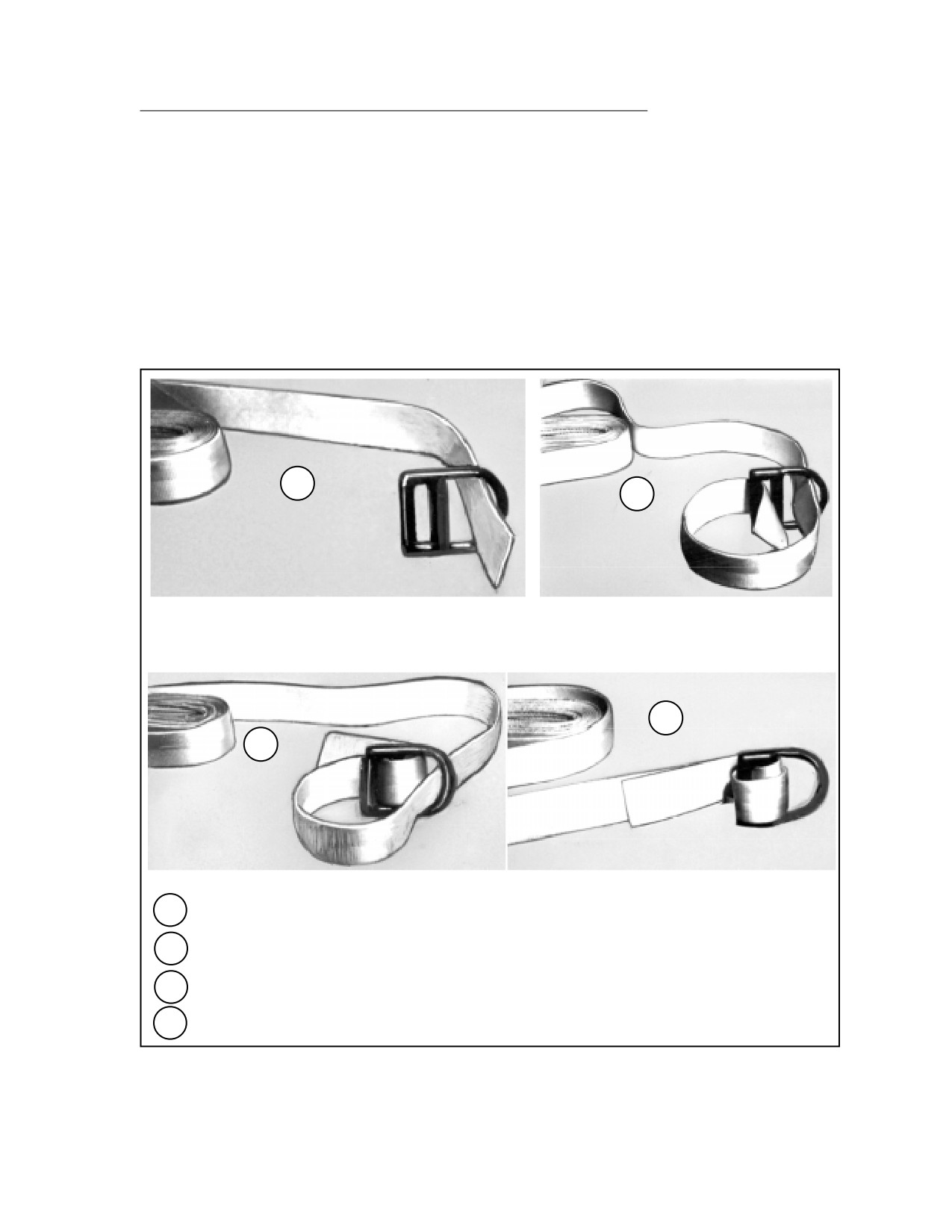
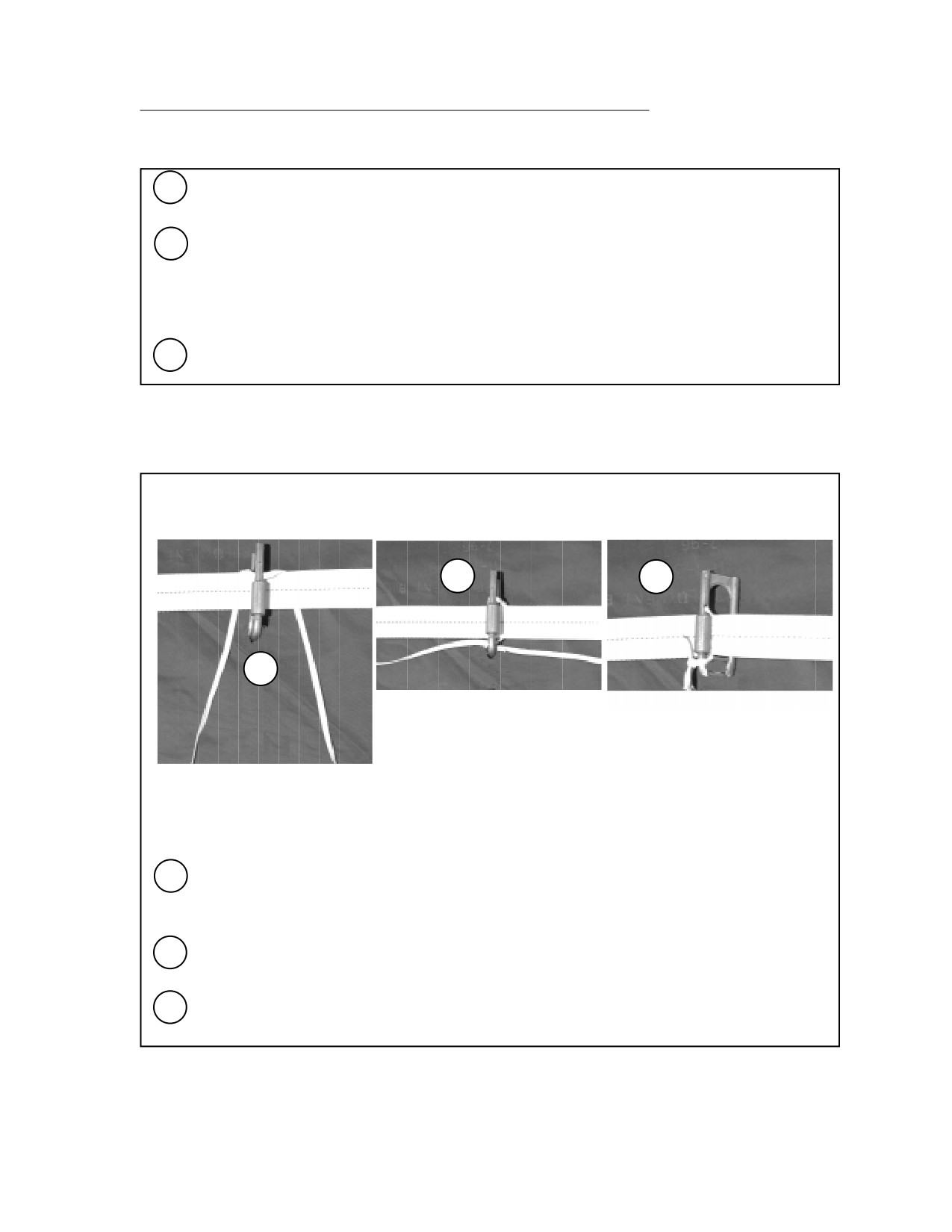
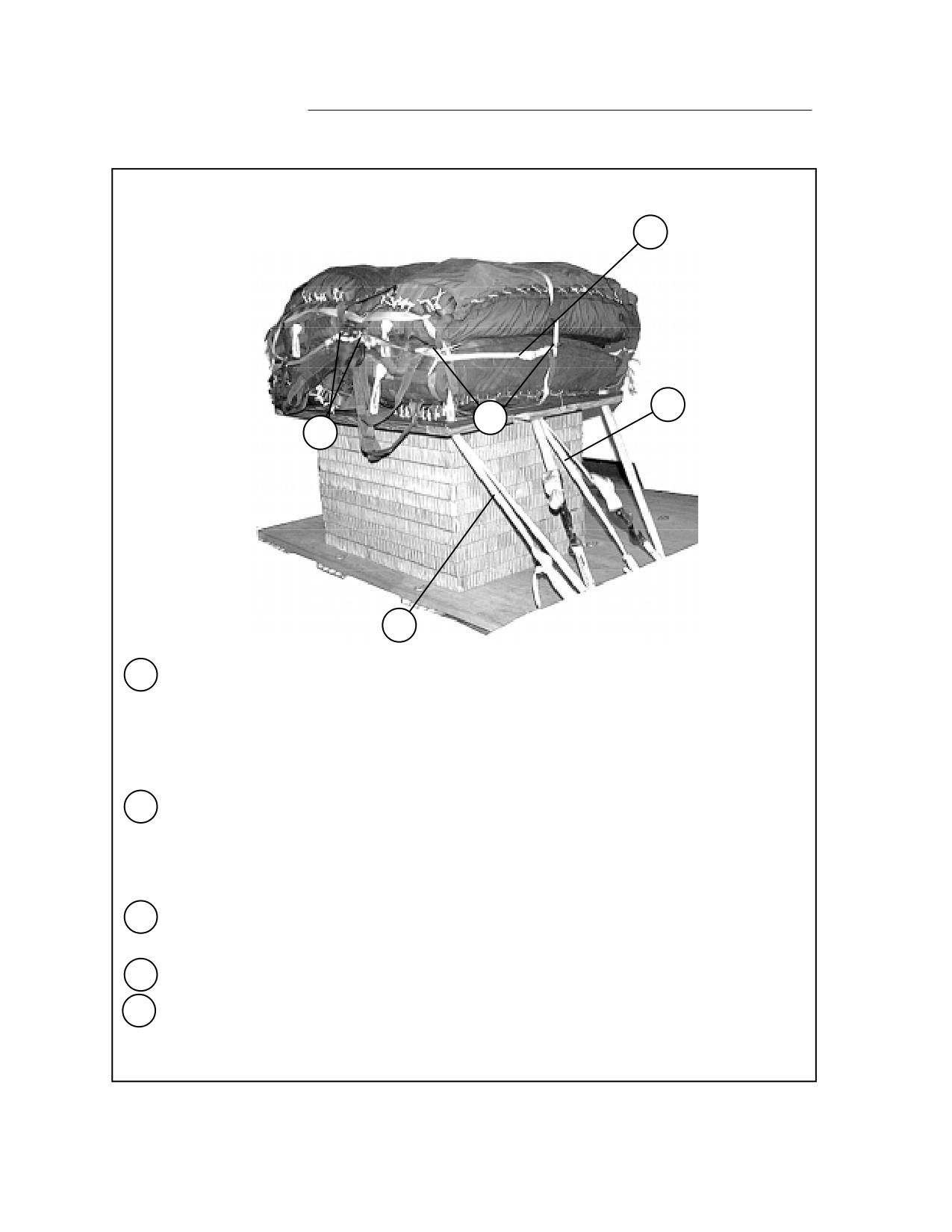
3-10. Fit a D-ring to the end of each tiedown strap as shown in Figure 3-6.
LASHING LOAD
3-11. Lash a DRAS load to the platform according to the instructions in the
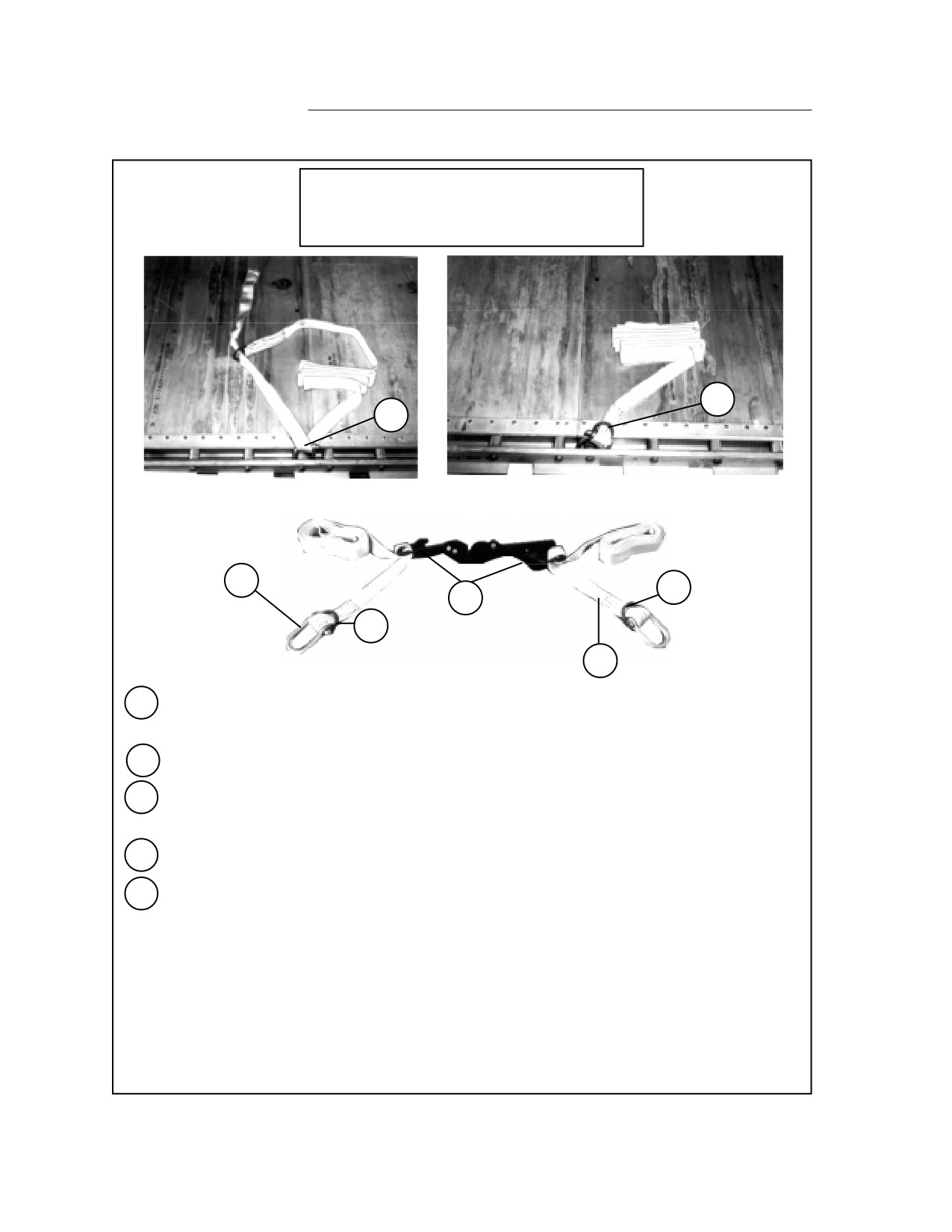
specific rigging chapter. Install the lashings as shown in Figures 3-7 and 3-8.
1
2
4
3
1
Run the free end of the tiedown strap through the large opening in the D-ring.
2
Run the strap around and through the small opening in the D-ring.
3
Run the strap back through the large opening in the D-ring.
4
Pull the strap taut.
Figure 3-6. D-Ring Fitted to Tiedown Strap
3-9
FM 4-20.105/TO 13C7-1-51
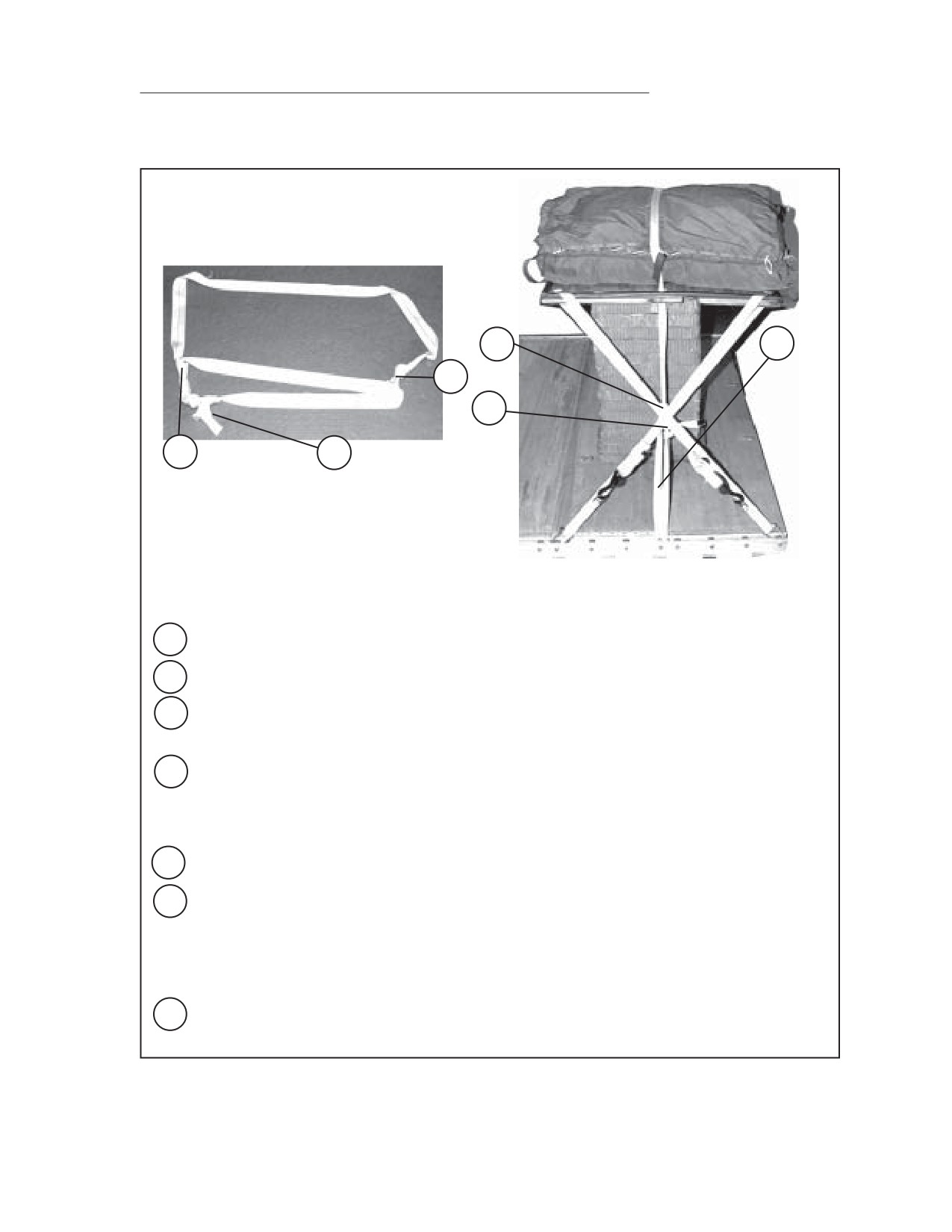
CAUTION
Do not tighten the lashings so tight that they
cause the platform to bow especially in the
aircraft.
3
3
3
1
5
4
2
1
Pass the free end of one tiedown strap through a clevis on the right rail and through its own
D-ring. Pull the strap taut.
2
Run the free end of the strap up over the load.
3
Pass the free end of a second tiedown strap through a clevis on the left rail and through its
own D-ring. Pull the strap taut.
4
Run the free end of the strap up over the load.
5
Fit a D-ring on the free end of each strap as described in Figure 3-6, and place the D-rings
on the hooks of a load binder. Safety the binder handle closed as shown in Figure 3-9.
NOTES:
1. When the tiedown strap length is not a factor, it is permissible to use a single
tiedown strap and D-ring with a load binder attached directly to a side rail
clevis or tiedown ring.
2. Pad all sharp edges that may touch the strap with cellulose wadding or other
suitable material.
Figure 3-7. Single Line Lashing
3-10
FM 4-20.105/TO 13C7-1-51
3
2
1
1
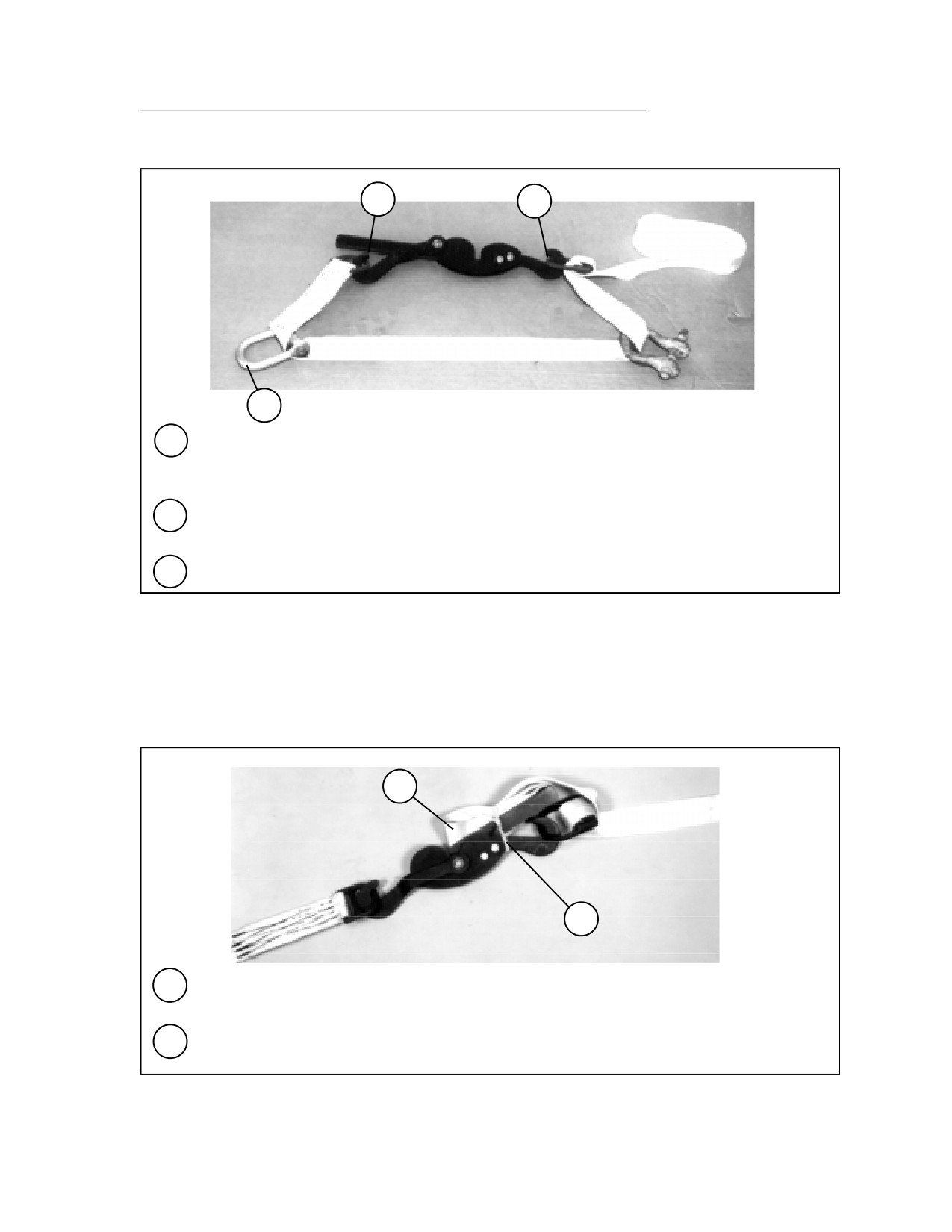
Pass the free end of a tiedown strap through a clevis on a rail and up and over, around, or
through the indicated tiedown provision on the load. The tiedown provision will be listed in
the specific rigging chapter for a particular load. Run the strap back toward the clevis.
2
Fit a D-ring to the free end of the strap (Figure 3-6), and place the D-rings on the hooks of
a load binder. Close the handle of the load binder pointing toward the platform.
3
Safety the binder handle closed as shown in Figure 3-9.
Figure 3-8. A Looped (Floating Binder) Lashing
SAFETY TIEING LOAD BINDER HANDLES
3-12. Fold the excess tiedown strap, and place the folds alongside the load binder
handle. Safety tie the load binder handle closed as shown in Figure 3-9.
1
2
1
After the handle of the load binder has been closed, fold or roll any excess tiedown strap and
place the folds alongside the load binder handle.
2
Tie the folded webbing to the binder and the binder handle closed with a single length of
type I, 1/4-inch cotton webbing.
Figure 3-9. Load Binder Handle and Excess Webbing Safety Tied
3-11
FM 4-20.105/TO 13C7-1-51
FORMING A 30-FOOT, 45-FOOT, OR GREATER LENGTH TIEDOWN
STRAP
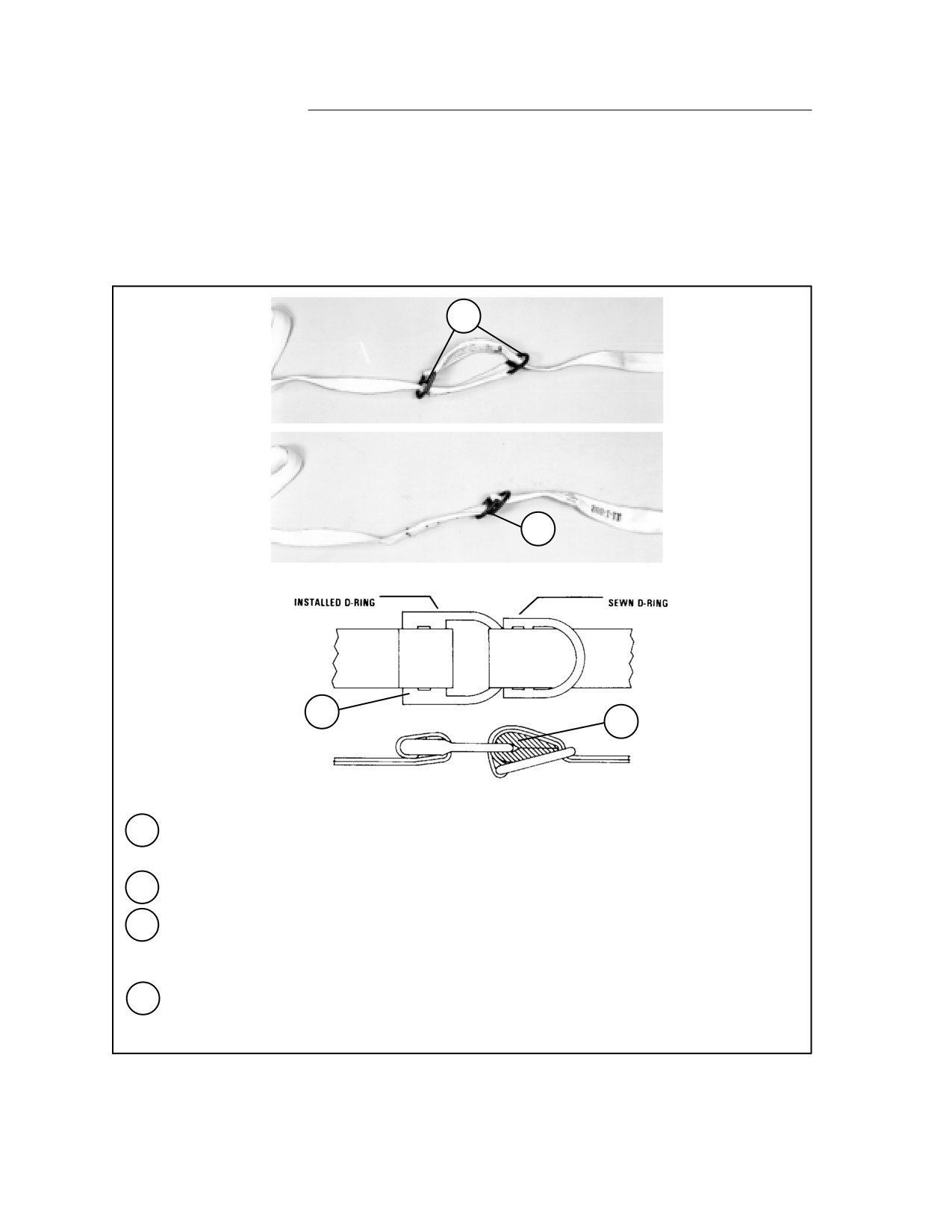
3-13. When needed, attach 15-foot tiedown straps together to form a 30-foot, 45-
foot, or greater length tiedown strap as shown in Figure 3-10.
1
2
3
4
1
Run the free end of two 15-foot tiedown straps through the D-ring of the opposite strap to
form a 30-foot strap.
2
Pull the straps taut.
3
Install a D-ring on a free end of the 30-foot strap. Pass the free end of a 15-foot tiedown
strap through the installed D-ring and back through its own D-ring to form a 45-foot or
greater strap.
4
Insert a 2- by 5-inch piece of 1/2-inch felt around the installed D-ring.
NOTE: Make sure the felt is centered around the installed D-ring.
Figure 3-10. A 30-Foot, 45-Foot, or Greater Length Tiedown Strap Formed
3-12
FM 4-20.105/TO 13C7-1-51
SECTION III - CARGO PARACHUTES
RISER EXTENSIONS
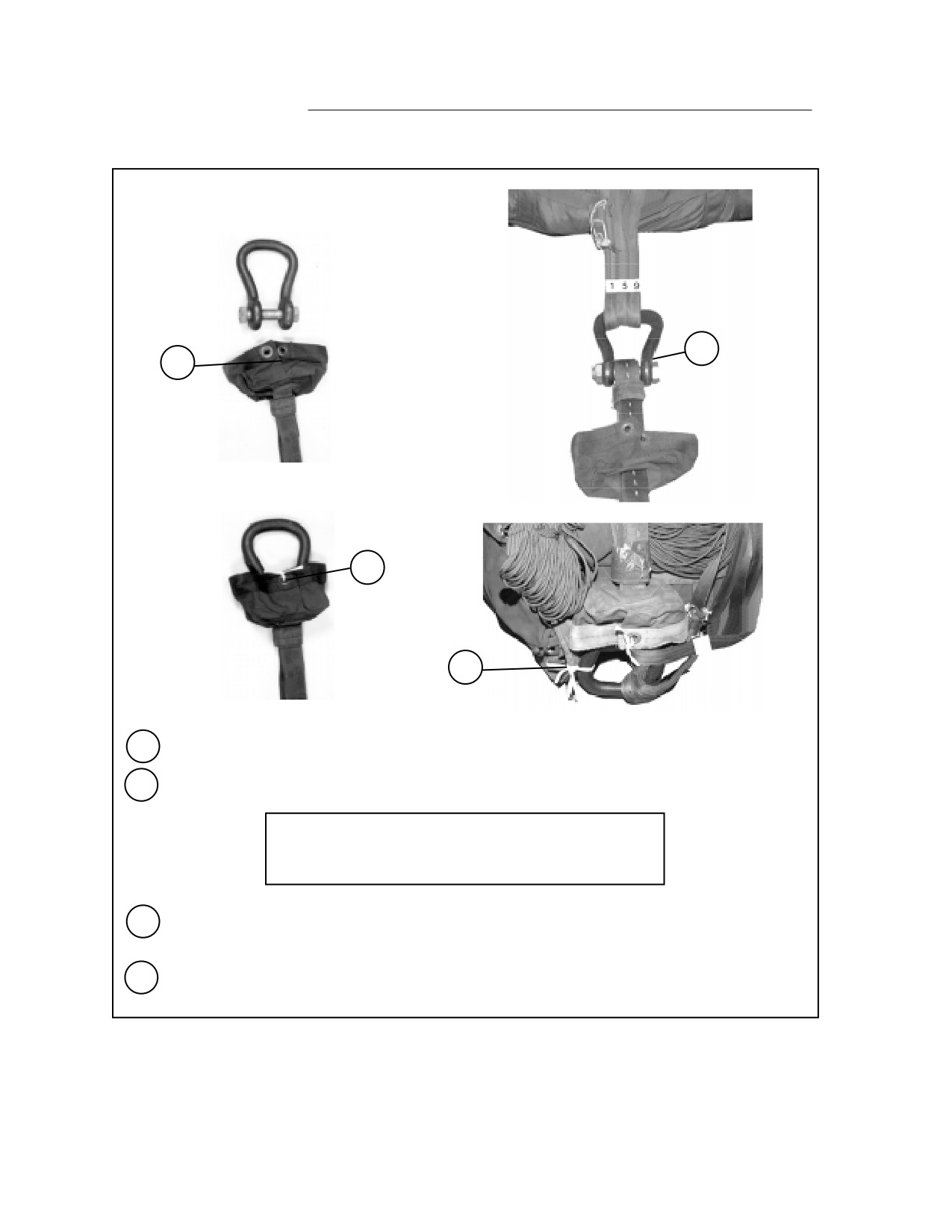
3-14. The risers of a cluster of G-11D cargo parachutes used on DRAS loads
must be extended (lengthened). The length of the extension needed for the
cluster is given in Table 2-4.
a. Forming Extensions. Only continuous riser extensions may be used.
b. Bolting Extensions to Risers. Bolt the riser extension to the risers of
a cargo parachute as shown in Figure 3-11.
3-13
FM 4-20.105/TO 13C7-1-51
2
1
3
4
1
Slip a clevis cover on one end of a riser extension.
2
Fit the sling on the bolt of the clevis running through the parachute risers.
CAUTION
The nuts must be tight enough to keep them from loosen-
ing during transport and airdrop.
3
Slide the clevis cover up over the bolt of the clevis, and tie the cover in place with a length of
type I, 1/4-inch cotton webbing. Pass the tie through the grommets of the cover.
4
Tie the clevis to the left bottom bag carrying handle with one double length of type I, 1/4-
inch cotton webbing.
Figure 3-11. Riser Extension Bolted to Risers
3-14
FM 4-20.105/TO 13C7-1-51
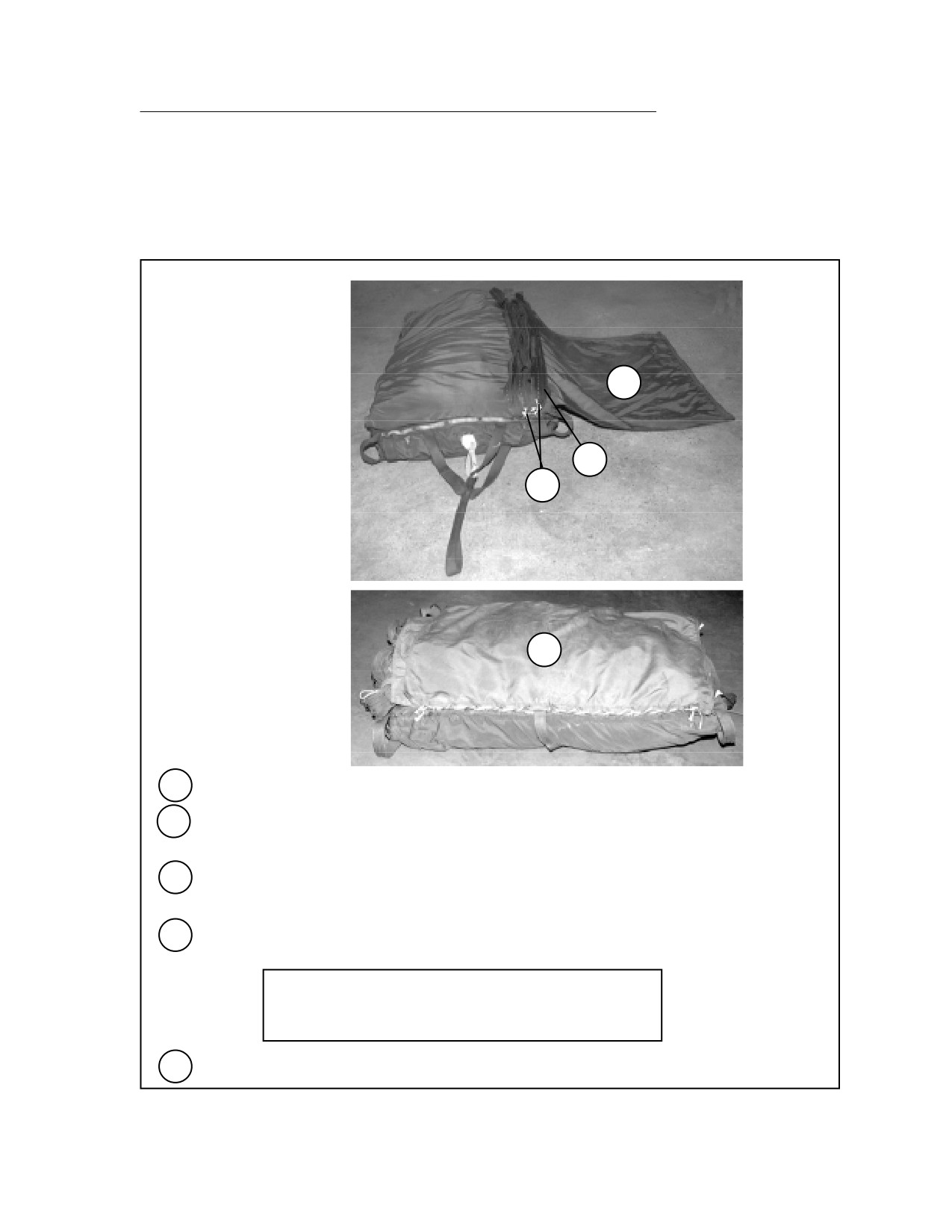
STOWING RISER EXTENSIONS
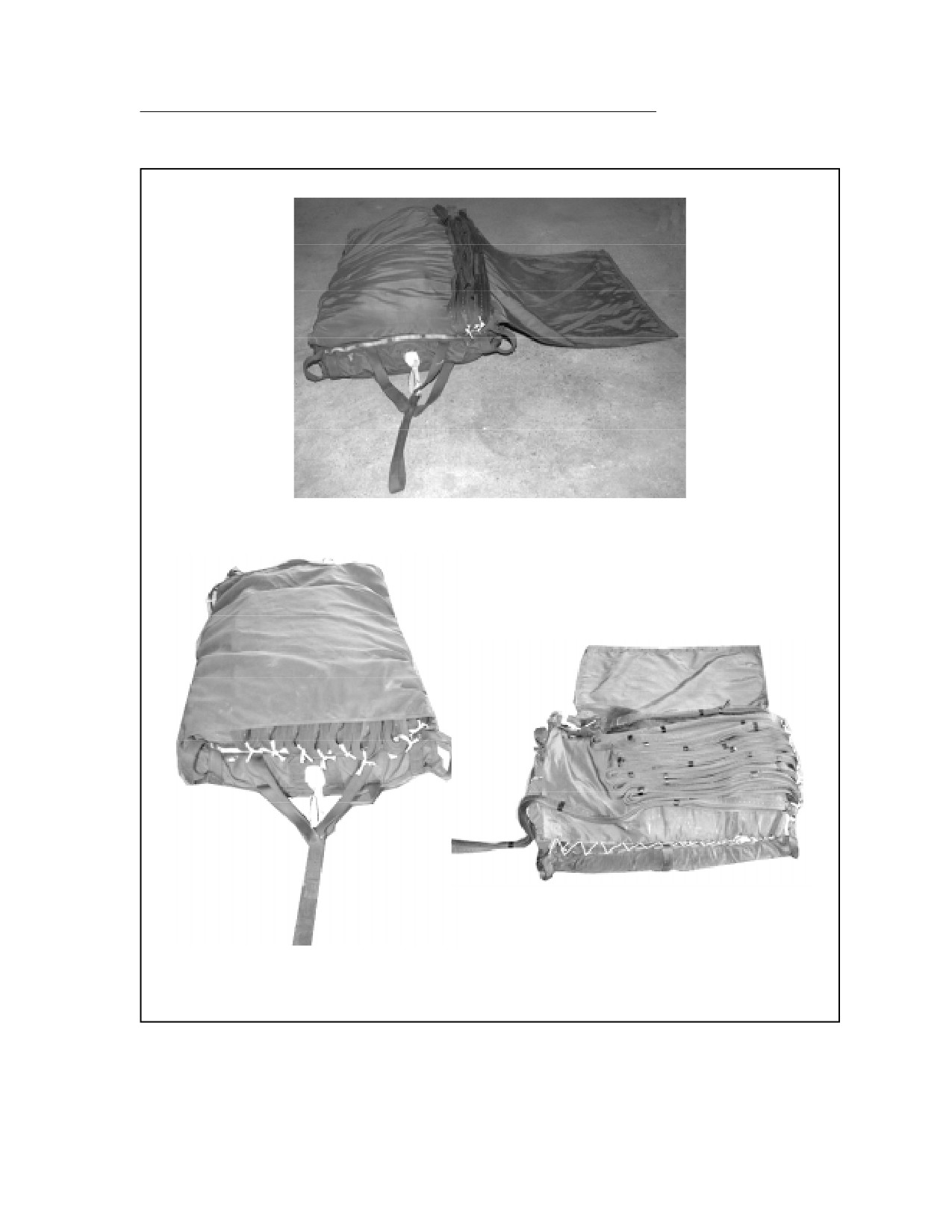
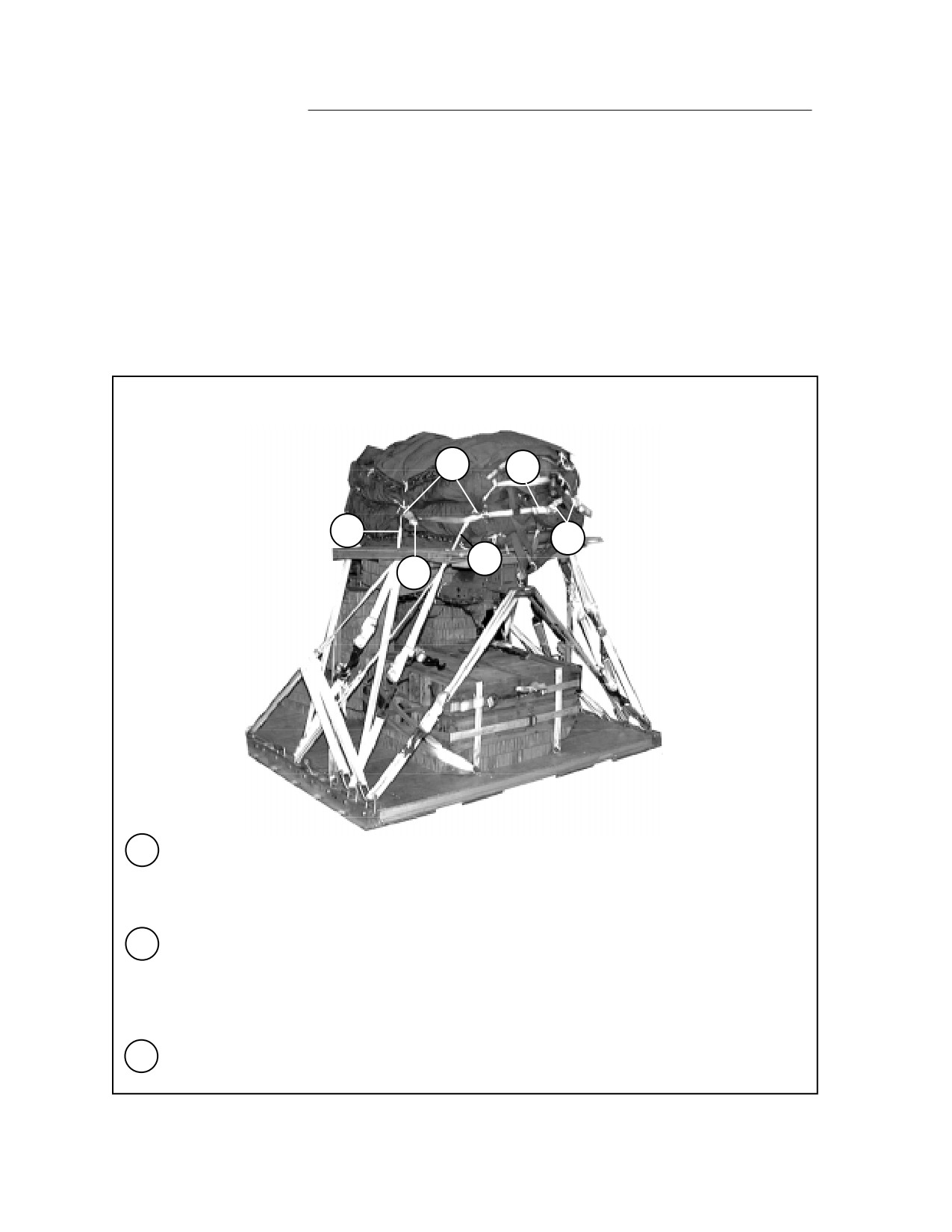
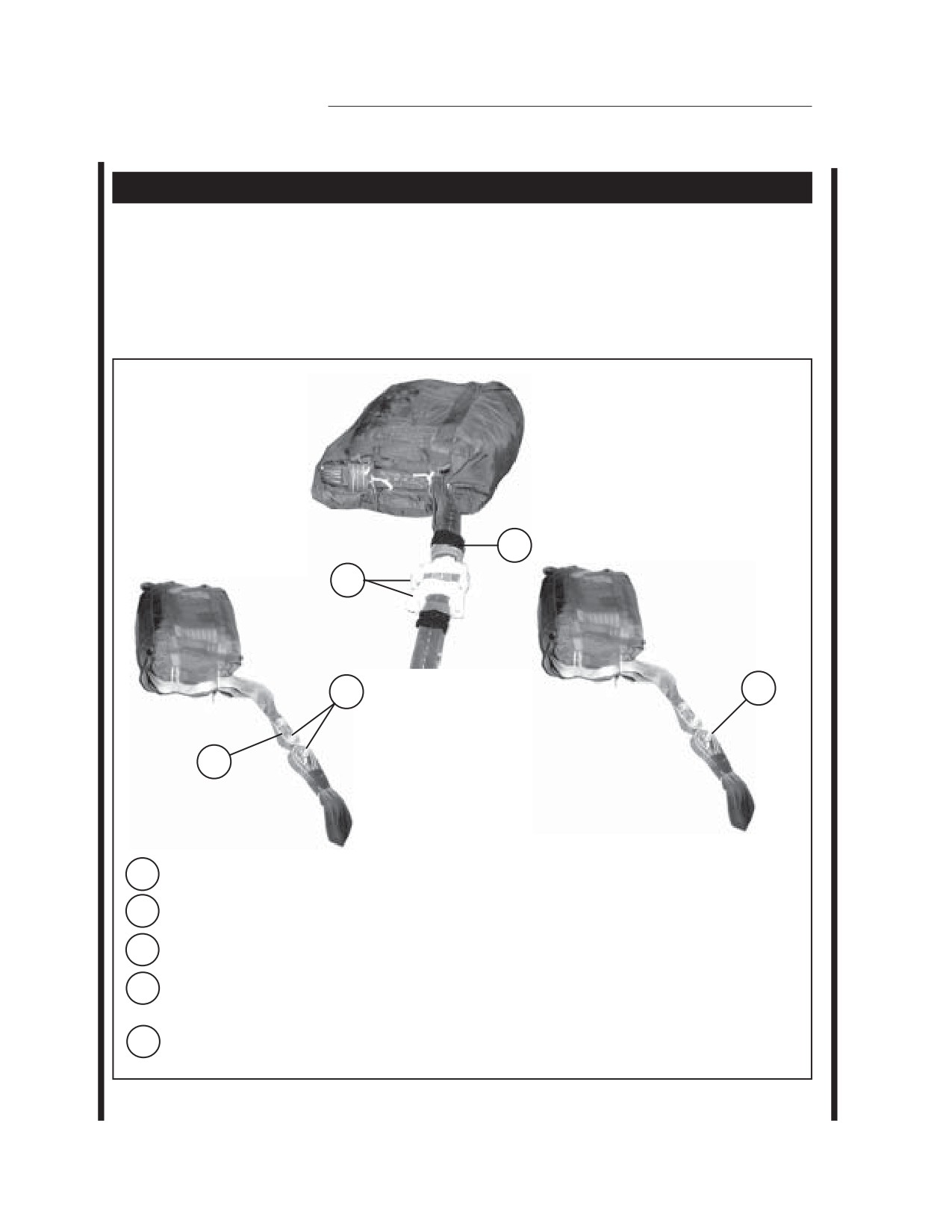
3-15. The riser extensions for the G-11D cargo parachutes must be stowed
as shown in Figures 3-12 and 3-13.
NYLON BAG
NOTE: The nylon deploy-
ment bags have the riser
1
extension securing line
permanently attached.
2
4
5
1
Open the riser extension flap which is attached with type I, 1/4-inch cotton webbing.
2
Start at the end of the riser extension fitted to the clevis and S-fold the extension into
the riser extension compartment.
3
Leave approximately 3 feet of the free end of the extension outside the riser end of the
compartment. (Not shown)
4
Tie each stow to the riser extension securing line with one turn double, type I, 1/4-inch
cotton webbing.
CAUTION
Do not girth hitch the type I, 1/4-inch cotton webbing ties
to the riser extension securing line.
5
Close the riser flap according to TM 10-1670-280-23&P/TO 13C5-31-2.
Figure 3-12. Riser Extension Securing Line Installed and Riser Extension Stowed
3-15
FM 4-20.105/TO 13C7-1-51
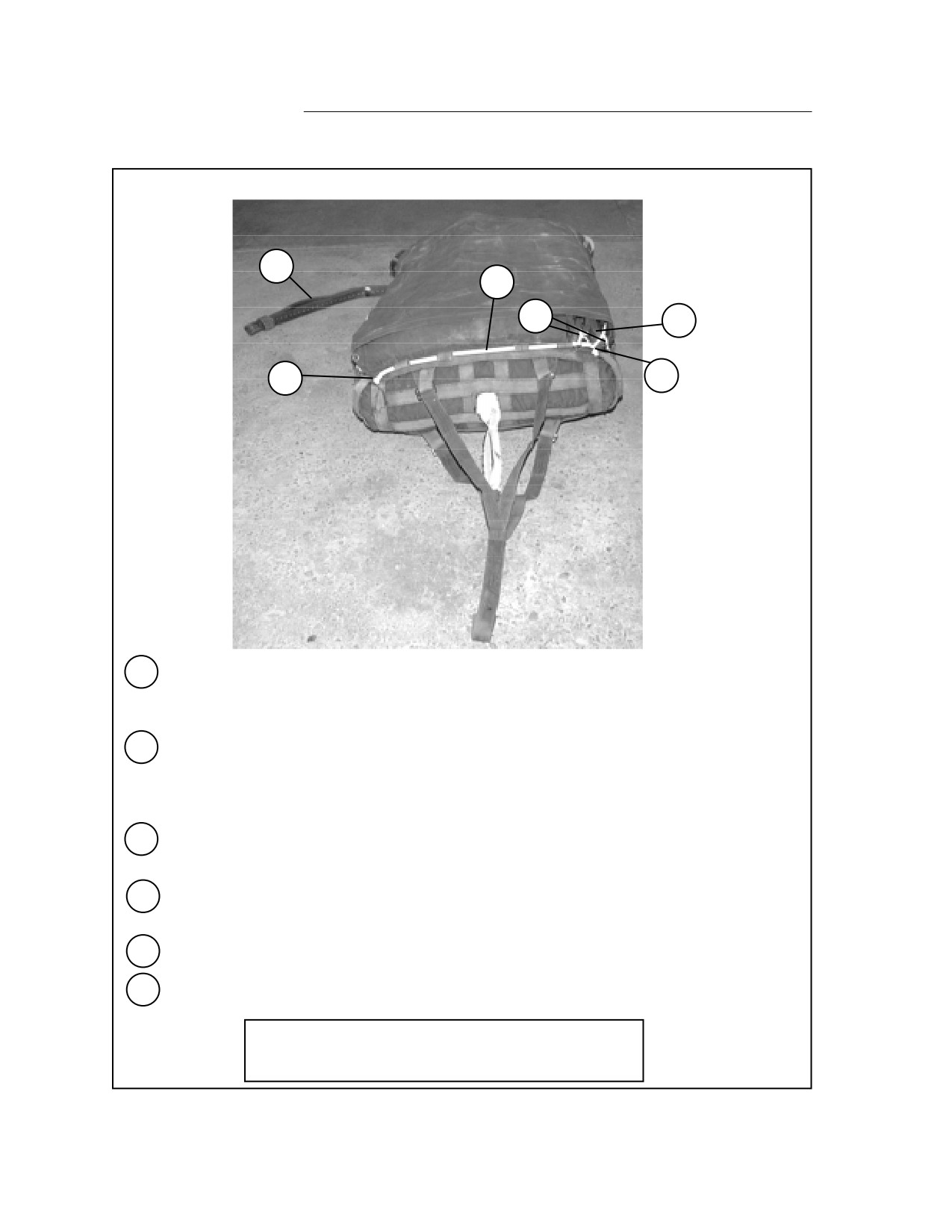
COTTON BAG
5
2
6
4
3
1
1
Fold an 8-foot length of 1/2-inch tubular nylon webbing in half lengthwise. Run the loop in
the folded end through the left carrying handle. Run the free ends of the webbing through
this loop, and pull the webbing taut.
2
Run the webbing across the parachute, passing it through the riser extension retaining
loops (end tabs).
NOTE: Do not pull the webbing tight across the parachute.
3
Tie the webbing to the right top carrying handle with three alternating half hitches and an
overhand knot in each free running end.
4
Start at the end of the riser extension fitted to the clevis and S-fold the 20-foot extension into
the riser extension compartment.
5
Leave about 3 feet of the free end of the extension outside the riser end of the compartment.
6
Tie each stow to the riser extension securing line with ties of one turn double type I, 1/4-
inch cotton webbing.
CAUTION
Do not girth hitch the type I, 1/4-inch cotton webbing ties
to the riser extension securing line.
Figure 3-12. Riser Extension Securing Line Installed and Riser Extension Stowed (Continued)
3-16
FM 4-20.105/TO 13C7-1-51
NYLON BAG
20-FOOT RISER EXTENSION STOWED
60-FOOT RISER EXTENSION STOWED
60-FOOT RISER EXTENSION STOWED
Figure 3-13. The 20- and 60-Foot Riser Extensions Stowed
3-17
FM 4-20.105/TO 13C7-1-51
STOWING CARGO PARACHUTES
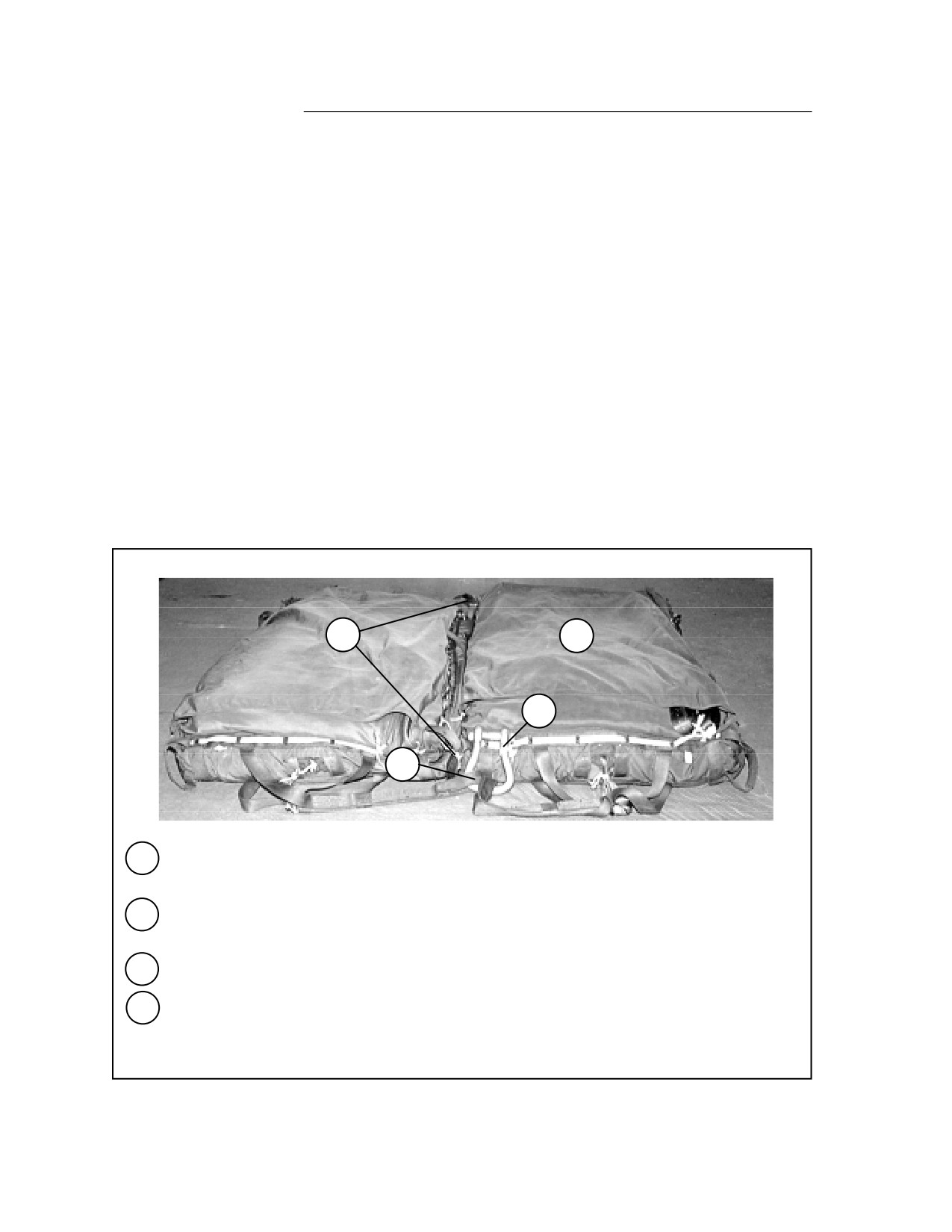
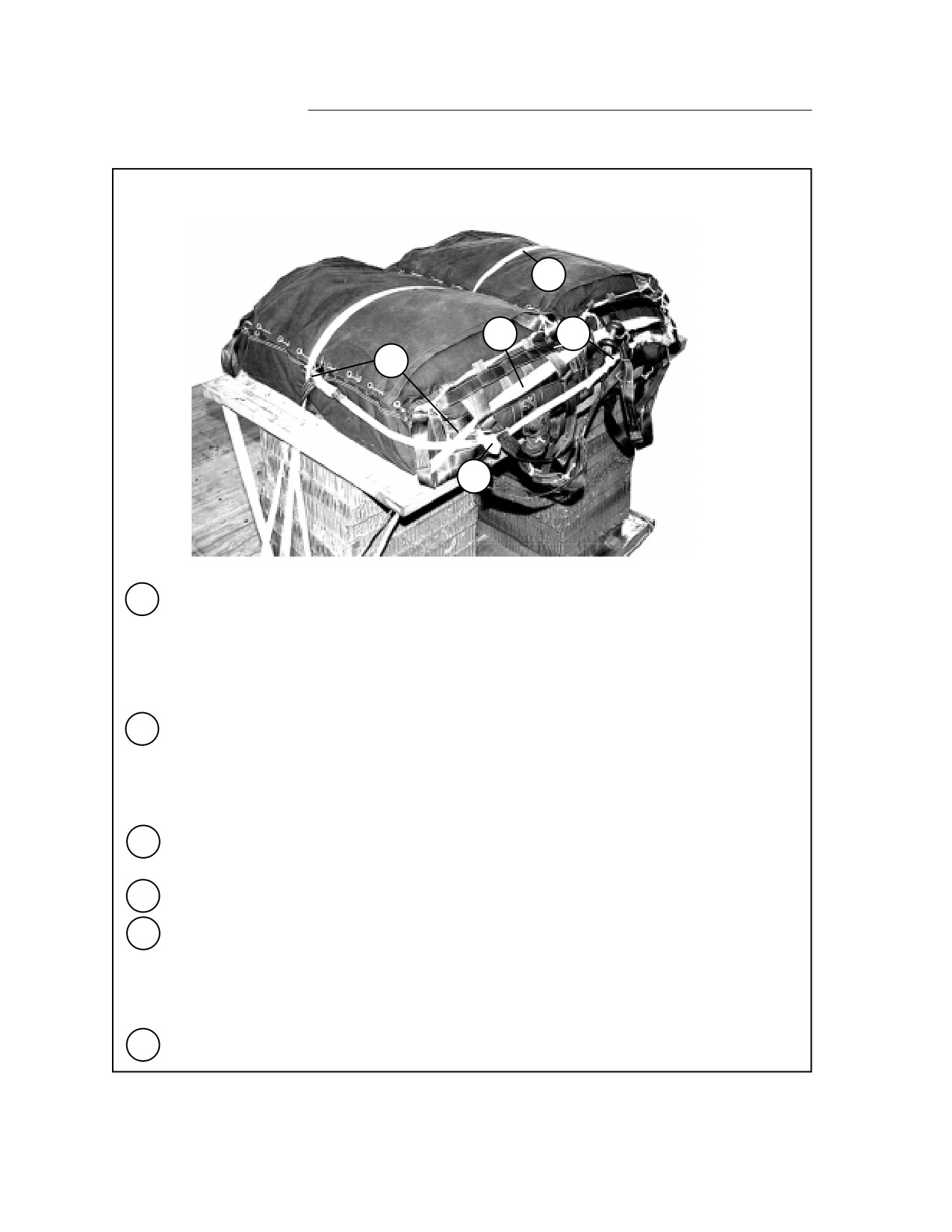
3-16. When referring to cargo parachutes, stowing consists of three steps. First,
place the cargo parachutes on the load or on a parachute stowage platform.
Second, cluster the parachutes by tying their deployment bags handles together.
Third, group the bridles on a large clevis. Stow the parachutes as shown in
Figures 3-14 through 3-16.
Note: Nylon and cotton bags may be mixed on the same load.
USING DEPLOYMENT LINES
3-17. The deployment line for DRAS loads is a 3-foot (4-loop), type XXVI nylon
webbing sling. One end of the deployment line is fitted on a 3 3/4-inch two
point link attached to the adapter web of the deployment parachute. The other
end of the line is fitted to the bolt of the large clevis grouping the bridles of a
cluster of parachutes.
2
1
4
3
1
Set two parachutes side by side on the load with the riser compartments up and the
bridles toward the front of the platform.
2
Tie the inside front and rear cluster attaching loops (hereafter called carrying handles)
together with one turn single type III nylon cord.
3
Fit the bridle loops on the arms of a large clevis. Ensure the bolt of the clevis faces up.
4
For the nylon bag, tie the clevis to the right parachute restraint strap loop with a length of
doubled type I, 1/4-inch cotton webbing. Secure with a surgeons knot and a locking knot.
For the cotton bag, tie the clevis to the right bridle attaching loop with a length of one turn
double type I, 1/4-inch cotton webbing. Secure with a surgeons knot and a locking knot.
Figure 3-14. Two Parachutes Stowed
3-18
FM 4-20.105/TO 13C7-1-51
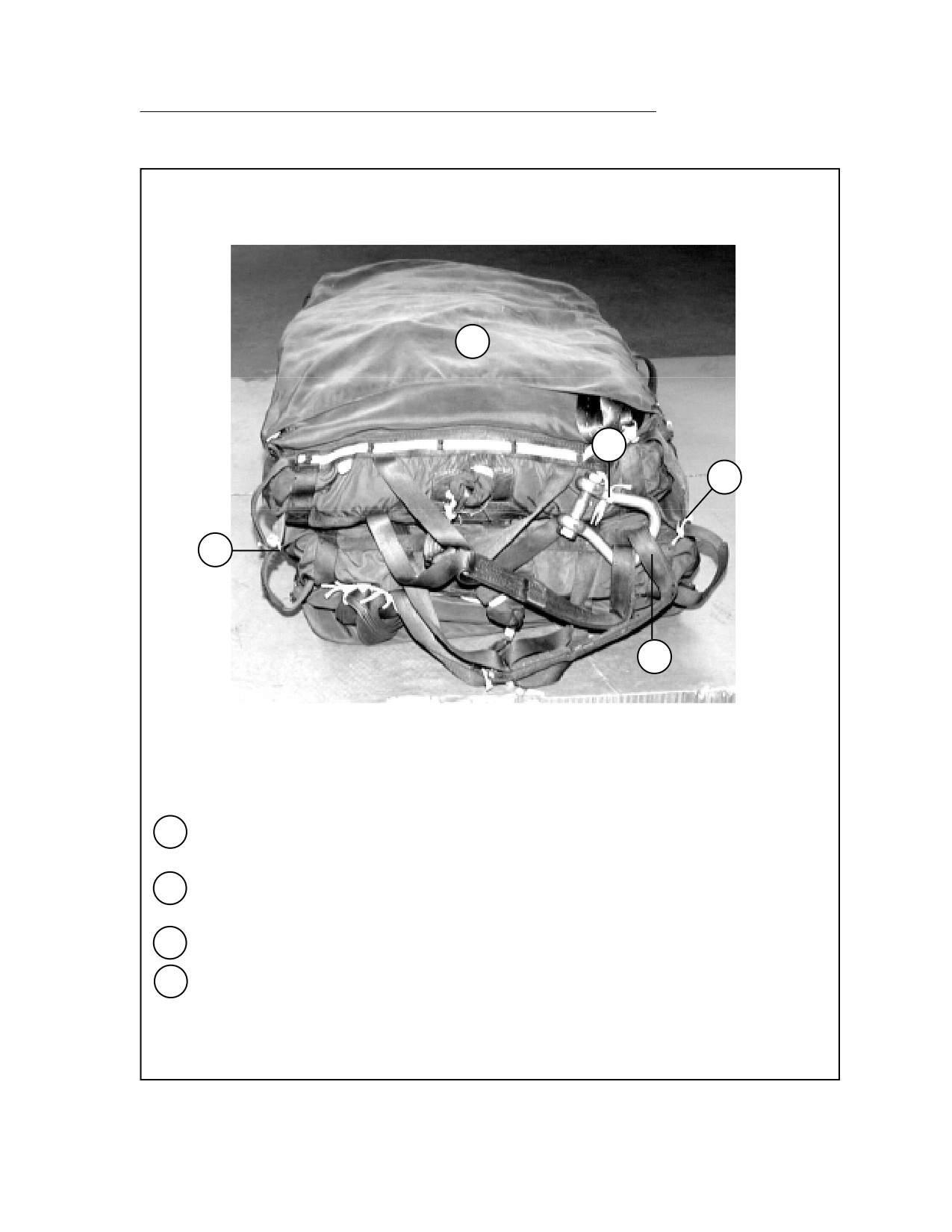
5
8
6
6
7
5
Stack two parachutes with the riser compartment of the bottom parachute down and the
riser compartment of the top parachute up.
6
Tie the outside front and rear cluster carrying handles together with one turn single type III
nylon cord.
7
Fit the bridle loops on the arms of a large clevis. Ensure the bolt of the clevis faces up.
8
For the nylon bag, tie the clevis to the right parachute restraint strap loop with a length of
one turn double type I, 1/4-inch cotton webbing. Secure with a surgeons knot and a locking
knot. For the cotton bag, tie the clevis to the right bridle attaching loop with a length of one
turn double type I, 1/4-inch cotton webbing. Secure with a surgeons knot and a locking
knot.
Figure 3-14. Two Parachutes Stowed (continued)
3-19
FM 4-20.105/TO 13C7-1-51
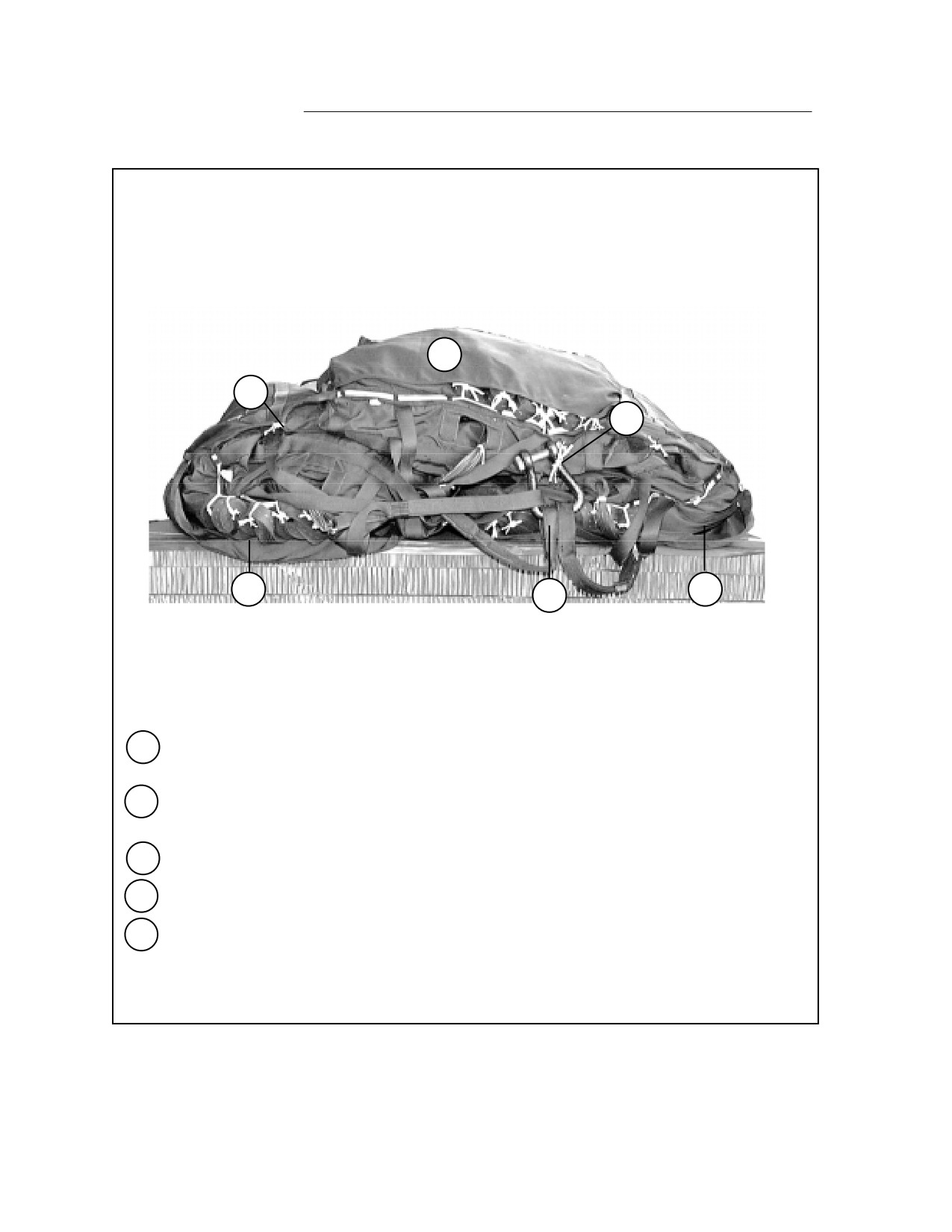
2
3
5
1
1
4
1
Set two parachutes side by side on the load with the riser compartments down and the
bridles toward the front of the platform.
2
Center one parachute on top of the two parachutes in step 1 above with the riser
compartment up.
3
Tie the front and rear carrying handles together with onr turn single of type III nylon cord.
4
Fit the bridle loops on the arms of a large clevis.
5
For the nylon bag, tie the clevis to the top right parachute restraint strap loop with a length
of one turn double type I, 1/4-inch cotton webbing. Secure with a surgeons knot and a
locking knot. For the cotton bag, tie the clevis to the top right bridle attaching loop with a
length of one turn double type I, 1/4-inch cotton webbing. Secure with a surgeons knot and
a locking knot.
Figure 3-15. Three Parachutes Stowed
3-20
FM 4-20.105/TO 13C7-1-51
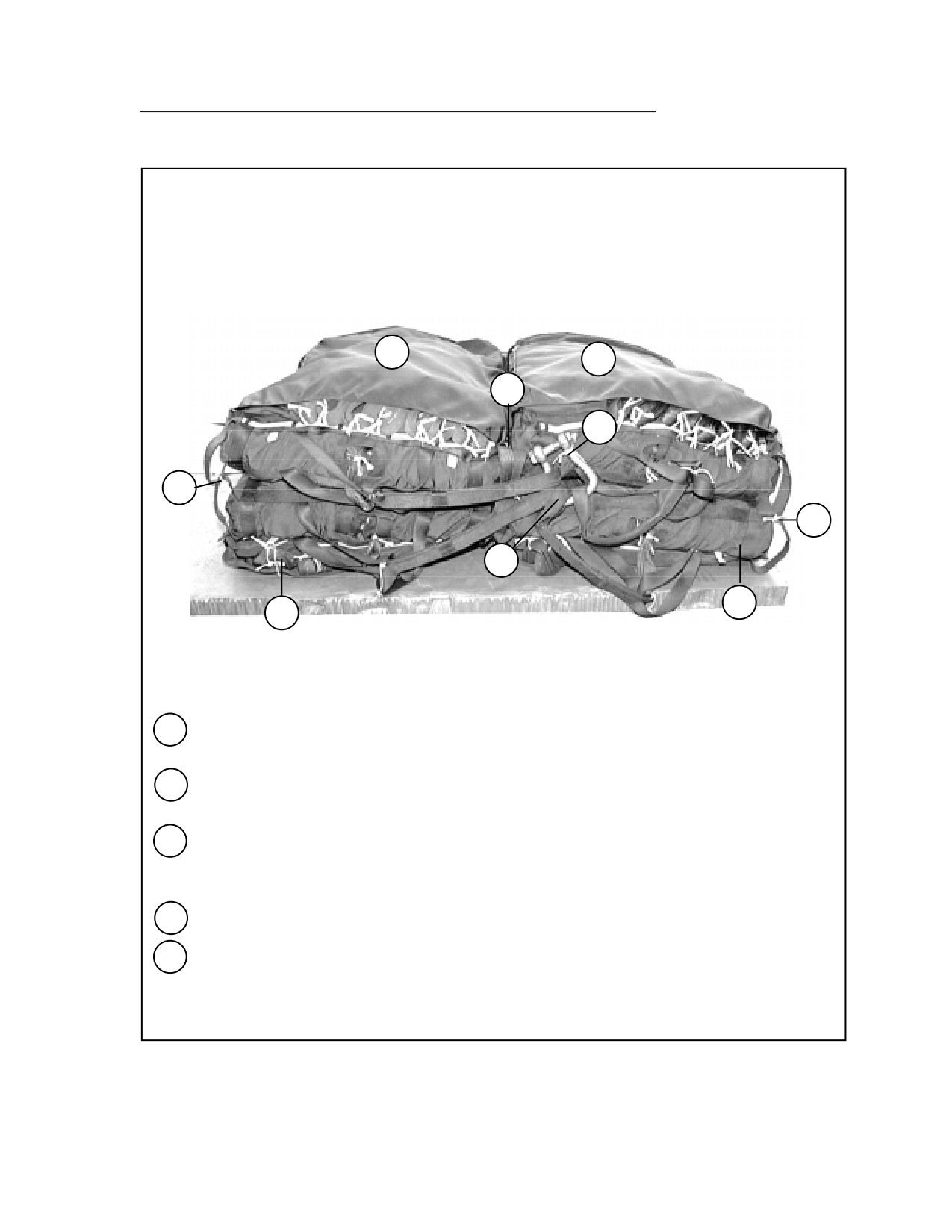
2
2
3
5
3
3
4
1
1
1
Set two parachutes side by side on the load with the riser compartments down and with
bridles toward the front of the platform.
2
Set two parachutes side by side on top of the two parachutes in step 1 above with the riser
compartments up.
3
Tie the four center front and four center rear carrying handles together with one turn single
length of type III nylon cord. Tie the outside carrying handles together with type III nylon
cord.
4
Fit the bridle loops on the arms of a large clevis.
5
For the nylon bag, tie the clevis to the top right parachutes left parachute restraint strap
loop with a length of one turn double type I, 1/4-inch cotton webbing. Secure with a
surgeons knot and a locking knot. For the cotton bag, tie the clevis to the top right
parachutes left bridle attaching loop with a length of one turn double type I, 1/4-inch cotton
webbing. Secure with a surgeons knot and a locking knot.
Figure 3-16. Four Parachutes Stowed
3-21
FM 4-20.105/TO 13C7-1-51
RESTRAINING TWO TO FOUR PARACHUTES
3-18. The following parachute restraint systems are used to restrain two to
four cargo parachutes.
a. Two Parachutes. The restraint system for two cargo parachutes
consists of two lengths of type VIII nylon webbing (restraint straps) and two
multicut parachute release straps for the stacked configuration and one length
of type VIII nylon webbing (restraint strap) and two multicut parachute release
straps for the side by side configuration as shown in Figures 3-17 through 3-19.
NOTE: When a stowage platform is used, the restraint strap runs through the
platform. Always use multicut parachute release straps in pairs.
4
6
1
5
2
3
1
Run the restraint strap through the center carrying handles on the left side of the
parachutes, up to the top of the parachutes, and down through the center carrying handles
on the right side of the parachutes. Tie the ends of the restraint strap to the load as de-
scribed in Figure 3-22.
2
Run the second restraint strap through the front carrying handles of the left parachutes.
Run the restraint strap through the bridle attaching loops of the top parachute for the cotton
bags or through the parachute restraint strap loops for the nylon bag, and down through
the front carrying handles of the right parachutes. Tie the ends of the restraint strap to the
load as described in Figure 3-22.
3
Remove guillotine knives number 3 (Figure 2-3) from each multicut parachute release
strap. Fold the unused loops, and tape the folds in place.
Figure 3-17. Multicut Parachute Release Straps Installed on Two Stacked Parachutes
3-22
FM 4-20.105/TO 13C7-1-51
4
Close each knife around the restraint strap, with the knurled nut out between the top and
bottom carrying handles. Safety tie the guillotine knife as shown in Figure 3-18.
5
Tie the free end of each release strap to the large clevis grouping the bridles. Use
three alternating half hitches and an overhand knot in each running end. Make sure that
the parachute release straps are not routed under the parachute restraint or parachute
bridles. Make sure that the release straps are shorter than the parachute bridles to ensure
that the deployment force is applied to the strap before the bridles.
6
Fold or roll any excess strap, and tape the folds in place.
Figure 3-17. Multicut Parachute Release Straps Installed on Two Stacked Parachutes (continued)
2
3
1
1
Close the knife around the restraint strap, knurled nut out. Thread a length of type I, 1/4-
inch cotton webbing through the safety tie hole. Even the ends of the webbing, and run
them under the restraint strap, and alongside the release knife.
2
Thread the end of the webbing on the left side of the knife rightward behind the bar of the
knife. Thread the other end of webbing left in a like manner.
3
Bring the ends of the webbing up over the top of the bar. Tie the ends of the webbing
together with a surgeons knot and a locking knot.
Figure 3-18. Guillotine Knife Safety Tied
3-23
FM 4-20.105/TO 13C7-1-51
NOTE: When a stowage platform is used, the restraint strap runs through the
platform. Always use multicut parachute release straps in pairs.
1
2
5
4
3
1
Run the restraint strap through the center carrying handle on the left side of the
parachute. Run the restraint strap over the top of the parachute, and down through the left
center carrying handle. Continue to run the restraint strap up through the right inside
carrying handle. Run the restraint strap over the right parachute and down through the
right outside carrying handle. Tie the ends of the restraint strap to the load as described in
Figure 3-22.
2
Run the second restraint strap through the outside front carrying handle of the bottom left
parachute, up through the top left front carrying handle and both bridle attaching loops of
the top parachute for the cotton bags or through the parachute restraint strap loops for the
nylon bag, and down through the outside front carrying handles of the top and bottom right
parachute. Tie the restraint strap to the load as described in Figure 3-22.
3
Remove guillotine knife number 3 (Figure 2-3) from each of two multicut parachute release
straps. Fold the unused loops, and tape the folds in place.
4
Close and safety tie the guillotine knives as shown in Figure 3-18.
5
Tie the free end of each release strap to the large clevis grouping the bridles. Use
three alternating half hitches and an overhand knot in each running end. Make sure that
the parachute release straps are not routed under the parachute restraint or parachute
bridles. Make sure that the release straps are shorter than the parachute bridles to ensure
that the deployment force is applied to the strap before the bridles.
6
Fold or roll any excess strap, and tape the folds in place.
Figure 3-19. Multicut Parachute Release Straps Installed on Two Side-by-Side Parachutes
3-24
FM 4-20.105/TO 13C7-1-51
b. Three and Four Parachutes. The restraint system for three and four
cargo parachutes consists of two lengths of type VIII nylon webbing (re-
straint straps) and two multicut parachute release straps. Restrain three
and four cargo parachutes as shown in Figures 3-20 and 3-21.
Note: Always use multicut parachute release straps in pairs.
1
4
3
2
5
1
Run the first restraint strap through the center carrying handles on the left side of the
parachutes. Run the restraint strap over the top of the parachute and down through the
right carrying handles. Tie the ends of the restraint strap to the load as described in Figure
3-22.
2
Run the second restraint strap through the outside front carrying handle of the bottom left
parachute, up through the top left front carrying handle and both bridle attaching loops of
the top parachute for the cotton bags or through the parachute restraint strap loops for the
nylon bag, and down through the outside front carrying handles of the top and bottom right
parachute. Tie the restraint strap to the load as described in Figure 3-22.
3
Remove guillotine knife number 3 (Figure 2-3) from each of two multicut parachute release
straps. Fold the unused loops, and tape the folds in place.
4
Close and safety tie the guillotine knives as shown in Figure 3-18.
5
Tie the release straps to the large clevis as in step 4, Figure 3-19.
NOTE: Place the knives around the restraint straps between the carrying
handles of the top and bottom parachutes.
Figure 3-20. Three Parachutes Restrained Using Multicut Parachute Release Straps
3-25
FM 4-20.105/TO 13C7-1-51
Note: Always use multicut parachute release straps in pairs.
3
1
4
5
2
1
Run the restraint strap through the center carrying handles on the left side of the
parachutes. Run the restraint strap over the top of the parachute, and down through the left
inside center carrying handle. Continue to run the restraint strap up through the right
inside center carrying handle. Run the restraint strap over the right parachute and down to
the right outside carrying handles. Tie the ends of the restraint strap to the load
as described in Figure 3-22.
2
Run the second restraint strap through the outside front carrying handles of the left
parachutes. Run the restraint strap through the bridle attaching loops of the top parachutes
for the cotton bags or through the parachute restraint strap loops for the nylon bag, and
down through the outside front carrying handles of the right parachutes. Tie the ends of the
restraint strap to the load as described in Figure 3-22.
3
Remove guillotine knife number 3 (Figure 2-3) from each of two multicut parachute release
straps. Fold the unused loops, and tape the folds in place.
4
Close and safety tie the guillotine knives as shown in Figure 3-18.
5
Tie the release straps to the large clevis as in step 4, Figure 3-19.
NOTE: Place the knives around the restraint straps between the carrying handles of
the top and bottom parachutes.
Figure 3-21. Four Parachutes Restrained Using Multicut Parachute Release Straps
3-26
FM 4-20.105/TO 13C7-1-51
5
6
1
7
2
3
When the ends are tied together-
1
Tie a loop in one end of the restraint strap with an overhand knot.
2
Tie a trucker’s hitch a suitable distance from the other end of the restraint strap.
3
Run the free end of the restraint strap through the first loop and then back through the
trucker’s hitch.
4
Pull on the free end until the strap is taut, and tie the free end of the strap with three
alternating half hitches and with an overhand knot in the running end (not shown).
When the ends are tied to the load-
5
Tie a trucker’s hitch a suitable distance in each end of the restraint strap.
6
Run each free end of the strap through or around the indicated point on the load and back
up through the trucker’s hitch.
NOTE: The indicated point for tying the parachute restraint strap to the load
will be given in the specific rigging chapter.
7
Pull on both ends of the restraint strap at the same time. When the strap is taut, tie the
ends with three alternating half hitches and an overhand knot in the running end.
Figure 3-22. Restraint Strap Tied
3-27
C1, FM 4-20.105/TO 13C7-1-51
SECTION IV - DEPLOYMENT LINE AND PARACHUTE
ATTACHING THE DEPLOYMENT LINE
3-19. The 3-foot (4-loop), type XXVI nylon webbing sling is used as the deploy-
ment line for DRAS airdrop and connects the deployment parachute to the cargo
parachutes. Follow the procedures as shown in Figure 3-23 to connect the
deployment line to the deployment parachute.
5
4
1
3
2
1
Place a large spacer on each bolt of the 3 3/4-inch two-point link.
2
Fit the adapter web loop on one of the spacers attached in step 1 above.
3
Fit the loop of the 3-foot deployment line on the free spacer of the 3 3/4-inch two-point link.
4
Bolt the side plate to the 3 3/4-inch two-point link. Use a wrench to tighten the nuts. Run a
length of tape around the link and over each nut and bolt end.
5
Run a length of cloth-backed tape around the adapter web keeper.
Figure 3-23. Deployment Line Attached
3-28
C1, FM 4-20.105/TO 13C7-1-51
POSITIONING AND SECURING THE DEPLOYMENT PARACHUTE
AND LINE
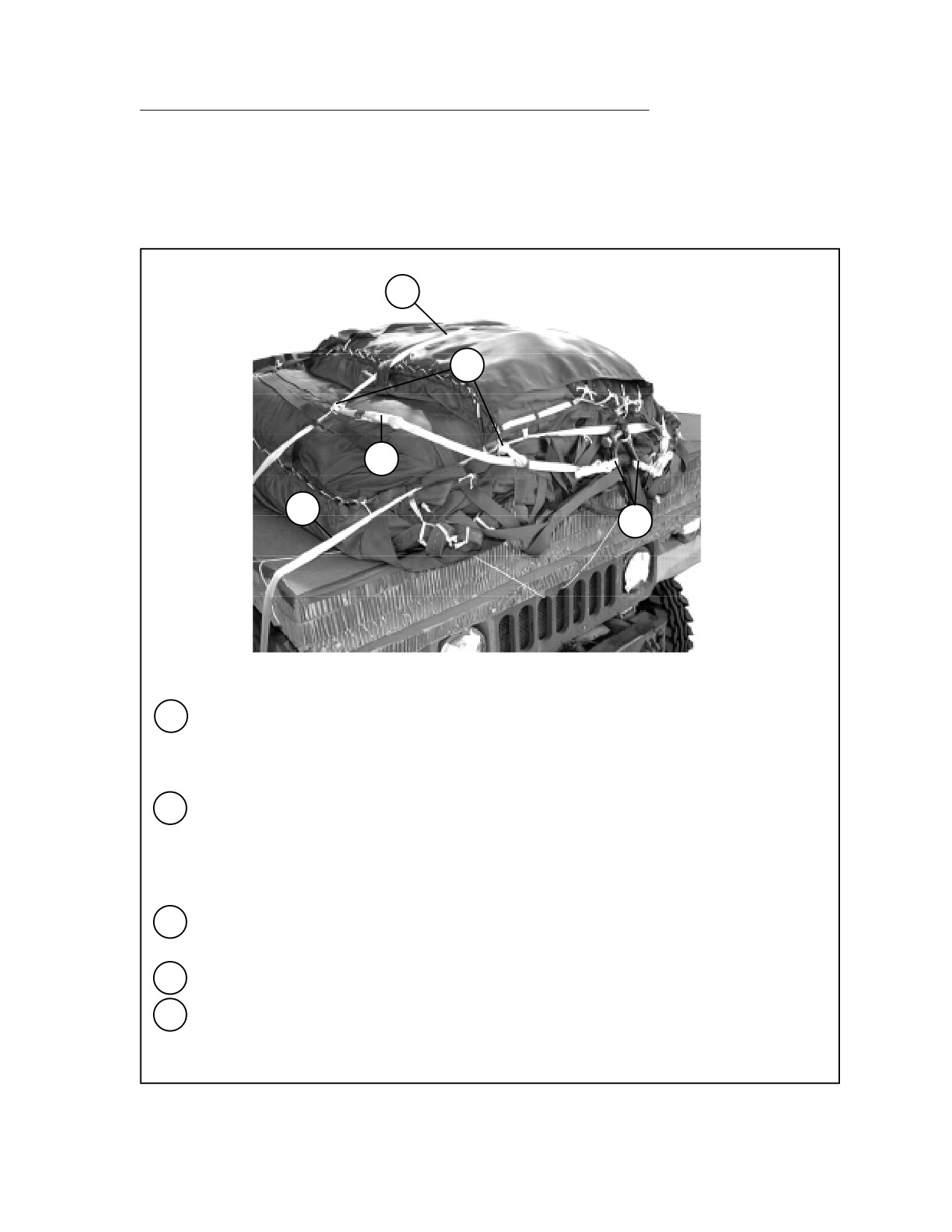
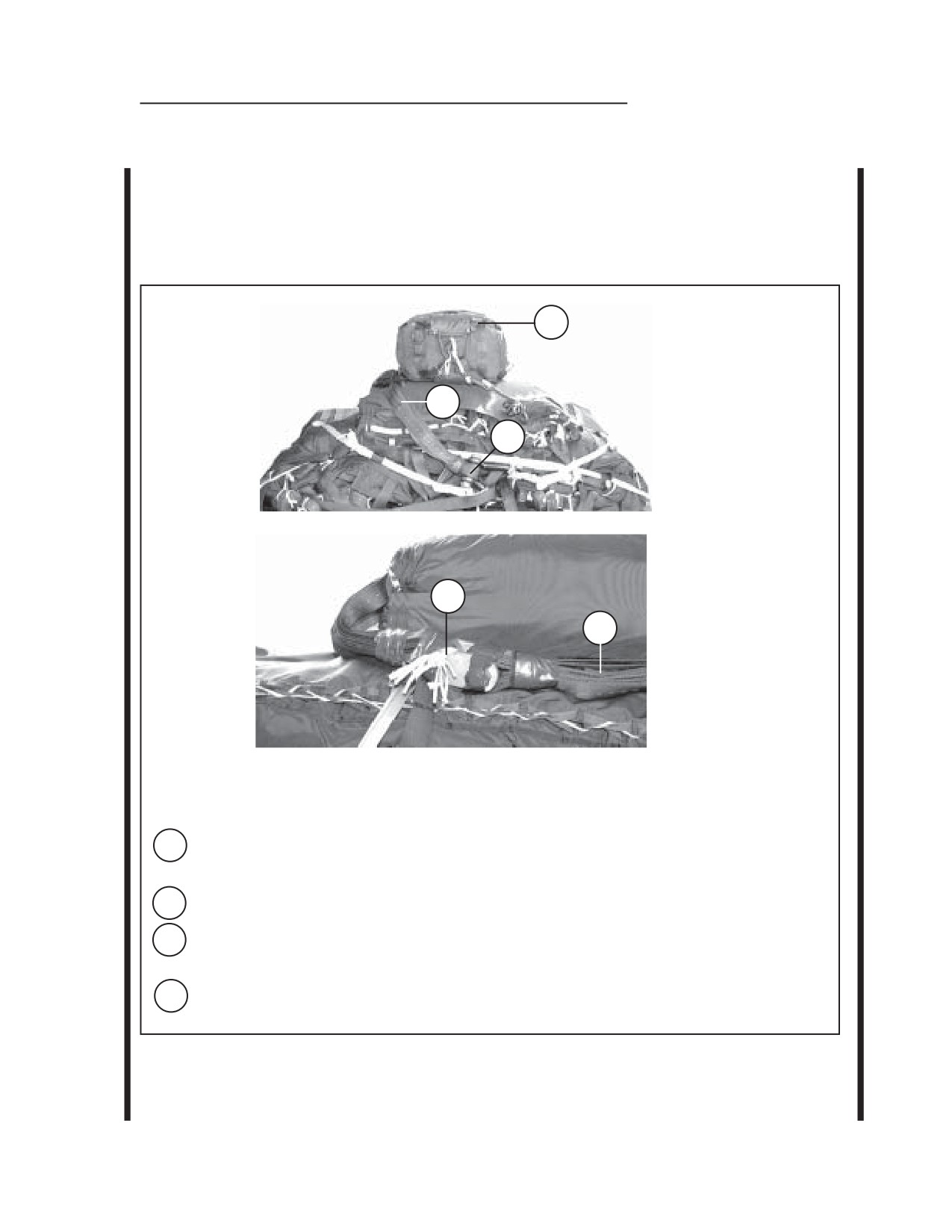
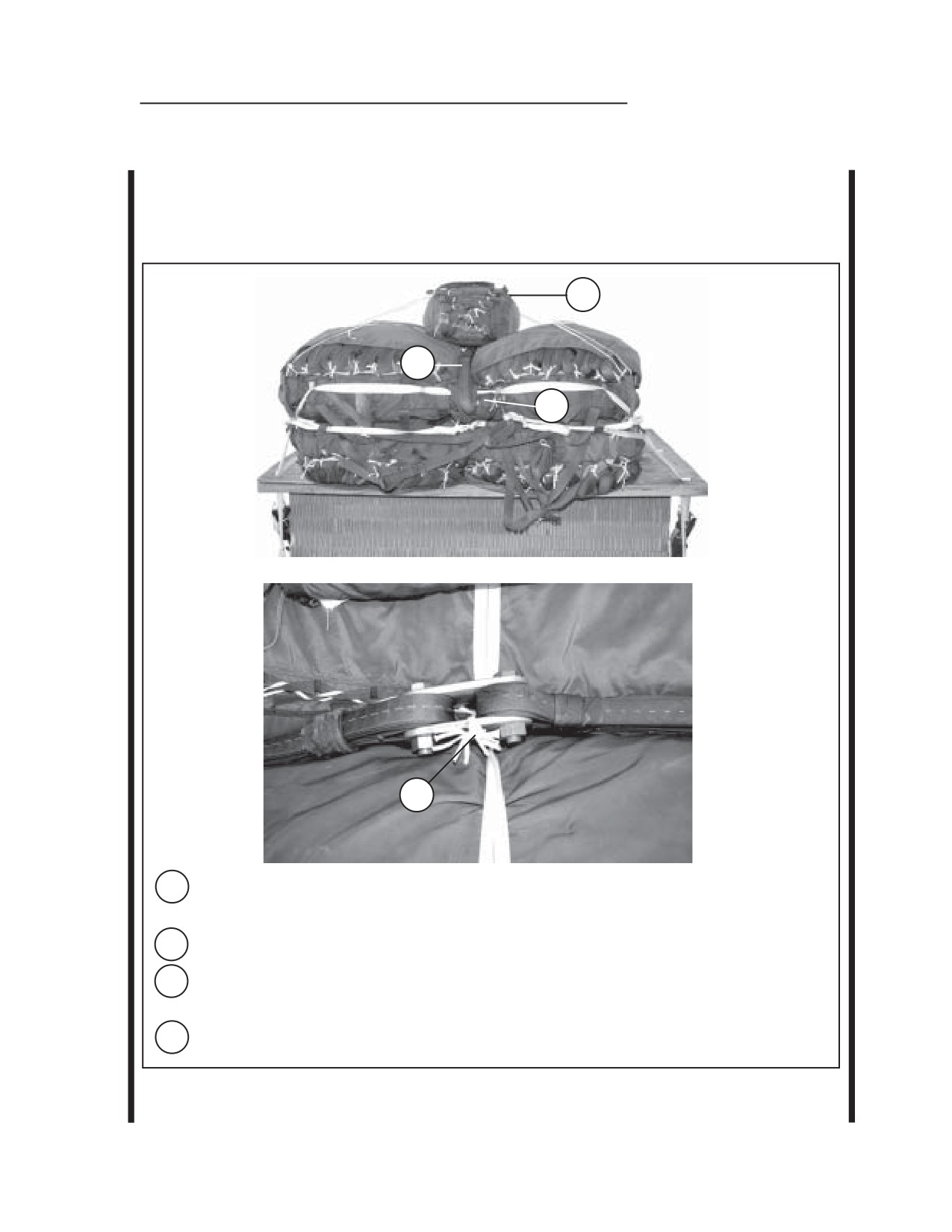
3-20. Position and secure the deployment parachute on two parachutes stacked
or three parachutes as shown in Figure 3-24.
1
2
4
3
2
1
Position the deployment parachute centered on top of the G-11D cargo parachutes with the
apex to the front and the taped V-rings facing up.
2
Route the deployment line around the right side of the deployment parachute.
3
Safety tie the 3 3/4-inch two-point link to the right center carrying handle of the G-11D
parachute with five lengths of type I, 1/4-inch cotton webbing.
4
Connect the other end of the deployment line to the bolt of the large clevis that groups the
cargo parachute bridles together.
Figure 3-24. Deployment Parachute and Line Positioned and Secured on Two Parachutes Stacked
or Three Parachute Loads
3-29
C1, FM 4-20.105/TO 13C7-1-51
5
7
6
5
Route a length of type I, 1/4-inch cotton webbing through each top clustering loop on the
deployment parachute deployment bag.
6
Tie the lengths of type I, 1/4-inch cotton webbing on the front clustering loops to the front
carrying handles on the G-11D cargo parachutes.
7
Tie the lengths of type I, 1/4-inch cotton webbing on the rear clustering loops to the rear
carrying handles on the G-11D cargo parachutes.
Figure 3-24. Deployment Parachute and Line Positioned and Secured on Two Parachutes Stacked
or Three Parachute Loads (Continued)
3-30
C1, FM 4-20.105/TO 13C7-1-51
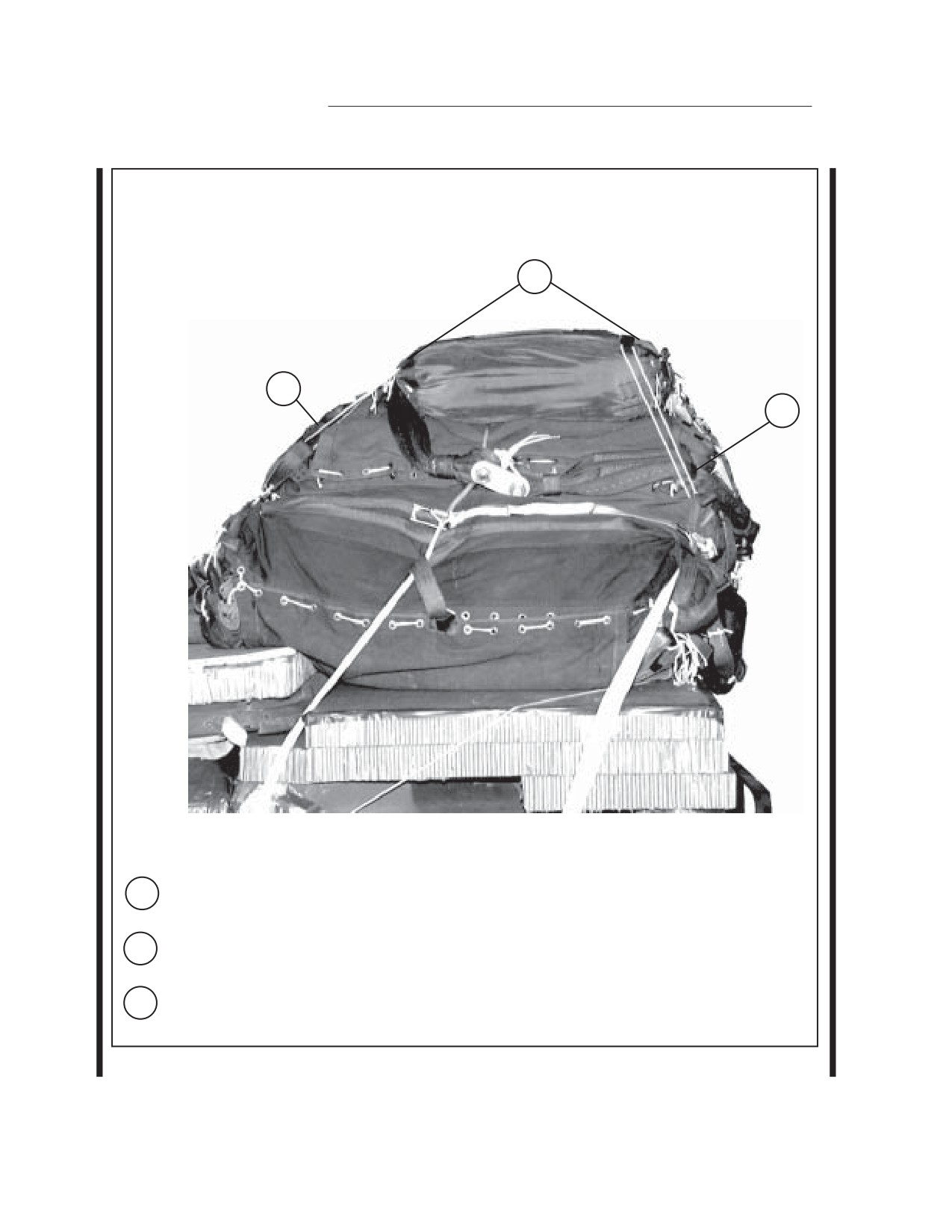
3-20.1. Position and secure the deployment parachute on two parachutes
side-by-side or four parachutes as shown in Figure 3-24.1.
1
2
4
3
1
Position the deployment parachute centered on top of the G-11D cargo parachutes with the
apex to the front and the taped V-rings facing up.
2
Route the deployment line under the deployment parachute.
3
Safety tie the 3 3/4-inch two-point link to the center carrying handle of the G-11D
parachute with five lengths of type I, 1/4-inch cotton webbing.
4
Connect the other end of the deployment line to the bolt of the large clevis that groups the
cargo parachute bridles together.
Figure 3-24.1. Deployment Parachute and Line Positioned and Secured on Two Parachutes
Side-by-Side or Four Parachute Loads
3-30.1
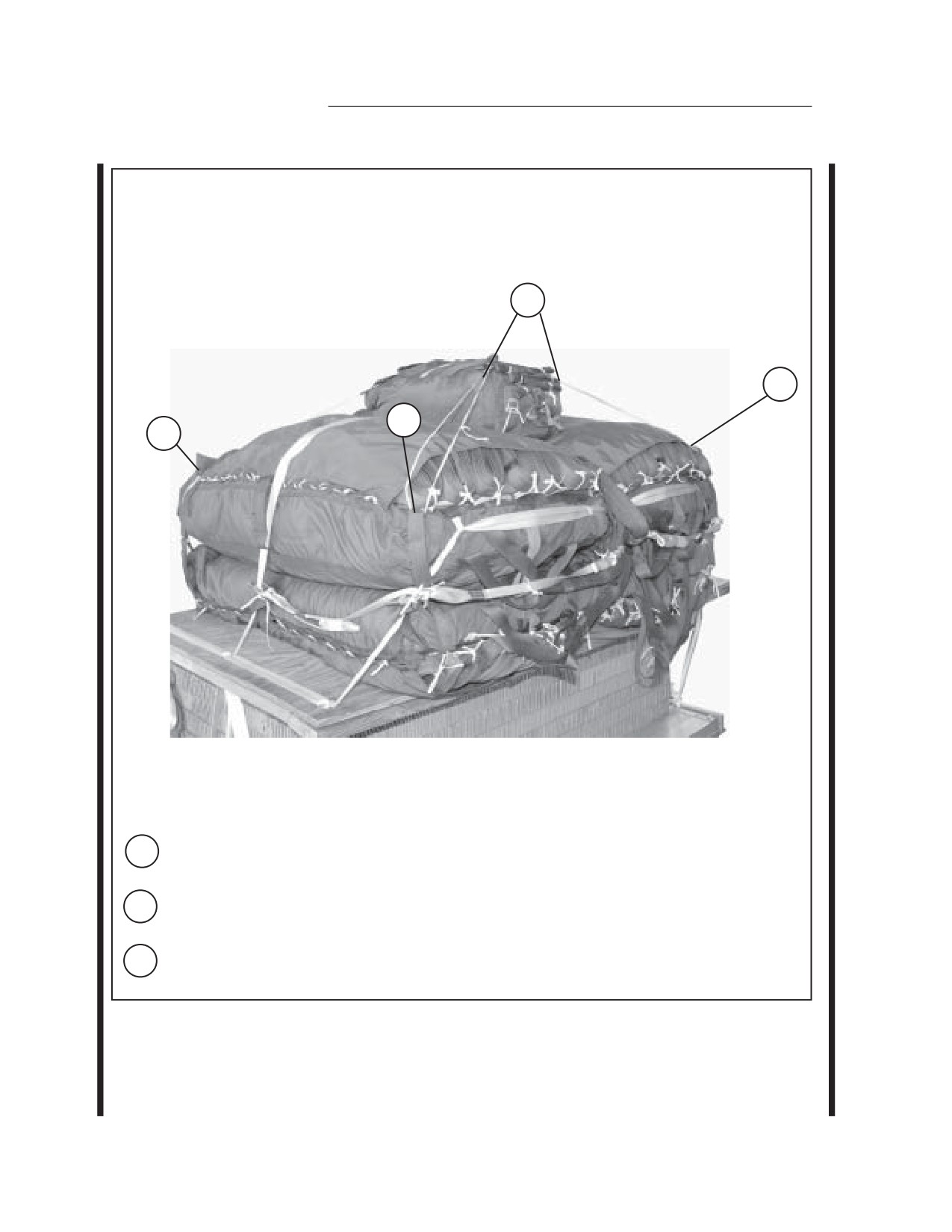
C1, FM 4-20.105/TO 13C7-1-51
5
6
6
7
5
Route a length of type I, 1/4-inch cotton webbing through each top clustering loop on the
deployment parachute deployment bag.
6
Tie the lengths of type I, 1/4-inch cotton webbing on the front clustering loops to the front
carrying handles on the G-11D cargo parachutes.
7
Tie the lengths of type I, 1/4-inch cotton webbing on the rear clustering loops to the rear
carrying handles on the G-11D cargo parachutes.
Figure 3-24.1. Deployment Parachute and Line Positioned and Secured on Two Parachutes
Side-by-Side or Four Parachute Loads (Continued)
3-30.2
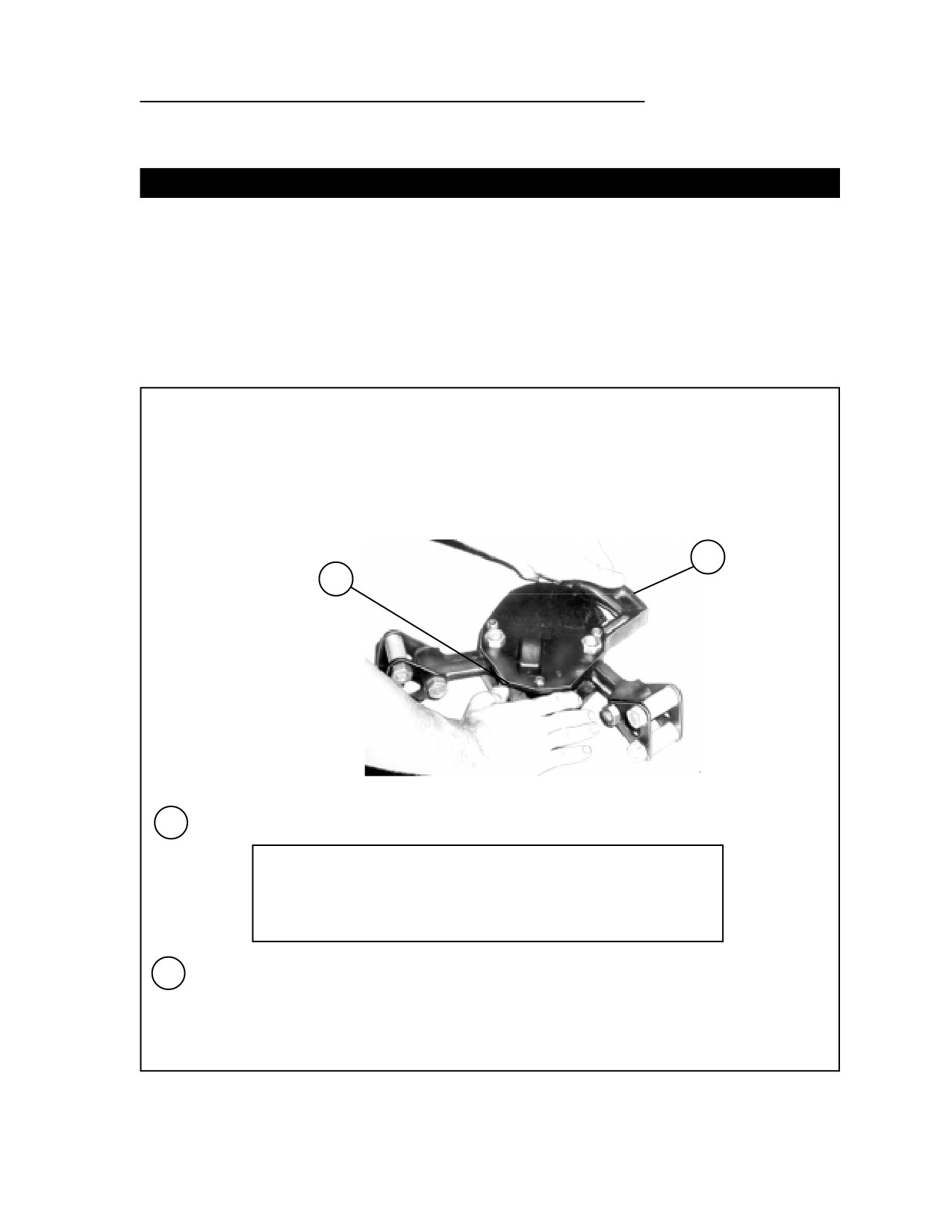
FM 4-20.105/TO 13C7-1-51
SECTION V- RELEASE ASSEMBLIES
M-1 CARGO PARACHUTE RELEASE
3-21. Test, attach, and safety the M-1 cargo parachute release as follows:
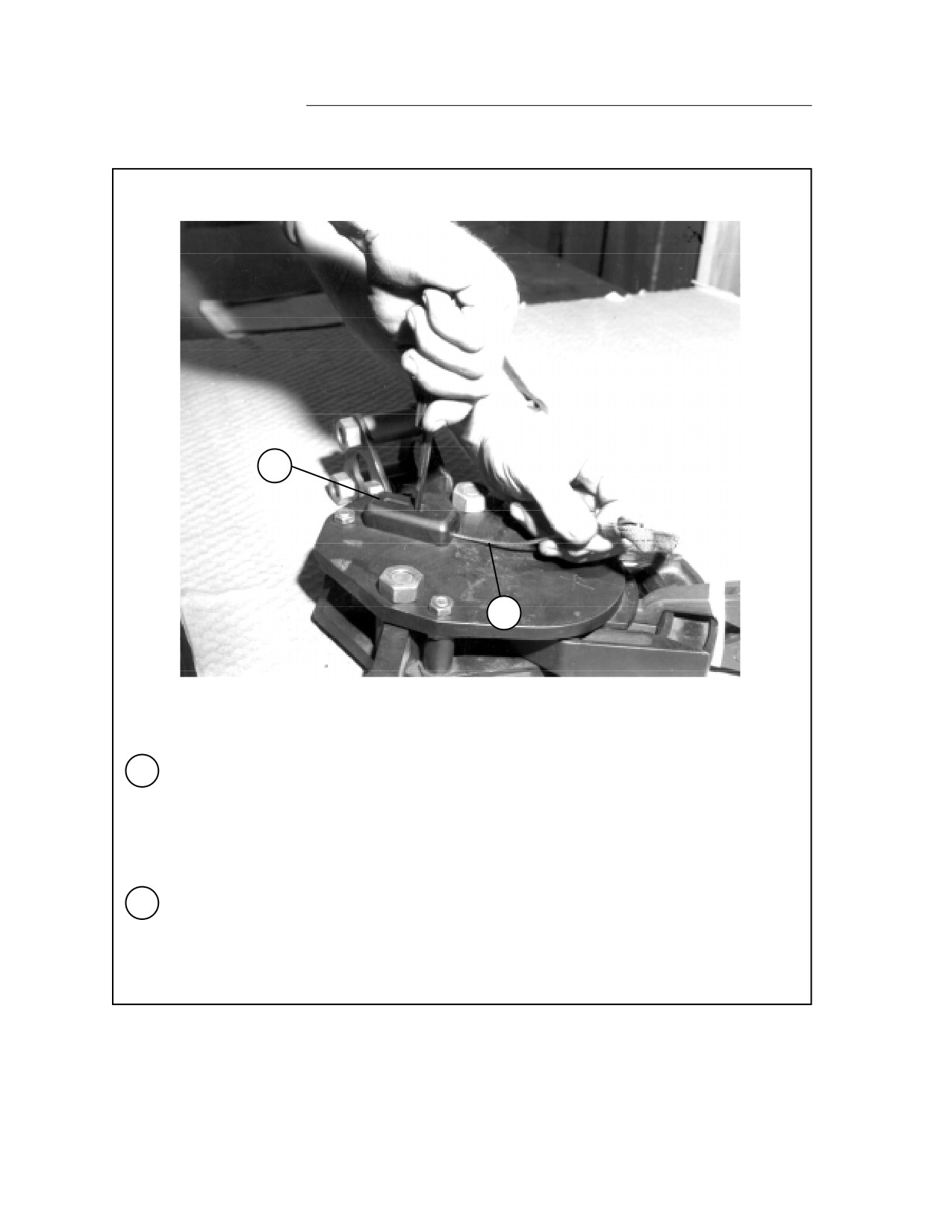
a. Testing Timer. Before each use, seat, arm, and test the delay timer as
shown in Figures 3-25 through 3-27.
1
2
1
Align and center the upper suspension link with the release side plates.
CAUTION
If the timer is not correctly seated in the upper position in the
release when it is armed, the keys will not fit into the slots in the
back side plate and could damage the timer.
2
Reach between the side plates, and slide the timer up until the toggles fit in the toggle lock
slides, making sure the timer slides freely. You should be able to see the winding shaft of
the timer through the guide block winder access hole.
Figure 3-25. Delay Release Timer Seated
3-31
FM 4-20.105/TO 13C7-1-51
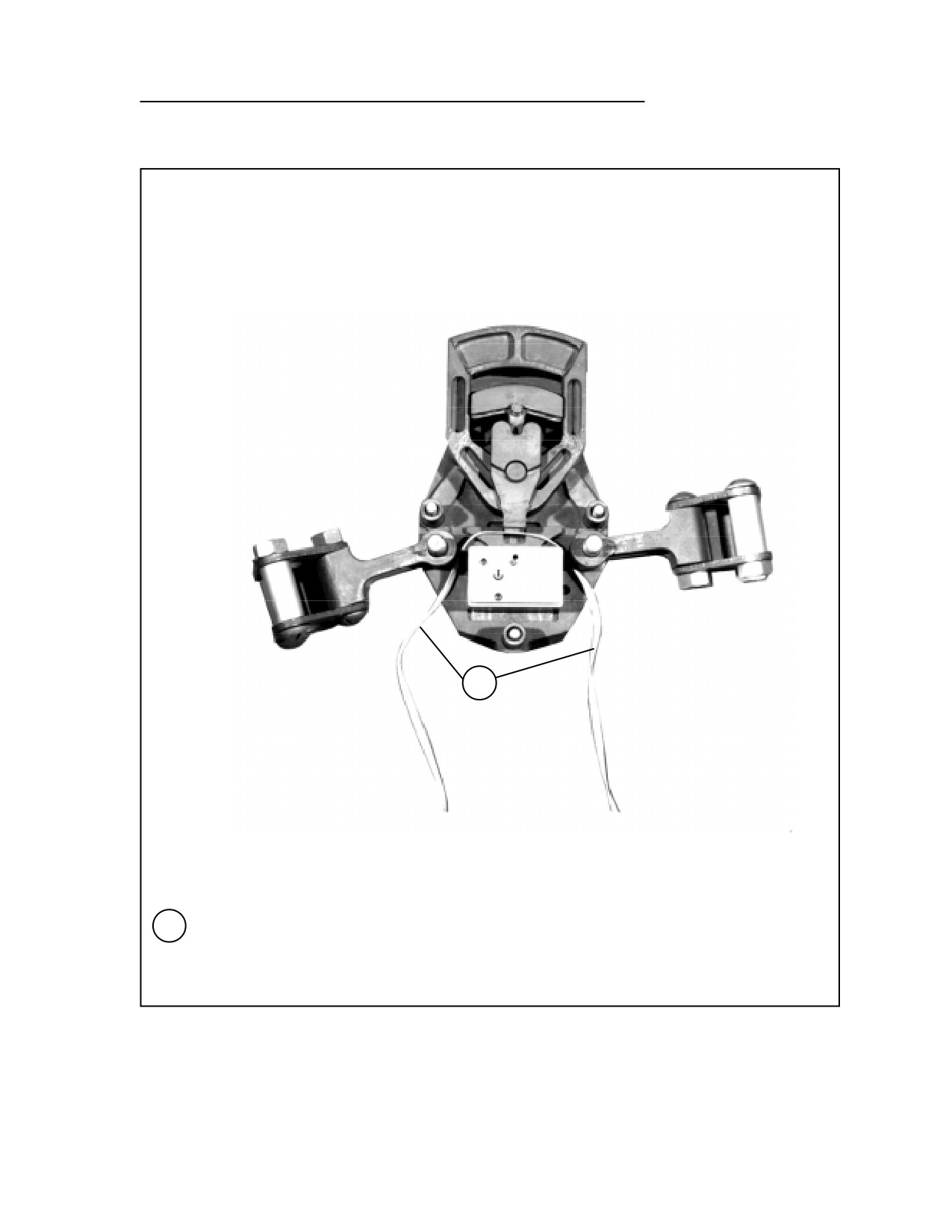
1
2
1
Put the tip of a flat-tip screwdriver through the guide block winder access hole and into the
slot in the timer winding shaft. Gently turn the shaft one-quarter turn to the right and
stop, holding the shaft with the screwdriver.
NOTE: If the winding shaft is hard to turn, hold the shaft with the screwdriver
and move the timer around until the keys align with the slots in the back plate.
2
Hold the shaft, and push the arming wire down through the hole in the guide block and the
hole in the winding shaft.
NOTE: When the timer is correctly armed, about 1/2 inch of the arming wire can
be seen through the slot below the guide block winder access hole.
Figure 3-26. Timer Armed
3-32
FM 4-20.105/TO 13C7-1-51
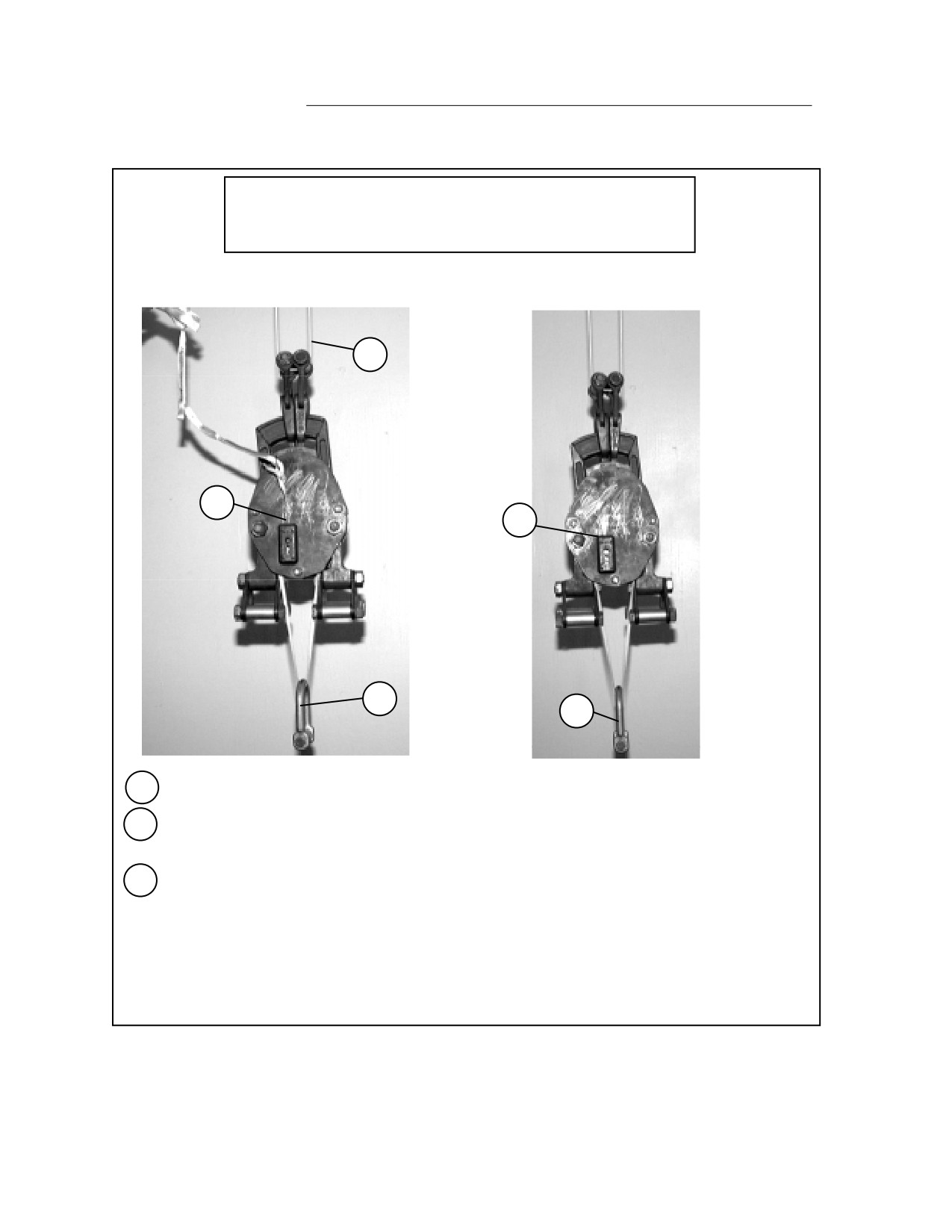
NOTE: A delay release timer will be tested before each use.
1
1
Pass a length of type I, 1/4-inch cotton webbing up between the release side plates, over and
around the center of the timer, and back down between the side plates. The side plate
and a toggle lock slide have been removed to show how the webbing passes around the
timer.You may use a length of wire to help you pass the webbing around the timer.
Figure 3-27. Timer Tested
3-33
FM 4-20.105/TO 13C7-1-51
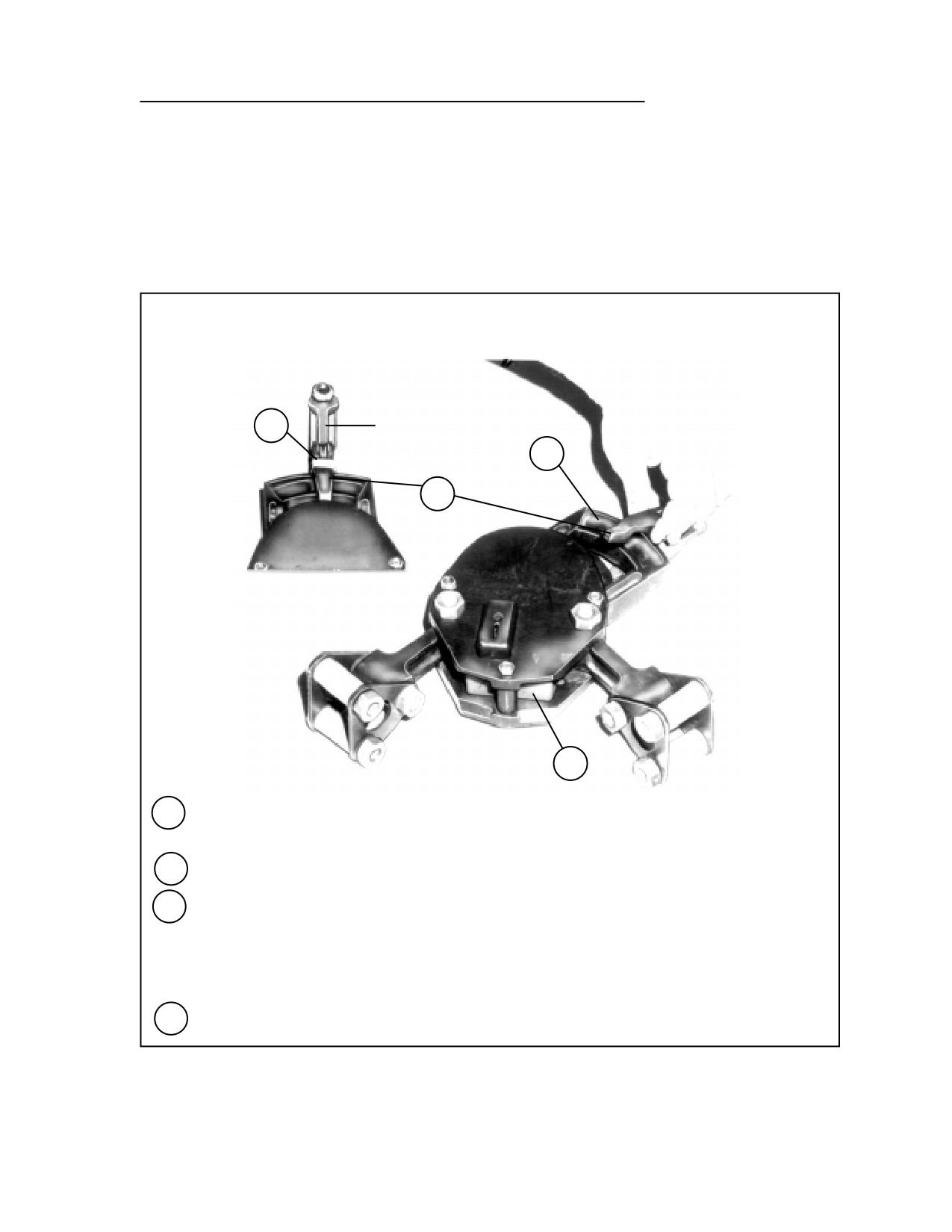
CAUTION
Do not over tighten the face side plate. Make sure the bolts are
tightened in an alternating sequence.
2
4
4
3
3
2
Hang the release in a straight, level position.
3
Tie a 10-ounce weight, such as a platform clevis with bolt or a parachute release
connector, without the nut and bolt, to the type I, 1/4-inch cotton webbing.
4
Pull the arming wire from the timer. Count the seconds from the time the wire is pulled
until the timer falls within the release.
NOTE: If the timer fails to fall after the alloted time (12 to 16 seconds), remove
the side plate and check the four screws holding the arming wire guide block to
the side plate for burrs. If the screw heads are burred, remove the burrs by
filing or replace the screws. Retest the timer. If there is a second failure, remove
and replace the timer.
Figure 3-27. Timer Tested (Continued)
3-34
FM 4-20.105/TO 13C7-1-51
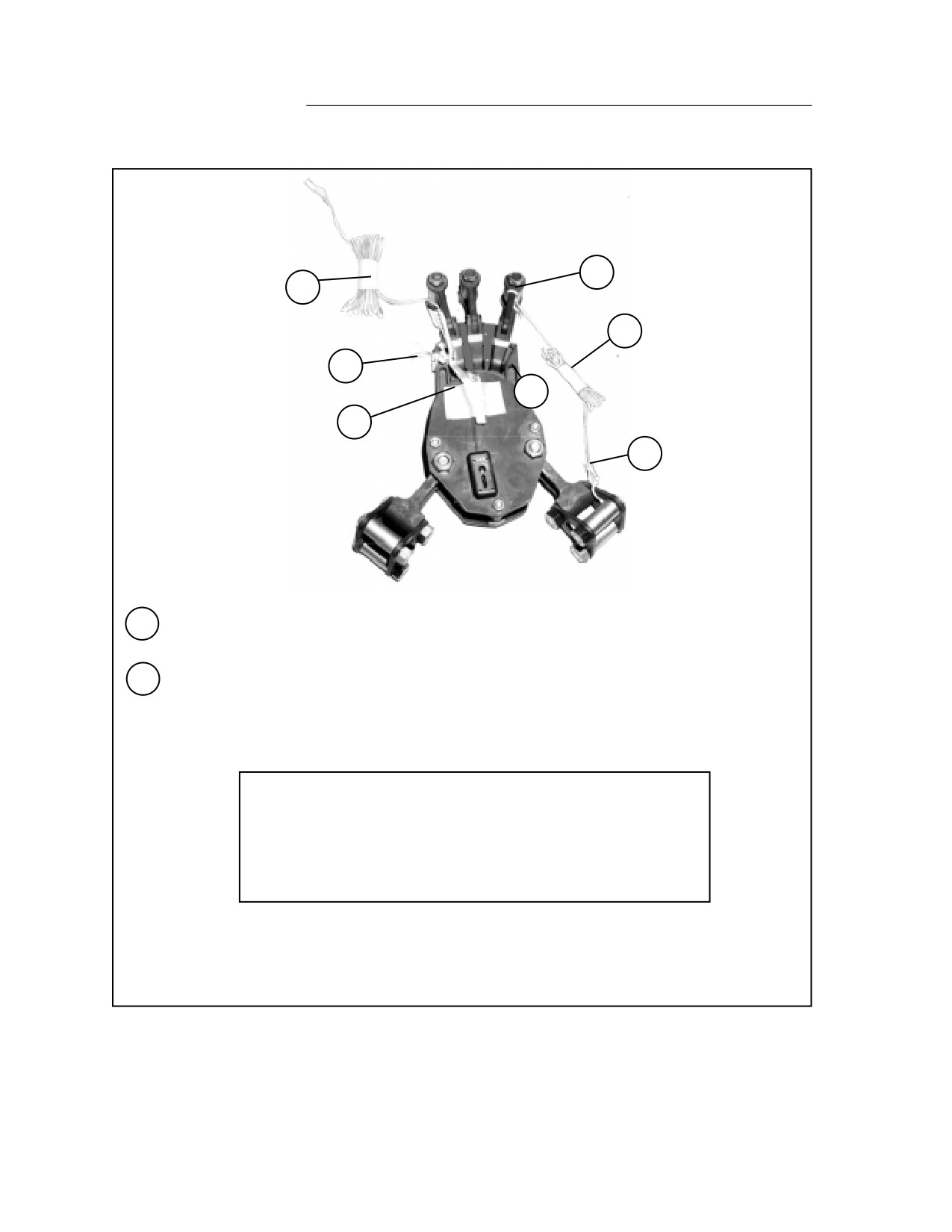
b. Preparing, Attaching, and Safety Tieing Release. Prepare,
attach, and safety tie the M-1 cargo parachute release as shown in
Figures 3-28 through 3-30.
PARACHUTE
4
CONNNECTOR
2
3
1
1
Use an M-1 release with a tested timer and make sure that the delay release timer is down
in the housing of the release.
2
Move the upper suspension link to the right or the left as far as it will go.
3
Open the arms of a parachute connector, and fit the arms on the upper suspension link
with the tips together in the groove of the retaining clamp.
NOTE: One parachute connector will be fitted to the upper suspension link for
each cargo parachute used on the load.
4
Fit a retainer band around the parachute connector to aid in assembly.
Figure 3-28. Parachute Connector Fitted to Upper Suspension Link of M-1 Release
3-35
FM 4-20.105/TO 13C7-1-51
9
6
10
2
1
7
8
1
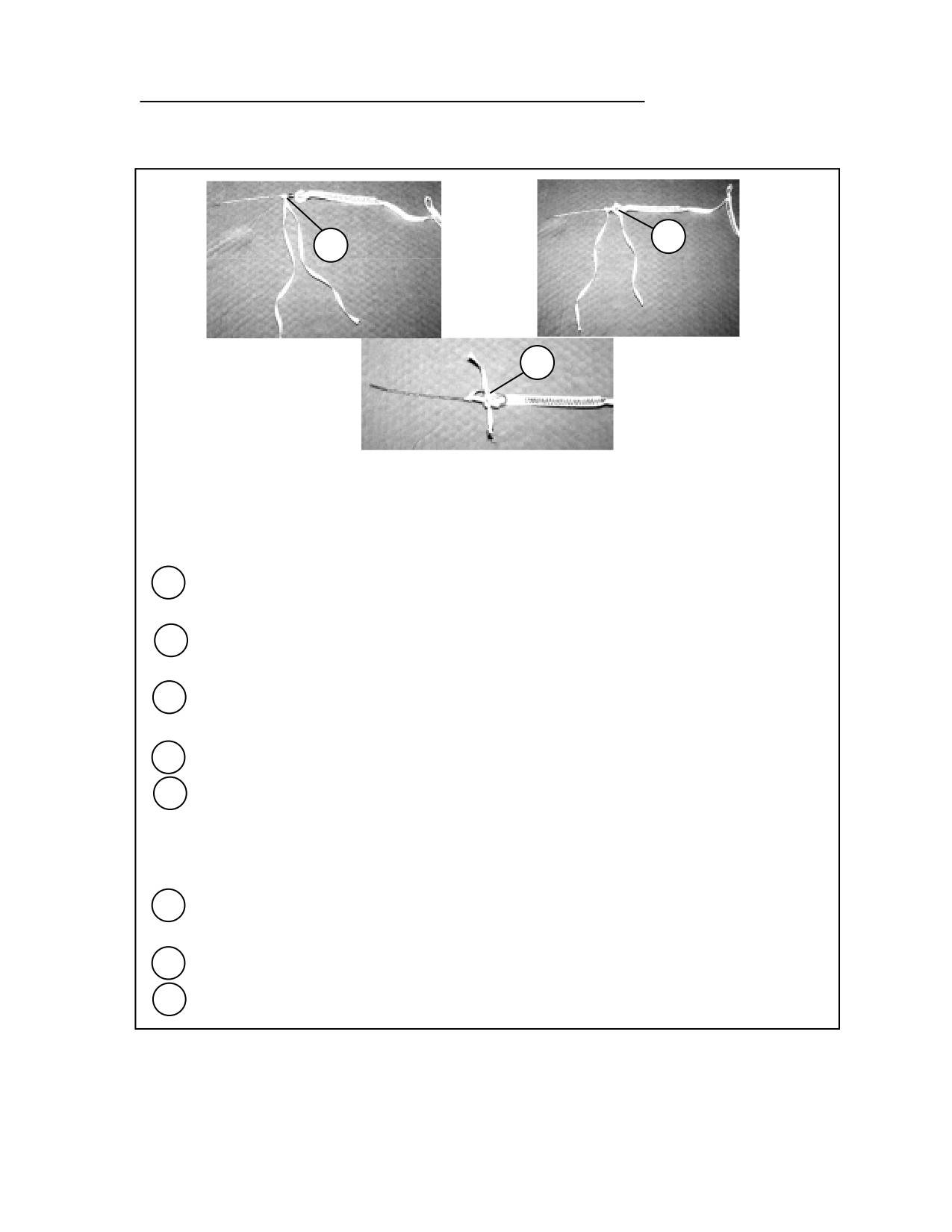
Move the upper suspension link back to the center of the release and arm the timer as
indicated in Figures 3-23 and 3-24.
2
Safety tie the arming wire lanyard to the upper suspension link with a double length of
type I, 1/4-inch cotton webbing with a surgeons knot and a locking knot.
CAUTION
The end loop of the arming wire may pull free from the crimping
sleeve during parachute deployment. To ensure that the arming
wire disengages from the timer stem, an arming wire safety tie
must be installed on all arming wires prior to use on an airdrop
operation.
Figure 3-29. M-1 Release Prepared
3-36
FM 4-20.105/TO 13C7-1-51
4
3
5
NOTE: With the arming wire lanyard attached to the arming wire loop, the arming wire
loop shall be designated as the top. Install the safety tie as follows:
This safety tie should be inspected at the joint airdrop load inspection, before and after
loading.
3
Girth hitch a 12-inch length of 1/4-inch cotton webbing on the safety wire just below the
metal fastener.
4
Route one running end of the 1/4-inch cotton webbing through the looped ends of the arming
wire and lanyard.
5
After ensuring there is 1/2 inch to 1 inch of slack in both running ends, tie a surgeons knot
and locking knot in the 1/4-inch cotton webbing.
6
Fold the slack in the lanyard, and tape the folds in place with one turn of masking tape.
7
Fold the slack in the lanyard, between the safety tie and the arming wire, and tape the fold
to the face side plate with one piece of masking tape.
NOTE: Include the following data on the masking tape: name, date, and timer
seconds.
8
Tie one end of a 5-foot length of type III nylon cord (dragline) to one side of the lower
suspension link.
9
Tie the other end of the dragline to a parachute connector.
10
Fold the slack in the dragline and tape the folds in place with one turn of masking tape.
Figure 3-29. M-1 Release Prepared (Continued)
3-37
FM 4-20.105/TO 13C7-1-51
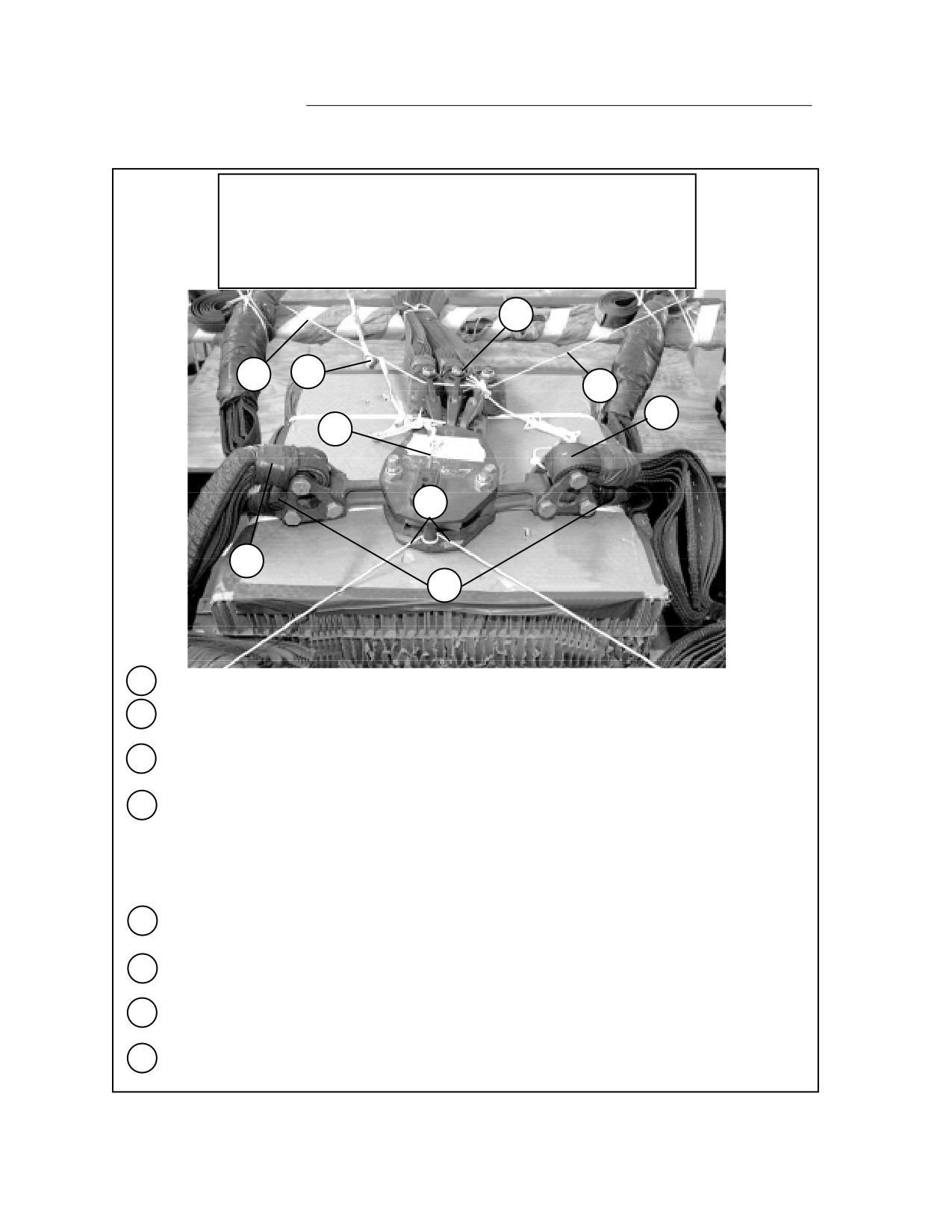
CAUTION
Place the release on the load with the parachute connectors toward
the front of the platform and with the guide block up. Bolt the sus-
pension slings to the lower suspension links so that they will not
change position when the load is suspended. Make sure the arming
wire lanyard is routed over all items.
2
6
8
6
4
1
5
4
3
1
Put the release on the load as instructed in the specific rigging chapter for the load.
2
Bolt the riser extensions of the G-11D cargo parachutes to the parachute connectors already
fitted to the release.
3
Attach the front suspension slings to the lower bolts of the lower suspension link. The front
slings will have a half twist towards the parachutes.
4
Attach the rear suspension slings to the top bolts of the lower suspension link.
NOTES: 1. The keeper at each end of the sling must be drawn snugly against the object on
which the sling is fitted.
2. Suspension slings on DRAS loads will have the nylon buffers removed to fit on
the lower suspension links of the M-1 parachute release assembly.
5
Run a length of type III nylon cord to encircle the lower spacer, and tie the ends of the cord
to points on the rear of the load or platform.
6
Run a length of type III nylon cord through the parachute connectors, and tie the ends of the
cord to points on the front of the load or platform.
7
Tie the lanyard to a carrying handle of a parachute with three alternating half hitches
and an overhand knot in the running end (not shown).
8
Fold the slack in the lanyard, and tape the folds in place with one turn of masking tape.
Figure 3-30. M-1 Release Attached and Safetied to Load
3-38
FM 4-20.105/TO 13C7-1-51
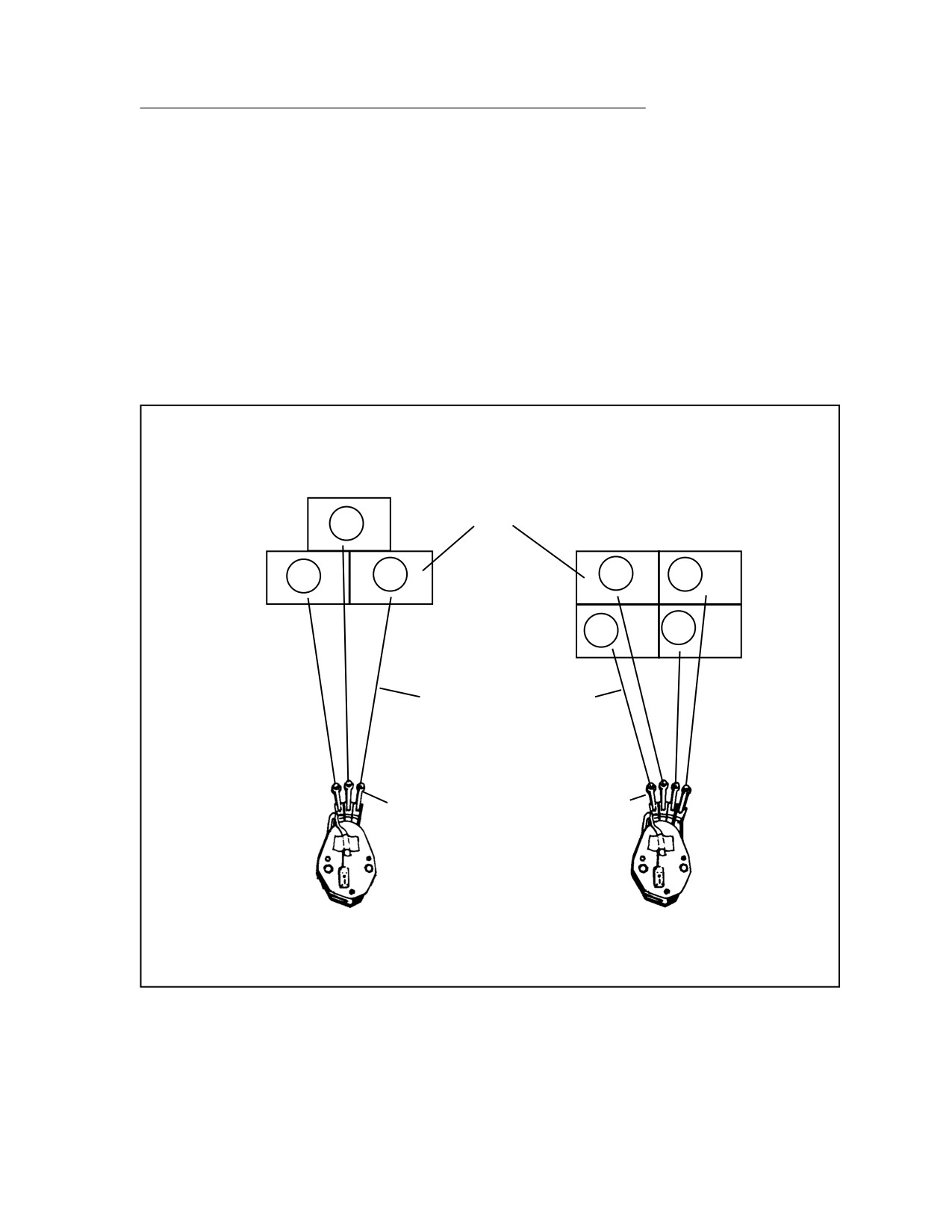
ATTACHING PARACHUTE RISERS TO THE PARACHUTE RELEASE
3-22. Lay the parachute release on top of the load with the bolt end of the
parachute connectors toward the cargo parachutes. Bolt the parachute riser
extensions to the parachute connectors of the M-1 parachute release as
shown in Figure 3-31.
NOTE: Bolt the parachute riser extensions to the parachute
connectors from riggers left to right. They must be in the
numerical order given for four parachute loads.
FRONT OF PLATFORM
CARGO PARACHUTES
2
1
3
2
4
1
3
PARACHUTE RISER
EXTENSIONS
3
2
3
4
2
1
1
PARACHUTE CONNECTORS
REAR OF PLATFORM
Figure 3-31. Three and Four Parachute Riser Extensions Attached to the Parachute
3-39
FM 4-20.105/TO 13C7-1-51
SECTION VI - ATTITUDE CONTROL SYSTEM (ACS)
ATTITUDE CONTROL SYSTEM
3-23. Assemble and inspect two attitude control systems for each load as follows:
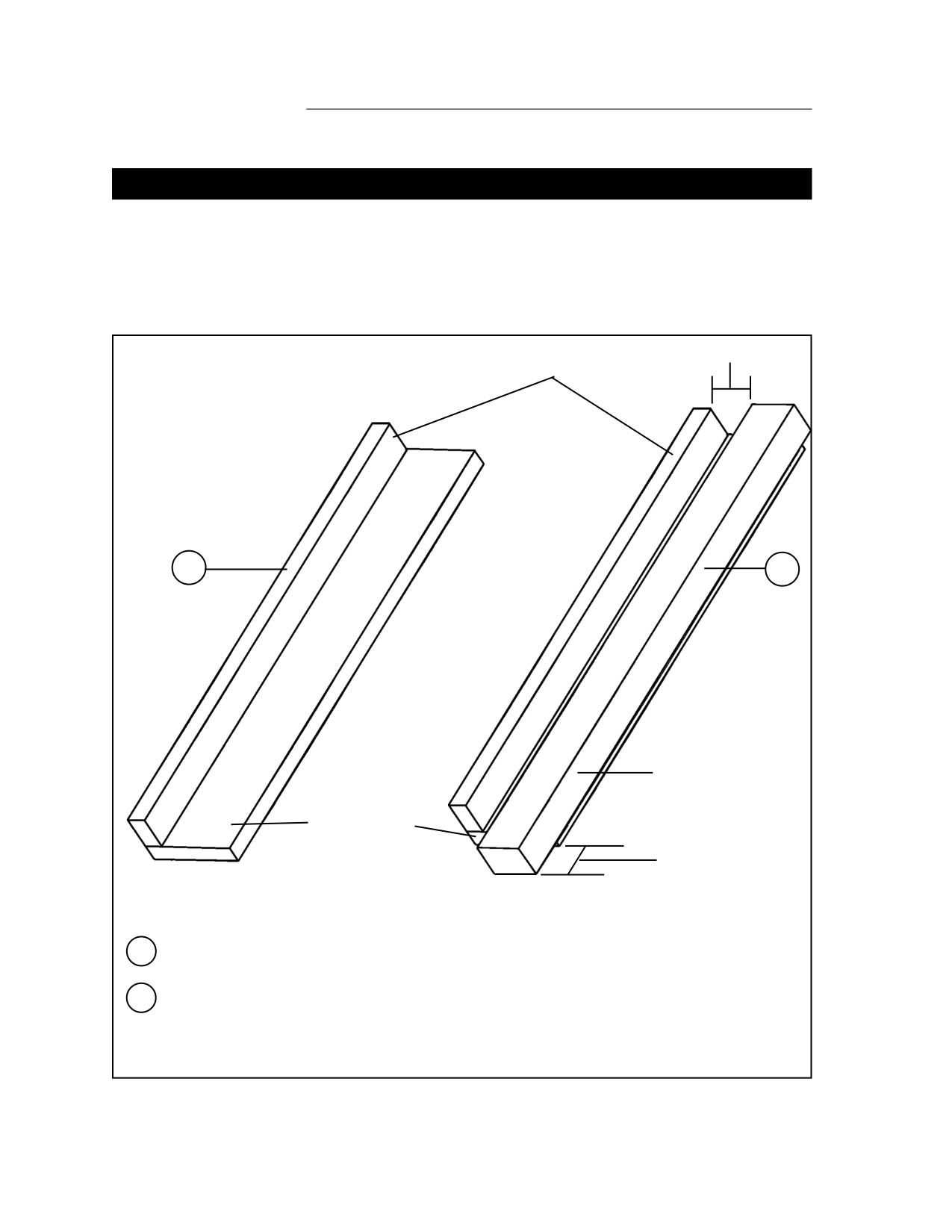
a. Assembling the ACS. Assemble the ACS as shown in Figure 3-32.
2-x 4-x 86-INCH
3 1/2
LUMBER
1
2
4- x 4- x 94-INCH
LUMBER
2-x 8-x 86-INCH
LUMBER
4
OVERHANG
1
Place a 2-x 4-x 86-inch piece of lumber flush along the rear edge of a 2-x 8-x 86-inch piece of
lumber and nail at 6 inch intervals using 16d nails.
2
Center a 4-x 4-x 94-inch piece of lumber on the 2-x 8-x 86-inch lumber, 3 1/2-inches from the
the 2-x 4-x 86-inch lumber. Nail at 6 inch intervals using 16d nails.
NOTE: The 4-x 4-x 94-inch lumber should over hang each end of the 2-x 8-x 86-inch
lumber by 4 inches.
Figure 3-32. Attitude Control System Assembled
3-40
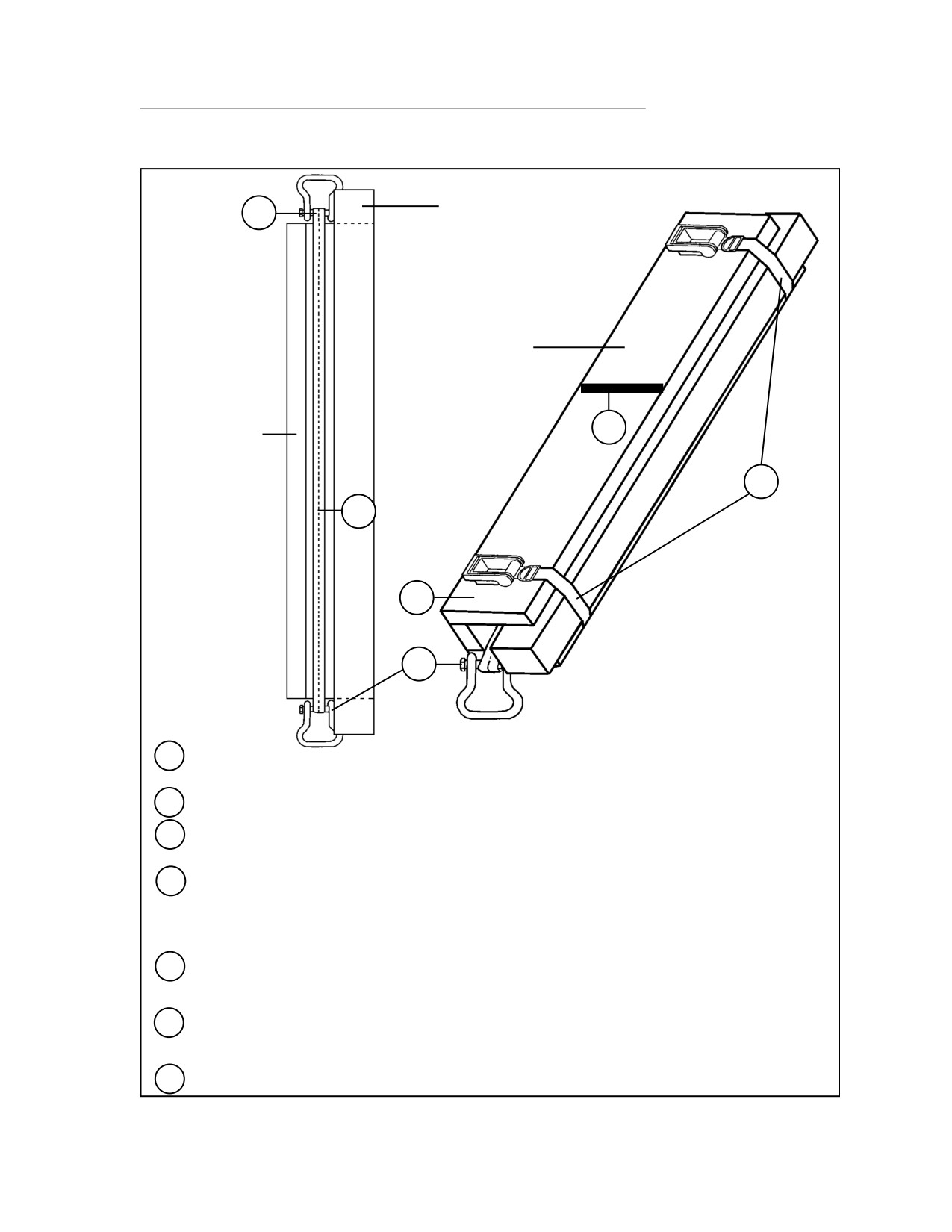
FM 4-20.105/TO 13C7-1-51
4- x 4- x 94-INCH
3
LUMBER
2-x 8-x 86-INCH
LUMBER
2-x 4-x 86-INCH
9
LUMBER
7
5
6
4
3
Fold a 16-foot (2-loop), type XXVI nylon sling in half. Place both ends on the bolt of a
medium or large clevis.
4
Place the bolt of a second medium or large clevis through the fold of the sling.
5
Center the folded sling and clevises in the trough of the ACS with the clevises extending
from each end.
6
Place a 2-x 8-x 86-inch piece of lumber flush along the rear edge of the 2-x 4-x 86-inch piece
of lumber. Nail the lumber at 6 inch intervals along both sides using 16d nails.
NOTE: Ensure NO nails are protruding through the inside of the ACS.
7
Route two CGU-1/B tiedown straps or two A7A cargo slings around the ACS 4 inches from
each end.
8
Pad the CGU-1/B tiedown straps or A7A cargo slings with felt and secure the felt with cloth-
backed tape (not shown).
9
Mark the center of the ACS so it is visible from the ground.
Figure 3-32. Attitude Control System Assembled (continued)
3-41
FM 4-20.105/TO 13C7-1-51
b. Inspecting the ACS. Inspect the ACS for the following items:
(1) Lumber. Inspect the lumber for splits or excess damage. If the
damage interferes with the proper functioning of the ACS, discard
and use a new ACS.
(2) Slings. Inspect the slings according to TM 10-1670-296-20&P/
TO 13C7-49-2. Ensure the slings move freely through the ACS.
(3) Clevises. Inspect the clevises according to TM 10-1670-296-20&P/
TO 13C7-49-2.
(4) Servicable slings and clevises may be used on another ACS.
3-42
FM 4-20.105/TO 13C7-1-51
SECTION VII - INSTALLING OUTRIGGER ASSEMBLY
PLATFORM FITTING ASSEMBLY (PFA) WELDMENT AND LINK
ASSEMBLIES
3-24. The PFA weldment and the link assembly are designed to be installed on
either platform siderail. Assemble and install the PFA weldment and the link
assembly on the DRAS platform according to TM 10-1670-268-20&P/TO13C7-52-
22.
OUTRIGGER MAST AND FOOT
3-25. The outrigger mast and foot are interchangeable and may be used on
either side of the platform. Assemble, install, and safety the mast and foot
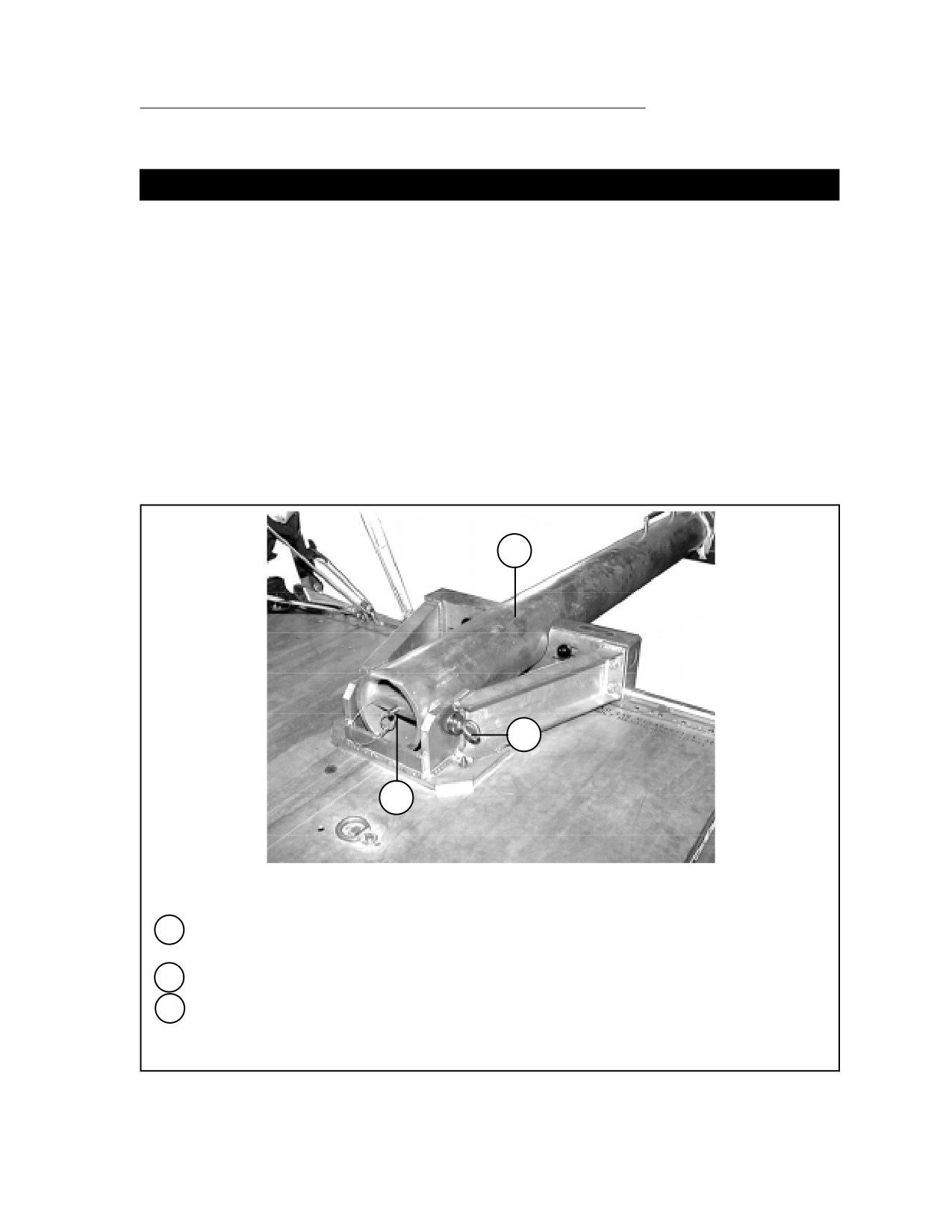
on the DRAS platform according to TM 10-1670-268-20&P/TO13C7-52-22 and
as shown in Figures 3-33 through 3-36.
1
2
3
1
Place the mast in the PFA weldment in the horizontal position aligning the shaft hole in
the mast with the sleeve bearings in the PFA weldment.
2
Insert the mast pivot pin through the bearing and the mast from rear to front.
3
Looking inside the bottom of the mast, align the hole in the mast pivot pin with the
hole in the mast and insert the ball-lock pin.
Figure 3-33. Mast Installed
3-43
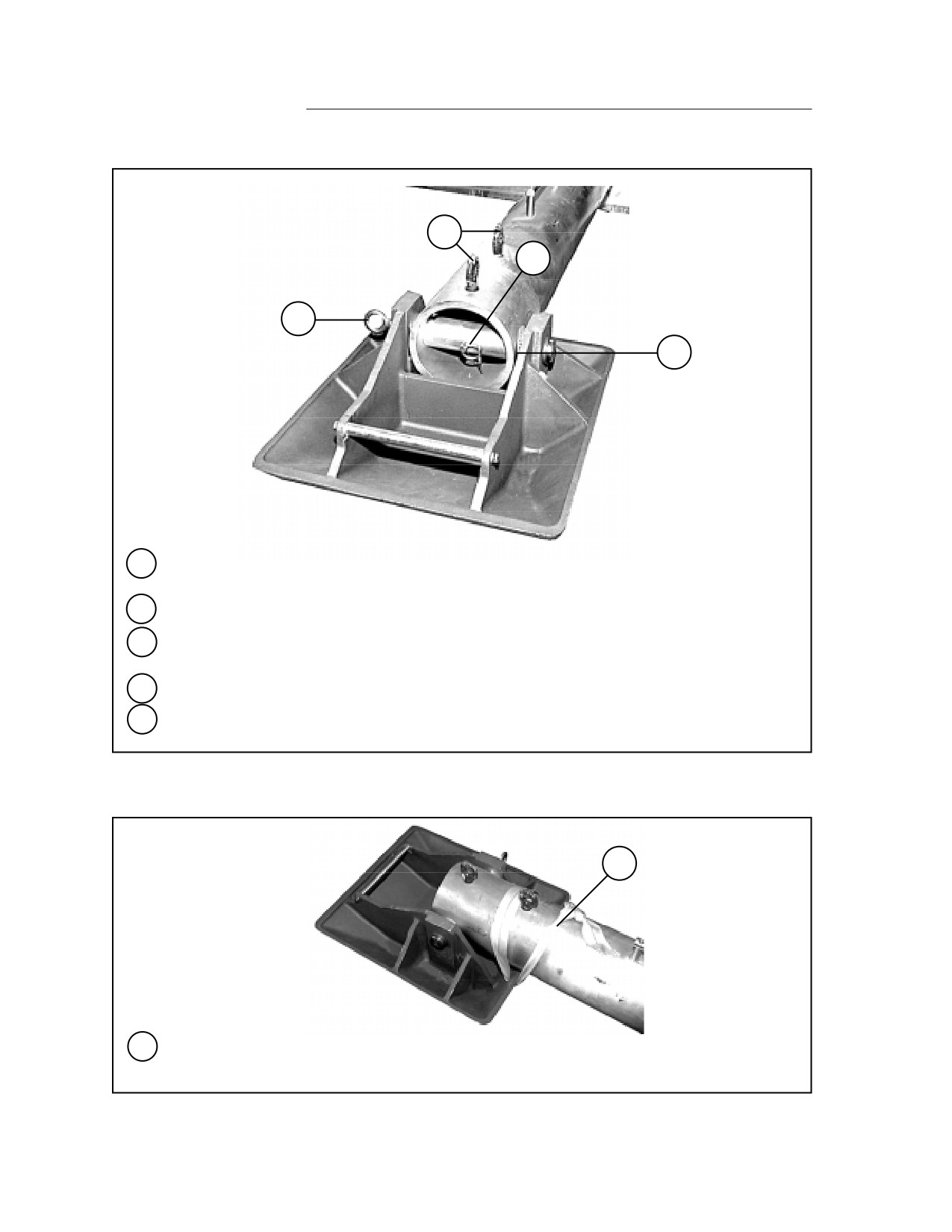
FM 4-20.105/TO 13C7-1-51
4
3
2
1
1
Place the foot at the end of the mast aligning the pivot pin hole in the mast with the sleeve
bearings in the foot.
2
Insert the pivot pin through the bearing and the mast from rear to front.
3
Looking inside the end of the mast align the hole in the mast pivot pin with the hole in the
mast and insert the ball-lock pin.
4
Tape the eyebolts with cloth-backed tape leaving the eyes open.
5
Repeat steps 1 through 4 on the opposite side.
Figure 3-34. Foot Installed
1
1
Place a length of type VIII nylon webbing between the eyebolts on the mast. Run the ends
through the inside holes of the foot. Secure the ends together, with a truckers hitch knot,
on top of the mast. Repeat on the opposite side.
Figure 3-35. Foot Safety Tied
3-44
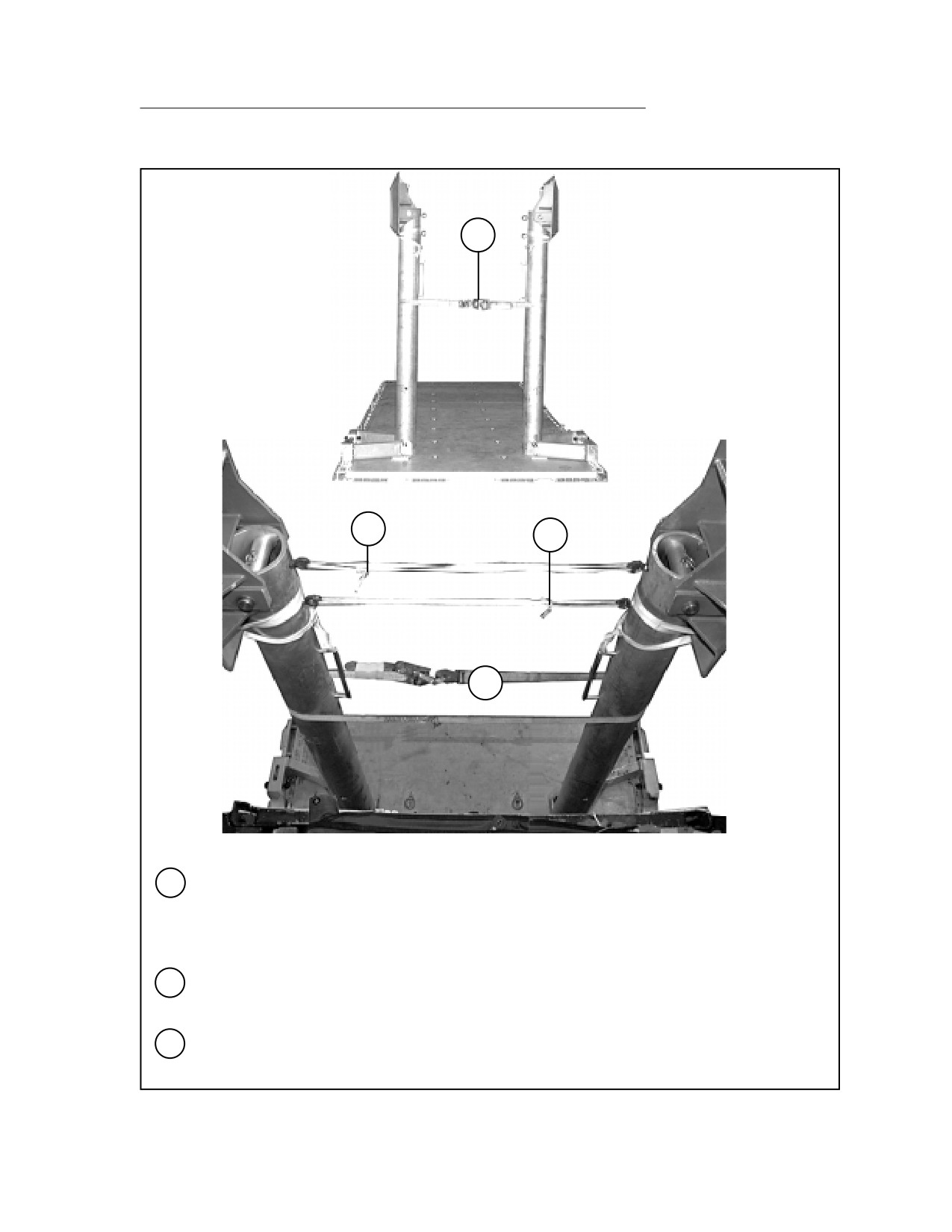
FM 4-20.105/TO 13C7-1-51
1
2
3
1
1
Raise both outriggers to the vertical position and route a CGU-1B tiedown assembly around
both masts.
NOTE: The CGU-1B tiedown assembly must be removed by the aircrew prior to
airdrop.
2
Form an outrigger vertical restraint tie by routing a length of 1/2-inch tubular nylon
webbing through the top eyebolt on both masts. Tie the ends together 6 inches from the
right mast eyebolt using a truckers hitch.
3
Form a second outrigger vertical restraint tie by routing a length of 1/2-inch tubular nylon
webbing through the bottom eyebolt on both masts. Tie the ends together 6 inches from the
left mast eyebolt using a truckers hitch.
Figure 3-36. Masts Safety Tied
3-45
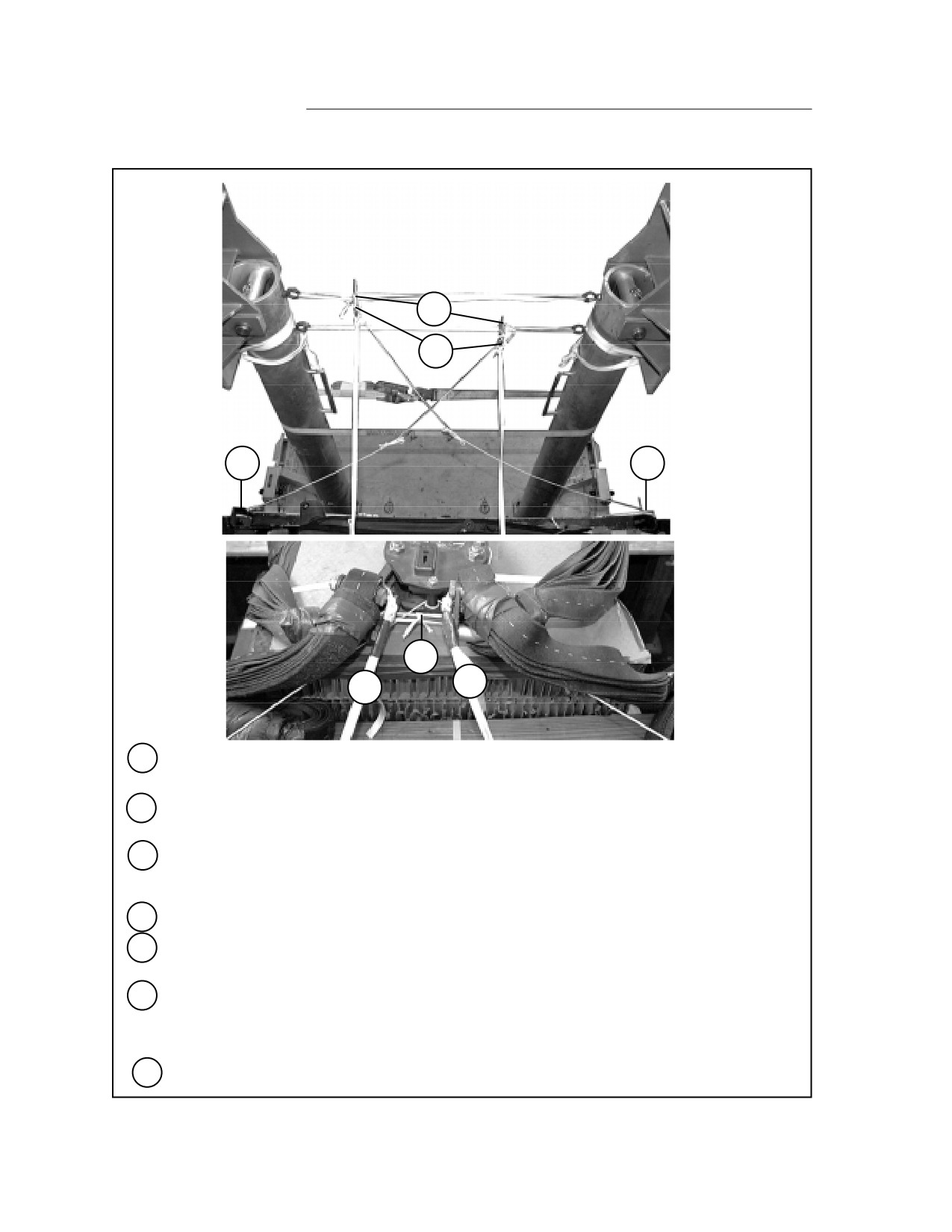
FM 4-20.105/TO 13C7-1-51
4
5
10
9
8
6
7
4
Install and safety tie a guillotine knife around each outrigger vertical restraint tie as shown
in Figure 3-18. Ensure the knives are installed against the knots.
5
Tie a length of 1/2-inch tubular nylon webbing to the body of each guillotine knife. The
length of the webbing is given in the specific chapter for the item being rigged.
6
Tie the webbing from the right guillotine knife to the right lower suspension link of the M-1
parachute release assembly with three alternating half hitches and an overhand knot. Tape
the running end to the 1/2-inch tubular nylon webbing.
7
Repeat step 6 using the left guillotine release knife and the left lower suspension link.
8
Tie the lower suspension links together as close as possible with one turn single, type I 1/4-
inch cotton webbing. Ensure the tie is under the 1/2-inch tubular nylon webbing ties.
9
Tie a length of type III nylon cord to the left point indicated in the specific rigging
chapter. Tie the other end of the type III nylon cord to the body of the top guillotine
knife. The length of thecord is given in the specific chapter for the item being rigged.
S-fold the slack in the type III nylon cord and secure with masking tape.
10
Repeat step 9 using the right point indicated in the specific rigging chapter and the bottom
guillotine knife.
Figure 3-36. Mast Safety Tied (continued)
3-46
FM 4-20.105/TO 13C7-1-51
SECTION VIII - LOAD MARKING AND INSPECTION
MARKING RIGGED LOAD
3-26. Each rigged load must have a data tag prepared for it, and some rigged
loads may require a Shippers Declaration for Dangerous Goods. The center of
balance must also be clearly marked on both sides of the platform.
a.
Data Tag. A data tag is prepared and secured on the rear of each
platform load. Entries on the tag are used by the Army and Air Force in
making inspections and in finding causes for malfunctions. The entries
are also used to help the loadmaster determine where to place the load
in the aircraft. Use a ballpoint pen or other waterproof marking device
to record the following information on the tag:
(1) Total rigged weight.
(2) Height, including parachutes.
(3) Width.
(4) Overall length.
(5) Overhang (specify front, rear, or side of load).
(6) Longitudinal center of balance (measured from the front edge of the
platform).
b.
Shippers Declaration for Dangerous Goods. This form is prepared
and secured on each load that has any type of hazardous material such
as fuel, ammunition, or a battery.
c.
Center of Balance. In addition to being included on the data tag, the
longitudinal center of balance must also be marked on the platform. The
vertical line of the symbol CB is placed at the center of balance on both
sides of the platform.
3-47