FM 8-42 COMBAT HEALTH SUPPORT IN STABILITY OPERATIONS AND SUPPORT OPERATIONS (October 1997) - page 5
FM 8-42
(Classification)
(2) Evaluate each COA against each significant difficulty to determine strengths and
weaknesses inherent in each.
b. Compare all COAs listed in terms of significant advantages and disadvantages or in terms of
the major considerations that emerged during the above evaluation.
5. CONCLUSIONS
a.
Indicate whether the mission set forth in paragraph 1 can (cannot) be supported.
b. Indicate which COA can best be supported from the CHL standpoint.
c.
List the limitations and deficiencies in the preferred COA that must be brought to the
commanders/command surgeons attention.
d. List factors adversely affecting the combat health logistics mission.
/s/ ________________________________
(as appropriate)
Annexes (as required)
DISTRIBUTION: (Is determined locally)
(Classification)
F-43
FM 8-42
Section II. COMBAT HEALTH SUPPORT PLAN
F-8. General
a. Once the CHS estimate is completed, the CHS planner can proceed with developing the CHS
plan for the proposed operation. As with the estimate, the same planning process for developing the
traditional CHS plan is used for stability and support operations.
b. In this section the format for the CHS plan and appropriate annexes is provided.
c.
Paragraphs F-10 through F-14 provide the CHS plan format for veterinary, PVNTMED,
dental, CSC, and CHL support.
F-9. Sample Format for the Combat Health Support Plan
(Classification)
Copy of copies
Headquarters
Location
Date, time, and zone
COMBAT HEALTH SUPPORT PLAN
References: List all maps, overlays, charts, or other documents required to understand the plan. Reference
to a map will include the map series number and country or geographic area, if required;
sheet number and name, if required; edition; and scale.
Time Zone Used Throughout the Plan: (Included only if used as the initial plan or if a major organization is
to be affected.)
Task Organization: Annex A (Task Organization) (Task organization may appear here, in paragraph 3, or
in an annex.)
1. SITUATION (Provide information essential to understanding the plan.)
a.
Enemy (Opposition) Forces/Negative Factors.
(Emphasis on capabilities bearing on the plan
by terrorist groups, insurgents, HN forces, or other opposition groups or political factions found in a
particular country. This subparagraph is viewed as groups opposed to the US-backed or supported groups,
HN, and US national interests. Also, in stability and support operational scenarios, information concerning
grievances, causes for unrest, or other pertinent data can be included.)
(Classification)
F-44
FM 8-42
(Classification)
b. Friendly Forces/Positive Factors.
(This is addressed from the perspective of the HN or US-
backed group and US national interests. Emphasis is also placed on CHS functions or medical operations
and responsibilities for higher and adjacent units.)
c.
Attachments and Detachments. (May be published as an annex pertaining to task organization.
In a stability and support operational scenario, HN, other US agencies or military services, allies, coalition
partners or US-backed groups who will participate in the operation can be indicated in this subparagraph.)
d. Assumptions.
(Include the minimum required for the planning process.)
2. MISSION
(Statement of the overall CHS mission and type of activity to be supported [insurgency
and counterinsurgency, combatting terrorism, peace support, or domestic support operations].)
3. EXECUTION
a.
Surgeons Concept of Support for the Combat Health Support Operation.
(First lettered
subparagraph provides a concise overview of planned CHS.)
b. Major Medical Command and Control Headquarters. The second lettered subparagraph
identifies the major medical control headquarters and lists the tasks or missions assigned to it.)
c.
Other Medical Units. (The third and subsequent lettered subparagraphs identify the remaining
medical units in turn and list their respective tasks and missions.)
d. Evacuation Policy. (The next to the last lettered subparagraph discusses the evacuation policy
by phases of the operation, if applicable.)
e.
Coordinating Instructions.
(The final lettered subparagraph contains any coordinating
instructions that may be appropriate to ensure continuity in CHS. This coordination should include
requirements for interface with the other Services, allied forces, coalition forces, HN, US-backed groups,
other US agencies, country team, NGOs, or PVOs, as deemed appropriate.)
4. SERVICE SUPPORT
a.
Supply.
(Refer to TSOP or another annex whenever practical.)
(1) General supply.
(Provide special instructions applicable to CHS units. Also consider
stockage levels for all classes of supply, as units will be operating in an austere environment and at extended
distances from the full complement of CSS resources.)
(2) Combat health logistics
(to include blood and blood products).
(Provide special
procedures applicable to the operation.)
(Classification)
F-45
FM 8-42
(Classification)
(a) Requirements.
(For sustaining the US, allied, coalition, or HN forces and other
eligible beneficiaries are addressed in subparagraph [3] below.)
(b) Procurement.
(Provide detailed information on resupply and stockage levels
required and/or contracting support for the operation.)
(c) Storage.
(Special procedures and equipment [such as refrigerators] requirements
for maintaining storage and the appropriate shelf life of medical supplies in an austere environment should
be included.)
(d) Distribution.
(This should include the method of distribution and any limitations or
restrictions that are applicable. Additionally, if special transportation requirements exist, they should also
be noted.)
(3) Supplies required to accomplish stability and support operational missions and not for the
sustainment of the US, allied, coalition, or multinational force.
(This includes humanitarian assistance,
disaster relief, or other stability and support operational missions.)
(a) Requirements.
(Includes estimates of the population to be supported or the number
of patients anticipated to be treated; materials required for teaching or training health professionals; and
medical educational programs for the population at large.)
(b) Procurement. (The funding source should be identified and procedures for obtaining
the supplies described, as well as any limitations or restrictions on the use of the supplies, should be
included.)
(c) Storage.
(Requirements for refrigeration or other special handling should be
included.)
(d) Distribution.
(Limitations and restrictions, as well as transportation requirements,
should be included.)
(e) Coordination.
(Interservice, allied force, US agencies, coalition forces, HN
government, NGOs, and PVOs should be included.)
(4) Combat health logistics activities.
(This includes the location of the medical supply
activity supporting the AO and means of communicating requests for resupply.)
(5) Salvaged medical equipment and supplies.
(a)
(For sustainment of the US forces.)
(Classification)
F-46
FM 8-42
(Classification)
(b)
(For sustainment of stability and support operational missions.)
(6) Abandoned enemy (opposition) medical supplies, if applicable.
(Should include
disposition instructions.)
(7) Civilian medical supplies. (Should include resources for operational missions and training
activities.)
(8) Other CHL matters.
b. Transportation and Movements.
(This includes medical use of various transportation means.)
(1) General.
(Transportation in stability and support operational scenarios oftentimes
includes moving the medical team from one treatment area or CHS mission area to another. Transportation
is often a critical factor in accomplishing the stability and support operational mission.)
(2) Ground.
(The availability of ground evacuation assets to sustain US forces should be
discussed. Additionally, the assessment and development of a ground evacuation system and the training
requirements for HN personnel [if applicable] can also be included. Coordination for use of allied,
coalition, or HN forces evacuation assets should also be included.)
(3) Rail.
(If available, the treatment locations could be established along the railway; or it
could provide a means for the civilian population to travel to a treatment area or to move the medical team
and equipment.)
(4) Water. (Considerations should include both inland and at sea transportation requirements
or assets and the availability of shipboard facilities for evacuation and treatment.)
(5) Air.
(The availability of aeromedical evacuation support for the supported force should
be discussed. Additionally, the assessment of aeromedical evacuation requirements for a HN or US-backed
group, the development of a medical evacuation system, and the training of appropriate personnel can be
discussed depending upon the category of the stability and support operational mission.)
(6) Movement control and traffic regulation, if applicable.
(This can include requirements
for armed escorts; requirements for crossing international boundaries, convoy restrictions; or other
circumstances affecting transport operations.)
c.
Services.
(1) Services to CHS units and facilities. (Include information on the following services: laundry,
bath, utilities, fire fighting, construction, real estate, graves registration, religious, personnel, and finance.)
(Classification)
F-47
FM 8-42
(Classification)
(2) Medical equipment maintenance.
(a) For the sustainment of US forces.
(b) For the sustainment of the stability and support operational mission (including
teaching medical equipment repair skills).
d. Labor. (Include policies, agreements, or arrangements on the use of civilian or other personnel
for labor.)
e.
General Maintenance. (This includes priority of maintenance and the location of repair facilities. )
5. EVACUATION, TREATMENT, AND OTHER HEALTH SERVICES
a.
Evacuation.
(1) Evacuation of supported US, allied, coalition, or HN forces. (Include evacuation policy,
medical regulating, en route medical care, and modes of transportation.)
(a) Requirements.
(Include mass casualty situations.)
(b) Units.
(Include information on the units providing this support and appropriate
communications information.)
(c) Other. (This can include information on assets which may be used in an emergency,
such as diplomatic flights.)
(2) Evacuation of HN civilians or military, US-backed groups, or other categories of
personnel.
(Include any limitations and restrictions.)
(3) Assessing and developing an evacuation system for a HN or US-backed group.
(Include
any limitations and restrictions.)
(4) Other activities pertaining to evacuation functions in a stability and support operational
scenario.
b. Treatment.
(1) Treatment of supported US, allied, coalition, or HN forces.
(Include arrangements for
hospitalization, mass casualty situations, or other treatment considerations.)
(a) Policies.
(Should address treatment and hospitalization policies to include civilians,
EPW, detainees, or other category of personnel.)
(Classification)
F-48
FM 8-42
(Classification)
(b) Units.
(This includes information concerning the location, capabilities, and
communications means of units providing support.)
(c) Other.
(This can include information on other medical assets which may be used in
an emergency, such as the embassy physician.)
(2) Treatment of HN civilian or military personnel, US-backed groups, or other categories
of personnel.
(This includes limitations and restrictions, hours of operation, and procedures to cover
emergencies and mass casualty situations.)
(3) Assessing and providing assistance in developing a primary care system for the HN or
US-backed group.
(Include information on the adequacy of secondary and tertiary hospitals or other
treatment-related missions.)
c.
Veterinary.
(Refer to paragraph F-10.)
d. Preventive Medicine.
(Refer to paragraph F-11.)
e.
Dental.
(Refer to paragraph F-12.)
f.
Combat Stress Control.
(Refer to paragraph F-13).
g. Combat Health Logistics.
(Refer to paragraph F-14.)
h. Other Health Services.
(This includes information pertinent to the other CHS functions and
services: medical laboratory service, fabrication of prosthetic and orthotic devices and required training;
and command, control, and communications issues.)
6. MISCELLANEOUS (Address areas of support not previously mentioned which may be required or
needed by subordinate elements in the execution of their respective CHS mission: command post locations,
signal instructions, medical intelligence, claims, special reports that may be required, and international or
HN support agreements affecting CHS.)
/s/ ________________________________
(Commander/Command Surgeon)
Appendixes
DISTRIBUTION: (Is determined locally.)
(Classification)
F-49
FM 8-42
F-10. Sample Format for the Veterinary Service Portion of the Combat Health Support Plan
(Classification)
VETERINARY SERVICE
1. FOOD INSPECTION
a.
Procurement Inspection Policy.
b. Abandoned Ration Inspection Policy.
c.
Nuclear, Biological, and Chemical Contaminated Ration Inspection Policy.
d. Units.
(Provide location, hours of operation, or other pertinent information.)
2. EVACUATION POLICY FOR GOVERNMENT-OWNED ANIMALS
a.
Evacuation Requirements.
b. Units Participating in the Evacuation.
c.
Special Requirements for Animals Subjected to Nuclear, Biological, and Chemical
Contamination.
3. HOSPITALIZATION FOR GOVERNMENT-OWNED ANIMALS
(Provide location of units
providing this support.)
4. VETERINARY OUTPATIENT SERVICES (Provide treatment locations and hours of operation.)
5. VETERINARY CARE PLANS AND PROGRAMS FOR HOST-NATION LIVESTOCK (Provide
information on animal husbandry programs when assistance is authorized.)
6. TRAINING AND EDUCATION PROGRAMS FOR HOST-NATION VETERINARY PERSONNEL
7. DEVELOPMENT OF HOST-NATION MILITARY VETERINARY INFRASTRUCTURE
(Classification)
F-50
FM 8-42
F-11. Sample Format for the Preventive Medicine Portion of the Combat Health Support Plan
(Classification)
PREVENTIVE MEDICINE SERVICES
1.
MEDICAL THREAT (From the PVNTMED estimate, give a brief overview of the threat.)
a.
Environmental Injuries.
b. Diarrhea.
c.
Arthropodborne, Foodborne, and Waterborne Diseases.
d. Other.
2.
CONCEPT OF SUPPORT
a.
Individuals.
b. Units.
c.
Major Units.
d. Preventive Medicine Teams/Detachments.
3.
RESPONSIBILITIES
a.
General Policies.
(State policies applying to all soldiers within the command.)
(1) Individual PMM.
(2) Specific policies.
b. Unit Commanders.
(1) Environmental injuries.
(2) Diarrhea.
(3) Biting arthropods.
(Classification)
F-51
FM 8-42
(Classification)
(4) Other.
c.
Specific Unit Commanders Responsibilities.
(1) Medical units.
(2) Quartermaster units.
(3) Subordinate units.
(Classification)
F-52
FM 8-42
F-12. Sample Format for the Dental Service Portion of the Combat Health Support Plan
(Classification)
DENTAL SERVICE
1. ASSIGNMENT OF RESPONSIBILITIES
(Provide information concerning treatment locations,
hours of operation, and services available at each location.)
2. PREVENTION (Include developing educational programs for the HN populace.)
3. TREATMENT (Include available services, humanitarian assistance programs, or other pertinent
information.)
4. ALTERNATE WARTIME ROLE
5. REPORTING (Include all reports as required by command policy, regulation, HN agreements and
laws, and unit TSOPs.)
6. EVACUATION AND HOSPITALIZATION REQUIREMENTS
7. SUPPLIES AND TRAINING MATERIALS
8. MISCELLANEOUS DENTAL MATTERS
(Classification)
F-53
FM 8-42
F-13. Sample Format for the Combat Stress Control Portion of the Combat Health Support Plan
(Classification)
COMBAT STRESS CONTROL
1. CONCEPT OF SUPPORT (Indicate how MH personnel [teams/units] integrate their activities into
the units supported.)
2. TEAMS/UNITS (Subparagraph for each CSC/MH team/unit.)
a.
Mission.
(May be several statements giving)
(1) Area/general support missions.
(2) Unit (group) support missions.
(This includes support to specific groups/units [such as
victims of a terrorist incident, care givers in disaster relief operation, or a military unit engaged in
peacekeeping operations].)
(3) Specific support mission.
(Type of stability and support operational activity.)
b. Location.
(This includes the location of CSC/MH assets and units/groups supported.)
c.
Attachments.
d. Coordination Requirements.
(Classification)
F-54
FM 8-42
F-14. Sample Format for the Combat Health Logistics Portion of the Combat Health Support Plan
(Classification)
COMBAT HEALTH LOGISTICS
1. CONCEPT OF THE OPERATION (This paragraph includes information on the SIMLM function
[if appropriate], other military or civilian Services/governments/agencies providing support, and
coordination requirements.)
2. CLASS VIII (This includes both medical supplies/equipment and blood.)
3. OPTICAL FABRICATION
4. MEDICAL EQUIPMENT MAINTENANCE
5. ABANDONED/CAPTURED MEDICAL SUPPLIES AND EQUIPMENT
6. DONATED MEDICAL SUPPLIES AND EQUIPMENT
(Classification)
F-55
FM 8-42
APPENDIX G
NUCLEAR, BIOLOGICAL, AND CHEMICAL CONSIDERATIONS
G-1. Threat
a. The potential for the employment of NBC weaponry against a deployed US force must be
considered as a condition of the battlefield by commanders at all levels. The ease of NBC employment, the
difficulty of identification and treatment, and most importantly, the publicity value of even an isolated BW
or CW agent attack lends itself well to stability and support operations. The use of an agent would rapidly
focus international attention on the deployed US forces, their mission, training, and readiness posture to
protect themselves. Further, a terrorist organization claiming responsibility for the attack would receive
media attention (which is frequently their goal). In this regard, chemical agents with their historical shock
value would be particularly well suited from the terrorist standpoint to gain the maximum psychological
impact.
b. The ability of small organizations (especially terrorists) to either produce or procure supplies
of BW and CW agents has been documented. The degree to which such agents pose a threat against a
deployed US force is dependent upon the goals and objectives of the terrorist organizations. As such, the
degree of the NBC threat must be developed from the standard threat indicators formulacapabilities +
intentions
= threat. This threat must be addressed as a part of the overall threat identification process.
Protective procedures can be developed by the commander following this assessment. Protective measures
for a commander to consider include
Training.
Protection.
Detection and identification.
Prophylaxis.
Contamination avoidance.
Decontamination (patients, personnel, and materiel).
G-2. Biological Warfare Agents
a. Biological warfare agents range in spectrum from sophisticated, specifically engineered
infectious microorganisms and toxins produced in modern biotechnology laboratories, to simple expedient
food contaminants employed by insurgents or terrorists in stability and support operations. Gross con-
tamination of water supplies or ingestion of adulterated foodstuffs present the most likely mode of BW agent
delivery. Commonly used techniques which have been employed in stability and support operations
include
Sharpened stakes (Punji stakes) smeared with human or animal waste. (This results in an
infection in addition to the actual puncture wound.)
G-1
FM 8-42
Contamination of water and ice sources using infectious waste (discarded bandages or
medical dressings), animal and human excreta, or carrion or remains.
Contamination of locally procured foodstuffs with infectious organisms.
Direct contamination of foodstuffs by locally hired cooks and food handlers sympathetic
to or coerced by terrorists.
b. In considering the threat posed by BW agents, the primary means of protection available to US
forces is to implement PMM. These measures include
Practicing personal hygiene and field sanitation (FMs 21-10 and 21-10-1).
Maintaining a current immunization status for the AO.
Taking prescribed prophylaxis.
Implementing a rigorous field sanitation program incorporating water inspection by
PVNTMED personnel (inspection of food for wholesomeness is the responsibility of the Veterinary Service).
Developing a medical screening and health certification program for the hire of HN
personnel, if required by medical authority.
Implementing water discipline and sleep programs.
Establishing a health care program to closely monitor the health of the command.
Health care personnel must be alert to any increase in infectious disease rates or disease
cases not commonly found in the AO.
(The commander must be kept informed as they occur. Medical
observation continues to provide the primary warning as rapid field BW agent detectors are not available.)
c.
Suspected or confirmed incidents of BW agent employment are reported through the Special
Telegraphic Report of Selected Diseases, RCS MED-16. Format for this report is provided in AR 40-400
and through NBC reporting procedures as outlined in FM 3-3.
d. Initial treatment of biological agent patients is based on symptomatic indicators. Refer to FM
8-9 and FM 8-10-7 for additional information.
G-3. Chemical Warfare Agents
a. Chemical warfare agents provide the terrorist with a capability to produce casualties and
capture media attention as does no other single weapon at his disposal. Chemical agents are relatively easy
to make and to employ; their effects are immediate and dramatic. Chemical warfare agents/weapons are
used for their injury or death production mechanism, especially the well-known variety of vesicants and
G-2
FM 8-42
nerve agents. These categories have the most potential for threatening deployed US forces. Possible means
by which chemical agents can be employed include
Terrorist chemical attack using locally made low-strength agents.
Water source contamination.
Contamination of foodstuffs, to include direct contamination by locally hired cooks and
food handlers.
Chemical weapons provided through a country sympathetic to the terrorist cause.
b. Although not classed as chemical agents (weapons), incendiary/flame munitions, phosphorus
compounds, and irritants (CS and CN) will most likely be encountered by US forces in stability and support
operations.
c.
The NBC defense is a balance of three principlesavoidance, protection, and decontami-
nationin order to defend against the effects of NBC weapons. These principles apply in stability and
support operations as well as war. United States forces must try to avoid or limit the spread of contamination.
There are fairly broad groups of activities that comprise protective measures. They are hardening positions
and protecting personnel, assuming MOPP, reacting to the attack, and using collective protection. As is the
case of BW agent protection, a thorough food and water sanitation/inspection program greatly reduces the
possibility of a clandestine chemical assault achieving its goal. In the event of an overt chemical attack, or
indirect exposure, physical protection measures and supporting equipment are readily available to the force
commander for detection and protection. The keys to protecting the force are individual and unit training on
basic soldier skills and leader tasks with emphasis on
Recognizing and reacting to NBC hazards.
Donning, wearing, removing, and storing the protective mask.
Decontaminating skin and personal equipment.
Administering nerve agent antidote to self (self-aid) and to a buddy (buddy aid).
Exchanging MOPP gear.
Maintaining individual protective mask.
Maintaining and putting NBC defense equipment into operation.
d. Signs, symptoms, first aid, patient decontamination, and medical treatment procedures for
chemical agent casualties or military chemical injuries are provided in FM 8-9, FM 8-285, and FM 8-10-7.
G-3
FM 8-42
G-4. Nuclear Weaponry
a. The employment of nuclear weapons in stability and support operations is not likely; however,
commanders must be prepared for their use. With the advent of new technologies, it is conceivable that a
terrorist or terrorist organization could obtain a small nuclear device. This device could then be used to
hold a city or state at ransom. The employment of nuclear weapons could rapidly escalate a stability and
support operational scenario into a major war.
b. The use of radioactive material to contaminate food and water supplies is a more likely method
of employment by terrorists. Monitoring food and water is a must.
c.
Food suspected of being contaminated with radioactive material must be inspected by veterinary
personnel. They will determine if the food can be used as is, decontaminated then used, or whether it must
be destroyed. Food containers, such as unopened cans, can be decontaminated by unit personnel. Refer to
FM 8-10-7 for additional information.
d. Preventive medicine personnel will evaluate the water supply to determine if it is safe to
consume.
G-5. Operations Under Nuclear, Biological, and Chemical Conditions
Operations under NBC conditions for US forces will cause additional concerns for medical units. Increased
incidence of heat casualties may occur due to prolonged wearing of MOPP. An increased number of
psychological casualties may also occur from personnel thinking they were exposed to CW agents. Further,
if persistent blister agents are used, significant resources may be required to care for these patients. Due to
slow wound healing, these injuries require a long and intensive treatment process.
G-6. Civilian Disasters
In stability and support operations, CHS personnel must also be prepared to respond to and treat victims of
civilian disasters involving commercial biological research, chemical production, or nuclear power generating
facilities. These facilities could be damaged due to collateral damage involving military action, accidents,
damage from natural disasters (earthquakes, hurricanes), or terrorist activity. Further, the transport of
chemical or nuclear weapons or materiels could potentially create a chemical/nuclear contamination situation
within a civilian community due to either an accident or terrorist incident. The same triage and treatment
protocols are used in these instances as are used for military NBC casualties.
G-4
FM 8-42
APPENDIX H
SAMPLE CHECKLIST FOR DEPLOYMENT
FOR COMBAT HEALTH SUPPORT OPERATIONS
H-1. General
a. This appendix provides a sample checklist that can be used in the event of mobilization or
deployment. It is not to be considered all-inclusive as there may be specific procedures or requirements that
are unique to the command assigned and to the operation.
b. Additional checklists for CSS operations in general are contained in FM 63-6.
H-2.
Sample Predeployment Checklist
a.
Unit Operations.
____
Are appropriate doctrinal and training literature products and procedures available?
____
Is the OPLAN current and available?
(Are there any contingency plans or mass
casualty plans developed or required?)
____
Are the commanders guidance, intent, and concept of the operation clearly established
and available?
____
Has a medical threat update been requested and received?
____
Has the CHS planner been involved early in the planning process?
____
Are maps, overlays, aerial reconnaissance photographs, or other similar documentation
of the AO available?
____
Has the CHS C2 structure been identified?
____
Have individual unit/command responsibilities been delineated?
____
Have the responsibilities been clearly stated for both supporting and supported units?
____
Have all preparation for oversea movement (POM)/preparation of replacements for
oversea movement (POR) requirements been accomplished?
____
Have all OPSEC measures been taken?
____
Have language-qualified personnel been identified?
____
Are passports required?
(If so, how long is required to obtain them?)
____
For domestic support operations
____ Has proper authority been received for the tasking?
____ Have the responsibilities of the DOD component, other federal agencies, state
and local governmental agencies, relief organizations, and others been
clearly delineated?
____ Have funding sources been identified for reimbursement?
____ Have eligibility for care issues been addressed and a clearly stated policy
established?
____ Has coordination for administrative/logistics support been accomplished?
H-1
FM 8-42
____ For humanitarian assistance and disaster relief operations
____ Has clear legal authority been granted for participation?
____ Has coordination with the country team and other appropriate services/agencies
been accomplished?
____ Have funding sources been identified?
b.
Training.
____
Has initial or refresher training been accomplished in the following areas?
____ Preventive medicine concerns in the AO, to include
____ Field sanitation and personal hygiene.
____ Prevalence of endemic and epidemic diseases.
____ Poisonous plants, wild animals, and reptiles.
____ Climate and associated environmental concerns.
____ Pest management.
____ Personal protective measures (insect repellent, bed netting, sunscreen).
____ Stress control measures.
____ Operations, signal, and communications security.
____ Military occupational specialty refresher training.
____ Common soldier tasks refresher training.
____ Mass casualty situations.
____ First-aid refresher training for nonmedical personnel.
____ Instruction on litter handling and litter bearer duties for nonmedical personnel.
____
Have personnel been oriented to new AO and mission, to include
____ Mission update.
____ Update on OPLANs, operation orders (OPORDs), or fragmentary orders
(FRAGOs).
____ Emergency warning signals.
____ Threat update.
____ Force protection measures.
____ Terrorism awareness and antiterrorism measures.
____ Rules of engagement.
____ Uniform requirements and issue of specific equipment or clothing for the
mission (such as extreme cold weather operations).
____ Local customs and mores.
____ Religious beliefs of the population (in many cases, there may be more than one
and they may be at odds with each other).
____ Status of Forces agreements.
____ Local laws.
____ Personnel restrictions, curfews, and pass procedures.
____ Applicable international laws, agreements, or conventions.
____ Applicable US laws, codes, and regulatory guidance.
____ Languages (there may be more than one predominate language or dialect
within the language).
____ Political considerations and dynamics in the region.
H-2
FM 8-42
____ Location and hours of operation of support facilities, if available.
____ Climate and terrain and their potential impact on mission accomplishment.
____ Status of HN support available.
c.
Concept of Combat Health Support.
____
Has mission assessment been completed?
____
Has support been tailored to the specific mission?
____
Are personnel or equipment augmentation or reinforcement required to accomplish
mission?
____
Have the MESs been inspected for dated and/or missing items?
____
Are there any special equipment (pitons, piton hammers, ropes, and such) require-
ments?
____
Are there any specialized clothing requirements (cold weather gear, jungle fatigues)?
____
Are there requirements for chemoprophylaxis while in the AO? (If so, are appropriate
medications available or requisitioned?)
____
Will the unit participate in an operation consisting of traditional force structure
(medical platoon, FSMC, MSMC, corps medical units)? If not
____ Is there a requirement to coordinate directly with the USAF for aeromedical
evacuation support?
(If so, are the appropriate DD forms on hand? Has a
liaison been appointed?)
(Refer to FM 8-10-6.)
____ Is there a requirement to coordinate directly with the USN for hospital ship
support? If so
____ Are medical evacuation pilots deck-landing qualified?
____ Is communications equipment interoperable?
____ How will CHL (to include blood) be obtained?
____
Are there any special storage requirements?
____
Will automated reporting systems be used (Theater Army Medical Management In-
formation System [TAMMIS])? If so
____ Are equipment and software on hand?
____ Are there any special coordination requirements to support the equipment?
____
Does this mission involve a multinational force? If so
____ What are the endemic diseases of each participating country?
____ Is the US responsible for CHS for the other nations forces?
____
What is the composition of the population to be supported?
____ Healthy soldiers in a combat-related role or a cross-section of the civilian com-
munity from infants to geriatrics?
____ If infant and geriatric patients are anticipated, are MESs augmented with
appropriate medications and equipment to treat these patients?
____
What support can the HN provide? Are contracting personnel available to negotiate
support requirements?
____
Are veterinary personnel available for the inspection of locally procured foodstuffs?
____
Are PVNTMED personnel available to inspect water and ice sources for potability?
H-3
FM 8-42
____ Is there a possibility that PVNTMED support will be required for temporary camps
established for displaced persons or refugees? If so
____ What effect will it have on the provision of PMM to supported troops?
____ What is the status of PVNTMED supplies to support the additional mission?
____ Will PVNTMED assets require augmentation?
____ Is support to refugees anticipated?
____ Is support to EPW and/or detainees anticipated?
H-4
FM 8-42
APPENDIX I
SPECIALTY RESPONSE TEAMS
I-1.
General
This appendix contains brief descriptions of SRTs. These teams provide a rapidly available asset to
compliment the need to cover the full spectrum of military medical response locally, nationally, and
internationally. These teams are organized by USAMEDCOM subordinate commands; they are not intended
to supplant TOE units assigned to Forces Command or other major commands. The regional medical
commands (RMCs), USACHPPM, US Army Medical Research and Materiel Command (USAMRMC),
and US Army Veterinary Command (USAVETCOM) commanders organize SRTs using their tables of
distribution and allowances (TDA) assets. These teams enable the commander to field standardized modules
in each of the SRT areas to meet the requirements of the mission.
I-2.
Responsibilities
a. As stated above, the SRTs will be standardized and formalized within the TDA assets of the
USAMEDCOM subordinate commands.
(1) Each RMC will be responsible for organizing and fielding a Chemical/Biological (Chem/
Bio) SRT, a Trauma/Critical Care SRT, a Stress Management SRT, and a Telemedicine SRT.
(2) The USAMRMCs US Army Institute of Surgical Research (USAISR) will organize and
resource the Burn SRT.
(3) The USACHPPM will organize and field three PVNTMED Threat Assessment SRTs.
(4) The USAVETCOM will organize and field four Food Safety, Veterinary PVNTMED, and
Animal Health Care SRTs.
b. One or more teams may be deployed on a specific mission. The senior medical person
deployed (unless otherwise designated) provides the CHS C2 required. He is also responsible for coordinating
the teams effort for mission accomplishment.
I-3.
Requests for Assistance
a. Requests for assistance may be generated from numerous sources.
These sources may
include
Supported military forces within the RMC or abroad.
Local communities within the geographical boundaries of the RMCs.
Federal agencies through the DOD.
Foreign nations through the DOS.
I-1
FM 8-42
b. Regardless of the point of origin, all requests for assistance from USAMEDCOM assets must
be coordinated through the USAMEDCOM headquarters.
c.
For additional information on requests for assistance in domestic support operations, refer to
paragraph 3-3. For additional information on interagency operations refer to Appendix B.
I-4.
Team Composition and Specialty-Specific Equipment
a. The USAMEDCOM will determine the composition of each team and will identify the specialty-
specific equipment required to accomplish the mission. This information will be provided to its subordinate
commands through appropriate command policy statements, directives, or SOP.
b. These teams may be comprised of active duty military or DOD civilians as determined by the
commander.
NOTE
When civilian personnel are included on these teams, coordination
with the servicing civilian personnel office is required.
c.
Personnel identified for deployment into a TOE position through the Professional Officer Filler
System program will not be selected for SRT duties.
d. Members of the US Army Reserve (USAR) may be relied upon to provide a variety of functions
in support of the various SRT missions. Some members of the USAR may be required to augment RMCs
where certain specialties are identified as integral parts of the SRTs. As personnel in those specialties deploy
in support of an SRT mission, USAR personnel may fill their vacancies.
I-5.
Deployability and Continuous Operations
a. All SRTs will be capable of deploying within 18 hours of notification except for the Burn SRTs
which deploys within 2 hours of notification and the Food Safety, Veterinary PVNTMED, and Animal Health
Care SRT within 8 hours.
b. Team members must maintain their readiness status to deploy.
(1) All applicable immunizations must be current and complete, as decided by local travel
medicine experts. Regardless of where these events occur, disease vectors will flourish and expose team
members to possible infection.
(2) Dental care should be maintained to reduce the possibility of serious dental emergencies
while deployed.
I-2
FM 8-42
c.
The teams will deploy in the most expeditious manner available (as deemed by the commander),
either by commercial or government aircraft or vehicle. The Burn SRT is normally the only team with a
dedicated medical evacuation aircraft at their disposal.
d. Team members should obtain an official US passport. Upon notification of deployment,
coordination for appropriate country clearances should be accomplished.
e.
The SRTs are not capable of 24-hour continuous operations. To conduct continuous operations
the deployed SRTs require augmentation/reinforcement of both personnel and materiel or support from
follow-on medical specialty personnel.
I-6.
Administrative Support and Requirements
a. The administrative support requirements for these teams will vary depending upon the type
of mission, geographic location, magnitude of the disaster/incident, and the anticipated duration of
the operation. As discussed in Appendix K, if these teams are deployed to a major disaster area, they should
be prepared to provide their administrative/clerical materials and perform those clerical duties themselves.
(1) Coordination for billeting, feeding, and transportation must be accomplished prior
to departure. The team may not be able to stay in the immediate area of the disaster/incident and may
have to commute from an area adjacent to the site. Teams deploying into disaster sites should bring sufficient
MREs for the anticipated duration of the operation if they cannot confirm that other support is
available.
(2) It is essential that the teams provide their own communications capability (commercial
hand-held radios or cellular telephones may suffice). Once in the disaster/incident area, links with other
communications systems (telephone, FM radios, or satellite) may be required to accomplish the mission.
The SRTs may employ any of the following communications: cellular telephones, laptop notebooks with
modems, local telephone services, local area networks, long-haul telephone services, Internet systems,
military FM radios, and telemedicine systems (audio, video, interactive video, and satellite).
(3) Requirements for expendable supplies are dependent upon the type and duration of the
operation, anticipated level of CHL and general supply support in the AO, and availability of local resources.
b. The uniform for the teams is scenario driven. Normally, the battle dress uniform and
appropriate civilian (or military) attire for DOD civilians is required. However, in some instances assuming
a low profile may be desired. Guidance on dress requirements will be provided when the SRT is mobilized.
Team members should have their table of allowances-50 and NBC personal protective equipment readily
available and in working order. Information on any other special clothing/equipment based on the specific
mission, location, season, and climate in the AO will be provided upon notification.
I-7.
Equipment
I-3
FM 8-42
As stated in paragraph I-4 above, equipment requirements for each team will be determined by USAMEDCOM
and disseminated to its subordinate commands. General considerations for equipment requirements include
the following:
a. All equipment to support the team must be deployed with the team, either as carry-on or
checked baggage. Additional costs may be incurred if the equipment exceeds the allowable weight or number
of containers.
b. The parent command is responsible for preparing and distributing any CHL resupply packages
required for the support of the deployed teams.
c.
All medical equipment that will be used on a USAF aircraft must have the appropriate air
worthiness certification.
d. If the teams are deploying to an overseas area, appropriate country clearances may be required
before equipment and supplies (such as pharmaceuticals and chemicals) can enter the HN. Further, the
team must ensure that they have the required regulatory clearances to transport any chemicals, medical
gases, or other materials with restrictions aboard the aircraft.
e.
Teams must deploy with all individual/unit PVNTMED measures and field sanitation
equipment.
I-8.
Training
a. Those personnel selected to comprise the SRTs should receive training and orientation in areas
of general interest for conducting these operations. Topics may include
Humanitarian assistance operations.
Media relations training.
Interagency operations.
Domestic support operations.
The role of governmental and nongovernmental agencies in disaster relief.
The role of the FEMA.
The NDMS.
Emergency medical treatment and/or first aid (for nonmedical personnel).
Multinational operations.
I-4
FM 8-42
Social, political, economic, and religious information on the local populace in the AO.
Team field sanitation training and unit/individual PVNTMED measures (FMs 21-10 and
21-10-1).
b. Professional training requirements are discussed under each specific type of SRT.
c.
One of the keys to teamwork is practice. To enhance the effectiveness and efficiency of the SRT,
the team should conduct rehearsals at least quarterly. Assessing and evaluating the outcome of these
rehearsals provides the team an opportunity to strengthen their skills and teamwork.
d. When possible, training opportunities with local, national, and international agencies and
organizations should be pursued. This interaction is crucial to refining procedures, enhancing coordination,
and facilitating the integration of the SRTs into the relief efforts.
e.
After a deployment, the team should conduct an after-action debriefing to identify those areas
requiring additional refinement.
I-9.
Trauma/Critical Care Specialty Response Team
a. The Trauma/Critical Care SRT is capable of providing technical expertise to local first
responders in the areas of triage, assessment, and advanced trauma management of mass casualties with
severely injured casualties. When required, it may also assist in providing direct patient care using existing
on-site resources and facilities on-site. Further, this team can assess what follow-on specialty skills are
required to enhance the care of the victims, provide guidance to the management staff on trauma/critical
care requirements, and provide consultation to other health professionals at the incident site.
b. The qualifications for this team are that the providers be ATM trained, maintain current
standards for deployability, and receive continuing medical education in trauma care on a yearly bases.
I-10. Burn Specialty Response Team
a. The Burn SRT is capable of deploying worldwide within 2 hours following notification. This
team receives, triages (multiple patients), and provides resuscitative treatment to burn patients. Further, the
team can evacuate one to five burn patients to the USAISR located at Brooke Army Medical Center, Fort
Sam Houston, Texas. During evacuation, the Burn SRT provides en route medical care to sustain the patient
during transport.
b. The personnel comprising the team are all flight-qualified on fixed-wing medical evacuation
aircraft. Further, equipment requirements may change depending upon the actual scenario. If the teams mis-
sion is to stay at the location of the incident/disaster and treat, additional medical supplies will be required.
c.
The Burn SRT is deployed on a military aircraft that remains at the incident site and is used to
evacuate the burn patients to the USAISR burn unit. If the mission of the team is to stay at the incident site
I-5
FM 8-42
and treat the patients on-site, coordination for the return aircraft is required.
d. The personnel comprising the Burn SRT should be trained and experienced in the treatment of
burn patients. Physicians should receive training in Advanced Burn Life Support (ABLS), Advanced Trauma
Life Support, Advanced Cardiac Life Support (ACLS), and Pediatric Advanced Life Support. Nonphysician
members require 1 year of USAISR experience, ABLS, and ACLS. All members should attend the flight
physiology course conducted at Brooks Air Force Base, Texas.
I-11. Preventive Medicine Threat Assessment Specialty Response Team
a. The mission of this SRT is to provide initial disease and environmental health threat assessments.
This is accomplished prior to or in the initial stages of a contingency operation, or during the early or
continuing assistance stages of a disaster.
b. Although the basic SRT is standardized, the PVNTMED Threat Assessment SRT may be
tailored to the requirements of the specific mission if the Commander, USAMEDCOM determines additional
specialties are needed. It can
Perform on-site initial health threat assessments, limited and rapid hazard sampling,
monitoring, and analysis, health risk characterization, and needs assessment for follow-on PVNTMED
specialty or other medical treatment support in the AO.
Prepare PVNTMED estimates.
Perform analysis of, but not limited to
Endemic and epidemic disease indicators within the AO.
Environmental toxins related to laboratories, production and manufacturing facili-
ties, nuclear reactors, or other industrial operations.
Potential NBC hazards.
Provide medical threat information and characterize the health risk to deployed forces or
civilian populations.
Provide guidance to local health authorities on surveying, monitoring, evaluating, and
controlling health hazards relative to naturally occurring and man-made disasters.
Assist local health authorities in surveying, monitoring, evaluating, and controlling health
hazards relative to naturally occurring and man-made disasters.
c.
The composition of the PVNTMED Threat Assessment SRT will be determined by the specific
mission and guidance provided by the USAMEDCOM. The team may
I-6
FM 8-42
Request information from the AFMIC, WHO, and other agencies with endemic disease
and environmental effects information to prepare their database for the AO.
Request information from the Centers for Disease Control (in the event of a national
disaster) to establish a baseline for determining the effects/impact of the disaster.
Determine the need for follow-on medical specialty teams or PVNTMED detachments to
definitively characterize the operational force health risks associated with domestic disaster emergencies,
foreign deployments, or other contingency operations.
Elect to use telemedicine reach back, or request assistance from appropriate domestic,
foreign, or international response assets after the initial assessment is completed.
d. In addition to the general orientation and training discussed in paragraph I-8, the PVNTMED
Threat Assessment SRT should be cross-trained in the fields of
Engineering.
Environmental science.
Preventive medicine.
Infectious and communicable diseases.
Industrial hygiene.
Nuclear medical science.
Entomology.
Animal health, food safety, and veterinary PVNTMED.
Database management.
Medical information/public health planning.
I-12. Chemical/Biological Specialty Response Team
a. The Chem/Bio SRTs include the following USAMEDCOM staffed assets: The National
Medical Chem-Bio Advisory Team (MCBAT) at the USAMRMC and the RMC Chem/Bio SRTs. The
National MCBAT is comprised of USAMRMC elements from the US Army Medical Research Institute of
Infectious Diseases (USAMRIID) and the US Army Medical Research Institute of Chemical Defense.
These assets are Tier 1 elements of the DOD Chemical Biological Quick Response Force (CBQRF) and are
I-7
FM 8-42
ready to deploy worldwide within 4 hours after receiving their orders. The Chem/Bio SRTs are trained
medical teams located at the RMCs that can deploy in response to a chemical, biological, or radiological
incident.
b. Examples of incidents which may require a rapid response include
An accident involving the transport or storage of NBC weapons.
The release of CW or BW agents or radiological material.
A leak of an industrial chemical, infectious material, or radioactive material.
c.
The National MCBAT is the principal DOD medical advisor to the Commander, CBQRF and
the Interagency Response Task Force. Both the National MCBAT and regional Chem/Bio SRT can provide
medical advice and consultation to commanders or local medical and political authorities for preparation of
a response to a threat or actual incident. They can also provide medical advice to commanders or local
authorities on protection of first responders and other health care personnel, casualty decontamination
procedures, first aid (for nonmedical personnel) and initial medical treatment, and casualty handling. The
initial advice includes signs, symptoms, first aid (self-aid, buddy aid, combat lifesaver aid for military
personnel), and initial treatment when an incident has occurred. It also assists in facilitating the procurement
of needed resources. During an incident response, all response personnel must first protect themselves from
the agent/material, then provide response assistance to victims.
d. The Chem/Bio SRT will conduct the initial response, and upon arriving at the incident site or
AO, will determine the types and number of other responders required. The RMC Chem/Bio SRT may, after
initial assessment of the situation, elect to use telemedicine reach back or to call in domestic or foreign
response assets organized at the national level. These response assets include the National MCBAT and the
Aeromedical Isolation Team (AIT) from USAMRIID. The AIT is a highly specialized medical evacuation
asset for the evacuation of limited numbers of contagious casualties with lethal infectious diseases, or for
consultation on appropriate management of such casualties in place in the event of a mass casualty situation.
I-13. Stress Management Specialty Response Team
a. The mission of this Stress Management SRT is to provide initial NP, mental health, and stress
assessment prior to or in the initial stages of an incident/event. The Stress Management SRT may provide
initial, limited NP triage and stabilization for a small number of clinical cases. This team may provide initial
critical events stress management for the military and civilian responders and for survivors as directed.
b. The precedent of using stress management teams has been established. Within the past few
years, numerous accidents and hostile incidents have demonstrated the value of crisis stress control for
soldiers, their families, and civilians caught in the turmoil of peacetime operations. Unit leaders, aided by
post and hospital mental health personnel, chaplains, and others, played a key role in providing crisis stress
control for many of these tragic incidents. In the peacetime military, as in civilian police, fire, and disaster
relief, stress debriefing of critical incidents has proven its value in sustaining mission performance and in
I-8
FM 8-42
reducing disabling post-traumatic stress disorders.
c.
Capabilities of the Stress Management SRT include
Providing initial assessment of stressors, stress responses, and psychological trauma
issues.
Identifying and categorizing populations at risk.
Providing initial assessment of stress and mental health requirements.
Advising commanders or local authorities on mental health and stress issues.
Providing critical event stress management, to include group defusing/debriefings and
individual counseling.
Conducting surveys and interviews, asking questions, and identifying cases for further
counseling and treatment.
Advising or augmenting MTFs to enhance their mental health and stress management
capabilities.
Coordinating for additional mental health/stress management resources as required.
d. The Stress Management SRT must be prepared to provide stress management for multiple
types of contingency operations. All members should complete a critical events management course. At
least two of the professional staff members should have expertise in child/adolescent development and mental
health. Subject areas where training could be of value include
Victims assistance.
Psychological trauma.
Post-traumatic stress disorders.
Types of mental health problems following disasters.
Special risk groups.
Burnout Syndrome pertaining to human services and disaster relief workers.
Ethics of interviewing (confidentiality and privacy).
Effects of chemical/biological/radiation exposure and their differential diagnosis and
I-9
FM 8-42
treatment.
I-14. Telemedicine Specialty Response Team
The Telemedicine SRT provides the vital communications link for the other deployed SRTs to interface with
the parent MEDCEN and other activities, as required. By leveraging technology, the telemedicine SRT
enables the deployed health care providers and other health professionals to consult closely with specialists at
the home station or elsewhere.
a. The electronic bridge the Telemedicine SRT establishes between the deployed SRTs and the
supporting MEDCEN and other activities allows the interchange of health information and results in an
enhanced ability to
Rapidly and accurately diagnosis disease and injury.
Promptly determine appropriate treatment regimes.
Monitor the patients medical condition.
Rapidly transmit and receive real-time medical threat data and facilitate its analysis into
medical intelligence.
Expedite notification of other CHS teams required to deploy in response to the disaster/
incident after initial assessment is completed and requirements are identified by the deployed SRTs.
b. The size and capability of the telemedicine SRT will be scenario driven and will depend upon
the number of SRTs deployed, the type of mission, the anticipated duration of the operation, and the type and
quantity of equipment deployed.
c.
To maximize the interoperability between the deployed teams and the supporting facilities and
agencies, the equipment used will be that which is currently available and compatible. This equipment will
be updated when newer state-of-the-art medical information systems (hardware and software) become
available and efforts will be made to standardize these systems throughout the AMEDD and Army tactical
systems.
d. As the resources of the Telemedicine SRT will be constrained, prioritization of support
requirements must be accomplished. The Telemedicine SRT provides a distributed voice system, a video
teleconferencing system, digital imaging systems, information systems, and local area network with selective
access to wide area networks. This includes integrated software to support PVNTMED, logistics, decision
support, and when required, health provider input to the patient digitized clinical record and patient
administration.
e.
Services that will be essential to the accomplishment of the Telemedicine SRT mission
include
I-10
FM 8-42
Voice. The voice requirements of the SRT include internal, on-site communications for
command, control, and coordination.
Data. The Telemedicine SRT will depend upon the use of inexpensive, global, two-way
messaging. Most consultation applications can be accomplished using store and forward technologies and
communications systems.
Reach-back services. As requirements change during the mission, the reach-back
services required will include video teleconferencing; electronic mail; voice; imagery file transfer; wide
area network; and possibly paging.
Bandwidth requirements. Bandwidth on demand will offer the best possibility for low cost
and small telecommunications support.
I-15. Food Safety, Veterinary Preventive Medicine, and Animal Health Care Specialty Response
Team
a. The mission of the Food Safety, Veterinary PVNTMED, and Animal Health Care SRT is to
assess the degree of existing destruction and/or impending risk and to determine recommended follow-on
actions relative to animal health and food safety. The SRT also
Advises local first responders on food safety/veterinary PVNTMED issues.
Advises local first responders on triage and treatment of injured animals.
Provides limited triage and emergency treatment of injured animals including lifesaving
emergency procedures, or when appropriate, euthanasia to prevent undue suffering of those cases encountered
during the assessment process.
Provides veterinary care for military search and rescue dogs; when authorized, it
also provides care to other governmental and nongovernmental agencies animals participating in the
operation.
b. The Food Safety, Veterinary PVNTMED, and Animal Health Care SRT can
Assess food contamination and potential for foodborne illness outbreaks.
Determine the magnitude of animal involvement in public health and zoonotic disease
threat.
Make initial assessment and recommend corrective actions.
Provide liaison with follow-up relief organizations/agencies.
Assist in establishing control for the AO.
I-11
FM 8-42
Coordinate with all known animal medicine/food safety agencies and organizations in the
AO.
c.
The Food Safety, Veterinary PVNTMED, and Animal Health Care SRT must be highly trained
and prepared to provide veterinary services for multiple types of contingency operations. All members
should maintain proficiency in their area of concentration or MOS. All team members should have media
relations training. Specific subject areas where training could be of value include
Survivors assistance.
United States Department of Agriculture courses.
American Veterinary Medical Association sponsored courses.
Emergency medical treatment.
Nuclear, biological, and chemical incidents (to include NBC threat information; working
in a contaminated environment; and decontamination and treatment of NBC contaminated animals).
I-12
FM 8-42
APPENDIX J
MASS CASUALTY SITUATIONS
J-1.
General
Mass casualty situations occur when the number of casualties exceeds the available medical capability to
rapidly treat and evacuate them. In disaster relief operations and in the aftermath of terrorist incidents, mass
casualty situations frequently occur. For example, a disaster that destroys a significant amount of property
may result in a mass casualty situation even though the number of injured is relatively low. By destroying a
significant number of the medical assets within the community, those injured cannot obtain care locally and,
therefore, overwhelm the remaining medical assets.
J-2.
Mass Casualty Management
Mass casualty situations are normally chaotic
Victims are in various stages of pain and distress.
Casualties may have single or multiple injuries, or may have conventional injuries which are
complicated by NBC exposure (such as in a toxic spill or nuclear power plant accident).
Casualties will range in age from infants to geriatric patients. Parents and loved ones may not
want to be separated from the victim, even to permit the provision of medical care.
Severity of medical conditions will vary from relatively minor injuries to severe, life-
threatening trauma. Medical care provided may be complicated due to pre-existing medical conditions
(disease, injury, or disability).
New casualties will be arriving before the patients already on hand are treated.
There may be personnel who are just dazed and wandering throughout the area disrupting
operations.
There may be uninjured persons looking for a family member, friend, or coworker; their
search may be disruptive to the ongoing medical operation.
a. Planning. To ensure efficient management of mass casualty situations, the CHS planner must
develop an effective plan and then rehearse it on a periodic schedule.
(1) In mass casualty situations, medical resources are scarce. The plan, therefore, must be
comprehensive and efficiently use what medical resources are available.
(2) Planning considerations include
Establishing a control element to coordinate ongoing activities and release informa-
tion updates.
J-1
FM 8-42
Securing the area and limiting access to nonessential personnel.
Establishing communications between areas within the facility or treatment areas.
Establishing the triage, treatment, and holding areas.
Establishing a traffic pattern that provides for the smooth flow of patients and
vehicles.
Marking routes to the different areas.
Orienting all personnel (medical and nonmedical) operating the mass casualty station
to the types of markings used, layout, and routes to be followed.
Organizing medical personnel for staffing of the different areas.
Organizing nonmedical personnel (such as from relief organizations) and volunteers
for litter bearer duties, as messengers, for restocking supplies, and for other nonmedical functions.
Ensuring an adequate blood supply and/or other Class VIII items are available or
on order.
Providing timely evacuation.
b. Rehearsal and Training.
(1) The response to a mass casualty situation must be rehearsed. By conducting rehearsals,
unit personnel become familiar with where they should report and with what their duties should entail.
(2) Nonmedical personnel assigned to the unit should be trained in the proper techniques for
loading, carrying, and unloading litters. This training will enhance their ability to perform the task by
reducing fatigue and risk of injury from transporting patients incorrectly.
(Refer to FM 8-10-6 for additional
information.)
(3) In disaster relief operations, in response to terrorist incidents or in other mass casualty
situations, the military unit may not be operating alone, but rather in conjunction with other relief agencies,
humanitarian assistance organizations, and religious groups. Even though there would not be time to
rehearse a mass casualty plan with the other agencies/organizations involved, the medical unit can rehearse a
response to a typical mass casualty situation. This rehearsal will allow them to function more effectively
and more easily incorporate and adapt to changes in the actual scenario.
J-3.
Triage Categories
Triage is the medical sorting of patients according to the type and seriousness of injury, the likelihood of
survival, and the establishment of priorities for treatment and evacuation. Triage ensures that medical
J-2
FM 8-42
resources are used to provide care for the greatest benefit to the largest number of injured. Ideally,
sufficient medical assets will be deployed to the operational site so that all victims can receive the required
care in a timely manner. However, in the time immediately following the incident, this may not be possible.
The triage process, therefore, is required.
a. Triage (or sorting) is the process of prioritizing or rank ordering trauma victims on the basis of
their individual needs for surgical intervention. The likely outcome of the individual victim must be
factored into the decision process prior to the commitment of limited medical resources. Victims are
generally sorted into four categories (or priorities). These priority groupings are discussed in decreasing
order of surgical urgency.
b The four categories of the triage of conventional injuries are
(1) IMMEDIATE. This category is for the patient whose condition demands immediate,
resuscitative treatment. An example of this treatment is the control of hemorrhage from an extremity.
Generally, the procedures used are short in duration and economical in terms of medical resources.
(2) DELAYED. Victims in the DELAYED category can tolerate delay prior to operative
intervention without unduly compromising the likelihood of a successful outcome. When medical resources
are overwhelmed, victims in this category are held until the IMMEDIATE cases are cared for. An example
is stable abdominal injuries with probable visceral involvement, but no significant hemorrhage. These cases
may go unoperated for 8 to 10 hours, after which there is a direct relationship between time lapsed and the
advent of complications. Other examples include
Soft tissue injuries requiring debridement.
Maxillofacial injuries without airway compromise.
Vascular injuries with adequate collateral circulation.
Genitourinary tract disruption.
Fractures requiring operative manipulation, debridement, and external fixation.
Eye and central nervous system injuries.
(3) MINIMAL (or AMBULATORY). This category is comprised of victims with injuries that
are so superficial that they require no more than cleansing, minimal debridement under local anesthesia,
administration of tetanus toxoid, and first-aid type dressings. They must be rapidly directed away from the
triage area to uncongested areas where first aid is available. Examples include burns of less than 15 percent
of the total body surface area (TBSA), with the exception of those involving the face, hands, and genitalia.
Other examples include
Upper extremity fractures.
J-3
FM 8-42
Sprains.
Abrasions.
Behavioral disorders or other obvious psychiatric disturbances.
(4) EXPECTANT. Victims in the EXPECTANT category have injuries that are so
extensive that even if they were the sole casualty and had the benefit of optimal medical resources application,
their survival would be very unlikely. During a mass casualty situation, this sort of patient would require an
unjustifiable expenditure of limited resources that are more wisely applied to several other more salvageable
victims. The EXPECTANT patients should be separated from the view of other victims; however, they
should not be abandoned. Above all, one attempts to make them comfortable by whatever means necessary
and provides attendance by a minimal but competent staff. Examples of this category include
Unresponsive patients with penetrating head injuries.
High spinal cord injuries.
Second- and third-degree burns in excess of 60 percent TBSA.
Profound shock with multiple injuries.
Agonal respiration.
J-4.
Control Element
The key to the management of a mass casualty situation is control. To enhance the effectiveness of mass
casualty operations, an on-site control element must be established to coordinate the various aspects of the
support.
a. The treatment facility director
(or if an MTF is working independently of other relief
organizations, the MTF commander) designates the individuals who will staff the control element. This
element is responsible for
Implementing the plan.
Establishing security.
Limiting access to the area.
Monitoring ongoing activities.
Providing informational updates as required.
J-4
FM 8-42
b. Communications with the triage, treatment, and holding areas are essential to accomplish the
coordination and control of ongoing activities. If telephone/radio communications are not available, a
messenger system is employed using some of the volunteers or ambulatory patients for this function.
J-5.
Establishing Triage, Treatment, and Holding Areas
Depending on the location of the mass casualty, the triage, treatment, and holding areas may be established
in an existing hospital or clinic, an available shelter or field unit, or outdoors.
a. Using an Existing Hospital or Clinic.
(1) When an existing hospital or clinic is used, the triage area should afford easy access for
incoming litter bearer teams, ground and air ambulances and other emergency vehicles, and nonmedical
transportation assets (such as privately owned cars or company trucks). Sufficient space must be allocated
for ambulance and ground vehicle turnaround to ensure a smooth traffic flow. Further, space is required for
helicopter landing zones (LZs). Helicopter LZs must be available when planning or using an existing
facility. Wire hazards and other obstructions must be considered when establishing safe LZs. These
requirements are normally met with the established layout of hospital emergency rooms; however, some
clinics may not normally receive patients transported by emergency vehicles (such as when established in an
office building) and depending upon the number of victims being received, additional space may be required
to accommodate the patient flow. Litter stands should be established (such as sawhorses supporting litters
[when commercial equipment is not available]) for placing patients to be triaged. At a minimum, two should
be established with the triage officer between the stations. Resuscitation and vascular volume replacement is
initiated in the triage area, if required. The flow of the injured into the triage area must be controlled. An
increase in the noise level and confusion can result if too many victims are brought into the triage area at one
time. These factors can adversely impact on the ability of the medical personnel to thoroughly evaluate and
prioritize each victim.
(2) Specific areas within the facility are designated for each of the triage categories, personnel
pools, and control element. Additionally, internal traffic routes to the x-ray, laboratory, preoperative,
recovery, and holding areas must be identified.
Ideally, holding areas for each of the four triage categories should be established.
Each area should be clearly identified and the route to that area marked. Marking can be accomplished with
the use of different colored panels or a numbering system. Each area can be designated as a specific color
or number and the route to that area marked accordingly. The marking system used should function during
times of good and limited visibility (such as at night or during power shortages). Materials used for marking
purposes should be prepared when the mass casualty plan is developed and stored until required for use.
The materials should not be made to rely on the knowledge of a specific language, such as English, as they
may be required to be used in an area where English is not the predominant language (that is why colors and
numbers are more effective).
Two personnel pool areas should be designated; one for medical personnel and one
for nonmedical personnel. The facility director should designate those individuals who will supervise the
J-5
FM 8-42
management of these pools. As personnel complete tasks, shifts, or other duties, they report back to the
appropriate personnel pool area. Using this system, ensures the efficient use of available resources and
permits the reallocation of resources as requirements change. MINIMAL category patients can be used as an
additional manpower pool while awaiting transportation or housing arrangements. They can act as runners,
litter bearers, or guides, with minimal training or briefing, to free up medical personnel so they can attend to
medical tasks.
The control element should have access to all areas as required.
The internal communications system should be modified as required to provide
communications capability to the major areas within the facility; or, if a system does not exist, a messenger
system is established.
(3) A sample layout of a mass casualty station is provided in Figure J-1. Space should be plan-
ned for and an area established for the decontamination of patients, if required. This sample is a field medi-
cal company which includes surgical augmentation. Each mass casualty situation will be unique as to the
number and types of casualties, the medical facilities available, and the medical resources available to treat
them. This mass casualty station should be modified to fit the realities of a specific mass casualty situation.
b. Using an Available Structure or Field Medical Unit. A mass casualty situation may occur in an
area away from an established hospital or clinic, or in an area where the facility has been destroyed. It may
not be practical or possible to evacuate or transport the victims to a hospital or clinic outside of the disaster
site. If a structure, not previously used for a hospital or clinic, is available and safe for occupancy, it may be
used. The requirements for the establishment of the area are the same as when an existing hospital or clinic
is used; however, the actual layout will differ depending on the structure used. Caution must be used to
develop a traffic pattern which will avoid congestion and the crisscrossing of internal paths and will expedite
patient flow. Another option is to establish a field medical unit (such as a FSMC) in the vicinity of the
disaster area and use it as the treatment facility.
c.
Establishing the Mass Casualty Station Outdoors. In some instances, a mass casualty station
may be required to be established outdoors; this is especially true in the aftermath of severe earthquakes
where the stability of remaining structures has been compromised, or when significant aftershocks are
occurring. When this occurs, efficient use of available shade and, if safe, overhead cover is essential.
Unless inclement weather occurs, the triage area and the MINIMAL treatment area remain outdoors. The
triage area must be accessible to incoming vehicles and provide sufficient space for the turnaround of the
vehicles. Also, it should not be established too far away from the treatment areas, as the distance will place
an additional burden on the litter bearers. Once triaged, patients should be brought inside an improvised
shelter as soon as possible. The use of improvised shelters or the use of cover (such as caves) may be
required until more appropriate shelters can be obtained or established.
J-6.
Medical Evacuation
When mass casualty situations occur, the number of victims will normally overwhelm the available emergency
vehicles and ambulances. Therefore, the mass casualty plan should include considerations for
J-6
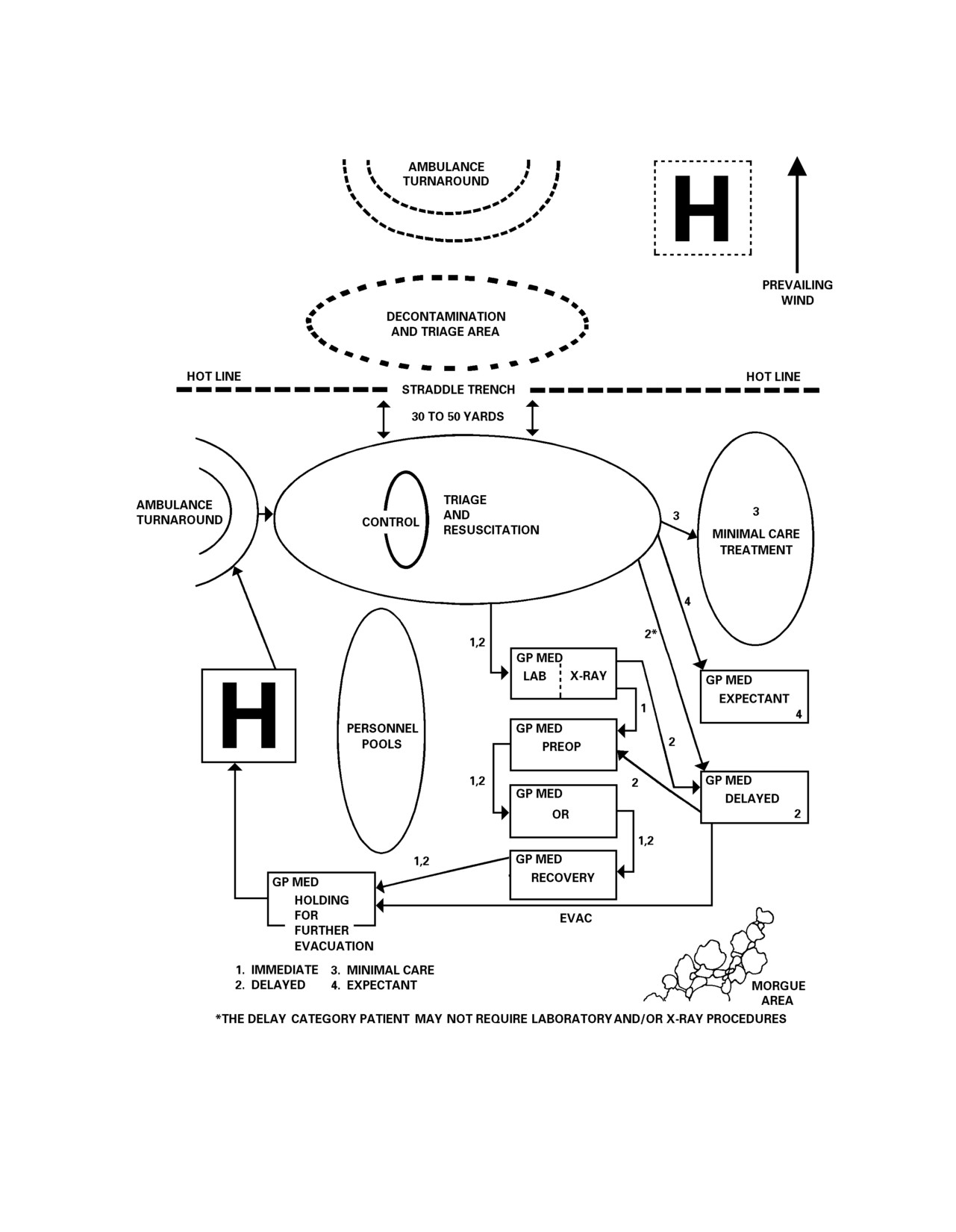
FM 8-42
Figure J-1. Mass casualty station with triage and MINIMAL care areas established outdoors.
J-7