FM 3-28 CIVIL SUPPORT OPERATIONS (AUGUST 2010) - page 6
Appendix D
National Guard ground or air assets. An additional command element from the supporting state may deploy
to coordinate a CBRNE enhanced response force package’s employment and sustainment with the
supported JFHQ-state.
SUSTAINMENT OF THE CBRNE ENHANCED RESPONSE FORCE PACKAGE
D-11. The CBRNE enhanced response force package leadership works with the JTF-state, the JFHQ-state,
the nearest consequence management support center and the National Guard Support Center in Lexington,
Kentucky to sustain extended operations. The consequence management support center should be prepared
to provide immediate service and sustainment support for nonstandard, commercial off-the-shelf
equipment, as requested. Additionally, United States property and fiscal officer, surgeon, chaplain, public
affairs, operations, and state logistic staffs must be prepared to support CBRNE enhanced response force
package operations. Chaplain and surgeon activities should comply with state and federal guidelines for
employment. If federalized, the CBRNE enhanced response force package will receive support from the
gaining unit commander.
D-4
FM 3-28
20 August 2010
Appendix E
CBRNE Consequence Management Response Force
This appendix discusses chemical, biological, radiological, nuclear, and high-yield
explosives consequence management response force organization, operations, and
considerations.
ORGANIZATION OF THE CBRNE CONSEQUENCE MANAGEMENT
RESPONSE FORCE
E-1. The chemical, biological, radiological, nuclear, and high-yield explosives (CBRNE) consequence
management response force provides the Department of Defense response to a chemical, biological,
radiological, nuclear, or high-yield explosives incident. It is a multicomponent and multi-Service force
package; however, all forces are federal military forces (under Title 10, United States Code).
E-2. The CBRNE consequence management response force is the largest of the military forces trained for
CBRNE consequence management. Should a significant chemical, biological, radiological, nuclear, or
high-yield explosives incident (CBRNE incident) occur within the United States, United States Northern
Command (USNORTHCOM) would alert and prepare to deploy the CBRNE consequence management
response force to augment federal consequence management efforts. For planning purposes the force
includes about
5,000 personnel task-organized into three subordinate task forces. Units may vary
depending upon forces provided by United States Joint Forces Command
(USJFCOM) to
USNORTHCOM, but the capabilities remain constant. Joint Task Force-Civil Support, a standing
USNORTHCOM joint task force, normally commands the initial CBRNE consequence management
response force committed. Additional CBRNE consequence management response forces will be employed
under the command of other joint task forces (JTF-51 or JTF-52 in the continental United States) as the
forces become available to the supported combatant command. Figure E-1, page E-2, illustrates the state
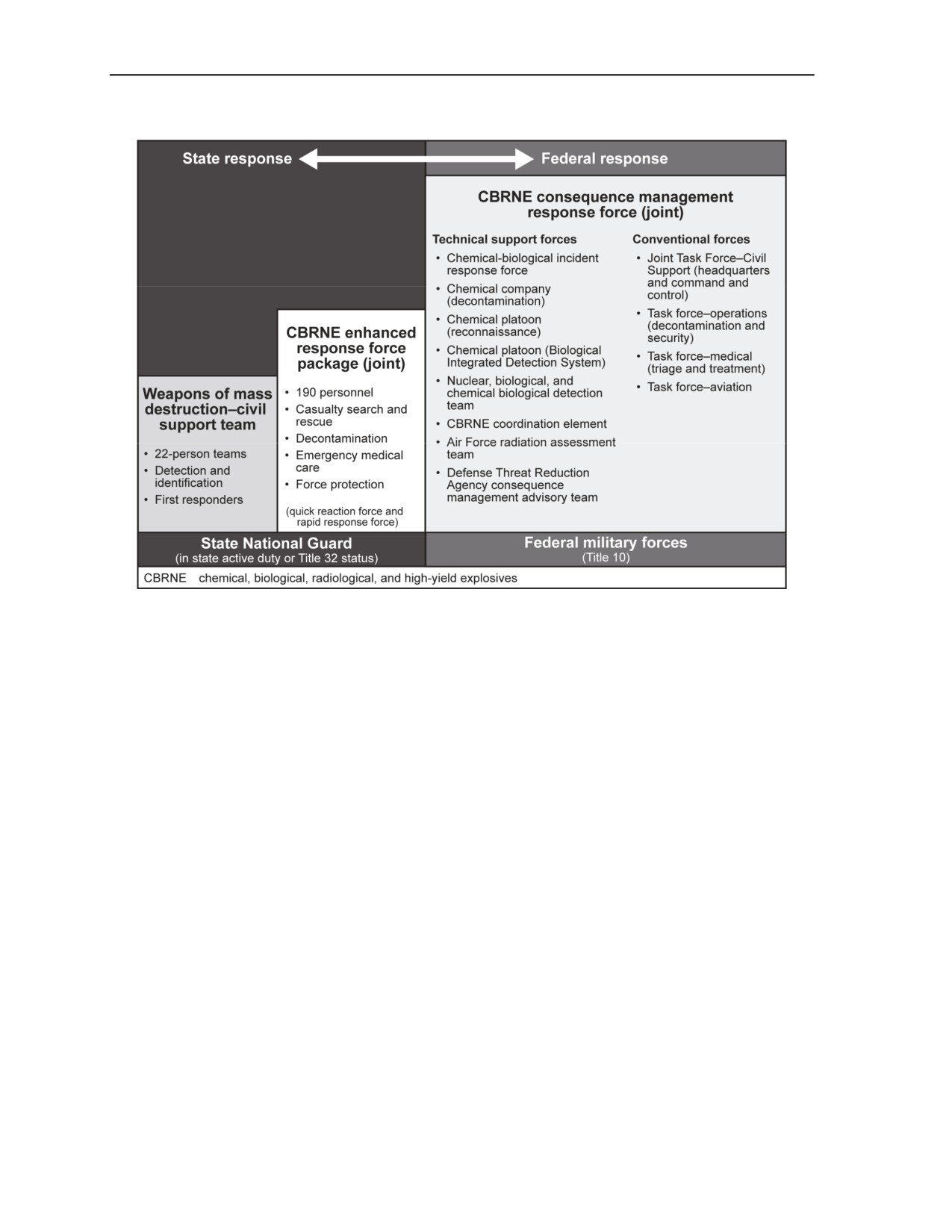
(National Guard) CBRNE response elements and the CBRNE consequence management response force.
20 August 2010
FM-3-28
E-1
Appendix E
Figure E-1. State and federal CBRNE incident response forces
E-3. The CBRNE consequence management response force is a multi-Service force drawn from the active
and reserve components of the Air Force, Army, Navy, and Marines. Forces designated for the CBRNE
consequence management response force remain under the administrative control of the parent Service.
The commander of USNORTHCOM exercises coordinating authority for training of these forces through
commander of USJFCOM. The commander of USNORTHCOM reviews training readiness, and
mobilization plans for reserve component forces in the CBRNE consequence management response force.
E-2
FM 3-28
20 August 2010
CBRNE Consequence Management Response Force
JOINT TASK FORCE-CIVIL SUPPORT
E-4.
Joint Task Force-Civil Support is a USNORTHCOM standing joint task force headquarters,
commanded by a two-star officer. Joint Task Force-Civil Support is assigned to United States Army North
(USARNORTH). The task force consists of active, Guard and Reserve military members drawn from all
Service branches, as well as civilian personnel, commanded by a federalized (Title 10) National Guard
general officer. Joint Task Force-Civil Support plans and integrates federal military support to the
designated primary agency for domestic CBRNE consequence management. Joint Task Force-Civil
Support trains to respond to a CBRNE incident beyond the capability of civilian agencies. When directed
by USNORTHCOM, Joint Task Force-Civil Support alerts and deploys to the incident site and commands
forces federal military forces provided by the combatant commander. Joint Task Force-Civil Support
provides support to civil authorities to save lives, prevent injury and provide temporary critical life support.
Some typical Joint Task Force-Civil Support tasks include incident site support, casualty medical
assistance and treatment, displaced populace support, mortuary affairs support, logistical support, and air
operations. Additional CBRNE consequence management response forces will be commanded by a joint
task force with similar capabilities to Joint Task Force-Civil Support. The role of the Joint Task Force-
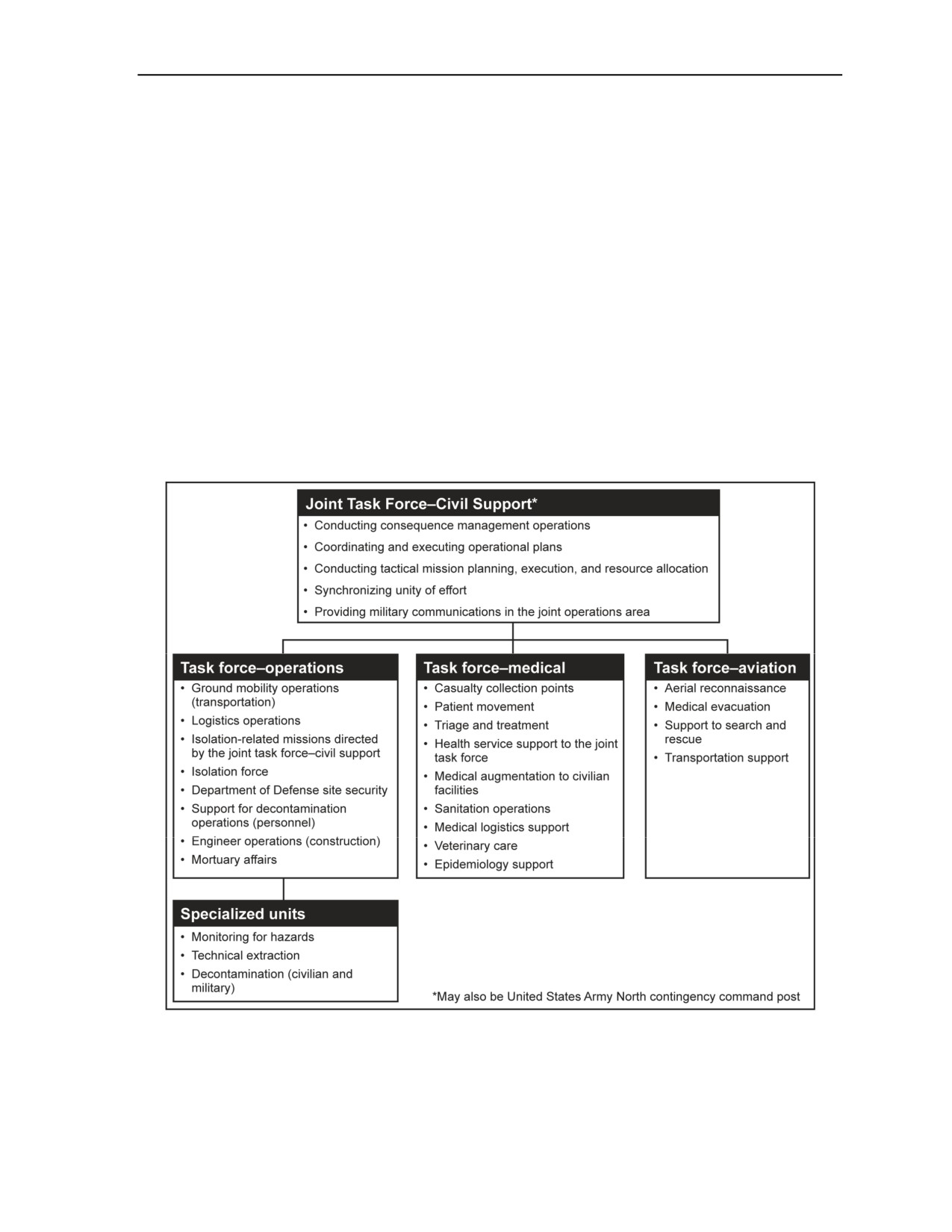
Civil Support within the CBRNE consequence management response force construct is illustrated in Figure
E-2.
Figure E-2. Organization of the CBRNE consequence management response force
20 August 2010
FM 3-28
E-3
Appendix E
CBRNE CONSEQUENCE MANAGEMENT RESPONSE FORCE SUBORDINATE TASK FORCES
E-5. The CBRNE consequence management response force is a tailored force based on the specialized
requirements for CBRNE incident response. It becomes the base organization to which additional federal
military forces may be attached or under operational control, based upon the requirements at the incident
site. The CBRNE consequence management response force normally consists of three subordinate, multi-
Service task forces: task force-operations, task force-medical, and task force-aviation. Each task force has
a colonel or equivalent (O-6) in command and is organized around a brigade or equivalent headquarters.
The composition of each task force varies according to the availability and organization of forces selected
for the CBRNE consequence management response force. Subsequent paragraphs describe the CBRNE
consequence management response force using example forces. It is important to note that the logistic
support to this force is limited and dependent on the theater logistic support established by USARNORTH.
Task Force-Operations
E-6. The largest task force in the CBRNE consequence management response force is task force-
operations. The basic organization comes from an infantry brigade combat team or a combat support
brigade
(maneuver enhancement) although USJFCOM may designate other brigades. A Marine
expeditionary brigade may also become task force-operations, but this manual uses the Army for
illustration. The brigade commander task-organizes the brigade and any attachments into subordinate task
forces intended for area support, and functional task forces intended for specialized activities such as
decontamination or mortuary affairs support. The brigade commander organizes subordinate task force
elements around the battalion headquarters available within the brigade.
E-7. In addition to the organic elements of the brigade, task force-operations normally receives
specialized CBRNE response units and additional engineer assets. In the case of an Army brigade combat
team, the Marines may provide a chemical-biological incident response force—a multifunctional task
force. The Air Force and Navy may provide engineer assets in addition to any Army units organic or
attached to the Army brigade.
Task Force-Aviation
E-8. Task force-aviation provides rotary wing lift capabilities to the joint task force. Task force-aviation
normally includes an Army aviation brigade, minus its assigned attack aviation units. Task force-aviation
also deploys with an aviation maintenance battalion tailored to support the mix of aircraft deployed. The
task force also includes an air traffic control element to assist the joint force air component commander
with Army airfield operations. The aviation brigade provides direct support to joint task force elements and
general support as directed to the federal agencies directing various emergency support functions. When
deployed, task force-aviation may receive tactical control of Marine or Navy aircraft.
Task Force-Medical
E-9. Task force-medical is a multi-Service task force that provides medical support to Joint Task Force-
Civil Support. Typically, task force-medical includes two battalion-equivalent capabilities: a patient
treatment and evacuation unit and a medical support unit which provides logistical support and also
includes ground evacuation assets. Specialized detachments unique to the CBRNE consequence
management response force round out the medical capability. These may include contaminated patient care
capabilities, laboratory support, mental health specialists, veterinary care, and disease control sections.
E-10. Task force-medical has three priorities of care. The first is to provide medical care to deployed
forces within the Joint Task Force-Civil Support. The second is to provide reinforcing medical capabilities
to civilian responders for collection, screening, emergency treatment, and evacuation of patients. The third
priority is to provide health service support to federal and state personnel when their medical requirements
outstrip their agencies’ capacity.
E-4
FM 3-28
20 August 2010
CBRNE Consequence Management Response Force
CBRNE CONSEQUENCE MANAGEMENT OPERATIONS
E-11. CBRNE consequence management response force response is rapid, flexible, and provides a
designated chain of command for federal military CBRNE consequence management operations. The
CBRNE consequence management response force provides capabilities necessary to execute the initial set
of anticipated mission assignments. As required, the joint task force commander requests additional forces
using the request for forces process. In general, the CBRNE consequence management response force
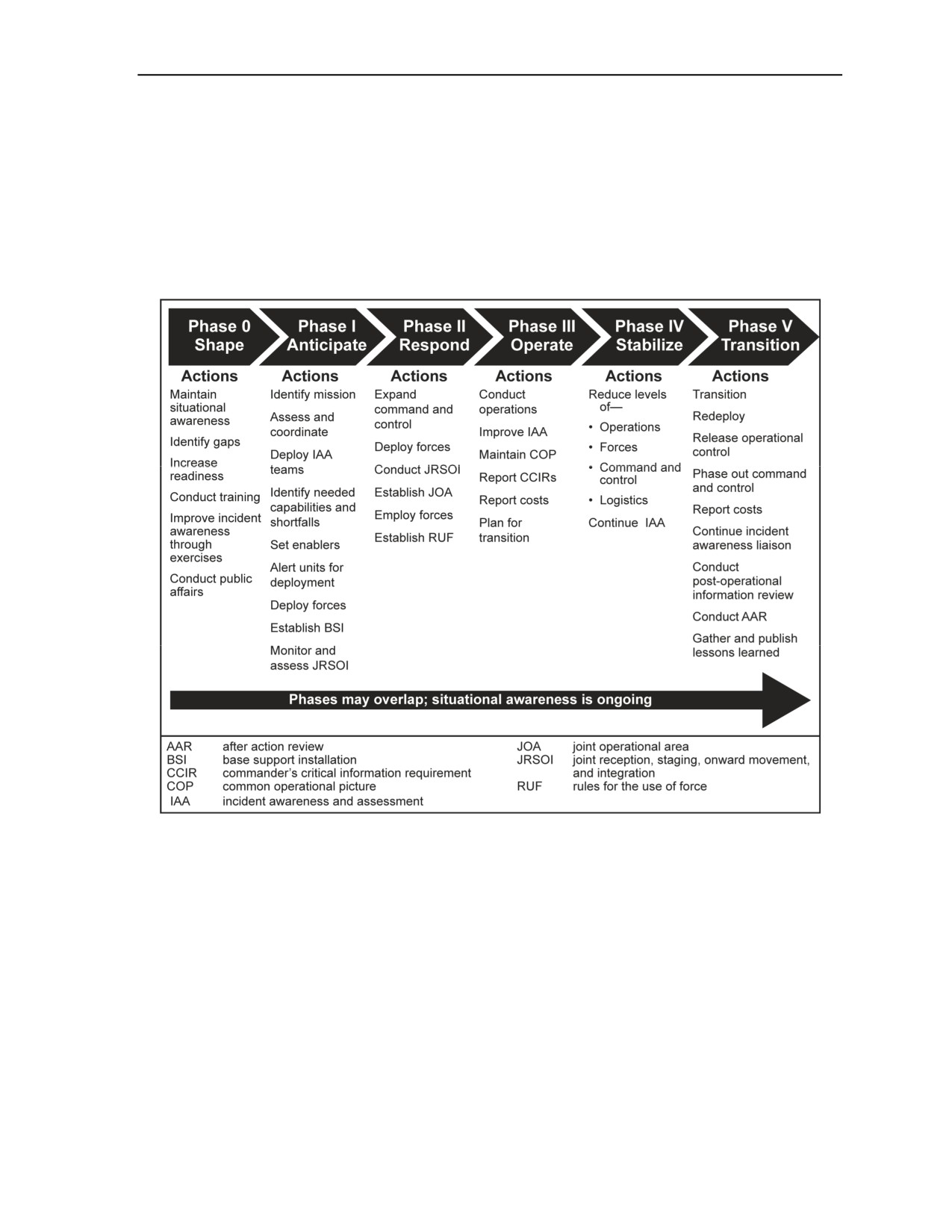
conducts operations according to the six USNORTHCOM phases shown in figure E-3. These phases are
not rigid; forces perform actions as needed.
Figure E-3. USNORTHCOM disaster response phases and actions
PHASE 0—SHAPE
E-12. Phase 0 involves continuous situational awareness and preparedness. Actions in this phase
include interagency coordination, planning, identification of gaps, exercises, and public affairs outreach.
This phase sets conditions for increased CBRNE consequence management interoperability and
cooperation with interagency partners and designated CBRNE consequence management response force
units. This requires participation in planning, conferences, and exercises while simultaneously supporting
USNORTHCOM’s Theater Security Cooperation Plan with bordering nations. These activities continue
through all phases.
E-13. Response force is the focus during this phase with priority on CBRNE consequence management
operations and building command relationships. Commanders focus on training and rehearsals for CBRNE
incidents, based on the training priorities provided through USARNORTH. Selected commanders and staff
20 August 2010
FM 3-28
E-5
Appendix E
participate in training provided by USARNORTH (defense support of civil authorities (DSCA) courses I
and II). Individuals and detachments receive training from experts on operations in a contaminated
environment. The subordinate unit staffs carefully review interoperability challenges, concentrating on
command and control systems and liaison requirements with their headquarters and the supported
combatant command. They identify shortfalls and submit requests for additional capabilities through their
parent headquarters. The staffs also modify existing plans to fit their particular organization and
capabilities, and review the plans with the joint task force commander. This includes updating and
submitting time phased force deployment data through their parent headquarters and USARNORTH to
United States Transportation Command (USTRANSCOM). Each task force commander pays particular
attention to interoperability between elements from the other Services, and includes liaison requirements in
all planning and exercises. Finally, the shaping phase includes a mission rehearsal exercise. The phase ends
with the identification of a potential CBRNE incident through indicators and warning, Secretary of
Defense direction, or an actual CBRNE incident.
PHASE I—ANTICIPATE
E-14. The objective of this phase is to minimize the response time of federal military forces and provide
the combatant commander with assessments that allow rapid and effective tailoring of the CBRNE
consequence management response force, and identify additional requirements for forces. During Phase 1
the defense coordinating officer and USNORTHCOM Situational Awareness Teams) assess the situation
and provide reports to USNORTHCOM. The assessments determine the scope and magnitude of the
incident, identify potential theater response forces, determine which forces need to be expedited to the
incident, and identify potential command and control requirements. This phase ends when CBRNE
consequence management response force and follow-on forces receive prepare-to-deploy orders and are
staged and ready to deploy, or when the combatant commander determines that the scope and magnitude of
the incident does not warrant deployment. In the former case, USNORTHCOM deploys consequence
management forces. In the latter case, the combatant commander directs the return to Phase 0 operations.
E-15. At the tactical level, once units receive a deployment order, operational control passes from the
supporting commander to the gaining commander. Each subordinate task force deploys liaisons to a
location designated by the joint task force commander. These liaisons provide communications
connectivity for dissimilar systems and pass situational assessments back to their task forces as the
situation develops. Simultaneously, each task force deploys an advance party to the base support
installation identified by USARNORTH for reception and logistics support. The task force commanders
coordinates with the joint task force commander on rules for use of force, arming status, law enforcement
missions, intelligence support and restrictions, public affairs guidance, deployment priorities, and mission
assignments (if known). Because of the nature of the most likely CBRNE incidents, forces will deploy into
and remain in the joint operational area for the duration of the CBRNE incident response. For a
catastrophic incident, the commander plans for force rotation of units within the CBRNE consequence
management response force.
PHASE II—RESPOND
E-16. During Phase II, the joint task force deploys forces to key theater nodes and to the joint operational
area. The joint task force establishes command and control of all assigned, attached, and operational
control federal military forces; develops a common operational picture; and conducts joint reception,
staging, onward movement, and integration (JRSOI). Commanders of subordinate units appoint a capable
officer and small staff to continue to manage unit arrival and JRSOI. As units arrive and reassemble, they
occupy their assigned operating bases and prepare for mission assignments. Leaders take every available
opportunity to reinforce Soldier skills they will need when operating in the area of operations. They stress
protective measures, rules for the use of force, and situation awareness and reporting. Task force
commanders receive and integrate additional forces identified during Phase II. They provide updates to
Joint Task Force-Civil Support and keep the supporting installations informed. Phase II success equals
forces deployed with enough command and control and consequence management capability to safely and
effectively conduct operations. This phase ends when 1) response forces are prepared to conduct operations
in the joint operations area, 2) when theater support and incident response forces are postured to conduct
E-6
FM 3-28
20 August 2010
CBRNE Consequence Management Response Force
consequence management operations, and 3) the joint force land component command and joint task force
establish command and control of federal military forces and begin execution of mission assignments.
PHASE III—OPERATE
E-17. Phase III begins when CBRNE consequence management operations commence. Operations focus
on mitigating CBRNE incident effects, saving lives, preventing further injury, and providing temporary
critical life support. The aim of operations is to enable community recovery through efficient employment
of available capabilities. All commanders pay particular attention to safety and force health protection of
their personnel.
E-18. At the tactical level, the joint task force commander will begin assigning missions to units as soon as
the units complete assembly and integration. Each task force can expect to receive multiple missions in the
form of fragmentary orders together with a priority of effort. Commanders circulate constantly between
their subordinates in order to experience and assess for themselves the situation on the ground. They also
conduct information engagement actions with residents and responders working near CBRNE consequence
management response force units. Further, federal military commanders at every level from company to
brigade should personally coordinate with state National Guard commanders and other DOD asset leaders
operating in proximity to CBRNE consequence management response force. The operation plan,
fragmentary orders, and e-mails cannot substitute for face-to-face coordination between commanders to
increase situational understanding and achieve unity of effort. If possible, federal military commanders
should meet with their Guard counterparts at least once a day.
E-19. Certain units of the CBRNE consequence management response force may work closely with highly
specialized personnel from other agencies, such as the Defense Threats Reduction Agency and the
Department of Energy as part of their mission assignment. The commander should designate a subordinate
commander to provide any required support to these agencies and personally visit them to assess the
progress of operations.
E-20. For many missions, Army tactics, techniques, and procedures and mission-essential task list
conditions and standards are adequate to meet the requirements of civil authorities developed in mission
assignments. However in some circumstances, additional requirements will be established. Army forces
should expect some civilian agency coordination and periodic oversight to confirm that projects are
progressing on time and to acceptable civil standards.
E-21. Phase III ends when deployed federal military forces are present in sufficient strength that no
additional forces are required to perform mission assignments. Further, Phase III ends with CBRNE
incident effects are reduced and conditions are set for transition to stabilizing operations in preparation for
transition to civil authorities or designated command.
PHASE IV—STABILIZE
E-22. Phase IV begins when the requirements for CBRNE consequence management response force
capabilities decline and the majority of assigned missions have been completed, or are under execution,
and no other significant CBRNE incident response mission assignments are anticipated. The purpose of
this phase is to allow the joint task force to scale down operations. Determining whether federal military
forces have met transition criteria will require close coordination and day-to-day interaction with the
primary agency. Forces begin preparation of any special equipment and loaned items for turn in. Planning
begins for movement to staging areas for redeployment to home-station. Selective redeployment of forces
that are no longer required for operations may occur. Phase IV ends successfully when civil authorities can
sustain consequence management operations with reduced federal military support.
PHASE V—TRANSITION
E-23. Phase V begins with the transition of operational responsibilities to designated civil authority or
follow-on military forces. Civil authorities are postured for full recovery operations and have the ability to
accommodate surge requirements. Well before this phase begins, joint task force planners develop
transition criteria with specific measures of effectiveness for each mission assignment. As required, they
20 August 2010
FM 3-28
E-7
Appendix E
modify reporting formats to indicate readiness for transition. Resource managers should assign particular
attention to accountability for non-expendable items that are to be turned over to a civilian agency as part
of transition. Site clean-up and turnover of hazardous material protective items and equipment is
coordinated with federal, state, local authorities for disposition. Lessons learned and after action reports are
completed. Commanders review redeployment schedules and mode of transport details with their
subordinates and ensure that leaders understand the schedule and requirements for a safe and efficient
redeployment. Forces safely redeploy to home-station to reset and reconstitute.
E-24. The phase ends when the CBRNE consequence management response force has moved out of the
joint operations area and is released from USNORTHCOM command. Success in Phase V is achieved
when federal military forces have transitioned all operations back to civil authorities and redeployed to
home station.
CONSIDERATIONS FOR THE CBRNE CONSEQUENCE
MANAGEMENT RESPONSE FORCE
E-25. A terrorist attack on U.S. soil would present daunting challenges for civilian authorities.
Unintentional CBRNE releases, whether the result of accidents or natural events, could create catastrophes.
CBRNE incidents may cause overwhelming loss of life, extensive environmental and infrastructure
devastation, and general service disruptions for long periods. Incidents may occur at one or many locations,
simultaneously or sequentially, overwhelming local resources.
E-26. Initial task-organization for the task force should stress unit integrity above capability management.
The CBRNE consequence management response force brings together many different elements in a
dangerous environment with limited experience working with each other. Exercising command and control
through a familiar chain of command, using mission orders, will improve mission effectiveness, even
though it will appear to be less efficient. Whenever possible, commanders should specify a tactical control
or support relationship between units from different components and Services. This also simplifies
logistical support. As the operations progresses, subordinate elements will become accustomed to the
mission and the environment, and commanders may change the task organization more frequently. Other
considerations include:
z
Request and integrate experts in CBRNE training and operations. Use them to assess training
and mission preparation.
z
Strike a balance between mission accomplishment and risk. In order to evaluate the risks,
commanders need to understand the hazards. This often requires individual study and expert
advice. Some of the hazards will be difficult to understand, but commanders should press for
explanations until they are satisfied that they understand both what the experts know, and what
they don’t know. Require subordinates to become familiar with the risks associated with the
mission and the steps their subordinates need to take to mitigate potential hazards.
z
Stay flexible and be prepared to adapt to unforeseen circumstances. Keep in mind that previous
CBRNE incidents differ in many ways from the current mission, and that what the units find on
the ground may differ from what they expected.
z
Be prepared to deal with panic-stricken citizens, many of whom will be very difficult to control.
E-8
FM 3-28
20 August 2010
Appendix F
Airspace Command and Control
This appendix provides guidance on civilian airspace control requirements and
military airspace command and control during civil support. Numerous organizations
use aircraft during disaster response operations. Army leaders and staff must
coordinate airspace command and control procedures to operate effectively along
with other organizations to reduce the chance of accident or injury.
COORDINATING AIRSPACE IN CIVIL SUPPORT OPERATIONS
F-1. Army aviation support for civil support operations includes air movement of logistics; transportation
of personnel and equipment; command and control support to federal, state, and local authorities; air
evacuation; and reconnaissance and surveillance support to civilian law enforcement operations. Federal
military and National Guard aviation units support civil authorities for counterdrug programs, civil
disturbances, and border surveillance operations. Several emergency support function annexes (ESFs) of
the National Response Framework may apply to aviation support, depending on the mission. ESF #1
discusses transportation, including airspace command and control. ESF #9 discusses interagency search
and rescue operations. ESF #7 discusses logistics management. ESF #5 discusses emergency management.
Aviation support during disaster assistance concentrates on air movement, medical evacuation, and
command and control. Disasters may temporarily close ground lines of communication due to debris or
higher priority traffic. Large metropolitan areas may experience traffic gridlock. Aviation units may
include medium lift assets in the initial response to enhance distribution of critical personnel, supplies, and
equipment over these obstacles. Early aerial incident awareness of the disaster area by federal, state, and
local authorities helps to assess relief priorities.
F-2. The guiding rule for airspace control in civil support operations is that the Federal Aviation
Administration is always the airspace coordinating authority. (Federal Aviation Administration is part of
the Department of Transportation.) The national airspace remains under the control of the Federal Aviation
Administration. The airspace control plan developed by the Federal Aviation Administration for
emergencies provides specific planning guidance and procedures that all organizations, civilian and
military, follow for airspace control during civil support operations.
F-3. Each state should have an airspace control plan signed by the adjutant general, maintained by 1st Air
Force. As required, the joint force air component commander coordinates with the Federal Aviation
Administration and issues supplementary instructions to air commanders to accommodate changes required
for emergency operations by military aircraft.
F-4. The airspace control plan assumes that civilian air traffic control facilities and communications will
control all air traffic to provide visual and instrument flight rules separation. If requested, federal military
command and control assets will augment Federal Aviation Administration capabilities when an incident
disrupts civilian air command and control facilities. For large civil support operations, the military plan
outlines airspace procedures for assessment, search, rescue, recovery, and reconstitution operations for all
military organizations. The airspace control plan describes processes and procedures for the safe
employment of air assets, both military and civilian, operating within the rescue and recovery area. The
airspace control plan is used for other military operations within the scope directed by the joint force air
component command.
F-5. The airspace control plan is directive for all assets, military or civilian, operating in or through the
disaster area. Strict adherence to the airspace control plan and Federal Aviation Administration air traffic
procedures ensures safe, efficient, and expeditious use of airspace while still allowing all participants the
20 August 2010
FM-3-28
F-1
Appendix F
ability to complete their respective missions. The air component command for United States Northern
Command (USNORTHCOM) is Air Force North (1st Air Force, headquartered at Tyndall Air Force Base,
Florida). The air tasking order is used to build and promulgate the plan and pass information for air support
during a specified period. Airspace control measures can be adjusted daily according to mission
requirements by making changes in the special instructions within the air tasking order. To assist with
coordination, all military and civilian agencies and organizations provide liaisons to the joint force air
component command, and all air activities are coordinated with Federal Aviation Administration
representatives. While this is true for federal military missions, Air Force North offers the Contingency
Response Air Support Schedule to all agencies supporting disaster response operations. Participation is
voluntary; civil and other federal agencies are not required to participate with the Contingency Response
Air Support Schedule but are highly encouraged.
F-6. The Regional Air Movement Coordination Center located at Tyndall Air Force Base, assists
Department of Defense
(DOD) to provide assets and coordinate with the primary federal agency
controlling predictability of arrival of transient
(originating outside the joint operations area) federal
military air assets. Federal military aircraft providing support based within the joint operations area are not
included in the Regional Air Movement Coordination Center.
F-7. Information flow during a major civil support operation can be challenging due to the rapidly
changing nature of the situation and the resources available. It is imperative that information flow freely
between DOD and other participating agencies to ensure all units are operating on the most current
information. The joint field office air operations branch is the new and correct structure at the federal level.
The air operations branch is designed to facilitate coordination of aviation assets during disaster operations.
F-8. When an Army aircraft supports a defense support of civil authorities (DSCA) mission, airspace
control is transferred to the joint force air component command. All military aircraft in the joint operations
area are line-tasked in the air tasking order. For those assets not directly tasked by the joint force air
component command, applicable mission information appears in the air control plan and special
instructions section of the air tasking order for command, control, and coordination purposes. All
participating military aircraft adhere to the air control plan and applicable air tasking order special
instructions.
JOINT AIRSPACE CONTROL
F-9. The daily air domain and civil support operations are conducted by Air Force North. The 1st Air
Force standing air operations center is carefully tailored and particularly suited for all homeland security
operations taking place within the USNORTHCOM area of responsibility. Additional tactical command
and control systems (ground based or airborne) may be required to deploy to the area based on the
availability of the local communications and command and control nodes.
Note: 1st Air Force controls military airspace within the USNORTHCOM area of responsibility
except in Alaska, where the 11th Air Force Air and Space Operations Center supports Joint Task
Force-Alaska.
F-10. 1st Air Force is responsible for coordinating DOD search and rescue support within the continental
United States (See appendix G). In support of civil support operations, Air Force North is prepared to
deploy numerous air component coordination element elements as well as additional liaison elements to
support other major commands.
F-11. Air National Guard air control squadrons provide operationally ready command and reporting center
mission control elements for support of theater air operations. These elements include radar surveillance
and tracking, radar service to tactical aircraft, supervision of subordinate deployed air control units, and
data-link of a combined air picture to higher headquarters.
F-12. Many Navy ships are well suited for air command and control support during civil support
operations. They possess robust communications capabilities. For example, Navy tactical air command and
F-2
FM 3-28
20 August 2010
Airspace Command and Control
control centers are located on amphibious naval assault ships. They are able to assist the joint force air
component command in air space planning, integration, and deconfliction of multiagency air assets.
F-13. A Marine air support squadron provides a direct air support center cell for coordination and control
of aircraft operating in direct support of Marine air-ground task force. The entire direct air support center,
or a portion of it, may deploy for civil support operations.
F-14. Air Force airborne warning and airspace control aircraft may deploy to provide a detailed air picture
to the airspace control authority. These airborne control centers can become the link between the Federal
Aviation Administration controllers on the ground, working out of a military facility, and aircraft in and
around the incident site.
RESTRICTIONS ON UNMANNED AIRCRAFT SYSTEMS
F-15. Unmanned aircraft systems have become an indispensable combat multiplier for U.S. forces in
combat. However, in civil support operations the Federal Aviation Administration may severely restrict
their use due to safety and control issues associated with an unmanned aircraft. See appendix H for more
information about these restrictions.
PLANNING CHECKLIST FOR AIRSPACE COORDINATION
F-16. This list provides some primary considerations for airspace coordination in domestic operations.
This list is not all inclusive.
z
Locate and establish contact with the air component coordination element and air command
center.
z
Identify the base support installation and determine its capabilities.
z
Locate the combined air operations center.
z
Identify the centralized command for all military air assets and other federal air assets.
z
Locate and establish contact with air operations branch in the joint field office (each joint field
office will be organized differently).
z
Get a copy of the airspace control plan, and get Web site addresses for updated information.
z
Locate the Federal Aviation Administration representatives.
z
Find out what assets are controlled by the joint force air component command (such as Air
Force, Army, and Navy) or other Services and organizations (such as Coast Guard and Marine
Corps).
z
Develop contacts with supported and controlling agencies within the operational area.
20 August 2010
FM 3-28
F-3
This page intentionally left blank.
Appendix G
Search and Rescue
This appendix provides an overview of search and rescue performed by Army forces
during civil support. It describes the general process used by federal military forces
for search and rescue, and provides a comparison between civilian search and rescue
and military efforts. The appendix then describes the specialized area of urban search
and rescue.
STANDARDS FOR INTERAGENCY SEARCH AND RESCUE
OPERATIONS
G-1. Search and rescue involves assisting persons and property in potential or actual distress. Types of
search and rescue missions include mountain rescue, wilderness rescue, urban search and rescue, combat
search and rescue, air-sea rescue, and mass rescue operations. Conducting search and rescue is hazardous.
Search and rescue should only be undertaken by competent individuals under the supervision of skilled
instructors and in accordance with Federal Emergency Management Agency (FEMA) standards for search
and rescue personnel and equipment. The U.S. government has developed the National Search and Rescue
Plan of the United States to identify the roles and responsibilities of various agencies conducting or
supporting search and rescue.
G-2. As a participant in the National Search and Rescue Plan of the United States, Department of Defense
(DOD) provides federal military support to civil search and rescue within the continental United States.
The National Search and Rescue Plan of the United States supports standards prescribed in the
International Aeronautical and Maritime Search and Rescue (IAMSAR) Manual, various international
agreements, and DOD policy—all of which provide the authoritative basis for military participation in civil
search and rescue efforts. DOD provides this support only when it does not interfere with ongoing military
operations. Emergency Support Function #1 of the National Response Framework discusses transportation,
including airspace command and control. Emergency Support Function # 9 discusses interagency search
and rescue operations.
COORDINATING SEARCH AND RESCUE SUPPORT
G-3. The Air Force Rescue Coordination Center at Tyndall Air Force Base, Florida, coordinates military
support to search and rescue efforts within the United States. The 11th Air Force (Alaska Air National
Guard) oversees search and rescue in Alaska. The Coast Guard also oversees search and rescue in the
United States maritime environment, including Hawaii. The National Park Service has primary
responsibility for search and rescue in national parks. State and local authorities designate a search and
rescue coordinator for their respective jurisdictions to work with the agency having primary search and
rescue responsibility. Each state coordinates search and rescue differently. The Air Force Rescue
Coordination Center ties into to the Federal Aviation Administration's alerting system and the U.S. Mission
Control Center. In addition to the search and rescue satellite aided tracking information, the Air Force
Rescue Coordination Center computer system contains resource files that list federal and state
organizations which can conduct or assist in search and rescue efforts throughout North America
G-4. While every search and rescue assignment is unique, search and rescue missions follows the pattern
discussed in the succeeding paragraphs. Response usually begins at the local level with first responders. If
the emergency (or disaster) is great enough, the local emergency manager requests assistance from the
state.
20 August 2010
FM-3-28
G-1

Appendix G
G-5. Following the disaster, the local emergency manager requests assistance from the state, the state in
turn can request DOD assistance through the through the defense coordinating officer. A hasty search and
rescue reconnaissance mission may be supported by federal military and state National Guard rotary wing,
unmanned aircraft systems, or Civil Air Patrol assets. Coordination between DOD agencies allows
prioritization of timely support to urgent needs. The DOD Global Area Reference System combines with
local search and rescue grid systems to give a visual representation of areas where search and rescue has
been completed.
DISASTER RESPONSE AND CIVIL SEARCH AND RESCUE
G-6. Aspects of domestic disaster response and civil search and rescue tend to be confused. This is
because they overlap in certain aspects, such as responsible agencies and resources used, and both involve
emergency response. Table G-1, pages G-2 to G-3, points out some of the basic differences between
domestic disaster response and search and rescue in a way that may be helpful to Army personnel involved
in both operations. However, it does not address how states or localities deal with these missions and their
differences.
Table G-1. Disaster response and civil search and rescue comparison chart
Criteria
Disaster Response
Civil Search and Rescue
Nature of
Typically responds to events involving large-
Locates and rescues persons in distress in land
operations
scale loss of lives or property, with lifesaving
(wilderness, caves, and such), maritime (mostly
efforts (mostly urban SAR).
oceanic environment), and aeronautical (involving
persons in distress in aircraft on land or water)
First responders are rapidly overwhelmed and
scenarios, including possible mass rescue
need substantial help from outside the affected
operations.
area.
U.S. forces typically save 4,000-5,000 lives
annually.
Main concept
Federal backup to the 28 states with self-
Divides globe into a patchwork of SAR regions,
sufficient, deployable, urban SAR task forces.
each with one RCC that arranges for SAR services
within its region.
Supplemented by mitigation and recovery
efforts.
Part of a global system of two specialized bodies of
United Nations.
Does not cover beyond 3 miles from shore (for
example, a sinking passenger ship).
Caseload
Typically 5-12 cases annually.
Typically 40,000-50,000 cases annually.
Alerts or
May start with initial contact by a government
Usually initiated automatically by communications
requests for
official to FEMA or to a local, federal, or military
equipment with distress alerting as a primary or
assistance
entity for assistance.
secondary function (providing data to the
responsible RCC) or by person in distress.
Either initially or eventually involves a governor
request to FEMA for a “major disaster”
declaration by the President.
Common basis
Declared a disaster or emergency by the
Received distress alert by any means.
for federal
President based on request and justification
Default response responsibility is federal military
involvement
from a governor.
except where other arrangements are made, for
Default response responsibility is with local and
example, via agreements with states to handle
state authorities.
inland SAR.
Coordination of
By a designated lead federal agency before a
By the responsible RCC, using own or arranged
federal
disaster declaration to ensure unity of effort.
local, national, or international resources or by
response
delegation based on plans or agreements.
Often has involvement of local military
command or other federal agency (for example,
National Park Service) before a disaster
declaration and by FEMA after such
declaration.
Primary legal
The Stafford Act1, Presidential Directives, the
NRF and agency-specific legislation authorizing
authorities
NRF, and authorizing legislation relevant to
conduct or support of SAR.
various federal agencies (there are many) to
provide or support federal response.
Supplemental
NRF.
National Search and Rescue Plan (NSP), available
authorities
G-2
FM 3-28
20 August 2010

Search and Rescue
Table G-1. Comparison of disaster response and civil search and rescue, continued
Criteria
Disaster Response
Civil Search and Rescue
Implementing
Mainly the NIMS.
Mainly the IAMSAR Manual and the National
guidance for
Search and Rescue Supplement to the IAMSAR
NRF and NSP2
Manual.
Terminology
Mainly per NRF and NIMS.
Mainly per IAMSAR Manual.
Primary policy
Department of Homeland Security and FEMA.
International Civil Aviation Organization,
and oversight
International Maritime Organization, and the
authorities
National Search and Rescue Committee.
Typical
NIMS.
Mainly international SAR procedures at the federal
operational
level, with NIMS and incident command system
coordination
used mainly within (or when coordinating with) state
and local levels.
RCC Langley also uses incident command.
Compatibility of
Disaster response is carried out per the NRF
SAR procedures achieve compatibility with NIMS
disaster
and civil SAR (including mass rescue
by assigning a SAR representative to the incident
response with
operations), if any.
commander in the operations section of the incident
SAR
command post.
SAR coordination is separate from but “plugs
into” the NIMS command structure.
Command
Incident commander of incident command post
SAR mission coordinator (usually in an RCC) and
structure
or unified command.
on-scene coordinator.
Factors
Primary responsibility for disaster response
RCC Langley agreements with each state.
affecting
belongs to state.
Various other agreements, where appropriate.
involvement of
State sovereignty, laws, plans, and
RCC plans.
states
agreements.
NSP provides for states to assume aeronautical
State capabilities.
and maritime SAR responsibilities that default to
Responsibilities assigned to state agencies.
the federal government.
Interstate organizations for governors,
emergency managers, and so on.
Mutual-aid arrangements among states.
Primary civilian
Per Presidential Directives, all federal agencies
The Coast Guard operates 10 RCCs and arranges
agencies
follow the NRF, with Department of Homeland
SAR services for waters around the United States.
Security and FEMA as the lead.
National Park Service handles SAR in national
parks.
Primary supporting agencies are the National
Oceanic and Atmospheric Administration, Federal
Communications Commission, and National
Aeronautics and Space Administration.
Department of
Defense support of civil authorities usually, but
Per NSP (not defense support of civil authorities),
Defense role
not limited to, actions under the Stafford Act.
primary responsibility for RCC functions in
continental United States (RCC Langley) and
Alaska (RCC Elmendorf); secondary support of civil
SAR in rest of the world; local military commands
have authority for immediate response.
Search and
Mainly federal urban SAR task forces deployed
For sea, aircraft and boats with SAR-trained crews
rescue units
under the NRF to support local efforts in the
and specialized SAR equipment, ships at sea, and
United States.
all other available resources.
For land SAR, mostly state and local resources.
Funding
Mainly various types of funding available under
Agency-appropriated SAR; each entity funds own
the Stafford Act.
services. No charge to survivors.
FEMA Federal Emergency Management Agency
IAMSAR International Aeronautical and Maritime Search and Rescue
NIMS
National Incident Management System
NRF
National Response Framework
RCC
regional coordination center
SAR
search and rescue
Note1. The Stafford Act is the "Robert T. Stafford Disaster Relief and Emergency Assistance Act."
Note2. NSP or National Search and Rescue Plan is “The National Search and Rescue Plan of the United States.”
Note3. Includes half of the North Atlantic and three-fourths of the North Pacific.
20 August 2010
FM 3-28
G-3
Appendix G
URBAN SEARCH AND RESCUE
G-7. Urban search and rescue refers to searching for, extricating, and providing immediate medical
treatment for victims of structural collapse or other hazards. Urban search and rescue falls under ESF #6 of
the National Response Framework. Urban search and rescue is dangerous and highly specialized. Military
units normally support specialized urban search and rescue teams and work under the direction of highly
trained experts.
G-8. A catastrophic disaster, such as an earthquake, tornado, or a high-yield explosion, would result in a
high degree of devastation in urban areas. Substantial numbers of persons could be in life-threatening
situations requiring prompt rescue and medical care. Because the mortality rate dramatically increases
beyond 72 hours, search and rescue must begin immediately. Rescue personnel will encounter extensive
damage to buildings, roadways, public works, communications, and utilities. In an earthquake, aftershocks,
secondary events, and other effects such as fires, tsunami, landslides, flooding, and hazardous materials
releases will compound problems and may threaten both survivors and rescue personnel.
G-9. FEMA civilian urban search and rescue task forces, and other federal agencies, as well as DOD, will
provide support to state and local urban search and rescue operations under three execution phases, in
addition to planning and preparation for potential incidents. The execution phases include notification,
initial response actions, and continuing actions. Because of the urgency to rescue trapped victims, the first
two phases must be accomplished within 72 hours of the event. After arriving at a disaster site, structural
specialists (licensed professional engineers) provide direct input to FEMA rescue task force members about
the structural integrity of buildings and the risk of secondary collapses when applicable. Search teams
venture around and into collapsed structures, shoring up structures and locating trapped personnel. Teams
use electronic listening devices, search cameras, and specially trained search dogs to locate victims. When
a victim is located, the search group begins the task of breaking and cutting through the damaged structures
to reach victims. They stabilize and support the entry and work areas. Army engineers may participate in
these activities.
G-10. Medical teams, composed of trauma physicians, emergency room nurses, and paramedics provide
medical care for the victims as well as the rescuers, if necessary. A fully stocked mobile emergency room
is part of the task force equipment cache. Army medics may be required to enter the unstable interior of the
collapsed structure to render immediate aid. Throughout the effort, hazardous material specialists evaluate
the disaster site and decontaminate rescue and medical members who may be exposed to hazardous
chemicals or decaying bodies. Army chemical, biological, radiological, nuclear, and high-yield-explosives
assets may be required.
G-11. Heavy rigging specialists direct the use of heavy machinery, such as cranes and bulldozers. These
specialists understand the special dangers of working in a collapsed structure and help to ensure the safety
of the victims and rescuers inside. Army engineers may be required. Technical information and
communication specialists ensure all team members can communicate with each other and the task force
leaders, facilitating search efforts and coordinating evacuation in the event of a secondary collapse. Army
signal corps assets may be required.
G-12. Logistics specialists handle the more than 16,000 pieces of equipment to support urban search and
extrication of the victims. The equipment cache includes such essentials as concrete cutting saws, search
cameras, medical supplies, and tents, cots, food, and water to keep the task force self-sufficient for 72 or 96
hours. Army sustainment assets may be required.
G-13. During planning and preparation, DOD components and supporting federal agencies will plan
support for urban search and rescue, and as required, engage in training and other related activities in order
to expeditiously execute urban search and rescue. An example of this is the Army’s 911th Engineer
Company (Technical Rescue). It is the only unit in the Army that specializes in collapsed structure,
vertical, confined space, and mine rescue. The unit is located at Fort Belvoir, Virginia. The unit regularly
trains with local, state, and federal first responders in the National Capitol Region as part of Joint Force
Headquarters-National Capital Region.
G-14. If a disaster response operation requires urban search and rescue, FEMA alerts the joint director of
military support, the civilian urban search and rescue task forces, and the Department of Health and Human
G-4
FM 3-28
20 August 2010
Search and Rescue
Services (U.S. Public Health Service). Each civilian task force alerts its members regarding activation. The
joint director of military support designates a supported combatant commander and issues a warning order
to all supporting commanders.
G-15. FEMA headquarters, the joint director of military support, and the supported combatant commander
take initial actions by assessing the situation. Based on this analysis, the joint director of military support
determines the allocation of civilian task forces for the response. FEMA activates the civilian task forces
and directs them to deploy to the scene. The joint director of military support evaluates alternatives and
may direct the geographic combatant commander or United States Transportation Command
(USTRANSCOM) to move some civilian task forces by military aircraft. Other civilian task forces may
move to the disaster area by their own ground transportation.
G-16. The joint director of military support directs the supported combatant commander to execute urban
search and rescue. The combatant commander deploys one or more tailored joint task forces to control the
federal military effort and conduct basic and light urban search and rescue. Each joint task force will
consist of a number of medium and heavy rescue teams, basic and light rescue units, and Service support.
The basic and light rescue unit is a military unit (it may be augmented with civilian urban search and
rescue specialists coordinated by FEMA and United States Army Corps of Engineers personnel tasked to
conduct basic and light urban search and rescue).
G-17. The joint task force receives its mission assignments from the defense coordinating officer. The state
coordinating officer, or territorial counterpart, provides the defense coordinating officer with requirements
for the urban search and rescue. The defense coordinating officer coordinates these requirements with the
joint task force, which assigns urban search and rescue units to one or more specific jurisdictions. In each
jurisdiction, a local incident commander (or commanders) directs the specific operations of the subordinate
units of the joint task force. The state coordinating officer may provide the defense coordinating officer
with additional requirements or change the priority for support. The defense coordinating officer
coordinates with the joint task force to provide civilian or military urban search and rescue units to other
locations. If requested and made available, foreign urban search and rescue teams are integrated into the
operation. Units are reassigned to other jurisdictions as required. Upon completion of the urban search and
rescue mission, the joint task force, if not needed for follow-on missions, redeploys.
20 August 2010
FM 3-28
G-5
Appendix H
Unmanned Aircraft Systems in Civil Support
This appendix addresses the use of unmanned aircraft systems in civil support
operations. It identifies the basic types of systems and provides considerations for
their employment. This document uses Joint Unmanned Aircraft Systems Center of
Excellence categories to distinguish types of unmanned aircraft systems.
TYPES OF UNMANNED AIRCRAFT SYSTEMS
H-1. In full spectrum operations in different areas of the globe, the use of unmanned aircraft has grown
exponentially. However, within the United States and its territories, the use of unmanned aircraft is
severely restricted. Any use of unmanned aircraft systems must be approved at very high levels by both the
Department of Defense and the Federal Aviation Administration prior to employment in civil support
operations. This appendix provides some considerations for the employment of unmanned aircraft systems
in support of civil authorities.
H-2. Unmanned aircraft systems (sometimes called unmanned aerial systems) employment considerations
vary among the different types of systems. Army unmanned aircraft systems that may be suitable for
domestic operations include groups 1, 3, and 4. Group 1 unmanned aircraft systems (such as Raven), by
virtue of size and portability, have limited range and ability to support large areas of operation. Normally
man-pack portable, hand-launched, and controlled with its own individual controller, the Group
1
unmanned aircraft systems have a normal range of less than 20 miles. Group 1 unmanned aircraft systems
may be teamed with unmanned ground vehicles, utilizing the same controller for both the unmanned
ground vehicle and the unmanned aircraft systems, and may be tracked using blue force tracker. Group 1
unmanned aircraft systems have fairly limited endurance (typically two hours or less). Simplicity of launch
and recovery operations allows the unit to employ group 1 assets quickly, within constraints of airspace
coordination. Group 3 unmanned aircraft systems (such as Shadow) require a fairly robust command and
control and support element, but may have employment advantages over larger unmanned aircraft systems.
Group 3 unmanned aircraft systems are normally launched from a catapult, have increased payloads and
weapons capabilities, and are controlled by a ground and shipboard control system. Based on weight,
power, and size restrictions, this group can be tracked by either blue force tracking or a transponder and
becomes a combat multiplier utilizing manned-unmanned teaming. Although still limited by line of sight to
the ground control stations, groups 3 and 4 unmanned aircraft systems can provide support in a larger
geographic area than group 1 unmanned aircraft systems. Group 4 (Hunter MQ-5B and Sky Warrior)
possesses increased size and capabilities over group 1 unmanned aircraft systems but have increased
airspace management requirements.
MISSIONS FOR UNMANNED AIRCRAFT SYSTEMS
H-3. Five missions are normally associated with unmanned aircraft systems during civil support: provide
incident awareness assessment, support search and rescue, support civilian law enforcement agencies,
support communications, and support detection of chemical, biological, radiological, nuclear, or high-yield
explosive materials. (Emergency Support Function #1 of the National Response Framework discusses
transportation, including airspace command and control. Emergency Support Function # 9 discusses
interagency search and rescue operations.)
20 August 2010
FM-3-28
H-1
Appendix H
SUPPORT INCIDENT AWARENESS AND ASSESSMENT
H-4. Incident awareness assessment capabilities include electro-optical, infra-red and synthetic aperture
radar imagery, as well as full motion video. Incident awareness and assessment requirements are based on
the nature of the support requested, and these requirements will derive from the primary federal agency.
For example, after an earthquake, the primary federal agency may wish to ascertain the damage to a major
highway running through the affected area for ground-based relief efforts. Broad area and point damage
assessments are also components of incident awareness and assessment, and all activities must be fully
compliant with the Posse Comitatus Act, intelligence oversight policy, and other U.S. laws and policies
regarding the use of U.S. Armed Forces in a domestic setting. (See chapters 3 and 7.)
SUPPORT SEARCH AND RESCUE
H-5. In some situations, military forces supporting a search and rescue mission may plan for the use of
unmanned aircraft systems platforms in concert with manned platforms and ground teams. Unmanned
aircraft systems can perform the “search” portion of this mission, locating and identifying victims in need
of rescue, while manned aircraft and ground systems can complete the mission by performing the actual
rescue. The use of unmanned aircraft systems for surveillance and detection allows the manned aircraft to
concentrate on rescue of survivors. Emergency Support Function # 9 discusses interagency search and
rescue operations. (See appendix G for more information about search and rescue).
SUPPORT CIVILIAN LAW ENFORCEMENT AGENCIES
H-6. Any non-traditional use of intelligence assets must be approved by Secretary of Defense. This
includes the use of unmanned aircraft systems with intelligence, surveillance, and reconnaissance
capabilities, especially if domestic imaging is involved. Army forces may provide unmanned aircraft
systems support to civilian law enforcement agencies (such as the Federal Bureau of Investigation or Drug
Enforcement Agency) during counterterrorism, foreign intelligence, counterintelligence, or
counternarcotics support. However, all of these missions require approval by the Secretary of Defense.
Law and policy dictate permissible use of information and data gathered by unmanned aircraft systems
operating in support of civilian law enforcement agencies. Each use is subject to different authorities,
procedures and law and policy limitations. All requests for military unmanned aircraft systems to support
to civilian law enforcement agencies must be processed in accordance with Department of Defense
Directive (DODD) 5525.5; DOD Publication 5240.1-R, Procedure 12; and Chairman of the Joint Chiefs of
Staff Instruction (CJCSI) 3710.01B, as appropriate. (See chapters 3 and 7 for more information about
intelligence. See chapter 5 for more information about law enforcement.)
SUPPORT COMMUNICATIONS
H-7. Unmanned aircraft systems can fill gaps and extend communication ranges within the area of
operations. For example, after a natural disaster cellular phone communications may be disrupted due to
power outages or antenna damage. Unmanned aircraft systems could be employed to fill these gaps in
coverage, serving as airborne antennas. Communications relay services could also be provided by
unmanned aircraft systems, extending the range of emergency first responder land mobile radio systems.
SUPPORT CBRNE INCIDENTS
H-8. Unmanned aircraft systems offer a significant advantage in detection of chemical, biological,
radiological, nuclear, or high-yield explosive materials over manned aircraft due to the danger involved
and the risk of contamination to the aircraft. Unmanned aircraft systems could gather data used to identify
and track toxicity plumes, radiation fields, or collect damage assessment imagery without risk to human
life. Additionally, decontamination of the unmanned aircraft system is much easier than with a manned
aircraft.
H-2
FM 3-28
20 August 2010
Unmanned Aircraft Systems in Civil Support
EMPLOYMENT CONSIDERATIONS FOR UNMANNED AIRCRAFT
SYSTEMS
H-9. The preferred means of unmanned aircraft systems employment during civil support is in direct
support of a civilian agency. In direct support, the military unit generating the unmanned aircraft systems
Missions receives the tasks and priorities from the supported agency. The unmanned aircraft system
collects the data and the data is downloaded to the military detachment, which in turn passes the
information directly to the supported agency. If required the military unit may provide on-site analysis of
the data, but does not retain the data once provided to the supported agency.
H-10. Use of unmanned aircraft systems during civil support should be a last resort when manned assets
are not available or not practical. The driving force behind a decision to employ an unmanned aircraft
system must be the capability required for the operation in question. These systems give the commander
many capabilities, but in many cases unmanned aircraft systems may not be the most efficient, timely, or
practical method of achieving the commander’s desired effect. There may be cases where a manned
platform can provide the desired capability in a much more timely and efficient manner. The decision to
employ unmanned aircraft systems must be judicious. Unmanned aircraft systems are well-suited for those
missions characterized as dull, dirty or dangerous. Dull missions are those where persistence or long on-
station dwell times are required. Persistence gives unmanned aircraft systems an advantage over manned
systems. Dirty missions are those missions that risk contamination to the vehicle or crew. An obvious
application of a dirty mission is the detection of chemical, biological, radiological, nuclear, or high-yield
explosive materials. Finally, dangerous missions are those missions where there is substantial risk to the
airframe and operator of the system. This risk may come from an adversary or the environment itself. The
“dull, dirty or dangerous” standard is a good rule of thumb for planners and commanders to use when
considering unmanned aircraft system employment. The temptation to use unmanned aircraft systems
simply because they are available should be avoided. The unmanned aircraft system needs to be the best
available asset that enables the commander to provide the necessary capability.
H-11. The joint force air component command remains the approving authority for Army unmanned
aircraft system missions; there is no “free space” below coordinating altitudes for small tactical systems.
The Secretary of Defense approves unmanned aircraft system missions, not the joint force air component
command. Deconfliction of airspace below the coordinating altitude is the responsibility of the Federal
Aviation Administration and local authorities, unless the entire national airspace is put under military
control. Army National Guard unmanned aircraft systems, with the approval of the Secretary of Defense,
can be used in support of local authorities.
H-12. Certain unmanned aircraft systems such as Global Hawk can operate far above normal commercial
traffic while providing situation assessment to ground commanders. Intermediate systems such as the
Predator have supported recent disaster operations, dramatically increasing situational awareness at the
field office level. If available and authorized, these systems can provide real time surveillance to command
posts for extended periods. The approval process is not automatic. Requests for unmanned aircraft system
surveillance support goes through the joint force air component command and joint task force to the joint
field office for joint staff approval. The joint force air component command coordinates with the Federal
Aviation Administration and includes the mission on the air taking order when approved. The Federal
Aviation Administration issues notices to Airmen as required.
COMMAND AND CONTROL OF UNMANNED AIRCRAFT SYSTEMS
H-13. Command and control relationships for unmanned aircraft systems operations should be defined in
advance of execution of the mission. In general, the controlling joint task force will typically exercise
operational control of the available unmanned aircraft systems.
H-14. Unmanned aircraft system operators supporting domestic missions should anticipate coordinating
their actions through the joint task force to supporting the joint force air component commander and be
prepared for inclusion of their operations in the air tasking order. Regardless of the nature of operations,
unmanned aircraft systems command and control structures must be thoroughly planned (well in advance,
20 August 2010
FM 3-28
H-3
Appendix H
when possible), responsive to both operator and user inputs, and flexible enough to handle changes to the
operation. This is particularly important for re-tasking of unmanned aircraft systems assets.
H-15. The joint force air component command will provide guidance regarding the certification of
authorization approval process due to their long-term relationship established with the Federal Aviation
Administration. Regardless of the status of a certification of authorization application, active coordination
with the Federal Aviation Administration when planning to operate military unmanned aircraft systems in
the domestic airspace of the United States cannot be overemphasized. Timely coordination with the Federal
Aviation Administration will give the operator a greater chance of gaining approval to operate unmanned
aircraft systems where and when required. In those instances where no pre-existing certification of
authorization is in place, a process is in place between joint force air component command and the Federal
Aviation Administration to expedite certification of authorization approval for in extremis cases.
UNMANNED AIRCRAFT SYSTEMS AND DISASTER SUPPORT
H-16. Before an incident with some warning (such as a hurricane) units with unmanned aircraft systems
assets should evaluate the requirement and environment to determine whether unmanned aircraft systems
operations will be available to support possible requests for assistance. Unmanned aircraft systems
normally do not have the speed or the range to allow for operations directly from their home station. They
must deploy to a base support installation near the incident area. Deployment considerations include site
surveys for possible operating locations. Planners should ensure unmanned aircraft system operations are
conducted at smaller or remote sites, away from other disaster relief aircraft. Initial coordination for
temporary flight restriction or Certification of Authorization should be staffed through United States
Northern Command (USNORTHCOM) or United States Pacific Command (USPACOM) and then through
the joint force air component command to the Federal Aviation Administration. An Army Regional
Representative to the Federal Aviation Administration is located at each of the Federal Aviation
Administration service centers to provide day-to-day unmanned aircraft systems coordination.
H-17. During an immediate response situation or the initial stages of a larger response, designated units
move their unmanned aircraft systems to their operating locations. Additionally, units should be prepared
to meet and coordinate with local airspace users to facilitate safe operations within the unmanned aircraft
systems operating area. Under ideal conditions, the Federal Aviation Administration will issue a temporary
flight restriction for disaster relief operations that authorize unmanned aircraft systems operations. With or
without a temporary flight restriction, unmanned aircraft systems operations will require a certification of
authorization from the Federal Aviation Administration to conduct operations. Units should ensure an
additional site survey is conducted if their previously selected operating location sustained damage.
Additions, modifications, or changes to the final certification of authorization must be coordinated with the
joint force air component command for inclusion in the airspace control plan and the air tasking order.
H-18. In the aftermath of a disaster, the primary mission for unmanned aircraft systems will become
assessment of the extent of the disaster. Additional unmanned aircraft systems missions include conducting
initial damage assessment of critical locations and infrastructure, and identification of those areas hardest
hit. Unmanned aircraft systems operations may be used to assist with locating and identifying personnel
requiring rescue. Unmanned aircraft systems operations may provide critical information to law
enforcement agencies by providing persistent observation of critical facilities and affected areas.
LIMITATIONS ON THE USE OF UNMANNED AIRCRAFT SYSTEMS
H-19. There are numerous limitations involving unmanned aircraft systems operations in United States.
The three most important are legal restrictions, Federal Aviation Administration restrictions, and weather
restrictions.
Legal Restrictions
H-20. Restrictions on the use of unmanned aircraft systems in domestic operations are numerous. Use of
DOD intelligence capabilities for civil support missions, such incident awareness and assessment, damage
assessment, and search and rescue, requires prior Secretary of Defense approval, together with approval of
H-4
FM 3-28
20 August 2010
Unmanned Aircraft Systems in Civil Support
both the mission and use of the specific DOD intelligence community capabilities. Certain missions may
require not only approval of the Secretary of Defense, but also coordination, certification, and possibly,
prior approval by the Attorney General of the United States. Additionally, there are several DOD directives
and CJCSIs covering military support to civil authorities. For example, DODDs 3025.12 and 5525.5 and
CJCSI 3710.01B may apply to domestic unmanned aircraft systems operations. The Chairman of the Joint
Chiefs of Staff standing execute order for DSCA (referred to as the CJCS DSCA EXORD) provides
guidance on operational parameters and limitations on use of DOD intelligence capabilities for DSCA
missions. Further, per DODD 5525.5, military systems are not to be used for surveillance and pursuit of
individuals.
H-21. All requests for unmanned aircraft systems must be approved by Secretary of Defense. Operators of
unmanned aircraft systems supporting civilian law enforcement agencies must be cognizant of, and fully
comply with, DODD 5525.5 (see paragraph H-6) and any operational parameters and limitations specified
in the CJCS DSCA EXORD regarding collection, retention, and dissemination of unmanned aircraft
systems sensor data and imagery. Operators cannot conduct surveillance on specifically identified U.S.
persons, unless expressly approved by the Secretary of Defense, consistent with U.S. laws and regulations.
Additionally, civilian law enforcement agencies will handle any data collected by such surveillance
operations. Finally, per current Office of the Secretary of Defense guidance, National Guard forces
conducting domestic unmanned aircraft systems operations are normally in Title 10 (United States Code)
status, unless the Secretary of Defense determines Title 32 status is more appropriate.
Federal Aviation Administration Restrictions
H-22. By far the biggest challenge to operating unmanned aircraft systems in the United States, its
territories and possessions is access to the National Airspace System. Since unmanned aircraft systems are
by their very nature different from manned systems, unmanned aircraft systems do not meet the same
standards for operations in the National Airspace System that are required for manned systems (the ability
to “see and avoid” other aircraft, for example). In order to fly unmanned aircraft systems in other than
military restricted airspace or warning areas, unmanned aircraft systems operators must apply for a
certificate of waiver or authorization
(certification of authorization) from the Federal Aviation
Administration granting specific permission to fly the unmanned aircraft systems in the National Airspace
System. This certification of authorization process can take up to 60 days, although work is underway to
shorten this process. Emergency certification of authorizations timeline can be reduced to hours if
conditions dictate. Additionally, unmanned aircraft systems operators should be prepared to meet other
Federal Aviation Administration requirements such as qualification training for operators and knowledge
of the airspace regulations for the type of airspace the unmanned aircraft systems will operate in.
H-23. The Federal Aviation Administration will activate a temporary flight restriction in the vicinity of
disaster and hazard areas, or approve an emergency certification of authorization for the unmanned aircraft
systems to operate. Unmanned aircraft systems operations within an approved temporary flight restriction
should be added to the verbiage contained in the temporary flight restriction. For operations outside the
temporary flight restriction, an additional certification of authorization will be required.
Weather Restrictions
H-24. Severe weather presents operational challenges to most unmanned aircraft systems. Planners have to
carefully consider the weather in the intended area of operations to determine if manned systems are more
suitable for the desired mission. In-flight conditions such as icing, heavy precipitation or instrument
meteorological conditions at the launch and recovery site will likely preclude unmanned aircraft systems
operations. Throughout the civil support mission, unmanned aircraft systems employment depends on the
current and forecasted weather conditions of the affected area.
20 August 2010
FM 3-28
H-5
This page intentionally left blank.
Appendix I
Joint Field Office Sections
This appendix illustrates examples of the four sections of a joint field office fully
manned for operations, with all emergency support functions activated. This
appendix provides a breakout diagram of each section, based on the incident
command system. "Joint," in this context, refers to an interagency organization based
on national policy documents.
EMERGENCY SUPPORT FUNCTIONS
I-1. The National Response Framework contains the emergency support function annexes that specify
lead and supporting agencies for interagency incident response operations. The National Incident
Management System describes the incident command system used for organizing the participating
organizations. Chapter 2 of this field manual discusses the emergency support functions, joint field office,
and incident management system.
I-2. As the primary agency (normally the Federal Emergency Management Agency, or FEMA) activates
each emergency support function (ESF), the lead agency for each ESF deploys personnel for the joint field
office. In addition, each ESF lead agency also assigns personnel as required to other functions and incident
command system staff elements. (See table 2-1 for a listing of the 15 ESFs and their coordinating
agencies.) Per the National Response Framework, participating agencies may have primary and support
responsibilities. Department of Defense is a supporting agency for all ESFs except ESF #3, which is led by
the United States Army Corps of Engineers.
20 August 2010
FM-3-28
I-1
Appendix I
I-3. This excerpt from the National Response Framework: Overview summarizes how ESFs work during
an interagency response:
The Federal Government and many State governments organize much of their resources
and capabilities—as well as those of certain private-sector and nongovernmental
organizations—under 15 Emergency Support Functions (ESFs). ESFs align categories of
resources and provide strategic objectives for their use.
During a response, ESFs are a critical mechanism to coordinate functional capabilities
and resources provided by Federal departments and agencies, along with certain
private-sector and nongovernmental organizations. ESFs may be selectively activated for
both Stafford Act and non-Stafford Act incidents where Federal departments or agencies
request DHS
[Department of Homeland Security] assistance or under other
circumstances. Not all incidents result in the activation of ESFs.
ESFs may be activated to support headquarters, regional, and/or field activities. The
Incident Command System provides for the flexibility to assign ESF and other
stakeholder resources according to their capabilities, tasking, and requirements to
augment and support the other sections of the Joint Field Office
(JFO)/Regional
Response Coordination Center (RRCC) or National Response Coordination Center
(NRCC) in order to respond to incidents in a more collaborative and cross-cutting
manner.
While ESFs are typically assigned to a specific section at the NRCC or in the JFO/RRCC
for management purposes, resources may be assigned anywhere within the Unified
Coordination structure. Regardless of the section in which an ESF may reside, that entity
works in conjunction with other JFO sections to ensure that appropriate planning and
execution of missions occur. For example, if a State requests assistance with a mass
evacuation, the JFO would request personnel from ESF #1 (Transportation), ESF #6
(Mass Care, Emergency Assistance, Housing, and Human Services), and ESF #8 (Public
Health and Medical Services). These would then be integrated into a single branch or
group within the Operations Section to ensure effective coordination of evacuation
services.
National Response Framework: Overview, January 2008
I-2
FM 3-28
20 August 2010
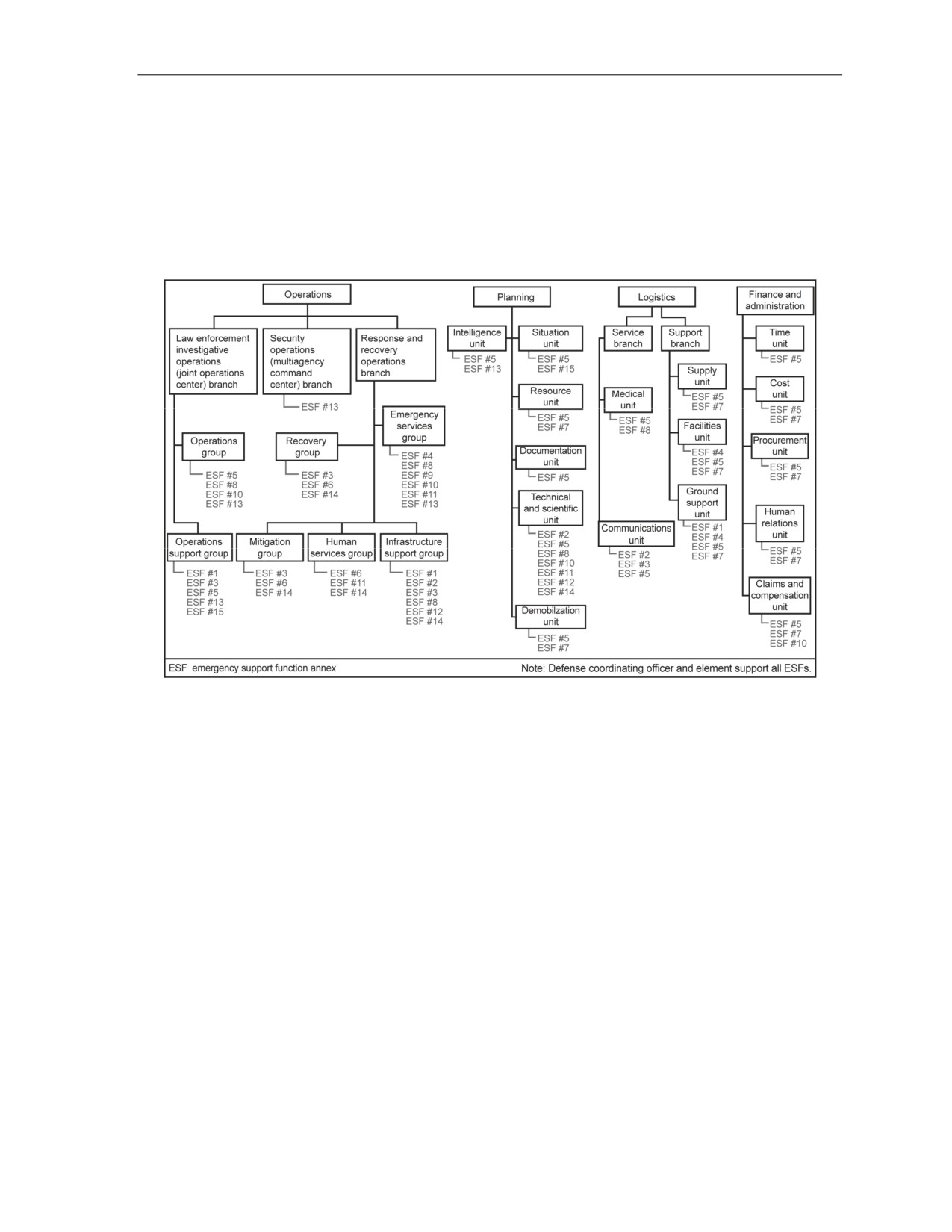
Joint Field Office Sections
THE MAIN SECTIONS OF A JOINT FIELD OFFICE
I-4. Figure I-1 illustrates an example of the four main sections of a fully manned joint field office, based
on the flexible principles of the incident command system. In this illustration, all 15 ESFs have been
activated. The four sections are operations, planning, logistics, and finance and administration. Normally, a
unified coordination group oversees the joint field office (refer to chapter 2). (Each joint field office will
have these four sections, but each section will be organized to accommodate the situation.)
Figure I-1. Example of a fully manned joint field office
20 August 2010
FM 3-28
I-3
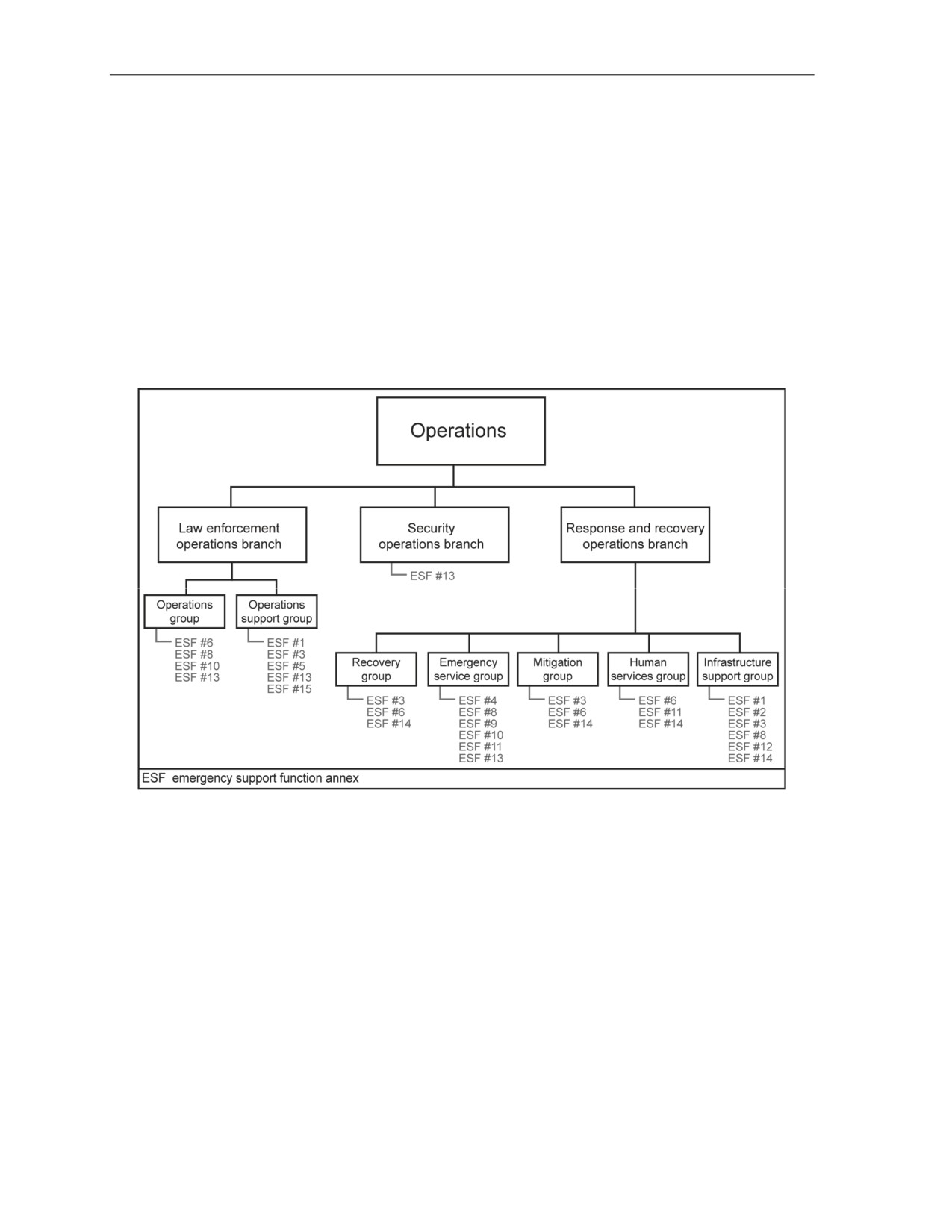
Appendix I
THE OPERATIONS SECTION OF A JOINT FIELD OFFICE
I-5. Figure I-2 illustrates an example of the operations section of a joint field office. The operations
section has the most incident resources. It develops and implements strategy and tactics to carry out the
incident objectives. Each joint field office is organized according to the flexible principles of the incident
command system, so each operations section will be somewhat different depending on the situation. It
expands from the bottom up. The operations section—
z
Organizes, assigns, and supervises the tactical field resources.
z
Supervises air operations and those resources in a staging area.
z
Directs and coordinates all incident tactical operations.
z
Normally the first organizations to be assigned to the incident.
z
May include staging areas and special organizations.
Figure I-2. Example of the operations section of a joint field office
I-4
FM 3-28
20 August 2010
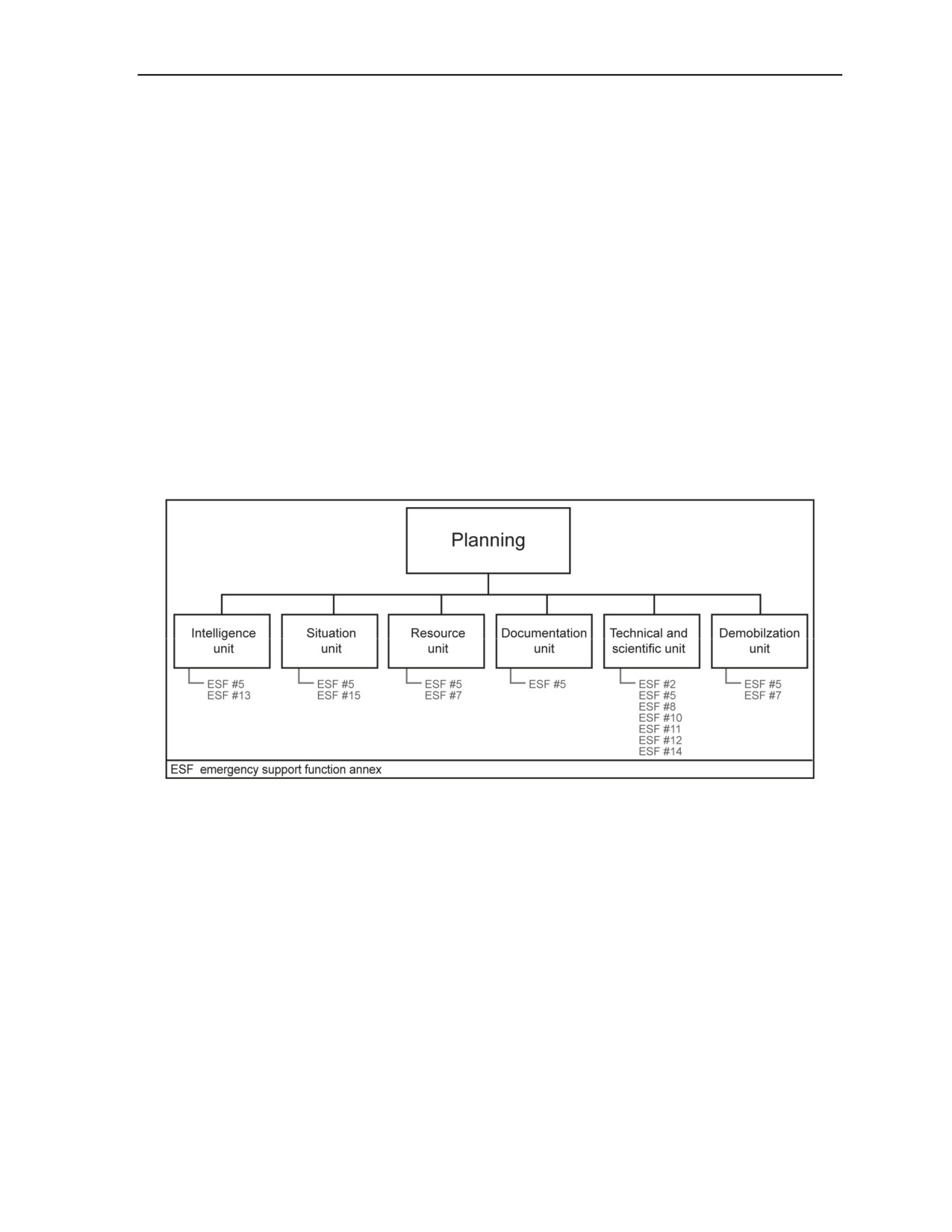
Joint Field Office Sections
THE PLANNING SECTION OF A JOINT FIELD OFFICE
I-6. The planning section gathers, analyzes, and disseminates information and intelligence. The planning
section—
z
Manages the planning process.
z
Compiles the incident action plan.
z
Manages Technical Specialists.
z
Maintains resource status.
z
Maintains and displays situation status.
z
Prepares the Incident action plan.
z
Develops alternative strategies.
z
Provides documentation services.
z
Prepares the Demobilization plan.
z
Provides a primary location for technical specialists assigned to an incident.
Figure I-3 illustrates an example of the planning section of a joint field office. Each planning section is
organized to accommodate the situation, according to the flexible principles of the incident command
system.
Figure I-3. Example of the planning section of a joint field office
20 August 2010
FM 3-28
I-5
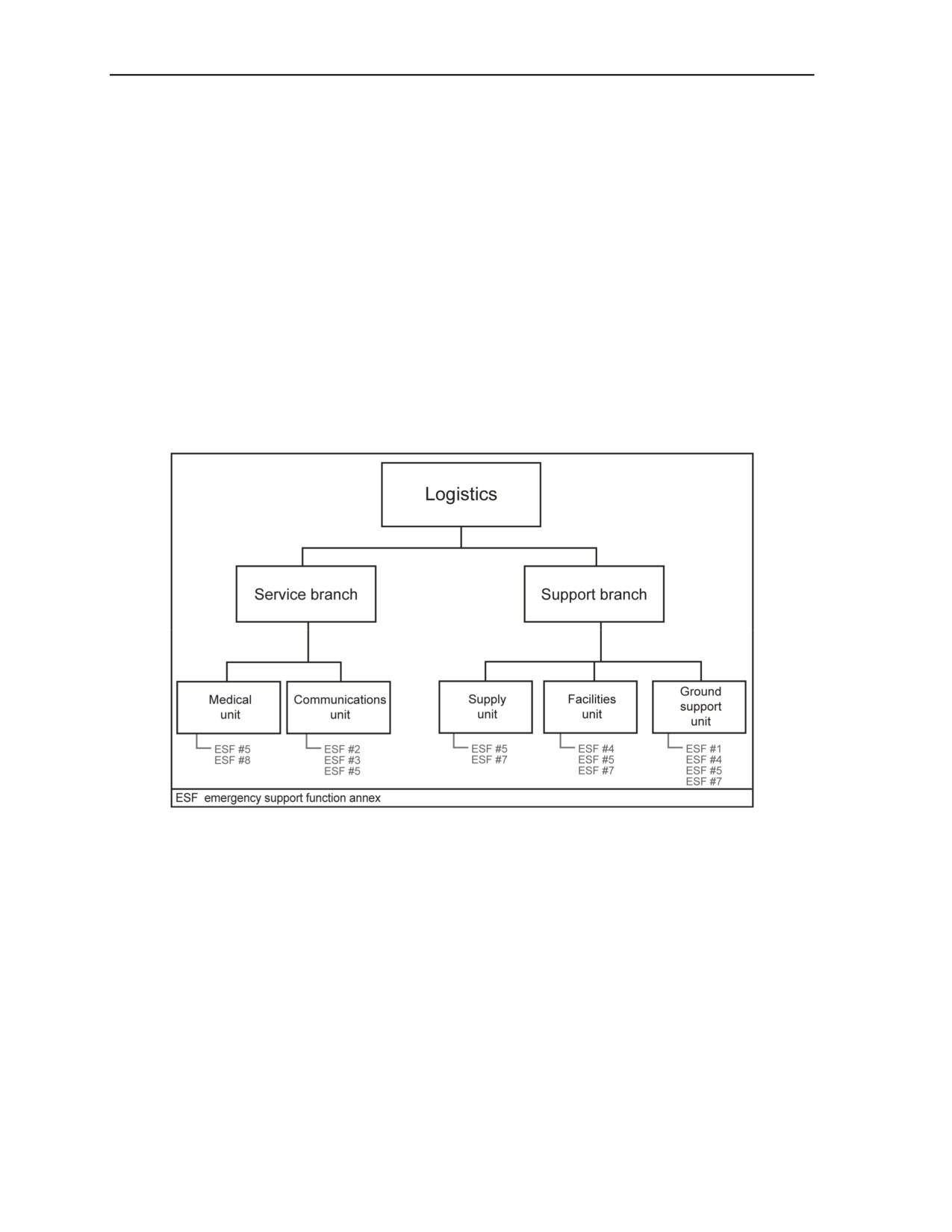
Appendix I
THE LOGISTICS SECTION OF A JOINT FIELD OFFICE
I-7. The logistics section provides resources and services required to support incident activities. The
logistics section develops portions of incident action plan and forwards them to planning section. The
logistics section—
z
Contracts for and purchases goods and services needed at the incident.
z
Coordinates communications support.
z
Provides medical support to incident personnel.
z
Provides food for incident personnel.
z
Provides supplies.
z
Provides facilities.
z
Oversees ground support.
Figure I-4 illustrates an example of the logistics section of a joint field office. Each logistics section is
organized to accommodate the situation, according to the flexible principles of the incident command
system.
Figure I-4. Example of the logistics section of a joint field office
I-6
FM 3-28
20 August 2010
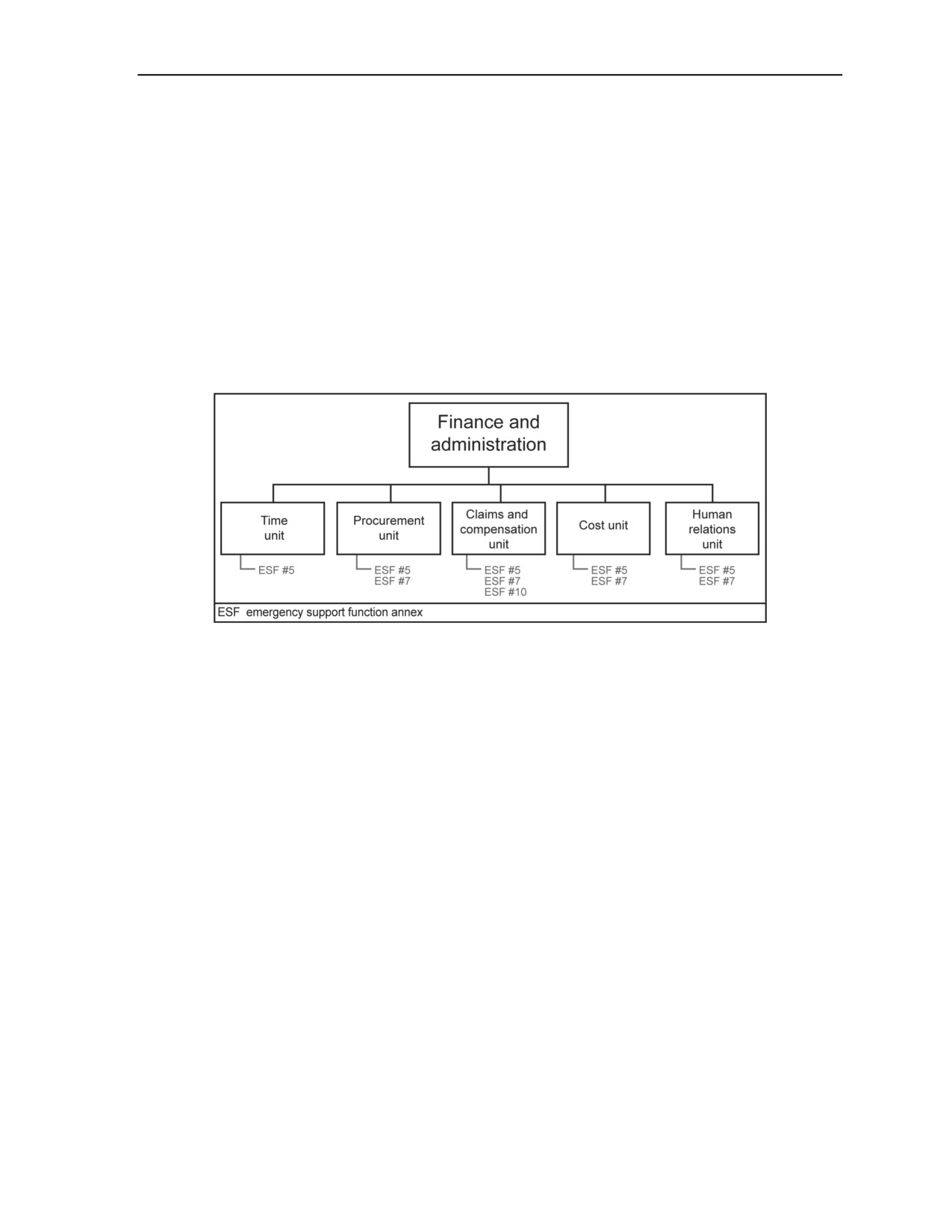
Joint Field Office Sections
THE FINANCE AND ADMINISTRATION SECTION OF A JOINT
FIELD OFFICE
I-8. The finance and administration section handles financial transactions, accounting, and human
resources support. This includes—
z
Contract negotiation and monitoring.
z
Timekeeping,
z
Cost analysis.
z
Compensation for injury or damage to property.
Figure I-5 illustrates an example of the finance and administration section of a joint field office. Each
finance and administration section is organized to accommodate the situation, according to the flexible
principles of the incident command system.
Figure I-5. Example of the finance and administration section of a joint field office
20 August 2010
FM 3-28
I-7

Appendix J
Comparison of Stability and Civil Support Tasks
Table J-1, pages J-1 to J-22, lists tactical tasks from The Army Universal Task List
(AUTL), Field Manual (FM) 7-15, by warfighting function and their relationship to
full spectrum operations. Tasks that apply in stability operations and civil support are
shown with a white background. Tasks that only apply to stability operations are
shown light grey shading. Tasks that only apply to civil support operations appear in
dark grey with white lettering. Tasks for the fires warfighting function are omitted
because none applies directly to civil support or stability operations.
Table J-1. Stability and civil support task comparison chart
AUTL #
Title
Stability
Civil
Remarks
Support
1.1
Perform Tactical Actions Associated with
X
X
Force Projection and Deployment
1.1.1
Conduct Mobilization of Tactical Units
X
X
1.1.1.1
Conduct Alert and Recall
X
X
1.1.1.2
Conduct Home Station Mobilization
X
X
1.1.1.3
Conduct Mobilization Station Activities
X
X
1.1.2
Conduct Tactical Deployment/Redeployment
X
X
1.1.2.1
Conduct Pre-deployment Activities
X
X
1.1.2.2
Conduct RSOI
X
X
1.1.2.3
Conduct Redeployment Activities
X
X
1.1.3
Conduct Demobilization of Tactical Units
X
X
1.1.4
Conduct Rear Detachment Activities
X
X
1.2.2.7
Conduct Actions on Contact
X
1.2.3
Employ Combat Patrols
X
1.2.4
Conduct Counter-ambush Actions
X
1.2.5
Exploit Terrain to Expedite Tactical
X
Movements
1.2.6
Cross a Danger Area
X
1.2.7
Linkup with Other Tactical Forces
X
X
1.2.9
Conduct a Relief in Place
X
X
1.2.10
Navigate From One Point to Another
X
X
1.2.12
Conduct Sniper Active Countermeasures
X
X
1.2.13
Conduct Sniper Passive Countermeasures
X
X
1.3
Conduct Tactical Troop Movements
X
1.3.1
Prepare Forces for Movement
X
X
1.3.1.1
Conduct Advance Party Activities
X
X
1.3.1.2
Conduct Quartering Party Activities
X
X
20 August 2010
FM-3-28
J-1

Appendix J
Table J-1. Stability and civil support task comparison chart, continued
AUTL #
Title
Stability
Civil
Remarks
Support
1.3.1.4
Conduct Pickup Zone Operations
X
X
1.3.2
Conduct Tactical Road March
X
1.3.3
Conduct Tactical Convoy
X
1.4
Conduct Direct Fires
X
1.4.1
Conduct Lethal Direct Fire Against a Surface
X
Target
1.4.2
Conduct Nonlethal Direct Fire Against a
X
X
Nonlethal weapons only
Surface Target
1.5
Occupy an Area
X
X
1.5.1
Occupy an Assembly Area
X
X
1.5.5
Conduct Landing Zone Operations
X
X
1.6
Conduct Mobility Operations.
X
X
1.6.1
Overcome Barriers, Obstacles, and Mines
X
1.6.1.1
Conduct Breaching Operations
X
1.6.1.2
Conduct Clearing Operations
X
X
1.6.1.2.1
Conduct Area Clearance
X
X
1.6.1.2.2
Conduct Route Clearance
X
X
1.6.1.3
Conduct Gap Crossing Operations
X
X
1.6.1.3.2
Conduct Line of Communications Gap
X
X
Crossing Support
1.6.2
Enhance Movement and Maneuver
X
X
1.6.2.1
Construct/Maintain Combat Roads and Trails
X
X
1.6.2.2
Construct and Maintain Forward Airfields and
X
X
Landing Zones
1.6.3
Negotiate a Tactical Area of Operations
X
X
1.6.4
Provide Diver Support
X
X
1.6.5
Conduct Non-Tactical Movement
X
X
1.7.1
Site Obstacles
X
X
1.7.2
Construct, Emplace, or Detonate Obstacles
X
X
2.1
Support to Force Generation
X
2.1.1
Provide Intelligence Readiness
X
2.1.1.1
Perform Indications and Warnings
X
2.1.1.2
Ensure Intelligence Readiness Operations
X
X
According to intelligence
oversight laws for civil
support
2.1.2
Establish Intelligence Architecture
X
X
According to intelligence
oversight laws for civil
support
2.1.2.1
Conduct Intelligence Reach
X
X
According to intelligence
oversight laws for civil
support
2.1.2.2
Develop/Maintain Automated Intelligence
X
X
According to intelligence
Networks
oversight laws for civil
support
J-2
FM 3-28
20 August 2010

Comparison of Stability and Civil Support Tasks
Table J-1. Stability and civil support task comparison chart, continued
AUTL #
Title
Stability
Civil
Remarks
Support
2.1.2.3
Establish and Maintain Access
X
X
According to intelligence
oversight laws for civil
support
2.1.2.4
Create/Maintain Intelligence Databases
X
X
According to intelligence
oversight laws for civil
support
2.1.3
Provide Intelligence Over watch
X
X
According to intelligence
oversight laws for civil
support
2.1.4
Generate Knowledge
X
X
According to intelligence
oversight laws for civil
support
2.1.4.1
Develop the foundation to Define Threat
X
Characteristics
2.1.4.2
Obtain Detailed Terrain Information and
X
X
According to intelligence
Intelligence
oversight laws for civil
support
2.1.4.3
Obtain Detailed Weather and Weather Effects
X
X
According to intelligence
Information and Intelligence
oversight laws for civil
support
2.1.4.4
Obtain Detailed Civil Considerations
X
X
According to intelligence
Information and Intelligence
oversight laws for civil
support
2.1.4.5
Complete Studies
X
X
According to intelligence
oversight laws for civil
support
2.1.4.5.1
Conduct Area, Regional, or Country Study of a
X
Foreign Country
2.1.4.5.2
Conduct Specified Study
X
X
According to intelligence
oversight laws for civil
support
2.1.5
Tailor the Intelligence Force
X
X
According to intelligence
oversight laws for civil
support
2.2
Support to Situational Understanding
X
X
According to intelligence
oversight laws for civil
support
2.2.1
Perform Intelligence Preparation of the
X
X
According to intelligence
Battlefield
oversight laws for civil
support
2.2.1.1
Define the Operational Environment
X
X
According to intelligence
oversight laws for civil
support
2.2.1.2
Describe Environmental Effects on Operations
X
X
According to intelligence
oversight laws for civil
support
2.2.1.3
Evaluate the Threat
X
X
According to intelligence
oversight laws for civil
support
2.2.1.4
Determine Threat Courses of Action
X
X
According to intelligence
oversight laws for civil
support
20 August 2010
FM 3-28
J-3

Appendix J
Table J-1. Stability and civil support task comparison chart, continued
AUTL #
Title
Stability
Civil
Remarks
Support
2.2.1.5
Conduct Geospatial Engineering Operations
X
X
According to intelligence
and Functions
oversight laws for civil
support
2.2.2
Perform Situation Development
X
X
According to intelligence
oversight laws for civil
support
2.2.3
Provide Intelligence Support to Protection
X
X
According to intelligence
oversight laws for civil
support
2.2.4
Provide Tactical Intelligence Over watch
X
2.2.5
Conduct Police Intelligence Operations
X
2.2.5.1
Collect Police Information
X
2.2.5.2
Complete Police Information Assessment
X
2.2.5.3
Develop Police Intelligence Products
X
2.2.6
Provide Intelligence Support to Civil-Affairs
X
X
According to intelligence
Operations
oversight laws for civil
support
2.3
Perform Intelligence, Surveillance, and
X
X
According to intelligence
Reconnaissance
oversight laws for civil
support
2.3.1
Perform ISR Synchronization
X
X
According to intelligence
oversight laws for civil
support
2.3.1.1
Develop Requirements
X
X
According to intelligence
oversight laws for civil
support
2.3.1.2
Develop the ISR Synchronization Plan
X
X
According to intelligence
oversight laws for civil
support
2.3.2
Perform Intelligence, Surveillance, and
X
X
According to intelligence
Reconnaissance Integration
oversight laws for civil
support
2.3.2.1
Develop the Intelligence, Surveillance, and
X
X
According to intelligence
Reconnaissance Plan
oversight laws for civil
support
2.3.2.2
Execute/evaluate and update the ISR Plan
X
X
According to intelligence
oversight laws for civil
support
2.3.3
Conduct Reconnaissance
X
X
According to intelligence
oversight laws for civil
support
2.3.3.1
Conduct a Route Reconnaissance
X
X
According to intelligence
oversight laws for civil
support
2.3.3.2
Conduct A Zone Reconnaissance
X
X
According to intelligence
oversight laws for civil
support
2.3.3.3
Conduct An Area Reconnaissance
X
X
According to intelligence
oversight laws for civil
support
2.3.3.5
Conduct A Reconnaissance Patrol
X
X
According to intelligence
oversight laws for civil
support
J-4
FM 3-28
20 August 2010

Comparison of Stability and Civil Support Tasks
Table J-1. Stability and civil support task comparison chart, continued
AUTL #
Title
Stability
Civil
Remarks
Support
2.3.4
Conduct Surveillance
X
X
According to intelligence
oversight laws for civil
support
2.3.5
Conduct Related Missions and Operations
X
X
According to intelligence
oversight laws for civil
support
2.3.5.1
Establish a Mission Intelligence Briefing and
X
X
According to intelligence
Debriefing Program
oversight laws for civil
support
2.3.5.1.1
Establish a Mission Intelligence Briefing Plan
X
X
According to intelligence
oversight laws for civil
support
2.3.5.1.2
Establish a Debriefing Plan
X
X
According to intelligence
oversight laws for civil
support
2.3.5.2
Conduct Intelligence Coordination
X
X
According to intelligence
oversight laws for civil
support
2.3.5.2.1
Establish and Maintain Technical Authority
X
X
According to intelligence
and Channels
oversight laws for civil
support
2.3.5.2.2
Conduct Deconfliction and Coordination
X
X
According to intelligence
oversight laws for civil
support
2.3.5.3
Support Sensitive Site Exploitation
X
2.3.5.4
Intelligence Support to Personnel Recovery
X
2.3.5.4.1
Conduct PR Focused Intelligence Preparation
X
of the Battlefield
2.3.5.4.2
Conduct Support to PR Planning, Preparation,
X
and Execution
2.4
Provide Intelligence Support to Targeting and
X
Information Superiority
2.4.1
Provide Intelligence Support to Targeting
X
2.4.1.1
Provide Intelligence Support to Target
X
Development
2.4.1.2
Provide Intelligence Support to Target
X
Detection
2.4.2
Provide Intelligence Support to Information
X
X
According to intelligence
Tasks
oversight laws for civil
support
2.4.2.1
Provide Intelligence Support to Activities
X
Related to Information Engagement
2.4.2.1.1
Provide Intelligence Support to Public Affairs
X
2.4.2.1.2
Provide Intelligence Support to Psychological
X
Operations
2.4.2.2
Provide Intelligence Support to Command and
X
Control Warfare
2.4.2.3
Provide Intelligence Support to Electronic
X
Attack
20 August 2010
FM 3-28
J-5

Appendix J
Table J-1. Stability and civil support task comparison chart, continued
AUTL #
Title
Stability
Civil
Remarks
Support
2.4.2.4
Provide Intelligence Support to Information
X
X
According to intelligence
Protection
oversight laws for civil
support
4.1
Provide Logistics Support
X
X
4.1.1
Provide Maintenance Support
X
X
4.1.1.1
Perform Preventative Maintenance Checks
X
X
and Services
4.1.1.2
Recover/Evacuate Disabled Equipment
X
X
4.1.1.3
Diagnose Equipment Faults
X
X
4.1.1.4
Substitute Parts
X
X
4.1.1.5
Exchange Parts
X
X
4.1.1.6
Repair Equipment
X
X
4.1.1.7
Return Repaired Equipment to the User
X
X
4.1.1.8
Provide Maintenance Management
X
X
4.1.2
Provide Transportation Support
X
X
4.1.2.1
Provide Movement Control
X
X
4.1.2.1.1
Provide Highway and Main Supply Route
X
X
Regulation
4.1.2.1.2
Regulate Movement
X
X
4.1.2.1.3
Conduct Support to Movement Operations
X
X
4.1.2.2
Conduct Terminal Operations
X
X
4.1.2.2.1
Conduct Arrival and Departure Airfield Control
X
X
Group Activities
4.1.2.2.2
Conduct Trailer, Container, and Flatrack
X
X
Transfer Operations
4.1.2.2.3
Conduct Rail Transfer Operations
X
X
4.1.2.2.4
Conduct Marine Terminal Operations
X
X
4.1.2.3
Conduct Mode Operations
X
X
4.1.2.3.1
Move by Surface
X
X
4.1.2.3.2
Move by Air
X
X
4.1.2.3.3
Move by Water
X
X
4.1.3
Provide Supplies
X
X
4.1.3.1
Provide Subsistence (Class I)
X
X
4.1.3.2
Provide Clothing, Individual Equipment, Tools,
X
X
and Administrative Supplies (Class II)
4.1.3.3
Provide Petroleum, Oil, and Lubricants
X
X
4.1.3.3.1
Provide Bulk Fuel
X
X
4.1.3.3.2
Provide Packaged Petroleum, Oils, and
X
X
Lubricants Products
4.1.3.3.3
Provide Petroleum Quality Assurance and
X
X
Quality Surveillance
4.1.3.3.5
Provide RETAIL Fuel
X
X
4.1.3.4
Provide Barrier and Construction Material
X
X
4.1.3.5
Provide Ammunition
X
X
J-6
FM 3-28
20 August 2010

Comparison of Stability and Civil Support Tasks
Table J-1. Stability and civil support task comparison chart, continued
AUTL #
Title
Stability
Civil
Remarks
Support
4.1.3.5.1
Provide Munitions
X
4.1.3.5.2
Provide Separate Loading Munitions
X
4.1.3.5.3
Provide Pyrotechnic and Specialty Items
X
X
4.1.3.6
Provide Personal Demand Items
X
X
4.1.3.7
Provide Major End Items
X
X
4.1.3.8
Provide Medical Material and Repair Parts
X
X
4.1.3.9
Provide Repair Parts
X
X
4.1.3.10
Provide Supplies for Civilian Use
X
X
4.1.3.11
Provide Water Support
X
X
4.1.3.11.1
Purify Water
X
X
4.1.3.11.2
Provide Packaged Water
X
X
4.1.3.12
Provide Miscellaneous Supplies
X
X
4.1.3.13
Conduct Forward Arming and Refueling Point
X
X
Activities
4.1.3.15
Provide Supply Management
X
X
4.1.3.15.1
Request Supplies
X
X
4.1.3.15.2
Receive Supplies
X
X
4.1.3.15.3
Procure Supplies
X
X
4.1.3.15.4
Issue Supplies
X
X
4.1.3.16
Salvage and Retrograde Equipment and
X
X
Materiel
4.1.3.17
Prepare Configured Loads
X
X
4.1.4
Provide field Services
X
X
4.1.4.1
Conduct Mortuary Affairs
X
X
4.1.4.2
Conduct Aerial Delivery Support
X
X
4.1.4.3
Provide Base Camp Sustainment
X
X
4.1.4.3.1
Provide Clothing and Textile Repair Support
X
X
4.1.4.3.2
Provide Hygiene Support
X
X
4.1.4.3.3
Provide Nutrition Support
X
X
4.1.4.3.4
Provide General Purpose Shelters and
X
X
Systems
4.1.5
Provide Contracting Support
X
X
4.1.5.1
Request Contracting Support
X
X
4.1.5.2
Provide Logistics Civilian Augmentation
X
Program (LOGCAP) Support
4.1.6
Provide Distribution
X
X
4.1.6.1
Conduct Distribution Management
X
X
4.1.6.2
Provide In transit Visibility /Asset Visibility
X
X
4.1.6.3
Conduct Unit Logistics Package Operations
X
X
4.1.6.4
Establish Hub/Node
X
X
4.1.6.4.1
Conduct APOD Operations
X
X
4.1.6.4.2
Conduct SPOD Operations
X
X
20 August 2010
FM 3-28
J-7

Appendix J
Table J-1. Stability and civil support task comparison chart, continued
AUTL #
Title
Stability
Civil
Remarks
Support
4.1.6.4.3
Conduct Hub Operations
X
X
4.1.7
Provide General Engineer Support
X
X
4.1.7.1
Restore Damaged Areas
X
X
4.1.7.2
Construct and Maintain Sustainment Lines of
X
X
Communications
4.1.7.2.1
Construct and Maintain Roads and Highways
X
X
4.1.7.2.2
Construct and Maintain Over-the-Shore
X
X
Facilities
4.1.7.2.3
Construct and Maintain Ports
X
4.1.7.2.4
Construct and Maintain Railroad Facilities
X
4.1.7.2.5
Construct and Expand Airfield Facilities
X
4.1.7.2.6
Construct and Maintain Pipelines and Tank
X
Farms
4.1.7.2.7
Construct and Maintain Standard and
X
Nonstandard Fixed Bridges
4.1.7.3
Provide Engineer Construction Support
X
X
4.1.7.4
Supply Mobile Electric Power
X
X
4.1.7.5
Provide Facilities Engineering Support
X
X
4.1.7.5.1
Provide Waste Management
X
X
4.1.7.5.2
Acquire, Manage, and Dispose of Real Estate
X
X
4.1.7.5.3
Provide Fire-Fighting Support
X
X
4.1.7.5.4
Construct, Manage, Maintain Bases and
X
X
Installations
4.2
Provide Personnel Services Support
X
X
4.2.1
Provide Human Resource Support
X
X
4.2.1.1
Man the Force
X
X
4.2.1.1.1
Perform Personnel Readiness Management
X
X
4.2.1.1.2
Conduct Personnel Accounting and Strength
X
X
Reporting
4.2.1.1.2.1
Conduct Personnel Accounting
X
X
4.2.1.1.2.2
Conduct Strength Reporting
X
X
4.2.1.1.3
Provide Personnel Information Management
X
X
4.2.1.1.4
Conduct Reception, Replacement, Return-to-
X
X
Duty Operations, Rest and Recuperation and
Redeployment Operations
4.2.1.2
Provide Human Resource Services
X
X
4.2.1.2.1
Conduct Casualty Operations
X
X
4.2.1.2.2
Perform Essential Personnel Services
X
X
4.2.1.2.2.1
Provide Identification Documents
X
X
4.2.1.2.2.2
Operate Award and Decorations Programs
X
X
4.2.1.2.2.3
Provide Promotions and Reduction Support
X
X
4.2.1.2.2.4
Control Personnel Evaluations
X
X
J-8
FM 3-28
20 August 2010

Comparison of Stability and Civil Support Tasks
Table J-1. Stability and civil support task comparison chart, continued
AUTL #
Title
Stability
Civil
Remarks
Support
4.2.1.2.2.5
Operate Leave and Pass Program
X
X
4.2.1.2.2.6
Complete Line of Duty Investigations
X
X
4.2.1.2.2.7
Conduct Military Pay Transactions
X
X
4.2.1.3
Provide Personnel Support
X
X
4.2.1.3.1
Conduct Human Resource Programs
X
X
4.2.1.3.2
Conduct Postal Operations
X
X
4.2.1.3.3
Provide Morale, Welfare, and Recreation and
X
X
Community Support Activities
4.2.1.3.4
Conduct Retention Operations
X
X
4.2.1.4
Conduct Human Resource Planning and
X
X
Operations
4.2.1.4.1
Perform Human Resource Planning and
X
X
Mission Preparation
4.2.1.4.2
Operate Human Resource Command and
X
X
Control Nodes
4.2.2
Provide Financial Management Support
X
X
4.2.2.1
Provide Support to the Procurement Process
X
X
4.2.2.2
Provide Limited Pay Support
X
X
4.2.2.3
Provide Disbursing Support
X
X
4.2.2.4
Provide Accounting Support
X
X
4.2.2.5
Provide Banking and Currency Support
X
4.2.2.6
Develop Resource Requirements
X
X
4.2.2.7
Provide Support to Identify, Acquire, Distribute
X
X
and Control Funds
4.2.2.8
Provide Support to Track, Analyze and Report
X
X
Budget Execution
4.2.2.9
Conduct Financial Management Planning and
X
X
Operations
4.2.3
Provide Legal Support
X
X
4.2.3.1
Provide Military Judge Support
X
Installation task
4.2.3.2
Provide Trial Defense Support
X
Installation task
4.2.3.3
Provide International Law Support
X
Installation task
4.2.3.4
Provide Administrative and Civil Law Support
X
X
4.2.3.5
Provide Contract and Fiscal Law Support
X
X
4.2.3.6
Provide Claims Support
X
X
4.2.3.7
Provide Legal Assistance
X
X
4.2.4
Provide Religious Support Operations
X
X
4.2.4.1
Deliver Religious Services
X
X
4.2.4.2
Provide Spiritual Care and Counseling
X
X
4.2.4.3
Provide Religious Support to the Command
X
X
4.2.4.4
Provide Rites, Sacraments, and Ordinances
X
X
4.2.4.5
Coordinate Military Religious Support
X
X
20 August 2010
FM 3-28
J-9