FM 3-28 CIVIL SUPPORT OPERATIONS (AUGUST 2010) - page 3
Provide Support for Domestic Disasters
The New Madrid Earthquake
In 1811 a massive earthquake devastated the Mississippi Valley region near modern
Carbondale, Illinois. The quake was so violent that the Mississippi River reversed its
course for a period and sections of the surrounding valley “liquefied” from the
shaking. The quake was powerful enough to ring church bells on the East Coast of
the United States. Other severe earthquakes followed in succeeding months. If the
New Madrid Quake were to occur today, it could devastate several states along with
major cities such as St. Louis and Memphis and shatter transportation and energy
infrastructure crossing the Mississippi River. Today the New Madrid Earthquake
scenario features prominently in FEMA and state planning for catastrophic disasters.
Command and Support Relationships
3-75. Command and support relationships require careful attention. Military forces remain under military
chain of command, but state National Guard and federal military forces have different chains of command.
Unless directed by the President as specified in law, the chains of command remain separate. Although the
chains of command remain separate, the forces are often intermixed geographically.
Note: The U.S. Army Corps of Engineers operates separately from both state National Guard
forces and federal military forces. The United States Army Corps of Engineers is the ESF
coordinator for ESF #3 and receives priorities from the joint field office directly. Federal
military forces may also receive mission assignments under ESF #3, but they remain under the
joint task force’s command.
3-76. National Guard commanders may enhance unity of effort through judicious use of support
relationships, which differ from command relationships under Army doctrine (see FM 3-0, appendix B).
For example, the joint task force-state may place a National Guard company in direct support of a local
incident commander. The National Guard commander receives his priorities directly from the incident
commander, but retains operational control over all Guardsmen in the company.
3-77. Federal military forces are attached or under operational or tactical control to the federal military
joint task force. The joint task force commander further task-organizes subordinate units based on mission
assignments, normally specifying operational control by the gaining headquarters. Administrative control
remains with the original providing component headquarters, subject to modification by the Secretary of
the Army.
3-78. Support relationships can facilitate unified action when federal military and state National Guard
forces operate in the same area, subject to mission assignments. Following requests from FEMA or the
state, a federal military installation or unit may support a National Guard force, particularly in cases where
the federal installation is supporting FEMA efforts. However, because the command lines remain separate,
any supporting relationship requires approval by both DOD and the affected state's adjutant general, in
coordination with their respective federal and state coordinating officers.
Command Post Operations
3-79. Command post operations pose different challenges from those encountered in a stability operation.
Whenever possible, the joint task force headquarters should co-locate with their supported civilian
coordinating officer. The state joint task force positions itself within or near the state emergency operations
center, and the federal military joint task force co-locates with the joint field office. This eases
communications challenges between the joint task force and the DCO. In practice, the joint field office
positions itself near the incident area (50 to 100 miles away). If locating the joint field office near the state
emergency operations center does not degrade support to the incident area, the federal coordinating officer
will do so.
20 August 2010
FM 3-28
3-21
Chapter 3
3-80. In some instances, it is not feasible to locate the federal military joint task force command post near
the joint field office. The most practical solution is for the joint task force headquarters to remain at the
base support installation (see chapter 8). The commander employs a small, mobile command post as a
tactical command post to allow face-to-face contact with subordinate commanders while maintaining
situational awareness between the DCO and joint task force main command post.
3-81. Similar considerations apply for subordinate units. Units position their command post close to their
civilian counterpart’s field facilities. If the civilian agencies have multiple facilities from which they are
coordinating their response, the tactical unit selects a command post that provides rapid access to civilian
locations by foot or vehicle. Units select command post facilities in coordination with their higher
headquarters that—
z
Allow communication with the higher and subordinate commanders. Disruption of civilian
communications and the limitations of tactical radios become the primary considerations.
z
Allow rapid road movement between higher and subordinate command posts
z
Comply with requirements of state and local officials. Normally, the controlling joint task force
headquarters negotiates contracts with local agencies for facilities, whether an existing structure
or field location. Unit commanders may recommend a suitable facility based on advance party
reconnaissance, but the approval remains with civilian authorities.
3-82. Access to the military command post should be as unrestricted as possible, consistent with force
protection posture. Civilian officials and news media require frequent access. If space permits, the staff
should designate an area where visitors can observe the command post, coordinate with various staff
officers, and obtain reports. If the unit requires a work area for classified information (this seldom occurs),
physically separate it from the rest of the tactical operations center and restrict access. Keep in mind that
the local, state, and federal agencies all operate on unclassified networks; therefore, reports sent to any
civilian agencies must be unclassified.
3-83. In the initial stages of operations, units deploy and operate their command posts in accordance with
their standing operating procedures. As soon as practical, the commander should adjust the staff functions
to align with the incident command system. This realignment will assist other agencies that coordinate with
the unit and save time when processing requests and information. Initially, this can be as simple as placing
the appropriate sections together and hanging an incident command system functional designation from the
ceiling. Commanders should give careful consideration to their intelligence staff section. One option is to
consolidate the S-2 and S-3 functions under the S-3 as the operations section. This can assist the
commander in complying with the restrictions on intelligence in domestic environments.
(See the
discussion of intelligence in paragraphs 3-115 to 3-121, and in paragraphs 7-40-7-52.)
Communications
3-84. Based on studies conducted by the National Communication System and real world incidents (such
as
9/11 and Hurricane Katrina), there is a high probability that commercial wired and wireless
communication infrastructure will be highly saturated for an indeterminate period. This is due to several
factors such as a higher than normal percentage of usage due to first responders, personnel staying home
from work or school and personnel attempting to locate information on their loved ones potentially
involved in the incident. Depending on the incident, there could also be a large percentage of the
commercial communication system degraded or destroyed (electromagnetic pulse and cell towers being
destroyed, for example). Power to cell phone towers remains problematic for an extended period due to
back up batteries and generators shutting down communication nodes. Units cannot assume that wired
(landline phones etc) or wireless communications will be functional during an incident and must plan for
alternate forms of both communication and power without relying on the commercial communications
system. Units should consider bringing additional iridium telephones
(including dialing instructions,
directory, battery charger, and case) to support civilian partner communications needs. Providing satellite
telephones (with training) to key civilian leaders can greatly enhance communications and coordination.
3-85. Other communications equipment may be incompatible among various organizations.
USARNORTH deployable headquarters have communications systems that are compatible with civilian
and military communications systems, as do many National Guard forces. Regular Army and Army reserve
3-22
FM 3-28
20 August 2010
Provide Support for Domestic Disasters
forces may have a range of communications capabilities, including legacy systems such as mobile
subscriber equipment, newly fielded tactical command and control systems such as command post of the
future, and developmental systems. Initially, federal military units may need to provide communications
equipment and network access to civilian responders until the civilian communications grid is restored.
3-86. Upon alert, communications officers verify the communications systems required. They obtain
frequency lists approved by FEMA and the Federal Communications Commission through their controlling
joint task force headquarters. If a unit system is incompatible with local emergency systems, and gaining
headquarters, the unit should coordinate with the gaining combatant command and DCO for additional
capability for its liaison teams. Units plan for expedient communications that include—
z
Liaison teams with unit-compatible communications deployed to the gaining headquarters and
supported incident commander or civilian incident command post.
z
Satellite telephones. Satellite telephones such as iridium can provide voice communications
regardless of the state of the local cellular telephone network or power grid.
z
Couriers. A Soldier with a high mobility vehicle can drive to a command post and deliver
messages and orders. If roads are passable, a rental or General Services Administration vehicle
is more efficient. A very expensive alternative is a helicopter.
z
Additional signal units and capabilities. Communications officers should identify ground radio
relay as well as single channel satellite communications requirements to ensure they are
included in the force package.
z
Use of the internet. Most communications will travel via commercial telephone networks or the
internet. Signal planning must include the ability to access commercial internet, commercial
telephone, and video teleconference
(VTC) networks. With internet access
(wireless or
landline), virtual private network
(VPN) software, and Army Knowledge Online (AKO)
addresses, units can create a command and control network able to handle almost all of their
requirements.
3-87. Federal military units should be prepared to integrate communication systems with civilian agencies.
Commanders should not assume that military tactical radio equipment would be able to communicate with
civilian equipment, due to equipment differences, spectrum requirements, and the geography at the
incident. Interoperability should include radio bridging devices that can connect varied devices such as
tactical radios to cell phones, and sharing data through a common information management plan. Army
forces that support civilian responders in the field (such as medical, logistics, and aviation) must be able to
communicate with civilian responders in order to receive instructions and coordinate. When assisting
civilian first responders, federal military units will not only be responsible for communicating with other
military units, but also with supported civilian responders. Available technology will assist in bridging
these capability gaps. For example, radio bridging equipment allows military tactical equipment to
communicate with common civilian radio equipment.
Liaison Officers
3-88. Deployed units supporting the disaster need many liaison officers. Commanders plan for additional
liaison teams as part of the force package. During relief efforts in Hurricane Katrina, for example, the U.S.
Army Corps of Engineers and other engineer units requested and obtained officers from United States
Army Training and Doctrine Command and United States Army Forces Command to increase their liaison
capability. Depending on connectivity, these officers can be very effective when equipped with a laptop,
cell phone, and rental car. However, they will require satellite-based communications to coordinate in
incident areas where the cellular communications are not working.
3-89. In addition to unit requirements, the DCO is inside the joint field office with a defense coordinating
element to provide technical expertise and coordination. When required, the DCO requests augmentation
for the defense coordinating element from the supported combatant commander. The DCO deploys
emergency preparedness liaison officers to National Guard headquarters and military installations to serve
as liaison between state National Guard and federal military forces and installations.
20 August 2010
FM 3-28
3-23
Chapter 3
3-90. Differences in equipment, capabilities, doctrine, rules for the use of force, and law are some of the
interoperability challenges that mandate close cooperation by supporting forces. State National Guard and
federal joint task force headquarters should exchange qualified liaison officers at the earliest opportunity.
The primary function of the liaison officer is coordination to increase situational understanding.
Commanders ensure liaison officers or teams deploy with sufficient communications equipment to permit
real-time communication between their respective commanders. Commanders ensure liaison officers are
operationally proficient, innovative, tenacious, diplomatic, and have the authority to speak for their parent
commander.
Areas of Operations
3-91. National Guard commanders normally use areas of operations (see Joint Publication (JP) 3-0) as a
primary control measure in disaster response. Before assigning an area of operations, commanders consider
the factors described in paragraphs 3-92 to 3-95.
3-92. Unlike combat operations, assignment of an area of operations does not determine the supported
commander. It only delineates the area in which a military unit concentrates its support to civil authorities.
Legal responsibilities remain with the established jurisdictions unless modified by the governor or the
President.
3-93. Commanders should designate areas of operation based upon civilian administrative boundaries such
as precincts, municipal boundaries, and county lines whenever possible. Within those boundaries, deployed
units should support civil authorities as specified in their mission assignments. Wherever possible,
commanders align a specific unit within a civilian jurisdiction. For example, a National Guard rifle
company may support a police precinct. Its area of operations would be the precinct boundaries.
3-94. The area of operations for a joint task force-state should coincide with the declared disaster area.
The governor normally requests disaster declarations based on county jurisdictions. National-level support,
directed by FEMA, will encompass the same area.
3-95. The federal joint task force commander may establish a joint operations area (see JP 3-0) to aid in
control of federal military forces. Federal military forces do not normally receive an area of operations.
They operate in general support of the federal civilian agencies across the disaster area, providing
functional support such as distribution of supplies, support to hospitals and shelters, and movement of
personnel. An exception may involve an incident occurring on federal lands, when Army units have
responsibility for support within a defined area such as a canyon or lake. Another exception involves
incorporation of supporting installations within the joint operations area. The joint force commander may
extend the joint operations area to include supporting military installations.
PROTECTION DURING DISASTER RESPONSE OPERATIONS
3-96. There are many important considerations related to protection. Safety is just as important in civil
support as in other elements of full spectrum operations. Composite risk management is one of the
processes commanders use to integrate these and other protection considerations. Appendix B provides a
more detailed discussion of safety. Other important considerations include rules for the use of force,
restrictions on weapons, and force health protection.
3-97. Rules for the use of force prescribe graduated levels of force used against citizens in a domestic
environment, based on the citizen’s behavior and threat posture. They share with the more commonly
known rules of engagement one fundamental—Soldiers may use lethal force if they are in imminent risk of
death or major injury. Beyond that, they differ. Rules of engagement are permissive and intended to allow
commanders to fight enemy combatants and avoid inflicting unnecessary losses on noncombatants. Rules
for the use of force are restrictive and intended to restrict lethal and nonlethal force according to the risk. A
classified Chairman of the Joint Chiefs of Staff instruction (CJCSI) establishes policies and procedures for
standing rules for the use of force (SRUF) for all federal military forces conducting civil support and
certain other missions. (See appendix B of JP 3-28 for a discussion of these policies and procedures as they
relate to civil support. See also the current CJCS DSCA EXORD.) The joint task force commander may
3-24
FM 3-28
20 August 2010
Provide Support for Domestic Disasters
modify the SRUF only by making them more restrictive. See chapter 7 for more information about rules for
the use of force.
3-98. Each state has rules for the use of force and National Guard commanders ensure that all Guardsmen
train on them. The rules for the use of force vary widely from state to state. While there are many
similarities between the joint SRUF and state rules for the use of force, there may be key differences
between the two. Commanders should always consult their servicing judge advocate to determine the
current rules for the use of force and the potential effect that the current rules for the use of force may have
on operations. Each National Guardsmen carries a rules-for-the-use-of-force instruction card and small unit
leaders review the rules before each mission.
3-99. The decision to deploy National Guard troops with weapons in state active duty or Title 32 status
remains with the governor. His or her decision will depend upon requirements for law enforcement, and
protect critical infrastructure. Arming posture or arming order conventions may vary from state to state and
should be communicated to any National Guard forces deploying from other states.
3-100. The Secretary of Defense alone makes the decision to 1) deploy federal military forces with
weapons, and 2) to direct federal military forces to carry weapons and ammunition. Should the situation
require arming of federal military forces, the joint task force commander will submit a request to arm them
through the chain of command to the Secretary of Defense. If approved by the Secretary of Defense, the
joint task force commander issues necessary orders to subordinate units that require weapons to accomplish
their mission. Soldiers authorized to carry weapons also carry ammunition; Soldiers should not carry
weapons to create an appearance of capability that they do not actually possess. In general, the decision to
arm some or all federal troops is based upon the threat posed to Soldiers performing disaster response or
securing critical infrastructure by criminal elements. When authorized to deploy with weapons, unit
commanders establish field arms rooms as prescribed by regulation.
3-101. All Army forces involved in disaster response should monitor the exposure of their Soldiers to
environmental contaminants. In a disaster, safety and health hazards are everywhere. Toxic chemicals
contaminate structures, water, and soil. Floods often contain enough bacteria from decomposing debris and
sewage to infect anyone working near it. Rabies and insect borne diseases become a serious threat.
Commanders stress safety and force health protection to their subordinates and demand field discipline
from their Soldiers. Leaders and medical personnel continuously check personnel for hot or cold weather
injuries, minor trauma, infections, and stress. The supply system needs to push items such as insect
repellant, mosquito netting, work gloves, disposable overalls, surgical masks and latex gloves, commercial
breathing equipment and filters, and a host of other items. Personal hygiene is as important in civil support
as it is in combat. In a flood response, for example, units should have a system to launder every Soldier’s
uniform and equipment daily, and provide replacement clothing frequently. However, commanders should
ensure that they comply with environmental regulations before authorizing field expedient measures for
laundry, garbage and waste disposal. Contracted support for portable latrines, laundry facilities, and mess
halls become priority issues for commanders. Finally, the chain of command needs to be alert for the
effects of fatigue, particularly when Soldiers are operating equipment. The decision to operate around the
clock on recovery tasks requires establishment of policy for work and rest. All leaders continuously assess
the capability of Soldiers to operate safely during around the clock operations.
MOVEMENT AND MANEUVER DURING DISASTER RESPONSE OPERATIONS
3-102. The purpose of maneuver in disaster response is two-fold: restore mobility and concentrate
supporting assets at the point of greatest need. Army forces have several capabilities to make them valuable
in disaster response. Most tactical vehicles are able to operate in rougher terrain than commercial vehicles.
In the aftermath of a disaster, the ability to provide relief to the victims and often depends on the ability of
vehicles to move across debris and flooded areas. Army vehicles do both. However, many of the newer
wheeled vehicles such as mine-resistant trucks, have heavy armor, and require experienced drivers in order
to operate them on and off road, particularly around obstacles. Using high mobility vehicles, Soldiers can
deliver supplies, assist in evacuating stranded citizens, and move Soldiers into the area to remove obstacles
and assist first responders. Tactical radio communications, mobility, command and control assets designed
20 August 2010
FM 3-28
3-25
Chapter 3
for austere environments, and a mission focus make Army units an excellent complement to first
responders.
SUSTAINMENT FOR MILITARY FORCES DURING DISASTER RESPONSE OPERATIONS
3-103. Disaster response operations depend upon flexible and effective sustainment. Within the United
States, sustainment operations benefit from a huge and diversified economic base centered on commercial
activity and utilizing unmatched transportation capabilities. This allows for a greatly reduced logistics
footprint. However, it also means that logisticians have a completely different set of challenges when
sustaining the force. Success depends upon unity of effort with federal, state, and commercial partners;
continuous coordination is critical. Disaster response stresses the logistical system, which needs to respond
very rapidly and often in an austere local environment. Sustainment will often require resources from
outside the disaster area, since local supply and transportation within the joint operations area may be
dysfunctional. See chapters 8 and 9 for more detail on sustainment.
Deployment of Military Forces
3-104. Deployment of military forces to the disaster area requires flexible planning and effective RSOI.
In response to disaster, responding forces deploy using multiple deployment means.
3-105. National Guard forces from within that state normally self deploy using organic transportation,
chartered commercial busses, and rental vehicles. Advance parties and liaison teams typically self-deploy
from their armories using personal, state-owned, and rental vehicles. In the immediate reaction phase, the
armory dispatches military vehicles using individual dispatch procedures if convoy clearance is not
required. Larger groups of forces deploy in convoy from their armory or training center, using movement
credits coordinated through the state emergency operations center. National Guard aircraft follow pre-
coordinated procedures with the Federal Aviation Administration to deploy to the incident site. Reception,
staging, onward movement, and integration occur at the armory or state mobilization center.
3-106. Out of state National Guard units committed under the EMAC and appropriate memorandums of
agreement normally move by military and commercial vehicle. If air movement is required, the National
Guard Bureau coordinates with the supported state, supporting state Air National Guard wings, and United
States Transportation Command (USTRANSCOM), to initiate airlift using National Guard resources. If
supporting forces deploy by air, the supported adjutant general coordinates for reception, staging, onward
movement, and integration at the aerial port of debarkation.
3-107. Federal military forces also move by a combination of surface, sea, and air movement.
USNORTHCOM planners coordinate with USTRANSCOM for air and surface movement to a base
support installation. This is normally the nearest Active component military installation capable of
receiving airlift and of supporting joint reception, staging, onward movement, and integration. Within
USTRANSCOM, The Military Surface Deployment and Distribution Command coordinates movement by
vehicle or rail with the deploying and receiving installations, as well as federal and state authorities for
movement control. Intratheater
(C-130) aircraft will provide most airlift; other personnel and some
equipment may move using commercial aircraft. Oversized systems will await strategic airlift or move by
ground transportation. The deploying installation transportation office uses the same procedures required in
intercontinental movement, although more equipment may move by convoy. (See chapter 8 for more
information about deployment.)
3-26
FM 3-28
20 August 2010
Provide Support for Domestic Disasters
Sustainment for State National Guard Forces
3-108. Once deployed, National Guard unit commanders should coordinate with government agencies
and nongovernmental organizations in the area and determine how the state joint task force will assist with
relief operations. They pass this information back through the joint task force-state to improve situational
awareness across the state. Soldiers may provide immediate assistance with unloading relief items or
helping to recover a stuck vehicle. However, National Guard leaders need to politely refuse direct requests
for labor and assistance and direct the civilian organization to the appropriate ESF for programmed
assistance. In addition, National Guard forces—
z
Use an advance party to coordinate with the gaining headquarters (normally the joint task force-
state) for a suitable area to establish a support base. Prior to arrival of sustainment forces, they
establish the layout in that area.
z
Coordinate through higher headquarters to the joint task force-state for resupply operations.
z
Identify civil authorities needing assistance or coordinating relief efforts, and notify higher
headquarters if there appears to be a need for assistance. Assist the civilians with planning if
they want the assistance.
z
Coordinate with supporting military units and civilian organizations to pre-position supplies and
construction material at or near the point of planned use or at a designated location. This reduces
reaction time and ensures timely support during the initial phases of an operation.
z
Comply with military and civilian regulations for the movement of hazardous cargo. Always ask
for assistance from military and civilian authorities if leaders are unsure what safeguards need to
be enforced.
z
Maintain an accurate personnel status, and establish centralized procedures for movement of
personnel to and from their home stations.
z
National Guard forces may coordinate with DOD for use of federal military installations for
bed-down of forces and other support.
Sustainment for Federal Military Forces
3-109. The gaining command transmits sustainment instructions to the federal military forces alerted for
DSCA in an operation order or fragmentary order. In general, sustainment for federal military forces is
coordinated through the theater sustainment command, which provides the principal sustainment. Federal
military commanders account for the considerations discussed in paragraphs 3-108 to 3-112.
3-110. Units should arrive in the joint operations area with 72 hours of consumables (principally water
and food). The guiding principle is not to add to the sustainment burden on an already overtaxed area.
3-111. One of the most important issues will be capability and requirements for the home installation
support to the deployed force, particularly in the initial stages of response. Although USARNORTH will
support joint reception, staging, onward movement, and integration and bulk resupply, in the short-term,
immediate requests for additional equipment and specialized maintenance may go back to the parent
headquarters. Planners determine the transition criteria for support requirements from the home installation
to the base support installation.
3-112. Military forces comply with military and civilian regulations for the movement of hazardous
cargo. Leaders will verify and adhere to all local safeguards that need to be enforced. If the parent
installation requires additional information, the gaining combatant command will assist.
3-113. Military forces maintain an accurate personnel status. They establish centralized procedures for
movement of personnel to and from their home stations.
3-114. The deployed joint task force commander coordinates through the joint force land component
command or the DCO for any additional support.
20 August 2010
FM 3-28
3-27
Chapter 3
INTELLIGENCE DURING DISASTER RESPONSE AND OTHER CIVIL SUPPORT TASKS
3-115. Questions on the use of DOD intelligence capabilities during civil support operations are complex
and subject to different interpretations. USPACOM and USNORTHCOM planning documents and
operating procedures provide specific guidance on intelligence activities. Intelligence officers should
analyze each fragmentary order carefully for intelligence-related support and identify potential restrictions.
If necessary, they consult with the command judge advocate and higher headquarters, particularly
regarding the functions of the S-2 and G-2 staff. Related issues may involve the use of tactical intelligence
units such as a battlefield surveillance brigade. The command judge advocate provides the commander and
intelligence officer legal advice regarding intelligence directives and regulations, restrictions concerning
information on persons and organizations not affiliated with DOD, and legally acceptable courses of
action. See paragraphs 7-40 to 7-52 for more information.
Incident Awareness and Assessment
3-116. Army forces involved in civil support conduct "incident awareness and assessment," which is a
distilled version of intelligence, surveillance, and reconnaissance operations used by forces in combat.
Incident awareness and assessment is based on the same concepts as intelligence, surveillance, and
reconnaissance operations. However, incident awareness and assessment addresses only those information
requirements permitted by law within a domestic environment. Due to policy issues and a history of
intelligence abuses in the
1960s and 1970s, domestic intelligence, surveillance, and reconnaissance
activities do not occur without express permission of the Secretary of Defense. Further, any use of
intelligence capabilities for purposes other than traditional use—support of combat operations—must be
expressly approved by the Secretary of Defense.
Note: The only exceptions to the use of intelligence capabilities are those detailed in the CJCS
DSCA EXORD, in paragraph 4.D.7, in support of incident awareness and assessment through
the use of Secretary of Defense pre-approved packages (per the 14 August 2009 CJCS DSCA
EXORD). The only collection of information concerning U.S. persons, permissible under the 14
August 2009 CJCS DSCA EXORD, is detailed in paragraph 9.L.2.
3-117. The key to incident awareness and assessment is an informed intelligence professional. If alerted
to prepare for a DSCA mission, unit staffs should obtain the governing operation plan and standing
operating procedures from their gaining combatant command joint task force. Before units begin
deployment, G-2s and S-2s should clarify all contentious intelligence areas with their higher headquarters.
Intelligence personnel must become familiar with the DOD directives (DODDs) and their specific Service
regulations concerning all aspects of domestic incident operations.
3-118. Commanders and staffs modify priority information requirements during civil support operations.
When units are conducting civil support operations priority information requirements consists of essential
environmental information requirements, and friendly force information requirements. Essential
environmental information requirements include information about the physical environment,
environmental hazards, and infrastructure. Friendly force information requirements include information
about the status of agencies, units, and installations conducting civil support under direction of state and
federal coordinating officers.
3-119. Instead of conducting intelligence preparation of the battlefield, the staff conducts a modified
process called situation assessment. Situation assessment requires the entire staff to continuously analyze
the mission variables (METT-TC) as they relate to that civil support mission.
Limits on the Handling of Sensitive Information
3-120. Information on individuals and specific organizations outside DOD (such as a corporation or faith-
based organization) falls within the broad classification of sensitive information. Sensitive information is
any personal information about any individual not affiliated with DOD that is collected, stored, or
disseminated during DSCA operations. This includes criminal intelligence on individuals obtained from
3-28
FM 3-28
20 August 2010
Provide Support for Domestic Disasters
civilian law enforcement agencies. Sensitive information also includes specific information about any the
organization and activities of any U.S. organization (private and public sector) outside DOD that is
collected, stored, or disseminated during DSCA operations.
3-121. The production, analysis, storage, and distribution of sensitive information require special
attention from commanders and intelligence officers at every level. DOD components may collect
information concerning the activities of persons and organizations not affiliated with the DOD only as
authorized by DODD 5200.27. This directive summarizes public law and Presidential Directives. It
carefully limits the types of information that intelligence organizations may collect, process, store, and
disseminate about the activities of persons and organizations not affiliated with DOD. It also delineates
certain exceptions to the general prohibitions including the acquisition of information essential to
protection of DOD functions and property, personnel security, and operations related to civil disturbances.
The directive is explicit and commanders and intelligence personnel should refer to it when determining
how to handle any information concerning civilians and civilian organizations. Army Regulation 381-10
provides additional instructions and guidance for all Army intelligence organizations.
20 August 2010
FM 3-28
3-29
Chapter 4
Provide Support for Domestic CBRNE Incidents
This chapter discusses the second primary civil support task—provide support for
chemical, biological, radiological, nuclear, or high-yield explosives incidents. The
chapter discusses potential consequences of these types of incidents, National Guard
and federal military
(Department of Defense) response capabilities, and related
considerations for incident response. Because of certain shared characteristics among
chemical, biological, radiological, nuclear, or high-yield explosives incidents and
pandemic disease outbreaks, pandemic disease outbreaks
(including agricultural
disease) are included in this civil support task. This chapter builds on doctrine
discussed in chapters 1, 2, and 3.
POTENTIAL CONSEQUENCES OF DOMESTIC CBRNE INCIDENTS
4-1. A chemical, biological, radiological, nuclear, or high-yield explosives incident is defined as an
emergency resulting from the deliberate or unintentional release of nuclear, biological, radiological, or
toxic or poisonous chemical materials, or the detonation of a high-yield explosive (Joint Publication (JP) 3-
28). It is also known as a CBRNE incident. The Nation’s strategic and conventional deterrent may not
dissuade terrorists from using chemical, biological, radiological, nuclear, or high-yield explosives, and
conventional forces have limitations when supporting CBRNE incidents. The potential consequences are
enormous. Public fear, the need to decontaminate infrastructure, and economic losses can protract the
effects of CBRNE incidents for months and even years. Although an affected area may become safe to
reoccupy, individuals, businesses, and local agencies might relocate, close, or postpone returning to the
area. Threats include
“dirty bombs,” nuclear weapons, biological agents, toxins, refined battlefield
chemical agents, or the “weapons of convenience” found in many modern industrial materials. Examples of
sophisticated or improvised delivery methods may include insect sprayers, envelopes, backpacks, vehicles,
and missiles. In addition, international conflicts, technological advances, information sharing, and
commercial spin-offs in the fields of biology, chemistry, and nuclear sciences increase the risk.
4-2. CBRNE incidents can cause massive numbers of casualties without warning. In addition to actual
casualties, CBRNE incidents lead to large numbers of patients known as “worried well.” This refers to
people who believe they have been exposed to hazardous materials. Medical practitioners sometimes use
the non-pejorative term “low risk patients” to acknowledges that these individuals may have been exposed
and may require some type of medical care (to include psychological) but do not need immediate treatment.
Medical practitioners expect worried well to outnumber actual casualties by a factor of ten. Actual
casualties and the worried well who self-present at hospitals can overwhelm facilities and potentially
spread contamination. Lacking recognizable injuries, victims suffering from blast-induced internal injuries
or contamination further complicate response efforts.
4-3. The Nation’s capability for CBRNE incident response
(sometimes referred to as CBRNE
consequence management) continues to evolve. The Defense against Weapons of Mass Destruction Act of
1996 directed the Secretary of Defense to enhance the federal government’s capability to prevent and
respond to terrorist attacks involving weapons of mass destruction. These initiatives led to the
establishment of the National Guard’s weapons of mass destruction-civil support teams (known as WMD-
CSTs) and various Department of Defense (DOD) units. Following the terrorist attacks of 2001, several
Homeland Security Presidential Directives
(HSPDs) were issued to further improve the Nation’s
preparedness for terrorist attacks. A classified directive issued in
2006 provides broad guidance for
responding to CBRNE incidents. The Quadrennial Defense Review Report of 2010 initiated additional
20 August 2010
FM 3-28
4-1

Chapter 4
changes in the federal and state National Guard forces identified for CBRNE incident response missions.
These steps complement the National Incident Management System (NIMS) and the National Response
Framework (NRF) to improve the Nation’s all-hazards response capability (see chapters 1, 2, and 3). The
NRF and the NIMS documents are available at http://www.fema.gov.
NATIONAL PLANNING SCENARIOS
4-4. The federal interagency Scenario Working Group developed scenarios to implement HSPD-8,
National Preparedness, in setting priorities for national planning. The fifteen National Planning Scenarios
depict a credible range of terrorist attacks and disasters. The scenarios are organized into eight key scenario
sets. Eleven of the National Planning Scenarios refer to CBRNE incidents. Two of several incident annexes
in the NRF (not to be confused with emergency support function annexes) discuss CBRNE incidents (the
Biological Incident, and the Nuclear/Radiological Incident annexes). The NRF''s incident annexes support
the key scenario sets (see chapter 2 for more information, or visit http://www.fema.gov). Emergency
support function annex (ESF) #10, Oil and Hazardous Materials Response, covers response to a chemical
incident caused by accidents or attacks involving dangerous chemicals. Table 4-1 lists National Planning
Scenarios related to CBRNE incidents. This is not a complete list of national planning scenarios.
Table 4-1. National Planning Scenarios related to CBRNE incidents
Scenario #
Type of incident
1
Nuclear Detonation - Improvised Nuclear Device
2
Biological Attack - Aerosol Anthrax
3
Biological Disease Outbreak - Pandemic Influenza
4
Biological Attack - Plague
5
Chemical Attack - Blister Agent
6
Chemical Attack - Toxic Industrial Chemicals
7
Chemical Attack - Nerve Agent
8
Chemical Attack - Chlorine Tank Explosion
11
Radiological Dispersal Device
13
Biological Attack - Food Contamination
14
Biological Attack - Foreign Animal Disease
4-5. Military forces conduct CBRNE incident preparedness and response operations under appropriate
laws, regulations, and policies. These include the hazardous waste operations and emergency response
standard (Title 29, Code of Federal Regulations, Part 1910, Occupational Safety and Health Standard
Number 1910.120) and the Comprehensive Environmental Response, Compensation, and Liability Act
(Sections 9601 to 9675 of Title 42, USC). Responders at every level plan and operate in accordance with
these laws. These and other laws define—
z
Response authorities for public and private agencies.
z
Hazardous substances, emergency planning, and “community right to know.”
z
Clean-up requirements.
z
Required protective measures and training for responders within the United States.
The federal government provides a billion-dollar fund for public and private agencies to respond to and
recover from incidents involving hazardous materials. The NRF integrates governmental jurisdictions,
incident management and emergency response disciplines, nongovernmental organizations, and the private
sector into a coordinated CBRNE incident response. The Department of Homeland Security uses the
National Fire Protection Association Standard 472, “Standard for Competence of Responders to Hazardous
Materials/Weapons of Mass Destruction Incidents,” to establish the qualifications for personnel conducting
domestic CBRNE incident response. During domestic CBRNE incident response operations, national laws
subordinate military doctrine and military authority outside of DOD installations while defining command
structures within the NRF and the NIMS. They also require that when requested, DOD supports civil
authorities. DOD is not the lead unless an incident occurs on a DOD installation.
4-2
FM 3-28
20 August 2010
Provide Support for Domestic CBRNE Incidents
CHEMICAL THREATS
4-6. Military doctrine classifies chemical weapons by their effects—persistent, nonpersistent, blister,
choking, and blood agents. Nonpersistent agents include G-series nerve agents, often referred to by their
military designations, “sarin” and “soman.” These agents typically volatilize rapidly, immediately affect
people, and dissipate quickly. Persistent agents produce casualties through liquid contact and inhalation
and remain potent for many hours. The nerve agent O-Ethyl S-Diisopropylaminomethyl
Methylphosphonothiolate, known as VX, is the best-known persistent nerve agent. Because persistent
agents dissipate slowly they can shut down entire facilities until they are thoroughly decontaminated.
Mustard or H-series chemicals are also persistent agents and create severe skin blistering and lung injuries.
Hydrogen cyanide, cyanogen chloride, and carbon monoxide are blood agents. Choking agents include
phosgene and chlorine. Nerve and blister agents are weapons, while cyanides, chlorine, and phosgene are
common chemicals. A nonpersistent chemical weapon using sarin or chlorine or a toxic industrial chemical
such as ammonia can continue producing death and injuries for hours if released indoors or in a densely
populated area (see vignette about the Graniteville derailment). A persistent hazard such as VX or a
carcinogenic toxic industrial chemical such as benzene cause lethal or adverse health effects for days or
weeks. Highly persistent chemical weapons such as mustard gas are stable and can produce casualties for
decades.
The Graniteville Derailment
On 6 January 2005, near Graniteville, South Carolina, a train moving chlorine gas
derailed and killed 8 people, injured dozens, and sickened hundreds. Over 5000
people evacuated from their homes for nearly two weeks. The accident released
approximately 90 tons of chlorine, a deadly chemical. Chlorine attacks the soft
tissues of the lungs, leading to death from a form of drowning. Chlorine is also
corrosive—exposed metals, cell phones, computers, machinery and other equipment
in the area were damaged or destroyed. Corrosion also damaged metal roofs, nails,
and other materials around the crash site. The wreck suspended business and
affected traffic and civilian life throughout the area for weeks. In addition to lost lives,
the derailment resulted in significant litigation and long-term economic losses.
4-7. Chemical warfare agents require specialized production, handling, and storage. Some agents are
unstable and break down if improperly stored. In addition, sophisticated chemical weapons such as
thickened nerve agent require “precursor” compounds that law enforcement and intelligence agencies may
be able detect. In contrast, potentially deadly toxic industrial chemicals are commonly found in large
quantities. Some industrial hazards exceed the lethality and toxicity of World War I chemical weapons. In
Iraq, insurgents have used chlorine and other toxic industrial chemicals as terror weapons. Using
commercial activities as a screen, terrorists might use a toxic industrial chemical as a weapon in the United
States.
4-8. Most Army units are not equipped to detect or protect against toxic industrial chemicals although
they may have protective capabilities that exceed those of some local police and civilian organizations.
Most chemical hazards degrade in hours or days, and first responders hasten the process by a variety of
decontaminants. However, working around lethal chemicals requires training and protective equipment,
including decontamination capabilities.
4-9. Two events illustrate the panic, loss of lives, economic disruption, and political impact of chemical
incidents. In India in
1985, an American subsidiary plant belonging to Union Carbide inadvertently
released methyl isocyanate, a heavy gas. Design failures and negligent operation created a catastrophe.
More than 10,000 people in the Bhopal region died, and thousands more were injured. In 1995, the Aum
Shin Riko cult placed small sarin containers in several Tokyo subway trains. This terrorist attack killed
twelve people and injured thousands. Had the cult employed weapons-grade sarin, the loss of life would
have been much greater. Both incidents resulted in hundreds of millions of dollars spent in response,
litigation, economic loss, and legislation, in addition to having large international impacts. Panic in both
incidents overwhelmed facilities and contributed to even greater loss of life.
20 August 2010
FM 3-28
4-3
Chapter 4
4-10. Local, state, and federal responders, with National Guard augmentation as required, manage most
domestic chemical incidents. These organizations organize, train, and equip to respond to CBRNE
incidents and mitigate the consequences. Identification of the hazard, isolation of the affected area
(including evacuation), and rapid decontamination of victims and responders are essential to the initial
response. First responders and hospital personnel handle the majority of these situations. A larger incident
requires additional resources. The Environmental Protection Agency and Coast Guard provide command
and control and significant capabilities in accordance with ESF #10. For incidents beyond minor industrial
accidents, the state emergency manager and state director of military support may commit a National
Guard civil support team. A persistent hazard requires repeated decontamination of personnel and
equipment for an indefinite period of time. A responding civil authority may request and receive additional
National Guard capabilities, such as a CBRNE enhanced response force package. A catastrophic incident
may lead to requests for federal military support such as the CBRNE consequence management response
force to transport, secure, sustain, and decontaminate for a protracted period of time. DOD has contingency
plans to manage any accident involving stored chemical weapons or incidents at chemical weapons
disposal sites.
BIOLOGICAL THREATS
4-11. Of all the potential CBRNE incidents, biological weapons pose the greatest threat to United States.
Current threat estimates focus on biological attacks because of the potential for terrorists to produce
biological weapons in secrecy and with limited resources. Hostile regimes could develop or refine
biological agents with the potential to disrupt the economy and cause mass casualties. Biological agents are
lethal in tiny quantities and have a small manufacturing footprint compared to other CBRNE agents. The
delivery of a biological agent often leaves no trail. An attacker may spread biological agents by mail (see
vignette about an anthrax attack), insects, a pathogen-soaked cloth, or food. Feedlots, food stockpiles, and
individuals are targets for biological terrorism. Biological hazards can disrupt a population for weeks.
Distinguishing between a manmade or natural biological incident may be difficult or impossible.
Anthrax Attack
Anthrax is a deadly and hardy pathogen, ideally suited for a biological weapon. In
September 2001, an individual mailed a small amount of anthrax to media and
government targets. The disease killed five people and infected dozens. The anthrax
spores spread throughout buildings and mail handling systems, contaminating other
mail. The attack closed government buildings, shut down mail distribution, and
resulted in thousands of false and malicious white powder incidents. Thousands of
congressional staffers, media personnel, responders, and postal workers received
antibiotics as a precaution. Thousands of “worried well” demanded antibiotics, while
thousands more purchased protective masks. Efforts in New York, Connecticut, the
District of Columbia, and Florida reflect the strength of cooperation among private
organizations; local, state, and federal governments; and state and federal military
forces working under the incident command system. The 44th Civil Support Team in
Florida worked with the Environmental Protection Agency, Coast Guard, contractors,
and local government to respond to anthrax in a contaminated building in Boca
Raton, Florida. In the District of Columbia, the Marine chemical-biological incident
response force, Environmental Protection Agency, and Coast Guard worked to
identify anthrax in the Hart Senate Building.
Biological weapons come in two types: pathogens and toxins. Pathogens are alive; they reproduce and
spread to other organisms. Tularemia, anthrax, and smallpox are pathogens that can be used in biological
weapons. Toxins are complex poisons produced by an animal, plant, or microbe. They may be incredibly
toxic but do not reproduce. Ricin and botulinum toxin are examples of biological toxins. Though deadly,
biological weapons are not perfect. The risk to the individuals creating the weapon, laboratory
requirements, and natural degradation of the agent(s) are just a few limitations.
4-4
FM 3-28
20 August 2010
Provide Support for Domestic CBRNE Incidents
NUCLEAR AND RADIOLOGICAL THREATS
4-12. Nuclear weapons are more destructive than any other type. If a nuclear device were to explode in an
urban area, casualties could exceed 100,000, with massive destruction and widespread contamination.
Fortunately, nuclear threats are not likely to materialize for several reasons. They require extensive
resources to develop and safeguard, so terrorists are unlikely to build their own. However, they could
acquire a nuclear weapon from a rogue entity. This is not very likely since nations that have begun nuclear
programs have had difficulty producing nuclear weapons, especially weapons that are easily transportable.
Finally, the use or threat of use of nuclear weapons risks massive U.S. retaliation against both the
perpetrators and their partners.
4-13. A radiological dispersal device threat is very similar to that of a chemical weapon, but the threat is
from radiation. Often called “dirty bombs,” radiological dispersal devices require less technology than
nuclear weapons but are also far less destructive. Instead of a nuclear explosion, a radiological dispersal
device uses conventional explosives to spread a radiological contaminant such as cesium. While less lethal,
even a low-grade radiological dispersal device presents the ability to terrorize a population, requires
significant clean-up, and denies use of an area for a prolonged period.
4-14. The probability of accidents involving radioactive materials is lower than other threats. U.S.
authorities plan for accidents involving nuclear reactors. The most publicized incident in the United States
occurred in Pennsylvania at the Three Mile Island reactor. Operator mistakes turned a small problem into a
near disaster. Fortunately, the containment system worked and only small amounts of radiation leaked.
Lessons learned from the incident have helped to improve response and coordination at every level. The
Nuclear Regulatory Commission oversees the operation of all civilian reactors. DOD, Department of
Energy, and Environmental Protection Agency also have contingency plans to manage any accident
involving an American nuclear weapon or nuclear propulsion plants. Like other CBRNE incidents, the
threat of contamination can create panic far beyond the actual affected area. (The vignette on page 4-6
briefly describes the 1986 Chernobyl disaster.)
4-15. The Post-Katrina Emergency Management Reform Act of 2006 and the NRF designate Department
of Homeland Security, through the Federal Emergency Management Agency (FEMA), as the coordinator
for the national response to a nuclear or radiological incident. See chapter 2 for more information about
interagency incident response operations.
4-16. Department of Energy provides vital support to the response. Department of Energy capabilities
include response teams, radiological isotope identification, response assets deployed across eight
Department of Energy regions, and watch centers staffed with subject matter experts. In accordance with
the NRF, the Interagency Modeling and Atmospheric Advisory Center provides the single federal hazard
prediction model for domestic nuclear incidents. Based on computer-generated models, planners can
determine staging areas, evaluate lines of communications, and predict the spread of contamination. Other
supporting civilian agencies and DOD capabilities provide downwind contamination monitoring,
decontamination support, transportation, water purification, security around impacted areas, and support to
the ESFs.
20 August 2010
FM 3-28
4-5
Chapter 4
Chernobyl
The April 1986 Chernobyl disaster remains the worst nuclear accident in history. A
reactor explosion and fire spewed radioactive fallout across the Soviet Union,
Western Europe, and parts of North America. It contaminated huge areas of Russia,
Belarus, and Ukraine. The International Atomic Energy Agency estimates that 56
people died, and hundreds of thousands suffered exposure to high doses of
radioactivity. The area around Chernobyl remains uninhabitable. The response,
ongoing medical care, and environmental monitoring costs have totaled billions of
dollars. Foreign criticism and a clumsy Soviet cover-up undermined internal support
for the communist regime. Russian military and civilian responders prevented an
even greater catastrophe through their unparalleled courage; many knowingly
sacrificed their lives to save others and contain the radioactivity.
HIGH-YIELD EXPLOSIVES THREATS
4-17. Explosives remain a prevalent killer, nationally and internationally. Terrorists have employed them
against individuals, businesses, and government offices within the United States for decades. The deaths,
injuries, long-term health effects, and economic effects of terrorist explosive scar the collective memory of
Americans. Although increased restrictions on CBRNE hazards and precursors are in place, information
regarding explosives is easily accessible. Soldiers and civilian response agencies may face fertilizer bombs
and other homemade explosives, along with improvised explosive devices. The first blast is not the only
casualty producer. Collapsed structures near the target area also create challenges for responders.
4-18. Both the Oklahoma City and World Trade Center attacks destroyed large buildings. Managing a
collapsed structure such as those requires trained search and rescue teams. A catastrophic collapse may
create additional hazards such as asbestos exposure, which can cause long-term health problems and
endless litigation. Collapsed structures may require decontamination. FEMA search and rescue teams,
augmented as required by trained military search and extraction teams, are essential to collapsed structure
rescue operations. The governor and President may commit specialized military units from the Reserve and
Active components to augment civilian resources. National Guard CBRNE enhanced response force
packages and chemical-biological incident response forces can operate in a contaminated environment.
4-19. Police bomb squads typically respond with fire and emergency medical service to bomb threats and
incidents. Military explosive ordnance disposal units have long provided civil support to incidents such as
the Oklahoma City bombing, the World Trade Center attack, and other explosives incidents, and often
work with the Federal Bureau of Investigation’s explosives unit. In situations involving both explosives
and chemical hazards, the National Guard provides civil support teams as directed to complement the
capabilities of first responders. The vignette on page 4-7 briefly describes the largest industrial explosion in
U.S. history.
4-6
FM 3-28
20 August 2010
Provide Support for Domestic CBRNE Incidents
Deadly Industrial Accident
On 16 April 1947, the SS Grandcamp, a cargo ship carrying 2,300 tons of ammonium
nitrate fertilizer, exploded at the Texas City port. The subsequent fire led to the
detonation of the cargo, creating a 15-foot tidal wave and sending debris for miles.
Secondary fires destroyed tons of crude oil and spread to a nearby ship, the High
Flyer. It also exploded with 961 additional tons of ammonium nitrate. Five hundred
and eighty-one persons died in the explosions, and thousands more were injured.
Over 600 vehicles, tons of crude oil, a chemical factory, and over 500 homes were
destroyed by blasts that shattered windows 40 miles away. The Texas City disaster
remains America’s largest industrial accident.
CIVILIAN CBRNE INCIDENT RESPONSE
4-20. Any CBRNE incident requires numerous specialized assets and equipment. Much of the nation’s
capacity for responding to these events resides with the Department of Energy, Environmental Protection
Agency, Coast Guard, private industry, and local hazardous materials teams. First responders, together
with state and federal agencies, augmented as required by military capabilities, manage incidents involving
hazardous materials. As described in chapter 2, the response begins when local responders such as the fire
department move to the incident site and establish an incident command. If the incident requires more
resources, nearby cities, state, and private resources begin to assist (when requested). When local, tribal,
and state authorities request federal assistance for a CBRNE incident, the NRF identifies primary federal
agencies that take the lead in coordinating the federal response. Concurrent to a CBRNE incident, the
Department of Justice conducts investigations with the Federal Bureau of Investigation’s hazardous
materials response unit or explosives units.
4-21. One of the most difficult and potentially dangerous challenges facing immediate responders is that of
determining the nature of the hazard they face. They are familiar with accidents and hazardous spills. Most,
however, have never experienced a CBRNE incident. Initial reports are often late or wrong as agencies try
to gain situational awareness. In the immediate aftermath of an incident, responders may rush to rescue
victims and unwittingly spread contamination beyond the incident site. Obtaining an accurate assessment
of requirements is compounded by the suddenness of a CBRNE incident. Like the Texas City incident or
Oklahoma City bombing, the emergency occurs without warning or even rational explanation. In the
immediate aftermath, victims, witnesses, and relatives deluge emergency responders with reports and
requests for help. Faced with the threat of secondary devices and rapidly changing situations, first
responders might not have the time or ability to assess a developing CBRNE incident. Defining external
resource requirements and enacting mutual aid agreements with adjacent cities during a CBRNE incident
becomes challenging.
20 August 2010
FM 3-28
4-7
Chapter 4
NATIONAL GUARD CBRNE INCIDENT RESPONSE
4-22. The National Guard CBRNE incident response capabilities consist of a WMD-CST, CBRNE
enhanced response force package, National Guard response force, joint force headquarters-state (JFHQ-
state), National Guard joint task force, and National Guard joint enabling team. These forces may work
together, support other agencies, or remain separated across a large area. Geography, type of hazards,
number of response agencies, and size of the incident determine the employment of these forces. The
weapons of mass destruction-civil support teams were created specifically for domestic CBRNE incident
response operations by congressional law and a presidential decision directive. A National Guard response
force is a rapid-response general-purpose force available to each state. Although not a specialized CBRNE
element, it can provide incident site security. A National Guard response force can deploy independently or
as a headquarters that can assume control of weapons of mass destruction-civil support team and CBRNE
enhanced response force package elements deployed to the incident.
JOINT FORCE HEADQUARTERS-STATE
4-23. The JFHQ-state provides consequence management command and control for Army and Air
National Guard forces within a state. The JFHQ-state can serve as a command and control element for
single or multiple weapons of mass destruction-civil support teams, CBRNE enhanced response force
packages, National Guard response forces, and other intra- or interstate National Guard forces during an
incident. For additional communications, the JFHQ-state employs the Joint Incident Site Communications
Capability secure communications system to augment or replace civilian communications. Based on forces
available and geography, states often employ a subordinate joint task force-state for CBRNE consequence
management command and control. Most states either have a prearranged joint task force or a designated
unit headquarters identified for immediate activation to provide additional command and control of
CBRNE enhanced response force packages, weapons of mass destruction-civil support teams, and
explosive ordnance disposal, medical, communications, or other units during a CBRNE incident.
4-24. Joint enabling teams alert and deploy when directed by the National Guard Bureau, based upon the
Bureau’s assessment. Joint enabling teams have internal communications, provide situational awareness to
the National Guard Bureau staff, provide subject matter expertise, and facilitate requests for assistance
through the Emergency Management Assistance Compact. Table 4-2, page 4-9, summarizes National
Guard capabilities.
4-8
FM 3-28
20 August 2010

Provide Support for Domestic CBRNE Incidents
Table 4-2. National Guard CBRNE incident response capabilities
Unit1
Size
Capabilities
Availability
Limitations
Weapons of
22 full-time
Rapid identification of
Able to deploy to a
Cannot be deployed
Mass
National Guard
CBRNE agents.
WMD, HAZMAT, or
outside the United
Destruction-
personnel.
natural disaster incident
States or its territories
Assessment of current
Civil Support
within 90 minutes of
while in Title 32 status.
57 teams, one in
and projected
Team
notification.
every state
consequences.
(California, New
Able to deploy across
Advice on response
York and Florida
state boundaries based
measures.
have 2 teams)
on a verbal agreement
Assistance with
and territory
between affected
requests for additional
(District of
governors. Civil support
support.
Columbia, Guam,
teams routinely
Puerto Rico, and
Analytical Laboratory
respond together to
the Virgin
System Unified
support large incidents.
Islands).
Command Suite—
Up to 22 teams have
incident
been deployed in
communications
support of a response.
systems.
CBRNE
200 personnel.
Casualty search and
Within 6-48 hours.
8-12 hour sustained
Enhanced
rescue.
capability in
17 CBRNE enhanced
Response
contaminated
Decontamination.
response force
Force Package
environment.
packages.
Emergency medical
care.
At least one CBRNE
enhanced response
force package in each
FEMA region.
National Guard
12,500-25,000
Force protection.
First elements within
Larger elements require
Joint Task
personnel.
24-72 hours.
significant
Aviation support.
Force2
transportation assets.
Mass decontamination.
Communication.
Medical support.
Engineer support.
General purpose tasks.
CBRN chemical, biological, radiological, and
FEMA
Federal Emergency Management Agency
nuclear
HAZMAT hazardous materials
CBRNE chemical, biological, radiological, nuclear,
WMD weapons of mass destruction
and high-yield explosives
Note1: See paragraph 4-26 for a discussion of homeland response force; this is a future capability.
Note2: There are 2 National Guard joint task forces available—Division East and Division West. Each National Guard
joint task force has a division headquarters plus task-organized brigades and battalions with attached CBRN units.
PLANNED NATIONAL GUARD CBRNE FORCES
4-25. During the 2010 Quadrennial Defense Review, DOD and the National Guard Bureau conducted a
comprehensive review of military management capabilities and identified gaps at the regional and national
levels. The homeland response force is a new force design. When fully staffed and designated, each FEMA
region will have one homeland response force that can deploy by road to a CBRNE incident within 24
hours. A homeland response force will be a CBRNE incident force organized from existing CBRNE
enhanced response force packages and weapons of mass destruction-civil support teams and reinforced by
various National Guard CBRNE incident response forces located within each FEMA region.
FEDERAL MILITARY CBRNE INCIDENT RESPONSE
4-26. A CBRNE incident may overwhelm a single state’s consequence management capabilities, and
immediate help under the Emergency Management Assistance Compact (EMAC) may not be immediately
accessible. When requested, federal military forces will respond, which may include federalized National
Guard forces. Federal military support may range from small, highly qualified teams, through
correspondingly large forces, each capable of responding to a larger incident. These elements might work
20 August 2010
FM 3-28
4-9
Chapter 4
directly for a defense coordinating officer during a smaller incident or under United States Army North
(USARNORTH) or United States Northern Command (USNORTHCOM) element during a larger
response.
4-27. DOD supports civil authorities during a CBRNE incident with a full range of capabilities. Several
organizations have the training and equipment for this mission. National Guard teams routinely practice
their roles in consequence management in conjunction with USNORTHCOM. Federal military forces and
state National Guard forces also work very closely during national special security events such as the
Olympics or national political conventions.
4-28. For any serious incidents, DOD may commit Joint Task Force-Civil Support, a specialized standing
joint task force assigned to USNORTHCOM and the CBRNE consequence management response force.
Highly trained and specialized CBRNE units such as technical escort units and Defense Threat Reduction
Agency teams may augment the DOD response. In large CBRNE incidents, DOD installations serve as
staging areas for resources and agencies. Federal military forces also play a key supporting role. During
anthrax responses in 2001 and 2002 for example, DOD laboratories, resources, and personnel played
critical response roles to mitigate incident effects and costs to the public. As in other disasters, a large
CBRNE incident will require military forces to provide security and essential services. Food distribution
points as well as the National Pharmaceutical Stockpile or inoculation sites will require security measures
during a pandemic influenza or following a CBRNE incident. Water supply, trash collection, medical
screening, and augmentation of local government might be required support missions during an incident
recovery. All are possible requests for DOD assistance.
4-29. As the joint forces land component command, USARNORTH may deploy one or both contingency
command posts configured as a joint task force. USNORTHCOM has deployable headquarters capable of
commanding large contingents of federal military. Based upon the initial situation reports from the defense
coordinating officer, the USNORTHCOM commander alerts USARNORTH of a potential CBRNE
incident response requirement. Joint assessment and liaison teams from USNORTHCOM, USARNORTH,
and Joint Task Force-Civil Support deploy as directed to the affected state emergency operations center
and regional defense coordinating officer. These teams augment the defense coordinating element and
assist the emergency preparedness liaison officers, allowing those elements to focus on supporting their
state and federal agencies while the USNORTHCOM liaison elements determine potential employment
options of federal military forces. Based on the situation, the defense coordinating officer recommends that
the USNORTHCOM Commander alert and deploy some or all of the CBRNE consequence management
response forces. The Secretary of Defense approves the USNORTHCOM commander’s request for
CBRNE consequence management response force capabilities. USARNORTH normally deploys Joint
Task Force-Civil Support to provide command and control of CBRNE incident response units under its
operational control. In the case of an immediate Presidential decision, the Secretary of Defense directs
deployment of USNORTHCOM to deploy and employ a CBRNE consequence management response
force.
4-30. Joint Task Force-Civil Support is a standing joint task force staffed and equipped for joint CBRNE
consequence management command and control. It exercises operational control of CBRNE consequence
management response force units and other forces during a catastrophic domestic CBRNE incident. When
deployed, Joint Task Force-Civil Support deploys to the supported joint field office and coordinates
federal military support response efforts with the incident command staff and National Guard forces. Joint
Task Force-Civil Support trains for and specializes in CBRNE consequence management, but is prepared
to respond to all hazards. Joint Task Force 51 and Joint Task Force 52, (USARNORTH contingency
command posts) train specifically for all hazards and typically receive augmentation during an incident. In
the event of a catastrophic incident, one of the USARNORTH deployable command posts may become the
land component joint force land component commander’s forward command post, and assume operational
control of Joint Task Force-Civil Support and other federal military forces.
4-31. Currently, a CBRNE consequence management response force is a multibrigade force of Army,
Marine, and Air Force units that provides federal military assistance to a primary agency in a domestic
CBRNE incident. The CBRNE consequence management response force normally deploys with its units
task-organized into three subordinate commands: task force-operations, task force-medical, and task
4-10
FM 3-28
20 August 2010
Provide Support for Domestic CBRNE Incidents
force-aviation. These forces bring security, mortuary affairs, transport, medical treatment, logistics and
many other resources to an incident site. The Marine Corps chemical-biological incident response force
(sometimes known as CBIRF) is the largest CBRNE element within the CBRNE consequence management
response force. Additional Army CBRNE units provide decontamination, detection, and reconnaissance
capabilities. Army units provide most of the logistical and aviation support. The Air Force provides
specialized engineering capability and medical treatment facilities. Refer to appendix E for details on the
CBRNE consequence management response force.
4-32. The composition of the CBRNE consequence management response force varies according to the
Army force generation cycle. DOD identifies units for the CBRNE consequence management response
force through United States Joint Forces Command and the National Guard Bureau, based on requirements
and force readiness. The force consists of a mix of active, reserve, and National Guard Forces. National
Guard forces committed to the CBRNE consequence management response force remain under state
control until USNORTHCOM requires the CBRNE consequence management response force, at which
time the President mobilizes and federalizes them. Each CBRNE consequence management response force
task force is subject to a CBRNE incident response posture level with "prepare to deploy" time lines
determined by the Commander of USNORTHCOM, and the Secretary of Defense.
4-33. Within United States Pacific Command (USPACOM), the Joint Task Force-Homeland Defense has
a domestic CBRNE consequence management mission. Although it may require augmentation from a joint
manning document, many of its capabilities, subject matter experts, and resources are already within U.S.
Army Pacific (USARPAC). Joint Task Force-Homeland Defense works with state, territorial, and military
organizations to ensure response across a large area of responsibility. Because of the vast geographical
distances within the Pacific, each territory and base has plans to respond to a variety of threats, with forces
in place, since any external forces will have to come by air or sealift. The USPACOM consequence
management plan includes flexible task-organizations from Services, components, and capabilities that
include weapons of mass destruction-civil support teams, CBRNE enhanced response force packages,
federal fire departments, Army explosive ordnance disposal teams, Navy explosive ordnance disposal
teams, and active component chemical companies.
ADDITIONAL DEPARTMENT OF DEFENSE CBRNE INCIDENT RESPONSE ASSETS
4-34. Explosive ordnance disposal teams and technical escort teams from the 20th Support Command
(CBRNE), respond to CBRNE incidents in support of a combatant commander. If requested, they respond
to USNORTHCOM and USPACOM for specialized domestic CBRNE incident support. Typical requests
include responding to unknown explosive hazards, support to federal installations, movement of munitions,
and disposal of unusual unexploded ordnance. The 20th Support Command has CBRNE incident response
reams that provide CBRNE incident response capability if requested. These units frequently deploy for
national special security events. The CBRNE incident response teams deploy with mission-specific
sustainment capabilities, but life-support assistance comes from the supported combatant commander.
4-35. The Marine Corps maintains specialized units for dealing with biological threats and chemical
weapons. The Marine chemical-biological incident response force includes decontamination, medical
evacuation and treatment, and field detection capability for many hazards. All personnel in the basic
package have approved hazardous materials protective equipment. The chemical-biological incident
response force may deploy as reinforcement to either federal or state National Guard CBRNE incident
response forces.
4-36. The Defense Threat Reduction Agency specializes in analysis of weapons of mass destruction and
disposal of weapons of mass destruction. This agency has a variety of specialized capabilities which deploy
as teams to deal with chemical, biological, radiological, and nuclear weapons. During a CBRNE incident
these teams may support to both federal and state National Guard forces. Table 4-3, page 4-12 summarizes
DOD CBRNE response capabilities.
20 August 2010
FM 3-28
4-11

Chapter 4
Table 4-3. Department of Defense CBRNE incident response capabilities
Unit1
Size
Capabilities
Availability
Limitations
CBRNE
5000 personnel
CBRNE assessment,
Contingency force on
Deployment times vary
Consequence
(composition varies
MEDEVAC, and medical
order of Secretary of
with proximity and
Management
depending on
treatment.
Defense.
available lift.
Response
ARFORGEN
Some rescue support.
Requires air and
Subject to higher priority
Force2
alignment).
ground movement.
missions (Federal
Incident support.
military elements).
Deployment begins
All terrain mobility.
within hours.
Rotary-wing air support.
Infrastructure protection.
Advanced C2.
Flexible task organizations.
Chemical-
500 Marines.
CBRNE casualty assessment,
24 hours, depending
72 hours sustainment.
Biological
MEDEVAC and medical
on tactical airlift.
May not be available if
Incident
treatment.
committed to a CBRNE
Response
Area decontamination.
consequence
Force (USMC)
management response
Limited search and rescue.
force.
Incident support.
All terrain mobility.
Infrastructure protection.
Rotary-wing aviation.
Flexible task organizations can
expand into a large task force.
US Army
Variable.
Lab analysis and determination
24 hours, depending
May require sustainment
Medical
of infectious diseases.
deployment means.
and security.
Research
Institute of
Infectious
Diseases
US Northern
Various command
Rapid deploying C2 with
First elements of the
Contingency CPs may
Command Joint
posts each with
military and civilian
CP within 4 hours.
require unit liaison teams
Task Forces
150-250
communications.
to augment tactical
Contingency CP
personnel.
communications die to
C2 of task force through
within 12 to 24 hours.
wartime C2 systems
division-sized forces.
Main CP allows
within subordinate units.
reachback anywhere
May become a joint task force
within DOD.
with augmentation.
May function as the JFLCC
forward CP controlling other
federal military forces.
Regular Army
Typically two or
Intratheater deployment using
Alert and prepared
CBRN training and
Divisions
more brigade
air, rail, and vehicular
for initial deployment
equipment designed for
combat teams with
movement.
within 18-24 hours.
combat.
various modular
Advanced C2 capabilities,
Unlimited endurance.
Training focused on
support brigades.
trained commanders and
combat operations;
10,000-25,000
staffs, and robust sustainment.
knowledge of DSCA may
personnel.
be limited.
Flexible tactical employment.
Availability may be
Units with CBRNE defensive
limited.
equipment and life support.
ARFORGEN Army force generation
DSCA
defense support of civil authorities
C2
command and control
FEMA
Federal Emergency Management Agency
CBRN
chemical, biological, radiological, and nuclear
JFLCC
joint force land component commander
CBRNE
chemical, biological, radiological, nuclear, and high-
MEDEVAC
hazardous materials
yield explosives
USMC
United States Marine Corps
CP
command post
WMD
weapons of mass destruction
DOD
Department of Defense
Note1: See paragraph 4-38 for a discussion of the defense CBRNE response force; this is a future capability.
Note2: The CBRNE consequence management response force includes the Joint Task Force-Civil Support plus Regular Army, Air Force, and
Marine units and mobilized National Guard.
4-12
FM 3-28
20 August 2010
Provide Support for Domestic CBRNE Incidents
PLANNED DEPARTMENT OF DEFENSE CBRNE INCIDENT RESPONSE CAPABILITIES
4-37. Following the 2010 Quadrennial Defense Review, DOD and USNORTHCOM initiated development
of the defense CBRNE response force, which will replace the CBRNE consequence management response
force in fiscal year
2011. This concept builds on experience gained from the CBRNE consequence
management response force, while complementing the homeland response forces under development by
the National Guard. When fielded, the defense CBRNE response force will be a joint federal military force
that can be tailored and deployed rapidly to any CBRNE incident site. Compared with the existing CBRNE
consequence management response force, the defense CBRNE response force will deploy more quickly
(primarily by strategic airlift) and bring federal military capabilities urgently required for the initial
response. Follow-on forces will be task-organized for extended response and transition to recovery. The
new force will have more helicopters, emergency medical capability, chemical, biological, radiological,
and nuclear reconnaissance and decontamination, and search and rescue. Follow-on force packages will
add capabilities needed to complete the initial response and transition to recovery operations. As required,
the defense CBRNE response force can be reinforced to more than divisional size (20,000 Soldiers,
Marines, and Airmen) with general purpose forces and scalable command and control. Concurrently with
the defense CBRNE response force evolution, DOD, National Guard Bureau, and other agencies will
develop a “chemical, biological, radiological, and nuclear enterprise” to integrate capabilities from every
level into a unified consequence management effort.
SUPPORT FOR PANDEMIC DISEASE OUTBREAKS
4-38. A pandemic disease outbreak, often referred to as a pandemic, is a global disease epidemic. A flu
pandemic occurs when a new influenza virus emerges for which people have little or no immunity and for
which there is no vaccine. The disease spreads easily person-to-person, produces serious illness, and can
sweep across the country and around the world in very short time. The “black death”, for example,
depopulated large parts of Europe in the 14th century. The great influenza epidemic of 1918 -1919 killed
43,000 American Soldiers and millions of civilians in the United States and abroad. Even today, urgent
research continues into its origins because a recurrence could have similar or greater effects.
4-39. The designation of pandemic does not relate to the lethality of the disease, but its spread. The World
Health Organization categorizes disease outbreaks according to six phases or contagion, followed by three
levels of declining threat. Phases 1, 2, and 3 correlate with preparedness, including capacity development
and response planning activities, while Phases 4-6 clearly signal the need for response and mitigation
efforts. Periods after the first pandemic wave (through phase 6) are elaborated to facilitate post-pandemic
recovery activities. The World Health Organization pandemic phases are—
z
Phases 1 through 3: predominantly animal infections but few human infections.
z
Phase 4: sustained human-to-human transmission.
z
Phases 5 to 6: widespread human infection.
z
Post peak period: possibility of recurrent events.
z
Post pandemic period: disease activity at seasonal levels.
Figure 4-1, page 4-12, illustrates the World Health Organization’s pandemic phases.
20 August 2010
FM 3-28
4-13
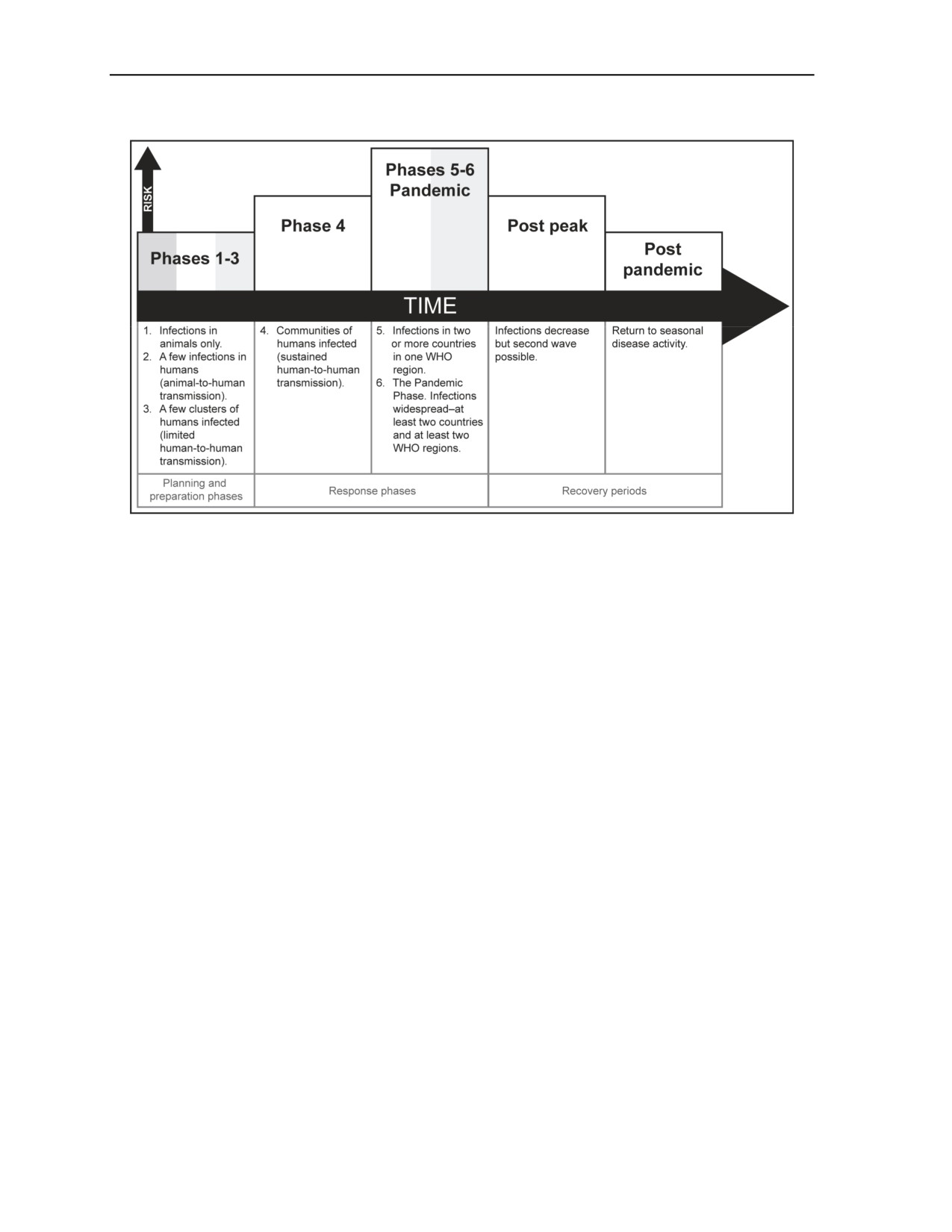
Chapter 4
Figure 4-1. World Health Organization pandemic influenza phases
4-40. Although biological weapons are a significant threat to homeland security, naturally occurring
diseases continue to pose a greater threat. For example, ricin and anthrax attacks have killed relatively
small numbers; West Nile Virus and influenza can kill tens of thousands. Pandemics have occurred
intermittently over centuries. The last three pandemics produced millions of fatalities. Animals are the most
likely reservoir for emerging viruses; avian viruses played a role in the last three influenza pandemics. The
2009 pandemic influenza may have originated with domestic pigs, quite possibly in North America.
Although the timing is unpredictable, history and science suggest that the United States will face additional
pandemics in this century. In a world of rapid movement of people and animals across intercontinental
distances, the outbreak of flu as serious as the outbreak of 1918 could produce far more fatalities. Viruses
remain difficult to combat. Vaccines for a new type of flu may take years to develop and produce, and their
effectiveness may vary widely, particularly as the virus continues to evolve rapidly. Generally, flu vaccines
improve resistance and may help reduce the severity of the infection, but the more novel the virus, the less
effective the vaccine.
4-41. A flu pandemic may cause political, social, economic instability while affecting military readiness.
While the flu will infect adversarial forces, it may not degrade their readiness and operational capability in
the same manner or at the same time as U.S. and allied forces. The degree to which countries can mitigate
morbidity and mortality during the pandemic influenza and reintegrate recovering individuals into society
will have considerable impact on military force capabilities. Countries with more advanced and robust
health care systems will be better able to mitigate many of the pandemic influenza effects.
SECURITY CONCERNS DURING A PANDEMIC
4-42. Key security concerns could arise during a period of turmoil caused by a pandemic. These include
opportunistic aggression, opportunities for violent extremists to acquire weapons of mass destruction,
reduced partner capacity during and after pandemic influenza, instability resulting from humanitarian
disaster, and decreased production and distribution of essential commodities. The prevalence of pandemic
influenza coupled with political, social and economic instability may result in reduced security capabilities,
providing an opportunity for military aggression and economic collapse, humanitarian crises, and dramatic
social change. The potential for pandemic influenza to reduce the number of mission-capable forces can
4-14
FM 3-28
20 August 2010
Provide Support for Domestic CBRNE Incidents
place DOD mission accomplishment at risk. Therefore, DOD’s objective is to prevent and reduce
transmission and illness within federal military installations so operational capabilities are preserved.
DOD’s ability to prevent or reduce transmission or illness and to regenerate, recruit, and sustain the force
will become critical. Efforts must include timely force health protection measures, requirements
identification and prioritization, proactive procurement, responsive and tailored logistic support, and
continuity of essential services.
DEPARTMENT OF DEFENSE READINESS FOR PANDEMICS
4-43. DOD policy and directives stress the importance of state-level planning and preparation before an
outbreak requires military resources. The priority of effort goes to installation readiness and force health
protection measures. The installation commander plays a pivotal role by coordinating installation response
planning and preparation. The flu will not distinguish between Regular military, National Guard and
Reserve Component forces, and DOD civilians. Most estimates predict that between 30 per cent and 40 per
cent of Soldiers or civilians would not report for duty (either because they are sick, or family members are
ill). A pandemic could degrade readiness so that units could not carry out their missions. This could occur
due to lack of a pandemic influenza vaccine, lack of antiviral drugs, lack of personal protective equipment,
and the lack of education on hygiene and social distancing. Therefore, the installation commander ensures
that the civilian workforce remains prepared for a possible influenza outbreak. Commanders ensure their
Soldiers receive flu vaccinations regularly. Post agencies develop plans to operate at reduced manning
levels by prioritizing missions and ensuring that critical positions have cross-trained replacements. Military
forces stress inoculation of personnel and develop plans to augment essential services. They also work with
the installation to ensure that families are prepared for an outbreak.
4-44. Training emphasizes casualty manning requirements for combat; commanders may need to
implement their casualty response plans before deployment. Commanders emphasize to junior leaders the
importance of having someone ready to step up to replace other members of the team when they are
unavailable. If deployment is imminent, commanders coordinate with higher headquarters for individual
movement of recovered Soldiers. Most important, commanders hold every leader responsible for basic
preventative measures shown to be highly effective at containing influenza:
z
Sanitation, particularly constant hand washing.
z
Rest and proper diet.
z
Isolation of infected Soldiers.
Commanders should coordinate with their supporting installation medical activity for guidance about anti-
viral drugs and other treatment for deploying Soldiers.
COORDINATED NATIONAL RESPONSE TO PANDEMIC DISEASE OUTBREAKS
4-45. The NRF provides the overall architecture for pandemic influenza response, but there are marked
differences to federal response for other incidents. The Department of Health and Human Services is the
supported agency for pandemic influenza response. USARNORTH works closely with Department of
Health and Human Services and FEMA to plan for defense support of civil authorities (DSCA) in a
pandemic.
4-46. The scope and pace of an influenza pandemic may defy accurate prediction. The disease may appear
in many different parts of the Nation almost simultaneously. It may occur in only one or a few
communities, and if not contained there, proceed to affect other communities. In either case, the Secretary
of Health and Human Services may have reason to exercise his or her authority under the Public Health
Service Act to declare a public health emergency before or coincident with activation of the NRF.
20 August 2010
FM 3-28
4-15
Chapter 4
4-47. The mission of DOD in a pandemic is to preserve the U.S. combat capabilities and readiness and to
support U.S. government efforts to save lives, reduce human suffering and slow the spread of infection.
Military actions before and during a major influenza outbreak focus on three areas:
z
Planning and preparation for a possible outbreak.
z
Maintaining combat readiness.
z
Support to state and federal agencies.
In any major outbreak of disease, public health workers and medical supplies will require security.
4-48. USNORTHCOM and USPACOM commanders will control federal military support to federal
authorities within their respective areas of responsibility.
Note: Federal military commanders should coordinate carefully with their chain of command to
clarify information handling requirements for personal identifying information concerning
citizens outside DOD assisted by the military.
Possible missions include military support to—
z
Deploy non-countermeasure components of international stockpile and diagnostic reagents to
support outbreak investigation, as well as technical and medical assistance.
z
Rapidly assess conditions and likelihood of international containment or slowing of pandemic
spread.
z
Support international deployment of countermeasures to affected regions.
z
Work with other countries to implement host country pre-departure screening and initiate U.S.
en route and arrival screening at U.S. ports of entry.
z
Consider travel or routing restrictions from the affected area and for countries that do not have
adequate pre-departure screening.
z
Implement protocols for cargo handling that allow trade to continue, when possible.
z
Implement protocols to manage or divert inbound international flights with suspected cases of
pandemic influenza and prepare to limit domestic ports of entry to manage increased demand for
screening, as needed.
z
Activate domestic quarantine stations and ensure coordination at state, local, and tribal level,
especially with health care resources.
z
Prepare to provide military bases and installation support to federal, state, local, and tribal
agencies.
z
Review domestic pandemic plans and prepare for response, placing critical staff on recall and
pre-deploying assets where appropriate.
z
Prepare to implement surge plans at federal medical facilities.
z
Activate domestic emergency medical personnel plans.
z
Deploy pre-pandemic vaccine to state and tribal entities and to federal agencies, and initiate
vaccination.
z
Limit non-essential passenger travel in affected areas and institute protective measures and
social distancing, and support continued delivery of essential goods and services.
z
Maintain continuous situational awareness of community needs, triage, and direct federal
support of health and medical systems, infrastructure, and maintenance of civil order as feasible.
4-49. National Guard forces will support their state emergency managers in a similar fashion, with one
important addition. National Guard commanders may provide Soldiers and Airmen to reinforce police
departments unable to provide full law enforcement support to their communities due to absences from
illness.
4-16
FM 3-28
20 August 2010
Provide Support for Domestic CBRNE Incidents
4-50. Public communication during a pandemic is the responsibility of federal and state health officials
through their joint information centers. As part of their daily preparation for the mission, Soldiers should
receive a situation briefing stressing the facts, and including key information that they can pass on to
citizens asking for help.
ENFORCEMENT OF ISOLATION AND QUARANTINE
4-51. A public health emergency may require isolation and quarantine measures to protect the public by
preventing exposure to infected or potentially infected individuals. Isolation refers to the separation and the
restriction of movement of people who have a specific infectious illness from healthy people to stop the
spread of any communicable illness. In most cases, quarantine refers to the separation and restriction of
movement of people exposed to an infectious disease. They may not be ill, but they may pose a risk of
spreading the disease inadvertently before they manifest clear symptoms. Isolation and quarantine of
civilians are normally voluntary but in extreme cases may be compulsory.
4-52. Because compulsory isolation or quarantine is a law enforcement function, Soldiers support law
enforcement officials only when authorized by the supported civilian agency through the mission
assignment process. Although Hollywood movies depict Regular Army troops enforcing quarantine, this
would not be the case in an actual health emergency. Federal military forces do not enforce quarantine.
National Guard Soldiers provide the majority of the military support required by their state’s officials, and
support compulsory measures only as authorized by their governor. See paragraphs 7-53 to 7-58 for more
information about legal considerations related to isolation and quarantine.
State Authority for Isolation and Quarantine
4-53. A state’s public health authority to enact statutes and issue regulations to compel isolation and
quarantine within its borders (intra-state) is derived from the 10th Amendment to the Constitution of the
United States and its inherent “police power.” As a result of these authorities, states have primary
responsibility to enact laws and regulations to promote health, safety, and welfare of its citizens. Consistent
with this authority, states may provide for isolation and quarantine restrictions within their borders and
conduct these activities in accordance with their respective statutes and regulations.
4-54. The governor of a state may impose isolation and quarantine restrictions in accordance with their
respective statutes and regulations. There is variation among states regarding the issue of compelled
isolation and quarantine. In general, a governor can declare a public health emergency to initiate isolation
or quarantine restrictions. Upon discovery of the need for quarantine or isolation by first responders, the
request is forwarded through the appropriate state agency to the governor for approval. The governor
assesses the requirements against the resources, and decides whether additional support must be provided
by the National Guard. If required such support is provided in state active duty status, unless the President
approves a request for support
Federal Government Authority for Isolation and Quarantine
4-55. The federal government has authority under the Commerce Clause of the Constitution to prevent the
spread of disease into the United States (foreign) or from one state to another (interstate). The Department
of Health and Human Services is the lead federal agency for isolation and quarantines. The Director of the
Center for Disease Control and Prevention has been delegated the authority from the Secretary of Health
and Human Services to determine whether measures taken by health authorities of any state are insufficient
to prevent the spread of any communicable diseases from such state to another state, and to take such
measures to prevent the spread of the disease as he deems reasonably necessary.
4-56. The President may authorize federal civilian authorities to detain, examine, and isolate individuals
that may have dangerous infectious diseases. This includes cholera, diphtheria, infectious tuberculosis,
influenza caused by novel or re-emergent influenza viruses, plague, severe acute respiratory syndrome
(known as SARS), smallpox, yellow fever, and viral hemorrhagic fevers that require isolation and
quarantine. The Secretary of Health and Human Services coordinates support from state and local
authorities for the enforcement of federal quarantine regulations. Such assistance may include National
20 August 2010
FM 3-28
4-17
Chapter 4
Guard forces, but the decision to employ National Guard Soldiers belongs to the governor, not the
President or the Secretary of Defense. The Secretary of Health and Human Services cooperates with states
in the enforcement of their quarantine. At the request of state authorities, Secretary of Health and Human
Services may extend temporary assistance to a state in meeting health emergencies. Such assistance may
include support provided by federal military forces as authorized by the Secretary of Defense.
4-57. Upon approval by the Secretary of Defense, federal military may be used to support a state
quarantine or isolation only by providing logistical, medical, transportation, communications, and other
appropriate disaster assistance support as requested by a primary federal agency under the Robert T.
Stafford Disaster Relief and Emergency Assistance Act (commonly known as the Stafford Act). This
assistance follows the mission assignment process. Unless the President specifically authorizes an
exception, federal military cannot be used to enforce a quarantine or isolation (see paragraphs 7-53 to 7-
58).
4-58. Because enforcing an isolation or quarantine is a “police power” function, public health officials at
the federal, state, and local level may seek the assistance of their respective law enforcement community.
At the federal level, this would be primarily the Department of Justice, Federal Bureau of Investigation,
United States Marshals Service, Drug Enforcement Administration, and Coast Guard.
Agricultural Diseases
4-59. Pandemic disease threats exist to plants and animals. An outbreak of hoof-and-mouth disease could
cost the livestock industry and the U.S. economy billions of dollars. The loss of a crop due to disease or
blight also creates economic impacts and could result in food shortages. For example, the potato famine in
Ireland forced millions to emigrate or starve in the 19th century. The outbreak was caused by a fungus.
Crops, feedlots, and food transportation networks are all at risk for contamination. Operating in support of
civil authorities, federal military could play a key role in a response to a biological hazard in the agriculture
industry.
4-60. In the case of agriculture, quarantine is often mandatory. Unfortunately, this often requires the
destruction of entire herds of livestock. The scale of the infection can rapidly overwhelm county and state
officials, and the governor may call up National Guard units to assist with disposal of euthanized animals.
Although this has not happened recently in the United States, European military forces assisted officials
following large-scale outbreaks of
“mad cow” and hoof-and-mouth infections. The Secretary of
Agriculture is authorized to cooperate with foreign countries, states, and other jurisdictions, to prevent,
regulate, and eliminate burdens on interstate commerce and foreign commerce. The Secretary of
Agriculture may request assistance from DOD in order to protect the agriculture, environment, economy,
and health and welfare of the population by preventing, detecting, controlling, and eradicating diseases and
pests of animals. When federal military support is requested, it will be provided under the Economy Act.
Federal military forces providing assistance will receive specific constraints and restraints on their
activities through the mission assignment process.
CONSIDERATIONS FOR DOMESTIC CBRNE INCIDENT RESPONSE
OPERATIONS
4-61. Actual and suspected CBRNE incidents have triggered response to a single incident site such as the
attack on the Pentagon in 2001 or to multiple sites in different states in response to the anthrax attacks of
2001. Responding military forces included both National Guard and Regular military units. For any large
incidents, DOD may commit some or all of Joint Task Force-Civil Support, the CBRNE consequence
management response force and other specialized CBRNE units such as technical support forces, and
various Defense Threat Reduction Agency teams. In large disasters or CBRNE incidents, DOD
installations serve as staging areas for resources and agencies. During anthrax responses in 2001 and 2002
for example, DOD laboratories, resources, and personnel played critical response roles that helped mitigate
incident impacts and costs to the public. As in other disasters, a large CBRNE incident will require military
forces to augment security and essential services.
4-18
FM 3-28
20 August 2010
Provide Support for Domestic CBRNE Incidents
COMMAND AND CONTROL FOR DOMESTIC CBRNE INCIDENT RESPONSE
4-62. In accordance with the NRF and NIMS, federal military will support a civilian incident command
structure with many agencies during civil support operations (see chapter 2). The incident command team
is responsible for managing the response. The incident command staff develops an incident action plan, a
type of operations order that assigns work tasks. The incident command staff determines safety measures,
technical reference, reach-back, personnel protective equipment, logistics, and other requirements. The
incident command staff, together with law enforcement, public health, Environmental Protection Agency,
Department of Energy and other agencies develops specific mission requirements such as obtaining
samples, setting decontamination standards, monitoring exposure levels The most difficult command and
control challenge during a CBRNE incident response is maintaining situational awareness at all levels and
across all agencies involved. Commanders plan for this by deploying liaison personnel who help the
commander to maintain constant communication with both military and civil authorities
4-63. Commanders must integrate composite risk management and operational risk management in their
planning to mitigate and manage hazards and ensure force protection when working with civilian agencies.
Tailored situational awareness teams perform the following tasks during CBRNE incidents:
z
Attend daily incident command planning meetings to anticipate mission requirements.
z
Describe to the incident command staff DOD capabilities and limitations.
z
Describe to the incident commander legal limitations for federal military and state National
Guard forces.
z
Provide liaison between other federal military and state National Guard forces in the area.
z
Secure resources not provided by DOD.
z
Clarify or translate civilian work requirements into tasks related to DOD.
z
Establish communications links.
z
Augment the incident command staff with CBRNE specialists.
4-64. Most command and control systems developed for combat are incompatible with civilian systems
unless the military provides specialized connections. Developing situational awareness and building a
common operational picture is critical to effective response. Many state and local emergency operations
centers use commercial communications software. State agencies, the National Guard Bureau, and
USNORTHCOM continually improve tools that facilitate information sharing at CBRNE and other
incident sites.
PUBLIC AFFAIRS AND DOMESTIC CBRNE INCIDENT RESPONSE
4-65. CBRNE incident response activities are likely to be highly publicized and can place great pressure
on leaders. The public information and education efforts are essential to easing fear and protecting the
public during CBRNE incidents. Accurate information regarding the incident and efforts to protect the
public should be disseminated to all subordinates as soon as the incident command staff makes it available.
To ensure a unified message, public affairs information is coordinated through the incident command staff
during civil support operations. Military public affairs personnel work directly with incident command’s
joint information center to synchronize efforts.
4-66. Commanders, leaders, and Soldiers play a key role in information. The actions of Soldiers on the
ground communicate far more powerfully than other media. Those actions must be in accordance with the
command’s public affairs guidance. Civilians may assume that uniformed personnel know more about the
situation than others do. Rumors will be rampant during the initial response. Disruption to civilian
broadcasts may limit routine sources of information. Therefore, federal military may be able to provide
updated, factual information to the local populace. Commanders must brief their personnel daily on the
public affairs guidance. See appendix K for more information about public affairs.
20 August 2010
FM 3-28
4-19
Chapter 4
PROTECTION DURING DOMESTIC CBRNE INCIDENT RESPONSE
4-67. Conventional battlefield protective and detection systems cannot meet all battlefield and homeland
security CBRNE requirements. Commanders must understand the limitations of their equipment and
personnel. During a CBRNE incident, the incident command staff determines the level of protective
garment required based on the hazard.
Chemical Protection
4-68. Conventional forces are not equipped to detect or protect against toxic industrial chemicals and
materials. Joint Service Lightweight Integrated Suit Technology (JSLIST) and protective masks do not
meet civilian chemical protection standards or protect against most toxic industrial materials. Battlefield
chemical detection systems detect specific battlefield threats. Presently weapons of mass destruction-civil
support teams, CBRNE consequence management response force units, and attached chemical, biological,
radiological, and nuclear defense units along with elements of the 20th Support Command have enhanced
CBRNE and industrial chemical protection and detection capabilities. These capabilities are being issued to
conventional chemical units in the modular brigades.
Biological Protection
4-69. Battlefield protective equipment will protect Soldiers against biological hazards. Most biological
detection systems screen for battlefield biological hazards. Current biological detection and analytical
equipment require extensive training and laboratory support for confirmative results. Weapons of mass
destruction-civil support teams possess mobile analytical laboratory systems and train to meet standards
required by civilian agencies and laboratory networks. In civil support operations, public health
departments and other agencies handle the majority of biological sampling and identification.
Nuclear Protection
4-70. U.S. military forces are equipped to deal with the domestic consequences of a nuclear or radiological
incident. Battlefield radiological detection equipment and protective gear are suited for civil support
operations. Post-blast nuclear and radiological devices present standard exposure levels and decay rates.
Conventional radiological detection systems can detect and monitor radioactive materials. However, these
systems require training to use properly.
Decontamination
4-71. Battlefield decontamination equipment and measures work well against CBRNE hazards. Sunlight,
household disinfectants, and inclement weather also break down some chemical and biological
contaminants. Equipped with commercial equipment, the CBRNE enhanced response force package,
chemical-biological incident response force, and CBRNE consequence management response force units
can support the decontamination of mass casualties or responders during large incidents. Commanders and
leaders of CBRNE decontamination units coordinate with their headquarters concerning the location and
procedures for operating the station. If available, team leaders should consult with civilian experts from
Defense Threat Reduction Agency, Environmental Protection Agency, and other organizations. In
particular, senior commanders need to confirm the proposed location and protection measures at the
decontamination site with the unified coordination group to ensure hazardous substances are controlled and
eliminated safely.
Hazard Prediction Models
4-72. Hazard prediction modeling programs graphically depict the impacts of CBRNE hazards for
commanders and incident commanders. Under the NRF, the Interagency Modeling and Atmospheric
Advisory Center employs the National Atmospheric Release Advisory Center, which is the single
hazardous airborne and dispersion prediction model used during a federal response. In a CBRNE incident,
models can provide information on casualty estimates, contaminated areas, road block locations, local
4-20
FM 3-28
20 August 2010
Provide Support for Domestic CBRNE Incidents
hospitals, airfields and hazards concentrations. This information helps the incident command staff and
supporting agencies organize staging areas, define work zones, conduct downwind monitoring, and
determine evacuation measures. Units operating near a CBRNE incident site should obtain prediction
models through the incident command for situational awareness and force protection. The Defense Threat
Reduction Agency, weapons of mass destruction-civil support teams, and fire departments employ hazard
prediction models.
Protective Equipment
4-73. Battlefield protective equipment and civilian personal protective equipment terminologies and
employment are different. Required protective equipment levels vary throughout a response based on the
nature of the hazard, distance from a hazard, weather conditions and work being completed. Flexibility in
employing personal protective equipment or military protective gear and Soldier safety are priorities. Some
CBRNE responses might require light gloves and eyewear rather than a full protective overgarment.
Civilian personal protective equipment is categorized by levels A, B, C, and D. Level A is a fully
encapsulated vapor protective suit with a self-contained breathing apparatus (SCBA). Level B is a hooded
protective suit and SCBA. Level C is a hooded protective suit with a filtered air purifying respirator. Level
A, B, and C suits use many types of flexible flash and or chemical protective materials from laminated
fabrics and plastics. Level D is a response duty uniform that might include earplugs, gloves, protective
footgear and eyewear. Battlefield protective levels do not match civilian personal protective equipment
levels. Based on the CBRNE hazards, military protective equipment may not be appropriate. The use of
level A, B, C, and D personal protective equipment requires special training and certification.
4-74. Special attention must be given to heat injury prevention to personnel using personal protective
equipment. The civilian incident commander will normally determine the level of personal protective
equipment based on the hazard. In a large federal response, Environmental Protection Agency, Centers for
Disease Control, Department of Energy, response organizations, and the safety officer might contribute to
personal protective equipment decisions. When the hazard is unknown, Level A personal protective
equipment is chosen.
MOVEMENT AND MANEUVER DURING DOMESTIC CBRNE INCIDENT RESPONSE
OPERATIONS
4-75. The incident staging area is the equivalent of an intermediate staging base. Units move to an incident
staging area determined by an incident command staff prior to moving into a CBRNE incident site. The
staging area personnel receive the unit’s personnel and equipment accountability information and provide
details regarding the incident. Before leaving the staging area, a unit receives it mission, safety briefings,
and updated information regarding the incident. Debris, contaminated areas, other responding agencies,
and terrain might delay movement.
4-76. Contaminated areas present a serious hazard to movement near any CBRNE incident. One of the key
tasks that Army forces may anticipate is establishing and maintaining security around a contaminated area,
sometimes known as a “hot zone.” In an urban area this task can be manpower intensive. It requires close
coordination with the incident command and unified area command to ensure its proper placement,
security, and maintenance. Commanders keep in mind that the contaminated area may shift suddenly due to
weather or other factors. Army forces directed to move into a contaminated area plan and rehearse prior to
executing the mission. Ideally, the unit is equipped for CBRNE incidents. Otherwise, if a unit is responding
to an emergency, Soldiers should follow the unit standing operating procedure for movement techniques in
a contaminated environment. Some combat systems provide much better protection than other vehicles,
particularly against radiation and chemical threats. Stryker nuclear, biological, and chemical
reconnaissance vehicles have overpressure and detection systems and their armor reduces radiation
exposure. The M-88 Hercules also has heavy steel armor, and can maneuver in radioactive areas. The
armor on these vehicles can attenuate the effects of gamma radiation, and extend the time that rescue or
recovery personnel can spend in the hot zone.
20 August 2010
FM 3-28
4-21
Chapter 4
4-77. Movement in or near a contaminated area requires decontamination support. Unless decontamination
support is available, commanders should not send Soldiers into or near a contaminated area. Commanders
must coordinate with the supporting decontamination element to ensure that they can conduct the necessary
detection and decontamination before committing Soldiers.
4-78. Aviation unit commanders must review current instructions for operating in or near a contaminated
area. A helicopter is almost impossible to decontaminate completely once exposed to hazardous agents or
radiation. Aircraft generally should avoid flying near contaminated areas, if possible. If the mission
requires exposing the aircraft and crew to hazardous materials, the aviation unit must establish protective
procedures for immediate decontamination, and train the air crew in protective measures.
4-79. Engineering support to a CBRNE incident response is extensive and supports all of the other
functions. The key capabilities the engineers provide include—
z
Force bed down and marshalling support.
z
Emergency route opening (use of any available means to enable ground emergency movement
into and out of the affected area).
z
Engineer site assessment.
z
Infrastructure repair.
z
Geospatial information support. (Paragraphs 8-81-8-82 discuss geospatial support. Chapter 7
discusses legal considerations related to information.)
SUSTAINMENT FOR DOMESTIC CBRNE INCIDENT RESPONSE OPERATIONS
4-80. A large scale CBRNE incident can quickly exhaust the capabilities of local, state, and federal
emergency responders. CBRNE emergency responders develop sustainment plans that include the
coordination for and establishment of logistics systems to ensure continuous replenishment of
consumables, personnel, spare parts, and maintenance. DOD installations should plan for sustainment of its
CBRNE emergency responder preparedness programs as well as establish contact with the appropriate state
and federal emergency response officials within the installations respective FEMA region.
CBRNE Incident Response Equipment
4-81. Equipment requirements vary depending upon the nature of the CBRNE incident. Equipment could
be provided by FEMA, USARNORTH, Joint Task Force-Civil Support, fire departments, state agencies,
military stocks or local purchase. CBRNE response units should deploy to an incident site with the ability
to sustain themselves for two to three days and then submit resupply requirements through their chains of
command.
National Guard Consequence Management Support Center
4-82. The National Guard’s weapons of mass destruction-civil support teams and CBRNE enhanced
response force package forces receive support from the consequence management support center. The
consequence management support center provides weapons of mass destruction-civil support teams and
CBRNE enhanced response force packages full replacement of shelters, light sets, air compressors,
CBRNE detection, decontamination, batteries, calibration gases, masks, protective garments, self-contained
breathing apparatus and analytical equipment required to sustain an extended CBRNE incident response
mission. The consequence management support center rapidly deploys equipment stocks to an incident site.
In extended response, the consequence management support center forward deploys personnel and
equipment to directly support the CBRNE enhanced response force packages and weapons of mass
destruction-civil support teams.
Federal Emergency Management Agency Sustainment
4-83. FEMA supplies pre-positioned equipment to replenish and reconstitute state, local, and tribal
responders incident site. This equipment includes protective equipment, detection instruments, medical
supplies, decontamination equipment, and logistics.
4-22
FM 3-28
20 August 2010
Provide Support for Domestic CBRNE Incidents
Sustainment from Military Installations During CBRNE Incident Response
4-84. Some military installations have equipment for responding to CBRNE incidents. They may have a
fire department with appropriate assets. During an emergency, installations might provide protective
equipment, air compressors, fire trucks, decontamination systems, power generation, detection equipment
and other resources. Installations also serve as staging areas providing food, shelter, fuel, headquarters
facilities, and vehicles to responding units.
4-85. Mortuary affairs personnel may support CBRNE incidents. Team leaders should verify procedures
for handling remains through higher headquarters and through the defense coordinating officer to the
primary agency responsible for the appropriate emergency support function (normally ESF #8). Specific
procedures on identifying and handling contaminated remains are according to the existing civilian plans
and JP 4-06 to the controlling National Guard and federal military joint task force.
INTELLIGENCE CAPABILITIES DURING DOMESTIC CBRNE INCIDENT RESPONSE
OPERATIONS
4-86. Domestic intelligence remains a sensitive area in civil support, and incident awareness and
assessment during CBRNE incidents may be subject to additional regulatory requirements. See chapter 7
for more information about legal considerations. Commanders should carefully review instructions
concerning intelligence capabilities in their specific execution orders. The majority of military intelligence
support pertains to ongoing terrorist activities and CBRNE incident investigation. The Department of
Justice, Department of Homeland Security, Central Intelligence Agency, and other law enforcement
agencies provide domestic intelligence to military commanders daily. Intelligence on domestic terrorists
and criminals will come through secure law enforcement channels. The need for intelligence in CBRNE
incidents drives the requirement for secure communication between all participating agencies and the
military. Military communication systems will tie in with the civilian Joint Incident Site Communications
Capability secure communications system. FEMA and other agencies provide this capability to share
classified or sensitive information.
4-87. Environmental and safety information receives the widest possible dissemination. The incident
command operations staff provides all unclassified information and analysis on the hazardous area to
ensure the safety of responders, hospitals, and others impacted by the incident. Intelligence staff members
can provide mapping, situational awareness, liaison support, and weather support during a CBRNE
incident response.
4-88. The incident command operations and planning sections manage CBRNE incident information. A
hazardous materials working group under the operations staff might form in order to coordinate incident
information and direct operations. The incident command operations staff receives CBRNE and other
hazardous materials survey reports from fire fighters, Department of Energy, DOD, Environmental
Protection Agency, and other agencies responding and monitoring an incident site. This information refines
hazard prediction models to develop a common operational picture of the hazardous locations. The
Interagency Model and Atmospheric Advisory Center provide the contamination prediction model for all
federal responses. Field measurement and reporting confirms or alternatively, modifies the predictive
models.
20 August 2010
FM 3-28
4-23
Chapter 5
Provide Support for Domestic Civilian Law Enforcement
Agencies
This chapter covers general concepts for military support to civilian law enforcement
agencies. It summarizes the important laws and policy that govern support. It
discusses the types of law enforcement missions that commanders could receive, and
provides considerations for the employment of forces, particularly in civil
disturbance scenarios.
PRINCIPAL AUTHORITES FOR SUPPORT TO DOMESTIC CIVILIAN
LAW ENFORCEMENT AGENCIES
5-1. State and federal law carefully limits the support that Army forces may provide to civilian law
enforcement agencies. Federal laws, Presidential directives, and Department of Defense (DOD) policy
constrain the use of federal military forces from enforcing laws and providing security except on military
installations. When authorized by the Secretary of Defense, federal military forces may provide support to
law enforcement agencies, but that support is limited to logistical, transportation, and training assistance
except in life-threatening emergencies. The governors of the 54 states and territories can use National
Guard forces under state command for civilian law enforcement; however, use of state National Guard
forces for support to law enforcement is a temporary expedient. Governors have some flexibility in
employing state National Guard forces for law enforcement. Chapter 7 provides additional information on
the legal considerations for law enforcement support. Department of Defense Directive (DODD) 3025.12
summarizes the responsibilities of civil authorities for law enforcement:
The primary responsibility for protecting life and property and maintaining law and
order in the civilian community is vested in the State and local governments.
Supplementary responsibility is vested by statute in specific Agencies of the Federal
Government other than the Department of Defense. The President has additional powers
and responsibilities under the Constitution of the United States to ensure that law and
order are maintained.
DODD 3025.12
5-2. Domestic law enforcement missions differ substantially from similar stability tasks associated with
civil security and civil control. Except in extreme emergencies, during domestic law enforcement
operations the rights of the citizens take precedence. Military forces supporting law enforcement typically
have less authority to enforce the law than when conducting stability operations. When circumstances
dictate, the governor of a state may call up National Guard forces to assist local and state law officers. The
National Guard’s authority derives from the governor’s responsibility to enforce the laws of that state.
Even with that authority, the governor carefully regulates the amount and nature of the support. The
governor may employ the state National Guard for law enforcement duties and support in state active duty
status or in Title 32 status. Federal laws (principally the Posse Comitatus Act) restrict the role of any
National Guard forces in Title 10 status for law enforcement support (see chapter 7) unless a specific
exemption is applicable.
20 August 2010
FM-3-28
5-1
Chapter 5
5-3. Military support to civilian law enforcement agencies occurs in two general circumstances: in
response to an emergency or in response to a request for support from a law enforcement agency. The more
difficult case occurs as part of an emergency. Federal Army forces may provide indirect support to federal,
state, and local law enforcement organizations reacting to civil disturbances, conducting border security
and counterdrug missions, preparing for antiterrorism operations, and providing other related support to
law enforcement, but such support requires the approval of the Secretary of Defense. Before approval, the
DOD legal staff normally conducts a comprehensive legal review of the request and advises the Secretary
of Defense on their conclusion.
5-4. Upon approval of the governor, state National Guard forces may support state law enforcement
agencies within their respective states and within the limits prescribed by state law. State National Guard
forces in either Title 32 status or state active duty status from another state operating under the Emergency
Management Assistance Compact (EMAC) or a memorandum of agreement between the states may only
support civilian law enforcement as specified in a memorandum approved by both governors.
LAW ENFORCEMENT SUPPORT UNDER THE POSSE COMITATUS ACT
5-5. The Posse Comitatus Act restricts the use of the federal military forces for direct support to civilian
law enforcement. Except as expressly authorized by the Constitution of the United States or by another act
of Congress, the Posse Comitatus Act and DOD directives prohibit the use of the Army, Air Force, and—
through DOD policy—the Navy and Marine Corps as enforcement officials to execute state or federal law
and perform direct law enforcement functions. The Navy and Marine Corps are included in this prohibition
as a result of DOD policy articulated in DODD 5525.5. However, the Posse Comitatus Act does not apply
to state National Guard forces operating in state active duty status or in Title 32 status. Due to the state
National Guard’s statutory law enforcement functions, the Posse Comitatus Act does not apply. Nor does
the Posse Comitatus Act restrict the Coast Guard, even when it falls under the operational control of the
Navy due to the fact that the Coast Guard has inherent law enforcement powers under Title 14, United
States Code (USC). Commanders should understand that the Posse Comitatus Act specifies severe criminal
penalties if violated. Chapter 7 provides additional detail on the Posse Comitatus Act.
5-6. A catastrophic disaster may overwhelm local law enforcement, particularly when they are
responding with a disrupted command and control system. National Guard forces support law enforcement
when the governor authorizes that state’s military command to assume designated law enforcement duties.
The specific legal authority for National Guard members to conduct law enforcement functions are derived
from state law and vary from state to state. Federal military forces require special authorization, from the
Secretary of Defense, to support civilian law enforcement officials outside of federal military installations.
In extreme cases, the state attorney general, in coordination with the Secretary of Defense, may recommend
that the President invoke the Insurrection Act (see chapter 7). The restrictions on federalized military
forces are derived from Posse Comitatus Act case law and are summarized in the Chairman of the Joint
Chiefs of Staff standing execute order for DSCA order (referred to as the CJCS DSCA EXORD) dated 14
August 2009:
Unless specifically authorized by law, no DOD personnel in a Title 10, United States
Code (USC), status (Federal military forces) will become involved in direct civilian law
enforcement activities, including, but not limited to, search, seizure, arrest,
apprehension, stop and frisk, surveillance, pursuit, interrogation, investigation, evidence
collection, security functions, traffic or crowd control, or similar activities, except in
cases and under circumstances expressly authorized by the President, Constitution, or
Act of Congress.
CJCS DSCA EXORD, 14 August 2009
5-2
FM 3-28
20 August 2010
Provide Support for Domestic Civilian Law Enforcement Agencies
5-7. DODD 5525.5 provides guidance on the type of assistance DOD can provide to local authorities
when it is primarily for a military purpose and does not violate the Posse Comitatus Act. This guidance is
known as the “Military Purpose Doctrine.” Such support cannot degrade combat readiness or the capacity
of DOD to fulfill its primary mission. In general, the less directly related the situation is to civilian law
enforcement and the more it supports a military purpose, the less applicable is the Posse Comitatus Act.
“Military Purpose” actions include:
z
Investigations and other actions related to the enforcement to the Uniform Code of Military
Justice.
z
Investigations and other actions related to the commander’s inherent authority to maintain law
and order on a military installation or facility.
z
Protection of classified military information or equipment.
z
Protection of DOD personnel, DOD equipment, and official guests of the DOD.
z
Other actions that are undertaken primarily for a military or foreign affairs purpose.
LAW ENFORCEMENT SUPPORT UNDER EMERGENCY AUTHORITY
5-8. In an extreme situation, federal military commanders may commit their forces to uphold the law and
protect federal property. Only two circumstances for emergency authority are allowed by DODD 5525.5.
5-9. The first circumstance is when a situation demands immediate federal action, including use of
military forces, to prevent loss of life or wanton destruction of property and to restore governmental
functioning and public order. The need for federal military forces might arise because of sudden and
unexpected civil disturbances, disasters, or calamities. Incidents such as these may seriously endanger life
and property and disrupt normal governmental functions to such an extent that duly constituted local
authorities are unable to control the situation. The Posse Comitatus Act’s restrictions on direct participation
in law enforcement still apply in this situation unless another exemption exists.
5-10. The second circumstance is when a situation requires federal military forces to protect federal
property and federal government functions. The need might arise when there was an immediate and
discernable threat, and duly constituted local authorities were unable or declined to provide adequate
protection.
5-11. In either of these situations, federal military commanders responsible for authorizing action under
emergency authority must determine that obtaining prior approval from the President through the chain of
command is not feasible. Commanders will continue to use all available means to seek specific
authorization from the President through their chain of command while operating under their emergency
authority.
MARTIAL LAW
5-12. Martial law involves use of the military to exercise police powers; restore and maintain order; ensure
essential mechanics of distribution, transportation and communication; and conduct necessary relief
measures. In such cases, the ordinary law, as administered by the ordinary courts, is superseded for the
time being by the order of a military commander. See page 5-4 for a summary of the historical use of
martial law in the United States.
20 August 2010
FM 3-28
5-3
Chapter 5
Historical Use of Martial Law
Martial law was first used in the United States by General Andrew Jackson in 1814,
during the War of 1812. Later, during the Civil War, Confederate territory taken by
Union forces was governed under martial law. Additionally, the Secretary of War
issued an order under President Lincoln’s authority suspending the writ of habeas
corpus. In other words, individuals were arrested and detained indefinitely by a
military commander without trial. After the Civil War, the Supreme Court in the
seminal case of Ex Parte Milligan reviewed and declared this martial law invalid. It
said when it is extremely necessary to furnish a substitute for civilian government
and the only authority left is the military, then martial law exercised by the military
was permissible and could be implemented. However, where the civilian courts were
open and capable of exercising their law enforcement jurisdiction and trying
individuals who violated civil laws, as they were in this case, then martial law could
never properly exist. “Public necessity” creates martial law, justifies it, and limits its
duration. Other instances of martial law occurred during World War II, when Hawaii’s
governor placed the territory under martial law from December 1941 to October
1944, and in 1954 when Alabama’s governor declared martial law in Phenix City,
enforced by the Alabama National Guard.
5-13. Only the President may order federal military forces to impose martial law. DODD 3025.12 states
that federal military commanders shall not take charge of any function of civil government unless
absolutely necessary under conditions of extreme emergency. Any commander who is directed, or
undertakes, to control such functions shall strictly limit military actions to the emergency needs, and shall
facilitate the reestablishment of civil responsibility at the earliest time possible.
5-14. Other officials may be authorized to impose martial law within a particular state under that state’s
law, but the restraints are similar to the federal level. The state and federal supreme courts may review any
imposition of martial law for legality.
MAIN TYPES OF MISSIONS FOR SUPPORT TO DOMESTIC
CIVILIAN LAW ENFORCEMENT AGENCIES
5-15. Support to civil law enforcement agencies usually falls under four general mission areas. Military
forces may provide indirect support for counterdrug activities, border security and protection from
terrorism. Military forces may provide direct and indirect support during civil disturbance operations.
Another category is critical infrastructure protection and is addressed in chapter 6. The military force with
primary responsibility for direct law enforcement support (for example, involving face-to-face contact with
offenders) is the National Guard, under state command and control.
5-16. Although federal military forces have limitations on direct enforcement of the law, DOD provides
indirect support to civilian law enforcement regularly. Indirect assistance facilitates the supported civilian
agency’s ability to enforce the laws, while maintaining separation between the Soldier and the civilian
offenders. DOD policy provides federal military commanders with guidance on indirect federal military
support to civilian law enforcement agencies. DOD policy allows indirect federal military support to
civilian law enforcement based on the following criteria:
z
Assistance is limited to situations when the use of persons not affiliated with DOD would be
unfeasible or impractical from a cost or time perspective and would not otherwise compromise
national security or military preparedness concerns.
z
Assistance may not involve DOD personnel in a direct role in law enforcement operation, except
as otherwise authorized by law.
5-4
FM 3-28
20 August 2010
Provide Support for Domestic Civilian Law Enforcement Agencies
z
Except as otherwise authorized by law, assistance by DOD personnel will occur at a location
where there is not a reasonable likelihood of a law enforcement confrontation.
z
Military departments and defense agencies may provide expert advice to federal, state, or local
law enforcement officials in accordance with Title 10, USC. This does not permit regular or
direct involvement of military personnel in activities that are fundamentally civilian law
enforcement operations, except as otherwise authorized.
z
Use of DOD personnel to operate or maintain or to assist in operating or maintaining equipment
is limited to situations when the training of persons not affiliated with DOD would be unfeasible
or impractical from a cost or time perspective and would not otherwise compromise national
security or military preparedness concerns.
COUNTERDRUG SUPPORT
5-17. DOD supports federal, state, and local law enforcement agencies in their effort to disrupt the
transport or transfer of illegal drugs into the United States. Illicit drug trafficking, smuggling of every sort,
and the regional and global movement of terrorists are closely linked by financial, political, and operational
ties.
5-18. Countering illegal drugs is a high priority mission. DOD functions and responsibilities related to
counterdrug support are based on statutory authority. DOD supports counterdrug operations to enhance
national security and international cooperation. The Armed Forces of the United States also assist partner
nations in their counterdrug efforts.
5-19. The strategic goals of the National Drug Control Strategy are preventing drug use before it starts,
intervening and healing those who already use drugs, and disrupting the market for illicit substances. In
support of this strategy, Army forces assist law enforcement officials indirectly through loan of equipment
(without operators), use of facilities (such as buildings, training areas, or ranges), transfer of excess
equipment, and training conducted in military schools.
5-20. Indirect support by federal military forces to counterdrug agencies requires approval by the Secretary
of Defense or a designated representative. Three standing joint task force headquarters provide indirect
support to domestic civilian law enforcement agencies. Joint Task Force-North supports counterdrug
efforts within the United States Northern Command (USNORTHCOM) area of responsibility. Joint Task
Force-West does the same in the United States Pacific Command (USPACOM) area of responsibility. The
Joint Interagency Task Force operates in the United States Southern Command area of responsibility. The
missions vary widely and may include ground reconnaissance; detection and monitoring; communications
support; aerial reconnaissance; marijuana eradication; linguist support; air and ground transportation;
intelligence analysis; tunnel detection; engineering support; and maintenance support.
Note: Military forces are prohibited from using herbicides.
5-21. There are 54 state and territory National Guard counterdrug support programs, governed by National
Guard regulations. Additionally, there are four regional National Guard counterdrug schools. The Secretary
of Defense, in accordance with Section 112 of Title 32, USC, may provide resources though the Chief,
National Guard Bureau, to states with approved National Guard counterdrug support plans. In addition to
requiring approval by the Secretary of Defense, the state National Guard counterdrug support plan requires
approval from the state's attorney general and adjutant general. The Secretary of Defense, (under Section
1004, National Defense Authorization Act for Fiscal Year 1991, as amended) may provide funding through
the Chief of the National Guard Bureau to a state receiving Secretary of Defense approval of a counterdrug
school execution plan for National Guard Training Support. The National Guard Bureau funds a full-time
Title 32 Active Guard and Reserve counterdrug coordinator position in each state for administration and
management of the state counter drug program. The counterdrug coordinator serves as the focal point for
all counter drug mission validations, approval authority, and the prioritization for counterdrug mission
tasking under appropriate policies, instructions, and directives. National Guard support can include linguist
support (translators), investigative case and analyst support, operational or investigative case support,
20 August 2010
FM 3-28
5-5
Chapter 5
engineer support, subsurface diver support, domestic cannabis suppression support, transportation support,
maintenance or logistical support, cargo or mail inspection, counterdrug-related training, training law
enforcement agency or military personnel, ground reconnaissance, aerial reconnaissance, and demand
reduction support.
BORDER SECURITY
5-22. The Department of Homeland Security may request support from federal military forces. Requests
for assistance go from Department of Homeland Security to the Secretary of Defense or the Assistant
Secretary of Defense (Homeland Defense and America’s Security Affairs). If approved by the Secretary of
Defense, federal military forces provide indirect support to border security and law enforcement personnel,
as well as immigration and naturalization officers. Joint Task Force-North exercises tactical control over
federal military assets within the USNORTHCOM area of responsibility.
5-23. State National Guard forces also provide support to Department of Homeland Security border
security programs. Under Section 112 of Title 32, USC, National Guard Soldiers assist in border security
by operating surveillance systems, analyzing intelligence, installing fences and vehicle barriers, building
roads, and providing training. Although state National Guard units could participate in direct law
enforcement activities related to border security, under DOD policy they normally provide indirect support,
under the control of their governor.
5-24. DOD may indirectly support border security efforts under legislation contained in Title 10, USC,
Sections 371 through 374. This is provided through Joint Task Force-North. Joint Task Force-North does
not directly enforce the laws pertaining to homeland security. Its mission is to improve the capabilities of
Department of Homeland Security agencies to carry out their law enforcement missions.
HOMELAND DEFENSE ACTIVITIES
5-25. Under Sections 901 to 908, Title 32, USC, the Secretary of Defense may provide DOD funding for
National Guard Soldiers in a Title 32 status to conduct homeland defense activities within their state. The
National Guard Soldiers performing this type of homeland defense duty remain under the command and
control of the governor. The duration of this duty is limited to 180 days, but the governor may extend the
tour by 90 days with the concurrence of the Secretary of Defense.
CIVIL DISTURBANCE
5-26. When large numbers of people disregard the law—through mob behavior and rioting, for example—
local and state police may become unable to protect lives and property, particularly if the mob is armed.
Large civil disturbances have occurred throughout U.S. history and frequently have turned deadly. The
most recent instance of both federal forces and state National Guard forces controlling a large civil
disturbance occurred during the Los Angeles riots in 1992. National Guard forces under state control are
responsible for direct support to law enforcement in civil disturbance operations.
5-27. United States Army North (USARNORTH) categorizes civil disturbances according to three general
scenarios:
z
Violent-destructive-nonconfrontational.
z
Violent-destructive-confrontational.
z
Nonviolent-nondestructive-confrontational.
Using these scenarios helps commanders determine mission requirements. In all types of scenarios,
planners maintain situational awareness and assessment so supporting forces can anticipate requirements
and prepare for contingencies. They coordinate with civilian law enforcement agencies as needed.
5-28. The first scenario—violent-destructive-nonconfrontational—is the most likely to require federal
intervention. One example is the Los Angeles riots of 1992. This scenario is considered nonconfrontational
because the violence is not targeted at authorities. Mobs behave violently toward other civilians and
destroy property. The civil disorder is dispersed and intermittent. A variety of causes may lead to this type
of situation, including hurricanes that destroy infrastructure. In this scenario, violence can quickly
5-6
FM 3-28
20 August 2010
Provide Support for Domestic Civilian Law Enforcement Agencies
overwhelm state capabilities. Popular discontent can cause violence to spread to several localities. This
type of scenario may be the costliest in terms of property damage. It typically requires the quickest
response and is the most dangerous to supporting forces.
5-29. The second scenario—violent-destructive-confrontational—refers to concentrated demonstrations of
limited duration and focused at points with psychological significance. Antagonism is directed at
authorities. Examples are the 1967 march on the Pentagon and the 1973 Wounded Knee standoff. These
incidents may start as a planned, lawful protest or special event. If violence erupts, however, it happens
suddenly.
5-30. The third scenario—nonviolent-nondestructive-confrontational—refers to peaceful demonstrations
against civil or military authorities. This is the least likely to require federal forces. For example, peaceful
protesters might block the entrance to a public building or trespass on a military installation.
State National Guard Forces
5-31. The governor may call out the National Guard to quell any civil disturbance when it threatens lives
or property. National Guard forces disperse unlawful assemblies and patrol areas to prevent unlawful acts.
They assist in the distribution of essential goods and the maintenance of essential services. Military forces
also establish traffic control points, cordon off areas, release smoke and obscurants, and serve as security
or quick-reaction forces. The National Guard joint task force commander provides liaison teams to each
affected law enforcement agency and normally positions the joint task force headquarters near the police
headquarters. In addition to support for law enforcement agencies, National Guard forces provide security
for emergency responders, particularly fire fighters. After review by the state attorney general, the
governor approves the rules for the use of force.
Note: There is no standard military nomenclature for rules for the use of force between the 54
states and territories.
Federal Military Forces
5-32. Federal military forces may reinforce law enforcement agencies responding to civil disturbances.
Federal military support for civil disturbances does not, technically, fall under support to civilian law
enforcement agencies when the Insurrection Act or other exemptions to the Posse Comitatus Act are used.
The primary reference for civil disturbance is DODD 3025.12. The President may employ the Armed
Forces of the United States, including the National Guard, within the United States to restore order or
enforce federal law when requested by the state legislature, or when not in session, by the governor, and
when the authorities of the state are incapable of maintaining public order. The President normally initiates
action by ordering the dispersal of those obstructing the enforcement of the laws. The President may also
act unilaterally to suppress an insurrection or domestic violation without the request or authority of the
governor in order to protect the federal government, enforce federal law, or protect the constitutional rights
of citizens.
5-33. Responsibility for coordinating the federal response for civil disturbances rests with the Attorney
General of the United States. The Attorney General appoints a senior civilian representative as his or her
action agent. Any federal military employed in civil disturbance operations remain under military
command at all times. Forces deployed to assist federal and local authorities in a civil disturbance adhere to
the rules for the use of force approved by the combatant commander.
5-34. USNORTHCOM develops and maintains plans for civil disturbance operations. These plans provide
the foundation for civil disturbance support and standardize most military activities and command
relationships. Tasks performed by military forces may include joint patrolling with law enforcement
officers; securing key buildings, memorials, intersections and bridges; and acting as a quick reaction force.
20 August 2010
FM 3-28
5-7
Chapter 5
Training for Civil Disturbance Operations
5-35. Civil disturbance missions require unit training prior to employing crowd control tactics. This
normally requires a mobile training team from the military police or trained law enforcement personnel.
Note that effective employment of shields and batons requires frequent drilling, and small-unit leaders
should put their subordinates through these drills during any available time between commitments. Even in
an urgent situation, commanders need to drill their forces repeatedly until small unit leaders can execute
maneuvers under extreme stress. Training should be all-arms, emphasizing treatment and evacuation
procedures, detention and movement of citizens, and use of authorized nonlethal systems.
PROTECTION AGAINST TERRORISM
5-36. Protecting against terrorism in the United States is a civilian law enforcement responsibility. The
Department of Justice—specifically, the Federal Bureau of Investigation (FBI)—has primary federal
responsibility for combating terrorism. Responsibilities include measures to anticipate, prevent, and resolve
a threat or act of terrorism. The FBI works closely with local, state, and federal agencies to detect and
preempt terrorist activity.
5-37. The FBI continually assesses intelligence and reports of terrorist activity. When there is a credible
threat, the FBI is responsible to disrupt it and prevent an attack. Should there be an incident, the FBI
neutralizes any on-scene threat and conducts the criminal investigation. The FBI special agent in charge
supervises the law enforcement activities at the incident scene. To do this, the FBI establishes a joint
operations center
(an ad hoc federal government law enforcement organization for coordinating an
interagency response). Based on the National Response Framework's Terrorism Incident Law Enforcement
and Investigation incident annex, the joint operations center is co-located with the joint field office (see
chapter 2). Other FBI actions can include deploying a domestic emergency support team—a rapidly
deployable special interagency team that provides advice to the FBI on-scene coordinator. The special
agent in charge may also request the FBI hostage rescue team.
5-38. In response to a terrorist incident, several federal law enforcement agencies will deploy assets to the
scene. Depending on the seriousness of the incident, the Attorney General of the United States designates
the ranking FBI agent as the senior federal law enforcement official to coordinate the activities of not only
the FBI, but also all other federal law enforcement agencies. The senior federal law enforcement official
works within the joint field office.
5-39. The principal Army contributions to this effort are antiterrorism and force protection. State and
federal military forces take effective antiterrorism and force protection measures to prevent attacks and, by
complicating the terrorists’ activities, increase the likelihood of their detection and apprehension.
ANTITERRORISM SUPPORT AND FORCE PROTECTION
5-40. Antiterrorism efforts within the United States require force protection and indirect support to civilian
law enforcement agencies for training and material assistance. Antiterrorism and force protection programs
are interrelated; commanders must ensure their application and integration in all civil support operations.
Force protection is an overarching mission that ties together all mission assurance functions. Force
protection activities include actions taken to prevent or mitigate hostile actions against personnel (including
family members), resources, facilities, and critical information. Activities contributing to the force
protection mission include antiterrorism, critical infrastructure protection, continuity of operations,
logistics, medical activities, legal activities, and safety.
5-41. Antiterrorism involves defensive measures used to reduce the vulnerability of individuals and
property to terrorist acts, to include limited response and containment by local military forces and civilians.
Antiterrorism programs form the foundation for effectively combating terrorism. The basics of such
programs include training and defensive measures that strike a balance between the level of protection, the
mission, individual freedoms, and resource availability.
5-8
FM 3-28
20 August 2010