FM 3-28 CIVIL SUPPORT OPERATIONS (AUGUST 2010) - page 2
A Comprehensive Approach for Civil Support
Table 2-1. Emergency support function annexes (ESFs), continued
ESF #11: Agriculture and Natural Resources
ESF #11 Coordinator: Department of Agriculture
•
Nutrition assistance
•
Animal and plant disease and pest response
•
Food safety and security
•
Natural and cultural resources and historic properties protection
•
Safety and well-being of household pets
ESF #12: Energy
ESF #12 Coordinator: Department of Energy
•
Energy infrastructure assessment, repair, and restoration
•
Energy industry utilities coordination
•
Energy forecast
ESF #13: Public Safety and Security
ESF #13 Coordinator: Department of Justice
•
Facility and resource security
•
Security planning and technical resource assistance
•
Public safety and security support
•
Support to access, traffic, and crowd control
ESF #14: Long-Term Community Recovery
ESF #14 Coordinator: Department of Homeland Security (Federal Emergency Management Agency)
•
Social and economic community impact assessment
•
Long-term community recovery assistance to states, tribes, local governments, and the private sector
•
Analysis and review of mitigation program implementation
ESF #15: External Affairs
ESF #15 Coordinator: Department of Homeland Security
•
Emergency public information and protective action guidance
•
Media and community relations
•
Congressional and international affairs
•
Tribal and insular affairs
National Planning Scenarios
2-37. The NRF builds preparedness using the National Preparedness Guidelines and the National
Infrastructure Protection Plan. (The National Planning Scenarios are part of the National Preparedness
Guidelines.) DHS provides these scenarios for use at local, state, and national level to conduct exercises
and estimate response capabilities. There are currently fifteen planning scenarios. Each scenario provides
the basis for planning and national-level exercises. Table 2-2, page 2-11, lists the scenarios, and illustrates
how the scenarios fit into eight categories called key scenario sets. Additional information is available at
the FEMA Web site: http://www.fema.gov.
20 August 2010
FM 3-28
2-11

Chapter 2
Table 2-2. National Planning Scenarios
Key Scenario Sets
National Planning Scenarios
Set 1: Explosives Attack—Bomb Using
Scenario 12: Explosives Attack— Bomb Using Improvised
Improvised Explosive Device
Explosive Device
Set 2: Nuclear Attack
Scenario 1: Nuclear Detonation—Improvised Nuclear Device
Set 3: Radiological Attack—Radiological
Scenario 11: Radiological Attack—Radiological Dispersal Device
Dispersal Device
Set 4: Biological Attack—with annexes for
Scenario 2: Biological Attack—Aerosol Anthrax
different pathogens
Scenario 4: Biological Attack—Plague
Scenario 13: Biological Attack—Food Contamination
Scenario 14: Biological Attack—Foreign Animal Disease
Set 5: Chemical Attack—with annexes for
Scenario 5: Chemical Attack—Blister Agent
different agents
Scenario 6: Chemical Attack—Toxic Industrial Chemicals
Scenario 7: Chemical Attack—Nerve Agent
Scenario 8: Chemical Attack—Chlorine Tank Explosion
Set 6: Natural Disaster—with annexes for
Scenario 9: Natural Disaster—Major Earthquake
different disasters
Scenario 10: Natural Disaster—Major Hurricane
Set 7: Cyber Attack
Scenario 15: Cyber Attack
Set 8: Pandemic Influenza
Scenario 3: Biological Disease Outbreak—Pandemic Influenza
TIERED RESPONSE FROM LOCAL THROUGH NATIONAL LEVEL
2-38. The NRF is based on the capability of civil authorities at each level to respond to extraordinary
situations. Each level of government maintains enough capability to carry out its legal responsibilities
specified in law. Each has some reserve capability to deal with situations out of the ordinary that occur
within its jurisdiction. When a situation exceeds the capacity of that level of government, it calls upon the
next higher level of government to provide support. The key players in this tiered response are local
government, tribal government, state and territorial government, and the federal government. Acting at all
levels, nongovernmental organizations and the private sector work closely with government agencies in
response to an incident.
COMPRESSION OF RESPONSE TIMES
2-39. Although tiered response is the guiding principle, actual response can be compressed to such a
degree that it begins almost simultaneously at all levels. This is true for the military response to a
catastrophic incident, especially if the incident is preceded by a warning period—such as a hurricane. State
National Guard forces may receive an alert order through state channels at the same time that federal
military forces receive alert and prepare-to-deploy orders through DOD channels. Although the Stafford
Act limits the ability of the federal government to provide full assistance until requested by the governor of
a state, the President and the Secretaries of Homeland Security and Defense have ample authority to
prepare to support even before the formal request from the governor arrives at the President’s desk.
FIRST RESPONDERS—LOCAL-TO STATE-LEVEL
2-40. No matter how large an incident becomes, almost every response begins at the local level. First
responders normally include police, fire, and emergency medical personnel from the affected community.
Homeland Security Presidential Directive-8, National Preparedness, defines first responder as—
. . . those individuals who in the early stages of an incident, are responsible for the
protection and preservation of life, property, evidence, and the environment, including
emergency response providers as defined in Section 2 of the Homeland Security Act of
2002 (6 U.S.C. 101) [Section 101 of Title 6, United States Code (USC)], as well as
2-12
FM 3-28
20 August 2010
A Comprehensive Approach for Civil Support
emergency management, public health, clinical care, publics works, and other skilled
support personnel
(such as equipment operators) that provide immediate support
services during prevention, response, and recovery operations.
Homeland Security Presidential Directive-8, paragraph 2.d.
2-41. First responders are trained and certified to perform their specific duties and responsibilities
according to the NRF, NIMS, and their state and local laws and emergency operations plan. They
participate in numerous types of all-hazard exercises which are appropriate for their locality. They use a
NIMS-based incident command system. It is important to keep in mind that a NIMS incident command
system is not the same as a military command and control system using echelons such as company,
battalion, brigade, or joint task force commanders. (Refer to the NIMS for a thorough discussion of its
incident command system.)
2-42. Local first responders, such as police, fire, and emergency management, arrive very quickly and are
usually the last to leave an incident site. When a situation requires several departments, such as police, fire,
and health services, the primary responding agency designates the (civilian) incident commander. For
example, if a large fire causes injuries and disrupts traffic, the fire chief of the responding fire department
becomes the incident commander. He or she sets up an incident command post near the scene and assumes
control of other assets as they are committed. As other assets arrive, such as fire companies from another
city, they report to the incident commander and receive their missions. The incident command post may
also receive reinforcements to enable it to increase its span of control and endurance.
2-43. In a major incident, the city or county executive activates an emergency operations center. These
centers are usually in or near the city hall, police headquarters, or county administration building. Large
municipalities may have a specialized facility. From this location the local government maintains command
and control over first responders and coordinates requests for assistance. As the situation develops, the
emergency operations center may designate additional incident commanders based on geography and
different challenges.
Local Chief Executive Officer—Mayor, Administrator, Manager, or Parish President
2-44. Response to any incident begins at the local level and expands as each jurisdiction becomes
overtaxed. This section discusses the basic roles of local, state, and tribal governments involved in incident
management. Understanding government structure and responsibilities allows Army forces to better
integrate civil support operations. The Homeland Security Act of 2002 defines “local government” as—
. . . a county, municipality, city, town, township, local public authority, school district,
special district, intrastate district, council of governments (regardless of whether the
council of governments is incorporated as a nonprofit corporation under State Law),
regional or interstate government entity, or agency or instrumentality of a local
government; an Indian tribe or authorized tribal organization, or in Alaska a Native
village or Alaska Regional Native Corporation; and a rural community, unincorporated
town or village, or other public entity.
Homeland Security Act of 2002
2-45. Local governments (counties, cities, or towns) respond to emergencies routinely using their own
resources. They also rely on mutual aid agreements with neighboring jurisdictions when they need
additional resources. A mayor or county manager, as that jurisdiction’s chief executive, is responsible for
the public safety and welfare of the people of that jurisdiction. This individual may also serve as the
principal advisor to the state emergency director or homeland security administrator. The local chief
executive officer—
z
Is responsible for coordinating local resources to prevent, prepare for, respond to, and recover
from disasters.
z
Depending on state and local law, may have powers to suspend local laws and ordinances in an
emergency. The local chief executive officer may establish a curfew, order evacuations, and, in
coordination with the local health authority, order quarantines.
20 August 2010
FM 3-28
2-13
Chapter 2
z
Provides leadership and plays and a key role in communicating to the public, and in helping
people, businesses, and organizations cope with the consequences of any type of disaster.
z
Negotiates and enters into mutual aid agreements with other jurisdictions to facilitate resource
sharing.
z
Requests state assistance through the governor when the situation exceeds the local capability.
z
May request emergency assistance to prevent loss of life or property from a nearby military
installation.
Tribal Chief Executive Officer
2-46. Tribal governments respond to the same range of emergencies and disasters that other jurisdictions
face. They may require assistance from neighboring jurisdictions under mutual aid and assistance
agreements and may provide assistance as well. The United States has a trust relationship with Indian tribes
and recognizes their right to self-government. As such, tribal governments are responsible for coordinating
resources to address actual or potential incidents. When local resources are not adequate, tribal leaders seek
assistance from states or the federal government. Tribal governments normally work with the state, but as
sovereign entities, they can also elect to deal directly with the federal government for other types of
assistance. In order to obtain federal assistance via the Robert T. Stafford Disaster Relief and Emergency
Assistance Act (known as the Stafford Act), the state governor must request a Presidential declaration on
behalf of a tribe.
2-47. Native American reservations have a special status within incident response operations. They are
neither federal property, such as a military base or national park, nor are they part of the state in which they
are located. Within the reservation, that particular Indian Nation controls its own affairs. Most tribes have
agreements in place with surrounding jurisdictions for emergency assistance such as medical, fire, and
hazardous material response. Civil support of tribal authorities, however, remains an extremely sensitive
area and occurs only in extraordinary circumstances.
2-48. Both the tribal authorities and the Department of the Interior, specifically the Bureau of Indian
Affairs, must approve any military response into a Native American reservation. In a reversal of the normal
response sequence, the President could commit federal resources to an emergency on a reservation, while
the National Guard of that state remained in a supporting role, outside the reservation. The tribal chief
executive officer is responsible for the public safety and welfare of the people of that tribe. The tribal chief
executive officer, as authorized by tribal government—
z
Coordinates tribal resources to address all actions to prevent, prepare for, respond to, and
recover from disasters involving all hazards including terrorism, natural disasters, accidents, and
other contingencies.
z
May suspend tribal laws and ordinances, and take actions such as establishing a curfew,
directing evacuations, and initiating quarantine.
z
Provides leadership and plays a key role in communicating to the tribe, and in helping people,
businesses, and organizations cope with the consequences of any type of domestic emergency or
disaster within the jurisdiction.
z
Negotiates and enters into mutual aid agreements with other tribes and jurisdictions to facilitate
resource sharing.
z
May request assistance directly from the federal government (other than under the Stafford Act),
normally through the Bureau of Indian Affairs.
z
May request state assistance through the governor of the state.
State or Territorial Governor
2-49. The state helps local governments if they need assistance. States have significant resources of their
own, including emergency management and homeland security agencies, state police, health agencies,
transportation agencies, incident management teams, specialized teams, and the National Guard. If
additional resources are required, the state may request assistance from other States through interstate
mutual aid and assistance agreements such as the Emergency Management Assistance Compact (EMAC).
2-14
FM 3-28
20 August 2010
A Comprehensive Approach for Civil Support
Administered by the National Emergency Management Association, EMAC is a congressionally ratified
organization that provides form and structure to the interstate mutual aid and assistance process. If an
incident is beyond the local and state capabilities, the governor can seek federal assistance. The state will
collaborate with the impacted communities and the federal government to provide the help needed.
2-50. As a state or territories’ chief executive, the governor is responsible for the public safety and welfare
of the people of that state. The governor—
z
Coordinates state resources to address the actions required to prevent, prepare for, respond to,
and recover from disasters.
z
Under certain emergency conditions, the governor can make, amend, and rescind orders and
regulations under certain emergency conditions.
z
Provides leadership and plays a key role in communicating to the public and in helping people,
businesses, and organizations cope with the consequences of any type of declared emergency
within the state.
z
Encourages participation in mutual aid from jurisdiction to jurisdiction within the state and
enters into mutual aid agreements with other states.
z
Encourages tribes and counties to share resources.
z
Is the commander-in-chief of state National Guard forces (state National Guard when in state
active duty or Title 32 status and the authorized state National Guard forces).
z
Requests federal assistance when state capabilities are insufficient or have been exceeded or
exhausted.
State-Level Agencies
2-51. Each state has a state emergency director and a state emergency management agency, which is the
state’s counterpart to FEMA. The actual title and office nomenclature varies by state. This individual
serves as the principal advisor to the governor for homeland security and coordinates state level emergency
response. He or she receives training on emergency planning and management from the federal
government and state experts, and is often an emergency professional. In many states, the adjutant general
of the National Guard serves as the chief of staff of the state National Guard, the state director of homeland
security, and the state emergency manager. Each state has an emergency operations center, normally
manned at minimum levels but rapidly expansible and organized according to NIMS and NRF principles.
Some states have mobile command center capabilities, allowing the state emergency operations center to
move into a facility nearer the scene of a large emergency, and every state has some sort of mobile forward
command post to allow the governor and emergency manager to maintain control. The organization of
ESFs within each state varies somewhat, with many states having more than fifteen, and some less.
2-52. Each governor has many capabilities to commit to an incident response. Most states have
corresponding agencies to those of the federal government, and these agencies frequently work together.
The state agencies have two limitations—fiscal and manpower. Only the federal government has the funds
and personnel to respond to a very large emergency, which is why federal laws such as the Stafford Act
regulate so much state and federal interaction.
State Coordinating Officer
2-53. A state coordinating officer, appointed by the governor, represents the state government in the
unified coordination group
(an interagency group of senior leaders within a joint field office—see
paragraph 2-79). In addition, a state coordinating officer oversees state-level incident response operations
and coordination with local governments, tribal nations, military forces, nongovernmental organizations,
and FEMA.
Nongovernmental and Private Sector Organizations
2-54. Within the United States, disaster response brings with it a multitude of organizations and private
citizens motivated by a sincere desire to help. Some of these organizations have the charter to do
emergency assistance. The American Red Cross, for example, has a charter from Congress to assist in
20 August 2010
FM 3-28
2-15
Chapter 2
emergencies anywhere in the country. Faith-based organizations often respond to assist with disaster relief.
Quite often, ad hoc groups of concerned citizens travel to a disaster and offer their services to relief
organizations. Organizations normally link their efforts to government agencies through the local and state
emergency operations centers but often simply go to where they perceive a need. Commanders need to
coordinate with the leadership of nongovernmental organizations on the ground and establish a
collaborative working relationship with them, while emphasizing that requests for assistance need to go
through the appropriate coordinating officer. Therefore, part of this relationship will depend on making
clear to the nongovernmental organization leadership what Soldiers in the area can and cannot do for them
according to laws and policies.
2-55. Nongovernmental and voluntary organizations are essential partners in responding to incidents. To
engage these key partners most effectively, local, tribal, state, and federal governments routinely
coordinate with voluntary agencies, community and faith-based organizations, and other entities. They
develop plans to manage volunteer services and donated goods, establish appropriate roles and
responsibilities, train, and conduct exercises before an incident occurs. Working through emergency
operations centers and other structures, nongovernmental and voluntary organizations assist local, tribal,
state, and federal governments in providing shelter, food, counseling services, and other vital support.
Normally, professional American Red Cross personnel operate positions in local and state emergency
operations centers. These types of groups often provide specialized services that help individuals with
special needs, including those with disabilities.
2-56. Nongovernmental organizations and private sector representatives are good sources of information
for military forces. For example, the American Red Cross is an excellent source for incident awareness.
American Red Cross professionals and volunteers across the nation possess more response experience than
any military organization. They usually arrive early in any disaster. Private sector individuals such as
electrical and cable technicians may also have valuable information about the situation. However, Soldiers
need to exercise caution when dealing with personally identifiable information on people outside the
military—information such as names, addresses, employers, and descriptions. For further information, see
chapter 3.
2-57. Forming the foundation for the health of the Nation’s economy, the private sector is a key partner in
local, tribal, state, and federal response. The private sector is responsible for most of the critical
infrastructure and key resources in the Nation and thus may require assistance in the wake of a disaster or
emergency. The private sector also provides goods and services critical to the response and recovery
process, either on a paid basis or through donations.
2-58. The utility companies throughout the United States have sophisticated emergency response plans and
protocols. Their response is multitiered, beginning with the utilities within the state and expanding to a
national level effort drawing resources from across the nation. In anticipation of a major incident such as a
hurricane, or in response to an unexpected disaster, the utility companies alert and deploy assets to restore
essential services. Soldiers will encounter emergency utility teams throughout the affected area. They
utility companies coordinate their efforts with the incident commander and local emergency manager as
they arrive. In a large disaster, they will provide liaison teams to the state and federal command centers.
FEDERAL GOVERNMENT RESPONSE
2-59. The federal government maintains a wide array of capabilities and resources that can assist state
governments in responding to incidents. In addition, federal departments and agencies may also request
and receive help from other federal departments and agencies. A general understanding of federal
government responsibilities helps National Guard, Regular Army, and Army Reserve commanders
integrate civil support with civilian efforts. Any commitment of Army forces, regardless of component, is
certain to interact with some part of the federal government. Without the comprehensive approach
described in the NIMS and the NRF, Army forces might find themselves bombarded by tasking from every
level of government. State National Guard forces receive mission guidance through their state joint force
headquarters, which works directly with the state emergency operations center. (In many states, the
adjutant general is also the state emergency coordinator.) Based on the NIMS and NRF, a defense
2-16
FM 3-28
20 August 2010
A Comprehensive Approach for Civil Support
coordinating officer serves as the single point of contact for federal military forces supporting civil
authorities in any disaster.
Department of Homeland Security
2-60. The Homeland Security Act of 2002 established DHS. The act charges DHS with preventing terrorist
attacks within the United States; reducing America’s vulnerability to terrorism, major disasters, and other
emergencies; and minimizing the damage and recovering from attacks, major disasters, and other
emergencies. The agency with which Army forces deal most frequently is FEMA. The Coast Guard is also
part of DHS. These two agencies are described in more detail in paragraphs 2-63 to 2-68.
2-61. The Secretary of Homeland Security is responsible for coordinating a federal response in support of
other federal, state, local, tribal, or territorial authorities as directed in Homeland Security Presidential
Directive (HSPD)-5, Management of Domestic Incidents. In this role, the Secretary will coordinate federal
resources used in response to a pandemic influenza outbreak when any one of the following four
conditions applies:
z
A federal department or agency acting under its own authority has requested DHS assistance.
z
The resources of state and local authorities are overwhelmed and federal assistance has been
requested.
z
More than one federal department or agency has become substantially involved in responding to
the incident.
z
The President directs the Secretary to assume incident management responsibilities.
2-62. DHS comprises several agencies with law enforcement responsibilities. These include Customs and
Border Protection, Immigration and Customs Enforcement, Transportation Security Administration, and
the United States Secret Service. Any of these agencies may request military support. All of them provide
support under the NRF for a variety of scenarios. Additional information is available through DHS web
site at http://www.dhs.gov/index.shtm. Under the Department of Justice, the Bureau of Alcohol, Tobacco,
Firearms, and Explosives also may seek military support related to civilian law enforcement activities.
Federal Emergency Management Agency
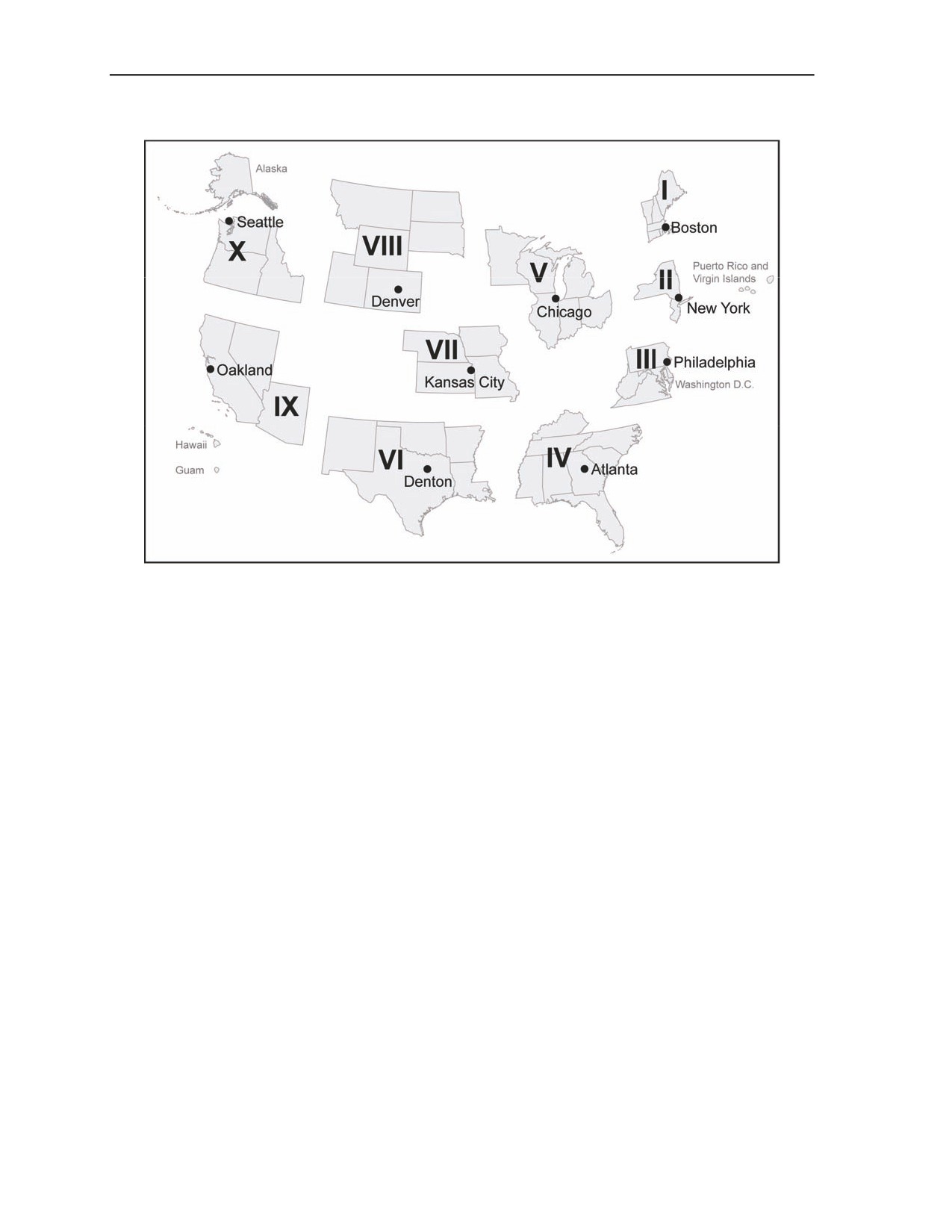
2-63. FEMA is part of DHS. Its missions are planning for disaster response and coordinating disaster
responses. For incident response, the Nation is divided into ten FEMA regions as shown in Figure 2-5,
page 2-18. Alaska falls within Region X, Hawaii and the Pacific territories within Region IX, and Puerto
Rico and the Atlantic possessions within Region II. The alignment of the islands in Pacific and Atlantic
Oceans minimizes the likelihood of a disaster in that region affecting the continental and island areas
simultaneously.
2-64. Each FEMA region has a regional coordination center located within its offices. This center activates
during any significant and stays manned until response operations conclude and recovery operations pass
to the control of an on-site recovery center. FEMA coordinates with organizations across each region for
preparation and incident response. The agency oversees NIMS, the NRF, disaster response training, and
national planning and preparation for all hazard emergencies. DOD works directly with FEMA in each
region to plan responses to disasters and terrorist attacks. Defense coordinating officers are permanently
co-located with each FEMA regional office. For a full listing of their responsibilities, go to
http://www.fema.gov.
20 August 2010
FM 3-28
2-17
Chapter 2
Figure 2-5. FEMA regions and headquarters
The Coast Guard
2-65. The Coast Guard is the fifth Armed Service, but it falls under Title 14, USC, not Title 10 or Title 32.
It is a law enforcement agency as well as a military Service, and it has offices and units across the country.
The Coast Guard has a unique position among the Armed Services. Because of its unique status, the Coast
Guard supports and is supported by the other Armed Services. In homeland defense, for example, units of
the coast guard may be under Navy control. In homeland security, Navy warships and aircraft may provide
support to a Coast Guard operation. Because of its Title 14 responsibilities and as part of DHS, the Coast
Guard frequently supports civil authorities, and vice versa. Army units conducting civil support operations
may support or receive support from Coast Guard elements. In a large incident, the senior Coast Guard
officer in charge could exercise tactical control over some or all responding federal military forces.
2-66. In the reorganization of the federal government after 9/11, the Coast Guard moved from Department
of Transportation to DHS. The Coast Guard's homeland security missions include port, waterway, and
coastal security; drug interdiction; control of illegal immigration; and other law enforcement. Non-
homeland security missions include marine safety, search and rescue, aids to navigation, living marine
resource protection (fisheries enforcement), marine environmental response, and icebreaking. This array of
missions endows the Coast Guard with many civil support capabilities.
2-67. The Coast Guard Deployable Operations Group provides organized, equipped, and trained
deployable, specialized forces to the Coast Guard, DHS and civilian incident commanders. These forces
deploy in support of national requirements as tailored, integrated force packages, across the United States
and other high interest areas. The Deployable Operations Group has approximately 3,000 Coast Guard
personnel from twelve Maritime Safety and Security Teams, the Maritime Security Response Team, two
Tactical Law Enforcement Teams, eight Port Security Units, the National Strike Force Coordination
Center, and three National Strike Teams.
2-18
FM 3-28
20 August 2010
A Comprehensive Approach for Civil Support
2-68. The Coast Guard has some of the best-trained and equipped personnel for hazardous material
incidents in the Nation. Although most Coast Guard capabilities and personnel are stationed in the coastal
cities, they can deploy highly trained teams anywhere in the country using Coast Guard, commercial, and
DOD transport. Once they arrive, Coast Guard forces can support Title 10 and state National Guard forces
interchangeably.
Department of Justice
2-69. The Attorney General of the United States has lead responsibility for criminal investigations of
terrorist acts or terrorist threats by individuals or groups inside the United States. The Attorney General
acts through the Federal Bureau of Investigation and cooperates with other federal departments and
agencies engaged in activities to protect national security. The Attorney General and these departments and
agencies coordinate the activities of other members of the law enforcement community to detect, prevent,
preempt, and disrupt terrorist attacks against the United States.
Department of State
2-70. The Department of State has international coordination responsibilities for domestic disaster
assistance to the United States. The Secretary of State also is responsible for coordinating international
prevention, preparedness, response, and recovery activities relating to emergencies or disasters. When the
United States suffers a disaster, other nations may offer material, financial or military assistance. The
Department of State coordinates the receipt of foreign assistance. When the assistance includes foreign
military forces, Department of State officials coordinate between the foreign government, DOD, and
gaining combatant commanders prior to their employment.
Other Federal Departments
2-71. During an incident, other federal agencies may play primary, coordinating, or supporting roles, or
any combination, based on authorities, resources, and the nature of the incident roles and responsibilities
outlined in the ESFs. Although DOD usually supports DHS, any agency may request federal military
support if its own resources are overtaxed. Several federal agencies have responsibility to declare disasters
or emergencies, and DOD may support these agencies in their response. Some examples include—
z
Department of Agriculture.
z
Department of Commerce.
z
Department of Health and Human Services.
z
Department of the Interior.
z
Department of Energy.
2-72. The Secretary of Agriculture may declare a disaster in certain situations when a county sustained
production loss of 30 percent or greater in a single major enterprise, authorizing emergency loans for
physical damages and crop loss. The Forest Service (a part of the Department of Agriculture) provides
wildland fire fighting teams and incident command system teams suitable for supporting emergency
response.
2-73. The Secretary of Commerce may make a declaration of a commercial fisheries failure or fishery
resources disaster. The National Oceanic and Atmospheric Administration Commissioned Corps operates
ships, aircraft, and diving teams suitable for supporting emergency response.
2-74. The Secretary of Health and Human Services may declare a public health emergency. The Secretary
of Health and Human Services directs the national response to communicable diseases such as pandemic
influenza (see chapter 4). The United States Public Health Service Commissioned Corps provides teams of
health professionals prepared to support emergency response.
2-75. The Department of the Interior includes the Bureau of Indian Affairs, Bureau of Land Management,
and the National Park Service. They provide wild land fire fighting teams and incident command system
teams suitable for managing emergency response.
20 August 2010
FM 3-28
2-19
Chapter 2
2-76. Department of Energy is involved with incidents involving nuclear facilities security and incidents
and is the emergency coordinator for ESF #12. In the event of an accident involving an American nuclear
weapon, Department of Energy works directly with DOD according to carefully developed plans and
procedures.
The Federal Coordinating Officer and the Joint Field Office
2-77. In most cases, the federal government assists an incident response operation following a Presidential
disaster or emergency declaration and a request by a governor. The NRF describes the coordination
structures for federal departments and agencies in its third chapter and in the ESFs. These structures are in
addition to the systems described in the NIMS.
2-78. When the federal government joins a disaster response operation, the Administrator of FEMA and
the Secretary of Homeland Security recommend a federal coordinating officer for that operation, and the
President makes the appointment. The federal coordinating officer represents FEMA in the unified
coordination group and ensures integration of federal activities. Normally, the federal coordinating officer
selected for a specific operation is a full-time, permanent federal coordinating officer from within the
FEMA region affected by the incident. In some cases, a federal coordinating officer from another FEMA
region becomes the federal coordinating officer for the operation because of availability. Initially, FEMA
may deploy specialized teams to support state and local jurisdictions. These teams can deploy on short
notice, before a joint field office can be established.
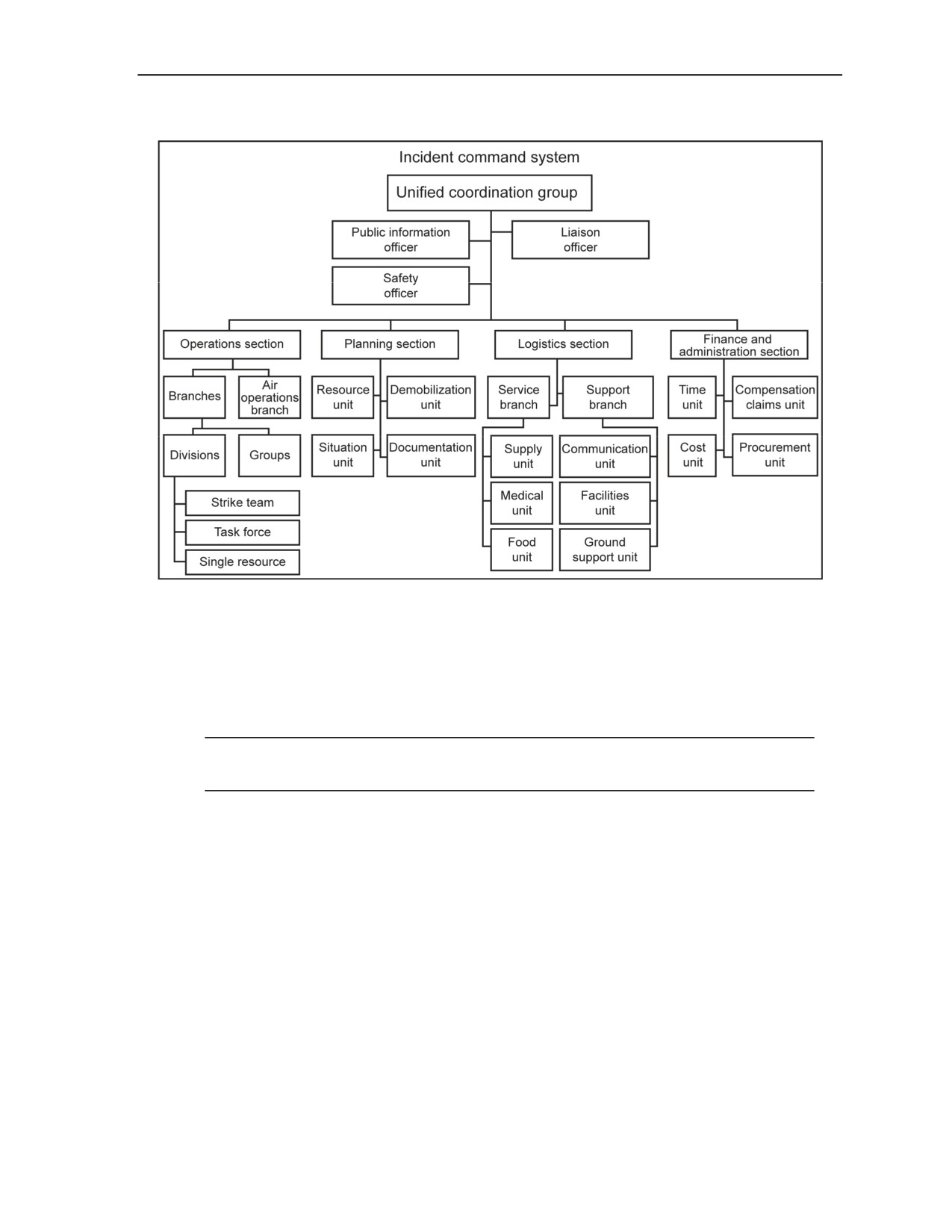
2-79. When required, FEMA establishes a joint field office (“joint” in this context means interagency) to
coordinate the national-level response. A joint field office is a temporary federal facility for coordination
and liaison across agencies and jurisdictions. FEMA organizes every joint field office according to the
NIMS and adapts its makeup to meet the requirements of the situation. Therefore, every joint field office
has a similar broad division of major responsibilities but is staffed differently. It has, for instance, an
operations section, a planning section, a logistics section, and a finance and administration section, directed
by a unified coordination group. The unified coordination group includes key state and federal officials
involved in managing the response. A joint field office may be geographically grouped or functionally
grouped, with air operations or evacuation functions included. The NRF specifies that DOD may support
every ESF, based on the situation. Figure 2-6 illustrates a notional fully staffed joint field office with all
ESFs activated. See Appendix I for a more detailed view of the various incident command system staff
sections.
2-20
FM 3-28
20 August 2010
A Comprehensive Approach for Civil Support
Figure 2-6. A joint field office example, with command staff, sections, and branches
2-80. The Secretary of Homeland Security or the President may designate a regional team leader to ensure
effective management of federal support for a catastrophic or unusually complex incident involving several
states, and hence, several joint field offices. A regional team leader, when designated, represents DHS in
the unified coordination group. However, for most incidents requiring a federal response, the federal
coordinating officer is the senior federal official.
Note: Under older nomenclature the regional team leader was called a principal federal official.
Some responders still refer to this individual as the principal federal official.
2-81. A regional team leader is distinct from a federal coordinating officer. He or she does not have
directive authority over a federal coordinating officer or other members of the unified coordination group.
The regional team leader promotes multiagency collaboration, resolves interagency conflict, and presents
policy issues to the Secretary of Homeland Security. A regional team leader, when designated, interfaces
with federal, state, tribal, and local jurisdictional officials regarding the overall federal incident
management strategy and acts as the primary federal spokesperson for coordinated media and public
communications.
20 August 2010
FM 3-28
2-21
Chapter 2
NATIONAL GUARD CIVIL SUPPORT OPERATIONS
2-82. The National Guard is a crucial capability available to state governors in any emergency. State
National Guard forces have equipment and expertise in communications, logistics, search and rescue, law
enforcement, and decontamination.
THE ADJUTANT GENERAL
2-83. A state's adjutant general is an Air Force or Army general officer who serves as the commander of
the state’s National Guard and is the joint forces commander for all military forces under the governor’s
command and control. National Guard Regulation 500-1 establishes the adjutant general as a joint position,
with authority over subordinate Air and Army National Guard forces of that state or territory. The adjutant
general recommends National Guard response options to the governor and designates the National Guard
commander for any National Guard response. The adjutant general has a joint staff that includes full-time
National Guard officers and state civilian employees. During any incident, the adjutant general coordinates
with adjutant generals from other states and with the National Guard Bureau for emergency assistance. In
states with constituted militia units, the adjutant general serves as an intermediary with state National
Guard forces.
2-84. In many states, the National Guard adjutant general is the governor’s homeland security advisor as
well as commander of the state’s military forces. For example, in the state of Washington, the state’s
homeland security apparatus is embedded in the [state of] Washington Military Department. The adjutant
general is therefore responsible for military operations, emergency management, emergency
telecommunications, and policy-related interaction with executive and legislative branches of local, state,
and federal governments.
ORGANIZATION OF NATIONAL GUARD FORCES
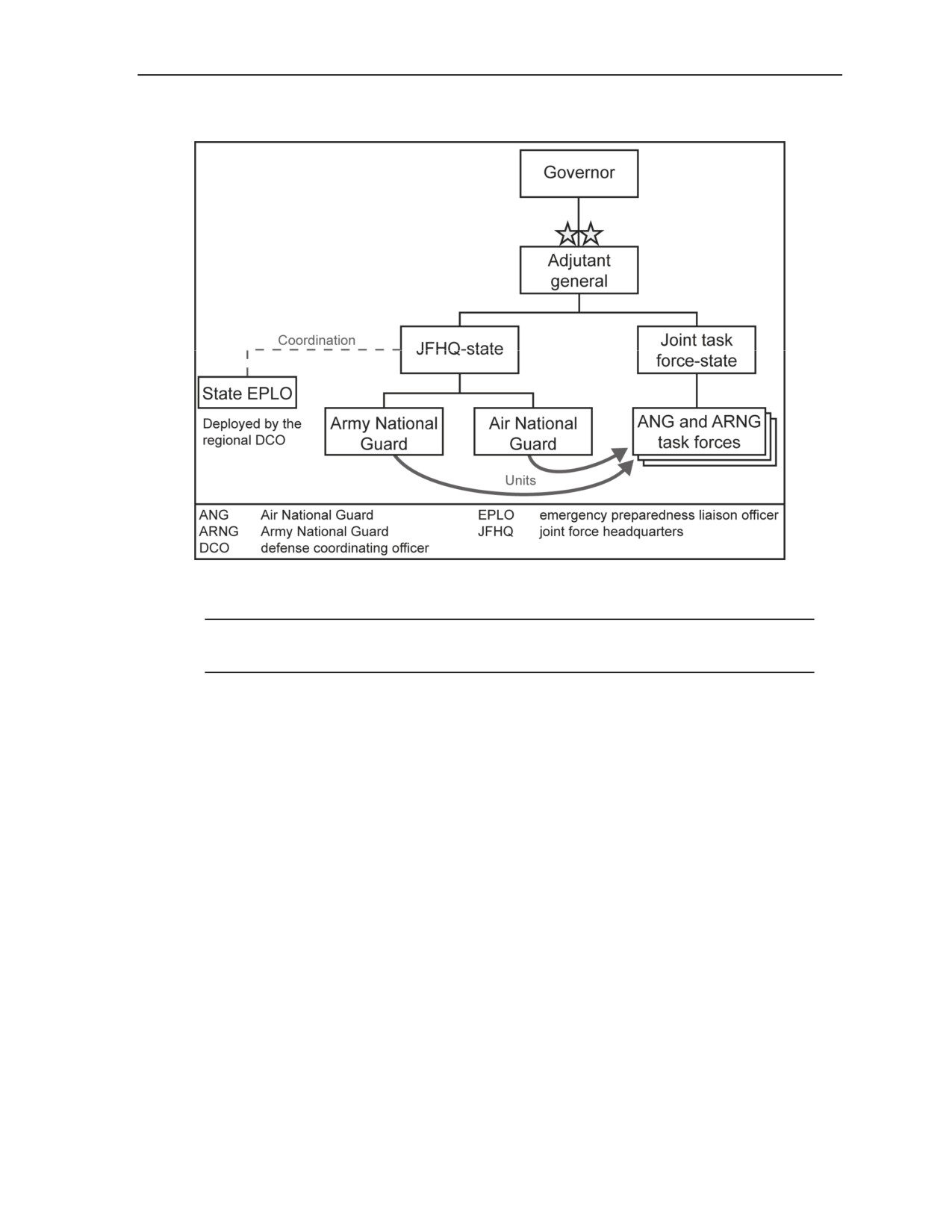
2-85. National Guard forces are permanently organized under a joint force headquarters-state (JFHQ-
state). The JFHQ-state oversees the administrative requirements for the Guard units and coordinates with
the National Guard Bureau in Washington, D.C.
2-86. Each state’s National Guard varies in composition and size; there is no standard response
organization for all 54 Guard entities. In most incidents, the adjutant general establishes a headquarters
known as a joint task force-state (JTF-state). The JTF-state (designated in contingency plans) has
operational control of all Air and Army National Guard forces from all participating states. These
partnerships have already been established and reinforced through joint and multiagency exercises. The
JTF-state commander task-organizes units into task forces for particular missions. Within an operational
area, these state task forces work alongside federal task forces. Figure 2-7, page 2-22, shows an example of
a National Guard response organization with a state.
2-22
FM 3-28
20 August 2010
A Comprehensive Approach for Civil Support
Figure 2-7. An example of National Guard organization within a state
Note: The reader should avoid confusing the joint force headquarters-state (JFHQ-state) with
combatant commander’s standing joint task force headquarters (SJFHQ).
2-87. Each state has existing contingency plans for different incidents and updates these plans to adjust for
Guard units serving in Title 10 status. These task forces employ Air Guard and Army Guard personnel
completely integrated at the small-unit level. This is routine in most National Guard response forces.
CHIEF OF THE NATIONAL GUARD BUREAU
2-88. The Chief of the National Guard Bureau is the liaison between the state and territorial National
Guards and the federal military components. The Chief of the National Guard Bureau coordinates National
Guard support between the states. The Chief of the National Guard Bureau communicates, collaborates,
and coordinates with combatant commands. This coordination facilitates continuity and integration with
state, territorial, and federal military capabilities. The Chief of the National Guard Bureau also coordinates
closely with federal civil authorities and adjutants general of the states.
2-89. The Army National Guard Office in Washington D.C. maintains a continuously manned National
Guard operations center that keeps the Chief of the National Guard Bureau informed about National Guard
forces committed to civil support operations and to operations overseas. Although the Army National
Guard office does not control any of the 54 National Guard elements, it provides critical coordination
between the various National Guards before and during any emergency. The Army National Guard office
can identify units, personnel, or equipment available for loan between state forces in an emergency.
FEDERAL MILITARY CIVIL SUPPORT OPERATIONS
2-90. The primary mission of DOD and its components is national defense. As directed by the President or
the Secretary of Defense, DOD provides support to a primary federal agency as part of a coordinated
20 August 2010
FM 3-28
2-23
Chapter 2
federal response to any incident that exceeds local and state capabilities, following a request for assistance
from civil authorities. However, DOD resources are not typically required to mitigate domestic incidents.
For example, in 2005, the President declared 65 major disasters or emergencies. Federal military forces
responded to only three.
2-91. The Services can provide many types of federal military support under various authorities. When
deciding to commit DOD resources, military readiness, cost, lethality, risk, appropriateness, and whether
the response is in accordance with applicable laws and regulations all factor into the decision.
2-92. The Secretary of Defense orders the use of federal military forces for domestic incidents as directed
by the President. The decision to employ regular military forces requires assessment of the impact on
combat readiness, or when operations and appropriate under the circumstances and the law. The Secretary
based the decision primarily on combat readiness. The Secretary of Defense or the Assistant Secretary of
Defense for Homeland Defense and America's Security Affairs is the approval authority for any requests
from lead federal agencies for any actions that might require lethal force by federal military forces. This
includes the authorization for any Soldier in Title 10 status to carry weapons during a defense support of
civil authorities (DSCA) mission.
2-93. The joint director of military support, located in the Pentagon, is the DOD action agent for federal
civil support. The joint director of military support interfaces with FEMA and the regional defense
coordinating officers when civil authorities request federal military support for incident response. The joint
director of military support works with the Joint Chiefs of Staff and Service Secretaries to analyze the
request and develop a recommendation. Once analyzed, the request goes to the Secretary of Defense for
approval, who then passes that decision to the Joint Chiefs of Staff for sourcing from the appropriate
combatant commander.
DEFENSE COORDINATING OFFICER
2-94. DOD appoints twelve full-time defense coordinating officers—one in each of the ten FEMA regions
and two in the outlying territories. Each defense coordinating officer works closely with federal and state
emergency agencies in each FEMA region and develops personal ties with the key representatives.
Although the defense coordinating officer is not an ESF manager, each defense coordinating officer has a
permanent work space inside FEMA's regional coordination center, next to the ESF desks. A defense
coordinating officer is serves as the single point of contact for DOD at a joint field office. These officers
are selected carefully and retained in their assignment for long periods. Defense coordinating officers serve
as the vital link between the state emergency operations center, state National Guard joint headquarters,
federal agencies, and federal military forces.
2-95. Generally, requests for DSCA originating at a joint field office are initially coordinated with and
processed through the defense coordinating officer. The defense coordinating officer has a defense
coordinating element consisting of a staff and military liaison officers who facilitate federal military
support to activated ESFs. Specific responsibilities of the defense coordinating officer usually include
coordinating requests for military support (see figure 3-5, page 3-11), forwarding mission assignments to
the appropriate military organizations through DOD channels, and assigning military liaisons, as
appropriate, to activated ESFs. A defense coordinating officer does not process requests for assistance
from United States Special Operations Command, United States Army Corps of Engineers, or National
Guard forces operating under state active duty or Title
32 status
(not in federal service). In some
circumstances, a defense coordinating officer does not process requests for federal military forces in
support of the Federal Bureau of Investigation.
2-96. At the start of any incident, or when warning precedes an incident, the defense coordinating officer
establishes a watch office (manned by the defense coordinating element) within the FEMA regional
coordination center. For most incidents, FEMA does not require federal military support, and the defense
coordinating officer remains at the regional coordination center to monitor the situation. If and when the
FEMA region establishes a joint field office, and there is a likelihood of federal military forces deploying,
DOD activates the regional defense coordinating officer and defense coordinating element. Activation
means DOD designates the defense coordinating officer as the single point of contact between the primary
agency and DOD.
2-24
FM 3-28
20 August 2010
A Comprehensive Approach for Civil Support
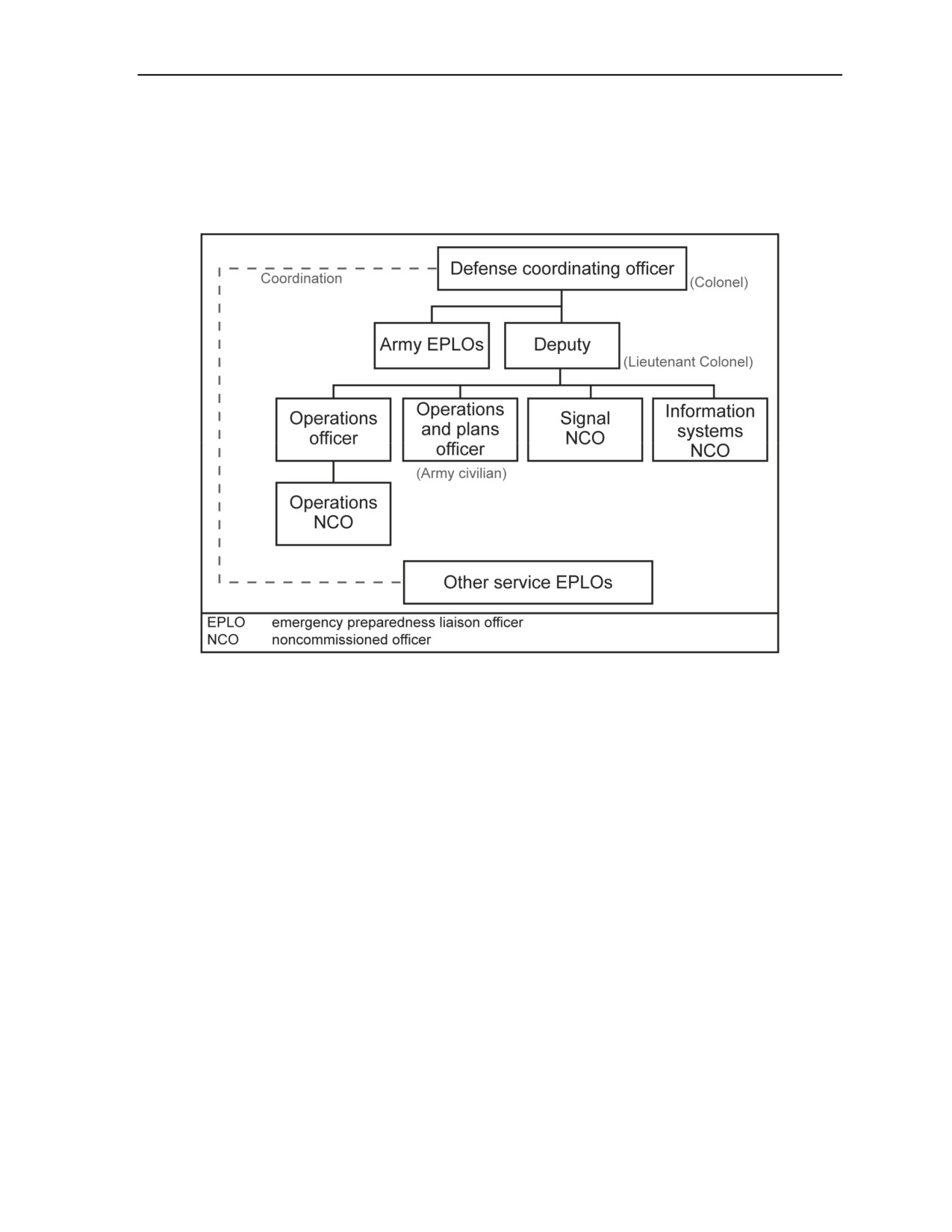
2-97. In some situations, DOD may commit small military detachments when the states require specialized
federal military support. When directed by United States Northern Command (USNORTHCOM), a
defense coordinating officer exercises tactical control over these forces and coordinates with
USNORTHCOM and local officials for their sustainment. Figure 2-8 illustrates an example of the
organization of a defense coordinating officer and defense coordinating element.
Figure 2-8. Example of defense coordinating officer and defense coordinating element
organization
2-98. An emergency preparedness liaison officer is a senior reserve officer or noncommissioned officer
who, when activated, assists the defense coordinating officer and serves as the subject matter expert for
their Service. An emergency preparedness liaison officer can assist ESF planners conduct planning and
coordination involving military forces. Emergency preparedness liaison officers are directed by the defense
coordinating officer and work in close coordination with the defense coordinating element. An emergency
preparedness liaison officer may serve as a liaison to the JFHQ-state or at a DOD installation when tasked
by the defense coordinating officer. An emergency preparedness liaison officer identifies potential federal
military support requirements for incidents.
2-99. Each state emergency preparedness liaison officer is a member of the Armed Forces Reserve Title
10 Reserve. When mobilized, they are under the control of the defense coordinating officer. When directed
by the defense coordinating officer, they facilitate planning, coordination, and training for civil support
operations. They serve as Service component liaisons to the adjutants general of the states, the joint force
headquarters-state, and the state emergency management agencies. They develop a habitual relationship
with respective state and National Guard officials through training and real-world incident management.
2-100. Regional emergency preparedness liaison officers are also Title 10 reserve officers. Unlike the
state emergency preparedness liaison officer, they are not aligned to a particular state. They provide the
defense coordinating officer with a team of senior professionals available to act as liaison officers at
regional military bases, and to augment the state emergency preparedness liaison officer and defense
coordinating element. The emergency preparedness liaison officer and regional emergency preparedness
liaison officer may be from any of the Armed Services, and officers from Services other than the Army
20 August 2010
FM 3-28
2-25
Chapter 2
may be referred to by their Service. There are typically between ten and twenty regional emergency
preparedness liaison officers within each FEMA region.
COMBATANT COMMANDS
2-101. The President and Secretary of Defense command federal military forces through the combatant
commands. There are two geographic combatant commands with primary DSCA responsibilities:
USNORTHCOM and United States Pacific Command (USPACOM). The other combatant commands
provide capabilities to USNORTHCOM and USPACOM for DSCA as directed by the Secretary of
Defense. USNORTHCOM and USPACOM control five standing joint tasks forces that have primary
missions associated with DSCA.
United States Northern Command
2-102. USNORTHCOM anticipates and conducts homeland defense and civil support operations
involving federal military forces within its area of responsibility to defend, protect, and secure the United
States and its interests. The USNORTHCOM area of responsibility includes air, land, and sea approaches
and encompasses the continental United States, Alaska, Puerto Rico, the Bahamas, Turks and Caicos
Islands, and the U.S. Virgin Islands. It also includes the Gulf of Mexico, the Straits of Florida, and the
water surrounding the continental United States out to approximately 500 nautical miles. Additionally, the
USNORTHCOM area of responsibility includes Canada and Mexico. As directed by the President or
Secretary of Defense, USNORTHCOM conducts operations through assigned Service components,
designated functional commands, and subordinate standing joint task forces.
2-103. In accordance with the Chairman of the Joint Chiefs of Staff standing execute order for DSCA
(referred to as the CJCS DSCA EXORD) the USNORTHCOM Commander has the authority to alert and
prepare to deploy assigned and allocated forces in support of a primary agency such as FEMA. The
Combatant Commander may request, deploy, and employ selected forces upon notification from the
Chairman of the Joint Chiefs of Staff and the Secretary of Defense, in support of a validated request for
assistance from a primary agency. The intent of the order is to provide the combatant commander the
maximum latitude to posture federal military forces to respond immediately to an incident.
2-104. If required, USNORTHCOM may deploy its standing joint force headquarters, a joint command
and control element organized within USNORTHCOM headquarters. This command and control element
rapidly deploys to enable the stand-up of a joint task force headquarters or to augment existing joint task
forces. In addition, USNORTHCOM may deploy a situation awareness team as an advance joint liaison
element.
United States Army North
2-105. United States Army North
(USARNORTH) is the Army component command assigned to
USNORTHCOM. USARNORTH is the joint forces land component command within USNORTHCOM.
As the joint forces land component command, USARNORTH commands and controls federal land forces
conducting DSCA. USARNORTH has a main command post, based at Fort Sam Houston, and two
contingency command posts, each capable of operating as a joint task force with augmentation. The
contingency command posts organize for rapid land and air deployment anywhere within the
USNORTHCOM area of responsibility. Both command posts have joint and interagency compatible
communications systems, with satellite links.
2-106. USNORTHCOM has standing joint task forces (see paragraphs 2-107 to 2-108) subordinated to
USARNORTH. The defense coordinating officers and defense coordinating elements for all ten FEMA
regions also belong to USARNORTH. In response to any incident requiring large numbers of federal
troops, USARNORTH initially deploys a contingency command post near the joint field office. Figure 2-9
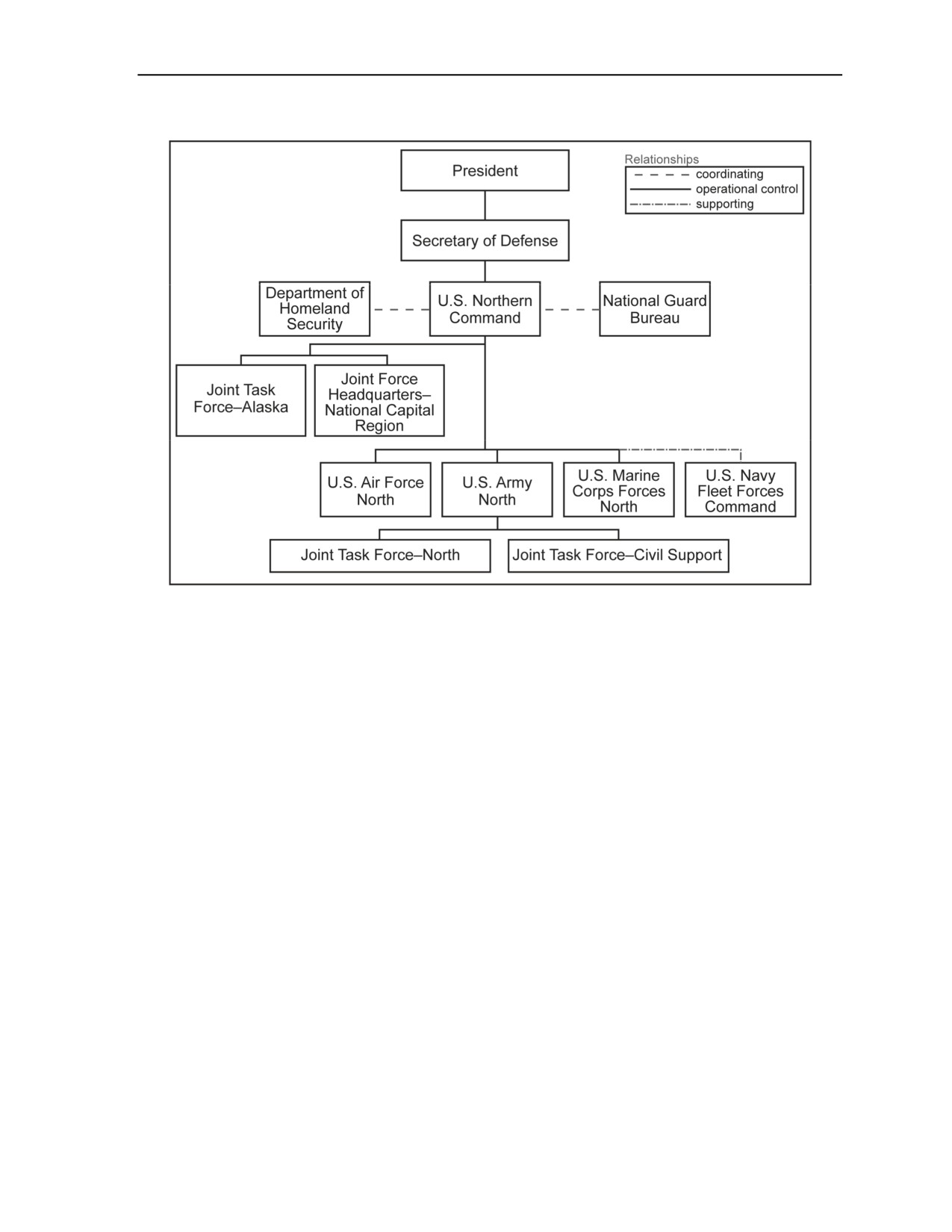
shows USNORTHCOM and USARNORTH command and control.
2-26
FM 3-28
20 August 2010
A Comprehensive Approach for Civil Support
Figure 2-9. USNORTHCOM and USARNORTH structure
Joint Task Force-Civil Support
2-107. Joint Task Force-Civil Support is a standing joint task force headquarters assigned to
USNORTHCOM and under the operational control of USARNORTH. It plans and integrates federal
military support for chemical, biological, radiological, nuclear, or high-yield explosives incidents (referred
to as CBRNE incidents). During support for CBRNE incidents (this support is also called CBRNE
consequence management) Joint Task Force-Civil Support forces consist mainly of CBRNE consequence
management response force units as provided to USNORTHCOM in an annually updated execute order for
CBRNE incident response operations. When directed by the Secretary of Defense, the commander of
USNORTHCOM deploys Joint Task Force-Civil Support to establish command and control of federal
military forces at a CBRNE incident site. The CBRNE consequence management response force provides
capabilities such as casualty decontamination, security, medical triage and treatment, aviation, logistics,
and transportation. USNORTHCOM may deploy Joint Task Force-Civil Support to the USPACOM area
of responsibility to provide CBRNE incident support within U.S. territory. (See chapter 4 and appendix E
of this manual, and also Field Manual (FM) 3-11, for more information.)
Joint Task Force-North
2-108. Joint Task Force-North is under the operational control of USARNORTH. It employs military
capabilities in support of federal civilian law enforcement agencies for threats to the homeland. Chapter 5
discusses support to domestic civilian law enforcement agencies in detail.
Joint Force Headquarters-National Capital Region
2-109. The Joint Force Headquarters-National Capital Region plans, coordinates, and maintains
situational awareness in the National Capital Region to safeguard the Nation’s capital. As directed, this
headquarters employs forces for civil support.
20 August 2010
FM 3-28
2-27
Chapter 2
Joint Task Force-Alaska
2-110. Joint Task Force-Alaska, headquartered at Elmendorf Air Force Base, is a subordinate command
of USNORTHCOM. It is comprised of Soldiers, Sailors, Airmen, and DOD civilian specialists. Joint Task
Force-Alaska’s mission is to deter, detect, prevent and defeat threats within the Alaska joint operations
area to protect U.S. territory, citizens, and interests, and as directed, conduct civil support. Within its joint
operations area, Joint Task Force-Alaska plans and integrates DOD homeland defense efforts and provides
DSCA to civilian agencies such as FEMA.
Other Units
2-111. Other allocated or theater committed military assets for homeland defense and DSCA include a
theater sustainment command, an air and missile defense command, a contracting brigade, and a human
resources command.
United States Pacific Command
2-112. USPACOM conducts civil support in Hawaii, Guam, and American Samoa, and the U.S.
territories within its area of responsibility. Due to the large distances within the USPACOM area of
responsibility and the distribution of U.S. forces in the region, USPACOM maintains flexible command
and control arrangements for civil support. USPACOM conducts civil support operations through assigned
Service components and designated functional components. It has one standing joint task force, Joint
Interagency Task Force-West, which supports civilian law enforcement agencies in USPACOM’s area of
responsibility. It can also activate Joint Task Force-Homeland Defense to perform DSCA and homeland
defense missions.
2-113. In accordance with the CJCS DSCA EXORD, the USPACOM Commander has the authority to
alert and prepare to deploy assigned and allocated forces in support of a primary federal agency. The
combatant commander may request, deploy, and employ forces upon notification from the Chairman of the
Joint Chiefs of Staff and Secretary of Defense, in support of a validated request for assistance from a
primary agency. The intent of the order is to provide the combatant commander with the maximum latitude
to posture federal military forces to respond immediately to an incident.
Joint Interagency Task Force-West
2-114. Joint Interagency Task Force-West is the USPACOM executive agent for federal military support
to law enforcement for counterdrug and drug-related activities. The mission of Joint Interagency Task
Force-West (formerly Joint Task Force-5) is to detect, disrupt, and dismantle drug-related transnational
threats in Asia and the Pacific. Joint Interagency Task Force-West does this by providing interagency law
enforcement intelligence, supporting U.S. law enforcement, and developing partner nation capacity to
protect U.S. security interests at home and abroad. Joint Interagency Task Force-West provides U.S. and
foreign law enforcement agencies with interagency information and analysis, counterdrug training, and
infrastructure development support.
Joint Task Force-Homeland Defense
2-115. USPACOM forms Joint Task Force-Homeland Defense by combining a Service headquarters
(such as an Army Division), a joint signal element, personnel from a joint manning document, and DHS
liaison. The primary mission of Joint Task Force-Homeland Defense is DSCA within the USPACOM area
of responsibility, excluding Alaska. Current plans focus on developing the Task Force-Homeland Defense
into a standing joint task force that represents all five armed Services and various government agencies.
UNITED STATES ARMY CORPS OF ENGINEERS
2-116. The United States Army Corps of Engineers (USACE) manages components of the nation’s public
works infrastructure. This includes maintenance and management of the national waterways,
environmental remediation and recovery operations, real estate, disaster recovery operations, and general
project management functions. The Corps of Engineers is responsible for infrastructure protection and
2-28
FM 3-28
20 August 2010
A Comprehensive Approach for Civil Support
emergency repair to support states in reconnaissance and emergency clearance of debris from damaged
areas.
2-117. USACE coordinates ESF #3, Public Works and Engineering. It provides technical assistance,
engineering, and construction management resources and support during response activities. This includes
preparedness, response, and recovery actions. It also extends to construction management, contracting and
real estate services, providing emergency repair of damaged public infrastructure and critical facilities, and
support to the FEMA Public Assistance Program and other recovery programs. The Public Assistance
Program provides supplemental federal disaster grant assistance for debris removal and disposal;
emergency protective measures; and the repair, replacement, or restoration of disaster-damaged public
facilities and the facilities of certain qualified private nonprofit organizations. See also the USACE Web
site at www.usace.army.mil.
JOINT TASK FORCE
2-118. The combatant commander normally establishes a joint task force to command federal military
forces (excluding USACE resources). The joint task force normally exercises operational control over all
federal military forces and installations within its assigned joint operational area. When the joint task force
is established, consistent with operational requirements, its command and control element will co-locate
with the joint field office to ensure coordination and unity of effort. If that is not operationally feasible, the
joint task force commander places a liaison officer with the defense coordinating officer at the joint field
office.
2-119. The defense coordinating officer and joint task force commander have distinct roles and
responsibilities. The defense coordinating officer serves as DOD’s single point of contact at the joint field
office for requesting assistance from DOD. With few exceptions, requests for federal military support
originating at the joint field office are coordinated with and processed through the defense coordinating
officer.
2-120. Based on the complexity and type of incident, and the anticipated level of federal military
resources needed, DOD may also elect to designate a joint task force commander to command federal
(Title
10) military activities in support of the incident objectives. If a joint task force is established,
consistent with operational requirements, its command and control element will be co-located with the
senior on-scene leadership at the joint field office to ensure coordination and unity of effort. The co-
location of the joint task force command and control element does not replace the requirement for a
defense coordinating officer and defense coordinating element as part of the joint field office unified
coordination staff. The defense coordinating officer remains the DOD single point of contact in the joint
field office for requesting assistance from DOD.
PRE-SCRIPTED MISSION ASSIGNMENTS
2-121. Part of the CJCS DSCA EXORD addresses pre-scripted mission assignments. Based on careful
analysis of previous DSCA missions and DOD capabilities, the Joint Staff develops a menu of capabilities
and identifies each as a force package. The CJCS DSCA EXORD does not specify types of military units;
rather, it identifies force packages with specific capabilities that a supported agency (such as FEMA) likely
will require from DOD. The joint director of military support provides the CJCS DSCA EXORD to FEMA
and other agencies. This provides FEMA a menu of military capabilities from which it can select. The
supported agency selects the DOD capability, and the request for assistance flows very rapidly up to the
Pentagon and back to the requesting agency. Simultaneously, the Joint Staff (normally the joint director of
military support) sources the request to a supporting combatant command or Service. The alert and
deployment orders follow rapidly. The use of a pre-scripted mission assignment expedites much of the
coordination between the civilian agency and DOD for determining what the civilian agency needs and the
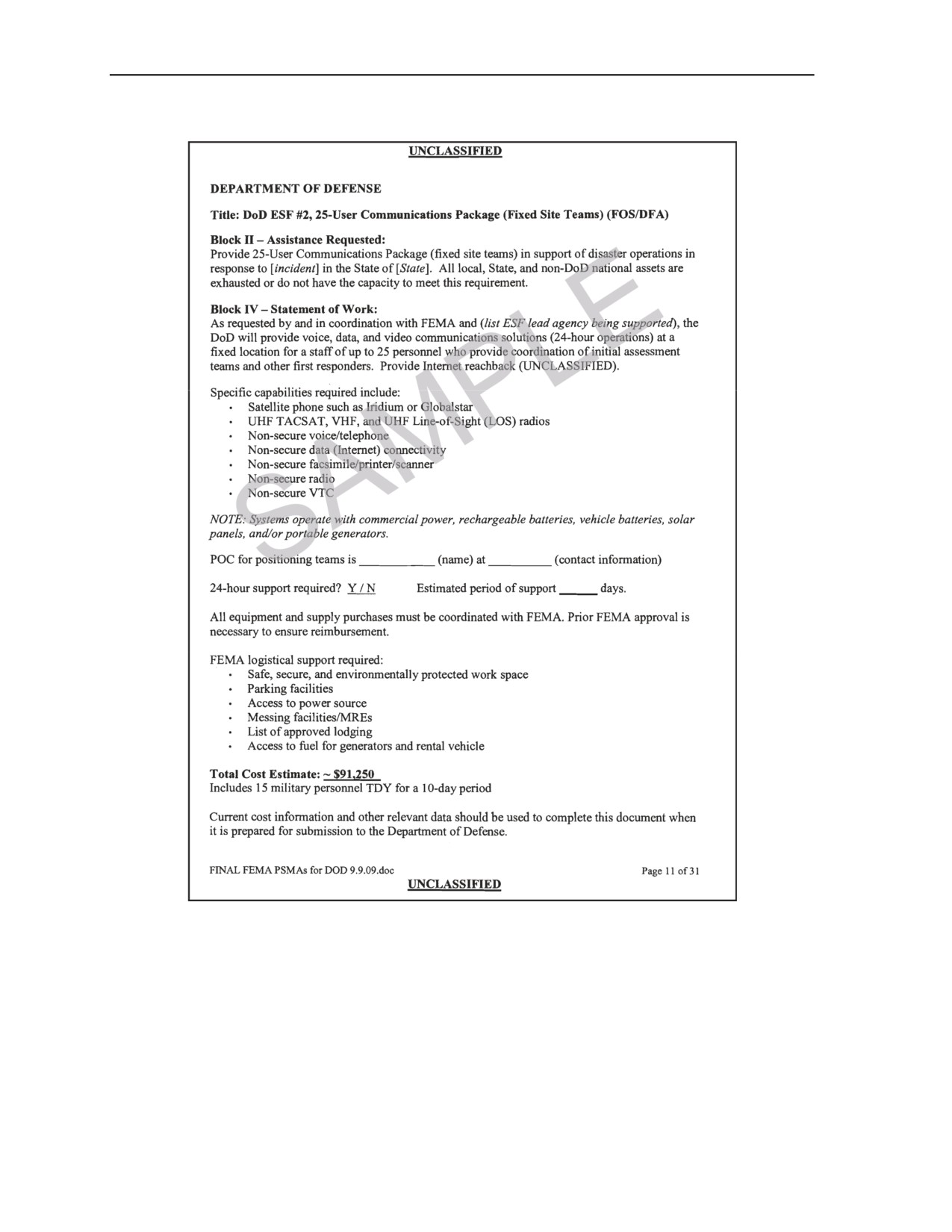
approximate cost of providing it. As an example, a pre-scripted mission assignment for communications
support is shown in figure 2-10. Note that cost figures are included in a pre-scripted mission assignment.
20 August 2010
FM 3-28
2-29
Chapter 2
Figure 2-10. A pre-scripted mission assignment for communications support
2-30
FM 3-28
20 August 2010
Chapter 3
Provide Support for Domestic Disasters
This chapter discusses the first primary civil support task—provide support for
domestic disasters. The doctrine in this chapter builds on chapters 1 and 2. The
discussion begins by explaining the general nature of a disaster. It then explains how
civil authorities fulfill their responsibilities for responding, starting from the lowest
level of government and eventually incorporating support from military forces. It
discusses National Guard support for disaster response operations, followed by
federal military support for disaster response operations. It briefly explains military
and civilian operational phases. It concludes with an extended discussion of doctrinal
considerations specific to disaster response.
THE NATURE OF A DISASTER
3-1. There is an adage among emergency responders that “every disaster has a zip code.” This is a
reminder that any disaster is both a personal and a community experience for the victims. After a disaster,
the affected communities often experience a collective shock that inhibits the local response, compounded
by the destruction. Until Soldiers have been part of a disaster response effort, the misery and loss
experienced by the victims—and the degree of disruption that inhibits even the most basic services—lie
beyond their experience. Only combat operations create similar effects within civilian communities, and
even then the destruction may not equal the aftermath of a tornado or hurricane. The compensating factor
for Soldiers is that no operational experience is likely to produce the same sense of satisfaction as assisting
their fellow citizens’ recovery, even though the mission is exhausting and often frustrating.
3-2. A disaster can strike anytime, anywhere. It can take many forms—a hurricane, an earthquake, a
tornado, a flood, a fire or a hazardous spill, an act of nature, or an act of terrorism. It may build over days
or weeks, or it may hit suddenly and with no warning. Every year, millions of Americans face a disaster
and its terrifying consequences. A disaster can quickly produce an overwhelming demand for resources
and reduce the ability of local, state, and tribal governments to respond effectively. A disaster can result in
many deaths and injuries or cause extensive damage to critical infrastructure. Besides hurricanes,
earthquakes, and floods, potentially devastating events include large, powerful winter storms, regional
droughts, and contagious disease outbreaks. Naturally occurring plant and animal disease strains reaching
epidemic infection levels could have a devastating effect on the nation’s food supply and the economy. The
destruction of or inability to access communications systems, transportation, and shelter may further
complicate governments’ ability to assist the victims.
3-3. Natural or manmade disasters may start a chain of subsequent disasters such as chemical spills,
biological hazards, and potentially explosive material. Each subsequent disaster creates a cascading chain
of harmful effects. For example, a chemical spill caused by a tanker truck accident on a bridge over a
flooded major river causes numerous complications. The chemical enters the potable water system and
compounds the effects of the flooding on waterborne shipping traffic. The food supply is contaminated as
the chemical is deposited on flooded cropland. Lack of sanitation after flooding can cause serious diseases
to appear.
20 August 2010
FM 3-28
3-1
Chapter 3
3-4. Military support in response to a disaster varies from loaning equipment to local authorities to
committing major units of the National Guard and regular and reserve military components. At the peak of
the response to Hurricane Katrina, over 75,000 military personnel from the regular and reserve components
supported civil authorities at the local, state, and national level.
RESPONSIBILITY FOR DISASTER RESPONSE
3-5. The primary responsibility for responding to domestic disasters and emergencies
(also called
incidents) rests with the lowest level of government able to manage the response. As discussed in chapter
2, if a situation exceeds local capability, local authorities first seek assistance from neighboring
jurisdictions, usually under a mutual aid agreement. Requests work their way up from the lowest level to
the highest level, as each lower level’s resources become insufficient. If the capabilities of neighboring
jurisdictions are overtaxed, or responders anticipate additional requirements, they go to the state for
assistance. If state capabilities prove insufficient, state authorities then ask for assistance from other states
under existing agreements and compacts (including requests for support from nonfederalized National
Guard units). In a smaller incident, state authorities normally exhaust state resources, including support
from states within their region, before requesting federal assistance.
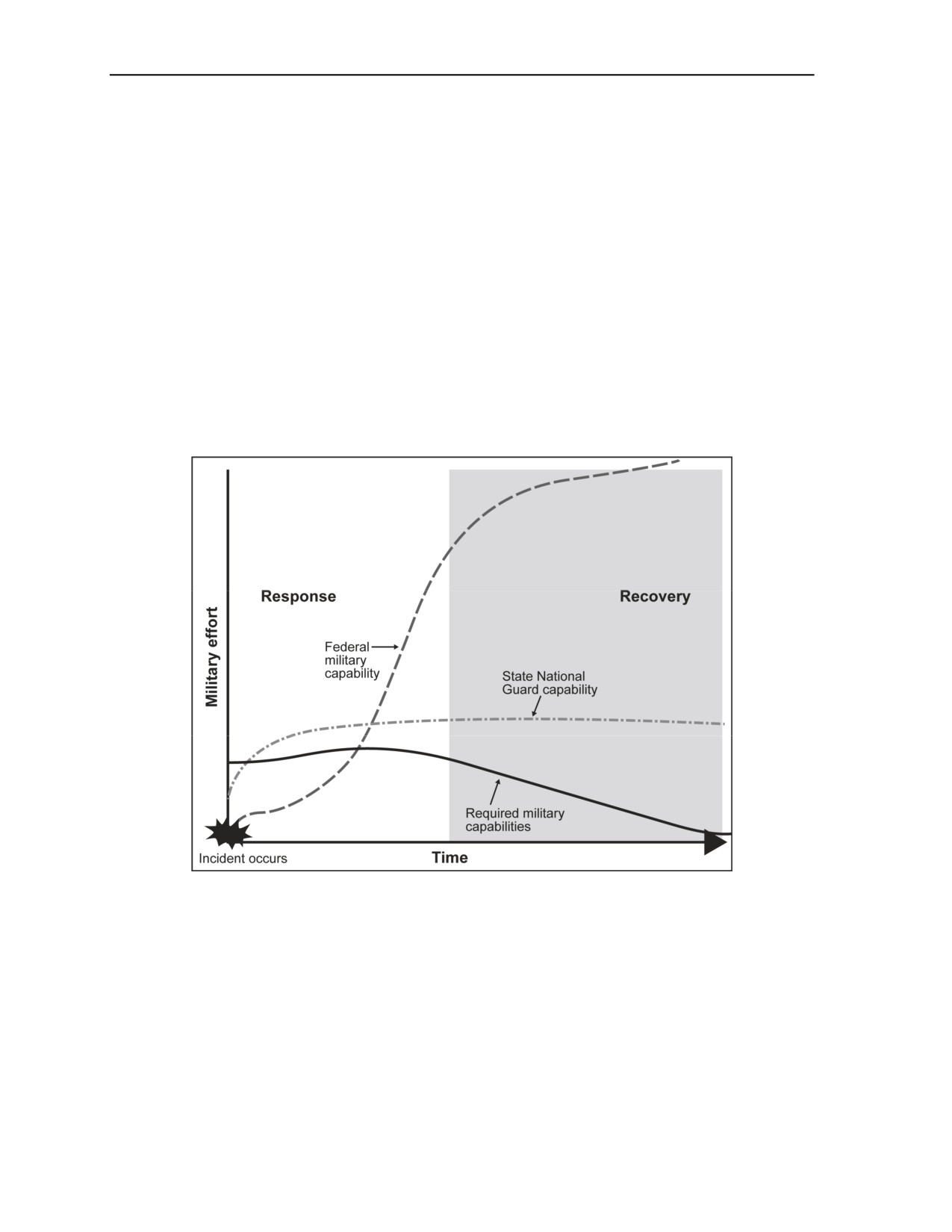
Figure 3-1. Military forces required for a typical incident
3-6. For most incidents, a state’s National Guard capabilities are sufficient; no additional military support
is needed. Studies show that more than 90 per cent of declared emergencies require no federal military
forces, even in incidents requiring significant support from the Federal Emergency Management Agency
(FEMA). Figure 3-1 illustrates this using a solid line for the total military effort needed, and dotted lines
representing the military capability that state National Guard and federal military forces can generate.
Given advance warning, the capability gap can be reduced. It may also be reduced through immediate
response authority (see figure 3-2, page 3-3) of federal military forces from nearby installations.
3-2
FM 3-28
20 August 2010
Provide Support for Domestic Disasters
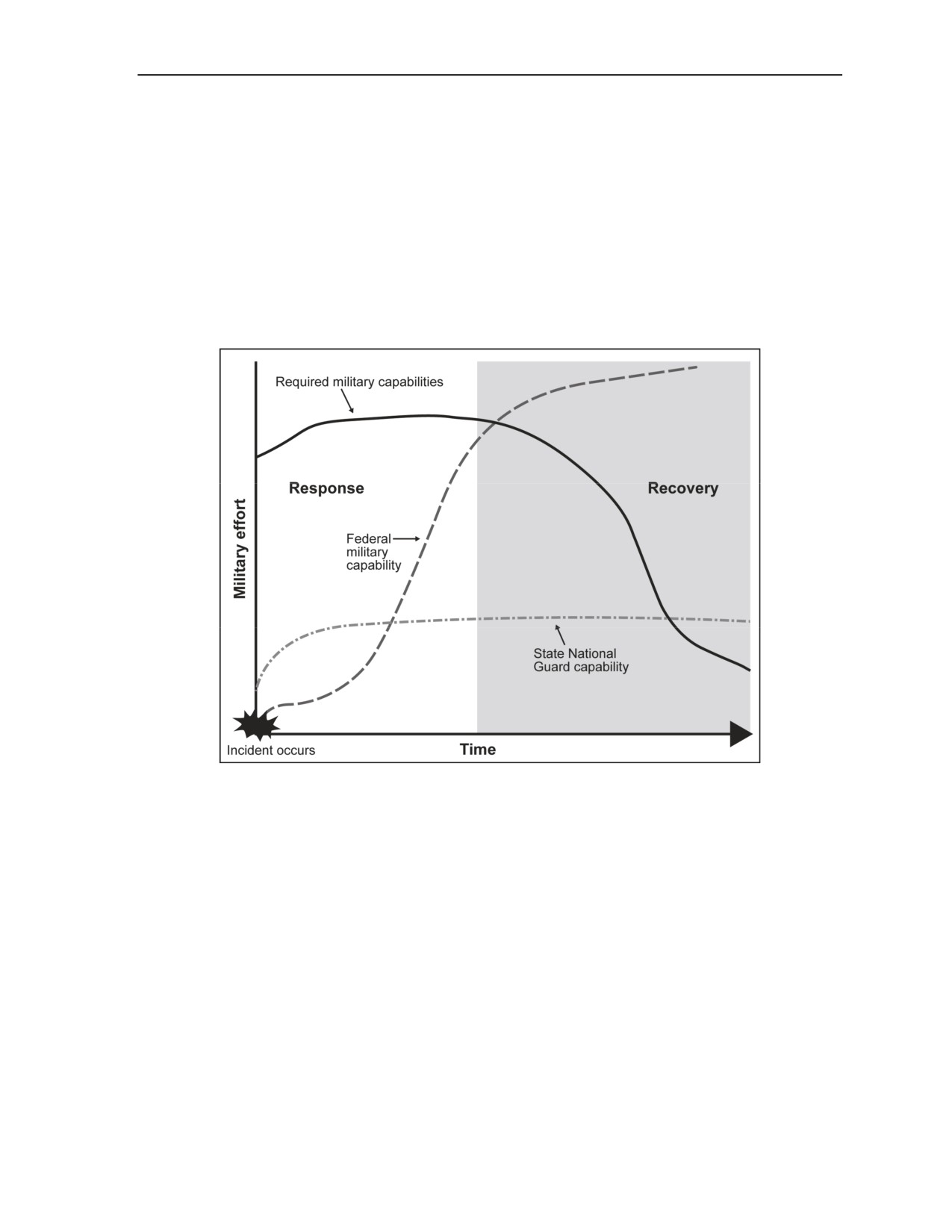
3-7. A catastrophic incident always exceeds the immediate capability of responders at every level. The
effect of the disaster on local responders—disaster victims themselves—compounds the requirements.
Although a formal request under Robert T. Stafford Disaster Relief and Emergency Assistance Act
(commonly known as the Stafford Act) for federal assistance follows the process illustrated in chapter 2, in
practice, the President commits federal aid simultaneously with the governor’s commitment of state
resources. Based on initial assessments from the Department of Homeland Security and supported
combatant commander, the Secretary of Defense authorizes support from federal military forces. Even
before the formal authorization, the combatant commander places available forces on alert. After the state’s
civilian and National Guard responders arrive, federal military forces fill the capability gap until national
resources can meet requirements. Figure 3-2 illustrates the requirements in a major catastrophe as a solid
line and the relative capabilities of the National Guard and federal military forces as dotted lines.
Figure 3-2. Military forces required for a catastrophic incident
3-8. To close the initial capability gap, federal military forces support response and recovery efforts
(usually led by FEMA) as fast as they can deploy. The capability gap, though it will decline quickly, may
remain until the bulk of federal military forces arrive. Deploying and receiving large forces in disaster
areas takes time; initial response will always lag requirements. Means of deployment must be re-tasked
from other commitments. (Even in a major catastrophe, however, the federal military support available will
rapidly exceed the need.) During the initial deployment period, commanders should expect criticism from
media representatives who demand to know why more is not being done. Despite this, commanders do
everything within their scope of authority to ensure that unity of effort is achieved.
20 August 2010
FM 3-28
3-3
Chapter 3
3-9. Civilian agencies will eventually reach their full capacity, recovery will begin, and military forces
will no longer be needed. Transition for military forces usually follows the reverse order of alert and
deployment. Federal military forces redeploy to their home stations first. Any of their remaining missions
pass to federal agencies (usually executed by civilian contract), National Guard units, and state agencies.
However, should conditions deteriorate, the President can increase federal military support at any time. As
state and local agencies recover, National Guard units begin to redeploy, with priority normally given to
National Guard units assisting from other states under mutual aid agreements. Until the governor is
satisfied that citizens’ needs can be met by civilian means alone, that state’s National Guard forces
continue to support local authorities in a reduced, “steady state” posture by rotating units and personnel.
INITIAL RESPONSE FROM LOCAL AND STATE AUTHORITIES
3-10. Before and during an incident, city, county, and tribal emergency managers assess their jurisdictions’
ability to respond. They consider the incident commanders’ assessments, experience with similar incidents,
training based on the National Incident Management System
(NIMS) and the National Response
Framework (NRF), estimates developed from the National Planning Scenarios, and advance coordination
with their counterparts in adjacent states or territories. They determine if they will need support from
outside their jurisdictions.
3-11. In some types of disasters, such as hurricanes, there is a warning period—sometimes up to a week.
This allows planners to initiate evacuations, pre-position supplies, and mobilize additional responders.
Unfortunately, many disasters occur with no warning. Local emergency manager request assistance from
adjacent jurisdictions and state officials as soon as possible when a disaster strikes unexpectedly. Prior
planning and preparation, coupled with support from outside the disaster area, mitigates the effects of the
incident somewhat. Local officials from adjoining communities normally have agreements in place that
authorize their first responders to provide emergency assistance when requested. Similar agreements allow
commercial services, such as utilities, to assist their counterparts across an entire region. However,
adjacent communities may be unable to provide assistance if the incident also affects them.
3-12. When local authorities determine they will not be able to manage the response through support from
their neighbors, they request assistance from the state. The state activates its emergency operations center,
and representatives from state emergency support functions (see chapter 2 for more information about
emergency support functions, known as ESFs) report to it. The state emergency operations center normally
initiates operations from its permanent offices. However, the governor or state emergency manager may
displace it if the permanent location is affected by the disaster and would degrade the response, or if the
governor needs to be closer to the disaster area. The latter is particularly true in the larger states, when
movement by air may require refueling stops.
NATIONAL GUARD DISASTER RESPONSE
3-13. When any municipality or county activates an emergency operations center, it notifies the state
emergency manager. The state emergency manager then passes a situation report to the joint force
headquarters-state and then to the National Guard watch desk. The adjutant general or a designated
representative may deploy a liaison team from the joint force headquarters-state to assess and monitor the
situation. A National Guard liaison team is likely to deploy if the situation is unclear and has the potential
to require additional resources. If the adjutant general anticipates local authorities needing additional
assistance, the joint force deploys additional teams.
3-4
FM 3-28
20 August 2010
Provide Support for Domestic Disasters
3-14. National Guard commanders may provide immediate response to a local community, but under state
laws. The local emergency managers may have contingency agreements in place with local armories and
nearby National Guard training installations. Alert for the National Guard begins with the activation of the
alert roster—usually initiated by full time Guard personnel. This alerting message is the notification the
Guard members receive to report to their home station. The National Guard local commander is not a
permanent full time member and is alerted by his or her alert roster. The supporting commander assesses
the situation within the larger context of the likely state response. Soldiers committed locally in an
immediate response may be needed for a larger call-up of National Guard forces by the governor. The local
commander may limit the immediate assistance in order to support higher priority missions. Frequently,
National Guardsmen muster at their units even before an official alert order; their experience enables them
to anticipate quite accurately when they will be needed. The Tennessee National Guard’s response to
damaging tornadoes in 2008 provides an example of a state response.
Tennessee National Guard Responds to Tornadoes
Strong tornados struck Arkansas, Tennessee, Kentucky, Mississippi and Alabama in
February, 2008. Two thirds of Tennessee suffered damaging storms. Tornadoes
killed 32 people, injured 149, and destroyed over 750 homes, making it the worst
storm to hit the state in 75 years. Many of the counties hit by the storm were
overwhelmed with storm debris and lacked the means to clear roads and initiate
response and recovery operations. Macon, Sumner, and Trousdale counties reported
a swath of destruction over a mile wide. The storm nearly destroyed some
communities. The Tennessee Governor called out the National Guard to help in the
recovery efforts.
The 230th Engineer Battalion, Tennessee National Guard, received the alert to
deploy within 48 hours. Their mission was to support the Tennessee Department of
Transportation. The Tennessee National Guard deployed 27 large dump trucks, eight
large bucket loaders, troops with chain saws, and a logistics support package. Over
a two-week period, the unit collected, hauled, and dumped over 9,000 cubic yards of
debris.
The Joint Force Headquarters-State
3-15. Under National Guard Regulation 500-1, each state maintains a joint force headquarters-state
(JFHQ-state) to unify command of its Air and Army National Guard forces. The JFHQ-state functions as
the joint staff for the adjutant general, who directs the state National Guard’s operations. The JFHQ-state
co-locates with the state’s emergency operations center and allocates resources to National Guard forces.
One of the most important functions of the JFHQ-state is coordinating requests for assistance by state
National Guard forces. Simultaneously, the JFHQ-state provides situation reports to the National Guard
Bureau joint operations command center in Washington D.C. During a disaster response, however, most
states exercise operational control of their deployed forces through a joint task force headquarters in the
operational area.
3-16. The adjutant general alerts state National Guard forces through emergency communications
networks that tie together subordinate National Guard armories, installations, and commanders. Based on
standing contingency plans, the adjutant general organizes one or more joint task forces formed around one
of the state’s battalions or larger sized units. This may be a brigade headquarters with Air National Guard
personnel and state civilians. Although other states have different arrangements, the support follows
similar patterns. The adjutant general supports the governor, and the JFHQ-state supports the state
emergency operations center. The joint task force exercises operational control of committed forces and
works
with
the
20 August 2010
FM 3-28
3-5
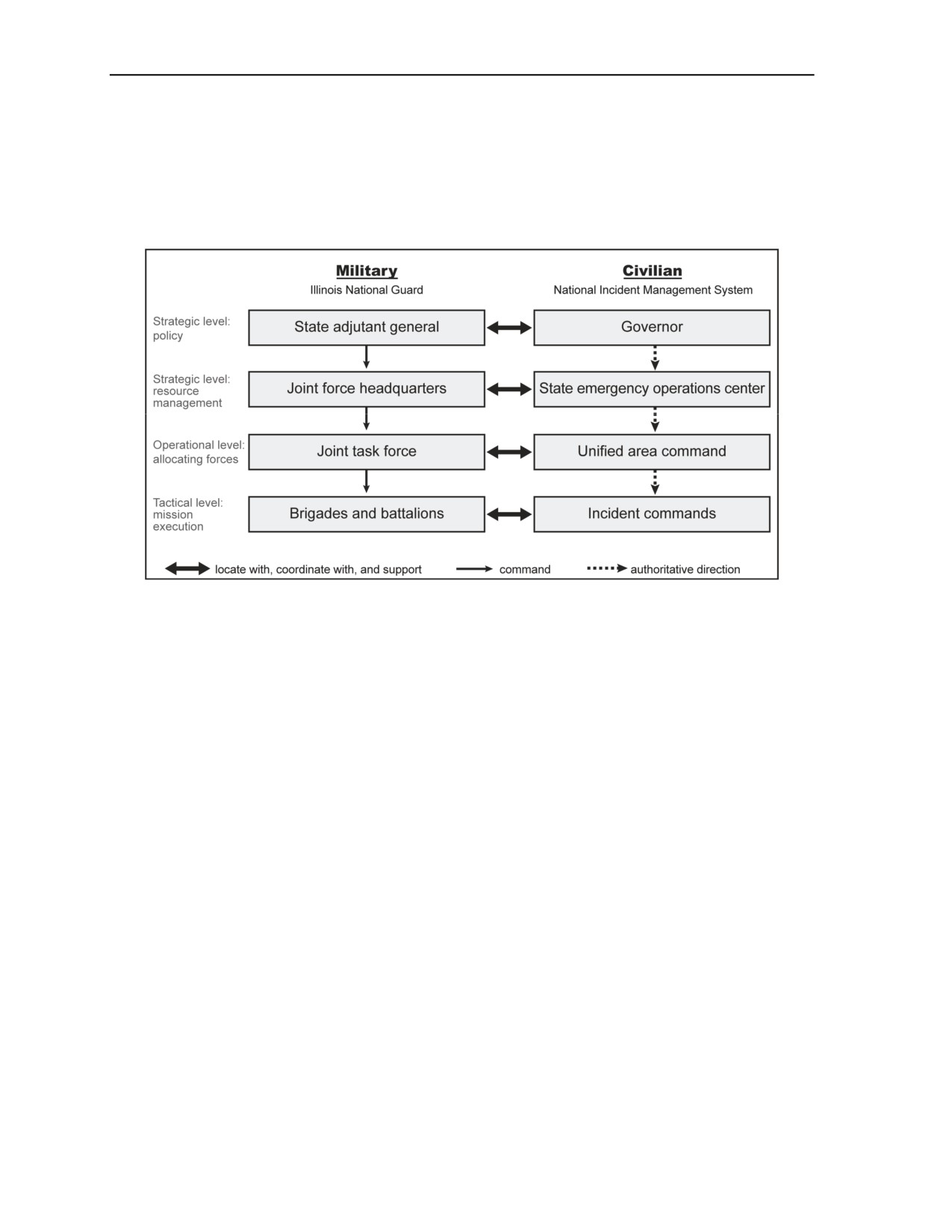
Chapter 3
civilian incident command organization (see chapter 2) on-scene. Figure 3-3 illustrates the relationships
between civilian command organizations and National Guard echelons during a large, state-level
multijurisdictional disaster response, as used in Illinois. This example shows a joint task force. In some
states, the military response may include only Army National Guard, and the force headquarters may be a
task force. A civilian area command may not be needed, depending on the extent of the disaster (refer to
chapter 2).
Figure 3-3. State response and National Guard echelons—Illinois example
3-17. Even in states where the adjutant general is also the state emergency coordinator, National Guard
forces remain in support of civil authority. State constitutions echo the principles in the Constitution of the
United States and respect the authorities of elected and appointed officials within their jurisdictions. The
relationship between National Guard leaders and their civilian counterparts may intertwine considerably.
This occurs for practical reasons and also because National Guard and state officials work closely together
for years and often form teams to respond to incidents.
3-18. When a disaster involves many counties, such as in a hurricane or major winter storm, the affected
state may employ several area commands and incident commands. The adjutant general organizes joint or
single Service task forces and places them in direct support of the area commands. This streamlines the
command and control process by allowing the civilian incident commanders to pass requests for assistance
directly to supporting task force commanders, who then issue fragmentary orders to the appropriate units.
Task force commanders inform the JFHQ-state of their status and pass on requests for reinforcements or
additional equipment and sustainment. This arrangement capitalizes on mission command and individual
initiative. Figure
3-4, page 3-7, illustrates the relationships of National Guard task forces to incident
commands.
3-6
FM 3-28
20 August 2010
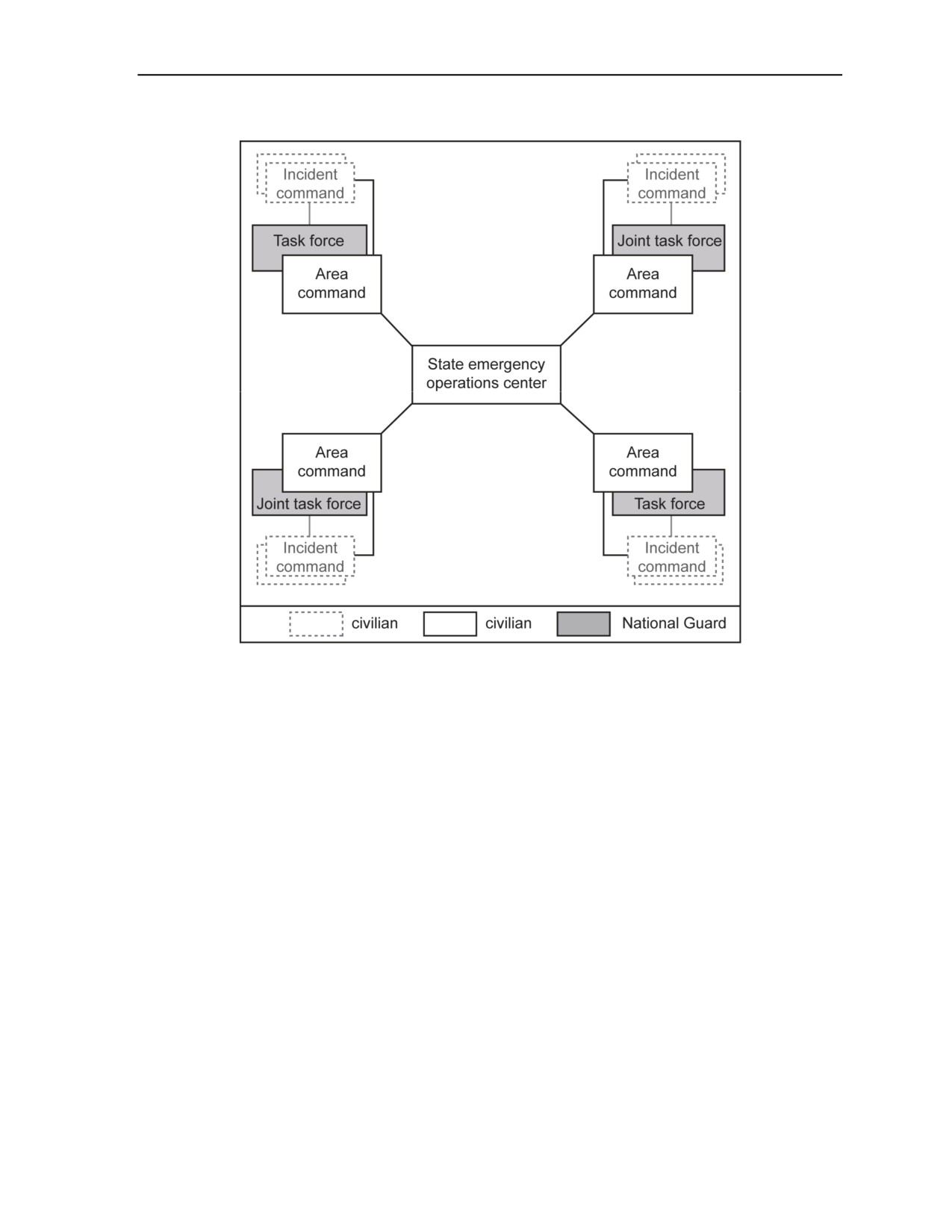
Provide Support for Domestic Disasters
Figure 3-4. Relationship of National Guard forces to area commands
Planning Considerations for State National Guard Units
3-19. State National Guard contingency planners consider several factors when preparing for potential
disasters. Some factors are common to Army unit planning, but several are unique to the National Guard.
These include—
z
Proximity of the unit to the disaster.
z
Deployed personnel and equipment.
z
Distribution of tactical units.
Proximity Of The Unit To The Disaster
3-20. The closer the unit’s armory is to the disaster, the more rapidly it can respond, and the more familiar
key leaders will be with the area and local civilians. However, the unit is also more likely to suffer in the
disaster, with some or all of its capability severely degraded.
Deployed Personnel And Equipment
3-21. National Guard units deploy overseas more frequently today than at any time during the Cold War.
The adjutant general continually updates plans based upon the availability of forces within the state. By
coordinating with adjacent states and the National Guard Bureau for support under assistance agreements
(see paragraphs 3-24 to 3-29), the adjutant general manages the state’s disaster response capabilities. If a
disaster strikes and one of the state’s units is preparing for deployment but not yet federalized, the governor
20 August 2010
FM 3-28
3-7
Chapter 3
may commit the unit to the disaster, under state control. The adjutant general works through the National
Guard Bureau to coordinate adjustments to deployment and training schedules.
Distribution of Tactical Units
3-22. Unlike the Regular Army, the various tactical units that make up the brigades and divisions of the
National Guard are widely distributed. Units are not necessarily co-located with their heavy equipment. For
example, a National Guard brigade combat team may have its battalions distributed across armories
throughout the state. In some cases, one of the battalions may belong to another state’s National Guard.
Disaster response plans within each state adjust task-organizations based on availability of forces,
proximity of units to one another, and unit equipment. Early in the response, a task force may consist of
small units from many units, and larger forces gradually assemble their table of organization and
equipment configuration.
3-23. National Guard planners also assess requirements against capabilities they will provide during civil
support operations. These include security; chemical, biological, radiological, nuclear, and high-yield
explosives consequence management; communications; logistics; engineer support; medical support;
transportation; aviation; and maintenance. Refer to National Guard Regulation
500-1 for additional
discussion.
Emergency Management Assistance Compact
3-24. The Emergency Management Assistance Compact (EMAC) grew out of several states helping each
other after Hurricane Andrew in 1992. The EMAC is a comprehensive agreement similar to a treaty
between nations. It establishes a legal framework for interstate mutual aid. The National Emergency
Management Association administers the EMAC. All states, the District of Columbia, Puerto Rico, and the
Virgin Islands are members of EMAC. For more information, see Web site http://www.emacweb.org/.
3-25. When incidents occur, governors enter into contractual agreements between their states based on
prior EMAC arrangements. States request assistance on an EMAC request form (known as a REQ-A). On
the form, requesting states provide details about support sought from neighboring states, including costs
for reimbursement. Requesting states prepare a separate request to each neighboring state from whom they
seek support. Support under EMAC requires an emergency declaration from the requesting state’s
governor but not from the President of the United States.
3-26. If National Guard forces support another state based on an EMAC agreement, they normally serve in
a state active duty status. National Guard forces do not serve in Title 32 status unless approved by the
Secretary of Defense. The EMAC does not pertain to federalized National Guard forces, in Title 10 status.
3-27. Article XIII of the EMAC prohibits EMAC agreements for using National Guard forces from one
state for civil disturbance or law enforcement operations in another state. This type of support requires a
separate memorandum of understanding. The Gulf States have executed memoranda with each other for
civil disturbance and law enforcement support. The terms of their agreements cover the use of armed
National Guardsmen from another state, including command relationships, immunity, carrying and loading
of weapons authority, law enforcement authority, and training on state rules on the use of force
requirements.
3-28. State National Guard forces provide their interstate support agreements to the National Guard
Bureau. Because the Bureau monitors the status of the total National Guard force, it can identify resources
to match requirements and assist with the details. In an emergency, the National Guard Bureau in
Washington, DC, assists with additional agreements between states, but the respective governors must
execute their memorandum of understanding concerning the use of out-of-state forces.
3-8
FM 3-28
20 August 2010
Provide Support for Domestic Disasters
3-29. Whenever state National Guard forces respond in support of another state, each state's joint force
headquarters ensures the following coordination requirements are met:
z
The memorandum of understanding specifies the duration of the commitment with the supported
state. (Most National Guard commitments are for 30 days.) The agreement normally specifies
the
“time on station” and excludes mobilization, movement, and demobilization time. The
supported adjutant general specifies the command relationship between the gaining unit and the
supporting unit. The preferred relationship is operational control, with specific coordinating
instructions concerning logistics and health service support.
z
The supporting state retains administrative control throughout the deployment.
z
The supporting unit deploys with a minimum of 72 hours of sustainment.
z
The agreement must clearly specify the authorities for law enforcement duties granted by the
supported governor and approved by the supporting governor.
z
The gaining state designates and operates the reception, staging, onward movement, and
integration facility and procedures for all incoming units and personnel from supporting states.
z
The supporting unit commander provides the gaining unit commander with a complete unit
status report when the unit arrives, and updates it according to the gaining unit’s standing
operating procedure. Forces avoid needless operational and administrative difficulties by
ensuring accurate status reporting.
z
The supporting unit brings or maintains access to any professional licenses necessary (such as
medical or veterinary licenses) for personnel provided under a mutual aid agreement that are not
validated under EMAC. The supported state must specify which licensing requirements are
waived or restricted.
z
Both states agree to the documentation needed for reimbursable expenses and procedures not
covered in National Guard regulations.
z
The gaining and supporting unit commanders coordinate actions related to disciplinary matters.
Unless modified by the respective governors, Soldiers remain subject to their state’s military
codes.
FEDERAL MILITARY DISASTER RESPONSE
3-30. Federal military forces provide support during emergencies and incidents in two general categories.
The first is immediate response authority, under which an installation commander may assist a local
community in an emergency. This support is limited in time and scope. The second category is in response
to a Presidential declaration of emergency or disaster. In the latter case, federal military support may range
from installation support up to commitment of major portions of the Regular Army.
IMMEDIATE RESPONSE AUTHORITY
3-31. Although federal military forces are seldom first responders, they can support local authorities in an
emergency, under immediate response authority. In the absence of a federally declared disaster, installation
commanders and responsible officials from Department of Defense (DOD) may provide support to save
lives, prevent human suffering, and mitigate great property damage. This includes mutual aid for fire
protection and immediate response as directed by the Secretary of Defense. This response must be
consistent with the Posse Comitatus Act. (See chapters 5 and 7 for more about the Posse Comitatus Act.)
The Chairman of the Joint Chiefs of Staff standing execute order for DSCA (referred to as the CJCS
DSCA EXORD) dated 14 August 2009 states—
When time does not permit prior approval from higher headquarters, local military
commanders, or responsible officials of other DOD components, may in imminently
serious conditions, upon request from local authorities, provide support to save lives,
prevent human suffering, or mitigate great property damage. Such immediate response
should be provided to civil agencies on a cost-reimbursable basis, but requests for
immediate response should not be delayed or denied because of the inability or
unwillingness of the requester to make a commitment to reimburse the Department of
20 August 2010
FM 3-28
3-9
Chapter 3
Defense [DOD]. Commanders, or responsible DOD, officials will report all actions and
support provided through the appropriate chain of command to the National Military
Command Center (NMCC), . . . and provide a copy to the Geographic CCDR [combatant
commander]. After
72 hours of employment, respective military departments will
coordinate continued operations with the Geographic CCDR.
CJCS DSCA EXORD, 14 August 2009
3-32. According to Section 1856a of Title 42, United States Code (USC), each agency charged with
providing fire protection for any property of the United States may enter into agreements with local fire-
fighting organizations (including nearby military installations) to provide assistance in fighting fires. This
includes personal services and equipment required for fire prevention, the protection of life and property
from fire, fire fighting, and emergency services. Emergency services include basic medical support, basic
and advanced life support, hazardous material containment and confinement, special rescue events
involving vehicular and water mishaps, and extractions from trenches, buildings, or confined spaces.
3-33. Requests for assistance under immediate response authority usually go directly from local civilian
authorities to local military commanders. Requests may also go to DOD officials. The installation
commander may provide all assets with the exception of those that have a potential for lethality. The
Secretary of Defense must approve deployment of weapons and munitions, including bayonets. Deployed
forces remain under military command and function in direct support of the requesting local authority.
Typical missions include—
z
Search and rescue.
z
Evacuation, decontamination, fire-fighting, medical treatment, restoration of medical capabilities
and public services.
z
Removal of debris, rubble, or hazards to permit rescue or movement.
z
Recovery, identification, and registration, and disposal of the dead of deceased persons.
z
Detecting, assessing, and containing a chemical, biological, radiological, nuclear, or high-yield
explosives incident.
z
Collecting, safeguarding, and distributing essential food items and supplies.
z
Damage assessment.
z
Communications.
z
Explosive ordnance disposal.
Note: The installation senior commander will not approve any civilian jurisdiction request for
law enforcement support outside the installation, including interdicting vehicles, conducting
searches and seizures, making arrests or apprehensions, surveillance, investigation, or
undercover work.
FEDERAL MILITARY FORCES DISASTER RESPONSE—PRESIDENTIAL DECLARATION
3-34. Usually, the commitment of federal military forces for civil support operations follows a presidential
disaster declaration under the Stafford Act. After the disaster declaration, a primary federal agency (usually
FEMA) coordinates with the defense coordinating officer (DCO) to prepare a request for DSCA and
submit it to the DOD executive secretary. (See paragraphs 2-94 to 2-100 for details about the DCO.)
However, a federal coordinating officer may initiate the request, or another federal agency could request
federal military support. In addition, the President may bypass the usual request process and order the
military to provide support. Figure 3-5, page 3-11, illustrates the usual process that leads to committing
federal military forces. Paragraphs
3-45 to
3-48 provide more information about how requests for
assistance develop into mission assignments.
3-35. Concurrently with the DSCA request to joint director of military support, the appropriate combatant
commander, either United States Northern Command
(USNORTHCOM) or United States Pacific
Command (USPACOM) develops the concept of operations and support and submits a request for forces to
3-10
FM 3-28
20 August 2010
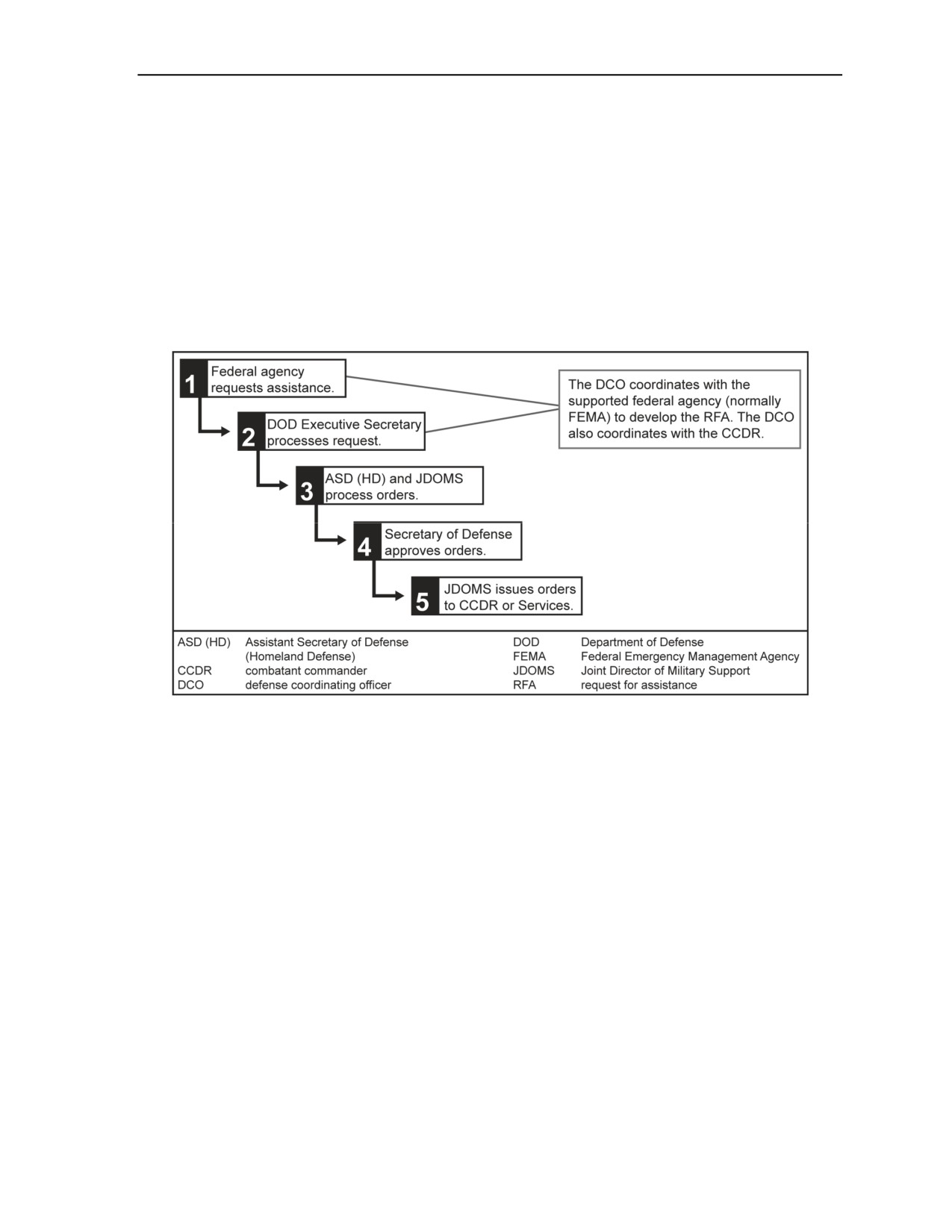
Provide Support for Domestic Disasters
the Joint Staff. The Secretary of Defense designates the supported combatant commander and any
supporting combatant commands. When validated, the request for forces becomes an order to the
supporting combatant commanders to provide the forces. In support of this process, the Army Service
component commander coordinates with Department of the Army and United States Army Forces
Command (for most Army units) concerning required capabilities.
3-36. Based on the Army force generation process, the United States Army Forces Commander and
Department of the Army identify the required forces to the supporting combatant commander (normally
United States Joint Forces Command). The Secretary of Defense specifies the command relationship of
forces to the gaining combatant command, either operational control or attached. The Secretary of the
Army may direct modifications to administrative control; if not, administrative control remains with the
providing Army headquarters.
Figure 3-5. The federal request for assistance process
3-37. If approved by the President, the Secretary of Defense may mobilize National Guard forces for
federal service. These forces pass to the operational control of the gaining combatant commander. National
Guard units conducting DSCA in federal military (Title 10) status change their administrative control to the
gaining Army Service component command—usually United States Army North
(USARNORTH).
However, the Army Service component commander coordinates with the providing adjutant general to
continue as much of the administrative control support as feasible through the respective states. The
Secretary of Defense may also direct the Service secretaries to place selected installations in a support
relationship to the supported combatant command.
20 August 2010
FM 3-28
3-11
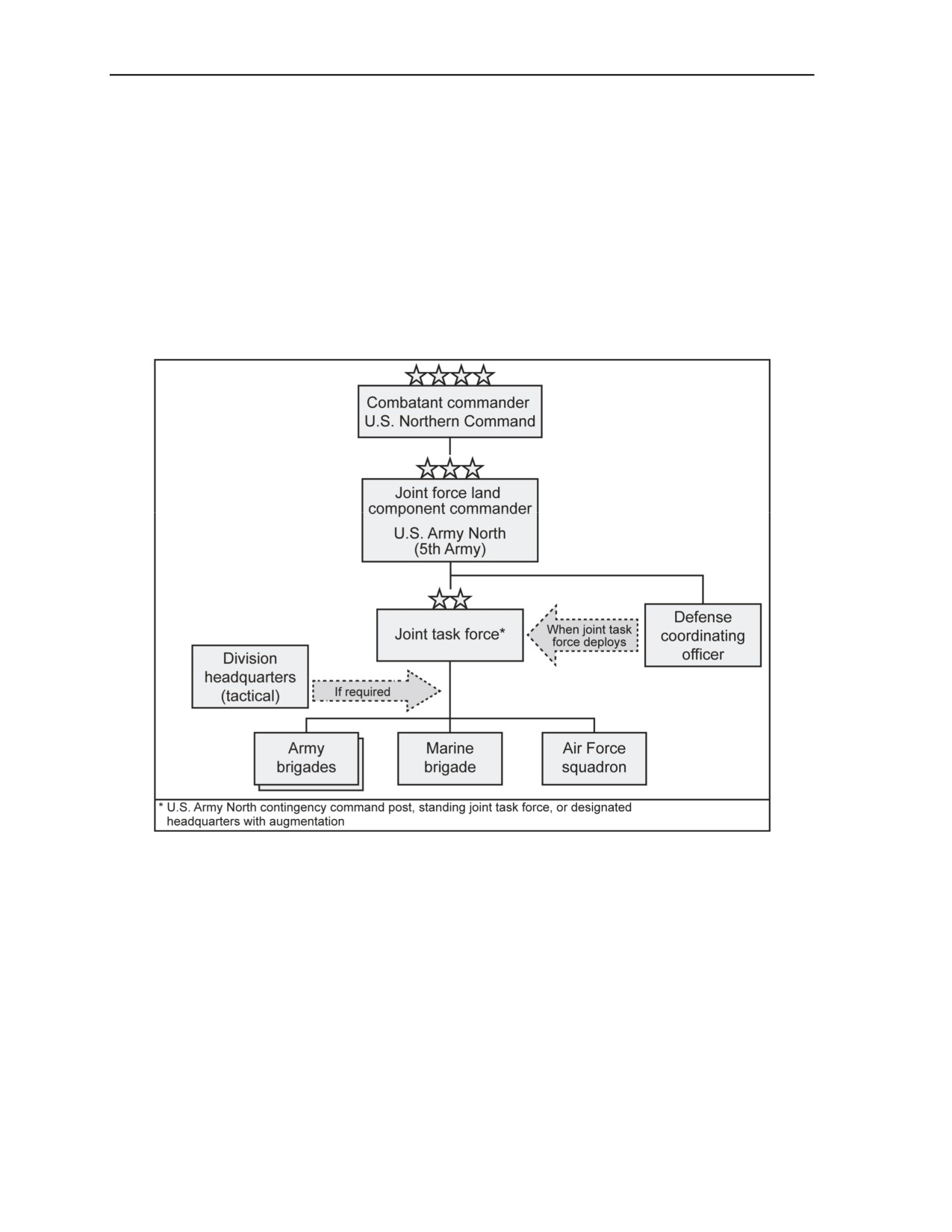
Chapter 3
3-38. For any federal military force operating in the USNORTHCOM area of responsibility, the joint force
land component commander determines the required capabilities and the appropriate command
relationships, depending on the situation. The determination of command and control arrangements is one
of the most important joint force land component command decisions. Figure 3-6 illustrates an example of
USNORTHCOM structure for DSCA.
3-39. If the requirement for federal military support only consists of a small number of troops, the joint
force land component commander may place the detachment under operational control of the DCO, rather
than a joint task force. The joint force land component commander provides the DCO with any additional
assets to support the detachment. The DCO coordinates missions with the federal coordinating officer and
issues orders to the detachment commander. The DCO and staff—the defense coordinating element—
coordinate for support through the joint force land component command and other federal agencies.
Figure 3-6. Example of USNORTHCOM structure for DSCA
3-40. Anything larger than a small element necessitates more extensive command and control than the
joint force land component command and defense coordinating element can provide. Within the
USNORTHCOM area of responsibility, the combatant commander and USARNORTH assesses the
command and control requirements needed to control federal Army and other federal military land forces.
The USNORTHCOM commander decides whether to commit Joint Task Force-Civil Support.
USARNORTH may employ either of its two contingency command posts as a joint task force or land
component command; conversely, it may designate an incoming headquarters as the joint task force or land
component.
3-41. The USNORTHCOM commander identifies the base support installation. The base support
installation is normally a DOD installation with an airfield and suitable support facilities. The base support
installation is the domestic equivalent to a theater base in other areas of responsibility. The base support
installation becomes the aerial port of delivery and joint reception, staging, onward movement, and
3-12
FM 3-28
20 August 2010
Provide Support for Domestic Disasters
integration facility for the Army forces. USARNORTH establishes and controls the joint reception,
staging, onward movement, and integration facility, usually at the base support installation or very near it.
In addition to joint reception, staging, onward movement, and integration, the base support installation may
become a training facility and principal supporting base for the federal relief efforts. If a suitable DOD
installation is not nearby, USNORTHCOM may request permission to use a National Guard base.
However, National Guard bases usually support no more than one or two battalions at a time and may
require extensive additional military and contract support. (See chapters 8 and 9 for more information
about sustainment.)
3-42. Both USNORTHCOM and USARNORTH routinely deploy situational assessment teams to disaster
areas in advance of a decision to commit federal military forces. These teams deploy to the incident area
and come under the operational control of the DCO. The DCO facilitates coordination and information
sharing between the assessment teams and the various emergency support functions. If required, the DCO
can coordinate for information sharing between the assessment team, the state emergency operations
center, and the JFHQ-state. Because DCOs work full-time in their FEMA regions, each DCO is usually
well-acquainted with state emergency managers, state coordinating officers, and state emergency
preparedness liaison officers. Once the assessment team provides its findings to its parent headquarters, it
becomes part of the defense coordinating element. As part of the defense coordinating element, the
assessment teams continue to provide situation updates to their former headquarters through the DCO’s
situation report.
3-43. USNORTHCOM or USARNORTH also sends liaison teams to DOD installations nearby to assess
the potential basing requirements. If deployment of federal military forces is likely, USARNORTH deploys
a contingency command post to the vicinity of the joint (interagency) field office. From there, the
command post coordinates requirements between the DCO and USARNORTH, assists the defense
coordinating element, and begins the process of tying in military command and control with the joint field
office.
3-44. The liaison team members achieve efficiency by combining interpersonal skill with professional
competence. If the situation is severe enough to require federal military forces, civilians at the joint field
office and a state emergency operations center will be under great stress. Bringing newly arrived federal
military personnel up to speed may seem like an additional burden in a chaotic situation. Before
deployment, the liaison teams and the contingency command post coordinate through the DCO with senior
federal and state officials. They obtain as much information as possible. Upon arrival, the liaison team
leaders further coordinate through the defense coordinating element in order to support civilian incident
commanders and deployed National Guard forces.
3-45. In situations other than a disaster, a federal agency or state government may request DOD assistance.
The request follows the same general process as an emergency under the Stafford Act. However, requests
for assistance in circumstances other than a declared emergency or disaster come under the Economy Act.
This law prohibits the use of DOD capabilities in lieu of similar capabilities within the requesting agency
or state. The law also requires the supported agency to reimburse DOD for all operating expenses.
Tactically, the Stafford and Economy Act have no significant effect on operations.
MISSION ASSIGNMENTS
3-46. Federal military forces receive their missions when they arrive in the disaster area. Within the
(civilian) joint field office, ESF coordinators analyze the requirements and capabilities in coordination with
the federal coordinating officer and DCO. Together, they identify potential requests for assistance from
federal military forces. The DCO determines if the requests are feasible. The DCO also assesses whether
the requests are appropriate—evaluating resources and legal issues. If the requests meet the criteria (listed
in paragraph 3-46), the DCO submits the requests according to the process illustrated in figure 3-5.
3-47. Beginning with the DCO and continuing through the chain of command, each request for DOD
assistance receives an evaluation based on six factors (sometimes referred to by the acronym CARRLL):
z
Cost. Who will pay or reimburse DOD for the assistance rendered?
20 August 2010
FM 3-28
3-13
Chapter 3
z
Appropriateness. Who normally provides and is best suited to satisfy the request for
assistance? Is it in DOD’s interest to provide the assistance? Have other options been considered
to meet the request? Is DOD the best provider of the requested assistance under the
circumstances?
z
Readiness. Does the assistance have an adverse impact on the responding unit’s ability to
perform its primary readiness, training, deployment missions?
z
Risk. What is the potential health or safety hazards to federal military forces and their
equipment, vehicles, or aircraft? Can these risks be mitigated?
z
Legality. What is the legal authority that permits or prohibits the requested assistance?
z
Lethality. Is there any potential for lethal force to be used by or against Federal military? If yes,
has the Secretary of Defense authorized the carrying of weapons?
3-48. The defense coordinating element performs a critical function by performing a modified mission
analysis on each request for assistance. First, they determine if the request for assistance expresses the right
mission. Often this means translating civilian terms into military terms. Second, they translate the approved
mission assignment into a mission tasking order, suitable for the joint task force to analyze and execute.
Ideally, the federal coordinating officer and DCO determine what capabilities are required, not how to do
the mission, allowing mission command. The joint task force commander translates the mission tasking
order into an operations order that allows the joint task force maximum flexibility. For example, rather than
asking the joint task force for “one UH-60 helicopter to fly the federal coordinating officer and FEMA
Director at a specific date and time and location”, the DCO may revise it into a mission tasking order, to
“provide command and control aviation support to the federal coordinating officer.”
3-49. Broader issues of support may require discussion among the members of the unified coordination
group (see paragraph 2-79) and military commanders. When required, the federal military joint task force
commander and the state joint task force commander participate in the discussions with their respective
DCO or state coordinating officer, but their inclusion is not required.
PHASES OF DISASTER RESPONSE OPERATIONS
3-50. The NRF divides disaster response into three broad phases: prepare, respond, and recover.
USNORTHCOM plans for DSCA use six phases: shape, anticipate, respond, operate, stabilize, and
transition. (Army doctrine does not specify operational phases. See Field Manual (FM) 3-0, chapter 6.)
Figure
3-7 illustrates the relationship between the NRF phases and the USNORTHCOM phases.
Commanders conducting civil support operations should be familiar with these phases and understand their
relationships. USARNORTH applies the USNORTHCOM phases for sustainment planning (see chapter 8).
3-14
FM 3-28
20 August 2010
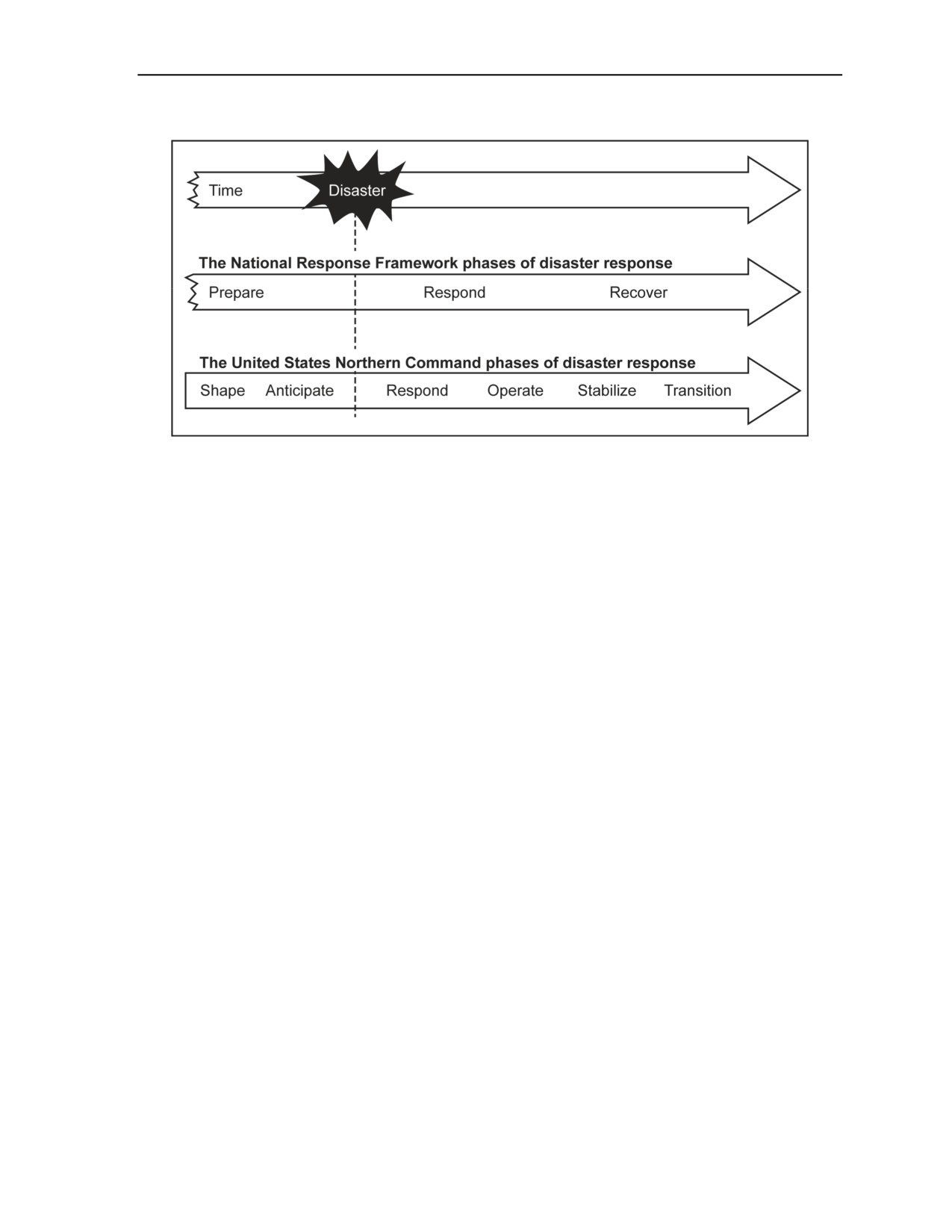
Provide Support for Domestic Disasters
Figure 3-7. USNORTHCOM and National Response Framework phases of disaster response
3-51. Phase 0 (zero), shape, refers to continuous situational awareness and preparedness. Actions in this
phase include interagency coordination, planning, identifying capability gaps, conducting exercises, and
public affairs activities. USNORTHCOM plans synchronize Phase 0 activities, which are ongoing.
3-52. Phase I, anticipate, begins with the identification of a potential DSCA mission, a no-notice incident,
or when directed by the President or Secretary of Defense. This phase ends when federal military forces
deploy or when the determination is made that federal military forces are not needed. Phase I is completed
with deployment of the DCO, the defense coordinating element, emergency preparedness liaison officers,
and other required personnel.
3-53. Phase II, respond, begins with the deployment of initial federal military response capabilities. This
phase ends when federal military forces are ready to conduct operations in the joint operations area. This
phase is completed when sufficient forces are deployed to accomplish the mission.
3-54. Phase III, operate, begins when federal military forces commence operations. Phase III ends when
federal military forces are close to completing their missions and no further requests for assistance are
anticipated.
3-55. Phase IV, stabilize, begins when military and civil authorities decide that federal military support
will scale down. Military and civil authorities establish criteria for transition to civilian management of the
response without federal military support. Phase IV is successful when all operational aspects of mission
assignments are complete and federal military support is no longer needed.
3-56. Phase V, transition, begins with the redeployment of remaining federal military forces. This phase
ends when federal military forces have redeployed and operational control is returned to their parent
commands. Phase V is complete when federal military forces have transitioned all operations back to state
National Guard forces or civil authorities.
PLANNING SUPPORT FOR CIVILIAN EMERGENCY MANAGERS
3-57. Early in an operation, a catastrophic disaster may overburden the civilians managing the response.
Urgent requirements force emergency managers to concentrate all their efforts on the next 24 or 48 hours.
Longer planning horizons may become a low priority. Army planners can support civil authorities by
offering to develop long-term plans. Before offering to support long-term planning, the senior commander
must earn the trust and confidence of civilian leaders. Army commanders always keep in mind that they
serve in a supporting role. Once accepted, Army planners help the civilian staff develop a phased plan
(keeping in mind NRF phases) with an achievable end state. Similar assistance, offered where needed in
20 August 2010
FM 3-28
3-15
Chapter 3
the joint field office or within other parts the incident command system (such as incident command posts
and emergency operations centers), contributes to effective unified action.
TRANSITION FROM MILITARY TO CIVILIAN SUPPORT
3-58. The Army’s role in disaster response ends as soon as practical. The ultimate task of federal and state
disaster response efforts is to assist the local community in returning to self-sufficiency. When directed by
the federal coordinating officer or state coordinating officer, Army forces complete their mission
assignments and turn over responsibility for further efforts to civilian agencies and commercial enterprise.
Commanders coordinate with appropriate interagency and military groups (including joint field offices,
emergency operations centers, incident commands, and defense coordinating elements) to avoid gaps in
necessary support. The goal of the recovery effort is to allow state authorities to control as much of the
long-term recovery as feasible and return federal forces to their parent installations.
3-59. In addition, commanders at every level keep in mind the human aspects of the transition to civilian
organizations and account for it in their assessments. In a disaster, Soldiers form friendships and
professional relationships with civic and group leaders with whom they work. Communities form a
relationship with the Soldiers they see every day. When military units are near the end of a mission, they
need to coordinate the transition with their civilian counterparts. Each situation is different, but
commanders make sure they plan for the human aspects of transition as well as the details of transferring
missions.
3-60. National Guard forces may supplant federal military forces as communities begin to recover. This is
likely in incidents involving immediate response authority. Federal military forces that arrive immediately
at an incident site may be relieved by National Guard forces as the latter reach the scene. In other cases,
federal military forces may receive a mission assignment to replace National Guard units so that state
National Guard forces can enforce public order, while federal troops take over humanitarian efforts. The
transition between federal military forces and state National Guard forces is planned and coordinated
through the joint field office between the federal coordinating officer, DCO and state coordinating officer.
In addition to specific coordination requirements specified in fragmentary orders, the outgoing and
incoming commander exchange information on the situation and environment.
CONSIDERATIONS FOR DISASTER RESPONSE OPERATIONS
3-61. In this section and in succeeding chapters, FM 3-28 discusses operational and tactical considerations
for civil support operations. This discussion includes selected considerations organized by the Army
doctrinal concepts of battle command and the elements of combat power. The emphasis is on tactical
considerations that require additional planning and on measures that complement civil support operations
or distinguish them from stability operations.
3-62. FM 3-28.1 discusses many other tactical considerations. Commanders and staff can also find related
information in Center for Army Lessons Learned, National Guard Lessons Learned, and Joint Lessons
Learned publications. The USNORTHCOM Web site, http://www.northcom.mil/, also provides a portal for
extensive reference material.
BATTLE COMMAND
3-63. Battle command drives the operations process in civil support just as battle command drives it in full
spectrum operations overseas. Commanders understand, visualize, describe, and direct while assessing and
leading. However, certain aspects of civil support require a different command perspective than combat
situations. The most obvious is the lack of a thinking, adaptive enemy. Although Soldiers may encounter
some criminal behavior by civilians during civil support operations, from the Soldier’s perspective the
civilians are citizens and not enemy combatants. Commanders also adjust the way they understand, assess,
and lead, adapting the particulars of battle command to domestic operational environments.
3-16
FM 3-28
20 August 2010
Provide Support for Domestic Disasters
Understand
3-64. Command in civil support begins with understanding the operational environment. Understanding
the physical environment, particularly in the aftermath of a disaster or terrorist attack, requires first-hand
knowledge. To achieve this, commanders travel to their subordinate’s location to get their subordinate’s
assessment of the situation and measure that against personal observation, just as they would in combat.
Reports and statistics may be useful summaries of activity but cannot convey the actual impact of the
incident on the community. Commanders speak with citizens throughout the area and ascertain for
themselves the situation in the community. They make sure their subordinates do the same. There is no
substitute for face-to-face discussions to build understanding of the situation at a human, neighborhood
level and then assemble that level of understanding into an appreciation of the larger situation.
3-65. To understand the environment, commanders need to know their role and that of their units within
the environment. Commanders begin with their own chain of command. In many operations, the task
organization combines units and headquarters that have not worked together previously. For many of the
Regular Army units, this may be their first deployment in a domestic emergency. The command
arrangements for civil support will differ from those used in combat operations. Commanders at each level
meet with their seniors and subordinates early and often. As soon as they understand their military
organization and commanders’ intent, they do the same with leaders of other military forces and the
civilian agencies. This parallels how commanders develop understanding in stability operations—the role
of that unit within the larger context. Military forces are there to support citizens, working in conjunction
with local, state and federal authorities.
Assess
3-66. Commanders stress assessment of the situation to their staffs and subordinates. They build situational
awareness through coordination with supported and supporting agencies, other military forces, volunteer
organizations, and contacts with the media. On the ground, leaders are certain to encounter misinformation
and rumors, particularly in the early stages of response. Inoperable and incompatible communications,
overloaded incident command centers, distraught citizens, and exaggerated or inaccurate news media
coverage contribute to confusion. Although it may not be battle command as FM 3-0 defines it, the chaos
surrounding a disaster poses challenges found in combat situations. Commanders keep in mind that the
effectiveness of civil support depends not on the success of military missions, but on the effectiveness of
the civilian agencies in meeting the citizens’ needs.
3-67. Initial assessment is vital. The initial assessment provides the responding commander with
information and recommendations to make timely decisions for the response. Initial assessment identifies
specific needs on the ground and actual coordination requirements, including but not limited to items
covered in local, state, and federal disaster plans. Prior planning and exercises are invaluable, but disasters
never occur exactly as anticipated. The initial assessment provides information to help verify on-the-
ground conditions. This information helps the commander make required decisions in order to provide the
most effective military support for civil disaster response. During the initial assessment, the commander
may determine that an existing plan fits a very different incident and can rapidly orient the unit on
measures developed in response to that scenario, adapted for the situation.
20 August 2010
FM 3-28
3-17
Chapter 3
Earthquake Plans Adapted to an Ice Storm
In February of 2009, a severe ice storm paralyzed western Kentucky. The storm left
more than 100,000 citizens, many in rural areas, in dire circumstances. They had no
electric power, no way to call for help and all the roads were blocked by broken trees.
The Adjutant General of Kentucky, who was also the state’s emergency manager,
did not have a specific plan for a winter storm of this severity. However, he did have
plans for dealing with an earthquake. He quickly realized that the effects of the ice
storm were similar to those predicted for the earthquake. He ordered civilian
responders and National Guard emergency forces to adapt the plan they had
rehearsed in March of
2008 as part of an emergency response simulation.
Subordinates took the initiative and executed ice storm relief effort based upon plans
for a major earthquake. BG Heltzel, adjutant general of Kentucky, attributed the
success of the relief effort to prior planning, even if it was for a very different
emergency than actually occurred.
Lead
3-68. In civil support operations, commanders focus not only on their subordinates, but on their civilian
counterparts. They work to develop trust and confidence between military and civilian personnel. This is
an art, and it depends on human qualities. There is no checklist for how to do this, but it is essential for
commanders to promote unified effort. Military commanders begin by demonstrating their willingness to
support and not take charge of the various field offices. Close cooperation and honesty break down
friction. Army leaders look for interagency shortfalls in personnel, communication, and situational
awareness, and offer assistance if available. They stress that their Soldiers and personnel are there to help
and to learn, and they demonstrate it by personal example.
COMMAND AND CONTROL OF MILITARY FORCES DURING DISASTER RESPONSE
OPERATIONS
3-69. Probably the most challenging aspect of civil support is the command and control adjustments
required to adapt Army forces to their supporting role within a multiagency environment. Specific areas
that require attention include command and support relationships, command post operations, and
communications, liaison, and control measures.
Parallel Command
3-70. In many large-scale civil support operations, state National Guard and federal military forces operate
in overlapping areas but under separate chains of command. The parallel command structure is one of the
means to enhance unity of effort, but its success depends on continuous coordination between all of its
components. Within a parallel command structure, there is no single force commander and therefore no
unity of command in the military sense. Both the federal and state militaries retain control of their
respective forces. Decisions regarding the operation require the collective effort of all participating leaders:
state and federal governmental leaders, and state and federal senior military leaders. These leaders
collaborate within the NRF to develop common goals, unify their efforts, and accomplish the mission.
Figure 3-8 shows an example of a parallel command structure.
3-18
FM 3-28
20 August 2010
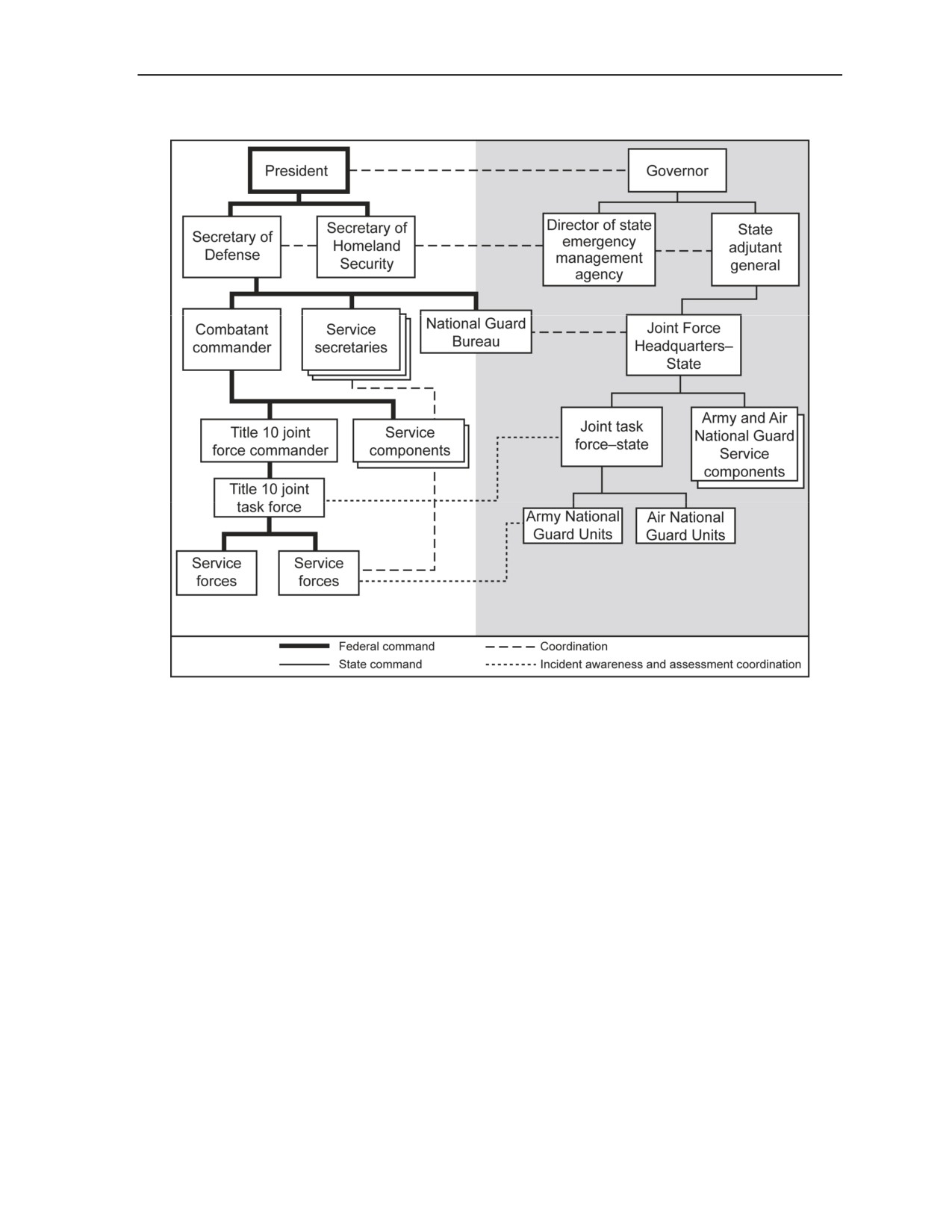
Provide Support for Domestic Disasters
Figure 3-8. Example of parallel command structure
3-71. The challenge in using a parallel command structure for DSCA is its dependence on the efficient and
effective use of available forces by the state and federal military chains of command. Therefore, its
effectiveness depends on a close working relationship between commanders. Physically co-locating
command posts or exchanging high-quality liaison officers at the command posts facilitates this
coordination.
Comand in Multistate Disasters
3-72. A major catastrophe such as a major earthquake may affect several states simultaneously. This
makes a coordinated national response imperative. The military commitment could involve thousands of
Soldiers from every component. Within the affected states, all National Guard forces will support their
respective state’s first responders. However, in a multistate disaster, existing agreements for support from
adjacent states may be overridden by the extent of the catastrophe. The National Guard Bureau will work
with all unaffected states to coordinate for additional National Guard forces to deploy and reinforce the
state National Guard forces within the affected states.
3-73. A multistate disaster will require FEMA to activate at least one joint field office per state. In those
states where federal military forces join the response effort, a DCO will operate within each joint field
office. In order to oversee the multiple responses FEMA may expand the regional coordination center
within the disaster area (if still operational) to direct the regional response efforts. Note that DCOs from
other FEMA regions would have to deploy to joint field offices established in each state since the regional
DCO remains with the regional coordination center and principal federal official. The Department of
20 August 2010
FM 3-28
3-19
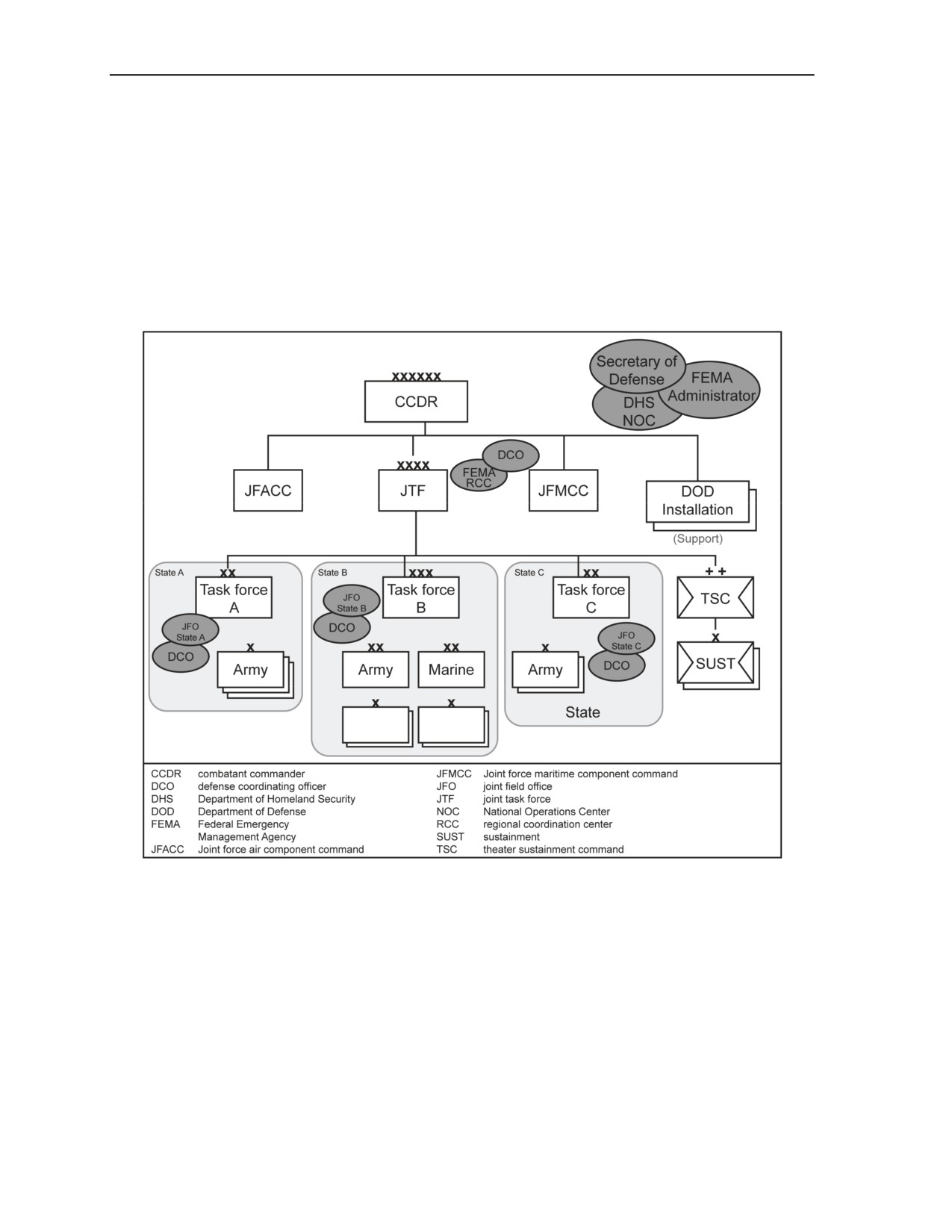
Chapter 3
Homeland Security and FEMA would coordinate the National response efforts from the National
Operations Center in Washington, DC.
3-74. Figure 3-9 illustrates command and control for a very large federal military forces response to a
major catastrophe in the continental United States. In this hypothetical response, an earthquake on the scale
of the 1811 New Madrid Quake (see vignette on page 3-20) strikes a region of the United States,
devastating a three state region (states A, B, and C). State B suffers the greatest damage, including severe
damage and large loss of life within a major metropolitan area. Other states beyond state A, B, and C are
affected, but their state National Guard forces can meet military requirements. Supporting combatant
commands, principally United States Joint Forces Command, provide federal military forces to
USNORTHCOM.
Figure 3-9. Multistate disaster requiring major commitment of federal military forces
3-20
FM 3-28
20 August 2010