FM 4-01.30 MOVEMENT CONTROL (SEPTEMBER 2003) - page 2
FM 4-01.30 _______________________________________________________________________________________ Chapter 4
• To observe, assess, and report progress of tactical and non-tactical transportation
movements along main supply routes.
• To adjust movement schedules as necessary, to coordinate the movement of authorized
traffic.
• To implement changes in unit moves or vehicle/convoy routings.
• To divert cargo and resolve movement problems.
• To provide first destination reporting points.
Cargo Documentation Team
4-37. The Mission of the Cargo Documentation Team is to provide cargo documentation for the
transshipment of cargo in water, air, motor, and rail terminals. The Cargo Documentation Team
supports onward movement of combat units and sustainment operations. On a round-the-clock
basis, the functions of the cargo documentation team are:
• Performs documentation required to load, discharge or transship 500 short tons of general
cargo or 480 containers daily in a water, rail, intermodal, or air terminal.
• Assists in the coordinated defense of the unit's area or installation.
4-15
FM 4-01.30 _______________________________________________________________________________________ Chapter 5
Chapter 5
Movement Control In The Corps
5-1. The corps combines the operational and tactical levels of war. In this environment, both unit
and sustainment transport moves must be coordinated and executed to ensure a continuous flow of
available transportation assets, infrastructure, and Line of Communications
(LOCs). Particular
attention must be directed to coordinating movements that occur concurrently.
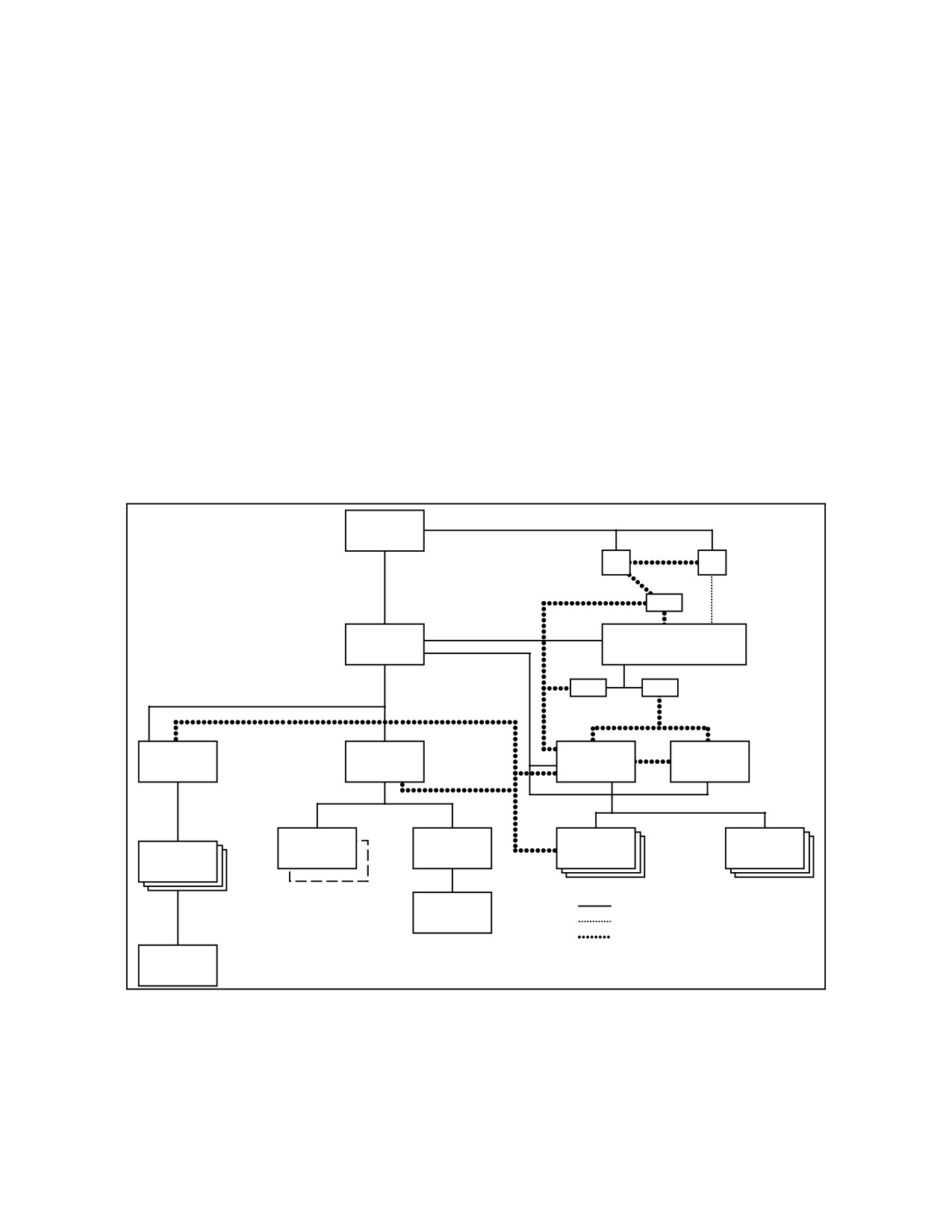
5-2. Movement planning is conducted by the corps G3 and G4 staffs, and by the corps support
command (COSCOM) support operations staff.
(See figure 5-1.) The corps G3 plans and directs
maneuver and recommends corps priorities. The G4, in coordination with the Corps Transportation
Office (CTO) and COSCOM support operations staff, recommends logistical support priorities. The
CTO receives technical support from the COSCOM Movement Control Battalion (MCB) and the
transportation support branch of the COSCOM support operations staff.
CORPS
G3
G4
CTO
SUPPORT
COSCOM
OPERATIONS
TRANS
BRANCH
DMC
CSG
CSG
MCB
MMC
FWD
REAR
TRANS
CSB
MCT
MRT
BN
CSB
LEGEND:
TRANS
COMMAND
UNITS
STAFF SUPERVISION
COORDINATION
TRANS
NOTE: MCT COLOCATED WITH EACH CSG.
UNITS
Figure 5-1. Corps Transportation Command and Control
5-3. The COSCOM provides logistical support to the corps and an integrated distribution system in
the corps area. It does this through the coordinated planning of the COSCOM staff, subordinate
Corps Support Group (CSG), and its materiel management and movement control units. The corps
MCB centralizes movement control and highway regulation to support corps operations.
5-1
FM 4-01.30 _______________________________________________________________________________________ Chapter 5
CORPS MOVEMENT CONTROL STAFF
5-4. Within the corps headquarters, the movement control staff consists of the G3, G4, and CTO.
Each of their duties is described below.
•
G3 Plans, Operations, and Training. The G3 plans and directs movement and maneuver
of combat units through or within the corps area. This may require rapidly projecting these
forces over extended distances on main supply routes (MSRs). The G3, coordinating with
the G4, establishes priorities for using MSRs for movements and maneuver. Maneuver will
normally have priority over movements. However, maneuver must be well coordinated with
movements to prevent route congestion, enforce movement priorities, and provide
continuous logistical support. MCB movement planners assist the G3 in planning the
movement of combat forces. The G3 air allocates Army aviation support. The G3 also
coordinates with the CTO and MCB for unit movement, force tracking, and maneuver
planning.
•
G4 Logistics. The G4 plans for the logistical support of the corps, and directs the
execution of the plans. The G4, using the recommendations of the CTO, establishes plans
and implements logistical support priorities for movement. These priorities become the
basis of the corps distribution plan developed by the COSCOM support operations staff, the
movement program and highway regulation plan prepared by the Highway Traffic Division
of the MCB in coordination with CTO, and the traffic control plan prepared by the Provost
Marshal (PM).
•
Corps Transportation Officer. The CTO is a special staff officer who works for the corps
Chief of Staff
(CofS). The CofS has the option of placing the CTO under the staff
supervision of the G3 or G4. The CTO assists the G3 with transportation planning during
unit movement and maneuver planning. The CTO assists the G4 in the areas of logistic and
unit movement requirements, and prepares transportation portion of corps plans and orders.
The CTO also assesses the impact for transportation requirements and highway regulation in
the corps area. This may include support of reception and onward movement of forces,
replacement operations, and reconstitution. The MCB works directly with the CTO
establishing movements and highway regulation. The CTO assesses the overall effectiveness
of the corps movement programs and recommends the type of transportation units and
assets required to accomplish the corps mission. Other CTO duties include the following:
⇒ Coordinate transportation planning with theater Transportation Command Element
(TCE), COSCOM support operations staff, and division and separate brigade
transportation officers to determine requirements.
⇒ Plan, coordinate, and monitor large or special movements in conjunction with the MCB.
⇒ Guide and assist major subordinate commands and units transiting the corps area.
⇒ Recommend road repair priorities and improvements for the road network in the corps
area in coordination with the corps engineer.
⇒ Assess and recommend requirements for host nation transportation support (HNS).
5-2
FM 4-01.30 _______________________________________________________________________________________ Chapter 5
CORPS SUPPORT COMMAND
5-5. The COSCOM is a multifunctional support command at the corps level. COSCOM operations
are the focal point for tactical logistics support to the corps. Both the corps MCB and transportation
mode operating units are assigned to the corps and attached to the COSCOM.
NOTE: As the Army moves toward the objective force, redesign of some CSS organizations is occurring. This is true
of the COSCOM. As this FM is written, the COSCOM is undergoing the careful scrutiny needed to ensure that its
new organizational design is one that provides the support needed by the objective force.
5-6. Transportation Support Branch. The transportation support branch is a planning staff that
integrates and coordinates transportation planning with all other support operations provided by the
COSCOM. This branch is under the supervision of the DCSO. The transportation support branch
executes planning responsibilities vested in the DCSO for the movement function. These
responsibilities include the following:
•
Preparing and coordinating plans, policies, and programs to support transportation,
movement control, highway regulation, and cargo transfer operations.
•
Preparing movement management policies for the COSCOM.
•
Preparing estimates, plans, and recommending policies for mode operations, and
terminal operations.
•
Developing input for corps movement annexes and transportation estimates.
•
Reviewing corps orders for transportation supportability, specified, and implied tasks.
•
Coordinating plans for throughput from theater to the tactical level, intermodal
operations, and trailer transfer operations.
•
Coordinating with the COSCOM procurement support branch on the acquisition and
use of host nation (HN) transportation resources based on the corps movement
program or other planning documents.
•
Developing and recommending locations of transportation nodes and units to support
the distribution system and corps movement program.
•
Preparing changes in allocation of transportation units based upon changes in the
distribution plan or to influence the corps battle.
•
Advising the COSCOM deputy commander for support operations on the effective use
and operation of transportation units.
•
In coordination with the MCB, reviews materiel distribution plans to ensure that the
existing transportation infrastructure can support them.
•
Developing input to the transportation portion of contingency plans.
•
Recommending requirements to construct, improve, or maintain transportation facilities.
•
Providing input to the MCB for inclusion in the corps movement program.
•
Coordinating transportation plans and policies with the CTO, corps G4, CSG
transportation branch staff, DTOs, TCE, and TSC DMC.
•
Developing the transportation movements annex to COSCOM operation plans
(OPLANs) and consolidating input to the corps administrative/logistics plan for
personnel and materiel movements.
CORPS MOVEMENT CONTROL BATTALION
5-3
FM 4-01.30 _______________________________________________________________________________________ Chapter 5
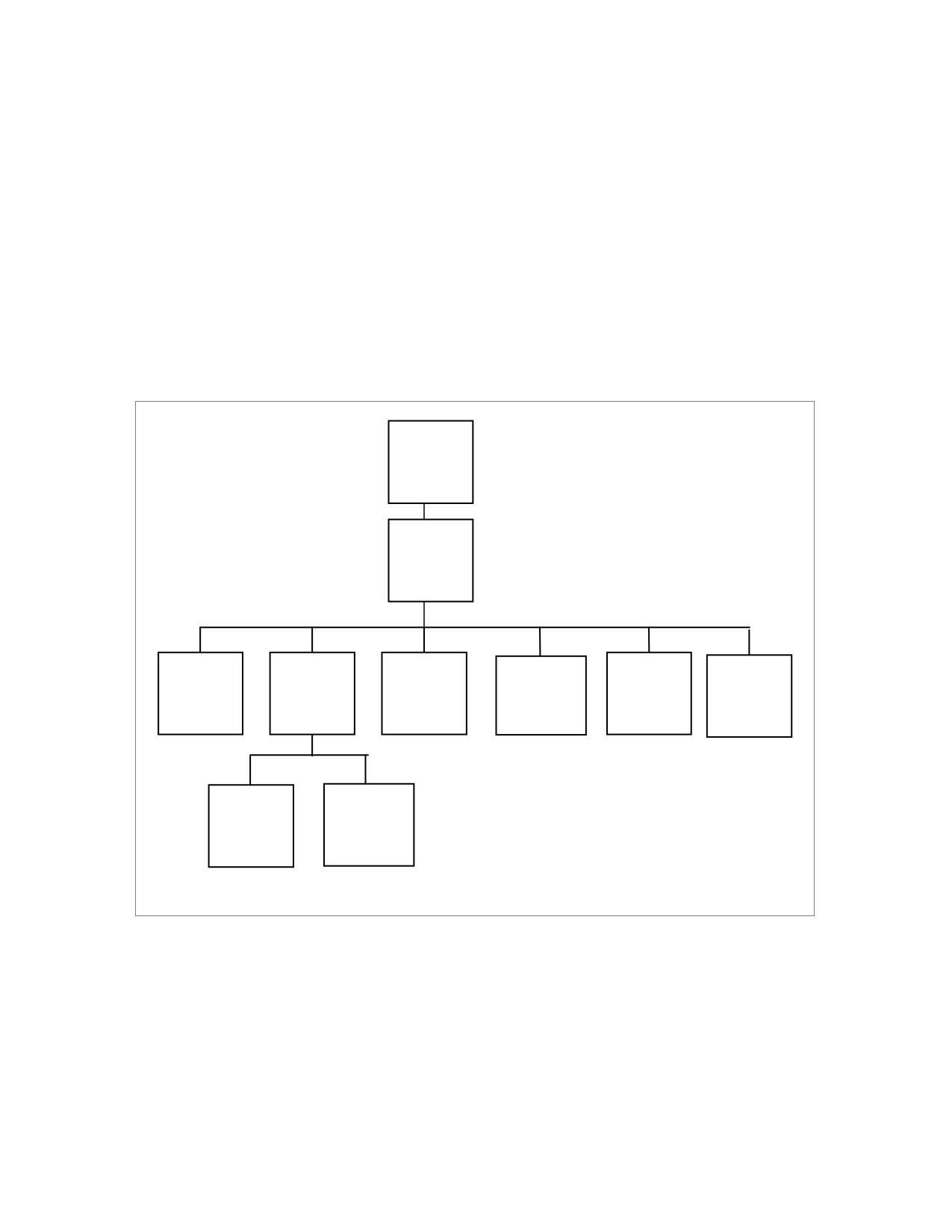
5-7. The corps movement control battalion (MCB) controls the movement of all personnel, units,
and materiel in the corps AO. It commands, controls, and supervises movement control teams.
The battalion maximizes the use of available transportation assets. The battalion plans, coordinates,
and manages movement programming, highway regulation, and transportation support for the corps.
It provides a central headquarters for all movement control teams assigned or attached to the
battalion. It plans, programs, coordinates, manages, and analyzes transportation and movement
requirements and adheres to and enforces corps priorities. The battalion receives reports of vehicle
asset visibility for tactical and nontactical moves within the corps geographical area. The corps MCB
is organized as shown in figure 5-2. The table of organization and equipment (TOE) for the MCB
(Corps) is at Appendix D.
MCB
CMD
SEC
S1 SEC
S2/3 SEC
S4 SEC
S6 SEC
UMT
HQ CO
PP&O
HWY REG
Figure 5-2. MCB (Corps) Organization
5-4
FM 4-01.30 _______________________________________________________________________________________ Chapter 5
5-8. The MCB commands and controls its functional divisions. It also commands, allocates, and
supervises the operation of attached or assigned movement control teams (MCTs) and movement
regulating teams (MRTs). The MCB and its attached teams require personnel, administrative, food
service, and maintenance support from other COSCOM units.
5-9. The command section and headquarters detachment normally collocate with elements of the
plans, programs, and operations (PP&O) section and the highway traffic section. These two sections
may also provide personnel to other locations in the corps area based on mission requirements.
Portions of the highway traffic section may collocate with the corps rear command post (CP)
operations cell. The CP operates on a 24-hour basis normally with two 12-hour shifts. Personnel
staffing per shift is based on anticipated workload. The Corps’ MCB and MMC must be collocated
to allow the close coordination between movement and materiel managers that is essential to making
distribution based logistics work.
•
Detachment Headquarters. The detachment headquarters provides or coordinates
administrative and logistics support for the MCB and its attached teams.
•
Plans, Programs, and Operations Section. The PP&O section is responsible for surface,
logistics air, rail, barge movements, and container management. If assigned, the Air Mobility
Command liaison officer will operate in this section. This section coordinates support and
maintains the status of transportation activities throughout the corps. This section also does
the following:
⇒ Develops and implements the corps movement program based on movement
requirements submitted by corps major subordinate commands and the COSCOM.
⇒ Performs Force Tracking for the G3 and provides ITV for critical shipments moving to
the Corps AO.
⇒ Coordinates and monitors the status of inbound and outbound movements from the
corps rear area.
⇒ Plans support for reception and onward movement.
⇒ Performs transportation planning according to priorities established by the corps G3 and
G4 in coordination with the COSCOM DCSO. Provides planners to assist the CTO
during initial planning stages of each operation.
⇒ Programs and commits transportation assets to meet movement requirements according
to corps priorities.
⇒ Coordinates transportation support and maintains status of transportation activities
throughout the corps.
⇒ Recommends reallocation or relocation of transportation units or transportation assets
to meet exceptional movement requirements.
⇒ Coordinate policy and procedures with the joint movements’ center when the corps is
the Army component of a joint force
⇒ Maintains liaison with theater, joint, combined, and adjacent corps movement control
activities.
⇒ Coordinates with Corps MMC to provide ITV on shipments moving within the Corps
area on the Movement Program.
5-5
FM 4-01.30 _______________________________________________________________________________________ Chapter 5
⇒ Constantly assess and determine support requirements for corps movement control
Deleted:
operating units and facilities.
•
Highway Traffic Section (HTS). The HTS performs highway regulation within the corps
area. It coordinates with the TCE, other MCB highway traffic sections, DTOs, and
appropriate HN authority, for any movements that originate in the corps area, but which
terminate outside the corps. This section also does the following:
⇒ Provides highway regulation planning assistance to the corps G4 and CTO to designate
main supply routes (MSRs) and establish control measures to support the concept of
operations.
⇒ Develops highway regulation plans.
⇒ Provides transportation route overlays and traffic circulation plans to support corps
OPLANs.
⇒ Coordinates with the corps G2, engineer, PM, and military police (MP) for route
classification and selection.
⇒ Coordinates placement of MRTs.
⇒ Collects, processes, and distributes information on MSR status.
⇒ Plans, routes, schedules, and manages traffic according to command priorities.
⇒ Issues movement credits for approved movements.
⇒ Provides instruction for diversion or rerouting based upon the condition of MSRs,
enemy activity, or congestion.
⇒ Coordinates large unit movement tables with other movements and maneuvers.
⇒ Coordinates enforcement of Highway Regulation Plans with the PM, MP brigade, and
HN.
⇒ Tracks movements of convoys; maintains status of movements to include current
position or last reported checkpoint.
•
Movement Control Teams. The corps MCB commander positions teams throughout the
corps area to extend his control to critical transportation nodes, facilities, or operating units.
Allocation of teams includes the following:
⇒ One MCT per CSG and division and at each critical transportation node in the corps
area, and at air, rail, and sea ports.
⇒ MRTs at key transportation nodes and other critical locations on MSRs to expedite
surface movements.
⇒ Corps also has an MCT not found at EAC. The Division Support MCT as allocated one
per division.
Division Support Movement Control Team
5-10. The mission of division support MCTs is to augment the division transportation officer
(DTO). The DTO in the division structure is limited in the manning required to conduct the full
range of transportation support planning, programming, and operations required for combat
operations. This team provides movement control functions on a 24-hour basis. They assist the
DTO in scheduling, controlling, and coordinating movements. They also maintain ITV of personnel,
5-6
FM 4-01.30 _______________________________________________________________________________________ Chapter 5
unit equipment, and sustainment supplies moving in a division area. On a round-the-clock basis, the
functions of the division support movement control team are:
• Execute highway regulation in the division area for all non-tactical movements to plan and
coordinate use of main supply routes.
• Plan and coordinate use of main supply routes within the Division.
• Operate first destination reporting point.
• Provide technical expertise to transportation users in the Division area.
• Provide intransit visibility of unit equipment and sustainment cargo movements in a Division
area.
• Provide movement control support to tactical road marches and division movements.
• Provide additional capability to the movements control officer for support of operations.
FUNCTIONAL RELATIONSHIPS
5-11. The functional relationships of the corps MCB to the TCE, HN, and other staffs and
headquarters are shown below:
• Transportation Command Element. The TCE provides guidance and technical assistance
to the corps MCB. The TCE provides movement programs, policies, and procedures
established by the Army Service Component Command
(ASCC). Close working
relationships and direct communications between the corps MCB and the TCE are required.
The TCE also coordinates theater plans with the corps MCB to ensure unity of effort. The
TCE provides additional MCTs to the corps MCB when the corps MCB requires additional
movement control capabilities to meet operational requirements of the theater army.
NOTE: The corps MCB furnishes the corps commander’s priorities to the TCE and must coordinate corps personnel
and materiel movements with the TCE. The corps MCB provides the TCE corps reception and processing
capabilities.
• Host Nation. The HN may provide transportation assets, facilities, movement control, and
highway regulating capabilities to the corps area. These arrangements and plans are normally
coordinated between the COSCOM staff and HN authorities. The corps MCB then
implements these plans and interfaces with HN movement control.
• Corps Provost Marshals and Military Police. The corps PMs and MPs integrate
movement control and highway regulation plans into the MP battlefield circulation control
plan. They provide traffic control on MSRs and enforce highway regulation plans. They
reroute and divert traffic as required by the tactical situation or as directed by the corps
MCB. They also provide reports to the MCB on the status of MSRs.
• Division and Separate Brigade Transportation Officers. Division and separate brigade
TOs coordinate with the corps MCB and the CSGs through the supporting CSG MCT to
obtain transportation assets to meet division requirements beyond the division’s organic
capability. They also provide input to the MCB to coordinate the corps movement control
and highway regulation plan.
5-7
FM 4-01.30 _______________________________________________________________________________________ Chapter 5
MOVEMENT CONTROL BATTALION and CORPS SUPPORT GROUP INTERFACE
5-12. CSGs are subordinate commands of the COSCOM. CSGs provide responsive logistics
support to corps units, whether those units are employed in the corps rear area, a division rear area,
or in support of a separate brigade. The COSCOM tailors its CSGs to meet the needs of the
supported force. The basic mission of the CSG will vary depending on whether the CSG is
employed as a forward CSG behind a division, or as a rear CSG to support the corps rear area.
Transportation units are assigned (in the tailoring process) to the CSGs to facilitate distribution. The
CSGs must be responsive to the direction of the MCB when tasked to provide transportation
support.
5-13. Forward CSGs are the primary source of logistics support for corps organizations in their AO.
This includes corps forces in the division forward area and the armored cavalry regiment area during
covering force operations. They also provide backup support to the division. It provides this
support through its subordinate multifunctional corps support battalions (CSB). Each CSB in a
forward CSG has truck companies (normally light/medium truck companies or medium truck
companies operating PLS) assigned to support local haul transportation requirements in its assigned
geographic area. The CSG coordinates support among transportation units and conventional
ammunition and petroleum units. The CSG also supports other movement requirements in its area
on a mission basis. Normally, one CSB will be located in the division rear. The CSG commander
may task force organize the CSBs to weight support as needed.
5-14. The rear CSG focuses on supporting the corps and providing reinforcing support to the
forward CSGs. The rear CSG consists of functional battalions and one or more multifunctional
CSBs. The rear CSG’s transportation battalion provides corps-wide transportation line haul support.
Depending on its organization, its truck companies move cargo, unit equipment, and ammunition
and relocate heavy maneuver forces. The cargo transfer companies operate either a breakbulk or
container operation at air, rail, motor, intermodal, and water terminals.
5-15. An additional transportation battalion is located in the rear CSG for command and control of
the combat heavy equipment transporter (HET) companies. The HET companies are assigned to
corps to provide operational and tactical mobility to the heavy force. Using the HET to displace
heavy armored forces, either tactically or operationally, increases the maneuver commander's
capability to quickly and efficiently shift his forces on the battlefield to attain and keep the initiative.
It also keeps the forces available in a high state of operational readiness.
5-16. The forward and rear CSGs and their subordinate CSBs have support operations sections with
transportation support branches. Within the rear CSG, the transportation support branch tasks
transportation units of the transportation battalion based on commitments from the area MCT
collocated with the rear CSG headquarters. Based on local command policy, the MCT may send
commitments directly to the transportation battalion. In the forward CSGs, the transportation
support branch tasks the transportation units of its CSBs based on commitments for the area MCT
collocated with the CSG headquarters and may also reallocate transportation units among its
subordinate CSBs. The CSB transportation support branch does the following:
• Places truck companies in routine support of ammunition and petroleum companies.
• Matches requirements against capabilities.
• Reports assets availability to the area MCT.
5-8
FM 4-01.30 _______________________________________________________________________________________ Chapter 5
• Tasks subordinate truck companies for mission support.
5-17. The MCB collocates an area MCT with each CSG HQ to commit CSG transportation assets to
execute the movement program, fill validated requirements in the CSG, and monitor transportation
asset use, availability, and readiness of CSG transportation assets. This MCT remains under the
command and control of the MCB. The area MCT will also maintain asset visibility, including
containers and trailers in their area, through the CSG support branches. It will request additional
transportation support and coordinate backhaul from the corps MCB.
5-9
FM 4-01.30 _______________________________________________________________________________________ Chapter 6
Chapter 6
Movement Control In The Division
Division transportation forges the other logistics functions into a network dedicated to supporting the division
commander’s scheme of maneuver and support operations.
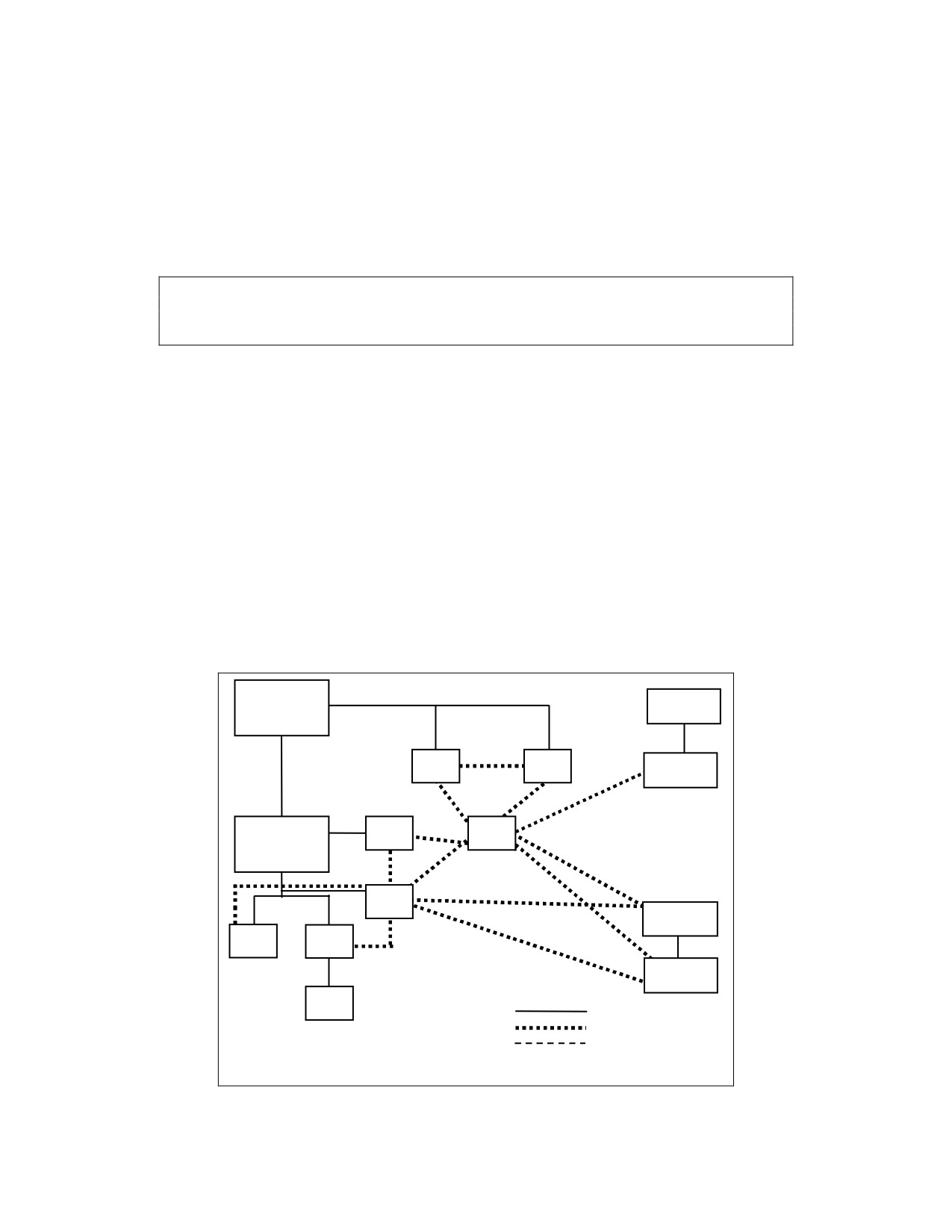
6-1. Movement planning and execution in the division is a staff responsibility, not vested in
operational units as found at corps and echelons above corps (EAC). The division transportation
officer (DTO), division support command (DISCOM) distribution management center (DMC), and
the DISCOM movement control officer (MCO) coordinate and control division transportation
operations. This includes the control of any movement of non-divisional units in the division area.
Because the G3 plans and directs maneuver; the G3 (air) allocates aviation assets to combat service
support
(CSS); the G4
(through the DTO and DISCOM) supports operations, plans, and
movements; close coordination between the G3, G4, DTO, and DISCOM, is absolutely essential to
accomplishing the division mission.
6-2. Movement and maneuver of combat, combat support, and CSS forces in support of maneuver
operations are normally given priority over other movements. Other CSS traffic is usually assigned a
lower priority. Planning and regulating movement requires close coordination among the division
staff and the commanders and staffs of the brigades, battalions, and companies.
(Figure 6-1).
COORDINATING STAFF
CORPS
DIVISION
G3
G4
COSCOM
DMC
DTO
DISCOM
MCO
AREA
MCT
MSB/
FSB
DSB
MCB
LEGEND:
TMT
COMMAND
COORDINATION
STAFF SUPERVISION
NOTE:
MCO ALSO COMMITS DIVISION AVIATION ASSETS ALLOCATED
FOR CSS AIR MOVEMENT OPERATIONS.
Figure 6-1. Command and Coordination of Division Transportation
6-1
FM 4-01.30 _______________________________________________________________________________________ Chapter 6
ORGANIZATION
6-3. Movement control planning and transportation management functions are the responsibility of
the DTO. The DTO is a special staff officer involved in the movement of units and maneuver
elements.
(Movement control of sustainment and other distribution moves is routinely handled by
the DISCOM MCO.) The composition of the division transportation office varies with the type of
division, however, it has an MCT from the corps MCB attached to support routine DTO functions.
(See paragraph 6-7.)
6-4. Within the brigade HQ, the S4 staff performs transportation functions. The S4 staff (which
includes the brigade movement coordinator) does the following:
• Establishes main supply routes (MSRs) in the brigade area in coordination with the DTO
and DISCOM DMC.
• Coordinates with the DTO and conducts highway regulation for movements that cross the
brigade rear boundary.
• Coordinates with the forward support battalion
(FSB) support operations section for
transportation support when requirements exceed the organic capability of the brigade.
6-5. Divisional combat and combat support (CS) battalions and squadrons do not have separate
transportation staffs. The battalion S4 staff performs transportation functions with help from the
support platoon leader of the headquarters company. Their table(s) of organization and equipment
(TOEs) provide vehicles to support limited transport requirements, such as resupplying their
companies. The battalion S4 staff requests transportation support and movement clearances from its
brigade S4.
6-6. FSBs for the new Stryker Brigade Combat Teams (SBCT) have transportation management
personnel on the battalion staff. The role of the transportation management cell is to coordinate and
monitor all cargo-related movements (specifically logistics packages) in and out of the brigade
support area. It includes synchronizing movement and maintaining integrated end-to-end visibility of
the transportation network and assets at the brigade level. It serves as the committing authority for
all common-user land transportation assets within the SBCT. Transportation operations and
movement control is a CSS staff responsibility that must be integrated with tactical movements,
which are managed and approved by the SBCT S3. The SBCT S4 retains overall staff responsibility
for highway regulation and supply route establishment, accomplished within the S3’s priority of
movement and traffic circulation plans. The movements officer and movements NCO coordinate
with the supply and services officer on a constant basis. The movements officer controls the
employment of BSB surface transportation assets, maintains in-transit visibility of all commodities,
movements, and units inbound, outbound, and within the SBCT area of operation (AO). These
assets include the transportation platoon’s 14 trucks and trailers, and the fuel and water platoon’s 14
fuelers and six trucks for bulk water distribution. The movements officer also has access, through
the SBCT S4, to CSS transportation assets above the brigade echelon.
6-7. Brigades and separate units depend on the DISCOM to provide transportation support when
requirements exceed their organic capabilities. Each brigade, depending upon the type of division,
receives logistical support from an FSB in the brigade support area (BSA). The movement control
noncommissioned officer (MCNCO), in the support operations office of the FSB, is the brigade S4’s
point of contact
(POC) for DISCOM transportation support. The FSB MCNCO forwards
requirements to the DISCOM MCO. The DISCOM MCO coordinates tasking of truck assets
6-2
FM 4-01.30 _______________________________________________________________________________________ Chapter 6
assigned to the transportation motor transport
(TMT) company assigned to the main support
battalion (MSB) in the division support area (DSA). (See paragraph 6-12.)
DIVISION TRANSPORTATION OFFICER
6-8. The DTO, as a special staff officer, is a staff planner who advises the commander and
coordinates support with the division G3 and G4 on tactical moves and operations. The DTO
coordinates with the G4 on logistical and administrative matters, and also provides guidance on
transportation matters to all other staff sections and commanders. The DTO provides the formal
link between the division and the corps transportation office (CTO), and is normally located in the
division rear command post (CP). The DTO has four primary functions: advisory, planning,
coordination, and technical assistance.
•
Advisory. The DTO, as the division staff transportation expert, advises the commander and
staff on transportation matters. The DTO recommends division priorities for transportation
and movement to support division plans and orders. The DTO recommends the allocation
of division transportation assets and the establishment of MSRs and provides the DISCOM
DMC and MCO with policies and priorities. The DTO assists the G4 in preparing,
updating, and maintaining the transportation portion of the logistics estimate.
•
Planning. The DTO participates in the decision-making process as a member of the
division planning staff. The DTO conducts concurrent planning with the staff to integrate
movement and maneuver. This includes providing movement control expertise for planning
tactical road marches and for preparing movement orders and movement tables. The DTO
develops the deployment, movement, and highway regulation portions of the division
operation plans (OPLANs) and operation orders (OPORDs).
•
Coordinating. The DTO coordinates with other division staff offices, subordinate staffs,
the provost marshal
(PM), division engineer, the CTO, and corps movement control
battalion
(MCB). DTO movement control efforts require close coordination with the
DISCOM MCO.
•
Technical Assistance. The DTO is the focal point for transportation technical guidance
and assistance for the staff. The Mobility Warrant Officer assigned to this office and the one
assigned to the MCT, attached to support the DTO, provide a depth of technical expertise
needed for this role. The DTO provides technical assistance in planning for unit movement
by all modes. The DTO provides technical assistance to the divisional units for movement
training which includes preparing vehicles for transport, developing load plans, loading and
securing vehicles on railcars and Air Force aircraft, and convoy procedures.
MOBILITY WARRANT OFFICER (MWO)
6-9. The mobility warrant officer (MWO) (MOS 882A) provides deployment training and execution
expertise. The mobility warrant officer is the commander’s key staff officer for deployment planning,
execution, advice, coordination, and training. The mobility officer is a movement technician who
manages and controls the flow of Army Transportation during unit movement operations. The
mobility officer plans, organizes, and supervises the movement of Army personnel and equipment.
The MWO coordinates movement operations issues with joint, Army, and commercial agencies, and
provides technical interpretation and guidance on the implementation and use of transportation
6-3
FM 4-01.30 _______________________________________________________________________________________ Chapter 6
automation systems. The MWO also coordinates training of unit personnel, and advises and assists
commanders and staffs on the elements of unit movement operations.
DIVISION SUPPORT MOVEMENT CONTROL TEAM
6-10. The division support MCT is an element of the corps movement control battalion that is
attached to the DTO to augment and provide support to the DTO operations. The mission of the
division support MCT is solely to augment the DTO. It does not perform the usual functions of an
MCT. This team provides the DTO support needed on a 24-hour basis.
DIVISION SUPPORT COMMAND
6-11. The DISCOM commander is the principal logistics operator of the division and units of the
DISCOM provide division-level logistics support to all organic and attached elements of the division.
While the division G4 has staff responsibility for logistics planning, and develops division-level
logistics plans, policies, and procedures, the DISCOM commander must make them a reality.
Therefore, the relationship between the division G4 and the DISCOM commander must be
extremely close for either to succeed.
• DISCOM S3. The S3 is the principal staff advisor to the DISCOM commander. The S3
plans and directs movement and maneuver of DISCOM units within the division area. To
accomplish this task, the S3 coordinates with the DTO, as do all other organizations making
unit moves in the division’s AO.
• DISCOM S4. The S4 is responsible for all logistics matters pertaining to DISCOM units.
(The S4 is not concerned with division-level logistics.) The S4 submits transportation
requests for DISCOM administrative moves and submits requests for highway clearances to
the MCO.
• DISCOM Distribution Management Center. A DMC is located within the DISCOM
support operations staff. While the DISCOM DMC operates at a smaller scale than the TSC
DMC, the basic functions are essentially the same. The DISCOM DMC is the center
responsible for providing timely distribution information and accurate logistics information
to the DISCOM commander and the DISCOM staff. The DISCOM DMC coordinates the
distribution plan with the DTO, MCO, and the DISCOM materiel management center
(DMMC) and monitors distribution operations. The DISCOM DMC focuses on the
distribution lines of communication (LOC) as they extend into the division area. The
DISCOM DMC also monitors the establishment of the distribution system within the
division to include lateral redistribution and retrograde.
MOVEMENT CONTROL OFFICER
6-12. The MCO is the link between the division transportation mode operators and the division
users of transportation. The MCO is normally located in the division rear with the DISCOM CP.
6-13. The MCO provides movement management support to the division by controlling the
division’s motor transport assets employed in distribution support. Movement management includes
planning, coordinating, and controlling the allocation and use of available transportation resources to
6-4
FM 4-01.30 _______________________________________________________________________________________ Chapter 6
fulfill the commander’s distribution movement requirements. There must be close working
relationship between the MCO and the following:
• DISCOM DMC
• DMMC
• DTO (and its attached MCT)
• Supporting corps and area MCTs
• Support operations section of the DISCOM MSB
• Support operations section of the DISCOM FSB
• Operations office of the PM
6-14. The MCO commits MSB/DSB TMT company assets. The MCO coordinates with the
supporting area MCTs to get transportation resources when requirements exceed capabilities. If the
requirement for additional transportation is excessive, the MCO coordinates the request through the
DTO. The MCO ensures the accountability and return of throughput assets, including containers
and pallets. The MCO requests aviation assets (from the air assets G3 (Air) allocates for CSS
purposes) to support logistical requirements
6-15. The MCO develops the division distribution program in coordination with the DMC. The
MCO coordinates with the DMMC to determine and plan for the transportation of materiel. The
DMMC has visibility over materiel distribution requirements that will require either transportation
assets or movement clearance. The MCO coordinates with the G1 for personnel movement
requirements. The MCO also maintains close coordination with division units to project
transportation and movement requirements. The MCO also does the following:
• Advises the DISCOM commander and staff on transportation matters.
• Enforces division priorities in tasking transportation assets and seeks to resolve priority
conflicts and competition by employing alternate modes and times or requesting support
from corps or area MCTs.
• Maintains information on the status of transportation assets allocated to support movement
requirements to include additional transportation assets placed in direct support
(DS),
attached, or allocated for CSS operations.
• Coordinates transportation movements in the division rear with the FSBs, MSB/DSBs, and
other units as required.
• Monitors the status of containers, flatracks, pallets, and trailers in the division area. Reports
their availability for retrograde.
• Provides transportation intelligence data to the DISCOM DMC and the DTO. This data is
usually obtained through contact with the transport mode operators. These operators are
movement control teams, dispatchers, truck drivers, pilots, and users of surface and air
transportation facilities.
• Coordinates with units to ensure adequate materials handling equipment
(MHE) and
container handling equipment (CHE) are available for loading and unloading.
• Assists the brigade movement coordinator in preparing unit movements.
6-5
FM 4-01.30 _______________________________________________________________________________________ Chapter 6
MOVEMENT CONTROL CELL IN THE DIVISION REAR COMMAND POST
6-16. The division rear CP is usually collocated with the DISCOM CP in the DSA. The DTO, its
MCT, and the MCO normally collocate and the combined elements comprise the movement
control cell. The collocation of these elements in the rear CP enables a coordinated transportation
effort. To accomplish this mission, the DTO prepares the highway regulation and traffic circulation
plan for the division road network. The MCO plans and controls division transportation assets and
develops the division movement program.
6-17. The movement control cell personnel maintain situation maps and overlays of the road
networks that reflect current information on the following:
• Traffic disruptions
• Obstructions
• Surface conditions
• Regulation and control measures
• Capacities
• Classifications
6-18. Movement control cell personnel coordinate with the G3, G2, air defense artillery, aviation,
chemical fire support element, PM, and signal cells of the division rear CP for current information on
enemy activity such as conventional or chemical strikes on MSRs, bridges, and tunnels that could
interrupt movement. Close coordination with the other cells is necessary to coordinate movement
and maneuver, ensure support of current operations. The movement control cell coordinates with
the appropriate cells to accomplish all the functions and activities that are the responsibility of the
separate offices.
BRIGADE MOVEMENT CONTROL
6-19. The Force XXI brigade includes a movement control NCO as the link between the brigade
transportation mode operators and the brigade users of transportation. The movement control NCO
controls the brigade’s common user motor transport assets employed in distribution support.
Movement management includes planning, coordinating, and controlling the allocation and use of
available transportation resources to fulfill the commander’s distribution movement requirements.
6-20. The Stryker Brigade Combat Team has a Mobility Warrant Officer and a movement control
NCO in the brigade. The Mobility Support Element will support other brigades, regiments, and
battalion/squadrons for deployment and operational mobility.
6-6
FM 4-01.30 _______________________________________________________________________________________ Chapter 7
Chapter 7
Developing A Movement Program
INTRODUCTION
7-1. This chapter is for the movement managers at all command levels. It explains how to develop a
movement program. Developing a movement program requires the direct coordination of
coordinating staff officers, material managers, movement managers, and mode operators.
7-2. A movement program is a command directive prepared by planners in the transportation command
element (TCE), movement control battalion (MCB) at echelons above corps (EAC), MCB (Corps), and
division transportation officer (DTO) at division. To plan an integrated distribution system, these
planners must coordinate with the following:
• Deputy chief of staff for logistics (DCSLOG/G4).
• TSC distribution management center (DMC) and support operations staff
• Corps support command (COSCOM) and support operations staff
• Materiel management centers (MMC)
• Mode operators to plan an integrated transportation system.
• Joint transportation board (JTB)
• Joint movement center (JMC)
• Deputy chief of staff for operations (DCSOPS/G3)
7-3. The movement program is used to preplan anticipated transportation requirements for movement
and flow of units, personnel, materiel, and sustainment supplies. During the movement planning
process, movement planners allocate available transportation resources based on the commander’s
priorities.
7-4. Implementing the commander’s priorities is a responsibility of logisticians at each level of
command. The movement program supports the commander’s priorities by establishing what
requirements can be resourced given available transportation assets, units, and infrastructure. Doing
this effectively uses these assets and identifies competing requirements and shortages.
7-5. An effective movement program is vital for successful support of combat operations. Therefore,
supported units must provide accurate data when developing transportation requirements and inform
movement planners of current and projected operating sites. Movement planners must be flexible because
requirements often change based on changes in priority, unit locations, asset availability, and conditions of
the LOCs. Therefore, supporting movement plans should have fully developed alternatives based on likely
courses of action. The TCE MCBs and the Corps MCB must also be resourced with sufficient movement
control teams (MCTs) and communications equipment to provide adequate movement control and
operational flexibility.
7-6. The movement program serves as an authority to commit transportation assets. It authorizes
the MCTs to issue transportation movement releases (TMR), directs mode operators to furnish
7-1
FM 4-01.30 _______________________________________________________________________________________ Chapter 7
assets, arrange commercial movements, and alerts receiving units to accept programmed shipments
so that they can unload transportation assets promptly. There are nine basic steps used to develop a
movement program. These steps are as follows:
• Step One. Assess the distribution pattern.
• Step Two. Determine requirements.
• Step Three. Determine transportation capabilities.
• Step Four. Balance the requirements against the capabilities.
• Step Five. Determine Critical Points.
• Step Six. Determine Check Points.
• Step Seven. Determine shortfalls and recommended solutions for handling the shortfalls.
• Step Eight. Coordinate the movement program.
• Step Nine. Publish and distribute the program.
ASSESS THE DISTRIBUTION PATTERN
7-7. The distribution pattern is a complete logistics picture that shows the locations of ports,
locations of supply, locations of consignees, maintenance activities, nodes, and transportation
activities. It is the tool by which planners know where support should normally flow and where it
may be diverted as operational needs dictate. The distribution pattern constantly evolves as the
theater develops. The commander’s concept of operations, number, types, and locations of in-place
and incoming units guide development of the distribution pattern and their time phased arrival in
theater. The distribution pattern delineates throughput and interzonal transportation requirements
directly affecting the coordination and preparation of movement programs.
7-8. Movement planners use the distribution pattern to develop the transportation network. The
network consists of the complete system of routes pertaining to all modes of transportation available
in the theater. Movement planners study intelligence and engineer information on the area of
operation (AO) to determine the capabilities of transportation networks. They analyze the enemy
situation to determine existing or potential threats to movement. Concurrently, they determine the
suitability and feasibility of moving supplies and personnel over those transportation networks.
Based on these studies, movement planners recommend locations for transportation units and
modes to make full use of the transportation networks.
7-9. Movement planners in the TCE and corps MCB coordinate with the TSC and COSCOM
regarding the positioning of transportation units and supply activities. These units are positioned so
that their capabilities will enhance the distribution system.
7-10. Movement planners also coordinate with shippers and receivers to determine their capability to
receive, handle, and load by various transportation modes. This capability is based on the availability
of materials handling equipment (MHE), container handling equipment (CHE), ramps, labor, storage
capacity, and other factors that affect transportation services. This information is necessary to
efficiently schedule transportation and prevent congestion.
7-2
FM 4-01.30 _______________________________________________________________________________________ Chapter 7
DETERMINE REQUIREMENTS
7-11. Having accurate requirements is the key to developing an effective movement program.
Forecasts must be submitted far enough in advance for the transportation and supply systems to
adjust their resources to carry out the program.
7-12. Movement planners use planning periods for forecasting requirements. The length of these
periods is based upon the number and frequency that changes are experienced or anticipated. A 14-
day planning period is desirable to allow a firm forecast of requirements for the current 7-day period
and a tentative forecast for the succeeding 7-day period. This method provides a basis on which to
operate during the current period and a tool for planning during the succeeding period. With a 14-
day planning period, a new planning cycle is initiated every seven days. The availability of an
integrated information system that integrates movement and supply information increases the
accuracy of forecasts. It also allows for more accurate movement programming.
7-13. Materiel movement requirements are developed and grouped in terms of classes of supply,
estimated weight and cube, required delivery date (RDD), priority, origin, and destination. Special
handling requirements such as refrigerated cargo, hazardous cargo, and controlled or sensitive cargo
should also be identified.
7-14. Personnel movement estimates are grouped by category such as troops, civilians, patients, and
prisoners of war.
7-15. Major subordinate commands must provide their movement requirements that exceed organic
transportation capability for inclusion in the movement program. Requirements should be identified
as indicated in paragraphs 7-13 and 7-14.
DETERMINE CAPABILITIES
7-16. Movement planners at each command level determine the capabilities of the transportation mode
operators in their AO. They obtain from mode operators the characteristics and capabilities of the
following:
• Number of transportation units and their equipment available to support common-user
movement requirements.
• Total number of host nation (HN) transportation assets allocated to support common-user
movement requirements (including commercial, rail, inland waterways, and coastal shipping).
• Number of third country and US-contracted assets.
• Reception, material handling, and in-transit storage capabilities.
7-17. Theater airlift and airdrop may be planned for if the JTB or JMC apportions assets for logistics
air movement operations to the theater. The TSC will allocate apportioned airlift based on command
priorities. Movement planners should realize that requirements normally exceed allocated airlift.
They should also take advantage of opportune lift.
7-18. Movement planners must update capabilities with changes as they occur and adjust movement
programs accordingly.
7-3

FM 4-01.30 _______________________________________________________________________________________ Chapter 7
7-19. When developing transport capabilities, planners must use planning factors or experience
based on the type of equipment, availability of MHE and CHE, weather, and terrain. Planners
should obtain planning factors from mode operators or from planning publications such as FM 4-
01.40 (FM 55-30). Figures 7-1 through 7-4 reflect capabilities data, truck capacities and technical
data for the divisional and non-divisional truck companies. This data can be used when developing
transport capabilities
Divisional TC Truck Company TOE Capability Data
13-Feb-03
DISPATCHES PER
DAY
PLS or
SINGLE LIFT
TOE
TRK
TRAC/
HET
TONS
PAX
VEH
REMARKS
CGO
STLR
GEN
AMMO
1,2
LEVEL 1 CAPABILITY
55288F000
31
30
22
235
412
1664
22
3,4
55158L000
34
10
135
174
801
3
55168L000
34
8
143
245
984
3
55178L000
28
7
117
200
804
3
55188L000
31
28
22
226
396
1597
22
3,4
LEVEL 2 CAPABILITY
55288F000
29
24
18
212
370
1491
18
3,4
55158L000
32
10
127
164
921
3
55168L000
32
8
135
231
930
3
55178L000
27
6
110
189
760
3
55188L000
29
26
18
213
374
1510
18
3,4
LEVEL 3 CAPABILITY
55288F000
26
22
18
191
333
1344
18
3,4
55158L000
29
9
115
148
830
3
55168L000
29
7
122
209
838
3
55178L000
24
6
99
171
685
3
55188L000
26
24
18
192
337
1361
18
3,4
1. All data rounded to nearest whole number
2. TMT Companies normally do not perform Line or Local Haul missions
as normally defined in doctrine; they are organic to the division.
3. These units normally do not transport ammunition.
4. HETs used for evacuation missions - one tank per HET.
Figure 7-1. Divisional TC Truck Company TOE Capability Data
7-4
FM 4-01.30 _______________________________________________________________________________________ Chapter 7
BALANCE REQUIREMENTS AGAINST CAPABILITIES
7-20. Balancing requirements against capabilities determine whether the available mode assets will
support movement requirements. As a result of this step, movement planners determine the
workload for each mode and segment of the transportation network. They should not limit this
process to simply programming the use of available transportation capability. Planners must also
consider command relationships and geographic area of responsibility (AOR).
7-21. Movement planners must assign requirements against all capabilities in a logical manner. They
must not only consider the capabilities but also the total transportation network, the tactical situation,
the priority of movement, and the risk of failure. For example, if a critical shipment must move into
an area that is accessible by multiple road routes, but only one rail route, it would be wise to program
the movement by motor transport. The rail segment could make less critical movements. Planners
must consider the following workload requirements:
• Direct shipments
• Multistops
• Retrograde
• Intermodal shipments
7-22. If planners identify transportation shortfalls, they will plan movement according to command
priorities and the transportation priority of the shipment. The remainder will be adjusted and these
adjustments will be coordinated with the shipper, receiver, materiel managers, and logistics staffs.
7-23. Schematics may be used to assist movement planners when balancing requirements and
capabilities. Their purpose is to graphically portray total shipping requirements and available
transportation capabilities as they relate to the distribution plan. Planners use two types of
schematics (requirements and mode).
PLANNING SEQUENCE FOR RECEPTION AND ONWARD MOVEMENT
7-24. The senior movement control element develops a comprehensive plan for reception and
onward movement that adheres to a step-by-step process similar to that used to develop a movement
program. Planning must estimate the workload at specific transportation nodes to determine
requirements for movement control, mode operating, and cargo transfer units. Planning should be
done for operational periods for each mode. It must also identify requirements for MHE, container
handling equipment (CHE), and host nation support (HNS) (Figure 7-5).
7-9
FM 4-01.30 _______________________________________________________________________________________ Chapter 7
DEPART
ARRIVE
ARRIVE
ARRIVE
DEPART
ARRIVE
PRESTOCK
STAGING
ARRIVE
CONUS
APOD/SPOD
HOLDING AREA
SPOD
SPOD
MA
POINTS
AREA
FINAL
STRATEGIC
DATE
DATE
DATE
DATE
DATE
DATE
DATE
DATE
DESTINATION
PLANNING
TIMELINE
DAYS
DAYS
DAYS
DAYS
DAYS
DAYS
DAYS
DAYS
INCREMENT 1
INCREMENT 2
INCREMENT 3
BALANCE
DETERMINE
DETERMINE
REQUIREMENTS
DETERMINE
COORDINATE
STRATEGIC
REQUIREMENTS
CAPABILITIES
& CAPABILITIES
CRITICAL POINTS
AMONG PLANNERS
PLANNING
For each increment,
Availability for a given
Include all workloads to
Identify bottlenecks or
Ensure inclusion of supply
SEQUENCE
for each leg. Require-
time period. Examine
include loading and off-
choke points. Apply
and maintenance planners
ment equals total lift
alternate modes and
loading. Identify short-
intelligence generated by
and host nation. Involve
required minus unit’s
routing. Consider
falls. Develop alterna-
US or host nation sources.
all commands and territorial
lift capability.
military, civilian, and
tives.
authorities along route.
host nation.
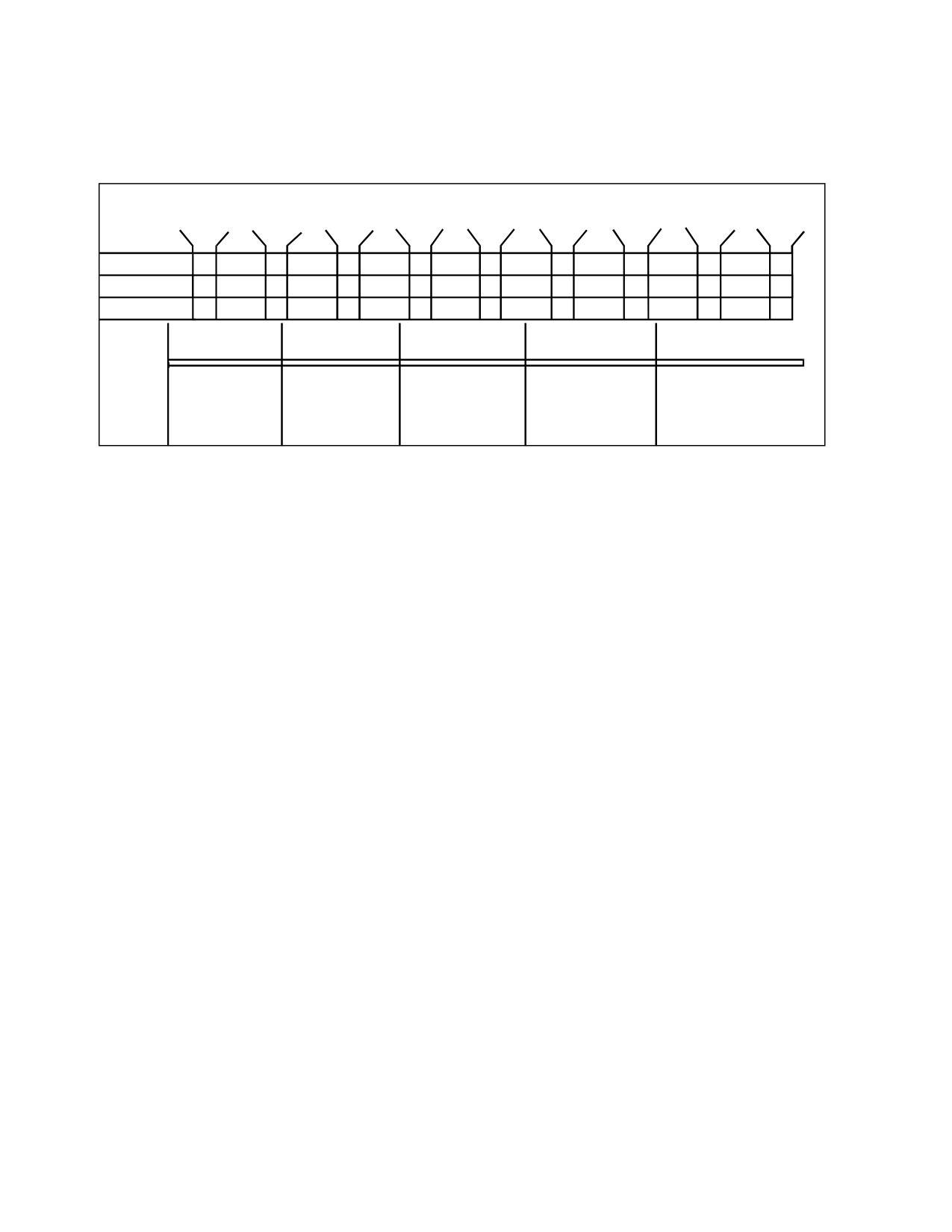
Figure 7-5. Planning for Reception and Onward Movement.
7-25. During this planning, process, senior movement control element planners at the do the
following:
•
Obtain advance arrival information for intertheater sea and air movement from port
operators and operational planners.
•
Assess the movement requirements data such as required delivery date (RDD), priority of
movement, equipment characteristics, and special requirements.
•
Group the requirements for each POD by destination geographic location in RDD
sequence.
•
Obtain movement priority for requirements that have the same destination and RDD.
•
Determine available modes for onward movement based upon planning requirements.
Consider requirements, equipment characteristics, priorities, and modes servicing the PODs,
SAs, and TAAs.
•
Select mode for each requirement.
•
Program the mode for each requirement for reporting to POD based upon estimated time
for POD clearance. This is dependent on the type of strategic asset lift; air or sea.
•
Determine availability of equipment for follow-on missions at the POD. Estimate uploading
and processing time for each mode at the POD. Apply time-distance factors to estimate
transit time to other transportation nodes, or arrival at the SA or TAA. Determine total
transit time, maintenance, crew rest, and return time.
•
Resolve conflicts by rerouting, changing modes, rescheduling, or obtain guidance from
operational planners. Reconfirm that the selected route can accommodate any oversize or
overweight cargo being moved.
•
Identify requirements for MHE and CHE for each mode at the POD, cargo and trailer
transfer points, and at destination. Coordinate with the TSC to provide sufficient MHE and
CHE to meet the needs at the points and times required.
•
Coordinate to establish holding and storage areas outside the POD marshaling area if ports
become congested.
•
Identify en route support needs for fuel, mess, maintenance, and billeting. Identify need and
potential location of convoy support centers. Coordinate with the TSC for this support.
7-10
FM 4-01.30 _______________________________________________________________________________________ Chapter 7
• Determine critical points where highway regulation or traffic control should be established
to maintain the flow of traffic. Provide for en route communications.
NOTE
CONVOY SUPPORT CENTERS provide food service, medical service, maintenance, crew rest facilities and other
personnel and equipment support for line haul drivers, equipment, and convoys moving along the MSR and ASR.
They are located along the MSR with the mission to support, enhance, and otherwise facilitate long haul convoy
operations. Their capabilities and capacities are tailored to the meet the requirements of the situation.
7-26. Plan retrograde missions for equipment returning from the SA and TAA in the same manner
as above.
Requirements Schematic
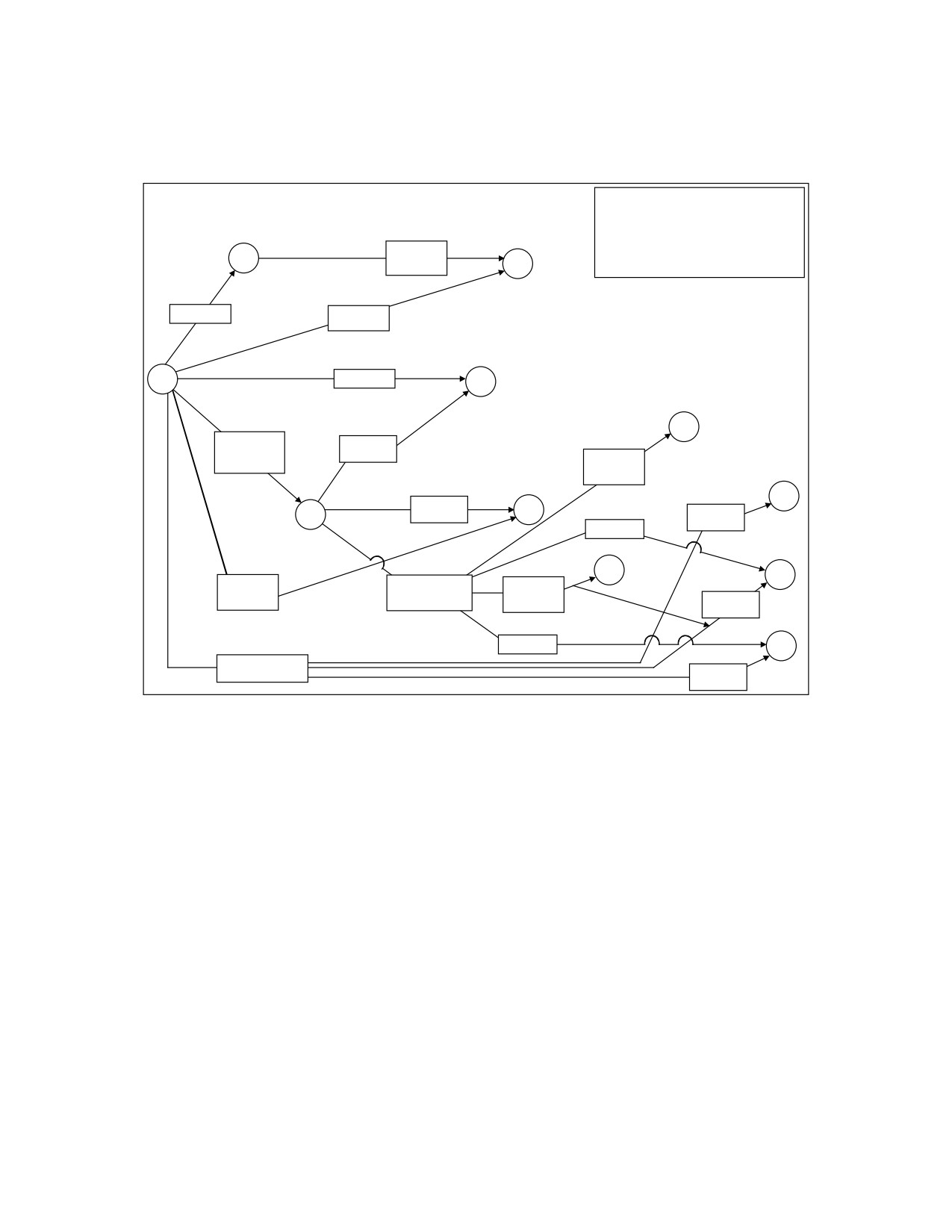
7-27. Prepare a requirements schematic as shown in figure 7-6. Prepare the schematic as follows:
• Draw and circle origin and destination points obtained from movement requirement
forecasts. Identify each origin and destination point.
• Connect each point with lines and arrows showing direction of movement.
• List the daily shipping requirements between each origin and destination point. The requirements
list the classes of supply, the tonnage, and the movement program line number.
• Create a legend as shown in figure 7-6.
7-11
FM 4-01.30 _______________________________________________________________________________________ Chapter 7
1Example of an origin point.
2Example of a destination point.
3Example of daily shipment requirements entry:
Class of
Line number of shipment as
3
Supply
Tonnage
shown on movement program
I
-
10 - L13
2
I
-
10
-
L13
IXB - 430 - L32
IXB
-
430
-
L32
B-2
VII
-
245 - L47
D-2
VII
-
245
-
L47
V
-
60 - L111
V
-
60
-
L111
I
-
75 - L11
I
-
65 - L14
IXB- 310 - L33
VII
-
245 - L48
IIB -
405 - L64
1
VII
-
40 - L49
A-2
IIB - 500 - L65
C-2
E-2
I
-
300 - L15
IXB -
400 - L34
I
-
50 - L19
VII
-
1000 - L50
IXB -
35 - L35
I
-
80 - L22
V
-
15 - L113
IHB -
400 - L66
IXB - 125 - L37
V
-
200 - L112
VII
-
200 - L52
V
-
55 - L114
F-3
I
-
115 - L20
IXB-
15 - L36
D-3
I
-
50 - L16
B-3
VII
-
100 - L51
IIB - 400 - L69
IXB -
40 - L38
V
-
300 - L117
VII
-
200 - L53
E-3
F-4
I
-
35 - L21
I
-
125- L22.23
I
-
15 - L23
VII
-
115 - L56
IXB - 300- L37.38.39.40
IXB-
90 - L39
IIB - 315 - L67
VII
-
800- L52.53.54.55
VII
-
200 - L54
I
-
50 - L17
V
-
200 - L116
V
-
100- L114.115
V
-
45 - L115
IIB - 300 - L70
V
-
300 - L118
IXB-
45 - L40
VII
-
200 - L55
F-5
I
-
150 - 16.17.18
IIB - 1500 - L68.69.70.74
I
-
50 - L18
V
-
900 - L117.118.119
IIB - 300 - L7I
V
-
300 - L119
Figure 7-6. Requirements Schematic
Mode Schematic
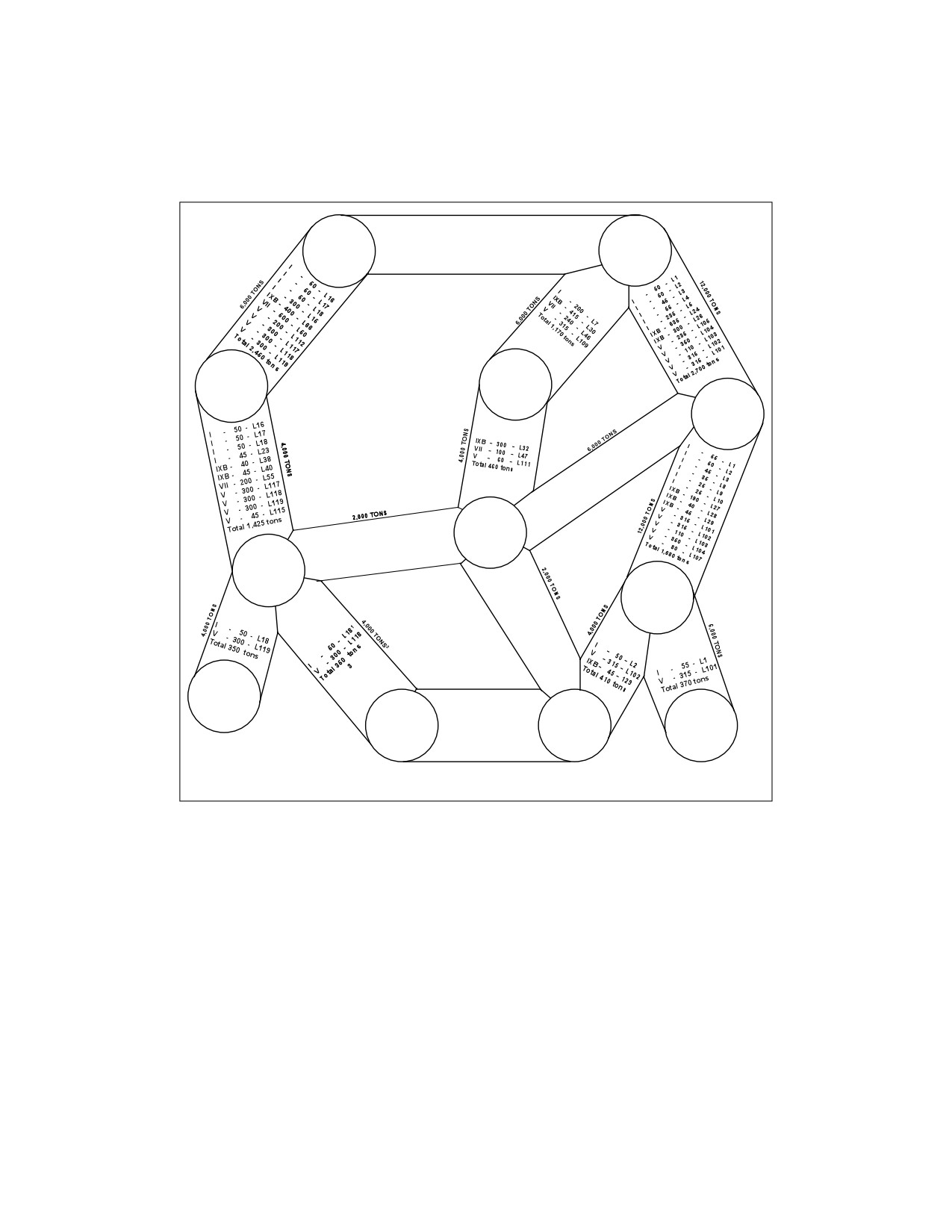
7-28. Prepare a mode schematic (figure 7-7) for each available mode. Prepare the schematic as follows:
• Draw and label mode origin and destination nodes and connect with lines. Connect the lines
whether or not the current program requires movement on a segment.
• Note the mode capacity on the outside of the lines. Mode capacity can be expressed as
follows: for rail and air as the total daily tonnage capacity between major terminals. For motor
transport compute capacity in a particular area or as segments of a line-haul operation.
• Identify the schematic.
• On the outside of the lines note the mode capacity. Mode capacity can be expressed in several
forms: for rail and air, as daily tonnage capacity between major terminals. Motor transport is
the daily ton-mile capacity in a particular area or as segments of a line-haul operation.
• Assign program line numbers to each mode and list them between the nodes as classes of
supply, tonnage, and the movement program line numbers.
• Note the type of mode under the schematic.
• Create a legend as shown in figure 7-7.
7-12
FM 4-01.30 _______________________________________________________________________________________ Chapter 7
6,000 TONS
BRAVO
ALPHA
ECHO
CHARLIE
DELTA
FOXTROT
HOTEL
GOLF
2,000 TONS
LIMA
KILO
JULIET
INDIA
1Line number.
2Total daily tonnage capability between major terminals.
3Movement requirement by line number tonnage and class of supply.
Figure 7-7. Mode Schematic - Rail
Selecting A Mode
7-29. Movement planners use the following basic guidelines to allocate the mode of transport.
• Provide service according to command and transportation priority. Other factors such as
shipment characteristics, security requirements, and political considerations are also
evaluated.
• Whenever possible, reduce or eliminate cargo rehandling, avoid crosshauls, and plan for
backhauls.
• Allocate all available transport equipment necessary to fulfill known requirements.
• Use the most efficient mode for the complete movement or as far forward as possible (see
Figure 7-8).
7-13

FM 4-01.30 _______________________________________________________________________________________ Chapter 7
ORDER OF ECONOMY
MOST EFFECTIVE USE
CAPABILITIES
LIMITATIONS
Pack animals and
Supplementary mode to
All tactical terrain, all weather
Most inefficient means when
human bearers
extend surface
conditions. Pack animals can
terrain is trafficable to other
transportation net over
transport about 250 pounds per
surface modes. Human
terrain impassable to other
pack animal. Human bearer can
bearers most wasteful of
modes.
transport about 80 pounds subject
human resource.
to pack configuration.
Pipeline
Primary mode for bulk
All weather conditions; few terrain
Flexibility limited by immobile
liquids and solids
restrictions; most economical and
facilities: vulnerable to
suspended in liquid.
reliable mode for bulk liquids;
sabotage and enemy action;
relatively few personnel required for
large construction tonnage
operation and maintenance.
required.
Water
Primary over-ocean mode.
All weather conditions; any
Relatively slow; flexibility
Inland surface mode for
commodity; most economical
limited by adequacy of
moving large quantities of
overall long-distance carrier;
waterways, facilities, and
cargo.
particularly useful for relieving other
channels; vulnerable to enemy
modes to more suitable
action and difficult to restore.
employment.
Inland waterways are subject
to flooding and freezing.
Rail
Primary inland mode for
All weather conditions; any
Flexibility limited by fixed routes;
sustained flow of large
commodity; most economical
rail-line clearances restrict outsize
quantities of traffic over
continuous line-haul operations;
movements; capability limited by
long distances.
greatest sustained ton-mile
availability of tractor power; rail
capability; variety of specialized
line highly vulnerable to enemy
equipment and services.
action.
Motor transport
Supplementary mode for
Most flexible mode over trafficable
Over-the-road operations
making possible an
terrain; practically all weather
affected by route interference
integrated transportation
conditions (terrain factor important);
and obstacles created by
system. Effective in
increases flexibility of other modes;
weather, terrain, or enemy
scheduled line-haul
can transport nearly any commodity
action; sustained line-haul
operations by the trailer-
with a variety of specialized
operations over long distances;
relay system: primary
equipment for both on- and off-road
uneconomical in terms of ton-
mode for distribution
movement.
mile output versus expenditure
operations and logistical
of manpower and equipment.
support operations in a CZ.
Army Air (Helicopter)
The most costly Army
All terrain. Effective over short
Operational capabilities limited
mode for the movement of
distances (less than 40 km for
by weather. Restricted flights
supplies. Becomes the
external loads). Helicopter can use
in snow conditions and
primary mode of transport
unimproved PZ and LZ during
thunderstorms. Freezing
when all others are
external lift opns. Capable of lifting
levels above surface may limit
ineffective because of
nearly any load that can be safely
capabilities. Aircraft
limitations or physical
rigged and that is within the weight
capabilities limited by cargo
restrictions. Used to move
limitations of the helicopter. CH47
load weight, cargo hook limits,
only those high-priority
helicopters are capable of using Air
or cargo door sizes. Aircraft
items and critically needed
Force 463L pallets and standard
availability is affected by flying
supplies as determined by
NATO warehouse pallets when they
hour program or crew rest
mode managers.
are equipped with the helicopter
requirements. Internal cargo
internal cargo handling system.
loading may require MHE.
Air:
Complementary mode for
Greatest potential speed of delivery;
Operational capabilities and
Army
expediting movement of
most flexible with respect to terrain
effectiveness limited by climate
Air Force
mission-essential traffic;
obstacles; economically more
and trafficability of takeoff and
primary or major
favorable (when these factors are
landing areas; high ton-mile
supplementary mode when
combined with substantial lift
operating costs.
terrain reduces
capability and air transport over
effectiveness of surface
long distances). Capabilities are:
modes; scheduled
heavy drop, container delivery
operation is most
system, low altitude parachute
economical method of
extraction system, air land, adverse
employment and produces
weather aerial delivery system, and
greatest sustained ton-mile
aerial bulk fuel delivery system.
capability.
Figure 7-8. Mode Selection Guide
7-14
FM 4-01.30 _______________________________________________________________________________________ Chapter 7
DETERMINE CRITICAL POINTS
7-30. Movement planners must identify critical points where restrictions could slow down or stop
movement. Critical points include the following:
• Facilities
• Terminals
• Ports
• Railheads
• Bridges
• Tunnels
• Congested highways
• Cargo transfer points
7-31. Congested critical points limit the efficiency and effectiveness of the entire transportation network.
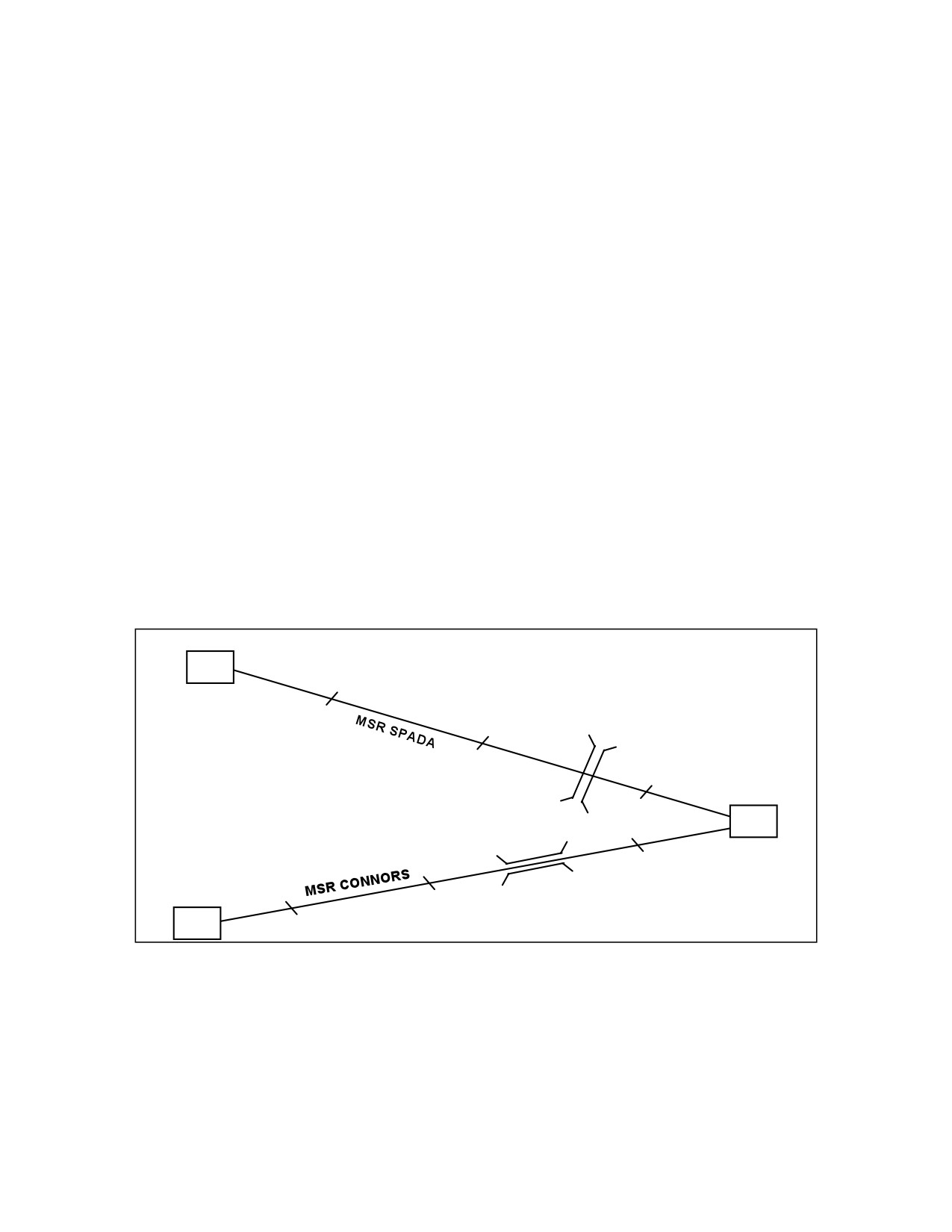
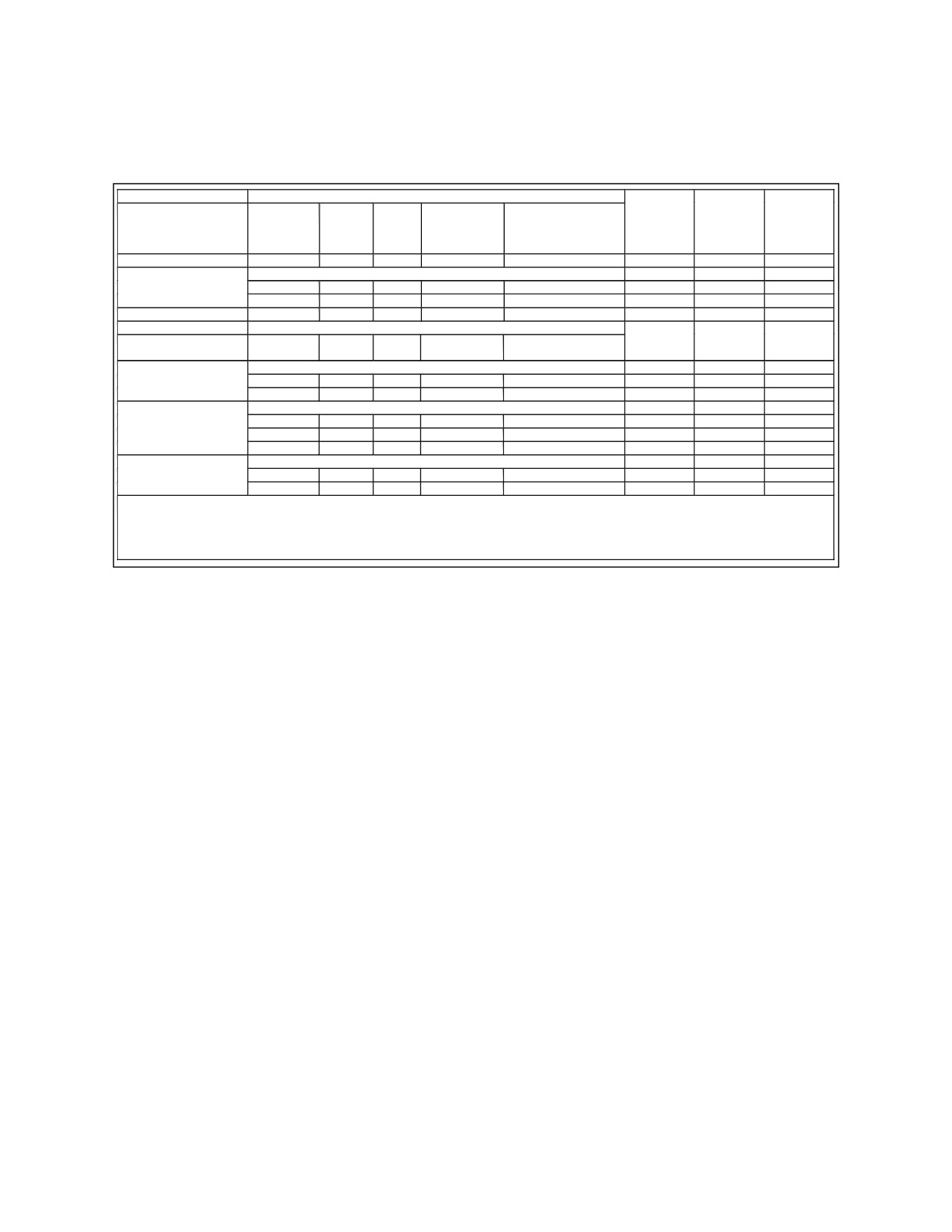
7-32. After identifying the critical points, planners determine alternative plans or control measures
that could reduce or eliminate the risk of congestion. The MCB will place movement regulating
teams on the ground where the problems are expected so they can respond before delays congest the
system. They should also coordinate with the engineer, military police (MP), and air defense artillery
support where necessary. (See figures 7-9 and 7-10.)
SEA PORT
CP 13
CP 9
4 M
CP 3
DESTINATION
CP 60
60 T
AERIAL PORT
CP 66
CP 56
Figure 7-9. Critical Points Schematic
7-15
FM 4-01.30 _______________________________________________________________________________________ Chapter 7
MSR SPADA
E/W ROUTE - 41.5 KM
DAILY
DAILY
HOURLY
HWY
5-TON
5-TON
LOCAL
ROAD
SURFACE
TONNAGE
TRUCK
TRUCK
CRITICAL POINTS
DISTANCE
REDUCTIONS
HWY
TYPE
TYPE
(STONS)
CAPACITY
CAPACITY
SEA PORT - CP 13
15.2 KM
37
1
BITUMINOUS
N/A
27,000
4,500
188
CP 13-CP9
13.1 KM
37
3
GRAVEL
N/A
6,090
1,050
42
4.0 KM
37
1
BITUMINOUS
N/A
27,000
4,500
188
CP 9-CP 3
3.6 KM
37
0
CONCRETE
BRIDGE - 4 KM
36,000
6,000
250
MSR CONNORS
E/W ROUTE - 41 KM
LOCAL
ROAD
SURFACE
CHECKPOINTS
DISTANCE
REDUCTIONS
HWY
TYPE
TYPE
AERIAL PORT - CP 56
2.5 KM
42
2
BITUMINOUS NARROW - 25%
20,250
3,375
141
11.0 KM
42
1
BITUMINOUS HILLS/CURVES 20%
18,900
3,150
131
7.0 KM
42
3
GRAVEL
MOUNTAINS 80%
588
98
4
CP 56-CP 66
3.0 KM
42
1
BITUMINOUS
HILLS/CURVES 10%
24,300
4,050
169
7.0 KM
42
5
DIRT
HILLS/CURVES 60%
1,176
196
8
CP 66-CP 60
5.0 KM
42
4
GRAVEL
HILLS/CURVES 30%
4,263
710
30
5.5 KM
42
0
CONCREATE
BRIDGE 60T
588
98
5
LEGEND:
ROAD TYPE/SURFACE TYPE
3 - 4-LANE LOOSE SURFACE-GRAVEL/ALL WEATHER
0 - SUPER HIGHWAY - CONCRETE
4 - 2-LANE LOOSE SURFACE-GRAVEL/ALL WEATHER
1 - 4-LANE HARD SURFACE-BITUMINOUS
5 - TRAIL-DIRT ROAD
2 - 2-LANE HARD SURFACE-BITUMINOUS
Figure 7-10. Critical Points Table
DETERMINE CHECK POINTS
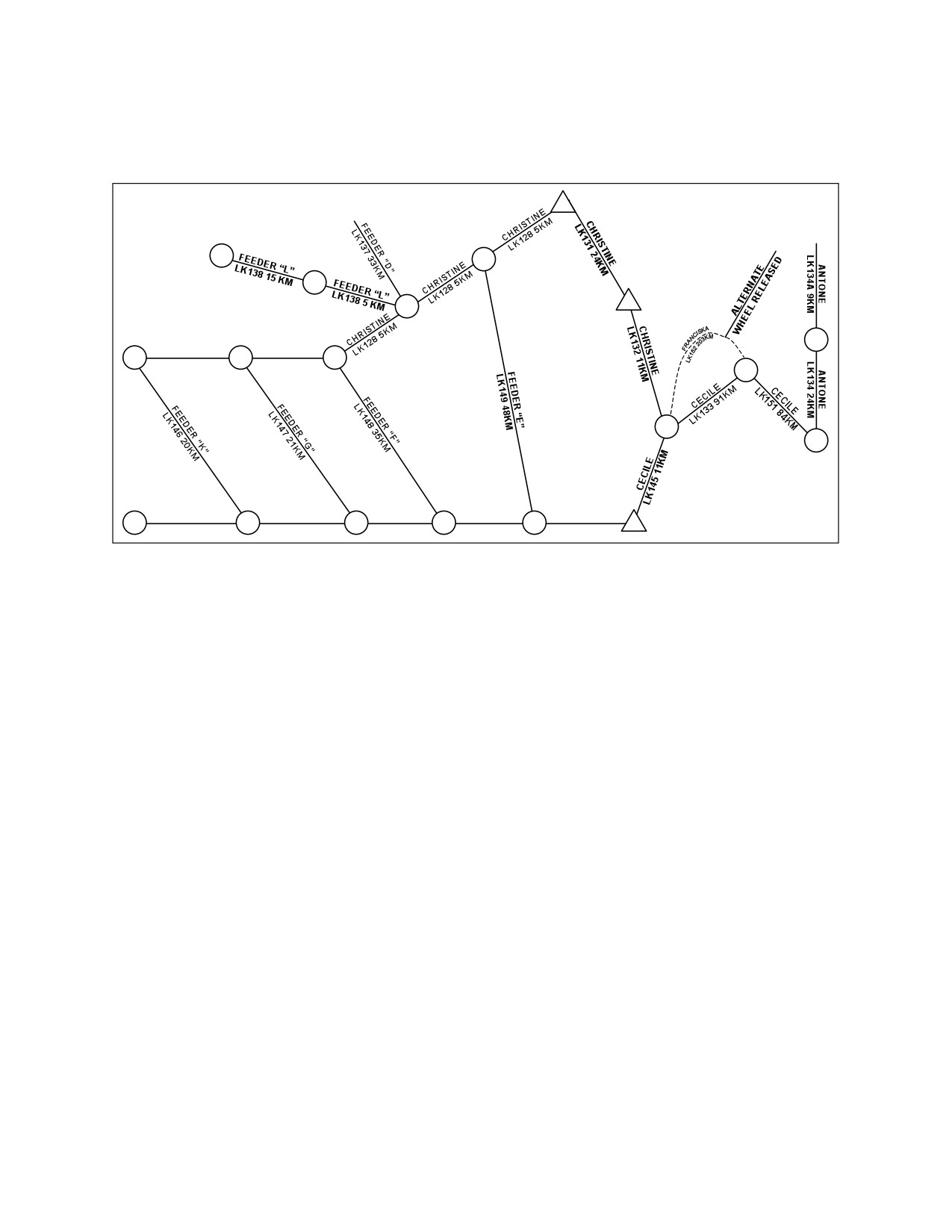
7-33. Included in the movement program is a main supply route (MSR) checkpoint list. It provides ready
reference data about the MSR network such as checkpoints, link numbers, feeder routes into the MSR,
and distances. Movement control personnel and customers can use this information to identify what path
to use from origin to destination and to identify segment numbers for use in requesting movement bids
and receiving movement credits. Movement planners must identify checkpoints along the route to
control movements. Checkpoints should be easily recognizable features that can be clearly identified on
both the MSR checkpoint list and on the route. Automatic Identification Technology (AIT) devices can
be used to report the passing of vehicles and convoys at checkpoints or they can be manned or the when
the vehicle or convoy passes the checkpoint it can just be reported by the Movement Tracking System
(MTS) or some other source of communication. (See figure 7-11.)
7-16
FM 4-01.30 _______________________________________________________________________________________ Chapter 7
29
39
28
39
27
30
50
CHRISTINE
CHRISTINE
24
25
26
LK126 51KM
LK127 45KM
44
31
32
CECILE
CECILE
CECILE
CECILE
CECILE
33
34
35
36
37
38
LK140 22KM
LK141 43KM
LK142 55KM
LK143 43KM
LK144 42KM
Figure 7-11. MSR Checkpoint List
DETERMINE SHORTFALLS AND RECOMMENDED SOLUTIONS
7-34. Once shortfalls between material to be moved and the transportation assets to move the
material are identified, solutions for moving the material must be developed. These include the
following:
• Changing the date of the move to a later date.
• Assigning another motor transport unit to move the material.
• Assigning another mode (e.g., moving the material by rail rather than motor transport units).
• Using HN or commercial assets.
• Holding the material until transportation assets can be use to move it.
COORDINATE THE PROGRAM
7-35. The movement program must be coordinated with movement planners and distribution
managers at each command level during its development and also afterwards to ensure integrated
planning and coordinated execution. It also requires coordination with operations, supply, MP,
engineer, and air staffs so that each one knows its responsibilities during execution.
7-36. Movement control organizations distribute the completed movement program to each
command level for comment and concurrence. During this phase, the program is used to facilitate
planning and to show the evolving distribution patterns and projected logistic activity but does not
authorize shipments to take place. It becomes directive once it is approved by the DCSLOG or G4.
7-17
FM 4-01.30 _______________________________________________________________________________________ Chapter 7
FORMAT AND PUBLISH THE PROGRAM
7-37. During the planning process, planners assign each movement requirement a movement
program line number. This line number is used to identify the requirement and provide additional
information throughout the development of the movement program. Figure 7-12 is a sample of a
movement program for a cargo movement. Figure 7-13 is a sample of a movement program for
passenger movement. The movement program planning process can also be used to identify and
plan for the expected arrival of units into the theater. Information in the cargo format includes the
following:
• Program line number
• Container type
• Class of supply
• Pieces
• Estimated weight (short tons and
• Short tons
cube)
• Cube
• Origin
• Transportation priority
• Origin location
• RDD
• Destination
• Mode
• Destination location
• Remarks
• Destination MCT
7-38. The remarks column should be used to identify characteristics for items requiring special
handling. For example, the remarks column could include the dimensions of outsize/overweight
cargo. Other examples include items requiring special handling such as controlled temperature,
controlled environment, hazardous cargo, or cargo security.
MCT: ______________________
MOVEMENT PROGRAM -- CARGO
PLANNING PERIOD: 230-244
EFFECTIVE DATE: 230-237
MVMT PRG
SUPPLY
CNTNR
T
LINE NO
CLASS
ORIGIN
LOCATION DESTN LOCATION DEST MCT TYPE PIECES STON
CUBE P RDD MODE REMARKS
51000
1
JG2
FU330044
AK4SQC FR282922
793RD
/
028905
000245
52028.0
2
232
H
51001
5
JG9
ET400000
AK4RJA LC979250
793RD
20/40
006964
003995
181422.0
3
232
H
51002
5
JG8
ET770599
AK4RJB LC914722
793RD
20/40
006292
003614
149284.9
3
232
H
51003
5
JH1
ES160875
AK4RKA LC410321
27AD DTO
20/40
006292
003614
149284.8
3
232
A
51004
5
JG9
ET400000
AK4RKB LC124262
27AD DTO
20/40
005964
003580
154622.0
3
232
H
51005
8
JG6
ET995488
WK4NEC MC520537
536TH
/
155896
000105
18621.0
2
232
R
51006
5
JG9
ET400000
WK4RCA MC685976
536TH
20/40
002119
001155
50533.7
3
232
R
51007
5
WK4SJC
ET770599
WK4RCD MC441610
429TH
20/40
002156
001271
52855.0
3
232
R
51008
5
WK4SHD
ET400000
WK4REA MC812223
793RD
20/40
002195
001251
52428.7
3
232
R
51009
1
WK4SGC
MC736246
WK4SAY NC078547
793RD
/
004983
000042
8969.4
3
232
H
51010
1
WK4SQC
MC708466
WK4SBY NC018317
793RD
/
004986
000042
8974.8
3
232
A
51011
1
WK4SQC
MC785828
WK4SCY NC056843
27AD DTO
/
005115
000043
9207.0
3
232
A
51012
1
WK4SQC
FR282922
WK4SGC MC785826
27AD DTO
/
005544
000056
11779.2
2
232
H
51014
1
WK4SQC
FR282922
WK4SHD MC708466
536TH
/
006910
000058
12438.0
2
232
H
51015
1
WK4SQC
FR282922
WK4SJC MC736246
536TH
/
006909
000059
12436.2
2
232
H
51016
7
JH2
ES960720
9SQD22
LC854443
429TH
/
000140
001022
186160.8
3
232
A
51017
7
JH2
ES960720
22AVBN
LC854443
793RD
/
000157
000765
224409.1
3
232
A
51019
8
JG2
FU330044
AK4NNF
FU230026
793RD
/
049440
000049
6635.2
2
232
H
51020
8
JG2
FU330044
AK4NNG
FS662988
793RD
/
049850
000050
6676.2
2
232
H
51021
1
AK4SQC
FR282922
AK4SWC
FT765045
27AD DTO
/
004566
000039
8218.8
2
232
R
51022
1
WK4SQC
FR282922
AK4STA
MC332864
27AD DTO
/
003975
000034
7156.8
2
232
R
61000
1
JG1
ET995488
WK4NEC
FR282922
536TH
/
028906
000246
52029.0
2
233
H
61001
5
JG9
ET400000
AK4RJA
LC979250
536TH
20/40
003679
003445
124335.5
3
233
H
61002
5
JG6
ET770599
AK4RJB
LC914722
429TH
20/40
003402
003156
115608.0
3
233
H
61003
5
JH1
ES180875
AK4RKA
LC410321
793RD
20/40
003309
003154
118570.8
3
233
R
61004
5
JG9
ET400000
AK4RKB
LC124262
793RD
20/40
003578
003445
124335.5
3
233
H
Figure 7-12. Movement Program - Cargo
7-18
FM 4-01.30 _______________________________________________________________________________________ Chapter 7
7-39. Information in the personnel format includes the following:
•
Program line number
•
Container type
•
Passenger Type
•
Pieces
•
Estimated weight (short tons and
•
Short tons
cube)
•
Cube
•
Origin
•
Transportation priority
•
Origin location
•
RDD
•
Destination
•
Mode
•
Destination location
•
Destination MCT
MCT: ______________________
MOVEMENT PROGRAM -- PERSONNEL
PLANNING PERIOD: 225-238
EFFECTIVE DATE: 225-232
MVMT PRG
TYPE
CNTNR
T
RD
LINE NO
PASSENGER ORIGIN LOCATION DESTN
LOCATION DEST MCT TYPE PIECES
STON
CUBE P
D
MODE
REMARKS
P0001
PATIENTS
AMS FT230970
AK4PUC
FT220830
793RD
/
000400
000028
4000.0
2
226
A
P0002
PATIENTS
A,S
FT230970
AK4PUG
FT220830
793RD
/
000400
000028
4000.0
2
226
A
P0003
PATIENTS
A,S
FT230970
AK4PUL
FT220930
793RD
/
000400
000028
4000.0
2
226
H
P0004
TROOPS
BRU
FS043390
AK4PVJ
FS040340
27AD DTO
/
000400
000048
4000.0
2
226
H
P0005
TROOPS
BRU
FS043390
AK4PVN
FS040430
27AD DTO
/
000400
000048
4000.0
2
226
H
P0006
EPW
AK4PUC FT220930
WK4PKU
MC782766
536TH
/
000300
000038
4000.0
2
227
H
P0007
EPW
AK4PUG FT220930
WK4PRU
MC684510
536TH
/
000300
000038
4000.0
2
227
H
P0008
EPW
AK4PVJ FS040340
WK4PJU
MC760336
429TH
/
000400
000048
4000.0
2
227
R
P0009
PATIENTS
AMS FT230970
AKAPUC
FT220930
793RD
/
000400
000048
4000.0
2
227
R
P0010
PATIENTS
AMS FT230970
AK4PUG
FT220930
793RD
/
000400
000048
4000.0
2
227
H
P0011
PATIENTS
AMS FT230970
AK4PUL
FT220930
793RD
/
000400
000048
4000.0
2
227
H
P0012
TROOPS
BRU FS043390
AK4PVJ
FS040340
27AD DTO
/
000400
000048
4000.0
2
227
H
P0013
TROOPS
BRU FS043390
AK4PVN
FS040430
27AD DTO
/
000400
000048
4000.0
2
227
A
P0014
EPW
AK4PUC FT220930
WK4PKU
MC782166
536TH
/
000300
000038
4000.0
2
228
H
P0015
EPW
AK4PUG FT220930
WK4PRU
MC684510
536TH
/
000300
000038
4000.0
2
228
H
P0016
EPW
AK4PVJ FS040340
WK4PJU
MC780336
429TH
/
000400
000048
4000.0
2
228
R
P0017
PATIENTS
AMS FT230970
AK4PUC
FT220930
793RD
/
000400
000028
4000.0
2
228
R
P0018
PATIENTS
AMS FT230970
AK4PUG
FT220930
793RD
/
000400
000028
4000.0
2
229
H
P0019
PATIENTS
AMS FT230970
AK4PUL
FT220930
793RD
/
000400
000028
4000.0
2
229
H
P0020
TROOPS
BRU FS043390
AK4PVJ
FS040340
27AD DTO
/
000400
000048
4000.0
2
229
H
P0021
TROOPS
BRU FS043390
AK4PVN
FS040430
27AD DTO
/
000400
000048
4000.0
2
229
H
P0022
EPW
AK4PUC FT220930
WK4PKU
MC782766
536TH
/
000300
000038
4000.0
2
230
H
P0023
EPW
AK4PUG FT220930
WK4PRU
MC684510
536TH
/
000300
000038
4000.0
2
230
A
P0024
EPW
AK4PVJ FS040340
WK4PJU
MC760336
429TH
/
000400
000048
4000.0
2
230
A
P0025
PATIENTS
AMS FT230970
AK4PUC
FT220930
793RD
/
000400
000048
4000.0
2
230
H
P0026
PATIENTS
AMS FT230970
AK4PUG
FT220930
793RD
/
000400
000048
4000.0
2
230
H
P0027
PATIENTS
AMS FT230970
AK4PUL
FT220930
793RD
/
000400
000048
4000.0
2
230
H
P0028
TROOPS
BRU FS043390
AK4PVJ
FS040340
27AD DTO
/
000400
000048
4000.0
2
230
H
Figure 7-13. Movement Program - Personnel
7-40. The TCE compiles activity address files for units in the theater (Figure 7-14). These files list
in-the-clear unit locations and points of contact. Therefore, these files must be designated as
classified documents and must be safeguarded. The TCE provides a copy of each file to subordinate
movement control units. These subordinate units also compile activity address files for units in their
geographical area and update the TCE master file. The MCT and DISCOM movement control
officer (MCO) will accept transportation requests from those units located in their geographic AOR
and also update their customer list.
7-19

FM 4-01.30 _______________________________________________________________________________________ Chapter 7
CUSTOMER LIST
(ALPHABETICAL LISTING)
GRID
AAC
NOMENCLATURE
COORD
UIC
MCT
WK4CFC
C CO 704 SIG BN AREA
NV228645
WCFCAA
793RD MCT
WK4CFD
D CO 704 SIG BN AREA
NV086625
WCFDAA
793RD MCT
WK4CFE
HHC 704 SIG BN AREA
NV399791
WCFUAA
793RD MCT
WK4CGA
A CO 705 SIG BN AREA
NV279958
WCGAAA
792ND MCT
WK4CGB
B CO 705 SIG BN AREA
NV270869
WCGBAA
792ND MCT
WK4CGC
C CO 705 SIG BN AREA
MV997883
WCGCAA
792ND MCT
WK4CGD
D CO 705 SIG BN AREA
MV982803
WCGDAA
792ND MCT
WK4CGU
HHC 705 SIG BN AREA
NV270869
WCGUAA
792ND MCT
WK4CHA
A CO 706 SIG BN AREA
NA995238
WCHAAA
791ST MCT
WK4CHB
B CO 706 SIG BN AREA
NA007067
WCHBAA
791ST MCT
WK4CHC
C CO 706 SIG BN AREA
MA859181
WCHCAA
791ST MCT
WK4CHD
D CO 706 SIG BN AREA
MV863984
WCHDAA
791ST MCT
Figure 7-14. Sample Transportation Customer Alphabetical List
7-41. The movement program planning format may also be used to develop individual movement
plans. Movement plans are initial developmental stages of a movement program that support
specific OPLANs. As such, these movement programs are only plans until they are executed.
7-42. Included in the movement program is an MSR checkpoint list. It provides ready reference
data about the MSR network such as checkpoints, link numbers, feeder routes into the MSR, and
distances. Movement control personnel and customers can use this information to identify the path
to be used from origin to destination sand to identify segment numbers for use in requesting
movement bids and receiving movement credits.
EXECUTING THE MOVEMENT PROGRAM
7-43. To activate a movement program line number, the shipper contacts its servicing MCT or
MCO and requests its line number to be activated. The MCT or MCO verifies that the program data
is still valid by coordinating with the shipper. The MCT or MCO will coordinate with the receiver if
positive inbound clearance is required. If command priorities change during the current program
cycle and these priority changes affect program executions, movement planners coordinate with
affected shippers and receivers. Shippers or receivers should immediately contact their servicing
MCT or MCO when there is a change in requirements, capabilities, or locations.
7-20
FM 4-01.30 _______________________________________________________________________________________ Chapter 7
PREPARING THE PORT CLEARANCE PROGRAM
7-44. The port clearance program is part of the theater movement program. The TCE begins preparing
the port clearance program as soon as it receives advance manifest data from the continental United States
(CONUS) ports, terminal units, or other ports of origin. Once the manifest (lists what is actually on the
ship or plane and where stowed) is available, the port MCT does the following:
• Programs actual transportation assets to provide onward transportation based on anticipated
arrival date.
• Activates line numbers and/or programs.
7-45. The port MCT coordinates through movement control channels the status of program execution.
7-46. The TCE provides input to the terminal port commander if diversion is required. The TCE
makes recommendations based on the following:
• Cargo destinations.
• Available port capacities, capabilities, and workload.
• Capacities and projected workload for the various modes and segments of the transportation
network.
7-47. A close working relationship between the TCE and MMC is required to program and expedite
moving non-unit equipment and supplies; especially those shipped in containers.
7-21
FM 4-01.30 _______________________________________________________________________________________ Chapter 8
Chapter 8
Highway Regulation
There are many ways of going forward, but only one way of standing still.
-- Franklin D. Roosevelt
8-1. Highway regulation is the responsibility of commanders having area jurisdiction. Commanders
must ensure that highway movement program moves occur as planned, while meeting the immediate
daily requirements. See FM 4-01.40, Army Motor Transport Units and Operations for doctrine
pertaining to actual execution of the plan. The following activities perform the highway regulation
mission:
• Transportation command element
(TCE) and movement control battalion
(MCB) at
echelons above corps (EAC).
• MCB (corps) in the corps rear area.
• Division transportation officer (DTO) in the division rear area.
• Brigade S4 in the brigade rear area.
8-2. The TCE and MCB (corps) monitor main supply routes (MSR) using movement regulating
teams (MRT) employed throughout the area of operation (AO) in essential locations to observe,
assess, and report progress of tactical and nontactical movements. The TCE, MCB (corps), and
DTO also monitor highway regulation in subordinate command areas and may regulate some of the
routes based upon the tactical situation.
8-3. The highway regulation function consists of planning, routing, and scheduling, of ground traffic
to deconflict the use of highways and facilitate movements. It provides order, prevents congestion,
and enforces movement priorities. The extent of regulation required depends upon the number of
planned or anticipated movements, the routine level of immediate requirements, and the capacity of
the road networks.
Planned movement requirements are identified in advance. They are found in distribution plans,
movement programs, and operation plans and orders. They involve onward movement of forces
from port of debarkations (PODs), movement of supplies and equipment, and movement of units.
Immediate requirements are unplanned and based on requirements generated during the conduct of
operations. They include requirements such as unit displacement, unprogrammed resupply, and
evacuation. Immediate requirements are normally of a higher priority than planned requirements and
must be quickly acted upon.
8-4. The extent of the regulation needed depends upon the number of moves and the capacity of the
road network. Highway regulation is crucial when operating over underdeveloped and saturated road
networks. The more developed the road network and the more capacity it provides, the less
regulation is required. In a highly developed highway and road network, regulation may not be
8-1
FM 4-01.30 _______________________________________________________________________________________ Chapter 8
necessary and free-flow of traffic may be allowed. Free-flow of traffic allows for the maximum
movement of cargo and personnel. Transportation planners and operations should only use free-
flow when the road network and security requirements allow.
PLANNING FOR HIGHWAY REGULATION
8-5. The goal of highway regulation planning is to sustain movements according to the commander’s
priorities and make the most effective and efficient use of the road networks. It requires
synchronization and coordination with planners of unit movement and maneuver. Planning is done
in a logical sequence and results in the publication of the highway regulation plan and the traffic
circulation plan. The first step in the planning process is to assemble critical information. This
information can be found in the following:
•
Operation plans
(OPLAN), operation orders
(OPORD), and estimates. OPLANs,
OPORDs, and estimates contain essential information. Movement planners must read and
understand the concept of operation to effectively support the commander’s intent while
executing highway regulation.
Information such as geographic boundaries, task
organization, priorities, and locations of major supply activities are also contained in these
plans.
•
Engineer route reconnaissance or classification overlays. The engineer route reconnaissance
or classification overlays provide detailed information on the characteristics of the road
network such as road surface, width, restrictive features, and bridge classifications. This
information is necessary to determine critical points and route capacity. The characteristics
of the route are contained in the route classification formula. Current information is
required and thorough route reconnaissance may not always be possible or feasible.
Therefore, movement planners may also obtain information from aerial photographs, local
authorities, intelligence reports, and military police
(MP) hasty route reconnaissance to
supplement information obtained from maps or intelligence studies.
•
Traffic density information. Traffic density information is the anticipated volume of traffic
on route segments during specific periods. It comes from planned requirements contained
in the distribution plan, movement program, the OPLAN or OPORD, or fragmentary
orders
(FRAGO). Planners must extract specified and implied requirements for unit
movements, sustainment movements, and retrograde movements. These documents may
also require moving civilian refugees, unit displacement, or shared uses by allied or host
nation (HN) forces. Each type of movement must be prioritized, planned, and coordinated.
•
Terminals and facilities data. Terminals and facilities data obtained from the theater
distribution plan, include the location of supply points, terminal transfer points, staging and
assembly areas, aerial ports and sea ports, airfields and drop zones, and refuel points. These
are considered in terms of their total clearance and reception capabilities. Specific
considerations include location, access from military supply routes
(MSR), and their
capability to receive, load, unload, and stage.
8-6. When the data is assembled and studied, movement planners must identify the road networks
that are capable of supporting the volume of traffic necessary to meet planned and anticipated
movement requirements. These road networks will be recommended as MSRs and ASRs. Planners
8-2
FM 4-01.30 _______________________________________________________________________________________ Chapter 8
must also plan extensions of the MSRs to anticipate forward movement of maneuver forces. ASRs
are used when the MSRs are disabled or too congested, and should be planned for in the same
manner as MSRs. At this point in planning, it is necessary to obtain approval of the G4 and G3.
The G4 has staff supervision for movement planning. The G3 is responsible for terrain
management. The G3 must approve the selection of MSRs and ASRs before movement planners
can conduct detailed highway regulation planning.
8-7. Movement planners will develop the highway regulation plan and traffic circulation plan after
the G3 approves the MSRs and ASRs. The highway regulation plan is a written plan that describes
the MSR network and establishes control measures to promote effective regulation (an example of a
highway regulation plan is shown at Appendix I). The traffic circulation plan is a map overlay or
graphic representation of the MSR network. Both are published as an annex to the OPLAN or
OPORD. They are used by the provost marshal (PM) to develop the traffic control plan. The
development process involves the following:
• Naming each MSR according to command directives. Avoid using colors to name MSRs
since the MSR status and other logistics statuses are normally reported as green, amber, red,
or black. Avoid using numbers to name MSRs because they may conflict with existing route
numbers.
• Determining critical points. Critical points are areas of interest to movement planners. See
chapter 7, paragraph 7-30 for detailed discussion of critical points. See chapter 7, paragraph
7-24, for discussion of planning the support of onward movement which involves, among
other things, the establishment of convoy support centers.
• Establishing checkpoints (CPs) on each MSR to segment the MSRs. Segmenting the MSR
facilitates highway regulation and traffic control planning and execution. See chapter 7,
paragraph 7-33 for detailed discussion of checkpoints. CPs should be established at the
following:
⇒ Major crossroads.
⇒ Locations where road conditions change.
⇒ Major supply or service areas.
⇒ Geographic boundaries.
⇒ Assembly areas.
⇒ Other critical points.
8-8. CPs are predetermined points on the MSR that are used as a means of regulating and controlling
movement. Units use CPs when requesting movement clearance by using CPs to identify their start
point, release point, and en route CPs. CPs enable quick dissemination of information during
execution such as a point where traffic will be rerouted. CPs are also used when describing the MSR
in the highway regulation plan. Some examples are as follows:
• MSR Spear is a paved, all weather road from CP 22 to CP 34.
• From CP 34 to the 54th Division rear boundary, the MSR is an improved fair weather road.
The MSR can accommodate two-way traffic.
8-3
FM 4-01.30 _______________________________________________________________________________________ Chapter 8
• The route is classified as an open route from CP 22 to CP 34.
• It is a supervised route from CP 34 to CP 8 at the division rear boundary. Convoys of eight
or more vehicles, tracked vehicles, or vehicles that cannot maintain a 30 km march rate
require a movement credit on that segment.
• The most restrictive route feature is at CP 35, a bridge with a military load classification
(MLC) of 30. Vehicles with an MLC greater than 30 must use the ford at NJ334098. Signs
for the ford are posted.
8-9. Planners should identify sufficient CPs to adequately exercise control, but no more than they
have the capability to manage when the plan is executed. This requires careful balancing so that
excessive CPs do not impede execution.
•
Establishing control measures for each route. Control measures should be based on the
engineer route classifications, planned and anticipated traffic volume, mission, enemy, terrain
and weather, troops, time available, and civilian considerations, and critical points. Planners
must also consider the capabilities of movement control and traffic control units to enforce
the control measures. Control measures may change based on the conduct of operations.
Movement planners must ensure that changes generated as the result of operational needs
are incorporated into the OPORD or otherwise disseminated quickly. Below are the five
control measures:
⇒ Open Route. This is the least restrictive control measure. Any unit may use the route
without a movement credit. Minimum control is exercised.
⇒ Supervised Route. The movement control headquarters will specify the size of
convoys, the type of traffic, or characteristics of vehicles that require a movement credit
to use the route. Limited control is exercised.
⇒ Dispatch Route. A movement credit is required to use this route regardless of the
number or types of vehicles. A dispatch route will normally be designated when traffic
volume is expected to exceed capacity or when the route is critical to operations and
priority of use must be strictly enforced. Full control is exercised.
⇒ Reserved Route. The route is reserved for the exclusive use of a particular unit(s) or
type of traffic and no other units or traffic may use the route. Reserved routes may be
identified for large unit movements. Examples are when a maneuver unit must pass
another forward, when reserve formations are committed, or when units are withdrawn
for reconstitution.
⇒ Prohibited Route. The route is closed and no unit or traffic may use the route. A
route may be prohibited due to washouts, destroyed bridges, maintenance, or
construction work. It may be prohibited for only short periods, such as the time
necessary to do repairs.
•
Making a traffic circulation plan (see Figure 8-1). The overlay will show all MSRs, CPs,
and highway regulation points. It will also include route names, direction of travel,
boundaries, and principal supply activities. It will reflect any restrictive route features,
critical points, and convoy support centers. It may include traffic control points if provided
by the PM before publication of the traffic circulation plan.
8-4
FM 4-01.30 _______________________________________________________________________________________ Chapter 8
• Determining reporting requirements. These requirements are for units using the MSR if
reporting is necessary.
• Developing the highway regulation plan. The highway regulation plan is included in the
operation plan or order. The written plan will describe the information contained on the
overlay and specify the control measures that apply to each MSR or critical segments of
MSRs. Control measures should be coordinated to phases of the operation if they can be
determined in advance. These should be coordinated with the DMC, then the G3, especially
requirements for reserved routes to support large unit movements.
• Staffing and coordinating the plan. Recommend points where traffic control will be
required. Recommend locations and priorities for engineer repair and upgrade efforts.
8-5
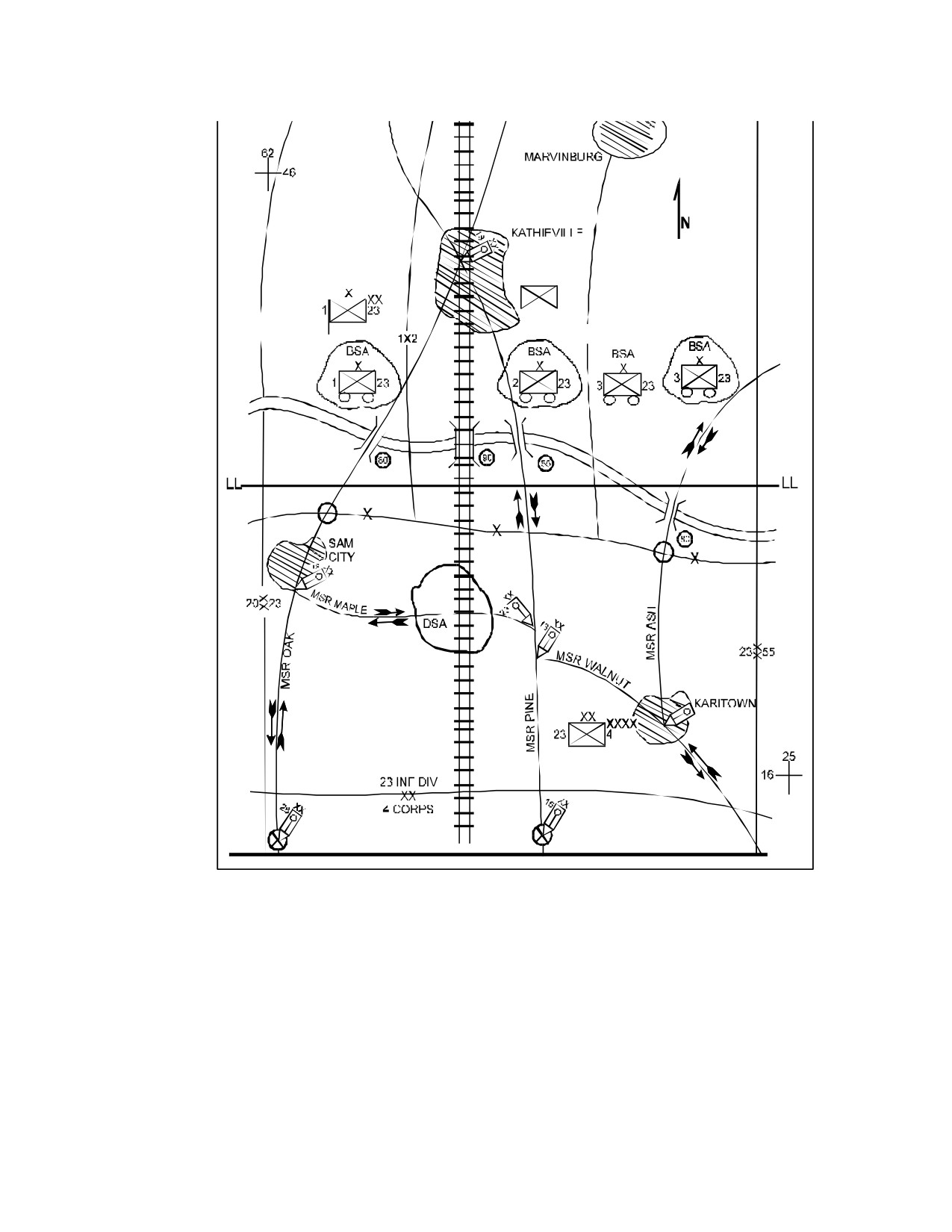
FM 4-01.30 _______________________________________________________________________________________ Chapter 8
Figure 8-1. Sample Traffic Circulation Plan
PRINCIPLES OF ROUTING
8-10. Routing is the process of coordinating or directing movements on MSRs or ASRs. When
routing traffic, movement planners should consider the four principles that govern routing.
• Balance. Balance is the matching of vehicle characteristics with route characteristics to
ensure that vehicle traffic does not exceed the most limiting feature of a route.
8-6
FM 4-01.30 _______________________________________________________________________________________ Chapter 8
• Separation. Separation is allocating the road space to ensure that military movements do
not conflict with each other, with pedestrian movements, or with civilian traffic.
• Distribution. Distribution is allocating as many routes as possible to reduce the potential
for congestion, enhance the useful life of roads and bridges (sustained capability), and
prevent deterioration of road surfaces (due to overuse). Distribution also promotes passive
defense by distributing and separating traffic.
• Prioritize. Assign highest priority traffic to routes that provide the minimum time-distance.
METHODS OF SCHEDULING
8-11. Scheduling is the process of coordinating times for road and highway movements. It involves
receiving and managing movement requests, and issuing clearances. Scheduling is essential to the
application of the principles of routing (paragraph 8-10).
8-12 Apply the following guidelines in scheduling movements:
• Movements on routes requiring movement clearance must be scheduled.
• Movements that cross movement control boundaries must be scheduled, coordinated, and
inbound cleared by the movement control organization responsible for the area where the
movement originates to the movement control organization where the movement
terminates.
• Large unit movements must be scheduled.
• Movements in one direction, on routes that require a movement clearance, are treated as a
single movement, regardless of the distance or time involved. Each movement retains the
same movement clearance to destination.
• Schedules and changes to schedules (due to changes in the tactical situation or in immediate
movement requirements) are provided to the movement regulation teams (MRT) to execute
highway regulation and to the PM to provide traffic control.
8-13. The method of scheduling road movements is based on the control measures specified for the
route. The four types of scheduling methods (from the least restrictive to the most restrictive) are
described below.
• Infiltration Schedule. This schedule is a rate of dispatch assigned to units for specific
routes and time blocks to achieve an average traffic flow that is within the capacity of the
route. By assigning rates of dispatch to different units that need to use the same route,
average traffic flow can be held within desired limits. An infiltration schedule may be used
for open or supervised routes.
• Route Schedule. This schedule is a flexible scheduling method. It apportions blocks of
time on MSRs to units, types of movements, phases of the operation, or for route
maintenance. A route schedule may be used for supervised, dispatch, or reserved routes.
8-7