6-02.45 (FM 11-45) Signal Support to Theater Operations (APRIL 2004) - page 1

HEADQUARTERS
DEPARTMENT OF THE ARMY
FIELD MANUAL
6-02.45 (FM 11-45)
Signal Support to
Theater Operations
APRIL 2004
DISTRIBUTION RESTRICTION: Approved for public release; distribution is unlimited.
*FM 6-02.45 (FM 11-45)
Field Manual
Headquarters
No 6-02.45
Department of the Army
Washington, DC, 12 April 2004
Signal Support to Theater Operations
Contents
Page
Preface
......................................................................................................................................iii
Chapter 1
THEATER SIGNAL TRANSFORMATION
1-1
Theater Signal Operational Environment
1-1
The Changing Army Operational Environment
1-2
Effect on Theater Signal
1-5
Chapter 2
SIGNAL SUPPORT IN THEATER
2-1
Support Principles and Objectives
2-1
End-User Services in the Current and Transformed Force
2-5
Chapter 3
ARMY ENTERPRISE SYSTEMS MANAGEMENT
3-1
Overview
3-1
Network Operations (NETOPS)
3-1
Army Enterprise Infostructure (AEI)
3-5
Roles and Functions of Key Network Management Organizations
3-14
Chapter 4
THEATER TACTICAL SIGNAL ARCHITECTURE
4-1
Current Force Architecture
4-1
Network Standardization
4-31
Rapid Deployment Contingency Communications Packages
4-31
Non-Integrated Tactical Signal Brigade (ITSB) Generic Contingency
Communications Packages
4-38
Notional Deployment Sequence
4-44
Echelons Corps and Below (ECB) Architectures
4-45
Stovepipe Architectures
4-45
Distribution Restriction: Approved for public release; distribution is unlimited.
__________
* This publications supercedes FM 11-45, 30 June 1999.
i
FM 6-02.45________________________________________________________________________________
Page
Chapter 5
THEATER STRATEGIC AND TACTICAL SIGNAL ORGANIZATIONS
5-1
New/Significantly Modified Force Structures
5-1
Force Structures Being Phased Out
5-1
Organizational Structure
5-1
Strategic/Fixed Station
5-2
Tactical
5-24
Appendix A
EMERGING SYSTEMS AND CONCEPTS
A-1
Appendix B
SELECTED LESSONS LEARNED FROM OPERATION ENDURING
FREEDOM AND OPERATION IRAQI FREEDOM
B-1
Appendix C
ORGANIZATIONS BEING PHASED OUT
C-1
Appendix D
EQUIPMENT OVERVIEW
D-1
Appendix E
ILLUSTRATIONS
E-1
Glossary
...................................................................................................................... Glossary-1
Bibliography
................................................................................................................ Bibliography-1
Index
............................................................................................................................Index-1
ii
Preface
FM 6-02.45 is the Army’s doctrine for Theater Signal. It is consistent with and expands
on the doctrine in Joint Pub 6-0, FM 6-0, FM 3-0, FM 24-1, and FM 100-6. It contains the
Command, Control, Communications, Computers and Information Management (C4IM)
guidelines necessary for theater communicators to support warfighters in the
contemporary operational environment (COE).
This manual is applicable at strategic, operational, and tactical levels of war, special
operations, smaller scale contingencies (SSC), homeland security (HLS), and military
operations other than war (MOOTW). The content is based on lessons learned from
operational experience, combatant commander operational requirements, current
concepts, programmatic initiatives, and new technology infusions. These factors create
doctrinal issues that may affect future warfighting operations. This doctrine examines
how new concepts, systems design, network protection, organizational structure, and
user responsibilities have changed the role of the Signal Corps in providing C4IM to the
Army.
This manual introduces several new organizational constructs that will bridge the gap
between the current and objective Theater Signal force and make signal organizations
relevant across all components (Active, National Guard, Reserve) of the Army. It also
provides information on the planned phase-out of several legacy force structures.
This manual provides the doctrinal foundation for force design, combat development,
professional education, and training of Theater Signal units and personnel. It establishes
and reiterates that effective C4IM operations are vital to the warfighter’s mission. This
manual provides information to combat arms, combat support, and combat service
support leaders and planners on how Theater Signal supports their operations.
The proponent for this publication is the United States Army Signal Center. Send
comments and recommendations on DA Form 2028 directly to: Commander, United
States Army Signal Center and Fort Gordon, ATTN: ATZH-CDD (Doctrine Branch), Fort
Gordon, Georgia
30905-5075, or via e-mail to doctrine@gordon.army.mil. Key all
comments and recommendations to pages and paragraph numbers to which they apply.
Provide reasons and rationale for your comments to ensure complete understanding and
proper evaluation.
Unless this publication states otherwise, masculine nouns and pronouns do not refer
exclusively to men.
This publication is available on the General Dennis J. Reimer Training and Doctrine
Digital Library at www.adtdl.army.mil.
iii
Chapter 1
Theater Signal Transformation
The Army is transforming in response to changes in the global political,
military, and technological environment and in accordance with national
level strategic and political decisions on how best to adapt to this
changing environment. Concurrent with the overall Army transformation
from the current force through the Stryker force to the future force, the
theater signal force is undergoing far-reaching transformations. These
changes to theater signal forces are driven by the changes to the Army as
a whole and serve as enablers to the Army transformation. This chapter
discusses the changing Army and its effect on the Signal Corps.
THEATER SIGNAL OPERATIONAL ENVIRONMENT
1-1. The Department of Defense (DOD) defines an operational environment
as a “composite of all the conditions, circumstances, and influences that affect
the employment of military forces and bear on the decisions of the unit
commander.” The theater signal operational environment that drives theater
signal doctrine and force structure includes all of the elements of the larger
operational environment that affect all US forces, and the additional factors
imposed by the requirements, characteristics, and doctrine of the forces
supported by theater signal. Highlights of the changes to the theater signal
operational environment are summarized in Figure 1-1.
Then
Now
Area-Centric Support
Multiple Scenarios
Minimal Data Demand
High Data Demand
Large Footprint
Reduced Footprint
Voice Reliant
Voice and Data Reliant
Cold War Focused
Operational Focus
Transport Intensive
Reduced Transport
Figure 1-1. Evolving Signal War Fight
1-1
FM 6-02.45________________________________________________________________________________
THE CHANGING ARMY OPERATIONAL ENVIRONMENT
1-2. Today, the warfighter’s environment changes quickly due in part to
rapid development, deployment of new technologies, and the constant change
in the types of terrain and operations to which they are forced to adapt.
1-3. As our technological capabilities change and expand, so too do the
capabilities of our enemy. In today’s global technological environment, hi-tech
developments make new capabilities available to both friendly and adversary
forces alike.
1-4. The types of threats facing the United States extend from smaller, lower-
technology opponents using more adaptive asymmetric methods to larger
modernized forces engaging deployed US forces in more conventional
symmetrical ways. Threats to peace and stability exist in the form of military
powers, terrorism, narcotics trafficking, and organized crime. In some
possible conflicts (or in multiple, concurrent conflicts), a combination of these
types of threats could be especially difficult to defend against.
1-5. Contemporary strategic thought recognizes that the origin of potential
threats involves some degree of uncertainty. Adversaries may no longer
present themselves clearly in terms of intent, capability, or modes of
operation. The very nature of conflict is uncertain, as is the form it will take.
However, in light of this uncertainty, the following trends are recognized:
• Diminishing protection afforded by geographic distance.
• Increasing threats to regional security.
• Increasing challenges and threats emanating from territories of weak
and failing states.
• Diffusion of power and military capabilities to nonstate actors.
• Increasing importance of regional security arrangements.
• Increasing diversity in the sources and unpredictability of the
locations of conflict.
• Cyber attacks provide the opportunity for individuals or small groups
to wreak havoc on networked services and information that may have
impact on a local, regional, and global scale.
1-6. The threat of terrorist attacks against US citizens and US interests
around the world has become the nation’s most pressing national security
issue. American and allied military strikes in response to such attacks are
likely to lead to further terrorist strikes against American and allied citizens
and interests, both in the United States and abroad. This aggression will
likely take a variety of forms and may include cyber attacks by terrorist
groups themselves or by targeted nation-states.
1-7. Even more likely are cyber attacks by sympathizers of the terrorists,
hackers with general anti-US or anti-allied sentiments, and thrill seekers
lacking any particular political motivation. During the past few years, the
world has witnessed a clear escalation in the number of politically motivated
cyber attacks, often embroiling hackers from around the world in regional
disputes. In addition, the number, scope, and level of sophistication of cyber
attacks unrelated to any political conflict are increasing rapidly. Where
antecedent attacks were relatively benign, recent attacks have targeted vital
1-2
________________________________________________________________________________FM 6-02.45
communications and critical infrastructure systems. In the future, cyber
attacks will evolve further, exposing vulnerabilities not yet identified by
computer security experts. For example, the recent Code Red and Nimda
worms each exploited new vulnerabilities in Microsoft’s Internet Information
Server (IIS) software.
1-8. The same technologies that in the past were key to our information and
technical superiority now enable our enemies to offset our warfighting and
technological dominance. The challenge to leaders and planners at all levels
is to maintain information and technological dominance in spite of the
availability of high technology resources to our adversaries and potential
adversaries.
ARMY MISSIONS
1-9. The Army continues to prepare for, and participate in, efforts that span
the entire spectrum of military operations: from peacetime military
engagement, to smaller scale contingencies (SSC), to full-scale war. It is
essential to understand that Army forces participate in almost all operations
as part of a joint team. Combatant commanders rely upon Army forces to
conduct sustained land operations as a part of an overall strategy involving
land, air, sea, and space forces. Land operations support the full spectrum of
operations to include offensive, defensive, stability, and support operations:
• Offensive operations—intend to destroy or defeat an enemy with the
purpose of imposing US will on the enemy and achieving decisive
victory.
• Defensive operations—defeat an enemy attack, buy time, economize
forces, or develop conditions favorable for offensive operations.
Defensive operations alone are not expected to achieve a decision;
they are employed to create conditions suitable for a counteroffensive
to enable US forces to regain the initiative.
• Stability operations—promote and protect US national interests by
influencing the threat, political, and information dimensions of the
operational environment through a combination of peacetime,
developmental cooperative activities, and coercive actions in response
to a crisis. Inherent to stability operations is the deterrent effect of
knowing that US forces are prepared to transition to other operations
if necessary.
• Support operations—assist civil authorities, foreign or domestic, as
US forces respond to crises or relieve suffering.
1-10. While operations at the lower end of the scale are more probable and
numerous, operations at the higher end are the most dangerous and
demanding. Therefore, major combat operations (MCO) and higher-level SSC
operations are the benchmark for standards of preparedness.
1-3
FM 6-02.45________________________________________________________________________________
1-11. Often it is necessary to engage in decisive operations with the purpose
of defeating aggression or preempting actions that would threaten US
interests. The following actions outline the character of future military
operations:
•
Strengthen resistance capabilities and efforts of indigenous forces.
•
Deter aggression by the repositioning of pre-positioned equipment;
redeploy forward-stationed air, ground, maritime, and amphibious
forces; and rapidly deploy continental United States (CONUS) based
and allied forces into the theater.
•
Defeat enemy attempts to create an operational exclusion zone by
securing regional deployment facilities from disruption; establishing
regional air and missile defenses; securing entry to littoral waters as
required; destroying enemy air, missile, and command and control
(C2) capabilities; and destroying enemy war supporting
infrastructures such as communications, electrical power, and
transportation means.
•
Conduct entry operations through multiple points of entry with
combat forces able to fight immediately upon arrival, achieve
operational surprise, and begin the destruction of enemy air defenses,
fires, intelligence, surveillance, reconnaissance
(ISR), and C2
systems.
•
Conduct decisive operations against critical objectives throughout the
enemy’s area of operations. These operations require the integration
of precision fires, maneuver, and assault to negate the enemy’s ability
to respond effectively and to fragment enemy combat forces, deny
them freedom of maneuver, and isolate them from sustainment or
reinforcement. Decisive operations are conducted until the enemy’s
capabilities are disintegrated and capitulation or armistice conditions
are achieved.
•
Reestablish regional stability by disarming residual conventional and
paramilitary forces and restoring civil order.
ARMY TRANSFORMATION
1-12. The Army is transforming itself in response to the changes in its
operational environment. Some of the key changes in Army operations
include the following:
• Lighter, more strategically deployable forces.
• Reliance on reach-back logistics and intelligence support.
• More mobile forces.
• More lethal forces.
• Increased area of control/area of influence for smaller tactical
formations, leading to enclave operations as opposed to a linear
battlefield.
• Reduced physical and logistical footprint.
1-4
________________________________________________________________________________FM 6-02.45
• Emphasis on information superiority as an element of combat power.
At its essence, information superiority is about Army forces being
able to see first, understand first, and act first.
• Information centric/network centric force.
• Leveraging of technology, especially information technology (IT), at
all levels as an enabler to other transformational capabilities.
• Joint and coalition operations are the rule, not the exception.
Although the above items are not a comprehensive list of the Army
transformations, they are aspects that have profound effect on theater signal
forces.
EFFECT ON THEATER SIGNAL
1-13. Strategic and tactical theater signal forces are transforming along with
all of the Army. The following paragraphs discuss the areas in which theater
signal transformation is occurring. Appendix A examines high-level trends as
well as technological sustainment considerations that are likely to affect
theater signal organizations and planners.
MISSION
1-14. The theater signal mission has expanded significantly in the following
areas.
Demand for Data Services
1-15. The technical scope of the theater signal’s mission has expanded to
include numerous new data services and significantly increased bandwidth.
These services are discussed in detail in Chapter 2.
1-16. Technological trends and economic factors that have driven the civilian
world to leverage IT into savings of manpower, time, and transport have
driven the same trade-offs for the forces supported by theater signal.
1-17. The deployed or tactical environment demands the same data services
as the garrison. In addition to the economic factors that drive demand for
data services in garrison, deployed forces must have interoperability with the
sustaining base for all forms of logistic support as well as for C2 and
intelligence. Deployed forces can’t afford less automation in the field. The
demand for data bandwidth in the field follows parallel exponential growth
curves as for garrison. The baseline for customer service is providing and/or
enabling the functionality of the customer’s garrison electronic desktop
environment in the field. This applies to both bandwidth and services.
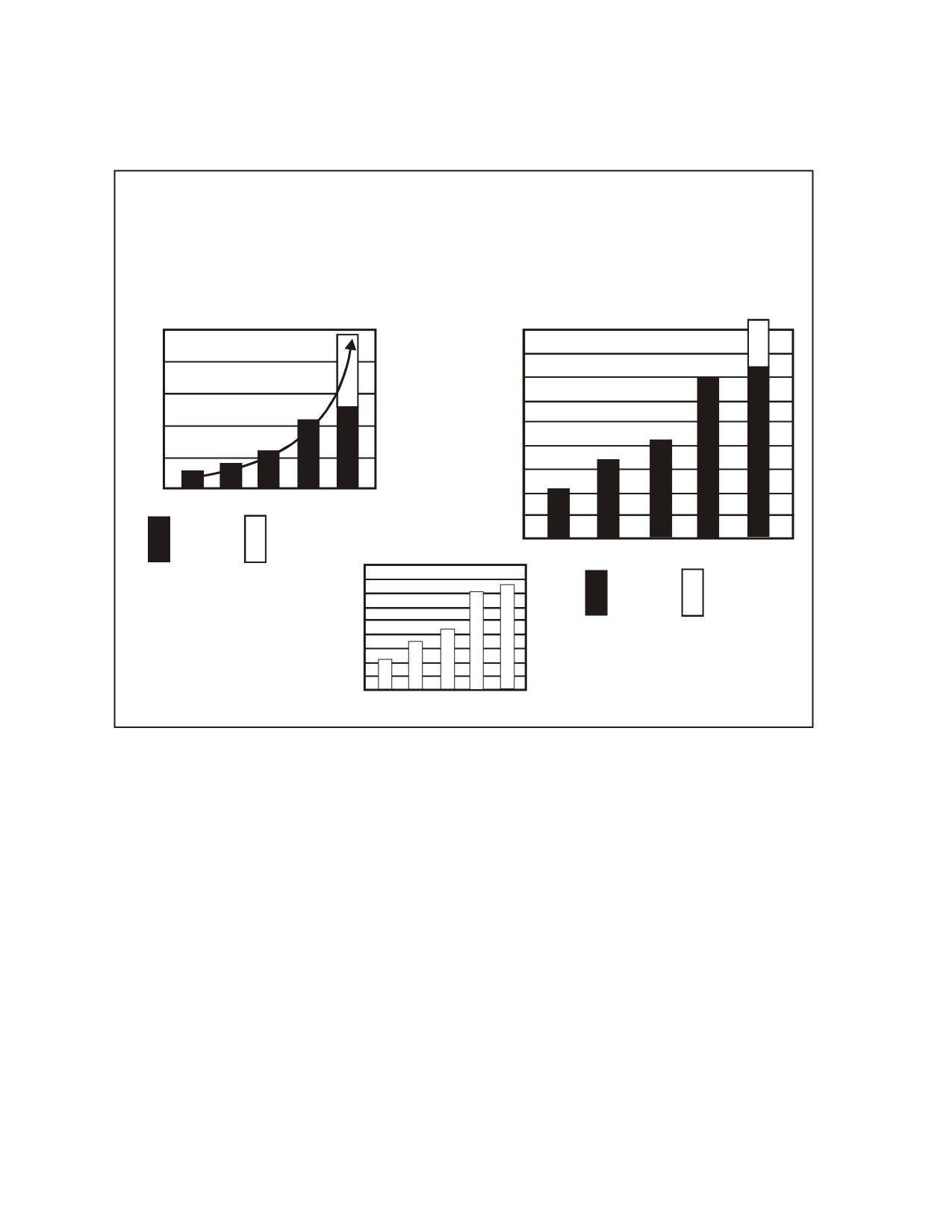
1-18. This translates to an exponential growth in user demand for data
services and a corresponding increase in bandwidth to support those services.
The extent to which Internet Protocol (IP) services have grown and continue
to grow within the Army in a garrison environment is representative of this
trend. Figure 1-2 illustrates Army IP growth.
1-5
FM 6-02.45________________________________________________________________________________
Army IP Growth
SIPRNET
NIPRNET
141 Routers
165 Routers
Additional B/W
Additional B/W
on order: 186 Mb
on order: 982Mb
Mbps
NIPRNET
27%**
Mbps
NIPRNET
95% **
2500
450
400
2000
67%
350
1500
300
1000
250
24%
200
500
53%
150
0
100
FY98 FY99 FY00 FY01 FY02
50
B/W
B/W
0
Installed
On Order
FY98 FY99 FY00 Fy01 FY02
900
** B/W installed and on order thru May ‘02
800
700
B/W
B/W
600
Installed
On Order
500
400
300
200
100
0
FY98 FY99 FY00 FY01 FY02
Figure 1-2. Army IP Growth
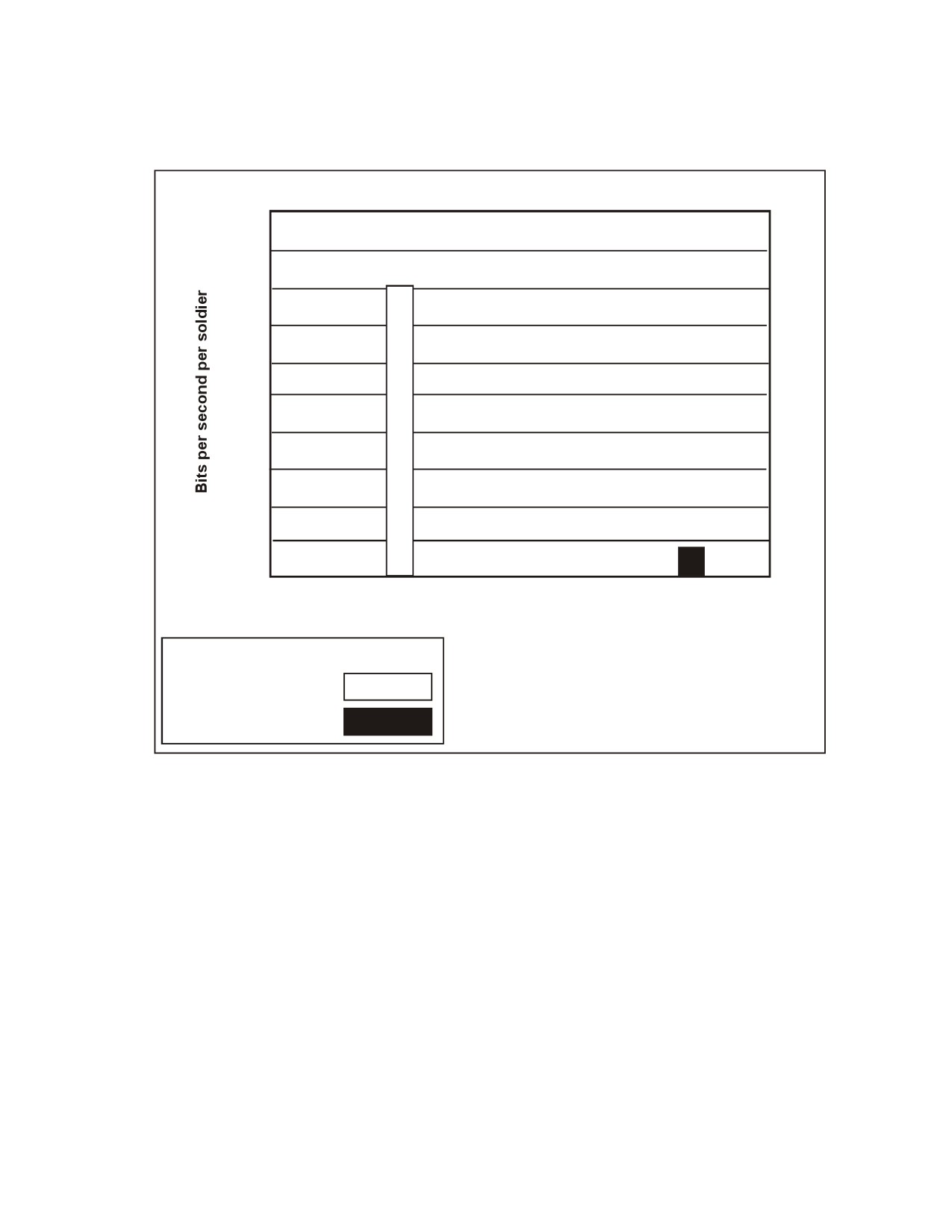
1-19. Another way of viewing the increase in the demand for satellite
communications (SATCOM) bandwidth is as bits per second per soldier.
Figure 1-3 illustrates the growth in this metric between Operation Desert
Storm and Operation Iraqi Freedom.
1-20. The demand for data services brings with it an increased demand for
cable and wire installation services. Current field experience is that the
addition of Unclassified but Sensitive Internet Protocol Router Network
(NIPRNET), Secret Internet Protocol Router Network (SIPRNET), and video
teleconferencing (VTC) to the baseline of user services has resulted in a
three-fold increase in the amount of wire and cable installation services that
must be provided by theater signal units.
1-6
________________________________________________________________________________FM 6-02.45
10,000
9,000
8,000
7,000
6,000
5,000
4,000
3,000
2,000
1,000
0
300,000
350,000
400,000
450,000
500,000
550,000
Number of Soldiers
Legend:
Operation Iraqi Freedom
Desert Storm
Source: Briefing by Chief Technology Officer, DISA
May, 2003
Figure 1-3. SATCOM Bandwidth per Soldier
Cyber Defense
1-21. Cyber defense is a popular term for computer network defense (CND).
CND is a subelement of information assurance (IA), which is in turn a sub-
element of network operations (NETOPS). The mission of theater signal
forces has significantly expanded in CND as well as in overall NETOPS.
Previously, responsibility for the subelements of NETOPS was fragmented.
Organizational responsibilities for these functions are discussed in detail in
Chapter 3.
1-22. NETOPS, IA, and CND mission areas help ensure the availability,
integrity, identification, authentication, confidentiality, and nonrepudiation
of friendly information and information systems while denying adversaries
access to the same information/information systems. IA incorporates cyber
defense protection, detection, and reaction capabilities, including restoring
information systems. It provides end-to-end protection to ensure data quality
and protection against unauthorized access and inadvertent damage or
1-7
FM 6-02.45________________________________________________________________________________
modification. Cyber defense by means of CND incorporates those actions
taken to protect, monitor, analyze, detect, and respond to unauthorized
activity within DOD information systems and computer networks. Cyber
defense activity employs IA protection activity and includes deliberate
actions taken to modify an assurance configuration or condition in response
to a CND alert or threat information.
NOTE: IA is focused on building in protections and then
performing recovery when protections are not adequate,
while cyber defense is focused on actions (protect, monitor,
analyze, detect, and respond), and includes IA protection in
response to an IA alert or threat.
1-23. Adequate cyber defense requires the following:
• Protection capabilities—include emission security, communications
security
(COMSEC), computer security, and information security
incorporating devices such as access control, cryptography, network
guards, and firewall systems that are used by all the information
transport and service providers in a theater or other area of
responsibility (AOR).
• Detection capabilities—include the ability to sense abnormalities in
the network through the use of anomaly and intrusion detection
systems. Timely detection of abnormalities, to include attack,
damage, or unauthorized modification, is key to initiating system
response and restoration actions.
• Reaction capabilities—incorporate restoration as well as other
information operations response processes. Capability restoration
relies on established mechanisms for prioritized restoration of
minimum essential systems and networks.
Joint/Coalition Support
1-24. Theater signal forces are frequently called upon to provide network
services such as local area networks (LANs) and wide area networks (WANs)
to coalition partners. These coalition local area networks
(C-LANs) and
coalition wide area networks (C-WANs) may operate at both classified and
unclassified levels.
1-25. Because many joint and coalition partners may not have adequate
quantities of compatible network equipment, or may not have computer
network equipment at all, theater signal forces are frequently called upon to
provide user equipment as well as services.
Nontraditional Support Relationships
1-26. Theater signal units are frequently called upon to accompany and
support organizations outside traditional echelon affiliations. It is not
unusual for theater signal units to support corps, division, or lower
headquarters that would normally draw their primary signal support from
their own organic assets or from assets associated with their echelon.
Sometimes this is due to the theater signal units having the greater technical
capability. Other times, it is simply a matter of geographic proximity. An
example of this support is shown during Operation Iraqi Freedom, when
1-8
________________________________________________________________________________FM 6-02.45
theater signal units accompanied elements of the Third Infantry Division in
the march into Baghdad in order to provide adequate SATCOM capability.
1-27. The result is that theater signal units render support on an anyone-,
anytime-, and anywhere-basis. Theater signal units are among the earliest
responders in the establishment of a theater of operations. They are exposed
to all of the hazards of the battlefield and require the same force-protection
and self-protection measures and capabilities traditionally associated with
much lower echelon tactical forces.
DOCTRINE
1-28. Theater signal doctrine has evolved in the following areas to support
the Army’s changing roles and missions.
Electronic Parity Between Garrison and Field
1-29. Theater signal forces’ doctrinal objective is to provide the connectivity,
bandwidth, and services required to virtually replicate the garrison
operational electronic desktop environment to supported customers in the
field. The baseline for field services is no longer significantly more austere
than the services and functionality provided in garrison.
1-30. Theater signal must provide technological parity with the garrison IT
environment. The shortening of support chains requires units in the field to
interface more directly with suppliers and agencies that are more exclusively
civilian than in the past. These direct interfaces require technological
compatibility, which currently includes access to the Internet, compatibility
with the Web page practices and Web-based applications of both civilian and
government agencies, and the evolving nature of e-commerce. Examples of
these technological parity and compatibility requirements include:
• Supply clerks in the field must have the qualitative and quantitative
IT and communications support to maintain the same productivity
(process electronic transactions at the same rate) as in garrison.
• Personnel clerks, medical personnel, and all other disciplines of
logistic support must also have this same type of support.
Army Knowledge Management (AKM)
1-31. In concert with the overall Army transformational goals of becoming an
info-centric and network-centric force, the signal doctrinal perspective has
expanded beyond the technical aspects of physical management of
communications and information processing systems to a broader view of
knowledge management.
1-32. The AKM strategy is the center of the Army’s information revolution. It
is the enabler for mission operations, knowledge generation, information
delivery, and technology innovation.
1-9
FM 6-02.45________________________________________________________________________________
1-33. The AKM vision encompasses a transformed Army, with agile
capabilities and adaptive processes, powered by world-class, network-centric
access to knowledge systems and services, and interoperable with the joint
environment. It embraces Army and DOD imperatives for information
dominance, and integrates technology, e-business, and knowledge-
management concepts.
1-34. The AKM framework consists of three interrelated components:
• Intellectual capital—The expertise, experience, and insights that
reside in the workforce—military, civilian, and industry partners—
coupled with new strategies for harnessing human capital.
• Infostructure—The hardware, software, and communications
information technologies and associated architectures and facilities
that ensure universal access, security, privacy, and reliability of
Army and DOD networks.
• Change catalysts—The innovative policies, governance structures,
and culture changes that create a network-centric environment and a
knowledge-based workforce.
1-35. The AKM strategic plan, endorsed by both the Army’s secretary and
chief of staff in August 2001, delineates five goals:
• Adopt governance and cultural changes to become a knowledge-based
organization.
• Integrate knowledge management concepts and best-business
practices into Army processes to improve performance.
• Manage the infostructure as an enterprise to enhance capabilities
and efficiencies.
• Scale the Army Knowledge Online (AKO) Web site as the enterprise
portal to provide universal, secure access for the entire Army.
• Harness human capital for the knowledge organization.
1-36. As a strategic concept, AKM will continuously incorporate change. The
AKM vision, framework, and strategic-plan goals are constant guideposts,
while the specific objectives associated with each goal will change as actions
are completed and new initiatives are started.
Commercial Off-The-Shelf (COTS) Technology
1-37. Extensive reliance on COTS technology is, and will continue to be, a
permanent reality on the battlefield. (This is in contrast to previous concepts
that regarded the use of COTS as an aberration or temporary condition to be
remedied by future systems developed and acquired by traditional military
specification methods.)
1-38. The pace of technological advance has made COTS a permanent feature
of the battlefield. Moore’s Law predicts that the available processing power of
computers doubles every 18 months, and this shows no sign of leveling off.
Civilian industry typically replaces or upgrades desktop personal computers
(PCs) every two to four years in order to remain compatible with the world. In
order to remain current, units in garrison tend to upgrade at about the same
rate. The traditional military acquisition process has been designed with the
1-10
________________________________________________________________________________FM 6-02.45
intent of going from idea to initial operational capability
(IOC) in
approximately 5 years under ideal conditions. Under real conditions, 15 to 20
years is not unusual. The traditional materiel acquisition process will not
deliver IT in a manner adequate to keep Army forces current and compatible
with their operational and support environment.
1-39. The enabling of garrison services in the field and extensive use of COTS
are already being implemented as much as possible by the warfighters and by
theater signal units out of necessity. Because these concepts have not been
previously recognized as doctrinal norms, the implementations have been
carried out piece-meal in an ad-hoc, nonstandardized manner. In the case of
equipment, this has occurred independently in the different theaters,
resulting in multiple equipment configurations.
1-40. Doctrinal recognition of the increased quality of support requirement
and the COTS environment is only a first step in meeting the challenges this
poses, which include:
• Funding. Because acquisition and logistics concepts have not been
adapted to COTS, technology insertions in the field have historically
been accomplished with contingency and operational funds rather
than with normal procurement funds. This has detracted from the
equipment availability and other aspects of unit readiness that the
funds were intended to maintain.
• Training and logistical support. Training and logistical support for
technology insertions executed outside the normal acquisition process
is ad-hoc and lacks the efficiencies of standardization.
• Manning. The six-year process for designing and implementing
changes to Tables of Organization and Equipment (TOEs) is a major
impediment to manning signal units with school-trained soldiers for
the rapidly developed COTS solutions. This is further complicated by
the interaction of the force development process with the formal
acquisition process. The challenge is getting the Army materiel
acquisition and logistic support systems to officially recognize and
support COTS equipment. This recognition is required in order to
authorize the equipment on organizational documents.
1-41. Signal leaders and planners must engage logisticians and planners of
other disciplines at all echelons to adapt Army management and support
systems to meet the support requirements of COTS equipment. The Signal
Corps must educate other functional areas on the capabilities COTS provides
to the warfighter.
Leased Commercial Communications
1-42. Leased commercial communications are critical to the success of
theater signal in meeting the demand for connectivity and services. Force
structure and equipment must be designed and acquired with this parameter
in mind. An example of this is the acquisition and fielding of multiband
SATCOM terminals that are capable of accessing commercial satellites as
well as military satellites.
1-11
FM 6-02.45________________________________________________________________________________
“About 80 percent of our capability over there was commercial
satellite…” LTG Peter Cuviello, Army Chief Information Officer
(CIO)/G6, referring to Operation Iraqi Freedom, quoted in
National Defense Magazine, July 2003
Commercial (Contractor) Support
1-43. Extensive reliance on commercial sector support is, and will continue to
be, a permanent reality of theater signal operations. Introduction of
commercial
(contractor) support begins almost immediately following
deployment in order to free up tactical signal assets for follow-on
deployments.
TACTICS, TECHNIQUES, AND PROCEDURES (TTP)
1-44. One of the more tangible changes in the way the Army fights that
drives changes in theater signal force structure and TTP is the shift from the
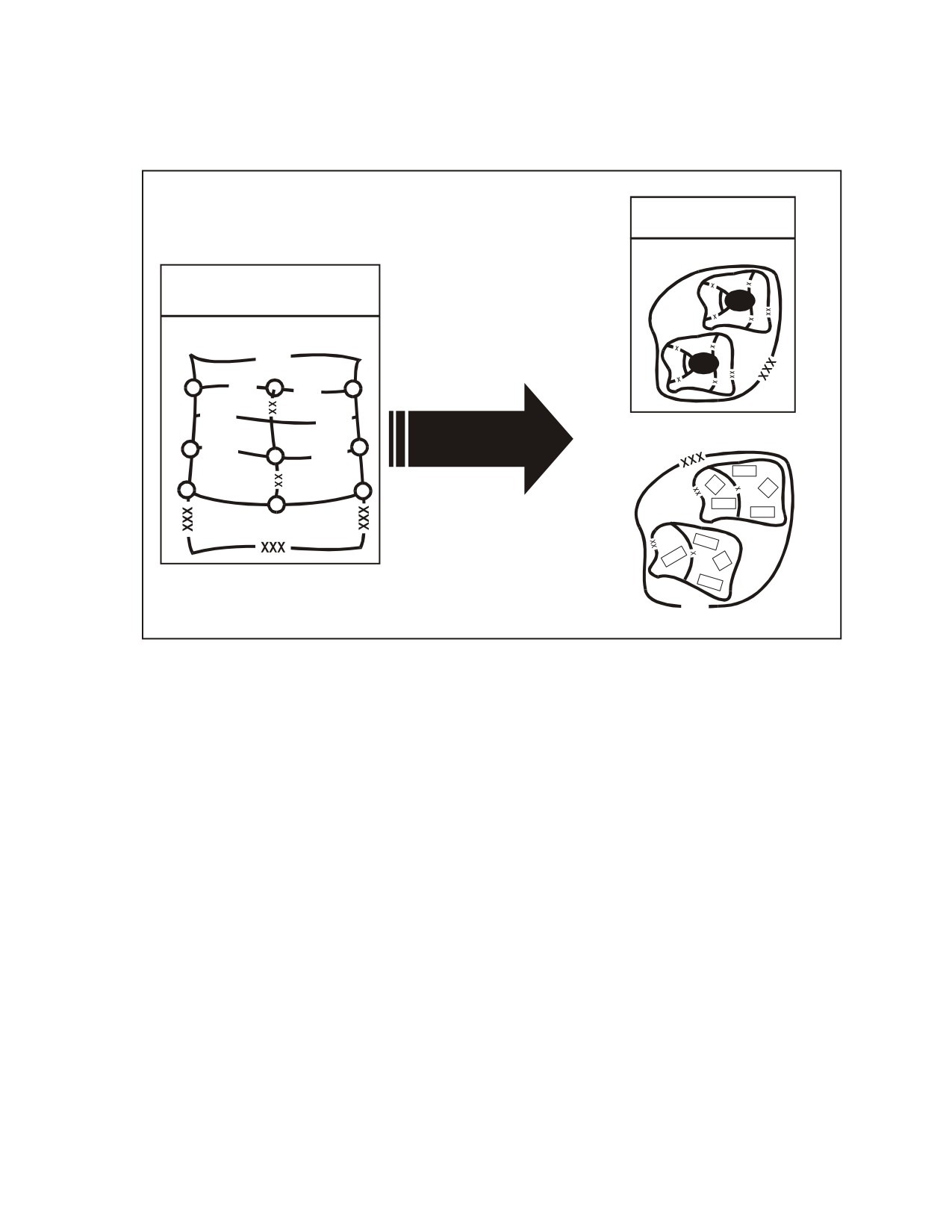
contiguous battlefield of the Cold War era to operating and fighting from
widely separated enclaves.
1-45. Although the Army retains the capability to fight in a linear,
contiguous battlefield, enclave operations are more the norm than the
contiguous battlefield of the Cold War era. The enclaves of forces supported
by theater signal are more often than not beyond line-of-sight
(BLOS)
distance from each other. The agility, strategic deployability, and economy of
force considerations that drive combat forces to smaller forces in enclaves as
opposed to larger forces in a contiguous battlefield also operate against
having forces available to secure line-of-sight (LOS) relays. This creates a
greater demand for BLOS transmission services such as SATCOM and
troposcatter communications (TROPO). It reduces, but does not eliminate,
the critical demand for and utility of LOS transmission systems. This factor
is reflected in the design of the new theater signal force structure. Figure 1-4
illustrates the changing battlefield.
1-46. Radio systems will typically be co-located in the same enclave with the
headquarters elements they support. This is in contrast to the Cold War
norm of remoting radio systems as far away as practical from their supported
headquarters. In the typical enclave deployments since Desert Storm,
enclaves have most often been surrounded by, or in close proximity to, the
local population. In these situations, the locations of the enclaves, and hence
the headquarters elements, are readily known to the enemy. In such
situations, remoting radio systems away from their supported headquarters
elements to reduce detection of those headquarters by their electronic
signature becomes a moot point. Economizing on the forces’ need to provide
physical security becomes the more important factor. This reduces
requirements for LOS systems, particularly those specialized for up-the-
hill/down-the-hill applications.
1-12
________________________________________________________________________________FM 6-02.45
Noncontiguous
Areas of Operations
Linear Operations
Contiguous
Areas of Operations
II
Rear
Area
Linear Operations
XXX
Rear
II
Area
X
XX
X
XX
X
FLOT
FLOT
Nonlinear Operations
FEBA
X
X
FEBA
X
X
X
X
From this
To this
XXX
Figure 1-4. Changing Battlefield
1-47. The emergence of a peer competitor of the United States could drive
these trade-offs back the other way in the future. Another circumstance that
could force a return to remoting of emitters would be a threat that has anti-
radiation missiles capable of being targeted on communications emitters. The
doctrinal principle is that the commander optimizes overall force protection
and command post survivability. In this case, it is the TTPs and the force
structure that change to adapt to the environment.
1-48. The nonlinear battlefields and guerrilla environments of Operation
Enduring Freedom and Operation Iraqi Freedom have highlighted other
changes in force protection requirements for theater tactical signal units. A
synopsis is presented below. Lessons learned topics are discussed in more
detail in Appendix B.
• Theater signal troops require the same protective individual
equipment (for example, body armor) as the combat forces they
accompany. Based on the experience of Operation Iraqi Freedom,
theater signal units may be called upon to accompany combat arms
brigades. Force development planners need to ensure that this
equipment is included in requirements documents
(TOEs) and
authorization documents
(Modified Tables of Organization and
Equipment [MTOEs]).
1-13
FM 6-02.45________________________________________________________________________________
•
Theater signal units require greater self-protection capability than
has traditionally been designed into them. This capability includes,
but is not limited to, additional crew served weapons such as heavy
machine guns, automatic grenade launchers, night vision devices,
and night vision weapons sights. Force development planners need to
insure that this equipment is included in requirements documents
(TOEs) and authorization documents (MTOEs).
•
Weapons proficiency requires greater emphasis than has been
traditional within the signal regiment and within combat support and
combat service support in general. This applies to both individual and
crew served weapons. Commanders must provide both personal
example and resources
(range time, funds, instruction, and
ammunition) to make this happen. At the higher command and
planning levels, the budgeting functions are critical in ensuring
adequate ammunition availability to train all unit members on all
unit weapons, to include crew served weapons.
•
TTPs for signal site defense planning and execution must
acknowledge that signal units rarely have sufficient organic troops to
effectively establish and defend a perimeter large enough to contain
all of their equipment. The bottom line is that signal units must
cluster with other units for a common defense and/or be augmented
with more soldiers specifically for defense.
•
Signal leaders, trainers, and staff members at all levels must acquire
a detailed knowledge of Global Positioning System (GPS) technology
and develop TTPs adapted to its nuances. Effective employment of
GPS technology is a staff and leader function as well as a technical
operator skill. GPS, in conjunction with other command, control,
communications, and computer (C4) technology, has enabled combat
forces to operate at a much higher tempo and under conditions of far
less visibility than in conflicts prior to GPS. Effective use of GPS is
critical for signal as well as other combat support and combat service
support disciplines in order to keep pace with the GPS-enabled
combat forces we support and to survive on the fluid, noncontiguous
battlefield, made more fluid and more noncontiguous by the new
operational modes of those combat forces.
•
In the noncontiguous battlefield, errand runs (for example, getting
critical parts, moving critical personnel from site to site) common to
signal operations must be managed and defended by organizing them
into convoy operations. This adds to the time and manpower required
to accomplish tasks compared to operations on the contiguous
battlefield with secure rear areas. Leaders and planners must allow
for these requirements when they occur, and seek to minimize such
requirements by prior planning and preparation. When convoy
operations are mounted, they must be large enough and adequately
equipped to effectively defend themselves and have adequate
navigation and communications equipment. As with perimeter
defenses, banding together with other units can result in more
effective defense by providing for larger convoys. Force development
planners need to insure that convoy defense is considered in selecting
1-14
________________________________________________________________________________FM 6-02.45
equipment for requirements documents (TOEs) and authorization
documents (MTOEs). Such equipment may include, but will not
necessarily be limited to, vehicle weapons mounts and armored high
mobility multipurpose wheeled vehicle (HMMWV) variants.
FORCE STRUCTURE
1-49. Theater signal is undergoing several significant force structure changes
in order to meet the expanded mission requirements and strategic
deployability requirements of the supported force. The most significant of
these changes is the replacement of the theater area signal battalion and
theater composite signal battalion with the integrated theater signal
battalion
(ITSB). The details of force structure changes are provided in
Chapter 5 and Appendix C.
1-50. Current operational concepts require combat forces to achieve rapid
deployability by placing heavy reliance on the capability to reach back to the
sustaining base for access to national assets, intelligence, and logistics
support. This drives requirements for increased wideband communications in
general, and for SATCOM in particular. These requirements are reflected in
the new force designs.
1-15
Chapter 2
Signal Support in Theater
This chapter discusses the mission of signal support in theater, to include
support principles and objectives and end-user services in the current and
transformed force.
SUPPORT PRINCIPLES AND OBJECTIVES
2-1. Theater signal support accommodates many types of situations. It has
the capability to deploy, interface, and interoperate with equipment from
other services, allies, and commercial and host-nation infrastructures. It
decreases dependence on strategic air, sea, and rail lifts and enables a more
rapid and flexible response. Theater signal support provides a ubiquitous
communications architecture for all requirements of our forces. The following
paragraphs discuss some of the principles and objectives of theater signal
support.
PRINCIPLES
2-2. The over-arching principle of signal support is that it must meet the
needs of the user by—
• Achieving effective information management.
• Defending and protecting against information warfare.
• Planning, deploying, operating, and maintaining all information
services as an integrated system to enable an information service
centric environment.
• Applying in-depth knowledge of all individual service components and
a systems-engineering approach in the planning and deployment of
information services.
• Organizing as you fight.
• Training as you fight.
• Equipping organizations with up-to-date technology.
• Providing the services and connection points to enable the use of
user-owned and -operated terminal equipment to function in a field
environment the same as in garrison.
2-3. Signal units provide
“whatever it takes” assistance to customer
organizations when higher-level doctrinal principles break down. For
example, while the Army doctrinal principle of emphasizing user-owned and
-operated terminal equipment (e.g., telephone instruments, secure telephone
units
[STUs], fax machines, and PCs) remains in effect, difficulties in
implementing this principle have forced signal units to take extraordinary
measures to lend terminal equipment to users and to assist them in acquiring
2-1
FM 6-02.45________________________________________________________________________________
terminal equipment. This is especially true when supporting other services
and coalition forces. The following paragraphs discuss other support
principles.
Interoperability
2-4. Interoperability is necessary to ensure the success in any joint,
multinational, or interagency operation. Interoperability is achieved among
C4 equipment when components are interchangeable and information can be
exchanged directly and satisfactorily between users.
2-5. Commonality is one means of achieving interoperability. Equipment and
systems are common when:
• They are compatible.
• Each can be operated and maintained by personnel trained on one
system without requiring additional specialized training for the
others.
• Repair parts (components or subassemblies) are interchangeable.
• Consumable items are interchangeable.
2-6. Compatibility is also a means of gaining interoperability. It is the
capability of two or more items or components of equipment or material to
exist or function in the same system or environment without mutual
interference.
Electromagnetic
compatibility,
including
frequency
supportability, must be considered at the earliest conceptual stage and
throughout the planning, design, development, testing and evaluation, and
operational life cycle of all systems.
Liaison
2-7. Technology can never replace the face-to-face exchange of information
between commanders. However, as the pace and complexity of operations
increase, the commander must extend his presence through liaisons. Liaison
officers
(LNOs) provide the direct contact or communications between
elements or forces that ensures mutual understanding, unity of purpose, and
action. Critical functions of an LNO include monitoring, coordinating,
advising, and assisting the command to which a team is attached.
2-8. In terms of mission accomplishment, the LNO is one of the most effective
ways to ensure interoperability between organizations. The mission is
enhanced when competent C4 support personnel are employed to extend the
eyes and ears of the commander.
Flexibility
2-9. Flexibility is required to meet changing situations and diversified
operations with minimal disruption or delay. Designing systems and
networks that are mobile, transportable, and interoperable with joint,
unified, coalition, and commercial facilities is just one way to obtain
flexibility. Flexibility allows rapid integrations at all levels of joint and
service C4 support. The connectivity achieved and maintained from flexible
systems is particularly important during contingency operations. Flexibility
2-2
________________________________________________________________________________FM 6-02.45
is a necessary adjunct to the other principles of interoperability,
survivability, and compatibility.
Responsiveness
2-10. C4 systems must respond instantaneously to the warriors’ demands for
information. To be responsive, systems must be reliable, redundant, and
timely:
• Reliable. C4 systems must be available when needed and must
perform as intended. Reliability is achieved by designing systems and
networks with low failure rates and error correction techniques;
standardizing systems; establishing standardized procedures;
countering computer attacks and electromagnetic jamming and
deception; and establishing effective logistic support programs.
• Redundant. Redundancy is obtained through a multiplicity of paths,
backups, self-healing strategies, and replications of data at several
locations, which can be recovered quickly in the event portions of the
network become destroyed, inoperative, or degraded.
• Timely. As weapon systems technology shortens the time between
warning and attack, so must the processing and transmission time for
warning, critical intelligence, and operation order execution
information be compressed.
Mobility
2-11. The horizontal and vertical flow and processing of information must be
continuous to support the rapid deployment and employment of joint military
forces. Commanders at all levels must have C4 systems that are as mobile as
the forces, elements, or organizations they support without degraded
information quality or flow. More than ever before, modular design and
micro-electronics can make C4 systems lighter, more compact, and more
useful to warfighters.
Survivability
2-12. National policy dictates the survivability of both command centers and
C4 networks through which the forces in the field receive command decisions
and situational understanding. It is not practical or economically feasible to
make all C4 networks or elements of a system equally survivable. The degree
of survivability for C4 networks supporting the function of C2 should be
commensurate with the survival potential of the associated command
centers. The survivability of C4 networks is accomplished through
applications and techniques such as dispersal of key facilities, multiplicity of
communications nodes, hardening (electrical and physical), or a combination
of these techniques.
2-3
FM 6-02.45________________________________________________________________________________
2-13. The commander ensures the employment of both offensive and
defensive information operations to protect friendly C2. Since C4 networks
are crucial enablers for C2, they will present a high-value target to the
enemy. Therefore, the protection of C4 networks is critical to the integrity of
the force C2 infrastructure. Defensive information operations include
measures to ensure the security of information and C4 networks through
information protection, intrusion/attack detection, effect isolation, and
incident reaction to restore information and system security.
Sustainability
2-14. C4 networks must provide continuous support during any type and
length of operation. This requires the economical design and employment of
networks without sacrificing operational capability or survivability.
Examples that might improve system sustainability include:
• Consolidation of functionally similar facilities, which are closely
located under one command or service.
• Integration of special purpose and dedicated networks into the
Defense Information Systems Network (DISN) systems, provided
they can offer equal or better service.
• Careful planning, design, and procurement of facilities and systems.
• Efficient management and operating practices and effective
communications discipline.
• Maximum use of the DISN common-user subsystems.
• Judicious use of commercial services.
• Adherence to joint-approved architectures.
OBJECTIVES
2-15. The objective of signal support is to:
• Provide one-stop shopping to the user for bandwidth and information
services. Providing customers with all their signal support needs
enhances the interoperability, integrated defense, and the efficiencies
of integrated management of communications and information
services. The current Army force structure contains examples of
shortfalls in the ability of the Signal Corps to achieve this objective.
In cases where the Signal Corps has been unable to provide the
quality and quantity of service required by customers, customers
have developed stovepipe systems and operate them within their own
force structures. In this context, stovepipe systems are comprised of
assets such as wideband transmission and multiplexing systems that
are traditionally owned and operated by signal units. An example of a
stovepipe is the Trojan Special Purpose Intelligence Remote
Integrated Terminal
(SPIRIT) System used by the Intelligence
community. Such stovepipe systems represent valid Army
requirements as evidenced by the approval of senior decision makers
for their creation and funding. Signal leaders must be aware of these
systems because they will be encountered in the field. Signal leaders
and planners in force generation and sustaining base roles must be
2-4
________________________________________________________________________________FM 6-02.45
aware of these requirements and seek to increase the ability of signal
units to meet these requirements.
• Provide seamless transition to the customer from the garrison
environment to the deployed/tactical environment. This means
providing the bandwidth and services to enable the virtual replication
of the customers’ electronic desktop environment in the field.
• Provide support to specialized or individualized user information
systems. These types of systems provide customers access to, or
specifically enhance their ability to perform, specialized missions or
tasks through devices designed for optimum performance. Many of
these user information systems will continue to undergo development
and testing for potential inclusion in the future networks.
Combined Joint Task Force (CJTF) 180 February 2002
In support of CJTF 180 in Afghanistan, a theater signal battalion provided
services to the US Air Force as one of its many customers. The theater signal
battalion was called upon to ensure that the Global Air Transportation
Execution System could reach back to the US Transportation Command. This
critical link was necessary to provide near real-time, in-transit status to both
passenger and cargo coming into and out of the AOR.
This instance became an example of “whatever it takes” support to specialized
systems rather than one of seamless service. Even though the Global Air
Transportation Execution System application uses a generic Transmission
Control Protocol/Internet Protocol
(TCP/IP) networking service, signal
personnel had to work with the customer extensively and make custom
adjustments to network security settings in order to accommodate the
application.
Such scenarios are commonplace within the signal operation environment.
This is simply one example of the many user-owned and
-operated
applications that require signal support.
END-USER SERVICES IN THE CURRENT AND TRANSFORMED FORCE
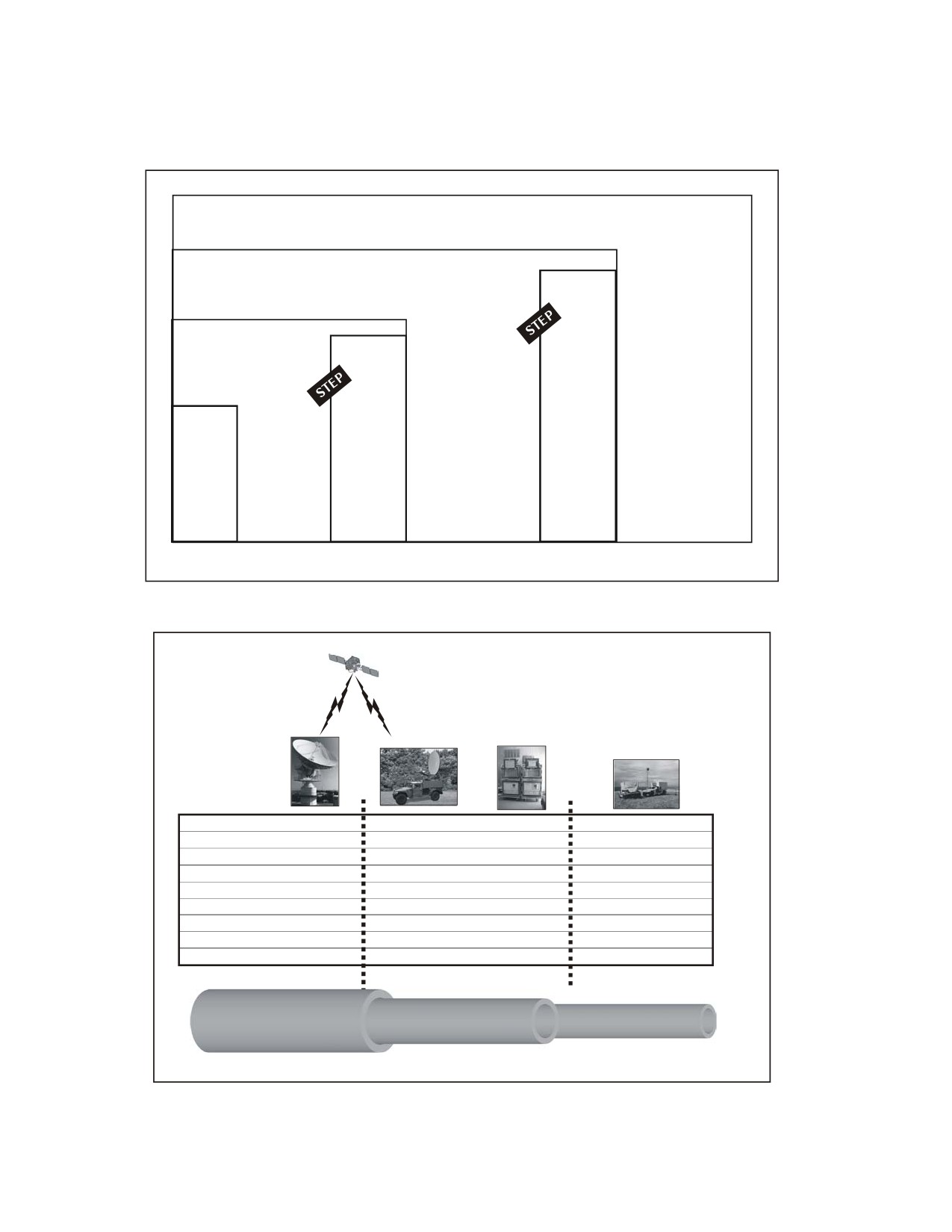
2-16. The following paragraphs discuss services considered to be the
standard, or baseline, for enabling the garrison electronic desktop
environment for the theater signal user in the field. These services are
discussed from a user operational viewpoint. Technical information on the
operation of these services is provided in Chapter 4. Figure 2-1 summarizes
these requirements by echelon, and Figure
2-2 shows the bandwidths
typically provided by signal units at the respective echelons in support of
these services.
2-5
FM 6-02.45________________________________________________________________________________
Tactical/Strategic/DOIM
Tactical
As JTF
Tactical
As JTF
Red Switch
Red Switch
Coalition
Coalition
JWICS
JWICS
GBS
GBS
Cable
Red Switch
Cable
Cable (Heavy)
Tactical
Coalition
Freq Mgt
Freq Mgt
Freq Mgt
IA
IA
IA
VTC
VTC
VTC
NIPR
NIPR
NIPR
NIPR
SIPR
SIPR
SIPR
SIPR
Voice
Voice
Voice
Voice
Brigade Division
Corps
Theater
Figure 2-1. Signal Support Core Requirements
EAC/Tactical
ECB/Tactical
CFLCC/JTF/JFLCC
Corps HQS/JTF
TRI-TAC/MSE/DCP
MSE
Strategic
GIG
Fixed Station
DISN services:
EAC services package:
ECB services:
• NIPR
•
NIPR
• NIPR (256 Kbs)
• SIPR
• SIPR
• SIPR (256 Kbs)
• DSN large dial central switch
• DSN (PBX and tactical phones)
• Voice tactical phones
• Defense Red Switch Network
• DRSN red phones
• DSVT (16-32 Kbs)
• Data/ Voice/ e-mail/ VTC
• Data/ Voice/ e-mail
• Data THSDN (256 Kbs)
• DISN video services-Global
• VTC hubs
• VTC (256 Kbs)
• Mobile communications team
• Special circuits
• MSRT and RAU
• Emergency Action Messaging
• Aggregate bandwidth 8 Mbs
T1/E1/DS3 - 45 Mbs
T1/E1 - 8 Mbs
256/512 Kbs - T1
Figure 2-2. Strategic and Tactical Signal Support Services
2-6
________________________________________________________________________________FM 6-02.45
NIPRNET
2-17. The NIPRNET is a highly used end-user service. It supports a wide
variety of applications such as e-mail, Web-based collaboration and
information dissemination, and connectivity to the worldwide Internet. It
enables a myriad of reach-back logistic functions from deployed forces to the
sustaining base, and lateral collaboration among deployed elements.
2-18. The paragraphs below provide examples that illustrate the criticality of
the NIPRNET to the transforming Army. Because many infrastructure
elements that supported the previous way of doing business no longer exist,
NIPRNET is not a luxury but a necessity.
2-19. The traditional Army concept has been for the technician to identify
repair parts by national stock number or part number from a parts manual.
He then submits a requisition by national stock number or part number,
which is processed and forwarded by administrative personnel until the
requisition is finally filled and the part shipped.
2-20. Parts for PCs change so rapidly that even the manufacturers do not try
to maintain parts manuals specific to a model and year of a PC in the same
sense that parts manuals are maintained for specific models and years of
cars. If a part such as an accessory card is needed for a PC that is over six
months to a year old, chances are that the model of that accessory card that
was current when the computer was built is no longer in production. The
process of obtaining the new accessory card typically involves the technician
navigating the Internet to identify a current model accessory card that is
compatible with the one year-old computer. Telephone consultation with tech
support provided by the manufacturer of the new card, with the
manufacturer of the computer, or with both may be required. Additional
items such as software drivers to make the new card compatible may also be
identified in this research process. After this consultation, the order is placed.
In some cases, the process is streamlined to the point that the technician
gives a credit card number, and the order is placed with the supplier on the
spot.
2-21. Another example of how the NIPRNET supports evolving Army
operational concepts is shown with the reduction of transportation
requirements for publications support of deployed units. The constraints on
transportation that come with rapid deployments into enclave operations do
not allow units to carry with them paper copies of all the field manuals,
technical manuals, and other administrative publications they might need.
What they can carry is their computer to access the publications on
sustaining-base Web sites, a portable printer, and enough paper to print the
needed manuals. This quantity of paper is further reduced by the units’
ability to view the information on-screen without having to print it in every
case. For extended deployments, the transportation and administrative
burden is further reduced by the ability of users to obtain updates to
publications as they occur. This is in contrast to the transportation and
administrative burden of moving all the paper updates that the deployed
force might need and managing the distribution of paper updates to all the
holders of the various publications.
2-7
FM 6-02.45________________________________________________________________________________
2-22. In this area alone, the Army is completely committed to operations
based on the availability of NIPRNET. Many publications are only
distributed electronically via posting on Web sites. They are not printed in
bulk. Users are responsible for printing downloaded copies on their local
printers. Deployed users do not have the option of ordering paper copies if the
electronic versions are not available.
SIPRNET
2-23. The SIPRNET operates in a manner similar to the NIPRNET, but as a
secure network. SIPRNET supports critical C2 applications. As with the
NIPRNET, the SIPRNET provides access to many Web-based applications as
well as the ability to send and receive US Secret information. These
applications and capabilities enable the effective planning and execution of
battle plans in a secure environment.
2-24. The SIPRNET supports a wide variety of applications such as e-mail,
Web-based collaboration, and information dissemination. It enables a myriad
of reach-back logistic functions from deployed forces to the sustaining base,
and lateral collaboration among deployed elements. It is heavily used for C2
and intelligence functions. Demand for SIPRNET services is increasing
because of its utility and ability to meet the security requirements for
operational planning and collaboration.
COALITION NETWORK (C-LAN/C-WAN)
2-25. A coalition network (C-LAN/C-WAN) is a network created to support
coordination and collaboration among US and non-US forces in the
operational environment. C-LAN/C-WAN services support planning and
execution of operations involving coalition forces. C-LANs and C-WANs
operate at both Sensitive but Unclassified
(SBU) and Classified levels.
C-LANs and C-WANs may operate as local or limited regional entities, or
they may connect to and extend the services of the Combined Enterprise
Regional Information Exchange System
(CENTRIXS). CENTRIXS is a
standing classified-capable coalition network. CENTRIXS is discussed in
greater detail in Chapter 4.
JOINT WORLDWIDE INTELLIGENCE COMMUNICATIONS SYSTEM (JWICS)
2-26. JWICS is important for its ability to provide classified, compartmented,
point-to-point or multipoint information exchange involving voice, text,
graphics, data, and VTC.
SECURE VOICE
2-27. Secure voice remains a user requirement. The role of secure voice in
operations remains unchanged from its traditional usage. Secure voice
connections may also be used for facsimile traffic.
2-8
________________________________________________________________________________FM 6-02.45
NONSECURE VOICE
2-28. Nonsecure voice remains a customer requirement. In addition to voice,
this service may also be used to carry facsimile traffic. Nonsecure voice
includes requirements to provide connectivity to civilian telephone networks
in the sustaining base and host nation. Additionally, the nonsecure voice
network can be extended to joint, allied, and coalition subscribers.
DEFENSE RED SWITCH NETWORK (DRSN)
2-29. The DRSN is the worldwide secure switched network managed by the
Defense Information System Agency (DISA). It provides high-quality secure
voice, data, and conferencing communications services to senior decision
makers.
VTC
2-30. VTC has become a mainstay collaboration tool both for forces in
garrison and in deployed environments. It provides the best available
technical alternative to face-to-face meetings to provide users human-factor
feedback and interaction when they must collaborate from separate locations.
GLOBAL BROADCAST SYSTEM (GBS)
2-31. The GBS is significant to theater signal customers and providers
because of its ability to alleviate congestion on other networks and its ability
to deliver large volumes of data in formats not readily supported by other
means. It also delivers data in large batches (files) simultaneously to multiple
users. Examples include topographic data and large video files.
DEFENSE MESSAGE SYSTEM (DMS)
2-32. The DMS is the Army's portion of the global DOD DMS. It is a record
traffic system that replaces the automated digital network (AUTODIN) and
provides secure writer-to-reader electronic messaging for both organizational
and individual users.
TACTICAL MESSAGE SYSTEM (TMS)
2-33. The TMS extends the DMS used in garrison into the tactical
environment. All DMS intra/inter traffic into and out of the tactical area of
operations is routed through the TMS.
IA
2-34. IA is the management area that ensures the availability, integrity,
identification, authentication, confidentiality, and nonrepudiation of friendly
information and systems and forbids the access to the information and
systems by hostile forces. It is a service performed by signal soldiers that is
largely invisible to the user. It becomes most visible when it fails.
2-9
FM 6-02.45________________________________________________________________________________
CABLE AND WIRE INSTALLATION
2-35. Cable and wire teams are organic to the ITSB. These teams install,
maintain, and repair aerial, buried, or underground cable, wire, and fiber
optic transmission systems.
2-10
Chapter 3
Army Enterprise Systems Management
To enable the transforming Army to dominate a network centric
battlespace, it is essential for Army information resources, also known as
the Army Enterprise Infostructure (AEI), to be managed as a single,
coherent, seamless enterprise in their context as elements of the larger
DOD Global Information Grid (GIG). This chapter provides an overview of
the AEI and discusses the Army Enterprise Systems Management
structure.
OVERVIEW
3-1. The AEI is the Army’s portion of the GIG and extends from the
sustaining base to the tactical environment. It includes LANs, WANs, and all
deployed networks. The AEI encompasses the command, control,
communications, computers, and information management (C4IM) platforms
and services supporting Army users, both in permanent stations and
deployed, and the infostructure required to deliver these services efficiently
and effectively.
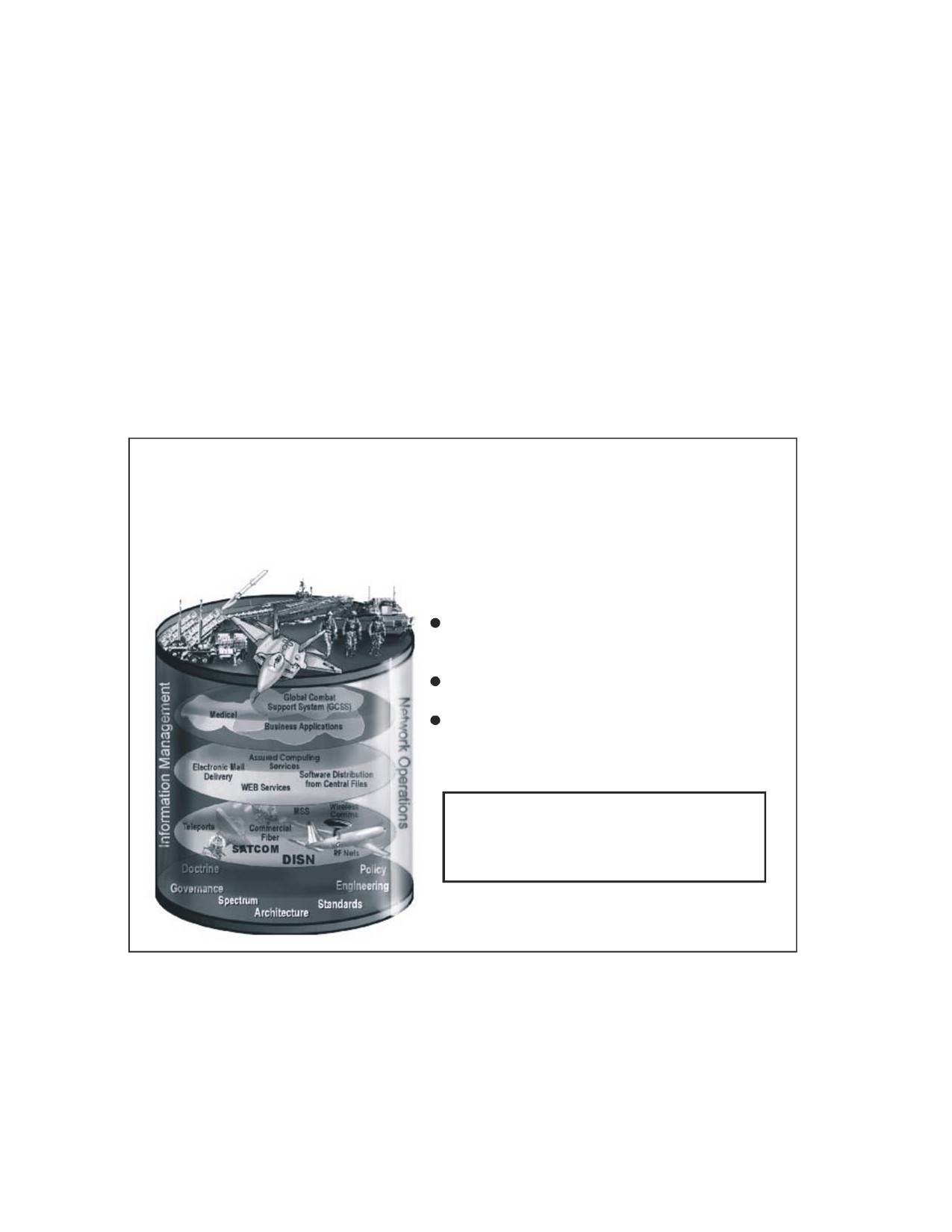
NETOPS
3-2. NETOPS is an organizational, procedural, and technological construct
for ensuring information superiority and enabling speed of command for the
warfighter. It links together widely dispersed NETOPS centers through a
command and organizational relationship and establishes joint TTPs to
ensure a joint procedural construct. The NETOPS construct extends from the
highest level of the GIG through the service level down to the lowest level of
information networking. NETOPS is the conceptual toolbox and framework
for Army Enterprise Systems Management. Figure
3-1 shows the GIG
NETOPS.
NETOPS GOALS
3-3. The goals for Army NETOPS are to—
• Provide universal (and secure) access for authorized infostructure
services to all Army customers within the Army infostructure—
secure, single, sign-on plug and play capability.
• Accurately display a total and integrated situational awareness of the
AEI.
• Predict impacts on the AEI of new/changed systems and operational
contingencies.
3-1
FM 6-02.45________________________________________________________________________________
• Redirect and reallocate AEI resources in near real-time to support
Army response to a crisis or an unplanned event anywhere within the
Army infostructure operational AOR.
• Provide consistent, robust, base level infostructure services to all
authorized Army customers at the least cost feasible within Army
operational constraints.
• Provide additional (above base level) infostructure services to Army
customers on a reimbursable basis.
• Perform continuing and nonintrusive technology insertion to improve
service levels or reduce the cost of providing current base-level
services.
• Provide continuity of operations (CONOPS) plan capabilities.
GIG NETOPS: A Transformation Imperative
Enables the Net Centric battlespace by providing combatant commanders,
services, and agencies the ability to exchange integrated C4 and ISR
information across a global high performance information grid by:
Establishing an operational hierarchy
and horizontal information sharing
Providing global situational awareness
Achieving end-to-end distributed
management and control of system
and network services
“Our ability to leverage the power of
information and networks will be key
to our success in the 21st Century.”
Secretary of Defense Rumsfeld
Figure 3-1. GIG NETOPS
NETOPS MISSION AREAS
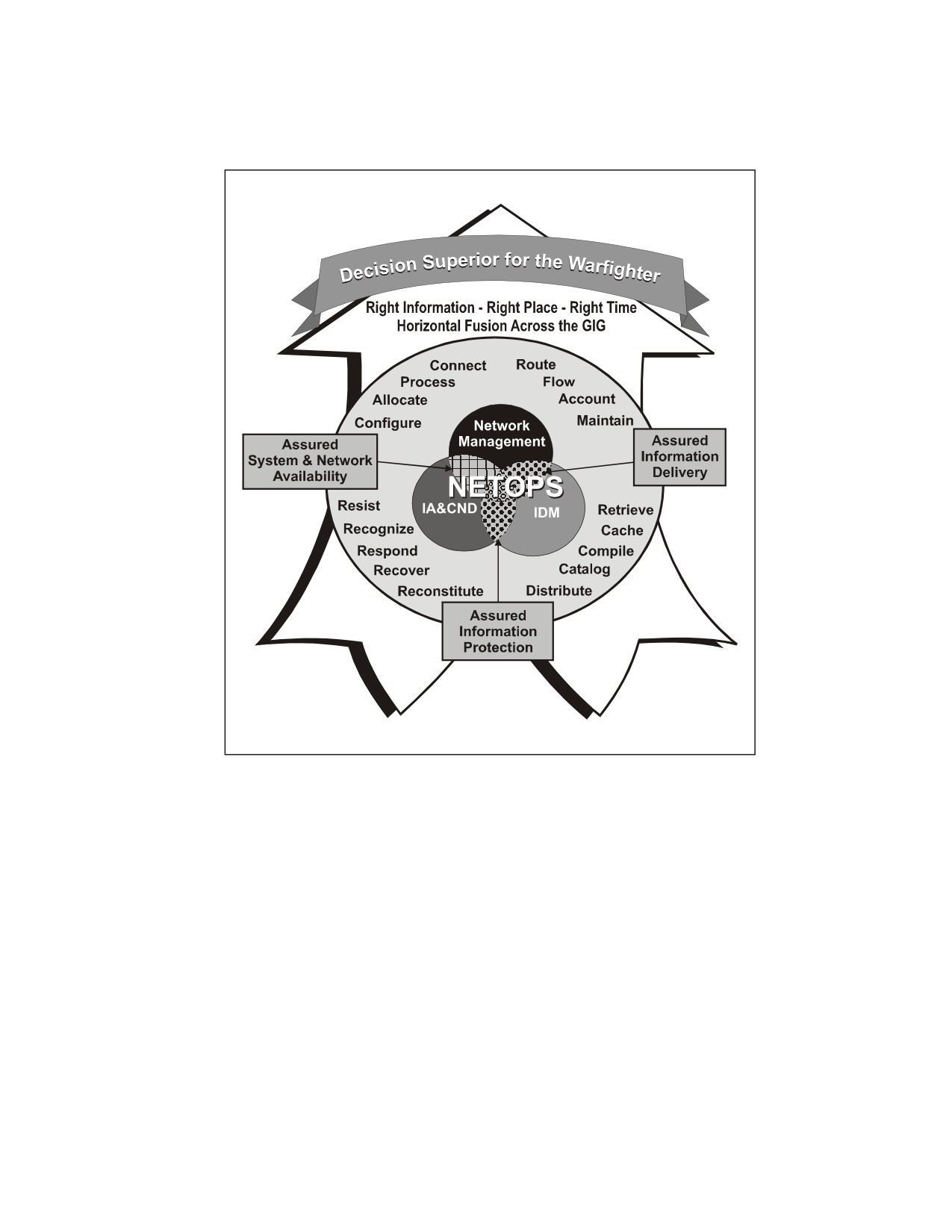
3-4. NETOPS provides IT and situational awareness, protects information
flow, and integrates network management, IA, and information
dissemination management (IDM). Figure 3-2 depicts the NETOPS mission
areas and functions.
3-2
________________________________________________________________________________FM 6-02.45
Figure 3-2. NETOPS Mission Areas and Functions
Network Management
3-5. Network management is the management of the network and the
devices connected to the network. It includes:
• Network management—includes systems and applications
management and comprises all the measures necessary to ensure the
effective and efficient operations of networked systems, to include
network devices, servers, storage devices, and end-user devices like
printers, workstations, laptops, and hand-held computers.
Synonymously, network management is composed of fault,
configuration, accounting, performance, and security management.
• Transmission systems management—includes the day-to-day
management of all transmission systems, for example, SATCOM,
microwave, fiber, and metallic cable. Because of its criticality to
theater signal, SATCOM management is often discussed as a
separate discipline (see below).
3-3
FM 6-02.45________________________________________________________________________________
• SATCOM management—includes the day-to-day management of all
apportioned and nonapportioned SATCOM resources.
• Frequency spectrum management—exists as a management area to
ensure the combatant commanders and subordination commanders
have cognizance of all spectrum management decisions affecting the
area of operations. Additionally, it is composed of the efficient
management of the electromagnetic spectrum to include the
acquisition, allocation, protection, and utilization of radio frequency
and call-sign resources.
3-6. Key aspects or focus areas of network management include:
•
Configuration management
(CM). The CM process includes all
aspects of the infostructure configuration. The Army controls the
introduction of new services and functionality to the end-user
community without disrupting existing services. CM is also required
to ensure compliance with operating and security policy.
•
Service level management (SLM). The SLM process is how the Army
defines, delivers, measures, and improves C4IM services. As such, it
is expected to become the cornerstone of how the Army operates and
manages the infostructure to deliver quality information
management and telecommunications services.
•
Networthiness. The Networthiness Certification process identifies
and continually refines all required support for a C4IM system,
particularly in the areas of supportability, interoperability,
sustainability, and security. The process ensures that C4IM systems
do not adversely impact the network and that it is sustainable
throughout its lifecycle.
•
Asset and resource management (ARM). The ARM process defines
how both physical and logical property items are cataloged in terms of
identification and use. The ARM process supports the identification of
duplicative systems and their subsequent elimination by integrating
the functionality and the data into a common system. The ARM
process is complementary to the CM and SLM processes but includes
nonconfiguration items and is focused on the accurate representation
and use of property.
IA
3-7. IA is the management area that ensures the availability, integrity,
identification, authentication, confidentiality, and nonrepudiation of friendly
information and systems, and forbids the access to the information and
systems by hostile forces.
3-8. CND. CND is the utilization of network management services and IA
tools depicted as part of NETOPS. The protection capability of CND is
accomplished through operations and maintenance of network and system
devices, such as network guards and firewalls, that ensure emission,
communications, computer, and information security. The capability to detect
security anomalies on the network and to systems is enhanced via
mechanisms that support near real time alerts and predictive analysis.
3-4
________________________________________________________________________________FM 6-02.45
Correcting and restoring normal operations after various network and system
anomalies have taken place are the key NETOPS elements of network
management.
IDM
3-9. IDM is the management area concerned with providing the right
information to the right person(s) at the right time. It addresses the
awareness, access, and delivery of information. Additionally, IDM includes
the safeguarding, compilation, cataloguing, storage, distribution, and
retrieval of data. As such, it deals with the management of information flow
to users in accordance with the commander's information policy. IDM
segregates information into two types: planning and survival. Planners and
decision makers use planning information gleaned from databases, Web
pages, or files to determine future action. Survival information is much more
time sensitive and is pushed over tactical networks and data links to
warfighters and weapon systems.
3-10. IDM has technical and policy components. The technical component
includes the electronic management of user privileges and access rights to
network resources such as Web pages and databases, and the design and
operation of electronic information filters. The policy component determines
individual and group need-to-know and the setting of information priorities
such as commander’s critical information requirements and priority
intelligence requirements.
AEI
3-11. The scope of the AEI includes Army information services worldwide
accessing the GIG, to include the Top Secret/Sensitive Compartmented
Information (TS/SCI) domain and/or networks, Army Secret security domain,
Army SBU security domain, Army public information sites on the Internet,
and a variety of telephony systems
(for example, DRSN and Defense
Switched Network [DSN]). The AEI includes core services such as e-mail,
Web access, file and print servers, directories, AKO, Public Key
Infrastructure
(PKI)/Common Access Card
(CAC), and Army enterprise
applications such as personnel and logistics. It includes the active Army, the
Army Reserve, and the Army National Guard. Figure 3-3 illustrates the
physical scope of the AEI.
3-12. The current Army sustaining-base operating environment consists of a
variety of geographically dispersed small, medium, and large installations
and user sites (for example, Reserve Component centers, armories, and
recruiting stations), in the CONUS and outside the Continental United
States (OCONUS). Small installations are characterized by having less than
5,000 users, medium installations having
5,000-15,000 users, and large
installations having excess of 15,000 users. Large headquarters complexes
exist, such as Headquarters, Department of the Army
(HQDA) in the
Pentagon.
3-5
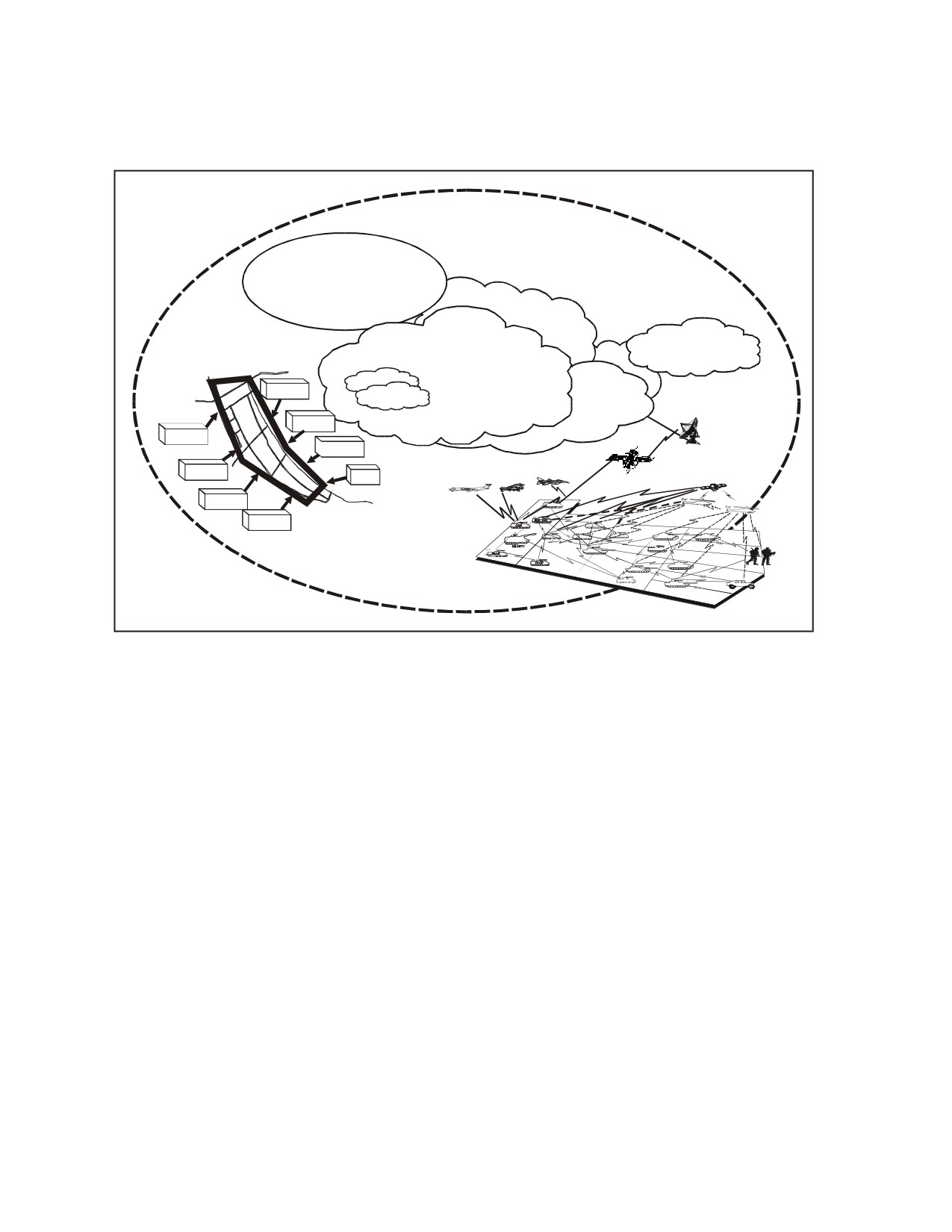
FM 6-02.45________________________________________________________________________________
AKO Consolidation Areas
e-mail
Servers
Application
Services
ARMY.SMIL
INTERNET
ARMY.MIL
.SMIL
Army C/P/S
ARNG
BLDG
USAR
.MIL
DISA
DOIM
STEP
BLDG
BLDG
1
BLDG
Army Tactical
HQ
JSTARS
UAV
X
BLDG
AV TOC
II
BLDG
BN TOC
I
FSE
MORTAR
M2A3
M2A3
PLT LDR
TACTBDE TACAL
CO CDR
M1A2
I
FIST
DIS MOUNTINFANTRY
BN TF CDR
M1A2
M23A
STINGER
CO CDR
FIST
M1A2
PLT LDR
SCOUT
Figure 3-3. Army Enterprise View
3-13. Each installation typically hosts several IT facilities, providing support
to not only Army users but also to other service/agency tenants. In addition,
the Army has many mobile users who will need access to the AEI from
outside the enclave. Thus, multiple separate communities of interest with
varied IT requirements are found on most Army installations. Furthermore,
the operations and maintenance of the IT systems at these locations differ
from installation to installation. In some installations, Army personnel
(military and civilian) perform operations and maintenance; in others, a mix
of Army and contractor support is used. These disparities require
consolidated operations and management, as the following paragraphs
illustrate.
3-14. There are several commands that operate separate networks of their
own to support their facilities located around the world, such as the Army
Corps of Engineers, Army Recruiting Command, Space and Missile Defense
Command, Intelligence and Security Command, and Medical Command
(MEDCOM). These separate networks create duplication of effort in network
management. In worst cases, having different networks with potentially
different security policies and practices can create security vulnerabilities for
the entire Army when the various networks are linked together with each
other and/or with mainstream Army networks.
3-6
________________________________________________________________________________FM 6-02.45
3-15. Some organizations provide global applications throughout the
enterprise and perform selected network management functions to support
those applications. Examples of such applications include the Total Army
Distance Learning Program, the Transportation Information System, and the
Army Human Resources System. For user and application support functions,
such arrangements create inefficiencies in resource usage. In cases where the
proponents of such applications acquire their own networking resources (for
example, leased circuits, non-Army access to the Internet), security
vulnerabilities can be introduced that affect the entire Army.
3-16. Some organizations have activities and isolated users located in other
government and commercial leased facilities throughout CONUS and in some
cases, OCONUS.
3-17. Deployed Army units use the tactical component of the AEI to access
the GIG through DISA managed and service operated strategic tactical entry
point (STEP), commercial satellite, military multichannel tactical satellite
(TACSAT), and terrestrial communications links.
3-18. Currently, the management structure for the AEI cannot be described
as seamless. Significant reorganizations are in progress or being planned
towards the goal of seamlessness and single enterprise management. Still
other commands and organizations are under analysis prior to the generation
of concrete plans.
3-19. The many disparate operations discussed above are being transitioned
to consolidated operations and management under US Army Network
Enterprise Technology Command/9th Army Signal Command (NETCOM/9th
ASC) to provide efficiencies of operation, consistent security practices, and
consistent levels of service. Where it is not feasible for NETCOM/9th ASC to
provide support (for example, for Army tenant units working on a Navy or Air
Force installation), current support agreements will remain in effect.
MANAGEMENT OF THE AEI
3-20. Management of the AEI encompasses a number of different functions,
some of which can overlap each other. The paragraphs below discuss these
management functions.
Installation Infostructure Management
3-21. One aspect of the Army transformation that has major impact on signal
operations is the transformation to centralized installation management
under the Assistant Chief of Staff for Installation Management (ACSIM).
Previously, installations were owned and managed by the various major
commands
(MACOMs). In the transformed environment, installation
management is delegated by region to regional managers as illustrated in
Figure 3-4.
3-7
FM 6-02.45________________________________________________________________________________
Northwest (20)
Northeast (23)
Fort Lewis
Vancouver Barracks
Yakima Training Center
Fort Drum
USA Cold Reg Lab
Watervilet Ar
Natick R&D Ctr
Fort Devens RFTA (USAR)
Tobyhanna
Westpoint Military Res
Fort McCoy (USAR)
Charles E. Kelly
Fort Hamilton
Spt Fac (USAR) Carlisle
Picatinny Ar
Fort Monmouth
Letterkenny AD
Barracks
Fort Dix (USAR)
USAG Selfridge
Aberdeen Proving Grounds
Detroit Ars
Fort Detrick
Fort Meade
Aldelphi Lab Ctr
Arsenal
Fort A.P. Hill
Walter Reed
Dugway Proving Ground
Fort Eustis
Desert Chem Depot
Iowa AAP
Lima Army Tank
Fort Monroe
Tooele AD
Plt
Radford AAP
Fort Story
Sierra Army Depot
Fort Lee
Hawthorne AD
Fort Leavenworth
Fort Belvoir
Fort Carson
Fort Riley
Fort
Pueblo Depot
Leonard Wood
Camp Parks (USAR)
Riverbank AAP
Kansas AAP
Precidio of Monterey
Fort Knox
Blue Grass AD
Fort Hunter Liggett
(USAR)
Fort Erwin
Fort Campbell
Holston AAP
Milan AAP
Fort Bragg
McAlester AAP
Fort
MOT Sunny Point
Yuma Proving Grounds
Fort Sill
Pine Bluff Ar
Redstone Ar
McPherson
Fort Jackson
White Sands Missle
Fort Gillem
Testing Center
Red River AD
Anniston AD
Fort Gordon
Fort Huachuca
Lone Star AAP
Fort Benning
Hunter Army Airfield
Fort Bliss
Fort Stewart
Louisiana AAP
Fort Polk
Fort Rucker
Mississippi
Fort Hood
AAP
Southeast (19)
Camp Stanley
Fort Sam Houston
Storage Actv
Corpus Christi AD
LEGEND:
Southwest (19)
V
Figure 3-4. Army Installation Management Regions
3-22. With the transformation of the Army to centralized installation
management, the ACSIM is responsible for providing telecommunications
services for posts, camps, and stations. Installation level services are
provided and administrated by local Directorates of Information Management
(DOIMs). These DOIMs report directly to their local installation managers
and are under technical control
(TECHCON) of NETCOM/9th ASC.
NETCOM/9th ASC exercises this TECHCON through the Army Network
Operations and Security Center (ANOSC) for day-to-day operational issues
and through the Regional Chief Information Officers (RCIOs) on policy and
standards. NETCOM/9th ASC establishes RCIOs for each installation
management region. RCIOs are NETCOM/9th ASC assets that are
operational control (OPCON) to the installation regional managers.
3-23. NETCOM/9th ASC also exercises TECHCON through RCIOs of quasi-
separate networks operated by other commands such as the Corps of
Engineers.
3-24. Figure 3-5 depicts the top-level organizational relationships for AEI
Systems Management.
3-8
________________________________________________________________________________FM 6-02.45
SA/CSA
Army CIO/G6
and MACOM CIO
Have Normal Staff
Army
Relationships
ACA
ACSIM
CIO/G6
Tactical Forces
IT
MACOM
OPCON to
Installation
Supported
NETCOM
Management
Commander
Activity
Theater
IMCEN
REG DIR
NOSCs
RISO
Intermediate
NETCOM
HQ
(NE, NW, SE, SW)
RCIO
3 OCONUS
MEDCOM
CFSC
COE
ARNG
USAR
RCIO
RCIO
RCIO
RCIO
RCIO
Commander
WCF Installation
Fort Warfighter
Activity
DOIM
GISO
DOIM
DOIM
Tenant
Notes:
IMO
ACA - Army Contracting Agency
ANOSC - Army Network Operations and Security
Center
CFSC - Community and Family Support Center
RISO - CFSC Regional Information Services Officer
GOSO - CFSO Garrison (Installation) Information
Services Officer
WCF - Working Capital Fund
Figure 3-5. Organizational Relationships
3-25. Currently, most commands and tenant organizations on an Army
installation are responsible for the operation and management of their own
networks, e-mail servers, and desktops.
(This is not always the case
OCONUS.) The DOIM at each installation will become responsible for
operation and management of all installation infostructure. While
NETCOM/9TH ASC has the responsibility for operation and management of
the enterprise level assets throughout the Army, the DOIM has the
responsibility for installation specific IT assets. NETCOM/9TH ASC provides
the technical guidance to the DOIM for the information management services
depicted in Figure 3-6. In this way, standard basic service levels are provided
throughout the enterprise, independent of a user's organization or location.
3-9
FM 6-02.45________________________________________________________________________________
Users
Event
Desktop
Management
Management
Systems
Network
Management
Management
Service Management
Service Management
Systems Management
Event Management
Desktop Management
Network Management
SLA Management
Workload Management
Automated Help
Hardware Inventory
Device Control
Desk
Service Provider
Storage Management
Software Inventory
Device Monitoring
Management
Monitoring
Asset Management
Event Monitoring
Quality Management
Failure Control
Anti-virus
Event Reporting
Administration
Security Management
Software Delivery
Load Balancing
Software Metering
Planning and Design
Remote Control
Configuration Control
Change Management
Figure 3-6. Information Management Services
3-26. The standardization and consolidation of NETOPS functions across the
enterprise allow the Army to better utilize personnel required to perform
these tasks and increase the quality of service provided to the end users
while at the same time reducing the total cost of providing these services.
However, as consolidation of routine functions causes the physical execution
of those functions to move away from the physical proximity of the customer,
the role of the local IT provider, generally the DOIM, changes to that of
customer representative for the overall C4IM operations team.
3-27. Comprehensive remote management capabilities are established within
the consolidated support areas. The goal is to maintain a high level of IT
support and service at the installation and to reduce the inherent
redundancies and inefficiencies with the current structure. This change in
focus is accomplished at the local level by an equally significant change in
how the C4IM management structure views its role.
Tactical Infostructure Management
3-28. The tactical portion of the AEI extends from Army component
commanders to deployed forces supporting a joint, combined, or single-service
task force. Deployed forces access reach-back applications through a STEP or
Teleport site. NETCOM/9TH ASC, through its senior subordinate in-theater
signal element, is responsible for the operation and maintenance of the
Army’s portion of the GIG in theater. (In some theaters, the senior Army
theater signal element is a theater signal command-Army
(TSC(A)). In
others, the senior Army theater signal element is a signal brigade
headquarters.)
3-10
///////////////////////////////////////