FM 4-02.6 THE MEDICAL COMPANY: TACTICS, TECHNIQUES, AND PROCEDURES (AUGUST 2002) - page 2
FM 4-02.6
d. For communications (see Appendix I), the company employs AM and FM tactical radios, unit-
level computers, a manual switchboard with wire telephones, and DNVTs. The company headquarters
establishes an FM radio net and an internal wire net for C2. It also establishes an AM net capability for
reach-back support.
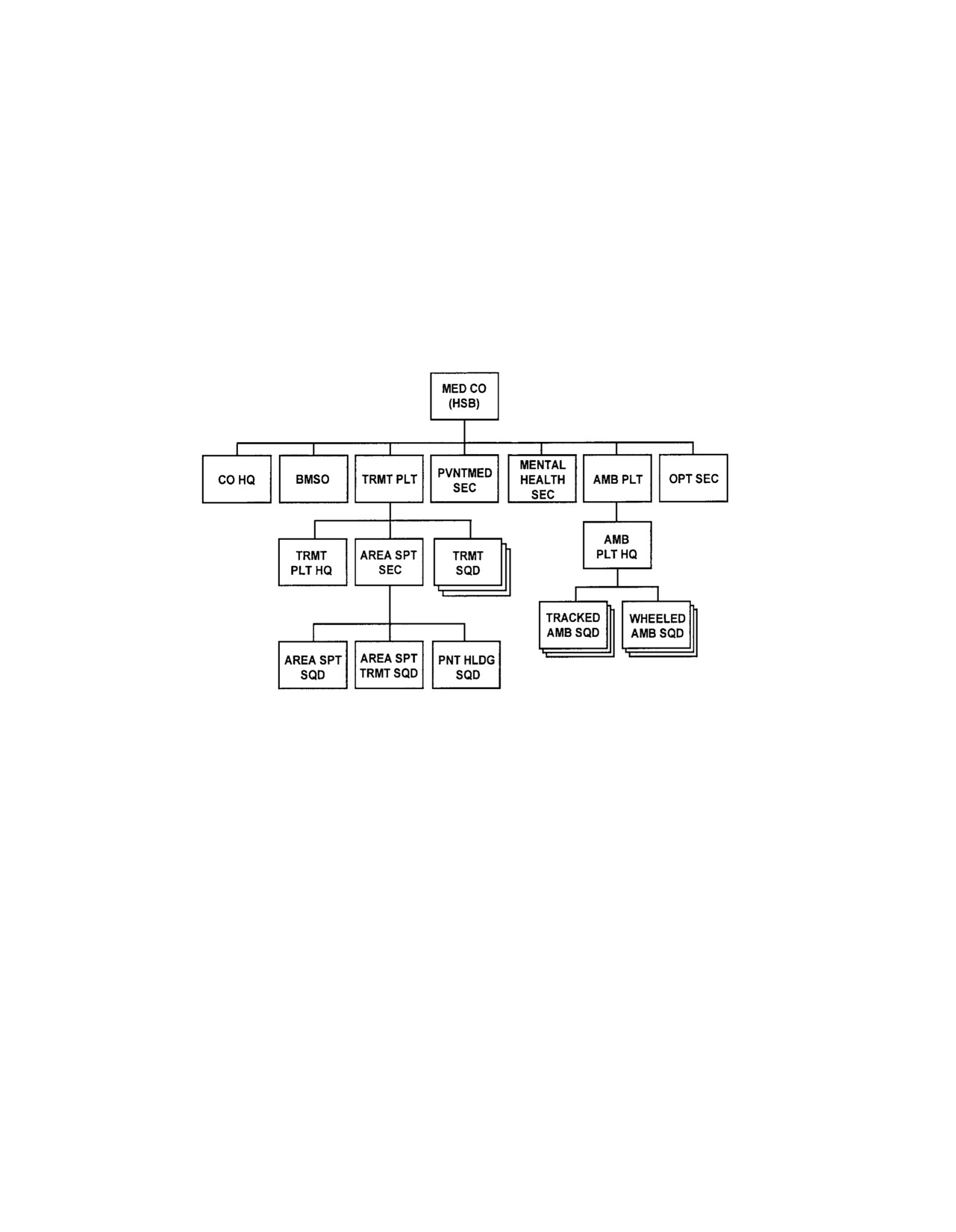
Figure 2-11. Medical company-heavy separate brigade (TOE 08437L0), support battalion,
heavy separate brigade.
2-11. Armored Cavalry Regiment Overview
a. The ACR is a self-contained combined arms organization composed of armored cavalry
squadrons (ACS), an aviation squadron, a support squadron, and separate CS companies and batteries. The
ACR is a separate unit that supports the corps or a joint task force (JTF). Corps CS units and divisional
maneuver battalions often reinforce it. The ACR operates independently over a wide area and at extended
distances from other units. The ACR is a highly mobile, armored force capable of fighting the fully
mechanized threat in the environmental states of war or conflict.
b. Armored cavalry regiments are provided DS CSS by an organic support squadron with an
imbedded medical troop providing CHS.
c.
See FM 17-95 for additional information on the organization and functions of the ACR. Also,
see FM 63-1 on the ACR support squadron’s organization and operations.
2-17
FM 4-02.6
2-12. Medical Troop-Armored Cavalry Regiment
a. Mission. Same as 2-4a above except it supports the ACR.
b. Capabilities. Same as 2-4b above except it has organic mental health and preventive medicine
sections.
c.
Basic Organization. The medical troop-ACR is organized into seven basic components: a
company headquarters, a treatment platoon, an ambulance platoon, a regimental medical supply office
(RMSO), a PVNTMED section, and an optometry section.
d. Dependency. The medical troop-ACR is dependent on appropriate elements of the corps and
the support squad for patient evacuation (including air ambulance), CHS operational planning, guidance,
legal, finance, and personnel and administrative services. It is also dependent on the headquarters and
headquarters troop of the support squad for food service, religious, and vehicle maintenance support.
2-13. Organizational Structure and Tactical Capabilities of the Medical Troop-Armored Cavalry
Regiment
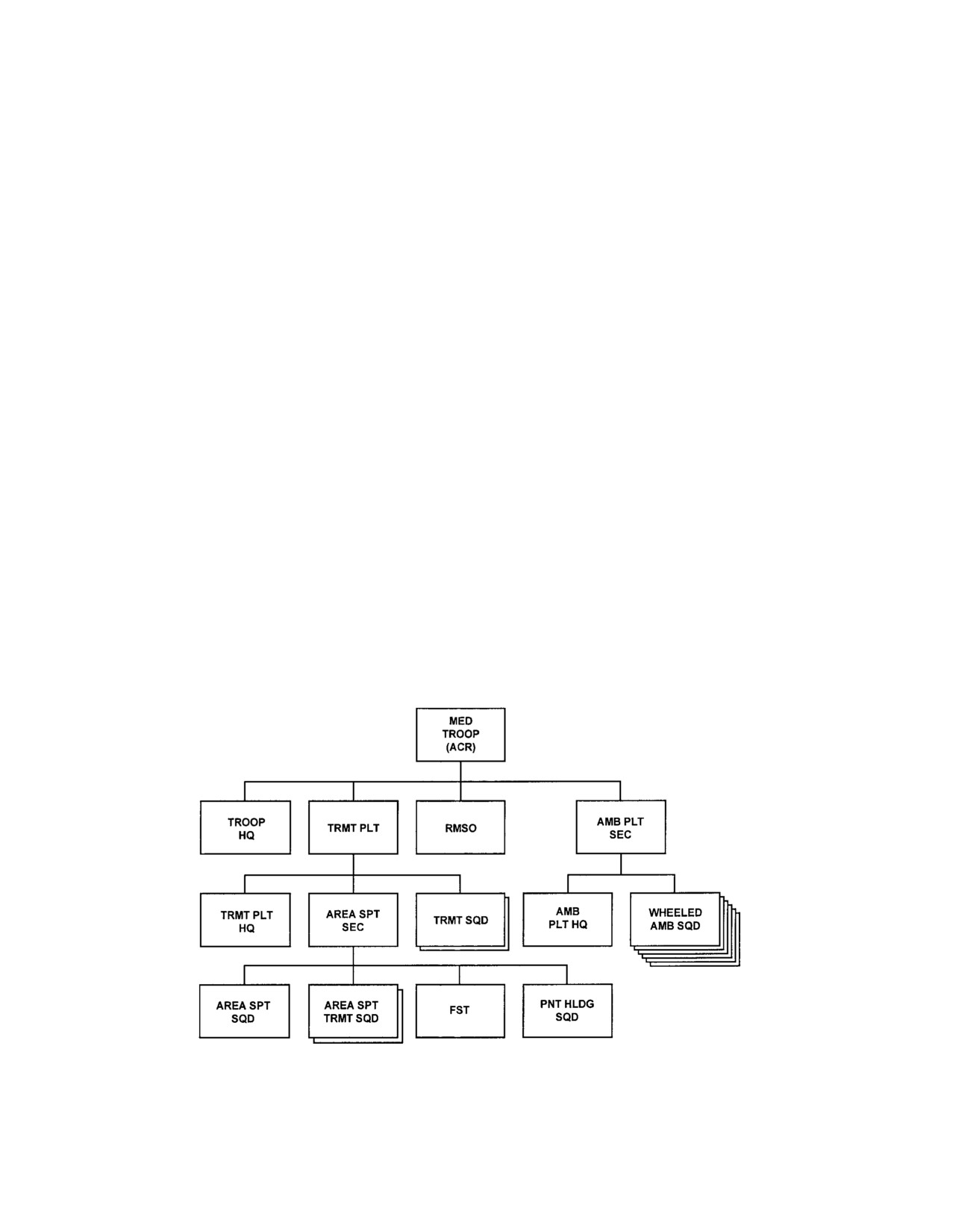
a. The Medical Troop-ACR (TOE 08489L0) (Figure 2-12) is organized into a troop headquarters
section; a treatment platoon that is further organized into a platoon headquarters, an area support element
with an area support squad, two area support treatment squads; an FST, and a patient-holding squad. The
platoon also employs two independent treatment squads that may be deployed in DS of maneuver squadrons’
medical platoons. The troop is also organized with a RMSO and an ambulance platoon. The ambulance
platoon employs a platoon headquarters and six-wheeled ambulance squads (12 ambulances).
Figure 2-12. Medical troop-ACR (TOE 08489L0), support squadron armored cavalry regiment.
2-18
FM 4-02.6
b. For communications (see Appendix I), the company employs AM and FM tactical radios, unit-
level computers, a manual switchboard with wire telephones, and DNVTs. The company headquarters
establishes an FM radio net and an internal wire net for C2. It also establishes an AM net capability for
reach-back support.
2-14. Brigade Combat Team Overview
a. The BCT is a full spectrum, combat force. It has use in all operational environments against
all projected future threats, but it is designed and optimized primarily for employment in small scale
contingency operations in complex and urban terrain, confronting low-end and mid-range threats that may
employ both conventional and asymmetric capabilities. The BCT deploys very rapidly, executes early
entry, and conducts effective combat operations immediately on arrival to prevent, contain, stabilize, or
resolve a conflict through shaping and decisive operations. The BCT participates in a major theater war,
with augmentation, as a subordinate maneuver component within a division or corps and in a variety of
possible roles. The BCT also participates with appropriate augmentation in stability operations and support
operations as an interim entry force and/or as a guarantor to provide security for stability forces by means
of its extensive combat capabilities.
b. The BCT is a divisional brigade that is strategically responsive, rapidly deployable, agile,
versatile, lethal, survivable, and sustainable. It is designed to optimize its organizational effectiveness and
seeks to balance the traditional domains of lethality, mobility and survivability with the domains required
for responsiveness, deployability, sustainability and a reduced in-theater footprint. It is nontraditional with
respect to design, the deployment process, and manner of employment. Its two core qualities are high
mobility (strategical, operational, and tactical) and its ability to achieve decisive action through dismounted
infantry assault.
c.
Interim brigade combat teams are provided DS CSS by an organic support battalion with an
imbedded medical company providing CHS.
2-15. Brigade Support Medical Company, Support Battalion, Interim Brigade Combat Team
a. The BSMC (TOE 084108F0), BSB, BCT provides Echelon II CHS in support of those
battalions with organic medical platoons. The company also provides both Echelons I and II medical
treatment to those units deployed without organic medical assets that operating in the BCT’s AO. The
BSMC provides C2 for its organic elements and may provide operational control (OPCON) of medical
augmentation elements. The BSMC locates in the vicinity of the BSB headquarters and establishes a brigade
clearing station/MTF in the BSA.
b. A complete discussion on the organization and functions of the BSMC is provided in
Appendix F.
2-19
FM 4-02.6
2-16. Area Support Medical Company, Area Support Medical Battalion (Corps and Echelons
above Corps)
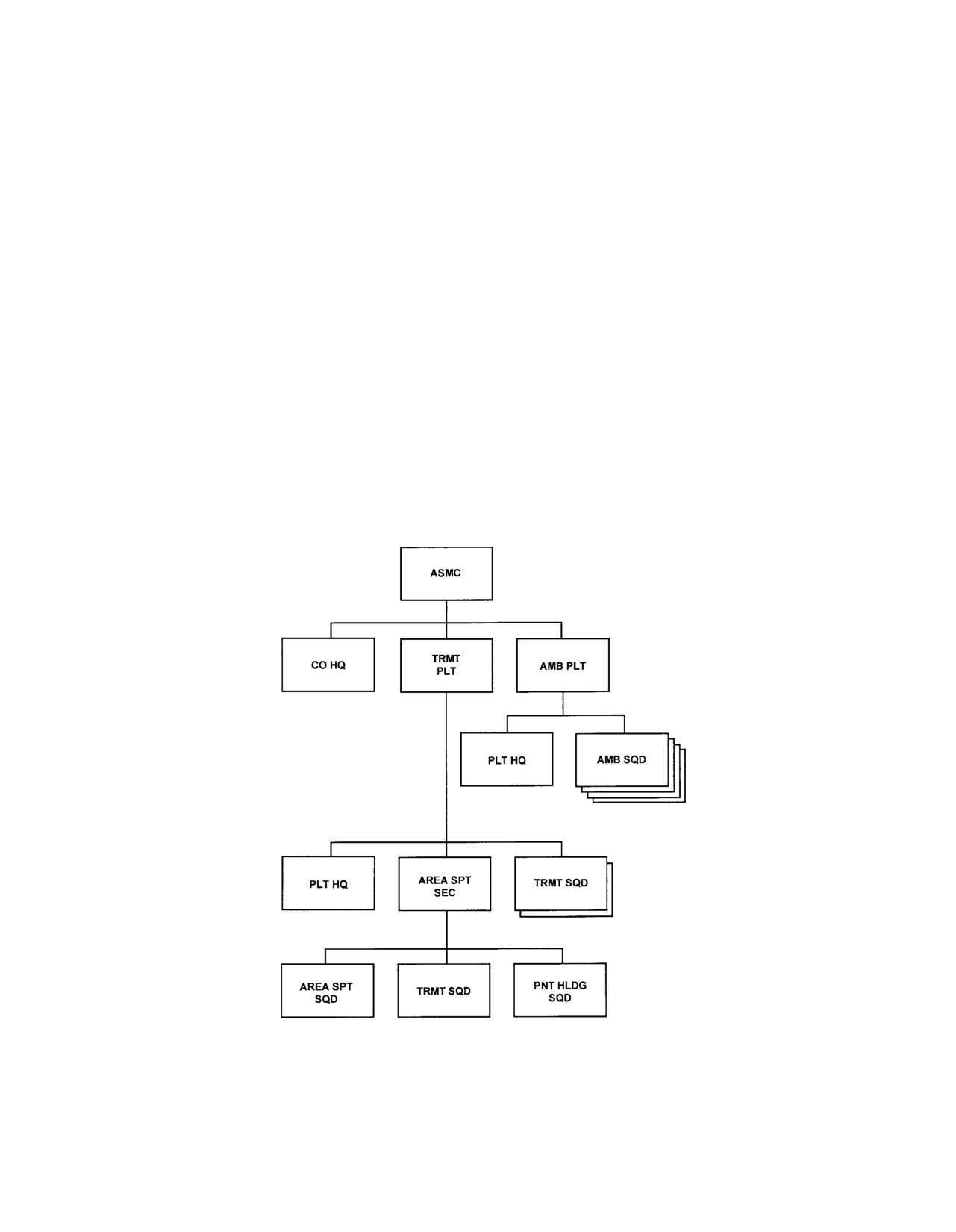
a. The ASMCs (TOE 08456A0) of the headquarters and headquarters detachment, ASMB (TOE
08457A0) are organized as depicted in Figure 2-13 and perform functions similar to those of divisional and
other nondivisional medical companies.
b. The ASMCs are employed primarily in the corps rear and support areas of the EAC/COMMZ.
They are deployed to a geographical area to provide area CHS, or may be deployed to provide CHS for
designated units. The ASMCs also establish clearing stations and provide Echelons I and II CHS in a wide
area (normally, an area or sector of the size established and supported by a corps support group or corps
support battalion). Medical treatment squads/teams of the ASMCs may be deployed to establish treatment
stations and provide Echelon I support to concentrations of nondivisional units that do not have organic
medical capabilities.
c.
A complete discussion on the organization, mission and functions of the ASMC and the ASMB
is provided in FM 4-02.24.
Figure 2-13. Area support medical company (TOE 08456A0), area support medical battalion
(TOE 08457A0), medical brigade (corps/echelons above corps).
2-20
FM 4-02.6
CHAPTER 3
MEDICAL COMPANY OPERATIONS
Section I. ORGANIZATION AND FUNCTIONS OF THE
MEDICAL COMPANY
3-1.
General
The mission, assignment, capability, basic organization and dependency of all medical companies were
discussed in Chapter 2. This chapter provides information on the organizational design of the medical
company and the functions performed by its subordinate elements in support of the mission.
3-2.
Headquarters Section
The company headquarters section is organized into a command element; a support element; a unit supply
element; a medical supply and medical maintenance element; and an operations and communications
element. It provides general (unit) supply, medical supply/resupply, arms maintenance, NBC defensive
operations, and communications-electronics (CE) support to organic and attached elements. For communi-
cations, the company headquarters employs AM and FM tactical radios, tactical computers, and a manual
switchboard. Personnel of this section supervise unit operations, general supply, medical supply,
communications, and power-generation operations.
a. Command Element. The command element is responsible for providing billeting, security,
training, administration, and discipline for assigned personnel. This element provides C2 of its assigned
and attached personnel. It is typically staffed with a company commander, a field medical assistant, and a
first sergeant (1SG).
(1) Company commander. Currently, the medical company commander positions are
documented 05A, AMEDD immaterial, meaning any qualified AMEDD officer can assume command.
When the medical company/troop commander is not a physician, medical decisions and technical supervision
of any physician assigned to the medical company/troop is performed by the treatment platoon leader since
that position is always designated as a physician’s position. The medical company commander keeps the
support battalion/squadron commander informed on the CHS aspects of battalion/squadron operations and
the health of the command. He regularly attends headquarters staff meetings to obtain information to
facilitate the execution of medical operations. He provides staff estimates and assists the headquarters staff
and the command surgeon’s section/medical planner, as required, with the development of the support
battalion/squadron and brigade/regiment CHS plan.
(2) Field medical assistant/executive officer. The field medical assistant/executive officer
(XO) is the company’s second in command and its primary internal CSS/medical planner and coordinator.
He and the company headquarters personnel operate the company command post (CP) and net control
station (NCS) for both radio and digital traffic.
(3) First sergeant. The
1SG is the company’s senior NCO and normally is its most
experienced soldier. He is the commander’s primary medical and tactical advisor and he is an expert in
3-1
FM 4-02.6
individual and NCO skills. He is the company’s primary internal CSS operator and helps the commander
plan, coordinate, and supervise all logistical activities that support the company’s mission. He operates
where the commander directs or where his duties require him.
b. Headquarters Support Element. The headquarters support element (in the AOE medical
company) is normally comprised of the signal support, maintenance specialist, decontamination specialist,
NBC specialist, and the armorer. These personnel perform those functions for the company in their areas of
expertise. This element also operates the company switchboard and serves as the company NCS for the
company’s operations nets’ FM and AM radios.
c.
Unit Supply Elements. The unit supply element, under the supervision of the unit supply
sergeant, is responsible for managing, requesting, receiving, issuing, storing, and maintaining all classes of
supplies and turn-in supplies and equipment for the company. It also employs the Unit Level Logistics
System (ULLS)/Supply Officer (US Army)(S4) (see note below) for automated supply activities. The unit
supply sergeant coordinates all general supply, equipment requirements, and actions with the 1SG and the
logistics support operations officer of the parent battalion/squadron.
NOTE
The ULLS/S4 is scheduled to be replaced by the objective Global
Combat Support System-Army (GCSS-A) Supply Property Book
Module.
d. Medical Supply and Medical Maintenance Element.
(1) The medical supply element, under the supervision of the MEDLOG sergeant, establishes
the Class VIII distribution point and manages Class VIII. The MEDLOG sergeant also supervises the
activities of the MEDLOG specialist and the medical maintenance repairer. He coordinates Class VIII
requirements through the company XO with the FSB support operations section’s health service support
officer (HSSO), (in AOE divisions) with the DMSO and (in the Force XXI division) medical materiel
management center (MMMC) also with the brigade surgeon’s section.
(2)
This medical supply element issues Class VIII supplies to all treatment elements of the
company, monitors the expiration of perishable medication, and requisitions accordingly. All blood products
for the company are distributed to the treatment platoon (area support squad medical laboratory [MEDLAB]
element) for storage, managing, monitoring, and further distribution in the company or to a supporting
FST. The treatment platoon/MEDLAB element is responsible for the preparation of the blood situation
report (refer to Appendix E).
NOTE
Blood products are not issued to Echelon I/BAS MTFs.
3-2
FM 4-02.6
(3) Medical Maintenance Element. The medical maintenance element consist of one medical
equipment repairer. He provides operational-level and unit-level medical equipment maintenance/repair for
the company and supported units.
3-3.
Treatment Platoon
The treatment platoon is composed of a platoon headquarters, treatment squads, an area support squad,
and an area treatment squad. For communications, the platoon employs up to seven tactical radios. The
digitized medical companies also use FBCB2 and in the future MC4 enablers when fielded for sit-
uational awareness and understanding and for functional area operations (refer to Chapter 2 and Appen-
dix F).
a. Headquarters Element. The platoon headquarters is the C2 element of the platoon. It
determines and directs the disposition of patients and submits requests through the company CP for their
evacuation of patients to supporting hospitals. During hasty displacements the treatment platoon headquarters
is used as an alternate company CP. The headquarters element directs, coordinates, and supervises platoon
operations. It directs the activities of the clearing station and monitors Class VIII supplies, blood usage and
inventory levels, and keeps the commander informed. The headquarters element is responsible for the
management of platoon operations, operations security (OPSEC), communications, medical administration
(see Appendices E and K), organizational training, supply transportation, patient accountability, statistical
reporting functions, blood situation reporting. The platoon headquarters element is composed of a platoon
leader (04, 62B, Medical Corps [MC]), a senior PA (04, 65D, Army Medical Specialist Corps [SP]), a field
medical assistant (02, 70B67, Medical Service Corps [MS]), a platoon sergeant (E7, 91W40), and a patient
administration specialist (E4, 91G).
b. Treatment Squad Elements. The treatment squad element can contain up to four treatment
squads, depending on the type company assigned. Each squad is composed of a field surgeon (62B, 03,
MC), a PA (65D, 03, SP), three health care sergeants (one 91W30, E6, and two 91W20, E5), and three
health care specialists (one 91W, E4, and two 91W, E3). These squads provide emergency and routine sick
call treatment to soldiers assigned to supported units. The squads can perform their functions while located
in the company area, or they can operate independently of the medical company/troop for limited periods of
time. Each squad has the capability to split and operate as separate treatment teams (Teams A and B) for
limited periods of time. While operating in these separate modes, they may operate up to four treatment
stations. They can be assigned to reinforce or reconstitute similar treatment squads. These squads can
operate for up to 48 hours while separated from their parent unit. They are also used to augment the
clearing station operation during MASCAL situations (see Appendix C). For medical companies/troops
deployed in the BSA or the regimental support area (RSA), these squads can further be used to—
• Provide augmentation to maneuver battalion/squadron medical platoons. They can
routinely be placed under attachment less OPCON to a maneuver battalion.
• Reinforce/reconstitute maneuver unit medical platoons in TF operations, during periods
of high patient densities, in areas with a temporary troop concentration (such as marshalling areas), or
during MASCAL situations.
3-3
FM 4-02.6
• Facilitate the movement of the clearing station/treatment platoon MTF from one location
to another. A treatment squad can be echeloned forward to establish an MTF at a new location. The
echeloning of elements allows the old treatment site to remain operational until the new site is established.
• Regenerate severely attrited battalion aid stations.
• Used in conjunction with AXP or positioned at designated points in the ambulance shuttle
system, when required.
c.
Area Support Squad Elements. The area support squad elements of the treatment platoon are
composed of an area treatment squad, an area support squad, and a patient-holding squad. These squads
form the clearing station/medical company. The area support treatment squad provides trauma care and
routine sick call services to personnel assigned to units located in the supported area of the medical
company/troop. The area support squad provides operational dental care that include emergency and
essential dental services, limited laboratory and radiological services, and blood support commensurate with
Echelon II treatment facilities. The patient-holding squad provides up to 40 cots (40 cots for heavy division
and 20 cots for light divisions) for patients requiring minimal treatment. Patients held in the patient-holding
area are those patients who are expected to be RTD within 72 hours from the time they are held for
treatment.
NOTE
Area support squad elements are not used to reinforce or reconstitute
supported units’ medical elements. Also, they are normally not used
on the area damage control team.
(1) Area treatment squad. The area treatment squad is identical in personnel and equipment
as the treatment squads of the treatment section. It is the base medical treatment element of a clearing
station. It provides sick call services and initial resuscitative treatment (ATM and EMT) for supported
units. For communications, the squad employs FM radios and is deployed in the medical/troop radio and
wires communications nets. Also, for communications, the digitized medical companies have an FBCB2
and when fielded a MC4 capability and can be employed in the tactical Internet for tactical/medical
situational understanding.
(2) Area support squad. The area support squad includes the dental and diagnostic support
elements of the clearing station. The diagnostic element is composed of a MEDLAB and has field radiology
capability. It provides for basic services commensurate with Echelon II medical treatment. The area
support squad is typically staffed with a comprehensive dental officer (03, 63B, Dental Corps [DC]), one
dental specialist (E4, 91E10), one MEDLAB sergeant (E5, 91K20), one MEDLAB specialist (E4, 91K10),
one radiology sergeant (E5, 91P20), and one radiology specialist (E4, 91P10). The dental officer supervises
the activities of the area support squad.
3-4
FM 4-02.6
NOTE
Only under the Force XXI design is there an additional MEDLAB
specialist and a radiology specialist. The AOE units only have one
MEDLAB specialist and one radiology specialist.
(a) Dental element. The dental element provides operational dental care, which consists
of emergency and essential dental care. Essential dental care is intended to intercept potential dental
emergencies.
(b) Medical laboratory element. The MEDLAB element performs clinical laboratory
and blood banking procedures to aid physicians and PAs in the diagnosis, treatment, and prevention of
diseases. Laboratory functions include performing elementary laboratory procedures consistent with the
Echelon II laboratory capabilities.
(c) Radiology element. The radiology element operates radiological equipment
consistent with the Echelon II x-ray MES. This element performs routine clinical radiology procedures to
aid physicians and PAs in the diagnosis and treatment of patients.
d. Patient-Holding Squad. The patient-holding squad operates the holding area of the clearing
station. The patient holding area is staffed with a medical-surgical nurse (03, 66H, Army Nurse Corps
[AN]), two health care sergeants (E5, 91W20), and two health care specialists (E4/E3, 91W10). The
patient holding area is equipped to provide care for up to 40 patients. Normally, only those patients
awaiting evacuation or those requiring treatment of minor illness or injuries are placed in the patient-holding
area. Neuropsychiatric patients and BF/stress-related casualties, who are expected to be RTD within 72
hours, may also be placed in the patient-holding area. The patient-holding squad works under the direct
super-vision of a physician. The medical-surgical nurse assigned to the patient-holding squad provides
nursing care supervision. Since Echelon II facilities, such as a medical company or troop, do not have an
admis-sion capability, patients may only be held at this facility, but are not counted as hospital admissions.
If recovery or RTD is not expected within 72 hours, the patients are evacuated to a supporting hospital for
admission.
e.
Organic Forward Surgical Team.
(1) The FST (TOE 08518LB) is organic to the MSMCs of the airborne/air assault division
and the medical troop of the ACR. A detailed discussion on the staffing, function, and operation of the FST
is provided in FM 8-10-25.
(2) While the FST is located with MSMC (airborne/air assault), it is routinely deployed
forward to augment the FSMCs based on the division CHS plans and the division surgeon’s recom-
mendations. Tasking for the FST is accomplished through appropriate command channels.
f.
Corps Forward Surgical Team (TOE 08518LA) Augmentation. When the FST augments a
FSMC, they will make provisions for the following support of the unit:
3-5
FM 4-02.6
(1) Triage of trauma patient to be treated at the FST facility.
(2) Coordination and arrangement for logistical support to include Class I, water, and
electrical power generation support.
(3) Medical laboratory support.
(4) Backup holding support for patients that overflow the FST recovery facility.
(5) Medical evacuation and tracking of surgical patients seen by the FST.
3-4.
Ambulance Platoon
a. Headquarters. The ambulance platoon headquarters element is staffed with a platoon leader
(02, 70B, MS) and a platoon sergeant (E7, 91W40). It provides C2 for ambulance platoon operations. The
ambulance platoon headquarters element maintains communications to direct ground ambulance evacuation
of patients. It provides ground ambulance evacuation support for supported maneuver battalions/squadrons
and for supported units operating in the rear areas. The ambulance headquarters element performs route
reconnaissance and develops and issues graphic overlays to all its ambulance teams. It also coordinates and
establishes AXPs for both air and ground ambulances, as required. Refer to Appendix F for ambulance
platoon operations in digitized medical companies.
b. Ambulance Squads. Ambulance squads provide ground ambulance evacuation of patients
from supported BASs/unit aid stations back to the clearing station/FSMC MTF that is located in the BSA.
An ambulance squad consists of two ambulance teams (two ambulances, wheel or tracked vehicles). Each
wheeled-ambulance team is composed of an emergency care sergeant (E5, 91W20) and an ambulance/aide
driver (E4, 91W10). A tracked-ambulance team consists of three personnel, one emergency care sergeant
(91W20)/track commander and two ambulance/aide drivers (91W10). Ambulance squad personnel perform
EMT, evacuate patients, and provide for their continued care en route. They also operate and maintain
assigned communication and navigational equipment. Ambulance squad personnel provide the EMT that is
necessary to prepare patients for movement and also provide en route care. They perform preventive
maintenance checks and services (PMCS) on ambulances and associated equipment. Ambulance squad
personnel maintain supply levels for the ambulance MESs. They ensure that appropriate property exchange
of medical items (such as litters and blankets) is made at sending and receiving MTF.
NOTE
Tracked ambulances are found the armored and mechanized infantry
divisions.The airborne air assault and light infantry have only wheeled
ambulances organic to their medical companies.
3-6
FM 4-02.6
3-5.
Preventive Medicine Section and Functions
a. Preventive medicine sections are organic to the MSMC, DSMC, FSMC in the divisions and
the BSMC of the interim brigade combat team (IBCT) and in the medical company of the heavy separate
brigade, and the medical troop of the ACR. The PVNTMED section is also found in the ASMB headquarters
(see FM 4-02.24). The PVNTMED section found in the MSMC and in the ASMB normally have enough
personnel to staff three PVNTMED teams. Personnel assigned to the MSMC PVNTMED section include a
PVNTMED officer (04, 60C00, MC), an environmental science officer (03, 72D67, MS), PVNTMED
NCOs (an E7, 91S40 and an E5, 91S20), and five PVNTMED Specialists (three 91S10 E4s and two
E3s). The PVNTMED section located in the Force XXI FSMCs and BSMC of the IBCT are staffed with an
Environmental Science Officer, (02, 72D67, MS) and a PVNTMED Specialist (E4, 91S10).
b. The PVNTMED section assigned of all medical companies/troops has a primary responsibility
for supervising the unit’s PVNTMED program as described in AR 40-5. The section ensures PVNTMED
measures are implemented to protect personnel against food-, water-, and arthropodborne diseases, as well
as environmental injuries.
c.
The section provides advice and consultation in the area of health threat assessment, force
health protection, environmental sanitation, epidemiology, sanitary engineering, and pest management.
Through routine surveillance, they identify actual and potential health hazards, recommend corrective
measures, and assist in training IBCT personnel in disease prevention programs
d. Functions of the PVNTMED section include—
• Assisting the commander in preparing staff estimates by identifying the health threat and
risk assessments.
• Assisting the higher headquarters in determining requirements for medical intelligence
assessments, particularly with respect to toxic industrial chemical and disease prevalence.
• Assisting units in the training of PVNTMED measures (PMM) against heat and cold
injuries, as well as food-, water-, and arthropodborne diseases.
• Coordinate with supporting veterinary teams for conducting and implementing food
safety and quality assurance surveillance and assisting in foodborne and zoonotic disease surveillance and
control.
• Monitoring the division/brigade immunization program.
• Monitoring and approving the health-related aspects of water and ice sources, to include
production, distribution, and consumption.
• Conducting health surveillance of organic and attached units, to include monitoring
disease and injury incidence to optimize early recognition of disease trends and to initiate preemptive
disease suppression measures.
3-7
FM 4-02.6
• Conducting epidemiological investigations of disease outbreaks and recommending PMM
to minimize effects.
• Collecting and shipping specimens to the supporting medical laboratory to rule out or
confirm presence of a medical threat.
• Coordinating for NBC reconnaissance vehicle to assist with environmental monitoring to
verify presence of industrial chemical and low-level radiation in the environment.
• Conducting limited entomological investigation and control measures.
• Monitoring environmental and meteorological conditions, assessing their health-related
impact on operations, and recommending PMM to minimize heat or cold injuries, as well as selected
arthropodborne diseases.
• Training unit field sanitation teams for assigned or attached units in accordance with
(IAW) FM 21-10-1.
• Assessing the effectiveness of field sanitation teams.
• Conducting routine monitoring and surveillance of all assigned and attached brigade units to
ensure field sanitation procedures are implemented and to identify any existing or potential medical threats.
• Monitoring disposal practices/facilities for all classes of waste in the AO.
• Maintaining technical and tactical proficiency by participating in continuing medical
education (CME) activities, and Army Training and Evaluation Program (ARTEP)/Common Task Test
related training.
Additional information pertaining to PVNTMED staff and specific functions is discussed in FM 4-02.17.
3-6.
Mental Health Section Operations and Functions
a. The MH section of the MSMC/DSMC/medical company heavy separate brigade/medical
troop ACR is the medical element with primary responsibility for assisting units in the supported
organizations to control combat stress. In the division/heavy separate brigade/ACR, combat stress is
controlled through vigorous prevention, consultation, and restoration programs. These programs are
designed to maximize the RTD rate of BF soldiers by identifying combat stress reactions and providing
rest/restoration within or near their unit areas. Also, the prevention of posttraumatic stress disorders is an
important objective in both division and corps CSOC programs. For detailed information on CSC operations,
see FM 8-51.
b. The mental health section assigned to AOE MSMCs are staffed with a division psychiatrist
(60W00), a social work officer (03, 73A67, MS), a clinical psychologist (03, 73B67, MS), three mental
3-8
FM 4-02.6
health NCOs (91X40/30/20) and two mental health specialists (E4/E3, 91X10). The MH section of the
Force XXI DSMC is staffed with a division psychiatrist (04, 60W00, MC) and a behavioral science NCO
(E7, 91X40).
c.
Under the direction of the senior MH officer, the MH sections of the MSMC/DSMC, medical
company heavy separate brigade/medical troop ACR, and FSMCs provide MH/CSC services throughout
the operational area. In the Force XXI division, each FSMC also has a MH section.
d. In maneuver brigades of AOE division, a brigade coordinator (behavioral science NCO) is
routinely detailed to each FSMC commander to assist with COSC. This NCO works for the brigade
surgeon under the general supervision of the division psychiatrist. The brigade CSC coordinator routinely
circulates throughout the brigade to trained and advise supported personnel (see FM 8-51).
e.
The ME section assigned to the Force XXI FSMC and the IBCT BSMC are staffed with a
behavioral science officer (CPT, 67D00) and a mental health specialist (E4, 91X10).
(1) The mental health section has a primary responsibility for assisting commanders in
controlling combat stress by implementing the brigade MH (combat mental fitness program). Also the MH
section serves as a consultant to the commander, staff and others involved with providing prevention and
intervention services to unit soldiers and their families.
(2) The MH section has the staff responsibilities for establishing brigade policy and guidance
for the prevention, diagnosis, treatment, management, and return to duty of BF and other stress related
casualties. This is accomplished under the guidance and in close coordination with the brigade surgeon,
battalion surgeons, and BSMC physicians.
f.
Functions of the Force XXI FSMC MH section and the IBCT BSMC MH section include—
• Conducting surveys and evaluating data to assess unit cohesion and other factors related
to prediction and prevention of both BF casualties and misconduct stress behaviors.
• Identifying and resolve organizational behavioral and social environmental factors that
interfere with combat readiness.
• Monitoring indicators of dysfunctional stress in units.
• Providing consultation and triage as requested for soldiers exhibiting signs of combat
stress or neuropsychiatric disorders.
• Coordinating MH and stabilization support for soldiers and for their families from Army
and civilian community support agencies.
• Providing counseling to soldiers experiencing emotional or social problems.
3-9
FM 4-02.6
• Assisting in the evaluation of command referred emotionally and mentally impaired
soldiers according to Department of Defense Directives 6490.1, Mental Health Evaluation of Members of
the Armed Forces and 6490.5, Combat Stress Control Program.
• Conducting critical-event debriefing/diffusing following traumatic events within the
IBCT.
• Coordinating and/or recommend/assist with getting commanders and staffs involved with
unit and small group leader-led after action briefings.
• Providing stress management training to commander, leaders, and individuals for
recognizing and coping with excessive stress to include leader’s actions for resolving stress related problems
and individual actions for coping with excessive stress.
• Providing CSC consultation services for unit commanders and feedback on the status of
morale, unit cohesion, and adverse trends in their units. Provide recommendations for prevention or
actions required to ensure positive mission-oriented motivation of unit members and unit cohesion.
• Conducting and overseeing a three-day unit restoration program for IBCT soldiers
experiencing BF or other stress related disorders as required according to FM 8-51.
• Developing TSOPs and TTPs to facilitate the timely acquisition, treatment, disposition
and or RTD of IBCT soldiers with BF or other stress related disorders.
• Ensuring patient encounters are recorded in the soldier’s individual health record (HREC)
and civilian employee medical records (CEMRs) in the field. The governing regulation is AR 40-66. Also
see Appendix K.
• Providing predeployment briefings, postdeployment debriefings, and reunion briefings,
for IBCT personnel and family support groups.
• Providing combat stress control training and consultation to IBCT medical personnel.
• Providing MH support in garrison for unit soldiers and families by working with unit
commanders, chaplains, and other medical personnel or if the mission permits, to augment home station
Community Mental Health Activity.
• Providing consultation, training, and support to the brigade’s Alcohol and Drug Pre-
vention and Control Program.
• Maintaining technical and tactical proficiency by participating in CME activities, and
ARTEP/Common Task Test related training.
3-10
FM 4-02.6
3-7.
Optometry Section Operations and Functions
a. The optometry section is assigned to the MSMC, DSMC, and the medical company of
separate brigades. It is normally staffed with two optometry officers (03, 67F), one of which serves as the
section chief; an eye sergeant, 91W20; one optical laboratory specialist, 91H10; and one eye specialist,
91W10. The optometry section provides—
• Optometry services, including routine vision evaluation and refractions.
• Evaluation and management of ocular injuries and diseases.
• Spectacle frame assembly using presurfaced single-vision lenses.
• Spectacle repair services for units within the division.
b. The two optometrists assigned to this section independently conduct examinations of the eyes
using optometric procedures, instruments, and pharmaceuticals, as required. They are responsible for—
• Performing eye examinations and prescribing corrective lenses.
• Managing ocular diseases and injuries according to medical protocols (established by the
division surgeon/credentialing committee of the home station medical department activity (MEDDAC).
• Examining, evaluating, and referring laser-induced injuries for further ophthalmologic
care as appropriate.
• Providing clinical statistical input through appropriate channel to the command surgeon
as established by TSOP.
• Advising commanders on all matters relating to vision, to include protective eyewear
(ballistic and laser protection).
SECTION II. TACTICAL EMPLOYMENT OF THE MEDICAL COMPANY
3-8.
Employment of the Medical Company
The medical company locates with its parent headquarters in the DSA, BSA, or RSA. The medical
company/troop participates in the initial reconnaissance of a new operational area. It assists with site
selection for establishment of the units. The company/troop treatment teams may deploy, as required, to
the geographical locations of supported units. The company/troop headquarters’ element coordinates for
convoy clearances and security for the movement of treatment teams through its parent support battalion/
squadron support operations section.
3-11
FM 4-02.6
3-9.
Site Selection
a. Site selection is an important factor impacting on the accomplishment of the unit’s treatment
mission. Improper site selection can result in inefficiency and possibly danger to unit personnel and
patients. For example, if there is insufficient space available for ambulances to turnaround, congestion and
traffic jams in the MTF AO can result; or, if the area selected does not have proper drainage, heavy rains
may cause flooding in the unit and treatment areas. The optimal land space required for establishment of a
medical company is approximately 2,500 square meters. This area also includes the helipad and parking
area requirements. The actual space allotted to the unit will be based on METT-TC and the amount of
operational space available to the support battalion/squadron.
b. Medical companies are normally established within a base cluster with other corps, division,
brigade, or regimental units for security. Although the base cluster provides security, there are certain
considerations which influence where within the base cluster the medical company/troop is established. The
senior commander within a base cluster is also the base cluster commander and operates the base cluster
operations center (BCOC). The medical company coordinates site selection and obtains approval from the
BCOC prior to the establishment of the company area. The medical company will be competing with other
CSS units for space and location within the base cluster. Many of the factors, which influence CHS
operations, will also apply to the other CSS units. It is important, therefore, to stress the unique requirements
of the medical mission. The BCOC provides guidance on security and briefs the medical company on base
cluster operating procedures and locations of supported units and elements. Within the base cluster, the
MTF should not be placed near hazardous materials (such as petroleum, oils, and lubricants (POL) and
ammunition or storage areas), motor pools, and waste disposal sites. If possible, the MTF should be
established toward the center, rather than on the perimeter of the base cluster.
c.
Additional site selection criteria include—
(1) Commander’s plan and mission. The specifics of the OPLAN, the manner in which it
will be executed, and the unit’s assigned mission can affect the selection of a specific site. The requirements
for an area that is only to be used for a short period of time can differ significantly from an area that is
expected to be used on an extended basis. For example, if the medical unit’s mission requires that it re-
locate several times a day, complete treatment and holding areas will not be established; only essential ser-
vices, shelters, and equipment will be used. On the other hand, if it is anticipated that the unit will be locat-
ed at one site for an extended period of time, buildings or preestablished shelters, if available, may be used.
NOTE
Buildings of opportunity should be inspected by the engineers prior to
use as an MTF.
(2) Routes of evacuation and accessibility. Ground evacuation is the principal means of
evacuation for patients injured in the forward areas. The MTF must be situated so that it is accessible from
a number of different directions and/or areas. It should be situated near and be accessible to main road
3-12
FM 4-02.6
networks and air corridors, but not placed near lucrative targets of opportunity (such as bridgeheads). The
site should not be so secluded that incoming ambulances have difficulty locating the MTF.
(3) Expected areas of patient density. To ensure the timely delivery of CHS, the clearing
station must be located in the general vicinity of the supported forces (or Echelon I facilities supported).
Without proximity to the areas of patient density, the evacuation routes will be unnecessarily long, resulting
in delays in both treatment and evacuation. The longer the distance is that must be traveled, the longer it
takes for the patient to reach the next echelon of care. Further, this time delay reduces the number of
ambulances available for clearing the battlefield as a number of ambulances will be in transit to the clearing
station at any given time.
(4) Hardstand, drainage, obstacles, and space.
• The site should provide good drainage during inclement weather. Care must be
taken to ensure that the site selected is not in or near a dry river or stream bed, has drainage that slopes
away from the MTF location and not through the operational area, and that there are not any areas where
water can pool.
• The ground, in the selected area, should be of a hard composition that is not likely
to become marshy or excessively muddy during inclement weather or temperature changes. This is
particularly true in extreme cold weather operations where the ground is frozen at night and begins to thaw
and become marshy during daylight hours. Further, the area must be able to withstand a heavy traffic flow
of incoming and departing ambulances in various types of weather.
• The area selected should be free of major obstacles that will adversely impact on
the unit layout (such as disrupting the traffic pattern), cause difficulties in erecting shelters (overly rocky
soil), or require extensive preparation of the area before the MTF can be established.
• The space to establish the treatment and administrative areas of the unit is dependent
upon the mission, expected duration of the operation, and whether NBC operations are anticipated. The site
must be large enough to permit dispersal of the unit elements and expansion should augmentation be
required. When fully establishing the site, at least 4 acres of land are required for the treatment and
administrative areas exclusive of the helipad and motor pool requirements.
(5) Communications. When establishing communications, the selected site must enable
communications while minimizing the enemy’s ability to intercept and locate transmissions. See Appendix I
for communications considerations and procedures.
(6) Likely enemy targets. The site must not be too closely located to likely enemy targets.
These include—
• Ammunition storage facilities or ammunition transfer points.
• Petroleum, oils, and lubricants points.
3-13
FM 4-02.6
• Motor pools.
• Main supply routes (MSRs) (must be accessible from but not directly next to).
• Bridges.
• River crossing points.
• Strategic towns and cities.
• Industrial complexes or factories.
(7) Cover and concealment. The area should provide maximum cover and concealment
without hampering mission accomplishment or communications capability. Overhead cover is desirable for
protection from biological and chemical contamination in the event of an attack.
(8) Landing sites (zones). The site selected must have sufficient space available to serve as a
landing site for incoming and outgoing air ambulances. Sufficient space must be allocated for establishing a
landing site for contaminated aircraft downwind of the unit and treatment areas. Additional site selection
considerations for a landing site are contained in FM 8-10-6.
(9) Perimeter security. The site selected should be easily defendable and maximize the use
of available terrain features and defilade for cover and concealment. The extent of perimeter security
requirements is dependent upon whether the unit is included in a base cluster (or its placement within the
base cluster), or if it is solely responsible for its own security. A complete discussion on perimeter security
and the Geneva Conventions is contained in Appendix A.
(10) Flow of traffic (patients and vehicles). In establishing the traffic patterns within the unit
area, three significant areas must be addressed.
• The selected site must permit the establishment of the treatment and administrative
areas in such a manner as to maximize the smooth flow of patients through the triage, diagnostic, and
holding areas. Using overlapping internal traffic patterns should be minimized.
• The external traffic pattern must afford a smooth flow of vehicle traffic through the
unit area. There must be sufficient space allocated for ambulance turnaround once the patient has been
delivered to the triage area. Intersections accommodating cross-traffic should be avoided as they present
the potential for traffic jams and accidents. The flow of traffic should be in one direction only.
NOTE
Two-way traffic can cause confusion, particularly when loading and
unloading patients.
3-14
FM 4-02.6
• A route from the landing site to the triage area must be established which minimizes
the distance the patient must be carried and which affords easy access to the treatment area.
(11) Equipment. Certain pieces of equipment require strategic placement within the company
area. In selecting the site, the placement of this type of equipment must be considered. For example,
trailer-mounted, 10 kilowatt generators must be placed in such a manner as to enhance their safe operation
and to reduce their heat signature and noise level, yet be close enough to unit and treatment areas that the
limited amount of cable can reach. It is preferable to maximize the use of natural terrain features within the
site to provide a portion of this shielding rather than having to rely solely on the use of sandbags.
(12) Decontamination area. The site should be large enough to provide an area for patient
decontamination. The specific site selected to establish the decontamination station must be downwind of
the unit and treatment areas.
(13) Geneva Conventions adherence. The Geneva Conventions (Appendix A) afford the
medical unit a certain degree of protection from attack. The extent to which the combatants and irregular
forces on the battlefield are adhering to the provisions of the Geneva Conventions has a bearing on site
selection in that it may dictate the degree of required security for the unit (refer to Appendix A).
This paragraph implements STANAG 2931.
3-10. Establishing the Company Headquarters
a. Operational Guidelines.
(1) The company headquarters must ensure that communications are established with the
units within the support area. All security precautions and requirements must be met according to higher
headquarters operating procedures. Only essential equipment is set up to support the medical company
operations. If the failure to camouflage endangers or compromises tactical operations, the camouflage of
the MTF may be ordered by a NATO commander of at least brigade level or equivalent. Dispersion of
tents and equipment is accomplished to the maximum extent possible. A controlled entry into the medical
company area is established.
(2) North Atlantic Treaty Organization STANAG 2931 provides for camouflage of the
Geneva emblem and/or the red crescent on medical facilities where the lack of camouflage might compromise
tactical operations. The STANAG defines “medical facilities” as medical units, medical vehicles, and
medical aircraft on the ground. Medical aircraft in the air must display the distinctive Geneva emblem.
Camouflage of the red cross means covering it up or taking it down. The black cross on an olive
background is not a recognized emblem of the Geneva Conventions. The command element supervises the
establishment of the company. The commander monitors all elements as the company sets up. He ensures
that it is established according to the unit layout plan and the TSOP. The field medical assistant/XO and the
1SG assist the company commander. The field medical assistant/XO supervises and monitors the
establishment of the company area for compliance with its parent battalion/squadron TSOP and its higher
3-15
FM 4-02.6
headquarters’ guidance. The field medical assistant/XO coordinates with supporting units/elements for
short- and long-term support requirements. Both the commander and field medical assistant/XO should
interface with supported units as soon as possible. This interface includes—
• Combat health support requirements (displacement of ambulance and treatment
teams to remote sites in support of units within the company’s AO).
• Sick call services.
• Medical evacuation support and procedures.
• Dental sick call.
• Mass casualty plan.
• Nuclear, biological, and chemical patient decontamination support.
• Preventive medicine.
• Combat stress control.
• Medical threat.
• Return-to-duty policies/procedures.
• Class VIII resupply.
b. Area Damage Control.
(1) When NBC patient decontamination support is required, the supported units are
responsible for providing eight nonmedical personnel to perform patient decontamination (under medical
supervision). This is accomplished according to FMs 3-5, 8-10-7, and 8-285. The nonmedical personnel
are identified and trained on patient decontamination procedures with medical company personnel.
Additional personnel from the base cluster may be trained to transport patients by litter. All Echelon II
medical companies are authorized three chemical patient treatments and two patient decontamination MESs.
Each patient chemical treatment MES is stocked with enough supplies to treat 30 patients. Each patient
decontamination MES is stocked with enough supplies to decontaminate 60 patients.
(2) The 1SG focuses his attention toward ensuring all unit security requirements are
accomplished. The 1SG supervises the establishment of the company headquarters and the troop billeting
areas and monitors field sanitation team activities. The operations element assists in establishing the
company headquarters. The NBC NCO supervises the company NBC team (detailed company members)
by monitoring its activities and use of unit NBC-monitoring equipment. He coordinates with the BCOC and
monitors the placement of early warning devices for the detection of chemical agents. He supervises and
monitors unit personnel for compliance with correct wear of mission-oriented protective posture (MOPP)
3-16
FM 4-02.6
clothing and equipment according to the current MOPP level and TSOP. The NBC NCO coordinates with
veterinary services in cases of possible NBC contamination of food.
(3) Unit communications personnel set up communications equipment and establish the NCS
for the company. They establish contact with the battalion/squadron headquarters and with supporting and
supported units. They establish the medical company net control for unit assets. Communications personnel
establish the internal wire communications net. They connect to the mobile subscriber equipment (MSE)
area system at the wire subscriber access point operated by the area support signal element.
(4) The supply element establishes both the unit and medical supply area. It ensures that all
supplies are secured, properly stored, and protected from the environment. It establishes the unit POL and
water points. The supply element supports the company during establishment and provides additional items
such as sandbags, tent pegs, and other standard equipment normally associated with establishing the
company/troop.
c.
Rear Operations.
(1) Rear operations are actions, including area damage control, taken by units, singly or in a
concerted effort, to secure and sustain the force, neutralize or defeat enemy operations in the rear area, and
ensure freedom of action in deep and close operations.
(2) Medical units are established within base clusters to afford them the protection offered by
the other combat, CS, and CSS forces. Medical units are limited by the provisions of the Geneva
Conventions in responding defensively to enemy action.
(Refer to Appendix A for additional information
on self-defense and the defense of patients.)
d. Mass Casualty Situations. Medical units must be prepared to respond to MASCAL situations
(see Appendix C) that may arise in the rear area. Thorough planning, effective communications, and
training and rehearsal of these types of operations are required if they are to be successfully executed.
3-11. Command Post Operations
The company CP is the principal facility employed by the medical company/troop commander to C2 unit
CHS operations. It is typically staffed with the commander, XO (health services administration assistant/
medical operations officer), 1SG, and other individuals the commander designates (depending on the
operation), such as the NBC specialist, and the forward signal specialist.
a. The commander establishes priorities and defines the level of authority within the CP. The
extent of operational authority given to members of the CP staff is based on the commander’s desires and
the staffs’ experience. The exact operational authority is defined in the TSOP. The commander also
establishes procedures (see TSOP, Appendix G), which clearly identify those CP activities and functions
that must be accomplished on a routine basis to support the operation and those that require command
approval. In all situations, the commander will be kept informed.
3-17
FM 4-02.6
b. During the course of support operations, the CP receives, analyzes, coordinates, and
disseminates information, which is critical to successfully accomplish the mission. The tools used in the CP
to facilitate C2 are a journal, a situation map, and an informational display.
(1) Journal. A journal is an official chronological record of events about a unit or a staff
section during a given period of time. A journal is prepared and maintained during combat, training
exercises, other military operations (such as disaster relief or humanitarian assistance operations) and as
directed by the commander. The journal is maintained on Department of the Army (DA) Form 1594 (refer
to FM 101-5 for additional information and sample journal entries).
(2) Situation map. A situation map is a graphic presentation of the current organizational
situation. A general situation map may be supplemented with one or more overlays showing specific items
(such as barricades or obstacles). At the company level, one situation map may be used; however, specific
functional areas may maintain their own specific situation map (such as medical evacuation with preplanned
CCPs, AXPs, and forward-sited ambulance assets). Situation maps should be updated per the TSOP with
information obtained from higher headquarters and changes in the tactical situation. Situation maps, as a
minimum, show—
• Symbols as required to portray the friendly and enemy situation (refer to FM 101-
5-1 for information on guidance on the use of symbols).
• Boundaries and frontline trace applicable to the current operations.
• Other control measures applicable to the operation (such as phase lines).
• Location of CPs for adjacent units, supported units, and higher headquarters.
• Location of supported units.
• Civilian installations, allied military installations, airfields, seaports, and rail net-
works, as appropriate.
(3) Information display. An information display, automated or manual, may be required to
supplement details contained on the situation map or to make information available that is not suitable for
posting on the situation map. Information associated with the situation map is located adjacent to it for easy
viewing and posting. A typical display is in the form of a chart which reflects information such as task
organization, personnel status, supplies and equipment status, organization and strengths
(personnel,
equipment, and health status) of the unit, and communications status. An information display should follow
these guidelines:
• The commander determines which information will be displayed.
• The display readily must show the essential information.
• The display must permit prompt changes.
3-18
FM 4-02.6
NOTE
A display that is not up to date is misleading and serves no useful
purpose.
c.
The CP must be staffed and equipped for 24-hour operations.
3-12. Employment of the Treatment Platoon
a. The treatment platoon establishes its elements in accordance with the unit’s TSOP. Platoon
personnel set up patient treatment and holding areas. Some platoon personnel are detailed, as necessary, to
assist with unit security and other unit activities associated with establishing and conducting company
operations. Treatment section personnel assist the platoon with establishing the clearing section and
preparing for further deployment of treatment teams according to the OPORDs/OPLANs. The platoon
headquarters element supervises the establishing of platoon operations. The platoon leader directs setup
operations and supervises the displacement of treatment squads/teams, when necessary. The treatment
platoon field medical assistant assists the platoon leader in supervising establishment operations and
coordinates the displacement of treatment squads/teams with company headquarters and supported units.
He ensures all platoon elements perform PMCS on their assigned equipment and report any deficiencies that
are not correctable to the platoon leader, who reports them to the company commander. The treatment
platoon sergeant is responsible for assisting the platoon leader and field medical assistant with establishing
platoon operations. He ensures that the platoon treatment elements are established according to the TSOP.
He supports the 1SG by providing platoon personnel to assist with security establishment and other
operational activities of the company/troop headquarters.
b. The area support section establishes all treatment areas as directed by the treatment platoon
leader. A treatment team from the treatment section is tasked with providing medical support for the
company until the clearing station is established. The area support section is also tasked with clearing and
marking helicopter landing areas and the ambulance turnaround point.
3-13. Establishing the Clearing Station/Medical Treatment Facility
a. The term clearing station is the generic term used in designating an Echelon II MTF in the
BSA/RSA, DSA, corps, and EAC and in support of the separate brigades and ACRs. The medical
company/troop treatment platoon’s area support section or an area treatment squad operates the MTF. In
the DSA, ACR RSA, IBCT BSA, and in the separate (corps) BSA, it is collocated with the MH, optometry,
and PVNTMED sections, the FST, and the Medical Detachment, Telemedicine (MDT) when attached. The
division/brigade clearing station provide Echelons II medical care. All medical companies have the capability
to providing both Echelon I and Echelon II care. The DSA clearing station/MTF also serves as the backup
for the BSA clearing station/MTF. The clearing station/MTF, established by the medical company/troop of
the separate brigade/ACR provides Echelons I and II medical care to all units operating in its support AO.
The clearing station established by the ASMC in corps and EAC provides Echelons I and II medical care on
an area basis for units within its AO (refer to FM 4-02.24).
3-19
FM 4-02.6
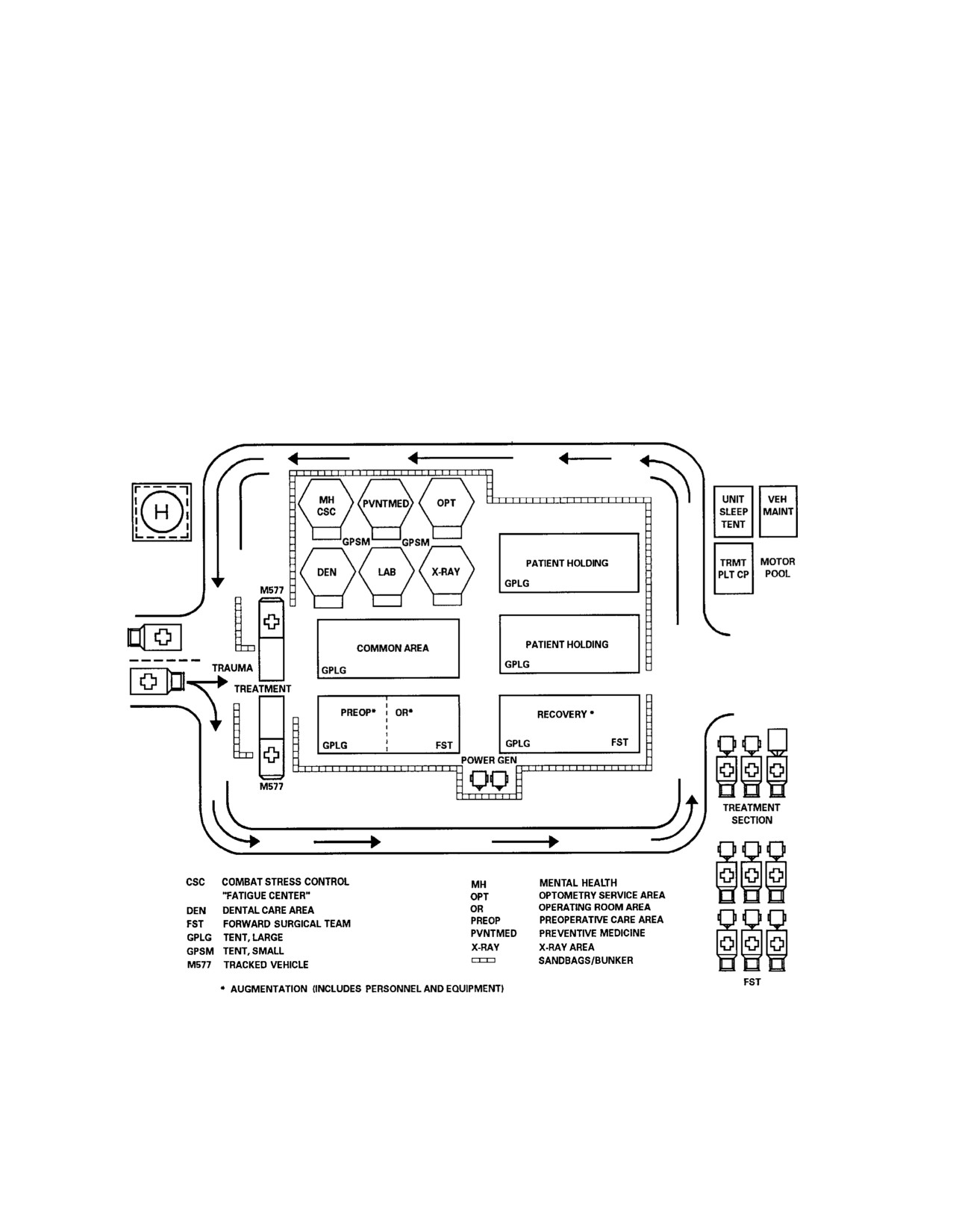
b. When establishing the MTF, sufficient space must be allocated to accommodate the normal
clinical elements of a medical company/troop, as depicted in Figure 3-1, with a possible augmentation of
other supporting elements. This augmentation may include a FST (augmented or organic), a MH section, a
PVNTMED section, and other medical specialty teams or elements that may be METT-TC driven. Some of
the elements depicted in this layout such as the MH, PVNTMED, and optometry sections are not applicable
to all medical companies (refer to Chapter 2 for discussions on the organizational structure of medical
companies).
Figure 3-1. Suggested layout of a clearing station augmentation.
3-20
FM 4-02.6
c.
The clearing station is established according to the unit layout and the company TSOP.
Attached corps medical units normally establish in the vicinity of the clearing station. The clearing station
maintains its integrity at all times. The area support squad establishes its patient treatment areas according
to the layout and the TSOP and provides treatment (see Appendix H). The dental treatment facility is
established adjacent to the clearing station. The dental officer supervises the placement of dental supplies
and equipment within the dental treatment area. The laboratory element is normally established within the
clearing station area. Precautions for operating radiological equipment must be observed. Radiation hazard
areas adjacent to the radiology facility must be clearly marked and blocked so company personnel are
prevented from crossing. The patient-holding squad sets up the patient-holding area. The patient-holding
area is normally adjacent to the clearing station. The treatment platoon leader, based on the commander’s
guidance, troop concentration, and casualty estimates, determines the number of cots set up. If the com-
mander directs that only 20 cots are to be set up, this may dictate that only one general-purpose large tent be
erected. In the vicinity near a patient-holding area, a water point, a latrine, and a handwashing area should
be established for the convenience of those patients being held at this facility. Field surgeons direct the
activities of the treatment squads. They identify the treatment team tasked with providing medical support
for the company/troop during movement and establishment of operational procedures. Personnel assigned
to the area support section are involved in assisting with establishment of the medical platoon area and/or
preparing for redeployment when required.
d.
Seriously ill or wounded patients arriving at the BSA/RSA clearing station are provided
medical treatment, initial surgery, if or preparing for redeployment, when required, and stabilized for
further evacuation. Patients reporting with minor injuries, BF, and illnesses are treated within the capability
of attending medical personnel. These types of patients are either held for continued treatment for up to 72
hours; or evacuated to the supporting MTF for further treatment, evaluation, and disposition. Other
functions of this MTF include—
• Providing consultation and limited clinical laboratory and radiology diagnostic proce-
dures.
• Recording all patients seen or treated at the MTF.
• Verifying the information contained on the US Field Medical Card (FMC) of all patients
evacuated to the facility.
• Monitoring casualties, when necessary, for NBC contamination prior to medical
treatment.
• Ensuring decontamination of NBC-contaminated patients is accomplished.
NOTE
Patient decontamination is performed by eight nonmedical personnel
designated by the echelon commander and supervised by medical per-
sonnel.
(For additional information, refer to FM 8-10-7.)
3-21
FM 4-02.6
e.
Evacuation from the clearing station is performed by ground and air ambulances from the
corps medical evacuation (MEDEVAC) battalion. If a brigade/regiment is operating out of sector, patients
may require evacuation by USAF assets from its BSA/RSA.
f.
Ammunition and individual weapons, to include sensitive military equipment (electronic
devices and so forth) belonging to patients to be evacuated further to the rear, are collected and safeguarded
by the clearing station personnel and returned to the S4 of the supported unit or as directed by the TSOP.
Patients who are being held at the holding facility but expected to RTD within 72 hours may retain their
weapons and other equipment, or such equipment can be given to the unit armorer for safekeeping pending
the patient’s final disposition. Patients traveling to the rear for routine medical consultation will retain their
individual weapons and equipment, as they will RTD from the rear supporting facility.
g. For a detailed discussion on the operation of a clearing station on an urbanized terrain, see
Appendix J.
3-14. Employment of the Ambulance Platoon
Ambulance platoon operations are an essential link in clearing the battlefield of the wounded, thus enabling
the tactical commander to exercise control over the tactical situation.
a. The ambulance platoon locates with the treatment platoon for mutual support. The platoon is
fully mobile in that all of its assets may be totally dispatched at any given time. Each ambulance team
carries an on-board MES designed for medical emergencies and en route patient care. Ambulances are
normally pre-positioned with supported units. Ambulances may be dispatched from the BSA to units
positioned in or near the BSA that are receiving area medical support from the FSMC. The ambulance
platoon leader and platoon sergeant conduct reconnaissance of the area supported to establish primary and
alternate evacuations routes, to verify locations of supported units, and to field site ambulance teams as
necessary.
b. The platoon leader and platoon sergeant coordinate support requirements with supported units
for ambulance platoons placed in DS. Ambulance platoon personnel obtain appropriate dispatch and road
clearances prior to departing company/troop or supported unit areas. He ensures that maps and overlays
are provided to platoon personnel. If time and fuel permit, the platoon leader or platoon sergeant may take
ambulance drivers on a rehearsal of the evacuation routes. The platoon leader/sergeant coordinates/
establishes AXPs as required by the medical evacuation mission.
c.
The DS tracked ambulances are usually positioned forward with the BASs of the maneuver
battalions. Tracked ambulances normally evacuate patients from aid station back to AXPs where patients
are placed in a wheeled or air ambulance for further evacuation to the clearing. Wheeled ambulances are
used as GS for area support missions and for medical evacuation missions where patients do not require the
added protection that an armored ambulance provides. Ambulance platoon personnel assist with
establishment of the medical company/troop and provide available personnel as tasked by the 1SG. For
definitive information on medical evacuation operations, see FM 8-10-6 and FM 8-10-26.
3-22
FM 4-02.6
d. Administratively, it is important that ambulance drivers are well briefed on the tactical situation
in the area in which they will be providing medical evacuation support. A thorough route reconnaissance
must be accomplished and strip maps developed before ambulance crews begin medical evacuation
operations. During the planning process and continuously once the operation has begun, the ambulance
platoon leader and the medical company/troop commander must prepare casualty estimates for the tactical
operation to ensure there is sufficient CHS coverage for the operation. The medical evacuation plan should
include an overlay depicting (at a minimum) the location of supported units, CCPs, Echelon I facilities, and
AXPs. The platoon leader should also obtain both the CSS and operations overlays for the tactical
operation. These overlays provide valuable information, such as the location of mine fields, obstacles and
barriers, artillery target reference points, and air corridors. This information is essential to enhance the
survivability of the ambulance crews by decreasing incidents of fratricide and enhancing mobility of the
evacuation assets. The ambulance platoon leader and platoon sergeant must be proficient at map reading,
terrain analysis, communications, and reading operational graphics (FM 101-5-1) in order to successfully
accomplish the medical evacuation mission. The ambulance platoon leader establishes his location so that
he can best control the medical evacuation operation. His location will vary with each tactical operation and
can include—
• Combat trains.
• Casualty collection points.
• Ambulance exchange points.
• Relay points or other locations along the ambulance shuttle system.
• Medical company/troop area.
• Central location behind supported units.
e.
One of the keys to successfully accomplishing the medical evacuation mission is communi-
cations and control. It is essential that communications be effective and maintained between the supported
units, the ambulance assets, the ambulance platoon leadership, and the supporting corps evacuation elements.
This can be accomplished in a number of ways. Division ambulances are equipped with radios (also, IBCT
and Force XXI ambulances are equipped with FBCB2 enablers—see Appendix F) that can be used to pass
MEDEVAC request information and instructions. Supporting corps ambulances, however, may not be
radio-equipped. Medical evacuation information must, therefore, be passed through medical channels by
returning ambulances crews, and information is then relayed back through ambulance crews returning to the
forward areas. The ambulance platoon TSOP must also include procedures concerning how to conduct
evacuation operations during periods of radio silence. In order for the ambulance platoon leader to ensure
his assets are being efficiently employed, he must stay abreast of the tactical situation, the tempo of the
battle, and the areas of patient density.
f.
There are a number of employment options available to the medical commander to ensure
there is timely and efficient medical evacuation coverage for the units supported and that contact is
maintained with these units.
3-23
FM 4-02.6
(1) Forward siting of ambulance assets. The medical company/troop ambulances can be
forward sited with Echelon I facilities. This provides immediate and responsive support to that facility.
(2) Use of the ambulance shuttle system. The ambulance shuttle system is an effective and
flexible method of employing ambulances during combat. It consists of one or more ambulance loading
points, relay points, and when necessary, ambulance control points, all echeloned forward from the principal
group of ambulances, the company location, or basic relay points as tactically required. The various points
within the ambulance shuttle may or may not be manned. If they are staffed, the echelon of care designating
the point is responsible for providing that support. A detailed discussion of the employment of the
ambulance shuttle system and its various components is contained in FM 8-10-6.
(3) Casualty collection points. In intense combat operations, CCPs are established along
routes where it is anticipated that wounded soldiers traveling to the rear would naturally follow (lines of
patient drift). These points can be established in areas where terrain canalizes traffic or locations near or
adjacent to improved roads. In addition to ambulance assets, treatment assets may also be collocated.
These points may or may not be staffed with EMT and medical evacuation personnel. As with the
ambulance shuttle system, the echelon of care designating the point is responsible for its staffing.
(4) Ambulance exchange points. Ambulance exchange points should be located where they
can best provide the required support to reduce ambulance turnaround time to supported units. Ambulance
exchange points are a place on the ground where a patient is transferred from one evacuation platform to
another (such as litter to vehicle; tracked vehicle to wheeled vehicle; ground vehicle to air ambulance) en
route to an MTF. Their use is extremely important when a tracked vehicle is evacuating patients. As
tracked vehicles are slower than wheeled vehicles, AXPs should be established as close as possible to the
supported units to reduce the time and distance requirements for the tracked vehicles. The AXP may be an
established point in an ambulance shuttle or it may be designated independently.
(a) These points may be staffed or unstaffed. Points, which are not staffed, may serve
as rendezvous points for the rapid transfer of a patient from one transportation mode to another. In most
cases, these points will not be staffed. An AXP is a predetermined point, which may be activated by such
events as the passing of phase lines and/or for specific time periods. Ambulance exchange points are moved
frequently to reduce their signature and enhance the survivability of the ambulance assets.
(b) An AXP may serve three battalions/squadrons (FSMC/medical troop); three
brigades (reinforcing mission) (MSMC/DSMC); or a specific number of nondivisional Echelon I facilities
(ASMC); therefore, if possible, the AXP should be centrally located to reduce ambulance turnaround and
enhance the timely execution of the medical evacuation mission. This may not, however, always be
possible due to terrain or other factors. The distance from the supported Echelon I facilities is also
dependent upon the terrain, the tactical situation, the type of vehicles being operated (wheeled versus
tracked), and the type of operation being conducted (offense, defense, or retrograde). Additionally, the
medical company/troop has an area support mission within the BSA/RSA, DSA, or corps area. All
ambulance assets cannot be forward sited to units in contact, as sufficient assets must remain in the support
area to accomplish the area support mission.
3-24
FM 4-02.6
3-15. Divisional and Nondivisional Medical Supply Offices
This section is applicable to the DMSO of AOE MSMCs and Force XXI DSMCs. It is also applicable to the
medical company of separate brigades and the medical troop of ACRs.
a. The DMSO, the BMSO, and the RMSO are staffed with the following personnel:
• One health service materiel officer (02, 70K67, MS), chief of section.
• One MEDLOG sergeant (E7, 91J40, NC); noncommissioned officer in charge (NCOIC)
(E6, 91J30 in BMSO and RMSO).
• One pharmacy NCO (E6, 91Q30, NCO).
• One MEDLOG sergeant (E5, 91J30, NC) (assigned MSMCs only).
• One medical equipment repairer (E4, 91A10).
• Two MEDLOG specialists (E4, 91J10) (one assigned BMSC and RMSO).
• One MEDLOG specialist (E3, 91J10).
b. The medical supply office is organized to provide Class VIII supply and unit-level medical
equipment maintenance for the division/separate brigades/ACR and attached medical units. It executes the
division/brigade/regimental CHL plan.
c.
The mission of this element is to provide routine and emergency Class VIII resupply, to
include blood (packed red blood cells) support for Echelon II. Personnel of this section plan, coordinate,
and manage a variety of functional areas pertaining to technical materiel, equipment, and services used in
support of the CHL support mission. For definitive information on DMSO employment and operations, see
FMs 8-10-9 and 4-02.1.
3-16. Employment of the Preventive Medicine Section
a. Preventive medicine activities begin prior to deployment to minimize DNBIs. Actions taken
include—
• Ensuring command awareness of potential medical threats and implementation of
appropriate protective measures.
• Ensuring the deployment of a healthy and fit force.
• Monitoring the command’s immunization status (see AR 40-562).
3-25
FM 4-02.6
• Monitoring the status of individual and small unit PVNTMED measures (see FMs 21-10
and 21-10-1).
• Monitoring PVNTMED measures against heat and cold injuries and food-, water-, and
arthropodborne diseases (see FMs 4-02.33 and 8-250, Technical Manual [TM] 5-632, Technical Bulletins
[Medical] [TB MED] 81, 507, 530, and 577).
• Performing environmental sampling and/or analysis on air, water, and soil to assess for
any health-related impact.
• Ensuring training in PVNTMED measures that will assist in countering the medical
threat.
• Monitoring the use of prophylaxis such as antimalarial tablets.
• Ensuring adequate unit field sanitation team personnel and supplies.
• Monitoring, collecting, analyzing and recording medical surveillance data.
b. The division PVNTMED officer, medical company/troop commander, and PVNTMED
personnel must be proactive and initiate action on presumptive information to reduce the medical threat
early. They cannot wait until the incapacitation of troops occurs before taking action; for example—
• If mosquitoborne diseases are endemic to troop assembly areas and known or suspected
vectors are present, mosquito control efforts should be initiated.
• Inadequate sanitation practices must be corrected before the first case of enteric disease
appears.
• Avoid establishment of bivouac locations on sites that are contaminated with toxic
industrial chemicals.
c.
It should be anticipated—
• That sanitation breakdowns will occur while troops are still in debarkation assembly
areas.
• That soldiers are at risk for arthropod-transmitted diseases upon entry to the AO.
• That a lack of or delay in implementing preemptive actions can significantly impact on
the forces ability to accomplish their assigned mission. Refer to FMs 8-250, 21-10, and 21-10-1 for
additional information.
3-26
FM 4-02.6
3-17. Employment of the Mental Health Section
a. The MSMC/DSMC commander prioritizes the MH mission based on input from the division
psychiatrist and on the provisions of the division CHS plan. The division psychiatrist is assigned to the
MSMC/DSMC. The psychiatrist is also a working physician who applies the knowledge and principles of
psychiatry and medicine in the treatment of all patients. He examines, diagnoses, and treats, or recommends
courses of treatment, for personnel suffering from emotional or mental illness, situational maladjustment,
combat stress reaction, BF, and misconduct stress behaviors.
b. Personnel assigned to the MH section assist the division psychiatrist with the accomplishment
of his duties. They may perform as CSC coordinators for selected units in the division rear. Mental health
personnel will also assist with and provide COSC training to—
• Small-unit leaders.
• Unit ministry teams and staff chaplains.
• Battalion medical platoons.
• Patient-holding squad and treatment squad personnel of medical companies.
3-18. Employment of the Optometry Section
The optometry section normally establishes its operations in the clearing station. Patients seen by this
section are normally referred from units and MTFs within the supported area. The optometry sections can
form two teams with the capability of projecting services into areas of large troop concentrations. All
eyewear fabrications or repairs beyond the scope of the section’s capability are sent to the supporting
MEDLOG battalion.
3-27
FM 4-02.6
CHAPTER 4
COMBAT HEALTH SUPPORT IN SPECIFIC ENVIRONMENTS
4-1.
Introduction
a. Combat health support is limited when operating in areas of adverse environmental conditions
or terrain hazards. In these environments, medical units may require special purpose equipment, which is
not normally included in their TOE, or additional quantities of authorized equipment. This equipment can
include, but is not limited to, such items as—
• Mountain climbing gear.
• Cold weather bags for the protection of patients.
• Extra tentage.
• Modified transportation platforms.
• Bed nets.
b. Of equal importance, special handling techniques, increased maintenance, and protection from
the environmental hazards may be required for personnel, supplies, and equipment.
c.
This chapter discusses CHS operations, including ground ambulance operations; in specific
operations; only slight reference is made to air ambulance operations. For an in-depth discussion of air and
ground ambulance operations in these environments, refer to FMs 8-10-6 and 8-10-26.
4-2.
Jungle Environment
a. Difficult terrain, widely dispersed combat units, inadequate road networks, and unsecured
lines of communications (LOCs) all have a direct effect on CHS in jungle operations. The jungle
environment degrades the ability to maneuver. The manner in which CHS is provided in this environment
depends on how the tactical units are employed. Wide variations may be expected, but the general
principles of providing CHS apply.
b. Jungle combat operations are characterized by ambushes and other guerrilla-type operations.
The security threat caused by infiltrators requires that LOCs be patrolled often and that convoys be
escorted. It is, therefore, essential that CHS be performed as far forward as the tactical situation permits.
Deploying assets forward—
• Improves response time.
• Reduces road movement.
• Allows the CHS elements to take advantage of the security offered by combat units.
4-1
FM 4-02.6
c.
Special planning considerations for operations in the jungle environment include the following:
• Evacuation. Thick and remote jungles often require that evacuation be accomplished by
litter. In the jungle, even slightly wounded soldiers may find it impossible to walk through the dense
undergrowth. This requires that they be evacuated on a litter until easier terrain is reached. This, in effect,
raises the number of patients who require evacuation by litter. Litter evacuation is a labor-intensive activity
that quickly exhausts the litter bearers. At best, litter teams can carry patients only a few hundred yards
over rough terrain before becoming exhausted and requiring rest or relief. Litter carries should be kept as
short as possible and maximum use of air ambulances equipped with rescue hoists and jungle penetrators
should be made.
• Water. Water is vital in the jungle; it is also plentiful. Water from natural sources,
however, should be considered contaminated. Water purification procedures must be taught to all soldiers.
The high humidity and heat present in the jungle environment requires all leaders to ensure that a water
discipline program is established and enforced. The consumption of inadequate amounts of water will
lead to dehydration and heat injuries. The human body cannot adjust to less water; hydration must be
continuous.
• Clothing and personal protective equipment and supplies. Because of the tropical climate,
units should pack hot weather clothing when deploying to jungle areas. Jungle fatigues and boots are
recommended. The bed net, insect (arthropod) repellent, and sunscreen must be issued to all soldiers
operating in this environment.
• Disease and nonbattle injuries. The jungle environment is ideal for the transmission of
large numbers of diseases. The rate of DNBI casualties is potentially the highest in this climate. The heat,
humidity, and terrain places the troops at a high risk for dehydration, heat injury, skin diseases, endemic
diseases, and immersion syndrome. Cold injury and especially hypothermia are a risk in cool (night) times
because wet, hot weather clothing loses its insulating value. Small wounds can rapidly become infected and
lead to the loss of effectiveness and possibly require medical evacuation. High standards of personal
hygiene must be taught, encouraged, and maintained by the command. Mosquitoes and other arthropods
that carry disease flourish under jungle conditions. Use of all PVNTMED measures must be ensured.
Poisonous plants, animals, arthropods, large predators, and reptiles can cause casualties. Foodborne and
waterborne diseases leading to diarrhea or other symptoms abound. Food service sanitation measures must
be strictly followed. For additional information on PVNTMED measures, refer to FMs 4-02.17, 4-02.21,
21-10, and 21-10-1.
• Combat Operation Control. The jungle restricts vision and hearing, causes discomfort
and poor hygiene, and evokes a sense of threat from poisonous plants, animals, reptiles, enemy ambush,
and fear of becoming lost. Battle fatigue rates are high until troops gain jungle fighting and survival skills.
For an in-depth discussion on COSC, refer to FMs 8-51 and 22-51.
• Training. Medical Personnel deployed to a jungle environment should be trained in
survival and support techniques. Training (both initial and sustainment) should be conducted on—
•
Hot weather acclimatization and survival.
4-2
FM 4-02.6
•
Prevention, early detection, and treatment of arthropodborne, foodborne, and
waterborne diseases.
•
Land navigation.
•
Field sanitation and other PVNTMED measures.
•
Care and maintenance of equipment and supplies.
•
Local plants, animals, reptiles, and arthropods that pose a medical threat.
• Equipment and supplies. Due to the increased heat and humidity, vehicles and equipment
require additional maintenance. Equipment tends to rust quickly and must be cleaned and oiled more
frequently. Canvas items rot, and rubber deteriorates much faster than in more temperate climates. Class
VIII supplies (to include blood) are both environmental and time sensitive. These supplies must be correctly
stored at the appropriate temperature and used before their expiration date. Improper storage and handling
result in these supplies becoming unusable.
d. For additional information on medical evacuation jungle operations, refer to FMs 8-10-6, and
90-5.
4-3.
Mountain Environment
a. In the past, armies have experienced great difficulty in evacuating patients from mountainous
areas. Mountain environments are extremely diverse in nature. Some mountains are dry and barren with
temperatures ranging from extreme heat in the summer to extreme cold in the winter. In tropical regions,
mountains are frequently covered by lush jungles and heavy seasonal rains may occur. Many areas display
high rocky crags with glaciated peaks and year-round snow cover. Elevations can also vary from as little as
1,000 feet above sea level to over 16,000 feet above sea level with drastic and rapidly occurring weather
changes.
b. In order to effectively support the tactical plan, the CHS plan must provide maximum
flexibility. The CHS planner should consider using all methods of evacuation. Because of the rough
terrain, the medical companies may not be able to reach the BASs by ground ambulance. An ambulance
shuttle system established with an AXP for aeromedical evacuation assets to meet litter bearers may be
required. Litter bearers and beasts of burden, however, may be the only means of evacuation. The tactical
commander determines which soldiers will serve as litter bearers. Close coordination between the medical
companies and BASs in establishing CCPs and AXPs is necessary to—
• Reduce distance traveled by litter bearers.
• Reduce evacuation time.
• Conserve personnel.
4-3
FM 4-02.6
c.
Mountain operations require CHS personnel to carry additional equipment. Items such as
ropes, pitons, piton hammers, and snap links are all necessary for evacuation of patients and the establishment
of MTFs. Unnecessary equipment (especially that which is heavy or bulky [for example, extra tentage], or
that for which substitutes are available) should be left behind. If stored, this equipment and supplies should
be readily available for airdrop or other means of transport.
d. Survival training is essential in this environment. Combat health support personnel should be
trained in survival skills encompassing the following areas:
• Traversing mountainous terrain, to include mountain (rock) climbing and the use of
ropes and vertical rescue techniques.
• Exposure to extreme cold and snow, to include cold injury prevention.
• Land navigation.
• Preparation of field expedient shelters.
• Individual and unit movement at high altitudes.
• Care and treatment of patients suffering from high altitude illness and cold weather
injuries.
e.
Combat health support personnel will see an increase in patients suffering from—
• Fractures, sprains, and dislocation injuries.
• Acute mountain sickness, high-altitude pulmonary edema, and cerebral edema caused by
the rapid ascent to heights over 7,500 feet above sea level.
• Cold weather injuries and hypothermia.
• Dehydration and heat exhaustion.
• Sunburns and snow blindness.
• Aggravated sickle cell anemia.
(Although not considered a mountain illness, personnel
with sickle cell traits can be seriously affected by the decrease in the barometric pressure and lower oxygen
levels found at higher altitudes.)
• Operational stress. Mountains confer a psychological advantage to those who hold the
high ground, with good fields of vision and fire. Those who are confined to the valleys or roads or who
must struggle up hill against snipers or indirect fire tend to have higher COSC rates.
(Refer to FM 8-51 for
additional information.)
4-4
FM 4-02.6
f.
For additional information on mountain operations, refer to FM 3-97.6. For additional
information and techniques for the extraction and evacuation of personnel deployed in mountain terrain,
refer to FM 8-10-6.
4-4.
Desert Environment
a. Deserts are arid, barren regions of the earth incapable of supporting normal life because of the
lack of fresh water. Although deserts are often thought of as hot climates, it is important to note that tem-
peratures range from over 136 degrees Fahrenheit (F) in some deserts to bitter cold in others. Day-to-night
fluctuations in temperature can exceed 70°F. Desert terrain can have mountains, rocky plateaus, or sandy
dunes; some desert areas may contain all of these characteristics. Rain, when it falls, often causes flooding
in low-lying areas. Winds can have a devastating effect upon CHS operations by destroying equipment and
supplies and causing dust storms. Dust storms make navigation, patient acquisition and evacuation, and
treatment difficult. Since deserts vary considerably in their type of terrain and temperature, characteristics,
current and specific medical intelligence should be obtained prior to deploying to a desert environment.
b. The CHS planner must consider the numerous environmental effects to personnel, equipment,
and supplies when developing the CHS plan for this environment. These factors include, but are not limited
to the following:
(1) Acclimatization. To be effective, soldiers must be properly acclimatized to the desert.
Two weeks are usually required to satisfactorily acclimatize troops to a hot environment, using progressive
degrees of heat exposure and physical exertion. Other potential acclimatization problems that may be
encountered are the effects of dry air and altitude on the respiratory system. Since many desert areas are
located in mountainous terrain, soldiers may have to be acclimatized to both altitude and cold.
(2) Discipline. Units deployed in desert areas typically have long LOCs and are widely
dispersed. This necessitates a greater reliance on the junior leaders since commanders are required to
decentralize operations. For a unit to be effective, a high level of discipline must exist at all levels of the
organization.
(3) Water. Water is the most basic need in a desert. Without it, soldiers cannot function
effectively for more than a few hours. See FM 21-10 for water requirements. Extra water must be carried
by medical vehicles and be available in MTFs. The additional quantities of water are required for patient
consumption, treatment of heat casualties, and routine operation of the MTF.
(4) Endemic disease and environmental injuries. Soldiers deployed in the desert are
susceptible to endemic and epidemic diseases and environmental injuries. Water discipline, immunizations,
pretreatments, barrier creams, and chemo-prophylaxis, field sanitation, personal hygiene, and other
PVNTMED measures can reduce the risk of DNBIs. Proper clothing, equipment, and a water discipline
program to protect against environmental injuries must have command emphasis.
(5) Combat Operational Stress Control. The desolate, often wide-open spaces of many
deserts can cause uneasiness, disorientation, and fear of being observed or of becoming lost. These
4-5
FM 4-02.6
circumstances may result in high COSC rates until troops learn to navigate, move, camouflage, and use
other survival skills in this environment.
(6) Winds, dust, and sand. Winds may very easily damage equipment and supplies.
Equipment is protected by using covers, tie-downs, and shelters. Terrain helps shield equipment from the
wind if the site selection is done carefully. In some cases, special tools (such as extra long metal tent stakes)
are necessary. Supplies must be carefully stored and protected from the effects of the wind and sand. The
effects of wind and sand are interrelated. Desert sand starts to become airborne when the wind reaches
about 20 knots. Sandstorms—
• Restrict visibility.
• Pose a hazard to eyes (especially for soldiers wearing contact lenses).
• Contaminate water supplies (if they are not protected).
• Make navigation and patient evacuation difficult.
Dust and sand presents one of the greatest dangers to the proper functioning of equipment. Sand mixed with
lubricants forms an abrasive paste. Lubricated fittings, bearings, and filters should be inspected frequently
and changed when required. Communications and automation equipment may be adversely affected by dust
and sand. Over a period of time, electrical insulation is damaged by windblown sand. Special care should
be taken to brush dust and sand off radio equipment, computers, and printers, and to keep ventilating ports
and channels clear. Dust trails created by hovering aircraft or ground vehicles can be seen in excess of 10
miles on a relatively flat desert. This exposes these assets to direct and indirect enemy fires. If the tactical
situation permits, ground vehicles should reduce their speed to the point that they do not create a dust
signature.
(7) Terrain. Trafficability varies with the type of terrain covered. Open, flat, and rocky
terrain affords higher trafficability than does mountainous areas, lava beds, or salt marshes. Drivers must
be well trained in judging the terrain over which they are driving to select the best route. Track vehicles are
best suited for desert operations. They can, however, throw tracks when traversing a rocky area. Their use
is also limited in rough terrain with steep slopes. Wheeled vehicles may be used in desert operations;
however, they normally have a lower average speed than track vehicles and a higher incidence of damage
and malfunction. Wheeled vehicles often bog down in sandy areas and cannot traverse many of the rougher
areas. Vehicles should carry extra repair parts (fan belts, tires, and other items apt to malfunction).
(8) Radiant light. The sun burns unprotected skin, and it may damage unprotected eyes.
Soldiers should dress in loosely fitting clothing, use sunscreen to protect exposed skin, and wear sunglasses
or goggles to protect their eyes. Soldiers should remain fully clothed. Removing clothing increases direct
exposure of the skin to the sun and eliminates the beneficial cooling effects of the moisture trapped in
clothing. Radiant light or its heat effects may be detrimental to plastics, lubricants, pressurized gases,
rubber, and other fluids. All vehicles and aircraft should be kept well ventilated. When parked, windshields
should be covered to reduce heat buildup inside. Supplies of all types should be stored in well-ventilated,
shady areas. Placing supplies in covered holes in the ground may reduce the heat effects.
4-6
FM 4-02.6
(9) Humidity. Humidity is a factor in some desert areas of the world, especially in the
Middle East. Humidity can become a problem for short periods of time in other desert areas. Light coats of
lubrication can help prevent rust; however, these benefits should be weighed against the dust gathering
qualities of oil. Demisting equipment is used on optics and night vision equipment to reduce the effects of
humidity.
(10) Temperature variations. Variations of temperature will require personnel to be issued
suitable clothing for encountering extreme weather conditions. Temperature changes in a desert environment
can range from 140°F midday to near freezing at night. Temperature variations can cause condensation in
humid desert areas affecting optics, fuel lines, air tanks, and weapons. Expansion and contraction of air and
fluids may cause vehicle and equipment problems. Vehicle and equipment operators must ensure that the
effects of temperature variations do not become a significant problem. Temperature variations may cause—
• Tires to overinflate during the day and underinflate at night.
• Fuel tanks to overflow during the day resulting in a fire hazard.
• Oil fluid levels during the day to become overfull and cause a leak, or during the
night as the oil cools, to provide insufficient lubrication.
(11) Static electricity. Static electricity is a factor in the desert. During refueling operations
and when oxygen or other flammable substances are being used on board vehicles, it is important to
remember that it presents a real hazard. Proper refueling procedures must be followed. Static electricity
also causes severe shock to ground personnel in sling-loading and hoist operations.
(Refer to FM 8-10-6
and 8-10-26 for additional information.)
c.
To ensure success in desert operations, detailed planning is required. Factors to consider
include the following:
• Water is as mission essential as any piece of unit equipment. Additional quantities of
water are required for CHS operations for the survival of both medical personnel and patients. Load plans
for all vehicles and aircraft must include water.
• Prescribed load lists are expanded to carry sufficient quantities of repair parts that are
easily degraded by the environment.
• Covers should be fabricated (prior to deployment, if possible) for equipment (especially
communications and electronic), supplies, and vehicles.
• Fuel usage and consumption are critical due to the extended ranges between supported
units and the increased vulnerability for refueling sites in the open desert terrain.
• Appropriate clothing for both hot and cold weather is required.
• Petroleum, oils, and lubricants must be of the proper viscosity for desert operations.
Maintenance services are also performed more frequently.
4-7
FM 4-02.6
• Small packages/amounts of Class III packaged products should be used to avoid
contamination by blowing sand.
• Filters of all types are consumed at a higher rate.
d. Training for desert operations is not significantly different than training for operations in other
areas except for the following:
(1) Mountain training. Because many desert areas are in mountainous terrain, procedures
and techniques for evacuation in mountainous terrain must be practiced by all CHS personnel. Special
equipment requirements must also be planned for (paragraph 4-3).
(2) Navigation. Navigation on desert terrain varies from relatively simple to extremely
difficult. Factors affecting navigation are—
• Type of desert.
• Scale and quality of available maps.
• Other navigational guides which are available.
• Ground vehicles must have compasses available as they may have to rely on compass
headings and odometer readings to navigate.
• Use of convoys is a viable technique to ensure that ground vehicles do not get lost
and to improve security.
e.
For additional information on desert operations, refer to FMs 8-10-6 and 90-3.
4-5.
Extreme Cold Weather Environment
a. Operations in extreme cold environment are adversely impacted by severe environmental
conditions and rugged terrain. The tundra and glacial areas are harsh, arid, and barren. Temperatures may
reach lows of -80°F to -100°F that, combined with gale force winds, make exposure unsurvivable. The
greatest environmental detriment to operations is blowing snow, which reduces visibility to zero. This
results in the loss of depth perception from total white conditions.
b. Other environmental considerations are as extreme but easier to circumvent. Solid footing is
suspect in both the dead of winter and in the summer. Snow and ice cover crevasses, holes, and otherwise
unstable ground. In traversing suspect ground situations, consider linking soldiers by ropes. During the
summer, ground transportation maybe restricted than in any other environment due to the marsh and
muskeg composition of the arctic tundra. In CHS operations, patients must be sustained for a longer
duration due to terrain delays and the lack of direct evacuation routes.
4-8
FM 4-02.6
c.
Combat health support personnel may see an increase in the following types of DNBIs:
• Cold injuries (ranging from minor to severe frostbite, especially of exposed areas of the
body and feet, to hypothermia).
• Dehydration and heat exhaustion.
• COSC. (The similarity of arctic and desert terrain may also cause disorientation and a
sense of exposure.) Extreme cold can psychologically paralyze the inexperienced soldier and reduce him to
a budding “survival first and only” mentality.
d. Factors to consider when conducting CHS activities in extreme cold operations include the
following:
• Patients must be kept warm as the effects of the extreme cold can hasten and/or deepen
shock.
• Improvised shelters may be required for patient holding (due to unexpected snow storms
or vehicle breakdowns); the shelters should be capable of being heated (such as in a cave). The longer the
period the patient must be held in the improvised shelter, the more important it is to fortify it against the
effects of the cold.
• Blood and intraveneous (IV) fluids must be protected from freezing, both when in use
and when stored.
• Establishing an ambulance shuttle system (FM 8-10-6) or AXPs are useful when operating
in extended battle zones, or when evacuation distance and time required are increased.
• Augmentation of air and ground ambulances from higher echelon CHS elements and/or
use of nonmedical transportation assets may also be required to meet the extended evacuation needs.
• Additional supplies of water should be carried by ambulances, and be available at MTFs.
• Due to the decreased temperature and frozen environment, vehicle maintenance require-
ments are increased. Lubricants must be of the correct viscosity for the temperature. In extreme cold,
batteries perform less efficiently. Batteries may have to be removed from the vehicles and kept in a warm
place to ensure prompt starting. Engines may also have to be kept running to avoid freeze-ups or long warm-
up periods. All ambulances are considered deadlined without a functional heater in the patient compartment.
• The proper storage of medical supplies is essential to prevent loss from freezing.
• There are few terrain features or road networks; therefore, evacuation routes must be
surveyed and marked over open terrain. At extreme altitudes, operations during the winter months are
conducted in extended hours of darkness. The use of night vision goggles (NVG) may be required.
Compass accuracy is inconsistent due to geomagnetic phenomenon.
4-9