FM 4-02.6 THE MEDICAL COMPANY: TACTICS, TECHNIQUES, AND PROCEDURES (AUGUST 2002) - page 1
FM 4-02.6 (FM 8-10-1)
THE MEDICAL
COMPANY
TACTICS, TECHNIQUES, AND PROCEDURES
AUGUST 2002
HEADQUARTERS, DEPARTMENT OF THE ARMY
DISTRIBUTION RESTRICTION: Approved for public release; distribution is unlimited.
*FM 4-02.6 (FM 8-10-1)
FIELD MANUAL
HEADQUARTERS
NO. 4-02.6 (8-10-1)
DEPARTMENT OF THE ARMY
Washington, DC, 1 August 2002
THE MEDICAL COMPANY
TACTICS, TECHNIQUES, AND PROCEDURES
TABLE OF CONTENTS
Page
PREFACE
vii
CHAPTER
1.
COMBAT HEALTH SUPPORT SYSTEM
1-1
Section
I.
Overview of Combat Health Support
1-1
1-1.
General
1-1
1-2.
Theater of Operations
1-1
1-3.
Mission
1-2
1-4.
Echelons of Medical Care
1-2
1-5.
The Medical Threat and Medical Intelligence
1-4
1-6.
Planning for Combat Health Support
1-5
1-7.
Principles of Combat Health Support
1-7
1-8.
Modular Medical Support System
1-8
Section
II.
Combat Health Support Functional Areas
1-9
1-9.
General
1-9
1-10.
Medical Treatment
1-9
1-11.
Medical Evacuation and Medical Regulating
1-10
1-12.
Hospitalization
1-11
1-13.
Combat Health Logistics
1-12
1-14.
Dental Services
1-12
1-15.
Veterinary Services
1-13
1-16.
Preventive Medicine Services
1-13
1-17.
Combat Operational Stress Control Services
1-13
1-18.
Medical Laboratory Services
1-14
CHAPTER
2.
THE MEDICAL COMPANY
2-1
Section
I.
The Medical Company and Division Overview
2-1
2-1.
General
2-1
2-2.
Division Overview
2-1
2-3.
Types of Divisions
2-1
2-4.
Forward Support Medical Company
2-3
2-5.
Organizational Structure of Forward Support Medical Companies
2-4
DISTRIBUTION RESTRICTION: Approved for public release; distribution is unlimited.
*This publication supersedes FM 8-10-1, 29 December 1994.
i
FM 4-02.6
Page
2-6.
Main Support Medical Company/Division Support Medical Company ...
2-9
2-7.
Organizational Structure of Main Support Medical Company/Division
Support Medical Company
2-10
Section
II.
Medical Companies in Separate Brigades, Armored Cavalry
Regiments, and Interim Brigade Combat Teams
2-15
2-8.
Separate Brigade Overview
2-15
2-9.
Medical Company-Heavy Separate Brigade
2-16
2-10.
Organizational Structure and Tactical Capabilities of the Medical
Company-Heavy Separate Brigade
2-16
2-11.
Armored Cavalry Regiment Overview
2-17
2-12.
Medical Troop-Armored Cavalry Regiment
2-18
2-13.
Organizational Structure and Tactical Capabilities of the Medical Troop-
Armored Cavalry Regiment
2-18
2-14.
Brigade Combat Team Overview
2-19
2-15.
Brigade Support Medical Company, Support Battalion, Interim Brigade
Combat Team
2-19
2-16.
Area Support Medical Company, Area Support Medical Battalion
(Corps and Echelons above Corps)
2-20
CHAPTER
3.
MEDICAL COMPANY OPERATIONS
3-1
Section
I.
Organization and Functions of the Medical Company
3-1
3-1.
General
3-1
3-2.
Headquarters Section
3-1
3-3.
Treatment Platoon
3-3
3-4.
Ambulance Platoon
3-6
3-5.
Preventive Medicine Section and Functions
3-7
3-6.
Mental Health Section Operations and Functions
3-8
3-7.
Optometry Section Operations and Functions
3-11
Section
II.
Tactical Employment of the Medical Company
3-11
3-8.
Employment of the Medical Company
3-11
3-9.
Site Selection
3-12
3-10.
Establishing the Company Headquarters
3-15
3-11.
Command Post Operations
3-17
3-12.
Employment of the Treatment Platoon
3-19
3-13.
Establishing the Clearing Station/Medical Treatment Facility
3-19
3-14.
Employment of the Ambulance Platoon
3-22
3-15.
Divisional and Nondivisional Medical Supply Offices
3-25
3-16.
Employment of the Preventive Medicine Section
3-25
3-17.
Employment of the Mental Health Section
3-27
3-18.
Employment of the Optometry Section
3-27
CHAPTER
4.
COMBAT HEALTH SUPPORT IN SPECIFIC ENVIRONMENTS ..
4-1
4-1.
Introduction
4-1
ii
FM 4-02.6
Page
4-2.
Jungle Environment
4-1
4-3.
Mountain Environment
4-3
4-4.
Desert Environment
4-5
4-5.
Extreme Cold Weather Environment
4-8
4-6.
Nuclear, Biological, Chemical, and Directed-Energy Environments
4-11
4-7.
Urban Operations
4-12
4-8.
Combat Health Support During Night Operations
4-14
4-9.
Army Special Operations Forces
4-17
APPENDIX
A.
LAW OF WAR AND GENEVA CONVENTIONS OBLIGATIONS
FOR MEDICAL PERSONNEL
A-1
A-1.
Law of War
A-1
A-2.
Medical Implications of Geneva Conventions
A-1
A-3.
Distinctive Markings and Camouflage of Medical Facilities and
Evacuation Platforms
A-4
A-4.
Civilian Wounded and Sick
A-5
A-5.
Captured Medical Supplies
A-6
A-6.
Compliance with the Geneva Conventions
A-6
APPENDIX
B.
COMBAT HEALTH SUPPORT PLANNING
B-1
Section
I.
Combat Health Support Estimate
B-1
B-1.
General
B-1
B-2.
Responsibilities
B-1
B-3.
Format for the Estimate
B-2
B-4.
Sample Format for the Combat Health Support Estimate
B-2
Section
II.
Combat Health Support Plan
B-9
B-5.
General
B-9
B-6.
Format for the Combat Health Support Plan
B-10
APPENDIX
C.
MASS CASUALTY SITUATIONS
C-1
C-1.
General
C-1
C-2.
Mass Casualty Management
C-1
C-3.
Triage Categories
C-3
C-4.
Control Element
C-4
C-5.
Establishing Triage, Treatment, and Holding Areas
C-5
C-6.
Patient Accountability
C-6
C-7.
Medical Evacuation
C-7
C-8.
Contaminated Patients
C-7
C-9.
Disposition of Remains
C-7
APPENDIX
D.
MANAGEMENT OF CLASS VIII ITEMS IN THE FORCE XXI
DIVISION
D-1
D-1.
Class VIII Management
D-1
iii
FM 4-02.6
Page
D-2.
Throughput Delivery of Class VIII Items
D-2
D-3.
Additional Combat Health Logistics Support Information
D-2
APPENDIX
E.
RECORDS AND REPORTS
E-1
Section
I.
Patient Accountability
E-1
E-1.
General
E-1
E-2.
United States Field Medical Card
E-1
E-3.
Daily Disposition Log
E-2
E-4.
Patient Summary Report
E-4
E-5.
Patient Evacuation and Morality Report
E-4
Section
II.
Blood Management Report
E-5
E-6.
General
E-5
E-7.
Blood Management Report
E-6
APPENDIX
F.
THE BRIGADE SUPPORT MEDICAL COMPANY
F-1
Section
I.
Organization and Mission
F-1
F-1.
Organization Capability and Functions
F-1
F-2.
Augmentation
F-3
Section
II.
Company Headquarters Organization and Function
F-3
F-3.
Company Headquarters
F-3
F-4.
Command Element
F-4
F-5.
Logistics Elements
F-5
Section
III.
Employment of the Medical Company
F-6
F-6.
Establishment of the Company Headquarters
F-6
F-7.
Preventive Medicine Section
F-7
F-8.
Employment of the Preventive Medicine Section
F-9
F-9.
Mental Health Section
F-10
Section
IV.
The Treatment Platoon
F-14
F-10.
General
F-14
F-11.
Treatment Platoon Headquarters
F-15
F-12.
Treatment Squad
F-15
F-13.
Area Treatment Squad
F-17
F-14.
Area Support Squad
F-19
F-15.
Patient-Holding Squad
F-21
F-16.
Employment of the Treatment Platoon
F-22
Section
V.
The Evacuation Platoon
F-23
F-17.
General
F-23
F-18.
Evacuation Platoon Headquarters
F-23
F-19.
Evacuation Squads
F-25
F-20.
Employment of the Evacuation Platoon
F-28
Section
VI.
Combat Health Logistics Support for the Brigade Combat Team
F-28
F-21.
Overview
F-28
F-22.
Health Service Materiel Officer
F-29
iv
FM 4-02.6
Page
F-23.
Functional Combat Health Logistics Module Business Systems
F-29
F-24.
Class VIII Requisitioning in the Brigade
F-29
F-25.
Medical Maintenance
F-30
F-26.
Property Exchange
F-30
F-27.
Delivery of Class VIII Supplies
F-31
F-28.
Blood Management
F-31
APPENDIX
G.
TACTICAL STANDING OPERATING PROCEDURE
G-1
G-1.
General
G-1
G-2.
Purpose of the Tactical Standing Operating Procedure
G-1
G-3.
Format for the Tactical Standing Operating Procedure
G-1
G-4.
Sample Tactical Standing Operating Procedure (Sections)
G-2
G-5.
Sample Tactical Standing Operating Procedure (Annexes)
G-3
APPENDIX
H.
CLINICAL STANDING OPERATING PROCEDURE
H-1
H-1.
General
H-1
H-2.
Purpose of the Clinical Standing Operating Procedure
H-1
H-3.
Sample Clinical Standing Operating Procedure
H-1
APPENDIX
I.
COMMUNICATIONS, AUTOMATION, AND POSITION
NAVIGATION SYSTEMS
I-1
Section
I.
Communications and Equipment
I-1
I-1.
General
I-1
I-2.
Frequency-Modulated Radios
I-1
I-3.
Amplitude-Modulated Radios
I-2
I-4.
Ancillary Radio Equipment
I-2
I-5.
Mobile Subscriber Equipment
I-4
I-6.
Position/Navigation Equipment
I-4
Section
II.
Combat Net Radios
I-5
I-7.
Combat Net Radio Systems
I-5
I-8.
Radio and Wire Nets
I-6
Section
III.
Automation and Digitization
I-11
I-9.
Warfighter Information Network
I-11
I-10.
Tactical High-Speed Data Network
I-12
I-11.
Medical Company Automation/Digitization Enablers
I-12
Section
IV.
Medical Communications for Combat Casualty Care System
Concept
I-13
I-12.
General
I-13
I-13.
Medical Digitization of the Combat Brigades
I-14
I-14.
The Application of Medical Communications for Combat Casualty
Care in Combat Health Support Echelons of Care
I-15
I-15.
Medical Command and Control Application
I-16
v
FM 4-02.6
Page
APPENDIX
J.
CLEARING STATION OPERATIONS ON URBANIZED
TERRAIN
J-1
J-1.
Employment
J-1
J-2.
Site Selection and Unit Layout
J-1
J-3.
Forward Surgical Team
J-2
J-4.
Mass Casualty Operations
J-2
J-5.
Forward Deployed Medical Treatment, Preventive Medicine, and
Medical Evacuation Assets
J-2
APPENDIX
K.
MANAGEMENT OF INDIVIDUAL HEALTH RECORDS IN
THE FIELD
K-1
K-1.
General
K-1
K-2.
Health Records of Deployed Soldiers
K-1
K-3.
Use of Field Files/DD Form 2766
K-3
K-4.
Storage of Health Records and Civilian Employee Medical Records
K-3
K-5.
Establishment and Management of the Field File in the Operational
Area
K-3
K-6.
Health Assessment after Deployment
K-4
K-7.
Field Record Administration after Hostilities Cease
K-5
APPENDIX
L.
CLINICAL GUIDELINES FOR COMBAT CASUALTY CARE
L-1
Section
I.
Clinical Guidelines for Physician-Lead, Physician Assistant-Lead,
and Nursing-Lead Treatment Modules
L-1
L-1.
General
L-1
L-2.
Field Surgeon (62B00 MC)
L-1
L-3.
Physician Assistant (65D00 SP)
L-1
L-4.
Medical-Surgical Nurse (66H00 AN)
L-1
L-5.
Forward Surgical Team
L-2
Section
II.
Health Care Specialists Treatment and Evacuation Modules
L-2
L-6.
The 91W Health Care Specialist
L-2
L-7.
Core Competencies of the 91W
L-2
L-8.
Medical Training
L-4
L-9.
Semiannual Combat Medic Skills Validation Test
L-9
Section
III.
Dental-Lead Treatment and Clinical Diagnostic Support Modules
L-10
L-10.
Comprehensive Dental Officer (63B00 DC)
L-10
L-11.
Dental Specialist (91E)
L-10
L-12.
Core Competencies/Critical Tasks and Training for the 91E
L-10
L-13.
Radiology Specialist (91P)
L-12
L-14.
Radiology Specialist/Sergeant Core Competencies, Critical Tasks
and Training
L-13
L-15.
Medical Laboratory Specialist (91K)
L-15
L-16.
Core Competencies of the 91K
L-16
L-17.
Clinical Laboratory Training
L-16
vi
FM 4-02.6
Page
Section
IV. Mental Health Clinical Support Modules
L-17
L-18.
Psychiatrist (60W00 MC)
L-17
L-19.
Social Worker (73A67 MS)
L-17
L-20.
Clinical Psychologist (73B67 MS)
L-18
L-21.
Mental Health Specialist (91X)
L-18
L-22.
Core Competencies of the 91X
L-19
L-23.
Mental Health Specialty Training
L-19
Section
V. Preventive Medicine Support Modules
L-20
L-24.
Preventive Medicine Officer (60C00 MC)
L-20
L-25.
Environmental Science Officer (72D67 MS)
L-20
L-26.
Preventive Medicine Specialist (91S)
L-21
Section
VI. Optometry Clinical Support Modules
L-21
L-27.
Optometry Officer (67F00 MS)
L-21
L-28.
Eye Specialist (91WP3)
L-22
L-29.
Core Competencies of the 91WP3
L-22
L-30.
Training for the 91WP3
L-22
L-31.
Optical Laboratory Specialist (91H10)
L-24
GLOSSARY
Glossary-1
REFERENCES
References-1
INDEX
Index-1
PREFACE
This field manual (FM) provides information on the employment, functions, and operations of
divisional and nondivisional medical companies of Army of Excellence (AOE) and Army XXI divisions to
include separate brigades, the interim brigade combat team, and the armored cavalry regiment. It is
intended to serve as doctrine and a primary reference publication for medical planners and the medical
commander and his staff.
Users of this publication are encouraged to submit comments and recommendations to improve the
publication. Comments should include the page, paragraph, and line(s) of the text where the change is
recommended. The proponent for this publication is the United States (US) Army Medical Department
Center and School (AMEDDC&S). Comments and recommendations should be forwarded directly to
Commander, AMEDDC&S, ATTN: MCCS-FCD-L, 1400 East Grayson Street, Fort Sam Houston, Texas
78234-5052.
vii
FM 4-02.6
The staffing and organizational structure presented in this publication reflects those established in
AOE and Force XXI tables of organization and equipment (TOEs). However, such staffing is subject to
change to comply with manpower requirements criteria and can be subsequently changed by your modified
table of organization and equipment (MTOE).
As the Army Medical Department (AMEDD) transitions to the 91W military occupational specialty
(MOS), positions for 91B and 91C will be replaced by 91W when new unit MTOE take effect.
This publication implements and/or is in consonance with the following North Atlantic Treaty
Organization
(NATO) Standardization Agreements (STANAGs), American, British, Canadian, and
Australian
(ABCA) Quadripartite Standardization Agreements (QSTAGs), and Air Standardization
Agreements (AIR STDs).
TITLE
STANAG QSTAG AIR STD
Regulations and Procedures for Road Movements and Identi-
2454
fication of Movement Control and Traffic Control Per-
sonnel and Agencies
Medical Employment of Air Transport in the Forward Area
2087
529
Documentation Relative to Medical Evacuation, Treatment
and Cause of Death of Patients
2132
470
Orders for the Camouflage of the Red Cross and Red
Crescent on Land in Tactical Operations
2931
Aeromedical Evacuation
3204
Aeromedical Evacuation by Helicopter
44/36A
Selection, Priorities, and Classes of Conditions for Aero-
medical Evacuation
61/71
Unless this publication states otherwise, masculine nouns and pronouns do not refer exclusively to
men.
Use of trade or brand names in this publication is for illustrative purposes only and does not imply
endorsement by the Department of Defense (DOD).
viii
FM 4-02.6
CHAPTER 1
COMBAT HEALTH SUPPORT SYSTEM
Section I. OVERVIEW OF COMBAT HEALTH SUPPORT
1-1.
General
The combat health support (CHS) system is a continuum from the forward edge of the battle area (FEBA)
through the continental United States (CONUS) sustainment base. It is a system that provides medical
management throughout all echelons of care. The challenge is to simultaneously provide medical support to
mobilizing and deploying forces, establish a CHS system within the theater, and continue to provide health
care services to the CONUS base. Additionally, there will be a requirement to provide medical support to
redeployment and demobilization operations at the conclusion of operations. The basic tenets of CHS for a
Force Projection Army involve strict adherence to AMEDD battlefield rules. These battlefield rules provide
the basis for the development of medical organizations and force structure. Table 1-1 lists these rules in
order of precedence.
Table 1-1. Army Medical Battlefield Rules
BE THERE (MAINTAIN A MEDICAL PRESENCE WITH THE SOLDIER)
MAINTAIN THE HEALTH OF THE COMMAND
SAVE LIVES
CLEAR THE BATTLEFIELD OF CASUALTIES
PROVIDE STATE-OF-THE-ART-MEDICAL CARE
ENSURE EARLY RETURN TO DUTY OF THE SOLDIER
1-2.
Theater of Operations
A theater of operations (TO) is that portion of an area of war necessary for military operations and for the
administration of such operations. The scenario depicts the size of the TO and the US forces to be
deployed. The theater is normally divided into a combat zone (CZ) and a communications zone (COMMZ).
The CZ begins at the Army/corps rear boundary and extends forward to the extent of the commander’s area
of influence. The COMMZ begins at the corps rear boundary and extends rearward to include the areas
needed to provide support to the forces in the CZ. In some instances, the COMMZ may be outside the TO.
NOTE
The area encompassed by the COMMZ is often referred to as echelons
above corps (EAC), as the COMMZ is no longer routinely established
for all operations.
1-1
FM 4-02.6
1-3.
Mission
The mission of the AMEDD is to conserve the fighting strength. This mission is accomplished by providing
a seamless health care delivery system from the initial point of wounding, injury, or illness, through
successive echelons of medical care, to a facility that can provide definitive and rehabilitative care for the
specific illness/injury. Essential care includes resuscitative care and en route care, as well as care to either
return a patient to duty (within the stated theater evacuation policy) or to begin initial treatment required for
optimization of outcome and to ensure the patient can tolerate evacuation to the next echelon of care and/or
out of the TO.
1-4.
Echelons of Medical Care
Combat health support is arranged into five echelons of medical care. Each echelon reflects an increase in
medical capabilities while retaining the capabilities found in the preceding echelon. The TO is normally
organized into four echelons of support that extend rearward from the FEBA. The fifth echelon is located
in CONUS. In the TO, CHS is tailored and phased to enhance patient acquisition, treatment, evacuation,
and return to duty (RTD) as far forward as the tactical situation permits.
a. Echelon I. Care is provided by designated individuals or elements organic to combat and
combat support (CS) units and elements of the area support medical battalion (ASMB). Major emphasis is
placed on those measures necessary to stabilize the patient (maintain airway, stop bleeding, and prevent
shock) and allow for evacuation to the next echelon of care.
(1) Echelon I medical care is provided by—
• Medical platoons/sections of combat and CS battalions.
• Divisional and nondivisional medical companies/troops.
• Corps and EAC area support medical companies (ASMCs) and area support medical
detachments (ASMDs).
(2) The first medical care a soldier receives is provided at Echelon I. This echelon of care
includes the following:
• Immediate lifesaving measures.
• Prevention and treatment of disease and nonbattle injuries (DNBIs).
• Combat operational stress control (COSC) preventive measures.
• Patient collection.
• Medical evacuation from supported units to supporting medical treatment elements.
1-2
FM 4-02.6
• Treatment provided by designated trauma specialists or treatment squads (battalion
aid stations [BASs]). Major emphasis is placed on those measures necessary for the patient to RTD, or to
stabilize him and allow for his evacuation to the next echelon of care. These measures include maintaining
the airway, stopping bleeding, preventing shock, protecting wounds, immobilizing fractures, and other
emergency measures, as indicated.
(3) The trauma specialist is assisted in his duties by nonmedical personnel performing first-
aid procedures. First aid is administered by an individual (self-aid or buddy aid) and by the combat
lifesaver.
(a) Self-aid and buddy aid. Each individual soldier is trained to be proficient in a
variety of specific first-aid procedures. These procedures include aid for nuclear, biological, and chemical
(NBC) casualties with particular emphasis on lifesaving tasks. This training enables the soldier or a buddy
to apply immediate first aid to alleviate a life-threatening situation.
(b) Combat lifesaver. The combat lifesaver is a member of a nonmedical unit selected
by the unit commander for additional training beyond basic first-aid procedures. A minimum of one
individual per squad, crew, team, or equivalent-sized unit should be trained. The primary duty of this
individual does not change. The additional duty of the combat lifesaver is to provide enhanced first aid for
injuries, based on his training before the trauma specialist arrives. The combat lifesaver’s training is
normally provided by medical personnel assigned, attached, or in direct support (DS) of the unit. The
training program is managed by the senior medical person designated by the commander.
(4) Echelon I medical treatment is provided by the trauma specialist or by personnel in the
BAS/squadron aid station (SAS).
(a) Emergency medical treatment (EMT) (immediate far-forward care) consists of those
lifesaving steps that do not require the knowledge and skill of a physician. The trauma specialist is the first
individual in the CHS chain who makes medically substantiated decisions based on medical MOS-specific
training.
(b) The physician and the physician assistant (PA) in a treatment squad are trained and
equipped to provide advanced trauma management (ATM) to the battlefield casualty. Advanced trauma
management is emergency care designed to resuscitate and stabilize the patient for evacuation to the next
echelon of care. Each squad can split into two trauma treatment teams. When not engaged in ATM, these
elements provide routine sick call services on an area basis. Echelon I care for units not having an organic
capability is provided on an area support basis by the supporting medical element/unit in the AO. Like
elements provide this echelon of care in divisions, corps, and EAC units.
b. Echelon II. Care at this echelon is rendered at the clearing station (division or corps). The
clearing station can be augmented with a forward surgical team (FST), as required, for far forward surgical
intervention to stabilize a nontransportable patient for further evacuation.
(1) At the clearing station, the patient is examined and his wounds and general status are
evaluated to determine his treatment and evacuation precedence, as a single casualty among other casualties.
1-3
FM 4-02.6
Those patients who can RTD within 1 to 3 days are held for treatment. Emergency medical treatment
(including beginning resuscitation) is continued and, if necessary, additional emergency measures are
instituted; but they do not go beyond the measures dictated by the immediate necessities. The division
clearing station has blood replacement capability, limited x-ray and laboratory services, patient-holding
capability, and operational dental care. The clearing station also provides Echelon I care to those units
without organic medical elements within its area of responsibility (AOR).
(2) The FST is a corps augmentation for divisional and nondivisional medical companies
without an organic surgical capability (paragraph 1-8). The FST provides emergency/urgent initial surgery
and nursing care after surgery for the critically wounded/injured patient until he is sufficiently stable for
evacuation to a corps hospital. The FSTs not organic to divisions and regiments will be assigned to a
medical brigade and normally attached to a corps hospital when not operationally employed. The FST will
be further attached for support to a divisional/nondivisional medical company. For a detailed discussion on
the FST, refer to FM 8-10-25.
(3) Echelon II CHS also includes preventive medicine (PVNTMED) activities and COSC.
These functions are performed typically by company-sized medical units organic to brigades, divisions, and
ASMBs.
c.
Echelon III. The first hospital facility, the corps combat support hospital (CSH), is located at
this echelon. The CSH is staffed and equipped to provide resuscitation, initial wound surgery, and
postoperative treatment. Patients are stabilized for continued evacuation or RTD. Those patients who are
expected to RTD within the theater evacuation policy are regulated to an EAC hospital, if present in the TO.
For detailed information on theater hospitalization, refer to FM 4-02.10 and FM 8-10-14.
d. Echelon IV. At this echelon, the patient will be treated at the field or general hospital (Medical
Force 2000) or the EAC CSH (Medical Reengineering Initiative [MRI]). Those patients not expected to
RTD within the theater evacuation policy are stabilized and evacuated out of theater (refer to FM 4-02.10
and FM 8-10-15).
e.
Echelon V. This echelon of care is provided in the CONUS. Hospitals in the CONUS
sustaining base provide the definitive and rehabilitative treatment capability for patients generated within the
theater. Department of Defense hospitals (military hospitals of the triservices) and Department of Veterans
Affairs (VA) hospitals are specifically designated to provide the soldier with maximum return of function
through a combination of medical, surgical, rehabilitative, and convalescent care. Under the National
Disaster Medical System, patients overflowing DOD and VA hospitals are cared for in designated civilian
hospitals.
1-5.
The Medical Threat and Medical Intelligence
a. The medical threat is a composite of all ongoing or potential enemy actions and environmental
conditions that may render a soldier combat ineffective. The soldier’s reduced effectiveness results from
sustained wounds, injuries, stress, or diseases. The elements of the medical threat include, but are not
limited to—
1-4
FM 4-02.6
• Diseases endemic to the AO.
• Environmental and occupational health hazards such as toxic industrial material (TIM),
heat, and cold.
• Battle injuries from conventional weapons and weapons of mass destruction (WMD) to
include NBC warfare agents.
• Physiological and psychological stressors (such as in continuous operations).
• Diseases caused by zoonotic/animal bites.
• Presence of poisonous animals, plants, and insects.
• Level of compliance with the law of war and the Geneva Conventions requirements
regarding respect and protection of medical personnel, medical facilities, and transportation means (see
Appendix A).
b. In order to develop the CHS estimate and plan (see Appendix B of this publication, FM 8-42,
and FM 8-55), the CHS planner obtains updated medical intelligence through intelligence and other channels.
Medical intelligence is the product resulting from the collection, evaluation, analysis, integration, and
interpretation of all available general health and bioscientific information. Medical intelligence is concerned
with one or more of the medical aspects of foreign nations or AO. Until medical information is appropriately
processed (ordinarily on the national level by the Armed Forces Medical Intelligence Center [AFMIC]), it is
not considered to be intelligence.
c.
For additional information on the medical threat and medical intelligence, refer to FM 8-10-8,
FM 4-02.17, FM 8-42, and FM 8-55.
1-6.
Planning for Combat Health Support
a. The extended and nonlinear battlefield stretches CHS capabilities to the maximum. It presents
unprecedented challenges to the CHS planner as well as to the tactical commander. While the responsibility
for what is or is not done is the tactical commander’s alone, he must rely on his staff and his subordinate
commanders to execute his decisions. It is imperative that the CHS planner be involved in the initial stages
of the planning process. A thorough understanding of the tactical commander’s plan is necessary for the
CHS commander to support the tactical commander during the absence of orders or communications.
Combat health support planning is an intense and demanding process. The CHS planner must know what
the organic capabilities of the supported units are and—
• WHAT each supported element will do.
• WHEN it will be done.
1-5
FM 4-02.6
• HOW it will be accomplished.
• WHAT threat it faces.
b. The CHS planner must foresee actions beforehand to be able to plan for positive and responsive
support to each element supported. He must be prepared to meet the requirements for—
• Medical treatment to include area support (FM 4-02.4 and FM 4-02.24).
• Medical evacuation (to include training of nonmedical personnel to serve as litter bearers)
and medical regulating (FM 8-10-6, FM 8-10-26, and FM 8-55).
• Hospitalization (FM 4-02.10, FM 8-10-14, and FM 8-10-15).
• Combat health logistics, to include blood management (FM 4-02.1 and FM 8-10-9).
• Preventive medicine services (FM 4-02.17, FM 21-10, and FM 21-10-1).
• Veterinary services (FM 8-10-18).
• Dental services (FM 4-02.19).
• Combat operational stress control (FM 6-22.5, FM 8-51, and FM 22-51).
• Command, control, communications, computers and intelligence (C4I) (FM 8-10, FM 8-
10-8, and FM 8-10-16).
• Medical laboratory services (FM 8-10).
c.
To ensure effective support, the CHS planner must stay abreast of the tactical commander’s
plans and objectives. This ensures that the CHS plan provides the flexibility to meet changes in the CHS
requirements. To this end, commanders and their staffs must coordinate horizontally and vertically with
both medical and nonmedical staffs. Commanders must be able to reallocate medical resources as the
tactical situation changes.
d. On the integrated battlefield, medical units can anticipate situations in which large numbers of
patients are produced in a relatively short period of time. These mass casualty (MASCAL) situations may
exceed local CHS capabilities. Key factors for effective MASCAL management are on-site triage, EMT,
effective communications, and skillful evacuation by ground and air resources (refer to Appendix C).
• The objective of providing the greatest good for the greatest number is achieved by
medical units maximizing the use of available resources and prioritizing missions.
• To free medical personnel from nonclinical duties, nonmedical personnel may have to
serve as litter bearers, perform rescue operations, or perform other nonmedical tasks, as required.
1-6
FM 4-02.6
e.
Combat health support planning is an intricate process which enables the CHS commander or
command surgeon to develop the most effective and flexible plan for providing CHS to the tactical
commander. Appendix B provides a sample of the CHS estimate and the CHS plan. For additional
information on the planning for CHS, refer to FM 8-42 and FM 8-55.
1-7.
Principles of Combat Health Support
a. Conformity. Conformity with the tactical plan is the most fundamental element for effectively
providing CHS. Only by participating in the development of the operation plan (OPLAN) can the CHS
planner ensure adequate support at the right time and the right place.
b. Continuity. Combat health support must be continuous since an interruption of treatment may
cause an increase in morbidity and mortality. No patient is evacuated any farther to the rear than his
physical condition or the military situation requires.
c.
Control. Technical control and supervision of medical assets must remain with the appropriate
force-level surgeon. Combat health support staff officers must be proactive and keep their commanders
apprised of the impact of future operations on CHS resources. The CHS system must be responsive to a
rapidly changing battlefield and must support the tactical OPLAN in an effective manner. The medical
commander must be able to tailor CHS organizations and direct them to focal points of demand throughout
his AO. Treatment performed at each echelon of the CHS system must be commensurate with available
CHS resources. Since these resources are limited, it is essential that their control be retained at the highest
CHS level consistent with the tactical situation.
d. Proximity. The location of CHS assets in support of combat operations is dictated by the
tactical situation (mission, enemy, terrain, troops, time available, and civilian considerations [METT-TC]
factors), time and distance factors, and availability of evacuation resources. The speed with which medical
treatment is initiated is extremely important in reducing morbidity and mortality. Medical evacuation time
must be minimized by the efficient allocation of resources and the judicious location of medical treatment
facilities (MTFs). The MTFs cannot be located so far forward that they interfere with the conduct of
combat operations or are subjected to enemy interference. Conversely, they must not be located so far to
the rear that medical treatment is delayed due to the lengthened evacuation time. Further, the location of
the MTFs may be affected by the level of conformance to the Geneva Convention protections by the
combatants.
e.
Flexibility. Since a change in tactical plans or operations may require redistribution or
relocation of medical resources to meet the changing requirements, no more medical resources should be
committed nor MTFs established than are required to support expected patient densities. When the patient
load exceeds the means available for treatment (MASCAL situation), it may be necessary to give priority to
those patients who can be returned to duty the soonest, rather than those who are more seriously injured.
This ensures manning of the tactical commander’s weapons systems.
f.
Mobility. Since contact with supported units must be maintained, CHS elements must have
mobility comparable to that of the units they support. Mobility is measured by the extent to which a unit can
1-7
FM 4-02.6
move its personnel and equipment with organic transportation. When totally committed to patient care, a
CHS unit can regain its mobility only by immediate patient evacuation.
1-8.
Modular Medical Support System
a. General. The modular medical support system was designed to standardize all medical sub-
elements in Echelons I and II. The divisional medical companies and Echelon II units in the corps and EAC
are based on this design. This system enables the medical resources manager to rapidly tailor, augment, re-
inforce, or regenerate CHS units as needed. This system is designed to acquire, receive, and triage patients
and to provide EMT and ATM. Combat health support originates in the forward areas (divisions) with the
trauma specialist (Echelon I). From this point, the patient is evacuated to the BAS (Echelon I) and then to
the division clearing station (Echelon II). The area support medical company provides Echelons I and II
CHS on an area support basis to units without organic medical support operating in the corps and EAC.
b. Modular Medical Support System. The modular medical support system is built around six
modules. These modules are oriented to casualty collection, treatment, and RTD or evacuation.
(1) Trauma specialist. The trauma specialist (combat medic) module consists of one trauma
specialist and his prescribed load of medical supplies and equipment. Trauma specialists are organic to the
medical platoons or sections of combat and CS battalions and are attached to the companies of the battalions.
(2) Ambulance squad. An ambulance squad is comprised of two ambulance teams and two
ambulances. This squad provides patient evacuation and en route medical care throughout the theater
(division, corps, and EAC). Ambulance squads are organic to the medical platoons and sections in
maneuver battalions, divisional/nondivisional medical companies, and medical detachments. Ambulances
of forward supporting medical companies/troops are normally field-sited to BASs/SASs.
(3) Treatment squad. This squad consists of a primary care physician, a PA, two health care
noncommissioned officers (NCOs), and four health care specialists. The squad is trained and equipped to
provide ATM to the battlefield casualty or to treat and return him to duty. To maintain contact with the
combat maneuver elements, each squad has two vehicles equipped with four field medical equipment set
(MES): two trauma sets and two sick call sets. Each squad can split into two treatment teams (one team is
headed by the physician and the other by the PA). These squads are organic to medical platoons or sections
in maneuver and designated CS units, as well as being the basic building block of medical companies,
medical troops, and medical detachments.
(4) Area support squad. This squad is comprised of one dentist trained in ATM, a dental
specialist, a radiology specialist, and a medical laboratory specialist. This squad is organic to all divisional
and nondivisional medical companies/troops and detachments.
(5) Patient-holding squad. This squad consists of one medical-surgical nurse, two health
care NCOs, and two health care specialists. It is capable of holding and providing minimal care for up to 40
(20 in the light infantry division) RTD patients. This squad is also organic to all divisional and nondivisional
medical companies/troops and detachments.
1-8
FM 4-02.6
NOTE
When an area support squad, and a patient-holding squad are col-
located, they form the clearing station (Echelon II MTF). This MTF
provides CHS on an area basis to all forces within a geographical
AOR (clearing station). The area support and patient-holding squads
are not capable of independent operations.
(6) Forward surgical team. The FST is a corps asset and is an augmentation to Echelon II
CHS. It is also organic to the airborne and air assault divisions and the armored cavalry regiment (ACR).
The FST provides a rapidly deployable immediate surgery capability. It provides surgical support forward
in division, separate brigade, and ACR operational areas. This small lightweight surgical module is
designed to complement and augment emergency treatment capabilities for the brigade-sized task forces
(TFs). The corps FST is normally attached to the supporting medical company’s higher headquarters and
collocates with the clearing station. The FST coordinates, through the supported medical company, for
general support (GS) such as Class I, II, III, and VIII resupply. The team also coordinates through the
medical company for its security and redeployment. For additional information on the operations and
functions of the FST, refer to FM 8-10-25.
Section II. COMBAT HEALTH SUPPORT FUNCTIONAL AREAS
1-9.
General
The CHS continuum encompasses all of the functional areas within the AMEDD. However,
C4I will not be discussed in this chapter; it is included throughout the manual as appropriate. Within
the division, the full spectrum of services is provided by a combination of assigned and attached CHS
resources.
1-10. Medical Treatment
a. Medical treatment consists of those measures necessary to recover, resuscitate, stabilize, and
prepare the patient for evacuation to the next echelon of care. The medical treatment functional area
encompasses Echelons I and II medical treatment. These echelons of care are provided on an area support
basis from the supporting medical units/elements.
b. Medical treatment is provided through the use of modular medical elements (paragraph 1-8)
and units designed to perform specific battlefield medical functions. The composition of each module will
be identical regardless of where they are employed. This eases the reconstitution burden on the CHS
system. Echelon I CHS elements provide ATM, routine medical sick call, and limited medical ground
evacuation. Echelon II medical units duplicate these services in addition to providing limited dental, x-ray,
and medical laboratory services, and extensive medical ground evacuation services. Other area medical
1-9
FM 4-02.6
support functions include limited optometry, dental support, mental health (MH) and COSC, PVNTMED,
and limited patient-holding capabilities.
1-11. Medical Evacuation and Medical Regulating
a. Medical Evacuation. The systematic evacuation of sick, injured, or wounded soldiers within
US forces has been an evolutionary process. The current organizational design and doctrine are based on
years of experience and the assimilation of lessons learned. Medical evacuation encompasses—
• Collecting the wounded for evacuation.
• Sorting (triage).
• Providing an evacuation mode.
• Providing medical care en route.
• Anticipating complications and being ready and capable to perform emergency medical
interventions.
(1) For medical evacuation, the gaining echelon is responsible for arranging for the
evacuation of patients from lower echelons of care. For example, Echelon II medical units are responsible
for evacuating patients from BASs (Echelon I MTFs). Medical evacuation begins when medical personnel
receive the sick, injured, or wounded soldier and continues as far rearward as the patient’s medical
condition warrants, or the military situation requires.
(2) The theater evacuation policy is established by the Secretary of Defense, with the advice
of the Joint Chiefs of Staff, and upon the recommendation of the theater commander. The policy establishes,
in days, the maximum period of noneffectiveness (hospitalization and convalescence) that patients may be
held within the theater for treatment. This policy does not mean that a patient is held in the TO for the
entire period of noneffectiveness. A patient who is not expected to be ready for RTD within the number of
days established in the theater evacuation policy is evacuated to CONUS or some other safe haven. This is
done providing that the treating physician determines that such evacuation will not aggravate the patient’s
medical condition. For example, a theater evacuation policy of 15 days does not mean that a patient will be
held in the TO for 14 days and then evacuated. Rather, it means that a patient is evacuated as soon as it is
determined that he cannot be RTD within 15 days following admission.
(3) When the medical evacuation system becomes overwhelmed with patients, as in a
MASCAL situation, nonmedical transportation assets may be required to move the wounded. Prior planning
to incorporate this requirement into the OPLAN ensures that the use of these assets is integrated with the
dedicated medical evacuation platforms. When the use of nonmedical transportation assets is planned,
augmentation medical personnel should be requested to provide medical care en route on these vehicles.
1-10
FM 4-02.6
b. Medical Regulating. Medical regulating is the coordination and control of evacuating patients
to MTFs that are best able to provide the required specialty care. This system is designed to ensure the
efficient and safe movement of patients. Within the division, informal medical regulating is known as
patient tracking. Medical regulating from the division and patient tracking within the division is the
responsibility of the division medical operations center (DMOC) for the AOE division; it is the responsibility
of the division surgeon’s section (DSS) for the Force XXI division. Patient tracking within the division is
usually operated procedurally so as not to depend solely on communications to effect rapid evacuation. The
medical regulating function of the DMOC/DSS is concerned primarily with—
• Tracking the movement of patients throughout the division MTFs and into corps facilities.
• Monitoring the location of corps air and ground ambulance assets in support of the
division.
• Coordinating with the corps medical evacuation battalion when additional resources are
required.
(1) Corps air and ground ambulances placed in DS of the division are field-sited based on
METT-TC. Once an evacuation mission is completed, the originating division MTF contacts the patient
disposition element of the DMOC/DSS and provides patient numbers by category and precedence; departure
times; modes of transportation; destination MTFs; and any other information required by the tactical
standing operating procedure (TSOP). The DMOC/DSS, in turn, notifies the medical brigade medical
regulating office (MRO) via the administration/logistics net.
(2) Medical evacuation can be effected immediately, procedurally, and under conditions of
communications silence without interrupting the continuum of care by—
• Preparing patient estimates.
• Prioritizing and task organizing ambulance support.
• Assigning blocks of hospital bed designations prior to the start of a mission.
c.
Additional Information. For additional information on medical evacuation and medical
regulating, refer to FM 8-10-6 and FM 8-10-26.
1-12. Hospitalization
a. Corps hospitalization is provided by hospitals subordinate to the corps medical command
(MEDCOM)/medical brigade. Hospitalization is provided as close as practical to the troops requiring it
(see FMs 4-02.10 and 8-10-14).
b. The theater MEDCOM provides hospitalization for Army patients originating in EAC and for
those received from the CZ. The hospital system at EAC is also comprised of the MRI 248-bed CSH
1-11
FM 4-02.6
(FM 4-02.10). Hospitalization of patients from other Services is provided as directed by higher headquarters.
Hospitalization requirements must be forecasted so that MTFs can be established in advance of the time they
are to be occupied.
c.
The CONUS-sustaining base hospitals provide the definitive and rehabilitative treatment
capability for patients generated within the TO.
d. Refer to paragraph 1-4e of this publication, FM 4-02.10, FM 8-10-14, and FM 8-10-15 for
additional information on hospitalization.
1-13. Combat Health Logistics
Combat health logistics (CHL) (to include blood management) is an integral part of the CHS system. Com-
bat health logistics encompasses the planning and execution of medical supply operations, medical equipment
maintenance, optical fabrication and repair, contracting services, medical hazardous waste management and
disposal, production and distribution of medical gases, and blood banking services for Army operations;
when designated, the Army may provide Class VIII support to the other Services, and during interagency
and multinational operations. For a detailed discussion of CHL, see FM 4-02.1 and FM 8-10-9.
1-14. Dental Services
Within the theater, dental service support provides operational care, which is composed of emergency
dental care and essential dental care. Another category, normally found only in fixed facilities in the
CONUS, is comprehensive care. These categories are not absolute in their limits; they are the general basis
for the definition of the dental service capabilities available at the different CHS echelons of care.
a. Operational Care. Care given for the relief of oral pain, elimination of acute infection,
control of life-threatening oral conditions (hemorrhage, cellulitis, or respiratory difficulty), and treatment of
trauma to teeth, jaws, and associated facial structures is considered emergency care. It is the most austere
type of care and is available to soldiers engaged in tactical operations. Common examples of emergency
treatments are simple extractions, antibiotics, pain medication, and temporary fillings. Essential care
includes dental treatment necessary to intercept potential emergencies. This type of operational care is
necessary for prevention of lost duty time and preservation of fighting strength. Soldiers in Dental Class 3
(potential dental emergencies) should be provided essential care as the tactical situation permits. Soldiers in
Dental Class 2 (untreated oral disease) should be provided essential care as the tactical situation and
availability of dental resources permit. The scope of operational care includes restoration, minor oral
surgery, exodontic, periodontic, and prosthodontic procedures as well as prophylaxis.
b. Comprehensive Care. Treatment to restore an individual to optimal oral health, function, and
esthetics is considered comprehensive care. Comprehensive dental care may be achieved incidental to
providing operational care in individuals whose oral condition is healthy enough to be addressed by the
category of care provided. This category of care is usually reserved for CHS plans that anticipate an
extensive period of reception and training in theater. The scope of facilities needed to provide this level of
dental support could equal that of Echelon III MTFs (see FM 4-02.19).
1-12
FM 4-02.6
1-15. Veterinary Services
a. Veterinary support is an integral part of CHS within a TO. The US Army Veterinary Service
is designated as the DOD Executive Agent for veterinary services and as such, provides support as required
for the US Army, US Navy, US Marine Corps, and United States Air Force (USAF). Veterinary support is
also provided upon request and subject to availability of resources for government-owned animals of other
federal agencies. In some instances, US veterinary support may also be provided to allies, coalition
partners, and/or host-nation (HN) agencies. There are no organic veterinary assets within the divisions,
separate brigades, and ACRs. However, veterinary support is an integral part of the CHS system within the
TO. Veterinary service within the corps and EAC includes—
• Food hygiene and quality assurance.
• Veterinary medical care.
• Veterinary PVNTMED.
b. For additional information on veterinary support activities, refer to FM 8-10-18.
1-16. Preventive Medicine Services
Historically, DNBIs have rendered more soldiers combat ineffective than actual battle casualties. Therefore,
the medical threat (paragraph 1-5) must be recognized, analyzed, and measures taken to combat its effects.
The medical threat accounts for the vast majority of combat noneffectiveness.
a. Division, brigade, and regimental surgeons should monitor PVNTMED programs to include
medical surveillance activities to ensure they are accomplished and/or to initiate programs that are required.
Assistance with PVNTMED programs can be obtained from the PVNTMED section of medical companies/
troops or corps-level PVNTMED detachments. Command emphasis is needed to ensure that PVNTMED
measures are practiced.
b. The company field sanitation team consists of two soldiers. This team is specially trained by
PVNTMED personnel in potable water supply, food service sanitation, waste disposal, pest management,
environmental and occupational health hazards, and TIM hazards. The field sanitation team serves as an aid
to the unit commander in protecting the health of his command. Through regular inspections, the field
sanitation team ensures sanitary standards are maintained and PVNTMED measures practiced.
c.
For additional information on PVNTMED doctrine and activities, refer to FM 4-02.17,
FM 4-02.33, FM 8-50, FM 8-500, FM 21-10, and FM 21-10-1.
1-17. Combat Operational Stress Control Services
a. Combat operational stress control is a system-oriented program to control stressors and stress
behaviors. It is coordinated and conducted by MH personnel. Of primary importance in this effort are the
1-13
FM 4-02.6
organic MH sections of divisional medical companies, the medical companies of separate brigades, the
medical troops of ACRs, the ASMBs, and the MH staffs of the MEDCOM and medical brigade headquarters.
The organic MH sections are augmented when and where needed by COSC teams from corps-level COSC
medical companies or detachments.
b. The mission of COSC team is to assist the command in controlling combat operational stress
by providing training and consultation in the control of stressors, the promotions of positive combat
operational stress behavior, and the identification, handling, and the management of battle fatigue (BF)
soldiers.
c.
Combat operational stress prevention programs reduce the incidence of new combat opera-
tional stress-related casualties. These programs promote the early recovery and RTD of stress casualties.
They reduce the cases that could otherwise overload the CHS system.
d. For additional information on COSC, refer to FM 6-22.5, FM 8-51, and FM 22-51.
1-18. Medical Laboratory Services
Medical laboratory services in a TO are designed to enhance diagnostic capabilities and to identify suspect
biological warfare (BW) and chemical warfare (CW) agents.
a. Diagnostic medical laboratory assets analyze body fluids and tissues to determine disease
processes or to identify microorganisms. The equipment and personnel available are limiting factors in the
scope of services provided. The sophistication of laboratory services increases at each successive echelon
of care. Additionally, the management of blood and blood components are critical tasks requiring medical
laboratory and CHL assets.
(1) Echelon II is the first level where a laboratory specialist is assigned. Laboratory tests are
limited to manual procedures such as hematocrit, white blood cell count, urinalysis, and gram staining.
(2) At Echelons III and IV, laboratory officers and laboratory NCOs are available. A full
range of laboratory procedures is provided at these echelons. Each has a clinical laboratory to support
patient care.
b. The primary mission of the area medical laboratory (AML) focuses on the identification and
evaluation of health hazards in the AO through accurate field confirmatory laboratory testing of NBC,
endemic disease, and occupational and environmental agents.
c.
For additional information on medical laboratory capabilities refer to FM 8-10, FM 8-10-7,
FM 8-10-14, FM 8-10-15, FM 4-02.24, FM 8-43, and FM 8-55.
1-14
FM 4-02.6
CHAPTER 2
THE MEDICAL COMPANY
Section I. THE MEDICAL COMPANY AND DIVISION OVERVIEW
2-1.
General
The medical company provides Echelons I and II CHS for soldiers assigned to combat arms, CS, or to
combat service support (CSS) units. Medical companies are organic to CSS battalions in divisions and
separate brigades. The division and separate brigade medical companies are assigned to either a main
support battalion (MSB), a division support battalion (DSB), a forward support battalion (FSB), or a brigade
support battalion (BSB). The medical troop assigned to the support squadron of an armored cavalry
regiment performs the same functions as a medical company assigned to an FSB, MSB, DSB, or a BSB.
2-2.
Division Overview
a. The division, either AOE or Force XXI division-digitized, is the largest Army fixed
organization that trains and fights as a tactical team. Both are organized with varying numbers and types of
combat, CS, and CSS units. A division may be armored, mechanized infantry, light infantry, airborne, or
air assault, or it could be comprised of combination of task-organized heavy and light units. Each type of
division conducts tactical operations across the operational continuum. Divisions are the basic units of
maneuver at the tactical level. For detailed information on the divisions, refer to FM 71-100, FM 71-100-2,
and FM 71-100-3.
b. In all divisions, Echelon II medical care is provided by medical companies. These medical
companies are assigned to one of the CSS battalions identified above. Depending on their assignment, the
medical company may be referred to as a forward support medical company (FSMC), a main support
medical company (MSMC), a division support medical company (DSMC) or brigade support medical
company (BSMC). In addition to Echelon II, all medical companies provide Echelon I medical care to units
without organic CHS resources and may also augment Echelon I MTFs that are organic to supported unit.
In the division, the FSB, MSB, DSB, and the division aviation brigade support (DABS) are assigned to the
division support command (DISCOM).
2-3.
Types of Division
a. Armored and Mechanized Infantry Divisions
(1) Army of Excellence. The US Army’s armored and mechanized divisions (referred to
collectively as heavy divisions) provide mobile, armor-protected firepower. Armored and mechanized
divisions are normally employed for their mobility, survivability, lethality, and psychological effects on the
enemy. These divisions destroy enemy armored forces. They can seize and secure land areas and key
terrain. During offensive operations, armored and mechanized divisions can rapidly concentrate over-
whelming lethal combat power to break or envelop enemy defenses or offensive formations. These
divisions then continue the attack to destroy fire support, command and control (C2), and logistics elements.
2-1
FM 4-02.6
Their mobility allows them to rapidly concentrate, attack, reinforce, or block enemy forces. Their collective
protection systems enable them to operate in an NBC environment. Armored and mechanized divisions
operate best in open terrain where they gain the advantage with their mobility and long-range, direct-fire
weapons. Because of strategic lift requirements, armored and mechanized forces are slow to deploy from
home or staging bases into an area of operations (AO). They have high consumption rates of supplies, can
deploy relatively few dismounted infantry, and have limited use in restrictive terrain. See FM 71-100 for
organizational structure of the division.
(2) Force XXI, Digitized Division. The Army’s Force XXI Division is a redesign of our
current divisions that represent a leap forward into the realm of 21st Century technology. The smaller
Force XXI Division possesses greater lethality and quicker mobility, as well as the CSS imperative of
situational understanding. The digital technological enablers will enhance situational understanding and
provide the means for information dominance by enabling friendly forces to share a complete common
relevant picture (CRP). This provides the commanders a CRP while communicating and targeting in real or
near real-time. Digitization permits the division to conduct operations over an extended battle space by
increasing the operational areas of responsibility for all maneuver elements. Digitization will decrease
decision-making time by optimizing the flow of information. This information enables Force XXI
commanders to quickly mass forces allowing the division to defeat a larger, but less technologically
advanced enemy. It will contribute increased lethality, survivability, and operational tempo while reducing
the potential for fratricide.
b. Light Infantry Division. The light infantry division fights as part of a larger force in conven-
tional conflicts and conducts missions as part of a joint force in stability operations and support operations.
Its C2 structure readily accepts any augmentation forces, permitting task organizing for any situation. The
factors of METT-TC largely determine the augmentations required for the division. The optimum use of
light forces is as a division under corps control, its mission capitalizing on its capabilities. The division ex-
ploits the advantages of restricted terrain and limited visibility. It achieves mass through the combined
effects of synchronized small-unit operations and fires, rather than through the physical concentration of
forces on the battlefield. Light division forces physically mass only when risk to the force is low and the
payoff is high. The division deploys as an entity; widely dispersed to conduct synchronized, but decen-
tralized, operations primarily at night or during periods of limited visibility. Light force limitations include
their austere CS and CSS systems, and their requirement for support from the corps or joint force head-
quarters, based on METT-TC. For organizational structure of the light infantry division, see FM 71-100.
c.
Airborne Division. The airborne division can rapidly deploy anywhere in the world to seize
and secure vital objectives. It conducts parachute assaults to capture initial lodgments, execute large-scale
tactical raids, secure intermediate staging bases or forward operating bases for ground and air operations, or
rescue US nationals besieged overseas. It also can serve as a strategic or theater reserve as well as
reinforcement for forward-presence forces. The airborne division can assault deep into the enemy’s rear
areas to secure terrain or interdict enemy supply and withdrawal routes. It can seize and repair airfields to
provide a forward operating base and airheads for follow-on air-landed forces. It is capable of all other
missions assigned to light infantry divisions. The airborne division uses its strategic and operational
mobility to achieve surprise on the battlefield. Its aircraft range and its instrumentation capability enable
the Air Force to accurately deliver the airborne division into virtually any objective area under almost any
weather condition. All equipment is air transportable; most are airdroppable. All personnel are trained for
2-2
FM 4-02.6
parachute assaults and airborne operations. Engagements with enemy armored or motorized formations
require special consideration. The division does not have sufficient armored protection to defeat heavier
armored formations at close range. Antitank weapons in the division compensate for, but do not completely
offset, this deficit. For division organizational structure, see FM 71-100.
d. Air Assault Division. The air assault division combines strategic deployability with tactical
mobility within its AO. It attacks the enemy deep, fast, and often over extended distances and terrain
obstacles. The airmobile division of the Vietnam era provided the US Army the operational foundation,
experience, and tactics for today’s air assault operations. Air assault operations have evolved into combat,
CS, and CSS elements (aircraft and troops) deliberately task-organized for tactical operations. Helicopters
are completely integrated into ground force operations. Air assault operations generally involve insertions
and extractions under hostile conditions, as opposed to mere air movement of troops to and from secure
locations about the battlefield. Once deployed on the ground, air assault infantry battalions fight like
battalions in other infantry divisions; however, normal task organization of organic aviation results in
greater combat power and permits rapid aerial redeployment. The rapid tempo of operations over extended
ranges enables the division commander to rapidly seize and maintain the tactical initiative. For division
organizational structure, see FM 71-100.
e.
Medium Division. The medium division consists of one armored brigade, one mechanized
brigade, and one air assault brigade, and traditional heavy division aviation, CS, and CSS units. The Army
designed this division to provide commanders operational flexibility with armor lethality and light infantry
strength in restrictive terrain.
2-4.
Forward Support Medical Company
a. Mission. The FSMCs provide Echelon II medical care to supported maneuver battalions with
organic medical platoons. They also provide Echelons I and II medical treatment on an area basis to those
units without organic medical assets operating in the brigade support area (BSA). The FSMC normally
establishes its treatment facility in the BSA. Also, the FSMCs may deploy its treatment teams that can
operate independently from the company for limited periods of time.
b. Capabilities. Each FSMC is organized to provide triage and management of mass casualties,
ATM, initial resuscitation and stabilization, care for patients with DNBI, and battle wounded and injured
soldiers. The FSMC also provide intervention for combat and operational stress disorders to include BF
and preparation of patients for further medical evacuation. The FSMC establishes its MTF/division
clearing station in the BSA and its capabilities also include—
(1) Providing routine sick call and consultation services for patients referred from Echelon I
MTFs.
(2) Providing urgent initial surgery (when it is augmented or has an organic FST for critically
injured patients).
(3) Providing ground ambulance evacuation (and/or arrangement for air ambulance evacua-
tion) for patients from supported aid stations and ambulance exchange points (AXPs).
2-3
FM 4-02.6
(4) Operational dental care, which consists of emergency dental care and essential dental
care intended to intercept potential dental emergencies.
(5) Class VIII resupply and medical equipment maintenance for supported medical units.
(6) Medical laboratory and radiology services commensurate with Echelon II/division-level
treatment.
(7) Limited blood storage.
(8) Patient holding for up to 40 patients in an armored or mechanized division and 20
patients in a light, airborne and air assault division that are able to RTD within 72 hours.
(9) Limited reinforcement and augmentation to supported maneuver battalion medical
platoons.
(10) Preventive medicine services/consultation and support (provided by the FSMC under
Force XXI and the BSMC of the brigade combat team (BCT). Medical surveillance for detection of any
health hazards that pose a medical threat.
(11) Mental health/combat operational stress control (COSC) services, to include management
of BF and stress-related casualties under Force XXI and the BSMC of the BCT TOEs.
c.
Basic Organization. The FSMCs are organized into three basic components: a company
headquarters, a treatment platoon, and an ambulance platoon (under Force XXI and the BSMC of the BCT
TOEs, a PVNTMED section and a MH section are assigned). The composition of each of these components
differs depending on the type of division. Refer to Figures 2-1 (FSMC-heavy), 2-2 (FSMC-light), 2-3
(FSMC-air assault), and 2-4 (FSMC-airborne) to see the structural differences. Changes to the FSMC in
Force XXI divisions are noted in Figure 2-5.
d. Dependency. Forward support medical companies are dependent on appropriate elements of
the corps, division, and brigade for patient evacuation (including air ambulances), CHS operational planning
and guidance, and for legal, finance, and personnel and administrative services. It is also dependent on the
FSB for food service and religious support. All of the divisional FSMCs are dependent on the FSB for
vehicle maintenance support, except for the FSMC-heavy, which has organic maintenance assets within its
company headquarters. The FSMCs supporting the Force XXI (digitized) division will require maintenance
support from their FSBs.
2-5.
Organizational Structure of Forward Support Medical Companies
a. Forward Support Medical Company-Heavy.
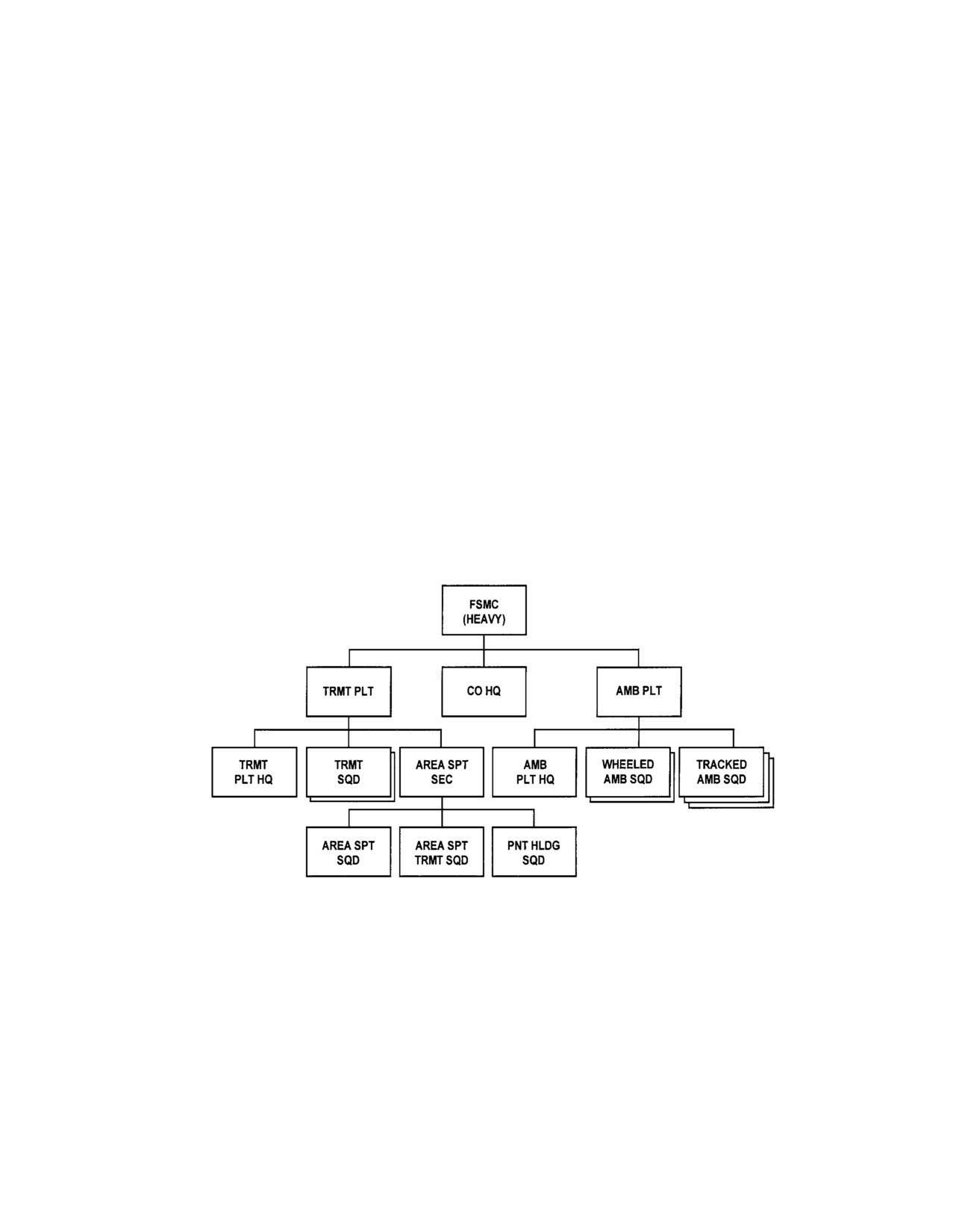
(1) The FSMC-Heavy (TOE 08058L1) (Figure 2-1) of the heavy division is organized into a
company headquarters section; a treatment platoon, (organized into a platoon headquarters with two
2-4
FM 4-02.6
independent treatment squads; an area support section with an area support squad, an area support treatment
squad), and a patient-holding squad; and an ambulance platoon. The ambulance platoon employs a platoon
headquarters with three tracked ambulance squads (six ambulances) and two-wheeled ambulance squads
(four ambulances).
(2) For vehicle retrieval and track maintenance, the company headquarters employs a 5-ton
truck wrecker.
(3) For rapid mobility of the clearing station, the treatment platoon employs three 5-ton
expansible vans (one for the area support squad and two for the area treatment squad).
(4) For communications (see Appendix I), the company employs amplitude-modulated (AM)
and frequency-modulated (FM) tactical radios, unit-level computers, a manual switchboard with wire
telephones, and digital nonsecure voice telephones (DNVTs). The company headquarters establishes an
FM radio net and an internal wire net for C2. It also establishes an AM net capability for reach-back
support.
Figure 2-1. Forward support medical company-heavy (TOE 08058L1), forward support
battalion, heavy division.
b. Forward Support Medical Company-Light.
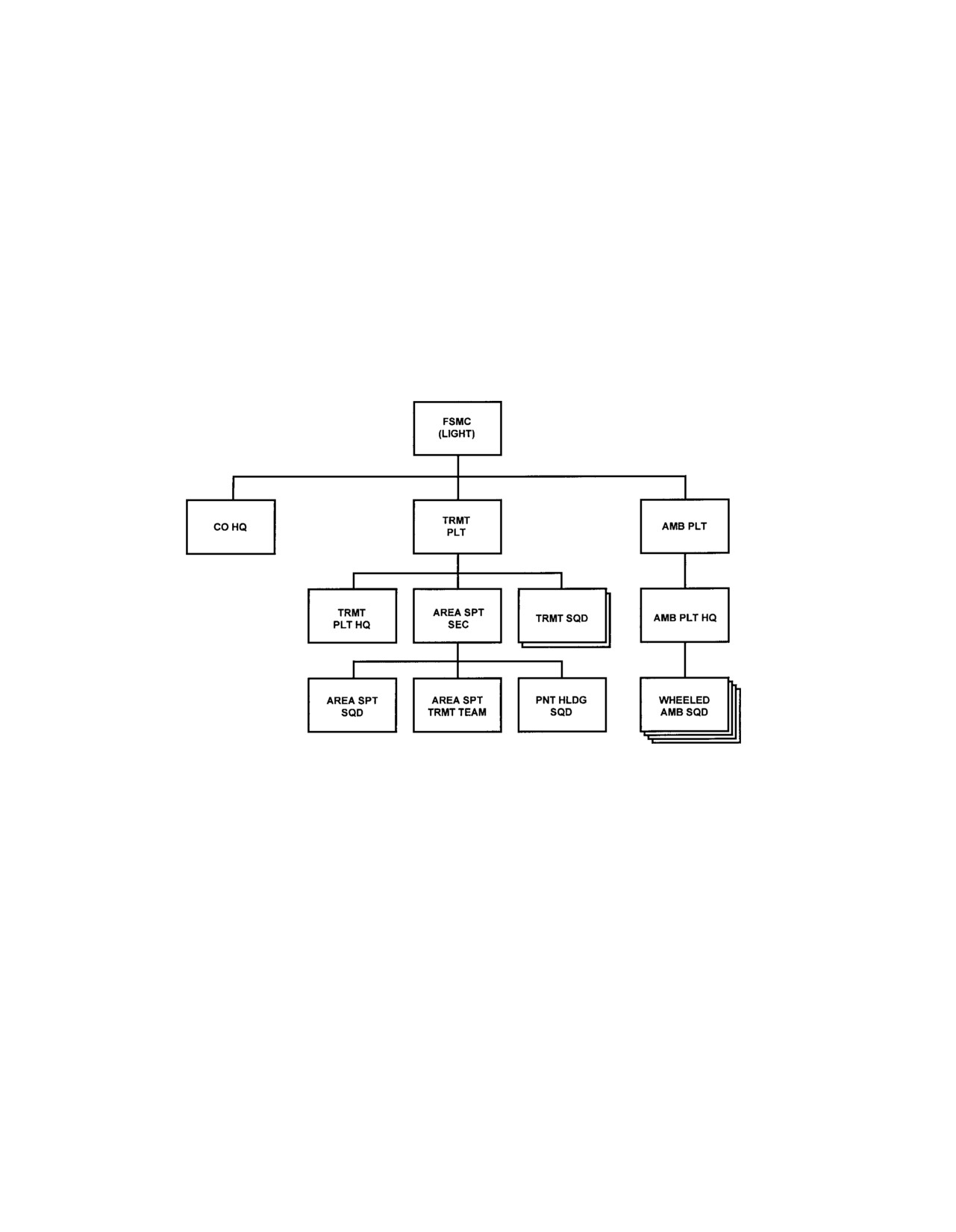
(1) The FSMC-Light (TOE 08298L0) (Figure 2-2) of the light division is organized into a
company headquarters section; a treatment platoon organized into a platoon headquarters with two
2-5
FM 4-02.6
independent treatment squads; an area support section with an area support squad, an area support treatment
team, and a patient-holding squad; and an ambulance platoon. The ambulance platoon employs a platoon
headquarters with four-wheeled ambulance squads (eight ambulances).
(2) For communications (see Appendix I), the company employs AM and FM tactical radios,
unit-level computers, a manual switchboard with wire telephones, and DNVTs. The company headquarters
establishes an FM radio net and an internal wire net for C2. It also establishes an AM net capability for
reach-back support.
Figure 2-2. Forward support medical company-light (TOE 08298L0), forward support
battalion, light division.
c.
Forward Support Medical Company-Air Assault.
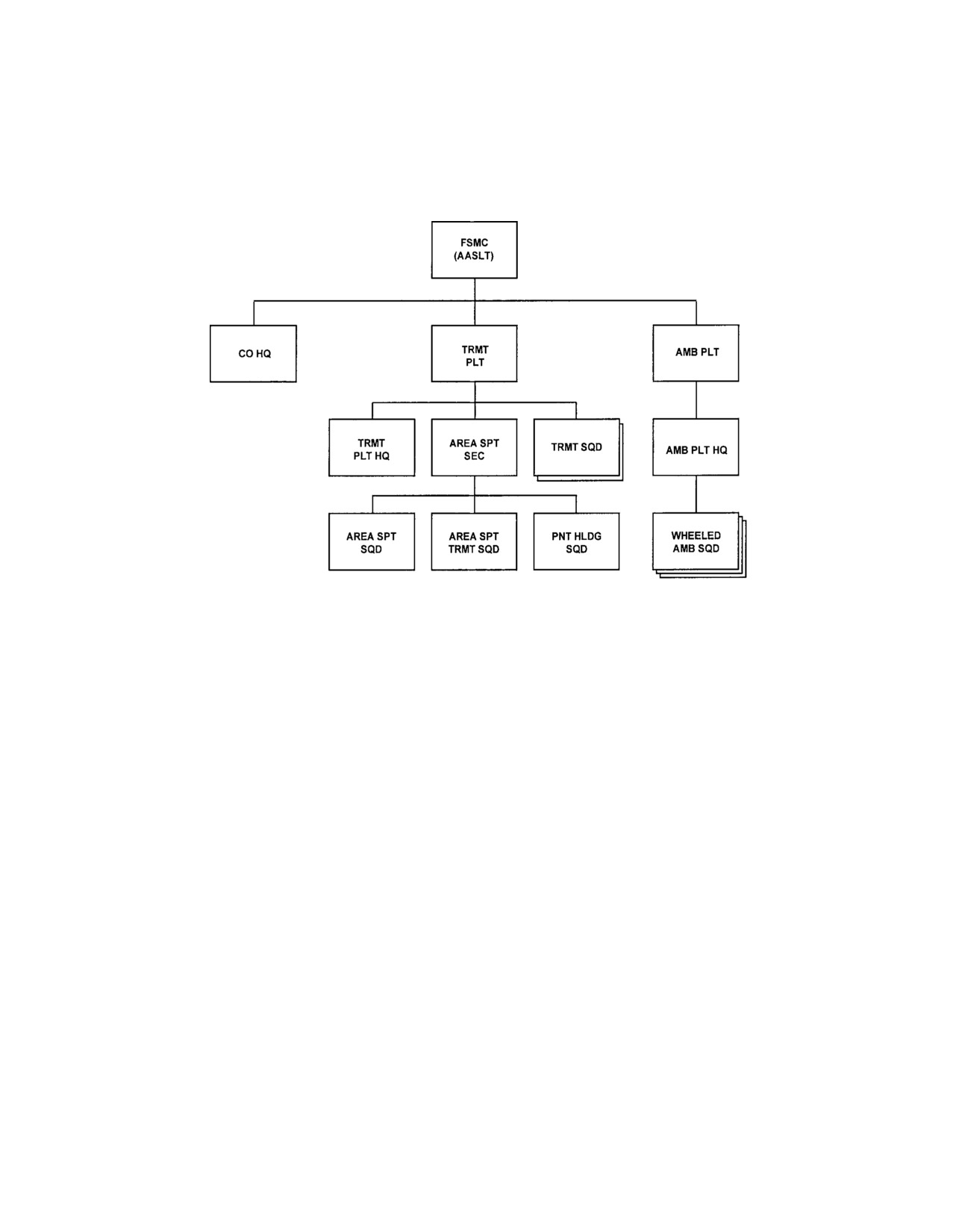
(1) The FSMC-Air Assault (TOE 08278L0) (Figure 2-3) is organized into a company
headquarters section; a treatment platoon (organized into a platoon headquarters with two treatment squads;
an area support section with an area support squad, an area support treatment squad and a patient-holding
squad); and an ambulance platoon. The ambulance platoon employs a platoon headquarters with three-
wheeled ambulance squads (six ambulances).
(2) For communications (see Appendix I), the company employs AM and FM tactical radios,
unit-level computers, a manual switchboard with wire telephones, and DNVTs. The company headquarters
establishes an FM radio net and an internal wire net for C2. It also establishes an AM net capability for
reach-back support.
2-6
FM 4-02.6
Figure 2-3. Forward support medical company-air assault
(TOE 08278L0), forward support
battalion, air assault division.
d. Forward Support Medical Company-Airborne.
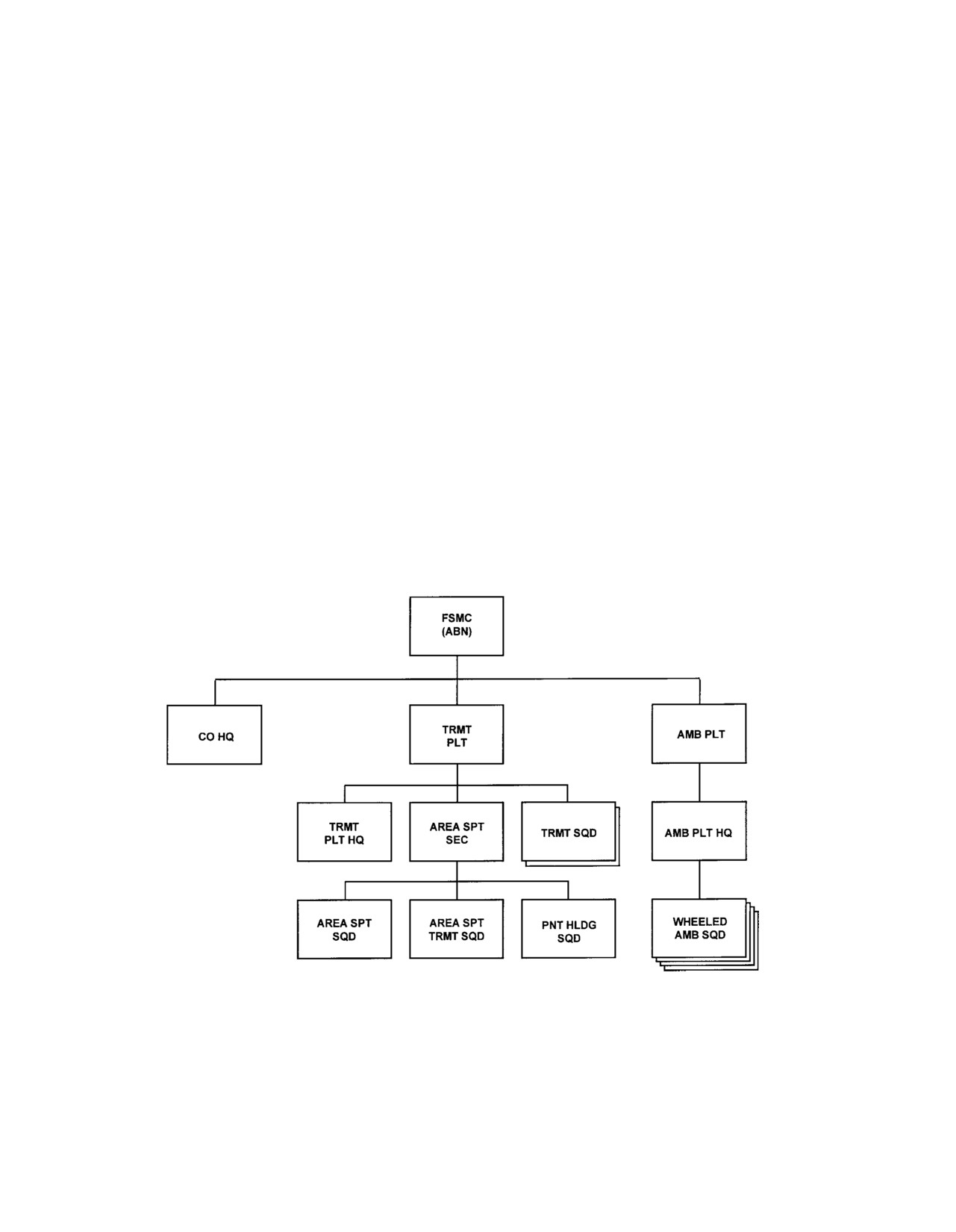
(1) The FSMC-Airborne (TOE 08268L0) (Figure 2-4) is organized into a company head-
quarters section; a treatment platoon (organized into a platoon headquarters with two treatment squads; an
area support section with an area support squad, an area support treatment squad, and a patient-holding
squad); and an ambulance platoon. The ambulance platoon employs a platoon headquarters with four-
wheeled ambulance squads (eight ambulances).
(2) For communications (see Appendix I), the company employs AM and FM tactical radios,
unit-level computers, a manual switchboard with wire telephones, and DNVTs. The company headquarters
establishes an FM radio net and an internal wire net for C2. It also establishes an AM net capability for
reach-back support.
e.
Forward Support Medical Company-Digitized/Force XXI.
(1) The FSMC-Digitized (TOE 08158F0) (Figure 2-5) is organized into a company head-
quarters element with a medical logistics (MEDLOG)/medical maintenance capability; a PVNTMED section;
a MH section; a treatment platoon (organized into a platoon headquarters with one independent treatment
squad; an area support section composed of an area support squad, an area support treatment squad, and a
patient-holding squad); and an ambulance platoon, organized into platoon headquarters with three track
ambulance squads (six ambulances), and two wheeled ambulance squads (four ambulances).
2-7
FM 4-02.6
(2) For rapid mobility of the clearing station, the treatment platoon employs three 5-ton
expansible vans (one for the area support squad and two for the area treatment squad).
(3) For communications, the company employs AM and FM tactical radios, unit-level
computers, the Force XXI Battle Command Brigade and Below (FBCB2) System (when the system becomes
available), the Medical Communications for Combat Casualty Care (MC4) System enablers, and a manual
switchboard. The company headquarters establishes an FM radio net and an internal wire net for C2. It
also establishes an AM net capability for reach-back support, and its platoons are deployed in the tactical
internet for situational understanding of its forward deployed assets. The company and its forward
supporting elements are employed in the tactical internet. For additional information on radios and
battlefield automation, see Appendix I. See also Appendix F for information on the digitization of the
medical company.
Figure 2-4. Forward support medical company-airborne (TOE 08268L0), forward support
battalion, airborne divisions.
2-8
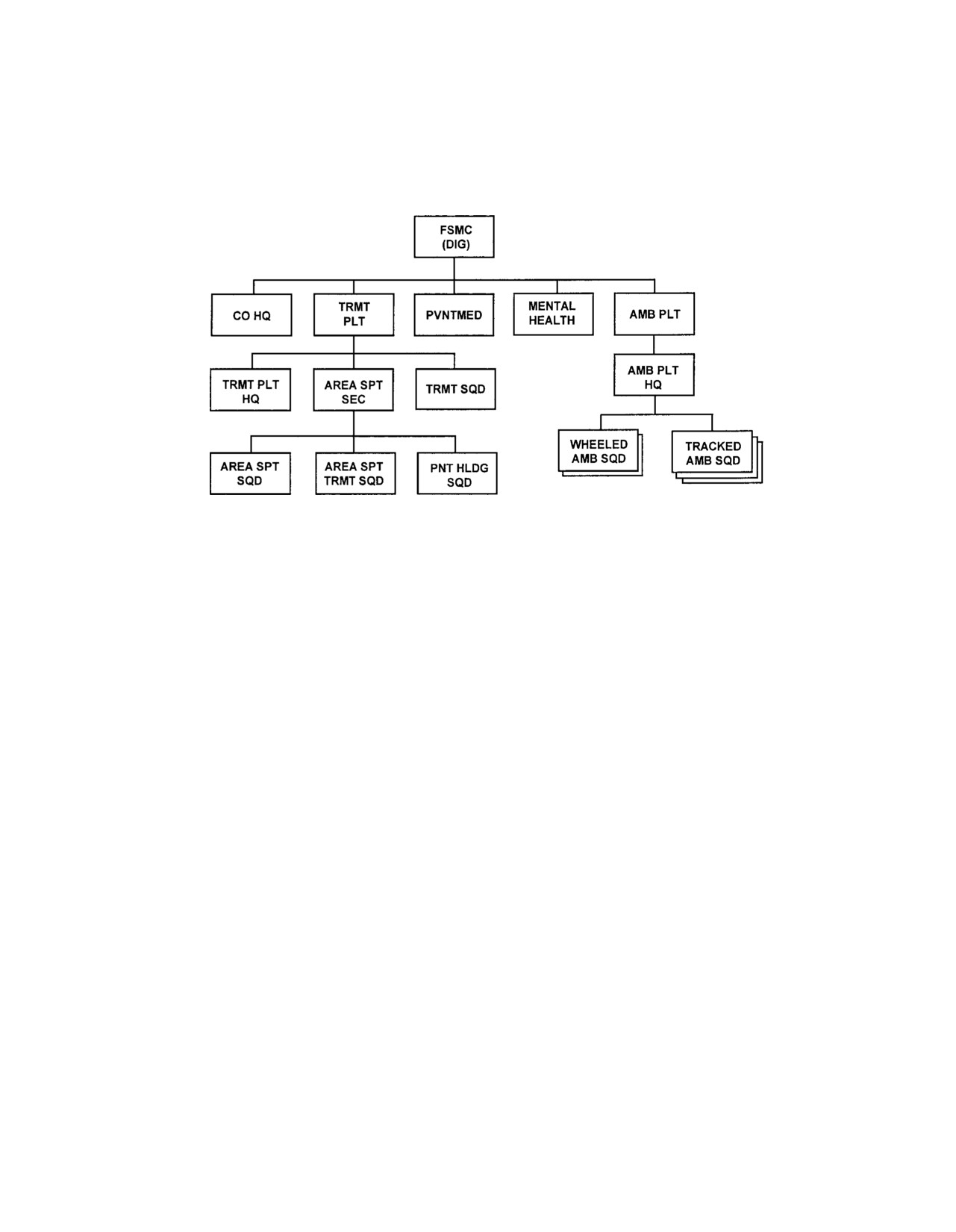
FM 4-02.6
Figure 2-5. Forward support medical company-digitized (TOE 08158F0), forward support
battalion, Force XXI division.
2-6.
Main Support Medical Company/Division Support Medical Company
a. Mission. The mission of the MSMC and DSMC is to provide Echelons I and II medical care
on an area support basis to those units without organic medical assets operating in the division support area
(DSA). These companies provide C2 for organic and attached medical elements. The MSMC/DSMC
normally locates in the vicinity of the MSB/DSB headquarters and establishes a division clearing station.
The MSMC/DSMC may provide treatment teams that can operate independently from the company for
limited periods of time.
b. Capabilities. Each MSMC/DSMC is organized to provide care for patients suffering DNBI,
BF, and trauma injuries. This medical company establishes a division clearing station/company MTF and
provides the following services:
(1) Routine sick call services, treatment of patients with DNBIs and BF, triage of MASCALs,
ATM, initial resuscitation and stabilization, and preparation of patients needing further evacuation.
(2) Ground ambulance evacuation and arrangement for air ambulance evacuation of patients
from units supported in the DSA. Also, ground ambulance evacuation for patients from an FSMC if that
company is unable to hold/treat patients due to its current mission requirements, loss of equipment and
personnel, or relocating to a new position.
(3) Operational dental care, which consists of emergency dental care and essential dental
care intended to intercept potential dental emergencies.
(4) Limited blood storage.
2-9
FM 4-02.6
(5) Class VIII resupply and unit-level medical equipment maintenance for all divisional units
and corps medical elements supporting the division.
(6) Medical laboratory and radiology services commensurate with Echelon II/division-level
treatment.
(7) Outpatient consultation services for patients referred from unit-level MTFs.
(8) Patient-holding for up to 40 patients able to RTD within 72 hours.
(9) Limited reinforcement and augmentation to FSMCs.
(10) Preventive medicine and environmental health surveillance, inspections, and consultation
services for the division.
(11) Neuropsychiatric and MH support and consultation services, to include COSC teams
and services throughout the division.
(12) Optometry services to divisional and nondivisional units on area basis.
c.
Basic Organization. The MSMC/DSMC is organized into seven basic components: a company
headquarters, a treatment platoon, an ambulance platoon, a division medical supply office (DMSO), a
PVNTMED section, a MH section, and an optometry section. The composition of each of these components
differs, depending on the type of division.
d. Dependency. Main support medical companies/DSMCs are dependent on appropriate elements
of the corps, division and DISCOM for patient evacuation (including air ambulances), CHS operational
planning and guidance, and for legal, finance, and personnel and administrative services. It is also
dependent on the FSB/DSB for food service and religious support. All of the divisional MSMCs are
dependent on the FSB for vehicle maintenance support, except for the FSMC-heavy and the DSMC-Force
XXI, which have organic maintenance assets within their company headquarters.
2-7.
Organizational Structure of Main Support Medical Company/Division Support Medical
Company
a. Main Support Medical Company-Heavy.
(1) The MSMC-Heavy (TOE 08057L0) (Figure 2-6) of the heavy division is organized into a
company headquarters section; a DMSO: a PVNTMED section, an optometry section; a MH section; a
treatment platoon organized into a platoon headquarters with four treatment squads (eight treatment teams),
an area support section with an area support squad, an area support treatment squad, and a patient-holding
squad; and an ambulance platoon. The ambulance platoon employs a platoon headquarters and five
wheeled-ambulance squads (10 ambulances).
2-10
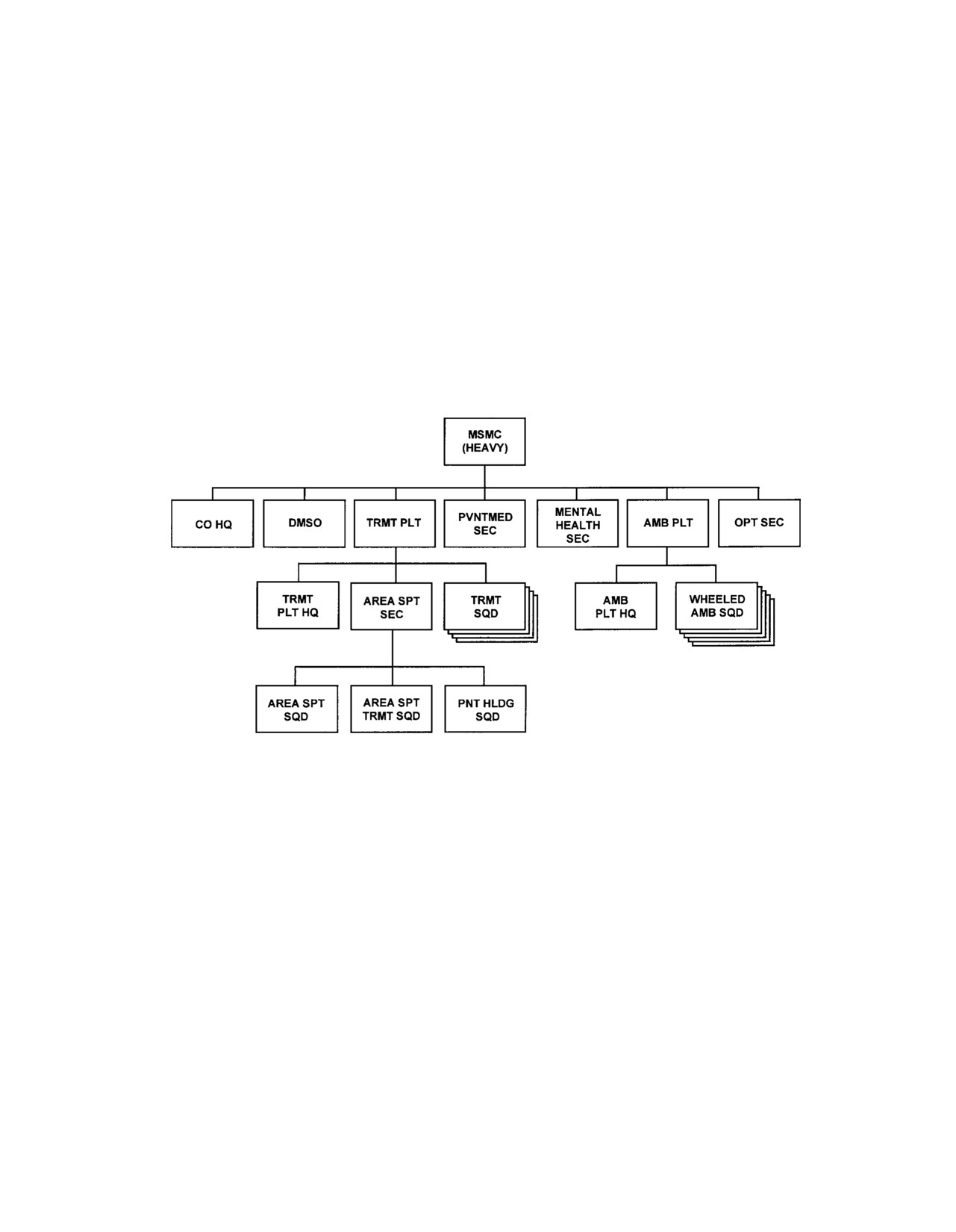
FM 4-02.6
(2) For vehicle retrieval and heavy wheeled maintenance, the company headquarters employs
a 5-ton truck wrecker (heavy division AOE units only).
(3) For rapid mobility of the clearing station, the treatment platoon employs three 5-ton
expansible vans (one for the area support squad and two for the area treatment squad).
(4) For communications (see Appendix I), the company employs AM and FM tactical radios,
unit-level computers, a manual switchboard with wire telephones, and DNVTs. The company headquarters
establishes an FM radio net and an internal wire net for C2. It also establishes an AM net capability for
reach-back support.
Figure 2-6. Main support medical company-heavy (TOE 08057L0),
main support battalion, heavy division.
b. Division Support Medical Company-Force XXI.
(1) The DSMC-Force XXI (TOE 08257F0) (Figure 2-7) is organized into a company
headquarters element with a MEDLOG and medical maintenance capability; a PVNTMED section; a MH
section; a treatment platoon (organized into a platoon headquarters with a treatment section composed of
five independent treatment teams, an area support element composed of an area support squad, an area
treatment squad, and a patient-holding squad); and an ambulance platoon that is organized into a platoon
headquarters with five wheeled ambulance squads (10 ambulances).
(2) For rapid mobility of the clearing station, the treatment platoon employs three 5-ton
expansible vans (one for the area support squad and two for the area treatment squad).
(3) For communications, the company employs AM and FM tactical radios, unit-level
computers, the FBCB2 system (when the system becomes available), the MC4 system enablers, and a
2-11
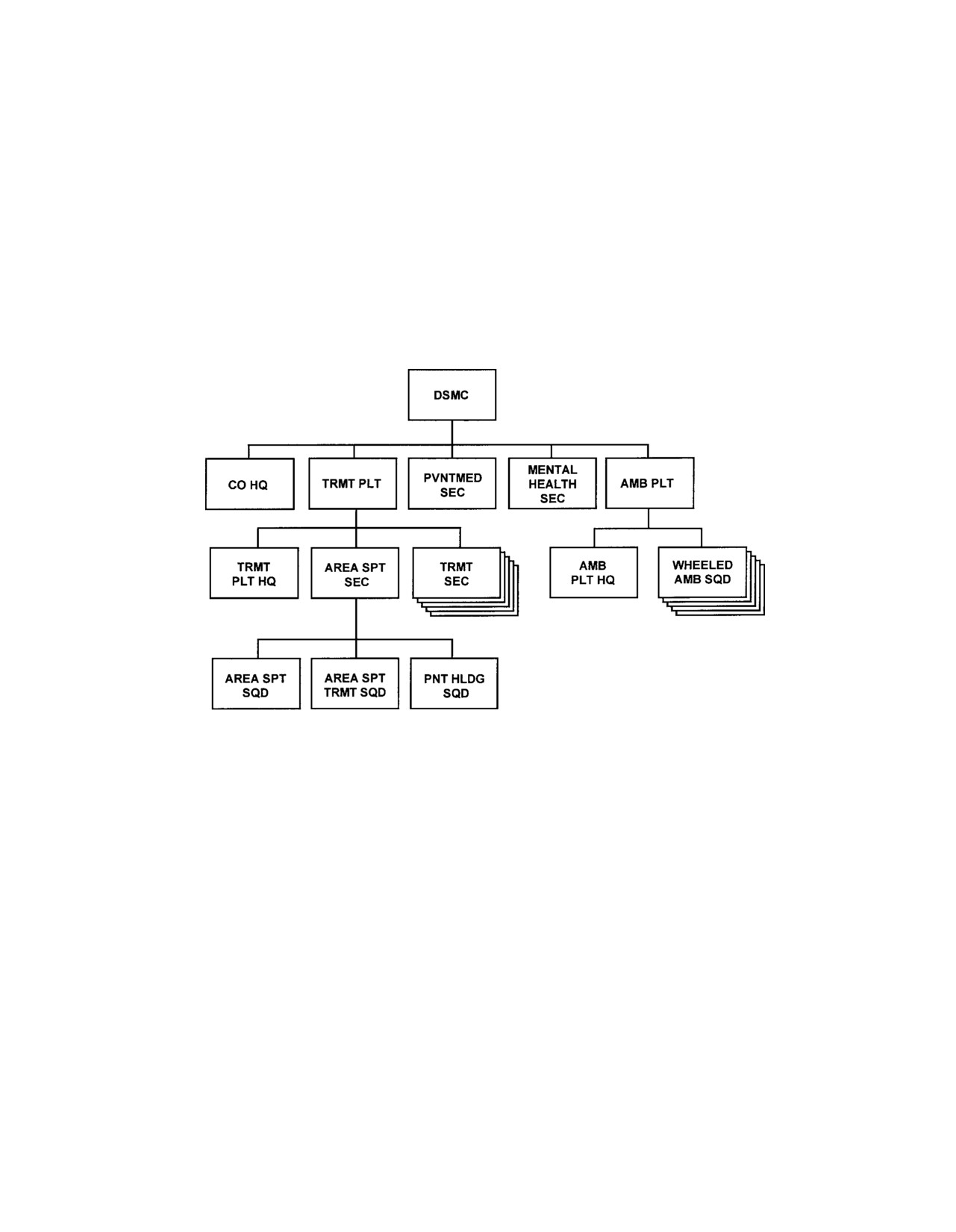
FM 4-02.6
manual switchboard. The company headquarters establishes an FM radio net and an internal wire net for
C2. It also establishes an AM net capability for reach-back support, and its platoons are deployed in the
tactical internet for situational understanding of its forward deployed assets. The company and its forward
support elements (FSEs) are employed in the tactical Internet. For additional information on radios and
battlefield automation, see Appendix I. See also Appendix F for information on digitization of medical
company.
Figure 2-7. Division support medical company-Force XXI
(TOE 08257F0),
division support battalion, Force XXI division.
c.
Main Support Medical Company-Light.
(1) The MSMC-Light (TOE 08297L0) (Figure 2-8) is assigned to the light division. It is
organized into a company headquarters section; a DMSO; a PVNTMED section; an optometry section; a
MH section; a treatment platoon (organized into a platoon headquarters with two independent treatment
squads [four treatment teams]; an area support section with an area support squad, an area treatment squad,
and a patient-holding squad); and an ambulance platoon. The ambulance platoon employs a platoon
headquarters and four wheeled-ambulance squads (eight ambulances).
(2) For communications (see Appendix I), the company employs AM and FM tactical radios,
unit-level computers, a manual switchboard with wire telephones, and DNVTs. The company headquarters
establishes an FM radio net and an internal wire net for C2. It also establishes an AM net capability for
reach-back support.
2-12
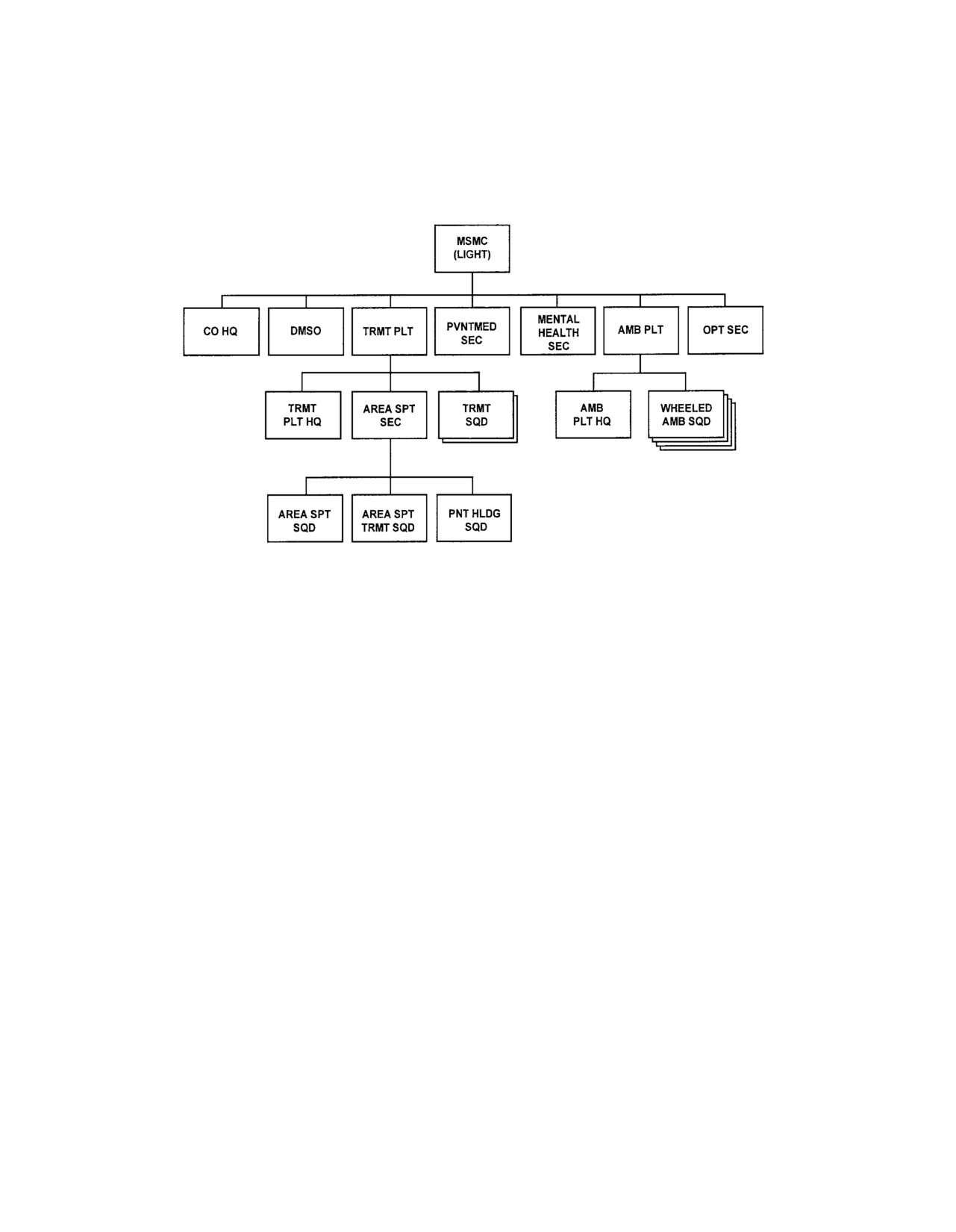
FM 4-02.6
Figure 2-8. Main support medical company-light (TOE 08297L0),
main support battalion, light division.
d. Main Support Medical Company-Air Assault.
(1) The MSMC-Air Assault (TOE 08277L0) (Figure 2-9) is organized into a company
headquarters section; a DMSO; a PVNTMED section; a MH section; and an optometry section. It employs
a treatment platoon that is organized into a platoon headquarters, an area support section composed of an
area support squad, an area support treatment squad, an FST (see note below), and a treatment squad (two
treatment teams). The company’s ambulance platoon employs a platoon headquarters and three-wheeled
ambulance squads (six ambulances).
NOTE
Operationally, the air assault FST is deployed forward in DS of a
brigade receiving heavy casualties. It is normally under the technical
control of the division surgeon with tasking through the MSB support
operations section (refer to FM 8-10-25).
(2) For communications (see Appendix I), the company employs AM and FM tactical radios,
unit-level computers, a manual switchboard with wire telephones, and DNVTs. The company headquarters
establishes an FM radio net and an internal wire net for C2. It also establishes an AM net capability for
reach-back support.
2-13
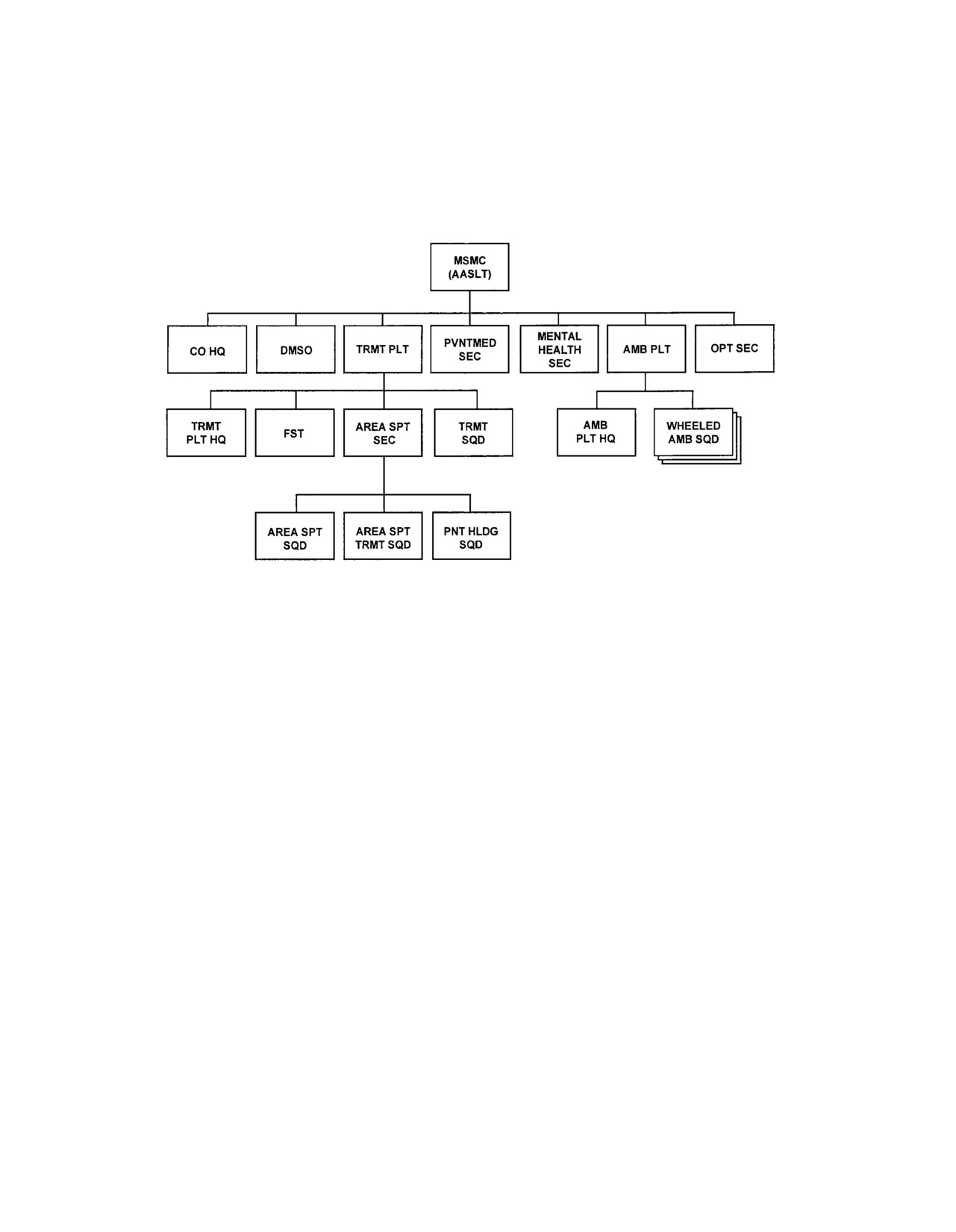
FM 4-02.6
Figure 2-9. Main support medical company-air assault
(TOE 08277L0),
main support battalion, air assault division.
e.
Main Support Medical Company-Airborne.
(1) The MSMC-Airborne (TOE 08267L0) (Figure 2-10) is organized into a company
headquarters section; a DMSO: a PVNTMED section, a MH section; and an optometry section. It employs
a treatment platoon that is organized into a platoon headquarters, an area support section composed of area
support squad, an area support treatment squad, an FST (see note below), and two independent treatment
squads (four treatment teams). The company’s ambulance platoon employs a platoon headquarters and
four-wheeled ambulance squads (eight ambulances).
NOTE
Operationally, the airborne FST is deployed forward in DS of a
brigade receiving heavy casualties. It is normally under the technical
control of the division surgeon with tasking through the MSB support
operations section.
(2) For communications (see Appendix I), the company employs AM and FM tactical radios,
unit-level computers, a manual switchboard with wire telephones, and DNVTs. The company headquarters
establishes an FM radio net and an internal wire net for C2. It also establishes an AM net capability for
reach-back support.
2-14
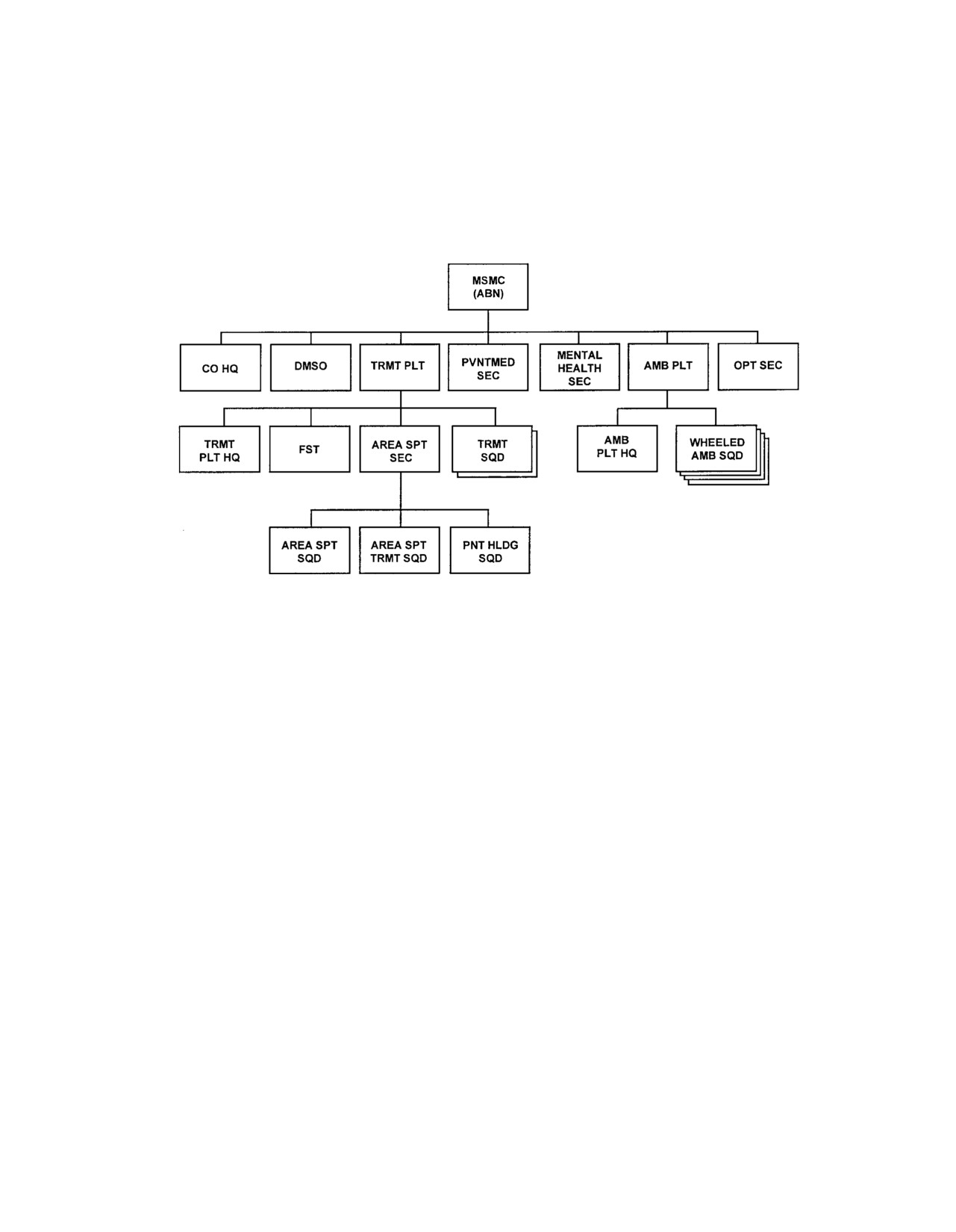
FM 4-02.6
Figure 2-10. Main support medical company-airborne (TOE 08267L0),
main support battalion, airborne division.
Section II. MEDICAL COMPANIES IN SEPARATE BRIGADES,
ARMORED CAVALRY REGIMENTS, AND INTERIM
BRIGADE COMBAT TEAMS
2-8.
Separate Brigade Overview
a. Both the staffing and the equipping of separate brigades are geared toward semi-independent
operations. They can serve as planning headquarters for larger reserve forces or major contingency
operations. Separate brigades normally conduct operations under the corps command. They can also serve
as division reinforcement for short periods. The headquarters and headquarter companies of separate
brigades include support elements that would normally be found at division.
b.
Separate brigades conduct operations like the divisional brigade; they can fight directly under
corps control or perform rear operations, flank security mission operations, or covering force operations.
They can also serve as the corps reserve, or reinforce a division. Separate brigades also have their own
cavalry troop, engineer company, military intelligence company, military police platoon, artillery battalion,
and support battalion for DS CSS with an imbedded medical company. See FM 7-30 and FM 63-1 for
detailed information on the organization and functions of the different brigades.
2-15
FM 4-02.6
2-9.
Medical Company-Heavy Separate Brigade
a. Mission. Same as paragraph 2-4a above.
b. Capabilities. Same as 2-4b above.
c.
Basic Organization. This unit is organized into seven basic components: a company head-
quarters; a treatment platoon; an ambulance platoon; a DMSO; a PVNTMED section; a MH section; and an
optometry section.
d. Dependency. The medical company-heavy separate brigade is dependent on appropriate
elements of the corps for patient evacuation (including air and ground ambulance support from the BSA). It
is dependent on its brigade and battalion headquarters for CHS operational planning and guidance and for
legal, finance, and personnel and administrative services. It is also dependent on its parent support battalion
for food service and religious support.
NOTE
The company has organic maintenance assets within its company
headquarters and should not require unit-level maintenance support.
2-10. Organizational Structure and Tactical Capabilities of the Medical Company-Heavy Separate
Brigade
a. The Medical Company, Heavy Separate Brigade (HSB) (TOE 08437L0) (Figure 2-11) is
organized into a company headquarters section; a brigade medical supply office (BMSO), a PVNTMED
section, an optometry section; a MH section; a treatment platoon, and an ambulance platoon. The treatment
platoon is organized into a platoon headquarters with three treatment squads (six treatment teams), an area
support section with an area support squad, an area treatment squad, and a patient-holding squad. The
ambulance platoon employs a platoon headquarters, three M113A1 tracked ambulance squads (six M113A1
tracked ambulances) and three-wheeled ambulance squads (6-wheeled ambulances) with a combined total of
12 ambulances.
b. For vehicle retrieval and heavy-wheeled maintenance, the company headquarters employs a
5-ton truck wrecker.
c.
For tailgate operations and rapid mobility of the clearing station, the treatment platoon employs
three 5-ton expansible vans (one for the area support squad and two for the area support treatment squad).
NOTE
The 5-ton truck wrecker and the 5-ton expansible van are also employ-
ed by medical companies (TOE 08438L000 and TOE 08438L100) of
the separate infantry brigade.
2-16
///////////////////////////////////////