FM 3-31.1 AMCI ARMY AND MARINE CORPS INTEGRATION IN JOINT OPERATIONS (NOVEMBER 2001) - page 1
*FM 3-31.1
US Army Training and Doctrine Command
Fort Monroe, Virginia
*MCWP 3-36
Marine Corps Combat Development Command
Quantico, Virginia
21 November 2001
AMCI
Army and Marine Corps Integration in Joint Operations
TABLE OF CONTENTS
Page
EXECUTIVE SUMMARY
xi
CHAPTER I
ORGANIZATION AND FUNDAMENTALS
Background
I-1
United States Army (USA) Corps
I-2
Heavy Notional Army Brigade
I-2
Marine Air-Ground Task Force (MAGTF)
I-4
Marine Expeditionary Force (MEF)
I-5
Marine Expeditionary Brigade (MEB)
I-5
Fundamentals of Army-Marine Corps Integration AMCI)
Operations
I-8
Augmentation Requirements
I-8
CHAPTER II
COMMAND AND CONTROL
Background
II-1
Terminology
II-1
Command Relationships
II-1
Organization of Forces
II-3
Liaison
II-4
Command and Control (C2) Communications
II-6
Army Tactical C2 System (ATCCS)
II-7
Notional Army Brigade C2 Organizations and Facilities
II-8
Notional Army Brigade Communications Architecture
II-10
MEB C2 Facilities
II-12
MEB Communications
II-13
AMCI Communications
II-15
*This publication supersedes FM 90-31 and MCRP 3-3.8, 29 May 1996.
iii
CHAPTER III
INTELLIGENCE
Background
III-1
Terminology
III-1
Intelligence Responsibilities
III-1
Notional Army Brigade Intelligence
III-2
Notional Army Brigade Intelligence Organizations
III-3
MAGTF Intelligence Organizations
III-6
AMCI Intelligence Operations
III-8
CHAPTER IV
MANEUVER
Background
IV-1
Notional Army Brigade Ground Maneuver Organizations
IV-1
Maneuver of the Notional Army Brigade
IV-4
MEB Maneuver Organizations
IV-6
Maneuver of the MEB
IV-8
Integrated Maneuver and Complementary Capabilities
IV-10
CHAPTER V
FIRE SUPPORT
Background
V-1
Fire Support Coordinating Measures (FSCMs)
V-1
Notional Army Brigade Fire Support Operations
V-1
Army Aviation
V-6
MEB Fire Support Operations
V-6
Integrated Fire Support Operations
V-8
CHAPTER VI
ENGINEER OPERATIONS
Background
VI-1
Terminology
VI-1
Notional Army Brigade Operations
VI-1
MEB Engineer Operations
VI-2
Integrated Engineer Operations
VI-8
CHAPTER VII
AVIATION
Background
VII-1
Army Aviation Overview
VII-1
Capabilities and Limitations
VII-4
Command and Control
VII-5
Planning Considerations
VII-7
Marine Aviation
VII-12
Aviation Combat Element
VII-12
Marine Aviation Functions
VII-13
Notional Army Brigade Under MEF Control
VII-22
MEB Under Army Corps Control
VII-24
Communications Integration
VII-29
iv
CHAPTER VIII
AIR AND MISSILE DEFENSE
Background
VIII-1
Integrated Army and Marine Corps Air and Missile
Defense Operations
VIII-1
Army Air and Missile Defense Operations
VIII-7
MEB Operations
VIII-12
Command and Control
VIII-12
MAGTF Air and Missile Defense Organizations and
Equipment
VIII-13
CHAPTER IX
ADMINISTRATION AND LOGISTICS
Background
IX-1
Authority for Logistics Operations
IX-1
Joint Logistics Functions
IX-2
Notional Army Brigade Logistics Organizations
IX-2
Notional Army Brigade Logistics Operations
IX-12
MEF Logistics Organizations
IX-14
MEB Logistics Operations
IX-19
Integrated Logistics
IX-21
Logistics Status Reporting
IX-30
APPENDIX A
UNITED STATES ARMY CORPS
A-1
APPENDIX B
MARINE AIR-GROUND TASK FORCES (MAGTFs)
B-1
APPENDIX C
REPORTING FORMATS
C-1
REFERENCES
References-1
GLOSSARY
Glossary-1
INDEX
Index-1
FIGURES
I-1
Notional Army Brigade
I-3
I-2
Notional Marine Corps Expeditonary Brigade
I-6
III-1
Notional Army Brigade Direct Support
Military Intelligence (MI) Company
III-4
III-2
Intelligence and Reconnaissance Units/Assets
III-6
III-3
MEF G-2 Section
III-7
III-4
Intelligence Battalion
III-7
IV-1
Notional Army Brigade Mechanized Infantry
Battalion
IV-2
IV-2
Notional Army Brigade Tank Battalion
IV-3
IV-3
Marine Infantry Regiment
IV-7
IV-4
Light Armored Reconnaissance Company
IV-8
V-1
Notional Army Brigade Fire Support Coordination
Organizations
V-2
v
V-2
Notional Army Brigade Field Artillery Organization
V-3
V-3
Multiple Launch Rocket System (MLRS) Battery
V-5
V-4
Notional MEB Artillery Battalion
V-7
V-5
Marine Air Command and Control System (MACCS)/
Force Fires Coordination Center (FFCC) /Fire Support
Coordination Center (FSCC) Relationships
V-8
VI-1
Notional Army Brigade Engineer Battalion
VI-2
VI-2
Notional MEB Engineers
VI-3
VI-3
MEB Ground Combat Element (GCE) Combat
Engineer Company
VI-4
VI-4
MEB Air Combat Element (ACE) Marine Wing Support
Squadron
VI-5
VI-5
MEB Brigade Service Support Group (BSSG)
Engineer Company
VI-7
VII-1
Notional MEF ACE Organization
VII-13
VII-2
Close Air Support (CAS) Request Procedures
VII-16
VII-3
Helicopter Support Team (TM)
VII-20
VII-4
US Army/USMC Air Operations Connectivity
VII-25
VII-5
CAS/Air Interdiction (AI) Support Request
Channels
VII-26
VII-6
Immediate CAS Request Channels
VII-27
VII-7
Airlift Support Request Channels
VII-28
VIII-1
Dissemination Measures Between Corps and
MEB
VIII-6
VIII-2
Dissemination Measures Between the MEF and
Notional Army Brigade
VIII-6
VIII-3
Notional Army Brigade Air Defense Artillery (ADA)
Organization
VIII-9
VIII-4
Corps ADA Brigade Organization
VIII-10
IX-1
Forward Support Battalion
IX-2
IX-2
Sample Corps Support Group (-)
IX-7
IX-3
Notional Brigade Service Support Group
IX-16
IX-4
Aviation Combat Element Logistics Organization
IX-18
IX-5
Logistics C2 Notional Army Brigade Under MEF
IX-22
IX-6
Notional Combat Support Battalion in
Support of a MEB
IX-22
IX-7
MEB Logistics C2 Under Corps Control
IX-23
A-1
Notional US Army Corps
A-1
A-2
Heavy Armored Cavalry Regiment
A-2
TABLES
I-1
Notional Army Brigade Capabilities
and Limitations Summary
I-4
I-2
Capabilities and Limitations of the MEB
I-8
I-3
Notional Army Brigade Augmentation Requirements
I-9
I-4
MEB Augmentation Requirements
I-10
II-1
Liaison Requirements from Notional Army
Brigade to MEF
II-5
II-2
Liaison Requirements from MEF to
Notional Army Brigade
II-5
vi
II-3
Liaison Requirements from MEB to Corps
II-6
II-4
Liaison Requirements from Corps to MEB
II-6
II-5
Notional Army Brigade Command Group Functions
and Characteristics
II-9
II-6
Notional Army Brigade Tactical CP Functions and
Characteristics
II-9
II-7
Notional Army Brigade Main CP Functions and
Characteristics
II-10
II-8
Notional Army Brigade Rear CP Functions and
Characteristics
II-10
II-9
Notional Army Brigade Signal Platoon
Capabilities/Limitations Summary
II-11
II-10
Notional Army Brigade Signal Section
Capabilities/Limitations Summary
II-11
II-11
MEB DS Communications Company (Reinforced)
Capabilities and Limitations Summary
II-14
II-12
Typical Communications Systems Available
from Marine Corps DS Communications Company
(Reinforced) and Notional Army Brigade Signal
Section
II-15
III-1
Notional Army Brigade Operations Platoon
Capabilities
III-5
III-2
Intelligence Battalion Capabilities
III-8
III-3
Notional Army Brigade Collection/Electronic Warfare
(EW) Capabilities
III-9
III-4
MEB Collection/EW Capabilities
III-10
IV-1
M2 Bradley Fighting Vehicle Characteristics
IV-2
IV-2
M1064A3 (120mm) Mortar Characteristics
IV-3
IV-3
M1A1 Abrams Tank Characteristics
IV-4
IV-4
Notional Army Brigade Maneuver Space
Requirements
IV-5
IV-5
Unopposed Movement Rates
IV-6
IV-6
MEB Mobility Assets
IV-9
IV-7
AMCI Operations Complementary Capabilities
(Amphib Operations/Passage of Lines)
IV-10
IV-8
AMCI Operations Complementary Capabilities
(Movement to Contact)
IV-11
IV-9
AMCI Operations Complementary Capabilities
(Attack)
IV-11
IV-10
AMCI Operations Complementary Capabilities
(Breaching/River Crossing Operations)
IV-12
IV-11
AMCI Operations Complementary Capabilities
(Defend)
IV-13
IV-12
AMCI Operations Complementary Capabilities
(Retrograde)
IV-14
IV-13
Opposed Rates of Movement in Km/h
IV-15
IV-14
Major Weapons and Aircraft Summary
IV-17
V-1
Army Fire Support Coordination Organizations and
Coordinators
V-1
vii
V-2
Firepower Comparison of MLRS and
155mm Howitzer
V-4
V-3
MEB Target Acquisition Assets
V-8
V-4
Inherent Responsibilities of Artillery Standard
Tactical Missions
V-10
V-5
Characteristics of MEB and Notional Army
Brigade Artillery
V-11
V-6
MLRS Ammunition Planning Figures
V-14
V-7
Notional Army Brigade Artillery External
Communications Net Structure When Operating
with MEF
V-16
V-8
MEB Artillery External Communications Net
Structure When Operating with Corps
V-17
VI-1
Notional Army Brigade Engineer Battalion
Equipment
VI-2
VI-2
Notional Combat Engineer Company (Reinforced)
Equipment in Support of a MEB GCE
VI-4
VI-3
Marine Wing Support Squadron (MWSS)
(Fixed-Wing) Engineer Equipment
VI-6
VI-4
Notional Engineer Company (Reinforced)
Equipment in Support of a MEB BSSG
VI-7
VI-5A
Mobility Tasks
VI-8
VI-5B
Countermobility Tasks
VI-9
VI-5C
Survivability Tasks
VI-9
VI-5D
General Engineering Tasks
VI-10
VII-1
Possible Army Aviation Task Force
VII-2
VII-2
Army Aviation Missions
VII-3
VII-3
Army Aviation Capabilities and Limitations
VII-4
VII-4
Aviation Deep Operations GO/NO-GO
Planning Matrix
VII-9
VII-5
Asset Capabilities for Antiair Warfare Tasks
VII-14
VII-6
TACP/FACP Personnel
VII-19
VII-7
MEB Fixed-Wing Aircraft Capabilities
VII-21
VII-8
MEB Rotary-Wing Aircraft Capabilities
VII-22
VII-9
Army Aviation Aircraft Capabilities and
Limitations
VII-23
VII-10
Army Aviation Communications Equipment
Summary
VII-31
VII-11
USAF/USMC/USN Fixed-Wing Aircraft
Communications Summary
VII-32
VII-12
TACP/FAC Communications Equipment
VII-33
VIII-1
Inherent Responsibilities of Air Defense
Standard Tactical Missions
VIII-3
VIII-2
Types and Capabilities of Army ADA Weapons
VIII-7
IX-1
FSB Supply Company Capabilities/Major
Equipment
IX-3
IX-2
MSB Augmentation of Notional Army Brigade
IX-5
IX-3
Corps Direct Support (DS) Supply Capabilities
IX-9
IX-4
Supply Company (DS) Major Equipment
IX-9
viii
IX-5
Ammunition Company (DS) Major Equipment
IX-10
IX-6
Maintenance Company (DS) Capabilities
IX-10
IX-7
Maintenance Company (DS) Major Equipment
IX-11
IX-8
Combat Service Support Organizations
IX-15
IX-9
Illustrative Class III Consumption Rates
IX-26
ix
THIS PAGE INTENTIONALLY LEFT BLANK
x
EXECUTIVE SUMMARY
Army and Marine Corps Integration (AMCI) in Joint Operations
This publication-
• Provides multiservice tactics, techniques, and procedures focusing
on the integrated employment of United States Army (USA) and
United States Marine Corps (USMC) forces.
• Provides various operational tools for commanders and joint
planners in task-organizing Army and USMC forces.
Our national military strategy recognizes today’s uncertain world requires flexible
and interoperable forces that can respond quickly to the multitude of potential crises
that may threaten United States vital national interests. To respond to these crises,
the nation’s evolving force structure must be both capable and responsive to
implement and enforce the strategy that will protect our national interests. The
exact composition of a given force depends on the nature of the crisis and the
prevailing strategic politico-military environment. Such “adaptive force packaging”
seeks to maximize the capabilities of operational execution. This publication focuses
on one type of force packaging available to the joint warfighting community: the
integrated employment of Army and USMC forces.
Chapter I
Organization and Fundamentals
Chapter I provides an overview of selected Army and USMC forces, and describes
the organization, capabilities, and limitations of a notional Army brigade and a
Marine Expeditionary Brigade (MEB). It also discusses the fundamentals of
integrated operations to maximize the capabilities of one force to counterbalance the
vulnerabilities of the other.
Chapter II
Command and Control
Chapter II provides an overview, principals, and responsibilities of communications.
It describes command and control (C2) organizations, facilities, and communications
architecture of both a notional Army brigade and MEB.
Chapter III
Intelligence
Chapter III addresses intelligence support of AMCI operations. It highlights
selected terms and defines the responsibilities of the various intelligence
organizations that support the joint force.
xi
Chapter IV
Maneuver
Chapter IV defines maneuver at the operational and tactical levels of war and
describes a joint Army-USMC perspective on maneuver. It focuses on maneuver
from both a notional Army brigade and MEB and includes a discussion of maneuver
from an integrated vantage point. Specific topics include: AMCI operational
capabilities, tactical planning considerations, recommended employment options,
and a recapitulation of major weapons systems and aircraft.
Chapter V
Fire Support
Chapter V defines fire support operations. It discusses Army and USMC service
perspectives on fire support, selected coordinating measures, and fire support
tactics, techniques and procedures to support integrated combat operations.
Chapter VI
Engineer Operations
Engineers provide commanders with significant capabilities to assist them in
multiplying the battle effectiveness of both maneuver and fire. Chapter VI describes
engineer support to combat operations. It establishes common terminology and
addresses Army and USMC engineer C2, organizations, and equipment. It also
offers an integrated approach to planning and executing those operations by cross-
walking engineering capabilities regarding the four common primary functions of
mobility, countermobility, survivability, and general engineering.
Chapter VII
Aviation
Chapter VII familiarizes commanders and staffs on the mission, capabilities,
limitations, C2, and planning factors for employment of respective service aviation
organizations. It also describes AMCI operational and augmentation requirements.
Chapter VIII
Air and Missile Defense
Chapter VIII addresses joint force air and missile defense operations. It provides
the basis for a common lexicon and details operations from Army and USMC
perspectives.
Chapter IX
Administration and Logistics
Chapter IX defines authority, responsibilities, and control of logistics supporting the
joint force. This chapter also includes a discussion of integrated logistics using the
six logistics functions as the framework (supply, maintenance, health services,
transportation, other services, and civil engineering).
xii
PROGRAM PARTICIPANTS
The following commands and agencies participated in the development of this
publication:
Commandant
United States Army command and General Staff College
ATZL-FD-CD
1 Reynolds Ave
Fort Leavenworth, KS 66027-1352
Commandant
United States Army Infantry School
ATTN: ATSH-ATD
Fort Benning, GA 31905-5000
Commandant
United States Army Engineer School
ATTN: ATSE-DOT
Fort Leonard Wood, Mo 65473-8929
Commandant
United States Army Signal Center and School
ATTN: ATZH-CDC
Fort Gordon, GA 30905-5090
Commandant
U.S. Army Field Artillery School
ATTN: ATSF-DDD
Fort Sill, OK 73503-5600
Commandant
United States Army Armor School
ATTN: ATZK-MW-DTD
Fort Knox, KY 40121-5200
Commandant
United States Army Air Defense Artillery School
ATTN: ATSA-DT
Fort Bliss, TX 79916-3802
United States Army Combined Arms Support Command and Fort Lee
ATN: ATCL-CDD
3901 A Avenue
Fort Lee, VA 23801
xiii
Marine Corps Combat Developments Command
Joint Doctrine Branch
3300 Russell Road, 3rd Floor, Suite 318A
Quantico, VA 22134-5021
HQDA, ODCSOPS (DAMO-SSP)
400 Army Pentagon
Washington D.C. 20310-0400
HQ INSCOM
ATTN: IAOP-SP
Fort Belvoir, VA 22060
xiv
Chapter I
ORGANIZATION AND FUNDAMENTALS
“The nature of modern warfare demands that we fight as a team
Effectively integrated joint forces expose no weak points or seams to
enemy action, while they rapidly and efficiently find and attack enemy
weak points
”
(Joint Publication (JP) 1, Joint Warfare of the Armed Forces of the United
States)
1. Background
Given the expanse of options available to joint planners in task-organizing
United States Army (USA) and United States Marine Corps (USMC) forces, this
publication provides two “base cases” for discussion. These two cases focus on
command and control (C2) of a notional army brigade by a Marine Expeditionary
Force (MEF) and C2 of a notional Marine Expeditionary Brigade (MEB) by an Army
corps.
a. Notional Army Brigade. The notional army brigade serves as the centerpiece
for the discussions that follow. Throughout this text, notional army brigade refers to
a tailored, early-deploying armor-heavy/mechanized force. The Army has four
different types of divisions: light, heavy, airborne, and air assault. The most likely
scenario for Army and USMC contingencies is the use of a brigade from a heavy
division. See Appendix A, United States Army Corps, for an overview of other Army
forces that may employ with USMC forces. The rationale for using the notional army
brigade is threefold:
(1) A notional army brigade will likely be the initial mechanized force
deployed in a contingency situation requiring a mechanized capability.
(2) Notional army brigades are ideally suited to deploy and linkup with
prepositioned Army equipment.
(3) Notional army brigades feature unique capabilities that complement
USMC capabilities.
b. Notational MEB. Throughout this text, MEB refers to Marine Air-Ground
Task Force (MAGTF) outlined in Marine Corps Bulletin 3501. This MEB is centered
around the equipment and supplies loaded on the ships of a Maritime Prepositioning
Ship Squadron (MPSRON). This MEB is also commonly referred to as a Maritime
Prepositioning Force (MPF) Brigade. For the sake of consistency, any reference to
amphibious operations will be based on the pretense that the Marines and
equipment of this notional MEB are embarked on amphibious shipping. See
Appendix B, Marine Air-Ground Task Forces (MAGTFs) for an overview of different
type USMC forces that may employ with Army forces.
I-1
2. United States Army (USA) Corps
The corps, commanded by a lieutenant general, is designed to conduct operations
at the tactical or operational level of war and normally fights as part of a larger joint
or multinational force within the context of campaigns or major operations. See
Appendix A and Field Manual (FM) 3-100.1 (100-15), Corps Operations, for further
information.
a. Composition. Because corps differ in size and composition, there is no
standard organization. Depending on the preponderance of armored, mechanized, or
light infantry combat units, a corps can be characterized as heavy, light, or mixed.
Corps are tailored for the specific requirements of the mission. Generally, a corps
consists of:
(1) Two to five divisions
(2) A corps aviation brigade
(3) Corps artillery
(4) A multifunctional corps support command (COSCOM)
(5) A number of combat, combat support (CS), and combat service support
(CSS) units that can range in size from companies to brigades.
3. Heavy Notional Army Brigade
The heavy notional army brigade is organized to fight successive battles on any
part of the battlefield in conventional, nuclear, or chemical environments. This kind
of unit features the mobility, firepower, and survivability needed to destroy enemy
forces by fire and maneuver and disrupt enemy operations by fire. An Army brigade
is commanded by a colonel.
a. Organization. There is no standard organization for an Army brigade. A
notional army brigade is used in this publication to show what forces may compose a
brigade during operations in which it may be integrated with the Marine Corps.
Specific composition depends on the following:
(1) Strategic situation
(2) Nature of the contingency mission
(3) Forces available
(4) Mission, enemy, terrain and weather, troops and support available, and
time available (METT-T/METT-TC) analysis of the particular situation that required
the deployment and employment of the brigade.
I-2
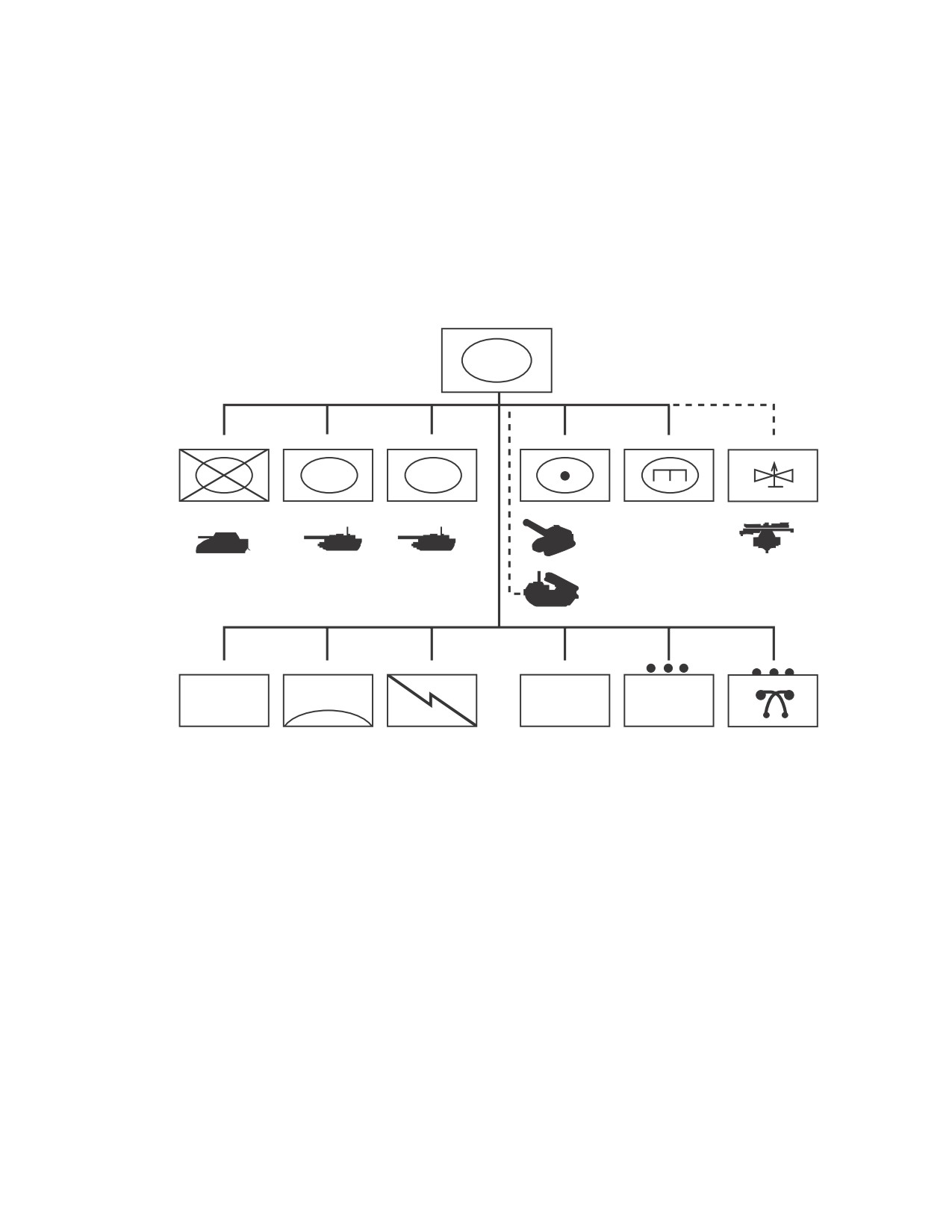
(Note: The Army uses METT-TC, adding civil considerations as a sixth area
of analysis. Civil considerations relate to the attitudes and activities of the
civilian leaders, populations, and organizations within an area of operations
and the impact they have on the conduct of military operations.)
Figure I-1 represents a notional army brigade. The model is not absolute for the
units or types and quantities of weapons portrayed; its function is to serve as a
common point of departure for subsequent discussions throughout the publication.
Figure I-1. Notional Army Brigade
Note: This is a notional organization. These assets will be provided according to
METT-T/METT-TC and availability. It will be difficult for the Army to provide
the multiple launch rocket system (MLRS) battery and the aviation battalion.
b. Capabilities and Limitations. The notional army brigade performs missions
assigned by higher headquarters and conforms to that commander’s intent and
concept of operation. Although capable of acting independently, the brigade
normally conducts operations as part of a larger force. Table I-1 lists capabilities
and limitations of the notional army brigade.
I-3

Table I-1. Notional Army Brigade Capabilities and Limitations Summary
Capabilities
Limitations
•
C2 up to five ground and air maneuver
•
Mobility restricted by jungle and dense
battalions and supporting CS and CSS
forests, steep and rugged terrain, and
units
significant water obstacles
•
Conduct range of sustained offensive
•
Brigade consumes significant
and defensive combat operations
quantities of Class III, V, and IX supplies
•
Conduct covering force operations
•
Strategic mobility limited by
•
Conduct security operations
available air and sea lift
•
Penetrate enemy forward defenses and
•
Bridging capability limited and comes
rapidly maneuver to operational depths
from the reserves
•
Combine effects of inherent maneuver
•
Heavy dependence on radio and digital
speed and firepower to exploit
communications
opportunities for decisive action
•
Significant logistics support required for
•
Pursue and destroy enemy forces
long administrative ground moves
•
Conduct defensive operations of delay
•
Capability for dismounted operations
•
Rapidly conduct linkup operations
limited
•
Perform as multinational reserve
•
Logistics lines of communications (LOCs)
•
Perform role as breakout/counterattack
dependent and vulnerable to enemy
force in forcible entry operations
activity
•
Assist breakout of encircled forces
•
No forcible entry assault capability
•
Aviation assets may not be available
•
Deliberate decontamination capability
limited
•
No airmobile operations capability
without lift helicopter support (helicopter
mix provided) and additional training.
•
Limited organic intelligence, surveillance,
and reconnaissance (ISR) capability
4.
Marine Air-Ground Task Force (MAGTF)
The specific composition of MAGTFs depends upon the requirements of a
particular mission, but the basic organization is standard. Each MAGTF consists of
a command element (CE), a ground combat elements (GCE), an aviation combat
element (ACE), and a combat service support element (CSSE).
a. CE. The CE consists of the MAGTF commander, an executive staff,
headquarters sections, communications, and other service support sections. The CE
serves as the focal point for MAGTF operational execution in coordinating and
directing the efforts of assigned aviation, ground, and CSS forces.
b. GCE. The GCE is task organized around combat and CS units and can range
in capability and size from a single reinforced rifle company to one or more
reinforced Marine divisions (MARDIVs).
c. ACE. The ACE plans and executes air operations for the MAGTF. Marine
aviation functions include air reconnaissance, antiair warfare, assault support,
offensive air support, electronic warfare (EW), and control of aircraft and missiles.
The ACE varies in size from a reinforced helicopter squadron to one or more Marine
I-4
Air Wings (MAWs). Like the GCE, the ACE is also task organized with appropriate
CS and CSS.
d. CSSE. The CSSE is task organized to provide the necessary CSS to
accomplish the MAGTF mission. Based on situational requirements, CSSEs vary in
size from an expansive Force Service Support Group (FSSG) that supports a MEF to
the Marine Expeditionary Unit (MEU) Service Support Group (MSSG) that supports
a MEU.
5. Marine Expeditionary Force (MEF)
The MEF, the largest MAGTF, is the Marine Corps’ primary warfighting force.
The MEF may consist of one or more MARDIVs, one or more MAWs, and possibly
more than one FSSG. An MEF (single division/wing/FSSG) features approximately
55,000 Marine Corps and Navy personnel, 300 fixed and rotary-wing aircraft, 300
combat vehicles, and 72 artillery pieces.
6. Marine Expeditionary Brigade (MEB)
The specific composition depends on the same conditions that dictate the task
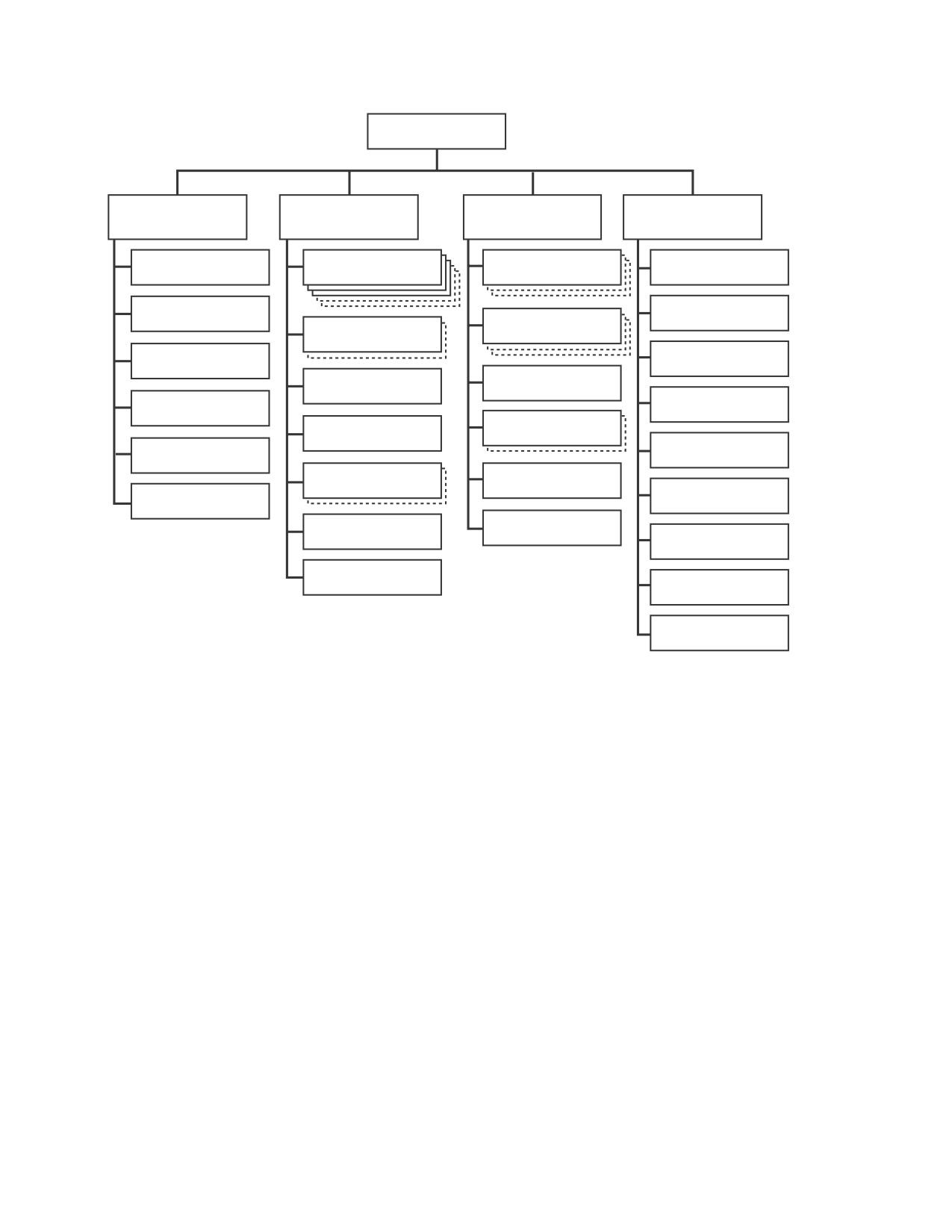
organization of the notional army brigade described earlier. Figure I-2 shows the
organization of a notional MEB. As with the notional army brigade, the model is not
absolute for the units or types and quantities of weapons portrayed but designed to
serve as a common point of departure for ensuing discussions. The MEB is the mid-
sized MAGTF and is normally commanded by a brigadier general. The MEB bridges
the gap between the MEU at the tip of the spear, and the MEF, our principal
warfighter. Like all MAGTFs, the MEB is comprised of the CE, GCE, ACE, and
CSSE. The GCE is normally a reinforced infantry regiment while the ACE is
centered on a composite Marine Aircraft Group (MAG), comprised of both rotary and
fixed-wing assets. The CSSE is commonly referred to as a Brigade Service Support
Group (BSSG) and is capable of sustaining the fighting force for approximately 30
days.
a. Mission. The MEB mission is to plan, coordinate, and conduct sustainable
combined arms combat and other expeditionary operations across the spectrum of
conflict. MEB tasks include:
(1) Independent operations ranging from forcible entry to humanitarian
assistance.
(2) Deployment to Commander in Chief ’s (CINC) area of responsibility (AOR)
as part of joint or combined force
(3) Providing a nucleus Joint Task Force Headquarters (JTF HQ)
(4) Enabling follow-on forces
(5) Being prepared to act as the Marine Corps Service Component
(6) Being prepared to serve as the advance echelon of a MEF
I-5
MEB
GROUND COMBAT
AVIATION COMBAT
COMBAT SERVICE
COMMAND ELEMENT
ELEMENT (REIN
ELEMENT
SUPPORT ELEMENT
(CE)
INFANTRY REGT)
(COMPOSITE MAG)
(BSSG)
VMFA/VMFA
MHG DET
INFANTRY
HEADQUARTERS
ALL WEATHER (AW)
CIVIL AFFAIRS
TRANSPORTATION
VMM/HMM
TANK COMPANY
COMMUNICATION
SUPPLY COMPANY
ASSAULT AMPHIBIAN
VMAQ VMGR
COLLECTION
FORCE RECON
MARINE WING
LIGHT ARMORED
BULK FUEL COMPANY
RADIO BN
ARTILLERY BATTALION
MARINE AIR
MAINTENANCE
INTELLIGENCE BN DET
MARINE AVIATION
RECONNAISSANCE BN
ENGINEER SUPPORT
COMBAT ENGINEER
DENTAL DETACHMENT
SURGICAL SUPPORT
Figure I-2. Notional Marine Corps Expeditionary Brigade
b. MEB Command Element. The MEB command element provides C2 for
elements of the MEB. It usually includes the following elements:
(1) Detachment (Det), MEF Headquarters Group
(2) Det, Intelligence Battalion
(3) Det, MEF Liaison Element
(4) Det, Communications Battalion
(5) Det, Radio Battalion
(6) Force Reconnaissance Company
c. GCE. The GCE is normally formed around a reinforced infantry regiment. It
usually includes the following elements:
(1) Headquarters Company (reinforced)
(2)3 to 5 Infantry Battalions
I-6
(3) Artillery Battalion
(4) Armor, assault amphibious vehicle (AAV), and light armored vehicle (LAV)
capabilities as required
(5) Reconnaissance
(6) Combat Engineer
d. ACE. The ACE is a composite MAG task-organized for the assigned mission.
It usually includes the following elements:
(1) Fixed Wing Squadrons — F-18C/D, AV-8B, EA-6B, and KC-130
(2) Rotary Wing Squadrons — CH-46, MV-22, CH-53E, UH-1, and AH-1
(3) Det, Marine Air Control Group (MACG)
(4) Det, Marine Unmanned Aerial Vehicle (UAV) Squadron (VMU)
(5) Det, Marine Air Support Squadron (DASC)
(6) Det, Marine Air Control Squadron (TAOC)
(7) Det, Marine Tactical Air Command Squadron (MTACS)
(8) Det, Marine Air Traffic Control
(9) Det, Marine Wing Support Group
(10) Marine Wing Support Squadron(s)
e. CSSE. The brigade CSSE is task-organized to provide CSS beyond the
capability of the supported air and ground elements. It usually includes the
following elements:
(1) Engineers
(2) Supply
(3) Transportation
(4) Landing Support-Beach, Port, Airfield
(5) Medical
(6) Maintenance
(7) Services
I-7

Table I-2 describes the capabilities and limitations of the MEB.
Table I-2. Capabilities and Limitations of the MEB
Capabilities
Limitations
•
C2 several maneuver battalions, a Marine
•
Limited ground capability to counter
air group, and associated CS and CSS
extensive enemy armor threat
units
•
Limited numbers of ground mobility
•
Conduct amphibious assaults, raids,
assets constrain tactical mobility to
demonstrations, withdrawals and other
approximately one battalion by ground
amphibious operations
transport.
•
Seize advanced operating bases
•
Limited capability to conduct mounted
•
Conduct vertical assaults and
ground maneuver operations
envelopments
•
Limited protection and decontamination
•
Conduct sustained combat operations
capabilities in nuclear, biological and
ashore as part of a larger force to achieve
chemical (NBC) environments
campaign or major operations’ objectives
•
Limited indirect counterfire capability
•
Provide close and deep air support and
•
Limited bridging capabilities. Armored
aerial reconnaissance.
Vehicle Launched Bridges (AVLB) are
•
Achieve local air superiority to support
in active forces while the rest of bridging
ground operations.
is in the reserves.
•
Conduct EW
•
Limited organic ISR capability
•
Conduct dismounted operations in all
geographic environs
•
Conduct military operations in urban
terrain
•
Coordinate naval support of ground
operations
•
Conduct military operations other than
war
7.
Fundamentals of Army - Marine Corps Integration (AMCI) Operations
The basic principle for effectively integrating and employing Army and USMC
forces as a joint warfighting team is to maximize the capabilities of one force to
counterbalance the vulnerabilities of the other. To achieve that end, requirements
for additional external forces and assets must be identified and resourced, command
relationships must be established, and the force must be task organized for
operational planning and execution.
8. Augmentation Requirements
In some circumstances, the notional army brigade and the MEB may fight in the
configurations depicted in Figures I-1 and I-2 respectively. In most cases, however,
both forces require augmentation to conduct sustained combat operations. The
augmentation matrix found in Table I-3 provides a summary of some of the
augmentation the notional army brigade may require to operate as part of a MEF.
The table also identifies potential sources for the required augmentation assets.
Table I-4 provides similar data for the MEB when it operates as part of an Army
corps. The tables illustrate rather than prescribe; specific requirements are
I-8

situation dependent. Augmentation requirements are addressed in greater detail in
succeeding functionally focused chapters.
Table I-3. Notional Army Brigade Augmentation Requirements
Type Operations
From
From
USMC
Army
C2
Liaison
X
X
Communications
X
X
Military police
X
Civil affairs
X
X
Intelligence
Long range reconnaissance and surveillance
X
X
Intelligence and electronic warfare
X
X
Communications
X
X
Maneuver
Combat forces
X
X
Fire Support
MLRS
X
EW
X
X
Target acquisition
X
X
Naval gunfire spotters
X
Mobility/Survivability
Combat engineers
X
X
Bridging
X
Chemical
X
Aviation
Air support (fixed wing)
X
Air support (rotary wing)
X
X
Maneuver (rotary wing)
X
X
Air Defense
SHORAD/HIMAD
X
X
C2
X
X
Logistics
Class III operations
X
Class IV operations
X
Class V operations
X
Medical support
(USN)
X
Transportation
X
Personnel
X
Terminal operations
X
X
Maintenance
X
Class IX operations (limited)
X
Mortuary Affairs
X
Psychological Operations
X
Legend:
MLRS - multiple launch rocket system
SHORAD - short range air defense
HIMAD - high to medium altitude air defense
USN - United States Navy
I-9

Table I-4. MEB Augmentation Requirements
Type Operations
From
From
USMC
Army
C2
Liaison
X
X
Communications
X
X
Military police
X
Civil affairs
X
X
Intelligence
Long range reconnaissance and surveillance
X
X
Intelligence and electronic warfare
X
X
Communications
X
X
Maneuver
Combat forces
X
X
Fire Support
MLRS
X
EW
X
X
Target acquisition
X
X
Naval gunfire spotters
X
Mobility/Survivability
Combat engineers
X
X
Bridging (from reserves)
X
X
Chemical
X
Aviation
Air support (fixed wing)
X
Air support (rotary wing)
X
X
Maneuver (rotary wing)
X
X
Air Defense
SHORAD/HIMAD
X
C2
X
Logistics
Class III operations
X
Class V operations
X
Medical support
(USN)
X
Transportation
X
Personnel
X
Terminal operations
X
X
Maintenance
X
Mortuary Affairs
X
Psychological Operations
X
I-10
Chapter II
COMMAND AND CONTROL
1. Background
This chapter provides an overview of the C2 system, the principles of C2, and the
responsibilities for C2 communications. It also describes the C2 organizations,
facilities, and communications architecture of both a notional army brigade and a
MEB.
2. Terminology
The joint lexicon features a variety of terms and acronyms that define the
concept of C2. Throughout ensuing discussions, command refers to the JFC’s vested
authority as defined in JP 0-2, Unified Action Armed Forces (UNAAF). C2 indicates
the process which commanders use to plan, direct, coordinate, and control forces to
accomplish assigned missions. The C2 system, the command, control and
communications (C3) system, or the command, control, communications, and
computer (C4) system consists of those integrated systems of doctrine, procedures,
organizations, personnel, equipment, facilities, and communications that support
the commander.
3. Command Relationships
Joint force commanders (JFCs) establish any of the basic command relationships
to facilitate C2 of the joint force. These include operational control (OPCON),
tactical control (TACON), support, or attachment of forces with the type of command
relationship specified as discussed below:
a. OPCON. OPCON may be exercised at any echelon at or below the level of the
combatant command. OPCON is inherent in combatant command (COCOM) and is
the authority to perform those functions of command over subordinate forces
involving organizing and employing commands and forces, assigning tasks,
designating objectives, and giving authoritative direction necessary to accomplish
the mission. OPCON includes authoritative direction over all aspects of military
operations and joint training necessary to accomplish assigned missions.
(1) OPCON is normally exercised through service component commanders.
OPCON, in and of itself, does not include authoritative direction for logistics or
matters of administration, discipline, internal organization, or unit training.
OPCON does include the authority to delineate functional responsibilities and
geographic AOR of subordinate commanders.
(2) OPCON is also exercised by functional component commanders over
assigned and attached forces and other forces as established by JFCs.
II-1
b. TACON. TACON may be exercised by commanders at any echelon at or below
the level of COCOM. TACON is the detailed and usually local direction and control
of movements or maneuvers necessary to accomplish assigned missions or tasks.
TACON provides sufficient authority for controlling and directing the application of
force or tactical use of combat support assets. TACON does not provide for
administrative and logistic support; the commander of the parent unit continues to
exercise those responsibilities unless otherwise specified in the establishing
directive. TACON is typically exercised by functional component commanders over
military capability or forces made available for tasking that are not assigned or
attached to the functional component.
c. Support. A support relationship is established by a senior commander between
subordinate commanders when one organization should aid, protect, complement, or
sustain another force.
(1) JFCs may establish support relationships within the joint force to
enhance unity of effort for given operational tasks, emphasize or clarify priorities,
provide a subordinate with an additional capability, or combine the effects of similar
assets. The following definitions are from JP 0-2, UNAAF.
(a) Mutual Support. Mutual support is the action that units render each
other against an enemy because of their assigned tasks, position relative to each
other and to the enemy, and inherent capabilities.
(b) General Support (GS). GS is the action that is given to the supported
force as a whole rather than to a particular subdivision thereof.
(c) Direct Support (DS). DS support is a mission requiring a force
to support another specific force’s request for assistance.
(d) Close Support. Close support is the action of the supporting force
against targets or objectives that are near enough to the supported force as to
require detailed integration or coordination of the supporting action with fire,
movement, or other actions of the supported force.
(2) Establishing supported and supporting relationships between components
is a useful option to accomplish needed tasks. This concept applies equally to all
components of the joint force. Each subordinate element of the joint force can be
supported by other elements.
(3) As stated in JP 0-2, UNAAF, “Unless limited by the establishing directive,
the commander of the supported force will have the authority to exercise general
direction of the supporting effort.” General direction includes the designation of
targets or objectives, timing, duration of the supporting action, and other instruc-
tions necessary for coordination and efficiency. The supporting commander is re-
sponsible for ascertaining the needs of the supported commander and taking the
necessary action to fulfill these needs within existing capabilities, consistent with
priorities and requirements of other assigned tasks.
II-2
(4) The establishing directive indicates the purpose of the support action in
terms of the effect desired and the scope of the action to be taken. It should include:
(a) The strength of forces allocated to the supporting mission.
(b) The time, place, and duration of the supporting effort.
(c) The priority of the supporting mission relative to the other missions of
the supporting force.
(d) The authority, if any, of the supporting force to depart from its
supporting mission in the event of exceptional opportunity or an emergency.
(e) The general or special authority for any operational or other
instructions to be issued by the forces being supported or by other authority in the
action areas.
d. Attachment. Attachment is the temporary placement of a unit into another
organization. Subject to limitations placed by the attachment order, the receiving
commander has the same degree of C2 and the same responsibilities for logistics and
administration over the unit(s) received as over organic units. The attachment order
should specify the supply and maintenance requirements in terms of what the
receiving and parent unit will provide.
4. Organization of Forces
Once the JFC has established command relationships, the receiving MEF or
corps commander may exercise several options in organizing their forces. In
addition to the recommended options described below, the JFC may also elect to
establish TACON or support relationships in organizing the joint force.
a. For this discussion, we will illustrate the command relationships for both
scenarios: a notional army brigade attached to a MEF, and a MEB attached to an
army corps.
(1) Notional Army Brigade to a MEF:
(a) Provide the notional army brigade OPCON/TACON to the MEF for
employment by the commander as a separate ground combat element.
(b) Provide the notional army brigade OPCON/TACON to the MEF GCE
commander as a separate maneuver force.
(c) Provide the notional army brigade OPCON/TACON to a designated
MARDIV to be employed within that division commander’s scheme of maneuver.
II-3
(2) MEB to Corps:
(a) Provide the MEB OPCON/TACON to an Army corps.
(b) Provide the MEB OPCON/TACON to an Army division.
b. Transfer of Units. Army and Marine Corps forces are structured to operate
most efficiently using service doctrine and tactics, techniques, and procedures (TTP).
However, there will be situations where circumstances dictate the need to transfer
units at levels below the notional army brigade or MEB in order to optimize the
capabilities of the joint force and accomplish the mission.
5. Liaison
Liaison teams contribute to successful integrated operations and reduced
instances of fratricide. To be effective, liaison teams must be properly trained,
planned for, and integrated into all major headquarters elements. In Army and
Marine Corps integration (AMCI) operations, robust liaison provides critical linkage
between Army and Marine units and contributes to the success of those operations.
Liaison provides current expertise and representation for critical planning,
coordination, and execution. (See Tables II -1 through II-4.)
a. Duties. Liaison officers (LNOs) advise the sending and receiving
commanders. The sending commander is assisted in determining requirements,
priorities, and required allocations. The receiving commander is advised on
capabilities, tactics, and doctrine of the sending command. The status of the sending
and receiving commands is monitored to maintain a basis for advising. LNOs act as
a two-way conduit to coordinate and facilitate the flow of support and information
between commands.
b. AMCI Liaison Requirements. Commanders must ensure their liaison teams
are adequately manned and equipped to execute 24-hour operations and can
communicate with their parent elements. The following tables provide
recommended liaison exchanges between Army and Marine units during AMCI
operations.
II-4

Table II-1. Liaison Requirements from Notional Army Brigade to MEF
Function
Notional Army Brigade to MEF
C2
To GCE (command liaison)
To GCE (G-6 liaison)
Intelligence
To Intelligence Battalion
To GCE G-2
Maneuver
To GCE G3
To adjacent units as required
Fire Support
To Force Fires Coordination Center (FFCC) and Senior Fire
Support Coordination Center (FSCC)
Engineer
To MEF engineer
Aviation
To ACE
To GCE G3 air
Air Defense
To ACE
To GCE G3 air
Logistics
To Force Service Support Group (FSSG)
To GCE G-4
Note: Tables II-1 to II-4 depict the areas, which will require liaison, however,
neither service will be able to provide this high number of liaisons. Therefore,
liaison officers may be required to interact with several functions of the other
service.
Table II-2. Liaison Requirements from MEF to Notional Army Brigade
Function
MEF to Notional Army Brigade
C2
To notional army brigade signal officer
Intel
To Direct Support Military Intelligence (MI) company as required
Maneuver
Lateral exchange as required
Fire Support
To notional army brigade tactical (TAC) fire support element (FSE)
To main FSE
Engineer
To notional army brigade Main Command Post (CP)
Aviation
To notional army brigade TAC CP
Forward Air Controllers (FACs) to maneuver battalions as required
Air Defense
To notional army brigade main CP
Logistics
To rear CP
II-5

Table II-3. Liaison Requirements from MEB to Corps
Function
MEB to Corps
C2
To Command Group
To Corps G-6
Intelligence
To Corps G-2
Maneuver
To G3
Lateral exchange as required
Fire Support
To Corps FSE
To maneuver units as required
Engineer
To Corps engineer BDE CP
Aviation
To Corps operations (G3 air)
To maneuver units as required
Air Defense
To Corps air defense element or brigade CP
Logistics
To Corps support group
To Corps G-4
Table II-4. Liaison Requirements from Corps to MEB
Function
Corps to MEB
C2
To Command Group
To MEB G-6
Intelligence
To Intelligence Battalion (BN)
Maneuver
Lateral exchange as required
Fire Support
To MEB FSCC and GCE FSCC
Engineer
To MEB engineer
Aviation
To ACE
To G3 air
Air Defense
To ACE
Logistics
To BSSG
To G-4
6. Command and Control (C2) Communications
a. The term C2 communications encompasses the means by which the command
transmits and receives information and orders.
b. Service Responsibilities.
(1) Provide, operate, and maintain the C2 facilities organic to its own tactical
forces, including organic service elements.
II-6
(2) Provide, operate, and maintain terminal equipment on defense
communications system access circuits, circuits required for communications with
elements of other services, and associated circuit facilities.
(3) Provide, operate, and maintain interoperable and compatible C2 systems
for distress, disaster, emergency, and safety as directed by proper authority.
c. Lateral Communications. Responsibility for establishing lateral
communications between adjacent units may be fixed by the next higher commander
or by establishing or adapting standing operating procedures (SOPs). When
responsibility is not fixed by orders, commanders establish communications on a
geographical basis from left to right and from the rear forward.
7. Army Tactical Command and Control System (ATCCS)
a. ATCCS is a ground mobile, deployable network of common hardware and
software for echelons at corps and below. Its purpose is to assist commanders and
their staffs to obtain a near real-time access to command critical information
requirements (task organization, maneuver, engineer, NBC, signal, Army airspace
C2, fire support, air defense, intelligence and electronic warfare (IEW), CSS,
resources, and enemy situation) through a force level database.
b. The ATCCS architecture includes five component battlefield functions analysis
systems:
(1) The Maneuver Control System (MCS) is the primary automated decision
support/information system supporting the tactical commander and staff. The MCS
provides the functional applications necessary to access and manipulate the force
level information database and satisfy all stated commander’s critical information
requirements. MCS also allows effective and timely control of current combat
operations (deep, close, and rear), and the development and distribution of plans and
estimates in support of future operations.
(2) The All Source Analysis System (ASAS) is the intelligence and EW
component of the ATCCS. It is a deployable, computer-assisted intelligence and EW
analysis, reporting, and technical control system. ASAS receives and rapidly
processes large volumes of combat information and sensor reports from all sources to
provide timely and accurate targeting information, intelligence products, and threat
alerts such as collection management, intelligence processing and reporting, high
value/high payoff target processing and nominations, and communications
processing and interfacing.
(3) The Forward Area Air Defense Command, Control, Communications, and
Intelligence (FAAD C3I) System provides the automated interface between the
Forward Area Air Defense System (FAADS) and the C2 nodes within the ATCCS.
Functional applications include:
(a) Alerting supported field forces of impending air action.
II-7
(b) Providing hostile aircraft cueing to forward area air defense (FAAD)
units.
(c) Providing rapid dissemination and acknowledgment of air battle
management information.
(d) Providing exchange, processing, and display of air defense command
information.
(e) Providing an automated decision support for the planning,
coordinating, controlling, and executing of air defense support.
(4) The Combat Service Support Control System (CSSCS) provides critical,
timely, integrated, automated logistical information to include all classes of supply,
critical systems maintenance statuses, and CSS unit locations as well as integrated
logistic planning tools. It is utilized by battalion through echelon above corps (EAC)
logistic commanders and staffs.
(5) The Advanced Field Artillery Tactical Data System (AFATDS) provides
automated decision support for the fire support function, to include joint and
combined fires. The AFATDS provides a fully integrated fire support C3 system,
giving the fire support coordinator automated support for planning, coordinating,
controlling, and executing close support, counterfire, interdiction, and suppression of
enemy air defense (SEAD) systems. AFATDS performs all the fire support
operational functions, to include automated allocation and distribution of fires based
on target value analysis.
8. Notional Army Brigade C2 Organizations and Facilities
a. The notional army brigade commander commands and controls through an
organizational structure that includes the command group, TAC CP, main CP, and
rear CP. Tables II-5 through II-8 describe the functions and characteristics of each
of these organizations.
b. Command Group. The notional army brigade command group consists of the
commander and staff necessary to help command and control the fight. Personnel
include the intelligence staff officer (S2), operations staff officer (S3), fire support
coordinator (FSCOORD) (Note: USMC uses the acronym fire support coordinator
(FSC), and United States Air Force (USAF) air liaison officer (ALO), (USMC uses Air
Officer). METT-T/METT-TC may dictate inclusion of the engineer, air defense, and
aviation officer, subordinate commanders, or special staff officers. Because the
command group fights the battle from the location of the commander, it is a small,
highly mobile organization that displaces with the ebb and flow of the tactical
situation.
II-8

Table II-5. Notional Army Brigade Command Group Functions and Characteristics
Primary Functions
• Influence the battle
• Issue planning guidance
• Conduct ongoing close operations
• Disseminate the commander’s intent
Characteristics
• Comprised of notional army brigade commander and selected
personnel
• Led by commander
• Small size affords reduced physical and electronic signatures
• Can relocate to any position on battlefield
• Communicates on move
c. TAC CP. The TAC CP conducts on-going close operations. The TAC CP
provides the commander with a small staff composed of S2, S3, fire support, ALO,
aviation, air defense, and other personnel as required. The TAC CP operates well
forward in the notional army brigade’s area of operation (AO), typically within
several kilometers of the forward edge of the battle area (FEBA) or forward line of
own troops (FLOT), depending on the situation. It affords the commander the
capabilities of exercising C2 over the notional army brigade and planning close
operations.
Table II-6. Notional Army Brigade Tactical CP Functions and Characteristics
Functions
• Controls ongoing close operations
• Provides the commander with combat critical information
• Maintains current close operations situation
• Disseminates the commander’s decisions
Characteristics
• Positioned forward in brigade AO
• Operates in mounted or dismounted modes
• Organized as a single, cohesive cell
• Small, highly mobile
• Comparatively low electronic signature to provide security
• Controlled by brigade S3
d. Main CP. The main CP or tactical operations center (TOC) provides continuity
for notional army brigade operations by synchronizing the entire C2 system. The
main CP monitors the close fight, plans future operations, conducts deep operations,
and coordinates combat, CS, and CSS requirements to support ongoing and future
operations. The main CP includes current operations, plans, intelligence, fire
support, communications, and Army airspace command and control (A2C2) sections.
II-9

Table II-7. Notional Army Brigade Main CP Functions and Characteristics
Functions
• Assists the brigade and task force
• Plans future operations
• Coordinates operations throughout the depth of the AO
• Synchronizes CS and CSS assets
• Executes planned deep attacks
• Monitors the close fight
• Conducts rear operations
• Keeps higher headquarters informed
• Coordinates with adjacent units
• Maintains continuous operations for extended periods
• Assumes C2 of close operations if the TAC CP is destroyed
Characteristics
• Organized by functional cells
• Operates in mounted or dismounted modes
• Positioned in brigade rear area
• Controlled by brigade executive officer (XO)
e. Rear CP. The rear CP sustains the force during current operations, forecasts
future CSS requirements, and conducts rear operations. The personnel or
manpower staff officer (S1) controls the rear CP and normally collocates with the
forward support battalion (FSB) CP in the brigade support area.
Table II-8. Notional Army Brigade Rear CP Functions and Characteristics
Functions
• Tracks current battle
• Sustains current deep and close operations
• Forecasts future CSS requirements
• Conducts detailed CSS planning
• Serves as the entry point for units entering the brigade rear area
• Coordinates with the FSB CP (collocate)
Characteristics
• Positioned in brigade support area
• Collocates with forward support battalion
• Operates in mounted or dismounted modes
• Controlled by the S4
9. Notional Army Brigade Communications Architecture
Two sources provide communications support for the notional army brigade: the
communications platoon organic to the brigade headquarters and a signal section
provided by the division’s signal battalion.
a. Notional Army Brigade Communications Platoon. Table II-9 describes the
capabilities and limitations of the communications platoon organic to the notional
army brigade’s headquarters and headquarters company (HHC).
II-10

Table II-9. Notional Army Brigade Signal Platoon Capabilities/Limitations Summary
Capabilities
Limitations
• Provide FM radio net (network) control
• No mobile subscriber equipment
communications.
(MSE) capability.
• Install, operate, and maintain internal wire
• Limited ability to establish external
communications.
connectivity.
• Install, operate, and maintain FM radio
• Limited communications redundancy
retransmission to higher HQs.
and equipment.
• Install, operate, and maintain IHFR
communications.
• Provide tactical facsimile (FAX) capability.
• Manage COMSEC material.
• Provide local area network (LAN)
management and connectivity into the
wide area network (WAN).
b. Signal Section. A signal section from division assets also provides
communications support to the notional army brigade. The section augments the
capabilities of the signal platoon and provides the notional army brigade access and
connectivity into the MSE network. Table II-10 describes the capabilities and
limitations of the signal section.
Table II-10. Notional Army Brigade Signal Section Capabilities/Limitations Summary
Capabilities
Limitations
• Provide secure long haul multichannel tactical
• Cannot support full range
satellite (TACSAT) communications connectivity
of MEF MSE requirements.
into higher HQs communications network.
• Increased requirement to logistically
• Provide secure net radio interface into the
support additional signal assets
MSE network.
• Provide MSE automated switching service to
network subscribers.
• Install and maintain MSE network for the
notional army brigade.
• Install, operate, and maintain secure single
channel (SC) TACSAT communications.
• Provide remote access unit (RAU) coverage
sufficient to support the notional army brigade
force.
II-11
10. MEB C2 Facilities
MEB CPs are the facilities (e.g., buildings, structures, ships, tents, and vehicles)
used by the commander and staff at each echelon to plan, direct, control, and
coordinate operations of assigned forces.
a. The Main Echelon. The primary interests of the main echelon are directing
current operations and planning future operations. The main CP is organized into
two sections: the current operations staff and future operations staff.
(1) Current operations staff:
(a) Supervises mission execution.
(b) Coordinates combat operations.
(c) Coordinates required CSS.
(d) Handles close and deep operations occurring within 12-72 hours.
(2) Future operations staff:
(a) Plans future, close, and deep operations beyond 72 hours.
(b) Coordinates the C2 organization and support system.
(c) Monitors continuity of MAGTF operations.
(d) Determines friendly and enemy possible courses of action.
(e) Develops execution plans with key decision points and alternate plans.
(f) Ensures synchronization of operating systems in operation plans,
branches, and sequels.
b. The Rear Echelon. The rear echelon’s primary mission is to provide support to
forces conducting combat operations. The rear echelon is located close enough to
perform duties without engaging in close combat. The rear CP provides C2 over
rear-area security operations, terrain management within the rear area,
sustainment operations, control of administrative moves, and other associated
functions. The rear echelon is often positioned near major ports, airfields, or
telecommunications facilities, or it can remain sea-based.
c. The Tactical Echelon. The primary purpose of the tactical echelon (commonly
referred to as the command group) is to provide the commander with freedom of
movement and the information critical to situational awareness. Typically, the
tactical echelon consists of the commander and representatives from the intelligence,
operations, and communications staff sections. The tactical echelon must have the
mobility and C2 support commensurate with its stated purpose.
II-12
11. MEB Communications
a. Organization. The organization charged with the overall responsibility of C4
is the CE. Just as the other elements of the MEB are made up of subordinate units
that perform various missions and functions, the CE of a notional MEB consists of a
number of command support organizations as required, but traditionally includes:
(1) A headquarters company.
(2) The general staff sections.
(3) A reinforced DS communications company. The DS communications
company of the MEB comes from the MEF’s communications battalion. The
company is task organized to support the functions discussed below. There will also
be augmentation from the General Support Company, Service Company and
Headquarters Company from the Communications Battalion.
b. Functions. The elements of the MEB must be supported with communications
resources whether afloat or ashore. When the MEB CE is sea-based, the Navy
amphibious task force provides connectivity to the Naval Telecommunications
System (NTS). When ashore, the MEB CE provides entry into the NTS or the
Defense Communications System (DCS). Table II-11 shows communications
capabilities and limitations associated with the DS communications company
assigned to the MEB CE.
II-13

Table II-11. MEB DS Communications Company (Reinforced)
Capabilities and Limitations Summary
Capabilities
Limitations
•
Provides CE with SC (VHF, HF, UHF, SHF)
•
Limited numbers of SC UHF
portable and mobile radio sets, to include
SATCOM radios.
SC UHF SATCOM (AN/PSC-3/5).
•
Provides CE multichannel (LOS UHF, SHF, and
•
Cannot directly connect to
SHF SATCOM) connectivity to subordinates and
MSE network via a SEN due to a
higher units as part of the communications DTGs
signaling format difference.
network (AN/TRC-170, MRC-142, AN/TSC-85/93).
can only be established between
ULCS (AN/TTC-42, SB-3865) MSE
•
Provides CE with internal wire, telephones, and
switches (AN/TTC-47/48/39D)
phone switching system (digital and analog), to
using CCIS trunks at NSC & LEN
include STU-III, DSVT, DNVT, AN/TTC-42,
points of entry.
SB-3865 & SB-3614.
•
Provides CE with an AUTODIN entry capability, to
•
Limited communications repair
include stand alone GENSER and DSSCS
capabilities.
personnel computers and follow on possibility of
a message center (AN/MSC-63).
•
Provides CE with a tactical FAX (UXC-7A)
•
Limited communications
capable of radio or wire interface.
redundancy in equipment and
personnel.
•
Provides CE with a secure E-mail to subordinate
units using a LAN. LAN includes direct
server-to-server and dial up capabilities.
•
Provides CE with DCS and or NTS access
(DSCS, FLTSATCOM, or HF DCS entry) with
(AN/TSC-85, AN/TSC-96, or AN/TSC-120).
LEGEND
AUTODIN - automatic digital network
LAN
- local area network
CCIS
- Common Channel Interswitch Signaling
LEN
- large extension node
DCS
- Defense Communications System
LOS
- line of sight
DSSCS
- Defense Special Security
SATCOM
- satellite communications
Communications System
SC
- single channel
DNVT
- digital nonsecure voice terminal
SEN
- small extension node
DSVT
- digital subscriber voice terminal
SHF
- super high frequency
DTG
- date time group
STU-III
- secure telephone unit III
FLTSATCOM - fleet satellite communications
ULCS
- unit level circuit switches
GENSER - general service
HF
- high frequency
II-14

12. AMCI Communications
For effective C2, the commander and staff rely on communications systems that
facilitate the passing of information quickly and accurately, in both secure and
nonsecure modes. At the brigade/regiment level and below, the Army and the
Marine Corps use similar equipment (see Table II-12). Communications challenges
include interoperability issues, communications procedures, standard message
formats, and communications security (COMSEC).
Table II-12. Typical Communications Systems Available from Marine Corps DS
Communications Company (Reinforced) and Notional Army Brigade Signal Section
Capability
DS COMM CO
Notional Army Brigade
(reinforced)
Signal Section
Combat Net Radio (CNR)/
MRC-145
PRC-119
single channel radio (SCR)
PRC 119
VRC-88, 89, 90, 91, and 92
VRC-88
PRC 113
Switching
TTC-42
MSE-TTC-47, TTC-48
SB 3865
SB 3614
Message center
MSC 63A
COMSEC
VINSON KY-57
VINSON, DSVT, KY-99
ANDVT KY-99
DLED KG-84C
Tactical FAX
UXC-7A
UXC-7A/B
Telephones
DNVT-TA-1042 and 954,
DNVT TA-1042, DSVT KY-68
DSVT KY-68
Analog TA-312, 838, TA-1035
Analog TA-312, 838, and
and STU-III
STU-III
Multichannel
TRC-170 V3
MRC-142
UHF TACSAT
MRC-140
MST-20
PSC-5
PSC-5
AN/TSC-96
SHF Multichannel GMF SAT
TSC-93
AN/TSC-85, AN/TSC-93
HF
MRC-138
AN/GRC-193, PRC-104
PRC-104
AN/TSC-120
Navigational aids MSE
GPS w/GCE
EPLRS
NCS (2), SEN (8), RAU (2), R-
RAU (2)
II-15
a. Interoperability. USMC and Army units use SC frequency modulation radios
to communicate at lower unit levels. Both services make use of UHF TACSAT,
although the Marine Corps has fewer TACSAT assets than the Army. The Army
employs MSE extensively and when operating with Marine Corps units should
consider providing MSE to Marine units at critical interface points. One technique
is to augment the notional army brigade with a signal communications company (-)
from the division signal battalion to provide MSE connectivity between the TOC and
brigade support area (BSA) and their MAGTF counterparts.
b. Communications Procedures and Considerations.
(1) Planning. Procedural planning and coordination prevents interoperability
conflicts that may hamper C2 effectiveness. Each service has its own peculiar
procedures and equipment. Interoperability-specific procedures that assist in
effective C2 execution are discussed below:
(a) UHF Voice SATCOM. Upon arrival in the joint operations area (JOA),
the notional army brigade or MEB should activate the higher headquarters (HHQ)
or joint force (MEF or Army Corps) SC SATCOM circuits. The notional army
brigade or MEB should bring SC SATCOM assets for internal and external uses.
Intertheater Communications Security Packages (ICPs) are required. The satellite
access authorization message will assign 5 or 25 kilohertz (kHz) channels.
(b) HF Voice. Upon arrival in the JOA, the notional army brigade or MEB
should activate the HHQ SC HF circuits. The notional army brigade or MEB should
bring mobile and portable equipment for internal and external uses (KY-99s and ICP
COMSEC. Frequencies and call signs are assigned in accordance with (IAW) the
operation plan in concept format or joint communications-electronic operating
instructions (JCEOI)/joint signal operating instructions (JSOI).
(c) UHF/VHF Voice. Upon arrival in the JOA, the notional army brigade
or MEB should activate the HHQ (MEF or Army Corps) SC UHF/VHF circuits. The
notional army brigade or MEB should bring mobile and portable equipment for
internal and external uses. Use ICP COMSEC. Frequencies and call signs are
assigned IAW the operation plan in concept format (CONPLAN) or JTF JCEOI/
JSOI.
(d) Single Channel Ground and Airborne Radio System (SINCGARS).
Upon arrival in the JOA, the notional army brigade or MEB activates the HHQ or
JTF SINCGARS circuits. ICP trunk encryption key (TEK), transmission security
key (TSK), and hop sets are required. The NET identifications (IDs) are IAW the
CONPLAN or JCEOI/JSOI. If ICP TSK and hop sets are not available, the HHQ or
JTF must send the notional army brigade or MEB a data transfer device (CYZ-10)
for direct transfer of SINCGARS HF data, complete a file transfer with the HF data
via a secure means such as a secure telephone unit III (STU-III), and physically
transport the file/disk.
(e) Transmission Systems and Telephone Switched Networks. SC radio
communications are used throughout the operation between Army and Marine units;
II-16
however, major subordinate command (MSC) staffs use telephones to accomplish
most coordination. Although interoperable, the Tri-Service Tactical Communications
Program (TRI-TAC) ULCS employed by Marine units (SB-3865/TTC-42) and the
MSE employed by the Army (TTC-46/47/48/39D) require planners to employ specific
techniques and procedures to overcome equipment incompatibilities.
• The first planning consideration is the trunk group data rate used by
MSE and ULCS. ULCS will support both modulo 8 (256/512 kilobits per second
[kbps]) and 9 (288/576 kbps) trunk group rates. MSE will only support modulo 8
rates. Additionally, the Marine Corps MRC-142 UHF LOS) multichannel radio will
transmit only CX-11230 modulo 9 trunk groups.
• The second planning consideration is the interswitch trunk signaling
formats utilized by MSE and ULCS. Both use the CCIS format between large and
medium switches (TTC-39, 42, 46, 47) but use different forms of digital in-band
interswitch trunk signaling (DIBITS) to small switches (TTC-48, SB-3865). ULCS
cannot directly connect to a SEN (TTC-48). The TTC-42 can directly connect to a
TCC-39D, TTC-46, or TTC-47. The SB-3865 can directly connect only to a TTC-42 or
TTC-39D.
• The third planning consideration is the type of transmission path
used for the interswitch trunk. In addition to the limitation of the MRC-142 modulo
9-trunk rate, greatly modulated frequency (GMF) satellite (AN/TSC-85/93) will not
receive a call from MSE if there is a terrestrial link. At present, the flood search
routing utilized by the MSE switches precludes the use of a GMF and terrestrial
path simultaneously. This is due to a time delay encountered by MSE flood search
calls over GMF paths that causes a call to be routed over terrestrial paths. When
fielded, the circuit switch task execution plan (TEP) will reduce the impact of this
limitation by allowing MSE switches to direct calls down GMF paths. However, once
a terrestrial path is established, the GMF path will not be used by MSE originated
calls and will serve only ULCS originated calls.
• The fourth planning consideration is the number of area codes
utilized to support the telephone switched network. Presently, both MSE and ULCS
equipment pose limitations on the employment of area codes. The MSE switches are
capable of crossing the area code boundary between the ULCS (TRI-TAC) and MSE
networks to one gateway switch. In order to connect the MSE network to another
ULCS switch, the system requires that the second ULCS switch be in a separate
area code. The TTC-42 (ULCS) is only capable of being programmed to
accommodate its own area code and two others. With MSE, ULCS, and defense
switched network (DSN) each being in separate area codes, this is a critical
limitation. The TEP will help alleviate this concern by allowing ULCS and MSE
switches to reside within the same area code.
(2) Although there are many ways to accommodate the planning
considerations listed, the techniques described below can be employed quickly to
provide telephone service between Army and Marine units:
II-17
(a) During the initial phases of an operation, Marines can establish a
MRC-142 link to the Army and provide long local telephone service using remote
multiplayer combiner (RMC) and digital subscriber voice terminal (DSVT)/digital
nonsecure voice terminal (DNVT) telephones.
(b) The Army can provide a LOS radio link to the Marines and provide
long locals from the MSC network.
(c) A TRC-170 link can be established between Army and Marine units
using the TD-1235 to provide long local service in both directions. This will be
particularly useful when the ULCS switch is the SB-3865 that cannot directly be
connected to the MSE SEN, LEN, or net control station (NCS).
(d) If the Marines employ the TTC 42, and the Army employs a NCS, LEN,
or TTC-39, an interswitch CCIS trunk group can be established directly between
switches.
(e) If Marine units are operating within LOS distance of an Army remote
access unit (RAU), the Army can provide mobile subscriber radio terminals (MSRTs)
to the Marines.
c. Communications Security. Marine battalions and regiments have COMSEC
accounts but generally have only Marine/Navy versions of COMSEC software.
Battalions and regiments do not hold joint software packages like the ICP; however,
these packages are available at the MAGTF CE. Consequently, the receiving
organization (corps or MEF) must provide applicable COMSEC software and
subsequent “fills” throughout the duration of the AMCI operation. This may
necessitate the acquisition of COMSEC materials in addition to the normal holdings
of the receiving force.
II-18
///////////////////////////////////////