FM 4-02.6 THE MEDICAL COMPANY: TACTICS, TECHNIQUES, AND PROCEDURES (AUGUST 2002) - page 4
C1, FM 4-02.6
• Patient decontamination (see FM 4-02.7, and for treatment of NBC patients refer to FMs
4-02.283, 8-284, and 8-285).
• Coordination with the unit ministry team for required religious support.
c.
The BSMC is dependent on—
• Appropriate elements of the SBCT for legal, finance, and personnel and administrative
services.
• The headquarters and distribution company (HDC) (TOE 43106F300), BSB for food
service support, and religious support. Further, communication-electronics support and communications
and security equipment maintenance are also provided by the HDC, BSB.
• The forward maintenance company (FMC) (TOE 43107F300), BSB for unit maintenance
support.
• The FST (TOE 08518LA00) for surgical support as an early entry element into the AO.
• A MEDLOG activity that could be either Joint CONUS-based, United States Army
Medical Supply Agency, or a corps MEDLOG company (TOE 08488A000), MEDLOG battalion (corps)
for optometry, Class VIII resupply, and medical equipment maintenance and repair.
• Either a Joint or Army blood support detachment (TOE 08489A000), MEDLOG battalion
for blood support.
• A telemedicine team for reach telemedicine/teleconsultation capabilities to national assets
in CONUS or sustaining base.
• The forward support medical evacuation team (FSMT) from the medical company, air
ambulance (UH 60) (TOE 08447L000). The FSMT collocates with the BSMC for timely aeromedical
evacuation within the SBCT AO. Normally these air ambulances are placed in direct support of SBCT
operations. Under some scenarios patients are evacuated by air ambulances to a supporting Level III MTF,
either a corps combat support hospital or to a supporting offshore hospital afloat. Air ambulance support
may not be available within the first 96 hours after initial entry into an AO.
• The medical company, ground ambulances (TOE 080449A000) for ground MEDEVAC
from the BSA.
• An Air Force air evacuation liaison team (AELT) and a mobile aeromedical staging
facility (MASF) for providing aeromedical evacuation from the AO, when required.
F-2
C1, FM 4-02.6
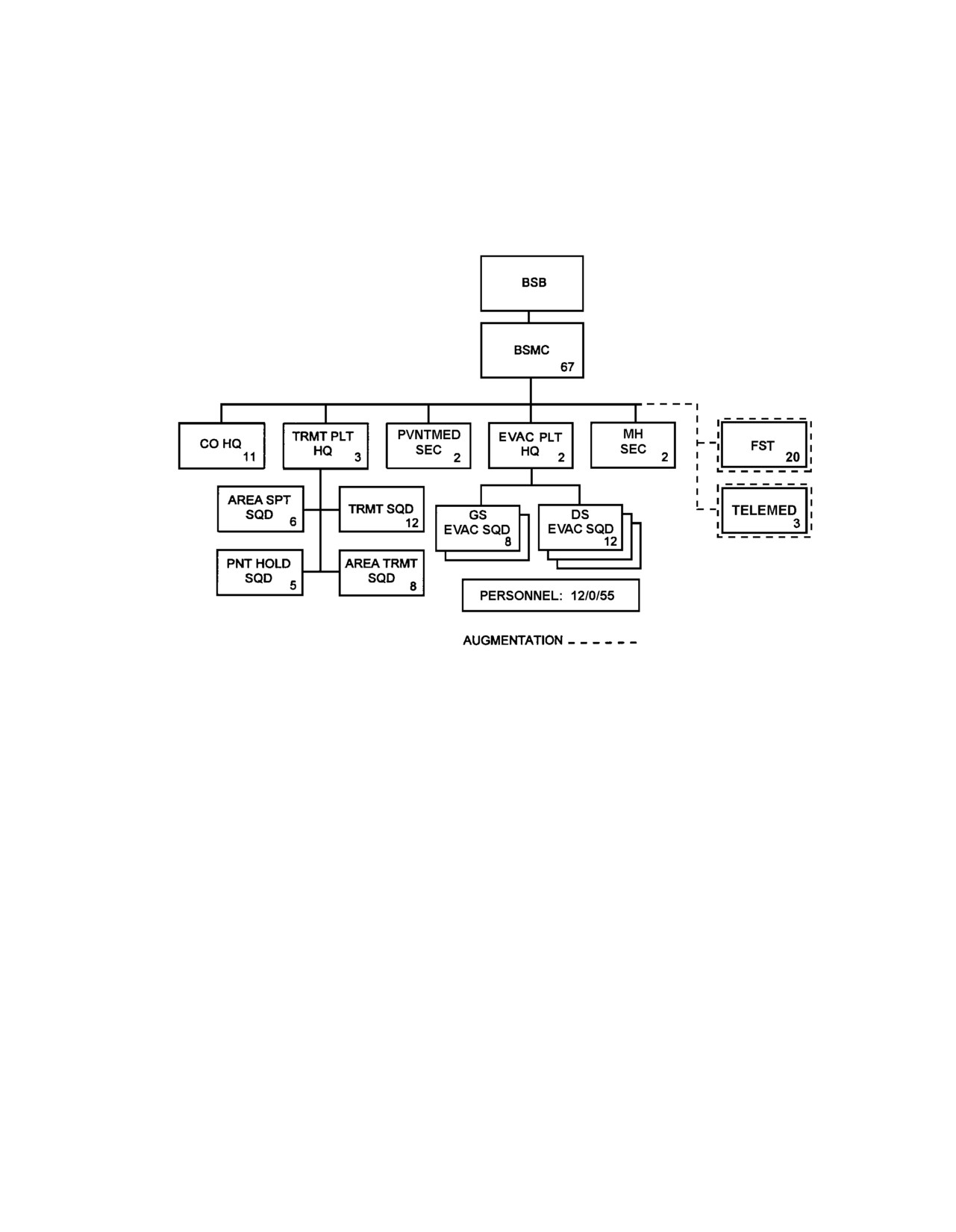
Figure F-1. Brigade support medical company, brigade support battalion.
F-2. Augmentation
It is essential that the BSMC be augmented with an FST as part of the initial entry medical support for the
SBCT. Medical evacuation by air ambulance will be the preferred method for evacuating patients.
Therefore, it is essential that an FSMT augment the BSMC medical evacuation capabilities during early
entry or as part of follow-on support elements. For example, in Kosovo, medical evacuation by air was the
preferred method of evacuation because of difficulties with short-range communication between ground
elements, conditions of roads, and time and distance factors. A reach-capability telemedicine team will link
the BSMC with the sustaining base. This capability is invaluable for medical consultation and coordination
for CHS requirements. Additional augmentation is provided as required based upon METT-TC and may
include:
• Level III MTF (a module from the CSH for hospitalization support).
• Dental services.
• Veterinary services (food safety/security [inspection and surveillance], animal care, and veter-
inary PVNTMED support).
F-3
C1, FM 4-02.6
• Area medical laboratory for the rapid health-hazard identification (ID) and assessment within
an AO. These operational health hazards include NBC threat agents, endemic diseases, and other medical
threats associated with occupational and environmental hazards.
• Preventive medicine (medical threat/medical surveillance support and occupational and
environmental health surveillance).
• Mental health/neuropsychiatric treatment (combat operational stress control).
• Health service logistics and blood support.
• Area medical support.
• Air and ground ambulances for medical evacuation.
Section II. COMPANY HEADQUARTERS SECTION
ORGANIZATION AND FUNCTIONS
F-3. Company Headquarters Section
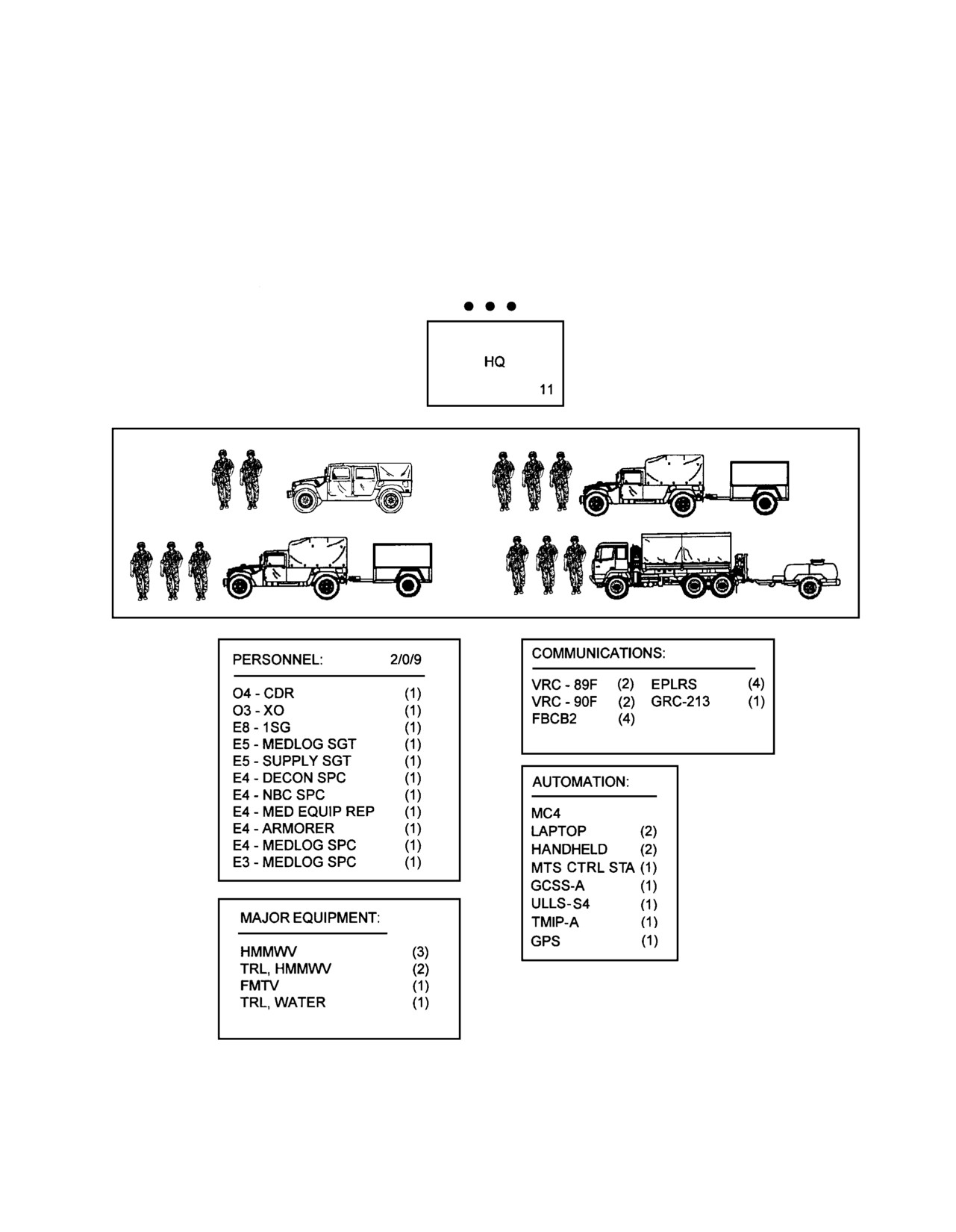
a. The company headquarters section provides C2 for the company and attached units. It
provides unit-level administration, general and medical supply, unit-level medical maintenance, and NBC
defense support. It also provides supply point distribution of Class VIII for supported assigned or attached
medical elements. This includes Class VIII for resupply of the SBCT’s combat lifesavers, if required.
b. The company headquarters section is organized into a command element, a supply element,
and a support operations element consisting of unit decontamination, NBC defense, and a small arms repair
capability. For communications, the company establishes an FM, AM, and MSE network. For personnel,
major equipment, and communication/automation enablers see Table F-1.
F-4
C1, FM 4-02.6
Table F-1. Company Headquarters Section Depicting Personnel, Major Equipment,
and Communications/Automation Enablers
F-5
C1, FM 4-02.6
F-4. Command Element
The command element is responsible for providing billeting, security, training, administration, and discipline
for assigned personnel. This element provides C2 of its assigned and attached personnel. It is typically
staffed with a company commander, an XO, and a 1SG.
NOTE
Currently, medical company commanders’ positions are documented
05A, AMEDD immaterial, meaning any qualified AMEDD officer
can assume command. When the medical company commander is not
a physician, clinical decisions and technical supervision is performed
by the treatment platoon leader. The treatment platoon leader’s
position should always be filled by a physician.
F-5. Supply Elements
The supply elements include general supply, medical supply, and medical equipment maintenance and
repair elements. These elements provide Class VIII resupply, unit-level medical equipment maintenance,
general supply, and armorer support for the BSMC’s organic platoons/sections and attached medical units.
a. General Supply Element. The general (unit) supply element is responsible for managing,
requesting, receiving, issuing, storing, and maintaining all classes of supplies and turn-in of supplies and
equipment, as well as performing organizational maintenance on the company’s small arms. It also employs
the ULLS/S-4 for automated supply activities. The unit supply sergeant coordinates all general supply,
equipment requirements, and actions with the BSMC 1SG and the logistics support operations officer of the
BSB support operations section. The armorer performs organizational maintenance on the company’s small
arms and is responsible for evacuating weapons as necessary to the area support company for DS
maintenance. In addition, he normally assists the supply sergeant in his duties.
b. Medical Supply Element. The medical supply element establishes the Class VIII distribution
point and manages the requisitioning of Class VIII supplies and blood products. The MEDLOG sergeant of
this element coordinates Class VIII requirements through the BSMC XO with the medical logistics officer
(MLO) of the BSB support operations section and the brigade surgeon section (BSS).
(1) The medical supply element issues Class VIII supplies to all treatment elements of the
company, maintains quality control by monitoring the expirations of dated Class VIII supplies, and
requisitions accordingly. All blood products for the company are distributed to the treatment platoon (area
support squad medical laboratory element) for storage, managing, monitoring, reporting, and further
distribution within the company and supporting FST, when attached.
(2) Blood products for the supporting FST will be issued directly to that unit for use,
management, and reporting.
F-6
C1, FM 4-02.6
(3) The BSMC medical supply element and the BSB support operations section’s MLO will
use MC4/Defense Medical Logistics Standard Support—Amplitude Modulated (DMLSS-AM), TAMMIS
Customer Assistance Module (TCAM), Combat Service Support Control System (CSSCS), FBCB2, radios,
telephones, facsimile (FAX), and GCSS-A for requisitioning and monitoring Class VIII requirements for
the SBCT and its supporting medical augmentation elements.
c.
Medical Equipment Maintenance Element. The medical equipment maintenance element
provides operational and unit-level medical equipment maintenance for the BSMC and all other medical
elements of the SBCT.
Section III. EMPLOYMENT OF THE
BRIGADE SUPPORT MEDICAL COMPANY
F-6. Establishment of the Company Headquarters
a. In establishing the company headquarters, the command element must ensure that
communication is established with BSB units and other supported units, as required. All security precautions
and requirements must be met according to BSB and SBCT TSOP. Only essential equipment is set up to
support the BSMC operations. If the failure to camouflage endangers or compromises tactical operations,
the camouflage of the Level II MTF may be ordered by a commander of at least brigade level or equivalent
(refer to STANAG 2931). Dispersion of shelter systems and equipment is accomplished to the maximum
extent possible.
b. The command element supervises the establishment of the company. The commander monitors
all elements as the company sets up. He ensures the BSMC is established according to the unit layout and
the TSOP. The XO and the 1SG assist the company commander. The XO supervises and monitors the
establishment of the company area for compliance with BSB TSOP and SBCT guidance. The XO coordinates
with supporting units/elements for support requirements. The commander and XO coordinate the medical
support mission with the BSB support operations and the brigade surgeon’s sections. This coordination
ensures the timely forward deployment of BSMC evacuation and treatment elements in support of the
SBCT. For synchronization of CHS operations, medical company leaders must conduct direct interface
with maneuver battalion medical platoon leaders and other brigade medical elements.
c.
The 1SG focuses his attention toward ensuring all unit security requirements are accomplished.
The 1SG supervises the establishment of the company headquarters and the troop billeting areas and
monitors field sanitation team activities. The support operations element assists in establishing the company
headquarters. The NBC NCO supervises the company NBC team by monitoring its activities and use of
unit NBC-monitoring and decontamination equipment. He coordinates with other BSB units and monitors
the placement of early warning devices for the detection of chemical agents. He supervises and monitors
unit personnel for compliance with correct wear of MOPP ensemble according to the current MOPP level
and TSOP.
F-7
C1, FM 4-02.6
d. Unit personnel set up communications equipment and establish the NCS for the company.
They establish contact with the battalion headquarters and with supporting and supported units. Unit
personnel also establish the internal wire communications net. They connect to the MSE area system at the
wire subscriber access point operated by the area support signal element.
e.
The logistics element establishes the general supply for the company and establishes a Class
VIII supply distribution point for all medical elements operating in SBCT AO. This element ensures that
supplies are secured, properly stored, and protected from the environment. Further, it establishes the unit
POL and water points.
F-7. Preventive Medicine Section
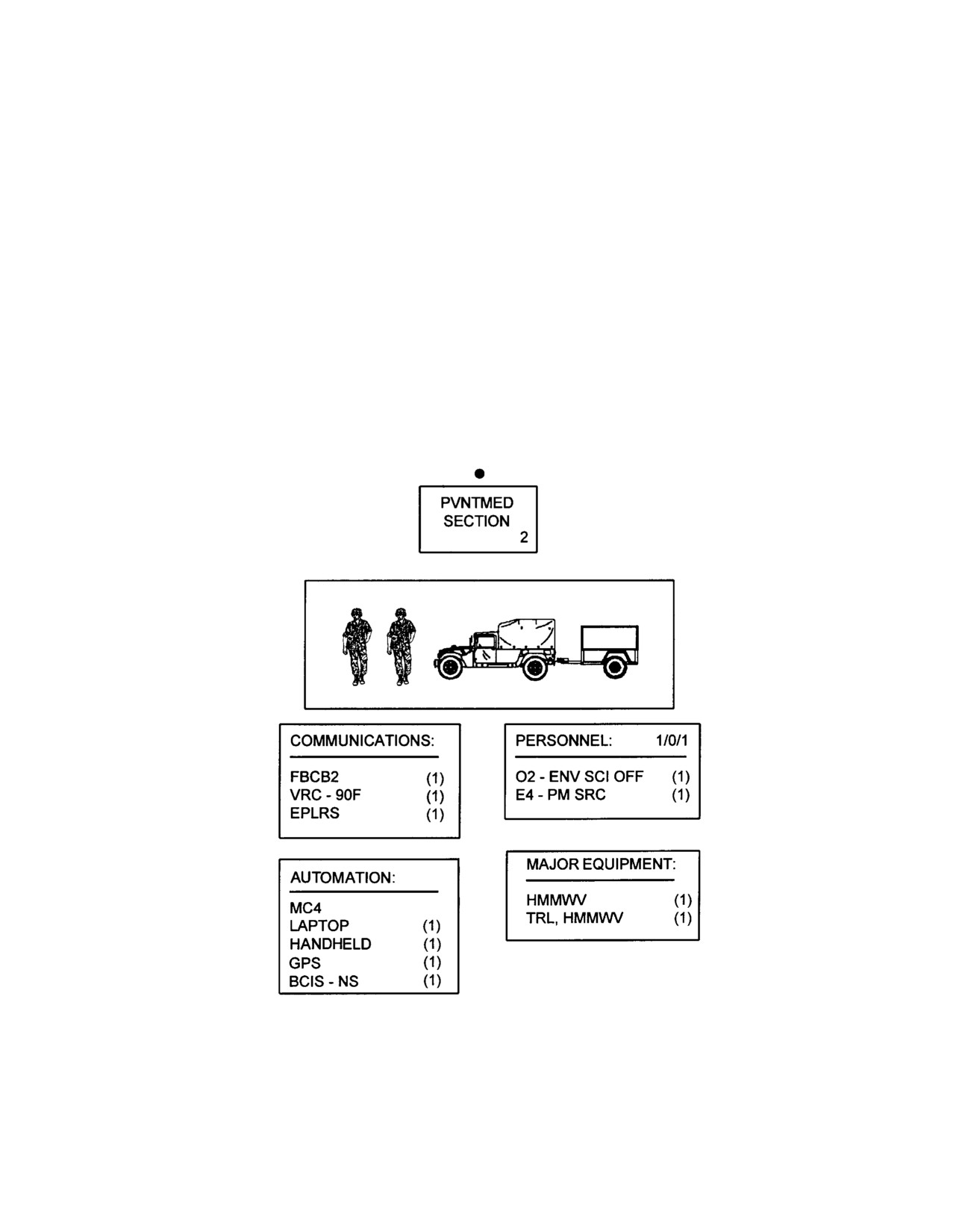
a. The PVNTMED section (Table F-2) is responsible for supervising the unit’s PVNTMED
program as described in FM 4-02.17. The section is primarily responsible for medical threats/medical
surveillance support and conducting occupational and environmental surveillance. This section is responsible
for assessing the health risk associated with medical and health hazards and recommending protective
measures.
b. The PVNTMED section provides advice and consultation in the area of health threat assessment,
force health protection, environmental sanitation, epidemiology, sanitary engineering, and pest management.
Through routine surveillance, they identify actual and potential health hazards, recommend corrective
measures, and assist in training SBCT soldiers in disease and nonbattle injury prevention programs. For
additional information on the operations and function of the PVNTMED section refer to FM 4-02.17.
c.
Preventive medicine activities begin prior to deployment and continue during deployment and
redeployment to minimize DNBIs. Actions taken include, but are not limited to—
• Supporting command awareness of potential medical threats and implementation of
appropriate protective measures.
• Ensuring the deployment of a healthy and fit force.
• Monitoring the command’s immunization status (see AR 40-562).
• Monitoring the status of individual and small unit PVNTMED measures (see FMs 4-
25.12 and 21-10).
• Monitoring against heat and cold injuries, occupational and environmental health hazards,
arthropodborne diseases, and NBC contamination of water and food, (see FMs 4-02.17, 4-02.33, 8-250,
TM 5-632, TBs (Med) 81, 507, 530, and 577).
• Ensuring unit’s training in PVNTMED to counter the medical threat.
• Monitoring the use of prophylaxes such as antimalarial tablets.
F-8
C1, FM 4-02.6
• Monitoring, analyzing, and reporting medical surveillance information.
d. Preventive medicine support operations are prioritized based on the METT-TC, medical
threat, and assessment of data collected (through medical surveillance, occupational and environmental
health surveillance, monitoring unit and individual protective measures, inspecting, and reporting
observations). Under the oversight of the brigade surgeon, the PVNTMED section ensures implementation
of the brigade PVNTMED program.
Table F-2. Preventive Medicine Section Depicting Personnel, Major Equipment,
and Communications/Automation Enablers
F-9
C1, FM 4-02.6
F-8. Mental Health Section
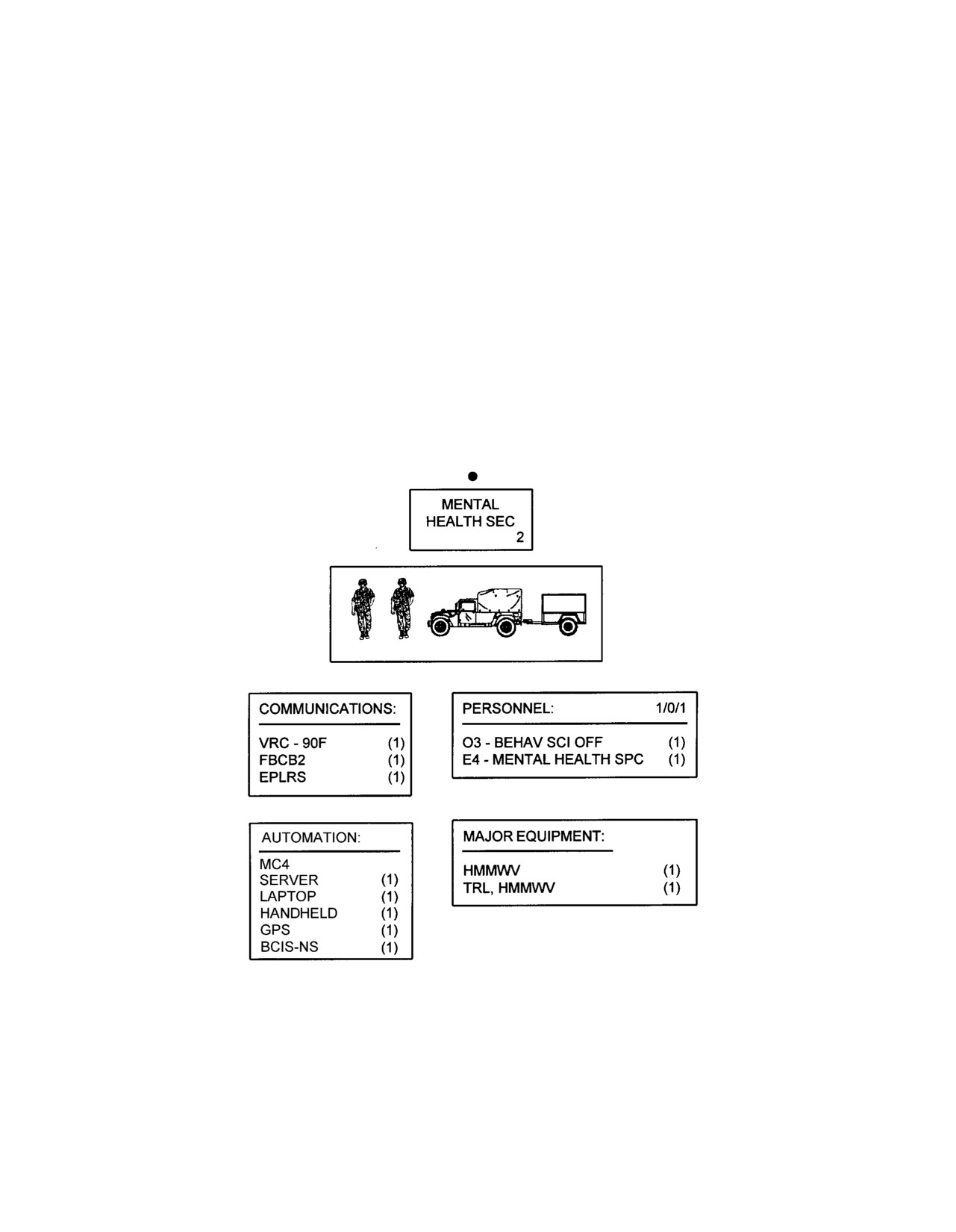
a. The MH section (Table F-3) is responsible for assisting commanders in preventing/controlling
COSC through brigade mental health. The COSC team operates under the direction of the BSMC
commander and provides brigade-wide MH services. See FM 8-51 for details on COSC/CSC duties. The
behavioral science officer and MH specialist are especially concerned with assisting and training maneuver
unit soldiers and small unit leaders, to include members of unit ministry teams, members of forward
deployed medical platoons/sections, and medical treatment personnel of BSMC.
Table F-3. Mental Health Section Depicting Personnel, Major Equipment,
and Communications/Automation Enablers
b. The BSMC MH section provides training and advice in the control of stressors, the promotion
of positive combat operational stress behaviors, and the identification, handling, and management of
misconduct stress behavior and BF soldiers. It coordinates COSC training for supported units. The section
collects and records social and psychological data and counsels personnel with personal, behavioral, or
psychological problems.
F-10
C1, FM 4-02.6
c.
The MH section uses the brigade Level II MTF as the center for its operations, but is mobile
throughout the AO. The section’s priority functions are to promote positive stress behaviors, prevent
unnecessary evacuations, and coordinate RTD for recovered stress-related soldiers. Through the treatment
and ambulance platoon leaders and the company commander, the section keeps abreast of the tactical
situation and plans and projects requirements for COSC support when units are pulled back for rest and
recuperation. For definitive information on COSC/CSC operations, see FMs 8-51, 22-51, and 6-22.5.
Section IV. THE TREATMENT PLATOON
F-9. General
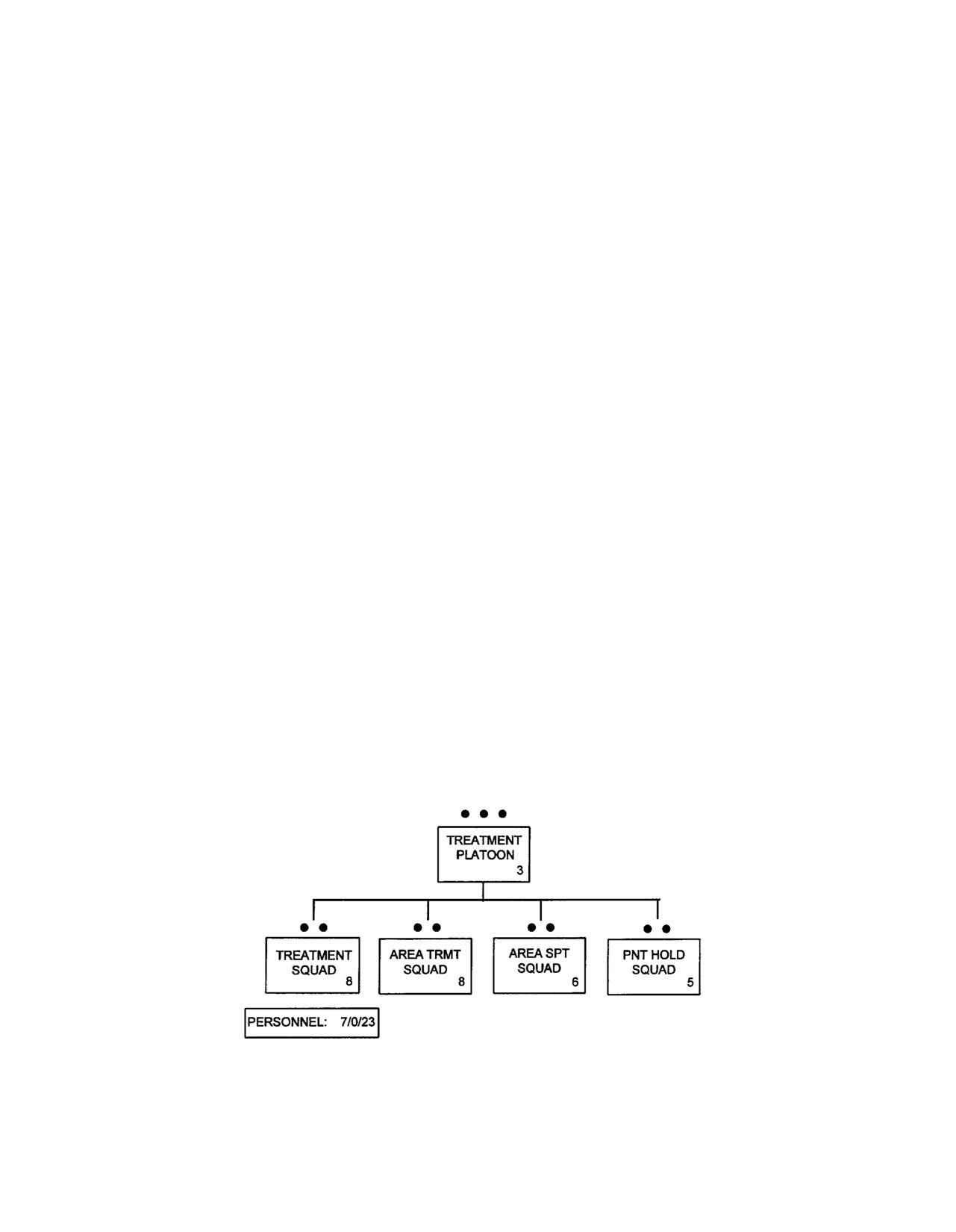
The treatment platoon (Figure F-2) receives, triages, treats, and determines the disposition of patients. The
platoon provides for ATM, general medicine, and general dentistry. The platoon consists of a platoon
headquarters, a treatment squad, an area support treatment squad, an area support squad, and a patient-
holding squad. The treatment squad includes two treatment teams to provide Level I area support and
augmentation support to SBCT maneuver battalions, as required. Each of the treatment teams has a
HMMWV ambulance (with trailer) to transport the team and its equipment. The area support treatment
squad is comprised of two treatment teams that operate and provide continuous coverage for the BSMC
Level II MTF. The area support squad provides operational dental care, as well as laboratory and x-ray
support commensurate with Level II medical treatment. The patient-holding squad provides a patient-
holding facility capability of 20 cots. Its primary mission is to hold patients awaiting evacuation out of the
brigade AO; a secondary mission is to hold soldiers who are expected to return to duty within 72 hours.
The area support treatment squad, the area support squad, and the patient-holding squad are the elements
required to establish the BSMC Level II MTF. Once established, the treatment platoon is responsible for
operating this MTF. In addition, it provides basic diagnostic laboratory (blood cell counts, urinalysis, and
microbiology for diagnosis) and digital imaging radiological services and patient-holding support. When
patients are able to return to duty after having received treatment, the company CP coordinates with the
brigade S1, who in turn contacts the respective unit to pick up the soldier or follow brigade TSOP. The
treatment platoon also functions as an alternate company CP during hasty displacements.
Figure F-2. Treatment platoon.
F-11
C1, FM 4-02.6
F-10. Treatment Platoon Headquarters
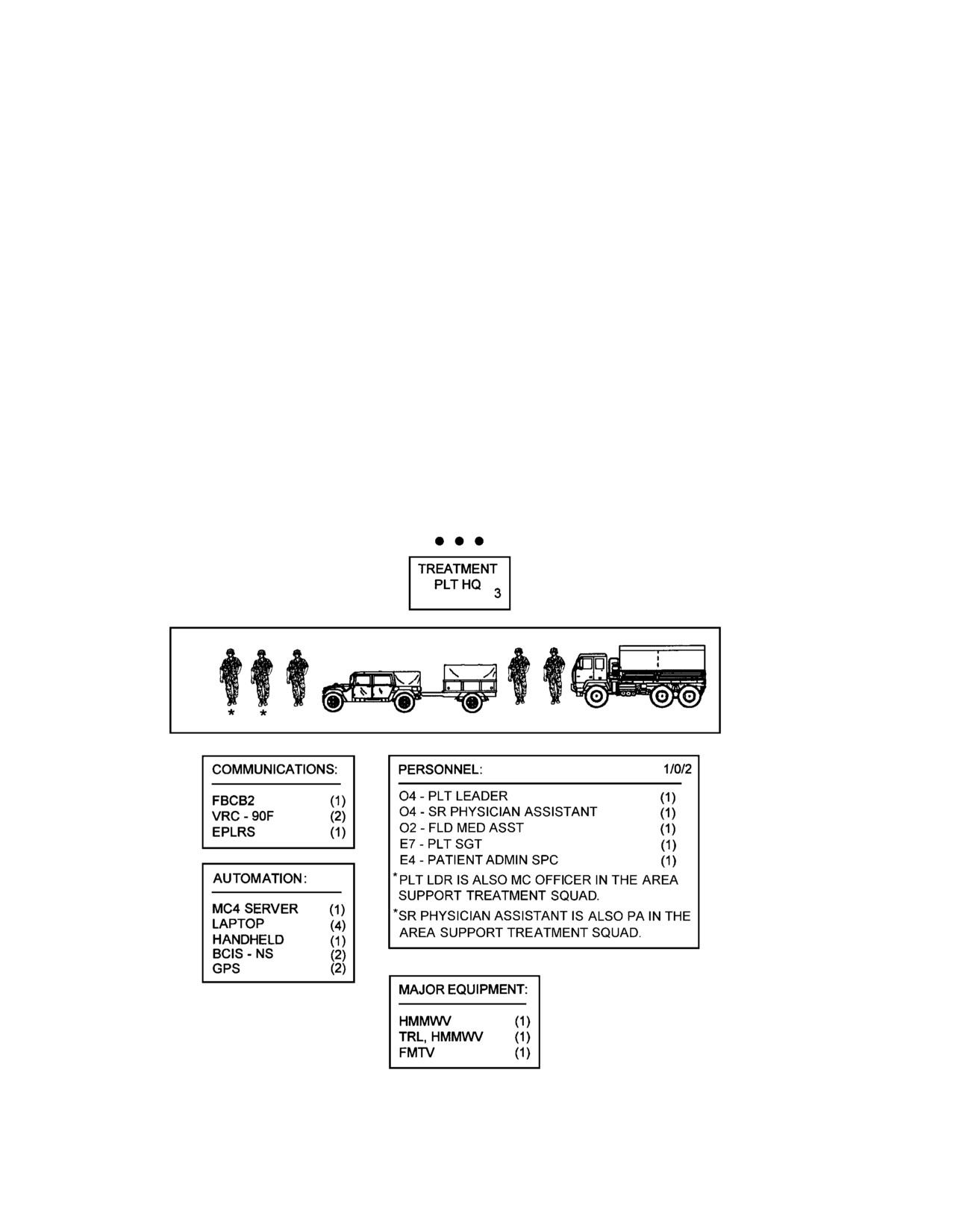
The treatment platoon headquarters (Table F-4) element directs, coordinates, and supervises platoon
operations based on the SBCT CHS plan. The headquarters element directs the activities of the BSMC’s
Level II MTF and monitors Class VIII supplies and inventory levels blood usage, and keeps the commander
informed of critical Class VIII and blood requirements. The treatment platoon headquarters element is
responsible for overseeing platoon operations, OPSEC, communications, administration, organizational
training, supply, transportation, patient accountability, statistical reporting, and maintenance of medical
records functions. For communications, the headquarters employs an FM radio for C2, and is employed in
the BSMC command and wire net. It also employs an MC4 (laptop and handheld computers) capability for
patient accounting and reporting.
Table F-4. Treatment Platoon Headquarters Depicting Personnel, Major Equipment,
and Communications/Automation Enablers
F-12
C1, FM 4-02.6
F-11. Treatment Squad
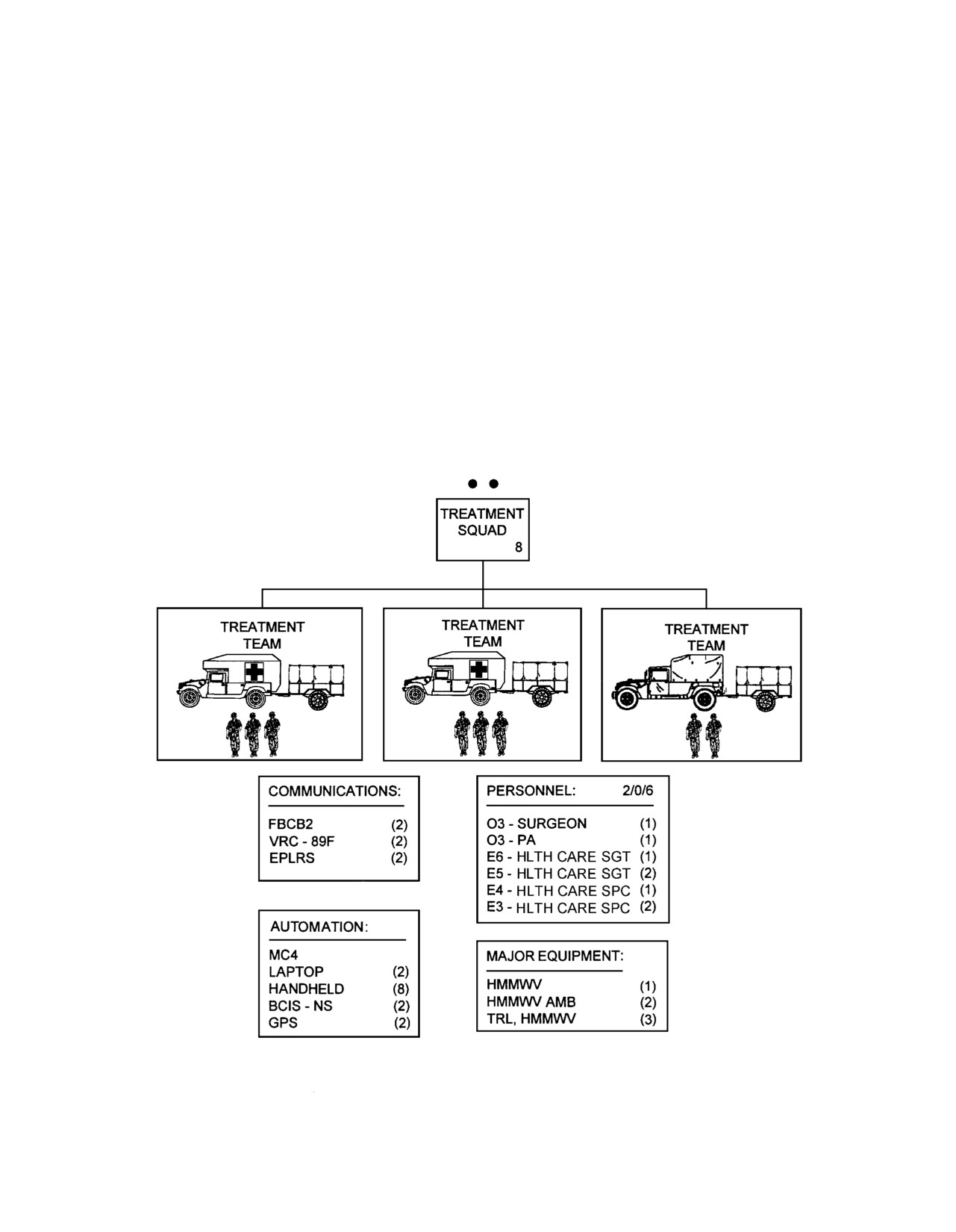
The treatment squad (Table F-5) provides emergency and routine sick call treatment to soldiers assigned or
attached to supported units. This squad is deployed in DS of CS/CSS units. When positioned with the BSMC,
the treatment squad personnel work in the Level II MTF. The treatment squad/teams must be prepared for
short-notice, forward deployment; therefore, personnel, MESs, and vehicles must be in a state of readiness.
The squad has the capability to split and operate as separate treatment teams (Teams A and B) for limited
periods of time. While operating in these separate modes, they may operate up to two aid stations.
Table F-5. Treatment Squad Depicting Personnel, Major Equipment,
and Communications/Automation Enablers
F-13
C1, FM 4-02.6
F-12. Area Treatment Squad
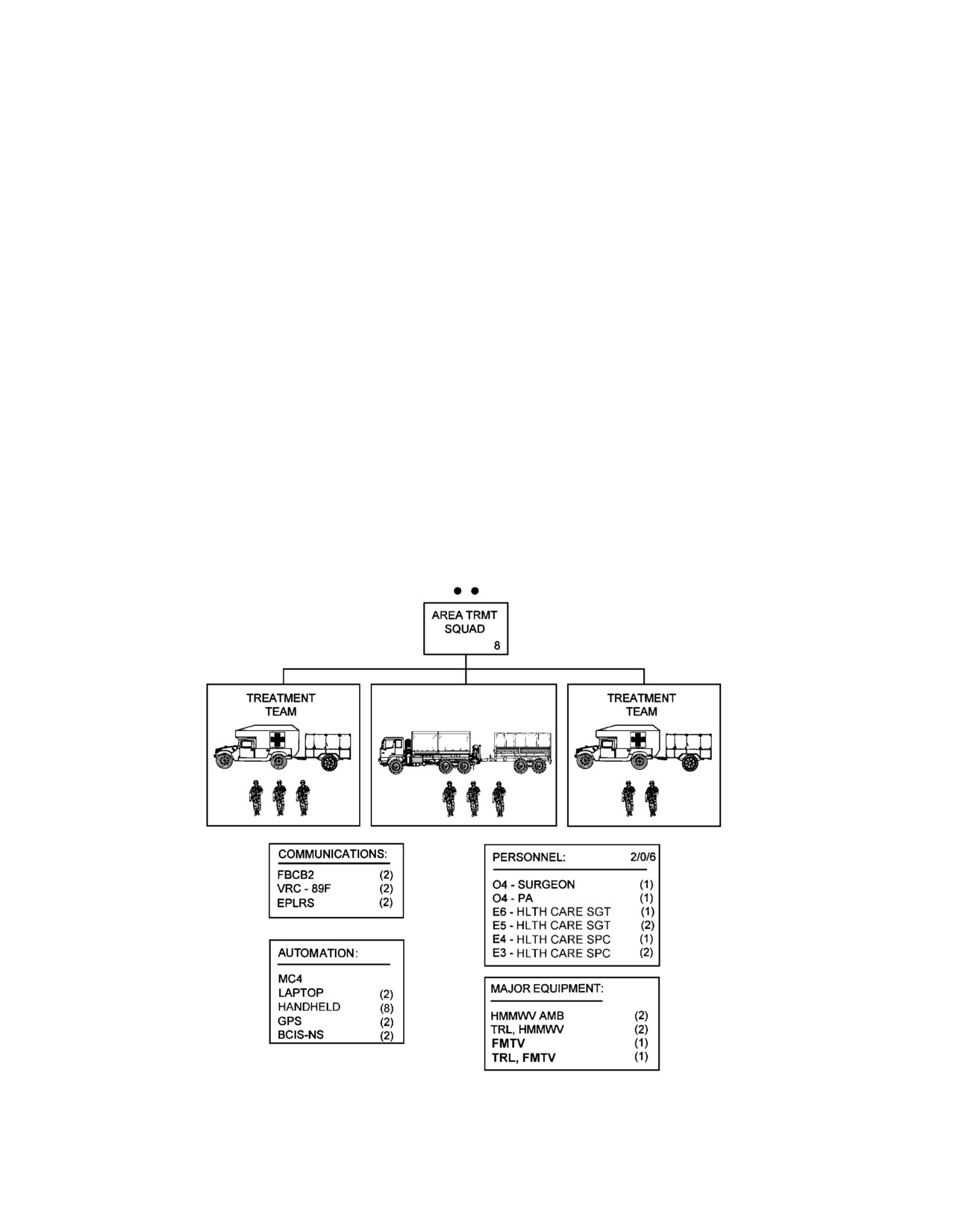
The area treatment squad (Table F-6), along with the area support squad and patient-holding squad, form
the brigade Level II MTF. The area treatment squad is the base medical treatment element of the Level II
MTF and does not deploy from the BSMC. The squad provides routine sick call services and initial
resuscitative treatment (EMT and ATM) for supported units. For communications, the squad employs FM
radios and is deployed in the BSMC’s radio and internal wire communications nets. Teams of this squad
operate their radios on the treatment platoon FM net (See Appendix I).
NOTE
This squad, because it operates the brigade Level II MTF, is not used
to reinforce or reconstitute other medical units. It is also not used on
the area damage control team.
Table F-6. Area Treatment Squad Depicting Personnel, Major Equipment,
and Communications/Automation Enablers
F-14
C1, FM 4-02.6
F-13. Area Support Squad
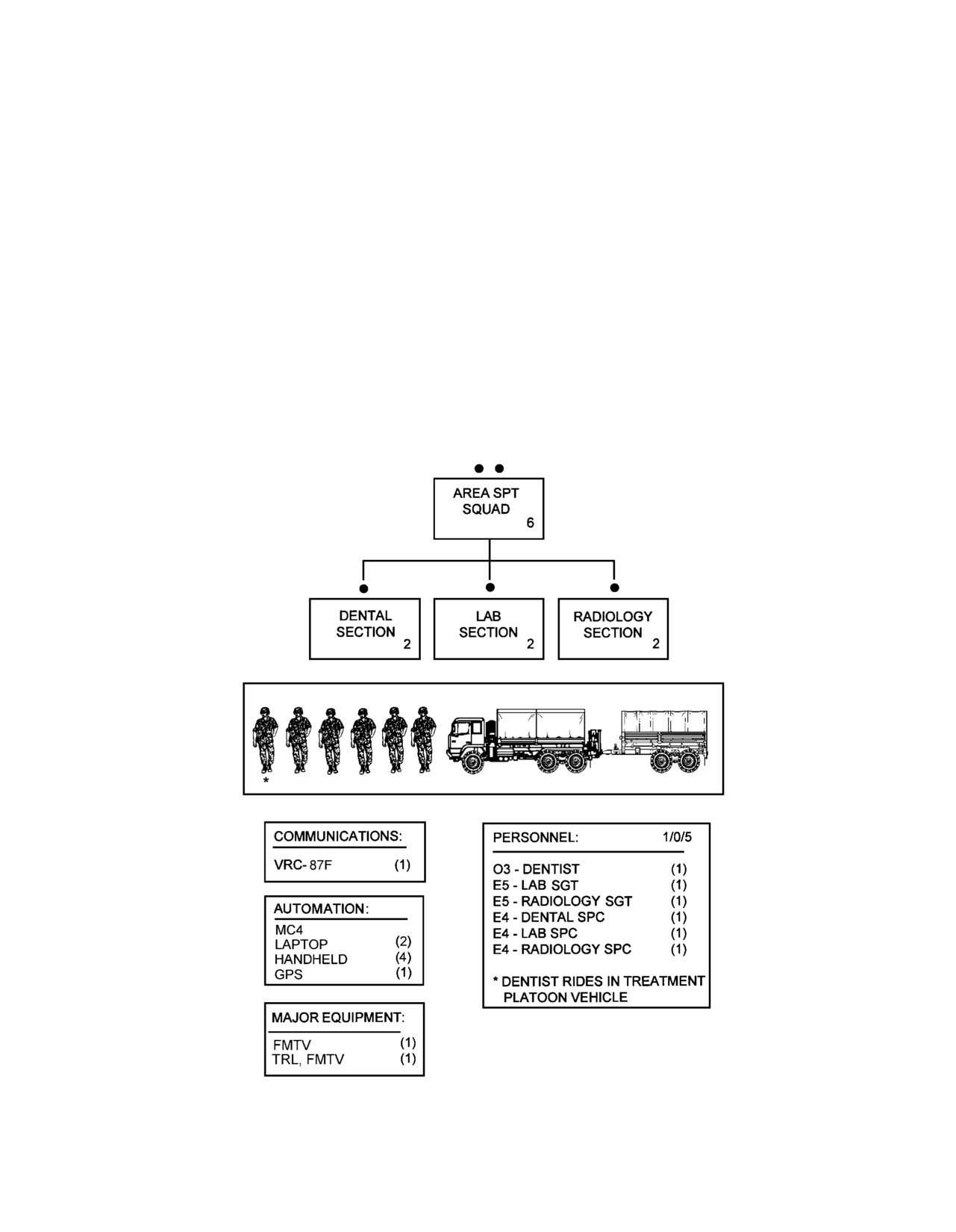
The area support squad (Table F-7) includes the dental, medical laboratory, and field x-ray capability. It
provides for basic services commensurate with Level II medical treatment. The area support squad is
typically staffed with a general dental officer (63A), a dental specialist (E4 91E10), a medical laboratory
sergeant (E5 91K20), a medical laboratory specialist (E4 91K10), a radiology sergeant (E5 91P20), and a
radiology specialist (E4 91P10). The dental officer supervises the activities of the area support squad. The
area support squad is employed in the treatment platoon FM net (See Appendix I).
Table F-7. Area Support Squad Depicting Personnel, Major Equipment,
and Communications/Automation Enablers
F-15
C1, FM 4-02.6
a. Dental Element.
(1) The dental element provides operational dental care, which consists of emergency dental
care, and essential dental care intended to intercept dental emergencies. This also includes dental
consultation and x-ray services.
(2) Operational dental care is the care given for the relief of pain, elimination of acute
infection, control of life-threatening oral conditions
(hemorrhage, cellulitis, or respiratory difficulty);
treatment of trauma to teeth, jaws, and associated facial structures is considered emergency care. It is the
most austere type of care and is available to soldiers engaged in tactical operations. Common examples of
emergency treatment are simple extractions, antibiotics, pain medication, and temporary fillings. Essential
care includes dental treatment necessary for prevention of lost duty time and preservation of fighting
strength. Soldiers in dental Class 3 (potential dental emergencies should be provided essential care as the
tactical situation permits [refer to FM 4-02.19 for a detailed discussion on dental operations]).
b. Medical Laboratory Element. The medical laboratory element performs clinical laboratory
and blood banking procedures to aid physicians and PAs in the diagnosis, treatment, and prevention of
diseases. Blood banking procedures are accomplished according to FM 8-70, TM 8-227-3, TM 8-227-
11, and TM 8-227-12. Laboratory functions include performing laboratory procedures consistent with
the Level II treatment capabilities. This element is responsible for storing and issuing blood (liquid red
blood cells).
c.
Radiology Element. The radiology element operates x-ray equipment consistent with the
Level II treatment capabilities. It is capable of both plane film and regional digital radiography. The
section performs routine clinical radiological procedures to aid physicians and PAs in the diagnosis and
treatment of patients. Specific functions performed by this element include—
• Interpreting physicians’ orders, applying radiation and electrical protective measures,
operating and maintaining x-ray equipment, and taking x-rays of the extremities, chest, trunk, and skull.
• Performing manual and automatic radiographic film processing to include using the
medical filmless imaging systems.
• Assembling x-ray film files for the patients remaining within the brigade, or arranging
for such film to accompany those patients who are evacuated out of the AO.
• Operating and maintaining the assigned generator.
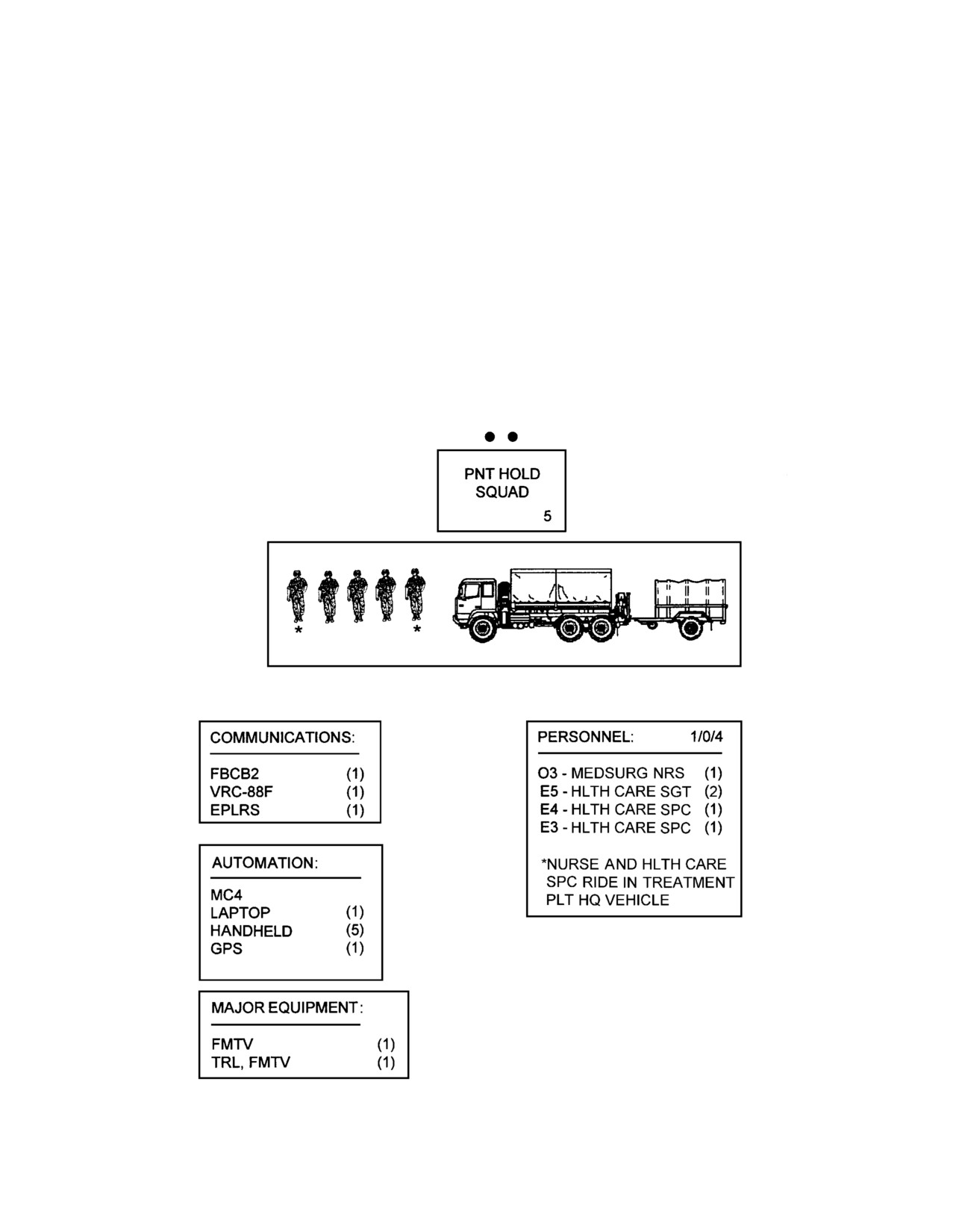
F-14. Patient-Holding Squad
a. The patient-holding squad (Table F-8) operates the patient-holding facility of the BSMC Level
II MTF. The holding facility’s mission is to hold patients awaiting evacuation out of the brigade AO; a
secondary mission is to hold patients who are expected to return to duty within 72 hours. It is staffed and
equipped to provide care for up to 20 patients.
F-16
C1, FM 4-02.6
b. The medical-surgical nurse assigned to the patient-holding squad provides nursing care
supervision and is responsible for the operation of the holding facility. Since Level II facilities, such as the
BSMC, do not have an admission capability, patients may only be held at this facility and are not counted as
hospital admissions. In addition, the patient-holding facility serves as a patient-overflow recovery area for
those patients awaiting medical evacuation from the FST.
Table F-8. Patient-Holding Squad, Treatment Platoon Depicting Personnel, Major Equipment,
and Communications/Automation Enablers
F-17
C1, FM 4-02.6
F-15. Employment of the Treatment Platoon
a. The treatment platoon establishes its elements using the BSMC layout plan. The platoon
headquarters element supervises the establishment of platoon operations. The platoon leader directs set-up
operations and supervises the displacement of treatment squads/teams, when necessary. The field medical
assistant assists the platoon leader in supervising establishment operations and coordinates the displacement
of treatment squads/teams with company headquarters and supported units. He ensures all platoon elements
perform PMCS on their assigned equipment and reports any deficiencies to the chain of command.
b. The area treatment squad establishes all treatment areas as directed by the treatment platoon
leader. This DS treatment team from the area support treatment squad is tasked with providing medical
support for the company until the Level II MTF is established.
c.
The dental treatment facility is established within the MTF. The dental officer supervises the
placement of dental supplies and equipment within the dental treatment area.
d. The laboratory element and the radiology element are established within the MTF area.
Precautions for operating radiological equipment must be observed. Radiation hazard areas adjacent to the
x-ray facility must be clearly marked and blocked so that personnel are prevented from crossing too closely
to the facility.
e.
The patient-holding squad sets up the patient-holding facility, which is an integral part of the
Level II MTF. The treatment platoon leader, based on troop concentration and patient estimates, determines
the number of cots to set up. If the commander directs that less than 20 cots are to be set up, this may
dictate that only one general-purpose large tent be erected. A water point, latrine, and a handwashing area
should be established for the convenience of those patients being held at this facility.
Section V. THE EVACUATION PLATOON
F-16. General
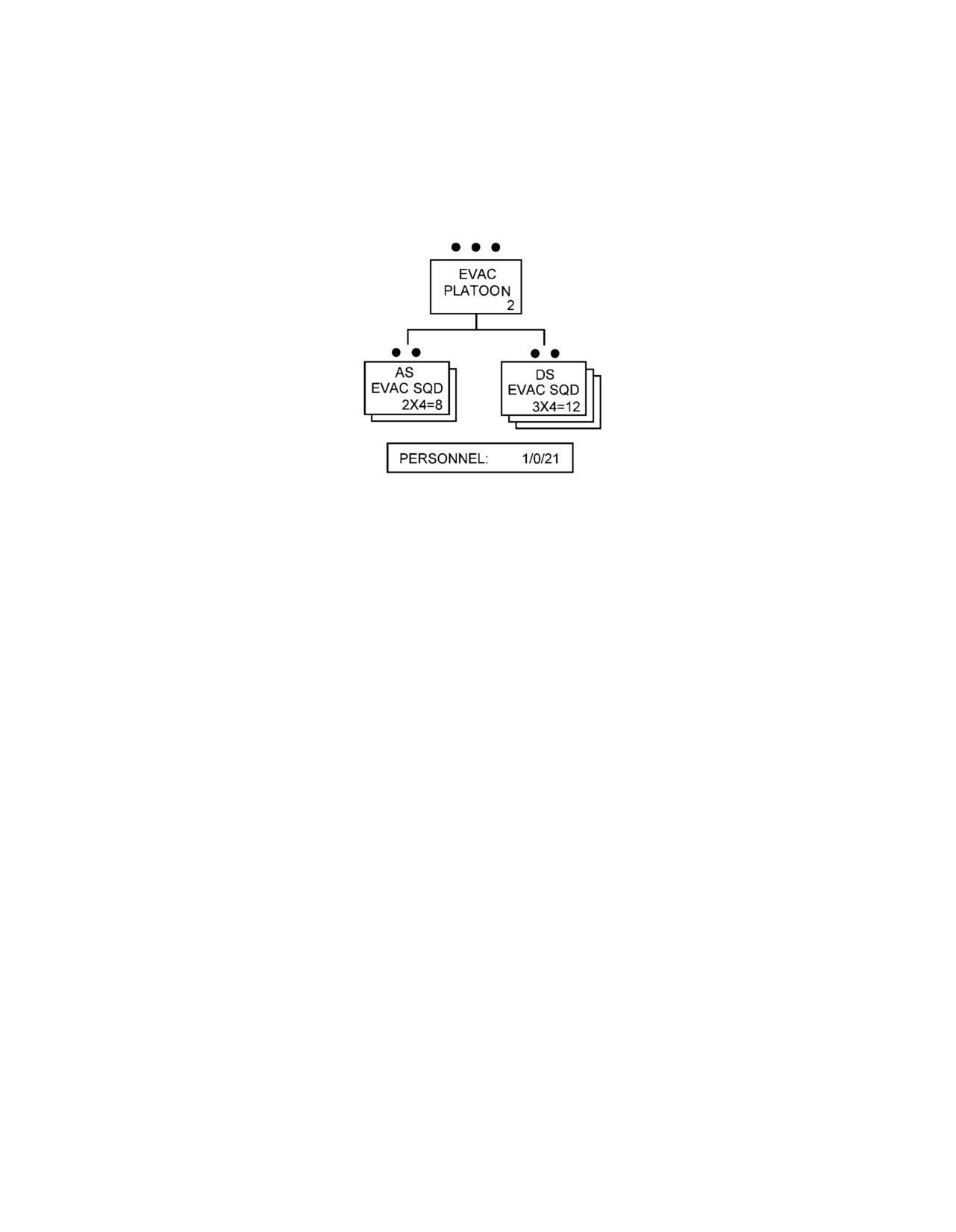
The evacuation platoon (Figure F-3) performs ground evacuation and en route patient care for the supported
units. The evacuation platoon consists of a platoon headquarters, an area support (AS) evacuation section,
and a DS evacuation section. The platoon employs five HMMWV evacuation squads (or ten evacuation
teams).
F-18
C1, FM 4-02.6
Figure F-3. Evacuation platoon, brigade support medical company.
F-17. Evacuation Platoon Headquarters
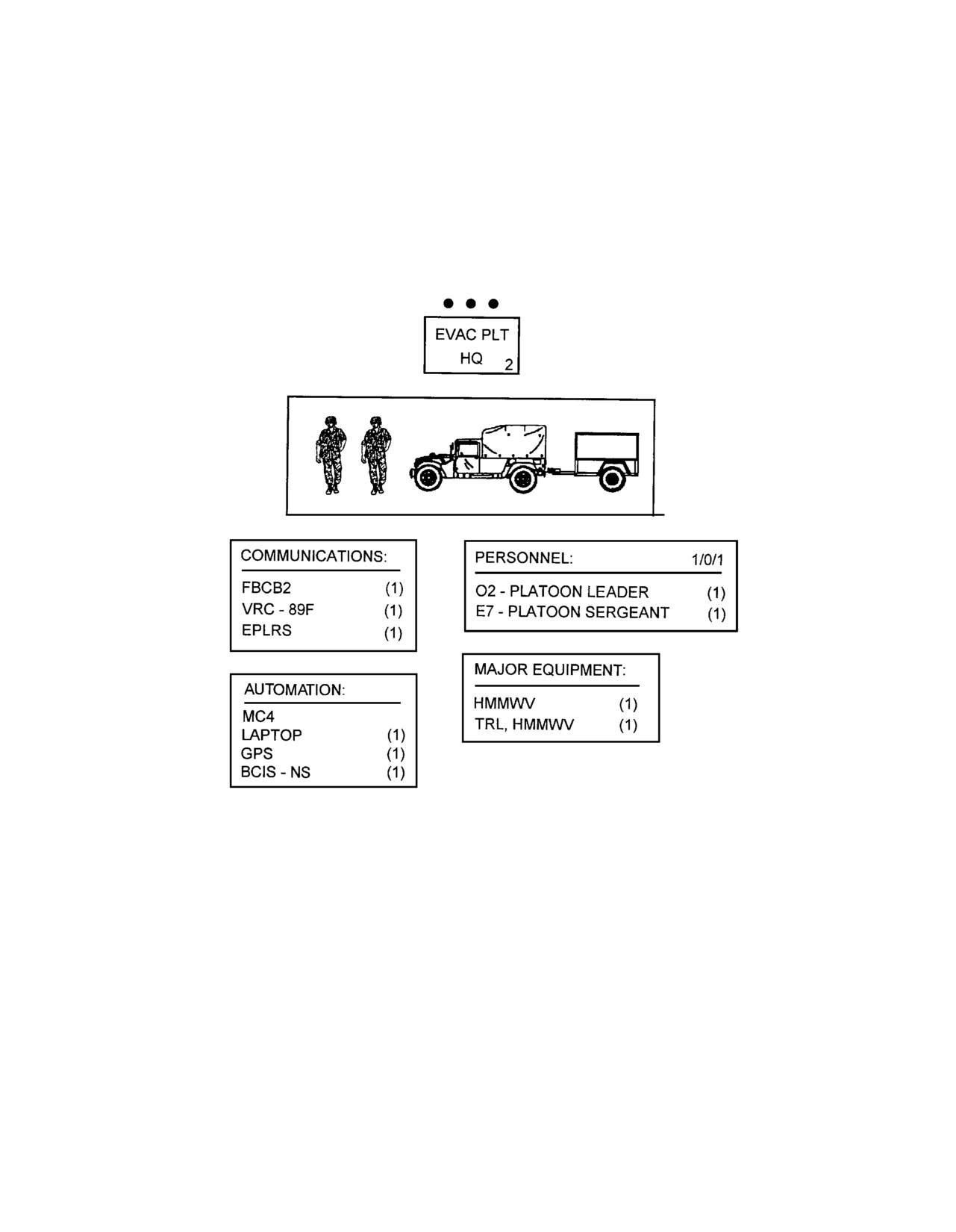
a. The evacuation platoon headquarters (Table F-9) element provides C2 for the evacuation
platoon operations. It maintains communications to direct ground evacuation of patients. It provides
ground ambulance evacuation support for the maneuver battalions of the SBCT. It also provides ground
evacuation support to other units receiving area medical support from the BSMC. Further medical
evacuation to Level III hospitals is the responsibility of the next higher echelon, to include ground and air
evacuation. In the SBCT, this may be different early on until echelons above brigade (EAB) ambulances
arrive. Personnel assigned to the evacuation platoon headquarters include the platoon leader and platoon
sergeant.
b. The evacuation platoon headquarters element directs and coordinates ground evacuation of
patients. This element supervises the platoon and plans for its employment. It establishes and maintains
contact with supported units and forward deployed treatment squad/teams of the BSMC. The platoon
headquarters element performs route reconnaissance and develops and issues all necessary route and
navigational information, to include strip maps, maps, graphic control measures, and any other pertinent
information. If possible, the information is provided via the FBCB2 system to all ambulance teams. The
platoon headquarters element also coordinates and establishes AXPs for both air and ground ambulances, as
required. The evacuation platoon is employed in the company command net (see Appendix I) and establishes
an NCS for its evacuation teams.
F-19
C1, FM 4-02.6
Table F-9. Evacuation Platoon Headquarters Depicting Personnel, Major Equipment,
and Communications/Automation Enablers
F-18. Evacuation Squads
a. The evacuation squads (Table F-10 and Table F-11 [page F-22]) provide ground evacuation of
patients from supported units to the BSMC MTF. The evacuation squads consist of five emergency care
sergeants and fifteen ambulance aides/drivers. Evacuation squad emergency care personnel perform EMT,
prepare patients for evacuation, and provide en route care for patients they evacuate. They also operate and
maintain assigned radios and other CE equipment, as well assigned ambulances and associated equipment
including MESs. They ensure that appropriate property exchange of medical items (such as litters and
blankets) is made at originating and receiving MTFs (Army only). Evacuation teams maintain situational
understanding and use all available navigational tools to ensure quick and secure evacuation of patients.
b. For communications, each evacuation team/evacuation squad is employed in the company
FM net.
F-20
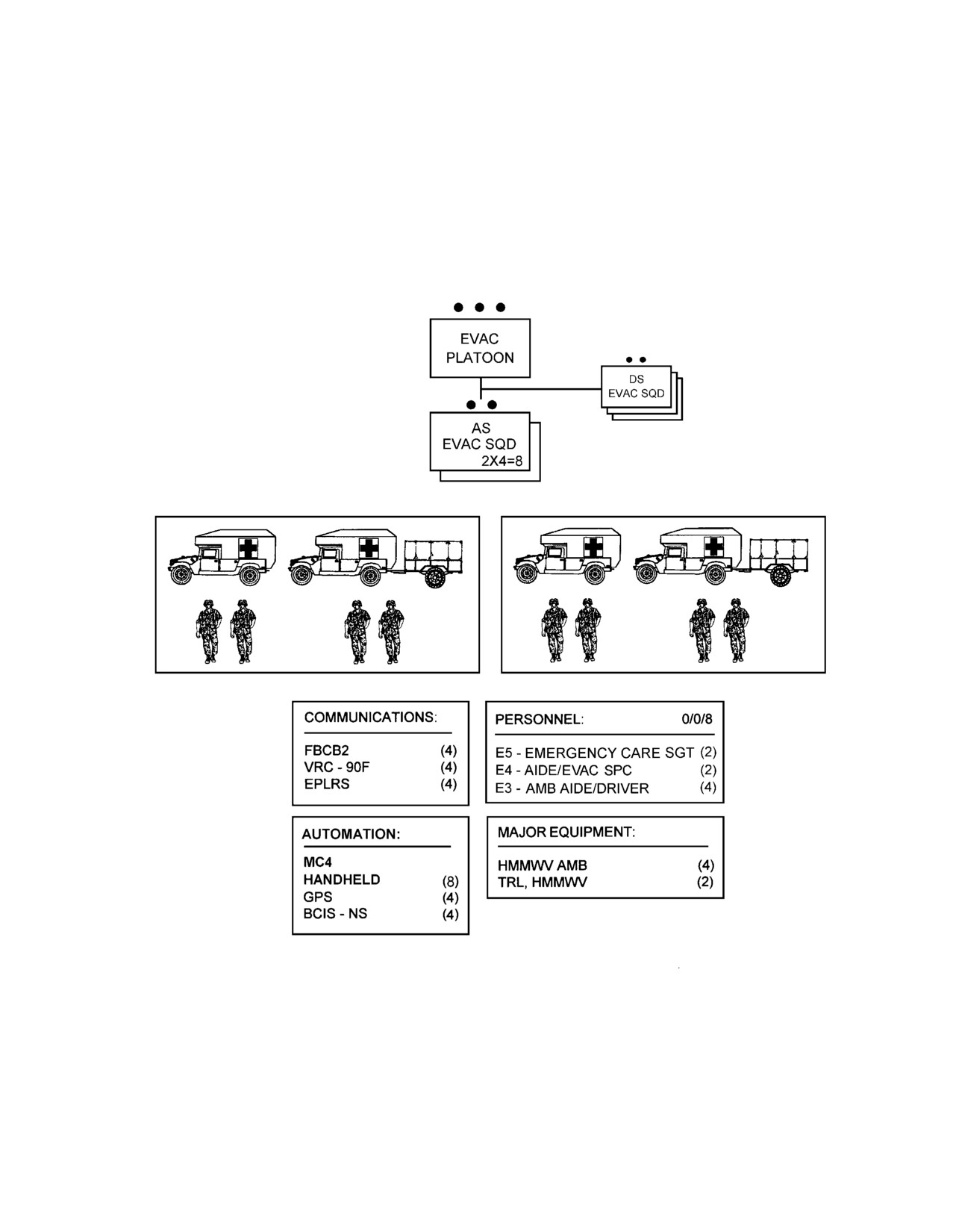
C1, FM 4-02.6
Table F-10. Area Support Evacuation Squads Depicting Personnel, Major Equipment,
and Communications/Automation Enablers
F-21
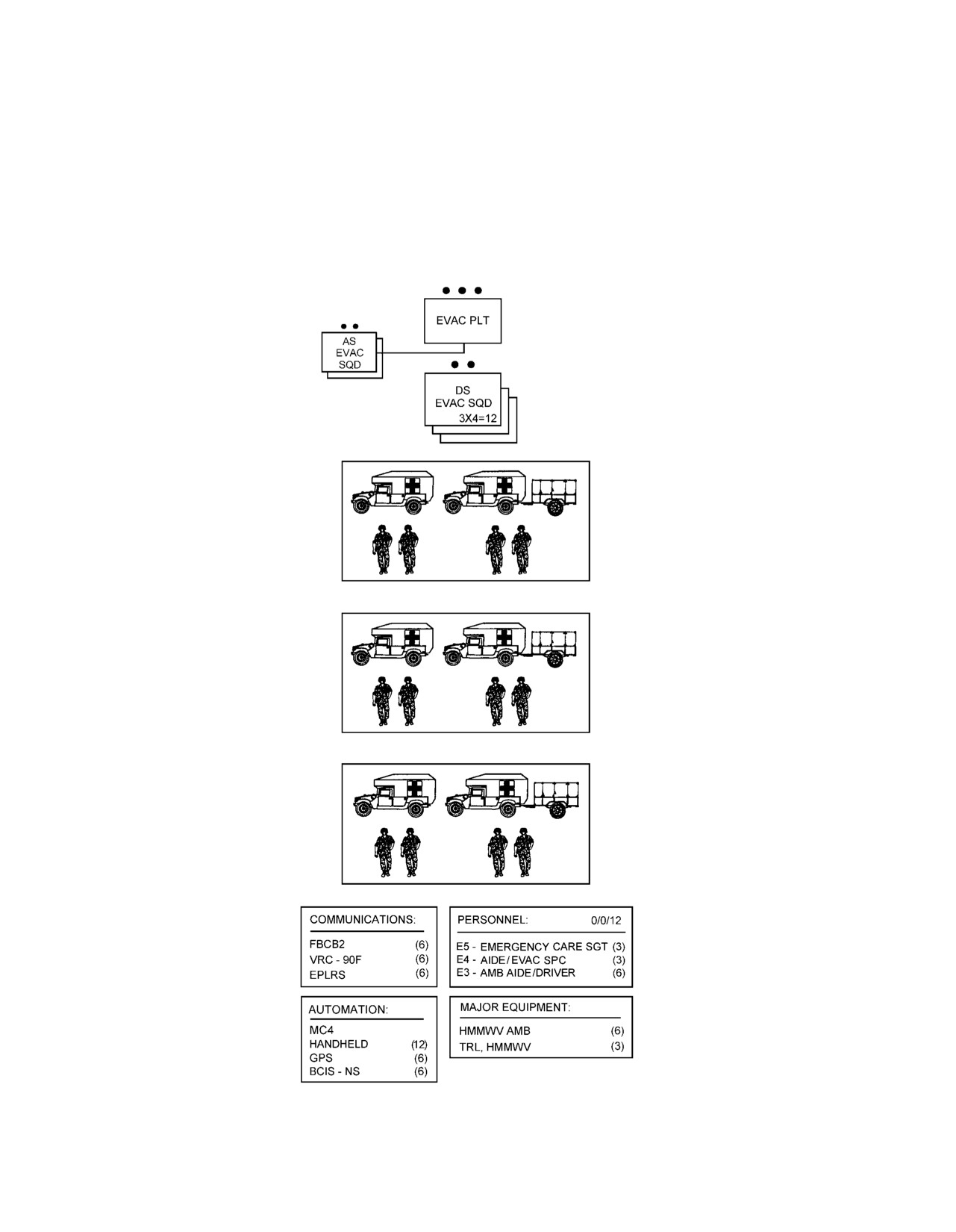
C1, FM 4-02.6
Table F-11. Direct Support Evacuation Squads Depicting Personnel, Major Equipment,
and Communications/Automation Enablers
F-22
C1, FM 4-02.6
F-19. Employment of the Evacuation Platoon
Each evacuation team ambulance has an MES designed for medical emergencies and en route patient care.
Ambulances deploy forward to support maneuver and other Level I MTFs and BSMC treatment squads/
teams and/or AXP operations. The evacuation platoon leader and platoon sergeant establish primary and
alternate evacuations routes, verify locations of supported units, and assist evacuation teams as necessary.
The platoon leader and platoon sergeant coordinate support requirements with supported units for evacuation
teams/squads placed in DS. Evacuation platoon personnel obtain appropriate dispatch and road clearances
prior to departing company or supported unit areas. The platoon leader ensures that maps, graphic control
measures, and all available information is provided to platoon personnel. If time and fuel permit, the
platoon leader or platoon sergeant may take ambulance drivers on a rehearsal of the evacuation routes. The
platoon leader/sergeant coordinates/establishes AXPs as required by the medical evacuation mission. The
ambulances are usually positioned forward with the aid stations of maneuver battalions/squadrons. The AS
ambulances (Table F-10) are used for area support missions. The DS ambulances (Table F-11) normally
evacuate patients from the aid stations back to the AXPs where patients are placed in either a ground or air
ambulance for further medical evacuation back to the BSMC. Evacuation platoon personnel assist with
establishment of the BSMC area and provide available personnel as tasked by the 1SG. For definitive
information on medical evacuation operations, see FMs 8-10-6 and 8-10-26.
Section VI. MEDICAL LOGISTICS SUPPORT FOR
THE STRYKER BRIGADE COMBAT TEAM
F-20. Medical Logistics Support for Early Entry Operations
Initial Class VIII resupply efforts may consist of medical supply modules tailored to meet specific mission
requirements. Configured loads (CL) will be the primary means of supply for the BSB during early entry
operations. For the first 12 days of early entry operations, CL is shipped every second day with the last
shipment occurring on the 10th day. Class VIII modules, as a part of these CL, are shipped to the BSMC
until replenishment line item requisitioning with the supply support activity (SSA) is established. The SSA
could be a corps MEDLOG company or if attached to a division, a DMSO. All maneuver battalions or
squadron medical platoons will receive Class VIII modules as part of their battalions’ CL. Contents of CL
Class VIII modules may be adjusted as the battle changes. Adjustments to the Class VIII modules are
coordinated through the BSB support operations MLO. While resupply by CL is intended to provide
support during the initial phase, continuation on an exception basis may be dictated by operational needs.
All line item requisitioning from SBCT medical units/elements are sent through the support operations
MLO. The support operations MLO coordinates all Class VIII requirements for the SBCT with the
supporting MEDLOG company or SSA.
F-21. Functional Medical Logistics Business System
Stryker brigade medical elements will use a medical logistics automation system to requisition Class VIII.
Users of this system in the brigade include maneuver battalion/squadron medical platoons, and the BSMC.
F-23
C1, FM 4-02.6
The medical logistics automation system is the primary source for Class VIII line item requisitions from the
BSMC when connectivity is available. When connectivity for medical logistics automation systems are not
available and/or not operational, other methods will be employed. These methods may include paper
requisitions, coded requests by radio/telephone, or by a disk copy. All Class VIII requisitions are sent to
the support operations MLO. The support operations MLO submits all Class VIII resupply requisitions
from SBCT medical units/elements to the supporting MEDLOG company or SSA using MC4/DMLSS-AM
or TCAM or by other means as coordinated or required by the supporting MEDLOG element.
Section VII. MEDICAL LOGISTICS OPERATIONS
F-22. Routine Class VIII Requisitions
Routine requisitions from maneuver battalion medical platoons for Class VIII resupply are via digital,
voice, or paper request and sent to the support operations MLO. Also if the Class VIII digital systems are
down, FBCB2 could be used to a request for Class VIII supply. The voice procedures for requisitioning of
Class VIII need to be spelled out in the TSOP.
NOTE
The best method is to establish a 20- to 30-line sheet with numbered
resupply items listed. For example, line 1 would be cravats, line 2
would be ringers 1000 ml, and so forth. The radio report would be
given a standard report name in the communications SOP. When the
individual calls in the request, he would state “Report XXX, line 1-
15, line 2-12,” and so forth.
The BSS receives daily updates on the status of Class VIII resupply from the BSB support operations MLO.
Routine requisitions submitted by the BSMC are sent to the support operations MLO and forwarded directly
to the supporting MEDLOG activity. The BSB support operations MLO coordinates shortfalls in throughput
distribution with the supporting MEDLOG company or SSA. The BSB support operations MLO may
update priorities with the supporting MEDLOG activity to correct deficiencies in the delivery system. The
supporting MEDLOG company or SSA will forward information to the BSB support operations MLO on
items filled and shipped and on those requisitions that were not filled.
F-23. Emergency Class VIII Requisitions
Emergency requisitions from maneuver battalion medical platoons are submitted to the BSB support
operations MLO. If the BSMC is unable to fill the request, the requisition is forwarded to the supporting
MEDLOG company or SSA. Emergency requisitions from BSMC are sent through the support operations
MLO for management and to ensure visibility of the requisitions. The support operations MLO maintains a
F-24
C1, FM 4-02.6
record of the requisition until it is filled. All emergency requests received by the MEDLOG company or the
SSA are processed for shipment by the most expedient transportation available. The support operations
MLO report all emergency Class VIII requests to the SBCT BSS.
F-24. Shipment of Class VIII to Stryker Brigade Combat Team Medical Units/Elements
Delivery of Class VIII to the requesting medical units in the SBCT is accomplished by CL using medical
and nonmedical transports. Shipment of Class VIII modules on CL from the MEDLOG company or the
SSA is coordinated with the corps movement control officer. The management and in-transit visibility of
Class VIII delivery is accomplished through document number and transportation control number tracking.
The systems used to provide management and coordination are: Medical Logistics Automation Systems,
TC-AIMS, MTS, and GTN. These systems are located in the MEDLOG company. In some cases, delivery
of Class VIII into the SBCT AO may also be achieved through use of the directed Class VIII resupply using
backhaul medical evacuation resources that are returning to the SBCT AO. The primary means for resupply
of maneuver medical platoons and sections will be by LOGPAC. The BSMC coordinates delivery of Class
VIII to the maneuver battalion medical platoons via LOGPAC or nonmedical transports with the FSB
support operations MLO. For Class VIII backhaul resupply, medical transports may be used, if possible.
Emergency Class VIII resupply will be processed for shipment by the most expedient means available.
Based on casualty estimates for military operations, Class VIII may be pre-positioned with maneuver
battalion/squadron medical platoons or with the BSMC.
F-25. Medical Maintenance
The medical equipment repair performs unit-level medical maintenance on organic equipment assigned to
the BSMC and for supported and attached units. The SBCT is dependent on the SSA for medical maintenance
support to include medical standby equipment for temporary issue to SBCT medical elements. The SBCT is
dependent on the supporting SSA for intermediate-level (DS/GS) maintenance service for the SBCT and its
corps medical augmentation elements. The SBCT may also require assists with unit-level maintenance of
medical equipment. See FM 4-02.1 for definitive information on medical maintenance for the SBCT.
F-26. Using Other Systems for Reporting and Requisitioning Class VIII
If the digital MEDLOG system is not functioning, transmission of Class VIII requisitions and status reports
data may be accomplished by one of a number of ways. The baseline method will always be by disk and
hard copy. Another method will be by radio or telephone transmission if signal capabilities allow. At the
battalion level, units will attempt to transmit requisition and report data using Single-Channel Ground and
Airborne Radio System (SINCGARS) systems improvement program (SIP) or EPLRS linked to the hyperlink
or modem capability of MC4. Given the line of site limitations of FM radio, this attempt is best accomplished
in synchronization with previously coordinated retransmission. Within the BSA and higher, transmission of
data will be either by telephone or AM radio, if allowed. Note that if telephone is used, the unit must
accomplish prior coordination with the brigade S6/EAB Assistant Chief of Staff (Information Management)
(G6) to obtain a net encryption system or other encryption hardware system in order to send data.
F-25
C1, FM 4-02.6
F-27. Blood Management
Blood requirements for the SBCT are determined by the SBCT surgeon based on the casualty estimates.
Only packed liquid red blood cells are expected to be available to the brigade. Blood products are shipped
to BSMC Level II MTFs by the blood support element of the MEDLOG battalion. The BSB MLO based on
the brigade surgeon’s blood requirement estimates, submits a blood request to the EAB blood support
element or the Area Joint Blood Program Office. The BSMC treatment platoon submits the blood status
report through the support operations MLO to the blood support element. The BSMC treatment platoon
submits requests for blood through the support operations MLO to maintain blood supply stock. The
support operations MLO keeps the BSS informed on the status of blood at the BSMC. Shipment of blood
from the EAB blood support element to the BSMC is coordinated by the blood support element with the
EAB movement control center (MCC). It is then transported to the requesting BSMC MTF by dedicated
medical vehicles (air and ground). The blood support detachment notifies the BSB support operations MLO
when blood is shipped. Emergency resupply can be accomplished by air ambulance or by medical personnel
on nonstandard medical transports. See FMs 4-02, 4-02.1, 8-10-9, 8-55, and TM 8-227-12 for definitive
information on blood management.
F-28. Property Exchange
When patients are evacuated to and from the BSMC, property exchange will occur between the BSMC’s
ambulances and the supporting or supported elements to prevent unnecessary depletion of items. Whenever
a patient is evacuated from one MTF to another or is transferred from one ambulance to another, medical
items of equipment (casualty evacuation bags [cold weather-type bags], blankets, litters, and splints) remain
with the patient. To prevent rapid and unnecessary depletion of supplies and equipment, the receiving
Army element exchanges like property with the transferring element. This reciprocal procedure will be
practiced to the fullest extent possible through all phases of evacuation from the most forward element
through the most rearward hospital. Patient movement items (PMI) are available from Level II through
Level V MTFs. Patient movement items are identified as items of medical equipment required or may be
required during the patient’s evacuation. These items are more expensive/low density and require
accountability. The less expensive items such as litters, blankets, and litter straps will not be considered as
PMI. The handling and return of PMIs to the originating medical unit requires a reliable supporting
logistical infrastructure to ensure that PMI are available and serviceable. The intent of the PMI system is to
provide a seamless system, which includes a standardized, certified PMI equipment list. Patient movement
items used to monitor and sustain a patient would normally stay with the patient throughout the patient
evacuation system. The goal is to prevent depletion of forward units’ PMI through a one-for-one exchange
of equipment at the time of patient transfer. When a patient requires evacuation, it is the originating MTF’s
responsibility to provide the PMIs required for supporting the patient during evacuation. The Services will
include and maintain initial quantities of Joint Readiness Clinical Advisory Board (JRCAB)-standardized
PMIs in the appropriate medical assemblages. They should not assume or plan for shortfalls of PMI being
satisfied by other Services. The Services, through the JRCAB will identify and approve PMI equipment.
Patient movement items must be certified for use on the appropriate patient evacuation platform (for
example, fixed/rotary wing). For definitive information on PMI, see Appendix F of FM 4-02.1.
F-26
FM 4-02.6
APPENDIX G
TACTICAL STANDING OPERATING PROCEDURE
G-1. General
This appendix provides a sample TSOP format for a medical company. The information on the clinical
aspects of the treatment and evacuation elements can be included in the TSOP or prepared separately as a
clinical standing operating procedure (CSOP) (Appendix H). This sample TSOP should not be considered
as all-inclusive. However, this information and the unit mission training plan are good starting points for
developing the TSOP. It may be supplemented with information and procedures required for operating
within a particular command.
G-2. Purpose of the Tactical Standing Operating Procedure
The TSOP prescribes policy, guidance, and procedures for the routine tactical operations of a specific unit.
It should cover broad areas of unit operations but be sufficiently detailed to provide newly assigned
personnel the guidance required for them to assume their new positions. A TSOP may be modified by
TSOPs and OPLANs/OPORDs of higher headquarters. It applies to a specific unit and all subordinate units
assigned and attached. Should a TSOP not conform to the TSOP of the higher headquarters, the higher
headquarters’ TSOP governs. The TSOP should be periodically reviewed and updated as required.
G-3. Format for the Tactical Standing Operating Procedure
a. There is not a standard format for all TSOPs; however, it is recommended that the unit’s
TSOP follow the format used by its higher headquarters. The TSOP can be divided into sections (specific
functional areas or major operational areas). The TSOP can contain one or more annexes, each of which
may have one or more appendixes. The appendixes may each have one or more tabs. Appendixes can be
used to provide detailed information on major subdivisions of the annex and tabs can be used to provide
additional information (such as report formats or area layouts) addressed in the appendix.
b. Regardless of the format used, the TSOP should follow a logical sequence in the presentation
of material. As a minimum, it should discuss the—
• Chain of command.
• Major functions and staff sections of the unit.
• Operational requirements.
• Required reports.
• Necessary coordination with higher and subordinate elements for mission accomplish-
ment.
• Programs (such as command information, PVNTMED measures, and CSC).
• Other relevant topics.
G-1
FM 4-02.6
c.
Pagination of the TSOP can be accomplished by starting with page 1 and numbering the
remaining pages sequentially. If the TSOP is subdivided into sections, annexes, appendixes, and tabs, a
numbering system that clearly identifies the location of the page within the document can be used. Annexes
are identified by letters and are listed alphabetically. Appendixes are identified by numbers and arranged
sequentially within a particular annex. Tabs are identified by a letter and are listed alphabetically within a
specific appendix. After numbering the initial sections using the standard numbering system (sequentially
starting with page 1 through to the end of the sections), then beginning with the annexes and their
subdivisions, they are numbered as the letter of the annex, the number of the appendix, the letter of the tab,
and the page number. For example, page 4 of Annex D is written as “D-4”; page 2 of Appendix 3 to
Annex D is written as “D-3-2”; page 5 of Tab A to Appendix 3 of Annex D is written as “D-3-A-5”. This
system of numbering makes the pages readily identifiable as to their place within the document.
d. In addition to using a numbering system to identify specific pages within the TSOP, descriptive
headings should be used on all pages to identify subordinate elements of the TSOP.
(1) The first page of the TSOP should be prepared on the unit’s letterhead. The remaining
pages of the major sections should include the unit identification in the upper right hand corner of the page
(for example:
“____Medical Company”).
(2) A sample heading for an annex is:
“ANNEX C (Administration and Personnel) to
____Medical Company.”
(3) A sample heading for an appendix is:
“APPENDIX 2 (Personnel Management) to
ANNEX C (Administration and Personnel) to ____Medical Company.”
(4) A sample heading for a tab is:
“TAB A (Award Recommendations) to APPENDIX 2
(Personnel Management) to ANNEX C (Administration and Personnel) to ____Medical Company.”
e.
As the TSOP is developed there may be an overlap of material from one annex to another.
This is due in part to similar functions that are common to two or more unit elements. Where overlaps
occur, the material presented should not be contradictory. All discrepancies will be resolved prior to the
authentication and publication of the TSOP.
G-4. Sample Tactical Standing Operating Procedure (Sections)
The information contained in this paragraph can be supplemented. It is not intended to be an all-inclusive
listing. Different commands will have unique requirements that need to be included.
a. The first section of the TSOP identifies the unit that developed it.
(1) Scope. This document establishes and prescribes procedures to be followed by the
designated unit and its assigned, attached, or OPCON units/elements.
(2) Purpose. This document provides policy and guidance for routine tactical operations of
this unit and its assigned, attached, or OPCON units.
G-2
FM 4-02.6
(3) Applicability. Except when modified by TSOPs and OPLANs/OPORDs of higher
headquarters, this document applies to this unit and to all assigned, attached, or OPCON elements/units for
combat operations. In cases of nonconformity, the document of the higher headquarters governs.
(4) References. This paragraph can include any pertinent regulations, policy letters, higher
headquarters TSOP, or other appropriate documents.
(5) General information. This paragraph discusses the required state of readiness of the
unit; primary, secondary, and contingency missions; procedures for operating within another command’s
AO; and procedures for resolution of conflicts with governing regulations, policies, and procedures.
b. The second section of the TSOP discusses the unit’s organization.
(1) Organization. This unit is organized and equipped in accordance with the applicable
MTOE.
(2) Task organization. Task organization is contingent on the mission and is approved by
the headquarters ordering deployment.
(3) Organizational charts. Contained in Annex A.
c.
The third section of the TSOP discusses the unit functions.
(1) Company headquarters. The unit provides Echelons I and II medical care to supported
units and area support medical care to those units operating in the AO without organic CHS resources. The
company headquarters supervises movements, internal arrangements, area layout, physical security, and
operation of the unit.
(2) Ground and air ambulances (to include attached, assigned, or OPCON of corps
evacuation elements). These provide medical evacuation of patients; emergency movement of whole blood,
biologicals, and medical supplies; transportation of medical personnel and equipment; and serve as
messengers in medical channels.
(3) Staff responsibilities. This paragraph lists the unit’s key personnel and their duties as
prescribed in FMs 8-10 and 101-5 and any command-directed duties.
d. The fourth section of the TSOP pertains to staff operations and is subdivided into annexes.
G-5. Sample Tactical Standing Operating Procedure (Annexes)
Annexes are used to provide detailed information on a particular function or area of responsibility. The
commander determines the level of detail required for the TSOP. Depending upon the complexity of the
material to be presented, the annex may be further subdivided into appendixes and tabs. If the annex
contains broad guidance or does not provide formats for required reports, paragraphs may be used and the
G-3
FM 4-02.6
annex need not be further subdivided. However, as the material presented becomes more complex,
prescribes formats, or contains graphic material, the annex will require additional subdivision. This
paragraph discusses the subdivision of the annex by appendixes. It does not contain examples of subdividing
into tabs the information presented in the appendixes. Applicable references, such as ARs, FMs, and TMs,
should be provided in each annex. The number of annexes and their subdivisions presented below are not
to be considered as an all-inclusive listing. Different commands will have unique requirements; therefore,
supplementation of the information presented is permitted.
a. Annex A.
(Organizational Charts).
b. Annex B.
(Command Post).
(1) General. The company may operate a CP depending on the mission and tactical situation.
Personnel staffing of the CP is tailored to plan, coordinate, and provide C2 of assigned, attached, and
OPCON elements. The area location for the CP is selected by the commander; he also designates who will
staff it. Staffing usually consists of the commander and/or XO, 1SG, communications personnel, and NBC
NCO, if assigned.
(2) Camouflage. This appendix discusses what camouflage procedures are required to
include—
• Type and amount of required camouflage materials (such as nets and shrubs).
• Display of the Geneva Conventions distinctive emblem on facilities, vehicles, and
aircraft on the ground (STANAG 2931).
• Other pertinent policies, guidance, or procedures.
(3) Message distribution. This establishes procedures for the handling of messages (both
classified and unclassified); provides procedures for picking up and delivering messages; and establishes
procedures for preparing outgoing messages.
c.
Annex C.
(Human Resources Support). This annex outlines procedures relating to human
resources support and associated activities. The battalion S1 has primary responsibility for providing and
coordinating all human resources support functions, usually via the intermediate staging base or through
reach operations. These functions include manning, personnel services, personnel support, and personnel
information management.
(Field Manual 12-6 is the capstone manual on personnel doctrine and should be
used for developing specific operational plans and standard operating procedures.)
(1) Personnel accounting and strength reporting. Personnel accounting and strength
reporting is a critical function and is primarily conducted via Personnel Situation Report (PERSITREP)
from the unit to the battalion S1. For nondigitized units, other reports available for use are battle rosters,
personnel summary, and personnel requirements reports.
(2) Replacement management. Individual replacements will not be readily available during
the initial phases of operations. The battalion S1 automatically initiates replacement requests for personnel
G-4
FM 4-02.6
who are reported on the PERSITREP as wounded in action (WIA), missing in action (MIA), or killed in
action (KIA).
(3) Casualty operations management. Casualty operations management includes the record-
ing, reporting, verification, and processing of information from the unit level. Casualty operations require
100 percent personnel accounting reconciliation. All commanders, soldiers, and deployed civilians must be
sensitive to the accuracy and sensitive nature of casualty information. Casualty reports will be submitted to
the battalion S1 on DA Form 1155/1156 within 24 hours of incident.
(4) Personnel accountability.
• Personnel Daily Summary. This appendix provides the procedures for preparing
and submitting a Personnel Daily Summary (PDS) report. The instructions may include requirements for
encrypting the report prior to transmission, specific guidance on time of submission, corrections, or other
administrative details.
• Casualty Feeder Report. This report is submitted on DA Form 1155/1156. Instruc-
tions on the completion of the form and submission requirements are included.
• Witness statements on individuals. This statement needs to be completed only when
the recovery of a body is not possible or cannot be identified. It should be submitted to the battalion S1
within 24 hours of the incident. The procedure should contain information on obtaining the form,
instructions for completing it, and other relevant information.
(5) Personnel management.
• Replacements. Individual replacements will not be readily available during the
initial phases of operations. The battalion S1 automatically initiates replacement requests for personnel who
are reported on the PDS report as WIA, MIA, or KIA.
• Personnel actions. All personnel actions are channeled through the battalion S1.
The company XO and 1SG are the company points of contact. Actions are handled expeditiously and meet
suspense dates (tactical situation permitting).
• Efficiency reports. This paragraph provides pertinent information on the completion
and submission of these reports.
• Award recommendations. This paragraph delineates the responsibilities for and
guidance concerning the submission of recommendations for awards and for scheduling and conducting
award ceremonies.
• Promotions. This paragraph discusses the procedures for submitting recom-
mendations for promotion and conducting promotion ceremonies.
• Correspondence. All correspondence addressed to higher headquarters is submitted
through the battalion S1. Requirements for submission, preparation, and approval are also provided.
G-5
FM 4-02.6
• Personnel records. This paragraph discusses requirements for coordination for this
support and the procedures for having correspondence included in the official military personnel files of
personnel assigned and attached.
(6) Personnel services. Personnel services are those activities pertaining to soldiers as
individuals. Unless prohibited by the tactical situation, the services listed below are normally available to
all assigned and attached elements.
• Sporting activities and morale and welfare activities.
• American Red Cross.
• Finance. Finance units provide individual and organizational support on an area
basis. Individual support includes casual payments, check cashing, currency conversion, and pay inquiries.
Organizational support covers contracting support and commercial vendor operations and reimbursement of
impress fund cashiers and Class A Agent. Before deployment, units will have officer appointments
prepared and be trained for Class A Agent duties.
• Legal services. Information and guidance on administrative boards, court-martial
authority and jurisdiction, legal assistance, and general services should be provided.
• Religious activities. Religious activities include unit ministry teams, services
available from different faiths, schedule of services, and hospital visitations.
• Postal services. This includes hours of operation and services available.
• Post exchange services. This includes hours of operation and availability.
• Distribution. Pick up and delivery schedules and any command-specific issues and
procedures are provided.
(7) Mortuary affairs. Commanders at all levels are responsible for the recovery, identifi-
cation, and evacuation of US dead. This section discusses the responsibilities and procedures for unit-level
MA activities for assigned and attached personnel.
• Responsibilities. This paragraph discusses unit requirements.
• Disposition. Guidance on graves registration procedures, collection points, trans-
portation requirements, and the handling of remains are provided.
• Hasty burials. Requirements for conducting hasty burials, marking the grave, and
reporting the location of the grave site are included.
• Personal effects. Guidance on the accounting for personal effects and requirements
should a hasty burial be required.
G-6
FM 4-02.6
• Disposition of civilian and EPW remains. The local civilian government is
responsible for burial of remains of their citizens. The burial of the remains of EPW should be accomplished
in separate cemeteries from US, allied, and coalition personnel. If this is not possible, separate sections of
the same cemetery should be used.
• Contaminated remains. This paragraph discusses the handling and disposition
requirements (including protective clothing), procedures, and marking and reporting of the contaminated
burial site.
(8) Public information. This paragraph contains procedures for obtaining approval on the
public release of information.
(9) Maintenance of law, order, and discipline. This appendix should provide applicable
regulations, policy, and command guidance on topics such as serious incident reports, notifications, and
submission format, straggler control, confinement of military prisoners, and EPW.
(10) Enemy prisoners of war. This appendix discusses the responsibilities of EPW surrendered
to the medical unit. (These procedures DO NOT pertain to EPW patients captured by other units. Medical
personnel DO NOT guard, search, or interrogate EPW while they are in the CHS channels; guards are
provided by nonmedical personnel designated by the tactical commander for these duties.) Until EPW
personnel can be evacuated to an EPW collection point, medical personnel should remember and enforce
the soldier basic skills: segregate, safeguard, silence, secure, and speed.
(The speed portion of evacuating
EPW to designated collection points is of paramount importance to medical units.)
NOTE
The treatment of EPW is governed by international and US law and
the provisions of the Geneva Conventions. Personnel should be aware
of these requirements and have ready access to the applicable regula-
tions and policy guidance.
d. Annex D.
(Intelligence and Security). This annex pertains to intelligence requirements and
procedures and OPSEC considerations.
(1) Intelligence. Intelligence requirements are submitted to the battalion Intelligence Officer
(US Army, S2). These requirements include the essential elements of information, commander’s critical
intelligence requirements, medical threat, and other intelligence information/products.
(2) Counterintelligence. This appendix discusses camouflage, COMSEC, signals and
countersigns, SOI, and document security.
G-7
FM 4-02.6
(3) Weather.
(4) Captured personnel, equipment, supplies, and documents. This appendix provides
guidance on the procedures required for disposition of these personnel, equipment, supplies, and documents.
The Geneva Conventions have a specific bearing on this area.
(5) Security. Security issues, such as weapons security, checkpoints, SOI, required reports,
and escape and evasion training requirements, are included.
e.
Annex E. (Operations). This annex establishes procedures for company operations on issues
such as readiness levels, threat levels, warning levels, camouflage, security, and area damage control.
(1) Operational situation report. Report requirements for format, preparation, and sub-
mission are discussed.
(2) Operations security. This appendix provides guidance and procedures for secure planning
and conduct of combat operations.
(3) Operations security countermeasures. This appendix discusses camouflage, light
discipline, physical information, and signal security.
(4) Communications-electronics. This appendix establishes communications policies, proce-
dures, and responsibilities for the installation, operation, and maintenance of CE equipment.
• Concept of operations.
• Radio communications.
• Command and control.
• Radio teletypewriter communications.
• Message/communications center service.
• Message handling.
• Wire communications.
• Switchboard operations.
• Communications security and operations.
• Intelligence security.
• Meaconing, intrusion, jamming, and interference reporting and CE counter-
measures.
G-8
FM 4-02.6
• Security violations.
• Daily shift inventory.
• Physical security.
• Security areas.
• Inventory of classified materials.
• Safety.
• Power units.
(5) Rear battle responsibilities. This appendix discusses rear battle responsibilities, task
organization, and CHS for reaction/response forces.
(6) Unit location update. This appendix provides timely information on the location of main
and forward CPs, MSRs, and POL points.
f.
Annex F. (Unit Layout). This appendix discusses the establishment and breakdown of the unit
area. As this is a medical company, a smooth and even flow of patients through the treatment areas is
necessary.
(1) Site selection. This appendix provides information on considerations for site selection,
such as amount of terrain required, drainage, and coordination requirements.
(2) Establishment of treatment areas. This can be graphically displayed.
(3) Establishment of area for the handling of contaminated patients. This can be graphically
displayed.
(4) Establishment of administrative areas and motor pool. This can be graphically displayed.
g. Annex G.
(Nuclear, Biological, and Chemical Defense). This annex prescribes the policy,
guidance, and procedures for NBC defensive measures.
(1) Responsibilities.
(2) Nuclear, biological, and chemical reporting requirements and procedures.
• Contamination avoidance.
• Protection. Protection pertains to those measures each soldier must take before,
during, and after an NBC attack to survive and continue the mission.
G-9
FM 4-02.6
• Decontamination. This discusses equipment requirements, procedures, types of
decontamination (such as hasty), and patient decontamination.
• Mission-oriented protection posture. This appendix provides guidance on garments
required for the different MOPP levels and identification procedures for personnel in MOPP.
• Operational exposure guidance. This appendix contains guidance that establishes
the permissible radiation exposure level for the operation. It discusses determining what constitutes a
radiologic hazard; prescribes acceptable limits of potential casualty-producing doses of radiation, minimizing
exposure, and protecting against electromagnetic pulses.
• Masking and unmasking procedures.
• Radiological monitoring and survey operations.
h. Annex H.
(Logistics). This annex establishes logistics procedures for the company.
(1) General supply and services. A discussion of the applicability, responsibilities, policy,
classes of supply, requisition and delivery procedures, hours of operation, and other supply relevant topics
and available services (such as laundry and bath) can be addressed in this section.
(2) Combat health logistics support. The CHL concept of operations, requisition and
distribution procedures, accountability, and reports are provided in this appendix.
(3) Food service. This appendix discusses responsibilities, hours of operation, Class I
supplies, sanitation requirements, layout of field kitchen, fuel storage, maintenance, safety precautions, and
administration (such as head counts, meals, ready to eat, and inspections).
(If the field feeding function is
consolidated at battalion level, this annex would detail support and coordination requirements for the field
feeding operation.)
(4) Transportation and movement requirements. The appendix may cover the following
areas: applicability; responsibilities; policies on speed, vehicle markings, transporting flammable materials,
transporting ammunition and weapons, and so on; convoy procedures; safety; and accident reporting.
(5) Fire prevention and protection. This annex provides guidance on—
• Use of the tent stove and flammable materials.
• Use of cigarettes, matches, and lighters.
• Operation or use of electrical wiring and appliances.
• Safety of tents and occupants.
• Spacing of tents, stoves, and ranges.
G-10
FM 4-02.6
• Installation of British thermal units heaters.
• Availability of fire-fighting equipment.
(6) Field hygiene and sanitation. This appendix provides uniform guidance and procedures
for the performance of functions related to field hygiene and sanitation. It includes the following topics:
• Communicable disease control.
• Field sanitation team.
• Field water supply, water containers and cans, and water purification bags and
procedures.
• Food sanitation.
• Latrines.
• Liquid waste, garbage, and rubbish disposal.
(7) Conventional ammunition download and upload procedures. This appendix delineates
responsibilities and provides guidance and procedures for the requisition, storage, and distribution of
ammunition and weapons, reporting requirements, and safety. It also includes procedures for securing
patient weapons and organization equipment while the patient is being held or evacuated.
(8) Petroleum, oils, and lubricants accounting.
(9) Maintenance. This appendix includes information on the maintenance requirements of
the company and the location and hours of operation of maintenance units and collection points. Maintenance
for medical equipment, vehicles, and communications and other categories of equipment are discussed.
i.
Annex I.
(Safety). This annex establishes minimum essential safety guidance for the unit. It
includes—
• Accident reporting.
• Safety measures.
• Emergency procedures.
• Vehicle safety.
• Ground guide procedures.
• Fire prevention and protection.
G-11
FM 4-02.6
• Climate and survival training.
• Animal and arthropod hazards.
• Personal protective measures.
• Hearing conservation program.
• Threat of carbon monoxide poisoning.
j.
Annex J.
(Civil-Military Operations [CMO]). This annex discusses participation in CMO.
Medical elements are often involved in CMO, humanitarian assistance, and disaster relief operations. The
activities that may be covered include—
• Providing DS for medical evacuation.
• Providing guidance on developing a medical infrastructure in a HN.
• Providing training to HN personnel.
k.
Annex K. Clearing Station Clinical Activities. Refer to the CSOP (Appendix H.)
G-12
FM 4-02.6
APPENDIX H
CLINICAL STANDING OPERATING PROCEDURE
H-1. General
a. This appendix provides a sample CSOP for use within a clearing station. It is different than
the TSOP as it focuses on the clinical aspects of the unit’s operation.
b. Appendix G contains information on the format of the TSOP. This format may also be used
when developing the CSOP, if desired.
c.
The sample CSOP provided in this appendix is merely an outline and should not be considered
as all-inclusive. The information contained in this sample is not sufficiently detailed to enable a unit to
implement the CSOP as it is written. The addition of treatment protocols, command guidance, clearing
station policies, and other pertinent regulations, directives, and procedures is required.
H-2. Purpose of the Clinical Standing Operating Procedure
a. This CSOP prescribes policy and provides guidance on the routine operation of patient
treatment and support elements within the clearing station. Each clinical element is required to develop,
maintain, and update their CSOP.
b. Once completed, it is reviewed and approved by the senior clinician.
c.
The content of the CSOP should not contradict or impede the implementation of the TSOP.
Should differences in the two documents occur, they are to be resolved by the commander.
H-3. Sample Clinical Standing Operating Procedure
a. Treatment Platoon. The following topics should be considered:
(1) Treatment section.
• Triage procedures.
• Treatment protocols.
• Routine and emergency patient care management.
• Staffing, length of shift, and relief procedures and requirements.
• Controlled substance procedures and records.
• Coordination requirements with the patient administration specialist, to include
medical evacuations, release of RTD, and maintenance of the field individual medical records (including
disposition of the FMC).
H-1
FM 4-02.6
• Coordination for radiology and medical laboratory services, to include blood and
blood products.
• Procedures for the collection and safeguarding of weapons, munitions, and sensitive
military equipment which may arrive with patients.
• Policy on disposition of patient’s personal protective gear (such as mask and MOPP
overgarments).
• Logistic requirements and procedures for obtaining supply/resupply (both general
and medical), to include property exchange (litters and blankets).
• Notification requirements as directed by the commander.
• Death procedures.
• Scope of practice of MOS 91W personnel.
• Mass casualty operations (see paragraph e below.)
• Procedures for the disposal of medical waste.
• Reporting of unusual occurrences.
• Policy and procedures for the care and treatment of nonmilitary personnel.
• Policy and procedures for the care and treatment of non-US personnel.
• Policy and procedures for the care and treatment of EPW.
• Medical evacuation, to include receiving patients arriving by helicopter and ground
assets.
• Establishment of a triage area, to include a patient decontamination station, should
contaminated casualties be evacuated to the facility.
• Supervision of nonmedical patient decontamination teams.
• Training and use of litter teams.
• Procedures for the release of medical information on patients.
• Coordination requirements for power generation and refrigeration capabilities, if
required.
H-2
FM 4-02.6
• Procedures for medical activities affected by the Uniformed Code of Military Justice
(UCMJ) such as treating soldiers with self-inflicted wounds, rape, or other similar situations.
• Procedures for medical equipment maintenance.
• Safety.
• Fire evacuation plan.
(2) Area support section.
(a) Area support treatment squad. Same as (1) above.
(b) Area support squad. The following topics should be considered:
• Procedures for controlled substance inventory, dispensing requirements,
registry, destruction procedures, discrepancy reports, and requisitions.
• Key control.
• Requirements for refrigeration support.
• Rotation of medication stocks.
• Preparation of required reports.
• Infection and chemical hazard control procedures.
• Procedures for obtaining specimens.
• Procedures and requirements for shipping specimens to more sophisticated
laboratories.
• Procedures for medical waste disposal.
• Procedures for storing blood and blood products.
• Blood planning factors.
• Establishment of x-ray exposure area.
• Procedures for the operation of the darkroom.
• Film control procedures.
H-3