FM 4-02.6 THE MEDICAL COMPANY: TACTICS, TECHNIQUES, AND PROCEDURES (AUGUST 2002) - page 3
FM 4-02.6
• Frost shields (such as using the plastic bag in which the batteries are packed) should be
placed over microphones.
• Grounding rods have to be buried horizontally instead of pounded vertically. Recovery
of stakes and rods placed in the ground is significantly more difficult.
• Flooring is needed in heated areas because the heat will thaw the ground.
• Soldiers must take breaks for water and warmth.
• Static electricity presents a serious hazard especially around flammable products.
4-6.
Nuclear, Biological, Chemical, and Directed-Energy Environments
a. On future battlefields, the enemy may employ NBC weapons/agents and directed-energy (DE)
weapons/devices. Nuclear, biological, chemical, and DE protective measures and procedures to mitigate
their effects must be included in the medical company training programs and daily operations. Nuclear,
biological, and chemical actions create high casualty rates, materiel losses, obstacles to maneuver, and
contamination.
(1) Mission-oriented protective posture levels 3 and 4 result in body heat buildup, reduction
of mobility, and degradation of vision, touch, and hearing senses.
(2) Laser protective eyewear may degrade vision, especially at night.
(3) Toxic industrial material maybe released as a weapon application, accidental or by
terrorist. The TIM may prevent use of terrain and create casualties.
b. Contamination is a major problem in providing CHS in an NBC environment. To increase
survivability, as well as supportability, the medical company must take necessary action to avoid NBC
contamination. Maximum use must be made of—
• Alarm and detection equipment.
• Unit dispersion.
• Overhead cover, shielding materiel, and collective protection shelter, when available.
• Chemical agent resistant coatings.
c.
Generally, a biological aerosol attack will not significantly impact materiel, terrain, or
personnel in the short term, although toxins can be an exception.
d. Field Manuals 3-3, 3-4, 3-5, 3-9, 3-100, 4-02.283, 8-50, 8-284, and 8-285 contain detailed
information on—
4-11
FM 4-02.6
• Characteristics and soldier dimensions of the nuclear battlefield.
• Nuclear, biological, and chemical operations.
• Extended operations in contaminated areas.
• Contamination avoidance.
• Nuclear, biological, and chemical protection.
• Decontamination.
• Prevention and medical management of laser injuries.
• Toxic industrial material hazard
e.
Combat health support planning for the integrated battlefield must be comprehensive and
thoroughly coordinated. In addition to the traditional CHS provided combat units, planning for EMT for
civilian casualties, consistent with the military situation, should be included. The medical company
commander should forecast the expected number of casualties, institute triage, and provide medical
treatment. For additional information on CHS planning in this environment, refer to FMs 4-02.283,
8-10-6, 8-10-7, 8-50, 8-55, 8-284, 8-285, and 8-500.
(1) A new dimension on future battlefields will be the employment of DE weapons/devices.
These may be laser, microwave, or radio frequency generated sources. Information on the prevention and
medical management of laser injures is contained in FM 8-50.
(2) For information on the medical evacuation of patients in a contaminated environment,
refer to FMs 8-10-7, 8-10-6 and 8-10-26.
4-7.
Urban Operations
Throughout history, battles have been fought on urbanized terrain. Some recent historical examples include
Hue, Beirut, Panama City, and Somalia. Urban operations are those military actions planned and conducted
on a terrain where man-made structures impact on the tactical options available to the commander. This
terrain is characterized by a three-dimensional battlefield, having considerable rubble, ready-made fortified
fighting positions, and an isolating effect on all combat, CS, and CSS units. Of concern to the CHS planner
is the need to plan, train, prepare, and equip for CHS from under, above, and at ground level.
a. The CHS plan must be flexible and capable of supporting unanticipated situations. Special
equipment requirements for the provision of CHS include, but are not limited to—
• Axes, crowbars, and other tools used to break through barriers.
4-12
FM 4-02.6
• Special harnesses; portable block and tackle equipment; grappling hooks; collapsible
ladders; heavy gloves; and casualty blankets for shielding. This equipment is used to lower casualties from
buildings or move them from one building to another at some distance above the ground.
• Equipment for the safe and quick retrieval from craters, basements, sewers, and subways.
Casualties may have to be extracted from under rubble and debris.
b. Effective communications will be degraded in MOUT. The task-organized search and medical
evacuation teams will have difficulty locating injured and wounded soldiers because of their isolation within
buildings, or by their being hidden by rubble and debris. Once the area is secured, the wounded can display
markers or panels, or other field expedients (fatigue jacket or T-shirts) to indicate where they may be
found.
c.
The anticipated increase in wounds and injuries requires increased supplies of IV fluids.
Individual soldiers may carry these fluids to hasten their availability and shorten the time between wounding
and initiation of vascular volume replacement.
d. Route markings to the division clearing station and the display of the Geneva Conventions
emblem (red cross on a white background) at the MTF must be approved by the tactical commander.
(Not
displaying the Geneva Conventions emblem can forfeit the protections afforded to both medical personnel
and their patients under the Geneva Conventions. Refer to Appendix A and FM 8-10 for additional
information.) The location of the MTF must be as accessible as possible, but well separated from fuel and
ammunition depots, motor pools, reserve forces, or other lucrative enemy targets, as well as civilian
hazards such as gas stations or chemical factories.
e.
Casualty collection points, AXPs, BASs, and division clearing station locations should be
preplanned and in relatively secure areas accessible to both air and ground ambulances. The location of
these points should be indicated on the medical overlay to the OPLAN.
f.
The medical company/troop, in establishing its clearing station, uses only the minimum number
of resources required to successfully accomplish the mission. Suitable permanent facilities within the urban
area may be used to house the MTF, if available. Refer to Appendix J for clearing station in urbanized
operations (UO).
NOTE
Construction standards vary from area to area. Engineer personnel
should inspect local facilities prior to use as an MTF.
g. For additional information on medical evacuation in urban operation, refer to FM 8-10-6.
4-13
FM 4-02.6
4-8.
Combat Health Support During Night Operations
To own the night requires tactics, techniques, and procedures that maximize our night-fighting technological
advantages. Command and control is one of the most important factors in conducting night operations. The
mission of maneuver forces is to destroy the enemy without committing fratricide. To achieve this end
state, all soldiers must operate as efficiently at night as during the day; moreover, leaders must master night
C2.
a. General Considerations.
(1)
The DSS and the brigade surgeon’s section (BSS)/regimental surgeon’s sections (RSS),
along with medical company/troop commanders, must anticipate that supported maneuver brigades and
division units do a substantial amount of their work at night or in limited visibility. They must ensure that
TSOPs are available and used throughout the division and brigade for providing medical evacuation and
treatment at night. Real-life trauma care at night will be enhanced by the ability to use white light (visible
light) at the earliest opportunity. Therefore, medical units/elements must establish standard procedures to
use white light without compromising the tactical environment. This means training to erect shelters as
soon as possible and routinely during hours of darkness. Personnel must understand that some shelter
systems block visible light, but that those same shelters glow when viewed through NVG. In some
extremely mobile situations, ambulance/vehicles could be used to enclose patients and care providers thus
allowing treatment to proceed under white light conditions. The DSS and BSS, along with medical
company commanders, must understand this technology and their capabilities for conducting night
operations. The brigade surgeons and medical company commanders should know how to use both far
infrared (IR) devices (and how their capabilities can enhance CHS operations at night) such as the combat
identification panel (CIP) and near IR devices such as the Budd Light and Phoenix Light towers. See the
discussion below on IR and night-vision devices. They need to know the status and amount of equipment
on-hand and to identify the equipment needed. The BSS/RSS must plan the standard operating procedures
and METT-TC-specific techniques necessary to perform the CHS mission. For these types of operations,
the commander should be advised to consider—
• Using civilian buildings to reduce light and thermal signatures.
• Light-proofing shelters.
• Using nonvisible spectrum light in conjunction with night vision devices.
• Reducing noise signature to a minimum.
(2) The DSA and BSA are susceptible to a night attack. This further slows logistics and CHS
activities. Use of chemical lights may be applicable. However, overuse of chemical lights degrades light
discipline and security. Chemical lights are visible from a distance of a kilometer or more. Possible
techniques for medical units/elements include an array (mixture) of—
• Chemical lights to light CP areas thus eliminating generator noise and thermal
signature.
4-14
FM 4-02.6
• Magnetic holders to allow placement of color chemical lights on vehicles.
• Chemical light to illuminate the vehicle engine compartment for night repairs.
• Chemical light holders to regulate the amount and direction of light.
b. Combat Health Support Considerations.
(1)
Light discipline requirements affect CHS operations much as they do supply and
maintenance operations. Medical units/elements will use additional fuel to run vehicle-mounted night
sights. Treatment operations require lightproof shelters. Patient acquisition is more difficult. Units should
employ some sort of casualty-marking system such as luminous tape.
(2) Limited visibility slows medical evacuation. This requires additional ground ambulances
to compensate. In the offense, ambulances move forward with BAS. However, personnel have to accomplish
this movement carefully to avoid signaling the threat. Personnel use predesignated AXPs. Medical
evacuation by air ambulance is difficult and requires precise grid coordinates as well as prearranged signals
and frequencies. As in daylight, CHS operations conducted at night require active participation of all
involved units. Maximum use of the global positioning system (GPS) and IR and night-vision devices, will
enhance the ability of medical units/personnel to carry out CHS in support of night missions. Night
operating procedures must be routine and practiced as a part of routine operating procedures. This is
especially true for medical units/personnel since they have a 24-hour responsibility under all conditions, not
just combat operations.
c.
Infrared and Night Vision Devices.
(1) A far IR device, such as the CIP, is a quick-fix device for friendly identification. The
thermal taped-covered CIP provides an aid in distinguishing friendly from threat vehicles when thermal
sights are used. Combat identification panels do not replace current acquisition, identification, or
engagement procedures. They provide a device visible through thermal sights to increase situational
understanding and provide a safety net at normal engagement ranges. These devices can be used to further
identify medical vehicles and units.
(2) Near IR devices that aid in C2 may be used for signaling and marking devices. The IR
beam is an effective means to increase situational understanding, improve identification, and increase CHS
effectiveness. These devices reduce fratricide risk when used for marking AXPs, MTF, and landing zones
(LZs). Additionally, these lights are super signaling devices, such as the configuration of certain patterns to
indicate unit identification, turn on/off to signal accomplishment of a task, crossing a phase line, signal from
one ground position to another specific position, or from ground to air. These are excellent devices for near
recognition signaling to guide incoming evacuation vehicles.
(a) The Budd Light operates using active near IR light viewed through image intensi-
fying devices. These image-intensifying devices are only effective during nighttime conditions. Near IR
devices can be directional or omni-directional and emit a steady pulse or codable pulse. The Budd Light is
a compact near IR source using a standard 9-volt (BA-3090) battery as its power source. Both the Budd
4-15
FM 4-02.6
Light and its power source will fit in the palm of your hand. The average life span of the battery power for
a Budd Light is 8 hours of continuous use. The near IR pulse emitted by the Budd Light is similar to a
strobe light and pulses every 2 seconds. It is invisible to the naked eye and to the thermal imager. The pulse
is clearly visible out to 4 kilometers (km) under optimal conditions when pointing the beam directly at the
viewer. The directional characteristic of the beam makes it possible to limit observation by an enemy. If
used to mark vehicles, care should be taken to minimize the light illuminating the vehicle’s surface. The
enemy has to have image intensifying devices to see the lights directly; however, they may see the light
being reflected off of vehicles when the lights are employed in a directional mode. This device is most
effective for C2 purposes. The Budd Light is also very useful for dismounted operations at night.
(b) The Phoenix Light tower operates using active near IR light viewed through image
intensifying devices. The Phoenix Light tower can be used as a codeable IR beacon. The light is powered
by a standard 9-volt (BA-3090) battery. The Phoenix Light tower is ideal for use when positive identification
at night must be made out to 4 km under optimal conditions. The IR beacon has a range equal to the Budd
Light. One advantage is the ability to code many beacons with different codes (sequence of flashes
[including Morse code] up to 4 seconds), enabling anyone to be distinguished in a group. A programmed
sequence will repeat until canceled or when the battery expires (same as Budd Light). Operating instructions
include connecting the battery to the Phoenix Light tower. Using a metal object (a coin is best), make
connection across the two pins on top of the light. A microminiature red indicator flashes the sequence as
the code is entered. At the end of the 4-second memory, a green microminiature indicator will flash,
indicating the end of the input sequence. The Phoenix Light tower is now emitting the desired code. To
check the code, make a connection across the pins. The green microminiature indicator will flash the code.
To change the code, disconnect the battery and repeat the instructions. The Phoenix Light tower also can be
used during dismounted operations. The programming of a code can assist in distinguishing one unit from
another. An active Phoenix Light tower or Budd Light can be covered or uncovered as necessary to ensure
the light is visible only when necessary.
(c) There are numerous types of night vision devices in the Army inventory but this
subparagraph will focus on what the medical company/troop has on its TOE. Each vehicle in a medical unit
will have two night vision devices. Wheeled vehicle drivers will use either the AN/PVS-7B (discussed
below) or the driver’s vision enhancer (DVE). The DVE is a thermal imaging system capable of operating
in degraded visibility conditions such as fog, dust, smoke, and darkness. In conditions of reduced visibility,
the DVE allows a vehicle to maintain speeds up to 55 to 60 percent of those attained during normal daylight
operations. Unlike traditional night vision devices that magnify ambient light, the DVE generates a picture
based on very minute variances in temperature in the surrounding environment. It gives the operator
visibility to the horizon in total darkness and the ability to recognize a 22-inch object at a distance of 360
feet. It can elevate 35 degrees, depress 5 degrees, and rotate 170 degrees in either direction. The DVE
consists of a sensor module, a display control module, a positioning module, wiring harness, and mounting
equipment. A combat DVE and a tactical wheeled vehicle DVE will be available. The track ambulances
(M113), interim armored vehicle ambulances, and M577 track treatment vehicle drivers will use DVE if
available or continue to wear NVG. The NVG (AN/PVS-7B) is a hand-held, head-mounted, or helmet-
mounted night vision system that enables walking, driving, weapons firing, short-range surveillance, map
reading, treatment of patients, and vehicle maintenance in both moonlight and starlight. It has an IR
projector that provides illumination at close range and that can be used for signaling. If the device is
exposed to damaging levels of bright light, there is a high light-level shutoff. There is a compass that
4-16
FM 4-02.6
attaches to the device that allows for reading an azimuth through the goggles. This device has a weight of
1.5 pounds and operates on two AA batteries. Armored medical vehicles (M577, treatment vehicle and
M113, armored ambulance) have IR headlights. These IR headlights can be used for assisting drivers who
wear NVG and can be used for signaling. As with all lights, extreme caution must be taken in tactical
situations. The IR headlights are typically very bright to personnel wearing NVG.
d.
Example Techniques for Using Chemical Lights for Marking and Signaling.
NOTE
Techniques are only limited to available equipment and imagination.
The METT-TC factors should always take precedence.
(1) For marking, chemical lights can be placed along side standard military short or long tent
stakes/pickets to mark routes and positions. The concave side of the tent stake contains the chemical light
and the convex side faces the most likely direction of enemy observation. This technique controls the
direction of the light while assisting with such things as medical evacuation route and supported unit
collection point, AXP, or link-up point identification.
(2) For signaling, tying a chemical light to a length of cord or string and slinging it in a
circle overhead is an unmistakable signal. This only needs be used until recognition is established; it is
ended once the signal is seen. This technique makes use of widely available common supplies. It is
especially useful for guiding an incoming ground or air ambulance.
4-9.
Army Special Operations Forces
Combat health support for Army Special Operations Forces (ARSOF) is usually accomplished by unit-level
organic CHS resources, Special Operations Support Battalion assets, and the theater or corps MEDCOM.
A combination of organic, DS, and GS resources are required to effectively accomplish the CHS mission.
Army Special Operations Forces are characterized by an austere structure and a limited number of medical
personnel with enhanced medical skills including EMT, ATM, PVNTMED, and limited veterinary and
dental care. In addition, ARSOF support units have flight surgeons and medics who are qualified to provide
Echelon I care. Special Forces Operational Detachment A (SFODA) and Ranger companies are also
capable of providing organic Echelon I care. Medical personnel of this detachment receive enhanced
medical training above that provided for a regular combat medic. Each Special Forces medical sergeant
(SFMS) trained as an independent care practitioner and is qualified to provide ATM to combat casualties.
When the SFODA is deployed on independent missions, the two SFMSs are the sole source of medical care
for the operational detachment and the indigenous forces that the detachment supports. When not deployed,
the ARSOF depend upon the conventional CHS system for support.
a. The conventional force medical company would normally provide CHS on an area basis for
those ARSOF operating within its AO. Due to the security classification of particular ARSOF missions, the
4-17
FM 4-02.6
medical company may be required to ensure that medical personnel selected to treat ARSOF patients sign a
nondisclosure statement.
b. The nature of ARSOF missions often requires that a unit be small, highly skilled, and have
self-contained teams that can be easily inserted and extracted by air, sea, and land delivery methods. These
missions are often conducted in remote and denied areas. This generally results in the inability of
conventional CHS resources to be able to support deployed ARSOF. For example, conventional forces’
ground and air ambulances cannot be used to evacuate sick, injured, or wounded ARSOF from covert
operations due to lack of range, self-protection measures, crew qualification, or specialized navigation
equipment.
c.
Although augmentation of ARSOF medical resources may be required for a number of types
of missions, the most likely mission where medical company resources would be employed in DS or GS is
the foreign internal defense mission.
d. For additional information on medical support of ARSOF, refer to FM 8-43 and FM 8-10-6.
e.
For additional information on ARSOF operations, refer to FMs 3-05.20 and 100-25.
4-18
C1, FM 4-02.6
APPENDIX A
LAW OF LAND WARFARE AND GENEVA CONVENTIONS
OBLIGATIONS FOR MEDICAL PERSONNEL
For information regarding the Law of Land Warfare and Geneva Conventions, see Chapter 4,
FM 4-02, Force Health Protection in a Global Environment, 13 February 2003.
A-1
FM 4-02.6
APPENDIX B
COMBAT HEALTH SUPPORT PLANNING
Section I. COMBAT HEALTH SUPPORT ESTIMATE
B-1. General
a. The staff prepares estimates on their areas of expertise to assist the commander in the decision-
making process. The staff estimate consists of significant facts, events, and conclusions based on current or
anticipated situations and recommendations on how available resources can best be used. These recommend-
ations are used by the commander to—
• Identify and eliminate from consideration the courses of action (COA) that are not
feasible.
• Select the best COA for further analysis.
b. Adequate plans hinge on early and continuing estimates by staff officers. Failure to make
these estimates may lead to errors and omissions in the development of a COA.
c.
Regardless of the level of command, the military planning process remains unchanged;
however, the level of detail and the means of communicating (verbal or written) will differ. At the medical
company level, many procedures are already set forth in TSOPs, thereby effectively limiting the level of
detailed input required for preparation of the estimate. Although the level of detailed information contained
in this appendix is considerable, it is provided for illustrative and educational purposes. In the medical
company situation, for example, the CHS estimate for medical company operations may be verbal since
TSOPs cover routine activities; however, the FSMC commander may be required to provide a formal
written estimate to the FSB support operations for inclusion in the FSB estimate. Additionally, the brigade
surgeon may be required to provide formal written input for inclusion in the brigade estimate.
d. For additional information on the CHS estimate, refer to FM 8-42 and FM 8-55.
B-2. Responsibilities
After the commander provides his planning guidance, the surgeon should prepare estimates of require-
ments and descriptions of projects to be undertaken for establishing adequate CHS systems to support the
mission. The surgeon makes a CHS estimate that may stand alone or that may be incorporated into the
personnel estimate. The estimate forms the basis for the subsequent CHS plan. The estimate is a logical
and orderly examination of all the factors affecting the accomplishment of the mission to determine the most
suitable COA. All of the significant CHS possibilities that can affect the accomplishment of the tactical
commander’s mission must be considered. The CHS estimate, along with estimates of the other individual
staff members, is used by the commander in preparing his own estimate. It provides him with information
on which to base his selection of the best COA. This decision is then included in the operational and
logistics support plans.
B-1
FM 4-02.6
B-3. Format for the Estimate
a. A sample format for a CHS estimate is presented in paragraph B-4. This format is applicable
to any level of command and can be used under any operational condition. It is lengthy and includes many
more details than may be needed in some situations. Depending on the situation and the unit for which the
estimate is being completed, organic capability of certain functional areas may not exist. The estimate,
however, must include these areas as support or augmentation from corps assets may be required, such as
CSC and veterinary services. Each CHS planner must tailor the estimate to meet his needs. The estimate is
a continuous process; as the battle continues, new factors and COA are developed and impact on the
estimate.
b. Staff estimates may be presented orally or in writing. Often only the staff officer’s conclusions
or recommendations are presented to the commander.
c.
Depending on the level of command, separate estimates may also be made for the dental,
PVNTMED, veterinary, and CSC functional areas. For information on these estimates, refer to FM 8-55.
For additional information on the unique aspects of planning for medical operations in peacetime and
conflict, refer to FM 8-42.
d. The format for the estimate should be considered more as a tool to assist the planner than as a
rigid format that might complicate the task. Examples of information that may be required or considered
are provided for the different subheadings. They are not to be considered as an all-inclusive listing, but
rather as a starting point for consideration.
B-4. Sample Format for the Combat Health Support Estimate
______________
(Classification)
Headquarters
Location
Date, Time, and Zone
COMBAT HEALTH SUPPORT ESTIMATE OF THE SITUATION
References: Maps, overlays, charts, or other documents required to understand the estimate. Reference to
a map includes the map series number and country or geographic area, if required; sheet
number and name; and edition and scale.
1.
MISSION (Statement of the overall CHS mission.)
______________
(Classification)
B-2
FM 4-02.6
______________
(Classification)
2.
SITUATION AND CONSIDERATIONS (Consists of facts, assumptions, and deductions that can
affect the successful support of an operation.)
a.
Enemy Situation.
(Includes such issues as the enemy’s ability to interfere with the delivery of
CHS, his attitude toward the Geneva Conventions, his ability to inflict casualties [both combat and disease],
types of weapons available, and the health status of potential EPW.)
(1) Strength and disposition.
(Includes information on the numbers and types of enemy
forces, which will be encountered, and on their distribution throughout the battle area. This entry may
indicate where weak areas exist in the enemy’s defenses.)
(2) Combat efficiency. (Includes information on training received by enemy forces, previous
battles, degree of fatigue and nutrition, and other factors that may indicate how effective the enemy force
may be.)
(3) Capabilities.
(Includes the conventional warfare capabilities and the potential for use of
WMD.)
(4) Logistics situation.
(The logistics situation provides insight on the enemy’s ability to fight
a sustained battle and indicates weak areas that may be exploited by friendly forces.)
(5) State of health.
(This is an important issue as it may affect the enemy’s will, desire, and
ability to continue fighting. It may also provide some insight into the numbers of anticipated EPW and the
CHS requirements for this subpopulation. NOTE: Historically, the number of EPW has been under-
estimated.)
(6) Weapons and weapons systems.
(Includes the weapons systems, which are available,
and those that could be used to deliver NBC and DE weapons/devices. The types of weapons used may
dictate the type and distribution of wounds throughout the battlefield.)
b. Friendly Situation.
(Includes the tactical plan of the commander, anticipated areas of patient
densities, best placement of supporting CHS elements, health of the command, rear operations, and base
clusters.)
(1) Strength and disposition.
(Includes not only US Army troops, but also sister Services,
allies, coalition, and HN forces, which must be supported. The disposition throughout the battlefield may
indicate the areas of the heaviest patient densities, lines of patient drift, and potential evacuation routes
[both ground and air].)
(2) Combat efficiency.
(Includes training, experience, morale, and recent campaigns.)
______________
(Classification)
B-3
FM 4-02.6
______________
(Classification)
(3) Present and projected operations.
(Includes the current mission and all follow-on
missions. This subparagraph can provide information on the potential for augmentation, reinforcement,
and/or regeneration. It may also indicate requirements for CSC support after particularly heavy fighting.)
(4) Logistics situation.
(Includes information on supply/resupply operations [both general
and medical], location and hours of establishment/disestablishment of the facility, stockage levels, distribu-
tion points, and US and HN medical/nonmedical transportation support availability for patient evacuation.)
(5) Rear battle plan.
(Includes information on responsibilities and procedures for MASCAL
situations and rear area protection operations.)
(6) Weapons.
(Medical units only have defensive weapons; however, the types of weapon
systems being used may dictate types of wounds, potential injuries, and security.)
c.
Characteristics of the Area of Operations. (The CHS planner should obtain medical intelligence
regarding the AO. This information should be included in the planning process, as the medical threat will
influence the numbers and types of casualties.)
(1) Terrain.
(Includes any special equipment requirements needed to conduct the CHS
mission, such as mountain climbing equipment or bed nets; effect on medical evacuation [to include
potential landing sites and ambulance turnaround]; and effect on layout of unit resources.)
(2) Weather.
(Includes its effect on aeromedical and ground evacuation of casualties; care
of the wounded in adverse weather conditions, such as extreme cold weather operations; and effect on
supplies and equipment, such as storage requirements [hot or extreme cold], maintenance requirements, and
repair parts usage.)
(3) Civilian population.
(Includes potential requirements for providing CHS assistance [to
include Geneva Conventions requirements or civic action programs]; endemic and epidemic diseases in the
population; any rules, regulations, or laws affecting interaction between military and civilian populations;
and pertinent information on cultural aspects of the country [to include social, political, religious, and
economic considerations].)
(4) Flora and fauna.
(Includes poisonous reptiles, dangerous animals, disease vectors [such
as arthropods], poisonous plants, or other medically significant information [such as medicinal herbs and
plants] in the AO.)
(5) Local resources.
(Includes information on any significant assets, which are available to
the military force such as buildings, food sources, water sources, potential repair and maintenance facilities
and capabilities, POL, hospitals, and clinics.)
______________
(Classification)
B-4
FM 4-02.6
______________
(Classification)
(6) Other.
(Any significant information not covered previously, such as language require-
ments.)
d. Strengths to be Supported. (Includes the different categories of personnel described below.
Emphasis should be placed on accurately forecasting the numbers of refugees, displaced persons, and EPW
that will require support. Large numbers of these personnel can severely strain the CHS capabilities [in
particular the PVNTMED and treatment arenas].)
(1) Army.
(2) Navy.
(3) Air Force.
(4) Marines.
(5) Allied forces.
(6) Coalition forces.
(7) Enemy prisoners of war.
(Every effort must be made to arrive at a realistic forecast of
the EPW population. Traditionally, the US forces have underestimated the number of enemy soldiers who
will be captured or who will surrender. By underestimating the EPW population, adequate medical supplies
and equipment have not been available when needed and have, therefore, adversely affected the delivery of
health care.)
(8) Indigenous civilians.
(9) Detainees
(Enemy medical personnel are not considered EPW and should be identified
as soon as possible to assist in providing medical care for the EPW patients.)
(10) Internees.
(11) Others.
(May include contractors on the battlefield, humanitarian nongovernmental
organizations [NGOs], international organizations [such as the United Nations], refugees, or others as
determined by the Law of Land Warfare and/or the command.)
e.
Health of the Command.
(Consists of the following factors, which indicate command and
medical measures that should be taken into consideration prior to each operation.)
______________
(Classification)
B-5
FM 4-02.6
______________
(Classification)
(1) Acclimatization of troops.
(Includes requirements for acclimatization of newly arriving
troops or for forecasted operations, such as mountain operations.)
(2) Presence of disease. (Includes the endemic diseases that are not at a clinically significant
level in the native population. Deploying forces may not be immune and the incidence of endemic disease
cases may increase with a disruption of services [such as sanitation and garbage disposal].)
(3) Status of immunizations. (United States forces should receive all appropriate immuni-
zations prior to deployment.)
(4) Status of nutrition.
(5) Clothing and equipment.
(Includes consideration for specialized clothing and equipment
[such as jungle fatigues, bed netting, parkas, and mountain climbing equipment]. When deploying to desert
environments, both hot and cold weather clothing should be brought.)
(6) Fatigue.
(The fatigue factor must be monitored since fatigue can contribute to lowering
an individual’s resistance to disease and may lead to combat stress reactions.)
(7) Morale.
(It is important to the morale of a soldier that he knows that, if he is wounded,
medical attention is readily available.)
(8) Status of training.
(Includes soldier training, first-aid training, and MOS- and mission-
specific training.)
(9) Other, as appropriate. (This can include water discipline programs or other PVNTMED
measures and programs.)
f.
Assumptions.
(Assumptions may be required as a basis for initiating planning or preparing
the estimate. Assumptions are modified as factual data and specific planning guidance becomes available.)
g. Special Factors.
(Mention items of special importance in the particular operation to be
supported such as the unique conditions to be encountered in NBC warfare, or the impact that patients
suffering from combat stress will have on the CHS system.)
3.
COMBAT HEALTH SUPPORT ANALYSIS
a.
Patient Estimates.
(Indicate rates and numbers by types of units or divisions.)
(1) Number of patients anticipated.
(Includes all categories of patients from the supported
population.)
______________
(Classification)
B-6
FM 4-02.6
______________
(Classification)
(2) Distribution within the AO (space).
(The dispersion of troops throughout the battlefield will
affect patient densities, areas requiring augmentation or reinforcement, and the projected patient workloads.)
(3) Distribution in time during the operation (evacuation time).
(Includes the establishment
of CCPs, AXPs, BASs, and division clearing stations based on the crossing of phase lines or other
predetermined events.)
(4) Areas of patient density. (Heaviest areas of patient density will normally be in the MBA.)
(5) Possible MASCAL situation. (Includes the establishment of a triage point, coordination
for the use and augmentation of nonmedical vehicles to assist in transporting casualties, and establishing a
decontamination station [augmented with nonmedical personnel to perform patient decontamination], if
required.)
(6) Lines of patient drift and evacuation.
(Includes those areas where terrain features
canalize ambulatory wounded and injured soldiers.)
b. Support Requirements.
(1) Medical evacuation and regulating.
(Includes assets available, limitations, and require-
ments for using nonmedical transportation assets; procedures for requesting a mission; procedures for con-
ducting medical evacuation missions in radio silence conditions; and preparation of overlays or strip maps.)
(2) Hospitalization.
(Includes requirements for a CSH in the division rear and for specialized
teams.)
(3) Combat health logistics.
(Includes blood management; supply, equipment, maintenance,
and medical repair parts requirements; location of supply facility; and emergency resupply requirements,
procedures, and delivery.)
(4) Medical laboratory services.
(Includes information on organic capabilities of Echelons
III and IV hospital laboratory support and supporting area medical laboratory, and how to obtain these
services, if required.)
(5) Dental services.
(Includes procedures for obtaining dental support above the organic
capability.)
(6) Veterinary services.
(Includes information on obtaining veterinary support for food
inspection and animal care.)
______________
(Classification)
B-7
FM 4-02.6
______________
(Classification)
(7) Preventive medicine and sanitation.
(Includes PVNTMED measures and programs, sup-
port requirements for EPW, civilian, and other nonmilitary populations, unit field sanitation teams, and
dining facility inspections.)
(8) Combat stress control.
(Includes support requirements and augmentation, if required.)
(9) Command, control, communications, computers, and intelligence. (Includes information
on attachments, OPCON, or other control means for augmentation or reinforcement; signal operating
instructions; and all other C4I activities.)
(10) Others, as appropriate.
(Includes topics such as medical regulating procedures or
requirements, general supply procedures and support requirements; and nonmedical personnel required to
establish a patient decontamination station.)
c.
Resources Available.
(Consider all sources available within the AO.)
(1) Organic medical units and personnel.
(Includes US, allies, coalition, and HN forces.)
(2) Attached medical units and personnel.
(3) Supporting medical units.
(4) Civilian public health capabilities and resources.
(Civil affairs personnel are responsible
for obtaining HN support.)
(5) Enemy prisoners of war medical personnel.
(6) Medical supplies and equipment. (Includes other Services, allies, coalition forces, or HN
capabilities.)
(7) Medical troop ceiling.
d. Courses of Action.
(As a result of the above considerations and analysis, determine and list
all logical COA that will support the tactical commander’s OPLAN and accomplish the CHS mission.
Consider all TSOPs, policies, and procedures in effect. Courses of action are expressed in terms of what,
when, where, how, and why.)
4.
EVALUATION AND COMPARISON OF COURSES OF ACTION
a.
Compare the probable outcome of each COA to determine which one offers the best chances
of success. This may be done in two steps:
______________
(Classification)
B-8
FM 4-02.6
______________
(Classification)
(1) Determine and state those anticipated difficulties or difficulty patterns which will have a
different effect on the COA listed.
(2) Evaluate each COA against each significant difficulty or difficulty pattern to determine
the strengths and weaknesses inherent in each.
b. Compare all COA listed in terms of significant advantages and disadvantages, or in terms of
the major considerations that emerged during the above evaluation.
5.
CONCLUSIONS
a.
Indicate whether the mission set forth in paragraph 1 can (cannot) be supported.
b. Indicate which COA can best be supported from the CHS standpoint.
c.
List the limitations and deficiencies in the preferred COA that must be brought to the
commander’s attention.
d. List factors adversely affecting the health of the command.
/s/_______________________
Command Surgeon
Annexes (as required)
Distribution: (Is determined locally.)
________________
(Classification)
Section II. COMBAT HEALTH SUPPORT PLAN
B-5. General
Before the CHS estimate is completed, the commander (or surgeon) starts to prepare the CHS plan. As
each problem is recognized and solved, a part of the plan is automatically defined. Once the estimate is
completed, it defines requirements, identifies sources, and determines policies and procedures.
B-9
FM 4-02.6
B-6. Format for the Combat Health Support Plan
________________
(Classification)
Copy ______ of ______ Copies
Headquarters
Location Date, Time, and Zone
References: Maps, overlays, charts, or other documents required to understand the plan. Reference to a
map includes the map series number and country or geographic area, if required; sheet
number and name, if required; and edition and scale.
Time Zone Used Throughout the Plan:_____ (Included only if used as the initial plan, or if a major organi-
zation is to be affected.) Task Organization: Annex A (Task Organization) (Task organization may
appear here, in paragraph 3, or in an annex.)
1.
SITUATION (Provide information essential to understanding the plan.)
a.
Enemy Forces. (Emphasis on capabilities bearing on the plan.)
b. Friendly Forces.
(Emphasis on CHS functions and responsibilities for higher headquarters
and adjacent units.)
c.
Attachments and Detachments.
(May be published as an annex.)
d. Assumptions.
(Minimum required for planning purposes.)
2.
MISSION (Statement of overall CHS mission.)
3.
EXECUTION
a.
Surgeon’s Concept of Support.
(First lettered subparagraph provides a concise overview of
planned CHS operations.)
b.
(The second lettered paragraph identifies the major medical control headquarters and lists the
tasks/missions assigned to do.)
c.
(The third and subsequent lettered paragraphs identify the remaining medical units in turn and
list their respective tasks/missions.)
d.
(The next to the last lettered subparagraph discusses the evacuation/holding policy by phases
of the operation.)
______________
(Classification)
B-10
FM 4-02.6
______________
(Classification)
e.
Coordinating Instructions.
(The final lettered subparagraph contains any coordinating
instructions that may be appropriate to ensure continuity in CHS.)
4.
SERVICE SUPPORT
a.
Supply.
(Reference may be made to the TSOP or another annex if they provide sufficient
information.)
(1) General supply.
(Provide special instructions applicable to medical units, such as
additional requirements for potable water for patient care.)
(2) Medical supply.
(Provide special procedures applicable to this operation.)
(a) Requirements.
(For sustaining supported forces, this includes blood management.)
(b) Procurement.
(Provide detailed information on resupply and stockage levels.)
(c) Storage.
(Any specific equipment requirements, such as refrigerators.)
(d) Distribution. (Includes method of distribution and any limitations and restrictions,
as well as transportation requirements.)
(3) Medical supply installations.
(Give the locations, mission, hours of opening and closing,
and troops supported for each medical supply installation.
[In the division AO, this includes the DMSO.]
An overlay may also be used for clarity.)
(4) Salvage of medical equipment and supplies.
(Medical equipment and supplies are
afforded protection under the provisions of the Geneva Conventions and cannot be intentionally destroyed.
If they cannot be taken with the force, they must be abandoned [refer to FM 8-10].)
(5) Captured enemy medical supplies and equipment.
(The disposition of these supplies and
equipment is also governed by the provisions of the Geneva Conventions. They can be used to treat EPW
patients.)
(6) Civilian medical supplies and equipment.
(Include availability, compatibility, and
maintenance support requirements.)
(7) Other combat health logistics matters.
b. Transportation and Movements.
(Include medical use of various transportation means.)
______________
(Classification)
B-11
FM 4-02.6
______________
(Classification)
(1) Ground.
(2) Air (Army air).
(3) Air (USAF).
(4) Rail.
(5) Water (inland and/or sea).
(6) Movement control and traffic regulation.
(Include designation of MEDEVAC routes and
air corridors.)
c.
Services.
(1) Services to medical units and facilities.
(Include information on the following services:
laundry, bath, mortuary affairs (MA), utilities, fire fighting, construction, and real estate.)
(2) Medical equipment maintenance.
(Include in separate subparagraphs the location,
mission, and hours of operation for medical maintenance and/or optical repair teams, unless included as
attachments to health service logistics units.)
(3) Labor. (Include policies on the use of civilian or other personnel for labor. Comply with
existing agreements, arrangements, or policies.)
(4) General maintenance.
(Include priority of maintenance, location of facilities, and
collecting points.)
5.
MEDICAL EVACUATION, TREATMENT, AND OTHER HEALTH SERVICES
a.
Medical Evacuation.
(1) Evacuation requirements for Army, Navy, USAF, allied and coalition forces, allied
civilian, and refugees, detainees, and EPW.
(Guards for EPW are nonmedical personnel selected by the
echelon commander.)
(2) Requirements.
(List requirements, including percentage evacuated by air or sea
transportation means.)
______________
(Classification)
B-12
FM 4-02.6
______________
(Classification)
(3) Units.
(Give location, mission, and attachment of evacuation elements, such as forward-
sited corps ground ambulances or forward-sited air ambulances.)
b. Treatment.
(1) Policies.
(State treatment policies to include civilians, refugees, and EPW.)
(2) Units.
(Give the location and the establishing and disestablishing date and time [opening
and closing] at new or old location for all. Each MTF, a division, separate brigade, or an ACR regimental
clearing station should be listed in a separate paragraph.)
c.
Other Health Services.
(Include the provision of the remaining CHS functions: laboratory
services, dental services, PVNTMED and sanitation, CSC, veterinary services, and required C4I.)
6.
MISCELLANEOUS. (Address areas of support not previously mentioned which may be required
or needed for the execution of the CHS mission, such as CP locations, signal operation instructions [SOI],
medical intelligence, and international or HN support agreements affecting the delivery of CHS.)
/s/___________________________
(Commander/Command Surgeon)
Appendixes (as required)
Distribution: (Is determined locally.)
_____________
(Classification)
B-13
FM 4-02.6
APPENDIX C
MASS CASUALTY SITUATIONS
C-1. General
a. Mass casualty situations occur when the number of casualties exceeds the available medical
capability to rapidly treat and evacuate them. Therefore, the actual number of casualties required before a
MASCAL situation is declared varies from situation to situation depending upon the availability of CHS
resources. Technically, a MASCAL situation occurs if a combat medic has more than one seriously injured
soldier to be cared for at one time. A MASCAL situation could occur from incidences such as an ambush
of a platoon where 18 soldiers are wounded, an accident involving a troop carrier where 30 soldiers are
hurt, or the use of WMD where hundreds of soldiers are injured. To take this one step further, if the troop
carrier accident occurs in the CZ in the vicinity of the medical company, a MASCAL situation has occurred
(as this number of casualties would overwhelm the resources of the medical company). However, if the
same accident occurred in the COMMZ or corps area in the vicinity of a CSH and an ASMC, the patients
could be sent to several MTFs for treatment (MINIMAL to the ASMC; DELAYED, IMMEDIATE, and
EXPECTANT to several supporting CSHs). By having the medical resources of multiple MTFs available,
the impact of the MASCAL situation is effectively reduced.
b. This appendix provides a detailed description of how to establish a MASCAL station. Due to
the complexity of the MASCAL station and the number of personnel involved, the entire station may not be
able to be set up at the medical company level. The CHS planner should, therefore, modify the station
based on the specific unit’s needs.
c.
This station is not practical at the BAS level. When faced with a MASCAL situation at the
BAS level, the important aspects for the management of the situation are establishing control, organizing
activities, and effectively sorting patients. Effective sorting will enhance the physician’s ability to maximize
the use of his time and resources on those patients who would receive the most benefit from the intervention.
C-2. Mass Casualty Management
Mass casualty situations are normally chaotic and may include—
• Casualties in various stages of pain and distress.
• Casualties who may have single wounds, multiple wounds, or wounds from combined sources,
such as thermal and blast injuries in a nuclear detonation.
• Medical conditions that vary from relatively minor injuries to severe, life-threatening trauma.
• New casualties arriving before the patients already on hand are treated.
• Personnel who are just dazed and wandering throughout the area disrupting operations.
• Uninjured personnel looking for a buddy, or when civilian casualties are being treated,
relatives looking for a loved one, which also adversely impacts on the control of the situation.
C-1
FM 4-02.6
a. Planning. To ensure efficient management of MASCAL situations, the CHS planner must
develop an effective plan and then rehearse it on a periodic schedule.
(1) In MASCAL situations, medical resources are scarce. The plan, therefore, must be
comprehensive and efficiently use what medical resources are available.
(2) Planning considerations include—
• Establishing a control element to coordinate ongoing activities and release informa-
tion updates.
• Securing the area and limiting access to nonessential personnel.
• Establishing communications between areas and to higher headquarters, if possible.
• Establishing the triage, treatment, and holding areas.
• Establishing a traffic pattern which provides for the smooth flow of patients and
vehicles.
• Marking routes to the different areas.
• Orienting all personnel (medical and nonmedical) operating the MASCAL station to
the types of markings used, layout, and routes to be followed during the MASCAL operation.
• Organizing medical personnel for staffing of the different areas.
• Organizing nonmedical personnel for litter bearer duties, messengers, restocking
supplies, and other nonmedical functions.
• Ensuring an adequate blood supply and/or other Class VIII items are available or on
order.
• Providing timely evacuation.
b. Rehearsal and Training.
(1) The response to a MASCAL situation must be rehearsed. By conducting rehearsals, unit
personnel become familiar with where they should report and with what their duties should entail.
(2) Nonmedical personnel assigned to the unit should be trained in the proper techniques for
loading, carrying, and unloading litters. This training will enhance their ability to perform the task by
reducing fatigue and risk of injury for transporting patients incorrectly.
(Refer to FM 8-10-6 for additional
information.)
C-2
FM 4-02.6
C-3. Triage Categories
Triage is the medical sorting of patients according to the type and seriousness of the injury, likelihood of
survival, and the establishment of priorities for treatment and evacuation. Triage ensures that medical
resources are used to provide care for the greatest benefit to the largest number of casualties.
a. Triage of Conventional Wounds and Injuries.
(1) Triage (or sorting) is the process of prioritizing or rank ordering wounded soldiers on the
basis of their individual needs for surgical intervention. The likely outcome of the individual casualty must
be factored into the decision process prior to the commitment of limited medical resources. Casualties are
generally sorted into four categories (or priorities). These priority groupings are discussed in decreasing
order of surgical urgency.
(2) The four triage categories of conventional injuries are—
(a) IMMEDIATE. This category is for the patient whose condition demands immediate,
resuscitative treatment. An example of this treatment is the control of hemorrhage from an extremity.
Generally, the procedures used are short in duration and economical in terms of medical resources.
(Approximately 20 percent of the casualties are normally in this category.)
(b) DELAYED. Casualties in the delayed category can tolerate delay prior to operative
intervention without unduly compromising the likelihood of a successful outcome. When medical resources
are overwhelmed, soldiers in this category are held until the IMMEDIATE cases are cared for.
(Approximately 20 percent of the casualties are normally in this category.) An example of this category is
stable abdominal wounds with probable visceral injury, but no significant hemorrhage. These cases may go
unoperated for 8 to 10 hours, after which there is a direct relationship between time lapsed and the advent of
complications. Other examples include—
• Soft tissue wounds requiring debridement.
• Maxillofacial wounds without airway compromise.
• Vascular injuries with adequate collateral circulation.
• Genitourinary tract disruption.
• Fractures requiring operative manipulation, debridement and external fixation.
• Eye and central nervous system injuries.
(c) MINIMAL (OR AMBULATORY). This category is comprised of casualties with
wounds that are so superficial that they require no more than cleansing, minimal debridement under local
anesthesia, administration of tetanus toxoid, and first-aid type dressings. They must be rapidly directed
away from the triage area to uncongested areas where first aid and nonspecialty medical personnel are
C-3
FM 4-02.6
available. (Approximately 40 percent of the casualties are in this category and most of them are ambulatory.)
An example is burns of less than 15 percent total body surface area (TBSA), with the exception of those
involving the face, hands, and genitalia. Other examples include—
• Upper extremity fractures.
• Sprains.
• Abrasions.
• Behavioral disorders or other obvious psychiatric disturbances.
(d) EXPECTANT. Casualties in the expectant category have wounds that are so
extensive that even if they were the sole casualty and had the benefit of optimal medical resources application,
their survival would be very unlikely. During a MASCAL situation, this type of casualty would require an
unjustifiable expenditure of limited resources that are more wisely applied to several other more salvageable
soldiers. The EXPECTANT casualties should be separated from the view of other casualties; however,
they should not be abandoned. Above all, one attempts to make them comfortable by whatever means
necessary and to provide attendance by a minimal, but competent staff.
(Approximately 20 percent of the
casualties are normally in this category.) Examples of this category include—
• Unresponsive patients with penetrating head wounds.
• High spinal cord injuries.
• Mutilating explosive wounds involving multiple anatomical sites and organs.
• Second- and third-degree burns in excess of 60 percent TBSA.
• Profound shock with multiple injuries.
• Agonal respiration.
b. Triage of Nuclear Generated Patients. There are four triage categories for patients generated
in a nuclear detonation. These categories are—Immediate Treatment Group (T1); Delayed Treatment Group
(T2); Minimal Treatment Group (T3); and Expectant Treatment Group (T4).
c.
Triage of Neuropsychiatric Casualties. These casualties are usually triaged as MINIMAL and
should be quickly separated from the wounded patients. Within the MH discipline, the triage categories for
psychiatric disorders are contained in FM 8-51.
C-4. Control Element
a. The MTF commander designates the individuals who will staff the control element. This
element is responsible for—
• Implementing the plan.
C-4
FM 4-02.6
• Establishing security.
• Limiting access to the area.
• Monitoring ongoing activities.
• Coordinating medical resource augmentation.
• Providing informational updates as required.
b. Communications with the triage, treatment, and holding areas are essential to accomplish the
coordination and control of ongoing activities. If telephone/radio communications are not available, a
messenger system is employed using some of the nonmedical personnel for this function.
C-5. Establishing Triage, Treatment, and Holding Areas
Depending on the tactical situation or the location of the MASCAL, the triage, treatment, and holding areas
may be established in the existing MTF, an available shelter, or outdoors.
a. Using the Existing Medical Treatment Facility.
(1) When the existing MTF is used, the triage area should afford easy access for incoming
litter bearer teams, ground and air ambulances, and nonmedical transportation assets. Sufficient space must
be allocated for ambulance turnaround to ensure a smooth traffic flow. These requirements are normally
met with the established layout of the MTF; however, depending upon the number of casualties being
received, additional space may be required to accommodate the patient flow. Litter stands should be
established (such as sawhorses supporting litters) for placing patients to be triaged. At a minimum two
should be established with the triage officer between the stations. Resuscitation and vascular volume
replacement are initiated in the triage area, if required. The flow of wounded into the triage area must be
controlled. An increase in the noise level and confusion can result if too many casualties are brought into
the triage area at one time. These factors can adversely impact on the ability of the medical personnel to
thoroughly evaluate and prioritize each casualty.
(2) Specific areas within the MTF are designated for each of the triage categories, personnel
pools, and control elements. Additionally, internal traffic routes to the x-ray area, the laboratory area, and
the preoperative, recovery, and holding areas (if augmented by a surgical detachment or if the MTF has an
organic surgical squad) must be identified. Surgical procedures are limited to those required to save life and
stabilize nontransportable patients for evacuation.
• Ideally, holding areas for each of the four triage categories should be established.
Each area should be clearly identified and the route to that area marked. Marking can be accomplished with
the use of different color panels or a numbering system. Each area can be designated as a specific color or
number and the route to that area marked accordingly. The marking system used should function during
times of good visibility as well as times of limited visibility (such as at night or during blackout conditions).
C-5
FM 4-02.6
(Materials used for marking purposes should be prepared when the MASCAL plan is developed and stored
until required for use.)
• Two personnel pool areas should be designated—one for medical personnel and one
for nonmedical personnel. The MTF commander should designate those individuals who will supervise the
management of these pools. As unit personnel complete tasks, shifts, or other duties, they report back to
the appropriate personnel pool area. Using this system ensures the efficient use of available resources and
permits the reallocation of resources as requirements change. The MINIMAL category of patients can be
used as an additional manpower pool while awaiting transportation back to their units. They, with minimal
training or briefing, can act as runners, litter bearers, or guides to free up medical personnel so they can
attend to medical tasks.
• The control element should have access to all areas as required.
• The internal communications system should be modified as required to provide
communications capability to the major areas within the facility; if a communications systems does not
exist, a messenger system is established.
b. Using an Available Structure. A MASCAL situation may occur in an area away from the
MTF. It may not be practical or possible to evacuate or transport the casualties to the MTF location. If a
structure not previously used for an MTF is available, it may be used. The requirements for the establish-
ment of the area are the same as when an existing MTF is used; however, the actual layout will differ
depending on the structure used. Caution must be used to develop a traffic pattern that will avoid
congestion and the crisscrossing of internal paths and will expedite patient flow.
c.
Establishing the Mass Casualty Station Outdoors. In some instances, a MASCAL station may
be required to be established outdoors. When this occurs, efficient use of overhead cover and available
shade is essential. Unless inclement weather occurs, the triage area and the MINIMAL treatment area
remain outdoors. The triage area must be accessible to incoming vehicles and provide sufficient space for
the turnaround of the vehicles. It should also not be established too far away from the treatment areas, as
the distance will place an additional burden on the litter bearers. Once triaged, patients should be brought
inside an improvised shelter as soon as possible. The use of improvised shelters or the use of cover (such as
caves) may be required until more appropriate shelters can be obtained or established.
C-6. Patient Accountability
During MASCAL situations, medical personnel do not have time to fully complete the FMC with the
required patient identification information. A numbering system can be used to expedite the process. The
patient can be identified by a number and this same number is then entered on his FMC. The FMC is
attached to the individual’s clothing. The FMC is used to record the treatment and medications that the
patient receives. When the MASCAL situation begins to resolve, and as time permits, medical personnel
obtain the necessary information to complete the FMC.
C-6
FM 4-02.6
C-7. Medical Evacuation
When MASCAL situations occur, the number of casualties will normally overwhelm the available medical
evacuation assets. Therefore, the MASCAL plan should include provisions for the use of nonmedical
vehicles and aircraft. When at all possible, casualties who have sustained more severe wounds should be
evacuated in medical ground and air ambulances. These soldiers will benefit most from the provision of en
route medical care. The lightly wounded and stable casualties and those suffering from BF can be
transported by nonmedical transportation assets without serious risk of worsening their medical prognosis.
C-8. Contaminated Patients
Initial triage, EMT, and decontamination are accomplished on the dirty side of the hot line. Life-sustaining
care is rendered, as required, without regard to NBC contamination. Secondary triage, ATM, and patient
disposition are accomplished on the clean side of the hot line. When treatment must be provided in a
contaminated environment, outside of the chemical-biological protective shelter, the level of care may be
reduced to first-aid procedures because the care providers and patients are at MOPP Level 4.
C-9. Disposition of Remains
In a MASCAL situation, there will be casualties who have died before reaching the triage area (dead on
arrival [DOA]) or who die of wounds before they can be stabilized and further evacuated. A temporary
morgue area should be established away from and out of sight of the triage and treatment areas.
(This
morgue area is for use only by the MTF for those patients who have died. It is not a temporary collecting
point for deceased personnel from other units.) This area could be established behind a natural barrier,
such as a stand of trees, or it can be set off by using tentage or tarpaulins. This area is not an actual
morgue, as it has neither the required equipment nor is it staffed; it is only a holding area. The FMC must
be completed on each of the deceased personnel, and it must be signed by a physician. The remains are held
until MA support can be obtained.
C-7
FM 4-02.6
APPENDIX D
MANAGEMENT OF CLASS VIII ITEMS
IN THE FORCE XXI DIVISION
D-1. Class VIII Supply Management
a. Class VIII supply management in the Army’s Force XXI division is accomplished by medical
units/elements through the use of a functional business system called MC4 system/Theater Medical
Information Program (TMIP). Currently, the functional business system for Class VIII wholesale/retail
item management at echelons above division is the Theater Army Medical Management Information System
(TAMMIS). This system’s logistics modules will be replaced in the future by TMIP. The MC4/TMIP is
currently being evaluated and tested and is scheduled for fielding to division and corps medical units/
elements. The system provides division and corps medical units/elements with a direct link with the
supporting MEDLOG battalion’s units. The health service material officer (HSMO) of the DSS and the
medical materiel management branch (MMMB) of the DISCOM distribution management center coordinates
Class VIII resupply for division medical units/elements. Each medical unit maintains its own basic load of 5
days of medical supplies. The MEDLOG battalion normally assigns one MEDLOG company in DS of each
division. Once established, it provides Class VIII resupply for the division and corps medical elements
operating in the division AO.
NOTE
The provisions of this appendix are also applicable to AOE divisional
medical units when MC4/TMIP and other appropriate electronic sys-
tems become available.
b. During deployment, lodgment, and early buildup phases, medical units operate from planned,
prescribed loads and from existing pre-positioned war reserve stockpiles identified in applicable contingency
plans.
c.
During the initial employment phase, each FSMC will receive a preconfigured medical
resupply push-package every 48 hours from pre-positioned stock or the CONUS sustainment base.
Preconfigured medical resupply push-packages will continue until appropriate units of the corps MEDLOG
battalion are established.
d. Initial resupply efforts may consist of preconfigured medical supply packages tailored to meet
specific mission requirements. Preconfigured push-packages will normally be shipped directly to the
DSMC and FSMCs until replenishment line item requisitioning is established with the supporting MEDLOG
company. During this time, medical company treatment and ambulance teams deployed with maneuver or
other division elements are resupplied from their supporting medical company. Maneuver battalion medical
platoons/BASs will receive standard push-packages every 12 to 24 hours. Contents of push-packages can
be adjusted as the battle changes. Line item requisitioning will be by exception only during this time. While
resupply by preconfigured packages is intended to provide support during the initial phase, continuation on
an exception basis may be dictated by operational needs. Planning for such a contingency must be directly
D-1
FM 4-02.6
coordinated with the DSS. Other than line item requisitioning from the FSMCs and DSMC, the HSMO of
the DSS will coordinate all Class VIII requirements for the division with the supporting MEDLOG battalion
and/or MEDLOG company, as appropriate.
e.
Divisional medical elements use MC4/TMIP to requisition Class VIII items. Users of this
system in the division include maneuver battalion medical platoons, FSMCs, the DSMC, and the DSS
HSMO. The MC4/TMIP system is the primary source for Class VIII line item requisitions from the
FSMCs and DSMC. Forward support medical companies and the DSMC request Class VIII resupply from
the corps MEDLOG company in DS of a division.
D-2. Throughput Delivery of Class VIII Items
Delivery of throughput Class VIII items to the requesting medical units in the division is accomplished by
logistical packages (LOGPACs) and nonmedical transports. Shipment of these Class VIII LOGPACs from
the MEDLOG company is coordinated with the corps support battalion and the corps movement control
officer (MCO). The management and in-transit visibility of Class VIII item delivery is accomplished
through document number and transportation number tracking. The systems that work together to provide
this management and coordination are TAMMIS, Transportation Coordinators’ Automated Information for
Movement System (TC-AIMS), Movement Tracking System (MTS), and global traffic network (GTN).
These systems are located in the MEDLOG company and the DISCOM MMMB. In some cases, delivery
of medical materiel into the division AO may also be achieved through use of the directed Class VIII
resupply using medical evacuation resources that are returning to the division medical units. From the
FSMCs, delivery of Class VIII items to maneuver battalion medical platoons via LOGPACs or nonmedical
transports is coordinated by the FSMC with the FSB support operations section. For directed Class VIII
resupply, air and ground ambulance backhaul may be used. Immediate Class VIII resupply will be
processed for shipment by the most expedient means available. Based on casualty estimates, medical push-
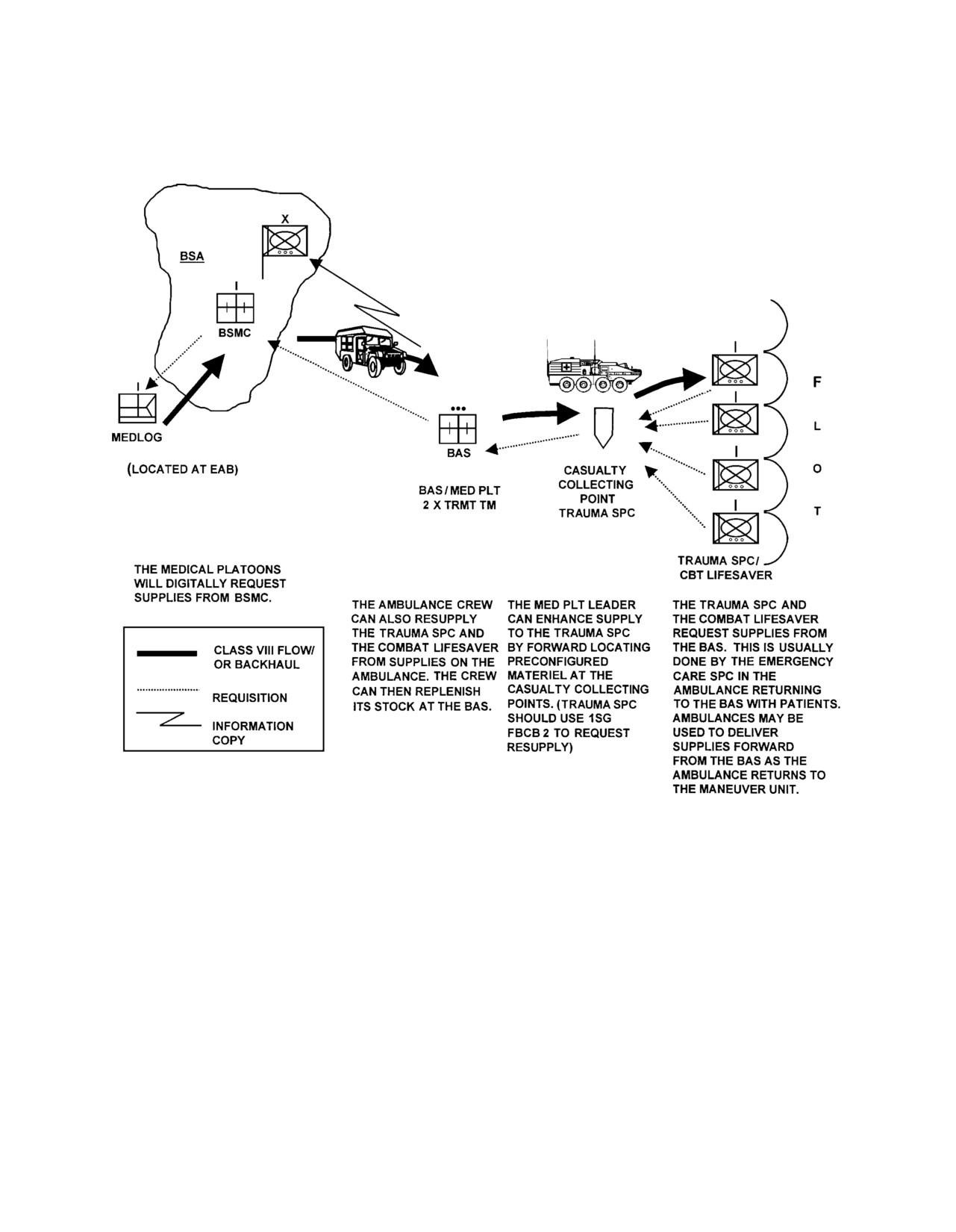
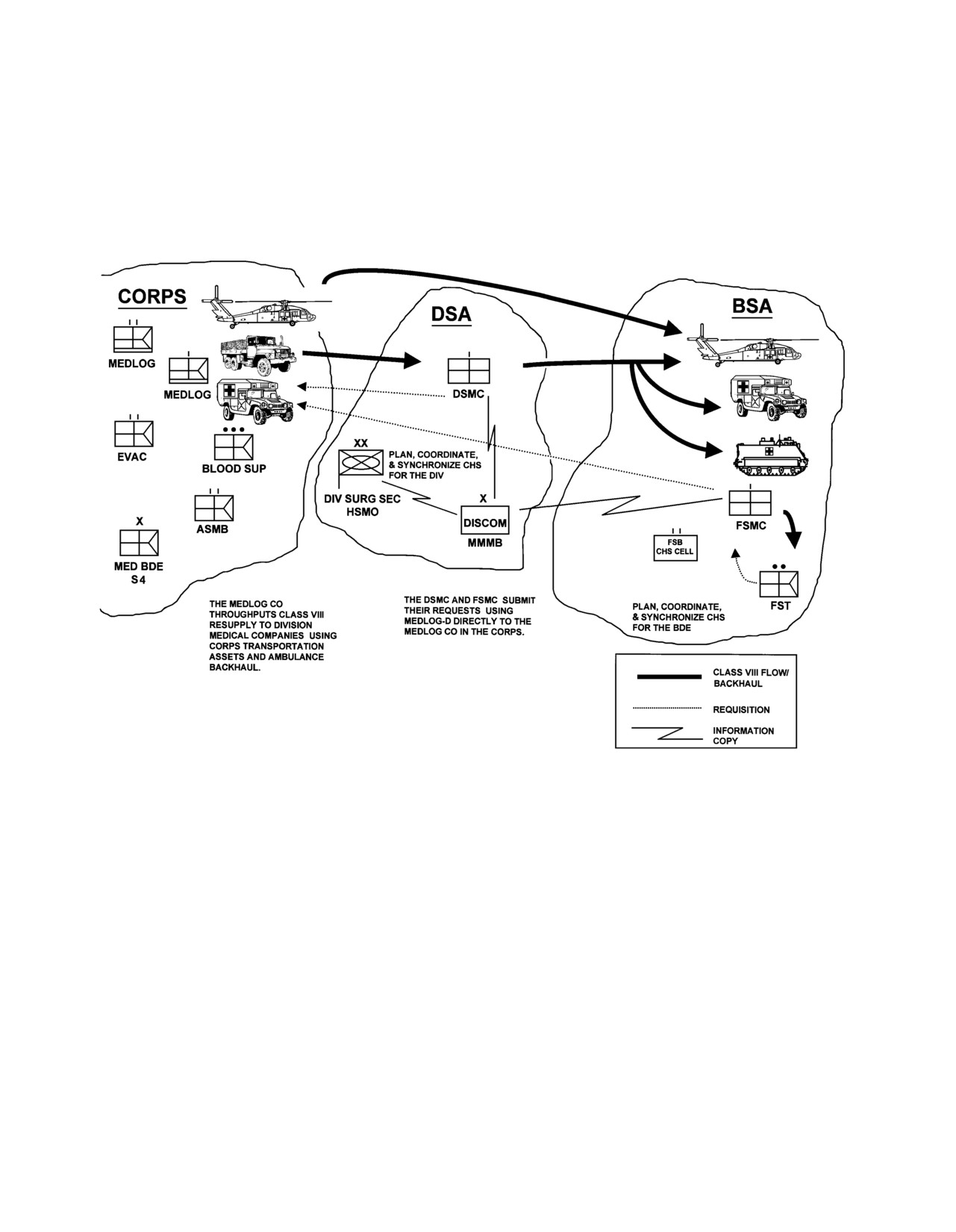
packages may be pre-positioned with maneuver battalion medical platoons or with the FSMC. Figure D-1
provides an overview of Class VIII requisitions and resupply flow at Echelon I. Figure D-2 provides an
overview of Class VIII requisitions and resupply flow at Echelon II.
D-3. Additional Combat Health Logistics Support Information
For detailed information on the transmission of Class VIII supply requisitions and blood support for Force
XXI divisions refer to FM 4-02.1.
D-2
FM 4-02.6
Figure D-1. Overview of Class VIII requisition and resupply flow at Echelon I.
D-3
FM 4-02.6
Figure D-2. Overview of Class VIII requisition and resupply flow at Echelon II.
D-4
FM 4-02.6
APPENDIX E
RECORDS AND REPORTS
Section I. PATIENT ACCOUNTABILITY
E-1. General
a. Individuals entering the medical treatment chain must be accounted for at all times. Prompt
reporting of patients and their health status to the next higher headquarters is necessary for the maintenance
of a responsive personnel replacement system and the Army Casualty System. Patient accountability and
status reporting is required to—
• Provide the commander with an accurate account of personnel losses due to medical
causes (enemy action and related battlefield losses and DNBI).
• Verify personnel replacement requirements.
• Assist the command surgeon in the preparation of the CHS estimate and plan.
• Alert PVNTMED personnel to the medical threat in a given AO.
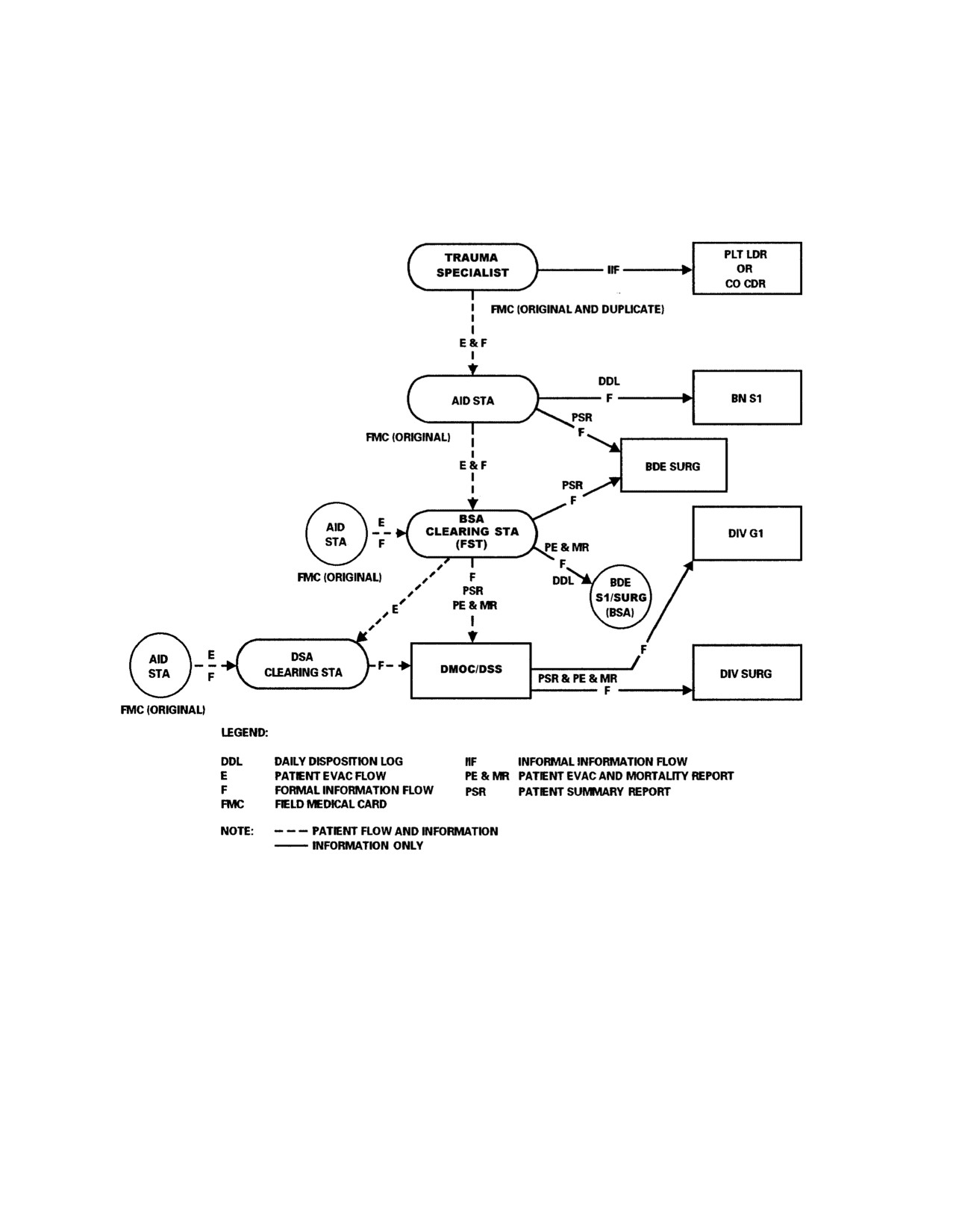
b. Patient accountability and status reporting in the AOE division is depicted graphically in
Figure E-1.
This paragraph implements STANAG 2132 and QSTAG 470.
E-2. United States Field Medical Card
a. The FMC (DD Form 1380) is used to record data similar to that recorded on the inpatient
treatment record cover sheet and Standard Form (SF) 600, Chronological Record of Medical Care. The
FMC is used by BASs, clearing stations, and nonfixed troop or health clinics working overseas, on
maneuvers, or attached to commands moving between stations. It may also be used to record an outpatient
visit when the health record is not readily available at an MTF. The FMC is used in the TO during times of
hostilities. It also may be used to record carded for record only cases.
b. The FMC is made so that it can be attached to a casualty. The cards are issued as a book, with
each card set consisting of an original card and a pressure sensitive paper duplicate.
c.
Medical treatment facilities initiating the SF 600, having received a patient with an initiated
DD Form 1380, will attach this form to the SF 600 to remain as a permanent record of the patient
(Appendix K).
d. For additional information on the preparation and use of this card, refer to AR 40-66 and
FM 8-10-6.
E-1
FM 4-02.6
Figure E-1. Patient accountability and status reporting in the AOE division.
E-3. Daily Disposition Log
a. The Daily Disposition Log (DDL) (Figure E-2) is maintained by Echelons II MTFs. The
information from this log is extracted, when required, and provided to the S1, (Adjutant [US Army]) or
supported unit requesting the information. The DDL is also the primary source document for information
needed in the preparation of the Casualty Feeder Report (DA Forms 1155/1156), Patient Summary Report
(PSR), and the Patient Evacuation and Mortality Report (PE&MR).
E-2
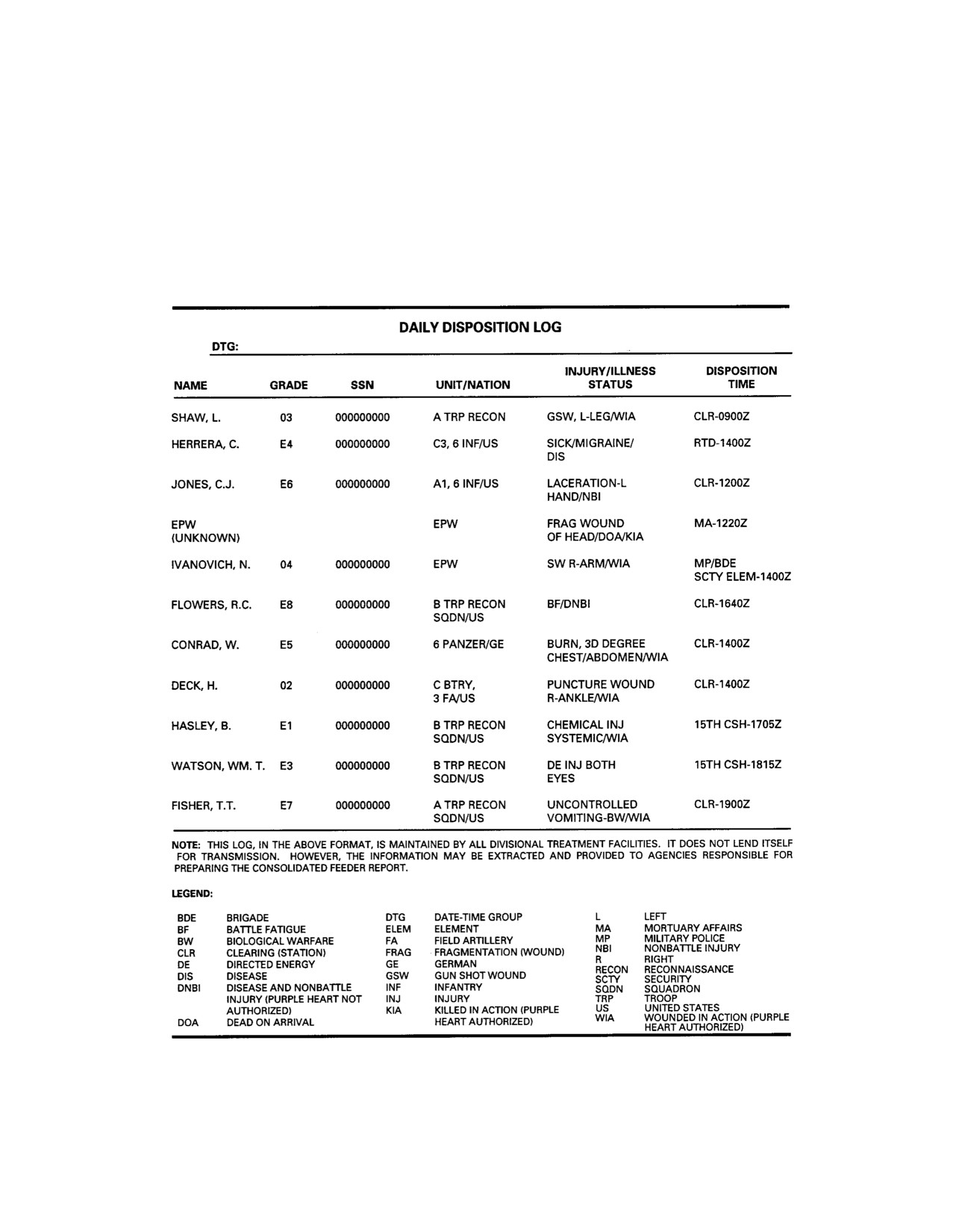
FM 4-02.6
b. The DDL does not lend itself to transmission. However, the information may be extracted and
provided via courier or electronic means to agencies responsible for preparing consolidated reports and/or
casualty feeder reports.
Figure E-2. Example Daily Disposition Log.
E-3
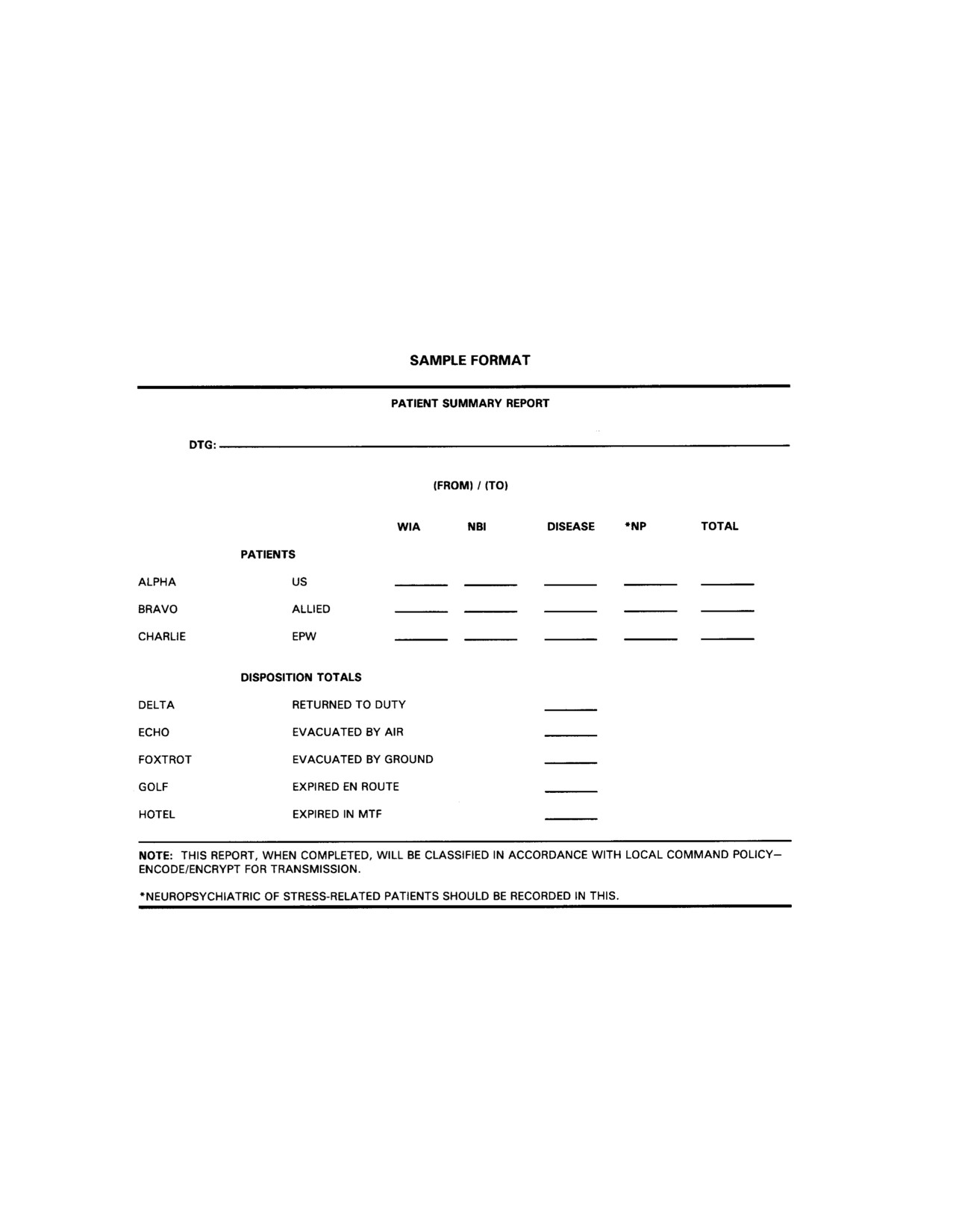
FM 4-02.6
E-4. Patient Summary Report
The PSR is a weekly report (Figure E-3), compiled as of 2400 hours, Sunday. It is prepared by Echelons I
and II MTFs and is submitted to respective surgeons as shown in Figure E-1, usually on each following
Monday. The command surgeon can, however, dictate the frequency of submission to meet command
requirements.
Figure E-3. Example Patient Summary Report.
E-5. Patient Evacuation and Mortality Report
The PE&MR (Figure E-4) is prepared by Echelons I and II MTFs. It is disseminated as shown in Figure E-1.
The PE&MR primarily serves as a medical spot report. The frequency of this report is established by the
command surgeon.
E-4
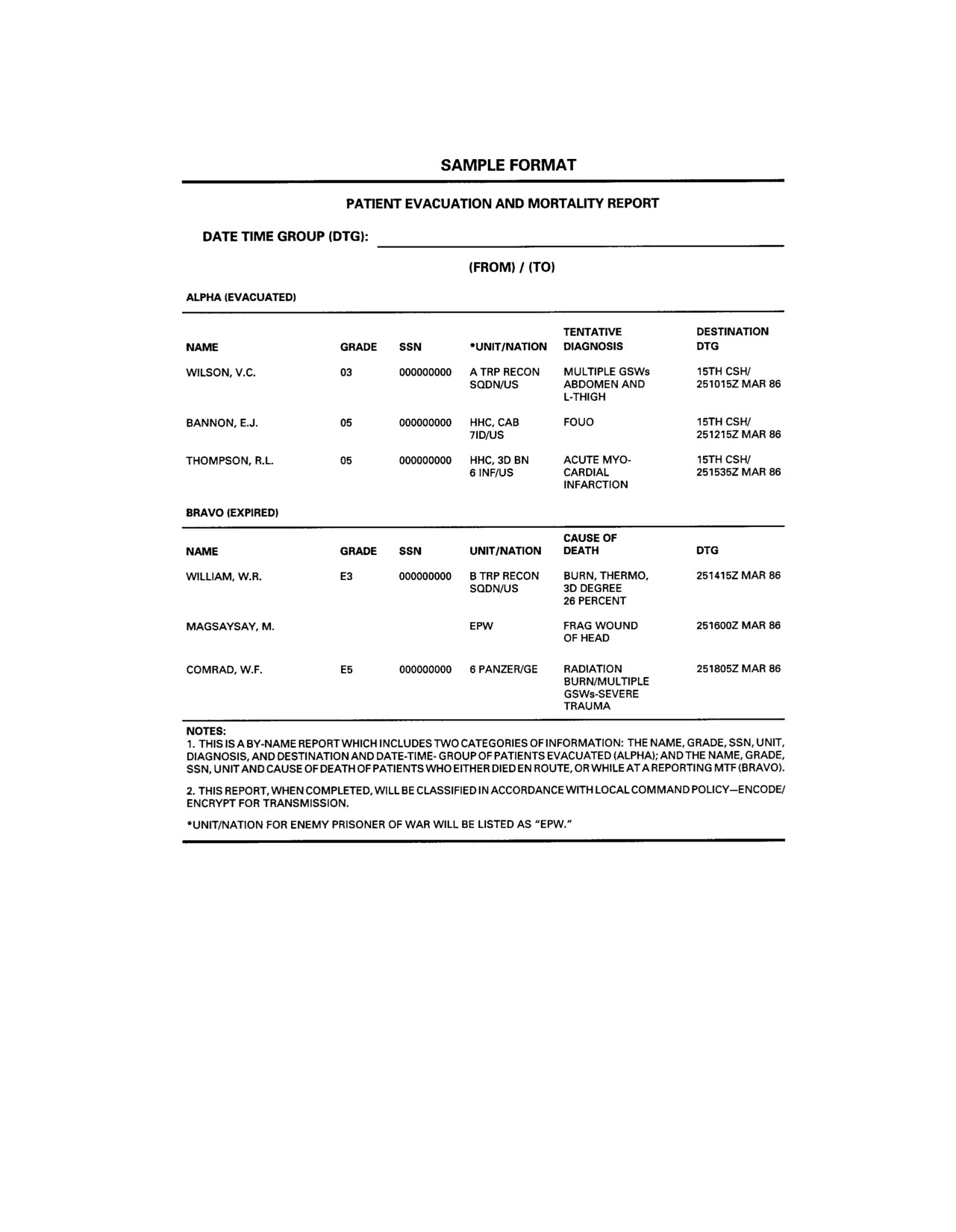
FM 4-02.6
Figure E-4. Example Patient Evacuation and Mortality Report.
Section II. BLOOD MANAGEMENT REPORT
E-6. General
This section provides a format for the required report for requesting blood support. Echelon II MTFs may
only request Group O red blood cells. The report in this appendix, therefore, only discusses this limited
support. For additional information on the complete blood report submitted by Echelons III and IV MTFs,
refer to Joint Publication 4-02.1.
E-5
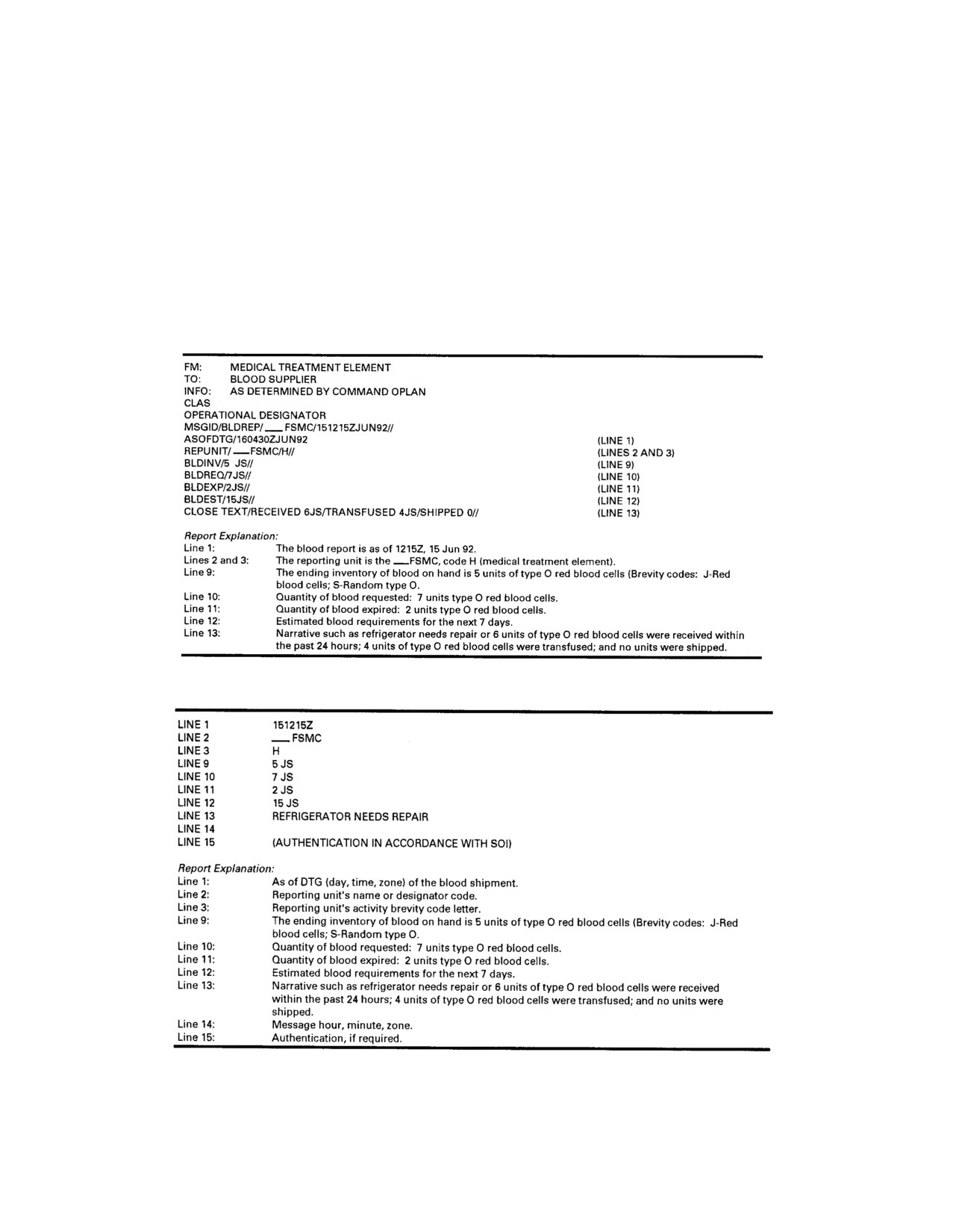
FM 4-02.6
E-7. Blood Management Report
Depending on the tactical situation and the command policy, the blood management report may be
transmitted by voice or written means (transmitted electronic message, telephonically, or by courier). A
sample written message format is contained in Figure E-5. A sample voice message format is contained in
Figure E-6.
Figure E-5. Sample written format for blood report.
Figure E-6. Sample voice message format.
E-6
C1, FM 4-02.6
APPENDIX F
THE BRIGADE SUPPORT MEDICAL COMPANY
Section I. MISSION AND ORGANIZATION
F-1. Organization, Capability, and Functions
a. The BSMC, TOE 08108F300, is assigned to the BSB of the SBCT. The basis of allocation is
one per brigade supported. The overall mission of the BSMC is to provide Level II CHS to all SBCT units
operating within the brigade AO. The company also provides Level I CHS on an area basis to all SBCT
units that do not have organic medical assets. The company provides C2 for its organic and attached/
OPCON medical augmentation elements. The BSMC locates and establishes its company headquarters and
a brigade Level II MTF in the BSA. The BSMC will normally be augmented with a Level II+ surgical
capability provided by a corps FST, see FM 4-02.25. For additional information on the operations and
functions of similar medical company organizations, see FMs 4-02.24, 4-93.5, 4-93.7, and 4-93.51. For
detailed information on the capabilities of the FST see FM 4-02.25.
b. The BSMC is organized (Figure F-1) into a company headquarters, a PVNTMED section, a
MH section, a treatment platoon, and an evacuation platoon. The company performs the following functions:
• Emergency medical treatment and ATM for wounded and DNBI patients.
• Sick call services.
• Ground ambulance evacuation from supported Level I MTF and provides area support
medical evacuation for the BSA and SBCT AO.
• Operational dental treatment that includes emergency and essential dental care.
• Class VIII resupply and medical equipment maintenance and repair support.
• Limited medical laboratory and radiology diagnostic services.
• Outpatient consultation services for patients referred from Level I MTFs.
• Patient holding for up to 20 patients.
• Reinforcement/regeneration of maneuver battalion medical platoons.
• Preventive medicine consultation and support.
• Combat and operational stress control support.
• Mass casualty triage and management.
F-1