FM 3-04.113 Utility and Cargo Helicopter Operations (December 2007) - page 5

Army Aviation Air-Ground Integration
Table B-3. Methods of marking friendly and enemy positions
Method
Day
Night
NVGs
NVS
Friendly
Target
Remarks
Marks
Marks
Smoke
Go
No
Marginal
No
Good
Good
Easy ID. May compromise
Go
Go
friendly position, obscure target,
or warn of FS employment.
Placement may be difficult
because of terrain, trees, or
structures.
Smoke (IR)
Go
Go
Go
No
Good
Good
Easy ID. May compromise
Go
friendly position, obscure target,
or warn of FS employment.
Placement may be difficult
because of terrain, trees, or
structures. Night marking is
greatly enhanced by the use of
IR reflective smoke.
Illumination,
Go
Go
Go
No
NA
Good
Easy ID. May wash out NVDs.
Ground
Go
Burst
Signal
Go
No
No Go
No
Good
NA
Avoids compromise of friendly
Mirror
Go
Go
location. Depends on weather
and available light. May be lost
in reflections from other surfaces
(windshields, windows, or water).
Spot Light
No
Go
Go
No
Good
Marginal
Highly visible to all.
Go
Go
Compromises friendly position
and warns of FS employment.
Effectiveness depends on
degree of ambient lighting.
IR Spot
No
No
Go
No
Good
Marginal
Visible to all NVGs.
Light
Go
Go
Go
Effectiveness depends on
degree of ambient lighting.
IR Laser
No
No
Go
No
Good
Marginal
Effectiveness depends on
Pointer
Go
Go
Go
degree of ambient lighting.
(below .4
watts)
IR Laser
No
No
Go
No
Good
Good
Less affected by ambient light
Pointer
Go
Go
Go
and weather conditions. Highly
(above .4
effective under all but the most
watts)
highly lit or worst weather
conditions. IR zoom laser
illuminator designator-2 is the
current example.
Visual
No
Go
Go
No
Good
Marginal
Highly visible to all. High risk of
Laser
Go
Go
compromise. Effective,
depending on degree of ambient
light.
Laser
Go
Go
No Go
Go
NA
Good
Highly effective with precision
Designator
guided munitions (PGMs).
Restrictive laser-acquisition cone
and requires LOS to target. May
require precoordination of laser
codes. Requires PGM or laser
spot tracker equipped.
7 December 2007
FM 3-04.113
B-5
Appendix B
B-18. Some U.S. weapons can kill targets beyond ranges that thermal, optical, and radar acquisition
devices can provide positive identification. Both aviation and ground forces may become overloaded with
tasks in the heat of battle. Simple positive identification procedures must be established and known to all.
Marking Friendly Positions
B-19. A method of target identification is direction and distance from friendly forces. Friendly forces mark
their own positions with IR strobes or tape, NVG lights, smoke, signal panels, body position, MRE heaters,
chemical lights, and mirrors. Marking friendly positions is the least desirable method of target location
information and should be used with extreme caution. Marking friendly positions can be a more time-
consuming process than directly marking a target and can reveal friendly positions to the enemy.
Marking Enemy Positions
B-20. Target marking aids aircrews in locating targets the unit in contact desires them to attack. Ground
commanders should provide the target mark whenever possible. To be effective, the mark must be timely,
accurate, and easily identifiable. Target marks may be confused with other fires on the battlefield,
suppression rounds, detonations, and marks on other targets. Although a mark is not mandatory, it assists in
aircrew accuracy, enhances SA, and reduces risk of fratricide.
Marking by Direct Fire
B-21. Direct-fire weapons can deliver a mark. Although this method may be more accurate and timely than
an indirect fire mark, its use may be limited by range and the visibility of the weapon’s burst effect.
Aircraft may be used to deliver a mark. A burst of machine gun fire to the left or right of the target as a
marking round may be an option. This method may alert the enemy but is a good way to verify the target
with reduced risk of friendly casualties. Ground units may also mark targets with direct fire using tracers,
M203 smoke rounds, or other means as coordinated by the unit.
Marking by Indirect Fire
B-22. Artillery or mortar fires are effective means of assisting aircrews in visually acquiring targets. Before
choosing to mark by artillery or mortars, observers should consider the danger of exposing these
supporting arms to enemy indirect-fire acquisition systems and additional coordination required. Marking
rounds should be delivered as close to target as possible with smoke being the last round. Marking rounds
are most effective when delivered within 100 meters of target, but those within 300 meters are generally
effective enough to direct armed aircraft. If the situation requires a precise mark, observers or spotters can
adjust marking rounds early ensuring an accurate mark is delivered. This action may, however, alert the
enemy to an imminent attack.
Backup Marks
B-23. Whenever a mark is provided, a plan for a backup mark should be considered. For example, direct
fire may be tasked to deliver the primary mark, while a mortar may be assigned responsibility for the
backup mark.
INFRARED MARKING
B-24. IR pointers, as well as other IR devices, can be used to mark targets at night for aircrews using
NVGs. Unlike laser designators, these IR devices cannot be used to guide or improve accuracy of aircraft
ordnance. IR pointers may expose friendly units to an enemy with night-vision capability and should be
used with caution. Ground units should initiate IR marks when the aircrew request “SPARKLE” and
continue until the aircrew transmits “STOP” or the weapon hits the target.
B-6
FM 3-04.113
7 December 2007

Army Aviation Air-Ground Integration
TARGET MARKING BREVITY LIST
B-25. Table B-4 lists standard brevity terms.
Table B-4. Brevity list
Term
Meaning
Blind
Observer has no visual contact with friendly aircraft or ground position. Opposite of VISUAL.
Contact
Observer: (1) Has sensor contact at the stated position. (2) Acknowledges sighting of a
specified reference point.
No Joy
Aircrew does not have visual contact with the target/bandit/landmark. Opposite of TALLY.
Rope
Observer is circling an IR pointer around an aircraft to help the aircraft identify the friendly
ground position.
Snake
Aircrew calls to oscillate an IR pointer about a target.
Sparkle
Observer acknowledges: (1) Air-to-surface target marking by IR pointer. (2) Air-to-surface
target marking by gunship/forward air controller (airborne) (FAC[A]) using incendiary rounds.
Steady
Aircrew calls to stop oscillation of IR pointer.
Stop
Aircrew calls to stop IR illumination of a target.
Tally
Observer acknowledges sighting of a target, aircraft, landmark, or enemy position. Opposite
of NO JOY.
Visual
Observer is sighting a friendly aircraft or ground position. Opposite of BLIND.
OTHER OPERATIONS
SPECIAL OPERATIONS
B-26. Training at home station with SOF may not be practical or available. SOF may already be in theater,
but their activities may not be published. Commanders must be aware of SOF location and plan for
establishment of a communications link with these units to coordinate operations.
B-27. SOF are usually well trained in the use of all assets. This expertise should make coordination with
them flow easily, but in some instances, the aviation force leader may have to use emergency coordination
measures.
OPERATIONS WITH NONTRADITIONAL FORCES
B-28. Commanders must train their leaders and Soldiers to be flexible and prepared to conduct liaison with
and support elements not traditionally included in home station training. These organizations may include
the Central Intelligence Agency, Department of State, DEA, domestic and foreign police agencies, and
indigenous forces. General checklists may be developed to address concerns. Often, these other agencies
may not be aware of aviation capabilities. LNOs must be ready to advise and assist the supported element.
CLOSE COMBAT OPERATIONS
B-29. During close combat, attack reconnaissance aircraft and/or utility or cargo aircraft may engage
targets near friendly forces, thereby requiring detailed integration of fire and maneuver of ground and
aviation forces. To achieve desired effects and reduce risk of fratricide, air-ground integration must take
place at company, platoon, and team levels. Close-combat engagements also require a higher training
standard for aerial weapons delivery accuracy.
Close Combat Attack
B-30. Effective planning, coordination, and training between ground units and armed aircraft maximize
capabilities of the combined arms team while minimizing risk of fratricide. The key to success for
7 December 2007
FM 3-04.113
B-7
Appendix B
enhancing air-ground coordination and subsequent execution of the tasks involved begins with
standardizing techniques and procedures. To prepare for close combat, basic tasks—such as how to find a
ground unit’s position at night—must be solved during home station training. Operations in unfamiliar
terrain must not be hampered by the question of how to find the unit. It is found by one of various methods
already practiced in training. CCA is a mission and should not be confused with a maneuver.
Close Combat Attack Briefing
B-31. CCA kneeboard card briefings (table B-5) follow joint standard five-line format, with minor
modifications for Army helicopters. This briefing provides clear and concise information in a logical
sequence enabling aircrews to employ their weapons systems. It also provides appropriate control to reduce
risk of fratricide.
Table B-5. Sample close combat attack kneeboard briefing card
CLOSE COMBAT ATTACK BRIEFING (Ground to Air)
1. Observer-Warning Order:
“_______________________. THIS IS ______________________. FIRE MISSION. OVER.”
(Aircraft)
(Observer call sign)
2. Friendly Location/Mark:
“MY POSITION ___________________________. MARKED BY______________________________.”
(TRP, Grid)
(Strobe, Beacon, IR Strobe.)
3. Target Location:
“_________________________________________________________________________________.”
(Bearing [magnetic] and Range [meters], TRP, Grid.)
4. Target Description/Mark:
“________________. MARKED BY ____________________. OVER.”
(Target Description)
(IR pointer, Tracer)
5. Remarks:
“__________________________________________________________________.”
(Threats, Danger Close Clearance, Restrictions, At My Command.)
AS REQUIRED:
1. Clearance: Transmission of the fire mission is clearance to fire (unless Danger close). Danger close ranges are in
accordance with FM 3-09.32. For closer fire, the observer/commander must accept responsibility for increased risk.
State “CLEARED DANGER CLOSE” on line 5. This clearance may be preplanned.
2. At my command: For positive control of the gunship, state “AT MY COMMAND” on line 5. The gunship will call
“READY FOR FIRE” when ready.
Emergency Coordination Measures
B-32. Aviators may be required to assist ground personnel who are not fully familiar with aviation assets.
Key personnel who habitually handle coordination for aviation support may become casualties or simply
not be available. These situations require close attention, careful communications, and initiative on the part
of the aviator to place fire on targets or deliver other support as necessary. An assault pilot may be required
to coordinate an attack mission or call indirect FS.
B-33. Pilots must ask appropriate questions of the requestor with emphasis on positive identification of
location. Possibilities include the following:
Where is ground unit’s position? What are the GPS coordinates? Are those coordinates verified
with another GPS?
B-8
FM 3-04.113
7 December 2007
Army Aviation Air-Ground Integration
Can ground unit mark its position with smoke, tracers, or other methods? If smoke is used,
aircrew verifies color after deployment.
What assistance does ground unit need (FS, extraction, or resupply)?
Where is the target? What are the grid coordinates or relationship of the target to a readily
identifiable natural or manmade feature?
How far is the target from ground unit and in what direction? If the observer is not familiar with
meters, aircrews ask the observer to try football or soccer field lengths estimating distances.
What is the target? Is it personnel, vehicles, equipment, or buildings? What is the size of the
enemy force, and what is it doing?
B-34. Aviators may have to fly helicopters near friendly troops to deliver ordnance onto the target. Factors
reducing the potential for fratricide include—
PGMs.
FS coordinating measures.
Planned or hasty coordination and control measures.
Knowledge of GTP.
Knowledge of exact location of friendly troops.
Composition of friendly forces (number and type of vehicles, types of uniforms if nonstandard
or coalition/host nation forces, Army or police).
Knowledge of exact location of aircraft.
Positive identification of targets.
Familiarity between supported and aviation units.
MISSION TRAINING
B-35. Integration starts at home station with—
Development of common SOPs among aviation and ground maneuver units.
Habitual combined training, including battle drills, to help all team elements maintain awareness
of locations and needs of other elements.
Integration of AHB and/or GSAB into the ground maneuver unit’s STX/field training exercise
(FTX).
B-36. Training, procedural standardization, and familiarity of team members greatly accelerates planning
and coordination, especially in unfamiliar environments. A team built in this manner establishes battle
efficiency sooner and maintains a higher tempo of combat operations. Familiarity and compliance with
joint procedures are essential in allowing seamless integration with other services’ ground and air units.
B-37. Commanders must insist on a high degree of combined arms training with habitually supporting
units. Air and ground units regularly train and execute battle drills together making coordination and
reaction in combat instinctive. Although aviation may not be available for every exercise, ground
maneuver units need to understand how to effectively integrate all aviation systems in their operations.
Commanders can further ensure effective integration into ground maneuver through officer professional
developments, NCO professional developments, and capabilities and limitations briefings with ground
maneuver units.
B-38. When units are unable to create a desired habitual relationship, planning and coordination processes
are longer and more detailed. Rehearsals are essential for success. In-country training exercises should also
be accomplished whenever possible. The probability of mistakes is increased unless coordination,
planning, rehearsals, and training are conducted. Commanders must apply risk-management procedures
throughout planning and execution.
7 December 2007
FM 3-04.113
B-9
Appendix B
MISSION PLANNING
B-39. Mission planning encompasses mission training, rehearsal, and execution. During planning, a
company commander analyzes the OPORD using TLP (identifying specified, essential, and implied tasks),
visualizes the operational environment at various stages, develops a plan, and prepares the unit to conduct
the operation. During split-based operations, platoon and section leaders must utilize these same TLP prior
to conducting operations supporting the maneuver commander’s intent.
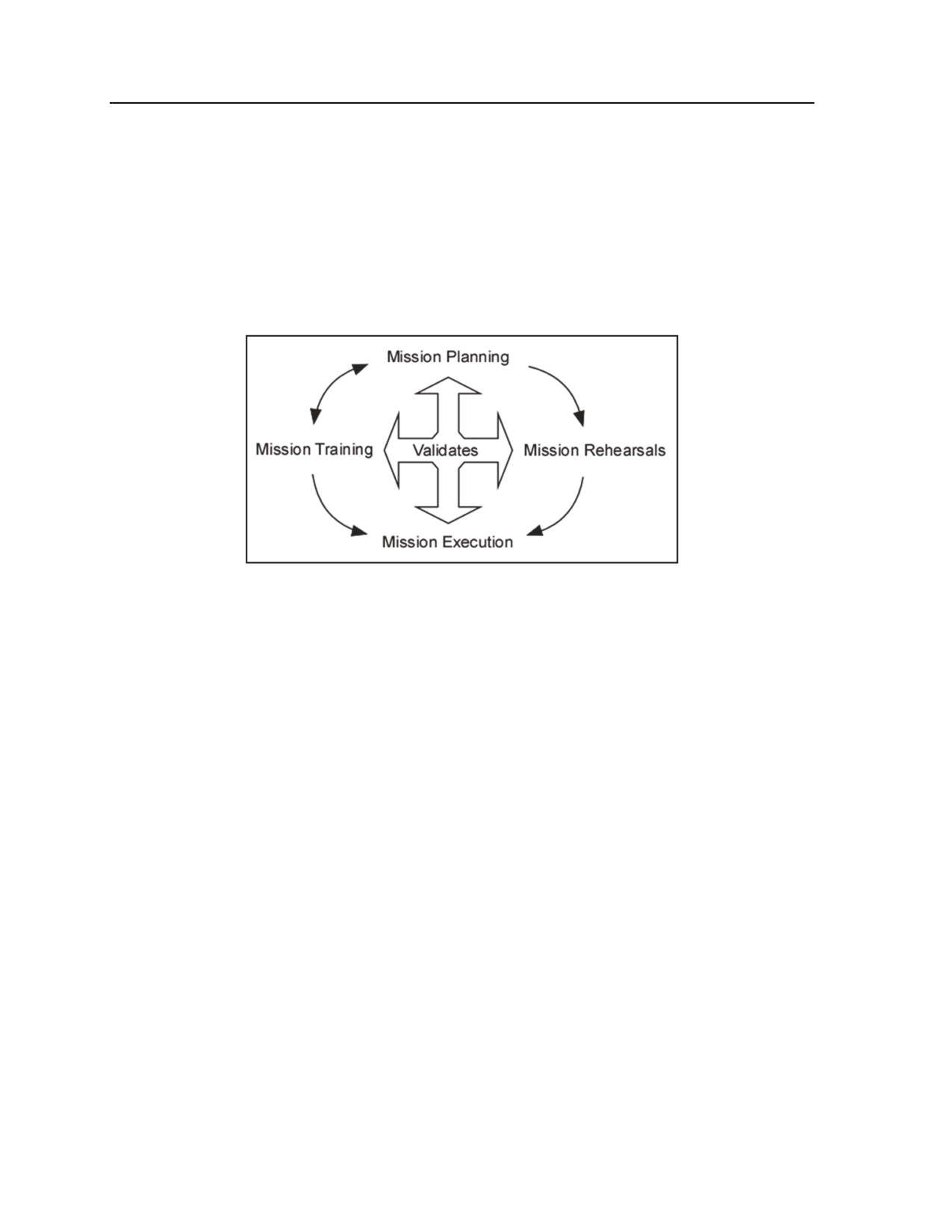
B-40. Training exercises validate planning, training, and rehearsal, while the outcome of these exercises
assists the commander in pinpointing where to place emphasis for future training and where to focus
sustainment training (figure B-1).
Figure B-1. Mission planning through execution cycle
B-41. Mission recovery ensures readiness for subsequent missions. Recovery includes munitions
reconfiguration, refueling, maintenance, CP movement, and crew changes.
Minimum Planning Requirements
B-42. Minimum information required by an Army aviation team to ensure accurate and timely support
includes—
Situation including friendly forces’ location, enemy situation (highlighting known ADA threat
in the AO), mission request, and tentative LZ coordinates.
Updating brigade- and battalion-level graphics via maneuver control system, AMPS, or radio
communications. Updating critical items such as limit of advance, fire control measures, and
maneuver graphics ensures better integration into the friendly scheme of maneuver.
FS coordination information including location of DS artillery and organic mortars, and call
signs and frequencies.
Ingress/egress routes into the AO, including PPs into sector or zone, and air routes to the HA or
LZ.
Call signs and frequencies of the battalion in contact, down to the company in contact; air-
ground coordination must be done on command frequencies to provide SA for all elements
involved.
GPS and SINCGARS time coordination. Care must be taken to ensure all units are operating on
the same time schedule. All units should use GPS time that is the most accurate. A common
error is for some ground units and aviation operations centers to set SINCGARS time by
ANCD/CYZ 10 instead of GPS time. This results in ground and air communication failure due
to time/synchronization error.
Digital transmission of information, such as coordinates, is faster and more accurate, if available. Voice
communications are necessary to verify information and clarify needs and intentions.
B-10
FM 3-04.113
7 December 2007
Army Aviation Air-Ground Integration
LIAISON WITH THE GROUND MANEUVER FORCE
B-43. The BAE is a planning and coordination cell whose major function is incorporating aviation into the
ground commander’s scheme of maneuver. The BAE focuses on providing employment advice and initial
planning for aviation missions, UAS, airspace planning and coordination, and synchronization with the
ALO and FSCOORD. The BAE also coordinates directly with the CAB or supporting aviation TF for
detailed mission planning. The liaison demands on aviation units are reduced by implementation and use of
the BAE.
B-44. Although the BAE will conduct many of the functions traditionally performed by LNOs, aviation
LNO teams remain a critical part of the process and must be staffed appropriately. While the members of
the BAE work directly for the BCT commander as permanent members of his staff, aviation LNO teams
represent the supporting aviation TF at a designated maneuver HQ only for the duration of a specific
operation. Effective employment of LNOs is imperative for coordination and synchronization. Often
aviation LNO teams will coordinate with the BAE and then proceed to a supported ground maneuver
battalion. An example would be an aviation LNO team in support of an infantry battalion performing an
assault to seize a key piece of terrain as part of a mechanized BCT scheme of maneuver.
B-45. Aviation LNOs must embody competence and credibility, and act as skillful representatives for their
respective aviation TFs. A commander must exercise extreme care in choosing his LNOs since his unit is
judged by their performance. The LNO must be capable of changing focus and approach depending on
location and who he is supporting at the time. Above all, the LNO must be knowledgeable and mission
focused toward the supported unit.
B-46. LNO teams maintain and provide current—
Aviation unit locations.
Aircraft/equipment status.
Crew availability and fighter management cycle status.
Class III/V status.
METL training status.
Continuous updates to the aviation commander and staff on the BCT’s plan.
Refer to TC 1-400 for more information on BAE/liaison operations.
DECONFLICTION
B-47. Deconfliction is a continual process for ground, aviation, and other supporting units. During
planning and execution, aviation units must deconflict their operations with friendly units by
coordinating—
Indirect fires, including mortars and possibly NSFS.
CAS.
UASs.
ADs.
Smoke operations.
Other internal aviation operations.
Nonorganic aviation operations.
Other services’ delivery systems such as supply drops.
SECTION II - FRATRICIDE PREVENTION
B-48. Air and ground assets require effective integration in conducting operations successfully and
minimizing potential for fratricide and civilian casualties. Integration starts at home station with
implementation of effective tactical SOPs, habitual relationships, and training. It continues through
planning, preparation, and execution of the operation.
7 December 2007
FM 3-04.113
B-11
Appendix B
FRATRICIDE
B-49. Fratricide is the employment of friendly weapons and munitions, used with the intent to kill enemy
forces or destroy its equipment or facilities, which results in unforeseen and unintentional death or injury to
friendly, neutral, or noncombatant personnel. Fratricide is a type of accident and is a real and grim
consequence of war. Its effects can spread deep within a unit and are devastating.
CAUSES OF FRATRICIDE
B-50. Contributing factors to fratricide include but are not limited to—
Incorrect target identification.
Incomplete planning and coordination.
Equipment failure or improper procedures.
Poor land navigation.
Loss of communications.
Position-reporting errors.
B-51. Weapons systems can detect, engage, and destroy targets at maximum range. However, weapons-
sighting equipment cannot provide high resolution of targets at extended ranges, especially during limited-
visibility conditions. The increasing use of common equipment by allied and hostile nations increases the
probability of fratricide.
FRATRICIDE RISK CONSIDERATIONS
B-52. There are two types of risk: (1) losing men and equipment to accomplish the mission and (2)
choosing a COA that may not be successful or may succeed but fails to achieve the desired effect. A
commander must take such risks with prudence. Prudent risk taking emphasizes operational functions with
the proper balance of administrative functions; for example—
Understanding capabilities and limitations of units and components.
Understanding the enemy, and identifying and creating opportunities to exploit enemy
weaknesses.
Pursuing actions that gain or retain the initiative.
Planning for a mission or unit training.
Training with supporting branches (joint and combined arms).
Participating, supervising, and observing unit training.
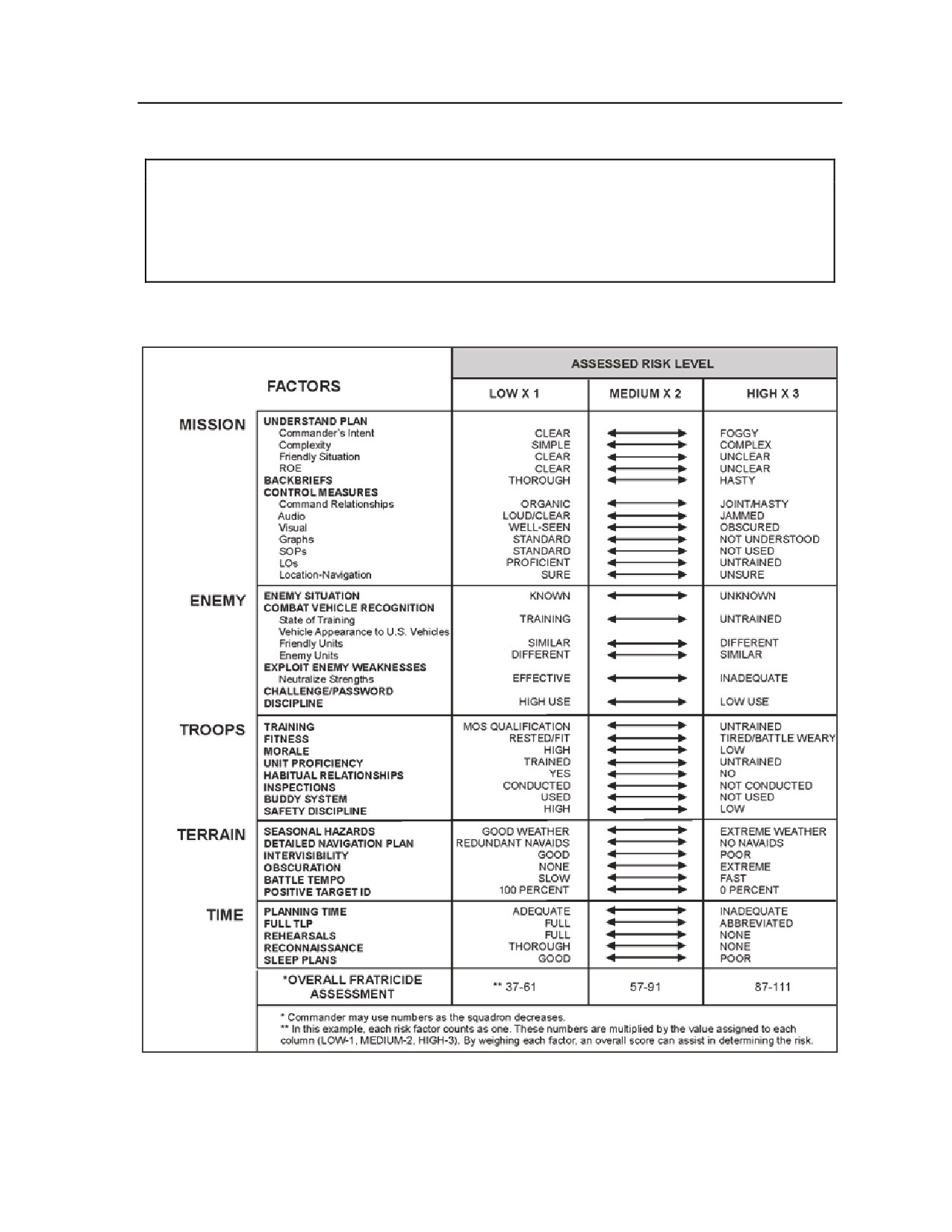
B-53. The format for fratricide risk factors in figures B-2, page B-13, and figure B-3, page B-15, parallels
the five-paragraph OPORD. The considerations/factors, key to fratricide reduction, are structured where
they would likely appear in the OPORD. This is neither a change nor an addition to the OPORD format.
B-12
FM 3-04.113
7 December 2007
Army Aviation Air-Ground Integration
Fratricide Risk Factors
Paragraph 1: Situation
a. Threat forces:
Equipment and uniform similarities.
Language.
Deception capabilities and past record.
What similarities could lead to fratricide?
Location.
b. Friendly forces:
Similarities or differences (allied forces language, uniform, and equipment [combined operations]).
Differences in U.S. Service’s equipment and uniform (joint operation).
What similarities could lead to fratricide?
What differences could prevent fratricide?
Deception plan.
Location of unit and adjacent units (left, right, leading, follow-on).
Location of neutrals and/or noncombatants.
c. Attachments/Detachments:
Do attached elements know above information?
Do gaining units supply above information to detached elements?
Own forces:
Status of training (individual, crew, unit) proficiency.
Fatigue (at time of the operation, sleep plan).
Acclimatization to AO.
Equipment (new, old, and mix: status of NET).
MOPP requirements.
Weather:
Visibility (light data and precipitation).
Hot, cold (effect on weapons, equipment, and Soldiers).
Terrain:
Topography and vegetation (such as urban, mountainous, hilly, swamp, prairie, jungle, forest,
woods).
Obstacles, avenues of approach, key terrain, observation, cover and concealment.
Paragraph 2: Mission
Is this mission, with associated tasks and purpose, clearly understood?
Paragraph 3: Execution
a. Task organization:
Has unit worked under this organization before (familiarity)?
Are SOPs compatible with the task organization (especially with attached units)?
Uniform and equipment:
Are special markings/signals needed for positive ID (such as cat’s eyes, chem. lights, panels)?
What special weapons and/or equipment are to be used?
Do they look/appear like enemy weapons and/or equipment?
b. Concept of operations:
1. Maneuver:
Are main and supporting efforts identified to ensure awareness of greatest fratricide danger?
Figure B-2. Fratricide risk factors
7 December 2007
FM 3-04.113
B-13
Appendix B
2. Fires (direct and indirect):
Are priorities of fires identified?
Target list(s).
Fire execution matrix/overlay.
Location of denial areas (minefields/family of scatterable mines [FASCAM]) and contaminated
areas (such as improved conventional munition [ICM], CBRN).
Are aviation and CAS targets clearly identified?
Direct fire plan.
Final protective fire.
Sector limits (check/verify).
3. Engineer:
Barrier breaching:
Are friendly minefields, including FASCAM- and ICM-contaminated areas, known?
Are obstacles, along with approximate time for reduction/breaching, identified?
4. Tasks to each subordinate unit:
Are friendly forces identified, as appropriate, for each subordinate maneuver element?
5. Tasks to CS and sustainment units:
Are friendly forces identified to support and sustainment units?
6. Coordinating instructions:
Rehearsals:
Will one be conducted; is it necessary?
Are direct and indirect fired included?
Is a backbrief necessary?
Constraints and Limitations:
Are appropriate control measure clear and in the OPORD/overlay?
Control measures might include all or some of the following: AA, attack position, line of departure
(LD), axis of advance/avenue of approach/direction of attack, phase lines, objective(s),
movement times, restrictive fire line, fire support coordination line (FSCL), zone of engagement,
limits of advance, main supply route, coordination points, listening post/observation post (LP/OP),
challenge and password.
Are these control measures known by everyone who has a need to know?
What is the plan for using control measures to synchronize the battle and prevent fratricide?
Target/vehicle ID drills.
What is the immediate action drill/signal for “cease fire”/“I’m friendly” if coming under
unknown/unfriendly fire?
Is there a backup action?
Is guidance included in handling dud munitions (such as ICM and cluster bomb units)?
Paragraph 4: Service Support
Ensure trains location(s) and ID marking(s) are known by everyone.
Ensure medical/maintenance personnel know routes between trains and units.
Paragraph 5: Command and Signal
a. Command:
Where is the location of the command and key staff?
What is succession of command?
Figure B-2. Fratricide risk factors
B-14
FM 3-04.113
7 December 2007
Army Aviation Air-Ground Integration
b. Signal:
Do instructions include signals for special and emergency events?
Do instructions include how to identify ourselves to aircraft?
Do instructions include backup for code words/visual signals for all special and emergency events?
Are SOI/communications-electronics operating instructions (CEOI) distributed to units (higher,
owner, left, right, leading, following)?
Figure B-2. Fratricide risk factors
Figure B-3. Risk reduction and/or fratricide prevention assessment
7 December 2007
FM 3-04.113
B-15
Appendix B
SECTION III - BRIGADE COMBAT TEAMS
ORGANIZATION
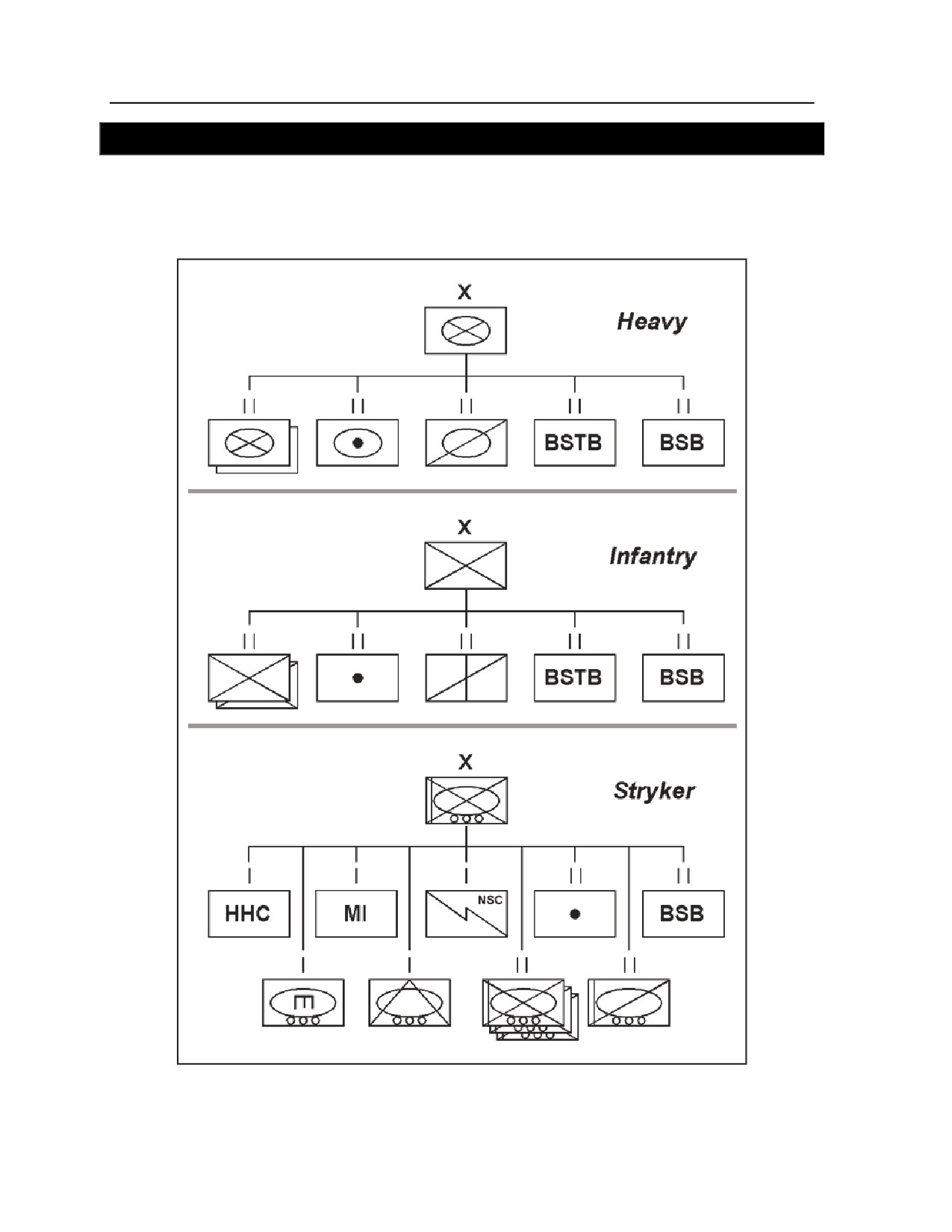
B-54. Maneuver BCTs are the Army’s basic instrument of tactical execution. Figure B-4 provides an
overview of the three types of maneuver BCT organization. See FM 3-90.6 for additional information.
Figure B-4. Maneuver brigade combat teams
B-16
FM 3-04.113
7 December 2007
Army Aviation Air-Ground Integration
HEAVY BRIGADE COMBAT TEAM
B-55. The heavy brigade combat team (HBCT) reduces complexity of deployment planning and replaces
many variations of divisional armored and mechanized brigades. It contains combined arms components
normally required to rapidly achieve tactical overmatch in a single formation. The HBCT is best employed
against enemy mechanized and armored forces. Robust enough to fight with or without external support for
limited periods, the HBCT can fight across full spectrum operations when tactically loaded.
INFANTRY BRIGADE COMBAT TEAM
B-56. The infantry brigade combat team (IBCT) reduces complexity of deployment planning and replaces
many variations of divisional light, assault, and airborne brigades. It contains combined arms components
normally required to forcibly enter an AO and hold key objectives for a short period of time. The IBCT is
organized around dismounted infantry and is designed to operate best in high-OPTEMPO offensive
operations against conventional and unconventional forces in rugged terrain. Robust enough to fight
without external support for limited periods, IBCT can fight “off the ramp” across full spectrum operations
when tactically loaded.
STRYKER BRIGADE COMBAT TEAM
B-57. The Stryker brigade combat team (SBCT) combines the deployability of an IBCT with the mobility
of a HBCT. A SBCT can be deployed rapidly and sustained by an austere support structure for up to 72
hours of independent operations. The SBCT is manned and equipped primarily to conduct operations in a
small-scale contingency and is designed with many organic elements that allow for increased flexibility
during employment.
7 December 2007
FM 3-04.113
B-17

Appendix C
Aircraft Characteristics
This appendix provides an overview of the basic characteristics and capabilities of
aircraft organic to AHBs and GSABs.
SECTION I - UH-60 BLACK HAWK
C-1. The primary missions of the UH-60 Black Hawk aircraft are air assault, air movement, C2 support,
and as required, CASEVAC.
DESCRIPTION
C-2. The UH-60A/L is a twin-engine, dual-seat, utility helicopter. The minimum required crew is a pilot
and copilot but typically includes one or two crewchiefs/gunners for improved mission effectiveness. It is
designed to carry 11 combat-loaded air assault troops (seats installed). It also can move a 105-millimeter
howitzer and 30 rounds of ammunition. The UH-60A/L is equipped with a full instrument package and
certified for instrument meteorological conditions (IMC) as well as day and NVG operations. Table C-1
provides UH-60A/L aircraft characteristics.
Table C-1. UH-60A/L aircraft characteristics
Specifications:
Length:
64 ft 10 in rotors turning, 41 ft 4 in rotors/pylons folded
Height:
12 ft 4 in center hub, 16 ft 10 in tail rotor
Width
9 ft 8.6 in main landing gear, 14 ft 4 in stabilator
with ESSS installed:
21 ft
Main rotor and tail rotor diameter:
53 ft 8 in main rotor, 11 ft tail rotor at 20-degree angle
Cabin floor dimensions:
73 in wide x 151 in long
Cabin door dimensions:
69 in wide x 54.5 in high
Maximum gross weight:
UH-60A/L: 22,000 lbs*
Maximum cargo hook load:
UH-60A: 8,000 lbs*
Maximum cargo hook load:
UH-60L: 9,000 lbs*
Cruise airspeed:
130 kts *
Combat radius:
225 km *
Armament:
2 x M240H (7.62 MGs)
Optics:
AN/AVS-6 Night Vision Goggles
Navigation Equipment:
Doppler/GPS, VOR, ADF, and tactical air navigation (TACAN) (HH-60 only) navigation sets
7 December 2007
FM 3-04.113
C-1

Appendix C
Table C-1. UH-60A/L aircraft characteristics
Flight Characteristics:
Max speed (level):
156 kts
Normal cruise speed:
120-145 kts
With external sling-loads:
140 kts max. Up to 8,000 lbs/120 kts max. 8,000-9,000 lbs
Additional Capabilities:
The ESSS allows configuration for extended operations without refueling (5+ hours) (2 X 200 gallon fuel
tanks) and ferry and self-deployment flights (4 X 200 gallon fuel tanks).
The enhanced C2 console provides the maneuver commander with an airborne platform supporting six
secure FM radios, one HF radio, two VHF radios, and two UHF radios.
Can be configured with the Volcano mine dispensing system; requires 8 hours to install.
Capable of inserting and extracting troops with FRIES/SPIES.
Limitations:
Use of the ESSS for fuel tanks restricts access to the cabin doors for troops and bulky cargo or litters. It
also reduces the payload and maximum speed.
Cruise speed is decreased by light, bulky sling-loads.
* varies with environmental/mission conditions
C-3. The UH-60M has the same characteristics as the UH-60A/L but contains a fully coupled flight
director, fully integrated digital cockpit, and Integrated Vehicle Health Management System (IVHMS).
The UH-60M upgrade includes the integration of electronic flight controls (fly-by-wire) and Full Authority
Digital Engine Controls (FADEC). These enhancements provide the crew with enhanced situational
awareness, expanded mission support capability, and improved sustainability.
Note. At the time of production of this manual, the UH-60M specifc systems, capabilities, and
limitations were not finalized.
CAPABILITIES
C-4. The UH-60A/L has, but not limited to, the following capabilities:
Countermeasure suite of IR jammers and radar warning receivers.
Data-transfer system to upload from the AMPS data-transfer cartridge and download post-
mission data.
Internal transport of 11 combat-loaded troops with seats installed and approximately 16 combat-
loaded troops with seats removed. The actual number of troops carried is limited by space and
environmental conditions.
Self-deployable range of 558 nm with the ERFS.
Airload transportable by C-5 and C-17 aircraft.
ARMAMENT SUBSYSTEMS
C-5. The Black Hawk has provisions for gunner’s window mounting of two M240H 7.62-millimeter
machine guns. The subsystem is pintle-mounted in each gunner’s window at the forward end of the cabin
section.
AIR VOLCANO
C-6. The air Volcano is a helicopter-mounted, automated, scatterable mine-delivery system able to deliver
mines day or night. The system can rapidly emplace a 278-meter, 557-meter, or 1,115- by 140-meter
minefield at up to 960 mines (800 AT and 160 AP) per sortie. The AT density yields an 80 percent chance
of encounter. Mines can be set to self destruct after 4 hours, 48 hours, or 15 days.
C-2
FM 3-04.113
7 December 2007
Aircraft Characteristics
C-7. The air Volcano system limitations include—
The UH-60 with air Volcano mounted, a full crew, and one system operator will be at high gross
weight, which reduces range and maneuverability.
Minefield emplacement is conducted at low airspeeds (80 knots or less), making the aircraft
more vulnerable to detection and engagement.
The crew cannot operate the M240H machine gun with the air Volcano installed.
System installation requires approximately 8 hours.
These systems require two 5-ton cargo trucks for transport; it is an engineer responsibility to
provide transportation assets to move these systems.
C-8. Four types of minefields can by emplaced using Volcano: disrupt, fix, turn, and block. Refer to
chapter 3 for additional information.
COMMUNICATIONS
C-9. The UH-60 A/L has the following communications systems:
The AN/ARC-186 provides two-way voice VHF-AM/FM communications.
The AN/ARC-164 (V) Have Quick II provides two-way voice UHF-AM communications. It
provides an antijam frequency-hopping capability.
The AN/ARC-201
(SINCGARS) provides two-way voice VHF-FM communications. It
provides an antijam frequency-hopping capability.
The TSEC/KY-58 interfaces with the ARC-186 (V), Have Quick II, and SINCGARS radios to
provide secure communications.
The AN/ARC-220 HF radio provides long-range, two-way voice and text messaging
communications capabilities between other AN /ARC 220-equipped aircraft or AN/ARC-100
equipped CPs.
The KY-100 provides secure communications for the AN/ARC-220 HF radio.
C-10. The UH-60M communication system contains the Joint Tactical Radio System and Joint Alternate
Communications Suite (JACS) that includes—
Two AN/ARC-231 multiband radios.
Two AN/ARC-201D (SINCGARS).
Note. The UH-60M does not inlcude HF capability. Additional TSEC equipment is not required
as it is imbedded in JACS.
NAVIGATION SYSTEMS
C-11. The UH-60A/L has the following navigation systems:
The ASN-128B/D Doppler/GPS navigation set provides present position to destination
navigation information in latitude and longitude or military grid reference system (MGRS)
coordinates.
The AN/ARN-89 or AN/ARN-149 (V) provides automatic direction finding capability for IFR
operations.
The AN/ARN-123
(V) or AN/ARN-147
(V) VOR/LOC/GS/MB receiving set provides
navigation capability for IFR operations.
HEADS-UP DISPLAY AN/AVS-7
C-12. The heads-up display (HUD) system serves as an aid to pilots using AN/AVS-6 NVGs by providing
operational symbology information directly into the NVGs. It always displays airspeed, altitude from MSL,
attitude, and engine torque. It can display up to 29 symbols.
7 December 2007
FM 3-04.113
C-3
Appendix C
LIMITATIONS
C-13. The following are limitations of the UH-60A/L aircraft:
UH-60A/L aircrews employ AN/AVS-6 NVGs that lack the same night capabilities as AH-64
and OH-58D TIS.
UH-60A/L aircraft are instrument-certified but cannot operate in all environmental conditions.
Aircraft equipped with extended-range fuel tanks may not offer the same accessibility to the
aircraft cabin for loading; self-defense machine guns have a limited range of motion when ERFS
kits are installed.
SECTION II - HH-60L BLACK HAWK
C-14. The HH-60L Black Hawk’s primary mission is aeromedical evacuation. Secondary missions include
transport of medical personnel and equipment, emergency transport of class VIII to include blood products
and biologicals, PR support, and support to Title 10 U.S. Code taskings.
DESCRIPTION
C-15. The HH-60L is a twin-engine, dual seat, utility helicopter. The minimum required crew is a pilot and
copilot. For aeromedical evacuation missions, the crew includes up to three medical attendants (typical
configuration includes one crew chief and two medical attendants). The HH-60L is equipped with a full
instrument package and certified for IMC, as well as day and NVG operations. In addition to its basic
configuration, the HH-60L includes a nose-mounted TIS and kit installations allowing rescue hoist,
extended-range fuel, and aeromedical evacuation operations. The interior design of the HH-60L allows for
the installation of life-saving instruments and equipment for use by onboard medical attendants. Normal
cabin configurations of the HH-60L can accommodate up to four primary litter patients or six ambulatory
(seated) patients. However, when necessary, two STANAG litters can be placed on the floor under the
forward lifts for a total of six litter patients. The unique platform design also includes oxygen distribution
and suction systems, an airway management capability, and provisions for stowing intravenous solutions.
The interior also features the following capabilities:
Oxygen generating systems.
NVG-compatible lighting throughout.
An environmental control system.
Medical equipment.
Patient monitoring equipment.
Neonatal isolettes.
Note. The HH-60M combines the MEDEVAC package of HH-60L with the avionics and
airframe upgrades of the UH-60M.
Table C-2, page C-5, outlines HH-60L aircraft specifications.
C-4
FM 3-04.113
7 December 2007

Aircraft Characteristics
Table C-2. HH-60L specifications
Length:
64 ft 10 in rotors turning, 41 ft 4 in rotors/pylon folded
Height:
12 ft 4 in center hub, 16 ft 10 in tail rotor
Width:
9 ft 8.6 in main landing gear, 14 ft 4 in stabilator
Main rotor and tail rotor diameter:
53 ft 8 in main rotor, 11 ft tail rotor at 20-degree angle
Cabin floor and door dimensions:
73 in wide x 151 in long, 69 in wide x 54.5 in high
Maximum gross weight:
22,000 lbs
Rescue hoist/cargo hook max weights:
600 lbs rescue hoist; 8,000 lbs, cargo hook
Maximum range w/ERFS:
630 nm w/400 lbs reserve
Patient capacity:
6 litter, 6 ambulatory, or combination
Crew capacity:
2 pilots, 1 crew chief, 3 medical attendants
Fuel capacity:
360 gallons and additional 400 gallons w/ERFS
CAPABILITIES
C-16. The HH-60L has, but is not limited to, the following capabilities:
Countermeasure suite of IR jammers and radar warning receivers.
Data-transfer system to upload from the AMPS data-transfer cartridge
and
download
postmission data.
Self-deployable range of 558 nm with the ERFS.
Airload transportable by C-5 and C-17 aircraft.
Transport of six patients and two medical attendants.
Internally and externally loaded medical supplies.
TIS,
AN/ARS-6(V) Personnel Locator System (PLS).
ARMAMENT
C-17. The HH-60L is an unarmed aircraft (no gunner stations).
COMMUNICATIONS
C-18. The HH-60L has the following communication systems:
The AN/ARC-222 provides two-way voice VHF-AM/FM air and maritime communications
capability.
The ARC-164 (V) Have Quick II provides two-way voice UHF-AM communications. It
provides an antijam, frequency-hopping capability
The AN/ARC-201
(SINCGARS) provides two-way voice VHF-FM communications. It
provides an antijam frequency-hopping radio capability
.The TSEC/KY-58 interfaces with the AN/ARC-222, Have Quick II, and SINCGARS radios to
provide secure communications.
The AN/ARC-220 HF radio provides long-range, two-way voice and text messaging
communications capabilities between other AN /ARC 220-equipped aircraft or AN/ARC-100
equipped CPs.
The KY-100 provides secure communications for the AN/ARC-220 HF radio.
7 December 2007
FM 3-04.113
C-5

Appendix C
NAVIGATION SYSTEMS
C-19. The HH-60L has the following navigation systems:
The ASN-128B/D Doppler/GPS navigation set provides present position to destination
navigation information in latitude and longitude or military MGRS coordinates.
The AN/ARN-149 (V) provides automatic direction finding capability for IFR operations.
The AN/ARN-147 (V) VOR/LOC/GS/MB receiving set provides navigation capability for IFR
operations.
AN/ASN 153 (V) TACAN provides navigation capability for IFR operations.
PERSONNEL LOCATOR SYSTEM AN/ARS-6
C-20. PLS covertly and precisely locates personnel for evacuation. This system allows aeromedical
evacuation crews the ability to pinpoint personnel locations electronically rather than flying search
patterns.
PILOT HEADS-UP DISPLAY AN/AVS-7
C-21. The HUD system serves as an aid to pilots using AN/AVS-6 NVGs by providing operational
symbology information directly into the NVGs. It always displays airspeed, altitude (MSL), attitude, and
engine torque and can display up to 29 symbols.
LIMITATIONS
C-22. The limitations of the HH-60L aircraft are—
HH-60L aircrews employ AN/AVS-6 NVGs that lack the same night capabilities as the AH-64
TIS. The HH-60L TIS is used primarily to detect personnel to be evacuated. The TIS is not
intended as a visual enhancment system for flight.
HH-60L aircraft are instrument certified but cannot operate in all environmental conditions.
Aircraft equipped with extended-range fuel tanks may not offer the same accessibility to the
aircraft cabin for loading..
SECTION III - CH-47 CHINOOK
C-23. The primary missions of the CH-47 are air assault, air movement, and as required CASEVAC..
DESCRIPTION
The CH-47D is a twin-turbine engine, tandem-rotor helicopter. The minimum crew required for flight is a pilot,
copilot, and flight engineer. Additional crewmembers/gunners, as required, may be added for improved mission
effectivenss. Tactical missions normally require the addition of one or two crew chiefs. Table C-3 outlines CH
47D characteristics.
Table C-3. CH-47D characteristics
Specifications:
Length:
98.9 ft
Height:
18.9 ft
Fuselage width:
12.4 ft
Main rotor span:
60 ft
Cargo space:
1,500 cu ft
Floor space:
225 sq ft
Maximum gross weight:
50,000 lbs
C-6
FM 3-04.113
7 December 2007

Aircraft Characteristics
Table C-3. CH-47D characteristics
Specifications:
Max load for forward and aft hooks:
17,000 lbs
Max tandem load for forward and aft hooks:
25,000 lbs
Max load for center hook:
26,000 lbs
Cruise airspeed:
130 kts*
Max continuous airspeed:
170 kts*
Combat radius (16,000 lbs cargo):
50 nm (90 km)*
Combat radius (33 troops):
100 nm (180 km)*
Armament:
3 M240H 7.62 MGs (two cabin-mounted and one ramp-mounted)
Optics:
AN/AVS-6 Night Vision Goggles
Navigation Equipment:
Doppler/GPS, VOR, and ADF navigation sets
Flight Characteristics:
Max speed (level):
170 kts
Normal cruise speed:
120-145 kts
Additional Capabilities:
Can be configured w/additional fuel for mobile FARE system (Fat Cow) or for ferrying/self-deployment
missions.
Aircraft has an internal load winch to ease loading of properly configured cargo.
The CH-47D can sling-load virtually any piece of equipment in the light infantry, airborne, or air assault
divisions.
Limitations:
Cruise speed is greatly decreased by light, bulky sling-loads.
*Varies with factors such as temperature, wind, gross weight, internal versus external load, and time in PZ/LZ.
C-24. The CH-47F has the same characteristics as the CH-47D but contains a fully integrated digital
cockpit management system, and new flight control system. The CH-47F inlcudes improved
communications suite, navigation equipment, and airframe. These enhancements provide the crew with
enhanced situational awareness and improved mission support capability.
Note. At the time of production of this manual, the CH-47F specific systems, capabilities, and
limitations were not finalized.
CAPABILITIES
C-25. The CH-47D has, but is not limited to, the following capabilities:
Countermeasure suite of IR jammers, radar-warning receivers, and laser-warning detectors.
Data-reduction transfer system to upload from the AMPS data-transfer cartridge and download
post-mission data.
Internal transport of one HMMWV or two HMMWVs externally loaded.
Internal transport of 33 combat-loaded troops with seats installed.
Evacuation of 24 litter patients and 2 medics.
Self-deployable range of 1,056 nm with the ERFS
Air transportable by C-5 and C-17 aircraft.
7 December 2007
FM 3-04.113
C-7
Appendix C
ARMAMENT SUBSYSTEMS
C-26. The armament subsystems are M24 and M41 machine-gun systems installed in the cabin door, cabin
escape hatch, and on the ramp. Both subsystems use the M240H 7.62-millimeter machine gun. The two
flexible 7.62-millimeter machine guns are free pointing but limited in traverse, elevation, and depression.
COMMUNICATIONS
C-27. The CH-47D has the following communications systems:
The AN/ARC-186 provides two-way voice VHF-FM/AM communications
The AN/ARC-164 Have Quick II provides two-way voice UHF-AM communications. It
provides an antijam, frequency-hopping capability.
The AN/ARC-201
(SINCGARS) provides two-way voice VHF-FM communications. It
provides an antijam, frequency-hopping capability.
The TSEC/KY-58 interfaces with the AN/ARC-186, Have Quick II, and SINCGARS radios to
provide secure communications .
The AN/ARC-220 HF radio provides long-range, two-way voice and text messaging
communications capabilities between other AN /ARC 220-equipped aircraft or AN/ARC-100
equipped command
The KY-100 provides secure communications for the AN/ARC-220 HF radio.
NAVIGATION SYSTEMS
C-28. The CH-47 has the following navigation systems:
The AN/ASN-128B/D Doppler/GPS navigation set provides present position to destination
navigation information in latitude and longitude or the MGRS coordinates.
The AN/ARN-89 (V) provides automatic direction finding capability for IFR operations.
The AN/ARN-123 (V) VOR/LOC/GS/MB receiving set provides navigation capability for IFR
operations..
HEADS-UP DISPLAY AN/AVS-7
C-29. The HUD system serves as an aid to pilots using AN/AVS-6 NVGs by providing operational
symbology information directly into the NVGs. It always displays airspeed, altitude (MSL), attitude, and
engine torque and can display up to 29 symbols.
LIMITATIONS
C-30. Limitations of the CH-47D aircraft are—
CH-47D aircrews employ AN/AVS-6 NVGs that lack the same night capabilities as AH-64 and
OH-58D TIS.
CH-47D aircraft are instrument certified but cannot operate in all environmental conditions.
C-8
FM 3-04.113
7 December 2007

Aircraft Characteristics
SECTION IV - TYPICAL FUEL EXPENDITURE RATES, CAPACITIES, AND
STANDARD LOAD CAPACITIES
C-31. Table C-4, page C-9, depicts typical rates of fuel expenditures per helicopter and fuel capacities
without additional tanks.
Table C-4. Typical helicopter fuel expenditure rates and capacities
Helicopter
Average Gallons per Hour
Fuel Capacity
AH-64D
175
370
OH-58D
44
112
OH-58D (armed)
110
112
UH-60 A/L
178
362
CH-47D
514
1,030
C-32. Aircraft are capable of carrying more than is indicated on the lists in table C-5; however, safety,
loading procedures, space limitations, and other factors play a great part in determining authorized loads
for each helicopter, table C-6, page C-10. Environmental conditions
(high altitude/high temperature
decrease maximum gross weight) and configuration (internal load size/dimensions) constraints affect the
ACL for each aircraft.
C-33.
Table C-5. Typical planning weights for combat equipment and vehicle
Vehicle/Equipment
Weight in Pounds
M998 HMMWV
7,535
M996 TOW HMMWV
8,095
M149 Water Buffalo (empty)
2,540
(loaded)
6,060
M101A1 ¾ Ton Trailer (empty)
1,350
(loaded)
2,850
500 Gallon Fuel Drum (empty)
275
(full)
3,625
M102 105-mm Howitzer
3,360
M119 105-mm Howitzer
4,000
M114A1 155-mm Howitzer
15,200
M198 155-mm Howitzer
15,740
M167 Vulcan (towed)
3,260
A22 Bag (loaded)
2,200
Conex, Steel (empty)
2,140
Conex, Aluminum (empty)
1,560
Conex (either) Max Load
6,500
SCAMP Crane
14,600
One Mil-Van
4,710
Electronic Shop with Wheels
3,940
Tool Set, Shop with Wheels
3,030
Shop, Portable, Aircraft Maintenance (empty)
4,220
(loaded)
5,425
M1008 Pickup (empty)
5,900
(loaded)
8,800
JD-550 Dozer
16,800
7 December 2007
FM 3-04.113
C-9

Appendix C
Table C-6. Typical helicopter load capacities
Type
Empty Weight Plus
Max Gross
Max Sling Load
Crew and Fuel
Weight
UH-60A
15,000
22,000
8,000
UH-60L
15,000
23,500*
9,000
CH-47D
30,000
50,000
26,000
* External lift missions above 22,000 pounds can only be flown with cargo hook loads
above 8,000 pounds and up to 9,000 pounds
C-10
FM 3-04.113
7 December 2007
Appendix D
Checklists, Briefings, Reports, and Formats
This appendix provides example checklists, briefings, tables, reports, and formats
(table D-1 through table D-25) used by aviation units during training or combat to
more efficiently accomplish assigned tasks and missions. This is not all inclusive;
products are used as a guide and do not supersede unit SOPs.
SECTION I - CHECKLISTS AND BRIEFINGS
D-1. Table D-1 is an example of a predeployment and pretemporary duty checklist.
Table D-1. Sample predeployment and pretemporary duty checklist
Yes
No
N/A
Task/Action
Finance
Bills, recurring and nonrecurring.
Bank accounts, checking, savings, loans. Investments and other income
sources.
Safety deposit boxes.
Legal
Power of attorney as needed (specific, general).
Wills updated.
Living wills updated.
Spouse’s social security number.
Guardianship for children.
Insurance policies; life, auto, home/renters, floater.
Deeds, leases, rentals, real estate documents, management company.
Marriage or divorce papers.
Birth certificates, adoption papers.
School records.
Naturalization documents.
Vehicle titles and registration.
Taxes.
Necessary court documents.
Personnel Issues
TDY or permanent change of station (PCS) orders.
Emergency data cards complete.
ID cards, copy, expiration dates, Defense Enrollment Eligibility Reporting
System (DEERS) enrollment.
7 December 2007
FM 3-04.113
D-1
Checklists, Briefings, Reports, and Formats
Table D-1. Sample predeployment and pretemporary duty checklist
Yes
No
N/A
Task/Action
Personnel Issues
Serviceman’s Group Life Insurance.
Passport and visa documents.
Family care plan.
NEO/Safe haven information.
Personal affairs; funeral and burial instructions.
Household
Vehicle registration, inspection, all stickers and tags.
Crime prevention measures/force protection information.
Maintenance/utilities/list of who to contact for problems and repairs.
Disaster/evacuation plan and survival kit: water, food, clothing, other personal
necessities.
Communication
Community contact information.
Local emergency contacts; police, fire, Red Cross, poison control, hospital,
TRICARE.
Post chaplain, Army Community Service, military police.
Unit contact information (include phone numbers, physical address and e-mail
address).
Unit name, DIV, BDE, battalion (BN), company (CO).
Commander, CSM/1SG, UMT, supervisor.
FRG spouses.
Orderly room, staff duty officer, foreign object damage.
Rear detachment commander/officer in charge (OIC) and NCOIC.
TDY: dates, location, phone and emergency phone.
Personal contact information.
Family.
Friends.
Immediate neighbors.
Financial.
Insurances.
Emergency family and friends.
Medical.
TRICARE enrollment/claim process.
Locations/providers/clinic contact information.
Records; medical, dental, shot, other.
Pets.
Records.
Veterinarian: regular and emergency.
D-2
FM 3-04.113
7 December 2007
Checklists, Briefings, Reports, and Formats
D-2. Table D-2 is an example of a convoy precombat inspection checklist.
Table D-2. Sample convoy checklist
Completed
Vehicles:
Vehicles are inspected at operating temperatures with hoods open.
5988Es are current with all parts installed.
Vehicle fuel will be topped off.
All basic issue items (BIIs) present and serviceable.
Three days rations per Soldier per vehicle.
Five-gallon water cans topped off.
Water buffalo sanitized and topped off.
All supply trucks are covered.
Complete combat life saver bag on hand (if applicable.)
Weapons:
Crew-served weapons functionally checked.
.50-cal headspace and timing set.
Functions check on all individual weapons.
5988Es are present and current for all crew-served weapons.
All weapons are lubricated.
Communications:
Radios loaded with correct frequencies. Call signs recorded.
5998Es are all current with PMCS and manual.
Batteries are present for dismounted radios.
Long-range radio checks are complete.
Digital nonsecure voice telephones are present with 2 miles of WF-16 wire per
phone.
TA-1s or TA-312s are operational with 1 roll of WD-1 per set.
Automated net control devices are present and loaded.
CBRN Equipment:
5988Es are present for all CBRN equipment.
M-8/M-22 alarms are complete with batteries and operational alarm.
IM-93 is present and operational.
CBRN Equipment:
M8 and M9 paper present and attached.
M256A1 chemical detection kit (1 per squad) on hand.
CBRN markers are present and stocked.
CBRN teams identified.
Night Observation Devices (NODs):
5988Es are present and complete for all NODs.
15-day supply of batteries for all NODs.
Carrying cases are complete with accessories and lens cleaning equipment.
7 December 2007
FM 3-04.113
D-3
Checklists, Briefings, Reports, and Formats
Table D-2. Sample convoy checklist
Completed
Individual Solider:
Load-bearing equipment worn in accordance with TACSOPs and properly fitted.
Flack jacket is present/Gortex jacket if necessary.
Flashlight present with the appropriate filter.
Identification tags and identification card present.
7 magazine per M-4; 3 per M-9 9-mm.
DA Form 1156 (Casualty Feeder Card) in the first aid pouch and left pocket of
the chemical protective overgarments.
Serviceable first aid packets.
One-quart canteen with cup and cover (extra canteen optional) present.
Canteens must be filled and fitted with CBRN cap.
All Soldiers understand the mission.
Drivers:
5988E with current PMCS and quality control within 72 hours.
Dispatch signed by the driver and the company commander/XO.
Driver has a current ULLS computer-generated license.
Driver has sustainment graphics, control measures, and a map of the
operational area.
Leaders:
Map with current graphics and/or strip map.
Completed CRM.
Leaders have appropriate FMs and MTPs.
List of all sensitive items on company standardized sensitive items sheet.
Current list of all vehicles organic or attached.
Current SOI for support area and TF.
S-2 threat assessment.
Prepared convoy commander brief.
D-4
FM 3-04.113
7 December 2007
Checklists, Briefings, Reports, and Formats
D-3. Table D-3 is an example of a precombat checklist.
Table D-3. Sample precombat checklist
Check
Check
Individual:
Equipment packed inaccordance with
M8/M9 paper
(IAW) TACSOP
Load bearing vest (LBV) complete and
Current MOPP implemented
serviceable
• Ear plugs
Weapon at appropriate arming level
• First aid pouch
Optical inserts
• Ammunition pouches
Antifogging kit
• Canteen w/water and cup
ID card
Kevlar w/camo cover and band
ID tags (2 sets, w/2 tags, 1 set worn)
Weapons, zero in pistol grip
MREs
Protective mask w/carrier and hood
Drivers licenses
Body armor as required
Challenge and password
Flashlight w/batteries and lens filters
Shot records
Causality feeder reports
Hot/cold weather brief
Individual decon kit
Mission brief
Squad Leader:
Personnel accounted for
MOPP level known and disseminated
Individual PCI completed
Weapons control
Reference publications reviewed
Section status to platoon sergeant
Uploaded by load plan
Situation briefed
Expendable supplies on hand
MREs issued
Sleep plan established
Ammo basic load issued
Platoon Sergeant:
Personnel accounted for
Sleep plan established
Individual PCI completed
Class V issued
Reference publications reviewed
MOPP level known and disseminated
Uploaded by load plan
Weapons control
Operation equipment
Platoon status to 1SG
• Maps, updated
Situation briefed
• Compasses
MREs issued
• Pens.
First Sergeant:
Personnel accounted for
Spare equipment:
Uploaded by load plan
• Microphones
Expendable supplies on hand
• Headsets
Operation equipment
• Antennas
• Maps, updated
• Batteries
• Compasses
SINCGARS spare battery
• Pens.
Defensive sector diagram complete
Individual PCI completed and verified
Range cards verified and complete
LP/OP briefed and positioned
Camouflaged:
7 December 2007
FM 3-04.113
D-5
Checklists, Briefings, Reports, and Formats
Table D-3. Sample precombat checklist
Check
Check
First Sergeant:
Defense plan established and
• Vehicles
rehearsed
Expendable supplies on hand
• Equipment
Communications equipment
• Positions
Equipment accounted for:
• Glass and mirrors
• Radios
Repack all equipment not in use
• Microphones
Field sanitation enforced
• Antennas
Hand washing enforced
• Encrypting equipment
Trash kept policed
• SOI
MEDEVAC LZ marked
PMCS completed:
Casualty collection identified
• Radios
Reference publications reviewed
• Antennas
Early warning devices employed
• Encrypting equipment
Noise and light discipline enforced
Call Sign board
Sleep plan established
Frequencies:
Class V issued
• Unit
Feeding plan established
• Next higher
MOPP level known and disseminated
• MEDEVAC
Accountability of personnel to S-1
• Range control
Accountability of sensitive items to S-3
• FS
Reportable equipment status to maint officer
TA-312s: batteries
Situation briefed
Wire
Generator operational
Reel handles on hand
All BIIs on hand
SINCGARS: Batteries
Grounding rods
Wire
Fire extinguishers
Blank report formats
-10 manual on hand
Coordinate pickup of equipment
PMCS performed
Coordinate pickup of SOI
Generator topped off
Extra fuel and POL
CBRN Equipment:
Individual PCI complete
IM-93 dosimeter issued
Chemical agent alarms operational
146 radiac meters issued
Chemical agent alarms employed
GTA warning system issued
PMCS performed on M8 alarm
PBT and nerve agent antidote issued
M273 kit per chemical alarm
CBRN marking kit available
M256/256A1 detector kit as required
Mark I kit available
AN/VRDR-2 radiac sets on hand
Cana kit available
Combat Lifesavers:
Combat lifesaver bags issued
100% inventory and all supplies replenished
Vehicle Commander:
All BII on hand
Pens/pencils available
Pioneer tools
Maps and overlays
D-6
FM 3-04.113
7 December 2007
Checklists, Briefings, Reports, and Formats
Table D-3. Sample precombat checklist
Check
Check
Vehicle Commander:
Fire extinguishers
Sun/wind/dust goggles
-10 manual on hand
Compass/GPS present serviceable
PMCS performed:
Binoculars
Vehicle
Crew-served weapons
Radios
Headspace and timing checked
Vehicle topped off
Ammunition basic load
Extra fuel and POL
Qualified gunner
Grease pencils
Vehicle load plan verified
Notebook available
Convoy number on vehicle
Crew Served Weapons:
Clean and functional
Head space and timing set (M2)
Spare barrels, cleaning kits on-hand
Machine guns mounted
Glove; bolt rupture extraction on hand
Function check
Tripod w/traversing and elevation
Test fire w/permission
mechanism, bipod
NVD, serviceable
Driver/Vehicle Preparation:
-10 and LO on hand
Rags
BII/AII present and serviceable
MREs rations stowed
First aid kit
Tools
Fire extinguisher
Goggles
Warning triangles
Dispatch
PMCS performed
Vehicle hardened as required
Vehicle topped off
Strip map on-hand
Loaded according to load plan
Convoy route and plan briefed
POL products including weapons oil
Camouflage nets/poles configured/stowed
5 gallon can of water
Lights and markings covered
5 gallon can of fuel
Convoy number on vehicle
Trailer properly hooked
CHECKLIST FOR COMBAT OPERATIONS
D-4. Table D-4 is an example of an air mission coordination meeting checklist.
Table D-4. Sample air mission coordination meeting checklist
1. Mission number:
2. Supported unit:
3. Supporting unit:
4. Time required:
5. Mission (and concept sketch):
6. Number/type of aircraft:
7. H-hour:
7 December 2007
FM 3-04.113
D-7
Checklists, Briefings, Reports, and Formats
Table D-4. Sample air mission coordination meeting checklist
8. Pickup time with rehearsal time built in:
9. PZ location (and sketch):
10. PZ frequency
A. Unit
B. Aircraft
11. PZ call sign
A. Unit
B. Aircraft
12. PZ marking (day/night)
13. Landing heading
14. Landing formation
15. Door entry
16. Number of troops total
17. Number of troops per aircraft
18. Number/type cargo loads
19. Takeoff direction
20. Takeoff formation
21. False LZ grid
22. Route
23. Time of flight
24. LZ grids (primary and alternates)
25. LZ sketches:
26. LZ marking (day/night)
27. LZ frequency and call sign (if Pathfinders are
available)
28. Attack reconnaissance aviation concept
29. LZ prep fires
30. Landing heading
31. Landing formation
32. Weapons status
33. Door exit
34. Takeoff direction
35. Number of turns required
36. Abort criteria
37. Weather call time
38. Bump plan
39. ABN frequency
40. CAN/command frequencies
41. Code words
42. Go/No-Go criteria
Infantry battalion S-3
AMC initials________
Initials_______
D-8
FM 3-04.113
7 December 2007
Checklists, Briefings, Reports, and Formats
D-5. Table D-5 is an example of an air mission brief .
Table D-5. Sample air mission brief
Roll Call
Time Zone
Time Hack
Packet Check
______________
______________
_______________
__________________
References
Task Organization(Infantry Brigade TF)
1. Situation.
a. Enemy forces (synopsis of overall enemy situation). (TF S-2)
(1) Air IPB.
(2) Enemy air capability.
(3) Enemy ADA capability.
(a) Type/location.
(b) Night capability/range.
(c) Weather/NOTAMs.
SR:
SS:
MR:
MS:
Max % illum:
Illum. range (during air assault, sucha as 0% -
45%):
NVG window:
Ceiling/visibility:
MAX temp:
MAX density altitude/pressure altitude:
End evening nautical twilight
Begin morning nautical twilight (BMNT):
(EENT):
b. Friendly forces (TF S-3).
(1) Mission higher HQ (include commander’s intent).
(2) BDE/BN Infantry scheme of maneuver. (TF S-3)
2. Mission. (AVN TF S-3).
a. Brigade/Battalion commander’s intent. (AATFC)
b. Conditions for air assault. Conditions for ice.
c. Mission risk assessment. (TF S-3)
d. Aviation mission. (AVN S-3)
7 December 2007
FM 3-04.113
D-9
Checklists, Briefings, Reports, and Formats
Table D-5. Sample air mission brief
3. Execution.
a. Aviation commander’s intent. (AMC)
b. Concept of the aviation operation. (AVN TF S-3)
c. AVN tasks to subordinate units. (AVN TF S-3)
d. Fires. (AVN TF FSO)
(1) FA. Annex I (FS graphics)
(a) Purpose of supporting fires.
(b) Unit/location.
(c) Priority of fire.
(d) SEAD information/targets.
(e) LZ prep.
(2) Close air support. (ALO)
(a) Purpose/mission.
(b) Coordinating altitude.
Rotary wing.
Fixed wing.
(c) #, type, and time of sorties available.
(d) Call signs and frequencies.
(3) Attack reconnaissance aviation. (Attack Recon S-3/CDR)
(a) Mission.
(b) Concept.
(c) Attack BPs/ABF sectors/routes in and out.
e. Staging plan. Annex A (PZ Diagram) (AATF XO)
(1) Name/number.
(2) Coordinates.
(3) Load time.
(4) Takeoff time.
D-10
FM 3-04.113
7 December 2007
Checklists, Briefings, Reports, and Formats
Table D-5. Sample air mission brief
(5) Markings.
(6) Control.
(7) Call signs/frequencies.
(8) Landing formation.
(9) Heading.
(10) Hazards/go arounds.
(11) Supported unit bump plan. (Annex A-1 coordinating instructions)
(12) PZ arrival times.
f. Air movement plan. (Assault S-3/Mission lead)
(1) Routes/corridors. Annex B (Route Card)
(a) Ingress primary/alternate.
(b) Egress primary/alternate.
(c) Others.
(2) En route hazards.
(3) Abort criteria.
(a) Weather.
(b) Aircraft available.
(c) Time.
(d) Mission essential combat power.
(e) Mission criticality.
(f) Enemy.
(4) Penetration points.
(5) En route formation/rotor separation/angle/airspeeds (as per crew brief).
(6) Deception measures/false insertions.
(7) Air movement plan. Annex D
(8) Cargo doors.
(9) External lighting. (SOP)
7 December 2007
FM 3-04.113
D-11
Checklists, Briefings, Reports, and Formats
Table D-5. Sample air mission brief
(10) ROZ locations.
(a) Air assault C2.
(b) ATK C2.
(c) QUICKFIX.
(11) MEDEVAC/CASEVAC aircraft plan.
(12) Aircraft decontamination plan.
g. Landing plan. Annex C (LZ diagram) (Assault S-3/Mission lead)
(1) Name/number.
(2) Coordinates.
(3) LDG times (as per AMT).
(4) Markings.
(5) Control.
(6) Call signs/frequencies.
(7) LDG formation/direction.
(8) LZ abort criteria. (based on GTC guidance)
(9) Go arounds. (flight/single ship, as per crew brief)
(10) Departure. (as per crew brief)
h. Laager plan. (Assault S-3/Mission lead)
(1) Name/locations.
(2) Times/REDCON status.
(3) Security plan.
(4) Scatter plan.
(5) Call forward plan.
i. Extraction plan. (Assault S-3/Mission lead)
j. Coordinating instructions. (Aviation) (Assault S-3)
(1) MOPP level/CBRN warning status.
(2) M240H control status.
D-12
FM 3-04.113
7 December 2007
Checklists, Briefings, Reports, and Formats
Table D-5. Sample air mission brief
(3) ADA status.
(4) IFF procedures/times.
(5) Chaff/ALQ 144 employment.
(6) NVG-specific procedures. (SOP)
(7) Vertical helicopter instrument recovery procedure/IIMC. (as per crew brief)
(8) Mission contingencies. (SOP)
(a) DAPP/SAR/emergency aircrew extraction.
(b) Downed aircraft/SERE/DART.
(c) BDAR.
(9) Spare aircraft procedures.
(10) Special aircraft equipment/preparation.
(11) PPC.
(12) Mission brief sheet.
(13) Risk assessment form (completed/signed).
(14) Safety considerations/hazards.
(15) OPSEC considerations (SOI, kneeboard sheets, maps).
(16) Weather decision plan/times.
(17) Debrief location/time.
k. Coordinating instructions. (AATF) (AATF S-3)
4. Service Support.
a. Class I (1 case meals, MREs/5 gallons water/survival kits) (TF S-4)
b. Class III/V. (III/V platoon leader)
(1) Minimum fuel. (as per crew brief)
(2) Basic load.
(3) FARP/rapid refuel point.
7 December 2007
FM 3-04.113
D-13
Checklists, Briefings, Reports, and Formats
Table D-5. Sample air mission brief
c. Class VIII (HSSO)
(1) CCP. (record locations of company CCPs)
(2) Evacuation plan/hospital location.
d. MEDEVAC/CASEVAC plan. (HSSO)
5. Command and Signal. (AVN TF S-3).
a. Command.
(1) AC2. (as per ACO, this AMB, and established tactical flight procedures)
(2) AATFC/location.
(3) AVN TF AMC/location.
(4) ABC/location
(5) Aviation chain of command. (as per serial chain of command)
b. Signal. (AVN TF S-6)
(1) Commo card day (Annex ____).
(2) Execution matrix (Annex ____).
(3) Code words.
Mission Brief Back
Final Questions
Commanders Comments
D-14
FM 3-04.113
7 December 2007

Checklists, Briefings, Reports, and Formats
D-6. Table D-6 is an example of a pickup zone/landing zone kneeboard diagram
Table D-6. Sample pickup zone/landing zone kneeboard diagram
PRIMARY PZ DIAGRAM
PRIMARY LZ DIAGRAM
ALTERNATE PZ DIAGRAM
ALTERNATE LZ DIAGRAM
PZ name/grid coordinates
PZ elevation/LZ elevation
LZ name/grid coordinates
PZ formation
PZCO freq/call sign
LZ formation
Alternate PZ name/grid coordinates
Chalk aircraft, entry/exit
Alternate LZ name/grid coordinates
PZ:
LZ:
PZ landing direction/touchdown point
PZ wind direction
LZ landing direction:
marking, takeoff direction
LZ wind direction
Primary LZ:
Alternate LZ:
PZ time/load/weight:
Onboard fuel versus minimum
Take-off direction:
Lift 1:
fuel for lift:
Primary LZ:
Lift 2:
PZ fuel lift 1:
/
Alternate LZ:
Lift 3:
PZ fuel lift 2:
/
Collection point for CASEVAC
PZ fuel lift 3:
/
7 December 2007
FM 3-04.113
D-15
Checklists, Briefings, Reports, and Formats
D-7. Table D-7 is an example of a personnel recovery planning checklist
Table D-7. Sample personnel recovery planning checklist
Go/No-Go
Date-time group (DTG) Notified:
Premission planning:
Record event on appropriate incident form
Determine PR plan of action
Complete PR worksheet
Obtain current intelligence brief
Obtain ISOPREP, authentication data, and EPA
Determine threat level
Obtain weather brief
Study terrain/obtain sea conditions
Determine survival equipment
Determine CBRN contamination
Determine medical status
Special considerations
Complete PR planning:
PR plan (forces, timing, locations)
Comm plan/flight following including backups
Rescue forces informed
Support forces requested (as requested)
OSC appointed /notified
Coordination complete with all PR forces
Mission Execution:
Monitor mission progress
Start times
Keep component rescue coordination center (RCC)/ intelligence, surveillance, and
reconnaissance cell (ISRC) advised of actions
Arrival times at scene
Arrange for transport of injured (as required)
Obtain additional PR forces/support (as required)
Complete reports (as required)
Closing Actions:
Rescue personnel debriefed
INTEL debriefed (as required)
Component RCC/ISRC notified of mission results
Rescued personnel status confirmed
Paperwork complete
PR Precombat Checks/Precombat Inspection:
Medics kit inventoried, splints, IV bags, sufficient for full up crew of downed aircraft (UH-60 = four
personnel, AH-64 and OH-58 = two personnel).
Commo cards accurate? (prepared by RCC)
Location of Level I and II care known, freqs and approach paths into C Med. known?
Contingency plans for early departure from battle, return crossing of PP if cross-FLOT?
D-16
FM 3-04.113
7 December 2007

Checklists, Briefings, Reports, and Formats
Table D-7. Sample personnel recovery planning checklist
PR Precombat Checks/Precombat Inspection:
Aircrew knowledge of adjacent airspace coordination measures.
Personnel qualified/trained/rehearsed.
Weapons PCC/PCI.
Battle graphics on maps.
Safing procedures for downed aircraft.
Personnel should be trained on use of all survival equipment including forest penetrator and horse collar.
Emphasis should be placed on letting the hoist cable ground itself before touching.
Ensure completion of DD Form 1833 (Isolated Personnel Report [ISOPREP]).
Ensure PRC-112 radios are programmed correctly with frequencies and isolated personnel code.
Go/No-Go
Airspace Coordinating Measures:
Coordination for PPs in cross-FLOT.
Location of Level II care, communication, and familiar with landing site at Level II care.
Knowledge of airspace available and ability to coordinate passage through adjacent
airspace.
Enemy situation.
Friendly situation.
Air routes.
Individual PR Related Requirement:
All aircrew personnel should wear on their person the following equipment:
• A survival vest with combat survivor/evader locator (CSEL) or PRC-112 radio.
• Strobe light with IR cover.
•
6 chemlights.
• Signal mirror.
Ensure they have completed DD Form 1833.
Ensure PRC-112 radios are programmed correctly with frequencies and isolated personnel code.
Security team personnel should be equipped with the following nonstandard items:
• Crash rescue (quickie) saw.
• Crowbars.
• Crash axes.
• Rappel ropes.
• STABO harnesses.
• Aviator flak vests.
• SABRE radios (w/headsets).
• PRC-112s.
• Additional back boards and medical supplies.
Go/No-Go
AMC:
Appoint an OSC.
• Usually wingman (will have location and condition information).
• If not wingman relay vicinity and condition if known.
• Consider station time and weapons load.
Ensure OSC authenticates the downed aircrew IAW SPINS and pass used/compromised
authentication data to higher.
Find PRC-112 CSEL codes (PLS codes) and ISOPREP data from S-2 and pass to
RMC/OSC.
7 December 2007
FM 3-04.113
D-17
Checklists, Briefings, Reports, and Formats
Table D-7. Sample personnel recovery planning checklist
Go/No-Go
AMC:
Coordinate and monitor PR radio nets.
Manage flow of aircraft to and from the objective area.
On Scene Commander:
Authenticate isolated personnel.
• Record all used:
• Call sign ___________________________________________
• Authentication used ________________________________________
Locate isolated personnel and pass initial information to the AMC via the RMB.
•
# of isolated personnel _______________________________
• Location: Grid/LL is transmitted secure only
• MGRS Grid ____________________________________
• Latitude/longitude (L/L) N_____________________ E
_________________
• Search and rescue dot (SARDOT)/DAPP
• Bearing: _________ Range ________ (from isolated personnel to SARDOT/DAPP)
Conduct a threat assessment of the objective area
(Avoid highlighting the isolated
personnel’s location).
• Avoid/Suppress/Kill
• Enemy positions ___________________________________
• Neutralize enemy IAW ROE
• Set-up assets to sanitize the SAR unit route
• Isolated personnel EPA ______________________________
• Isolated personnel communications plan _________________________
• Remind them when to transmit/listen
• Limit transmissions < 5 sec
Determine the health/condition of the isolated personnel and pass status to the AMC.
• Rabbit or Turtle ____________________________________
• Condition _________________________________________
Evaluate:
Why did aircraft go down? ____________________________
Check all assets for:
• Station time ____________________________________
• Ordnance _____________________________________
• What is needed/on the way? ______________________
• Reset Bingo (don’t overfly) ________________________
• Weather options ________________________________
Rescue Mission Commander:
Complete all necessary information in the RMB.
Determine Isolated Personnel’s available signaling devices.
Conduct a thorough threat assessment:
• Recommend ingress and egress routes
• Inform RESCORT of threat positions so they can be circumvented.
• Request additional support if required.
Make Go/No-Go recommendation based on information gathered at the objective area.
Brief replacement RMC/RESCORT using the RMB.
Prepare isolated personnel for pickup.
Re-authenticate the isolated personnel after OSC changeover only if situation warrants.
D-18
FM 3-04.113
7 December 2007