FM 3-04.113 Utility and Cargo Helicopter Operations (December 2007) - page 3
Chapter 3
Aircraft rejoin. A site should be selected permitting the assault helicopters to quickly drop off
casualties and return to the PZ to continue the tempo of the air assault operation.
THE PLANNING SEQUENCE
3-105. Successful air assault execution requires METT-TC analysis and the reverse planning sequence.
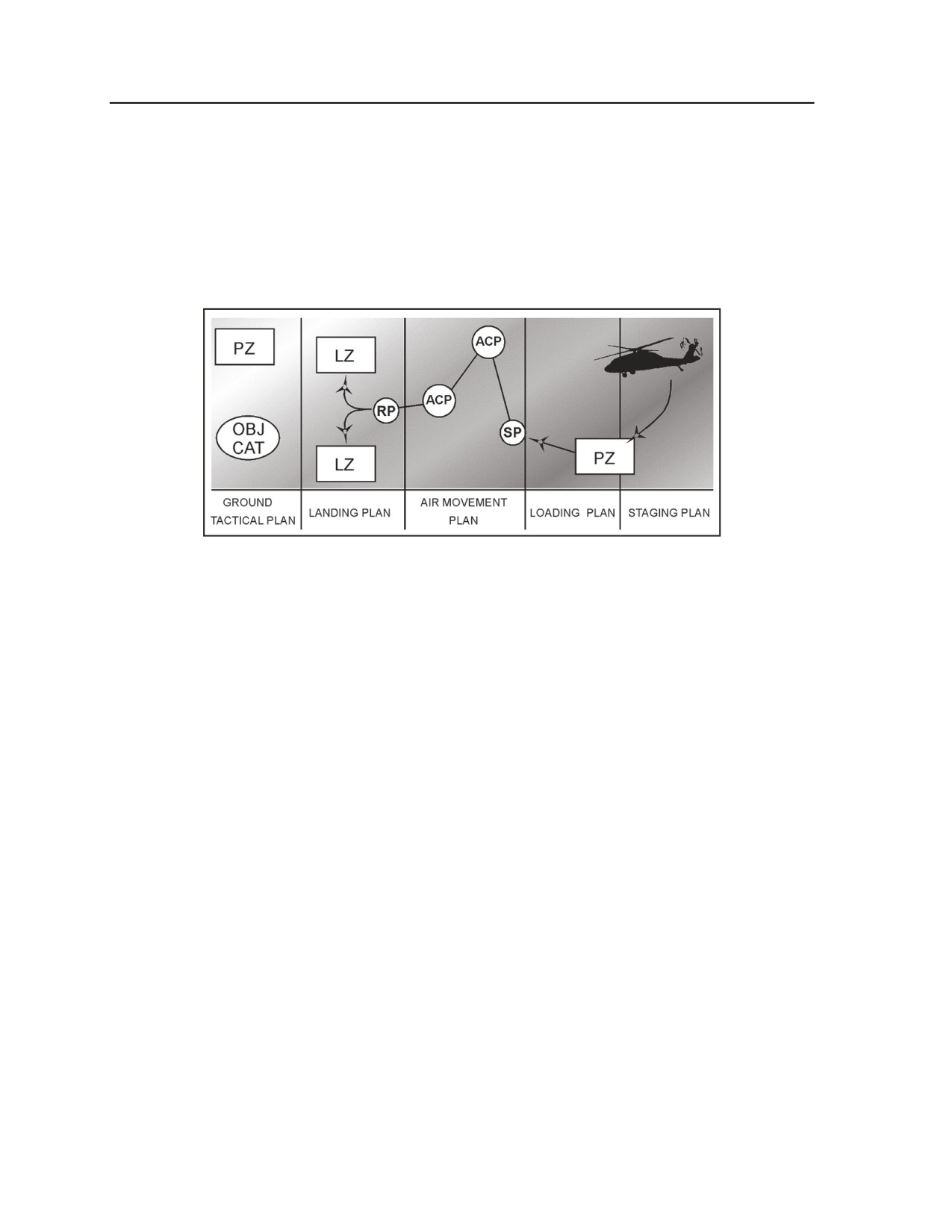
The five basic plans composing an air assault operation are: GTP, landing plan, air movement plan, loading
plan, and staging plan (figure 3-9, page 3-22). Air assaults are planned in reverse sequence to ensure
timing and synchronization.
Figure 3-9. Air assault planning stages
3-106. These plans are not developed independently. They are coordinated, developed, and refined
concurrently by both the AATF and aviation brigade staffs making the best use of available time. The GTP
is normally developed first and the basis from which the other four plans are derived.
Ground Tactical Plan
3-107. The GTP is the focal point of planning and foundation for a successful air assault. All other
operations support this plan. It specifies actions in the objective area to accomplish the mission and sets the
stage for subsequent operations. It also indicates actions from exiting the LZ to attacking the objective
area. The GTP addresses the following factors:
Task organization for combat. This identifies the number and type of maneuver, support, and
sustainment elements essential to mission accomplishment.
FS identifies systems available and within range to strike the LZ and objective area, such as:
FA assets.
CAS or close combat attack (CCA) assets.
EW assets.
Scheme of maneuver defines how the commander intends to maneuver the ground force from
the LZ to accomplish the mission and seize assigned objectives.
Commander's intent describes the method of execution and end state that initiates subsequent
plans including:
Location of the force (land on the objective or near it and maneuver to it).
The value of surprise versus J-SEAD and preparatory fires.
Supporting fires guidance.
Observation plan guidance.
Other factors based on METT-TC and CCIR.
Use of attack reconnaissance helicopters including when and which units will transition
from assault force security under AMC control to support the GTP under the AATFC/GTC.
3-22
FM 3-04.113
7 December 2007
Employment
Laager sites in support of PZ operations during extraction.
Landing Plan
3-108. The scheme of maneuver and GTP directly impact the selection of LZs, landing formations, and
the amount of combat power entering the LZs. The landing plan outlines the distribution, timing, and
sequencing of aircraft into the LZs.
3-109. After coordinating with the AMC and LNO, the AATFC selects primary, alternate, tertiary, and
false insertion LZs (if applicable and METT-TC dependent) based on the following factors:
Location. The LZ may be on the objective, nearby, or some distance from the objective.
Capacity. LZs must accomodate for TF aircraft without excessive slope or uneven terrain.
Enemy disposition and capabilities. The location of potential enemy reinforcements, AD, and
other weapon locations and ranges influence LZ location.
Unit tactical integrity. Squads must land intact with platoons and companies in the same serial
to ensure unit integrity.
Supporting fires. LZs should be within range of supporting fires.
Obstacles. LZs should be free of large rocks, debris, mud, ice, fine dust/snow, and brush, unless
executing special patrol infiltration/exfiltration system (SPIES)/fast rope insertion/extraction
system (FRIES) operations or allowing troops to safely jump to the ground from a low hover.
Identifiable from the air. LZs should be identifiable by aircrews at night and from low altitude
yet should be shielded from enemy direct fires and observation.
Orientation. Prevailing winds, illumination, and sun direction at landing time affect elements in
the LZ.
3-110. The AATFC's intent and GTP influence the decision to use single or multiple LZs. Using a single
LZ has the following advantages:
Simplifies C2.
Requires less planning and rehearsal time.
Centralizes resupply operations.
Concentrates supporting fires on one location.
Provides better security on subsequent lifts.
Masses more combat power in a single location.
Reduces fratricide risk.
May make enemy detection more difficult due to confinement in a smaller area of the battlefield.
3-111. Using multiple LZs has the following advantages:
Reduces the risk of concentrating the entire assaulting force in one location the enemy could
mine or target with fires.
Forces the enemy to fight in multiple directions.
Allows rapid dispersal of ground elements to accomplish tasks in separate areas.
Makes it more difficult for the enemy to determine the size and main effort of the assault force.
3-112. During the landing phase, attack reconnaissance helicopters provide overwatch of the LZs,
reconnoiter egress routes, call for fire (if designated), and screen to warn the AATFC and ground force
commander of any enemy counterattack during the ground tactical phase.
3-113. The plan must address door gunner fires to reduce the risk of hitting other aircraft in the formation
or troops on the ground. Dependent on landing formation, door gunners are usually free to fire. As Soldiers
exit the aircraft, fires must shift or cease. On subsequent lifts, units limit door gunner fires with controlled
or restrictive fire lines.
3-114. The unit may plan single door exits away from a potential enemy position. This technique allows
the door gunner closest to the enemy position to continue firing while Soldiers exit from the other side of
7 December 2007
FM 3-04.113
3-23

Chapter 3
the aircraft. In this scenario, rucksacks may hamper rapid exit from the aircraft. The same applies to other
cross-leveled equipment belonging to Javelin and mortar sections.
Air Movement Plan
3-115. The AATF staff develops the air movement plan and corresponding AMT with the AMC, LNO,
and flight lead. This plan schedules movement of troops, equipment, and supplies from the PZ to the LZ. It
also provides a plan of action for serial and lift routes, start points, ACPs, RPs, aircraft speeds, altitudes, en
route formations, actions on enemy contact, FS en route, and egress.
3-116. Factors of METT-TC determine flight route selection. Higher HQ may recommend general flight
axes or designate flight corridors from which to plan exact flight routes. The AATF staff and flight lead
develop primary and alternate flight routes while considering the following:
Airspace management. Coordinate flight corridors, axes, and PPs with ground maneuver,
artillery, AD, joint, UAS, aeromedical evacuation, and other potential airspace users to reduce
fratricide risks (a ground and/or aviation brigade usually coordinates airspace management).
Support of the landing plan. Develop flight routes and LZ formations that conceal and
facilitate rapid aircraft approach and departure into the LZ and exact landing/take-off locations.
Enemy capabilities. Avoid known or suspected enemy positions en route; choose routes
providing maximum terrain masking at contour speeds and altitudes.
FS. Select routes friendly artillery can range; plan to lift towed artillery to support en route and
objective fires. Deconflict routes with position areas for artillery (PAAs) and gun-target lines.
Distance. Minimize flight route distance to decrease aircraft exposure time and increase speed
of turnaround.
3-117. Table 3-5 provides an example of how to calculate en route time. Add 2 to 5 minutes of flight time
to an LZ 3 to 8 kilometers from the RP, 2 to 5 minutes of flight time for a PZ 3 to 8 kilometers from the
start point, and one minute for acceleration/deceleration time.
Table 3-5. Computing en route time
Flight time computation
T = D X 60 (60 converts hr to min)
T = Time in minutes
S X 1.85 (1.85 converts kt to km/hr)
D = Distance in kilometers
Note: Round up fractions of a minute to the next whole minute.
S = Groundspeed in knots
Aviation planners convert airspeed to groundspeed.
Example: Given 80 km distance from start point to RP at an average groundspeed of 100 kt.
T =
80 km X 60
T =
4800 T = 25.9
(Round up to 26 minutes one-way
100 kt X 1.85
185
from the start point to RP.)
Note: Sample groundspeeds in kts converted to rounded off km/hour and km/minute
80 kt = 148.2 km/hr = 2.5 km/min = 110 kt = 203.7 km/hr = 3.4 km/min
90 kt = 166.7 km/hr = 2.8 km/min = 120 kt = 222.2 km/hr = 3.7 km/min
100 kt = 185.2 km/hr = 3.1 km/min = 130 kt = 240.8 km/hr = 4.0 km/min
3-118. The RP should be chosen so flights cross it within a 30-degree arc of the final approach path to the
LZ. This allows more precision in timing and simplifies transition from the en route formation to the
landing formation.
3-119. If the AATF employs J-SEAD, en route fires, or CAS/air interdiction, it may request designated
flight corridors for portions of the flight route. The aviation brigade or AATF staff coordinates the corridor
through airspace management channels. A flight corridor has a maximum width and altitude restricting
navigation within the corridor.
3-24
FM 3-04.113
7 December 2007
Employment
3-120. Air corridors may exist only within the vicinity of the PP and at en route locations deemed
potentially dangerous and requiring long-range indirect fires or air interdiction. The AATF may designate
the remainder of the planned route as a wide flight axis, giving the AMC and flight leads greater latitude in
choosing a route.
3-121. The aviation brigade or AATF should request a high-density airspace control zone (HIDACZ)
around the vicinity of the LZ/objective. The inner and outer HIDACZ boundaries should not restrict CAS
and aviation reconnaissance. Units request the HIDACZ within the ACO cycle.
Loading Plan
3-122. The loading plan establishes PZ operations including appointment of the PZCO and air loading
table. The air loading table designates the troops, equipment, and supplies load for each aircraft in a
manifest along with the priority of loads, frustrated load plan, bump plan, and cross-loading of equipment
and personnel.
3-123. Although ultimate responsibility for aircraft loading rests with the aviator and aviation unit, SOPs
and loading plans must be coordinated between the aviation and supported unit. At the least, SOPs must
address the following:
PZ markings.
Hand and arm signals.
Hookup procedures.
Troop entry/exit sequence and direction.
Securing equipment.
Assigned seating (if applicable).
Individual to open/close the door (if applicable).
Contingencies (hot PZ, lost communications, aircraft malfunction, broken loads).
3-124. The loading plan and PZ selection should aim to maintain ground unit integrity. Just as a squad
should not be divided between chalks, a platoon should remain in one serial and a company should not be
divided into different lifts or PZs.
3-125. The AATF staff selects primary and alternate PZs with the AMC and LNO. Multiple PZs can
speed the assault. Units often designate multiple PZs to separate internal and external loads, troops and
equipment, or UH-60 and CH-47 operations.
3-126. The AATF staff bases PZ selection on METT-TC, AATFC's intent, assault force's location in
relation to the PZ, and capacity of available terrain. Each PZ should be—
Large enough to accommodate all supporting aircraft at one time.
Close to the troops being lifted so they do not have to travel a long distance.
Accessible to vehicles supporting PZ operations but away from unrelated traffic.
Free of excessive slope; blowing dust, sand, or snow; rocks; mud; ice; brush; and other
obstacles.
Masked by terrain from enemy observation.
Outside the range of enemy medium artillery.
3-127. The AATFC appoints a PZCO for each PZ. The PZCO forms a PZ control party with troop control
teams, rigging-support, ATS, and security personnel. PZ communications occur using wire and a secure
FM PZ control net. Units minimize radio communications using preplanned brevity codes.
3-128. To avoid confusion at night, the PZCO establishes marking procedures and lighting controls. The
PZ control party may employ blue flashlight filters and chemical lights to designate active ground staging
areas as these lights do not interfere with aircraft night vision systems. Table 3-6 illustrates examples of
marking techniques units may employ to mark PZs.
7 December 2007
FM 3-04.113
3-25

Chapter 3
Table 3-6. Marking techniques for day and night pickup zones
Position In PZ
Daylight Marking
Night Marking
PZ entry
Guide and sign
Guide with 2 blue chemical lights
PZ control
M998 and VS-17 panel
2 green chemical lights on antenna
Aid station
M997
Steiner device
Chalk stage points
PZ control party guides/signs
Guide/blue chemical light per chalk
Lead touchdown point
VS-17 panel, smoke
Inverted Y, IR flashlight
Chalk touchdown points
Soldier on knees with raised rifle
IR chemical light per aircraft
Obstacles
Notify pilots on radio
Red chemical ring around obstacle
Loads to be picked up
Hookup team on loads
Swinging IR chemical light per load
3-129. The PZCO directs the marking of the PZ to simplify night identification. Beanbag or chemical
lights in a shallow trench forming an inverted "Y" form a reliable marker for inbound aircrews. Chemical
lights placed near each chalk can mark touchdown points. Other night marking mechanisms include glint
tape; strobe lights with IR filters; meal, ready to eat (MRE) heaters; flares; and reverse polarity tape. VS-17
panels and smoke are good daylight markers.
3-130. PZ sketches promote understanding of the loading plan. The PZCO or LNO should provide the
flight leader with kneeboard PZ sketches at the rehearsal or AMB. There should be space on the sketch
where aircrews can enter new information and changes. The landing formation corresponds to the PZ
sketch to simplify chalk staging and expedite loading. See appendix D for a sample PZ/LZ kneeboard
diagram.
3-131. The AATF may have spare aircraft to offset mechanical problems or combat losses during the air
assault. The bump plan indicates how spares join serials in the PZ and fit into the bump plan. One
technique is to employ all available aircraft during the first critical lift, and park one or two aircraft to serve
as spares during less critical subsequent lifts. The bump plan also addresses the elements or cargo to be
delayed or left behind if aircraft numbers fall short.
3-132. During the loading phase, attack reconnaissance aircraft can overwatch the PZ and conduct route
reconnaissance of the air assault flight routes.
Staging Plan
3-133. The staging plan prescribes arrival times and order of aircraft, ground personnel, and equipment
movement to the PZ. Loads must be ready (inspected and certified) prior to aircraft arrival. The PZCO and
PZ control party have primary roles in the efficient transition from the staging plan to loading plan.
3-134. During the staging phase, the aviation unit conducts mission planning, orders, and checks to
ensure mission times are met during the air assault. Other preparation includes—
Coordination between the AATF and AMC.
Load preparation and inspection.
Aircrew briefings, mission planning, and rehearsals.
Aircraft preparation, reconfiguration, and spacing.
Preflight inspections and PCC.
Emplacement of FARPs to sustain the mission.
Selection of flight routes to the PZ.
Selection of routes to and from refueling points.
Confirmation of communications card and frequency/COMSEC fill accuracy.
3-26
FM 3-04.113
7 December 2007
Employment
INSERTION AND EXTRACTION OPERATIONS
3-135. Team insertion/extraction missions can be conducted at any time during TACOPS. These
operations usually occur prior to offensive operations such as air assaults or movements to contact. Teams
may consist of long-range surveillance detachment (LRSD) troops, special operations forces (SOF),
combat observation laser teams (COLTs), reconnaissance scouts, or retransmission elements. Teams may
be inserted by fast-rope, single-point, or landing to an LZ.
FUNDAMENTALS
3-136. Assault and GS helicopter units perform team insertions and extractions of LRSDs, rangers,
special operations teams, infantry patrols, forward observers and COLTs, combat engineer demolition
teams, and Pathfinders. Missions may also require SPIES or FRIES equipment, rappelling ropes, hoists,
auxiliary fuel tanks, and additional training or rehearsals.
3-137. The inserting or extracting aviation element commonly consists of two UH-60s and two AH-64s.
UH-60s conduct multiple false insertions before and after actual insertion and enable immediate downed
aircrew recovery. AH-64s provide security and may conduct feints or demonstrations to help cover the
operation.
3-138. The unit may have as few as 6 hours to plan a team insertion due to the need to gather intelligence
early in the planning process of a larger mission. A major mission may involve multiple team
insertions/extractions. For example, the mission may require insertion of—
LRSD and/or Pathfinders 72 to 96 hours prior to H-hour.
Scouts 48 hours before H-hour.
Advance elements and forward observers/COLT teams several hours or less before H-hour.
3-139. Aviation elements should expect the inserted element to choose insertion/extraction points 5 to 10
kilometers or more from planned mission objectives. They should also plan different ingress/egress routes.
Insertion mission orders must include—
Planned extraction points.
Emergency extraction rally points.
Lost communications extraction points.
3-140. Planned extraction points and emergency extraction rally points require communications to verify
the preplanned pickup time or coordinate an emergency pickup time window. The lost communications
extraction point involves ground teams moving to the emergency extraction point after two consecutive
missed communication windows and waiting up to 24 hours for pickup.
3-141. Battalions must plan team insertions/extractions as companies lack the resources to both plan and
prepare for the mission. Unit SOPs should outline an abbreviated planning process for these missions.
3-142. On short-notice missions, it may be impossible to coordinate J-SEAD or units may elect to avoid
using lethal J-SEAD depending on threat and stealth requirements. Escorting armed helicopters and
artillery can provide some protection.
PLANNING CONSIDERATIONS
3-143. Although insertions and extractions follow the same five-stage planning process, the primary
difference between air assaults and team insertions is that a formal AATF may not exist. A command
structure must be established to plan, organize, and execute the operation. Assault, GS, and attack
reconnaissance units may internally task-organize for habitual insertion/extraction missions.
Alternatively, the TF may be temporarily OPCON or under tactical control for these missions. Other
planning considerations include—
Coordinating with the supported unit and verifying mission requirements with higher HQ
(battalion/brigade staff). Normally, the order is sent from the higher HQ to the company,
platoon, or section conducting the insertion/extraction.
7 December 2007
FM 3-04.113
3-27
Chapter 3
Planning and rehearsing with the team members to be inserted prior to the mission if possible. If
armed escort accompanies the operation, the assault or GS aviation unit should ensure the attack
reconnaissance aircrews are included in the planning and rehearsal.
Leaders gathering as much information as possible (such as enemy situation) in preparation for
the mission and ensuring J-SEAD coordination as appropriate.
Ensuring mission fuel requirements can be met and coordinating for FARPs.
SPECIAL PATROL INFILTRATION/EXFILTRATION SYSTEM OPERATIONS
3-144. SPIES was designed for use in inserting and extracting patrol personnel where a helicopter landing
is impractical. The system provides a means of exfiltrating up to 14 Soldiers over short distances. It is not
recommended for infiltration as team members are exposed the entire time. Due to the nature of SPIES
operations, a thorough briefing is required for all participants before the operation. Careful coordination is
crucial when additional assets (attack reconnaissance helicopters, aerial observers, or artillery support) are
employed with the extraction helicopter.
3-145. Soldiers must have SPIES harnesses as part of their individual equipment. The commander and SP
must ensure unit rated members and NCMs are trained and complete rehearsals prior to conducting SPIES.
For detailed information on SPIES, refer to FM 3-05.210, FM 7-93, and the applicable ATM.
FAST ROPE INSERTION/EXTRACTION SYSTEM OPERATIONS
3-146. FRIES provides the capability to insert troops and equipment into areas not suitable for helicopter
landing. FRIES is also the fastest method of deploying troops from a helicopter unable to land. The UH-60
has provisions for two fast ropes, one on either side of the cargo door area. The CH-47 has provisions for
up to three fast ropes, one out the forward right door and two out the ramp. The fast rope consists of a
polyester rope, which is 1¾ inches in diameter, olive drab in color, and various lengths (20, 40, 60, 90, and
120 feet).
3-147. Fast rope serves to insert troops without the aircraft contacting the ground or an obstacle. FRIES is
used for team insertion or extraction in various settings:
DART in mountainous terrain.
Urban settings with no room to land.
Pinnacles and ridgelines.
Decks of ships.
3-148. The commander and SP must ensure crewmembers are trained, thoroughly briefed, and complete
rehearsals prior to conducting FRIES. For detailed information on FRIES refer to FM 3-05.210, FM 7-93,
and the applicable ATM.
HELICOPTER CAST AND RECOVERY OPERATIONS
3-149. A helicopter cast and recovery
(HELOCAST) operation involves inserting/extracting troops
and/or equipment from a helicopter overwater. HELOCAST is a very effective means of inserting and/or
extracting combat swimmers, combat divers, LRS teams, SOF, snipers, and combat rubber raiding crafts. A
HELOCAST operation is planned and conducted much the same as an air movement operation, except the
LZ is in the water. Refer to the following FMs for detailed information on HELOCAST operations:
FM 3-05.210 for SOF.
FM 7-93 for LRS units.
FM 23-10 for sniper training.
3-28
FM 3-04.113
7 December 2007
Employment
SECTION III - AIR MOVEMENT
FUNDAMENTALS
3-150. Air movement operations involve the use of Army airlift assets for other than air assaults. These
operations are used to move troops, equipment, and supplies. The same planning sequence and phases used
for air assault operations apply to air movement operations. In these operations, aviation is not necessarily
task-organized with other members of the combined arms team.
3-151. Assault and GS helicopter units perform air movement on a DS or GS basis. Air movements are
especially effective in moving forces and their equipment when—
Ground routes are nonexistent, limited, congested, damaged, or blocked by enemy activity or
obstacles.
The supported unit does not have adequate available vehicles.
Time is critical.
EXTERNAL LOADS
3-152. Typical external loads include bulk supplies, fuel or water drums, vehicles, trailers, materiel
handling equipment, towed artillery and other weapons systems, and ribbon bridges. The supported unit is
responsible for preparing, weighing, and rigging external loads. FM 10-450-4 and FM 10-450-5 contain
information on typical loads and their weights. FM 4-20.197 contains additional detail related to required
rigging equipment and methodology for preparation and transport. Appendix C of this manual contains
information on UH-60 and CH-47 characteristics, capabilities, and limitations.
3-153. High altitudes and temperatures degrade aircraft performance, reducing the weight they can carry
and/or the amount of fuel onboard. Reduced fuel restricts the distance items can be carried and causes more
frequent refueling during missions with multiple lifts. Ground units operating in hot weather and
performing missions with PZs, LZs, or flight routes in areas of high elevation must consider these factors
when planning for heavier loads. Available aircraft power is higher during the cooler night, early morning,
and late afternoon hours.
3-154. Supported units must avoid loading vehicles, trailers, pallets, and other containers beyond
maximum weights that have been coordinated with the aviation unit. If the aircraft is unable to lift the load
or transport it the required distance, the supported unit must reduce the weight by removing items. This
could involve partial derigging, rerigging, and reinspection delays. These unexpected delays could cause
the ground unit to lose aviation support if the aircraft are scheduled for other missions.
AIR MOVEMENT RESPONSIBILITIES
Supported Unit at the Pickup Zone
3-155. In the PZ, the sending unit must provide rigging equipment and complete the sling-load inspection
checklist according to FM 4-20.197. It is the responsibility of the aviation LNO to verify that the supported
unit is aware of the sending unit’s duties in this area. If the sending unit desires backhaul of slings and
rigging equipment, this must be precoordinated. The sending unit also prepares loads for air movement that
includes marking, prioritizing, rigging, inspecting, weighing, and tracking loads. The sending unit is also
responsible for PZ marking and operations, including ground guides and radio communication. For
external loads, the ground unit performs the static discharge and hooks the load.
Aviation Unit
3-156. The aviation unit makes the final determination of the load’s worthiness to fly and determines in
advance what portion of the load to carry internally or externally. The aviation unit also transports the
loads and notifies the receiving unit of any changes it makes in the precoordinated plan.
7 December 2007
FM 3-04.113
3-29
Chapter 3
Supported Unit at the Landing Zone
3-157. The supported unit is responsible for LZ markings and operations, including ground guides and
radio communications. The supported unit guides the aircraft to the desired point for landing or external
load release. It prepares the LZ, unrigs the load, and loads rigging materiel for backhaul for subsequent
lifts, if coordinated.
AVIATION STAFF RESPONSIBILITIES
3-158. The S-2 section identifies threats to air movement operations and disseminates reports. CH-47
aircraft are particularly at risk due to their large signatures, especially when transporting external loads.
The S-2 section provides assessments of the safest routes if the mission is cross-FLOT or nonlinear.
3-159. The S-3 section provides mission, PZ, route, and LZ information including grid locations,
frequency, call signs, markings, and landing direction. The S-3 provides critical mission times and a
supported unit point of contact (POC). The S-3 section specifies the means of flight following and periodic
situation reporting of activities and locations by precoordinating modes of communication. The S-3 section
ensures compliance with the AC2 structure and advises aircrews of other potential airspace users along
projected flight routes. If a threat is anticipated, the S-3 coordinates for preplanned or on-call fires
available to support operations. The S-3 will also coordinate for attack reconnaissance helicopter security
as needed. The S-3 section ensures aircrews are aware of downed aircraft procedures. A detailed mission
brief can suffice instead of an OPORD for most air movement operations.
3-160. The S-4 section arranges refuel and maintenance coverage to support extended distance missions.
When in DS of a particularly large air movement mission, the S-4 section may plan throughput of fuel
supplies directly to the supported unit's trains where class III sections can link up their FARP equipment
with supplies.
DOWNED AIRCRAFT RECOVERY TEAM
3-161. The DART’s mission is recovering an aircraft damaged on the battlefield. Although downed
aircarft recovery is an aviation enabling mission, it is a specific and detailed form of air movement.
Considerations include extent of damage, location on battlefield, proximity to enemy and friendly forces,
and recovery resources available.
3-162. Assault and GS helicopter units transport maintenance contact teams along with a security element
(if required) to repair or evacuate downed aircraft. UH-60 aircraft can recover the OH-58D by sling-load.
The CH-47 can externally transport all types of Army helicopters including another CH-47 (when properly
prepared). The maintenance team provides recovery equipment but typically requires augmentation from
the owning unit. Refer to chapter 4 for more information.
FAT HAWK OPERATIONS
3-163. A Fat Hawk is a UH-60 that provides fuel and/or ammunition. The UH-60 provides fuel to another
aircraft from its internal or external fuel tanks via a micro-forward area refueling equipment (FARE)
system. A Fat Hawk crew can refuel and rearm four OH-58D aircraft in less than 15 minutes without sling-
loading fuel or ammunition. The absence of an external load increases UH-60 survivability, reduces
emplacement time, and limits enemy capability to target the FARP. Normal operation consists of two
external stores support system (ESSS)-equipped UH-60 aircraft with full crew; three to four petroleum,
oils, and lubricants (POL) personnel; a combat lifesaver/medic; security personnel; armament personnel;
and armament and refuel equipment to support the mission. See FM 3-04.104 for additional information.
3-30
FM 3-04.113
7 December 2007
Employment
UNIQUE HEAVY HELICOPTER OPERATIONS
3-164. Heavy helicopters have a few unique missions they predominantly perform rather than assault
helicopter units.
Air Movement of Special Munitions
3-165. Nuclear, chemical, and other special munitions require transport in some battlefield scenarios;
heavy helicopters provide the requisite lift and onboard security capability. Due to the sensitivity of this
mission, a backup CH-47 and UH-60s with additional reaction forces normally accompany the flight. In
hostile environments, armed aircraft provide en route security.
Air Movement of Oversize, Tandem, Side-by-Side, and Internal Equipment
3-166. Some equipment cannot be externally or internally transported by assault aircraft due to size,
weight, or a high-altitude and/or high-temperature environment. Loads too heavy for the UH-60 include
critical items such as the M198 155-millimeter towed howitzer and several HMMWV variants.
3-167. The CH-47's triple cargo hook system enables transport of vehicles and trailers or towed howitzers
in tandem (vehicle and towed equipment are externally transported together). Likewise, some HMMWVs
and other equipment can be lifted side by side. FM 10-450-5 details procedures and required equipment.
3-168. The helicopter HICHS gives the CH-47 unique abilities to load and offload palletized cargo. In
addition, the rear ramp permits some drive-on/drive-off capability. Units also internally transport some
trailers and M119 towed howitzers.
Fat Cow Operations
3-169. CH-47 aircraft carry the extended range fuel system (ERFS) or ERFS II and FARE or advanced
aviation forward area refueling system (AAFARS) equipment to provide a mobile FARP supporting deep
shaping operations and other special missions. One CH-47 can carry up to four 800-gallon fuel tanks,
FARP personnel, and equipment, while other aircraft transport internal and external ammunition loads. See
FM 3-04.104 for additional information.
High Altitude Operations
3-170. Some regions and mountainous areas have such high altitudes above mean sea level (MSL) that
only the CH-47 can safely operate with adequate range and payload. High-altitude rescue of lost and/or
injured civilian and military personnel is also a CH-47 mission. CH-47s can also insert combat teams and
observers in high-altitude areas. Higher HQ may task units to externally transport communications
equipment, AD systems, and towed artillery to higher altitude positions for optimal ranging.
PLANNING CONSIDERATIONS
AIR MOVEMENT PLANNING AND DECENTRALIZED CONTROL
3-171. Large air movements require planning and C2 similar to air assaults but usually without the
associated task organization. Most air movements are smaller and highly decentralized. On a typical
mission, one or two mission aircraft may operate at distances that often outstrip maintenance support and
normal radio communications ranges. These missions may require extensive premission planning to
coordinate—
Maintenance support from other units.
Alternate communication means (SATCOM, aerial retransmission, HF radio, or message relay
by the supported unit).
Threat data along the route and an alternate means for obtaining intelligence updates.
7 December 2007
FM 3-04.113
3-31
Chapter 3
PZs and LZs.
POCs at supported and supporting units.
3-172. AC2 for air movement may include having the mission published in the airspace tasking order and
coordinated by the ATS Tactical Airspace Integration System. Unit aircrews still have the responsibility of
exercising caution and being aware of and not overflying artillery units, UAS launch/recovery locations,
AD sites, and other airspace users. Battalions must coordinate with the brigade to ensure flight standards
across the FLOT, or forward in nonlinear theaters, are published in the ACO to reduce potential for
fratricide. Flight following or procedural control is normal for air movement operations with altitude
restrictions often in place.
SECTION IV - COMMAND AND CONTROL SUPPORT
3-173. C2 aircraft allow commanders to maintain communications with their forces and provide timely
information supporting critical decisions without sacrificing mobility and efficiency. There are currently
two types of C2 platforms supported by the UH-60. The first is an aircraft with a C2 console. The second is
an aircraft modified with the A2C2S console.
FUNDAMENTALS
3-174. C2-mission aircraft may employ ERFSs to extend station time up to four to 6 hours. Although C2
missions are normally flown in C2-system aircraft, other UH-60s may be required to perform this role.
3-175. Since C2 aircraft may need to fly at higher altitudes to maintain LOS communications, the
supported unit S-3 section should request a ROZ or airspace control area. The aviation battalion and
supported unit S-2 must analyze the threat to operating at higher altitudes. C2 aircraft supporting a ground
operation must maintain awareness of friendly locations so as not to overfly and reveal locations to the
enemy.
PLANNING CONSIDERATIONS
AIRSPACE COMMAND AND CONTROL
3-176. C2 aircraft must operate within a designed airspace structure. Normally, a ROZ or airspace control
authority will be established for C2 aircraft. Selection of a suitable ROZ must consider several factors to
include scheme of maneuver, threat, communications, and routes to/from the ROZ.
Scheme of Maneuver
3-177. The ROZ must be located in an area that supports the maneuver commander's plan and does not
conflict with the current operations of the supported unit. The S-3, or S-3 Air, of the supported unit should
request the ROZ. It may be necessary to plan for multiple ROZs. In offensive operations, on order ROZs
must be planned, so as the battle moves, C2 aircraft can move forward and continue to provide effective
C2.
Threat
3-178. Aviation battalion S-2s, S-3s, and TACOPS officers must carefully analyze the threat and the
impact potential threats can have on aircraft working in a ROZ. ROZ operations can be high risk. Often
aircraft will be operating in a ROZ for an extended period of time and may go above the coordinating
altitude. A careful analysis of the ROZ by the aviation unit will ensure the ROZ can support the ground
maneuver commander's concept and remain clear of high threat areas.
3-32
FM 3-04.113
7 December 2007
Employment
Communications
3-179. The ROZ must be selected so LOS communications are capable of being maintained with all
elements of the unit. Altitude is a factor in ROZ selection. Higher altitudes allow for better
communications but increase risk from threat systems. A careful analysis of the factors of METT-TC
allows the ROZ to be selected in an area providing security and uninterrupted communications.
Routes to/from the Restricted Operations Zone
3-180. Flight routes must be developed supporting the aircraft's transition to the ROZ. These flight routes
must be planned carefully, should avoid overflight of friendly artillery units, and should be opened and
closed as needed by C2 aircraft.
COMMAND AND CONTROL CONSOLE OPERATOR
3-181. A console operator must be available to run console operations while the commander and staff are
controlling the battle. The operator may or may not be from the supporting aviation unit. There are no
special requirements needed to operate the console, just an understanding of the system’s OPCONs. The
aviation unit may not have personnel available to operate the system. The supported unit commander must
be prepared to provide an additional Soldier to operate the console during missions.
ARMY AIRBORNE COMMAND AND CONTROL SYSTEM OPERATOR
3-182. A master operator manages the software/hardware, while the commander and staff control the
battle. The operator must be trained to initialize and troubleshoot the system, use each of the component
systems, and provide immediate work-around solutions in case of malfunctions. The aviation unit may not
have personnel available to operate the system; therefore, the supported unit commander must be prepared
to provide a systems operator.
ARMY AIRBORNE COMMAND AND CONTROL SYSTEM INITIALIZATION
3-183. Initialization is an important step in preparing A2C2S automated systems. To achieve maximum
use of the system’s capabilities, initialization must be accomplished prior to conducting airborne
operations. If A2C2S begins a mission without proper initialization, it may be difficult to transfer the
necessary volume of initial information while en route (in a timely manner) to exploit the capabilities of the
automated workstations and data communications. The steps for A2C2S initialization include—
Initializing radios.
Initializing ABCSs.
Loading the supported unit’s maneuver data and graphics.
Conducting a communications rehearsal.
COMMUNICATIONS FILLS
3-184. Some consoles require a fill from a modified ANCD existing at brigade level and higher.
Coordination must be made as soon as possible after receipt of the mission for the supported unit to
provide the necessary ANCD fills. To ensure the COMSEC fills are compatible, the console operator
should conduct communications checks with the supported unit prior to mission execution. If the
communications check proves unsuccessful, the aircrew should try loading the COMSEC fills from the
secure loading device (KYK-13 or ANCD) at the supported unit.
COMMAND RELATIONSHIPS
3-185. Aircraft conducting C2 missions will be OPCON to the maneuver commander. The aviation unit
providing the aircraft must coordinate with the supported unit early to integrate the C2 aircraft during the
planning process. The aircrew of the C2 aircraft should attend OPORD briefings and rehearsals of the
supported unit to fully understand the operational scheme of maneuver and concept for the C2 aircraft.
7 December 2007
FM 3-04.113
3-33
Chapter 3
ROLES AND MISSIONS
3-186. The airborne C2 mission often requires independent operations by aircrews and aircraft OPCON
to commanders and staffs down to brigade and battalion level. A2C2S provides the maneuver commander
with a highly mobile, self-contained, and reliable airborne digital CP with the C2 systems needed to C2 in
JIM environments. A2C2S allows the commander and his staff to maintain voice and digital connectivity
with required C2 elements. A2C2S will roughly replicate the systems and capabilities of a digitized
maneuver brigade commander’s TAC CP.
3-187. A2C2S provides the maneuver commander a rapidly deployable means of C2 that can support any
mission. The commander and staff can perform all battle command and coordination functions from the
A2C2S. A2C2S provides tactical internet access to manipulate, store, manage, and analyze SA
information, intelligence data, mission plans, and mission progress data to support the C2 decisionmaking
process. A2C2S provides the commander the ability to “see” his portion of the AO, exercise C2 regardless
of location, control his part of the battle, and rapidly respond to fluid situations.
COMMAND AND CONTROL AIRCRAFT CONFIGURATIONS
3-188. UH-60 aircraft can be configured with a C2 console or EUH-60 with A2C2S mission kit to
provide maneuver commanders with an aerial C2 platform.
Note. For an aircraft to operate a console system or A2C2S, the airframe must undergo
modification. Not all UH-60s are modified to operate as a C2 platform.
COMMAND AND CONTROL CONSOLE CONFIGURATION
3-189. UH-60 C2 aircraft contain a command console and map board that functions as an airborne or
ground CP and provides communications in both secure and nonsecure modes. The C2 aircraft provides
the commander with—
VHF/AM or FM-secure communications.
FM SINCGARS frequency hopping/secure communications.
HF secure with Have Quick I and II communications.
SATCOM.
HF-nonsecure communications.
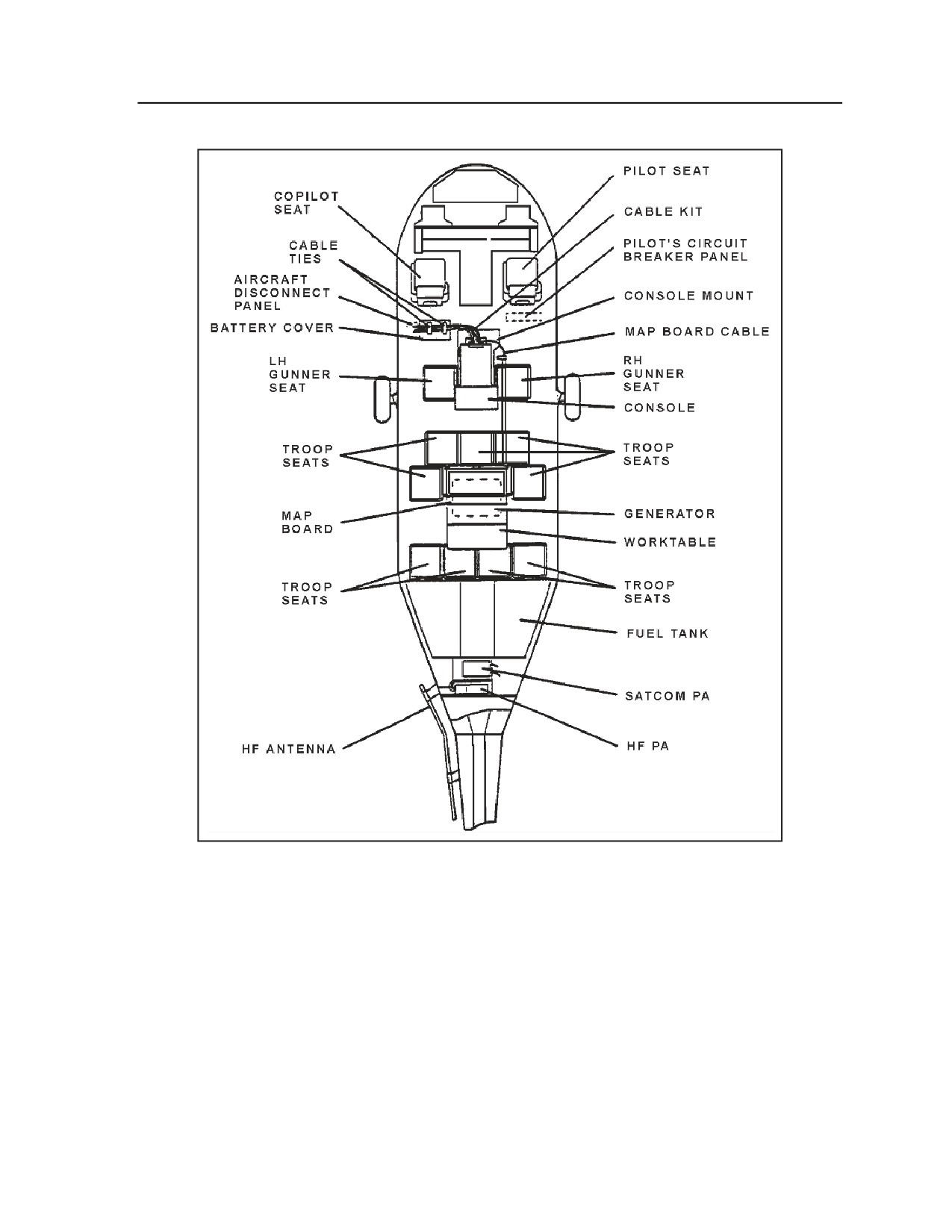
3-190. The C2 aircraft is configured with a C2 console in the front of the aircraft (figure 3-10, page 3-35).
The C2 console contains radio sets, console controls, and six internal communications system (ICS) boxes
for internal aircraft communications and receiving/transmitting on the console radio systems. The back row
of the UH-60 contains a map board with four additional ICS boxes allowing 10 personnel to be hooked up
to the console's radio systems. The C2 console is NVG-compatible allowing the commander to conduct C2
operations at night. The C2 console runs off aircraft power and internal aircraft antennas.
3-191. The C2 console has the capability to operate in a ground mode. In this configuration, the console
can either remain mounted on the aircraft or be dismounted and operated away from the aircraft. Using the
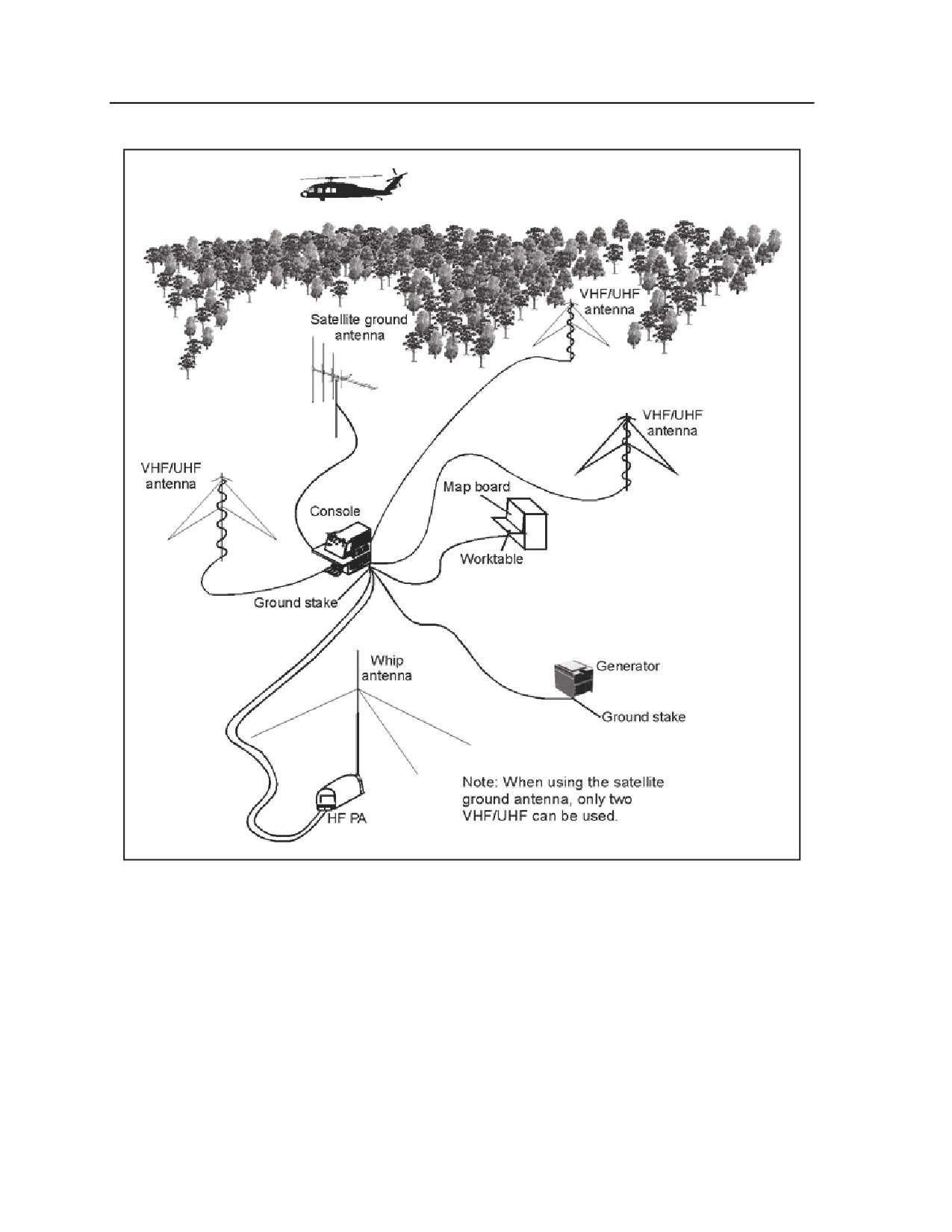
C2 console in a ground mode requires a generator for power and external antennas. Figure 3-11, page 3-36,
depicts the ground configuration for the C2 console.
3-34
FM 3-04.113
7 December 2007
Employment
Figure 3-10. Aircraft command and control console configuration
7 December 2007
FM 3-04.113
3-35
Chapter 3
Figure 3-11. Ground based command and control console
Capabilities
3-192. The capabilities of the C2 console include the following:
Provides the commander approximately 6 hours of on-station time (with ERFS mounted).
Provides retransmission capability for VHF, UHF, and SINCGARS increasing the
communications range for the supported unit.
Can be configured for ground-based operations.
VHF/AM and UHF radio can store up to 30 preset frequencies.
Provides VHF and UHF scanning of up to four frequencies.
Can store two SATCOM preset channels.
3-36
FM 3-04.113
7 December 2007
Employment
Limitations
3-193. The limitations of the C2 console include the following:
Requires an individual trained in operation of the console system for effective operation.
The crew chiefs of the aircraft are not C2 system operators; therefore the supported unit should
have dedicated and trained console operators.
Removal from the aircraft is timely. It takes at least one hour and four personnel to remove
the C2 console from the aircraft for ground-based operations. Reinstallation in the aircraft
requires special mounting hardware.
Limited FM communications. With only one SINCGARS radio, the console can only load six
FM frequency hop sets at a time. This limits the commander's ability to communicate, and
retransmission capability is lost.
ARMY AIRBORNE COMMAND AND CONTROL SYSTEM
CONFIGURATION
3-194. A2C2S consists of two components: an A-Kit and B-Kit. The A-Kit is permanently affixed to the
airframe and consists of antennas, wiring, and aircraft interfaces
(power, structural) enabling B-Kit
installation onto the host platform. Once the A-Kit is installed, the airframe is designated EUH-60. The B-
Kit
(also referred to as the mission equipment package, airborne C2 system) consists of operator
positions/workstations, computer systems, and the communications devices necessary to host and support
the digital C2 process. Through its onboard ABCS, A2C2S provides continuous battlefield SA. It is also
the source of digital information for nondigitized aircraft supporting the operation. The robust
communications package on A2C2S provides maneuver commanders with on-the-move C2. The system
supports three major operational functions—mission planning, mission execution, and mission support. Its
primary function is monitoring execution of current operations while the main CP focuses primarily on
planning future operations.
FEATURES AND PERFORMANCE
3-195. A2C2S provides—
LOS communications through the latest version of the combat net radio (CNR) including
SINCGARS-Advanced System Improvement Program, demand assigned multiple access for
UHF SATCOM, HF radio with automatic link establishment, and Have Quick II/VHF/UHF.
Beyond line of sight (BLOS) systems to include interface with the Blue Force Tracking-
Aviation (BFT-A) system resident on the platform, which provides connectivity to the lower
tactical internet for SA and C2 messaging and broadband
(Ku-band or Ka-Band)
communications systems. These systems support connectivity to the upper tactical internet and
data transport for hosted ABCS and other hosted C2 systems while on the move.
ABCS applications form maneuver, effects, intelligence, and SA (FBCB2 and BFT-A).
Receive and view Army tactical UAS imagery for up to four user workstations for the
commander and staff.
Modular design (two or four workstation configuration) to allow the commander to configure
the A2C2S to best support his C2 requirements.
Ability to host current and emerging communication systems such as the Joint Tactical Radio
System, Warfighter Information Network-Terrestrial, and military and commercial satellite
systems.
Common displays.
Digital connectivity with all ABCSs.
Airborne and ground operational modes.
7 December 2007
FM 3-04.113
3-37
Chapter 3
INTERFACES
3-196. A2C2S utilizes a suite of secure communication systems providing voice and data
communications. Voice capabilities include CNR (ground/air LOS and BLOS). Data capabilities include
SA and C2 messaging, data synchronization, and collaboration. The radio requirements closely replicate
the ground commander’s TAC CP capability allowing the commander to operate the same nets and use the
same TTP developed for ground CPs.
OPERATION AS A GROUND COMMAND POST
3-197. When operating as a ground CP, the preferred power source is commercial power. If commercial
power is not available, a generator is the next preferred power source. If external power is not available,
aircraft power is required. Extended ground times may require a ground power unit, which could be
brought in via sling-load or tactical ground vehicle, such as a HMMWV with a generator kit.
INFORMATION FLOW
3-198. ATCCSs are primarily top-down planning tools. Once the execution phase begins, the primary
flow of information is bottom-up via FBCB2. A2C2S draws real-time data from broadcast sources to
determine changes to the enemy situation during the execution phase of a mission.
3-199. The operating environment increases stress on joint C2 as commanders are faced with unfamiliar
scenarios in complex, uncertain, and rapidly changing situations. Simultaneously, joint C2 must support the
increased demand for high quality information and conflict resolution that includes greater interagency,
coalition, multinational, and NGO involvement.
3-200. A2C2S relies on the open sharing of SA and C2 information between joint and coalition
warfighters as required by joint battle command. This enables A2C2S-information sharing with other
service components and leverages relevant information from other command, control, communications,
computers, ISR systems and sensors. The passing of information throughout the joint force and coalition
community is key in achieving enhanced SA and information/situation dominance. A2C2S is dependent on
multiple systems including, but not limited to, platform power, communications, computers and
networking, position location devices, geospatial reference data, and subsystem/sensor integration.
SECTION V - AEROMEDICAL EVACUATION
3-201. Commanders of medical units in a theater of operations use modularity and economy of force to
effectively allocate their resources to evacuate and treat sick, injured, and wounded Soldiers. A wounded
Soldier’s survival often depends on the time it takes to receive treatment. Rapid responsive care is essential
to protecting the force and ensuring high survival rates on the battlefield.
Note. Refer to FM 4-02.2 for additional information on Medical Evacuation
3-202. Army aviation is responsible for command, control, and execution of the Army aeromedical
evacuation mission. Each GSAB has an organic air ambulance company capable of supporting 24-hour
operations. This company consists of a company HQ and four FSMTs with three aircraft each. The
company can be individually or group deployed in support of tactical, operational, and strategic missions
encompassing full spectrum operations worldwide.
MEDICAL EVACUATION
3-203. MEDEVAC is the timely, efficient movement and en route care by medical personnel of wounded,
injured, or ill persons from the battlefield and/or other locations to MTFs. MEDEVAC applies to both air
and ground evacuation and is a combat multiplier. Refer to FM 4-02.2 for additional information.
3-38
FM 3-04.113
7 December 2007
Employment
3-204. The U.S. Army is the only service that provides MEDEVAC consisting of dedicated ground and
air platforms designed to provide en route care. These platforms are protected under the provisions of the
Geneva Conventions from intentional attack by the enemy.
3-205. In contrast to a typical aviation mission cycle, continuous aeromedical evacuation coverage results
in extended operational duty days that often exceed 24 hours in length. MEDEVAC units must plan and
develop a detailed battle rhythm that addresses CRM and mission execution processes and TTP unique to
24-hour continuous evacuation operations.
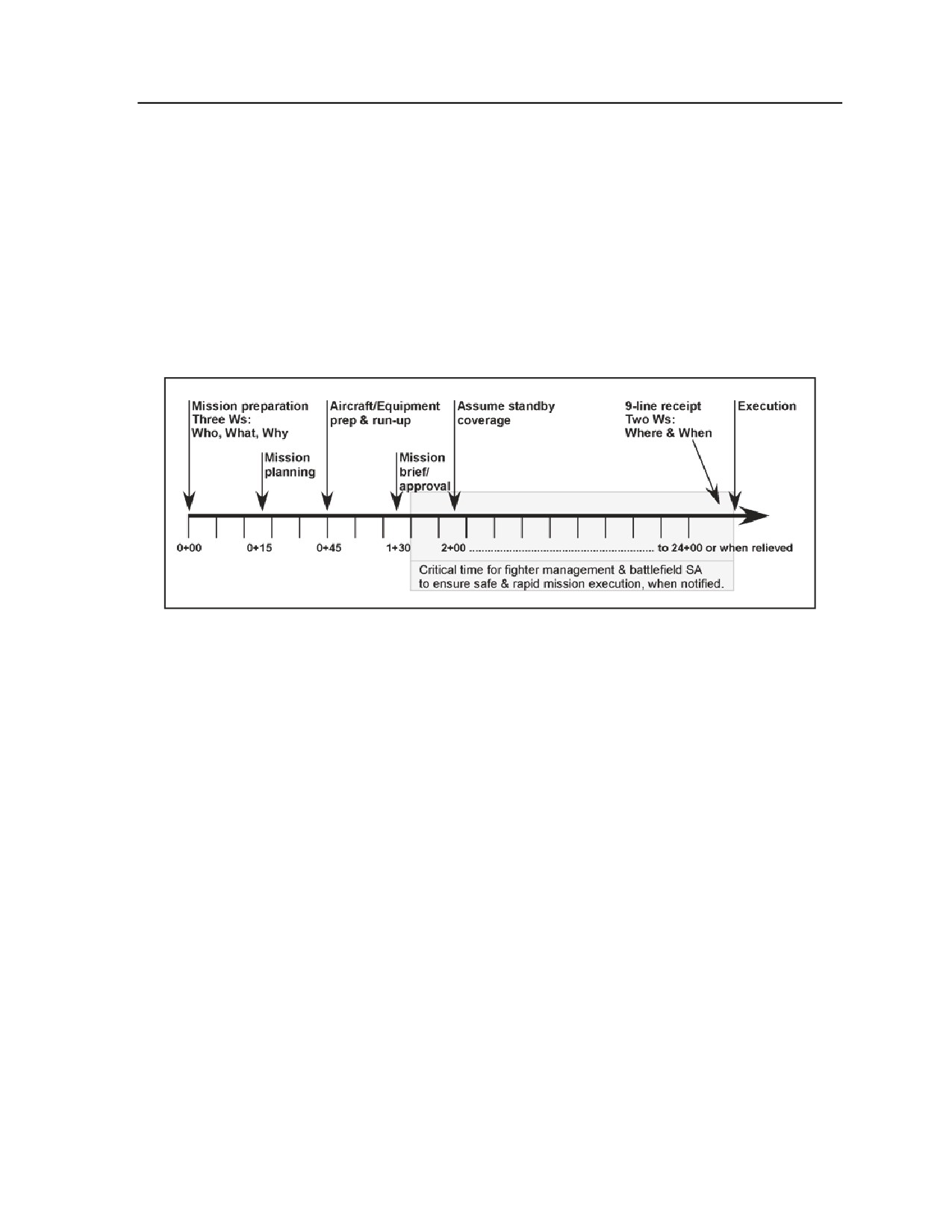
3-206. A MEDEVAC crew cycle (figure 3-12) begins like any other mission planning; however, the
location or time of execution is absent. Crews must manage rest cycles while ensuring procedures are in
place to maintain battlefield SA for a rapid, safe execution when a 9-line is received. Units must establish
unique crew rest cycles and briefing procedures for remote/split-based crews.
Figure 3-12. Example medical evacuation mission cycle
Dedicated Assets
3-207. Dedicated MEDEVAC assets include—
Permanently allocated vehicles with no other assigned mission.
Permanently allocated medical equipment for the purpose of en route care.
Specifically trained medical personnel to provide en route care.
En Route Care
3-208. The provision of en route care on medically-equipped vehicles or aircraft enhances the patient’s
potential for recovery and may reduce long-term disability by maintaining and/or stabilizing the patient’s
medical condition. Recent world conflicts indicate extended distances from point of injury to treatment
facilities make en route patient care more critical. Highly-proficient flight medics with standardized
training are essential for patient stabilization, sustainment, and survival over extended distances.
FUNDAMENTALS
3-209. Army air ambulance companies are the only dedicated rotary-wing aeromedical assets within the
Department of Defense (DOD). Air ambulance companies are assigned to the aviation brigade and provide
intratheater evacuation to division, corps, and theater units. The speed, range, and flexibility of
aeromedical evacuation moves patients directly to an MTF best equipped to treat the casualty. The HH-60
is used as the primary dedicated air ambulance.
7 December 2007
FM 3-04.113
3-39
Chapter 3
3-210. The primary mission of the GSAB air ambulance company is patient evacuation; however, the
company also provides—
Patient movement between MTFs (patient transfers).
Class VIII resupply.
Joint blood program support.
Medical C2.
Movement of medical personnel and medical equipment.
Air crash rescue support.
3-211. The air ambulance company executes a diverse set of missions. Their scope often crosses the
mission boundaries of its aviation brigade. The air ambulance company may also call for support to a
specific mission or unit external to the aviation brigade.
3-212. In accordance with Title 10 of U.S. Code, air ambulance assets are responsible for MEDEVAC in
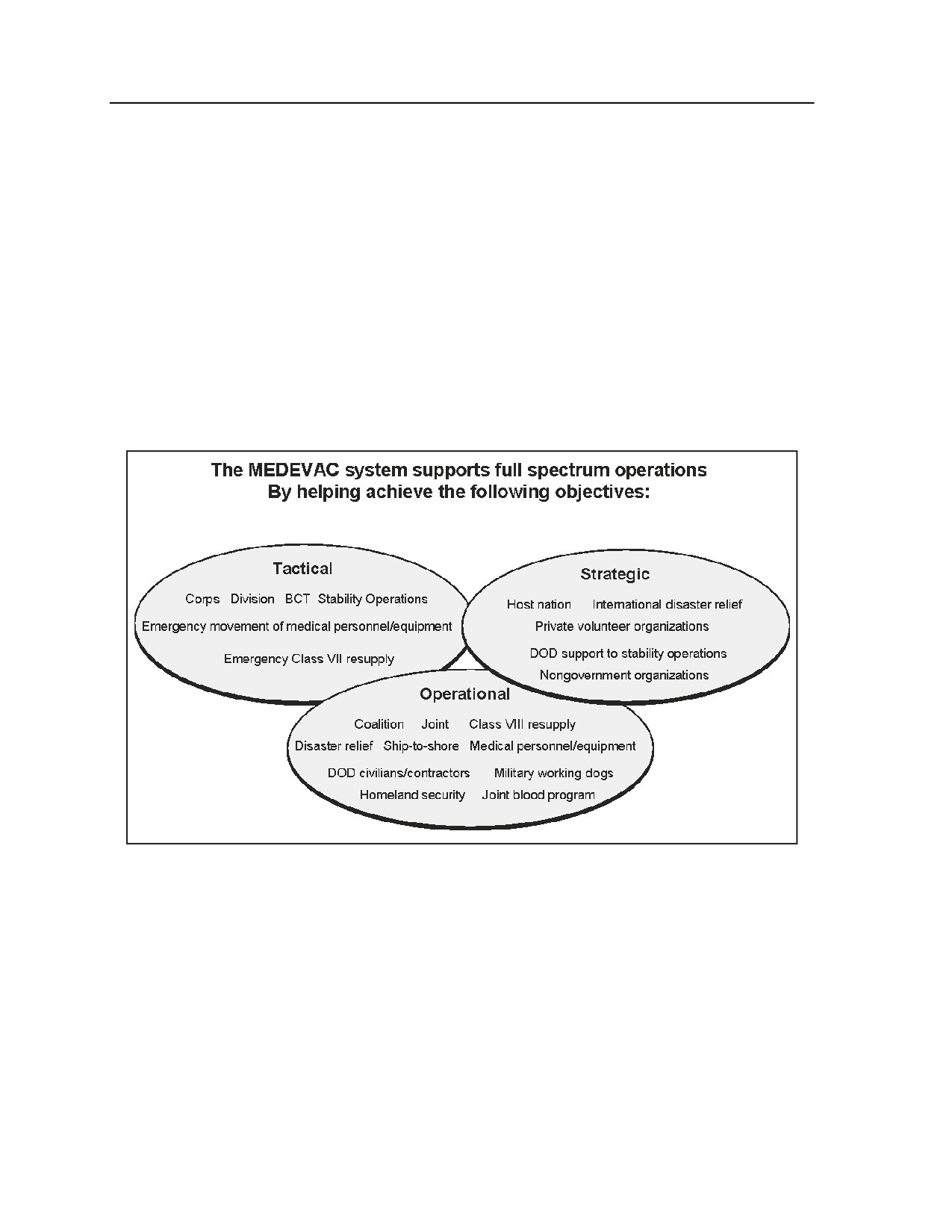
support of joint operations. In planning evacuation operations, the tactical, operational, and strategic scope
of the mission, as part of the joint force, must be considered in CAB planning (figure 3-13).
Figure 3-13. Army medical evacuation mission spectrum
3-213. Air ambulance company joint missions during combat operations include—
Evacuation of joint and coalition force casualties.
Evacuation of enemy prisoner of war (EPW) casualties.
Evacuation of civilian patients.
Evacuation of contractors and government employees.
Noncombatant evacuation.
Shore-to-ship evacuation.
Transfer of patients to Air Force aeromedical evacuation staging facilities.
Evacuation of military working dogs.
Support of PR operations.
3-40
FM 3-04.113
7 December 2007
Employment
3-214. Air ambulance joint missions during stability operations or civil support operations include—
Support of natural disaster area evacuees.
Support of disease and famine stricken areas.
Support of areas struck by acts of terrorism.
Evacuation of civilian patients in nations occupied by joint forces during stability operations.
PLANNING CONSIDERATIONS
3-215. Planning considerations for aeromedical evacuation operations often require unique and specific
plans to support continuous and often decentralized operations. These include but are not limited to—
Receipt and synchronization with the evacuation plan from higher.
Support for CAB DS and GS missions.
Logistics support for split-based operations.
Battle rhythm/communication flow for receiving MEDEVAC missions.
MOC coordination with all medical units for collecting medical information to develop and
maintain SA of MTFs and patient regulation.
Fighter management plan to support continuous operations.
Identify and coordinate CASEVAC support when necessary.
Rapid communications plan with risk approval authorities to ensure mission rebrief if required.
RECEIPT OF THE EVACUATION PLAN FROM HIGHER
3-216. The evacuation plan from higher integrates aeromedical evacuation with the Army medical
system. To establish evacuation procedures, each level of command issues an evacuation plan through the
orders process developed by evacuation planners at each level of command. On receipt of the higher HQ
force health protection plan, the aeromedical evacuation support plan must be synchronized with Army
aviation planners.
3-217. The evacuation order assigns—
GS mission responsibilities such as patient transfers, blood, and medical resupply. For
example, an air ambulance company collocated with a CAB supporting a division in reserve
may be assigned a greater portion of the patient transfer mission due to lower expected
casualties within its assigned DS division.
Joint and coalition force support responsibilities such as an FSMT tasked to provide DS to a
Marine Corps regiment
Any DS or GS taskings that takes air ambulance assets away from their CAB. For example
an FSMT could be tasked to specifically support a humanitarian mission occurring in a specific
region of a combat zone.
SUPPORT PLAN FOR DIRECT SUPPORT AND GENERAL SUPPORT MISSIONS OF THE COMBAT
AVIATION BRIGADE
3-218. The air ambulance company in concert with evacuation planners (MOC) of the CAB and GSAB
must devise an allocation plan that can support all of the evacuation coverage areas and missions the
evacuation order assigns to the CAB. Important considerations include—
MEDEVAC aircraft are a critical asset in today’s operational environment. Care must be
taken on how to employ MEDEVAC assets as effectively and efficiently as possible.
FSMTs must retain flexibility in employment. In both the DS and GS role, FSMT efforts
should not be rigidly tied to any area or supported unit.
Air ambulance assets are a limited resource and located where they are most needed. This
can be with troops most often engaged in combat, high population density areas, areas of famine
or disease with high civilian casualties, refugee areas, or geographically centralized locations.
7 December 2007
FM 3-04.113
3-41
Chapter 3
FSMTs performing area support or GS accomplish the patient transfer mission that
develops between MTFs, FSMTs and MTFs, and MTFs and intertheater movement
locations. These FSMTs are also responsible for the DS mission within their immediate vicinity.
PLAN FOR SPLIT-BASED OPERATIONS (IF APPLICABLE)
3-219. Air ambulance split-based operations can occur for a short time or the entire duration of a
deployment/operation. CAB/GSAB commanders must consider the ramifications of this action and provide
the necessary support with personnel, maintenance, communication and other equipment, vehicles, and a
bench stock (BS) of several categories of supply.
3-220. FSMTs or an air ambulance company may be operating and collocated with a GSAB or be task-
organized with a joint task force (JTF), marine expeditionary force (MEF), BCT, coalition, host nation, or
other organizations such as the civilian disaster relief operations center.
3-221. When air ambulance companies or their FSMTs are task-organized apart from the GSAB, C2 may
become difficult and a break in contact, short or long term, should be included in the plan. Solid SOPs,
leadership skills, and command guidance are necessary to compensate for a temporary break in
communications.
3-222. Air ambulance assets collocated with the CAB will be able to utilize the operations cell (battle
captain) to grant launch authority if the CAB commander chooses. However, an FSMT or air ambulance
company may be isolated from the CAB, and another measure will have to be used such as delegating
launch authority and authorized briefers. For example, an air ambulance company supporting a Marine
Corps division apart from the CAB will not have high and very high risk briefers who are PCs in the
mission being performed; therefore, an alternate method must be assigned.
METHODOLOGY FOR RECEIVING MEDICAL EVACUATION MISSIONS AND LAUNCHING
MEDICAL EVACUATION AIRCRAFT
3-223. Time is of crucial importance to MEDEVAC missions. MEDEVAC duty cycles are generally
executed differently than other aviation missions but could be compared to a helicopter QRF mission cycle.
Generally, aeromedical evacuation duty cycles are conducted as follows:
Mission brief and risk assessment developed.
Mission intelligence, ACO, SPINS, NOTAMs, and other information collected and incorporated
in planning.
Local area events and knowledge is shared among crews.
Preflight and maintenance checks performed.
Aircraft is run-up and set up in mission ready status with necessary mission equipment onboard.
Crew stands by for MEDEVAC missions.
3-224. When missions are received—
Crew analyzes the mission from the 9-line and determines risk level.
Procedures must be in place to coordinate immediately for the next higher level of command to
approve, if risk level is beyond what the crew is briefed,.
Crew coordinates for other mission specific considerations
(escort aircraft or extraction
equipment).
The goal is to launch as rapidly as possible (METT-TC dependent) to ensure safe, efficient
execution of the mission.
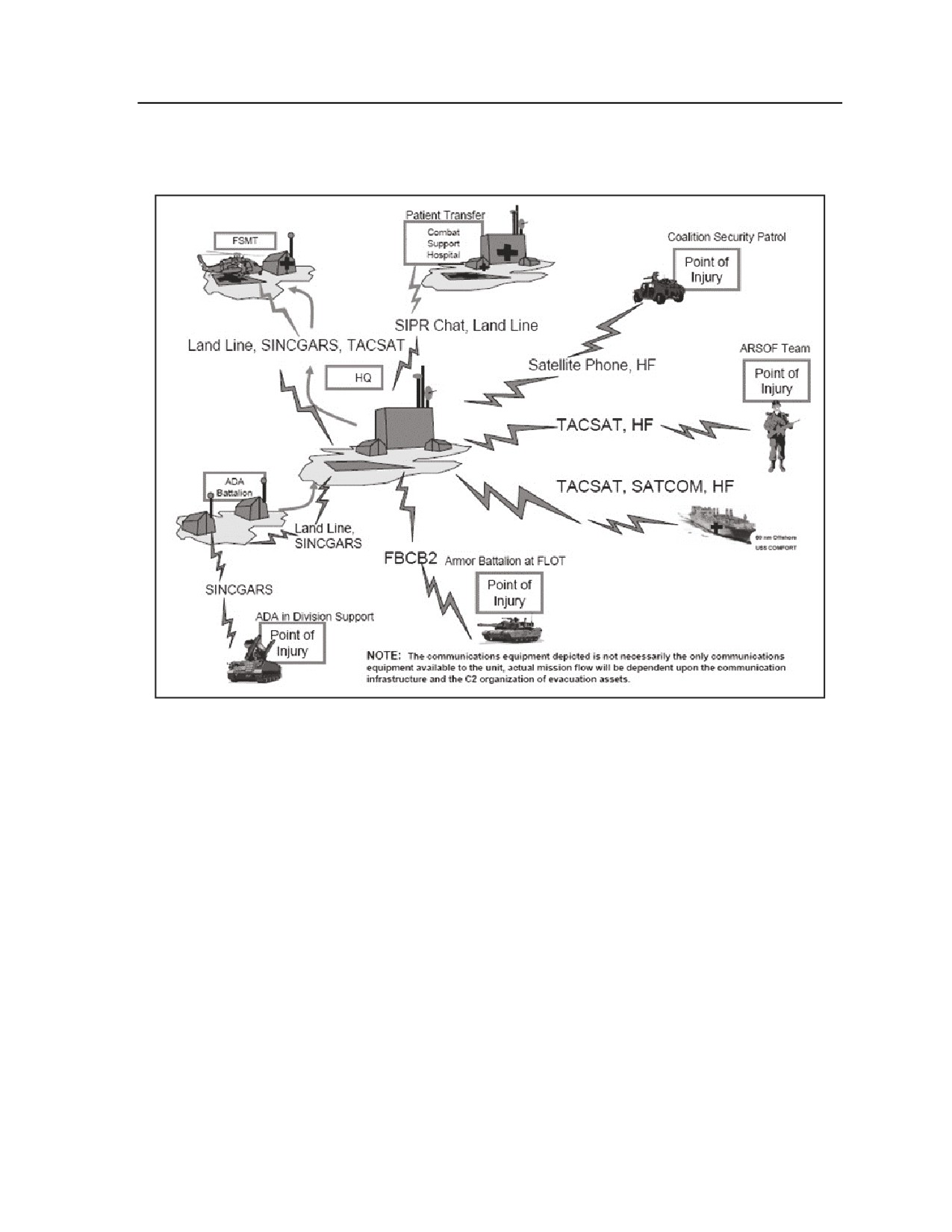
3-225. MEDEVAC missions are received through a number of different communications venues (figure
3-14. page 3-43). An established communication net that provides adequate battlefield SA and the FSMT
the ability to communicate during mission execution is essential. This is often a command net but could
also be another reliable and dedicated communication system if available. The higher HQ maintaining SA
3-42
FM 3-04.113
7 December 2007
Employment
over the operation could be the GSAB HQ for the air ambulance company or one of many options
including: JTF, MEF, BCT, coalition, host nation, or a disaster relief operations center.
Figure 3-14. Medical evacuation mission communications
AIR AMBULANCE LAUNCH DECISION
3-226. The decision to launch air ambulance assets for a specific mission is determined by the theater
evacuation order and launch authority policy.
Theater Evacuation Order
3-227. As part of the theater evacuation order, a standard procedure for the assignment of evacuation
resources will be in effect. The order also specifies the tactical situations (enemy ground-to-air and air-to
air threat, enemy ground threat in the pick up area, and weather) that dictate the conditions for an air or
ground ambulance launch. If a mission falls within the parameters of the theater evacuation order’s
protocol for aeromedical evacuation, then the mission is valid. No other mission or medical validations are
necessary.
Launch Authority
3-228. The air ambulance crew(s) preparing for the MEDEVAC mission will obtain launch authority in
accordance with the CAB commander’s guidance. The launch authority decision is based on METT-TC
(weather, enemy threat, crew endurance, and equipment available) for that particular mission.
7 December 2007
FM 3-04.113
3-43

Chapter 3
Evacuation Requests
3-229. It is critical all commanders with C2 of MEDEVAC assets understand the categories of casualty
precedence. Soldiers are evacuated by the most expeditious means possible dependent on their medical
condition and assigned evacuation precedence. Anyone can request MEDEVAC; however, assignment
precedence is paramount. Refer to table 3-7, page 3-44, for MEDEVAC categories of precedence.
Table 3-7. Medical evacuation categories of precedence
Priority I
URGENT
Evacuation as soon as possible within 2 hours to save life, limb,
eyesight; prevent complications of serious illness; or avoid
permanent disability.
Priority IA
URGENT
Requiring far-forward stabilizing surgical intervention prior to further
SURGICAL
disability.
Priority II
PRIORITY
Sick and wounded requiring prompt medical care within 4 hours
otherwise patient will become an URGENT or suffer unnecessarily.
Priority III
ROUTINE
Sick and wounded requiring evacuation but whose condition is not
expected to deteriorate within the next 24 hours.
Priority IV
CONVENIENCE
Patient movement is convenient but not necessary.
3-230. In most cases, the senior military person present requests MEDEVAC and assigns the appropriate
medical precedence. The person sending the request may utilize the advice of the senior medical person at
the scene, if one is present, regarding patient condition; however, no medical validation is required for
MEDEVAC. The precedence assists the supporting medical unit and controlling HQ in determining
priorities for committing evacuation assets. For this reason, correct assignment of precedence cannot be
overemphasized; over classification remains a continuing problem. Patients are evacuated as soon as
possible, consistent with available resources and pending missions.
MEDICAL OPERATIONS CELL COORDINATION WITH HIGHER ECHELONS OF MEDICAL
AUTHORITY
3-231. The MOC, consisting of the GSAB and CAB staff medical planners, is the conduit for
communication between higher echelons of medical C2 and the CAB. The MOC will—
Establish flight procedures specific to aeromedical evacuation missions within the CAB.
This could include special routes or corridors as well as procedures for escort aircraft link-up.
Ensure LOCs to supported units and higher echelons of medical command are available.
The MOC also ensures supported units understand MEDEVAC procedures and capabilities.
Facilitate MEDEVAC briefing and launch procedures. Ensure there is 24-hour access to
those able to launch high and very high risk missions.
Maintain awareness of the tactical and medical situation. Coordinate with medical regulators
at higher echelons to efficiently conduct GS and work in concert with adjacent units.
Assist the air ambulance company and GSAB/CAB to conduct aeromedical evacuation.
Coordinate missions with supported command surgeons. To ensure coordination of
MEDEVAC efforts, the staff should keep command surgeons updated on aeromedical
evacuation missions performed in their AO.
Consult and coordinate with supported command surgeons when air ambulances cannot
be launched to execute a requested mission. It is important the appropriate command surgeon
is notified to ensure the mission can be accomplished by ground evacuation assets.
3-44
FM 3-04.113
7 December 2007
Employment
MEDICAL EVACUATION AIRCRAFT CAPABILITIES
UH-60A/L
3-232. The UH-60 continues to operate as the main helicopter platform for the majority of tactical Army
aeromedical evacuations. The UH-60 can be equipped with a removable, high-performance internal hoist,
and patient carousel capable of holding six litter patients. All medical equipment is carried on the aircraft
and can be switched out.
HH-60A/L/M
3-233. The interior design of the HH-60 has maximium cabin space, placing sophisticated, life-saving
instruments and equipment at the fingertips of the medical attendants. Normal cabin configurations of the
HH-60 can accommodate up to four primary litter patients or six ambulatory (seated) patients. However,
when necessary, two standardization agreement (STANAG) litters can be placed on the floor under the
forward lifts for a total of six litter patients. The unique platform design also includes oxygen distribution
and suction systems, an airway management capability, and provisions for stowing intravenous solutions.
The interior also features the following capabilities:
Oxygen-generating systems.
NVG-compatible lighting throughout.
An environmental control system.
Medical equipment.
Patient monitoring equipment.
Neonatal isolettes.
SECTION VI - CASUALTY EVACUATION
3-234. Casualties will be evacuated by Army MEDEVAC resources if MEDEVAC assets are available. If
available MEDEVAC resources are overwhelmed (such as in a mass casualty situation), some casualties
may be transported on nonmedical vehicles. This is referred to as casualty evacuation (CASEVAC).
CASEVAC should only be used when the number of casualties exceedes the capability of the MEDEVAC
assets or when the urgency of evacuation exceeds the risk of waiting for MEDEVAC assets to arrive.
Refer to FM 4-02.2 for additional information on Casualty Evacuation and Medical Evacuation.
3-235. Sufficient advance CASEVAC planning is essential.. Proactive planning and rehearsals are a
critical step to reducing risk when executing effective CASEVAC operations. All crewmemebers should
be familiar with the location and capabilites of medical treatment facilites located within the area of
operations.
WARNING
Without aeromedically trained en route care, the casualty’s
medical condition may deteriorate during transport and an
adverse impact on his prognosis and long-term disability may
result.
7 December 2007
FM 3-04.113
3-45
Chapter 3
CASUALTY EVACUATION CLASSIFICATIONS
3-236. There are three general classifications of CASEVAC crews—vehicles, personnel, and associated
equipment:
Dedicated. Dedicated crews are identified and reserved for the CASEVAC mission exclusively.
This tasking may be for a period of hours or months. Similar to a MEDEVAC crew, they will
not be called on to perform another mission. This is the highest level of classification for
CASEVAC.
Designated. Designated crews are tasked to perform the CASEVAC mission on request. These
crews may have a variety of priorities, CASEVAC not necessarily being the highest.
Lift of opportunity. Crews performing a CASEVAC lift of opportunity have no specific prior
designation as a CASEVAC platform. This does not indicate a lack of CASEVAC planning, but
does not ensure CASEVAC resources will be available at any given time.
3-237. None of the above classifications are associated with any certain level of medical care. In any
configuration, it is highly desirable to have aeromedically trained personnel onboard to administer
treatment. Without this capability, further harm may come to the patient(s). Therefore, when executing
CASEVAC, it is advisable that the least injured are evacuated using CASEVAC assets and most injured
using MEDEVAC assets. Any available medical personnel at the pickup site can assist in determining
priority for evacuation by available medical vehicles and aircraft.
3-238. During the planning process for CASEVAC, the same availability methodology used to assist
CASEVAC crews must be used for en route medical care personnel. Onboard medical personnel can serve
in a dedicated, designated, or lift of opportunity capacity. Due to the coordination necessary between the
CASEVAC crews’ parent unit and medical unit providing personnel for en route care, prior planning is
especially critical.
3-239. Aeromedical care is a specialized task. Medical personnel not trained in this particular area of
medicine may cause further harm to the patient. If possible, prior training/orientation should be coordinated
when serving in the CASEVAC role.
CASUALTY EVACUATION AIRCRAFT CAPABILITIES
3-240. For any platform utilized for CASEVAC, significant preparations may be required to
accommodate litters, medical attendants, and medical equipment. Well-planned CASEVAC operations take
into account this additional time requirement. Units should also conduct CASEVAC aircraft
reconfiguration rehearsals.
3-241. Aircrews conducting the CASEVAC mission should have medical SA. It is important to ensure
crews understand the location and status of MTFs, their basic capabilities, and the severity of casualties
onboard to help prevent further harm. This information is critical to ensure patients are evacuated to the
correct facility that can provide proper treatment and care.
UH-60
3-242. UH-60s can provide CASEVAC support to the brigade and division. The number of casualties that
can be transported by the UH-60 varies depending on aircraft configuration, such as seats in or seats out
and other equipment onboard the aircraft. The UH-60 can carry three or four litters, depending on seating
configuration. UH-60s can be used in a variety of CASEVAC missions including executing as far forward
as possible to evacuate front line casualties on an armed platform due to the tactical situation.
CH-47
3-243. CH-47s can transport up to 24 litter patients or 31 ambulatory patients or some combination
thereof in the following configurations:
3-46
FM 3-04.113
7 December 2007
Employment
Seats folded. With seats folded up, the number of casualties transported is dependent on the
type of casualty (ambulatory versus litter) and the severity of their injuries and wounds.
Seats down. With seats folded down, the lifting capacity for litter patients will be reduced.
Ambulatory capabilities in this configuration will be 30 seated ambulatory casualties and others
loaded on the floor, as directed by the aircrew.
Litter configuration. CH-47s can be equipped with a litter kit. This kit gives the CH-47 the
capacity to transport 24 litter patients. When in the litter configuration, CH-47 seats are replaced
with six tiers of litters, four litters high.
Note. The CH-47 litter support kit consists of poles and supports only. Litters and tie-down
straps must be provided by the supported unit. Litters must be provided by medical assets
belonging to the unit the CASEVAC aircraft are supporting.
SECTION VII - AIR TRAFFIC SERVICES
MISSION AND SUPPORT CAPABILITIES
3-244. ATS assets promote safe, flexible, and efficient use of airspace that is shared with a multitude of
weapon systems. ATS companies maximize technology by coordinating airspace and providing recovery
capabilities. For additional ATS information, see FM 3-04.120.
AIR TRAFFIC SERVICES COMPANY
3-245. An ATS company supports CABs by providing terminal area and en route airspace information
and control services. ATS companies provide services to support CABs throughout full spectrum
operations. ATS companies are composed of a control tower, GCA, AIC, and two tactical aviation control
teams (TACTs). They also deploy as part of the CAB and are an integral part of brigade readiness.
3-246.
ATS companies have the following capabilities:
Deployable within 96 hours of notification and equipped and capable of operating in any
environment.
Control tower operations on 30 minutes of arrival in an AO and become fully operational within
1 hour of arrival.
Provide self-sustaining operations for 72 hours upon arrival in an AO.
Set up TACTs in austere/tactical environment operational within 15 minutes after arrival in an
AO.
Support aircraft recovery operations including PR, MEDEVAC, and assistance to aircraft in
distress (battle damage, inclement weather, and disoriented aircraft).
Provide airspace management operations in support of manned and unmanned air operations for
its designated airspace sector by providing updates of airspace information.
Provide navigational assistance to friendly aircraft.
Coordinate ATC procedures with military C2 agencies and civilian agencies/organizations,
including the Federal Aviation Administration and International Civil Aviation Organization
Provide personnel for survey/reconnaissance party team ensuring air traffic procedures, ATS
equipment emplacement criteria, and terminal instrument procedures (TERPs) are considered
and addressed during site survey.
Provide personnel as required for integrated aviation planning and management of air
operations.
Provide precision and nonprecision NAVAIDs.
Provide essential SA information for use in activation and execution of the airfield base defense
zone (BDZ).
7 December 2007
FM 3-04.113
3-47
Chapter 3
Provide ATS subject matter experts to assist with the CAB’s mission area relating to the joint,
interagency, interdepartmental, and multinational force.
Provide ATS operations across the full spectrum of conflict to include civil support and
homeland security operations facilitating restoration, revitalization, stability, and sustainment
services.
OPERATIONAL CONSIDERATIONS
3-247. The type of operation determines equipment requirements, back-up capabilities, and the
communications connectivity used. A CAB main operating base or division airfield is normally established
by the terminal assets of the ATS company. Mission planning for ATS operations should incorporate close
coordination and guidance from the CAB S-3. The following planning considerations should be utilized
when preparing to conduct initial entry operations:
Type of mission. This determines the section or sections of the company called on to complete
the mission.
Length of operations. Promote input by platoon sergeants and facility chiefs. Factors such as
food, water, fuel, medical support, and life support issues (showers, laundry, and resupply of
uniforms, boots, and other common table of allowances [CTA] 50-900 [TA 50]) must be well
planned. Fighter management issues such as sleep and feeding plans must be considered.
Type of services required. This involves instrument flight rules (IFR) recovery capability. A
TERPs package must be developed and forwarded to the U.S. Army Aeronautical Services
Agency for approval and certification. Emergency IFR recovery procedures are interim
procedures developed for emergency use. The approval authority for this procedure is the CAB
commander.
Support requirements. Support requirements are determined by the type of services and
communications required at the airfield and length of mission. Once established, these
requirements must be met by the GSAB or CAB through division support and logistic channels.
Some requirements may dictate the need for semipermanent facilities as well as commercial
power if hardened facilities are used.
Future mission of the base. If the base is used as a theater airfield later in the operation, ATS
companies plan for and execute—
Site surveys and TERPs packages as required.
Terminal airspace coordination.
Development and publication of local airfield procedures.
NAVAID frequencies requests with timelines for their use.
Current combat airspace/additional airspace requirements. Current combat airspace is a
critical planning measure. During the planning process, a risk assessment is completed and
control measures are implemented. Current and future combat airspace is disseminated to all
airspace users, controllers, and aircrews during the mission brief.
Environment. The operating environment impacts the planning process. Terrain determines
equipment placement and may impact equipment capabilities based on LOS radio and NAVAID
performance. Terrain can also dictate site layout for LZ or FARP operations and type of
formation flight used during the mission. SOPs should address factors considered in the METT
TC mission planning risk assessment/management process.
SECTION VIII - PERSONNEL RECOVERY
3-248. The Army’s PR philosophy is one of leadership and accountability. It comprises primarily the
Soldier’s Creed, directed responsibilities, and practical considerations. The Army conducts PR as a
collection of architecture and activities designed to affect the recovery of personnel who are isolated,
missing, detained, or captured (IMDC). PR is no longer just combat search and rescue (CSAR); it includes
3-48
FM 3-04.113
7 December 2007
Employment
a special operation force or air asset centric operation designed primarily for the rescue of aviators. See FM
3-50.1 for more details.
3-249. The Army PR function is defined as “the sum of military, diplomatic, and civil efforts to affect the
recovery and return of U.S. military, DOD civilians, DOD contractor personnel, and/or other personnel, as
determined by the Secretary of Defense, who are IMDC in an operational environment.” PR is one of the
highest priorities within the DOD.
3-250. Army aviation’s role in PR is in the execution of pre-established procedures and well-rehearsed
operations to report, locate, support, recover, and repatriate IMDC personnel. Specifically, aviation is
involved in the recovery of personnel within the unit’s or supported units’ AO when the IMDC personnel’s
location is known. Four principle methods of recovery are used when planning and executing recoveries:
Immediate recovery is the sum of actions conducted to locate and recover IMDC personnel by
forces directly observing the isolating event or, through the reporting process, determining
IMDC personnel are close enough for them to conduct a rapid recovery. Immediate recovery
assumes the tactical situation permits a recovery with the forces at hand without detailed
planning or coordination.
Deliberate recovery is the sum of actions conducted by Army forces when an incident is
reported and immediate recovery is not feasible or was not successful. Weather, enemy actions,
IMDC personnel location, and recovery force capabilities are examples of factors that may
require the detailed planning and coordination of a deliberate recovery.
External supported recovery (ESR) is the sum of actions conducted when immediate or
deliberate recovery is not feasible or was not successful. ESR is either the support provided by
the Army to other JTF components, interagency organizations, or multinational forces, or the
support provided by these entities to the Army. CAS, ISR, and airborne C2 are examples of
capabilities that may be required from different components to execute an ESR.
Unassisted recovery comprises actions taken by IMDC personnel to achieve their own recovery
without outside assistance. An unassisted recovery typically involves an evasion effort by IMDC
personnel to get back to friendly forces or to a point where they can be recovered via another
method. While the code of conduct requires IMDC personnel make every effort to evade or
escape, commanders must strive to recover these personnel via one or a combination of
methods.
ROLES AND RESPONSIBILITIES
3-251. PR is a dynamic and unique mission including all levels of threat. The vast geographic area,
variety of hostile defenses, and geographic separation of friendly forces demand thorough mission
coordination. Each PR event has the possibility of becoming a joint mission depending on the situation of
forces involved in a recovery. Some joint participants receive specialized training to execute their role in a
recovery. A thorough understanding of the roles and responsibilities of all participants ensures recoveries
that start as immediate or deliberate may be continued as externally supported with a minimum of
confusion. This level of functionality and modularity requires an understanding of terms, recovery training,
and action drill rehearsals at all levels.
Personnel Recovery Terms
3-252. Any PR event has the possibility of becoming a joint mission. Additionally, the Army may be
called on to participate in civil search and rescue (SAR) operations. Therefore, it is important to note key
joint terms with regard to other services and civil SAR as well as the Army (table 3-8).
7 December 2007
FM 3-04.113
3-49

Chapter 3
Table 3-8. Personnel recovery terms
Joint Terms
Army Terms
Civilian Terms
JPRC
JPRC
Rescue Coordination Center
PRCC
PRCC
Rescue Sub Center
PRO
PRO
SAR Mission Coordinator
OSC
OSC
OSC
Airborne Mission Commander
Operations Officer S-3/Battle Captain
Aircraft Coordinator
CSAR Unit
SAR Unit
Helicopter Recovery Force
Helicopter Recovery Force
SAR Unit
RESCORT
Attack Escort
**
RESCORT Commander
AMC (Attack)
**
JPRC - joint personnel recovery center
* - No Army term
PRCC - personnel recovery coordination cell
** - No civilian term
PRO - personnel recovery officer
OSC - on-scene commander
RESCORT - rescue escort
Battalion Role
3-253. The Army has detailed the PR planning process and equipment requirements in FM 3-50.1. In
many cases, the battalion or TF HQ may act as C2 coordinator or facilitator for PR recoveries by providing
assets, an OSC, coordination for recovery assets, or communication relay. Overall execute authority for
deliberate recoveries should be outlined in the theater SOP and/or unit SOP.
3-254. Predeployment PR training/preparation for all personnel should include ISOPREP development,
high risk to capture training and use of weapons, PR drills, and ground-to-air communication/signaling
procedures. Aircrews should receive additional training on SPINS and ATO data, SOPs, and include PR
battle drills. AHB and GSAB CP personnel should be trained on PR procedures and have rehearsed PR
missions prior to deployment.
3-255. Commanders must ensure that only forces required to accomplish the recovery are put at risk.
Additional forces may only complicate recovery planning and execution. Execution tasks for the battalion
may vary based on the mission, level, and type of recovery. The Air Force utilizes an airborne mission
commander in much the same way as the battalion operation staff functions. The difference being, the
airborne mission commander is airborne. Some common execution tasks include—
Appointing an OSC and coordinating OSC relief as the situation dictates. Communications
capability, weapons load, fuel status, and aircraft limitations are considered when selecting the
OSC. The initial OSC may be the wingman or a ground unit in the area.
Locating low-threat areas where rescue assets can hold and egress.
Determining the threat level in the isolated personnel’s area.
Obtaining evasive plan of action (EPA) data from flight operations and passing data to the
recovery force, OSC, and PRCC.
Coordinating and monitoring PR radio nets. Aircrews use an FM radio as the primary net if
Army assets are only used during the operation. UHF/VHF becomes primary if the operation is
inter-service or joint.
Continuing to gather information from all sources and passing to higher in accordance with
SPINS and PR plan.
Managing flow of aircraft to and from the objective area.
3-50
FM 3-04.113
7 December 2007
Employment
3-256. Battalion operations will execute additional tasks based on the mission to include—
Briefing the designated RESCORT or PR recovery force on missions with the potential for an
isolating event. This may be a part of the briefing for the QRF or DART.
Completing all necessary information in the rescue mission brief (RMB).
Determining isolated personnel’s available signaling devices.
Conducting a thorough threat assessment and developing a threat map covering the following to
permit protection of the recovery team:
Radar sites due to their ability to detect PR forces, intercept communications, and possibly
direct hostile forces to the vicinity of isolated personnel.
Threats to primary rescue vehicles such as helicopters, antiaircraft artillery (AAA), man-
portable AD systems, small-arms fire from ground forces, and armed enemy aircraft.
Known or suspected enemy sites should be avoided at all times.
Location of ROZs for EW and airborne C2 platforms often required for PR missions.
Data concerning enemy weapons and troop deployments with terrain and weapon ranges
noted. This provides mission planners with detailed information to plan ingress and egress
routes for rescue vehicles with respect to enemy weapon systems and ground forces.
Recommending air routes to and from the area. If threats are present, inform RESCORT of
threat positions so threats can be circumvented or additional support assets requested.
Making a go/no-go recommendation based on information gathered at the objective area.
Preparing isolated personnel for pickup.
Company Role
3-257. The company’s role in PR is at execution level. The commander must understand PR includes
training of all aircrews and personnel in PR procedures for both execution of recovery and actions of
company personnel if they become isolated. Procedures for immediate recoveries should be outlined in the
unit TACSOP and rehearsed based on the type of airframe and circumstances for its use. This section will
concentrate on procedures for a deliberate recovery or participation in an externally supported recovery.
Personnel should be familiar with the following terms.
On-Scene Commander
3-258. The OSC is the person designated to coordinate recovery operations within a specified area. He
does not have to be in an aircraft; he may be ground or vessel based, but he must be proficient in all PR
procedures and have the ability to communicate with higher. While the Air Force qualifies a pilot to act as
OSC, any Army aircrew may be called on to act in this capacity. Other responsibilities of the OSC
include—
Establishing and authenticating communication with isolated personnel.
Locating isolated personnel and passing initial information to the AMC via the RMB.
Conducting a threat assessment of the objective area (avoid highlighting the isolated personnel’s
location).
Completing the OSC checklist.
Determining the health/condition of isolated personnel and passing status to the AMC.
Re-authenticating isolated personnel after OSC changeover only when the situation warrants.
Rescue Mission Commander
3-259. The rescue mission commander (RMC) is the designated AMC maintaining control of the entire
recovery during the launch, en route, and terminal phase. Areas considered when selecting the RMC should
include knowledge of the overall mission, capabilities of the helicopter recovery force, requirements for
communication, night vision capabilities, and joint interoperability.
7 December 2007
FM 3-04.113
3-51
Chapter 3
Recovery Force
3-260. The PR force consists of personnel that will affect the actual recovery of the isolated personnel.
These personnel nclude—
Security personnel for the area around the extraction point.
Recovery personnel that authenticate and move the isolated personnel to the aircraft.
Medical personnel that provide immediate assistance to the isolated personnel or injured security
force personnel.
The size and composition of this force may vary with the mission supported or actual threat. During
recovery operations, the RMC should be in the gun escort for SA at the objective; however, this is mission
dependent.
Helicopter Recovery Force
3-261. The helicopter recovery force will consist of lift aircraft used to move the recovery force to and
from the objective area and the recovered IMDC personnel back to friendly forces. The helicopter recovery
force will designate an AMC. The helicopter recovery force AMC will coordinate all PR force efforts on
the objective.
Gun Escort
3-262. Attack/reconnaissance assets utilized to provide security escort to the helicopter recovery force
may also be called the RESCORT. The primary duty of the gun escort or RESCORT is to provide
protection for the helicopter recovery force. The principles of air assault security are used in execution of
this task. Priority is to avoid, suppress, and destroy targets posing a threat to the helicopter recovery force
or recovery force on the ground.
TYPES OF ESCORT
3-263. Several types of escort methods may be used during the en route phase, but the tactics will depend
on factors such as speed, altitude, distance, fuel, level of threat, weather conditions, and whether it is a day
or night operation. Two common types of escort may be utilized (table 3-9):
Attached escort. This method allows continuous visual or radar contact (AH-64D fire control
radar [FCR]) of the helicopter recovery force.
Detached escort. This method includes reconnaissance ahead of the helicopter recovery force,
trail escort, or proximity escort. Detached escort requires knowledge of routes and planned
timing or position calls.
If the escort sweeps ahead of the helicopter recovery force, it suppresses threats along
the ingress route or redirects the helicopter recovery force to avoid enemy activity.
Checkpoints or control points must be established to maintain SA and horizontal airspace
deconfliction.
Trail escort employs the escort in a rear quadrant. This may be used for rapid linkup of the
gun escort with the helicopter recovery force but delays response time to en route
engagements and puts the trail elements at more risk.
Proximity escort is similar to trail escort but allows the gun escort to fly a parallel course
to the helicopter recovery force. This provides an increased survivability from surface-to-air
and air engagements and decreased probability of detection for both groups.
3-52
FM 3-04.113
7 December 2007

Employment
Table 3-9. Types of escort
Attached
Detached
Advantages
Good SA of helicopter recovery force
Does not highlight helicopter recovery
assets and status.
assets.
Rapid response to threats.
Allows flexibility in maneuver.
Mutual response from recovery force
Allows escort to maximize individual tactics.
assets.
Disadvantages
Escort may highlight the formation
May preclude continuous visual, radar, or
Increased potential for aircraft conflict
radio contact.
due to formation.
Helicopter recovery force may not be aware
Decreased formation maneuverability.
of or responsive to threats to assets.
Potential for loss of mutual support.
SEQUENCE OF EVENTS
3-264. To effectively integrate into the PR architecture, the unit should ensure PR has been rehearsed
exhaustively. The dynamic and unpredictable nature of this mission requires time and effort in preparation
to reduce risk during execution. The gun escort mission includes but is not limited to—
Rendezvous with the helicopter recovery force.
Ingress.
Conduct of security escort and/or suppression.
Cover and/or suppression during the extraction.
Egress security escort and/or suppression to a friendly or permissive threat environment.
Premission Planning
3-265. To effectively integrate a deliberate recovery into the PR architecture, the unit should ensure PR
has been rehearsed exhaustively. The dynamic and unpredictable nature of this mission requires time and
effort preparing to reduce risk during execution. A determination must be made immediately, based on
predetermined factors, if the unit is capable of conducting the recovery or if the recovery should be
conducted by externally supported assets.
3-266. Whether aircrews are being utilized as gun escort for a designated helicopter recovery force or are
maintaining an on order status as part of QRF, friendly and enemy SA is of primary concern. Each aircrew
should understand their role in the recovery operation. Knowledge of the helicopter recovery force
procedures, PR force actions on the ground, and OSC procedures are critical.
3-267. Capabilities of the helicopter recovery force must be considered carefully. The threat and ability to
provide forward firepower, locate the threat at night, and maneuver must be considered when determining
formation, patterns, and actions on the objective.
3-268. Planning for a deliberate recovery is conducted from TF/battalion-level down to the aircrews
performing the mission. Commanders must ensure missions are planned using only the forces required to
gain the situational advantage required to execute the recovery. This may not be achieved by aviation
assets only. Aircrews assigned PR missions must have adequate time for planning to ensure mission
success. Information necessary to execute a PR mission includes—
Call sign, type of aircraft, and number of personnel.
Enemy situation.
Last known location/position.
FLOT penetration points/routes.
ISOPREP and SPINS data for time of PR incident (SPINS will change immediately following
PR incident).
7 December 2007
FM 3-04.113
3-53
Chapter 3
3-269. Basic planning factors are the same regardless of the mission type or aircraft utilized. METT-TC
and the following factors should be considered:
Isolated personnel, location, and condition.
Threat.
Ingress/egress routes.
Meteorology.
Terrain.
Navigation.
Fuel (FARPs and aircraft ranges).
Flight formation.
ROE.
SEAD plan.
Elements of the personnel recovery (PR) TF.
Deception plan.
Security.
Defining and coordinating action at the terminal objective area.
LZ.
Force requirements.
EPA.
Aircraft destruction criteria.
Transload required after isolated personnel pickup. Y/N? If yes, where?
Location (FOB/combat support hospital) where rescued personnel will be returned.
Notification
3-270. Notification procedures during an isolating event should be the same whether it is unit personnel
or personnel outside the unit that have been isolated. Immediately following notification of a possible
isolating incident, the operations section executes its immediate action steps that should include receiving
or transmitting the IMDC’s ISOPREP, EPA, and search and rescue incident report (SARIR) to/from the
PRCC. This enables parallel planning at all levels and opens the LOCs to receive additional assets to aid in
the recovery.
Note. Updates or mission complete messages are sent to the PRCC in the SAR situation
summary report format.
3-271. Aircrews that are part of the unit’s designated PR helicopter recovery force should begin
preparations for launch based on mission requirements. Local SOP should outline how this is accomplished
to ensure each member of the aircrew has all information required to complete their part of the mission.
Sensitive IMDC information, like the ISOPREP and EPA, should not be carried by the recovery force. The
staff should brief the RMC on all aspects of the recovery and construct the RMB or order.
Launch and En Route
3-272. Following notification and passing of the RMB or order, the helicopter recovery force and gun
escort are directed to launch. The execution authority for the recovery should be outlined in the SOP.
Depending on the isolated personnel’s location, the helicopter recovery force launches and is expected to
hold at a point outside hostile fire range until permission to enter is given by the gun escort AMC. If the
initial legs of the flight to the objective area are to be conducted in friendly territory, the helicopter
recovery force proceeds without gun escort (provided they are not collocated) reducing the helicopter
recovery force en route time once the execute order is given.
3-54
FM 3-04.113
7 December 2007
Employment
3-273. If not collocated, the gun escort or RESCORT conducts an aerial link-up with the helicopter
recovery force and conducts the following tasks:
Reconnoiters the planned ingress route.
Provides security for the recovery force along the designated route to the HA.
Passes all updates to the helicopter recovery force AMC.
Escorts the helicopter recovery force to the objective area (isolated personnel’s location).
3-274. Before the recovery force is established in the objective area, the gun escort or RESCORT sets the
conditions at both the primary and alternate LZ for insertion of the recovery force. Conditions that must be
met include—
No armored vehicles in the objective area.
No indirect fire affecting the LZ.
No unit larger than squad size in the objective area.
No weapon larger than 7.62-millimeter.
3-275. The gun escort AMC or RMC conducts an inventory of the isolated personnel’s signaling devices,
directs isolated personnel to prepare the appropriate device for identification, and briefs the pickup plan to
all participants per the RMB or order. This briefing is completed prior to the terminal area phase.
Terminal Area Phase
3-276. During the terminal area phase, the gun escort attempts radio contact with the isolated personnel in
an effort to determine their precise location. When radio contact is made and the gun escort clears the
objective area, the helicopter recovery force moves from the HA to the objective area. The helicopter
recovery force may require vectors from the HA to the objective area from the gun escort. Once visual
contact is established, the helicopter recovery force assumes communication responsibility with the
isolated personnel. The primary means of recovery is conducted by landing in the objective, but alternate
means may be required.
3-277. The gun escort or RESCORT provides overwatch utilizing pre-established orbit patterns or from
an ABF during the operation. The patterns or ABF should allow coverage of any avenues of approach into
the objective area and permits the gun escort or RESCORT to observe the isolated personnel’s position.
This should be accomplished by establishing an inner area of security around the objective area then
moving outward to form an outer band of security.
3-278. RMC, gun escort, or RESCORT continually reports to higher or relays through airborne C2 assets
on the current situation and helicopter recovery force’s location throughout the mission.
Reintegration Phase
3-279. Reintegration begins once the isolated personnel is in positive control. The level of reintegration
required is determined during the MEDEVAC and, if appropriate, SERE debrief following an isolating
event. It is important to note an isolating event is traumatic and each Soldier will react differently based on
intensity and duration of the event. A miscalculation or lack of emphasis on complete reintegration of an
isolated soldier has unpredictable results. A well-organized and efficient reintegration program includes
but is not limited to—
Medical evaluation and follow-up.
SERE debrief.
Psychological evaluation and follow-up treatment.
Limited duty.
Medical or psychological evacuation for continued care.
7 December 2007
FM 3-04.113
3-55
Chapter 3
SECTION IX - OTHER OPERATIONS
STABILITY AND CIVIL SUPPORT OPERATIONS
3-280. Stability and civil support operations are separate activities not necessarily involving armed
conflict between organized forces. Stability operations are conducted outside the continental United States
(OCONUS), whereas civil support is conducted inside the continental United States (CONUS). The
battalion does not perform any unique missions during stability and civil support operations. It simply
performs the same mission set described above within a different operational environment and with certain
specific mission planning considerations.
3-281. During stability and civil support operations, the AHB and GSAB can expect to work with U.S.
government, host nation, and international agencies. These agencies may not have the military-style chain
of command to which U.S. Soldiers are accustomed. Prior coordination and flexibility are keys to mission
success. The chain of command, support responsibility, reporting requirements, and authority to approve
specific actions must be clearly understood by all parties prior to initiating the mission. Units must
maintain liaisons with local police, ATC, and civil and military authorities.
PLANNING CONSIDERATIONS
3-282. AHB and GSAB commanders face challenges differing from those involved in conventional
operations.
Mission Analysis
3-283. Perhaps the greatest obstacle for the commander to overcome in stability and civil support
operations is defining the mission for the unit. When he receives the OPLAN, OPORD, or implementing
instructions, mission analysis begins. The commander must pay particular attention to limitations placed on
him by ROE or political considerations.
Task Organization
3-284. Task organization for stability and civil support operations is METT-TC driven. The commander
must assess the battalion's capabilities versus the mission and determine if task organization is capable of
accomplishing assigned missions. If the mission can not be completed, the commander should modify the
organization.
Command Relationships
3-285. It is critical command relationships for stability and civil support operations be established early.
Elements of the AHB or GSAB may deploy for stability and civil support operations without their parent
HQ. It is also possible the aircraft may work for another service or U.S. nonmilitary agency, such as the
Drug Enforcement Agency (DEA) or Federal Bureau of Investigation. A clear understanding of the
command, control, and support relationship helps reduce confusion and allows the unit to integrate with
their controlling HQ early and with proper resource support requirements.
Advance Party Operations
3-286. Advance party personnel need a comprehensive overview of their unit's mission, capabilities,
requirements, and commander's intent prior to deployment. They must coordinate with the gaining or
outgoing command, higher HQ, and local population. The commander must carefully select advance party
personnel. For example, deploying to another country with an undeveloped logistics base may require the
advance party be heavily logistics weighted and contain foreign language specialists, while other missions,
such as counter-drug operations, can be weighted with operational personnel. Whichever the commander
chooses, the advance party must receive guidance and focus prior to deployment. The advance party must
also keep the commander informed as to their actions and current situation.
3-56
FM 3-04.113
7 December 2007
Employment
Split-Based Operations
3-287. The battalion, or some of its elements, will often deploy on stability and civil support operations
into a theater having an immature logistics base. Logistics operations may be conducted in theater from the
unit's home station. This is termed split-based operations. The commander who deploys on a split-based
operation must consider the type of support required from home station. He must pay special attention to
communications between the theater of operations and home station, and to the transportation means
available to provide a timely flow of logistics.
SPECIAL CONSIDERATIONS
3-288. There are several key employment guidelines for the battalion commander to consider during the
planning process. These guidelines are preparation, specialty augmentation, host nation requirements,
ROE, and ROI.
Preparation
3-289. Battalion and companies should expect a wide range in the tempo of operations and plan
accordingly. Staff must be able to adjust rapidly to many different operational considerations. They must
plan ahead and have contingency plans for numerous situations not normally addressed in the unit's METL.
These situations can be identified and trained at home station. Examples of situations include civilians on
the battlefield, media relations, public affairs, and defense against terrorism.
Specialty Personnel Augmentation
3-290. Operational conditions of stability and civil support operations frequently require integration of
specialty personnel with battalion staff including civil affairs, PSYOP, staff judge advocate (SJA), and
special forces personnel. Besides specialty staff personnel, battalion may be required to operate with
infantry, armor, artillery, engineer, sustainment, or a combination of these and other assets. Whatever the
composition, staff must be fully integrated to coordinate and plan operations. LNOs from the battalion to
other units and from supporting units to battalion are critical.
Host Nation Requirements
3-291. Airspace restrictions, flight clearances, refueling procedures, civil and military laws,
environmental laws and regulations, radio frequency (RF) usage, ground convoy clearances, and product
disposal procedures vary from country to country. The commander must adapt unit procedures to the host
nation's operating environment and procedures. Serious complications can develop when host nation
requirements are not met with repercussions ranging from mission restrictions to mission failure. In some
situations, battalions conducting stability operations may be included on the air component commander's
ATO to ensure SA and reduce the possibility of fratricide.
EMPLOYMENT
3-292. The majority of missions assigned to battalions during stability and civil support operations will
either conform to or build on their standard mission roles
(air assault, air movement, C2, ATC,
MEDEVAC). Generally, the major differences in unit operations during stability and civil support
operations will be in the C2 relationships between the battalion and its higher HQ, and the greater
requirement for restraint in potentially hostile situations.
CATEGORIES OF OPERATIONS
3-293. During stability operations, the AHB and GSAB primarily perform their METL-related tasks and
remain prepared for potential escalation to full armed conflict. During civil support operations, they use the
capabilities of their combat systems to increase the effectiveness of the overall effort. Again, the AHB and
GSAB must remain prepared for renewed hostilities or civil disorder. Many of these missions will be
performed as an integrated piece of the overall U.S. military capability—often in conjunction with forces
7 December 2007
FM 3-04.113
3-57
Chapter 3
from other nations, other U.S. agencies, nongovernmental organizations, and United Nations forces.
Therefore, leaders should familiarize themselves with joint operational procedures and terms.
Stability Operations
3-294. Combatant commanders employ Army forces in stability operations outside the U.S. and its
territories to promote and protect U.S. national interests. Stability operations are designed to influence the
threat and the political and information dimensions of the operational environment. These operations
include developmental, cooperative activities during peacetime, and coercive actions in response to crisis.
Stability operations are normally conducted in noncontiguous AOs. Army forces conduct the following
five stability tasks—civil security, civil control, restore essential services, support to governance, and
support to economic and infrastructure development (FM 3-0)
Civil Security
3-295. Civil security involves protecting the populace from external and internal threats. Ideally, Army
forces defeat external threats posed by enemy forces that can attack population centers. Simultaneously,
they assist host-nation police and security elements as the host nation maintains internal security against
criminals and small, hostile groups. In some situations, there is no adequate host-nation capability for civil
security and Army forces provide most of it. Civil security is required for the other stability tasks to be
effective.
Civil Control
3-296. Civil control regulates selected behavior and activities of individuals and groups. This control
reduces risk to individuals or groups and promotes security. Civil control channels the population’s
activities to allow provision of security and essential services while coexisting with a military force
conducting operations. A curfew is an example of civil control.
Restore Essential Services
3-297. Army forces establish or restore the most basic services and protect them until a civil authority or
the host nation can provide them. Normally, Army forces support other government, intergovernmental,
and host-nation agencies. When the host nation or other agency cannot perform its role, Army forces may
provide the basics directly. Essential services include the following:
Emergency medical care and rescue.
Preventing epidemic disease.
Providing food and water.
Providing emergency shelter.
Providing basic sanitation (sewage and garbage disposal).
Support to Governance
3-298. Stability operations establish conditions that enable interagency and host-nation actions to
succeed.
By establishing security and control, stability operations provide a foundation for transitioning authority to
other government or intergovernmental agencies and eventually to the host nation. Once this transition is
complete, commanders focus on transferring control to a legitimate civil authority according to the desired
end state. Support to governance includes the following:
Developing and supporting host-nation control of public activity, rule of law, and civil
administration.
Maintaining security, control, and essential services through the host nation. This includes
training and equipping host-nation security forces and police.
Normalizing the succession of power (elections and appointment of officials).
3-58
FM 3-04.113
7 December 2007
Employment
Support to Economic and Infrastructure Development
3-299. Support to economic and infrastructure development helps a host nation develop capability and
capacity in these areas. It may involve direct and indirect military assistance to local, regional, and national
entities.
CIVIL SUPPORT OPERATIONS
3-300. Civil support operations use battalions to assist civil authorities as they prepare for or respond to
crises and relieve suffering. Assault and GS helicopter forces provide essential support, services, assets, or
specialized resources to help civil authorities deal with situations beyond their capabilities. The purpose of
civil support operations is to meet the immediate needs of designated groups for a limited time, until civil
authorities can do so without Army assistance. In extreme or exceptional cases, U.S. forces may provide
relief or assistance directly to those in need. More commonly, they help civil authorities or
nongovernmental organizations provide support.
Homeland Defense
3-301. During CONUS declared disasters or emergencies, battalions may be called on to supplement
efforts and resources of state and local governments. Such operations may include responding to natural or
manmade disasters, controlling civil disturbances, conducting counter-drug activities, combating terrorism,
or aiding law enforcement. The battalion may be employed to augment C2 requirements, provide security
for air movement, search for casualties, and assess damage.
RULES OF ENGAGEMENT
3-302. ROE are designed to control the application of force. ROE are prepared and issued by higher HQ.
Commanders must clearly understand ROE and ensure all Soldiers understand them. ROE situations
should be rehearsed in detail prior to deploying or executing a mission. No situation should occur in which
personnel are unsure whether to use force, and what types of force—to include deadly force—are
warranted. For ROE assistance, the commander should consult with the SJA representative.
RULES OF INTERACTION
3-303. ROI embody the human dimension of stability operations; they lay the foundation for successful
relationships with the numerous factions and individuals playing critical roles in these operations. ROI
encompass an array of interpersonal communication skills, such as persuasion and negotiation.
3-304. ROI are tools the individual Soldier will need to deal with the nontraditional threats prevalent in
stability operations including political friction, unfamiliar cultures, and conflicting ideologies. In turn, ROI
enhance the Soldier’s survivability in such situations. ROI, when applied with good interpersonal
communication skills, improve military personnel's ability to accomplish the mission while reducing
possible hostile confrontations.
3-305. ROI are based on applicable ROE for a particular operation; they must be tailored to specific
regions, cultures, and/or populations affected by the operation. Like ROE, ROI can be effective only if
thoroughly rehearsed and understood by every Soldier in the unit.
QUICK REACTION FORCE OPERATIONS
3-306. A QRF is any force poised to respond on very short notice. The QRF provides the TF commander
an on call capability to react to contingencies within the AO. The QRF package is based on anticipated
mission requirements and the crew and aircraft assets available. Due to the short-fused launch order,
mission success requires extensive preplanning by QRF aircrews and the supporting operations cell.
7 December 2007
FM 3-04.113
3-59
Chapter 3
PRE-POSITIONED QUICK REACTION FORCE
3-307. The standard battalion pre-positioned QRF package includes two attack reconnaissance aircraft,
two utility aircraft
(UH-60), and ground forces. The parent CAB may also have two UH-60s, a
MEDEVAC aircraft, and one heavy lift helicopter (CH-47) on call for support if required. The QRF
maintains a readiness condition (REDCON) as established in the OPORD for the duration of the duty
period. The standard QRF duty day is 14 hours allowing for 2 hours of mission planning and a 12-hour
shift.
3-308. Aircrews assigned as the QRF should not be tasked for additional missions. To reduce risk of
aircrew fatigue while assigned to the QRF, the following steps are taken:
Restrict QRF crewmembers from conducting rigorous physical training while on QRF.
If the tactical situation allows, afford aircrews the opportunity to sleep during QRF duty period.
Provide the QRF a separate environmentally-controlled staging area for all crews and personnel.
Exempt QRF crews from conducting any other additional duties distracting from QRF readiness.
The TF commander approves training flights during QRF duty period.
PRELAUNCH PLANNING CONSIDERATIONS
3-309. The QRF AMC is the focal point of all coordination between the supporting staff and QRF. Prior
to assuming the mission, the AMC—
Obtains a tactical update brief and determines the status of the on-duty QRF elements and/or
ongoing missions. This action determines the possibility of a relief-in-place or immediate
launch.
Obtains a weather brief for the duration of duty shift plus 2 hours.
Files an EPA and flight plan for the entire QRF package. All mission planning except takeoff
time, route of flight, duration of flight, and destination is completed.
Completes a mission risk assessment and obtains approval from the TF/battalion commander.
The mission risk assessment should approve no lower than medium risk operations. Approved
operations include all tasks on the crew’s CTL, all conditions (day, night, NVD), and all modes
of flight that may be encountered during the duty period. Crews are briefed to operate in the
worst weather forecasted during the duty period or go/no-go weather.
Completes crew mission kneeboard packets for each aircraft providing all known information.
Conducts an AMB with all known information and ensures each aircrew completes applicable
crew and passenger briefings.
Ensures all aircraft, crews, and support personnel assume designated REDCON level. All
aircraft are preflighted and individual equipment checks complete prior to assuming mission.
Depending on unit SOP and mission, aircraft are run-up with communications checks complete
(includes spare aircraft).
Ensures QRF package maintains REDCON level as briefed until alerted or relieved.
Conducts static rehearsal of anticipated missions.
Immediately informs controlling flight operations of any developments that will interfere with
QRF launch.
ALERT PROCEDURES
3-310. The battalion/TF commander establishes criteria for launching the QRF to avoid unnecessary
alerts; however, the QRF is alerted as early as possible. Alert of the QRF criteria includes the following:
QRF launch authority approves the mission.
Mission is a “preapproved” immediate response mission.
The battalion/TF commander determines alerting the QRF is justified in anticipation of launch
approval.
3-60
FM 3-04.113
7 December 2007
Employment
3-311. When alerted, the QRF assumes the designated REDCON as quickly as possible and awaits either
a launch order or stand-down order. Specific tasks necessary to assume the mission include the following:
QRF AMC reports to the operations center for a mission brief. Crew packets are completed and
printed for all aircrews. In some cases, the QRF is ordered to launch immediately and crews
proceed with communications cards and products on hand received during initial QRF brief. The
QRF AMC receives and briefs the mission via radio.
PCs from each aircraft meet the AMC for a mission brief.
Copilot and crewmembers from each aircraft run-up the auxiliary power unit, if required, and
initialize all systems, mission equipment, and weapons. The communications check consists of
all copilots checking in with the AMC’s copilot when able.
When the mission brief is complete, each PC reports to their aircraft to complete run-up, brief
the crew, and conduct communications check with the AMC.
Once the QRF package is at the appropriate REDCON level, the AMC reports to the operations
center and awaits further instructions.
POST-LAUNCH PROCEDURES
3-312. Once ordered to launch, the AMC or flight lead requests priority handling from the control agency
for takeoff and route of flight. This should be precoordinated and is usually based on call sign. As the
mission progresses, the AMC updates the operations center and requests any additional follow-on forces.
When the mission is complete, the QRF returns to the AA and assumes the designated REDCON level. The
AMC reports to the operations center and debriefs the battalion/TF S-2 and/or S-3. Part of the debrief is a
QRF status report with information as to how much mission time each crew has remaining and if any crews
or aircraft need replacing.
AERIAL MINE DELIVERY OPERATIONS
3-313. Volcano-equipped UH-60 aircraft can dispense wider turn or block minefields or a single-pass
narrower disrupt or fix minefield. Aircraft can dispense up to 960 mines in 18 seconds at 120 knots. Mines
have a self-destruct feature that can be set for 4 hours, 48 hours, or 15 days. The owning aviation unit is
responsible for transporting and mounting the air Volcano. Although aviation provides the equipment,
engineers provide the mines. The unit must coordinate closely to ensure transport and delivery of mines to
the upload site.
VOLCANO MINE DISPENSING SYSTEM
3-314. The Volcano system consists of the M139 mine dispenser, four launcher racks, M87 or M87A1
mine canisters, an electronic dispensing control unit
(DCU), carrying cases, and special mounting
hardware. The system for the UH-60 is identical to the ground Volcano version except for mounting
hardware. Each system can dispense mines 35 to 70 meters from the aircraft flight path. The aircraft flies at
a minimum altitude of 5 feet at speeds ranging from 20 to 120 knots.
M87 Mine Canister
3-315. The M87 mine canister comes with five antitank (AT) mines and one antipersonnel (AP) mine.
Later M87A1 versions consist of six AT and no AP mines. They come in prepackaged, unalterable mine
mixtures. A nylon web electronically connects mine groups in each canister and functions as a lateral
dispersion device as mines exit the canister. Mine-mounted spring fingers prevent mines from coming to
rest on the edge. On coming to rest, each mine has a delayed arming time. The AT mine takes 2 minutes
and 15 seconds to arm, and the AP mine takes 4 minutes to arm.
M139 Mine Dispenser
3-316. The dispenser consists of four launching racks (two on each side) mounted in the UH-60 cargo-
compartment door openings. Each rack holds up to 40 M87 mine canisters. Each canister contains 6 mines
7 December 2007
FM 3-04.113
3-61
Chapter 3
yielding a total capacity for the dispenser of 960 mines. The mounting hardware secures the racks to the
UH-60 and provides for a jettison assembly that can propel racks away from the aircraft in an emergency.
Dispensing Control Unit
3-317. The DCU, the central control panel for air Volcano, is used by the operator to perform system
fault isolation tests, select delivery speed, set self-destruct times, and initiate the system arming sequence.
The start-stop firing switch, located on the DCU and cyclic, allows the DCU operator or pilot to initiate or
stop mine dispensing. A DCU counter indicates the number of canisters remaining on each side of the
aircraft.
PLANNING CONSIDERATIONS
3-318. The division or higher commander makes decisions to emplace Volcano minefields based on the
tactical situation and recommendations from division staff. While the assistant division engineer (ADE)
plans Volcano employment for most shaping and decisive operations, brigade commanders can request
Volcano integration into their scheme of maneuver and may conduct the planning. Planners must develop
good triggers with the Assistant Chief of Staff, Intelligence (G-2) or S-2.
3-319. On receipt of the WARNO, the Volcano-equipped unit begins planning and aircraft preparation.
Aircrews, with battalion staff assistance, plan flight routes, J-SEAD, en route FS, attack reconnaissance
aircraft security, CAS, and airspace deconfliction. Volcano planning is similar to that for a team insertion
or small air assault using the reverse planning sequence. The resultant OPORD must contain defined
triggers based on enemy actions. The S-2/S-3 establishes these triggers as DPs to increase aircraft
REDCON levels for execution.
Aircrew Briefing
3-320. The division, brigade, or battalion staff briefs the aircrew on the Volcano mission. The aircrew
brief includes times, locations, routes, J-SEAD, AH-64 or OH-58D security, minefield marking
procedures, delivery technique, and minefield purpose. The purpose of the brief is to assist crews if
improvision, based on the commander's intent, is necessary, such as if the threat proves too great at the
preplanned minefield location or if navigation systems fail and require use of a clearer start or endpoint.
The planning staff provides a minefield sketch for the aircrews.
Logistics Planning
3-321. The planning staff coordinates to have mines at the arming location at least 6 hours prior to the
planned arming time. Three hours before departure time, aircraft reposition to the arming location where
the aircrew and other personnel load the canisters into dispensers. Once loaded, aircraft must exercise care
as to where they park so accidentally discharging mines do not threaten other aircraft, trucks, or personnel.
Reporting Requirements
3-322. As soon as possible after mission completion, aircrews give the ADE an exact dispensing time and
start/end point coordinates for the minefield-dispensing strip. The aircrew uses the FM-secure or secure
relay and scatterable minefield warning reporting format in accordance with FM 3-34.210. This allows the
ADE to properly mark and determine safe distances away from the minefield. Aircrews verify ADE receipt
of the entire message following mission completion.
CAPABILITIES AND LIMITATIONS
3-323. Capabilities of the air Volcano system are—
Each aircraft carries 960 mines (800 AT, 160 AP mines, or all AT).
Mines have three programmable self-destruct times (4 hours, 48 hours, or 15 days).
3-62
FM 3-04.113
7 December 2007