FM 3-04.113 Utility and Cargo Helicopter Operations (December 2007) - page 2
Command and Control
Reporting and coordinating functions are shifted as required. The shift may be within main CP
echelons, to the TAC CP, or to the alternate CP.
CP and HHC elements prepare and execute movement per SOP. The main CP may displace in
one echelon if the TAC CP can provide C2 for the interim. If the TAC CP cannot execute
required C2, the main CP displaces in two echelons:
The first echelon displaces with enough assets and personnel to establish minimum C2.
The second echelon remains in place and provides C2 until the first echelon assumes
control, then it displaces.
Planning Considerations
2-88. The HHC commander quickly gains an understanding of the mission requirements. He translates
these requirements into a movement order, assembles the convoy, and issues the order. NCOs must be able
to organize and assemble the convoy, conduct precombat checks (PCCs)/precombat inspections (PCIs),
and ensure personnel complete rehearsals. The convoy commander creates a terrain model, and writes and
prepares to issue the order.
2-89. During troop leading procedures
(TLP), the HHC commander
(and subordinate leaders, as
necessary) performs standard tasks prior to a tactical road march that include—
Conducting an analysis of METT-TC factors. This helps to assess the threat situation and
determine probability of air or ground attack.
Developing a timeline for the preparation and movement of the main CP.
Designating a marshalling area to organize the march column and conduct final inspections and
briefings.
Establishing detailed security measures.
Rehearsing actions on contact drills.
Conducting convoy rehearsal.
Designating the movement route including the start point, required checkpoints, rally points, and
release point (RP). Additional control measures the team might need to identify include critical
areas, defiles, choke points, rest and maintenance stops, and danger areas.
Organizing, briefing, and dispatching the quartering party.
Specifying the march speed, movement formations, vehicle and serial intervals, catch-up speed,
lighting, and times of critical events.
Establishing the order of march. Key HQ positions in the order of march must enable continuous
C2 and maximum protection using available combat assets. Based on its size, the organization
divides into multiple serials.
Planning for indirect FS and contingency actions, and rehearsing actions on contact.
Contingency plans should cover vehicle breakdowns, lost vehicles, and accidents.
Coordinating for sustainment including refueling, mess operations, vehicle recovery, military
police assistance, and MEDEVAC.
Preparing and issuing an order on completion of the planning tasks.
Quartering Party
2-90. The quartering party assists the HHC in moving to and occupying a new AA in a new operations
site. The HHC dispatches a quartering party to the prospective site in advance of the main body to—
Reconnoiter the site and route(s) used to approach and occupy it.
Secure the area prior to occupation.
Organize the area prior to the main body’s arrival.
7 December 2007
FM 3-04.113
2-19
Chapter 2
2-91. On receipt of the movement WARNO, a reconnaissance team from the quartering party travels to the
new area. If either the routes or AAs prove unsatisfactory, the quartering party advises the XO/S-3 of their
findings and recommends changes, if possible. The HHC TACSOP should designate members of the
reconnaissance team to assist reconnaissance in special ways, such as:
Determining if the new area can support HHC operations and C2.
Determining if the location selected can support the main CP.
Identifying sites able to support communications and retransmission.
Conducting CBRN reconnaissance of the new site as METT-TC dictates.
Providing additional security, as available.
2-92. Time available for the reconnaissance team to complete its mission varies depending on the situation.
The reconnaissance team reconnoiters routes the main body will use, and identifies built-up areas, grades,
fords, obstacles, and defiles affecting the move. The team also identifies alternate routes to the new site and
rally points. Once the quartering party selects a site, it conducts CBRN reconnaissance of the site. The
reconnaissance team leader then compiles graphics for the routes and area, and sends them to the
quartering party via FBCB2, if available. When possible, the team leader directs a security element to
observe the new site. The remainder of the team returns to the main CP as some members of the
reconnaissance team may also be part of the quartering party.
2-93. While the reconnaissance team is at work, the HHC 1SG assembles and conducts PCIs of the
quartering party. The quartering party should be ready to move 2 hours prior to actual movement of the
main body. The HHC TACSOP should include quartering party task organization and operation. Elements
in the quartering party should include representatives from each element comprising the main CP, namely:
HHC section.
S-3 representative.
S-6 representative.
Signal team.
Chemical reconnaissance team.
Security team, if available.
Additional vehicles as required.
2-94. The HHC commander prepares and issues a movement order. During the move from the start point
through the RP to the site, the quartering party verifies whether the route selected by the reconnaissance
party is still able to support the unit’s operations. When the quartering party reaches the new site, it verifies
whether the site will support the main CP, and begins to prepare the site for occupation by the main body.
The quartering party first establishes security and communications. The quartering party identifies and
marks vehicle and crew-served weapons positions, and routes from the RP to the AA and positions. Guides
from specific sections help position vehicles when they arrive.
Main Body Actions
2-95. On arrival of the first main CP convoy serial at the RP, quartering party guides meet the main body
and guide it into position. Once all vehicles are in position, each platoon/section establishes 100 percent
local security. Platoon/section sergeants walk the perimeter with a quartering party guide, making
adjustments to crew-served weapons or individual fighting positions, if needed. Platoon/section sergeants
ensure all positions tie into the CP perimeter and coordinate fires with left and right positions.
2-96. Once the last serial arrives, the HHC commander inspects the main CP perimeter. If satisfied with
the defensive layout, he can reduce security to a level appropriate to the threat condition. All sections begin
the occupation timeline (table 2-3), and each vehicle deploys concertina wire on the perimeter.
2-20
FM 3-04.113
7 December 2007
Command and Control
Table 2-3. Example of main command post occupation timeline
Within 5
Clear RP without stopping and pick up quartering party guides.
minutes
Move directly to marked positions.
Account for personnel, equipment, and sensitive items.
Report sent to HHC commander.
Within 30
Maintain security and air guard.
Digital and FM communications established.
minutes
Vehicles in final positions.
Main CP vehicles connected.
Crew-served weapons in hasty fighting positions.
Hasty defensive and survivability positions designated.
Entry point gate established with barriers and communications to the main CP.
Sector sketches started.
CBRN-detection equipment emplaced.
Initiate set-up of main CP.
Within 60
Platoons/sections establish land line communications to each crew-served weapon position.
Logistics support areas (LSAs) finalized.
minutes
Complete security plan and set-up of TAC CP.
Establish CCPs.
Emplace inner concertina wire.
Begin emplacement of outer ring of wire or berm.
Within 90
minutes
Land line communications checks completed.
LSAs established.
Establish security defense level.
Vehicle/tent camouflage started.
Guard and patrol rotation started.
Within 2
hours
Continued improvement of machine gun and individual fighting positions.
Helicopter LZ identified and marked.
Sector sketches to HHC commander.
Within 4
Refuel and resupply basic load.
Update maintenance status.
hours
Perimeter wire continued until triple strand is emplaced.
Quick reaction force (QRF) rehearsal.
Camouflage complete.
Continue to improve machine gun and individual fighting positions.
Implement CP shifts and sleep plan.
Check load plans.
BATTALION PLANNING CONSIDERATIONS
2-97. The battalion develops its operational plans parallel with both higher and subordinate HQ. In
addition to planning for the operational mission, battalion and companies ensure aviation operation details
are accomplished. Units plan, coordinate, and rehearse concurrently while the operational plan is in
development. Examples of ongoing preparation include—
Fighter management cycles.
Task organization.
Aircraft designation and configuration.
Auxiliary fuel tank distribution and management (if applicable).
Communications planning.
ASE requirements and settings.
Identification friend or foe (IFF) procedures and Mode 4 settings.
Airspace C2 coordination.
7 December 2007
FM 3-04.113
2-21
Chapter 2
Review of the current air control order (ACO), ATO, and SPINS.
Crew selection.
Tasks and responsibilities (company, platoon, team, aircrew).
En route formations and security.
Formation actions on contact and break-up procedures.
Selected rehearsals and training.
FARP movement, composition, and emplacement.
Maintenance support movement, composition, and emplacement.
Plans and procedures for recovery of personnel and equipment, specifically downed aviator
pickup points (DAPPs), in-stride/immediate aircrew recovery, and downed aircraft recovery
teams (DARTs).
Weather
(to include inadvertent instrument meteorological conditions
[IIMC] recovery
procedures).
Creation of emergency global positioning system (GPS) recovery procedure if required.
Passage of lines planning.
AD status.
AA departure procedures.
Bump plan.
2-98. Operations beyond friendly lines feature extended distances and require tremendous speeds in
execution. These operations may involve deep penetrations and wide sweeps, while bypassing enemy
forces and terrain obstacles, almost always at night. To react quickly to intelligence on hostile forces,
planning and execution must keep pace with the accelerated attack tempo, maximizing surprise to ensure
effective execution at the decisive place and time.
MILITARY DECISIONMAKING PROCESS
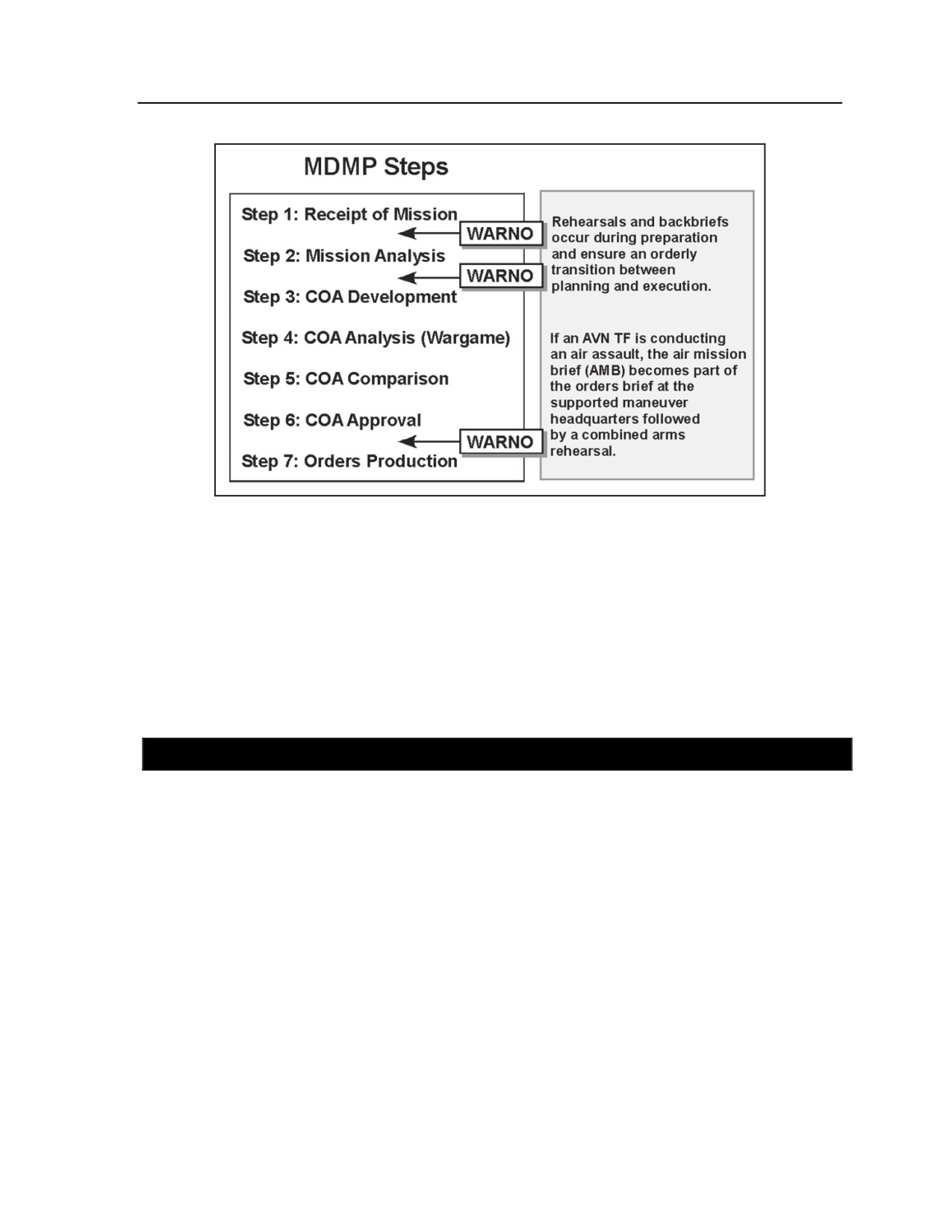
2-99. To plan and coordinate missions effectively, the commander and staff follow MDMP (figure 2-1).
Staff planners must focus on previously listed aviation planning considerations to formulate a complete
plan. Due to the complexity inherent in the process, battalions should practice the process regularly prior to
deployment. FM 5-0 covers the MDMP process in detail.
2-22
FM 3-04.113
7 December 2007
Command and Control
Figure 2-1. Military decisionmaking process
2-100. The dynamic battlefield often does not allow a complete MDMP due to time constraints. The
commander and staff must know current aircraft and crew availability to immediately assess feasibility of
mission requests.
2-101. The steps of an abbreviated MDMP are the same as those of the full process; however, the
commander performs many of them mentally or with less staff involvement. The commander may direct a
COA based on experience to expedite planning. The products developed during an abbreviated MDMP
may be the same as those developed using the full process; however, they are usually less detailed and
some may be omitted altogether. Unit SOPs should address how to abbreviate MDMP based on
commander’s preferences.
SECTION III - COMPANY COMMAND AND CONTROL
COMPANY COMMAND POST
2-102. The company CP is an austere setup and not specifically designed to be a staff-level planning and
tracking environment. The bulk of the company’s mission information comes from the battalion, BCT, or
AATF. The company CP is for company specific mission planning, briefings, and rehearsals. Often, the
company CP is collocated within the same shelter grouping as the company’s maintenance and supply
personnel, offering limited designated mission planning space. The company CP operates under the same
principles as the main CP.
SPLIT-BASED OPERATIONS
2-103. Operations of platoons/sections independent from the company HQ is referred to as split-based
operations. Modularity of forces supporting BCTs requires companies to operate while geographically
separated and with a decentralized command. Company HQ may be collocated with their platoons, or the
platoons may be deployed forward in support of a BCT, ABTF, or TF. Companies must be able to deploy,
sustain combat operations, and fight wholly or as independent platoons or sections. The duration depends
on mission requirements and will require sufficient logistics support. Additional augmentation of personnel
and/or equipment may be required to fill essential mission support roles.
7 December 2007
FM 3-04.113
2-23
Chapter 2
CAPABILITIES
2-104. Aviation company capabilities are a combat multiplier for the GTC. Modularity of companies
allows a “plug and play” capability for BCTs, ABTFs, and TFs. Aviation companies are capable of 24
hour continuous operations for short periods of time. Sustained operations involving surges, such as
offensive operations, drain the unit causing a reduced capability following the operation. This permits
required aircraft maintenance to be accomplished and allows for management of fighter endurance for
aircrews. The aviation modular design also allows assets of the corps and theater to reinforce the brigade,
providing an added capability to BCTs, ABTFs, and TFs during surge operations. This design also supplies
aviation support following surge operations, while BCT-, ABTF-, and TF-organic aviation unit companies
are in a reduced capability time frame.
COMPANY ELEMENTS
Commander
2-105. The company commander is a warfighter, responsible for the integration of his company into the
combined arms fight. He leads, mentors, guides, and inspires the Soldiers of the company. The commander
is responsible for training platoon leaders and evaluating crews and individuals as well as assessing
training. The company commander is responsible for ensuring aircraft and crews are available to meet the
battalion commander’s intent. He determines crew selections as well as composition of flight teams. The
1SG, platoon leaders, IPs, TACOPS, and pilots in command (PCs) assist the commander in ensuring
combat crew readiness.
First Sergeant
2-106. The 1SG is the senior NCO and senior enlisted aviation maintainer at company level. The 1SG is
the commander's primary advisor concerning enlisted Soldiers and performs other duties directed by the
commander. The 1SG focuses attention on functions critical to success of the operation. The 1SG assists
the commander in the following ways:
Provides recommendations and expedites procurement and preparation of enlisted replacements
for the company.
Supervises daily maintenance operations.
Oversees protection measures in fixed-base operations.
Organizes, deploys, and supervises all support elements assigned, attached, or under operational
control (OPCON) to the company. This includes food service, transportation, maintenance, and
other support personnel.
Coordinates medical, mess, supply, administrative, and other logistics support.
Receives, consolidates, and forwards all administrative, personnel, and casualty reports to the
battalion CP via radio, hard copy, or digital format.
Establishes and organizes the company resupply point.
Leads company ground movements when required and establishes AAs.
Monitors NCO development, promotions, and assignments. This includes assessment of the
company’s battle-focused Soldier and NCO leader training programs.
Identifies, plans, and assesses Soldier performance on training tasks that support collective
(unit) tasks on the METL.
Platoon Leader
2-107. The platoon leader leads his platoon and is responsible for the conduct of crew training, selection
to ensure mission accomplishment. Unit IPs assist the platoon leader in ensuring crews are properly
selected and trained. The platoon leader is responsible for all maintenance operations of the platoon to
include—
Updating the commander on all aircraft status changes.
2-24
FM 3-04.113
7 December 2007
Command and Control
Developing and implementing a tracking system to monitor critical maintenance services, such
as scheduled, unscheduled, and deferred maintenance; phases; the flow chart and status chart;
and parts and work order requests.
Supervising daily maintenance operations.
Platoon Sergeant
2-108. The platoon sergeant is the primary adviser to the platoon leader. He is responsible for soldier and
equipment readiness. The platoon sergeant assesses Soldier training proficiency with input from section
leaders, identifying Soldier and collective tasks needing training. The platoon sergeant assists the platoon
leader, as the 1SG assists the commander, by—
Ensuring the platoon has aircraft available to accomplish assigned missions.
Providing recommendations and requests for procurement and preparation of enlisted
replacements for the company through the platoon leader to the commander.
Coordinating medical, mess, supply, administrative, and other logistics support for the platoon.
Reviewing maintenance forms ensuring crew chiefs verify deficiencies and completing
additional forms as necessary.
Ensuring submittal of maintenance forms and appropriate tracking is initiated.
Monitoring status of replacement parts, including parts on order and valid parts requisition
numbers.
Ensuring all recoverable parts are turned in.
Leading platoon ground movements and conducting pre-execution checks when required.
Providing input to platoon leader’s collective task assessment.
Ensuring Soldiers are prepared for and attend training.
Monitoring NCO development and promotions.
Identifying, planning, and assessing Soldier performance on training tasks that support
individual and collective (unit) tasks on the METL (to include maintenance tasks).
Standardization Instructor Pilot
2-109. SPs assist the commander in developing and implementing the unit aircrew training program
(ATP). He also assists the commander in crew selection, normally performs as a member of the company
operations planning cell, and may serve as an AMC during combat operations. SPs provide quality control
for the ATP via the commander’s standardization program. Along with their primary responsibilities, they
mentor and professionally educate all unit crewmembers. SPs are tasked to provide expertise on unit,
individual, crew, and collective training to the commander, and perform the following functions:
Serves as member of the battalion standardization committee.
Advises commander on development of commander’s task list (CTL).
Monitors unit standardization and ATPs.
Maintains unit individual aircrew training folders (IATFs).
Monitors unit no-notice programs.
Assists the battalion SP in
development and execution of realistic company gunnery tables. This may include ammunition
forecasts, helicopter gunnery skills tests, engagement scenarios, simulator situational training
exercises (STXs), and computer-based ASE training (CBAT) requirements.
Develops company STXs accurately reflecting current combat operations and the full spectrum
of aircraft capabilities.
Attends training meetings.
7 December 2007
FM 3-04.113
2-25
Chapter 2
Instructor Pilot
2-110. IPs are responsible for assisting the platoon leader in properly training combat ready crews. IPs
provide quality control for the ATP via the commander’s standardization program. Although IPs work
directly for the platoon leader, they receive guidance and delegated tasks from the company SP. This
ensures training is standardized throughout the company, provides for an economy of effort in the
company, and contributes to professional development of the IP. IPs also mentor and professionally
educate all unit crewmembers and are responsible for—
Performing as designated IP and/or instrument examiner.
Conducting no-notice evaluations.
Assisting the company standardization officer in maintaining IATFs.
Assisting in development of company STXs.
Assisting in development and execution of company gunnery tables.
Unit Trainer
2-111. Unit trainers are aviators designated to instruct in areas of specialized training (refer to TC 1-210).
They assist IPs in unit training programs and the achievement of established training goals. Areas in which
they instruct are—
Night vision goggles (NVGs).
Instrument flight.
Tactics.
Border and corridor qualifications.
Local area qualifications.
Maintenance Test Pilot
2-112. Maintenance test pilots (MPs) work with the Platoon Sergeant in developing and managing the
unit maintenance program. The MP is involved in all aspects of aircraft maintenance within the company.
They interface with the Production Control Officer to maintain coordinated efforts across the battalion to
ensure the efficient use of resources and establish priority of effort. The MP’s goal is to provide maximum
availability of aircraft. The MP also—
Conducts maintenance test flights and maintenance operational checks.
Advises the commander and platoon leader on maintenance operations
Serves as an operational mission pilot.
Conducts pilot training on maintenance-related tasks.
Safety Officer
2-113. SOs assist the commander in developing and implementing all unit safety programs. The SO is not
just an observer; he is expected to be tactically and technically proficient, and an active participant in the
ATP. Commanders rely on their SOs to monitor all safety aspects of the unit, and provide feedback and
advice from a different perspective than that of the commander. The SO serves as the commander’s advisor
on risk management during flight mission planning. SOs are the commander’s primary trainer for annual
safety training requirements and CRM including—
Individual risk assessment.
Crew risk assessment and mitigation.
FARP and AA site surveys.
Convoy risk assessment and safety briefs.
2-26
FM 3-04.113
7 December 2007
Command and Control
Tactical Operations Officer
2-114. TACOPS officers are subject matter experts related to threat, aviation survivability measures, and
the organic AMPS and its associated products. Additional responsibilities include—
Conducting the ASE/EW portion of the risk management process.
Assisting in development of unit TTP.
Assisting the battalion TACOPS in managing the organization’s PR program.
Determining ASE settings and countermeasures.
Advising the commander and company leaders on appropriate ASE techniques and procedures,
and if necessary, coordinating for integration of joint assets for each major mission.
Integrating FS and CAS into company mission planning.
Managing/tracking company ASE systems.
Assisting in development of company STXs and gunnery tables.
Advising the commander on development of CTL.
Standardization Flight Instructor
2-115. Standardization flight instructors (SIs) are nonrated crewmembers (NCMs) responsible for training
NCM flight instructors (FIs) and nonrated Soldiers within the command. SIs provide quality control for the
NCM ATP via the commander’s standardization program. They also train NCMs to perform FI duties
aboard aircraft and monitor/evaluate the instructor’s performance while training NCMs essential to
operation of the aircraft. SIs work with aviators in-flight using the team concept. Their duties are included
in the corresponding aircrew training manual (ATM).
2-116. For CH-47/UH-60 equipped units, the commander designates a NCM standardization instructor to
help administer the door gunnery program. The master gunner/door gunnery NCM standardization
instructor duties are described in FM 3-04.140.
Flight Instructor
2-117. FIs are NCMs who have been trained by the SP/SI and certified by the commander to train other
NCMs for operational flight duties. FIs are responsible for the training of NCMs in flight operations of the
unit’s assigned aircraft. The SP and SI monitor/evaluate FIs.
Aviation Life Support Officer
2-118. Aviation life support officers (ALSOs) assist, advise, and represent commanders in all matters
pertaining to the aviation life support systems (ALSSs). ALSOs—
Review, analyze, and develop procedures ensuring planning, budgeting, and maintenance of
ALSS.
Ensure training of aircrew personnel in proper operation, use, and operator maintenance of
survival equipment and techniques of survival.
Supervise the life support section and ensure qualified personnel are available to conduct life
support and survival training and maintenance of organizational-level aviation life support
equipment (ALSE).
Maintain a current file of regulations, procedures, and technical manuals (TMs) pertaining to
inspection, maintenance, and use of assigned life support equipment.
Ensure units have adequate information and training before using new equipment or system
changes.
Ensure materiel deficiency reports are submitted on life support equipment failing to operate as
designed.
7 December 2007
FM 3-04.113
2-27
Chapter 2
2-119. Additionally, the commander appoints ALSE technicians and specialists to assist, advise, and
represent the ALSO in all matters pertaining to ALSE. Technicians—
Establish a library of ALSE publications and ensure the unit’s pinpoint distribution account is
updated to include ALSE publications and necessary forms.
Ensure all ALSE is maintained in a high state of readiness by inspecting, cleaning, fitting,
testing, adjusting, and repairing equipment.
Maintain files on inspection, maintenance, expiration dates, and supply pertaining to ALSE.
Inspect all controlled drugs used in survival kits and vests.
COMPANY PLANNING CONSIDERATIONS
TROOP LEADING PROCEDURES
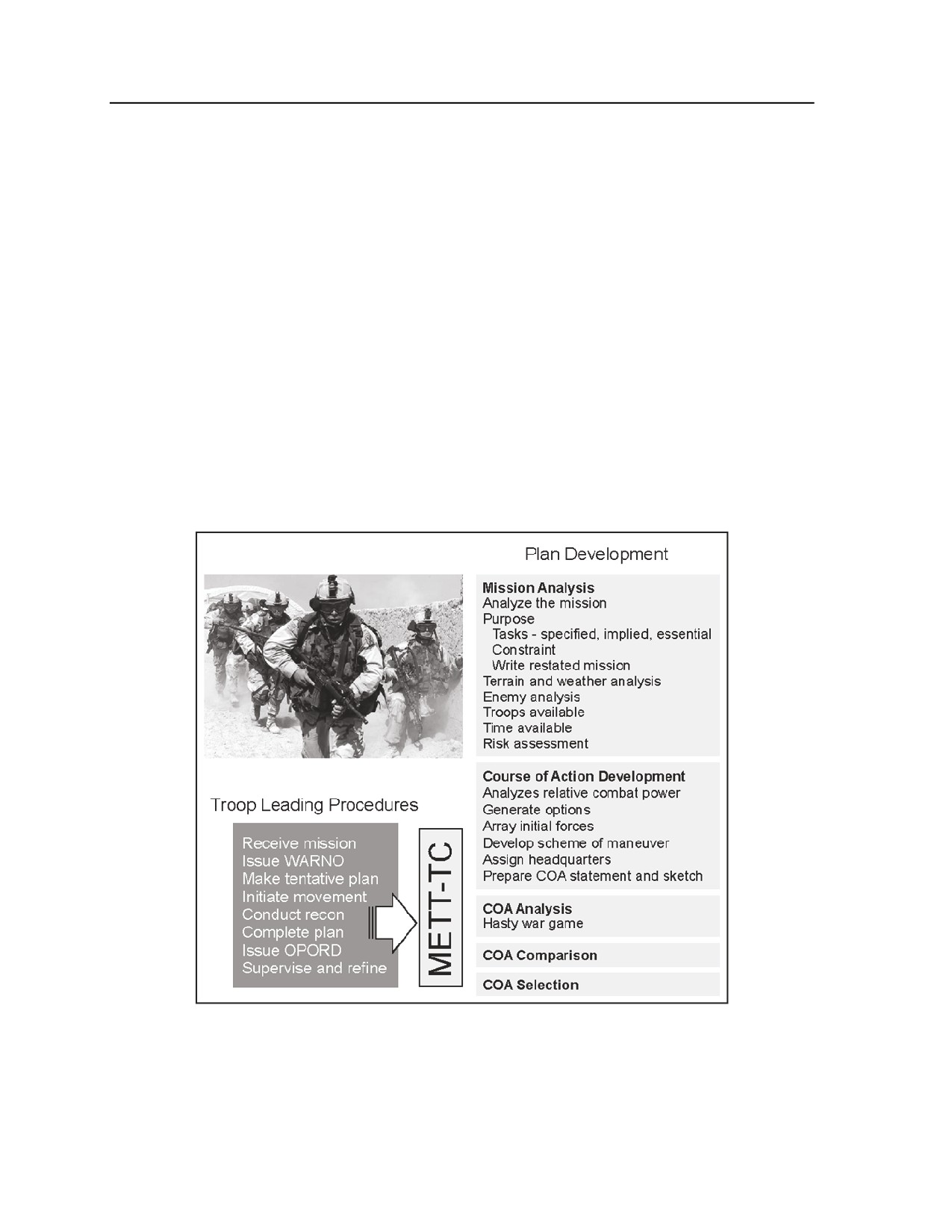
2-120. Although MDMP is essential to accomplish the mission, effective TLP are equally important.
Commanders with a coordinating staff use MDMP. Company-level and smaller units do not have formal
staffs and use TLP to plan and prepare for operations. Figure 2-2 depicts TLP along with key planning
tasks. The box on the left shows the steps of TLP. The box in the middle (METT-TC) represents the initial
METT-TC analysis leader’s conduct to develop an initial assessment. This occurs in TLP steps 1 and 2 and
is refined in plan development. The box on the right depicts plan development tasks. Plan development
occurs in TLP steps 3 through 6. These tasks are similar to the MDMP steps (refer to FM 5-0).
Figure 2-2. Troop leading procedures and key planning tasks
2-121. TLP must be a part of the SOP and its checklists. Although quick directives can accomplish much
in certain circumstances, a missed step can easily lead to mission shortfalls or failure. Written TLP steps
2-28
FM 3-04.113
7 December 2007
Command and Control
provide a guide the leader applies in ways consistent with the situation, leader's experience, and experience
of subordinate leaders.
2-122. Leaders use TLP when working alone to solve tactical problems or with a small group. A
company commander may use the 1SG, platoon leaders, SP, and SO for assistance during TLP.
Additionally, aviation company commanders utilize planning cells to perform much of the TLP process.
PLANNING CELLS
2-123. Company planning cells are utilized by the commander to plan, organize, and effectively execute
the mission. This section defines a method for planning conducted at company level, and the process a
company follows to ensure completion of required tasks for mission planning.
2-124. The company commander or senior officer acts as the AMC. He selects crews and assigns them to
planning cells. The AMC assigns suspenses for planning cells providing products to the
reproduction/distribution cell.
Process
2-125. The following process establishes information requirements necessary to successfully plan and
execute company missions. Cells conduct planning concurrently. The information required for planning
and execution is located in the WARNO. To begin planning, the following is needed from a WARNO:
(Some of this information can be generated into AMPS.)
Threat and friendly situation along routes and AOs.
Mission, objective, or target time, and any alternate missions.
Weather and light data for time of operation.
Number of aircraft required.
Location of specified passage points or corridors with occupying unit designation, call sign, and
frequency.
Specific tasks for planning cells.
Time and place of OPORD.
AMPS integration.
Cell assignments matrix (table 2-4. page 2-29).
Table 2-4. Sample cell assignments matrix
Route Planning Cell
Operate AMPS:
• Select air control points (ACPs), altitudes, airspeeds, and formations using friendly situation graphics.
Coordinate with other units as necessary.
• Calculate/confirm time/distance/heading data. These data and grid coordinates will be checked by
another cell member.
• Identify obstacles and hazards. Coordinate with weather/hazards cell.
• Obtain FARP layout data and post on unit FARP sketch.
• Coordinate with ASE/EW cell to avoid known enemy hazards.
• Coordinate with operations cell concerning mission timeline.
• Produce/update AMPS graphics (such as flight plan, control measures, battlefield graphics, and mission
essential data.
• Provide reproduction/distribution cell with kneeboard products.
• Load mission from AMPS to data transfer cartridges and provide to all copilots at briefing.
7 December 2007
FM 3-04.113
2-29
Chapter 2
Table 2-4. Sample cell assignments matrix
Communications Cell
Develop communication sets for the mission.
Ensure COMSEC equipment in all mission aircraft (including spares) is keyed and operational (such as KY
58, KIT 1C, SINCGARS and Have Quick).
Collect frequency and selective identification feature/IFF data from the OPORD, ACO, Aviation Planning
Guide, automated network control device (ANCD), SOP, and Flight Information Publication covering all
mission aspects from communications check to completion.
Prepare the unit communications card.
Provide the reproduction/distribution cell with all data in a timely manner.
Performance Planning Cell
Obtain mission load data.
Obtain planning weather data (temperature and pressure altitude).
Prepare a generic performance planning card (PPC).
Calculate fuel-planning data for all phases of the mission. If unit aircraft are equipped with internal tanks,
perform planning for those aircraft allowing for two contingencies:
(1) Auxiliary tanks are operational
(2) Tanks are full of fuel but do not transfer fuel.
Calculate minimum fuel including return to FARP/AA (commonly code worded as “bingo”) and visual flight
rules reserve.
Place all calculations and data on the unit PPC/fuel planning card and provide timely data to the route
planning cell and reproduction/distribution cell.
Operational Planning Cell (usually composed of commander and team leader/leaders)
Selection of LZs, PZs, and holding areas (HAs).
Control measures for routes.
Selection of target reference points (TRPs) if required.
Team employment procedures.
Integration into ground tactical plan (GTP).
Provide the reproduction/distribution cell with all data in a timely manner.
Brief actions on the objective at the unit mission briefing.
Weather, Notices to Airman (NOTAMs), Hazards Cell
Compare forecasted weather and mission requirements. Consider illumination, sunrise/sunset times.
Review NOTAMs, airmen’s advisories, and ACO for items that may influence the mission including IIMC
recovery airfields.
Update wire hazards map.
Provide the reproduction/distribution cell with all data in a timely manner.
Conduct contingency planning for follow-on missions if necessary.
Brief weather, NOTAMs, and hazards at the unit mission briefing.
Flight Plan/Mission Brief/Risk Assessment Cell
Complete mission brief and risk assessment sheets. Make available to mission crews prior to briefing.
Inform the AMC if initial risk assessment warrants any amendments to the mission profile.
Complete the flight plan or collect data for flight operations log.
Obtain squawk codes, prior permission requests, and diplomatic clearances as required by mission.
Provide the reproduction/distribution cell with all data in a timely manner.
2-30
FM 3-04.113
7 December 2007

Command and Control
Table 2-4. Sample cell assignments matrix
IIMC Cell
Develop a IIMC recovery plan. For long en route portions, more than one recovery airfield may be required.
Select appropriate instrument approach procedures at each recovery airfield.
Create emergency GPS recovery procedure if required.
Prepare an IIMC plan and post on unit IIMC card.
Provide the reproduction/distribution cell with all data in a timely manner.
Threat Cell/ASE/EW
Analyze threat composition, disposition, order of battle, array, and numbers.
Using AMPS inter-visibility plots, analyze threat weapons systems that may influence the mission.
Coordinate with the route planning cell concerning threats that may influence the en route phase.
Coordinate with the operations cell concerning any threats in the vicinity of the objective.
Prepare the threat risk assessment. Much of the data for this form may be obtained from the Air Force
technical training publication (AFTTP). The AFTTP is a classified document and may be obtained from the
TACOPS/battalion EWO/S-2.
Provide the reproduction/distribution cell with all data in a timely manner.
Brief the threat risk assessment at the unit mission briefing.
Reproduction/Distribution Cell
Actively collect and safeguard all data provided by planning cells.
If possible, photcopy uniform packets for all crewmembers. Arrange in the same order and clip together.
Post the mission briefing boards as soon as possible to allow aircrews to post their own mission packets if
reproduced packets are not available.
Distribute packets prior to start of mission briefing.
Assist AMC with mission briefing preparation. This includes posting graphics/overlays to briefing maps.
Products that are reproduced and distributed:
• Route cards.
• FARP, objective, and PZ/LZ sketches.
• Communication card.
• PPC.
• Weather, NOTAMs, and hazards briefs.
• Flight plan/mission brief/risk assessment.
• IIMC recovery plan.
• Threat risk assessment.
• Mission execution matrix (if not provided from battalion).
SECTION IV - MEETINGS AND BRIEFINGS
INITIAL PLANNING CONFERENCE
2-126. Although not required, an initial planning conference (IPC) may be conducted by the unit. The
IPC is the first meeting between the ground maneuver unit and aviation unit or TF. The IPC takes place
when the AATFC has a general idea of his intent and GTP scheme of maneuver. During the IPC, each unit
involved in the air assault backbriefs task and purpose, general scheme of maneuver, and task organization.
The information gained in the IPC is used to develop the aviation OPORD and air mission brief (AMB).
The unit personnel attending the IPC should have the following:
An air mission coordination meeting (AMCM) checklist (refer to appendix D).
Maps.
An execution matrix template.
An ANCD for receiving mission frequency set.
7 December 2007
FM 3-04.113
2-31
Chapter 2
2-127. Briefing products produced may include—
A staging plan.
PZ and LZ plans.
An air movement plan.
Routes.
LZs and landing plans.
HA/restricted operations zone (ROZ) plans.
A CASEVAC plan.
AIR MISSION COORDINATION MEETING
2-128. The purpose of the AMCM is to complete coordination between ground and aviation units. The
AMCM is a critical event in synchronizing air-ground integration. The AMCM coordinates operational
information between ground and aviation operations officers, and key members of the BCT staff. The
AMCM takes place immediately after the backbrief to the BCT. The end result of the AMCM is a finalized
air movement plan, landing plan, air routes, PZs, and LZs. See chapter 3 for more information.
OPERATION ORDER BRIEF
2-129. The OPORD briefing provides information, specific instructions, and a thorough overview of the
mission. The briefing should be organized to follow the written order’s format and presented by a single
briefing officer, who may be the commander, an assistant, staff officer, or special representative depending
on the nature of the mission or HQ level. Refer to FM 5-0 for more information on orders production and
briefings.
2-130. In an operational situation or when the mission is of a critical nature, individuals or smaller units
may need more specific data, which may be provided by a mission briefing. The mission briefing
reinforces orders, provides more detailed requirements and instructions for each individual, and explains
the significance of each individual role.
AIR MISSION BRIEF
2-131. The AMB is a focused adjunct to the OPORD and where the battalion commander approves the
plan. The term AMB is used to mean both the written product and the briefing itself. The AMB should not
be a working meeting; an OPORD should have already been published. Therefore, the AMB is essentially
a backbrief to the commander. All units involved in the operation should attend and receive a copy of the
order.
2-132. The AMB should focus on concepts, sequence of events, and reasons the staff developed the
sequence for the mission. The slightest change in route selection, LZs/PZs, or other elements of the mission
can significantly affect the rest of the plan.
2-133. Changes to the mission after the AMB must be approved by the commander. It is very difficult to
resynchronize the different combat systems in the short time remaining between the AMB and mission
execution. Unit personnel attending should bring—
An AMB checklist (refer to appendix D for an example checklist).
Maps.
An execution matrix.
An ANCD for receiving frequency set changes/updates.
An AMPS data transfer cartridge for receiving changes/updates to routes.
2-32
FM 3-04.113
7 December 2007
Command and Control
2-134. Briefing products produced may include—
Mission.
Friendly graphics.
AC2 procedures.
A communication card (frequencies/call signs).
An execution matrix.
Routes (AMPS cartridge).
An ANCD frequency set load.
A risk assessment/mission brief/mission schedule.
TEAM BRIEF
2-135. Team briefings can occur at different levels. The team can be briefed by the battalion or company
for specific missions or missions that are part of larger operations. An example of a team brief is teams
being briefed by battalion for missions supporting battalion PR or QRF operations. Information and
products reviewed during the brief include—
PPC.
FS card.
Actions on contact.
Contingency planning.
Scheme of maneuver.
Weather, NOTAMs, and hazards briefs.
Flight plan/mission brief/risk assessment.
IIMC recovery plan.
Threat risk assessment.
CREW MISSION BRIEF
2-136. The PC briefs the mission and flight requirements that demand effective communication, proper
sequencing, and timing of actions according to a unit-approved crew mission briefing checklist. The
appropriate aircraft type ATM contains an example of a detailed crew mission briefing checklist and
instructions for completing this task. Unit SOPs should also address crew briefing checklists.
SECTION V - REHEARSALS
2-137. A rehearsal is essential for success in operations. FM 6-0 contains a discussion of rehearsal types,
techniques, responsibilities, and conduct. Following is a discussion of items critical to aviation operations.
2-138. Once commanders are satisfied and personnel understand the concept of operation, they must
rehearse the plan. The rehearsal cannot become the brief to commanders. The purpose is to validate
synchronization of subordinate units' tasks to execute the commander's intent.
2-139. Rehearsal types include—
Confirmation brief.
Backbrief.
Combined arms rehearsal.
Support rehearsal.
Battle drill or SOP rehearsal
2-140. Rehearsal techniques include—
Full dress rehearsal.
Reduced force rehearsal.
7 December 2007
FM 3-04.113
2-33
Chapter 2
Terrain model rehearsal.
Sketch map rehearsal.
Map rehearsal.
Network rehearsal.
2-141. Although a full dress rehearsal is preferred, a terrain model rehearsal is most common. The terrain
model must represent the unit’s area of influence and be large enough for participants to easily traverse. An
effective rehearsal is dependent on an accurate terrain model, complete with key terrain features, reliefs,
obstacles, and unit positions (friendly and enemy) correctly portrayed. Additionally, an effective technique
for utilizing terrain models is to increase the scale of the objective area for better visualization by rehearsal
participants. A standardized terrain model kit is an effective tool to reduce setup time.
2-142. Rehearsals are accomplished at all levels. They may be conducted separately at each echelon, in
one large rehearsal, or using a combination of the two. An appropriate large rehearsal would be a cross-
forward line of own troops (FLOT) air assault. Rehearsals are as detailed as time and resources permit.
They may be a series of full-up, live-fire rehearsals or as simple as a quick review on the map. All
rehearsals must include reviewing or conducting the following:
Actions on the objective.
Maneuver, movement, and fires.
Critical event rehearsals (such as FARP and PZ/LZ).
Contact drills en route.
Contingencies.
REHEARSAL SEQUENCE AND ATTENDANCE
2-143. Rehearsals follow a script and proceed in action, reaction, and counteraction sequence. Elements
of the script include—
Agenda.
Attendee response sequence to actions.
Unit actions response checklist (standardized format).
Sequence of events.
2-144. If time becomes critical during the rehearsal, then the most critical part of the mission must be
given adequate attention. Rehearsals must include a representation of the enemy and should cover—
Actions at the objective.
Actions at the PZ, en route, and LZ.
Enemy positions and disposition.
Friendly scheme of maneuver/GTP.
Integration of fires/suppression of enemy air defenses (SEAD).
Actions on contact.
Occupation of reconnaissance or security positions, battle positions (BPs), and landing plans.
Passage of lines.
Flight plans including primary/alternate routes, PZ/LZ ingress/egress procedures, maneuver
formations, flight techniques, and altitudes.
Actions in the AA (communication checks, line up for takeoff, takeoff, and landing on return).
FARP information.
Loading plan (troops, equipment, and supplies).
CASEVAC procedures.
IIMC procedures.
In stride/immediate downed aircrew recovery procedures.
Contingency plan TTP (such as change of mission, aircraft equipment malfunction, or hot LZ).
2-34
FM 3-04.113
7 December 2007
Command and Control
All critical members of units should attend the rehearsal. Critical members are those who have key parts in
the operation and whose failure to accomplish a task could cause mission failures.
REHEARSAL QUESTION RESOLUTION
2-145. The battalion commander and staff may conduct or observe the rehearsal. Detailed questions
ensure units thoroughly understand the mission. The following questions are examples of critical questions
that should be answered during the rehearsal:
Who provides security?
Who collects and sends SPOTREPs, whom do they call, and on which net?
Who initiates communications checks?
Who coordinates with the ground force commander?
Who confirms call signs, nets, and authenticators?
What radio calls (digital and voice) are required during the conduct of the operation?
What are the success criteria, and how do we know if they have been met?
What are the mission criteria and who selects the mission criteria?
What are the divert criteria and who makes that decision?
What are the mission abort criteria?
What are the in-stride downed aircrew procedures?
What are the CASEVAC procedures?
What are the ROE?
What are the ASE requirements and settings?
What are the critical times (PZ, start point, rally point, and LZ)?
What is the entry/exit plan?
What is the bump and spare aircraft plan?
What Pathfinder support is available?
What are the hot LZ procedures and alternate LZ divert criteria?
What is the plan to sequence serials through the FARP?
What are the contingencies at the objective or LZ for various enemy actions?
Where do crews get the time sequence for Have Quick (unless automatic)?
Where are the FARPs and what are their procedures?
Where is the AATFC, GTC, AMC, and air battle captain (ABC) during each phase of the
mission, and who uses/monitors the CAN for coordination between air and ground forces?
How are PZs and LZs marked?
CONFLICT RESOLUTION AT THE REHEARSAL
2-146. Conflicts may arise during a rehearsal. The commander must ensure conflicts are resolved, and the
rehearsal does not become a war game. Wargaming should have been accomplished during the planning
process. The rehearsal ensures all members of the unit understand their roles and how they contribute to
success. It is not the time to develop a new plan, but if required, refinements may be made.
ADDITIONAL REHEARSALS
2-147. Additional rehearsals include—
The ground tactical rehearsal includes the air movement plan, landing plan, GTP, and
extraction plan. Designed to ensure synchronization of all efforts, this full, detailed rehearsal has
all key personnel in attendance. A terrain model of the AO is required.
The communications exercise (COMMEX) should mirror the signal requirements of the
mission. The COMMEX ensures assignment of nets, equipment capabilities, range,
7 December 2007
FM 3-04.113
2-35
Chapter 2
retransmission requirements, and COMSEC requirements. All elements participating in the
mission participate in the COMMEX. The use of a common communications card is highly
recommended and allows for a quick reference guide to frequencies and call signs.
The PZ rehearsal is run by the battalion XO. All pilots flying the mission, the PZ NCOIC, and
supported unit commander(s) attend. The staging, loading, and air movement plans are
rehearsed in detail as well as the pilots’ actions in and around the PZ. A terrain model of the PZs
with a depiction of the aircraft and loads is recommended.
Company rehearsals are required to cover key company events not portrayed at the battalion
rehearsal, such as formation, bump plan, departure sequence, radio calls, and actions on the
objective. Attendees include all aircrews and key leaders.
REHEARSAL COMPLETION
2-148. At the end of any rehearsal the commander should receive correct responses from every member
present concerning—
Mission/actions at the objective.
Commander's intent.
Timetable for mission execution.
2-149. Following rehearsal and prior to executing the mission, commanders conduct PCI ensuring PCC
on aircraft and mission equipment are complete.
PRECOMBAT CHECKS
2-150. Aircrews and vehicle operators conduct PCC. Checks include—
Posting graphics on maps.
Completing aircraft performance planning.
Completing preflight/before operations preventive maintenance checks and services (PMCS).
Ensuring proper configuration of vehicles, aircraft, and weapons systems.
Ensuring data transfer cartridge upload.
Ensuring IFF and COMSEC are loaded.
Verifying communications checks.
Test firing of weapons systems, if possible.
SECTION VI - END OF MISSION DEBRIEFING AND AFTER ACTION REVIEW
DEBRIEFS
MISSION DEBRIEF
2-151. Units should address mission debrief procedures in their SOP and conduct mission debriefs as
soon as practical on completion of the mission. All mission personnel should attend. Mission debriefs
cover mission planning, preparation, and execution phases. The purpose is to capture what happened
during a mission to ensure all requirements were achieved. The intent is to capture better SA/SU and
intelligence of the area. Table 2-5, page 2-37, shows an example mission debrief format.
2-36
FM 3-04.113
7 December 2007

Command and Control
Table 2-5. Sample mission debrief
Date:
Time:
Mission:
Location:
AMC:
Aircraft #1: Call sign and crew
Aircraft #2: Call sign and crew
Takeoff time
Route
Actions on objective
Significant events
SPOTREPs
BDA
PIR answered
FARP/team rotations
Battle handover/end of mission time
Maintenance: Hours flown and thorough postflight analysis of the aircraft
SAFIRE Incidents:
Aircraft (A/C) location
A/C heading, altitude, and airspeed
Evasive maneuvers performed
Enemy
Weapon system/# of rounds
Enemy location
Number of personnel
Subsequent actions
CREW
2-152.
Commanders must emphasize the critical importance of crew debriefs and crew coordination, not
only during flight mission execution but in the crew internal debrief. Unit SPs/IPs must ensure crews are
trained and execute crew coordination before, during, and after flight.
2-153. The crew debrief provides information that assists the crew in enhancing mission execution, safer
operations, and reduction of errors. The commander should institute and promote the posting of crew
coordination lessons learned to a forum. The forum also allows other crews to learn through an aircrew’s
experience as not all problems encountered are associated only with the aircraft and crews. This event
becomes a mission enhancer for future flight operations.
2-154. Many errors occur in the interaction between aircraft crews and supported ground units. Aviation
units will habitually work with the same ground units. The sharing of learned errors from past experience
with all flight crews allows them to be aware and prepared and adjust risk as necessary. This same learned
information is forwarded to the ground unit commander so corrections can be made to reduce risk.
7 December 2007
FM 3-04.113
2-37
Chapter 2
TEAM
2-155. Platoons and sections operating independently from company HQ (in support of a BCT for
example) conduct the same debriefs and are responsible for submitting information to the S-2/S-3 and
platoon’s/section’s respective commander.
COMPANY
2-156. Commanders ensure unit personnel conduct mission debriefs as soon as practical on completion of
the mission with all mission personnel attending. Mission debriefs cover mission planning, preparation,
and execution phases with a focus on how to improve the operation. Additionally, the commander ensures
the higher HQ S-2/S-3 receives debrief information and is afforded the opportunity to debrief the crew if
warranted.
BATTALION INTELLIGENCE
2-157. The front line Soldier is a valuable intelligence source. Commanders instill in crewmembers they
are reconnaissance Soldiers fighting for and confirming intelligence. Their sightings and reporting of any
activity (or lack thereof) may make the difference between victory and defeat. The S-2 debriefs aircrews as
an essential part of gathering information. The crews provide the S-2 with all sketches, checklists, and
video imagery collected during the mission.
AFTER ACTION REVIEW
PURPOSE
2-158. An after action review (AAR) is a structured review process of an event, focused on performance
standards, enabling Soldiers to discover for themselves what happened, why it happened, and how to
sustain strengths and improve on weaknesses. It is a tool units and leaders can use to obtain maximum
benefit from every mission or task. The AAR consists of four parts:
Review what was supposed to happen (training plan).
Establish what happened.
Determine what was right or wrong with what happened.
Determine how the task should be done differently next time.
2-159. Unit AARs focus on individual and collective task performance, identifying shortcomings and
training required to correct any deficiencies. AARs with leaders focus on tactical judgment. These AARs
contribute to leader learning and provide opportunities for leader development. AARs with trainers,
evaluators, observer controllers, and opposing forces provide additional opportunities for leader
development. If applicable, AARs are forwarded to the next higher HQ S-3. Commanders should
emphasize what they believe to be key critical elements within the AAR. Refer to FM 7-1 for more
information.
Application to Future Missions Training
2-160. Each AAR has a direct impact on the next mission or training event. Commanders review and
annotate recommendations from AARs. The commander can then implement recommendations he feels are
necessary to enhance mission execution and safety. The commander ensures all leaders (officer and NCO)
review the AAR with his comments posted. These include improvements to the SOP, TTP, battle drills
and, at a minimum, include mission critical elements. This allows officers and NCOs to learn from the
AAR and understand the commander’s guidance on recommendations.
2-161. Following the reviews and commander’s guidance, the recommendations are highlighted in
planning the next mission or training event. Following the mission or training, the debrief covers the results
of an implemented recommendation. The commander reviews the outcome and determines if he wants to
continue as recommended or modify the recommendation for a better outcome.
2-38
FM 3-04.113
7 December 2007
Chapter 3
Employment
This chapter addresses employment aspects for the AHB and GSAB. The AHB
provides the means to extend the tactical reach of the maneuver commander, negate
the effects of terrain, seize key nodes, achieve surprise, and isolate or dislocate
enemy forces. The unique makeup of the GSAB provides the commander with a wide
variety of capabilities. Both the AHB and GSAB allocate resources based on METT
TC, scheme of maneuver, available assets, and commander’s priorities.
SECTION I - FUNDAMENTALS
3-1. Principles for employment of aviation assets
follow these general guidelines:
Contents
Fight as an integral part of the combined
arms team.
Section I - Fundamentals
3-1
Capitalize
on intelligence-gathering
Section II - Air Assault
3-8
capabilities.
Section III - Air Movement
3-29
Destroy or suppress threat weapons and
Section IV - Command and Control
Support
3-32
logistics capabilities.
Section V - Aeromedical Evacuation
3-38
Exploit firepower, mobility, and surprise.
Section VI - Casualty Evacuation
3-45
Mass forces.
Section VII - Air Traffic Services
3-47
Maintain flexibility.
Section VIII - Personnel Recovery
3-48
3-2. The primary missions of assault and GS
Section IX - Other Operations
3-56
aviation units are air assault, air movement, C2
support (GSAB), aeromedical evacuation, CASEVAC, ATS (GSAB), and PR. Each company must be
prepared to fight as a part of the battalion as a whole, as part of an ABTF, or independently in support of a
BCT.
MANEUVERING FORMATIONS
3-3. When different types of aircraft operate in a formation, the operating procedures, characteristics, and
limitation of each type must be evaluated. Additionally, when aircraft are mixed at night, differences
between NVGs, thermal imaging systems (TISs), and external lighting must be identified and considered in
planning. Inconspicuous use of IR chemical lights or tape, IR strobes, and/or IR position lights, and IR
anticollision lights enhances identification and improves spatial reference.
3-4. Maneuverability is the prime consideration for formations flying in tactical situations. These
formations allow lead to maintain formation integrity, yet maneuver the formation with few restrictions.
Wingmen must maintain a position that will not hamper the preceding aircraft's ability to maneuver. Due to
their authority to maneuver, wingmen must understand that lead is free to maneuver near terrain and will
expect wingmen to provide their own horizontal and vertical clearance.
3-5. Over open terrain or during high illumination, greater spacing is used to increase survivability and
flexibility. Formation spacing becomes tighter in rough terrain or reduced illumination/visibility. It is
important to avoid flying over the same spot on the ground; variations in flight path between aircraft/flights
7 December 2007
FM 3-04.113
3-1
Chapter 3
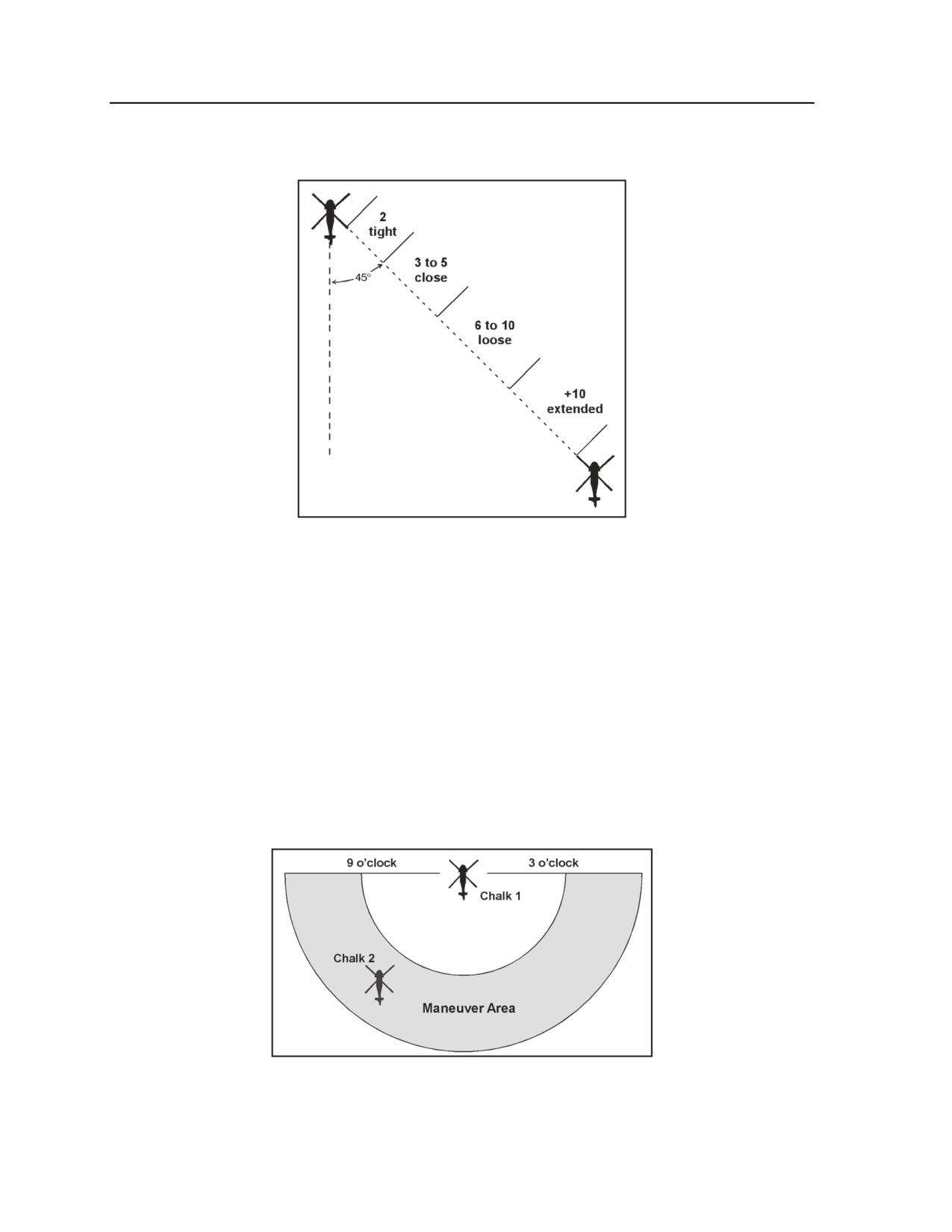
should be the norm. Aircraft and flight separation may range from 3 to 5 rotor disks to 1 kilometer or more
(see figure 3-1).
Figure 3-1. Formation separation
3-6. Primary concerns when establishing separation are METT-TC and the ability to provide mutual
support. The basic flight formations are combat cruise, combat cruise left/right, combat trail, and combat
spread. These formations serve as the basic building blocks to create larger formations and may be
interchanged throughout a mission. Refer to FM 3-04-203 for more information.
COMBAT CRUISE
3-7. Combat cruise is used when teams wish to move quickly and maximize use of terrain for masking.
Combat cruise allows the wingman flexibility in maneuvering the aircraft left or right of the lead aircraft’s
centerline. The wingman is allowed to vary separation and angle anywhere in the maneuver area from
approximately 3 to 9 o’clock (see figure 3-2). The wingman should never track in straight trail as it limits
forward observation and the ability to provide suppressive fires for lead. It also increases the possibility of
alerting the enemy to the wingman’s flight path due to the lead’s presence. Separation should be 150
meters or more depending on terrain and threat.
Figure 3-2. Combat cruise formation
3-2
FM 3-04.113
7 December 2007
Employment
3-8. Combat cruise formation is preferable—
At very low altitudes for long flights to break up the predictability of the formation and permit
optimal terrain flight using masking terrain.
During day and high-visibility weather when small arms fire threat is substantial.
COMBAT CRUISE LEFT/RIGHT
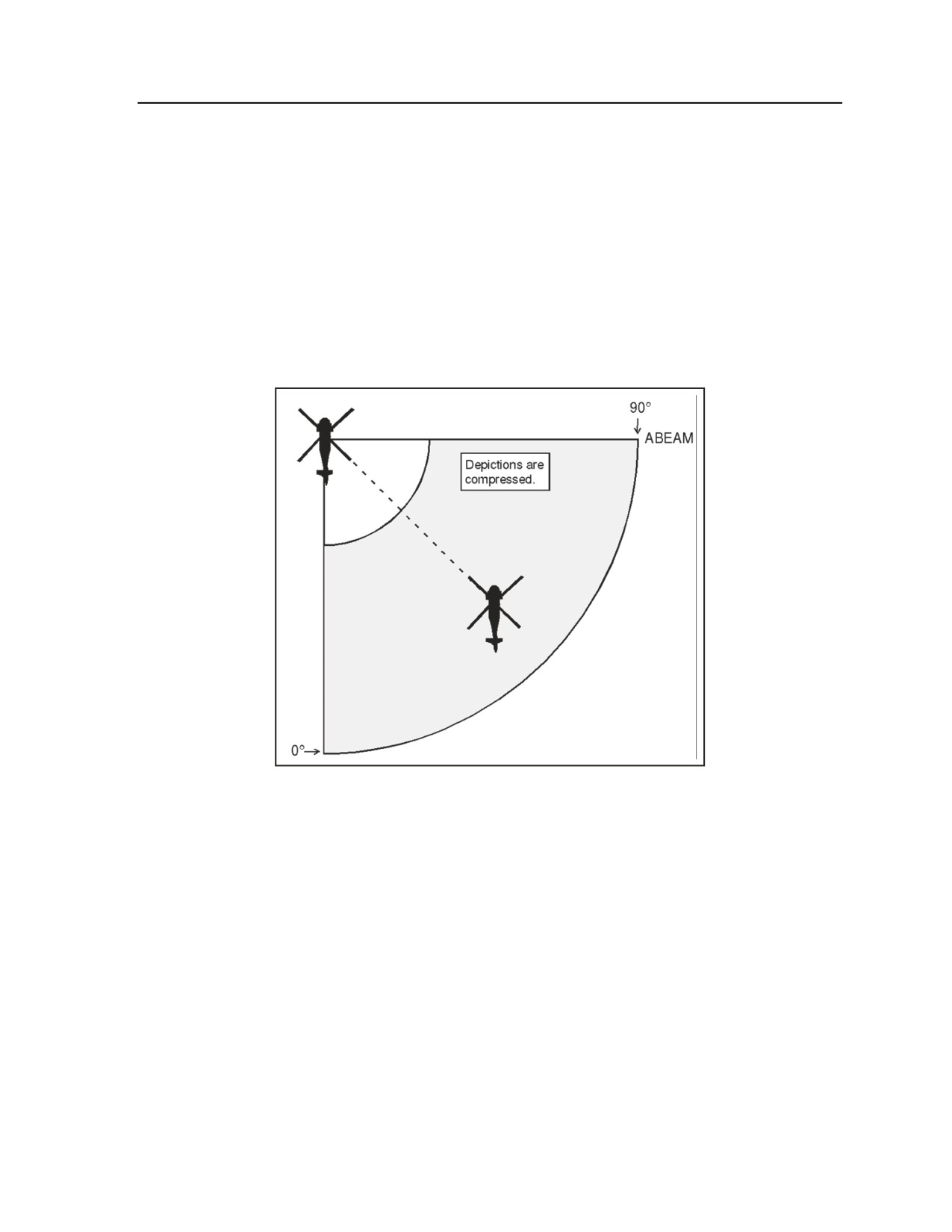
3-9. Unlike combat cruise, combat cruise left/right requires the wingman remain in either left or right
cruise and change sides only after coordinating with the lead aircraft (figure 3-3). Using combat cruise
left/right, the wingman remains in an arc 0 degrees aft to 90 degrees abeam of lead to the left or right side.
Optimum position is 45 degrees. Observation sectors are divided between lead and wing providing
overlapping observation and fire.
Figure 3-3. Combat cruise right
3-10. Combat cruise left/right formation—
Is preferable at very low altitudes for long flights breaking up predictability of formation and
permitting optimal terrain flight using masking terrain.
Is preferable to combat cruise when weather and night vision systems are marginal, but threat is
still high.
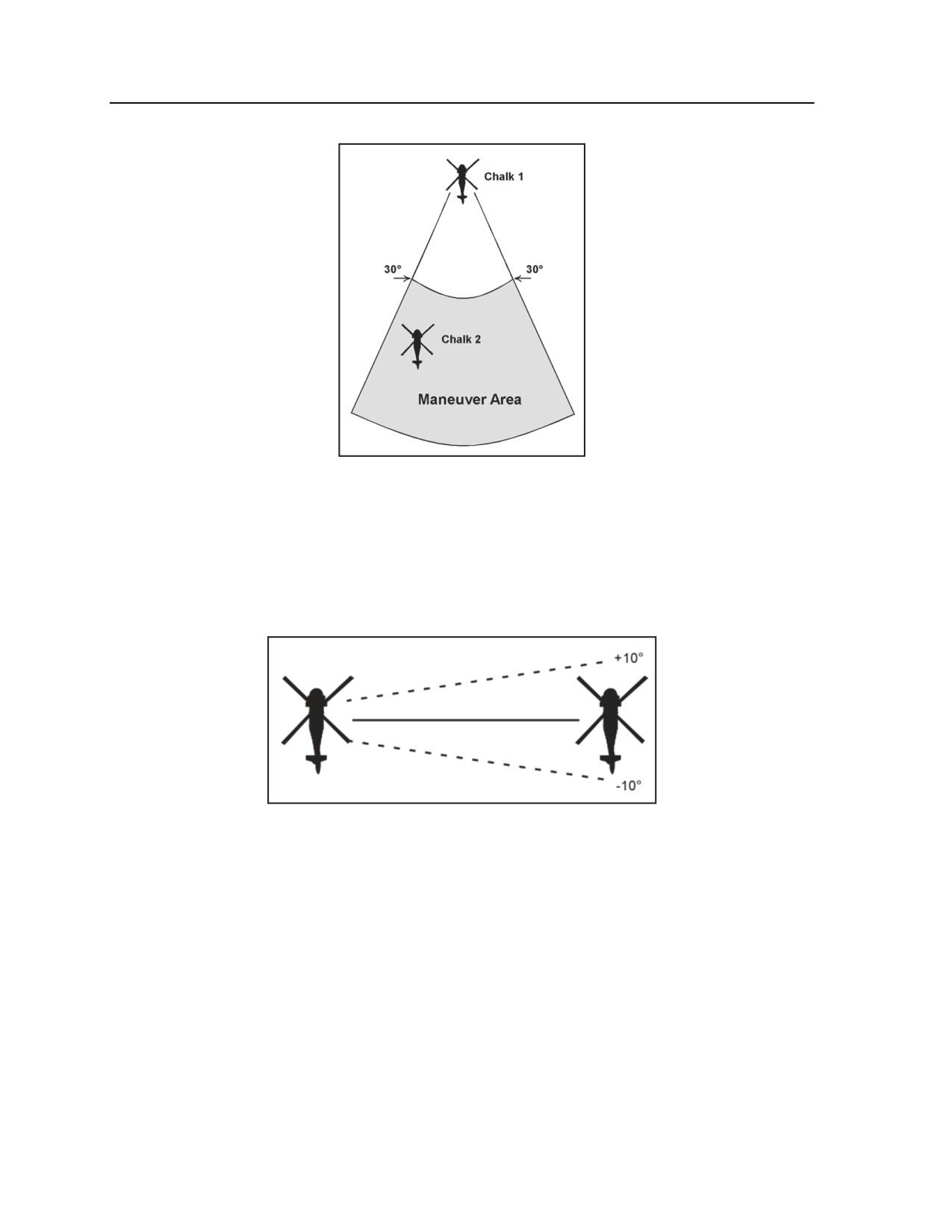
Can be used at night for larger formations as an alternative to echelon when NVGs are used.
COMBAT TRAIL
3-11. While combat cruise allows wingmen maximum flexibility, there may be instances where flight lead
requires more control of the flight and must restrict some maneuverability. Combat trail can be used to
limit wingmen’s movement to plus or minus 30 degrees from the proceeding aircraft (figure 3-4, page 3-4).
This formation is useful for negotiating narrow terrain or LZs. It should not be flown for extended periods
of time or at night due to the difficulty of determining rates of closure for proceeding aircraft.
7 December 2007
FM 3-04.113
3-3
Chapter 3
Figure 3-4. Combat trail
COMBAT SPREAD
3-12. Combat spread is used when maximum observation to the front is desired or an attempt to limit
package exposure time over open areas is made. When flight lead announces combat spread, he includes
the command right or left. Wingmen should move toward that abeam position, either lead’s 3 or 9 o’clock
position (figure 3-5). Flying in combat spread requires a rapid scan to maintain SA on the other aircraft as
well as approaching terrain. This formation requires even more vigilance at night.
Figure 3-5. Combat spread
3-13. Combat spread formations—
Can be used when maximum observation to the front is desirable or when attempting to limit
exposure of the flight when crossing open areas.
May be used en route to minimize vulnerability of trail aircraft.
Is not advised for use in the objective area when constant maneuvering is required.
Increases pilot workload to maintain formation, especially under night vision systems.
PLANNING CONSIDERATIONS
3-14. The factors considered in determining the best formation, or sequence of formations, are—
Mission of supported and aviation units.
Current enemy situation, enemy AD capability and placement, and vulnerability to enemy visual
or electronic surveillance.
3-4
FM 3-04.113
7 December 2007
Employment
Weather and environmental conditions such as ceiling and visibility, wind and turbulence,
ambient light levels, and IR crossover throughout the mission.
Artillery support available, naval surface fire support (NSFS), planned types of ordnance, and en
route J-SEAD.
Possible changes in mission or situation and evasive tactics to be used.
Type of night vision devices (NVDs) used.
Level of crew training and experience.
Aircraft capabilities.
FLIGHT MODES AND MOVEMENT TECHNIQUES
3-15. Flight modes include low-level, contour, and nap-of-the-earth (NOE). They are often referred to as
terrain flight. Based on METT-TC, all three modes of flight can be combined during execution of missions.
3-16. Movement techniques include traveling, traveling overwatch, and bounding overwatch. Movement
techniques are designed to exploit mobility of helicopters while employing fire and maneuver concepts.
3-17. Security is established and maintained by adapting the flight to specific flight modes and movement
techniques according to METT-TC. Flight modes and movement techniques incorporate principles of
overwatch that include—
Locating the enemy with a minimum of forces.
Using all available cover and concealment.
Overwatching lead elements and preparing to fire and maneuver.
Adjusting movement technique and type of terrain flight to factors of METT-TC.
3-18. Flight modes and movement techniques are determined by available terrain and probability of enemy
contact. Battalion or TF S-3s recommend terrain flight modes and movement techniques based on IPB;
however, companies refine this information during TLP by choosing the appropriate scheme of maneuver
for the assigned mission(s).
TERRAIN FLIGHT
Terrain Flight Mission Planning and Preparation
3-19. Using elements of METT-TC is essential to the safe and successful accomplishment of missions at
terrain flight altitudes. Flight routes, LZs, and PZs are determined and planned according to commander’s
intent. Contingency planning is also a critical element during this stage of the operation and includes
alternate flight routes, alternate LZs and PZs, and suspected enemy positions. The entire planning sequence
is a methodical and thorough effort, eliminating confusion and clarifying each step in the planned
execution phase. This intensive level of preparation also better prepares each aircrew to react to changes,
unexpected events, and emergencies. This planning phase must include appropriate personnel from the
next lower level of operation ensuring adequate dissemination of information and mission accomplishment.
3-20. The rapid dissemination of information allows maximum planning and familiarization time for
aircrews. It also permits maximum time to brief the mission and address the questions and inquiries that
inevitably result. There must be a sense of urgency in expediting the flow of information to aircrews as
quickly as possible. Essential planning for terrain flight may include—
Analyzing the mission using the factors of METT-TC.
Performing a map/photo reconnaissance using available map media, an AMPS video map
terminal, or photographs (ensure all known hazards to terrain flight are plotted on the map or
into AMPS).
Selecting appropriate terrain flight modes.
Selecting appropriate primary and alternate routes and entering them on the map or route sketch,
or into AMPS.
7 December 2007
FM 3-04.113
3-5
Chapter 3
Determining distance, ground speed, and estimated time en route (ETE) for each leg of the
flight.
Obtaining and evaluating weather briefing.
3-21. Terrain flight planning and preparation also include aircraft preparation to ensure aircraft are
configured, preflighted, and readied for the ensuing mission. This is most effectively accomplished with a
timely and continuous information flow from higher HQ, such as through the battalion S-3.
Terrain Flight Limitations
3-22. Terrain flight imposes additional factors on aircrews and units not encountered on missions flown at
higher altitudes. The following are considerations for missions at terrain flight altitudes:
Mountainous or uneven terrain restricting use of line of sight (LOS) radios, making it difficult or
sometimes impossible to conduct normal communications.
In terrain flight operations, control may be delegated to a lower level due to inherent problems.
Aircrews and platoon or section leaders must be knowledgeable enough to execute the mission
using sound tactical judgment. This is a result of training and experience.
IED/vehicle borne IEDs can have effects on aircraft flying over or too close to roads.
3-23. Such missions should be coordinated with higher HQ to ensure appropriate airspace management
and acquire the latest intelligence updates. Even in a training scenario, the plan to conduct terrain flight
operations must be disseminated ensuring safe use of the training area.
3-24. The unit anticipates increased maintenance as a result of increased demands placed on aircraft and
components.
3-25. Demands on aircrews increase dramatically when terrain flight operations increase, especially NVD
terrain flight. Specifically, fighter management becomes a larger issue with an increase in psychological
and physiological stress. The factors increasing stress include—
Increased workloads (physical dexterity and mental processes).
Limited field of view when using NVD.
Reduced visual acuity, viewing distances, and depth perception.
More complex aircrew coordination.
Modes of Terrain Flight
3-26. Terrain flying includes appropriate tactical application of low-level, contour, and NOE flight
techniques, as appropriate, to diminish the enemy’s capability to acquire, track, and engage aircraft. Terrain
flight requires aircrew proficiency in map reading, preparation, and terrain interpretation. It also requires
constant vigilance in identifying terrain features and hazards, and understanding effects of surrounding
terrain, ambient light, and seasonal changes in vegetation. Continuous NOE or contour flight is unusual as
terrain and vegetation vary. Normally, there is a transition from one mode to another as the situation
dictates. Modes of terrain flight are defined as—
Nap-of-the-earth flight. NOE flight is conducted at varying airspeeds as close to the earth’s
surface as vegetation and obstacles permit. Aviators should decrease airspeed if weather and
ambient light restrict visibility.
Contour flight. Contour flight is conducted at low altitudes conforming to the earth’s contours.
It is characterized by varying airspeeds and altitude and dictated by terrain and obstacles.
Aviators should decrease airspeed if weather and ambient light restrict visibility.
Low-level flight. Aviators perform low-level flight at constant altitude and airspeed dictated by
threat avoidance. Aviators should decrease airspeed if weather and ambient light restrict
visibility.
3-6
FM 3-04.113
7 December 2007
Employment
Selection of Terrain Flight Modes
3-27. Companies must determine which terrain flight mode to use in each segment of the planned route
during the mission planning sequence (see table 3-1). This determination is based on METT-TC.
Table 3-1. Mission, enemy, terrain and weather, troops and support available, time available,
and civil considerations and terrain flight modes
Mission
The mission influences selection of terrain flight techniques. This is especially true if the company performs
night missions. Factors such as light levels and moon illumination complicate NVD flight at terrain flight
altitudes. Lack of visual acuity may demand a lower airspeed and higher altitude.
Enemy
Threat weapons can detect and engage aircraft at low altitudes. To avoid or minimize detection, the company
must select the appropriate terrain flight mode.
Terrain and Weather
Vegetation and terrain features masking an aircraft from visual and electronic detection significantly degrade
the capability of threat weapons to detect an aircraft. The company determines a maximum safe flight altitude
by availability of terrain features and vegetation to mask the aircraft. Companies use the highest terrain flight
altitude for a specific condition. A higher flight altitude reduces difficulty in navigation, permits a higher
airspeed, reduces hazards to terrain flight, and minimizes fatigue.
Troops and Support
Periods of deteriorating weather with low ceilings/restricted visibility may make any terrain flight mode
extremely difficult or impossible. These weather conditions make navigation more difficult and increase
potential for IIMC, especially when flying in formation or operating in an unfamiliar environment.
Time
Personnel factors may affect selection of terrain flight techniques. These may include aircrew availability,
experience level, and effects of the fighter management program. Time also influences selection of the terrain
flight mode. Whenever possible, the route should be flown at the highest flight mode to permit the shortest
completion time.
Civilian Considerations
Selection of a particular mode must consider the safety of and potential threat from any civilian AO.
MOVEMENT TECHNIQUES
Traveling
3-28. Company elements employ the traveling technique to move rapidly over the battlefield when enemy
contact is unlikely or the situation requires speed for evading the enemy. In this technique, all aircraft move
at the same speed. Although this technique is the fastest method for aircraft formation movement, it
provides the least amount of security. Units often employ low-level and contour flight at high airspeeds
using the traveling movement technique.
Traveling Overwatch
3-29. Company elements employ traveling overwatch when speed is essential and enemy contact is
possible. This technique is normally associated with reconnaissance, security, and attack missions when
threat and/or environmental conditions preclude use of bounding overwatch. Lead aircraft or teams move
constantly and trail aircraft or teams move as necessary maintaining overwatch of lead. Overwatching
aircraft key their movement to terrain and their distance from the main element, and remain ready to fire or
maneuver, or both, to provide support to main elements. Units often employ contour or NOE flight with the
traveling overwatch technique using high and varying airspeeds depending on weather, ambient light, and
threat.
7 December 2007
FM 3-04.113
3-7
Chapter 3
Bounding Overwatch
3-30. Company elements employ bounding overwatch when enemy contact is expected and the greatest
degree of concealment is required. It is the slowest movement technique; too slow for high tempo
operations and too vulnerable for nonlinear and/or urban operations. Individual aircraft or aircraft teams
employ alternate or successive bounds.
3-31. One element remains in position to observe, fire, or maneuver before the other element moves.
Overwatching elements cover the progress of bounding elements from a covered and concealed position,
that offers observation and fields of fire against potential enemy positions.
3-32. The length of the bound depends on terrain, visibility, and effective range of the overwatching
weapon system. Units normally employ contour and NOE flight with the bounding overwatch technique.
Airspeed during each bound is varied depending on availability of vegetation and terrain for concealment.
MANEUVERING FLIGHT
3-33. In addition to terrain flight, NOE tasks, and hovering engagements, aviators must be well versed in
maneuvering weapons-employment techniques such as running fire and diving fire. These TTP require
Army aviators to be intimately familiar with aircraft aerodynamics and the maneuvers associated with
high-energy weapons platform employment. These skills are required to support engagement of a
distributed enemy in complex terrain.
3-34. Combat maneuvers should only be used as required to accomplish the mission. Units should
incorporate training programs to develop combat maneuvering skill sets as well as define factors of METT
TC that precipitate the need for transition to high-energy tactics. AMCs or flight leads identify and brief
changes in the flight profile based on threat and mission changes. FM 3-04-203 has more information.
LANDING ZONES AND PICKUP ZONES
LANDING ZONE
3-35. The LZ is the site where aircraft approach to touchdown or hover to unload passengers or cargo. It is
the location where ground forces consolidate, establish security, account for personnel and equipment, and
reorganize/reorient to execute the GTP or other ground operations. The AATFC may use single or multiple
LZs. LZ ground time is minimal; however, some aircraft may be redirected to PZs in or near the LZ for
immediate backhaul of casualties and slings/cargo nets.
PICKUP ZONE
3-36. The PZ is the location where aviation forces meet and load AATF or supported ground elements,
equipment, or cargo. It may be in friendly or enemy territory. The AATF or supported commander uses
ground force HAs to avoid massing forces near loading points in the PZ until the last possible moment. Air
assault planning is discussed in section II of this chapter.
SECTION II - AIR ASSAULT
3-37. Air assault operations are the movement of assault forces using the firepower, mobility, and total
integration of helicopter assets to engage and destroy enemy forces or seize and hold key terrain. Air
assaults allow friendly forces to strike over extended distances and terrain to attack the enemy when and
where it is most vulnerable.
3-38. Army aviation integrates with other combat teams to form an AATF to rapidly project combat
power. Air assaults require detailed, centralized planning and precise synchronization. FM 90-4 covers air
assault operations in detail.
3-8
FM 3-04.113
7 December 2007
Employment
FUNDAMENTALS
3-39. Both assault and GS helicopter units perform air assault operations, normally lifting company to
brigade-size TFs. Light and medium divisions rely extensively on heliborne assault for battle insertion and
extraction. Heavy force assaults may involve the assistance of dismounted infantry or reserve light infantry
elements in gap-crossing security and in seizing key terrain and chokepoints before arrival of armored and
mechanized forces.
3-40. Air assaults routinely involve night operations, false insertions, and multiple LZs and PZs. J-SEAD
and route planning are extensive with attack reconnaissance aircraft and CAS often providing assault force
security en route and at the objective.
3-41. The directing or establishing HQ allocates assets, defines authority, and assigns responsibility by
designating command and support relationships. The HQ forms the AATF early in the planning stage. If
divisional aviation assets are inadequate, additional resources must be requested from the TAC.
3-42. The complexity of air assault operations emphasizes the need for close coordination and
communication between participating units. Regularly scheduled training events, familiarity with unit
SOPs, and the operating environment will inherently reduce planning time requirements.
CAPABILITIES AND LIMITATIONS OF AIR ASSAULT FORCES
3-43. AATFs provide the unique capability to extend the battlefield and concentrate combat power rapidly.
An AATF can—
Attack enemy positions from any direction.
Bypass obstacles and strike objectives in otherwise inaccessible areas.
React rapidly to tactical opportunities.
Exploit success to complete the enemy's destruction.
Secure and defend key terrain rapidly.
Achieve surprise.
Reinforce committed units rapidly.
3-44. The AATF also has limitations that include—
Adverse weather that hinders helicopter operations.
Near total reliance on air LOCs for deep assaults.
Reduced ground mobility once inserted, especially for artillery.
Dependence on availability of LZs and PZs.
Susceptibility to battlefield smoke and obstacles, especially at night.
Significant logistics requirements.
Detailed planning requirements.
AIR ASSAULT ELEMENTS ROLES AND RESPONSIBILITIES
ASSAULT HELICOPTERS
3-45. The primary mission of the utility helicopter in air assault operations is to move troops. With seats
installed, the allowable combat load (ACL) for the UH-60 is 11 combat-loaded soldiers. Refer to appendix
C for more information on aircraft characteristics.
3-46. Assault and GS helicopters also perform a wide range of missions to support air assaults to include—
Providing airborne C2 systems for the AATFC and staff.
Supplying Volcano-emplaced mines to slow enemy forces attempting to react to assaults.
Performing artillery raids.
Transporting light vehicles and equipment to support the ground force.
7 December 2007
FM 3-04.113
3-9
Chapter 3
Providing air movement of supplies to sustain ground force operations
(including FARP
emplacement and support).
Performing CASEVAC.
Performing DART operations.
HEAVY HELICOPTERS
3-47. The CH-47 can carry up to 33 seated combat-loaded troops. The CH-47 is the only Army aircraft
capable of transporting the 155-mm towed howitzer. Heavier high-mobility multipurpose wheeled vehicle
(HMMWV) variants also require CH-47 transport. The aircraft also has extensive internal and external
cargo carrying capability to carry bulky and heavier items. In the Fat Cow configuration, the aircraft can
carry four 600-gallon fuel pods to support FARP operations. It can carry up to 24 litter patients for
CASEVAC. The helicopter internal cargo handling system (HICHS) allows internal transport of 3 463L
pallets or 10 standard warehouse pallets for ease of loading and unloading ammunition and other supplies.
Refer to appendix C for more information on aircraft characteristics.
KEY PERSONNEL
Air Assault Task Force Commander
3-48. The AATFC normally is the infantry brigade or battalion commander whose subordinate echelon
constitutes the main combat force. In some instances, higher level commanders may designate an aviation
battalion commander as the AATFC. In a light or medium division movement to contact, the aviation
brigade commander may be the AATFC.
3-49. The AATFC commands assault elements and is responsible for assault planning and execution. The
AATFC usually locates in a C2 aircraft to maintain positive control.
Air Assault Task Force Operations Officer
3-50. Normally from AATFC staff, the AATF operations officer serves as the AATFC in the commander’s
absence and positions himself in either the main CP or TAC CP along with the aviation S-3.
Air Assault Task Force Staff
3-51. The AATF staff plans air assaults. The AATFC’s staff must divide and coordinate planning tasks
between the infantry staff and aviation unit staff. The staff must resource and synchronize all elements of
the combined arms AATF.
Air Mission Commander
3-52. The AMC is designated from the supporting aviation unit and responsible for all aviation operations.
He performs much of the attack, FS, and CAS coordination and assumes control over aviation assets during
the mission. For major assaults involving multiple aviation elements, the aviation brigade commander is
the AMC. The AHB commander is the AMC when his battalion is the primary assault force with limited
attack security. For smaller assaults, the AHB commander may designate a company commander or
platoon leader as the AMC, but the battalion staff still plans most assaults. The AMC—
Receives and executes AATFC guidance and intent.
Ensures all participating aviation units conduct operations according to the AMB.
Coordinates actions during the assault and synchronizes attack reconnaissance, EW, CAS, and
artillery assets as required. (The attack reconnaissance helicopter ABC may be designated to
coordinate much of the attack, FS, and CAS coordination.)
Advises the AATFC on any situation that might require adjusting the air assault scheme of
maneuver and recommends changes that fully exploit aircraft capabilities.
3-10
FM 3-04.113
7 December 2007
Employment
Designates a flight lead, serial commanders (if required), LNO, and planning cell to the AATF
HQ.
Usually collocates with the AATFC.
Ground Tactical Commander
3-53. The GTC is the commander of the ground maneuver force in the air assault. He plans and briefs the
GTP, loading plan, and staging plan, and ensures the AMC’s landing plan reflects the requirements of the
GTP. The GTC staff assists the AATFC staff in air assault planning.
Brigade Aviation Officer
3-54. The primary duty of the brigade aviation officer (BAO) is to integrate aviation into the ground
scheme of maneuver. The BAO accomplishes this by close coordination with the BCT S-3, commander,
and BCT staff. He is responsible for advising the BCT commander and staff on status and availability of
aviation assets and their capabilities and limitations. The BAO recommends and assists in coordinating the
allocation of aviation assets, and helps determine priorities for their employment.
3-55. The BAO works for the BCT commander and is an integral part of the BCT commander’s staff. The
BAO must also maintain a relationship with the aviation brigade commander/aviation TF commander and
staff. The BAO must ensure appropriate information is exchanged between the aviation brigade, BCT, and
the rest of the BAE to facilitate smooth and timely aviation support.
Aviation Liaison Officer
3-56. The aviation LNO is the AMC's representative to the AATFC. He advises the AATFC and staff on
matters relating to aviation's mission in the air assault. The LNO assists the AATF staff and AMC in—
Selecting PZs, LZs, and the primary/alternate flight axis.
Developing the air movement table (AMT).
Developing an ingress/egress security plan.
AC2 coordination.
PZ operations.
3-57. The LNO does not replace the AMC during the planning phase of the air assault but acts according
to AMC guidance in his absence. The LNO must understand the AMC's intent and coordinate with the
AMC to receive guidance and update him on planning status, changes, and adjustments. The LNO should
not make decisions for the AMC unless delegated such authority. To function, the LNO and aviation
planning staff require transportation, AMPS, and communications equipment.
Flight Lead
3-58. The flight lead is responsible for assisting the AMC in selecting flight routes (primary and alternate)
within the flight axis, developing timing for the routes, and submitting route card data to the aviation staff
for production of route navigation cards. During the mission, the flight lead navigates the flight routes and
ensures air assault times are met according to the AMT.
Serial Commander
3-59. Serial commanders are responsible for two or more aircraft separated from other tactical groupings
within a lift by time or space. He is also the flight lead.
Pickup Zone Control Officer
3-60. The AATFC designates a PZCO (generally from his staff) for each PZ to organize, control, and
coordinate PZ operations. The PZCO operates on a designated PZ control frequency and executes mission
changes according to the AATFC's orders and aircraft availability.
7 December 2007
FM 3-04.113
3-11
Chapter 3
3-61. The PZCO executes the bump plan as necessary and keeps the AATFC informed of any PZ situation
requiring adjustment of the air assault scheme of maneuver. The PZCO ensures the PZ is clear of obstacles,
marks landing areas, plans PZ security and FS, and communicates with aircraft on the PZ control net. The
aviation LNO assists the PZCO in all aviation-related PZ functions.
Aviation Unit Staff
3-62. The staff of the aviation battalion performing the air assault conducts mission-specific planning and
execution. During the IPC, the aviation battalion S-2 and S-3 are on hand to assist the AMC and LNO
coordinate the aviation scheme of maneuver, flight routes, and mission timing for the air mission table;
plan security against threats to assault aircraft; discuss ISR assets to monitor those threats; coordinate
airspace and passage of lines; and develop J-SEAD plans. The brigade S-2 and S-3 may also participate.
The aviation unit staff ultimately develops the aviation OPORD for all aviation elements involved in the
assault.
3-63. The S-4 coordinates necessary FARP requirements for the assault and works with the S-3 to
determine the need for auxiliary tanks.
Attack Reconnaissance Helicopter Commander/Air Battle Captain
3-64. The ABC is responsible for coordinating, integrating, and controlling all aviation attack
reconnaissance and supporting fires (ground and air). He understands the AATFC’s FS plan and places
himself where he can maintain positive control of all air and ground FS assets.
3-65. Attack reconnaissance aircraft provide security en route and support the GTP. If air reconnaissance
assets are available, they generally precede the assault force to reconnoiter the flight route, LZ, and
objective areas. Attack reconnaissance aircraft may initiate preplanned fires according to the AATF's J
SEAD and preparatory FS plan. The AATFC may designate an ABC to control attack reconnaissance
employment if employing extensive security and objective-support attack reconnaissance aircraft assets.
3-66. Attack reconnaissance assets often accompany the assault force providing security while flying at the
front, rear, or sides. Generally, an AATF has no more than an attack reconnaissance company providing air
assault security; however, METT-TC and support for the GTP may require more.
3-67. At some point in the mission, the AATFC diverts some or all attack reconnaissance assets from the
assault force security mission to support at the objective as part of the GTP. The AMB covers all aspects of
attack reconnaissance support planned by the AATF staff, executed by the AATFC, and under AMC/ABC
control.
COMMAND AND CONTROL (KEY PERSONNEL LOCATIONS)
3-68. The AATFC, assisted by the AMC, addresses C2 requirements early in the assault planning phase.
Controlling diverse and dispersed air and ground elements between the LZ and PZ requires effective C2
networks functioning at NOE altitudes and over the horizon. Planning must include digital data transfer
and preplanned voice brevity codes to minimize radio traffic.
Command Posts
3-69. The AATF CP may be a ground C2 node of the AATFC HQ or an airborne C2 aircraft. If the AATF
CP is on the ground, the AHB should collocate a TAC CP with the AATF CP. Typical AATF CPs are
staffed by the AATFC, AATF S-2, AATF FSO, AMC (aviation brigade or battalion commander), aviation
S-3, and ALO if joint FS is planned.
3-12
FM 3-04.113
7 December 2007
Employment
Radio Nets
3-70. A mix of air-to-air, air-to-ground, and ground-to-ground nets supports assault C2. The number of
nets involved often exceeds the ability of a single aircrew to monitor. This requires task splitting among
several aircraft. The following nets support a typical air assault:
AATF command net. The AATFC and subordinate ground commanders use this FM net to
execute the GTP (an HF or TACSAT command link may exist to communicate to the infantry
brigade main CP).
CAN. The AMC, AATFC, ground commanders, and PZCO use this secure FM net for air-
ground communication at the PZ/LZ and to transmit SITREPs and mission changes (all aviation
units monitor this net, especially in the vicinity of the PZ/LZ).
Air battle net (ABN). The AMC uses secure Have Quick for air-to-air communication to
include joint air assets (all aviation units monitor the net).
FS net. The AATF FSO and designated aviation unit use this secure FM-relayed net to initiate
preplanned and on-call fires.
Aviation internal nets. Flight lead and serial leaders use VHF for internal communications.
PZ control net. The PZCO uses this FM net to control the flow of personnel/vehicles in and
around the PZ.
AHB command net. The AMC or aviation S-3 use this secure FM-relayed, HF, or SATCOM
net to communicate with battalion and brigade main CPs.
If CH-47 assets are available, the AATFC may opt to use assault mobile subscriber equipment (MSE)
HMMWV assets and relays to facilitate integration into the division and corps MSE network.
AIR ASSAULT PLANNING
3-71. Air assault planning begins immediately on receipt of a mission involving an air assault. All
personnel involved with air assault planning conduct continuous coordination under the AATF S-3 during
COA development to ensure air assault considerations are factored into COA development. The BAE is
critical to the AATF staff planning process during mission analysis and COA development. The BAE must
anticipate requirements of the aviation brigade and disseminate these requirements as soon as possible.
DELIBERATE PLANNING
3-72. Due to their complexity, air assault operations are deliberate. Ideally, the AATF receives 96 hours or
more, after issue of the order, to complete planning for a BCT-sized air assault. When time is available,
units should use the timeline outlined in figure 3-6, page 3-14, to develop the best possible plan.
7 December 2007
FM 3-04.113
3-13
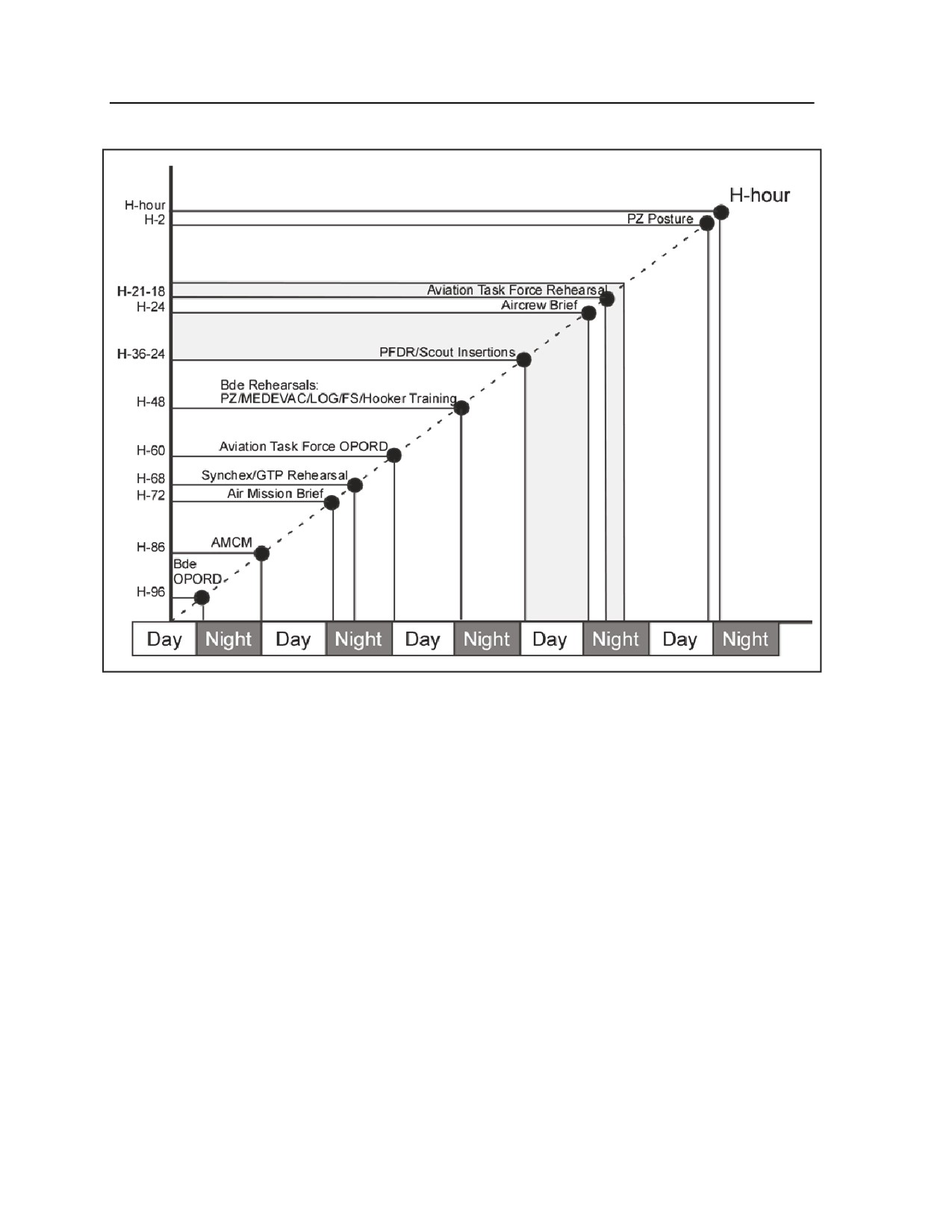
Chapter 3
Figure 3-6. Deliberate air assault planning timeline
3-73. The air assault planning process (figure 3-7, page 3-15) mirrors the steps in MDMP and incorporates
parallel actions necessary to provide the additional time and detailed planning required for successful air
mission execution.
3-14
FM 3-04.113
7 December 2007
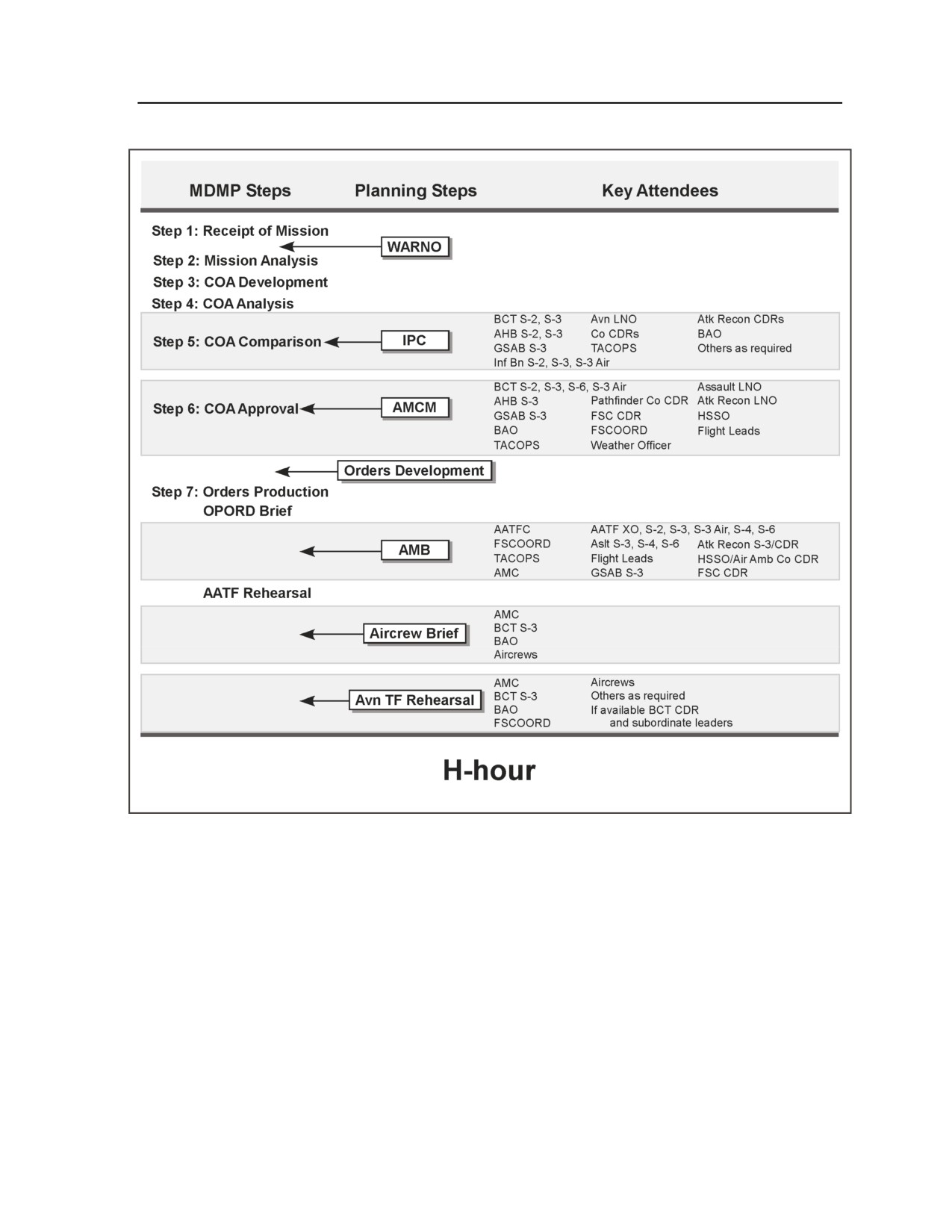
Employment
Figure 3-7. Air assault planning process
TIME CONSTRAINED PLANNING
3-74. Recent combat experience has shown that due to the fluid nature of operations, units are required to
execute air assaults with less than 96 hours from the time of the OPORD. Successful execution of an air
assault under time constrained planning requires parallel planning by all levels of command and units that
are habitually aligned. Figure 3-8, page 3-16, provides a method to reduce the time involved in the
planning process.
7 December 2007
FM 3-04.113
3-15
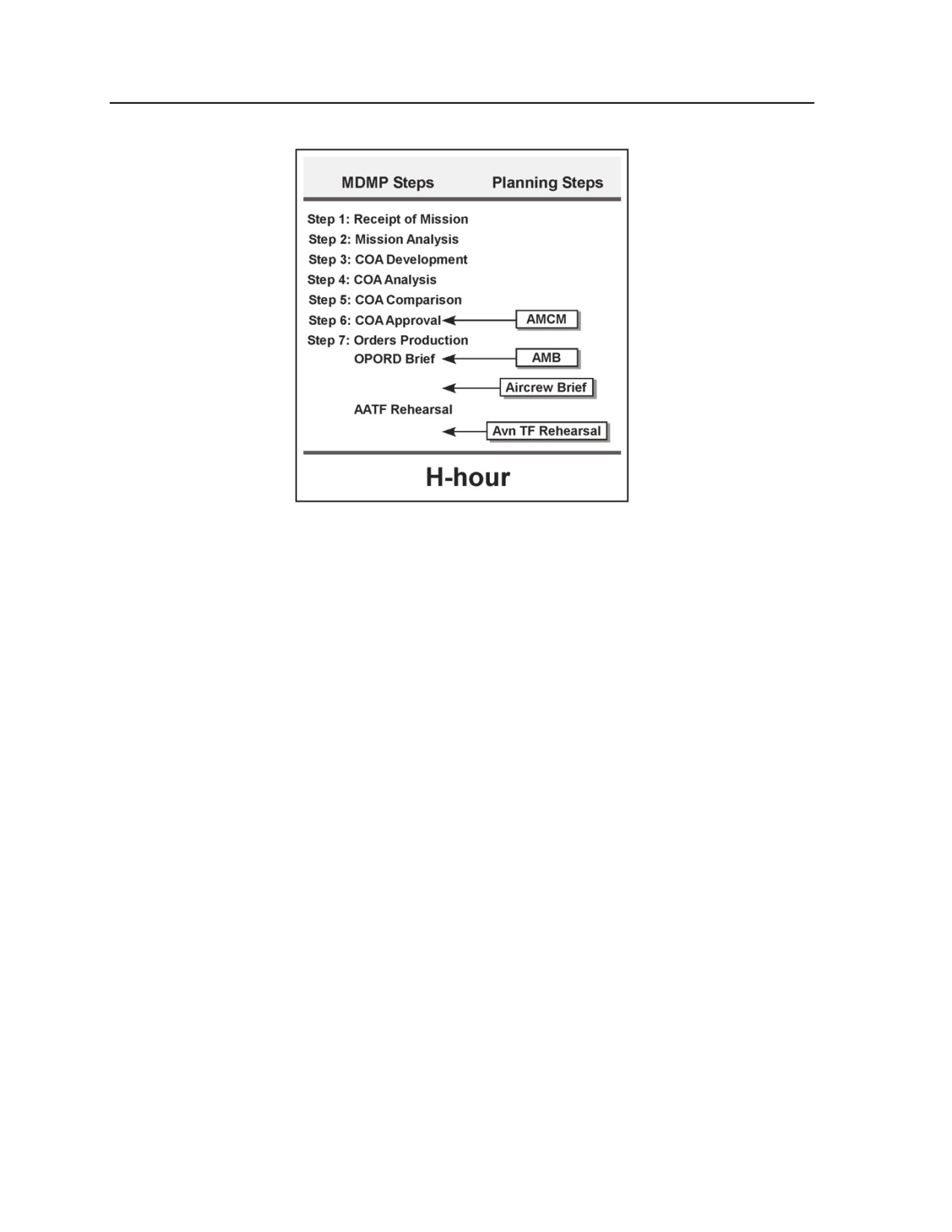
Chapter 3
Figure 3-8. Air assault planning process (time constrained)
THE PLANNING PROCESS
Warning Order
3-75. Air assault planning begins when the aviation unit receives a WARNO from higher HQ for the
upcoming air assault mission. The WARNO specifies the AATFC and task organization. This allows the
aviation commander to dispatch an LNO to the AATF HQ early in the planning phase. Other WARNOs
and FRAGOs should follow as the AATF staff and commander work through the reverse planning
sequence.
Aviation Orders Development
3-76. Throughout the air assault mission planning process, the aviation HQ produces its OPORD, conducts
aircrew briefs at company and serial level, and rehearses the aviation portion of the mission. The OPORD
covers all aviation elements including attack reconnaissance, MEDEVAC, and heavy helicopters. The
AMC and his staff brief other aviation unit commanders at the main CP. Planners comply with the one-
third/two-third rule during the orders process to give subordinate leaders time to prepare. WARNOs and
AMPS maximize preparation time for subordinate echelons.
Initial Planning Conference
3-77. The IPC is the first meeting between the AATF staff and aviation unit. The AMC, LNO, AHB S-2
and S-3, flight leads, ABC, attack reconnaissance security commander, and select aviation brigade staff
personnel should represent the aviation unit. The IPC generally is held at the AATF HQ.
3-78. The AATF staff should have hastily wargamed the concept for the GTP before the IPC, so
assembled planners can discuss and determine LZs, routes, and PZs. If more planning time exists, units
may conduct a subsequent AMCM (similar to the IPC), but this occurs after the GTP and other mission
details are finalized.
3-79. Following the IPC, both ground and aviation staffs should understand the distance and general time
involved for each lift. The staffs should know what forces are planned to be in the first lift and in each
3-16
FM 3-04.113
7 December 2007

Employment
serial of the first lift, and which first-lift serials are going to which LZs and by which route. Subsequent
lifts and follow-on echelon lifts, while discussed at the IPC, can be planned in detail at a later AMCM if
time permits.
Air Movement Table
3-80. The AATF S-3 Air and aviation LNO begin work on the AMT after the IPC. This preparation gives
them an early idea of the challenges involved in relocating units to the LZ with the accurate number of
aircraft available and distance and number of lifts involved. Table 3-2 provides AMT planning guidelines
for light, airborne, or assault divisions with two assault helicopter companies.
Table 3-2. Lift scenarios with two assault companies
One-Way Distance
150
km
100
km
50
km
Number of lifts
2 lifts
4 lifts
6 lifts
Mission Duration
2 hr, 9 min
3 hr, 23 min
2 hr, 56 min
(at 120 kts - actual lift time only)
Aircraft per Lift
16 UH-60 loads;
16 UH-60 loads; 64
16 UH-60 loads; 96
(80% availability)
32 total
total
total
Transportable Troops
11 fully loaded troops/aircraft1
342 (171 per lift)1
684 (171 per lift)1
1,026 (171 per lift)1
16 fully loaded troops/aircraft2
512 (256 per lift)2
1,012 (256 per lift)2
1,536 (256 per lift)2
20 partially loaded troops/aircraft2
640 (320 per lift)2
1,280 (320 per lift)2
1,920 (320 per lift)2
Notes.
1. With seats 2. Without seats
Times indicate en route times only and not times associated with loading/unloading, FARPs, false insertions.
Air Mission Coordination Meeting
3-81. The AMCM provides the conduit for coordination of operational information between ground and
aviation operations officers and key members of the BCT staff. The AMCM is the true “good idea cut-off
point”. All changes must be approved by the BCT S-3, XO, or commander after the AMCM.
3-82. The AMCM is an S-3 level meeting that follows GTP development. The BAE plans the AMCM with
the aviation TF S-3 present. The BCT S-3 chairs the AMCM and is also the final arbitrator. The AMCM is
scheduled to allow sufficient time for maneuver units to establish a specific ground COA, based on the
WARNO and standard planning factors. The AATFC should have already approved the maneuver COA.
3-83. At the AMCM, battalion S-3s brief the concept of their GTP including composition of combat power
required, by echelon, to be delivered to each LZ. It is imperative subordinate S-3s attend this meeting with
an approximate 80 to 90 percent solution on their requirements.
3-84. The meeting is not complete until the AHB LNOs understand the loads each LZ will receive and in
what sequence. Attack reconnaissance LNOs must know which air routes and attack by fire (ABF)/support
by fire positions to utilize, and all must understand the LZs as well as agree on a tentative AMT (with the
start and end times of the first and last serial on the LZ). The BAE is the central figure in coordinating this
information. The brigade S-3, XO, or commander must approve changes after the AMCM. It is critical that
the supported infantry unit and assault planners come to the AMCM with their required information for an
effective meeting to occur. Refer to table 3-3 for a sample AMCM agenda. See appendix D for a sample
AMCM checklist. The end result of the AMCM is a finalized air movement plan, landing plan, air routes,
PZs, and LZs.
7 December 2007
FM 3-04.113
3-17

Chapter 3
Table 3-3. Air mission coordination meeting agenda
Roll call
BAO/S-3 Air
Intelligence update (aviation focused)
BCT S-2
Weather (aviation focused)
Squadron weather officer
GTP and FS (air assault specific)
BCT S-3
Air movement plan (routes)
Assault LNO
Attack reconnaissance aviation concept (en route and LZ)
Attack reconnaissance LNO
Fires (PZ, SEAD, LZ prep)
Fire support coordinator (FSCOORD)
C2 plan
BCT S-6
MEDEVAC/CASEVAC plan
Health service support officer (HSSO)
FARP plan
Assault LNO
Load plan (detailed)
BAO/S-3 Air
Review decisions
BCT S-3
S-3 closing comments
BCT S-3
If scout or pathfinder insertions are conducted, also cover the following: emergency extraction plan/trigger,
alternate communications plan and rehearsals, communications check, and final coordination.
For an artillery raid, include the following: Laager time/location and trigger for extraction.
Air Mission Brief
3-85. The AMB is the final coordination meeting where key air assault personnel brief the plan to the
AATFC for approval. The AMC, aviation S-3, TACOPS officer, aviation S-2, flight lead, serial
commanders, all PCs, essential NCMs, and LNO should attend. If the air assault is planned on a time-
constrained timeline, the S-4 and S-6 should also attend to ensure aviation logistics and signal needs are
coordinated with the AATF staff in a timely manner. The AMC or his S-3 briefs the aviation portion of the
AMB. FM 90-4 contains other information about the AMB. Table 3-4 contains the AMB agenda. Refer to
appendix D for an example of an AMB checklist.
Table 3-4. Air mission brief agenda
Agenda Item
Individual Responsible
Task organization and roll call
AATF S-3
Time hack
AATF S-6
Enemy forces
AATF S-2
Friendly forces
AATF S-3
TF mission
AATF S-3
BCT/battalion commander’s intent
AATFC
Ground scheme of maneuver
AATF S-3
Concept of fires (SEAD and ground tactical)
AATF FSO
Aviation mission
Assault AVN S-3
Staging plan
BCT XO
Loading plan
AATF S-3 Air
Air movement plan
Assault S-3/Mission Lead
Landing plan
Assault S-3/Mission Lead
Laager plan
Assault S-3/Mission Lead
Attack reconnaissance aviation mission/concept
ATK Recon S-3/commander (CDR)
Tasks to subordinate units
AATF S-3
Coordinating instructions
AATF S-3
Service support (FARP plan)
Assault AVN S-4
3-18
FM 3-04.113
7 December 2007

Employment
Table 3-4. Air mission brief agenda
Agenda Item
Individual Responsible
MEDEVAC/CASEVAC plan
HSSO/Air Ambulance Co CDR
Command
AATF S-3
Signal
AATF S-6
Operational risk assessment
AATF S-3
AATFC comments
AATFC
3-86. Seven basic documents should be available at the AMB to assist air-ground integration:
AMT, regulating sequence of flights from PZ to LZ (AATF S-3 Air/aviation LNO).
Tadpole diagram describing each lift’s composition (AATF S-3 Air).
Kneeboard-sized communications cards (AATF signal officer).
Kneeboard PZ diagram (AATF PZCO).
Kneeboard LZ diagram for each primary and alternate LZ (AATF S-3).
Kneeboard sketch of the GTP scheme of maneuver for attack reconnaissance crews (AATF S
3).
Route cards for all ingress/egress routes (AMC/flight lead).
3-87. Additional air assault planning products include—
Air assault execution checklist.
Checklist with codewords permitting communication brevity.
Sequential list of events to ease battle tracking.
FARP sketch(s).
FS graphics.
GTP overlay.
Aircrew Brief
3-88. Subordinate aviation unit and serial commanders brief flight crews. The aircrew brief covers
essential aircrew actions and aviation planning necessary to successfully accomplish the mission.
Rehearsal
3-89. Aviation elements rehearse to synchronize elements. Representatives from the supported unit,
AATF, and supporting units should participate. Aviation units can also conduct rehearsals without
supported ground elements but must include key aviation personnel and start with the GTP/actions on the
objective. AMPS can be a good rehearsal tool. Actual flight rehearsal on similar terrain is another
possibility, given time and resources. For most air assaults, a full-dress rehearsal is desired.
Pickup Zone Update Brief
3-90. The PZ update brief is the final assembly of key leaders prior to conducting the air assault. The
purpose of the brief is to disseminate the most current operational and intelligence information. It is
conducted on the PZ after aircraft arrive so pilots can attend. The following components are reviewed:
enemy situation update, operations update
(target location), communications update, time hack, and
commander’s comments. At the conclusion of the brief, higher HQ is contacted for the final decision to
proceed or terminate the mission.
Abort Criteria
3-91. Abort criteria are a change of one or more conditions that seriously threatens mission success. As
such, they are CCIR relating to any ongoing air assault operation and require command consideration
7 December 2007
FM 3-04.113
3-19
Chapter 3
regarding mission continuation. It is important the AMB clearly defines abort criteria and the AATFC
monitor the criteria throughout conduct of the operation.
3-92. Planners establish proposed abort criteria to assist commanders in deciding when success of the
operation is no longer probable. The AATFC retains authority for abort decisions. Six factors considered to
determine abort criteria for air assault missions are—
Weather. Adverse weather conditions may reduce visibility and degrade effectiveness of
helicopter weapon systems.
Aircraft available. The GTP for an air assault operation depends on the rapid massing of
combat power at the critical place. The number of aircraft available determines how rapid the
AATF can build its combat power on the objective.
Time. Times are set so the AATF operates during periods that will ensure mission success to
include required time on the objective, time of day, and crew endurance.
Mission essential combat power. Abort criteria are used to ensure friendly forces have the
required combat ratio for the operation.
Mission criticality. The success of other units and future operations may depend on the seizing
of the air assault objective. Therefore, some air assault operations may proceed despite the
presence of circumstances that would normally abort the mission.
Enemy. Changes in enemy situation on or en route to the objective can cause the mission to be
aborted.
Condition Setting
3-93. Conditions are set for all air assault operations. Condition setting includes both lethal and nonlethal
systems against enemy forces and systems that can affect the assaulting force. Normally, 3 days are
allocated for condition setting. The threat and ability to assess the impact of condition setting determines
the duration. The purpose of condition setting is to limit and/or mitigate risk to an acceptable level. The
same criteria and process apply to most aviation missions, thus they can be adapted for use with other
missions.
3-94. Condition setting follows the decide, detect, deliver, and assess (D3A) targeting process. In this
iterative process of setting conditions, unacceptable risks can be negated until final conditions are
acceptable to launch the air assault.
Air Assault Security
3-95. Reconnaissance and security elements may precede the AATF and protect it en route using lethal and
nonlethal means. J-SEAD fires, attack reconnaissance helicopters, Pathfinders, ground scouts, LRS teams,
the Joint Surveillance Target Attack Radar System (JSTARS), UAS, and EW are among the assets that can
disrupt enemy communications, radars, and air support.
3-96. Attack reconnaissance assets can provide LZ and PZ reconnaissance and security as well as en route
security based on METT-TC. Refer to FM 3-04.126 for additional information on attack reconnaissance air
assault security.
Backhaul of Casualties During Air Assault Operations
3-97. During air assault planning, the AATF staff and AMC plan the combined use of aeromedical
evacuation (see section V) and aerial CASEVAC (see section VI). While assaulting aircraft may evacuate
wounded from the PZ, the time required to load and unload casualties could desynchronize the AMT. If
possible, separate CASEVAC aircraft should be used.
3-98. The AATF plans a means of marking the CCP for aircrew identification. Preferred signaling
methods include smoke or panel markers during the day and strobe or chemical lights (not blue-green) at
night. If air assault crews evacuate casualties, they must know where to take them and how to rejoin
3-20
FM 3-04.113
7 December 2007
Employment
remaining lift aircraft for subsequent lifts. Using a backhaul LZ within the normal assault PZ, FARP, or
both can minimize disruption of the loading plan while helping maintain serial integrity.
3-99. The backhaul of casualties on an air assault is a critical mission for assault helicopters, and one
requiring detailed planning to execute successfully. During the planning stages of the air assault, the AATF
S-3, S-3 Air, AMC, aviation S-3, and LNO must be involved. If the AATF commander's intent is to
backhaul casualties, then planning must include the considerations discussed in the following paragraphs.
Note. CASEVAC aircraft and crews do not include medical personnel, are not able to provide en
route medical care, and are not protected under the Geneva Convention.
Air Assault Task Force Commander's Intent
3-100. The AATFC must clearly state his intent for casualty backhaul during the air assault. The AMC
must inform the commander of the tradeoff between using assault helicopters for backhaul and continuing
with the air assault. If the AATF takes casualties early in an air assault operation, it may become necessary
to reduce the amount of assault helicopters to accomplish backhaul of casualties. The AATFC should
determine the number of aircraft he can bump from the air assault to pick up casualties. He may decide not
to bump any and conduct all MEDEVAC or CASEVAC after completion of the air assault, or he may
designate aircraft in each lift (such as the last two aircraft) for backhaul of casualties from the LZ. It is
imperative the AMC understands the AATFC's intent on casualty backhaul and advises him on COAs.
Signaling
3-101. Night operations provide a significant challenge for casualty backhaul operations. Light signals
should be planned so aircraft arriving at the LZ can be prepared to accept casualties. For example, a
flashlight or chemical light (not blue-green) coming from the designated LZ casualty location may indicate
there are casualties to be backhauled. Through this signal, the aircrews know they must remain on the LZ
and be prepared to accept casualties.
Communications
3-102. Once established in the LZ, communications on the CAN or predesignated radio net can alert the
flight of the necessity to backhaul casualties from the LZ.
Designated Area for Casualty Drop Off
3-103. The AATF should designate a specific area in the LZ for casualties. This designation will facilitate
rapid movement and minimize ground time in the LZ for the aircraft. Since most air assaults occur at night,
it is critical the CCP be designated and all members of the AATF know its location. The aircrews, as they
arrive at the LZ, will be able to focus on the CCP and prepared to accept casualties.
3-104. The AATF commander must decide where to transport casualties if they occur during the air
assault. During the planning process, the AATFC should develop a plan for the use of MEDEVAC
helicopters. As assault aircraft drop off casualties, they can be loaded onto a MEDEVAC aircraft for
transportation to higher level care facilities. Options include the PZ, forward support medical company at
the brigade support area (BSA), or another designated area. Considerations for selecting a CCP include—
Casualty status. A site should be selected that is secure and has medical personnel ready to
accept casualties.
Aircraft availability. Aircraft conducting casualty backhaul will separate from the serial at
some point. The AATF commander must be prepared to affect the bump plan if aircraft carrying
casualties do not return to the PZ for the next lift.
Confusion. A CCP should be selected so it does not interfere with the air assault still in
progress. Aircraft arriving at the PZ full of casualties may cause confusion on the PZ as troops
are trying to load and casualties are being unloaded from the aircraft.
7 December 2007
FM 3-04.113
3-21