FM 5-0 THE OPERATIONS PROCESS (MARCH 2010) - page 5

Army Operation Plan and Order Format
Table E-2. List of attachments and responsible staff officers (continued)
ANNEX F - SUSTAINMENT (Chief of Sustainment [S-4])
Appendix 1 - Logistics (G-4 [S-4])
Appendix 2 - Personnel Services Support
Appendix 3 - Army Heath System Support (Surgeon)
ANNEX G - Engineer
Appendix 1 - Mobility/Countermobility
Appendix 2 - Survivability (Engineer Officer)
Appendix 3 - General Engineering
Appendix 4 - Geospatial Engineering
Appendix 5 - Engineer Task Organization and Execution Matrix
Appendix 6 - Environmental Considerations
ANNEX H - SIGNAL (G-6 [S-6])
Appendix 1 - Information Assurance
Appendix 2 - Voice and Data Network Diagrams
Appendix 3 - Satellite Communications
Appendix 4 - Foreign Data Exchanges
Appendix 5 - Electromagnetic Spectrum Operations
ANNEX I
- Not Used
ANNEX J - INFORM AND INFLUENCE ACTIVITIES (G-7 [S-7])
Appendix 1 - Public Affairs
Appendix 2 - Military Deception
Appendix 3 - Military Information Support Operations
Appendix 4 - Soldier and Leader Engagement
ANNEX K - CIVIL AFFAIRS OPERATIONS (G-9 [S-9])
ANNEX L - INTELLIGENCE, SURVEILLANCE, AND RECONNAISSANCE (G-3 [S-3])
Appendix 1 - Intelligence, Surveillance, and Reconnaissance Overlay
Appendix 2 - Intelligence, Surveillance, and Reconnaissance Tasking Matrix
ANNEX M - ASSESSMENT (G-5 [S-5] or G-3 [S-3])
ANNEX N - SPACE OPERATIONS (Space Operations Officer)
ANNEX O - Not Used
ANNEX P - HOST-NATION SUPPORT (G-4 [S-4])
ANNEX Q - Spare
ANNEX R - REPORTS (G-3 [S-3])
ANNEX S - SPECIAL TECHNICAL OPERATIONS
ANNEX T - Spare
ANNEX U - INSPECTOR GENERAL
ANNEX V - INTERAGENCY COORDINATION (G-3 [S-3])
ANNEX W - Spare
ANNEX X - Spare
ANNEX Y - Spare
ANNEX Z - DISTRIBUTION (G-3 [S-3])
18 March 2011
FM 5-0, C1
E-17
Appendix E
E-61. Figure E-3 is an example of an annotated attachment format. Figure E-4, page E-20, illustrates a
sample WARNO. Figure E-5, page E-22, illustrates a sample FRAGO.
[CLASSIFICATION]
(Change from verbal orders, if any)
Copy ## of ## copies
Issuing headquarters
Place of issue
Date-time group of signature
Message reference number
Include heading if attachment is distributed separately from the base order or higher-level attachment.
[Attachment type and number/letter] [(attachment title)] TO [higher-level attachment type and
number/letter, if applicable] [(higher-level attachment title, if applicable)] TO OPERATION
PLAN/ORDER [number] [(code name)] [(classification of title)]
References:
Time Zone Used Throughout the Order:
1.
(U) Situation. Include information affecting the functional area that paragraph
1 of the
OPLAN/OPORD does not cover or that needs to be expanded.
a. (U) Area of Interest. Refer to Annex B (Intelligence) as required.
b. (U) Area of Operations. Refer to Appendix 2 (Operation Overlay) to Annex C (Operations).
(1) (U) Terrain. List all critical terrain aspects that impact functional area operations. Refer to
Tab A (Terrain) to Appendix 1 (Intelligence Estimate) to Annex B (Intelligence) as required.
(2) (U) Weather. List all critical weather aspects that impact functional area operations. Refer
to Tab B (Weather) to Appendix 1 (Intelligence Estimate) to Annex B (Intelligence) as required.
c. (U) Enemy Forces. List known and templated locations and activities of enemy functional area
units for one echelon up and two echelons down. List enemy maneuver and other area capabilities that
will impact friendly operations. State expected enemy courses of action and employment of enemy
functional area assets. Refer to Annex B (Intelligence) as required.
d. (U) Friendly Forces. Outline the higher headquarters’ plan as it pertains to the functional area.
List designation, location, and outline of plan of higher, adjacent, and other functional area assets that
support or impact the issuing headquarters or require coordination and additional support.
e. (U) Interagency, Intergovernmental, and Nongovernmental Organizations. Identify and describe
other organizations in the area of operations that may impact the conduct of functional area operations
or implementation of functional area-specific equipment and tactics.
f. (U) Civil Considerations. Refer to Annex K (Civil Affairs Operations) as required.
g. (U) Attachments and Detachments. List units attached or detached only as necessary to clarify
task organization.
h.
(U) Assumptions. List any functional area-specific assumptions that support the annex
development.
[page number]
[CLASSIFICATION]
±Figure E-3. Annotated attachment format (general)
E-18
FM 5-0, C1
18 March 2011
Army Operation Plan and Order Format
[CLASSIFICATION]
[Attachment type and number/letter] [(attachment title)] TO [higher-level attachment type and
number/letter, if applicable] [(higher-level attachment title, if applicable)] TO OPERATION
PLAN/ORDER [number] [(code name)]—[issuing headquarters] [(classification of title)]
2. (U) Mission. State the mission of the functional area in support of the base plan or order.
3. (U) Execution.
a. (U) Scheme of Support. Describe how the functional area supports the commander’s intent and
concept of operations. Establish the priorities of support to units for each phase of the operation. Refer
to Annex C (Operations) as required.
b. (U) Tasks to Subordinate Units. List functional area tasks assigned to specific subordinate units
not contained in the base order.
c. (U) Coordinating Instructions. List only instructions applicable to two or more subordinate units
not covered in the base order.
4.
(U) Sustainment. Identify priorities of sustainment for functional area key tasks and specify
additional instructions as required. Refer to Annex F (Sustainment) as required.
5. (U) Command and Signal.
a. (U) Command. State the location of key functional area leaders.
b. (U) Control. State the functional area liaison requirements not covered in the base order.
c. (U) Signal. Address any functional area-specific communications requirements or reports. Refer
to Annex H (Signal) as required.
ACKNOWLEDGE: Include only if attachment is distributed separately from the base order.
OFFICIAL:
[Authenticator’s name]
[Authenticator’s position]
Either the commander or coordinating staff officer responsible for the functional area may sign
attachments.
ATTACHMENT: List lower level attachments.
DISTRIBUTION: Show only if distributed separately from the base order or higher-level attachments.
[page number]
[CLASSIFICATION]
Figure E-3. Annotated attachment format (general) (continued)
18 March 2011
FM 5-0, C1
E-19
Appendix E
[CLASSIFICATION]
(Change from verbal orders, if any) (Optional)
[Heading data is the same as for OPLAN/OPORD]
WARNING ORDER [number]
(U) References: Refer to higher headquarters’ OPLAN/OPORD and identify map sheets for operation
(Optional).
(U) Time Zone Used Throughout the OPLAN/OPORD: (Optional).
(U) Task Organization: (Optional).
1.
(U) Situation. The situation paragraph describes the conditions and circumstances
of
the
operational environment that impact operations in the following subparagraphs:
a. (U) Area of Interest.
b. (U) Area of Operations.
c. (U) Enemy Forces.
d. (U) Friendly Forces.
e. (U) Interagency, Intergovernmental, and Nongovernmental Organizations.
f. (U) Civil Considerations.
g. (U) Attachments and Detachments. Provide initial task organization.
h. (U) Assumptions. List any significant assumptions for order development.
2. (U) Mission. State the issuing headquarters’ mission.
3. (U) Execution.
a. (U) Initial Commander’s Intent. Provide brief commander’s intent statement.
b. (U) Concept of Operations. This may be “to be determined” for an initial WARNO.
c. (U) Tasks to Subordinate Units. Include any known tasks at time of issuance of WARNO.
d. (U) Coordinating Instructions.
4. (U) Sustainment. Include any known logistics, personnel, or Army health system preparation tasks.
5. (U) Command and Signal. Include any changes to the existing order or state “no change.”
[page number]
[CLASSIFICATION]
±Figure E-4. Annotated WARNO format
E-20
FM 5-0, C1
18 March 2011
Army Operation Plan and Order Format
[CLASSIFICATION]
(Change from verbal orders, if any) (Optional)
[Heading data is the same as for OPLAN/OPORD]
WARNING ORDER [number]
ACKNOWLEDGE:
[Commander’s last name]
[Commander’s rank]
OFFICIAL:
[Authenticator’s name]
[Authenticator’s position]
ANNEXES:
DISTRIBUTION:
[page number]
[CLASSIFICATION]
Figure E-4. Annotated WARNO format (continued)
18 March 2011
FM 5-0, C1
E-21
Appendix E
[CLASSIFICATION]
(Change from verbal orders, if any) (Optional)
Copy ## of ## copies
Issuing headquarters
Place of issue
Date-time group of signature
Message reference number
FRAGMENTARY ORDER [number]
(U) References: Refer to higher the order being modified.
(U) Time Zone Used Throughout the OPLAN/OPORD:
(U) Task Organization: List changes to the task organization.
1. (U) Situation. Include any changes to the existing order or state “No change.” For example, “No
change to OPORD 03-XX.”
2. (U) Mission. State “No change.”
3. (U) Execution. Include any changes or state “No change.”
a. (U) Commander’s Intent. Include any changes or state “No change.”
b. (U) Concept of Operations. Include any changes or state “No change.”
c. (U) Scheme Movement and Maneuver. Include any changes or state “No change.”
d. (U) Scheme of Intelligence. Include any changes or state “No change.”
e. (U) Scheme of Fires. Include any changes or state “No change.”
f. (U) Scheme of Protection. Include any changes or state “No change.”
g. (U) Stability Operations. Include any changes or state “No change.”
h. (U) Assessment. Include any changes or state “No change.”
i. (U) Tasks to Subordinate Units. Include any changes or state “No change.”
j. (U) Coordinating Instructions. Include any changes or state “No Change.”
4. (U) Sustainment. Include any changes or state “No change.”
5. (U) Command and Signal. Include any changes or state “No change.”
ACKNOWLEDGE:
[Commander’s last name]
[Commander’s rank]
OFFICIAL:
[Authenticator’s name]
[Authenticator’s position]
ANNEXES:
DISTRIBUTION:
[page number]
[CLASSIFICATION]
±Figure E-5. Annotated sample FRAGO
E-22
FM 5-0, C1
18 March 2011
Army Operation Plan and Order Format
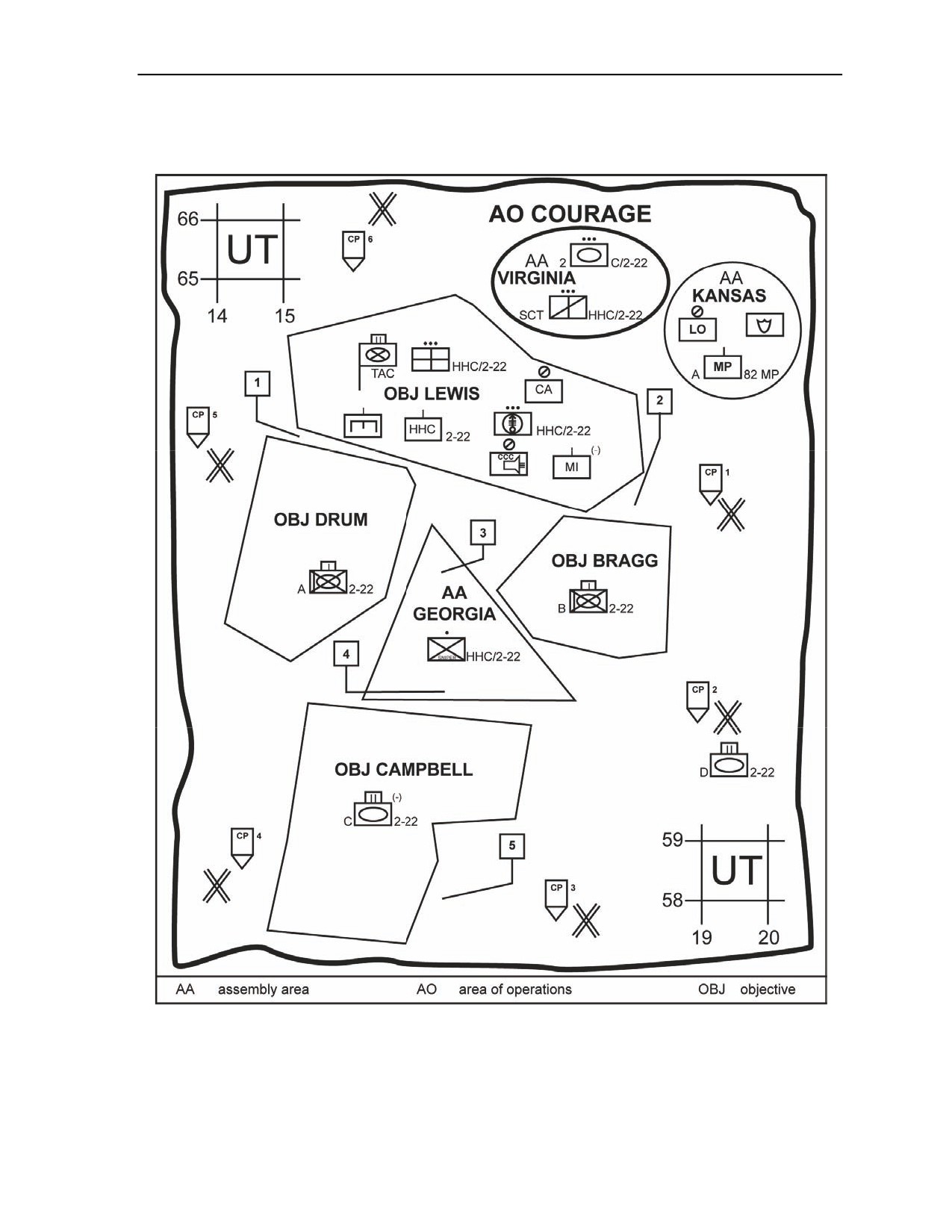
E-62. ±Figure E-6 is a sample overlay order graphic with text.
±Figure E-6. Example of overlay order graphic
18 March 2011
FM 5-0, C1
E-23
Appendix F
Task Organization
This appendix discusses the fundamentals of task organization, including command
and support relationships. It provides instructions, formats and examples for listing
task organization, and unit listing sequence. See JP 1 for doctrine on joint command
and control relationships.
FUNDAMENTAL CONSIDERATIONS
F-1. A task organization is a temporary grouping of forces designed to accomplish a particular mission
(FM 3-0). Task-organizing is the act of designing an operating force, support staff, or logistic package of
specific size and composition to meet a unique task or mission. Characteristics to examine when task-
organizing the force include, but are not limited to: training, experience, equipage, sustainability, operating
environment, enemy threat, and mobility. For Army forces, it includes allocating available assets to
subordinate commanders and establishing their command and support relationships (FM 3-0). Command
and support relationships provide the basis for unity of command in operations.
Note: Army command relationships are similar but not identical to joint command authorities
and relationships. (See FM 3-0.) Differences stem from the way Army forces task-organize
internally and the need for a system of support relationships between Army forces. Another
important difference is the requirement for Army commanders to handle the administrative
control requirements.
F-2.
±Military units consist of organic components. Organic parts of a unit are those forming an essential
part of the unit and are listed in its table of organization and equipment. Commanders can alter
organizations’ organic unit relationships to better allocate assets to subordinate commanders. They also can
establish temporary command and support relationships to facilitate exercising mission command.
F-3. Establishing clear command and support relationships is fundamental to organizing for any
operation. These relationships establish clear responsibilities and authorities between subordinate and
supporting units. Some command and support relationships (for example, tactical control) limit the
commander’s authority to prescribe additional relationships. Knowing the inherent responsibilities of each
command and support relationship allows commanders to effectively organize their forces and helps
supporting commanders to understand their unit’s role in the organizational structure.
F-4. Commanders designate command and support relationships to weight the decisive operation and
support the concept of operations. Task organization also helps subordinate and supporting commanders
support the commander’s intent. These relationships carry with them varying responsibilities to the
subordinate unit by the parent and gaining units as listed in table F-1 and table F-2, pages F-3 and F-4
respectively. Commanders consider two organizational principles when task-organizing forces:
z
Maintain cohesive mission teams.
z
Do not exceed subordinates’ span of control capabilities.
F-5. When possible, commanders maintain cohesive mission teams. They organize forces based on
standing headquarters, their assigned forces, and habitual associations when possible. When not feasible
and ad hoc organizations are created, commanders arrange time for training and establishing functional
working relationships and procedures. Once commanders have organized and committed a force, they keep
its task organization unless the benefits of a change clearly outweigh the disadvantages. Reorganizations
may result in a loss of time, effort, and tempo. Sustainment considerations may also preclude quick
reorganization.
18 March 2011
FM 5-0, C1
F-1
Appendix F
F-6.
±Commanders carefully avoid exceeding the span of control capabilities of subordinates. Span of
control refers to the number of subordinate units under a single commander. This number is situation
dependent and may vary. As a rule, commanders can effectively command two to six subordinate units.
Allocating subordinate commanders more units gives them greater flexibility and increases options and
combinations. However, increasing the number of subordinate units increases the number of decisions to be
made in a timely fashion.
F-7. Running estimates and course of action (COA) analysis of the military decisionmaking process
provide information that help commanders determine the best task organization. An effective task
organization—
z
Facilitates the commander’s intent and concept of operations.
z
Retains flexibility within the concept of operations.
z
Adapts to conditions imposed by mission variables.
z
Accounts for the requirements to conduct essential stability tasks for populations within an area
of operation.
z
Creates effective combined arms teams.
z
Provides mutual support among units.
z
Ensures flexibility to meet unforeseen events and support future operations.
z
Allocates resources with minimum restrictions on their employment.
z
Promotes unity of command.
z
Offsets limitations and maximizes the potential of all forces available.
z
Exploits enemy vulnerabilities.
F-8. Creating an appropriate task organization requires understanding—
z
The mission, including the higher commander’s intent and concept of operations.
z
The fundamentals of full spectrum operations
(see FM 3-0), basic tactical concepts
(see
FM 3-90), and the fundamentals of stability (see FM 3-07).
z
The roles and relationships among the warfighting functions.
z
The status of available forces, including morale, training, and equipment capabilities.
z
Specific unit capabilities, limitations, strengths, and weaknesses.
z
The risks inherent in the plan.
F-9. During COA analysis, commanders identify what resources they need, and where, when, and how
frequently they will need them. Formal task organization and the change from generic to specific units
begin after COA analysis when commanders assign tasks to subordinate commanders. Staffs assign tasks to
subordinate headquarters and determine if subordinate headquarters have enough combat power,
reallocating combat power as necessary. They then refine command and support relationships for
subordinate units and decide the priorities of support. Commanders approve or modify the staff’s
recommended task organization based on their evaluation of the factors (listed in paragraphs F-7 and F-8)
and information from running estimates and COA analysis. (Appendix B defines and describes the military
decisionmaking process.)
F-10. In allocating assets, the commander and staff consider the—
z
Task organization for the ongoing operation.
z
Potential adverse effects of breaking up cohesive teams by changing the task organization.
z
Time necessary to realign the organization after receipt of the task organization.
z
Limits on control over supporting units provided by higher headquarters.
ARMY COMMAND AND SUPPORT RELATIONSHIPS
F-11. Army commanders build combined arms organizations using command and support relationships.
Command relationships define command responsibility and authority. Support relationships define the
purpose, scope, and effect desired when one capability supports another.
F-2
FM 5-0, C1
18 March 2011

Task Organization
ARMY COMMAND RELATIONSHIPS
F-12. Table F-1 lists the Army command relationships. Command relationships define superior and
subordinate relationships between unit commanders. By specifying a chain of command, command
relationships unify effort and enable commanders to use subordinate forces with maximum flexibility.
Army command relationships identify the degree of control of the gaining Army commander. The type of
command relationship often relates to the expected longevity of the relationship between the headquarters
involved and quickly identifies the degree of support that the gaining and losing Army commanders
provide. (See FM 3-0 for additional discussion on command relationships.)
Table F-1. Army command relationships
Then inherent responsibilities:
Can
Unless
impose on
If
modified,
Establish/
Have
May be
Are
Have
gaining
relation-
ADCON
maintain
command
task
assigned
Provide
priorities
unit further
have
communi-
ship is:
relation-
organized
position
liaison to:
establish-
command
responsi-
cations
ship with:
by:1
or AO by:
ed by:
or support
bility
with:
relation-
through:
ship of:
Army HQ
Attached;
All organic
specified
OPCON;
forces
Organic
Organic
Organic
Organic HQ
in
N/A
N/A
TACON;
organized
HQ
HQ
organizing
GS; GSR;
with the HQ
document
R; DS
As
ASCC or
OPCON
As required
Combatant
Gaining
required
As required
Service-
Assigned
Gaining HQ
chain of
by OPCON
command
Army HQ
by
by OPCON
assigned
command
HQ
OPCON
HQ
Attached;
As
Unit to
OPCON;
Gaining
Gaining
Gaining
required
Gaining
Attached
Gaining unit
which
TACON;
unit
Army HQ
unit
by gaining
unit
attached
GS; GSR;
unit
R; DS
Parent unit
and gaining
As
As required
OPCON;
unit; gaining
Gaining
Parent
Gaining
required
by gaining
Gaining
TACON;
OPCON
unit may
unit
unit
unit
by gaining
unit and
unit
GS; GSR;
pass
unit
parent unit
R; DS
OPCON to
lower HQ1
As
As required
Gaining
Parent
Gaining
required
by gaining
Gaining
TACON;GS
TACON
Parent unit
unit
unit
unit
by gaining
unit and
unit
GSR; R; DS
unit
parent unit
Note: 1 In NATO, the gaining unit may not task organize a multinational force. (See TACON.)
ADCON administrative control
HQ
headquarters
AO
area of operations
N/A
not applicable
ASCC
Army Service component command
NATO
North Atlantic Treaty Organization
DS
direct support
OPCON
operational control
GS
general support
R
reinforcing
GSR
general support-reinforcing
TACON
tactical control
ARMY SUPPORT RELATIONSHIPS
F-13. Table F-2 on page F-4 lists Army support relationships. Army support relationships are not a
command authority and are more specific than the joint support relationships. Commanders establish
26 March 2010
FM 5-0
F-3

Appendix F
support relationships when subordination of one unit to another is inappropriate. They assign a
supportrelationship when—
z
The support is more effective if a commander with the requisite technical and tactical expertise
controls the supporting unit rather than the supported commander.
z
The echelon of the supporting unit is the same as or higher than that of the supported unit. For
example, the supporting unit may be a brigade, and the supported unit may be a battalion. It
would be inappropriate for the brigade to be subordinated to the battalion; hence, the echelon
uses an Army support relationship.
z
The supporting unit supports several units simultaneously. The requirement to set support
priorities to allocate resources to supported units exists. Assigning support relationships is one
aspect of mission command.
Table F-2. Army support relationships
Then inherent responsibilities:
Can
impose on
Are
If
Establish/
gaining
Have
May be
Receive
assigned
Have
relation-
maintain
unit
command
task
sustain-
position or
Provide
priorities
communi-
further
ship is:
relation-
organized
ment
an area of
liaison to:
established
cations
command
ship with:
by:
from:
operations
by:
with:
or support
by:
relation-
ship by:
Parent unit;
Direct
Parent
Parent
Parent
Supported
Supported
Supported
supported
See note1
support1
unit
unit
unit
unit
unit
unit
unit
Parent unit;
Reinforced
Reinforc-
Parent
Parent
Parent
Reinforced
Reinforced
Not
reinforced
unit; then
ing
unit
unit
unit
unit
unit
applicable
unit
parent unit
General
Reinforced
Reinforced
Parent unit;
support-
Parent
Parent
Parent
unit and as
unit and as
then
Not
Parent unit
reinforc-
unit
unit
unit
required by
required by
reinforced
applicable
ing
parent unit
parent unit
unit
As required
As required
General
Parent
Parent
Parent
Not
Parent unit
by parent
by parent
Parent unit
support
unit
unit
unit
applicable
unit
unit
Note: 1 Commanders of units in direct support may further assign support relationships between their subordinate units and
elements of the supported unit after coordination with the supported commander.
F-14. Army support relationships allow supporting commanders to employ their units’ capabilities to
achieve results required by supported commanders. Support relationships are graduated from an exclusive
supported and supporting relationship between two units—as in direct support—to a broad level of support
extended to all units under the control of the higher headquarters—as in general support. Support
relationships do not alter administrative control. Commanders specify and change support relationships
through task organization.
TASK ORGANIZATION FORMAT
F-15. Task organization is typically displayed in an outline format in Annex A of the operation plan or
order. Units are listed under the headquarters to which they are allocated or that they support. (See
figure F-1.) This format is recognized and understood by the other Services and multinational forces and
should be used during joint and multinational operations.
F-4
FM 5-0
26 March 2010
Task Organization
2/52 HBCT
116 HBCT (+)
52 CAB AASLT
1-77 IN (-)
3-116 AR
HHC/52 CAB
1-30 AR (-)
1-163 IN
1/B/1-77 IN (DIV QRF)
(OPCON)
1-20 CAV
2-116 AR
A/4-52 CAV (ARS) (DS)
1-148 FA
1-52 AV (ARB) (-)
2-606 FA (2x8)
145 BSB
4-52 CAV (ARS) (-)
TACP/52 ASOS (USAF)
4/B/2-52 AV (GSAB) (TACON)
3-52 AV (ASLT) (-)
521 BSB
4/2/311 QM CO (MA)
2-52 AV (GSAB)
2/2/311 QM CO (MA)
4/577 MED CO (GRD AMB)
1 (TUAS)/B/52 BSTB (-) (GS)
1/B/2-52 AV (GSAB) (TACON)
844 FST
2/694 EN CO (HORIZ) (DS)
2/577 MED CO (GRD AMB)
116 BSTB
(attached)
366 EN CO (SAPPER) (DS)
52 FIRES BDE
842 FST
HHB
1/401 EN CO (ESC) (DS)
2 BSTB
2/244 EN CO (RTE CL) (DS)
TAB (-)
31 EN CO (MRBC) (DS)
52 EOD
1-52 FA (MLRS)
63 EOD
1/301 MP CO
3-52 FA (-) (M109A6)
2/244 EN CO (RTE CL) (DS)
1/3/1/55 SIG CO (COMCAM)
1/694 EN CO (HORIZ) (DS)
1/2/1/55 SIG CO (COMCAM)
1/467 CM CO (MX) (S)
2D MP PLT
C/388 CA BN
17 MEB 52 ID
RTS TM 1/A/52 BSTB
116 MP PLT
25 CM BN (-)
RTS TM 2/A/52 BSTB
700 MP BN
RTS TM 3/A/52 BSTB
87 IBCT
7 EN BN
RTS TM 4/A/52 BSTB
1-80 IN
2/2/1/55 SIG CO (COMCAM)
2-80 IN
11 ASOS (USAF)
2/54 HBCT
3-13 CAV
4-77 IN
52 SUST BDE
A/3-52 AV (ASLT) (DS)
2-30 AR
B/1-52 AV (ARB) (DS)
52 BTB
3-20 CAV
C/4-52 CAV (ARS) (-) (DS)
520 CSSB
2/C/4-52 CAV (ARS) (DS)
2-636 FA
521 CSSB
2-607 FA
A/3-52 FA (+)
10 CSH
TACP/52 ASOS (USAF)
TACP/52 ASOS (USAF)
168 MMB
105 BSB
Q37 52 FA BDE (GS)
3/2/311 QM CO (MA)
99 BSB
52 HHB
2/B/2-52 AV (GSAB) (TACON)
845 FST
A/1-30 AR (DIV RES)
843 FST
1/577 MED CO (GRD AMB)
35 SIG CO (-) (DS)
3/577 MED CO (GRD AMB)
3/B/2-52 AV (GSAB) (TACON)
154 LTF
3 BSTB
1/2/311 QM CO (MA)
2/1/55 SIG CO (-)
A 388 CA BN
87 BSTB
14 PAD
1/244 EN CO (RTE CL) (DS)
388 CA BN (-) (DS)
53 EOD
763 EOD
3/2/1/55 SIG CO (COMCAM)
2/2/1/55 SIG CO (COMCAM)
B/420 CA BN
3D MP PLT
2 HCT/3/B/52 BSTB
745 EN CO (MAC) (DS)
1/1/52 CM CO (R/D) (R)
2/467 CM CO (MX) (S)
1/1102 MP CO (CS) (DS)
±Figure F-1. Sample outline format for a task organization (52d Infantry Division)
18 March 2011
FM 5-0, C1
F-5
Appendix F
AASLT air assault
EOD explosive ordnance disposal
MLRS multiple launch rocket
AR
armor
ESC
expeditionary sustainment
system
ARB
attack reconnaissance
command
MMB multifunctional medical
battalion
FA
field artillery
battalion
ARS
attack reconnaissance
FST
forward surgical team
MP
military police
squadron
GRD AMB ground ambulance
MRBC
multi-role bridge company
ASLT assault
GS
general support
MX
mechanized
ASOS air support operations
GSAB
general support aviation
OPCON operational control
squadron
battalion
PAD
public affairs detachment
AV
aviation
HBCT heavy brigade combat team
PLT
platoon
BDE
brigade
HCT
human intelligence
QM
quartermaster
BN
battalion
collection team
QRF
quick reaction force
BSB
brigade support battalion
HHB headquarters and
R
reinforcing
BSTB
brigade special troops
headquarters battalion
R/D
reconnaissance/
battalion
HHC headquarters and
decontamination
BTB
brigade troop battalion
headquarters company
RES
reserve
CA
civil affairs
HORIZ horizontal
RTE CL
route clearance
CAB
combat aviation brigade
IBCT
infantry brigade combat
RTS
retransmission
CAV
cavalry
team
S
smoke
CM
chemical
ID
infantry division
SIG
signal
CO
company
IN
infantry
SUST
sustainment
COMCAM combat camera
LTF
logistics task force
TAB
target acquisition battery
CS
combat support
MA
mortuary affairs
TACON
tactical control
CSH
combat support hospital
MAC
mobility augmentation
TACP
tactical air control party
CSSB
combat sustainment support
company
TM
team
battalion
MEB maneuver enhancement
TUAS
tactical unmanned aircraft
DIV
division
brigade
system
DS
direct support
MED medical
USAF United States Air Force
EN
engineer
Figure F-1. Sample outline format for a task organization (52d Infantry Division) (continued)
F-16. ±List subordinate units under the headquarters to which they are assigned, attached, or in support.
Place direct support (DS) units below the units they support. Indent subordinate and supporting units two
spaces. Identify relationships other than attached with parenthetical terms—for example, general support
(GS) or (DS).
±UNIT LISTING SEQUENCE
F-17. List major subordinate control headquarters in the sequence shown in table F-3. If applicable, list
task organizations according to the phases of the operation during which it applies.
F-18. Group units by controlling headquarters. List major subordinate maneuver units first (for example,
2d HBCT; 1-77th IN; A/4-52d CAV). Place them in alphabetical or numerical order. List brigade combat
teams ahead of brigades, combined arms battalions before battalions, and company teams before
companies. Follow maneuver headquarters with the field artillery
(for example, fires brigade after
maneuver brigades), intelligence units, maneuver enhancement units, and the sustainment units. The last
listing should be any special troops units under the control of the force headquarters.
F-19. Use a plus
(+) symbol when attaching one or more subelements of a similar function to a
headquarters. Use a minus symbol (-) when deleting one or more subelements of a similar function to a
headquarters. Always show the symbols in parenthesis. Do not use a plus symbol when the receiving
headquarters is a combined arms task force or company team. Do not use plus and minus symbols together
(as when a headquarters detaches one element and receives attachment of another); use the symbol that
portrays the element’s combat power with respect to other similar elements. Do not use either symbol when
two units swap subelements and their combat power is unchanged. Here are some examples:
z
C Company loses one platoon to A Company; the battalion task organization will show A Co.
(+) and C Co. (-).
z
4-77th Infantry receives a tank company from 1-30 Armor; the brigade task organization will
show TF 4-77 IN (+) and 1-30 AR (-).
F-6
FM 5-0, C1
18 March 2011

Task Organization
±Table F-3. Order for listing units in a task organization
Corps
Division
Brigade
Battalion
Company
Movement and
Divisions
Brigade-size
Battalion TFs
Company
Organic
Maneuver
Separate
ground units
Battalions
teams
platoons
maneuver
Infantry
Combined arms
Named
Attached
brigades or
teams in
platoons
Heavy
Infantry
battalions
order
Stryker
Reconnaissance
Combat
Letter
Brigades in
Company teams
aviation
designated
numerical
brigades or
Companies
teams in
order
battalions
Air cavalry
alphabetical
Battalion TF
order
Special
squadron
Named TFs in
operations
Companies
alphabetical
forces
Rifle
order
Ranger
Mechanized
Numbered TFs
Special forces
infantry
in numerical
order
Armor
Combat aviation
brigade
Fires
Fires brigade
Fires brigade
Fires battalion
Mortar platoon
Intelligence
Battlefield
Battlefield
RSTA squadron
Scout platoon
surveillance
surveillance
brigade
brigade
Protection
MEB
MEB
Air defense
Air defense
Air defense
Air defense
CBRN
CBRN
CBRN
CBRN
Engineer
Engineer
Engineer
Engineer
Military police
Military police
Military police
EOD
EOD
Sustainment
Sustainment
Sustainment
BSB
FSC
brigade
brigade
Medical brigade
Medical brigade
Mission
Signal
Signal
Signal
Command
Public affairs
Public affairs
Public affairs
Civil affairs
Civil affairs
Civil affairs
MISO
MISO
MISO
Space
Space
BSB
brigade support battalion
MISO military information support operations
CBRN
chemical, biological, radiological, and nuclear
RSTA reconnaissance, surveillance, and target
EOD
explosive ordnance disposal
acquisition
FSC
forward support company
TF
task force
MEB
maneuver enhancement brigade
F-20. When the effective attachment time of a nonorganic unit to another unit differs from the effective
time of the plan or order, add the effective attachment time in parentheses after the attached unit—for
example, 1-80 IN (OPCON 2 HBCT Ph II). List this information either in the task organization in the base
order or in Annex A (Task Organization). For clarity, list subsequent command or support relationships
under the task organization in parentheses following the affected unit—for example, “..on order, OPCON
to 2 HBCT” is written (O/O OPCON 2 HBCT).
F-21. During multinational operations, insert the country code between the numeric designation and the
unit name—for example, show 3rd Panzer Division as 3d (GE) Panzer Division. (FM 1-02 contains
authorized country codes.)
F-22. Use abbreviated designations for organic units. Use the full designation for nonorganic units—for
example, 1-52 FA (MLRS) (GS) rather than 1-52 FA. Specify a unit’s command or support relationship
only if it differs from that of its higher headquarters.
18 March 2011
FM 5-0, C1
F-7
Appendix F
F-23. Designate task forces with the last name of the task force commander
(for example, TF
WILLIAMS), a code name (for example, TF WARRIOR), or a number (for example, TF 47 or
TF 1-77 IN).
F-24. For unit designation at theater army level, list major subordinate maneuver units first, placing them
in alphabetical or numerical order, followed by fires, intelligence, maneuver enhancement, sustainment,
and any units under the control of the force headquarters. For each function following maneuver, list
headquarters in the order of commands, groups, brigades, squadrons, and detachments.
F-8
FM 5-0, C1
18 March 2011
Appendix G
Running Estimates
This appendix defines the running estimate and describes how the commander and
members of the staff build and maintain their running estimates throughout the
operations process. This appendix provides a generic running estimate format
modified by the commander and each staff section to fit their functional area. See
JP 5-0 for information on joint estimates.
TYPES OF RUNNING ESTIMATES
G-1. A running estimate is the continuous assessment of the current situation used to determine if
the current operation is proceeding according to the commander’s intent and if planned future
operations are supportable. The commander and each staff section maintain a running estimate. In their
running estimates, the commander and each staff section continuously consider the effects of new
information and update the following:
z
Facts.
z
Assumptions.
z
Friendly force status.
z
Enemy activities and capabilities.
z
Civil considerations.
z
Conclusions and recommendations.
G-2. Commanders maintain their running estimates to consolidate their understanding and visualization of
an operation. The commander’s running estimate includes a summary of the problem and integrates
information and knowledge of the staff’s and subordinate commanders’ running estimates.
G-3.
±Building and maintaining running estimates is a primary task of each staff section. The running
estimate helps the staff to track and record pertinent information as well as to provide recommendations to
commanders. Running estimates represent the analysis and expert opinion of each staff section by
functional area. Running estimates are maintained throughout the operations process to assist commanders
and staffs in the exercise of mission command.
G-4. Each staff section and command post functional cell maintains a running estimate focused on how
their specific areas of expertise are postured to support future operations. Because an estimate may be
needed at any time, running estimates must be developed, revised, updated, and maintained continuously
while in garrison and during operations. While in garrison, staffs must maintain a running estimate on
friendly capabilities.
ESSENTIAL QUALITIES OF RUNNING ESTIMATES
G-5. A comprehensive running estimate addresses all aspects of operations and contains both facts and
assumptions based on the staff’s experience within a specific area of expertise. Figure G-1 on page G-2
provides the base format for a running estimate that parallels the planning process. Each staff section
modifies it to account for their specific functional areas. All running estimates cover essential facts and
assumptions including a summary of the current situation by the mission variables, conclusions, and
recommendations. Once they complete the plan, commanders and staff sections continuously update their
estimates.
18 March 2011
FM 5-0, C1
G-1
Appendix G
1.
SITUATION AND CONSIDERATIONS.
a.
Area of Interest. Identify and describe those factors of the area of interest that affect
functional area considerations.
b.
Characteristics of the Area of Operations.
(1) Terrain. State how terrain affects staff functional area’s capabilities.
(2) Weather. State how weather affects staff functional area’s capabilities.
(3) Enemy Forces. Describe enemy disposition, composition, strength, and systems within a
functional area as well as enemy capabilities and possible courses of action (COAs) with
respect to their effects on a functional area.
(4) Friendly Forces. List current functional area resources in terms of equipment, personnel,
and systems. Identify additional resources available for the functional area located at higher,
adjacent, or other units. List those capabilities from other military and civilian partners that may
be available to provide support within the functional area. Compare requirements to current
capabilities and suggest solutions for satisfying discrepancies.
(5) Civilian Considerations. Describe civil considerations that may affect the functional area
to include possible support needed by civil authorities from the functional area as well as
possible interference from civil aspects.
c. Assumptions. List all assumptions that affect the functional area.
2.
MISSION. Show the restated mission resulting from mission analysis.
3.
COURSES OF ACTION.
a. List friendly COAs that were war-gamed.
b. List enemy actions or COAs that were templated that impact the functional area.
c. List the evaluation criteria identified during COA analysis. All staff use the same criteria.
4.
ANALYSIS. Analyze each COA using the evaluation criteria from COA analysis. Review enemy
actions that impact the functional area as they relate to COAs. Identify issues, risks, and
deficiencies these enemy actions may create with respect to the functional area.
5.
COMPARISON. Compare COAs. Rank order COAs for each key consideration. Use a decision
matrix to aid the comparison process.
6.
RECOMMENDATIONS AND CONCLUSIONS.
a. Recommend the most supportable COAs from the perspective of the functional area.
b. Prioritize and list issues, deficiencies, and risks and make recommendations on how to mitigate
them.
Figure G-1. Generic base running estimate format
G-6.
The base running estimate addresses information unique to each functional area. It serves as the staff
section’s initial assessment of the current readiness of equipment and personnel and of how the factors
considered in the running estimate affect the staff’s ability to accomplish the mission. Each staff section
identifies functional area friendly and enemy strengths, systems, training, morale, leadership, and weather
and terrain effects, and how all these factors impact both the operational environment and area of
operations. Because the running estimate is a picture relative to time, facts, and assumptions, each staff
section constantly updates the estimate as new information arises, as assumptions become facts or are
invalidated, when the mission changes, or when the commander requires additional input. Running
estimates can be presented verbally or in writing.
RUNNING ESTIMATES IN THE OPERATIONS PROCESS
G-7. Commanders and staff sections immediately begin updating their running estimates upon receipt of
mission. They continue to build and maintain their running estimates throughout out the operations process
in planning, preparation, execution, and assessment as discussed in paragraphs G-8 through Error!
Reference source not found..
RUNNING ESTIMATES IN PLANNING
G-8. During planning, running estimates are key sources of information during mission analysis.
Following mission analysis, commanders and staff sections update their running estimates throughout the
rest of the military decisionmaking process. Based on the mission and the initial commander’s intent, the
staff develops one or more proposed courses of action (COAs) and continually refines its running estimates
G-2
FM 5-0, C1
18 March 2011
Running Estimates
to account for the mission variables. The updated running estimates then support COA analysis (war-
gaming) in which the strengths and weaknesses of each COA are identified. The staff relies on its updated
running estimate to provide input to the war game. Following COA analysis, the staff compares the
proposed COAs against each other and recommends one of them to the commander for approval. During all
these activities, each staff section continues to update and refine its running estimate to give commanders
the best possible information available at the time to support their decisions. The selected COA provides
each staff section an additional focus for its estimates and the key information it will need during orders
production. Key information recorded in the running estimate is included in orders, particularly in the
functional annexes.
RUNNING ESTIMATES IN PREPARATION
G-9. The commander and staff transition from planning to execution. As they transition, they use running
estimates to identify the current readiness of the unit in relationship to its mission. The commander and
staff also use running estimates to develop, then track, mission readiness goals and additional requirements.
RUNNING ESTIMATES IN EXECUTION
G-10. During execution, the commander and staff incorporate information included in running estimates
into the common operational picture. This enables the commander and staff to depict key information from
each functional area or warfighting function as they impact current and future operations. This information
directly supports the commander’s visualization and rapid decisionmaking during operations.
RUNNING ESTIMATES IN ASSESSMENT
G-11. Each staff section continuously analyzes new information during operations to create knowledge and
understand if operations are progressing according to plan. Staffs use their running estimates to develop
measures of effectiveness and measures of performance to support their analyses. The assessment of
current operations also supports validation or rejection of additional information that will help update the
estimates and support further planning. At a minimum, a staff section’s running estimate assesses the
following:
z
Friendly force capabilities with respect to ongoing and planned operations.
z
Enemy capabilities as they affect the staff section’s area of expertise for current operations and
plans for future operations.
z
Civil considerations as they affect the staff section’s area of expertise for current operations and
plans for future operations.
26 March 2010
FM 5-0
G-3
This page intentionally left blank.
Appendix H
Formal Assessment Plans
This appendix provides guidelines to assist commanders and their staffs in
developing formal assessment plans. See chapter
6 for a discussion of the
fundamentals of assessment.
ASSESSMENT PLAN DEVELOPMENT
H-1. Units with staffs develop formal assessment plans when appropriate. A critical element of the
commander’s planning guidance is determining which formal assessment plans to develop. An assessment
plan focused on the end state often works well. It is also possible, and may be desirable, to develop an
entire formal assessment plan for an intermediate objective, a named operation subordinate to the base
operation plan, or a named operation focused solely on a single line of operations or geographic area. The
time, resources, and added complexity involved in generating a formal assessment plan strictly limit the
number of such efforts.
ASSESSMENT STEPS
H-2. Commanders and staffs develop assessment plans during planning using six steps:
z
Step 1 - Gather tools and assessment data.
z
Step 2 - Understand current and desired conditions.
z
Step 3 - Develop assessment measures and potential indicators.
z
Step 4 - Develop the collection plan.
z
Step 5 - Assign responsibilities for conducting analysis and generating recommendations.
z
Step 6 - Identify feedback mechanisms.
Once commanders and their staffs develop the assessment plan, they apply the assessment process of
monitor, evaluate, and recommend or direct continuously throughout preparation and execution.
STEP 1 - GATHER TOOLS AND ASSESSMENT DATA
H-3. Planning begins with receipt of mission. The receipt of mission alerts the staffs who begin updating
their running estimates and gather the tools necessary for mission analysis and continued planning. Specific
tools and information gathered regarding assessment include, but are not limited to—
z
The higher headquarters’ plan or order, including the assessment annex if available.
z
If replacing a unit, any current assessments and assessment products.
z
Relevant assessment products (classified or open-source) produced by civilian and military
organizations.
z
The identification of potential data sources, including academic institutions and civilian subject
matter experts.
STEP 2 - UNDERSTAND CURRENT AND DESIRED CONDITIONS
H-4. Fundamentally, assessment is about measuring progress toward the desired end state. Staffs compare
current conditions in the area of operations against the desired conditions. Mission analysis and intelligence
preparation of the battlefield help develop an understanding of the current situation. The commander and
staff identify the desired conditions and key underlying assumptions for an operation during design and the
military decisionmaking process.
26 March 2010
FM 5-0
H-1
Appendix H
H-5. Understanding current and desired conditions requires explicitly acknowledging the underlying
assumptions. Assumptions identified during planning are continually challenged during the evaluation
phase of the assessment process. If the assumptions are subsequently disproven, then reframing the
problem may be appropriate.
H-6. Following mission analysis, commanders issue their initial commander’s intent, planning guidance,
and commander’s critical information requirements. The end state in the initial commander’s intent
describes the desired conditions the commander wants to achieve. The staff section charged with
responsibility for the assessment plan identifies each specific desired condition mentioned in the
commander’s intent. These individual desired conditions focus the overall assessment of the operation.
Monitoring focuses on the corresponding conditions in the current situation. If the conditions that define
the end state change during the planning process, the staff updates these changes for the assessment plan.
H-7. To measure progress effectively, the staff identifies both the current situation and the desired end
state. For example, the commander provides the end state condition
“Essential services restored to
prehostility levels.” The staff develops a plan to obtain indicators of this condition. These indicators also
identify the current and prehostility levels of essential services across the area of operations. By taking
these two actions, the staff establishes a mechanism to assess progress toward this condition.
STEP 3 - DEVELOP ASSESSMENT MEASURES AND POTENTIAL INDICATORS
H-8. A formal assessment plan has a hierarchical structure—known as the assessment framework—that
begins with end state conditions, followed by measures of effectiveness (MOEs), and finally indicators.
Commanders broadly describe the operation’s end state in their commander’s intent. Specific desired
conditions are then identified from the commander’s intent. Each condition is measured by MOEs. The
MOEs are in turn informed by indicators.
H-9. A formal assessment plan focuses on measuring changes in the situation and whether desired
conditions are being attained while continually monitoring and evaluating assumptions to validate or
invalidate them. MOEs are the measures used to do this. Normally, measures of performance (MOPs) are
not part of formal assessment plans. MOPs are developed and tracked by the current operations integration
cell and in individual staff sections’ running estimates. However, occasionally specific tasks are assessed as
part of the assessment plan using the following hierarchical structure: tasks, MOPs, and indicators. Formal,
detailed assessments of task completion tend to be the exception rather than the rule.
H-10. Developing assessment measures and potential indicators involves—
z
Selecting and writing MOEs.
z
Selecting and writing indicators.
z
Building the assessment framework.
Selecting and Writing Measures of Effectiveness
H-11. Guidelines for selecting and writing MOEs consist of the following:
z
Select only MOEs that measure the degree to which the desired outcome is achieved.
z
Choose distinct MOEs.
z
Include MOEs from different causal chains.
z
Use the same MOE to measure more than one condition when appropriate.
z
Avoid additional reporting requirements for subordinates.
z
Structure MOEs so that they have measurable, collectable, and relevant indicators.
z
Write MOEs as statements not questions.
z
Maximize clarity.
H-12. Commanders select only MOEs that measure the degree to which the desired outcome is achieved. A
good basis must exist for the theory that this MOE is expected to change if the condition is being achieved.
H-13. Commanders choose MOEs for each condition as distinct from each other as possible. Using similar
MOEs can skew the assessment by containing virtually the same MOE twice.
H-2
FM 5-0
26 March 2010
Formal Assessment Plans
H-14. Commanders include MOEs from differing relevant causal chains for each condition whenever
possible. When MOEs have a cause and effect relationship with each other, either directly or indirectly, it
decreases their value in measuring a particular condition. Measuring progress towards a desired condition
by multiple means adds rigor to the assessment. For example, in figure H-1 under condition 1, MOE 1 and
MOE 3 have no apparent cause and effect relationship with each other although both are valid measures of
the condition. This adds rigor and validity to the measurement of that condition. MOE 2 does have a cause
and effect relationship with MOE 1 and MOE 3 but is a worthwhile addition because of the direct
relevancy and mathematical rigor of that particular source of data.
Condition 1: Enemy Division X forces prevented from interfering with corps decisive operation.
MOE 1: Enemy Division X forces west of phase line blue are defeated.
• Indicator 1: Friendly forces occupy OBJ Slam (Yes/No).
• Indicator 2: Number of reports of squad-sized or larger enemy forces in the division area of
operations in the past 24 hours.
• Indicator 3: Current G-2 assessment of number of enemy Division X battalions west of phase
line blue.
MOE 2: Enemy Division X forces indirect fire systems neutralized.
• Indicator 1: Number of indirect fires originating from enemy Division X’s integrated fires
command in the past 24 hours.
• Indicator 2: Current G-2 assessment of number of operational 240mm rocket launchers within
enemy Division X’s integrated fires command.
MOE 3: Enemy Division X communications systems disrupted.
• Indicator 1: Number of electronic transmissions from enemy Division X detected in the past 24
hours.
• Indicator 2: Number of enemy Division X battalion and higher command posts destroyed.
Figure H-1. Sample of end state conditions for defensive operations
H-15. Commanders use the same MOE to measure more than one condition when appropriate. This sort of
duplication in the assessment framework does not introduce significant bias unless carried to the extreme.
The MOE duplication to be concerned about is among MOEs measuring the same condition.
H-16. Commanders avoid or minimize additional reporting requirements for subordinate units. In many
cases, commanders use information requirements generated by other staff sections as MOEs and indicators
in the assessment plan. With careful consideration, commanders and staffs can often find viable alternative
MOEs without creating new reporting requirements. Excessive reporting requirements can render an
otherwise valid assessment plan onerous and untenable.
H-17. Commanders structure MOEs so that measurable, collectable, and relevant indicators exist for them.
A MOE is of no use if the staff cannot actually measure it.
H-18. Commanders write MOEs as statements not questions. MOEs can be expressed as a number. They
are answers to questions rather than the questions themselves. (See figures H-1 and H-2 on page H-4 for
examples.)
H-19. Commanders maximize clarity. A MOE should describe the sought information precisely, including
specifics on time, information, geography, or unit, if needed. Any staff member should be able to read the
MOE and understand exactly what information it describes.
26 March 2010
FM 5-0
H-3
Appendix H
Condition 1: Enemy defeated in the brigade area of operations.
MOE 1: Enemy kidnapping activity in the brigade area of operations disrupted.
• Indicator 1: Monthly reported dollars in ransom paid as a result of kidnapping operations.
• Indicator 2: Monthly number of reported attempted kidnappings.
• Indicator 3: Monthly poll question #23: “Have any kidnappings occurred in your neighborhood
in the past 30 days?” Results for provinces ABC only.
MOE 2: Public perception of security in the brigade area of operations improved.
• Indicator 1: Monthly poll question #34: “Have you changed your normal activities in the past
month because of concerns about your safety and that of your family?” Results for provinces
ABC only.
• Indicator 2: Monthly K through12 school attendance in provinces ABC as reported by the host-
nation ministry of education.
• Indicator 3: Monthly number of tips from local nationals reported to the brigade terrorism tips
hotline.
MOE 3: Sniper events in the brigade area of operations disrupted.
• Indicator 1: Monthly decrease in reported sniper events in the brigade area of operations.
(Note: It is acceptable to have only one indicator that directly answers a given MOE. Avoid
complicating the assessment needlessly when a simple construct suffices.)
Condition 2: Role 1 medical care available to the population in city X.
MOE 1: Public perception of medical care availability improved in city X.
• Indicator 1: Monthly poll question #42: “Are you and your family able to visit the hospital when
you need to?” Results for provinces ABC only.
• Indicator 2: Monthly poll question #8: “Do you and your family have important health needs that
are not being met?” Results for provinces ABC only.
• Indicator 3: Monthly decrease in number of requests for medical care received from local
nationals by the brigade.
MOE 2: Battalion commander estimated monthly host-nation medical care availability in battalion area of
operations.
• Indicator 1: Monthly average of reported battalion commander’s estimates (scale of 1 to 5) of
host-nation medical care availability in the battalion area of operation.
Figure H-2. Sample of end state conditions for stability operations
Selecting and Writing Indicators
H-20. Indicators are developed that provide insights into MOEs. Indicators must be—
z
Measurable.
z
Collectable.
z
Relevant.
H-21. A measurable indicator can be gauged either quantitatively or qualitatively. This is sometimes a
problem with imprecisely defined indicators. For example, the indicator “Number of local nationals
shopping” is not measurable. The information lacks clear parameters in time or geography. The revised
indicator “Average daily number of local nationals visiting main street market in city X this month” is
measurable. Additionally, the indicator should be designed to minimize bias. This is particularly true when
only qualitative indicators are available for a given MOE. Many qualitative measures are easily biased, and
Soldiers must use safeguards to protect objectivity in the assessment process.
H-22. An indicator is collectable if the data associated with the indicator can be reasonably obtained. In
some cases, the data may not exist or the data may be prohibitively difficult to collect. For example, the
indicator “Average daily number of local nationals visiting main street market in city X this month” is
likely not collectable. This number exists, but unless a trusted source is tracking and reporting it, there is no
way to collect it. The revised indicator “Battalion commander’s monthly estimate of market activity in city
X on a scale of 1 to 5” is collectable. In this case, a quantitative indicator was not available, so a qualitative
indicator was substituted.
H-4
FM 5-0
26 March 2010
Formal Assessment Plans
H-23. An indicator is relevant if it provides insight into a supported MOE or MOP. Commanders must ask
pertinent questions. They might include the following: Does a change in this indicator actually indicate a
change in the MOE? (Which is the cause and which is the effect is not the point here; what matters is that a
correlation exists.) What factors unrelated to the MOE could cause this indicator to change? How reliable is
the correlation between the indicator and the MOE? For example, the indicator “Decrease in monthly
weapons caches found and cleared in the division area of operations” is not relevant to the MOE “Decrease
in enemy activity in the division area of operations.” This indicator could plausibly increase or decrease
with a decrease in enemy activity. An increase in friendly patrols, particularly in areas not previously
patrolled on a regular basis, could result in greater numbers of caches found and cleared. It may also be
difficult to determine when the enemy left the weapons, raising the question of when the enemy activity
actually occurred. These factors, unrelated to enemy activity, could artificially inflate the indicator, creating
a false impression of increased enemy activity within the assessment framework. In this example, enemy
activity levels can be reliably measured without considering weapons caches, and the indicator should not
be used for this MOE.
Building the Assessment Framework
H-24. An assessment framework is a hierarchy used in formal assessments that numerically describes
progress toward achieving desired conditions. It typically quantifies end state conditions, MOEs, and
indicators. In some cases, it may include an objective rather than the end state or MOPs rather than MOEs.
H-25. A formal assessment framework is simply a tool to assist commanders with estimating progress.
Using a formal assessment framework does not imply that the outcomes of military operations are
mathematically deterministic. Commanders and staff officers apply judgment to mathematical assessment
results to assess the progress holistically.
H-26. For example, commanders in an enduring operation may receive a monthly formal assessment
briefing from their staff. This briefing includes both the products of the formal assessment process as well
as the expert opinions of members of the staff, subordinate commanders, and other partners. In this way,
the commander receives both a mathematically rigorous analysis as well as expert opinions. Commanders
combine what they find useful in those two viewpoints with their personal assessment of the operations,
considering recommendations and directing action as needed.
H-27. A significant amount of human judgment goes into designing an assessment framework. Choosing
MOEs and indicators that accurately measure progress toward each desired condition is an art. Processing
elements of the assessment framework requires establishing weights and thresholds for each MOE and
indicator. Setting proper weights and thresholds requires operational expertise and judgment. Input from
the relevant staff sections and subject matter experts is critical. The logic of why each MOE and indicator is
chosen should be recorded. This facilitates personnel turnover as well as understanding the assessment plan
among all staff sections.
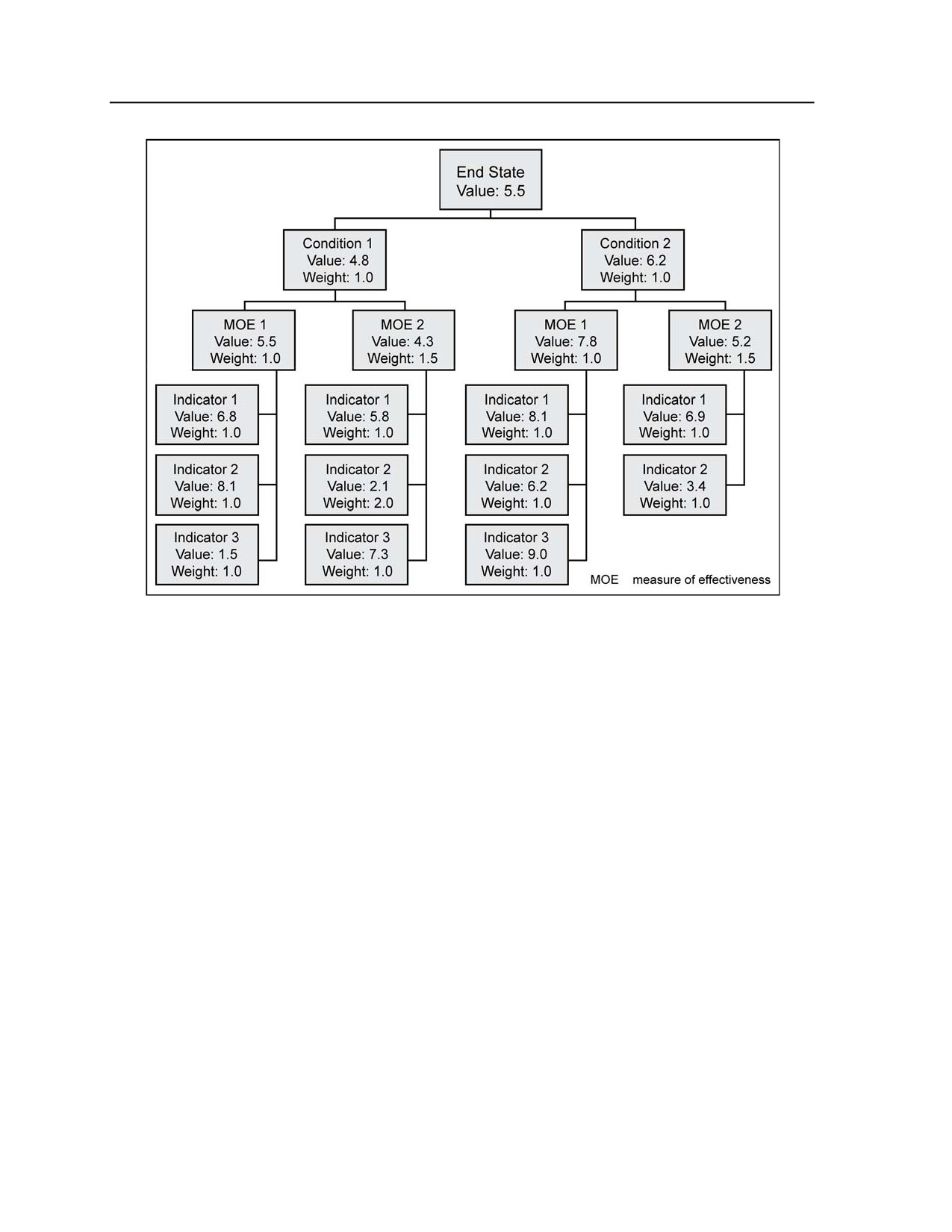
H-28. Each component of the assessment framework is standardized, assigned a weight, and given
thresholds. They are combined mathematically starting at the indicator’s level and worked up through
MOEs and conditions to the end state. (See figure H-3 on page H-6.)
H-29. Standardization means that each component is expressed as a number on a common scale such as 1
to
5 or 1 to 10. Setting a common scale aids understanding and comparing as well as running the
mathematical model. For example, Indicator 1 for MOE 1 for Condition 1 in figure H-3 could be monthly
reported dollars in ransom paid as a result of kidnapping operations. For the month of June, that number is
$250,000. That number is normalized to a scale of 1 to 10, with 1 being bad and 10 being good. The value
of that indicator within the framework is 6.8.
H-30. A weight is a number that expresses relative significance. Some indicators may be more significant
than others for informing a given MOE. They count for more in the real world and should literally count for
more in the mathematical assessment framework. Weights are used as multipliers for MOEs and indicators.
The standard weight of 1.0 implies equal significance. A weight of 2.0 for an MOE (or indicator) implies
that MOE carries twice the significance.
26 March 2010
FM 5-0
H-5
Appendix H
Figure H-3. Sample assessment framework
H-31. A threshold is a value above which one category is in effect and below which another category is in
effect. Thresholds answer the question for a given indicator or MOE of what good and bad is. The
categories can be whatever the commander finds useful, such as colors or numbers. A commonly used
color example is red, amber, yellow, and green. Mathematical thresholds are often set at plus or minus one
standard deviation. Whatever category commanders use, they must define it in the assessment plan. They
also must weigh the value of insight against the risk of bias.
H-32. Establishing a baseline for comparison is often useful in a formal assessment plan. A baseline is a
time in the past against which the present is compared. The word baseline is a statistical term. In the
context of assessment, do not use it to mean starting point. Often commanders choose the baseline from a
time when conditions are similar to their desired conditions. However, the baseline must be recent enough
to be relevant. In protracted operations, the baseline may represent conditions from which commanders are
trying to move away. Baselines provide a focus for the commander and staff in comparing data across
different blocks of time. Baselines are particularly useful when using standard deviations to establish
thresholds. The standard deviation is calculated over the baseline, and multiples of those values are used to
set thresholds.
STEP 4 - DEVELOP THE COLLECTION PLAN
H-33. Each indicator represents an information requirement. In some instances, these information
requirements are fed into the intelligence, surveillance, and reconnaissance (ISR) synchronization process
and tasked to ISR assets. In other instances, reports in the unit standing operating procedures may suffice.
If not, the unit may develop a new report. The information requirement may be collected from
organizations external to the unit. For example, a host nation’s central bank may publish a consumer price
index for that nation. The source for each indicator is identified in the assessment plan along with the staff
member who collects that information. Assessment information requirements compete with other
information requirements for resources. When an information requirement is not resourced, staffs cannot
H-6
FM 5-0
26 March 2010
Formal Assessment Plans
collect the associated indicator and must remove it from the plan. Adjustments are then made to the
assessment framework to ensure that the MOE or MOP is properly worded.
STEP 5 - ASSIGN RESPONSIBILITIES FOR CONDUCTING ANALYSIS AND GENERATING
RECOMMENDATIONS
H-34. In addition to assigning responsibility for collection, members of the staff are assigned responsibility
for analyzing assessment data and developing recommendations. For example, the intelligence officer leads
the assessment of enemy forces. The engineer leads the effort on assessing infrastructure development. The
civil affairs operations officer leads assessment concerning the progress of local and provincial
governments. The chief of staff aggressively requires staff principals and subject matter experts to
participate in processing the formal assessment and in generating smart, actionable recommendations.
STEP 6 - IDENTIFY FEEDBACK MECHANISMS
H-35. A formal assessment with meaningful recommendations never heard by the appropriate
decisionmaker wastes time and energy. The assessment plan identifies the who, what, when, where, and
why of that presentation. Feedback leading up to and following that presentation is discussed as well.
Feedback might include which assessment working groups are required and how to act and follow up on
recommendations.
H-36. In units with an assessment cell, both the assessment cell and the appropriate staff principal present
their findings to the commander. The assessment cell presents the assessment framework with current
values and discusses key trends observed. Any relevant insights from the statistical analysis of the
information are presented. Then the staff principal either agrees or disagrees with the values provided in the
formal model and discusses relevant insights and factors not considered or not explicit in the model. The
staff principal then provides meaningful, actionable recommendations based on the assessment.
26 March 2010
FM 5-0
H-7
This page intentionally left blank.
Appendix I
Rehearsals
Rehearsing key actions before execution allows Soldiers to become familiar with the
operation and translate the abstract ideas of the written plan into concrete actions.
This appendix describes rehearsal types and techniques. It lists the responsibilities of
those involved. It also contains guidelines for conducting rehearsals.
REHEARSAL OVERVIEW
I-1. Rehearsals allow leaders and their Soldiers to practice executing key aspects of the concept of
operations. These actions help Soldiers orient themselves to their environment and other units before
executing the operation. Rehearsals help Soldiers to build a lasting mental picture of the sequence of key
actions within the operation.
I-2. Rehearsals are the commander’s tool to ensure staffs and subordinates understand the commander’s
intent and the concept of operations. They allow commanders and staffs to identify shortcomings (errors or
omissions) in the plan not previously recognized. Rehearsals also contribute to external and internal
coordination as additional coordinating requirements are identified.
I-3. Effective and efficient units habitually rehearse during training. Commanders at every level routinely
train and practice various rehearsal types and techniques. Local standing operating procedures (SOPs)
identify appropriate rehearsal types, techniques, and standards for their execution. All leaders conduct
periodic after action reviews to ensure their units conduct rehearsals to standard and correct substandard
performances. After action reviews also enable leaders to incorporate lessons learned into existing plans
and orders or into subsequent rehearsals.
I-4. Adequate time is essential when conducting rehearsals. The time required varies with the complexity
of the mission, the type and technique of rehearsal, and the level of participation. Rehearsals are conducted
at the lowest possible level, using the most thorough technique possible, given the time available. Under
time-constrained conditions, leaders conduct abbreviated rehearsals, focusing on critical events determined
by reverse planning. Each unit will have different critical events based on the mission, unit readiness, and
the commander’s assessment.
I-5. Whenever possible, rehearsals are based on a completed operation order. However, a unit may
rehearse a contingency plan to prepare for an anticipated deployment. The rehearsal is a coordination event,
not an analysis. It does not replace war-gaming. Commanders war-game during the military
decisionmaking process to analyze different courses of action to determine the optimal one. Rehearsals
practice that selected course of action. Commanders avoid making major changes to operation orders
during rehearsals. They make only those changes essential to mission success and risk mitigation.
REHEARSAL TYPES
I-6. Each rehearsal type achieves a different result and has a specific place in the preparation timeline.
The four types of rehearsals are—
z
Backbrief.
z
Combined arms rehearsal.
z
Support rehearsal.
z
Battle drill or SOP rehearsal.
26 March 2010
FM 5-0
I-1
Appendix I
BACKBRIEF
I-7. A backbrief is a briefing by subordinates to the commander to review how subordinates intend
to accomplish their mission. Normally, subordinates perform backbriefs throughout preparation. These
briefs allow commanders to clarify the commander’s intent early in subordinate planning. Commanders use
the backbrief to identify any problems in the concept of operations.
I-8. The backbrief differs from the confirmation brief
(a briefing subordinates give their higher
commander immediately following receipt of an order) in that subordinate leaders are given time to
complete their plan. Backbriefs require the fewest resources and are often the only option under time-
constrained conditions. Subordinate leaders explain their actions from start to finish of the mission.
Backbriefs are performed sequentially, with all leaders reviewing their tasks. When time is available,
backbriefs can be combined with other types of rehearsals. Doing this lets all subordinate leaders
coordinate their plans before performing more elaborate drills.
COMBINED ARMS REHEARSAL
I-9. A combined arms rehearsal is a rehearsal in which subordinate units synchronize their plans with
each other. A maneuver unit headquarters normally executes a combined arms rehearsal after subordinate
units issue their operation order. This rehearsal type helps ensure that subordinate commanders’ plans
achieve the higher commander’s intent.
SUPPORT REHEARSAL
I-10. The support rehearsal helps synchronize each warfighting function with the overall operation. This
rehearsal supports the operation so units can accomplish their missions. Throughout preparation, units
conduct support rehearsals within the framework of a single or limited number of warfighting functions.
These rehearsals typically involve coordination and procedure drills for aviation, fires, engineer support, or
casualty evacuation. Support rehearsals and combined arms rehearsals complement preparations for the
operation. They may be conducted separately and then combined into full-dress rehearsals. Although these
rehearsals differ slightly by warfighting function, they achieve the same result.
BATTLE DRILL OR STANDING OPERATING PROCEDURE REHEARSAL
I-11. A battle drill is a collective action rapidly executed without applying a deliberate decisionmaking
process. A battle drill or SOP rehearsal ensures that all participants understand a technique or a specific set
of procedures. Throughout preparation, units and staffs rehearse battle drills and SOPs. These rehearsals do
not need a completed order from higher headquarters. Leaders place priority on those drills or actions they
anticipate occurring during the operation. For example, a transportation platoon may rehearse a battle drill
on reacting to an ambush while awaiting to begin movement.
I-12. All echelons use these rehearsal types; however, they are most common for platoons, squads, and
sections. They are conducted throughout preparation and are not limited to published battle drills. They can
rehearse such actions as a command post shift change, an obstacle breach lane-marking SOP, or a
refuel-on-the-move site operation.
REHEARSAL TECHNIQUES
I-13. Techniques for conducting rehearsals are limited only by the commander’s imagination and available
resources. Generally, six techniques are used. (See figure I-1.) Resources required for each technique range
from broad to narrow. As listed, each successive technique takes less time and fewer resources. Each
rehearsal technique also imparts a different level of understanding to participants.
I-2
FM 5-0
26 March 2010
Rehearsals
Figure I-1. Rehearsal techniques
I-14. Paragraphs I-15 through I-30 address these considerations:
z
Time-the amount of time required to conduct (plan, prepare, execute, and assess) the rehearsal.
z
Echelons involved-the number of echelons that can participate in the rehearsal.
z
Operations security risk-the ease by which adversary can exploit friendly actions from the
rehearsal.
z
Terrain-the amount of space needed for the rehearsal.
FULL-DRESS REHEARSAL
I-15. A full-dress rehearsal produces the most detailed understanding of the operation. It includes every
participating Soldier and system. Leaders rehearse their subordinates on terrain similar to the AO, initially
under good light conditions, and then in limited visibility. Small-unit actions are repeated until executed to
standard. Full-dress rehearsals help Soldiers to clearly understand what is expected of them. It helps them
gain confidence in their ability to accomplish the mission. Supporting elements, such as aviation crews,
meet with Soldiers and rehearse with them to synchronize the operation.
I-16. The unit may conduct full-dress rehearsals. They also may be conducted and supported by the higher
headquarters. The full-dress rehearsal is the most difficult to accomplish at higher echelons. At those levels,
commanders may develop an alternate rehearsal plan that mirrors the actual plan but fits the terrain
available for the rehearsal.
I-17. Full-dress rehearsals have the following implications:
z
Time. Full-dress rehearsals consume more time than any other rehearsal type. For companies
and smaller units, full-dress rehearsals most effectively ensure all units in the operation
understand their roles. However, brigade and task force commanders consider how much time
their subordinates need to plan and prepare when deciding whether to conduct a full-dress
rehearsal.
z
Echelons involved. All echelons involved in the operation participate in the full-dress rehearsal.
26 March 2010
FM 5-0
I-3
Appendix I
z
Operations security risk. Moving a large part of the force may attract unwanted enemy
attention. Commanders develop a plan to protect the rehearsal from enemy surveillance and
reconnaissance. One method is to develop an alternate plan, including graphics and radio
frequencies, which rehearses selected actions without compromising the actual operation order.
Commanders take care not to confuse subordinates when doing this.
z
Terrain. Terrain management for a full-dress rehearsal can be difficult. The rehearsal area must
be identified, secured, cleared, and maintained throughout the rehearsal.
REDUCED-FORCE REHEARSAL
I-18. Circumstances may prohibit a rehearsal with all members of the unit. A reduced-force rehearsal
involves only key leaders of the organization and its subordinate units. It normally takes fewer resources
than a full-dress rehearsal. Terrain requirements can be the same as a full-dress rehearsal, even though there
are fewer participants. The commander first decides the level of leader involvement. Then the selected
leaders rehearse the plan while traversing the actual or similar terrain. Often commanders use this
technique to rehearse fire control measures for an engagement area during defensive operations. A reduced-
force rehearsal may be used to prepare key leaders for a full-dress rehearsal. It may require developing a
rehearsal plan that mirrors the actual plan but fits the terrain of the rehearsal.
I-19. Often, smaller scale replicas of terrain or buildings substitute for the actual AO. Leaders not only
explain their plans, but also walk through their actions or move replicas across the rehearsal area or sand
table. This is called a rock drill. It reinforces the backbrief given by subordinates since everyone can see the
concept of operations and sequence of tasks.
I-20. Reduced-force rehearsals have the following implications:
z
Time. A reduced-force rehearsal normally requires less time than a full-dress rehearsal.
Commanders consider how much time their subordinates need to plan and prepare when
deciding whether to conduct a reduced-force rehearsal.
z
Echelons involved. A small unit can perform a full-dress rehearsal as part of a larger
organization’s reduced-force rehearsal.
z
Operations security risk. A reduced-force rehearsal is less likely to present operations security
vulnerabilities than a full-dress rehearsal because it has fewer participants. However, the number
of radio transmissions required is the same as for a full-dress rehearsal and must be considered.
z
Terrain. Terrain management for the reduced-force rehearsal can be as difficult as for the
full-dress rehearsal. The rehearsal area must be identified, secured, cleared, and maintained
throughout the rehearsal.
TERRAIN-MODEL REHEARSAL
I-21. The terrain-model rehearsal is the most popular rehearsal technique. It takes less time and fewer
resources than a full-dress or reduced-force rehearsal. (A terrain-model rehearsal takes a proficient brigade
between one to two hours to execute to standard.) An accurately constructed terrain model helps
subordinate leaders visualize the commander’s intent and concept of operations. When possible,
commanders place the terrain model where it overlooks the actual terrain of the AO. However, if the
situation requires more security, they place the terrain model on a reverse slope within walking distance of
a point overlooking the AO. The model’s orientation coincides with that of the terrain. The size of the
terrain model can vary from small (using markers to represent units) to large (on which the participants can
walk). A large model helps reinforce the participants’ perception of unit positions on the terrain.
I-22. Terrain-model rehearsals have the following implications:
z
Time. Often, constructing the terrain model is the most time-consuming part of this technique.
Units require a clear SOP that states how to build the model so it is accurate, large, and detailed
enough to conduct the rehearsal. A good SOP also establishes staff responsibility for building
the terrain model and a timeline for its completion.
z
Echelons involved. Because a terrain model is geared to the echelon conducting the rehearsal,
multiechelon rehearsals using this technique are difficult.
I-4
FM 5-0
26 March 2010
Rehearsals
z
Operations security risk. This rehearsal can present operations security vulnerabilities if the
area around the rehearsal site is not secured. Assembled commanders and their vehicles can
draw enemy attention. Units must sanitize the terrain model after completing the rehearsal.
z
Terrain. Terrain management is less difficult than with the previous techniques. A good site is
easy for participants to find yet concealed from the enemy. An optimal location overlooks the
terrain where the unit will execute the operation.
I-23. With today’s digital capabilities, users can construct terrain models in virtual space. Units drape high
resolution imagery over elevation data thereby creating a fly-through or walk-through. Holographic
imagery produces the view in three dimensions. Often, graphics, detailed information, unmanned aircraft
systems, and ground imagery are hot linked to key points in the model providing more insight into the plan.
Digital terrain models reduce the operations security risk because real terrain is not used. The unit
geospatial engineers or imagery analysts can assist in digital model creation. Detailed city models already
exist for many world cities.
I-24. Digital terrain-model rehearsals have the following implications:
z
Time. The time it takes to create the three-dimensional model depends on the amount of
available data on the terrain being modeled.
z
Echelons involved. This type of rehearsal best suits small units, although with a good local area
network, a wider audience can view the graphics. All echelons may be provided copies of the
digital model to take back to their headquarters for a more detailed examination.
z
Operations security risk. If not placed on a computer network, there is limited security risk
because no site is secured and the rehearsal can be conducted under cover. However, if placed on
a computer network, digital terrain models can be subject to enemy exploitation due to inherent
vulnerabilities of networks.
z
Terrain. This space requires the least space of all rehearsals. Using tents or enclosed areas
conceal the rehearsal from the enemy.
SKETCH-MAP REHEARSAL
I-25. Commanders can use the sketch-map technique almost anywhere, day or night. The procedures are
the same as for a terrain-model rehearsal except the commander uses a sketch map in place of a terrain
model. Effective sketches are large enough for all participants to see as each participant walks through
execution of the operation. Participants move markers on the sketch to represent unit locations and
maneuvers.
I-26. Sketch-map rehearsals have the following implications:
z
Time. Sketch-map rehearsals take less time than terrain-model rehearsals and more time than
map rehearsals.
z
Echelons involved. Because a sketch map is geared to the echelon conducting the rehearsal,
multiechelon rehearsals using this technique are difficult.
z
Operations security risk. This rehearsal can present operations security vulnerabilities if the
area around the rehearsal site is not secured. Assembled commanders and their vehicles can
draw enemy attention. Units must sanitize, secure, or destroy the sketch map after use.
z
Terrain. This technique requires less space than a terrain-model rehearsal. A good site is easy
for participants to find yet concealed from the enemy. An optimal location overlooks the terrain
where the unit will execute the operation.
MAP REHEARSAL
I-27. A map rehearsal is similar to a sketch-map rehearsal except the commander uses a map and operation
overlay of the same scale used to plan the operation.
I-28. Map rehearsals have the following implications:
26 March 2010
FM 5-0
I-5
Appendix I
z
Time. The most time-consuming part is the rehearsal itself. A map rehearsal is normally the
easiest technique to set up since it requires only maps and graphics for current operations.
z
Echelons involved. Because the operation overlay is geared to the echelon conducting the
rehearsal, multiechelon rehearsals using this technique are difficult.
z
Operations security risk. This rehearsal can present operations security vulnerabilities if the
area around the rehearsal site is not secured. Assembled commanders and their vehicles can
draw enemy attention.
z
Terrain. This technique requires the least space of all rehearsals. A good site is one that is easy
for participants to find yet concealed from the enemy. An optimal location overlooks the terrain
where the unit will execute the operation.
NETWORK REHEARSAL
I-29. Network rehearsals are conducted over wide-area networks or local area networks. Commanders and
staffs practice these rehearsals by talking through critical portions of the operation over communications
networks in a sequence the commander establishes. The organization rehearses only the critical parts of the
operation. These rehearsals require all information systems needed to execute that portion of the operation.
All participants require working information systems, the operation order, and overlays. Command posts
can rehearse battle tracking during network rehearsals.
I-30. Network rehearsals have the following implications:
z
Time. This technique can be time efficient if SOPs are clear. However, if the organization has
unclear SOPs, has units not operating on the network, or has units without working
communications, this technique can be time-consuming.
z
Echelons involved. This technique lends itself to multiechelon rehearsals. Participation is
limited only by the commander’s intent and the capabilities of the command’s information
systems.
z
Operations security risk. If a network rehearsal is executed from current unit locations, the risk
may be higher. The enemy may monitor the increased volume of transmissions and potentially
compromise information. The organization should use different frequencies from those planned
for the operation. Using wire systems is an option but does not exercise the network systems,
which is the strong point of this technique.
z
Terrain. If a network rehearsal is executed from unit locations, terrain considerations are
minimal. If a separate rehearsal area is required, considerations are similar to those of a
reduced-force rehearsal.
REHEARSAL RESPONSIBILITIES
I-31. This discussion addresses responsibilities for conducting rehearsals. It is based on the combined arms
rehearsal. Responsibilities are the same for support rehearsals.
PLANNING
I-32. Commanders and chiefs of staff (executive officers at lower echelons) plan rehearsals.
Commander
I-33. Commanders provide certain information as part of the commander’s guidance during the initial
mission analysis. They may revise the following information when they select a course of action:
z
Rehearsal type.
z
Rehearsal technique.
z
Location.
z
Attendees.
z
Enemy course of action to be portrayed.
I-6
FM 5-0
26 March 2010
Rehearsals
Chief of Staff (Executive Officer)
I-34. The chief of staff or executive officer ensures all rehearsals are included in the organization’s
time-management SOP. The chief of staff or executive officer responsibilities include—
z
Publishing the rehearsal time and location in the operation order or warning order.
z
Conducting staff rehearsals.
z
Determining rehearsal products, based on type, technique, and mission variables.
z
Coordinating liaison officer attendance from adjacent units.
PREPARATION
I-35. Everyone involved in executing or supporting the rehearsal has responsibilities during preparation.
Commander
I-36. Commanders prepare to rehearse operations with events phased in proper order, from start to finish.
Under time-constrained conditions, this often proves difficult. Commanders—
z
Identify and prioritize key events to rehearse.
z
Allocate time for each event.
z
Perform personal preparation, including reviews of—
Task organization completeness.
Personnel and materiel readiness.
Organizational level of preparation.
Chief of Staff (Executive Officer)
I-37. The chief of staff or executive officer, through war-gaming and coordination with the commander—
z
Prepares to serve as the rehearsal director.
z
Coordinates time for key events requiring rehearsal.
z
Establishes rehearsal time limits per the commander’s guidance and mission variables.
z
Verifies rehearsal site preparation. A separate rehearsal site may be required for some events,
such as a possible obstacle site. A good rehearsal site includes—
Appropriate markings and associated training aids.
Parking areas.
Local security.
z
Determines the method for controlling the rehearsal and ensuring its logical flow, such as a
script. (See paragraphs I-57 through I-64.)
Subordinate Leaders
I-38. Subordinate leaders complete their planning. This planning includes—
z
Completing unit operation orders.
z
Identifying issues derived from the higher headquarters’ operation order.
z
Providing a copy of their unit operation order with graphics to the higher headquarters.
z
Performing personal preparation similar to that of the commander.
z
Ensuring they and their subordinates bring all necessary equipment.
26 March 2010
FM 5-0
I-7
Appendix I
Conducting Headquarters Staff
I-39. Conducting headquarters staff members—
z
Develop an operation order with necessary overlays.
z
Deconflict all subordinate unit graphics. Composite overlays are the first step for leaders to
visualize the organization’s overall plan.
z
Publish composite overlays at the rehearsal including, at a minimum—
Movement and maneuver.
Intelligence.
Fires.
Sustainment.
Command and control, including signal operations.
Protection.
EXECUTION
I-40. During execution, the commander, chief of staff, assistants, subordinate leaders, recorder, and staff
from the conducting headquarters all have specific responsibilities.
Commander
I-41. Commanders command the rehearsal just as they will command the operation. They maintain the
focus and level of intensity, allowing no potential for subordinate confusion. Although the staff refines the
operation order, it belongs to the commander. The commander uses the order to conduct operations. An
effective rehearsal is not a commander’s brief to subordinates. It validates synchronization—the what,
when, and where—of tasks that subordinate units will perform to execute the operation and achieve the
commander’s intent.
Chief of Staff (Executive Officer)
I-42. Normally, the chief of staff or executive officer serves as the rehearsal director. This officer ensures
each unit will accomplish its tasks at the right time and cues the commander to upcoming decisions. The
chief of staff’s or executive officer’s script is the execution matrix and the decision support template. The
rehearsal director—
z
Starts the rehearsal on time.
z
Has a formal roll call.
z
Ensures everyone brings the necessary equipment. This equipment includes organizational
graphics and previously issued orders.
z
Validates the task organization. Linkups must be complete or on schedule, and required materiel
and personnel must be on hand. The importance of this simple check cannot be overemphasized.
z
Ensures sustaining operations are synchronized with shaping operations and the decisive
operation.
z
Rehearses the synchronization of combat power from flank and higher organizations. These
organizations are often beyond communication range of the commander and G-3 (S-3) when
away from the command post.
z
Synchronizes the timing and contribution of each warfighting function by ensuring the rehearsal
of operations against the decisive points by time or event that connect to a decision.
z
For each decisive point, defines conditions required to—
Commit the reserve or striking forces.
Move a unit.
Close or emplace an obstacle.
Fire at planned targets.
Move a medical unit, change a supply route, and alert specific observation posts.
I-8
FM 5-0
26 March 2010
Rehearsals
z
Disciplines leader movements, enforces brevity, and ensures completeness. The operation order,
decision support template, and execution matrix are the chief of staff’s tools.
z
Keeps within time constraints.
z
Ensures that the most important events receive the most attention.
z
Ensures that absentees and flank units receive changes to the operation order. Transmits changes
to them as soon as practical.
z
Communicates the key civil considerations of the operation.
Assistant Chief of Staff, G-3 (S-3)
I-43. The G-3 (S-3) assists the commander with the rehearsal. The G-3 (S-3)—
z
Portrays the friendly scheme of maneuver.
z
Ensures subordinate unit actions comply with the commander’s intent.
z
Normally provides the recorder.
Assistant Chief of Staff, G-2 (S-2)
I-44. The G-2 (S-2) portrays the adversary forces and other variables of the operational environment
during rehearsals. The G-2 (S-2) bases actions on the enemy course of action that the commander selected
during the military decisionmaking process. The G-2 (S-2)—
z
Provides participants with current intelligence.
z
Portrays the best possible assessment of the enemy course of action.
z
Communicates the adversary’s presumed concept of operations, desired effects, and end state.
z
Explains other factors of the operational environment that may hinder or complicate friendly
actions.
z
Communicates the key civil considerations of the operation.
Subordinate Leaders
I-45. Subordinate unit leaders, using an established format—
z
Effectively articulate their units’ actions and responsibilities.
z
Record changes on their copies of the graphics or operation order.
Recorder
I-46. The recorder is normally the G-3 (S-3) or a representative from the operations cell. During the
rehearsal, the recorder—
z
Captures all coordination made during execution.
z
Notes unresolved problems.
I-47. At the end of the rehearsal, the recorder—
z
Presents any unresolved problems to the commander for resolution.
z
Restates any changes, coordination, or clarifications directed by the commander.
z
Estimates when a written fragmentary order codifying the changes will follow.
Conducting Headquarters Staff
I-48. The staff updates the operation order, decision support template, and execution matrix based on the
decisions of the commander.
ASSESSMENT
I-49. The commander establishes the standard for a successful rehearsal. A properly executed rehearsal
validates each leader’s role and how each unit contributes to the overall operation—what is done, when it is
26 March 2010
FM 5-0
I-9
Appendix I
done relative to times and events, and where it is done to achieve desired effects. An effective rehearsal
ensures commanders have a common vision of the enemy, their own forces, the terrain, and the relationship
among them. It identifies specific actions requiring immediate staff resolution and informs the higher
commander of critical issues or locations that the commander, chief of staff (executive officer), or G-3
(S-3) must personally oversee.
I-50. The commander (or rehearsal director in the commander’s absence) assesses and critiques all parts of
the rehearsal. Critiques center on how well the operation achieves the commander’s intent and on the
coordination necessary to accomplish that end. Usually, the internal execution of tasks within the rehearsal
is left to the subordinate unit commander’s judgment and discretion.
CONDUCTING A REHEARSAL
I-51. All participants have responsibilities before, during, and after a rehearsal. Before a rehearsal, the
rehearsal director states the commander’s expectations and orients the other participants on details of the
rehearsal as necessary. During a rehearsal, all participants rehearse their roles in the operation. They make
sure they understand how their actions support the overall operation and note any additional coordination
required. After a rehearsal, participants ensure they understand any changes to the operation order and
coordination requirements, and they receive all updated staff products.
I-52. Commanders do not normally address small problems that arise during rehearsals. Instead, these are
recorded. This ensures the rehearsal’s flow is not interrupted. If the problem remains at the end of the
rehearsal, the commander resolves it then. However, if the problem can wait until the end of the rehearsal,
it may not have been a real problem. If the problem jeopardizes mission accomplishment, the staff
accomplishes the coordination necessary to resolve it before the participants disperse. Identifying and
solving such problems is a major reason for conducting rehearsals. If corrections are not made while
participants are assembled, the opportunity to do so may be lost. Coordinating among dispersed participants
and disseminating changes to them is more difficult than accomplishing these actions in person.
BEFORE THE REHEARSAL
I-53. Before the rehearsal, the rehearsal director calls the roll and briefs participants on information needed
for execution. The briefing begins with an introduction, overview, and orientation. It includes a discussion
of the rehearsal script and ground rules. The detail of this discussion is based on participants’ familiarity
with the rehearsal SOP.
I-54. Before the rehearsal, the staff develops an operation order with at least the basic five paragraphs and
necessary overlays. Annexes may not be published; however, the responsible staff officers should know
their content.
Introduction and Overview
I-55. Before the rehearsal, the rehearsal director introduces all participants as needed. Then, the director
gives an overview of the briefing topics, rehearsal subjects and sequence, and timeline, specifying the no-
later-than ending time. The rehearsal director explains after action reviews, describes how and when they
occur, and discusses how to incorporate changes into the operation order. The director explains any
constraints, such as pyrotechnics use, light discipline, weapons firing, or radio silence. For safety, the
rehearsal director ensures all participants understand safety precautions and enforces their use. Last, the
director emphasizes results and states the commander’s standard for a successful rehearsal. Subordinate
leaders state any results of planning or preparation (including rehearsals) they have already conducted. If a
subordinate recommends a change to the operation order, the rehearsal director acts on the recommendation
before the rehearsal begins, if possible. If not, the commander resolves the recommendation with a decision
before the rehearsal ends.
Orientation
I-56. The rehearsal director orients the participants to the terrain or rehearsal medium. Orientation is
identified using magnetic north on the rehearsal medium and symbols representing actual terrain features.
I-10
FM 5-0
26 March 2010
Rehearsals
The director explains any graphic control measures, obstacles, and targets and then issues supplemental
materials, if needed.
Rehearsal Script
I-57. An effective technique for controlling rehearsals is to use a script. It keeps the rehearsal on track. The
script provides a checklist so the organization addresses all warfighting functions and outstanding issues. It
has two major parts: the agenda and the response sequence.
Agenda
I-58. An effective rehearsal follows a prescribed agenda that everyone knows and understands. An
effective rehearsal includes—
z
Roll call.
z
Participant orientation to the terrain.
z
Location of local civilians.
z
Enemy situation brief.
z
Friendly situation brief.
z
Description of expected adversary actions.
z
Discussion of friendly unit actions.
z
A review of notes made by the recorder.
I-59. The execution matrix, decision support template, and operation order outline the rehearsal agenda.
These tools, especially the execution matrix, both drive and focus the rehearsal. The commander and staff
use them to control the operation’s execution. Any templates, matrixes, or tools developed within each of
the warfighting functions (for example an intelligence synchronization matrix or fires execution matrix)
should tie directly to the supported unit’s execution matrix and decision support template.
I-60. An effective rehearsal requires the enemy force and other variables of the operational environment to
be portrayed realistically and quickly without distracting from the rehearsal. One technique for doing this
has the G-2 (S-2) preparing an actions checklist. It lists a sequence of events much like the one for friendly
units but from the enemy or civilian perspective.
Response Sequence
I-61. Participants respond in a logical sequence: either by warfighting function or by unit as the
organization is deployed, from front to rear. The commander determines the sequence before the rehearsal.
It is posted at the rehearsal site, and the rehearsal director may restate it.
I-62. Effective rehearsals allow participants to visualize and synchronize the concept of operations. As the
rehearsal proceeds, participants talk through the concept of operations. They focus on key events and the
synchronization required to achieve the desired effects. The commander leads the rehearsal. The
commander gives orders during the operation. Subordinate commanders enter and leave the discussion at
the time they expect to begin and end their tasks or activities during the operation. This practice helps the
commander assess the adequacy of synchronization. They do not
“re-war-game” unless absolutely
necessary to ensure subordinate unit commanders understand the plan.
I-63. The rehearsal director emphasizes integrating fires, events that trigger different branch actions, and
actions on contact. The chief of fires (fire support officer) or fires unit commander states when fires are
initiated, who is firing, from where the firing comes, the ammunition available, and the desired target
effect. Subordinate commanders state when they initiate fires per their fire support plans. The rehearsal
director speaks for any absent staff section and ensures all actions on the synchronization matrix and
decision support template are addressed at the proper time or event.
I-64. The rehearsal director ensures that key sustainment and protection actions are included in the
rehearsal at the times they are executed. (See table I-1 on page I-12.) Failure to do so reduces the value of
the rehearsal as a coordination tool. The staff officer with coordinating staff responsibility inserts these
items into the rehearsal at appropriate times. Special staff officers should brief by exception when a
26 March 2010
FM 5-0
I-11
Appendix I
friendly or enemy event occurs within their area of expertise. Summarizing these actions at the end of the
rehearsal can reinforce coordination requirements identified during the rehearsal. The staff updates the
decision support template and gives a copy to each participant. Under time-constrained conditions, the
conducting headquarters staff may provide copies before the rehearsal and rely on participants to update
them with pen-and-ink changes.
Table I-1. Example sustainment and protection actions for rehearsals
• Casualty evacuation routes
• Support area displacement times and locations
• Ambulance exchange point locations
• Enemy prisoner of war collection points
• Refuel-on-the-move points
• Aviation support
• Class IV and class V resupply points
• Military police actions
• Logistics release points
Ground Rules
I-65. After discussing the rehearsal script, the rehearsal director—
z
States the standard (what the commander will accept) for a successful rehearsal.
z
Ensures everyone understands the parts of the operation order to rehearse. If the entire operation
will not be rehearsed, the rehearsal director states the events to be rehearsed.
z
Quickly reviews the rehearsal SOP if all participants are not familiar with it. An effective
rehearsal SOP states—
Who controls the rehearsal.
Who approves the rehearsal venue and its construction.
When special staff officers brief the commander.
The relationship between how the execution matrix portrays events and how units rehearse
events.
z
Establishes the timeline; it designates the rehearsal starting time in relation to H-hour. For
example, begin the rehearsal by depicting the anticipated situation one hour before H-hour. One
event executed before rehearsing the first event is deployment of forces.
z
Establishes the time interval to begin and track the rehearsal. For example, specify a ten-minute
interval equates to one hour of actual time.
z
Updates friendly and adversary activities as necessary, for example, any ongoing
reconnaissance.
The rehearsal director concludes the orientation with a call for questions.
DURING THE REHEARSAL
I-66. After the rehearsal director finishes discussing the ground rules and answering questions, the G-3
(S-3) reads the mission statement, the commander reads the commander’s intent, and the G-3 (S-3)
establishes the current friendly situation. The rehearsal then begins, following the rehearsal script.
I-67. Paragraphs I-68 through I-80 outline a generic set of rehearsal steps developed for combined arms
rehearsals. However, with a few modifications, these steps support any rehearsal technique. The products
depend on the rehearsal type.
Step 1 - Enemy Forces Deployed
I-68. The G-2 (S-2) briefs the current enemy situation and operational environment and places markers on
the map or terrain board (as applicable) indicating where enemy forces and other operationally significant
groups or activities would be before the first rehearsal event. The G-2 (S-2) then briefs the most likely
enemy course of action and operational context. The G-2 (S-2) also briefs the status of reconnaissance and
surveillance operations (for example, citing any patrols still out or any observation post positions).
I-12
FM 5-0
26 March 2010
Rehearsals
Step 2 - Friendly Forces Deployed
I-69. The G-3 (S-3) briefs friendly maneuver unit dispositions, including security forces, of the rehearsal
starting time. Subordinate commanders and other staff officers brief their unit positions at the starting time
and any particular points of emphasis. For example, the chemical, biological, radiological, and nuclear
officer states the mission-oriented protective posture level, and the chief of fires (fire support officer) or
fires unit commander states the range of friendly and enemy artillery. Other participants place markers for
friendly forces, including adjacent units, at the positions they will occupy at the rehearsal starting time. As
participants place markers, they state their task and purpose, task organization, and strength.
I-70. Sustainment and protection units brief positions, plans, and actions at the starting time and at points
of emphasis the rehearsal director designates. Subordinate units may include forward arming and refueling
points, refuel-on-the-move points, communications checkpoints, security points, or operations security
procedures that differ for that period. The rehearsal director restates the commander’s intent, if necessary.
Step 3 - Initiate Action
I-71. The rehearsal director states the first event on the execution matrix. Normally this involves the G-2
(S-2) moving enemy markers according to the most likely course of action at the point on the execution
matrix being rehearsed. The depiction must tie enemy actions to specific terrain or to friendly unit actions.
The G-2 (S-2) portrays enemy actions based on the situational template developed for staff war-gaming.
The enemy is portrayed as uncooperative but not invincible.
I-72. As the rehearsal proceeds, the G-2 (S-2) portrays the enemy and other operational factors and walks
through the most likely enemy course of action (per the situational template). The G-2 (S-2) stresses
reconnaissance routes, objectives, security force composition and locations, initial contact, initial fires
(artillery, air, and attack helicopters), probable main force objectives or engagement areas, and likely
commitment of reserve forces. The G-2 (S-2) is specific, tying enemy actions to specific terrain or friendly
unit actions. The walk through should accurately portray the event template.
Step 4 - Decision Point
I-73. When the enemy movement and operational context is complete, the commander assesses the
situation to determine if a decision point has been reached. Decision points are taken directly from the
decision support template. The commander determines if the organization is—
z
Not at a decision point. If the organization is not at a decision point and not at the end state, the
rehearsal director continues the rehearsal by stating the next event on the execution matrix.
Participants use the response sequence (see paragraphs I-61 through I-64) and continue to act out
and describe their units’ actions.
z
At a decision point. When conditions that establish a decision point are reached, the commander
decides whether to continue with the current course of action or by selecting a branch. If electing
the current course of action, the commander states the next event from the execution matrix and
directs movement of friendly units. If selecting a branch, the commander states why that branch,
states the first event of that branch, and continues the rehearsal until the organization has
rehearsed all events of that branch. As the unit reaches decisive points, the rehearsal director
states the conditions required for success.
I-74. If units in the reserve force participate, they rehearse all their branches beginning with the most
likely.
I-75. When it becomes obvious that the operation requires additional coordination to ensure success,
participants immediately begin coordinating. This is one of the key reasons for rehearsals. The rehearsal
director ensures that the recorder captures and all participants understand the coordination.
Step 5 - End State Reached
I-76. Achieving the desired end state completes that phase of the rehearsal. In an attack, this will usually
be when the unit is on the objective and has finished consolidation and casualty evacuation. In the defense,
26 March 2010
FM 5-0
I-13
Appendix I
this will usually be after the decisive action (such as committing the reserve or striking force), the final
destruction or withdrawal of the enemy, and casualty evacuation is complete. In a stability operation, this is
usually when targeted progress within a designated line of effort is achieved.
Step 6 - Reset
I-77. At this point, the commander states the next branch to rehearse. The rehearsal director resets the
situation to the decision point where that branch begins and states the criteria for a decision to execute that
branch. Participants assume those criteria have been met and then refight the operation along that branch
until they attain the desired end state. They complete any coordination needed to ensure all participants
understand and can meet any requirements. The recorder records any changes to the branch.
I-78. The commander then states the next branch to rehearse. The rehearsal director again resets the
situation to the decision point where that branch begins, and participants repeat the process. This continues
until all decision points and branches the commander wants to rehearse have been addressed.
I-79. If the standard is not met and time permits, the commander directs participants to repeat the
rehearsal. The rehearsal continues until participants are prepared or until the time available expires.
(Commanders may allocate more time for a rehearsal but must assess the effects on subordinate
commanders’ preparation time.) Successive rehearsals, if conducted, should be more complex and realistic.
I-80. At the end of the rehearsal, the recorder restates any changes, coordination, or clarifications the
commander directed and estimates how long it will take to codify changes in a written fragmentary order.
AFTER THE REHEARSAL
I-81. After the rehearsal, the commander leads an after action review. The commander reviews lessons
learned and makes the minimum required modifications to the existing plan. (Normally, a fragmentary
order effects these changes.) Changes should be refinements to the operation order; they should not be
radical or significant. Changes not critical to the operation’s execution may confuse subordinates and
hinder the synchronization of the plan. The commander issues any last minute instructions or reminders and
reiterates the commander’s intent.
I-82. Based on the commander’s instructions, the staff makes any necessary changes to the operation
order, decision support template, and execution matrix based on the rehearsal results. Subordinate
commanders incorporate these changes into their units’ operation orders. The chief of staff (executive
officer) ensures the changes are briefed to all leaders or liaison officers who did not participate in the
rehearsal.
I-83. A rehearsal is the final opportunity for subordinates to identify and fix unresolved issues. An
effective staff ensures that all participants understand any changes to the operation order and that the
recorder captures all coordination done at the rehearsal. All changes to the published operation order are, in
effect, verbal fragmentary orders. As soon as possible, the staff publishes these verbal fragmentary orders
as a written fragmentary order that changes the operation order.
I-14
FM 5-0
26 March 2010