FM 4-25.12 UNIT FIELD SANITATION TEAM (January 2002) - page 6
FM 4-25.12
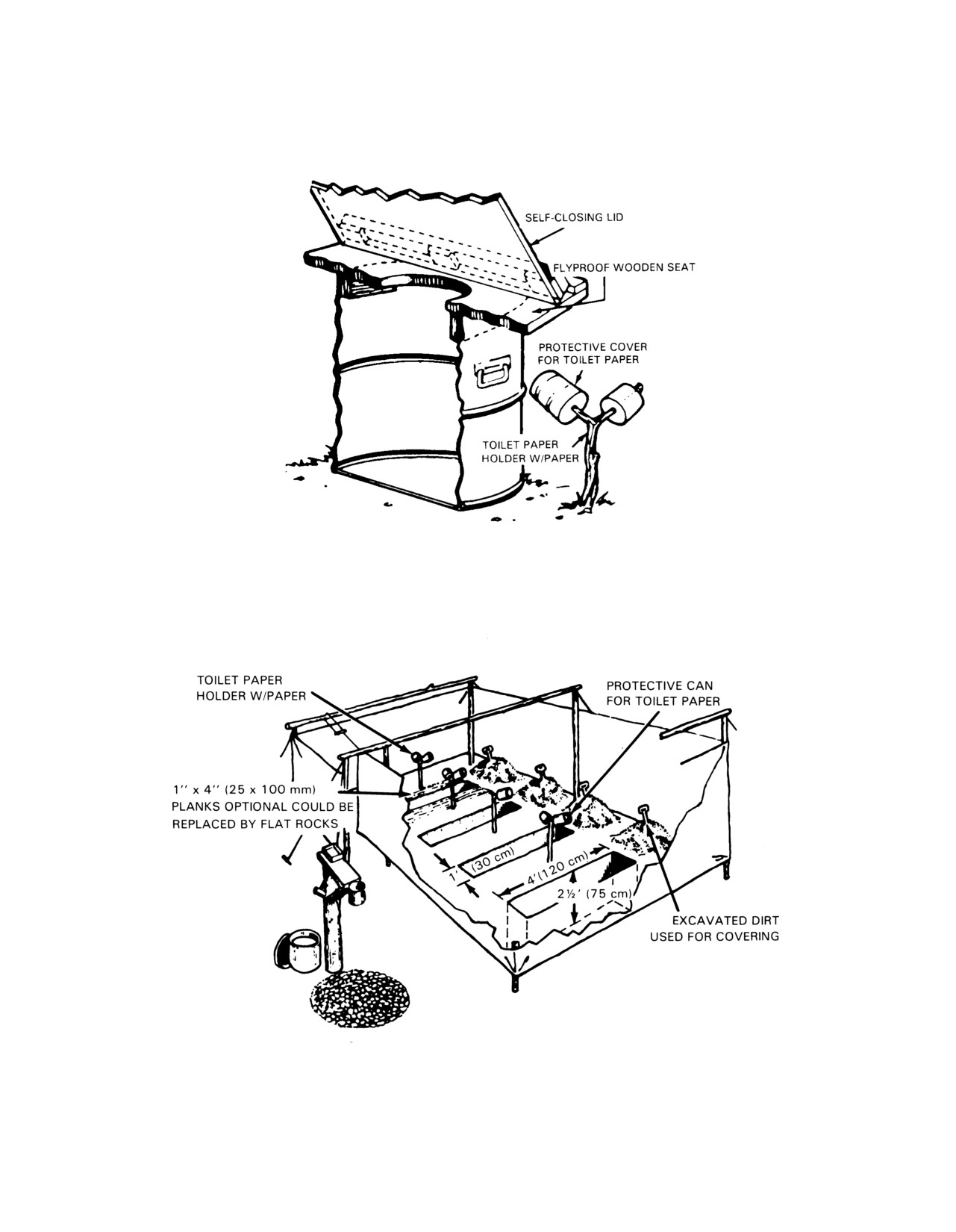
Figure B-13. Burn-out latrine.
Figure B-14. Straddle trench with latrine screen and handwashing device.
B-9
FM 4-25.12
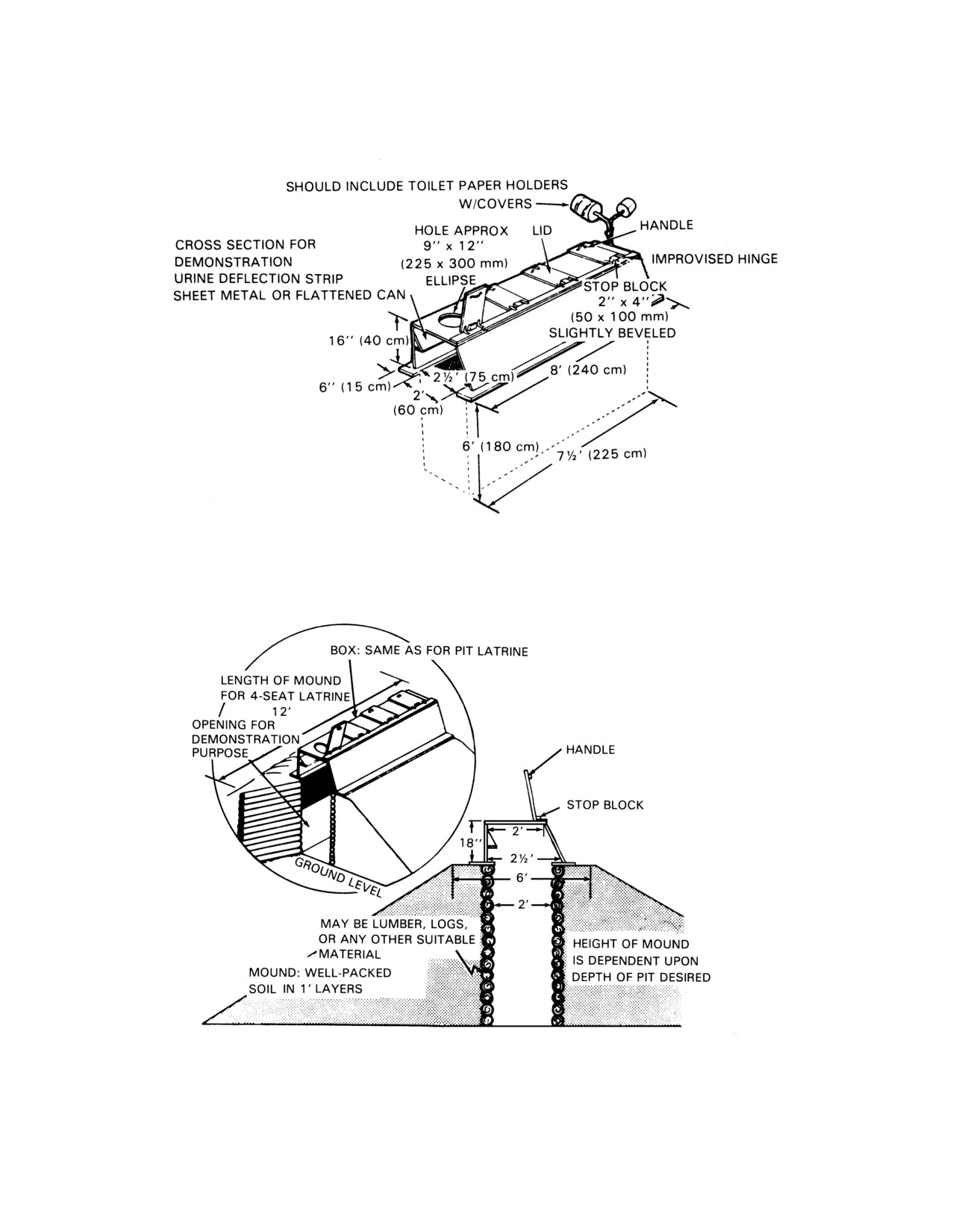
Figure B-15. Deep-pit latrine.
Figure B-16. Mound latrine.
B-10
FM 4-25.12
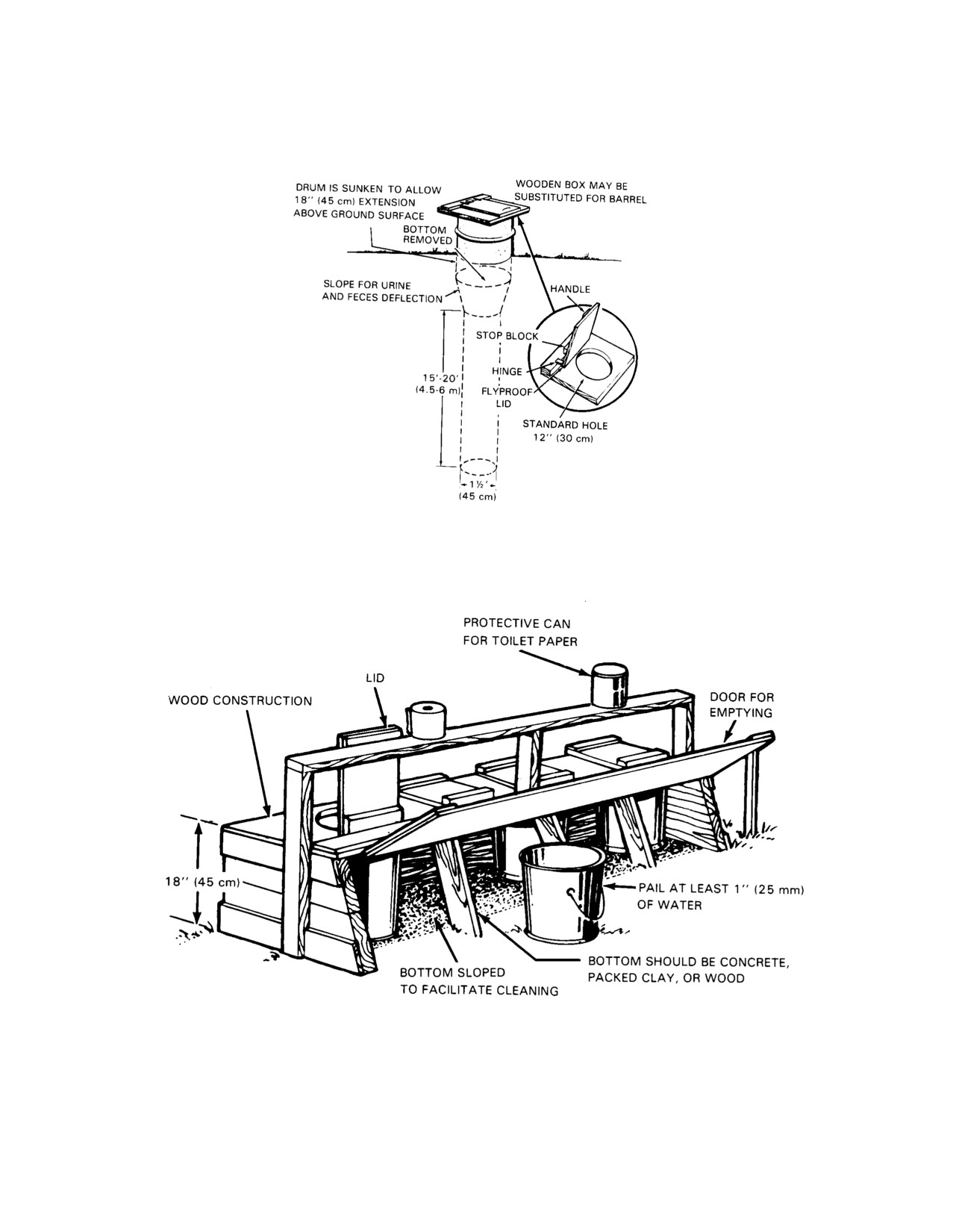
Figure B-17. Bored-hole latrine.
Figure B-18. Pail latrine.
B-11
FM 4-25.12
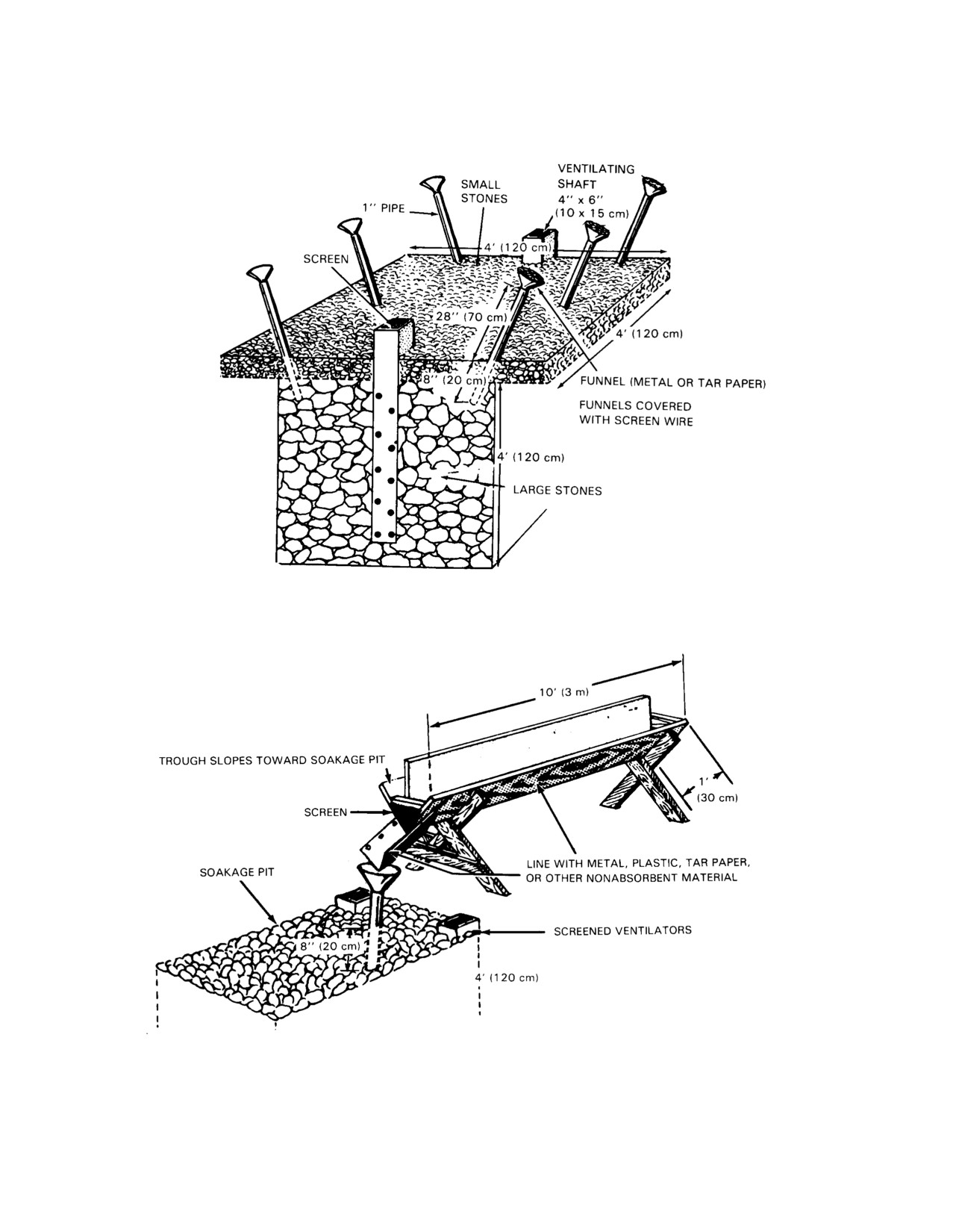
Figure B-19. Urine soakage pit.
Figure B-20. Trough urinal.
B-12
FM 4-25.12
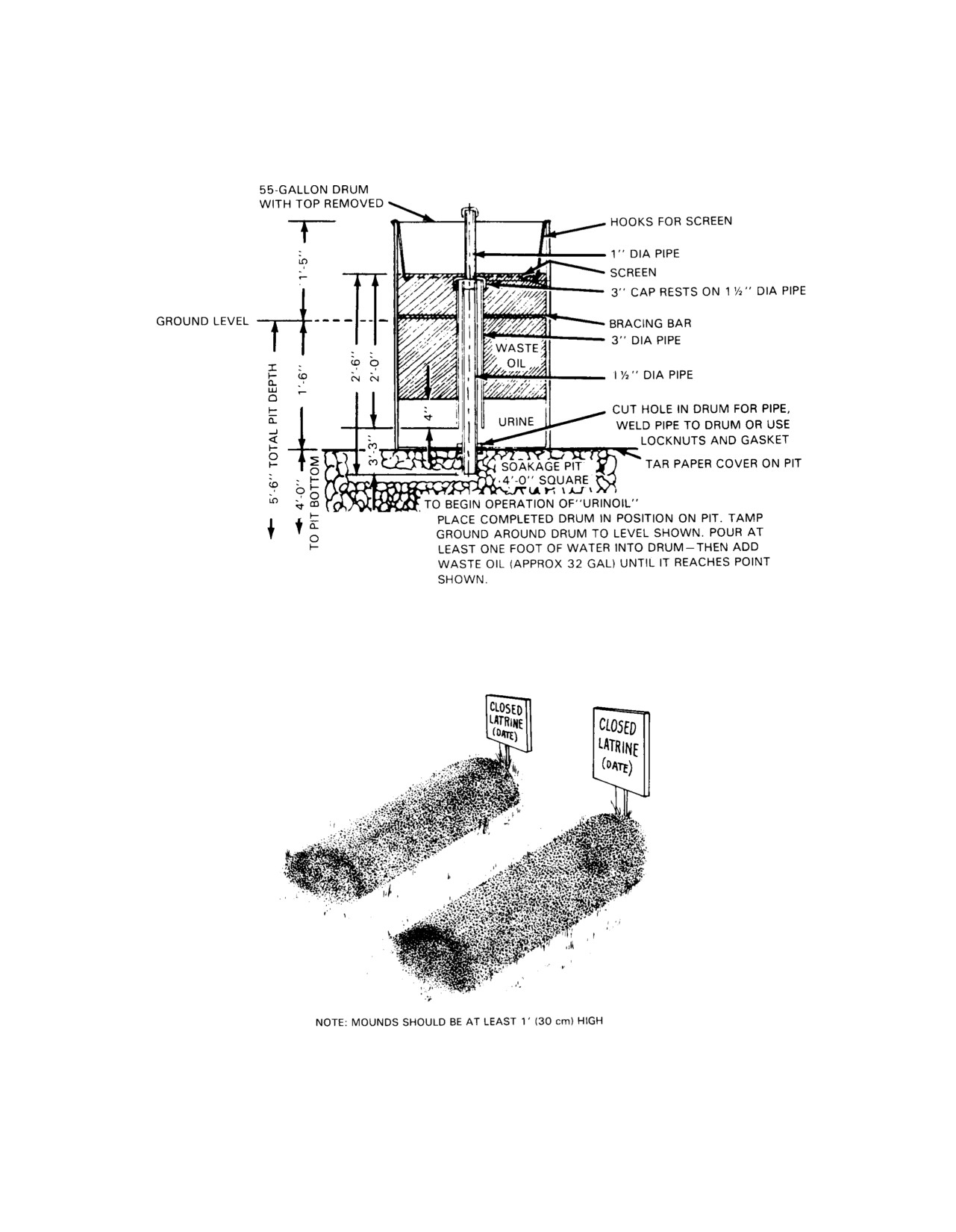
Figure B-21. Urinol Urinal.
Figure B-22. Closed latrines.
B-13
FM 4-25.12
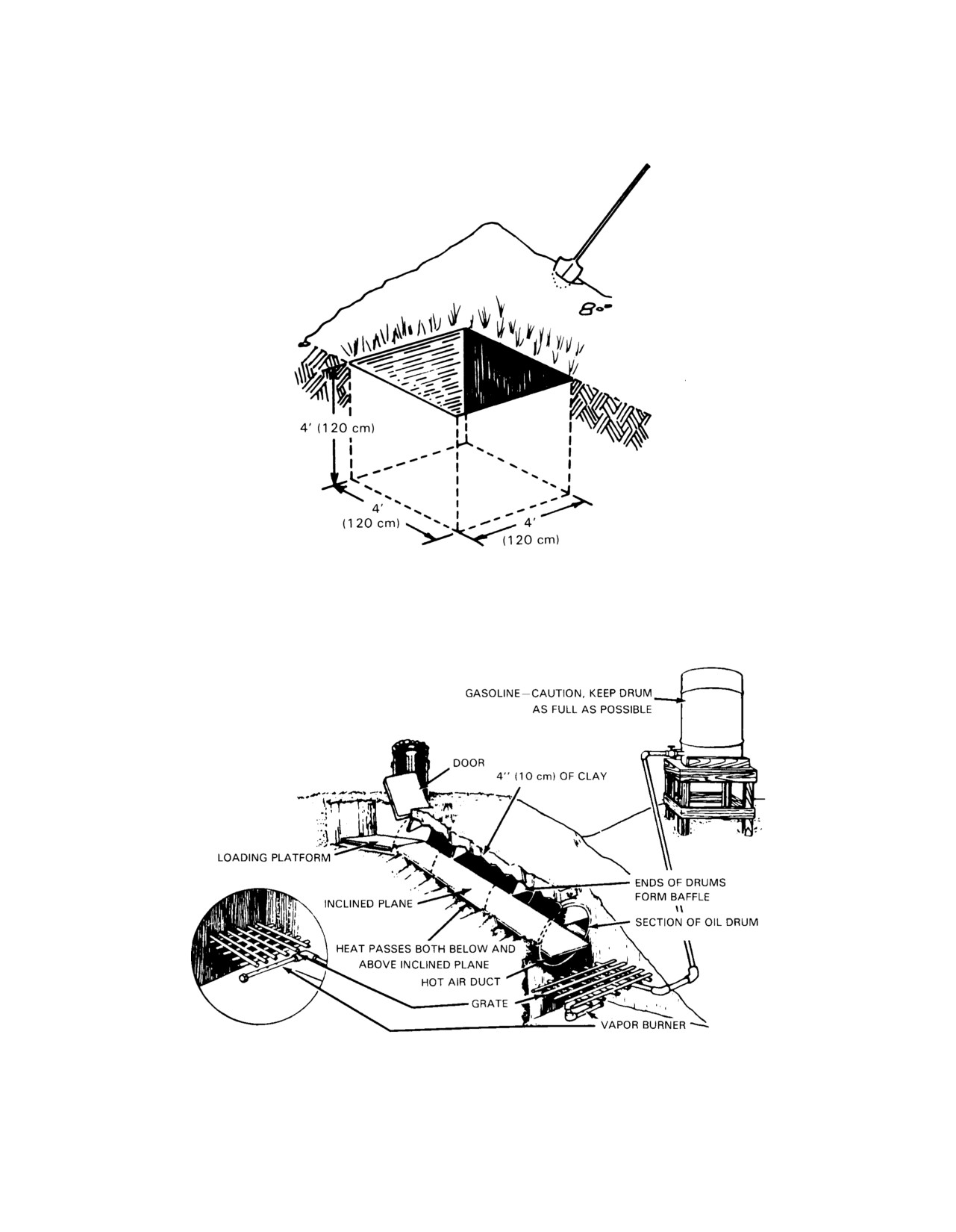
Figure B-23. Garbage burial pit.
Figure B-24. Inclined-plane incinerator with vapor burner.
B-14
FM 4-25.12
Figure B-23. Garbage burial pit.
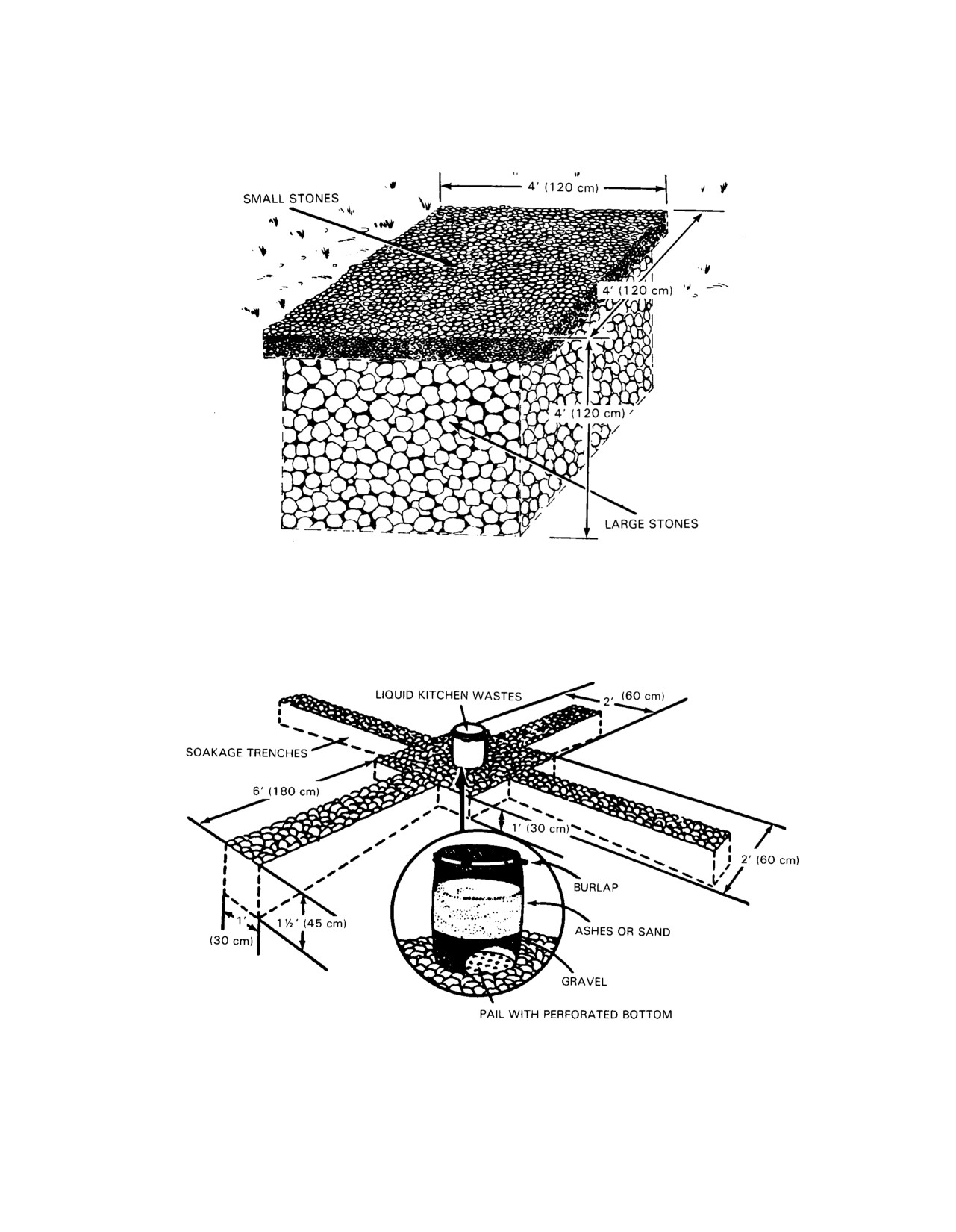
Figure B-25. Soakage pit.
Figure B-26. Soakage trenches with pail grease trap.
B-15
FM 4-25.12
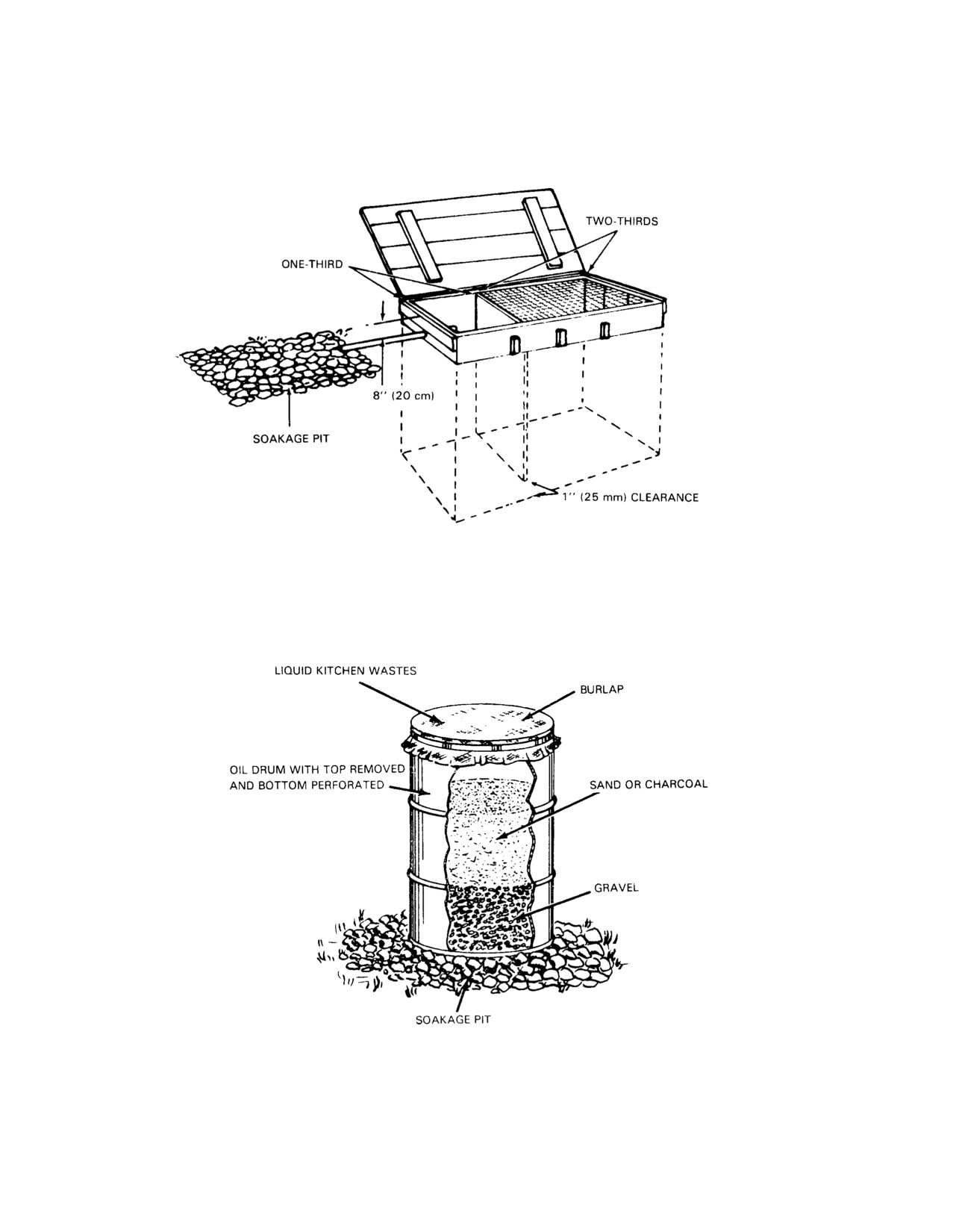
Figure B-27. Filter grease trap.
Figure B-28. Baffle grease trap.
B-16
FM 4-25.12
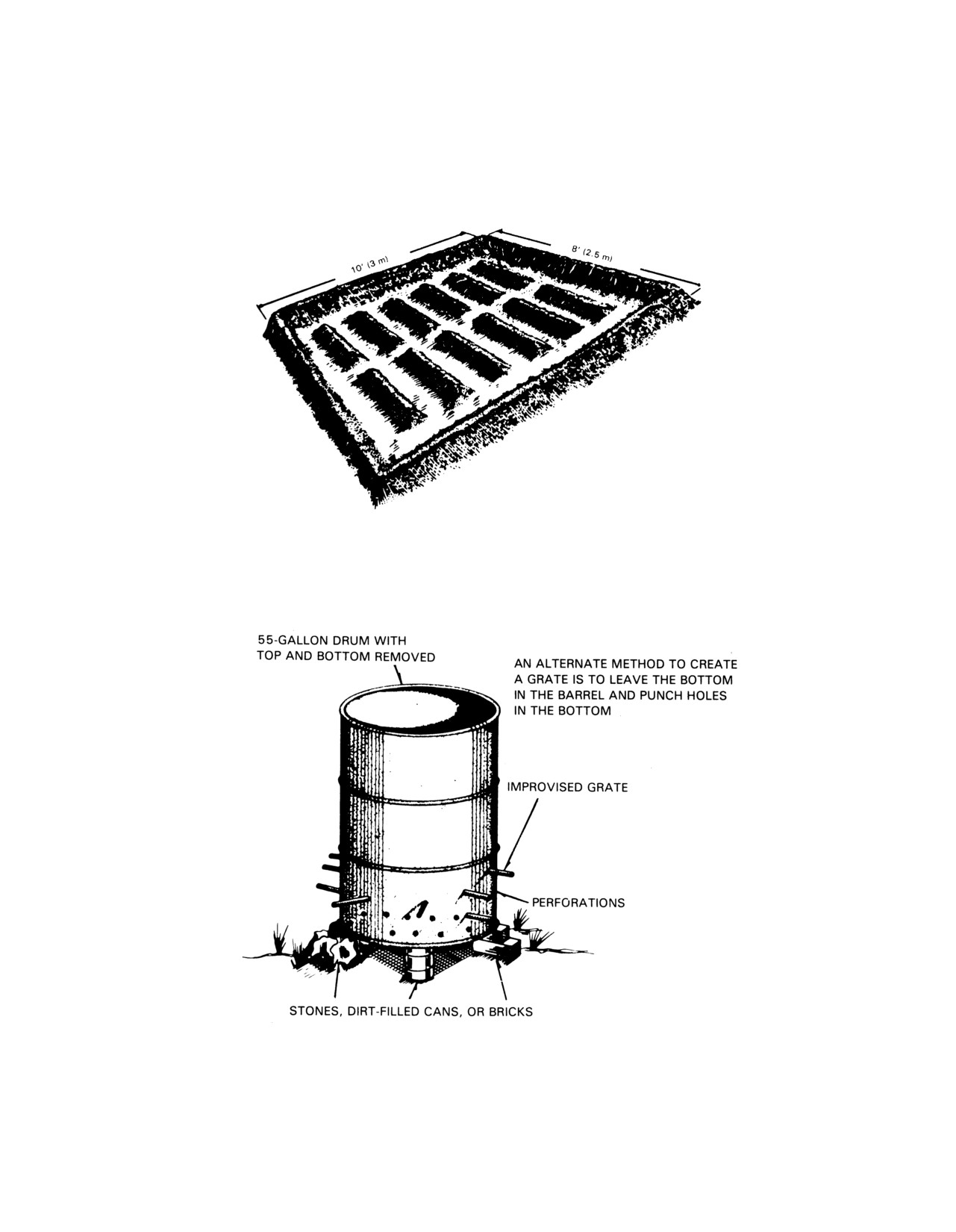
Figure B-29. Evaporation bed.
Figure B-30. Barrel incinerator.
B-17

FM 4-25.12
APPENDIX C
FIELD SANITATION TEAM MATERIALS
Field Sanitation Team Expendable Items
SUPPLY ITEMS FOR PREVENTION OF HEAT INJURIES
ITEM
NSN
UI
AUTH QTY
CL
REMARKS
Wet Bulb-Globe Temperature
6665-00-159-2218
EA
1/unit
9
Inventory component; replace broken
(WBGT) Kit (without tripod).
thermometers; clean/replace wick as
See Note 6.
needed.
WBGT Black Globe Thermometer
6685-01-110-4429
EA
1
9
WBGT component replacement as needed.
WBGT Wet Bulb Thermometer
6685-01-110-4430
EA
1
9
WBGT component replacement as needed.
WBGT Dry Bulb Thermometer
6685-01-110-6563
EA
1
9
WBGT component replacement as needed.
WBGT Wick. See Note 6.
EA
1
9
Use cotton shoestring for replacement.
SUPPLY ITEMS FOR PROVIDING POTABLE WATER
ITEM
NSN
UI
AUTH QTY
CL
REMARKS
*Calcium Hypochlorite, 6 oz jar
6810-00-255-0471
BT
1/50 indiv
2
Check expiration dates quarterly. See
Note 1.
Chlorination Kit, Water Purification
6850-00-270-6225
KT
1/15 indiv
2
Check expiration dates quarterly.
Chlorination Kit, Water Purification
6850-01-374-9921
KT
1/15 indiv
2
Check expiration dates quarterly.
Chlorine Test Tablets
6550-01-044-0315
PG
1
2
Restock Chlorination Kit as needed.
DPD #1 (100 tablets)
Water Purification Tablet,
6850-01-352-6129
PG
10/indiv
2
Check expiration dates quarterly.
Chlorine (10 tablets)
Water Purification Tablet, Iodine,
6850-00-985-7166
BT
2/indiv
2
Check expiration dates quarterly.
8 mg (50 tablets)
Randomly open bottles to inspect that
tablets are steel grey.
SUPPLY ITEMS FOR PROVIDING FOOD SERVICE SANITATION
ITEM
NSN
UI
AUTH QTY CL
REMARKS
Alcohol Swabs, Single
6510-01-153-4638
BX
1/150 indiv
8
Pads, 500s
Disinfectant, Food Service
6840-00-810-6396
BX
1/75 indiv
2
Check expiration dates quarterly.
(12 packets)
Test Paper, Chlorine Residual
6630-01-012-4093
PG
1
2
Check expiration dates periodically.
(10/package)
Thermometer, Food
6685-00-444-6500
EA
2
2
Calibrate as per instruction.
C-1

FM 4-25.12
SUPPLY ITEMS FOR PERSONAL PROTECTIVE EQUIPMENT (PPE)
ITEM
NSN
UI
AUTH QTY
CL
REMARKS
Gloves, Chemical and Oil
8415-01-012-9294
PR
2/150 indiv
2
Maintain cleanliness; replace when torn.
Protective (size 9 or size 11)
8415-01-013-7384
Goggles, Industrial Non-vented
4240-00-190-6432
EA
2/150 indiv
2
Maintain cleanliness; store to prevent
scratching.
SUPPLY ITEMS FOR CONTROL OF ARTHROPODS/RODENTS
ITEM
NSN
UI
AUTH QTY
CL
REMARKS
Chest, #3, 30x18x10 Aluminum
6545-00-914-3480
EA
As required
9
See Note 2.
to load
*Insect Repellent, Personal
6840-01-284-3982
BX
4 tubes/indiv
9
Visually inspect containers periodically.
Application, 2 oz tube
(12 tubes/BX)
*Insect Repellent, Clothing
6840-01-345-0237
BX
9
Visually inspect containers periodically.
Application IDA Kit
(12 kits/BX)
*Insect Repellent, Clothing
6840-01-278-1336
BX
1 can/indiv
9
Visually inspect containers periodically.
and Bednet Treatment,
Aerosol, 6 oz can (12 cans)
*Insecticide, Demand Pestab
6840-01-431-3357
CO
1/150 indiv
9
Visually inspect containers periodically.
10% Tablets, Unit Dose
See Note 3.
(40 tablets/CO)
*Insecticide d-Phenothrin 2%
6840-01-412-4634
CN
1/10 indiv
9
Visually inspect containers periodically.
Aerosol, 12 oz
Mouse Trap, Spring Indiv
3740-00-252-3384
DZ
4 dz/150 indiv
9
Maintain/clean as needed.
(12 traps/BX)
Rat Trap, Spring
3740-00-260-1398
DZ
4 dz/150 indiv
9
Maintain/clean as needed.
*Rodenticidal Bait Anticoagulant,
6840-00-089-4664
BX
1/150 indiv
9
Visually inspect containers periodically.
0.005% diphacinone
(40 blocks/BX)
*Rodenticidal Bait Anticoagulant,
6840-01-426-4808
CN
1/150 indiv
9
Visually inspect containers periodically. See
0.005% brodifacdoum
Note 2.
(Talon-G) 11 lb. can
*Rodenticidal Bait Anticoagulant,
6840-01-151-4884
CN
1/150 indiv
9
Substitute for 6840-01-4808. Visually
0.005% bromadiolone, (Maki
inspect container periodically. See
Pellets) 11 lb can
Note 2.
Container, Rodent Bait, Plastic,
3740-01-423-0737
BX
4 dz/indiv
.9
Maintain/store properly as per manual
Tamper Proof, capable of
instructions.
dispensing solid or granular
bait. Part No. 05830 (6/BX)
C-2

FM 4-25.12
SUPPLY ITEMS FOR CONTROL OF ARTHROPODS/RODENTS
ITEM
NSN
UI
AUTH QTY
CL
REMARKS
Sprayer, Insecticide, Manually
3740-00-641-4719
EA
1/150 indiv
9
Maintain/store properly as per manual
Carried, 2 gal
instruction. See Notes 4 and 5.
Sprayer, Insecticide, Manually
3740-00-191-3677
EA
1/150 indiv
9
Substitute for 3740-00-641-4719. See
Carried, 1 gal
Notes 4 and 5.
Swatter, Fly
3740-00-252-3383
DZ
1/150 indiv
9
*Indicates items with special handling requirements
NOTE 1: Pesticides should be properly stored. Additionally, pesticides should be over packed in Air-Transportable Over pack containers
to facilitate division into teams. Refer to TM 38-250 for additional guidance on air transportation of pesticides. The International
Air Transportation Associations Shippers Declaration for Dangerous Goods form must be used for air transport of those
pesticides, which are regulated.
NOTE 2: Due to shelf life considerations, DO NOT prestock. Order on a priority basis prior to anticipated deployment. For emergency
procurement: Contact the Defense Supply Center, Richmond (DGSCR) Emergency Supply Operations Center (ESOC)
at DSN 695-4865 [commercial (804) 279-4865]. This ESOC is staffed 24 hours, 7 days per week.
NOTE 3: Demand Pestab replaces Chlorpyrifos, 40 ml bottle (Dursban LO), 6840-01-210-3392. Dursban LO may be used until stocks
are exhausted.
NOTE 4: Three sets of repair parts should be acquired for each sprayer. Repair parts will include items such as: check valves, pressure
cups, filters, O-rings, four-way nozzles with crack and crevice tips. Repair parts may be ordered from sprayer manufacturer by
part number as Class IX repair parts.
NOTE 5: All sprayers should be equipped with a pressure gauge. If not, order a pressure gauge, NSN 3740-01-332-8746, and filter,
NSN 4330-01-332-1639, to retrofit the sprayers.
NOTE 6: The Sigma Products and Manufacturing Company, Incorporated, 3324 Blue Jay Pass, Fort Mill, South Carolina 29708, is the
single source provider for the following individual replacement parts within the WBGT kit. Some of the items are not listed with
NSN and must be ordered directly. To receive specific details and current pricing, contact the company either by their website:
WET BULB GLOBE TEMPERATURE KIT AND REPLACEMENT PARTS
PART NUMBER
DESCRIPTION
601301/t
WBGT Kit with tripod
(NSN 6665-01-381-3023)
601301
WBGT Kit
(NSN 6665-00-159-2218)
6013-7755
Refurbish Kit
(complete internal assembly)
5096-2501
Black Globe Thermometer
(NSN 6685-01-110-4429)
5096-2401
Wet Bulb Thermometer
(NSN 6685-01-110-4430)
C-3
FM 4-25.12
WET BULB GLOBE TEMPERATURE KIT AND REPLACEMENT PARTS (Continued)
PART NUMBER
DESCRIPTION
5096-2402
Dry Bulb Thermometer
(NSN 6685-01-110-6563)
6013-0143
Airflow Reducer Vial
6013-0145
Water Reservoir
7200-0020
Wicking
6013-0142
Black Cooper Sheath
6013-0199
Tripod
6013-0140
Calculator
(NSN 6665-01-109-3246)
C-4
FM 4-25.12
APPENDIX D
SAMPLE UNIT STANDING OPERATING PROCEDURE
FOR FIELD SANITATION
NOTE: The following sample standing operating procedure (SOP) satisfactorily shows positive actions and
specific duties considered suitable for a company-sized unit. Standard operating procedures take a
considerable amount of time to develop; they are very detail-oriented. The format, actions, time frames,
and techniques are shown as examples only and are not intended to apply in all cases or to all units. For
most units, the scope, actions, quantities, and responsibilities need to be adapted to the local commanders
requirements throughout all stages of an operation, from predeployment, deployments, site selection,
setup, maintenance, recovery and redeployment.
1.
References.
a. Army Regulation 40-5, Preventive Medicine.
b. Field Manual 21-10, Field Hygiene and Sanitation.
2.
Purpose. To reduce DNBI by ensuring that effective PMM are routinely and habitually practiced
under all field conditions.
3.
Scope. This SOP specifies for all field exercises and contingencies
a. The required FST supplies and equipment.
b. The routine, special, and emergency PMM to be taken.
c.
The responsibilities for the accomplishment of PMM.
4.
Field Sanitation Team. The FST is appointed by the commander as his special representatives to
oversee and observe PMM before, during, and after field exercises or contingencies. Because of special
training, they know and are authorized to initiate the necessary PMM to reduce DNBI to the lowest possible
level. The PMM that will always be accomplished by the designated individual(s) are identified below.
5.
Key. The individual(s) with the requirement for performing the indicated PMM task is identified in
the ACTION column. The SUPERVISE/FOLLOW-UP column identifies the leader/noncommissioned
officer responsible. The individuals are keyed as follows:
APAdvance Party Leader
CDCommander
DFDining Facility Sergeant
DLAssigned Detail
D-1
FM 4-25.12
1CFirst Cook
1SFirst Sergeant
FSField Sanitation Team
KPKitchen Police
METhe Company Trauma Specialist
SSSupply Sergeant
ULAll Officers/Noncommissioned Officers
6.
Actions and Responsibilities.
ACTION
SUPERVISE/
FOLLOW-UP
a.
Planning and Preparations.
1.
Provide personal PMM instruction to troops.
FS
1S
2.
Check supplies, equipment, and loading.
FS
1S
3.
Water/water trailer:
(a) Clean/fill/chlorinate/test (5 ppm).
ME
DF
(b) Locate QM water point(s).
SS
FS
(c) Determine quantity needed.
FS
1S
4.
If potentially hazardous food
(a) Get ice chest(s)/container(s).
DF
1S
(b) Locate ice point(s).
SS
FS
(c) Take food temperatures.
FS
1S
(d) Determine where frozen food will be tempered.
FS
1S
5.
Rubbish/garbage.
(a) Provide for containers.
SS
FS
(b) Locate disposal point(s).
SS
FS
6.
Assure sufficient insect-/rodent-proof food containers.
1C
DF
D-2
FM 4-25.12
ACTION
SUPERVISE/
FOLLOW-UP
7.
Plan and train for contingencies in
(a) Hot temperatures.
1S
CD
(b) Cold temperatures.
1S
CD
b.
Arrival at Field Site.
1.
Spot/set up dining facility and latrine.
AP
FS
2.
Contracting for chemical toilets (1 to 14 days).
DL
FS
3.
Dig deep pit (7 plus days).
DL
FS
4.
Dig soakage pit (liquid kitchen waste).
DL
DF
5.
Spot/set up rubbish/garbage collection points
DL
FS
(if no burial).
6.
Spot/set up water purification bag.
1S
FS
7.
Spot/set up handwashing devices (at dining facility
ME
FS
and latrine).
c.
Routine Actions.
1.
Set up/boil water in mess kit laundry.
DF
FS
2.
Test chlorine residual daily.
FS
ME
3.
Chlorinate/disinfect if test fails.
FS
ME
4.
Schedule/remove garbage/rubbish (every 2 days).
SS
1S
5.
Inspect for/destroy fly/mosquito breeding places.
FS
1S
6.
Police food/drink spills to prevent fly-breeding and
UL
FS
rodent infestations.
7.
Inspect mess kit cleaning.
UL
FS
8.
Inspect utensils/ranges/tables/containers after
DF
FS
cleanup following meals.
D-3
FM 4-25.12
ACTION
SUPERVISE/
FOLLOW-UP
9.
Observe/inspect personal hygiene of troops.
UL
1S
10. Police latrine daily; control flies as required.
DL
FS
d.
Special Conditions/Actions.
1.
Foot marches.
(a) Prior to.
UL
1S
(b) During and after.
UL
1S
2.
Cold temperature (below 50°F/10°C).
(a) Provide for exercise (such as frequent road halts).
UL
1S
(b) Instruct on wear/drying of clothing/footwear.
UL
1S
(c) Instruct on prevention of trench foot, immersion
ME
FS
foot, frostbite, snow blindness, and carbon
monoxide poisoning.
(d) Provide for and heat latrine.
DL
FS
(e) Inspect feet/footwear of troops.
UL
1S
3.
Hot temperature (WBGT index over 85).
(a) Obtain WBGT as directed.
ME
FS
(b) Schedule work for acclimatization.
1S
CD
(c) Provide adequate water.
FS
1S
(d) Instruct troops on cause and prevention of heat
ME
UL
exhaustion, heatstroke, heat cramps, sunburn,
prickly heat, and fungus infections.
e.
Emergency Conditions/Actions.
1.
Loss of bath/laundry support.
(a) Intensify personal hygiene inspections/observations.
UL
1S
D-4
FM 4-25.12
ACTION
SUPERVISE/
FOLLOW-UP
(b) Provide expedient shower/laundry devices.
DL
FS
(c) Inspect troops for body lice 3 weeks after loss
FS
ME
of support in cold weather.
(Notify medical
personnel if body lice are found.)
2.
Loss of water-heating capability.
(a) Start use of disinfectant for mess kit laundries
DF
FS
and utensils.
(b) Provide/improvise expedient water-heating
DL
FS
device(s).
(c) Intensify personal hygiene inspections/
UL
1S
observations.
f.
Departure and Return from Field Site.
1.
Close latrines, soakage pits.
UL
1S
2.
Clean, repair, reorder, replace, and store equipment/
UL
1S
supplies as required.
D-5
FM 4-25.12
GLOSSARY
ACRONYMS AND ABBREVIATIONS
ABCA American, British, Canadian, and Australian
AMEDD Army Medical Department
AMEDDC&S Army Medical Department Center and School
AO area of operations
AOC area of concentration
AR Army regulation
attn attention
auth authorized
bt bottle
bx box
C Celsius
Ca calcium
cl class
cm centimeter
cn can
co container
CTA common table of allowance
CVC combat vehicle crew
DA Department of Army
dB decibel
DEET
75 percent N, N-diethyl-M-tolumide
Glossary-1
FM 4-25-12
dia diameter
DNBI disease and nonbattle injury
DOD Department of Defense
DPD N, N-diethyl-p-phenylene-diamine
DRMO Defence Marketing and Utilization Office
DZ dozen
ea each
ECWCS Extended Cold Weather Clothing System
F Fahrenheit
FAC free available chlorine
FM field manual
FSC food sanitation center
FST field sanitation team
ft foot/feet
gal gallon
IAW in accordance with
IDAA Individual Dynamic Absorption Application
in inch
indiv individual
JP4
jet propulsion fuel, grade 4
Glossary-2
FM 4-25.12
kg kilogram
km kilometer
kt kit
l liter
lb pound
m meter
mg/l milligrams per liter
mm millimeter
MOS military occupational specialty
MRE meals, ready-to-eat
MSDS Material Safety Data Sheets
NATO North Atlantic Treaty Organization
NBC nuclear, biological, and chemical
NSN national stock number
oz ounce
pg package
pH symbol relating the hydrogen ion activity in gram
equivalents per
liter
used in expressing
both
acidity and alkalinity on a scale whose values run from 0 to 14 with 7 representing neutrality.
Numbers less than 7 indicate increasing acidity, and numbers greater than 7 indicate increasing
alkalinity.
PHF potentially hazardous food
PMCS preventive maintenance checks and services
Glossary-3
FM 4-25-12
PMM preventive medicine measures
ppm parts per million
pr pair
psi pounds per square inch
PVNTMED preventive medicine
QM Quartermaster
QSTAG Quadripartite Standardization Agreement
qt quart(s)
qty quantity
RO reverse osmosis
ROWPU reverse osmosis water purification unit(s)
S4
Logistics Officer (US Army)
SB Supply Bulletin
SOP standing operating procedure
STANAG standardization agreement
TB technical bulletin
TIC toxic industrial chemical
TIM toxic industrial material
TM technical manual
TOE table(s) of organization and equipment
UGR Unitized Group Rations
Glossary-4
FM 4-25.12
UI unit of issue
US United States
WBGT wet bulb globe temperature
Glossary-5
FM 4-25.12
REFERENCES
During the development of this publication, the information from the following was used and, in some
instances, quoted or paraphrased as necessary to complete the text. The intended users of this publication
need these references as background general knowledge. They should be fully aware of each of these
sources in order to conduct the training described in the lesson plans (mentioned in Appendix A) for which
this publication is a hands-on ready-reference.
NATO STANAGs
These agreements are available on request using DD Form 1425 from Standardization Document Order
Desk, 700 Robin Avenue, Building 4, Section D, Philadelphia, Pennsylvania 19111-5094.
2048. Chemical Methods of Insect and Rodent ControlAMedP-3. Edition 2.
4 October 1982.
(Latest
Amendment, 10 September 1986.)
2122. Medical Training in First-Aid, Basic Hygiene, and Emergency Care. Edition 2.
10 December
1975.
(Latest Amendment, 7 January 1999.)
2136. Minimum Standards of Water Potability in Emergency Situations. Edition 3. 27 July 1994. (Latest
Amendment, 7 September 1995.)
2885. Emergency Supply of Water in War. Edition 3. 13 May 1996. (Latest Amendment, 1 October 1997.)
2899. Protection of Hearing. Edition 2.
19 October 1987.
(Latest Amendment, 18 July 1995.)
2981. Prevention of Cold Injury. Edition 1.
5 January 1987.
(Latest Amendment, 24 September 1991.)
ABCA QSTAGs
These agreements are available on request using DD Form 1425 from Standardization Document Order
Desk, 700 Robin Avenue, Building 4, Section D, Philadelphia, Pennsylvania 19111-5094.
245. Minimum Requirements for Water Potability (Short and Long Term Use). Edition 2. 10 September 1985.
889. Essential Field Sanitary Requirements. Edition 1.
27 September 1988.
(Latest Amendment,
27 February 1990.)
Joint and Multiservice Publications
TB MED 81. Cold Injury. NAVMED P5052-29; AFP 161-11. 30 September 1976.
TB MED 507. Occupational and Environmental Health: Prevention, Treatment, and Control of Heat
Injury. NAVMED P-5052-5; AFP 160-1. 25 July 1980.
TM 5-632. Military Entomology Operational Handbook. NAVFAC MO-310; AFM 9-16.
1 December
1971.
(Reprinted with basic including Changes 12, January 1976.)
TM 38-250. Preparing Hazardous Materials for Military Air Shipments. AFJM 24-204; NAVSUP PUB
505; MCO P4030.19G; DLAI 4145.3. 1 March 1997.
Army Regulations (AR)
40-5. Preventive Medicine.
15 October 1990.
71-32. Force Development and DocumentationConsolidated Policies.
3 March 1997.
200-1. Environmental Protection and Enhancement.
21 February 1997.
References-1
FM 4-25.12
Common Tables of Allowances (CTA)
8-100. Army Medical Department Expendable/Durable Items.
31 August 1994.
50-909. Field and Garrison Furnishings and Equipment.
1 August 1993.
50-970. Expendable/Durable Items (Except: Medical, Class V, Repair Parts and Heraldic Items).
21 September 1990.
Department of the Army Pamphlets (DA Pam)
40-501. Hearing Conservation Program.
10 December 1998.
40-503. Industrial Hygiene Program.
30 October 2000.
Field Manuals (FM)
4-02-17. Preventive Medicine Services.
28 August 2000.
8-34. Food Sanitation for the Supervisor.
30 December 1983.
8-250. Preventive Medicine Specialist.
27 January 1986.
(Reprinted with basic including Change 1,
12 September 1986.)
8-500. Hazardous Materials Injuries: A Manual for Prehospital Care (Third Edition).
17 January 1997.
10-23. Basic Doctrine for Army Field Feeding and Class I Operations Management.
18 April 1996.
10-52. Water Supply in Theaters of Operations.
11 July 1990.
21-10. Field Hygiene and Sanitation.
21 June 2000.
25-4. How to Conduct Training Exercises.
10 September 1984.
25-100. Training the Force.
15 November 1988.
25-101. Battle Focused Training.
30 September 1990.
100-14. Risk Management.
23 April 1998.
Supply Bulletin (SB)
3-40. Pesticides.
15 November 1995.
Technical BulletinsMedical (TB MED)
TB MED 530. Occupational and Environmental Health: Food Service Sanitation.
28 November 1991.
TB MED 576. Occupational and Environmental Health: Sanitary Control and Surveillance of Water
Supplies at Fixed Installations.
15 March 1982.
TB MED 577. Occupational and Environmental Health: Sanitary Control and Surveillance of Field
Water Supplies.
7 March 1986.
Other
Armed Forces Pest Management Board Technical Information Memorandum, No. 36, Personal Protective
Techniques Against Insects and Other Arthropods of Military Significance.
15 March 2001. This
memorandum is available at www.acq.osd.mil/afpmb.
References-2
FM 4-25.12
INDEX
References are to paragraph numbers except those in boldface type are to page numbers.
ABCA. See American, British, Canadian, and Australian.
AMEDD. See Army Medical Department.
American, British, Canadian, and Australian, iv
Army Medical Department, iv, 2-7ab, A-1, A-21, A-30
Center and School, iii, A-1
arthropod, 2-2, 2-4b, 2-2833, A-4867
biting, 2-29a
bloodsucking, 2-29a(1)(a)
borne disease/illness, 2-1a, 2-4a(6), 2-2830, A-6, A-9, A-4853
dengue fever, 2-30c
malaria, 2-1, 2-30
yellow fever, 2-30b
control, 1-3, 2-4b, 2-3133, A-5466, C-2
disease, 1-3, 2-2b(2), 2-2830
transmission, 2-28, 2-35d
habitat, A-4951, A-53, A-62, A-6869, A-72
life cycles,
2-31, A-4950, A-6869, A-72
nonbloodsucking, 2-29a(1)(b)
preventive medicine measures, 1-3, 2-32, A-5460
repellent systems, 2-32a, A-54
stinging, 2-29b
vectors, A-52
blisters, A-1315
calcium hypochlorite, 2-10bd, A-23, A-2628, A-38, A-110111
carbon monoxide, 2-52b, 2-53, 2-55, A-9099
chemical(s)
action and effects of, 2-52
bore/gun gases, 2-55, A-91, A-95
carbon monoxide, 2-52b, 2-53, 2-55, A-9099
control, 2-33, 2-40f
hydrogen chloride, 2-54
latrines, 2-23ac, B-78
liquid, 2-56
pesticide, 2-3233, 2-39, A-63
poisoning, A-94
rodent control, 2-40f
toxic industrial, 2-49
classification, 2-51
routes of entry, 2-50
Chlor-Floc®, A-2628
chlorination. See water.
combat medic, A-3
Index-1
FM 4-25.12
commanders responsibility, 2-2b(3)(a), 2-21a, A-21
common table of allowance, 1-3
contamination of
food, 2-13, 2-15, 2-18, 2-23a(1), A-3239
water, 2-23a(1), A-2629
cooking
temperatures, 2-1112, 2-14
utensils, 2-14, 2-16
cleaning and sanitizing, 2-4, 2-14, 2-1617, A-3134, A-3738
Corps of Engineers, 2-7b, A-2122, A-30
decibel, 2-59b, A-105
DEET, 2-2b(2), 2-32ab, 2-40h(1), A-5560
Department of Defense, iv
Insect Repellent System, 2-2b(2), 2-32a, A-60
diarrheal disease, 2-2b(3), A-6
disease(s)
and nonbattle injury, 1-12, 1-4, 2-12, 2-3b, A-2, A-56, A-8, A-109, D-1
arthropodborne, 2-1a, 2-4a(6), 2-2830, A-6, A-9, A-49, A-5253
dengue fever, 2-30c
malaria, 2-1, 2-30a
yellow fever, 2-30b
carried by rodents
hantavirus, 2-35f
leptospirosis, 2-35c, A-20
murine typus, 2-35b
plague, 2-35a, A-68, A-70
rickettsialpox, 2-35e
salmonellosis, 2-35d, A-70
transmission of, 2-3537, A-20, A-5253
disinfection, A-23, A-27, A-3738
DPD test kit, 2-10d(2), A-2829, B-5
ear(s), 2-60, A-7
effects of noise on, 2-61, A-103
muffs, 2-62, A-104105
plugs, 2-62, A-105107
preventive medicine measures, 2-62, A-104107
field sanitation
devices, 2-2b(3), 2-5a(1), 2-23, 2-24b(2), 2-25a(2), A-9, A-36, A-44, A-63, B-117, D-3,
expendable items for, C-14
standing operating procedure (sample), D-15
Index-2
FM 4-25.12
field sanitation (continued)
team, iv, 1-14, 2-1, 2-2b(3)(a), 2-45, 2-12, 2-19, 2-33, 2-39, 2-40f, 2-48e, A-1112, C-14
duties/role of, 2-4, A-89, D-15
equipment and supplies, A-108112
expendable items for, C-14
training course, A-1112, B-117
food(s)
borne diseases/illness, 2-1112, 2-14b(1)(2), A-3235
cold, 2-12, 2-14b(2), A-3133
containers, B-1h
handlers, 2-15, A-3039
hot, 2-14b(2), A-33
inspections, 2-19, A-3039
leftovers, 2-16b, 2-18, A-33
PHF. See foods, potentially hazardous.
potentially hazardous, 2-12, 2-14b, 2-16b, A-3139
service
sanitation, 1-3, 2-4a(2), A-3039, C-1
supervisor, 2-15
sanitation center, A-38, B-7
spoilage, A-31
storage, 2-14, A-34
temperatures, 2-14, A-33, A-39
transportation, 2-1213, A-35
utensils, 2-4a(2), A-37
foot care, A-1315
free available chlorine, 2-8fg, 2-10b, 2-10c(4)(b), 2-10e
garbage disposal, 2-24, B-1417
hydrogen chloride, 2-54, A-91, A-94
symptoms of exposure to, A-9798
injury(ies)
cold weather, 1-4, 2-5b, 2-4648, A-6, A-8088
categories of, 2-46, A-8182
cramps, 2-43a
environment, 2-41b, A-83
exhaustion, 2-43b
factors, 2-47, A-82
field sanitation team role in prevention of, A-8588
frostbite, 2-5b, 2-46a and e, 2-47b(1) and c, 2-48d, A-87
hypothermia, 2-5b, 2-46a and ef, A-82
personal measures, 2-48e
prevention of, 2-48, A-8088
soldiers individual role in prevention of, A-87
Index-3
FM 4-25.12
injury(ies) (continued)
heat, 1-4, 2-2b, 2-4145, A-7380
acclimatization, 2-44c, A-75
factors leading to, 2-42
prevention of, 2-44, A-7380
types of, 2-43
cramps, 2-43a, A-74
exhaustion, 2-43b, A-74
stroke, 2-43c, A-75
iodine tablets, A-2627, B-1
latrines, 2-23, A-4143, B-713
lesson plans, A-1112
Lyster bag, 2-10c(1)(a), B-1d, B-5
malaria, 2-1, 2-30, A-6, A-49, A-52
meals, ready-to-eat, 2-10c(2)(c), A-34
medical threat, 2-2, A-410
mental health concepts, A-16
MRE. See meals, ready-to-eat.
NATO. See North Atlantic Treaty Organization.
noise hazards, 1-4, 2-4a(9), 2-5862, A-101108
protective measures, 2-62, A-101108
North Atlantic Treaty Organization, iv
nutritional elements, A-1518
personal
cleanliness, 2-5, A-8, A-12
hygiene, 1-2, 2-5, 2-15, A-8, A-1018
PMM. See preventive medicine measures.
potentially hazardous food, 2-12, 2-14b, 2-16b, A-3139
preventive medicine measures, 1-14, 2-162, A-1112
cold injury, 2-48, A-8088
ear(s), 2-60, 2-62, A-104108
effects of noise on, 2-61, A-103
muffs, 2-62, A-104105
plugs, 2-62, A-105106
foot care, A-1315
heat injury, 2-44, A-7380
QSTAG. See Quadripartite Standardization Agreement.
Quadripartite Standardization Agreement, iv, 2-6
Quartermaster Corps, 2-7c, A-21
Index-4
FM 4-25.12
rechlorination, 2-10c(2)(b)(c), A-2627
reverse osmosis water purification unit, 2-10, A-2329
rodent(s)
control measures, 2-4, 2-40, A-6772
bait station, 2-40g
chemicals, 2-40f
eliminating food source, 2-40bc
pesticide application, 2-39b, A-6466
surveys, 2-40a
traps, 2-4b(5), 2-38c, 2-40e and h(4), A-71
diseases carried by
hantavirus, 2-35f
leptospirosis, 2-35c, A-20
murine typus, 2-35b
plague, 2-35a, A-68, A-70
rickettsialpox, 2-35e
salmonellosis, 2-35d, A-70
disposal of dead, 2-40h, A-72
ROWPU. See reverse osmosis water purification unit.
STANAGs. See standardization agreements.
standardization agreements, iv, 2-4, 2-6, 2-31
standing operating procedure, D-15
TIC/TIM. See toxic industrial, chemicals; materials.
toxic industrial
chemicals, 2-4a, 2-49, 2-52, A-6066, A-96
routes of entry, 2-50
absorption, 2-50b
ingestion, 2-50c
inhalation, 2-50a
injection, 2-50d
materials, 2-4a, 2-49, A-7, A-89101
biologic effects of, A-93
gaseous form of, A-9596
liquid form of, A-9596
medical threat of, A-94
physical status of, A-9092
routes of entry in a body,
2-5051, A-9293
UGR. See Unitized Group Rations.
unit field
bivouac, A-9
waste disposal, A-9, A-4047
Index-5
FM 4-25.12
Unitized Group Rations, A-34
urine disposal facilities, 2-23, A-4047, B-713
waste
disposal, 2-212-23, A-4048
methods, 2-22, A-41
evaporation beds, 2-25a(4), A-44, B-17
facilities, B-1, B-7B-17
garbage, 2-24, A-45, B-14
grease, 2-25a(3), A-44, B-1516
hazardous, 2-27
human
latrines, 2-23, A-4143, B-713
urinals, 2-23, A-4047, B-713
JP4, 2-23c(1)(b)
liquid, 2-25, A-41, A-43, B-1617
rubbish, 2-26, A-41, A-45
water, 2-43a, A-1829
boiling, 2-10c(7), A-2728, A-38
borne disease, 2-6b, A-20
bottled, A-29
chlorination, 2-8e, A-20, A-23
dosage, 2-8f, A-19
kit, A-28, B-5
residual, 2-8h, 2-10d, A-19, A-23, A-28
coliform bacteria, 2-6b, A-20
color comparator, 2-10d, A-28, B-5
containers, 2-7, 2-10c(4), A-2425
contamination, 2-6b
disinfection of, 2-4a(1), 2-8d, 2-10bc
filtration, 2-10, A-23
ground, 2-9, A-22
handwashing device, 2-5, 2-23a(1), B-3
human consumption, 2-6a, 2-9, A-2021
palatable, 2-8a, A-1923
potable, 2-2c, 2-6a, 2-7, 2-8b, 2-18, A-1921, A-24, C-1
purification methods, 2-4a(1), A-2329
quality of, 2-6c
rechlorination, 2-10c(2), A-2627
requirements, 2-6, 2-44, A-21
cold climate, 2-6c(1)
hot climate, 2-6c(2)
rules of water discipline, 2-7d, A-21
sea, 2-9, A-22
Index-6