FM 3-35.4 DEPLOYMENT FORT-TO-PORT (June 2002) - page 4
_______________________________________________________________________________
Appendix E
ANNEX L - Air Transportation.
This annex always covers personnel, TAT, and baggage. It also covers equipment if the
OPLAN/OPORD indicates.
• Appendix 1 - Documentation.
Documentation includes—
DD Form 2130-1, C5 Cargo Manifest
DD Form 2130-3, C141 Cargo Manifest
DD Form 2130-6, KC10 Cargo Manifest
DD Form 2327, Unit Aircraft Utilization Plan
This appendix reflects—
-Equipment/TAT/cargo to deploy by air.
-Number of personnel and cargo to deploy.
-Bulk, oversized, and outsized equipment designated to deploy by air.
• Appendix 2 - Listing of Pintle-Hook Vehicles (if authorized to ship major end items by air; oth-
erwise, personnel pallets only will be indicated).
• Appendix 3 - Air Loading Procedures.
This may include—
TAB A - Planeload commander’s SOP.
TAB B - Load team SOP.
TAB C - Shoring material requirements.
TAB D - 463L pallet and tie-down requirements.
TAB E - Motor and aviation fuels for movement of organic air equipment.
TAB F - Special handling cargo certification.
ANNEX M - Convoy Requirements.
This annex contains information, requirements, and forms.
• Appendix 1 - Request for Convoy Clearance, DD Form 1265 (FM 55-30).
• Appendix 2 -Request for Special Hauling Permit, DD Form 1266 (Request for Special Hauling
Permit) (for outsized/overweight equipment).
• Appendix 3 - Convoy Commander’s Checklist.
• Appendix 4 - Drivers’ Strip Maps.
• Appendix 5 - Convoy Commander’s Safety Briefing.
The briefing should be used to ensure—
Drivers are licensed for vehicles being driven.
ο Any hazardous material that is part of the load is identified on DD Forms 1750 and
836, and on the OEL.
ο Vehicles are properly prepared for movement. Considerations include—
ο Shipping configuration.
ο Fuel levels.
ο Secured secondary loads.
ο Shackles.
ο Purging requirements.
ο Flags.
E-11
________________________________________________________________________________
FM 3-35.4
ο Convoy signs.
ο Highway warning kits.
ο First aid kits.
ο Convoy speeds.
ANNEX N - Rail Requirements.
This annex includes information, procedures and documentation for rail movement. This annex is in-
cluded only for those units where rail movement is projected.
• Appendix 1 - Load Team SOP.
• Appendix 2 - Documentation and Procedures for Rail Loading Equipment.
This appendix includes a rail load plan and is used to ensure training is validated and vehi-
cles are properly prepared for movement. Guidance on vehicle preparation includes—
Shipping configuration.
Fuel levels.
Secondary loads secured.
Shackles.
Markings (UIC and shipment unit number (SUN)).
MSLs.
Purging requirements.
First aid kits.
Vehicle placards in place if HAZMAT is part of the load.
ANNEX 0 - Commercial Movements Requirements.
This annex includes information, procedures and documentation necessary for commercial move-
ment.
• Appendix 1 - Packing List (DD Form 1750). See Annex ____.
• Appendix 2 - FORSCOM Form 285-1-R.
Note. If distance is less than 400 miles, equipment must be non-roadable.
Distance to travel to SPOE must be more than one day (400 miles) road march.
ANNEX P - Facilities/Equipment.
This annex covers facilities en route and equipment requirements for loading/unloading at point of ori-
gin/MS.
ANNEX Q - Points of Contact Listing.
This annex lists POCs pertinent to the movement.
ANNEX R - Safety.
This annex covers—
• Motor vehicle operations.
• Rail load operations.
• Air load operations.
• Accident/injury prevention.
• Ammunition and explosive/POL safety.
E-12
_______________________________________________________________________________
Appendix E
• Prevention of carbon monoxide poisoning.
• Senior vehicle occupant responsibilities.
ANNEX S - N-Hour Sequence.
This annex identifies and schedules movement tasks.
ANNEX T - Plan Coordination Documentation.
This annex includes—
• Documentation requiring action from another command or agency, intermediate headquar-
ters, and local agencies/businesses.
• OPLAN information - location and procedures.
ANNEX U - Appointment Memorandums and Training Certificates and/or Validations.
This annex includes instructions, requirements and documentation for providing certificates or valida-
tions during movement.
ANNEX V - Plan Approval.
This annex includes the approved plans. Plans will be validated and approved by the chain of com-
mand (battalion, brigade, division, and/or installation). The plan(s) will be sent through the chain of
command BEFORE submitting to installation UMC/USAR MSC/STARC DMC for final approval.
ANNEX W - Unit Movement Data.
It is not necessary to forward this annex for approval unless required by approving authority.
• Appendix 1 - OEL Printout.
This appendix contains the OEL printout and may be cross-matched with equipment listed on
the DD Form 1750 and higher headquarters using shipment unit number. OELs will be re-
viewed annually by the installation UMC for AC, biannually by the MSC for USAR, and bian-
nually by the STARC DMC for ARNG. Vehicle load cards must cross match with AUEL and
packing list using SUN sequence.
• Appendix 2 - Packing list (DD Form 1750).
This list for air, rail, convoy, and commercial movement must cross match with OEL and
higher headquarters SUN sequence.
E-13
Appendix F
Unit Airlift Affiliation Program
The airlift affiliation program establishes a training relationship between
deploying Army units and their associated Air Mobility Command Unit. It
develops an understanding of each unit’s mission and promotes coordina-
tion between air mobility managers and airlift users at all levels.
F-1.
The objectives of the unit airlift affiliation program are—
• Enhance the ability of U.S. forces to plan and execute rapid and efficient
movement by airlift.
• Establish a liaison between the moving unit and the airlift manager to
optimize airlift planning and execution.
• Develop a mutual understanding and appreciation of the complexities of
unit activities to prepare for air movement.
• Promote joint training in airlift mobility procedures enhancing the capa-
bility for immediate response to contingency airlift missions.
F-2.
Headquarters AMC manages the affiliation program with the 21st
and 15th Air Forces responsible for area management.
F-3.
The program consists of two phases followed by refresher training:
• Phase 1 prepares unit personnel for safe and efficient airlift operations.
The course of instruction is held at the users' location and is targeted to
prepare unit personnel (E-4 and below) who are designated to prepare,
load, and tie down unit equipment. The course consists of 16 hours of
training and is a requirement for attendance to Phase 2. Successful com-
pletion and receipt of a training certificate recognizes that the student
has been trained to prepare unit cargo for air shipment but does not au-
thorize the student to sign or validate aircraft cargo manifests.
• Phase 2 is the airlift planners’ course and educates unit movement offi-
cers and supervisory personnel (E-5 and above) in airlift planning and
execution of joint combat airlift missions. The course is 48 hours of train-
ing (6 days) held at the user location. Graduates of Phase 2 will be certi-
fied airload planners and authorized to sign, as planning officials, air-
craft cargo manifests for air shipment of unit cargo and personnel. Certi-
fication is valid for 24 months.
• The refresher training is a one day event consisting of refresher training
and a written exam. Successful completion results in the issuance of new
certification (AMC Form 9) valid for 24 months.
F-1
Appendix G
Hazardous Cargo
All hazardous cargo must be prepared and documented according to ap-
propriate regulations. When equipment is packed and loaded, HAZMAT
must be identified and properly segregated. All HAZMAT moving by air
must be certified in accordance with Air Force Joint Manual (AFJM) 24-
204/TM 38-250/Naval Supplement
(NAVSUP) Publication 505/Marine
Corps Operations Pamphlet (MCOP) 4030.19F/Defense Logistics Agency
Manual (DLAM) 4145.3. Units follow the steps outlined below for surface
shipments.
DOCUMENTING HAZARDOUS CARGO MATERIAL FOR SURFACE
SHIPMENT
G-1. The following steps may be used as a guide when shipping HAZMAT.
Use this guide with 49 CFR, Parts 100-177. If the shipment is going interna-
tional, see the Intermodal Maritime Dangerous Goods Code (IMDGC). The
planner should—
• Determine the proper shipping name and number. The shipper must se-
lect the proper shipping name of the materials as listed in the Hazardous
Materials Table.
• Determine the hazard class or classes. Materials are classed by the
proper name in the Hazardous Materials Table. (Hazard class definitions
are located in 49 CFR.) If the materials have more than one hazard class,
classify the materials by hazard precedence.
• Determine the modes of transport to the destination area. The shipper
must ensure that the shipment complies with the various modal re-
quirements. Mode of transport affects the packaging, quantity per pack-
age, labeling and segregation of HAZMAT.
• Select the proper labels and apply as required. Refer to the proper section
of the Hazardous Materials Table.
• Determine and select the proper packaging
Notes.
Most countries enforce the International Maritime Dangerous Goods Code for
import surface shipments of HAZMAT. Department of Transportation (DOT)
regulations require HAZMAT classification and labeling according to 49 CFR
and the IMGDC.
Labels are not required for fuel in vehicle tanks.
G-1
________________________________________________________________________________
FM 3-35.4
• Mark the packaging. Apply the required markings, proper shipping
name, identification number, as required, and the TCN or UIC/shipment
unit number.
• List HAZMAT packed inside containers or vehicles first (refer to steps 1
through 3).
Note. HAZMAT permits only authorized abbreviations. Refer to 49 CFR.
• Determine the proper placards. Refer to 49 CFR.
• Determine segregation requirements for HAZMAT. Rail, ocean vessel,
highway, or a combination of these modes may ship HAZMAT. If two or
more modes transport the cargo, segregation standards for each mode
must be met.
• Prepare appropriate shipping papers.
• Ensure water commodity and special handling codes are used on the
OEL/UDL.
• Ensure compliance with the DOT emergency response guidebook (DOT P
5800.5).
PREPARING SHIPMENT UNITS OF HAZARDOUUS MATERIAL FOR
SHIPMENT
G-2. Rules governing segregation requirements for hazardous cargo must
be met. When in doubt about shipping any hazardous or questionable mate-
rials, units separate them from the rest of the unit cargo. If they cannot iden-
tify the hazard class or classes, they consult the installation safety office or
the ITO. The deploying unit ensures—
• Loose ammunition and explosives are removed from all containers and
vehicles. Ammunition is not permitted into the port or aboard vessels
without prior authorization from MTMC.
• Vehicle fuel tanks are only three-quarters full.
(See DOT Exception
7280.) (Hazardous placards are not required for fuel in vehicle tanks.)
• Fire extinguishers remain aboard motor vehicles and secured in brackets.
• Oxygen and acetylene tanks are marked with the prime mover
UIC/shipment unit number. Trailer-mounted equipment with internal
combustion engines, such as generator sets, are only 50 percent full of
fuel to ensure they are removed and palletized.
• Five-gallon fuel cans, field cans, water heaters, gasoline lanterns, port-
able generators, blow torches, and similar equipment in which combusti-
bles or fuel other than diesel are used or stored are completely drained
and cleaned before shipment. Under a declared national emergency, 5-
gallon fuel cans may carry fuel. These cans must remain in built in cra-
dles designed for this purpose. (See DOT Exemption 7280.)
• The battery box and cover are serviceable. The battery band box and
cover must be positioned not to touch the terminals and to prevent
arcing.
• Batteries of non-self-propelled equipment, such as generators, are dis-
connected and terminal ends are protected from arcing and corrosion.
G-2
_______________________________________________________________________________
Appendix G
• Bulk fuel carriers are drained and placarded appropriately. If required,
units purge bulk fuel carriers according to the respective TM.
PLANNING UNIT BASIC LOAD AMMUNITION SHIPMENTS
G-3. Ammunition shipments are normally scheduled through military
ammunition ports. To meet deployment requirements, ammunition may be
moved through a commercial port. If the unit deploys through a commercial
seaport, the USCG grants a HAZMAT permit. Permits are required for muni-
tions above .60 caliber, granted on a case-by-case basis and issued according
to 33 CFR. The unit must submit HAZMAT data to the ITO to ensure the
permit is coordinated with the USCG for pre-positioning. This data will in-
clude—
• The DoD Identification Code (DODIC).
• The quantity/unit of ammunition.
• The total weight in pounds per box.
• The total net explosive weight (NEW).
• The DOT class code/number.
• The Quantity Distance (QD).
• The storage compatibility of ammunition.
G-4. The USCG representative to the port issues the HAZMAT permit.
The permit will specifically identify the amount of UBL ammunition per unit,
state the name of the commercial port, and grant clearance for a specific
amount of ammunition through the port.
G-3
Appendix H
Rail Operations
Not all units or power projection platforms are located within driving dis-
tance to seaports, and not all cargo, particularly for heavy forces, is trans-
portable by military or commercial truck. In these cases, use rail travel.
The railroad facilities serving the POE may be at the head of a pier or at
an inland transfer point. The transfer point may be truck-to-rail or am-
phibian-to-rail. Terminal service units will load or unload rail equipment
during cargo-handling operations. These units plan rail loading proce-
dures and secure cargo on rail cars. They must also know the type of
equipment required at destination to load and unload cargo to minimize
the amount of rail equipment used and to make the loading/unloading as
simple and quick as possible. This annex provides some of that informa-
tion.
THE DEFENSE FREIGHT RAILWAY INTERCHANGE FLEET
H-1. Commercial carriers provide most rail cars. The Defense Freight
Railway Interchange Fleet (DFRIF) is essentially a CONUS land transporta-
tion asset. The DFRIF augments the peacetime and mobilization freight
movement requirements, which cannot be adequately met by the commercial
transportation system. It is limited to equipment which cannot be readily ob-
tained from commercial railroads or other equipment when ownership is re-
quired to meet deployment time constraints. The DFRIF consists of the fol-
lowing assets:
• Common user flat cars.
• Special purpose flatcars.
• Common user tank cars.
• Special purpose box cars.
• Special purpose cabooses.
H-2. Commercial rail cars vary by carrier; however, there are three basic
types:
• Open top cars (flatcars and gondolas).
• Closed cars (box cars).
• Specialty cars (multi-level, caboose, heavy-duty, and trailer/container on
flatcar).
RESPONSIBILITIES
H-3. The unit and the installation have planning and execution responsi-
bilities during rail operations.
• The deploying unit’s responsibilities—
H-1
________________________________________________________________________________
FM 3-35.4
Submits movement requirements to the supporting ITO.
Prepares equipment for rail loading including packing, crat-
ing, banding, blocking, and bracing secondary loads.
Loads railcars under the technical supervision of the ITO.
Uses FM 55-17 (scheduled to be incorporated into FM 4-
01.011) as guidance for railcar loading.
• The installation transportation officer—
Orders railcars in the types and quantities required based on
the deploying unit's movement requirements.
Computes railcar requirements based on the shipping con-
figuration of the items to be shipped. Accurate OEL/UDL data
is essential.
Coordinates with MTMC and the railway agent.
Provides HAZMAT documentation as required.
Checks, in conjunction with the railway agent, applicable
route clearances for each shipment of overweight or outsized
items.
H-4. The director of public works provides units with blocking and bracing
materials needed to load military equipment on railcars. Units must request
these materials from the DPW as far in advance as possible. The DPW also
provides tools and assistance as required.
PRE-LOADING
H-5. When railcars arrive on station, the ITO performs a joint inspection
with the railroad representative before the cars are placed at an onload site.
Once the military accepts the railcars, units comply with the AAR rules or
with host nation rules. An additional inspection is made after the cars are
loaded to ensure compliance with Army regulations, AAR loading rules, or
host nation rail rules. Rail cars used to transport explosives must be
inspected to ensure compliance with Title 49, CFR 174.104, or applicable host
nation rules.
H-6. The deploying unit checks chain tie-downs and position them on the
railcar decks to avoid having to reposition chains after vehicles are loaded.
They also store unused chains in the channels to prevent damage and place
spanner boards between railcars when loading wheeled vehicles. As a rule, at
least 12 inches of the spanner should overlap the railcar deck. Most tracked
vehicles do not require the use of spanners when rail loading. The ITO pro-
vides spanners as required for rail operations. Spanners come in various
lengths to meet operational requirements. Before beginning operations, apply
car brakes and chock rail wheels to prevent shifting during loading. Addi-
tional site preparation may include setting up command and control facili-
ties, warming tents, and medical aid stations. When possible, turn off over-
head electric wires.
H-2
______________________________________________________________________________
Appendix H
LOADING
H-7. The AAR publishes loading rules, which apply to the railroad, ITO,
and shippers (users). Military publications FM 55-17 (to be incorporated
into FM 4-01.011) and FM 4-01.50 include these rules. Commanders will en-
sure host nation rail rules and regulations are followed. Both CONUS and
host nation railroad representatives can, and do, refuse to accept improperly
loaded shipments. Rail cars must be loaded promptly to avoid demurrage
charges. All loads must be properly secured in accordance with appropriate
military standards and shipper loading drawings. They also comply with
railroad loading guidelines.
H-8. When loading, blocking, and bracing vehicles on flat cars or in box-
cars—
• Cars must be suitable for safe transportation of the load.
• Load and weight limits must not be exceeded.
• Loads must not exceed the width and height restrictions over the pro-
posed route.
• Loads must be adequately secured on cars.
• One-half the load limit of the car must not be exceeded on any axle.
• The load on the car must be secured.
• Items having a high center of balance (CB) must be secured to prevent
tipping while in transit.
• Idler cars must be used when loads extend beyond the end of the loaded
car.
• Trailers loaded with heavy equipment are not to be loaded.
H-9. The most common and expeditious method of loading vehicles is
called the circus method. This method uses a flatcar as a roadbed with span-
ners placed between cars. Tracked vehicles may be loaded without spanners.
Vehicles are staged per the loading sequence, called forward to the ramp, and
driven onto the flatcars. A guide should be stationed on the ramp, on each
flatcar, and at each side of the flatcar to adjust the spanners. When heavy
equipment is loaded, spanners are secured to each car to prevent movement.
H-10. Brake wheel clearance on loaded open-top cars is prescribed by Rule
2, Section 1, AAR Rules for Loading All Commodities. Sufficient space must
be provided around the brake to ensure accessibility.
TYPES OF TRAINS
H-11. Individual cars or groups of cars moving in the carriers regular train
service are called carloads. For planning purposes, use the average speed of
13 miles an hour or 312 miles per day.
H-12. An additional train operated by the carrier for its convenience to
handle a large number of cars is called a unit train. The number of cars re-
quired to form a unit train varies dependent on the carriers operating condi-
tion. MTMC negotiates rates on unit train service with the rail carriers. The
shipper usually receives a reduced rate for tendering so much service at one
time, but is not entitled to exclusive use of the train. If the unit train is not
dimensional (high/wide) loads, use an average speed of 22 miles per hour or
H-3
________________________________________________________________________________
FM 3-35.4
528 miles per day. If the unit is carrying dimensional loads, use the carload
speed for planning.
HAZARDOUS AND SENSITIVE CARGO
H-13. Hazardous Cargo - Shipments of ammunition, explosives, and other
hazardous materials will be tendered for rail shipment in accordance with
defense transportation regulation (DTR), Part II, and appropriate Army in-
structions.
• Shipments must not contain any combination of explosive or hazardous
material prohibited by DOT regulations from being loaded, transported,
or stored together.
• All items must be in good condition and marked in accordance with DOT
and applicable regulations.
• Placards must be properly placed in accordance with DOT regulations.
• MTMC, at the bequest of the shipper, requests exemptions in accordance
with the DTR.
• IAW Title 49, CFR 174.104, a carrier-provided three-part car certificate
will be used in connection with inspection of rail cars used for shipping
Class 1 explosives.
• Rail cars used for shipment of explosives must be properly sealed with an
Army approved seal.
H-14. When deploying units ship sensitive or classified material by rail,
commanders may be required to provide guards or escorts. For shipments
other than sensitive or classified, guards are provided at the commanders’
discretion. See DTR, Part II, Chapter 205 and Figure 205-1, for sensitive ma-
terial risk categories and proper security requirements.
UNLOADING
H-15. Rail cars are unloaded promptly at destination to preclude unneces-
sary payment of demurrage charges. CONUS tenders allow 48 hours free
time for unloading commercial rail cars. The ITO does not detain DoD-owned
cars more than 10 days without the DFRIF manager’s approval. Blocking,
dunnage, and banding are removed from the unloaded rail car before release
to the carrier.
SAFETY
H-16. Safety considerations are paramount throughout all phases of rail
operations, with a safety briefing given before all operations. Examples of
safety concerns include—
• Guiding vehicles on and off rail cars.
• Using proper safety equipment; such as gloves, goggles, and safety boots.
• Ensuring proper tension for tie-down.
• Standing or riding on rail car after load is secured.
• Walking between rail cars.
• Standing on rail car or equipment after loading.
• Proper mounting and dismounting of railcars.
H-4
______________________________________________________________________________
Appendix H
• Using spanner plates before vehicle roll-on/roll-off.
• Avoiding overhead electric lines.
H-5
Appendix I
Classified and Sensitive Cargo
Classified cargo is cargo that requires protection in the interest of na-
tional security. Classified cargo shipments are specially identified, se-
cured, segregated, handled and tracked to ensure the safety and integrity
of the shipment. Sensitive cargo defined as arms, ammunition, and explo-
sives are a definite threat to public safety and may be used by militant,
revolutionary, criminal, or other elements for civil disturbances, domestic
unrest, or criminal actions. Sensitive cargo is sometimes confused with
protected cargo, which are items designated as having characteristics re-
quiring them to be identified, accounted for, secured, segregated, or han-
dled in a special manner to ensure safety or integrity. In either case, this
sensitive or protected cargo must be properly secured and identified to
port personnel so sufficient security can be provided.
Note. Do not identify sensitive cargo or classified cargo on the outside of the
shipping containers.
CLASSIFIED CARGO SHIPMENTS
I-1. When transporting classified material, enclose it in two sealed contain-
ers, such as boxes or heavy wrappings. For detailed instructions when pack-
ing classified material, see the local security manager and AR 380-5. The fol-
lowing considerations apply—
• For classified information inside a packaged item of equipment, the out-
side shell or body may be considered as the inner enclosure if it does not
reveal classified information.
• When classified material is an inaccessible internal component of a bulky
piece of equipment that is not otherwise packaged, the outside body of
the item may be considered a sufficient enclosure if it does not reveal
classified information.
• If the classified material is a piece of equipment that is not reasonably
packaged and the shell or body is classified, conceal it with a covering
that hides all classified features.
• Specialized shipping containers may be used, including lockable cargo
transporters, instead of following the above packaging requirements. In
such cases, the container may be considered the outer wrappings or
cover.
• Packaging material must be durable enough to provide security protec-
tion while in transit to keep items from breaking out of the container and
I-1
________________________________________________________________________________
FM 3-35.4
to help detect any tampering with the container. The wrapping must con-
ceal all classified characteristics.
• Closed and locked vehicles, compartments, or cars are used for shipments
of classified material except when the appropriate authority authorizes
another method.
• When classified material is transported, it is not stored in any detachable
storage compartment, such as automobile trailers, luggage racks, aircraft
travel pods, or drop tanks.
• When classified material is transported across international borders, ar-
rangements must be made to ensure that customs, border, or other in-
spectors (either U.S. or foreign) do not open the material.
• A serial-numbered seal is placed on doors to containers, vehicles, or com-
partments that contain classified or protected cargo. The serial number
must be entered on the shipment unit packing list.
• The unit authorizing the transport of classified equipment must notify
the ITO and appropriate carrier in advance.
I-2. When traveling by motor convoy, escorts ensure constant surveillance of
classified material. Classified material must stay within the escort’s personal
possession or observation at all times. Larger pieces of secret shipments such
as missiles may require outside storage. If so, special protective measures in-
clude constant and continuous surveillance by at least one or more escorts in
the area.
SENSITIVE CARGO SHIPMENTS
I-3. For sensitive cargo, units—
• Remove crew-served weapons from vehicles. They place them in contain-
ers that are sealed and secured.
• Ensure packaging material is durable enough to provide security protec-
tion while in transit.
• Secure containers, vehicles, or compartments with an appropriate locking
device as directed by the installation security officer. They also place a
serial-numbered seal on the door and enter the serial number on the
shipment packing list.
• Identify sensitive items in the commodity code on the unit’s OEL/UDL.
• Do not indicate on the outside of the container, vehicle, or compartment
that it contains sensitive items. They identify this fact on the unit’s
OEL/UDL.
• Provide guards/escorts if shipping sensitive/classified material by rail
(place container doors facing each other). They notify the rail carrier and
enter the shipment in the Defense Transportation Tracking System. For
shipments other than sensitive/classified material, guards/escorts are
provided at the commander’s discretion.
• Many overseas customs officials require serial numbers and dollar values
for weapons before allowing transit to and through a country.
Note. Security requirements for the shipment of arms, munitions, missiles,
and explosives are detailed in AR 190-11 and DoD Reg 4500.9R.
I-2
Appendix J
Convoy Commander's Checklist
This checklist was adapted from a number of training aids. It provides a
representative example of a convoy commander’s checklist. (See FM
4-
01.30 (55-10) for detailed convoy operations.)
MISSION REQUIREMENTS
• Current Intelligence/Situation
• Task Vehicles: Type and Quantity
• Personnel
• Cargo by Type, Class, and Size
• Security Vehicles: Type and Quantity
• Maintenance Vehicles
• Materials Handling Equipment
• Command and Control Vehicles: Type and Quantity
• Lighting/Blackout Conditions/Night Vision Goggles (NVGs)
RECONNAISSANCE
• Map and Photo
• Physical
ROUTE SELECTION
• Roads
• Bridges and Tunnels
• Grades and Curves
• Traffic Density
• Requirements for Route Preparation or Repair
LIAISON AND COORDINATION
• Units Along Route
• Units Being Moved
• Supporting Units
• Highway Control Agencies
• Shippers/Cargo Handlers
• Engineer/Explosive Ordnance Disposal (EOD) Requirements
CONVOY ORGANIZATION
• Size of Serials/March Units
• Type of Column
J-1
________________________________________________________________________________
FM 3-35.4
• Operating Gaps
Serials/March Units
Vehicles
• Positions of Security and Supporting Units
• Positions of Control Personnel/Escorts Guides
• Organization for Command
• Vehicle Marking
MOVEMENT PLAN
•
Controlled Route
Convoy Clearance/Movement Credit
Road Movement Table
Special Permits or Authorization
•
Distance, Time, and Rate of Movement
Trip Distance
Required Start Time
Column Length
Slowest Vehicle
Required Delivery Time
Rate of Movement/Speed (Speedometer Multiplier)
Maximum Catch-up Speed
•
Loading
Time and Place
Site POC
Type/Class Cargo
Outsized Loads
Materials Handling Equipment Required
Blocking, Bracing, and Cargo Restraints
•
Staging
Location
Vehicle Checks
Cargo Checks
Time to Start Point
OPERATOR BRIEFING
• Start Point
Location/Grid Coordinates
Identification Characteristics
• Check Points
Locations/Grid Coordinates
Identification Characteristics/Alphanumeric Designators
• Guides and Markers
J-2
_______________________________________________________________________________
Appendix J
Positions
Posting and Pickup
•
Halts
Purpose
Time Duration
Locations
•
Maintenance
Trail
En Route Support
•
Medical Support
Organic Capability
Evacuation
•
Release Point
Location/Grid Coordinates
Identification Characteristics
Report Requirements
Control of Vehicles and Operators
•
Unloading
Time and Place
Site POC
Materials Handling Equipment Required
•
Backload and Turn Around
SECURITY EN ROUTE
• Action in Event of Attack
Air Attack
Artillery Attack
Ground Attack
Sniper
• Air Support Procedures
• Fire Support Procedures
• Use of Lights-Blackout Restrictions
SERVICE SUPPORT
• Fuel
Location/Times
Types and Quantity
Accompanying Convoy
• Messing/Rations
Locations/Times
Units on Route
Prescribed Loads
J-3
________________________________________________________________________________
FM 3-35.4
Maintenance and Medical Support
COMMUNICATIONS
• Convoy Control Net
Serial/March Unit Commanders
Parent Unit/Headquarters
• Alert/Broadcast Net
• Security/Tactical Nets
• Fire and Air Support Nets
• Medical Evacuation
• Visual Signals
• Sound Signals
• Interpreter Requirements
J-4
Appendix K
The Joint Inspection Process
The joint inspection process designed to ensure loads and vehicles
transport safely within the Defense Transportation System. The process
consists of two steps: preparing equipment and supplies for the joint in-
spection, and then the actual inspection. This annex addresses both steps.
PREPARATION OF EQUIPMENT AND SUPPLIES
AIR TRANSPORTED VEHICLES
K-1. Vehicles and equipment should be prepared so as not to diminish
their combat capability. They should be reduced only enough to meet the di-
mensional and weight requirements of the aircraft transporting them. TB 55-
46-1 lists the reduced dimensions and characteristics for the transportability
of military vehicles. The TB may also be found at the MTMCTEA website.
FUEL IN AIR TRANSPORTED EQUIPMENT
K-2. Fuel requirements for air transport will be in accordance with TM 38-
250. (For example, a maximum of three-fourth of a tank for most vehicles and
one-half a tank for ramp loaded vehicles.) Fuel tankers containing fuel are
not authorized for air transport. However, if the tankers are purged and ap-
propriately documented they can be air transported. Some tankers do not re-
quire purging. (See TM 38-250.) Some full containers including the collapsi-
ble 500-gallon containers can be air transported.
WATER TANKS
K-3. Water tanks and water trailers must be empty with the following ex-
ceptions:
• When water is not available at the destination the M149A2 may be trans-
ported full in compliance with established procedures.
• Water may be transported in certified air transportable containers. (For
example, 5-gallon water cans, 55-gallon drums, and 500-gallon fabric col-
lapsible bags.)
GENERAL CARGO
K-4. General cargo can be carried in or on any vehicle if the cargo can be
properly secured and restrained. Supplies and equipment not transported as
secondary loads (in vehicle cargo compartments) should be palletized or
packed in pallet inserts.
K-1
________________________________________________________________________________
FM 3-35.4
CONTAINERS
K-5. Internal airlift/helicopter slingable-container units (ISU) are certified
for air transportation. The keys to the containers must be available through-
out the air deployment process. Hazardous material must be accessible at all
times when containerized and certified for air transport per TM 38-250.
K-6.
463L pallets are certified for airlift at a 10,000 pound maximum
weight and, depending on position within the aircraft, vary in height restric-
tion. The base measurements of the 463L pallet are 88 by 108 inches.
PALLET BUILDING PROCEDURE CHECKLIST
K-7. Follow safety procedures. Ensure personnel have safety shoes and
work gloves. Provide a briefing on appropriate lifting procedures before be-
ginning to build pallets.
K-8. Before building the pallet, examine it for usability.
• Is the pallet skin free of damage, top and bottom?
• Are the lips on the pallet perimeter bent?
• Are tie-down rings serviceable?
• Is the pallet level and not warped?
• Is the pallet free of corrosion?
• Is the pallet clean and free of dirt?
• Is the pallet right side up?
K-9. The building process may now begin.
•
Is the pallet placed on three-point dunnage?
•
Is the cargo to be placed on the pallet securely packaged?
•
Does cargo have required markings?
•
Are hazardous materials labels prepared in accordance with 49 CFR
172.400 and TM 38-250?
•
Are hazardous material labels attached to items of hazardous cargo or
their containers?
•
Is cargo marked with arrows, such as, “This side up,” placed with arrows
pointing up?
•
Are hazardous items on pallets compatible IAW TM 38-250?
•
Is hazardous cargo positioned for easy access during flight?
•
Are hazardous labels visible from the 88-inch side of the pallet?
•
Do doors of mobility bins containing hazardous items open to an 88-inch
side of the pallet?
•
Are heavier boxes and crates placed on the bottom of the pallet load?
•
Is lighter, more fragile cargo placed on the top of the pallet load?
•
Is cargo arranged and properly stacked so it is safe?
•
Is the height of the pallet 96 inches or less from the skin of the pallet?
•
Does the pallet weigh less than 10,000 pounds?
•
Is the 88 by 108-inch pallet loaded with no overhang?
•
Has the plastic cargo cover been placed on cargo before cargo netting?
•
Is the cargo secured to the pallet with two side nets and a top net?
K-2
_______________________________________________________________________________
Appendix K
• Does the netting have serviceable clips and hooks?
• Are the nets free of tears, rips, and broken rings?
• Are the cargo netting adjustment straps on the outside of the nets?
• Are strap ends tucked into the netting?
• Does each pallet have three-point dunnage?
• Are keys or combinations available to the troop commander for all locked
items?
JOINT INSPECTION PROCEDURE CHECKLIST
K-10. DD Form 2133 (Joint Airlift Inspection Record) should be used as a
guide when preparing equipment and cargo for airlift. The following are the
standards for preparing and inspecting cargo for airlift. Each item number
listed matches an item number from DD Form 2133, and provides instruc-
tions on how to properly fill the block.
(See Figure K-1, Sample DD Form
2133.)
•
Heading—
Item 1. UNIT BEING AIRLIFTED - Enter the numerical designation
and geographic location of the military unit responsible for the
equipment being airlifted; for example, 7th Transportation Group,
Fort Eustis, VA.
Item 2. DEPARTURE AIRFIELD - Enter the name of the facility the
airlifted unit is departing; for example, Langley Air Force Base
(AFB), VA.
Item 3. DATE - Enter year, month and day that the inspection is
accomplished.
Item 4. AIRCRAFT TYPE AND MISSION NUMBER - Enter the type
and mission number of the aircraft on which the equipment is being
loaded.
Item 5. LOAD/CHALK NUMBER - Enter the transported force as-
signed aircraft load number that establishes the desired load se-
quence.
Item 6. START TIME - Enter the local time the inspection started.
Item 7. COMPLETE TIME - Enter the local time the load was
checked and deemed ready for movement.
Item 8. TALCE - Enter the numerical designation of the unit having
TALCE or aerial port responsibility for operating location.
•
Documentation—
Item 9. MANIFEST/LOAD PLANS - Ensure completion of the re-
quired number of copies. Check for proper manifesting of the entire
chalk, and check that the load plan scale weights match the manifest
weights. Ensure the load is correctly sequenced (IAW load plan) and
complies with all aircraft loading and safety of flight limitations.
Item 10. SHIPPER’S DECLARATION - Check for the proper prepa-
ration of all required hazardous material documentation and certifi-
cation IAW TM 38-750.
K-3
________________________________________________________________________________
FM 3-35.4
Item 11. HAZARDOUS MATERIALS PREPARATION - Check that
all hazardous material in the loads is properly prepared, positioned,
and compatible with other hazardous material in the chalk, as re-
stricted by TM 38-250.
Item 12. LOAD LISTS / CARGO TRANSFER FORMS - Ensure the
proper preparation of all required load lists and/or custodial transfer
documentation.
•
Vehicles/Non-Powered Equipment—
•
Item 13. CLEAN - No dirt, trash, or pests. Clean each item of all
grime, oil, dirt, or anything else. Steam clean if necessary. Ensure
all vehicle tires are free from debris (rocks, pebbles, sand, and such)
embedded in tire treads.
Item 14. FLUID LEAKS - A loss of fluid at a rate which is readily de-
tected or seen is a leak. Five drops or more per minute from a cooling
system crank case or gear case is a leak. Fuel or brake system leaks,
no matter how minor, will prevent air shipment. Do not consider a
damp or discolored seal a leak unless any of the above conditions ex-
ist.
Item
15. MECHANICAL CONDITION - Unless the vehicle is
shipped as retrograde cargo it must be operational. The engine,
brakes, and emergency brake should work.
Item 16. BATTERY - Ensure the battery is correctly installed, for ex-
ample, the holding clamp is secure, connectors tight, filter caps
tightly installed, and all cables and clamps are not in contact with
any grounding point during loading or flight. If the battery is discon-
nected, ensure the terminals are covered with rubber covers or tape
to prevent damage or short circuits.
Item 17. FUEL TANK(S) LEVELS - Vehicles and self propelled
equipment will not exceed three-fourth of a tank when loaded on the
aircraft floor and one-half a tank when loaded on the ramp. Wheeled,
engine-powered support equipment (wheeled generators and the like)
will not exceed one-half tank regardless of position on the aircraft.
Equipment that is ramp loaded will be positioned with the gas tank
opening on the high side of the ramp. Palletized vehicles or self-
propelled equipment will not exceed one-half tank. Palletized genera-
tors will be drained. Ensure fuel caps are properly installed. On
closed fuel systems, loosen caps to allow pressure to equalize.
Item 18. JERRY CANS - Per TM 38-250, performance oriented pack-
aging (POP)-certified 5-gallon fuel containers are authorized for air
transportation. The vehicle/equipment fuel racks must be designed to
accommodate and secure fuel containers to prevent movement or
leakage during air transport. Fuel containers not in fuel racks must
be cushioned by material or fiberboard separation to prevent metal-
to-metal contact. They must have a serviceable gasket in place on the
screw cap closure. The containers must not leak, nor may any dent on
the seams be visible. DOT 5-liter fuel containers (metal) can be pal-
letized when drained (purging not required), but cannot be palletized
full. Maximum quantity of fuel authorized for the containers is 5 gal-
lons, although they can be air transported with less fuel.
K-4
_______________________________________________________________________________
Appendix K
Item 19. DIMENSIONS (Fits Aircraft (A/C) Profile or Contour) - En-
sure equipment will negotiate the aircraft ramps and interior dimen-
sions and will not come into contact with aircraft ceiling or side walls
at any time.
Item 20. CENTER OF BALANCE (Both Sides) - Indicate the center
of balance to the nearest whole inch. The only vehicles that require a
coupled center of balance are tractor-trailers that will remain coupled
during flight.
Item 21. SCALE WEIGHT (Both Sides) - Show the gross vehicle
weight to the nearest whole pound on both sides of the vehicle.
Item 22. AXLE WEIGHT (Both Sides) - Mark axle weight above each
axle.
Item 23. TIE DOWN POINTS (Serviceable) - Ensure all clevises and
tie down point are serviceable. Include interior and exterior cargo re-
straint tie downs in the inspection.
Item 24. PINTLE HOOKS/CLEVISES - Ensure all devises required
for loading off-loading trailers and cargo are serviceable and all re-
quired pins or cotter keys are properly installed and serviceable.
Item 25. VEHICLE EQUIPMENT SECURE (Tools, Tires, and Other
Accessory Items) - Ensure all vehicle accessory items are secure. This
includes fire extinguishers, seat brackets, and any other loose equip-
ment that may become a projectile during flight.
Item 26. TIRE PRESSURE - Check to ensure tire pressure is within
manufacturer specifications. Tires must be sufficiently inflated to
prevent wheel-rim contact with the aircraft floor.
Item 27. SHORING (Rolling, Parking, Sleeper, Approach) - Check
that all required shoring is serviceable and immediately available.
Consult aircraft loading manual for specific shoring requirements.
Item 28. ACCOMPANYING LOAD - Ensure the rated capacity of the
vehicle is not exceeded. (See vehicle data plate.) Ensure cargo is prop-
erly restrained and within the criteria required for the vehicle (gener-
ally do not exceed sidewall height). Ensure one-half inch rope (not ny-
lon) is used for cargo constraint. Ensure rope touches cargo not just
side racks. Consider all locally manufactured modifications as secon-
dary loads.
Item 29. Liquid Oxygen (LOX)/NITROGEN CART (Vent Kit) - En-
sure appropriate vent kit materials are with cargo.
•
Pallets
Item 30. CLEAN - Clean each piece of equipment and pallet of all
grime, oil, dirt, or other contaminants. Steam clean if necessary. En-
sure no soil is transported on or under items loaded on the pallet.
Item 31. SCALE WEIGHT - Ensure pallet scale weight is attached to
one 88-inch side and one 108-inch side of the pallet.
Item 32. DIMENSIONS (Fits A/C Profile or Contour) - Check to see
that each pallet does not exceed the dimensions of the planned air-
craft position.
K-5
________________________________________________________________________________
FM 3-35.4
Item 33. CARGO PROPERLY SECURED - Check that all cargo nets
are serviceable and properly installed. Check that all chains and
straps are installed and provide adequate restraint.
Item 34. DUNNAGE (3 Pieces Per Pallet) - Ensure proper dunnage, 3
pieces, 4 x 4 x 88, accompany the pallets during shipment.
•
Helicopters (Flyaway)—
Item 35. FUEL QUANTITY (Gallons) - Fuel quantities cannot exceed
three-fourth full or 150 gallons per tank, whichever is less.
Item 36. BATTERY (Disconnect/Taped) - Ensure user disconnects
and tapes battery terminal and secures the battery to prevent acci-
dental leaks and short circuits.
Item 37. CENTER OF BALANCE (C/B) (Both Sides) - Ensure user
clearly writes C/B on both sides of the item.
Item 38. SCALE WEIGHT (Both Sides) - Ensure gross weight is
clearly marked on both sides of the item.
Item 39. SHORING (Rolling, Parking, Approach) - Check that all re-
quired shoring is serviceable and immediately available for use.
Item 40. SPECIAL LOADING EQUIPMENT - Ensure special equip-
ment (tools, jacks, pintle hooks, pumps, ramps) necessary to load
cargo is available.
Item 41. REMARKS - List and explain, in detail, any discrepancies
found during the inspection and actions taken to correct the problem.
Pertinent information regarding the load/chalk should also be listed
in this block.
Item
42. DEPLOYING FORCE REPRESENTATIVE (Signature,
Rank, Unit of Assignment) - To be signed by the deploying unit rep-
resentative accompanying the mobility force inspector.
Item 43. MOBILITY FORCE INSPECTOR (Signature, Rank, Unit of
Assignment) - To be signed by inspector-qualified personnel who are
also current and qualified in aircraft cargo load planning.
K-6
Appendix L
Deploying Unit Departure Airfield Control Group
Planning and Preparation Phase Requirements
The Departure Airfield Control Group (DACG) is the organization pro-
vided by the FORSCOM-designated installation, which will control the
unit airlifted from the marshaling area until released to the TALCE at
the ready line. Listed below are responsibilities for the readiness of the
deploying units.
DEPLOYING UNIT
The deploying unit will—
•
Identify the number of personnel to be moved.
•
Identify the type and quantity of cargo and equipment to be moved.
•
Establish priorities for arrival.
•
Establish required liaison.
•
Identify the cargoes or equipment that require special handling based on
shipping configuration or fragile/hazardous characteristics.
•
Request technical assistance to prepare equipment and train personnel.
•
Plan and coordinate staff assistance in administrative support, unit
movement training, air movement planning, logistics and maintenance
support and standard safety practices in and around aircraft.
•
Assign unit movement or embarkation officer.
•
Develop traffic plan for movement to the departure airfield.
•
Establish trained load teams to assist the D/AACG.
•
Identify foreign border clearance requirements if applicable.
•
Enter force deployment requirements into the JOPES to accurately re-
flect lift requirements and deployment priorities.
•
Determine requirements for vehicle cargo restraint devices.
•
Review inspection procedures and documentation requirements for haz-
ardous cargo.
•
Coordinate procedures for transporting individual weapons, ammunition,
and equipment.
•
Determine shoring requirements, ensure its availability before loading,
and establish destination disposition procedures.
•
Construct 463L pallets in accordance with DoD 4500.9R.
•
Prepare vehicles and equipment in accordance with DoD 4500.9R.
L-1
________________________________________________________________________________
FM 3-35.4
DEPARTURE AIRFIELD CONTROL GROUP
The DACG will—
• Determine the number of personnel to be moved.
• Determine the type and quantity of cargo and equipment to be moved.
• Determine the timeframe for loading.
• Confirm the location of airfield(s) and marshaling area(s) with the instal-
lation or base commander and the deploying unit.
• Determine available departure airfield logistics and administrative facili-
ties.
• Determine user support requirements (MHE, security, lighting, fuels,
etc.)
• Establish liaison with the deploying unit and other support activities.
• Coordinate with the TALCE to establish DACG training requirements.
• Coordinate foreign border clearance requirements and procedures if nec-
essary.
• Obtain UDL of unit cargo and equipment to be loaded. Identify any prob-
lems that will affect loading or require special attention to the TALCE.
• Validate shoring requirements.
• Ensure 463L pallet dunnage availability.
L-2
Appendix M
Labeling and Tagging Equipment
Unit equipment and sustainment cargo, (such as vehicles, containers, and
463L pallets), moving in a force projection operation should be labeled
and tagged with AIT data storage devices. This appendix describes label-
ing requirements and provides a set of checks to assist organizations in
applying AIT data storage devices to equipment. If applied properly these
devices can be efficiently utilized throughout the mobilization, deploy-
ment redeployment, and demobilization (MDRD) process to automatically
collect and report supply and ITV data.
ESTABLISHED REQUIREMENTS
M-1. Current Army guidance only addresses attaching military shipping
labels to equipment and containers. There are no standards for attaching
RFID tags. Current requirements are—
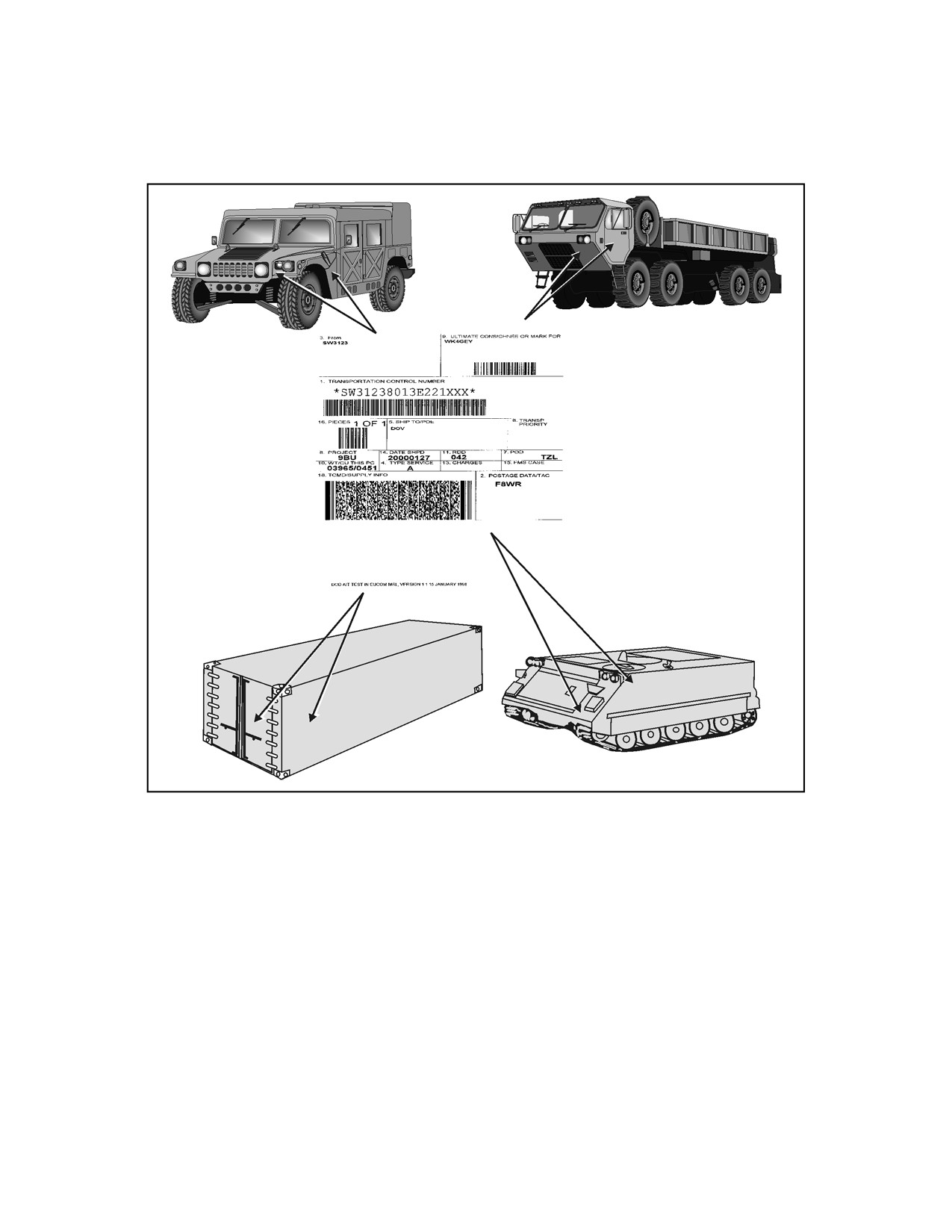
• All containers will display two military shipping labels. One label is
placed on a container door and the other on the adjacent side. (See Figure
M-1 for an example of where to attach MSLs to container shipments.)
• For vehicles, one label will be attached to the left front bumper (driver’s
side), and the other label will be placed on the left side door (driver’s
door). (See Figure M-1.)
M-1
________________________________________________________________________________
FM 3-35.4
Figure M-1. Placement of the MSL on Rolling Stock and Containers
ADDITIONAL CONSIDERATIONS
M-2. The information that is passed to GTN and other AIS from the source
AIS must be the same information that is on the AIT data storage device. If
changes occur to source data prior to movement, the AIS (TC-AIMS II) must
be updated and new AIT data storage devices (MSLs and RFID tags) pro-
duced and affixed to the equipment.
M-3. The following two sections provide considerations and guidelines for
AIT data storage device use on unit equipment and cargo. The UMO or other
designated representative will be responsible for ensuring that AIT data
storage devices are properly produced and attached to unit equipment.
M-2
_______________________________________________________________________________
Appendix M
MILITARY SHIPPING LABELS
M-4. The following general guidelines should be considered when working
with, and attaching MSLs to unit equipment:
•
Whenever possible, use Mylar MSLs. They are more resistant to damage
by the weather. If paper MSLs are used, ensure they are laminated or
otherwise protected from the elements. Ensure the label can still be
scanned through the lamination or protective material. Ensure that
every piece of equipment on the UDL has two military shipping labels
produced and attached.
•
Ensure all required data fields are filled out correctly before printing the
labels.
•
After producing the MSLs, scan the bar codes to ensure they are readable
and accurate.
•
Ensure the correct MSLs are attached to the proper piece of equipment in
such a manner to reasonably ensure they will not be lost or destroyed
during transit.
•
When attaching MSLs, ensure the surface area where the label will be
attached is clean. This allows the adhesive on the label to stick.
•
After attaching the MSLs, visually check to ensure they are properly at-
tached and were not damaged during placement on the equipment. Scan
the bar codes to ensure that the correct MSLs are on the correct piece of
equipment.
•
For items that do not possess the physical characteristics of the equip-
ment in paragraph M-1, follow these general guidelines when attaching
MSLs.
For equipment without bumpers or doors, attach the MSL in a simi-
lar position (left front and left side). Ensure the labels can be easily
found by individuals that need to scan the data at the various transit
locations.
Do not attach the label to a part of the equipment that may be re-
moved and packed separately during the movement. (For example, do
not attach an MSL to the driver’s door of a soft-top high mobility mul-
tipurpose wheeled vehicle (HMMWV) if the door will be removed and
packed before loading strategic transportation.)
•
Attach MSLs to 463L pallets and other multipacks the same as contain-
ers. Place MSLs on one end and on the adjacent side at the same end of
the multipack or pallet.
•
Do not mark on the code 3-of-9 or portable data file (PDF)-417 symbology
on the MSLs. If local procedures require operators to physically mark the
label after it has been scanned (to provide a visual check showing the bar
code has been read), mark somewhere other then the symbologies. Mark-
ing over the code 3-of-9 or (PDF)-417 symbology may make the linear and
2D bar code unreadable at other transit locations.
RADIO FREQUENCY TAGS
M-5. The following general guidelines should be considered when working
with, and attaching RFID tags to unit equipment.
M-3
________________________________________________________________________________
FM 3-35.4
•
When burning RFID tags, interrogate the tag after the burn to ensure
that the data transferred correctly.
•
Ensure the RFID tag is attached to the correct piece of equipment.
When attaching RFID tags to equipment, consider the following
guidelines:
Attach the RFID tags in a location that reasonably assures they
can be interrogated as they flow through the movement process
with the piece of equipment. The RFID tags must be on the out-
side of the piece of equipment.
Develop a method to attach the RFID tags so that they will not be
lost or damaged in shipment. Plastic ‘zip’ strips, nylon strips, or
magnetic holders have worked well in previous operations. (Note:
previous operations have shown that the plastic strips are not as
durable as the nylon strips.) Tie down both the top and the bot-
tom of the tag so that it will not bounce and be damaged during
shipment.
When attaching the newer 410 tag to containers, mount them on
the right side near the top. Ensure that the RFID tag is mounted
between the ribs in an indentation. When attaching the older
SealTag II RFID tags, use the nylon strips and mount them to the
front door.
When attaching RFID tags to vehicles, tie the tag to the top of the
grill using two long nylon strips to attach the device ensures the
tag will not bounce or be lost during transit.
Attach RFID tags on 463L pallet netting using nylon strips. Put
the tag near the MSL.
When attaching RFID tags on other equipment, mount the tag so
that it can easily be read but not damaged. Use nylon or plastic
strips to attach the tag.
Do not drill holes in equipment without prior approval from the
owners.
(In previous operations, organizations have created
brackets to attach RFID tags to containers. Mounting the brack-
ets required drilling holes in the commercial containers. As prior
approval to drill the holes was not obtained from the container
owner, DoD paid for the damage.)
Verify the battery life of RFID tags. If the battery power is low,
replace the batteries. RFID tags with low battery power will not
operate properly and will not respond to interrogator ‘wake up’
calls. The process of checking RFID tag batteries, as equipment
and sustainment supplies flow through the force projection pipe-
line will require advanced planning. For example, the newer 410
tag has two mounting holes (one at the top and one at the bot-
tom). When the tag is attached to a vehicle, for example an M923
5-ton cargo truck, zip strips are used to fasten the top and bottom
of the tag to the front grill of the truck. In order to turn the tag
over and replace the batteries at least one of the zip strips will
have to be cut or broken. Procedures must be in place so that the
individual checking tag batteries can quickly and easily break the
zip strip, replace the batteries, and then replace the zip strip en-
M-4
_______________________________________________________________________________
Appendix M
suring that the tag is once again securely fastened to the vehicle.
If only one end of the tag is fastened to the vehicle the tag will
bounce around during movement and may be damaged or lost.
M-5
Glossary
2D
two dimensional
A/C
aircraft
A/DACG
arrival/departure airfield control group
AALPS
Automated Air Load Planning System
AAR
Association of American Railroads
ABL
ammunition basic load
AC
Active component
AFB
Air Force Base
AFJM
Air Force Joint Manual
AI
artificial intelligence
AIS
automated information system
AIT
automatic identification technology; advanced individual train-
ing
AMC
Air Mobility Command (Air Force)
AMC
Army Materiel Command (Army)
AOR
Area of Responsibility
AO
area of operations
AOC
area of concentration
APFT
Army Physical Fitness Test
APOD
aerial port of debarkation
APOE
aerial port of embarkation
AR
Army regulation
Glossary-1
________________________________________________________________________________
FM 3-35.4
ARFOR
Army forces
ARNG
Army National Guard
ASCC
Army Service Component Command or Commander
ASG
area support group
ASL
assigned or authorized stockage list
ASORTS
Army Status of Operational Readiness and Training System
ASP
ammunition supply point
AT
annual training
ATCMD
advanced transportation control and movement document
AUEL
automated unit equipment list
BASOPS
base operations support
BBM
blocking and bracing material
BBPCM
blocking, bracing, packing, and crating materials
BBPCT
blocking, bracing, packing, crating, and tie-down
BBT
blocking, bracing, and tie-down
BDU
battle dress uniform
BN or bn
battalion
BSB
base support battalions
C2
command and control
C3
command, control, and communications
C4I
command, control, communications, computers, and intelligence
CAC
common access card
CAP
crisis action planning
Glossary-2
_________________________________________________________________________________
Glossary
CASCOM
Combined Arms Support Command
CB or C/B
center of balance
CBRN
chemical, biological, radiological, or nuclear
CBRNE
chemical, biological, radiological, nuclear explosives (high yield)
CDE
chemical decontamination equipment
cdr
commander
CDRL
contract data requirements list
CF
copy furnished
CFA
call forward area
CFM
CONUS freight management
CFR
Code of Federal Regulations
CHE
container−handling equipment
CIF
central issue facility
CIIP
clothing initial issue point
CINC
commander in chief
CJCS
Chairman of the Joint Chiefs of Staff
CJCSI
Chairman of the Joint Chiefs of Staff Instruction
CJCSM
Chairman, Joint Chiefs of Staff Manual
CMOS
cargo movement operations system
CO or co
company
COA
course of action
COC
combat operations center
COMASCC
Commander, Army Service Component Command
Glossary-3
________________________________________________________________________________
FM 3-35.4
COM'L
commercial
COMPASS
Computerized Movement Planning and Status System
COMPES
contingency operations/mobility planning and execution system
CONPLAN
concept plan
CONUS
continental United States
COR
contracting officer's representative
COSCOM
corps support command
CP
checkpoint
CPSF
Central Panograph Storage Facility
CRAF
civil reserve air fleet
CRC
CONUS Replacement Center
CSA
United States Army Chief of Staff
CSC
convoy support center
CSS
combat service support
CSSS
Combat Service Support System
CTA
common table of allowances
CTT
common task test
CUL
common user logistics
CVW
collaborative virtual workspace
DA
Department of the Army
DAC
Department of the Army civilian
DACG
departure airfield control group
DAMMS
Department of the Army Movements Management System
Glossary-4
FM 3-35.4
18 JUNE 2002
By Order of the Secretary of the Army:
ERIC K. SHINSEKI
General, United States Army
Chief of Staff
Official:
JOEL B. HUDSON
Administrative Assistant to the
Secretary of the Army
0214310
DISTRIBUTION:
Active Army, Army National Guard, and U.S. Army Reserve: To be distributed in
accordance with the initial distribution number 115867, requirements for FM 3-35.4.
________________________________________________________________________________
FM 3-35.4
DTR
defense transportation regulation
DTS
Defense Transportation System
EAC
echelons above corps (Army)
EAD
echelons above division (Army)
ECS
engagement control station
EDI
electronic data interchange
EDRE
emergency deployment readiness exercise
EEFT
end-to-end force tracking
ELIT
enhanced logistics intratheater support tool
EOC
emergency operations center
EOD
explosive ordnance disposal
ETA
estimated time of arrival
ETS
end tour of service
FAA
functional area assessment
FLOGEN
flow generator
FM
field manual (Army)
FORSCOM
United States Army Forces Command
FP
force protection
FRAGO
fragmentary order
GATES
global air transportation execution system
GBL
government bill of lading
GCCS
Global Command and Control System
GCCS-A
Global Command and Control SystemArmy
Glossary-6