FM 3-35.4 DEPLOYMENT FORT-TO-PORT (June 2002) - page 2
________________________________________________________________________________
FM 3-35.4
• Providing rail or air load planning assistance.
• Advising on proper application of logistics applications of automated
marking and reading systems (LOGMARS) placards.
• Establishing transportation inspection points.
• Providing guidance on shipment of HAZMAT cargo.
• Assisting with the preparation and correction of OELs.
• Providing hands-on training/guidance in equipment preparation and tie-
down procedures.
• Providing liaison between the port command and the ITO and UMOs.
3-33. Each DSB includes a command group and unit movement teams
(UMTs), consisting of six individuals per team. UMTs have been predesig-
nated and assigned to specific installations. Those installations without des-
ignated UMTs can request DSB assistance in peacetime and during mobiliza-
tion. Requests for DSB assistance are made to MTMC. MTMC responds to
requests for assistance by—
• Scheduling a DSB to perform annual training (AT) with the unit and/or
ITO.
• Tasking the DSB through the United States Army Reserve Command
(USARC) to provide assistance during active duty training.
• Coordinating with FORSCOM to resolve any support issues.
CONUS REPLACEMENT CENTER
3-34. CONUS Replacement Centers (CRCs) are located at several sites in
the United States. They prepare non-unit related personnel (NRP) for de-
ployment and receive individuals upon redeployment. NRPs consist of five
categories: Active Component
(AC) personnel, Individual Ready Reserve
(IRR) (already accessed onto active duty), Department of Defense civilians,
contract civilians, and Red Cross civilians. CRCs are only activated when
there is a Presidential Selective Reserve Call-Up (PSRC) and are operational
24 hours a day, seven days a week. More information on CRCs is in FM 1-0
(12-6).
DEPLOYMENT PROCESSING CENTER
3-35.
A deployment processing center (DPC) is one term used for a no-
tional group of activities that do not exist in a single physical form. The term
is used to encompass all installation activities assisting in the deployment
process. Since DPC activities are unique to each installation, based on mis-
sion and facilities, they may be referred to by different terms.
3-36. Some installations, such as Fort Drum, have world class deployment
facilities. In such instances, deployment activities, such as medical screening,
records updating, and mission briefing take place in a central location. In
other instances, such as at Fort Polk where there is no central deployment
facility, these activities spread out over a 50-mile radius.
3-37. To assist in the deployment of its soldiers, the United States Army
Europe (USAREUR) established a DPC at Rhine-Main Ordnance Barracks.
The mission of this DPC is to control, stage, and conduct final processing of
3-10
_________________________________________________________________________________
Chapter 3
units (soldiers and their equipment) for deployment by air from the aerial
port of embarkation (APOE) at Ramstein Air Base. The DPC may provide a
staging area for equipment (including helicopters), air pallet building facili-
ties, maintenance support, fueling and defueling capability, ammunition sup-
port, and communication and automation support to the deploying unit. The
DPC also provides life support for deploying and redeploying units transiting
at the APOE.
3-38. The processing concludes with the Air Force joint inspection at the
airfield. Upon successful completion, the equipment is moved in chalk forma-
tion to the ready line. The DPC may also operate the personnel holding area
at the airfield.
SECTION III - FORCE PROTECTION/ANTITERRORISM
"...terrorists should know that we will not simply play passive defense. America will de-
fend itself and its interests through active measures..."
Former Secretary of Defense, William Cohen
3-39. A series of incidents in recent years has created an increased empha-
sis on force protection (FP) throughout the DoD. FP consists of those actions
that prevent or mitigate hostile actions against DoD personnel (to include
family members), resources, facilities, and critical information. FP involves
coordinating and synchronizing offensive and defensive measures to enable
the joint force to perform while degrading opportunities for the enemy. FP in-
cludes air, space, and missile defense; chemical, biological, radiological, nu-
clear, and explosives (CBRNE) activities; antiterrorism; defensive informa-
tion operations; and security to operational forces and means. FP does not in-
clude actions to defeat the enemy or protect against accidents, weather, and
disease. FP at all levels minimizes losses to hostile action. Skillful and ag-
gressive counterintelligence and threat assessments decrease the vulnerabil-
ity of friendly forces. Effective operations security (OPSEC) keeps adversar-
ies from exploiting friendly information. Proper dispersion of CSS assets
helps reduce losses from enemy fires and terrorist action. CSS commanders
must use camouflage discipline, local security, and field fortifications, which
reduce losses due to enemy actions. Protection of electronic links and nodes,
to include combat troops with electronic devices, is vital to protection of in-
formation, information systems, and soldiers. There is no more important re-
sponsibility than force protection.
3-40. Force protection is an inherent command responsibility and must be
fully integrated into every unit’s mission. A commander must continually re-
view his unit’s FP posture and crosswalk it with current and changing policy
and threat levels. The threat of enemy interdiction during deployment opera-
tions, particularly for forward presence forces, presents a special challenge.
The challenge is to protect geographically dispersed deploying forces (which
have limited self-protection capability while configured for deployment) and
materiel transiting the various links and nodes of the deployment process.
FP demands the personal involvement of commanders to ensure the best pos-
3-11
________________________________________________________________________________
FM 3-35.4
sible security consistent with the threat to personnel and mission-essential
resources.
3-41. To meet the terrorist threat, an integrated and comprehensive anti-
terrorism program must be developed and implemented at every echelon of
command. The program is designed to foster a protective posture in peace-
time (units performing normal duties and serving in security assistance or-
ganizations, peacekeeping missions, or mobile training teams) that will carry
over to a wartime environment. Antiterrorist measures are intended to iden-
tify and reduce the risk of loss or damage of potential targets and to develop
procedures to detect and deter planned terrorist actions before they take
place, thereby reducing the probability of a terrorist event. The measures
also encompass the reactive or tactical stage of an incident, including direct
contact with terrorists to end the incident with minimum loss of life and
property. See JP 3-07.2 for more on antiterrorism.
3-42. All units must ensure force protection/antiterrorist plans are inte-
grated into movements through high threat areas such as, ports, MSRs, and
depots. Commanders must include the following areas in force protection pre-
deployment planning:
•
Threat and vulnerability assessments. Units assess the threat and their
own vulnerability before deployment.
•
Security planning. Units must take the results of threat and vulnerabil-
ity assessments and develop security plans for self-protection while in-
transit. Although emphasis must be on movements through high threat
areas, commanders should not discount appropriate security measures
for movements in lower threat areas. Security plans for movements
through high threat areas must be completed and approved by the next
higher command (at the minimum, the battalion (BN) commander). Ad-
vanced or on-board security augmentation should be considered for travel
through high threat areas. Commanders/senior Army representatives ac-
companying the movement are responsible to ensure security measures
sufficiently address vulnerabilities. Movements may require tailored in-
telligence/counterintelligence support, host nation assistance, or pre-
planned alternate routes based on the vulnerabilities associated with the
movement.
•
Training. Units moving through high threat areas ensure personnel re-
ceive pre-deployment training on rules of engagement, AOR threat orien-
tation, defensive tactics, techniques and procedures (TTPs)/exercises, and
security equipment. Training is performance oriented and provides sol-
diers and leaders the training required to defend against a terrorist
threat and/or mitigate the effects of an attack.
•
Movement tracking. Major Army Commands (MACOMs) will establish a
process to track movements through high threat areas for units with 30
or more personnel. MACOMs are required to report specific movements
to HQDA (ODCSOPS).
•
Logistics. Predictability and support of unit movements are a unit’s
greatest vulnerability. Unit commanders must understand that predict-
ability places a higher demand on the unit’s ability to know the local
threat, assess unit vulnerabilities, and develop self-protection measures.
3-12
_________________________________________________________________________________
Chapter 3
3-43. The potential abilities of adversaries to orchestrate asymmetric
threats against U.S. forces require that every measure be taken to protect
those forces during the deployment process. The advent of the Cable News
Network (CNN) and instant worldwide news, coupled with the difficulty of
hiding port operations, makes the threat real. Installations have important
responsibilities in preparing for possible asymmetric threats. Comprehensive
FP requires the employment of a full array of active and passive measures
and the integration and coordination of intelligence and security programs,
risk management techniques and safety programs to increase individual
awareness of potential threats. Agreements with civil authorities, clear lines
of authority, training, and security procedures all influence our ability to op-
erate in an asymmetric threat environment and to combat terrorism. See FM
4-0, FM 3-07.2 (100-35), (to be developed), FM 3-19.4, (to be developed), and
JP 3-35 for more information on force protection and physical security.
3-13
Chapter 4
Movement to and Activities at Ports of Embarkation
The first surge began with the need to put combat power on the ground in Saudi
Arabia as quickly as possible. The decision to deploy the 82d Defense Ready Bri-
gade (DRB1) meant that the United States (U.S.) Transportation Command
(USTRANSCOM) had to provide the 82d with 250 C-141 equivalents, though
USTRANSCOM could only guarantee 90.
Within hours, C-141 and C5A aircraft from U.S. bases all over the world were
landing at Pope Air Force Base. Because the Air Force was unable to predict ei-
ther type of aircraft arriving or the times of arrival, 1st Corps Support Command
(COSCOM) Transportation Corps soldiers were constantly reconfiguring loads
based on the type of aircraft and needs to fit tactical exigencies in Saudi Arabia,
making for an extremely demanding mission. As aircraft landed, little time was
wasted. Aircraft loads were often reconfigured and loaded within minutes of the
aircraft touching down.
Spearhead of Logistics
A History of the U.S. Army Transportation Corps
Contents
Section I - Principles of Movement
4-2
Support Installations (SI)
4-8
Principles
4-2
Deploying Unit
4-8
Liaison Officer
4-2
Marshaling Areas
4-9
Section II - Fort-To-Port Movement
4-3
Staging Areas
4-10
Convoy Operations
4-3
Airports
4-11
Rail Operations
4-4
Departure Airfield Control Group (DACG)
4-11
Section III - Activities at the Ports of Embarkation
4-4
Tanker Airlift Control Element (TALCE)
4-11
Seaports
4-4
Marshaling Area
4-12
Military Traffic Management Command (MTMC)
4-4
The Alert Holding Area
4-12
MTMC Deployment Support Team (DST)
4-5
The Call Forward Area
4-13
Transportation Terminal Brigade (TTB)
4-5
The Ready Line and Loading Ramp Area
4-14
Military Sealift Command (MSC)
4-6
Railhead
4-15
U.S. Coast Guard (USCG)
4-6
Sequence Loads For Rail Spurs
4-15
Port Support Activity (PSA)
4-7
Move To Rail Staging Areas
4-15
Supercargo
4-7
Finalize Rail Load
4-16
Port Operations Center
4-8
Move To Railhead and Loading the Trains
4-16
4-1
________________________________________________________________________________
FM 3-35.4
Units normally deploy via airports and seaports of embarkation. Each
power projection platform has an associated strategic seaport and airport.
The proximity of the port facilities to the platform determines the type of
movement to the port required. At some ports, the distance is short, so
units can convoy; at others, commercial support is required.
In the overall global deployment scheme, each point at which a unit
changes the type of transportation platform (that is, air, ship, rail, com-
mercial and military truck) is a node. Nodes are, by their nature, friction
points. Friction slows the deployment time line. Therefore, throughput,
the amount of cargo that can move through a node, becomes a principal
concern. This is particularly true at the POEs. The objective is to maxi-
mize quickly the throughput capability by moving transportation assets,
units, and enablers into position for immediate execution of the plan. Any
time lost in this pursuit is lost forever and, if ports are used at less than
capacity, the unused portion is irrecoverable.
SECTION I - PRINCIPLES OF MOVEMENT
PRINCIPLES
4-1.
Principles discussed earlier are applicable to fort-to-port movement
in general and specifically to APOE and SPOE operations.
• Precision in all movements, units and support elements, being neither
late nor early to the ports, reduces lost capacity, and the payoff is a re-
duction in the time required for force closure.
• The synchronization of fort-to-port deployment activities limits waste of
critical resources. All organizations involved must work together to affect
a smooth and timely deployment.
• Knowledge creates an environment where sound and timely decisions can
be made. A complete understanding of the processes, including the auto-
mated information systems (AIS) used, is paramount for a smooth de-
ployment.
• The speed achieved in each phase and through each node affects the ve-
locity of the entire force projection process. To get to the fight as quickly
as possible, speed is essential in the loading and unloading of unit cargo.
LIAISON OFFICER
4-2.
A liaison officer from the deploying unit to each POE is critical to the
unit’s smooth transit at the port and the achievement of precision, synchroni-
zation, knowledge and speed. Liaison is defined as contact or communication
maintained between elements of military forces or other agencies to ensure
mutual understanding and unity of purpose. It is an effective way for deploying
units, particularly separate brigade and higher level organizations, to ensure
the commander’s intent is understood and properly influences the deployment
process. It can also reinforce safety, resolve problems, limit the time required
4-2
_________________________________________________________________________________
Chapter 4
for decisions, and keep the commander informed. A liaison team can directly
improve the synchronization between an installation and port activities.
The practice of using liaison officers as "directed telescopes" to facilitate com-
mand and control is almost as old as war itself. Beginning in antiquity and con-
tinuing into the modern era, ground commanders have relied on carefully selected
subordinates to serve as their eyes and ears. These trusted agents, often with di-
rect access to the deliberations that produced the "commander's intent," have pro-
vided invaluable information to the commander's immediate staff and others. And
during the heat of battle they assisted commanders by communicating orders and
controlling units.
Major General Robert H. Scales, Jr., U.S.A
Commandant, U.S. Army War College
PARAMETERS, U.S. Army War College Quarterly - Winter 1998.
SECTION II - FORT-TO-PORT MOVEMENT
CONVOY OPERATIONS
4-3.
Most units conduct convoy operations to get to the ports of embarka-
tion. A convoy is a group of vehicles organized for the purpose of control and
orderly movement under the control of a single commander. Theater policy
(OCONUS unit), standardization agreement, or the HN directs the minimum
number of vehicles in a convoy. In the absence of policies to the contrary, con-
voys consist of six or more vehicles. Vehicles in a convoy are organized into
groups to facilitate command and control, and normally move at the same
rate.
4-4.
To assist in centralized convoy management, FORSCOM has devel-
oped and implemented a computerized mobilization movement control sys-
tem/program known as MOBCON. The MOBCON software uses the national
highway transportation network (NHTN) in conjunction with a system of
nodes (road junctions, critical points) and links
(road segments between
nodes). About 380,000 miles of roadway with 28,500 nodes and 45,000 links
represent this network. MOBCON software uses the electronic NHTN
database to schedule and deconflict convoys within CONUS. The deconflic-
tion process permits only one convoy to operate over a segment of road at any
given time. Normally, accomplishment of this process occurs by changing
times of movement or rest halt duration. MOBCON usually separates con-
voys by a 10-minute time gap. MOBCON provides visibility of all military
traffic processed in the system. It links all DMCs and provides a means of
communication. A convoy processed in one state and passing through other
states has immediate visibility of all MOBCON users.
4-5.
FM 4-01.40, (55-30), DoD 4500.9, and AR 55-80 contain additional in-
formation concerning convoy operations and MOBCON . See Appendix J for a
convoy commander’s checklist and a convoy briefing outline.
4-3
________________________________________________________________________________
FM 3-35.4
RAIL OPERATIONS
4-6.
Although most units conduct convoy operations to get to the POE, not
all units or power projection platforms are located within driving distance to
seaports, and not all cargo, particularly for heavy forces, is transportable by
military or commercial truck. In these cases, rail travel is used. The railroad
facilities serving the POE may be at the head of a pier or at an inland trans-
fer point. The transfer point may be truck-to-rail or amphibian-to-rail. Ter-
minal service units will load or unload rail equipment during cargo-handling
operations. These units must plan rail-loading procedures and secure cargo
on rail cars. They must also know the type of equipment required at destina-
tion to load and unload cargo to minimize the amount of rail equipment used
and to make the loading/unloading as simple and quick as possible. See FMs
4-01.41 (55-20 and 55-21), FM 4-01.50 (55-17), and Appendix H for more in-
formation on rail operations.
SECTION III - ACTIVITIES AT THE PORTS OF EMBARKATION
SEAPORTS
4-7.
There are essential activities involved in port operations that involve
DoD and Army units and ad hoc organizations. The following is a description
of these key organizations and of the areas in which they operate at seaports.
MILITARY TRAFFIC MANAGEMENT COMMAND
4-8.
The Military Traffic Management Command (MTMC) is the surface
transportation component of DoD’s USTRANSCOM and is DoD’s single port
manager. In peacetime, MTMC serves as the link between DoD shippers and
commercial carriers, such as, those in the trucking and rail industries. It en-
sures efficient, safe transportation service to customers. MTMC has a per-
manent presence in 24 ports worldwide. In each port, MTMC stages cargo,
plans and directs loading, and documents cargo movement. (For further de-
scription and guidance of activities and functions, visit the MTMC web-site
4-9.
Deploying units receive their port call instructions from MTMC. The
port call message identifies the date the unit must arrive at the SPOE for
movement processing. MTMC schedules units to arrive at the POE in suffi-
cient time to allow processing and loading to meet vessel sailing schedules.
Units, in coordination with the ITO, backward plan for the movement to the
SPOE and coordinate movement schedules with MTMC. Deployment duties
and responsibilities of MTMC include—
• Select unit SPOE/SPOD with the ASCC.
• Determine movement requirements and coordinate vessel selection with
Military Sealift Command (MSC).
• Prepare and issue port call messages.
• Receive PSAs from supporting installations and direct their functions
and activities.
• Receive, stage, and transship unit equipment in the port.
4-4
_________________________________________________________________________________
Chapter 4
• Establish and direct port communications, safety policies, and physical
security procedures.
• Regulate military traffic within the port.
• Direct DSBs to assist deploying units.
• Assist ITOs and traffic managers in shipping unit equipment and sup-
plies to the POE.
• Develop stow plans, supervise vessel loading, inspect vessel readiness,
and provide documentation.
MTMC DEPLOYMENT SUPPORT TEAM
4-10. The MTMC deployment support team (DST) is a team of personnel,
both military and/or Department of the Army civilian (DAC), who are di-
rected to open and temporarily operate an SPOE until the transportation
terminal brigade (TTB) is operational. When alerted, a DST is formed and
immediately deploys to the SPOE to coordinate contracts, set up operations,
and begin to receive cargo. The team also plans for traffic flow, obtains waiv-
ers and clearances, establishes liaison with the deploying unit, develops pre-
stow plans, and provides reports to MTMC’s Deployment Support Command
(DSC), Command Operation Center (COC) or to headquarters, MTMC Com-
mand Operations Center.
TRANSPORTATION TERMINAL BRIGADE
4-11. TTBs are USAR units that allow MTMC to expand the number and
capability of seaports. They normally take over responsibility for port opera-
tions from the DST. TTBs conduct ocean terminal operations at established
ports where existing manpower, equipment, and infrastructure are available.
When operating in CONUS, TTBs are assigned to MTMC. They may be de-
ployed OCONUS to expand the number and capability of ports for sustain-
ment or redeployment purposes.
4-12. TTBs consist of soldiers and systems. They depend on the infrastruc-
ture of the port facility, contract stevedores, and host nation support (HNS)
at the terminals where they are assigned to operate. A typical TTB operates
two or three berths simultaneously (four or five berths for limited surge peri-
ods), provides traffic management, and supervises contracts. It employs
Army standard management information systems such as Integrated Com-
puterized Deployment System (ICODES), Worldwide Port System (WPS),
and Integrated Booking System (IBS), as well as AIT. Its major responsibili-
ties are—
• Establish and maintain liaison with port authorities.
• Establish and maintain liaison with the PSA, the supporting installation
or the area support group (ASG), and the marshaling area commander.
• Receive, supervise load/discharge of, and transship cargo according to
supported command directives.
• Establish and maintain liaison with the local MSC representative.
• Prepare and update port terminal operations plans.
• Analyze terminal workload capabilities and quantify missions that may
be performed by contract, HN, or military stevedore support.
4-5
________________________________________________________________________________
FM 3-35.4
• Delegate unit assets (whether assigned, attached, or contracted) to ac-
complish terminal missions.
• Analyze, plan, and control terminal cargo movements through the termi-
nal.
• Prepare and update vessel stow plans.
• Plan vessel work loads.
• Execute port security plans in coordination with the U.S. Coast Guard
(USCG).
• Execute commercial contracts to hire stevedores. The civilian stevedore
company provides vessel/terminal work. It normally will hire gangs to do
the actual loading and lashing.
• Compile cargo receipt and processing data in automated systems for
documentation, management information, and in-transit visibility (ITV).
• Perform liaison with deploying units.
• Coordinate all cargo activity and stow plans with the vessel master or his
representative.
MILITARY SEALIFT COMMAND
4-13. MSC is the sea transportation component of DoD’s USTRANSCOM.
The mission of the MSC is to provide ocean transportation of equipment, fuel,
supplies and ammunition to sustain U.S. forces worldwide during peacetime
and in war for as long as operational requirements dictate.
and guidance of activities and functions.
COAST GUARD
4-14. The Coast Guard’s tasks in the maritime aspects of major theater
warfare encompass critical elements of naval operations in littoral regions,
including port security and safety, military environmental response, mari-
time interception, coastal sea control and force protection. This includes har-
bors, channels, approaches, and vessels that are in these areas. The USCG
physical security plan is integrated with the port commander's physical secu-
rity plan for developing and maintaining comprehensive physical security
and antiterrorist plans. The USCG’s operational capabilities figure impor-
tantly in small-scale contingencies and port security in overseas theaters, as
well as in other important MOOTW missions. The role of the USCG in de-
ployment security takes on a greater importance, as adversaries of the
United States are more likely to engage in asymmetric warfare. In addition
to waterside physical security, the USCG's other duties include—
• Regulating the shipping, handling, and pierside storage of hazardous
cargo, and interfacing with military authorities, as the senior DoD port
safety agent.
• Issuing hazardous cargo permits.
• Supervising vessel fire prevention programs.
4-6
_________________________________________________________________________________
Chapter 4
guidance of activities and functions).
PORT SUPPORT ACTIVITY
4-15. The PSA is an ad hoc organization comprised of military and civilian
personnel with specific skills that aid the port commander in receiving, proc-
essing, and clearing cargo at the SPOE. CONUS installations are delegated
specific ports to which they must provide support. This includes providing
the PSA and associated logistic support for deploying units. A general nu-
meric sizing rule of thumb for the PSA task force is a company for a deploy-
ing brigade, a battalion for a deploying division, and a brigade for a deploying
corps. This relates to size only, not organizational structure.
4-16. Commanders responsible for deployments should not (where practi-
cal) allocate deploying units to operate the PSA organization. PSA organiza-
tions should maintain the same core personnel for the duration of the de-
ployment and augment the TTB, as required, with unique deploying unit
skills such as aviation personnel and munitions experts. Terminal operations
success depends on a well-organized PSA augmenting and supplementing the
port commander's SPOE mission.
4-17. The PSA establishes the necessary communications to ensure the
proper flow of cargo. It provides daily operational reports of cargo received, of
maintenance performed, and of operational problems, to the port commander.
4-18. The commander providing PSA support first considers the type of
unit and equipment being deployed. He then selects personnel qualified to
handle the physical security of classified equipment and protected cargo, per-
sonnel with unique equipment operator skills, and maintenance personnel to
correct primary weapon system and deploying equipment deficiencies. PSA
duties include—
• Receiving, inspecting, and documenting deploying cargo.
• Correcting cargo deficiencies that preclude sea movement.
• Operating unique equipment (normally neither contract nor military ste-
vedores can operate track vehicles and other atypical military cargo).
• Providing backup organizational and limited DS maintenance for deploy-
ing units.
• Providing a physical security guard force for classified and protected
cargo.
• Providing blocking/bracing personnel and tools to secure secondary loads.
• Providing workers with safety equipment, such as vests, lights, gloves,
and goggles.
• Moving deploying unit equipment according to the port traffic plan.
• Providing messing/billeting and medical support to transiting units.
• Providing miscellaneous administrative support.
4-7
________________________________________________________________________________
FM 3-35.4
SUPERCARGO
4-19. Supercargoes are unit personnel designated on orders to accompany,
secure, and maintain unit cargo on board ships. They perform liaison during
cargo reception at the SPOE, shipload and discharge operations, and SPOD
port clearance operations. The deploying unit may have to provide supercar-
goes to accompany cargo aboard ships.
4-20. Unit commanders recommend the composition of supercargoes based
on several factors including the amount and types of equipment loaded
aboard the ship and the number of units with equipment on the ship. How-
ever, MSC determines the actual number of supercargo personnel permitted
on board, based on the berthing capacity on the ship. Off-load preparation
parties (OPPs) may be deployed with the advance party to assist in vessel
discharge.
PORT OPERATIONS CENTER
4-21. The Port Operations Center (POC) controls the activities surrounding
the deployment, from the unit’s arrival in the port area, through the loading
of the ship. The POC is composed of military and DAC personnel and in-
cludes the TTB commander, a contracting officer’s representative (COR), who
acts as liaison between MTMC and the longshoremen who load the vessels.
The POC also includes several cargo specialists who supervise the loading of
the vessels, in accordance to the ICODES plan, keep time records for the con-
tracted support, process GBLs, and certify the hazardous cargo. The trans-
portation specialists in the POC create the ship’s manifest using WPS, IBS,
and the unit TPFDDs. The POC commands and operates the SPOE, provides
traffic management and terminal support, coordinates security, and directs
PSA support.
SUPPORT INSTALLATIONS
4-22. Support installations (SI) plan for supporting units in their area of
responsibility. Mobilization stations (MS) plan for the deployment of their
units. Fifteen major installations, designated Power Projection Platforms
(PPPs), deploy high priority AC and USAR units. Twelve additional installa-
tions, designated Power Support Platforms (PSPs), perform training base ex-
pansion missions, mobilize both individual USAR soldiers and units, and
plan to conduct strategic deployments. Other installations on which AC units
are stationed also plan to conduct strategic deployments. These specially
trained units are deployed to the TTB to assist in deployment activities.
Some of these activities include establishing and operating the marshaling
area, providing the PSA, coordinating and controlling the billeting and mess-
ing areas, securing unit protected cargo, providing a vehicle wash area, pro-
viding local transportation, when needed, and providing parking, fueling and
emergency maintenance services. Members of the SI are also versed on the
use of WPS, IBS, ICODES, interrogators/readers, and GBLs. As part of an-
nual training, AC and USAR units work with the POC as cargo and transpor-
tation specialists.
4-8
_________________________________________________________________________________
Chapter 4
DEPLOYING UNIT
4-23. At the SPOE, the deploying unit also has responsibilities. These re-
sponsibilities include establishing a relationship with the unit that controls
the marshaling area, identifying personnel and equipment to be moved, iden-
tifying cargo requiring special and hazardous handling, and providing
trained load teams. (A more detailed listing of deploying unit responsibilities
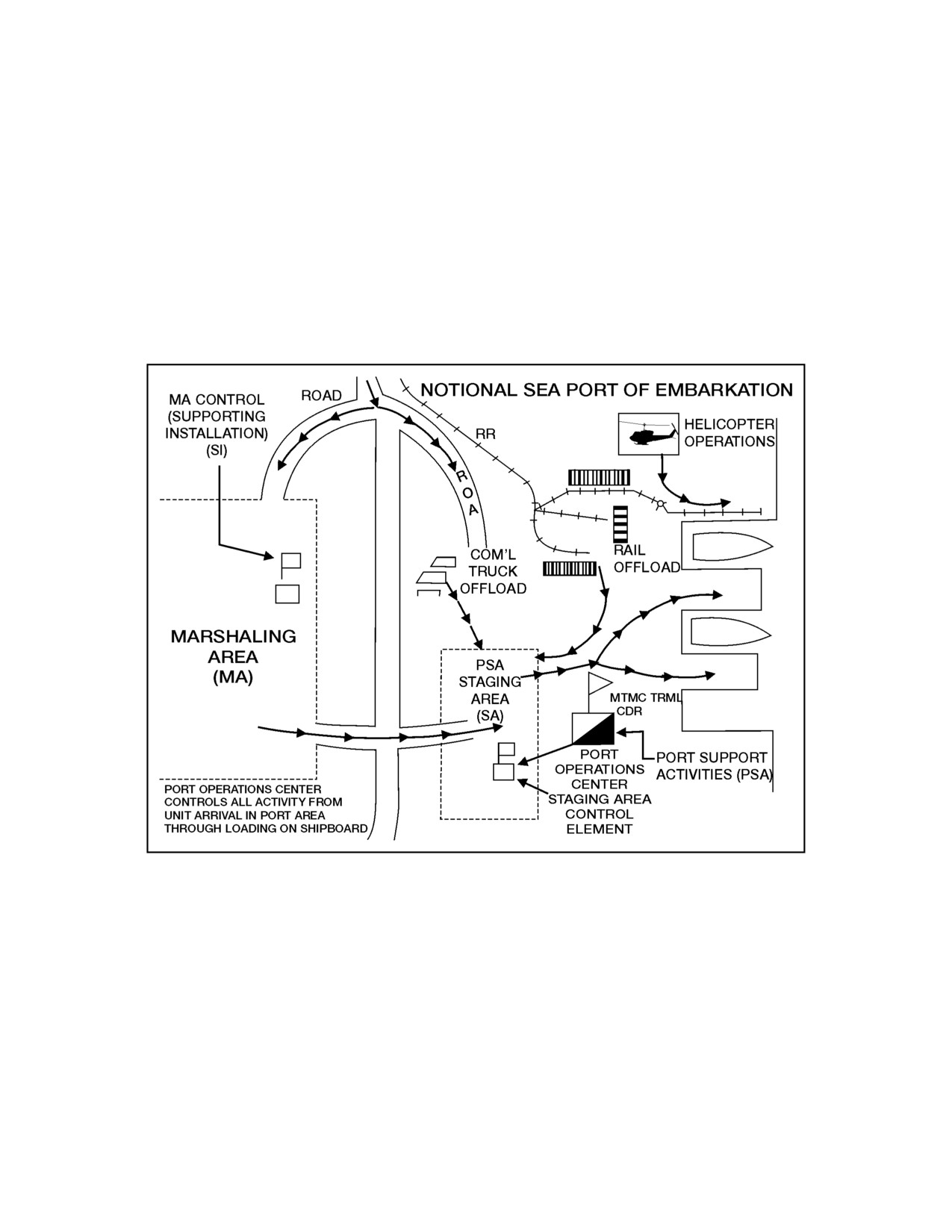
appears later in this chapter). (See figure 4-1, Notional SPOE, for a sug-
gested layout of the SPOE and the activities/organizations necessary for de-
ployment.)
Figure 4-1. Notional Sea Port of Embarkation.
MARSHALING AREAS
4-24. Support installations establish a final en route marshaling area, if
space permits, where unit equipment is configured for overseas movement
before entering the port staging area. This marshaling area is designated by,
and under the control of, the support installation and serves to facilitate the
call forward of equipment.
4-25. There is no set organization or physical layout for a marshaling area.
It is organized to meet operational requirements within available space by
grouping related functions. Cargo may be subdivided into any number of
4-9
________________________________________________________________________________
FM 3-35.4
categories, but usually does not include the containers. The categories and
the volume of cargo in each category play a significant role in the marshaling
area. The most widely used categories are containerized, roll-on/roll-off
(RO/RO), and special (oversize, heavy lift, hazardous, and security) cargo.
4-26. Regardless of the type of cargo, marshaling areas should provide for
the following activities and elements:
• Act as a central control and inspection point with multiple lanes for cargo
entering or exiting the marshaling yard. Containers are usually segre-
gated into a separate location in the marshaling yard.
• Act as auxiliary internal checkpoints (CPs) for containers and cargo en-
tering the yard from a beach, or a rail spur, or by helicopter to a landing
zone within the yard.
• Act as the segregator of inbound containers and cargo, separating by size
and type and, within these groupings, by priority, destination, and spe-
cial handling (security, mail, hazardous, and so forth).
• Provide a traffic circulation plan showing movement flow into, through,
and out of the marshaling area.
• Repair minor damage to containers.
• Provide equipment parking.
• Facilitate unit maintenance of equipment.
• Facilitate messing and comfort facilities.
• Provide a spill contingency plan including emergency supplies and
equipment for isolating and disposing of HAZMAT spills.
• Provide emergency response plan for fire or other emergencies.
4-27. In addition to the space for temporary storage of containers, there
should be space for any required container repackaging, container repair, or
other operational or administrative functions. Space requirements are influ-
enced by type, size, and number of containers handled, length of time con-
tainers are held in the marshaling area, and container handling equipment
(CHE) available.
4-28. The marshaling area is located as near the vessel, rail, air, or truck
discharge or load site as practicable. Enemy capabilities and activities may
require dispersion of activities or affect selection of marshaling yard location.
STAGING AREAS
4-29. Staging at the SPOE is used for assembling, holding and organizing
personnel, equipment, and sustaining material in preparation for onward
movement from the port. Staging allows the port manager to maximize port
throughput capability by strategically placing personnel, equipment and sus-
taining material in such a way as to make loading quick and efficient. The
staging area is the general locality established for the concentration of these
units, unit personnel, and sustaining materials.
4-30. With the move toward the IBCT/objective force and the invent of the
large medium speed roll/on-roll/off ships (LMSRs), time spent in staging is
critical. The LMSR has been built to accomplish the loading and unloading of
equipment in a total of ninety-six (96) hours combined. Operational tests on
4-10
_________________________________________________________________________________
Chapter 4
the LMSRs show that the majority of the ninety-six hours is taken up in the
loading process. Thus, the function of staging profoundly affects the time re-
quired to move the force forward.
OBSERVATION: Ship loading operations are prolonged when staging areas are
disorganized.
DISCUSSION: The vehicles of one unit were parked in no particular scheme or
sequence. This hampered loading operations of the port. The unit marshaling
areas are used to receive convoys and process vehicles before they are staged
for loading. Preventative maintenance checks and services (PMCS) are performed
as well as any required organizational or direct support maintenance; nested loads
(secondary loads on prime movers) are checked for security and documentation.
LESSON: A representative from the major unit (brigade or regiment) should be at
the port from the beginning of the load out and be authorized to make decisions
regarding priorities. Park vehicles by type of vehicle first, then further divide them
by subordinate unit. The major unit indicates its priority for loading by the order in
which the vehicles are parked. This is beneficial to both the deploying units in po-
sitioning vehicles and the terminal transportation unit (TTU) in calling vehicles for-
ward for loading.
Call 90-11 Special edition, Getting to the Desert
AIRPORTS
4-31. The Aerial Port of Embarkation (APOE) is the interface between land
transportation and strategic airlift. Departure airfield operations occur in
four separate areas and involve activities of the unit, (which have already
been discussed), the A/DACG, and the tanker airlift control element
(TALCE). These areas are the marshaling area (MA), the alert holding area,
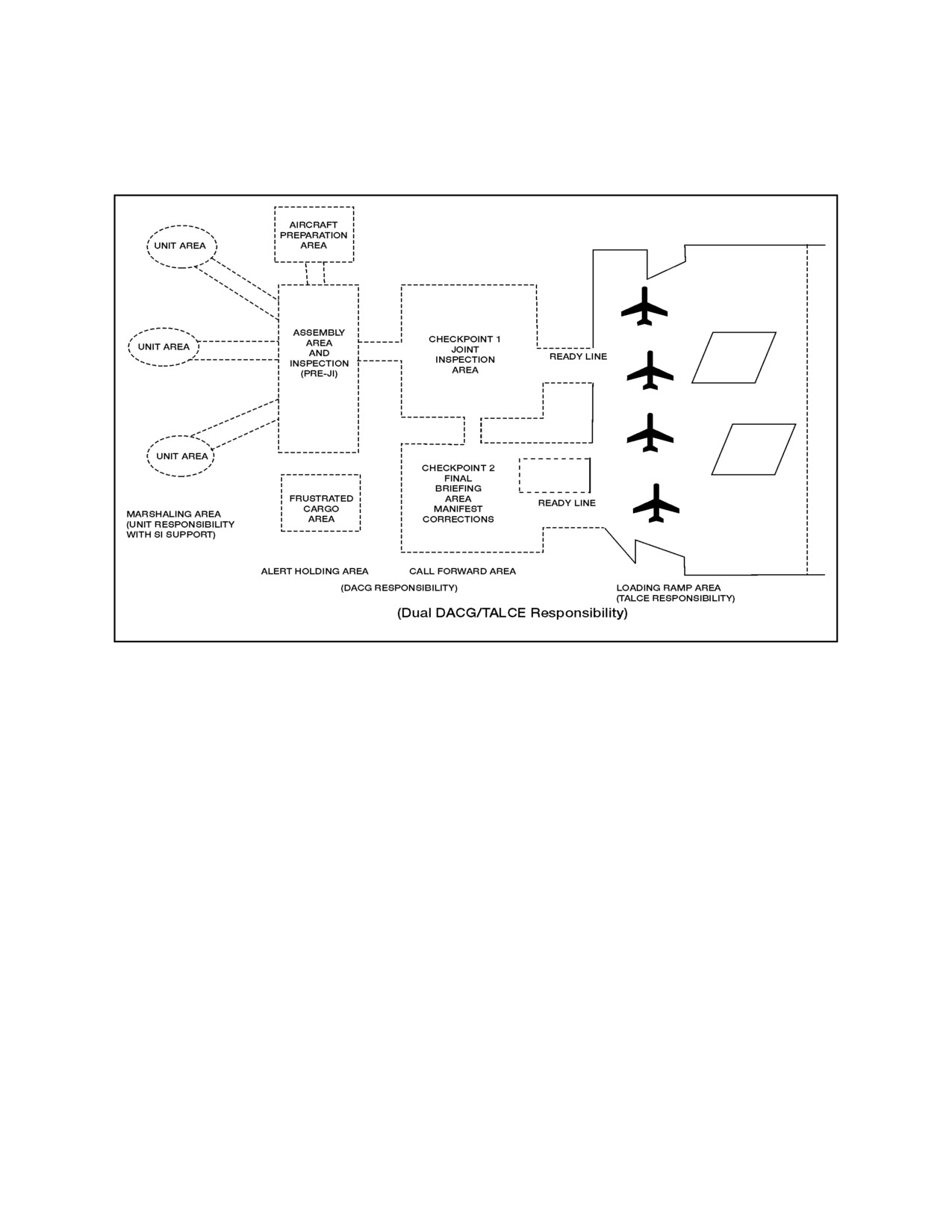
the call forward area (CFA), and the ready line and loading ramp area. (See
figure 4-2, Notional Aerial Port of Embarkation, for details.) Some of the du-
ties within these areas mirror those that occur in the SPOE. Appendix K con-
tains equipment preparation and joint inspections procedures. See FM 55-9,
for further guidance. Responsibilities are discussed below.
4-11
________________________________________________________________________________
FM 3-35.4
Figure 4-2. Notional Aerial Port of Embarkation
DEPARTURE AIRFIELD CONTROL GROUP
4-32. The departure airfield control group (DACG) is normally an ad hoc
organization provided by the supporting installation. The TALCE coordinates
the overall airlift operations at the departure airfield (see DoD 4500.9-R,
Part III). (See Appendix L for deploying unit, DACG planning and prepara-
tion phase requirements.) Its size and capabilities are mission dependent.
The DACG is task organized with personnel and equipment not associated
with the deploying units. Cargo transfer companies are best suited to per-
form this mission.
TANKER AIRLIFT CONTROL ELEMENT
4-33. The TALCE is a provisional, deployed Air Mobility Command (AMC)
organization established at fixed, en route, and deployed locations where
AMC operational support is non-existent or insufficient. The TALCE provides
continuing on-site management of AMC airfield operations including com-
mand and control, communications, aerial port services, maintenance, secu-
rity, weather, and intelligence—those critical elements needed to ensure safe
and highly efficient air base activities for all tanker and airlift operations. A
TALCE is composed of mission support elements from various units and de-
ploys in support of special assignment airlift missions (SAAMs), joint air-
4-12
_________________________________________________________________________________
Chapter 4
borne/air transportability training
(JA/ATT), tanker support, and contin-
gency/emergency relief operations on both planned and "no-notice" bases.
MARSHALING AREA
4-34. The marshaling area is located at the airfield or in the vicinity of the
airfield. Marshaling area activities are the responsibility of the deploying
unit and the deploying commander. The marshaling area activities should
take place as close as possible to the departure airfield. Its location should
not cause unnecessary congestion to airfield operations or undue hardship to
the deploying unit.
Support Installation and Unit Responsibilities
4-35. The support installation (SI)/base commander who provides and con-
trols the marshaling area assists the deploying forces. The commander pro-
vides necessary support functions that allow the deploying unit to concen-
trate on deployment preparations. These support functions include providing
emergency maintenance, providing POL-including defueling capability, and
related services.
4-36. The marshaling area is where units may start, continue, or complete
preparation for strategic loading. These preparations include assembling ve-
hicles, equipment, supplies, and personnel into mission loads (chalks). These
loads are manifested and sent to the alert holding area upon notification
from the DACG or deploying units. The units also prepare personnel and
cargo manifests for deployment, prepare additional required paperwork,
(such as, hazardous or agricultural certification), brief personnel on the
situation and mission, movement plan, assembly plan, operational plan, con-
voy discipline, loading procedures, safety, and assembly procedures once at
the POD. The unit ensures that adequate shoring and dunnage material for
aircraft loading is readily available, provides personal safety equipment to
load team members, and appoints and briefs planeload or troop commanders
for departure from the POE.
DACG Responsibilities
4-37. The DACG arranges for technical assistance with the supporting in-
stallation, when necessary, and provides a liaison between the deploying
units and the supporting installations.
ALERT HOLDING AREA
4-38. The alert holding area is the equipment, vehicle, and passenger con-
trol area. It is normally located near the departure airfield. The DACG
and/or host installation is responsible for activities conducted within the
alert holding area.
Unit Responsibilities
4-39. At the alert holding area, the deploying unit checks in with the alert
holding area team chief and completes final preparation and assembly of per-
sonnel, cargo, and equipment into individual chalks. The unit ensures, in co-
ordination with the DACG, that aircraft loads arrive on time. The unit also
4-13
________________________________________________________________________________
FM 3-35.4
provides the DACG with passenger and/or cargo manifests, load plans, and
any other required documentation. This is the opportunity for units to correct
any load discrepancies identified during pre-inspection. Control of chalks is
transferred to the DACG upon completion and acceptance of personnel,
cargo, and equipment. Normally, personnel assigned to work the alert hold-
ing area do not deploy.
DACG Responsibilities
4-40. At this point, the DACG assumes control of the chalks from the units.
The DACG, in coordination with the deploying unit and the TALCE, ensures
loads arrive at the alert holding area on time, receives, inventories, and con-
trols aircraft loads as they arrive into the area, and inspects aircraft loads to
ensure they are complete and correctly prepared. The DACG also inspects
documentation for accuracy and completeness, inspects HAZMAT for proper
loading and documentation, verifies weight and balance markings, and estab-
lishes a discrepancy correction area. The DACG coordinates with the SI for
MHE support as needed, and provides emergency maintenance, POL, and re-
lated services, when required to complete the out-loading mission. Once these
duties are completed, the DACG directs the chalks to the call forward area.
CALL FORWARD AREA
4-41. The call forward area is that portion of the departure airfield where
the joint inspection (JI) between the deploying unit, the DACG, and the
TALCE is conducted and discrepancies corrected. The activities conducted
within the call forward area are the responsibility of the DACG, host instal-
lation, and the mobility force. This is the final check to be sure all cargo and
equipment are properly prepared and documented for safe and efficient air
shipment. Nothing will be accepted for airlift until all discrepancies are cor-
rected by the deploying unit. A final briefing is provided to deploying troops
and all manifests are reviewed for accuracy.
Unit Responsibilities
4-42. After the deploying unit corrects the discrepancies found during the
JI, it arranges its vehicles (with drivers), pallets, and equipment into the call
forward load (chalk) sequence.
DACG Responsibilities
4-43. Within the call forward area, the DACG establishes and maintains
communications with the TALCE and deploying units, ensuring the deploy-
ing unit adheres to the established movement timetable. The DACG provides
a passenger holding area, if necessary. The DACG checks HAZMAT docu-
mentation and load plans, refines the upload sequence, and assists with the
JI of aircraft loads and manifests. It ensures that passenger/cargo manifests
are correct and maintains statistical data to account for the current status of
all unit personnel and equipment scheduled for air movement, as well as
maintaining a final corrected copy of each passenger/cargo manifest and in-
spection record. The DACG provides fueling and defueling capability, emer-
gency maintenance for vehicles being transported, and other emergency ser-
vices as agreed upon during joint planning. The DACG provides load team
4-14
_________________________________________________________________________________
Chapter 4
personnel and support equipment and ensures the load team members are
properly outfitted with safety equipment. Finally, the DACG escorts aircraft
loads to the ready line and ensures that all personnel are briefed on flight
line safety procedures and requirements. Once the unit is ready to move to
the ready line, the DACG provides data to the TALCE for reporting to the
Global Transportation Network (GTN) to provide ITV.
TALCE Responsibilities
4-44. At the call forward area, the TALCE coordinates with the DACG on
all changes required by aircraft configuration or availability changes, pro-
vides a chief for each loading team, and provides airflow information to the
DACG. The TALCE is also part of the JI team, along with the DACG and
unit representatives. The TALCE notifies the DACG to dispatch loads/chalks
to the loading ramp area ready line and provides a passenger briefing guide
for briefing the troops on on/offload procedures and vehicle drivers and pas-
sengers on flight line safety, driving procedures and safety procedures and
precautions. Finally, the TALCE transmits ITV data to GTN.
READY LINE AND LOADING RAMP AREA
4-45. The TALCE controls the ready line and the loading ramp area. At
this point, control of units, for movement purposes, passes to the Air Mobility
Command.
DACG Responsibilities
4-46. At the ready line and loading ramp area, the DACG transfers control
of the aircraft loads to the TALCE, provides load teams to assist in loading
and securing aircraft loads, maintains coordination with the deploying unit
representatives and TALCE, and obtains individual aircraft load completion
times from the TALCE.
TALCE Responsibilities
4-47. At the ready line and loading ramp area, the TALCE ensures that all
drivers have been briefed on flight line safety, coordinates with the aircraft
loadmasters and ensures that loads are placed aboard the aircraft in time to
meet the scheduled departure, and provides (if required) and operates MHE
and special loading equipment. The TALCE follows the directions of the load
team chief or passenger escort, maintains liaison with the aircraft crews and
the DACG, and accepts planeloads from the DACG and loads them aboard
the aircraft, correctly positioned and at the proper aircraft at the specified
time. The TALCE maintains communication with the DACG and deploying
units and provides the aircraft loadmaster with the required copies of the
passenger/cargo manifests and retains a copy for the TALCE files.
RAILHEAD
4-48. Railways may be the only means of transport necessary to accomplish
some deployments. An intratheater move of some elements of a deploying
force may complement deployment from CONUS or other OCONUS loca-
tions. An example of rail supported deployment would be the movement of
units from HSs in Germany to Bosnia.
4-15
________________________________________________________________________________
FM 3-35.4
4-49. Railhead operations, in many respects, resemble SPOE operations,
but some aspects are unique to rail. A combat service support (CSS) unit nor-
mally performs the functions associated with the installation, especially
those of the ITO and the Department of Public Works (DPW). The CSS unit
also arranges for any technical assistance required to accommodate U.S.
equipment. (See Chapter 3 and Appendix H for detailed rail operations.)
SEQUENCE LOADS FOR RAIL SPURS
4-50. Sequencing rail loads is similar to sequencing equipment for ship
loading. The corps, division, or unit develops rail loads based upon the
TPFDD and the corresponding UDL.
MOVE TO RAIL STAGING AREAS
4-51. The deploying unit, with assistance from designated supporting
units, cleans its equipment and configures it to comply with rail regulations.
If international boundaries are involved, the personnel and equipment must
be prepared to comply with the regulations of all the countries traversed.
FINALIZE RAIL LOAD
4-52. The CSS unit manages railhead operations in the marshaling and
staging areas. Deploying units provide drivers, tie-down teams, safety moni-
tors, and other support personnel, as directed.
MOVE TO RAILHEAD AND LOADING TRAINS
4-53. The deploying unit documents its equipment and personnel for rail
transport. The CSS unit consolidates and coordinates all rail movements
with other en route nations and the carrier. When rail is the primary means
of deployment, the railhead is the functional equivalent of a rail POE.
4-16
Chapter 5
Fort-to-Port In-Transit Visibility
“"Victory is the beautiful, bright-colored flower. Transport is the stem without which it
would never bloom."
Sir Winston Spencer Churchill (1874-1965)
A key capability as we move forward with the Army Transformation is
enhanced deployability with a minimized CSS footprint. Focused logistics
is the fusion of information, logistics, and transportation technologies to
track and manage assets while en route and to deliver tailored task or-
ganized unit equipment, personnel accompanying supplies, and sustain-
ment packages directly to the strategic, operational and tactical levels of
operations. The key component of this concept is in-transit visibility
(ITV). ITV is defined as the ability to track the identity, status, and loca-
tion of Department of Defense units and non-unit cargo (excluding bulk
petroleum, oils, and lubricants) and passengers; medical patients; and
personal property from origin to consignee or destination across the range
of military operations.
CONTENTS
Section I - Planning Considerations and
AIS Planning Considerations at the
Responsibilities
5-2
APOE
5-10
AIS/AIT and ITV
5-2
Passenger Movements Through an
Major Army Command (MACOM)
5-2
APOE
5-11
United States Army Reserve
5-4
Unit Equipment Movements Through
Major Subordinate Command/
an APOE
5-12
Installation
5-3
Marshaling Area
5-12
Installation Deployment Information
Alert Holding Area
5-13
Network
5-5
Call-Forward Area
5-14
AIT Interrogator/Reader Positioning
5-6
Ready Line/Loading Area
5-14
Installation Use of Common Access
Section IV - Seaports of Embarkation
5-14
Cards
5-8
AIS Planning Considerations at the
Brigade Equivalent
5-8
SPOE
5-14
Battalion And Separate
Cargo Movements Through a SPOE
5-16
Company/Unit
5-8
Marshaling Area
5-16
Section II - Installation Support En Route
Port Staging Area
5-17
to the POE
5-9
Vessel Loading
5-17
Section III - Aerial Ports of
Passenger Movements Through a
Embarkation
5-10
SPOE
5-17
5-1
FM 3-35.4_________________________________________________________________________________
ITV provides the supported combatant commander continuous informa-
tion on the location of unit equipment, personnel, accompanying supplies,
and sustainment packages during movement from origin to destination
across the full spectrum of military operations. The strategic-level system
that provides ITV is the Global Transportation Network (GTN). The geo-
graphic combatant commander uses ITV information to adjust operations
planning based upon expected availability of required assets to execute
military operations. Evolving technological improvements provide soldiers
at all levels access to the same capability.
SECTION I - PLANNING CONSIDERATIONS AND RESPONSIBILITIES
AIS/AIT AND ITV
5-1.
At the heart of ITV lies automated information systems (AIS) and
automatic identification technology (AIT). AIS are the hardware and soft-
ware and data required to create AIT devices, (such as bar codes, magnetic
strips, optical memory cards, and radio frequency tags), read the information
on them, and integrate that information with other logistic information.
5-2.
The key to successful ITV is the use of AIS and AIT during prepara-
tion for deployment. The unit has the ability at HS to capture source data in
its entirety in AIS. HS is also the logical location to prepare AIT data storage
devices such as, linear and two-dimensional (2D) bar codes, military shipping
labels (MSLs), radio frequency identification (RFID) tags, optical memory
cards (OMCs), and CACs for all deploying soldiers and equipment. The suc-
cess of AIT activities at follow-on nodes is critically dependent on the accu-
racy and reliability of the deploying units AIS source data at HS. Failure to
produce accurate source data at the beginning of the deployment severely af-
fects the usefulness of ITV.
MAJOR ARMY COMMAND
5-3.
MACOMs must be actively involved in development of source data for
deployment AIS. MACOMs establish policy for reporting source movement
data, tagging and labeling unit equipment, and using common access card
technology. MACOMs must also plan for the deployment of Army Reserve
and National Guard units. General MACOM planning considerations in-
clude—
• Establish policy and procedures for unit movement data reporting.
• Establish policy and procedures for collecting new equipment transporta-
tion characteristics data for AIS.
• Establish and maintain a communications infrastructure to support the
deployment AIS.
• Establish and maintain a remote ITV (RITV) network to monitor move-
ment of unit equipment, personnel and accompanying supplies.
• Maintain liaison between USTRANSCOM and deploying units during
movement to POEs.
• Review and verify deployment plans.
5-2
_________________________________________________________________________________
Chapter 5
UNITED STATES ARMY RESERVE
5-4.
As an essentially CONUS-based Army, the majority of forces pro-
jected into a theater of operations deploys from the continental United
States. These forces are a mix of active and USAR units. For the USAR, there
are three basic types of deploying units: direct deployers, modified deployers,
and units that move to a power projection or power support platform with
their equipment and then deploy.
•
Direct deploying USAR units and AC units use deployment AIT devices
to provide in-transit visibility data as their equipment and personnel
move from HS to the theater of operations.
•
Modified USAR deployers have AIS functions to perform at HS and train-
ing locations. Before leaving HS, they must update the UDL (discussed
and defined in Chapter 1) and pass the data to their higher headquarters
and supporting installation. This data is the initial source data used for
initial TPFDD development and refinement. Next, the unit prepares
their equipment for shipment to the theater of operations. This includes
ensuring that proper documentation (linear and 2D-bar code MSLs, and
radio frequency (RF) tags) are attached to the equipment before move-
ment. These tags provide the initial source data for GTN and help enable
in-transit visibility and force tracking once movements begin. Supporting
installations provide the RF tags to the deploying units. Soldiers undergo
an SRP program and CACs are issued or updated after moving to the
training location and completing deployment validation. The unit up-
dates the UDL if it draws any additional equipment for deployment while
at the training location. Before sending additional equipment to the POE,
the unit prepares proper documentation and RF tags and attaches them
to the equipment.
•
USAR units that move to a power projection or power support platform
with their equipment before deployments ensure their OEL is accurate
and supply accountability bar codes (if used) are attached to their equip-
ment at HS. These actions assist in AIT capture as the unit prepares to
deploy after validation. These units have not yet been validated for de-
ployment and there are no strategic transportation call-forward messages
associated with this unit. The unit conducts the bulk of its AIS processes,
using AIT, after validation, following the same procedures as any other
deploying active unit.
5-5.
USAR direct deploying and modified deploying units face additional
challenges when moving from HS to the POE that units moving from an in-
stallation to a POE may not encounter. Local SOPs and formalized AIT sup-
port agreements between direct and modified deploying USAR units and
their supporting installations need to be planned in advance to preclude de-
ployment delays.
MAJOR SUBORDINATE COMMAND/INSTALLATION
5-6.
MACOM-level regulations and policies detail deployment responsi-
bilities and address AIS use by the major subordinate commands responsible
for supporting deployments. Major subordinate commands (MSCs) are corps
and/or divisions, and other unit organizations that support movements of de-
5-3
FM 3-35.4_________________________________________________________________________________
ploying units for the use of AIS in movements to ports of embarkation. Criti-
cal actions include developing accurate source data in deployment AIS for ini-
tial TPFDD development and refinement. All unit equipment for shipment is
prepared using linear or 2D bar code MSLs and RF tags. All personnel de-
parting the MSC are identified. The MSC establishes procedures for the use
of deployment AIS/AIT at the deployment nodes to ensure the mission is ac-
complished.
5-7.
Since MSCs are not found at all locations, the installation and other
organizations that support movements of deploying units (garrison com-
mands, ASGs, base support battalions [BSBs]), and designated pusher units,
plan for the use of AIS in force projection operations. Critical actions include
developing accurate source data in deployment AIS for initial TPFDD devel-
opment and refinement. All unit equipment for shipment is prepared, using
AIT devices, to include proper documentation (linear and 2D bar code MSL),
and RF tags. All personnel departing the installation are identified. The in-
stallation establishes procedures for the use of deployment AIS/AIT at the in-
stallation nodes to ensure the mission is accomplished.
5-8.
Installations have taken different approaches for accomplishing their
deployment support mission. The AIS tasks performed at the installation
level are basically the same, while the organizational approaches may differ.
It is important to remember that the deploying unit retains the responsibility
for ensuring that these actions occur. The unit needs to work in partnership
with the MSC and/or installation to guarantee a smooth deployment. AIS-
related tasks at this level include—
• Review, verify, and coordinate deployment plans.
• Establish procedures for unit movement data maintenance and report-
ing—review and verify unit movement data.
• Maintain a current copy of OELs on file.
• Establish MSC-level procedures for properly placing bar coded MSLs,
RFID tags, OMCs, and any other AIT data storage devices on equipment
to ensure their readability and protection.
• Verify that all unit equipment is properly marked before movement via
any mode of transportation.
• Maintain ITV network using AIS with RF AIT technology to monitor de-
ployment of unit equipment, personnel, and accompanying supplies.
• Maintain communications infrastructure to support the AIS for deploy-
ment.
5-9.
MSC and installation SOPs must clearly define staff and unit respon-
sibilities and address the use of deployment AIS. (Deployment AIS is defined
as the automated information systems (TC AIMS II, JOPES) used in support
of deployment operations). At a minimum, the following areas should be con-
sidered:
• Identification of automated information systems where source data re-
sides (TC-AIMS II server, regional ITV server) and what command level
is responsible for the data’s accuracy.
• Define the process in deployment AIS for use of CAC technology for de-
ployment and redeployment of personnel.
5-4
_________________________________________________________________________________
Chapter 5
• Define the process in deployment AIS for use of bar codes, OMC, RFID
and other AIT devices for deployment/redeployment of unit equipment
and sustainment cargo.
• Establish quality control procedures to ensure all personnel and equip-
ment have accurate source data for documentation and for the use of AIT
devices, such as labels, RF tags and common access cards.
• Identify the location of RF AIT interrogators and readers to capture all
deployments from the installation (for example, gates, airfields, passen-
ger (PAX) loading area).
• Identify procedures for requesting additional deployment AIS capability
when requirement exceeds capability or there are problems with AIT de-
vices.
• Identify procedures for maintenance of deployment AIS.
• Identify communications infrastructure supporting the deployment AIS.
• Identify procedures for the accountability of AIT devices.
• Identify procedures for using deployment AIS in PSA/DACG support mis-
sions.
• Identify procedures for using deployment AIS to support en route-to-POE
tracking.
• Identify deployment AIS systems architecture that provides source data
to JOPES and ITV systems.
INSTALLATION DEPLOYMENT INFORMATION NETWORK
5-10. The installation connects the deployment AIS to the local area net-
work that links each deployment node and command headquarters. The net-
work must be capable of operating 24 hours a day to support the deployment
flow throughout the deployment. The installation staff also plans to support,
or coordinate deployment AIS support for PSAs, A/DACGs, and other en
route-to-POE locations and organizations. Installations have a responsibility
to support movement plans for all deploying unit UDLs, which include
equipment, personnel, and accompanying supplies deploying from their loca-
tions. They forward this data to MTMC. The burn record is created from
source data resident in AIS. The installation interrogator network transmits
this information to regional ITV servers and finally to GTN.
5-11. The installation staff also plans to support, or coordinate deployment
AIS support for PSAs, A/DACGs, and other en route-to-POE locations. This
support depends on MACOM taskings, the deployment/redeployment sce-
nario, deployment support responsibilities, and physical infrastructure at
each of the locations.
5-12. Installations have a responsibility to build a movement plan for all
units and equipment deploying from their locations. The information used to
develop the movement plan comes from UDLs and passenger manifests. The
unit’s responsibility is to ensure that this source data is accurate. In addition
to building the movement plan, installations must also forward this data to
MTMC.
5-13. The installation is the first location where source data is
scanned/interrogated and verified against data resident in AIS. The installa-
5-5
FM 3-35.4_________________________________________________________________________________
tion interrogator network transmits this information to regional ITV servers
and finally to GTN. Close monitoring of the AIT data storage devices the first
deploying units use provides the installation and deploying commanders a
benchmark to measure how well units are conducting their AIT mission.
Benchmarking allows units deploying later to correct identified AIT problems
and deficiencies before departing the installation.
AIT INTERROGATOR/READER POSITIONING
5-14. The installation identifies the best location to install fixed and tem-
porary AIT interrogators and deployment AIS workstations. The interrogator
network serves two basic purposes: it captures and reports the movement of
unit equipment passing the interrogator location, and it assists in finding
unit equipment in staging areas.
5-15. Not every piece of equipment moving in a deployment will have RFID
or a satellite tracking system for automatic data capture. For equipment that
does not, installations must plan for the use of hand-held interroga-
tors/readers to scan equipment linear and 2D bar codes. Scanning should oc-
cur at the various deployment nodes on the installation and at the PSA,
A/DACG, marshaling areas, staging areas, and en route support sites. After
scanning the linear or linear and 2D bar code, the hand-held interrogators
(HHIs) pass the data to supporting AIS by either radio frequency data com-
munications (RFDC) or batch downloading. This data is passed to web-
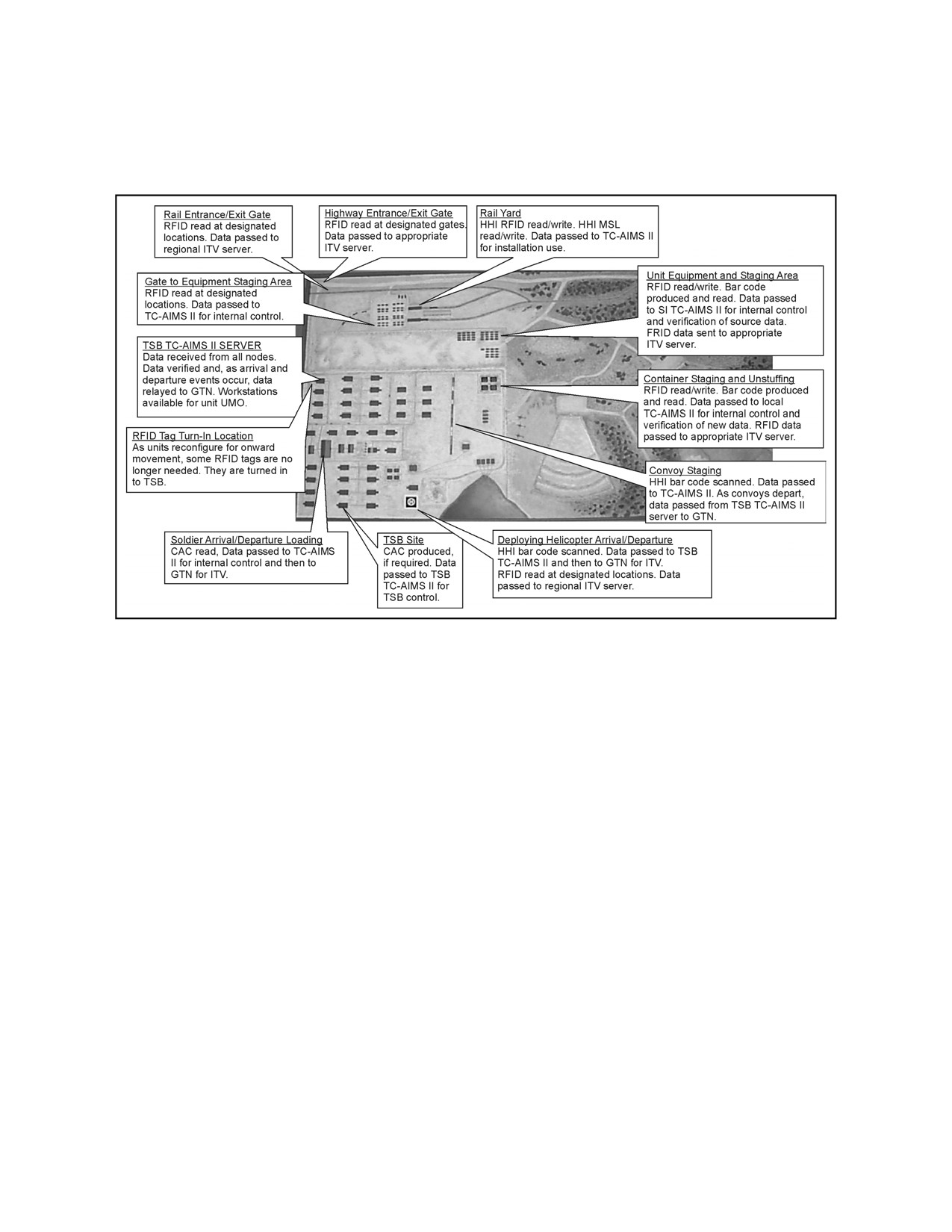
enabled AIS for ITV reporting and tracking. (See figure 5-1 for a notional in-
stallation of interrogators.)
5-6
_________________________________________________________________________________
Chapter 5
Figure 5-1. Notional Installation AIT/AIS Infrastructure
5-16. The following is an example of an interrogator network, but is not all-
inclusive as various installations may identify nodes by different names:
• All gates where units, unit equipment, and sustainment cargo will arrive
or depart (RFID).
• Convoy marshaling/staging areas (RFID, linear and 2D bar codes).
• Airfield marshaling area (linear and 2D bar codes).
• Transportation mode (rail/highway/barge) loading areas (linear and 2D
bar codes).
• Container consolidation point (RFID, linear and 2D bar codes, and OMC).
• Ammunition supply point (ASP) (RFID, linear and 2D bar codes, and
OMC).
• Vehicle scales/transportation automated measurement system (TRAMS)
sites (RFID and linear and 2D bar codes).
• Ready brigade lock-down areas (RFID, linear and 2D bar codes).
• Soldier readiness processing validation sites.
• Passenger holding/staging areas.
• Bus or aircraft passenger loading areas.
INSTALLATION USE OF COMMON ACCESS CARDS
5-17. Movement of soldiers during deployment may be expedited with the
use of CACs, sometimes referred to as smart cards. The CAC is a quickly de-
5-7
FM 3-35.4_________________________________________________________________________________
veloping enabler that, when fully implemented, will be accessible by AIS and
enhance deployability. Installation responsibilities concerning the CAC will
be further defined as the technology is integrated.
5-18. Installation consolidated SRP sites will eventually have the capabil-
ity to produce/update common access cards. As soldiers complete the SRP
process, their personal deployment information is encrypted onto a card. The
CAC then captures movements as the soldier travels through the deployment
process. CAC use eliminates the need for paper manifesting of soldiers as
they board transportation moving from the installation to the POE.
BRIGADE EQUIVALENT
5-19. Home station is the permanent location of active and USAR
component units. After receiving the alert or warning order of an impending
deployment, the unit has AIS/AIT-related responsibilities at HS. All brigade
equivalent units develop deployment plans. They may have several deploy-
ment plans based on the contingency operations they support. Each plan may
involve different task organizations of equipment, personnel, and accompany-
ing supplies that the unit must deploy by a variety of modes. Before depar-
ture from HS, the UMO creates a UDL in a TC-AIMS II deployment plan.
The brigade equivalent headquarters or the supporting installation verifies
the accuracy of the plan data and forwards the plan to the plans and opera-
tions section of its higher headquarters. The higher headquarters imports
the plan into the JFRG II. This file is then forwarded to the operations center
that updates JOPES. The installation unit movement coordinator or move-
ment control element produces a movement plan using TC-AIMS II and coor-
dinates transportation support for the movement plan.
BATTALION AND SEPARATE COMPANY/UNIT
5-20. The UMO will use TC-AIMS II to create an accurate OEL that identi-
fies all personnel equipment and supplies assigned to a unit identification
code (UIC). The unit will produce source data using TC-AIMS II for AIT data
storage devices (such as linear and 2D bar codes and RFID tags). The battal-
ion and/or company/unit commander has the responsibility to ensure the
source data is accurate and AIT storage devices are created.
5-21. The supply accountability bar code is scanned using the TC-AIMS II
hand-held reader/interrogator as units load equipment into containers or
build pallets. The hand-held reader/interrogator transfers the data to the TC-
AIMS II computer. TC-AIMS II then generates a packing list and burns an
RFID tag. The RFID tag contains a detailed list of all the unit equipment
consolidated within the container. The RFID tag is attached to the consoli-
dated shipment for ITV tracking. (See Appendix N for information on the ap-
plication of linear and 2D bar codes and RFID tags to unit equipment.)
5-8
_________________________________________________________________________________
Chapter 5
Bar code labels were missing from the majority of Kosovo Peacekeeping Force
(KFOR) cargo arriving at the port. In addition, advanced data received from TC-
ACCIS was inaccurate. All consignor and consignee fields were filled with the de-
fault code of “111111” so the port operators could not use AIT or AIS to verify the
unit that was shipping the equipment and the unit that would receive the equip-
ment. Additionally, there were problems reading bar code labels because opera-
tors were inputting the letter ‘O’ rather then the number ‘0’ in the transportation
control numbers (TCN). This error caused WPS to reject the TCN. This rejection
caused delays in passing the information from WPS to ICODS. These errors
caused delays in stow planning and loading vessels while port documentation per-
sonnel manually corrected the information problem.
Kosovo After Action Report
5-22. The UMO refines the UDL after receipt of the alert order or warning
order before movement to the POE. The unit updates its load plans and pro-
duces accurate MSLs and required RFID tags.
5-23. Deploying units properly label and tag their equipment and update
AIS before beginning the deployment. By ensuring AIT data storage devices
are accurate, properly attached to unit equipment, and readable, units facili-
tate ITV with limited human intervention at the other transportation pipe-
line nodes. Inaccurate data and manual data collection procedures for arriv-
ing units at reception nodes slow the deployment process.
5-24. Units develop SOPs to support the readiness standard operating pro-
cedures (RSOP). The RSOP specifies procedures, responsibilities, and quality
controls for ensuring that all equipment is properly bar coded, to include lo-
cation of MSLs on equipment and containers. The RSOP assigns responsibili-
ties and procedures for using deployment AIS in the unit marshaling and
staging area while preparing for deployment.
SECTION II - INSTALLATION SUPPORT EN ROUTE TO THE POE
5-25. Various installations in CONUS are assigned supporting installation
missions within geographical areas of responsibility. ASGs or BSBs normally
perform these missions during OCONUS deployments. The required en route
support varies based on factors such as C2 requirements, distance to the POE
and in-transit visibility requirements. There are no standards for en route
ITV reporting established by the DoD AIT Implementation Plan. En route
support missions may require maintenance or life support. If a support site
manned rest halt, or convoy support center (CSC) is established, planners
should consider collocating a TC-AIMS II system with fixed and hand-held
readers/interrogators. This enables the site to capture the arrival and depar-
ture of equipment and convoys moving to and from the port. For ITV re-
quirements, supporting installations should also consider the feasibility of
placing fixed interrogators at highway and rail choke points leading to POEs.
This allows the data capture of RFID information as the equipment passes
the interrogators. The installation’s AIT site survey should address en route
AIT support requirements.
5-9
FM 3-35.4_________________________________________________________________________________
5-26. Other en route AIT data collection options include—
• Placing satellite transponders in selected vehicles (for example, the con-
voy commander’s vehicle and vehicles with sensitive items) and monitor-
ing the movement via satellite.
• Using commercial carrier AIT with an electronic data interchange (EDI)
feed to the GTN.
SECTION III - AERIAL PORTS OF EMBARKATION
5-27. APOE operations, by their very nature, cross Service boundaries for
most force projection operations. The A/DACG is the primary organization
responsible for Army operations at airfields. The arrival and departure of all
unit equipment, personnel, and sustainment air cargo moving to and from
APOEs must be captured in automated information systems and reported to
GTN within one hour of occurrence. There are three primary organizations
operating at the APOE that may possess AIT enabling tools: the Air Force
element responsible for aircraft loading, the Army port movement control
team (if established), and the Army departure airfield control group. Detailed
inter-Service support agreements (ISSAs) or other arrangements should be
established in advance of deployment operations detailing information flow
through deployment AIS at the APOE. The arrangements address each or-
ganization’s functions and responsibilities as they relate to information flows
using deployment AIS. DACGs that come from TOE cargo transfer or cargo
documentation elements are equipped with deployment AIS. Ad hoc DACGs
may not have an organic deployment AIS. Supporting installations and com-
mands providing ad hoc DACGs must plan for obtaining deployment AIS.
AIS PLANNING CONSIDERATIONS AT THE APOE
5-28. MACOMs, supporting installations (or the Army organizations re-
sponsible for providing airfield support), and the Air Force element responsi-
ble for APOE operations address deployment AIS considerations in advance
of deployment operations. Two general considerations are—
• Identifying the deployment AIS responsibilities for the marshalling area,
passenger-holding area, alert holding area, and call forward area.
• Defining the procedures for processing information on Army equipment
and personnel arriving at the airfield.
5-29. Deployment AIS at aerial ports requires detailed planning and prior
coordination to support ITV information requirements. Planners must estab-
lish a system architecture to capture the arrival and departure of both pas-
sengers and equipment through an APOE. (See Figure 5-2 for a notional dia-
gram of AIS/AIT use at an APOE.)
5-10
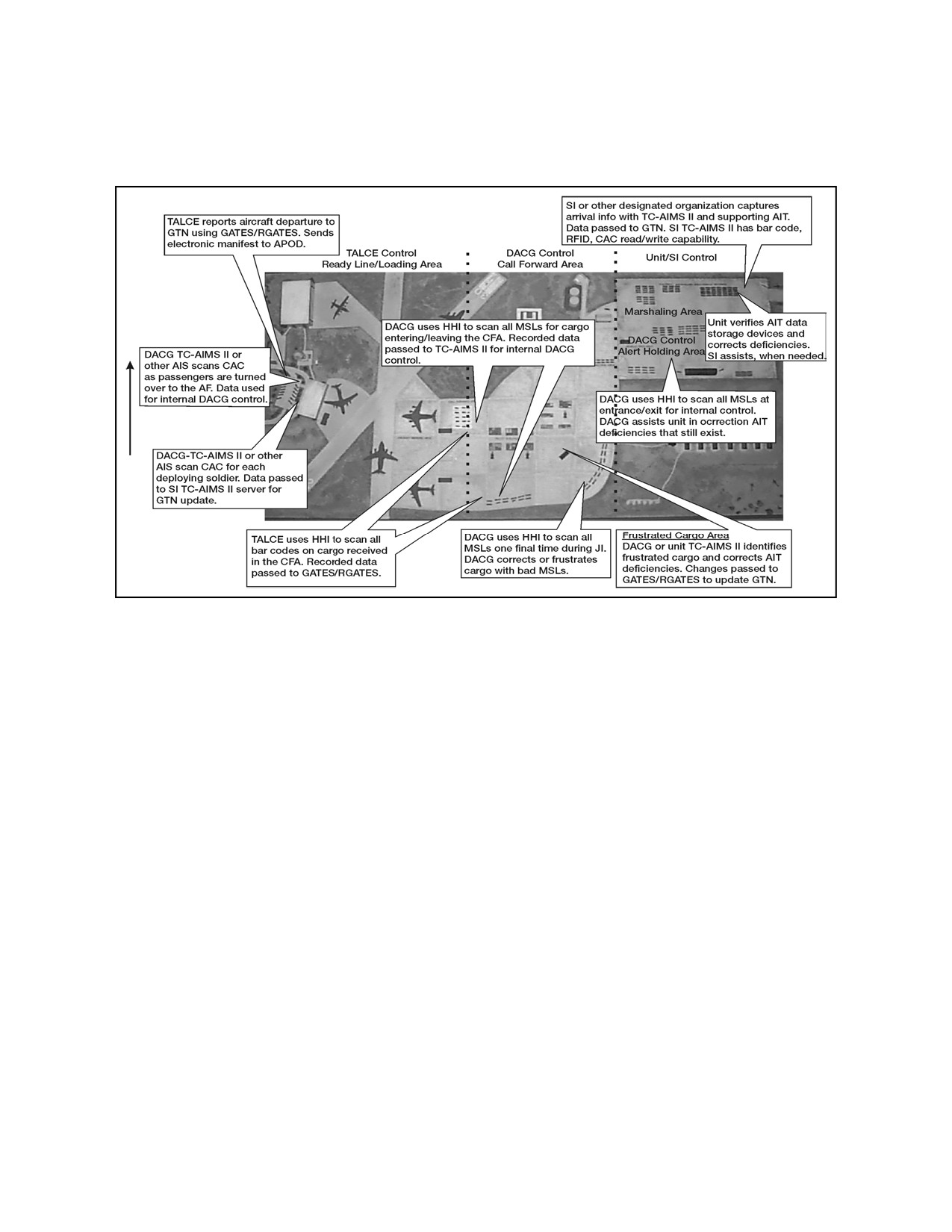
_________________________________________________________________________________
Chapter 5
Figure 5-2. Notional APOE with AIS/AIT Infrastructure
5-30. Planners address the following Army deployment AIS considerations
for APOEs:
• Coordinate with Air Force elements to augment the deployment AIS in-
frastructure at the APOE with Army elements operating at the APOE
during force projection operations.
• Identify the deployment AIS that will contain the primary source data
used to feed GTN. (AMC will use the Global Air Transportation Execu-
tion System (GATES) or Remote GATES (RGATES)).
• Identify the communications requirements and restrictions at each par-
ticular airfield that will affect the use of Army deployment AIS.
PASSENGER MOVEMENTS THROUGH AN APOE
5-31. Passengers moving through an APOE usually process through two
distinct areas: the marshaling area and the passenger holding area. Marshal-
ing areas may be located at the home installation, at the APOE, or in both lo-
cations depending on the deployment scenario and distances.
5-32. The installation or base commander usually establishes the marshal-
ing area as close as possible to the APOE. However, marshaling activities
may be conducted within the deploying unit’s permanent area. Both the unit
and the organization responsible for supporting operations at the marshaling
area have AIS-related responsibilities.
5-11
FM 3-35.4_________________________________________________________________________________
5-33. The unit verifies personnel manifests and ensures all soldiers have
accurate and up-to-date CACs, when available. The army command control-
ling the marshaling area (may be a supporting installation, DACG, or other
designated unit/command)—
• Scans arriving soldier’s CACs for internal accountability and for ITV re-
porting requirements, if the marshaling area is on the air base. If this is
the initial arrival area for soldiers at the APOE, procedures must be in
place to report this data to GTN within one hour of the arrival, in accor-
dance with the DoD AIT Implementation Plan standards.
• Assists the unit in correcting any CAC deficiencies.
• Scans all CACs and matches the data against the manifest as soldiers
depart the marshaling area for the passenger holding area.
5-34. Normally a distinct passenger holding area is established near the
APOE. The Air Mobility Command or other Air Force elements operate the
passenger holding area. Soldiers arriving from the marshaling area link up
with soldiers assigned duties loading unit equipment aboard the aircraft. As
soldiers arrive, the DACG, or other supporting Army elements, verify per-
sonnel information against the unit manifest. The DACG assists in making
any final manifest corrections. When notified, the DACG passes control of
deploying soldiers to the Air Force element along with an electronic copy of
the personnel manifest. The Air Force element loads this electronic data into
GATES or R-GATES and passes departure data to GTN within one hour of
aircraft takeoff.
UNIT EQUIPMENT MOVEMENTS THROUGH AN APOE
5-35. Normally unit equipment passes through four distinct areas when
deploying through an APOE: marshaling area, alert holding area, call-
forward area, and ready line/loading areas. Organizations have overlapping
responsibilities in each of these locations; they should set procedures before
operations begin.
MARSHALING AREA
5-36. An equipment marshaling area can be on the installation, near the
airfield, or in both locations depending on the deployment situation. Not all
deployments require the establishment of a marshaling area at the APOE.
Based on the deployment timeline, distance between the HS and the APOE,
space requirements, and marshaling space available at the APOE, a mar-
shaling area may be established near the port facility for equipment consoli-
dation. The supporting installation or area support group whose geographical
area of responsibility controls the area around the port complex normally op-
erates the marshaling area.
5-12
_________________________________________________________________________________
Chapter 5
5-37. Deploying units, with installation or other designated support ele-
ment assistance, are responsible for ensuring their equipment is properly
prepared for onward movement before it departs the marshalling area. Key
deployment AIS considerations at the marshaling area are as follows:
• The unit—
Ensures all equipment still has the correct label and/or RFID tag and
that none of the AIT data storage devices (for example, linear and 2D
bar codes, MSLs, and RFID tags) have been damaged in transit.
Verifies that bar codes and RFID tags are properly attached to pre-
clude loss or damage during further movement.
Verifies that all MSLs are readable. (This procedure requires a TC-
AIMS II hand-held scanner.)
• The Army command responsible for marshaling area operations—
Captures the arrival and departure of all unit equipment and sus-
tainment cargo at the marshaling area.
Provides additional RFID batteries for emergency replacement.
Assists units as necessary.
5-38. The unit corrects any problems or deficiencies found with AIT data
storage devices before the equipment is moved from the marshalling area. If
the unit does not have the capability to make corrections, the supporting in-
stallation or designated unit supporting the deployment provides support. Af-
ter preparing their equipment for air movement, units arrange vehicles and
equipment in chalk order before movement to the alert holding area.
ALERT HOLDING AREA
5-39. The alert holding area is normally on the airfield and controlled by
the DACG. The DACG coordinates operations between the unit and the Air
Force element (normally a TALCE) conducting aircraft loading. The DACG
scans the MSLs of all arriving and departing equipment for internal DACG
accountability and control purposes. The DACG is responsible for verifying
that MSLs and RFID tags are properly attached to the piece of equipment or
pallet to preclude damage or loss during air movement and for scanning all
MSLs to ensure they are readable.
5-40. The supporting command may need to resource the DACG with the
capability to check the battery life in all RFID tags and have them replaced,
if necessary. Once unit equipment is ready, it is moved from the alert holding
area to the call-forward area.
CALL-FORWARD AREA
5-41. The call-forward area of the airfield is where the unit and Air Force
element conduct joint inspection of equipment and air load plans are devel-
oped in the automated air load planning system (AALPS). The call-forward
area is under the control of the DACG (or designated Army element). The
unit, with assistance from the DACG, corrects all deficiencies found during
joint inspections.
5-13
FM 3-35.4_________________________________________________________________________________
READY LINE/LOADING AREA
5-42. The ready line/loading area is under the operational control of the Air
Force. The DACG passes the AALPS load plans and control of Army unit
equipment to the Air Force at the ready line. The Air Force imports the
AALPS load plans into GATES, ensures that the aircraft is loaded properly,
and sends aircraft departure and ITV data to the GTN within one hour of air-
craft departure.
SECTION IV - SEAPORTS OF EMBARKATION
5-43. SPOE operations cross Service boundaries as equipment is loaded on
strategic transport for overseas movement. The primary organization respon-
sible for SPOE operations is MTMC. MTMC is the military port manager for
all common-user water terminals. Also operating in the port complex will be
MSC, PSA, and the unit. Other possible operators at the port are civilian port
managers and operators, and possibly, Army port operators (7th Transporta-
tion Group or a USAR transportation group). Depending on the location,
there may also be an Army port movement control team. MTMC, as the DoD
designated single port manager for all worldwide common user seaports, co-
ordinates operations between Army units and MSC. If required, MTMC will
also coordinate all activities with the civilian port authorities and operators.
5-44. Unit equipment transiting an SPOE generally passes through two
primary areas before vessel loading: a marshaling area normally located just
outside the port and a staging area located within the port. Depending on the
size of the operation and the amount of unit equipment passing through the
SPOE, a marshaling area may or may not be established. The primary pur-
pose of a marshaling area is to provide a location near the port complex to as-
semble unit equipment and sustainment cargo and make final preparations
for ocean shipment just before entering the port. Marshaling areas are often
established when the volume of materiel moving to the port exceeds internal
port capabilities. In CONUS, FORSCOM has designated supporting installa-
tions to provide marshaling area and PSAs to MTMC terminals. In OCONUS
operations, the theater commander establishes a similar relationship with
MTMC.
AIS PLANNING CONSIDERATIONS AT THE SPOE
5-45. The primary use of AIT in deployment AIS at the port complex is to
capture information for ITV reporting and for internal control. Both MTMC
and the PSA use AIT to capture the movement of unit equipment through the
port complex. AIT can also be used to locate RFID tagged unit equipment
that is in the port area.
5-46. The PSA and MTMC elements operating in the SPOE have a limited
capability to verify data on AIT media and a limited capacity to make correc-
tions. Deploying units should not expect the SPOE to have a capability to
properly label and tag their equipment. This is a unit and installation func-
tion.
5-47. Supporting installations should provide deployment AIS to the PSAs.
5-14
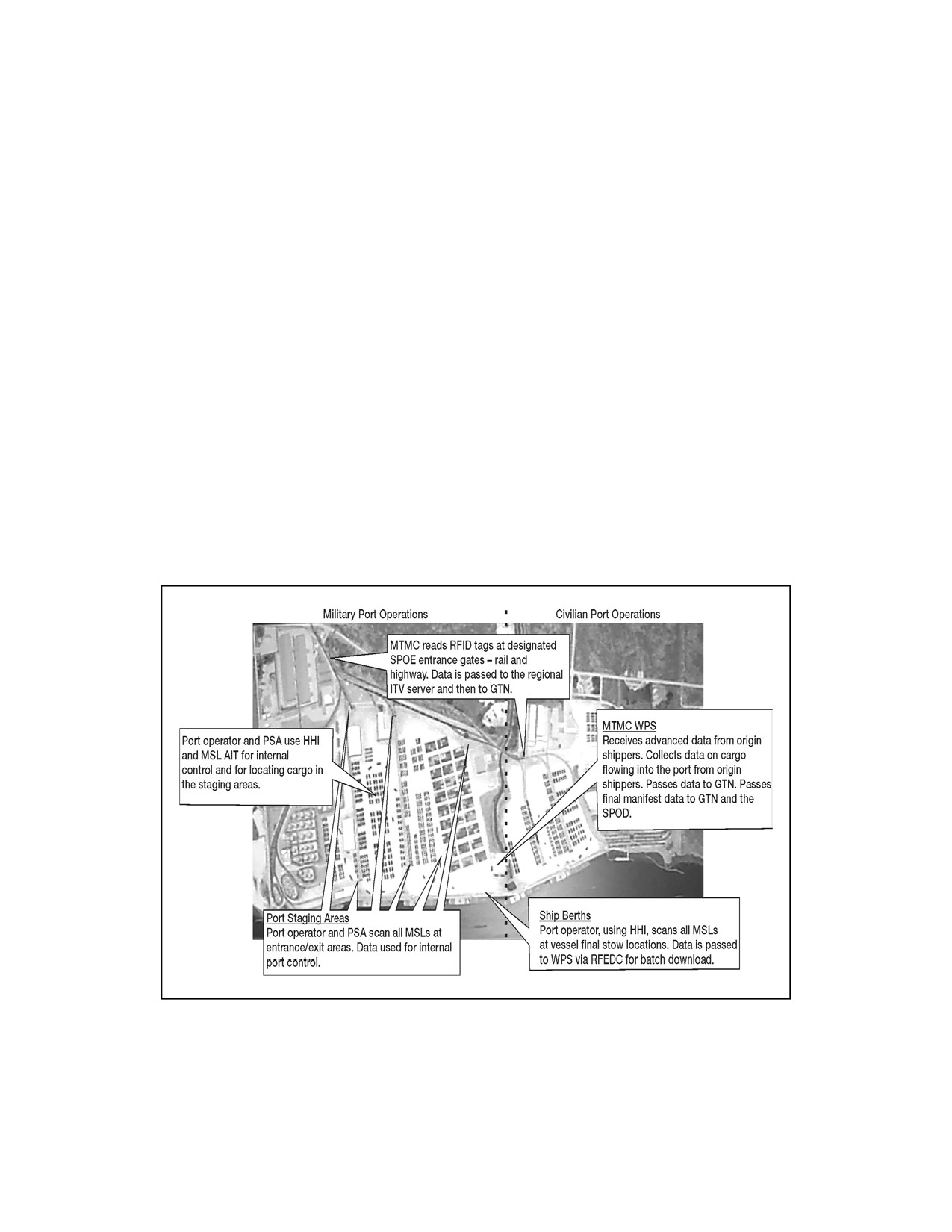
_________________________________________________________________________________
Chapter 5
5-48. MTMC will use RFID interrogators to capture the arrival/departure
of tagged unit equipment at SPOE/SPOD gates. This information is sent to
the GTN and to a regional ITV server. MTMC will scan linear and 2D bar
codes on MSLs and use this data for internal port control purposes once
equipment has entered the port. This includes the final stow location of unit
equipment aboard the vessel that is used to prepare the ship’s final manifest.
The location of fixed RFID interrogators must capture the arrival and depar-
ture of all unit equipment moving past its location. (See Figure 5-3 for a no-
tional diagram of a SPOE with AIS/AIT considerations depicted.) Below are a
few of the more common locations.
• Unit equipment and sustainment cargo arrival gates (RFID).
• Marshaling area entrance and exit (linear and 2D bar codes) (PSA asset).
• Container consolidation point (linear and 2D bar codes) (PSA or the or-
ganization charged with consolidation requirement).
• Port staging area entrance and exit (linear and 2D bar codes).
• Air-to-sea interface site, if one is established (linear and 2D bar codes).
• Barge off/on-load site (linear and 2D bar codes).
• HAZMAT staging area (linear and 2D bar codes).
• Ship loading ramp and lift-on/lift-off (LO/LO) locations (linear and 2D bar
codes).
Figure 5-3. Notional SPOE with AIT/AIS Infrastructure Considerations
5-49. Data collected by AIT (linear and 2D bar code and RFID tags) are
passed to GTN and WPS. MTMC has one hour to report POE arrival of unit
5-15
FM 3-35.4_________________________________________________________________________________
equipment by WPS to GTN, and four hours to report POE arrival of sustain-
ment cargo.
CARGO MOVEMENTS THROUGH SPOE
5-50. Normally unit equipment and sustainment cargo moves through a
marshaling and port staging area before it is loaded on a vessel.
MARSHALING AREA
5-51. Not all deployments require the establishment of a marshaling area
at the SPOE. If a marshaling area is established, the supporting installation
or ASG whose geographical area of operation controls the area around the
port complex normally runs it. SPOE responsibilities should be identified
during planning and coordination before any deployment operations are exe-
cuted. The key deployment AIS/AIT considerations at the marshaling area
are—
• Capturing the movement of all unit equipment and sustainment cargo
arriving and departing the area.
• Verifying AIT data storage devices are properly affixed to the equipment.
5-52. Units should correct problems found with AIT data storage devices. If
the unit is not located in the marshaling area, the organization operating the
marshaling area should make these corrections.
PORT STAGING AREA
5-53. The staging area is the final location where equipment is assembled
before loading the vessel. Equipment is usually lined up by piece type, or in
the order that it will be moved onto the ship. MTMC and the PSA both oper-
ate in the staging area. The key deployment AIS/AIT functions in the staging
area are—
• Scanning or interrogating all unit equipment and sustainment cargo as it
arrives and leaves the staging area.
• Producing new AIT data storage devices for any pieces of equipment that
have damaged, inaccurate, or missing RFID tags or MSLs.
VESSEL LOADING
5-54. MTMC controls all equipment departing the staging area for vessel
loading. Normally the equipment is scanned at the final stowage location.
Scanned data is passed to the WPS. WPS then uses an electronic data inter-
change transaction and sends the ship’s final manifest to the GTN and the
SPOD WPS. For unit movements, this data must be visible in GTN within
one hour of ship departure. For sustainment shipments, that data must be
visible in GTN within four hours. MSC reports ship departure from the port
complex.
5-16
_________________________________________________________________________________
Chapter 5
PASSENGER MOVEMENTS THROUGH A SPOE
5-55. A final consideration for AIS/AIT uses at the SPOE is the possible
need for a plan to capture personnel movements by ocean transport. This
need may occur with—
• Large-scale mobilization and the use of passenger ships.
• Soldiers moving on Navy ships (similar to the United States Marine
Corps [USMC]).
• Self-deploying U.S. Army watercraft.
• Supercargoes accompanying Army equipment.
5-56. There are several options that planners should consider for using AIT
to capture the movement of Army personnel through water terminals:
• Establish an ISSA with MTMC to ensure that a MTMC element has TC-
AIMS II available at SPOEs where a large number of Army personnel
will deploy.
• Develop an ISSA with the Navy to use its TC-AIMS II system to capture
the movement of Army personnel deploying on Navy vessels.
• Equip the port support activity TC-AIMS II system with CAC read capa-
bility to capture movements. This option assumes that the PSA has a TC-
AIMS II capability.
• Ensure self-deploying Army watercraft use their battalion-level TC-AIMS
II system to capture and report their personnel movement.
• For small numbers of supercargoes, have the supercargoes call their com-
mand before vessel departure. The parent command then uses the TC-
AIMS II data feed to GTN to provide passenger movement information.
5-17
Appendix A
Automation and Communication Systems
The rapid advance of web-based technology provides combatant and com-
ponent commands potential worldwide access to various references and
information to enhance deployment and redeployment operations. (The
systems described below use web-based technology only where stated in
the text.) This appendix presents an overview of automated and commu-
nication support systems that may be available to deploying
units/organizations. If required, these systems obtain and transmit unit
movement requirements in support of operations and to monitor execu-
tion.
JOINT OPERATION PLANNING AND EXECUTION SYSTEM
A-1.
The Joint Operation Planning and Execution System (JOPES) is the
system used by the JPEC to conduct joint planning during peace and crisis.
(See Figure A-1.) Joint operation planning is a process coordinated through
all levels of the national structure for joint planning and execution, including
the NCA and the JPEC. The focus of the joint operation planning process is
the combatant commanders users, assisted by and coordinated through
JOPES, to determine the best method of accomplishing assigned tasks and to
direct the actions necessary to accomplish the mission. In normal peacetime
conditions, the deliberate planning process produces operation plans, either
OPLANS or CONPLANs, and functional plans. In crises, CAP produces
OPORDs. JOPES’ focus is on force generation and tracking. Building force
requirements, capturing/scheduling strategic lift requirements and execution
reporting, within the JOPES accomplish this. Senior-level decision-makers
use JOPES to plan and execute deployment, sustainment, and redeployment
activities. It supports the national, theater, and supporting organizational
levels in both peacetime and crisis. For additional information (See CJCSM
3122.03).
A-2.
The JOPES has two end products (OPLANs and OPORDs). OPLANs
are the result of deliberate planning conducted during peacetime. OPORDs
are the execution portion of an OPLAN. FRAGOs are a result of time-
sensitive planning.
A-1
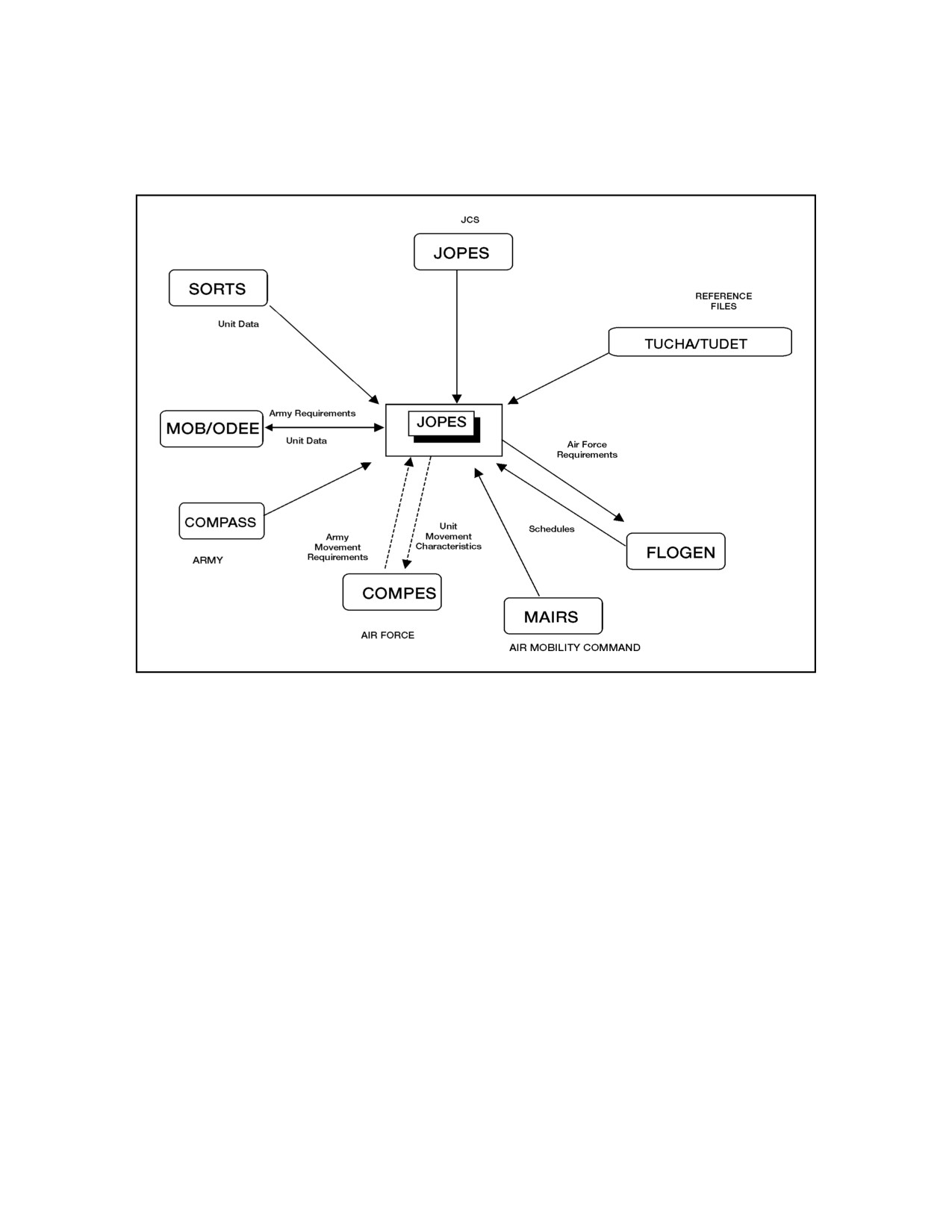
________________________________________________________________________________
FM 3-35.4
Figure A-1. Joint Operation Planning and Execution System
A-3.
The JOPES planning is based on both requirements and capabilities.
Military planners use forces and resources identified in the Joint Strategic
Capabilities Plan (JSCP), CJCS orders, Service documents, and approved
OPORDs. They identify forces and resources required to accomplish the mis-
sion and compare them to actual forces and resources available. Supporting
commands and agencies and the Services confirm force and resource avail-
ability, including combat, combat service and combat service support forces,
and transportation resources. Rapid, accurate exchange of information is
fundamental to the intense coordination required throughout the JPEC to
support timely decisions during planning and to adjust operations to the de-
veloping situation during execution.
A-4.
Within JOPES, completed and approved plans are maintained and
updated as changes in the plans occur. Development of new plans occurs,
when the threat, tasks, forces assigned, resources available, and/or concept of
operations change to the extent that the supported commander and the
Chairman of the Joint Chiefs of Staff determine necessary. Otherwise, com-
manders and their staffs concentrate on keeping existing plans and orders up
to date and executable through use of all appropriate methods, including
plan maintenance conferences and plan-specific newsgroups.
A-2
_______________________________________________________________________________
Appendix A
GLOBAL TRANSPORTATION NETWORK
A-5.
The Global Transportation Network (GTN) is the USTRANSCOM
automated command and control information system that supports transpor-
tation users and providers, both DoD and commercial, in an integrated sys-
tem providing command and control and ITV capabilities. GTN collects and
integrates transportation data from selected transportation systems. The re-
sulting data is provided to the NCA, commanders-in-chief
(CINCs),
USTRANSCOM, its component commands, and DoD customers to support
transportation planning and decision making during peacetime and wartime.
GTN supports planning, providing, and controlling the common user airlift,
surface lift, and terminal services that deploy and support DoD forces glob-
ally during peacetime and wartime. Specifically, GTN focuses on providing
USTRANSCOM with the information necessary for visibility, planning,
command and control, intelligence, and reporting.
A-6.
Although not a JOPES system, GTN is a GCCS interface that pro-
vides information essential to monitoring and managing TPFDD execution.
GTN furnishes the automated command and control support needed for
USTRANSCOM to carry out its mission of global transportation management
for DoD. GTN also supports USTRANSCOM in accomplishing its task to in-
tegrate deployment-related automatic data processing systems and to furnish
centralized ITV in peace and war.
A-7.
GTN accesses current transportation information from diverse
sources, integrates that information, and gives it to users in a useful form.
Information is integrated into a central database to cross-reference supply,
cargo, forces, passenger, and patient requirements and movements with air-
lift, air refueling, aero-medical, and sealift schedules and movement.
A-8.
GTN gives users the ability to do the following—
• Locate items in transit
• Forecast port workload
• Assess unit deployment status
• Determine onward movement requirements
• Determine container and pallet contents
• Obtain current aircraft and ship schedules
GLOBAL COMMAND AND CONTROL SYSTEM
A-9.
The Global Command and Control System (GCCS) with its Service
subset, the GCCS-A, has replaced the Worldwide Military Command and
Control System. GCCS is a system of interconnected computers that provides
integrated command, control, communications, computers and intelligence
(C4I) capability to the joint community. It provides information from a
variety of applications that have migrated, or are in the process of migrating,
from other systems including JOPES. GCCS can document movement re-
quirements, transportation closures, and other significant deployment-
related events. Pre-formatted reports containing information on deployment
requirements and strategic lift schedules are available on GCCS. Any regis-
tered GCCS user using the Rapid Query Tool (RQT) software can also extract
requirements and scheduling information. This software establishes site-
A-3