FM 3-35.4 DEPLOYMENT FORT-TO-PORT (June 2002) - page 1
HEADQUARTERS
DEPARTMENT OF THE ARMY
FM 3-35.4 (100-17-4)
18 June 2002
DEPLOYMENT FORT-TO-PORT
DISTRIBUTION RESTRICTION:
Approved for public release; distribution is unlimited.
Field Manual
FM 3-35.4 (100-17-4)
Headquarters
No. 3-35.4 (100-17-4)
Department of the Army
Washington, DC, 18 June 2002
DEPLOYMENT FORT-TO-PORT
Contents
Page
Preface
iv
Introduction
v
CHAPTER 1
DEPLOYMENT: FORT-TO-PORT - AN OVERVIEW
1-1
Section I - Force Projection
1-1
Section II - Deployment
1-3
Deployment Phases
1-4
The Deployment Process
1-5
Section III - Principles Governing Predeployment Activities and Fort-
To-Port Movement
1-6
Section IV - Joint Deployment Information System Improvement
1-7
Section V - The Army Transformation and Deployment
1-9
Chapter 2
PREDEPLOYMENT ACTIVITIES
2-1
Section I - Planning and Preparation
2-2
Planning Process
2-2
Joint Operation Planning and Execution System (JOPES)
2-3
Deployment Plans and Procedures
2-7
Battle Books
2-8
Route and Location Reconnaissance and Rehearsal
2-8
Section II - Deployment Training Requirements
2-9
Collective Training
2-9
Installation Training
2-10
Individual Soldier Training
2-10
Unit Movement Officer (UMO)
2-11
Unit Loading Teams
2-11
Air Load Planners
2-12
Hazardous Cargo Certifying Official
2-12
Mission Specific Training
2-13
Chapter 3
INSTALLATION ACTIVITIES
3-1
Section I - Installation Predeployment Activities
3-2
Installation Staging Area (ISA)
3-2
Rail Preparation/Operations
3-3
Distribution Restriction. Approved for public release; distribution is unlimited.
i
FM 3-35.4_________________________________________________________________________________
Soldier Readiness Processing (SRP)
3-4
Personal Property
3-5
Family Members
3-5
Individual Clothing and Equipment Inspection
3-5
Overseas Orientation
3-6
Clearance from the Installation
3-6
Maintenance
3-6
Deploying DA Civilians and Contractors
3-7
Rear Detachment
3-7
Security
3-8
Section II - Organization Responsibilites
3-8
Emergency Operations Center (EOC)
3-8
Installation Transportation Officer (ITO)
3-9
Deployment Support Brigades (DSB)
3-9
CONUS Replacement Center (CRC)
3-10
Deployment Processing Center (DPC)
3-10
Section III - Force Protection/Antiterrorism
3-11
Chapter 4
MOVEMENT TO AND ACTIVITIES AT PORTS OF EMBARKATION
4-1
Section I - Principles of Movement
4-2
Principles
4-2
Liaison Officer
4-2
Section II - Fort-to-Port Movement
4-3
Convoy Operations
4-3
Rail Operations
4-4
Section III - Activities at the Ports of Embarkation
4-4
Seaports
4-4
Military Traffic Management Command
4-4
MTMC Deployment Support Team
4-5
Transportation TerminaL Brigade
4-5
Military Sealift Command
4-6
U.S. Coast Guard
4-6
Port Support Activity
4-7
Supercargo
4-8
Port Operations Center
4-8
Support Installations
4-8
Deploying Unit
4-9
Marshaling Areas
4-9
Staging Areas
4-10
Airports
4-11
Railhead
4-15
Chapter 5
FORT-TO-PORT IN-TRANSIT VISIBILITY
5-1
Section I - Planning Considerations and Responsibilities
5-2
Automated Information Systems/Automatic Identification Technology
and In-Transit Visibility (AIS/AIT and ITV)
5-2
Major Army Command
5-2
United States Army Reserve
5-3
Major Subordinate Command/Installation
5-3
Installation Deployment Information Network
5-5
Brigade Equivalent
5-8
Battalion and Separate Company/Unit
5-8
ii
_________________________________________________________________________________
FM 3-35.4
Section II - Installation Support En Route to the POE
5-9
Section III - Aerial Ports of Embarkation
5-10
AIS Planning Considerations at the APOE
5-10
Passenger Movements Through an APOE
5-11
Unit Equipment Movements Through an APOE
5-12
SECTION IV - Seaports of Embarkation
5-14
AIS Planning Considerations at the SPOE
5-14
Cargo Movements Through a SPOE
5-16
Passenger Movements Through a SPOE
5-17
Appendix A
AUTOMATION AND COMMUNICATION SYSTEMS
A-1
Appendix B
TIME-PHASED FORCE AND DEPLOYMENT DATA (TPFDD)
DEVELOPMENT
B-1
Appendix C
DEPLOYMENT BINDERS
C-1
Appendix D
DEPLOYMENT PLANNING
D-1
Appendix E
UNIT MOVEMENT PLAN (SAMPLE)
E-1
Appendix F
UNIT AIRLIFT AFFILIATION PROGRAM
F-1
Appendix G
HAZARDOUS CARGO
G-1
Appendix H
RAIL OPERATIONS
H-1
Appendix I
CLASSIFIED AND SENSITIVE CARGO
I-1
Appendix J
CONVOY COMMANDER'S CHECKLIST
J-1
Appendix K
THE JOINT INSPECTION PROCESS
K-1
Appendix L
DEPLOYING UNIT DEPARTURE AIRFIELD CONTROL GROUP
PLANNING AND PREPARATION PHASE REQUIREMENTS
L-1
Appendix M
LABELING AND TAGGING EQUIPMENT
M-1
Glossary
.............................................................................................................. Glossary-1
Bibliography
........................................................................................................Bibliography-1
Index
.................................................................................................................... Index-1
iii
FM 3-35.4_________________________________________________________________________________
Preface
This manual defines deployment in terms of its process, structure, and organization from the
point of origin or home station (HS) to the port of embarkation (POE). It recognizes the shift in
U.S. strategic policy from forward presence to power projection and the resulting reliance on the
strategic mobility triad to fulfill the U.S. Army requirements for force projection.
This manual's focus is on planning for and execution of deployments in a joint arena to satisfy
Joint Operation Planning and Execution System (JOPES) process requirements. It concentrates
on the sequence of actions and requirements for both the deploying unit and agencies responsi-
ble for its deployment from origin/mobilization station to the ports of embarkation (POEs) (fort-
to-port).
This manual supports soldiers, leaders, and staffs who execute deployment operations, specifi-
cally at the Army service component command (ASCC)/Army forces (ARFOR), deploying unit, in-
stallation, and supporting unit levels. Roles and missions of other agencies instrumental in the
deployment process are described to aid the primary players in their understanding of the entire
force projection sequence.
The proponent of this manual is the U.S. Army Training and Doctrine Command. Send com-
ments and recommendations on DA Form 2028 directly to Commander, U.S. Army Combined
Arms Support Command, Directorate of Combat Developments for Combat Service Support,
ATTN: ATCL-C, Fort Lee, VA, 23801-1809.
Unless this publication states otherwise, masculine nouns or pronouns do not refer exclusively to
men.
iv
_________________________________________________________________________________
FM 3-35.4
Introduction
"...power projection, enabled by overseas presence, will likely remain the fundamental
strategic concept of our future force."
Joint Vision 2010
Smaller Army forces with fewer of them forward-deployed require an Army that is prepared to
deploy anywhere in the world on short notice from both the continental United States (CONUS)
and forward-deployed locations outside CONUS (OCONUS). The United States Army is the na-
tion’s strategic land force and the strategic core of U.S. forces for joint or multinational opera-
tions. While it is the world’s premier land force, the Army’s relevance depends on being strategi-
cally responsive, for example, its ability to deliver early and continuous lethal combat power
through force projection. The Army's defining strategy has become one of having tailored, lethal,
decisive forces, capable of deploying quickly to any global hotspot.
Force projection is not a new mission for the Army, but profound changes in force structure, sta-
tioning, and world situation have raised it to a preeminent mission and changed its operational
nature. The Army has to move with a greater velocity and sustained lethality to fulfill its role as
the guarantor of victory. The previous operational rhythm of halt, buildup, and counterattack is
no longer acceptable for force projection operations. Future enemies will not allow an incre-
mental build up of combat power. Moreover, a future adversary’s exploitation of technology,
weapons of mass destruction, and asymmetrical anti-access measures, coupled with the natural
friction points in the constrictive force projection pipeline, will make force projection a more chal-
lenging and difficult operation.
This manual explains the United States Army’s responsibilities in force projection to better pre-
pare the key organizations involved in deployment: the ASCC/ARFOR, the deploying unit, the
installation, and the supporting units. The ARFOR could vary in size from multiple corps to a
battalion, depending upon the mission. The responsibilities and planning involved in the process
of deployment entail similar actions whatever the command level. In austere theaters, the de-
ployment enabling systems (software and communications) may be unavailable; however, this
manual discusses these systems because units deploying from power projection platforms (PPPs)
or power support platforms (PSPs) will eventually have state-of-the-art infrastructure and
automation support.
In addition to planning considerations, this manual presents the deployment process from verbal
warning through port of embarkation operations. It describes operations at both seaports of em-
barkation and aerial ports of embarkation.
This manual is one in a series dealing with force projection stemming from the capstone FM 3-35
(100-17). In this series, FM 3-35.1 (100-17-1) establishes the doctrinal framework for a pre-
designated heavy brigade drawing Army pre-positioned stocks from forward-based ships. FM 3-
35.2 (100-17-2) describes similar procedures from land sites in certain theaters. FM 3-35.3 (100-
17-3) defines actions from the ports of debarkation to tactical assembly areas or to operational
destinations. FM 3-35.5 (100-17-5) on redeployment completes the series. Since these publica-
tions adequately amplify these specific operations, this manual focuses on the Army’s primary
responsibility of planning for and moving a unit from origin/mobilization station to the ports of
embarkation (POEs) and the subsequent requirements at the ports to ensure a successful de-
ployment.
Detailed tactics, techniques, and procedures on unit responsibilities in deployment will be pub-
lished in FM 4-01.011 (55-65).
v
Chapter 1
Deployment: Fort-to-Port—an Overview
"The deployment of land forces is the gravest response that can be made, short of war, to
demonstrate the national will to prevent conflict."
Army Vision 2010
Force projection, a military
Contents
element of national power, sys-
Section I - Force Projection
1-1
tematically and rapidly moves
Section II - Deployment
1-3
military forces in response to
Deployment Phases
1-4
requirements of war or military
The Deployment Process
1-5
operations other than war
Deployment Planning
1-5
(MOOTW). It demonstrates the
Section III - Principles Governing Predeployment
Activities and Fort-to-Port Movement
1-6
ability to alert, mobilize, deploy
Section IV - Joint Deployment Information
rapidly, and operate effectively
System Improvement
1-7
anywhere in the world. The U.S.
Section V - The Army
Army, as a key member of the
Transformation and Deployment
1-9
joint team, must be ready for
global force projection with an
appropriate mix of combat, combat support, and combat service support
forces. It can execute a variety of missions spanning the range of military
operations. More importantly, the world situation demands that the Army
project its first-rate power at an unprecedented pace and accomplish diffi-
cult missions that promise to be more complex than those of the past.
Army Goal: "With the right technological solutions...allow U.S. to put a combat capable
brigade anywhere in the world in 96 hours after liftoff, a division on the ground in 120
hours, and five divisions in 30 days."
General Shinseki, CSA
SECTION I - FORCE PROJECTION
1-1.
Force projection operations encompass a range of processes that occur
in a continuous, overlapping, and iterative sequence. These activities include:
• Mobilization. Mobilization is the process of assembling and organizing
national resources to support national objectives in time of war (and for
MOOTW) or other emergencies. Each Service maintains its own mobili-
zation plan and planning system. Mobilization includes bringing all or
part of the industrial base and the armed forces of the United States to
the necessary state of readiness to meet the requirements of the specific
contingency. Mobilization may include activation of all, or part, of the
1-1
FM 3-35.4_________________________________________________________________________________
United States Army Reserve (USAR), as well as assembling and organiz-
ing personnel, supplies, and materiel. Once assembled, personnel will
undergo predeployment checks and training as needed.
•
Deployment. Deployment is movement of forces and their sustainment
from their point of origin to a specific operational area to conduct joint
operations outlined in a given plan or order. The type and nature of de-
ployments vary widely according to scenario and circumstances. Occas-
sionally, strategic deployment may involve the intertheater movement of
forces and materiel using national and allied and/or coalition deployment
capabilities
•
Employment. Employment prescribes how to apply force and/or forces to
attain specified national strategic objectives. During the planning proc-
ess, the joint forces commanders (JFCs) and their component commands
develop employment concepts. These concepts provide the foundation and
determine the scope of mobilization, deployment, sustainment, and rede-
ployment processes. Employment encompasses a wide array of operations
including, but not limited to, entry operations (opposed or non-opposed),
decisive operations (combat or support), and post-conflict operations (pre-
pare for redeployment or for follow-on mission).
•
Sustainment. Sustainment is directed toward providing and maintaining
levels of personnel and materiel required to sustain the levels of combat
or mission activity for the appropriate duration and at the desired level of
intensity. Sustainment is ongoing throughout the entire process of de-
ployment and redeployment. Key decisions made early in force projection
operations concern basing and sustaining the force. Force projection op-
erations may involve the establishment of support facilities in multiple
sites outside the continental United States (OCONUS), including the cri-
sis area. Logistic support will usually be split-based between several
theaters and the continental United States (CONUS). The location and
size of the base or bases supporting the operation is a key factor in opera-
tional reach. CONUS bases supporting a deployment or redeployment
will normally be selected or designated by the Services and Defense
agencies participating in the operation in consultation with United
States Transportation Command
(USTRANSCOM) or its component
commands. Supporting combatant commanders will select bases within
their theaters to support a specific operation. The supported combatant
commander will select or designate theater bases to support the joint re-
ception, staging, onward movement, and integration (JRSOI) of arriving
forces.
•
Redeployment. Redeployment involves the transfer of units, individuals,
or supplies deployed in one area to another location within the area, to
the zone of interior for the purpose of further employment. Also, to
CONUS and/or OCONUS home and/or demobilization stations for the
purpose of further operational employment or demobilization. Post-
conflict missions may affect the redeployment flow. Commanders (CDRs)
must plan and execute redeployment in a manner that optimizes the
readiness of redeploying forces and materiel to meet new contingencies or
crisis.
1-2
_________________________________________________________________________________
Chapter 1
1-2.
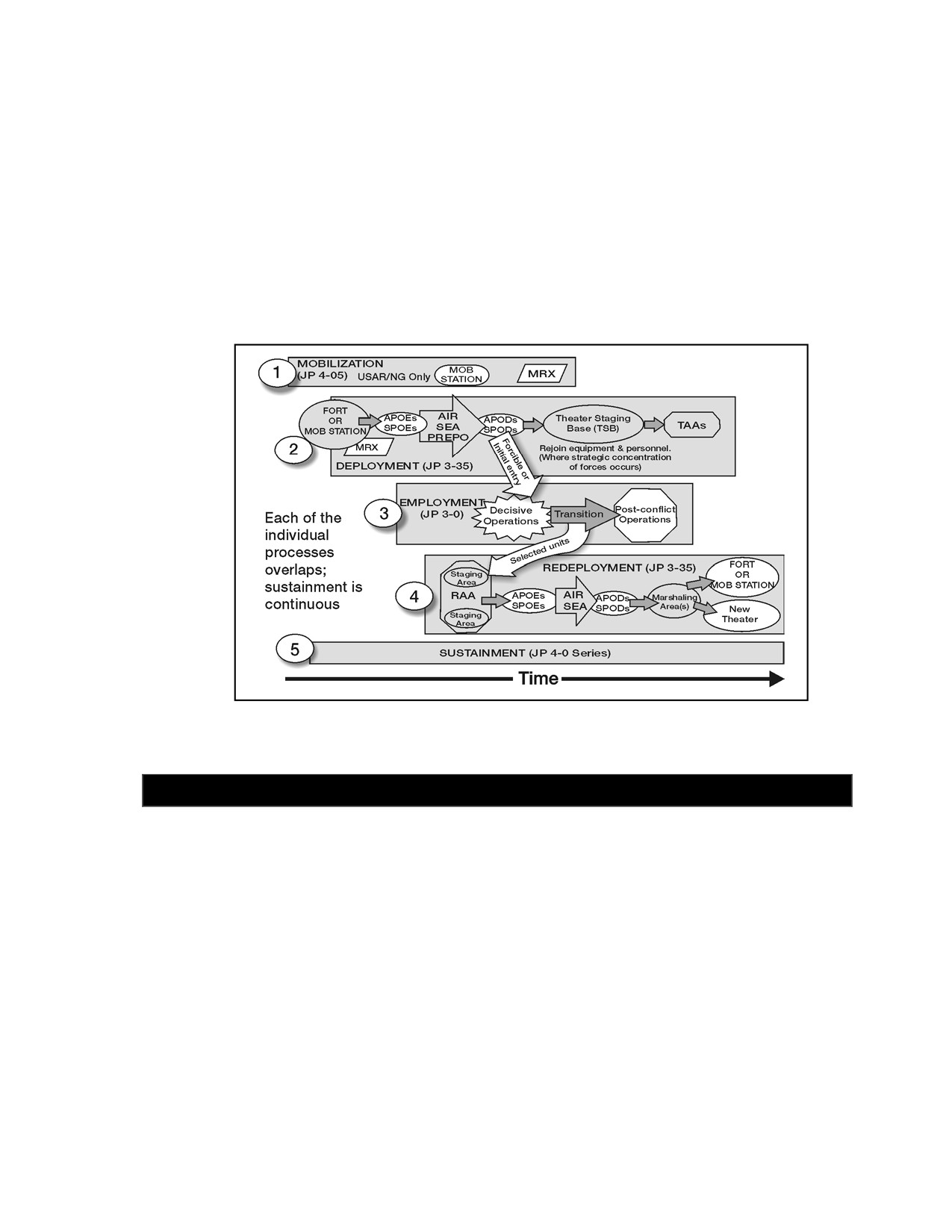
Each force projection activity influences the other. (See figure 1-1,
Force Projection Process, below.) This is especially true of the interrelation-
ship of deployment and employment. Deployment and employment
inextricably link; neither can be planned successfully without a firm grasp of
the other. Consequently, the operational speed and tempo reflect the ability
of the deployment pipeline to deliver combat power where and when the joint
force commander wants it. Any disruption in the deployment will accordingly
affect employment.
Figure 1-1. Force Projection Process
SECTION II - DEPLOYMENT
1-3.
Deployment is the movement of forces and materiel, and their sus-
tainment, from their point of origin to a specific area of operation (AO) to
conduct operations outlined in a plan or order. It encompasses all activities
from origin or home station (HS) through destination, specifically including
intra-continental United States, intertheater, and intratheater movement
legs. This combination of dynamic actions support the combatant com-
mander’s concept of operations for employment of the force.
1-4.
The geographic combatant commander and their subordinate JFCs
define success in deployments, establishing what, where, and when forces are
needed. The subordinate JFC's employment concept is the starting point for
deployment planning. Consequently, how the JFC intends to employ his
forces is the basis for orchestrating the deployment structure. On the other
hand, the deployment possibilities dramatically influence employment plan-
ning—how much and when combat power can be delivered affects the JFC's
employment options.
1-3
FM 3-35.4_________________________________________________________________________________
1-5.
The commander of the Army service component command
(COMASCC) assigned to the geographical combatant commander, in concert
with subordinate Army force commanders, take the subordinate JFC em-
ployment concept and develop the Army force plan. The COMASCC tailors
the Army forces (ARFOR) to meet the subordinate JFC’s deployment and
employment requirements. The commander of the Army service component
command identifies the ARFOR in the development and refinement of the
time-phased force and deployment data (TPFDD). See field manual (FM) 3-93
(100-7), and FM 3-35 (100-17) for further discussion on the Army service
component command (ASCC).
DEPLOYMENT PHASES
1-6.
Deployments consist of four distinct and interrelated deployment
phases. These phases may not be sequential and could overlap or occur
simultaneously:
• Predeployment activities
• Movement to and activities at the port of embarkation (POE) — fort-to-
port
• Movement to port of debarkation (POD) — port-to-port
• Reception, staging, onward movement, and integration (RSO&I) — port-
to-destination
1-7.
The friction that develops as soldiers and equipment move through
the lines of communication (LOCs) at forts, ports, and tactical assembly areas
(TAAs) slows the arrival of combat power in the theater. It also lessens the
efficiency and effectiveness of the total mobility system. In addition, time
wasted in any phase affects force closure. A successful deployment requires
smooth and quick implementation of each phase and seamless transitions or
interactions between them all.
1-8.
The effectiveness and/or inefficiency of the first two phases, which
are the focus of this publication, set the conditions for the rest of the deploy-
ment. Several principles guide commanders to execute predeployment activi-
ties and the fort-to-port movement effectively and efficiently. Section III of
this chapter discusses these principles.
1-9.
JP 4-01 discusses the defense transportation system (DTS) employed
in the third phase. The fourth phase overlaps with the entry stage of a force
projection operation. FM 3-35.3 (100-17-3) covers this component for the
Army. Joint Publication (JP) 4-01.8 is the joint manual on the subject.
1-10. A multitude of manuals, including FMs 3-0 (100-5), 3-93 (100-7), 3-
100.15 (100-15), and 3-100.71 (71-100), discuss employment. FM 4-0 (100-10)
and subordinate combat service support (CSS) manuals detail how the force
is sustained throughout force projection operations. FM 3-35.5 (100-17-5) is
the Army's primary doctrine on redeployment, while JP 3-35 is the relevant
joint publication.
1-4
_________________________________________________________________________________
Chapter 1
FORCE PROJECTION DOCTRINE
Mobilization
Primary Army FMs
Primary JPs
FM 100-17 (3-35)
JP 4-05, JP 4-05.1
Deployment
o Point of origin to POE
FM 3-35.4
JP 3-35
o POE to POD
FM 55-1 (4-01)
o POD to TAA
FM 100-17-3 (4-01.8)
JP 4-01.8
Employment
FM 3-100.7 & others
JP 3-0 & others
Sustainment
FM 100-10 (4-0) & others
JP 1-0,4-0, & others
Redeployment
FM 100-17-5 (3-35.5)
JP 3-35
Note. The current edition of these publications can be found on the Army Digital
mil/doctrine). At the time of publication of this manual (FM 3-35.4), the FM num-
ber outside of parenthesis is current. Revisions of these publications will use the
number in parenthesis.
THE DEPLOYMENT PROCESS
1-11. Unless a unit moves intact, a unit earmarked for deployment is sub-
jected to several transformations during the deployment process. First, at its
HS, personnel and equipment separate in preparation for transport to a port
of embarkation, then transport on different conveyances. The unit, in effect,
“dissolves.” Both personnel and equipment may arrive at different ports of
debarkation and go through RSO&I to operate again as a combat unit. Tradi-
tionally, the RSO&I segment is the most difficult and is often referred to as
the Achilles’ heel of deployment due to this separation of unit and equipment.
1-12. Predeployment activities and the fort-to-port phase significantly im-
pact RSO&I. In-transit visibility, proper sequencing of personnel and equip-
ment, meeting the timelines at the port of embarkation, proper containeriza-
tion of hazardous materials, and a detailed, integrated, tested and, where
possible, modeled and simulated RSO&I plan are instrumental in the success
of RSO&I. On the other hand, inefficiency and ineffectiveness up front com-
pound the inherent difficulties in building combat power.
DEPLOYMENT PLANNING
1-13. Successful deployment planning requires knowledge of the unit’s de-
ployment responsibilities, an understanding of the total deployment process,
and an intellectual appreciation of the link between deployment and em-
ployment.
1-5
FM 3-35.4_________________________________________________________________________________
1-14. Deployment planning is an invariable, logical process that focuses on
soldiers and equipment for deployment, ways to deploy them and information
and means to track them. In particular, deployment plans require specific in-
formation (detail) to guide the unit through an effective deployment. The
heart of deployment planning is a precise list of soldiers and equipment that
have to deploy—the unit deployment list (UDL) (see next section for defini-
tion), which is developed in the Transportation Coordinators’ Automated In-
formation for Movement System II (TC-AIMS II).
(See Appendix A.) Its im-
portance exemplifies by its use, for example, to manifest unit equipment for
deployment and to update the TPFDD so that appropriate lift is scheduled
for the deployment.
1-15. The Army uses five steps in planning and preparation during pre-
deployment activities: analyze mission, structure forces, refine deployment
data, prepare the force, and schedule movement. Army commands from the
ASCC and ARFOR through corps and division headquarters down to the de-
ploying units execute each of these steps.
SECTION III - PRINCIPLES GOVERNING PREDEPLOYMENT ACTIVITIES AND
FORT-TO-PORT MOVEMENT
Four principles apply to the broad range of activities encompassing pre-
deployment and movement from fort-to-port: precision, synchronization,
knowledge, and speed.
1-16. Precision applies to every activity and piece of data. Its effect is far-
reaching, and the payoff is speed. Precise unit UDLs, for example, ensure
that correct lift assets are quickly assigned against the requirement. Preci-
sion in loading increases departure speed and safety. Precision in meeting
the JFC's timeline supports his concept of employment. Current doctrine, re-
alistic training, adequate support structure, and timely enablers, when work-
ing synergetically, provide the framework for precision.
1-17. Just as a commander arranges activities in time and space to gain
the desired effect during employment, so too should deployment activities be
synchronized to close the force successfully. Resources such as lift assets, en-
ablers, time, and information are scarce, and effective synchronization pro-
duces maximum use of every resource. Synchronization normally requires
explicit coordination among the deploying units and staffs, supporting units
and staffs, a variety of civilian agencies, and other Services. Extensive exer-
cises and training are the key to successful synchronization.
1-18. One of the more critical pieces at this stage of deployment is the
knowledge upon which decisions are made. There is a short period of time
during which the deploying commander must make crucial decisions on em-
ployment. These decisions set the tone for the remainder of the deployment.
Many of the decisions are irrevocable or very hard to change. For example,
knowledge and understanding of the TPFDD are imperative to make deci-
sions on high-priority items, sequencing, use of time, and prioritization. In
addition, knowledge of the deployment process itself, as well as the require-
1-6
_________________________________________________________________________________
Chapter 1
ments for effective predeployment activities and port-to-port movement, is a
fundamental necessity.
1-19. Speed is more than miles per hour. The proper focus is on the velocity
of the entire force projection process, from planning to force closure. In de-
ployment, critical elements of force projection speed include the following fac-
tors:
• Efficient planning tools.
• Agile ports.
• Submission of accurate information.
• Safe and efficient loading.
• Trained unit movement officers (UMOs).
• Timely arrival of throughput enablers.
•
Maintaining unit integrity.
• Delivering capability rather than entire units.
I found the place crowded with an indiscriminate accumulation of supplies and war ma-
teriel. The confusion...appeared to be utterly inextricable. The (rail) sidings from the port
of Tampa for perhaps fifty miles into the interior were blocked with cars, the resulting dif-
ficulties of the situation prevented proper embarkation of troops.
Nelson A. Miles
Commanding General of the Army
1 June 1898
SECTION IV - JOINT DEPLOYMENT INFORMATION SYSTEM IMPROVEMENT
1-20. The Chairman of the Joint Chiefs of Staff (CJCS) has stated that re-
cent improvements in strategic mobility capability must be complemented by
improvements in the capability to conduct crisis action planning and execu-
tion and to document the results. The key to this directive is improving the
joint deployment and redeployment processes as Service-specific systems are
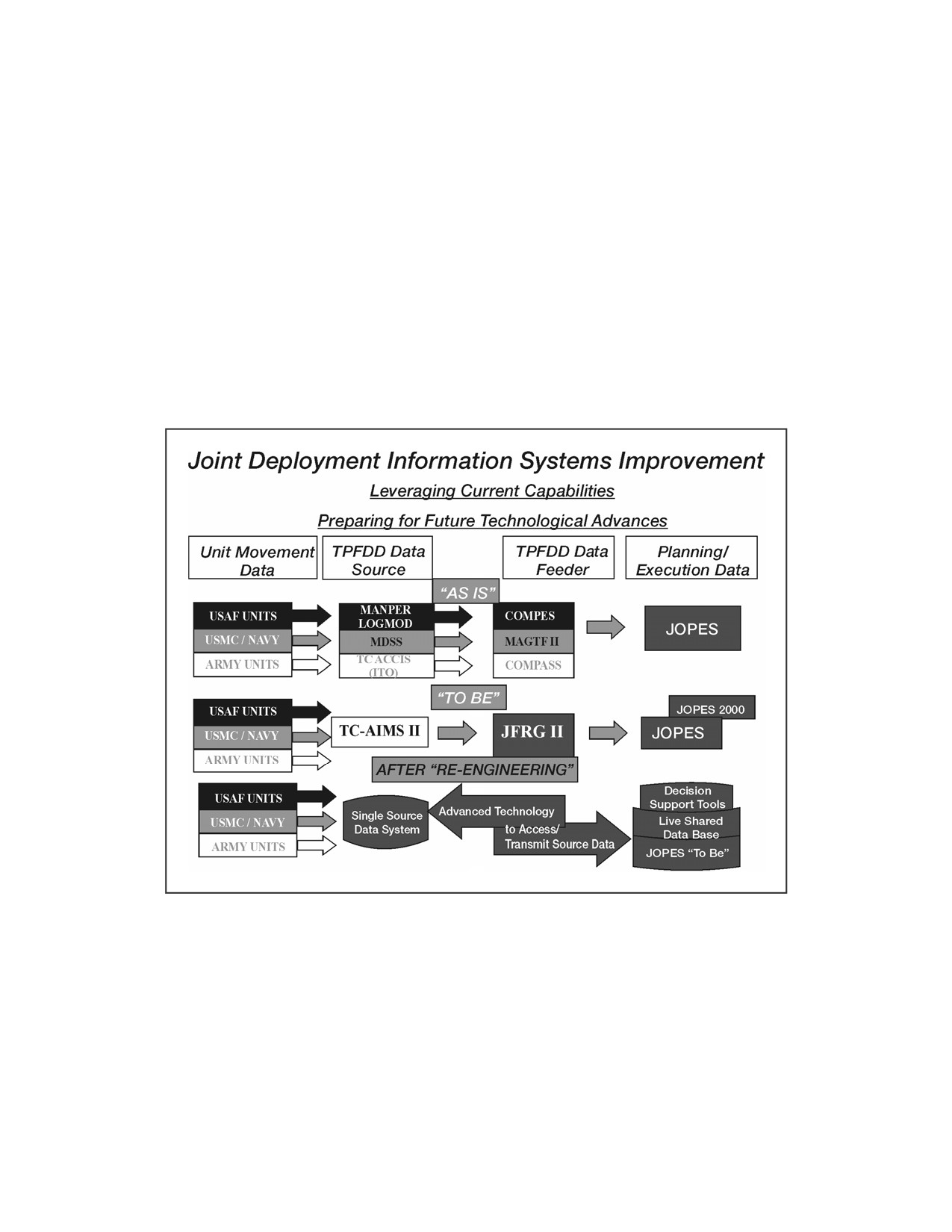
phased out and one single integrated system is employed. Figure 1-2 charts
the growth and phasing of the joint deployment information system im-
provement process. It defines very clearly the move from Service-specific de-
ployment systems, such as the Army’s Transportation Coordinator’s Auto-
mated Command and Control Information System (TC-ACCIS) to TC-AIMS,
which the CJCS designated as the single joint source data system for unit
move information and the Joint Operation Planning and Execution System
(JOPES). TC-AIMS II is the result of a joint effort of the U.S. Armed Forces
and the Joint Project Management Office (JPMO), headed by the U.S. Army
as the executive agent.
1-21. TC-AIMS II will exchange unclassified unit movement data files with
the Joint Force Requirements Generator II (JFRG II). JFRG II will be the
joint single source feeder system for unit move information from TC-AIMS II
to JOPES. JFRG II will import classified TPFDD force records from JOPES,
1-7
FM 3-35.4_________________________________________________________________________________
strip out classified data, export the unclassified data to TC-AIMS II, reinte-
grate it with the appropriate force records, then export it to JOPES in a clas-
sified form. (See CJCS, Instruction (CJCSI) 3020.01, 12 June 2000, (enclo-
sure E) for a detailed description of JFRG II). Since JFRG II does not perform
management command and control functions inherent in Service-unique sys-
tems, United States Army Forces Command (FORSCOM) will maintain and
utilize the Computerized Movement Planning and Status System
(COMPASS) to support data validation and management.
1-22. There are currently over 20 existing interface agreements (IAs) be-
tween TC-AIMS II and various joint and Service information technology sys-
tems. Others will be initiated, while some existing IAs may be eliminated,
merged, or replaced. (See CJCSI 3020.01 for a current list.)
Figure 1-2. Joint Deployment Information System Improvement Phases
1-23. The directive to use TC-AIMS II as the single joint source data sys-
tem for unit move information does not mean the transformation from Ser-
vice-specific systems to TC-AIMS will occur overnight. Initial fielding of TC-
AIMS II for the Army (beyond testing) is slated to begin in FY-02. Therefore,
the Army’s TC-ACCIS will be around in some capacity through FY-05. Resid-
ual Service requirements will be fielded in accordance with approved Service
program objective memorandums (POMs).
1-8
_________________________________________________________________________________
Chapter 1
1-24. As the force transitions from TC-ACCIS to TC-AIMS II, the terminol-
ogy for use with the system also evolves. The automated unit equipment list
(AUEL), a component of TC-ACCIS, becomes the organization equipment list
(OEL) in TC-AIMS II. The deployment equipment list (DEL), another TC-
ACCIS term, becomes the UDL in TC-AIMS II. For the sake of continuity, the
new terms defined and described below will be utilized throughout the FM.
• Organizational Equipment List (OEL): The OEL (formally AUEL) is a
computerized listing (in printed and data file formats) of on-hand equip-
ment in a unit. The OEL supports cargo manifests for movement and
provides input to transportation managers to identify movement re-
quirements.
• Unit Deployment List (UDL): The UDL (formally DEL) is an OEL tai-
lored for a specific or directed move. It lists the equipment that will actu-
ally deploy.
SECTION V - THE ARMY TRANSFORMATION AND DEPLOYMENT
1-25. As a result of lessons learned from Operation Desert Storm, in Octo-
ber 1999, the Chief of Staff Army (CSA) and the Secretary of the Army di-
rected that the Army transform into a strategically responsive force that is
dominant across the full spectrum of operations. Today, the Army is increas-
ingly involved in stability and support operations (SASO) and small-scale
contingency (SSC) situations in austere environments, while faced with the
ultimate requirement for winning two near-simultaneous major regional con-
flicts (MRC). To ensure the Army can respond to the situations above, the
Army’s transformation begins with an initial effort in the Interim Force and
moves to the Objective Force.
• The Initial Force is the first effort of the Interim Force and begins with
two brigades organizing at Fort Lewis, Washington as off-the-shelf
equipment is acquired. It evaluates and refines the operational and or-
ganizational (O&O) concept, thereby establishing the critical conditions
necessary to develop the Interim Force.
• The Interim Force is a transition force. It seeks the characteristics of the
Objective Force to the maximum extent feasible, but leverages today’s
state-of-the-art technology together with modernized legacy forces as a
bridge to the future. It consists of five to eight interim brigade combat
teams (IBCT).
• The Objective Force is the force that achieves the transformation objec-
tive. It is a future force with a common design applied to the entire Army
to achieve the force characteristics described in the Army Vision. (See the
1-26. This transformation directive, known as the Army Transformation
Campaign Plan states that the force must exhibit seven critical characteris-
tics or imperatives in order to be better prepared for the future. The Army
must be more—
• Responsive.
• Agile.
• Versatile.
1-9
FM 3-35.4_________________________________________________________________________________
• Lethal.
• Survivable.
• Sustainable.
• Deployable.
1-27. The force must confront an adversary before setting the conditions in
its favor to meet the deployable imperative. The Army’s objective is “to deploy
a combat brigade force anywhere in the world in 96 hours, a division in 120
hours, and 5 divisions in 30 days.” The IBCT’s design capitalizes on the
widespread use of common vehicular platforms, particularly a highly mobile,
medium-weight combat/combat support platform, coupled with a minimiza-
tion of personnel, a reduced logistics footprint, and state-of-the-art auto-
mated information systems.
1-28. The phases for the deployment of the IBCT remain the same as those
for other units, and the preparation processes discussed in subsequent chap-
ters, (such as soldier readiness processing, training), also remain constant.
However, for the IBCT to meet its mandated deployment timelines, prede-
ployment activities must remain at a minimum and equipment and person-
nel readiness rates should be maintained at 90 percent or greater. Efforts are
being made during the development of the Objective Force to eliminate re-
ception and staging in the theater. Extensive efforts at the HS and support
installations (SI) will be required to ensure strategic transportation assets
are loaded in such a way that deployed forces may begin operations immedi-
ately upon arrival in the AO. (See FM 4-93.7 (63-7) for further information on
deploying the IBCT).
1-10
Chapter 2
Predeployment Activities
The Army’s challenge to become more strategically responsive begins at HS
by increasing the efficiency and effectiveness of predeployment activities
and fort-to-port movement.
CONTENTS
Speed, as measured by force
closure, varies in almost all de-
Section I - Planning and Preparation
2-2
ployments. Factors influencing
Planning Process
2-2
JOPES
2-3
deployment speed include mis-
Deployment Plans and Procedures
2-7
sion, the combatant com-
Battle Books
2-8
mander’s priorities, theater lo-
Route and Location Reconnaissance
cations, port capabilities, and
and Rehearsal
2-8
other factors of mission, en-
Section II - Deployment Training
emy, terrain and weather,
Requirements
2-9
troops and support available,
Collective Training
2-9
time available, civil considera-
Installation Training
2-10
tions (METT-TC). It is advan-
Individual Soldier Training
2-10
tageous to look at the deploy-
Unit Movement Officer
2-11
ment segments and their influ-
Unit Loading Teams
2-11
ence on force closure when ex-
Air Load Planners
2-12
Hazardous Cargo Certifying Official
2-12
amining the reasons for the
Mission Specific Training
2-13
pace of a deployment.
Predeployment planning and the fort-to-port phase of deployment are
activities that have the least amount of variance. Units follow set proce-
dures to prepare and then move to the air or seaport of debarkation. The
other phases, the port-to-port movement and RSO&I, are the most vari-
able. Lift capabilities, port capabilities, and throughput factors all vary
with the availability, distance, locations, and theater. The Army’s use of
specified power projection platforms
(PPPs) and designated ports de-
creases the variables in fort-to-port operations, and increases the impact
of training and knowledge.
2-1
FM3-35.4 _________________________________________________________________________________
A power projection platform (PPP) is an Army installation that strategically deploys
one or more high priority Army active component brigades (or larger) and mobi-
lizes and deploys high priority USAR units. A PPP installation will be prioritized
and resourced, with designated sea and aerial ports, to perform power projection
functions supporting national strategy. A PPP may also serve as a mobilization lo-
cation for training base expansion units and individual replacement operations.
SECTION I - PLANNING AND PREPARATION
2-1.
Predeployment activities are actions taken to prepare forces for de-
ployment. They are essentially constant and ongoing activities performed at
HS before, and continuing after, warning or alert notification. Predeployment
activities are not limited to the deploying unit, but include supporting units
and the installation staff. Predeployment activities include planning, route
and location reconnaissance, unit and team deployment training and valida-
tion, deployment planning, and soldier readiness processing (SRP).
PLANNING PROCESS
2-2.
Force projection usually begins as a contingency operation requiring
a rapid response to a crisis, although it could involve a deliberate, slower
build-up and deployment in anticipation of a requirement. Units deploy un-
der the JOPES procedures. Units are identified in the TPFDD and move un-
der an assigned unit line number (ULN). Operational plans (OPLANs) in
JOPES contain deployment information such as strategic deployment modes
and POE/POD. This information is used in developing unit deployment plans.
2-3.
The JOPES process dictates specific procedures for both deliberate
and crisis action planning. Warning, alert, execute, and deployment orders
initiate specific deployment actions.
2-2
_________________________________________________________________________________
Chapter 2
Warning Order (WARNORD): A crisis-action planning directive issued by the CJCS
that initiates the development and evaluation of courses of action by a supported com-
mander and requests that a commander’s estimate be submitted.
Alert Order: A crisis-action planning directive from the Secretary of Defense (SECDEF),
issued by the CJCS, that provides essential guidance for planning and directs the initia-
tion of execution planning for the selected course of action (COA) authorized by the
SECDEF. It does not authorize execution of the approved course of action.
Execute Order: An order issued by the CJCS, by the authority and at the direction of
the SECDEF, to implement a National Command Authorities decision to initiate military
operations.
Deployment Order: A planning directive from the SECDEF, issued by the CJCS, that
authorizes and directs the transfer of forces between combatant commands by reas-
signment or attachment. It normally specifies the authority that the gaining commander
will exercise over the transferred forces.
Source: Joint Pub 3-35
JOPES
2-4.
The Joint Operation Planning and Execution System (JOPES) is the
integrated, joint command and control system used to support military op-
eration planning, execution, and monitoring (including theater-level nuclear
and chemical defense plans) activities. JOPES incorporates policies, proce-
dures, personnel and systems, and underlying Global Command and Control
System (GCCS) information technology support to provide senior-level deci-
sion-makers and their staffs with enhanced capability to plan and conduct
joint military operations. JOPES policies, procedures, and information tech-
nology systems provide the mechanisms to submit movement requirements
to lift providers for joint operations and exercises. Critical supporting inter-
faces with JOPES include the Computerized Movements Planning and
Status System (COMPASS) and the Joint Force Requirements Generator II
(JFRG II). For additional information on JOPES, COMPASS, and JFRG II,
see Appendix A.
2-5.
The joint planning and execution community (JPEC) uses JOPES to
conduct joint planning during peace and crisis. Joint operation planning is a
process coordinated through all levels of the national structure for joint plan-
ning and execution, including the National Command Authorities (NCAs)
and JPEC. The focus of the joint operation planning process is at the
discretion of the combatant commanders. Assisted by JOPES, they determine
the best method of accomplishing assigned tasks and direct the actions nec-
essary to accomplish the mission. In normal peacetime conditions, the proc-
ess—called deliberate planning—produces either OPLANs or concept of op-
eration plans (CONPLANs), as well as functional plans and TPFDDs. In cri-
ses, the process—called crisis action planning (CAP)—produces operational
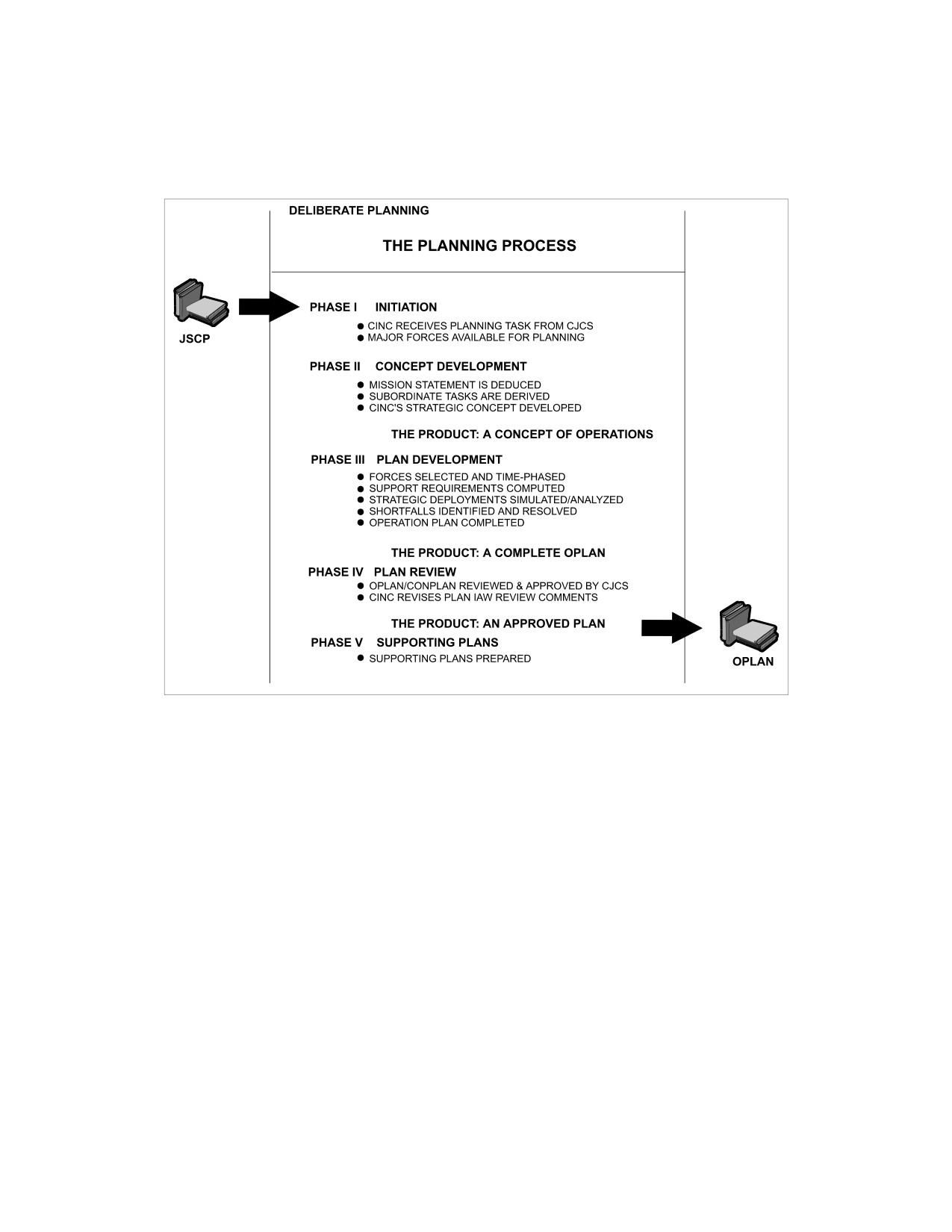
orders (OPORDs). Figure 2-1 depicts the deliberate planning process phases.
JOPES facilitates rapid building and timely maintenance of plans in deliber-
ate planning, rapid development of effective options and OPORDs through
2-3
FM3-35.4 _________________________________________________________________________________
adaptation of approved operation plans in no-plan situations in CAP, and ef-
fective management of operations in execution across the spectrum of mobili-
zation, deployment, employment, sustainment, and redeployment when op-
erations are conducted. See Chairman, Joint Chiefs of Staff, Manuals,
(CJCSMs) 3122.01 and 3122.03, CJCSI 3020.01, and JP 3-35 for a detailed
description and instructions for use of JOPES.
2-6.
The Commander, Army service component command (COMASCC)
participates closely in the combatant commander’s deliberate planning proc-
ess. The COMASCC must provide the ARFOR unit data, ARFOR support re-
quirements, and the support capabilities required to meet the ARFOR’s
Army-specific support requirements as well as the combatant commander’s
designated lead Service common user logistics (CUL) requirements. As part
of the process, the ASCC and subordinate commands help the deploying unit,
installation, and supported geographical commander meet their individual
responsibilities:
• Monitor out-load and deployment preparations.
• Coordinate with the installation for convoy requirements.
• Ensure the unit deployment sequence is in accordance with the sup-
ported geographical commanders validated TPFDD requirements.
• Advise the JPEC on progress.
• Begin the force tracking process by transmitting data, such as departure
and arrival report and UDL updates, as required.
2-7.
More information on ASCC planning requirements may be found in
FM 3-93 (100-7).
2-8.
USTRANSCOM analyzes transportation feasibility in conjunction
with the supported combatant commander during the deliberate planning
process. USTRANSOM conducts analysis using models, simulations, and
transportation expertise. Dependable transportation feasibility analysis de-
pends on accurate combatant command analysis of theater transportability.
2-4
_________________________________________________________________________________
Chapter 2
Figure 2-1. The Deliberate Planning Process
2-9.
Deployments supporting a major theater war (MTW) and some SSCs
are planned using the deliberate planning process, a planning cycle that can
take as long as 18 to 24 months to accomplish. Many operations, however,
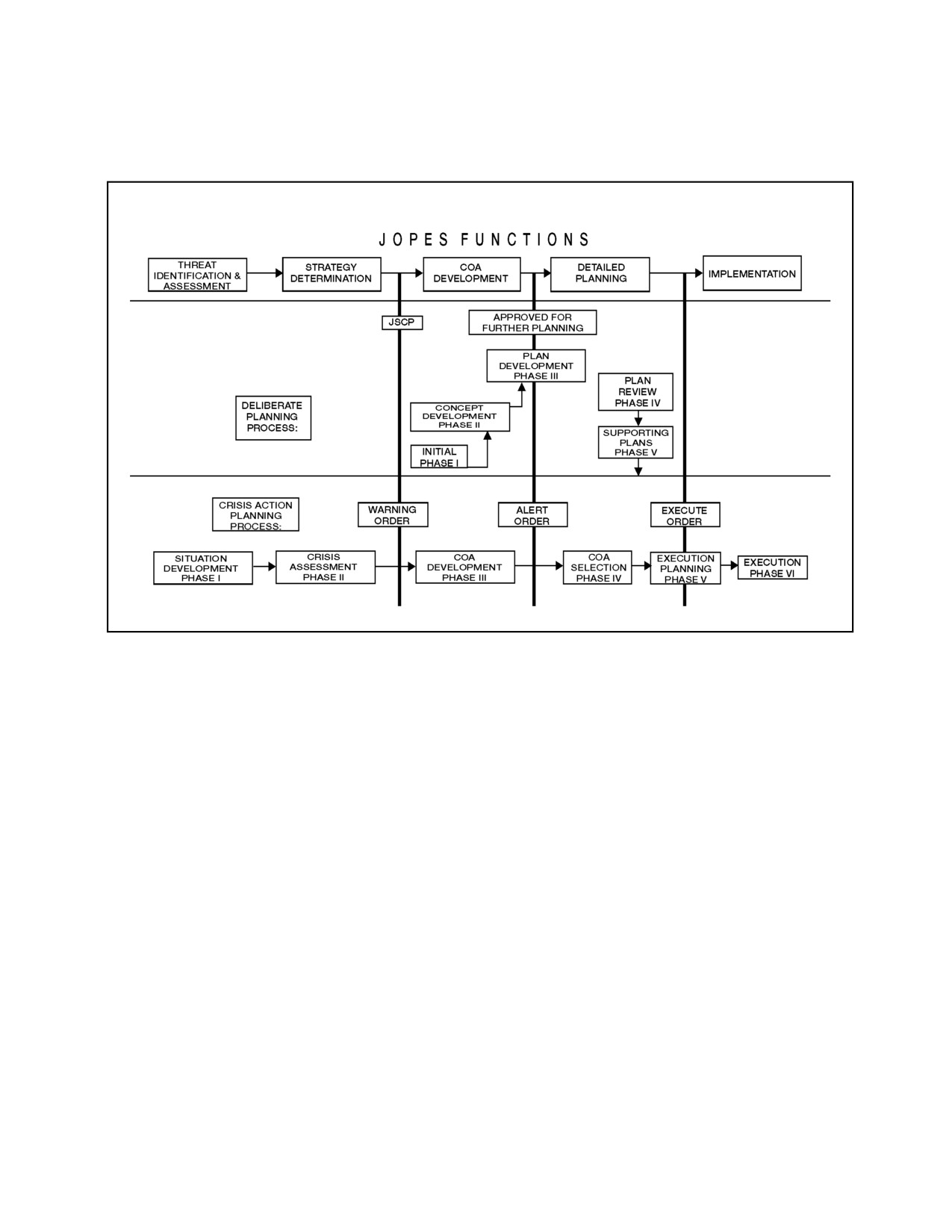
will involve unplanned contingencies. CAP is a flexible adaptation of the ba-
sic planning process under JOPES.
(See Figure 2-2.) CAP emphasizes the
time available, rapid and effective communications, and maximum use of
previously accomplished contingency planning.
2-5
FM3-35.4 _________________________________________________________________________________
Figure 2-2. JOPES Deliberate Planning Process and
Crisis Action Planning Process Functional Alignment
2-10. The TPFDD is the JOPES portion of an OPLAN that contains time-
phased force data for the OPLAN. During execution planning, the supported
combatant commander normally publishes a TPFDD Letter of Instruction
(LOI) with planning guidance, procedures, and coordinating instructions. The
intent of the supported combatant commander’s TPFDD LOI is to eliminate
confusion, facilitate parallel planning, and expedite TPFDD refinement by
providing commands, supporting commands, and agencies with a single set of
instructions for input and management.
2-11. TPFDD development is based on the three main processes: force
planning, support planning, and transportation planning. The resulting
TPFDD is both a force requirement document and a prioritized transporta-
tion movement document defining the supported combatant commander’s
time-phased lift requirements for personnel, supplies, and equipment. The
objective of TPFDD maintenance is to systematically and effectively incorpo-
rate required changes to the TPFDD in a standardized manner at defined in-
tervals after the TPFDD becomes effective for execution. To help with this
maintenance, it is essential that units maintain up-to-date data so the
COMPASS database has the most current data available.
2-12. During the deployment, supporting commands and agencies provide
accurate (unit verified) movement data to the supported combatant com-
mander. The subordinate JFC commander validates the TPFDD require-
2-6
_________________________________________________________________________________
Chapter 2
ments of the supported combatant commander. The combatant commander
then incorporates the JFC validation requirements with other theater valida-
tion requirements already forwarded to USTRANSCOM and other lift pro-
viders tasked with the mission to deploy forces and agencies that support the
JFC. (As part of the TPFDD validation process, modeling and simulation of
the flow of cargo, forces, and sustainment may be performed to identify pos-
sible transportation/distribution shortfalls.)
USTRANSCOM planners
schedule movement consistent with the concept of operations.
2-13. TPFDD and movement schedule changes during deployment execu-
tion are inevitable. Changes during deployment execution are often the re-
sult of a change to the supported combatant commander’s priorities, deploy-
ing unit missions, METT-TC, or incomplete or erroneous movement data in
the TPFDD. Changes may also occur because of deployment planning deci-
sions. Avoid TPFDD changes inside the validated window as they may affect
the transportation flow. Management of changes is possible if changes are
held to a minimum. They require supported combatant commander’s ap-
proval.
2-14. Successful implementation of planning is critical for effective and
timely deployment. The TPFDD is one of the most vital tools supporting this
purpose. It sequences the activities of the deploying forces according to the
supported subordinate JFC's concept of operations. It is common to all de-
ployments. For more detailed information, see Appendix B.
2-15. The objective of deployment is the arrival of the force at the right
place, at the right time, and in the right order. The TPFDD is, therefore, both
a force requirements and a transportation requirements document, and it
must be considered from both of these aspects. The supported subordinate
JFC must approve any change to this statement of force requirements and
priorities.
DEPLOYMENT PLANS AND PROCEDURES
2-16. To meet contingency support requirements, units develop deployment
plans and standing operating procedures (SOPs). An effective deployment
plan contains sufficient detail to prepare units to execute strategic deploy-
ments. The unit deployment SOP is a generic document outlining functions
that should occur automatically upon notification of a deployment. In addi-
tion to deployment plans and SOPs, units often maintain deployment binders
(see Appendix C) and battle books that contain deployment information and
instructions.
"Commanders training together and knowing each other, rehearsing and practicing op-
erations, holding AARs immediately after an exercise, refining and enforcing SOPs, and
ensuring there is good understanding two levels up and down are a few of the things we
need to emphasize."
Commander, 2ACR, Operation DESERT STORM
2-17. Deployment plans define responsibilities, functions, and details for
each part of a unit deployment, from installation to reception in theater.
There may be more than one deployment plan required depending on the
2-7
FM3-35.4 _________________________________________________________________________________
number of contingencies/OPLANs the unit must prepare to support. Deploy-
ment plans are written in a five-paragraph OPORD format. They may con-
tain SOPs, OELs, and other annexes as needed. The plans must be flexible
enough to incorporate mission requirements and changes resulting from con-
tingencies that have not been anticipated. (See Appendix D for a recom-
mended process for developing deployment plans.)
2-18. The unit deployment SOP outlines functions that should occur auto-
matically upon notification of a unit deployment. It should be generic to fit
any given deployment situation. Day-to-day and alert functions should be in-
cluded in the document. The SOP defines the duties of subordinate
units/sections that will bring the unit to a higher state of readiness. These
duties can be written in separate annexes, which can be easily separated and
issued to leaders for execution. Functions addressed in the SOP may include
unit property disposition, supply draw, equipment maintenance, vehicle and
container loading, security, marshaling procedures, purchasing authorities,
unit briefings, and other applicable deployment activities. FM to 55-15 Ap-
pendix B provides a sample transportation SOP format. (FM 55-15 will be in-
corporated into FM 4-01.011.)
2-19. For deployment preparation and execution, units may use a readiness
standard of operation procedure (RSOP) or supplement their higher head-
quarters RSOP/deployment SOP. The RSOP normally addresses the overall
deployment concept, the notification hour (N-hour) sequence, force package
training requirements, the alert notification system, logistics support, per-
sonnel and equipment readiness, outload support (including SRP), and com-
mand and control at critical points. This document is essential for the orderly
execution of rapid force deployments in response to crisis situations.
2-20. Appendix D contains a deployment checklist for commanders to use
to evaluate deployment readiness.
BATTLE BOOKS
2-21. The battle book has many names—deployment binder, smart book—
but no matter what it is called, it documents how the commander accom-
plishes his mission in the specified area of operations. It should include the
organization and responsibilities for the unit’s RSO&I within the theater.
The following specific deployment items should be included in the battle
book, if applicable:
• Pertinent information from the OPLAN and the TPFDD.
• Information and photographs/schematics concerning the layout and fa-
cilities/capabilities of the ports of debarkation.
• Maps of convoy routes within the AO, to include critical areas that the
unit will pass through en route to its employment location.
ROUTE AND LOCATION RECONNAISSANCE AND REHEARSAL
2-22. Reconnaissance of the route to pre-designated POEs and of the POEs
themselves should be an ongoing activity. It may be accomplished through
passive means such as map surveillance or, optimally, through site visits.
Walking the terrain at the power projection platform and designated port fa-
2-8
_________________________________________________________________________________
Chapter 2
cilities allows commanders to understand space limitation, see choke points,
survey facilities, understand the simultaneous nature of the operation, and
visualize the deployment operation. Terrain walks can be useful as a unit
level activity, but are more beneficial when they involve all participating and
supporting units.
2-23. Fort-to-port rehearsals are key to reducing deployment times. Units
can use rehearsals as validation of their deployment plans. They permit
commanders and unit movement officers to see possibilities and limitations.
The physics of the operation can become plainly evident. A map reconnais-
sance would not reveal that the staging area (SA) used in past operations is
now is a shopping center, or that road construction that slowed traffic is now
complete.
Conducting Rehearsals
9
Orient participants.
9
Define the standard.
9
Visualize and synchronize the concept of the operation. Verbally walk through
the concept of the operation. Subordinate commanders should interactively
verbalize their units actions, entering or leaving the discussion at the time they
would expect to begin or end their task or activities. This will help the com-
mander to assess the adequacy of synchronization.
9
Address any point of the operation where the execution of branches or se-
quels is likely to occur.
9
If the standard is not met and time permits, rehearse again.
9
Make changes.
SECTION II - DEPLOYMENT TRAINING REQUIREMENTS
2-24. Training is the underpinning mechanism to drive the Army’s effort
intellectually to become strategically responsive. Unit deployment training is
an essential element in developing the mental agility and knowledge re-
quired for strategic responsiveness. Moreover, it is a proven way for units to
increase the speed of projecting combat power.
2-25. Units train in peacetime to meet unit and individual training re-
quirements for deployment operations. Force projection missions occur rap-
idly, leaving the deploying unit with little or no time to correct training defi-
ciencies or to meet mission specific training requirements.
COLLECTIVE TRAINING
2-26. Collective deployment training incorporates the knowledge, skills,
attitudes, abilities, and the command emphasis so that deployment is a reflex
activity executed with precision. Units must identify deployment as a mission
essential task, annotate it on their mission essential task list (METL), and
gain proficiency. Many Army training programs offer the opportunity to em-
bed force projection training in a major training event program.
2-9
FM3-35.4 _________________________________________________________________________________
INSTALLATION TRAINING
2-27. Installation fort-to-port deployment activities are labor intensive and
demanding in that they occur simultaneously. Effective fort-to-port deploy-
ment activities rely on centralized planning and a decentralized execution
base, according to the installation RSOP. Repetitive training is essential for
success. Simultaneous actions include—
• Establishing an emergency operation center (EOC).
• Establishing rail and commercial truck operations.
• Initiating a port support activity (PSA).
• Initiating arrival/departure airfield control group (A/DACG) operations.
• Establishing a convoy support center, if required.
• Establishing port liaison teams.
• Initiating automatic identification technology (AIT) plans.
INDIVIDUAL SOLDIER TRAINING
2-28. Units with deployment missions are required to have an appropriate
number of personnel trained to perform special deployment duties. These du-
ties include unit loading teams, hazardous cargo certifying officials, and air
load planners. Each major command has specific requirements and policies
for appointing and training personnel in these positions. In addition, many
CONUS and OCONUS commands and installations maintain a capability lo-
cally to provide deployment training. All deployable units, however, require
personnel trained to perform the following deployment functions: UMO, unit
loading team members, hazardous cargo certifying official and air load plan-
ners.
2-29. Individual soldiers must accomplish, at a minimum, the following
standardized Army training requirements before deployment:
• An Army Physical Fitness Test (APFT) within the last 6 months. (A sol-
dier who has not successfully completed the APFT may still be deploy-
able, subject to command review.)
• Code of conduct training within the last 12 months.
• Survival, escape, resistance, and evasion (SERE) training peculiar to the
deployment destination.
• Weapons qualification per AR 350-6 and DA Pam 350-38 within the last
12 months.
• Subversion and espionage directed against the U.S. Army and deliberate
security violations (SAEDA) training within the past 12 months.
• Law of War (Law of Armed Conflict) training within the past 12 months.
• Driver's training for destination country.
• Mobilization briefing.
• Intelligence briefing.
• Legal briefing.
• Theater or mission specific training as defined by the supported combat-
ant commander.
2-10
_________________________________________________________________________________
Chapter 2
UNIT MOVEMENT OFFICER
2-30. Preparing the unit for movement is the commander’s responsibility
and the unit movement officer (UMO) is the commander’s appointed repre-
sentative to assist in the accomplishment of this task. The UMO must know
the unit’s mission and the commander’s intent when preparing the unit for
deployment, so he can coordinate, plan, and execute appropriately. The UMO
assembles and maintains unit movement plans and documentation, prepares
the unit for movement, creates the unit’s equipment list, and supervises the
outload of the unit.
2-31. The UMO must be familiar with Air Force and Army airlift opera-
tions; the transportability of organic unit equipment; the characteristics and
capabilities for the types of vessels, aircraft, or railcars the unit may use to
deploy; and highway, rail, and port operations. FM 55-15, (to be incorporated
into 4-01.011) is an excellent source for characteristics and capabilities of the
various transportation assets (aircraft, railcars, and ships) and contains in-
formation for planning mode operations. The UMO reference material for
transportability of organic unit equipment can be found in Military Traffic
Management Command Transportation Engineering Agency (MTMCTEA)
Reference 700-5, and at the following website:
www.tea.army.mil/dpe/FIELD.HTM. The UMO—
• Prepares and maintains unit movement plans. (See Appendix E.)
• Prepares and maintains the OEL and other documentation needed for
unit movements.
• Prepares the UDL.
• Changes and submits unit movement data (UMD) as required by the ma-
jor command (MACOM) and/or ASCC.
• Supervises the preparation and execution of unit load plans.
• Coordinates with higher headquarters and support activities on unit
movements.
• Coordinates logistics support for the move.
• Maintains approved copies of all unit load plans.
• Establishes and trains unit loading teams.
• Ensures the unit has access to personnel who are authorized to certify
hazardous material (HAZMAT) cargo.
UNIT LOADING TEAMS
2-32. Each unit is required to have an appropriate number of personnel
trained in vehicle preparation and aircraft and rail loading/unloading tech-
niques. Specific skills required include—
• Preparing and activating vehicle load plans.
• Preparing vehicles for shipment (purging, protecting fragile components,
weighing and marking for air and rail movement).
• Executing aircraft and railcar tiedown procedures.
• Loading and unloading unit vehicles on aircraft and railcars.
• Palletizing cargo on 463L pallets.
2-11
FM3-35.4 _________________________________________________________________________________
2-33. Load team composition is tailored to the type and quantity of equip-
ment to be loaded and the time available for loading. In general—
• For rail movements, a well-trained team of five operators, using prefabri-
cated tiedown devices, can complete loading/lashing of equipment on a
flatcar in approximately 15 minutes.
• For air movement, a six-person team can provide efficient loading and
tiedown of equipment.
2-34. There are many references available for help and direction on the
loading of equipment. Some of these include Department of Defense (DoD)
Military Standards (MIL STDs) 209, 669, 810, 814, 910, 913, and 1791.
AIR LOAD PLANNERS
2-35. Air load planners are appointed and trained to prepare, check, and
sign unit aircraft load plans. The Air Mobility Command (AMC) offers an Air-
lift Planners Course to those units aligned under the AMC Affiliation Pro-
gram. The course is designed to train personnel in the planning and execu-
tion of airlift operations. (See Appendix F for information on the unit airlift
affiliation program.) Upon course completion, the trained individual is au-
thorized to sign load plans. Other schools within CONUS authorized to teach
air load planning include—
• U.S. Army Transportation School, Air Deployment Planning Course, Fort
Eustis, Virginia.
•
82nd Airborne Division, Advanced Airborne School, Fort Bragg, North
Carolina.
•
101st Airborne Division (Air Assault) Strategic Deployability School, Fort
Campbell, Kentucky.
HAZARDOUS CARGO CERTIFYING OFFICIAL
2-36. Each unit (company/detachment level) requires at least one individ-
ual to certify hazardous cargo. The hazardous cargo certifying official is re-
sponsible for ensuring the shipment is properly prepared, packaged, and
marked. The certifying official is also responsible for personally inspecting
the item and signing the HAZMAT documentation. Hazardous cargo certifi-
ers must be trained (within the previous 24 months) at a DoD-approved
school on applicable regulations for all modes. Upon training completion,
they are authorized to certify documentation for commercial and military
truck, rail, sea and air. Certified personnel also require refresher training
every two years to continue certification of hazardous cargo for movement.
2-37. Technical specialists for HAZMAT are trained by HAZMAT certifiers
and are authorized to certify limited types of HAZMAT and selected trans-
portation modes as described by each Service. (See Technical Manual (TM)
38-250, Attachment 25 and DoD Regulation 4500.9R, Part II, for further de-
tails.) These individuals must be designated in writing by the commander
and have received their training within the previous 24 months. Technical
specialist are also responsible for ensuring the shipment is properly pre-
pared, packaged, and marked; they must inspect the item being certified and
2-12
_________________________________________________________________________________
Chapter 2
sign the HAZMAT documentation. (See Appendix G for surface shipments of
hazardous cargo.)
MISSION SPECIFIC TRAINING
2-38. The COMASCC of the supported geographical combatant commander
is responsible for determining what, if any, mission specific training re-
quirements are necessary for deploying ARFOR individual soldiers and units.
Many factors, such as the combatant commander’s guidance, deployment
timelines, and the nature of the threat, determine mission specific training
requirements. Mission specific training may include, but is not limited to, the
following:
• Mission rehearsal. Conduct formal mission rehearsal exercises (MRXs) if
required.
• Rules of engagement (ROE) training.
• Special force protection training.
• Country familiarization training, including history, geography, religion,
environment, local laws/political situation, and status of forces agree-
ment (SOFA).
• Friendly force briefing.
2-39. The COMASCC must weigh the potential effect of mission specific
training on both deployment and employment of ARFOR units and individu-
als. Significant mission specific training efforts, especially if conducted at a
training site separate from the mobilization site or CONUS replacement cen-
ter (CRC), may have a negative effect on the ARFOR’s strategic responsive-
ness. However, the lack of mission specific training may cause unacceptable
force protection risk. Therefore, the COMASCC must consider what mission
specific training is required and coordinate where and when the training will
take place and who will conduct the training. Resource issues must also be
identified and resolved, especially between the supporting and supported
ASCCs.
2-40. When feasible, the COMASCC should allow the individual ARFOR
units to conduct their own unit training at the mobilization sites. Individual
training is best conducted at CRCs. The supported ASCC must ensure that
duplication of both mission specific and standard Army training is avoided.
Additionally, the advantages and disadvantages of conducting mission spe-
cific training at a separate, in theater or intermediate staging base (ISB)
training site must be considered. While this methodology gives the supported
COMASCC firm control over training validation of deploying ARFOR units
and individuals, it also may cause a significant delay in the deployment
process.
2-13
Chapter 3
Installation Activities
Although the MACOM METL includes “Trained and Ready Force With Capability to De-
ploy” Using “Multiple transportation modes to meet timelines,” units were inexperienced
and needed practice in air deployment operations.
TF Hawk - CALL Report
Deployment is a complex operation with many simultaneous activities.
The installation staff’s orches-
CONTENTS
tration of the fort-to-port phase
is essential to efficient and ef-
Section I - Installation Predeployment Activities
3-2
fective operations. The de-
Installation Staging Area (ISA)
3-2
Rail Preparation/Operations
3-3
ploying unit commanders and
Soldier Readiness Processing (SRP)
3-4
staffs working with the instal-
Personal Property
3-4
lation staff have numerous and
Family Members
3-5
disparate responsibilities dur-
Individual Clothing and Equipment Inspection
3-5
ing deployment training and ac-
Overseas Orientation
3-5
tual deployments. The deploy-
Clearance from the Installation
3-6
ing unit commanders and staffs
Maintenance
3-6
develop and maintain accurate
Deploying DA Civilians and Contractors
3-6
unit movement data and de-
Rear Detachment
3-7
ployment plans. They must
Security
3-7
identify
transportation
re-
Section II - Organization Responsibilities
3-8
quirements for movement to
Emergency Operations Center (EOC)
3-8
Installation Transportation Officer (ITO)
3-9
POE and estimated strategic lift
Deployment Support Brigades (DSB)
3-9
requirements. The installation
CONUS Replacement Center (CRC)
3-10
staff mans the emergency
Deployment Processing Center (DPC)
3-10
operations center; initiates in-
Section III - Force
stallation support agreements;
Protection/Antiterrorism
3-11
conducts rail, commercial truck,
A/DACG, and convoy support
operations; obtains highway and convoy clearances; maintains basic load
and deployment supplies; and possibly operates a CRC. These activities
can be initiated with limited or no warning and may be required through-
out the mobilization and deployment periods.
3-1
________________________________________________________________________________
FM 3-35.4
Most units were participating in training exercises or preparing for another contin-
gency mission when the warning order for TF Hawk was issued. The warning or-
der alerted some units to be prepared to move within 72 hours. During this plan-
ning and preparation period, the task force organization and deployment packages
changed frequently due to rapidly changing mission requirements, which chal-
lenged the unit movement officers (UMOs). These changes usually resulted in
equipment and personnel density changes, which had transportation ramifications.
Each time the equipment density changed, the UMO was required to update his
unit deployment list (UDL). Frequent UDL changes may hinder deployment opera-
tions by underestimating the actual movement requirements, which increases pro-
curement lead time.
TF HAWK
CALL Report
Force projection demands on the installation will increase dramatically in
the future. The Army’s mandate to decrease deployment time will perme-
ate all phases of deployment. Probably one of the most challenging as-
pects of deployment an installation may face is the management of
change. Change is inevitable. Techniques to manage change are grounded
in automated and communication alternatives. Techniques can include
collaborative systems
(for example, Collaborative Virtual Workspace
(CVW), Odyssey, Information Workspace
(IWS), NetMeeting, Same-
time/Real-time), video teleconferencing, in-progress reviews (IPRs), and
fragmentary orders (FRAGOs).
SECTION I - INSTALLATION PREDEPLOYMENT ACTIVITIES
INSTALLATION STAGING AREA
3-1.
The installation staging area (ISA) (Figure 3-1) is a centralized loca-
tion where deploying units assemble their equipment for continued move-
ment to the POE. The installation is normally responsible for the operation
and organization of the ISA, but may be augmented by unit teams from de-
ployment support brigades (DSBs) or by non-deploying units. The installa-
tion normally provides command and control of the ISA by establishing a
control center, monitoring unit movements, and validating unit equipment
preparation. This chapter discusses DSBs in more depth later.
3-2.
The DSBs are United States Army Reserve (USAR) units that pro-
vide direct support to installations for unit deployments. Their primary mis-
sion is to assist the installation UMO to ensure unit equipment is properly
prepared and correctly documented prior to departing the installation, and
that the equipment arrives at the port in accordance with call forward move-
ment schedules. They also provide hands-on training and guidance to units
in equipment preparation and tie-down procedures. DSBs may provide assis-
tance in the unit marshaling area (MA) and the installation staging area.
3-2
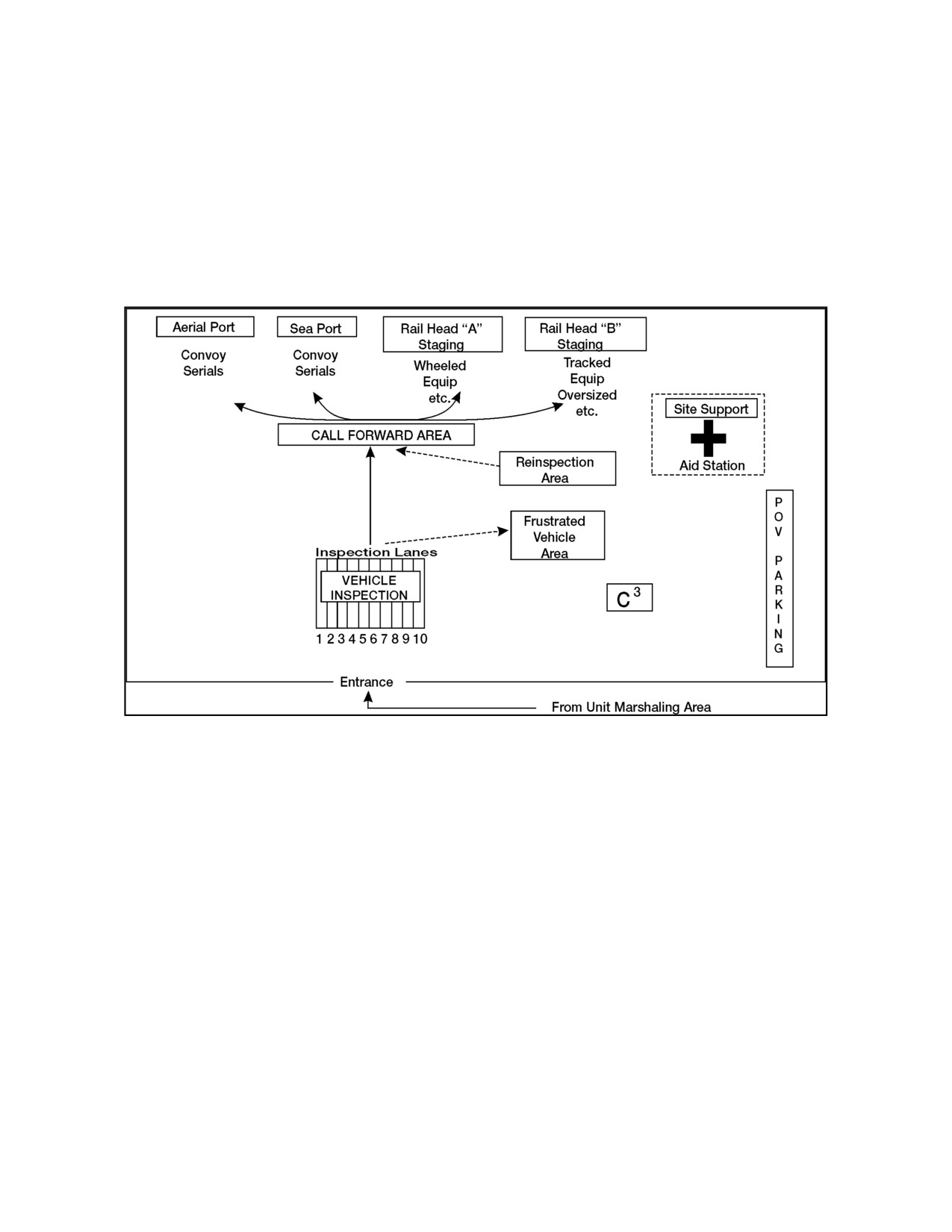
_________________________________________________________________________________
Chapter 3
3-3.
Upon arrival at the ISA, equipment is inspected for cleanliness, ser-
viceability, proper shipping configuration, documentation, fuel levels, and
any other criteria required to meet deployment standards. Equipment failing
to meet standards is placed in holding areas until deficiencies are corrected.
When established standards are met, the equipment is sequenced for loading
according to mode of transport.
Figure 3-1. Installation Staging Area
RAIL PREPARATION/OPERATIONS
3-4.
Not all units or power projection platforms are located within driving
distance to seaports, and not all cargo, particularly for heavy forces, is trans-
portable by military or commercial truck. However, the use of rail may not be
the fastest mode of transport and could cost installations significantly more
in money and space to operate. This fact must be considered when deciding to
use rail for transportation. (See Appendix H for more on rail operations).
3-5.
The installation transportation officer (ITO) orders railcars in the
types and quantities required based on the deploying unit's UDL. The ITO is
the official liaison with the Military Traffic Management Command (MTMC)
and the railway agent and inspects all railcars for serviceability before units
begin loading. The ITO provides technical advice, publishes rail-loading
schedules, and provides HAZMAT documentation as required. The ITO pre-
pares the Government Bill of Lading (GBL) based on equipment data from
the UDL and provides a DD Form 836 (Dangerous Goods Shipping Pa-
per/Declaration and Emergency Response Information of Hazardous Materi-
3-3
________________________________________________________________________________
FM 3-35.4
als Transported by Government Vehicles/Containers/Vessels), if necessary,
for HAZMAT.
3-6.
The unit loads the railcars. The following are principles of loading,
blocking, and bracing vehicles on flat cars or in boxcars:
• Cars must be suitable for safe transportation of the load.
• Load and weight limits must not be exceeded.
• Loads must not exceed the width and height restrictions over the pro-
posed route.
• Loads must be adequately secured on cars.
3-7.
The most common and expeditious method of loading vehicles is the
circus method. This method uses flatcars as a roadbed with spanners placed
between cars. After the loading sequence for the train has been determined,
the vehicles are staged in that sequence, called forward to the ramp, and
driven onto the flatcars.
SOLDIER READINESS PROCESSING
3-8.
Commanders of deploying units must have a formal review process in
place to ensure soldiers meet readiness requirements. (TC-AIMS II, when
fielded, will have the capability to track some of this information for the
commander.) Army regulation (AR) 600-8-101 provides specific readiness pro-
cedures and requirements. Unit responsibilities include—
• Maintaining and updating personnel rosters. The roster shows shortages
and non-deployable personnel, and is used for readiness reporting and
strategic deployment manifesting. Before embarkation at the POE, the
roster is updated to identify each element of the unit being moved.
• Identifying and outprocessing non-deployable personnel or those person-
nel not military occupational specialty (MOS) qualified. Non-deployable
screening is performed in accordance with applicable personnel regula-
tions and command directives. ARs 614-30 and 220-1 outline personnel
availability criteria.
• Resolving soldier financial problems with the supporting financial insti-
tution.
• Resolving soldier legal issues through supporting Office of the Staff
Judge Advocate (for example, wills, powers of attorney, insurance, family
support and custody issues).
• Ensuring soldier has accurate and current common access card (CAC).
• Ensuring deploying personnel prepare a DA Form 3955 (Change of Ad-
dress and Directory Card) for mail forwarding.
3-9.
In addition to unit responsibilities, the supporting installation or
area command normally establishes SRP checks before and as a part of the
deployment process. (See Appendix D, figure D-1, Readiness and Deployment
Checklist and figure D-2, instructions for completing the Readiness and De-
ployment Checklist.) These checks include personnel records, finance, legal,
medical, dental, security, and unit ministry support.
3-4
_________________________________________________________________________________
Chapter 3
PERSONAL PROPERTY
3-10. Before deployments, unit procedures must be in place to ensure the
security of soldiers’ personal property. This could include the use of a power
of attorney by unit personnel to ship and store their property. Soldiers living
in barracks should properly pack, label, inventory, and turn in personal
property not required or authorized in the overseas area. The unit’s rear de-
tachment is responsible for disposition of this property in coordination with
the supporting transportation office. Privately owned vehicles (POVs) can be
stored in an area designated by the installation or area commander, or left
in the custody of a family member or other responsible individual. When time
does not permit these POV procedures, the keys of the vehicle and the power
of attorney are left with the rear detachment commander or custodian, or a
family member.
FAMILY MEMBERS
3-11. Documented procedures for family support while soldiers are gone
are essential in deployment planning. Procedures may include forming fam-
ily support groups that assist in resolving problems, and formally interacting
with Army Community Services, the installation ministry team, the installa-
tion Office of the Staff Judge Advocate, and family life center to meet family
needs. Single soldiers should be assured that their families will be kept in-
formed of their situation. Family support is the responsibility of both the de-
ploying commander and the garrison or installation commander. A family as-
sistance officer is usually appointed from the staff of the command having
control over the moving unit. Responsibilities of this officer may include—
• Advising family members of their entitlements for travel and shipment or
storage of household goods.
• Advising family members of the need for their sponsors to leave a power
of attorney or letter of authorization, if family members are to arrange
for shipment or storage of household goods and POVs.
• Advising family members of the services available through the Red
Cross, Army Emergency Relief, and Army Community Services.
• Moving family members if required.
• Clearing quarters belonging to family members.
• Emphasizing the need for a will.
• Establishing a chain of concern for family support group members to ob-
tain support and information.
INDIVIDUAL CLOTHING AND EQUIPMENT INSPECTION
3-12. This inspection is coordinated with the issuance of any equipment pe-
culiar to the deployment. All individual equipment, clothing, and unit equip-
ment is accounted for according to the unit supply update and through use of
DA Form
3645
(Organizational Clothing and Individual Equipment
Record)/DA Form 4886 (Issue-in-Kind Personal Clothing Record).
3-13. Unit movement plans include arrangements for transporting troops
to an issue facility to fill shortfalls. The soldier's rucksack contains clothing
items that are required en route and upon arrival at the unit's destination.
3-5
________________________________________________________________________________
FM 3-35.4
OVERSEAS ORIENTATION
3-14. Before deployment, unit commanders brief their units on the pro-
jected AO. The briefing should include mission and threat; geography (loca-
tion, topography, and climate); people (population, race, religion, customs,
values, and language); history; economy; infrastructure; natural resources
and special environmental considerations; defense forces; political systems;
local laws; SOFA; force protection; and hazards of the area.
CLEARANCE FROM THE INSTALLATION
3-15. The unit commander must clear from the installation/home station
before deployment. During rapid deployment, the commander may appoint
the rear detachment commander to perform administrative and supply func-
tions, such as accounting for materiel not accompanying the unit.
3-16. Not all of a unit's table of equipment (TOE) equipment may accom-
pany the unit. For example, the unit could be drawing pre-positioned stocks
in the AO. The equipment remaining at HS may be turned over to the rear
detachment commander or to the installation. Additionally, hand receipts or
annexes should be prepared for turn-over of all nonmission essential equip-
ment, station property, and installation property authorized by table of dis-
tribution and allowances (TDA) or common tables of allowances (CTAs).
Units should also—
• Turn in excess petroleum, oils and lubricants (POL) and prescribed load
list (PLL) items.
• List fixed facilities (motor pools, troop billets, and administration build-
ings, as well as accompanying materiel) to be transferred to a non-
deploying unit or turned in to the installation.
• Cancel outstanding requisitions and/or provide a ship-to address to the
servicing supply support activity (SSA) in accordance with AR 710-2.
MAINTENANCE
3-17. Maintenance is an essential facet of vehicle preparation for deploy-
ment. Consideration must be given to the special requirements associated
with hot and cold weather environments.
3-18. For hot climates or deserts, units must have special parts, oils and
lubricants. Rust forms faster in high temperatures and tire life is shortened.
Oil is consumed more quickly in diesel powered engines. Before deploying to
this environment units should consult technical bulletin (TB) 43-0239 and
FM 3-97.3 (90-3). For deployments to cold weather climates, unit personnel
should consult the appropriate TMs and FM 4-30.32 (9-207).
3-19. The Army Materiel Command will assist units with deployment. As-
sistance may be requested through the Logistics Assistance Representatives
and the installation Logistics Assistance Office. Types of assistance include
application of immediate and urgent modification work orders, packaging,
and calibration.
3-6
_________________________________________________________________________________
Chapter 3
DEPLOYING DA CIVILIANS AND CONTRACTORS
3-20. The civilian personnel management system ensures that deployed ci-
vilians are accounted for and that they receive personnel services. The war-
time dimension of civilian personnel management is a subset of the base op-
erations support
(BASOPS) civilian personnel management function. As
such, it is manned entirely in the table of distribution and allowance (TDA)
structure. The civilian TDA structure with support from the military person-
nel support system provides personnel support to deployed civilians during
war and operations other than war (OOTW). Support begins before the de-
ployment and lasts until the civilian redeploys. Deployed (or alerted for de-
ployment) DA civilian personnel/families are entitled to the same benefits
and privileges afforded to soldiers/family members unless precluded by stat-
ute. (See FM 1-0 (12-6), for detailed information on deploying civilians.)
3-21. The Army Materiel Command logistics assistance civilian personnel
routinely support and/or deploy with their unit. Other DA civilian and con-
tractor personnel have habituated relationships and may deploy with their
supported units. If the commander decides to deploy DA civilian and contrac-
tor personnel, the unit is responsible for planning, training, equipping and
transporting these people. Deploying DA civilian and contractor personnel
and equipment should be included in TC-AIMS II.
3-22. When U.S. contractors are deployed from their HSs, in support of
Army operations/weapon systems, the Army will provide or make available,
on a reimbursable basis, force protection and support services commensurate
with those provided to DoD civilian personnel to the extent authorized by
law. These services may include—but are not limited to—non-routine medi-
cal/dental care; mess; quarters; special clothing, equipment, weapons or
training mandated by the applicable commander; mail and emergency notifi-
cation. Planning must be accomplished to ensure agreed upon support to con-
tractors is available to the responsible commander. (See FM 4-100.2 (100-10-
2) and FM 3-100.21 (100-21) for detailed information.)
REAR DETACHMENT
3-23. Requirements for rear detachments always exist when units deploy.
Nondeployable personnel and equipment (organizational and personal) re-
quire positive control. Rear detachments must be trained to perform their
critical tasks:
• Installation or facility control.
• Administrative responsibility of nondeployed personnel.
• Storage of POVs and weapons.
• Disposition of personal property.
• Family assistance in updating soldier status.
• Unit property management.
• Provision of Class A agent.
• Security management.
3-7
________________________________________________________________________________
FM 3-35.4
SECURITY
3-24. Equipment should be guarded while it is being staged at the installa-
tion, or at railheads, or en route to POEs. Units may consider assigning su-
percargoes to accompany the equipment. (During transit from the seaport of
embarkation (SPOE) to the seaport of debarkation (SPOD)). As a minimum,
equipment should be protected against theft and pilferage. Deploying units
normally wire ignition keys of deploying vehicles to the steering column.
When containers are padlocked, two sets of keys will be available for each
locked item (one set for the supercargoes or escorts and one set for the custo-
dian). A key custodian is appointed to assist with specialized cargo that may
require keys. (See Appendix I for handling classified and sensitive cargo.)
3-25. When handling classified material, the deploying unit performs the
following steps before deployment:
• Disposes of nonessential files according to AR 380-5, and local SOP.
• Consults security or information management directorate for disposition
of classified or cryptographic material.
• Prepares classified cargo for shipment.
• Assigns escorts or supercargoes for classified cargo.
SECTION II - ORGANIZATION RESPONSIBILITIES
3-26. One of the key principles identified in the Power Projection Func-
tional Area Assessment (FAA) was the fact that installations and garrison
staffs are the primary enablers for preparing and deploying the force. Spe-
cifically they must—
• Modernize infrastructure and maintain a power projection capability.
• Provide the necessary trained personnel to prepare and deploy the force.
• Plan for rapid augmentation to meet surge requirements.
• Mobilize, prepare, and deploy follow-on forces.
• Continue routine base operations at required levels, while accomplishing de-
ployment and mobilization operations.
• Be prepared to execute mobilization and deployment operations without the
benefit of borrowed military manpower drawn ordinarily from tenant organiza-
tions.
FORSCOM Mobilization/Deployment Handbook
EMERGENCY OPERATIONS CENTER
3-27. The multitude and variety of actions required of an installation staff
during a force projection operation mandates the need for centralized control.
The installation establishes an emergency operation center (EOC) to satisfy
this need. These centers provide the commanders with the ability to schedule
facilities, husband resources, manage diverse requirements, track deploying
forces and, most importantly, manage change. During a force projection op-
3-8
_________________________________________________________________________________
Chapter 3
eration, the time value of deployment facilities is at its peak. Any time these
facilities are not operating at maximum efficiency is lost time and slows the
deployment process.
INSTALLATION TRANSPORTATION OFFICER
3-28. The Installation Transportation Officer (ITO) is a pivotal participant
in the force projection process providing links for the deploying units to
USTRANSCOM services, to commercial sources, and to power projection
platform operational expertise. The ITO also provides the unit movement of-
ficer a link to all commercial transportation.
3-29. The ITO obtains routings from MTMC for all shipments associated
with moving military units by ordering rail cars for equipment for all rail
movements and appropriate trucks and vehicles for other shipments. For rail
movements, the unit prepares, updates, and distributes the rail-loading plan
in time to obtain carrier equipment and meet deployment load-out schedules.
The ITO reviews the unit’s rail load plan for accuracy. The ITO orders truck
service from the motor carrier after notification of routing from MTMC. The
ITO coordinates with the rail inspector for the pre-loading inspection of all
rail cars; provides materiel-handling equipment (MHE) for loading; and coor-
dinates and monitors loading to verify that equipment is loaded in accor-
dance with the loading plan.
3-30. The ITO generates a request for aircraft in accordance with DoD
Regulation 4500.9-R and AR 59-9, if the need for an aircraft is identified for a
unit move. The ITO coordinates with the unit being moved to provide MHE
availability, loading equipment times, the specifications of equipment to be
loaded, the number of troops to be carried, any hazardous cargo that will be
transported, the mission, and priorities.
3-31. The unit prepares the convoy request and then submits the request
through the installation to the respective state Defense Movement Coordina-
tor (DMC) for action in accordance with FM 4-01.40 (55-30). To assist in cen-
tralized convoy management, the computerized mobilization movement con-
trol (MOBCON) system/program is utilized. The MOBCON program gives
the state DMCs an automated system that plans, schedules, and deconflicts
convoys within CONUS (MOBCOM will be discussed further in Chapter 4).
The ITO schedules convoys locally if the MOBCON is unable to process the
request. The ITO coordinates with the moving unit as required and notifies
authorities of areas through which convoys will transit.
DEPLOYMENT SUPPORT BRIGADES
3-32. The Deployment Support Brigades (DSBs) are USAR units that pro-
vide direct support to installations for unit deployments. They are under the
operational control of MTMC. In their direct support role, the DSB's primary
mission is to assist the installation in ensuring unit equipment is properly
prepared and correctly documented prior to departing the installation, and
that the equipment arrives at the port in accordance with call forward move-
ment schedules. Based on requirements identified by the installation and
deploying unit in coordination with the port, the DSB can assist in—
• Preparing movement documentation.
3-9
///////////////////////////////////////