FM 3-11.34 MULTISERVICE TACTICS, TECHNIQUES, AND PROCEDURES FOR INSTALLATION CBRN DEFENSE (NOVEMBER 2007) - page 2
Chapter IV
INSTALLATION CBRN RESPONSE
1.
Fundamentals of Installation Response
Each installation response occurs under different circumstances and with
different actions. An installation response depends on whether the installation is in a
peacetime or contingency environment, what organic resources are available, what
resources must be obtained from off the installation, and the threats currently facing
the installation. Response forces act in different ways and along their own specific time
sequences. See Figure IV-1 for the Response Phase relative to the other phases of
Installation CBRN defense.
Plan
Prepare
CBRN
Prevent
and
Mitigate
Incident
Recover
Respond
Consequence Management
Figure IV-1. Response Phase for Installation CBRN Defense
a.
Response Time Spectrum Overview.
(1)
The sequence and time of response events varies depending on
whether the installation is in a peacetime or contingency environment, the C2 response
organization established, based upon the environment, magnitude of the CBRN event
and the resources immediately available. Table IV-1 provides a general flow of events
for an installation CBRN response.
6 November 2007
FM 3-11.34/MCWP 3-37.5/NTTP 3-11.23/AFTTP(I) 3-2.33
IV-1

Table IV-1. Flow of Events for Installation CBRN Response
Trigger
A CBRN incident occurs that requires an installation CBRN response.
First Response
Installation first responders or reconnaissance teams activate.
Initiate ICS
First responders or reconnaissance teams identify the need to establish ICS.
Command Established
Senior official or commander takes charge of the incident.
Notify
Senior official or commander notifies installation leadership.
Installation notification procedures are executed.
Installation notifies higher HQ as appropriate.
Secure Site/Control
Installation first responders or reconnaissance teams identify perimeter and
Access
senior official or commander directs perimeter enforcement.
Establish Incident
Senior official or commander determines need for and establishes, if required,
Command Post
an on-scene ICP; location is disseminated to higher headquarters and local
officials.
Incident reporting begins.
Task Organize
Available response resources are organized under senior official or
commander.
Deploy Response
Responders begin operations based on capability and size of the incident.
Assets
Requirements for additional response assets requested to higher HQ as
appropriate (through EOC).
Follow-On Response
EOC coordinates with ESF leads for additional response assets. MOAs/MOUs
Asset Coordinated
are executed.
Follow-On Response
Follow-on response assets report to ICP and are deployed as appropriate.
Assets Arrive
Senior official or commander may change hands as other response assets
arrive.
(2)
An example of a flow of response events on an installation during
peacetime is depicted in Figure IV-2. The figure depicts an installation that must rely
on its own resources and those of the theater and HN to completely respond to a CBRN
incident—in this case exposure to an unknown white powdery substance in a mail room.
IV-2
FM 3-11.34/MCWP 3-37.5/NTTP 3-11.23/AFTTP(I) 3-2.33
6 November 2007

Communications
maintained with EOC
Trigger
incident/discovery
Follow-on OSC briefed
ICP Established upwind
Unified HN/US command established
On-scene command established
Specialized first responders arrive
Notification
Medical support
- Law enforcement
Recon
Decon
- EMS
- HN
- Installation recon
- HN fire department
- Installation & HN fire departments
Clinic/hospital
team
- HN medical
- EOC
- Patients tracked
- HN HAZMAT
- Combatant command
- Installation command
- Theater CSH
- CBRN recon
decon element
- Higher HQ/COCOM
element/UTC
- Installation decon team
- HAZMAT
- HN HAZMAT
- IRT
Evidence/samples taken
Site Security/Perimeter
Established
Evidence/samples evacuated
- Law enforcement
HN laboratory
- HN police
- QRFs
Evidence/samples tracked
- Follow-on military (as needed)
Initial entry/exit points established
Figure IV-2. Installation Response Example
b.
Triggering. In simple terms, triggering refers to the initial event or
sequence of events, which causes response actions to begin. From an operational
standpoint, the installation CBRN vulnerability assessment evaluates the threat and
determines when, where, and how each specific threat may employ CBRN agents
against the installation or the local community. In response to a CBRN threat with
unknown factors, the applicable OPLAN and/or OPORD outlines the priorities of effort
and trigger events (decision points) that will result in a CBRN response. Trigger events
help determine when response to the incident begins. A trigger may prompt either
immediate or delayed response action by responders or the general installation
populace. Notification, warning and reporting will implement protective actions to
prevent exposure of resources. Knowing when a trigger occurs helps shape the ability of
the force to respond. Effective response will drive a more effective recovery phase, limit
the severity of the CBRN event on operations, and reduce the overall number of
casualties.
(1)
Detector trigger events refer to the discovery by a detection device
signal that a CBRN agent may be present in the environment. CBRN agent detection is
limited due to the inherent design of the detector’s capability to detect a variety of CBRN
agents across the spectrum from specific to generic, as well as the concentration or dosage of
CBRN agent detectable threshold (e.g. chemical mass spectrometer with gas-chromatography
6 November 2007
FM 3-11.34/MCWP 3-37.5/NTTP 3-11.23/AFTTP(I) 3-2.33
IV-3
vs. chemical detection tape). They may not indicate the presence of all CBRN agents, due to
the sensitivity of the devices and the possibility of false positive and false negative readings.
(2)
Weapons event triggers refer to an overt attack by a weapons
system, such as theater ballistic missiles (TBMs), submunitions, or artillery that might
be armed with a CBRN agent. If intelligence has indicated a CBRN-weapons capability,
a weapons event in a high-threat area will likely be initially treated as an unknown
agent. Detection of an attack in progress may result from an attack warning, a detector
alarm, or observable weapons events. The top priority during and immediately after
attack should be to determine whether it was a CBRN attack. Detection, observation,
or other notices of attack prior to the occurrence of casualties trigger during-attack
actions, which are initially focused on immediate resources to preserve human life.
(3)
MEDSURV may be the first means of detection for a CBRN event.
MEDSURV at its lowest level occurs when an individual identifies the symptoms of a
CBRN attack upon an individual and sounds the alarm. At its highest level,
MEDSURV could occur through the theater medical surveillance network, where
epidemiology is focused on theater-wide tracking of medical symptoms.
(4)
Intelligence triggers occur when a commander receives intelligence
indicating a threat possesses an offensive CBRN capability, that there is unusual threat
activity consistent with operational use of a CBRN agent, or that an installation may be
attacked with a CBRN agent. Information and intelligence from multiple sources (e.g.,
the general public, military intelligence, or national intelligence institutions in the HN)
can provide advance warning of a CBRN attack. Intelligence warning is the trigger
event that allows a commander the best opportunity to prepare for response.
2.
Tiered Response
a.
Organization.
(1)
DOD installations may use the ICS according to federal law to
organize and respond to a CBRN event, depending upon the threat location and
environment factors stated earlier. Under circumstances when ICS will be used, the
senior installation first responder on the scene at a CBRN incident who has the
requisite training implements the ICS (see training requirements below). The
responder assumes the role of the IC and is responsible for directing and controlling
resources by virtue of explicit legal, agency, or delegated authority. As the installation
response further progresses, the role of IC may change hands as more qualified first
responders arrive on scene or are appointed by the installation commander. At some
point, a unified command may be established depending on the magnitude of the event
or an incident of national significance.
(2)
The IC is responsible for all aspects of the response, including
developing incident objectives and managing all incident operations. The IC sets
priorities and defines the ICS organization for the particular response. Even if other
positions are not assigned, the IC is always designated.
(3)
The IC may assign deputies, who must have the same
qualifications as the person for whom they work, as they must be ready to take over IC
position at any time.
IV-4
FM 3-11.34/MCWP 3-37.5/NTTP 3-11.23/AFTTP(I) 3-2.33
6 November 2007

(4)
The organization of an ICS is built around five major management
functions—command, planning, operations, logistics, and finance (see Figure IV-3).
These functions are applied to any incident, whether large or small. The IC retains
responsibility for these functions unless they are delegated to another individual. In
some incidents or applications, only a few of the organization functional elements may
be formally established or delegated to another individual. However, if there is a need
to expand the organization, additional positions exist within the ICS framework to meet
any need.
Incident command
Finance/
Planning
Operations
Logistics
administration
section
section
section
section
Figure IV-3. ICS Major Management Functions
(5)
The modular organization of the ICS allows responders to scale
their efforts and apply the parts of the ICS structure that best meet the demands of the
incident. In other words, there are no hard and fast rules for when or how to expand
the ICS organization. Many incidents never require the activation of planning, logistics,
or finance/administration sections, while others require some or all of them to be
established. A major advantage of the ICS organization is the ability to fill only those
parts of the organization that are required. However, if there is a need to expand the
organization, additional positions exist within the ICS framework to meet virtually any
need. For example, in operations involving responders from a single jurisdiction, the
ICS establishes an organization for comprehensive response management. However,
when an incident involves more than one agency or jurisdiction, responders can expand
the ICS framework to address a multi-jurisdictional incident.
(6)
The roles of the ICS participants also vary depending on the
incident and may even vary during the same incident. Staffing considerations are
always based on the needs of the incident. The number of personnel and the
organizational structure are totally dependent on the size and complexity of the
incident. However, large-scale incidents usually require that each component or section
be set up separately, with different staff members managing each section. A basic
operating guideline is that the IC is responsible for all activities until command
authority is transferred to another person.
(7)
Another key aspect of an ICS is the development of an incident
action plan (IAP). A planning cycle is typically established by the IC and planning
section chief, and an IAP is then developed by the planning section for the next
operational period (usually 12 or 24 hours in length) and submitted to the IC for
approval. Creation of a planning cycle and development of an IAP for a particular
6 November 2007
FM 3-11.34/MCWP 3-37.5/NTTP 3-11.23/AFTTP(I) 3-2.33
IV-5
operational period helps to focus the available resources on the highest
priorities/incident objectives. The planning cycle, if properly practiced, brings together
input and identifies critical shortfalls that need to be addressed to carry out the IC's
objectives for that period.
(8)
Agencies must be able to use the system on a day-to-day basis for
routine situations and for major emergencies.
(9)
The senior emergency response official responding to an
emergency shall become the OSC/IC of a site-specific ICS. All emergency responders
and their communications shall be coordinated and controlled through the OSC/IC, and
they shall be assisted by the senior official present for each installation functional area.
(10)
The OSC/IC at an emergency response is responsible for
controlling operations at the site. As more senior officers arrive (i.e., battalion chief, fire
chief, senior law enforcement officials, and IC) the position is passed up the line of
authority that has previously been established.
(11)
The OSC/IC shall identify, to the extent possible, all CBRN agents,
hazardous substances, or conditions present and shall address appropriate site analysis,
use of engineering controls, maximum exposure limits, hazardous substance handling
procedures, and use of any new technologies.
(12)
The OSC/IC shall designate a safety officer who is knowledgeable
in the operations being implemented at the emergency response site. He is specifically
responsible for identifying and evaluating hazards and providing direction with respect
to the safety of operations for the emergency at hand.
(13)
Based on hazardous substances and conditions present, the
OSC/IC shall implement appropriate emergency operations and ensure that the
personal protective equipment (PPE) worn is appropriate for the hazards expected to be
encountered.
(14)
Responders who are engaged in CBRN defense and emergency
response that are exposed to hazardous substances of unknown quantities shall wear a
positive-pressure self-contained breathing apparatus (SCBA). They will continue to
wear SCBA until the IC or designated safety officer determines a decreased level of
respiratory protection will not result in hazardous exposure.
(15)
The OSC/IC shall limit the number of emergency response
personnel at the emergency site, in those areas of potential or actual exposure to
incident or site hazards. Personnel will be limited to those who are actively performing
emergency operations. However, operations in hazardous areas shall be performed
using the buddy system in groups of two or more.
(16)
When the safety officer determines that activities involve an
imminently dangerous condition, he shall have the authority to alter, suspend, or
terminate those activities. The safety officer shall immediately inform the OSC/IC of
any actions needed to correct these hazards at the emergency scene.
(17)
After emergency operations have terminated, OSC/IC shall
implement appropriate decontamination procedures.
(18)
There are two functional centers on the installation during a
CBRN incident. They are the incident command post (ICP) and the emergency
IV-6
FM 3-11.34/MCWP 3-37.5/NTTP 3-11.23/AFTTP(I) 3-2.33
6 November 2007
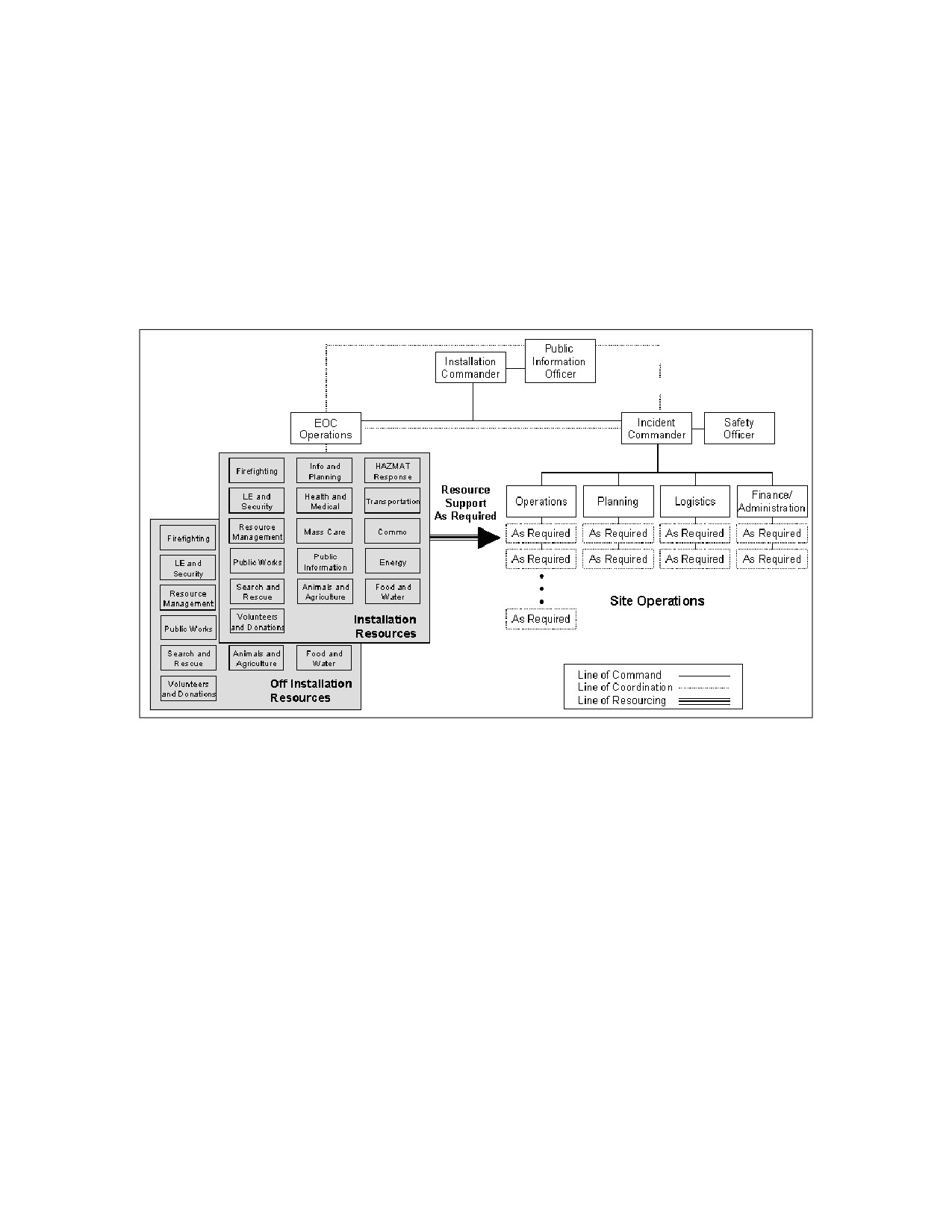
operations center (EOC). The ICP is responsible for on-scene response activities, while
the EOC is responsible for the entire installation-wide response to the event. During an
incident, the EOC provides overall C2 (on behalf of the installation commander) of a
CBRN incident. In this role, the EOC functions as an ICS liaison coordinating support
for the IC/ICP in all functional areas and follow-on elements (FOE) (see Figure IV-4).
The EOC controls all functional-area response and installation support elements so that
taskings or requests from the incident site are supported and keeps higher HQ
informed.
Figure IV-4. Installation Incident Command System
b.
Individual Response/Actions. Individual response occurs when
individuals respond to a CBRN attack by taking appropriate protective actions. The
basic response begins with the individual identifying a potential CBRN hazard, donning
a protective mask, and sounding an alarm. Individual response may be furthered by
donning protective clothing and performing immediate decontamination, self aid, and
buddy aid, if required. Further individual response actions are described in Appendix C.
c.
Collective Response/Actions. Collective actions are coordinated actions in
which groups of people respond to achieve a collective goal. An example would be when
a unit conducts decontamination of its personnel and equipment after a CBRN attack.
Tenant and transient units should be prepared to execute collective actions to mitigate
CBRN effects on themselves and to support common installation CBRN responses.
Further collective response actions are described in Appendix C.
d.
First Response. First response is conducted by local and nongovernmental
police, fire, and emergency personnel who are responsible for the protection and
preservation of life, property, evidence, and the environment. They include emergency
6 November 2007
FM 3-11.34/MCWP 3-37.5/NTTP 3-11.23/AFTTP(I) 3-2.33
IV-7
response providers and emergency management, public health, clinical care, public
works, and other skilled support personnel (such as equipment operators) who provide
immediate support services during prevention, response, and recovery operations. First
responders may include personnel from federal, state, local, tribal, or nongovernmental
organizations (NGOs). In its most basic form, first responders are individuals who are
likely to witness or discover a hazardous substance release and who have been trained
to initiate an emergency response sequence by notifying the proper authorities of the
release. In its more advanced form, first responders are trained to operational or
technical levels as presented in Chapter III. Additional first responder actions are
described in Appendix C.
e.
Emergency Response. Emergency response occurs when responders from
outside the immediate release area deploy to an occurrence which resulted in, or is
likely to result in an uncontrolled release of a hazardous substance. Responses to
releases of hazardous substances where there is no potential safety or health hazard are
not considered to be emergency responses.
f.
Installation Response. When a CBRN incident is detected, trained
installation personnel initiate the ICS and establish an ICP for on-site response. The
ICP is the tactical-level, on-scene incident command and management organization,
typically located at or in the immediate vicinity of the incident site. The installation
EOC can serve as the operational-level command post where resources are coordinated,
command and staff decisions are made, and reporting to higher echelons of command
outside of the installation occurs. An alternate EOC site is recommended in the event
that the installation EOC is within the hot zone or otherwise inaccessible during an
incident.
g.
External Response. The magnitude of a CBRN attack may quickly
overwhelm the ability of an installation to effectively respond. When this occurs, the
installation must be prepared to reach out to obtain external support. The external
response assets that an installation has coordinated for through MOAs/MOUs should be
listed in the CBRN defense plan. This includes assets available through higher
commands. Appendix B provides a list of reach-back asset points of contact (POCs) that
may provide assistance. Theater-level assets may also be utilized during such an
incident. For example, a theater CBRN defense company could be identified in theater
concept plans (CONPLANs) to provide assistance. The time it takes to get such
external support on-site is critical and must be a primary consideration when planning
for such use. Some support will take days to obtain and may no longer be needed once it
is available. For example, a unit may be able to provide mass casualty decontamination
and processing but may not be able to arrive for a few days. By the time the unit
arrives, the casualty processing may well be complete. Time can be a critical factor in
handling CBRN patients and their decontamination. External response assets located
near the installation are very valuable in that they have the ability to arrive on scene
quickly.
3.
Emergency Support Functions and Roles
ESFs are used to organize and provide support to the installation CBRN
response. This ESF structure can be applied to the installation and its staff. Specific
functional personnel should be assigned to lead/manage specific ESF functions. These
designated roles are referred to as “ESF managers”. Appendix B provides the ESFs and
IV-8
FM 3-11.34/MCWP 3-37.5/NTTP 3-11.23/AFTTP(I) 3-2.33
6 November 2007
some of the ESF manager’s roles during a CBRN response. See Multiservice TTP for
CBRN Consequence Management for additional, more in-depth information. The
following are ESF designated for installations:
No. 1 Transportation
No. 2 Communications
No. 3 Public works and engineering
No. 4 Firefighting
No. 5 Emergency management
No. 6 Mass care, housing, and human services
No. 7 Resource Support
No. 8 Public health and medical services
No. 9 Urban search and rescue
No. 10 Oil and HAZMAT response
No. 11 Agriculture and natural resources
No. 12 Energy
No. 13 Public safety and security
No. 14 Long-term community recovery and mitigation
No. 15 External affairs
4.
Emergency Communications (Warning and Reporting)
Warning and reporting of an incident occurs at various levels (i.e., individual,
collective, and installation levels).
a.
Individual. Initial warning that an incident has occurred comes from an
individual level to save the lives of those potentially affected or warn those at risk of
exposure. The individual may yell, “Gas, Gas, Gas!” and give the appropriate hand and
arm signals. Individuals may also report incidents by calling 911 or sending an CBRN1
message.
b.
Collective. SOPs at tenant or transient unit level should include how the
unit warns of and reports CBRN incidents. The CBRNWRS (see Multiservice Tactics,
Techniques, and Procedures for CBRN Contamination Avoidance) is normally used by
military units to pass CBRN warning and reporting messages. The unit also
disseminates a change in its MOPP level to appropriately protect its members. This in
itself is a warning (a transient unit commander orders the unit into MOPP4 via internal
communications methods).
c.
Installation. Installations warn of a CBRN incident through various
methods. Methods such as the use of sirens, flags, public address systems, and signs
should be described in the installation CBRN defense plan and disseminated to all that
occupy the installation (either tenant or transient). The installation may also have a
requirement to pass reports of any CBRN incidents to its higher HQ. Tables IV-2 and
IV-3 provide additional guidance for standardized alarm signals for the U.S. and
overseas.
6 November 2007
FM 3-11.34/MCWP 3-37.5/NTTP 3-11.23/AFTTP(I) 3-2.33
IV-9

Table IV-2. Standardized Alarm Signals for the US and its Territories and Possessions
Warning Or
Signal
Meaning
Required Actions
Condition
Attack
3- to 5-minute
Attack is imminent
Proceed immediately to designated
wavering tone on
or in progress or
shelters or take other appropriate actions.
sirens or other
the arrival of
devices.
nuclear fallout is
Listen for additional instructions.
Warning
3 to 5 minutes of
imminent.
short blasts from
horns, whistles, or
other devices.
Peacetime
3- to 5-minute
Peacetime disaster
Tune in to local radio, television, or cable
Emergency
steady tone on
threat exists.
stations for emergency information.
Warning
sirens or long
Potential or
steady blasts on
confirmed hazard
Listen to public address systems for
horns, whistles, or
to public health,
additional instructions.
similar devices.
safety, or property.
Be prepared to evacuate or to take
immediate shelter or other appropriate
protective actions.
All Clear
Declared verbally
Emergency
Resume normal operations or initiate
by local official
terminated.
recovery, if applicable.
agencies.
IV-10
FM 3-11.34/MCWP 3-37.5/NTTP 3-11.23/AFTTP(I) 3-2.33
6 November 2007

Table IV-3. Standardized Alarm Signals for OCONUS Bases and Stations Subject to CBRN
Attacks
Alarm
If You:
This Indicates
General
Condition
Actions
•
Don MOPP0 or as directed.1, 2
Green
Hear: Alarm
Attack is not probable.
•
Perform normal wartime
“green”
operations.
•
Resume operations.
See: Green flag
•
Continue recovery operations.
•
Don MOPP2 or as directed.1
Hear: Alarm
Attack is probable in less than 30
•
Protect and cover assets.
Yellow
“yellow”
minutes.
•
Go to protective shelters or seek
the best protection with overhead
See: Yellow flag
cover.3
Hear: Alarm
•
Seek immediate protection with
“red”,
Attack by air or missile is imminent
overhead cover.3
or a siren
or in progress.
•
Don MOPP4 or as directed.1
Red
(wavering tone)
•
Report observed attacks.
See: Red flag
Hear: Ground
•
Take immediate cover.2, 3
attack or a bugle
Attack by ground force is imminent
•
Don MOPP4 or as directed.1
(call-to-arms)
or in progress.
•
Defend self and position.
•
Report activities.
See: Red flag
•
Don MOPP4 or as directed. 1, 2
Attack is over, and CBRN
•
Perform self-aid/buddy care.
Hear: Alarm
contamination and/or UXO hazards
•
Remain under overhead cover or
Black
“black” or a siren
are suspected or present.
within shelter until directed
(steady tone)
otherwise.
See: Black flag
1Wear field gear and personal body armor (if issued) when outdoors or when directed.
2This alarm condition may be applied to an entire installation or assigned to one or more defense sectors or zones.
3Commanders may direct continuation of mission-essential tasks or functions at increased risk.
5.
Common Operational Picture (COP)
a.
During the response phase, a COP is established based upon plans and
preparations and is invaluable for providing the installation commander and his staff
with a quick, timely, usable, precise, and reliable view of the status of a CBRN incident.
During the response phase, the CBRN COP must be capable of supporting all aspects of
the response operations (e.g., hazard locations, evacuation or shelter-in-place
requirements and locations, unit CBRN capabilities, unit exposure status, and updated
CBRN risk assessments) to the extent possible. A key benefit of a good COP system is
that it allows the installation to quickly relay to its tenant and transient units this
identical, graphic display of relevant information for SA. The same information can be
relayed to local U.S. embassy officials, and it is feasible that embassy personnel could
then relay specific details on to host nation’s representatives as appropriate. Obviously,
to be effective, this COP must therefore be constantly updated through the recovery
6 November 2007
FM 3-11.34/MCWP 3-37.5/NTTP 3-11.23/AFTTP(I) 3-2.33
IV-11
phase while transitioning to mission sustainment operations. Updates to this COP are
made from detection, identification, contamination marking, and warning and reporting
information.
b.
Examples of information that the installation’s operations staff will want
to keep updated include:
•
Current IPE requirements for all affected areas.
•
Split - MOPP operations (if applicable).
•
Survey team input on status of all areas of contamination.
•
Potential of secondary explosive devices and the likelihood of blast injury
and destruction with any CBRN event, especially radiological/nuclear.
•
Status of immediate level decontamination.
6.
Transition to Recovery and Immediate Mitigation
a.
There exists a fine yet unclear line of when response ends and recovery
operations begin. Indeed, recovery often begins while response operations are still in
progress. There is a need to clearly distinguish between response and recovery,
especially for planning purposes. Additionally, there is most often a “handover” of site
responsibilities and authorities when transitioning from the response phase to recovery.
For example, a responding Fire Chief may hand over control of the scene to crime
investigators, incident investigation teams, or senior officials from on or off the
installation.
b.
Immediate mitigation actions occur during response operations to reduce
the harmful effects of the incident and to decrease risks of damage. For example, a
hazardous material response team may dike or divert the contamination from a leaking
device or container in order to keep the contaminated contents from affecting populated
areas. Each situation presents its own unique opportunities to immediately implement
mitigation actions.
IV-12
FM 3-11.34/MCWP 3-37.5/NTTP 3-11.23/AFTTP(I) 3-2.33
6 November 2007
Chapter V
INSTALLATION CBRN RECOVERY
1.
Fundamentals of Recovery
a.
This chapter will focus on the initial recovery operations carried out by
installation personnel using installation equipment. These actions can be compared to
what NIMS refers to as short term “emergency” recovery activities that set the stage for
successful long term recovery. Installation personnel and equipment will likely be the
only resources immediately available to commence initial recovery operations. CBRN
Consequence Management (CM) operations, in comparison, typically require additional
personnel, equipment and capabilities beyond those readily available on the
installation. See Figure V-1.
Plan
Prepare
CBRN
Prevent
and
Mitigate
Incident
Recover
Respond
Consequence Management
Figure V-1. Recovery Phase for Installation CBRN Defense
b.
The DoD Dictionary of Military and Associated Terms (JP 1-02) defines
recovery and reconstitution as those actions taken “to minimize the effects of an attack,
rehabilitate the national economy, provide for the welfare of the populace, and
maximize the combat potential of remaining forces and supporting activities.” The
National Response Plan speaks of recovery in terms of “the development, coordination,
and execution of service- and site-restoration plans and the reconstitution of
6 November 2007
FM 3-11.34/MCWP 3-37.5/NTTP 3-11.23/AFTTP(I) 3-2.33
V-1
government operations and services through individual, private-sector,
nongovernmental, and public assistance programs”.
c.
For comparison, JP 1-02 defines consequence management as those
“actions taken to maintain or restore essential services and manage and mitigate
problems resulting from disasters and catastrophes, including natural, manmade, or
terrorist incidents, and JP 3-41 states that “CBRNE consequence management
encompasses CM actions taken to address the consequences from all deliberate and
inadvertent releases of chemical, biological, radiological, nuclear agents or substances,
and high-yield explosives with potential to cause mass casualties and large levels of
destruction”.
d.
Several key points to remember about the installation’s recovery phase
after a CBRN incident are that:
(1)
The recovery phase generally begins when immediate hazards are
contained or controlled (see Figure I-1).
(2)
An installation’s primary tasks during this recovery phase are to
complete any remaining mitigation of the immediate hazard, and finish restoring
mission capability and essential public and government services interrupted by an
event.
(3)
By this point after an attack, reconnaissance assets should have
determined the boundaries of detectable chemical or radiological contamination,
technical reach-back will hopefully have provided assessments of the estimated
duration of negligible risk for contamination, immediate and operational
decontamination will be complete, thorough and perhaps clearance decontamination
will be getting underway, and the installation's ability to carry out its most critical
mission-related tasks will have been restored to pre-attack levels.
(4)
During this transition to follow-on operations, the installation
commander is balancing between focusing resources on mission essential tasks versus
completion of recovery tasks. Limitations of resources require the installation’s decision
makers to prioritize and concentrate on those tasks needed to recover the installation's
missions and operations to full capability.
(5)
Many of the recovery tasks initiated by installation personnel
during the initial recovery phase will likely be transitioned to CM personnel so that
installation personnel can refocus on primary installation missions.
(6)
During the recovery phase, installation response teams conduct
debriefing operations, begin performing re-supply and equipment maintenance, reset
their response posture, and generally reconstitute their operational readiness as they
commence / continue their transitions to other tasks.
V-2
FM 3-11.34/MCWP 3-37.5/NTTP 3-11.23/AFTTP(I) 3-2.33
6 November 2007
2.
Unique Operational Environment Considerations
As with an installation’s CBRN defense planning and its response to a CBRN
incident, there will likely be differences in how the recovery operations are carried out
depending on whether the installation is in a domestic or foreign setting and whether
the installation is in a permissive, uncertain or hostile environment. Listed below are
some of the issues that may arise during the recovery phase:
a.
Foreign Installations - Permissive Environment. Some of the unique
factors that the command staff of an installation on foreign territory will need to
consider include:
(1)
CBRN recovery operations procedures and associated retrograde
standards are subject to US and HN agreements that are specified in binding
documents such as treaties or SOFAs. These agreements should be fully spelled out, and
understood by all responding personnel.
(2)
CBRN recovery operations must be routinely coordinated by the
installation with their HN civilian counterparts.
(3)
Either a permissive or semi-permissive environment may exist
during the CBRN recovery operations. Appropriate AT/FP annexes need to be written
into each recovery procedure.
(4)
Based on the tactical situation at the installation, the commander
may assume additional risk and direct the use of MOPP gear, as required. Guidance
regarding use of military IPE / MOPP gear must be specifically mandated in writing by
the appropriate theater Combatant Commander or higher authority.
(5)
Communications linkages to domestically based technical reach-
back will likely be more difficult to sustain therefore backup communications paths
should be identified.
b.
Foreign Expeditionary Installations - Uncertain or Hostile Environment.
Some of the unique issues that the command staff will likely encounter on foreign
expeditionary installations include the following:
(1)
CBRN recovery operations could take place in an environment
ranging from permissive to hostile.
(2)
Based on short-term requirements for support of operational
missions against an adversary, crisis-action planning may still dominate recovery
operations.
6 November 2007
FM 3-11.34/MCWP 3-37.5/NTTP 3-11.23/AFTTP(I) 3-2.33
V-3
(3)
Based on potential shortages of subject matter experts (SMEs) in a
hostile setting, the availability of timely technical reach-back may be a critical issue.
(4)
At this stage, the possible lack of a robust first-responder
capability (e.g., long-term sustainment of recovery operations for days or weeks) may
delay or defer recovery operations.
(5)
Military IPE is worn during CBRN recovery activities based on
written guidance promulgated by the appropriate theater Combatant Commander or
higher authority.
c.
Domestic Installations. The following are examples of unique factors that
any domestic military installation staff will need to consider:
(1)
CBRN-related recovery operations occur under the auspices of the
civilian-based ICS.
(2)
CBRN-related recovery operations occur in a permissive
environment.
(3)
CBRN-related recovery operations use the same terms of reference
used to support first-responder decontamination operations.
(4)
CBRN recovery operations are routinely coordinated with civilian
counterparts at the federal, state, or local level, as applicable.
(5)
CBRN specialists maintain the certification required to operate
with civilian first responders (as necessary).
(6)
Based on the type of hazard, CBRN responders will be required to
wear Level A and/or Level B clothing in lieu of MOPP gear, which don’t meet
Occupational Safety and Health Administration (OSHA) requirements.
3.
Recovery Phase Command and Control
As was stated previously, during the recovery phase, the installation commander
must focus his/her resources on those tasks that will most efficiently restore the
installation's missions and operations to full capability. Two closely related critical
components that help a command’s staff efficiently carrying out these responsibilities
are an effective information management (IM) program and a well designed and fully
functional common operational picture (COP) system.
a.
Information Management. An effective installation CBRN IM program
provides quality information to the right persons, i.e. installation personnel and tenant
and transient units, at the right time in a readily usable form to facilitate
understanding and decision-making.
V-4
FM 3-11.34/MCWP 3-37.5/NTTP 3-11.23/AFTTP(I) 3-2.33
6 November 2007
(1)
The IM program provides information and direction to impacted
personnel, maintains incident management logs and reports, manages data-sharing via
interoperability services, supports establishment and operation of any Joint information
centers and public affairs offices, maintains all applicable websites or web logs for
public use, maintains portals and related data sharing sites for either internal or public
use, and performs data-mining activities via available networks. This section is also
responsible for appropriate dissemination of intelligence, surveillance, and
reconnaissance information, to include threat/hazard warnings.
(2)
CBRN IM supports the installation commander in three main
areas:
•
Achieving SA/understanding.
•
Making decisions.
•
Communicating execution information to implement those
decisions.
(3)
This installation CBRN IM has four basic sequential steps that are
cyclical in nature:
(a)
Identification and update of information requirements.
Prior to an event occurring, the command will have developed a listing of critical
information that it will need immediately available should a CBRN incident occur.
During the response and recovery phases after an incident, those information
requirements typically require refinement and updating.
(b)
Collection and processing of information. The installation’s
operations center serves as a central focal point for collecting, processing, storing,
protecting, displaying, disseminating key information.
(c)
Provide information to build a common operational picture
(COP)/display. As events transition to the recovery phase, the requirement to maintain
a current COP is even more important. Resource use is probably even more constrained
and a single, identical display of information shared by all the commands on an
installation is even more important.
(d)
Developing an understanding. A common situational
understanding (by all parties) is important on an installation to help ensure coordinated
and synchronized activities.
b.
COP and Intelligence Preparation of the Operational Environment.
During the recovery phase, an up-to-date COP is invaluable for providing the
installation commander and his staff with a quick, timely, usable, precise, and reliable
view of the status of a CBRN incident. During the recovery phase, the CBRN COP must
be capable of supporting all aspects of the recovery operations (e.g., hazard locations,
6 November 2007
FM 3-11.34/MCWP 3-37.5/NTTP 3-11.23/AFTTP(I) 3-2.33
V-5
unit CBRN capabilities, unit exposure status, and updated CBRN risk assessments).
One key benefit of a good COP system is that it allows the installation to quickly relay
to its tenant and transient units this identical, graphic display of relevant information
for SA. The same information can be relayed to local U.S. embassy officials, and it is
feasible that embassy personnel could then relay specific details on to host nation’s
representatives as appropriate. Obviously, to be effective, this COP must therefore be
constantly updated. Updates to this COP are made from detection, identification,
contamination marking, and warning and reporting information. Examples of
information that the installation’s operations staff will want to keep updated include:
(1)
Current IPE requirements for all affected areas.
(2)
Any ongoing split - MOPP operations (if applicable).
(3)
Survey team input on status of all areas of contamination.
(4)
Information received from technical reach-back (e.g., analysis of
CBRN reports).
(5)
Updates on adversary CBRN capabilities.
(6)
Potential of secondary explosive devices and the likelihood of blast
injury and destruction with any CBRN event, especially radiological/nuclear. Terrorists
may employ conventional explosives in combination with CBR to attract responders to a
scene or to injure responders after they respond to a CBRN scene.
(7)
Potential for residual hazards such as breakdown products from
CW agents.
(8)
Status of thorough or clearance decontamination.
4.
Mitigating CBRN Hazard Effects
As stated above, an installation’s primary tasks during the recovery phase of a
CBRN incident are to complete any remaining mitigation of the immediate hazard and
finish restoring mission capability and essential public and government services
interrupted by the event. This must be done while maintaining the safety and
protection of affected and responding personnel. Key activities that continue or are
initiated during the recovery phase include decontamination, personnel and equipment
protection, contamination marking, mortuary affairs, equipment retrograde, and
hazardous waste disposal. Although the jobs of completing many of these tasks
gradually transitions to CM personnel, installation personnel will likely have initiated
each activity. Each of these key activities will be discussed separately below:
a.
Decontamination. Decontamination is conducted as a series of graduated
steps (immediate, operational, thorough, and clearance decontamination). The
V-6
FM 3-11.34/MCWP 3-37.5/NTTP 3-11.23/AFTTP(I) 3-2.33
6 November 2007
progression of these steps is dependent on many factors including the operational
situation, type of hazard and location of the event. See the Multiservice Tactics,
Techniques, and Procedures for CBRN Decontamination for much more detailed
guidance and TTPs for CBRN decontamination.
(1)
Decontamination Status. By the time the recovery phase has
begun, immediate decontamination will have taken place to minimize casualties, save
lives, and limit the spread of contamination. It is also likely that operational
decontamination will have been carried out on specific parts of much of the installation’s
operationally essential equipment, materiel and/or working areas in order to minimize
contact and transfer hazards and to sustain operations. Operational decontamination
can also include decontamination of the individual beyond the scope of immediate
decontamination, as well as decontamination of mission-essential spares and limited
terrain decontamination to reduce penetration of the agent(s) into surfaces.
(2)
Thorough Decontamination. During recovery operations, thorough
decontamination measures commence in key locations as part of a reconstitution effort;
however, these operations require immense logistical support and are manpower-
intensive. Thorough decontamination is carried out by a unit, with or without external
support, to reduce contamination on personnel, equipment, materiel, and/or working
areas equal to natural background or to the lowest possible levels, to permit the partial
or total removal of individual protective equipment and to maintain operations with
minimum degradation. This may include terrain decontamination beyond the scope of
operational decontamination.
(3)
Clearance Decontamination. Clearance decontamination is the
final level of decontamination. It provides the decontamination of equipment and
personnel to a level that allows unrestricted transportation, maintenance, employment
and disposal. It is the most resource-intensive and requires command involvement,
guidance, and decisions on the disposition of possible mission-essential equipment.
Because clearance decontamination involves factors such as suspending normal
activities, withdrawing personnel, and obtaining materials and facilities that are not
normally present, it will not be discussed here further. Clearance decontamination
requires the application of appropriate federal or international standards. The MTTPs
for CBRN Aspects of Consequence Management and CBRN Decontamination should be
consulted for additional information on clearance decontamination.
(4)
Facilities Decontamination. As the recovery phase begins, the
installation COP should be indicating what buildings (interior and exterior) were
contaminated and what type of contamination is present. The evaluation of sampling
results to determine the extent of contamination may also have been completed at this
point. Based on evaluation results, it may be possible to resume the use of facilities
that were originally isolated and secured during the response phase, or part or all of
specific facility functions may need to be transferred elsewhere. Another difficult
challenge for the installation is that facilities (exterior and interior) contain many
porous surfaces that may absorb contamination and may not be able to be completely
decontaminated. Measures such as removal or sealing (painting) of these surfaces are
6 November 2007
FM 3-11.34/MCWP 3-37.5/NTTP 3-11.23/AFTTP(I) 3-2.33
V-7
not options that would likely be exercised by the installation. Rather, these clearance
decontamination issues should be left to external CM specialists.
(5)
Terrain Decontamination. Hopefully as the recovery phase of a
CBRN incident commences, reconnaissance assets will have determined the boundaries
of detectable chemical or radiological contamination on surrounding terrain. The
commander has multiple options available to cope with contaminated terrain including
isolating the area, setting revised boundaries for sectors or zones, and decontaminating
the terrain. For further discussion on this issue, see the MTTPs for CBRN Aspects of
Consequence Management and CBRN Decontamination.
b.
Individual and Collective Protection. As the recovery phase begins,
multiple active and passive measures should be in full operation providing protection to
the installation from CBRN hazards. Within the following paragraphs, several of these
protection measures for personnel and equipment will be discussed.
(1)
Personal Protection. During all phases of an installation’s response
to any incident, the commander and his staff need to monitor the effects of extended
wear of IPE on personnel. They need to continually reevaluate what level of heat stress
or psychological burden is likely to result from the continued use of protective clothing
and equipment under current environmental conditions. Heat stress is a pathological
condition in which the body’s cooling mechanisms are unable to dissipate the heat load
generated. It is disabling and in early, mild stages causes mental confusion and loss of
coordination and concentration. Heat stress rapidly progresses through heat exhaustion
to heat stroke, which is a very serious medical emergency. These types of evaluations
require the assistance of the command’s senior medical advisor and his staff. See MTTP
for CBRN Protection for additional guidance.
(2)
Personnel Evacuation. Evacuation operations may have
commenced as a component of an installation’s initial response actions. As the recovery
operations progress, depending upon the extent of the impact of the CBRN incident and
the progress of the subsequent decontamination efforts, conditions may start to stabilize
to a point that it may become safe for some personnel to move back to their original
locations. Based on the feedback from post-attack CBRN reconnaissance, the
installation commander may deem it safe for personnel to return to their original duty
stations. These returning personnel will need to be kept updated on safe routes of
movement as the decontamination efforts continue to avoid accidental contamination or
re-contamination. A well executed and widely disseminated COP will significantly
improve an installation’s ability to keep evacuation ambulances and aircraft free of
accidental contamination along their egress routes as well as keep installation
personnel free of accidental re-contamination during their return to station.
c.
General Medical Activities, Quarantine, Isolation, and Restriction of
Movement.
(1)
Medical Activities. During the execution of recovery operations,
installations continue to use their existing medical capabilities (i.e., generally Level I
V-8
FM 3-11.34/MCWP 3-37.5/NTTP 3-11.23/AFTTP(I) 3-2.33
6 November 2007
[battalion aid station, expeditionary force medical team, and installation medical
department activity] and Level II [division-level, expeditionary force medical teams, and
installation medical department activity]). During this phase, first responder
capabilities still undergoing high use will likely include advanced trauma management,
disease prevention, combat and operational stress control prevention, casualty
collection, and evacuation from supported units to supporting medical treatment
facilities (MTFs). An installation commander’s forward resuscitative care duplicates
first responder care and expands services available by adding dental, laboratory, X-ray,
and patient-holding capabilities. Surgical capabilities may also be provided at this
capability by surgical augmentation teams.
(2)
Quarantine and Isolation. If a biological warfare (BW) agent was
used in the attack, “quarantine” or “isolation” may be needed during the response
and/or recovery phases to prevent contact between healthy populations and those either
infected or suspected of being infected with an infectious disease. These types of
decisions are made after consultation with the command’s senior medical advisor.
Quarantine involves the detention of an individual or group suspected of having been
exposed to an infectious disease until it is deemed that they have escaped infection
(usually once the incubation period has lapsed). Isolation is the separation of an
infected individual from a healthy population. (The term is usually used to refer to
patients in an MTF.)
(3)
Restriction of Movement (ROM). This is another tool that
installation commanders may choose to use to maintain operational effectiveness in the
face of an infectious disease, whether natural or intentional (such as a BW attack). The
goal is to control the spread of the disease by restricting contact between healthy groups
of personnel and those who have, or are suspected of having, contracted the disease.
Personnel covered by ROM do not necessarily need to be removed from operations.
Rather, ROM should be implemented in such a way as to allow them to continue their
mission. Again, these decisions are made with recommendations furnished by the
command’s senior medical advisor.
d.
Contamination Marking. Contamination marking is used to provide a
warning to installation personnel of the presence of contamination. If contaminated
areas weren't sufficiently well marked during the initial reconnaissance after the CBRN
incident, such marking efforts should be a high priority during the recovery phase. See
MTTP for CBRN Reconnaissance for additional guidance on these procedures.
Contamination marking signs are standardized in color, shape, and size (see Figure V-
2). The primary (background) color of the marking sign indicates the general type of
contamination. The secondary (foreground) color identifies the specific hazard.
Contamination marking signs are annotated with important information that includes
the following data fields:
• Chemical. Post the name of the agent, if known, and the date and time of
detection.
• Biological. Post the name of the agent, if known, and the date and time
of detection.
6 November 2007
FM 3-11.34/MCWP 3-37.5/NTTP 3-11.23/AFTTP(I) 3-2.33
V-9
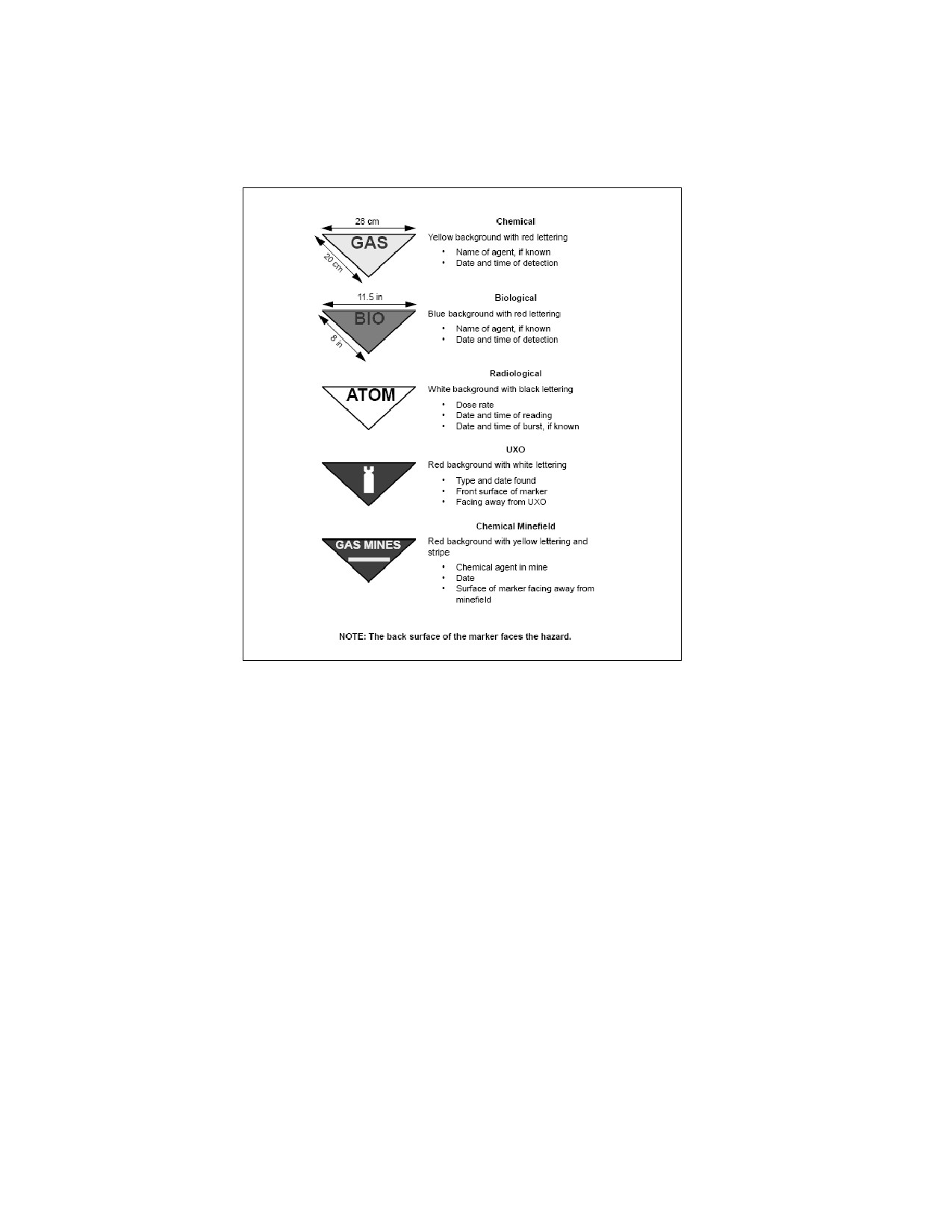
• Radiological. Post the dose rate, the date and time of the reading, and
the date and time of the burst, if known.
Figure V-2. Contamination Marking Signs
(1)
When those standards are not provided or when standard markers
are unavailable, units may use expedient markers to mark CBRN hazards. Any suitable
material including locally produced marking signs, decals, tape, chalk, and paint may be
used to construct these expedient markers to the approximate size and shape of the
examples. See MTTP for CBRN Reconnaissance for additional guidance on standardized
contamination marking sets and figures illustrating expedient CBRN hazard markers.
(2)
Standardized CBRN contamination marking procedures include
the following:
(a)
Place the contamination markers where they will be most
likely seen by approaching individuals and units. Individuals who locate the
contamination will place markers at the point of detection. To prevent forces from
missing posted markers and inadvertently entering contaminated areas, place adjacent
marking signs at intervals of 25 to 100 meters, depending on the terrain. If marking
contamination in open terrain (i.e., desert, plains, rolling hills), raise the markers to
heights that permit approaching forces to view them at distances up to 200 meters.
MTTP for CBRN Reconnaissance shows a sample contamination bypass marker.
V-10
FM 3-11.34/MCWP 3-37.5/NTTP 3-11.23/AFTTP(I) 3-2.33
6 November 2007
(b)
Mark contamination on all sides in rear areas to warn
follow-on and support units of the hazard. These clear zones (safe lanes) provide greater
freedom of movement by rear area forces through or around contamination.
(c)
Mark buildings and other facilities that may be
contaminated at critical points, such as entry points.
(d)
Mark materiel to protect personnel from accidental
contamination. Place contamination markers on any unmarked equipment present in
the CBRN attack area. Personnel using equipment after decontamination must take
precautions against vapor, particulate, and liquid contamination that may be trapped
inside filters, assemblies, and joints. The contamination could pose a hazard while
equipment is being used or maintained.
e.
Mortuary Affairs. Installations may need to contend with CBRN-
contaminated remains. The joint tactics, techniques and procedures (JTTP) for the
processing and handling of contaminated remains are found in JP 4-06.
f.
Equipment Retrograde. Some equipment that has received low-level
contamination may be required during a redeployment (retrograde) within the recovery
phase. See the Multiservice Tactics, Techniques, and Procedures for CBRN
Decontamination and the Multiservice Tactics, Techniques, and Procedures for
Chemical, biological, radiological, and nuclear Aspects of Consequence Management for
further information on equipment retrograde. The installation should maintain copies
of any records documenting when and how any of its equipment underwent operational
and thorough decontamination operations. The key concern is the potential for residual
contamination. During recovery, if equipment is to be retrograded under non-
emergency conditions from an installation, some of the basic control measures that an
installation should consider adopting include:
(1)
Using consolidation points for equipment suspected of residual
contamination.
(2)
Establishing buffer zones around each consolidation point to
provide an additional contamination control measure.
(3)
Using specialized detectors and monitors to confirm and monitor
for contamination.
(4)
Providing installation personnel engaged in monitoring and
preparation of equipment retrograde with stringent personal protection and specialized
detectors.
g.
Hazardous Waste. During initial recovery operations and as well as
during subsequent associated longer term consequence management operations, the
installation will be challenged with handling and disposing of potentially huge amounts
of contaminated waste. These contaminated items may include IPE, field gear, M8/M9
6 November 2007
FM 3-11.34/MCWP 3-37.5/NTTP 3-11.23/AFTTP(I) 3-2.33
V-11
paper, components of M291 and M295 kits, pallet covers, bulk plastic, tarps, other
contamination avoidance covers, and decontamination solutions. Guidance on proper
collection and disposal of these materials is available in the following documents:
Occupational Safety and Health Administration (OSHA) Hazard Communication
(HAZCOM) Standard, the OSHA Hazardous Waste and Emergency Response
(HAZWOPER) Standard, the Resource Conservation and Recovery Act (RCRA), the
Comprehensive Environmental Response, Compensation, and Liability Act (CERCLA),
and the Superfund Amendments and Reauthorization Act (SARA). During recovery
operations, the installation’s hazardous waste handling responsibilities include
ensuring that—
(1)
Waste collection sites are established, properly marked, reported,
and maintained.
(2)
Installation personnel apply contamination avoidance techniques
and procedures to establish and maintain waste collection points and segregate wastes
for localized collection.
(3)
The CBRN control center provides technical guidance and
oversight for establishing installation contaminated waste disposal areas and marks
and plots accumulation points and disposal areas on local area and grid maps.
(4)
Medical authorities provide technical oversight and guidance for
personal safety and health-related issues.
h.
General Logistics Concerns. As the recovery phase progresses, more and
more of the installation’s operations begin to return to pre-incident levels as the
installation restores additional mission capability. Logistics issues that will likely arise
during this period include:
(1)
Replacing personnel who may have become injured or ill during
decontamination operations.
(2)
Reordering supplies (e.g., detector paper, decontamination
solutions, decontamination kits, and apparatuses).
(3)
Maintaining or repairing vehicles and equipment, including
recalibrating or replacing detectors and alarms.
(4)
Marking used decontamination sites, selecting new
decontamination sites, reporting old and new decontamination sites, and recording and
reporting previously contaminated personnel and equipment.
(5)
Documenting resource expenditures.
(6)
Conducting FHP.
(7)
Preparing after-action reviews (AARs) and documenting the
use of resources.
V-12
FM 3-11.34/MCWP 3-37.5/NTTP 3-11.23/AFTTP(I) 3-2.33
6 November 2007
Appendix A
INSTALLATION CBRN DEFENSE PLAN DEVELOPMENT
1.
Background.
The CBRN defense plan is an important document for support of installation
preparation, response, and recovery operations.
2.
Installation CBRN Defense Plan Development Process
a.
Considerations. Important points to consider for developing a CBRN defense
plan include the following:
•
The development of a comprehensive, integrated, and executable installation
CBRN defense plan is the responsibility of the commander.
•
Commander involvement is essential.
•
The recommended lead for installation CBRN defense plan development is
the installation operations officer and his staff.
•
No single individual should be tasked with the sole responsibility of
developing an installation CBRN defense plan. Installation CBRN defense
plan development and documentation should be a collective effort.
•
The most effective method of developing and documenting an installation
CBRN defense plan is through the utilization of a cross-functional working
group, such as the installation AT working group. This working group should
include those individuals (or office representatives) of the ESF managers
identified by the commander.
•
Using the AT working group ensures the participation, input, and “buy-in” of
necessary cross-functional SMEs.
•
Everyone involved in installation CBRN defense plan development and
documentation should be thoroughly familiar with—
Applicable installation CBRN defense directives.
Previous installation CBRN defense plans and assessments.
Data developed earlier in the overall installation defense plan
development process.
•
The unpredictability of the installation CBRN defense mission requires that
the installation CBRN defense plan provide the “what” and the “how to”
instructions that define when, where, by whom, and in what manner specific
CBRN defense measures must be conducted and coordinated. Detailed “how
to” instructions should—
Permit subordinate commanders to prepare supporting plans.
Focus on subordinate activities.
Provide tasks, activities, constraints, and coordinating instructions.
Not inhibit initiative.
6 November 2007
FM 3-11.34/MCWP 3-37.5/NTTP 3-11.23/AFTTP(I) 3-2.33
A-1
Provide a clear, concise mission statement.
Convey the commander’s intent.
Include annexes/appendixes, if required, in order to expand the
information not readily incorporated in earlier text.
b.
Process. The CBRN defense plan format follows the standard OPLAN and
five-paragraph order format, yet is tailored to meet the unique requirements of
comprehensive CBRN defense programs. There are eight basic steps in developing an
installation CBRN defense plan. They are:
(1)
Gather/compile information developed during earlier installation
planning processes. Information gathered by the planning staff during the entire
installation AT/FP planning process is used for CBRN defense plan documentation.
(2)
Produce a summary and basic plan. The plan summary provides the
reader with a concise synopsis of the scope and purpose of the plan. The basic plan
provides the groundwork for all amplifying sections (annexes/appendixes) and is
produced prior to their documentation. The basic plan follows the five-paragraph-order
format and describes the situation-mission-plan for execution (commander’s intent,
CONOPS, tasks, coordinating instructions)-administrative and logistics concepts-C2
concepts.
(3)
Determine/assign responsibility for developing annexes/appendixes.
Annexes provide the details not readily incorporated into the basic plan, and they are
written to increase the clarity and usefulness of the basic plan: task organization-
logistics-intelligence-personnel-operations-multitude of installation CBRN defense
specific topics. These are only required if deemed necessary. Each annex relates to a
specific aspect of the CBRN defense operation. Appendixes further expand the annexes
and contain even more detailed explanation of the commander’s concept for installation
CBRN defense operations. Appendixes can further be subdivided into tabs and
enclosures. Development and documentation of individual annexes/appendixes should
be tasked to the AT working group members with a related expertise or responsibility
for the activity. For example, the public affairs representative should supervise the
development of Annex F (Public Affairs).
(4)
Establish a plan of action and task suspense dates for completion of
annexes/appendixes. Installation CBRN defense plan development and documentation
requires a comprehensive, integrated approach and a strong, clear vision of installation
CBRN defense program requirements. A realistic plan of action, with suspense dates,
drives the efficient development and documentation of the installation CBRN defense
plan.
(5)
Coordinate staff development and review of the plan. Each service has
published guidance concerning deliberate planning, organization, and coordination of
staff (FM 5-0, NWP 11, Air Force Manual [AFMAN] 10-401, and Marine Corps
Warfighting Publication [MCWP] 5-1).
(6)
Finalize the plan and submit it to the commander for review and
approval. The finalized plan should be—
•
Consistent with the organization/installation mission and
responsibilities.
A-2
FM 3-11.34/MCWP 3-37.5/NTTP 3-11.23/AFTTP(I) 3-2.33
6 November 2007
•
Oriented on tactical perspective.
•
Adequately detailed to provide specific actions to be taken.
•
Easily understood.
•
Executed quickly and decisively, if required.
After the commander’s approval and upon execution, the installation CBRN defense
plan becomes an OPORD.
(7)
Publish, plan, and task the development of supporting plans. Once the
installation CBRN defense plan is published, the next planning cycle begins. The
installation CBRN defense plan cannot remain static; rather, as the situation changes,
the plan must also change. The installation CBRN defense plan must remain under
constant review that it is truly a “living document”. Each subordinate and supporting
commander who is assigned a task in the installation CBRN defense plan may prepare
a supporting plan. Supporting plans are consistent with supporting commander
missions and responsibilities. Supporting plans are submitted to the supported
commander for review and approval.
3.
Installation CBRN Defense Plan Format
Figure A-1, page A-4, provides an example of an installation CBRN defense plan
format. As stated above, installations have the flexibility to choose their own formats.
6 November 2007
FM 3-11.34/MCWP 3-37.5/NTTP 3-11.23/AFTTP(I) 3-2.33
A-3
1. Situation.
a. Enemy Situation. Describe threat CBRN weapons and agent capabilities, threat delivery
capabilities, and circumstances or conditions supporting threat use of CBR weapons.
b. Friendly Situation. Include tenant and transient CBRN defense capabilities/locations with
projected arrival and departure times for transients. Identify CBRN defense task organization and
current force protection conditions.
c. Attachments and Detachments. List any HN, local, state or federal emergency support
units or assets that have been agreed upon under MOAs.
2. Mission. Describe the mission of CBRN defense. Ensure it is consistent with the commander’s
intent.
3. Task.
a. Commander’s Intent. Describe the intent of the CBRN defense program and mitigation
measures to prevent potential threat attack so that loss of life is kept to an absolute minimum.
b. CONOPS. Descriptive overview by ESF of how CBRN defense are executed in response
to threat CBRN attacks. Articulate who, what, with what, how, where, and when for each ESF during
preincident, incident, and postincident phases of a CBRN event.
(1) ESF #1
Transportation
(2) ESF #2
Communications
(3) ESF #3
Public works and engineering
(4) ESF #4
Firefighting
(5) ESF #5
Emergency management
(6) ESF #6
Mass care, HHS
(7) ESF #7
Resource support
(8) ESF #8
Public health and medical services
(9) ESF #9
Urban searches and rescue
(10) ESF #10
Oil and HAZMAT response
(11) ESF #11
Agriculture and natural resources
(12) ESF #12
Energy
(13) ESF #13
Public safety and security
(14) ESF #14
Long-term community recovery and mitigation
(15) ESF #15
External affairs
c. Execution. Describe critical subparagraphs including—
(1) Tasks to Subordinate Tenant Units. Detailed task assignments to each tenant
unit with execution guidance, as required.
(2) HN, Local, State, and Federal Agency Tasks. Tasks must be agreed upon by
MOA. Specify those assets that are available to support response/restorative efforts, such as
fire-fighting equipment, security, and medical assets.
(3) Rehearsals/Exercises. Plan and execute annual rehearsals/exercises to include
threat weapons, location of incident(s), participating units, participating civilian agencies, post-exercise
evaluations, and other scenario-related characteristics.
Figure A-1. Installation CBRN Defense Plan Format
A-4
FM 3-11.34/MCWP 3-37.5/NTTP 3-11.23/AFTTP(I) 3-2.33
6 November 2007
d. Coordinating Instructions.
(1) Minimum MOPP levels and flexibility guidance.
(2) Contamination avoidance guidance.
(3) Reiteration/establishment CBRN threat-response measures.
(4) Chemical and biological early warning and detection systems (include integrated
chemical alarm systems and biological systems, if available).
(5) Reconnaissance and survey team actions.
(6) Personnel safety criteria.
(7) Operational exposure guidance.
(8) Automatic masking/unmasking guidance.
(9) Reporting requirements.
(10) CBRN sample collection guidance and transfer points.
(11) Instructions/procedures for civilian/HN interaction/support.
(12) Decontamination team actions and priorities.
(13) Locations of HAZMAT storage and disposal facilities.
4. Service Support.
a. Contaminated casualty collection points/procedures.
b. Procedures for contaminated remains.
c. Location of consolidated CBRN defense equipment.
d. Locations of field-expedient decontamination supplies/HN support.
e. Decontamination and MOPP exchange points.
f. Special contamination control requirements.
g. Retrograde contamination monitoring sites.
h. CBRN equipment/supply controlled supply rates and stockage points.
i. Location of medical CBRN defense items and procedures for issue and administration.
5. Command and Signal.
a. Warning signals and alarms.
b. CBRNWRS.
Figure A-1. Installation CBRN Defense Plan Format (continued)
6 November 2007
FM 3-11.34/MCWP 3-37.5/NTTP 3-11.23/AFTTP(I) 3-2.33
A-5
4.
Sample CBRN Defense Plan
Figure A-2 provides a sample CBRN defense plan in a different format than the
above example.
Copy_______of_______copies
Utopia, USA 39001-0001
XXXX NOV 2003
APPENDIX 5 TO ANNEX C TO INSTALLATION X-RAY AT PLAN
CHEMICAL, BIOLOGICAL, RADIOLOGICAL, NUCLEAR (CBRN) DEFENSE
Ref: See the Basic Plan
1. Situation
a. General. This tab provides planning guidance for the protection of installation X-ray
military members, family members, DOD civilian, and on-base DOD contractors from the effects of
terrorist CBRN (including TIM). These devices are commonly known as WMD. Installation X-ray
units deployed to other locations follow the CBRN planning guidance for those locations. For the
purpose of this AT plan, CBRN defense is focused on deterrence through effective planning,
training, and equipping of installation X-ray personnel.
b. Enemy. See Annex B (Intelligence).
c. Friendly. See Annex A (Task Organization) and Annex J (Command Relationships).
d. Attachments/Detachments. See Annex A (Task Organization) and Annex J (Command
Relationships). For the purpose of this Annex, attachments/detachments refer to tenant
organizations that participate in a response to a terrorist incident that occurs on installation X-ray.
Attachments/detachments may also be made up of any HN, local, state, or federal response forces
that have been agreed upon under appropriate MOAs, SOFAs, or HN agreements.
e. Assumptions.
(1) See the Basic Plan.
(2) There is an increased possibility of a CBRN attack due to the relative ease of access
to chemicals, explosives, and plan designs for such devices.
(3) A CBRN scenario exceeds the crisis response/CM capabilities of base resources.
(4) Extensive DOD, local, state and federal support is required to cope with a CBRN
scenario.
(5) Incidents involving CBRN are often a combination of three types of incidents.
Potentially, they could be HAZMAT incidents, mass casualty incidents, and criminal incidents.
(6) CBRN incidents pose significant problem for first responders.
(7) Installation X-ray should be able to contain CBRN incidents until the arrival of DOD,
state, and federal response forces.
Figure A-2. Sample Installation CBRN Defense Plan
A-6
FM 3-11.34/MCWP 3-37.5/NTTP 3-11.23/AFTTP(I) 3-2.33
6 November 2007
(8) Mass casualty planning should augment CBRN planning.
(9) Effective planning, proactive passive/active protective measures, and continuous
exercising of crisis action plans help to mitigate the effects of a CBRN attack.
(10) Installation X-ray maintains MOAs with appropriate local, state, and federal
agencies or HN forces.
(11) Procedures and protective equipment are required for first responders (i.e.,
emergency medical services, firefighters, and military police). These can include MOPP, OSHA
Level A equivalent, detection equipment, and a heightened awareness for the presence of CBRN
agents/devices.
(12) The FBI has primary jurisdiction for investigating CBRN terrorist incidents, and the
FEMA is primarily responsible for CM.
2. Mission
On a continuing basis and in conjunction with local, state and federal agencies, installation X-ray is
prepared to respond to a CBRN incident and maintains a high level of readiness by conducting
preincident planning, implementing mitigation measures, and exercising terrorist incident
response/CM operations aimed at lessening the effects of a CBRN incident.
3. Execution
a. Commander’s Intent. An example of the commanders intent is as follows: “I intend to
develop comprehensive CBRN plans designed to marshal installation, DOD, local, state, federal,
and civil resources in an effort to deter, mitigate, and respond to a CBRN incident. The cornerstone
of this planning effort will be our ability to conduct proactive deterrent measures prior to a CBRN
incident. Plans will specifically address how local, state, federal, and civilian resources will be
incorporated into deterrent, mitigation and response efforts. Endstate: Installation X-ray has
executable plans, personnel are trained to be equipped to execute their responsibilities, and CBRN
plans are exercised periodically.”
b. CONOPS. The installation goal is to protect personnel, materiel, and facilities from a
potential terrorist CBRN threat. Installation X-ray protects key assets by deterring potential terrorists
from employing a CBRN device as a WMD. The focus is on effective planning, training, and
equipping of personnel. Commanders must ensure that their units/organizations have planned for a
CBRN event and are adequately trained and equipped. In case deterrence fails, incident response
and terrorist CM actions reduces the risk to personnel, materiel, and facilities.
(1) Preincident phase.
(a) All units/organizations appoint, in writing, a CBRN defense officer and an
alternate to develop, implement, and supervise the organizational CBRN defense program.
(b) The CBRN defense officer’s responsibilities include but are not limited to—
• Coordinating with the intelligence division to ensure that the CBRN threat is
identified and that information is disseminated to unit/organization personnel.
• Assessing CBRN readiness and vulnerabilities based upon the threat
• Developing CBRN defense plans and training guidance.
• Coordinating and tracking execution of CBRN defense training.
• Identifying CBRN defense logistical requirements.
• Participating in the installation AT working group.
Figure A-2. Sample Installation CBRN Defense Plan (continued)
6 November 2007
FM 3-11.34/MCWP 3-37.5/NTTP 3-11.23/AFTTP(I) 3-2.33
A-7
(c) All units/organizations develop a CBRN defense plan. The plan should be an
annex to the unit/organization antiterrorism plan. Plans should be integrated and supportive of the
Installation X-ray plan, the next higher HQ and adjoining unit/organization plans. The plan should
address the following areas:
• CBRN vulnerabilities and associated mitigation measures.
• Early warning and detection procedures.
• Survey operations.
• Decontamination operations.
• Individual and collective protection procedures.
• Casualty management and evacuation.
• Issuing of medical CBRN defense items.
• Training requirements.
• Resource requirements.
(d) All units/organizations implement CBRN defense training programs that
adequately prepare individuals and units to meet the threat (see Tab B to this Appendix).
Units/organizations conduct a CBRN defense exercise at least annually using one or more of the
materials or agents characteristic of a CBRN attack. The training should challenge the unit ability to
react to a CBRN attack and continue operations.
(e) Units/organizations provide CBRN IPE to critical and mission-essential
assigned military personnel and DOD personnel. US contractor civilians are provided IPE as
determined by contract or by the commander. Issuance of equipment to civilians, including military
dependents, must be consistent with supply availability and with consideration of the individual's
exposure risk. Civilian personnel, including dependents, issued IPE must be trained on the proper
use of the equipment. They are subject to the same individual training standards.
(f) Installation X-ray specific CBRN FPCON measures are established at all levels
of command based on assessment of the CBRN threat. CBRN FPCON actions should consist of
graduated levels of CBRN defense measures commensurate with the threat of a CBRN attack.
(2) Incident Phase. First responders perform actions such as containing and
controlling the incident site; rescuing survivors; performing hasty decontamination, triage and
evacuation; and identifying, if possible, the agent. This phase is complete when the immediate
threat has been abated and surviving victims have been evacuated for treatment.
(3) Postincident Phase. This phase involves continuing consequence management
actions. The incident site is searched for evidentiary material. First responders and terrorist CM
workers may require psychological counseling. Response agencies conduct comprehensive
reviews of actions taken in order to improve procedures. This phase is complete when the area is
restored to normal operations.
c. Tasks.
(1) Installation X-ray Commander
(a) Ensure that CBRN defense plans are developed, individual and collective
training and annual exercises are accomplished. associated resource requirements are identified,
and IPE is issued to personnel.
(b) Retain jurisdiction for CBRN incidents until the FBI assumes jurisdiction and
be prepared to establish a unified command relationship with responding local, state, and federal
agencies.
Figure A-2. Sample Installation CBRN Defense Plan (continued)
A-8
FM 3-11.34/MCWP 3-37.5/NTTP 3-11.23/AFTTP(I) 3-2.33
6 November 2007
(c) Exercise C2 through the CMT.
(d) Employ the CBRN emergency response force and other units to deal with the
threat.
(2) Director, Operations Division
(a) Retain primary staff oversight for the development of CBRN defense plans.
Ensure that CBRN plans integrate available DOD, local, state, and federal response forces and
resources.
(b) Coordinate CBRN defense training and annual exercises.
(c) When directed by the installation X-ray commander, convene the CMT and
activate the EOC.
(d) Oversee the development and implementation of FPCON measures.
(e) Initiate the installation-wide mass notification process. Periodically test and
exercise the notification process to ensure viability.
(f) Ensure that local, state, and federal agencies are notified when an incident
occurs and the EOC is activated.
(g) Coordinate CBRN incident and postincident recovery operations.
(h) Prepare and submit installation AARs.
(3) Director, Intelligence Division (OSI, CID, NCIS)
(a) Ensure that all available sources of intelligence are used to develop a CBRN
threat assessment as a part of the overall terrorism threat assessment. At a minimum, consider the
following questions:
• Who are the terrorist groups who have used or have the capability to use
CBRN?
• Are any of these groups or offshoots of these groups present in the local
area?
• What type of agents/materials could be used?
• What are the means of delivery?
(b) Provide daily updates and threat summaries as part of the commander’s
INTSUM.
(c) Be prepared to support the installation CBRN defense training program, as
required.
(4) Director, Medical Services
(a) Ensure that medical personnel are equipped and trained to handle CBRN-
contaminated victims. Maintain the capability to execute emergency medical services, to include
basic lifesaving measures and procedures to treat CBRN contaminated victims.
(b) Develop and maintain a medical MOA/MOU with local civilian and military
medical facilities to provide emergency medical support to CBRN incident response operations.
Figure A-2. Sample Installation CBRN Defense Plan (continued)
6 November 2007
FM 3-11.34/MCWP 3-37.5/NTTP 3-11.23/AFTTP(I) 3-2.33
A-9
(c) Maintain an adequate medical supply for CBRN medical emergencies.
Maintain a supply of NAAK (atropine and 2 PAM chloride).
(d) Provide an on-scene medical officer to coordinate/supervise triage and
evacuation actions.
(e) Advise local hospitals to prepare for the receipt of CBRN-contaminated
victims.
(f) Be prepared to execute the mass casualty plan. Establish a procedure for
patient tracking and accountability.
(g) Be prepared to support the installation CBRN defense training program, as
required.
(h) Execute the installation-wide vaccination policy.
(i) Monitor local, state, and national disease reporting systems for indicators of a
biological attack in an area that could affect the installation.
(5) Director, Public Safety Division (law enforcement and security/fire/emergency
response)
(a) Ensure that security, emergency response and fire-fighting personnel are
equipped and trained to respond to CBRN contaminated incident scenes.
(b) Ensure that fire-fighting and other emergency response personnel maintain an
on-scene capability to identify CBRN agents/materials.
(c) Establish procedures for dispatchers to query/identify incoming calls for
potential CBRN incidents.
(d) Provide on-scene C2 per Annex C (Operations) and Annex J (Command
Relations). Establish cordon area based on weather conditions.
(e) Be prepared to perform hasty decontamination of victims.
(f) Recommend the activation of the CBRN emergency response force, as
required. See ANNEX J (Command Relationships).
(6) Director, Public Works (Facilities) Division
(a) Ensure that CBRN scenarios are incorporated into installation HAZMAT
response procedures.
(b) Ensure installation HAZMAT response teams are capable of responding to a
CBRN scenario.
(c) Be prepared to dispose of CBRN-contaminated waste material.
(d) Be prepared to test installation drinking water and water drainage areas after a
CBRN incident, in coordination with medical/bioenvironmental engineering services.
(e) Provide logistical support per Annex D (Logistics).
Figure A-2. Sample Installation CBRN Defense Plan (continued)
A-10
FM 3-11.34/MCWP 3-37.5/NTTP 3-11.23/AFTTP(I) 3-2.33
6 November 2007
(7) Subordinate and Tenant Unit Commanders and Security Zone Commanders
(a) Establish an effective CBRN defense program in accordance with the
requirements outlined in this Tab.
(b) Appoint, in writing, a CBRN defense officer and an alternate officer to develop,
implement, and supervise the organizational CBRN defense program. Ensure that the CBRN
defense officer accomplishes tasks in accordance with paragraph 3.b.(1)(b) above.
(c) Develop a CBRN defense plan. This plan should be an annex to the
unit/organization AT Plan. Plans should be integrated and supportive of the Installation X-ray plan,
next higher HQ, and adjoining unit/organization plans. Ensure that the plan includes information
outlined in paragraph 3.b.(1)(c) above and see Tab A to this Appendix.
(d) Implement a CBRN defense training program that adequately prepares
individuals and units to meet the threat (See Tab B to this Appendix). Unit/organizations conduct a
CBRN defense exercise at least annually. The defense exercise should have a threat different
from that of the previous year.
(e) Provide CBRN IPE to critical and mission-essential assigned military and other
DOD personnel (See Tab C to this Appendix).
d. Coordinating Instructions.
(1) The priority of actions for CBRN incident responders are as follows:
(a) Control/contain incident site and surrounding areas.
(b) Perform rescue operations for survivors.
(c) Decontaminate injured.
(d) Triage and evacuate injured.
(e) Collect and preserve evidence.
(f) Collect and identify the deceased.
(g) Conduct site cleanup and HAZMAT disposal.
(h) Return incident site to normal operations.
(2) The primary responsibility of the installation is the containment of the CBRN agent
and the rescue of survivors.
(3) All victims of a CBRN agent attack are hastily decontaminated before evacuation to
a medical facility. Patient decontamination is achieved by:
(a) Removal of the victim from the contaminated area (hot zone).
(b) Removal of contaminated clothing.
(c) Rinsing with large quantities of water and/or cleaning with various
decontamination solutions.
(4) Identification/classification of chemical, biological, and nuclear materials is
obtained by using various detection devices.
(5) The MOA is developed to support this Appendix.
Figure A-2. Sample Installation CBRN Defense Plan (continued)
6 November 2007
FM 3-11.34/MCWP 3-37.5/NTTP 3-11.23/AFTTP(I) 3-2.33
A-11
(6) Deploying units should familiarize themselves with any HN response procedures
and/or the base defense plans for any sites where they will be tenants. Once deployed and a
CBRN incident occurs, units should seek to tie in with existing unit actions and procedures to assist
in recovery, security, and other postincident responses.
4. Administration and Logistics
a. Administration. See the Basic Plan.
b. Logistics. See Annex D (Logistics).
5. Command and Signal
a. Command. See Annex A (Task Organization) and Annex J (Command Relationships).
b. Signal. See Annex K (Command, Control, Communications and Computer Systems).
I. M. RESPONSIBLE
Commander, Installation X-RAY
Tabs:
Tab A: CBRN Defense Planning Process and Plan Format
Tab B: CBRN Defense Training
Tab C: CBRN Defense Equipment and Availability
Tab D: General Chemical Attack Scenario Analysis (Hazard Prediction and Assessment Capability
[HPAC] Analysis)
Tab E: General Biological Attack Scenario Analysis (HPAC Analysis)
Tab F: General Radiological Attack Scenario Analysis (HPAC Analysis)
Tab G: General Nuclear Attack Scenario Analysis (HPAC Analysis)
Tab H: General Toxic Industrial Material Scenario Attack Analysis (HPAC Analysis)
Tab I: General Improvised Explosive Device (IED) Scenario Attack Analysis (HPAC Analysis)
Figure A-2. Sample Installation CBRN Defense Plan (continued)
5.
Technical Reach-Back Assets
a.
Technical reach-back is the ability to contact technical SMEs when an issue
exceeds the installation’s capability. Reach-back should be conducted using established
installation protocols. Many reach-back resources have other primary missions and are
not specifically resourced for reach-back. Issues may include the following:
(1)
Nonstandard Agent Identification of CBRN Warfare Agents and TIM.
Military responders are trained to detect and identify certain military warfare agents.
If a TIM is used, or is suspect, then installation personnel must obtain technical
information. This technical information could include persistency, medical effects, or
decontamination or protection requirements.
(2)
Modeling. During CBRN operations, the spread of contamination must
be limited. Technical reach-back can help support detailed analysis of an area to assist
in determining downwind hazards locating staging areas, operations centers,
decontamination sites, etc.
A-12
FM 3-11.34/MCWP 3-37.5/NTTP 3-11.23/AFTTP(I) 3-2.33
6 November 2007

(3)
CBRN-Agent Sample Evacuation. Sample evacuation can be an
important part of installation operations. The evacuation of samples can provide the
means to obtain critical information for patient treatment. Samples evacuated can also
be used as evidence for prosecution.
(4)
Hazard Prediction. Technical experts can use modeling to provide a
better indication of where vapor, liquid, or aerosolized hazards may occur on an
installation.
b.
Reach-back can be accomplished through various means, from the telephone
to broadband satellites; however, information management protocols and chain-of-
command must be followed before using any hot-line number.
Table A-1. Technical Reach-Back Contact Information
NRC, Chemical Terrorism/CB Hot Line
800-424-8802 or 202-267-2675
DTRA
877-240-1187
AFRRI
301-295-0316/0530
USAMRIID
888-872-7443
USAMRICD
410-436-3277
USACHPPM
800-222-9698
6.
National Response Center and Chemical-Biological Hot Line
a.
The NRC mans the hot-line service and serves as an emergency resource for
first responders to request technical assistance during an incident. The intended users
of the hot line include trained emergency personnel such as emergency operators and
first responders (firefighters, police, and emergency medical technicians who arrive at
the scene of a CB terrorist incident). Other potential users may include the state EOCs
and hospitals that may treat victims of agent exposure.
b.
The US Coast Guard (USCG) operates the NRC, and its trained operators
staff the hot line seven days a week, 24-hours a day. Operators use extensive databases
and reference material and they have immediate access to the Nation’s top SMEs in the
field of CBRN agents. NRC duty officers take reports of actual or potential domestic
terrorism and link emergency calls with applicable SMEs (such as those from the
Research, Development, and Engineering Command [RDECOM], or the USAMRICD)
for technical assistance and with the FBI to initiate federal response actions. The NRC
also provides reports and notifications to other federal agencies as necessary. Specialty
areas include the following:
•
Detection equipment.
•
PPE.
•
Decontamination systems and methods.
•
Physical properties of CB agents.
•
Toxicology information.
6 November 2007
FM 3-11.34/MCWP 3-37.5/NTTP 3-11.23/AFTTP(I) 3-2.33
A-13
•
Medical symptoms from exposure to CB agents.
•
Treatment for exposure to CB agents.
•
Hazard-prediction models.
•
Federal response assets.
•
Applicable laws and regulations.
c.
The CB hot line is a joint effort of the USCG, FBI, FEMA, Environmental
Protection Agency (EPA), Department of Health and Human Services, and the DOD.
The NRC is the entry point for the CB hot line. The NRC receives basic incident
information and links the caller to the DOD and FBI chemical, biological, and terrorism
experts. These and other federal agencies can be accessed within a few minutes to
provide technical assistance during a potential CB incident. If the situation warrants, a
federal response action may be initiated.
d.
Local established policies and procedures for requesting federal assistance
should be used before contacting the CB hot line. State and local officials can access the
hot line in emergency circumstances by calling 1-800-424-8802.
7.
Defense Threat Reduction Agency
a.
DTRA can provide technical reach-back information and services for on-scene
personnel. The focal/coordination point for support is the DTRA EOC (1-877-240-1187).
b.
The DTRA Operations Center (OPCEN) enables first responders and service
members to deal with CBRN threats through on-line assistance and provides a
wideband infrastructure for user support. As part of the Combat Support Directorate of
DTRA, the OPCEN is manned 7-days a week, 24-hours a day, and has the requisite
communications links to act as the single POC for on-line assistance and the dispatch of
other agency resources, as required.
c.
DTRA resources can provide support and crisis action planning through
modeling and simulation, scenario development, and war game and exercise
participation. Representative support that can be provided includes—
•
Access to decision support assets for CBRN analysis and consequence
prediction.
•
Access to high-resolution weather data.
•
Access to data files on CBRN materials.
•
Access to teleconferencing capabilities and national experts.
•
Online collaborative support.
8.
Armed Forces Radiobiology Research Institute
The Armed Forces Radiobiology Research Institute (AFRRI) can provide DOD with
a technical support capability for nuclear/radiological incidents or accidents. AFRRI can
provide multiple services, such as furnishing training to health professionals on the
management of nuclear or radiological casualties and/or providing state-of-the-art
expertise and advice to commanders following a nuclear or radiological accident
involving nuclear weapons, a reactor, or radiological material. AFRRI can also provide
A-14
FM 3-11.34/MCWP 3-37.5/NTTP 3-11.23/AFTTP(I) 3-2.33
6 November 2007
access to biodosimetry and bioassay support to incident responders and local health
authorities
9.
United States Army Medical Research Institute of Infectious Diseases
The US Army Medical Research Institute of Infectious Diseases (USAMRIID)
provides medical and scientific SMEs and technical guidance to commanders and senior
leaders on prevention and the treatment of hazardous diseases and the prevention and
medical management of biological casualties. The USAMRIID serves as the DOD
reference center for identification of biological agents from clinical specimens and other
sources. The USAMRIID can provide technical guidance for assessing and evaluating a
biological terrorist incident, from initial communication of the threat through incident
resolution.
10. United States Army Medical Research Institute of Chemical Defense
The USAMRICD provides medical and scientific SMEs and technical guidance to
commanders and senior leaders on the prevention and treatment of chemical casualties.
The USAMRICD can provide technical guidance for assessing and evaluating a chemical
terrorist incident, from initial communication of the threat through incident resolution.
11. United States Army Center for Health Promotion and Preventive Medicine
The USACHPPM provides a variety of technical, medical, and public health SMEs.
SMEs are available to provide direct support to DOD field and installation personnel, as
well as commanders and senior leaders regarding the prevention and mitigation of,
response to, and recovery from incidents involving CBRN releases. The USACHPPM
offers particular expertise relative threat and health risk assessments associated with
TIC, TIM, and CWA materials. This includes occupational and public health goals and
exposure limits including the delineation of response/recovery action levels (i.e., clean
up or clearance goals). CHPPM is also designated as the official DOD FHP archival
agency for documentation of exposures to military personnel during deployments.
6 November 2007
FM 3-11.34/MCWP 3-37.5/NTTP 3-11.23/AFTTP(I) 3-2.33
A-15
This page intentionally left blank.

Appendix B
EMERGENCY SUPPORT FUNCTION (ESF) MANAGER ROLES
Sample ESF manager roles are shown in Table B-1
Table B-1. Sample ESF Manager Roles
ESF
Name
ESF Manager Roles
No. 1
Transportation
• Advise the IC, ICP, or EOC Director on the availability or
limiting factors of transportation resources.
• Provide transportation for follow-on team members from the
assembly point to the designated Incident Command Post
as required.
• Coordinate all requests for transportation support.
• Coordinate the evacuation of equipment from the incident
area.
• Request additional transportation resources from local
agencies when needed.
• Strategically plan for future phases.
No. 2
Communications
• Monitor mass notification/public warning system.
• Supervise and manage the IC, ICP, and EOC computer
networks to ensure they are operational throughout an
incident.
• Provide communications equipment, as needed.
• Coordinate and monitor requests for on-site
communications assets.
• Coordinate and monitor on-site communications support, as
necessary.
• Determine on-site operating frequencies.
• Monitor communication networks; recommend limiting
nonessential use of nets.
• Maintain the communications log.
• Coordinate communications with other appropriate entities.
• Evaluate communications capabilities available to support
the incident response. Make a recommendation to the
IC/ICP/EOC Director on whether to request additional
support.
• Liaise with augmentation elements to coordinate
communications procedures.
• Monitor C4ISR status and advise IC/ICP/EOC Director as it
changes.
• Strategically plan for future phases.
6 November 2007
FM 3-11.34/MCWP 3-37.5/NTTP 3-11.23/AFTTP(I) 3-2.33
B-1