FM 5-434 Earthmoving Operations (JUNE 2000) - page 5
FM 5-434
HORIZONTAL CONSTRUCTION PHASES
11-27. To satisfy the project’s density requirement, it is essential to
understand the various phases of a horizontal construction project. These
include preparing the subgrade; placing and spreading fill material;
compacting fill material for the subgrade and base courses; and performing
finishing and surfacing operations (discussed in Chapter 12).
Preparing Subgrade
11-28. The term subgrade describes the in-place soil on which a road, an
airfield, or a heliport is built. Subgrade includes the soil to the depth that may
affect the structural design of the project or the depth at which the climate
affects the soil. Depths up to 10 feet may be considered subgrade for
pavements carrying heavy loads. The quality and natural density of this
material dictate what action(s) to take to prepare the subgrade. For example,
a highly organic subgrade material may have to be totally removed and
replaced with a higher quality, select material. In most situations this is not
the case. Often the in-place material is suitable, but requires some degree of
compactive effort to achieve the required density.
11-29. Heavy, pneumatic-tired rollers are preferred for subgrade compaction
because of their capability to compact the soil to depths up to 18 inches. Often
it is necessary to scarify the top 6 inches of the material to adjust the moisture
content. Then the material can be recompacted to a higher density than could
be achieved at the soil’s natural moisture content. This process is known as
scarify and compact in place (SCIP). The tamping-foot roller is good for this
operation since it loosens the material, yet compacts it as it walks out of the
material. The tamping-foot roller also helps to break up oversize material or
rock in the area. If using a tamping-foot roller to prepare the subgrade, also
use a pneumatic-tired or smooth-drum roller to compact the top 1 to 2 inches
of the final material lift or to seal the lift surface if expecting rain.
11-30. Shaping and sealing the surface protects the subgrade from the
damaging effects of water infiltration. If a lift has been sealed, scarify the top
1 or 2 inches before placement of a succeeding lift. This ensures a good bond
between the lifts. If the subgrade material is sand, a vibratory compactor
would provide the most effective compactive effort.
Placing and Spreading Fill Material
11-31. After preparing the subgrade, bring in fill material to form the subbase
and base courses for the project. When placing fill, it is important to spread
the material in uniform layers and to maintain a reasonably even surface. The
thickness of the layers is dependent on the desired compacted lift thickness.
The thickness of the uncompacted lift is normally 1 1/2 to 2 times the final
compacted lift. For example, place fill in 9- to 12-inch lifts to achieve a
compacted lift thickness of 6 inches. Place the fill material with a scraper or a
dump truck and spread it with a dozer or grader. When spreading material on
a prepared subgrade, spread the material from the farthest point from the
source to the nearest or vice versa. The advantages of spreading fill from the
farthest point to the nearest are as follows:
• The hauling equipment will further compact the subgrade.
• Previously undetected weaknesses in the subgrade will become
apparent.
• Hauling will not hinder spreading or compacting operations.
Soil-Processing and Compaction 11-19
FM 5-434
11-32. On the other hand, spreading from the nearest point to the farthest
point has the advantage of haul equipment traveling over the newly spread
material. This compacts the material and greatly reduces the overall
compactive effort required.
Compacting Fill Material
11-33. Before beginning compaction operations, the project officer must
determine the moisture content of the fill and compare it to the acceptable
moisture range for that material. If the moisture content is below the
acceptable range, add water to the fill. If the moisture content is higher than
the acceptable range, use one of the previously discussed methods to dry the
soil. After achieving the appropriate moisture content, begin compaction
operations. The base course functions as the primary load-bearing component
of the road, ultimately providing the pavement (or other surface) strength.
Base-course material is, therefore, higher quality material than either the
subgrade or the subbase fill. Base course normally consists of well-graded
granular materials that have a liquid limit less than 25 percent and a plastic
limit less than 6 percent. The thickness of the base course is dependent on the
strength of the subgrade. Smooth-drum vibratory rollers are ideal for base-
course compaction. A dual-drum roller can also be used for base-course
compaction.
OPERATING HINTS
Compacting Against Structures
11-34. Jay tampers and pneumatic backfill tampers are specifically designed
for use in confined areas such as against existing structures. If these tampers
are not available, use a roller to achieve satisfactory results. If space permits,
run the roller parallel to the structure. If it is necessary to work perpendicular
to the structure, place fill material (sloped to the height of the roller axle)
against the structure. Apply compactive effort against this excess fill material.
Take care to avoid damaging the existing structure.
Aerating Materials
11-35. When using the roller to aerate soils, travel at the highest practical
speed. High speeds tend to kick up the material, which is the objective in this
case instead of density.
Overlapping Passes
11-36. To eliminate noncompacted strips, each pass with the roller should
overlap the preceding pass by at least 1 foot.
Turning
11-37. Make gradual turns at the end of each pass. This prevents surface
damage to the lift and eliminates the possibility of damaging a towed roller’s
tongue with the tracks of the towing tractor.
11-20 Soil-Processing and Compaction
Chapter 12
Road Surfacing
This chapter covers surface treatments and the road-surfacing equipment
used to apply these treatments. Surface treatments include the following:
seal coat, sprayed bituminous material with cover aggregate (single and
multiple surface treatments), and asphalt emulsions or slurry seal. Paving
and surfacing operations are discussed in FM 5-436.
SURFACE TREATMENT
12-1. The term surface treatment covers a wide range of applications and
materials, with or without aggregate, applied to the top of a road or pavement.
Surface treatments with aggregates can be
• Single surface. A single surface treatment is a sprayed bituminous
material with an aggregate cover that is one stone in depth. Use a
single surface treatment as a wearing and waterproofing treatment.
This type of surfacing requires a minimum of equipment, materials,
and time.
• Multiple surface. Repeating the single surface-treatment process
results in what is referred to as a multiple surface treatment. A
multiple surface treatment provides a denser wearing and
waterproofing course and the multiple layers add strength to the road
structure.
An initial single or double surface treatment may, when time and material are
available, be supplemented by additional surface treatments or thicker pave-
ment structures. This process is referred to as stage construction.
SURFACING EQUIPMENT
SWEEPER
12-2. A sweeper is a tractor-type machine with one or more brooms for
removing dust from the surface of the existing roadway before laying new
asphalt. Remove dust or dirt to ensure proper bonding between the new
asphalt and the base course or old pavement. When surfacing a prepared base
course, remove the dust layer either by sweeping with the sweeper or by
wetting the base course and recompacting. Before using a sweeper, always
inspect for excess bristle wear and check that the power drive on all brooms is
operating properly.
Road Surfacing 12-1
FM 5-434
ASPHALT DISTRIBUTOR
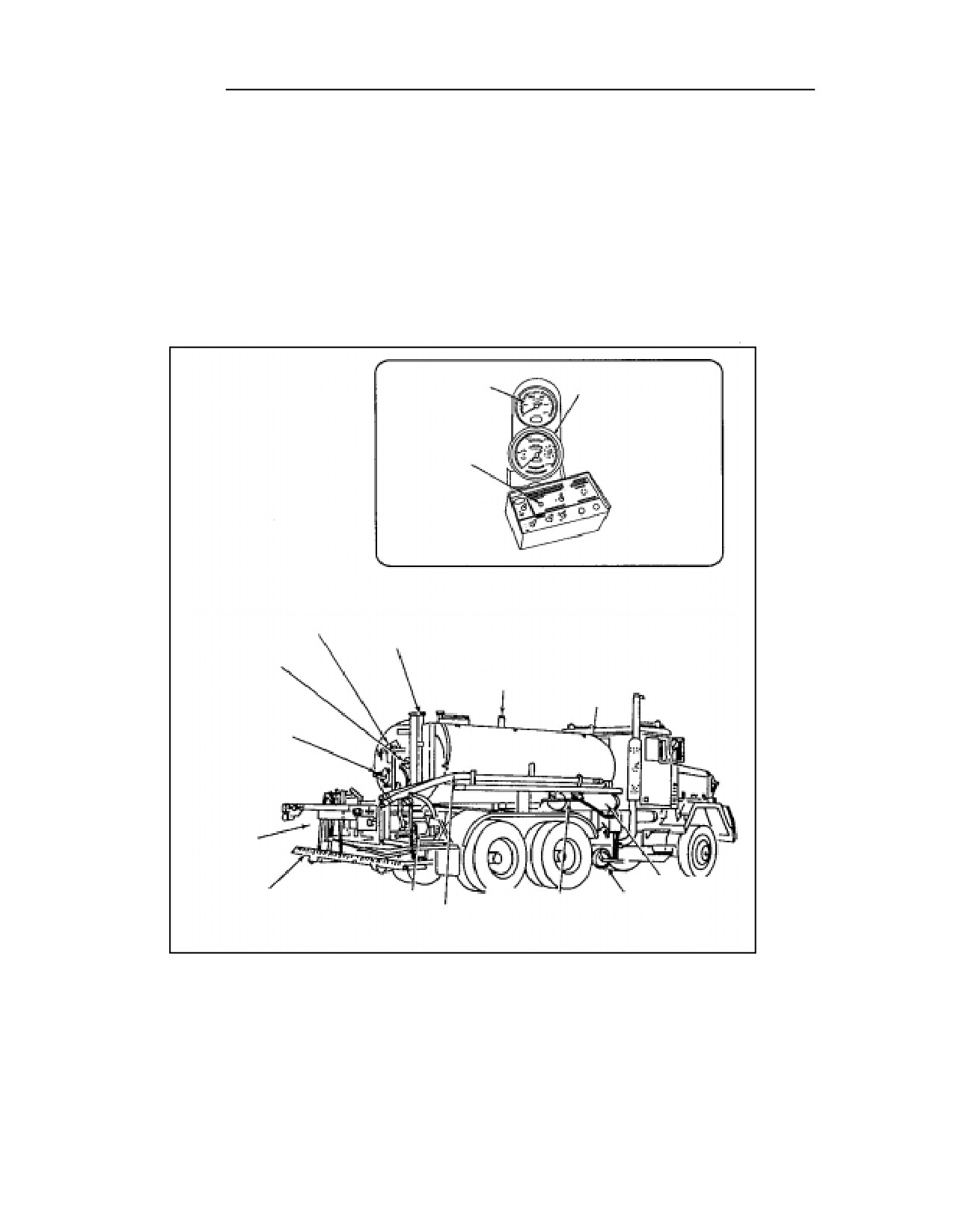
12-3. The Army asphalt distributor (Figure 12-1) is a truck-mounted unit. It
has a 1,500-gallon insulated storage tank with a low-pressure heating system,
a hydraulic-powered pumping unit mounted on the rear, and an adjustable
spray bar for distributing bituminous material. To produce a uniform
application, an asphalt distributor requires constant attention. It is critical
that the asphalt heater and pump be well maintained. Calibrate all gauges
and measuring devices properly (pump tachometer, measuring stick,
thermometers, bitumeter, and so on). Use clean spray bars and nozzles and
set them at the proper height above the surface receiving the application.
Pump
Recording
tachometer
bitumeter
(GPM)
Material
low-level
indicator
Quadrant control lever
Exhaust stacks
Tank gauge
Overflow and
vent cover
Signal bell
Low-
pressure
atomizing
burners
Tachometer
(mounted on
the rear of
the
storage tank)
Burner fuel tank
Spray barBurner fuel pump
Hand spray gun Bitumeter wheel
Auxiliary hoses (2)
Figure 12-1. Army Asphalt Distributor
Heating System
12-4. The system’s two diesel burners each have an air blower that provides
low-pressure air for atomizing burner fuel. The burners emit flame into two
U-shaped fire tubes located in the bottom of the asphalt storage tank.
Maintain 3 inches of asphalt cover over these fire tubes to prevent
12-2 Road Surfacing
FM 5-434
overheating and possible fire or explosion. Perform heating only in a well-
ventilated area with the distributor truck level and at a complete stop. Table
12-1, page 12-4, is a guide for asphalt spraying temperatures.
WARNING
Exercise extreme caution while heating the asphalt
to prevent damage to the heating system and
possible fires and explosions.
Spraying System
12-5. The spraying system consists of piping, an adjustable spray bar, a
bitumen-pump tachometer, and a bitumeter. Use Table 12-2, page 12-5, to
determine the proper settings for a desired application rate. The application
rate is controlled by
• The length of the spray bar.
• The bitumen pump output. The pump tachometer dial in the cab of the
truck (Figure 12-1) registers the pump output in GPM from the
tachometer mounted on the rear of the storage tank.
• The forward speed of the distributor truck. The bitumeter mounted
inside the truck cab monitors the forward speed in fpm.
12-6. Spray Bar. The spray bar may be full-circulating or noncirculating,
depending on the model of the distributor. The bar can be adjusted to provide
coverage from 8 to 24 feet in width. Along the bar there are a series of nozzles
with hand-operated valves to control the flow of asphalt. Although the spray
bar may have either 1/8- or 3/16-inch nozzles, the 1/8-inch nozzle is
appropriate for most applications. For a uniform application, make sure that
the spray bar is at the proper height and that all nozzles are the same size and
free of obstructions.
• Spray-bar height. To achieve a uniform double or triple overlap for a
single-layer application, the height of the spray bar must be properly
adjusted above the pavement. It is important to maintain the correct
height during the entire application. If the spray bar is too low or too
high, streaking will result.
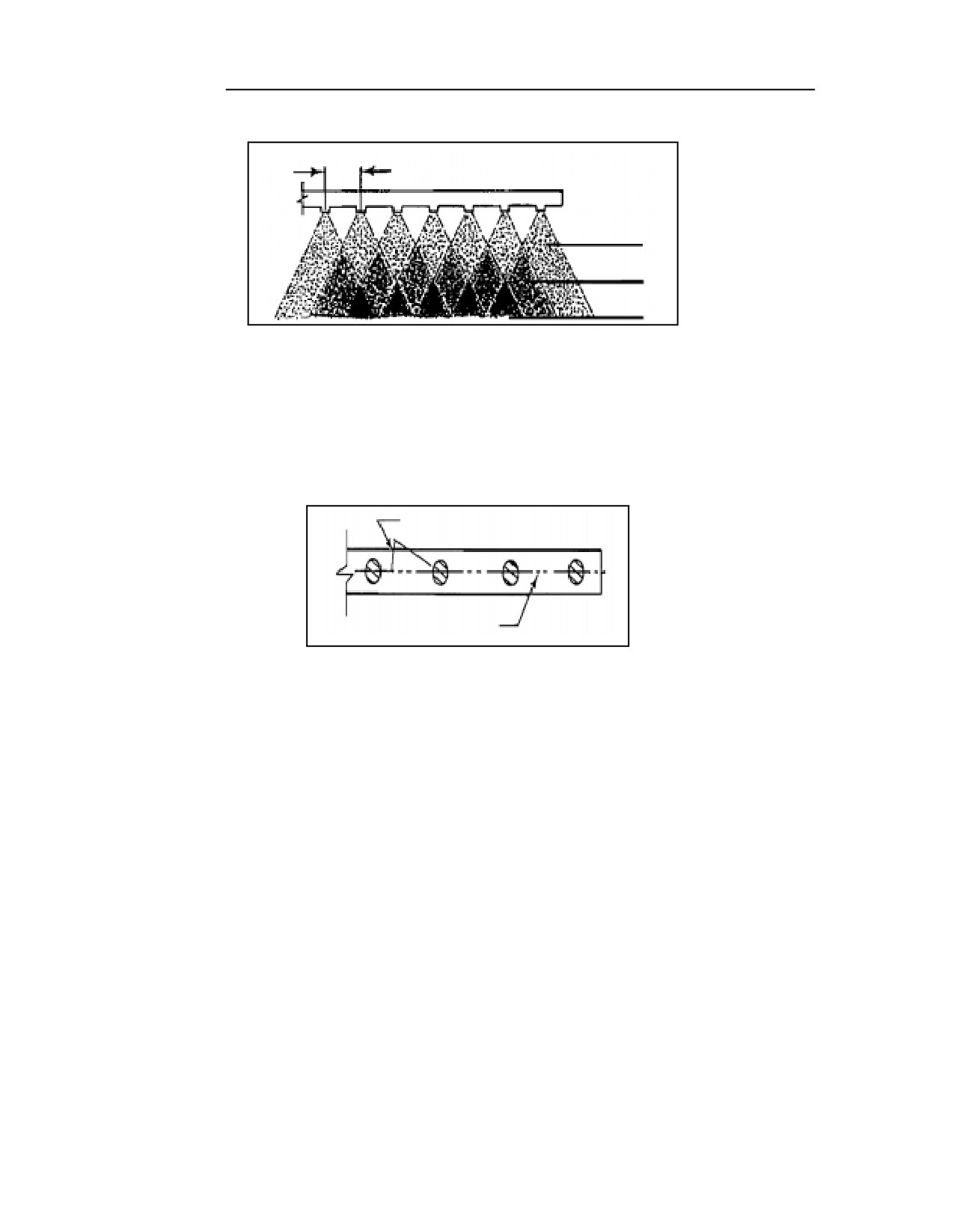
• Nozzle spacing. Spray bars are usually constructed with either a 4-
or 6-inch nozzle spacing. With 4-inch nozzle spacing, the best
application results are attained using a triple lap of the spray fans
(Figure 12-2, page 12-6). To determine the proper spray-bar height for
triple-lap coverage, open every third nozzle on the spray bar. Raise the
bar until there is single-layer coverage along the entire length of the
bar. Do a visual inspection to determine this. When all the nozzles are
opened, this height will furnish a triple lap of the spray fans. Use the
same procedure for double-lap coverage except only open every other
nozzle. When using 6-inch nozzle spacing, the height of the bar
necessary to give a triple-lap coverage will frequently allow wind
distortion of the spray fans, resulting in a nonuniform application.
Therefore, with 6-inch nozzle spacing, only a double lap may be
achieved.
Road Surfacing 12-3

FM 5-434
Table 12-1. Typical Pug Mill and Spraying Temperatures for Asphalts (Degrees Fahrenheit
Pug Mill Mixture
Spraying
Temperatures1
Temperatures5
Dense-
Open-Graded
Surface
Graded
Mixes
Road
Treatments
Type and Grade of Asphalt
Mixes
Mixes
Notes
Asphalt
AC-2.5
235-280
180-250
æ
270+
Temperatures for
cements
AC-5
250-295
180-250
æ
280+
asphalt cements and
AC-10
250-315
180-250
æ
280+
cutback asphalts are
AC-20
265-330
180-250
æ
295+
guides only.
AC-40
270-340
180-250
æ
300+
1Temperature of mix-
AR-1,000
225-275
180-250
275+
ture immediately after
AR-2,000
275-325
180-250
285+
discharge from the pug
AR-4,000
275-325
180-250
290+
mill rather than temper-
AR-8,000
275-325
180-250
295+
AR-16,000
300-350
180-250
ature of asphalt
cement or cutback
200-300 pen
325-305
180-250
265+
asphalt.
120-150 pen
245-310
180-250
270+
85-100 pen
250-325
180-250
280+
2Application tempera-
60-70 pen
265-335
180-250
295+
tures may, in some
40-50 pen
270-350
180-250
300+
cases, be above the
flash point of the mate-
Cutback
30 (MC only)
—
85+
asphalts
rial. Exercise caution
70
—
—
65+
120+
(RC, MC,
to prevent fire or explo-
250
135-1753
—
105+
165+
sion.
SC)2
—
800
165-2103
135+
200+
3Rapid curing grades
3,000
180-2403
—
—
230+
are not recommended
Emulsified
RS-1
—
—
70-140
for hot pug mill mix-
asphalts
RS-2
—
—
125-185
tures.
MS-1
50-1604
70-160
—
4Temperature of the
emulsified asphalt in
MS-2
50-1604
70-160
—
the pug mill mixture.
MS-2h
50-1604
70-160
—
5The maximum tem-
SS-1
50-1604
70-160
—
perature (asphalt
cement and cutback
SS-1h
50-1604
70-160
—
asphalt) must be below
CRS-1
—
—
125-185
the temperature at
CRS-2
—
—
125-185
which fogging occurs.
CMS-2
50-1604
70-160
—
CMS-2h
50-1604
70-160
—
CSS-1
50-1604
70-160
—
CSS-1h
50-1604
70-160
Legend:
AC = viscosity-graded asphalt cement
MC = medium curing
AR = viscosity-graded, aged-residue
MS = medium setting
asphalt cement
pen = penetration-graded asphalt
CMS = cationic-medium cement
RC = rapid curing
CRS = cationic rapid-setting
RS = rapid setting
CSS = cationic slow-setting
SS = slow setting
)
12-4 Road Surfacing

FM 5-434
Table 12-2. Asphalt-Distributor Application Rates
Pump Tachometer Readings (GPM)
Gallons
Nozzle
Bitu-
Per
Size
meter
Spray-Bar Length (Feet)
Sq Yd
(Inch)
Reading
8
9
10
11
12
13
14
15
16
17
18
19
20
21
22
24
1/8
900
80
90
100
110
120
130
140
150
160
170
180
190
200
0.10
210
220
240
3/16
1350
120
135
150
165
180
195
210
225
240
255
270
285
300
1/8
450
80
90
100
110
120
130
140
150
160
170
180
190
200
0.20
210
220
240
3/16
675
120
135
150
165
180
195
210
225
240
255
270
285
300
1/8
360
80
90
100
110
120
130
140
150
160
170
180
190
200
0.25
210
220
240
3/16
540
120
135
150
165
180
195
210
225
240
255
270
285
300
1/8
300
80
90
100
110
120
130
140
150
160
170
180
190
200
0.30
210
220
240
3/16
450
120
135
150
165
180
195
210
225
240
255
270
285
300
1/8
225
80
90
100
110
120
130
140
150
160
170
180
190
200
0.40
210
220
240
3/16
340
120
135
150
165
180
195
210
225
240
255
270
285
300
1/8
180
80
90
100
110
120
130
140
150
160
170
180
190
200
0.50
210
220
240
3/16
270
120
135
150
165
180
195
210
225
240
255
270
285
300
1/8
150
80
90
100
110
120
130
140
150
160
170
180
190
200
0.60
210
220
240
3/16
225
120
135
150
165
180
195
210
225
240
255
270
285
300
1/8
130
80
90
100
110
120
130
140
150
160
170
180
190
200
0.70
210
220
240
3/16
195
120
135
150
165
180
195
210
225
240
255
270
285
300
1/8
120
80
90
100
110
120
130
140
150
160
170
180
190
200
0.75
210
220
240
3/16
180
120
135
150
165
180
195
210
225
240
255
270
285
300
1/8
110
80
90
100
110
120
130
140
150
160
170
180
190
200
0.80
210
220
240
3/16
170
120
135
150
165
180
195
210
225
240
255
270
285
300
1/8
100
80
90
100
110
120
130
140
150
160
170
180
190
200
0.90
210
220
240
3/16
150
120
135
150
165
180
195
210
225
240
255
270
285
300
1/8
90
80
90
100
110
120
130
140
150
160
170
180
190
200
1.00
210
220
240
3/16
135
120
135
150
165
180
195
210
225
240
255
270
285
300
1/8
80
80
90
100
110
120
130
140
150
160
170
180
190
200
1.10
210
220
240
3/16
120
120
135
150
165
180
195
210
225
240
255
270
285
300
1/8
75
80
90
100
110
120
130
140
150
160
170
180
190
200
1.20
210
220
240
3/16
110
120
135
150
165
180
195
210
225
240
255
270
285
300
1/8
70
80
90
100
110
120
130
140
150
160
170
180
190
200
1.25
210
220
240
3/16
105
120
135
150
165
180
195
210
225
240
255
270
285
300
1/8
60
80
90
100
110
120
130
140
150
160
170
180
190
200
1.50
210
220
240
3/16
90
120
135
150
165
180
195
210
225
240
255
270
285
300
1/8
50
80
90
100
110
120
130
140
150
160
170
180
190
200
1.75
210
220
240
3/16
80
120
135
150
165
180
195
210
225
240
255
270
285
300
1/8
45
80
90
100
110
120
130
140
150
160
170
180
190
200
2.00
210
220
240
3/16
70
120
135
150
165
180
195
210
225
240
255
270
285
300
1/8
35
80
90
100
110
120
130
140
150
160
170
180
190
200
2.50
210
220
240
3/16
55
120
135
150
165
180
195
210
225
240
255
270
285
300
1/8
30
80
90
100
110
120
130
140
150
160
170
180
190
200
3.00
210
220
240
3/16
45
120
135
150
165
180
195
210
225
240
255
270
285
300
Road Surfacing 12-5
FM 5-434
4 inches
Single lap
Double lap
Triple lap
Figure 12-2. Perfect Triple Lap
• Nozzle angle setting. To attain a good edge, the end nozzles are
often set at a different angle (60° with respect to the spray bar) from
the other nozzles. Do not permit this practice because it produces a fat
streak on the edge and robs the adjacent spray fan of the lap from this
nozzle. A curtain on the end of the bar or a special end nozzle with all
nozzles set at the same angle gives more uniform coverage and makes
a better edge (Figure 12-3).
Nozzle angle
setting
Spray bar axis
Figure 12-3. Proper Nozzle Angle Setting
12-7. Bitumeter. The bitumeter (Figure 12-1, page 12-2) has a small rubber-
tired wheel mounted on a retractable frame under the distributor. A cable
leads from the wheel to a dial in the truck cab. The dial registers the
distributor’s rate of travel in fpm and the travel distance in feet. Some
bitumeters, besides providing travel distance, correspondingly register the
application rate in gallons per square yard. Check the bitumeter at regular
intervals to ensure accurate registering of speeds. The bitumeter check
procedure is as follows:
Step 1. Mark off a distance of 500 to 1,000 feet on a straight, level surface.
Step 2. Drive the distributor at a constant speed over this length while timing
the trip with a stopwatch.
Step 3. Determine the distributor speed in fpm and compare this calculation
with the bitumeter reading recorded during the run.
Step 4. Repeat this procedure for a number of different speeds, bracketing the
speed to be used for spraying.
Step 5. Tabulate or plot on a graph errors found at various speeds so a correc-
tion can be readily applied when using the distributor.
NOTE: Keep the bitumeter wheel clean to ensure accurate registering
of the truck’s speed. Asphalt buildup on the wheel causes errors.
12-6 Road Surfacing
FM 5-434
AGGREGATE SPREADER
12-8. Use the towed aggregate spreader (Figure 12-4) to apply aggregate to
freshly sprayed asphalt surfaces. It has a 2.5-cubic-yard capacity charging
hopper, an aggregate feed roller, an adjustable strike-off gate, traction tires, a
towing tongue, and a travel axle. During spreading operations the spreader
connects to the dump truck with a two-point, quick-coupling hitch but is
supported by its traction tires. It can apply aggregate when being towed or
when pushed by the dump truck that is supplying aggregate to the charging
hopper. Push the spreader with the dump truck for surface-treatment
operations. This allows the aggregate spreader and the dump truck to ride on
the freshly laid aggregate. As the aggregate spreader moves along the project,
the rotation of the traction tires drives the aggregate feed roller. Control the
application rate (pounds per square yard) of the aggregate with the adjustable
gate setting. The application width ranges from 4 to 8 feet, in 1-foot
increments. Control the width of application by installing blocking plates
inside the charging hopper. The blocking plates merely block off a segment of
the gate opening.
NOTE: It is important to spread the aggregate immediately after appli-
cation of the asphalt, before the asphalt cools.
Figure 12-4. Towed Aggregate Spreader
ROLLER
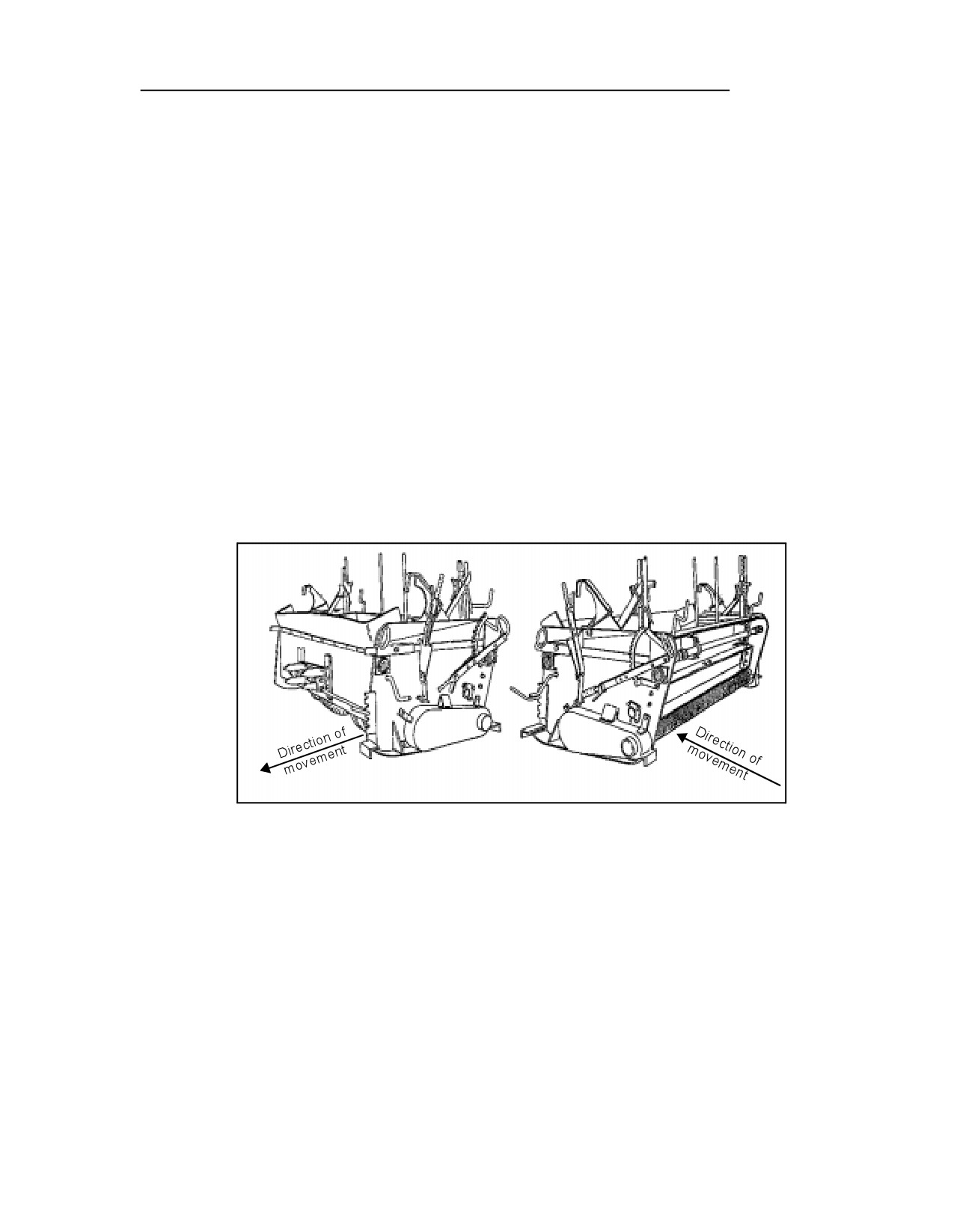
12-9. All rollers must be in good mechanical condition and able to start, stop,
and reverse smoothly. They must have a water-sprinkling system to keep the
drums or tires wet so that asphalt will not stick to the drum surface and scar
the new surface. Operate the rollers on the asphalt with the drive wheel
toward the spreader or asphalt paver. This pulls the mix under the roller and
imparts a smooth surface. Placing the rollers on the asphalt with the guide
roller toward the spreader will push the hot asphalt forward (Figure 12-5,
page 12-8). This causes the material to mound up in front of the roller.
Eventually, the roller passes over the mound, leaving a bump in the finished
pavement. In most cases, subsequent rolling cannot correct this bump.
Road Surfacing 12-7

FM 5-434
Correct position
(Drive wheel in front)
Weight
Direction of laying
Wrong position
Pushing force
(Tiller wheel in front)
Weight
Figure 12-5. Correct Roller Drive-Wheel Position
Dual-Drum Vibratory Roller
12-10. A 7- to 14-ton, dual-drum vibratory roller can be used for compacting
surface treatments, normally after application of the second layer of
aggregate. However, the roller should not be so heavy or the vibration
amplitude set so high that it crushes the aggregate particles.
Pneumatic-Tired Roller
12-11. A pneumatic-tired roller is the preferred equipment for compacting
bituminous surface treatments. See Chapter 11 for information on pneumatic-
tired rollers.
IN-PLACE MIXING EQUIPMENT
12-12. The Army has two pieces of equipment for in-place mixing of asphalt or
other stabilizing agents—grader and stabilizer-mixer.
GRADER
12-13. Use a grader to spread the aggregate, either from piles or by scarifying
in-place material. After applying the liquid asphalt with the distributor, use
the grader to mix the asphalt and aggregate thoroughly. For mixing, pitch the
blade all the way forward and angle it to side cast the windrow. Normally, it
takes five or six passes with the grader to thoroughly mix the materials after
each asphalt application. See Chapter 4 for additional information on asphalt
mixing with a grader.
STABILIZER MIXER
12-14. The stabilizer mixer is preferred over a grader for road mixing
materials. It is faster and provides better control of the asphalt/aggregate
ratio, producing a thoroughly mixed material. First, use the mixer to loosen
in-place materials and to blend select aggregate. The asphalt distributor
supplies asphalt directly to the mixer pump through a flexible metal hose.
When using this hose, connect the two units with a safety chain to prevent
damage to the hose. Spray the asphalt onto the aggregate with a spray bar
mounted under the mixer hood. The spraying takes place while the mixer is
12-8 Road Surfacing
FM 5-434
moving and the tines are rotating. This procedure completely blends the
asphalt and aggregate. See Chapter 11 for additional information on stabilizer
mixers.
BITUMEN HANDLING AND DEDRUMMING EQUIPMENT
ASPHALT MELTER
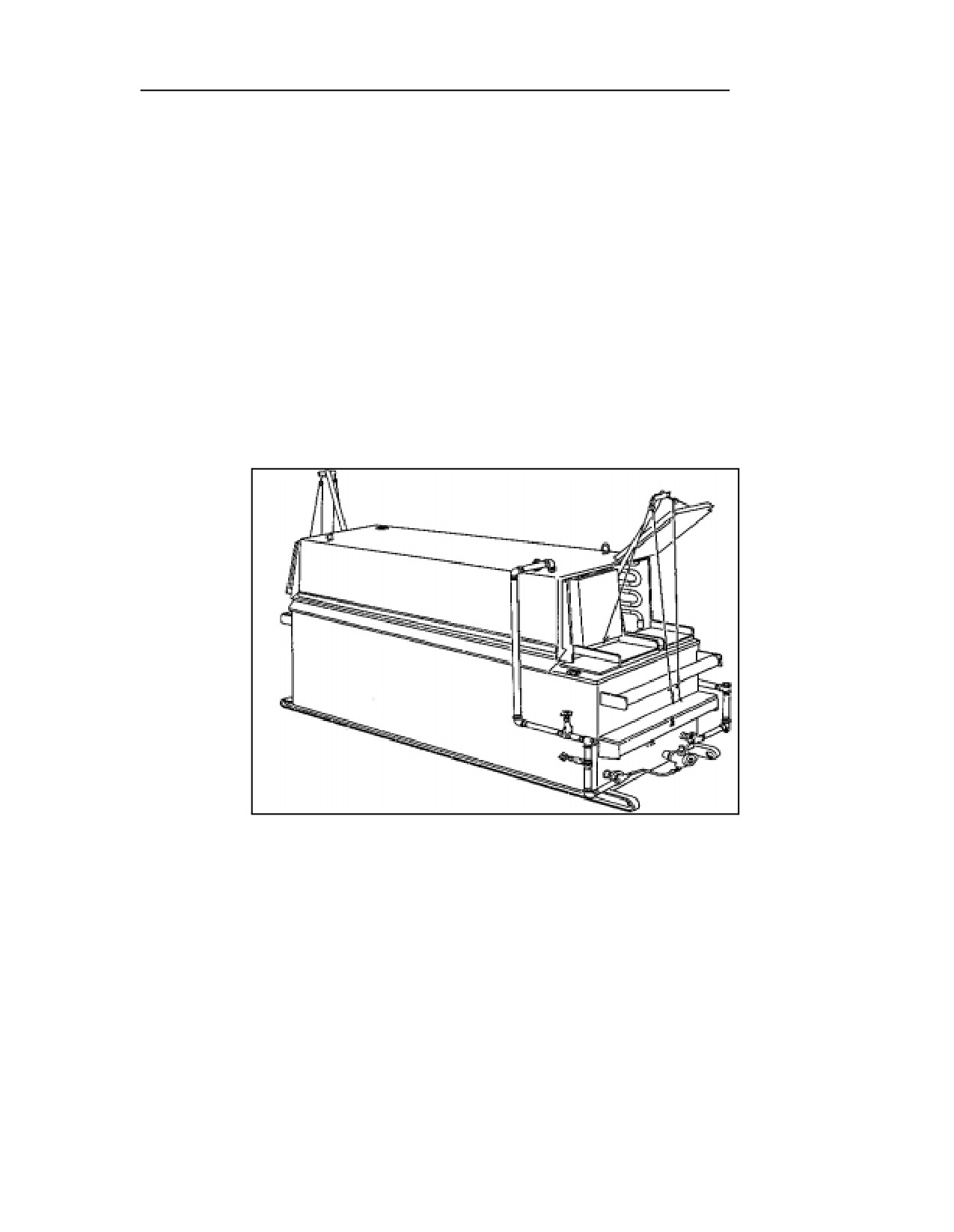
12-15. The asphalt melter (Figure 12-6) melts asphalt from 55-gallon drums
and heats it to a prescribed pumping temperature. The upper section of the
melter consists of dual, dedrumming tunnels; the lower section consists of an
asphalt melting and storage tank. In dedrumming operations, cut away one
end of each 55-gallon drum. Then place the drum, open end down, in the
dedrumming tunnel. Use an oil heater in conjunction with the asphalt melter.
Hot-oil coils, running along the sides and bottom of the tunnel, provide the
heat to melt the asphalt in the drums. Additional hot-oil coils, running
throughout the storage tank, bring the asphalt to mixing temperature. Table
12-1, page 12-4, is a guide for asphalt mixing temperatures in pug mills.
Figure 12-6. Asphalt Melter
OIL HEATER
12-16. The oil heater heats and then circulates the hot oil to systems such as
an asphalt melter or a storage tank. A diesel burner provides the heat to raise
the temperature of the circulating oil. A pump circulates the hot oil to the
systems. Set the heating requirements on the heater’s temperature controller.
From that point on, a programmed circuit automatically controls the
operation with a check-and-balance safety procedure. If the system
malfunctions, safety devices cause the unit to shut down. The oil heaters come
mounted on liquid-asphalt storage-tank trailers.
Road Surfacing 12-9
FM 5-434
ASPHALT KETTLE
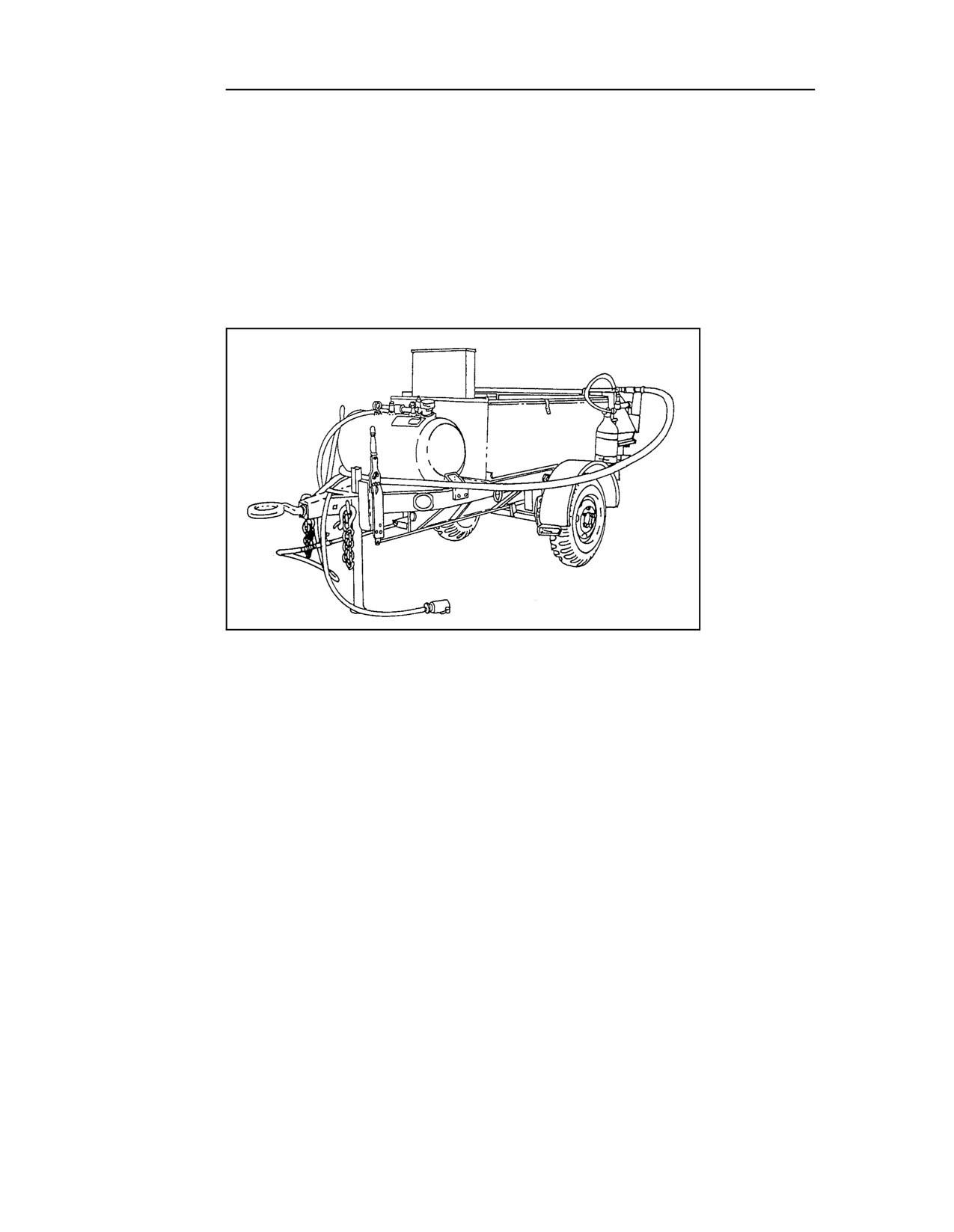
12-17. The 165-gallon asphalt kettle (Figure 12-7) is designed primarily for
surface patching and maintenance operations. The trailer-mounted tank
consists of an outer shell encompassing a 165-gallon capacity storage and
heating tank. A removable distillate burner, mounted inside the outer shell,
provides heat to the kettle. A flue carries off the exhaust gases. A small, two-
cylinder gasoline engine provides power to the asphalt pump. Asphalt is
applied to small patching projects through a flexible hose and a handheld
spray assembly.
Figure 12-7. Asphalt Kettle
SUPPORT EQUIPMENT
12-18. Use a rough-terrain forklift to transport and lift asphalt drums and
mineral filler. See Chapter 6 for information on forklifts. Use a loader to
maintain aggregate stockpiles and for other material-handling operations. See
Chapter 5 for information on loaders.
12-10 Road Surfacing
Chapter 13
Safety
Supervisors are responsible for ensuring that personnel follow safety
standards. Time is usually the controlling factor in construction operations
in the theater of operations. The necessity for economy of time, coupled
with the temporary nature of much of the work, sometimes results in
safety precautions that are substantially lower than those used in civilian
practice, but this does not mean safety can be ignored. Construction
equipment, except for dump trucks, is designed to accommodate only the
operator.
SAFETY PROGRAM
13-1. Do not construe the lack of documentation of hazards as an indication of
their nonexistence or insignificance. Where safety precautions are necessary
but are not documented, or where existing precautions are judged to be
inadequate, the commanding officer must issue new or supplementary
warnings. Each job has its own particular safety hazards. Identify dangers
and prepare a safety program to reduce or eliminate all hazards. Supervisors
must conduct all operations following the guidance in the safety program. For
help in making safety decisions, review the safety information in United
States (US) Army Corps of Engineers Manual (EM) 385-1-1. Additionally,
operators’ manuals give do’s and don’ts, cautions, and safety warnings. Check
them!
GENERAL SAFETY RULES
13-2. The appropriate chapters of this manual identify safety rules for specific
equipment. Also, check applicable technical and operator manuals prior to
operating all equipment. Some general safety rules are as follows:
• Inspect equipment before use, and periodically on a regular basis.
• Ensure that mechanized equipment is operated by qualified and
authorized personnel only.
• Use seat belts when they are available.
• Provide barriers to prevent personnel from walking under loading
equipment that has a hoist or lift capability.
• Operate equipment in a manner that will not endanger persons or
property.
• Observe safe operating speeds.
• Shut down and turn off the engine when equipment is unattended.
• Stop the equipment completely (apply the parking brake if available)
before mounting or dismounting.
Safety 13-1
FM 5-434
• Do not operate any machinery or equipment for more than
10
consecutive hours without an 8-hour rest interval.
• Post the safe load capacities at the operator's position on all
equipment not rigged to prevent overloading.
• Post the safe operating speeds at the operator’s position on all
equipment not having a speed governor.
• Mount a ROPS on equipment whenever it is available. Do not make
any modifications to the ROPS.
• Ensure that only the operator is on the equipment while it is running.
Supervisors can authorize exceptions in emergency situations, some
training situations, and when required for maintenance.
• Shut down and turn off the engine when refueling motor vehicles and
mechanized equipment.
OPERATOR INDOCTRINATION
13-3. Teach operator safety practices during machine operation training.
Indoctrinate operators about job hazards and ways to reduce or avoid them.
Instruct operators to observe fellow workers and to warn them when they get
into dangerous situations. Personnel should receive continuing instruction
during the project to ensure that they appreciate the job hazards and
understand the objectives of the safety program. Horseplay and practical
jokes create very dangerous situations on the work site.
OPERATOR QUALIFICATIONS AND REQUIREMENTS
13-4. Construction and material-handling equipment operators must be tested
and licensed according to Army Regulation (AR) 600-55. An apprentice or
applicant can only operate equipment under the direct supervision of a
licensed operator. Do not permit anyone who is not physically or mentally
capable to operate any equipment. Operators are responsible for the safe
operation of their equipment and for the safety of their passengers and cargo.
EQUIPMENT INSPECTION
13-5. Before using a machine, a qualified, licensed operator should inspect and
test the equipment to determine its safe operating condition. Equipment-
operator maintenance checks, service charts, and common sense ensure safe
operation and proper maintenance. Tag any unsafe machinery or equipment
“Out Of Service, Do Not Use” at the operator's position, to prevent its use until
repaired. Ensure that the equipment’s safety features (backup alarms, lights,
and so on) are operational.
REPAIRS AND MAINTENANCE
13-6. Besides the following items, check the unit’s SOP for special repair and
maintenance procedures.
• Shut down or lock out equipment controls while a machine is being
repaired, adjusted, or serviced.
• Position the equipment in a place, away from the project area, that is
safe for the mechanic to work.
13-2 Safety

FM 5-434
• Crib or block suspended machinery, equipment, or parts, and
machines held apart by slings, hoists, or jacks. Do not work
underneath or between items not properly blocked.
• Lower blades, bowls, hooks, buckets, and forks to the ground or onto
suitable blocking material when equipment is undergoing
maintenance or repairs.
GUARDS AND SAFETY DEVICES
13-7. Equipment guards, appliances, and similar devices are for the protection
of personnel. Do not remove these devices or render them ineffective. During
repairs, lubrication, or adjustments, remove guards temporarily, but only
after shutting off the power. Replace all guards and devices immediately after
completing repairs and adjustments. All equipment should have properly
working warning devices, such as backup alarms and turn signals.
SIGNALS
13-8. Provide a warning device or a signal person wherever there is possible
danger to fellow workers or others from moving equipment. If the tactical
situation allows, the signal person should wear a reflective, orange vest.
ROPES, CABLES, AND CHAINS
13-9. Table 13-1 and Tables 13-2 and 13-3, page 13-4, give load limitations and
safety factors for ropes, cables, and chains. Ropes, cables, and chains used in
construction operations present some of the largest potential safety hazards.
To eliminate these hazards
• Perform periodic inspections of their physical condition.
• Use only according to manufacturers' recommended procedures or
within the safe limits recommended by the manufacturers of the
equipment.
• Wear leather gloves when handling wire rope.
Table 13-1. Breaking Strengths of 6 x 19 Standard Wire Hoisting Rope
Breaking Strength in Tons (2,000-Pound Ton)
Diameter
Approximate Weight
Mild Plow
Improved Plow
(Inches)
Per 100 Feet (Pounds)
Steel
Plow Steel
Steel
1/4
10
2.07
2.39
2.74
3/8
23
5.00
5.50
6.30
1/2
40
8.50
9.40
10.80
5/8
63
13.10
14.40
16.60
3/4
90
18.70
20.60
23.70
7/8
123
25.40
28.00
32.20
1
160
33.00
36.50
42.00
1 1/8
203
41.50
46.00
53.00
1 1/4
250
57.00
56.50
65.00
1 1/2
360
72.50
80.50
92.50
NOTES:
1. A 6 x 19 rope is composed of 6 strands of 19 wires each. The strength of wire rope
varies slightly with the strand construction and the number of strands.
2. The maximum allowable load is the breaking strength divided by the appropriate
safety factor. The safety factors are shown in Table 13-3, page 13-4.
Safety 13-3

FM 5-434
Table 13-2. Breaking Strengths and Safe Loads for Manila and Sisal Rope
Number 1 Manila
Sisal
Nominal
Weight Per
Breaking
Breaking
Diameter
Circumference
100 Feet
Strength
Safe Load (Pounds)
Strength
Safe Load (Pounds)
(Inches)
(Inches)
(Pounds)
(Pounds)
(Safety Factor = 4)
(Pounds)
(Safety Factor = 4)
1/4
3/4
2.00
540
140
440
120
3/8
1 1/8
4.10
1,260
320
1,020
260
1/2
1 1/2
7.50
2,640
660
2,120
530
5/8
2
13.30
4,400
1,100
3,520
880
3/4
2 1/4
16.70
5,400
1,350
4,320
1,080
7/8
2 3/4
18.60
7,700
1,920
6,160
1,540
1
3
27.00
9,000
2,250
7,200
1,800
1 1/8
3 1/2
36.00
12,000
3,000
9,600
2,400
1 1/4
3 3/4
41.80
13,440
3,360
10,800
2,700
1 1/2
4 1/2
60.00
18,500
4,620
14,800
3,700
1 3/4
5 1/2
89.50
26,500
6,620
21,200
5,300
2
6
108.00
31,000
7,750
24,800
6,200
2 1/2
7 1/2
135.00
46,500
11,620
37,200
9,300
3
9
242.00
64,000
16,000
51,200
12,800
NOTE: The above figures are for new rope used under favorable conditions. As rope ages or deteriorates,
progressively reduce safe load values to one-half the values given. See safety factors shown in Table 13-
3.
Table 13-3. Safety Factors for Ropes, Cables, and Chains
Wire Rope
Manila or
Type of Service
(Cable)
Sisal Rope
Chain
Guy lines
3.5
3.5
3.5
Miscellaneous hoisting equipment
5.0
7.0
5.0
Haulage lines
6.0
8.0
6.0
Overhead and gantry cranes
6.0
Jib and pillar cranes
6.0
Derricks
6.0
Small, electric or air hoists
7.0
7.0
Slings
8.0
10.0
8.0
NOTE: To determine the safe load for a single line, divide the breaking strength
of the line by the applicable safety factor and multiply the result by an assumed
efficiency factor of 80 percent for fittings.
INSPECTION
13-10. Inspect wire rope or cable at the time of installation and as part of daily
operator maintenance. Remove the wire rope or cable from hoisting service
when it is kinked, or when it has a number of broken wires in a strand.
Remove the wire rope or cable when
• Three broken wires are found in one strand of 6 × 7 wire rope.
• Six broken wires are found in one strand of 6 × 19 wire rope.
• Eight broken wires are found in one strand of 8 × 19 wire rope.
• Nine broken wires are found in one strand of 6 × 37 wire rope.
NOTE: Plainly mark defective wire rope as unsuitable for further use
and dispose of properly.
13-4 Safety
FM 5-434
SLINGS
13-11. Only qualified rigging personnel should attach slings to a load. When
using slings, their fasteners, and other rigging attachments
• Inspect daily for evidence of overloading, excessive wear, or damage.
Replace defective slings or accessories.
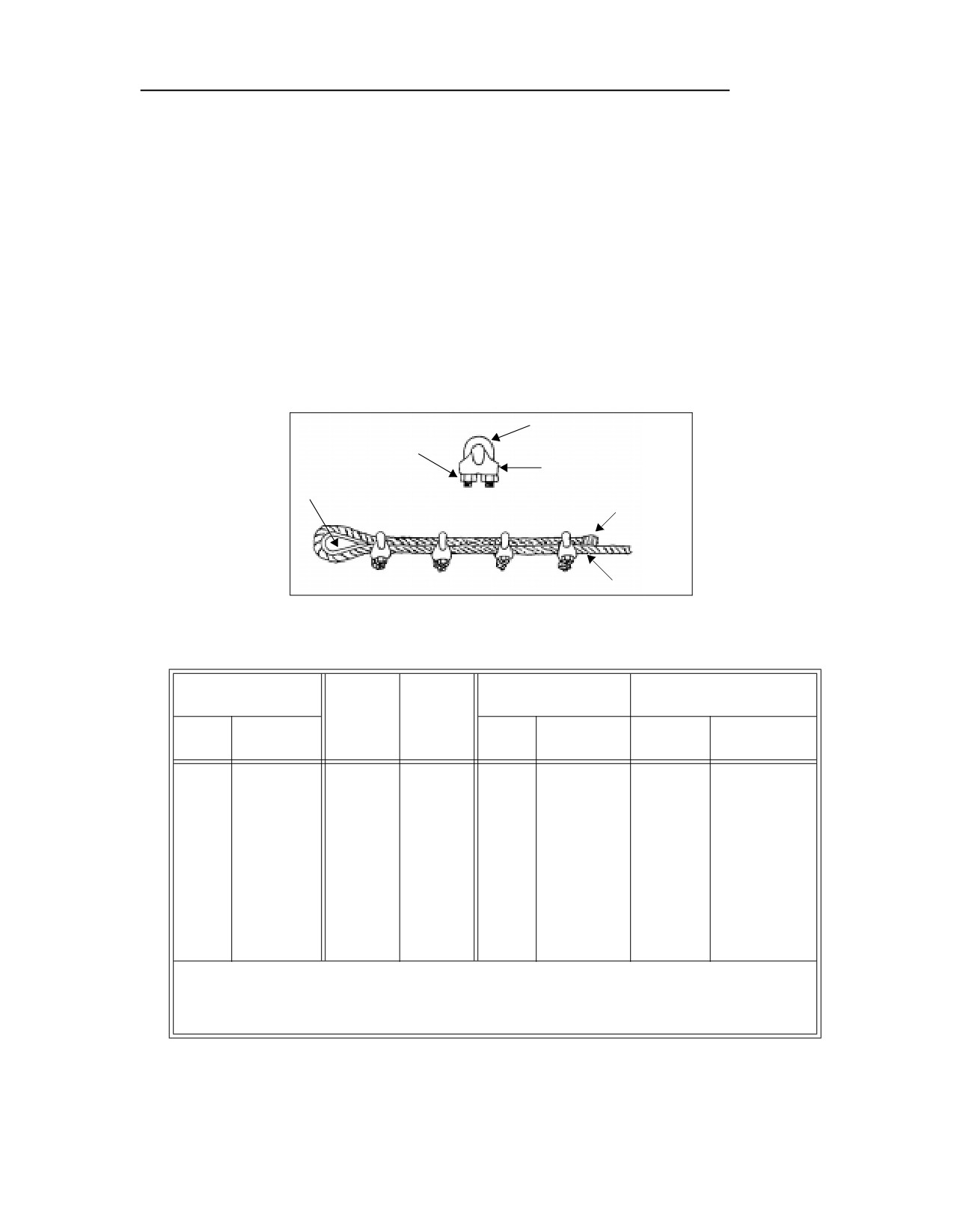
• Make all eye splices (Figure 13-1) using the proper size of wire-rope
thimbles.
• Place the U-bolt of the U-bolt clips on the dead (short) end of the wire
rope (see Figure 13-1). Tighten the U-bolts immediately after initial
load application and at frequent intervals thereafter. Table 13-4
shows the number and spacing of clips and the proper torque to apply
to the nuts of the clips (do not over torque). The minimum number of
clips is three.
U-bolt
Nuts (2)
Saddle
Thimble
Dead end
Live end
Figure 13-1. Eye splice
Table 13-4. Number and Spacing of U-Bolt clips for Wire-Rope Eye Connections
Torque to be
Wire-Rope Diameter
Spacing of Clips
Applied to Nuts of Clips
Nominal
Clip Size
Number
Foot-
(M-Kg)
Inches
Millimeters
(Inches)
of Clips
Inches
Millimeters
Pounds
(0.1383)
5/16
7.95
3/8
3
2
50
25
3.5
3/8
9.52
3/8
3
2 1/4
57
25
3.5
7/16
11.11
1/2
4
2 3/4
70
40
5.5
1/2
12.70
1/2
4
3
76
40
5.5
5/8
15.85
5/8
4
3 3/4
95
65
9.0
3/4
19.05
3/4
4
4 1/2
114
100
14.0
7/8
22.22
1
5
5 1/4
133
165
23.0
1
25.40
1
5
6
152
165
23.0
1 1/4
31.75
1 1/4
5
7 1/2
190
250
35.0
1 3/8
34.92
1 1/2
6
8 1/4
210
375
52.0
1 1/2
38.10
1 1/2
6
9
230
375
52.0
1 3/4
44.45
1 3/4
6
10 1/2
267
560
78.0
NOTE: The spacing of clips should be six times the diameter of the wire rope. For end-to-end
connections, increase the number of clips listed above by two, and apply the proper torque
listed above on all clips. Reverse U-bolts at the center of the connection, so that they are on the
dead (reduced load) end of each wire rope.
Safety 13-5
FM 5-434
HOOKS AND SHACKLES
13-12. When using hooks and shackles—
• Replace bent, twisted, or otherwise damaged hooks, shackles, rings,
and pad eyes and other fittings that show excessive wear.
• Close all hooks used to support human loads or loads that pass over
workers. Where there is danger of relieving the tension on the cable
due to the load or hook catching or fouling (such as lowering a load in
a confined space), do not use open hooks.
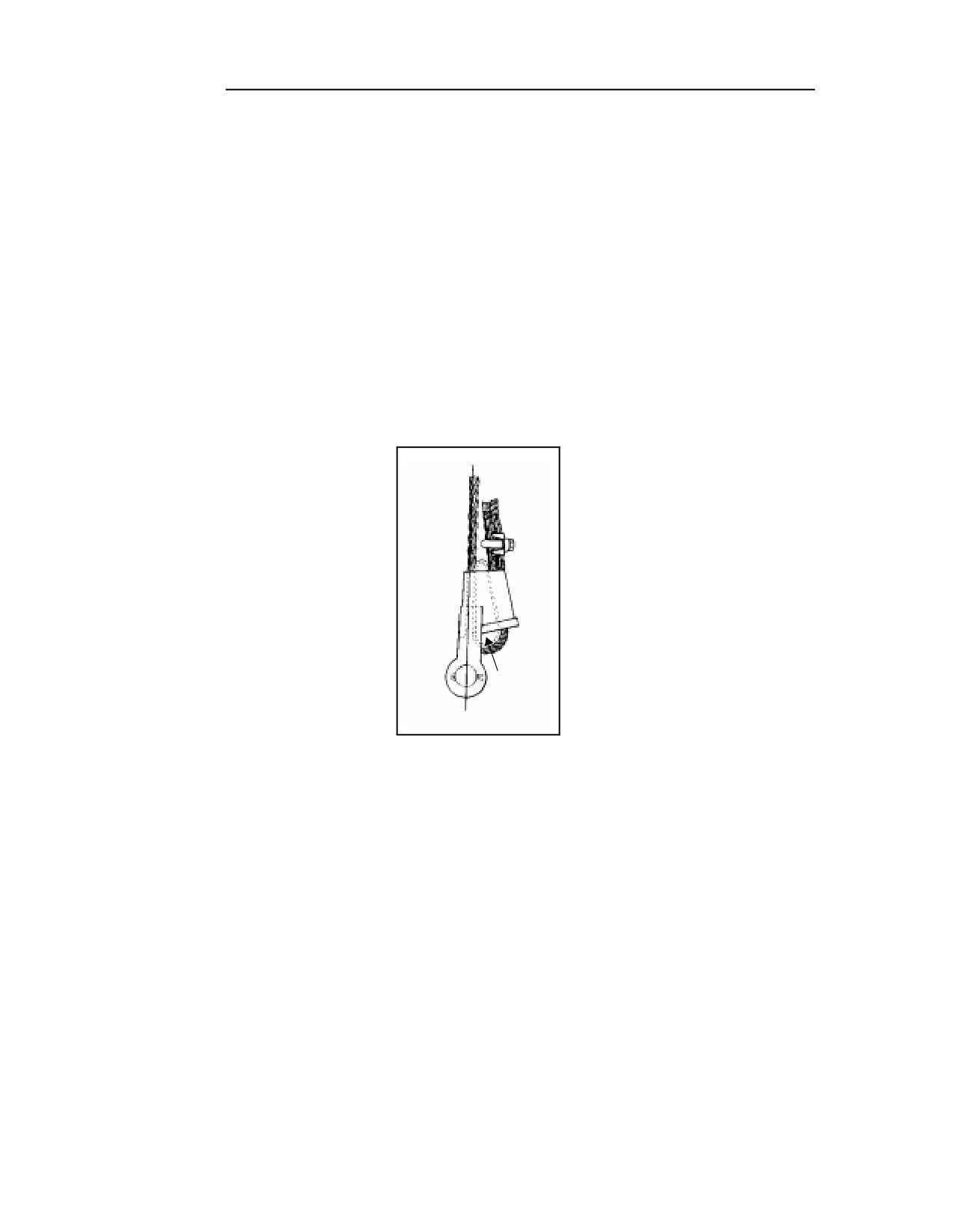
• Extend the dead end of the wire rope a distance of six to nine times the
wire rope’s diameter beyond the socket when using a wedge-socket
fastener (Figure 13-2). Clamp the dead end of the wire rope to an extra
piece of short wire rope. Place the clamp as close to the wedge as
possible. Never clamp the dead end of wire to the live end. The U-bolt
should bear against the tail, and the saddle of the clip should bear
against the short extra piece.
Wedge
Figure 13-2. Wedge-Socket Fastener
EQUIPMENT LOADING
13-13. When loading equipment using suspended or overhead loading devices,
the operator of the truck to be loaded must leave the cab. When loading
equipment for transporting
• Distribute, chock, and tie down the load.
• Make sure that the forward and side vision are clear, and that the
load does not interfere in any way with the safe operation of the
vehicle.
• Keep the load within the sides of the hauling equipment. When
working with oversize loads that extend beyond the sides or end of
hauling equipment, give adequate warnings and precautions to
prevent endangering passing or opposing traffic, or damaging the
vehicle.
13-6 Safety
FM 5-434
EQUIPMENT TRANSPORTING
13-14. Give special consideration to equipment that is wider than standard
vehicles or that protrudes past the sides or end of the hauling trailer. When
oversize equipment is traveling or being transported from one job site to
another
• Travel or transport during daylight hours.
• Use warning flags and/or lights.
• Accompany the equipment with a lead and/or follow vehicle with
warning signs whenever possible, especially in congested or heavy
traffic areas.
NIGHT OPERATIONS
13-15. When operating equipment at night
• Equip all mobile equipment with adequate headlights and taillights.
• Keep construction roads and working areas well illuminated until all
workers have left the area.
• Ensure that signalers, spotters, inspectors, maintenance personnel,
and others who work in dark areas exposed to vehicular traffic wear
reflectorized vests or other such apparel if the tactical situation
permits.
EXCAVATIONS
13-16. When excavating
• Shore, brace, or slope excavations that are more than 4 feet deep,
unless working in solid rock, hard shale, hardpan, cemented sand and
gravel, or other similar materials.
• Design shoring and bracing to be effective all the way to the bottom of
the excavation.
• Use sheet piling, bracing, shoring, trench boxes, or other methods of
protection, including sloping, based upon calculation of the pressures
exerted by and the condition and nature of the materials being
retained.
• Provide additional shoring and bracing to prevent slides or cave-ins
when excavating or trenching in locations adjacent to backfilled
excavations or when subjected to vibrations from traffic, vehicles, or
machinery.
Safety 13-7
FM 5-434
13-8 Safety
Chapter 14
Environmental Protection
US military forces operate under increasingly diverse environmental
requirements, both domestic and foreign, particularly during stability
operations and support operations. Heightened environmental concern has
led all federal agencies, including the armed services, to consider the
environmental consequences of proposed actions. Compliance with
environmental laws and regulations is now a necessary cost of doing
business. The military must comply with all environmental laws and
regulations that apply to installations or theaters of operation. See TC 20-
401 for additional information concerning military environmental
protection.
PREOPERATIONS CHECKLIST
14-1. Unit leaders must consider the environmental impact of unit actions and
plan to eliminate or minimize negative effects. An example of a preoperations
checklist is shown below.
• Has coordination occurred with the installation and operational staffs
concerning applicable environmental laws, regulations, and
considerations?
• Has the operation plan (OPLAN)/operation order (OPORD) and or
constructive directives been reviewed for environmental requirements
or considerations?
• Has the environmental-protection portion of the unit's SOP been
reviewed, especially the areas concerning spill response and
reporting?
• Have land-use permits and range clearances been obtained? Have all
other unique, environmental-related requirements been completed?
• Has a recent risk assessment been performed to identify
environmental-related risks?
• Have areas of environmental concern been verified during site
reconnaissance?
• Are rehearsals conducted to ensure that all safety and environmental
considerations are satisfied?
• Are hazardous material (HM) and petroleum, oils, and lubricants
(POL) checked to ensure that they are properly labeled and that a
material safety data sheet (MSDS) is on hand for each substance
before transporting?
• Are personnel designated for the spill-response team(s) properly
trained and aware of their assignment?
Environmental Protection 14-1
FM 5-434
• Are tools, equipment, and materials
(spill kits) available for
environmental emergencies?
• Have previous after action reviews
(AARs) been evaluated for
environmental lessons learned concerning the area(s) of operation and
the mission type, and have preventive measures been taken?
PERSONNEL-PREPARATION CHECKLIST
14-2. An example of a personnel-preparation checklist is shown below.
• Do soldiers understand their responsibilities in reducing the
generation of hazardous waste (HW) and minimizing damage to the
environment?
• Have all soldiers been briefed on range or maneuver restrictions and
endangered species, vegetation, archeological, cultural, and historic
resource preservation?
• Are identified environmental risks discussed during planning?
SPILL-RESPONSE PLAN
14-3. A spill is defined as any quantity of petroleum product over 5 gallons (or
according to local laws since some states are more stringent than 5 gallons) or
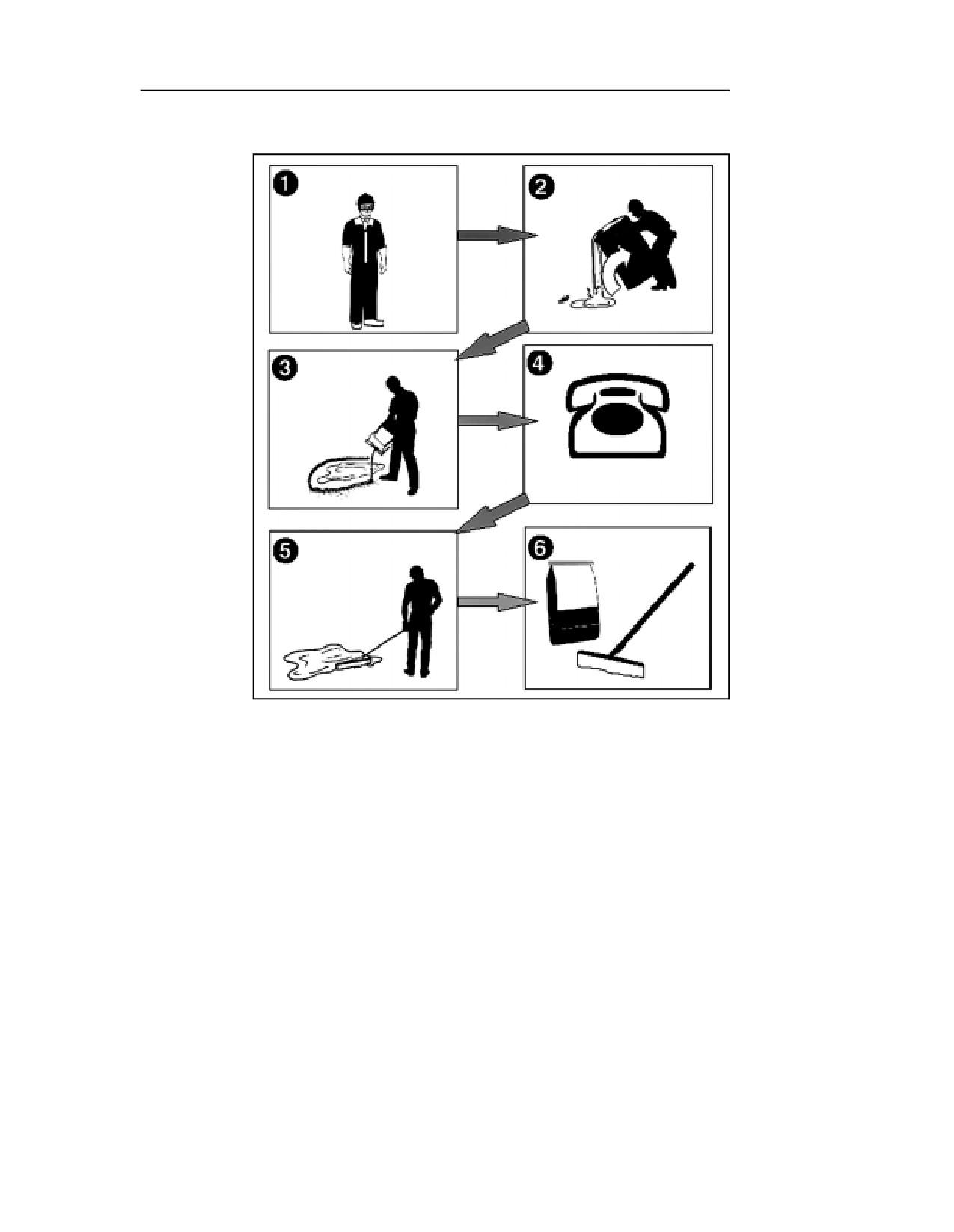
any quantity of HW. Should a spill occur, take the following actions
immediately (Figure 14-1).
14-4. Protect yourself by—
• Evacuating the area in a manner appropriate to the type of spill.
• Taking personal precautions as detailed in the MSDS for the type of
material spilled.
• Using the proper personal protective equipment.
• Extinguishing smoking materials and all sources of ignition.
• Turning off power if there is the possibility of fire.
• Ventilating the area.
• Showering and changing clothes
(as soon as possible) if HW
contamination occurs.
14-5. Stop the flow if it is possible, without taking unnecessary chances or
causing injury or contamination, by shutting off valves and turning drums
upright.
14-6. Contain the spill by—
• Using an absorbent.
• Making dams to keep the spill from spreading farther. Do not let it
enter storm or sewer drains or other waterways.
• Diverting the flow to prevent the spill from entering any water source
(including drains) if containment is not possible.
14-2 Environmental Protection
FM 5-434
Protect yourself
Stop the flow
1
2
4
3
Contain the spill
Report the spill
6
5
Clean the spill
Replace equipment
Figure 14-1. Spill-Response Actions
14-7. Report the spill to a superior and—
• Sound an alarm or give a verbal warning.
• Continue to assess the size and severity of the spill, while having
another person call the installation fire department.
• Report the spill of any HM other than a petroleum product (regardless
of the quantity) to the unit environmental compliance officer or the
installation’s environmental office immediately.
14-8. Clean the spill by—
• Scooping up the contaminated material and put it in a container.
Mark the container “Hazardous Waste, Contaminated Dirt” if the spill
occurred on concrete or asphalt and the spill was cleaned up with dirt.
• Checking with the unit supply sergeant or the Defense Reutilization
Management Office (DRMO) for proper disposal procedures.
Environmental Protection 14-3
FM 5-434
14-9. Replace the spill equipment through the following procedures—
• Immediately after a spill is cleaned, the spill-response team’s
noncommissioned officer in charge (NCOIC) will account for all tools
and supplies. The NCOIC will order replacement consumables
(sweeping compound and rags) from unit supply. The NCOIC will also
identify missing property and initiate appropriate action (statement of
charges or report of survey) to maintain accountability.
• Before resealing the drums, the spill-response team’s NCOIC will
complete a spill-kit inventory.
14-4 Environmental Protection

APPENDIX A
Metric Conversion Chart
This appendix complies with current Army directives, which state that the
metric system will be incorporated into all new publications. The following
table is an English-to-metric conversion chart.
Table A-1. Metric Conversion Chart
Multiplied
Equals
Multiplied
Equals
US Units
By
Metric Units
Metric Units
By
US Units
Length
Inches
2.5400
Centimeters
Centimeters
0.3937
Inches
Feet
0.3048
Meters
Meters
3.2808
Feet
Yards
0.9144
Meters
Meters
1.0936
Yards
Miles
1.6093
Kilometers
Kilometers
0.6214
Miles
Area
Square inches
6.4516
Square centimeters
Square centimeters
0.1550
Square inches
Square feet
0.0929
Square meters
Square meters
10.7640
Square feet
Square yards
0.8361
Square meters
Square meters
1.1960
Square yards
Acres
0.4047
Hectares
Hectares
2.4710
Acres
Volume
Cubic feet
0.0283
Cubic meters
Cubic meters
35.3144
Cubic feet
Cubic yards
0.7646
Cubic meters
Cubic meters
1.3079
Cubic yards
Gallons
3.7854
Liters
Liters
0.2642
Gallons
Weight
Foot-pounds
1.3830
Newton-meters
Newton-meters
0.7380
Foot-pounds
Pounds
0.4536
Kilograms
Kilograms
2.2046
Pounds
Foot-pounds
1.3830
Newton-meters
Newton-meters
0.7380
Foot-pounds
Metric Conversion Chart A-1
Glossary
AAR
after action review
AFJPAM
Air Force joint pamphlet
AFJMAN
Air Force joint manual
aggregate
a clustered mass of individual soil particles varied in shape,
ranging in size from a microscopic granule to a small crumb, and
considered the basic structural unit of soil
AR
Army regulation
atomize
to reduce to a fine spray
Atterberg limits
water contents at certain critical stages in soil behavior; they can
be used to describe the plasticity of a soil and if the soil is cohesive
or cohesionless
attn
attention
ballast
a heavy substance (such as wet sand) used to increase the weight
of rollers
base course or base
important element in a road structure; it functions as the primary
load-bearing component of the road, ultimately providing the
pavement (or surface) strength; therefore, it is made of higher
quality material than subbase material
BCY
bank cubic yard(s)
binder
a material that produces cohesion in loosely assembled
substances; for example, tar, cement, and cohesive soil material
passing a Number 40 sieve
borrow pit
an area where material is excavated for use as fill at another
location
CCY
compacted cubic yard(s)
cfm
cubic feet per minute
chock
motionless; for blocking the movement of a wheel
clay
a cohesive soil that exhibits plasticity within a range of water
contents and whose particles are less than 0.005 millimeters in
size
coefficient
any of the factors of a product considered in relation to a specific
factor, especially a constant factor of a term as distinguished from
a variable
cohesion
the act or state of sticking together tightly
cycle time
cycle time is the time required for a machine to complete one cycle
of operation
DA
Department of the Army
Glossary-1
FM 5-434
desired dry density
usually expressed as an acceptable density range but stated as a
single value when used to determine soil stabilizing requirements
DEUCE
deployable universal combat earthmover
dredging
method of moving material from below a body of water
DRMO
Defense Reutilization Management Office
efficiency factor
a percentage factor (60-minute working hour = 100 percent) used
to adjust production estimates for normal production delays
EM
engineer manual
EVW
empty vehicle weight
F
Fahrenheit
finishing
the final grading of an embankment or other earthwork or the
smoothing of a wearing surface after it is placed
FM
field manual
FMTV
family of medium tactical vehicles
fpm
foot, feet per minute
FSN
federal stock number
ft
foot, feet
gantry
a triangular frame on top of a crane superstructure, which carries
sheaves for the boom support lines; also, a platform (usually
supported by towers) made to carry a traveling crane on parallel
tracks
gap graded
see soil gradation
GPM
gallons(s) per minute
gradation
see soil gradation
granular
consisting of particles having a bulky shape
gravel
see soil
GVW
gross vehicle weight
heaped
material piled above the sides of a restricting container (such as
an excavator bucket, a scraper bowl, or a dump-truck carrying
box)
HM
hazardous material
hopper
usually, a funnel-shaped receptacle for holding and loading
material (grain, sand, crushed rock, or coal); also, any of various
other receptacles for the temporary storage of material
HQ
headquarters
HW
hazardous waste
in situ
soil in its natural (undisturbed) state
in-place mixing
mixing done at the construction site
inst
institute
kph
kilometers(s) per hour
lb
pound(s)
Glossary-2
FM 5-434
LCY
loose cubic yard(s)
lift
the depth of material that may be placed or compacted at one time
load time
the time it takes the loading equipment to actually load the haul
unit, plus any time lost by the loading equipment while waiting for
the haul unit to be spotted
loam
a general agricultural term applied most frequently to sandy, silty
topsoils that contain a trace of clay
M-Kg
meters to kilograms
mph
mile(s) per hour
MSDS
material safety data sheet
NA
not applicable
NATO
North Atlantic Treaty Organization
NAVFAC
naval facility
NCOIC
noncommissioned officer in charge
NSN
national stock number
No.
number
OMC
optimum moisture content
OPLAN
operation plan
OPORD
operation order
optimum moisture
the moisture content at which the soil’s highest density can be
content
obtained for a given amount of compactive input energy; soils
compacted at moisture contents below optimum do not compact as
completely as those at optimum moisture; those above optimum
approach a plastic stage and begin to act like liquids, distributing
an applied force equally in all directions and not moving particles
into the voids
outriggers
stabilizers used on cranes and backhoes to prevent tipping while
loading or digging
pcf
pounds per cubic foot
PCSA
Power Crane and Shovel Association
PI
plasticity index
pintle
a pivot pin (usually upright) on which another part turns
plasticity
the ability of a soil to deform without cracking or breaking; see also
optimum moisture content
POL
petroleum, oils, and lubricants
psi
pound(s) per square inch
push loading
loading a scraper with dozer (push tractor) assistance
push tractor or
a dozer pushing a scraper during earthmoving operations
pusher assistance
rimpull
the usable force developed between the driving tires and the travel
surface
Glossary-3
FM 5-434
ripping
digging or tearing hard material using shanks (teeth) mounted on
a dozer, grader, or other machine; the number of shanks mounted
on the back of a dozer can usually be changed to engage one, two,
or three shanks
ROPS
rollover protective system
rpm
revolution(s) per minute
RPR
rimpull required
SCIP
scarify and compact in place
SEE
small emplacement excavator
shore
(1) to give support to; brace; (2) a prop for preventing sinking or
sagging; (3) a prop placed against or beneath equipment to restrict
movement
shoulder
that part of the top surface of an approach embankment,
causeway, or cut immediately adjoining the roadway that
accommodates stopped vehicles in emergencies and laterally
supports base and surface courses
side casting
to push or throw to the side, using with the blade or bucket
soil
soil is classified by particle size and type; gravel has large, coarse,
blocky-shaped particles, while clay has small, fine, platy-shaped
particles; sand and silt have particle sizes between these two
extremes; (for earthmoving, soil is placed in three categories: rock,
soil, and rock soil)
soil gradation
soil is either well-graded or poorly graded; well-graded soil is
capable of being tightly compacted; it contains a variety of particle
sizes; during compaction, smaller particles are worked between
and around larger particles to reduce the percentage of voids,
making the soil denser and stronger; poorly graded soil is difficult
or impossible to compact; it contains a high percentage of similar-
size particles (called uniformly gapped) or a poor relationship of
the percentage of sizes (called gap -graded); such soil has a
relatively high percentage of voids after compaction; therefore, it
lacks density and strength
SOP
standing operating procedure
sq
square
STP
soldier training publication
struck
a full load of material that is level with the top of its container,
(such as a scraper bowl or a dump-truck body)
tandem
a group of two or more arranged one behind the other or used or
acting in conjunction
TB
technical bulletin
TC
training circular
tine
a slender, pointed projecting part; a prong
TM
technical manual
Glossary-4
FM 5-434
torque
a force that produces or tends to produce rotation or torsion (such
as an auto engine delivers to the drive shaft)
TRADOC United States Army Training and Doctrine Command
US United States
USAES United States Army Engineer School
USCS Unified Soil Classification System
vpm vibrations per minute
windrows a long, low ridge of material scraped to the side, using a blade,
when moving earth
yd yard(s)
Glossary-5
Bibliography
AR 600-55. The Army Driver and Operator Standardization Program (Selection, Training,
Testing, and Licensing). 31 December 1993.
Caterpillar® Performance Handbook, 28th Edition. Caterpillar Incorporated, Peoria, Illinois.
October 1997.
Compressed Air Handbook. Compressed Air and Gas Institute. 1947.
Construction Planning, Equipment, and Methods, 5th Edition. Robert L. Peurifoy, William D.
Ledbetter, and Clifford J. Schexnayder. McGraw Hill Company, Incorporated. 1996.
EM 385-1-1. Safety and Health Requirements Manual. 3 September 1996.
FM 5-34. Engineer Field Data. 30 September 99.
FM 5-125. Rigging Techniques, Procedures, and Applications. 3 October 1995.
FM 5-134. Pile Construction. 18 April 1985.
FM 5-410. Military Soils Engineering. 23 December 1992.
FM 5-412. Project Management. 13 June 1994.
FM 5-430-00-1. Planning and Design of Roads, Airfields, and Heliports in the Theater of
Operations—Road Design. AFJPAM 32-8013, Volume I. 26 August 1994.
FM 5-430-00-2. Planning and Design of Roads, Airfields, and Heliports in the Theater of
Operations—Airfield and Heliport Design. AFJPAM 32-8013, Volume II. 29 September 1994.
FM 5-436. Paving and Surfacing Operations. To be published within six months.
FM 5-472. Materials Testing. NAVFAC MO 330/AFJMAN 32-1221(I). To be published within six
months.
STP 5-62E12-SM-TG. Soldier's Manual and Trainer's Guide: Military Occupational Specialty
62E, Heavy Construction Equipment Operator, Skill Levels 1/2. 25 September 1985.
TB 43-0142. Safety Inspection and Testing of Lifting Devices. 28 February 1997.
TC 20-401. The Soldier and the Environment. To be published within six months.
TM 5-332. Pits and Quarries. 15 December 1967.
TM 5-2330-360-14&P. Operator's, Organizational, Direct Support and General Support
Maintenance Manual, Including Repair Parts and Special Tools List for Semitrailer, Low-bed:
40-Ton Construction Equipment Transporter, M870 (CCE) (CMI/Load King Model 403LF)
(NSN 2330-00-133-1731). 6 December 1984.
TM 5-2410-233-20. Organizational Maintenance Manual Tractor, Full-Tracked, Low Speed; DED;
Medium Drawbar Pull; Oscillating Track, 78-Inch Gage (Caterpillar Model D7F) with Ripper
(NSN 2410-00-177-7283); with Ripper and ROPS (NSN 2410-00-185-9794); with Ripper,
ROPS (CAB) Winterized (NSN 2410-00-30-6665); with Winch (NSN 2410-00-177-7284); with
Bibliography-1
FM 5-434
Winch and ROPS (NSN 2410-00-185-9792) and with Winch, ROPS (CAB) Winterized (NSN
2410-00-300-6664). 31 August 1973.
TM 5-3805-248-14&P-1. Scraper, Earthmoving, Motorized; Diesel Engine Driven (NSN
3805-01-153-1854) Operation. 19 August 1985.
TM 5-3805-261-10. Operator’s Manual for Grader, Heavy, Road, Motorized, Caterpillar Model
130G (NSN 3805-01-150-4795). 30 March 1989.
TM 5-3810-232-12. Operator and Organizational Maintenance Manual: Crane, Wheel Mounted:
20-Ton at 10-Foot Radius, 2 Engines, Diesel Engine Driven, 4 x 4 Air Transportable, 3 Phase
with Blade, Bulldozer, Earthmoving with Block, Tackle, 20-Ton with Boom Crane, 30 Foot
(American Hoist and Derrick Models 2380 (NSN 3810-00-763-7728) and 2385 (3810-
00-043-5354). 10 September 1970.
TM 5-3810-294-20. Organizational Maintenance Manual for Crane-Shovel, Truck Mounted; 3/4
Cubic Yard, 20-Ton, with Clamshell, Dragline, and Backhoe Attachments, Gasoline Engine
Driven. (Harnischfeger Corporation Model M32OT2) (NSN 3810-00-151-4431). 5 April 1974.
TM 5-3825-221-15. Operator’s, Organizational, Direct Support, General Support and Depot
Maintenance Manual: Distributor, Water, Tank-Type: Truck Mounted; Gasoline Driven
(MacLeod Model W15A, Nonwinterized) (NSN 3825-00-954-9033); Multifuel Driven (MacLeod
Model W15A, Winterized) (3825-00-774-9090); Multifuel Driven (MacLeod Model W15A4112)
(3825-00-077-0550) and Diesel Driven (MacLeod Model W15E9019) (3825-00-474-3742).
16 December 1964.
TM 5-3895-275-12. Operator and Organizational Maintenance Manual for Paving Machine,
Bituminous Material, Gasoline Engine Driven: Crawler Mounted, 8- to 10-Foot Wide
(Barber-Greene Model SA-35) (NSN 3895-057-8715). 31 December 1974.
TM 5-3895-330-10. Operator’s Manual for Spreader, Aggregate, Towed: Force Feed, Pneumatic
Tires; 8-Foot Width (Burch Corporation, Model FF-8) (FSN 3895-130-3633). 17 May 71.
TM 5-3895-334-15. Operator, Unit, Direct Support, General Support, and Depot Maintenance
Manual for Kettle, Heating, Bituminous, Gasoline Engine; Wheel Mounted, 2 Pneumatic Tires;
165-Gallon Capacity (White Manufacturing, Model F3M-1) (NSN 3895-00-442-9741). 29 April
1970.
TM 5-3895-353-14&P. Operator’s, Organizational, Direct Support, and General Support
Maintenance Manual Including Repair Parts Information and Supplementary Operating,
Maintenance and Repair Parts Instructions for Roller, Vibratory, Self-Propelled (CCE) Model
SP-848 (NSN 3895-01-075-2823). 24 April 1981.
TM 5-3895-371-10. Operator’s Manual for Bituminous Distributor Body, M918 (Model D-63)
(NSN 3895-01-028-4390). 5 October 1979.
TM 55-2410-234-14. Highway Transport Procedures: Transport of Caterpillar Model D8K-8S-8
Tractor with Ripper or Winch on M870, 40-Ton Low-bed Semitrailer Using the M920 Truck
Tractor. 10 August 1984.
TM 5-624. Maintenance and Repair of Surface Areas. 27 October 1995.
TM 5-822-8. Bituminous Pavements-Standard Practice. 30 July 1987.
TM 9-2320-272-10. Operator’s Manual for Truck, 5-Ton, 6 x 6, M939, M939A1, and M939A2
Series Trucks (Diesel). 15 August 1996.
Bibliography-2
FM 5-434
TM 9-2320-361-10. Operator’s Manual for 2 1/2-Ton, 6 x 6, M44A2 Series Trucks (Multifuel);
Truck, Cargo: 2 1/2-Ton, 6 x 6, M35A2, M35A2C, M36A2; Truck, Tank, Fuel: 2 1/2-Ton, 6 x 6,
M49A2C; Truck, Tank, Water: 2 1/2-Ton, 6 x 6, M50A2, M50A3; Truck, Van, Shop: 2 1/2-Ton,
6 x 6, M109A3; Truck, Instrument Repair Shop: 2 1/2-Ton, 6 x 6, M185A3; Truck, Tractor: 2
1/2-Ton, 6 x 6, M275A2; Truck, Dump: 2 1/2-Ton, 6 x 6, M342A2; Truck, Maintenance,
Pipeline Construction: 2 1/2-Ton, 6 x 6, M756A2; Truck, Maintenance, Earth Boring and
Polesetting: 2 1/2-Ton, 6 x 6, M764. 15 December 1988.
TM 9-2330-211-14&P. Operator’s, Unit, Direct Support, and General Support Maintenance
Manual (Including Repair Parts and Special Tools List) for Semitrailer, Low-Bed: 25-Ton,
4-Wheel, M172A1 (NSN 2330-00-317-6448). 14 July 1991.
TM 9-2330-294-14. Operator’s, Organizational, Direct Support, and General Support Maintenance
Manual: Semitrailer, Low-Bed, Heavy Equipment Transporter, 60-Ton, M747 (NSN
2330-00-089-7265). 5 May 1976.
Bibliography-3