FM 5-434 Earthmoving Operations (JUNE 2000) - page 2
FM 5-434
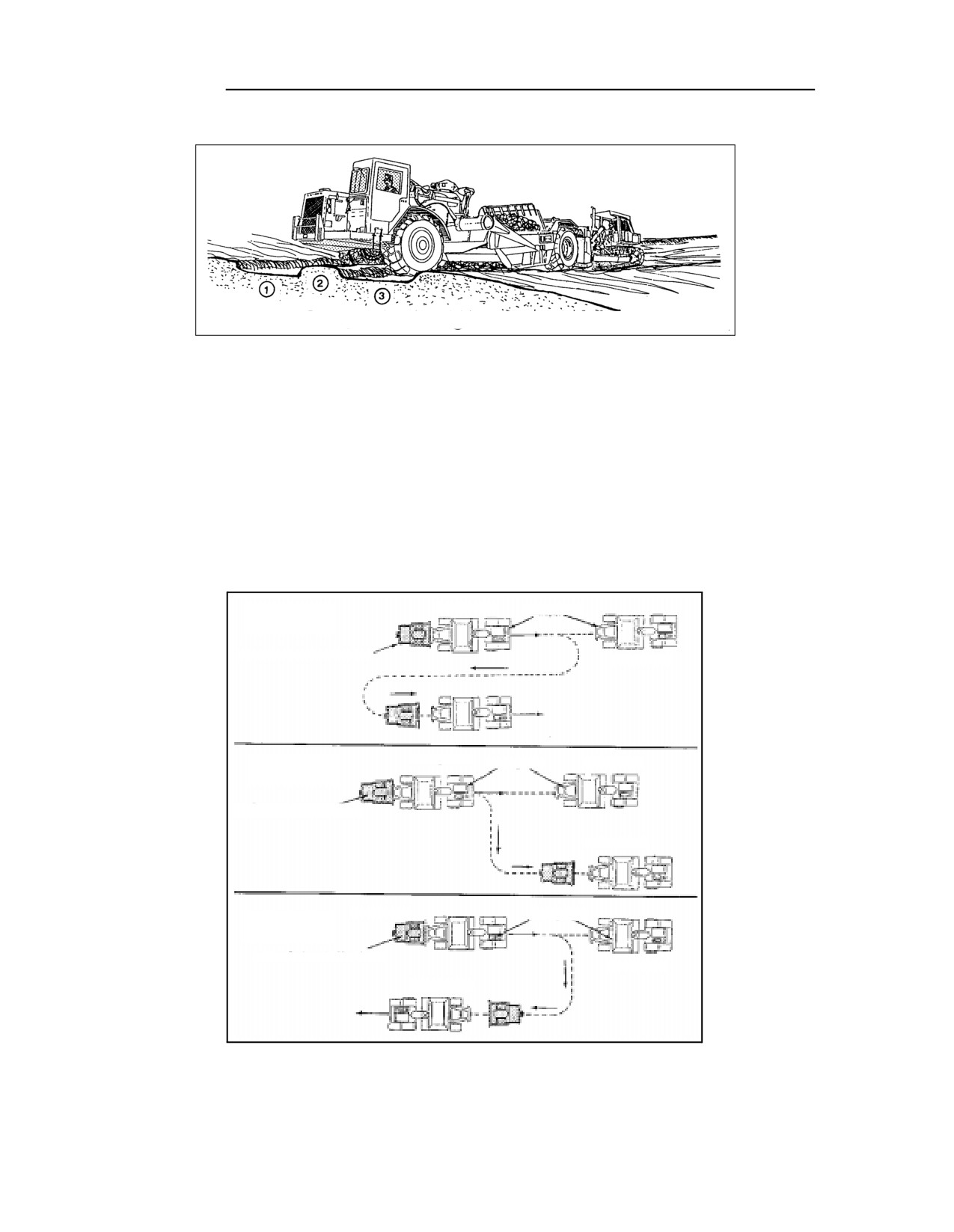
Make cuts 1 and 3, leaving a center strip (2) one-half blade width.
Figure 3-20. Straddle Loading With Pusher Assistance
Push-Loading
3-54. Back-Track. Use the back-track push-loading technique (Figure 3-4)
where it is impractical to load in both directions. However, this method is
inefficient due to the time spent in backing up and repositioning for the next
load.
3-55. Chain. Use the chain push-loading technique (Figure 3-4) where the cut
is fairly long, making it possible to pick up two or more scraper loads without
backtracking. The pusher pushes one scraper, then moves behind another
scraper that is moving in the same direction in an adjacent lane.
Back-track
Loading
Scraper
loading
Push-tractor (dozer)
Loaded
Chain
Loading
Scraper
Loaded
loading
Push-tractor (dozer)
Loading
Loading
Scraper
Shuttle
loading
Push-tractor (dozer)
Loaded
Loading
Figure 3-21. Push-Loading Techniques
3-4 Scrapers
FM 5-434
3-56. Shuttle. Use the shuttle push-loading technique (Figure 3-4) for short
cuts where it is possible to load in both directions. The pusher pushes one
scraper, then turns and pushes a second scraper in the opposite direction.
Cut-and-Load Sequence
3-57. The scraper loading sequence is as follows:
Step 1. Use the service brake to reduce scraper travel speed when close to the
cut (loading lane), and downshift to first gear for loading.
Step 2. Move the ejector to the rear.
Step 3. Open the apron partway.
Step 4. Lower the bowl to an efficient cut depth after the scraper enters the cut.
Continue moving forward until the dozer contacts the scraper and begins push-
ing. If the scraper tires spin before the dozer makes contact, stop and allow the
dozer to assist. When the dozer makes contact, push down both the differential
lock and the transmission hold pedal and proceed in second gear. The cut should
be as deep as possible, but it should allow the scraper to move forward at a con-
stant speed without lugging the engine. Decrease the cut depth if the scraper or
pusher lugs or if the drive wheels slip. Use the router bits on the vertical side of
the bowl to gauge the depth of cut. Once an efficient depth of cut is determined,
use that same depth on successive passes.
Step 5. Mark the cut. When cutting
• Regulate the apron opening to prevent material from piling up in front
of the lip or falling out of the bowl.
• Keep the machine moving in a straight line while maintaining pusher
and scraper alignment.
• Do not overload the scraper. Overloading lowers efficiency and places
unnecessary stresses on the machine.
• Raise and lower the bowl rapidly when loading loose material such as
sand.
NOTE: When a push tractor is used, it should be waiting about 45° off
of the lane to be cut. This allows the loading unit to come in with the
least delay and difficulty.
Step 6. Raise the bowl slowly when full, while at the same time closing the
apron to prevent spillage.
Step 7. Allow the pusher to help the machine out of the cut area, if necessary.
NOTE: When exiting the cut, release the transmission hold and/or the
differential lock, if in use. Accelerate to travel speed as quickly as pos-
sible. Travel a few feet before lifting the bowl to the carrying position.
This spreads any loose material piled up in front of the bowl and
allows the following scraper to maintain speed.
Materials
3-58. Loam and Clay. . Loam and most clay soils cut easily and rapidly with
minimum effort. However, loosen very hard clay with a dozer ripper before
loading.
Scrapers 3-5
FM 5-434
3-59. Sand. Since sand has little or no cohesion between its particles, it has a
tendency to run ahead of the scraper blade and apron. The condition is worse
for finer and drier particles. When loading sand, the best method is as follows:
Step 1. Enter the loading area fast, lowering the bowl slowly, and pick up as
much material as possible using the momentum of the scraper unit. This will
fill the hard-to-reach rear area of the bowl.
Step 2. Shift to a lower gear once the momentum is lost, and allow the pusher
to assist.
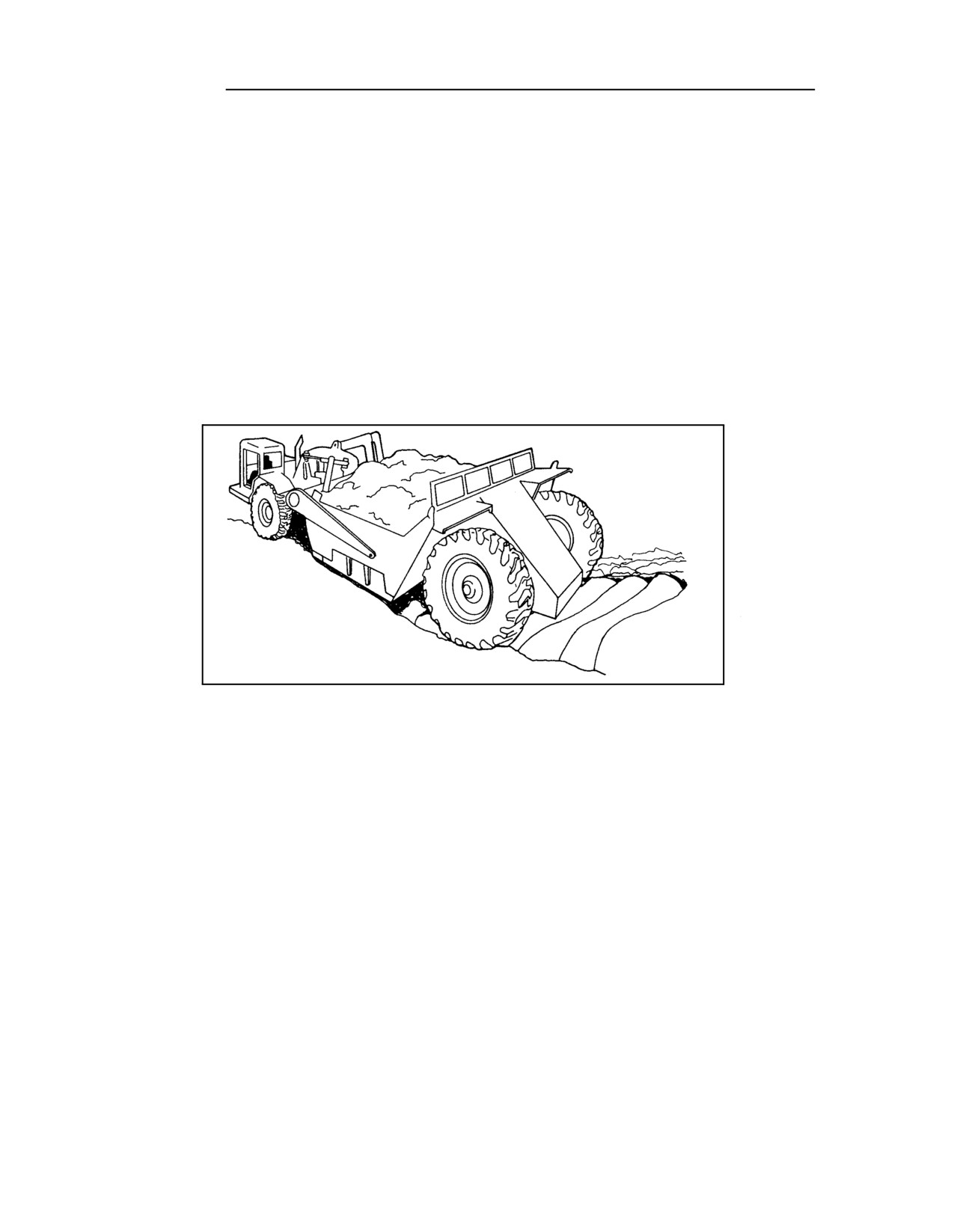
Step 3. Pump the bowl up and down (Figure 3-5). For best pumping results,
drop the bowl as the scraper’s rear wheels roll into the depression of the previ-
ously pumped area and raise the bowl as the wheels are climbing out of the
depression.
Step 4. Drop the bowl sharply two or three times at the end of the loading area
to top out the load. Then close the apron, raise the bowl, and exit the cut area.
Figure 3-22. Pumping a Scraper Bowl to Load Sand
3-60. Rock and Shale. Loading rock and shale with a scraper is a difficult
task that causes severe wear and tear on the equipment. Ripping will ease
this problem. Ripping depth should exceed the depth of the scraper cut. When
loading the scraper, leave a loose layer of ripped material under the tires to
provide better traction and to reduce both track and tire wear. Some soft rock
and shale can be loaded without ripping.
3-61. Start the scraper’s cutting edge in dirt (if possible) when loading
stratified rock. Move in to catch the blade in planes of lamination. This forces
material into the bowl. Pick up loose rock or shale on the level or on a slight
upgrade, with the blade following the lamination planes.
Load Time
3-62. Loading time is critical for obtaining maximum scraper production. Push
loading should normally take less than one minute within a distance of 100
feet (time and distance change with the material being loaded). Studies of load
volume versus loading time indicate that for a normal operation, about 85
percent of scraper load capacity is achieved in the first 0.5 minute of loading.
Another 0.5 minute will only produce about another 12 percent increase in
3-6 Scrapers
FM 5-434
load volume. Therefore, extra loading time (past about one minute) is not
worth the effect because increased total cycle time will decrease production.
Borrow-Pit Operation
3-63. It is essential to have highly competent personnel in the borrow-pit area.
Traffic control within the borrow-pit area reduces waiting time and excess
travel of earthmoving support units. Maintaining adequate drainage
throughout the borrow pit will reduce downtime caused by bad weather.
HAULING
3-64. Hauling, or travel time, includes the haul time and the return time.
Here the power and traction characteristics of the scraper become very
important. The following factors can greatly effect travel time.
Haul-Route Location
3-65. Lay out the haul routes to eliminate unnecessary maneuvering. Plan the
job to avoid adverse grades that could drastically reduce production.
Remember, where grades permit, the shortest distance between two points is
always a straight line.
Road Maintenance
3-66. Keep haul roads in good condition. A well-maintained haul road permits
traveling at higher speeds, increases safety, and reduces operator fatigue and
equipment wear.
• Ruts and rough surfaces. Use a grader or dozer to eliminate ruts
and rough (washboard) surfaces. (See Chapter 4 for haul-road
maintenance with a grader.)
• Dust. Use water distributors to reduce dust. Reducing the amount of
dust helps alleviate additional mechanical wear, provides better
visibility, and lessens the chance of accidents. Keeping roads moist
(but not wet) allows them to pack into hard, smooth surfaces
permitting higher travel speeds.
Travel Conditions
3-67. Once on the haul road, the scraper should travel in the highest safe gear
appropriate for road conditions. When possible, carry the scraper bowl fairly
close to the ground (about 18 inches). This lowers the center of gravity of the
scraper and reduces the chance of overturning.
• Lugging. Avoid unnecessary lugging of the engine. Downshift when
losing momentum. Lugging the engine usually results in a slower
speed than the top range of the next lower gear. Although the machine
can make it, it is best to downshift and accelerate faster. Lugging
causes a decrease in engine revolutions per minute (rpm) thereby
reducing hydraulic pressure. This will result in a loss of steering
control.
• Coasting. Never coast on a downgrade. When approaching a
downgrade, slow down and downshift the transmission. To prevent
unwanted upshifting, use the transmission hold on a downgrade if it is
available. Also, use it when approaching an upgrade or in rough
Scrapers 3-7
FM 5-434
underfooting. To control speed on a downgrade, use the retarder and
service brakes. Engine speed should not exceed the manufacturer’s
recommended rpm.
DUMPING AND SPREADING
3-68. When dumping, lower the bowl to the desired lift height and open the
apron at the beginning of the dump area. Dump and spread in the highest
gear permitted by haul-road conditions and fill-material characteristics.
Constant speed, along with bowl height, will help to maintain a uniform depth
of lift. Slowly dribbling the load at low speed slows down the cycle.
Dumping Procedure
Step 1. Move steadily across the spreading area.
Step 2. Open the apron fully as the scraper reaches the location to begin dump-
ing. Move the ejector forward to push the material out of the bowl.
Step 3. Maintain a straight path through the spread area.
Step 4. Close the apron when all the material is out of the bowl, and return the
ejector to the rear of the bowl.
Step 5. Raise the bowl slowly to clear obstacles (12 to 18 inches) during the
return trip to the loading area.
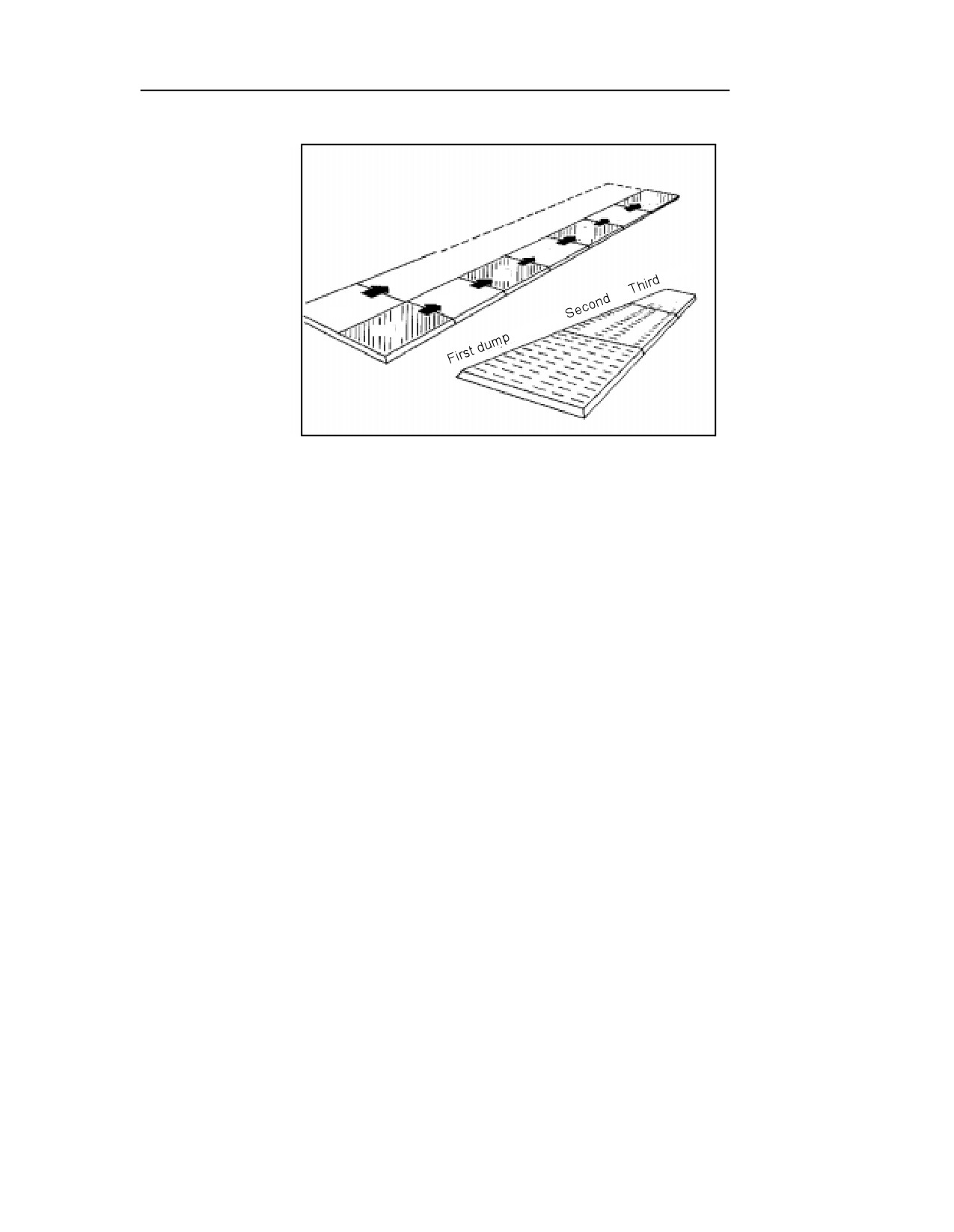
Spreading Sequence (Figure 3-6)
Step 1. Dump and spread the first load at the front of the fill.
Step 2. Travel with subsequent loads over the previous fill, provided the lifts
are shallow.
Step 3. Start each following dump at the end of the previous fill.
Step 4. Finish dumping and spreading one full lane before starting a new one
so that rollers can start compaction.
Step 5. Repeat this method in the next lane. Do not waste time on the fill. The
scraper should return to the cut area as fast as possible after dumping the load.
Plan the egress from the fill area to avoid soft ground or detours around trees or
other obstacles.
NOTE: Route the scrapers to compact the fill. Overlap wheel paths to
aid in compaction of the entire area and to reduce compaction time for
rollers.
CAUTION
Do not try to force wet or sticky material out of the bowl
too fast. This will cause the material to roll up in front,
which can damage the hydraulic system.
3-8 Scrapers
FM 5-434
7
6
5
4
3
2
8
1
Figure 3-23. Spreading Sequence
Fill Slope
3-69. To maintain the desired fill slope, make the fill high on the outside
edges. This will prevent the scraper from sliding over the slope and damaging
the slope. If there is rain, build up the low center for drainage, or use a grader
to cut the outside edge down, creating a crown in the middle of the area.
Materials
3-70. Different materials require different dumping and spreading
procedures.
3-71. Sand. Spread sand as thin as possible to allow better compaction and to
make traveling over the fill easier.
3-72. Wet or Sticky Material. Wet or sticky material may be difficult to
unload or spread. When operating in these material types
• Do not try to spread the material too thin.
• Keep the bowl high enough to allow the material to pass under the
scraper. Material not having enough room to pass under the scraper
will roll up inside the bowl into a solid mass that is difficult to eject.
• Bring the ejector forward about 12 inches at a time.
• Back the ejector about 6 inches after each forward movement. This
breaks the suction between the material and the bowl.
• Repeat this procedure until the bowl is empty.
PRODUCTION ESTIMATES
3-73. Following is an explanation of production estimating based on a step-by-
step method using the CAT 621B scraper. When developing data for
production estimates, consider all factors that influence production. Consider
the scraper’s weight, the weight of the load, and the average grade and rolling
resistance of both the haul and return routes in arriving at a cycle time. The
Scrapers 3-9
FM 5-434
same steps are applicable to other makes and models of scrapers, using the
appropriate tables and charts for those scrapers.
Step 1. Determine the vehicle weight, empty and loaded.
• Empty vehicle weight (EVW), in tons. Using Table 3-1, first
determine the EVW from the EVW column based on the specific make
and model of the scraper.
• Weight of load, in tons. Determine the weight of the load in pounds
by determining the scraper load volume in cubic yards (this is in LCY
of the material) and the material unit weight (in pounds per LCY). If
no specific material-weight data is available, use the information in
Table 1-2, page 1-4, as an estimate. Multiply the scraper load volume
by the unit weight in pounds per LCY of the material to be excavated.
Then, convert the resulting weight into tons by dividing the amount
by 2,000.
Weight of load (pounds) = scraper load volume (LCY) × material unit weight (pounds per LCY)
Weight of load (tons = weight of load (pounds)
2, 000
Table 3-6. Scraper Specifications
Heaped Capacity
Make and Model
(Cubic Yards)
EVW (Tons)
CAT 613B
11
15.6
CAT 621B
20
33.3
• Loaded or gross vehicle weight (GVW). Determine the GVW by
adding the EVW (tons) and the weight of load (tons).
GVW (tons) = EVW (tons) + weight of load (tons)
EXAMPLE
Determine the GVW of a CAT 621B single-powered scraper with a 20 LCY load of dry
loam.
From Table 1-2, dry loam is 1,900 to 2,200 pounds per LCY. Use an average value of
2,050 pounds per LCY.
20 LCY × 2,050 pounds per LCY
Weight of load (tons)
= -----------------------------------------------------------------------------------------
= 20.5 tons
2,000 pounds per ton
EVW = 33.3 tons
GVW = 33.3 tons + 20.5 tons = 53.8 tons
3-10 Scrapers
FM 5-434
Step 2. Determine the average grade (in percent) and the distance (in feet) for
both the haul and return routes. Uphill grades are positive (+) and downhill
grades are negative (-). Obtain this information from a mass diagram or a haul-
route profile.
EXAMPLE
The project mass diagram indicates that there is a 5 percent downhill grade from cut
to fill and that the one-way distance is 800 feet. The same route will be used for both
the haul and the return.
Haul:
Average grade = -5 percent
Distance = 800 feet
Return:
Average grade = +5 percent
Distance = 800 feet
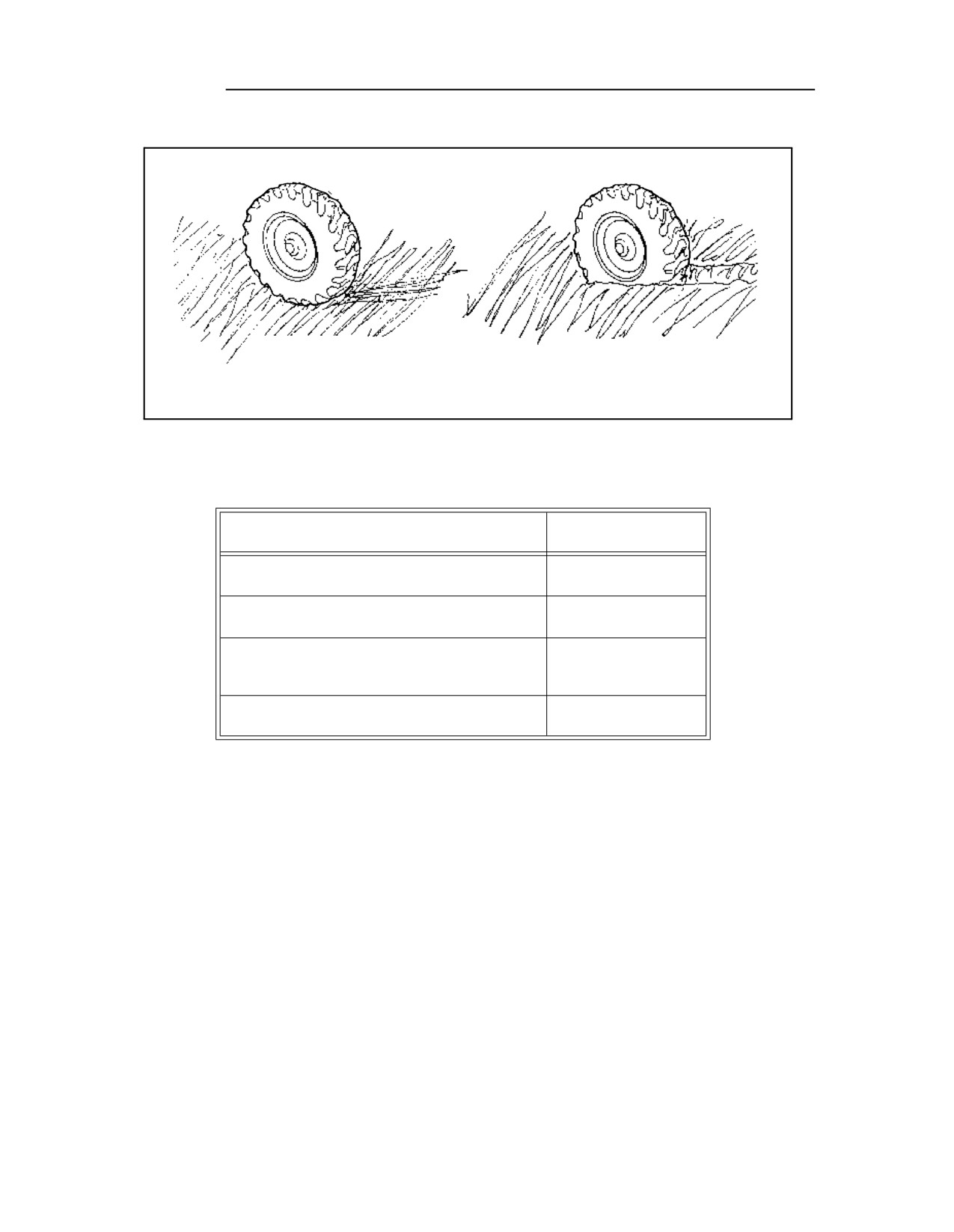
Step 3. Determine the rolling resistance (in pounds). Rolling resistance is the
force resisting the movement of a vehicle on level ground. This is primarily
caused by the tires penetrating the road’s surface, the tires flexing, and internal
gear friction (Figure 3-7, page 3-12). Express the rolling resistance for a given
road surface in pounds per ton of vehicle weight. Table 3-2, page 3-12, gives
some representative rolling-resistance values for various types of road surfaces.
If the expected tire penetration is known, determine the rolling resistance for
the haul and the return using the following formulas:
RRHaul = (40+[30×TP])×GVW
RRReturn = (40+[30×TP])×EVW
where—
RRHaul = haul rolling resistance, in pounds
RRReturn = return rolling resistance, in pounds
40 = constant that represents the flexing of the driving mechanism, in
pounds per ton
30 = constant that represents the force required to climb out of the rut, in
pounds per ton per inch
TP = tire penetration, in inches (may be different for the haul and the
return)
EXAMPLE
Determine the rolling resistance (haul and return) for a CAT 621B scraper carrying a
20.5-ton load if the tire penetration during the haul is 3 inches and the tire penetration
on the return is 1 inch.
RRHaul = (40 + [30 × 3 inches]) × 53.8 tons = 6,994 pounds
RRReturn = (40 + [30 × 1 inch]) × 33.3 tons = 2,331 pounds
Scrapers 3-11
FM 5-434
Hard ground
Soft ground
Low penetration
High penetration
Low rolling resistance
High rolling resistance
Figure 3-24. Rolling Resistance
Table 3-7. Representative Rolling-Resistance Values
Resistance Value
Road Condition
(Pounds Per Ton)
Hard, smooth surface with no tire penetration (well
40
maintained)
Firm, smooth surface, flexing slightly under load
65
(well maintained)
Flexible dirt roadway (irregular surface):
With about 1 inch of tire penetration
100
With up to 4 inches of tire penetration
150
Soft, muddy roadway (irregular surface or sand)
220 to 400
with over 6 inches of tire penetration
Step 4. Determine the grade resistance or the grade assistance. Grade resis-
tance is the opposing force of gravity that a vehicle must overcome to move
uphill. Grade assistance is the helping force of gravity that pulls a vehicle down-
hill. For uphill (adverse) grades, the vehicle needs more power to move as it
must overcome both rolling and grade resistance. For downhill (favorable)
grades, the helping force of gravity produces additional pounds of pull to propel
the vehicle. Indicate adverse grades by a plus (+) and favorable grades by a
minus (-). In earthmoving, measure grades in percent of slope. This is the ratio
between the vertical rise or fall, and the horizontal distance in which the rise or
fall occurs. For instance, a rise of 1 foot in a 20-foot horizontal distance is a +5
3-12 Scrapers
FM 5-434
percent grade (1 ⁄ 20 × 100
). Use the following formula to determine the grade
resistance or grade assistance:
GR(+) or GA(-) = 20 × percent grade × vehicle weight (tons)
Therefore
GR(+)Haul or GA(-)Haul
= 20 × percent grade × GVW (tons)
GR(+)Return or GA(-)Return = 20 × percent grade × EVW (tons)
where—
GR(+) = grade resistance, in pounds
GA(-) = grade assistance, in pounds
20 = constant that represents 20 pounds per ton of vehicle weight per
degree of slope
NOTE: Enter the percent grade as a percent not as a decimal.
EXAMPLE
Determine the grade resistance and grade assistance for a CAT 621B scraper carry-
ing a 20.5-ton load on a -5 percent grade from cut to fill.
GA(-)Haul
= 20 × (-5 percent) × 53.8 tons (GVW) = -5,380 pounds
GR(+)Return
= 20 × (+5 percent) × 33.3 tons (EVW) = +3,330 pounds
Step 5. Determine the rimpull required. Rimpull required is a measure of the
force needed (in pounds) to overcome the vehicle’s rolling resistance and grade
assistance/grade resistance. Use the following formula to determine the rimpull
required:
RPR = RR + GA(-) or GR(+)
where—
RPR = rimpull required, in pounds
RR = rolling resistance, in pounds
GA(-) = grade assistance, in pounds
GR(+) = grade resistance, in pounds
EXAMPLE
Determine the rimpull required on the haul and return based on the following data:
RRHaul = 6,994 pounds; GA(-) = -5,380 pounds
RRReturn = 2,331 pounds; GR(+) = +3,330 pounds
RPRHaul
= 6,994 pounds + (-5,380) pounds = 1,614 pounds
RPRReturn
= 2,331 pounds + (+3,330) pounds = 5,661 pounds
Scrapers 3-13
FM 5-434
Available rimpull is the amount of force that can actually be developed as lim-
ited by traction. The engine may be able to develop the rimpull, but the rimpull
must be able to be transferred at the point where the tire touches the ground.
Therefore, required rimpull must always be less than available rimpull, or there
will be tire slippage and the work will not be accomplished.
Step 6. Determine the travel speed.
• The travel speed of a piece of equipment is the maximum speed at
which the vehicle can develop the rimpull required to overcome the
opposing forces of grade and rolling resistance. The manufacturer
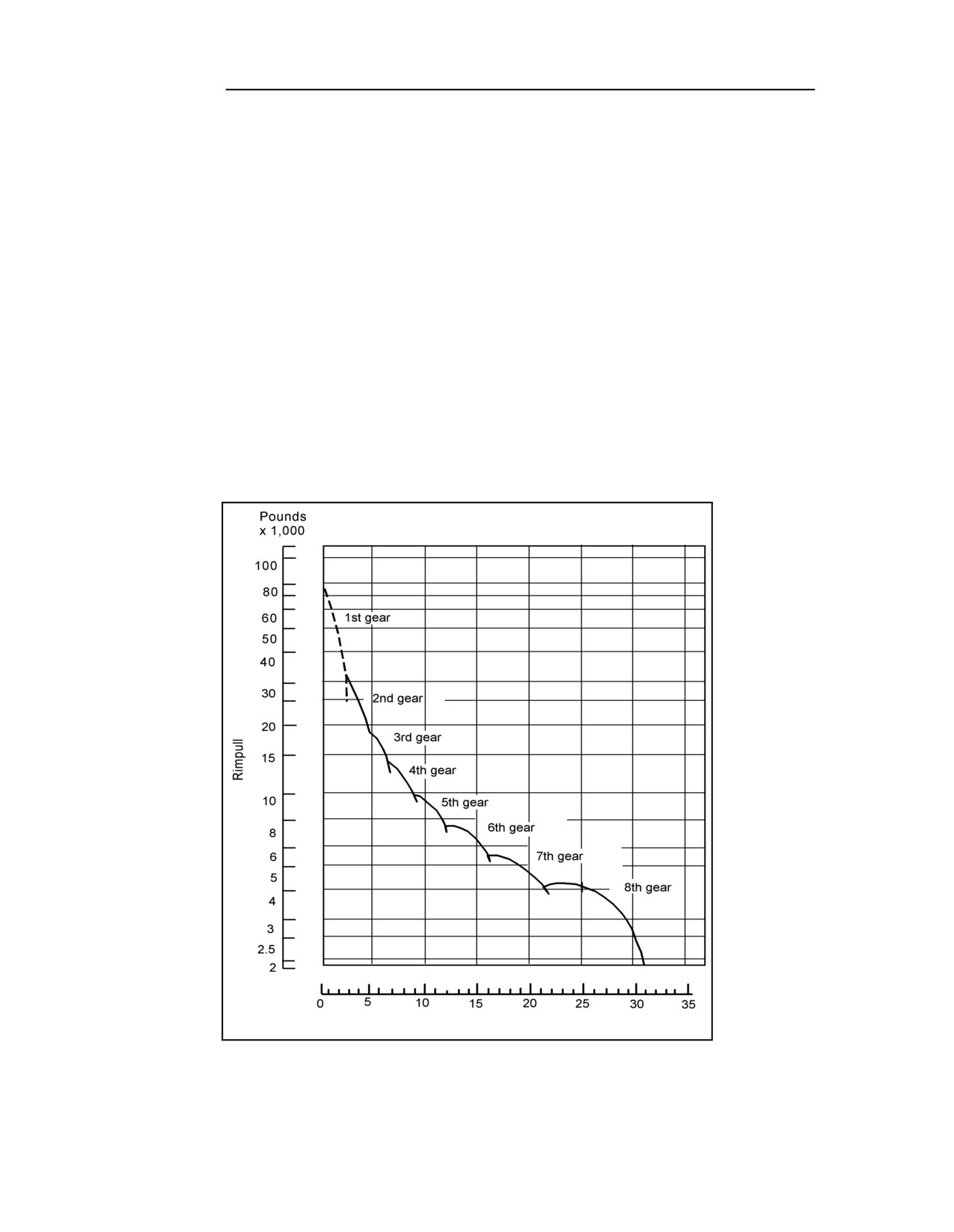
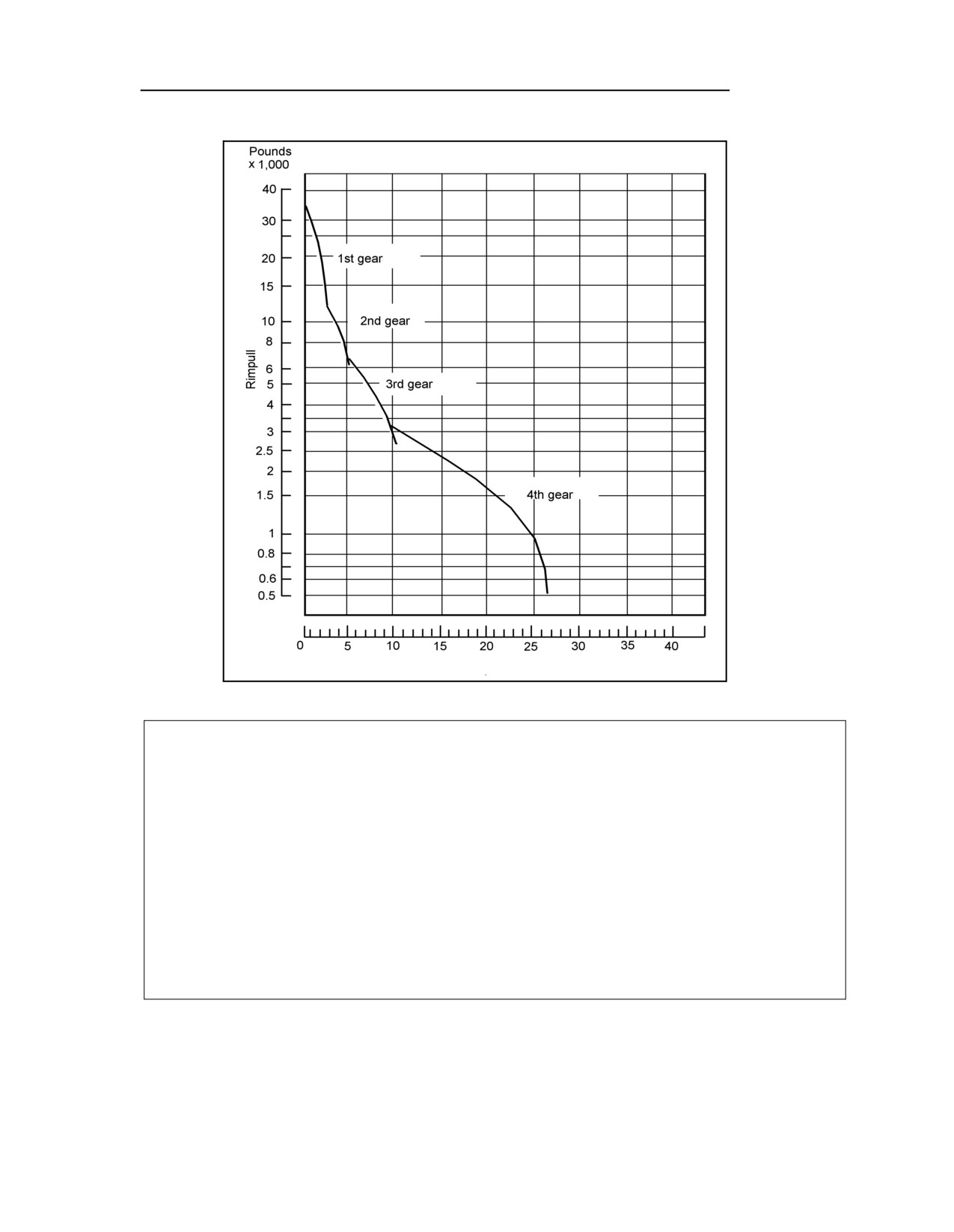
normally provides this information in tables or charts. Figures 3-8 and
3-9 show rimpull charts for the CAT 621B and the CAT 613B.
• To determine the travel speed, locate the rimpull required for either
the haul or return on the left side of the chart. Read to the right until
intersecting the line representing the highest gear which can achieve
that amount of rimpull. Read down from the gear intersect to
determine the maximum travel speed.
NOTE: Determine the travel speed for both the haul and the return.
Speed (mph)
Figure 3-25. Speed Chart for the CAT 621B
3-14 Scrapers
FM 5-434
Speed (mph)
Figure 3-26. Speed Chart for the CAT 613B
EXAMPLE
Determine the maximum travel speed for a CAT 621B scraper, based on the following
data.
RPRHaul = 1,614 pounds
RPRReturn = 5,661 pounds
First, determine the travel speed for the haul. Refer to Figure 3-8 and locate 1,614
pounds on the scale. This is below the lowest scale number of 2,000 pounds so use
the bottom line on the rimpull scale. Read right to determine travel gear (eighth gear)
and down to determine travel speed (31 miles per hour [mph]).
Second, determine the travel speed for the return. Refer to Figure 3-8 and locate
5,661 pounds (interpolate between 5,000 and 6,000 on the rimpull scale). Read right
to determine travel gear (seventh gear) and down to determine travel speed (17 mph).
NOTE: If computed travel speed (either haul or return) exceeds the
unit’s standing operating procedure (SOP) maximum allowable speed,
determine the travel time based on the maximum allowable speed in
the SOP.
Scrapers 3-15
FM 5-434
Step 7. Determine the total travel time. Total travel time is the sum of the time
it takes the vehicle to complete one haul and one return.
Total TT = TTHaul + TTReturn
where—
TT = travel time
• First, determine the haul travel time.
average haul distance (feet)
TTHaul
= ------------------------------------------------------------------------------
88
×
travel speed
Haul
where—
TT = travel time, in minutes
88 = conversion factor used to convert mph into feet per minute (fpm)
• Second, determine the return travel time (in minutes).
TTRetur = average return distance (feet)
88
travel speed
×
Return
where—
TT = travel time, in minutes
88 = conversion factor used to convert mph into fpm
NOTE: The haul and return routes are not always the same. Be sure to
use the correct haul distance for each computation.
EXAMPLE
Determine the total travel time for a CAT 621B based on a haul speed of 31 mph, a
return speed of 17 mph, and a haul distance of 800 feet. The unit’s SOP limits scraper
travel speed to 25 mph.
Determine the haul and the return travel time.
800 feet
TTHaul
= ---------------------------------
= 0.36 minute
88 × 25 mph
800 feet
TTReturn
= ---------------------------------
= 0.54 minute
88 × 17 mph
Determine the total travel time.
Total TT = 0.36 minute + 0.54 minute = 0.9 minute
Step 8. Determine the cycle time.
• The cycle time is the sum of the total travel time and the time
required for loading, dumping, turning at the dump site, and turning
and positioning to load, plus the time to accelerate/decelerate during
the haul and return.
• The average dump time for scrapers having a heaped capacity of less
than 25 cubic yards is 0.3 minute. The type or size of the scraper does
not significantly affect the turning time. Average turning time in the
cut is 0.3 minute and 0.21 minute on the fill. The cut turning time is
slightly higher because of congestion in the area and the necessity of
spotting for loading. Therefore, for both the CAT 613 and the CAT 621
scrapers, allow 0.81 minute for dumping, turning at the dump site,
3-16 Scrapers
FM 5-434
and turning at the load site. The question of the time for loading is the
consequential variable.
• A good average time for loading the CAT 621 with a D8 or equivalent-
size push tractor is 0.85 minute. Modify the time for loading or the
assumed load volume if using a smaller push tractor. With a D7,
expect load times approaching 1 minute. The self-loading CAT 613
requires 0.9 minute to load in good material. Good means loam, loose
clay, or sandy material. Encountering tight materials will increase the
loading duration. To determine the turn-and-dump time and the load
time for a special piece of equipment, time the equipment as it goes
through a few cycles.
CT = total TT + TD + LT
where—
CT = total scraper cycle time, in minutes
TT = travel time
TD = total turn and dump time
LT = load time
EXAMPLE
Determine the cycle time for a CAT 621B scraper with a D7 push tractor based on a
travel time of 0.9 minute and an average turn and dump and load time.
CT (minutes) = 0.9 minute + 0.81 minute + 1 minute = 2.71 minutes
Step 9. Determine the trips per hour. To determine the number of trips per
hour, divide the working minutes per hour by the cycle time. Normally there are
about 50 minutes per hour of productive time on a well-managed scraper job.
However, if the cut is in a tight area such as a ditch or if the embankment is a
narrow bridge header, the estimator should consider lowering the productive
time to a 45-minute working hour.
TPH= working minutes per hour
CT
where—
TPH = trips per hour
CT = total scraper cycle time, in minutes
EXAMPLE
Determine how many trips per hour a CAT 621B can make based on a 50-minute
working hour and a cycle time of 2.71 minutes per trip.
50 minutes
TPH
= ----------------------------------------------------------
= 18.5 trips
2.71 minutes per trip
Scrapers 3-17
FM 5-434
Step 10. Determine the hourly production rate. To determine the hourly pro-
duction rate, the average size of the load (in LCY) and the number of trips per
hour must be known. The capacity of the scraper, the material type, and the
method of loading will determine the average size of load.
P = TPH × average LCY per load
where—
P = hourly production rate, in LCY per hour
TPH = trips per hour
NOTE: To convert from LCY to either BCY or CCY, multiply the pro-
duction rate by a soil conversion factor from Table 1-1, page 1-4.
P (BCY per hour or CCY per hour) = P (LCY per hour) × conversion factor
where—
P = hourly production rate
EXAMPLE
Determine the hourly production rate in BCY per hour for a CAT 621B working in
loam, making 18.5 trips per hour, with an average load of 20 LCY.
P (LCY per hour) = 18.5 TPH × 20 LCY per load = 370 LCY per hour
P (BCY per hour) = 370 LCY per hour × 0.8 = 296 BCY per hour
Step 11. Determine the total time in hours required to complete the mission. To
determine the total time required to complete a mission, the total volume to
move, the hourly production rate, and the number of scrapers to be used on the
job must be known.
Q
Total time (hours)
= --------------
P×N
where—
Q = total volume to move, in BCY
P = hourly production rate, in BCY per hour
N = number of scrapers
EXAMPLE
Determine how many hours it would take to move 19,440 BCY, using three CAT 621B
scrapers, each with an hourly production rate of 296 BCY per hour.
19, 440
Total time (hours)
= -------------------------------------------------------------
= 22 hours
296 BCY per hour × 3
3-18 Scrapers
FM 5-434
If it is necessary to complete the job in a specified time, use the same basic for-
mula to determine the required number of scrapers.
Q
Number of scrapers required
= --------------
P×H
where—
Q = total volume to move, in BCY
P = hourly production rate, in BCY per hour
H = required number of hours
Step 12. Determine the number of push tractors required. The number of push
tractors required is a ratio of the scraper cycle time to the push-tractor cycle
time. The self-loading CAT 613 does not use a push tractor, so this part of the
analysis is not necessary when using self-loading scrapers.
N = CT
PT
where—
N = number of push tractors required
CT = total scraper cycle time, in minutes
PT = total pusher cycle time, in minutes
• Load time (discussed in step 8). A CAT 621B loading with a D7 push
tractor requires about 1 minute to load. This is the time the push
tractor is in contact with the scraper.
• Push-tractor cycle time. Once a scraper load time has been
determined, use the following formula to determine the push-tractor
cycle time.
PT = (1.4 x LT) + 0.25
where—
PT = total push-tractor cycle time
1.4 = constant that represents scraper load time and push-tractor
travel time between scrapers
LT = load time
0.25 = constant that represents push-tractor positioning time
At this point, the number of scrapers that a single push tractor will support can
be determined.
EXAMPLE
Determine how many CAT 621B scrapers a single push tractor can support if the
scraper cycle time is 2.71 minutes and the scraper load time is 1 minute.
PT = (1.4 × 1) + 0.25 = 1.65 minutes
2.71 minutes
Number of scrapers
= -----------------------------------
= 1.64 scrapers
1.65 minutes
Scrapers 3-19
FM 5-434
This example shows that the push-tractor cycle time will control the production
when using only one push tractor and more than one scraper on the project. The
push-tractor production formula is
P = working minutes per hour
× scraper load (LCY)
PT
where—
P = hourly production rate, in LCY per hour
PT = total push-tractor cycle time, in minutes
As was done in step 10, convert the production into BCY or CCY by using the
Table 1-1, page 1-4, soil conversion factors.
EXAMPLE
Determine what the production will be in BCY if a single push tractor, with a cycle time
of 1.65 minutes supports two CAT 621B scrapers hauling 20 LCY of loam. Assume a
50-minute working hour. The scrapers have a cycle time of 2.71 minutes.
2.71 minutes
Number of scrapers one pusher can support
= -----------------------------------
= 1.64 scrapers
1.65 minutes
Therefore, if using only one push tractor, the pusher cycle time will control production.
50
P (BCY per hour)
= ----------- ×
20 LCY × 0.8 = 485 BCY per hour
1.65
NOTE: If the incorrect assumption was made that one pusher could
handle two scrapers, the production would have been calculated at 590
BCY per hour.
50 minutes
P (BCY per hour)
= ----------------------------------- × 2 scrapers × 20 LCY × 0.8 =
590 BCY per hour
2.71 minutes
where—
P = hourly production rate
Once the number of scrapers that one push tractor can support has been deter-
mined, use the following formula to determine how many push tractors are
needed to support the job if using additional scrapers.
number of scrapers on job
Number of push tractors required
= -------------------------------------------------------------------------------------------------------------------------------------
number of scrapers a push tractor can support
EXAMPLE
Determine how many push tractors are required on a job that has nine 621B scrapers,
if a single push tractor can support 1.64 scrapers.
9 scrapers
Number of push tractors required
= -------------------------------------------------------------------------------------
= 6 push tractors
1.64 scrapers per push tractor
3-20 Scrapers
Chapter 4
Graders
Graders are multipurpose machines used for grading, shaping, bank
sloping, and ditching. They are used for mixing, spreading, side casting,
leveling and crowning, general construction, and road and runway
maintenance. Graders cannot perform dozer work because of the
structural strength and location of its blade. However, they can move
small amounts of material. They are capable of working on slopes as steep
as 3:1. Graders are capable of progressively cutting ditches to a depth of
3 feet.
GRADER COMPONENTS
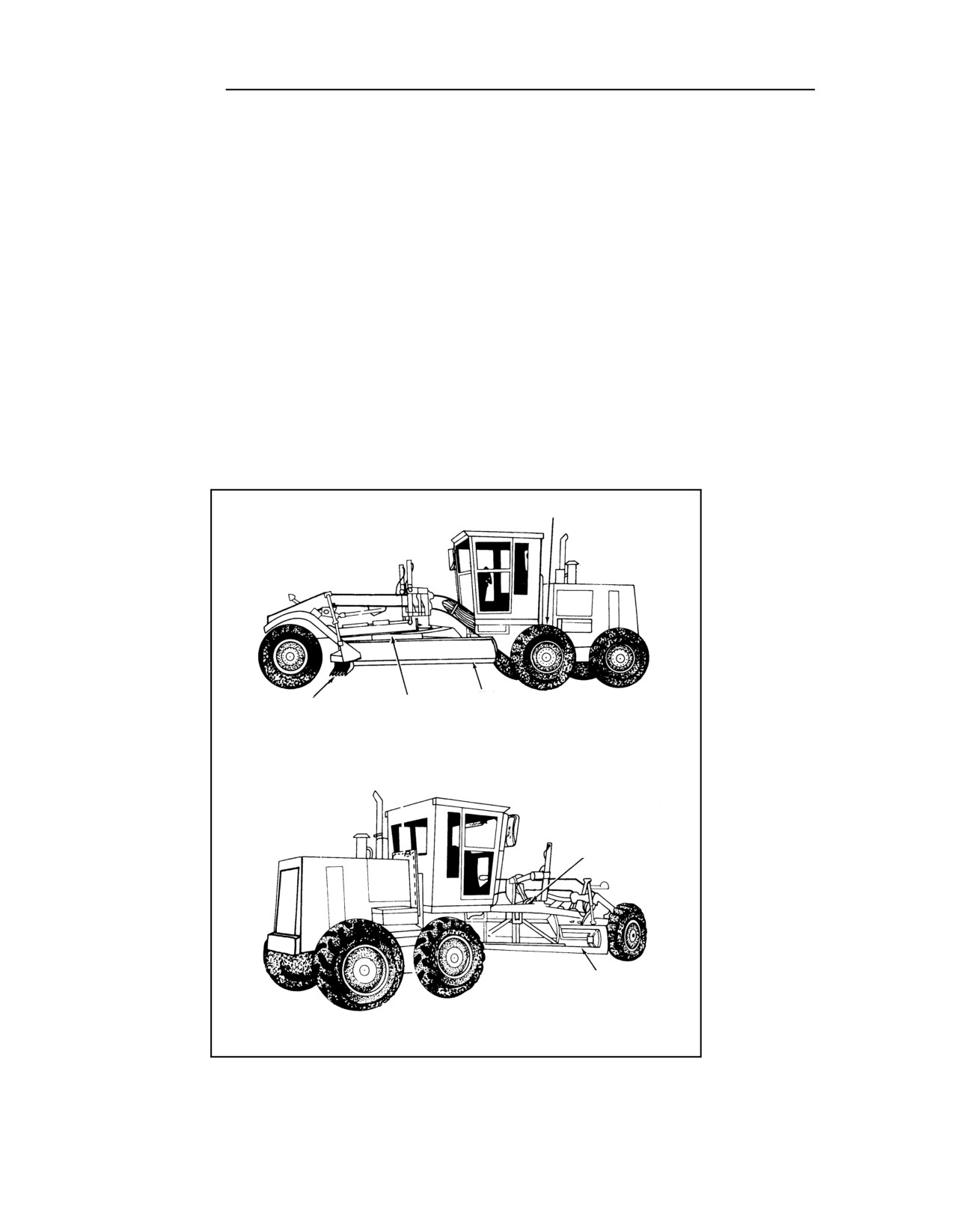
4-1. The components of the grader that do the work are the blade and
the scarifier. The blade’s position and pitch are adjustable and are
determined by the type of operation being performed.
BLADE
4-2. The major component of a grader blade is a hydraulically controlled
moldboard to which the cutting edges are bolted. Use the blade (Figure 4-1,
page 4-2) to side cast material. The ends of the blade can be raised or lowered
together or independently of one another.
Blade Position
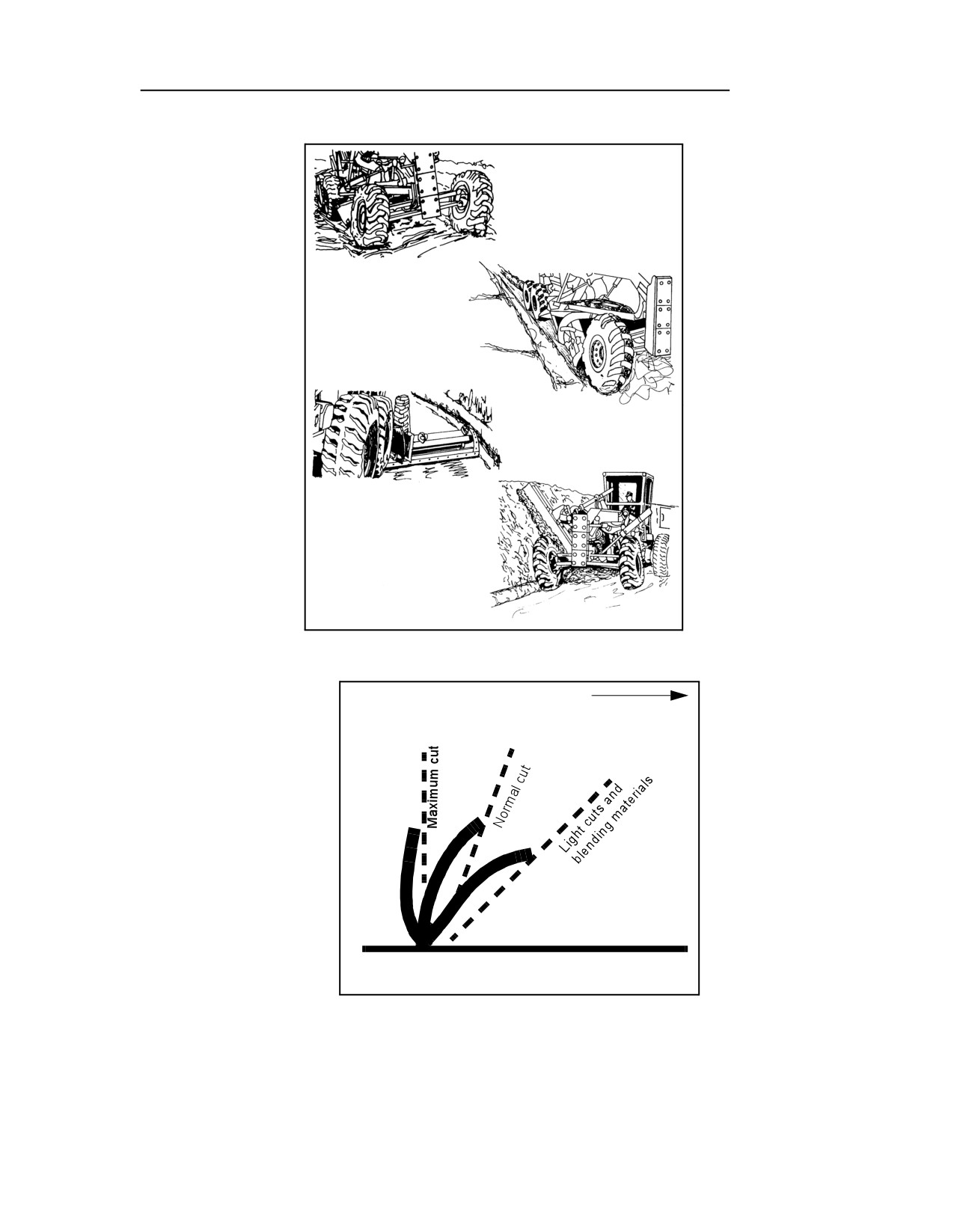
4-3. The blade can be angled perpendicular to the line of travel or parallel to
the direction of travel. It can also be shifted to either side or raised into a
vertical position (Figure 4-2, page 4-3).
Blade Pitch
4-4. The blade can be pitched forward or backward (Figure 4-3, page 4-3).
Keep the blade near the center of the pitch adjustment; this keeps the top of
the moldboard directly over the cutting edge of the blade. Pitching the blade
forward decreases the blade’s cutting ability and increases the dragging
action. The blade will tend to ride over the material rather than cut and push,
and it has less chance of catching on solid obstructions. Use a forward pitch to
make light, rapid cuts and to blend materials. When the blade is pitched to
the rear, it cuts readily but the material tends to boil over itself.
SCARIFIER
4-5. Use a scarifier (see Figure 4-1) to break up material too hard for the blade
to cut. A scarifier has 11 removable teeth that can be adjusted to cut a
maximum depth of 12 inches. When operating in hard material, it may be
necessary to remove some of the teeth from the scarifier. Do not remove more
Graders 4-1
FM 5-434
than five teeth because the force against the remaining teeth could shear
them off. When removing teeth, take the center one out first and then
alternately remove the other four teeth. This balances the scarifier and
distributes the load evenly. With the top of the scarifier pitched to the rear,
the teeth lift and tear the material being loosened. Use this position for
breaking up asphalt pavement. Adjust the pitch of the scarifier for the type of
material being ripped.
ROAD AND DITCH CONSTRUCTION
4-6. Road grading, embankment finish work, and shallow-ditch construction
are basic grader operations.
MARKING FOR A DITCH CUT
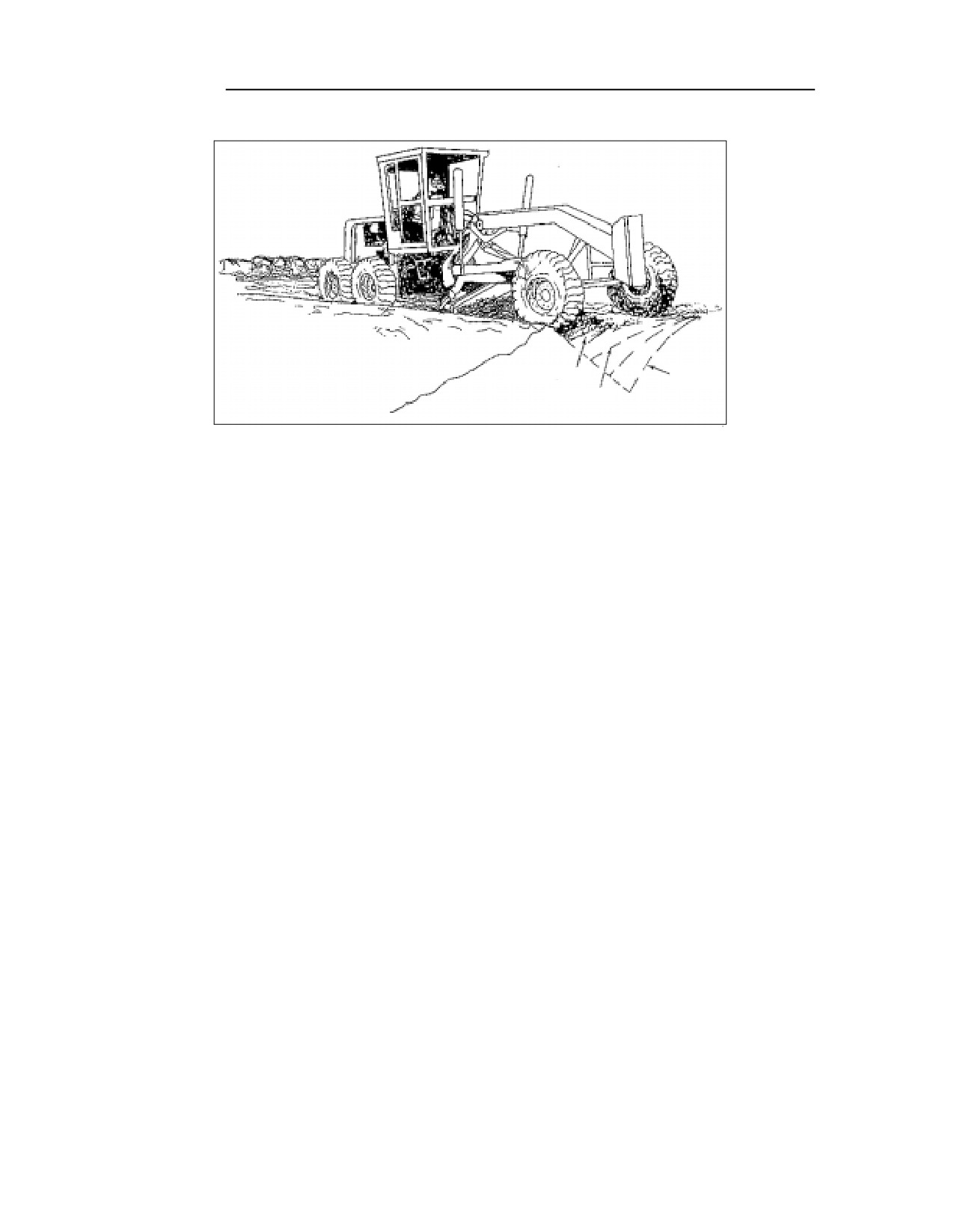
4-7. For better grader control and straighter ditches, make a 3- to 4-inch-deep
marking cut on the first pass (Figure 4-4, page 4-4) at the outer edge of the
bank slope (usually identified by slope stakes). The toe of the blade should be
in line with the outside edge of the lead wheel. This marking cut provides a
guide for subsequent operations.
Articulation pin
Blade
Circle
Scarifier
(cutting edges
bolted to the
moldboard)
Centershift
Moldboard
Figure 4-1. Grader
4-2 Graders
FM 5-434
V-ditch cut
Flat-bottom ditch cut
Wide-side reach
High-bank cut
Figure 4-2. Blade Positions
Direction of travel
The pitch changes the cutting-edge angle of attack.
Figure 4-3. Blade Pitch
Graders 4-3
FM 5-434
Final
Marking cut
cut
First cut
Figure 4-4. Starting a Ditch
MAKING A DITCH CUT
4-8. Make each ditch cut as deep as possible without stalling or losing control
of the grader. Normally, make ditching cuts in second gear at full throttle.
Start with the blade positioned so that the toe is in line with the center of the
lead wheel. Bring each successive cut in from the edge of the bank slope so
that the toe of the blade will be in line with the ditch bottom on the final cut.
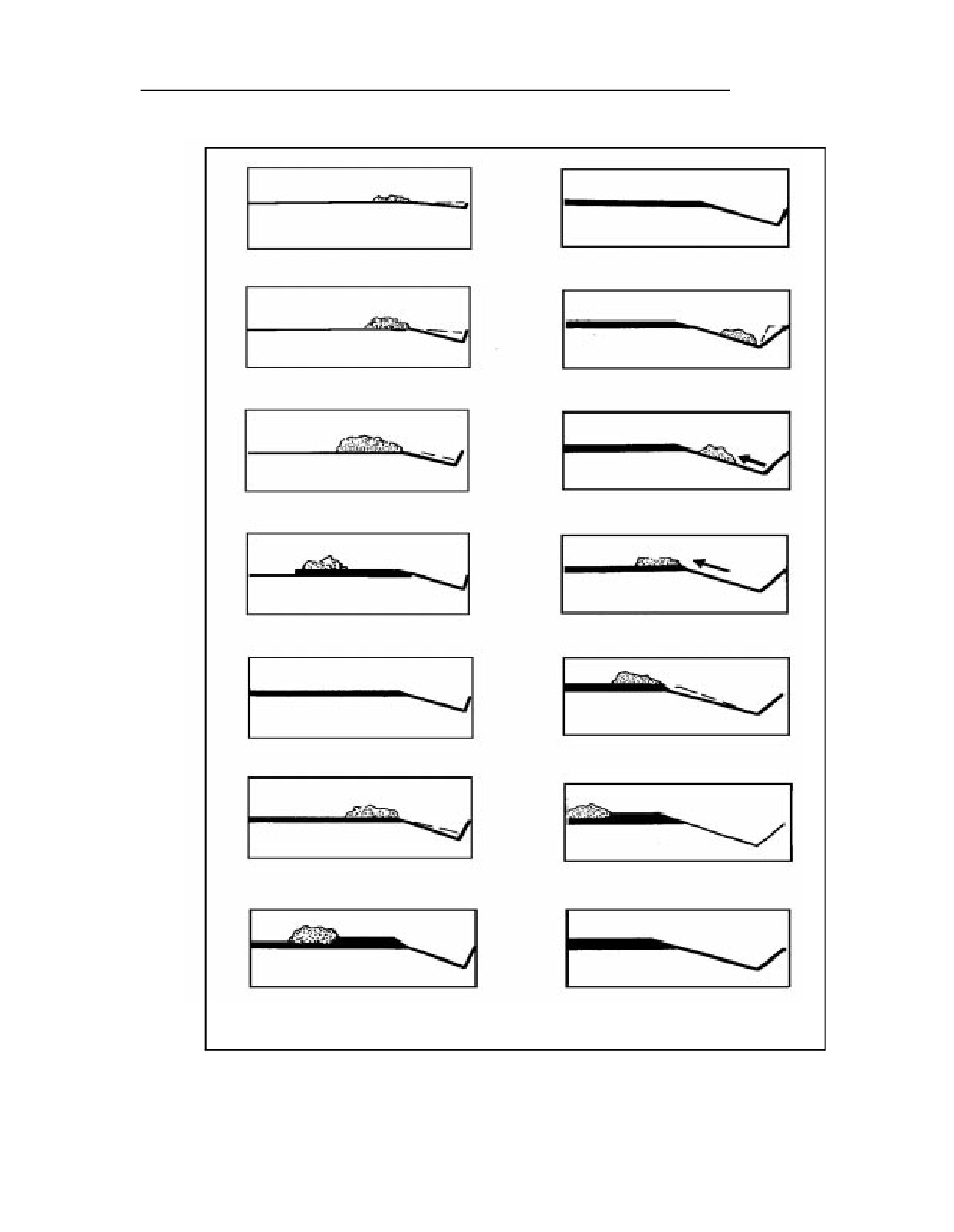
Figure 4-5 shows the steps of the V-ditching method. The steps shown in
Figure 4-5 are for a single roadside ditch. Repeat the steps on the opposite side
of the road. The machine’s frame should be articulated when performing steps
4 and 7.
Marking the Cut
Step 1. Begin the ditch by establishing a marking cut as follows (ditching is
normally done on the right-hand side of the grader):
• Ensure that the moldboard is high enough off the surface to allow
unrestricted movement.
• Ensure that the blade is pitched halfway.
• Center shift until the left lift cylinder (heel) is straight up and down.
• Rotate the moldboard so that the toe is just behind the outside edge of
the right front wheel (about a 45° angle to the frame).
• Side shift the blade if necessary to extend the edge of the moldboard to
the outside edge of the right front wheel.
• Raise the left lift cylinder all the way.
• Lean the front wheels to the left. The grader is now in the ditching
position.
Step 2. Move the grader forward. As the right front wheel passes over the start-
ing point of the ditch, lower the toe of the moldboard. Apply enough pressure on
the toe to penetrate the ground's surface about 3 to 4 inches.
4-4 Graders
FM 5-434
1. Ditch line: light cut
8. Spread to center
2. Second cut: heavy
9. Slope and bank
3. Third cut: heavy
10. Clean bottom of ditch
4. Clear the shoulder
11. Ditching pass (to clean and
shape inside slope)
12. Ditching pass (to shape inside
5. Level to center
slope)
6. Fourth cut: heavy
13. Finishing shoulder pass
7. Clear shoulder
14. Level and finish
Figure 4-5. V-ditching Method
Graders 4-5
FM 5-434
Step 3. Feather the material and raise the moldboard toe clear of the ground at
the completion of the marking cut. Continue moving forward until the rear
wheels pass over and off the marking cut.
NOTE: Feathering is accomplished by raising the moldboard in 1/2- to
1-inch increments while moving forward. Two or three seconds are
recommended between each upward adjustment until all the material
in front of the moldboard passes under it.
Step 4. Straighten the front wheels and steer the grader to the right (about a
45° angle to the ditch).
Step 5. Back the grader along the outside edge of the windrow.
Step 6. Reposition the grader at the start point.
Step 7. Lean the front wheels to the left.
Establishing the Depth of the Ditch
Step 1. Place the grader in forward motion and apply as much downward pres-
sure to the toe of the blade that the grader will handle.
Step 2. Continue along the ditch line until the grader has reached the finishing
point, and then follow the exit procedures previously discussed under marking
the cut.
NOTE: When making ditch cuts, windrows form between the heel of
the blade and the left rear wheel. Move or level these windrows when
either the ditch is at the planned depth or the windrow becomes
higher than the road clearance of the grader. This material will form
the shoulder of the road.
Establishing the Shoulder of the Ditch
4-9. This task is accomplished by placing the grader in the wide-side reach
position.
Step 1. Adjust the moldboard as follows:
• Rotate the moldboard to a 90° angle (perpendicular) with the frame
(straight across) and adjust the height of the blade to about 4 to 6
inches above the surface.
• Center shift the blade all the way to the right.
• Readjust the height of the blade to about 2 inches above the surface.
• Side shift the blade all the way to the right.
• Lean the front wheels to the left.
• Circle the moldboard counterclockwise until the toe is about 12 to 15
inches from the outside edge of the front right wheel.
NOTE: Do not adjust the moldboard height, especially the left lift cylin-
der.
Step 2. Move the grader forward and maintain a position and course so that the
toe of the moldboard passes directly over the center of the ditch.
Step 3. Apply enough downward pressure to skim the material from the shoul-
der; do not cut the shoulder.
4-6 Graders
FM 5-434
Step 4. Continue forward as the grader passes the finishing point of the ditch
until all the material in front of the moldboard passes under it or is windrowed
off the heel.
Step 5. Continue forward until enough space is available to position the grader
to back up and straddle the windrow.
NOTE: Place the grader in the right-hand general grade position and
the moldboard will be positioned to execute the next maneuver. Do not
back the grader in the wide-side reach position.
Step 6. Ensure that the front wheels are straight up and down before backing
the grader.
Step 7. Back the grader to the starting point of the project and, after stopping,
lean the wheels to the left.
Step 8. Lower the toe and heel of the moldboard to the surface.
Step 9. Raise the heel about 2 to 3 inches and ensure that the toe is just touch-
ing the surface. With the heel raised about 3 inches, the loose material from the
ditch should pass under and off the heel of the moldboard.
Step 10. Move the grader forward. Maintain a straight course by keeping the
grader centered on the windrow.
Step 11. Skim the shoulder of the road with the toe and spread the windrow to
form the surface of the road.
Step 12. Ensure that the material is feathered at the end of the pass before
stopping the grader.
Step 13. Straighten the front wheels and raise both lift cylinders all the way.
Step 14. Reposition the grader at the finishing end of the project. The grader
should be positioned to establish a V-ditch (going the opposite direction) on the
other side of the project area.
NOTE: Sometimes ditch cuts produce more material than is needed for
the roadbed and shoulders. Use this excess material as fill at other
locations throughout the project. Blade the excess material into a
windrow and haul it to the appropriate location.
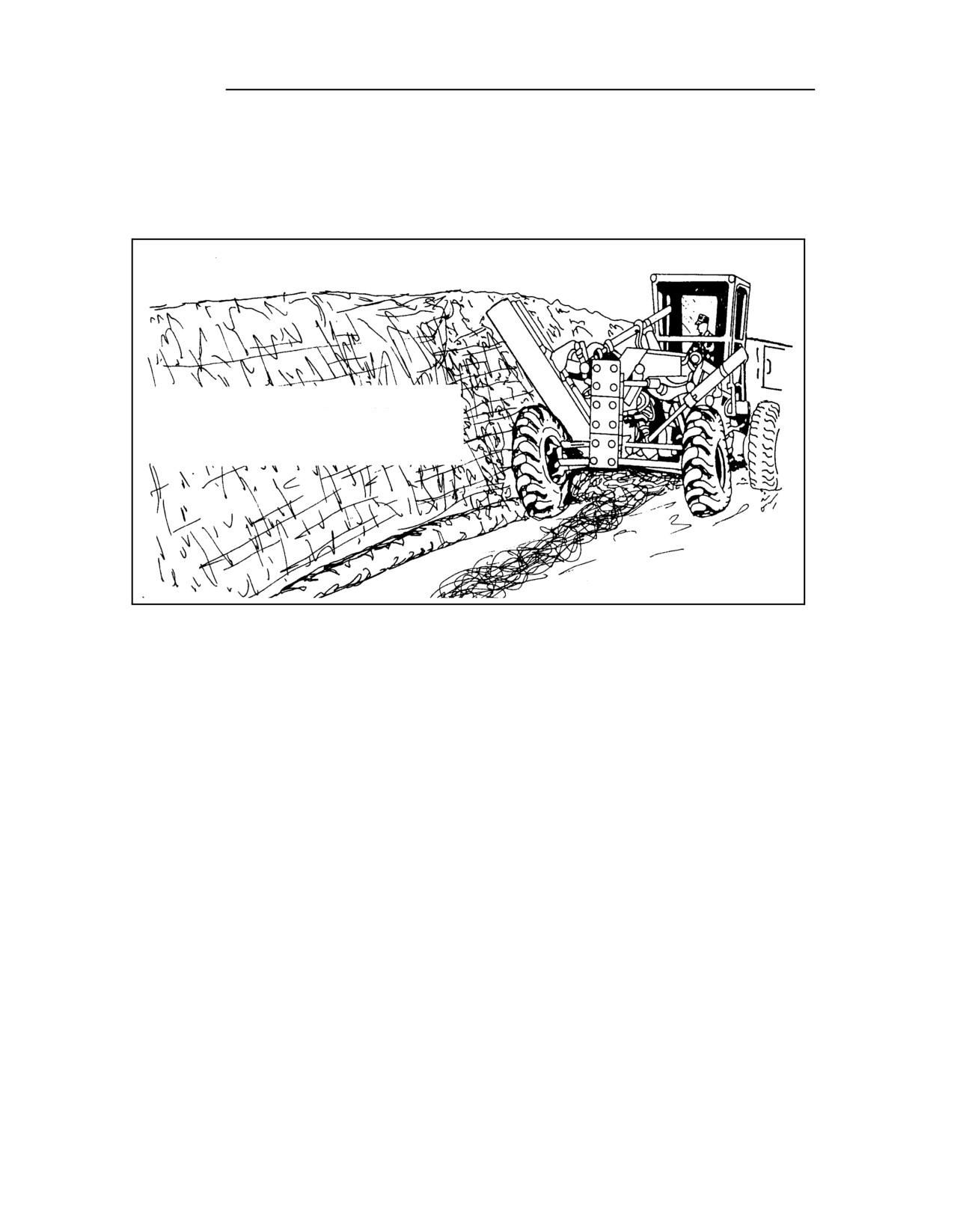
CREATING A BANK SLOPE
4-10. Sloping the bank on a road cut prevents slope-sloughing failures. It also
prevents excessive erosion of the bank, which could fill the roadside ditch.
Initially, cast the material cut from the outer slope into the bottom of the ditch
and remove it later. Figure 4-6, page 4-8, shows a grader sloping a high-bank
cut.
CLEANING A DITCH
4-11. To remove unwanted material that was pushed into the ditch during the
bank slope operation, place the blade in the same position as used for the
ditching cuts. This casts the material onto the shoulder.
FINISHING A SHOULDER
4-12. Move the windrow (formed by cleaning the ditch) onto the road at the
same time the shoulder is being finished to the desired slope.
Graders 4-7
FM 5-434
FINISHING A CROWN OR A CROSS SLOPE
4-13. The final operation is to spread all the material brought from the ditch
onto the roadway. Use this material to bring the roadway to the desired crown
or a cross slope.
For heavier cut, lean wheels toward slope.
For lighter cut, lean wheels away from slope.
Figure 4-6. Sloping a High Bank
EARTH- AND GRAVEL-ROAD MAINTENANCE
LEVELING AND MAINTAINING SURFACES
4-14. Ordinarily, level and maintain a surface by working the material across
the road or runway from one side to the other. However, to maintain a
satisfactory surface in dry weather, work traffic-eroded material from the
edges and shoulders of the road toward the center. Traffic or wind can cause
loss of binder material, so be cautious when disturbing dry road surfaces. The
surface is easier to work if it is damp; therefore, after a rain is a good time to
perform surface maintenance. A water truck may be necessary to dampen dry
material.
Step 1. Rotate the moldboard so that the toe is on the right side of the grader at
about a 50° to 60° angle to the frame.
Step 2. Ensure that the blade is pitched halfway.
Step 3. Center shift the blade until the left lift cylinder is straight up and down.
Step 4. Lean the front wheels to the left.
Step 5. Lower the moldboard until the toe and heel slightly touch the ground.
Step 6. Place the grader in motion and, as the moldboard crosses the project
start line, apply enough downward pressure on both the heel and the toe to pen-
etrate the surface on a level plain about 1/2 inch.
4-8 Graders
FM 5-434
Step 7. Maintain a straight course, adjusting the moldboard slightly to carry
the material the length of the project.
Step 8. Feather the material at the end of the pass.
Step 9. Stop the grader and straighten the front wheels after the material is
feathered to a smooth termination.
Step 10. Raise both lift cylinders all the way.
Step 11. Position the grader to straddle the windrow just made, and back the
grader to the starting point while ensuring the windrow is between the wheels
(do not drive on top of the windrow).
Step 12. Stop the grader just outside of the project boundary line.
Repeat this process until the entire area is leveled.
SMOOTHING PITTED SURFACES
4-15. When binder is present and moisture content is appropriate, rough or
badly-pitted surfaces may be cut smooth. The cut surface material is then
respread over the smooth base. Again, the best time to reshape earth and
gravel roads is after a rain. Dry roads should be moistened by using a water
distributor. This ensures that the material will have sufficient moisture
content to recompact readily.
CORRECTING CORRUGATED ROADS
4-16. When correcting corrugated roads, be careful not to make the situation
worse. Deep cuts on a washboard surface will set up blade chatter, which
emphasizes rather than corrects corrugations. Badly-corrugated surfaces may
require scarifying. With proper moisture content, level the surface by cutting
across the corrugations. Alternate the blade angle so that the cutting edge will
not follow the rough surface. Cut the surface to the bottom of the corrugations,
and then reshape the surface by spreading the windrows in an even layer
across the road. After reshaping the road, the traffic will compact it. However,
rolling the surface after shaping will give better and longer-lasting results.
SCARIFYING ROADS OR AREAS
Step 1. Position the grader outside the working area.
Step 2. Ensure that the moldboard is high enough off the ground to allow unre-
stricted movement.
Step 3. Rotate the moldboard so that it is perpendicular with the frame, and
adjust the height to 12 inches off the surface (level).
Step 4. Center shift the blade until the lift cylinders are centered on the grader.
Step 5. Pitch the blade halfway.
Step 6. Ensure that the front wheels are vertical.
Step 7. Move the grader forward.
Step 8. Lower the scarifier as it crosses the starting point and penetrate the
surface.
Step 9. Scarify the entire length of the area to a minimum depth of about
6 inches.
Graders 4-9
FM 5-434
Step 10. Raise the scarifier at the finish point.
Step 11. Exit the project area and stop the grader.
Step 12. Rotate the moldboard to a 50° angle, and adjust the center shift to
straighten the heel cylinder.
Step 13. Return to the starting point, and reposition the grader for a second
scarifying pass.
SNOW REMOVAL
4-17. Graders remove snow in much the same way as snowplows. Be sure to
raise the blade 0.5 to 1 inch when removing snow from uneven pavements or
portable runway surfaces. Improper adjustment can damage the grader and
gouge the surface.
ASPHALT MIXING
4-18. Asphalt can be mixed in place or mixed with imported aggregate.
Chapter 12 provides additional information on asphalt mixing.
MIXED-IN-PLACE ASPHALT
4-19. For mixed-in-place asphalt, spread the asphalt directly on the road
surface, either before or after scarifying the surface. After applying the
asphalt, mix it with the surface soil by scarifying and/or windrowing with the
blade.
IMPORTED AGGREGATE
4-20. When using imported aggregate for a pavement—
Step 1. Shape the existing base and prepare it by blading, rolling, and curing as
necessary.
Step 2. Dump the aggregate mix and blade it into uniform windrows. If the
aggregate is too wet, blade the windrows to allow evaporation of the excess
moisture.
Step 3. Flatten the windrow and apply the asphalt.
Step 4. Mix the asphalt with the aggregate using the grader. Move the windrow
from side to side across the road by making successive passes with the blade.
Several graders can operate, one behind another (tandem), on the same wind-
row. If rain moistens the mixture, continue mixing until dry.
Step 5. Blade the material back into a windrow after mixing and before spread-
ing.
LARGE-AREA MIXTURES
4-21. Set stakes to mark the edges of the spread width for each windrow.
When spreading mixtures over large areas, drive blue-top hubs (blue tops) to
indicate final pavement elevation. The blue tops are usually placed in a grid
pattern 20 feet apart. Remove the blue tops before rolling the pavement.
Usually, one pass of the grader will flatten the windrow after which it can be
spread to each side in increments. This produces a layer of uniform thickness
with proper lateral and longitudinal slopes. A skilled grader operator is
essential at this phase.
4-10 Graders
FM 5-434
OPERATION TECHNIQUES AND TIPS
4-22. Graders can be used for spreading, leveling, side casting, and planing
materials. Different procedures are required to achieve a desired result.
SPREADING AND LEVELING
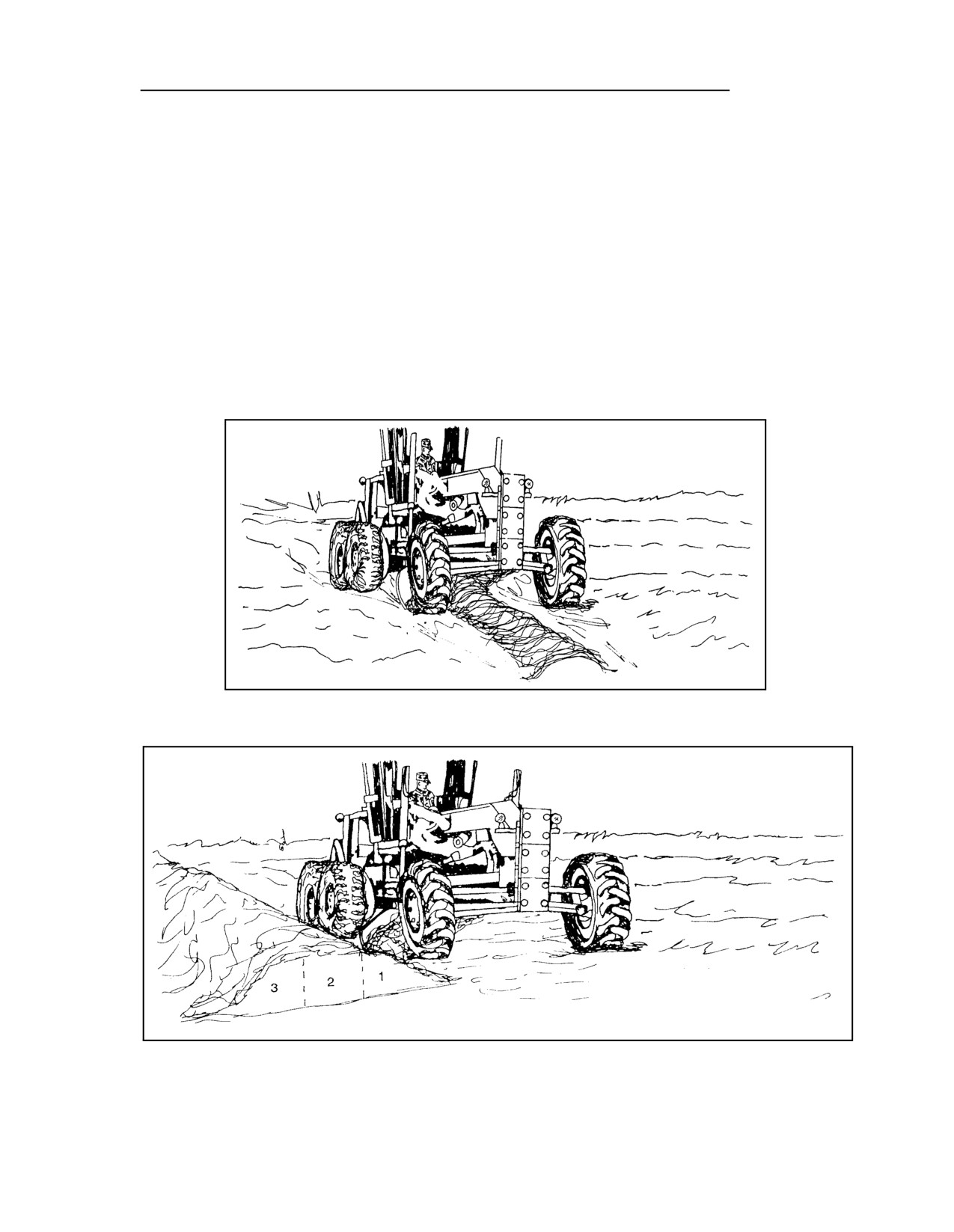
4-23. Use a grader to spread windrows of loose material (Figure 4-7). If there
is space to work around the sides of the windrows, extend the blade well to the
side and reduce the windrow, using a series of side cuts. Spread the windrows
as much as possible. The power and traction of the grader will limit the load to
be pushed. Graders have less power and traction than dozers, but graders
move the load faster. Although the grader blade is low, it is more concave than
the dozer blade. This gives increased rolling action to the load so that a large
quantity can be pushed without spilling over the top. Leveling large windrows
may require two or more sidecuts with a grader (Figure 4-8).
Figure 4-7. Spreading Windrowed Material
Spread section 1.
Spread section 2.
Straddle section 3 and spread.
Figure 4-8. Leveling Large Windrows
Graders 4-11
FM 5-434
SIDE CASTING
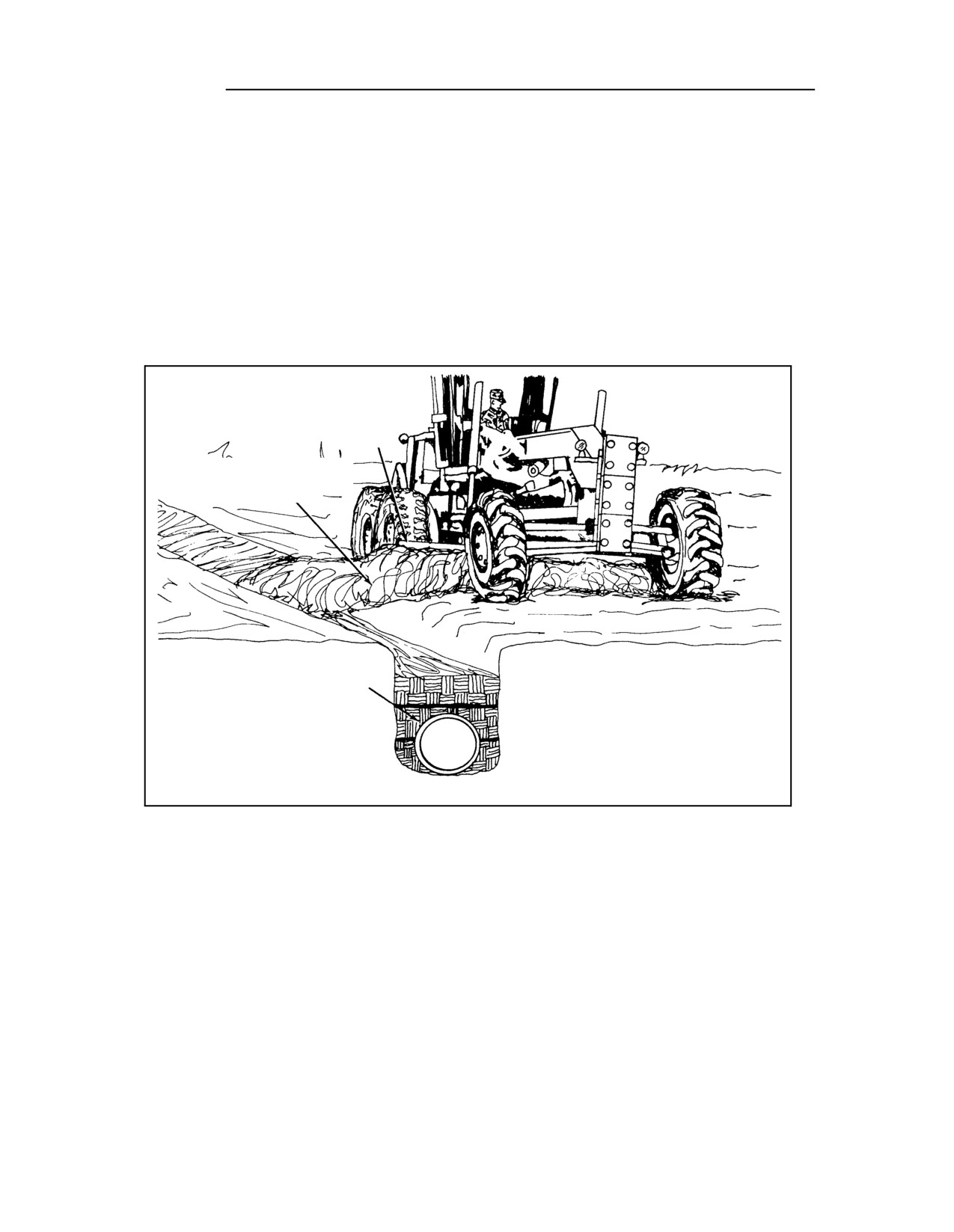
4-24. Set the blade at an angle so that the load being pushed will drift off the
trailing end (Figure 4-9). Rolling action caused by the blade curve assists this
side movement. As the blade is angled more sharply, the speed of the side drift
increases (which does not carry the material as far forward) and deeper cuts
can be made. To shape and maintain most roads, set the blade at a 25° to 30°
angle. Decrease the angle for spreading windrows; increase the angle for hard
cuts and ditching.
NOTE: A blade that is angled straight across (perpendicular to the
direction of movement) is at 0°.
Blade
Windrow of ditch material
used to backfill ditch
1. Angle blade toward ditch.
Hand filled
2. Travel forward and side cast
material into ditch. (Fill should be
compacted in layers.
The lift thickness will depend on
Pipe
project specifications.)
Figure 4-9. Backfilling a Ditch by Side Casting
PLANING
4-25. Set the blade at an angle to plane off irregular surfaces; use that
material to fill the hollows. Cut enough material to always keep some in front
of the blade. Move the loosened material forward and sideward to distribute it
evenly. On the next pass, pick up the windrow that was left at the trailing
edge of the blade. On the final pass, make a lighter cut and lift the trailing
edge of the blade enough to allow the surplus material to go under rather than
around the end. This will avoid leaving a ridge. Do not pile windrows in front
of the rear wheels because it will adversely affect traction and grader control.
4-12 Graders
FM 5-434
WORKING SPEEDS
4-26. Always operate the grader as fast as the operator’s skill and the road
conditions permit. Operate at full throttle in each gear. Use a lower gear if
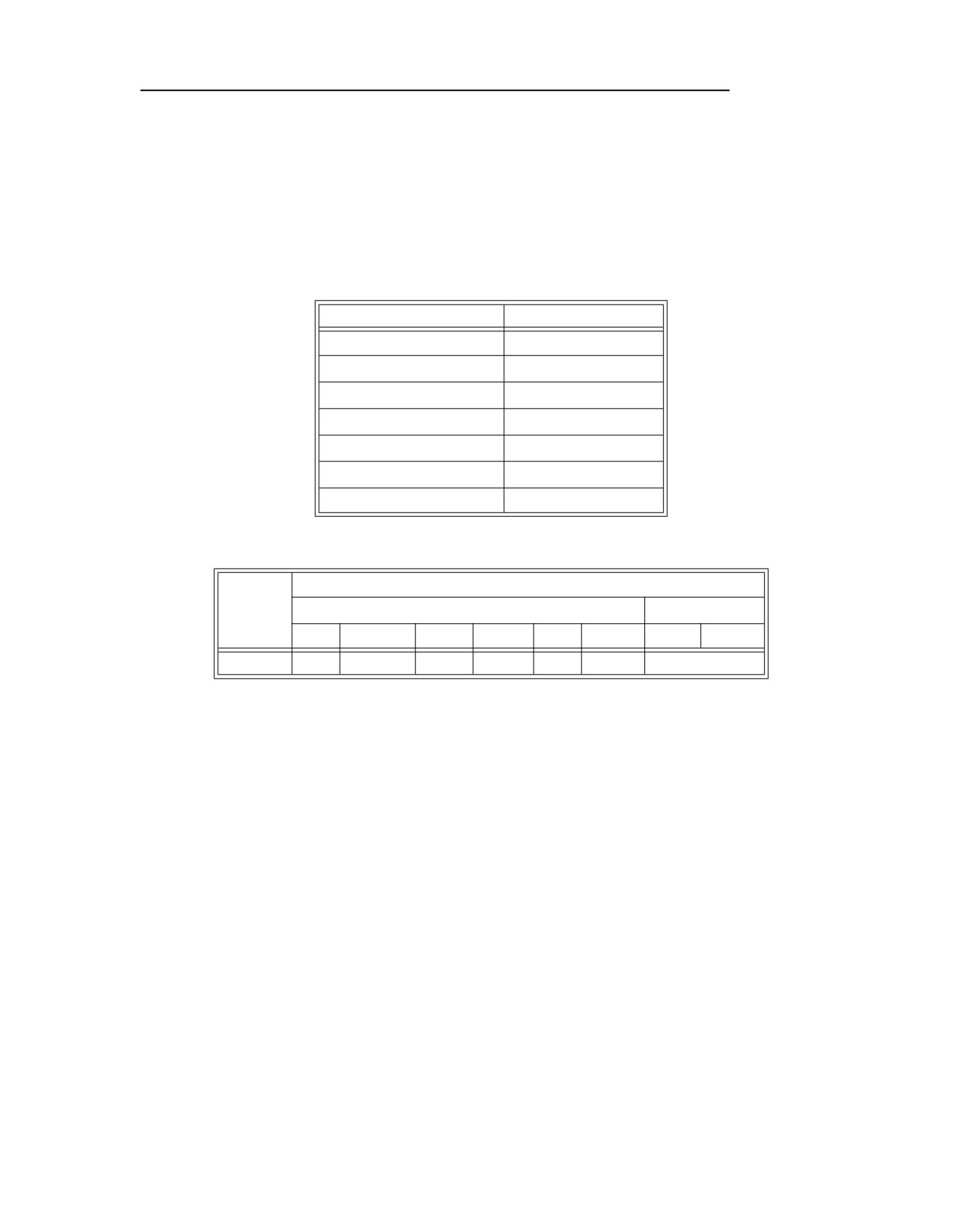
less speed is required, rather than operate at less than full throttle. Table 4-1
lists the proper gear ranges for various grader operations under normal
conditions. Table 4-2 lists the road speeds for the Army’s 130G grader.
Table 4-1. Proper Gear Ranges for Grader Operations
Operation
Gear
Maintenance
Second to third
Spreading
Third to fourth
Mixing
Fourth to sixth
Ditching
First to second
Bank sloping
First
Snow removal
Fifth to sixth
Finishing
Second to fourth
Table 4-2. Road Speeds for the Army’s 130G Grader
Road Speed: mph at Rated rpm
Forward Gears
Reverse Gears
Model
First
Second
Third
Fourth
Fifth
Sixth
Low
High
130G
2.3
3.7
5.9
9.7
15.5
24.5
Same as forward
BLADE SETTING AND GRADER SPEED
4-27. Each job requires a specific blade setting and grader speed for optimum
production. Deviations from these settings and speeds will cause machine
inefficiency.
TURNING
4-28. When making a number of passes over a short distance (less than 1,000
feet), backing the grader to the starting point is normally more efficient than
turning it around and continuing the work from the far end. Never make
turns on a newly-laid bituminous road or runway surface.
NUMBER OF PASSES
4-29. Grader efficiency is directly proportional to the number of passes made.
Operator skill, coupled with planning, is most important in eliminating
unnecessary passes. For example, if four passes will complete a job, every
additional pass increases the time and cost of the job.
Graders 4-13
FM 5-434
TIRE INFLATION
4-30. Keep the tires properly inflated to get the best results. Overinflated tires
result in less contact between the tires and the road surface, causing a loss of
traction. Air-pressure differences in the rear tires cause tire slippage and
grader bucking. The operator’s manual gives the correct tire inflation
pressure.
WET AND MUDDY CONDITIONS
4-31. Wet and muddy conditions cause poor traction, which may decrease
grader efficiency. However, in spite of reduced efficiency, the grader is the
best machine to use under these conditions. One example of this would be
casting surface mud to the side on a haul road.
HAUL-ROAD MAINTENANCE
4-32. Keep haul roads in good condition. This will increase the efficiency of
scrapers or dump trucks on large earthmoving operations. Graders are the
best machines for maintaining haul roads. The most efficient method of road
maintenance is to use enough graders to complete one side of a road with one
pass of each grader (tandem operation). In this method, maintenance of one
side of the road is completed while the other side is open to traffic.
TANDEM OPERATIONS
4-33. Using graders in tandem expedites such operations as leveling, mixing,
spreading, and haul-road maintenance.
PRODUCTION ESTIMATES
4-34. Use the following formula to prepare estimates of the total time (in
hours or minutes) required to complete a grader operation.
Total time= P×D
S×E
where—
P = number of passes required
D = distance traveled in each pass, in miles or feet
S = speed of grader, in mph or fpm (multiply mph by 88 to convert to
fpm)
E = efficiency factor
• Number of passes. Estimate the number of passes (based on the
project requirements) before construction begins.
• Distance traveled. Determine the required travel distance per pass
before construction begins.
• Speed of the grader. Speed is the most difficult factor in the formula
to estimate accurately. As work progresses, conditions may require
that speed estimates be increased or decreased. Compute the work
output for each rate of speed used in an operation. The speed depends
largely on the skill of the operator and the material type.
• Efficiency factor. For grader operations the efficiency factor is
usually no better than 60 percent.
4-14 Graders
FM 5-434
EXAMPLE
Time estimate based on the number of miles of construction.
Maintenance of a 5-mile gravel road requires cleaning the ditches and leveling
and reshaping the road. Use a CAT 130G grader and a 0.6 efficiency factor.
Cleaning the ditches requires two passes in first gear, leveling the road requires
two passes in second gear, and final shaping of the road requires three passes in
fourth gear.
Speeds (from Table 4-2, page 4-13):
First gear = 2.3 mph
Second gear = 3.7 mph
Fourth gear = 9.7 mph
2×5
2×5
3×5
Total time
=
----------------------
+
----------------------
+ ----------------------
= 7.3 + 4.5 + 2.6 = 14.4 hours
2.3 × 0.6
3.7 × 0.6
9.7 × 0.6
EXAMPLE
Time estimate based on the number of feet of construction.
A 1,500-foot gravel road requires leveling and reshaping. Use a CAT 130G grader
with a 0.6 efficiency factor. The work requires two passes in second gear and
three passes in third gear.
Speeds (from Table 4-2):
Second gear = 3.7 mph
Third gear = 5.9 mph
2 × 1,500
3 × 1,500
Total time
=
----------------------------------------
+ ----------------------------------------
= 15.4 + 14.4 = 29.8 minutes
(88 × 3.7) × 0.6
(88 × 5.9) × 0.6
SAFETY
4-35. Listed below are specific safety rules for grader operators:
• Always display a red flag or a flashing light on a staff at least 6 feet
above the left rear wheel when operating a grader slowly on a highway
or roadway.
• Never allow other personnel to ride on the blade or rear of the grader.
• Always engage the clutch gently, especially when going uphill or
pulling out of a ditch.
• Always reduce speed before making a turn or applying the brakes.
• Always keep the grader in low gear when going down steep slopes.
• Always take extra care when working on hillsides to drive slowly and
to be observant of holes or ditches.
• Never use graders to pull stumps or other heavy loads.
• Always keep the blade angled well under the machine when it is not in
use.
• Never allow more than one person on a grader while it is in operation.
If it has a buddy seat, ensure that no more than two people are on the
machine while it is in operation.
Graders 4-15
FM 5-434
4-16 Graders
Chapter 5
Loaders
Loaders are used extensively in construction operations to handle and
transport material, to load haul units, to excavate, and to charge
aggregate bins at both asphalt and concrete plants. The loader is a
versatile piece of equipment designed to excavate at or above wheel or
track level. The hydraulic-activated lifting system exerts maximum
breakout force with an upward motion of the bucket. Large rubber tires on
wheel models provide good traction and low ground-bearing pressure. A
wheel loader can attain high speeds, which permits it to travel from one
job site to another under its own power.
DESCRIPTION
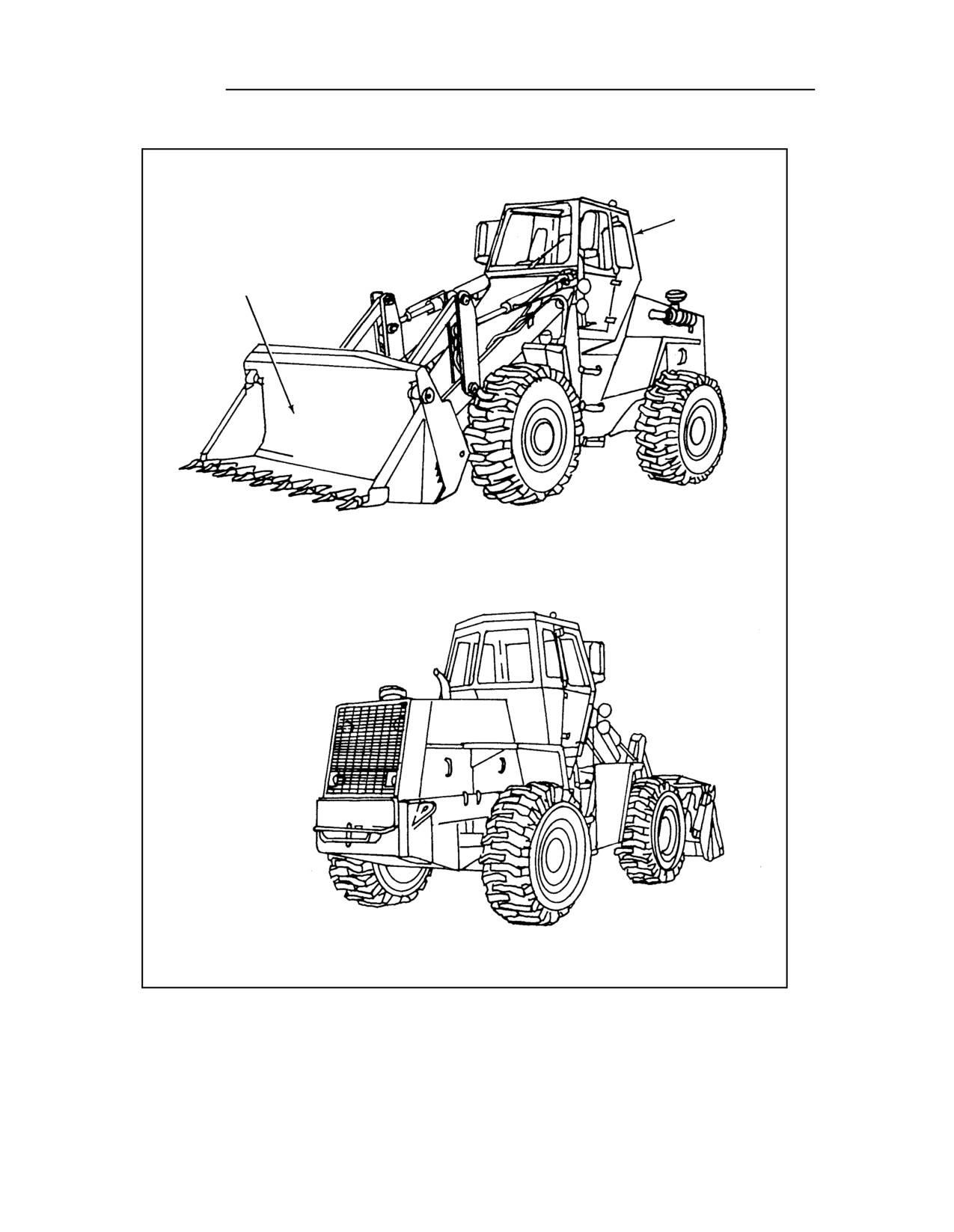
5-1. Military loaders are diesel-driven, rubber-tired machines (Figure 5-1,
page 5-2). They are available in varied sizes and capacities. A power-shift
transmission with a torque converter gives the loaders fast-movement
capability in both forward and reverse, with a minimum of shock. This lets the
machines maintain a high production rate. The hydraulic system gives the
operator positive control of mounted attachments and assists with steering.
Most loaders have pintles or towing hooks for towing small trailers or light
loads.
ATTACHMENTS
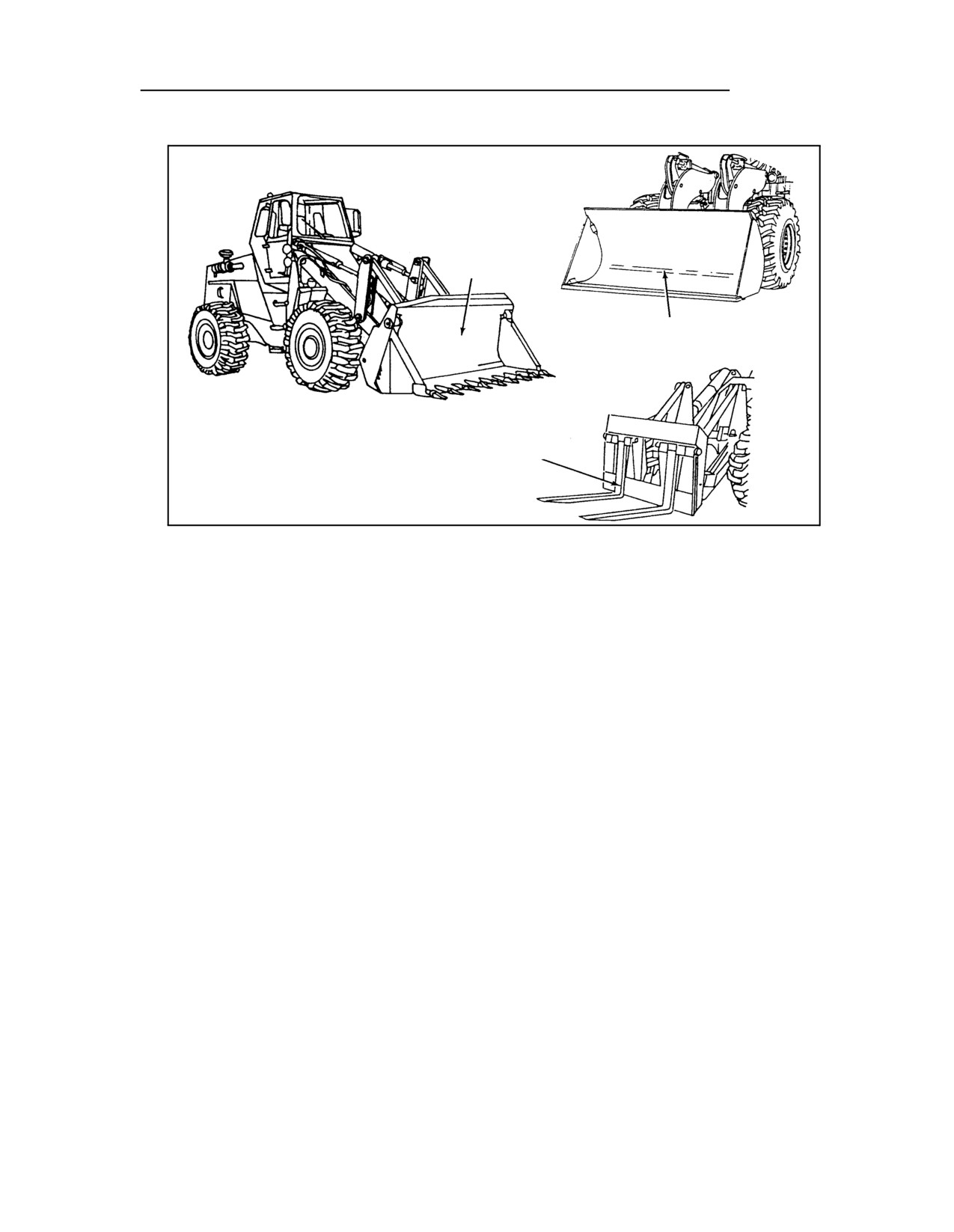
5-2. The most common loader attachments are a shovel-type bucket or a
forklift (Figure 5-2, page 5-3). The loader’s hydraulic system provides the
power necessary for operating these attachments. Hooks (designed for lifting
and moving sling loads) and snowplows are other available attachments.
BUCKET
5-3. Buckets may be general-purpose (one-piece, conventional) or multipurpose
(two-piece, hinged-jaw) (Figure 5-2). The bucket attaches to the tractor unit by
lift arms. Buckets are made of heavy-duty, all-welded steel and vary in size
from 2.5 to 5 cubic yards. The bucket teeth are bolted or welded onto
replaceable cutting edges. Bolt-on, replaceable teeth are provided for
excavation of medium-type materials. The multipurpose bucket provides the
capability to use the loader as a dozer and to grab material.
FORKLIFT
5-4. A forklift can be attached to the tractor unit in place of a bucket. Designed
for material handling, the fork attachment is made of steel with two movable
tines.
Loaders 5-1
FM 5-434
Cab
(ROPS)
Multipurpose
bucket
Figure 5-1. Wheel Loader
5-2 Loaders
FM 5-434
Multipurpose
bucket
General-purpose bucket
Forklift
Figure 5-2. Loader Attachments
USE
5-5. Typical uses for a loader are loading trucks; stockpiling materials; digging
basements or gun emplacements; backfilling ditches; lifting and moving
construction materials; and, when equipped with rock-type-tread tires,
operating in and around rock quarries. They may also be used for many
miscellaneous construction tasks. These include stripping overburden,
charging hoppers and skips, lifting and moving forms for concrete work,
moving large concrete and steel pipes, assisting with plant erection and
maintenance, and towing small trailers and light loads.
SELECTION
5-6. Two critical factors to consider in selecting a loader are the type and
volume of material being handled. Loaders are excellent machines for
excavating soft to medium-hard material. Loader production rates decrease
rapidly when excavating medium to hard material. Another factor to consider
is how high the material must be raised. To be of value in loading trucks, the
loader must be able to dump over the side of the truck’s dump bed. A loader
attains its highest production rate when working on a flat, smooth surface
with enough space to maneuver. In poor underfoot conditions or when there is
a lack of space to operate efficiently, other equipment may be more effective.
OPERATION
LOADING THE BUCKET
5-7. When loading the bucket, it should be parallel with the ground so its
cutting edge can skim the travel surface and remove ruts, obstacles, and loose
material on the forward pass. As the cutting edge contacts the bank or
stockpile, move the loader forward at a slow speed and increase the power.
Loaders 5-3
FM 5-434
While penetrating the material, raise the bucket. Crowd the material into the
bucket and roll the bucket back to prevent spilling. Maintain the bucket in an
upward position while backing away, to prevent spilling.
POSITIONING OF HAUL UNITS
5-8. Proper positioning of the equipment that will receive material from the
loader is necessary for maximum production. This cuts down on maneuver
time.
LOADING METHOD
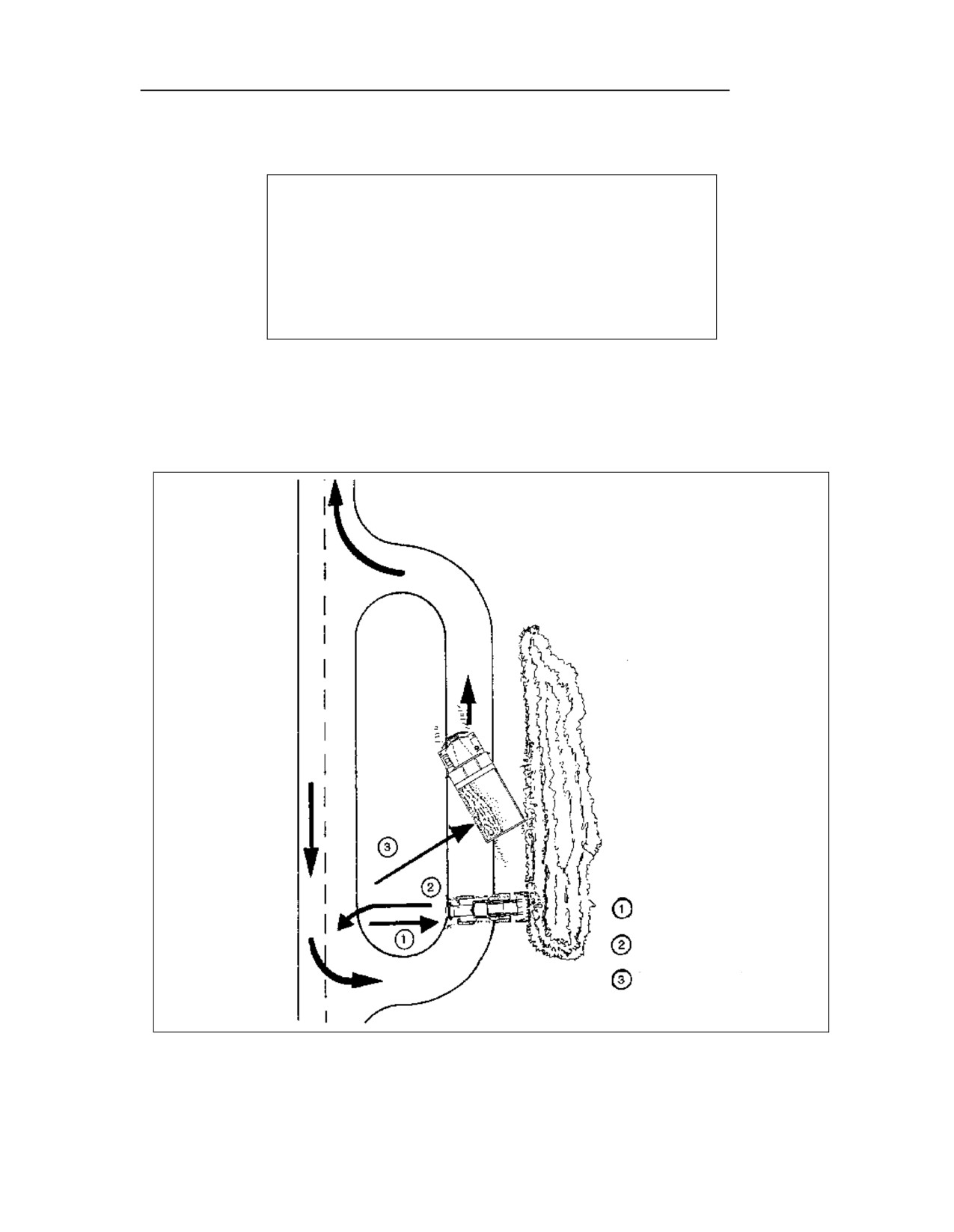
5-9. When loading trucks from a bank or a stockpile with a single loader, use
the V-loading method. Use the following steps for the V-loading method
(Figure 5-3).
Step 1. With the bucket lowered 1 to 2 inches off the ground, head the loader
toward the bank or stockpile in low gear.
Step 2. Move the loader into the stockpile and manipulate the lift and tilt con-
trol levers, simultaneously curling back the bucket and raising the boom
slightly until the bucket is full and completely rolled back. Maintain power
without spinning the tires.
Step 3. Hold the bucket in the upright and curled position, and back away from
the stockpile or bank.
Step 4. Approach the haul unit at a 90° angle, lifting the bucket high enough to
clear the haul unit.
Step 5. Proceed slowly forward until the bucket is over the haul unit. Do not
touch the haul unit with the front tires.
Step 6. Dump the bucket by rolling the bucket slowly forward. Do not let the
bucket hit the haul unit.
Step 7. Back away from the haul unit while simultaneously lowering the boom
and leveling the bucket.
Repeat the above steps until the haul unit is loaded.
NOTE: While these machines are flexible and can dig under very awk-
ward conditions, the best production is achieved by keeping both the
angle of turn and the travel distance to a minimum.
CLAM LOADING
5-10. This procedure can be used with the multipurpose bucket for handling
rocks, timbers, or stockpiles of loose material.
Step 1. Center the front of the bucket on the middle of the first load to be picked
up. When about 5 feet from the load, begin to open the bucket.
Step 2. Move the loader forward and make contact with the load. About two-
thirds of the opened bucket should penetrate into the material to be loaded.
Step 3. Close the bucket to secure the load.
5-4 Loaders
FM 5-434
Step 4. Position the load 10 to 14 inches above the ground.
CAUTION
Keep the loader bucket as low as possible. A low bucket
position provides better balance and operator visibility.
When traveling with a full bucket over rough terrain or
terrain that can cause the loader to slide, always operate
at low speed. Failure to do so can result in loss of control,
causing serious injury or loss of life and property
damage.
Step 5. Maneuver the loader to the desired location for load placement.
Step 6. Open the bucket fully.
Step 7. Raise the bucket high enough to clear any previously dumped material.
Ensure that all of the material is out of the bucket.
Make a frontal approach
to the tank or stockpile.
Lift the bucket and back
away from the stockpile.
Approach the haul unit
(truck) at a 90o angle to
load the truck.
Figure 5-3. Loading Trucks With a Loader (V-Loading Method)
Loaders 5-5
FM 5-434
Step 8. Close the bucket.
Step 9. Place the bucket in the traveling position (10 to 14 inches above the
ground).
Repeat the above steps until the task is complete.
EXCAVATING BASEMENTS AND GUN EMPLACEMENTS
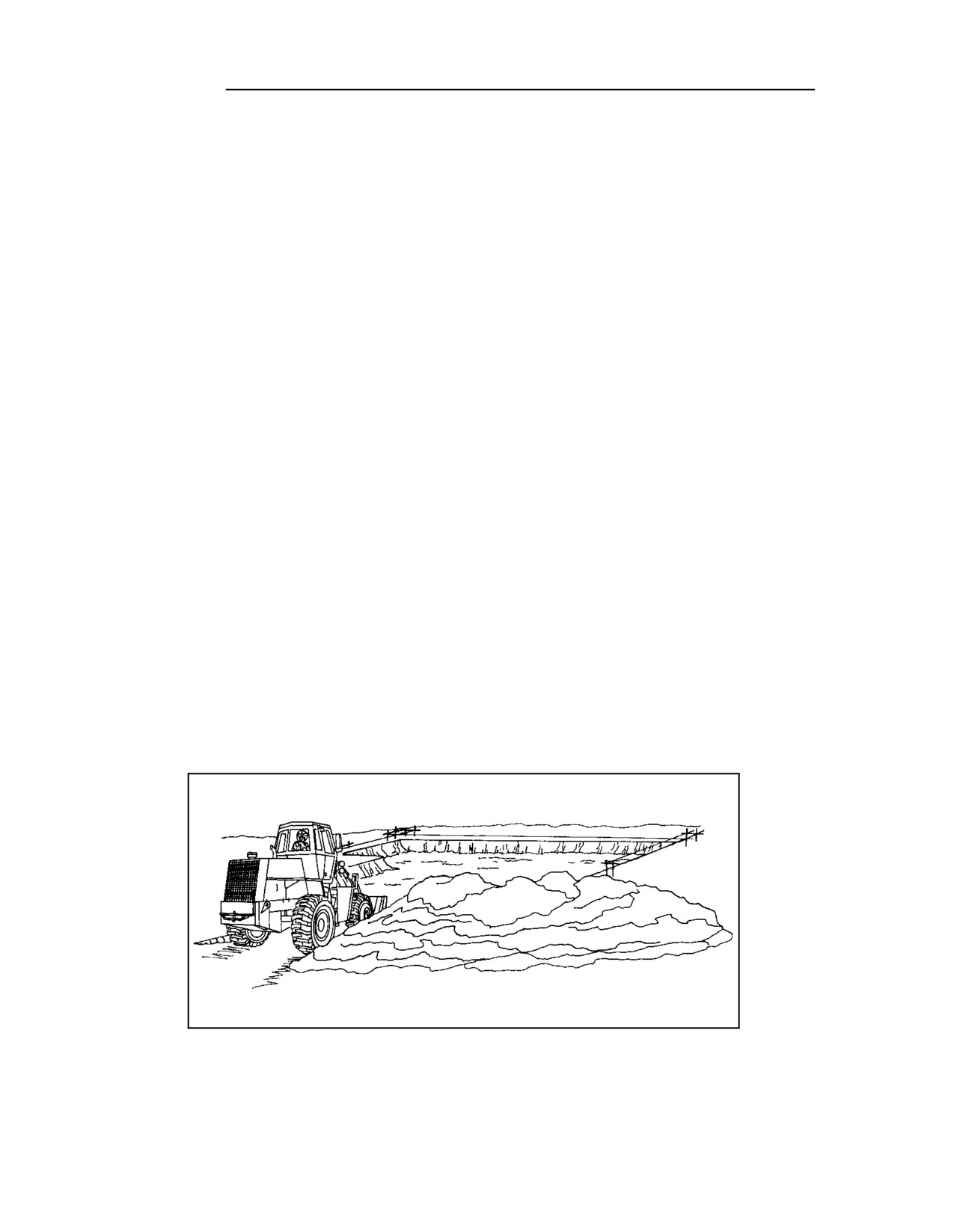
5-11. A loader can dig excavations such as basements or gun emplacements if
the material is not too hard. The operator should first construct a ramp into
the excavation (Figure 5-4). Because the loader works best when excavating
above wheel level, the ramp allows the loader to work in that manner and
later provides egress to bring out the material. The following procedures are
used to construct a ramp.
Step 1. Determine a starting point for the ramp.
Step 2. Position the bucket so it is pitched forward.
Step 3. Move the loader forward, gradually penetrating the earth by lowering
the lift control lever.
• Keep the loader in as high a gear as possible without causing the tires
to spin excessively.
• Regulate the depth of cut using the lift control lever.
Step 4. Retract the bucket fully.
Step 5. Place the lift control lever in the raised position until the bucket is high
enough to clear the surrounding area.
Step 6. Dump the loaded bucket onto a stockpile or into a haul unit.
Repeat the above steps until the excavation is complete.
WORKING IN DIFFICULT MATERIAL
5-12. The multipurpose bucket handles sticky material (which has a tendency
to cling to the bucket) better than the general-purpose bucket. A clam-type
digging motion works best in this material type. When digging medium to
hard material, a greater efficiency can be achieved by first breaking or
loosening the material.
Figure 5-4. Constructing a Ramp into an Excavation
5-6 Loaders
FM 5-434
BACKFILLING
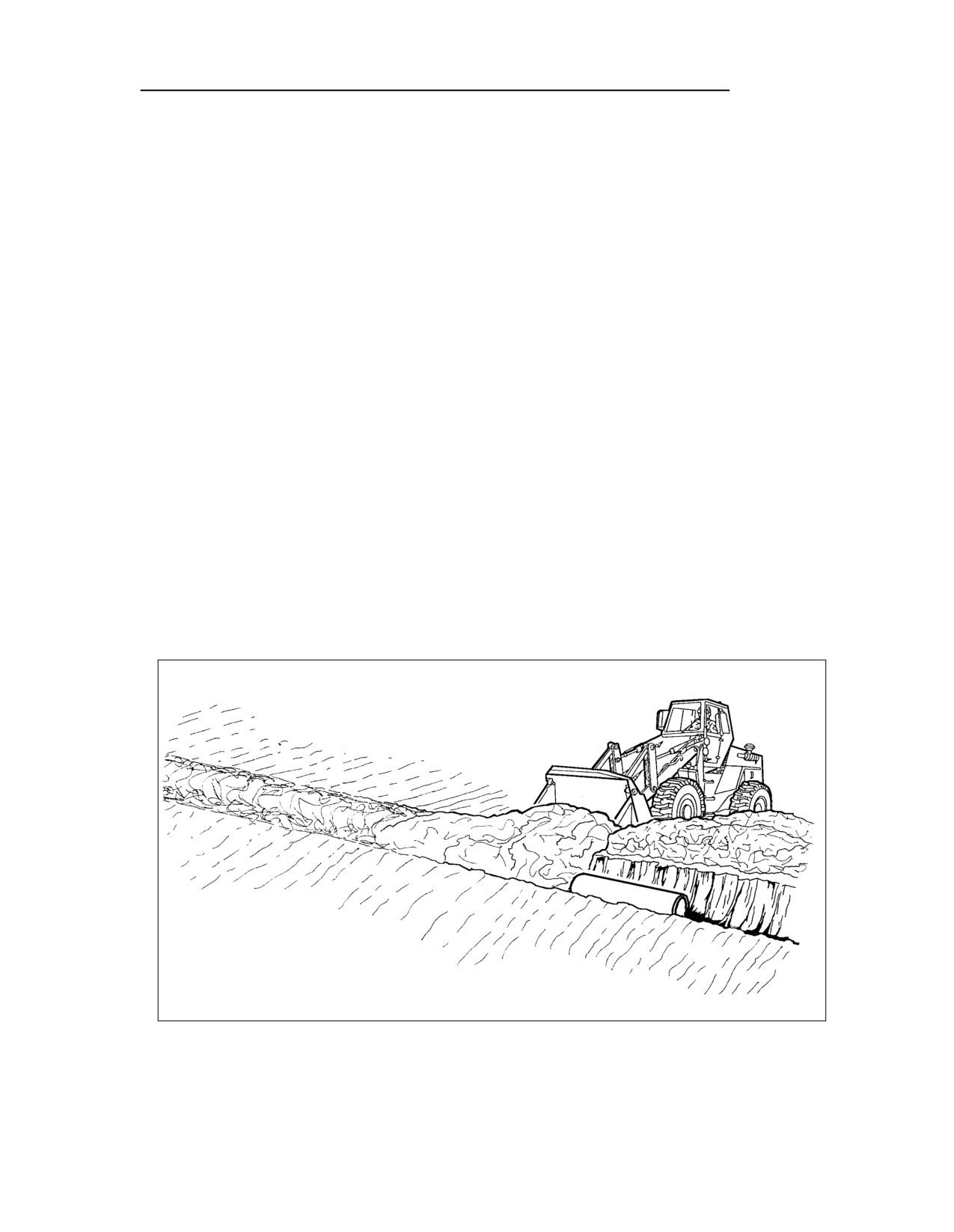
5-13. When backfilling trenches, lower the bucket to grade level and use the
forward movement of the machine to push the stockpiled earth into the trench
(Figure 5-5). This type of work is ideal for the loader as long as the bucket is as
wide as, or wider than, the loader’s wheels or tracks. Narrow buckets cause
the wheels to ride up the stockpile. This raises one corner of the bucket and
requires more passes. Use the following steps to perform backfilling
operations.
Step 1. Align the loader with the stockpile (either to the left or right side) while
approaching at a 45° angle so that one-third of the bucket will contact the stock-
pile.
NOTE: This technique will not work when pushing a large stockpile. In
this case, work from the edges.
Step 2. Adjust the bucket by moving the lift control lever to lower the bucket to
just off of the natural ground. If using a multipurpose bucket, move the bucket
control lever to open the bucket to the clam position.
Step 3. Move the loader forward and gradually move the material. Keep the
loader in as high a gear as possible without causing the tires to spin excessively.
Step 4. Move the lift control lever to lower or raise the bucket to cut and spread
the material the length of the trench.
Step 5. Move the lift control lever to raise the bucket 10 to 14 inches off the
ground before reversing direction.
Step 6. Reverse the loader and return to the stockpile.
Repeat the above steps until the operation is complete.
Figure 5-5. Backfilling a Trench With a Loader
Loaders 5-7

FM 5-434
CONSTRUCTING A STOCKPILE
5-14. A stockpile can be constructed from the material excavated in any of the
previously described operations. Use the following dump steps when
constructing a stockpile:
Step 1. Move the loader forward until the front tires contact the bank.
Step 2. Move the lift control lever to raise the bucket all the way.
Step 3. Move the tilt control lever to slowly tilt the bucket to the dump position.
Step 4. Pull the tilt control lever to tilt the bucket back to the standard bucket
position.
Step 5. Back the loader from the stockpile and lower the bucket to about 10 to
14 inches off the ground.
Step 6. Back the loader to the start of the work area.
Repeat the above steps until all of the material is stockpiled.
PRODUCTION ESTIMATES
5-15. Many factors affect loader production: operator skill, extent of prior
loosening of the material, slope of the operating area, height of the material,
climate, and haul-unit positioning. Table 5-1 shows bucket fill factors for
converting rated heaped-bucket capacity to LCY volume based on the type of
material being handled. Table 5-2 gives average cycle times for wheel loaders
to excavate and load with no extra travel required. Use the following formulas
and step-by-step method for estimating loader production.
Table 5-1. Bucket Fill Factors for Wheel Loaders
Material
Wheel Loader Fill Factor∗
Loose material:
Mixed moist aggregates
0.95 to 1.00
Uniform aggregates:
up to 1/8 inch
0.95 to 1.00
1/8 to 3/8 inch
0.90 to 0.95
1/2 to 3/4 inch
0.85 to 0.90
1 inch and over
0.85 to 0.90
Blasted rock:
Well blasted
0.80 to 0.95
Average
0.75 to 0.90
Poor
0.60 to 0.75
Other:
Rock-dirt mixtures
1.00 to 1.20
Moist loam
1.00 to 1.10
Soil
0.80 to 1.00
∗Decimal of heaped-bucket capacity, for adjustment to LCY
Table 5-2. Average Cycle Times for Wheel Loaders
Loader Size,
Heaped-Bucket Capacity
Wheel-Loader
(Cubic Yards)
Cycle Time (Minutes)
1.00 to 3.75
0.45 to 0.50
4.00 to 5.50
0.50 to 0.55
NOTE: Includes load, maneuver with four reversals of direction (minimum travel), and dump.
5-8 Loaders