FM 5-434 Earthmoving Operations (JUNE 2000) - page 1
Field Manual
*FM 5-434
No. 5-434
Headquarters
Department of the Army
Washington, DC 15 JUNE 2000
Earthmoving Operations
Contents
Page
PREFACE
v
Chapter 1
MANAGING EARTHMOVING OPERATIONS
1-1
Project Management
1-1
Equipment Selection
1-1
Production Estimates
1-1
Material Considerations
1-2
Zones Of Operation
1-6
Chapter 2
DOZERS
2-1
Description
2-1
Blades
2-2
Clearing and Grubbing Operations
2-3
Sidehill Excavations
2-9
Operation Techniques
2-11
Dozer Production Estimates
2-18
Ripping Production Estimates
2-23
Safety Precautions
2-26
Chapter 3
SCRAPERS
3-1
Description
3-1
Production Cycle
3-2
Production Estimates
3-9
DISTRIBUTION RESTRICTION: Approved for public release; distribution is unlimited.
*This publication supersedes FM 5-434, 26 August 1994, and FM 5-164, 30 August 1974.
FM 5-434
Page
Chapter 4
GRADERS
4-1
Grader Components
4-1
Road and Ditch Construction
4-2
Earth- and Gravel-Road Maintenance
4-8
Snow Removal
4-10
Asphalt Mixing
4-10
Operation Techniques and Tips
4-11
Production Estimates
4-14
Safety
4-15
Chapter 5
LOADERS
5-1
Description
5-1
Attachments
5-1
Use
5-3
Selection
5-3
Operation
5-3
Production Estimates
5-8
Safety
5-10
Chapter 6
FORKLIFTS
6-1
Use
6-1
Operation Techniques
6-1
Safety
6-2
Chapter 7
CRANES
7-1
Basic Crane Unit
7-1
Hoisting Operations
7-7
Pile Driver
7-11
Clamshell
7-12
Dragline
7-15
Safety
7-20
Chapter 8
HYDRAULIC EXCAVATORS
8-1
Description
8-1
Excavation Techniques
8-2
Operation Techniques
8-3
Small Emplacement Excavator with a Loader Bucket
8-4
Track-Mounted Excavator
8-8
Production Estimates
8-8
ii
FM 5-434
Page
Chapter 9
AIR COMPRESSORS AND PNEUMATIC TOOLS
9-1
Air Compressors
9-1
Compressed-Air Uses
9-4
Air Manifolds
9-5
Pneumatic Tools
9-6
Safety
9-17
Chapter 10
HAULING EQUIPMENT
10-1
Dump Trucks
10-1
Equipment Trailers
10-6
Chapter 11
SOIL-PROCESSING AND COMPACTION
11-1
Soil Processing
11-1
Soil Compaction
11-7
Chapter 12
ROAD SURFACING
12-1
Surface Treatment
12-1
Surfacing Equipment
12-1
In-Place Mixing Equipment
12-8
Bitumen Handling and Dedrumming Equipment
12-9
Support Equipment
12-10
Chapter 13
SAFETY
13-1
Safety Program
13-1
General Safety Rules
13-1
Operator Indoctrination
13-2
Operator Qualifications and Requirements
13-2
Equipment Inspection
13-2
Repairs and Maintenance
13-2
Guards and Safety Devices
13-3
Signals
13-3
Ropes, Cables, and Chains
13-3
Equipment Loading
13-6
Equipment Transporting
13-7
Night Operations
13-7
Excavations
13-7
Chapter 14
ENVIRONMENTAL PROTECTION
14-1
Preoperations Checklist
14-1
Personnel-Preparation Checklist
14-2
iii
FM 5-434
Page
Spill-Response Plan
14-2
APPENDIX A METRIC CONVERSION CHART
A-1
GLOSSARY
GLOSSARY-1
BIBLIOGRAPHY
BIBLIOGRAPHY-1
INDEX
1
iv
Preface
This field manual (FM) is a guide for engineer personnel responsible for planning,
designing, and constructing earthworks in the theater of operations. It gives estimated
production rates, characteristics, operation techniques, and soil considerations for
earthmoving equipment. This guide should be used to help select the most economical
and effective equipment for each individual operation.
This manual discusses the complete process of estimating equipment production rates.
However, users of this manual are encouraged to use their experience and data from
other projects in estimating production rates.
The material in this manual applies to all construction equipment regardless of make
or model. The equipment used in this manual are examples only. Information for pro-
duction calculations should be obtained from the operator and maintenance manuals
for the make and model of the equipment being used.
Appendix A contains an English-to-metric measurement conversion chart.
The proponent of this publication is HQ TRADOC. Send comments and recommenda-
tions on Department of the Army (DA) Form 2028 directly to United States Army Engi-
neer School (USAES), ATTN: ATSE-DOT-DD, Directorate of Training, 320 Engineer
Loop Suite 336, Fort Leonard Wood, Missouri 65473-8929.
Unless this publication states otherwise, masculine nouns and pronouns do not refer
exclusively to men.
v
Chapter 1
Managing Earthmoving Operations
Earthmoving may include site preparation; excavation; embankment
construction; backfilling; dredging; preparing base course, subbase, and
subgrade; compaction; and road surfacing. The types of equipment used
and the environmental conditions will affect the man- and machine-hours
required to complete a given amount of work. Before preparing estimates,
choose the best method of operation and the type of equipment to use.
Each piece of equipment is specifically designed to perform certain
mechanical tasks. Therefore, base the equipment selection on efficient
operation and availability.
PROJECT MANAGEMENT
1-1. Project managers must follow basic management phases to ensure that
construction projects successfully meet deadlines set forth in project
directives. Additionally, managers must ensure conformance to safety and
environmental-protection standards. The basic management phases as
discussed in FM 5-412 are—
• Planning.
• Organizing.
• Staffing.
• Directing.
• Controlling.
• Executing.
EQUIPMENT SELECTION
1-2. Proper equipment selection is crucial to achieving efficient earthmoving
and construction operations. Consider the machine’s operational capabilities
and equipment availability when selecting a machine for a particular task.
The manager should visualize how best to employ the available equipment
based on soil considerations, zone of operation, and project-specific
requirements. Equipment production-estimating procedures discussed in this
manual help quantify equipment productivity.
PRODUCTION ESTIMATES
1-3. Production estimates, production control, and production records are the
basis for management decisions. Therefore, it is helpful to have a common
method of recording, directing, and reporting production. (Refer to specific,
Managing Earthmoving Operations 1-1
FM 5-434
equipment production-estimating procedures in the appropriate chapters in
this manual.)
PRODUCTION-RATE FORMULA
1-4. The most convenient and useful unit of work done and unit of time to use
in calculating productivity for a particular piece of equipment or a particular
job is a function of the specific work-task being analyzed. To make accurate
and meaningful comparisons and conclusions about production, it is best to
use standardized terms.
Production rat = unit of work done
unit of time
• Production rate. The entire expression is a time-related production
rate. It can be cubic yards per hour, tons per shift (also indicate the
duration of the shift), or feet of ditch per hour.
• Unit of work done. This denotes the unit of production
accomplished. It can be the volume or weight of the material moved,
the number of pieces of material cut, the distance traveled, or any
similar measurement of production.
• Unit of time. This denotes an arbitrary time unit such as a minute,
an hour, a 10-hour shift, a day, or any other convenient duration in
which the unit of work done is accomplished.
TIME-REQUIRED FORMULA
1-5. The inverse of the production-rate formula is sometimes useful when
scheduling a project because it defines the time required to accomplish an
arbitrary amount of work.
Time required
= -------------------------------------------------
unit of work done
NOTE: Express the time required in units such as hours per 1,000 cubic
yards, hours per acre, days per acre, or minutes per foot of ditch.
MATERIAL CONSIDERATIONS
1-6. Depending on where a material is considered in the construction process,
during excavation versus after compaction, the same material weight will
occupy different volumes (Figure 1-1). Material volume can be measured in
one of three states:
• Bank cubic yard (BCY). A BCY is 1 cubic yard of material as it lies
in its natural/undisturbed state.
• Loose cubic yard (LCY). A LCY is 1 cubic yard of material after it
has been disturbed by an excavation process.
• Compacted cubic yard (CCY). A CCY is 1 cubic yard of material
after compaction.
1-2 Managing Earthmoving Operations
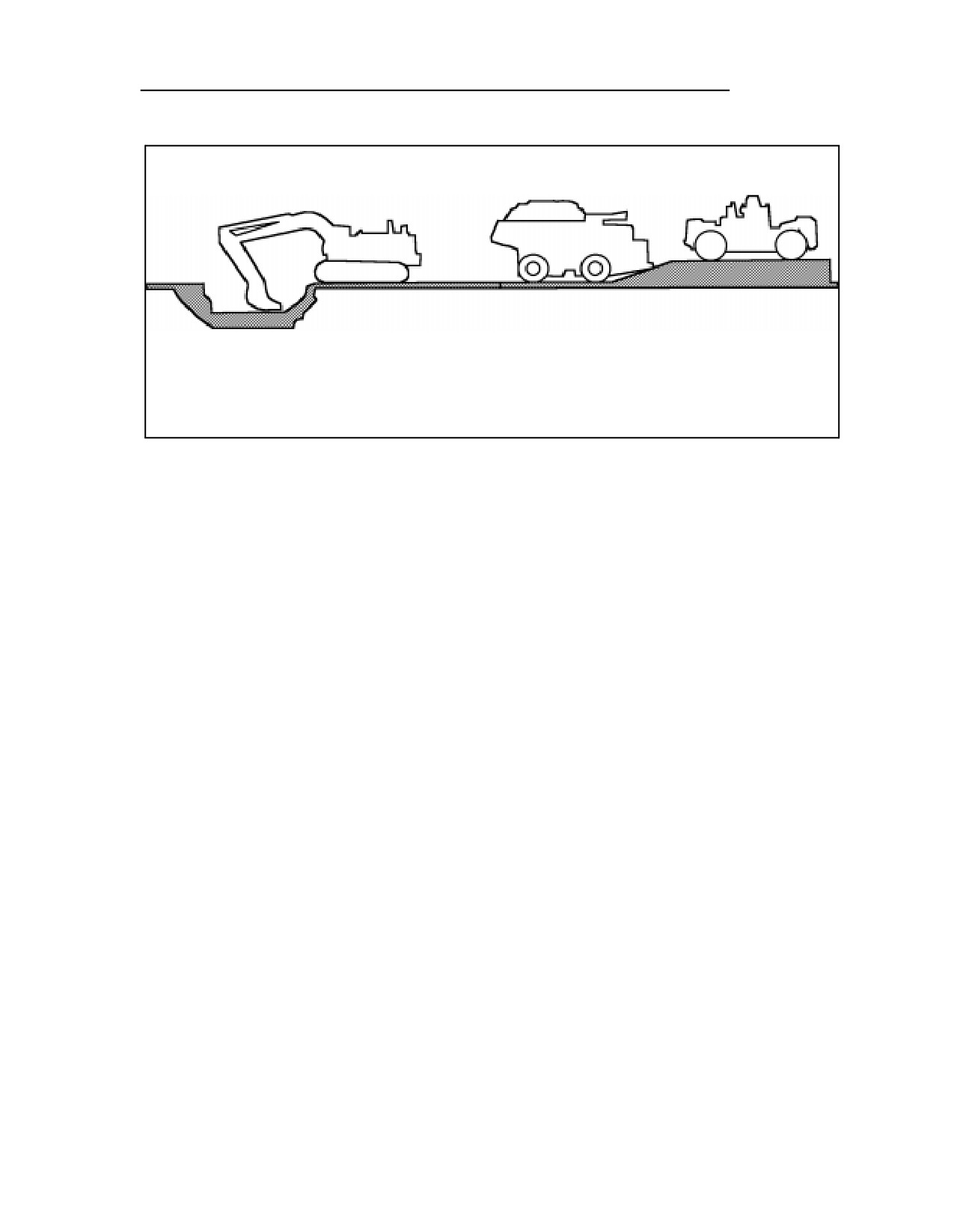
FM 5-434
1.25 cubic yards after
0.9 cubic yards after
1 cubic yard in natural
digging (LCY)
compaction (CCY)
conditions (BCY)
Figure 1-1. Material-Volume Changes Caused by Construction Processes
1-7. When manipulating the material in the construction process, its volume
changes. (Tables 1-1 and 1-2, page 1-4, give material-volume conversion and
load factors.) The prime question for an earthmover is about the nature of the
material’s physical properties; for example, how easy is it to move? For
earthmoving operations, material is placed in three categories—rock, soil
(common earth), and unclassified.
• Rock. Rock is a material that ordinary earthmoving equipment
cannot remove. Fracturing rock requires drilling and blasting. After
blasting, use excavators to load the rock fragments into haul units for
removal.
• Soil. Soils are classified by particle-size distribution and cohesiveness.
For instance, gravel and sands have blocky-shaped particles and are
noncohesive, while clay has small, platy-shaped particles and is
cohesive. Although ripping equipment may be necessary to loosen
consolidated deposits, soil removal does not require using explosives.
• Unclassified. The unclassified (rock-soil) combination is the most
common material found throughout the world. It is a mixture of rock
and soil materials.
SOIL PROPERTIES
1-8. In an earthmoving operation, thoroughly analyze the material's
properties (loadability, moisture content, percentage of swell, and
compactability) and incorporate this information into the construction plan.
Soil preparation and compaction requirements are discussed in Chapter 11.
Loadability
1-9. Loadability is a general material property or characteristic. If the
material is easy to dig and load, it has high loadability. Conversely, if the
material is difficult to dig and load, it has low loadability. Certain types of clay
and loam are easy to doze or load into a scraper from their natural state.
Managing Earthmoving Operations 1-3

FM 5-434
Moisture Content
1-10. Moisture content is a very important factor in earthmoving work since
moisture affects a soil’s unit weight and handling properties. All soil in its
natural state contains some moisture. The amount of moisture retained
depends on the weather, the drainage, and the soil’s retention properties.
Mechanical or chemical treatment can sometimes change the moisture
content of a soil. Refer to Chapter 11 for information about increasing and
decreasing the soil’s moisture content.
Table 1-1. Material Volume Conversion Factors
Converted To
Material Type
Converted From
Bank (In Place)
Loose
Compacted
Sand or gravel
Bank (in place)
—
1.11
0.95
Loose
0.90
—
0.86
Compacted
1.05
1.17
—
Loam
Bank (in place)
—
1.25
0.90
(common earth)
Loose
0.80
—
0.72
Compacted
1.11
1.39
—
Clay
Bank (in place)
—
1.43
0.90
Loose
0.70
—
0.63
Compacted
1.11
1.59
—
Rock (blasted)
Bank (in place)
—
1.50
1.30
Loose
0.67
—
0.87
Compacted
0.77
1.15
—
Coral
Bank (in place)
—
1.50
1.30
(comparable
Loose
0.67
—
0.87
to lime rock)
Compacted
0.77
1.15
—
Table 1-2. Material Weight, Swell Percentages, and Load Factors
Loose
Bank
(Pounds Per
Swell
(Pounds Per
Material Type
Cubic Yards)
(Percent)
Load Factor
Cubic Yard)
Cinders
800 to 1,200
40 to 55
0.65 to 0.72
1,100 to 1,860
Clay, dry
1,700 to 2,000
40
0.72
2,360 to 2,780
Clay, wet
2,400 to 3,000
40
0.72
3,360 to 4,200
Earth (loam or silt), dry
1,900 to 2,200
15 to 35
0.74 to 0.87
2,180 to 2,980
Earth (loam or silt), wet
2,800 to 3,200
25
0.80
3,500 to 4,000
Gravel, dry
2,700 to 3,000
10 to 15
0.87 to 0.91
2,980 to 3,450
Gravel, wet
2,800 to 3,100
10 to 15
0.87 to 0.91
3,080 to 3,560
Sand, dry
2,600 to 2,900
10 to 15
0.87 to 0.91
2,860 to 3,340
Sand, wet
2,800 to 3,100
10 to 15
0.87 to 0.91
3,080 to 3,560
Shale (soft rock)
2,400 to 2,700
65
0.60
4,000 to 4,500
Trap rock
2,700 to 3,500
50
0.66
4,100 to 5,300
NOTE: The above numbers are averages for common materials. Weights and load
factors vary with such factors as grain size, moisture content, and degree of
compaction. If an exact weight for a specific material must be determined, run a test
on a sample of that particular material.
1-4 Managing Earthmoving Operations
FM 5-434
Percentage of Swell
1-11. Most earth and rock materials swell when removed from their natural
resting place. The volume expands because of voids created during the
excavation process. After establishing the general classification of a soil,
estimate the percentage of swell. Express swell as a percentage increase in
volume (Table 1-2). For example, the swell of dry clay is 40 percent, which
means that 1 cubic yard of clay in the bank state will fill a space of 1.4 cubic
yards in a loosened state. Estimate the swell of a soil by referring to a table of
material properties such as Table 1-2.
Compactability
1-12. In earthmoving work, it is common to compact soil to a higher density
than it was in its natural state. This is because there is a correlation between
higher density and increased strength, reduced settlement, improved bearing
capacity, and lower permeability. The project specifications will state the
density requirements.
SOIL WEIGHT
1-13. Soil weight affects the performance of the equipment. To estimate the
equipment requirements of a job accurately, the unit weight of the material
being moved must be known. Soil weight affects how dozers push, graders
cast, and scrapers load the material. Assume that the volumetric capacity of a
scraper is 25 cubic yards and that it has a rated load capacity of 50,000
pounds. If the material being carried is relatively light (such as cinder), the
load will exceed the volumetric capacity of the scraper before reaching the
gravimetric capacity. Conversely, if the load is gravel (which may weigh more
than 3,000 pounds per cubic yard), it will exceed the gravimetric capacity
before reaching the volumetric capacity. See Table 1-2 for the unit weight of
specific materials.
NOTE: The same material weight will occupy different volumes in
BCY, LCY, and CCY. In an earthmoving operation, the basic unit of
comparison is usually BCY. Also, consider the material in its loose
state (the volume of the load). Table 1-1 gives average material conver-
sion factors for earth-volume changes.
LOAD FACTOR
1-14. Use a load factor (see Table 1-2) to convert the volume of LCY measured
to BCY measured (
). Use similar factors when
LCY × load factor = BCY
converting material to a compacted state. The factors depend on the degree of
compaction. Compute the load factor as follows:
If 1 cubic yard of clay (bank state)
=
1.4 cubic yards of clay (loose state),
-
then 1 cubic yard of clay (loose state)
= -- --- or 0.72 cubic yard of clay (bank state).
1.4
In this case, the load factor for dry clay is 0.72. This means that if a scraper is
carrying 25 LCY of dry clay, it is carrying 18 BCY (25 x 0.72).
Managing Earthmoving Operations 1-5
FM 5-434
ZONES OF OPERATION
1-15. The relationship of specific zones of operation to various types of
earthmoving equipment is significant when selecting earthmoving equipment.
A mass diagram graphically depicts how materials should be moved and is a
good tool for determining the zones of operation. Mass diagrams are explained
in FM 5-430-00-1. There are three zones of operation to consider on a
construction project.
POWER ZONE
1-16. In the power zone, maximum power is required to overcome adverse site
or job conditions. Such conditions include rough terrain, steep slopes, pioneer
operations, or extremely heavy loads. The work in these areas requires
crawler tractors that can develop high drawbar pull at slow speeds. In these
adverse conditions, the more traction a tractor develops, the more likely it will
reach its full potential.
SLOW-SPEED HAULING ZONE
1-17. The slow-speed hauling zone is similar to the power zone since power,
more than speed, is the essential factor. Site conditions are slightly better
than in the power zone, and the haul distance is short. Since improved
conditions give the dozer more power, and distances are too short for most
scrapers to build up sufficient momentum to shift into higher speeds, both
machines achieve the same speed. Considerations that determine a slow-
speed hauling zone are as follows:
• The ground conditions do not permit rapid travel and the movement
distance of the material is beyond economical dozing operations.
• The haul distances are not long enough to permit scrapers to travel at
high speeds.
HIGH-SPEED HAULING ZONE
1-18. In the high-speed hauling zone, construction has progressed to where
ground conditions are good, or where long, well-maintained haul roads are
established. Achieve this condition as soon as possible. Production increases
when the scraper is working at its maximum speed. Considerations that
determine a high-speed hauling zone are as follows:
• Good hauling conditions exist on both grade and haul-road surfaces.
• Haul distances are long enough to permit acceleration to maximum
travel speeds.
• Push tractors (also referred to as pushers) are available to assist in
loading.
CAUTION
Operate equipment at safe speeds to prevent personal
injury or premature failure of the machine’s major
components. Accomplish hauling operations safely as well
as efficiently.
1-6 Managing Earthmoving Operations
Chapter 2
Dozers
Dozers (tracklaying crawlers or wheel tractors equipped with a blade) are
perhaps the most basic and versatile items of equipment in the
construction industry. Dozers are designed to provide high drawbar pull
and traction effort. They are the standard equipment for land clearing,
dozing, and assisting in scraper loading. They can be equipped with rear-
mounted winches or rippers. Crawler tractors exert low ground-bearing
pressure, which adds to their versatility. For long moves between projects
or within a project, transport dozers on heavy trailers. Moving them under
their own power, even at slow speeds, increases track wear and shortens
the machine’s operational life.
DESCRIPTION
2-1. A crawler dozer consists of a power plant (typically a diesel engine)
mounted on an undercarriage, which rides on tracks. The tracks extend the
full length of the dozer. There are two classifications of military dozers, based
on weight and pounds of drawbar pull. The light class (about 16,000 pounds
operating weight) includes the deployable universal combat earthmover
(DEUCE) (Figure 2-1). The medium class includes dozers having an operating
weight of 15,000 to 45,000 pounds (Figure 2-2, page 2-2).
Figure 2-1. DEUCE, Light-Class Dozer
Dozers 2-1
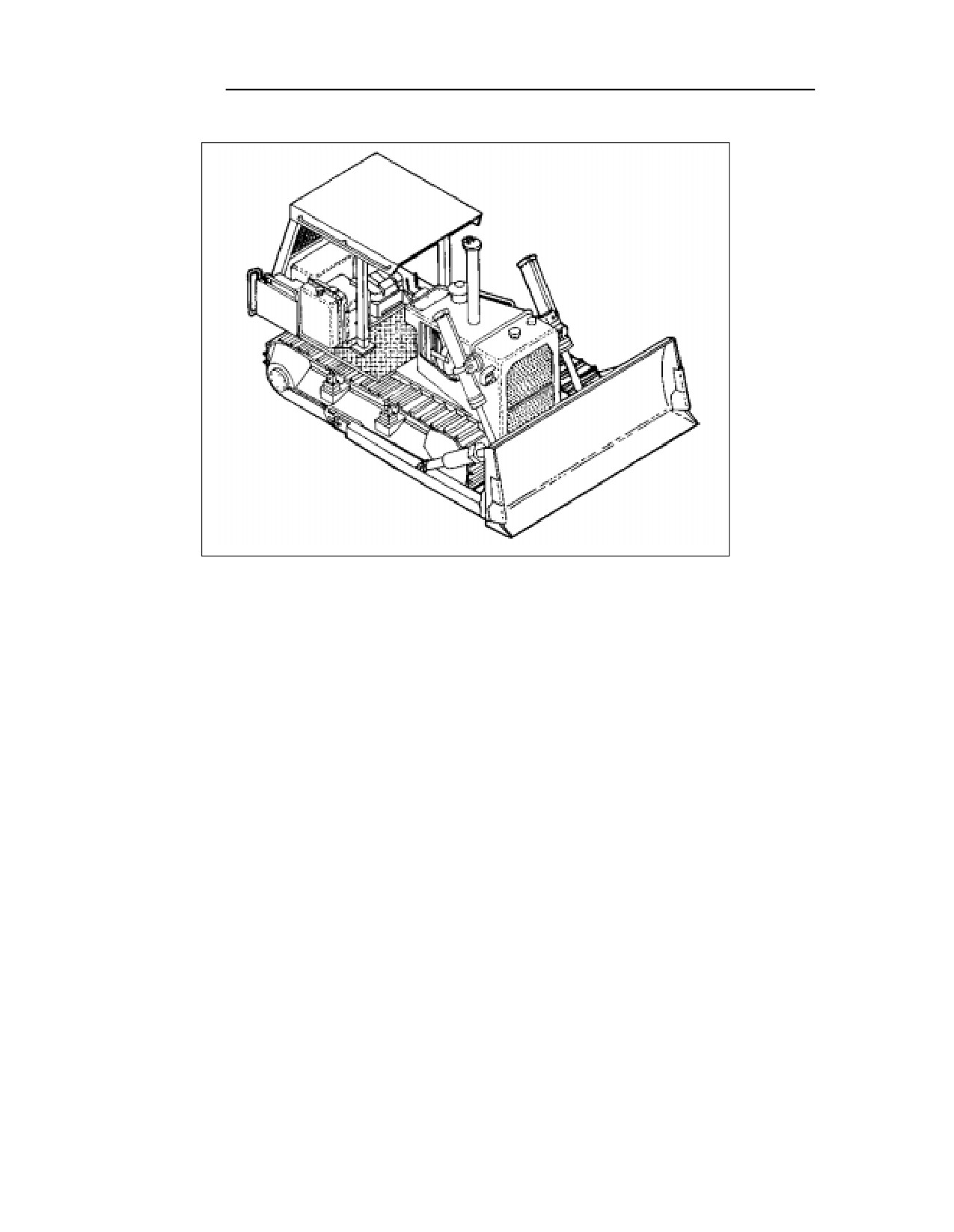
FM 5-434
Figure 2-2. Medium-Class Dozer
BLADES
2-2. A dozer blade consists of a moldboard with replaceable cutting edges and
side bits. Either the push arms and tilt cylinders or a C-frame are used to
connect the blade to the tractor. Blades vary in size and design based on
specific work applications. The hardened-steel cutting edges and side bits are
bolted on because they receive most of the abrasion and wear out rapidly. This
allows for easy replacement. Machine designs allow either edge of the blade to
be raised or lowered in the vertical plane of the blade (tilt). The top of the
blade can be pitched forward or backward varying the angle of attack of the
cutting edge (pitch). Blades mounted on a C-frame can be turned from the
direction of travel (angling). These features are not applicable to all blades,
but any two of these features may be incorporated in a single mount.
STRAIGHT BLADE
2-3. Use straight blades for pushing material and cutting ditches. This blade
is mounted in a fixed position, perpendicular to the line of travel. It can be
tilted and pitched either forward or backward within a 10° arc. Tilting the
blade allows concentration of dozer driving power on a limited length of the
blade. Pitching the blade provides increased penetration for cutting or less
penetration for back dragging.
ANGLE BLADE
2-4. Angle blades, which are 1 to 2 feet wider than straight blades, are used
most effectively to side cast material when backfilling or when making sidehill
cuts. Use an angle blade for rough grading, spreading piles, or windrowing
2-2 Dozers
FM 5-434
material. It can be angled up to a maximum of 25° left or right of
perpendicular to the dozer or used as a straight blade. When angled, the blade
can be tilted but it cannot be pitched.
SPECIAL-PURPOSE BLADE
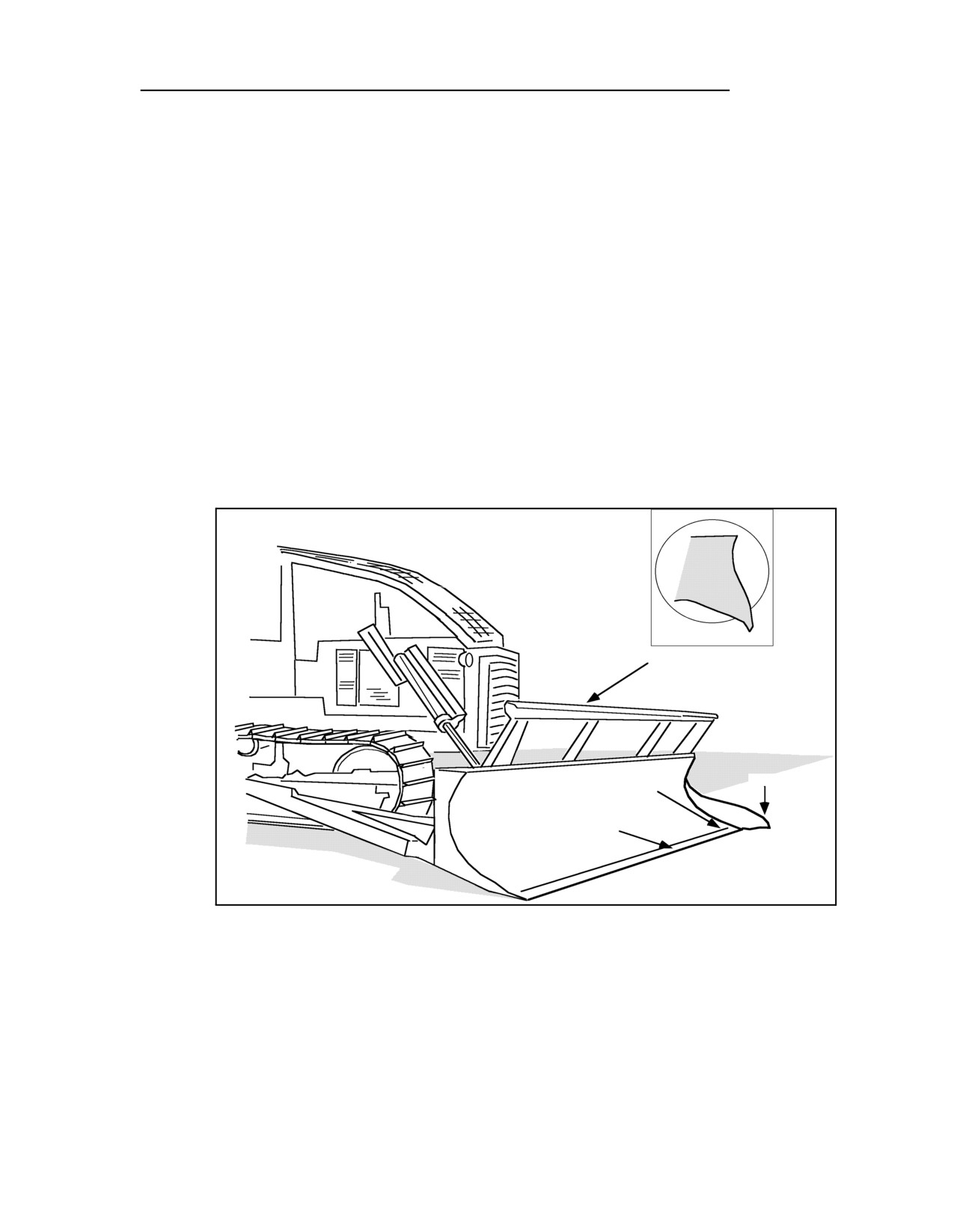
2-5. There are special blades (Figure 2-3), such as the Rome K/G, designed for
clearing brush and trees but not for earthmoving. The Rome K/G blade is
permanently fixed at an angle. On one end of the blade is a stinger. This
stinger consists of a vertical splitter and stiffener and a triangular-shaped
horizontal part called the web. One side of the triangular web abuts the
bottom of the vertical splitter, and the other side abuts the cutting edge of the
blade. The abutting sides of the web are each about 2 feet in length, depending
on how far the stinger protrudes from the blade. This blade is designed to cut
down brush and trees at, or a few inches above, ground level rather than
uprooting them. When cutting a large-diameter tree, first use the stinger to
split the tree to weaken it; then, cut the tree off and push it over with the
blade. Keep both the stinger and the cutting edge sharp. The operator must be
well-trained to be efficient in this operation. There are other special-purpose
blades not discussed in this manual which can be mounted on dozers.
Splitting point
Guide bar
Web
Stinger
Cutting
edge
Figure 2-3. Special-Purpose Clearing Blade
CLEARING AND GRUBBING OPERATIONS
2-6. Clearing vegetation and trees is usually necessary before moving and
shaping the ground. Clearing includes removing surface boulders and other
materials embedded in the ground and then disposing of the cleared material.
Ensure that environmental-protection considerations are addressed before
conducting clearing operations. Specifications may allow shearing of the
vegetation and trees at ground level, or it may be necessary to grub (removing
Dozers 2-3

FM 5-434
stumps and roots from below the ground). Project specifications will dictate
the proper clearing techniques. Plan clearing operations to allow disposal of
debris in one handling. It is best to travel in one direction when clearing.
Changing direction tends to skin and scrape the trees instead of uprooting
them or allowing a clean cut. Clearing techniques vary with the type of
vegetation being cleared, the ground’s soil type, and the soil’s moisture
condition. Table 2-1 shows average clearing rates for normal area-clearing
jobs. Increase the Table 2-1 values by 60 percent if the project requires strip-
type clearing (common in tactical land clearing). Engineers perform tactical
land clearing as a combat support function intended to enhance and
complement mobility, firepower, surveillance, and target acquisition.
Table 2-1. Quick Production Estimates for Normal Area Clearing
Equipment (Hours Per Acre)
Light
Medium
Heavy
Equipment
(12 Inches or Less*)
(12 to 18 Inches*)
(18 Inches*)
Bulldozer:
Medium tractor
2.5
5.0
10.0
Heavy tractor
1.5
3.0
8.0
Shear blade:
Medium tractor
0.4
0.8
1.3
Heavy tractor
0.3
0.5
0.8
*Maximum tree size
NOTE: These clearing rates are average for tree counts of 50 trees per acre. Adverse
conditions (slopes, rocks, soft ground) can reduce these rates significantly.
BRUSH AND SMALL TREES
2-7. Moving the dozer, with the blade slightly below ground level, will usually
remove small trees and brush. The blade cuts, breaks off, or uproots most of
the tree and bends the rest for removal on the return trip. A medium tractor
with a dozer blade can clear and pile about 0.25 acres of brush or small trees
per hour.
MEDIUM TREES
2-8. To remove a medium-size tree (7 to 12 inches in diameter), raise the blade
as high as possible to gain added leverage and then push the tree over slowly.
As the tree starts to fall, back the dozer quickly to avoid the rising roots. Then
lower the blade and drive the dozer forward, lifting out the roots. The average
time for a medium tractor with a dozer blade to clear and pile medium trees is
2 to 9 minutes per tree.
LARGE TREES
2-9. Removing large trees (12 to 30 inches in diameter) is much slower and
more difficult than clearing brush and smaller trees. First, gently and
cautiously probe the tree for dead limbs that could fall. Determine the tree’s
natural direction of lean, if any; this is the best direction for pushing the tree
over. Then, position the blade high and center it on the tree for maximum
2-4 Dozers
FM 5-434
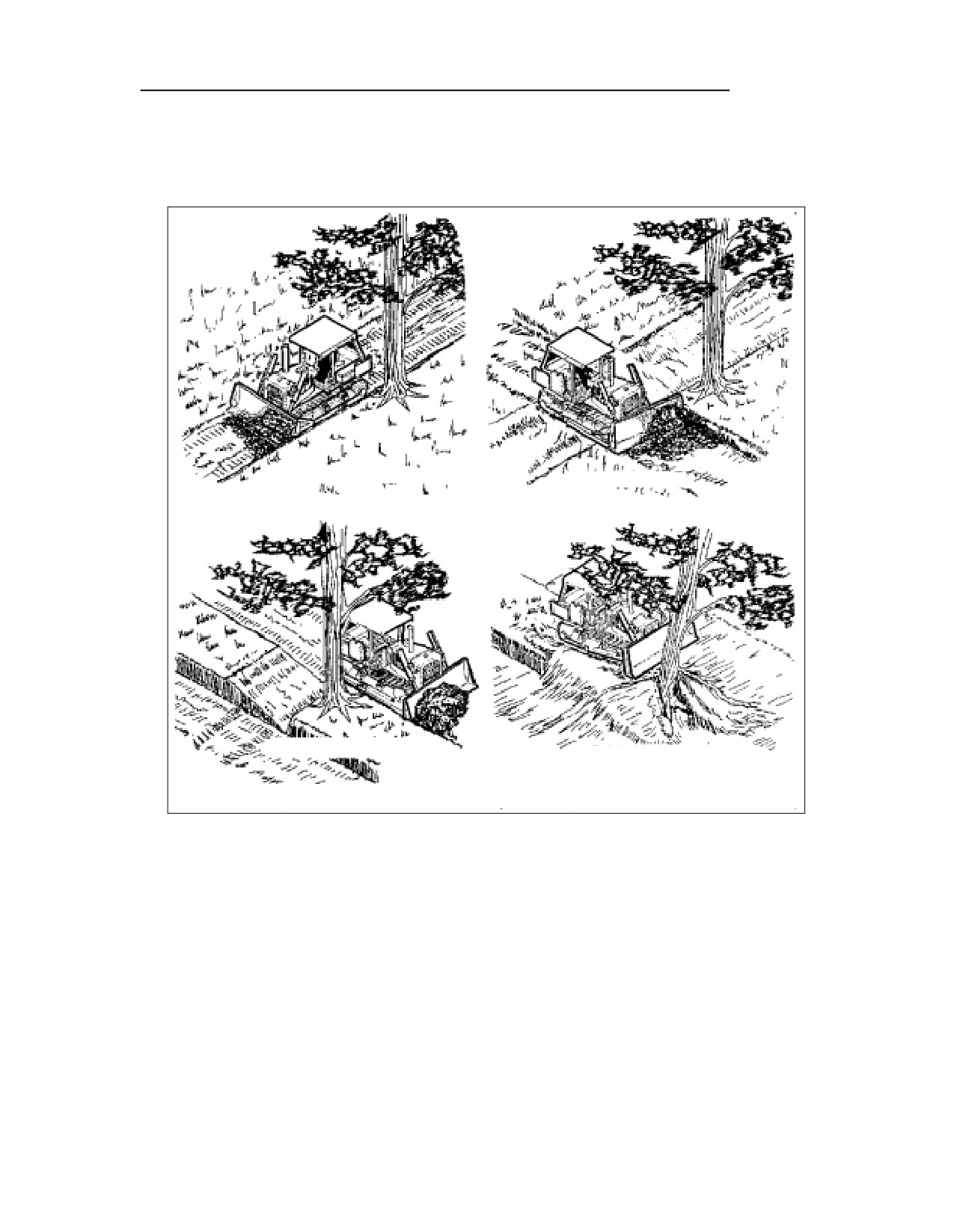
leverage. If possible, push the tree over the same as a medium tree. However,
if the tree has a massive, deeply embedded root system, use the following
method (Figure 2-4):
1. Cut roots on side one.
2. Cut side two.
3. Cut side three.
4. Build ramp on side one.
Push tree over.
Average clearing time:
5 to 20 minutes per tree
Figure 2-4. Four Steps for Removing a Large Tree With a Massive,
Deeply Embedded Root System
Step 1. Start on the side opposite the proposed direction of fall, and make a cut
deep enough to sever some of the large roots. Make the cut like a V-ditch, tilted
downward laterally toward the roots.
Step 2. Cut side two.
Step 3. Cut side three.
Step 4. Build an earth ramp on the same side as the original cut to obtain
greater pushing leverage. Then push the tree over and, as the tree starts to fall,
reverse the dozer quickly to avoid the rising root mass. After felling the tree, fill
the stump hole so that it will not collect water.
Dozers 2-5
FM 5-434
The average time for a medium tractor with a dozer blade to clear and pile large
trees is 5 to 20 minutes per tree. The time required to clear and pile massive
trees requiring this four-step procedure will often be more than 20 minutes
each.
NOTE: The roots on the fourth side may also need to be cut.
ROOTS
2-10. Mount a rake on the dozer in place of the blade to remove roots and
small stumps. As the dozer moves forward, it forces the teeth of the rake
below the ground’s surface. The teeth will catch the belowground roots and
the surface brush left from the felling operation, while the soil remains or
passes through.
SAFETY PRECAUTIONS
2-11. Never operate clearing tractors too close together. Do not follow a tree
too closely when pushing it, because when it begins to fall, its stump and roots
may catch under the front of the dozer. Clean out accumulated debris in the
dozer’s belly pan often to prevent fires in the engine compartment.
PRODUCTION ESTIMATES
2-12. The two methods for estimating production for clearing and grubbing
projects are the quick method and the tree-count method.
Quick Method
2-13. Table 2-1, page 2-4, shows quick estimates for normal area clearing. Use
the quick method only when a detailed reconnaissance and a tree count are
not possible.
Step 1. Determine the size of the area to clear (in acres).
width (feet) × length (feet)
Acres to be cleared
= ----------------------------------------------------------------------------
43,560 square feet per acre
Step 2. Determine the size and number of dozers available.
Step 3. Determine the maximum size of the trees to clear.
Step 4. Determine the time required (hours per acre) for clearing, based on
dozer size and tree size (see Table 2-1).
Step 5. Determine the efficiency factor for the work. Operators require breaks,
and there are always secondary delays for minor equipment repairs. Therefore,
actual production time per hour is something less than 60 minutes. In the case
of a well-managed job, expect 50 minutes of production time per hour.
Efficiency facto = actual working minutes per hour
60-minute working hour
2-6 Dozers
FM 5-434
Step 6. Determine the operator factor using Table 2-2.
Step 7. Determine the total time (in hours) required to complete the mission.
D×A
Total time (hours)
= -------------------------
E×O×N
where—
D = time required, in hours per acre
A = total area, in acres
E = efficiency factor
O = operator factor
N = number of dozers available
Table 2-2. Operator Factors for Track Dozers
Operator Ability
Daylight
Night
Excellent
1.00
0.75
Average
0.75
0.56
Poor
0.60
0.45
NOTE: These factors assume good visibility and a
60-minute working hour efficiency.
EXAMPLE
Determine the time required to clear an area that is 500-feet wide by 0.5 mile long. Two
medium bulldozers are available for the task. The largest trees in the area are 14 inches
in diameter, and the ground is fairly level. The operators are of average ability and will do
all work during daylight hours. Expected efficiency is 50 minutes per hour.
width (feet) × length (feet)
Step 1.
Total area in acres
= ----------------------------------------------------------------------------
43,560 square feet per acre
500 feet × (0.5 mile × 5,280 feet per mile)
= -----------------------------------------------------------------------------------------------------------------
= 30.3 acres
43,560
Step 2. Dozer size = medium
Number of dozers available = 2
Step 3. Maximum tree size = 14 inches
Step 4. Time required = 5 hours per acre (Table 2-1, page 2-4)
50 minutes per hour
Step 5.
Efficiency factor
= -------------------------------------------------------------------
= 0.83
60-minute working hour
Step 6. Operator factor = 0.75 (Table 2-2)
5 hours per acre × 30.3 acres
Step 7. Total time (hours)
= ---------------------------------------------------------------------------------
= 121.6 or 122 hours
0.83 × 0.75 × 2
Dozers 2-7

FM 5-434
Tree-Count Method
2-14. Use this method when a detailed reconnaissance and a tree count are
possible. The tree-count method allows for a better production estimate.
Step 1. Determine the size of the area to clear (in acres). Refer to step 1 of the
quick method.
Step 2. Determine the size and number of dozers available.
Step 3. Determine the average number of each size of tree per acre. This will
require a field reconnaissance.
Step 4. Determine the basic production factors (hours per acre) based on the
dozer size and the size of the trees to clear (Table 2-3).
Table 2-3. Production Factors for Felling With a Clearing Blade
Tree Diameter Range
Base Minutes
Per Acre
1-2 Feet
2-3 Feet
3-4 Feet
4-6 Feet
More Than 6 Feet
Tractor
B
M1
M2
M3
M4
F
Medium
23.48
0.5
1.7
3.6
10.2
3.3
Heavy
18.22
0.2
1.3
2.2
6.0
1.8
NOTE: These times are based on working on reasonably level ground with good footing and an
average mix of soft and hardwoods.
Step 5. Determine the time required to clear one acre.
D = H([A×B] +[M
×
]
+
[
×
]
+
[
×
]
+
[
×
]+[I×F])
1
N1
M2
N2
M3
N3
M4
N4
where—
D = clearing time of one acre, in minutes
H = hardwood factor affecting total time—
H = 1.3 if hardwoods are 75 to 100 percent
H = 1 if hardwoods are 25 to 75 percent
H = 0.7 if hardwoods are 0 to 25 percent
A = tree-density and presence-of-vines factor affecting total time
A = 2 if density is more than 600 trees per acre (dense)
A = 1 if density is 400 to 600 trees per acre (medium)
A = 0.7 if density is less than 400 trees per acre (light)
A = 2 if heavy vines are present
B = base time per acre determined from dozer size, in minutes
M = time required per tree in each diameter range, in minutes
N = number of trees per acre in each diameter range, from
reconnaissance
I
= sum of diameter of all trees per acre greater than 6 feet in
diameter at ground level (in foot increments), from reconnaissance
F = time required per foot of diameter for trees greater than 6 feet in
diameter, in minutes
NOTE: When it is necessary to grub roots and stumps, increase the
time per acre by 25 percent.
2-8 Dozers
FM 5-434
Step 6. Determine the total time (in hours) required to complete the mission.
Total time (hours = D×A
N
where—
D = time required to clear one acre (from step 5), in hours
A = total area
N = number of dozers
NOTE: The tree-count method has no correction factor for efficiency or
operator skill. The values in Table 2-3 are based on normal efficiency
and average operator skill.
SIDEHILL EXCAVATIONS
2-15. One of a dozer’s more important uses is making sidehill cuts, which
includes pioneering road cuts along hillsides. An angle blade is preferred for
this operation because of its side-casting ability.
CREATING A SLOPE
2-16. It is best to start the cut at the top of the hill, creating a bench several
dozer lengths long. Do this by working up and down the slope perpendicular to
the long direction of the project (Figure 2-5[A], page 2-10). Design the benches
to ensure that water runs off without damaging the slope. If possible, start the
bench on the uphill extreme of the cut (the highest point of the cut) and then
widen and deepen the cut until the desired road profile is achieved. Be sure to
start the bench far enough up the slope to allow room for both the inner slope
and the roadway.
NOTE: When working on extremely steep slopes, a winch line may be
necessary to stabilize the dozer (see paragraph 2-37).
2-17. Because the perpendicular passes are short, the dozer usually is not able
to develop a full blade load. Therefore, after constructing the initial bench,
turn the dozer and work in the long direction of the project (Figure 2-5[B],
page 2-10). Develop a full blade load and then turn the dozer to push the
material over the side. After developing the bench, use either a dozer or a
scraper to complete the cut. Keep the inside (hillside) of the roadway lower
than the outside. This allows the dozer to work effectively on the edge and
decreases the erosion of the outer slope. Make sure to maintain the proper
slope on the inside of the cut. It is very difficult to change the cut slope after
construction. Maintain the proper bench slope by moving out from the inside
slope on each successive cut. Determine the slope ratio from the distance
moved away from the slope for each successive cut and the depth of each cut.
When cutting the road’s cross slope, work from the toe of the bench to the
road’s outside edge.
Dozers 2-9
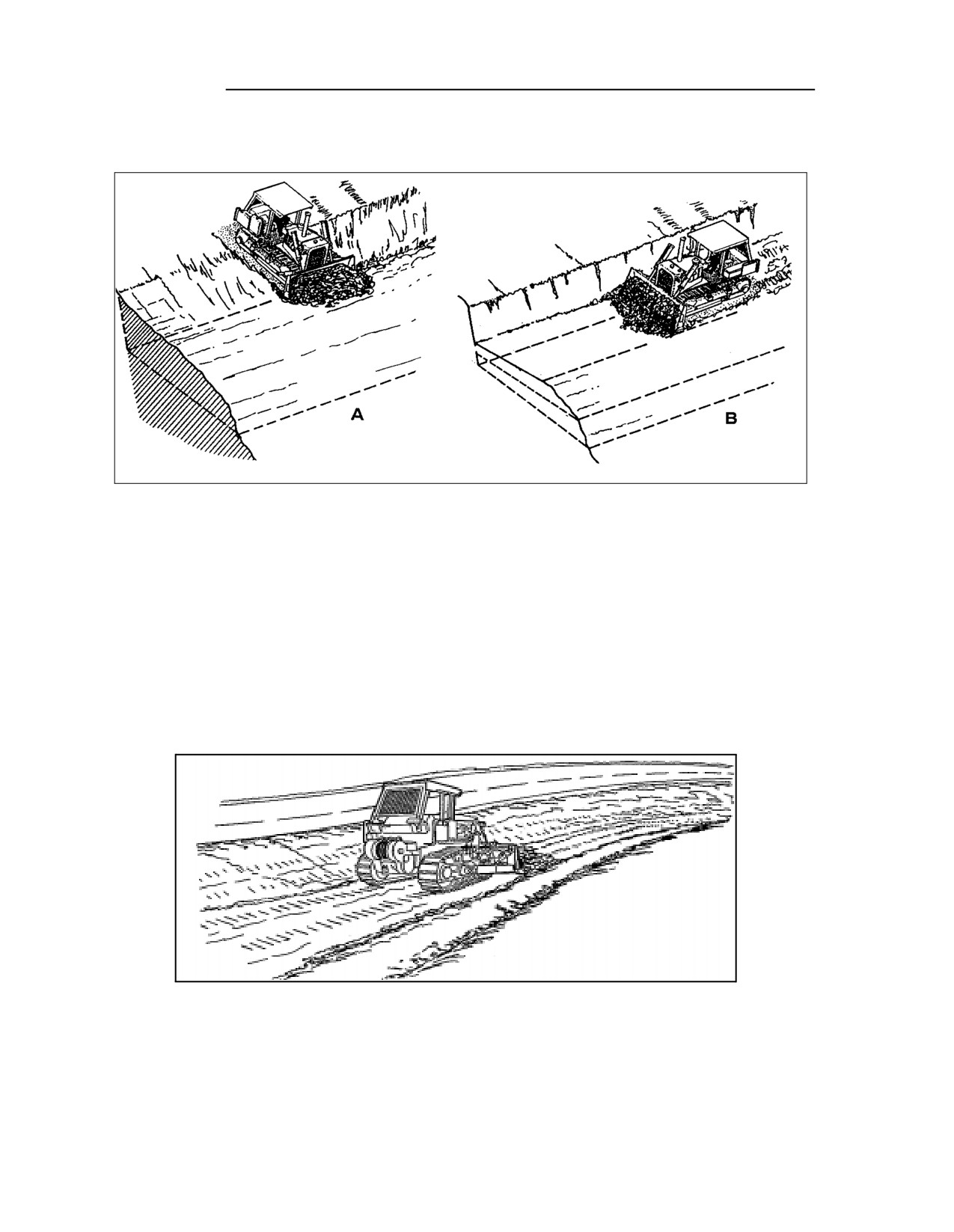
FM 5-434
Figure 2-5. Sidehill Cut
FINISHING A SIDE SLOPE
2-18. There are two methods for finishing a side slope—working perpendicular
to the slope and working diagonally up the slope.
Working Perpendicular to the Slope
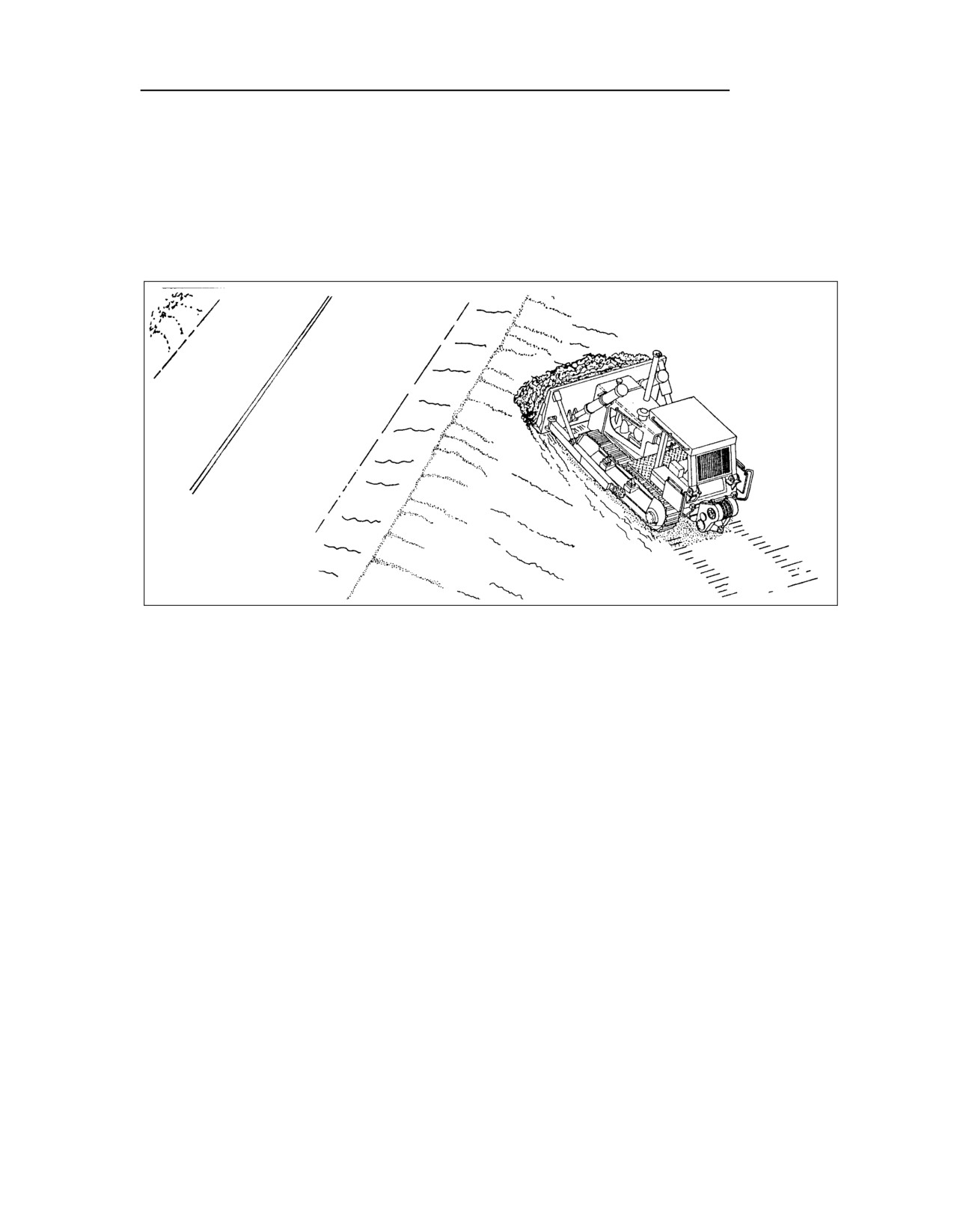
2-19. The dozer shown in Figure 2-6 is finishing a side slope by working
perpendicular to the slope. Start the dozer at the top of the embankment and,
on each pass, earth will fall to the lower side of the blade forming a windrow.
On succeeding passes, pick up this windrow and use it to fill holes and other
irregularities in the terrain. Be careful to prevent the blade corner from
digging in too deep; this would steepen the slope beyond job specifications.
Figure 2-6. Finishing a Side Slope Working Perpendicular to the Slope
2-10 Dozers
FM 5-434
Working Diagonally Up the Slope
2-20. The dozer shown in Figure 2-7 is finishing the side slope by starting at
the bottom and working diagonally up the slope. The windrow that forms is
continually pushed to one side, which tends to fill low spots, holes, and
irregularities. This is one of the few instances where a dozer works effectively
pushing uphill.
Figure 2-7. Finishing a Side Slope Working Diagonally up the Slope
OPERATION TECHNIQUES
2-21. Dozers work best when the ground is firm and without potholes, sharp
ridges, or rocks. Uneven surfaces make it difficult to keep the blade in contact
with the ground. This tends to bury vegetation in hollows rather than remove
it. To save time and increase output, use the following techniques when
conditions permit.
DOZING
2-22. When straight dozing, if the blade digs in and the rear of the machine
rises, raise the blade to continue an even cut. If moving a heavy load causes
the travel speed to drop, shift to a lower gear and/or raise the blade slightly.
When finishing or leveling, a full blade handles easier than a partially-loaded
blade.
Side-by-Side Dozing
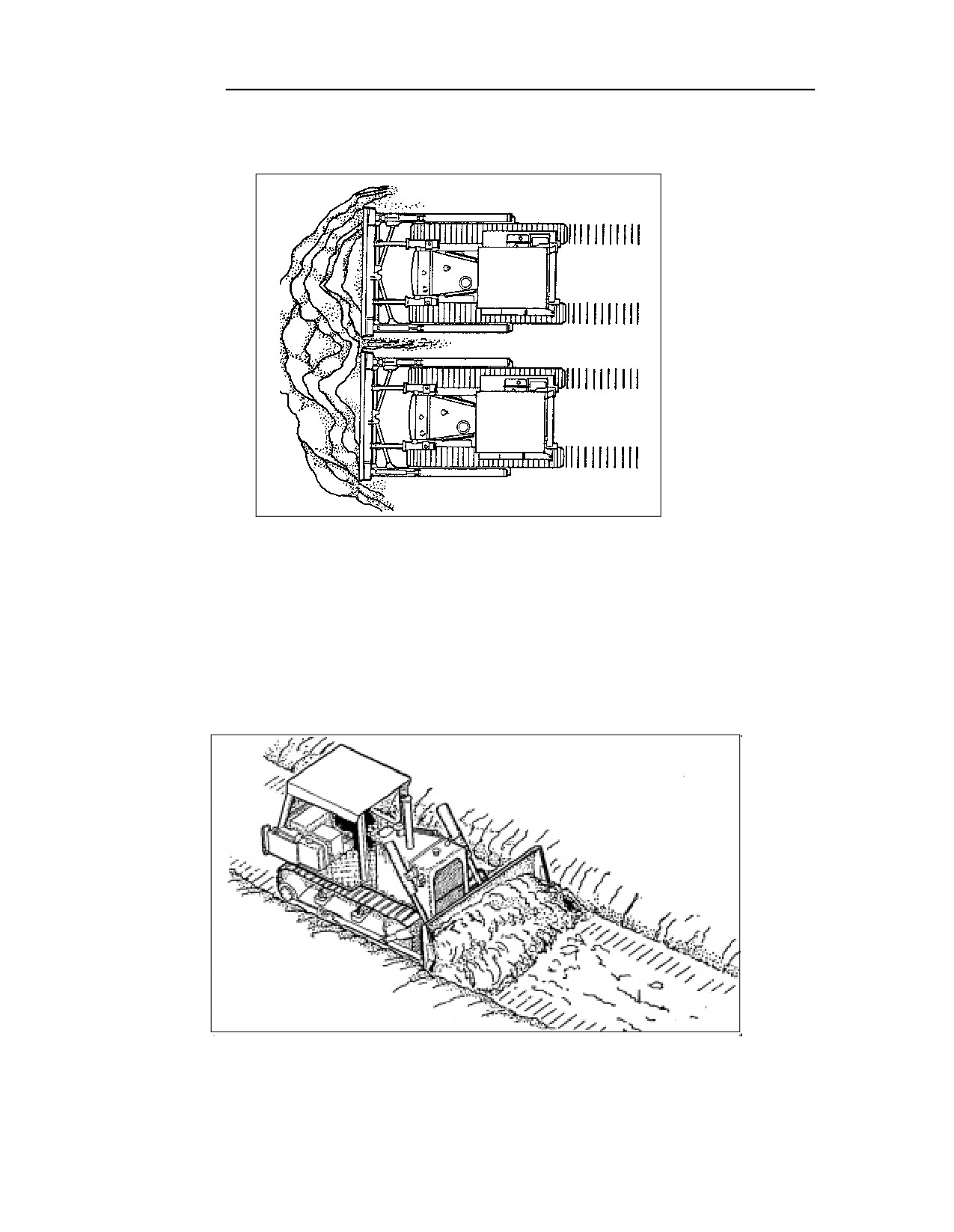
2-23. Side-by-side dozing will increase production 15 to 25 percent when
moving material 50 to 300 feet (Figure 2-8, page 2-12). When the distance is
less than 50 feet, the extra time needed to maneuver and position the dozers
will offset the increased production.
Dozers 2-11
FM 5-434
Figure 2-8. Side-by-Side Dozing
Slot Dozing
2-24. Slot dozing uses spillage from the first few passes to build a windrow on
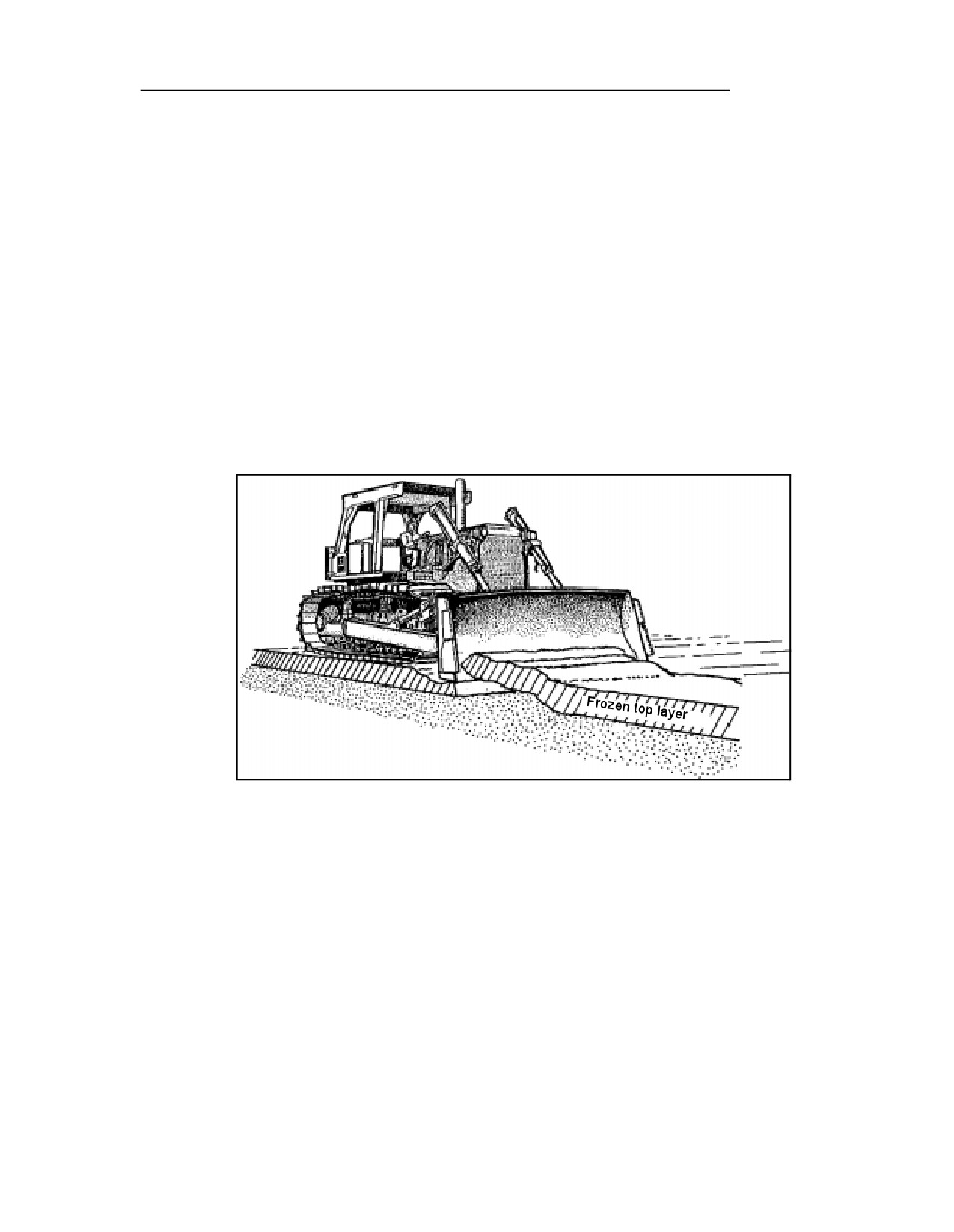
each side of a dozer’s path (Figure 2-9). This forms a trench, preventing blade-
side spillage on subsequent passes. To increase production, align cuts parallel,
leaving a narrow uncut section between slots. Then, remove the uncut section
by normal dozing. When grade and soil conditions are favorable, slot dozing
can increase output by as much as 20 percent.
Figure 2-9. Slot Dozing
2-12 Dozers
FM 5-434
Downhill Dozing
2-25. Pile several loads at the brink of the hill, and then push them to the
bottom in one pass. When dozing downhill, travel to the bottom of the hill with
each load. Use downhill dozing whenever possible since it increases
production.
Hard-Materials Dozing
2-26. Use the dozer blade to loosen hard material when rippers are not
available. Tilt the blade to force one corner into the material. Tilting is done
through blade control, by driving one track onto a ridge of material bladed up
for this purpose or by placing a rock or log under the track. To maximize the
driving force of the blade, hook only the tilted end under the material. Break a
thin layer by turning on it with a dozer. Turning causes the track grousers
(cleats) to break through the top layer. With a thin layer of frozen material, it
is best to break through at one point. By lifting and pushing, the blade breaks
through the top frozen layer as shown in Figure 2-10.
Figure 2-10. Dozing Hard Materials or Frozen Ground Layers
Rock Dozing
2-27. Use a rake to remove small rocks. The rake lets the soil remain, or pass
through, while digging the rocks from the earth. When removing large,
partially buried boulders, tilt the dozer blade and dig the earth out from
around three sides of the boulder. Lower the blade enough to get under the
fourth side. Lift the blade as the dozer moves forward to create a lifting,
rolling action of the boulder. If the dozer cannot push the boulder, lift it
upward with the blade and have someone place a log or some other object
under the boulder so the dozer can get another hold. The rolling action
removes the boulder as the dozer moves forward. Dozer work in rocky areas
increases track wear. If possible, install rock shoes or rock pads to cut down on
this wear.
Dozers 2-13
FM 5-434
Wet-Materials Dozing
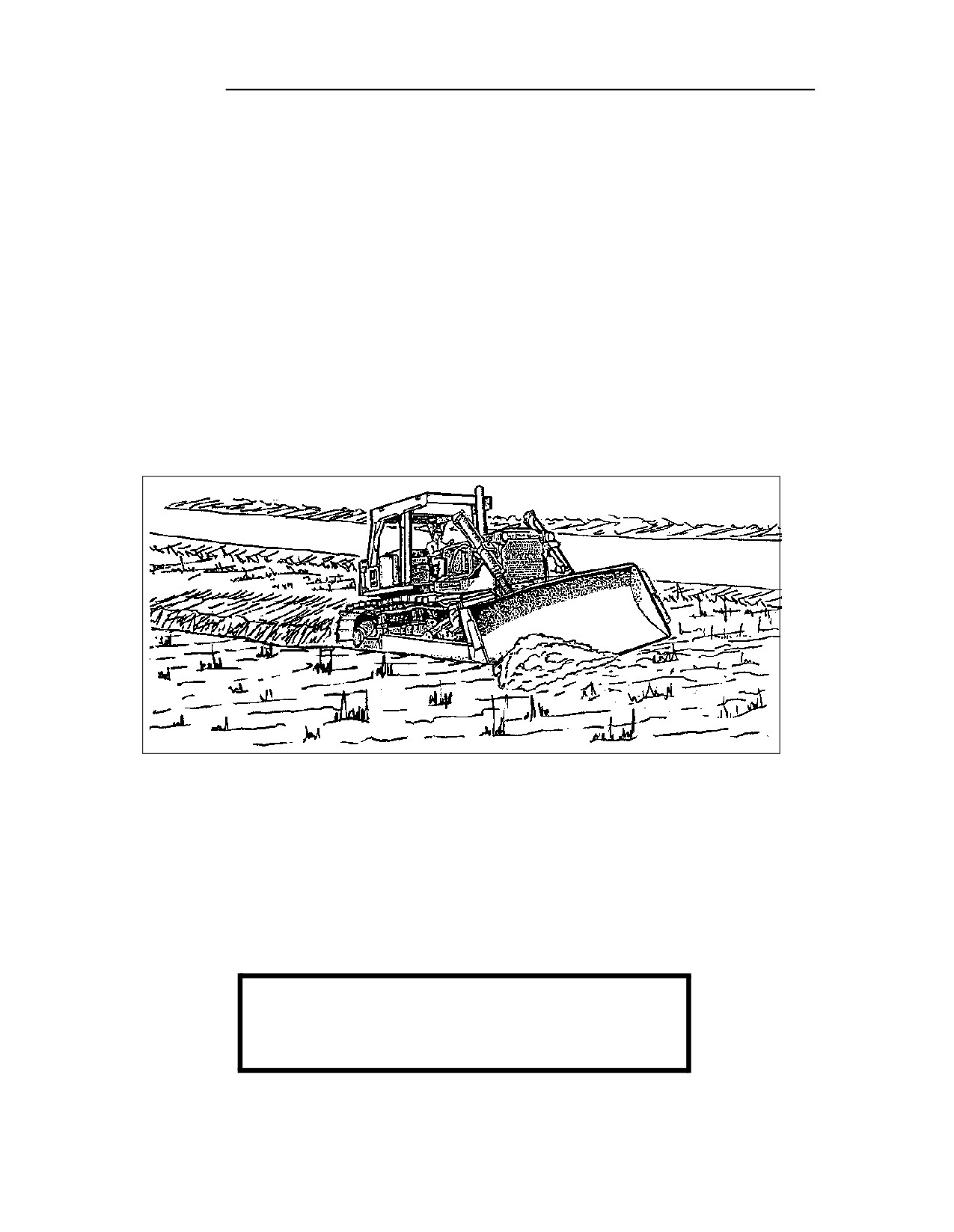
2-28. Wet material is difficult to move with a dozer. Also, the wet ground may
be too soft to support the weight of the dozer. If so, make each successive pass
the full depth of the wet material. This will place the dozer on a firmer footing.
If available, use wider tracked shoes for better flotation. When working in
mud, push the mud back far enough that it will not flow back into the cut.
Make provisions for recovery operations in case the dozer becomes stuck. Try
to use machines equipped with a winch.
DITCHING
2-29. Shallow ditches are best accomplished using a grader, but dozers can
accomplish rough ditching. Tilt the dozer blade to cut shallow V-ditches
(Figure 2-11). For larger ditches, push the material perpendicular to the
center line of the ditch. After reaching the desired depth, push the material
the length of the ditch to smooth the sides and bottom. Many times it is
necessary to correct irregularities in a ditch. Attempt to remove humps or fill
holes in a single pass. Use multiple passes to correct the grade.
Figure 2-11. Tilt Dozer Ditching
CONSTRUCTING A STOCKPILE
2-30. A dozer is a good machine for creating stockpiles of material that can
then be easily loaded into haul units by either a loader or a hydraulic hoe
excavator. Use the following steps to construct a stockpile:
Step 1. Push the material from the beginning of the excavation to the stockpile
area on the first pass. This distance should be no more than 75 feet from the
start point. Do not excavate deeper than 6 to 8 inches, while maintaining a
smooth cut.
WARNING
Before putting the machine in reverse, and while
backing, the operator must be satisfied that no one
will be endangered.
2-14 Dozers
FM 5-434
Step 2. Begin to raise the blade one dozer length from the stockpile, letting the
material drift under the blade forming a ramp upon reaching the stockpile area.
CAUTION
Keep the dozer under control at all times. Do not put the
transmission into neutral to allow the machine to coast.
Select the gear range necessary before starting down the
grade. Do not change gears while going downhill.
Step 3. Push the material on successive cuts in the same manner, working the
dozer from the start point all the way around the work area while stockpiling.
Overlap cuts about one-third of the blade’s width to pick up windrows.
NOTE: Do not stop the forward motion or cause the tracks to spin
while pushing material.
Step 4. Make successive cuts the same as in step 2, constructing the stockpile
higher on each pass until it reaches the desired height.
SPREADING A STOCKPILE
2-31. Large piles should be worked from the side, cutting material away from
the stockpile, using one-third of the blade. Use the following steps to spread a
stockpile:
Step 1. Lower the blade to the desired height while moving forward.
Step 2. Adjust the blade height and move the dozer into the side of the pile
making the cut with only one-third of the blade.
NOTE: When using the left side of the blade, continue working to the
left. When using the right side of the blade, continue working to the
right.
Step 3. Cut into the stockpile. The blade should be as full as possible without
stalling the dozer or spinning the tracks. Raise and lower the blade to maintain
a smooth pass.
WARNING
When spreading materials that are higher than the
midpoint of the rollover protective structure (ROPS),
adjust the height of the cut to eliminate the danger from
collapsing material.
Step 4. Spread the blade load after cutting the pile by continuing to move for-
ward and slowly raising the blade until all material is evenly feathered.
Step 5. Feather the blade load and reverse the dozer. Raise the blade about 12
inches off the ground, back the dozer to the stockpile, and reposition for another
cut.
Repeat the above steps until the stockpile has been leveled and spread over the
designated area. Do not back blade to level the stockpile.
Dozers 2-15
FM 5-434
BACKFILLING
2-32. Backfilling can be effectively accomplished by drifting material sideways
with an angle blade. This allows forward motion parallel to the excavation.
With a straight blade, approach the excavation at a slight angle and then, at
the end of the pass, turn in toward the excavation. No part of the tracks
should hang over the edge. Adjust the length of the push based on soil
conditions. For example, when working in soft material or on an unstable
slope, let the second bladeful push the first bladeful over the edge. Be careful
to keep oversize materials out of the backfill.
RIPPING
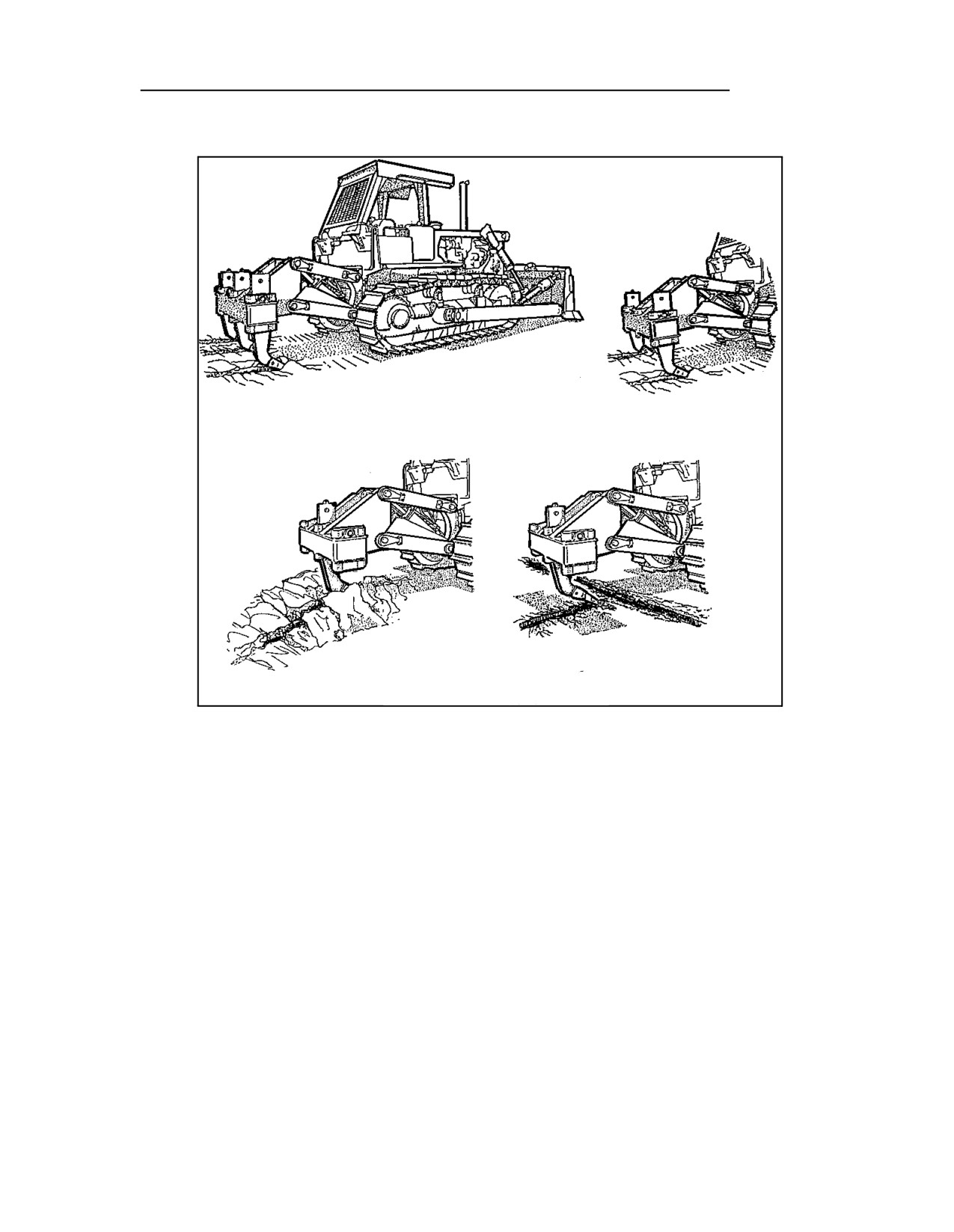
2-33. Figure 2-12 shows various ripping operations. Use first gear for ripping
operations. When performing one-shank ripping, always use the center shank.
Use additional shanks, where practical, to increase production. When ripping
for scraper loading, rip in the same direction that the scrapers are loading,
whenever possible. It is usually desirable to rip as deeply as possible.
However, it is sometimes better to rip the material in its natural layers even if
this is less than full-shank depth. Use the ripped material on top of the
unripped formation to cushion the machine and provide traction. When the
final material size must be relatively small, space passes close together. Cross
rip only when necessary to obtain the required breakage. Use the following
steps to rip material:
Step 1. Position the dozer on the uphill side if operating on a slope, about half
the length of the dozer from the start of the area to be ripped.
Step 2. Place the transmission shift lever in forward, first gear.
Step 3. Lower the rippers to the ripping depth as the dozer begins to cross the
area to be ripped.
WARNING
Maintain a straight line while ripping. Turning the
dozer with the rippers in the ground will cause
damage to the dozer.
Step 4. Raise the rippers out of the ground and then stop at the end of the pass.
Step 5. Place the transmission in reverse and back the dozer to the start point.
Step 6. Position the dozer to overlap the previous ripping pass.
Repeat steps 1 through 6 until the area is completely ripped.
Packed Soil, Hardpan, Shale, and Cemented Gravel
2-34. Three-shank ripping works well in these materials. Use as many shanks
as possible to break material to the desired size.
2-16 Dozers
FM 5-434
Three-shank ripping
Two-shank ripping
Single-shank ripping
Cross ripping
Figure 2-12. Ripping Operations
Rock with Fractures, Faults, and Planes of Weakness
2-35. Use two shanks for ripping where rocks break out in small pieces and
the machine can handle the job easily. Use only the center shank if the
machine begins to stall or the tracks spin.
• Asphalt. Raise the ripper shank to lift out and break the material.
• Concrete. Use one-shank ripping to sever reinforcing rods or wire
mesh effectively.
Solid Rock, Granite, and Hard-to-Rip Material
2-36. Use one shank in hard-to-rip material or material that tends to break
out in large slabs or pieces.
WINCHING
2-37. Winching is hoisting or hauling with a winch, using a cable. When
winching, make sure personnel are clear of the cable. Cables can break and
cause severe injury. Exercise caution with suspended loads. If the engine
revolutions (speed) are too low, the weight of the load may exceed the engine
Dozers 2-17
FM 5-434
capacity causing the load to drop, even though the winch is in the reel-in
position.
CAUTION
Always keep the winch cable in a straight line behind the
machine. For safety and maximum service life of the
winch component, decelerate the engine before moving
the winch control lever. After shifting, control the cable
speed by varying the engine speed. Winch loads at low
engine speed with the machine stationary. When moving
away from a load, operate the machine in low gear to
prevent overspeeding of winch components. Do not
operate the winch for extended durations.
DOZER PRODUCTION ESTIMATES
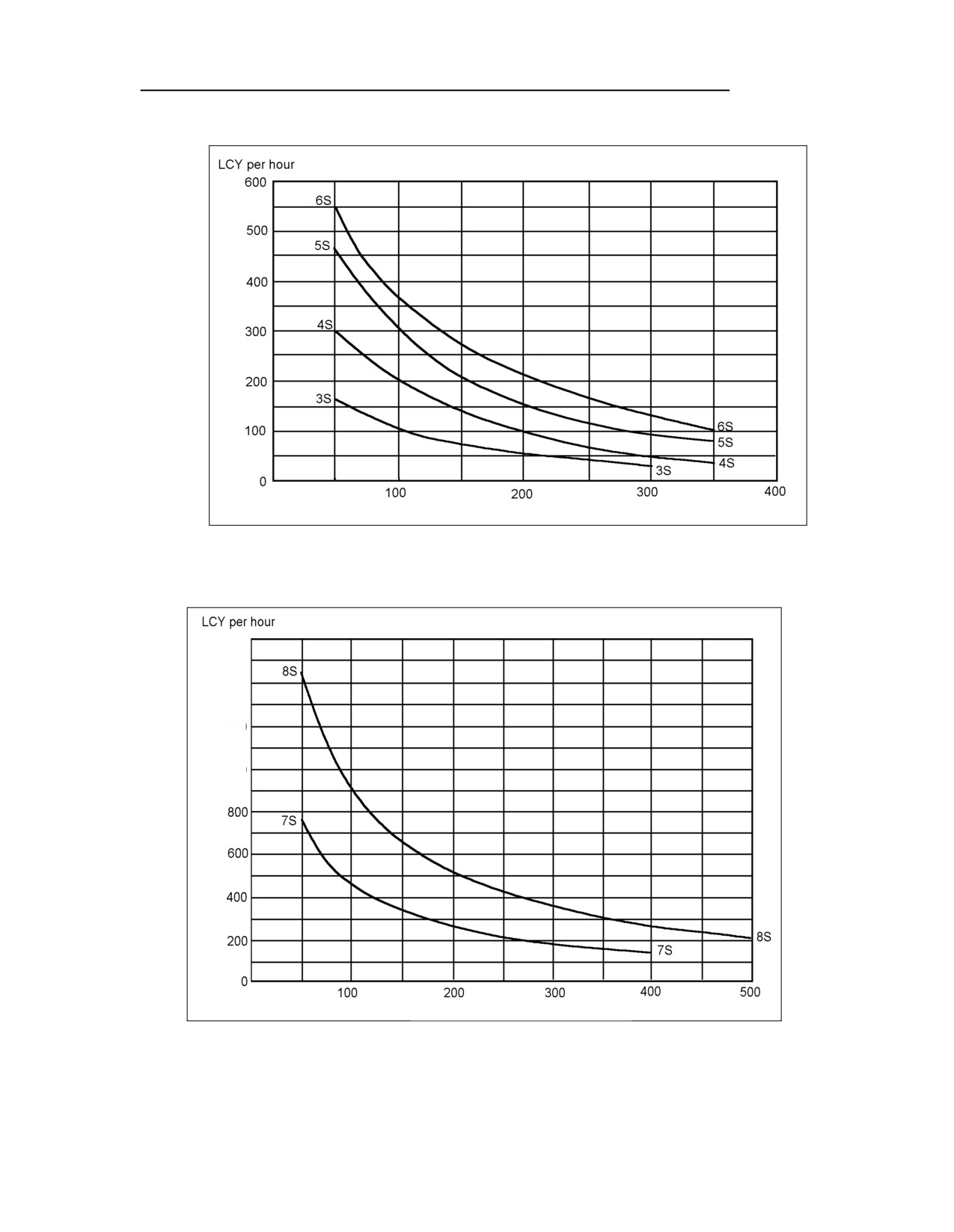
2-38. Dozer production curves give maximum-production values (in LCY per
hour) for straight and universal blades based on the following conditions:
• A 60-minute working hour (100 percent efficiency).
• Power-shift machines with 0.05-minute fixed times are being used.
• The dozer cuts 50 feet, then drifts the blade load to dump over a high
wall.
• The soil density is 2,300 pounds per LCY.
• The coefficient of traction equals 0.5 or better for crawler machines
and 0.4 or better for wheel machines.
• Hydraulic-controlled blades are being used.
2-39. Use the following steps to estimate dozer production:
Step 1. Determine the maximum production. Determine the estimated maxi-
mum production from either Figure 2-13 or 2-14, based on the type of dozer
being used. Find the dozing distance on the bottom horizontal scale in the
proper figure. Read up vertically until intersecting the production curve for the
dozer being considered then read the vertical scale on the left to determine the
maximum production in LCY per hour.
• Use Figure 2-13 to determine the estimated maximum production for
D3 through D6 tractors with straight blades. The DEUCE has the
same production capability as the D5.
• Use Figure 2-14 to determine the estimated maximum production for
D7 or D8 tractors with universal or straight blades.
2-18 Dozers
FM 5-434
Average dozing distance (feet)
S = straight blade
Figure 2-13. Estimated Maximum Production for D3 Through D6 Tractors
With Straight Blades
1,600
1,400
1,200
1,000
Average dozing distance (feet)
S = straight blade
Figure 2-14. Estimated Maximum Production for D7 or D8 Tractors
With Universal or Straight Blades
Dozers 2-19
FM 5-434
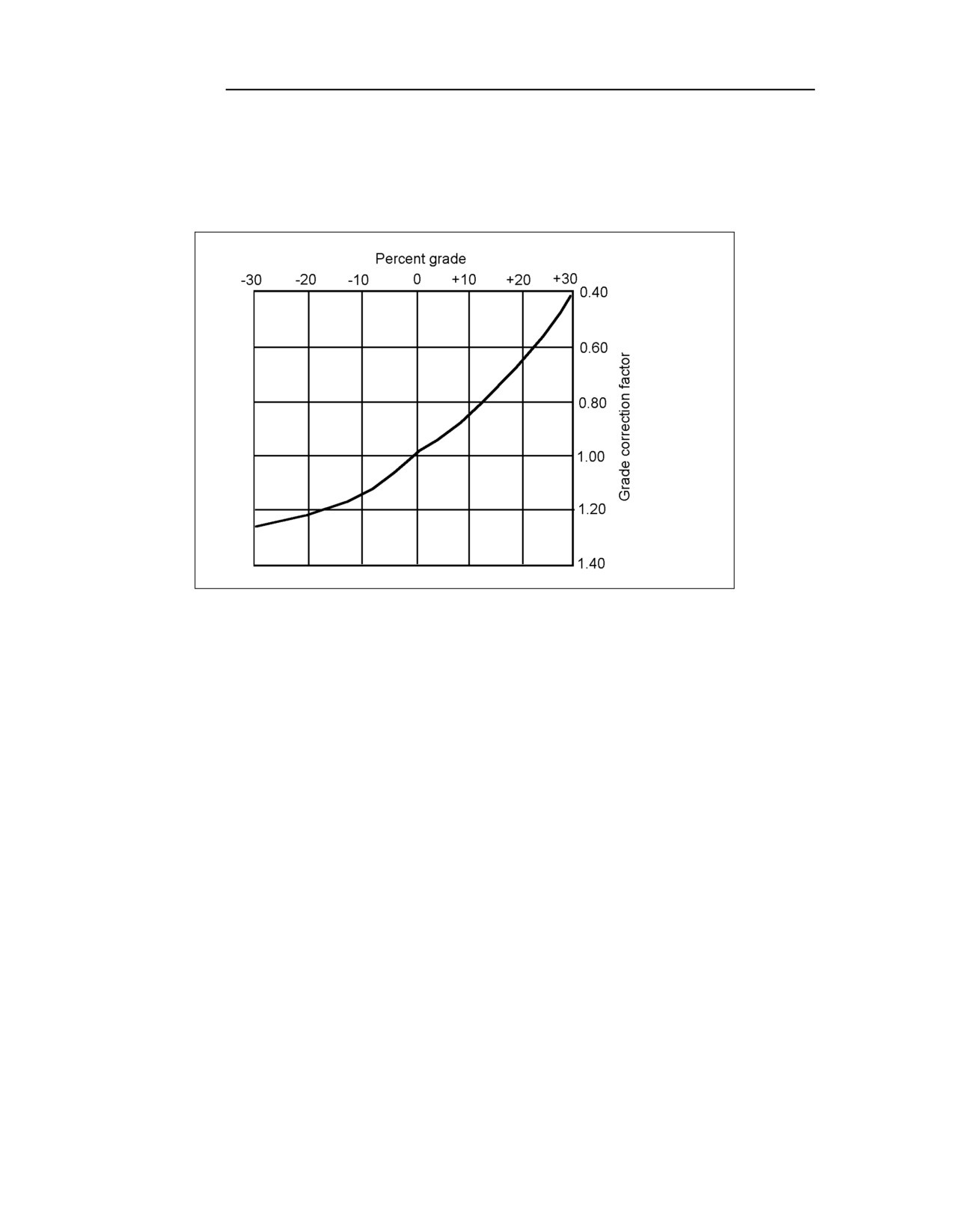
Step 2. Determine the grade correction factor—(-) favorable or (+) unfavorable.
Find the percent grade on the top horizontal scale of Figure 2-15. Read down
vertically and intersect the grade correction curve, then read to the right hori-
zontally and locate the grade correction factor on the vertical scale.
Note:
(-) Favorable
(+) Unfavorable
Figure 2-15. Dozer-Production Grade Correction Factors
Step 3. Determine the material-weight correction factor. If the actual unit
weight of the material to be pushed is not available from soil investigations, use
the average values found in Table 1-2, page 1-4. Divide 2,300 pounds per LCY
by the material’s LCY weight to find the correction factor. Soil density of 2,300
pounds per LCY is a constant that was assumed in determining the maximum
production.
2,300 pounds per LCY (standard material unit weight)
Material-weight correction factor
= -------------------------------------------------------------------------------------------------------------------------------------------------------
actual material LCY weight
where—
2,300 = standard material unit weight per LCY
Step
4. Determine the material-type correction factor. Dozer blades are
designed to cut material and give it a rolling effect in front of the blade. This
results in a production factor of 1. Table 2-4 gives the correction factors to
account for how different materials behave in front of the blade.
2-20 Dozers

FM 5-434
Table 2-4. Material-Type Correction Factors
Material State
Factor for Crawler Tractors
Loose, stockpile
1.2
Hard to cut; frozen, with tilt cylinder
0.8
Hard to cut; frozen, without tilt cylinder
0.7
Hard to drift; dead (dry, noncohesive)
0.8
material or very sticky material
Rock (ripped or blasted)
0.6 to 0.8
Step 5. Determine the operator correction factor (see Table 2-2, page 2-7).
Step 6. Determine the operating-technique correction factor from Table 2-5.
Table 2-5. Operating-Technique Correction Factors
Operating Technique
Factor for Crawler Tractors
Slot dozing
1.2
Side-by-side dozing
1.15 to 1.25
Step 7. Determine the efficiency factor. In the case of a well-managed job,
expect 50 minutes of production time per hour.
Efficiency facto = actual working minutes per hour
60-minute working hour
Step 8. Determine dozer production.
Production (LCY per hour) = maximum production × the product of the correction factors
Step 9. Determine the material conversion factor, if required. To find the total
time (step 10) and the total number of dozers required to complete a mission
within a given time (step 11), adjust the volume of material that is being moved
and the equipment production rate per hour so that they both represent the
same material state. Refer to material and production states as LCY, BCY, and
CCY. If necessary to convert, use Table 1-1, page 1-4, to find the material con-
version factor. Multiply the conversion factor by the production per hour to find
the production per hour in a different state.
NOTE: This conversion will not change the dozer production effort.
Dozers 2-21
FM 5-434
EXAMPLE
Determine the average hourly production (in CCY) of a straight-blade D7 (with tilt
cylinder) moving hard-packed clay an average distance of 200 feet, down a 10 per-
cent grade, using slot dozing. Estimated material weight is 2,500 pounds per LCY.
The operator is of average ability and will work during daylight hours. Expected effi-
ciency is 50 minutes per hour.
Step 1. Uncorrected maximum production = 300 LCY per hour (Figure 2-14, page
2-19)
Step 2. Grade correction factor = 1.15 (Figure 2-15, page 2-20)
Step 3. Material-weight correction factor
2,300 pounds per LCY (standard material unit weight)
=
-------------------------------------------------------------------------------------------------------------------------------------------------------
2,500 pounds per LCY (actual material unit weight)
= 0.92
Step 4. Material-type correction factor (a hard-to-cut material) = 0.8 (Table 2-4,
page 2-21)
Step 5. Operator correction factor = 0.75 (Table 2-2, page 2-7)
Step 6. Operating-technique correction factor = 1.2 (Table 2-5, page 2-21)
50 working minutes per hour
Step 7.
Efficiency factor
= ---------------------------------------------------------------------------------
= 0.83
60-minute working hour
Step 8. Dozer production
= 300 LCY per hour × 1.15 × 0.92 × 0.8 × 0.75 × 1.2 × 0.83
= 190 LCY per hour per dozer
Step 9. Material conversion factor = 0.63
Dozer production in CCY = 0.63 × 190 LCY per hour = 120 CCY per hour
Step 10. Determine the total time required in hours.
Q
Total time (hours)
= --------------
P×N
where—
Q = quantity of material to be moved
P = hourly production rate per dozer
N = number of dozers
EXAMPLE
Determine the total time required to move 3,000 CCY of hard-packed clay, using one D7
dozer with a production rate of 120 CCY per hour.
3,000 CCY
------------------------------------------------------------------------------
= 25 hours
120 CCY per hour × 1 dozen
2-22 Dozers
FM 5-434
Step 11. Determine the total number of dozers required to complete the mission
within a given time.
Q
Total number of dozers
= -------------
P×T
where—
Q = quantity of material to be moved
P = hourly production rate per dozer
T = maximum allowable duration, in hours
EXAMPLE
Determine how many D7 dozers (with a production rate of 120 CCY per hour) would be
needed to move 3,000 CCY of clay in seven hours.
3,000 CCY
------------------------------------------------------------------------------
= 3.6 D7 dozers (round up to 4 dozers)
120 CCY per hour × 7 hours
RIPPING PRODUCTION ESTIMATES
2-40. The best method to estimate ripping production is by working a test
section and recording the time required and the production achieved.
However, the opportunity to conduct such investigations is often nonexistent
and, therefore, estimates are usually based on historical production charts.
Ripping applications will increase the machine’s maintenance requirements
by 30 to 40 percent.
QUICK METHOD
2-41. A quick method to determine an approximate production rate is to time
several passes of a ripper over a measured distance. The timed duration
should include the turnaround time at the end of the pass. Determine an
average cycle time from the timed cycles. Determine the quantity (volume)
from the measured length multiplied by the width of the ripped area and the
depth of penetration. If measurements are in feet, divide the number of feet by
27 to convert cubic feet to cubic yards.
Volume BCY= length (feet)×width (feet)×penetration depth (feet)
27
where—
27 = factor used to convert cubic feet to cubic yards
2-42. Experience has shown that the production rate calculated by this quick
method is about 20 percent higher than an accurately cross-sectioned study.
Therefore, the formula for estimating ripping production is
V
Ripping production (BCY per hour)
= -----------------
T×1.2
where—
V
= measured volume in BCY
T
= average time in hours
1.2
= method correction factor
Dozers 2-23
FM 5-434
SEISMIC-VELOCITY METHOD
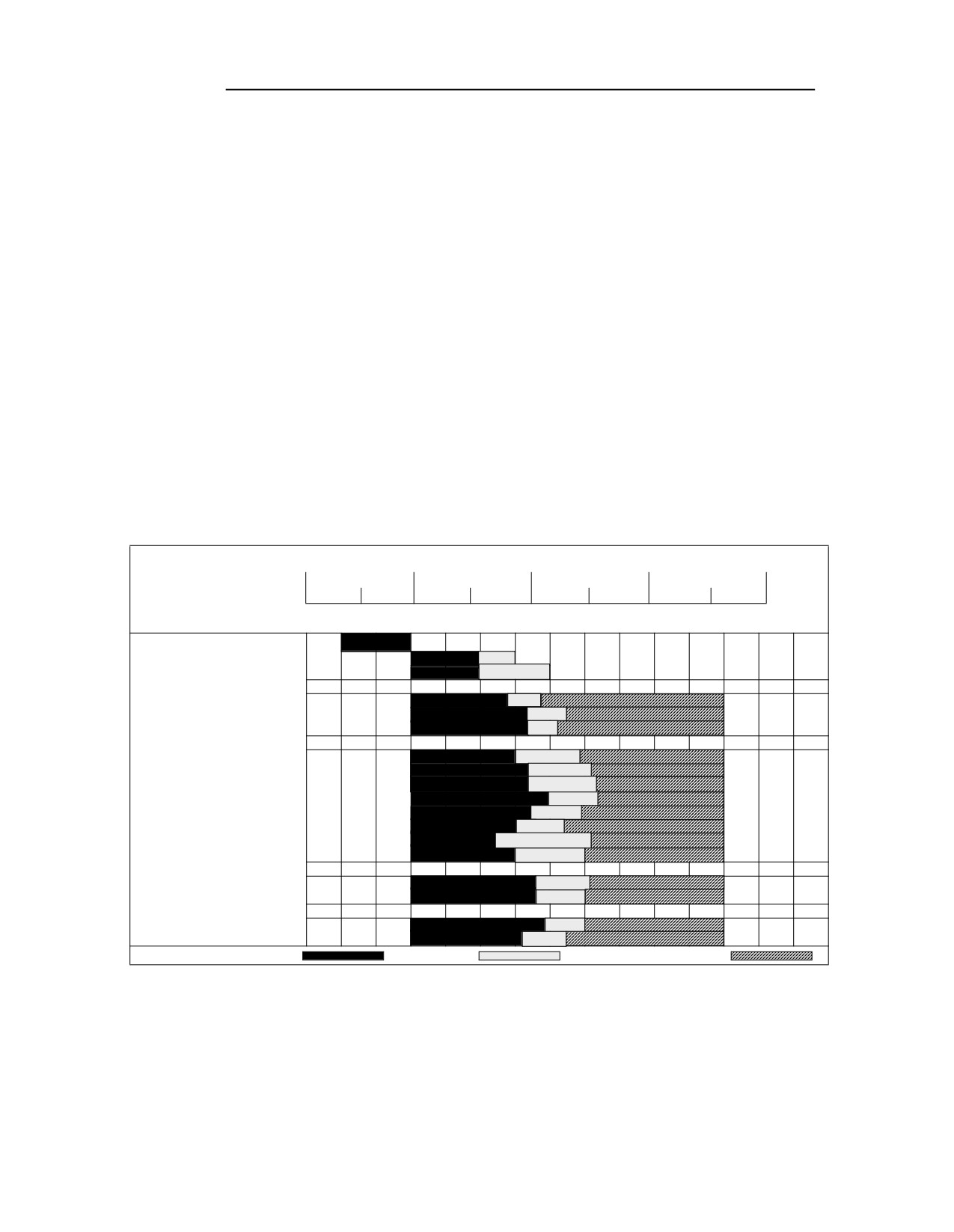
2-43. Most ripping-production charts are based on the relationship between the
ripability and the seismic-wave velocity response of a material. The Figure 2-16
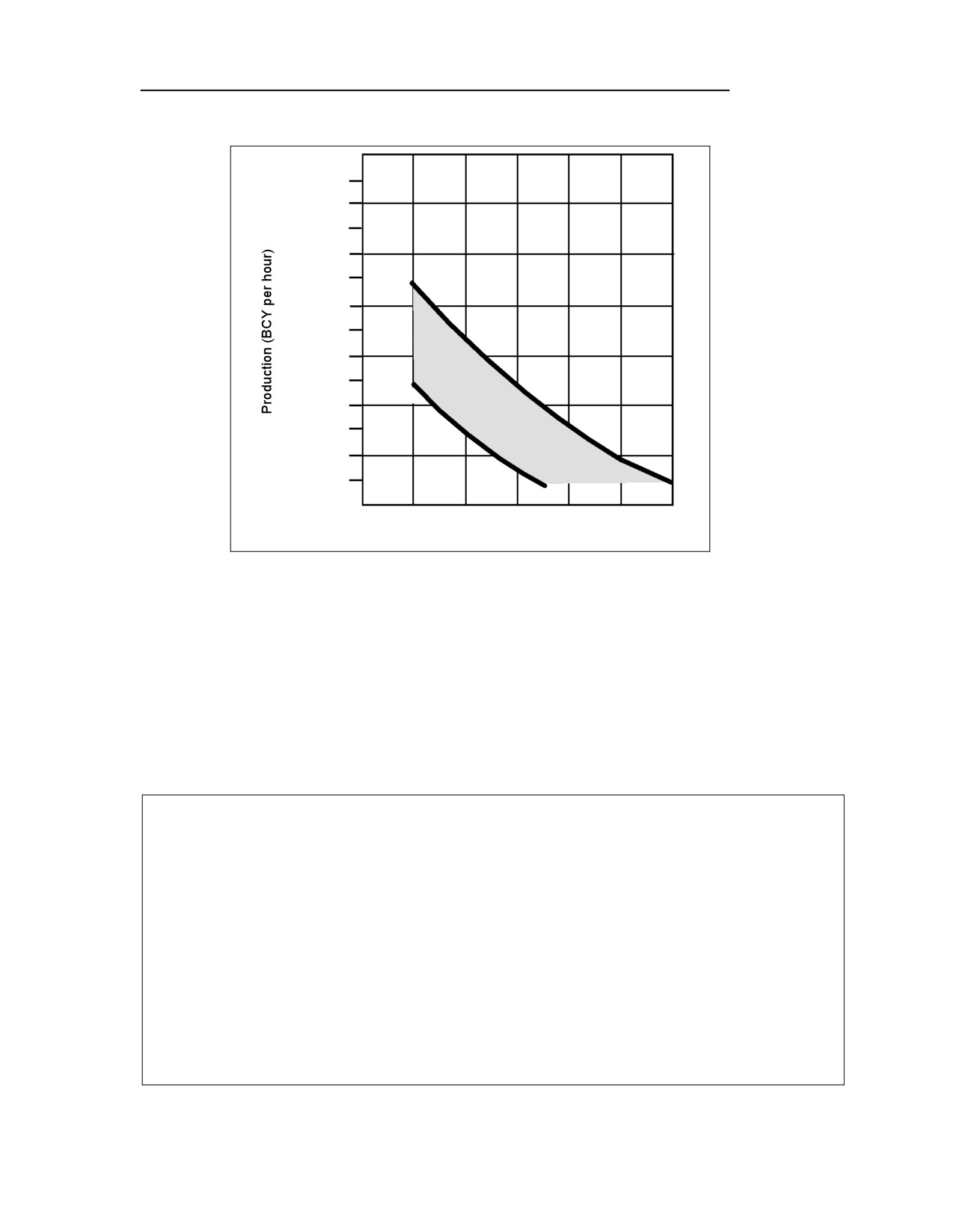
ripping performance chart, which is for a 300-horsepower dozer, allows the
estimator to make a determination of the machine’s performance capability
based on seismic velocity and general rock classifications. After establishing a
seismic velocity, estimate production from the production chart in Figure 2-17.
This chart provides a band of production rates representing ideal-to-adverse
rock conditions based on the following assumptions:
• The efficiency factor is 100 percent (60-minute working hour).
• The power-shift machines used have single-shank rippers.
• The machine rips full-time, no dozing.
• The upper limit of the band reflects ripping under ideal conditions
only. If conditions such as thick laminations, vertical laminations, or
other rock structural conditions exist which would adversely affect
production, use the lower limit.
2-44. Regardless of the seismic velocity, tooth penetration is the key to ripping
success. This is particularly true for homogeneous materials such as
mudstone, clay stone, and fine-grained caliches.
Velocity in meters
0
1
2
3
4
per second × 1,000
Velocity in feet
per second × 1,000
1
2
3
4
5
6
7
8
9
10
11
12
13
14
15
Topsoil
Clay
Glacial till
Igneous
Granite
Basalt
Trap rock
Sedimentary rocks
Shale
Sandstone
Siltstone
Claystone
Conglomerate
Breccia
Caliche
Limestone
Metamorphic rock
Schist
Slate
Minerals and ores
Coal
Iron ore
Ripable
Marginal
Nonripable
Figure 2-16. Ripping Performance for a 300-Horsepower Dozer
With a Single- or Multishank Ripper
2-24 Dozers
FM 5-434
3,250
3,000
2,750
2,500
Ideal
2,250
2,000
1,750
1,500
1,250
Adverse
1,000
750
500
250
2
3
4
5
6
7
8
Seismic velocity (in feet per second × 1,000)
Figure 2-17. Estimated Ripping Production for a 300-Horsepower
Dozer With a Single-Shank Ripper
Production (BCY per hour per dozer) = P × E
where—
P = maximum production for a 300-horsepower dozer (Figure 2-17)
E = efficiency factor
NOTE: Before referring to Figure 2-17 for determining a probable pro-
duction rate, refer to Figure 2-16 to verify the ripability with the equip-
ment available.
EXAMPLE
Determine how many 300-horsepower dozers are needed to rip 9,000 BCY of limestone
having a seismic velocity of 4,000 feet per second in 7 hours. The limestone is bedded
in thin laminated layers. Efficiency will be a 45-minute working hour.
Maximum production for ideal conditions (thin layers) is 1,700 BCY per hour (Figure
2-17).
Efficiency-adjusted production
45
= 1,700 BCY per hour
× ------
60
= 1,275 BCY per hour
9,000 BCY
-----------------------------------------------------------------------------------
= 1,300-horsepower dozer
1,275 BCY per hour × 7 hours
Dozers 2-25
FM 5-434
SAFETY PRECAUTIONS
2-45. Listed below are some specific safety precautions for dozer operators:
• Never carry personnel on the tractor drawbar.
• Never turn around on steep slopes; back up or down instead.
• Keep the machine in low gear when towing a heavy load downhill.
• Always lower the blades when the machine is parked.
• Ensure that only one person is on the machine while it is in operation.
However, in some training situations it is necessary to have two
people on a dozer while it is in operation.
2-26 Dozers
Chapter 3
Scrapers
The design of scrapers (tractor scrapers) allows for loading, hauling,
dumping, and spreading of loose materials. Use a scraper for medium-haul
earthmoving operations and for moving ripped materials and shot rock.
The haul distance (zone of operation), the load volume, and the type and
grade of surface traveled on are the primary factors in determining
whether to use a scraper on a particular job. The optimum haul distance
for small- and medium-size scrapers is 3,000 feet or less.
DESCRIPTION
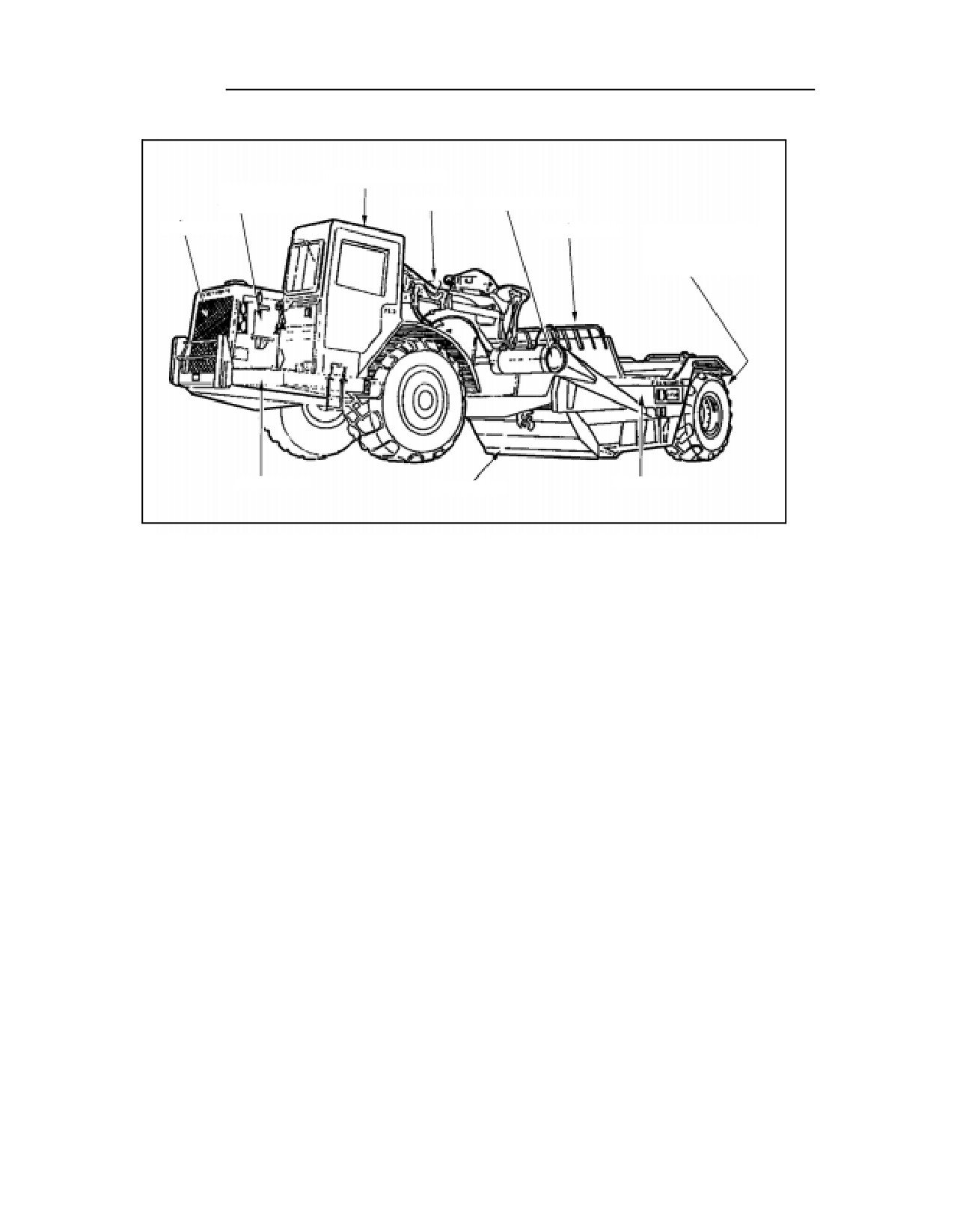
3-46. Figure 3-1, page 3-2, shows a CAT® 621B single-powered-axle wheel
scraper. The CAT 621 is designed to operate using a push tractor for loading
assistance. The air-droppable CAT 613B wheel scraper has a chain-elevator
loading mechanism that allows it to load without the assistance of a push
tractor. The basic operating parts of a scraper are these:
• Bowl. The bowl is the loading and carrying component. It has a
cutting edge, which extends across the front bottom edge. Lower the
bowl until the cutting edge enters the ground for loading, raise it for
carrying, and lower it to the desired lift thickness for dumping and
spreading.
• Apron. The apron is the front wall of the bowl. It is independent of
the bowl and, when raised, it provides an opening for loading and
spreading. Lower the apron during hauling to prevent spillage.
• Ejector. The ejector is the rear wall of the bowl. Keep the ejector in
the rear position when loading and hauling materials. Activate the
ejector to move forward during spreading to provide positive discharge
of materials.
CAPACITY
3-47. Struck capacity means the bowl has a full load of material that is level
with its sides. Heaped capacity means the material is heaped in the bowl and
slopes down on a 1:1 repose slope to the sides of the bowl. In practice, these
will be LCY of material because of how a scraper loads. Therefore, load volume
in terms of BCY moved depends on both the bowl size and the material type
being loaded. The rated volumetric capacity of the Army 621B scraper is 14-
cubic-yards struck and 20-cubic-yards heaped. The capacity of the CAT 613B
scraper is 11-cubic-yards heaped. Elevating scrapers, like the Army 613, are
not given struck capacity ratings.
Scrapers 3-1
FM 5-434
Cab (ROPS)
Engine
compartment
Hitch
Draft frame
Radiator
Ejector
Push block
(extends out
behind wheels)
Tractor
Bowl
Apron
Figure 3-18. CAT 621B Wheel Scraper
OPERATING RANGE
3-48. The optimum haul distance for the small- and medium-size scrapers is
300 to 3,000 feet. There are larger scrapers that are effective up to 5,000 feet.
SELECTION
3-49. A scraper is a compromise between a machine designed exclusively for
either loading or hauling. For medium-distance movement of material, a
scraper is better than a dozer because of its travel-speed advantage and it is
better than a truck because of its fast load time, typically less than a minute.
Another advantage of the scraper is that it can spread its own load and
quickly complete the dump cycle.
PRODUCTION CYCLE
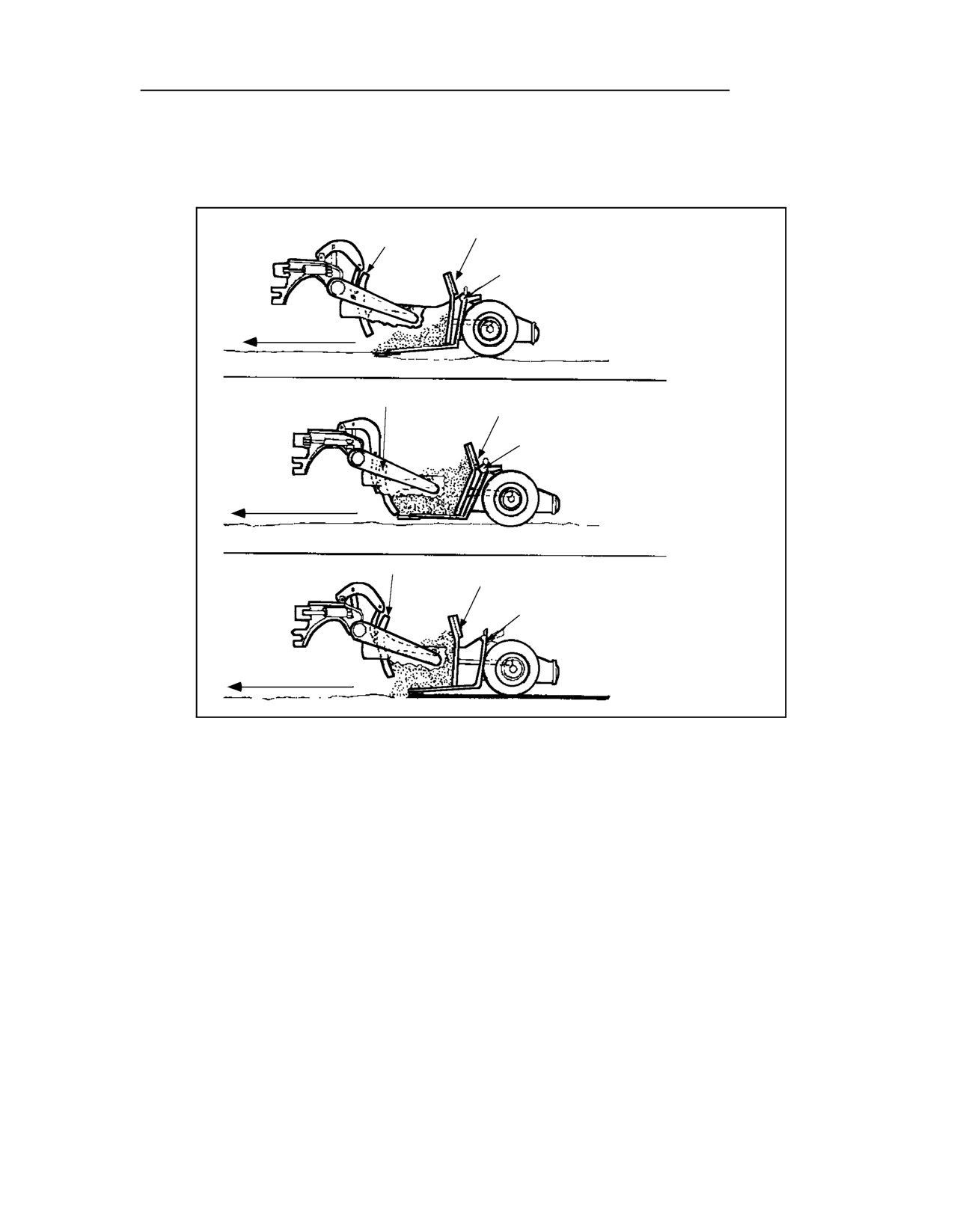
3-50. The production cycle for a scraper consists of six operations—loading,
haul travel, dumping and spreading, turning at the dump site, return travel,
and turning and positioning to load. Figure 3-2 shows the functions of the
apron, bowl, and ejector during loading, hauling, and dumping.
LOADING
3-51. The CAT 621 loads with push-tractor assistance. This scraper can load
to a limited extent without assistance, but requires push loading to achieve
maximum production. Pusher assistance is necessary to reduce loading time
and wheel spinning. Reducing scraper wheel spinning increases tire life. The
scraper should not depend on the pusher to do all the work. Conversely, do not
spin the scraper's wheels to pull away from the pusher. Use pusher assistance
for either straight, downhill, or straddle loading. Always load the scraper in
the direction of haul. Do not turn the scraper at the same time it is
3-2 Scrapers
FM 5-434
accelerating from the loading operation. The CAT 613 is a self-loading
machine, and pushing during loading will damage the scraper’s loading
elevator.
Apron raised
Ejector back in rear position during loading
Bowl lowered to desired cutting depth
Loading
Direction of travel
Apron lowered
Ejector back
Bowl raised to permit free travel
Carrying the
load (hauling)
Direction of travel
Apron raised
Ejector moves forward to empty bowl
Bowl lowered to desired spreading
Spreading the
load
Direction of travel
Figure 3-19. Functions of the Apron, Bowl, and Ejector
Downhill Loading
3-52. Downhill loading enables a scraper to obtain larger loads in less time.
Each 1 percent of favorable grade is equivalent to increasing the loading force
by 20 pounds per ton of gross scraper weight.
Straddle Loading
3-53. Straddle loading (Figure 3-3, page 3-4) requires three cuts with a
scraper. The first two cuts should be parallel, leaving a ridge between the two
cuts. The scraper straddles this ridge of earth to make the final cut. The ridge
should be no wider than the distance between a scraper's wheels. With
straddle loading, time is gained on every third trip because the center strip
loads with less resistance than a full cut.
Scrapers 3-3
///////////////////////////////////////