FM 4-02.283 TREATMENT OF NUCLEAR AND RADIOLOGICAL CASUALTIES (December 2001) - page 1
This manual contains copyrighted material.
FM 4-02.283
NTRP 4-02.21
AFMAN 44-161(I)
MCRP 4-11.1B
FIELD MANUAL
HEADQUARTERS
NO. 4-02.283
DEPARTMENTS OF THE ARMY, THE
NTRP 4-02.21
NAVY, AND THE AIR FORCE, AND
AIR FORCE MANUAL
COMMANDANT, MARINE CORPS
NO. 44-161 (INTERSERVICE)
Washington, DC 20 December 2001
MARINE CORPS
MCRP 4-11.1B
TREATMENT OF
NUCLEAR AND RADIOLOGICAL CASUALTIES
DISTRIBUTION RESTRICTION B: Distribution authorized to U.S. Government agencies only
because it contains copyrighted material that is not to be transmitted outside the U.S. Govern-
ment. This determination was made on 20 December 2001. Other requests for this document
will be referred to HQDA (DASG-HCD), 5109 Leesburg Pike, Falls Church, VA 22041-3258.
TABLE OF CONTENTS
Page
PREFACE
................................................................................................vii
CHAPTER
1.
INTRODUCTION
1-1.
Purpose and Scope
1-1
1-2.
Radiation Accidents
1-2
1-3.
Nuclear Weapons Incidents
1-8
1-4.
Terrorism and Radiological Dispersal Devices
1-9
1-5.
Terrorism and a Single Nuclear Detonation
1-9
1-6.
Nuclear Warfare
1-10
1-7.
Global and Regional Threats
1-11
CHAPTER
2.
HAZARDS OF NUCLEAR AND RADIOLOGICAL EVENTS
2-1.
General
2-1
2-2.
Types of Ionizing Radiation
2-1
2-3.
Units of Measure
2-2
2-4.
Penetration and Shielding
2-4
2-5.
Nuclear Detonation
2-6
2-6.
Nuclear Detonation Blast Hazards
2-8
2-7.
Nuclear Detonation Thermal Radiation Hazards
2-9
2-8.
Nuclear Detonation Radiation Hazards
2-10
i
FM 4-02.283/NTRP 4-02.21/AFMAN 44-161(I)/MCRP 4-11.1B
Page
2-9.
Range of Damage
2-12
2-10.
Radioactive Contamination Hazards
2-13
CHAPTER
3.
TREATMENT OF HIGH-DOSE RADIOLOGICAL AND
COMBINED INJURY CASUALTIES
3-1.
General
3-1
Section
I.
Ionizing Radiation Effects on Cells and Tissues
3-1
3-2.
General
3-1
3-3.
Cellular Effects of Ionizing Radiation
3-2
3-4.
Relative Tissue Radiosensitivity
3-3
Section
II.
Systemic Effects of High-Dose Radiation
3-5
3-5.
General
3-5
3-6.
Acute Radiation Syndrome
3-6
3-7.
Radiation-Induced Early Transient Incapacitation
3-11
Section
III.
Diagnosis, Severity, and Triage of Radiation Casualties
3-12
3-8.
Clinical Findings
3-12
3-9.
Dosimetry
3-14
3-10.
Laboratory Testing
3-14
3-11.
Triage of Nuclear and Radiological Casualties
3-15
Section
IV.
Treatment of Radiation Subsyndromes
3-17
3-12.
First Aid
3-17
3-13.
Management of the Hematopoietic Syndrome
3-17
3-14.
Management of the Gastrointestinal Syndrome
3-21
3-15.
Management of the Cardiovascular/Central Nervous System
Syndrome
3-22
3-16.
Recovery
3-22
3-17.
Summary of Medical Aspects of Acute Radiation Injury
3-22
Section
V.
Combined InjuryBlast, Thermal, and Radiological Injuries
3-27
3-18.
General
3-27
3-19.
Blast Injuries
3-27
3-20.
Treatment of Blast Injuries
3-27
3-21.
Thermal Injury
3-28
3-22.
Determining Severity of Thermal Injuries
3-29
3-23.
Treatment of Thermal Injuries
3-30
3-24.
Hematopoietic Effects of Combined Injury
3-31
3-25.
Chemical Weapons and Radiation
3-31
3-26.
Biological Weapons and Radiation
3-32
3-27.
Immunization and Radiation
3-32
CHAPTER
4.
RADIOACTIVE CONTAMINATION
4-1.
General
4-1
4-2.
Measuring Levels of Contamination
4-1
ii
FM 4-02.283/NTRP 4-02.21/AFMAN 44-161(I)/MCRP 4-11.1B
Page
Section
I.
External Contamination, Irradiation, and Acute Local
Radiation Injury
4-3
4-3.
External Irradiation
4-3
4-4.
Decontamination
4-3
4-5.
Local Tissue Irradiation
4-4
4-6.
Cutaneous Radiation Syndrome
4-5
4-7.
Treatment of the Cutaneous Radiation Syndrome
4-6
Section
II.
Internal Contamination and Irradiation
4-8
4-8.
General
4-8
4-9.
Internalization of Radioactive Materials
4-8
4-10.
Internal Contamination Treatment
4-11
CHAPTER
5.
LOW-LEVEL RADIATION
5-1.
Low-Level Radiation Characteristics and Hazards
5-1
Section
I.
Low-Level Radiation Exposure
5-1
5-2.
Exposure Guidance
5-1
Section
II.
Delayed/Late Health Effects
5-3
5-3.
General
5-3
5-4.
Principles
5-3
5-5.
Types of Long-Term Effects
5-4
5-6.
Embryonic and Fetal Effects
5-4
5-7.
Reproductive Cell Kinetics and Sterility
5-5
5-8.
Carcinogenesis
5-5
5-9.
Cataract Formation
5-6
Section
III.
Prevention, Initial Actions and Medical Care and Follow-Up
5-7
5-10.
Prevention
5-7
5-11.
Initial Actions
5-8
5-12.
Medical Care
5-8
5-13.
Medical Follow-Up
5-8
5-14.
Documentation of Radiation Exposure Records
5-10
CHAPTER
6.
PSYCHOLOGICAL EFFECTS AND TREATMENT OF
PSYCHOLOGICAL CASUALTIES
6-1.
General
6-1
6-2.
Radiation Dispersal Devices and Nuclear Incidents
6-1
6-3.
Nuclear Detonation
6-2
6-4.
Fallout Field
6-3
6-5.
Psychosocial Sequelae of Radiation Exposure
6-3
6-6.
Treatment
6-4
6-7.
Prevention and Risk Communication
6-5
APPENDIX
A.
DEPLETED URANIUM
A-1.
General
A-1
iii
FM 4-02.283/NTRP 4-02.21/AFMAN 44-161(I)/MCRP 4-11.1B
Page
A-2.
Depleted Uranium Characteristics and Uses
A-1
A-3.
Depleted Uranium Toxicity
A-2
A-4.
Health Effects of Exposure to Depleted Uranium
A-3
A-5.
Patient Management of Personnel Wounded by Depleted Uranium
Munitions
A-5
APPENDIX
B.
MEDICATIONS
B-1
APPENDIX
C.
TREATMENT BRIEFS
C-1.
Scope of Treatment Briefs
C-1
Section
I.
Global Assumptions
C-2
C-2.
Level of Care
C-2
C-3.
Combined Injury
C-2
C-4.
Wound Closure
C-3
C-5.
Return to Surgery
C-3
C-6.
Psychological Casualties
C-3
C-7.
Decontamination
C-4
C-8.
Incidence Rates
C-4
C-9.
Evacuation
C-4
C-10.
Patient Holding Capabilities
C-4
C-11.
Blood Products
C-5
C-12.
Patient Warming
C-6
C-13.
Sterilization
C-6
C-14.
C-Spine Management
C-6
C-15.
Tetanus
C-6
C-16.
Diets
C-6
C-17.
Casts and Splints
C-7
C-18.
Lab/X-ray/Pharmacy
C-7
C-19.
Oxygen
C-7
C-20.
Patient Personal Support Kits
C-7
C-21.
Water
C-7
C-22.
Linen
C-7
C-23.
Refrigeration
C-7
Section
II.
Treatment Briefs
C-8
C-24.
Treatment Brief No. 1: Radiation Exposure at 0.075 cGy Without
Other Physical Injury
C-8
C-25.
Treatment Brief No. 2: Radiation Injury at 75125 cGy Without
Other Physical Injury
C-8
C-26.
Treatment Brief No. 3: Radiation Injury at 125300 cGy Without
Other Physical Injury
C-9
C-27.
Treatment Brief No. 4: Radiation Injury at 300530 cGy Without
Other Physical Injury
C-10
iv
FM 4-02.283/NTRP 4-02.21/AFMAN 44-161(I)/MCRP 4-11.1B
Page
C-28.
Treatment Brief No. 5: Radiation Injury at 530830 cGy Without
Other Physical Injury
C-11
C-29.
Treatment Brief No. 6: Radiation Injury at 8301500 cGy Without
Other Physical Injury
C-12
C-30.
Treatment Brief No. 7: Radiation Injury >1500 cGy Without
Other Physical Injury
C-13
C-31.
Treatment Brief No. 8: Radiation at 0125 cGy With Nonoperative
Trauma (Examples include concussion, simple lacerations, closed
fractures, ligamental injuries, and so forth.)
C-14
C-32.
Treatment Brief No. 9: Radiation at 125530 cGy With Nonoperative
Trauma (Examples include concussion, simple lacerations, closed
fractures, ligamental injuries, and so forth.)
C-15
C-33.
Treatment Brief No. 10: Radiation >530 cGy With Nonoperative
Trauma (Examples include concussion, simple lacerations, closed
fractures, ligamental injuries, and so forth.)
C-17
C-34.
Treatment Brief No. 11: Radiation at 0125 cGy With Operative
Trauma
C-18
C-35.
Treatment Brief No. 12: Radiation at 125530 cGy With Operative
Trauma
C-20
C-36.
Treatment Brief No. 13: Radiation >530 cGy With Operative
Trauma
C-21
C-37.
Treatment Brief No. 14: Radiation at 0125 cGy With Mild Burn
C-23
C-38.
Treatment Brief No. 15: Radiation at 125530 cGy With Mild Burn
(Without treatment 90 percent mortality.)
C-24
C-39.
Treatment Brief No. 16: Radiation >530 cGy With Mild Burn
(Without treatment 100 percent mortality.)
C-25
C-40.
Treatment Brief No. 17: Radiation at 0125 cGy With Moderate Burn
C-26
C-41.
Treatment Brief No. 18: Radiation at 125530 cGy With Moderate
Burn (Without treatment 100 percent mortality.)
C-27
C-42.
Treatment Brief No. 19: Radiation >530 cGy With Moderate Burn
(With or without treatment 100 percent mortality.)
C-28
C-43.
Treatment Brief No. 20: Radiation at 0125 cGy With Severe Burn
(Without treatment 20 percent mortality.)
C-29
C-44.
Treatment Brief No. 21: Radiation at 125530 cGy With Severe Burn
(Without treatment 100 percent mortality.)
C-31
C-45.
Treatment Brief No. 22: Radiation >530 cGy With Severe Burn
(With or without treatment 100 percent mortality.)
C-32
C-46.
Treatment Brief No. 23: Radiation at 0125 With Operative Trauma
and Mild Burn
C-33
C-47.
Treatment Brief No. 24: Radiation at 125530 cGy With Operative
Trauma and Mild Burn (Without treatment 100 percent mortality.)
C-34
C-48.
Treatment Brief No. 25: Radiation >530 cGy With Operative
Trauma and Mild Burn (With or without treatment 100 percent
mortality.)
C-36
v
FM 4-02.283/NTRP 4-02.21/AFMAN 44-161(I)/MCRP 4-11.1B
Page
C-49. Treatment Brief No. 26: Radiation at 0125 With Operative Trauma
and Moderate Burn (Without treatment 100 percent mortality.)
C-37
C-50. Treatment Brief No. 27: Radiation at 0125 cGy With Operative
Trauma and Severe Burn (Without treatment 100 percent mortality.)
C-39
C-51. Treatment Brief No. 28: Radiation >125 cGy With Operative
Trauma and Moderate or Severe Burn
C-40
GLOSSARY
..................................................................................... Glossary-1
REFERENCES
................................................................................... References-1
INDEX
......................................................................................... Index-1
vi
FM 4-02.283/NTRP 4-02.21/AFMAN 44-161(I)/MCRP 4-11.1B
PREFACE
Purpose
This publication serves as a guide and a reference for trained members of the Armed Forces Medical
Services and other medically qualified personnel on the recognition and treatment of nuclear and radiological
casualties.
Scope
a. This publication
(1) Classifies and describes potential nuclear and radiological threats and hazards.
(2) Describes the biological aspects of blast, thermal radiation, and ionizing radiation and its
effects on organs and systems of the body.
(3) Describes procedures for first aid, medical diagnosing, treating, and management of
nuclear and radiological casualties.
b. The material in this publication is applicable to both the nuclear battlefield and to other
operations where a high- or low-level radiation hazard exists; this includes military support to United States
(US) civilian agencies during weapons of mass destruction (WMD) consequence management operations.
c.
The treatment modalities contained in this manual are based upon those described in the most
recent North Atlantic Treaty Organization (NATO) Handbook on the Medical Aspects of Nuclear, Biological
and Chemical (NBC) Defensive Operations AMedP-6(C), Ratification Draft; the Medical Management of
Radiological Casualties Handbook, First Edition, and the recently approved Treatment Briefs.
d. The use of the term level of care in this publication is synonymous with echelon of care
and role of care. The term echelon of care is the old NATO term. The term role of care is the new
NATO and American, British, Canadian, and Australian (ABCA) term.
Standardization Agreements
This manual is in consonance with NATO Standardization Agreements (STANAGs) and ABCA Quadripartite
Standardization Agreements (QSTAGs):
NATO ABCA
STANAG QSTAG TITLE
2068
Emergency War Surgery.
2083
Commanders Guide on Nuclear Radiation Exposure of Groups, Edition 6.
vii
FM 4-02.283/NTRP 4-02.21/AFMAN 44-161(I)/MCRP 4-11.1B
NATO ABCA
STANAG QSTAG TITLE
2461
NATO Handbook on the Medical Aspects of NBC Defensive Operations,
AMedP-6(C). Volume I-Nuclear Ratification Draft.
2473
Commanders Guide on Low-Level Radiation (LLR) Exposure in Military
Operations, Edition 1.
2475
Planning Guide for the Estimation of NBC Battle Casualties (Nuclear), AMedP-8
(A). Volume I.
1263
Common Principles and Procedures for Critical Aspects of the Medical and
Dental Treatment of Personnel.
Implementation Plan
Participating Service command offices of primary responsibility will review this publication, validate the
information, reference, and incorporate it in Service and command manuals, regulations, and curricula as
follows:
a. Army. The Army will incorporate this publication in US Army training and doctrinal
publications as directed by the Commander, US Army Training and Doctrine Command. Distribution is in
accordance with initial distribution number 115861, requirements for FM 4-02.283.
b. Marine Corps. The Marine Corps will incorporate the procedures in this publication in US
Marine Corps training and doctrinal publications as directed by the Commanding general, US Marine Corps
Combat Development Command. Distribution is in accordance with Marine Corps Publication Distribution
System.
c.
Navy. The Navy will incorporate these procedures in US Navy training and doctrinal
publications as directed by the Commander, Navy Warfare Development Command. Distribution is in
accordance with MILSTRIP Desk Guide and NAVSOP Publication 409.
d. Air Force. The Air Force will validate and incorporate appropriate procedures in accordance
with applicable governing directives. Distribution is in accordance with AFI 33-360.
e.
Coast Guard. The Coast Guard will validate and refer to appropriate procedures when
applicable. No material contained herein should conflict with Coast Guard regulations or other directives
from higher authority, or supersede, or replace any order or directive issued by higher authority.
User Information
a. The US Army Medical Department Center and School developed this publication with the
joint participation of the approving Service commands.
viii
FM 4-02.283/NTRP 4-02.21/AFMAN 44-161(I)/MCRP 4-11.1B
b. This publication reflects current Service and joint doctrine on prevention, protection, medical
management, and treatment of nuclear and radiological casualties.
c.
We encourage recommended changes for improving this publication. Key your comments to
the specific page and paragraph and provide a rationale for each comment or recommendation. Send
comments and recommendations directly to
Army
Commander
US Army Medical Department Center and School
ATTN: MCCS-FCD
Fort Sam Houston, Texas 78234-5052
DSN 471-9501/9524 COMM (210) 221-9501/9524
Navy
Commander
Navy Warfare Development Command
ATTN: N5
686 Cushing Road
Newport, RI 02841-1207
DSN 948-4201 COMM (401) 841-4201
Air Force
HQ Air Force Doctrine Center
ATTN: DR
155 North twining street
Maxwell AFB, AL 36112-6112
DSN 493-5645 COMM (334) 953-5645
Marine Corps
Commanding General
US Marine Corps Combat Development Command
ATTN: C42 (Director)
3300 Russell Road
Quantico VA 22134-5001
DSN 278-6234 COMM (703) 784-6234
U. S. Coast Guard
2100 Second Street, S.W.
Washington D.C. 20593-0001
Staff Symbol G-MOR, G-OPD
ix
FM 4-02.283/NTRP 4-02.21/AFMAN 44-161(I)/MCRP 4-11.1B
Gender Statement
Unless this publication states otherwise, masculine nouns and pronouns do not refer exclusively to men.
Use of Trade Names/Trademarks
Use of trade names/trademarks in this publication is for illustrative purposes only. Their use does not
constitute endorsement by the Department of Defense (DOD).
References
References listed should be consulted for details beyond the scope of this publication.
Acknowledgments
The Armed Forces Radiobiology Research Institute for allowing use of portions of the Medical Effects of
Ionizing Radiation Course (CD-ROM).
The National Academy of Sciences for use of portions of Potential Radiation Exposure in Military
Operations, Protecting the Soldier Before, During, and After, published 1999.
The National Council on Radiation Protection (NCRP) and Measurements for allowing use of portions of
NCRP Report No. 65, Management of Persons Accidentally Contaminated With Radionuclides, 1979.
To RAND, working jointly with the Advisory Panel, for allowing use of portions of the First Annual Report
to The President and The Congress of the Advisory Panel To Assess Domestic Response Capabilities For
Terrorism Involving Weapons of Mass Destruction, Part I. Assessing the Threat, December 1999. Also,
RAND is to be acknowledged for allowing use of portions of A Review of the Scientific Literature As It
Pertains to Gulf War Illnesses, Volume 7, Depleted Uranium, 1999.
x
FM 4-02.283/NTRP 4-02.21/AFMAN 44-161(I)/MCRP 4-11.1B
CHAPTER 1
INTRODUCTION
1-1.
Purpose and Scope
a. This publication serves as a guide and a reference for trained members of the Armed Forces
Medical Services on the recognition and treatment of nuclear warfare casualties and medical management
of persons exposed to high and low-level radiation. The proliferation of nuclear material and technology
has made the acquisition and adversarial use of nuclear and radiological weapons more probable.
Additionally, military personnel may be deployed to areas that could be radiologically contaminated
because of the presence of radioactive materials and nuclear facilities. Treatment protocols for radiation
casualties are now effective, practical and possible, and must be part of US Armed Forces medical
contingency planning efforts. In order to understand potential nuclear and radiological hazards, the entire
spectrum of threat events, with examples, is discussed starting with paragraph 1-2. Currently, radiation
accidents involving industrial or medical radiological material and nuclear weapons incidents are the most
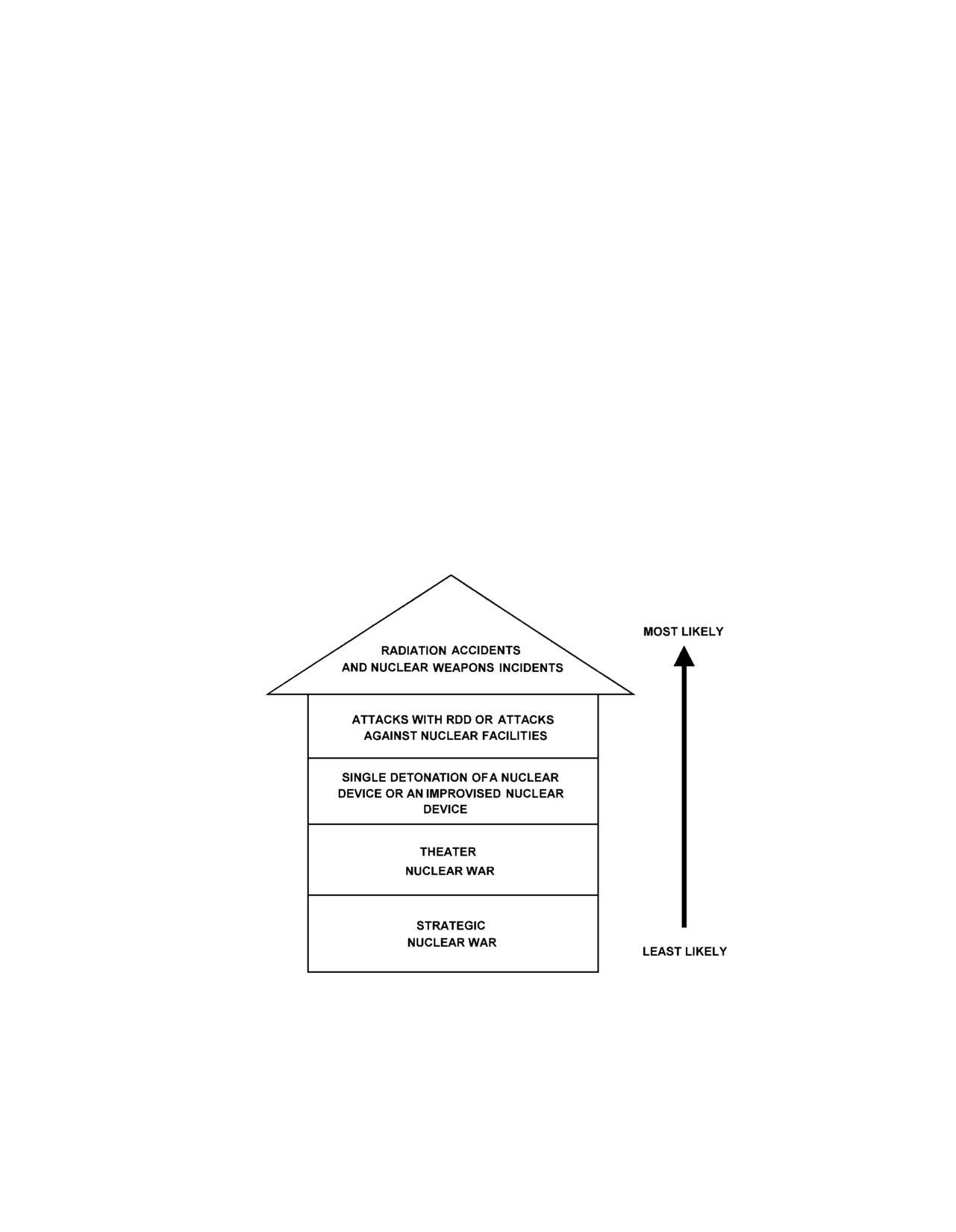
likely threat to US forces and civilians. The least likely threats are theater and strategic nuclear war (see
Figure 1-1).
Figure 1-1. Likelihood of radiation threat.
b. Throughout the manual, both existing and the International System of Units
(systeme
international dunites, abbreviated internationally as SI), are used to measure ionizing radiation. The
1-1

FM 4-02.283/NTRP 4-02.21/AFMAN 44-161(I)/MCRP 4-11.1B
existing and new units of measurement are discussed in detail in Chapter 2. For comparison purposes, a
radiation unit conversion table is shown below.
Table 1-1. Conversion Table
EXISTING UNITS
SI UNITS
0.001
rem
=
1
mrem
=
0.01
mSv
0.01
rem
=
10
mrem
=
0.1
mSv
0.1
rem
=
100
mrem
=
1
mSv
=
0.001
Sv
1
rem
=
1,000
mrem
=
10
mSv
=
0.01
Sv
10
rem
=
100
mSv
=
0.1
Sv
100
rem
=
1,000
mSv
=
1
Sv
1000
rem
=
10
Sv
0.001
rad
=
1
mrad
=
0.01
mGy
0.01
rad
=
10
mrad
=
0.1
mGy
0.1
rad
=
100
mrad
=
1
mGy
=
0.001
Gy
1
rad
=
1,000
mrad
=
10
mGy
=
0.01
Gy
10
rad
=
100
mGy
=
0.1
Gy
100
rad
=
1,000
mGy
=
1
Gy
1000
rad
=
10
Gy
2.7 x 10⁻¹¹
Ci
=
1
Bq
0.001
Ci
=
1
mCi
=
37
MBq
1
Ci
=
1000
mCi
=
3.7 x 10¹⁰
Bq
1-2.
Radiation Accidents
a. General. Radiation accidents are the most likely events that threaten US forces and civilians.
A radiation accident is a situation in which there is a real or suspected unintentional exposure to ionizing
radiation or radioactive contamination. According to the (Department Of Energy/Radiation Emergency
Assistance Center/Training Site) Radiation Accident Registry, from 1944 to 2000, there have been 417
radiation accidents worldwide. These accidents involved radiation devices (74 percent), radioisotopes (21
percent), and criticality incidents (5 percent). It must be emphasized that radiation accidents could involve
either high- or low-level radiation exposures. These exposures can result in varying levels of injuries
including acute radiation syndrome (ARS), acute local radiation injury, combined injuries (radiation,
thermal, or blast injuries), psychological consequences, and long-term stochastic effects. This paragraph
will discuss the most prevalent radiation sources and accidents associated with these sources. Examples will
be included where appropriate. For a detailed discussion of radiation sources and hazards, see US Army
Center for Health Promotion and Preventative Medicine (USACHPPM) Technical Guide (TG) 238, Radio-
logical Sources of Potential Exposure and/or Contamination, Draft, June 1999.
1-2

FM 4-02.283/NTRP 4-02.21/AFMAN 44-161(I)/MCRP 4-11.1B
b. Industrial Radiation Sources and Accidents.
(1) Radiation devices and radioactive materials are used in industrial processes involved with
agricultural practices, scientific research, manufacturing, sterilization, and radiography. In fact, most
radiation accidents have involved industrial gamma and x-ray radiography (nondestructive inspection)
devices and sources. These industrial and radiography sources are summarized in Table 1-2. Under
normal operating conditions, most industrial sources of radiation present minimal exposure risks when used
safely, but accidental exposures can result in serious consequences. US personnel must always be aware of
the possible dangers from these sources, especially when conducting operations in areas previously subjected
to ground and/or air combat.
Table 1-2. Industrial Sources of Radiation
LOCATIONS AND MATERIALS
RADIATION SOURCES
SOURCE STRENGTH
COMMENTS
Gauges, Sources, Static
Iridium-192, Cesium-137,
Greater than about 4 TBq.
Sealed sources, and if leaking,
Eliminators.
Cobalt-60, Radium-226,
presents surface
Neutrons, Americium-241,
contamination.
Polonium-210.
X-ray Machine Sterilizers,
X-rays, Protons, Deuterons,
~4 TBq to ~40 PBq.
Anywhere in an industrial
Processors, and Particle
Electrons, Gammas,
area. Be aware of possible
Accelerators.
Cesium-137, Cobalt-60.
activation products.
Mineral Extraction and
Naturally occurring Radioactive
Generally low level with
Dispersed low level material
Processing, including
Materials-Uranium, Thorium,
external exposures from
and scale build-up in piping.
phosphate fertilizers, oil,
and their progeny.
background level to about
Also, in gauges as noted
natural gas, and coal.
0.01 mSv (1 mrem).
above. Radon is a possible
concern.
Power Sources.
Plutonium-238, Strontium-90.
Plutonium-238: Up to 4 GBq;
In equipment in isolated areas.
Strontium-90: Up to 1 TBq.
Radioluminescent Materials.
Promethium-147, Tritium,
Up to tens of TBq.
Various applications, and if
Radium-226.
leaking, surface contamination.
(2) In February 1989, a radiation accident occurred at an industrial irradiation facility near
San Salvador, El Salvador. Prepackaged medical products were sterilized at this facility by irradiation
using an intensely radioactive Cobalt-60 source in a movable source rack. The accident happened when the
source rack became stuck in the irradiation position, and the operator and two other workers entered the
radiation room and attempted to free the source rack manually. The three workers were exposed to high
radiation doses and developed ARS. Their initial hospital treatment and consequent specialized treatment
1-3

FM 4-02.283/NTRP 4-02.21/AFMAN 44-161(I)/MCRP 4-11.1B
were effective in countering the acute effects. However, the legs and feet of two of the three men were so
seriously injured that amputation was required. The worker who had received the most exposure died six and
a half months post-exposure due to residual lung damage exacerbated by injury sustained during treatment.
c.
Biomedical Sources. Biomedical sources of radiation are those devices or materials that are
readily available at hospitals and some laboratories. They include sealed or encapsulated sources, unsealed
sources, and machine-produced radiation. Of particular concern are teletherapy units, brachytherapy
sources, and radionuclide generators. Cobalt-60 teletherapy units are currently used for the treatment of
cancer throughout the world and may contain up to a 15,000 curie encapsulated source capable of delivering
a dose rate of 350 cGy/min at 80 centimeters (cm). A life-threatening dose could be received in only a few
minutes of exposure to unshielded source of this strength. For example, an explosion near a radiation
therapy facilitys Cobalt-60 unit could result in destruction of the shielding surrounding the source and
spread radioactive material throughout the rubble of the target structure and possibly spread material outside
of the building. Responding firefighters, rescuers, and the casualties themselves would be at high risk for
exposure to the dispersed radioactive material. Medical sources of radiation are summarized in Table 1-3.
Table 1-3. Medical Sources of Radiation
LOCATIONS AND
RADIATION SOURCES
SOURCE STRENGTH
COMMENTS
MATERIALS
Radiation Therapy Facility
Cobalt-60 and Cesium-137
80 cGy/min to 350 cGy/min
Found in therapy rooms.
at 80 cm when the source
is unshielded.
Sources and Applicators
Cesium-137, Iridium-192,
Tens of MBq
Therapy and nuclear medicine
Radium-226, Phosphorous-32,
areas.
Strontium-90, Iodine-125.
Radiopharmaceuticals
Iodine-123, Phosphorous-32,
Tens of MBq
Storage, nuclear medicine
Technetium-99m, Thallium-201
areas, and transportation.
Iodine-131, Strontium-89
Hundreds of MBq
X-ray machines and
X-rays and electrons.
~0.01 Gy per minute at the
Radiology or therapy rooms.
Accelerators
source
d. The Nuclear Fuel Cycle and Nuclear Reactors (Power Plants). The nuclear fuel cycle includes
all the activities associated with the production of electricity from nuclear reactions. This includes mining,
milling, conversion, enrichment, and fabrication of the fuel as well as the reaction triggered by the fuel, and
the disposal of the spent fuel and other wastes. If released, high-level waste from the nuclear fuel cycle
poses serious environmental and health concerns. US forces may be operating in a theater that has nuclear
fuel processing facilities and nuclear reactors with varying degrees of safety and containment. Tactical
1-4

FM 4-02.283/NTRP 4-02.21/AFMAN 44-161(I)/MCRP 4-11.1B
considerations may require units to maneuver near these reactors, or to occupy areas in the vicinity of these
facilities. Exposure of US Forces could occur if an accident in one of these facilities dispersed radiation
into the surrounding environment. Of equal importance is that intentional exposure could occur if an enemy
commander chose to destroy one of these nuclear reactors and its containment facility. This would result in
both the disruption of electrical power and the potential for radiological contamination and thus incapacitation
of large numbers of US military personnel operating in the vicinity of the facility. Examples of wastes from
the nuclear fuel cycle are shown in Table 1-4.
Table 1-4. Examples of Nuclear Fuel Cycle Wastes
PHYSICAL
CYCLE PROCESS
PRINCIPAL RADIONUCLIDES
STATE OF WASTE
Gaseous
Bismuth-214; Polonium-210, 214, 218; Radon-222.
Mining and Milling
Liquid and Solid
Lead-210; Radium-226; Thorium-230; Uranium.
Liquid
Protactinium-234; Radium-226; Thorium-234; Uranium-238.
Conversion and Enrichment;
Fuel Fabrication
Liquid and Solid
Plutonium; Thorium; Uranium.
Gaseous
Argon-41; Krypton-87, 89; Nitrogen-13; Xenon-138.
Reactor Operations
Liquid and Solid
Cobalt-58, 60; Chromium-51; Iron-59; Hydrogen-3.
Gaseous
Hydrogen-3; Iodine-129, 131; Krypton-85; Xenon-133.
Waste Reprocessing
Liquid and Solid
Fission products; Americium, Curium, Plutonium.
(1) Nuclear fuel processing.
(a) There are several steps in the processing of the fuel that result in radioactive
wastes. For example, milling waste contains long-lived radioactive materials and progeny in low
concentrations and toxic materials such as heavy metals. The chemical conversion process of turning
uranium hexafluoride to uranium dioxide produces liquid waste that contains chemical impurities, including
fluorides. The fuel enrichment process leads to the production of material enriched in Uranium-235 for use
in nuclear power reactors and weapons. Depleted uranium (DU) is a waste product of the uranium
enrichment process which has found use in military aircraft as a counterweight and in armored vehicles and
antiarmor munitions (see Appendix A).
(b) An example of an exposure related to the nuclear fuel process is the large-scale
radioactive waste problem at the Mayak military complex in the Ural Mountains. The contamination began
1-5
FM 4-02.283/NTRP 4-02.21/AFMAN 44-161(I)/MCRP 4-11.1B
in 1948, when the Mayak complex provided the Soviet Union with the material for its first atomic bomb.
For over a decade, the facility was responsible for pumping 1.2 billion curies of cesium- and strontium-
laced nuclear waste into the bottom of Lake Karachai. This resulted in nearly 24 times the radioactive
content released by the Chernobyl reactor failure. During the summer of 1967, a portion of the lake
evaporated due to hot and dry weather conditions. Radioactive dust spewed from the lake, affecting an
estimated 41,000 people in an area of more than 40,000 square kilometers (kms). By 1990, radiation levels
near the lakeshore were still high enough to provide a lethal dose within 60 minutes of exposure. Today,
Lake Karachai remains the most contaminated spot on the earths surface.
(2) Nuclear reactors (power plants). As of 1999, there were 433 nuclear power plants in
operation worldwide. The pressurized water reactor (PWR) is the most common type of nuclear power
plant in the world. Waste from this type of a reactor is generated as liquid, solid, and gaseous effluents.
Nuclear reactors produce several potentially dangerous radioactive materials such as Iodine-131 and -133,
which can be taken up by the thyroid. The fission process also produces significant amounts of Cesium-134
and -137 that becomes uniformly distributed throughout the body and becomes a beta-gamma source
irradiating all organs. Tritium may also present an exposure risk if allowed to accumulate in the liquid and
gaseous effluents and in the surrounding environment. Reactor accidents are rare, but if an accident occurs,
there are several exposure pathways including:
External dose from a plume overhead (cloud shine) or radioactive material on the
ground (ground shine).
Internal dose due to inhaling materials directly from the plume or from stirred up dust.
Ingestion of contaminated materials in or on food or water.
(3) Examples of nuclear reactor accidents. There are three specific examples of accidents
involving nuclear reactors that resulted in varying degrees of exposure.
(a) In October
1957, a plume of radioactive contamination was carried into the
atmosphere from a nuclear reactor fire at Windscale in Great Britain. Because of the inadequacy of the
temperature measuring instrumentation, the control room staff mistakenly thought the reactor was cooling
down too much and needed an extra boost of heating. Thus, temperatures were abnormally high when the
control rods were withdrawn for a routine start to the reactors chain reaction. The uranium and graphite
ignited and sent temperatures soaring to 1,300 degrees centigrade. As the fire raged, radioactivity was
carried aloft. Blue flames shot out of the back face of the reactor and the filters on the top of the chimneys
could only hold back a small proportion of the radioactivity. An estimated 20,000 curies of radioactive
iodine escaped along with other isotopes such as plutonium, cesium, and polonium. Eventually, the reactor
was flooded with cooling water which put out the fire, and gradually the reactor was brought under control.
(b) The Three Mile Island incident on March 28, 1979 in Pennsylvania, was due to a
failure in an auxiliary component in the secondary system, which led to loss of the water supply to the steam
generators. This resulted in lack of adequate cooling capability to remove the heat produced within the
reactor. Part of the fuel melted, carrying fission products through the primary system into the pressurizer
1-6
FM 4-02.283/NTRP 4-02.21/AFMAN 44-161(I)/MCRP 4-11.1B
relief tank. This tank burst open under the rising pressure and fission gases were released into the
containment, actuating all of the radioactivity alarms. After several confusing hours, the operator finally
restored cooling to the reactor and reflooded the core. Before the operator finally isolated the containment,
fission gases such as xenon and krypton escaped through the ventilation filters. However, there was no
uncontrolled release of iodines or other aerosols since they were all trapped in the water and the filters. No
biological effects were observed as a result of the radioactive materials released in the accident.
(c) On April 26, 1986 a reactor at the Chernobyl power station located in the Ukraine,
about 90 miles from Kiev, was destroyed in a catastrophic accident. The accident occurred during the
running of safety test, not during the normal operation of the reactor. The test carried out at Chernobyl-4
was designed to demonstrate that during an external electrical grid failure, a coasting turbine would
provide sufficient electrical power to pump coolant through the reactor core while waiting for electricity
from the back-up diesel generators. Poor test design and violation of safety regulations ultimately resulted
in two explosions. One was a steam explosion; the other was an explosion of the fuel vapor. The
explosions lifted the nuclear pile cap, allowing the entry of air, which reacted with the graphite moderator
blocks to form carbon monoxide. This gas ignited and a reactor fire resulted. The end result was that about
eight tons of fuel and highly radioactive fission products were ejected from the reactor along with a portion
of the graphite moderator, which was also radioactive. These materials were scattered around the site,
while cesium and iodine vapors were released into the atmosphere.
e.
Sources from United States Forces Commodities and Foreign Material.
(1) United States forces use many radioactive commodities in equipment, vehicles, ships,
aircraft, weapons systems, and so forth. Depleted Uranium is discussed separately in Appendix A.
Depleted Uranium is not a chemical or a radiological threat. However, DU is a low-level radioactive
material and, as such, it is discussed in this manual for convenient reference by medical professionals.
Some of the most common radioactive sources in US material are:
Tritium (Hydrogen-3). Tritium is the heaviest isotope of hydrogen and is a low
energy beta emitter with a physical half-life of 12 years. Tritium is generally used in devices requiring a
light source, such as watches, compasses, and fire control devices for tanks, mortars, and howitzers. Only
a release of a large amount in a closed space can cause an exposure of clinical importance.
Nickel-63. Nickel-63 is a pure beta emitter with a radiological half-life of 92 years,
and is used in the chemical agent monitor (CAM). The beta energy of Nickel-63 is too low to penetrate the
dead layer of skin; however, efforts should be taken to prevent internalization.
Cesium-137. Cesium-137 is used in the soil density and moisture tester (Campbell
Pacific Model MC-1). Cesium-137 emits a beta particle as it decays to Barium-137, which in turn decays
by emitting gamma rays. The beta hazard is minimal since the radioactive source is shielded in double
encapsulated stainless steel. However, placing the source close to the body (such as in a pocket) for an
extended period of time can cause clinical injury.
Thorium-232. Thorium-232 is a naturally occurring radioisotope of thorium and is
an alpha emitter. When thorium is heated in air, it glows with a white light. For this reason, one of the
1-7
FM 4-02.283/NTRP 4-02.21/AFMAN 44-161(I)/MCRP 4-11.1B
major uses of thorium has been the Welsback lantern mantle used in portable gas lanterns. Thorium-232 is
also used in radiac sets AN/VDR-2, AN/PDR-54, and the AN/PDR-77 for use as calibration check sources.
Thorium-coated optics are found on many night vision devices and thermal optic fire control systems. Also,
heat resistant thorium alloys are used in the combustor liner for the Abrams tank turbine engine and on
various military aircraft engines. In general, Thorium-232 presents a minimal hazard, but care should be
taken to avoid internalization of any particles from damaged components or during metal working activities.
Americium-241. Americium-241 is used as a sealed source in the M43A1 Chemical
Agent Detector that is a component of the M8A1 alarm. Americium-241 is primarily an alpha emitter and a
very low energy gamma emitter. External exposure is not a concern unless large amounts of the substance
are located in one area and personnel are in close contact for an extended period of time.
(2) Similar to US forces commodities, some foreign materiel contains radioactive sources.
Although these sources do not present a hazard to personnel working close to them, it is important to be
aware of their presence, as they could be dangerous if the equipment has been damaged or tampered with.
See USACHPPM TG 238 for detailed descriptions of radioactive sources in foreign materiel.
1-3.
Nuclear Weapons Incidents
a. All nuclear weapons contain a conventional high explosive component, and in any accident
involving this type of weapon, there is a risk of either an explosion of this material, or a fire. Either may
occur during an accident with the weapon, resulting in the devices radioactive material being dispersed into
the environment. The principal fissile materials in nuclear weapons (Uranium-235 and Plutonium-239) are
basically alpha particle emitters, and therefore, internalizing these particles is the principal hazard. However,
there are weak X and gamma ray emissions associated with alpha particle decay. These weak X and gamma
radiations from unfissioned bomb material are not very penetrating, and the intensity is reduced by
approximately one-half for every 5.0 millimeter (mm) of tissue or water. Actual nuclear detonations due to
accidents and/or mishandling are considered to be highly unlikely.
b. A few very serious incidents involving nuclear weapons have occurred throughout the world.
However, the Palomares incident remains today the most severe accident in US nuclear weapons history. In
January 1966, a B-52 bomber carrying four hydrogen bombs collided in midair with a KC-135 tanker
during high altitude refueling operations near Palomares, Spain. The KC-135s 40,000 gallons of jet fuel
ignited, killing all four tanker crew members and three bomber crewmen. Four of the bombers crew
parachuted to safety. Wreckage from the accident fell across approximately 100 square miles of land and
water. Of the four H-bombs aboard, two of the weapons containing high explosive material exploded on
ground impact, releasing radioactive materials, including plutonium, over the fields of Palomares. A third
nuclear weapon fell to earth but remained relatively intact. The last one fell into the Mediterranean and was
not recovered until 7 April 1966. Land areas contaminated with nuclear material were remediated within
weeks of the accident. Contaminated soil was removed and shipped in metal drums to the Savannah River
Site in South Carolina, and buried there (1,600 tons). Arable soil contaminated at lower levels of radiation
was watered down and plowed to 30 cm deep in order to dilute the contaminated soil and reduce surface
contamination of radionuclides. The exteriors of homes were hosed down with water to remove surface
contamination.
1-8
FM 4-02.283/NTRP 4-02.21/AFMAN 44-161(I)/MCRP 4-11.1B
1-4.
Terrorism and Radiological Dispersal Devices
a. Another threat facing US Armed Forces and civilians today are terrorists and organized crime
groups who could potentially use Radiological Dispersal Devices (RDD). An RDD, as defined by a 1979
US DOD report to a US/Soviet committee on disarmament, is any device, including any weapon or
equipment other than a nuclear explosive device, that is specifically designed to employ radioactive material
by disseminating it to cause destruction, damage, fear, or injury by means of the radiation produced by the
decay of such material. They are ideal weapons for terrorism and can be used to intimidate and deny access
to an area by spreading radioactive material. Environmental radiological problems are of special concern
since at very low levels of radiation there will not be any immediate outward signs of exposure. Note that
RDDs may have a strong psychological impact on troops as well as the civilian population.
b. RDDs are low-technology devices that may use biomedical sources, industrial radioactive
material, and/or radioactive waste as its core element in the device. Potential radioactive material for
RDDs include medical radiation therapy sources such as Cobalt-60 and Cesium-137, nuclear reactor fuel
rods (Uranium-235, Plutonium-239), and radiography/gauging material (Cobalt-60, Cesium-137, Iridium-
192, Radium-226). Any radioactive material will present safety risks to the terrorists themselves, and
would present serious difficulties for any adversary attempting to store, handle, and disseminate it effectively.
Overall, RDDs could involve
Radioactive material combined perhaps with conventional high explosive.
Medical and/or industrial isotopes.
Cobalt, cesium, iodine, plutonium, and spent nuclear fuels.
Unsophisticated delivery systems.
c.
Another type of RDD would be the malicious distribution of sealed radioactive sources. This
is simply spreading the radioactive material by abandoning the material in a populated or sensitive area. In
one of the few recorded incidents of terrorists actually using radioactive materials, Chechen rebels placed
Cesium-137 in a busy Moscow park in November 1995. The material was packed in a protective canister,
and thus posed a minimal health threat. However, the incident embarrassed the Russian government, which
was probably the Chechens ultimate goal.
1-5.
Terrorism and a Single Nuclear Detonation
a. The reasons that terrorists may perpetrate a WMD attack include a desire to annihilate their
enemies, to instill fear and panic in order to undermine a governmental regime, to create a means of
negotiating from a position of strength, or to cause a great social and economic impact.1 A single nuclear
1. First Annual Report to The President and The Congress of the Advisory Panel to Assess Domestic Response Capabilities for Terrorism
Involving Weapons of Mass Destruction, I. Assessing the Threat (The Rand Corporation, 1999).
1-9
FM 4-02.283/NTRP 4-02.21/AFMAN 44-161(I)/MCRP 4-11.1B
detonation could achieve all of these objectives. State-sponsored terrorism is regarded as a form of
surrogate warfare and is a critical intelligence collection objective since more than 20 countries are suspected
of proliferating NBC weapons technology (see Table 1-5).
b. Terrorists who are able to acquire nuclear weapons and/or special nuclear material (SNM)
represent a major potential threat to US security and that of other nations. After the collapse of the Soviet
Union, Western fears about the security of Russian strategic and nonstrategic nuclear weapons were
heightened. However, it now appears that the weapons are more secure than had been initially feared.
Where there may be particular concern is during their transportation for maintenance or dismantling, when
the Russian weapons apparently are not subject to the same strict security measures.2
c.
Terrorists who were either unable or unwilling to steal a nuclear device, or were unsuccessful
in obtaining one on the putative black market, might attempt to build one themselves. Acquiring or
processing SNM, that is, either highly enriched uranium (HEU) or plutonium is extremely difficult.
Although much of the information about nuclear weapons design and production has become public
knowledge during the past 50 years, it is still extraordinary for nonstate entities to attempt to embark on a
nuclear weapons research and development program. A successful program hinges on obtaining enough
fissile material to form a supercritical mass for the nuclear weapon to permit a chain reaction. Also, the
device must also be small and light enough to be carried by a given delivery vehicle. If stringent conditions
are not met, the terrorist ends up with a device that cannot produce any significant nuclear yield, but will
instead function as an RDD.3
(Terrorists may also develop weapons known as improvised nuclear devices
[IND]. Such devices may be fabricated in a completely improvised manner, or may be a modification to a
US or foreign nuclear weapon.) Finally, any nuclear weapons program will, by nature, involve a number
of people, and significant resources, equipment, and facilities. This activity will increase the risk of
exposure of the terrorist group to detection by intelligence and law enforcement agencies.4
1-6.
Nuclear Warfare
In the cold war environment, there were two basic scenarios for an exchange of nuclear weapons: either a
general strategic exchange of large-yield thermonuclear weapons, or the limited use of nonstrategic nuclear
weapons on a theater battlefield.
a. Strategic Nuclear War. Strategic nuclear war would use weapons that generally range in yield
from hundreds of kilotons (KT) to multiples of megatons (MT). They are designed to destroy large
population centers, destroy or disrupt national and strategic nuclear forces and their command and control
(C2), and to destroy or disrupt national infrastructure, logistics, and warfighting capabilities. The exchange
of multiple strategic nuclear weapons would result in catastrophic casualty numbers, which would overwhelm
surviving local medical resources. Military personnel who are nominally capable of returning to short-term
duty would be utilized despite significant radiation injury. Casualties would receive medical care and
evacuation as soon as conditions permit according to mass casualty contingency plans. The only
2. Ibid.
3. Ibid.
4. Ibid.
1-10
FM 4-02.283/NTRP 4-02.21/AFMAN 44-161(I)/MCRP 4-11.1B
examples of this type of nuclear strike were the destruction of Hiroshima and Nagasaki in August of 1945.
Even though the 1945 weapons were of a relatively low yield as compared to todays weapons, their
employment was to accomplish strategic objectives. This event is now considered the least likely threat.
b. Theater Nuclear War. In the cold war environment, theater nuclear war planning envisioned
the use of both small, low-yield tactical nuclear weapons and larger yield theater-level weapons. Low-yield
tactical nuclear weapons (delivered by tube artillery or medium battlefield rockets) were planned for use
against specific enemy units, key terrain on the battlefield, nuclear capable enemy units, or for shock value
against specific troop concentrations. Generally, these would rarely exceed 10 KT. Also, there were a
number of atomic demolition munitions (ADM) present on both sides during the cold war. Since low-yield
tactical weapons have been removed from the inventory, it is no longer appropriate to use the term
tactical. The term nonstrategic is now used to describe the US theater-level capability. Current US
theater-level nuclear weapons include gravity bombs, air launched cruise missiles (ALCM), and Tomahawk
land attack missile/nuclear (TLAM/N). These larger yield (up to 400 KT) theater weapons would normally
be used at the operational level against theater targets such as enemy long-range nuclear weapons systems,
ports, airfields, and theater level logistic bases. They would also provide a deterrence and response to
either the enemys use, or threat of use, of any WMD. While large numbers of casualties would likely be
generated within a given area, medical care would be available outside the area of immediate destruction.
For a given nuclear detonation, casualties would depend on population density, terrain, weapon yield,
weapon employment technique, and other factors. Casualties could also be produced at a later time due to
fallout. The primary patient management concept would be to evacuate and distribute casualties to all
available medical treatment facilities (MTFs).
1-7.
Global and Regional Threats
Certain countries have embarked on extensive efforts to acquire and develop nuclear, biological, and
chemical weapons. Depending on their delivery systems, these weapons can pose a regional and a global
threat (see Table 1-5). The Defense Intelligence Agency (DIA) has estimated that the Middle East will
become the region of greatest concern in terms of nuclear weapons over the next 10 to 20 years. They
judge certain states in this region will be able to begin stockpiling nuclear weapons in the next two decades;
much sooner if they are successful in purchasing fissile material, or if they are successful in purchasing
complete weapons.
Table 1-5. Summary of Nuclear Weaponry/Material and Delivery Systems by Country
WEAPON/
DELIVERY SYSTEMS
COUNTRY
PRIMARY SUPPLIERS
MATERIAL ACQUIRED
(does not include dual use aircraft)
Iran
1000 MW reactor under
SCUD SRBM
Russia
construction; seeks to establish
Shahab-3 MRBM (prototype)
China
a complete nuclear fuel cycle
capability.
1-11

FM 4-02.283/NTRP 4-02.21/AFMAN 44-161(I)/MCRP 4-11.1B
Table 1-5. Summary of Nuclear Weaponry/Material and Delivery Systems by Country (Continued)
WEAPON/
DELIVERY SYSTEMS
COUNTRY
PRIMARY SUPPLIERS
MATERIAL ACQUIRED
(does not include dual use aircraft)
Iraq
Unknown
Al-Samoud SRBM
Unknown; under United
Ababil-100 SRBM
Nations restrictions.
North Korea
1 to 2 nuclear weapons; enough
SCUD SRBM
China
plutonium for several more.
Nodong MRBM
Taepodong LRBM
Libya
Unknown
Ballistic missiles still under development.
Russia
Eastern Europe
Iran
India
Unknown number of nuclear
Agni-2 MRBM
Russia
weapons; underground tests in
Western Europe
May of 1998.
Israel
Estimated 100 -200 nuclear
Jericho-1,-2 MRBM
France
weapons; several reactors, fuel
processing sites, and storage areas.
Pakistan
Unknown number of nuclear
Ghauri MRBM
Russia
weapons; tested in late May
China
of 1998.
Western Europe
China
450 nuclear weapons; numerous
DF-5, -31, -41 LRBM
N/A
reactors, fuel processing sites,
DF -3, -4, -21 MRBM
and storage facilities.
JL-1 SLBM (LRBM)
Former Soviet
21,000 nuclear weapons; numerous
Over 800 strategic LRBM
N/A
Union (FSU)
reactors, fuel processing sites, and
Over 250 SLBMs
storage areas.
1-12
FM 4-02.283/NTRP 4-02.21/AFMAN 44-161(I)/MCRP 4-11.1B
CHAPTER 2
HAZARDS OF NUCLEAR AND RADIOLOGICAL EVENTS
2-1.
General
This chapter covers basic biophysical and biological effects of ionizing radiation, and blast and thermal
effects in order to form a foundation for understanding the clinical aspects of radiation injury and combined
injury covered later in the manual. It must be emphasized that when dealing with an actual nuclear
detonation, blast and thermal injuries in most cases will far outnumber radiation injuries. However,
radiation effects are considerably more complex and varied than are blast or thermal effects, and are also
subject to considerable misunderstanding. Also, radiation effects will predominate in RDD events and
nuclear accidents. Since data from human experience are limited, much of the information in this chapter
is based upon experimental information from animal studies.
2-2.
Types of Ionizing Radiation
Ionizing radiation is simply nuclear radiation in the form of particles or electromagnetic waves (photons)
that, as it passes through matter, causes atoms to become electrically charged or ionized. In living tissues,
these electrically charged ions produced by radiation may effect normal biological processes. There are
only four types of ionizing radiation of biological significance. These four types of radiation are classified
into two categoriesparticulate and nonparticulate. Particulate ionizing radiation types are alpha particles,
beta particles, and neutrons. The nonparticulate radiation type is electromagnetic radiation (photons of x-rays
and gamma rays). Certain aspects of their mechanisms of interaction with living tissue are discussed below.
a. Particulate Ionizing Radiation.
(1) Alpha radiation. An alpha particle is a helium nucleus consisting of two protons and two
neutrons all strongly bound together by nuclear forces. Although highly ionizing, alpha particles are only
slightly penetrating. They are generally emitted by high atomic number elements such as polonium,
uranium, plutonium, and americium. If the source of the radiation is external to the body, all of the alpha
radiation is absorbed in the superficial layers of dead cells within the stratum corneum, or any outer clothing
or covering. Because of this, alpha radiation is not an external hazard. If alpha-emitting material is
internally deposited, all the radiation energy will be absorbed in a very small volume of tissue immediately
surrounding each particle. Beyond a radius of about 0.02 millimeters, the deposition of energy is very small.
The high radiation doses within this critical radius are lethal to the cells immediately adjacent to the source.
Thus, while extremely high radiation doses may be deposited in the few cells immediately surrounding a
source of alpha radiation, regions outside this irradiated volume are not affected. However, internal
deposition of alpha particles is important in terms of causing long-term radiation injury. Many alpha-
emitting materials also emit gamma radiation, and this more penetrating gamma radiation may irradiate
tissues far from the areas of deposition.
(2) Beta radiation. Beta particles are identical to atomic electrons but, like alpha particles,
they are ejected from a nucleus when the nucleus rearranges itself into a more stable configuration.
Radioactive materials that emit beta particles are generally the by-products of fission of heavy nuclides such
as plutonium. These by-products include elements such as Cesium-137, Strontium-90, and Iodine-131. Beta
2-1
FM 4-02.283/NTRP 4-02.21/AFMAN 44-161(I)/MCRP 4-11.1B
particles can only penetrate a few millimeters of tissue. If the beta-emitting material is on the surface of the
skin, the resulting beta irradiation causes damage to the epithelial basal stratum. The lesion initially appears
similar to a superficial thermal burn but significantly more damage has actually occurred. If the radionuclide
is incorporated internally, the damage will be in small spheres of tissue around each fragment or radioactive
source. However, internal exposures to beta radiation can be more homogeneous if associated with
ingestion of a soluble nuclide in foodstuffs. The total tissue damage is a function of the number of such
sources within the affected tissue volume, the nuclides intrinsic radioactivity, and the radiosensitivity of the
tissue. Dead cells are replaced quickly in most tissues. The less dense energy deposition of beta radiation
may simply damage rather than kill affected cells, thereby causing cells to become malignant or otherwise
malfunction, which in turn, may lead to late effects (see Chapter 5).
(3) Neutron radiation. Neutrons are electrically neutral, yet because of their relatively large
mass, they can severely disrupt atomic structures. Neutrons are produced in the processes of nuclear
fission and fusion. Compared to gamma rays, neutrons can cause much more damage to tissue. Collisions
with atomic nuclei slow down a neutron so it may undergo nuclear capture. In nuclear capture, the neutron
is actually absorbed into the target nucleus making the nucleus unstable and, therefore, radioactive.
b. Electromagnetic (Nonparticulate Photon) Ionizing Radiation. Gamma and x-rays constitute
the most abundant form of ionizing radiation associated with a nuclear detonation. Most radioactive
materials also emit gamma or x-ray radiation as part of their decay processes. Gamma rays and x-rays
have energy and momentum, but no mass, and travel at the speed of light (3 x 10⁸ meters per second). They
possess no net electrical charge. The only difference between the gamma and x-ray photons is that gamma
rays originate from the nucleus of an atom while x-rays are produced whenever high-velocity electrons
strike a material object or when an orbital electron moves from an outer to inner shell. Photons are highly
penetrating and a large fraction may pass through the human body without interaction. Consequently, energy
deposition can occur anywhere in the body along a photons path. A significant portion of the body may be
exposed to gamma radiation during a nuclear detonation, a nuclear reactor accident, or because of an
industrial accident. This is in marked contrast to the highly localized exposure pattern that occurs with alpha
and beta radiation. High-energy gamma emitters deposited within the body may also result in total body
irradiation just as effectively as exposure to external sources.
2-3.
Units of Measure
There are several different, but interrelated, methods of measuring and quantifying ionizing radiation. For
comparison purposes, existing and new units of measurement are discussed in this paragraph (also, see
Table 1-1).
a. Exposure. Exposure is defined for gamma and x-rays in terms of the amount of ionization they
produce in air. The unit of exposure is called the roentgen (R) and is defined as: 1 R = 2.58 x 10⁻⁴ Coulombs
per kilogram in air (C/kg-air). From a clinical standpoint, it must be remembered that some radiation passes
through a volume of material or tissue without interacting and, therefore, does no damage. Therefore, while
exposure measurements are a key element in making a diagnosis, they are only a part of the overall analysis.
b. Absorbed Dose. Although the concept of exposure provides a measurement standard for
electromagnetic radiation in air, additional concepts are needed for all types of radiation and its interaction
2-2

FM 4-02.283/NTRP 4-02.21/AFMAN 44-161(I)/MCRP 4-11.1B
with other materials, especially living tissue. Absorbed dose is defined as the radiation energy absorbed per
unit mass. The traditional unit of absorbed dose is the rad (radiation absorbed dose), and is defined as 100
ergs of energy deposited per gram of medium. The SI unit of measure for absorbed dose is the Gy, defined
as one joule of energy deposited per one kilogram of medium. It is easy to convert the two, since 1 Gy equals
100 rads (see Figure 2-1).
Rad
1 rad = 100 ergs/gram
Gray
1 Gy = 1 joule/kilogram = 100 rads
Figure 2-1. Units of absorbed dose.
c.
Dose Equivalent.
(1) It is recognized that the absorbed dose needed to achieve a given level of biological
damage is often different for different kinds of radiation. Dose equivalent allows for the different biological
effectiveness of different types of radiation and provides for measurement of biological damage, and
resulting risk, from a radiation dose. When radiation is absorbed in biological material, ionizations occur in
a localized fashion along the tracks of the particular photon or particle with a pattern that depends upon the
type of radiation involved. As a result, the spatial distribution of the ionizing events produced by different
radiations varies greatly. Linear energy transfer (LET) is the energy transferred per unit length of the
track. Different types of radiation have different LET rates, and therefore, the higher the LET, the more
effective the radiation is at producing biological damage. Low LET radiations (gamma and x-rays) are
generally sparsely ionizing and they more randomly interact with molecules along their path. Conversely,
high LET radiations (neutrons and alpha particles) are more uniformly and densely ionizing. To account for
the differences in LET, each type of radiation has a different quality factor (QF). The QF relates the amount
of biological damage caused by any type of radiation to that caused by the same absorbed dose of gamma or
x-rays (see Table 2-1). The QF is then used to determine the equivalent dose.
Table 2-1. Quality Factors for Various Radiation Types
RADIATION TYPE
QUALITY FACTOR
X-, gamma-, and beta-rays
1
Alpha particles, fission fragments, and heavy nuclei
20
Neutrons
320 *
* Values of quality factors for neutrons are dependent upon the energy of the neutron.
2-3
FM 4-02.283/NTRP 4-02.21/AFMAN 44-161(I)/MCRP 4-11.1B
(2) The dose equivalent then, is a measure of the actual biological damage in tissue. The
traditional unit of equivalent dose is the rem, which is equal to the absorbed dose, or the rad, multiplied by
the QF. The SI unit is the Sv (see Figure 2-2). One rem is 100 ergs per gram, and 1 Sv is 1 joule per
kilogram. Also, just as 1 Gy is 100 rads, 1 Sv is 100 rems.
Rem = QF x Rad
Sievert = QF x Gy
1 Sv = 1 joule/kilogram = 100 rem
Figure 2-2. Units of equivalent dose.
d. Dose Rate. Dose rate is the dose of radiation per unit of time. An example would be centiGray
per hour (cGy/hr).
e.
Activity. The activity level of a radioactive material is simply a measure of how many atoms
disintegrate (decay) per a unit of time. The existing unit for this is the Ci. The Ci is based on the activity of
1 gram of radium-226, or 3.7 x 10¹⁰ radioactive disintegrations per second. The SI unit for measuring the
rate of nuclear transformations is the Bq. The Bq is defined as one radioactive disintegration per second (see
Figure 2-3).
Curie
1 Ci = 3.7 x 10¹⁰ nuclear transformations per second
Becquerel
1 Bq = 1 nuclear transformation per second
1 Bq = 2.7 x 10⁻¹¹ Ci
Figure 2-3. Units of activity.
f.
Half-life. Activity is tied to a physical property of a radionuclide known as the half-life. The
half-life of a radionuclide is the amount of time it takes one-half of the nuclei to decay. Thus, after 1 half-
life, 1/2 of the original amount remains. After 2 half-lives, 1/4 remains, and after 3 half-lives, 1/8 remains,
and so forth. A substance with a short half-life decays quickly with a comparatively high radioactivity level.
A substance with a long half-life decays slowly with a comparatively low radioactivity level. The half-life of
radionuclides range from fractions of a second (Polonium-212 with a half-life of 0.0000003 seconds), to
billions of years (Bismuth-209 with a half-life of 2 x 10¹⁸ years).
2-4.
Penetration and Shielding
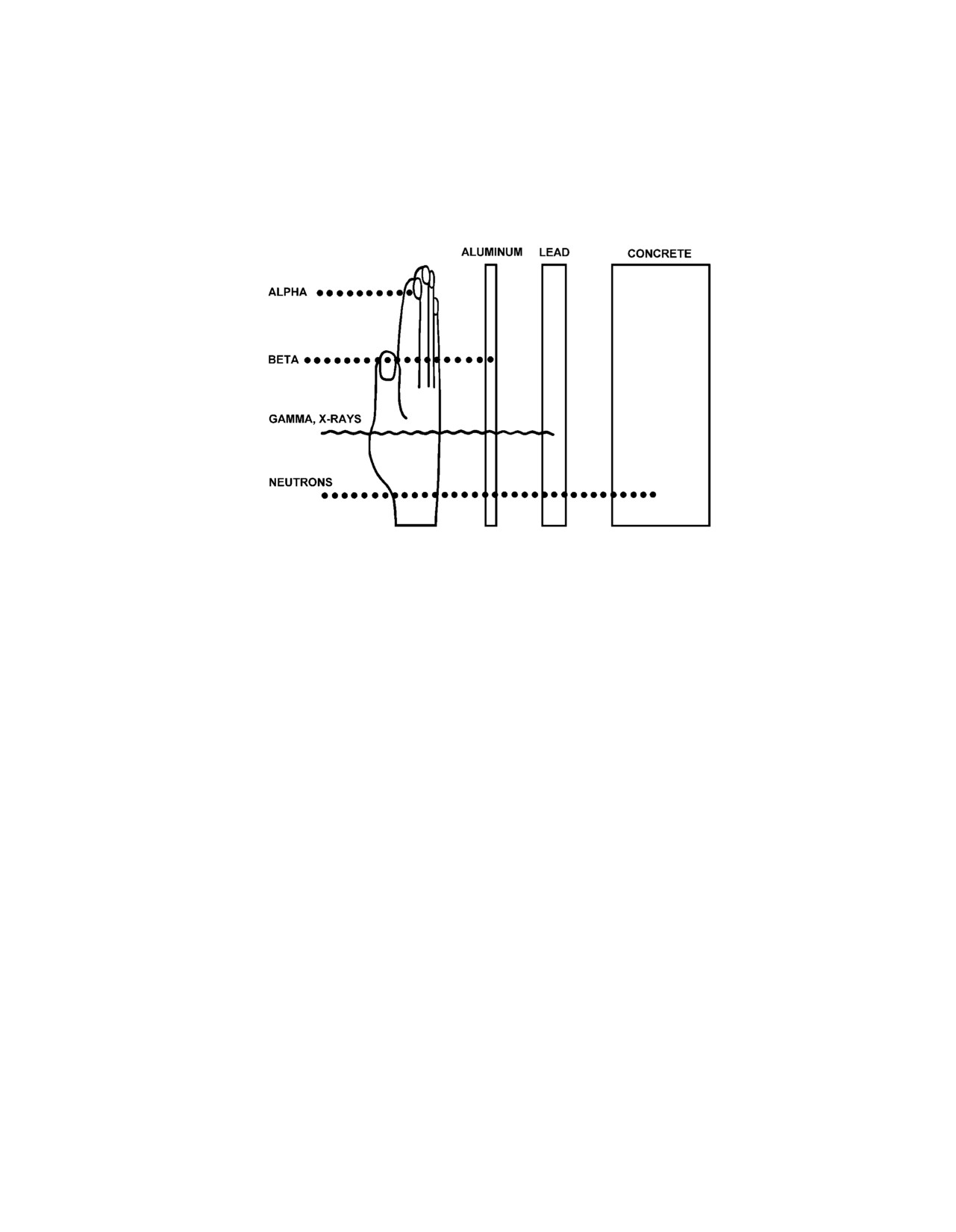
Personnel can be shielded from ionizing radiation by various materials. Properly shielding personnel
requires knowledge of the type and penetration characteristics of the radiation involved (see Figure 2-4).
2-4
FM 4-02.283/NTRP 4-02.21/AFMAN 44-161(I)/MCRP 4-11.1B
Figure 2-4. Radiation penetration and shielding.
a. Alpha Shielding. Alpha particles are heavily charged particles with a very low penetration
range in air. They can be stopped with a sheet of paper or at the superficial layers of skin; therefore, any
light clothing or gloves used to prevent contamination of underlying clothing or the body will provide
protection from this type of radiation.
b. Beta Shielding. Beta emitters present two potential external radiation hazards: the beta
particles themselves, and the x-rays they can produce when they strike certain materials such as lead.
Although beta particles can travel significant distances in air, materials such as aluminum, plastic, or glass
can provide appropriate shielding. However, these emitters should be handled with care. Because the lens
of the eye is radiosensitive, eye protection in the form of goggles or a protective mask are recommended
when working with high energy beta emitters.
c.
Gamma Shielding. Gamma rays and x-rays are more difficult to shield as they are typically
more penetrating than alpha and beta particles. Shielding of gamma ray photons is a function of absorber
thickness and density, and is based on the probability that the gamma ray photons will interact with the
medium through which they pass. As the thickness of an absorber is increased, the intensity of the gamma
radiation will decrease. Higher density media like lead, tungsten, steel, and concrete are good shielding
material against gamma ray photons. However, no matter how thick or dense a gamma or x-ray shield is,
some of the photons will still get through.
d. Neutron Shielding. Lead and other high-density materials do not provide effective shielding
against neutrons. Neutron shielding is more complicated than shielding against gamma or x-rays due to the
difference in the way neutrons interact with matter. The most effective materials in slowing down neutrons
are the light elements, particularly hydrogen. Many hydrogenous materials, such as water or paraffin make
efficient neutron shields.
2-5
FM 4-02.283/NTRP 4-02.21/AFMAN 44-161(I)/MCRP 4-11.1B
2-5.
Nuclear Detonation
A nuclear detonation results from the formation of a supercritical mass of fissile material, with a near
instantaneous release of nuclear binding energies and large-scale conversion of mass to energy. Fission is
the process where a heavier unstable nucleus divides or splits into two or more lighter nuclei, and, with
certain materials, substantial amounts of energy are released. The materials used to produce nuclear
explosions are the readily fissile isotopes of uranium or plutonium: Uranium-235 and Plutonium-239.
Modern weapons may boost their yield by incorporating a fusion element, which may be regarded as the
opposite of fission. It is the combining of two light nuclei to form a heavier nucleus (thermonuclear
reaction). The only practical way to obtain the temperatures and pressures required for fusion is by means
of a fission explosion. Consequently, weapons with fusion components contain a basic fission component.
a. Basic Detonation Characteristics. The destructive action of conventional explosions is almost
entirely due to the transmission of energy in the form of a blast wave and the resultant projectiles (shrapnel).
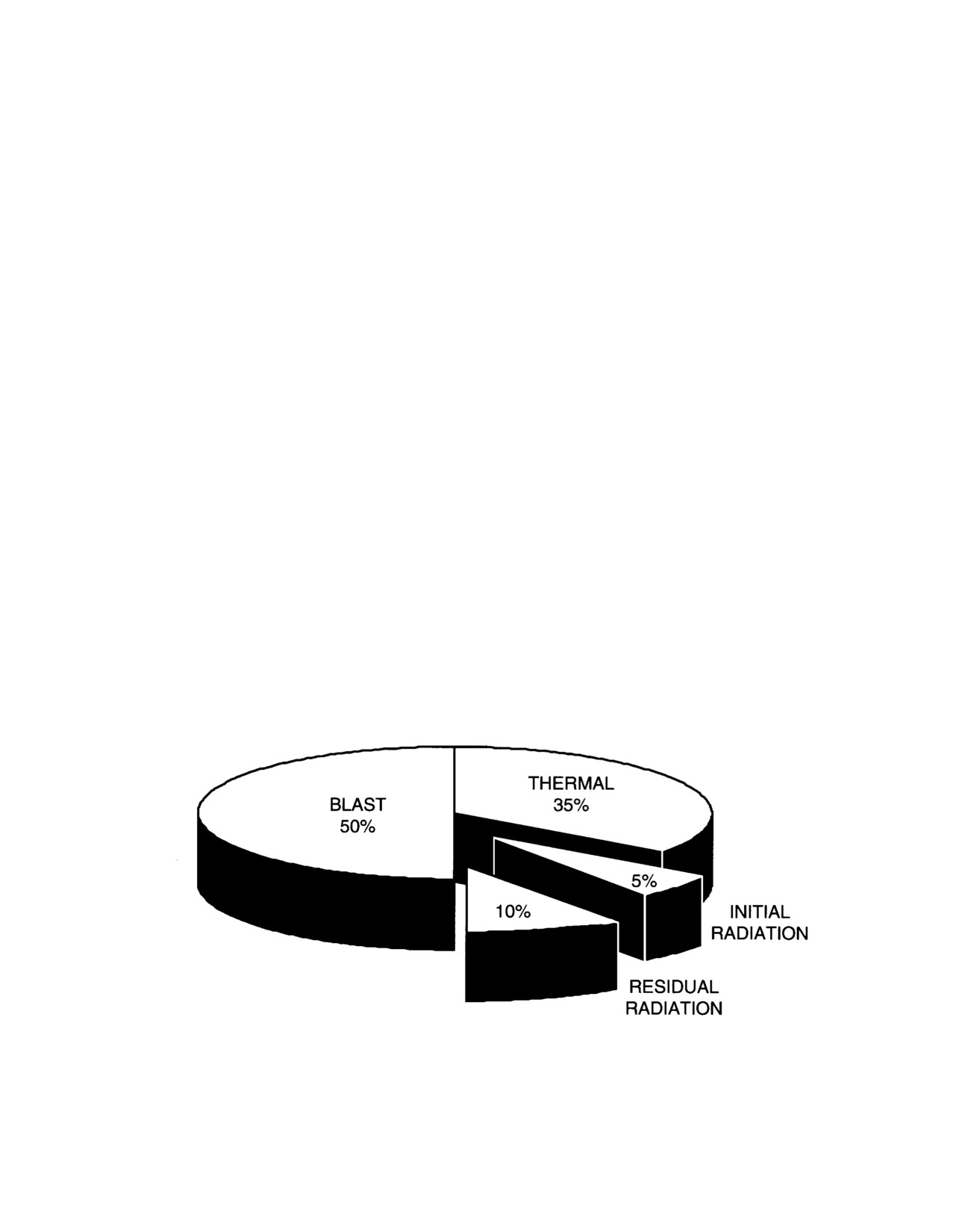
The energy of a nuclear explosion is transferred to the environment in three distinct formsblast, thermal
radiation, and nuclear radiation. The energy distribution among these three forms will depend on the
weapon yield, the location of the burst, and the characteristics of the environment. The energy from a low
altitude atmospheric detonation of a moderate-sized weapon in the KT range is distributed roughly as follows
(see Figure 2-5):
Fifty percent as blast.
Thirty-five percent as thermal radiation, which is made up of a wide range of the
electromagnetic spectrum including infrared, visible, and ultraviolet light and some soft x-rays.
Figure 2-5. Energy partition from a nuclear detonation.
2-6
FM 4-02.283/NTRP 4-02.21/AFMAN 44-161(I)/MCRP 4-11.1B
Fifteen percent as ionizing radiation, including 5 percent as initial (or prompt) radiation
emitted within the first minute after detonation, consisting chiefly of neutrons and gamma rays, and 10
percent as residual nuclear radiation (fallout).
It should be noted that the distribution of energy is significantly altered in an enhanced radiation nuclear
weapon (neutron bomb). A neutron bomb is designed specifically to reduce the energy that is dissipated as
blast and heat and increase the amount of initial nuclear radiation. Its approximate energy distribution is 30
percent blast, 20 percent thermal, 45 percent initial radiation, and 5 percent residual radiation.
b. Types of Bursts. The altitude at which the weapon is detonated will largely determine the
relative effects of blast, heat, and nuclear radiation. Nuclear explosions are generally classified as
airbursts, surface bursts, subsurface bursts, or high altitude bursts.
(1) Airburst. An airburst is an explosion in which a weapon is detonated in air at an altitude
of sufficient height that the fireball does not contact the surface of the earth. The altitude of an airburst can
be varied to obtain maximum blast effects, maximum thermal effects, desired radiation effects, or a
balanced combination of these effects. Burns to exposed skin may be produced over many square kilometers
and eye injuries over a still larger area. Initial nuclear radiation will be a significant hazard with smaller
weapons, but the fallout hazard can be ignored, as there is essentially no fallout from an airburst. The
fission products are generally dispersed over a very large area unless there is local rainfall, which would
result in a more localized fallout pattern. In the vicinity of ground zero, there may be a small area of
neutron-induced ground activity (NIGA) that could be hazardous to troops required to pass through the area.
The NIGA hazard is temporary, lasting only a few days to a few weeks.
(2) Surface burst. A surface burst is an explosion in which a weapon is detonated on, or
slightly above, the surface of the earth so that the fireball actually touches the land or water surface. Under
these conditions, the area affected by the blast, thermal radiation, and initial nuclear radiation will be less
than that for an airburst of similar yield, except in the region of ground zero where destruction is
concentrated. In contrast with airbursts, local fallout can be a hazard over a much larger downwind area
than that affected by blast and thermal radiation.
(3) Subsurface burst. A subsurface burst is an explosion in which the point of the detonation
is beneath the surface of the land or water. Cratering will generally result from an underground burst, just
as for a surface burst. If the burst does not penetrate the surface, the only other hazard will be from ground
or water shock. If the burst is shallow enough to penetrate the surface, blast, thermal, and initial nuclear
radiation effects will be present, but will be less than for a surface burst of comparable yield. Local fallout
will be very heavy if surface penetration occurs.
(4) High altitude burst. A high altitude burst is one in which the weapon is exploded at a high
altitude (typically above 50 km) so that it generates an intense electromagnetic pulse (EMP) which can
significantly degrade the performance of, or destroy sophisticated electronic equipment. Significant
ionization of the upper atmosphere (ionosphere) can occur and this radiation can travel for hundreds of miles
before being absorbed. For example, a high altitude burst of strategic weapons could be employed with the
intent of causing severe disruption or destruction of national command, control, communications, computers,
2-7
FM 4-02.283/NTRP 4-02.21/AFMAN 44-161(I)/MCRP 4-11.1B
and intelligence systems. There are no known adverse biological effects of EMP at exposure levels below
the established protection standards.
2-6.
Nuclear Detonation Blast Hazards
There are two basic types of blast forces which occur simultaneously in a nuclear detonation blast wave;
these are direct blast wave overpressure forces, measured in terms of atmospheres of overpressure; and
indirect blast wind drag forces, normally measured in the velocities of the winds which cause them. The
most important blast effects, insofar as production of casualties requiring medical treatment is concerned,
will be those due to the blast wind drag forces (see paragraph 2-9, Range of Damage). However, direct
blast effects can contribute significantly to the immediate deaths and injuries sustained close to the point of
detonation. Personnel in fortifications or unbuttoned armored vehicles who are protected from radiation and
thermal and blast wind effects, may be subjected to complex patterns of direct overpressures since blast
waves may be reflected and reinforced within them. Blast effects will also be present to a much lesser
extent when an RDD uses a conventional explosive as the dispersal mechanism.
a. Direct Blast Injury. When the blast wave acts directly upon a resilient target such as the
human body, rapid compression and decompression result in transmission of pressure waves through the
tissues. These waves can be quite severe and will result in damage primarily at junctions between tissues of
different densities (bone and muscle) or at the interface between tissue and air spaces (lung tissue and the
gastrointestinal [GI] system). Perforation of the eardrums would be a common, but a minor blast injury.
However, direct blast injuries will not occur by themselves; in general, other effects, such as indirect
blast wind drag injuries and thermal injuries are so severe at the ranges associated with these
overpressures that patients with only direct blast injuries will comprise a very small part of the patient
load. The range of overpressures associated with lethality can vary greatly. It has been estimated that
overpressures as low as 193 kilopascal (kPa) (1.9 atmospheres [atm]) can be lethal, but that survival is
possible with overpressures as high as 262 kPa (2.5 atm). It is important to note that the human body is
remarkably resistant to direct blast overpressure, particularly when compared with rigid structures such as
buildings.
b. Indirect Blast Wind Drag Forces. The drag forces of blast winds are proportional to the
velocities and duration times of those winds, which in turn vary with distance from the point of detonation,
yield of the weapon, and altitude of the burst. These winds are relatively short in duration but are extremely
severe and may reach several hundred km per hour. Indirect blast injuries will occur as crush and
translational injuries, and as missile injuries. Casualties will be thrown against immobile objects and
impaled by flying debris; therefore, solid organ, extremity, and head injuries will be commonplace. The
distance from the point of detonation at which severe indirect injury will occur is considerably greater than
that for serious direct blast injuries.
(1) Crush and translational injuries. The drag forces of the blast winds are strong enough to
displace even large objects, such as vehicles, or to cause the collapse of large structures, such as buildings.
These events can result in very serious crush injuries, similar to injuries seen in earthquakes and conventional
bombings. A human body can itself become a missile, and be displaced a variable distance and at variable
velocities depending upon the intensity of the drag forces and the nature of the environment. The resulting
2-8
FM 4-02.283/NTRP 4-02.21/AFMAN 44-161(I)/MCRP 4-11.1B
injuries sustained are termed translational injuries. The probability and the severity of the injury depend on
the velocity of the human body at the time of impact.
(2) Missile injury. The number of missiles that can be generated by the blast winds depends
to some extent upon the environment, that is, different terrain types will have different quantities of material
available for missile production. However, the drag forces of the blast winds produced by nuclear
detonations are so great that almost any form of vegetation or structure, if present, will be broken apart or
fragmented into a variety of missiles. Multiple and varied missile injuries will be common. The probability
of a penetrating injury increases with increasing velocity, particularly for small, sharp missiles such as
glass fragments. Heavier objects require higher kinetic energies to penetrate, therefore, heavy blunt
missiles will not ordinarily penetrate the body, but can result in significant injury, particularly fractures.
2-7.
Nuclear Detonation Thermal Radiation Hazards
In a nuclear warfare environment, thermal burns will be the most common injuries, subsequent to both the
thermal pulse, and the fires it ignites. The thermal radiation emitted by a nuclear detonation causes burns in
two ways, by direct absorption of the thermal energy through exposed surfaces (flash burns), or by the
indirect action of fires caused in the environment (flame burns). The relative importance of these two
processes will depend upon the nature of the environment. If a nuclear weapon detonation occurs in easily
flammable surroundings, indirect flame burns could possibly outnumber all other types of injury.
NOTE
Because of the complexity of burn treatment and the increased
logistical requirements associated with the management of burns, they
will constitute the most difficult problem faced by the medical service.
a. Flash (Thermal Pulse) Burns. Since the thermal pulse is direct infrared, burn patterns will be
dictated by spatial relationships and clothing pattern absorption. Exposed skin will absorb the infrared in a
variable pattern and the victim will be burned on the side facing the explosion. Persons shaded from the
direct light of the blast are protected. Light colors will reflect the infrared, while dark portions of clothing
will absorb it and cause pattern burns. Historical records from Hiroshima and Nagasaki bombings indicate
that, in some cases, dark-colored clothing actually burst into flames and ignited the undergarments, causing
flame burns. At temperatures below those required to ignite clothing, it is still possible to transfer sufficient
thermal energy across clothing to the skin to produce flash burns; however, clothing significantly reduces the
effective range producing partial thickness burns. It must be remembered that close to the fireball, the
thermal output is so great that everything is incinerated. The actual range out to which overall lethality
would be 100 percent will vary with yield, position of burst, weather, the environment and how soon those
burned can receive medical care. The mortality rate among the severely burned is much greater without
early resuscitative treatment.
2-9
FM 4-02.283/NTRP 4-02.21/AFMAN 44-161(I)/MCRP 4-11.1B
b. Flame Burns. Flame burns result from exposure to fires caused by the thermal effects in the
environment, particularly from the ignition of clothing. This could be the predominant cause of burns
depending upon the number and characteristics of flammable objects in the area. Firestorm and secondary
fires will cause typical flame burns, but they will also be compounded by closed space fire injuries. Patients
with toxic gas injury from burning plastics and other material, superheated air inhalation burns, steam burns
from ruptured pipes and all other large conflagration-type injuries will require treatment. Complications
arise in the treatment of skin burns created, in part, from the melting of man-made fibers. Therefore, it is
recommended that clothing made of natural fibers, or flame resistant clothing (for example, Nomex) should
be worn next to the skin. The variables of environmental flammability are too great to allow prediction of
either the incidence or the severity of flame burns. The burns themselves will be far less uniform in degree,
and will not be limited to exposed surfaces. For example, the respiratory system may be exposed to the effects
of hot gases, and respiratory system burns are associated with severe morbidity and high mortality rates.
c.
Eye Injuries. Since most personnel will not have access to specialized protective goggles,
there will be numerous eye injuries that will require treatment because of the intense light produced by a
nuclear explosion. Sudden exposures to high-intensity sources of visible light and infrared radiation can
cause eye injury, specifically to the chorioretinal areas. Factors that determine the extent of eye injury
include pupil dilation, spectral transmission through the ocular media, spectral absorption by the retina and
choroid, length of time of exposure, and the size and quality of the image. Direct vision optical equipment
such as binoculars will increase the likelihood of damage. Night vision devices (NVDs) electronically
amplify the ambient light, and they also detect infrared energy, the major component of the thermal pulse.
However, most NVDs automatically shutdown when an intense burst of energy hits the device. Eye injury
is due not only to thermal energy but also to photochemical reactions that occur within the retina with light
wavelengths in the range of 400 to 500 nanometers (nm), in addition to thermal and blast effects.
(1) Flash blindness. Flash blindness occurs with a sudden peripheral visual observation of a
brilliant flash of intense light energy; for example, a fireball. This is a temporary condition that results from
a depletion of photopigment from the retinal receptors. The duration of flash blindness can last several
seconds when the exposure occurs during daylight. The blindness will then be followed by a darkened
afterimage that lasts for several minutes. At night, flash blindness can last for up to 30 minutes and may
occur up to 100 km from the blast (see Figure 2-6).
(2) Retinal burns. Direct observation of a brilliant flash of light in the wavelengths of 400 to
1,400 nm can cause macular-retinal burns. Burns of the macula will result in permanent scarring with
resultant loss in visual acuity. Burns of the peripheral regions of the retina will produce scotomas (blind
spots), but overall visual acuity will be less impaired. These burns can occur at extended distances
depending upon yield (see Figure 2-6).
2-8.
Nuclear Detonation Radiation Hazards
a. Initial Radiation. About 5 percent of the energy released in a nuclear airburst is transmitted in
the form of initial neutron and gamma radiation. The neutrons result almost exclusively from the energy
produced by fission and fusion reactions. The initial gamma radiation includes that arising from these
reactions, as well as that from the decay of short-lived fission products. The intensity of the initial nuclear
2-10
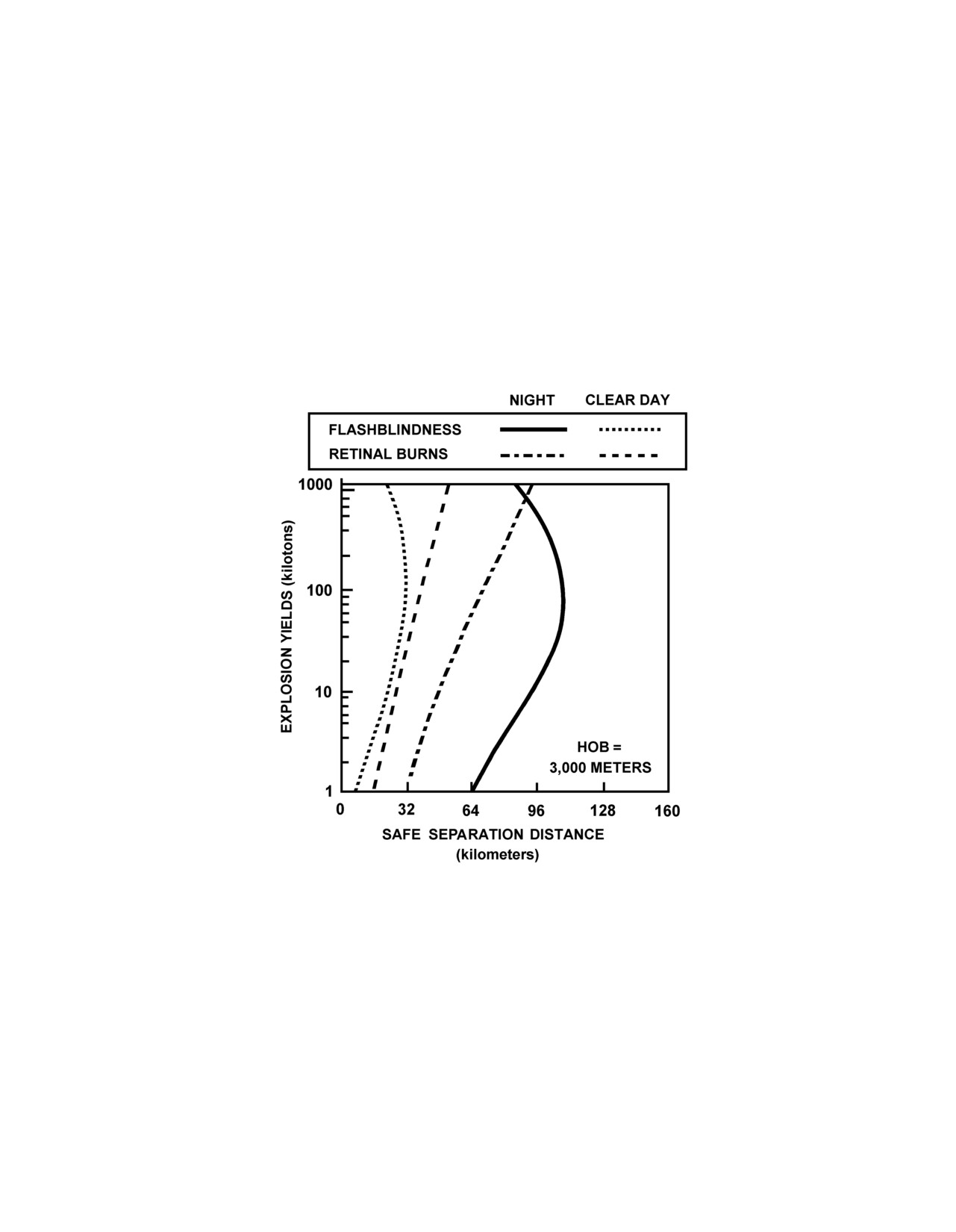
FM 4-02.283/NTRP 4-02.21/AFMAN 44-161(I)/MCRP 4-11.1B
radiation decreases rapidly with distance from the point of burst. The character of the radiation received at
a given location also varies with distance from the explosion. Near the point of the explosion, the neutron
intensity is greater than the gamma intensity, but reduces quickly with distance. The range for significant
levels of initial radiation does not increase markedly with weapon yield. Therefore, the initial radiation
becomes less of a hazard with increasing yield, as individuals close enough to be significantly irradiated are
killed by the blast and thermal effects. With weapons above 50 KT, blast and thermal effects are so much
greater in importance that prompt radiation effects can be ignored (see paragraph 2-9).
Figure 2-6. Flash blindness and retinal burn safe separation.
b. Residual Radiation. Residual ionizing radiation from a nuclear explosion arises from a variety
of sources but is primarily in the form of NIGA and radioactive fallout.
(1) Fission products. There are over
300 different fission products produced during
detonation. Many of these are radioactive with widely differing half-lives. Some fission products have half-
lives lasting only fractions of a second, while other materials can be a hazard for months or years. Their
principal mode of decay produces beta and gamma radiation.
2-11
FM 4-02.283/NTRP 4-02.21/AFMAN 44-161(I)/MCRP 4-11.1B
(2) Unfissioned nuclear material. Nuclear weapons are relatively inefficient in their use of
fissile material, and much of the uranium and plutonium is dispersed by the explosion without undergoing
fission. Such unfissioned nuclear material decays primarily by the emission of alpha particles and is of
relatively minor importance as long as it remains outside of the body. Also, the neutrons that are emitted as
part of the initial nuclear radiation will cause activation of the weapon residues.
(3) Neutron induced ground activity. If atomic nuclei in soil, air, and water are exposed to
neutron radiation and capture neutrons, they will, as a rule, become radioactive (NIGA) depending on their
composition and distance from the burst. They then decay by emission of beta and gamma radiation over an
extended period of time. For example, a small area around ground zero may become hazardous as a result
of exposure of the minerals in the soil to initial neutron radiation. This is normally a negligible hazard
because of the limited area involved.
(4) Fallout.
(a) In a nuclear weapon surface burst, large amounts of earth or water will be vaporized
by the heat of the fireball and drawn up into the radioactive cloud, especially if the explosive yield exceeds 10
KT. This material will become radioactive when it condenses with fission products and other radioactive
contaminants or if it becomes neutron-activated. These materials will then be dispersed by atmospheric
winds and, depending upon meteorological conditions, will gradually settle to the earths surface as fallout.
The larger particles will settle back to earth within
24 hours as local fallout. Severe local fallout
contamination can extend far beyond the blast and thermal effects, particularly in the case of high yield
surface detonations. In cases of water surface (and shallow underwater) bursts, the particles tend to be
lighter and smaller. This produces less local fallout but extends the spread of contamination out over a
greater area. For subsurface bursts, there is an additional phenomenon called base surge. The base surge
is a cloud that rolls outward from the bottom of the column produced by a subsurface explosion.
(b) Scavenging refers to processes that increase the rate at which radioactivity is
removed from the fallout cloud and deposited on the earths surface. Precipitation scavenging is the process
in which rain or snow falls through the fallout cloud and carries contaminated particles down with it.
Precipitation scavenging occurs in two formsrainout and washout. Rainout occurs when a rain cloud
forms within the fallout cloud, while washout occurs when the rain cloud forms above the fallout cloud. The
strength of the rain and the length of time the radioactive cloud is washed markedly affect the percentage of
radioactivity scavenged. Evidence indicates that washout is far less effective than rainout. Even in the case
of an airburst, which does not usually produce early fallout, rainout or washout can cause significant
contamination on the ground as a result of scavenging of radioactive debris. This contamination is typically
found in concentrated hotspots created between ridges in the earths surface or wherever rainwater collects.
2-9.
Range of Damage
Table 2-2 shows the ranges in kilometers of biological damage for the hazards discussed above. The ranges
noted are for weapons of various yields including very low yield INDs. These effects were calculated using
Lawrence Livermore National Laboratorys Hotspot, Version 8.0, simulating a surface burst with 25-mile
visibility, and no intervening shielding or sheltering.
2-12
///////////////////////////////////////