FMI 6-02.60 Tactics, Techniques, and Procedures (TTPs) for the Joint Network Node-Network (JNN-N) (SEPTEMBER 2006) - page 1
FMI 6-02.60
Field Manual Interim
Headquarters
Department of the Army
No. 6-02.60
Washington, DC, 5 September 2006
Tactics, Techniques, and Procedures (TTPs)
for the Joint Network Node-Network (J-NN-N)
Contents
Page
PREFACE
v
Chapter 1
THE JOINT NETWORK TRANSPORT CAPABILITIES - SPIRAL
1-1
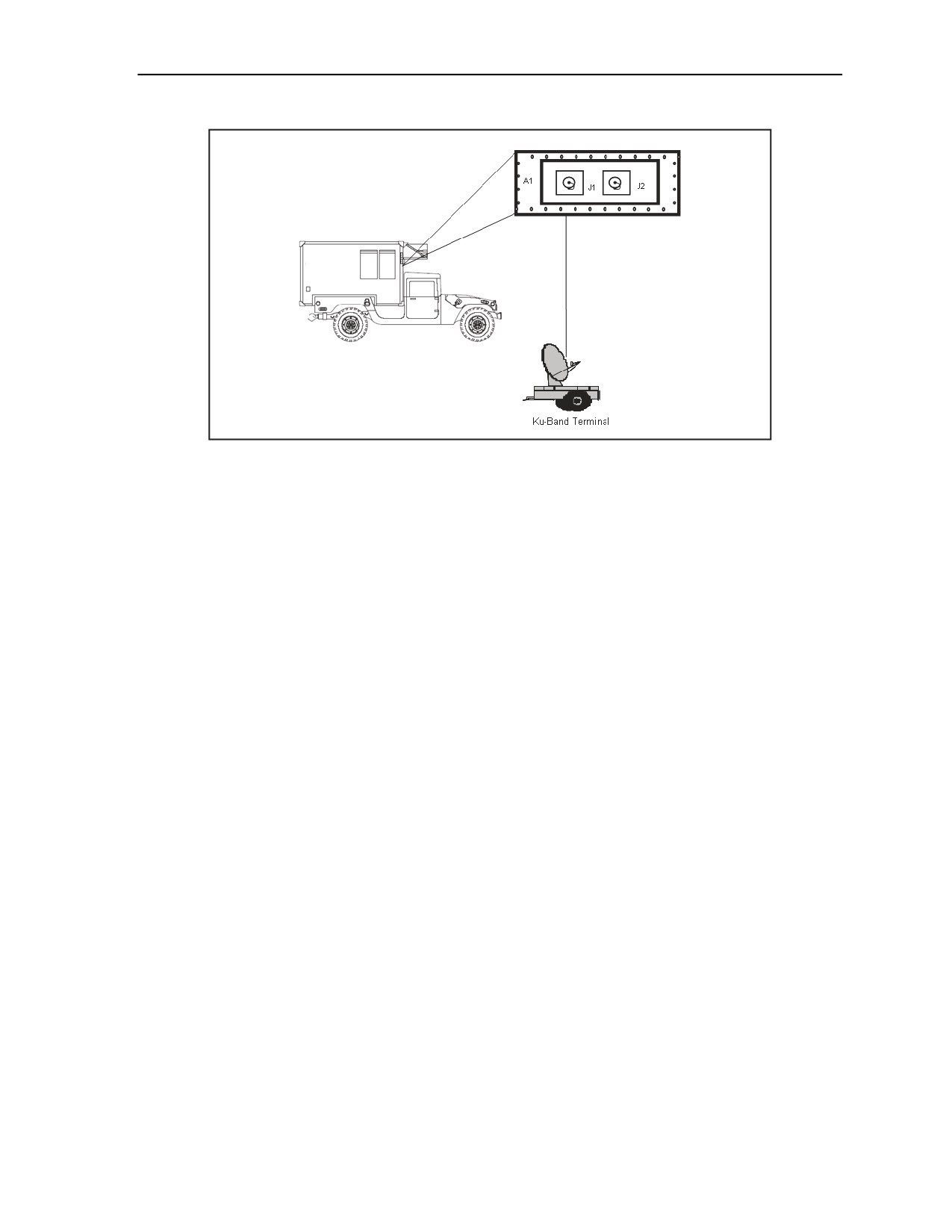
Joint Network Transport Capabilities - Spiral
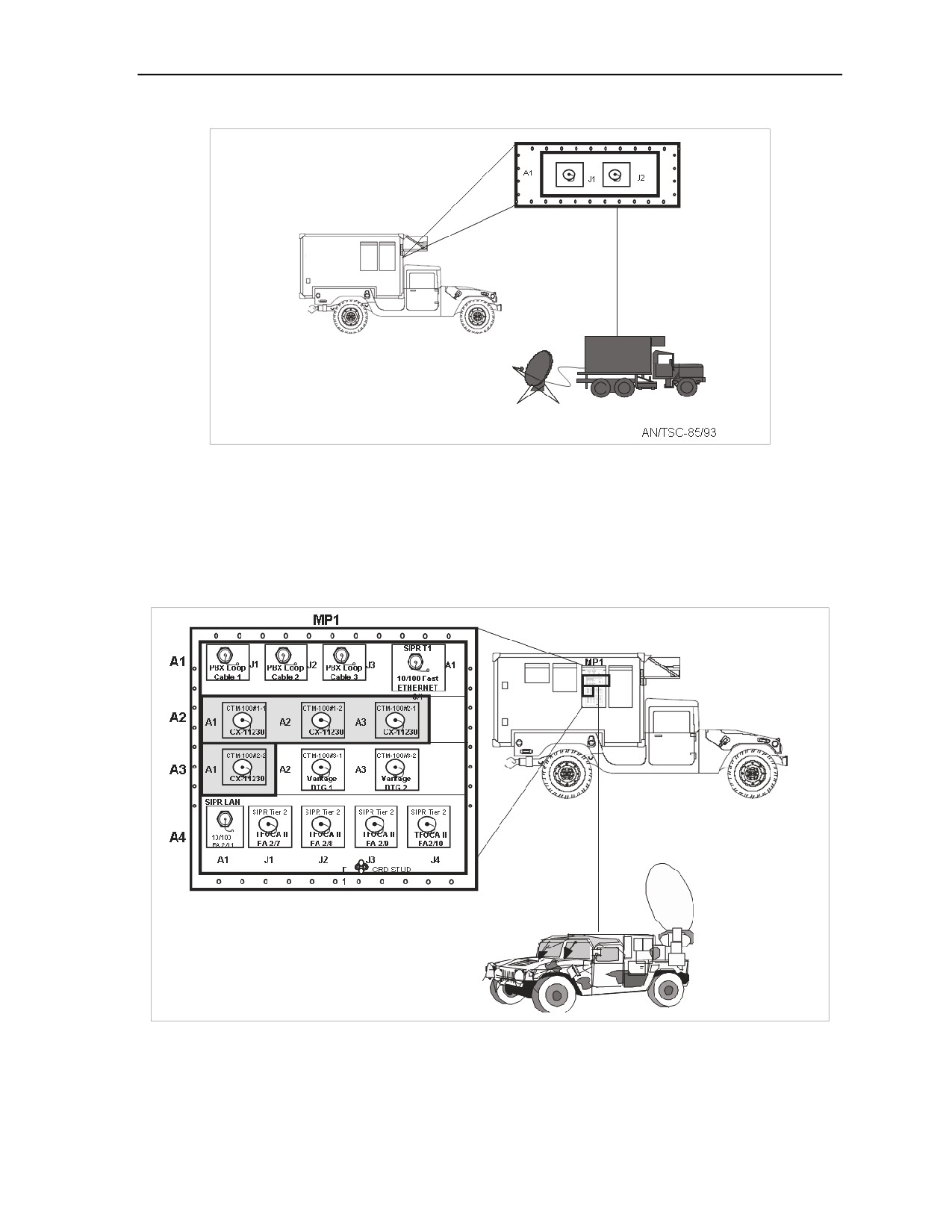
1-2
Chapter 2
JOINT NETWORK NODE-NETWORK
2-1
Network Description
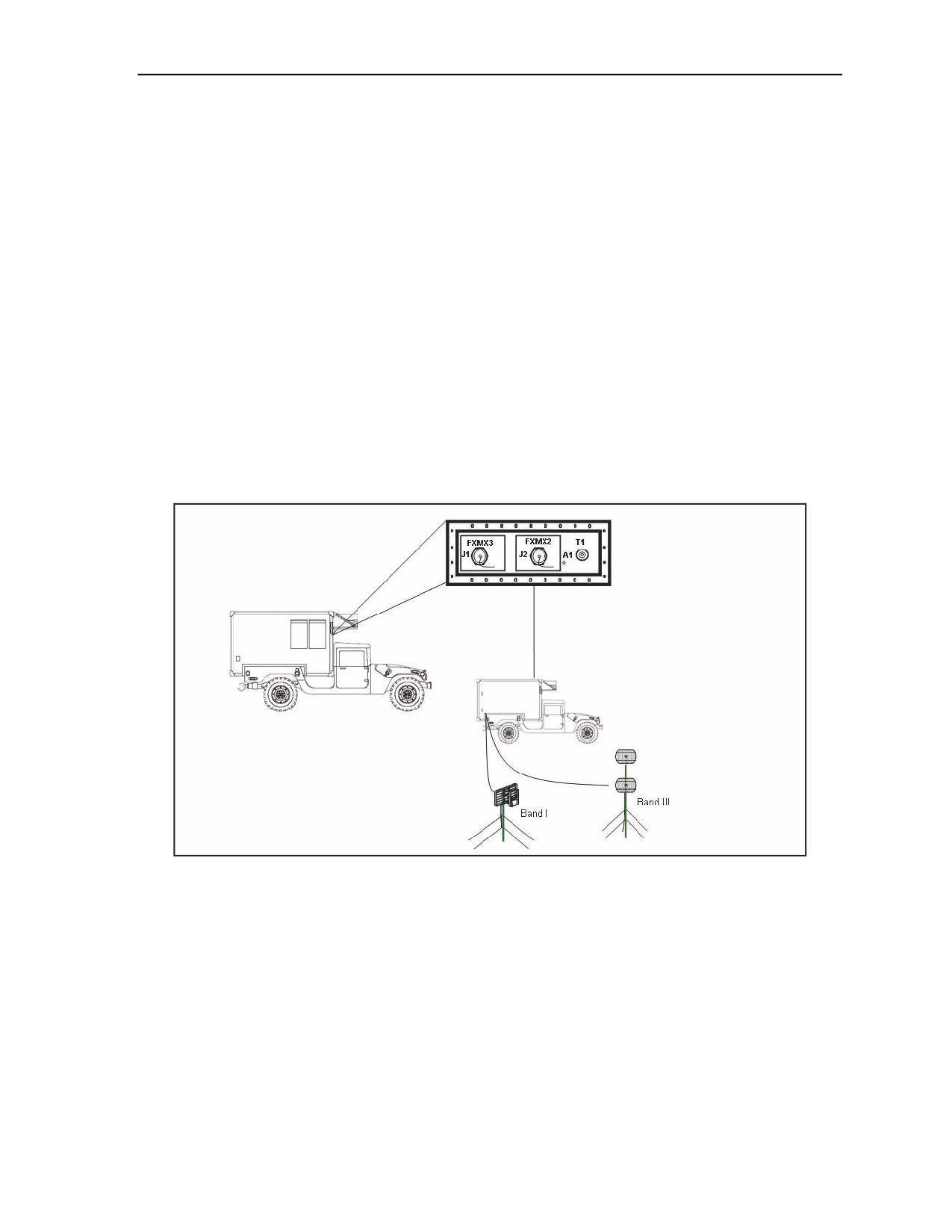
2-1
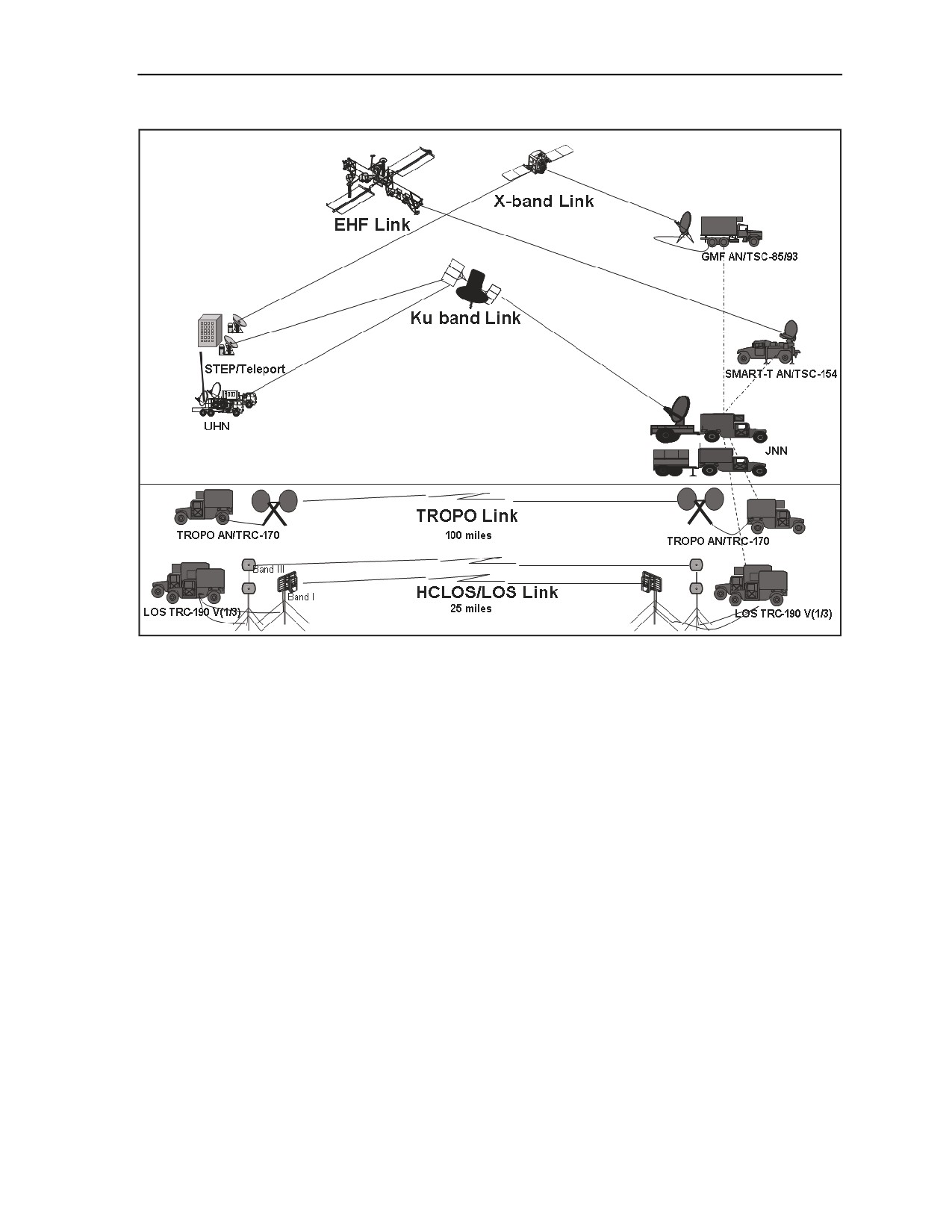
Transmission Capabilities
2-3
Connectivity to Current Networks
2-8
Chapter 3
EMPLOYMENT OF THE JOINT NETWORK NODE-NETWORK AT THE
DIVISION, BRIGADE, AND BATTALION LEVEL
3-1
Division
3-1
Brigade Combat Teams
3-3
Battalion
3-5
Chapter 4
JOINT NETWORK NODE-NETWORK NETWORK MANAGEMENT
4-1
Network Management Components
4-1
Network Management at the Division
4-2
Network Management at the Brigade
4-3
Network Management at the Battalion
4-3
Appendix A
UNIT HUB NODE COMPONENT LISTING
A-1
Baseband Shelter
A-2
Satellite Vans
A-6
Appendix B
JOINT NETWORK NODE COMPONENTS AND CONNECTIVITY
B-1
Components
B-2
Patch Panels
B-3
Non-Secure Data Network
B-4
Secure Internet Protocol Data Network
B-28
Voice Switching
B-48
Signal Entry Panels
B-58
Satellite Transportable Terminal
B-61
Transit Cases
B-61
Maintenance
B-61
Distribution Restriction: Approved for public release; distribution is unlimited.
i
Contents
Appendix C COMMAND POST NODE COMPONENT LISTING, STARTUP, AND
MAINTENANCE PROCEDURES
C-1
Division and Brigade Interface Cases
C-1
Battalion Command Post Node System Components
C-7
Configuring the Battalion Router Case
C-15
Command Post Node Transit Case Maintenenance
C-23
Appendix D KU BAND SATELLITE TRANSPORTABLE TERMINAL
D-1
Capabilities
D-1
Ku Band Satellite Transportable Terminal Equipment Description
D-3
Equipment Power Up
D-6
GLOSSARY
Glossary-1
REFERENCES
References-1
INDEX
Index-1
Figures
Figure
1-1. JNN Network at Division and Below
1-1
Figure
1-2. JNTC-S Support for CSS
1-3
Figure
1-3. JNTC-S Military Intelligence Support
1-4
Figure
2-1. JNN and Associated Equipment
2-3
Figure
2-2. Ku Band Satellite Terminal Connection via SEP MP3
2-5
Figure
2-3. GMF Satellite Terminal Connection via SEP MP3
2-6
Figure
2-4. SMART-T Terminal Connection via SEP MP1
2-6
Figure
2-5. HCLOS (V1) and (V3) Terminal Connection via SEP MP 2
2-7
Figure
2-6. Over-the-Air Communications Links
2-8
Figure
3-1. Division to BCT Connectivity
3-3
Figure
3-2. Representative CP Configuration
3-4
Figure
3-3. Battalion Command Post Connectivity
3-5
Figure A-1. Division Network Satellite Systems Overview
A-1
Figure A-2. Baseband and Satellite Vans Interconnections
A-2
Figure B-1. JNN and BCT Deployment
B-1
Figure B-2. JNN Roadside View
B-2
Figure B-3. JNN Curbside View
B-3
Figure B-4. Information Assurance-based Architecture
B-4
Figure B-5. NIPRNET Data Network
B-5
Figure B-6. SIPRNET Data Network
B-29
Figure B-7. Secure Virtual Network with TACLANEs
B-46
Figure B-8. JNN NIPRNET Voice Diagram
B-49
Figure B-9. JNN SIPRNET Voice Diagram
B-50
Figure B-10. Voice Connectivity to MSE and TRI-TAC Networks
B-53
Figure B-11. TRC Block Diagram
B-56
Figure B-12. Signal Flow Using KIV-7
B-57
ii
FMI 6-02.60
5 September 2006
Contents
Figure B-13. Typical KIV-19 Application
B-58
Figure B-14. Cable Connections for MP1
B-59
Figure B-15. Cable Connections for MP2
B-60
Figure B-16. Cable Connections for MP3
B-60
Figure C-1. SIPRNET and NIPRNET Domains
C-2
Figure C-2. Connection between JNN and Interface Cases
C-5
Figure C-3. Red and Black Voice Telephony Case
C-6
Figure C-4. Battalion Command Post Node Block Diagram
C-8
Figure C-5. LOS Block Diagram
C-11
Figure C-6. Network Diagram of CPN Transit Cases and JNN
C-13
Figure D-1. Equipment Racks
D-2
Figure D-2. Satellite Transportable Terminal Trailer
D-3
Figure D-3. Block Diagram
D-7
Tables
Table
3-1. Network Hub Platoon
3-1
Table
3-2. Joint Network Node Section
3-4
Table
3-3. Command Post Support Section
3-5
Table B-1. Configure a Tier 1 Router
B-6
Table B-2. Representative Entries for Tier 1 Router Configuration
B-6
Table B-3. Configure a Tier 2 Router
B-11
Table B-4. Representative Entries for Tier 2 Router Configuration
B-12
Table B-5. Configure a VPN Router
B-18
Table B-6. Representative Entries for a VPN Router Configuration
B-19
Table B-7. Connecting and Configuring Firewall
B-24
Table B-8. Set IP Address
B-25
Table B-9. Connect Using TELNET
B-25
Table B-10. Connect Using WebUI
B-25
Table B-11. Representative Entries for a JNN Firewall Configuration
B-25
Table B-12. Representative Entries for a SIPRNET Tier 1 Router Configuration
B-29
Table B-13. Representative Entries for a SIPRNET Tier 2 Router Configuration
B-36
Table B-14. Configuring the TACLANE
B-46
Table B-15. Configuring the Call Manager
B-50
Table B-16. Vantage Start up and Configuration
B-53
Table C-1. SIPRNET Connection Points
C-4
Table C-2. NIPRNET Connection Points
C-4
Table C-3. CPN Router Case Connection Points
C-14
Table C-4. Sample Configuration File for Battalion SIPRNET Case
C-15
Table C-5. Sample Configuration File for Battalion NIPRNET Case
C-20
5 September 2006
FMI 6-02.60
iii
Preface
This manual provides tactics, techniques, and procedures (TTPs) for the Joint Network Node-Network (JNN-N)
in the predeployment, deployment planning, and management to support military operations and training. The
scope of this manual includes descriptions of the JNN-N components and their functions, applications,
procedures, planning, management, and maintenance providing a user reference guide to support the
deployment and operation of the JNN-N in support of the digitized force. When applicable, the reader is
referred to the appropriate technical manuals and other documentation for more detailed information on subject
matter beyond the scope of this manual.
This publication applies to the Active Army, the Army National Guard (ARNG)/Army National Guard of the
United States (ARNGUS), and the United States Army Reserve (USAR) unless otherwise stated.
The proponent of this publication is the United States Army Training and Doctrine Command (TRADOC).
Provide electronic comments and suggestions at http://www.doctrine.gordon.army.mil or send comments and
recommendations on DA Form 2028 (Recommended Changes to Publications and Blank Forms) directly to
Commander, United States Army Signal Center and Fort Gordon, ATTN: ATZH-CDD (Doctrine Branch), Fort
Gordon, Georgia 30905-5000 or via e-mail to doctrine@gordon.army.mil.
Unless this publication states otherwise, masculine nouns and pronouns do not refer exclusively to men.
5 September 2006
FMI 6-02.60
v
Chapter 1
The Joint Network Transport Capabilities - Spiral
The Army is quickly and continually transforming to the Land Warrior Network
(LandWarNet). The overarching focus of LandWarNet is the Army’s transformation
into joint, network-enabled, interoperable, knowledge-based warfare. A key enabler
for transforming these operational capabilities is information superiority. Information
superiority is the capability to collect, process, and disseminate an uninterrupted flow
of information while exploiting or denying an adversary’s ability to do the same.
Achieving information superiority requires a network-enabled operations
environment, to include a Global Information Grid (GIG). The GIG provides an end-
to-end set of information services, associated processes, and people to manage and
provide the right information to the right user at the right time, with appropriate
protection across all Department of Defense (DOD), warfighting, intelligence, and
business domains. The Joint Network Transport Capabilities
- Spiral
(JNTC-S)
provides the infusion of commercial technologies that enables the Army to improve
its ability to effectively bridge from the current force to one of greater strength. Each
spiral, as it is fielded, enlarges and improves on the previous. This chapter provides
an introduction to the three major components of the JNTC-S of which the JNN-N is
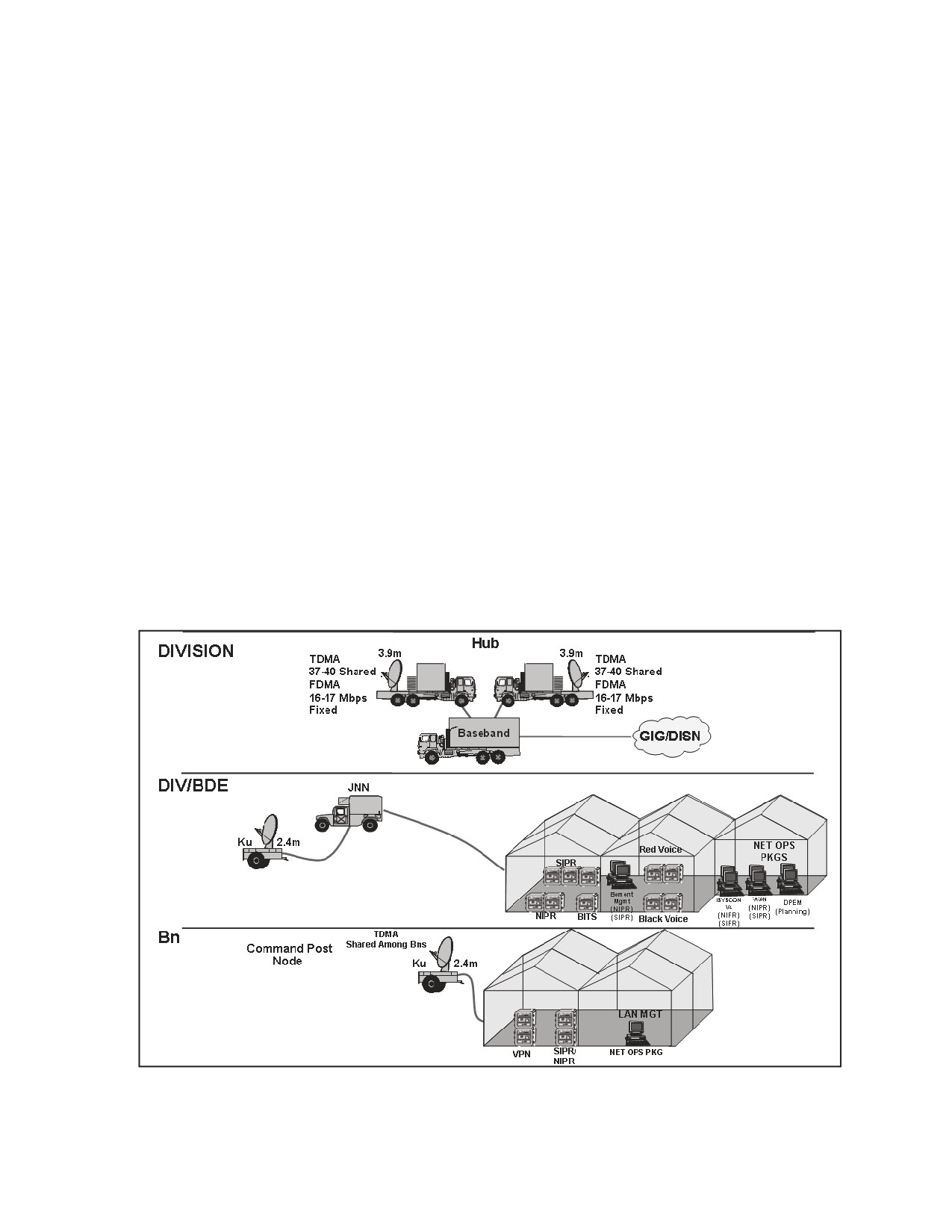
a critical component. Refer to Figure 1-1 which illustrates the employment of the
JNN-N at each echelon at the division level and below.
Figure 1-1. JNN Network at Division and Below
5 September 2006
FMI 6-02.60
1-1
Chapter 1
JOINT NETWORK TRANSPORT CAPABILITIES - SPIRAL
1-1. Commanders have been unable to leverage strategic and tactical information obtained from a single
network to gain a tactical advantage over the enemy. The ability to obtain information from the Army’s
portion of the GIG and to enable better decisions for precision engagement, maneuver, or information
operations is vital for the sustainability and employment of current forces.
1-2. In order to obtain informational superiority, the current tactical communications systems must be
capable of high mobility and joint and strategic interoperability. To gain this interoperability, modernized
communications teams must use like equipment or compatible government off-the-shelf (GOTS) and
commercial off-the-shelf (COTS) equipment found in the GIG infrastructure, while maintaining tactical
mobility.
1-3. Joint and strategic interoperability underpins the efforts to create a single integrated communications
package that enables the brigade combat team (BCT) to deploy autonomously, to work directly for a joint
headquarters (e.g., joint force land component command, joint task force, or other joint force component
commands), or work for a division or corps.
1-4. Bridge to future networks is the Army’s near term solution to the current bandwidth capability gap
as it transitions to the Warfighter Information Network-Tactical (WIN-T). It provides a solution to the near-
term operational requirements for beyond line of sight (BLOS) capability and integrates commercial
satellite programs with military programs. The use of the commercial Ku band is critical to this initiative
and is used extensively. The supporting system architecture is the JNTC-S.
1-5. The three major transport components of JNTC-S that use commercial-based satellite
communications (SATCOM) systems are the combat service support (CSS) SATCOM, Trojan Special
Purpose Integrated Remote Intelligence (SPIRIT), and the JNN-N.
CSS SATCOM
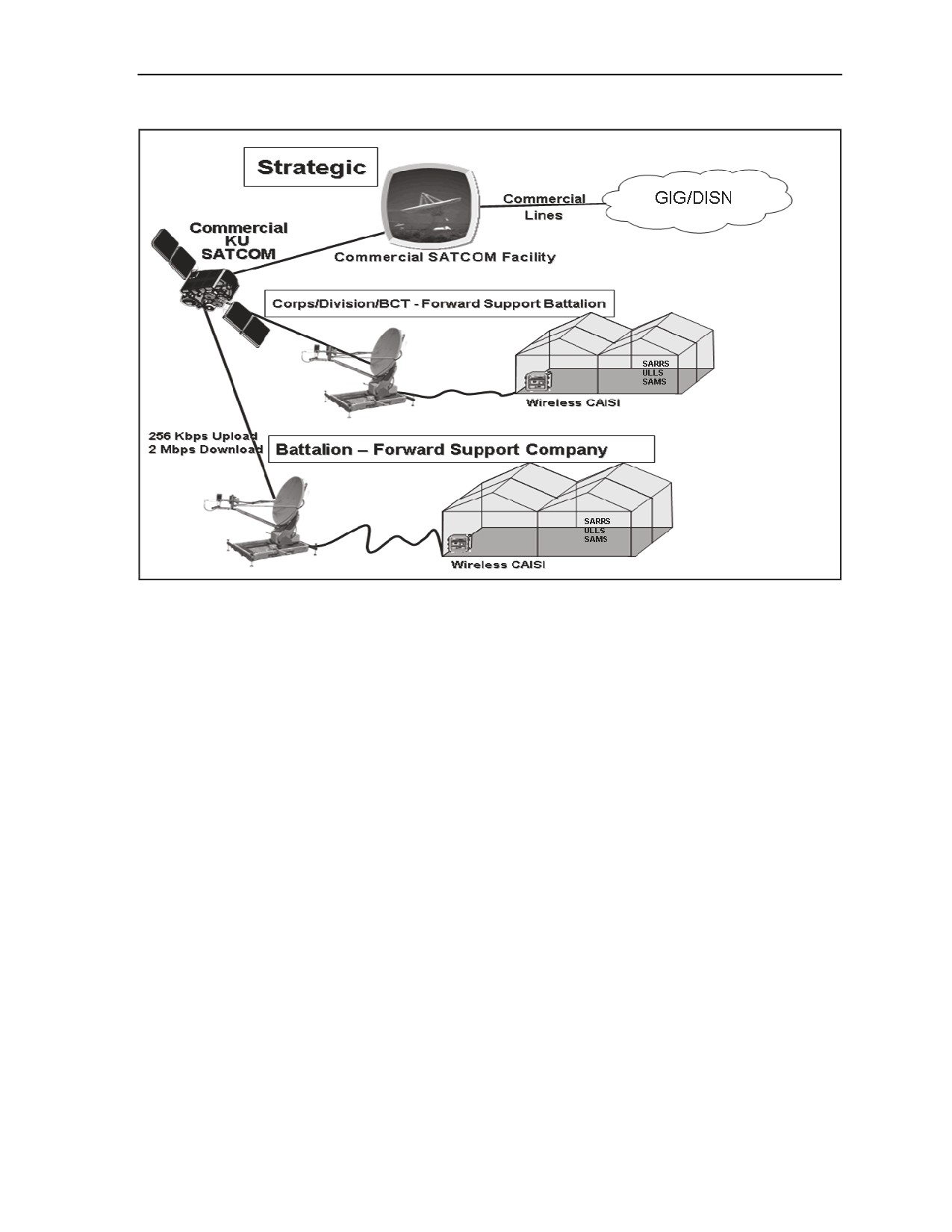
1-6. The CSS SATCOM provides wideband Non Secure Internet Protocol Router Network (NIPRNET)
connectivity to all major sustainment nodes across the Army. The CSS SATCOM enables deployed
maneuver and support battalions to reach key sites located in the continental United States (CONUS) and in
sanctuary. It is combined with the wireless CSS Automated Information Systems Interface (CAISI) system
to provide flexible connectivity down to the unit level logistics systems (ULLS) ground, and ULLS-S4
system. Refer to Figure 1-2 which illustrates the JNTC-S Support for Sustainment Units.
1-2
FMI 6-02.60
5 September 2006
The Joint Network Transport Capabilities - Spiral
Figure 1-2. JNTC-S Support for Sustainment Units
TROJAN SPIRIT
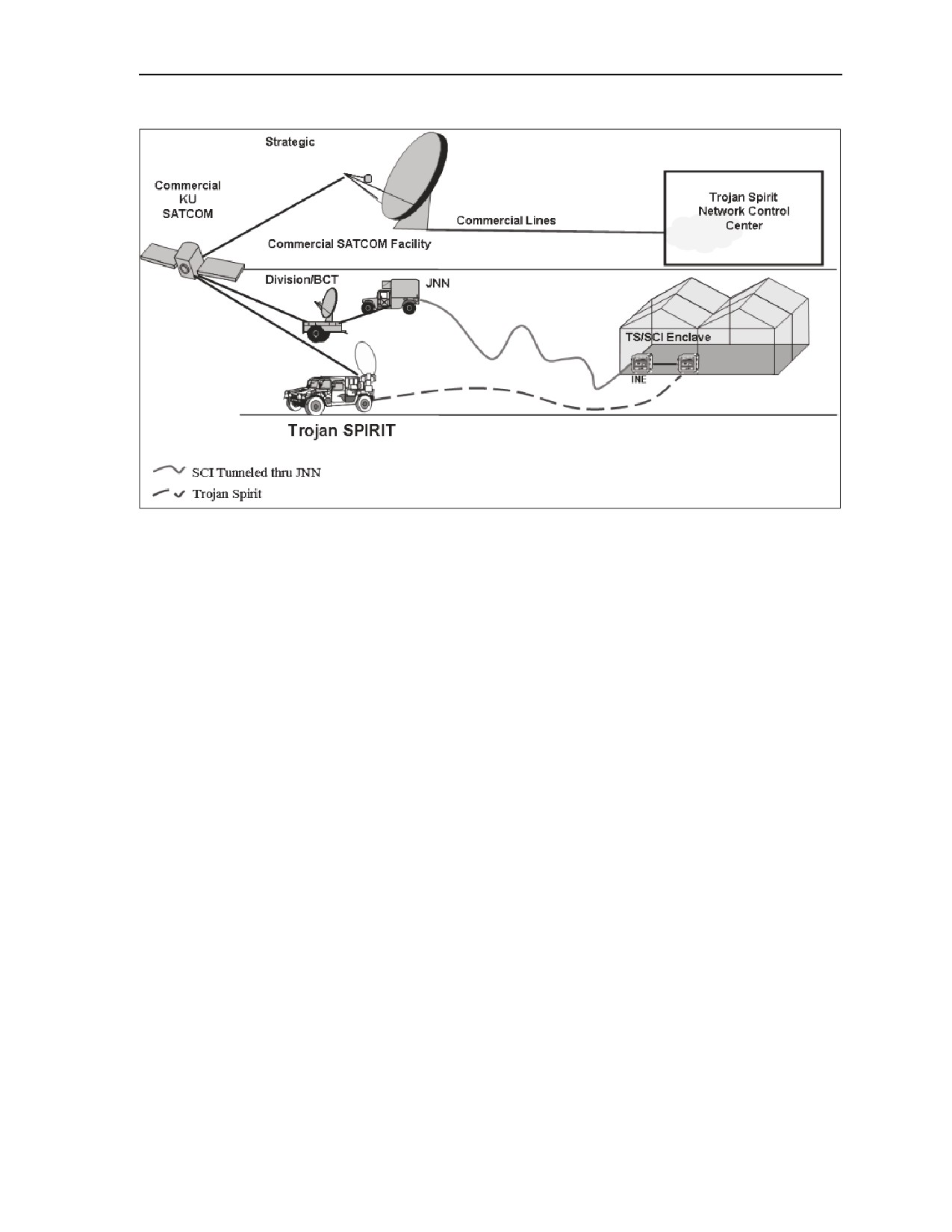
1-7. Trojan SPIRIT is a military intelligence operated system that is a critical network enabler for the
commander and the intelligence elements. It is currently the primary network capability connecting the
deployed user to Top Secret Sensitive Compartmented Information (TS/SCI) networks which include the
Joint Worldwide Intelligence Communications System (JWICS) and the National Security Agency (NSA)
network. Seventeen locations within the division have now been identified as requiring TS/SCI points of
presence or connectivity (to include three per BCT). Currently there are two Trojan SPIRITs designated for
the division; one Trojan SPIRIT for the BCT and the remaining points of presence will be tunneled through
the Joint Network Node (JNN) components via KG-175 tactical fastlane (TACLANE) in-line network
encryption (INE) devices. Figure 1-3 depicts the Trojan SPIRIT at division or brigade being tunneled
through the JNN to other points of presence that do not have a dedicated Trojan SPIRIT. This is done by
using a KG-175 within the respective TS/SCI enclaves.
5 September 2006
FMI 6-02.60
1-3
Chapter 1
Figure 1-3. JNTC-S Military Intelligence Support
1-4
FMI 6-02.60
5 September 2006
Chapter 2
Joint Network Node-Network
Army and joint operations are required to pass high volumes of data over greater
distances while maintaining a high degree of flexibility and mobility. Many of the
information exchanges are critical, time-sensitive, and must be analyzed and used
quickly. The JNN-N provides this capability though a suite of voice, video, and data
communication tools designed to meet the needs of the division, brigade, and
battalion command post structure. This chapter provides an overview of the
components that make up the JNN-N and describes the employment at different
levels.
NETWORK DESCRIPTION
2-1. The JNN is a suite of communications equipment, housed in transportable shelters and associated
transit cases, for the purpose of providing the resources for the network manager to exercise effective
control over communication links, trunks, and groups within a deployed network. The JNN-N provides the
capabilities to interface those resources with satellite and terrestrial transmission resources to establish a
robust network consistent with the Army's vision for the modular division and BCT force structure down to
the battalion command post level. The JNN-N is comprised of five fielded major communications nodes,
transit cases, and Ku band satellite transportable terminals for the division through battalion levels.
UNIT HUB NODE
2-2. The Unit Hub Node (UHN) connects the time division multiple access (TDMA) and frequency
division multiple access (FDMA) Ku band satellite network architectures together. The UHN provides end-
to-end Ku band satellite link network connectivity which will allow tactical JNN access into the standard
tactical entry point (STEP), teleport, Defense Information Systems Network (DISN), and the Defense
Switched Network (DSN) services. The UHN consists of three major communications assemblages: the
baseband shelter and two combined TDMA and FDMA satellite shelters. The following paragraphs provide
basic descriptions and capabilities of the UHN.
Baseband Shelter
2-3. The baseband UHN is housed in a transportable shelter and transported on a 5-ton family of medium
tactical vehicles (FMTV) with one 35 kW diesel generator. The first two iterations (spiral 1) were fielded
on commercial semi tractor-trailers with one 40 kW generator. The baseband UHN is a transportable circuit
switched and IP-based nodal communications system that supports the modular BCT and division force
structure. The baseband shelter is equipped with the necessary components to interface with the JNN,
command post node (CPN), and the GIG via Ku band satellite. Equipment included within the baseband
shelter are routers, switches, firewalls, servers, communications security
(COMSEC) equipment,
conditioned diphase modems, media converters, one transmission resource controller (TRC) multiplexer,
and one private branch exchange (PBX). The baseband shelter serves as the divisional interface point into
the GIG, which pulls services such as SECRET Internet Protocol Router Network (SIPRNET), NIPRNET,
and DSN via fiber optic connection. Appendix A contains a detailed listing of components and
interconnectivity for the baseband shelter.
5 September 2006
FMI 6-02.60
2-1
Chapter 2
TDMA and FDMA Satellite Vans
2-4. TDMA is digital transmission technology that allows a number of users to access a single radio
frequency (RF) carrier without interference by allocating unique time slots to each user within each carrier
separated by time. FDMA is a static multiple access technique where transponder bandwidth is subdivided
into smaller frequency bands or subchannels. Each subchannel is then assigned to a specific user. This
method is frequently used, but it does not readily adapt to changing traffic loads. The UHN fielded in spiral
one had two satellite vans - one dedicated to TDMA and one to FDMA. Subsequent fielding’s also had two
satellite vans with each van containing both TDMA and FDMA equipment. The TDMA and FDMA
satellite vans are housed in a transportable shelter and have two commercial 20 kW diesel generators
mounted on a 5-ton FMTV truck bed and two commercial 3-ton environmental control units (ECUs).
Within each of the satellite vans is a master reference terminal (MRT) for all the TDMA subnets (one
subnet per BCT, brigade, and division). Appendix A contains a detailed listing of components and
connectivity between the satellite vans and the baseband shelter.
JNN
2-5. The JNN is located at the division and BCT levels. The JNN consists of a high-mobility
multipurpose wheeled vehicle (HMMWV) mounted S-250 shelter communications platform that allows a
division and BCT headquarters to assume control of critical pieces of network services, network
management, and prioritization when the division and BCT fights as a whole. The division and BCT JNN
connect into the UHN for end-to-end network service connection into the GIG, DISN, and DSN. With the
use of a division and BCT JNN, the divisional and BCT G-6 or S-6 will assume network responsibility
from Network Enterprise Technology Command (NETCOM) to allow the communications support plan to
mirror the tactical priority of effort.
2-6. The JNN supports user interfaces into NIPRNET and SIPRNET data networks. There are four transit
cases to support the user interfaces into red and black voice networks, network and management service
components, and voice over internet protocol (VoIP) phones. One additional transit case containing the
Battlefield Video Teleconferencing (BVTC) which provides the management of teleconferencing using
both H.320 and H.323 multimedia communication standards. There is one 2.4M dish Ku band satellite
transportable terminal (STT) fielded with the JNN to provide direct reachback capabilities to higher
command and or strategic enclaves using FDMA and TDMA
2-7. The JNN can provide up to 3 Mbps FDMA satellite communications and is capable of shared bursts
up to 4 Mbps to the CPN. The JNN is also capable of simultaneous STEP and or joint interface through the
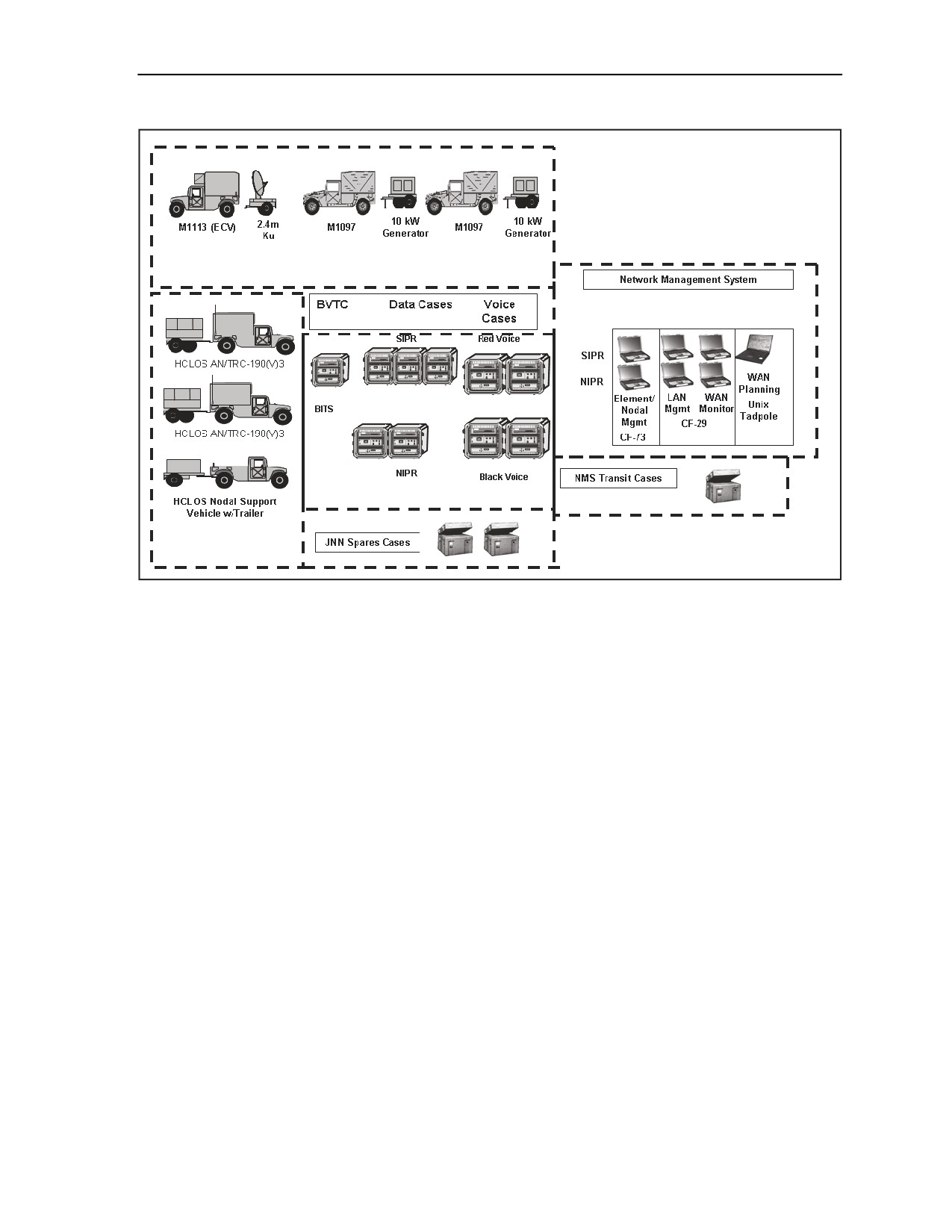
UHN to provide NIPRNET and SIPRNET access. Figure 2-1 shows a typical JNN with its associated
equipment at the division and BCT levels. Appendix B contains a detailed list of components and
connectivity of the JNN.
CPN
2-8. The CPN interface cases are a group of deployable transit cases located at the division, BCT, and
battalion level. At the division and BCT level, the CPN transit cases are deployed with the JNN shelter. The
SIPRNET and NIPRNET transit cases provide data services to subscribers in the network, voice switching
functions which provide VoIP, transmission system Ku band services (TDMA and FDMA), and user local
area network (LAN) services for the subscriber to mesh into the GIG. Refer to Appendix C for further
information.
2-2
FMI 6-02.60
5 September 2006
Joint Network Node-Network
Figure 2-1. JNN and Associated Equipment
2-9. Following are the major networking capabilities provided by JNN to support network enabled voice,
data, and video services:
z
Supports 32 secure telephone equipment (STE) subscribers (also supports 2 dial central office
[DCO] connections).
z
Supports 48 2-wire phone subscribers (SIPRNET and NIPRNET).
z
Supports 24 Internet Protocol (IP) voice subscribers (SIPRNET and NIPRNET).
z
Supports 46 IP data subscribers
(SIPRNET and NIPRNET) (includes 24 data subscribers
connected to IP phones).
z
Supports one local black Private Branch Exchange (PBX) Transmission Level 1 Signal (1.544
Mbps or tier 1) T1 trunk.
z
Supports 8 MSE black long local voice subscribers.
z
Supports Defense Red Switch Network (DRSN) long local access to the TRC via a Pairgain
modem.
z
Supports remote BVTC access to the TRC via a Pairgain modem.
z
Supports 2 MSE Digital Transmission Group (DTG) supporting voice and data.
2-10. The JNN facilitates the management of digital groups, trunks, and circuits. It provides the means
through which the communications resources at a node can be monitored, controlled, and managed. JNN
capabilities include Ethernet switching, IP routing, network management, and network security services
that include network intrusion detection.
TRANSMISSION CAPABILITIES
2-11. The JNN provides a high-speed and high-capacity backbone communications network focused on
rapidly moving information in a manner that supports commanders, staff, functional units, and capabilities-
based formations. The JNN-N enables commanders to plan, prepare, and execute multiple missions and
tasks simultaneously. The JNN-N connects to the GIG, through the UHN and provides autonomous brigade
5 September 2006
FMI 6-02.60
2-3
Chapter 2
operations by allowing brigade networking access and capabilities without requiring traditional division or
higher echelon communication support. The JNN-N will also provide NIPRNET connectivity down to the
battalion level of operations. The JNN-N capabilities provide joint and coalition connectivity and allow for
interfacing to current network communications systems through:
z
STEP.
z
BLOS.
z
Line of sight (LOS).
2-12. The STEP and teleport sites provide multiband, multimedia, and worldwide reachback capabilities to
DISN in addition to providing a variety of voice, video, and data transport services to classified and
unclassified users. The STEP and teleport sites support high throughput and multiband and multimedia
telecommunications services for deployed forces of all services in all operational scenarios.
2-13. The Ku band STT is the primary link connectivity to provide DISN services through the UHN to the
JNN. To ensure continuity of DISN services, a secondary network or link connectivity may be established
to the STEP or teleport site to ensure that there is no break in DISN services in the event the primary (Ku
band) link experiences network connectivity outages.
2-14. Regional STEP or teleport sites provide the following services on a requested or as-needed basis.
z
Data Services:
NIPRNET.
SIPRNET.
z
Voice Services:
DSN - A worldwide private-line telephone network.
DRSN - A global secure voice service which provides the President, Secretary of Defense,
Joint Chiefs of Staff, combatant commanders, and selected agencies with command and control
secure voice and voice-conferencing capabilities up to the TS/SCI level.
z
Video Services:
DISN video services provide interoperable dial-up and dedicated subscriber services for
point-to-point and multipoint video conferencing.
Provide a means to communicate within the different SATCOM systems.
BLOS INTERFACING CAPABILITIES
2-15. The JNN is designed to interface with existing satellite Ku band and ground mobile forces (GMF)
transport systems. The JNN can also interface with the typical SATCOM systems to provide reach and or
range extension capabilities such as the Secure Mobile Anti-jam Reliable Tactical Terminal (SMART-T)
AN/TSC-154 and the Flyaway Tri-Band Satellite Terminal (FTSAT) AN-USC-60A. These SATCOM
terminals can provide alternate and additional reach capabilities to the area of operations (AO) and STEP or
teleport sites in addition to range extension capabilities. The following paragraphs provide a brief
description of these typical communication transport systems that are most likely to interface with the JNN.
Ku Band Satellite Terminal
2-16. At the division and BCT level, the JNN is fielded with a STT to provide access to the Ku band
commercial satellite constellation to support FDMA and TDMA networks. At the battalion level the STT
provides TDMA access only. Each level provides reach and or reachback capabilities to a higher command
and strategic enclaves. The 2.4M Ku band satellite trailer interfaces into the JNN via the Ku modems and
or conditioned diphase interface (CTM-100) modems. Figure 2-2 illustrates the JNN signal entry panel
(SEP) MP3 A1 interface connection which supports the Ku band SATCOM terminal. Refer to Appendix D
for setup and equipment information.
2-4
FMI 6-02.60
5 September 2006
Joint Network Node-Network
Figure 2-2. Ku Band Satellite Terminal Connection via SEP MP3
GMF Satellite Terminals (AN/TSC-85/93)
2-17. The AN/TSC-85, tactical satellite communications (TACSAT) terminal, can interface with the JNN
to provide STEP or teleport reachback capabilities and or extend the network services. The AN/TSC-85 is a
multi-channel super high frequency (SHF) terminal which receives, transmits, and processes low, medium,
and high capacity multiplexed voice, data, and teletype signals. The AN/TSC-85 is a nodal terminal
capable of communicating with up to four other GMF terminals. The AN/TSC-85 can operate in a point-to-
point mode or as a nodal terminal in a nodal network. The AN/TSC-85 can interface into the JNN via SEP
MP3.
2-18. The AN/TSC-93, TACSAT terminal can interface with the JNN to provide STEP or teleport reach
capability. The AN/TSC-93 is an SHF multi-channel terminal that provides analog and digital secure
multiplexed channels. The TACSAT terminal operates as a point-to-point or as a spoke in a nodal network.
As a non-nodal terminal, it is capable of communicating with one other GMF terminal. It can
simultaneously transmit and receive a single high data rate carrier. The AN/TSC-93 can interface into the
JNN via the conditioned diphase interface diphase modem. Figure 2-3 depicts the JNN SEP MP3 interface
connection that supports the GMF terminals.
5 September 2006
FMI 6-02.60
2-5
Chapter 2
Figure 2-3. GMF Satellite Terminal Connection via SEP MP3
SMART-T (AN/TSC-154)
2-19. The SMART-T is a transportable satellite communications system that provides robust, anti-jam, low
probability of intercept (LPI) communications. The SMART-T may be used to extend JNN services BLOS.
The SMART-T interfaces into the JNN via the CX-11230 conditioned diphase modem. Figure 2-4 depicts
the JNN SEP MP1 interface connections that support the SMART-T assemblage.
Figure 2-4. SMART-T Terminal Connection via SEP MP1
2-6
FMI 6-02.60
5 September 2006
Joint Network Node-Network
FTSAT (AN/USC-60A)
2-20. The AN/USC-60A, FTSAT, is a COTS terminal supporting theater deployed communications and
special user requirements. It is a small, lightweight tri-band satellite communications terminal. The FTSAT
can operate on C-band, X-band, and Ku band frequencies. The FTSAT can provide STEP and teleport
connectivity to provide GIG, DSN, DISN services to the JNN or be used to extend BLOS services. The
FTSAT interfaces into the JNN via SEP MP3. Figure 2-4 above depicts the JNN SEP MP1 A1, A2, A3, and
A4 interface connections that support the FTSAT assemblages.
LOS INTERFACING CAPABILITIES
2-21. The JNN is designed to interface with existing terrestrial LOS systems (e.g., high capacity line of
sight (HCLOS) systems: AN/TRC-190(V)3; LOS, AN/TRC-190 (V1); and the Tropospheric Scatter Radio
terminal [TROPO], AN/TRC-170) to extend network services to modular forces.
2-22. The HCLOS radio (V3) is a terrestrial, microwave radio system capable of 8 Mbps of data
throughput which can vary depending on the radio band selected. Each AN/TRC-190(V3) is equipped with
three HCLOS radios and provides up to 25 miles of extended range communication capabilities. The
AN/TRC-190(V3) interfaces into the JNN via the Quad Multiplexer (QMUX) (JNN spiral 1) or the Flex
Multiplexer (FLEXMUX) (JNN spirals 2-7), Fiber Optic Modem (FOM), or Tactical Fiber Optic Cable
Assembly (TFOCA). Figure 2-5 depicts the JNN SEP MP2 interface connections which support the
HCLOS assemblages.
Figure 2-5. HCLOS (V1) and (V3) Terminal Connection via SEP MP 2
TROPO Terminal (AN/TRC-170)
2-23. The TROPO terminal interfaces with the JNN to provide BLOS and LOS capability. The AN/TRC-
170 is a transportable, self-enclosed tropo-scatter terminal (multi-channel) capable of transmitting and
receiving analog and digital data over varying distances (up to 100 miles). The TROPO terminals are
deployed at hybrid nodes for internodal and extended range (skip node) communications. The AN/TRC-
170 radio terminal will extend the JNN network services up to 100 miles and interfaces into the JNN via
the diphase modem. Refer to Figure 2-6 for the overview of the over-the-air communications links.
5 September 2006
FMI 6-02.60
2-7
Chapter 2
Figure 2-6. Over-the-Air Communications Links
CONNECTIVITY TO CURRENT NETWORKS
2-24. The JNN at the division and or BCT levels provides a high-speed wide area network (WAN)
infrastructure that connects the BCT main command post (CP) to the joint voice and data networks. The
JNN allows tactical users to interface into the GIG, joint, interagency organizations, and the division
headquarters. The JNN is also interoperable with commercial networks and current force communications
networks (e.g., mobile subscriber equipment [MSE] and Tri-Service Tactical Communications Program
[TRI-TAC]). The JNN interfaces with high bandwidth satellite and terrestrial data transmission systems
currently in the Army inventory providing video teleconferencing, email, and local area network services.
The JNN can support two MSE and TRI-TAC DTGs via the diphase modems, DTG modem, or the
Vantage. The JNN connects directly to the following systems:
z
MSE - The JNN can support two MSE digital transmission groups. Typically, the following
assemblages will interface into the JNN:
NODE CENTER SWITCH (NCS) - The JNN can provide DISN services to the NCS
which in turn provides essential switching, traffic control, and access points for MSE. The NCS
interfaces into the JNN via the CX-11230 cable on SEP MP1.
FORCED ENTRY SWITCH (FES) - The JNN can provide DISN services to the FES.
LEN - The JNN can provide DISN services to the LEN switch.
z
TRI-TAC - The TRI-TAC communication networks consist of components that ensure
subscribers have the capability to transmit and receive voice, data, and video. The JNN can
support two TRI-TAC DTGs. Typically the following assemblages will interface into the JNN:
AN/TTC-39D SWITCH - The JNN can provide DISN services to the AN/TTC-39D
switch.
2-8
FMI 6-02.60
5 September 2006
Joint Network Node-Network
AN/TTC-56 - The JNN can provide DISN services to the AN/TTC-56 Single Shelter
Switch (SSS).
2-25. The Vantage provides an H.323 gateway between tactical and commercial networks. The Vantage
takes various types of network elements (Integrated Services Digital Network [ISDN], IP, radio, and analog
voice) and allows distant ends to talk to each other while providing services such as affiliation and or
disaffiliation, routing, bandwidth, and link management. JNN VoIP subscribers register with the Vantage
and receive a Tactical User ID (TUID)) for communication within the tactical Time Division Multiplexer
(TDM) network.
JNN CPN TRANSIT CASES
2-26. The JNN CPN cases are a group of lightweight deployable transit cases that consist of SIPRNET and
NIPRNET communication processing equipment for voice and data functions at the division and BCT
level. At the division and BCT level the CPN transit cases are deployed with the JNN shelter. The
SIPRNET and NIPRNET transit cases provide data services to subscribers in the network, voice switching
functions which provide VoIP, transmission system Ku band services (TDMA and FDMA), and user LAN
services for the subscriber to mesh into the GIG. The SIPRNET data cases consist of data case A, data case
B, and an Uninterruptible Power Supply (UPS) case. The NIPRNET data cases consist of the data case B
and an UPS case.
5 September 2006
FMI 6-02.60
2-9

Chapter 3
Employment of the Joint Network Node-Network at the
Division, Brigade, and Battalion Level
The JNN-N is designed to be employed at all levels of the Army structure and fully
supports the modularity concept of the Army. The JNN-N is scalable to provide
capabilities necessary to support different CPs ranging from battalion CPs to larger
and more complex CPs at the brigade and division. This chapter discusses the
employment of the JNN-N at the division, brigade, and battalion.
DIVISION
3-1. The division headquarters uses all components of the JNN-N. This section describes the employment
of the JNN-N at division.
UNIT HUB NODE
3-2. The UHN is used to provide the division access into the STEP or teleport range of services. The hub
is located in close proximity to the STEP and is usually cabled into its network. One UHN is fielded at the
division level for this requirement. In order to increase the responsiveness of a complex network and to
facilitate the bandwidth required to support the division headquarters and BCT networks, the division can
employ a network operations (NETOPS) cell with the UHN. The G-6 will exercise control of the network
and NETOPS through the UHN. The MRT at the UHN allows the TDMA mesh resources to be allocated
across the division and provide the means to ensure that priority units, down to the battalion level, have the
necessary bandwidth to accomplish their mission. The UHN flattens the disparate TDMA satellite network
structure and increases the bandwidth capability from approximately 6 Mbps to 40 Mbps, while an
embedded NETOPS cell can provide the management to enable the division network.
3-3. The network hub platoon of the division network support company contains the personnel to install
and operate the baseband shelter and satellite shelters. Table 3-1 shows the structure of the network hub
platoon. MOS 25N (Nodal Network Systems Operator-Maintainer) has been approved and will be reflected
in place of MOS 25F (Switch Systems Operator-Maintainer) in the operation of the JNN-N at the division
and brigade levels.
Table 3-1. Network Hub Platoon
Rank
MOS
Position
O2
25A00
Platoon Leader
W3
250N
Network Management Technician
E7
25S40
Platoon Sergeant
Baseband Team
E6
25F30
Switch System Supervisor
E5
25B20
Senior LAN Manager
E5
25F20
Senior Switch Sys Operator-Maintainer
E4
25B10
LAN Manager
TDMA Multiband Team
E5
25S20
TACSAT System Team Chief
3-1
FMI 6-02.60
5 September 2006

Chapter 3
Table 3-1. Network Hub Platoon
Rank
MOS
Position
E4
25S10
TACSAT System Operator-Maintainer
E3
25S10
TACSAT System Operator-Maintainer
FDMA Multiband Team
E5
25S20
TACSAT System Team Chief
E4
25S10
TACSAT System Operator-Maintainer
E3
25S10
TACSAT System Operator-Maintainer
Hub Support Team
E5
25B20
Senior LAN Manager
E4
25B10
LAN Manager
E3
25U10
Signal Support System Specialist
E4
25L10
Cable System Installer Maintainer
E4
25L10
Cable System Installer Maintainer
JOINT NETWORK NODE
3-4. There are typically three JNNs located within the division headquarters to support three command
and control elements: division main command post (CP) and the tactical command posts (TAC CPs) 1 and
2. The TAC CP provides the commander the flexibility to organize continuous full spectrum operations.
The division main CP may be located anywhere within the division AO but is larger and thus entails a
longer time to set up and tear down. For this reason the main CP typically will set up in a semi-stationary
base within the theater or sanctuary. The JNN provides the division G-6 the means to exercise network
control from the main CP and the two TAC CPs. The G-6 also provides NETOPS support for the CPs
through the division network, operations, and security center.
3-5. The division headquarters may deploy with command and control of six BCTs and possibly other
service land forces. If the division is given command and control of other service land components,
additional joint manning and network management equipment may be necessary to support the mission. An
example of network management equipment is the Joint Network Management System which is not
doctrinally allocated to division level forces.
3-6. In addition to expanding bandwidth, the division has the capability to dynamically reassign the
bandwidth so that the communications support plan matches the division commander’s ground tactical
plan. The division UHN, through the MRT, ordinarily provides this. If a BCT is deployed autonomously it
can be equipped with a push package containing an MRT to control the bandwidth of its subordinate
battalions through the JNN. This provides an unprecedented capability to adjust bandwidth on demand to
those who need it to enable the ground tactical plan.
3-7. The division and BCT will be equipped with the necessary JNN assemblages and equipment which
may vary depending on the division mission, to provide network services to modular formations (e.g.,
division, BCT, and battalion [BN]) to meet their current information requirements. Figure 3-1 illustrates the
various connectivity services between the division, BCT, BN CPN, and STEP or teleport locations.
HCLOS
3-8. Each JNN section has an AN/TRC-190(V) 3 (HCLOS) capable of providing up to 8mbps of data
throughput. At division there are three HCLOS, and two at each BCT, allocated to be used with the JNN-N.
The HCLOS can be used to establish connectivity with the three division CPs or subordinate BCTs. The
HCLOS is used to provide additional bandwidth when the satellite bandwidth becomes saturated, when the
mission dictates, when the terrain allows, and for sustainment operations. The HCLOS can also be used for
establishing communications with MSE equipped units.
3-2
FMI 6-02.60
5 September 2006
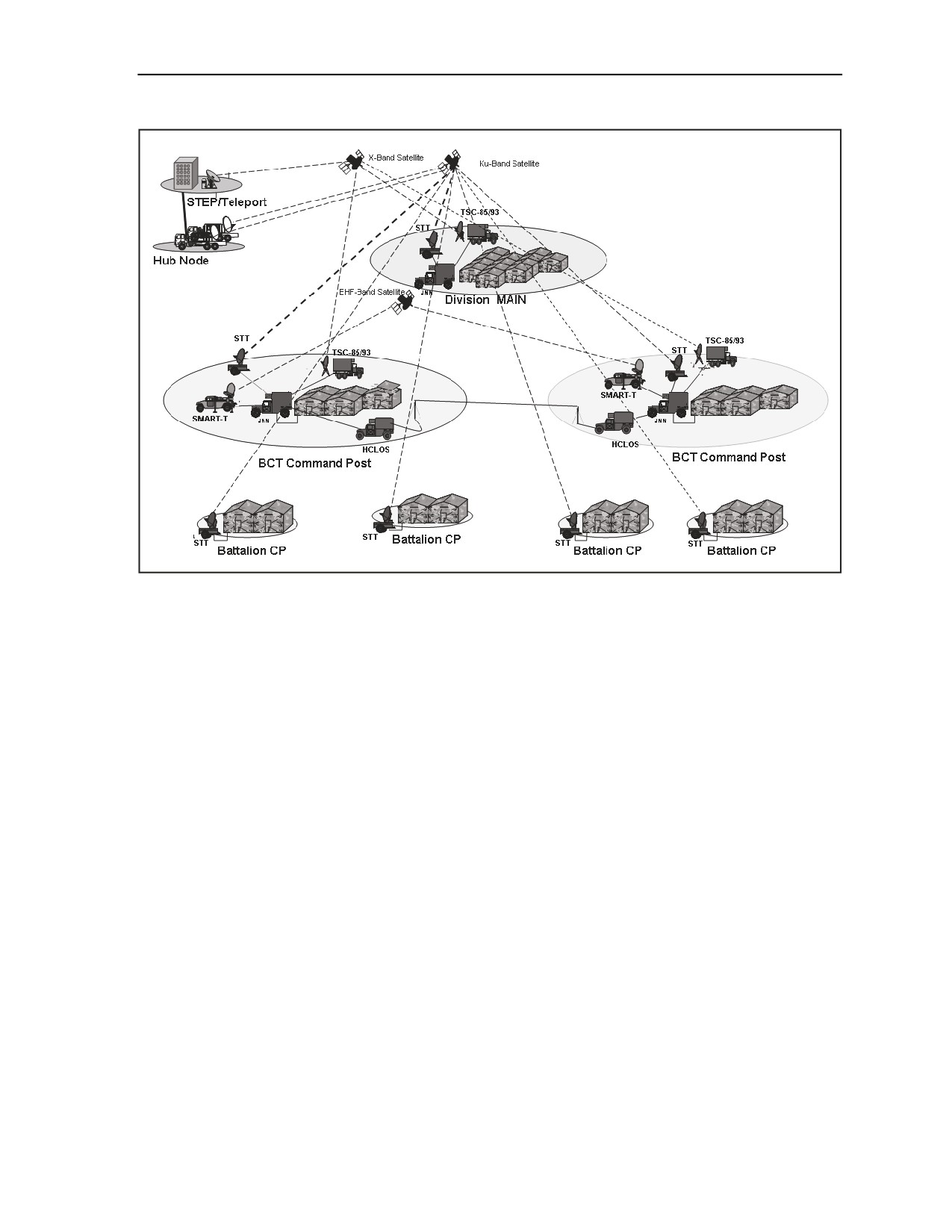
Employment of the Joint Network Node-Network at the Division, Brigade, and Battalion Level
Figure 3-1. Division to BCT Connectivity
BRIGADE COMBAT TEAMS
3-9. The heavy brigade combat team (HBCT), infantry brigade combat team (IBCT), and Stryker brigade
combat team (SBCT) have two JNNs to support a main CP and a TAC. The brigade S-6 typically operates
out of the brigade Nodal Operations Security Center (BNOSC) located at the main CP and based on
mission requirements, plans, coordinates, and directs the execution of the brigade communications support
plan using the JNN as his focal point. The JNN will typically be emplaced near the CP with the voice and
data cases for NIPRNET and SIPRNET located within the brigade NOSC. The S-6 will exercise
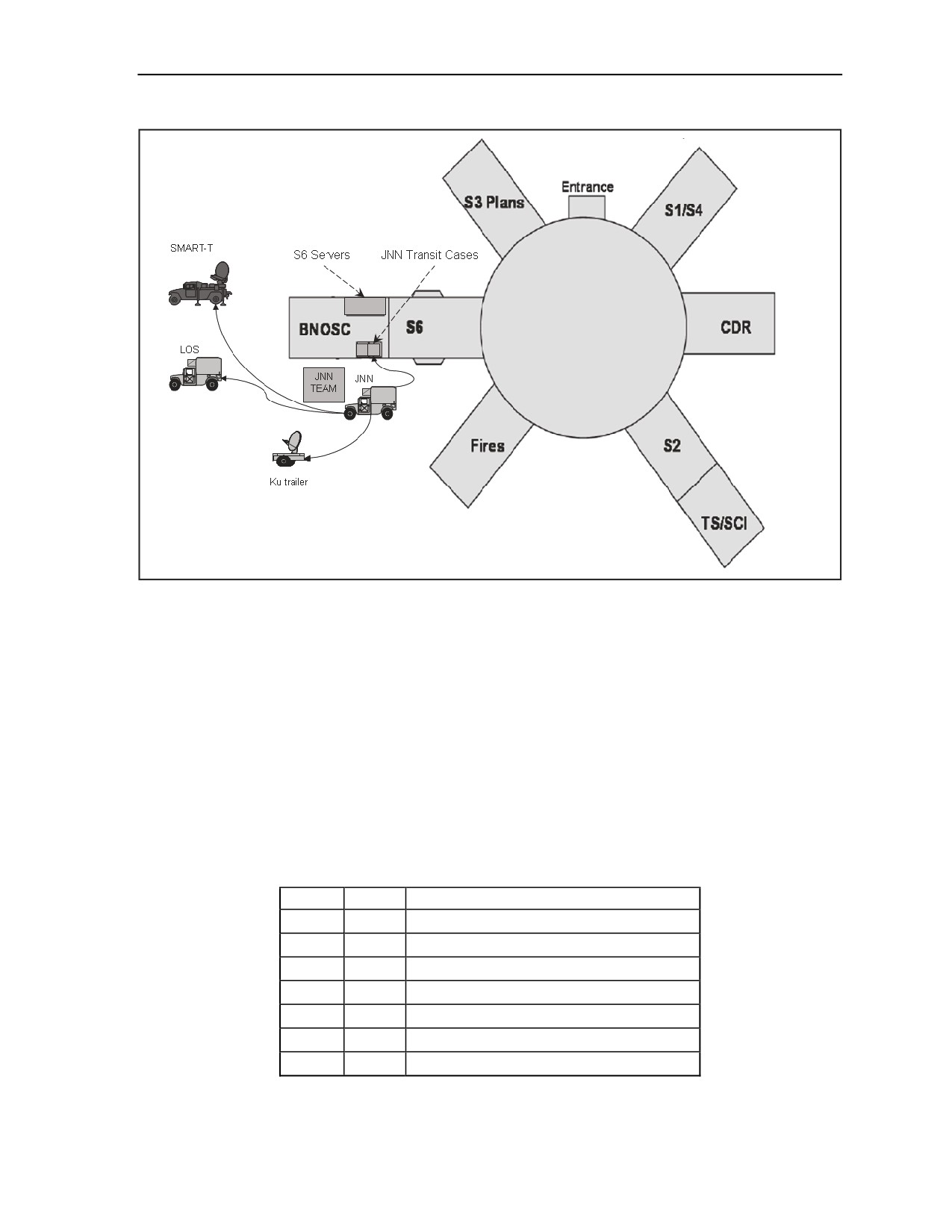
monitoring and control of the brigade network using the management tools. Figure
3-2 shows a
representative CP at the BCT level. The employment of the JNN is essentially the same at the division and
BCT level with the exception of the authorized manning levels, control functions, and planning
characteristics.
5 September 2006
FMI 6-02.60
3-3
Chapter 3
Figure 3-2. Representative CP Configuration
3-10. The JNN team establishes communications and extends the capabilities from the van via TFOCA II
to the SIPRNET and NIPRNET voice and data transit cases in the CP. The individual sections under the
guidance of the S-6 will connect their systems.
3-11. In addition to the Ku satellite trailer, each JNN has an AN/TRC-190(V3) HCLOS to establish
connectivity to adjacent brigades or subordinate battalions as needed. This provides a traffic capability of 8
Mbps to adjacent brigades and 2 Mbps to subordinate battalions when the battalion is equipped with an
AN/TRC-190(V1) LOS.
3-12. There are two network extension platoons in the BCT network support company which contain the
personnel to operate the JNN. Table 3-2 lists the personnel required in the JNN section. MOS 25N has been
approved and will be reflected in place of 25F in the operation of the JNN-N at the division and brigade
levels. Refer to page 3-1. MOS 25Q (Transmission Systems Operator-Maintainer) has been approved to
replace 25F as the Range Extension Operator and will be reflected on future manning documents.
Table 3-2. Joint Network Node Section
Rank
MOS
Position
E6
25F30
Extension Switch Supervisor
E5
25F20
Sr Switch System Operator-Maintainer
E3
25F10
Extension Switch Operator-Maintainer
E4
25F10
Range Extension Operator
E5
25S20
TACSAT System Team Chief
E4
25S10
TACSAT System Operator-Maintainer
E3
25S10
TACSAT System Operator-Maintainer
3-4
FMI 6-02.60
5 September 2006
Employment of the Joint Network Node-Network at the Division, Brigade, and Battalion Level
COMMAND POST NODE
3-13. There is one CPN located at the brigade level to provide support to the mobile command group or
TAC CP based on mission requirements. Table 3-3 shows the composition of the CPN support section.
Table 3-3. Command Post Support Section
Rank
MOS
Position
E5
25Q20
Senior Transmission Systems Operator-Maintainer
E3
25Q10
Transmission Systems Operator-Maintainer
E4
25B10
Information Systems Specialist
E3
25B10
Information Systems Specialist
BATTALION
3-14. There is one CPN located at the battalion level to provide voice and data capabilities. It uses TDMA
satellite transmission to gain access through the JNN or UHN to the GIG. The CPN consists of a Ku band
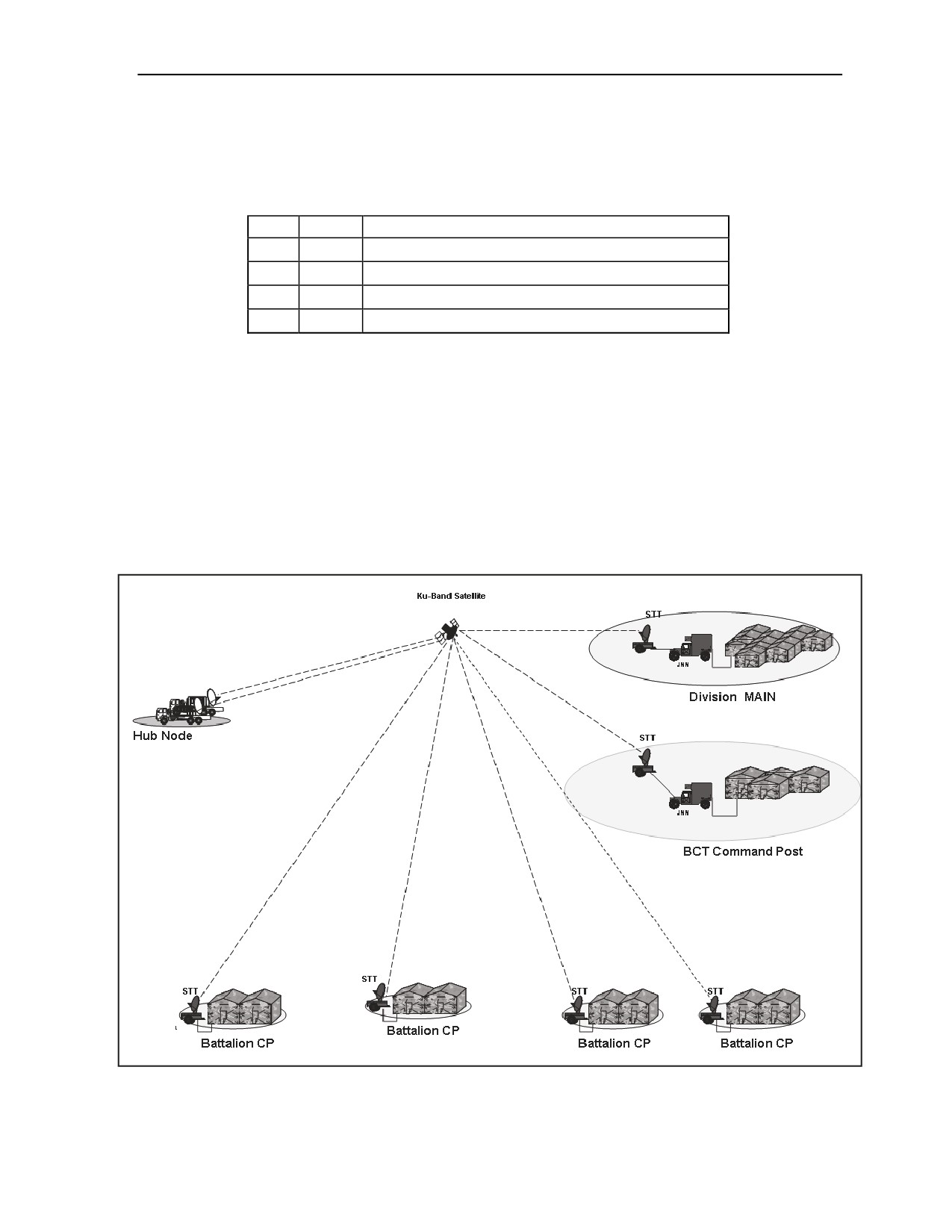
trailer and associated transit cases to provide a wide array of services. Figure
3-3 shows battalion
connectivity to the brigade using the TDMA mesh.
3-15. The CPN is located at the battalion CP, and the battalion S-6 typically exercises control from this
location. The equipment that is used to interface with the CPN in the CP is organic to the unit; therefore the
unit sets up and operates the equipment with technical oversight from the S-6. The battalion may have an
AN-TRC-190(V1) assigned, to provide a 2 Mbps traffic capability to the brigade when the mission dictates.
The personnel to operate the CPN are assigned to the S-6 section.
Figure 3-3. Battalion Command Post Connectivity
5 September 2006
FMI 6-02.60
3-5
Chapter 4
Joint Network Node-Network Network Management
The JNN-N network management (NM) is based on the application of COTS, GOTS,
and industry standard software and techniques
(a collection of
12 packages)
distributed from the UHN to the CPN level. This chapter will address the network
management packages fielded from the division to the battalion level as part of the
JNN-N. Specific applications of the packages have changed with each spiral but the
essential capabilities of the packages are the same.
NETWORK MANAGEMENT COMPONENTS
4-1. The JNN-N NM system provides autonomous NM operation at the division or BCT level. The JNN-N
NM solution is distributed rather than centralized in one location. This provides operational control from
the division NOSC at the division main CP and provides subordinate units the capability to manage their
respective portions of the network. An automated reporting procedure to pass information from subordinate
units to the division NOSC is embedded and allows the division NOSC to provide situational awareness of
the network to higher levels. There are three main components to the JNN network management system:
planning, configuration, and monitoring.
PLANNING
4-2. The planning component consists of the Detailed Planning and Engineering Module (DPEM). The
DPEM provides the capabilities to create and configure JNN equipped units and to place them
geographically on a map within their areas of responsibilities (AORs). It enables the user to place assets on
the battlefield and graphically assess connectivity in a logical view or on a map background. Patching
diagrams, cutsheets, and reports for switch configurations are generated from the DPEM.
CONFIGURATION
4-3. The network management COTS software product provides four tools to configure devices in the
JNN network: Config Upload, Config Download, Config Editor viewer, and Compare Configs. These tools
give the ability to upload, download, edit, view, and compare device configuration files.
MONITORING
4-4. The network monitoring COTS tool is provided to graph the performance of devices and provides a
real time view of the devices. It also can monitor bandwidth utilization of routers, switches, and servers to
provide current and historical charts of network performance.
4-5. Tools are provided to monitor traffic load on network links and provide a current representation of
the traffic.
4-6. Warfighter Machine Interface (WMI) is a node management tool used to provide the status and rack
views of monitored devices and is used in the JNN and UHN.
4-7. A COTS monitoring and configuring program for the PBXs is provided in the JNN and UHN.
4-8. The UHN has management software that is used to configure and monitor the network of
transmission resource control (TRC) multiplexers.
5 September 2006
FMI 6-02.60
4-1
Chapter 4
NETWORK MANAGEMENT AT THE DIVISION
4-9. The senior mission commander commands and controls the network. The commander delegates the
authority to control and configure the network to the G-6. The G-6 participates in the military decision
making process (MDMP) and identifies the optimum placement of network equipment and personnel to
achieve the goals of the commander.
4-10. Network operations (NETOPS) control is the authority granted to the senior signal officer by the
operational commander.
UNIT HUB NODE
4-11. The management package for the UHN serves as the central point in the network for the devices that
require a centralized management server such as firewalls and intrusion detection systems (IDS). There are
separate hardware platforms for the SIPRNET and NIPRNET domains. The management tools include:
z
WMI management.
z
TRC planning software.
z
Network monitoring management software to monitor and configure the PBX.
z
Network management software to configure and monitor routers.
z
Firewall and IDS managers.
z
TACLANE management software to monitor and control KG-175’s in the network.
z
MRT that supports the management and planning of the SATCOM network.
DIVISION MAIN (DMAIN) G-6
4-12. The network management tools provided to the DMAIN G-6 are designed to aid in the planning and
management of the TOC LAN. These tools are —
z
DPEM.
z
Integrated system control (ISYSCON V4).
z
Software to monitor and manage the LAN.
z
Separate laptops to control the SIPRNET and NIPRNET domains.
DMAIN NETOPS
4-13. The NETOPS section will work in conjunction with the DMAIN G-6 and will always be collocated
with a JNN. It contains the necessary tools for planning and to manage the WAN, administer and monitor
IDS and firewalls, software to manage TACLANEs in the network, and separate platforms for the
SIPRNET and NIPRNET domains.
DMAIN JNN
4-14. The JNN package includes a limited planning capability for the TACLANEs. WMI is used to
monitor the JNN components within the network and has the capability to monitor link status.
DIVISION TAC CP 1 AND CP 2 G-6
4-15. The DTAC G-6 section has the same capabilities as the DMAIN G-6 section with the exception that
it does not contain the capability of the DPEM. The DTAC G-6 section does have the capability to monitor
and manage the DTAC LAN.
DIVISION TAC CP 1 AND CP 2 NETOPS
4-16. The division TAC CP 1 and CP 2 NETOPS section has the same capability as the DMAIN NETOPS
section. This section does not have the capability to create detailed plans of the network or control
TACLANE management functions.
4-2
FMI 6-02.60
5 September 2006
Joint Network Node-Network Network Management
DIVISION TAC CP 1 AND CP 2 JNN
4-17. The division TAC CP 1 and CP 2 JNNs have the same management capability as the DMAIN JNN.
NETWORK MANAGEMENT AT THE BRIGADE
4-18. Network management at the brigade level is performed from the BNOSC controlled by the brigade
S-6, which includes personnel assigned to the S-6 section and NSC which is primarily performed from the
BNOSC. The capabilities include monitoring and controlling the networks within its AOR based on the
mission and orders from division. It also includes the control and monitoring of the assets at battalion. The
following management packages are used at brigade:
z
The BNOSC S-6 management package consists of the tools to manage and control the CP LAN
and to provide the capabilities necessary in the event the brigade deploys autonomously.
z
The brigade NETOPS section is provided essentially the same management package as the
division NETOPS section. The WAN management capability controls and monitors down to the
battalion level, and automatically forwards information to the division NETOPS section.
z
The brigade main JNN management package is the same as provided at the division JNN.
z
The brigade TAC CP S-6 section is provided the same management tools as the BNOSC without
the ability for network planning.
z
The brigade TAC JNN has the same management package as the division main JNN.
AUTONOMOUS BRIGADE DEPLOYMENT
4-19. In the event that the brigade is deployed autonomously, additional management and control tools are
required, which are provided in a push package for the NETOPS section to perform the functions ordinarily
performed by the division. These tools include:
z
MRT to manage and control SATCOM assets.
z
TACLANE management application.
z
IDS Remote Management.
NETWORK MANAGEMENT AT THE BATTALION
4-20. The battalion S-6 management functions will be limited to monitoring and controlling the LAN with
the ISYSCON V4. One platform is used with removable hard disk drives (RHDDs) for the SIPRNET and
NIPRNET domains.
5 September 2006
FMI 6-02.60
4-3
Appendix A
Unit Hub Node Component Listing
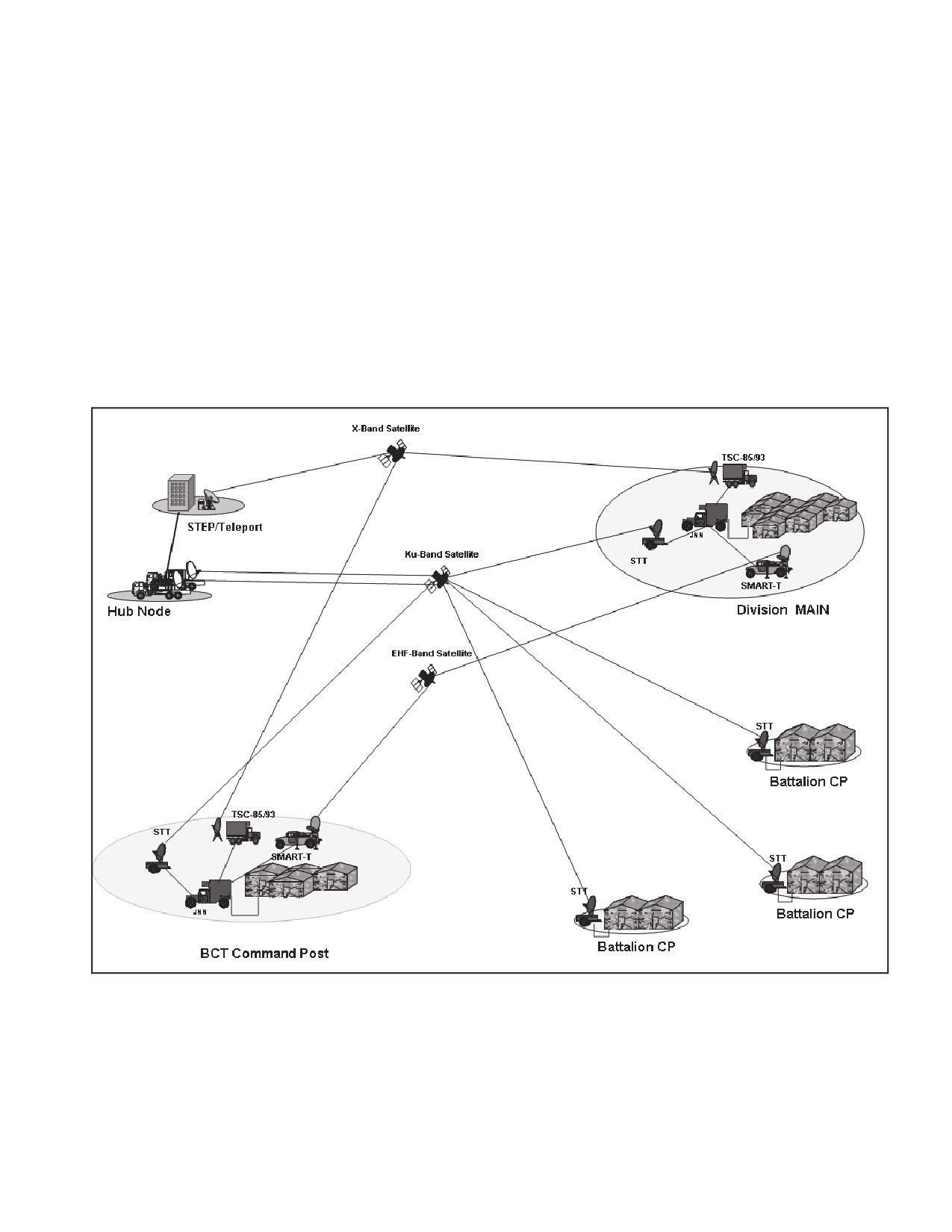
The UHN is a deployable communications support package that integrates, manages,
and controls the interfaces between the communications assets within the division
network. Figure A-1 depicts a division network satellite systems overview. When
fully populated, the UHN can support a division network of 16 FDMA links and 16
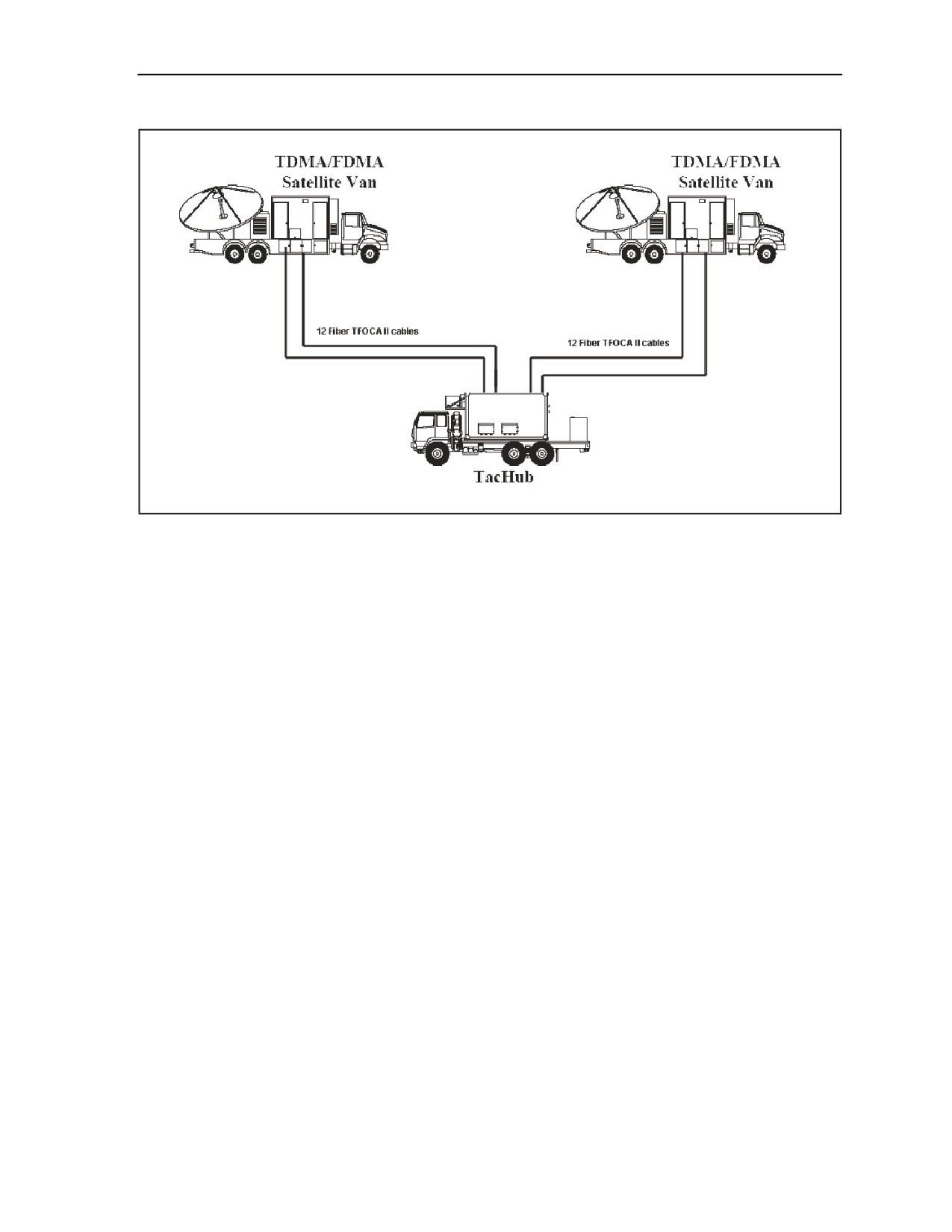
TDMA nets. Figure A-2 shows the interconnections between the baseband shelter and
the satellite vans. This appendix discusses the components that comprise the UHN
baseband van and an overview of the UHN satellite vans.
Figure A-1. Division Network Satellite Systems Overview
5 September 2006
FMI 6-02.60
A-1
Appendix A
Figure A-2. Baseband and Satellite Vans Interconnections
BASEBAND SHELTER
A-1. The UHN baseband shelter is comprised of components located in an S-280 shelter and includes
routers, firewalls, servers, transmission resource center, media converters, flexmux, and COMSEC devices
divided into separate NIPRNET and SIPRNET domains. The shelter has seven functional areas:
z
NIPRNET data.
z
SIPRNET data.
z
Voice switching.
z
Transmission systems.
z
Patching.
z
Network management.
z
Power.
A-2. The NIPRNET and SIPRNET data sections provide basic data and server services to subscribers in
each domain. The data networks are designed to provide information assurance functions to data
subscribers. The voice switching function provides the equipment necessary to service voice and data
subscribers, both locally and to subordinate units. The voice function also provides support for current
forces subscribers and interface to commercial switching assets external to the UHN baseband. The
patching and network management capabilities provide the necessary functions to route, reroute, monitor,
and troubleshoot circuits in the network. Equipment is also provided for timing distribution and line
conditioning. The transmission functional system includes multiplexer and modem functions to provide
equipment to multiplex lower data rate signals into larger aggregate signals and convert, as necessary, to a
format suitable for transport through the tactical network. It also includes the COMSEC function to supply
equipment used to protect and encrypt data and transmission lines from hostile interception. The power
subsystem provides the capabilities to connect to power sources and distribute power to the UHN baseband
shelter. The network management function provides capabilities to plan and manage the implementing
circuits, trunks, and transmission systems for the WAN.
A-2
FMI 6-02.60
5 September 2006
Unit Hub Node Component Listing
UHN COMPONENTS
A-3. The voice and data equipment are in separate racks that contain the same components in order to
support the NIPRNET and SIPRNET domains. The following descriptions apply to both the SIPRNET and
NIPRNET domains unless specified. For further information on the components refer to the COTS manual
supplied with the equipment.
Global Positioning System (GPS)
A-4. A GPS timing source in the baseband shelter provides Stratum 1 timing and synchronization of the
various serial devices used in the FDMA network. The GPS recovers clock from the GPS satellite
constellation and disciplines an on-board rubidium oscillator, allowing the device to operate in the event of
GPS signal loss. The GPS uses the recovered timing to distribute timing to the equipment. An external
antenna that is mounted on the front of the shelter provides the GPS input.
Domain Workstations
A-5. There are separate workstations and tabletop areas for the NIPRNET and SIPRNET domain. This
setup allows the monitoring and configuration of the components in each domain to be user friendly. Each
workstation consists of a monitor, keyboard, and trackball.
NIPRNET Tier 1 Routers
A-6. The NIPRNET tier 1/1 and tier 1/2 routers perform the following functions:
z
Public side router used to create a three part security domain.
z
Contains access lists to create a first line of defense for security.
z
Provides links for external connections to an isolation network.
z
Provides serial WAN connections.
z
Will run routing protocols to reach networks within the WAN.
NIPRNETTier 2 Router
A-7. The NIPRNET tier 2 router provides default gateway and routing functions for locally connected
NIPRNET hosts and shelter components. The tier 2 router contains an Ethernet switch module. The
Ethernet switch is used for shelter component Ethernet connections. The NIPRNET tier 2 router has a T1
card that interfaces to the T1 patch panel. The NIPRNET tier 2 router can serve as a gateway between VoIP
subscribers and the shelter PBX.
MEDIA CONVERTERS
A-8. The 100Base TX to 100Base FX media converters are used in the NIPRNET and SIPRNET data
network to convert LAN interfaces from the internal shelter data network to fiber interfaces. There are four
media converters used in each network for this purpose. The fiber output of each of the media converters
appears on the shelter SEPs as a TFOCA II connector. The fiber optic conversion allows devices to be
connected over greater distances than standard shielded twisted pair cable will allow.
KEYBOARD, VIDEO, MONITOR (KVM) SWITCH
A-9. Within the two security domains there are multiple devices that require a keyboard, monitor, and
pointing device (trackball or mouse). Shelter space availability does not allow for multiple monitors and
keyboards within the shelter for each security domain. To allow each machine to have access to the
required devices and to minimize the number of devices, a KVM switch has been included in the
NIPRNET and SIPRNET domain equipment. A KVM switch allows one keyboard, monitor, and trackball
to be switched between different servers, without causing upset on the servers, as the devices are switched
in and out. The KVM switch will allow remote IP connection to access any of the processors that are
connected to it.
5 September 2006
FMI 6-02.60
A-3
Appendix A
CONDITIONED DIPHASE MODEMS (CDIM)
A-10. There are two CTM-100 modems in the NIPRNET domain and one in the SIPRNET that are used to
transmit signals over existing copper wire. The modems convert NRZ data to CDI data over fiber, and can
also extend fiber from the shelter using CX-11230 or fiber optic cable.
FIREWALL
A-11. The COTS firewalls used in the NIPRNET and SIPRNET domains are used to protect the LAN and
public servers such as mail, Web, or FTP.
IA CONFIGURATION PANEL
A-12. The IA configuration panel is used to patch the IA components together to meet mission
requirements.
TACLANE
A-13. The UHN baseband has four TACLANEs (E100 and classic). The TACLANE is an INE that
provides security for the data passing over the Ku network. The E100 version connects directly to both the
NIPRNET and SIPRNET switches via RJ45 connections. The classic version connects to the NIPRNET
switch and the GEM server using RJ45 connections.
ETHERNET SWITCH
A-14. The UHN baseband has two Ethernet switches used in both the NIPRNET and SIPRNET domains.
The Ethernet switches are connected to all the KVM-managed servers as well as the other devices like the
TACLANEs and call managers (CM).
HSFEC UNITS
A-15. The HSFEC unit provides forward error correction to enhance data transmission over noisy lines.
The UHN has three HSFEC units in the shelter. Each unit has two HSFEC functions to yield a total of six
HSFEC channels. Each HSFEC channel appears on patch panel 4. The HSFEC can be patched in and
configured for standard serial or NIPRNET router serial data to one of the many transport and encryption
devices available at the patch panel 4.
NIPRNET SEP
A-16. The NIPRNET SEP data interfaces are Ethernet interfaces and appear at the SEP as either wired
(cabled) or fiber optic (FO) interfaces. There are four wire or cable interfaces (two for future use), six GMF
and EHF cable interfaces, and eight fiber optic interfaces (four for future use). Of the two cable interfaces,
one cable connects to the remote NIPRNET tier 1 router; the other connects to the remote NIPRNET tier 2
router. Each wired Ethernet interface has an MS round connector on the SEP. Two 50-foot external cables
are provided with the system which converts the MS round connector interface to a standard RJ45 Ethernet
cable interface.
SIPRNET DOMAIN
A-17. The SIPRNET data network components are similar to the NIPRNET data components. The
SIPRNET IA architecture consists primarily of a tier 1 and tier 2 router, separated by a firewall, with an
intrusion detection sensor.
A-18. The SIPRNET tier 2 router serial ports connect to patch panel 6, the HSFEC, or directly to KIV-7s.
At patch panel 6, the serial ports can be patched to KIV-19s, KIV-7s, or HSFEC units. The SIPRNET
connections cannot be patched to black devices without first being interfaced to a crypto device. The
Vantage also appears on the SIPRNET domain. The Vantage has an Ethernet connection to the SIPRNET
A-4
FMI 6-02.60
5 September 2006
Unit Hub Node Component Listing
tier 2 router Ethernet switch function. Accompanying the Vantage is a switch for SIPRNET voice gateway
functions.
SIPRNET SEP
A-19. The shelter SIPRNET SEP contains data interfaces that are Ethernet interfaces off of the SIPRNET
tier 1 and tier 2 routers. The Ethernet interfaces appear at the SEP as either wired (cabled) or FO interfaces.
There are two wire or cable interfaces and six fiber optic interfaces. One cable interface connects to each of
the SIPRNET routers. Each wire Ethernet interface has an MS round connector on the SEP. Two 50-foot
external cables are provided with the system which converts the MS round connector interface to a standard
RJ45 Ethernet cable interface. The six fiber interfaces are interior router Ethernet interfaces converted to
100Mbps fiber by four separate media converters. These internet interfaces terminate on the SIPRNET tier
2 router. It should be noted that the TFOCA II connector and cables have the capacity for two connections
(2 pairs of fiber). The UHN only connects to one of the pairs in the cable.
VOICE SWITCHING
A-20. There are separate NIPRNET and SIPRNET domains that mirror each other. The UHN voice
components are architected to interface with traditional tactical networks and to combine tactical voice with
data networks. The main voice components of the converged UHN voice system are the PBX, Vantage, and
CMs. The PBX is a COTS voice switch mounted in the shelter. The Vantage acts as an interface between
the current forces tactical network and the VoIP network and can be used to supply flood search routing,
tactical numbering, and multi-level precedence and preemption for subscribers. The CM software assists in
call supervision and gateway call service for VoIP subscribers. Also included as part of the voice network
are the Ethernet switches (one per security domain). The Ethernet switches are used to terminate and
provide power to VoIP subscribers. All of the voice components are mounted internal to the shelter.
CM
A-21. There are two CMs in the NIPRNET and two in the SIPRNET domain that are main components in
the shelter voice architecture. The CM is a software-based call processing station that extends the benefits
of IP telephony into current forces telephone systems. This allows administrators to control call processing,
assign device limitations, administer dial plans and phone features, and centralize directory services. The
CM’s primary functions are as follows:
z
Call processing.
z
Signaling and device control.
z
Dial plan administration.
z
Phone feature administration.
PBX
A-22. The UHN is supplied with a PBX for support of black voice users over the FDMA network. The hub
PBX is also used for connectivity to a STEP or teleport site and acts as a gateway to DSN. The PBX has six
T1 interfaces that connect to the TRC to provide voice over the FDMA network.
Vantage
A-23. The Vantage appears on the SIPRNET domain and acts as an H323 gatekeeper providing services
such as affiliation, disaffiliation, routing, bandwidth, and link management to nontactical between the
tactical and commercial networks.. VoIP subscribers register with Vantage and receive a TUID for
communication with the tactical TDM networks such as MSE and TRI-TAC.
TRC
A-24. The UHN TRC is a four-shelf TRC that provides multiplexing of voice (black PBX), data (both
SIPRNET and NIPRNET), and video interfaces for transport over the FDMA network. The TRC is the
hub’s primary means of transporting these interfaces to the JNNs or to the STEP and teleport sites. The
5 September 2006
FMI 6-02.60
A-5
Appendix A
hub’s TRC provides 12 aggregate trunk interfaces (2 are spares), and space is allocated in the TRC for a
total of 16 trunks. The symmetrical-asymmetrical trunk modules (SA-TRKs) may be used for FDMA,
cable, GMF SATCOM, or line of sight links. Typically, the TRC links are distributed to the JNNs via the
hub’s FDMA satellite van. The TRC port interfaces provide the necessary electrical and functional
interfaces for connectivity to the hub’s routers, dedicated encryption devices (DEDs), external video
devices, and the shelter’s PBX.
FOM
A-25. The FOMs are used to efficiently transport the TRC’s Trunk Encryption Device (TED)-encrypted
SA-TRKs between the baseband van and the satellite van for transport over the FDMA network. The FOMs
are the primary means of transport to the satellite van for the FDMA TRC links. The fiber outputs are
brought to separate 12-pair TFOCA II cables, and are patchable at fiber optic patch panels in both the
satellite and the baseband vans.
SATELLITE VANS
A-26. When initially fielded, the UHN had two satellite vans; one for FDMA and one for TDMA.
Beginning with spiral two, the FDMA and TDMA satellite vans were combined so that each van is
equipped to support eight FDMA and eight TDMA links for a total of 16 links each. Both satellite vans
contain MRTs that provide timing and management for the TDMA mesh.
A-27. The UHN satellite van is a transportable circuit switched and IP-based communications system that
allows for voice and data operation in FDMA and TDMA carrier mode. The UHN is an S-280 shelter
mounted on a five-ton FMTV and includes a 3.9M antenna to operate within the Ku band. It is powered by
two 20 kW generators mounted on the truck-bed and has two 18k BTU commercial ECUs.
A-6
FMI 6-02.60
5 September 2006
Appendix B
Joint Network Node Components and Connectivity
This appendix covers the component listing, installation, operation, and maintenance
of the JNN at the division and BCT level. The JNN provides the resources for the
network manager to exercise effective control over the communication links, trunks,
and groups within a deployed network. The JNN also provides the capabilities to
interface those resources with satellite and terrestrial transmission resources to
establish a robust network consistent with the Army's vision for the modular force
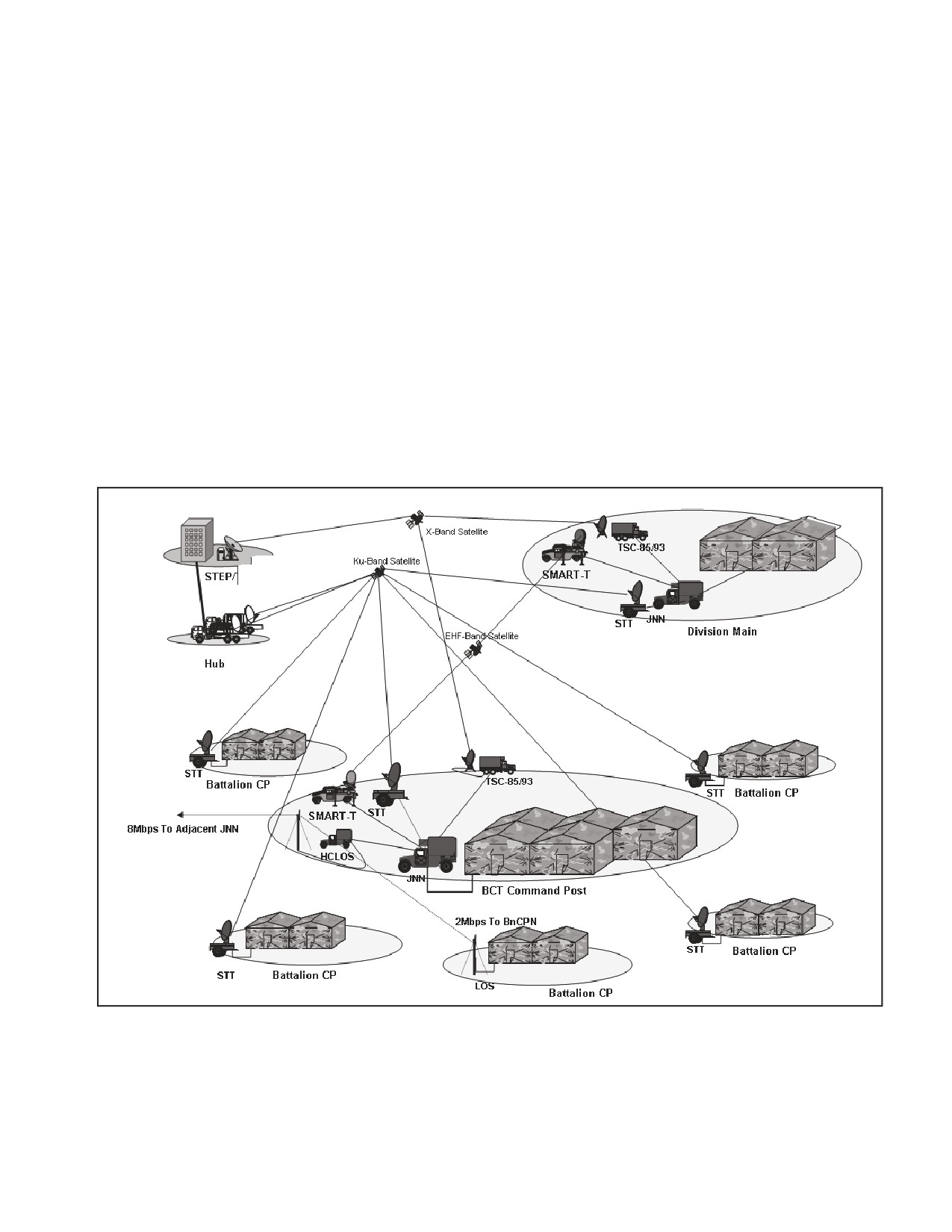
structure. Figure B-1 shows the JNN application from the division to battalion CP
level. The battalion CPN is covered in Appendix C. The configuration and settings on
the individual equipment contained within the JNN are for illustrative purposes only.
The actual configuration and settings will vary based on the unit’s mission and
policies in effect and will be in accordance with the Defense Information Systems
Agency (DISA) Security Technical Implementation Guide (STIG).
Figure B-1. JNN and BCT Deployment
5 September 2006
FMI 6-02.60
B-1
Appendix B
COMPONENTS
B-1. The JNN consists of components located in an S-250 shelter and includes routers, firewalls, servers,
transmission resource center, media converters, flexmux, Vantage, TACLANES, and COMSEC devices
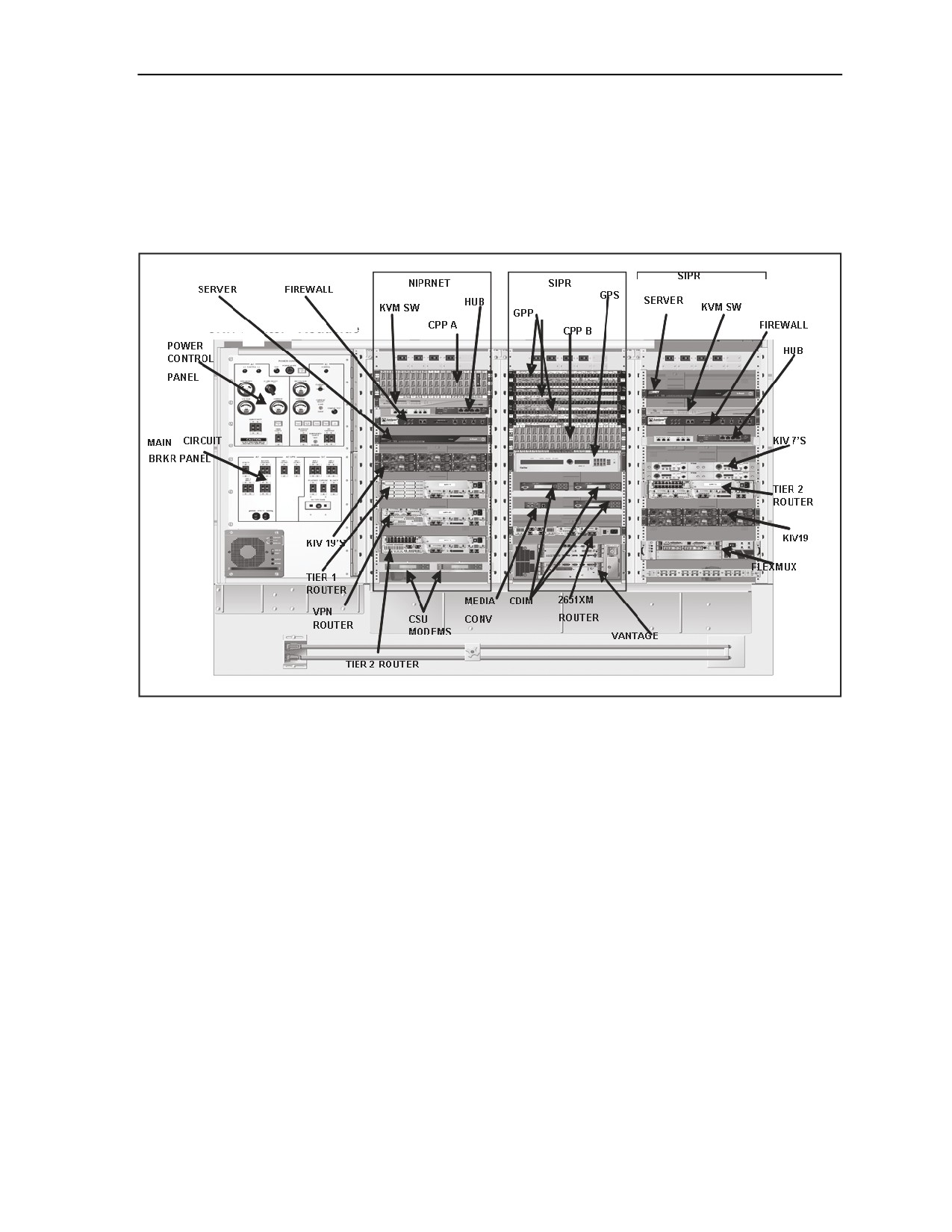
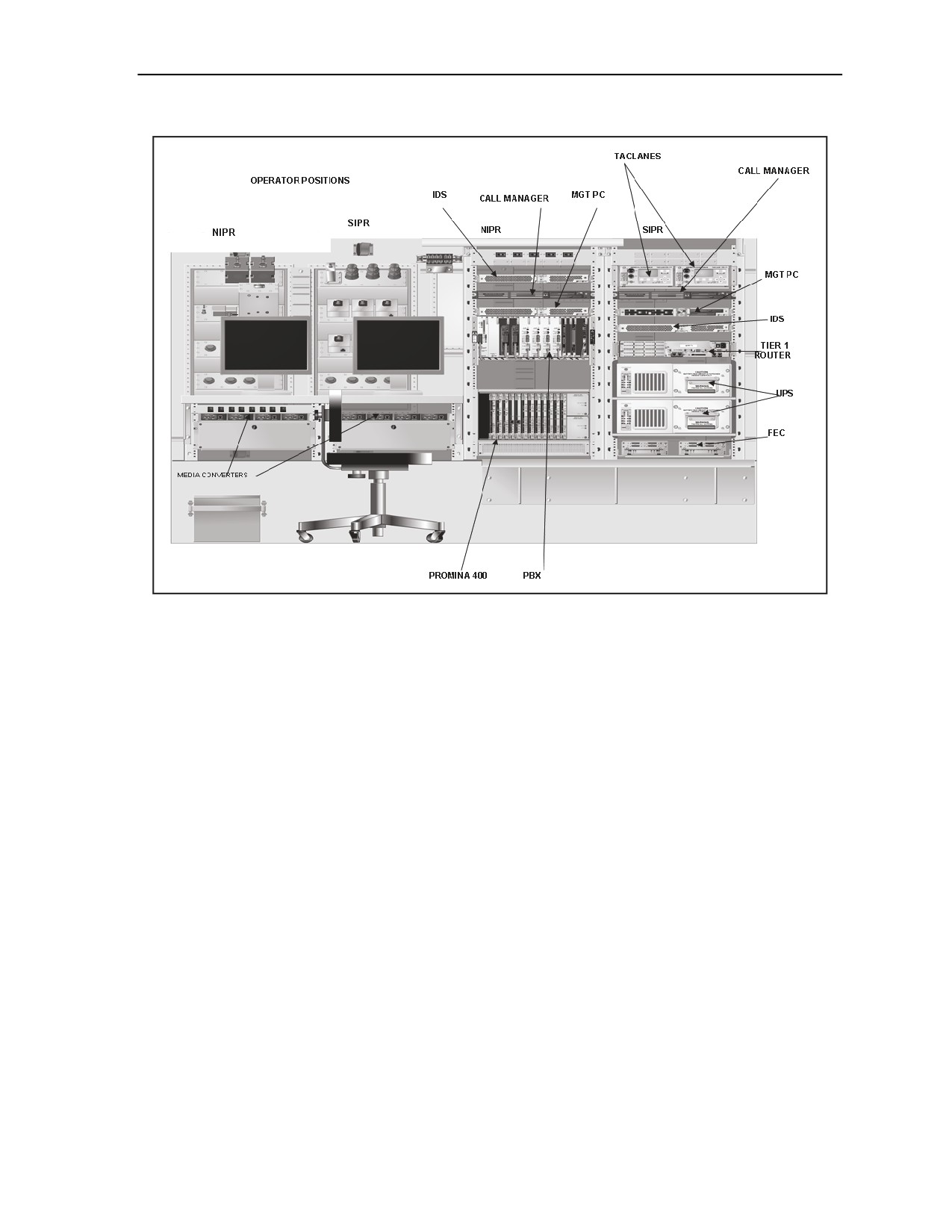
divided into NIPRNET and SIPRNET domains. Figure B-2 shows the inside roadside view, and Figure B-3
shows the inside curbside view. The following paragraphs provide a description of the shelter components
and their operating procedures.
Figure B-2. JNN Roadside View
GLOBAL POSITIONING SYSTEM (GPS)
B-2. The GPS, which includes the unit and antenna, is implemented in the JNN as a timing source. The
antenna is mounted externally on the shelter and is connected via an external SEP connection. The GPS
provides a Stratum
1 timing source with P(Y) coding for anti-spoofing. In the event of satellite
unavailability, the device has a disciplined Rubidium backup. The GPS is configurable via a console
(serial) port interface to the NIPRNET server. The GPS has eight connections to the GPP for TED Black
Station Clock Timing, one connection to the GPP for T1 timing (to the TRC) and one reference clock
appearance at the GPP. The components within the JNN are configured to draw all timing from the GPS
with a minimum amount of patching.
KVM SWITCH
B-3. The JNN has two separate domains (SIPRNET and NIPRNET) which have multiple devices that
require a keyboard, monitor, and pointing device (trackball or mouse). Shelter space availability does not
allow for multiple monitors and keyboards within the shelter. To allow each machine to have access to the
required devices, and to minimize the number of devices, a KVM switch has been included in the domain
equipment. The KVM switch allows one keyboard, monitor, and trackball to be switched between different
machines, without causing upset on the machine, as the devices are switched in and out. The KVM switch
will allow remote IP connection to access any of the processors that are connected to it. There is a separate
KVM switch for each of the domains.
B-2
FMI 6-02.60
5 September 2006
Joint Network Node Components and Connectivity
Figure B-3. JNN Curbside View
TERMINAL SERVER
B-4. For device configuration and management purposes, the NIPRNET server is required to have a serial
or console port interface to the following devices: tier 1 router, tier 2 router, firewall, TRC, CSUMs, GPS,
CDIM #1, CDIM #2, CDIM #3, NIPRNET KVM, VPN router, and the PBX. Because there is only one
serial port on the server itself, a terminal server device is employed to increase the number of interfaces that
the server can simultaneously access. The devices requiring serial or console port management connect to
serial ports on the terminal server. The terminal server in turn connects to the server directly via a console
port, and indirectly via an Ethernet connection to the tier 2 Ethernet switch module. The terminal server
allows access to the connected device’s serial ports via the Ethernet interface. There is a separate server for
the NIPRNET and SIPRNET domains.
PATCH PANELS
B-5. There are two types of patch panels in the JNN: communications patch panel (CPP) and GPP that are
used to manually reconfigure, monitor, and test circuits. The components within the JNN are configured to
be normal through and require little or no patching for typical circuits. However, some interfaces are dead-
ended at the patch panel to allow for flexibility in configurations. The patch panels will be used primarily to
test and monitor circuits.
CPP
B-6. The JNN is equipped with two CPPs (one within the NIPRNET domain and one within the SIPRNET
domain) which are used to patch multi-pin interfaces from the JNN equipment. The CPP permits normal
through connection of digital EQUIP to LINE interfaces, loopback testing of individual channels, and cross
patching for channel reassignment. Each CPP is composed of modules housed in an 18-slot chassis.
5 September 2006
FMI 6-02.60
B-3
///////////////////////////////////////