TAGS MULTI-SERVICE TACTICS, TECHNIQUES, AND PROCEDURES FOR THE THEATER AIR-GROUND SYSTEM (DECEMBER 2003) - page 2
Examples of OCI include jamming radars and corrupting data acquisition, and
transformation, storage, or transmission of an adversary’s information.
(b) Defensive counterinformation (DCI). DCI consists of those actions taken to
protect our information, information systems, and information operations from the
adversary. DCI programs, such as operations security (OPSEC), information security
(INFOSEC), and counterintelligence assess the threat and reduce friendly vulnerabilities to
an acceptable level. Improving security procedures to safeguard equipment and information
can prohibit unintentional and unwanted release of information.
3. Component Operations
Component commanders are responsible for planning long-range operations to
accomplish their assigned missions. The commander Air Force forces (COMAFFOR)
envisions assigned missions in terms of functions (for example, strategic attack,
counterland, or counterair). The COMAFFOR accomplishes the JFC assigned missions by
developing and conducting operations, often in phases, that continue until the JFC’s
desired campaign end state is achieved.
a. Approach. The air environment consists of the entire expanse above the earth’s
surface and can be exploited best when considered as an indivisible whole. Air and space
power grows from the ability to use a platform operating in or passing through the air
medium for military purposes. Air and space power can be concentrated quickly on or
above any point of the earth’s surface, providing a relative advantage over surface-based
forces.
b. Tenets of Air and Space Power. Air and space power is intrinsically different from
either land or sea power, and its employment must be guided by axioms different than
those of surface forces. The fundamental guiding truths of air and space power
employment are known as tenets. Air Force tenets of airpower include—
(1) Air and space power is flexible and versatile. Although often used
interchangeably, flexibility and versatility are distinctly different in meaning. Flexibility
means air and space forces can exploit mass and maneuver simultaneously. At the
operational level, flexibility allows air operations to shift, quickly and decisively, from one
campaign objective to another. Versatility means air and space power can be employed
equally effectively at the strategic, operational, and tactical levels of warfare. Air and space
forces have the versatility to deploy globally and responsively in support of strategic,
operational, or tactical objectives and can simultaneously achieve objectives at all three
levels of war (in parallel operations).
(2) Air, space, and information forces produce synergistic effects. The proper
application of coordinated air, space, and information forces can produce effects greater
than the individual contributions of the same forces employed separately. Through the
precise, coordinated application of the various elements of air, space, and surface force
power, disproportionate pressure can be brought to bear on enemy leaders, forcing them to
comply with our national will.
(3) Air, space, and information systems are uniquely suited to persistent operations;
they allow air and space forces to visit and revisit targets continually, nearly at will.
Because of their exceptional speed and range, air and space forces can operate from outside
the JOA and still bring forces to bear against the enemy. Space forces in particular hold
III-3
the ultimate high ground, and as space systems advance and proliferate, they offer the
potential for permanent presence over the entire globe.
(4) Air and space operations must achieve concentration of purpose. The versatility
of air and space power makes it attractive for almost every combat task. The principles of
mass and economy of force deal directly with concentrating overwhelming power at the
decisive time and place (or places). The demand for air and space forces will often exceed
the available forces and may result in attempts to fragment the integrated air and space
effort to fulfill the many demands of the operation. A vital concept of air and space forces is
its inherent ability to accomplish simultaneous strategic, operational, and tactical effects—
to conduct parallel operations—and attain overwhelming effect (concentration of purpose)
through carefully dispersed applications.
(5) Air and space operations must be prioritized. Given their flexibility and
versatility, demands for air and space forces will likely exceed availability; therefore,
establishing priorities is essential. The COMAFFOR assesses the possible uses of air forces
and their strengths and capabilities to support the overall joint campaign, air operations,
and the battle at hand. Limited resources require that air and space forces be applied
where they can make the greatest contribution to the JFC’s most critical current
requirements. Factors involved in prioritizing air and space force operations include the
principles of mass, offensive, and economy of force, the tenet of concentration, and the
airman’s strategic perspective.
(6) Air and space operations must be balanced. The inherent strategic application of
air and space forces must be balanced against their ability to conduct operations at all
levels of war, often simultaneously. Much of an air commander’s skill is reflected in
correctly and dynamically balancing the principles of war and the tenets of airpower to
bring air and space power together to produce a synergistic effect. The commander must
balance combat opportunity, necessity, effectiveness, efficiency, and the accomplishment of
JFC-assigned missions against the associated risk to friendly air and space forces.
4. Command and Control
The COMAFFOR exercises command authority as defined by the JFC. COMAFFOR
may be assigned responsibilities as a JFACC, ACA, and/or AADC (see discussion in
Chapter VI). The COMAFFOR plans, coordinates, and executes AFFOR air operations and
other assigned responsibilities through the component Theater Air Control System (TACS),
which allows the required centralized planning and control and decentralized execution
previously discussed. The AFFOR staff normally functions within the Air Force component
TACS (see Figure III-1). If another component has JFACC responsibility, the COMAFFOR
retains Service component responsibilities, which would also be accomplished through the
TACS. The TACS depicted in Figure III-1 is the backbone of the AFFOR’s contribution to
the TAGS and consists of units specifically trained and equipped to support the C2 process.
The TACS is designed to perform centralized planning and control and to facilitate
decentralized execution. The elements that form the TACS are the AFAOC, other separate
agencies, liaisons, and C2. See Figure III-1.
III-4
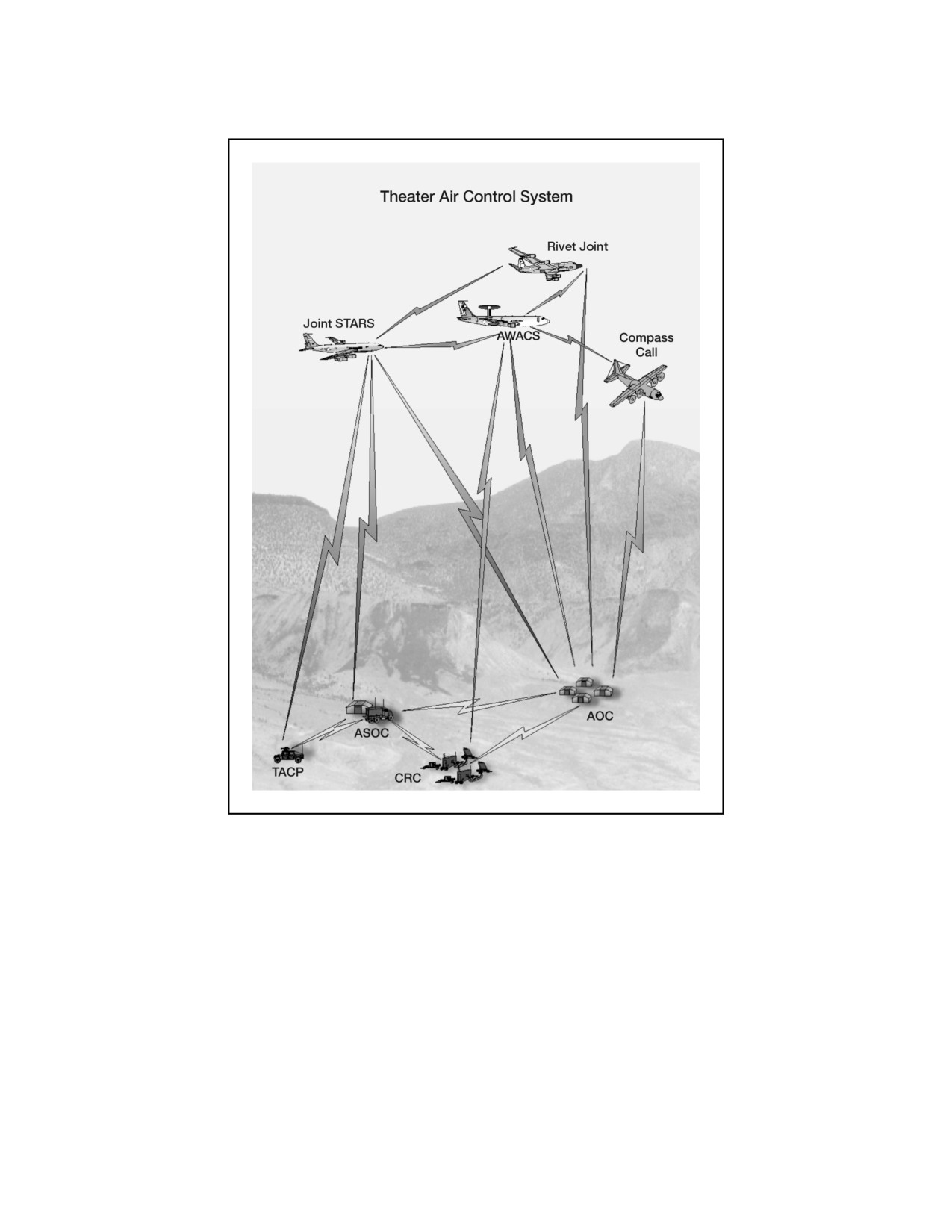
Figure III-1. TACS Coordination Links
a. Air Force Air and Space Operations Center (AFAOC). The AFAOC is the air and
space operations planning and execution focal point for the AFFOR, where centralized
planning, direction, control, and coordination of air and space operations occur. AFAOC
personnel are responsible for planning, executing, and assessing air and space operations
and directing changes, as the situation dictates. This section describes a fully functional
AFAOC that can be tailored and scaled to a specific or changing mission and to the
associated task force that the USAF presents to the JFC. Thus, the USAF would not
necessarily provide all of the elements described in the following sections if the situation
does not warrant them.
III-5
(1) Primary AFAOC Functions
(a) Develop air operations strategy and planning documents that integrate air,
space, and information operations to meet objectives and guidance.
(b) Task and execute day-to-day air operations, provide rapid reaction, positive
control, and coordinated and deconflicted weapons employment, and integrate the total air
effort.
(c) Receive, assemble, analyze, filter, and disseminate all-source intelligence
and weather information to support air operations planning, execution, and assessment.
(d) Issue ACO and coordinate airspace control activities for the ACA when the
COMAFFOR is designated ACA.
(e) Provide overall direction of air defense, including TMD, for the AADC when
the COMAFFOR is designated AADC.
(f) Plan, task, and execute theater intelligence, surveillance and
reconnaissance (ISR) missions.
(g) Conduct operational level assessment to determine mission and overall air
operations effectiveness, as required by the JFC to support the theater CA effort.
(h) Produce and disseminate an ATO and changes.
(i) Provide for the integration and support of all air mobility missions.
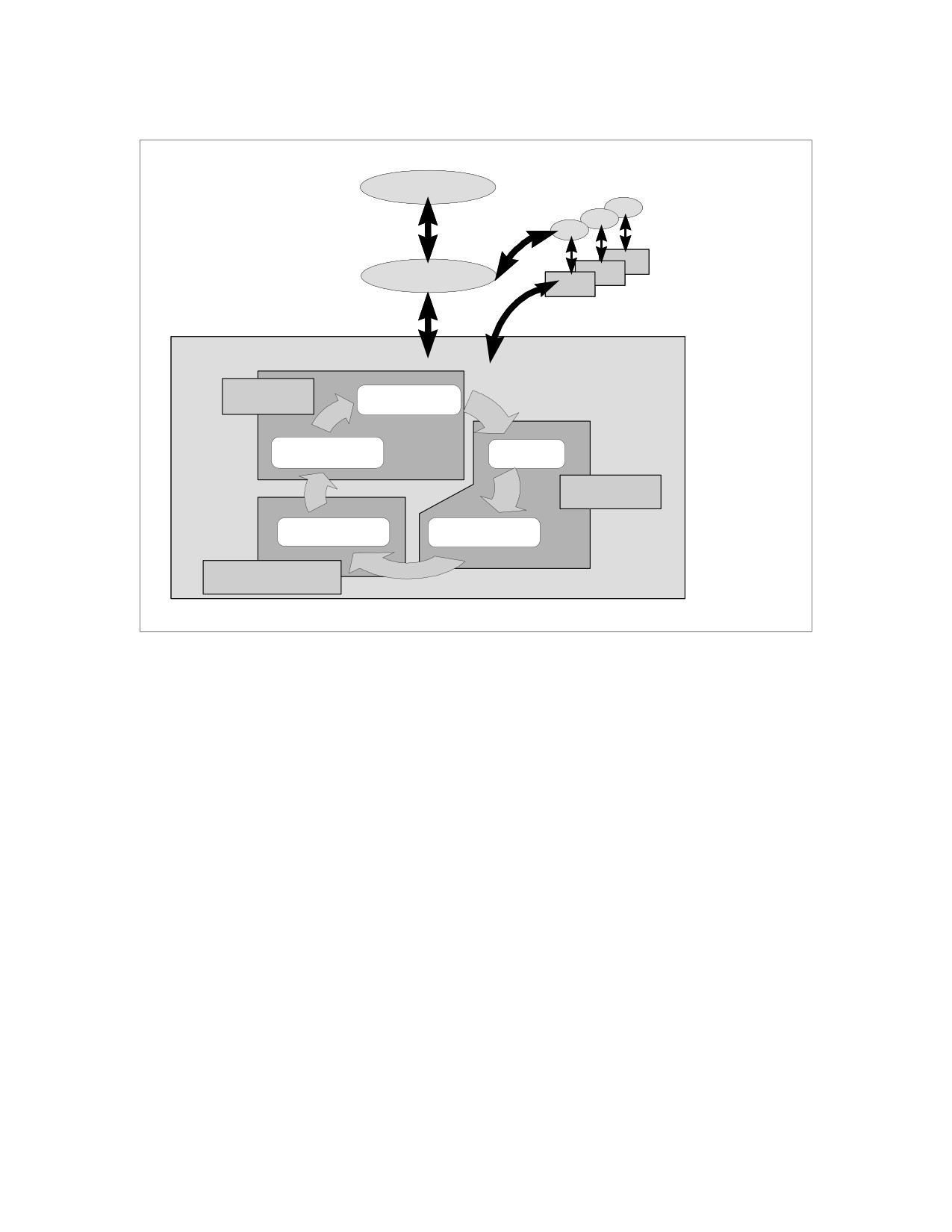
(2) Air and Space Planning and Execution Process. Fundamental to the AFAOC is
the integrated team concept. Individuals from various areas of expertise form these
integrated teams. This concept places various experts in integrated teams to accomplish
strategy development, operational level assessment, detailed planning, and ATO production
and execution functions (see Figure III-2).
III-6
JFC GUIDANCE
COMPONENT COMMANDER
& OBJECTIVES
GUIDANCE AND
OBJECTIVES
COMPONENT PLANNING
AND EXECUTION
COMAFFOR GUIDANCE
& OBJECTIVES
PROCESS
AIR OPERATIONS
CENTER
Strategy
STRATEGY
Division
DEVELOPMENT
ASSESSMENT
DETAILED
& ANALYSIS
PLANNING
Combat Plans
Division
ATO
ATO
EXECUTION
PRODUCTION
Combat Operations
Division
Figure III-2. Air and Space Planning Process
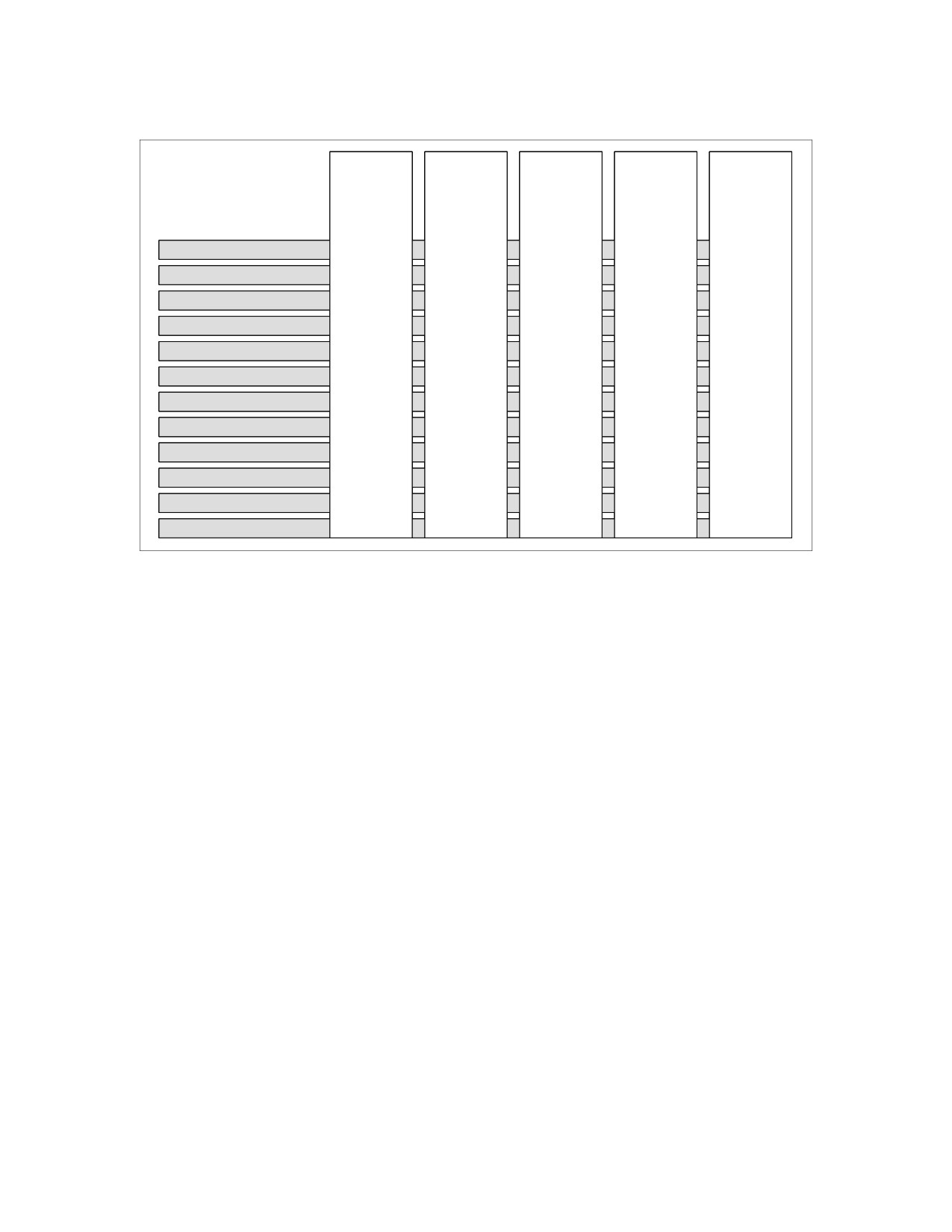
(3) AFAOC Organization. Normally an AFAOC is led by an AFAOC director and
has five divisions (strategy, combat plans, combat operations, air mobility, and ISR) with
several core teams and numerous specialty and support teams. The AFAOC team concept
represents a wide range of systems and capabilities. These teams are organized and
integrated within the AFAOC to support the COMAFFOR, and if designated, the JFACC.
The teams should be flexible, with an emphasis on integration of capabilities and the
avoidance of stovepipes. The basic structure of an AFAOC is illustrated in Figure III-3.
Specialty and support team members will move into the core teams as required.
III-7
Strategy
Combat
Combat
ISR
Air
Division
Plans
Operations
Division
Mobility
Division
Division
Division
Strategy
GAT
Offensive
Analysis
Airlift
Specialty Teams
Plans
Team
Operations
Correlation
Control
Component Liaisons
Team
Team
and Fusion
Team
MAAP
Team
Area Air Defense
Operational
Team
Defensive
Air
Information Warfare
Assessment
Operations
Targets
Refueling
Team
ATO
Team
And
Control
Logistics/Sustainment
Production
Combat
Team
Team
Assessment
Airspace Management
Team
Air Mobility
Weather
C2
Control
Planning
ISR
Team
Legal
Team
Operations
Team
Aeromedical
Rescue Coordination
Evacuation
System Administration
PED
Control
Management
Team
Air-to-Air Refueling
Team
Air
Communication Operations
Mobility
(Others as Needed)
Element
Figure III-3. AFAOC Organization
(4) AFAOC Director. The AFAOC director is charged with the effectiveness of
AFFOR air and space operations and focuses on planning, coordinating, allocating, tasking,
executing, and assessing air power operations in the AOR based on commander’s guidance
and DIRMOBFOR coordination. It is the director’s responsibility to ensure AFAOC
functions necessary to complete the air and space planning and execution process are
executed in a timely, efficient manner.
(5) Core Teams. The five divisions of the AFAOC (strategy, combat plans, combat
operations, ISR, and air mobility) provide core teams that drive the planning and execution
process.
(a) Strategy Division. The strategy division, located in the AFAOC, reports to
the AFAOC director to maintain continuity with AFAOC processes but has a strong bond
and special relationship with the COMAFFOR, and if designated, JFACC. This division
develops, refines, disseminates, and assesses the progress of the air and space strategy,
concentrating on long-range planning of air and space operations for theater activities. The
strategy division should not become mired in the detailed, day-to-day ATO production or
execution. Representatives from a range of functional areas, such as operations,
intelligence, communications, logistics, and space are full-time members of the division.
The strategy division has the following responsibilities:
• Develop the air and space estimate of the situation. The division will
normally use the JFC’s strategic appreciation to develop the estimate.
• Serve as the COMAFFOR’s focal point for overall development and
coordination of input to the joint air operations plan (JAOP) in support of the JFC’s theater
campaign.
III-8
• Develop the air and space strategy and assess its support of the theater
campaign.
• Serve as the primary liaison with the JFC planners.
• Monitor and assess the progress of the air phases and provide overall
operational level CA assessment with respect to air and space objectives.
• Develop alternative contingency plans and courses of action.
• Develop prioritized air objectives, air tasks, and measures of merit.
• Provide input to the development of an ISR plan for the JTF.
(b) The strategy division is normally comprised of two teams: strategy plans
and operational assessment. Before the start of operations, the strategy plans team
develops a proposed air and space strategy, air and space courses of action, and when the
COMAFFOR is designated JFACC, the JAOP. After the start of operations, they modify
the plan and provide guidance to the combat plans division and other AFAOC elements, as
necessary. In some cases, there will not be a requirement for daily guidance from the
strategy division. Rather, the dissemination of guidance is event driven and would
probably occur as the end of a planned phase approaches, with a change in COMAFFOR or
JFC guidance, or with a significant shift in the combat situation. The operational
assessment team assesses the progress of air and space operations at the operational or
campaign level. They assess the progress of each phase toward accomplishment of
objectives and tasks based on the approved measures of merit for each task and objective.
The information this team provides allows the the strategy plans team to address the air
and space strategy. Operational assessment addresses the overall achievement of the
desired AFFOR air and space objectives; it is not limited to battle damage assessment
(BDA).
(c) Combat Plans Division. The combat plans division is responsible for the
near-term air and space operations planning function of the AFAOC. This division develops
detailed plans for the application of air and space resources, based on approved guidance
received from the strategy division. These plans include the near-term guidance, allocation,
and tasking instructions for assigned and attached forces. This is accomplished within the
air and space planning and execution process through the preparation of ATOs. Combat
plans transmits the ATO throughout the theater for execution. Generally, combat plans
works the two ATO periods beyond the current ATO. The combat plans division has the
following responsibilities:
• Develop CA methods tied to ISR, C2 plans, and ATOs to achieve JFC
objectives.
• Determine the optimal combination of target, platform, weapon, and timing
for missions included in the ATO.
• Ensure that AFFOR air and space tasking supports the overall JTF
campaign.
• Produce and disseminate an operationally and tactically sound ATO.
• Generate SPINS and the daily ACO or ACO updates.
III-9
(d) The combat plans division is comprised of the GAT, MAAP, ATO production,
and C2 planning teams. The MAAP team uses the JFC and COMAFFOR guidance, the
authorized target list, optimal weapons selections, and asset availability to produce a time-
phased road map for operations or MAAP. The MAAP team works closely with each
component liaison and combat operations division to ensure that component concerns are
addressed and operational objectives are efficiently achieved.
(e) The ATO/ACO production team receives the ATO shell (a detailed list of
missions, forces, and timing) from the MAAP team and, with air mobility requirement's
input from the air mobility division, refines the ATO in TBMCS. In addition, they integrate
the ACO developed by the MAAP team with the ATO. The ATO/ACO production team has
the following responsibilities:
• Builds mission packages that achieve campaign objectives.
• Integrates other components’ direct support sorties into the ATO.
• Transmits the ATO/ACO to all required users when it is completed.
• Transfers responsibilities for the completed ATO/ACO to the combat
operations division.
(f) Combat Operations Division. Combat operations is responsible for
executing the current ATO. Combat operations analyzes, prioritizes, and, if necessary,
makes recommendations to redirect assets. ACA and AADC representatives, with
component LNO staffs, are part of this decisionmaking process. Combat operations has the
following responsibilities:
• Execute the current ATO through constant monitoring of air missions
under control of the TACS.
• Evaluate ISR feedback.
• Adjust the ATO, as necessary, in response to battlespace dynamics (for
example, assigned targets are no longer valid, HPTs are detected, or enemy action
threatens friendly forces).
• Coordinate emergency/immediate air support requests.
• Monitor to ensure that execution elements are adhering to ROE.
• Publish changes to the ACO.
• Provide feedback on status of the current ATO.
(g) Combat operations is normally comprised of two teams: offensive operations
and defensive operations. The offensive operations team is responsible for executing the
ATO, in accordance with commanders’ guidance and in reaction to the current battlespace
situation, for all offensive missions. The defensive operations team is responsible for
execution of the ATO, in accordance with commanders’ guidance and in reaction to the
current battlespace situation, for all defensive missions. Both teams, as part of combat
operations, monitor the battlespace and recommend changes to the ATO in response to
unforeseen opportunities and challenges.
(h) Air Mobility Division. The air mobility division plans, coordinates, tasks,
and executes the air mobility mission. The director of mobility forces (DIRMOBFOR)
provides direction to the air mobility division to execute the air mobility mission and is
III-10
responsible for integrating the total air mobility effort. The air mobility division is located
in the AFAOC. The AFAOC director ensures the air mobility division works as an effective
division of the AFAOC in the air and space planning and execution process. The air
mobility division coordinates with the JFC’s movement requirements and control authority,
the theater air mobility operations control center (AMOCC), if established, and the Air
Mobility Command (AMC) tanker/airlift control center (TACC), as required to derive
apportionment guidance, compute allocation, and collect requirements. As directed by the
DIRMOBFOR, the air mobility division tasks attached theater air mobility forces through
wing and unit CPs when those forces operate from permanent home bases or WOC if
forward deployed. Under the direction of the DIRMOBFOR, the air mobility division has
the following responsibilities:
• Integrate the flow of theater and USTRANSCOM-assigned air mobility
assets in support of JFC objectives.
• Coordinate air mobility support for mobility requirements identified and
validated by the JFC requirements and movement authority as appropriate.
• Participate in the air planning and execution process and coordinate with
the AFAOC director to ensure the air mobility mission is incorporated in the ATO.
• Identify ISR requirements in support of the air mobility mission.
• Ensure that air mobility missions are visible in the AMC standard C2
system and reflected in the ATO/ACO.
(i) The air mobility division is comprised of five elements: the air mobility
control team (AMCT), airlift control team (ALCT), air refueling control team (ARCT), air
mobility element (AME), and the aeromedical evacuation control team (AECT).
• The AMCT serves as the DIRMOBFOR’s centralized source of AMC control
and communications during mission execution. The DIRMOBFOR uses the AMCT to
direct, or redirect as required, air mobility forces in concert with other air and space forces
to respond to requirement changes, higher priorities, or immediate execution limitations.
The AMCT deconflicts all air mobility operations into, out of, and within the area of
operations. The AMCT maintains execution process and communications connectivity for
tasking, coordination, and flight following with the AFAOC combat operations division,
subordinate air mobility units, and mission forces.
• The ALCT brings intratheater airlift functional expertise from the theater
organizations to plan, coordinate, manage, and execute intratheater airlift operations in the
AOR/JOA. AMC may augment the ALCT with intratheater airlift expertise. These two
sources of airlift expertise integrate into a single ALCT within the air mobility division.
• The ARCT coordinates aerial refueling planning, tasking, and scheduling to
support combat air operations or to support intertheater airbridge within the AOR/JOA.
• The AME deploys to the theater as an extension of the AMC TACC. The
AME is requested when a DIRMOBFOR is established and AMC-assigned air mobility
aircraft are employed in support of a contingency. The DIRMOBFOR is responsible for
integrating the expertise of the intertheater air mobility planners with the expertise of the
AME. The AME provides air mobility integration and coordination of USTRANSCOM-
assigned air mobility forces. The AME receives direction from the DIRMOBFOR and is the
primary team for providing coordination with the TACC. Direct delivery intertheater air
III-11
mobility missions, if required, are coordinated through the air mobility division and tasked
by the AMC TACC. The TACC commander maintains OPCON of direct delivery missions
during execution. The AME ensures the integration of intertheater air mobility missions
with intratheater air and space operations planning.
• The AECT provides aeromedical evacuation (AE) expertise to the
DIRMOBFOR. The AECT is responsible to the DIRMOBFOR for current AE operational
planning and mission execution. The AECT analyzes patient movement requests (PMRs);
coordinates airlift to meet AE requirements; tasks the appropriate AE elements including
special medical requirements, when necessary; and passes mission information to the
patient movement requirements center (PMRC).
(j) Intelligence, Surveillance, and Reconnaissance Division. The ISR division
provides combat ISR support to planning, execution, and assessment activities and is led by
the Chief of ISR (CISR). The CISR has overall authority and responsibility for the ISR
process within the AFAOC. The CISR should typically be an officer with extensive ISR
expertise who will report to the AFAOC Director. Within the AFAOC, ISR is functionally
aligned to fully integrate sensor experts, platform experts, and intelligence experts within
the five divisions of the AFAOC. This symmetry ensures consistency of function and
general alignment of responsibilities. ISR operations require the management of
widespread supporting ISR assets (not C2 platforms) and capabilities ensuring integration
and synchronization with operations.
• Predictive Battlespace Awareness (PBA) is the framework for integrating
several independent ISR processes at the operational level of warfare. PBA consists of
several key constructs: Intelligence Preparation of the Battlespace (IPB), ISR Campaign
Planning, and ISR Management. These constructs encompass a distributed/reachback
architecture of supporting entities that are geographically separated. Many key AFAOC
ISR functions (e.g., analysis, target development, and BDA) are conducted and/or supported
by disparate entities that are widely dispersed geographically. Centralized tasking and
management, as well as distributed/reachback architecture, are required to integrate
theater, national, and distributed joint/combined ISR capabilities. Relationships governing
distributed/reachback ISR operations in support of COMAFFOR or JFACC activities are
generally under the purview of the JFC.
• Major process inputs include the component target nomination list, JFC
guidance, COMAFFOR guidance, JIPTL, joint integrated prioritized collection list (JIPCL),
joint intelligence estimate, air estimate of the situation, JAOP, AOD, ADP, ACO, IPB,
priority intelligence requirements (PIRs), no-strike target list, sensor/platform availability,
joint/master target list, and joint/master collection requirements list. Major process
outputs include the Intelligence, Surveillance, and Reconnaissance Annex (including the
current imaging day (CID) matrix and planned imaging day (PID) matrix) to the ATO
SPINS, updated IPB, and intelligence summary (INTSUM).
• ISR Division Core Teams. The ISR Division includes the following core
teams: Analysis, Correlation, and Fusion Team; Targets and Combat Assessment Team;
Collection Management Team; ISR Operations Team, and Processing, Exploitation, and
Dissemination (PED) Team. Core team personnel provide intelligence products and
services that support the entire AFAOC, joint force, and subordinate units. ISR core teams
must work closely with all AFAOC specialty/support teams such as airspace, space,
weather, and IW, fully integrating their products, services, and effects as well as
III-12
collaboratively plan ISR sensors and systems. In addition, ISR Division core personnel
provide oversight and management of COMAFFOR ISR processes internal and external to
the AFAOC to ensure that the appropriate ISR reporting, planning, tasking, and
deconfliction occurs to build a common all-source threat and targeting picture.
The ISR Division interfaces with the other divisions and teams of the AFAOC in the
following ways:
• Strategy Division (SD). The ISR Division assists in the development of the
overall strategy and integrates related ISR efforts. ISR personnel also provide target
development inputs to the guidance, acquisition, and targeting (GAT) recommendations for
the JIPTL process supporting the JFC’s JTCB. Subsequent products and intents of the SD
are forwarded to the ISR Division and other ISR entities.
• Combat Plans Division (CPD). The ISR Division provides tailored
collections planning, threat analysis, and targeting expertise necessary to develop detailed
execution plans for air operations. ISR personnel are integrated throughout the CPD to
synchronize the planned employment of all ISR capabilities and assets to support JFC
objectives across the range of military operations. The CPD provides relevant SPINS
inputs.
• Combat Operations Division (COD). The ISR Division provides current
situational awareness, targeting, and ISR management for execution of the ATO. ISR
personnel are integrated throughout the COD to synchronize the planned employment of all
ISR capabilities and assets.
• Air Mobility Division (AMD). The AMD ISR does not produce ISR
information but uses ISR information and products developed by other AFAOC ISR
elements. This information is applied to the mobility mission. The AMD also provides
guidance and direction to ISR elements subordinate to the DIRMOBFOR.
• Information Warfare. The CISR coordinates and integrates the IW Team’s
collection requirements, IPB, target development, and force application and COG analysis,
as applicable, into the larger COMAFFOR ISR process. All efforts are based on operational
objectives and support strategy development, operational planning, and execution of IW.
The CISR coordinates with the IW team to leverage intelligence support from theater and
national intelligence agencies for the IW planning effort.
(6) Specialty Teams. The specialty teams provide an AFAOC with diverse
capabilities to help orchestrate theater air power. Many of these capabilities are provided
to the AFAOC from agencies external to the AFAOC organization. It is crucial to the
success of the AFAOC that these capabilities be interwoven into the air and space planning
and execution process. The AFAOC incorporates certain functional leaders to help ensure
the best use of like assets. The specialty team leader ensures team members are used
efficiently and effectively throughout the AFAOC. The following are examples of specialty
teams:
(a) Component Liaisons. These liaisons work for their respective component
commanders and work with the COMAFFOR and staff. Each component normally provides
liaison elements (BCD, SOLE, NALE, MARLO, etc.) that work within the AFAOC. These
liaison elements consist of experienced warfare specialists who provide component planning
and tasking expertise and coordination capabilities. They help integrate and coordinate
their component’s participation in joint air operations.
III-13
(b) Area Air Defense (AAD). The COMAFFOR may also be designated as the
AADC. The AAD team integrates air defense operation of all defense systems to include all
aspects of TMD.
(c) IW. The IW team is charged with coordinating the offensive and defensive
aspects of counterinformation to include special programs and integrating IW efforts with
the JAOP. The IW team will also act as the COMAFFOR’s focal point for the integration of
AFFOR capabilities with the IW portion of the JFC’s campaign plan.
(d) Airspace Management. The COMAFFOR may also be designated as the
ACA. The airspace management team coordinates and integrates use of the airspace
control area. They help develop broad policies and procedures for airspace control and for
coordination among units within the JOA. They are key to the development and
promulgation of an ACP and the daily ACO. They must also provide the flexibility needed
within the airspace control system to meet contingency situations that necessitate rapid
employment of forces.
(e) Weather. The weather team provides climatological data for long-term
planning and reports significant weather with emphasis on target weather affecting ATO
execution.
(7) Support Teams. Support teams provide direct support to the AFAOC and to
operational echelons above and below the AFAOC (headquarters and tactical units). Team
chiefs report to the AFAOC Director and are responsible for effective integration
throughout the divisions and specialty teams. When performing their tasks, they allow the
core and specialty teams to focus on the air and space planning and execution process.
Examples of support teams are systems administration, combat reports, information
management, communications center, and supply.
b. Separate Agencies (Subordinate to the AFAOC).
(1) WOC. The WOC is a wing commander’s C2 element. It may include a CP,
command section, battlestaff, and other planning and support personnel. The WOC is
subordinate to the AFAOC and functions as the operations center for units assigned/
attached to the wing for operations. As required, the WOC can connect with the AFAOC,
CRC, and ASOC through voice and data communications. The WOC is responsible for
translating tasks and missions.
(2) Tanker Airlift Control Element (TALCE). A TALCE is a mobile organization,
responsible for providing continuous on-site management of air mobility airfield operations.
It is a temporary organization composed of various mission support elements. TALCEs
deploy to provide mission support when command and control, mission reporting, or
required mission support functions are insufficient. In addition to providing command,
control and communications capability, TALCEs provide aerial port, logistics, maintenance,
security, weather, health service support, and intelligence services, as necessary. TALCE
size is based on projected support requirements and designed to provide a capability at
austere locations. The majority of TALCE capability is sourced by AMC; however, USAFE
and PACAF have a limited TALCE capability. If a TALCE is supporting intertheater
operations exclusively, AMC/CC, through the TACC/CC, normally retains OPCON and
TACON. If a TALCE simultaneously supports both intertheater and intratheater
operations, TACON and supporting/supported relationships are determined following
III-14
coordination between component commanders. The decision to delegate TACON of
TALCEs is influenced by the presence of a suitable theater command and control capability.
(3) CRC. The CRC is a ground-based mobile element of the TACS. As an integrated
C2 weapon system, the CRC allows for flexibility in the decentralization and delegation of
battle management capability and authority. The CRC is capable of effective integration
vertically with the AFAOC and horizontally with other tactical C2 elements, ISR platforms,
and attack/support aircraft. In C2 architectures, the CRC is directly subordinate to the
AFAOC in the execution of its battlespace and data link management responsibilities. It
may be employed alone or in combination with other elements of the TACS, which may
include integration with elements of the joint theater air ground system (TAGS). The CRC
can accept delegated responsibility for planned, dynamic, functional, and/or geographic
missions and tasks. The ability of the CRC to provide mutual support to, interface with,
and complement other systems and operations, as the situation dictates, makes the CRC a
force multiplier. The CRC can provide support and enabling tasks that facilitate the full
spectrum of air power, including air tasking order (ATO) execution, airspace management,
surveillance and combat ID, data link management, and theater air defense. A CRC
consists of three effects-based operations unit-type codes (UTCs): interface coordination cell
(ICC), wide area surveillance and ID (WASID), air battle execution (ABE) and two
deployable radar (DR) UTCs. The CRC can deploy to main, limited, or bare operating bases.
The ICC, WASID, and ABE UTCs are interdependent concerning employment and cannot
be physically separated.
(4) AWACS. AWACS is an integrated Air Force command and control, surveillance,
target detection, and tracking platform. It is directly subordinate to the AFAOC and
supports decentralized execution of the ATO/ACO. AWACS is a force multiplier across the
entire spectrum of conflict and is normally one of the first battle management assets to
arrive in a theater of operations. It can detect threats and control assets below and beyond
the coverage of ground-based C2. AWACS provides an accurate and reliable real-time
battlespace picture of friendly, neutral, and hostile activity; C2 and air battle management
of theater forces; all altitude/all weather surveillance of the battlespace; and early warning
of enemy actions. It is vertically integrated with the AFAOC and may be employed alone or
horizontally integrated with C2 and ISR elements of the joint theater air ground system.
AWACS provides the theater with the ability to find, fix, track, and target airborne or
maritime threats and to detect, locate, and identify emitters. AWACS can also exchange
data with other C2 systems and shooters via TADIL-A and TADIL-J.
(5) ASOC. The ASOC plans, coordinates, and directs air support for land forces,
normally at corps level and below. It is directly subordinate to the AFAOC and is
responsible for the integration of air operations within its assigned corps sector to include
CAS, AI, intratheater airlift, ISR, SEAD, and CSAR. The ASOC can be configured for rapid
deployment. The ASOC director, normally the corps ALO, exercises OPCON of all
subordinate TACPs. The ASOC also provides some logistical and administrative support to
the TACPs under its OPCON. ASOC equipment includes satellite communications
(SATCOM), microwave radio sets, radios, and TBMCS terminals.
(6) TACP. The TACP is the principal Air Force liaison element (AFLE) collocated
with Army maneuver units from battalion through corps. The primary TACP mission is to
advise ground commanders on the capabilities and limitations of air power. The TACP
provides the primary terminal attack control of CAS in support of ground forces. TACPs
and terminal attack controllers (TACs) coordinate airspace control measures and deconflict
III-15
the aircraft with Army fire support to prevent fratricide. TACPs are directly subordinate to
the ASOC. TACPs may employ TACs at company/team level.
(a) ALO. An ALO is an aeronautically rated officer aligned with a ground
maneuver unit who functions as the primary advisor to the ground commander on the
capabilities and limitations of air power.
(b) Terminal Attack Controller (TAC). The TAC is the forward Army ground
commander’s CAS expert. TACs provide the ground commander recommendations on the
use of CAS and its integration with ground maneuver. They are members of TACPs and
perform terminal attack control of individual CAS missions. The TAC validates targets of
opportunity, advises the commander on proper employment of air assets, submits
immediate requests for CAS, controls CAS with supported commander’s approval, and
performs BDA.
(c) Forward Air Controller (Airborne) (FAC[A]). The FAC is a specifically
trained and qualified aviation officer who exercises control from the air of aircraft engaged
in CAS of ground troops. The FAC(A) is normally an airborne extension of the TACP.
(d) Tactical Air Coordinator (Airborne) (TAC[A]). Normally performed by
JSTARS, or a FAC(A) in the absence of JSTARS, the TAC(A) provides communications
relay between the TACP and attack aircraft as well as other agencies of the TACS. It also
expedites CAS aircraft-to-FAC hand-off during “heavy traffic” CAS operations. Air Force
two-ship FAC(A) flights, especially in higher threat environments, may divide
responsibilities so one aircraft fills the normal FAC(A) role while the second becomes a
TAC(A).
(7) Joint Surveillance Target Attack Radar System (JSTARS). JSTARS is an
integrated Army-Air Force theater-wide battle management and/or C2 platform that
conducts ground surveillance to develop an understanding of the enemy situation and
support attack operations and/or targeting that contribute to the delay, disruption, and
destruction of enemy forces. On-board battle managers provide direction based on wide area
surveillance ground moving target indicator and synthetic aperture radar information
developed by the JSTARS sensors. This data is also used to build a common tactical
picture. JSTARS detects and locates stationary ground targets and tracks moving ground
targets and rotating antennas; it also has a limited capability to detect, locate, and track
helicopters. JSTARS provides air and ground commanders with situation development,
targeting, attack planning, and limited post attack assessment information. Its C2 and
communications capabilities support attack operations planning. JSTARS data is also
transmitted to airborne and ground elements of the TACS capable of receiving and
processing the J-Series messages using Joint Tactical Information Distribution System
(JTIDS) Link 16 and to ground stations via the surveillance control data link (SCDL) and/or
SATCOM.
c. Air Force Liaison Element (AFLE). When the COMAFFOR is not the JFACC,
AFLEs provide interface between the COMAFFOR and the JFACC; this interface allows
coordinating and synchronizing Air Force units in support of joint air operations.
Normally, the AFLE is composed of personnel and equipment from a numbered Air Force
staff and component organizations. AFLE manning is based on a cadre concept with
personnel selected for their battle management expertise and knowledge of C2 concepts and
procedures. Additional personnel augment the cadre who are specialists in the capabilities
and tactics of the aircraft, intelligence, or weapons systems employed. The AFLE can be
III-16
tailored to perform a variety of missions and management functions to match the
contingency or operation.
d. Communications and Computers.
(1) TBMCS. TBMCS is the primary C2 tool for theater integration of air assets.
TBMCS is used to organize intelligence, build and disseminate the ATO/ACO, monitor and
control the ATO/ACO execution, track progress of the air war, and control all air activity.
TBMCS incorporates the former CTAPS, wing command and control system (WCCS), and
combat intelligence system (CIS) functionality and is interoperable with the global
command and control system (GCCS).
(2) Theater Deployable Communications (TDC). TDC provide deployed base
communications infrastructure and connectivity to the Defense Information Infrastructure
(DII) for the combat air forces. This system consists of lightweight multiband satellite
terminals (LMST) and modular communication packages. TDC augments and enhances
services provided by legacy ground mobile forces (GMF) and Tri-Service Tactical
Communications Program (TRI-TAC) systems.
(3) Global Broadcast System (GBS). GBS provides high speed, high volume one-way
information flow to units in garrison, deployed, in the field, or on the move. The GBS will
be incorporated into, but will not replace, existing military satellite communications
(MILSATCOM). It provides the capability to distribute quickly large information products
such as imagery, weather, intelligence, and ATOs.
(4) Initial Communications Packages. The major commands (MAJCOMs) use
various initial communications packages such as the wing initial communications packages
(WICP) in Air Combat Command, the mobility initial communications kit (MICK) in Air
Mobility Command, and the Pacific Air Forces (PACAF) initial communications package
(PICP). These packages include SATCOM, high frequency (HF), ultra high frequency
(UHF), very high frequency (VHF), switchboard, message distribution terminal, and land
mobile radio systems to support individual wing operations in theater.
(5) Air Force Air Request Net (AFARN). AFARN is an HF or SATCOM network
used by TACPs and the ASOC for requesting and coordinating CAS operations.
(6) Air Operations Center Communication Packages. Air operations center
communication packages are tailored to the scale and nature of the mission. These
communication packages support message switching, telephone, data communications,
SATCOM, troposcatter, and HF radio systems for theater communications.
(7) Data Links. Data Links supported in theater include TADIL-A, TADIL-B,
TADIL-C, TADIL-J, Army Tactical Data Link-1 (ATDL-1), and Ground Based Data Link
(GBDL).
(8) Tactical Air Direction (TAD) Net. TAD is a (UHF or VHF) net used by TACPs
and ASOCs for directing and controlling aircraft in air support missions.
5. Conclusion
Air Force contributions to the TAGS are threefold. First, the Air Force gains control of
the air and space environment and conducts other missions and support activities
throughout the theater for the JTF as a whole. Second, it plans, coordinates, and controls
air missions to achieve JFC assigned air operations objectives. Third, it produces C4
III-17
systems that enable the control of assets. By exchanging liaison elements with other
components, the COMAFFOR can provide a comprehensive and unified air operation.
Effective liaison is the key to planning and coordinating TAGS activities.
III-18
Chapter IV
NAVAL COMPONENT
1. Background
“Naval forces are a key component of our armed forces’ forward presence operations and
make a critical contribution during the transition from crisis to conflict. Forward-deployed
naval forces are often the critical operational linkage between peacetime operations and the
initial requirements of a developing crisis or major regional contingency.” (Forward ... from
the Sea).
a. This chapter provides a general understanding of the roles that naval forces can
accomplish in the JFC’s campaign, the doctrinal tools currently in use, and the C2 systems
used to apply naval air power to the JFC’s mission.
b. Naval forces provide strike aircraft and TLAM from surface and subsurface
platforms to attack targets. These resources are provided to the TAGS, as directed by the
JFC. Naval carriers and land-based aircraft are equipped and manned with trained
personnel to perform all types of air-to-ground missions, including CAS and AI. Ships and
aircraft that are part of the naval force are an integral part of air defense and air space
control of the joint operating area.
2. Mission
a. The mission of the Navy is to train, equip, and maintain combat-ready naval forces
capable of winning wars, deterring aggression, and maintaining freedom of the seas. The
basic function of naval forces is to promote and defend our national interests by
maintaining maritime superiority, contributing to regional stability, conducting operations
on and from the sea, seizing or defending advanced naval bases, and conducting such land
operations as may be essential to the prosecution of naval campaigns. Naval forces
accomplish these functions by conducting deterrence operations, maintaining a forward
deployed presence, and exercising a robust sealift capability.
b. Although naval presence includes a wide range of forward-deployed Navy and
Marine Corps units afloat and ashore, the basic building blocks remain the carrier battle
group (CVBG). CVBG is comprised of the carrier (CV), its embarked carrier air wing (CVW)
and surface combatants, and the amphibious ready groups (ARGs) with embarked Marine
expeditionary units—special operations capable (MEU SOC). Using the building-block
approach, US naval forces can be tailored with specific capabilities. The resulting naval
expeditionary force—conceptually built around fleet operational forces and forward-
deployed Marine air-ground task forces (MAGTFs)—can provide a highly flexible force for a
wide range of missions, including long-range strike operations and early forcible entry to
facilitate or enable the arrival of follow-on forces. The unique capabilities of naval
expeditionary forces operating from a highly mobile sea base provide the President and
Secretary of Defense freedom from political encumbrances that may inhibit or otherwise
limit the scope of land-based operations.
3. Component Operations
Naval forces can provide the theater commander a tailored expeditionary force package
from among the following: aircraft carriers and their associated air wings, submarines,
IV-1
amphibious ships with embarked Marines, surface combatants, maritime patrol aircraft,
mine warfare forces, and Navy special warfare forces (NSWF). Naval forces, including both
carrier-based air and associated amphibious land combat elements, maneuver from the sea
to dominate littoral areas. They possess the mobility and flexibility to mass strength
against an enemy that cannot defend adequately everywhere. Naval forces provide an
economy-of-force tool by forcing the enemy to be prepared to defend long coastal areas, thus
weakening the enemy at the intended focus of effort. Carrier and cruise missile firepower
can also operate independently or with other Services' air assets to provide quick
interdiction or retaliatory strike capability. Naval expeditionary forces provide the JFC
command, control, and communications; battlespace dominance; power projection; and self-
sustainability.
a. Battlespace Dominance. Battlespace dominance consists of zones of superiority
surrounding one or more units or even the entire force. Zones of superiority are used as a
base of operations from which the force protects itself and projects power. The force
maintains superiority by detecting, identifying, targeting, and neutralizing anything hostile
that enters or passes through the zones. Naval forces establish multiple zones of
superiority, as necessary for specific task forces separated from the main force. Based on
the capabilities of sensor and weapon systems, these zones can reach out for hundreds of
nautical miles. The protective zones of superiority around the naval force move with the
force and can be extended to cover entities such as convoys, amphibious groups, land-
masses, and forces moving ashore. Zones of superiority also protect those forces ashore as
they establish their own defensive zones. Theater commanders may direct naval forces to
conduct an independent mission if that force is capable of dominating the battlespace of the
region concerned. Battlespace dominance applies to both war and MOOTW.
b. Power Projection. Power projection is the use of supporting arms to apply high
intensity, concentrated offensive power at the time and location of the nation's choosing.
Supporting arms include, but are not limited to, varieties of firepower; the synergy of sea,
ground, and air operations; electronic warfare operations; deception and ruses;
psychological operations; and special warfare operations. Taking the fight to the enemy has
always been one of our nation's primary objectives in war. Even if no offensive action is
planned, naval forces can be used as a credible show of force. This can influence a potential
adversary’s actions by providing unequivocal evidence that a combat-ready force stands
poised to inflict significant damage to the nation’s infrastructure and armed forces.
c. Force Sustainment. Successful global response to contingencies depends on the
ability to project and sustain US forces in a theater of operations. Integrated support
resources in the form of fleet-based sustainment and strategic assets provide naval
expeditionary forces and joint and multinational forces the ability to operate in peacetime
and in war, wherever and whenever our national interests demand. Logistic support
provides assured delivery of the materiel required for US forces to remain on station,
combat ready, for as long as necessary.
4. Planning
a. Naval operation planning focuses on delivering the maximum impact from naval
force capabilities to achieve operational and strategic objectives in support of operational
commanders. When a JTF is established, the JFC normally assigns the senior Navy
commander as the maritime or maritime component commander. The JFC may choose to
appoint a joint force maritime component commander (JFMCC) as a functional component
IV-2
commander responsible for preparing naval operations plans and directing the actions of
subordinate commanders. Subordinate naval commanders, down to the lowest unit
commander, would then develop plans based on their own situational awareness and their
superior’s objectives. Familiarity with operational plans is essential to unit readiness,
enabling deployed naval forces to adapt quickly from a ready force to a combatant force.
b. Plans supporting the combatant commander are the basic tool for coordination of
naval actions at the operational or tactical level. Like the governing operation order, the
naval plan tests for adequacy, feasibility, and acceptability. These attributes are measured
in the context of the Navy and Marine tactics and procedures. Naval staffs are best able to
determine whether subordinate plans can accomplish the mission and be executed with
available resources. Maritime component commanders may also advise the supported
unified commander by evaluating the selected course of action. They may advise on the
acceptability of the course of action in terms of estimated costs in human and equipment
resources.
c. At the component and numbered fleet/Marine expeditionary force levels, Navy and
Marine Corps directives are similar to the directives issued by a unified commander,
Chairman of the Joint Chiefs of Staff, the Secretary of Defense, or the President. These
directives take the following forms: warning/alert/planning/execute orders, operation plans,
concept plans, functional plans, campaign plans, outline plans, and letters of instruction.
Naval forces worldwide use maritime tactical messages, a standardization of the general
operating instructions known as operational general messages (OPGEN), operational tasks
(OPTASKS), and operational status (OPSTAT) messages. These message formats are
compatible with the Joint Operation Planning and Execution System (JOPES).
(1) Navy officers in tactical command (OTC) have the ability to integrate naval units
rapidly into a synchronized battle force/battle group. The OTC requires that assigned units
and subordinate commanders understand and use the same concept of operations and
command and control practices. The delegation of warfare commander responsibilities has
been simplified through the use of standard OPTASKS. The OTC may delegate
responsibility within specific warfare disciplines to allow subordinate commanders to
operate based on stated intent. The OTC retains the ability to modify directives by using
supplemental directives or orders.
(2) The OPTASK system provides the same elements as the operation plan:
situation/mission/execution/administration/command and control necessary for centralized
planning and decentralized execution in the strategic and operational planning systems. If
the commander’s estimate of the situation requires changes to the operations order,
OPGEN, or OPTASK, a fragmentary order (FRAGO) or supplement to the OPGEN is used.
5. Command and Control
The maritime component commander exercises operational control as designated by the
JFC through the numbered fleet commanders and/or subordinate task forces. These forces
are task-organized as battle forces, task forces, task groups, task units, and task elements
composed of individual units necessary to accomplish specific operational missions. The
officer in command of any of the task organizations is designated as the OTC and has
primary responsibility for executing that force's mission. The maritime component
commander may create as many task groupings as necessary, assigning OTC
responsibilities as deemed appropriate. In doing this, the maritime component commander
IV-3
retains a critical theater-level perspective on naval operations. To facilitate execution and
combat responsibilities, the Navy uses a C2 arrangement referred to as the composite
warfare commander (CWC) concept, integrating ships, submarines, aircraft and land-based
forces.
a. CWC Concept. The Navy employs the CWC concept as the doctrinal cornerstone of
its task force operational and tactical C2 system. The CWC concept enables the OTC of a
naval force to wage combat operations aggressively against air, surface, and subsurface
threats while contributing to the overall campaign plan of the JFC. The concept is designed
to prevent an enemy from saturating a single command node with a large number of
rapidly closing air, surface, and submarine threats.
(1) Principal warfare commanders are responsible to the CWC for the conduct of the
tactical battle. Principal warfare commanders may include—
(a) Air defense commander (ADC).
(b) Surface warfare commander (SUWC).
(c) Antisubmarine warfare commander (ASWC).
(d) Strike warfare commander (STWC).
(e) Information warfare commander (IWC).
(2) Warfare commanders normally operate from the combat direction centers (CDCs)
of the ships they actually command or in spaces specially equipped to accomplish their
respective missions. All warfare commanders collect, evaluate, and disseminate tactical
information; plan and coordinate with other warfare commanders; and, when authorized by
the CWC, tactically control assigned resources and autonomously initiate action.
b. OTC. The OTC is responsible for successfully accomplishing missions assigned to
the naval force. Offensive mission objectives are of overriding importance. The OTC may
delegate planning and execution of offensive missions to a subordinate warfare commander.
In most cases, the OTC and the CWC are the same individual; however, in large forces
where overall mission direction and control demand the total attention of the OTC, tactical
command may be delegated to a separate CWC, who will wage combat operations to counter
threats against the force. The OTC/CWC—
(1) Promulgates plans and policies, orders degrees of readiness, and directs and
monitors task force operations to accomplish the objectives.
(2) Promulgates force disposition, position, and movement and establishes a force
surveillance area.
(3) Designates warfare commanders and coordinators, alternates, and sector
authorities as appropriate, and maintains the force command and coordination structure.
When assigning warfare commanders and coordinators, the CWC takes into consideration
the nature, severity, and relative priorities for dealing with the expected threat; the size,
composition, and distribution of the force; and the suitability of C2 equipment and living
and working space available in the various platforms in the force. Under certain
circumstances, the OTC/CWC may assign functional warfare commanders, such as a
maritime interceptions operations commander, mine warfare commander, screen
commander, operational deception group commander, and underway replenishment group
commander. These commanders perform duties that are generally limited in scope and
IV-4
duration. The specific duties and authority of all commanders and coordinators will be
defined in the OPGENs—formatted messages by which the OTC/CWC promulgates the
duties and responsibilities of subordinate commanders and coordinators.
(4) Specifies chain of command between OTC/CWC, the forces under their tactical
control, the principal warfare commanders, and the supporting coordinators.
(5) Provides air, surface, and subsurface units, as available, to the appropriate
warfare commanders; coordinates their respective efforts; and, when necessary, prioritizes
their requirements in light of limited assets, force mission, and current threat.
(6) Arranges for coordination of air, surface, and subsurface operations with other
friendly forces operating within or adjacent to the CWC's force.
(7) Designates sector CWCs, as required, for widely dispersed groups operating
together for mutual support.
c. Coordinators. Coordinators assist the CWC and the subordinate warfare
commanders. They differ from warfare commanders in that coordinators execute policy but
do not control forces and do not initiate autonomous actions. Pertinent coordinators
include—
(1) Air resource element coordinator (AREC)— responsible for managing and
coordinating the allocation and distribution of carrier aircraft.
(2) Naval force airspace control authority (ACA)—responsible for coordinating and
managing use of airspace by the naval force.
(3) Helicopter element coordinator (HEC)—responsible for managing naval
helicopter assets.
(4) TLAM strike coordinator (TSC)—responsible for all TLAM strike planning,
coordination, and reporting.
(5) TLAM launch area coordinator (LAC)—the TSC’s principal deputy in the
execution of TLAM strike operations.
d. Implementation. The CWC may use part of the concept or the entire concept, as
required by the situation. At-sea C2 arrangements are promulgated by the CWC in
operations general messages (OPGENs). A force's OPGEN will include instructions on
dispositions, maneuvering, ROE, emissions control policy, readiness conditions, threat
assessment, designation of warfare commanders and coordinators, and assignment of
particular responsibilities. Periodically, the OTC/CWC will issue updates. Regardless of
the amount of authority delegated, the CWC retains the option of control by command
override.
e. Responsibilities of Principal Warfare Commanders. Although all warfare
commanders have some interface with the TAGS, the primary operators are the STWC,
ADC, and the AREC. Principal warfare commanders issue OPTASK and daily intentions
messages to promulgate their intentions to the forces under their control. These messages
are addressed to all concerned forces, both the naval forces and other service component
forces performing missions for the OTC/CWC. Coordination with other service or functional
component commanders outside the naval force by the OTC/CWC and warfare commanders
is accomplished through the Navy component commander's staff.
IV-5
(1) STWC. The STWC coordinates the strike capabilities of the force with respect to
air and naval cruise missile assets and, as such, has the greatest interface with the TAGS.
Normally, the commander of the carrier air wing is appointed the STWC; in multicarrier
battle groups, one of the battle group commanders will normally be designated a STWC.
(a) The STWC appoints a strike planning team, headed by the mission
commander, for each strike mission assigned to the air wing or force. The strike planning
team does the detailed mission planning required to accomplish the strike and
accomplishes all coordination required within the carrier air wing. The strike operations
section of the AREC's (carrier commander's) staff accomplishes coordination outside of the
wing.
(b) The STWC also coordinates with the SUWC, the SOCA, and the force over-
the-horizon coordinator (FOTC), who maintains the locations of enemy forces for long-range
strikes. The SOCA will also be involved in submarine-launched cruise missile strikes
against land targets. Other service components tasked to participate in these operations
will coordinate through the STWC.
(2) ADC. The ADC is responsible to the CWC for the protection of the force against
air threats. The ADC is responsible for collecting, evaluating, and disseminating AD
surveillance information to the CWC and the force, and also plans and manages the
employment of AD resources.
(3) AREC. Normally the carrier commanding officer, the AREC, manages and
coordinates sea-based, fixed wing air assets for the CWC. The AREC ensures that the
CWC, warfare commanders, and other supporting coordinators are kept fully informed of
fixed wing air operations, aircraft availability, assignment, and aircraft mission results
when these results are not reported by the aircraft directly.
f. Other Warfare Commanders.
(1) SUWC. The SUWC is responsible to the CWC for the protection of the force
against hostile surface units. The SUWC is responsible for collecting, evaluating, and
disseminating SUW surveillance information to the CWC, the force, and planning and
managing the employment of SUW resources.
(2) IWC. The IWC is normally a member of the OTC/CWC staff who is responsible to
the OTC/CWC for providing the full spectrum of IW support. This IW support includes
maintaining secure force C2 while denying an adversary the same capability; disseminating
tactically relevant information derived from IW sources; planning and employing IW
systems and capabilities against hostile forces in coordination with other warfare
commanders; assessing the combat readiness of the force to operate throughout the EM
spectrum; and developing, coordinating, and executing integrated IW plans, utilizing all
aspects of IW.
(3) ASWC. The ASWC is responsible to the CWC for the protection of the force
against hostile submarines and is responsible for collecting, evaluating, and disseminating
ASW surveillance information to the CWC and the force. The ASWC also plans and
manages the employment of ASW resources to deny hostile sub-surface units the ability to
use or contest maritime battlespace in which friendly forces are operating or may be tasked
to operate. When ordered, the ASCW destroys or otherwise neutralizes all hostile
submarines within a specified area.
IV-6
(4) Sea Combat Commander (SCC). The duties of the SUWC and ASWC may be
combined as an SCC. The SCC is then responsible for protecting the force from both
surface and subsurface threats and for other offensive and defensive operations specified by
the OTC/CWC. The SCC is responsible for collecting, evaluating, and disseminating
SUW/ASW surveillance information to the CWC and the force. The SCC also plans and
manages the employment of SC resources.
(5) E-2C Airborne Execution Node. On the tactical side of the CWC, the E-2C
Hawkeye acts as an airborne extension of the ADC, STWC, and SUWC. The E-2C takes
tactical control of aircraft in support of each warfare commander, as required. Due to a
dynamic environment, geography, and system considerations, the E-2 may be able to
perform one mission or a combination of missions. In the joint environment, the Hawkeye
performs many of the same tasks as an AWACS, usually with a focus on a particular AOR,
rather than an entire theater. Specific joint missions include strike/fighter direction for
DCA and OCA missions, and CSAR/SAR airborne mission commander. The E-2C is also
used as an airborne battlefield command and control platform, performing similar missions
to the USAF JSTARS or USMC Direct Air Support Center (Airborne) (DASC (A)) type
aircraft. Due to a limited radio suite and a smaller crew of five officers, the Hawkeye is
typically focused on a specific area of operations within a theater for support of ground
operations.
g. Sea-Based JFACC. When a US joint force is activated, the Navy Forces (NAVFOR)
contribute substantially to the joint air operation. If a JFC designates a JFACC, the AREC
and AREC staff normally serve as NAVFOR primary points of contact with the JFACC and
JAOC on matters pertaining to air operations and planning.
(1) Command and Control (LCCs) ships provide the C4I infrastructure, connectivity,
work and support areas (such as berthing and messing) to fully support sea-based JFACC
operations. A sea-based JFACC with reachback could function similar to a land-based
JFACC.
(2) The JFACC operating on the LCC may be the numbered fleet commander or
JFACC assigned from another organization. The numbers of personnel assigned to the
JFACC staff is dependent upon the operation. The limiting factors of space and
communications do not apply as greatly to the LCC and a campaign of substantial size
(including two to three CVBGs, two ARGS, one to two USAF composite wings, and one
Marine Air Wing (MAW)) can easily be accommodated.
(3) The organization and processes associated with a sea-based JFACC do not differ
significantly from a land-based JFACC. The functions accomplished by the sea-based
JAOC are the same as a land-based JAOC; however, they are normally conducted on a
reduced scale because of staff capacity restraints.
(4) In a possible scenario, a sea-based JFACC could be designated at the outbreak of
a crisis, when the CVBG represents the preponderance of the air assets, with a small
contingent of land-based aviation assets in theater. As the situation develops and more
land-based air assets arrive in theater, the JFC may decide to transition the JFACC ashore.
This transition should be accomplished so as to minimize disruption to air operations and to
be as transparent as possible to the joint aviation assets tasked on the ATOs. As the crisis
is resolved and land-based assets leave the theater, the naval component may again be
transferred to the JFACC until the need for a JFACC no longer exists. (See Appendix C for
more information on procedures for transferring JFACC responsibilities.)
IV-7
h. Maritime Operations Support.
(1) Tactical Support Center (TSC). TSCs are located at principal P-3 deployment
sites. The TSC provides for a permanent reliable C4I support system from airbases
dedicated for MPA operations during peacetime contingencies or full mobilization. The
TSC provides the maritime component commander (MCC) with the facilities and
capabilities necessary to plan, direct, and control MPA operations in the assigned AOR.
(2) Mobile Operations Command Center (MOCC). MOCCs are located at remote
locations where P-3 and allied MPA aircraft may be deployed. The MOCC provides
command authorities, down to the air detachment level, with near-real-time continuous
information and situational awareness (via C2 communications links) concerning friendly
and opposing surface and subsurface forces and their movements, and performs supporting
targeting functions. In addition, the MOCC has an inherent capability to provide C4I
support to any theatre of action that requires rapid maritime air support. MOCCs meet the
requirements for NATO transportable air operations center (TAOC).
(3) Joint Mobile Ashore Support Terminal (JMAST). JMAST supports the
operational readiness and success of combatant commanders, JTF commanders, deployed
components, and other military commanders from forward deployed bases or operational
sites that are not equipped with C4I facilities. Commanders have automated data
processing (ADP) interfaces to appropriate communications channels. JMAST provides
JTF, Navy component, and other military commanders with the mobile ability to command,
control and communicate with assigned forces through voice, video, and data media forms
during all aspects of military operations, including joint, combined, and coalition
operations.
i.
Liaisons. The NALE represents the MCC and responds to the JAOC on matters
pertaining to Navy and Marine amphibious operations. The NALE processes NAVFOR and
Marine landing force requests for air support and monitors and interprets the maritime
battle situation for the JAOC. The NALE provides the necessary interface for the exchange
of current operational and intelligence data between components and the JAOC. The
NALE also coordinates maritime requirements for air defense, long-range interdiction, and
long-range requirements, and monitors Navy and Marine airspace and air traffic control
requirements and changes. The NALE provides feedback to the JAOC and components on
current and future joint air operations concerning integration of force requirements.
6. Amphibious Operations
a. An amphibious operation is a military operation launched from the sea by an
amphibious force embarked on ships or craft with the primary purpose of introducing a
landing force (LF) ashore to accomplish the assigned mission. Amphibious operations apply
maneuver principles to expeditionary power projection in joint and multinational
operations. The following summary is extracted from JP 3-02, Joint Doctrine for
Amphibious Operations. For more detailed information concerning amphibious operations,
refer to JP 3-02 and the Navy Warfare Publication 3-02 series.
(1) Types of Amphibious Operations. Amphibious operations include assaults,
withdrawals, demonstrations, raids, and other operations in a permissive, uncertain, or
hostile environment. An amphibious force conducts amphibious operations. An
amphibious force is defined as an amphibious task force (ATF) and a landing force (LF)
together with other forces that are trained, organized, and equipped for amphibious
IV-8
operations. Amphibious operations seek to exploit the element of surprise and capitalize on
enemy weakness by projecting and applying combat power precisely at the most
advantageous location and time. Amphibious forces provide the JFC with a balanced,
mobile force flexible enough to provide the required capability at the right time and place
with sufficient endurance to accomplish the mission.
(2) Terms. The terms “commander, amphibious task force” (CATF) and
“commander, landing force” (CLF) have been used doctrinally in the past to signify the
commanders assigned to spearhead amphibious operations. This doctrine disassociates
(from previous doctrine) any historical implications of the terms “CATF” and “CLF” from
command relations. The terms “CATF” and “CLF” do not connote titles or command
relationships. Rather, they refer to those commanders who are instrumental to the conduct
of amphibious operations in a joint environment. According to JP 0-2, Unified Action
Armed Forces (UNAAF), the establishing authority may choose from a variety of command
relationship options between the CATF, CLF, and other designated commanders involved
in amphibious operations.
(3) Purpose of Amphibious Operations. Conducted alone, or in conjunction with
other military operations, amphibious operations can be designed for the following
purposes:
(a) Achieve campaign objectives in one swift stroke by capitalizing on surprise
and simultaneous execution of supporting operations to strike directly at enemy critical
vulnerabilities and decisive points in order to defeat operational or tactical COGs.
(b) Comprise the initial phase of a campaign or major operation where the
objective is to establish a military lodgment to support subsequent phases.
(c) Serve as a supporting operation in a campaign in order to deny use of an
area or facility to the enemy, or to fix enemy forces and attention in support of other combat
operations.
(d) Support military operations other than war in order to deter war, resolve
conflict, promote peace and stability, and support civil authorities in response to domestic
crises.
(4) Types of Amphibious Operations. Amphibious operations can generally be
broken down into five major types:
(a) Amphibious Assault. The establishment of an LF on a hostile or potentially
hostile shore.
(b) Amphibious Withdrawal. The extraction of forces by sea in ships or craft
from a hostile or potentially hostile shore.
(c) Amphibious Demonstration. A show of force conducted to deceive with the
expectation of deluding the enemy into a course of action unfavorable to it.
(d) Amphibious Raid. A swift incursion into, or a temporary occupation of, an
objective, followed by a planned withdrawal.
(e) Other Amphibious Operations. The capabilities of amphibious forces may
be especially suited to conduct other types of operations, such as noncombatant evacuation
operations and foreign humanitarian assistance.
IV-9
(5) Characteristics of Amphibious Operations. Amphibious operations have four
major characteristics:
(a) Integration between the Navy and landing forces. The key characteristic of
an amphibious operation is close coordination and cooperation between the ATF, LF, and
other designated forces.
(b) Rapid buildup of combat power from the sea to shore. The salient
requirement of an amphibious assault is the necessity for swift, uninterrupted buildup of
sufficient combat power ashore from an initial zero capability to full coordinated striking
power as the attack progresses toward amphibious force objectives.
(c) Task-organized forces. Amphibious forces are task-organized based on the
mission, and are capable of multiple missions across the full range of military operations to
enable joint, allied and coalition operations.
(d) Unity of effort and operational coherence. The complexity of amphibious
operations and the vulnerability of forces engaged in amphibious operations require an
exceptional degree of unity of effort and operational coherence.
b. Command and Control of Amphibious Operations.
The command relationships established within the amphibious force are in accordance
with the concepts and principles delineated in JP 0-2. The JFC may establish unity of
command over amphibious forces by retaining operational control (OPCON) over the
Service or functional component commands executing the amphibious operation, or by
delegating OPCON or tactical control (TACON) of the amphibious force to a Service or
functional component commander. If organizing forces along Service components, the JFC
may establish a support relationship between the Navy component commander and the
Service component commander of the LF, or delegate OPCON or TACON of the assigned or
attached amphibious forces to a Service component.
Amphibious operations are normally part of a joint operation. The JFC ensures unity of
effort in achieving amphibious objectives by establishing unity of command over
amphibious forces. The JFC will organize the amphibious force in such a way as to best
accomplish the mission based on the concept of operations. If organizing the joint force
with a combination of Service and functional component commands with operational
responsibilities, the JFC may establish a support relationship between the functional
components, Service components, or other appropriate commanders, or delegate OPCON or
TACON of the assigned or attached amphibious forces to a functional component or Service
component commander.
The command relationships established among the CATF, CLF, and other designated
commanders of the amphibious force is important. Typically, a support relationship is
established between the commanders and is based on the complementary rather than
similar nature of the ATF and LF. The type of relationship chosen by the common superior
commander (or establishing authority) for the amphibious force should be based on mission,
nature, and duration of the operation, force capabilities, C2 capabilities, battlespace
assigned, and recommendations from subordinate commanders.
The commanders designated in the order initiating the amphibious operation are
coequal in planning matters and decisions. Regardless of the command relationships, when
the order initiating the amphibious operation is received, unique relationships are observed
IV-10
during the planning phase. All decisions must be reached on a basis of common
understanding of the mission, objectives, and procedures and on a free exchange of
information. Any differences between commanders that cannot be resolved are referred to
the establishing authority.
The amphibious operational area must be of sufficient size to conduct necessary sea,
land, and air operations required to execute the mission of the amphibious force.
Amphibious operations normally encompass a three-dimensional geographic area, within
which is located the amphibious objective(s). The operational areas that may be assigned to
an amphibious force in an order initiating the amphibious operation are an amphibious
objective area (AOA) or an area of operations normally in conjunction with a high density
airspace control zone (HIDACZ).
c. Air Command and Control.
During maritime operations such as amphibious operations, the ACA will normally
designate the maritime commander as the control authority for a specific airspace control
area during the conduct of the operation (JP 3-52). The complexity and size of an
amphibious operation directly affects the amount of airspace allocated.
The AADC bears overall responsibility for air defense activities of the joint force. The
regional air defense commander (RADC) is normally established within the ATF
organization and is responsible for the airspace allocated for amphibious operations,
including but not limited to the AOA (if established). The CATF will coordinate active
defense plans and procedures with the AADC and attack operations with the JFACC unless
otherwise specified in the establishing directive or the order initiating the amphibious
operation. The designated commander assigns an air warfare commander, normally on the
most capable air defense platform, to actually carry out air defense operations.
For transfer of airspace control and counterair responsibilities ashore to occur, an
appropriate agency must be established that is responsible for air operations planning, air
control, and counterair. This agency is either tactical air command center (ashore) when
the LF is Marine Corps, or an AOC with the LF is an Army task organization. It is phased
ashore as part of the LF. To facilitate an orderly transfer of control, specific control
functions may be incrementally passed as facilities ashore become operational.
d. Tenets of Amphibious Planning. The tenets of successful amphibious planning are
top-down planning, unity of effort (within the designated operational area), and an
integrated planning effort.
(1) Top-Down Planning. Planning is a fundamental responsibility of commanders.
The complexity of amphibious operations requires amphibious force commanders to drive
the planning process. Their guidance and intent are central to planning and must be
translated into a design for action by subordinates.
(2) Unity of Effort. Unity of effort in the operational area allows the CATF and CLF
to effectively focus the amphibious force on mission accomplishment. They must view their
battlespace as an indivisibile entity, for operations or events in one area may have profound
and often unintended effects on other areas and events.
(3) Integrated Planning. Integrated planning in amphibious operations has two
parts. The first part is the assembly of the amphibious force commanders and their staffs
in the same locality. When such arrangements are not practicable, the exchange or liaison
IV-11
officers qualified to perform planning functions and the use of advanced technology,
collaborative planning aids, and video teleconferencing are necessary. The second part of
integrated planning occurs across functional areas. The use of functional areas, such as
maneuver, supporting arms and fires, intelligence, C2, logistics, and force protection enable
amphibious force planners to integrate the planning effort and supervise the plan. The use
of functional areas helps the planners to consider all relevant factors and minimize
omissions.
e. Fire Support During Amphibious Operations. Fire support planning and
coordination in amphibious operations are continuous processes seeking timely and
appropriate application of force to achieve the desired effects within the operational area.
Fire support planning integrates and synchronizes the amphibious force organic fires with
non-organic supporting fires to achieve the commander’s intent. Maneuver and fires are
complementary functions. Fires in support of amphibious operations (amphibious fire
support) is the synergistic product of three subsystems: target acquisition (TA), C2, and
attack resources. TA systems and equipment perform the key tasks of target detection,
location, tracking, identification, and classification in sufficient detail to permit the
effective attack of the target. C2 systems bring all information together for collation and
decisionmaking. Vertical and horizontal coordination is essential, requiring a hierarchy of
mutually supporting fire support coordinators and agencies. Attack systems include fires
delivered from air, surface, land, and subsurface attack systems. Navy, Marine Corps,
Army, and Air Force aircraft may perform air-to-surface attack and electronic warfare
within the operational area. Land-based attack systems typically include Marine Corps
and Army artillery, mortars, rockets, missiles, and electronic warfare systems. Sea-based
attack systems include Navy guns, missiles, and electronic warfare systems. Effective fire
support depends on planning for the successful performance of the following four basic
tasks:
(1) Support forces in contact. The amphibious force provides responsive fire support
that protects and ensures freedom of maneuver to forces in contact with the enemy
throughout the operational area.
(2) Support the concept of operations. Shaping the battlespace and setting the
conditions for decisive action are successfully accomplished by achieving the commander’s
stated effects and attacking high-payoff targets to exploit critical vulnerabilities, the
destruction or neutralization of which significantly contributes to the success of the
amphibious operation by defeating the enemy’s COGs.
(3) Synchronize fire support. Fire support is synchronized through fire support
coordination, beginning with the commander’s estimate and concept of operations. Fire
support must be planned for continuously and concurrently with the development of the
scheme of maneuver.
(4) Sustain fire support operations. Fire support planners formulate realistic and
achievable fire support plans to achieve the commander’s stated effects by exploiting
logistic capabilities to overcome logistic limitations.
f. Logistics Planning During Amphibious Operations. Logistics planning for an
amphibious operation includes all facets of logistics. The amphibious force logistic systems
must be responsive, simple, flexible, economical, attainable, sustainable, and survivable.
The CATF is normally responsible for determining overall logistics requirements for the
amphibious force. Those requirements that cannot be supported from resources available
IV-12
within the ATF are directed to the applicable Service component through the chain of
command as established in the order iniiating the amphibious operation. Development of
effective logistics systems must take into account the planning considerations and factors
listed below.
(1) Orderly assembly and embarkation of personnel and materiel based on
anticipated requirements of the LF scheme of maneuver ashore.
(2) Establishment and maintenance of a logistic system in the operational area that
will ensure adequate support to all elements of the amphibious force, and subsequent
support of base development and garrison forces as directed.
(3) Impetus of logistics support from sea, or the rear, and directed forward to the
point of application at the using unit.
(4) Preservation of tactical security during logistics planning. Nonsecure logistics
planning can compromise tactical surprise and landing location.
7. Conclusion
Naval forces play a vital role in accomplishing the JFC’s campaign plan. From naval
doctrine to C2 systems, naval air power provides vital resources to the TAGS. Carrier and
land-based aircraft are equipped and trained to perform all types of air-to-ground missions,
including CAS and AI, as directed by the JFC. Naval forces also provide important
capabilities outside of naval aviation, such as firing cruise missiles from surface and
subsurface platforms in support of the JFC's mission objectives and other component
commanders. Naval command authority trains to perform joint command and control
functions such as JFACC afloat. Naval air and sea power is an important part of the
TAGS.
IV-13
Chapter V
MARINE CORPS COMPONENT
1. Background
As the landward extension of naval expeditionary forces, Marine Corps forces
(MARFOR) can project significant combat power ashore and are central to the overall
accomplishment of the littoral strategy. Their readiness, flexibility, and broad utility in
times of crisis allow MARFOR to provide globally responsive assets for contingency
missions in support of presidential or Secretary of Defense requirements. As a combined
arms force—with integrated ground, aviation and logistics capabilities and an
expeditionary focus—the Marine Corps offers a unique organization that provides the
combatant commander or JFC with a Total Force Package ready for action.
2. Mission
The MARFOR's mission is to support the JFC's campaign. Assigned tasks may
include—
a. Expeditionary warfare (landing force matters). Land operations contribute to a
naval operation, including the seizure and defense of advanced naval bases, attack of
enemy support facilities, seizure of areas blocking passage of enemy naval forces, and land-
based air operations in support of the fleet.
b. Naval political reinforcement operations up to and including intervention.
c. Naval support, amphibious or otherwise, of continental campaigns.
d. Joint and multinational operations where the MARFOR operate as part of a
joint/multinational task force, either as an inclusive element or as the principal framework.
e. Security support for certain naval bases and stations or areas.
3. Component Operations
The Marine Corps concept for conducting operations is maneuver warfare: a way of
thinking about war that shapes every action. It is a state of mind born of bold will,
intellect, initiative, and ruthless opportunism. The Marine Corps’ organization for combat
is the Marine air ground task force (MAGTF). Maneuver warfare is a warfighting
philosophy used by the MAGTF to shatter the enemy's cohesion through a series of rapid,
violent, and unexpected actions. These actions create for the enemy a turbulent, rapidly
deteriorating, and impossible situation. The MAGTF concentrates strength against enemy
vulnerabilities, striking quickly and boldly where, when, and how it will cause the greatest
harm to the enemy's warfighting ability. Because critical vulnerabilities are rarely obvious,
the MAGTF seeks to exploit every opportunity to deal a decisive blow to the enemy. When
the decisive opportunity arrives, the MAGTF exploits it fully and aggressively, committing
all its combat power. The ability and willingness to exploit opportunities generates decisive
results. Inherent in maneuver warfare is the need for relative speed to: seize the initiative,
dictate terms of combat, and keep the enemy off balance. The key to relative speed is
mobility. When combined with firepower, relative speed shocks the enemy, disrupts enemy
morale, and expedites success.
V-1
a. Firepower and Mobility. Firepower and mobility are fundamental to the
employment of military forces. They are complementary and mutually dependent.
Firepower aids mobility, causing sufficient destruction or confusion so the enemy cannot
block or oppose friendly movement. Mobility is used to position forces, including firepower
assets, to gain positional advantage against the enemy.
b. Firepower. Besides the ground combat element’s (GCEs) organic weapons systems,
aviation is the MAGTF’s greatest source of firepower. Aviation increases and complements
the MAGTF’s firepower and mobility. Aviation-delivered firepower damages, or threatens
to damage, enemy personnel, facilities, and equipment, relieving some of the burden on
ground combat units to move and carry large amounts of ordnance. With its ability to cover
distances rapidly, aviation provides the MAGTF commander with overwhelming amounts of
firepower on short notice.
c. Mobility. Mobility allows the MAGTF commander to focus firepower where it will
most likely be decisive. Mobility is tied to the use or threatened use of firepower. Aviation
provides the MAGTF tactical and operational mobility—the ability to move within an
engagement or battle and to move between engagements or battles. Aviation allows the
MAGTF to reposition forces rapidly to any location in the battlespace. With this ability, the
MAGTF can conduct tactical and operational actions at a tempo higher than that of the
enemy. This relative tempo advantage allows the MAGTF to shift quickly from one action
to another. Aviation can also provide a tempo advantage to the MAGTF by stopping or
slowing enemy movement.
d. Combined Arms. The Marine Corps organization is predicated on the combined arms
concept. Combined arms is the integration of arms in such a manner that, to counteract
one, the enemy must become more vulnerable to another. Whatever action the enemy takes
to avoid one arm opens him to another. Combined arms actions are designed so any enemy
reaction is equally disastrous.
(1) Marines can create combined arms effects using maneuver of forces, sustainment
capability, deception, EW, psychological operations, command and control warfare, and SO.
The MAGTF takes advantage of the asymmetrical and complementary characteristics of
different types of arms to gain the leverage to destroy the enemy.
(2) The Marine Corps uses combined arms at the tactical and operational levels of
war. Tactically, a commander can pin down (fix) an enemy force with direct fire weapons,
making that force vulnerable to close air support (CAS) . If the enemy force chooses to
move to escape the air attack, it risks coming under direct fire. Marines link the combined
arms effects of smaller units to produce a larger combined arms effect. For example,
operationally, the commander can use aviation to isolate an enemy force from
reinforcements or supplies. The commander can then strike the isolated enemy force,
forcing him to either fight and face irreplaceable losses or abandon the field and come
under additional aviation and artillery attack.
e. Task Organization. The Marine Corps task organizes for combat by forming
integrated, combined-arms MAGTFs, to include aviation. MAGTFs are specifically tailored
for rapid deployment by air and/or sea. The MAGTF is self-sufficient and can be tailored
based on the theater or JFC's operational requirement or task. MAGTFs are designed on a
building block concept, drawing appropriate units into an air-ground-logistics team under
one commander. The size of the MAGTF and its components varies depending on the
mission. Notional task organizations include the special purpose MAGTF (SPMAGTF),
V-2
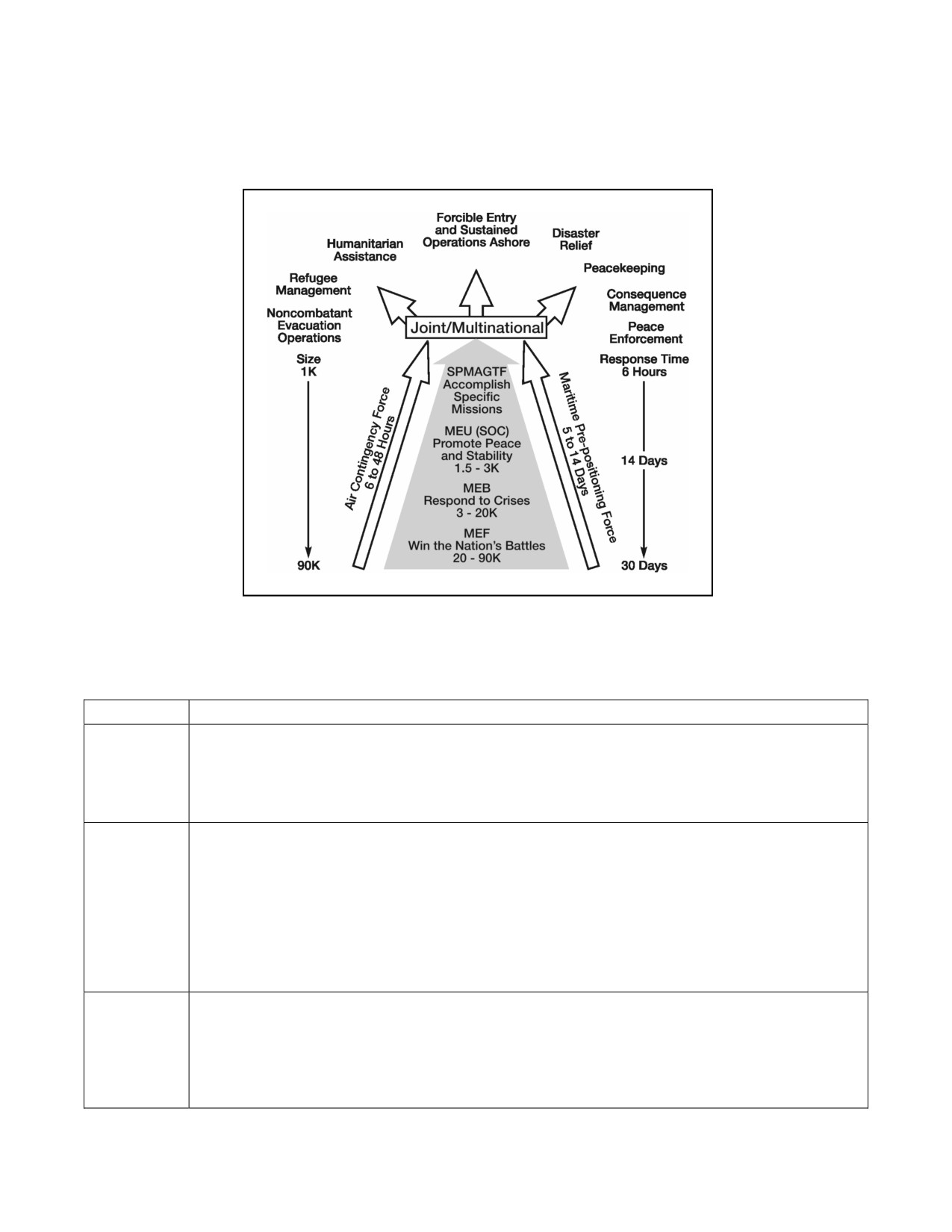
Marine expeditionary unit special operations capable (MEU(SOC)), Marine expeditionary
brigade (MEB), and Marine expeditionary force (MEF). (Figure V-1 and Table V-1).
Figure V-1. Marine Air Ground Task Forces
Table V-1. Marine Task Organization
Echelon
Description
• A Marine air-ground task force organized, trained, and equipped with narrowly focused
capabilities.
SPMAGTF
• Designed to accomplish a specific mission, often of limited scope and duration.
• May be any size, but normally a relatively small force (size of a Marine expeditionary unit or
smaller).
• The Marine expeditionary unit (special operations capable) augmented with selected
personnel and equipment, trained and equipped with an enhanced capability to conduct
amphibious operations and a variety of specialized missions of limited scope and duration.
• Capabilities include demolition, clandestine reconnaissance and surveillance, raids,
MEU(SOC)
hostage recovery, and enabling operations. The standard, forward-deployed, sea-based
expeditionary organization.
• The MEU(SOC) is not a special operations force but, when directed, may conduct limited
special operations in extremis when other forces are inappropriate or unavailable.
(JP1-02)
• An air-ground task force constructed around a reinforced infantry regiment, a composite
Marine aircraft group, and a brigade service support group.
• Commanded by a general officer and task-organized to meet the requirements of a specific
MEB
situation; may contain other service or foreign military forces assigned or attached.
• Can function alone, as part of a JTF, or as lead echelon of the Marine expeditionary force
(MEF); capable of conducting missions across the full range of military operations.
V-3
• Varies in size and composition; larger than a MEU but smaller than a MEF.
• The largest air-ground task force (MAGTF) and the Marine Corps principal warfighting
organization.
• Task-organized around a permanent command element and normally contains one or more
MEF
Marine divisions, Marine aircraft wings, and Marine force service support groups.
• Capable across the range of military operations, including amphibious assault and
sustained operations ashore in any environment. Can operate from a sea base, land base,
or both.
(1) All MAGTFs, regardless of size, have the same elements: a command element
(CE), a GCE, an aviation combat element (ACE), and a combat service support element
(CSSE). The CE is the MAGTF headquarters and is task organized to provide command
and control capabilities (including intelligence and communications) necessary for effective
planning, direction, and execution of all operations. The GCE is task organized to conduct
ground operations in support of the MAGTF mission and is formed around an infantry
organization reinforced with requisite artillery, reconnaissance, armor, and engineer forces.
The ACE is task organized to perform aviation functions, with Marine Corps aviation, as
required to support the mission. The ACE is formed around an aviation headquarters with
appropriate air control agencies, combat, combat support, and combat service support units.
The CSSE is task organized to provide the full range of combat service support functions
and capabilities necessary to support the continued readiness and sustainability of the
MAGTF as a whole.
(2) The MAGTF can provide a cohesive combined arms team capable of fulfilling
assigned missions with little or no outside support. MAGTFs present unique military
capabilities, limitations, and organizational requirements. Using maneuver warfare, the
MAGTF produces decisive results with forces of moderate size. When employed in joint
operations, the MAGTF commander advises the JFC on MAGTF employment to ensure
that its considerable and unique capabilities are maximized.
f. Marine Corps Aviation. The primary mission of Marine Corps aviation is to
participate as the MARFOR’s supporting air component. Marine aviation supports the
seizure and defense of advanced naval bases and conducts essential air operations in
support of Marine, naval, and joint land operations. As a collateral mission, Marine Corps
aviation participates as an integral component of naval aviation in the execution of other
naval functions as the fleet commanders direct.
(1) The MAGTF commander delegates air operations authority to the ACE
commander, who exercises authority through the Marine air command and control system
(MACCS) to command, coordinate, and control MAGTF air operations effectively. The
MACCS provides the ACE commander with the means to exercise centralized command
and coordination, and decentralized control, allowing operational flexibility and rapid
response to changing tactical situations.
(2) The MAGTF ACE, which fulfills expeditionary aviation requirements, is sized to
the mission and may range from a small aircraft detachment to multiple Marine Corps
aircraft wings. The ACE adds a dimension of flexibility, firepower, and mobility to the
MAGTF that it would not have otherwise. Normally, one ACE supports a MAGTF, but this
is not a permanent organization. The ACE is tailored to provide air support for the
MAGTF’s mission.
V-4
(a) The MAGTF commander, who receives advice from the ACE commander
concerning effective ACE employment, makes the final decision concerning ACE missions,
tasks, and priority of effort. Execution of the MAGTF operation relies on successful tactical
air operations.
(3) Marine Corps aviation performs the following doctrinal functions: AAW, Offense
Air Support (OAS), assault support, air reconnaissance, EW, and control of aircraft and
missiles.
(a) Antiair Warfare (AAW). The MAGTF uses AAW to destroy or reduce
enemy air and missile threats. The purpose of AAW is to gain and maintain the necessary
air superiority for the MAGTF to conduct ground and air operations without prohibitive
interference from enemy air action. AAW includes offensive operations conducted against
enemy air resources before they can be employed or assume an attacking role, and air
defense active and passive measures designed to reduce or nullify the effects of hostile air
action.
(b) Offensive Air Support (OAS). OAS isolates the battlefield, projects
firepower to shape events in time and space, and delivers firepower against enemy
installations, facilities, and personnel. OAS destroys enemy resources and isolates the
enemy's military force, allowing the MAGTF commander to influence the future battle. The
MAGTF commander uses OAS to create a dilemma for the enemy. If the enemy moves to
confront friendly forces, enemy forces are exposed to aviation assets. If the enemy cannot
move or employ forces or is unable or unwilling to sustain losses, initiative and tempo are
lost. OAS, which does not include air operations to reduce an enemy's air capability, is
categorized as either CAS or deep air support (DAS).
• CAS, which is used against hostile targets located close to friendly forces,
requires detailed integration with a friendly ground force's fire and maneuver. The
supported ground unit commander requests or approves all CAS missions in the area of
operations. CAS allows the MAGTF commander to concentrate aviation at the decisive
place and time to achieve local combat superiority and take advantage of fleeting battlefield
opportunities.
• Although DAS may require considerable coordination, it does not require
detailed integration with a friendly ground force's fire and maneuver. It does require a
complete understanding of the MAGTF commander's intent and scheme of maneuver to
shape the battlefield properly. DAS also allows the MAGTF commander to destroy,
neutralize, or delay enemy reinforcements, critical enemy functions or capabilities, and
other enemy potential before it can be brought to bear effectively against friendly forces.
DAS can attack enemy centers of gravity, enemy formations, lines of communication, and
C2 centers. DAS missions are conducted on both sides of the fire support coordination line
(FSCL).
• The two categories of DAS are air interdiction (AI) and armed
reconnaissance. AI can deny the enemy use of a particular area, route, or facility; increase
their consumption of supplies; increase their movement of troops and equipment; and apply
heavy pressure on their lines of communication. All this activity increases the enemy’s
vulnerability to air attack and provides friendly forces with lucrative targets. Armed
reconnaissance provides the MAGTF commander with an economy-of-force measure to
cover and defend terrain not suited to other forces. Armed reconnaissance identifies enemy
forces and engages them before they can threaten MAGTF forces.
V-5
(c) Assault Support. Assault support operations provide air movement of
personnel, supplies, and equipment into or within the area of operations and ensure the
rapid buildup of combat power. Assault support allows forces to bypass certain obstacles,
avoid hostile areas, maneuver over the entire battlefield, and rapidly resupply combat
forces. It requires detailed, coordinated, and concurrent planning at all levels. Categories
of assault support include combat assault transport, air delivery, aerial refueling, air
evacuation, and tactical recovery of aircraft and personnel (that is, combat rescue, air
logistical support, and battlefield illumination).
(d) Air Reconnaissance. Air reconnaissance provides the MAGTF commander
with information that can be used to influence operations. Air reconnaissance collects
multisensor imagery of areas of interest; provides and maintains surveillance of areas of
interest; provides rapid and current information on enemy composition, disposition,
activity, installations, and terrain; and supports the direction and adjustment of artillery
and naval surface fire support (NSFS).
(e) EW. EW provides timely information on the enemy, disrupts the enemy's
use of the electromagnetic spectrum, and allows the MAGTF to use the electromagnetic
spectrum despite enemy EW. EW also neutralizes enemy radars and provides the MAGTF
commander with information to update the enemy's order of battle.
(f) Control of Aircraft and Missiles. Control of aircraft (fixed-wing, rotary-
wing, and unmanned aerial vehicles (UAVs)) and missiles allows the MAGTF commander
to employ ACE assets to influence combat operations. It includes the facilities, equipment,
communications, procedures, and personnel to plan, direct, and control the ACE's effort.
Collectively, these compromise the MACCS.
4. Planning
To conduct MAGTF air operations effectively, detailed planning must take place. The
MAGTF commander and the MAGTF commander’s staff must understand the planning
required for integration of MARFOR as part of a joint or multinational force. The GCE and
CSSE commanders and staffs must fully comprehend their planning roles relative to
MAGTF air operations. The ACE commander, the ACE staff, subordinate units, and
personnel manning the MACCS must firmly grasp planning factors relative to command
and control of MAGTF air operations.
a. Amphibious Operations. Amphibious operations combine ships, aircraft, and
landing forces into a united military effort against a hostile or potentially hostile shore. It
is one of the most complex military operations. The MACCS must plan to provide the ACE
commander with the ability to command and control MAGTF air operations during all
phases of the amphibious operation. Integration of landing force aviation with the
amphibious task force and host nation airspace and air defense networks must be
considered. Chapter IV, paragraph 6 contains additional details concerning the MACCS
during amphibious operations. For further information, refer to JP 3-02 or Marine Corps
Doctrinal Publication 3.
b. Joint/Multinational Operations. During joint/multinational operations, the MAGTF
must successfully integrate with the force as a whole and with the other components. The
MACCS must conduct planning to integrate and coordinate with other service and joint
airspace control and air defense agencies and staffs to allow the ACE commander to employ
Marine aviation effectively in support of the MAGTF. An integral function of the MACCS
V-6