FM 4-02.1 COMBAT HEALTH LOGISTICS (September 2001) - page 1
FM 4-02.1
COMBAT
HEALTH
LOGISTICS
HEADQUARTERS, DEPARTMENT OF THE ARMY
DISTRIBUTION RESTRICTION: Approved for public release; distribution is unlimited.
FM 4-02.1
FIELD MANUAL
HEADQUARTERS
NO. 4-02.1
DEPARTMENT OF THE ARMY
Washington, DC, 28 September 2001
COMBAT HEALTH LOGISTICS
TABLE OF CONTENTS
Page
PREFACE
................................................................................................ iv
CHAPTER
1.
INTRODUCTION TO COMBAT HEALTH LOGISTICS
1-1.
General
1-1
1-2.
Scope of Combat Health Support Operations
1-1
1-3.
Medical Threat and Medical Intelligence
1-2
1-4.
Force Projection Considerations
1-4
1-5.
Combat Health Logistics Support
1-5
1-6.
Significance of the Medical Commodity
1-6
CHAPTER
2.
ARMY PRE-POSITIONED CLASS VIII STOCKS
2-1.
General
2-1
2-2.
Army Pre-Positioned Stocks
2-1
2-3.
Host-Nation Support
2-2
2-4.
Agreements
2-2
2-5.
Logistics Civil Augmentation Program
2-2
2-6.
United States Army Medical Department Pre-Positioned
Stock Roles and Responsibilities
2-2
CHAPTER
3.
COMBAT HEALTH LOGISTICS
Section
I.
Combat Health Logistics Support
3-1
3-1.
General
3-1
3-2.
Mission
3-1
3-3.
Theater Combat Health Logistics
3-1
Section
II.
Combat Health Logistics Support Organizations
3-3
3-4.
General
3-3
3-5.
Medical Logistics Management Center (TOE 08699A000)
3-3
3-6.
Headquarters and Headquarters Detachment, Medical
Logistics Battalion (TOE 08496A000)
3-5
3-7.
Logistics Support Company (TOE 08497A000)
3-7
3-8.
Medical Logistics Company (TOE 08488A000)
3-9
3-9.
Blood Support Detachment (TOE 08489A000)
3-11
3-10.
Medical Logistics Support Team
3-12
DISTRIBUTION RESTRICTION: Approved for public release; distribution is unlimited.
i
FM 4-02.1
Page
CHAPTER
4.
CLASS VIII SUPPLY OPERATIONS
Section
I.
The Force XXI Digitized Division
4-1
4-1.
General
4-1
4-2.
Combat Lifesaver
4-1
4-3.
Trauma Specialist
4-1
4-4.
Medical Platoon/Battalion Aid Stations
4-3
4-5.
Division Medical Companies
4-3
4-6.
Interim Brigade Combat Team
4-3
4-7.
Medical Materiel Management Branch
4-3
4-8.
Division Medical Supply Operations
4-4
4-9.
Medical Logistics Company
4-7
4-10.
Routine Requisitions of Class VIII Supplies
4-7
4-11.
Emergency Requisitions
4-7
Section
II.
The Corps
4-8
4-12.
General
4-8
4-13.
Corps Combat Health Support Logistics System
4-8
Section
III.
Echelons Above Corps
4-10
4-14.
General
4-10
4-15.
Echelons Above Corps Combat Health Support Logistics System
4-10
CHAPTER
5
MEDICAL MAINTENANCE
Section
I.
Role of Medical Equipment Maintenance
5-1
5-1.
General
5-1
5-2.
Objectives of the Army Medical Department Maintenance System
5-1
5-3.
Maintenance Factors
5-2
Section
II.
Levels of Medical Equipment Maintenance and
Responsibilities of Each Level
5-3
5-4.
General
5-3
5-5.
Unit-Level Maintenance
5-3
5-6.
Direct Support Maintenance
5-4
5-7.
General Support Maintenance
5-5
5-8.
Depot Support Maintenance
5-5
Section
III.
Medical Equipment Maintenance Support
5-6
5-9.
General
5-6
5-10.
Support to Other Services and Joint Operations
5-13
CHAPTER
6.
OPTICAL SUPPORT
6-1.
General
6-1
6-2.
Echelons I and II Optical Support
6-1
6-3.
Echelon III Optical Support
6-2
6-4.
Echelon IV Optical Support
6-2
6-5.
Contact Lenses
6-2
6-6.
Optical Equipment Sets
6-2
ii
FM 4-02.1
Page
CHAPTER
7.
BLOOD SUPPORT
7-1.
General
7-1
7-2.
Blood Components Available in the Field
7-2
7-3.
Continental United States-Based Blood Supply
7-3
7-4.
Theater Blood Supply
7-3
7-5.
Echelon Blood Support
7-4
7-6.
Blood Reporting System
7-5
CHAPTER
8.
COMMUNICATIONS
8-1.
General
8-1
8-2.
Communications Responsibilities and Systems
8-1
CHAPTER
9.
MEDICAL LOGISTICS INFORMATION SYSTEMS
9-1.
General
9-1
9-2.
Theater Army Medical Management Information System
9-3
9-3.
Medical Assemblage Management
9-3
9-4.
The Medical Maintenance System
9-4
9-5.
The Medical Supply System
9-4
9-6.
Theater Medical Information Program
9-7
9-7.
Theater Medical Information Program Operational Concept
9-9
APPENDIX
A.
LAW OF WAR OBLIGATIONS FOR MEDICAL PERSONNEL
A-1.
Law of War
A-1
A-2.
Medical Implications of Geneva Conventions
A-1
A-3.
Compliance with the Geneva Conventions
A-5
APPENDIX
B.
CLASS VIII LOGISTICS SUPPORT
B-1.
Class VIII Strategic Operations
B-1
B-2.
Customer Assistance
B-1
B-3.
Other Customer Assistance
B-6
APPENDIX
C.
MATERIEL IDENTIFICATION
C-1.
Classes of Supply (United States)
C-1
C-2.
Comparative Table
C-2
C-3.
Federal Supply Classifications (Medical)
C-3
APPENDIX
D.
STRATEGIC MOVEMENT DATA
D-1
APPENDIX
E.
COMBAT HEALTH SUPPORT LOGISTICS MANAGEMENT
IN JOINT OPERATIONS
E-1.
Logistics Functions, Support Responsibilities, and Requirements
E-1
E-2.
Responsibilities
E-1
E-3.
Single-Integrated Medial Logistics Manager
E-1
E-4.
Planning
E-2
iii
FM 4-02.1
Page
APPENDIX
F. PATIENT MOVEMENT ITEMS
F-1.
General
F-1
F-2.
Mission
F-1
F-3.
Explanation of System
F-1
F-4.
Responsibilities
F-2
F-5.
Execution
F-3
GLOSSARY
..................................................................................... Glossary-1
REFERENCES
................................................................................... References-1
INDEX
......................................................................................... Index-1
PREFACE
Combat health logistics (CHL), to include blood management, is one of the major Army Medical
Department (AMEDD) functional areas. Under the Medical Force 2000 (MF2K) concept, CHL in a theater
of operations (TO) is provided by the medical battalion, logistics (forward), the medical battalion, logistics
(rear), the theater medical materiel management center, and the medical detachment (logistics support).
These organizations were designed based upon the North Atlantic Treaty Organization (NATO) scenario
and workloads. Current MF2K CHL doctrine is articulated in Field Manual (FM) 8-10-9.
Under Force XXI and the medical reengineering initiative (MRI), theater CHL will be provided by
five new tables of organization and equipment (TOEs) organizations and a table of distribution and
allowances (TDA) element from the United States (US) Army Medical Materiel Agency (USAMMA) (see
Chapter 3). These new TOEs organizations were designed based on lessons learned from Desert Shield/
Desert Storm and recent contingency operations.
The purpose of this publication is to describe the CHL in support of a Force Projection Army into the
21st Century. It embodies doctrine based on the MRI and the A-edition TOE. The organizational
structures presented in this publication reflect those established in the A-edition TOE in effect on the date of
this publication. For a copy of your modified TOE, contact the Authorizations Documentation Directorate,
9900 Belvoir Road, Suite 120, ATTN: MOFI-FMA, Fort Belvoir, Virginia 22060-2287.
This publication is in concert with FM 8-10. Other FM 8- and FM 4-02 series publications will be
referenced in the manual. Users should be familiar with FM 3-0 and FM 100-10.
The use of the term echelon of care in this publication is synonymous with level of care and role of
care. The term echelon of care is the old NATO term. The term role of care is the new NATO and
American, British, Canadian, and Australian (ABCA) term.
iv
FM 4-02.1
In this manual, the term trauma specialist is used in place of combat medic. This change is in line with
the AMEDDs transition to the 91W military occupational specialty (MOS) which will replace MOS 91B
and 91C when new modified TOEs take effect.
The proponent of this publication is the US Army Medical Department Center and School
(AMEDDC&S). Send comments and recommendations directly to the Commander, AMEDDC&S, ATTN:
MCCS-FCD-L, 1400 E. Grayson Street, Fort Sam Houston, Texas 78234-5052.
This publication implements and/or is in consonance with the following NATO International
Standardization Agreements (STANAGs) and ABCA Quadripartite Standardization Agreements (QSTAGs):
NATO
ABCA
STANAG QSTAG
TITLE
2931
Orders for the Camouflage of the Red Cross and the Red Crescent on Land in
Tactical Operations
2939
Medical Requirements for Blood, Blood Donors, and Associated Equipment
2961
Classes of Supply of NATO Land Forces
289
Minimum Essential Characteristics of Blood Products Shipping Container
815
Blood Supply in the Area of Operations
850
Blood, Blood Donor and Transfusion Equipment Requirements
Unless this publication states otherwise, masculine nouns and pronouns do not refer exclusively to men.
Use of trade or brand names in this publication is for illustrative purposes only and does not imply
endorsement by the Department of Defense (DOD).
v
FM 4-02.1
CHAPTER 1
INTRODUCTION TO COMBAT HEALTH LOGISTICS
1-1.
General
The end of the cold war, Operations Desert Shield/Storm, Somalia, Rwanda, and Haiti have left us facing a
different enemy, different threats, and changing missions. To perform these new missions, the medical
logistician must plan for more frequent deployments of shorter duration. These deployments may be to
undeveloped theaters anywhere in the world. Therefore, the medical logistics (MEDLOG) support structure
must be prepared to support medical task-force-sized elements during deployment and immediately upon
arrival into the area of operations (AO). It must then support the medical elements until they are redeployed.
These tasks will not negate the responsibility of the medical logisticians to provide support to its continental
United States (CONUS) customers.
1-2.
Scope of Combat Health Support Operations
a. Todays Army must focus on preventing aggression through strength with a smaller force
primarily based in the CONUS. Future battlefields will be established based upon regional conflicts, most
likely in areas where there are no forward deployed US forces. Combat health support (CHS) assets of the
AMEDD must be tailorable for specific missions to support the Armys role of force projection in deterring
the threat of global war and future uncertainties.
b. Combat health support will be required to support the US Army across the full spectrum of
military operations:
Offensive operations.
Defensive operations.
Stability operations.
Support operations.
For a detailed discussion on military operations, refer to FM 3-0.
c.
The mission of the AMEDD is to maintain the health of the Army and conserve its fighting
strength. The AMEDD has responsibility for all medical services provided within the Department of the
Army (DA). The AMEDD is a functionalized, Armywide system that includes all services related to the
health of the Army and to the care and treatment of patients. These services include the following
functional areas:
Patient evacuation and medical regulating (FMs 8-10-6 and 8-10-26).
Hospitalization (FM 4-02.10).
Combat health support logistics, to include blood management.
1-1
FM 4-02.1
Dental services (FM 4-02.19).
Veterinary services (FM 8-10-18).
Preventive medicine services (FM 4-02.17).
Combat stress control (CSC) services (FM 8-51).
Area medical support (FM 4-02.24).
Command, control, communications, computers, and intelligence (C4I) (FM
8-10-16).
Medical laboratory services (FM 4-02 series or FM 8-series).
1-3.
Medical Threat and Medical Intelligence
a.
It is imperative that the medical logistician receives an updated medical threat and medical
intelligence report on the AO. The reports should be considered in planning Class VIII requirements. The
following paragraphs provide the medical threat elements and where to obtain medical intelligence.
b. The medical threat is a composite of all ongoing or potential enemy actions and environmental
conditions that may render a soldier combat ineffective. The soldiers reduced effectiveness results from
wounds, injuries, stress-induced performance deterioration, or diseases. The elements of the medical threat
include
Diseases endemic to the AO.
Environmental factors (heat, cold, humidity, and high altitude).
Battle injuries.
Biological warfare (BW) agents.
Chemical warfare (CW) agents.
Directed-energy (DE) sources.
Blast-effect munitions.
Flame and incendiary weapons.
Nuclear weapons.
Toxic industrial materiel (to include radiological, biological, and chemical).
1-2
FM 4-02.1
Combat operational stress.
Level of compliance with the Law of Land Warfare and the Geneva Conventions (see
Appendix A).
c.
Medical intelligence is the product resulting from the collection, evaluation, analysis,
integration, and interpretation of all available general health and bioscientific information. Medical
intelligence is concerned with one or more of the medical aspects of foreign nations or the AO and which is
significant to CHS or general military planning. Until medical information is processed, it is not considered
to be medical intelligence. Medical information pertaining to foreign nations is processed by the Armed
Forces Medical Intelligence Center (AFMIC). Medical threat information in AOs within the US can be
obtained from
United States Army Medical Command (MEDCOM).
United States AMEDD medical centers and activities within the immediate area.
United States Army Center for Health Promotion and Preventive Medicine (USACHPPM).
United States Civil Affairs and Psychological Operations Command.
Local public health officials.
American Public Health Association (FM 4-02.33).
Centers for Disease Control and Prevention.
World Health Organization.
d. Combat health logistics planners must acquaint themselves with the currently existing
intelligence products. These products include national-level intelligence products such as the Medical
Capabilities Studies, the AFMIC MEDIC CD-ROM, and Disease Occurrence Worldwide and access to
Intellink that is located at brigade or higher level. These reports are specifically produced to support US
military CHS operations conducted outside continental United States (OCONUS). These reports can be
obtained through operational and medical intelligence channels (such as the medical brigade/MEDCOM).
(Refer to FM 8-10-8 for specific information.)
e.
As CHS plans and operations progress, the requirements for additional medical intelligence
will occur. All such requirements should be requested through intelligence channels as soon as they are
validated; when required, coordination should be effected with local agencies.
f.
In OCONUS operations, the CHS planner must make himself aware of the medical threat
posed by the disaster (such as continued flooding, earthquakes and aftershocks, or further explosions) and
groups, factions, opponents, terrorists, or enemy forces operating within the AO. This threat also includes
the capabilities and potential use of weapons systems and munitions, such as nuclear, biological, and
1-3
FM 4-02.1
chemical (NBC) weapons, DE devices, or conventional armaments, toxic industrial material, and the
potential for terrorist attacks or incidents, including the use of CW and BW agents or radiological material
without weapons delivery systems. Combat health support planning and force survivability necessitates that
CHS units remain abreast of the complete intelligence picture.
g. Should CHS personnel gain information of potential medical intelligence value while in the
performance of their duties, they are required to report it to their Intelligence Officer (US Army) (S2) or
supporting military intelligence element.
h. For additional information on the medical threat and intelligence preparation of the battlefield,
refer to FM 8-10-8, FM 8-55, and FM 34-130.
1-4.
Force Projection Considerations
a. Force projection is the demonstrated ability to quickly alert, mobilize, deploy, and operate
anywhere in the world. Operations Just Cause and Desert Shield/Storm dramatized the ability of CHS units
to synchronize assets at all levels of war and respond rapidly to a force projection crisis.
b. The intent and purpose of force projection requires that combat service support (CSS)
commanders deploy only those forces necessary to support the task force. Combat service support
commanders and planners must tailor units to meet the task force requirements. Only personnel, equipment,
and supplies required to support the mission should be deployed.
c.
Force projection requires early critical analysis of the tactical commanders intent and the
threat. Analyses will be required at every level of logisticsstrategic, operational, and tacticaland in
stability operations and support operations. The keys are anticipation of requirements and the synchronization
of CHS services to the tactical commanders mission.
d. The development of forward logistics bases, intermediate staging bases, and lodgments in a
theater may be required. The theater may have full port facilities (air and sea), or it may require over-the-
shore or austere airflow operations. Additionally, the CHL planner must consider contract support, host-
nation support (HNS), international STANAGs, and other services (if available) as a means to augment and
assist military capabilities. This is critical during the initial phases of an operation.
e.
Besides supporting task force deployments and combat operations, the CSS planner must plan
for and execute post-conflict support. Certain CHS units should plan to be among the first into an AO and
the last to redeploy. This is primarily due to the need for CHS and Class VIII supplies before, during, and
after operations. Force projection operations will challenge CHL leaders at all levels.
f.
To anticipate requirements, the logistics planner must fully understand the commanders
intent. He must also know the location of supported units, maintain total asset visibility before and
throughout the operation, and maintain a continuous intelligence picture of the AO. Responsiveness is the
keynote of the medical materiel management system. The needs of the patient are paramount.
1-4
FM 4-02.1
1-5.
Combat Health Logistics Support
a. The office of the Deputy Chief of Staff for Logistics (DCSLOG) is the proponent office for all
Army logistics policy. The Office of The Surgeon General (OTSG) is the executive agent responsible for
development and management of CHL (Class VIII). The logistics division, MEDCOM, has primary staff
responsibility for developing policies and procedures and providing guidance in the area of medical materiel
management. The US Army Medical Research and Materiel Command (USAMRMC) and USAMMA have
the mission of implementation and management of medical materiel programs in support of Armywide CHL.
b. Combat health logistics follows the policies of Army Regulation (AR) 700-Series with
exceptions provided in AR 40-61. The policies and procedures covered in AR 40-61 are unique to medical
materiel and operations which are subject to regulations and standards of the Food and Drug Administration,
the Environmental Protection Agency, the Drug Enforcement Agency, and the Joint Commission on
Accreditation of Healthcare Organizations. Additionally, Class VIII supplies and equipment are afforded
protective status under the provisions of the Geneva Conventions (see Appendix A).
c.
Logistics support may be executed by strategic, operational, or tactical logistics systems.
These three levels of logistics support correlate to the three levels of war (FM 3-0).
(1) Strategic logistics supports the attainment of broad goals and objectives established by
the National Command Authorities in national security policies. It includes special activities under DA
control and the national inventory control points; national maintenance points; and depots, arsenals, data
banks, plants, and factories associated with the US Army Materiel Command (AMC). Strategic functions
are performed in CONUS and in the rear of the theater. See Appendix B for strategic CHL information and
points of contact for customer assistance.
(2) Operational logistics support the commanders plan in either a mature or immature
theater. Operational logistics link strategic logistics to tactical logistics on the battlefield, ensuring support
and success at the tactical level. Operational support attempts to balance the strategic planning requirements
with the needs of tactical operations in joint and combined campaigns, major operations, and other military
operations within an AO. Operational logistics are conducted by echelons above corps (EAC) and corps
and below organizations to support tactical logistics. Chapters 2 through 6 discuss CHL and CHL
organizations at the operational and tactical levels.
(3) Tactical logistics support the commanders plan at the operational level of military
operations. At this level, the essential functions of supply, maintenance, transportation, technical assistance,
human resources support (HRS), CHS, and field services are delivered to soldiers to permit them to
accomplish their mission. The medical logistician focuses on CHL to support and sustain the soldier.
d. Combat health logistics encompasses functional areas that are all tied together as a subsystem
of the multifunctional CHS system. Combat health logistics support is characterized by goals, policies,
procedures, and organizational structures and is directly related to the overall CHS system. It interfaces as
a facilitating-type subsystem responsive first and foremost to patient care and secondly to the Armys
logistical system. The functional areas include
Materiel procurement.
1-5
FM 4-02.1
Materiel management (receiving, shipping, storage, and property accounting).
Medical equipment maintenance and repair support.
Prescription optical lens fabrication.
Blood storage and distribution.
Arranging contract support.
e.
The materiel system has long recognized that certain commodities possess peculiarities or
characteristics that make them sufficiently distinctive so that they must be managed by specifically trained
personnel. Class III and Class IV are typical examples, as is medical materiel. In this regard, in their
decision of 20 July 1967, the Joint Chiefs of Staff directed that medical materiel be removed from Class III
and Class IV and be designated as a separate class of supply (Class VIII). See Appendix C for classes
of supplies.
1-6.
Significance of the Medical Commodity
a. In comparison with some commodities, the approximately 15,000 standard medical items that
comprise the management effort are a relatively insignificant number. Medical tonnage is not a significant
consideration. The significance of the medical commodity lies in the number of line items shipped.
b. Specific commodity peculiarities include
(1) Items subject to deterioration (short shelf life and dated items).
(2) Items subject to damage by freezing.
(3) Items requiring refrigeration.
(4) Items that must be frozen for preservation.
(5) Flammable and corrosive items.
(6) Items included under the Drug Abuse Control Amendment.
(7) Security items, to include alcohol, narcotics, and precious metals.
(8) Radioactive materials.
(9) Fragile items requiring special handling and packaging.
(10) Medical gases.
1-6
FM 4-02.1
c.
Considerations governing inventory management of the medical commodity include, but are
not necessarily limited to, the fact that
(1) Request for, and actual use of, Class VIII is preceded by a professional decision.
(2) Choice of substitution is extremely limited, professionally directed, and controlled and
monitored by technical specialists.
(3) Nonstandard items are an integral and significant element of the logistical management effort.
(4) Inherent to medical materiel management are the functions of medical equipment
maintenance and repair parts support, as well as optical fabrication and repair services.
(5) Strict adherence to the provisions of the Geneva Conventions precludes the storage of
medical materiel with other commodities.
d. Basic to any logistical plan are the principles of anticipated user needs and continued support.
These principles imply that the individual directing this support must have a thorough knowledge of the
system being supported, as well as an understanding of how and why the particular item being supplied is
used. Combat health logistics cannot operate on the basis of historical data alone. Many external factors
the judgment of the physician, environmental factors, and the peculiarities of the patients conditionaffect
the demands for an item. The nonavailability of certain pieces of equipment or supply items can cause an
interruption in the CHS being provided.
1-7
FM 4-02.1
CHAPTER 2
ARMY PRE-POSITIONED CLASS VIII STOCKS
2-1.
General
The CONUS support base supports the theater Army (TA). It is composed of numerous elements whose
missions are involved in supporting the US forces in the TO. These elements are commonly referred to as
wholesale logistics elements since they function as suppliers to the suppliers. They have defined lines of
command and control (C2). The President, through his Cabinet, directly controls the General Services
Administration. The Secretary of Defense directly controls the Defense Logistics Agency (DLA). The
Secretary of the Army, through the Chief of Staff, controls the AMC. The DCSLOG is the principal DA
staff officer who coordinates and manages internal/external supply, service, and maintenance operations.
The AMC is responsible for the operation of the logistical structure (less Class VIII) that supports the
operational forces of the Army and directs the activities of its depots, laboratories, arsenals, manufacturing
facilities, maintenance shops, proving grounds, test ranges, and procurement offices throughout the world.
Class VIII materiel is centrally managed by USAMMA as directed by Headquarters, DA.
2-2.
Army Pre-Positioned Stocks
a. Army pre-positioned stocks (APS), formerly known as war reserve stocks, consist of military
materiel specifically computed and acquired in peacetime to meet the increased military requirements at the
outbreak of war. It constitutes the third leg of the Armys Strategic Mobility Triad (airlift, sealift, and pre-
positioning). Army pre-positioned stocks support mobilization requirements and sustain operations until
resupply can be established and expanded. Army pre-positioned stocks include pre-positioned brigade and
unit sets, operational projects, APS sustainment, and APS for allies. The term Pre-positioned Materiel
Configured To Unit Sets is no longer used. Army pre-positioned stocks are pre-positioned afloat, in
overseas theaters, and in areas within CONUS. Policies and procedures for the management of APS are
described in ARs 710-1, 710-2, and 40-61 (Chapter 9). Class VIII requirements are programmed by USAMMA.
b. These APS are strategically located within a potential theater that can best support requirements
of the warfighting Commander in Chief (CINC). The AMC has the responsibility for APS (less Class VIII
that is managed by USAMMA). They support post D-day combat consumption until supplies arrive from
CONUS or other theater storage areas. A maximum of 10 days of supplies, or the number of days as
specified by the governing operation plan, is positioned in a theater to support the transition to war. At or
near the start of hostilities, they are released to the theater support command (TSC)/support groups where
they are stored. In a theater, the CHL planner is responsible to the theater commander for management of
pre-positioned Class VIII stocks.
c.
Army pre-positioned reserve assets are positioned in the following areas:
(1) Army Pre-Positioned Stocks-1 (CONUS), operational project stocks (OPS) and war
reserve sustainment stocks (WRSS).
(2) Army Pre-Positioned Stocks-2 (Europe), Army pre-positioned sets, OPS, and limited WRSS.
(3) Army Pre-Positioned Stocks-3 (Army pre-positioned afloat), pre-positioned sets, OPS,
and WRSS.
2-1
FM 4-02.1
(4) Army Pre-Positioned Stocks-4 (Pacific), pre-positioned sets, OPS, WRSS, and War
Reserve Stocks for Allies-Korea.
(5) Army Pre-Positioned Stocks-5 (Southwest Asia), pre-positioned sets, OPS, and WRSS.
2-3.
Host-Nation Support
Host-nation support is the civil and military assistance provided by host nations (HNs) to allied forces and
organizations. This support may occur in time of peace, transition to war, or war. The US continues to
rely on allies to supplement the organic support capabilities of the US. Host-nation support in wartime may
be used in such areas as transportation, maintenance, construction, civilian labor, communications, facilities,
utilities, air/seaport operations, rear area security, and the movement of US forces and materiel between the
ports of debarkation and combat areas. As a rule, the location of forces on the battlefield determines
whether you can use HNS. The rearmost areas are ideal for this support. Corps rear areas and EAC are
more static and lend themselves to HNS. However, in an undeveloped theater, HNS may be used wherever
needed. Army Regulation 570-9 has DA policies and responsibilities for HNS. In the past, US forces
relied on organic support. Today, logisticians must keep abreast of agreements on how their allies can help
support the battle logistically.
2-4.
Agreements
International agreements document commitments for HNS. Through agreements, the HN sets forth its
intent and willingness to support US requirements. For example: Will HN civilians remain at APS sites
after hostilities begin? Is the HN to retain territorial responsibility and control of supply ports, rail
facilities, and airspace? It may be that the HN will turn over control of main supply routes to another nation
or alliance. Host-nation transport could be used to move supplies from seaports to US support organizations
and beyond. Support available in a given theater will depend on the HNs political climate; national laws;
industrial development; and military, civilian, and commercial resources.
2-5.
Logistics Civil Augmentation Program
In the event HNS in wartime is incapable of satisfying all support requirements, the logistics civil
augmentation program (LOGCAP) will be initiated to fill the shortfalls. The LOGCAP is a program
designed to obtain civilian contractual assistance in peace to meet US crisis and wartime support requirements
worldwide through the advanced identification, planned acquisition, and use of global corporate assets.
2-6.
United States Army Medical Department Pre-Positioned Stock Roles and Responsibilities
a. The Surgeon General/Commander, Medical Command. The OTSG has Army staff
responsibility for assisting the Secretary of the Army and the Chief of Staff, Army in discharging Title 10
responsibility for health services for the Army and other agencies and organizations entitled to military
2-2
FM 4-02.1
health services. Inclusive is the executive agent responsibility for the Class VIII portion of non-AMEDD-
managed APS logistics programs.
b. The United States Army Medical Materiel Agency. The USAMMA, as a subordinate activity
of USAMRMC, was designated by the OTSG as the executive agent for Class VIII materiel and manager of
the Class VIII portion of the APS and OTSG contingency programs. The USAMMA provides total item
property records for Class VIII as the program manager and ensures coordinated and central materiel
requirements determination, acquisition, accountability, and funding of care of supplies in storage and other
support costs. The USAMMA provides an annual update of the APS programs in Supply Bulletin 8-75-
series and OTSG Contingencies.
c.
Release Authority. Release authority for medical APS materiel to designated units/major
theaters of war can be granted to USAMMA as directed by the Chairman, Joint Chiefs of Staff, Army per
AR 710-1. Release of medical APS materiel that includes medical chemical defense materiel (MCDM),
Reserve Component hospital decrement, and potency and dated (P&D) materiel in support of small-scale
contingencies will be approved through the OTSG.
2-3
FM 4-02.1
CHAPTER 3
COMBAT HEALTH LOGISTICS
Section I. COMBAT HEALTH LOGISTICS SUPPORT
3-1.
General
This section provides an introduction to theater CHL. It provides the overall CHL mission and lists the
medical organizations to logistically support the conduct of operations under Force XXI. Recent operations
in the Mideast, Somalia, Bosnia, Kosovo, and elsewhere have demonstrated the Armys capability to deploy
when required. These operations emphasized a logistical system that must be responsive and capable as the
forces it supports. Medical materiel must be delivered to the right unit at the right time in the requested
amounts in an expeditious manner, especially considering the perishable nature of the recipient (the wounded
or ill soldier) and the types of supplies involved.
3-2.
Mission
The CHL mission is to provide
Class VIII supplies and equipment (medical materiel, to include medical-peculiar repair parts).
Optical fabrication and repair.
Medical equipment maintenance and repair.
A single-integrated medical logistics manager (SIMLM) for joint operations.
Blood management for Army, joint, or combined operations.
Arrangement for contract support.
Patient movement items (PMIs).
3-3.
Theater Combat Health Logistics
a. Theater CHL encompasses the planning and execution of medical supply operations, medical
equipment maintenance, optical fabrication and repair, contracting services, medical hazardous waste
management and disposal, production and distribution of medical gases, and blood banking services for
Army, Joint Service, and combined and interagency operations under the technical guidance of the
appropriate command surgeon. Combat health logistics is anticipatory with select units capable of operating
in a split-based or dual-based mode. See Joint Publication 4-02.1 for CHL considerations in joint operations.
b. During initial deployment, units will rely on authorized basic loads in medical sets, kits, and
outfits, prescribed load lists (PLLs), and unit deployment packages. Initial resupply of Class VIII P&D
materiel will be provided for high priority echelons above division (EAD) units via initial resupply package
3-1
FM 4-02.1
managed by USAMMA through day D+31. The resupply package must be built utilizing contractual
resources. Resupply of non-P&D consumable materiel and all consumables beyond day D+31 for other
units and selected EAD will be provided by the MEDLOG battalion deployed to the AO. Upon DA
approval to use APS, MEDLOG battalions will roll over USAMMA-managed APS in the AO into their
operational levels and utilize this stock to support customer requisitions until MEDLOG units establish
sustainment channels.
c.
Commanders prioritize the mix of forces based on the time-phased force and deployment data
to get them into theater where and when required. Active and continuous command involvement in all
stages of force projection, coupled with detailed reversed planning, combine to ensure the right forces with
the right support are available and ready to conduct operations. See Appendix D for strategic movement
data for TOE MEDLOG organizations.
d. The theater CHL consists of the following organizations:
Medical Logistics Management Center (MLMC).
Headquarters and headquarters detachment (HHD), MEDLOG battalion.
Logistics support company.
Medical logistics company.
Blood support detachment (BSD).
Medical logistics support team (MLST) (USAMMA asset).
e.
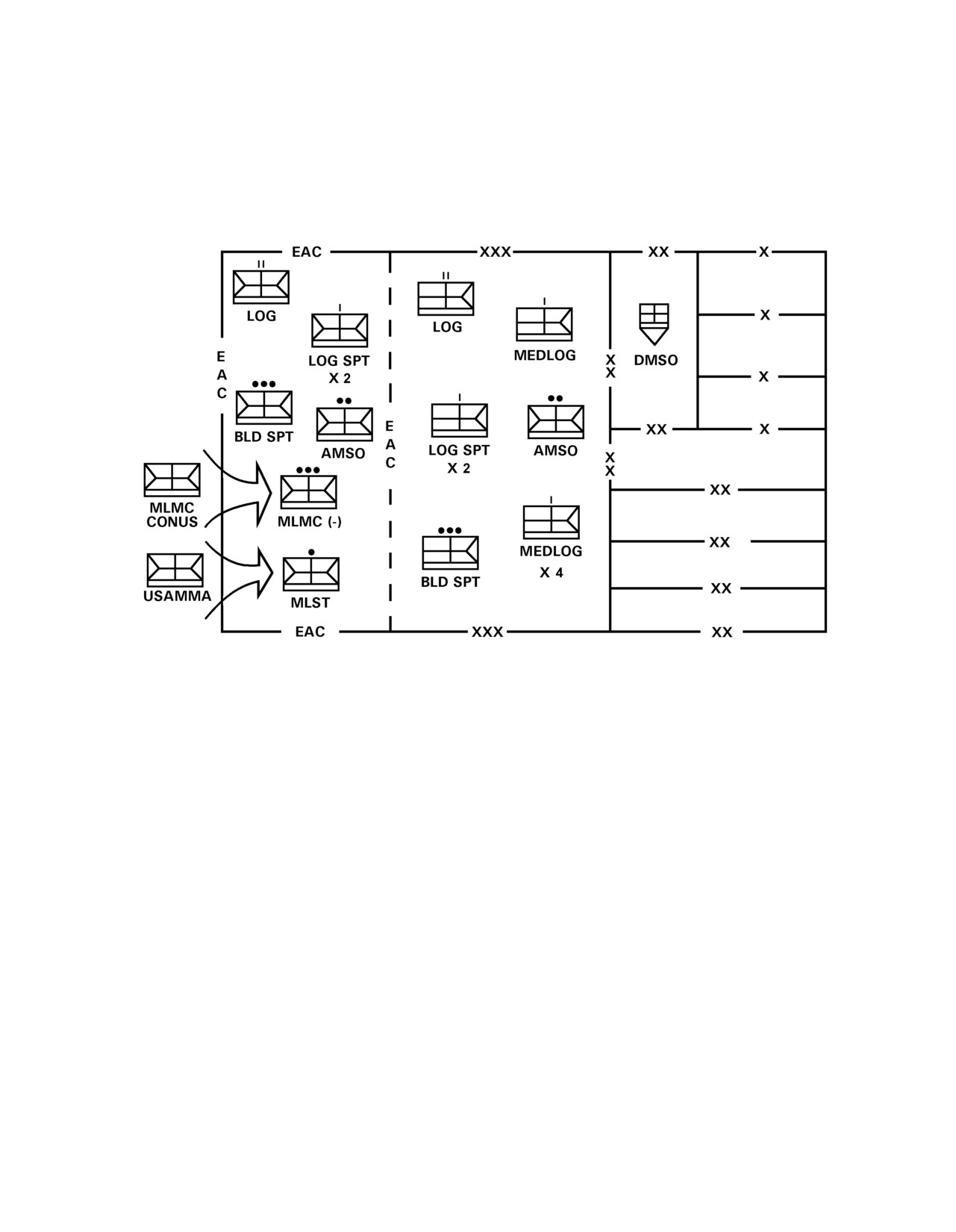
Figure 3-1 shows the connectivity of the CONUS-based AMEDD logistics organizations and
the MEDLOG organizations in support of a TO. The organizations are discussed in Section II of this
chapter. The division medical supply office (DMSO) will not be an organizational element of the Force
XXI division. The DMSO is shown in Figure 3-1 to reflect divisional MEDLOG support. The DMSO
will be removed from all Force XXI heavy divisions when the MEDLOG automation systems are mature.
Until then all requests, except blood, will continue to go to the DMSO. Requisitions that cannot be filled
by the DMSO, including blood, will be passed to the MEDLOG company (corps forward area). Once the
DMSO goes away, all requests from the brigade support area (BSA) or division support area (DSA) will go
directly to the MEDLOG company (corps forward area). The medical laboratory specialist at the
forward support medical company (FSMC) will requisition blood for both the FSMC and the forward
surgical team (FST) from the forward cell of the BSD collocated with the MEDLOG company. Also in
Force XXI, the FSMC will become a formal supply point and provide resupply for the maneuver battalions.
Those requests that the FSMC cannot fill will be forwarded to the MEDLOG company (corps forward
area). The purpose of the Medical Materiel Management Branch (MMMB) in the division support command
(DISCOM) is twofold. The MMMB monitors the Class VIII status within the division and prioritizes or
redirects supplies if it becomes tactically necessary to do so. The MMMB coordinates for transportation
assets for throughput distribution of Class VIII via the battlefield distribution system.
3-2
FM 4-02.1
Figure 3-1. Combat health logistics support.
Section II. COMBAT HEALTH LOGISTICS SUPPORT ORGANIZATIONS
3-4.
General
This section discusses the theaters CHL organizations and their organic elements. It discusses their
assignment, capabilities, and concept of operations.
3-5.
Medical Logistics Management Center (TOE 08699A000)
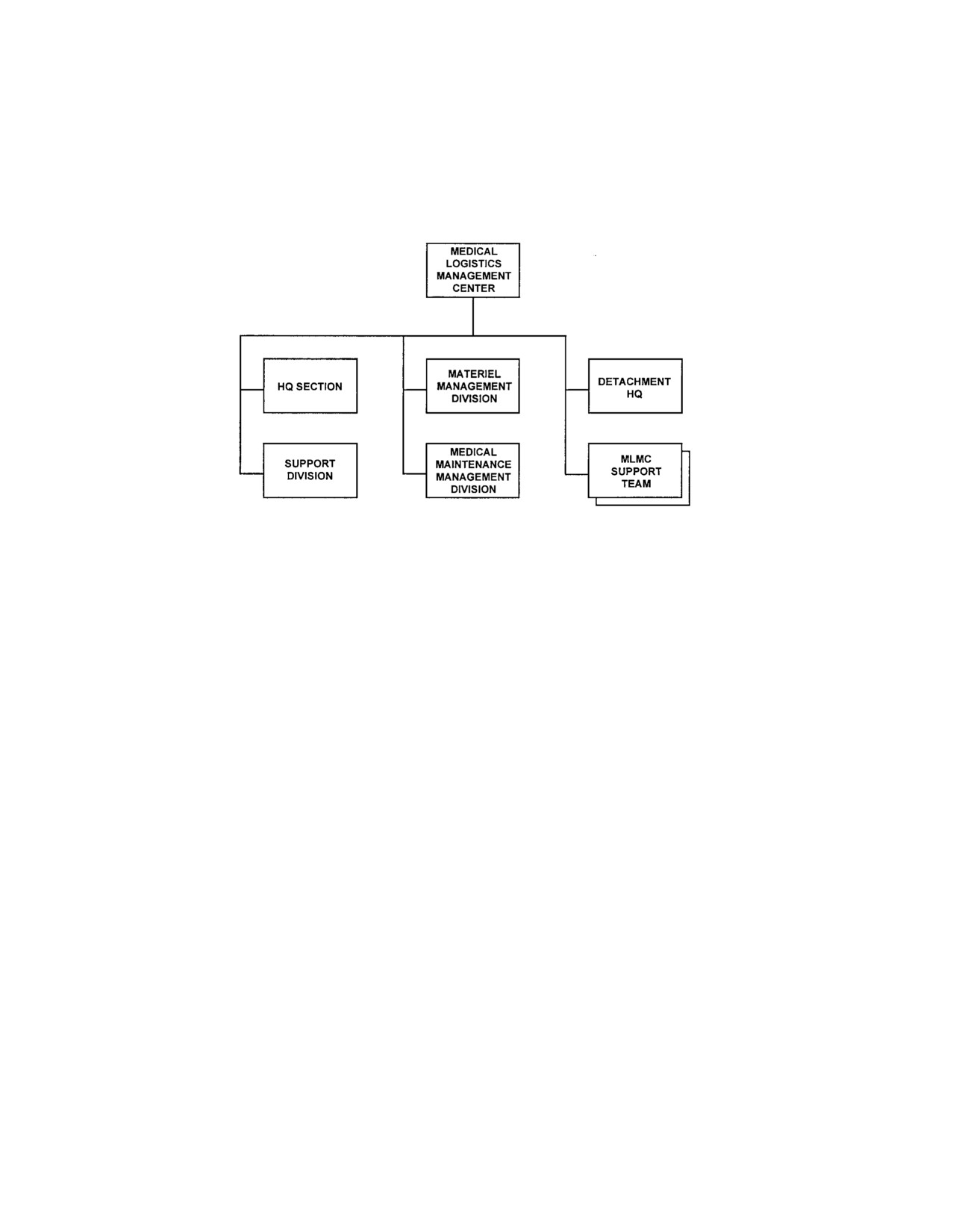
a. The MLMC (Figure 3-2) is responsible for providing management over Class VIII commodity
management and medical maintenance within the AO, using split-based operations. The MLMC base will
remain in CONUS while deploying a support team into the AO, linking the strategic to the operational level
of logistics. The support team will also link Class VIII management with the distribution system within the
3-3
FM 4-02.1
AO by collocating a distribution section with the corps support command (COSCOM) or TSC. The
MLMC, in conjunction with the MEDLOG battalion, will serve as the SIMLM for joint operations
(Appendix E). The MLMC can coordinate Class VIII specific contracting requirements for the theater
surgeon with the TSC contracting office. The MLMC is composed of the following elements:
(1) Headquarters section. This section provides C2 and administrative support for the MLMC.
(2) Support division. This division coordinates staff functions pertaining to CHL. It is
responsible for placement and operation of the MLMC and the execution of operational plans.
(3) Materiel management division. This division is responsible for monitoring Class VIII
materiel management in CONUS and in the theater. It has daily visibility of the theaters asset position for
Class VIII materiel and availability of CONUS-based stocks. Requisitions for critical items are monitored
and stockage objectives are analyzed. This division interfaces with the strategic and operational level of
logistics and performs special studies and analysis of logistical data.
(4) Medical maintenance management division. This division is responsible for the theater
medical maintenance program. It serves as the medical maintenance consultant to the TA surgeon. Analysis
of workload data, PLL management, and maintenance programs are part of this divisions activities. The
division reviews maintenance status and performance reports and manages allocation of maintenance
personnel assets and the Medical Standby Equipment Program (MEDSTEP [formally called operational
readiness float]). It also provides assistance to units with maintenance backlogs through resource allocation
and equipment evacuation policies.
(5) Medical logistics management center forward teams. The MLMC has two support
teams. A support team will deploy into the AO to provide centralized management of medical materiel,
medical maintenance, and coordination of the distribution of Class VIII materiel within the AO. The
forward team will collocate with the Theater Distribution Management Center, TSC. The forward team
will provide liaison officers (or noncommissioned officers [NCOs]) to each deployed MEDLOG battalion
and to the theater surgeons location (if not collocated with the TSC). The MLMC forward team will
provide the information management portion of SIMLM while the theater MEDLOG battalion will
provide distribution management portion of the SIMLM mission, when the Army is designated as the
SIMLM by the CINC, for joint operations. The MLMC forward team will still provide the information
management portion of the SIMLM mission when the Army is not designated as the SIMLM for joint
operations. The support team will be subordinate to the theater MEDCOM or TSC when there is no
MEDCOM in the theater. The forward team will collocate with the corps support operations section of the
COSCOM when the TSC is not deployed.
(6) Detachment headquarters. Personnel of this section will supervise and perform unit and
general supply functions, billeting, discipline, security, and training for the MLMC.
b. The MLMC support team is dependent upon elements of the TSC for CHS, food service
support, transportation, laundry and bath, finance, personnel and administrative services, legal, religious
support, communications, and unit maintenance.
3-4
FM 4-02.1
Figure 3-2. Medical Logistics Management Center.
3-6.
Headquarters and Headquarters Detachment, Medical Logistics Battalion (TOE 08496A000)
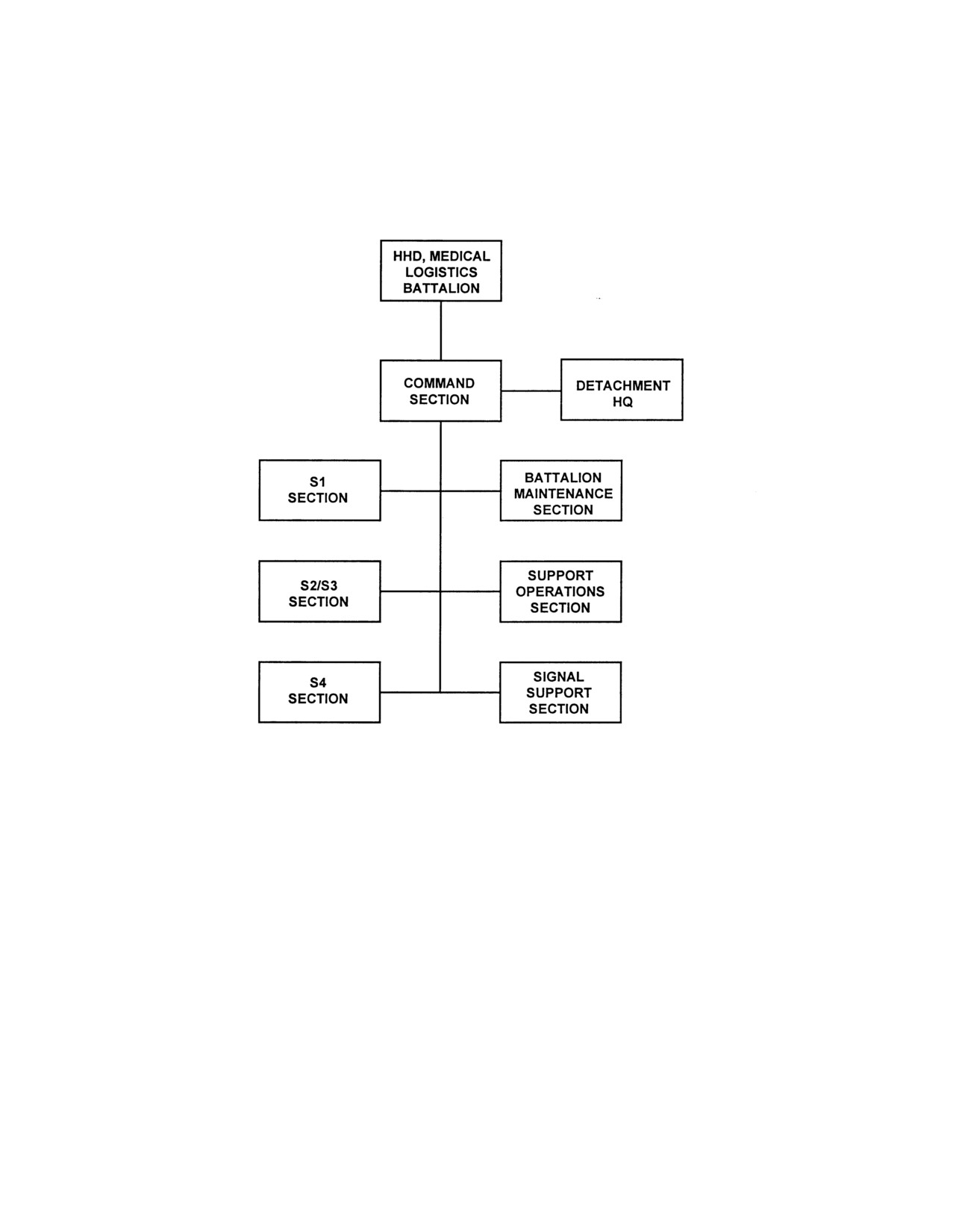
a. The HHD, MEDLOG battalion (Figure 3-3) is assigned to a Headquarters and Headquarters
Company (HHC) MEDCOM, TOE 08411A000, or HHC Medical Brigade, TOE 08422A100. It is responsible
for providing C2, staff planning, and supervision of operations, training, and administration for a variable
number of attached MEDLOG companies, logistics support companies, and BSDs. This overall control
covers the whole spectrum of MEDLOG services including Class VIII materiel, single- and multivision
optical lens fabrication and repair, medical maintenance, contracting, and blood and blood product collection,
processing, storage, and distribution. The HHD, MEDLOG battalion structure is improved under MRI
with the addition of a support operations section and a signal support section, and combines battalion
organizational maintenance and medical maintenance under a senior medical maintenance warrant officer.
b. The HHD, MEDLOG battalion supports division, corps, and EAC units (depending on area of
assignment), and is composed of the following elements:
(1) Command section. This section provides for the C2 of assigned and attached logistical
organizations. Command and specific responsibilities and functions are as in all headquarters elements.
(a) Adjutant (US Army) (S1) section. The section is responsible for advising the
commander on all aspects of HRS. Human resources support encompasses manning the force, personnel
services, and personnel support. These activities include personnel accounting and strength reporting,
casualty operations management, postal operations management, replacement management, and morale,
welfare, and recreation activities. The S1 also has coordinating responsibility for religious, finance, and
legal support.
3-5
FM 4-02.1
Figure 3-3. Headquarters and headquarters detachment, medical logistics battalion.
(b) Intelligence Officer (US Army)/Operations and Training Officer (US Army) (S3)
section. This section is responsible for battalion-level communications, security, intelligence, and operations
planning. Communications will include both internal and external communication systems. This section
coordinates input from staff and commanders in the development of operational plans. Relocation of
battalion assets will be coordinated by this section. The section is also responsible to the commander for the
battalions overall readiness.
(c) Supply Officer
(US Army) (S4) section. This section plans, coordinates, and
supervises battalion-level unit supply and services and transportation activities for the battalion. It maintains
and manages the property book and budget register for assigned and attached units. The section also
provides logistical planning input to the S2/S3 for implementation of operations. The S4 will be responsible
for the battalions logistical readiness.
3-6
FM 4-02.1
(d) Battalion maintenance section. This section provides oversight for direct support
(DS)/general support (GS) medical maintenance for all units within the MEDLOG battalions area of
responsibility. This section is also responsible for organizational vehicle maintenance, equipment records
and repair parts, fuel distribution, power generation repair, and vehicle recovery operations support to
assigned or attached units, and provides oversight on the maintenance of organic equipment in the attached
companies.
(e) Support operations section. This section is responsible for all coordination of
operational day-to-day customer support and quality assurance functions, to include monitoring supported
unit locations and inventory management for Class VIII within the AO. It is responsible for the installation
and operation of logistics information processing systems for the battalion. This section also provides
liaison for distribution of Class VIII supplies, blood, and blood products to the COSCOMs support
operations section. This section, when designated by the CINC, and when augmented with US Air Force
(USAF)/Navy personnel, will perform customer support functions of the distribution management portion
of the SIMLM mission.
(f)
Signal support section. This section is responsible for the installation, operation,
and maintenance of information processing systems for the battalion. This section configures and integrates
data processing systems and satellite transmission equipment to facilitate operations.
(2) Detachment headquarters. The detachment headquarters provides C2 of the HHD,
MEDLOG battalion. Personnel of this detachment will supervise and perform unit and general supply
functions.
c.
At corps, the HHD, MEDLOG battalion will be under the C2 of the corps MEDCOM or
medical brigade. At EAC, the HHD, MEDLOG battalion will be under the C2 of the EAC MEDCOM or
medical brigade.
d. The HHD, MEDLOG battalion is dependent upon appropriate elements of the corps and EAC
for unit-level CHS; supplemental transportation; unit maintenance; finance, HRS, religious, and legal
services, and technical intelligence for captured medical materiel. This unit is also dependent upon corps
and EAC transportation assets to provide unit distribution and signal assets for bandwidth communications.
This unit requires augmentation in an NBC environment for decontamination.
3-7.
Logistics Support Company (TOE 08497A000)
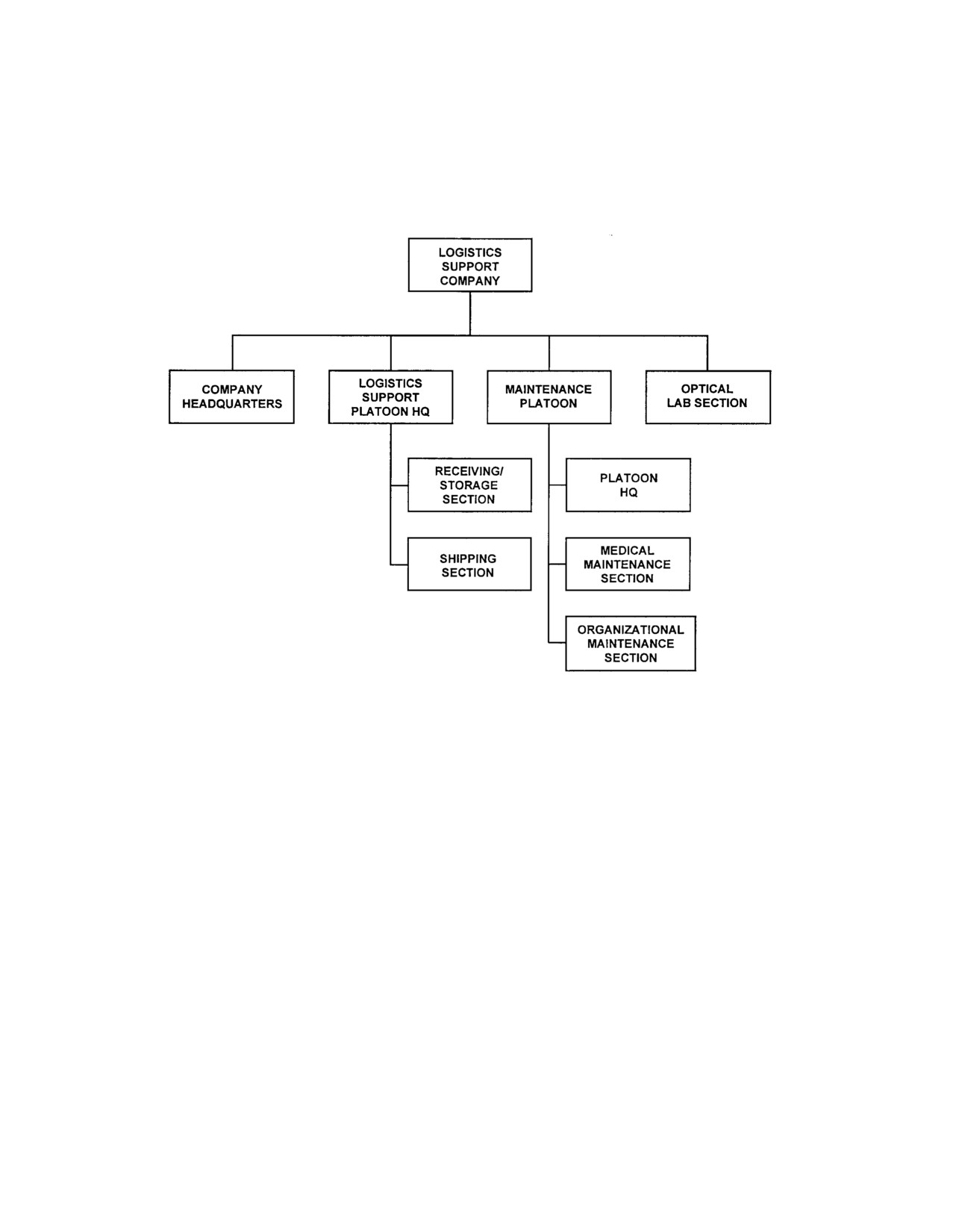
a. The logistics support company (Figure 3-4) provides medical materiel, medical maintenance,
and single- and multivision optical lens fabrication and repair to corps and EAC medical units operating
within the AO. It also provides backup support to the MEDLOG company (TOE 08488A000). The
logistics support company will normally be under the C2 of the HHD, MEDLOG battalion, forming the
MEDLOG based for the AO. The logistics support company has no internal automation capability for
MEDLOG management. It is dependent upon the HHD, MEDLOG battalion, for their logistics automation.
A five-division corps will normally require two logistics support companies under the C2 of a HHD,
MEDLOG battalion.
3-7
FM 4-02.1
Figure 3-4. Medical logistics support company.
b. The logistics support company is composed of the following elements:
(1) Company headquarters. The company headquarters provides C2 of the logistics support
company. Company personnel supervise and perform unit plans/operations and general supply functions.
This company provides food service for the HHD, MEDLOG battalion, the BSD, and the MLMC support teams.
(2) Logistics support platoon headquarters. This platoon ensures that stocks remain in an
issuable condition while in storage. This includes the planning prior to receipt of supplies, locating stocks
that provides first-in/first-out handling, utilizing space efficiently, and maintaining segregation and
disposition of stock as determined by the accountable officer. This platoon consists of a
(a) Receiving/storage section. This section prepares and processes receipt documents
for incoming shipments. It is also responsible for the storage, preservation, location, and accountability for
medical supplies and equipment. This section is capable of deploying a five-person mobile forward cell for
dual-based operations.
3-8
FM 4-02.1
(b) Shipping section. This section plans for release of materiel to transportation, coordinates
for vehicles, stages shipments for pickup, and prepares movement documents. This section is capable of
deploying a five-person mobile forward support cell in support of dual-based operations.
(3) Optical laboratory section. This section provides C2 and quality assurance over the
optical fabrication mission within the AO. It also provides single lens/multivision lens fabrication and
repair. All requisitions for contact lenses for AH-64 aviators only are submitted to and approved by this
section.
(4) Maintenance platoon headquarters. This platoon is responsible for DS and GS medical
maintenance on an area basis and organizational equipment maintenance within the company.
(5) Medical maintenance section. This section performs limited intermediate-level (GS)
maintenance services to all units within the companys area of responsibility. It also performs unit-level
maintenance for units in its AO that do not have organic medial equipment maintenance personnel assigned
or attached, or not supported by biomedical equipment repairmen from other units. This section can deploy
three mobile support teams.
(6) Organizational maintenance section. This section is responsible for vehicle maintenance,
equipment records and repair parts, fuel distribution, and power generation repair.
3-8.
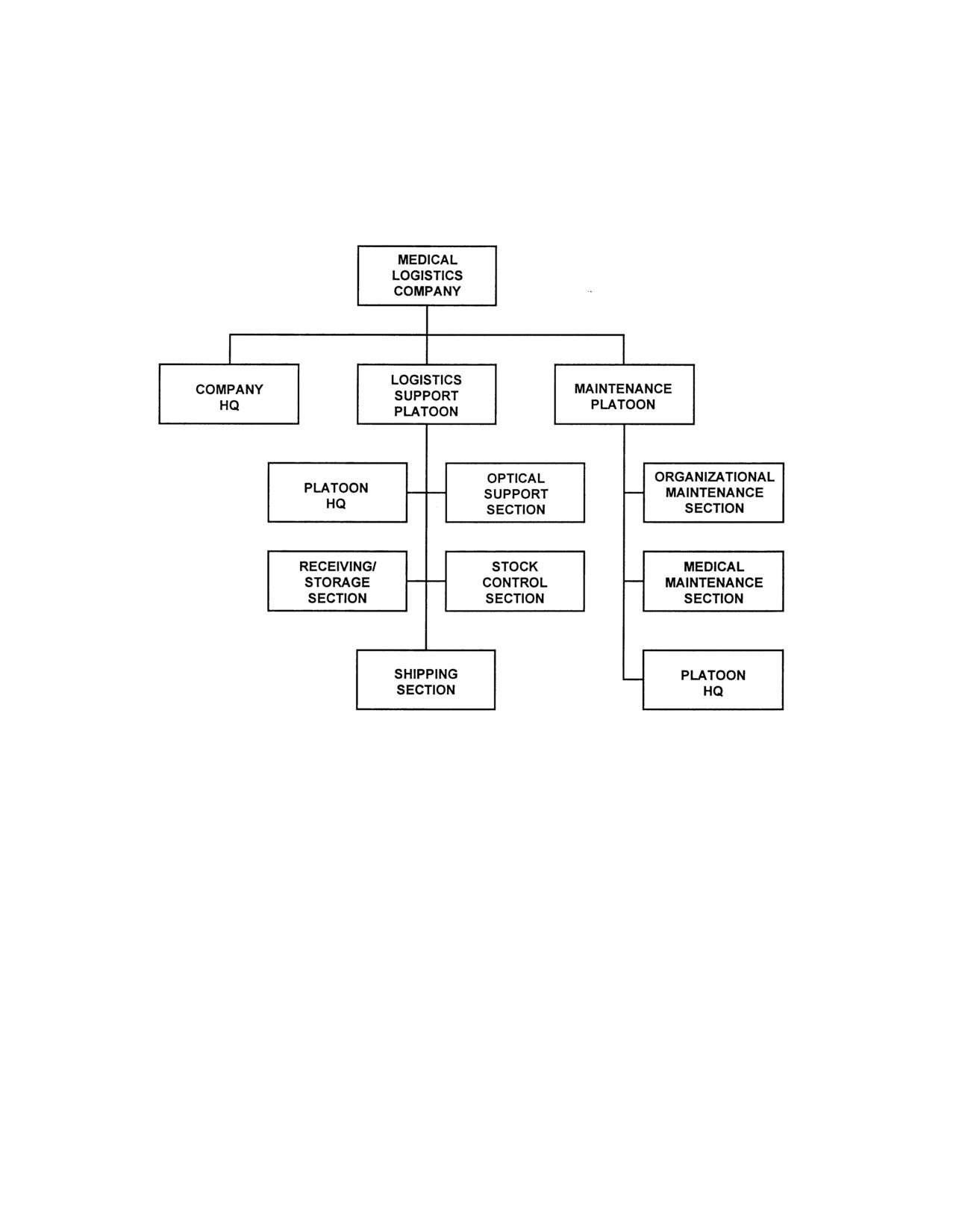
Medical Logistics Company (TOE 08488A000)
a. The MEDLOG company (Figure 3-5) provides medical materiel, medical maintenance, single-
and multivision optical lens fabrication and repair, and PMIs (see Appendix F) to division and corps
medical units operating within the division AO. The MEDLOG company has no organic blood support
capability. A cell from the BSD may be collocated with the company to provide blood support to the
division. The company will normally be under the C2 of the HHD, MEDLOG battalion. The company has
the capability for limited self-sustainment during initial operations, meeting the requirement for early entry
into the AO, or as part of a task organization.
b. The MEDLOG company is composed of the following elements:
(1) Company headquarters. This section provides C2 of the MEDLOG company. Personnel
of this section supervise and perform unit plans and operations and general supply functions. Food service
personnel will supplement a collocated unit for daily work assignments to support the MEDLOG company.
(2) Logistics support platoon. This platoon is composed of
(a) Logistics support platoon headquarters. This platoon ensures that stocks remain in
an issuable condition while in storage. This includes the planning prior to receipt of supplies, locating stocks
that provides first-in/first-out handling, utilizing space efficiently, and maintaining segregation and
disposition of stock as determined by the accountable officer.
3-9
FM 4-02.1
Figure 3-5. Medical logistics company.
(b) Receiving and storage section. This section prepares and processes receipt
documents for incoming shipments. It is responsible for the storage, preservation, location, and
accountability for medical supplies and equipment. It is capable of deploying a five-person mobile forward
support cell for dual-based operations.
(c) Shipping section. This section plans for release of materiel to transportation,
coordinates for vehicles, stages shipments for pick up, and prepares movement documents. This section is
capable of deploying a five-person mobile forward support cell for dual-based operations. This section
must stay in close synchronization and communication with the COSCOM and DISCOM distribution
management centers (DMCs) in order to utilize theater transportation assets to deliver supplies.
(d) Stock control section. This section maintains accountability for all medical materiel
and coordinates all stock control functions. It also maintains accountability for all materiel received, stored,
3-10
FM 4-02.1
and issued in the MEDLOG company. This section is capable of deploying a three-person mobile forward
support cell in support of dual-based operations.
(e) Optical support section. This section performs single- and multivision optical
fabrication and repair.
(3) Maintenance platoon. The maintenance platoon is composed of a
(a) Maintenance platoon headquarters. This platoon performs DS and GS medical
maintenance services on an area basis. It also provides organizational maintenance for all vehicles and
power generation equipment organic to the company.
(b) Medical maintenance section. This section performs limited intermediate-level
(GS) maintenance services to all units within the companys AO. It also performs unit-level maintenance for
units in its AO which do not have organic medical equipment maintenance personnel assigned or attached,
or are not supported by medical equipment repairer from other units. This section can deploy three mobile
support teams.
(c) Organizational maintenance section. This section is responsible for vehicle
maintenance, equipment records and repair parts, fuel distribution, and power generation repair for organic
company assets.
3-9.
Blood Support Detachment (TOE 08489A000)
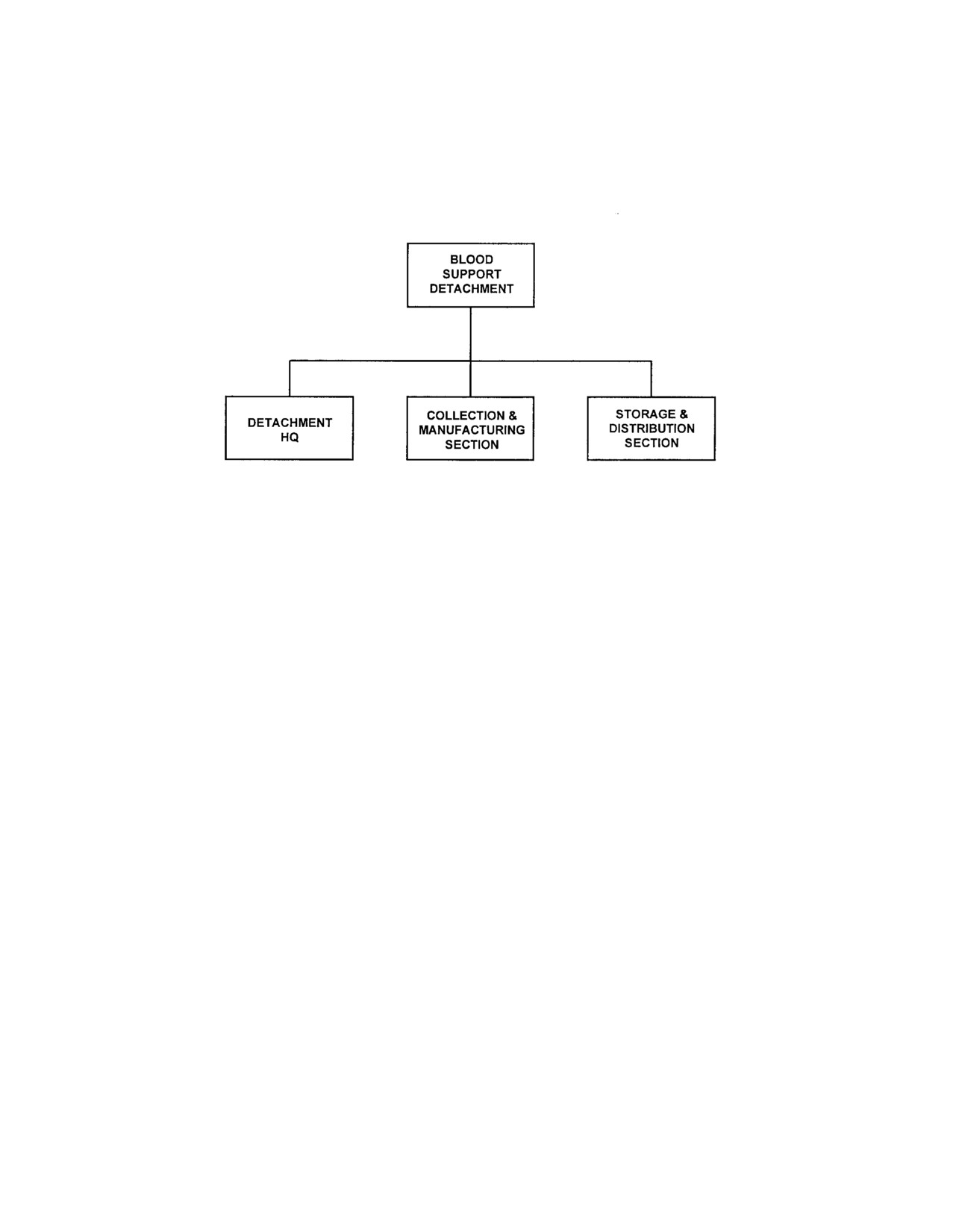
a. The BSD (Figure 3-6) provides collection, manufacturing, storage, and distribution of blood
and blood products to division, corps, and EAC medical units and to other operations. See Chapter 7 for
information on blood support operations. The detachment is normally attached to the HHD, MEDLOG
battalion for C2 and life support. The detachment provides flexibility to shift personnel between collection
and distribution missions, as required.
b. The BSD is composed of the following elements:
(1) Detachment headquarters. The detachment headquarters provides C2 of the BSD.
Personnel of this section supervise and perform unit plans and operations, general supply, life support, and
maintenance functions.
(2) Collection and manufacturing section. This section is responsible for the collection,
manufacturing, and quality control over all blood stocks within division, corps, and EAC.
(3) Storage and distribution section. This section is responsible for inspecting incoming
blood shipments and preparing and processing receipt documents. It is also responsible for the storage,
preservation, location and accountability for blood and blood products. It distributes blood and blood
products within the division, corps, and EAC. The section is capable of deploying a five-person forward
distribution augmentation cell to the MEDLOG company when required.
3-11
FM 4-02.1
Figure 3-6. Medical detachment, blood support.
c.
The detachment is dependent upon appropriate division, corps, and EAC elements for CHS;
medical maintenance; supplemental transportation; finance, HRS, religious and legal services, and technical
intelligence for captured medical materiel. This unit is dependent upon division, corps, and EAC
transportation assets to provide unit distribution and signal assets for bandwidth communications. This unit
requires augmentation in an NBC environment for decontamination.
3-10. Medical Logistics Support Team
The MLST is a TDA organization consisting of MEDLOG personnel (military, DA civilians, and
contractors) from USAMMA. The MLST will normally deploy with the AMCs logistics support element
(LSE). The MLST supports the reception and onward movement issue of APS unit sets and sustainment
stock pre-positioned in the AO or pushed in from the AFLOAT program or CONUS. The MLST will
provide medical materiel and maintenance capability, equipment accountability, and transfer support of
reception operations at aerial and seaports of debarkation. The MLST is a component of the AMC/LSE and
is under the operational control of the LSE until the establishment of a TSC. The MLST will transition their
mission to the theater MEDLOG battalion or MLMC. When the mission transition is completed, the MLST
will be redeployed to CONUS. At the completion of the contingency/operation, the MLST may be
redeployed to the AO to support the redeployment of US forces and medical materiel from the AO to
follow-on CONUS or OCONUS locations.
3-12
FM 4-02.1
CHAPTER 4
CLASS VIII SUPPLY OPERATIONS
Section I. THE FORCE XXI DIGITIZED DIVISION
4-1.
General
This section outlines Class VIII supply support at Echelons I and II in the Force XXI division. It discusses
the support roles and functions of the medical platoon/battalion aid station (BAS), FSMC, division support
medical company (DSMC), FST, forward support medical evacuation (MEDEVAC) team (FSMT), medical
logistic company, division surgeons section (DSS), and the MMMB.
4-2.
Combat Lifesaver
a. The combat lifesaver is not a trauma specialist (formerly referred to as the combat medic); he
is a combat, combat support (CS), or CSS soldier with an additional duty. Although not a trauma specialist, he
is a recipient/consumer of medical materiel. The normal resupply of the combat lifesaver assigned to a battalion
with organic medical support is through the medical platoon. The trauma specialist will coordinate supply
requests for the combat lifesaver with the medical platoon. Combat lifesavers assigned to units without organic
medical support will be resupplied by the medical unit providing area medical coverage; for example, an
FSMC or DSMC (see Figure 4-1). Combat lifesavers assigned to units without organic medical support will
request medical resupply through the platoon sergeant to the company first sergeant (1SG). The 1SG consolidates
and submits the medical requests on the Logistics Situation Report via the Force XXI Battle Command Brigade
and Below (FBCB2)/single channel ground and airborne radio system (SINCGARS) through the battalion S4 to
the supporting medical unit providing area medical coverage; for example, an FSMC or DSMC.
b. The trauma specialist can provide emergency resupply to the combat lifesaver. This type of
resupply should not be practiced on a routine basis as it presents logistical problems for the trauma
specialist. It should be noted that the trauma specialist may not carry all of the exact medical items carried
by the combat lifesaver.
4-3.
Trauma Specialist
a. The trauma specialist requests supplies from the medical platoon (BAS). The requests (as with
the combat lifesaver) are not formal; they can be oral or written. The requests are delivered/communicated
to the BAS by whatever means are available. Usually this will be accomplished by the ambulance team
returning to the BAS with patients. Ambulances may be used to transport the requesters supplies forward
from the BAS as the ambulance returns to the maneuver unit. This system is referred to as backhaul. The
trauma specialist in the maneuver company should use FBCB2 (platoon sergeants/1SGs FBCB2 system) to
coordinate Class VIII resupply with their supporting medical platoon.
b. The medical platoon leader can enhance the resupply to the trauma specialists by forwarding
preconfigured materiel using ambulances whenever possible. This method assumes a proactive standpoint
on the part of the medical platoon leader in anticipating requirements to push supplies forward via ambulances
returning to the supported units. Ambulances should never go forward empty when medical supplies are
needed. However, the medical platoon leader should be careful not to overstock the supported units.
4-1
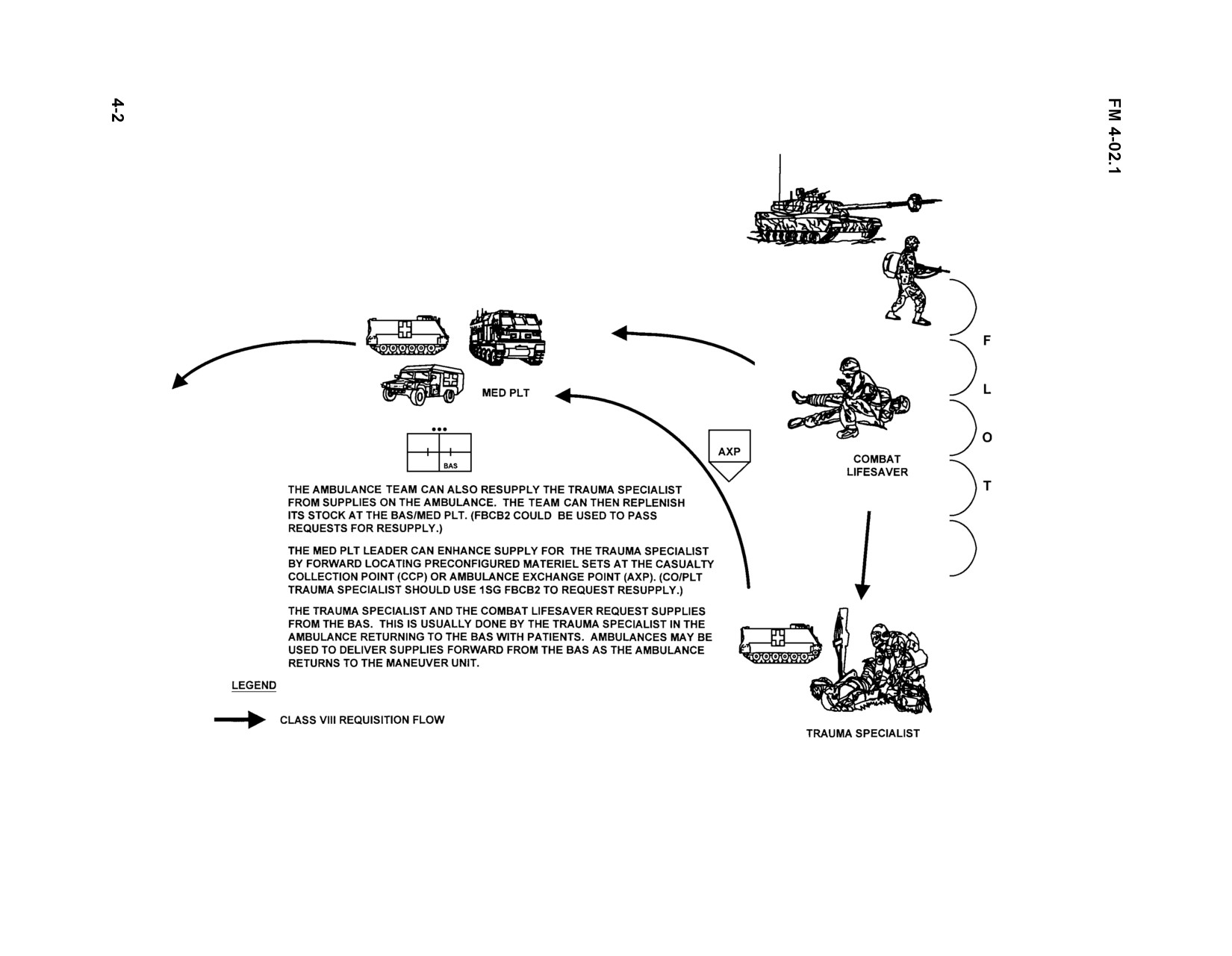
Figure 4-1. Unit-level Class VIII supply operations.
FM 4-02.1
c.
The ambulance crew can also resupply the trauma specialist from supplies on board the
ambulance. The ambulance crew can then replenish its stock upon returning to the BAS.
4-4.
Medical Platoon/Battalion Aid Stations
a. The forward deployed medical platoons/BASs of a division request their Class VIII supply
from their supporting FSMC located with the forward support battalion (FSB) in the BSA. The FSMCs
MEDLOG element is the direct support unit (DSU) for all Class VIII material for the brigade. This element
maintains a small authorized stockage list (ASL) of medical supplies for the brigade. The medical sets, kits,
and outfits organic to the treatment, patient hold, and ambulance sections of the FSMC can be utilized as a
backup source of supply for emergency resupply to the medical platoon/BAS.
b. Battalion and squadron aid stations of separate brigades/regiments request Class VIII resupply
from their supporting FSMC located with the FSB in the BSA. The FSMCs organic to separate brigades/
regiments request Class VIII supplies through their health service materiel officer (HSMO). Requests that
cannot be filled by their medical supply office are forwarded to the supporting MEDLOG company.
Separate brigades/regiments operating as part of a division will receive Class VIII supply support through
coordination with the MMMB, with supplies coming from the supporting MEDLOG company.
4-5.
Division Medical Companies
Each medical company maintains its own basic load that includes 5 days of medical supplies. The DSMC and
the FSMCs operate as medical DSUs for Class VIII material within the division. Preconfigured anticipatory
resupply packages are normally shipped directly to the DSMC and FSMCs until replenishment line-item
requisition is established with the supporting MEDLOG company. During this time, organic medical platoons
or treatment teams deployed with maneuver elements are resupplied from the DSMC and FSMCs. While
resupply by preconfigured anticipatory resupply packages is intended to provide support during the initial
phases of an operation, continuation on an exception basis may be dictated by operational needs. Planning for
such a contingency must be directly coordinated with the DSS. The HSMO of the DSS and the MMMB will
coordinate all Class VIII supply requirements for the division with the supporting MEDLOG company.
4-6.
Interim Brigade Combat Team
All interim brigade combat team medical units will deploy with supplies to support a 3- to 5-day self-
sustainment operation (based on casualty estimates). Routine and emergency medical resupply will follow
the procedures as outlined in this manual, normally through their intermediate staging base.
4-7.
Medical Materiel Management Branch
a. The MMMB manages the Class VIII supply system in the division. The MMMB coordinates
and recommends the prioritization of medical supplies and blood products. Under the technical control of
the HSMO of the DSS, the MMMB monitors and coordinates Class VIII resupply for division medical
units/elements.
4-3
FM 4-02.1
b. Using the CHL functional module of the Theater Medical Information Program (TMIP)/
Medical Communications for Combat Casualty Care (MC4) system, the Theater Army Medical Management
Information Systems (TAMMIS), joint total asset visibility (JTAV), Transportation Coordinators Automated
Information for Movement System II (TC-AIMS II), and/or other automated logistics management systems,
the MMMB manages all Class VIII requisitions submitted from the division to the supporting MEDLOG
company. The MMMB coordinates shortfalls in throughput distribution with the DSS and division support
operation section. The MMMB may update priorities with the MEDLOG company to correct deficiencies in
the delivery system.
c.
The MMMB provides Class VIII situational understanding to the DISCOM staff and the DSS
according to the tactical standing operating procedures (TSOP). The MMMB, in coordination with the
CHL cell of the DSS, manages the distribution of blood and blood products for division medical units.
d. The MMMB also coordinates through the DSS with the Assistant Chief of Staff, G5 (Civil
Affairs) for disposition of captured enemy medical materiel.
4-8.
Division Medical Supply Operations
a. During the initial employment phase, each FSMC receives a preconfigured push-package
every 48 hours from the supporting MEDLOG company. During deployment, early build-up phases, and
lodgment, supported medical units/elements operate from planned, prescribed loads and from existing APS
identified in applicable logistics plans. Initial resupply efforts may consist of preconfigured medical supply
(MEDSUP) packages tailored to meet specific mission requirements. Anticipatory logistics will allow for
preconfigured push-packages which are shipped directly from CONUS to FSMCs and DSMCs until
replenishment line-item requisitioning is established with the supporting MEDLOG battalion. While resupply
by preconfigured packages is intended to provide support during the initial phase, continuation on an
as-required basis may be dictated by operational needs in accordance with casualty estimates. Planning for
such a contingency must be directly coordinated with the DSS HSMO who coordinates further Class VIII
resupply requirements with the supporting MEDLOG battalion.
b. Shipment of medical materiel from the MEDLOG company is coordinated through the
DISCOM MMMB and the DISCOM support operations section. The primary transportation means of
sustainment resupply for Class VIII material is GS transportation assets. The MEDLOG company must
coordinate shipment of medical supplies with their supporting movement control team. Usually, corps-level
transportation assets will be used to deliver medical supplies from the corps forward area to the BSA/DSA.
In some instances, air ambulances from the MEDEVAC battalion may be used to transport Class VIII
supplies to requesting units. The MEDLOG company in the corps forward area is the Class VIII DSU to
the division (see Figure 4-2). Once requests are received by the MEDLOG company, a materiel release
order is printed and the stock is issued to the unit. For items not available for issue, the requests are
forwarded to the next higher level of supply. All emergency requests are immediately processed by the
FSMC/DSMC/MEDLOG company and issued to the requesting unit. The HSMO of the MMMB has the
responsibility to monitor all emergency requirements not immediately filled by the MEDLOG company.
The MEDLOG company coordinates with the MMMB for standard and emergency transportation of Class
VIII supplies, as required.
4-4
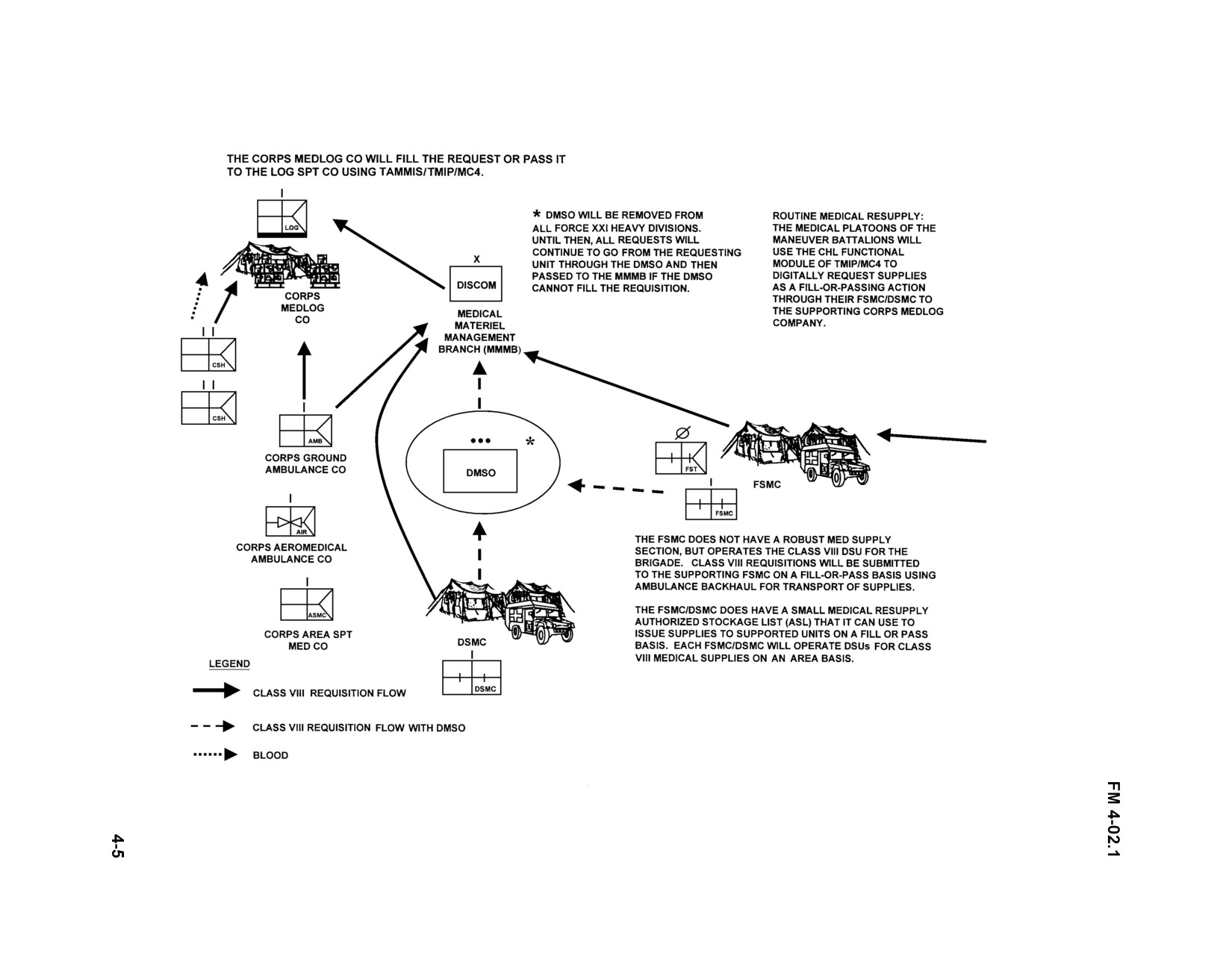
Figure 4-2. Division-level Class VIII supply operations.
FM 4-02.1
c.
Medical supplies are either forwarded from the source of supply or are picked up at the source of
supply using supply point distribution. The MMMB and DSS coordinate, as required, for the FSMC/DSMC
with the MEDLOG company to meet shortfalls in the supply point distribution system by updating priorities.
Class VIII resupply for medical units/elements at division and below will use the TAMMIS or TMIP/MC4.
The TAMMIS, the predecessor to CHL function module of TMIP/MC4, may still be used in some units in
place of TMIP/MC4 to perform the same function. The CHL functional module of TMIP/MC4 provides
division medical units/elements a direct link with the supporting MEDLOG battalions units. This connectivity
is accomplished using high frequency, radio frequency, or local area network (LAN). The CHL functional
module of TMIP/MC4 is an automated Class VIII requisitioning system used by Echelon II and below medical
units found at division, EAD, and EAC levels. The organic medical platoons of maneuver battalions, FSMCs,
and DSMC will use this system. The CHL functional module of TMIP/MC4 system is capable of assemblage
management, to include replenishment and quality control for all medical equipment sets (MESs) for a medical
unit/element. The TMIP/MC4 system can also be used for individual line-item requisitioning and employs
automated receipt updating to expedite issue. The reports section of the CHL functional module of TMIP/
MC4 can produce equipment-on-hand percentages that are used in unit status reporting.
d. Under the oversight of the HSMO of the DSS, the DISCOM MMMB coordinates Class VIII
resupply for division medical units/elements. The MMMB is assigned to the general supply section, along
with the other classes of supply. It works directly with the DMC by providing Class VIII supply information
pertaining to requisitions, priorities, and their status. Through the DMC and the TC-AIMS II and global
transportation network (GTN), the MMMB can maintain total Class VIII visibility including in-transit
visibility (ITV) of Class VIII resupply items inbound to the divisions AO. The MMMB will also coordinate
with the DMC to ship Class VIII resupply to forward deployed medical elements. The MMMB may
alternatively use medical ground or air transport vehicles to ship medical supplies to forward deployed
units/elements if the situation dictates and permits.
e.
The DSS and HSMO (FSBs/division support battalion) are informed by the MMMB of all
pertinent management indicators. These indicators include
Type/number of stocked lines.
Zero balances.
Critical item shortages.
Nonoperational critical equipment.
Records and reports are maintained as directed by TSOPs.
(In the event of an automated systems failure, a
backup manual system must be implemented.)
NOTE
Throughput Class VIII resupply will be initiated upon activation of the
MEDLOG support elements, division (CHL functional module of
4-6
///////////////////////////////////////