FM 7-15, C3 The Army Universal Task List (February 2009) - page 2
Chapter 2
ART 2.3.1.2 DEVELOP INTELLIGENCE, SURVEILLANCE, AND RECONNAISSANCE
SYNCHRONIZATION TOOLS
2-40. The entire unit staff develops their information requirements and determines how best to satisfy
them. The staff uses surveillance and reconnaissance assets to collect information. There are at least three
intelligence, surveillance, and reconnaissance (ISR) synchronization tools: the requirements management
matrix, ISR synchronization matrix, and ISR overlay. ISR synchronization tools address all assets the
operations officer can task or request as well as the coordinating mechanisms needed to ensure adequate
coverage of the area of interest. ISR tools are used to develop the ISR plan. (FM 2-0) (USAICoE)
Note: This task supports ART
2.3.2.1
(Develop the Intelligence, Surveillance, and
Reconnaissance Integration Plan)
No.
Scale
Measure
Intelligence officer, with staff participation, used the priority intelligence requirements
01
Yes/No
(PIRs) to begin ISR synchronization.
02
Yes/No
Unit identified all organic, adjacent, and higher echelon ISR assets.
03
Yes/No
Intelligence officer and operations officer, with staff participation, determined asset availability.
Unit determined unique support requirements for ISR assets to include maintenance,
04
Yes/No
crew training, downlink nodes, access, and connectivity.
Unit developed recommended scheme of support including fires, routes of movement
05
Yes/No
and maneuver, medical and casualty evacuation, and sustainment.
Intelligence officer, with staff participation, determined availability and capabilities of
06
Yes/No
assets from higher echelons.
Unit identified the reporting criteria, capabilities, limitations, and latest time information
07
Yes/No
is of value for all ISR assets.
08
Yes/No
Unit possessed the right mix of ISR assets for the area of operations.
Unit requested additional ISR assets or support when organic assets and attachments
09
Yes/No
cannot provide coverage.
10
Yes/No
ISR synchronization plan addressed redundancy, mix, and cueing.
11
Yes/No
ISR synchronization plan developed and linked to information and intelligence requirements.
ISR synchronization plan included the required action or production action needed once
12
Yes/No
requirements were answered.
ISR synchronization plan included the reporting procedures and channels for each
13
Yes/No
requirement.
14
Yes/No
Intelligence production answered requirements (specifically PIRs).
Unit disseminated ISR synchronization plan to operations officer in time to produce
15
Yes/No
orders and perform troop leading procedures.
16
Time
To determine availability of ISR assets.
17
Time
To develop ISR synchronization plan.
18
Percent
Of requirements identified that is addressed in the ISR synchronization plan.
19
Percent
Of requirements identified that has to be supported by higher echelons.
20
Percent
Of available ISR assets identified.
21
Percent
Of requirements analyzed, validated, and prioritized.
ART 2.3.2 PERFORM INTELLIGENCE, SURVEILLANCE, AND
RECONNAISSANCE INTEGRATION
2-41. Intelligence, surveillance, and reconnaissance integration is the task of assigning and controlling a
unit’s intelligence, surveillance, and reconnaissance assets (in terms of space, time, and purpose) to collect
and report information as a concerted and integrated portion of operation plans and orders. Intelligence,
2-30
FM 7-15, C3
29 July 2010
ART 2.0: The Intelligence Warfighting Function
surveillance, and reconnaissance (ISR) integration assigns and controls a unit’s ISR assets (in terms of
space, time, and purpose) to collect and report information as a concerted and integrated portion of
operation plans and orders. The operations officer integrates the best ISR assets through a deliberate and
coordinated effort of the entire staff across all warfighting functions into the operation. Specific
information requirements facilitate tasking by matching requirements to assets. Intelligence requirements
are identified, prioritized, and validated. ISR integration is vital in controlling limited ISR assets. During
ISR integration, the staff recommends redundancy, mix, and cue as appropriate. The result of ISR
synchronization and integration is an effort focused on answering the commander’s requirements.
(FM 3-90) (USACAC)
No.
Scale
Measure
01
Yes/No
ISR plan focused on the commander’s critical information requirements.
Staff determined unique support requirements for ISR assets to include maintenance,
02
Yes/No
crew training, downlink nodes, access, and connectivity.
Staff determined scheme of support including fires, routes of movement and maneuver,
03
Yes/No
medical and casualty evacuation, and sustainment.
04
Yes/No
ISR plan included other staff information requirements.
ISR plan provided information and intelligence in time for the commander’s
05
Yes/No
decisionmaking.
ISR plan included a dissemination plan, to include information tasked or requested from
06
Yes/No
external organizations.
Operations officer disseminated ISR plan in time to produce orders and perform troop
07
Yes/No
leading procedures.
08
Yes/No
Staff executed ISR plan.
09
Yes/No
Unit identified indicators of previously unanticipated threat patterns or activities.
10
Yes/No
Unit identified new requirements based on reporting and ISR operations.
11
Yes/No
ISR plan updated and disseminated in time to produce orders.
12
Time
To produce and disseminate initial ISR plan.
13
Time
To evaluate reporting and ISR operations.
14
Time
To determine threat patterns or activities from reporting and ISR operations.
15
Time
To identify indicators of previously unanticipated threat patterns or activities.
16
Time
To review existing information on threat capabilities.
17
Time
To consider threat doctrine.
18
Time
To determine new information and intelligence requirements.
19
Time
To develop new ISR tasks and requests for information.
20
Time
To update and disseminate the ISR plan.
21
Percent
Of specific information and intelligence requirements correctly answered.
22
Percent
Of reporting requirements correctly answered.
ART 2.3.2.1 DEVELOP THE INTELLIGENCE, SURVEILLANCE, AND RECONNAISSANCE
INTEGRATION PLAN
2-42. The operations officer develops the intelligence, surveillance, and reconnaissance (ISR) plan. The
entire unit staff analyzes each requirement to determine how best it is to be satisfied. The staff receives ISR
tasks and requests for information from subordinate and adjacent units and higher headquarters. The ISR
plan includes all assets that the operations officer can task or request and coordinating mechanisms to
ensure adequate coverage of the area of interest. (FM 3-90) (USACAC)
No.
Scale
Measure
01
Yes/No
Intelligence staff provided the operations officer with the ISR synchronization plan.
Intelligence staff and operations officer determined asset availability in coordination with
02
Yes/No
the rest of staff.
29 July 2010
FM 7-15, C3
2-31
Chapter 2
No.
Scale
Measure
03
Yes/No
All organic, adjacent, and higher ISR assets were tasked against requirements.
04
Yes/No
Staff developed and linked ISR plan to commander and staff requirements.
05
Yes/No
Unit had the right mix of ISR assets for the area of operations.
06
Yes/No
ISR plan addressed redundancy, mix, and cueing.
Unit determined unique support requirements for ISR assets to include maintenance,
07
Yes/No
crew training, and connectivity.
Unit determined a scheme of support including fires, routes of movement and
08
Yes/No
maneuver, medical and casualty evacuation, and sustainment.
09
Yes/No
Unit identified the reporting criteria, capabilities, and limitations of all ISR assets.
Unit linked ISR plan specific information requirements to specific reporting criteria and
10
Yes/No
latest time information is of value.
ISR plan provided information and intelligence in sufficient time for the commander’s
11
Yes/No
decisionmaking.
12
Yes/No
ISR plan required that ISR forces receive mission intelligence briefing before mission.
13
Yes/No
ISR plan required that ISR assets prepare mission report.
14
Yes/No
ISR plan required that ISR forces are debriefed.
ISR plan included a dissemination plan, to include information tasked or requested from
15
Yes/No
external organizations.
Operations officer disseminated ISR plan in time to produce operation orders and
16
Yes/No
perform troop leading procedures by subordinates.
17
Yes/No
ISR plan supported the intelligence production and provided answers to requirements.
18
Time
To develop ISR plan.
19
Time
To disseminate the ISR plan.
20
Time
To determine availability of ISR assets.
21
Percent
Of available ISR assets identified.
ART 2.3.2.2 EXECUTE, EVALUATE, AND UPDATE THE INTELLIGENCE, SURVEILLANCE, AND
RECONNAISSANCE PLAN
2-43. The operations officer updates the intelligence, surveillance, and reconnaissance (ISR) plan based on
information received from the intelligence officer. The operations officer is the integrator and manager of
the ISR effort through an integrated staff process and procedures. As priority intelligence requirements
(PIRs) are answered and new information requirements arise, the intelligence officer updates intelligence
synchronization requirements and provides the new input to the operations officer who updates the ISR
plan. The intelligence and operations officers work closely with all staff elements to ensure the unit’s
organic collectors receive appropriate taskings. This ISR plan reflects an integrated collection strategy and
employment, production, and dissemination scheme that will effectively answer the commander’s PIR.
This task includes updating ISR operations through dynamic retasking and periodic updates of the ISR
plan. (FM 3-90) (USACAC)
No.
Scale
Measure
Operations officer disseminated ISR plan in time to produce operation orders and
01
Yes/No
perform troop leading procedures.
ISR plan provided information and intelligence in time for the commander to use it in the
02
Yes/No
conduct of the operation.
03
Yes/No
Unit executed ISR plan.
04
Yes/No
ISR assets met latest time information is of value for ISR tasks.
ISR assets reported activity or lack of activity in the correct formats and through the
05
Yes/No
required reporting channels.
06
Yes/No
The staff monitored and began evaluation of ISR operations.
2-32
FM 7-15, C3
29 July 2010
ART 2.0: The Intelligence Warfighting Function
No.
Scale
Measure
07
Yes/No
The entire staff conducted analysis of ISR reporting.
Unit evaluated reports and identified which requirements had been answered and
08
Yes/No
identified which requirements (PIRs and commander’s critical information requirements)
to remove.
Unit evaluated reports and identified which commander and staff requirements had
09
Yes/No
been satisfied.
10
Yes/No
Unit evaluated reports and identified new requirements.
11
Yes/No
Unit identified gaps or seams within the ISR plan (a continuous measure).
12
Yes/No
Technical authority and channels provided refined information or data to ISR assets.
13
Yes/No
Technical authority and channels provided new technical data to ISR assets.
14
Yes/No
Unit identified indicators of previously unanticipated threat patterns or activities.
15
Yes/No
Unit identified new requirements based on reporting and ISR operations.
Unit developed new ISR tasks and requests for information based on new specific
16
Yes/No
information requirements.
17
Yes/No
Dynamic retasking refocused the ISR operation.
Operations officer updated and disseminated ISR plan periodically in time to produce
18
Yes/No
operation orders and lead troop movements.
19
Time
To evaluate reporting and ISR operations.
20
Time
To determine threat patterns or activities from reporting and ISR operations.
21
Time
To evaluate and identify gaps or seams within the ISR plan.
22
Time
To identify indicators of previously unanticipated threat patterns or activities.
23
Time
To review existing information on threat capabilities.
24
Time
To consider threat doctrine.
25
Time
To determine new information and intelligence requirements.
26
Time
To develop new ISR tasks and requests for information.
27
Time
To generate and disseminate new ISR tasks as a result of dynamic retasking.
28
Time
To update and disseminate the ISR plan.
29
Percent
Of specific information and intelligence requirements correctly answered.
30
Percent
Of reporting requirements correctly answered.
ART 2.3.3 CONDUCT RECONNAISSANCE
2-44. 2-44. Reconnaissance is a mission undertaken to obtain, by visual observation or other detection
methods, information about activities and resources of an enemy or potential enemy and about the
meteorological, hydrographic, or geographic characteristics of an area of operations. Other detection
methods include signals, imagery, measurement of signature, or other technical characteristics. This task
includes performing chemical, biological, radiological, and nuclear reconnaissance; engineer
reconnaissance
(to include infrastructure reconnaissance and environmental reconnaissance).
(FM 3-34.170) (USAIC&FH)
Note: This task branch includes techniques by which ART 6.9.6 may be performed.
No.
Scale
Measure
The specific information requirement that prompted the conduct of reconnaissance was
01
Yes/No
answered.
Reconnaissance system or force oriented on the intelligence, surveillance, and
02
Yes/No
reconnaissance (ISR) objectives.
29 July 2010
FM 7-15, C3
2-33
Chapter 2
No.
Scale
Measure
Human intelligence (HUMINT), signals intelligence (SIGINT), imagery intelligence
03
Yes/No
(IMINT), measurement and signature intelligence (MASINT), technical intelligence
(TECHINT), and counterintelligence (CI) assets were available for ISR tasking.
04
Yes/No
Reconnaissance system or force reported all information in a timely and accurate manner.
05
Yes/No
Reconnaissance mission completed no later than time specified in the order.
06
Yes/No
Identified support requirements for each reconnaissance asset were sufficient.
Available HUMINT, SIGINT, IMINT, MASINT, TECHINT, and CI assets deployed to
07
Yes/No
maximize their capabilities.
Unit maintained continuous reconnaissance by employing appropriate asset mix and
08
Yes/No
cueing.
09
Yes/No
Reconnaissance asset was dynamically retasked.
Technical authority and channels provided information or data that redirected
10
Yes/No
reconnaissance assets on the ISR objective.
Units practiced tactical patience when using HUMINT, SIGINT, IMINT, MASINT,
11
Yes/No
TECHINT, and CI assets.
Information observed or gained from contact with the local population (Soldier
12
Yes/No
surveillance and reconnaissance) by units conducting reconnaissance missions was
collected by debriefing Soldiers or from unit reports.
13
Yes/No
New tasking received as a result of dynamic retasking.
14
Time
From receipt of tasking until reconnaissance assets are in place and operational.
To report information to requesting unit or agency to satisfy priority intelligence
15
Time
requirements (PIR) or information requirements.
16
Time
To redirect or reorient reconnaissance assets to meet new collection requirements.
Of ISR assets collecting against assigned named areas of interest and target areas of
17
Percent
interest.
18
Percent
Of PIRs tied to commander’s decision points.
19
Percent
Of specific information requirements developed from PIRs.
20
Percent
Of collection requirements fulfilled by reconnaissance assets.
21
Percent
Of accuracy of data provided.
22
Percent
Of reconnaissance mission-capable assets.
23
Percent
Of reconnaissance assets becoming casualties during the mission.
ART 2.3.3.1 CONDUCT A ROUTE RECONNAISSANCE
2-45. Conduct a reconnaissance operation focused along a specific route—such as a road, railway, or
waterway—to provide new or updated information on route conditions and activities.
(FM 3-90)
(USACAC)
No.
Scale
Measure
Route reconnaissance accomplished its task or mission, such as determining the
01
Yes/No
trafficability of the route and finding, reporting, and clearing within force capabilities all
enemy forces that can influence movement along the route.
02
Yes/No
Reconnaissance force oriented on the reconnaissance objective.
03
Yes/No
Reconnaissance force reported all information rapidly and accurately.
04
Yes/No
Reconnaissance force retained its freedom to maneuver.
05
Yes/No
Reconnaissance force gained and maintained enemy contact.
06
Yes/No
Reconnaissance force rapidly developed the situation.
07
Yes/No
Force reported route reconnaissance critical tasks not performed to higher headquarters.
08
Yes/No
Force accomplished route reconnaissance mission by time specified in the order.
2-34
FM 7-15, C3
29 July 2010
ART 2.0: The Intelligence Warfighting Function
No.
Scale
Measure
Force collected information during the route reconnaissance and made it available to
09
Yes/No
the commander.
Information observed or gained from contact with the local population (Soldier
10
Yes/No
surveillance and reconnaissance) by units conducting route reconnaissance was
collected by debriefing Soldiers or from unit reports.
11
Time
From receiving task until unit reconnaissance assets are in place.
12
Time
To provide collected route data to tasking agency analysts.
13
Time
To redirect reconnaissance assets to meet new requirements.
14
Time
From receiving task until completing route reconnaissance.
15
Percent
Of route reconnaissance critical tasks fulfilled by reconnaissance assets.
Of tactical-level requirements satisfied by higher or adjacent units’ existing intelligence,
16
Percent
surveillance, and reconnaissance assets on a noninterference basis.
17
Percent
Of accuracy of data provided.
18
Percent
Of operational assets committed to the route reconnaissance mission.
19
Percent
Of reconnaissance assets becoming casualties during the mission.
ART 2.3.3.2 CONDUCT A ZONE RECONNAISSANCE
2-46. Conduct a directed effort to obtain detailed information about all routes, obstacles (to include
chemical, biological, radiological, and nuclear contamination), terrain, and enemy forces in an area defined
by boundaries. The commander normally assigns a zone reconnaissance when the enemy situation is vague
or when information concerning cross-country trafficability is desired. (FM 3-90) (USACAC)
No.
Scale
Measure
Zone reconnaissance accomplished its task or mission, such as finding and reporting
01
Yes/No
all enemy forces in the designation area and clearing all enemy forces in the
designated area of operations (AO).
Human intelligence (HUMINT), signals intelligence (SIGINT), imagery intelligence
(IMINT), measurement and signature intelligence (MASINT), technical intelligence
02
Yes/No
(TECHINT), and counterintelligence (CI) assets were available for intelligence,
surveillance, and reconnaissance (ISR) tasking.
03
Yes/No
Reconnaissance force was oriented on the reconnaissance objective.
04
Yes/No
Reconnaissance force reported all information rapidly and accurately.
05
Yes/No
Reconnaissance force retained its freedom to maneuver.
06
Yes/No
Reconnaissance force gained and maintained enemy contact.
07
Yes/No
Reconnaissance force rapidly developed the situation.
08
Yes/No
Reported zone reconnaissance tasks performed to higher headquarters.
Unit cleared the AO that defines the zone of all enemy forces within the capability of the
09
Yes/No
unit performing the zone reconnaissance.
10
Yes/No
Unit accomplished zone reconnaissance mission by time specified in the operation order.
Unit deployed available HUMINT, SIGINT, IMINT, MASINT, TECHINT, and CI assets to
11
Yes/No
maximize their capabilities.
Unit practiced tactical patience when using HUMINT, SIGINT, IMINT, MASINT,
12
Yes/No
TECHINT, and CI assets.
Information observed or gained from contact with the local population (Soldier
13
Yes/No
surveillance and reconnaissance) by units conducting a zone reconnaissance was
collected by debriefing Soldiers or from unit reports.
14
Time
From receiving task until unit reconnaissance assets are in place.
15
Time
To provide collected data to tasking agency analysts.
16
Time
To redirect reconnaissance assets to meet new requirements.
17
Time
From receiving task until completing zone reconnaissance.
29 July 2010
FM 7-15, C3
2-35
Chapter 2
No.
Scale
Measure
18
Percent
Of assigned zone reconnaissance tasks fulfilled by reconnaissance assets.
Of tactical-level requirements satisfied by higher or adjacent units’ existing ISR assets
19
Percent
on a noninterference basis.
20
Percent
Of accuracy of data provided.
21
Percent
Of zone reconnaissance mission-capable assets.
22
Percent
Of reconnaissance assets becoming casualties during the mission.
ART 2.3.3.3 CONDUCT AN AREA RECONNAISSANCE
2-47. Conduct a directed effort to obtain detailed information concerning the terrain or enemy activity
within a prescribed area not defined by boundaries, such as a town, ridgeline, woods, or other feature
critical to operations to include underwater reconnaissance, search, or recovery. (FM 3-90) (USACAC)
No.
Scale
Measure
Area reconnaissance accomplished its task or mission, such as finding and reporting
all enemy forces within the designation area and clearing all enemy forces in the
01
Yes/No
designated area of operations (AO) within the capability of the unit conducting
reconnaissance.
Human intelligence (HUMINT), signals intelligence (SIGINT), imagery intelligence
(IMINT), measurement and signature intelligence (MASINT), technical intelligence
02
Yes/No
(TECHINT), and counterintelligence (CI) assets were available for intelligence,
surveillance, and reconnaissance (ISR) tasking.
03
Yes/No
Reconnaissance force oriented on the reconnaissance objective.
04
Yes/No
Reconnaissance force reported all information rapidly and accurately.
05
Yes/No
Reconnaissance force retained its freedom to maneuver.
06
Yes/No
Reconnaissance force gained and maintained enemy contact.
07
Yes/No
Reconnaissance force rapidly developed the situation.
08
Yes/No
Reported area reconnaissance tasks not performed to higher headquarters.
Unit cleared AO that defined the area of all enemy forces within the capability of the
09
Yes/No
unit performing the area reconnaissance.
10
Yes/No
Unit accomplished area reconnaissance mission by time specified in the order.
Unit deployed available HUMINT, SIGINT, IMINT, MASINT, TECHINT, and CI assets
11
Yes/No
in a manner to maximize their capabilities.
Unit practiced tactical patience when using HUMINT, SIGINT, IMINT, MASINT,
12
Yes/No
TECHINT, and CI assets.
Information observed or gained from contact with the local population (Soldier
13
Yes/No
surveillance and reconnaissance) by units conducting an area reconnaissance was
collected by debriefing Soldiers or from unit reports.
14
Time
From receiving task until unit reconnaissance assets are in place.
15
Time
To provide collected data to tasking agency analysts.
16
Time
To redirect reconnaissance assets to meet new requirements.
17
Time
From receiving task until completing area reconnaissance.
18
Percent
Of assigned area reconnaissance tasks fulfilled by reconnaissance assets.
Of tactical-level requirements satisfied by higher or adjacent units’ existing ISR assets
19
Percent
on a noninterference basis.
20
Percent
Of accuracy of data provided.
21
Percent
Of area reconnaissance mission-capable assets.
22
Percent
Of reconnaissance assets becoming casualties during the mission.
2-36
FM 7-15, C3
29 July 2010
ART 2.0: The Intelligence Warfighting Function
ART 2.3.3.4 CONDUCT A RECONNAISSANCE-IN-FORCE
2-48. A reconnaissance in force is a deliberate combat operation designed to discover or test the enemy’s
strength, dispositions, and reactions or to obtain other information. (FM 3-90) (USACAC)
No.
Scale
Measure
Reconnaissance-in-force accomplished its task or mission, such as penetrating the
01
Yes/No
enemy’s security area, determining its size and depth, and determining the location and
disposition of enemy main positions.
Unit conducting the reconnaissance-in-force remained oriented on the reconnaissance
02
Yes/No
objective.
Unit conducting the reconnaissance-in-force reported all information rapidly and
03
Yes/No
accurately to its higher headquarters.
04
Yes/No
Unit conducting the reconnaissance-in-force retained its freedom to maneuver.
05
Yes/No
Unit conducting the reconnaissance-in-force gained and maintained enemy contact.
06
Yes/No
Unit conducting the reconnaissance-in-force rapidly developed the situation.
Unit conducting the reconnaissance-in-force reported reconnaissance-in-force tasks not
07
Yes/No
performed to higher headquarters.
08
Yes/No
Unit completed the reconnaissance-in-force by time specified in the order.
Unit collected desired information during the reconnaissance-in-force and made it
09
Yes/No
available to the commander.
Information observed or gained from contact with the local population (Soldier
10
Yes/No
surveillance and reconnaissance) by units conducting a reconnaissance in force was
collected by debriefing Soldiers or from unit reports.
11
Time
From receiving task until unit reconnaissance assets are in place.
12
Time
To provide collected data to tasking agency analysts.
13
Time
To redirect reconnaissance assets to meet new requirements.
14
Time
From receiving task until completing reconnaissance-in-force.
15
Percent
Of doctrinal reconnaissance-in-force tasks fulfilled by reconnaissance assets.
Of tactical-level requirements satisfied by higher or adjacent units’ existing intelligence,
16
Percent
surveillance, and reconnaissance assets on a noninterference basis.
17
Percent
Of accuracy of data provided.
Of unit assets mission capable at different points during the reconnaissance-in-force
18
Percent
mission—beginning, end, and critical times.
19
Percent
Of unit Soldiers becoming casualties during the mission.
ART 2.3.3.5 CONDUCT A RECONNAISSANCE PATROL
2-49. Use a detachment of ground, sea, or air forces to gather information about the enemy, terrain, or civil
environment. (FM 3-90) (USACAC)
No.
Scale
Measure
01
Yes/No
Patrol collected the information required.
02
Yes/No
Unit prepared patrol plan within time allowed.
03
Yes/No
Unit conducted rehearsals to standard within the time allowed.
Patrol used tactically appropriate reconnaissance tactic—fan, converging route, or
04
Yes/No
successive bounds.
05
Yes/No
Enemy detected reconnaissance patrol.
Information observed or gained from contact with the local population (Soldier
06
Yes/No
surveillance and reconnaissance) by units conducting a reconnaissance patrol was
collected by debriefing Soldiers or from unit reports.
07
Time
To conduct the reconnaissance patrol by time allocated by higher headquarters.
08
Percent
Of assigned area covered during the patrol.
29 July 2010
FM 7-15, C3
2-37
Chapter 2
No.
Scale
Measure
Of tactical-level requirements satisfied by higher or adjacent units’ existing intelligence,
09
Percent
surveillance, and reconnaissance assets on a noninterference basis.
10
Percent
Of accuracy of data provided.
11
Percent
Of friendly casualties received during the combat patrol.
12
Percent
Of information requirements achieved.
ART 2.3.4 CONDUCT SURVEILLANCE
2-50. Surveillance is the systematic observation of aerospace, surface, or subsurface areas, places, persons,
or things by visual, aural, electronic, photographic, or other means. (JP 3-0) Other means may include but
are not limited to space-based systems, and special chemical, biological, radiological, and nuclear; artillery;
engineer; special operations forces; and air defense equipment. Surveillance involves observing an area to
collect information. (FM 2-0) (USAICoE)
No.
Scale
Measure
01
Yes/No
Surveillance assets collected required information.
02
Yes/No
Identified support requirements for each surveillance asset was sufficient.
Human intelligence (HUMINT), signals intelligence (SIGINT), imagery intelligence
(IMINT), measurement and signature intelligence (MASINT), technical intelligence
03
Yes/No
(TECHINT), and counterintelligence (CI) assets were available for intelligence,
surveillance, and reconnaissance tasking.
Unit deployed available HUMINT, SIGINT, IMINT, MASINT, TECHINT, and CI assets
04
Yes/No
to maximize their capabilities.
05
Yes/No
Enemy forces detected surveillance asset.
06
Yes/No
Surveillance system or force reported all information in a timely and accurate manner.
07
Yes/No
Unit maintained continuous surveillance by using appropriate asset mix and cueing.
Unit practiced tactical patience when using HUMINT, SIGINT, IMINT, MASINT,
08
Yes/No
TECHINT, and CI assets.
Information observed or gained from contact with the local population (Soldier
09
Yes/No
surveillance and reconnaissance) by units conducting a surveillance mission was
collected by debriefing Soldiers or from unit reports.
10
Time
From receipt of tasking until surveillance assets are in place and operational.
11
Time
To respond to new taskings.
12
Time
To provide collected data to tasking agency analysts.
To report information to requesting unit or agency to satisfy priority intelligence
13
Time
requirements or information requirements.
14
Percent
Of time able to respond to collection requirements.
15
Percent
Of collection requirements fulfilled by surveillance assets.
16
Percent
Of surveillance requirements satisfied using intelligence reach.
17
Percent
Of surveillance assets mission capable.
18
Percent
Of surveillance assets becoming casualties during the mission.
Of assets collecting against assigned named areas of interest and target areas of
19
Percent
interest.
ART 2.3.5 CONDUCT INTELLIGENCE RELATED MISSIONS AND
OPERATIONS
2-51. The associated intelligence tasks
(mission and debriefing program, intelligence coordination,
technical authority, and intelligence support to personnel recovery) that facilitate the conduct of
reconnaissance and surveillance. It also includes specialized missions (such as sensitive site exploitation),
that provide intelligence and information outside of the traditional ISR construct. (FM 2-0) (USAICoE)
2-38
FM 7-15, C3
29 July 2010
ART 2.0: The Intelligence Warfighting Function
ART 2.3.5.1 ESTABLISH A MISSION INTELLIGENCE BRIEFING AND DEBRIEFING PROGRAM
2-52. Commanders establish, support, and allocate appropriate resources for a mission briefing and
debriefing program. Conducting battle updates and after action reviews are separate tasks from the mission
briefing and debriefing program. The intelligence officer develops a mission intelligence briefing plan and
complementary debriefing plan to support the commander’s program. Soldiers receive a mission
intelligence briefing before executing a patrol or similar operation. The briefing sensitizes Soldiers to
specific information and reporting requirements, information gaps, and unique mission requirements. The
mission intelligence briefings and debriefings generally follow the format of a mission briefing: review the
route traveled, collection objectives of the patrol, and methods employed. The debriefing program captures
the specific information requirements the patrol was to collect and any additional information and
observations the patrol made concerning the operational environment. It also collects any fliers, pamphlets,
media, or pictures the patrol found or obtained. (FM 2-0) (USAICoE)
No.
Scale
Measure
01
Yes/No
Command established and supported a mission briefing and debriefing program.
Command allocated appropriate resources (time, personnel, and a designated area) to
02
Yes/No
support the mission briefing and debriefing program.
Units performed battle update briefing and after action reviews separately from the
03
Yes/No
mission briefing and debriefing program.
04
Yes/No
G-2 or S-2 developed a mission intelligence plan.
05
Yes/No
G-2 or S-2 allocated resources for the mission briefing.
06
Yes/No
G-2 or S-2 developed a complementary debriefing plan.
07
Yes/No
G-2 or S-2 allocated resources for the debriefing.
08
Time
That command allocated to mission briefings and debriefings.
09
Time
That G-2 or S-2 allocated for mission intelligence briefing.
10
Time
That G-2 or S-2 allocated to conduct debriefings.
ART 2.3.5.1.1 Establish a Mission Intelligence Briefing Plan
2-53. The intelligence section develops a mission intelligence briefing plan. The mission intelligence
briefing plan identifies information Soldiers executing patrols should be seeking. It ensures that all Soldiers
conducting patrols, tactical movements, and nontactical movements are sensitized to specific information
and reporting requirements, information gaps, and unique mission requirements. The intelligence mission
briefing and debriefing generally follow the format of a mission briefing: review the route traveled,
collection objectives of the patrol, and methods employed. (FM 2-0) (USAICoE)
No.
Scale
Measure
All patrols, tactical movements, and nontactical movements received mission
01
Yes/No
intelligence briefing.
02
Yes/No
Mission intelligence briefing contained terrain impacts update.
03
Yes/No
Mission intelligence briefing contained civil considerations update.
04
Yes/No
Mission intelligence briefing contained weather effects update.
05
Yes/No
Mission intelligence briefing contained threat update.
06
Yes/No
Mission intelligence briefing contained route update.
07
Yes/No
Mission intelligence briefing contained focus areas for observation.
08
Yes/No
Mission intelligence briefing contained updated collection requirements.
09
Yes/No
Mission intelligence briefing provided criteria for immediate reporting requirements.
10
Yes/No
Mission intelligence briefing provided reporting requirements for nonpriority reporting.
Mission briefing contained reporting requirements for unusual activity or complete lack
11
Yes/No
of activity by the local population.
12
Yes/No
Mission briefing contained requirements for handling and disposing collected documents.
29 July 2010
FM 7-15, C3
2-39
Chapter 2
No.
Scale
Measure
Mission briefing contained requirements for enemy prisoner of war and detainee and
13
Yes/No
captured enemy document handling and disposition.
14
Yes/No
Mission intelligence briefing contained requirements for use of digital photography.
ART 2.3.5.1.2 Establish a Debriefing Plan
2-54. The intelligence section develops a complementary debriefing plan. The debriefing plan captures
information related to the specific information requirements the patrol was to collect and any additional
information and observations the patrol made concerning the operational environment. It also collects any
fliers, pamphlets, media, or pictures the patrol found or obtained. The plan should include all returning
patrols, leaders who have traveled to meetings, returning human intelligence collection teams, aircrews, and
others who may have obtained information of intelligence value. The intelligence section debriefs
personnel. Debriefers then write and submit a report or reports information verbally, as appropriate. The
requirement for a debriefing by the intelligence section following each mission should be a part of the
intelligence mission briefing. Leaders should not consider the mission complete and release the personnel
until the reporting and debriefings are done. (FM 2-0) (USAICoE)
No.
Scale
Measure
Units attended and participated in all patrols, tactical movements, and nontactical
01
Yes/No
movements in postmission intelligence debriefing upon return.
Units completed and submitted mission reports for all patrols, tactical movements, and
02
Yes/No
nontactical movements upon return.
03
Yes/No
Debriefing conducted in a logical and organized manner.
Debriefing conducted with all members of the patrols, tactical movements, and
04
Yes/No
nontactical movements.
05
Yes/No
Debriefing addressed information pertaining to the tasked collection requirements.
Debriefing addressed additional details on information provided through immediate
06
Yes/No
reporting during the mission or movement.
Debriefing addressed information provided through nonpriority reporting during the
07
Yes/No
mission or movement.
Debriefing addressed unusual activity or complete lack of activity by the local
08
Yes/No
population observed during the mission or movement.
09
Yes/No
Debriefing addressed documents found or photographed during the mission or movement.
10
Yes/No
Debriefing addressed enemy prisoner of war and detainee encountered during the mission.
11
Yes/No
Debriefing addressed any conversations unit members had with the local populace.
ART 2.3.5.2 CONDUCT INTELLIGENCE COORDINATION
2-55. Conduct intelligence coordination is the task carried out by the intelligence section to facilitate active
collaboration, laterally and vertically. It includes establishing and maintaining technical channels to refine
and focus the intelligence disciplines in intelligence, surveillance, and reconnaissance (ISR) tasks. It also
properly coordinates the discipline assets when operating in another unit’s area of operations (AO).
(FM 2-0) (USAICoE)
No.
Scale
Measure
01
Yes/No
Technical authority and channels capability and expertise resided in the G-2 or S-2.
02
Yes/No
Units used technical authority and channels to train assets before the mission.
Units used technical authority and channels to identify, define clearly, and disseminate
03
Yes/No
the legal limits of how to use specific ISR assets.
Units handled technical information and guidance to support operations following all
04
Yes/No
applicable regulations, policies, and procedures.
Intelligence assets and units coordinated with friendly units when entering, moving
05
Yes/No
through, or departing friendly lines or areas of operations.
2-40
FM 7-15, C3
29 July 2010
ART 2.0: The Intelligence Warfighting Function
No.
Scale
Measure
Units monitored the technical authority and channels of operations to ensure missions
conducted within applicable regulations, policies, and procedures; provided control
06
Yes/No
measures for ISR synchronization effort; and ensured a collaborative collection and
information environment.
Intelligence assets and units identified specific offices for liaison to exchange relevant
07
Yes/No
information and intelligence with the friendly units.
ART 2.3.5.2.1 Establish and Maintain Technical Authority and Channels
2-56. Intelligence commanders and intelligence staffs maintain control of each intelligence discipline
during operations through technical channels to ensure adherence to applicable laws and policies, ensure
proper use of doctrinal techniques, and provide technical support and guidance. Applicable laws and
policies include all relevant U.S. law, the law of war, international law, directives, DOD instructions, and
orders. Commanders direct operations but often rely on the intelligence section’s technical expertise to
conduct portions of the unit’s collection effort. Technical channels also involve translating ISR tasks into
the specific parameters used to focus highly technical or legally sensitive aspects of the intelligence,
surveillance, and reconnaissance (ISR) effort. Technical channels include but are not limited to defining,
managing, or guiding the use of specific ISR assets; identifying critical technical collection criteria, such as
technical indicators; recommending collection techniques, procedures, or assets; coordinating operations;
and directing specialized training for specific MI personnel or units. (FM 2-0) (USAICoE)
Note. In specific cases, regulatory authority is granted to specific national and DOD intelligence
agencies for specific intelligence discipline collection and is passed through technical channels.
No.
Scale
Measure
01
Yes/No
Technical authority and channels capability and expertise resided within the G-2 or S-2.
Unit requested technical authority and channel capability as well as resident expertise if
02
Yes/No
it was not resident within the G-2 or S-2.
03
Yes/No
Unit used technical authority and channels to train assets before the mission.
Unit conducted operations per all applicable regulations, policies, and procedures, to
04
Yes/No
include classification and security considerations.
Unit used technical authority and channels to identify, define clearly, and disseminate
05
Yes/No
the legal limits of the use of specific ISR assets.
Unit handled technical information and guidance to support operations per all
06
Yes/No
applicable regulations, policies, and procedures.
Unit monitored technical authority and channels to ensure missions conducted within
07
Yes/No
applicable regulations, policies, and procedures.
Technical authority and channels reported operations and missions that violated
08
Yes/No
applicable regulations, policies, and procedures.
Unit used technical authority and channels to determine what existing national
09
Yes/No
intelligence assets or higher echelon Army assets were satisfying requirements that
allow organic assets to be reallocated for other missions.
Unit used technical authority and channels to determine the minimum intelligence
10
Yes/No
assets required for the mission periodically reevaluated.
Technical authority and channels provided technical guidance and control measures to
11
Yes/No
the G-2 or S-2 for ISR synchronization efforts.
Technical channels provided the commander information and intelligence to support
12
Yes/No
lethal and nonlethal targeting of the threat.
Technical authority and channels monitored and identified all technical control
13
Yes/No
measures to ensure unit met reporting criteria.
Technical authority and channels ensured a collaborative collection and information
14
Yes/No
environment for all available intelligence disciplines.
29 July 2010
FM 7-15, C3
2-41
Chapter 2
No.
Scale
Measure
Technical controls ensured continuous technical interface between all applicable ISR
15
Yes/No
assets.
G-2 or S-2 section monitored ISR collection and compared it to the event template and
16
Yes/No
matrix to determine if the technical authority and channels were meeting predicted
course of action requirements.
17
Time
To identify, define, and disseminate the legal limits using technical authority and channels.
To provide information and guidance to support operations using technical authority
18
Time
and channels.
Of technical guidance and control measures given to the G-2 or S-2 for ISR
19
Percent
synchronization efforts.
ART 2.3.5.2.2 Conduct Deconfliction and Coordination
2-57. Deconfliction and coordination consists of a series of related activities that facilitate operations in
another unit’s area of operations (AO). These activities facilitate successful intelligence, surveillance, and
reconnaissance collection, support of the operation, and fratricide avoidance. Military intelligence
organizations may be used in general support for coverage of an AO or in direct support to support a
specific unit. Military intelligence organizations operating in general support should coordinate with unit
commanders when operating in that unit’s AO. At a minimum, the military intelligence organizations
announce their presence and request information on any conditions or ongoing situations that may affect
how they conduct their mission—organizations should conduct thorough face-to-face coordination. A
military intelligence organization operating in direct support of a specific unit coordinates with the unit for
augmentation to conduct operations in accordance with force protection requirements. The military
intelligence organization’s leader also coordinates with the supported unit’s intelligence section for
debriefings of returning members, convoy leaders, and others. (FM 2-0) (USAICoE)
No.
Scale
Measure
Intelligence assets and units conducted coordination with friendly units when entering,
01
Yes/No
moving through, or departing friendly lines or AOs.
Intelligence assets and units provided a liaison with the friendly forward unit, when
02
Yes/No
available.
Intelligence assets and units coordinated with the friendly forward unit within whose AO
they would be operating for exchanged graphics and overlays; fire support (en route, at
mission location, and return); casualty evacuation procedures; passwords (running,
03
Yes/No
forward of friendly lines); recognition signals, call signs, and frequencies; approved
routes for movement; off-limits or restricted areas; maintenance and resupply points;
reporting criteria to share relevant information and intelligence; and key information
concerning the operational environment.
Intelligence assets and units exchanged relevant information and intelligence with the
04
Yes/No
friendly forward unit.
ART 2.3.5.3 SUPPORT SITE EXPLOITATION
2-58. Site exploitation consists of a related series of activities inside a captured sensitive site to exploit
personnel, documents, electronic data, and material captured at the site, while neutralizing any threat posed
by the site or its contents. A sensitive site is a designated, geographically limited area with special
diplomatic, informational, military, and economic sensitivity for the United States. This includes factories
with technical data on enemy weapon systems, war crimes sites, critical hostile government facilities, areas
suspected of containing persons of high rank in a hostile government or organization, terrorist money
laundering areas, and document storage areas for secret police forces. While the physical process of
exploiting the sensitive site begins at the site itself, full exploitation may involve teams of experts located
around the world. (FM 3-90.15) (USACAC)
2-42
FM 7-15, C3
29 July 2010
ART 2.0: The Intelligence Warfighting Function
No.
Scale
Measure
Exploitation of the sensitive site supported U.S. operational or strategic diplomatic,
01
Yes/No
informational, military, and economic goals.
Unit supporting the exploitation of the sensitive site had isolated, seized, secured, and
02
Yes/No
cleared the site or relieved a unit that accomplished those tactical missions prior to
exploiting the site under the technical direction of subject matter experts.
03
Yes/No
Enemy or adversary knew that U.S. forces had exploited the site.
Tactical unit task organized itself appropriately to accomplish the mission of supporting
04
Yes/No
the exploitation of the sensitive site and compensated for losses.
Enemy or adversary failed to exfiltrate sensitive equipment or materiel from the
05
Yes/No
sensitive site.
Unit supporting the sensitive site exploitation did not suffer casualties because of a
06
Yes/No
failure to manage risks associated with the site properly.
Enemy or adversary failed to destroy sensitive equipment, materiel, and documents or
07
Yes/No
to purge computers of sensitive information before securing the site.
Commander of the unit supporting the exploitation of the sensitive site maintained
08
Yes/No
situational understanding throughout the operation.
Members of the unit supporting the exploitation had access to a high fidelity common
09
Yes/No
operational picture throughout the operation consistent with operations security.
Leaders of the unit supporting the exploitation of the sensitive site used the military
decisionmaking process or troop leading procedures correctly to include identifying
10
Yes/No
search locations, security positions, boundaries, and fire support coordination
measures. They coordinated and synchronized warfighting functions.
Unit conducted operations per established rules of engagement and consideration for
11
Yes/No
the nature of the sensitive site.
12
Yes/No
Unit recorded results of the search and appropriately disseminated results.
Unit supporting the exploitation of the site appropriately killed, captured, or detained
13
Yes/No
enemy soldiers, adversaries, sensitive individuals, and neutrals in the site.
Necessary to isolate the sensitive site and forces and individuals located in the site
14
Time
from outside physical, informational, and psychological support.
15
Time
Necessary to seize the sensitive site.
16
Time
Necessary to secure the sensitive site.
17
Time
Necessary to search the sensitive site.
18
Time
Necessary to establish liaison with and deploy technical experts to the sensitive site.
Of potential sensitive personnel, documents, electronic data, and materiel located in the
19
Percent
site discovered during the search.
ART 2.3.5.4 INTELLIGENCE SUPPORT TO PERSONNEL RECOVERY
2-59. Support to personnel recovery (PR) consists of intelligence activities and capabilities focused on
gathering information to recover and return U.S. personnel—whether Soldier, Army civilian, selected
Department of Defense contractors, or other personnel as determined by the Secretary of Defense—who are
isolated, missing, detained, or captured (IMDC) in a specific area of operation. This support also includes
detailed analysis, developing detailed products, and estimates to support operations undertaken to recover
IMDC personnel. (FM 3-50.1) (USACAC)
No.
Scale
Measure
01
Yes/No
Unit conducted PR-focused mission analysis.
02
Yes/No
Unit conducted PR-focused intelligence preparation of the battlefield.
03
Yes/No
Unit conducted support to PR planning, preparation, and execution.
04
Yes/No
Unit incorporated PR into intelligence, surveillance, and reconnaissance plan.
29 July 2010
FM 7-15, C3
2-43
Chapter 2
No.
Scale
Measure
05
Yes/No
Unit established PR intelligence architecture and network.
06
Yes/No
Unit established PR communications architecture and network.
ART 2.3.5.4.1 Conduct Personnel Recovery-Focused Intelligence Preparation of the Battlefield
2-60. Although the steps in the intelligence preparation of the battlefield process remain the same for all
operations, analysts realize that personnel recovery operations require additional considerations. Every
echelon and unit must be prepared to support personnel recovery in their area of operations and for all
missions and operations executed. (FM 3-50.1) (USACAC)
No.
Scale
Measure
Unit provided weather conditions, forecasts, and updates (advisories, watches, and
warnings) that provided coverage during mission period and included data pertaining to
01
Yes/No
starting point, recovery site, routes to and from recovery site, and effects on the threat
or local population.
Unit provided effects of weather on survivability for isolated, missing, detained, or
02
Yes/No
captured personnel.
Unit queried geospatial information and services archives and available databases for
information pertaining to terrain analysis of recovery site, building plans, and layout of
03
Yes/No
complexes, slope, and gradient analysis of recovery site and route (to include ingress
and egress routes).
If lacking sufficient geospatial information and services information, unit consulted civil
04
Yes/No
affairs, psychological operations, human intelligence, and other pertinent staff or files
that might have pertinent information.
Unit determined production strategy to fill geospatial data shortfalls after receiving
05
Yes/No
National Geospatial-Intelligence Agency’s (known as NGA) initial assessment of
product and data availability and suitability.
Unit developed modified combined obstacle overlays threat, situational, and event
06
Yes/No
templates.
Intelligence personnel identified potential pickup zones, landing zones, and drop zones
for feasibility, defense, threats; ground and air routes for conditions, detours, hazards
07
Yes/No
and obstacles; and named areas of interest and target areas of interest in vicinity of
recovery site to include areas for possible suppression of enemy air defense.
Intelligence personnel identified cultural considerations of local populations in vicinity of
recovery site; population safe and support status; local customs and values that impact
08
Yes/No
the recovery; social and human factors that impact the recovery; political parties and
factions impacts; and economic impacts.
Intelligence personnel identified known or suspected threat forces in the area (military,
paramilitary, guerilla forces, insurgents, and terrorists); enemy capabilities to counter
combat search and rescue (CSAR); potential enemy captivity and interrogation
09
Yes/No
procedures; and special capabilities (counterintelligence, electronic measures, ground
surveillance radar, night vision devices, aerial and satellite surveillance capabilities, and
suspected interrogation techniques).
Intelligence personnel identified known or suspected criminal groups, gangs, and
10
Yes/No
organizations that pose a risk to CSAR operations.
11
Yes/No
Unit developed an intelligence overlay of pertinent threat characteristics.
Unit coordinated with the rest of the staff to identify and post friendly units (to include
multinational partners), elements, or groups in the area of operations to include
12
Yes/No
coordination lines; applicable local law enforcement agencies; and political and local
leaders or local populations.
ART 2.3.5.4.2 Conduct Support to Personnel Recovery Planning, Preparation, and Execution
2-61. To accomplish the mission, the command and staff ensure resources are available to collect, analyze,
and produce intelligence for the planning and execution of personnel recovery operations. The personnel
2-44
FM 7-15, C3
29 July 2010
ART 2.0: The Intelligence Warfighting Function
recovery (PR) intelligence support team immediately identifies the appropriate assets to best satisfy the
commander’s critical information requirements for PR from the available resources. To accomplish this, the
team is familiar with every sensor’s capabilities and limitations so they can adjust sensor taskings to ensure
the optimal resource usage in real time. The intelligence, surveillance, and reconnaissance (ISR) support
starts with receiving and analyzing information from the unit reporting the isolated, missing, detained, or
captured (IMDC). Then the effort focuses on receiving, processing, fusing, and analyzing information
originating from organic collectors and theater, joint, and national agencies and organizations. It is critical
that coordination with higher headquarters is established to assist in PR operations.
(FM 3-50.1)
(USACAC)
No.
Scale
Measure
The command and staff ensured resources were made available to collect, analyze,
01
Yes/No
and produce intelligence for planning and executing PR operations to retrieve IMDC
personnel (to include contractors and Army civilians).
02
Yes/No
The staff developed a PR plan and included PR in the ISR plan.
03
Yes/No
The staff consisted of adequately trained PR personnel.
The staff tasked identified resources in accordance with the ISR annex and PR annex
04
Yes/No
of the operation order.
05
Yes/No
The available assets best satisfied the requirements identified.
06
Yes/No
The available assets best satisfied the requirements tasked in the order.
07
Yes/No
The intelligence assets allocated to PR were adequate for mission accomplishment.
08
Yes/No
Unit received report of IMDC personnel.
Unit standing operating procedures IMDC report standards were met when notified of
09
Yes/No
IMDC personnel.
10
Yes/No
The information on the IMDC incident was sufficient to begin PR.
11
Yes/No
Units executed their be-prepared and on-order PR tasks per the operation order.
12
Yes/No
Unit established PR intelligence and communications architecture and network.
13
Yes/No
PR intelligence and communications architecture and network were adequate.
14
Yes/No
The ISR plan required significant adjustment.
15
Yes/No
Unit completed after action review of PR plan and operation.
16
Yes/No
Unit implemented the lessons learned from the after action review into future PR planning.
17
Yes/No
The PR plan was adequate to accomplish the mission.
18
Yes/No
Higher headquarters assets were required to cover gaps in the PR plan.
19
Time
To report IMDC personnel.
For subordinate units to reorient, move into position, or reposition to execute be-
20
Time
prepared and on-order PR tasks.
To request and task assets (higher or adjacent) to reorient, move into position, or
21
Time
reposition to execute their PR taskings.
22
Time
To establish the PR intelligence architecture and network.
23
Time
To establish the PR communications architecture and network.
24
Time
For staff to readjust the ISR plan significantly.
25
Time
To issue the updated plan and to execute the updated plan.
26
Percent
Of significant adjustment the ISR plan required.
29 July 2010
FM 7-15, C3
2-45
Chapter 2
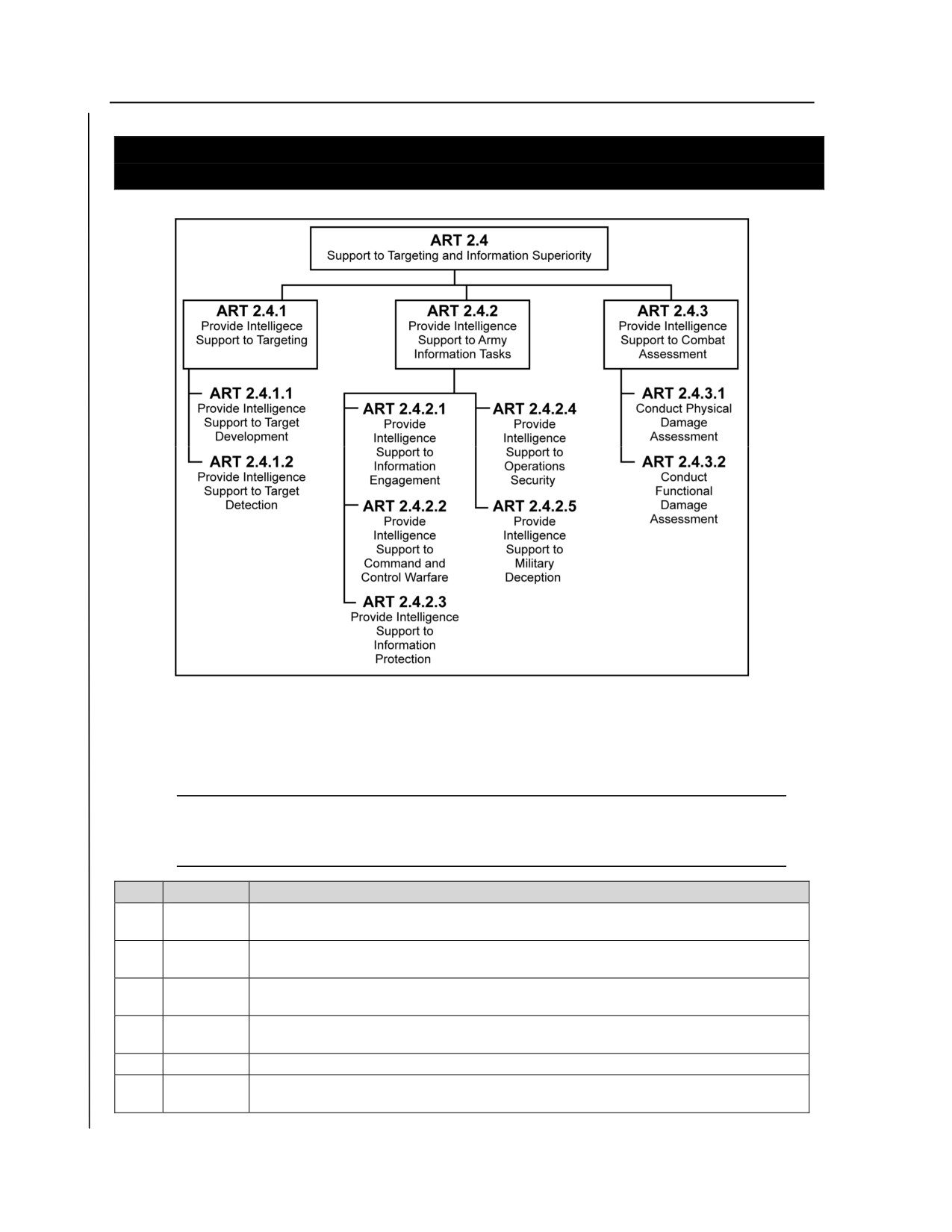
SECTION IV - ART 2.4: SUPPORT TO TARGETING AND INFORMATION
SUPERIORITY
2-62. Intelligence support to targeting and information superiority is the task of providing the commander
information and intelligence support for targeting through lethal and nonlethal actions. It includes
intelligence support to the planning and execution of direct and indirect fires and the Army information
tasks of information engagement, command and control warfare, information protection, OPSEC, and
military deception, as well as assessing the effects of those operations. (FM 2-0) (USAICoE)
Note: This task branch supports both direct (ART 1.4) and indirect (ART 3.3) delivery of fires.
This task is also linked with ART 5.1.4.3 (Provide Combat Assessment).
No.
Scale
Measure
Targets for lethal and nonlethal action were identified, nominated, and prioritized by the
01
Yes/No
entire staff.
Unit determined whether lethal, nonlethal, or a combination of lethal and nonlethal
02
Yes/No
actions will achieve the best effect or the desired outcome.
Unit linked lethal and nonlethal targets to specific intelligence, surveillance, and
03
Yes/No
reconnaissance (ISR) assets and included targets in the ISR plan.
Units identified ISR assets that can be retasked by the operations officer to acquire new
04
Yes/No
lethal or nonlethal targets per the commander’s targeting priorities.
05
Percent
Of information requirements identified for lethal and nonlethal effects.
Of information requirements identified for combat assessment and battle damage
06
Percent
assessment.
2-46
FM 7-15, C3
29 July 2010
ART 2.0: The Intelligence Warfighting Function
No.
Scale
Measure
Of combat assessment and battle damage assessments that identified if targets
07
Percent
achieved the desired effects or require reattack.
08
Percent
Of targeting databases developed, maintained, and updated.
ART 2.4.1 PROVIDE INTELLIGENCE SUPPORT TO TARGETING
2-63. The intelligence officer
(supported by the entire staff) provides the fire support coordinator,
information engagement officer, and electronic warfare officer, and other staff officers with information
and intelligence for targeting the threat’s forces and systems with direct and indirect lethal and nonlethal
fires. The information and intelligence includes identification of threat capabilities and limitations. The
targeting process uses the decide, detect, deliver, and assess methodology. The intelligence officer supports
targeting by providing accurate, current intelligence and information to the staff and ensures the ISR plan
supports the finalized targeting plan. (FM 2-0) (USAICoE)
Note: This task branch supports ART 3.2 (Detect and Locate Surface Targets) and is a byproduct
of decide, detect, deliver, and assess.
No.
Scale
Measure
01
Yes/No
The intelligence officer identified threat command and control nodes, to include all aspects.
02
Yes/No
The intelligence officer identified threat communication systems, to include all aspects.
03
Yes/No
The intelligence officer identified threat computer systems, to include all aspects.
The fire support coordinator, information engagement officer, and electronic warfare
04
Yes/No
officer received information and intelligence support for targeting of the threat’s forces
through lethal and nonlethal fires.
Risks to targeting cultural, historic sites, religious centers, medical facilities, natural
05
Yes/No
resources, hazard areas (such as nuclear power plants, chemical facilities, and oil
refineries) were assessed and included in target nomination criteria.
06
Time
To detect all aspects of the threat command and control nodes.
07
Time
To detect all aspects of the threat communications systems.
08
Time
To detect all aspects of the threat computer systems.
To provide the fire support coordinator, information engagement officer, and electronic
09
Time
warfare officer, information and intelligence support for targeting of the threat’s forces
through lethal and nonlethal fires, to include updates.
Of threat command and control nodes vulnerable to electronic attack and electronic
10
Percent
support.
Of threat computer systems vulnerable to computer network attack and computer
11
Percent
network exploit.
12
Percent
Of threat command and control nodes disrupted and degraded.
13
Percent
Of threat command and control nodes monitored.
14
Percent
Of threat computer systems compromised.
15
Percent
Of threat computer systems monitored.
ART 2.4.1.1 PROVIDE INTELLIGENCE SUPPORT TO TARGET DEVELOPMENT
2-64. The systematic analysis of threat forces and operations to determine high-value targets (people,
organizations, or military units the threat commander requires for successful completion of the mission),
high-payoff targets
(people, organizations, or military units whose loss to the enemy contributes
significantly to the success of the friendly course of action), and systems and system components for
potential attack through maneuver, fires, electronic means, or information engagement or operations.
(FM 2-0) (USAICoE)
29 July 2010
FM 7-15, C3
2-47
Chapter 2
No.
Scale
Measure
01
Yes/No
Unit developed target critical components on high-value targets.
02
Yes/No
Unit refined target critical components as high-payoff targets.
03
Yes/No
Critical components passed to targeting cell in sufficient time to engage targets.
04
Yes/No
Unit identified, nominated, and prioritized targets for lethal or nonlethal action.
05
Yes/No
Staff integrated information engagement requirements into target development.
06
Yes/No
Staff identified target areas of interest associated with each lethal or nonlethal action.
07
Time
To identify, nominate, and prioritize targets for lethal or nonlethal action.
To develop target list and perform target system analysis, critical components,
08
Time
vulnerability assessment, and target validation based on commander’s guidance.
09
Time
To identify target areas of interest for each lethal or nonlethal action.
10
Percent
Of targeted system vulnerabilities identified correctly.
11
Number
Of correctly identified critical components in targeted systems.
12
Number
Of correctly identified targets for lethal and nonlethal action.
ART 2.4.1.2 PROVIDE INTELLIGENCE SUPPORT TO TARGET DETECTION
2-65. The intelligence officer establishes procedures for dissemination of targeting information. The
targeting team develops the sensor and attack guidance matrix to determine the sensors required to detect
and locate targets. The intelligence officer places these requirements into the intelligence, surveillance, and
reconnaissance (ISR) synchronization tools for later incorporation into the ISR plan. (FM 2-0) (USAICoE)
No.
Scale
Measure
The intelligence officer linked targets to specific sensors for near real-time targeting and
01
Yes/No
included targets in the ISR synchronization plan.
The intelligence officer included targets and sensors in the sensor and attack guidance
02
Yes/No
matrix.
The intelligence officer disseminated targeting information to appropriate systems for
03
Yes/No
lethal and nonlethal action.
04
Time
For sensor to pass targeting data to appropriate systems for lethal and nonlethal action.
05
Percent
Of targets linked to sensor and appropriate systems for lethal and nonlethal action.
ART 2.4.2 PROVIDE INTELLIGENCE SUPPORT TO ARMY
INFORMATION TASKS
2-66. Intelligence support to information tasks is the task of providing the commander information and
intelligence support for targeting through nonlethal actions. It includes intelligence support to the planning,
execution of the Army information tasks
(information engagement, command and control warfare,
information protection, operations security, and military deception), as well as assessing the effects of those
operations. Key activities reflected in this task include communications, planning, synchronization, and
integration of intelligence into operation plans and orders. (FM 3-0) (USACAC)
Note: This task branch only addresses those intelligence tasks that support the conduct of Army
information tasks. The actual conduct of information engagement, information protection
operations, and activities related to command and control warfare are tasks addressed elsewhere
in the FM 7-15:
• ART 3.4 (Integrate Command and Control Warfare) addresses the conduct of electronic
command and control warfare operations.
• ART 6.3 (Conduct Information Protection) addresses the conduct of passive measures
that protect information and systems.
2-48
FM 7-15, C3
29 July 2010
ART 2.0: The Intelligence Warfighting Function
• ART 6.11.3.1 (Conduct Counterintelligence Operations) addresses the conduct of that
particular task which also relates to ART 6.3 (Conduct Information Protection).
• ART 5.3.1 (Integrate Information Engagement Capabilities) is the other activity related
to Army information tasks.
No.
Scale
Measure
01
Yes/No
Intelligence support to targeting database maintained.
02
Yes/No
Information operations (IO) target identified, prioritized and nominated.
Intelligence support identified for each element of IO involved in the operation and
03
Yes/No
integrated into the intelligence, surveillance, and reconnaissance plan.
04
Yes/No
Battle damage assessment performed on IO targets and target systems.
05
Yes/No
Combat assessment performed on IO targets.
06
Time
To determine support required for IO.
07
Time
To determine specific information requirements for IO.
08
Time
To determine the effects on the IO targets engaged.
09
Time
To provide combat assessments in support of IO.
10
Percent
Of IO requirements answered.
ART 2.4.2.1 PROVIDE INTELLIGENCE SUPPORT TO INFORMATION ENGAGEMENT
2-67. Military intelligence organizations operating outside U.S. territories support activities related to
information engagement under some circumstances. (FM 2-0) (USAICoE)
No.
Scale
Measure
Unit identified intelligence support required for public affairs through intelligence
01
Yes/No
preparation of the battlefield.
Unit provided intelligence and information to identify pertinent civil considerations that
02
Yes/No
affect information engagement.
Unit provided intelligence support to identify populace perceptions, sentiments,
03
Yes/No
attitudes, mores, allegiances, alliances, and behaviors.
Unit provided intelligence support to identify nongovernmental and international
04
Yes/No
organizations in the operational environment.
Unit provided identification support of resources and capabilities of nongovernmental
05
Yes/No
and international organizations in the operational environment.
Unit identified all relevant government agencies, organizations, or departments that
06
Yes/No
affect public affairs activities.
Unit provided intelligence support to identify adversary misinformation, disinformation,
07
Yes/No
and propaganda capabilities.
Unit provided intelligence support to identify the location, biases, and agenda of
08
Yes/No
national media representatives in the operational environment.
Unit provided intelligence support to identify the location, biases, and agenda of
09
Yes/No
international media representatives in the operational environment.
Unit provided intelligence support to identify trends reflected by the national and
10
Yes/No
international media.
Unit provided intelligence and information to public affairs per all applicable regulations,
11
Yes/No
policies, and laws.
ART 2.4.2.1.1 Provide Intelligence Support to Public Affairs
2-68. This task entails military intelligence organizations collecting and providing information and
intelligence products concerning civil considerations in the area of operations to support public affairs
activities. (FM 2-0) (USAICoE)
29 July 2010
FM 7-15, C3
2-49
Chapter 2
No.
Scale
Measure
Intelligence support required for public affairs identified through intelligence preparation
01
Yes/No
of the battlefield.
Unit provided intelligence information to identify pertinent civil considerations that affect
02
Yes/No
public affairs activities and operations.
Unit provided intelligence support to identify populace perceptions, sentiments, attitudes,
03
Yes/No
mores, allegiances, alliances, and behaviors.
Unit provided intelligence support to identify nongovernmental and international
04
Yes/No
organizations in the operational environment.
Unit identified all relevant government agencies, organizations, or departments that
05
Yes/No
affect public affairs activities and operations.
Unit provided intelligence support to identify trends reflected by the national and
06
Yes/No
international media.
Unit provided intelligence support to identify the location, biases, and agenda of national
07
Yes/No
media representatives in the operational environment.
Unit provided intelligence support to identify the location, biases, and agenda of
08
Yes/No
international media representatives in the operational environment.
Unit provided intelligence support to identify adversary misinformation, disinformation,
09
Yes/No
and propaganda capabilities.
Unit provided intelligence and information to public affairs per all applicable regulations,
10
Yes/No
policies, and laws.
11
Time
To identify pertinent civil considerations which affect public affairs activities and operations.
To identify populace perceptions, sentiments, attitudes, mores, allegiances, alliances,
12
Time
and behaviors.
13
Time
To identify nongovernmental and international organizations in the operational environment.
To identify all relevant government agencies, organizations, or departments that affect
14
Time
public affairs activities and operations.
15
Time
To identify trends reflected by the national and international media.
To identify the location, biases, and agenda of national media representatives in the
16
Time
operational environment.
To identify the location, biases, and agenda of international media representatives in the
17
Time
operational environment.
18
Time
To identify adversary or enemy misinformation, disinformation, and propaganda capabilities.
Of accurate information and intelligence provided to public affairs for civil considerations
19
Percent
that affect public affairs activities and operations.
ART 2.4.2.1.2 Provide Intelligence Support to Psychological Operations
2-69. Psychological operations require information and intelligence to support analysis of foreign target
audiences and their environment to include the following factors: political, military, economic, social,
social, information, infrastructure, physical environment and time. Continuous and timely intelligence is
required to assess target audience behavioral trends. Information and intelligence focus on target audience
motivation and behavior; indicators of success or lack of success (measure of effectiveness); and the target
audience’s reaction to friendly, hostile, and neutral force actions. (FM 2-0) (USAICoE)
No.
Scale
Measure
Unit identified intelligence support required for psychological operations through
01
Yes/No
intelligence preparation of the battlefield and support to targeting.
Unit responded to psychological operations specific information requirements
02
Yes/No
concerning the civil considerations.
03
Yes/No
Unit completed combat assessment on psychological operations targets.
04
Time
To determine the effects on the psychological operations targets engaged.
2-50
FM 7-15, C3
29 July 2010
ART 2.0: The Intelligence Warfighting Function
No.
Scale
Measure
05
Time
To provide combat assessments in support of psychological operations.
06
Percent
Of psychological operations information requests to which unit responded.
ART 2.4.2.2 PROVIDE INTELLIGENCE SUPPORT TO COMMAND AND CONTROL WARFARE
2-70. Military intelligence organizations provide information to identify threat decisionmaking and
command and control nodes, processes, and means in order of criticality. Intelligence also helps identify
threat systems, activities, and procedures that may be vulnerable to command and control warfare.
Additionally, intelligence plays a key role in evaluating and assessing the effectiveness of command and
control warfare. (FM 2-0 (USAICoE)
Note: This task supports electronic attack which employs jamming, electromagnetic energy, or
directed energy against personnel, facilities, or equipment. This task identifies critical threat
information systems and command and control nodes.
No.
Scale
Measure
01
Yes/No
Unit identified threat command and control nodes.
02
Yes/No
Unit identified threat communications systems.
03
Yes/No
Unit identified threat computer systems.
Intelligence support required for electronic attack identified through intelligence
04
Yes/No
preparation of the battlefield and support to targeting.
Unit identified the threat’s assets, processes, patterns, and means vulnerable to
05
Yes/No
electronic attack.
06
Yes/No
Unit provided intelligence support to locate targets for electronic attack.
07
Yes/No
Unit provided intelligence support to determine if desired effects were achieved.
08
Yes/No
Unit provided information regarding target capabilities and vulnerabilities.
Unit provided information regarding which enemy systems are available against which
09
Yes/No
to perform electronic attack.
10
Yes/No
Unit completed combat assessment for electronic attack.
11
Time
To determine support required for electronic attack.
12
Time
To determine specific information requirements for electronic attack.
13
Time
To provide combat assessments in support of electronic attack.
14
Percent
Of threat command and control nodes vulnerable to electronic attack.
15
Percent
Of threat command and control nodes vulnerable to electronic exploitation.
16
Percent
Of threat computer systems vulnerable to computer network attack.
17
Percent
Of threat command and control nodes disrupted and degraded.
18
Percent
Of threat computer systems compromised.
Of personnel, facilities, or equipment degraded, denied, disrupted, or destroyed by
19
Percent
electronic attack.
ART 2.4.2.3 PROVIDE INTELLIGENCE SUPPORT TO INFORMATION PROTECTION
2-71. The military intelligence organizations provide information to identify threat command and control
warfare capabilities and activities and tactics, techniques, and procedures. Intelligence provides information
relating to computer network defense, physical security, operations security, counterdeception, and
counterpropaganda. (FM 2-0) (USAICoE)
29 July 2010
FM 7-15, C3
2-51
Chapter 2
No.
Scale
Measure
Intelligence support required for information protection identified through intelligence
01
Yes/No
preparation of the battlefield and support to targeting.
02
Yes/No
Unit identified threat offensive information capabilities.
Unit identified threat offensive information operations (IO) tactics, techniques, and
03
Yes/No
procedures.
04
Yes/No
Unit identified friendly assets and forces that the threat could exploited.
05
Yes/No
Unit completed combat assessment on threat offensive IO.
06
Time
That threat offensive IO disrupts, degrades, or exploits friendly information systems.
07
Percent
Of known threat sensor coverage in area of operations.
Of attempted threat penetration of friendly information systems and facilities that were
08
Percent
successfully defeated.
09
Percent
Of imitative electronic deception attempted and successful against our forces.
10
Percent
Of threat IO capabilities not covered by operations security measures.
Of procedures for information protection changed or modified based on the results of
11
Percent
combat assessment.
Of threat offensive IO attempts that disrupt, degrade, or exploit friendly information
12
Number
systems and facilities.
13
Number
Of imitative electronic deception operations against our forces.
ART 2.4.2.4 PROVIDE INTELLIGENCE SUPPORT TO OPERATIONS SECURITY
2-72. This task identifies capabilities and limitations of the threat’s intelligence system including adversary
intelligence objectives and means, procedures, and facilities to collect, process, and analyze information.
This task supports the identification of indicators that adversary intelligence capabilities and systems might
detect that could be interpreted or pieced together to obtain essential elements of friendly information in
time to use against friendly forces. (FM 2-0) (USAICoE)
No.
Scale
Measure
Intelligence support required for operations security identified through intelligence
01
Yes/No
preparation of the battlefield.
Unit identified capabilities and limitations of adversary, threat intelligence, and security
02
Yes/No
services.
03
Yes/No
Unit identified operations security compromises.
04
Time
To input the information operations annex of the operation order.
To identify potential compromises of essential elements of friendly information in area
05
Time
of operations (AO).
06
Number
Of adversary capabilities in the AO identified.
Of successful adversary attempts to obtain information concerning friendly information
07
Number
systems.
08
Number
Of encrypted communications in AO.
09
Number
Of operations security measures selected tied to vulnerability analysis.
10
Number
Of operations security vulnerabilities tied to specific adversary capabilities by planners.
ART 2.4.2.5 PROVIDE INTELLIGENCE SUPPORT TO MILITARY DECEPTION
2-73. This task identifies capabilities and limitations of the threat’s intelligence collection capabilities,
systems, and means and identifies threat biases and perceptions. (FM 2-0) (USAICoE)
No.
Scale
Measure
01
Yes/No
Unit identified profiles of key threat leaders.
02
Yes/No
Unit outlined the threat decisionmaking processes, patterns, and biases.
2-52
FM 7-15, C3
29 July 2010
ART 2.0: The Intelligence Warfighting Function
No.
Scale
Measure
03
Yes/No
Unit identified the threat’s decisionmaking dissemination processes, patterns, and means.
04
Yes/No
Unit identified the threat perceptions of the military situation in the area of operations.
05
Yes/No
Unit identified capabilities and limitations of threat intelligence and security services.
06
Yes/No
Unit completed combat assessment for deception operations.
07
Time
To determine support required for deception operations.
08
Time
To determine specific information requirements for deception.
09
Time
To provide combat assessments in support of deception.
10
Percent
Of threat forces and targets who were deceived.
ART 2.4.3 PROVIDE INTELLIGENCE SUPPORT TO COMBAT
ASSESSMENT
2-74. Intelligence supports the assess activity of the operations process and targeting processes. The
commander uses combat assessment to determine if targeting actions have met the attack guidance and if
reattack is necessary to perform essential fires tasks and achieve the commander’s intent for fires. The staff
determines how combat assessment relates to specific targets by completing battle damage, physical
damage, functional damage, and target system assessments. (FM 2-0) (USAICoE)
Note: This task branch supports ART 5.1.4 (Assess Tactical Situations and Operations), ART
5.1.4.3 (Provide Combat Assessment), and ART 5.1.4.3.1 (Perform Battle Damage Assessment).
It is also associated with decide, detect, deliver, and assess.
No.
Scale
Measure
Unit identified intelligence, surveillance, and reconnaissance assets that can acquire
01
Yes/No
information on target effects.
02
Yes/No
Unit provided an initial assessment of attacks.
03
Yes/No
Unit provided a full assessment of attacks.
04
Time
To identify and submit information requirements for lethal and nonlethal effects.
To identify and submit information requirements for combat assessment and battle
05
Time
damage assessment.
To perform combat assessment to identify if targets achieved the desired effects or
06
Time
require reattack.
07
Time
To make initial assessment of attacks after engagement.
08
Time
To provide initial assessment of attack effects to force commander.
09
Time
To complete full assessment of attack effects after engagement.
10
Time
To provide full assessment of attacks to force commander.
11
Time
To provide reattack recommendations.
12
Percent
Of high-payoff targets correctly assessed to meet attack guidance.
ART 2.4.3.1 CONDUCT PHYSICAL DAMAGE ASSESSMENT
2-75. Conduct physical damage assessment is a staff task that estimates the extent of physical damage to a
target based on observed or interpreted damage. It is a post attack target analysis that is a coordinated effort
among all units and the entire staff. (FM 2-0) (USAICoE)
No.
Scale
Measure
Unit identified intelligence, surveillance, and reconnaissance assets that can acquire
01
Yes/No
information for physical damage assessment.
02
Yes/No
Unit provided an initial assessment of physical damage.
03
Yes/No
Unit provided a full assessment of attacks.
29 July 2010
FM 7-15, C3
2-53
Chapter 2
No.
Scale
Measure
04
Yes/No
Unit provided reattack recommendations.
05
Time
To identify and submit information requirements for physical damage assessment.
06
Time
To make initial assessment of physical damage after engagement.
07
Time
To provide initial assessment of physical damage to force commander.
08
Time
To complete full assessment of physical damage.
09
Time
To provide full assessment of attacks to force commander.
10
Percent
Of physical damage achieved within the commander’s intent for fires.
11
Percent
Of targets correctly assessed for the commander’s intent for fires.
12
Percent
Of targets unnecessarily reattacked.
ART 2.4.3.2 CONDUCT FUNCTIONAL DAMAGE ASSESSMENT
2-76. The staff conducts the functional damage assessment for the threat’s remaining functional or
operational capabilities. The assessment focuses on measurable effects. It estimates the threat’s ability to
reorganize or find alternative means to continue operations. The targeting working group and staff integrate
analysis with external sources to determine if the commander’s intent for fires has been met. (FM 2-0)
(USAICoE)
No.
Scale
Measure
Unit identified intelligence, surveillance, and reconnaissance assets that can acquire
01
Yes/No
information for functional damage assessment.
02
Yes/No
Unit provided an initial assessment of functional damage.
03
Yes/No
Unit provided a full assessment of attacks.
04
Yes/No
Unit provided reattack recommendation.
05
Time
To identify and submit information requirements for functional damage assessment.
06
Time
To make initial assessment of functional damage after engagement.
07
Time
To provide initial assessment of functional damage to force commander.
08
Time
To complete full assessment of functional damage.
09
Time
To provide full assessment of attacks to force commander.
10
Percent
Of functional damage achieved within the commander’s intent for fires.
11
Percent
Of targets correctly assessed for the commander’s intent for fires.
12
Percent
Of targets unnecessarily reattacked.
2-54
FM 7-15, C3
29 July 2010