FM 7-15, C3 The Army Universal Task List (February 2009) - page 1
FM 7-15, C3
Change No. 3
Headquarters
Department of the Army
Washington, DC, 29 July 2010
The Army Universal Task List
1. Change 3 to FM 7-15, 27 February 2009, replaces chapter 2 to align intelligence collective tasks and
current intelligence doctrine as a result of the recently published FM 2-0.
2. A bar (Ň) marks new material.
3. FM 7-15, 27 February 2009, is changed as follows:
Remove Old Pages
Insert New Pages
pages i through iv
pages i through iv
pages 2-1 through 2-54
pages 2-1 through 2-54
4. File this transmittal sheet in front of the publication for reference purposes.
DISTRIBUTION RESTRICTION: Approved for public release; distribution is unlimited.
*FM 7-15, C3
Field Manual
Headquarters
Department of the Army
No. 7-15
Washington, DC, 27 February 2009
The Army Universal Task List
Contents
Page
PREFACE
ix
INTRODUCTION
xii
Chapter 1
ART 1.0: THE MOVEMENT AND MANEUVER WARFIGHTING FUNCTION.. 1-1
Section I - ART 1.1: Perform Tactical Actions Associated with Force
Projection and Deployment
1-2
ART 1.1.1 Conduct Mobilization of Tactical Units
1-2
ART 1.1.2 Conduct Tactical Deployment/Redeployment Activities
1-4
ART 1.1.3 Conduct Demobilization of Tactical Units
1-7
ART 1.1.4 Conduct Rear Detachment Activities
1-7
Section II - ART 1.2: Conduct Tactical Maneuver
1-8
ART 1.2.1 Conduct One of the Five Forms of Maneuver
1-9
ART 1.2.2 Employ Combat Formations
1-11
ART 1.2.3 Employ Combat Patrols
1-17
ART 1.2.4 Conduct Counterambush Actions
1-17
ART 1.2.5 Exploit Terrain to Expedite Tactical Movements
1-18
ART 1.2.6 Cross a Danger Area
1-18
ART 1.2.7 Link Up with Other Tactical Forces
1-18
ART 1.2.8 Conduct Passage of Lines
1-19
ART 1.2.9 Conduct a Relief in Place
1-20
ART 1.2.10 Navigate from One Point to Another
1-21
ART 1.2.11 Conduct a Survivability Move
1-21
ART 1.2.12 Conduct Sniper Active Countermeasures
1-22
ART 1.2.13 Conduct Sniper Passive Countermeasures
1-22
Section III - ART 1.3: Conduct Tactical Troop Movements
1-23
ART 1.3.1 Prepare Forces for Movement
1-23
ART 1.3.2 Conduct Tactical Road March
1-25
ART 1.3.3 Conduct Tactical Convoy
1-25
ART 1.3.4 Conduct an Approach March
1-26
Distribution Restriction: This manual is approved for public release; distribution is unlimited.
*This publication supersedes FM 7-15, 31 August 2003.
27 July 2010
FM 7-15, C3
i
Contents
Section IV - ART 1.4: Conduct Direct Fires
1-27
ART 1.4.1 Conduct Lethal Direct Fire Against a Surface Target
1-27
ART 1.4.2 Conduct Nonlethal Direct Fire Against a Surface Target
1-28
Section V - ART 1.5: Occupy an Area
1-29
ART 1.5.1 Occupy an Assembly Area
1-29
ART 1.5.2 Occupy an Attack and Assault Position
1-29
ART 1.5.3 Occupy and Establish a Battle or Defensive Position
1-30
ART 1.5.4 Conduct Drop Zone Operations
1-30
ART 1.5.5 Conduct Landing Zone Operations
1-31
Section VI - ART 1.6: Conduct Mobility Operations
1-32
ART 1.6.1 Overcome Barriers, Obstacles, and Mines
1-33
ART 1.6.2 Enhance Movement and Maneuver
1-38
ART 1.6.3 Negotiate a Tactical Area of Operations
1-41
ART 1.6.4 Provide Diver Support
1-41
ART 1.6.5 Conduct Nontactical Movements
1-42
Section VII - ART 1.7: Conduct Countermobility Operations
1-43
ART 1.7.1 Site Obstacles
1-44
ART 1.7.2 Construct, Emplace, or Detonate Obstacles
1-45
ART 1.7.3 Mark, Report, and Record Obstacles
1-45
ART 1.7.4 Maintain Obstacle Integration
1-46
Section VIII - ART 1.8: Employ Obscurants
1-46
Chapter 2
ART 2.0: THE INTELLIGENCE WARFIGHTING FUNCTION
2-1
Section I - ART 2.1: Intelligence Support to Force Generation
2-2
ART 2.1.1 Provide Intelligence Readiness
2-2
ART 2.1.2 Establish Intelligence Architecture
2-4
ART 2.1.3 Provide Intelligence Overwatch
2-8
ART 2.1.4 Generate Intelligence Knowledge
2-8
ART 2.1.5 Tailor the Intelligence Force
2-13
Section II - ART 2.2: Support to Situational Understanding
2-15
ART 2.2.1 Perform Intelligence Preparation of the Battlefield
2-16
ART 2.2.2 Perform Situation Development
2-20
ART 2.2.3 Provide Intelligence Support to Protection
2-20
ART 2.2.4 Provide Tactical Intelligence Overwatch
2-21
ART 2.2.5 Conduct Police Intelligence Operations
2-21
ART 2.2.6 Provide Intelligence Support to Civil Affairs Activities
2-26
Section III - ART 2.3: Perform Intelligence, Surveillance, and
Reconnaissance
2-27
ART 2.3.1 Perform Intelligence, Surveillance, and Reconnaissance
Synchronization
2-28
ART 2.3.2 Perform Intelligence, Surveillance, and Reconnaissance
Integration
2-30
ART 2.3.3 Conduct Reconnaissance
2-33
ART 2.3.4 Conduct Surveillance
2-38
ART 2.3.5 Conduct Intelligence Related Missions and Operations
2-38
Section IV - ART 2.4: Support to Targeting and Information Superiority . 2-46
ART 2.4.1 Provide Intelligence Support to Targeting
2-47
ii
FM 7-15, C3
29 July 2010
Contents
ART 2.4.2 Provide Intelligence Support to Army Information Tasks
2-48
ART 2.4.3 Provide Intelligence Support to Combat Assessment
2-53
Chapter 3
ART 3.0: THE FIRES WARFIGHTING FUNCTION
3-1
Section I - ART 3.1: Decide Surface Targets
3-1
Section II - ART 3.2: Detect and Locate Surface Targets
3-2
Section III - ART 3.3: Provide Fire Support
3-2
ART 3.3.1 Conduct Fires
3-3
ART 3.3.2 Provide Illumination
3-7
ART 3.3.3 Conduct Survey Operations in Support of Fires Systems
3-8
ART 3.3.4 Perform Meteorological Operations in Support of Fires Systems
3-8
ART 3.3.5 Conduct Suppression of Enemy Air Defenses
3-9
Section IV - ART 3.4: Integrate Command and Control Warfare
3-10
ART 3.4.1 Conduct Electronic Attack
3-10
ART 3.4.2 Nominate Computer Network Attack Targets
3-11
ART 3.4.3 Nominate Electronic Attack Targets
3-11
Chapter 4
ART 4.0: THE SUSTAINMENT WARFIGHTING FUNCTION
4-1
Section I - ART 4.1: Provide Logistics Support
4-2
ART 4.1.1 Provide Maintenance Support
4-3
ART 4.1.2 Provide Transportation Support
4-7
ART 4.1.3 Provide Supplies
4-15
ART 4.1.4 Provide Field Services
4-32
ART 4.1.5 Provide Contracting Support
4-38
ART 4.1.6 Provide Distribution
4-39
ART 4.1.7 Provide General Engineer Support
4-44
Section II - ART 4.2: Provide Personnel Services Support
4-64
ART 4.2.1 Provide Human Resources Support
4-65
ART 4.2.2 Provide Financial Management Support
4-73
ART 4.2.3 Provide Legal Support
4-77
ART 4.2.4 Plan Religious Support Operations
4-82
ART 4.2.5 Provide Band Support
4-85
Section III - ART 4.3: Provide Health Service Support
4-86
ART 4.3.1 Provide Combat Casualty Care
4-86
ART 4.3.2 Provide Medical Evacuation (Air and Ground)
4-90
ART 4.3.3 Provide Medical Regulating Support
4-91
ART 4.3.4 Provide Medical Logistics
4-91
Section IV - ART 4.4: Conduct Internment and Resettlement
Operations
4-94
ART 4.4.1 Perform Internment Operations
4-94
ART 4.4.2 Conduct Resettlement Operations
4-97
ART 4.4.3 Conduct Resettlement Operations
Rescinded
Chapter 5
ART 5.0: CONDUCT COMMAND AND CONTROL
5-1
Section I - ART 5.1: Execute the Operations Process
5-2
ART 5.1.1 Plan Operations
5-2
ART 5.1.2 Prepare for Tactical Operations
5-8
ART 5.1.3 Execute Tactical Operations
5-11
29 July 2010
FM 7-15, C3
iii
Contents
ART 5.1.4 Assess Tactical Situations and Operations
5-17
Section II - ART 5.2: Conduct Command Post Operations
5-21
ART 5.2.1 Conduct Command Post Operations to Support Tactical
Operations
5-22
ART 5.2.2 Displace the Command Post
5-23
ART 5.2.3 Execute Sleep Plans
5-24
ART 5.2.4 Manage Stress
5-25
ART 5.2.5 Maintain Continuity of Command and Control
5-25
Section III - ART 5.3: Integrate Information Superiority Contributors
5-26
ART 5.3.1 Integrate Information Engagement Capabilities
5-26
ART 5.3.2 Conduct Military Deception
5-29
ART 5.3.3 Facilitate Situational Understanding Through Knowledge
Management
5-30
ART 5.3.4 Manage Information and Data
5-30
ART 5.3.5 Establish the Information Network and System
5-30
ART 5.3.6 Conduct Electromagnetic Spectrum Management Operations
5-35
Section IV - ART 5.4: Conduct Civil-Military Operations
5-37
ART 5.4.1 Provide Interface or Liaison Among Military and Civilian
Organizations
5-38
ART 5.4.2 Locate and Identify Population Centers
5-39
ART 5.4.3 Identify Local Resources, Facilities, and Support
5-39
ART 5.4.4 Advise Commanders of Obligations to Civilian Population
5-40
ART 5.4.5 Conduct Negotiations With and Between Other Government
Agencies and Nongovernmental Organizations
5-41
ART 5.4.6 Conduct Civil Affairs Operations
5-42
Section V - ART 5.5: Execute Command Programs
5-59
ART 5.5.1 Support the Commander’s Leadership Responsibilities for Morale,
Welfare, and Discipline
5-59
ART 5.5.2 Preserve Historical Documentation and Artifacts
5-67
ART 5.5.3 Conduct Official Ceremonial, Musical, Public, and Special Events. 5-72
ART 5.5.4 Develop a Command Environmental Program
5-72
Section VI - ART 5.6: Integrate Space Operations
5-73
ART 5.6.1 Provide Space Force Enhancement
5-74
ART 5.6.2 Provide Space Control
5-75
ART 5.6.3 Provide Army Space Support
5-76
ART 5.6.4 Provide Space Situational Awareness
5-76.1
ART 5.6.5 Coordinate Army Space Capabilities
5-76.2
Section VII - ART 5.7: Conduct Public Affairs Operations
5-77
ART 5.7.1 Plan Public Affairs Operations
5-77
ART 5.7.2 Execute Information Strategies
5-77
ART 5.7.3 Facilitate Media Operations
5-78
ART 5.7.4 Maintain Community Relations
5-78
ART 5.7.5 Conduct Internal Information Program
5-79
ART 5.7.6 Implement Higher Headquarters Public Affairs Themes
5-79
Section VIII - ART 5.8: Establish and Maintain Discipline
5-79
ART 5.8.1 Conduct Law and Order Operations
5-80
ART 5.8.2 Intern U.S. Military Prisoners
5-85
iv
FM 7-15, C3
29 July 2010
Chapter 2
ART 2.0: The Intelligence Warfighting Function
The intelligence warfighting function is the related tasks and systems that facilitate
understanding of the operational environment, enemy, terrain, and civil
considerations. It includes tasks associated with intelligence, surveillance, and
reconnaissance operations, and is driven by the commander. Intelligence is more than
just collection. As a continuous process, it involves analyzing information from all
sources
(human, imagery, measurement and signature, signal) and conducting
operations to develop the situation. (FM 3-0) (USACAC)
29 July 2010
FM 7-15, C3
2-1
Chapter 2
SECTION I - ART 2.1: INTELLIGENCE SUPPORT TO FORCE GENERATION
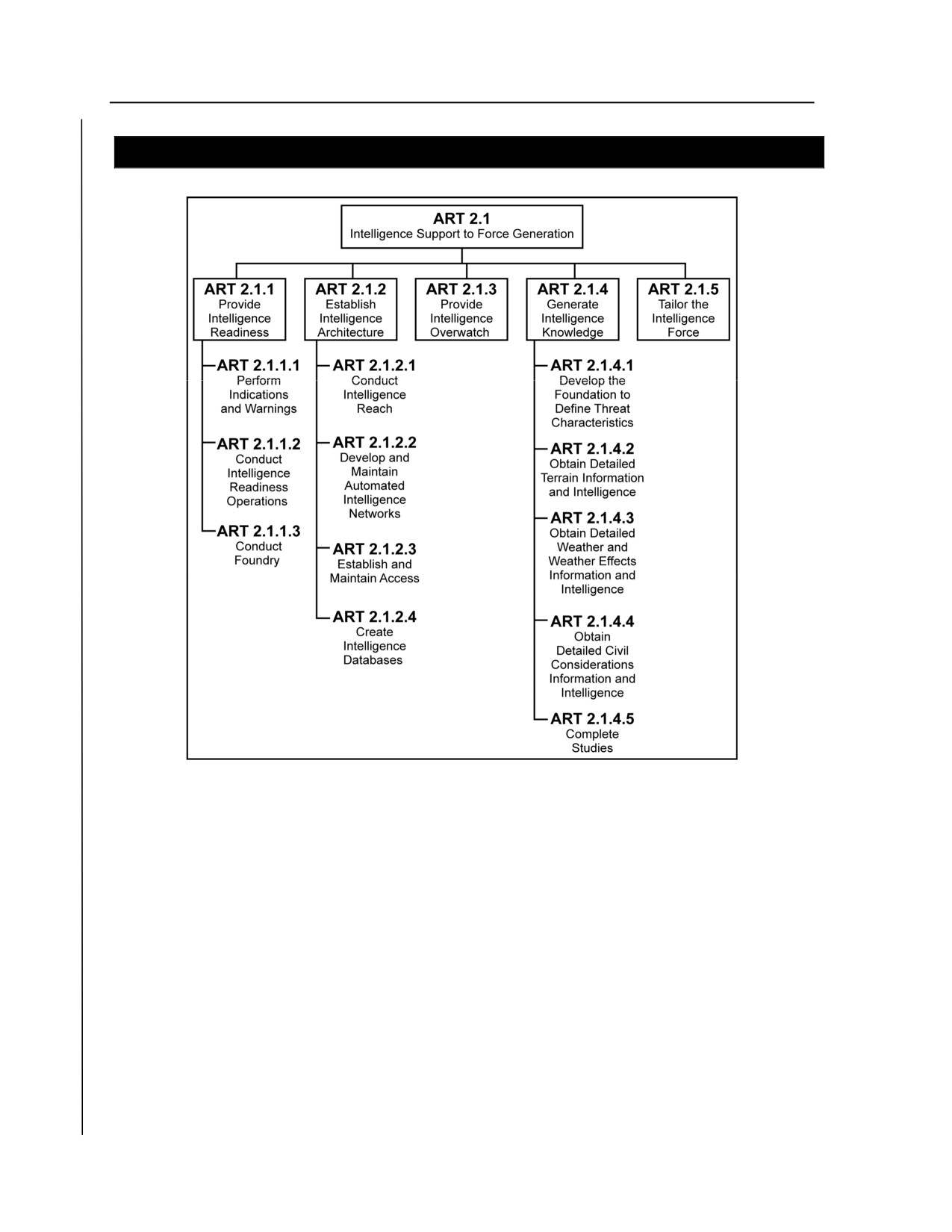
2-1. Intelligence support to force generation is the task of generating intelligence knowledge concerning
an area of interest, facilitating future intelligence operations, and tailoring the force. It includes establishing
intelligence communication and knowledge management architectures. These architectures enable
collaboration among strategic, operational, and tactical intelligence organizations in the following areas—
intelligence reach; collaborative analysis; data storage; processing and analysis; and intelligence production
support to force generation consists of five tasks. (FM 2-0) (USAICoE)
ART 2.1.1 PROVIDE INTELLIGENCE READINESS
2-2. Intelligence readiness operations develop baseline knowledge of multiple potential threats and
operational environments. These operations support ongoing operations, contingency planning, and
operational preparation. These operations and related intelligence training activities enable the intelligence
warfighting function to support the commander’s intelligence requirements effectively.
(FM 2-0)
(USAICoE)
2-2
FM 7-15, C3
29 July 2010
ART 2.0: The Intelligence Warfighting Function
No.
Scale
Measure
01
Yes/No
Unit provided indications and warning reports.
02
Yes/No
Unit provided intelligence readiness.
03
Yes/No
Unit conducted foundry training.
04
Percent
Of intelligence relating to indications and warning prior to incident occurring.
Of relevant data, information, intelligence, and products received on the
05
Percent
operational environment.
06
Percent
Of relevant training received for the conduct of operations.
ART 2.1.1.1 PERFORM INDICATIONS AND WARNING
2-3. This task provides the commander with advance warning of threat actions or intentions. The
intelligence officer develops indications and warnings to rapidly alert the commander of events or activities
that would change the basic nature of the operation. It enables the commander to quickly reorient the force
to unexpected contingencies and shape the operational environment. (FM 2-0) (USAICoE)
No.
Scale
Measure
Unit issued indications and warnings in sufficient time to prevent the enemy or
01
Yes/No
threat from surprising the targeted friendly unit or installation.
Unit disseminated indications and warnings after development and compared to
02
Yes/No
other information and intelligence to ensure accuracy.
Intelligence officer monitored event template and matrix to determine if the enemy
03
Yes/No
or threat was performing a predicted course of action (COA).
04
Yes/No
Unit identified enemy and potential threats in the operational environment.
05
Yes/No
Unit updated enemy and threat identification, tactics, techniques, and procedures.
Between receipt of significant information and intelligence and updates of
06
Time
indications and warnings conditions.
07
Time
To conduct predictive analysis in support of COA development.
08
Time
To predict significant changes in enemy or threat activities.
Required to disseminate indications and warnings to appropriate echelons,
09
Time
agencies, and organizations.
10
Time
To submit intelligence portion of commander’s situation report.
Of indications and warnings of threat actions reported that will impact friendly
11
Percent
forces operations.
12
Percent
Of commander’s threat conditions and attack warnings issued and disseminated.
13
Percent
Of threat indicators maintained and evaluated.
ART 2.1.1.2 CONDUCT INTELLIGENCE READINESS OPERATIONS
2-4. Intelligence readiness operations support contingency planning and preparation by developing
baseline knowledge of multiple potential threats and operational environments. This information and
training enables a collaborative effort and environment to provide the best possible initial threat
understanding. (FM 2-0) (USAICoE)
No.
Scale
Measure
Unit provided information on the civil considerations using the factors of areas,
01
Yes/No
structures, capabilities, organizations, people and events affecting the force.
02
Percent
Of intelligence relating to the enemy force.
03
Percent
Of intelligence relating to potential terrorist acts against U.S. forces.
04
Percent
Of intelligence relating to potential insurgent, guerrilla, or criminal groups.
Of intelligence relating to using chemical, biological, radiological, nuclear, and high-
05
Percent
yield explosives (CBRNE) weapons.
29 July 2010
FM 7-15, C3
2-3
Chapter 2
No.
Scale
Measure
Of information and intelligence that facilitates a cultural understanding of the
06
Percent
operational environment.
07
Percent
Of intelligence requirements to support the other warfighting functions or Army programs.
ART 2.1.1.3 CONDUCT FOUNDRY
2-5. Foundry is a training program designed to sustain critical intelligence capabilities and perishable
intelligence skills, and provide regional focus, technical training and functional expertise to the tactical
military intelligence (MI) force through home-station training platforms, mobile training teams, and live
environment training opportunities. Foundry creates a single hub for advanced skills training across the
Active Army, Army National Guard, and the Army Reserve MI force. It also provides training to leaders
who supervise MI missions and Soldiers who perform MI activities. (FM 2-0) (USAICoE)
No.
Scale
Measure
Unit identified specific intelligence skills by each military occupational specialty needed
01
Yes/No
to deploy to a specific theater.
Unit identified intelligence training requirements and skills needed for MI sustainment
02
Yes/No
and the intelligence overwatch program.
Unit identified intelligence training resources available to conduct foundry training in
03
Yes/No
order to meet theater specific mission and deployment standards.
04
Yes/No
Unit prepared foundry prioritized quarterly training requests for funding.
MI soldiers and units actively participated in foundry training opportunities to include live
05
Yes/No
environment training.
Unit established unit and functional partnerships in support of MI training and readiness
06
Yes/No
effort.
Unit used Project Foundry to develop MI adjunct faculty (subject matter expert) in
07
Yes/No
support of unit and home station training efforts.
08
Yes/No
Unit conducted MI periodic training councils to share training resources and assets.
09
Yes/No
Units used Project Foundry to conduct unit collective training and for unit exercises.
Units reported tactics, techniques, and procedures (TTP) and lessons learned for
10
Yes/No
integration into training programs, doctrine, and the Project Foundry.
Unit conducted an annual assessment of Project Foundry and MI training successes
11
Yes/No
and needs.
12
Percent
Of unfunded quarterly foundry training requests.
13
Number
Of skills identified for deployment used in theater.
14
Number
Of skills not initially identified but were needed in theater.
15
Number
Of available MI soldiers requiring training who participate annually in foundry training.
16
Number
Of available MI units requiring training who participate annually in foundry training.
17
Number
Of units that utilize foundry for collective training.
18
Number
Of units that utilize foundry for unit exercises.
Of units that report TTP and lessons learned for integration into training programs,
19
Number
doctrine, and the Project Foundry.
Of items identified in the annual assessment needed to improve Project Foundry and
20
Number
MI training.
ART 2.1.2 ESTABLISH INTELLIGENCE ARCHITECTURE
2-6. Establishing an intelligence architecture includes complex and technical issues that include hardware,
software, communications, communications security materials, network classification, technicians,
database access, liaison officers, training, and funding. Well-defined and well-designed intelligence
architecture can offset or mitigate structural, organizational, or personnel limitations. This architecture
2-4
FM 7-15, C3
29 July 2010
ART 2.0: The Intelligence Warfighting Function
provides the best possible understanding of the threat, terrain, and weather, and civil considerations
understanding. (FM 2-0) (USAICoE)
No.
Scale
Measure
Unit identified national agencies with relevant information, databases, and systems to
01
Yes/No
form a collaborative environment.
Unit identified Department of Defense organizations with relevant information,
02
Yes/No
databases, and systems to form a collaborative environment.
Unit identified multinational organizations and elements with relevant data, information,
03
Yes/No
databases, and systems to form a collaborative environment.
Unit identified Army organizations with relevant information, databases, and systems
04
Yes/No
to form a collaborative environment.
05
Yes/No
Unit achieved enemy and threat understanding through the intelligence architecture.
Of analysis, training, and intelligence production achieved through collaborative
06
Percent
intelligence architecture.
07
Percent
Of structural, organizational, or personnel limitations offset or mitigated.
ART 2.1.2.1 CONDUCT INTELLIGENCE REACH
2-7. Intelligence reach is a process by which intelligence organizations proactively and rapidly access
information from, receive support from, and conduct direct collaboration and information sharing with
other units and agencies, both within and outside the area of operations, unconstrained by geographic
proximity, echelon, or command. Intelligence obtained through intelligence reach helps the staff plan and
prepare for operations and answer commander’s critical information requirements without the need for the
information to pass through a formal hierarchy. (FM 2-0) (USAICoE)
No.
Scale
Measure
01
Yes/No
Unit established unit procedures or processes by which to conduct intelligence reach.
Soldiers trained, maintained, exercised, and sustained their intelligence reach
02
Yes/No
procedures or processes.
03
Yes/No
Unit received information or intelligence through intelligence reach relevant to operations.
04
Yes/No
Unit used intelligence reach in intelligence, surveillance, and reconnaissance (ISR) planning.
05
Time
Required to update procedures and processes for intelligence reach sustainment.
06
Percent
Of trained personnel on intelligence reach procedures.
07
Percent
Of relevant information obtained.
08
Percent
Of information acquired through organic ISR taskings available through intelligence reach.
09
Percent
Of ISR tasks developed through information obtained by intelligence reach.
10
Percent
Of ISR tasks dynamically retasked due to information obtained by intelligence reach.
ART 2.1.2.2 DEVELOP AND MAINTAIN AUTOMATED INTELLIGENCE NETWORKS
2-8. This task entails providing information systems that connect unique assets, units, echelons, agencies,
and multinational partners for intelligence, collaborative analysis and production, dissemination, and
intelligence reach. It uses existing automated information systems, such as the distributed common ground
system-Army (known as DCGS-A), and, when necessary, creates operationally specific networks. In either
case, these networks allow access to unclassified and classified means, and interoperability across the area
of operations. This task includes identifying deficiencies in systems or networks, Service procedures,
system administration procedures, security procedures, alternate power plan, redundancy capability, system
backups, and update procedures. (FM 2-0) (USAICoE)
No.
Scale
Measure
01
Yes/No
Unit established intelligence specific networks (classified and unclassified).
The appropriate unique assets, units, echelons, agencies, and multinational partners
02
Yes/No
were included in the network.
29 July 2010
FM 7-15, C3
2-5
Chapter 2
No.
Scale
Measure
The intelligence network was used for collaborative analysis and production,
03
Yes/No
dissemination, and intelligence reach.
The intelligence network was adequate for collaborative analysis and production,
04
Yes/No
dissemination, and intelligence reach.
The intelligence network was adequate for interoperability across the area of operations
05
Yes/No
to include subordinate elements collaborative analysis and production, dissemination,
and intelligence reach.
06
Yes/No
Policies and procedures were in place for identifying deficiencies in the systems or networks.
Policies and procedures were in place for implementing service procedures and an
07
Yes/No
alternate power plan.
08
Yes/No
Policies and procedures were in place for network security.
09
Yes/No
Policies and procedures were in place for system backup and update.
10
Yes/No
Units used policies and procedures for system administration.
11
Yes/No
Adequate redundancy was built into the network.
The network was down or unavailable due to service, system administration, or system
12
Time
update.
13
Time
Between the primary system failing and the redundancy capability initialized.
Of network used for collaborative analysis and production, dissemination, and
14
Percent
intelligence reach.
15
Percent
Of time the redundancy capability was used in place of the primary system.
ART 2.1.2.3 ESTABLISH AND MAINTAIN ACCESS
2-9. Establish and provide access to classified and unclassified programs, databases, networks, systems,
and other Web-based collaborative environments for Army and multinational organizations to facilitate
intelligence reporting, production, dissemination, sustainment, and intelligence reach. This task also
includes establishing access to classified and unclassified programs, databases, networks, systems, and
other Web-based collaborative environments with joint forces and national agencies to facilitate a
multilevel collaborative information environment. This task entails establishing, providing, and maintaining
access to classified and unclassified programs, databases, networks, systems, and other Web-based
collaborative environments for Army forces, joint forces, national agencies, and multinational
organizations. Its purpose is to facilitate intelligence reporting, production, dissemination, and sustainment;
intelligence reach; and a multilevel collaborative information environment. (FM 2-0) (USAICoE)
No.
Scale
Measure
Unit established or provided access to classified and unclassified programs,
01
Yes/No
databases, networks, systems, and other Web-based collaborative environments for
Army and multinational organizations.
Unit provided access to classified and unclassified programs, databases, networks,
02
Yes/No
systems, and other Web-based collaborative environments with joint and interagency
organizations to facilitate a multilevel collaborative environment.
Unit established individual user accounts per applicable policies and regulations and
03
Yes/No
any applicable prerequisite training.
04
Yes/No
Unit established local standing operating procedures (SOPs) for individual user accounts.
Unit maintained individual user accounts per the SOPs, policies, regulations, and any
05
Yes/No
applicable recertification or revalidation training.
06
Yes/No
Unit established system accounts per policies, regulations, and any prerequisite training.
07
Yes/No
Unit established local SOPs for system accreditation.
Unit established joint, interagency, and multinational accounts per policies, regulations,
08
Yes/No
and any prerequisite training.
Unit established local SOPs for joint, interagency, and multinational accounts
09
Yes/No
establishment and maintenance.
2-6
FM 7-15, C3
29 July 2010
ART 2.0: The Intelligence Warfighting Function
No.
Scale
Measure
Unit maintained joint, interagency, and multinational accounts per policies, regulations,
10
Yes/No
and any prerequisite training.
Unit designated a security officer to ensure local SOPs meet appropriate standards for
11
Yes/No
Army, joint, interagency, and multinational policies and regulations.
Unit designated a security officer to establish an oversight or inspection program to
12
Yes/No
enforce Army, joint, interagency, and multinational policies and regulations.
Unit designated a security officer to serve as the liaison for higher headquarters, joint,
13
Yes/No
and interagency oversight and inspection teams.
ART 2.1.2.4 CREATE INTELLIGENCE DATABASES
2-10. This task entails creating and maintaining unclassified and classified databases. Its purpose is to
establish interoperable and collaborative environments for Army forces, joint forces, national agencies, and
multinational organizations. This task facilitates intelligence analysis, reporting, production, dissemination,
sustainment, and intelligence reach. It also includes the requirements for formatting and standardization,
indexing and correlation, normalization, storage, security protocols, and associated applications. The
following must be addressed in database development, management, and maintenance: data sources;
information redundancy; import and export standards; data management and standards; update and backup
procedures; and data mining, query, and search protocols. (FM 2-0) (USAICoE)
No.
Scale
Measure
Unit established and maintained classified and unclassified databases at the
01
Yes/No
appropriate echelons and organizations.
Unit established prerequisite training for users on database use; data mining, searches,
02
Yes/No
and queries; and update and backup procedures.
Unit established local standing operating procedures (SOPs) for database use; data
03
Yes/No
mining, searches, and queries; and update and backup procedures.
The intelligence database was used for collaborative analysis and production,
04
Yes/No
dissemination, and intelligence reach.
The intelligence database was adequate for collaborative analysis and production,
05
Yes/No
dissemination, and intelligence reach.
The intelligence database was adequate for interoperability across the area of
06
Yes/No
operations to include subordinate elements’ collaborative analysis and production,
dissemination, and intelligence reach.
Policies and procedures were in place for reporting issues with database security and
07
Yes/No
database deficiencies or corruption.
08
Yes/No
Adequate redundancy was built into the database.
09
Yes/No
Policies and procedures were provided for database administration.
Unit designated a primary and alternate database manager to ensure local SOPs meet
10
Yes/No
appropriate standards for Army, joint, interagency, and multinational policies and regulations.
11
Yes/No
Unit established training program for the primary and alternate database managers.
Policies and procedures were in place for implementing Service procedures and a data
12
Yes/No
redundancy plan.
13
Yes/No
Policies and procedures were in place for database security.
14
Yes/No
Policies and procedures were in place for a database backup and update.
15
Time
That database was down or unavailable due to service, administration, or update.
16
Time
Between the primary database failing and the redundancy capability was initialized.
That primary or alternate database manager spent on correcting or resolving
17
Time
deficiencies or corruptions with the primary or redundant database.
Of database used for collaborative analysis and production, dissemination, and
18
Percent
intelligence reach.
19
Percent
Of time the redundancy capability was used in place of the primary database.
29 July 2010
FM 7-15, C3
2-7
Chapter 2
ART 2.1.3 PROVIDE INTELLIGENCE OVERWATCH
2-11. Intelligence overwatch is creating standing, fixed analytical intelligence capabilities that provide
dedicated intelligence support to committed maneuver units. The overwatch cell is connected via a shared
intelligence network that can extract information from multiple sources and provide succinct answers (vice
megabytes of information) directly to supported units when time is critical. (FM 2-0) (USAICoE)
Note: This task branch supports ART 6.7 (Conduct Survivability Operations).
No.
Scale
Measure
Selected intelligence Soldiers provided a foundation of regional and subject matter
01
Yes/No
expertise.
02
Yes/No
New intelligence technology was incorporated into the intelligence system.
ART 2.1.4 GENERATE INTELLIGENCE KNOWLEDGE
2-12. Generate intelligence knowledge is a continuous, user-defined task driven by the commander. It
begins before mission receipt and provides the relevant knowledge required regarding the operational
environment for the conduct of operations. As soon as the intelligence officer and other staff sections begin
to collect data on the operational environment, they should organize the data into databases that meet the
commander’s visualization requirements. The execution of this task must follow all applicable policies and
regulations on information collection and operations security. The information and intelligence obtained are
refined into knowledge for use in mission analysis through functional analysis. Information is obtained
through intelligence reach; research; data mining; database access; academic studies, products, or materials;
intelligence archives; open-source intelligence; and other information sources. Generate intelligence
knowledge is the foundation for performing intelligence preparation of the battlefield and mission analysis.
The primary product of the generate intelligence knowledge task is the initial data files and intelligence
survey. (FM 2-0) (USAICoE)
No.
Scale
Measure
Unit obtained detailed information on threat characteristics (composition, disposition,
tactics, training, logistics, operational effectiveness, fires, communications, personality,
01
Yes/No
intelligence, reach, agencies, nongovernmental organizations, and other threats) in and
affecting the operational environment.
Unit obtained detailed information on the types of environment, such as desert, urban,
02
Yes/No
jungle, arctic, and mountain, and the military aspects of terrain.
Unit obtained detailed information on recent and historical weather trends, seasonal
patterns, aspects of weather, and weather zones in the operational environment. Unit
03
Yes/No
effectively used and integrated the information to determine how the weather potentially
affects friendly and enemy forces and operations in the operational environment.
Unit obtained detailed information on civil considerations within and affecting the
04
Yes/No
operational environment.
05
Yes/No
Unit used the analytic functions and functional analysis.
Unit followed all applicable policies and regulations when collecting information and
06
Yes/No
operations security.
ART 2.1.4.1 DEVELOP THE FOUNDATION TO DEFINE THREAT CHARACTERISTICS
2-13. Obtain detailed information and intelligence concerning threat characteristics (formerly order of
battle) affecting the conduct of operations. Obtain this information from sources that include intelligence
reach; research; data mining; database access; academic studies, products, or materials; intelligence
archives; and open-source intelligence. This task develops specific, detailed information for each threat
characteristic. The information, intelligence, products, and materials obtained are refined for use in mission
analysis, intelligence preparation of the battlefield (IPB), and other planning tasks. This refinement occurs
through functional analysis and other analytic techniques. (FM 2-0) (USAICoE)
2-8
FM 7-15, C3
29 July 2010
ART 2.0: The Intelligence Warfighting Function
No.
Scale
Measure
Unit obtained detailed information on composition, disposition, tactics, training, logistics,
operational effectiveness, fires, communications, personality, intelligence, reach,
01
Yes/No
agencies, nongovernmental organizations, and other threats in and affecting the
operational environment.
Information obtained from external agencies, echelons, and partners was adequate for
02
Yes/No
use in mission analysis, IPB, and planning.
Information obtained was used and integrated effectively to determine the effects on
03
Yes/No
operations.
04
Percent
Of relevant information obtained from national agencies.
05
Percent
Of relevant information obtained from joint echelons.
06
Percent
Of relevant information obtained from multinational partners.
07
Percent
Of relevant information obtained from higher Army echelons.
08
Percent
Of relevant information obtained from lateral and subordinate echelons.
ART 2.1.4.2 OBTAIN DETAILED TERRAIN INFORMATION AND INTELLIGENCE
2-14. Obtain detailed information and intelligence about the terrain of the expected area of interest from
sources that include intelligence reach; research; data mining; database access; academic studies, products,
or materials; intelligence archives; and open-source intelligence. The information, intelligence, products,
and material obtained are refined for use in mission analysis, intelligence preparation of the battlefield
(IPB), and other planning tasks through functional analysis. This task encompasses the types of
environments and the military aspects of terrain. (FM 2-0) (USAICoE)
No.
Scale
Measure
Unit obtained detailed information on the types of environment, such as desert, urban,
01
Yes/No
jungle, arctic, and mountain.
Information obtained from external agencies, echelons, and partners was adequate for
02
Yes/No
use in mission analysis, IPB, and planning.
Information obtained was used and integrated effectively into mission analysis, IPB,
03
Yes/No
and planning.
04
Yes/No
Unit obtained detailed information on the military aspects of terrain.
05
Percent
Of relevant information obtained from national agencies.
06
Percent
Of relevant information obtained from joint echelons.
07
Percent
Of relevant information obtained from multinational partners.
08
Percent
Of relevant information obtained from higher Army echelons.
09
Percent
Of relevant information obtained from lateral and subordinate echelons.
ART 2.1.4.3 OBTAIN DETAILED WEATHER AND WEATHER EFFECTS INFORMATION AND
INTELLIGENCE
2-15. Obtain detailed information and intelligence regarding recent and historical weather trends, seasonal
patterns, aspects of weather, and weather zones. Obtain information on how the weather affects friendly
and enemy forces and operations in the area of interest Sources of information include intelligence reach;
research; data mining; database access via the digital topographic support system; academic studies,
products, or materials; intelligence archives; and open-source intelligence. This task requires specific and
detailed information for each weather factor. The Integrated Meteorological System (accessed through
distributed common groundsystem-Army) provides commanders at all echelons of command with an
automated weather system. This system receives, processes, and disseminates weather observations,
forecasts, and decision aids for weather and environmental effects to all warfighting functions. The
information, intelligence, products, and materials obtained are refined for use in mission analysis,
intelligence preparation of the battlefield (IPB), and other planning tasks through functional analysis.
(FM 2-0) (USAICoE)
29 July 2010
FM 7-15, C3
2-9
Chapter 2
No.
Scale
Measure
Unit obtained detailed information the recent and historical weather trends, seasonal
01
Yes/No
patterns, aspects of weather, and weather zones in the operational environment.
Information obtained from external agencies, echelons, and partners was adequate for
02
Yes/No
use in mission analysis, IPB, and planning.
Information obtained was used and integrated effectively into mission analysis, IPB,
03
Yes/No
and planning.
04
Yes/No
Unit obtained detailed information on each weather factor.
Information obtained was used and integrated effectively to determine how the weather
05
Yes/No
affected friendly and enemy forces and operations in the operational environment.
06
Percent
Of relevant information obtained from national agencies.
07
Percent
Of relevant information obtained from joint echelons.
08
Percent
Of relevant information obtained from multinational partners.
09
Percent
Of relevant information obtained from higher Army echelons.
10
Percent
Of relevant information obtained from lateral and subordinate echelons.
ART 2.1.4.4 OBTAIN DETAILED CIVIL CONSIDERATIONS INFORMATION AND
INTELLIGENCE
2-16. Obtain detailed information and intelligence concerning the civil considerations—areas, structures,
capabilities, organizations, people, events
(ASCOPE)—within or affecting the expected operational
environment through reach; research; data mining; database access; academic studies, products, or
materials; intelligence archives; open-source intelligence; or other information sources to support
operations, planning, execution, and commander’s decisions. The data, information, intelligence, products,
and material obtained are refined for use in mission analysis, intelligence preparation of the battlefield
(IPB), and planning through functional analysis. This task requires specific and detailed information for
each ASCOPE factor. This task entails obtaining detailed information and intelligence concerning the civil
considerations within or affecting the expected area of interest. The intelligence section obtains this
information from sources that include intelligence reach; research; data mining; database access; academic
studies, products, or materials; intelligence archives; and open-source intelligence. The data, information,
intelligence, products, and materials obtained are refined for use in mission analysis, IPB, and other
planning tasks through functional analysis. This task develops specific and detailed information for each
characteristic of civil considerations. (FM 2-0) (USAICoE)
Note: This task is supported by ART 2.2.1.5 (Conduct Geospatial Engineering Operations and
Functions) and ART 2.2.5 (Conduct Police Intelligence Operations).
No.
Scale
Measure
Unit obtained detailed information on areas and structures within and affecting the
01
Yes/No
operational environment.
Information obtained from external agencies, echelons, and partners was adequate for
02
Yes/No
use in mission analysis, IPB, and planning.
Information obtained was used and integrated effectively into mission analysis, IPB,
03
Yes/No
and planning.
Unit obtained detailed information on the capabilities within and affecting the
04
Yes/No
operational environment.
Unit obtained detailed information on the organizations, people, and events within and
05
Yes/No
affecting the operational environment.
06
Percent
Of relevant information obtained from national agencies.
07
Percent
Of relevant information obtained from joint echelons.
08
Percent
Of relevant information obtained from multinational partners.
2-10
FM 7-15, C3
29 July 2010
ART 2.0: The Intelligence Warfighting Function
No.
Scale
Measure
09
Percent
Of relevant information obtained from higher Army echelons.
10
Percent
Of relevant information obtained from lateral and subordinate echelons.
ART 2.1.4.5 COMPLETE STUDIES
2-17. To assist in achieving goals and objectives, this task entails providing the requesting command or
organization with detailed information, assessments, and conclusions about the area of operations and area
of interest. A study can be a systems or functional analysis product. It should be as detailed and in-depth as
time allows. Studies provide knowledge that supports understanding of the local populations; cultures and
caste system; societal systems or organizations; political systems and structures; religions practiced and
their impacts; moral beliefs and their impacts; civil authority considerations; military organizations,
structure, and equipment; and attitudes toward U.S., multinational, or host-nation forces. Studies can also
include the views and attitudes of multinational and host-nation forces towards these factors. (FM 2-0)
(USAICoE)
Note: This task can be conducted in support of ART 2.2 (Support to Situational Understanding).
No.
Scale
Measure
Study and conclusions provided commander and staff with necessary information for
01
Yes/No
mission analysis and planning.
02
Yes/No
Unit completed study in time to support mission analysis and planning.
03
Yes/No
Study provided relevant information for mission analysis and planning.
04
Yes/No
Study did not reproduce data contained in readily available publications.
Study used maps, charts, and tables to portray data in easily understandable and
05
Yes/No
retrievable formats.
Study included, as appropriate, areas (such as historical, religious, or culturally
06
Yes/No
important buildings or landmarks) that could cause a negative view of U.S. forces if
attacked or targeted.
Study included, as appropriate, industrial infrastructure, natural resources, and areas
07
Yes/No
that may pose environmental or health threat, if attacked.
Information for the study was compiled per applicable regulations, policies, and
08
Yes/No
procedures.
09
Yes/No
Unit completed study per applicable regulations, policies, and procedures.
10
Yes/No
Unit spent appropriate amount of time to complete the study.
11
Time
To identify shortfalls and gaps in available data to complete study.
12
Time
To request required data not available from available resources.
13
Percent
Of information requested and received from outside sources.
Of study information, as appropriate, accurate on or concerning the individual topics.
Topics can include geography, history, population, culture and social structure,
languages, religion, U.S. interests, civil defense, labor, legal, public administration,
14
Percent
public education, public finance, public health, public safety, public welfare, civilian
supply, civilian economics and commerce, food and agriculture, property control, public
communications, public transportation, public works and utilities, arts, monuments,
archives, civil information, cultural affairs, dislocated civilians, and host-nation support.
ART 2.1.4.5.1 Conduct Area, Regional, or Country Study of a Foreign Country
2-18. Study and provide mission-focused knowledge of the terrain and weather, civil considerations, and
threat characteristics for a specified area or region of a foreign country— including the attitudes of the
populace and leaders toward joint, multinational, or host-nation forces—to assist in achieving goals and
objectives. Studies can also include the views and attitudes of multinational and host-nation forces. Studies
29 July 2010
FM 7-15, C3
2-11
Chapter 2
provide detailed information, assessments, and conclusions on the areas of interest of the requesting
command or organization. Studies should be as detailed as time allows. (FM 2-0) (USAICoE)
No.
Scale
Measure
Study provided commander and staff with necessary information for mission analysis
01
Yes/No
and planning.
02
Yes/No
Unit completed study in time to support mission analysis and planning.
03
Yes/No
Study provided relevant information for mission analysis and planning.
04
Yes/No
Study did not reproduce data contained in readily available publications.
Study used maps, charts, and tables to portray data in easily understandable and
05
Yes/No
retrievable formats.
Study included, as appropriate, areas (such as historical, religious, or culturally
06
Yes/No
important buildings or landmarks) that could cause a negative view of U.S. forces if
attacked or targeted.
Study included, as appropriate, industrial infrastructure, natural resources, and areas
07
Yes/No
that may pose environmental or health threat, if attacked.
08
Yes/No
Unit spent appropriate time and resources to complete the study.
If study was requested from external organization, the request was made to the
09
Yes/No
appropriate external organization.
If study was requested from external organization, the study was received in time to
10
Yes/No
support mission analysis and planning.
If study was requested from external organization, the study provided relevant
11
Yes/No
information for mission analysis and planning.
If study was requested from external organization, the study used maps, charts, and
12
Yes/No
tables to portray data in easily understandable and retrievable formats.
If study was requested from external organization, amount and type of information
13
Yes/No
adequate and accurate for the area, region, or country.
14
Yes/No
The initial study was maintained and updated.
Information for the study was compiled per applicable regulations, policies, and
15
Yes/No
procedures.
16
Yes/No
Study was completed per applicable regulations, policies, and procedures.
17
Time
To identify shortfalls in available data to complete study.
18
Time
To request required data not available from available resources.
Allocated in advance for a study by an external organization prior to mission analysis
19
Time
and planning.
Prior to mission analysis and planning that the requested external agency used to
20
Time
deliver the study.
21
Time
From receipt of tasking until study was complete.
22
Percent
Of time available used toward completion of the study.
23
Percent
Of resources available used toward completion of the study.
24
Percent
Of information requested from outside sources provided by those outside sources.
ART 2.1.4.5.2 Conduct Specified Study
2-19. Study and provide focused knowledge of the terrain and weather, civil considerations, and threat
characteristics for a specified topic or requirement. Studies provide the requesting command or
organization with detailed information, assessments, and conclusions on the area of interest. Studies should
be as detailed and in-depth as time allows. (FM 2-0) (USAICoE)
No.
Scale
Measure
Study provided commander and staff with the specified information for mission analysis
01
Yes/No
and planning.
02
Yes/No
Unit completed study in time to support mission analysis and planning.
2-12
FM 7-15, C3
29 July 2010
ART 2.0: The Intelligence Warfighting Function
No.
Scale
Measure
03
Yes/No
Study provided relevant information for mission analysis and planning.
04
Yes/No
Study did not reproduce data contained in readily available publications.
Study used maps, charts, and tables to portray data in easily understandable and
05
Yes/No
retrievable formats.
Study included, as appropriate, areas (such as historical, religious, or culturally
06
Yes/No
important buildings or landmarks) that could cause a negative view of U.S. forces.
Study included, as appropriate, current industrial infrastructure, natural resources, and
07
Yes/No
areas that may pose environmental or health threat.
08
Yes/No
Unit spent appropriate time and resources to complete the study.
If study was requested from external organization, the request was made to the
09
Yes/No
appropriate external organization.
If study was requested from external organization, the study was received in time to
10
Yes/No
support mission analysis and planning.
If study was requested from external organization, the study used maps, charts, and
11
Yes/No
tables to portray data in easily understandable and retrievable formats.
If study was requested from external organization, amount and type of information was
12
Yes/No
adequate and accurate for the area, region, or country.
13
Yes/No
The initial study was maintained and updated.
Information for the study was compiled per applicable regulations, policies, and
14
Yes/No
procedures.
15
Yes/No
Study was completed per applicable regulations, policies, and procedures.
16
Time
To identify shortfalls in available data to complete study.
17
Time
To request required data not available from available resources.
Allocated in advance for a study by an external organization prior to mission analysis
18
Time
and planning.
Prior to mission analysis and planning that the requested external agency used to
19
Time
deliver the study.
20
Time
From receipt of tasking until study was complete.
21
Percent
Of time available used toward completion of the study.
22
Percent
Of resources available used toward completion of the study.
23
Percent
Of information requested from outside sources provided by those outside sources.
ART 2.1.5 TAILOR THE INTELLIGENCE FORCE
2-20. The generating force uses mission analysis to focus the allocation of intelligence resources for use by
a joint task force or combatant commander as well as to support strategic objectives, the Army’s mission,
and operations at each echelon. Based on their own mission analysis, the staffs at each echelon allocate
intelligence resources obtained through the generating force to support the commander’s intent, guidance,
and mission objectives. (FM 2-0) (USAICoE)
Note: This task supports ART 2.3.1 (Perform Intelligence, Surveillance, and Reconnaissance
Synchronization).
No.
Scale
Measure
Unit used results of generate knowledge to determine the correct amount intelligence
01
Yes/No
assets required to accomplish the mission.
Unit used results of generate knowledge to determine what existing national
02
Yes/No
intelligence requirements need to be reallocated to Army Service component
command (ASCC) intelligence services or organizations.
29 July 2010
FM 7-15, C3
2-13
Chapter 2
No.
Scale
Measure
If the national intelligence requirements were not reallocated, unit requested external
03
Yes/No
intelligence support to accomplish the mission.
04
Yes/No
Unit kept intelligence assets at the ASCC level based on strategic requirements.
Unit reallocated intelligence assets to subordinate commanders based on the mission
05
Yes/No
variables.
Unit reallocated intelligence assets to subordinate commanders based on operational
06
Yes/No
requirements.
Unit reallocated intelligence assets to subordinate echelons as required by the ASCC
07
Yes/No
and corps based on the results from generate knowledge.
08
Yes/No
Unit kept intelligence assets at the corps level based on operational requirements.
09
Yes/No
Intelligence assets allocated to the corps were adequate.
10
Yes/No
Minimum intelligence assets required for the corps mission were reevaluated periodically.
Unit reallocated intelligence assets to subordinate commanders based on the current
11
Yes/No
operational environment and requirements.
Corps results from generate knowledge were used to determine the minimum
12
Yes/No
intelligence assets required to accomplish the tactical mission.
Unit reallocated intelligence assets to subordinate echelons as required based on the
13
Yes/No
corps results from generate knowledge.
Intelligence assets were kept at the tactical level commands—divisions, brigades, and
14
Yes/No
battalions—based on tactical requirements.
Unit reallocated intelligence assets based on the subordinate commander’s area of
15
Yes/No
operation.
Intelligence assets allocated to the tactical level commands—divisions, brigades, and
16
Yes/No
battalions—were adequate.
17
Yes/No
Minimum intelligence assets required for the mission were reevaluated periodically.
18
Percent
Of intelligence assets allocated based on the results of generate knowledge.
Of surplus national intelligence requirements reallocated to other intelligence services
19
Percent
or organizations.
20
Percent
Of intelligence assets kept at the ASCC level that satisfy only the strategic requirements.
21
Percent
Of intelligence assets reallocated based on operational environment.
22
Percent
Of intelligence assets reallocated based on operational need.
Of intelligence assets allocated to the corps based on the ASCC results from generate
23
Percent
knowledge.
Of intelligence assets kept at the corps level that satisfied only the operational
24
Percent
requirements.
Of intelligence assets reallocated based on the current operational environment and
25
Percent
requirements.
26
Percent
Of intelligence assets reallocated to subordinate units based on tactical need.
27
Percent
Of external intelligence assets received to accomplish the tactical mission.
Of intelligence assets allocated to the tactical level based on the results of corps
28
Percent
generate knowledge.
Of intelligence assets were kept at the tactical level commands—divisions, brigades,
29
Percent
and battalions—which satisfied only that command’s requirements.
Of intelligence assets reallocated based on the subordinate commander’s area of
30
Percent
operation.
31
Percent
Of intelligence assets reallocated to subordinate units based on tactical requirements.
32
Percent
Of external intelligence assets received to accomplish the mission.
2-14
FM 7-15, C3
29 July 2010
ART 2.0: The Intelligence Warfighting Function
SECTION II - ART 2.2: SUPPORT TO SITUATIONAL UNDERSTANDING
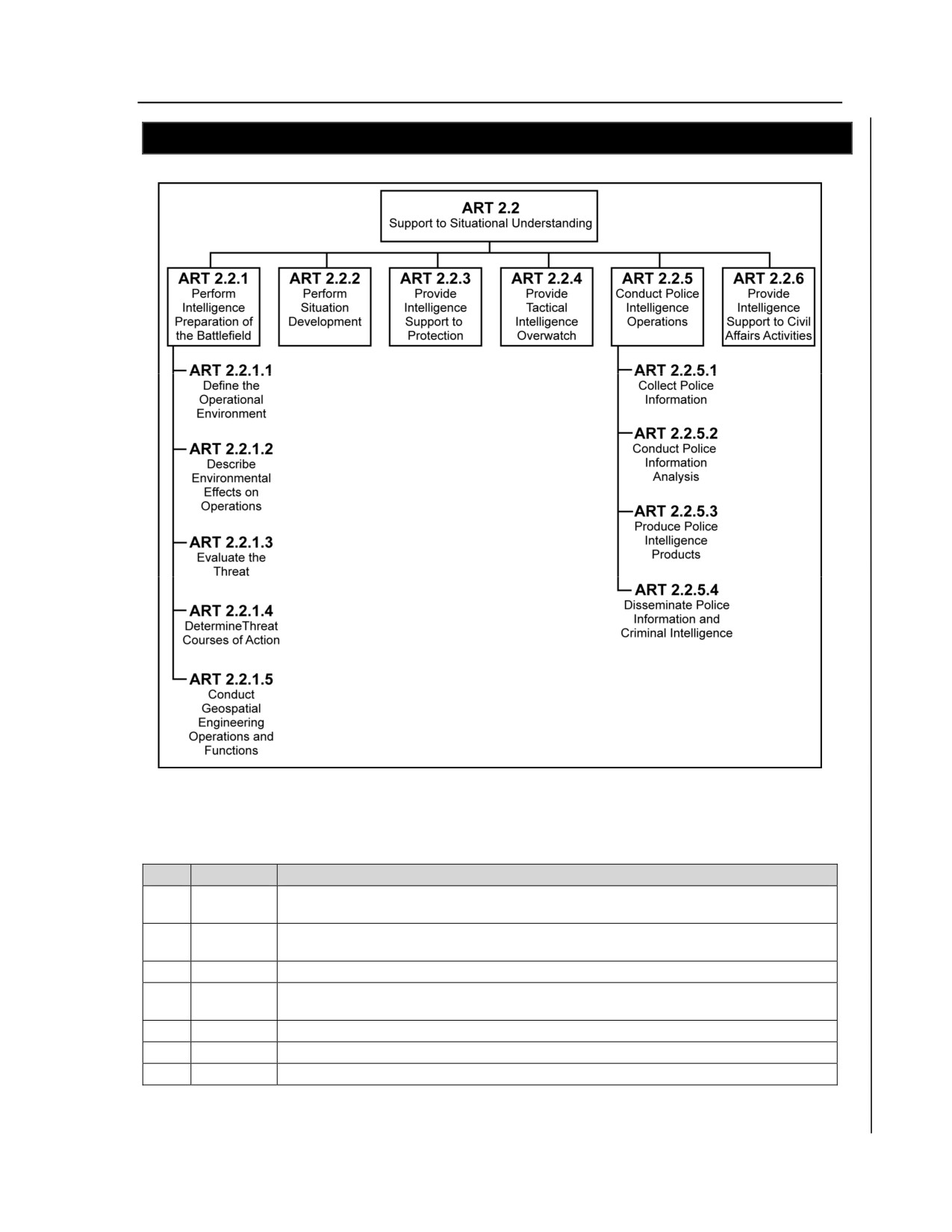
2-21. Support to situational understanding is the task of providing information and intelligence to
commanders to assist them in achieving a clear understanding of the force’s current state with relation to
the threat and other aspects of the AO. It supports the commander’s ability to make sound decisions.
(FM 2-0) (USAICoE)
No.
Scale
Measure
Unit supported the commander’s visualization of the battlefield and situational
01
Yes/No
understanding of the threat.
Required to provide intelligence products that facilitate the commander’s visualization
02
Time
and situational understanding of the threat.
03
Percent
Of information and intelligence accurate in light of events.
Of information and intelligence requested by commander completed by latest time
04
Percent
information and intelligence is of value.
05
Percent
Of produced intelligence judged relevant to military situations.
06
Percent
Of produced intelligence judged timely by users.
07
Percent
Of produced intelligence judged useable by users.
29 July 2010
FM 7-15, C3
2-15
Chapter 2
ART 2.2.1 PERFORM INTELLIGENCE PREPARATION OF THE
BATTLEFIELD
2-22. Intelligence preparation of the battlefield (IPB) is a systematic process of analyzing and visualizing
the portions of the mission variables of threat, terrain and weather, and civil considerations in a specific
area of interest and for a specific mission. By applying IPB, commanders gain the information necessary to
selectively apply and maximize operational effectiveness at critical points in time and space. IPB is a
continuous staff planning activity undertaken by the entire staff. The staff aims to understand the
operational environment and the options it presents to friendly and threat forces. (FM 2-01.3) (USAICoE)
No.
Scale
Measure
Products of the IPB process supported the preparation of running estimates and the
01
Yes/No
military decisionmaking process by the supported commander and staff.
Unit intelligence staff, with the support of the entire staff, identified characteristics of the
02
Yes/No
area of operations that will influence friendly and threat operations including terrain, civil
considerations, weather, and threat considerations.
The entire staff, led by the intelligence staff, established limits to the area of interest
03
Yes/No
following the commander’s guidance.
Unit intelligence staff identified gaps in current intelligence holdings, identified information
04
Yes/No
requirements, and recommended commander’s critical information requirements.
Unit intelligence staff, with the support of the entire staff, identified characteristics of the
05
Yes/No
battlefield that will influence friendly and threat operations.
Unit intelligence staff, with the support of the entire staff, described effects that military
06
Yes/No
actions will have on future operations in the area of operations.
07
Yes/No
Unit intelligence staff, with the support of the entire staff, evaluated the threat.
08
Yes/No
Unit intelligence staff determined the threat course of action.
09
Yes/No
Unit intelligence staff validated templates with updated information.
Commander and other unit staff elements in addition to the intelligence staff
10
Yes/No
participated in the process.
11
Yes/No
IPB products assisted the commander’s and staff’s visualization and decisionmaking.
12
Time
Since IPB products have been updated.
13
Time
To disseminate updated IPB products.
Of produced intelligence judged to be timely (latest time information and intelligence is
14
Percent
of value) by users.
15
Percent
Of produced intelligence judged to be accurate in light of events.
16
Percent
Of produced intelligence judged to be useable by users.
Of produced intelligence judged to be complete based upon requests for clarification or
17
Percent
expansion.
18
Percent
Of produced intelligence judged to be relevant to the military situation.
ART 2.2.1.1 DEFINE THE OPERATIONAL ENVIRONMENT
2-23. Initially examine the area of operations
(AO), define the area of interest, identify other
characteristics—such as the role of nongovernmental and international organizations—in the AO that
influence friendly and threat operations, and identify gaps in current intelligence holdings. (FM 2-01.3)
(USAICoE)
Note: The term “operational” in the title of this task does not refer to the operational level of war.
2-16
FM 7-15, C3
29 July 2010
ART 2.0: The Intelligence Warfighting Function
No.
Scale
Measure
Unit operations were delayed, disrupted, or canceled because the staff failed to identify
01
Yes/No
environmental characteristics of the AO.
02
Yes/No
Commander, with the assistance of intelligence staff officer, identified the area of interest.
03
Yes/No
Unit staff identified gaps in current information databases.
Public affairs elements accompanied the maneuver brigades and established field
04
Yes/No
media centers to take maximum advantage of these resources.
The entire staff identified significant characteristics of the operational environment, to
05
Yes/No
include the status-of-forces agreement, rules of engagement, and other constraints on
unit operations.
Staff collected and refined their input such as religious, health threat, terrain,
06
Yes/No
meteorological, and hydrological data.
07
Time
To establish or obtain a database that defines the operational environment.
Since intelligence preparation of the battlefield products addressing the operational
08
Time
environment have been updated.
09
Time
Required to determine threat characteristics and determine patterns of operations.
Of terrain, meteorological, and hydrological products produced and issued on time to
10
Percent
assigned and gained units.
Of information such as religious, health threat, terrain, meteorological, and hydrological
11
Percent
data received from higher headquarters or other organizations.
Of accuracy of threat characteristics, to include doctrine, tactics, techniques, and
12
Percent
procedures data.
Of accuracy of operational forecasts and products, to include weather effects and
13
Percent
terrain trafficability matrices, tide forecasts, light data, and tactical decision aids.
14
Percent
Of hazards in the AO identified and reported to appropriate headquarters.
Of noncombatants in the AO whose location is accurately reported to appropriate
15
Percent
headquarters.
16
Percent
Of press coverage and threat propaganda that addresses friendly activities in an AO.
17
Percent
Of the local legal and illegal economy correctly identified in area studies.
Of local decisionmakers and centers of influence correctly identified in area studies.
18
Percent
This includes official and unofficial leaders.
ART 2.2.1.2 DESCRIBE ENVIRONMENTAL EFFECTS ON OPERATIONS
2-24. The activity to evaluate all aspects of the area of operations (AO) with which all forces involved
—enemy, friendly, and neutral—must contend with during the conduct of full spectrum operations. This
includes the portions of the mission variables of terrain, civil considerations, weather, and threat
considerations of the AO and the area of interest (FM 2-01.3) (USAICoE)
No.
Scale
Measure
Unit operations were delayed, disrupted, or canceled because the staff failed to identify
01
Yes/No
environmental characteristics of the AO.
02
Yes/No
Unit staff identified gaps in current databases.
Staff identified and evaluated how terrain affects military operations and the
03
Yes/No
corresponding positive or negative impacts of the operation on the terrain.
04
Yes/No
Staff identified and evaluated how weather affects military operations.
05
Yes/No
Products assisted the commanders and staff’s visualization and decisionmaking.
To establish or obtain initial operational environment (terrain, civil considerations,
06
Time
weather, and threat considerations) database.
Required to evaluate the impact of combat operations and weather on trafficability of
07
Time
the terrain.
08
Time
Since intelligence preparation of the battlefield (IPB) products have been updated.
29 July 2010
FM 7-15, C3
2-17
Chapter 2
No.
Scale
Measure
09
Time
To disseminate updated IPB products.
10
Percent
Of analytical products produced and issued on time to assigned and task-organized units.
11
Percent
Of analytical products received from higher headquarters.
12
Percent
Of accuracy of products provided to unit elements.
Of entire staff effort devoted to updating initial operational environment (terrain, civil
13
Percent
considerations, weather, and threat considerations) database.
Of restrictions on friendly operations resulting from the presence and movement of
14
Number
noncombatants in the AO.
ART 2.2.1.3 EVALUATE THE THREAT
2-25. This activity analyzes current intelligence to determine how the threat normally organizes for combat
and conducts operations. The evaluation includes each threat operating system as well as potential criminal
organizations, factions, guerrillas, or insurgents. This step focuses on creating threat models and templates
that depict how the threat operates when unconstrained by effects of the environment (FM 2-01.3)
(USAICoE)
No.
Scale
Measure
The threat’s capabilities were stated in the intelligence preparation of the battlefield
01
Yes/No
process and accounted for in the military decisionmaking process.
Unit used pattern analysis, event analysis, and intelligence from higher headquarters
02
Yes/No
and other organizations to create threat templates, models, and methods of operation
and identify high-payoff targets and high-value targets.
Unit used Red Team concept to confirm or deny estimates and assessments about
03
Yes/No
threat intentions.
04
Time
Required to incorporate new intelligence data and products into ongoing threat evaluations.
05
Time
To identify threat capabilities and limitations.
06
Time
To update or create threat templates, models, and methods of operation.
07
Time
To disseminate updated threat templates, models, and methods of operation.
Of correctly identified threat templates, models, and methods of operations; capabilities
08
Percent
and limitations; high-payoff targets; high-value targets; and threat models.
09
Percent
Of new, processed intelligence integrated to update broad courses of action.
ART 2.2.1.4 DETERMINE THREAT COURSES OF ACTION
2-26. The activity to determine possible threat courses of action (COAs), describe threat COAs, rank
COAs in probable order of adoption, and at a minimum identify the most probable and the most dangerous
COAs. (FM 2-01.3) (USAICoE)
No.
Scale
Measure
The entire staff, under the direction of the intelligence staff, assessed the effects of
01
Yes/No
friendly actions on threat COAs.
The threat’s likely objectives and desired end state were identified, beginning with the
02
Yes/No
threat command level at one echelon above the friendly unit and ending the process at
two echelons below.
Unit staff identified opportunities and constraints that the operational environment offers
03
Yes/No
or affords to threat and friendly forces.
04
Yes/No
Unit staff assessed effects of friendly actions on threat COAs.
Units considered threat capabilities, effects of the operational environment, and the
05
Yes/No
threat’s preference in operations.
Units determined most probable and most dangerous COAs and other threat COAs to a
06
Yes/No
micro level of detail as time permitted.
2-18
FM 7-15, C3
29 July 2010
ART 2.0: The Intelligence Warfighting Function
No.
Scale
Measure
07
Yes/No
Units disseminated threat COAs to lower, adjacent, and next higher echelon.
08
Yes/No
Units delivered threat COAs in time to be of value for developing friendly COAs.
The G-3 or S-3 led staff war-gaming with full staff participation to validate and update
09
Yes/No
assessments.
Required to identify likely threat objectives and desired end states at different threat
10
Time
echelons of command.
To identify and analyze the feasibility of each threat COA in terms of time, space,
11
Time
resources, and force ratios required to accomplish its objective.
12
Time
To evaluate and prioritize each identified threat COA.
13
Percent
Of threat branches and sequels correctly identified during planning.
14
Percent
Of new intelligence integrated to update threat COAs.
15
Percent
Of forecasted significant threat actions correctly identified during planning.
Of correctly identified threat high-value targets and tactical centers of mass (before
16
Percent
selecting COAs).
ART 2.2.1.5 CONDUCT GEOSPATIAL ENGINEERING OPERATIONS AND FUNCTIONS
2-27. Geospatial engineer operations include functions of terrain analysis, data collection, data generation,
database management, data manipulation and exploitation, cartographic production and reproductions, and
geodetic survey. Geospatial engineering operations focus on data generation, data management, terrain
analysis, and the presentation of their results to the commander. The functions are all interdependent so to
prepare a geospatially accurate and timely enabled common operational picture for the commander.
(FM 3-34.230) (USAES)
Note: ART 5.3.3 (Facilitate Situational Understanding Through Knowledge Management)
includes the processing of sensor data, the interpretation of data into intelligent information,
fusion and integration of separate source data, management of the data to include accuracy and
data topology, and dissemination of tactical data information. The inclusion of this task does not
change the steps of the intelligence preparation of the battlefield process described in FM 2-01.3.
No.
Scale
Measure
The availability of accurate geospatial products allowed the commander to deploy and
01
Yes/No
employ the weapon systems effectively.
The availability of accurate geospatial products allowed supported commanders and
02
Yes/No
staffs to visualize their areas of operations, interest, and influence.
The availability of accurate geospatial products allowed supported commanders and
03
Yes/No
staffs to target enemy systems effectively.
The availability of accurate geospatial products allowed supported commanders and
04
Yes/No
staffs to plan air and ground missions efficiently.
The availability of accurate geospatial products allowed supported commanders and
05
Yes/No
staffs to counter enemy weapons and intelligence-collection capabilities.
The availability of accurate geospatial products supported the commander’s and staff’s
06
Yes/No
plans to avoid areas.
To complete terrain analysis of an area of operations and prepare products supporting
07
Time
intelligence preparation of the battlefield.
08
Time
To complete geodetic survey in the area of operations.
To produce and reproduce geospatial information in sufficient quantities to meet
09
Time
supported unit demand.
10
Number
And types of engineer topographic elements available to support unit operations.
29 July 2010
FM 7-15, C3
2-19
Chapter 2
ART 2.2.2 PERFORM SITUATION DEVELOPMENT
2-28. Situation development is a process for analyzing information and producing current intelligence
concerning the portions of the mission variables of enemy, terrain, and weather, and civil considerations
within the area of operations before and during operations. The process helps the intelligence officer
recognize and interpret indicators of threat intentions, and objectives. Situation development confirms or
denies threat courses of actions (COAs), provides threat locations, explains what the threat is doing in
relation to the friendly force commander’s intent, and provides an estimate of threat combat effectiveness.
The locations and actions of noncombatant elements and nongovernmental organizations in the area of
operations that may impact operations should also be considered. Through situation development, the
intelligence officer quickly identifies information gaps, explains threat activities in relation to the unit’s
operations, and assists the commander in gaining and maintaining situational understanding. Situation
development helps the commander make decisions, including when to execute branches and sequels.
(FM 2-0) (USAICoE)
No.
Scale
Measure
The COA executed by threat forces was predicted during the intelligence preparation of
01
Yes/No
the battlefield process and accounted for in the military decisionmaking process.
Threat situation development provided information that helps the commander make
02
Yes/No
decisions to execute branches and sequels.
03
Yes/No
Unit disseminated situation development intelligence to friendly forces.
04
Time
To disseminate situation development intelligence.
05
Time
To produce an updated situation template.
To confirm or deny the existing estimate of the threat COA and update the estimate
06
Time
based on current terrain, civil considerations, weather, and threat characteristics.
07
Percent
Of produced intelligence judged accurate based on threat activity.
Of produced intelligence judged complete based on request for clarification or
08
Percent
additional information.
09
Percent
Of produced intelligence judged useable to the current situation.
10
Percent
Of produced intelligence judged timely by consumers and users.
ART 2.2.3 PROVIDE INTELLIGENCE SUPPORT TO PROTECTION
2-29. This task includes providing intelligence that supports measures the command takes to remain viable
and functional by protecting itself from the effects of threat activities. It also provides intelligence that
supports recovery from threat actions. This task supports the protection warfighting function and is linked
to antiterrorism and homeland security. (FM 2-0) (USAICoE)
Note: This task branch supports ART 6.7 (Conduct Survivability Operations) and ART 6.6.1
(Identify Potential Terrorist Threats and Other Threat Activities, ART 6.6 Apply Antiterrorism
Measures, ART 6.2.5 Support Homeland Security Personnel Recovery Operations).
No.
Scale
Measure
Unit established force protection plan with commander’s critical information
01
Yes/No
requirements and reporting channels and requirements.
02
Yes/No
Unit provided information on incidents by threat forces affecting security of the force.
03
Yes/No
Unit provided intelligence support to the antiterrorism program and force protection mission.
04
Yes/No
Intelligence provided to support the antiterrorism program and force protection mission.
05
Percent
Of intelligence relating to potential hostile acts against U.S. forces or installations.
06
Percent
Of intelligence relating to potential criminal acts against U.S. forces or installations.
Of intelligence relating to chemical, biological, radiological, nuclear, and high-yield
07
Percent
explosives employment and deployment.
2-20
FM 7-15, C3
29 July 2010
ART 2.0: The Intelligence Warfighting Function
No.
Scale
Measure
08
Percent
Of intelligence to support theater missile defense operations.
09
Percent
Of intelligence relating to threat surveillance and reconnaissance elements.
10
Percent
Of intelligence provided for combatant command to support homeland security or defense.
ART 2.2.4 PROVIDE TACTICAL INTELLIGENCE OVERWATCH
2-30. Tactical intelligence overwatch is creating standing, fixed analytical intelligence capabilities that
provide dedicated intelligence support to committed maneuver units. The tactical intelligence overwatch
element is connected through a shared intelligence network that can extract information from multiple
sources and provide succinct answers directly to supported units when time is critical.
(FM 2-0)
(USAICoE)
Note: This task branch supports ART 6.7 (Conduct Survivability Operations).
No.
Scale
Measure
The tactical intelligence overwatch cell provided succinct information directly to the
01
Yes/No
supported units.
02
Yes/No
Tactical intelligence forces provided a foundation of regional and subject matter expertise.
ART 2.2.5 CONDUCT POLICE INTELLIGENCE OPERATIONS
2-31. Police intelligence operations (PIO) is a military police (MP) function, integrated within all MP
operations, which supports the operations process through analysis, production, and dissemination of
information collected as a result of police activities to enhance situational understanding, protection, civil
control, and law enforcement. Upon analysis, this information may contribute to commander’s critical
information requirements, intelligence-led, time-sensitive operations, or policing strategies necessary to
forecast, anticipate, and preempt crime or related disruptive activities to maintain order. Police intelligence
results from the application of systems, technologies, and processes that analyze applicable data and
information necessary for situational understanding and focusing policing activities to maintain law and
order. (FM 3-19.50) (USAMPS)
Notes: PIO function is not an intelligence discipline; it is a law enforcement function. However,
it is within the critical intelligence task,
“support situational understanding” that PIO best
support the Army operations process and informs the intelligence process. PIO are essential to
this task, particularly where irregular threats (criminal, terrorist, and insurgents) threaten the
security of U.S. forces and military operations. This function supports and enhances the
commander’s situational awareness and common operational picture through collection,
analysis, and appropriate dissemination of relevant criminal, police information, and police
intelligence. PIO are a vital tool of law enforcement and criminal investigators that distributes
and focuses military police and criminal investigations assets. U.S. Codes, executive orders,
Department of Defense (DOD) directives, and Army regulations contain specific guidance
regarding the prohibition of intelligence personnel from collecting intelligence on U.S. citizens,
U.S. corporations, and resident aliens. Any access by the intelligence community to information
or products resulting from PIO directed against U.S. citizens should undergo competent legal
review.
No.
Scale
Measure
The conduct of PIO did not violate U.S. Code and applicable DOD and Army
01
Yes/No
regulations against collecting intelligence on U.S. citizens.
02
Yes/No
PIO contributed to reducing criminal activity in the area of operations (AO).
Unit updated police intelligence products as additional police and criminal information
03
Yes/No
and related data was collected.
29 July 2010
FM 7-15, C3
2-21
Chapter 2
No.
Scale
Measure
Unit obtained legal coordination and authorization before using technical listening
04
Yes/No
equipment and technical surveillance equipment.
05
Yes/No
Commander provided list of critical assets to be protected to provost marshal.
06
Yes/No
Unit identified patterns or trends relevant to proactive law and order operations.
07
Yes/No
Military law enforcement received police and criminal information from the host nation.
Unit maintained information on known or suspected criminals per regulatory and legal
08
Yes/No
guidance.
09
Yes/No
Unit established activity files, when applicable.
10
Yes/No
Unit established area files, when applicable.
11
Yes/No
Unit safeguarded juvenile records from unauthorized disclosure.
Unit established and maintained liaison with host-nation authorities, military and civilian
law enforcement agencies, and other organizations as required by the factors of
12
Yes/No
mission, enemy, terrain and weather, troops and support available, time available, civil
considerations.
13
Yes/No
Unit provided tactical intelligence obtained to echelon intelligence staff.
Unit collected police and criminal information per the intelligence, surveillance, and
14
Yes/No
reconnaissance plan.
15
Yes/No
Unit disseminated police and criminal information to appropriate agencies.
Police intelligence requirements and integration were incorporated into the operation
16
Yes/No
plan or order.
Police and criminal databases were updated as unit received police and criminal
17
Yes/No
information and data.
18
Time
To determine susceptibility of critical facilities to criminal threat.
19
Time
To identify military resources susceptible to theft and diversion.
20
Time
To identify criminal trends and patterns based upon PIO.
21
Time
To identify trends and patterns by continued association with identified offenders.
To develop tactics, techniques, and procedures of operations to assist in eliminating or
22
Time
reducing vulnerability to criminal threat activities.
23
Time
To coordinate with the host nation for police and criminal information.
To review internally created police and criminal information to see if information can
24
Time
answer police and criminal information requirements.
25
Time
To coordinate police and criminal information collection by organic assets.
26
Time
To coordinate with staff intelligence officer for required counterintelligence support.
27
Time
To recruit and develop police informants.
28
Percent
Of identified offenders linked to criminal trends.
Of available U.S. police intelligence resources in the AO identified by military law
29
Percent
enforcement.
30
Percent
Of criminal-related activities reported by informants prior to their occurrence.
31
Percent
Of terrorist-related activities reported by informants prior to their occurrence.
Of criminal and other potentially disruptive elements in an AO identified before their
33
Percent
committing hostile acts against U.S. interests and host-nation elements.
ART 2.2.5.1 COLLECT POLICE INFORMATION
2-32. Collection of police information is a continuous activity. Military police identify gaps in existing
police information and develop intelligence requirements. This collection can be completed through several
means; military police patrols, police engagement, criminal investigations, collected evidence, database
queries and the use of reachback centers. Collection efforts also assist in enhancing protection operations
and antiterrorism through identifying potential criminal threats and other threat activities. (FM 3-19.50)
(USAMPS)
2-22
FM 7-15, C3
29 July 2010
ART 2.0: The Intelligence Warfighting Function
No.
Scale
Measure
The collection of police and criminal information did not violate U.S. Code and
01
Yes/No
applicable Department of Defense and Army regulations against collecting intelligence
on U.S. citizens.
Police and criminal information collected allowed the unit to prevent or reduce criminal
02
Yes/No
activity in its area of operations (AO).
Unit updated police and criminal intelligence products as additional police and criminal
03
Yes/No
information and data was collected.
Unit obtained legal coordination and authorization before using technical listening
04
Yes/No
equipment and technical surveillance equipment.
05
Yes/No
Military law enforcement received police and criminal information from the host nation.
Unit maintained liaison with host-nation authorities, military and civilian police agencies,
06
Yes/No
and other organizations as required by the factors of mission, enemy, terrain and
weather, troops and support available, time available, civil considerations.
Unit disseminated police and criminal information to appropriate headquarters and
07
Yes/No
agencies.
08
Yes/No
Unit recruited and developed police informants in the AO.
09
Time
To coordinate with the host nation for police and criminal information.
10
Time
To coordinate police and criminal information collection by organic assets.
11
Time
To coordinate with staff intelligence officer for required counterintelligence support.
12
Time
To develop police and criminal information requirements.
13
Time
To perform law enforcement patrols designed to obtain police and criminal information.
Of known terrorist- or criminal-related activities reported by informants before their
14
Percent
occurrence.
Of identified individuals engaged in terrorist- or criminal-related activities reported by
15
Percent
informants after their occurrence.
Of criminal and other potentially disruptive elements in an AO identified before they
16
Percent
commit hostile acts against U.S. interests and host-nation elements.
Of criminal activities (such as smuggling, vice, counterfeiting, narcotics, extortion, rape,
17
Percent
murder, robbery) occurring in an AO identified and reported.
18
Percent
Of AO covered by law enforcement patrols (mounted and dismounted).
ART 2.2.5.2 CONDUCT POLICE INFORMATION ANALYSIS
2-33. Conducting police information analysis is the process that organizes, analyzes, and interprets police
information to police intelligence. Police information and intelligence contributes to all-source analysis and
the Army operations process. It also assesses police and criminal information to identify trends and patterns
of criminal activity. (FM 3-19.50) (USAMPS)
No.
Scale
Measure
The police information analysis did not violate U.S. Code and applicable Department of
01
Yes/No
Defense and Army regulations against collecting intelligence on U.S. citizens.
The police information analysis allowed the unit to reduce criminal activity in its area of
02
Yes/No
operations (AO).
03
Yes/No
Unit coordinated funds to establish and maintain a police informant operation.
04
Yes/No
Unit identified patterns or trends relevant to proactive law and order operations.
05
Yes/No
Unit analyzed police information and produced actionable criminal intelligence.
06
Yes/No
Unit recruited and developed police informants in the AO.
07
Time
To prepare annex K for provost marshal operation plan and order as required.
08
Time
To identify and assess latest criminal information collected.
09
Time
To identify criminal information resources in the AO.
10
Time
To identify criminal trends and patterns developed in the AO.
29 July 2010
FM 7-15, C3
2-23
Chapter 2
No.
Scale
Measure
11
Time
To analyze external criminal information reports.
12
Time
To assess internally created police information.
13
Time
To produce criminal information bulletins and alert notices.
Of criminal priority intelligence requirement collection efforts directed toward
14
Percent
subordinate units.
15
Percent
Of available criminal intelligence resources in the AO.
Of known terrorist- and criminal-related activities reported by informants before their
16
Percent
occurrence.
Of identified individuals engaged in terrorist- and criminal-related activities reported by
17
Percent
informants after their occurrence.
18
Percent
Of accurate reported terrorist- and criminal-related activities.
ART 2.2.5.3 PRODUCE POLICE INTELLIGENCE PRODUCTS
2-34. Police intelligence operations use the intelligence process to produce police intelligence products
used by military police leaders. These products focus police operations and contribute to the Army
operations process. These products include standardized police information formatted for rapid
dissemination, criminal threat assessments based on police information analysis, and assessment and
analysis of police capability and capacity. (FM 3-19.50) (USAMPS)
No.
Scale
Measure
Developing the police intelligence products did not violate U.S. Code and applicable
01
Yes/No
Department of Defense and Army regulations against collecting intelligence on U.S.
citizens.
The police intelligence products developed enabled the unit to reduce criminal activity
02
Yes/No
in its area of operations (AO).
Unit developed police intelligence products based on police and criminal information
03
Yes/No
collected from external and internal sources.
Unit identified patterns or trends relevant to the conduct of proactive law and order
04
Yes/No
operations.
05
Yes/No
Unit produced actionable police intelligence products.
Unit disseminated relevant police and criminal intelligence through military law
06
Yes/No
enforcement and civilian and host-nation networks.
07
Yes/No
Products produced were relevant and answered identified police intelligence requirements.
Unit provided police information and police intelligence to the military intelligence
08
Yes/No
community within applicable legal constraints.
09
Yes/No
Unit provided support to the police intelligence fusion cell.
10
Time
To identify police and criminal information resources in the AO.
11
Time
To identify criminal trends and patterns developed in the AO.
12
Time
To analyze external police and criminal information reports.
13
Time
To assess internally created police and criminal information.
14
Time
To produce police and criminal information bulletins and alert notices.
ART 2.2.5.4 DISSEMINATE POLICE INFORMATION AND CRIMINAL INTELLIGENCE
2-35. Police information and criminal intelligence is disseminated for use by law enforcement to focus
policing activities. Police intelligence products are disseminated and integrated within the operations
process enhancing situational understanding, mission planning, and execution at every echelon. These
products may be disseminated in support of host-nation law enforcement in combating crime and
neutralizing criminal threats to military operations based on trend and pattern analysis and shared with
other law enforcement agencies. When legally allowable, these products are provided to the military
2-24
FM 7-15, C3
29 July 2010
ART 2.0: The Intelligence Warfighting Function
intelligence community for fusion and incorporation to the all-source intelligence effort, contributing to a
more complete intelligence picture. (FM 3-39) (USAMPS)
Note: The dissemination of police information and criminal intelligence is included in ART
5.8.1 (Conduct Law and Order Operations), ART 5.8.1.1 (Perform Law Enforcement), ART
5.8.1.2 (Conduct Criminal Investigations), ART 5.8.1.6 (Provide Customs Support), ART 4.4
(Conduct Internment and Resettlement Operations), and ART 7.3.2.3 (Perform Host-Nation
Police Training and Support). Joint, interagency, and multination coordination is included in
ART 5.2.2.1 (Prepare the Command Post for Displacement). (FM 3-39 and FM 3-19.50)
(USAMPS)
No.
Scale
Measure
Law enforcement agency personnel investigated offenses against Army forces or
01
Yes/No
property committed by persons subject to military law.
Law enforcement agency personnel referred offenses against Army forces or property
02
Yes/No
committed by persons subject to military law.
Law enforcement agency personnel monitored all ongoing investigations in the theater
03
Yes/No
of operation.
04
Yes/No
Law enforcement agency personnel received final reports from subordinate elements.
Law enforcement agency personnel coordinated with Army Criminal Investigation
05
Yes/No
Command for investigation of all major incidents (deaths, serious bodily injury, and war
crimes).
06
Yes/No
Law enforcement agency personnel took control of crime scene.
07
Yes/No
Law enforcement agency personnel identified personnel involved in the crime.
08
Yes/No
A senior law enforcement agency individual formulated an investigative plan.
Law enforcement agency personnel processed the crime scene. Processing includes
09
Yes/No
recording investigative notes and sketches, photographing crime scene as necessary,
and collecting physical evidence for evaluation.
10
Yes/No
Law enforcement agency personnel released the crime scene to appropriate individuals.
Law enforcement agency personnel pursued immediate leads. Pursuing leads
includes: interviewing victims and witnesses, obtaining written statements (if
11
Yes/No
appropriate), advising suspects of legal rights, obtaining written statements from
suspects, collecting related documents necessary to support specific investigations,
and coordinating with the judge advocate office as necessary.
Investigators law enforcement agency personnel modified standard interview
12
Yes/No
techniques to overcome any language barriers and cultural differences.
Investigators maintained a disciplined and systematic approach in their questioning
13
Yes/No
when doing a long series of interviews on the same basic topic.
Law enforcement agency personnel continued the investigation as necessary. Tasks
include completing evidence documentation, releasing evidence to evidence
custodian, identifying need for crime lab analysis of evidence, obtaining other needed
14
Yes/No
specialized investigative support (polygraph or technical listening equipment),
gathering related police intelligence operations from other sources, performing
surveillance, submitting status reports, and coordinating investigative efforts and
findings with supporting Staff Judge Advocate office.
15
Yes/No
Law enforcement agency personnel closed the case by preparing final report.
16
Time
To complete crime analysis.
17
Percent
Of investigations of minor reported incidents.
18
Percent
Of investigations conducted and reported per AR 195-2.
Of returns on deficient reports of investigations for corrective action or for further
19
Percent
investigative activity.
20
Percent
Of crime analysis performed correctly.
29 July 2010
FM 7-15, C3
2-25
Chapter 2
No.
Scale
Measure
Of case documents and required reports prepared per legal, regulatory, and standing
21
Percent
operating procedure guidance.
Of hotline complaints referred to criminal investigation division or military police
22
Number
investigation.
ART 2.2.6 PROVIDE INTELLIGENCE SUPPORT TO CIVIL AFFAIRS
ACTIVITIES
2-36. Military intelligence organizations performing this task collect and provide information and
intelligence products concerning civil considerations in support of civil affairs activities.
(FM 2-0)
(USAICoE)
No.
Scale
Measure
Intelligence support required for civil affairs identified through intelligence preparation of
01
Yes/No
the battlefield.
Unit provided intelligence information to identify pertinent civil considerations that affect
02
Yes/No
civil affairs operations.
Unit provided intelligence support to identify populace perceptions, sentiments,
03
Yes/No
attitudes, mores, allegiances, alliances, and behaviors.
Unit provided intelligence support to identify indigenous population and institutions,
04
Yes/No
nongovernmental, and intergovernmental organizations in the area of operations (AO).
Unit identified all relevant government agencies, organizations, or departments that
05
Yes/No
effect civil affairs activities.
Unit provided intelligence support to identify trends reflected by the national and
06
Yes/No
international media.
Unit provided support for to identify resources and capabilities of host-nation population
07
Yes/No
and institutions, nongovernmental, and intergovernmental organizations in the AO.
Unit provided intelligence and information to civil affairs within all applicable regulations,
08
Yes/No
policies, and laws.
09
Time
To identify pertinent civil considerations which affect civil affairs activities.
To identify populace perceptions, sentiments, attitudes, mores, allegiances, alliances,
10
Time
and behaviors.
11
Time
To identify nongovernmental and international organizations in the AO.
To identify all relevant government agencies, organizations, or departments that affect
12
Time
civil affairs activities.
13
Time
To identify trends reflected by the national and international media.
To identify resources and capabilities of nongovernmental and international
14
Time
organizations in the AO.
Of accurate information and intelligence provided to civil affairs for civil considerations
15
Percent
that affect civil affairs activities.
2-26
FM 7-15, C3
29 July 2010
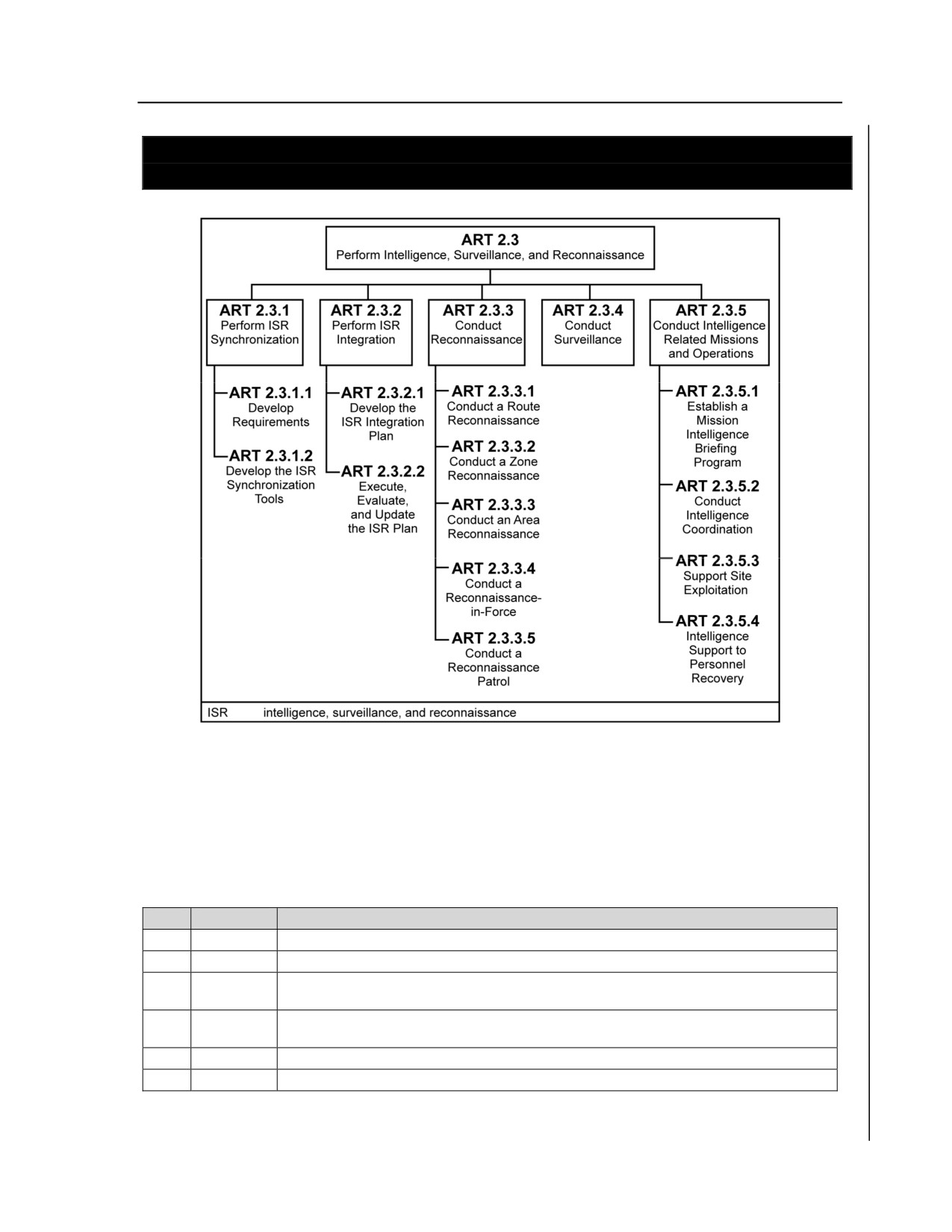
ART 2.0: The Intelligence Warfighting Function
SECTION III - ART 2.3: PERFORM INTELLIGENCE, SURVEILLANCE, AND
RECONNAISSANCE
2-37. Intelligence, surveillance, and reconnaissance is an activity that synchronizes and integrates the
planning and operation of sensors, assets, and processing, exploitation, and dissemination systems in direct
support of current and future operations. This is an integrated intelligence and operations function. For
Army forces, this combined arms operation focuses on priority intelligence requirements while answering
the commander’s critical information requirements
(CCIRs). Through intelligence, surveillance, and
reconnaissance (ISR), commanders and staffs continuously plan, task, and employ collection assets and
forces. These forces collect, process, and disseminate timely and accurate information, combat information,
and intelligence to satisfy the CCIRs and other intelligence requirements. When necessary, ISR assets focus
on special requirements, such as personnel recovery. (FM 3-90) (USACAC)
No.
Scale
Measure
01
Yes/No
Unit developed a strategy to answer each CCIR to accomplish ISR integration.
02
Yes/No
Unit developed requirements that supported the commander’s decisionmaking.
Unit planned scheme of support including fires, routes of movement and maneuver, air
03
Yes/No
corridors, medical and casualty evacuation, and sustainment.
Unit planned for unique support requirements for ISR assets to include maintenance,
04
Yes/No
crew training, downlink nodes, access, and connectivity.
05
Yes/No
Unit developed a detailed ISR plan through a staff process.
06
Yes/No
Unit task-organized ISR forces to perform tasks and accomplish missions.
29 July 2010
FM 7-15, C3
2-27
Chapter 2
No.
Scale
Measure
Unit developed a debriefing program to capture information observed or gathered by
07
Yes/No
Soldiers (Soldier surveillance and reconnaissance) conducting the ISR operations.
08
Yes/No
Unit satisfied CCIRs using intelligence reach.
Unit submitted requests for information to satisfy CCIRs that the commander lacks the
09
Yes/No
organic assets to answer.
The operations officer, with the intelligence officer, tasked and directed the available
10
Yes/No
ISR assets to answer the CCIRs.
Unit received additional requests from higher headquarters to collect, produce, or
11
Yes/No
disseminate combat information or intelligence products.
12
Yes/No
Unit evaluated each requirement for completion based on reported information.
13
Yes/No
Unit redirected or retasked ISR assets based on reported information.
14
Time
To redirect or retask ISR assets.
15
Percent
Of commander’s requirements answered through intelligence reach.
16
Percent
Of commander’s requirements answered through requests for information.
ART 2.3.1 PERFORM INTELLIGENCE, SURVEILLANCE, AND
RECONNAISSANCE SYNCHRONIZATION
2-38. Intelligence, surveillance, and reconnaissance synchronization is the task that accomplishes the
following: analyzes information requirements and intelligence gaps; evaluates available assets internal and
external to the organization; determines gaps in the use of those assets; recommends intelligence,
surveillance, and reconnaissance (ISR) assets controlled by the organization to collect on the commander’s
critical information requirements; and submits requests for information for adjacent and higher collection
support. (FM 3-0) (USACAC)
Note: This task ensures that ISR, intelligence reach, and requests for information successfully
report, produce, and disseminate information, combat information, and intelligence to support
decision making. The intelligence officer, in coordination with the operations officer and other
staff elements as required, synchronizes the entire collection effort. This effort includes assets
the commander controls and those of adjacent and higher echelon units and organizations. It also
uses intelligence reach to answer the commander’s critical information requirements (CCIRs)
and other requirements.
No.
Scale
Measure
Unit accomplished ISR synchronization by developing a strategy to answer each priority
01
Yes/No
intelligence requirement (PIR).
02
Yes/No
Unit developed requirements that supported the commander’s decisionmaking.
Unit determined unique support requirements for ISR assets to include maintenance,
03
Yes/No
crew training, downlink nodes, access, and connectivity.
Unit determined scheme of support requirements including fires, routes of movement
04
Yes/No
and maneuver, medical and casualty evacuation, and sustainment.
Unit developed and provided ISR task organization recommendations to the operations
05
Yes/No
officer.
Unit satisfied CCIRs using intelligence reach and through the request for information
06
Yes/No
(RFI) process.
Unit submitted requests for information to satisfy CCIRs that the commander lacks the
07
Yes/No
organic assets to answer.
Unit requested collection, products, or dissemination from higher headquarters,
08
Yes/No
adjacent units, or multinational partners to facilitate ISR operations.
09
Yes/No
Unit evaluated each requirement for completion based on reported information.
2-28
FM 7-15, C3
29 July 2010
ART 2.0: The Intelligence Warfighting Function
No.
Scale
Measure
10
Yes/No
Unit delivered the ISR synchronization plan to the operations officer.
11
Yes/No
Unit accomplished ISR synchronization by developing a strategy to answer each PIR.
12
Yes/No
Unit developed requirements that supported the commander’s decisionmaking.
Of commander’s requirements answered through intelligence reach and through the
13
Percent
RFI process.
Of commander’s requirements answered through requests for information and through
14
Percent
collection, production, or dissemination from higher headquarters.
2-39. The intelligence staff develops a prioritized list focusing on what information it needs to collect to
produce intelligence. Additionally, the intelligence staff dynamically updates and adjusts the requirements
in response to mission adjustments and changes. Each requirement is assigned a latest time information is
of value to meet operational requirements. (FM 2-0) (USAICoE)
No.
Scale
Measure
Staff analyzed commander’s critical information requirements (CCIRs), including
01
Yes/No
requests for information from lower echelons, adjacent units and organizations, and
orders from higher echelons.
Unit identified initial intelligence requirements during intelligence preparation of the
02
Yes/No
battlefield.
03
Yes/No
Unit prioritized and validated all information and intelligence requirements by the staff.
04
Yes/No
Commander approved the prioritized and validated requirements developed by the staff.
Unit identified mission-specific priority intelligence requirements (PIRs) during the
05
Yes/No
military decisionmaking process course of action (COA) development.
06
Yes/No
Unit performed wargaming for each COA.
07
Yes/No
Unit identified intelligence gaps.
08
Yes/No
Unit developed indicators for each PIR and friendly force information requirements.
Unit developed a specific information requirement for each PIR and friendly force
09
Yes/No
information requirement.
10
Time
To validate and incorporate PIR from higher, lower, and adjacent units.
11
Time
Before next phase of an operation when the PIR are validated or updated.
12
Time
Required for the commander to approve the updated PIR.
To identify intelligence requirements and if necessary dynamically update or revise in
13
Time
advance of collection.
14
Time
To prioritize information and intelligence collection requirements.
15
Percent
Of PIRs addressed in intelligence update.
Of subordinate echelon requirements supported by the echelon’s information and
16
Percent
intelligence requirements.
17
Percent
Of invalidated requirements returned to or resubmitted by originating agency or office.
Of validated requirements have ongoing collection efforts directed towards answering
18
Percent
requirements.
19
Percent
Of requirements submitted by multiple organizations.
20
Percent
Of PIRs tied to commander’s decision points.
21
Percent
Of PIRs linked to specific information requirements.
22
Number
Of open CCIRs and PIRs at any one time.
23
Number
Of requirements identified after collection begins.
29 July 2010
FM 7-15, C3
2-29
///////////////////////////////////////