FM 3-04.120 Air Traffic Services Operations (February 2007) - page 3
Chapter 5
repair
(SORs). Sustainment maintenance supports the supply system by economically repairing or
overhauling components.
5-15. Sustainment maintenance refers to all maintenance performed on equipment above and outside of the
combat aviation brigade. The OEM CFSRs may be placed within the combat aviation brigade to provide a
limited forward sustainment maintenance capability. They operate out of fixed or semi-fixed facilities.
ATS MAINTENANCE COMPANY-FORSCOM
5-16. A deployable special repair activity with mobile maintenance contact teams is organized under the
FORSCOM aligned Ordnance Branch. This company operates a supply support activity and provides class
IX materiel support for tactical ATS systems worldwide. This organization executes general
support/limited depot ATS maintenance operations in CONUS and through deployed ATS maintenance
teams in the theater of operation.
UNITED STATES ARMY MATERIEL COMMAND
5-17. The United States Army Materiel Command’s (USAMC’s) mission is complex and ranges from
developing sophisticated weapon systems to maintaining and distributing spare parts. The USAMC’s
mission is to provide superior technology, acquisition support, and logistics. The USAMC operates the
research, development and engineering centers; Army Research Laboratory; depots; arsenals; ammunition
plants; and other facilities. Subordinate commands provide specific aviation support within the USAMC
structure. These commands include the United States Army Aviation and Missile Command (AMCOM)
and United States Army Communications-Electronics Command (CECOM).
5-18. The USAMC—
Overhauls and upgrades Army equipment during the reset phase of the Army force generation
(ARFORGEN) process.
Produces and provides bombs and ammunition for all military services.
Provides on-the-ground logistics assistance to every unit in the Army.
Provides new equipment training.
Maintains the Army's pre-positioned stocks on land and at sea.
Researches, develops, and acquires conventional ammunition for DOD.
Supports acquisition of end items and parts for military weapon systems.
CECOM
5-19. The CECOM mission is to develop, acquire, and sustain superior information technologies and
integrated systems. CECOM controls and operates Tobyhanna Army Depot.
5-20. This particular depot is the largest, full-service electronics maintenance facility within DOD. Its
mission is total sustainment, including design, manufacture, repair, and overhaul of hundreds of electronic
systems. These include satellite terminals, radio and radar systems, telephones, electro-optics, night vision
and anti-intrusion devices, airborne surveillance equipment, navigational instruments, electronic warfare,
guidance and control systems for tactical missiles, and BFT installation kits.
UNITED STATES ARMY AVIATION AND MISSILE COMMAND
5-21. AMCOM is a major subordinate command of the USAMC. AMCOM has direct operational control
of the national maintenance SOR and two Army depots: Corpus Christi Army Depot and Letterkenny
Army Depot.
5-4
FM 3-04.120
16 February 2007
Maintenance Operations
NATIONAL MAINTENANCE SORS
5-22. The national maintenance manager is responsible for managing all sustainment-level reparables and
selected field-level reparables according to AR 750-1. The national maintenance manager uses various
sources of repair. The national maintenance program distributes sustainment maintenance workload across
depot and nondepot activities based on national needs. The national maintenance program manager may
establish the use of a theater aviation sustainment manager within a specific theater. The theater aviation
sustainment manager provides a unified aviation maintenance life-cycle management command focused on
the use of theater assets, providing airframe maintenance, overhaul of aviation subassemblies, and
crash/battle damage repair.
5-23. Performance-based logistics (PBL) is a support strategy that places primary emphasis on optimizing
system support to meet the needs of the warfighter. Its primary tenets are documentation of warfighter
performance requirements as measurable metrics in performance-based agreements designation of single
point accountability for performance with a product support integrator and development of support metrics
and accompanying incentives to ensure that the performance objectives are met. In short, PBL is buying
performance, not transactional goods and services. PBL delineates outcome performance goals of systems;
ensures that responsibilities are assigned; provides incentives for attaining these goals; and facilitates the
overall life-cycle management of system reliability, supportability, and total ownership costs. It is an
integrated acquisition and logistics process for buying system capability.
5-24. Source-of-support decisions for PBL do not favor either organic or commercial providers. The
decision is based upon a best value analysis or business case analysis of the provider's product support
capability to meet set performance objectives.
5-25. Depot level maintenance includes the repair, fabrication, manufacture, rebuilding, assembly
overhaul, modification, refurbishment, rebuilding, test, analysis, repair-process design, in-service
engineering, upgrade, painting and disposal of parts, assemblies, subassemblies, software, components, or
end items that require shop facilities, tooling, support equipment, and/or personnel of higher technical
skills, or processes beyond the organizational level capability. Depot level maintenance can be
independent of the location at which the maintenance or repair is performed, the source of funds, or
whether the personnel are government or commercial (contractor) employees.
SECTION III - ADDITIONAL MAINTENANCE CONSIDERATIONS
ARMY WARRANTY PROGRAM
5-26. The Army warranty program covers all items procured for Army use purchased with an
accompanying warranty. This program includes aircraft, aircraft weapon systems, ATS systems, repair
parts and components. The Army also purchases warranties for items such as trucks, tractors, engines,
transmissions, and construction equipment.
Note: Refer to AR 700-139 for additional guidance on the Army’s warranty program.
5-27. ATS units receiving newly fielded equipment and components should check to see what type of
warranty the Army purchased for their newly fielded equipment. Tailoring the warranty concept to fit the
item and its intended use in a comprehensive manner with minimal effect on standard Army logistical
procedures is the single most important aspect of the warranty acquisition process. Warranty tailoring is
intended to protect the Army from the costs and frequency of systemic failures and to enact responsive
remedies for failures of significant operational effect on aircraft readiness.
5-28. When newly fielded equipment under warranty experiences a malfunction, aviation maintenance
officers/technicians should request assistance from the logistics assistant program (LAP) office for answers
to or resolution of warranty issues or questions.
16 February 2007
FM 3-04.120
5-5
Chapter 5
5-29. Logistics assistant officers
(LAOs) or logistics assistant representatives provide advice and
assistance to the Army command warranty claims officer (WARCO) and aviation unit maintainers as part
of their service interface as established in AR 700-4. Representatives of the LAP will—
Clarify warranty applications/exclusions and warranty claim/report procedures upon user or
WARCO request.
Provide warranty information to users/WARCOs as a secondary source of information.
Provide specific assistance as outlined in materiel fielding plans and technical and supply
bulletins/manuals and related documents for warranty management.
5-30. ATS equipment and components covered by the Army warranty program require special handling
during the warranty period to keep it valid. Details concerning warranty provisions are published in supply
letters. The WARCOs or LAOs will have a copy of the warranty supply letter on items within their area of
support. Warranties will increase the time required to perform maintenance.
5-31. Once assistance and guidance is received from LAP technical representatives and warranty issues
and concerns are addressed and resolved, aviation unit maintenance personnel shall submit a product
quality deficiency report. DA Pamphlet 738-751 provides procedural guidance and information for this
report.
NEW EQUIPMENT TRAINING TEAMS
5-32. The Logistics Assistance and New Equipment Training Division is one of the subordinate divisions
of the Directorate for Readiness. Its mission is staff supervision and operational control of worldwide
LAPs for Army ATS systems and related support equipment. The division also provides representatives to
make command visits and manage all aspects of the new equipment training and support services.
ARMY TEST, MEASUREMENT, AND DIAGNOSTIC EQUIPMENT
5-33. United States Army test, measurement, and diagnostic equipment (TMDE) is essential to ATS
maintenance due to its distinctive ability to test, adjust, synchronize, repair, and verify accuracy, safety,
readiness, and information assurance of ATS systems. The capability of ATS systems, radios and
communication devices to operate accurately and effectively depends on the synchronization of precise
measurements against known standards.
5-34. AR
750-43 assigns management of the TMDE calibration and repair support program to
Headquarters, Air Mobility Command. In turn, the TMDE activity is responsible for DA TMDE program
execution and management. National Guard Bureau is assigned management, command, and control over
Army National Guard (ARNG) maintenance companies and their assigned TMDE. It also controls
calibration facilities at combined support maintenance shops. AR
750-43 prescribes policies and
procedures, assigns responsibilities, and establishes goals and objectives applicable to the development,
selection, acquisition, management, sustainment, and support of Army TMDE, associated test program
sets, embedded diagnostics and prognostics, and interactive technical manuals.
5-6
FM 3-04.120
16 February 2007
Appendix A
Deployment-Redeployment Life-Cycle
This appendix addresses deployment of ground vehicles and equipment. The
capability to quickly and safely deploy ATS assets from CONUS or forward-
deployment sites to another theater of operation is critical. Units that plan, train, and
validate movement strategies increase chances of success.
FUNDAMENTALS
A-1. Units may be required to move from any location to railheads, seaports of embarkation (SPOE), or
aerial ports of embarkation (APOE) from which they will be transported to the theater of operations.
Movement to the SPOE or APOE may involve a combination of modes. Depending on distance and time
available, vehicles may convoy or be shipped by rail or air.
UNIT MOVEMENT PERSONNEL
A-2. Unit movement personnel develop SOPs and load plans. They train personnel, ensure equipment is
prepared for movement, and inspect equipment before and after the unit deploys. They identify, request,
and coordinate additional support to move unit equipment and personnel as required.
SEA AND AIR TRANSPORT
PLANNING AND PREPARATION
A-3. Successful movement depends on detailed planning SOPs for deployment by various methods and
the identification, training, and validation of deployment and load teams. Each team member has specific
duties, from preparation at home station, to clearance of the port of debarkation (POD), to arrival at
destination. The unit must continually confirm automated unit equipment lists and time phase deployment
lists in preparation for future deployments.
A-4. Upon receiving the warning order (WARNO), and time permitting, advance parties are sent to both
the port of embarkation (POE) and PODs to set the conditions for reception of unit personnel and
equipment and to provide command, control, communications, and intelligence.
A-5. The following references discuss deployment actions and considerations:
The unit movement officer
(UMO) deployment handbook can be download at:
FM 3-04.500.
FM 4-01.011 (55-65).
FM 4-01.30 (55-10).
FM 4-01.8 (100-17-3).
A-6. Surface Deployment and Distribution Command Transportation Engineering Agency (SDDCTEA)
pamphlets provide specific guidance for preparation of equipment for movement. Download the following
SDDCTEA Pamphlet 55-19 (Rail).
SDDCTEA Pamphlet 55-20 (Truck).
SDDCTEA Pamphlet 55-21 (Helicopter).
16 February 2007
FM 3-04.120
A-1
Appendix A
SDDCTEA Pamphlet 55-22 (Lifting and Lashing).
SDDCTEA Pamphlet 55-23 (Containerization).
SDDCTEA Pamphlet 55-24 (FW Air Movements).
SDDCTEA 70-1 (Better Deployability).
SDDCTEA Pamphlet 700-2 (Strategic Mobility Planning).
SDDCTEA Pamphlet 700-4 (Ship Loading).
SDDCTEA 700-5 (Deployment Planning Guide).
SDDCTEA Pamphlet 700-6 (Large Roll-on/Roll-off Ships).
A-7. Not all contingencies for unit movement can be foreseen because of the wide range of missions and
world events. Units should be aware of battle book plans and wargame probable and possible scenarios.
Skeleton plans should be established to cover contingencies.
A-8. Unit movement personnel familiarize themselves with the POEs available to their organization and
mission requirements. Special needs and considerations are addressed as early as possible for each POE.
Unit movement personnel should—
Establish and periodically update telephone lists, points of contact, and special requirements for
likely POEs.
Conduct periodic leader’s reconnaissance of POEs. Reconnaissance includes members of unit
load teams and advance party personnel.
Identify advance party personnel and define duties.
Identify OPSEC requirements during movement and embarkation activities.
Plan and coordinate workspace for personnel during the embarkation phase (empty offices,
borrowed tentage from nondeploying units, and rented or borrowed trailers).
Identify and prepare requests for communications requirements (commercial lines, wire, radio,
and cellular phone).
Determine transportation requirements at POE for movement teams and key personnel
(borrowed vehicles and rental cars).
Plan messing, billeting, medical treatment facilities, refueling/defueling points, and special
requirements for weapons and ammunition.
DEPLOYMENT
Movement
A-9. On order, units transport their equipment and move ground vehicles along preselected routes to the
POE. Units that perform depot-level maintenance normally operate at embarkation points. As the units
arrive, a dedicated sustainment movement support team assists in preparing the vehicles and equipment for
deployment. Preparation includes required maintenance and installation of ferry equipment.
A-10. Air and sea deployment modes terminate at the designated APOD/SPOD. Depot or ATS
maintenance facilities should be available at the port or elsewhere in the theater. Personnel at these
facilities assist the unit with the removal of ferried equipment, installation of mission equipment, and
perform required maintenance and inspections to prepare equipment for the mission. They also coordinate
the immediate backhaul of designated support teams and transfer equipment. On receipt of the order,
commanders dispatch preselected facility teams. Advance party headquarters staff members locate
command facilities at each termination site to facilitate the integration of vehicles and personnel into the
theater force structure.
Task Organization
A-11. Arriving elements task organize and reconfigure vehicles as appropriate for the mission. Sustainment
efforts are prioritized to build combat-capable units and C4I architecture.
A-2
FM 3-04.120
16 February 2007
Deployment-Redeployment Life-Cycle
Force Protection
A-12. ATS forces are vulnerable during the buildup phase when the unit is not at full strength and
equipment or vehicles may not be fully assembled for combat. A security plan must be understood and
executed; work prioritized immediately upon arrival at designated POD. This plan should include passive
and active measures to combat air and ground threats.
Training
A-13. Many units that move from one environmental extreme to another need a period of adjustment to the
new climate. The unit commander arranges training and conditioning to accelerate acclimation.
A-14. Most deployments involve operating in a joint or multinational environment. Early arriving units
may be able to schedule training with other services. Liaison elements from the S-3 shop are designated to
ensure smooth coordination.
ARMY FORCE GENERATION
A-15. To effectively manage the modular force, the Army implemented a new process of ARFORGEN. In
the ARFORGEN model, units rotate through three phases of structured progression to increase unit
readiness. The sequence is reset/train, ready, and available. This process retains the capability to surge
combat power for major combat operations. The ARFORGEN allows commanders to identify predictable
deployment windows and manage readiness and training accordingly. These windows are based on the
objective cyclic rotation rates of one operational deployment for active component units every 3 years and
one operational deployment for reserve component units every 6 years. The ARFORGEN process creates
operational readiness cycles over time, resulting in recurring periods of availability of trained, ready, and
cohesive units prepared for operational deployment in support of regional combatant commander
requirements.
RESET/TRAIN
A-16. The unit mission is to reconstitute, reset equipment, assign new personnel, and train, thereby
achieving the required unit capability level necessary to enter the ready force pool. The unit is capable to
perform immediate defense support to civil authority missions.
READY
A-17. Units conduct mission preparation and higher level collective training with other operational
headquarters for upcoming missions. Ready force pool units are eligible for sourcing, mobilization, and
commitment if necessary.
AVAILABLE
A-18. Units are immediately available to conduct mission execution. Active component forces are available
for immediate deployment, and reserve component forces are available for alert/mobilization/required post
mobilization training and validation/deployment. Units will be sourced against operational (deployed
expeditionary force packages) or contingency (contingency expeditionary force packages) requirements.
A-19. ARFORGEN task organizes units into expeditionary force packages, providing targeted resourcing
for units based on known validated mission requirements. Through semiannual ARFORGEN
synchronization conferences, modular-based ready, deployment, and contingency expeditionary force
packages are designated and managed. Ready expeditionary forces conduct mission training and readiness
activities/functions. Deployment expeditionary forces are task organized to either execute planned
operational requirements or are currently executing deployed missions. Contingency expeditionary forces
are remaining available force pool units that are task organized to meet operational plans and contingency
requirements.
16 February 2007
FM 3-04.120
A-3
Appendix A
A-20. Army formations stationed at power projection installations are pooled into force packages to make
expeditionary operations easier to plan and execute. Restructuring across the active and reserve
components optimizes Army operating forces to the right capability packages for sustained operations.
A-4
FM 3-04.120
16 February 2007
Appendix B
Air Traffic Control Systems
Many Army ATC systems are in the process of being replaced. These newer systems
add flexibility, mobility, and capability to Army ATS companies and AOBs. This
modernization will ensure SA of airspace, and synchronization and interface with
airspace users, by facilitating the movement and recovery of aircraft in a hostile
environment or IMC weather conditions.
AIR TRAFFIC CONTROL TOWER SYSTEMS
AN/TSW-7A AIR TRAFFIC CONTROL CENTRAL
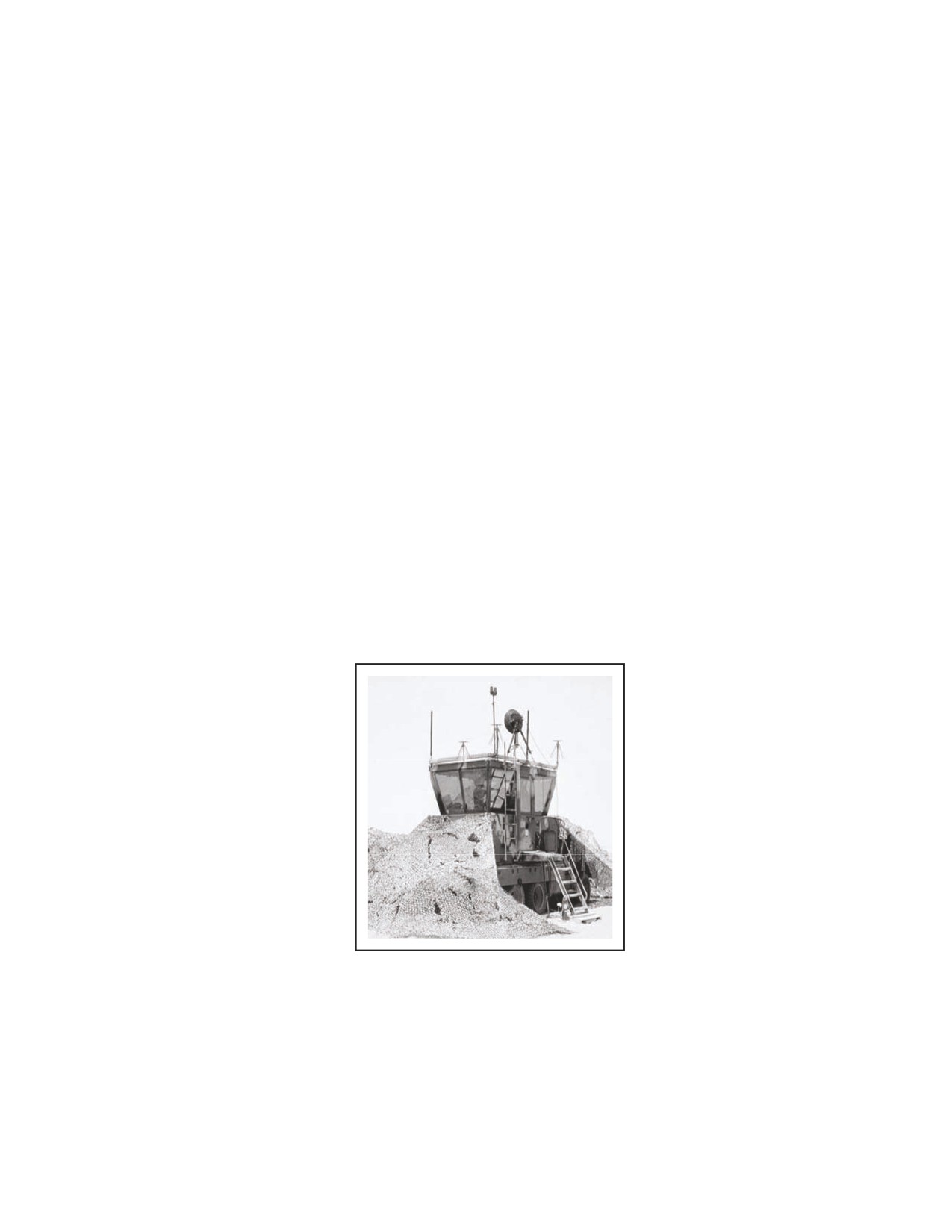
B-1. The AN/TSW-7A is a tactical ATC tower (figure B-1). This tower provides ground-to-aircraft,
aircraft-to-ground, and surface communications within a designated tactical landing area or airfield. It
assists in air traffic regulation; aircraft separation; in-flight assistance; and landing, takeoff, and ground
control. Major components include AN/VRC-83 Have Quick radio sets, AN/VRC-92E SINCGARS radios,
and one HF radio. Nine air traffic controllers are assigned to operate the AN/TSW-7A for a 24-hour
period. The shelter of the AN/TSW-7A is sling-loadable by a CH-47; or can be transported by a C-17 or
aircraft with similar load limits. Maintenance teams require 60 minutes during each 24-hour period. The
AN/TSW-7A has limited metrological capabilities of measuring wind speed and direction, altimeter,
current temperature, high and low daily temperature, and density altitude information.
Figure B-1. AN/TSW-7A ATC central
AN/MSQ-135 MOBILE TOWER SYSTEM
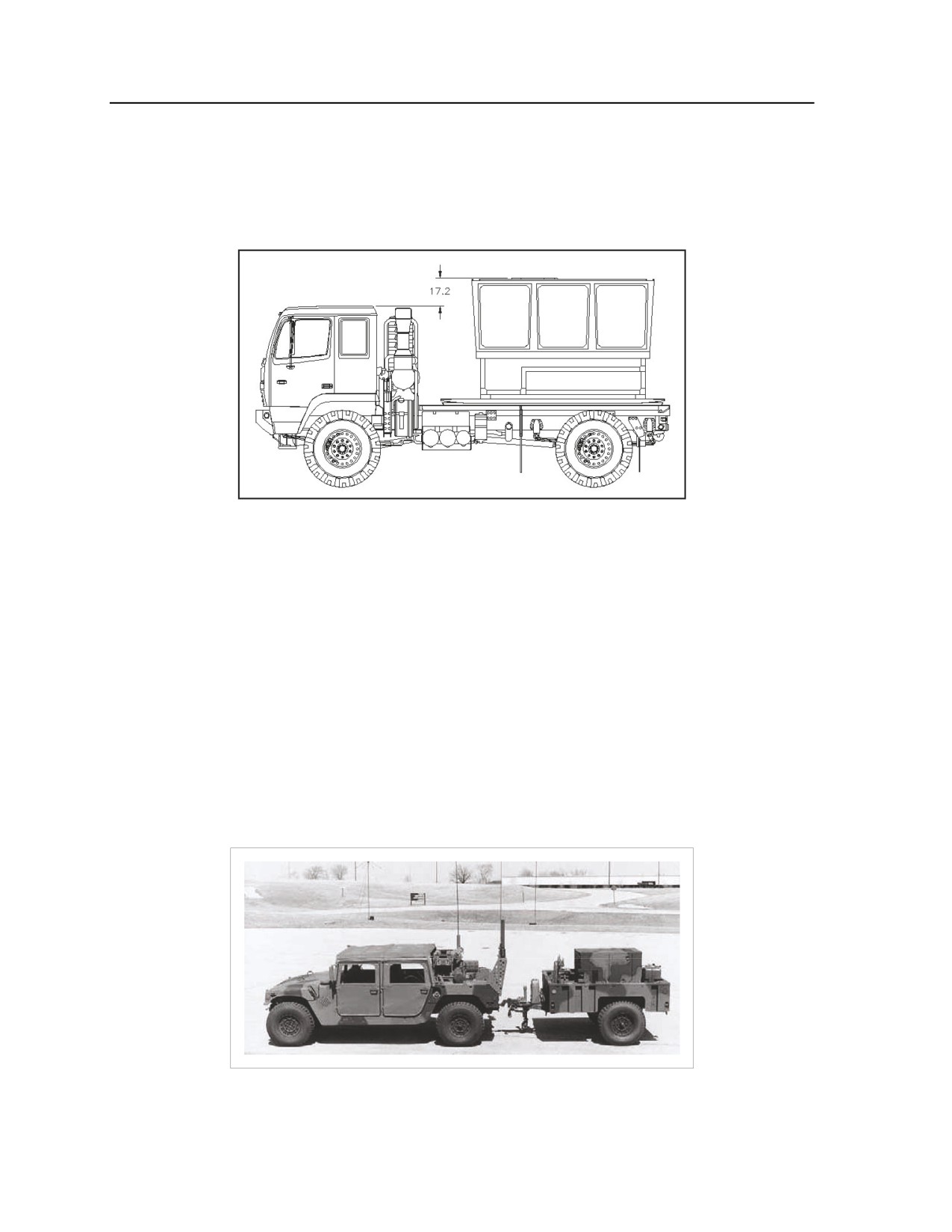
B-2. The AN/MSQ-135 mobile tower system (MOTS) (figure B-2) is a modular tactical ATC tower
system mounted on a an armored family of medium tactical vehicles (FMTV). The MOTS replaces the
AN/TSW-7A and AN/TSQ-70A. It provides the control tower team a robust ATC tower and airfield
lighting capability for the terminal airspace areas of the division and theater. The MOTS is ideal for an
16 February 2007
FM 3-04.120
B-1
Appendix B
airfield tower restoration mission or long-term airfield tower operations often necessary to support security
and civil support operations (SACSOs). This system has digital air/ground communication and digital
linkage to A2C2, ATS and local command nets, and is staffed with nine ATC operators. The AN/MSQ-135
is equipped with AN/ARC-220 HF-SSB ALE and AN/PRC-117 multiband radio sets. The AN/MSQ-135
can be airlifted by C-130 aircraft or CH-47 helicopter. The MOTS will be fielded to all components of the
Army beginning fiscal year 2009.
Figure B-2. Proposed AN/MSQ-135 mobile tower system
AN/TSQ-198 TACTICAL TERMINAL CONTROL SYSTEM
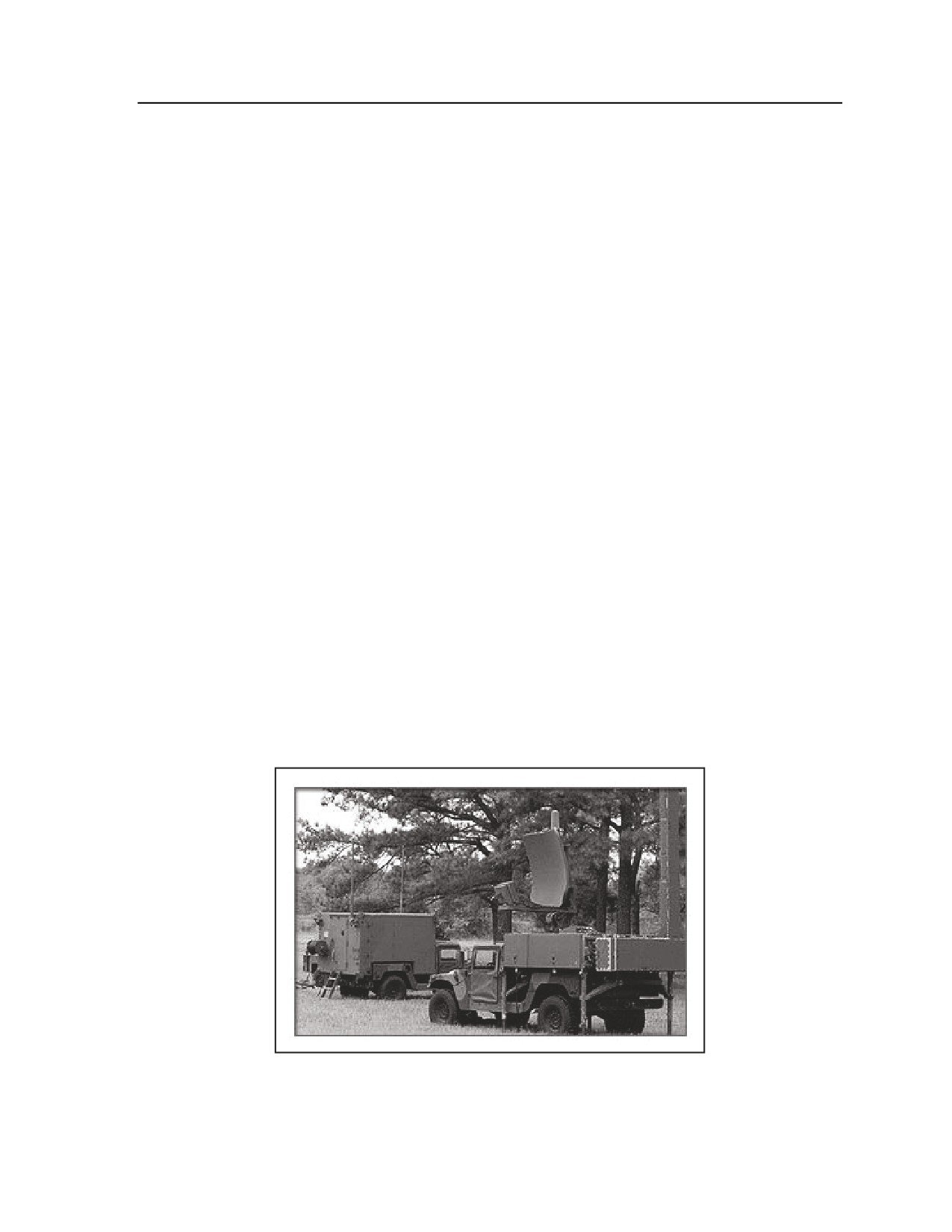
B-3. The AN/TSQ-198 TTCS (figure B-3) is a HMMWV-mounted ATC system for the TACT mission.
The TTCS enables VFR control of air traffic at LZs, DZs, PZs, FARPs, initial airfields, and temporary
helicopter operating areas. It is the system of choice for initial entry operations for localized high volume
aviation operations where ATC is a risk management reducer. Four air traffic controllers are assigned to
operate the AN/TSQ-198 for a 24-hour period. Major communications components include the AN/VRC-
83 Have Quick radio sets, AN/VRC-90F SINCGARS, and VRC-101/PRC-138 HF radio set. The
communications system can convert to a portable battery operated manpack configuration or be remoted
from the vehicle up to 1 kilometer. The AN/TSQ-198 is sling-loadable by a UH-60 or similar helicopter, or
can be transported by a C-130 aircraft load. The TTCS can be internally airlifted by a CH-47 if
reconfigured. All TTCSs are being modified to the AN/TSQ 198A, incorporating VRC-103/PRC117
multiband radios and the AN/VRC-200 HF-SSB ALE radio integrated into a new radio set control. This
modification will provide a SATCOM-DAMA capability and an improved meteorological senor. All
legacy radios will be removed except for the PRC-138 radio, which will be retained for a HF manpack
capability.
Figure B-3. AN/TSQ-198 TTCS
B-2
FM 3-04.120
16 February 2007
Air Traffic Control Systems
PRECISION APPROACH RADAR SYSTEMS
AN/TSQ-71B LANDING CONTROL CENTRAL
B-4. The AN/TSQ-71B GCA is a precision radar set providing course line and glide path tracking of
aircraft to within 20 feet (6.1m) (altitude) and 1.3-degree runway alignment of a predetermined landing
point/(touchdown. Aircraft position, as determined by GCA radar, is relayed to the pilot. An ASR
capability is provided to a maximum radar range of
40 nautical miles. Major components of the
AN/TSQ-71B include the shelter, AN/TPX-44 IFF interrogator antenna, AN/MJQ-15 power generation
set, and AN/TPN-18 radar set
(GCAs). Radio communications include UHF/VHF/FM radios. The
AN/TSQ-71B interfaces with other facilities by landline or VHF/UHF/FM radios and communicates with
the airfield/landing area tower facility. The AN/TSQ-71B uses analog equipment for communications and
requires special consideration when interfacing with digital equipment. Seven air traffic controllers are
assigned to operate the AN/TSQ-71B for a 24-hour period. The shelter of the AN/TSQ-71B is sling-
loadable by a CH-47 helicopter; and can be transported by a C-141, an aircraft with similar load limits or in
a dismounted configuration by a C-130 aircraft. The AN/TSQ-71B is fielded to the active Army.
AN/TPN-31 AIR TRAFFIC NAVIGATION, INTEGRATION, AND COORDINATION SYSTEM
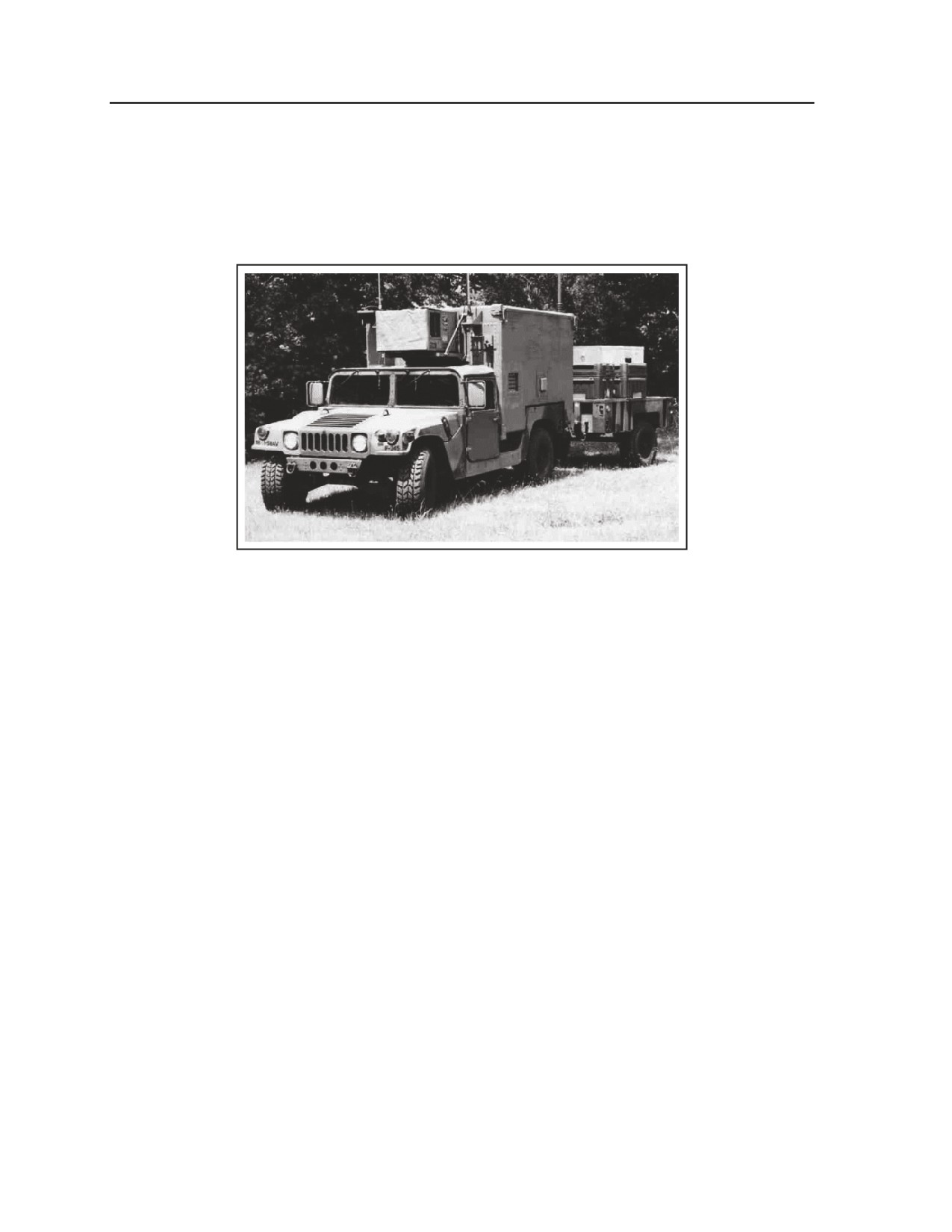
B-5. The AN/TPN-31 (figure B-4) is currently being fielded to all components of the Army replacing the
AN/TSQ-71B landing control central. It is a survivable radar system providing continuous, near all
weather, precision landing and departure recovery capability at Army tactical airfields and landing areas.
Additionally, this system provides area surveillance and aircraft identification capability for a 25 nautical
mile radius. The system consists of three integrated radars: ASR, PAR, and secondary surveillance radar
with seven air traffic controllers operating it. It can be airlifted by C-130 aircraft or sling loaded by CH-47
and is fielded to active Army and ARNG. Current fielding initiatives will replace the HMMWV
configuration with an armored FMTV.
B-6. Air traffic navigation, integration, and coordination system (ATNAVICS) is a modern, fully digital,
FAA compliant ATC radar, able to see better through battlefield obscurants, weather, and natural
phenomena (bird flights). This system helps fill requirements stemming from vulnerabilities of GPS, battle
damage to airborne systems, SACSO civil users, composite and combined nondigitized air assets, and the
continuing need to have redundant ground capabilities to space-based capabilities. Its digital air picture can
be used to contribute to BDZ operations, or the TAIS operations air picture, if deployed in the TAIS’
vicinity.
Figure B-4. AN/TPN-31 ATNAVICS
16 February 2007
FM 3-04.120
B-3
Appendix B
AN/TSQ-221 TACTICAL AIRSPACE INTEGRATION SYSTEM
B-7. The AN/TSQ-221 (figure B-5) is a digital and analog system for A2C2 planning, operations, and
ATS area support. It provides automation assistance to the full range of airspace planning, enhances
airspace management operations (real-time), and ensures connectivity between all ATS assets and airspace
users in theater. Current fielding initiatives will replace the HMMWV configuration with an armored
FMTV.
Figure B-5. AN/TSQ-221 TAIS
B-8. TAIS is the direct link to tactical aviation ground support (TAGS) through interface with the
JFACC’s automated airspace planning and communications system. It integrates with ABCS, with direct
connectivity to battlefield automated systems. It also has enhanced operability with joint, multinational,
and civil C4I systems.
B-9. TAIS is a mobile system with four workstations. Communications include VHF, UHF, HF, UHF
SATCOM, EPLRS, GPS, MSE/DNVT (FAX), improved data modem (+), and secure telephone unit III
(phone). It maximizes synchronization of battlefield airspace supporting force operations and minimizing
fratricide. Major capabilities include—
Full integration and total synchronization of all airspace operations in the tactical commander's
AO.
Prioritized course of actions (COAs) for immediate resolution of operational airspace conflicts
according to the commander's priority of airspace usage.
Maximized opportunities for continuous operations, thereby increasing the commander's
flexibility and offensive capability.
Transparent airspace management planning and operations.
Reduction of staff workloads and planning time.
B-10. TAIS fully integrates airspace planning methods and procedures through interface with ABCS and
TAGS. Projected battle and airspace usage plans are input digitally or manually. The system correlates all
information and identifies airspace usage conflicts automatically by means of preset priorities or command
decision. It displays a proposed ACP with control measure graphics (in two- or three-dimension, as
selected by the operator), and in the time dimension. It also produces required A2C2 orders, annexes, and
overlays. It provides the capability of monitoring ACP execution over time; identifies (with alarms) and
proposes resolution of actual or imminent airspace user conflict in near real-time; accepts and deconflicts
real-time airspace usage changes; and automatically modifies and distributes a revised ACP
(or
individually modified ACMs) to update battlefield visualization.
B-4
FM 3-04.120
16 February 2007
Air Traffic Control Systems
NAVIGATIONAL AIDS
AN/TRN-30 RADIO BEACON SET
B-11. The radio beacon set transmits a homing signal that is detected by automatic direction finder
equipment installed in many aircraft for navigation. The radio beacon provides an AM radio frequency
signal on any one of 964 channels in frequency ranges of 200 to 535.5 and 1605 to 1750.5, tunable in 500
Hz increments. The radar frequency output is automatically keyed into four-letter Morse code characters
either selected by the operator or manually keyed.
AN/TRN-30 (V) 1 Radio Beacon Set
B-12. The Pathfinder operates with both 15-foot (4.6m) and 30-foot (9.1m) antenna configurations and
requires 24 volt direct current (DC) power. It also requires a cleared area of 128 feet (diameter) for ground
radials and guy lines. Using a 15-foot (4.6m) antenna group, the beacon operates in a frequency range of
1605 to 1750.5 only, and transmits 28 kilometers/15 nautical miles. Operating in a 30-foot antenna
configuration, it uses frequency ranges of 200 to 535.5 and 1605 to 1750.5, and transmits 46 kilometers/25
nautical miles.
AN/TRN-30 (V) 2 Radio Beacon Set
B-13. The AN/TRN-30 (V) 2 uses a 60-foot (18.3m) antenna group and requires 28 volt DC power. The
two configurations used with this beacon set are tactical and semi-fixed, which require a cleared area of
170 feet (diameter) for guy lines and ground radials. The tactical configuration operates in a frequency
range of 200 to 535.5, and transmits 93 kilometers/50 nautical miles. The semi-fixed mode frequency range
is 200 to 535.5, and transmits 185 kilometers/100 nautical miles.
16 February 2007
FM 3-04.120
B-5
Appendix C
Composite Risk Management
The tactical environment provides ever-changing demands and unpredictable
problems, often under stressful conditions. Mission accomplishment requires
continuous leader involvement and flexible decision making. Safety in the tactical
environment depends on compliance with established standards. ATS units bring an
added measure of safety to aviation operations. Properly used, they can mitigate or
reduce many of the risks associated with these operations. Safe mission
accomplishment relies heavily on the complete integration of composite risk
management into the planning and execution phases of operations.
COMPOSITE RISK MANAGEMENT
D-1. Leaders at every echelon are responsible for risk management. As the Army’s principal risk-
reduction process, the intuitive management of risk in conducting military training and operations is old,
however its’ systematic application, as part of Army doctrine, is relatively new. Therefore, this section
presents a summary of how-to information presented in FM 5-0, FM 100-14, and FM 3-100.12.
C-2. The risk management cycle for ATS units at all levels is tied directly to the training and maintenance
process. Factors such as type of ratings, numbers of rated controllers, and equipment readiness and
availability are assessed and corrections are made during normal garrison operations. Command emphasis
at all levels of leadership on maintenance and supply operations eliminates many factors that might create
an unacceptable risk during exercises or deployments. This assessment minimizes and mitigates many of
the hazards faced during deployment. Leaders must complete the five steps for risk management listed in
table C-1.
Table C-1. Steps of risk management
Step 1. Identify hazards
• Make an operational analysis. This is a description of events, in time sequence, expected to
occur during the operation.
• Make a preliminary hazard analysis. List the various hazards that could occur and result in
accidents. It is developed using experience, the database, and scenario thinking or similar
techniques.
• In-depth hazard analysis. Use when time permits or when certain risks require more careful
consideration.
Step 2. Assess hazards
• Assess various hazards to determine the relative probability, severity, and potential mission
impact.
Step 3. Make decisions and develop controls
• Develop risk control options, starting with the most serious risks.
• Complete a training realism assessment to ensure the suitability of risk controls.
• Make decisions by selecting controls to reduce risk to a practical minimum constant with the
mission.
Step 4. Implement controls
• Implementation is best accomplished by integrating the procedures in unit SOPs, orders, and
training.
16 February 2007
FM 3-04.120
C-1
Appendix C
Table C-1. Steps of risk management
Step 5. Supervise
• Maintain effectiveness by ensuring risk standards are as effective as expected and kept at high
levels.
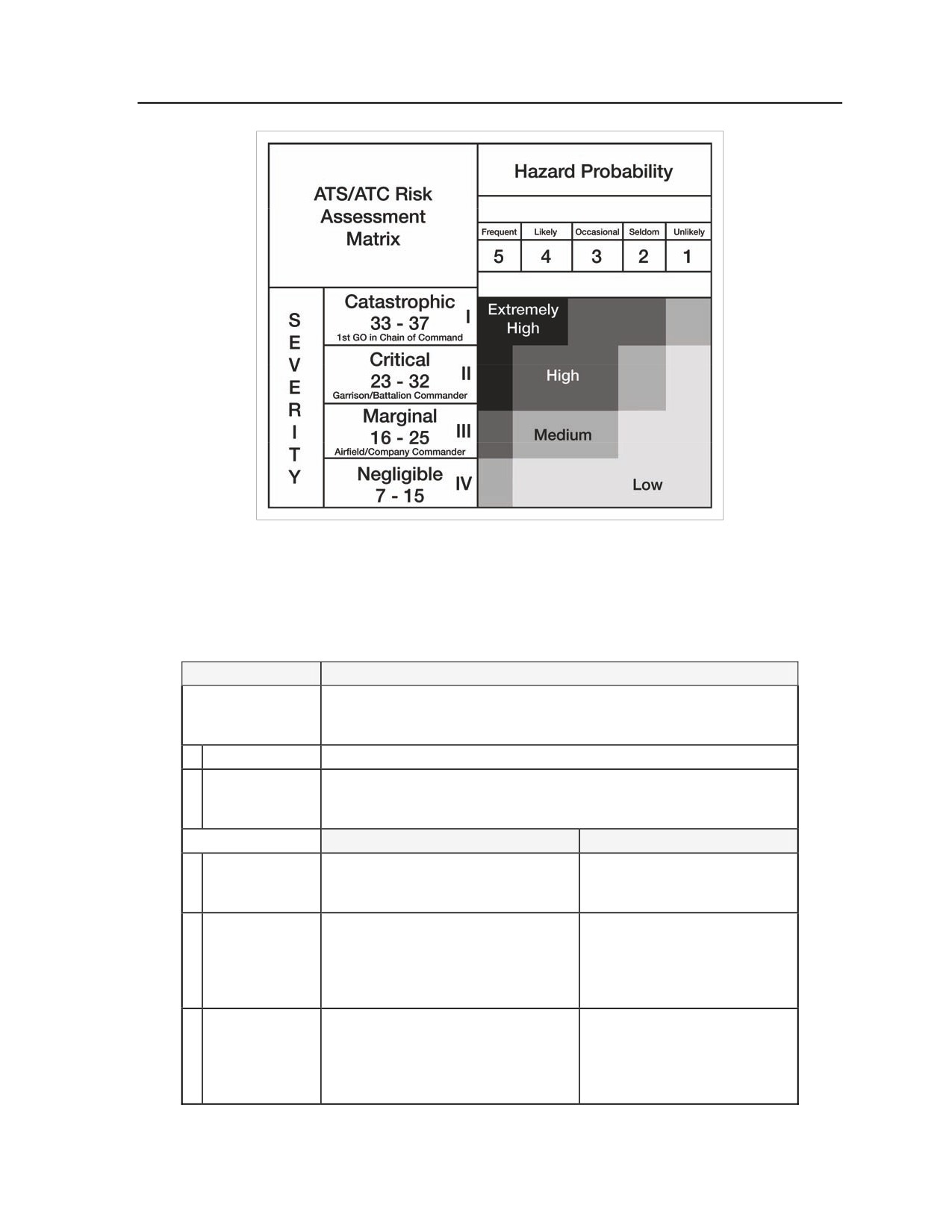
C-3. The five major areas of risk assessment are fiscal, threat, tactical doctrine, physical security, and
safety. Tactical units shall conduct risk assessment before a mission with each tactical facility developing
its’ own risk assessment (table C-2 and figure C-1, page C-3).
Table C-2. Sample tactical ATC risk assessment
1. Team Experience
All CTO Rated
All Rated
One Or More
Mixed
Not position
(CTO/ATC
qualified
specialist)
Inexperience- (<3 Months)
3
4
5
Experience- (3 - 6 Months)
2
3
4
Experience- (>6 Months)
1
2
3
2. Allotted Mission Planning Time
8 Hours
4 - 8 Hours
Less 4 Hours
Complex
3
4
5
Routine-New Mission
2
3
4
Routine-Same Mission
1
2
3
3. Traffic Density
Day
Night
NVG
20 + A/C per hour
3
4
5
5 - 19 A/C per hour
2
3
4
Less Than 5 per hour
1
2
3
4. Weather
Category I
Category II/III
Category IV/V
Night IFR
3
4
5
Day IFR
2
3
4
Day/Night VFR
1
2
3
5. Operating Environment
Garrison/EXCL
Tactical AVG
Tactical POOR
Condition
Condition
Condition
TAC/Unsecured
3
4
5
TAC/Secured
2
3
4
Garrison
1
2
3
6. Fighter Mgmt Rest
On Shift 8 Hrs
On Shift 10 Hrs
On Shift 12 Hrs
Less than 8 Hours
--
4
5
8 - 12 Hours
2
3
4
12 - 24 Hours
1
2
3
Note: Team member with the least amount of rest will be used for calculation
7. Cumulative Fighter Mgmt Hr
0 - 2 Weeks
3 - 6 Weeks
More Than 6
Worked In - Days
Over 40 Hr
Over 40 Hr
Weeks Over 40
Hr
50 +
3
4
5
40 - 49
2
3
4
Less Than 40
1
2
3
Notes: As a minimum, numbers 1, 6, and 7 shall be used in all tactical ATS risk assessments.
Instructions: Under the appropriate column, circle only one value for each numbered block. Total all circled
values and compare to ATS/ATC risk matrix.
C-2
FM 3-04.120
16 February 2007
Composite Risk Management
Figure C-1. Sample risk matrix
DEFINITIONS
C-4. Table C-3 defines risk management definitions.
Table C-3. Terms and definitions
Term
Definition
Risk
Chance of hazard or adverse consequences; the probability of
exposure to chance of injury or loss from a hazard; risk level is
expressed in terms of hazard probability & severity.
Acceptable
Identified risk permitted to persist without further controls.
Residual
Level of risk remaining after hazard controls are selected.
(Controls are identified & selected until risk is at an acceptable
level or it is impractical to reduce further.)
Levels
The levels of risk are:
Probabilities of loss:
Extremely
The loss of ability to accomplish
catastrophic or critical -
high
the mission if hazards occur. (FM
frequent or likely
100-14).
High
The significant degradation of
catastrophic - occasional-to-
mission capabilities & the inability
seldom
to accomplish all parts or complete
critical - likely-to-occasional
the mission to standard if hazards
marginal - frequent
occur.
probability
Moderate
The expected degradation of
catastrophic - unlikely
mission capabilities and the
critical - seldom
reduction in mission capability if
marginal - likely or
hazards occur.
occasional
negligible - frequent
16 February 2007
FM 3-04.120
C-3
Appendix C
Table C-3. Terms and definitions
Term
Definition
Risk
Chance of hazard or adverse consequences; the probability of
exposure to chance of injury or loss from a hazard; risk level is
expressed in terms of hazard probability & severity.
Low
Expected losses have little or no
critical- unlikely
impact on completing the mission.
marginal - seldom or unlikely
negligible - likely or less
Risk
The identification & assessment of hazards (first two steps of risk
Assessment
management process).
Risk Decision
The decision to accept the risk associated with an action made by
the commander, leader, or individual responsible for performing
the action.
Conditions
The readiness status of personnel & equipment with respect to the
operational environment during mission planning, preparation, &
execution. Readiness below standard leads to human error,
materiel failure, & inadequate precautions for environmental
factors which may cause accidents, fratricide, & mission
degradation.
Controls
Actions taken to eliminate hazards or reduce their risk.
Hazard
An actual or potential condition that can cause injury, illness, or
death of personnel; damage to or loss of equipment or property; or
mission degradation.
Probability
The levels of probability that an event will occur are:
Frequent
Occurs often, continuously
Seldom
Unlikely, but could occur
experienced.
at some time
Likely
Unlikely
Occurs several times
Can assume it will not
Occasional
occur
Occurs sporadically.
Severity
The expected consequence of an event in terms of degree of
injury, property damage, or other mission-impairing factors. These
levels are:
Catastrophic
Death or permanent total disability, system loss, major damage,
significant property damage, or mission failure.
Critical
Permanent partial disability, temporary total disability exceeding
three months, major system damage, significant property damage,
or significant mission degradation.
Marginal
Minor injury, lost workday accident, minor system damage, minor
property damage, or some mission degradation.
Negligible
First aid or minor medical treatment, minor system impairment, or
little or no impact on mission accomplishment.
Threat
A source of danger (any opposing force, condition, source, or
circumstance) with the potential to negatively impact mission
accomplishment and/or degrade mission capability. Applicable
only in the context of this publication and should not be referenced
outside this FM.
C-4
FM 3-04.120
16 February 2007
Appendix D
Checklists
This appendix provides a reference to information used by aviation units during
training or combat. It is not all inclusive, should only be used as a guide, and not
supersede unit SOPs.
CHECKLISTS
PREDEPLOYMENT AND PRE-TEMPORARY DUTY CHECKLIST
D-2. Table D-1 provides an example of a pre-deployment/pre-temporary duty checklist.
Table D-1. Example of a pre-deployment/pre-temporary duty checklist
Yes
No
N/A
Task/Action
Finance
Bills, recurring and nonrecurring.
Bank accounts, checking, savings, loans. Investments & other income
sources.
Safety deposit boxes.
Legal
Power of Attorney as needed (specific, general).
Wills updated.
Living wills updated.
Spouse’s social security number.
Guardianship for children.
Insurance policies; life, auto, home/renters, floater.
Deeds, leases, rentals, real estate documents, management company.
Marriage or divorce papers.
Birth certificates, adoption papers.
School records.
Naturalization documents.
Vehicle titles and registration.
Taxes.
Necessary court documents.
Personnel Issues
Temporary duty or permanent change of station orders.
Emergency data cards complete.
Identification cards, copy, expiration dates, DEERS enrollment.
Serviceman’s Group Life Insurance.
Passport & Visa documents.
16 February 2007
FM 3-04.120
D-1
Appendix D
Table D-1. Example of a pre-deployment/pre-temporary duty checklist
Yes
No
N/A
Task/Action
Family care plan.
NEO/Safe haven information.
Personal affairs; funeral & burial instructions.
Household
Vehicle registration, inspection, all stickers & tags.
Crime prevention measures/force protection information.
Maintenance/utilities/list of who to contact for problems & repairs.
Disaster/evacuation plan & survival kit; water, food, clothing, other necessities.
Communication
Community contact information
Local emergency (police, fire, Red Cross, poison control, hospital, TRICARE).
Post Chaplain, Army Community Services, Military Police.
Unit contact information (includes phone numbers, physical address and e-mail
address)
Unit name, division, brigade, battalion, company.
Commander, CSM/1SG, UMT, supervisor.
Family Readiness Group spouses.
Orderly room, staff duty officer, filed operations division.
Rear detachment commander/OIC & NCOIC.
Temporary duty; dates, location.
Personal contact information
Family.
Friends.
Immediate neighbors.
Financial.
Insurances.
Medical
TRICARE enrollment/claim process.
Locations/providers/clinic contact information.
Records; medical, dental, shot.
Pets
Records.
Veterinarian; regular & emergency.
D-2
FM 3-04.120
16 February 2007
Checklists
CONVOY PRECOMBAT INSPECTION CHECKLIST
D-3. Table D-2, page D-3, provides an example of a convoy precombat inspection checklist.
Table D-2. Example of a convoy precombat inspection checklist
Items
Completed
Vehicles
Vehicles are inspected at operating temperatures with hoods open.
DA Forms 5988E are current with all parts installed.
Vehicle fuel will be topped off.
All basic issue items present & serviceable.
Three days rations per Soldier per vehicle.
Five-gallon water cans topped off.
Water buffalo are sanitized and topped off.
All supply trucks are covered.
Complete combat lifesaver bag on hand (if applicable.)
Weapons
Crew-served weapons functionally checked.
.50-cal headspace & timing set.
Functions check on all individual weapons.
DA Forms 5988E are present & current for all crew-served weapons.
All weapons are lubricated
Communications:
Radios loaded with correct frequencies. Call signs recorded.
5998Es are all current with PMCS & manual.
Batteries for dismounted radios.
Long-range radio checks are complete.
Digital nonsecure voice telephones with 2 miles of WF-16 wire per phones.
TA-1s or TA-312s are operational with 1 roll of WD-1 per set.
Automated net control devices accounted for & loaded.
CBRN Equipment
DA Forms 5988E are accounted.
M-8/M-22 alarms are complete with batteries & operational alarm.
IM-93 is accounted for & operational.
M8 & M9 paper present & attached.
M256A1 chemical detection kit (1 per squad) on hand.
CBRN markers are present & stocked.
CBRN teams identified.
Night Observation Devices (NODs):
DA Forms 5988E are accounted for & complete for all NODs.
15-day supply of batteries for all NODs.
Carrying cases are complete with accessories & lens cleaning equipment.
16 February 2007
FM 3-04.120
D-3

Appendix D
Table D-2. Example of a convoy precombat inspection checklist
Items
Completed
Individual Solider
Load-bearing equipment worn in accordance with tactical standing operating
procedure (TACSOP) & properly fitted.
Flack jacket is present/Gortex jacket if necessary.
Flashlight present with the appropriate filter.
Identification tags & identification card present.
7 magazine per M-16/M-4; 3 per M-9 9-mm.
DA Form 1156 in the first aid pouch & left pocket of chemical protective
overgarments.
Serviceable first aid packets.
One-quart canteen w/cup & cover (extra canteen optional). Filled & fitted w/CBRN
cap.
All Soldiers understand the mission.
Drivers:
DA Forms 5988E with current PMCS & quality control with 72 hours.
Dispatch signed by the driver & company commander/XO.
Driver has a current unit-level support system computer-generated license.
Driver has CSS graphics, control measures, & a map of the operational area.
Leaders:
Map with current graphics &/or strip map.
Field trains TACSOP.
Leaders have appropriate FMs & ARTEP/MTPs.
List of all sensitive items on company standardized sensitive items sheet.
Current list of all vehicles organic or attached.
Current SOIs for brigade support area & task force.
S-2 threat assessment.
Prepared convoy commander brief.
PRECOMBAT CHECKLIST
D-4. Table D-3 provides an example of a precombat operations checklist.
Table D-3. Example of a precombat checklist
CHECK
CHECK
Individual
Equipment packed per TACSOP
M8/M9 paper
direction
LBV complete & serviceable
Current mission-oriented protective
posture (MOPP) implemented
Ear plugs
Weapon at appropriate arming level
First aid pouch
Optical inserts
D-4
FM 3-04.120
16 February 2007
Checklists
Table D-3. Example of a precombat checklist
CHECK
CHECK
Ammunition pouches
Anti fogging kit
Canteen w/water & cup
ID card
Kevlar w/camo cover and band
ID tags (2 sets, w/2 tags, 1 set worn)
Weapons, zero in pistol grip
MREs
Protective mask w/carrier & hood
Drivers licenses
Body armor as required
Challenge & password
Flashlight w/batteries & lens filters
Shot records
CausaliSA
Hot/cold weatherL
Individual decon Kit
MP
E
Personnel accounted for
MOPP level known and disseminated
Individual preconbat inspection (PCI)
Weapons control
completed
Reference publications reviewed
Section status to platoon sergeant
Uploaded by load plan
Situation briefed
Expendable supplies on hand
MREs issued
Sleep plan established
Ammo basic load issued
Platoon Sergeant
Personnel accounted for
Expendable supplies on hand
Individual PCI completed
Sleep plan established
Reference publications reviewed
Class V issued
Uploaded by load plan
MOPP level announced
Operation equipment
Weapons control
Maps, updated
Platoon status to 1SG
Compasses
Situation briefed
Pens, etc
MREs issued
First Sergeant
Personnel accounted for
Camo
Uploaded by load plan
Vehicles
Expendable supplies on hand
Equipment
Operation equipment
Positions
Maps, updated
Glass & mirrors
Compasses
MEDEVAC helipad marked
Pens, etc
Casualty collection identified
Individual PCI completed & verified
Reference publications reviewed
LP/OP briefed & positioned
Early warning devises employed
Defense plan established & rehearsed
Defensive Sector Diagram complete
Noise & light discipline enforced
Sleep plan established
16 February 2007
FM 3-04.120
D-5
Appendix D
Table D-3. Example of a precombat checklist
CHECK
CHECK
Range cards verified & complete
Class V issued
Repack all equipment not in use
Feeding plan established
Field sanitation enforced
MOPP level known & disseminated
Hand washing enforced
Accountability of personnel to S-1
Trash kept policed
Accountability of sensitive items to S-3
Reportable equipment status to
Coordinate pick-up of equipment
battalion maintenance officer
Blank report formats
Coordinate pick-up of SOI
Communications equipment
SINGARS
Wire
Batteries
Radios
Call sign board
Microphones
Frequencies
Antennas
Unit
Encrypting equipment
Next higher
SOIs
MEDEVAC
PMCS completed
Range control
Radios
Fire support
Antennas
Spare equipment
Encrypting equipment
Microphones
TA-312s
Headsets
Batteries
Antennas
Wire
Batteries
Reel handles on hand
Equipment accounted for
Situation briefed
CBRN Equipment
Individual PCI complete
M256/256A1 detector kit as required
Chemical agent alarms operational
AN/VRDR-2 Radiac sets on hand
Chemical agent alarms employed
146 Radiac meters issued
PMCS performed on M8 alarm
IM-93 Dosimeter issued
M273 kit per chemical alarm
GTA warning system issued
PBT & nerve agent antidote issued
CBRN marking kit available
MARK I kit available
CANA kit available
Combat Lifesavers
Combat lifesavers bags issued
100% inventory, replenish all supplies
Driver/Vehicle Preparation
Loaded according to load plan
5-gallon water can
POL products including weapons oil
5-gallon fuel can
Tools & Rags
MREs rations stowed
D-6
FM 3-04.120
16 February 2007
Checklists
Table D-3. Example of a precombat checklist
CHECK
CHECK
Vehicle hardened as required
Goggles
Strip map on-hand
Dispatch
Lights & markings covered
Convoy route & plan briefed
Convoy number on vehicle
BII/AII present & serviceable
Trailer properly hooked
First aid kit
-10 and LO on hand
Fire extinguisher
PMCS performed
Warning triangles
Camo nets/poles configured/stowed
Vehicle topped off
Vehicle Commander
Convoy number on vehicle
-10 manual on hand
Vehicle topped off
Extra fuel and POL
All BII on hand
PMCS Performed
Pioneer tools
Vehicle
Fire extinguishers
Radios
Grease Pencils
Note book available
Pens/pencils available
Maps & overlays
Sun/wind/dust goggles
Compass/GPS present serviceable
Binoculars
Crew-served weapons
Headspace & timing checked
Ammunition basic load
Qualified gunner
Vehicle load plan verified
Crew-Served Weapons
Clean & functional
Spare barrels, cleaning kits on-hand
Glove; bolt rupture extraction on hand
Tripod w/Triverse and elevation
mechanism, bipod
Head space & timing set (M2)
Machine guns mounted
Function check
Test fire w/permission
NVD, serviceable
Generator Operator
All BII on hand
-10 manual on hand
Grounding rods
PMCS performed
Fire extinguishers
Generator topped off
Extra fuel & POL
16 February 2007
FM 3-04.120
D-7
Appendix D
CHECKLIST FOR COMBAT OPERATIONS
D-5. Table D-4, page D-8, provides an example of an LZ survey checklist.
Table D-4. Example of an LZ survey checklist
Survey Date:
LZ#:
LZ Name:
GPS Coord:
MGRS Grid:
Landing Area
Type:
[
] Helipad
[
] Field
[
] Bean Bag
[
] Other:
Surface:
[
] Level
[
] Sloped
[
] Rocky
[
] Dusty
[
] Wet
Wind Indicator:
[
] Wind Sock
[
] None
[
] Other:
Lighting:
[
] Chem-lite
[
] Road
[
] Inverted Y
[
] None
[
] Other:
LZ Obstacles
[
] Towers
[
] High Grass
[
] Brush
[
]Trees
[
] Poles
[
] Buildings
[
] Wires/Height
[
] Other:
Approach Information
LZ Long Axis:________________ (degrees
LZ Size: (meters) ________ x ________
magnetic)
Approach Heading:
Departure Heading:
Number/Type Aircraft
UH-60
CH-47
OH-58
AH-64
Flight Route
Unaided Night Operations
NVD Operations
[
] Yes
[
] No
[
] Yes
[
] No
Accessibility
[
] Ground/Emergency Vehicles
[
] Other:
Considerations
[
] Near Housing Area
[
] Noise Abatement
[
] Other:
Restrictions/Remarks (Out-of-ground effect, In-ground effect, Number & Type Aircraft, Day Only)
LZ Sketch/Photo (Attach to this document)
Distribution
[
] Reading File
[
] Battalion Ops Files
Surveyor:
Risk:
[
] Low
[
] Medium
[
] High
*** This form is intended for use at field site landing areas, not helipads***
D-8
FM 3-04.120
16 February 2007
Checklists
RECONNAISSANCE WORKSHEET
D-6. Table D-5 provides an example of a reconnaissance report checklist.
Table D-5. Example of a reconnaissance report checklist
Reconnaissance Report
When Transmitted: Upon completion of zone, area, route, or obstacle reconnaissance.
LINE 1: Collection Data
a. Date/time/group (DTG) information collected:
b. DTG information received:
c. Reporting unit:
LINE 2: Data for Route Classification
a. Route name:
b. Start point:
c. Check point/release point:
d. Classification:
e. Trafficability (CODE):
f. Movement (CODE):
g. Location of critical points:
LINE 3: Data of a Bridge Classification
a. Location
b. One-way class:
c. Two-way class:
d. Overhead clearance:
e. Roadway width:
f. Bypass location:
g. Bypass (CODE):
h. Slope of entry point:
i. Slope of exit point:
LINE 4: Data for a Ford, Ferry, or a Swim Site
a. Location:
b. Current (M/SEC):
c. Maximum Depth:
d. Type Bottom (CODE):
e. Usable width:
f. Length:
g. Slope of entry bank:
h. Slope of exit bank:
i. Ferry capacity (TONS):
LINE 5: Data for Tunnel Classification
a. Location:
b. Usable width:
c. Overhead clearance:
d. Length:
e. Bypass location
16 February 2007
FM 3-04.120
D-9
Appendix D
Table D-5. Example of a reconnaissance report checklist
LINE 6: Obstacle Information
a. Location:
b. Slope (CODE):
c. Type (CODE):
d. Length:
e. Width:
f. Bypass Location:
g. Dimensions (6 digit grid):
1. From:
2. To:
3. To:
h. Description (Tank ditch, wire markings, antipersonnel/anti-tank mines)
LINE 7: Terrain Restrictions/Map Corrections
a. Location:
b. Movement (CODE)/What map should say:
LINE 8: Hazards to Flight
a. Obstacle height:
b. Obstacle location/length:
Report Codes
Classification
Green-All vehicles
Amber-No AVLB
Red-APC/BFV only
Trafficability
X-All weather
Y-Limited weather
Z-Fair weather
Movement
F-Fast
S-Slow
Bypass
E-Easy
D-Difficult
Type Bottom
M-Mud
C-Clay
S-Sand
G-Gravel
R-Rock
P-Paving
Slope
A-Less than 7%
C-10-14%
B-7-10%
D-Over 14%
Type Obstacle (If CBRN, use white 1 or green 6 formats)
AB-Abatis
MF-Minefield
RF-Rockfall or
TD-Tank ditch
rockslide
CH-Chemical
N-Radiological
O-Other
RB-Roadblock
Details on items encountered during reconnaissance are reported as encountered if time sensitive.
Submit overlays to the S-2 at conclusion of reconnaissance.
S-2 consolidates details of terrain features and submits them to higher at conclusion of reconnaissance.
D-10
FM 3-04.120
16 February 2007
Checklists
AIR TRAFFIC CONTROL HANDOVER CHECKLIST
D-7. Table D-6 provides an example of an ATC handover checklist:
Table D-6. Example of an ATC handover checklist
1. Airfield Name: ____________________________________________________
2. Airfield Location: _________________________________________________
LAT/LONG: __________________________/_______________________________
3. ICAO Identifier: ___________________________________________________
4. Airfield Frequencies: (P) UHF/VHF (S) UHF/VHF
ATIS ________/_______ ________/________
Approach Control ________/_______ ________/________
Tower Control ________/_______ ________/________
Ground Control ________/_______ ________/________
Clearance Delivery ________/_______ ________/________
Base Operations ________/_______ ________/________
SAR ________/_______ ________/________
WX Metro ________/_______ ________/________
5. Airfield Diagram:
6. Usable Runways: ________/________/________/________/________/________
7. Usable Taxiways: ________/________/________/_______/________/_________
8. Dimensions:
Length Width Composition PCN
Runway _______ft _______ft ____________ ___/___/___/___/__
______________ft _______ft ____________ ___/___/___/___/__
______________ft _______ft ____________ ___/___/___/___/__
______________ft _______ft ____________ ___/___/___/___/__
Taxiway _______ft _______ft ____________ ___/___/___/___/__
______________ft _______ft ____________ ___/___/___/___/__
______________ft _______ft ____________ ___/___/___/___/__
______________ft _______ft ____________ ___/___/___/___/__
Helipad _______ft _______ft ____________ ___/___/___/___/__
______________ft _______ft ____________ ___/___/___/___/__
______________ft _______ft ____________ ___/___/___/___/__
______________ft _______ft ____________ ___/___/___/___/__
AV-8B Pad _____ft _______ft ____________ ___/___/___/___/__
______________ft _______ft ____________ ___/___/___/___/__
______________ft _______ft ____________ ___/___/___/___/__
______________ft _______ft ____________ ___/___/___/___/__
9. Traffic Pattern:
Entry Point Altitude Point of Descent
Left ______________ _______________ __________________
Right ______________ _______________ _________________
Straight-in ______________ _______________ _________________
16 February 2007
FM 3-04.120
D-11
Appendix D
Table D-6. Example of an ATC handover checklist
Overhead ______________ _______________ __________________
Other ______________ _______________ ______________________
10. Pattern Altitude:
Turbo-Jet _____________________________
Propeller-Driven ______________________
Helicopter ____________________________
Altitude Remarks:
_________________________________________________________________________________
_________________________________________________________________________________
_________________________________________________________________________________
11. NAVAID: Location / Frequency / Power Source (Lat/Long)
NDB _________________________/________________/____________________
VOR _________________________/________________/_____________________
TACAN _______________________/________________/_____________________
VORTAC _____________________/________________/_____________________
MLS _________________________/________________/_____________________
ILS __________________________/________________/_____________________
GPS _________________________/________________/_____________________
VASI ________________________/________________/_____________________
ASR ________________________/________________/_____________________
PAR ________________________/________________/_____________________
12. Hot Cargo Area: Y___ N___ Location ______________________________________
13. Refueling Points: Y___ N___ Location ______________________________________
14. Arming/De-arming Area: Y___ N___ Location ________________________________
15. Parking Locations/Spots/Restrictions:
FW __________________________________________________________________
_____________________________________________________________________________
Rotary Wing ________________________________________________________________
_____________________________________________________________________________
VIP/VAL_____________________________________________________________________
_____________________________________________________________________________
16. Obstacles on Airfield: Y___ N___
Trees Y___ N___ _____________Ft
Wires
Y___ N___ _____________Ft
Houses Y___ N___ _____________Ft
Personnel Y___ N___ _____________Ft
Ditches Y___ N___ _____________Ft
Terrain
Y___ N___ _____________Ft
Poles Y___ N___ _____________Ft
17. Blind Spots:
Visual __________________________________________________________
Radio ___________________________________________________________
18. Non-Radar Procedures:
Heading ____________________________________________________________
Handoff Time _______________________________________________________
D-12
FM 3-04.120
16 February 2007

Checklists
Table D-6. Example of an ATC handover checklist
Fix _________________________________________________________________
Altitude ___________________________________________________________
Frequency __________________________________________________________
Location ___________________________________________________________
19. TERPs: Y ___ N ___
20. Reporting Points: #1 #2 #3 #4
Location _________ _________ __________ ____________
Altitude _________ _________ __________ ____________
21. Holding Points VFR:
Location _________ _________ __________ ____________
Altitude _________ _________ __________ ____________
Pattern _________ _________ __________ _____________
22. Holding Points IFR:
Location _________ _________ __________ ____________
Altitude _________ _________ __________ ____________
Pattern _________ _________ __________ _____________
23. Bailout Area:
Location _________ _________ __________ ____________
Altitude _________ _________ __________ ____________
24. Jettison Area:
Location _________ _________ __________ ____________
Altitude _________ _________ __________ ____________
25. Fuel Dump Area:
Location _________ _________ __________ ____________
Altitude _________ _________ __________ ____________
26. Alternate/Divert Airfields Information:
Name
NAVAID
Heading
Dist
Elev
Fuel
Longest
Approach
TWR
Navaid
channel
from
(nm)
Runway
Freq
Freq
ALFD
27. Weather:
Wind: Prevailing __________/__________ Surface __________/__________
VSBY __________Mi
Ice Y___ N___
Wet Y___ N___ Rain/Snow
Breaking Action
Good___ Fair___ Poor___ NIL___ UNK ___
16 February 2007
FM 3-04.120
D-13

Appendix D
Table D-6. Example of an ATC handover checklist
Other:_________________________________________________________________________
________________________________________________________________________________
Remarks:
_______________________________________________________________________________
_______________________________________________________________________________
_______________________________________________________________________________
TABLES
AVERAGE MARCH RATES FOR MIXED COLUMNS
D-8. Table D-7 provides the estimated speed march rates units can attain under certain driving and road
conditions. Planners adjust these rates given individual driver training, experience, and physical
conditioning.
Table D-7. Average march rates for mixed columns (in kilometers)
Condition
March Rates
Day, on roads
20 to 30
Night, on roads
15 to 20
Cross-country
5 to 15
AVERAGE VEHICLE SPEEDS
D-9. Table D-8 provides the planner an indication of average speeds attainable given
a
surface
composition and degree of surface destruction.
Table D-8. Average vehicles speed (kilometers per hour)
Road Type
Undamaged
10% Surface
<10% Surface
Surface
Destruction
Destruction
Concrete, asphalt
40 to 50
20 to 35
10 to 20
Gravel & rubble
40 to 50
20 to 30
10 to 20
Dirt
15 to 25
8 to 15
5 to 10
TIME DISTANCE RATES
D-10. Table D-9 and table D-10 reflect time distance rates in kilometers and miles, respectively.
Table D-9. Time distance rates (kilometers)
Speed
Distance
1 km
2 km
3 km
5 km
10 km
10 kph/6.2 mph
6 min
12 min
18 min
30 min
60 min
15 kph/9.4 mph
4 min
8 min
12 min
20 min
40 min
20 kph/12.5 mph
3 min
6 min
9 min
15 min
30 min
25 kph/15.6 mph
2.4 min
4.8 min
7.2 min
12 min
24 min
30 kph/18.7 mph
2 min
4 min
6 min
10 min
20 min
35 kph/22 mph
1.7 min
3.4 min
5.1 min
8.5 min
17 min
40 kph/25 mph
1.5 min
3 min
4.5 min
7.5 min
15 min
D-14
FM 3-04.120
16 February 2007

Checklists
Table D-9. Time distance rates (kilometers)
48 kph/30 mph
1.2 min
2.4 min
3.6 min
6 min
12 min
56 kph/35 mph
1 min
2 min
3 min
5 min
10 min
64 kph/40 mph
.9 min
1.8 min
3.6 min
4.5 min
9 min
72 kph/45 mph
.8 min
1.6 min
2.4 min
4 min
8 min
Table D-10. Time distance rates (miles)
Speed
Distance
1 mile
2 mile
3 mile
5 mile
10 mile
5 mph/8 kph
12 min
24 min
36 min
60 min
120 min
10 mph/16 kph
6 min
12 min
18 min
30 min
60 min
15 mph/24 kph
4 min
8 min
12 min
20 min
40 min
20 mph/32 kph
3 min
4 min
9 min
15 min
30 min
25 mph/40 kph
2.4 min
4.8 min
7.2 min
12 min
24 min
30 mph/48 kph
2 min
4 min
6 min
10 min
20 min
35 mph/56 kph
1.7 min
3.4 min
5.1 min
8.5 min
17 min
40 k mph/64 kph
1.5 min
3 min
4.5 min
7.5 min
15 min
45 mph/72 kph
1.3 min
2.6 min
3.9 min
6.5 min
13 min
Note: When converting miles to kilometers: (miles x 1.609 = kilometers) or (miles/621 =
kilometers). Example: 12 miles x 1.609 = 19.3 kilometers. When converting kilometers to miles:
(kilometers x 0.621 = miles) or (kilometers/1.609 = miles). Example: 20 kilometers x 0.621 =
12.4 miles.
REPORTS AND FORMATS
SPOT REPORT
D-11. Spot reports (SPOTREPs) are used to send timely intelligence or status information regarding events
that could have an immediate and significant effect on current planning and operations
(table
D-11).
Table D-11. SPOTREP
Line 1
Date and time group of report.
Line 2
Unit making report.
Line 3
Size of enemy unit.
Line 4
Activity of enemy at DTG or report.
Line 5
Location of enemy activity or event observed.
Line 6
Unit, (enemy unit).
Line 7
Time of observation.
Line 8
Equipment of unit observed.
LINE 9
Sender’s assessment of activity.
Line 10
Narrative of action taken by friendly forces.
Line 11
Report authentication.
Line 12
Distribution of report.
16 February 2007
FM 3-04.120
D-15
Appendix D
CONVOY STATUS REPORT
D-12. Table D-12 provides an example of a convoy status report. This report is used to update convoy SPs,
stops en route, and release points (RPs).
Table D-12. Convoy status report
Line 1
DTG.
Line 2
Unit making report.
Line 3
Convoy commander.
Line 4
Convoy unit number.
Line 5
Number of wheeled vehicles.
Line 6
Number of personnel.
Line 7
Route being used and alternate proposed.
Line 8
Starting point, include first vehicle to DTG and last vehicle DTG.
Line 9
Resting points.
a. DTG of arrival and departure at/from resting point.
b. Number of vehicles arrived and number of vehicles departing.
c. Number of personnel arrived and number of personnel departing.
Line 10
RP including DTG of first vehicle to cross and last vehicle to cross RP.
Line 11
CP.
Line 12
Convoy closing DTG.
Line 13
Accidents/breakdowns.
a. Type/bumper number/unit of broken down vehicles/equipment.
b. Location or broken vehicles/equipment.
c. Estimated time to continue operations.
Line 14
Sensitive items status.
Line 15
Narrative/remarks.
Line 16
Authentication.
WEATHER ADVISORY/WATCH (WEATHER WATCH) REPORT
E-1. The weather advisory/watch (weather watch) report in table D-13 is used to send flash weather
information affecting current unit operations.
Table D-13. Weather advisory/watch (weather watch) report
Line 1
DTG.
Line 2
Unit making report.
Line 3
Report line.
Line 4
Summary of warning.
Line 5
Time of watch (DTG from-to DTG as of DTG of watch).
Line 6
Area effected.
Line 7
Narrative/remarks, free text for additional information required for
clarification of report.
Line 8
Report authentication.
D-16
FM 3-04.120
16 February 2007
Checklists
RAIL LOAD STATUS REPORT
D-13. The rail load status report is used to update upload and download status (table D-14).
Table D-14. Rail load status report
Unit making the report.
DTG of report.
Line 1
DTG loading or off loading began.
Line 2
DTG loading or off loading completed.
Line 3
Loading or off loading railhead commander.
Line 4
Loading or off loading railhead location.
Line 5
Number of wheeled vehicles loaded or off loaded.
Line 6
Other cargo loaded or off loaded (specify).
Line 7
Number of passengers by grade including train guards.
Line 8
Estimated pull or arrival DTG.
Line 9
Rail destination.
Line 10
Remarks.
CLOSURE REPORT
D-14. The closure report is used to inform the commander of unit movement and its capability to conduct
future operations (table D-15). This report is submitted upon movement completion or as directed by the
commander.
Table D-15. Closure report
Line 1
DTG.
Line 2
Unit making report.
Line 3
SP grid point and DTG.
Line 4
RP grid point and DTG.
Line 5
Command post location.
Line 6
Closing DTG.
Line 7
Accidents/incidents/enemy activity encountered.
Line 8
Estimated time unit will be reconstituted and ready to continue operations.
Line 9
Sensitive items status, include detailed lost items report and action being taken.
Line 10 Remarks.
Line 11 Report authentication.
PERSONNEL DAILY SUMMARY REPORT
D-15. The personnel daily summary (PDS) report gives an overall view of personnel strengths as well as
changes to personnel strengths from the previous report (table D-16). A consolidated crew status of major
weapons systems within the major subordinate command is also reported. It covers a 12-hour time period,
is cumulative, and is submitted twice daily.
16 February 2007
FM 3-04.120
D-17
Appendix D
Table D-16. Personnel daily summary report
Required information
Consolidated strength
Required strength, required strength on MTOE.
Previous strength, strength reported from last PDS.
Replacements, replacement Soldiers from higher HQ.
RTD/ATCH (returned to duty Soldiers).
KIA/WIA/MIA (killed/wounded/missing in action).
DNBI (disease/non-battle injury).
ADMIN (administrative losses).
Current strength, previous strength + gains - losses.
Required and assigned strength by MOS and grade.
Junior grade officers (O1-O3).
Warrant officers (W1-W4).
Senior enlisted (E7-E9).
Junior NCOs (E5-E6).
Junior enlisted (E1-E4).
Significant remarks to explain drastic strength changes.
MAJOR SUBORDINATE COMMAND/ UNIT REPORTING
D-16. The major subordinate command/unit report is used to inform higher headquarters of CBRN threats
or attacks occurring in the last 12 hours and the reporting unit’s defensive posture (table D-17).
Table D-17. Major subordinate command/unit reporting
Unit sending report:
Line 1
DTG of report.
Line 2
Unit threat condition report.
Line 3
Unit minimum MOPP level(s).
Line 4
Unit radiation status.
Line 5
Enemy strikes reported in the past twelve hours:
a. DTG of attack.
b. Location of attack.
c. Means of delivery.
d. Agent type.
e. Remarks.
Line 6
Smoke, decon, recon mission conducted in last 12 hours.
Line 7
Remarks.
D-18
FM 3-04.120
16 February 2007
Checklists
MEACONING, INTRUSION, JAMMING, INTERFERENCE REPORT
D-17. The meaconing, intrusion, jamming and interference report is submitted when units experience
enemy attempts to jam, interfere, or disrupt radio communications (table D-18).
Table D-18. Meaconing, intrusion, jamming, interference report
Type:
Meaconing.
Intrusion.
Jamming.
Interference.
Affected stations (call signs):
Location(s):
Frequency:
Type of equipment affected:
Type of interference:
Strength of interference:
Date and time interference:
Begin:
End:
Remarks:
MEDICAL EVACUATION 9-LINE REQUEST
D-18. The medical evacuation 9-line request is used when requesting ambulance support (air and ground)
(table D-19).
Table D-19. Medical evacuation 9-line request
Line 1
Location of pickup site (full grid, 34T EN43532501):
Line 2
Frequency/call sign at pickup site (30.75 is mandatory): 30.750/
Line 3
Number of patients by precedence:
Urgent: To save life, limb, or eyesight within two hours; evacuate within 2 hours.
Urgent surgical: Must receive surgical care within 2 hours.
Priority: Evacuate within 4 hours.
Routine: Evacuate within 24 hours.
Convenience: Evacuate at medical convenience.
Line 4
Special equipment (circle if needed):
None.
Hoist.
Extraction equipment.
Ventilator.
Line 5
Number of patients by type:
L: Number of litter patients.
A: Number of ambulatory patients.
Line 6
Security of pickup site (wartime):
N: No enemy troops.
P: Possible enemy troops.
E: Enemy troops in area (caution).
X: Enemy troops in area (armed escort required).
16 February 2007
FM 3-04.120
D-19