FM 3-04.120 Air Traffic Services Operations (February 2007) - page 2
Chapter 2
COMMUNICATIONS SECURITY EQUIPMENT
AN/CYZ-10
2-102. The AN/CYZ-10 data transfer device (DTD), also known as ANCD, is a portable, hand-held
device capable of securely receiving, storing, and transferring data between compatible cryptographic and
communications equipment. It is programmable and capable of storing
1,000 keys, maintaining an
automatic internal audit trail of all security-relevant events that can be uploaded, and encrypting key for
storage. The DTD is capable of keying multiple information security
(INFOSEC) devices and is
compatible with COMSEC equipment such as SINCGARS radios or KY-57 VINSON. The DTD is
designed to be fully compatible with future INFOSEC equipment, meeting required signaling and benign
fill standards. It will eventually replace the legacy family of common fill devices including the KYX-15
electronic storage devices, and KOI-18 paper tape reader. Only the DTD and KOI-18 support newer 128-
bit keys. The DTD holds all keys needed for SINCGARS and SOI. Its internal clock uses a crystal
oscillator making it inadequate; therefore it can not set the time in a frequency-hopping radio, such as
SINCGARS or Have Quick. Crystal oscillators change frequency with aging, temperature, power supply
voltage, and other factors. SINCGARS needs a number of different fills for frequency-hopping and
transmission security. The A/N CYZ -10 is current scheduled to be replaced by the A/N PYQ -10(c).
KOI-18/TSEC
2-103. The KOI-18/TSEC, tape reader is used to load transmission encryption keys (TEKs) into the KY-
57 and other equipment needing a key. It uses a photo optical reader that can read a paper tape that is
pulled through the reader by hand. It is versatile and unforgiving, requiring accurate input on the tape.
Other key loaders have electronic registers that can only hold keys in predetermined formats.
KYK-13/TSEC
2-104. The KYK-13/TSEC electronic transfer device is designed to hold TEKs. The KYK-13 holds up to
six TEK variables.
ANDVT Minterm (KY-99)
2-105. The ANDVT MINTERM (KY-99) is a narrowband/wideband terminal that interoperates with
VINSON (KY-57, KY-58) and SINCGARS. A self-contained terminal including COMSEC, KY-99
provides secure voice and data communications in tactical airborne/ground environments.
2-24
FM 3-40.120
16 February 2007
Chapter 3
Employment
The Army’s primary task is to conduct prompt and sustained combat operations on
land. Joint force commanders (JFCs) require immediate available land power to
complement other service capabilities. The long-term presence of land power makes
the otherwise temporary effects of air, sea, and space operations permanent. Land
forces must be able to work with multinational forces, local populations, local
governments, and other United States government agencies to develop conditions that
successfully conclude campaigns.
SECTION I - AIR TRAFFIC SERVICES COMPANY
3-1. ATS assets promote safe, flexible, and efficient use of airspace that is shared with a multitude of
weapon systems. ATS companies enable Army aviation to maximize technology by coordinating airspace
and providing recovery capabilities. ATS units enhance air operations for ground force initiatives by
providing airspace information, terminal, navigational, and forward-area support services. Interface occurs
with theater, joint and combined, or host-nation ATS assets during all phases of operations. ATS
organizations enable air operations by collecting, processing, displaying, and issuing airspace user
information as well as implementing procedural and positive control measures and means for airspace
deconfliction. Additionally, ATS companies support United States government agencies (interagency
operations), as necessary, in the interest of national security during peacetime and contingency operations.
The deployment of air traffic systems support three missions sets, airspace information services, terminal
ATS, and forward area support services.
AIRSPACE INFORMATION SERVICES
3-2. AICs provide airspace information updates to
friendly aircraft and are the primary coordination
Contents
link between aircraft and the CAB/division. AICs
operate as an execution arm of the associated A2C2
Section I - Air Traffic Services
elements of the division by providing near real-time
Company
3-1
interface for airspace changes, while coordinating
Section II - Theater Airfield Operations.3-11
and deconflicting airspace requirements. The AIC
Section III - Stability and Civil Support
ensures the flow of information required for air
Operations
3-21
defense (AD) and air traffic management operations.
AIC services and updates include:
Critical in-flight advisories/updates of airspace deviations within the AO.
Hostile aircraft intrusion warnings.
Locations of rapid refueling points, FARPs, terminal facilities, and on call NAVAIDs.
Terminal airfield status.
Flight following and navigational assistance.
Monitoring and assisting combat search and rescue operations.
Planned airspace information, including C2 restricted operations zones (ROZs) or orbit areas for
Army Airborne Command and Control System aircraft monitoring a close battle.
Air mission planning data and airspace control information for terminal facilities.
16 February 2007
FM 3-04.120
3-1
Chapter 3
Current and forecasted weather information.
Electronic data link to ABCS for terminal facilities.
TERMINAL SERVICES
3-3. Terminal services assist in the movement of aircraft, including takeoff, landing, separation, and
sequencing. These services also include full-service radar, tower communications, NAVAIDs, precision
and nonprecision instrumentation on illuminated airfields and airports, and traffic advisories. Terminal
services can be temporary with minimal service support.
CONTROL TOWER TEAM
3-4. The terminal platoon tower team employs at tactical landing sites or main operating bases where
high density air traffic exists. Tower teams are responsible for controlling transitioning, landing, and
departing aircraft. As the primary ATS organization for regulating and integrating terminal services it
establishes the nonprecision approach capability for the terminal AO. Aircraft movements in, out, and
through the terminal area are closely coordinated with the tower, GCA, and AIC to ensure complete SA of
the terminal AO for deconfliction of airspace and fratricide avoidance.
GROUND CONTROL APPROACH TEAM
3-5. The GCA team employs with the tower team, providing a near all weather, precision/nonprecision
approach recovery capability and surveillance vectoring to arriving and departing aircraft operating in the
terminal area.
FORWARD AREA SUPPORT SERVICES
3-6. TACTs coordinate aviation operations and are employed as initial entry forces at auxiliary areas and
remote and austere locations. The mobility of the TACT allows the commander flexibility during all stages
of force projection and provides aviation units with on-the-spot control and advisory capabilities in any
environment. The TACT provides terminal and airspace information services where air assets require
coordinated movement.
3-7. Operations such as AAs, LZ/PZ, and FARPs are best suited for the TACT. Within 1 hour of arrival,
TACTs are capable of providing a nonprecision NAVAID, positive, and procedural ATS and secure UHF,
VHF, FM, SATCOM and HF radio communications, and limited meteorological information. These teams
employ manpack NDB (Pathfinder mode) and secure data/voice communications packages, providing low
probability of interception.
3-8. The TACT is trained and equipped to provide initial rapid response ATS and C3 (in support of CAB
and joint missions). It can operate for 72 hours without resupply or augmentation, and its small logistic
footprint is conducive to rapid site establishment and retrogrades. The TACT provides certified ATC
specialists uniquely trained in rapid tactical ATC operations.
EMPLOYMENT CONSIDERATIONS
OPPOSED ENTRY
3-9. Opposed entry operations require full coordination of joint capabilities to place large ground forces
in the theater. Synchronized with other supporting fires, air assets engage the enemy well forward to delay,
disrupt, and destroy enemy forces moving toward the battle area. Air assets also assist in countering the
insertion of large enemy forces to the rear of friendly combat forces. ATS units provide—
Terminal ATC services in the division AO.
Airspace information services throughout the division AO, if required.
3-2
FM 3-40.120
16 February 2007
Employment
TACT support throughout the battle area.
Host nation airspace integration and airspace coordination within the AO.
UNOPPOSED ENTRY
3-10. The Army seeks a peaceful unopposed entry with host nation assistance. Units that deploy early may
flow through airports or seaports into a theater staging base from which they will prepare to assist forward
presence or host nation forces. At the staging base, they protect the force, reconfigure, build combat
capability, train, and acclimate before conducting combat operations. Commanders sequence maneuver,
combat support, and sustainment units into the contingency area to gain and sustain the initiative and
protect the force. When part of initial entry forces, ATS companies establish terminal operations at landing
areas as required. These landing areas can include existing host nation airfields or captured enemy
airfields.
3-11. Unopposed entry operations allow the ATS company to deploy as a whole and begin establishment
of services. By deploying as a company, time required to initiate such items as host nation/JIIM
agreements, TERPs packages, and flight checks is reduced. Processing and publishing of airspace
requirements, local flight rules, and airfield procedures can begin immediately, while other required
airfield services are established with minimal delay.
OPERATIONAL CONSIDERATIONS
3-12. The type of operation determines equipment requirements, back-up capabilities, and the
communications connectivity used. A CAB main operating base or division airfield is normally established
by the terminal assets of the ATS company. Mission planning for ATS operations should incorporate close
coordination and guidance from the CAB S-3. The following planning considerations should be utilized
when preparing to conduct initial entry operations:
Type of mission. The type of mission determines the section or sections of the company called
upon to complete the mission.
Length of operations. Promote input by platoon sergeants and facility chiefs. Factors such as
food, water, fuel, medical support, and life support issues such as showers, laundry, and
resupply of uniforms, boots, and other common table of allowances (CTA) 900-50 (TA 50)
must be well planned. Fighter management issues such as sleep and feeding plans must be
considered.
Type of services required. This planning consideration involves instrument flight rule (IFR)
recovery capability. A TERPs package must be developed and is forwarded to the United States
Army Aeronautical Services Agency (USAASA) for approval and certification. Emergency IFR
recovery procedures are interim procedures developed for emergency use. The approval
authority for this procedure is the CAB commander.
Support requirements. Support requirements are determined by the type of services and
communications required at the airfield and the length of mission. Once established, these
requirements must be met by the GSAB or CAB through division support and logistic channels.
Some requirements may dictate the need for semi-permanent facilities as well as commercial
power if hardened facilities are used.
Future mission of the base. If the base is used as a theater airfield later in the operation, ATS
companies plan for and execute—
Site surveys and TERPs packages as required.
Terminal airspace coordination.
Development and publication of local airfield procedures.
NAVAID frequencies requests with timelines for their use.
Current combat airspace/additional airspace requirements. The current combat airspace is a
critical planning measure. During the planning process a risk assessment is completed, and
control measures are implemented. Current and future combat airspace is disseminated to all
airspace users, controllers, and aircrews during the mission brief.
16 February 2007
FM 3-04.120
3-3
Chapter 3
Environment. The operating environment impacts the planning process. Terrain determines
equipment placement and may impact equipment capabilities based on LOS radio and NAVAID
performance. The terrain can also dictate site layout for LZ or FARP operations, and the type of
formation flight used during the mission. SOPs should address factors considered in the mission,
enemy, terrain and weather, troops and support available, time available, and civil
considerations (METT-TC) mission planning risk assessment/management process.
AUSTERE AIRFIELDS/LANDING SITES
3-13. ATS company commanders consider specific capabilities when planning ATS operations. They
must—
Plan for continuous operations in all weather.
Address aircraft survivability related to ATC procedures and ACMs.
Ensure ATC aviation mission support without restricting operations.
3-14. Aviation mission support includes airspace and air traffic management, enabling maneuver
commanders to orchestrate air and ground operations, lethal and nonlethal fires, and ADs in conducting
decisive operations. ATS support is provided through automated airspace planning and en route, terminal,
and precision recovery throughout the brigade combat team and division AOs.
3-15. ATS assets provide air traffic management and airspace information support using TAIS. A2C2 cells
organic to the battle staff at brigade and above assist ATS elements in deconflicting, synchronizing, and
integrating airspace requirements.
ASSEMBLY AREA OPERATIONS
3-16. An AA is a location in which the unit prepares for operations. The three types of AAs used by Army
aviation units are forward assembly areas, heavy assembly areas (HAAs), and rear assembly areas (RAAs).
Activities include planning; orders; maintenance; and class I, III, and V resupply. AAs are emplaced based
on METT-TC and must be large enough for dispersion of the unit. AAs should not be located along an axis
of advance. Other considerations involved in selecting appropriate AAs are—
Security.
Concealment.
Accessibility to main supply routes.
Air avenues of approach.
Location of friendly units.
Suitability of ingress and egress routes.
3-17. AA operations for ATS companies may be limited as required by the tactical situation; however ATS
companies can operate at all three AAs simultaneously.
Forward Assembly Area
3-18. Units use forward assembly areas, also known as tactical assembly areas (TAAs), to reduce response
time, conduct final planning and mission changes, and task organize as required by the situation. Normally,
only operational helicopters and tactical CPs (brigade and battalion) are found in an forward assembly area,
but occasionally a small FARP may collocate. Units use forward assembly areas for no more than 6 to 12
hours. The ATS team used forward assembly areas is the TACT.
3-19. The following ATS are available at TAAs:
Weather information.
Visual surveillance of landing area.
Procedural control as required.
Situational updates about friendly and enemy situation.
3-4
FM 3-40.120
16 February 2007
Employment
On-call nonprecision approach NAVAIDs for station location.
Emergency marking and lighting (inverted Y).
Heavy Assembly Area
3-20. HAAs are locations where aviation units conduct routine maintenance, resupply, planning, and other
preparations for combat operations. These areas contain life support requirements for combat crews and
maintain crew endurance activities. The CAB main CP always locates in the HAA. Elements in the HAA
can relocate while unit aircraft fight forward. HAAs displace according to METT-TC. These locations are
areas of increased air activity and are normally serviced by the TACT. ATC services in the HAA are more
established and can include—
Limited meteorological information and A2C2 situational update information.
Separation and sequencing of aircraft.
Development and processing of airspace requirements.
Emergency nonprecision IMC recovery operations.
Emergency marking and lighting (inverted Y).
Rear Assembly Area
3-21. Units establish RAAs for sustainment operations that are not feasible in the HAA. When enemy air
threat is low, the RAA collocates with the HAA to better facilitate aviation maintenance. The RAA
relocates according to METT-TC. During deployments, the RAA may remain at the intermediate staging
base (ISB) while the brigade CP establishes operations at the host nation HAA. The aviation support
battalion should be positioned so that it moves as little as possible to allow maximum time to conduct
sustainment operations.
3-22. Terminal operations in the RAA are provided by the control tower and GCA teams of the terminal
platoon; however TACTs may be more advantageous to terminal control for shorter duration operations.
ATC services are more extensive than in the forward or heavy assembly areas. These services include—
Providing emergency precision and nonprecision approach NAVAIDs.
Providing aircraft separation and sequencing.
Developing and coordinating required airspace, ROZs, ingress and egress routes, and entry and
exit points. Ingress and egress routes should be built, when possible, with 30 degrees or more of
separation to facilitate the safe, orderly, and expeditious movement of air traffic.
Providing emergency marking or lighting for the LZ.
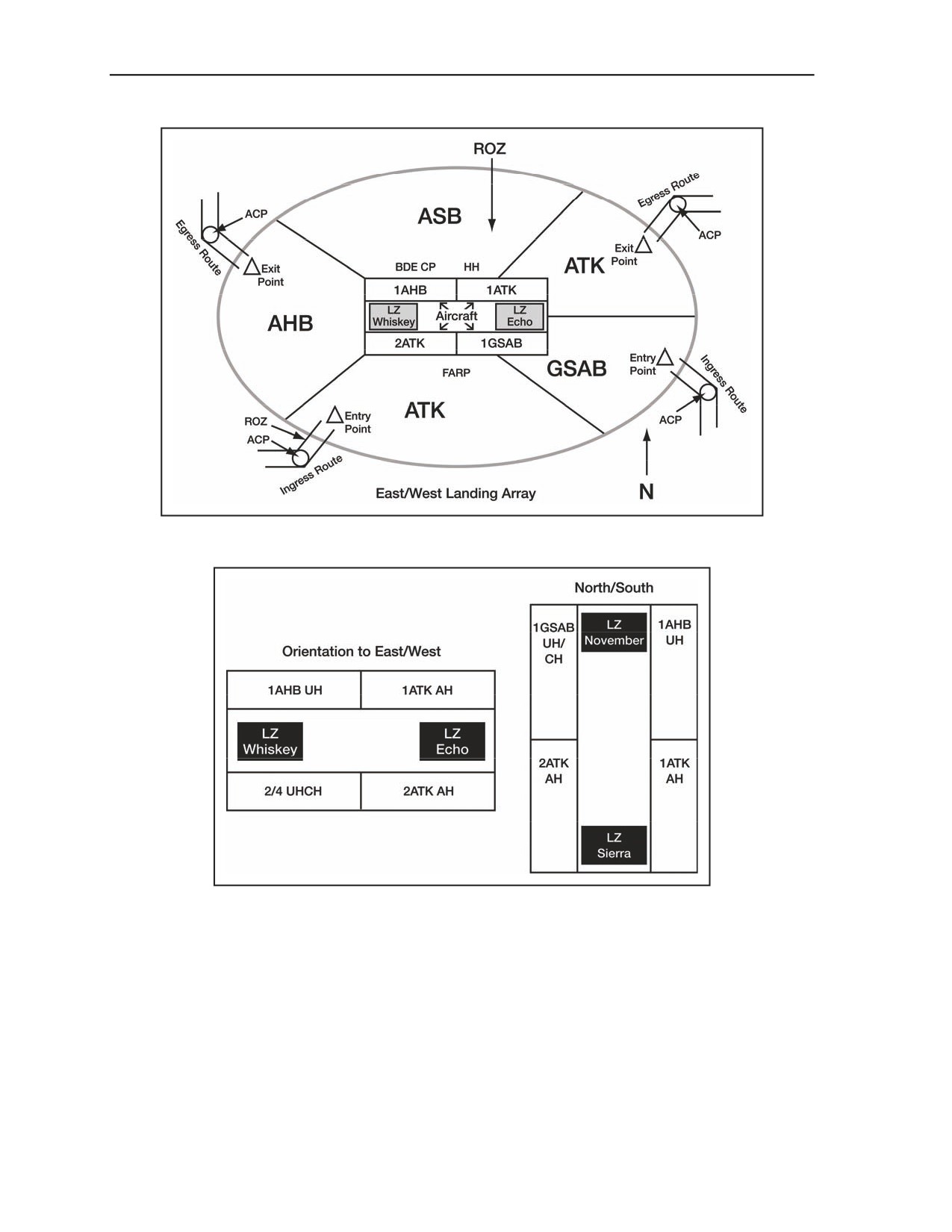
3-23. Figure 3-1 and figure 3-2, page 3-6, depict an AA in which two LZs are established to accommodate
landing and parking. Naming conventions of the LZs are orientation: driven east/west (Echo/Whiskey) or
north/south (November/Sierra). LZ names become part of the aircraft’s initial inbound report.
3-24. AIC in RAA operations provide—
Dissemination of weather and critical flight information.
Interface with air defense and airspace management (ADAM)/Brigade Aviation Element cell
and terminal facilities to coordinate airspace information.
Establish comprehensive flight following structure supporting air traffic to and from rear area.
16 February 2007
FM 3-04.120
3-5
Chapter 3
Figure 3-1. Depiction of assembly area ground graphics and airspace
Figure 3-2. Landing zone orientation
FORWARD ARMING AND REFUELING POINT OPERATIONS
3-25. ATS supports FARP operations based on METT-TC. Under some circumstances, ATS units can
provide aviation commanders with an extra measure of safety and synchronization to facilitate efficiency.
TACT can manage aircraft flow for faster, safer, and more efficient operations. A team has four Soldiers
equipped with an HMMWV-mounted tactical terminal control system (TTCS) and an AN/TRN-30(V) 1
low-power NDB that can be set up within 30 minutes. The TACT provides a short-to-medium range NDB;
secure VHF, UHF, FM, HF, and SATCOM radios, and limited weather observing capability.
3-6
FM 3-40.120
16 February 2007
Employment
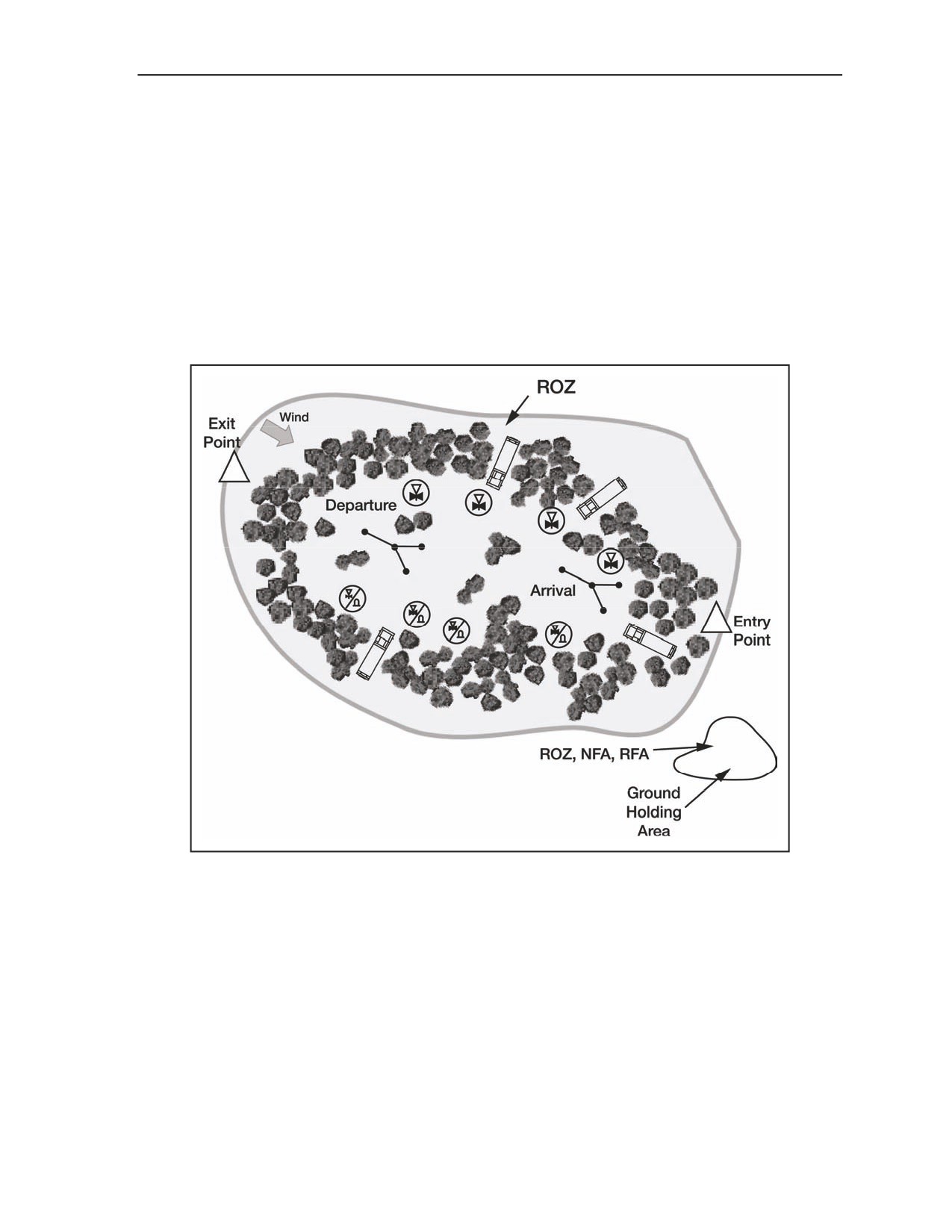
3-26. FARP survivability requires frequent displacement. Few locations permit arming and refueling more
than three times. A good planning figure for FARP duration is 3 to 6 hours. Careful site selection, effective
camouflage, and minimum personnel and equipment lead to survivable, mission-capable FARPs. ATS
units supporting FARP operations must consider and be involved in the planning process of ACMs/FSCMs
such as ROZs, no-fire area, restricted fire area, entry and exit points, and ground holding areas (figure 3-3).
ATS services at FARP locations provide—
Limited meteorological information.
Visual surveillance of landing area.
Procedural and positive control as required.
On-call NDB for aircraft to locate FARP.
Emergency marking and lighting.
Airspace coordination with AIC and control tower teams.
Figure 3-3. FARP with associated airspace and FSCMs
LANDING ZONE/PICKUP ZONE OPERATIONS
3-27. LZ/PZ operations are ideal for the TACT. Team members are F7/Pathfinder qualified and skilled in
austere operations. During planning, the TACT chief works with aviation units to select landing sites.
When selecting LZs from maps, aerial or ground photographs, or aerial reconnaissance, consider the
following:
Number of helicopters. If a large number of helicopters are to be used, multiple sites or
successive lifts may be required.
Type of formation. Landing formation is determined by the area available for use.
Surface conditions. Consider the firmness of the ground to avoid bogging down or creating
excessive dust from loose dirt, sand, or snow (creates visibility problems especially at night).
16 February 2007
FM 3-04.120
3-7
Chapter 3
Ground slope. Landing areas should be as flat as possible. To ensure safe operations, the
ground slope should be no more than seven degrees.
Prevailing winds. Landing and takeoff are aligned with these winds if possible.
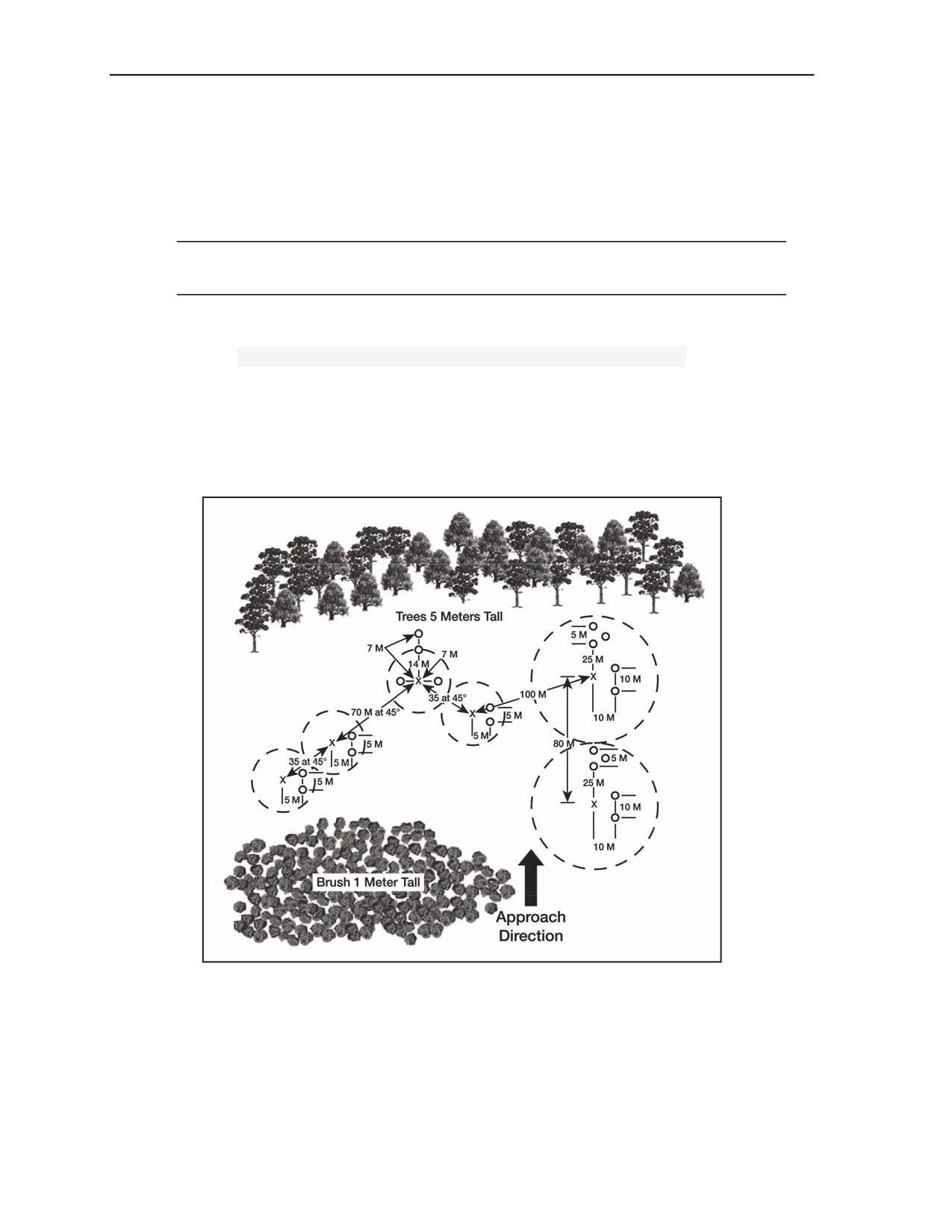
Landing point distances (table 3-1). Helicopter landing areas measure 25 to 100 meters in
diameter depending on helicopter type.
Landing site markings. Use the inverted Y as shown in figure 3-4.
Note: Landing distances depicted in table 3-1 are minimum required distances. Unit SOPs
should dictate standards for their unit.
Table 3-1. Landing distance sizes
Landing Point Size
Distance (meters)
1
25
2
35
3
50
4
80
5
100
Figure 3-4. Depiction of inverted Y and additional landing sites
3-28. ATS duties include—
On-call NDB used for identification and location of LZ or ACP.
Visual surveillance of landing area and visual sequencing and separation of aircraft.
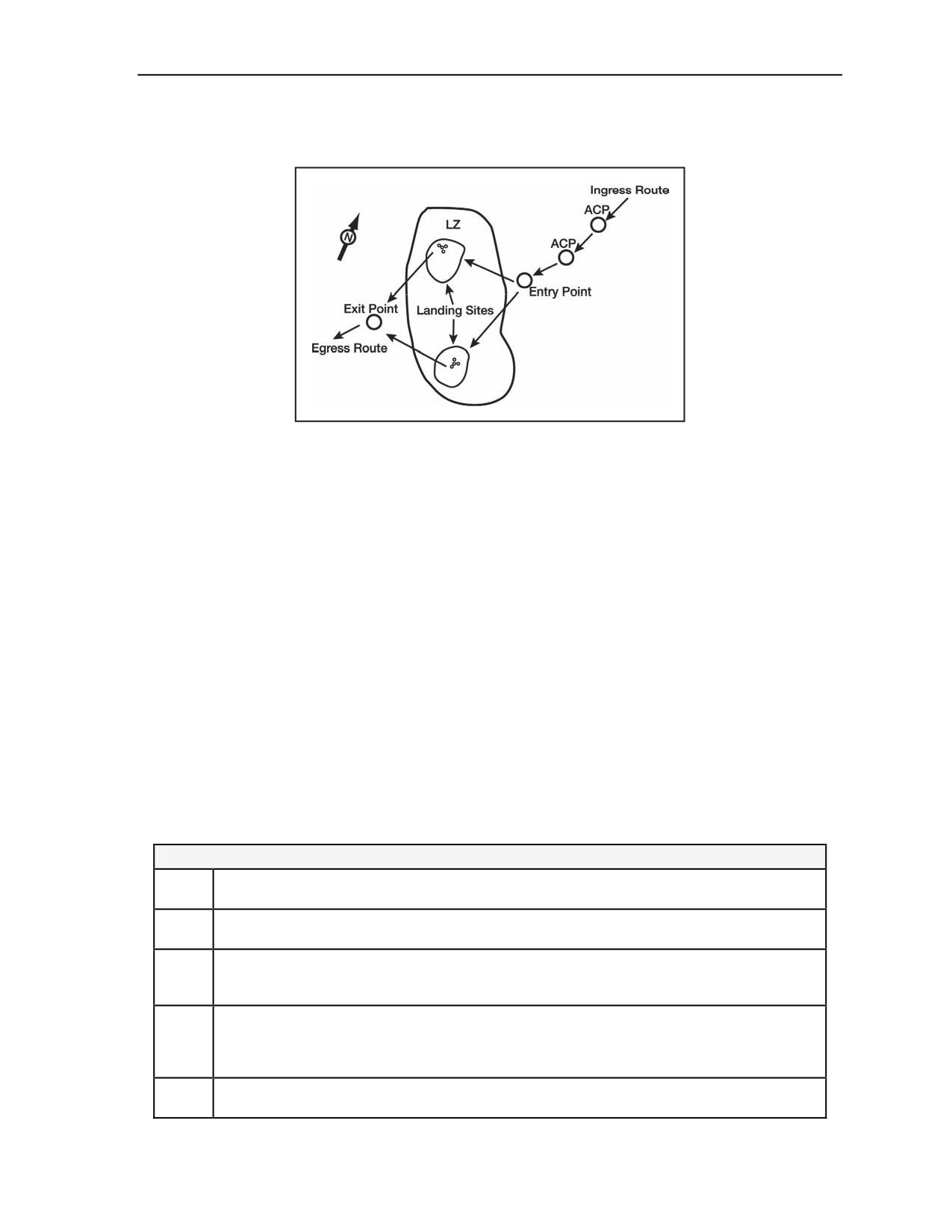
Development and coordination of required airspace for the operation. Figure 3-5, page 3-9,
depicts LZ airspace requirements.
3-8
FM 3-40.120
16 February 2007
Employment
Situational updates on weather, enemy, and A2C2 information.
Lighting and marking of LZ/PZ.
Figure 3-5. LZ airspace requirements
FORWARD OPERATING BASE/BASE CAMP OPERATIONS
3-29. Army deployment objectives require strategic responsiveness wherever needed. This operational
concept depends on flexible combinations of Army and joint capabilities across full spectrum operations.
The Army establishes airfields and forward operating bases (FOBs) to increase responsiveness and reduce
battlefield distances. The following factors are considered when planning airfields and FOBs:
Occupy host nation airfields if available and tactically acceptable.
Using abandoned or captured airfields to reduce construction and support requirements.
Use roads, highways, or parking lots if airfields are not available in sufficient quantity or
unsuitably located.
Construct an airfield or FOB.
3-30. These planning factors broadly establish the environment for which aviation operations are expected
to operate. Campaign planning at joint level establishes airfield requirements early on with consideration of
service-specific objectives. Army, Air Force, Navy, and Marine engineers all have the capability to design,
plan, construct, upgrade, and maintain airfields and heliports. Airfields and heliports are classified by their
degree of permanence and the type of aircraft they are designed to support. Army airfields and heliports are
divided into six classes (table 3-2).
Table 3-2. Army airfield and heliport classes
Class Definition (controlling aircraft weights reflect operational weight)
I
Heliports/pads with aircraft 25,000 lb (11,340 kg) or less. Controlling aircraft (UH-60)-16,300 lb
(7,395 kg).
II
Heliports/pads with aircraft over 25,000 lb (11,340 kg). Controlling aircraft (CH-47)-50,000 lb
(22,680 kg).
III
Airfield with class A runways. Controlling aircraft (combination of C-23 aircraft-24,600 lb (11,200
kg) & a CH-47 aircraft at a 50,000 lb (22,680 kg). Class A runways are primarily used for small
aircraft (C-12 and C-23).
IV
Airfields w/class B runways. The controlling aircraft is a C-130 aircraft at a 155,000 lb (70,310
kg) operational weight or a C-17 aircraft at a 580,000 lb (263,100 kg) operational weight. Class
B runways are primarily used for high performance and large heavy aircraft (C-130, C-17, and
C-141).
V
Heliports/pads supporting Army assault training missions. Controlling aircraft (CH-47)-50,000 lb
(22,680 kg).
16 February 2007
FM 3-04.120
3-9
Chapter 3
Table 3-2. Army airfield and heliport classes
VI
Assault LZs for operations supporting Army training missions that have semi-prepared or paved
landing surfaces. Controlling aircraft (C-130-155,000 lb [70,310 kg] or C-17-580,000 lb [263,100
kg]).
3-31. An airfield is also described on the basis of its location within the AO. Close battle area airfields are
intended to provide focused logistics support or to support combat missions of short-range aircraft such as
attack helicopters and UASs. These airfields are designed for initial or temporary operational standards,
depending on mission requirements, and may be paved or semi-prepared. Support area airfields provide
general logistics support and support of combat missions of longer-range aircraft. These airfields are
designed to temporary or semi-permanent standards, depending on mission and operational requirements.
Normally these airfields are paved and provide a link between close battle areas and sustainment area
airfields. Sustainment airfields provide logistics support forward from fixed, secure bases, and support
combat operations of long-range aircraft and are designed to be semi-permanent or permanent facilities.
3-32. After seizing an FOB or available airfield from which sustained main base or base camp operations
can be conducted, the CAB may be able to request joint fixed-wing (FW) refuel/resupply support.
3-33. Army H-60 and CH-47 aircraft can establish refuel points from the aircraft (Fat Hawk operations for
H-60s and Fat Cow for CH-47s), while the Marine Corps CH-53s have a unique refueling capability that
can support supply points, operations in deep areas, and other specialized mission applications.
3-34. The KC-130 or C-17 can operate from small airfields with limited supporting infrastructure. The
airfield runway must be 3,000 to 5,000 feet (914- 1524 meters) long and 90 feet (27.4 meters) wide with
graded and compacted gravel or clay. If KC-130 or C-17 is used as a primary means of resupply, runway
repair requirements will increase dictating engineer augmentation. CH-53 tactical bladder fuel distribution
system and CH-47 Fat Cow refueling does not require a runway, but does require a large relatively flat area
similar in size.
AIR TRAFFIC SERVICE SUPPORT
3-35. The ATS company can be task organized to meet any various combat operations. ATC services
required at an FOB dictate the number of personnel and type of equipment necessary to support the
mission. Each ATS company is capable of providing the following services:
Control tower.
Nonprecision NAVAID AN/TRN-30 (V) 1 and (V) 2 NDBs.
GCA radar.
Survey and creation of TERPs packages.
Support for continuous all-weather operations.
Interface with A2C2 cells throughout the division AO.
Execution of flight following operations as required.
3-36. In addition to the physical geography of the site, planners consider the related activities in or around
the main operating base and landing areas. These functional site considerations address locations of—
Fuel points and fuel storage areas.
Ordnance storage areas.
Arming/dearming areas.
Medical evacuation areas.
Weather support services.
Field of view.
Obstructions.
3-10
FM 3-40.120
16 February 2007
Employment
3-37. Additional planning considerations for ATS operations include—
Establishing a phased plan of equipment arrival to facilitate operational capabilities and
communications.
Selecting an advanced party to conduct physical reconnaissance, locate positions for equipment,
and plan equipment sites.
Preparing diagrams that depict equipment locations and are the basis for set-up crew briefings.
Ensuring site plans consider maximum dispersal and remoting of equipment to reduce
electromagnetic and infrared signatures.
Designating alternate site locations or satellite assembly areas.
SECTION II - THEATER AIRFIELD OPERATIONS
3-38. The TAOG and its subordinate elements are optimized for theater aviation support. The TAOG and
AOBs are organized and equipped to facilitate early deployment by establishing expeditionary airfields in
support of Army operations. These organizations provide Army airfield management and C2 at theater-
level airfields, FOBs, and other areas designated by the TAC.
3-39. The AOB organization and its related ATC assets are deployed at locations requiring the operational
management of airfield activities or at locations without an organic ATS element. This organization often
conducts transition operations from the ATS company of the GSAB during an advancing movement or
stability operations. For planning purposes, transitional ATC operations could occur for an extended period
based on the intended timeframe of the operation. The synchronization of AOB resources to produce
maximum operational effectiveness requires special attention to differences in the capabilities of the ATS
companies and the AOB ensuring a smooth transition.
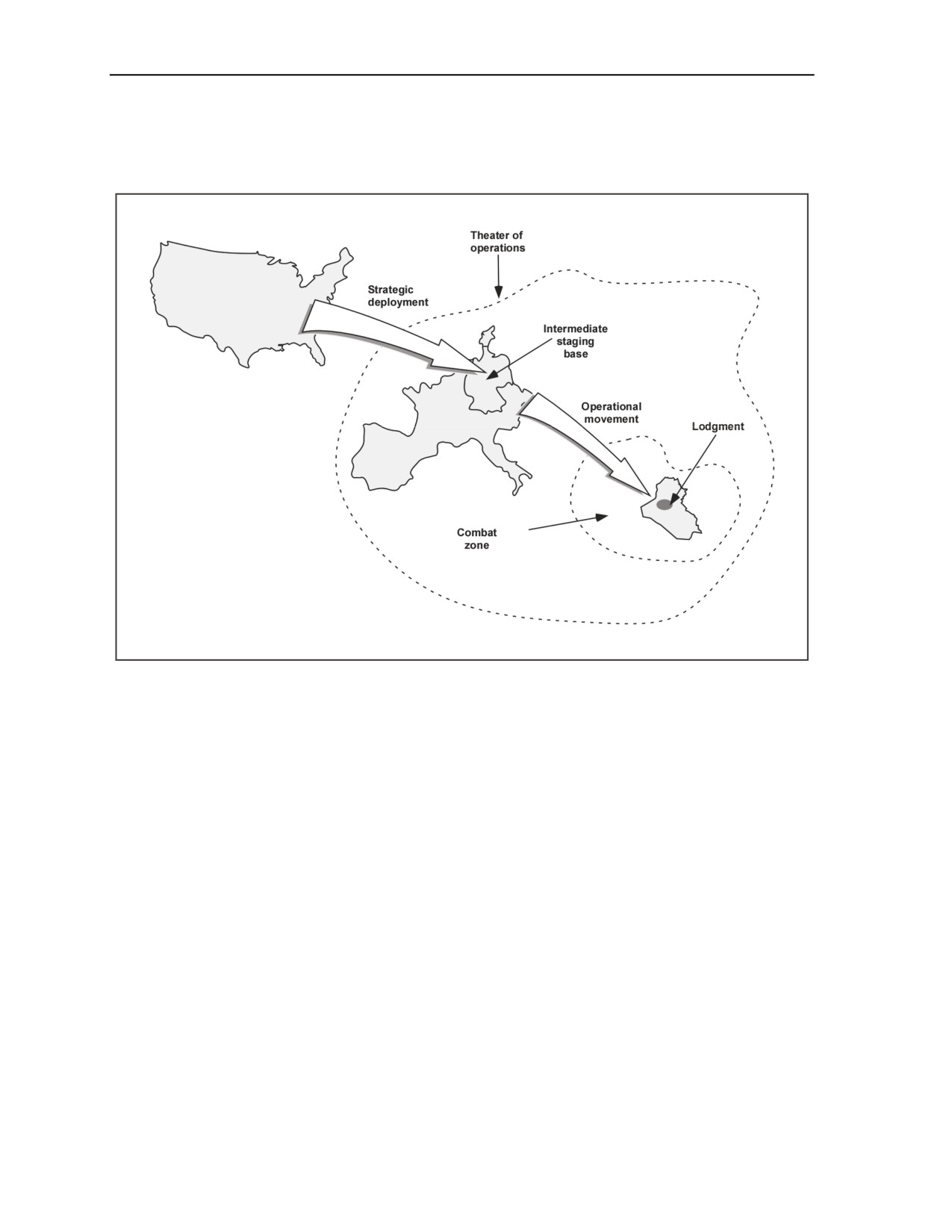
INTERMEDIATE STAGING BASE
3-40. The ISB is a temporary location used to stage forces before insertion into the combat zone. The first
deployment of a TAOG or AOB can take place here. In an ideal situation, secure bases are available in the
AO for RSOI and continued support of the deploying force. The ISB is normally located within the theater
of operations and outside the combat zone and AO. In cases where the joint force must secure a lodgment
to project the force, an ISB may be critical to success.
3-41. If established, the TAOG along with one or more AOBs may be required to establish an airfield for
staging forces. The ISB airfield may be the initial theater reception and staging facility making it the hub of
Army aviation movement into the theater. Deploying forces debark from strategic lift, reassemble, and
prepare for missions in the AO. Onward movement from the ISB to the combat zone may be multimodal
and requires some level of reassembly in the AO. Transportation assets employed in onward movement
include strategic and theater assets such as truck, rail, sea, and airlift. These movements are considered
components of the deployment and are included in the time-phased force deployment document.
3-42. If tasked to operate the ISB, the Army should have a primary role in the selection process. This
process involves TAOG assessment and recommendation. The ISB airfield should include sufficient Army
C2, maneuver, sustainment, and joint support to enable force projection into the combat zone. The ISB
airfield should be shielded from long-range engagement systems, such as missiles, along with enemy
special operations force (SOF) and civil threats.
3-43. The longevity of the ISB airfield varies according to circumstances. The airfield may function as a
secure facility for split-based operations during the operation or in the following capacities:
Logistic management for rear area functions supporting the forward deployed force.
Restricted forward deployment to only those forces necessary to execute the mission (reduces
logistical footprint).
May serve as a rest and relaxation site (in an austere unstable area).
16 February 2007
FM 3-04.120
3-11
Chapter 3
3-44. As the lodgment expands and tactical situation permits, the JFC can establish a theater staging base
within the AO, which may require the deployment of additional AOBs or redeployment of the TAOG as
part of the RSOI process. Figure 3-7 depicts an ISB.
Figure 3-6. Intermediate staging base
PRE-DEPLOYMENT PLANNING CONSIDERATIONS
3-45. Predeployment planning considerations must be closely coordinated to ensure required assets,
support elements, and resources have been coordinated and are available at the desired airfield location.
3-46. Predeployment planning considerations include—
Host nation, JIIM airspace, and ATC agreements and directives determining regulatory guidance
used by ATC with adjoining nations/ICAO. These agreements should encompass all airfields
and areas approved for or restricted from use.
Frequency requirements for radio, radar, NAVAIDs, and nets.
Airfield lighting must be planned if night or IFR operations will be conducted. The Army
currently has a limited airfield lighting capability and requires TAOG or higher headquarters
coordination.
National Imagery and Mapping Agency may provide geodetic control for the airfield, proving
valuable for GPS precision approaches or emergency inadvertent instrument meteorological
condition (IIMC) procedures in the future. Also refer to services/coalition/Air Force commands
or air staff databases for existing site surveys.
Base operations support planning should occur before deployment. The supplier and contact
lists for support items are formulated early in the planning process. These lists include areas
such as equipment support, power, base defense considerations, supply, maintenance personnel
3-12
FM 3-40.120
16 February 2007
Employment
support, billeting, security, medical, and food and water, engineer support, communication
needs, and signal support requirements and availability.
Airfield services required*:
VFR/IFR radar, terminal.
Precision/nonprecision approaches.
Manned and unmanned systems and over flight traffic.
Refuel aircraft maintenance.
Crash rescue.
Air Force weather support.
Note: *These requirements affect the planning process and augmentation requirements.
Airspace requirements may impact host nation and JIIM agreements. Determine airspace
requirements early and coordinate through the appropriate headquarters combat airspace
managers. This ensures inclusion in AOC publications. Terminal airspace and airfield
procedures are examples of airfield requirements.
Interface between terminal and en route systems.
Valid planning questions for terminal and en route coordination include:
Who can provide en route support?
What are the procedures (IIMC, filing IFR)?
Where are IFR procedures published?
EMPLOYMENT CONSIDERATIONS
TYPE OF OPERATION
3-47. The type of operation has direct bearing on its planning factors: Is it going to be used as a main
operating base or a FOB; are joint, interagency, and multinational forces going to use it; and is a FARP
required? It also has direct bearing on equipment: Are NAVAIDs required; will a back up capability be
needed; what is the duration of the mission; and what communications and automation connectivity are
required?
HOST NATION/ADJACENT NATION AIR TRAFFIC CONTROL CAPABILITIES
3-48. When planning deployment of a TAOG, it is crucial to know the condition and capabilities of
airfields, NAVAIDs, airspace considerations, and other ATC resources in the AO. This information
enables the planner to determine the types and mix of assets required to support initial operations until a
full airfield operations sustainment package is deployed. The condition of host nation facilities may greatly
simplify any agreements needed.
ENGINEER SUPPORT
3-49. The AOB may require engineer support for a specified mission or time period to—
Improve terrain and structures at unit locations.
Conduct required airfield surveys. Results can be used for TERPs data collection.
Build, improve, or repair runways or landing pads and protect them from erosion by emplacing
culverts and sandbags for drainage. Engineers can build runways to support C-130 and C-17 air
traffic.
16 February 2007
FM 3-04.120
3-13
Chapter 3
Protect semi-fixed positions from enemy observation and fires. Because airfields are usually
located in large open areas to accommodate aircraft, there is a large demand for survivability
support. Berms for CP protection, digging in FARP locations to protect vital class III/V assets,
defensive fighting and survival positions, and defensive perimeter obstacles are all priorities.
Build or improve aircraft revetments.
TERMINAL INSTRUMENT PROCEDURES
3-50. Survey-qualified TERP specialists conduct and participate in initial site surveys. If engineer support
for site surveys is needed, coordination for these services is done early in the planning process. TERPs
specialists use site survey information to develop approach procedure packages. These packages are
forwarded to the appropriate higher headquarters TERPs office responsible for the designated AOR.
Authorization to use the procedures ultimately remains with the appropriate flying operations authority
and/or the commander exercising operational control of the aircraft. During contingency operations, an in-
theater TERPs liaison may be established to develop and approve instrument procedures.
3-51. As per AR 95-1, emergency recovery procedures will be developed as a contingency plan for IIMCs.
Recovery procedures will be developed using approved DOD/FAA instrument approaches in the AO and
should be a joint effort between ATC and the supported aviation unit. In locations without an approved
DOD/FAA approach or commercially developed approach, an emergency GPS recovery procedure will be
developed per the aircrew training manual. If used as part of an emergency recovery procedure, non-
DOD/FAA approaches will be submitted for TERPs review and approval through Headquarters, USAASA
or United States Army Aeronautical Services Detachment-Europe. Pending approval, these approaches will
only be used in visual meteorological conditions (VMCs) or during an actual emergency. The first
colonel/0-6 in the chain of command with mission risk approval authority must approve the emergency
procedure containing an unapproved instrument approach. This authority will not be further delegated.
The risk associated with the recovery procedure will be mitigated through the mission approval process
and further defined in unit SOPs. Planned use of non-DOD/FAA instrument procedures for flight in IMC
requires approval as per paragraph 5-5 of AR 95-1. Manual entry of waypoints is permissible when using
emergency GPS procedures. Flight in IIMC that violates FAA, host nation, or ICAO regulations will
be considered deviations as per paragraph 1-6 and will be processed as per paragraph 2-13 of AR
95-1.
FLIGHT INSPECTION
3-52. Flight inspection aircraft certify instrument procedures and their associated NAVAIDs. Flight
inspections ensure the safety of NAVAID signals and published instrument procedures for IFR use. These
inspections verify the performance of air navigation services and their associated instrument flight
procedures conform to prescribed standards documented in FAA and DOD directives, and in Annex 10 to
the convention on ICAO. Flight inspection has both operational and legal ramifications. Flight inspection
of instrument procedures is required in accordance with FAAO 8200.1, TM 95-225, TM 95-226, FAA
(FAAH) 8260.3.
Degrees
3-53. The following four options reflect the different degrees of flight inspection available to the JFACC
(listed from higher to lower risk).
Note: Options 1 and 2 are available when a flight inspection is impossible/limited and military
operations must be conducted. However, they do not eliminate the requirement to conduct a
flight inspection. The flight inspection requirement is postponed until the situation permits
inspection in accordance with options 3 or 4.
3-14
FM 3-40.120
16 February 2007
Employment
Option 1. Approval without Flight Inspection
3-54. If the situation dictates, the JFC may approve the use of NAVAIDs/approach without a flight
inspection. This approval is only for military aircraft under JFC OPCON. Aircrews flying the procedures
should be advised that flight inspection certification has not been accomplished, and instrument procedures
should be labeled and limited to those aircrews specifically authorized. Other aircraft (FAA, Civil Reserve
Air Fleet (CRAF), and/or ICAO) are not authorized to use the procedure.
Option 2. Military Emergency Flight Inspection Procedures
3-55. In accordance with TM 95-225, when it is deemed necessary by military authorities, the abbreviated
flight inspection procedures of chapter 24 may be used. However, as soon as conditions allow, the
NAVAIDs and instrument procedures must be reinspected using normal procedures and tolerances. The
JFC may approve the use of these abbreviated flight inspection procedures. For additional flexibility, radar
approaches and certain new instrument procedures may be certified using a local military aircraft with a
flight inspector riding on the flight deck. This option is intended to permit a commander to continue flight
operations while waiting for a restricted or normal commissioning inspection. This inspection will allow a
theater commander to have temporary IFR capability for aircraft OPCON to the JFC/JFACC. Other
aircraft (FAA/CRAF/ICAO) may be authorized to use the facility at the discretion of the JFC.
Note: Nearly all flight inspections must be performed during daylight hours and require VMC
weather. An inspection of a single NAVAID normally takes half a day and one sortie to
complete.
Option 3. Restricted Facility Commissioning
3-56. This inspection certifies the facility using normal procedures but 1 day and two sorties (in VMC
weather) to complete. The restricted facility commissioning inspection permits use by any aircraft. Areas
evaluated to be acceptable are certified for use, and the remaining areas/procedures not evaluated are
restricted. The local (deployed) airfield operations/ATC manager will publish the restrictions in appropriate
NOTAMs.
Option 4. Normal Commissioning
3-57. This is the certification of all procedures
(arrival/approach/departure) and areas of NAVAID
coverage. Optimally, this inspection takes 2 to 3 days, and four to five sorties (VMC weather) to complete.
It is required for full use by DOD, CRAF, FAA, and ICAO aircraft.
AIRSPACE AND AIR DEFENSE PROCEDURES
3-58. Planners prioritize, integrate, and closely coordinate airspace control and AD requirements. The AIC
and tower facility chief coordinates with the ADAM element of the supported aviation or AD unit assigned
to defend the airfield. They work to establish and publish a BDZ and airspace C2 procedures that
include—
Ascertaining the size and shape of the BDZ. BDZ dimensions are normally determined by the
effective engagement envelope of the supporting air defense systems (for example, Avenger,
C-RAM, and Patriot) and anticipated air traffic patterns. Establishing entry and exit procedures,
including safe lanes and identification friend or foe (IFF) mode and code requirements, during
BDZ construction.
Identification of aircraft friend or foe. These procedures should not delay offensive operations
and be simple enough for aircrews and ground operations personnel to execute. They include
visual, electronic, geographic, and maneuver procedures for differentiating friendly or hostile
aircraft.
Coordinating with local ground-based air defense unit(s) for BDZ early warning cueing,
facilitating engagement of enemy aircraft.
16 February 2007
FM 3-04.120
3-15
Chapter 3
3-59. AD units must be free to engage hostile targets, aircraft, and missiles within prescribed rules of
engagement (ROE). The AIC and control tower share the responsibility of ensuring procedures are
disseminated to friendly aircraft.
AIRSPACE MANAGEMENT PLANNING
3-60. Airspace management planning involves segmenting assigned airspace by volume and time for the
safe and expeditious flow of air traffic. Airspace management also involves establishing various air
defense control measures, which are designed to protect friendly installations from enemy air attack.
Planning considerations include—
Analyzing suitable airfields to determine dimensions, and possible conflicts with civil aviation,
UAS, and other users of this airspace.
Preferred routings for friendly aircraft.
Determining the size and shape of terminal control airspace (Class D airspace).
Preparing TERPs for designated airfields and submitting packages for approval, flight check,
and publication.
Coordinating with the higher headquarters A2C2 element to publish ATC terminal procedures in
the ACO/ACP and APG.
3-61. Normal ATC procedures, such as traffic patterns and VFR inbound and outbound routes, are
developed by the tower chief in conjunction with the ATASM technician and used by supported aviation
units when appropriate (threat based). Tactical Army aviation flight into and out of LZs/PZs is typically
oval or race track. ATC procedures must incorporate tactical entry and exit patterns into the airfield
procedures.
3-62. Terminal rotary-wing procedures in a high threat situation can enhance rotary-wing survivability.
Traffic density and type are also a factor in the use of any specialized rotary-wing procedures. Numerous
landing pads should be constructed on the airfield by engineers. The number is dependent on the area
available for use and the proper separation between pads and runways. Special rotary-wing procedures can
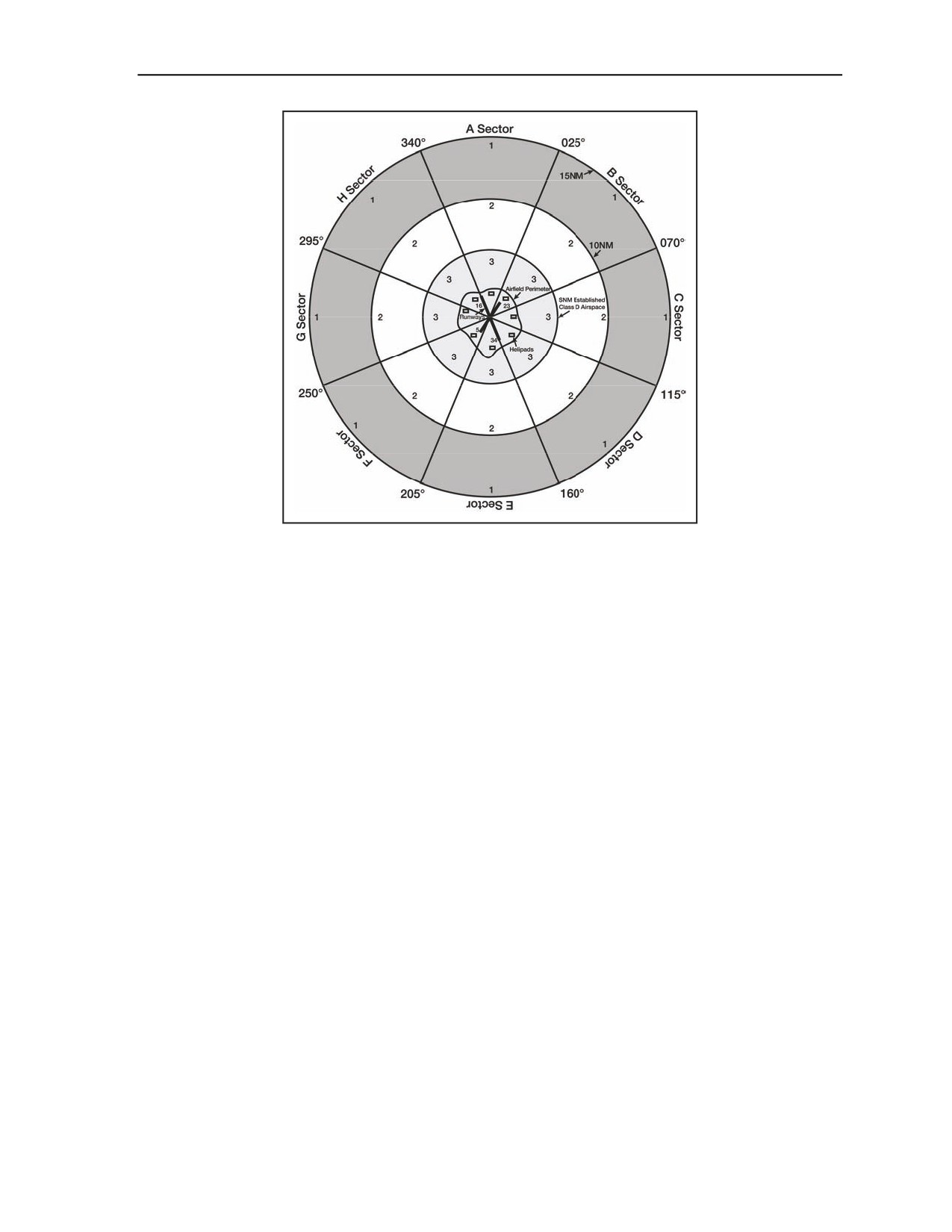
be established by the use of a wagon wheel overlay (figure 3-8, page 3-17) dividing the airspace into eight
45-degree sectors starting at 5 nautical miles and continuing each 5 nautical miles out to 15 nautical miles
or whatever mileage is deemed appropriate. These sectors can be designated by an alpha numeric system
and should be changed regularly and published within the SPINS of the current ATO/ACO cycle. The
frequency of changes is based upon the threat activity level. The sectors are aligned with existing runways
or helipads on the airfield and allow rotary wing aircraft freedom of maneuver below the established
coordinating altitude. The closer aircraft are to the airfield, the more restrictive the sectors and control
becomes. The use of sectors and landing pads eliminates the need for traffic or holding patterns. Aircraft
report crossing each phase line or 5-mile increment of the sector, allowing traffic calls and procedural
separation by controllers, until aircraft are cleared to land direct to the helipads, which eliminates the need
for runway use by rotary-wing traffic in situations where a large volume of FW traffic exists.
3-63. Terminal flight following by sector as opposed to block time flight following allows the controller
the ability to make traffic calls and provide procedural separation of aircraft within the sector. One possible
sector solution would be to use of the wagon wheel overlay mentioned above. The use of this system and
how restrictive the system should be is based on traffic density and operations in or near the terminal area.
Sector flight following and SA are critical elements of airspace management during urban operations.
Sector flight following would allow terminal controllers to pinpoint aircraft locations facilitating necessary
traffic advisories and procedural separation of aircraft.
3-16
FM 3-40.120
16 February 2007
Employment
Figure 3-7. Example of wagon wheel overlay
AUSTERE TO ENDURING AIRFIELD
3-64. Enduring airfield operations can be defined as when all AOB capabilities have been established and
are fully sustainable. These operations require a transition period; however major factors make it difficult
to establish a hard time line. Factors such as host nation and JIIM agreements, flight checks, or certified
TERPs packages may take longer to complete then first anticipated. Every effort should be made to
complete all necessary service requirements for the airfield within 45 to 120 days from establishment. The
type of entry operation could delay or enhance this transition period depending on whether the entry
operation was opposed or unopposed.
AIRFIELD MANAGEMENT
3-65. The management of the airfield must be established as soon as possible; it is the driving force behind
the smooth transition to an enduring airfield. The airfield commander is responsible for the safe operation
and accommodation of aircraft by constructing and maintaining facilities and procedures and controls.
Responsibility for daily operations is delegated to the operations officer of the AOB.
BASE DEFENSE OPERATIONS CENTER
3-66. A successful force protection plan keys on safeguarding critical assets found at airfields and FOBs.
One fundamental consideration of airfield security is the resolution of command authority. A conflict often
arises when command relations and responsibilities of units occupying airfields are not clear. All tenant
units are responsible to the commander for base and airfield security and should have representatives on
the planning board. The ATC operations officer should fill this duty requirement for the AOB. The base
commander must have tactical control over these units for conducting force protection operations. The
BDOC functions as a tactical command post and is responsible for the synchronization of force protection
measures. This center must be integrated through communication links with the airfield management
element, QRF, and ATC facilities to effectively counter threats with airborne and counterfire assets.
BDOCs establish threat conditions based on the likelihood of attack. Security planning for airfields and
FOBs starts at the JFC level. The JFC assigns responsibilities for joint security to component commanders.
16 February 2007
FM 3-04.120
3-17
Chapter 3
3-67. BDOC responsibilities include, but are not limited to the following:
Planning, coordinating, and controlling security forces.
Planning and coordinating ground fire and close air support within the AOR.
Integrating ground base AD assets.
Coordinating and assigning security responsibilities with tenant units.
Coordinating and supervising activities in support of the base defense plan.
Coordinating security measures with higher agencies.
Monitoring unit movement and facility positions within the AOR.
Establishing and maintaining communications with security forces and other airfield, AD, and
counterfire platoons.
Reaction Forces
3-68. Reaction forces and attachments must be fully integrated into the overall plan. Each individual must
have a clear and current SU of friendly and enemy forces in the AO. For example, a BDOC reaction force
should know if military police are conducting mounted patrols near the BDOC. The overall reaction force
plan must integrate those military police units or establish boundaries between the reaction force and the
military police unit.
3-69. A clear chain of command and training supported by battle drills are essential for reaction force
preparedness. They must assemble and be ready to fight in 10 minutes or less. Proper preparation includes
the following:
Alarms should be a part of the airfield and BDOC SOPs.
Reaction plans are rehearsed and executed on a routine basis. The reaction to a night attack must
be second nature if the enemy force is to be repelled.
3-70. Each reaction force assembles based on an alarm or orders. Personnel move to a predetermined rally
point, establish communications, and conduct operations as required to counter the threat.
Preparation for Security and Defense
3-71. Physical preparation for security and defense of the base camp and airfield includes—
Ensuring each Soldier is briefed, and has a copy and understands the ROE (for complicated
ROE, it is often necessary to conduct situational training exercises to ensure understanding).
Concealment, including use of urban areas and camouflage.
Cover for fighting positions and protective shelters.
Vehicle revetments, transitory vehicle dismount points, and parking areas.
Protective wire barriers.
Prepared defensive, alternate, and supplementary positions.
Prepared routes for supply and evacuation.
Minefields to cover avenues of approach, if approved for use. Adherence to correct procedures
makes mine recovery less dangerous when it is time to displace. Minefields must be observed.
Prepared sleep areas that are dug in or revetted to protect against enemy direct or indirect fires.
Listening posts (LPs)/observation posts (OPs) covering approaches. These positions must be
prepared so they cannot be seen when approached from the front.
Devices such as ground surveillance radar, personnel detection devices, and field expedients to
enhance early warning of enemy approach or infiltration.
Crew-served weapons emplaced to cover suspected avenues of approach. Cleared fields of fire.
Wire and directional antennas to prevent detection by enemy electronic warfare elements.
Air and ground patrols to inhibit observation and attack. Returning aircraft should be given
patrol areas to survey before landing. Ground patrols should conduct reconnaissance as required
to detect enemy observers or civilians who may be enemy informants.
3-18
FM 3-40.120
16 February 2007
Employment
Daily stand-to to establish and maintain a combat-ready posture for combat operations on a
recurring basis. Stand-to includes all steps and measures necessary to ensure maximum
effectiveness of personnel, weapons, vehicles, aircraft, communications, and CBRN equipment.
Units assume a posture during stand-to enabling them to commence combat operations
immediately. Although stand-to is normally associated with begin morning nautical twilight,
unit operations may dictate another time.
Airfield Services
3-72. The airfield services element develops local airfield procedures; assists the SO in development of the
local hazards map, preaccident plan, crash/rescue system; and formulates needed LOAs and OLs. This
element develops airfield SOPs and tactics, techniques, and procedures necessary to ensure safe and
effective operations. Airfield services coordinate through the TAOG any personnel and equipment required
for services not organic to the AOB (refuel services, crash rescue/firefighters, air force weather personnel,
and airfield lighting).
3-73. The airfield services element establishes communications, automation connectivity, and
interoperability with other systems on the airfield and supported aviation units. This is accomplished
through the use of the internal communications section, to the extent possible, of the AOB. Additional
communications support is coordinated through the signal support chief of the TAOG S-6 section.
3-74. Sustaining airfield operations requires trained maintenance personnel, and an ample supply of spare
parts and power as well as personnel life support considerations. The airfield services element must
develop contact lists for long-term airfield support requirements, which can be acquired through the corps
or area support system once the TAOG establishes formal support agreements with those agencies.
Petroleum, Oil and Lubricants Services Section
3-75. The POL section refuels appropriate Army and joint aircraft. Because this section is not organic to
the AOB, POL assets are coordinated through the TAOG and provided by the appropriate TSC/ASCC.
Engineer Fire-Fighting Team
3-76. Engineer fire-fighting teams provide fire prevention/fire protection; aircraft crash rescue, natural
cover, and hazardous-material incident responses within a theater of operations. The number and types of
fire fighting teams needed to protect an AO depend on the type of facilities within that AO. Engineer fire-
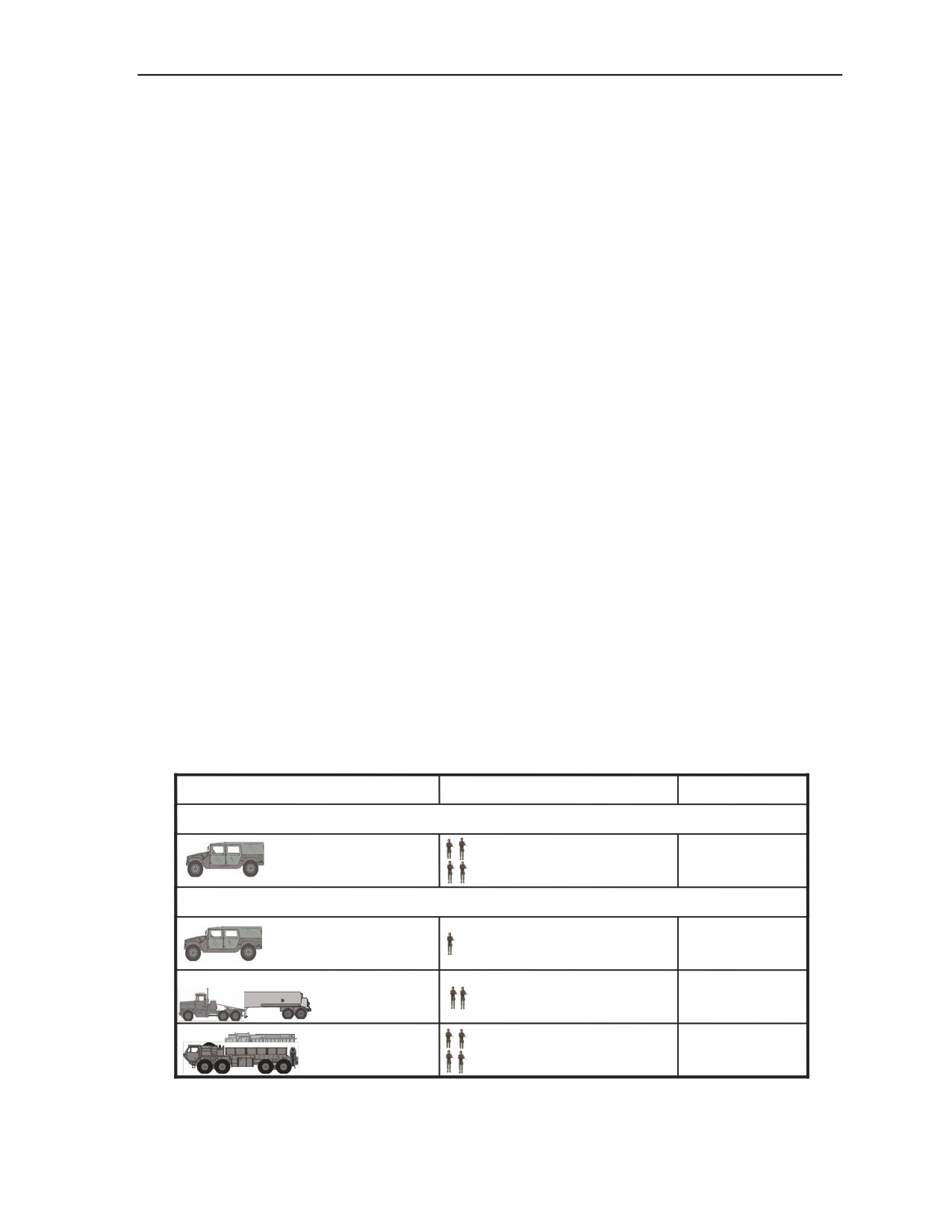
fighting teams are organized into headquarters and fire truck teams (figure 3-9).
Equipment
Personnel
Commo
Fire Fighting Teams
Headquarters Team
1-21B WO Fire Marshall
1-T61494
1-21M4 E7 Fire Chief
R6804 - VRC-90
Truck
1-21M3 E6 Fire Inspector
Z5986 - DAG
4X4 HMMWV
1-63B1 E4 Wheel\Ve Mec
Fire Fighting Teams
Fire Fighting Team
R6804 - VRC-90
1 -T61494 Truck 4X4 HMMWV
1-21M3 E6 Fire Team Chief
Z5986 - DAG
1-D28318
Distr
1-T91656 Truck LET
R6804 - VRC-90
t r
1-21M1 E4 Fire FT CSH Rescue Sp
t
66000
1-21M1 E3 Fire Fighter
Z5986 - DAG
1-21M2 E5 Lead Firefighter
1-Z4202 Trk
R6804 - VRC-90
1-21M1 E4 Fire FT CSH Rescue SP
Tactical Fire
Z5986 - DAG
2-21M1 E3 Fire Fighter
Figure 3-8. Headquarters and fire truck teams
16 February 2007
FM 3-04.120
3-19
Chapter 3
3-77. The headquarters team provides C2 and coordination for engineer fire-fighting teams. It also
supervises rescue and fire-fighting operations, while fire truck teams provide fire-fighting, crash extraction,
prevention programs, and first aid for logistic support areas (LSAs), ISBs, FOBs, and major facilities.
Weather Services
3-78. Air Force meteorological and oceanographic (METOC) organizations provide support to Army
component and subordinate elements. METOC organizations provide surface-based observations (clouds,
visibility, winds, pressure, temperature, and ground conditions), upper air observations
(temperature,
winds, and humidity), satellite data, and space environmental forecasts and observations. Air Force combat
weather teams use tactical equipment to receive satellite imagery, measure atmospheric weather
parameters, and generate forecast products. Service requests for theater airfield weather requirements are
processed through the TAC or ASCC general staff intelligence section.
JOINT INTERDEPENDENCE
3-79. Joint forces provide additional capabilities in construction and engineer services, airfield
management, and ATS. Airfields that support joint operations must share operational responsibilities for
base support. Time-phased force and deployment data addresses requirements for support of airfields. In
some cases, it is essential that other military services augment initial key areas such as fire protection,
utilities, power generation, and environmental services.
3-80. During combat operations, effective and efficient use of limited airfield capacity and resources is
critical to mission success. Foreign airfields hosting a variety of allied military, host nation, and
commercial air activities complicate this task. To achieve unity of effort for United States forces operating
on a JIIM airfield, the geographic combatant commander must appoint a single on-scene commander to
determine operational priorities among competing demands. United States military forces should designate
a single point of contact to negotiate airfield usage issues with JIIM airfield commanders and managers.
UNITED STATES NAVY
3-81. The naval construction force, organized primarily as Navy construction engineer units, perform both
generalized and specialized construction missions in support of Navy and Marine Corps component
commanders. These units provide construction support for the establishment of forward logistic support
sites. In addition, naval construction battalions have extensive vertical construction capabilities. They can
also be tasked to construct roads and bridges for supply routes, construct or extend airfield pavements,
establish ammunition supply points, and build expeditionary airfields and advanced bases.
UNITED STATES MARINE CORPS
3-82. The Marine Corps is an expeditionary force-in-readiness. Marine Corps engineers, by nature of their
organization and mission, focus on expeditionary engineering for essential aviation ground support
requirements. The combat engineer battalion conducts mobility, countermobility, and survivability
operations in support of Marine divisions.
3-83. The Marine Corps aviation ground support (AGS) element commands and controls expeditionary
airfield support services for its aviation assets. Functions such as construction, aircraft rescue and fire-
fighting, aircraft refueling, and weather services are organic to the AGS. These functions allow the Marine
Corps and Navy to project their assets ashore and generate sorties at a rate beyond their sea-based
platforms.
3-84. The Marine Air Traffic Control Detachment (MATCD) is the principal terminal ATC organization
within the Marine Corps. Three MATCDs are structured to operate as subordinate elements of the Marine
air control squadron and typically deploy as part of a Marine air ground task force. Each MATCD is
organized and equipped to provide continuous all weather ATC services to an independent and
geographically separated main air base or air facility, FOB, or other remote air sites or points. A MATCD
3-20
FM 3-40.120
16 February 2007
Employment
is composed of a command, maintenance, tower, and radar control section. Each section has personnel and
equipment capable of sustaining ATC operations within an amphibious objective area.
UNITED STATES AIR FORCE
3-85. Air Mobility Command has two contingency response wings (CRWs), formerly know as the
continental United States (CONUS) Air Mobility Operations Groups (AMOGs). CRWs are organized,
trained, and equipped to provide three deployable contingency response groups (CRGs). The CRW as an
organization does not deploy, however it provides the resources for and coordinates the deployment of
subordinate units to provide deployable elements of C2, aircraft maintenance, and aerial port personnel,
Additionally, air mobility liaison officers are normally assigned to the CRWs, though they are attached and
move with their associated ground units.
3-86. CRGs deploy in order to assess, open, and initially operate airfields. The groups consist of a
standardized force module dedicated to the airfield opening task. This module includes a tailored section
of all forces needed after seizure, or handoff from seizure forces, to assess an airfield, establish initial air
mobility, C2, and operate the flow of air mobility into and out of that airfield. CRGs may open an airfield
for the Air Force, another Service, or even a coalition partner. To ensure continuity of operations, CRGs
coordinate planning agreements with the theater Commander of Air Force Forces (COMAFFOR)/JFACC
staff.
3-87. Contingency response elements (CREs), formerly known as tanker/airlift control elements, are
mobile organizations responsible for providing continuous onsite mobility operations management.
Commanded by a commissioned officer, CREs deploy to provide air mobility mission support when
command and control, mission reporting, and/or other support functions are required. CREs provide aerial
port, logistics, maintenance, weather, medical, and intelligence services as necessary.
3-88. Mission support teams (MSTs) perform a similar function as a CRE but on a smaller scale. MSTs
are normally led by a noncommissioned officer and provide a level of command and control, aerial port,
and maintenance services capable of supporting a limited number of aircraft.
3-89. Air Force engineer units, organized as PRIME BEEF or RED HORSE, provide expeditionary civil-
to-general engineering support across the range of military operations, including airfield engineer and
construction operations.
3-90. Air Force deployable air traffic control and landing system (DATCALS) teams provide equipment
and personnel to support terminal area flight operations. DATCALS are designed to ensure a safe, flexible
use of terminal airspace. These teams provide continuity of control with the theater air control system and
air base defense forces. General-purpose DATCALS and airfield operations personnel provide terminal
area and airfield support from austere to fully supported host nation airfields with mobile tower,
surveillance radar, and precision landing system, terminal NAVAIDs, and space/ground capabilities or any
combination of the above.
SECTION III - STABILITY AND CIVIL SUPPORT OPERATIONS
3-91. Stability and civil support operation missions of the TAOG, AOBs, and ATS companies are similar
to combat missions. Requirements are based on scale and operational environment, the supported agency
or unit, and necessary interfaces. TAOG units, along with National Airspace System resources, are used
frequently during civil support operations. In this role, TAOG units coordinate and integrate Army airspace
user requirements into the nation’s airspace system. TAOG planners and airspace users coordinate and
integrate airspace requirements as necessary to permit freedom of movement to accomplish their mission.
Civil support and stability operations primarily focus on—
Disaster relief.
Department of Homeland Security missions.
Counter-drug operations.
Reconstruction or restoration of essential services (air traffic) and governance.
16 February 2007
FM 3-04.120
3-21
Chapter 3
3-92. Joint, combined, or interagency personnel may share ATS facilities. When Army aviation performs
sustained high-density operations from a joint-use airfield or landing area, the TAOG commander must
consider providing airfield management, airfield operations, and ATC personnel for the purpose of joint
manning. The TAOG, AOB, and ATS commanders coordinate with these joint personnel to determine
employment requirements and conditions in these facilities. Joint manning LOAs must be developed
among all concerned parties.
3-93. Stability operations outside of the borders of the United States that involve TAOG support in
interagency airspace infrastructures require careful attention to preserve the sovereignty of the host nation.
While services provided remain the same, the location of TAOG assets may differ. The focus remains on
the continued security and sovereignty of the supported country during these operations. TAOG activities
may at some point shift to the support of aviation retrograde operations at debarkation points. TAOG units
often execute these functions in host nation airspace; therefore, commanders must ensure that personnel are
trained to host nation or ICAO as well as United States Army standards.
DISASTER RELIEF
3-94. TAOG and ATS units deployed for disaster relief operations in the continental United States
(CONUS) are required to coordinate airspace in accordance with joint task force ACP In this capacity,
military units are concerned with the coordination of air and ground operations to facilitate relief supplies
and effects.
3-95. During disaster relief operations, outside the continental United States (OCONUS) civilian and
military agencies of the United States participate in actions taken by another government. These agencies
support the host nation making it the primary agent in most actions. If the host nation requests support,
United States national command authorities may direct the military to participate. In this environment,
airspace control focuses on establishing relief airfields and coordinating military airspace requirements
with host-nation civil air operations. The expanded use of TAOG and ATS units during these operations
can provide greater positive control of airspace.
3-96. Air traffic regulations and control of civil and military airspace users is the basis for airspace control.
In host-nation disaster relief efforts, the ATC system often provides the framework for most airspace
control functions. The airspace control system may require some adjustment depending on the situation.
Bilateral and international agreements often establish regulatory guidance affecting the use of airspace and
the conduct of air traffic activities. National sovereignty and host nation laws and procedures receive first
consideration. Where these procedures do not support military operations, training must be conducted or
host nation capabilities augmented with equipment, personnel, or both. Any required changes or waivers to
national regulations or problems resulting from restrictions to military operations are sent to the JFC.
3-97. In disaster relief operations, TAOG and ATS units may use more positive control then procedural
control, contributing directly to the identification of aircraft for the host nation airspace system. Strict host
nation laws may require TAOG and ATS units maintain continuous communications during every aviation
mission, making it critical that unit personnel are trained and proficient in ICAO rules and procedures.
HOMELAND SECURITY OPERATIONS
3-98. Terrorism counteraction operations prevent enemy insurgent acts by protecting personnel, units, and
facilities. The measures adopted and carried out by command directives dictate how to use airspace and
perform airspace control functions. These operations somewhat overlap all aspects of military operations.
Measures taken to counter terrorism can impact TAOG and ATS units and operations ongoing at air
terminals, aerial ports, and Army airfields and heliports. Restricted use of areas around sensitive facilities is
commonplace.
3-99. Drug trafficking is a true form of low intensity conflict (LIC). Likewise, counter-drug operations and
LIC operations are closely associated. ATS organizations may be tasked to support the Department of
Homeland Defense for support of nontraditional missions associated with radar surveillance.
3-22
FM 3-40.120
16 February 2007
Employment
RECONSTRUCTION AND RESTORATION OPERATIONS
3-100. Air traffic operations conducted under this category restore the air transportation system and
usually involve civil-military actions to reestablish essential services. To establish a stable operational
environment, stability operations capitalize on coordination, cooperation, integration, and synchronization
of nonmilitary organizations. The United States government often conducts stability operations through a
combination of peacetime developmental cooperative activities and coercive actions in response to crisis.
16 February 2007
FM 3-04.120
3-23
Chapter 4
Training and Readiness
Training for warfighting will always remain the top priority for the Army.
Warfighting readiness is derived from tactical and technical competence and from
confidence in individual and unit skills. Competence relates to the ability to fight
doctrine through tactical and technical execution. Confidence is the individual and
collective belief that one can do all things better than one’s adversary, and possesses
the trust and will to accomplish the mission.
SECTION I - TRAINING OVERVIEW
4-1. The intent of this chapter is to provide a
linkage of the training fundamentals of ATS units to
Contents
other aviation units within the aviation brigade.
Much like the aircrew training program of aviators,
Section I - Training Overview
4-1
air traffic controllers and ATS maintenance
Section II - Air Traffic Training
personnel complete a similar training program to
Program
4-3
reach technical and tactical qualification. Battle-
Section III - ATS Maintenance Training
focused training principles (outlined in FM 7-0, FM
Program
4-4
7-1, and combined arms training strategies [CATS])
Section IV - Unit Status Reporting
4-7
assist commanders with developing, managing and
Section V - Additional Training
administering comprehensive air traffic training
Considerations
4-8
programs (ATTPs) and ATS Maintenance Training
Programs (AMTPs). ATTPs and AMTPs reflect an
assembly of training requirements organized to fulfill the broad, overall training goals of aviation
commanders supervising certified and non-certified air traffic and air traffic maintenance personnel.
4-2. Aviation operations require worldwide strategic and tactical mobility. As a fully integrated member
of the combined arms team, aviation forces conduct a wide range of tasks across the spectrum of conflict
and during stability operations. ATS units enable aviation to operate in complex surroundings and are key
to the mitigation of risk often present within hazardous operating environments. Integrating ATS teams
with other aviation units within the brigade is critical in ensuring ATS assets are exercised and trained to
meet wartime task proficiency.
4-3. The ATTP and AMTP are the commander’s programs for training combat-ready air traffic
controllers and air traffic maintenance personnel. This training covers task proficiency at the individual
level, to team proficiency, and finally to unit proficiency in executing mission-essential tasks necessary to
accomplish joint and combined arms operations as defined in the Army universal task list. Commanders
should construct ATTPs and AMTPs to include—
Benefits to be gained through standardization.
Objectives to be achieved.
Procedures or actions to be standardized, described in detail.
Specific plans for implementation.
Effective procedures for enforcement.
Delineated responsibilities.
16 February 2007
FM 3-04.120
4-1
Chapter 4
4-4. Commanders use publications such as Army training and evaluation program (ARTEP)/mission
training plan (MTP) publications, FM 3-04 series, FM 7-0, FM 7-1, and CATS to develop the unit’s ATTP.
The first step in this process is an evaluation of the unit’s METL to determine training requirements.
4-5. The ATTP and AMTP are the ATS commander’s training program. However, warrant officer and
NCO leaders and trainers are the primary unit personnel tasked with implementing the ATTP and AMTP,
especially at the individual and team levels.
4-6. As the commander develops the training programs, input from the unit’s implementers is vital.
Warrant officer and NCO implementers advise the commander on required tasks, applicability of team
tasks to unit roles and METL-based missions, geographical factors which affect training and operational
employment, training assets, and recurring training issues.
4-7. After analysis of the unit METL, implementer input, and higher commander’s guidance,
commanders develop a supporting individual commander’s task list (CTL) for each air traffic team
member. Commanders will then establish a short-range, long-range and near-term training plan to ensure
ATS teams gain and maintain proficiency in unit collective tasks. Implementers must be familiar with the
commander’s training intent and with the training plans to implement the objectives of the ATTP and
AMTP.
4-8. Units are trained to be combat ready through realistic and challenging training. At every level,
commanders must train to Army standards. Battle focus enables commanders to plan and execute training
that produces tactically proficient units for success on the battlefield. Using the Army training management
cycle, the commander continuously plans, prepares, executes, and assesses the state of training in the unit.
This cycle provides the framework for commanders to develop their unit’s METL, establish training
priorities, and allocate resources.
4-9. Commanders and leaders at all levels use the principles of training to develop and execute effective
training. As commanders train their units on METL tasks, senior commanders reinforce training by
approving and protecting training priorities and providing resources.
BATTLE-FOCUSED TRAINING
4-10. Battle focus, as described in FM 7-1, is a concept used to derive peacetime training requirements
from assigned missions. The priority of training in units is to train to standard on the wartime mission.
Battle focus guides the planning, preparation, execution, and assessment of each organization's training
program, ensuring its members train as they fight. Battle focus is critical throughout the entire training
process and used by commanders to allocate resources for training based on wartime and operational
mission requirements. Battle focus enables commanders and staffs at all echelons to structure a training
program that copes with nonmission-related requirements while focusing on mission essential training
activities. It recognizes a unit cannot attain proficiency to standard on every task whether due to time or
other resource constraints. Commanders achieve a successful training program by consciously focusing on
a reduced number of critical tasks essential to mission accomplishment. A critical aspect of battle focus is
to understand the responsibility for, and linkage between, the collective mission essential tasks and
individual tasks supporting them.
4-11. Aviation commanders and their subordinate leadership must be well versed in the battle tasks across
the warfighting functions for the specific task force. Leaders must make conditions in training as close to
wartime conditions as possible. Innovative leaders seize the opportunity to increase training challenges for
Soldiers, leaders, and units. Successful completion of each training event increases the capability and
motivation of individuals and units for more sophisticated and advanced training. This is the commanders’
continuous quest. ATS training principles are not very different from aviation and other combat arms
branches; however the impact of operating in the third dimension with complex systems requires that
unique considerations be given to developing and maintaining proficiency at the individual, team, and
collective levels.
4-2
FM 3-40.120
16 February 2007
Training and Readiness
SECTION II - AIR TRAFFIC TRAINING PROGRAM
ATTP PROGRESSION
4-12. AR 95-2 establishes procedures, policy, responsibilities and standardization requirements for ATC
training programs. The status of ATS unit training depends upon the status of individual/team/collective
training. Individual, team, and collective proficiency must be balanced by ensuring training resources are
used to train both at the individual and collective proficiency level. Readiness levels (RLs) correlate a
Soldier’s proficiency level and mission readiness.
4-13. RL training begins with development of proficiency at the individual level and progress through
team to collective proficiency. This process follows the crawl-walk-run model of training. Tasks required
for air traffic controllers to progress from various levels are contained within the Soldier’s CTL. CTL
requirements are battle-focused, tasked-based requirements derived from the unit’s METL and appropriate
ATTP for the air traffic system the Soldier is assigned to or training on. In some cases, air traffic
controllers may have more than one RL. For example, controllers who are RL-1 in their assigned ATS
system may be RL-3 or RL-2 in other ATS systems within the unit. The following guidelines should be
utilized when assigning RLs to air traffic controllers and assessing ATTP progression.
READINESS LEVEL-1
4-14. Air traffic controllers are awarded RL-1 upon completion of all ATTP training requirements. This
phase culminates with an ATC certification or controller evaluation in accordance with AR 95-2 and
appropriate FAA orders. A controller awarded this RL has been determined to possess the necessary
tactical and technical skills to perform duties at the full performance level. Controllers should be removed
from RL-1 and identified RL-2 when additional training is warranted due to a lack of proficiency or when
individual currency requirements have exceeded guidelines.
READINESS LEVEL-2
4-15. Air traffic controllers are awarded RL-2 when undergoing advanced ATS system training at the team
level and the required CTLs for RL-1 have not yet been met. This RL is characterized with proficiency in
collective tasks and team tasks associated with the advanced operation of ATS systems. Tasks are
performed in complex varying environments and require successful coordination and integration of
combined arms operations. Advanced air traffic control procedures for the safe operation and handling of
aircraft during all phases of tactical operations are a critical element of this level. Controllers possessing a
previous ATC certification on the same ATS system may be awarded this level through the commander’s
evaluation processes discussed later in this chapter. Controllers will remain at RL-2 until all RL-1 level
provisions have been met and ATC certification has been successfully completed.
READINESS LEVEL-3
4-16. Air traffic controllers are awarded RL-3 when they have completed an MOS awarding ATC school,
and/or are assigned to an ATS system for which they have not previously obtained an ATC certification.
This RL is characterized with the individual task proficiency in the installation, operation, and operator’s
maintenance of air traffic systems. This phase reinforces basic ATC procedures in controlled training and
limited aircraft traffic environments. A controller assigned this RL is under the direct supervision of
leaders and trainers of the ATS unit.
READINESS LEVEL-4
4-17. Air traffic controllers are awarded RL-4 when ATTP progression is not required or has been
temporarily suspended due to the following—
Controller is assigned to a staff position not requiring ATTP progression and/or development.
Controller is medically grounded/pending medical disqualification.
16 February 2007
FM 3-04.120
4-3
Chapter 4
Controller is pending MOS reclassification/chapter actions.
Controller is assigned to a National Guard position without being a graduate of an approved ATC
school.
COMMANDER’S EVALUATION
4-18. The commander’s evaluation provides an opportunity to conduct an assessment of newly assigned
air traffic controllers and allows the association of a higher RL due to previous air traffic system
certifications. This evaluation consists of a records review by the commander or his designated
representative within 30 days after the controller is assigned to the unit. Provided that the controller
successfully completed all phases of an ATTP in the same ATS system, he/she may be initially designated
RL-2. The following guidelines apply:
Graduates of an ATC school who are on their first unit of assignment may not be awarded RL-2
based solely on a commander’s evaluation .
Previously certified air traffic controllers may not be awarded RL-2 if more that 12 months have
passed since assignment to that air traffic system.
Controllers may not be assigned RL-1 based upon a commander’s evaluation. RL-1 will only be
awarded after the successful completion of CTL and training requirements contained within the
unit’s ATTP. RL-1 may only be awarded upon successful completion of an ATS system
certification/rating or an over-the-shoulder evaluation by the ATS examiner.
ATTP FORMS AND RECORDS
4-19. The ATTP records system provides commanders with a comprehensive performance record on each
air traffic controller in their unit. The following forms are used to document air traffic controller training
and proficiency:
DA Form 3479-R (Training and proficiency record for the air traffic controller). These records
provide a chronological listing of ATC certifications and ratings throughout the controller’s
career.
DA Form 3479-1-R (Trainee/controller Evaluation). This form is used for the documentation of
written evaluations of a controller’s training progress and job performance.
SECTION III - ATS MAINTENANCE TRAINING PROGRAM
4-20. Much like the unique training requirements of air traffic controllers, ATS maintainers of air traffic
units require special consideration to achieve task proficiency. The United States Army ATC maintenance
certification program establishes uniform standards for measuring technical proficiency of ATC
maintenance technicians. It also ensures technical competence of all maintenance personnel with direct
responsibility for safe operation of systems/subsystems/equipment critical to air navigation and ATC. The
program establishes procedures for documenting technician proficiency, granting authority, and assigning
certification responsibility. This guidance applies to DA civilians, local national civilians, and military
personnel who perform maintenance on Army-owned ATC equipment. Contractor personnel are prohibited
from certifying United States Army NAVAIDs. Contractor personnel may repair and verify NAVAIDs are
operating properly, but NAVAID certification is an inherent governmental function.
4-21. Responsibility for the certification program is shared by examiners and various other maintenance
chiefs and supervisors. Shared responsibilities include—
Providing overall direction to and guidance on the program.
Identifying and specifying theory and performance requirements.
Standardizing, evaluating, and updating all phases of the program.
Developing, validating, reviewing, and revising theory and performance examinations.
Determining systems to be added or deleted from the program and informing appropriate
individuals/elements.
4-4
FM 3-40.120
16 February 2007
Training and Readiness
Printing and distributing examinations and certificates.
Resolving comments, questions, and disputes regarding examinations.
Maintaining database files containing complete verification records.
Designating examining officials
(in writing) and coordinating with the examiner regarding
examination administration.
Determining acceptability of formal schools.
Maintaining files containing complete certification and related training records on each technician.
Providing the technician with training materials needed to accomplish comprehensive training on
the systems/subsystems/equipment.
Requesting theory and performance examinations.
Developing and documenting on-the-job training on site-specific systems/subsystems to support
the certification program.
Advising the commander on the status of ATS maintenance certification.
Coordinating with the ATC facility maintenance chief for NOTAMs if training is required on any
in-use operational system/subsystem/equipment.
Conducting and recording annual reviews and proficiency assessments on DA Form 3479-9-R and
DA Form 3479-10-R.
AMTP PROGRESSION
4-22. RL training begins with development of proficiency at the individual level and progress through
team to collective proficiency. This process follows the crawl-walk-run model of training. Tasks required
for air traffic maintenance personnel to progress from various levels are contained within the Soldier’s
CTL. CTL requirements are battle-focused, tasked-based requirements derived from the unit’s METL. The
following guidelines should be utilized when assigning RLs to air traffic maintenance personnel and
assessing AMTP progression.
READINESS LEVEL-1
4-23. Air traffic maintenance personnel are awarded RL-1 upon completion of all AMTP training
requirements. RL-1 is awarded to ATS maintenance personnel who have successfully completed
maintenance training on all ATS systems present within the ATS unit. An ATS maintainer awarded this
RL has been determined to possess the necessary tactical and technical skills to perform duties at the full
performance level. ATS Maintainers should be removed from RL-1 and identified RL-2 when additional
training is warranted due to a lack of proficiency.
READINESS LEVEL-2
4-24. ATS maintenance personnel are awarded RL-2 when undergoing advanced ATS system training at
the team level and the required CTLs for RL-1 have not yet been met. This RL is characterized with
proficiency in collective tasks and team tasks associated with the advanced maintenance of ATS systems.
ATS maintenance personnel are awarded this RL when they have achieved certification on at least one
ATS system of the unit. Tasks are performed in complex varying environments and require successful
coordination and integration of combined arms operations. Advanced maintenance procedures during all
phases of tactical operations are a critical element of this level. ATS maintenance personnel will remain at
RL-2 until all RL-1 level provisions have been met and maintenance certification has been successfully
completed on all ATS systems of the unit.
READINESS LEVEL-3
4-25. ATS maintenance personnel are awarded RL-3 when they have completed an MOS awarding school,
and/or are on initial assignment to an ATS unit and have not achieved maintenance certification on any
ATS systems of the unit. This RL is characterized with the individual task proficiency in the installation,
operation, and unit level maintenance of air traffic systems. This phase reinforces basic maintenance
16 February 2007
FM 3-04.120
4-5
Chapter 4
procedures and theories. A maintainer assigned this RL is under the direct supervision of leaders and
trainers of the ATS unit when performing maintenance actions.
READINESS LEVEL-4
4-26. ATS maintenance personnel are awarded RL-4 when AMTP progression is not required or has been
temporarily suspended due to the following—
Maintainer is assigned to a staff position not requiring AMTP progression and/or development.
Maintainer is pending MOS reclassification/chapter actions.
Maintainer is assigned to a National Guard position without being a graduate of the 94D school.
COMMANDER’S EVALUATION
4-27. The commander’s evaluation provides an opportunity to conduct an assessment of newly assigned
ATS maintenance personnel and allows the association of a higher RL due to previous air traffic system
certifications. This evaluation consists of a records review by the commander or his designated
representative within 30 days after the maintainer is assigned to the unit. Provided that the controller
successfully completed all phases of an AMTP in the same ATS system, he/she may be initially designated
RL-1 or RL-2. Commanders should utilize practical hands-on assessments to confirm proficiency levels of
maintainers. The following guidelines apply:
Graduates of MOS 94D school who are on their first unit of assignment may only be awarded RL-
3 until they have successfully completed maintenance certification on at least one ATS system .
Previously certified ATS Maintenance personnel may not be awarded RL-1 if more that 12
months have passed since direct maintenance actions have been performed on all ATS systems of
the present unit.
ATS maintenance personnel will not be designated RL-1 until they have achieved maintenance
certification on all ATS systems of the present unit.
While commanders may designate previously certified maintainers as RL-1, careful consideration
must be given to past certifications as they relate to the current unit of assignment. Recency, task
assessment/comparison, and experience level must be assessed before designating maintenance
personnel RL-1.
AMTP FORMS AND RECORDS
4-28. The AMTP records system provides commanders with a comprehensive performance record on each
ATS maintainer in their unit. The following forms are used to document ATS maintainer training and
proficiency:
DA Form 3479-9-R (ATC Maintenance Personnel Certification and Related Training Record).
This record provides a chronological listing of ATS system certifications throughout the
maintainer’s career.
DA Form 3479-10-R (Responsibility Assignment). This form documents proficiency and
maintenance responsibilities of ATS systems within the unit.
4-6
FM 3-40.120
16 February 2007
Training and Readiness
SECTION IV - UNIT STATUS REPORTING
GENERAL
4-29. The two primary Army regulations governing readiness reporting are AR 220-1 and AR 700-138.
Although this section of this publication deals primarily with training, a commander must be intimately
familiar with both of these regulations. The unit status report (USR) provides the commander with a
snapshot of the unit’s overall training and equipment status. The commander determines the unit’s overall
status based on an assessment of the units capability to accomplish the assigned mission. The commander’s
responsibilities listed in AR 220-1 include—
Maintaining the highest unit status level possible with given resources.
Reviewing subordinate unit reports for accuracy and compliance with applicable requirements.
Distributing unit equipment and resources against mission essential requirements on a priority
basis.
Training to the highest level possible with available resources.
Submitting the unit’s status between regular reports, as required.
Ensuring the unit has computer hardware/software to process and submit the USR.
4-30. A unit’s C-level indicates the degree to which the unit has achieved prescribed levels of fill for
personnel and equipment, the training status of those personnel, and the maintenance status of its
equipment. Detailed procedures for reporting C-level are contained in AR 220-1.
ASSESSING AND REPORTING UNIT PROFICIENCY
4-31. As indicated earlier, the unit’s METL is derived from an analysis of the assigned wartime missions
and is approved by its next higher headquarters in the reporting chain of command. The commander, at all
levels, assesses the unit’s ability to execute mission essential tasks to standard. Commanders consider the
unit’s ability to perform in unique operational environments as required by the unit’s METL. When
assessing ATS unit proficiency, commanders use personal observations, records, reports and the
assessments of others (internal and external to the unit). The commander considers the demonstrated
proficiency of subordinate elements, leaders, and Soldiers; and the availability of critical resources required
to support METL training as follows:
The unit and organic sub-elements demonstrate proficiency during external evaluations of
ARTEP/MTP standards; deployment at collective training centers; emergency deployment
readiness, field training, CP, combined arms live-fire, and operational readiness exercises; and
other training events described in the unit’s CATS. Proficiency is measured in terms of the unit’s
demonstrated ability to perform the tasks as stated in the approved METL, including supporting
tasks not specified in the METL but necessary for performing METL tasks. Proficiency is judged
on the performance of these tasks to standard. Full METL proficiency is achieved when a unit has
attained a trained/T level of proficiency in all METL tasks as defined in FM 7-1. Sustaining
proficiency then becomes the commander’s challenge.
Leader qualification includes not only those areas of training required by their base branch, but
also those areas required by professional leadership development programs supporting the unit’s
mission.
4-32. In addition to maintaining a minimum number of qualified air traffic controllers and ATS
maintenance personnel to perform most of the critical warfighting tasks to standard, commanders must
satisfactorily accomplish collective training events as defined in the appropriate CATS. Commanders
perform T-level assessments per AR 220-1 to review and confirm the results of their T-level assessments in
light of their unit’s accomplishments during critical training events. The T-level rating provides meaningful
information for the entire chain of command. The ATS unit training T-level is a major factor in
determining how many days the unit needs to train to standard on METL tasks. Additionally, this T-level
provides an indicator to the aviation commander and staff on aircraft support requirements to achieve
training goals of the ATS company. Commanders use the number of days the unit needs to train to standard
16 February 2007
FM 3-04.120
4-7
Chapter 4
METL tasks, along with the information in AR 220-1 to determine the overall T-level. The following
guidelines apply to T-level requirements for ATS units—
T-1. At least 85 percent of air traffic controllers and ATS maintenance personnel are RL-1.
T-2. At least 65 percent of air traffic controllers and ATS maintenance personnel are RL-1.
T-3. At least 50 percent of air traffic controllers and ATS maintenance personnel are RL-1.
T-4. Less than 50 percent of air traffic controllers and ATS maintenance personnel are RL-1.
4-33. The use of RLs does not supersede ATC training time limitations or rating/certification system
requirements detailed in AR 95-2, FAA orders, and other appropriate maintenance and air traffic control
guidelines. Commanders and examiners should develop ATTPs and AMTP’s consistent with training time
limitations contained within these documents.
4-34. The guidelines detailed should serve as a training indicator for controller and ATS maintenance
personnel qualifications as they relate to the units overall ability to accomplish assigned mission(s).
Commanders and leaders must continually assess the environment and make determinations on individual
skill proficiency required to safely execute aviation operations. Commanders should always consider
minimum operating requirements and maximum hours of operation (fighter management/crew rest) for the
safe operation of air traffic systems.
SECTION V - ADDITIONAL TRAINING CONSIDERATIONS
4-35. ATS leaders must keep in mind ATC skills are a challenge to train in tactical ATS units and
extremely perishable. The crew-level training progression of the aviation brigade does not inherently
support the traffic density requirements to train and sustain air traffic controllers of many ATS units. It
remains critical that ATS leaders maximize opportunities to participate in the collective training events of
the aviation brigade.
4-36. ATS leaders should explore other training opportunities with installation ATC facilities within their
geographical area. ATS units fostering relationships and training opportunities with installation ATC
facilities are uniquely better prepared to execute ATS operations in heavy air traffic environments.
Likewise, ATS maintenance should not be excluded from installation training partnerships. Training on the
NAVAIDs and radio systems employed by installation ATC facilities may significantly increase the skills
and abilities of ATS maintainers.
4-8
FM 3-40.120
16 February 2007
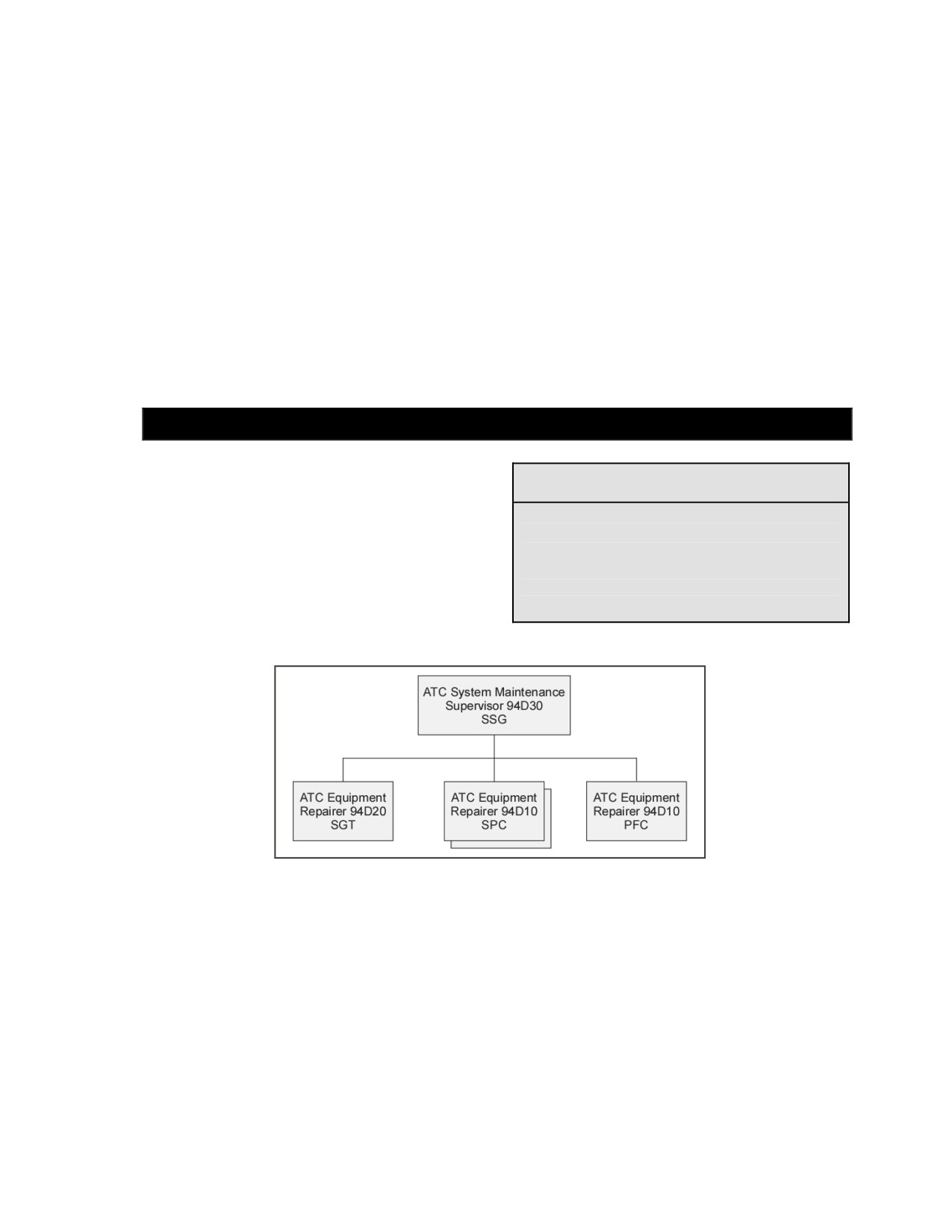
Chapter 5
Maintenance Operations
Repairing equipment far forward enhances the ability to quickly return the maximum
number of systems at the earliest opportunity. The concept of replacing components
and modules instead of repairing them is a key element in the logistic support and
maintenance operations of all modern ATS systems. This concept leverages advanced
prognostics and diagnostic tools, support equipment, and training of ATS
maintainers.
SECTION I - UNIT-LEVEL MAINTENANCE
5-1. The COMNAV maintenance section of the
GSAB ATS company and AOB are the maintenance
Contents
enablers of the air traffic mission area. ATS
maintainers
not
only
execute
field-level
Section I - Unit-Level Maintenance
5-1
maintenance, but also perform sustainment-level
Section II - External Maintenance
maintenance actions on air traffic systems. This
Organizations
5-3
unique replace and fix forward capability ensures
Section III - Additional Maintenance
critical systems are available to accomplish the
Considerations
5-5
multitude of ATS missions assigned to air traffic
organizations. Figure 5-1 illustrates the COMNAV
section organized under the GSAB ATS company and AOBs.
Figure 5-1. COMNAV section
TWO-LEVEL MAINTENANCE OPERATIONS
5-2. During the past decade, the United States Army has been engaged in a deliberate and seeping effort
to adapt its organizations, Soldiers, equipment, and methods or operations to requirements of a rapidly
changing strategic and technological landscape. The power of advanced technologies, especially
information technology, enables the Army to achieve situational dominance and decision-making
momentum, creating a new construct for the application of force.
5-3. The Army vision calls for transforming from a forward-deployed force to a strategically responsive
force projection Army. Today’s reactive maintenance system creates a large battlefield logistical footprint
reliant on multiple headquarters to coordinate forward support activities and evacuation of inoperative
16 February 2007
FM 3-04.120
5-1
Chapter 5
systems. The current methodology of
“fix forward” is changing to a
“replace forward-repair rear”
methodology. Clearly, the skills and abilities of our ATS maintainers executing this shift in doctrine will
also change.
5-4. The air traffic maintenance program is aligned with the Army maintenance system detailed in
AR 750-1 and FM 4-30.3. Unique to the ATS maintenance strategy is the alignment of repair functions for
both field and sustainment-level maintenance. Field maintenance, also known as on-system maintenance, is
primarily associated with repairs that return equipment to operators. Sustainment maintenance, also known
as off-system maintenance, primarily repairs and returns equipment to the supply system. Each of these
functions is supported by ATS maintainers.
5-5.
ATS maintainers perform the following maintenance actions under field maintenance—
Preventive maintenance checks and services (PMCS).
Inspections by sight and touch of accessible components per the TM XX-10 series and
condition-based maintenance indicators or instrumentation.
Lubrication, cleaning, preserving, tightening, replacement, and minor adjustments.
Limited diagnosis and fault isolation.
Replacement of combat spares.
Requisition, receipt, storage, and issue of repair parts.
Evacuation to the appropriate maintenance support activity of unserviceable reparables.
Coordination and transportation of ATS systems.
Materiel readiness reporting.
Fabrication as identified by the appropriate TM.
5-6.
ATS maintainers perform the following maintenance actions under sustainment maintenance—
Inspection, diagnosis, isolation, and repair of faults within modules and components.
Turn-in of unserviceable end items and components through the appropriate supply activity.
Fabrication or manufacture of repair parts, assemblies, components, jigs, and fixtures.
Equipment modifications as required by AR 750-10.
Manufacturing of end items and parts not provided or stocked by the national supply system.
Special inspections and modifications of equipment requiring extensive disassembly or elaborate
test equipment.
Nondestructive testing to determine the acceptability of removed parts.
Installation of all outstanding modification work orders and minor alterations directed by the
materiel proponent.
Postproduction software support, the sustainment of the operational software embedded in
weapon systems after closure of the production line.
Note: In accordance with AR 750-1, modified table of organization and equipment (MTOE)
ATS maintenance personnel may perform duties at table of distribution and allowances (TDA)
maintenance activities to maintain skills and update MOS training.
POSITIONING MAINTENANCE SUPPORT ASSETS
5-7. The nature of the modern battlefield demands that ATS systems be repaired quickly and as far
forward as possible. This requirement implies a forward thrust of maintenance within the division AO.
Maintenance assets move as far forward as the tactical situation permits, repairing unserviceable and
damaged ATS systems to return them as quickly as possible.
5-8. A viable maintenance system complements the capabilities of the supply system. When equipment is
in short supply or unavailable to support requirements, commanders use the maintenance system to offset
5-2
FM 3-04.120
16 February 2007
Maintenance Operations
the shortfall. Equipment has become complicated and technically advanced, making it easier to meet surge
requirements by redirecting the maintenance effort rather than influencing the supply effort.
5-9. The job of maintenance managers is to ensure the proper mix (type and location) of maintenance that
best supports the commander’s tactical and operational requirements. Early movement of essential
maintenance capabilities ensures that deployed ATS systems are operational upon arrival in a theater of
operations.
SPLIT-BASED OPERATIONS
5-10. Split-based operations refer to performing certain logistic and maintenance functions within a given
theater of operation, in more than one location. This is a principal concern of the COMNAV section due to
the nature of ATS operations within the CAB and additional ATS maintenance support to the brigade
aviation element and division airspace cell. By all accounts, this is the most significant challenge of the
ATS COMNAV section. Commanders must develop detailed plans and support agreements between
supported elements/staffs of their respective commands to ensure timely repair of ATS systems emplaced
throughout the battlefield.
5-11. Strategic split-based operations refer to performing certain logistic and maintenance administrative
and management functions outside the joint operations area (JOA). These functions can be performed in a
secure theater location, an ISB, or home station. Soldiers and civilians can perform personnel, materiel, and
distribution management functions without deploying to the JOA if standard Army management
information systems (STAMIS) are adequate. The STAMIS help minimize strategic lift requirements and
reduce the sustainment footprint in theater while still meeting support requirements.
CONTRACT AND CIVILIAN MAINTENANCE SUPPORT
5-12. AR 750-1, AR 70-1, and AR 700-127 contain policy guidance on the utilization and employment of
contractors, DA civilians, and local national augmentation used for supporting Army operations.
Specifically, AR
750-1 details the utilization of military and non-military personnel in maintenance
operations with the following:
Military personnel will perform maintenance in combat or hazardous duty areas as much as
possible. The employment of civilians in hazardous duty areas for the performance of
maintenance of field equipment that can be maintained by a Soldier is strongly discouraged.
Civilians will not be permanently stationed in combat areas or hazardous duty areas as
determined by the combatant commander (see AR 715-9). Civilians may travel forward to a
brigade combat team operational area on a case-by-case basis as individual equipment failures
occur to provide temporary onsite maintenance and technical advice
(sustainment-level
maintenance assistance teams and/or modification application teams).
Outside the brigade operational area, in addition to military personnel, civilian maintenance
personnel (contract, TDA, local nationals, and so on) may be acceptable as a prudent risk on the
probability of maintenance services being continued in wartime and in support of other
operations.
5-13. Certification is the quality control used by ATS maintainers to ensure ATS systems are operating
with required parameters. Independent discretionary judgment about the provision of services, the need to
separate profit motivations from operational decisions, and the desire to minimize liability, make the
regulatory function of certification and oversight inherently a governmental function. Contractors and host
nation augmentation will not be used in the certification or verification of ATS systems, NAVAIDS, and
ATS maintenance training programs.
SECTION II - EXTERNAL MAINTENANCE ORGANIZATIONS
5-14. Sustainment maintenance support is divided and primarily performed by three separate entities: the
original equipment manufacturers (OEMs), their civilian field service representatives (CFSRs), and Army
depots. These Army depots, located at fixed bases in CONUS, are the national maintenance sources of
16 February 2007
FM 3-04.120
5-3