FM 4-0 Sustainment (APRIL 2009) - page 2
Roles and Responsibilities for Providing Sustainment in Unified Action
geographical area. This responsibility may also include procurement of goods and services with
compensation and/or reimbursement subject to agreements between the parties involved.
Role Specialisation
2-104. One nation may assume the responsibility for providing or procuring a particular class of supply or
service for all or part of the MNF. A Role Specialist Nation’s responsibilities include the provision of
assets needed to deliver the supply or service. Compensation and/or reimbursement will then be subject to
agreement between the parties involved.
Third Party Logistic Support Services (TPLSS)
2-105. TPLSS is the use of preplanned civilian contracting to perform selected sustainment. Its aim is to
enable competent commercial partners to provide a proportion of deployed sustainment so that such
support is assured for the commander and optimizes the most efficient and effective use of resources.
TPLSS is most likely to be of use in a non-Article 5 Crisis Response Operation, and especially once the
operational environment has become more benign. The TPLSS database, which NATO Maintenance &
Supply Agency (NAMSA) developed, contains details of potential contractors world wide, capable of
providing sustainment to NATO operations. NATO Commands and Nations may consider using the
technical expertise of NAMSA for their contract activities.
Mutual Support Agreements (MSA)
2-106. Participating nations have the option to develop mutual support arrangements (bi- and multi-
laterally) to ensure provision of logistic support to their forces. This is especially useful when nations
have small force contingents collocated with the forces of another nation that have the capacity to support
them. By working together and sharing resources (especially services capabilities), nations can achieve
economies of scale in their sustainment operations. MSAs have the advantage of being simple to set up
and can take place on an ad hoc basis.
OTHER SUSTAINMENT OPTIONS
2-107. Chapter 138 of Title 10 USC authorizes exchanging support between U.S. services and those of
other countries. It authorizes DOD acquisition from other countries by payment or replacement-in-kind,
without establishing a cross-servicing agreement. Supplies and services authorized under Chapter 138 do
not include major end items, missiles, or bombs. It does include food, billeting, petroleum, oils,
transportation, communication services, medical services, ammunition, storage, spare parts, maintenance
services, and training. Therefore, negotiations in advance of operations for sharing projection and
sustainment resources are recommended.
ACQUISITION CROSS-SERVICING AGREEMENT (ACSA)
2-108. Under ACSA authority (Title 10 USC, sections 2341 and 2342), the SECDEF can enter into
agreements for the acquisition or cross-service of logistics support, supplies, and services on a
reimbursable, replacement-in-kind, or exchange-for-equal-value basis. These agreements can be with
eligible nations and international organizations of which the United States is a member. An ACSA is a
broad overall agreement, which is generally supplemented with an implementing agreement (IA). The IA
contains points of contact and specific details of the transaction and payment procedures for orders for
logistics support. Neither party is obligated until the order is accepted.
2-109. Under these agreements, common logistics support includes food, billeting, transportation
(including airlift), petroleum, oils, lubricants, clothing, communications services, medical services,
ammunition, base operations, storage services, use of facilities, training services, spare parts and
components, repair and maintenance services, calibration services, and port services. Items that may not
be acquired or transferred under the ACSA authority include weapon systems, major end items of
equipment, guided missiles, nuclear ammunition, and chemical ammunition
(excluding riot control
agents).
30 April 2009
FM 4-0
2-17
Chapter 2
SUMMARY
2-110. Sustainment is joint interdependent. The deliberate and mutual reliance on joint sustainment
can reduce duplication and increase efficiency. U.S. Title 10 requires each Service to provide its own
logistics support. However, authority is available through other means to conduct joint sustainment.
DAFL gives the CCDR authority to issue directives to subordinate commanders in order to meet joint
sustainment needs. Strategic level sustainment is provided by joint organizations such as DLA,
USTRANSCOM, USAHRC, DFAS, and USAFINCOM. These generating forces unique capabilities
allow them to provide support directly to the operational Army’s modular forces. Multinational
operations may include coalitions and alliances. An alliance is a formal relationship between
multinational partners whereas the coalition is an ad hoc relationship. Under the NATO alliance several
options are available for providing sustainment to allied and coalition forces.
2-18
FM 4-0
30 April 2009
Chapter 3
Command and Control (C2)
C2 is the exercise of authority and direction by a properly designated commander
over assigned and attached forces in the accomplishment of a mission. C2 is an
art and a science. Commanders combine the art of command and the science of
control to accomplish missions. This chapter will discuss C2, mission command,
and the art of battle command from a sustainment perspective. Although the
processes of C2 are the same for all commands, the mission focus, knowledge,
understanding, and visualization of how support will be provided is different. C2
is fundamental to any discussion of sustainment because of the importance and
flexibility of the modular force. The linking of C2 systems enables effective
decision making as people, materiel, and medical support moves from generating
force to operating force units. It also affects how commanders visualize, describe,
and direct support. Because of the uncertain and ever changing nature of
operations, mission command—as opposed to detailed command—is the
preferred method for exercising C2. The use of mission orders, full familiarity
with the commander’s intent and concept of operations, and mutual trust and
understanding between commanders and subordinates are prerequisites for
mission command.
COMMAND
3-1.
Command is the authority that an armed forces commander lawfully exercises over subordinates by
virtue of rank or assignment. Command includes the authority and responsibility for effectively using available
resources and for planning the employment of, organizing, directing, coordinating, and controlling military
forces for accomplishment of assigned missions (see FM 3-0).
3-2.
Command is an individual and personal function. It blends imaginative problem solving, motivational
and communications skills, and a thorough understanding of the dynamics of operations. Command during
operations requires understanding the complex, dynamic relationships among friendly forces, enemies, and
other aspects of the operational environment
(OE). This understanding helps commanders visualize and
describe their intent and develop focused planning guidance. Command is a specific and legal leadership
responsibility unique to the military (see FM 6-22).
CONTROL
3-3.
Control is the regulation of forces and WFFs to accomplish the mission in accordance with the
commander’s intent (FM 3-0). Control is fundamental to directing operations. Commanders and staff both
exercise control. Commanders and staffs must understand the science of control to overcome the physical and
procedural constraints under which units operate. Control also requires a realistic appreciation for time-distance
factors and the time required to initiate certain actions. It demands understanding those aspects of operations
that can be analyzed and measured. It relies on objectivity, facts, empirical methods, and analysis.
3-4.
Control of sustainment spans the strategic to tactical level. For example, the control of the flow of
sustainment across all levels of war is crucial for supporting operations. It demands an understanding of
sustainment functions and related systems that support all aspects of the distribution process. It also requires the
availability of organizations, centers, and activities designed with the mission to control sustainment. As a
30 April 2009
FM 4-0
3-1
Chapter 3
result; Movement Control Battalions (MCB), DMCs, materiel management sections, and support operations
(SPO) sections within sustainment commands are responsible this control. Brigades and battalions are primarily
responsible for the control and coordination of distribution operations. These activities rely on a number of
information systems to help control sustainment. Appendix A contains details on the various information
systems.
BATTLE COMMAND AND SUSTAINMENT
3-5.
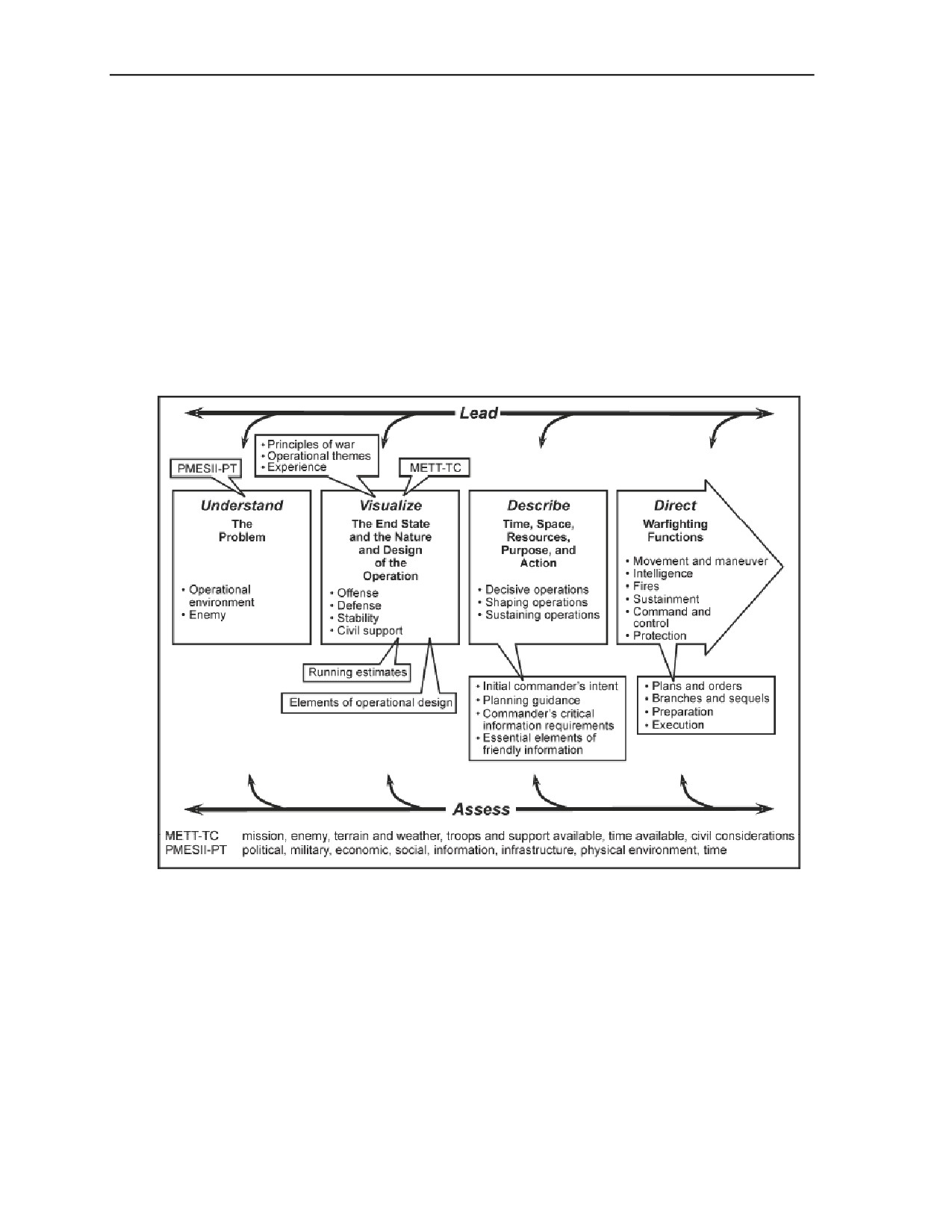
Battle command is the art and science of understanding, visualizing, describing, directing, leading, and
assessing forces to impose the commander’s will on a hostile, thinking, and adaptive enemy. Battle command
applies leadership to translate decisions into actions—by synchronizing forces and WFFs in time, space, and
purpose—to accomplish missions. Battle command is guided by the commander’s professional judgment
gained from experience, knowledge, education, intelligence, assessment skills, intuition, and leadership. Figure
3-1 diagrams battle command.
Figure 3-1. Battle Command
3-6.
The sustainment commanders must have broad perspective, understanding, and knowledge of
sustainment activities throughout the operational area. They must share the visualization of the operational
commander and then how to employ all elements of sustainment capabilities at their disposal in support of the
operation. Then they must describe and direct how these capabilities are provided. The elements of battle
command from the perspective of the sustainment commander are discussed below.
3-2
FM 4-0
30 April 2009
Command and Control (C2)
UNDERSTAND
3-7.
Understanding is fundamental to battle command. Sustainment commanders must first understand the
supported commanders’ intent and concept of operations. They understand how and what the supported
commander thinks. They specifically must understand the supported commander’s intent and concept of the
operations then track developments and adjust plans as the operations unfold. Sustainment commanders must
understand processes and procedures for the provision of sustainment, in relation to the operational
environment and the resources available to them. They must understand the relationship between each of the
WFFs and how sustainment impacts each. Sustainment commanders must also understand the flow of
sustainment and the critical decision points at which they can effect or adjust resources based on changing
mission requirements.
3-8.
Understanding changes as operations progress. Understanding the changes to the operation allows the
commander to choose and exploit METT-TC factors that best support the mission. Sustainment commanders
build upon their understanding by collecting, storing, and sorting through information that impacts the
operation. As a result, the sustainment estimate and commanders’ understanding have to be reviewed and re-
evaluated throughout an operation. They use a variety of tools, methods, and resources to increase their
understanding. A few are discussed below.
Relevant Information (RI)
3-9.
RI is defined as information of importance to commanders and staffs in the exercise of C2 (FM 3-0).
RI provides the answers commanders and staffs need to conduct operations successfully. Effective information
management helps staffs collect and store information commanders need for better understanding and thus
knowledge of the mission, task, or operation. For the sustainment commander, RI drives how he/she visualizes
the concept of support. It aides the sustainment commander in determining what, when, and where support is
needed. It helps commanders anticipate requirements and prioritize support for current and future operations. It
also helps in understanding potential problem areas that may need resolving before impacting support.
Intelligence
3-10. Intelligence Preparation of the Battlefield (IPB) is a continuous staff planning activity undertaken by
the entire staff to understand the operational environment and options it presents to friendly and threat forces.
It is a systematic process of analyzing and visualizing the operational environment in a specific geographic
area and for each mission. By applying IPB, commanders gain the information necessary to selectively apply
and maximize combat power at critical points in time and space. Understanding intelligence data is critical to
sustainment operations. Analysis of intelligence information may help commanders avoid potential enemy
activity and threats. Sustainment Soldiers in many ways (such as convoy operations and support to stability
operations) become a valuable source for collecting intelligence data which must be processed and passed
through intelligence channels.
Liasion
3-11.
Liaison is that contact or intercommunication maintained between elements of military forces or other
agencies to ensure mutual understanding and unity of purpose and action (JP 3-08). The Liaison Officer (LNO)
is the personal and official representative of the sending organization commander and should be authorized
direct face-to-face liaison with the supported commander. LNOs must have the commander’s full confidence
and the necessary rank and experience for the mission. Using an LNO conserves manpower while guaranteeing
the consistent, accurate flow of information, coordination, advice, and assistance.
3-12.
LNOs are essential for the sustainment mission for several reasons. Through monitoring of the
supported command’s mission, the sustainment LNOs provide quick information on mission changes thus
enabling responsive adjustments in support of the operation. The LNO enables sustainment command staffs and
supported command staffs in their planning and coordination, thereby assuring unity of effort. The LNO is an
important advisor to the supported commander aiding in the employment of sustainment assets.
30 April 2009
FM 4-0
3-3
Chapter 3
Command Visits
3-13.
Another technique used to facilitate understanding is command and staff visits with supported
commands. It enables commanders to determine the implications of what is happening (situational awareness)
and anticipate what may happen (commander’s visualization). It also establishes character, presence, and
intellect
(attributes of leadership) and instills competence. It enables commanders to see firsthand, the
operational environment and the supported commander’s mission. As a result, discussion, comparison of views,
and continuous study facilitates situational understanding. Sustainment commanders and their staffs obtain a
better understanding of the requirements of supported units and the operational environment in which they
operate. To maintain situational understanding, commanders talk with their peers, subordinates, superiors, and
with their staffs, and with community and civilian agency leaders. This assures sustainment commanders are
better able to integrate sustainment into operations, anticipate support requirements, and provide responsive and
continuous support.
Information Systems
3-14.
An information system is equipment and facilities that collect, process, store, display, and disseminate
information. This includes computers—hardware and software—and communications as well as policies and
procedures for their use (see FM 3-0). The commander uses these systems to collect information. Having access
to these systems gives the commander a common operational picture (COP). The COP is a single display of RI
within a commander’s area of interest tailored to the user’s requirements and based on common data and
information shared by more than one command (FM 3-0).
3-15.
For example, BCS3 provides support to commodity tracking, convoy operations, and the RSO&I
process. The system also produces user-defined COP. BCS3 fuses sustainment information from numerous
sources into one user-defined; mission focused and tailored, map-centric visual display. It provides graphics
that are scalable to the display requirements of tactical, operational, and strategic users’ needs. It exchanges C2
information with Army Battle Command System (ABCS) and joint systems. It also integrates logistics and
personnel services information required to manage sustainment operations.
3-16.
Another example is the Movement Tracking System (MTS). MTS allows sustainment organizations to
track, in real time, truck locations, communicate with the drivers, redirect cargo as required, and provide In-
Transit Visibility. This capability also provides the ability to avoid identified hazards, inform operators of unit
location changes, and provide Traffic Regulation and Control. MTS Control Stations are located in various
sustainment C2 and staff sections to provide overview of convoy operations within a specified area. A
discussion of MTS and other sustainment related information systems is in Appendix A.
VISUALIZE
3-17.
Visualization follows the commanders understanding. Commander’s visualization is the mental
process of developing situational understanding, determining a desired end state, and envisioning the broad
sequence of events by which the force will achieve that end state (see FM 3-0). Understanding helps the
commander to pull all of the pieces of the puzzle together to build the picture in his/her mind. The sustainment
commander’s visualization requires him/her to picture current and future operations and how to employ
sustainment assets and resources in support. His/Her visualization takes into account several factors such as
METT-TC, defining the end state, and determining the most effective method for employing availability of
sustainment resources. He/She must also consider the principles of sustainment and the integration of the
WFFs.
End State
3-18.
The end state is a set of required conditions that defines achievement of the commander's objectives
(JP 1-02). In terms of sustainment, determining the end state may be complex. For the sustainment commander,
achieving the desired end state involves determining the most effective means for getting the supported
commander what he/she needs, when he/she needs it, and where he/she needs it to conduct full spectrum
operations.
3-4
FM 4-0
30 April 2009
Command and Control (C2)
3-19.
As defined, sustainment is the provision of logistics, personnel services, and health services support to
maintain the force until mission accomplishment. Commanders at each level (strategic, operational, and
tactical) have different focuses and perhaps different definitions of end state.
3-20.
At the strategic level, the sustainment commanders’ focus is on force readiness. The end state is the
ability of a combat force to mobilize, deploy, sustain, redeploy, and reset. The key sustainment end state is
continuous cycle of ensuring units are equipped, manned, and healthy to conduct operations globally. At the
strategic level, the sustainment commander’s visualization may include, but not be limited to, what budget
requirements are needed to fund readiness initiatives, and how to modernize forces to make them more combat
effective while minimizing deployment resources. It may include things such as what forces are needed to
support the GCC’s operation based on METT-TC and priority for employing sustainment forces to support
theater operations. Another key end state may be determining what generating forces support is needed for the
operating force.
3-21.
At the operational level, the end state is more narrowly focused. While readiness is a critical factor, the
sustainment end state at this level may be the distribution of sustainment to support the GCC mission. It is
focused on continuity of support and how best to enable the operational reach of Army forces. It may also be
how to be more responsive to the needs of the commander.
3-22.
At the tactical level, the end state is the uninterrupted provision of sustainment to all units to support
continuous operations in an assigned area. As a result, visualizing an end state is a continuous process and
requires continuous monitoring of the situation. Commanders may make adjustments as the situation may
rapidly change to any combination of offense, defense, and stability support.
Mission, Enemy, Terrain and Weather, Troops and Support Available, Time Available, and
Civil Considerations (METT-TC)
3-23.
The assignment of a mission provides the focus for developing the commander’s visualization.
Commanders use METT-TC as a means for identifying mission variables.
Mission
3-24.
The mission is the task, together with the purpose, that clearly indicates the action to be taken and the
reason therefore (JP 1-02). Commanders analyze a mission in terms of specified tasks, implied tasks, and the
commander’s intent two echelons up. They consider the missions of adjacent units to understand their relative
contributions to the decisive operation.
3-25.
Sustainment commanders must understand the supported commander’s mission. The supported
commander establishes the priority of support. Since sustainment is generally provided to a designated area of
operations, commanders carefully assess the operational mission to determine the types of units operating in the
area and their sustainment needs. Results of that analysis yield the essential tasks that—with the purpose of the
operation—clearly specify the sustainment actions required which then become the sustainment unit’s mission.
The sustainment commander and staff work closely with the operational staffs to ensure the integration of
sustainment with the operations and mission plans.
Enemy
3-26.
The enemy may consider such sustainment operations, as convoys and medical evacuations, as
relatively soft targets to attack. In the current operational environment, the enemy has used IEDs and ambushes
on convoys as one of the methods to disrupt sustainment operations. To reduce this risk, sustainment
commanders may develop, alter, and/or improvise plans and actions for avoiding potential sites for attacks.
Understanding when and how the enemy is most likely to attack require detailed, timely, and accurate
information. Effective intelligence, surveillance, and reconnaissance information is important for identifying
threat capabilities and vulnerabilities.
30 April 2009
FM 4-0
3-5
Chapter 3
Terrain and Weather
3-27.
Terrain includes both natural and man-made features such as rivers, mountains, cities, airfields, and
bridges. Weather includes atmospheric conditions such as excessive heat, cold, rain, snow, and a variety of
storms. Terrain and weather significantly impact sustainment. It influences the sustainment commander’s
decision and visualization for supporting operations. Sustainment commanders visualize the advantages and
disadvantages afforded by terrain and weather. Natural terrain features may help conceal sustainment forces or
operations. On the other hand, it may provide opportunities for enemy attack. Urban areas may provide more
access to contract capabilities, but may also serve as bottlenecks for convoys or impede medical support.
Weather likewise has advantages and disadvantages. For example, cloud cover may conceal sustainment
operations from aerial attack while it may also hinder aerial delivery of supplies or MEDEVAC operations.
3-28.
Terrain and weather also influences the type of sustainment provided. For example, urban operations
may require increased quantities of small arms and crew served ammunition versus tank or artillery ammunition
for open terrain. Weather factors such as heat or cold will increase the demand on supplies such as water or
cold weather equipment. It may also increase incidences of disease and non-battle injuries (DNBI).
Troops and Support Available
3-29.
Troops and support available is the number, type, capabilities, and condition of available friendly
troops. These include resources from joint, interagency, multinational, host nation, commercial, and private
organizations. It also includes support provided by civilians (FM 3-0). Troops and support available falls
largely within the sustainment area and encompasses much of the sustainment commander’s visualization.
Sustainment staffs track readiness including training, maintenance, logistics, health and welfare, and morale.
They provide commanders with the required information to enable him/her to make decisions about his/her
ability to execute assigned missions. Sustainment commands and staffs are responsible for ensuring required
resources are available and replacements are requested to fill shortfalls.
Time Available
3-30.
Time is critical to the responsiveness of all operations. Sustainment commanders must understand the
time sensitive nature of operations and maximize all available time to get commanders what they need when
they need it. A key consideration for sustainment commander’s visualization is the time it will take to get
resources to supported commanders. There are numerous techniques sustainment commanders may use to
resolve timing issues. One solution may be positioning support in proximity of the operations. Another
solution is the ability to anticipate support requirements and initiate processes and procedures to begin the flow
of support through the sustainment chain. In certain unique circumstances, the commander may have to
improvise or take risk assuring critical support is provided. He/She may also direct by passing support nodes or
aerial delivery or other means.
Civil Considerations
3-31.
Understanding the operational environment requires understanding civil considerations. Civil
considerations reflect man-made infrastructure, civilian institutions, attitudes, and activities. The civilian
leaders, populations, and organizations within an area of operations influence the conduct of military
operations. In instances where stability and offensive operations are concurrent, sustainment commanders may
be required to provide support to civilian populations in addition to ongoing military operations, until other
agencies or HNS is available. This may be particularly true during resettlement operations. Supporting such
operations places heavy demands on sustainment forces and activities. Military movements, supply distribution,
contracting, and other sustainment activities may be strained.
3-32.
Commanders should avoid providing support to civilian populations that compete with economic
factors in the community. For example, providing services to a population that take away from businesses or
jobs may have an adverse effect on the local economy. Correspondingly, contracting for these services
contributes to fostering local support and may boost the local economy. The sustainment preparation of the
operational environment, discussed in Chapter 4, is one technique commanders may use to visualize civil
considerations in support of operations.
3-6
FM 4-0
30 April 2009
Command and Control (C2)
DESCRIBE
3-33.
The visualization process results in commanders describing to their staffs and subordinates the shared
understanding of the mission and intent. Commanders ensure subordinates understand the visualization well
enough to begin planning. Commanders describe their visualization in doctrinal terms, refining and clarifying it
as circumstances require. Commanders express their initial visualization in terms of:
z
Initial commander’s intent. Commanders summarize their visualization in their initial intent
statement. The purpose of the initial commander’s intent is to facilitate planning while
focusing on the overall operations process. The sustainment commander’s intent should
reflect his/her visualization for supporting the operational commander. His/Her intent
must integrate elements of the operational commander’s intent to ensure synchronization
and unity of effort. The sustainment staffs must analyze the commander’s intent to ensure
supportability of the operation.
z
Planning guidance. Planning guidance conveys the essence of the commander’s visualization.
It broadly describes when, where, and how the commander intends to employ combat power to
accomplish the mission. Sustainment commander’s guidance conveys his/her vision for
sustaining combat power. His/Her guidance may include such factors as the placements of
sustainment assets to best provide responsive support. It may include guidance for supply rates
or evacuation requirements. His/Her guidance may also establish priorities of support based on
the missions within his/her designated support area. His/Her planning guidance ensures staffs
understand the broad outline of his/her visualization while allowing the latitude necessary
to explore different options.
z
Commander’s Critical Information Requirements
(CCIR). A commander’s critical
information requirement is an information requirement identified by the commander as being
critical to facilitating timely decision making. One of the staff’s priorities is to provide the
commander with answers to CCIR. Some examples of CCIR for sustainment commanders
may be: What are the consumption rates for various classes of supply? What and where
are those supplies in the distribution pipeline? Where are the most likely casualties to
occur and are there assets available to evacuate them? What type and where are personnel
replacements needed? What is the maintenance status of critical combat equipment?
While most staffs provide RI, a good staff expertly distills that information. It identifies
answers to CCIR and gets them immediately to the commander. It also identifies vital
information that does not answer a CCIR, but that the commander nonetheless needs to
know. The two key elements are friendly force information requirements and priority
intelligence requirements (JP 3-0).
z
Essential elements of friendly information (EEFI). An essential element of friendly
information is a critical aspect of a friendly operation that, if known by the enemy, would
subsequently compromise, lead to failure, or limit success of the operation, and therefore should
be protected from enemy detection. An EEFI establishes an element of information to protect
rather than one to collect. For sustainment, a few examples of EEFI may include readiness
status of units or critical personnel, equipment, and/or maintenance shortfalls. Other
factors may be supply routes or schedules for resupply operations and locations of
essential stocks or resources.
DIRECT
3-34. Commanders direct all aspects of operations. This direction takes different forms throughout the
operations process. Commanders make decisions and direct actions based on their situational understanding,
which they maintain by continuous assessment. They use control measures to focus the operation on the desired
end state. Sustainment commanders direct operations by:
z
Assigning and adjusting missions, tasks, task organization, and control measures based on the
concept of operations of the supported commander and his/her priorities.
z
Positioning units to maximize support, anticipate combat operations and changes to combat
intensity, or create or preserve maneuver options.
30 April 2009
FM 4-0
3-7
Chapter 3
z
Positioning key leaders to ensure observation and supervision at critical times and places.
z
Adjusting support operations to execute changed priorities based on exploiting opportunities or
avoiding threats.
3-35.
Sustainment commanders direct forces by issuing orders to subordinates. The orders issued may be
verbal, written, or electronically produced using matrices or overlays. These orders may be of several types (see
FM 5-0).
z
An operation order (OPORD) is a directive issued by a commander to subordinate commanders
for the purpose of effecting the coordinated execution of an operation (FM 5-0).
z
The warning order (WARNO) is a preliminary notice of an order or action, which is to follow.
WARNOs help subordinate units and staffs prepare for new missions.
z
A fragmentary order (FRAGO) is an abbreviated form of an operation order (verbal, written, or
digital) usually issued on a day-to-day basis that eliminates the need for restating information
contained in a basic operation order.
STAFF
3-36.
Staffs assist the commander in providing control over and executing timely decisions for operations.
Commanders and staffs are continually alert for opportunities to streamline cumbersome or time-consuming
procedures. They provide RI to help commanders achieve situational understanding. One piece of information
alone may not be significant; however, when combined with other information from the COP, it may allow the
commander to formulate an accurate visualization and make an appropriate decision.
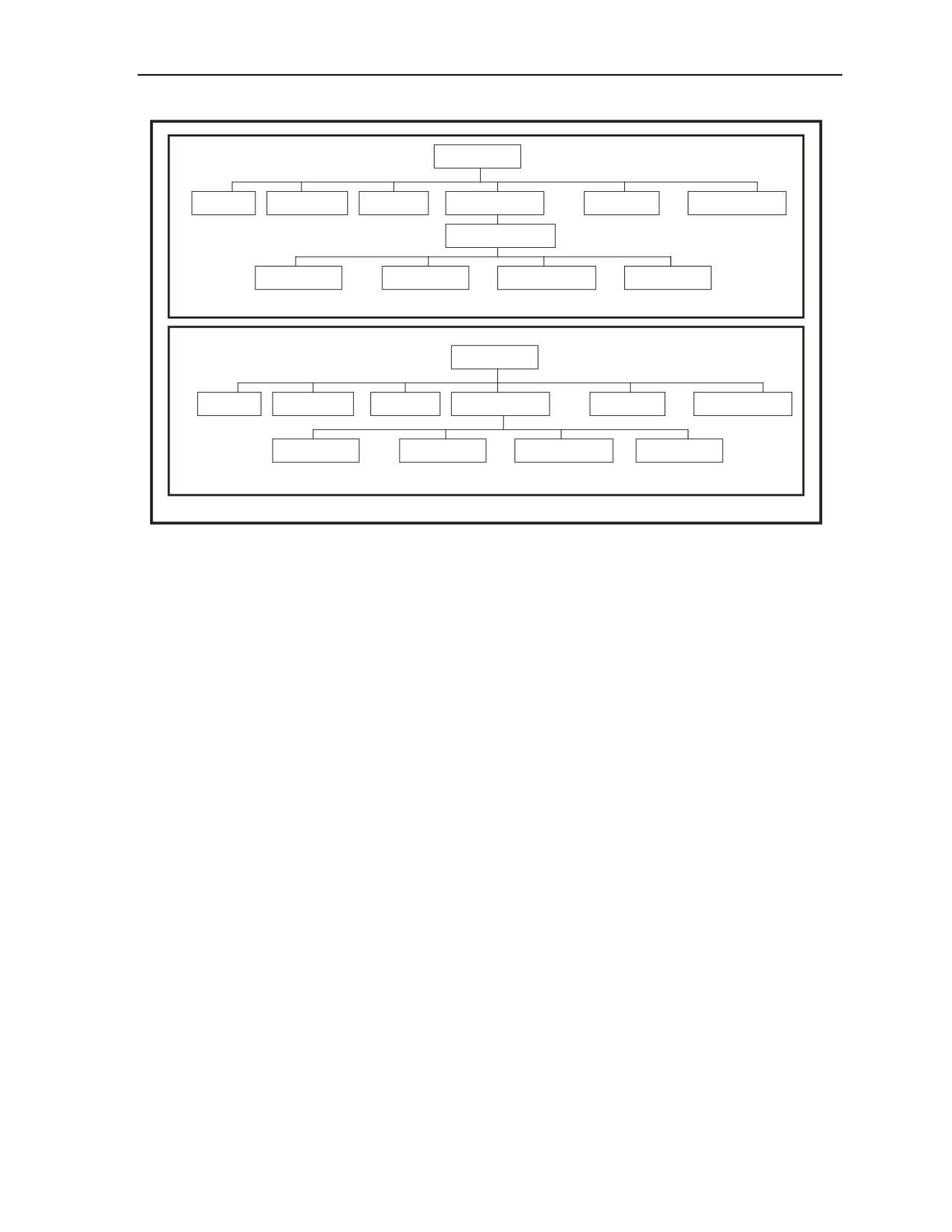
SUSTAINMENT CELL ROLES
3-37.
Modular force theater army, corps, and division headquarters have been realigned in accordance with
the WFFs of Movement and Maneuver, Fires, Intelligence, Command and Control, Protection, and
Sustainment. The WFF Cell - Sustainment combines many of the functions formerly found in G1, G4, G8, and
Surgeon staffs, and the Engineer Coordinator (ENCOORD). These functions are now organized into a G1
Division, G4 Division, G8, Surgeon, and Engineer Division (see Figure 3-2).
SUSTAINMENT STAFF COORDINATION
3-38.
The sustainment staffs are responsible for providing staff support activities for the commander. The
sustainment staff integrator monitors and coordinates sustainment functions between the sustainment staffs and
other WFF staffs and advises the commander on force readiness. The sustainment staffs also coordinate with
the corresponding sustainment commands and specialized functional centers (HRSC and FMC) for oversight of
operations.
G-1 STAFF
3-39.
The G-1 staff is an element of Theater Army sustainment HQ and staff section of corps or division.
At each command level, the G-1 is the senior HR advisor to the commander. The G-1’s mission is to ensure HR
readiness and plan HR support in compliance with the commander’s priorities, intent, and policies. The HR
mission is accomplished through a combination of direct communication with the USAHRC, G-1 and S-1 staffs
at Theater Army, corps and division, and TSCs and HRSC.
3-40.
The G-1 focus is establishing HR policy, priorities, and providing guidance and oversight for the HR
functions. These functions include man the force, provide HR services, coordinate personnel support, and
conduct HR planning and staff operations.
3-8
FM 4-0
30 April 2009
Command and Control (C2)
ASCC
INTEL
MOV & MAN
FIRES
SUSTAINMENT
C&IN
PROTECTION
SUSTAINMENT HQ
G-1
G-4
G-8
SURGEON
NOTE: SUSTAINMENT HQ IS THE INTEGRATOR FOR G-1, G-4, G-8, AND SURGEON
CORPS/DIV
INTEL
MOV & MAN
FIRES
SUSTAINMENT
C&IN
PROTECTION
G-1
G-4
G-8
SURGEON
NOTE: G-4 IS DUAL HATTED AS SUSTAINMENT CHIEF/INTEGRATOR
NOTIONAL ASCC AND CORPS/DIV ORGANIZATIONS
Figure 3-2. Notional Theater Army and Division or Corps Sustainment Cells
3-41.
The G-1 coordinates through the TSC to the HRSC for personnel accountability (PA), reception,
replacement, and return to duty, rest and recuperation, redeployment, postal, and casualty operations. The G-1
also advises the commander on the allocation and employment of HR support and units within the AOR (see
FM 1-0). Other G-1 responsibilities include, but are not limited to:
z
Coordinating HR functions across the entire JOA when serving as a Joint Task Force (JTF)
Combined Force Land Component Commander/Joint force Land Component Commander
(CFLCC/JFLCC) C-1/J-1 (see JP 1-0).
z
Planning and integrating civilian personnel HR support.
z
Incorporate unique Reserve Component programs and policies into theater HR programs.
G-4 STAFF
3-42.
The G-4 is the principal staff officer responsible for monitoring and advising on logistics within the
Theater Army, corps, or division commands. At the corps and division, the G-4 also serves as the sustainment
chief/integrator for the commander. The G-4 staff develops the logistics plan in support of the operational plan.
The staff provides recommendations on a variety of command priorities including force structure, HNS,
contracting support, materiel management, and movement control.
3-43.
The G-4 staff may include divisions, branches, and specialized sections for supporting various types of
operations. In addition, it may have joint and multinational capabilities for supporting requests for logistics
support to joint and MNFs, U.S. Agencies, NGOs, and IGOs in the theater. These logistic requests are
coordinated through the G-9 (Assistant Chief of Staff for Civil-Military Operations) or the civil-military
operations center. The staff may also serve as the focal point for the coordinating LOGCAP and other
contracting support.
G-8 STAFF
3-44.
The G-8 is the senior FM advisor to the commander at ASCC, corps, and division levels. The staff’s
mission is to fund the force through the coordination and synchronization of resources against unit
30 April 2009
FM 4-0
3-9
Chapter 3
requirements. It provides advice and guidance concerning resources commanders and staff. It also
synchronizes RM operations and performs management requirements as determined by the commander.
3-45. The G-8 performs the following functions:
z
Acquires, manages, and distributes funds.
z
Manages DOD resources.
z
Plans, programs, and develops budget.
z
Coordinates and supports accounting.
z
Supervises and provides leadership to the G-8 staff.
z
Estimates, tracks, and reports costs for specific operations to support requests to the U.S.
Congress for appropriation.
3-46.
The Army may be appointed the lead Service responsible for common FM support. If so, Army G-8
staffs ensure that RM, banking, and currency support are provided for joint interagency and multinational
operations. The Army also provides financial analysis and recommendations to joint forces for the most
efficient use of fiscal resources. FM provides the funding essential to support contracting requirements and
accomplish joint programs.
SURGEON
3-47.
A command surgeon is designated for all command levels. This medical officer is a special staff
officer charged with advising on the AHS mission. The duties and responsibilities of command surgeons for
HSS include: Advise the commander on the health of the command; plan and coordinate AHS support for units
in theater; establish polices for care of non-U.S personnel; maintain HSS situational awareness; monitor troop
strength of medical personnel; monitor medical logistics and blood management operations; and monitor
medical regulating and patient tracking operations.
3-48.
The duties of command surgeons for FHP include: coordinate for veterinary support for food safety,
animal care, and veterinary preventive medicine; plan and implement FHP operations to counter health threats;
recommend combat and operational stress control, behavioral health, and substance abuse control programs;
advise commanders on FHP CBRN defensive actions; ensure the provision of dental services; and ensure a
medical laboratory capability for the identification and confirmation of the use of suspect biological warfare
and chemical agents.
3-49.
The Theater Army surgeon ensures that all AHS support functions are considered and included in
OPLANs and OPORDs. The surgeon is a full-time special staff officer answering directly to the Theater Army
commander on matters that pertain to the health of the command. He/She coordinates for AHS support for both
HSS and FHP. The Theater Army surgeon maintains a technical relationship with the MEDCOM (DS)
commander and helps establish medical policy for the theater.
3-50.
The corps surgeon is solely responsible for planning, coordinating, and synchronizing the AHS effort
within the Corps AO. The corps surgeon maintains a technical relationship with the MEDCOM (DS)
commander and helps establish medical policy for the AO.
CHAPLAIN
3-51.
The chaplain is a member of the commander’s personal staff. The chaplain is responsible for religious
support operations. The chaplain advises the commander on matters of religion, morals, and morale as affected
by religion and on the impact of indigenous religions on military operations. No coordinating staff officer
exercises responsibility over the chaplain.
JUDGE ADVOCATE GENERAL
3-52.
The staff judge advocate (SJA) is a member of the commander’s personal staff. The HQ legal team
participates in actions related to C2 of its subordinates. Command and staff functions include advice to
commanders, staffs, and Soldiers on the legal aspects of command authority, command discipline, applying
force, and the law of war.
3-10
FM 4-0
30 April 2009
Command and Control (C2)
3-53.
Legal support to sustainment activities includes negotiating acquisition and cross-servicing
agreements, SOFAs with host nations, combat contingency contracting, fiscal law, processing claims arising in
an operational environment, and environmental law.
SUMMARY
3-54.
C2 is the exercise of authority and direction by a properly designated commander over assigned and
attached forces. Sustainment commanders and staffs use C2 of sustainment units to provide support to
operations. Sustainment commanders apply the principles of battle command-- understanding, visualizing,
describing, directing, and assessing, to lead sustainment forces. They also use the variables of METT-TC to
assist in visualizing support. The sustainment staffs of operational HQ conduct vertical and horizontal staff
coordination. Sustainment staffs in Theater Army, corps, and divisions assist the commander in the operations
process for providing support. Sustainment staffs at Theater Army are organized under a sustainment HQ
element. At corps and division, the G-4 serves the dual role as G-4 and sustainment chief/integrator for the
sustainment staff elements. A sustainment staff consists of the G-1, G-4, G-8, and representatives from the
Surgeon, and ENCOORD. The chaplain and judge advocate general staff serves as personal staff to the
commander.
30 April 2009
FM 4-0
3-11
Chapter 4
Integrating Sustainment into Operations
Integration is a key principle of sustainment. Effective integration of sustainment sets
the conditions to ensure mission success and extend strategic and operational reach.
Integration begins with the operations process—planning, preparation, execution, and
continuous assessment. It is conducted simultaneously and in synchronization with
the operations plan development. Sustainment must be integrated across each level of
war and with joint and multinational operations. This chapter covers how sustainment
is integrated into the operations process to support full spectrum operations—offense,
defense, stability, and civil support operations.
INTEGRATING SUSTAINMENT INTO THE OPERATIONS PROCESS
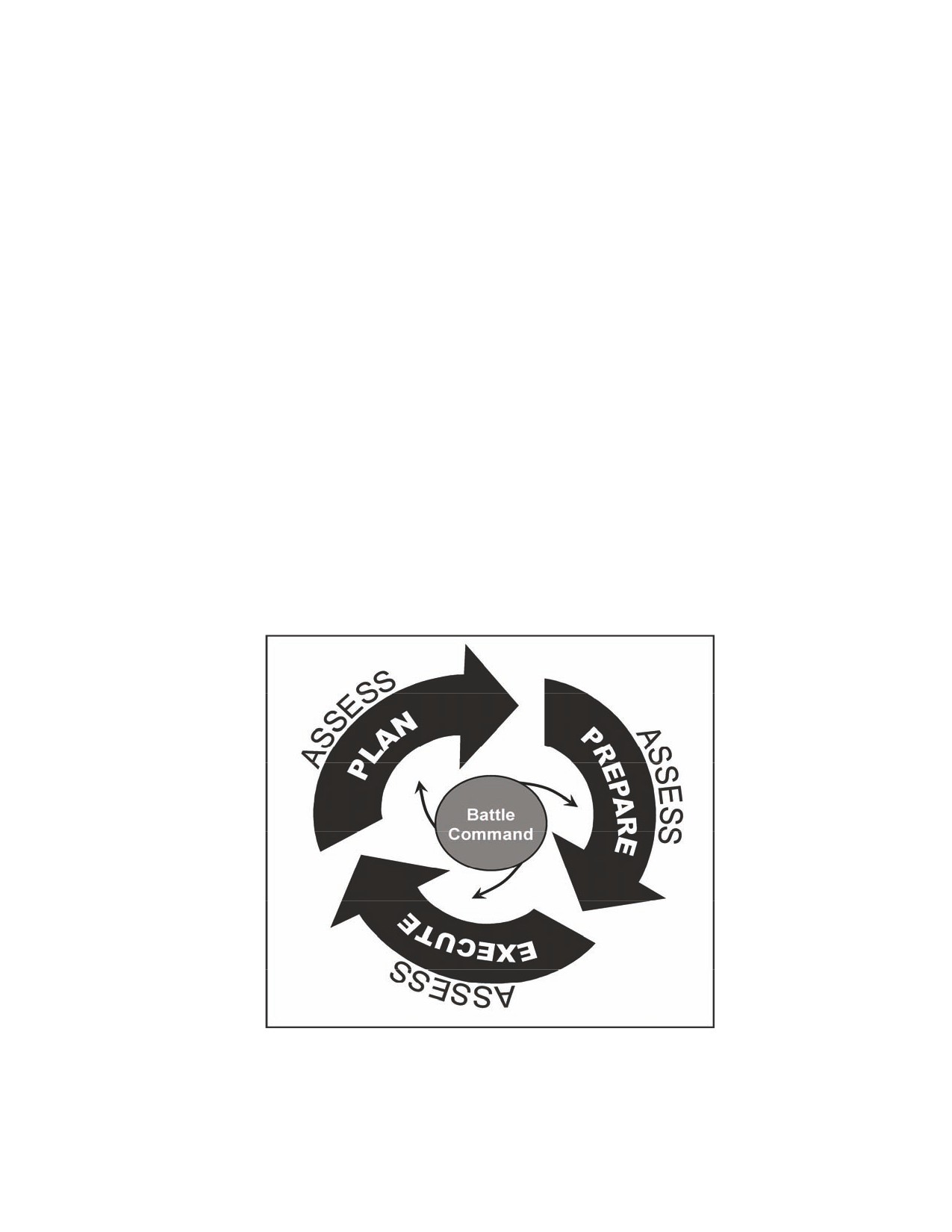
4-1.
The operations process consists of the major C2 activities performed during operations: planning,
preparing, executing, and continuously assessing the operations (FM 3-0). Integrating sustainment with the
operations process across each level of war is vital for ensuring the synchronization of sustainment with the
WFFs and unity of effort during operations. Integrating sustainment with joint and multinational operations
allow forces to conduct operations using mutual support capabilities while reducing redundancy and
competition for limited resources. Commanders and staff s at every level must make all efforts to integrate
sustainment with the operations process. Figure 4-1 illustrates the operations process.
Figure 4-1. The Operations Process
30 April 2009
FM 4-0
4-1
Chapter 4
PLANNING THE SUSTAINMENT OF OPERATIONS
4-2.
Chapter 3 covered many of the C2 planning functions (such as battle command, the determination of
end state, and sustainment staff roles). This chapter will focus on more specific tools and planning
considerations sustainment commanders and staffs use in planning for sustainment of full spectrum operations.
4-3.
Planning begins with analysis and assessment of the conditions in the operational environment with
emphasis on the enemy. It involves understanding and framing the problem and envisioning the set of
conditions that represent the desired end state (FM 3-0). Sustainment planning indirectly focuses on the enemy
but more specifically on sustaining friendly forces to the degree that the Army as a whole accomplishes the
desired end state. There are several tools available for conducting course of action analysis. We will highlight a
couple of them below.
SUSTAINMENT PREPARATION OF THE OPERATIONAL ENVIRONMENT
4-4.
Sustainment preparation of the operational environment is the analysis to determine infrastructure,
environmental, or resources in the operational environment that will optimize or adversely impact friendly
forces means for supporting and sustaining the commander’s operations plan. The sustainment preparations of
the operational environment assist planning staffs to refine the sustainment estimate and concept of support. It
identifies friendly resources
(HNS, contractable, or accessible assets) or environmental factors
(endemic
diseases, climate) that impact sustainment.
4-5.
Some of the factors considered (not all inclusive) are as follows:
z
Geography. Information on climate, terrain, and endemic diseases in the AO to determine when
and what types of equipment are needed. For example, water information determines the need
for such things as early deployment of well-digging assets and water production and distribution
units.
z
Supplies and Services. Information on the availability of supplies and services readily available
in the AO. Supplies (such as subsistence items, bulk petroleum, and barrier materials) are the
most common. Common services consist of bath and laundry, sanitation services, and water
purification.
z
Facilities. Information on the availability of warehousing, cold-storage facilities, production
and manufacturing plants, reservoirs, administrative facilities, hospitals, sanitation capabilities,
and hotels.
z
Transportation. Information on road and rail networks, inland waterways, airfields, truck
availability, bridges, ports, cargo handlers, petroleum pipelines, materials handling equipment
(MHE), traffic flow, choke points, and control problems.
z
Maintenance. Availability of host nation maintenance capabilities.
z
General Skills. Information on the general skills such as translators and skilled and unskilled
laborers.
OPERATIONS LOGISTICS (OPLOG) PLANNER
4-6.
The OPLOG Planner is a web-based interactive tool that assists commanders and staff from strategic
through operational levels in developing a logistics estimate. It is designed to support operations typically
associated with multi-phase operations plans and orders. The OPLOG Planner enables staffs to develop
estimated mission requirements for supply Class I, Class II, Class III(P), Class IV, Class VI, Class VII, Class X
including water, ice, and mail. The tool uses the latest Army approved planning rates and modular force
structures. It is updated at least annually to stay current with force structure and rate changes.
4-7.
OPLOG Planner allows planners to build multiple task organizations from a preloaded list of units and
equipment or from custom built units that are generated or imported. Each task organization is assigned a
consumption parameter set that establishes the rates, climate, Joint Phases
(Deter, Seize Initiative, and
Dominate), and Army full spectrum operations (Offense, Defense, and Stability). The planners have the option
of using predefined default planning rates or customizing rates based on what a unit is experiencing.
4-2
FM 4-0
30 April 2009
Integrating Sustainment into Operations
4-8.
OPLOG Planner generates the logistics supply requirements which can be viewed by the Entire
Operation, each Phase of the Operation, each Task Organization, each Unit, or each Unit’s Equipment.
Logistics requirement reports can be printed or exported to automated spread sheets for further analysis or
saved for recall to be used in course of action analysis.
PLANNING ARMY HEALTH SERVICES
4-9.
Medical planners determine the capabilities and assets needed to support the mission. To ensure
effective and efficient support, medical plans adhere to the principles of AHS support (as outlined in Chapter
5), the commander’s planning guidance, medical intelligence related to the operational area, and other planning
considerations.
4-10. The theater evacuation policy, health threat, troop strength or size of the supported population, and the
type, intensity and duration of the operation are some of the factors considered for determining medical
requirements. The medical staff estimates and patient estimates are also developed during planning. The patient
estimate is derived from the casualty estimate prepared by the G-1.
4-11. In-depth analysis is critical at every level of the operation to ensure the flexibility to quickly react to
changes in the mission and continue to provide the required support. The observations of commanders, disease
and nonbattle injury rates, and running estimates are the primary means of assessing an operation to ensure that
the concept of operations, mission, and commander’s intent are met. These factors and continuous analysis
help to make certain that once developed, the plan includes the right number and combination of medical assets
to support the operation. See FM 8-55 for additional information.
4-12. Medical and nonmedical automated information systems are used to plan AHS mission. Medical
commanders must know the complete COP which includes situational awareness of three areas—(1) tactical
(via FBCB2), (2) medical (via MC4/DHIMS), and (3) sustainment (via GCSS-Army). The commanders and
medical planners must maintain situational awareness, in-transit visibility and tracking of patients and
equipment, and a common operational picture of the AO. This information is obtained through various plans,
reports, and information systems available to commanders and planners to facilitate the decision making
process. These and other medical systems are discussed in Appendix A.
PLANNING CONSIDERATIONS FOR FULL SPECTRUM
OPERATIONS
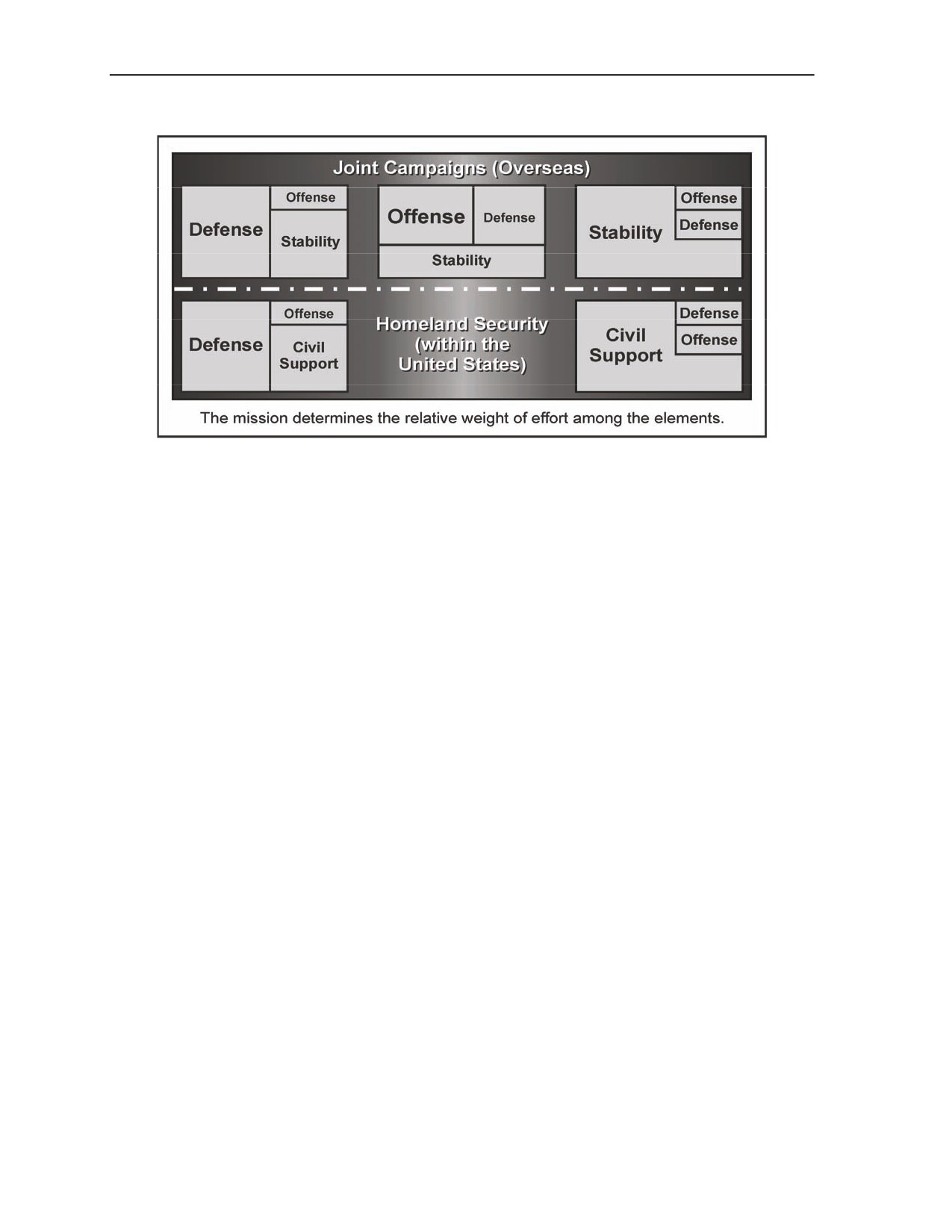
4-13. Army forces plan offensive, defensive, and stability or civil support operations simultaneously as part
of an interdependent joint force. The proportion and role of offensive, defensive, and stability or civil support
tasks are based on the nature of the operations, tactics used, or the environment. While full spectrum operations
may occur simultaneously versus sequentially, they have slightly different planning requirements. Figure 4-2
illustrates the element of full spectrum operations.
30 April 2009
FM 4-0
4-3
Chapter 4
Figure 4-2 .Elements of Full Spectrum Operations
OFFENSIVE OPERATIONS
4-14. Offensive operations are defined as combat operations conducted to defeat and destroy enemy forces
and seize terrain, resources, and population centers. They impose the commander’s will on the enemy (see
FM 3-0). Sustainment of offensive operations is high in intensity. Commanders and staffs plan for increased
requirements and demands on sustainment. Sustainment planners work closely with other WFF staffs to
determine the scope of the operations and develop estimates for quantity and types of support required. They
anticipate where the greatest need might occur and develop a priority of support. Sustainment planners may
consider positioning sustainment units in close proximity to operations to reduce response times for critical
support. They also consider alternative methods for delivering sustainment in emergency situations.
4-15. To maintain momentum and freedom of action, coordination between staff planners must be
continuous. During offensive operations, certain requirements present special challenges. The most important
materiel is typically fuel (Class III Bulk) and ammunition (Class V), Class VII, movement control, and medical
evacuation. Based on planning assessments, sustainment commanders direct the movement of these and other
support to meet anticipated requirements.
4-16. Another challenge in planning for and sustaining an offensive operation is the lengthened lines of
communication (LOCs). Widely dispersed forces, longer LOCs, and congested road networks increase stress on
transportation systems. As a result, a combination of ground and aerial delivery maybe planned to
accommodate the distribution. Distribution managers and movement control units synchronize movement plans
and priorities according to the commander’s priority of support. Distribution must be closely coordinated and
tracked to ensure delivery of essential support. The routing function of movement control becomes an essential
process for coordinating and directing movements on main supply routes or alternate supply routes, and
regulating movement on LOCs to prevent conflict and congestion.
4-17. Higher casualty rates associated with offensive operations increase the requirement of medical
resources. Plans to position medical support close to operations to facilitate treatment and evacuation are
considered. If increased casualty rates overwhelm medical resources, nonmedical transportation assets may be
needed for evacuation. Another planning consideration may be moving combat and operational stress control
teams to support combat stress casualties following operations.
4-18. Higher casualty rates also increase the emphasis on personnel accountability, casualty reports, and
replacement operations. G-1s and S-1s plan for accurate tracking of casualties and replacements through
coordination with Casualty Liaison Teams (CLTs) and the HRSC.
4-4
FM 4-0
30 April 2009
Integrating Sustainment into Operations
4-19. Plans should also provide for religious support, which may become critical during offensive
operations. Religious support through counseling and appropriate worship can help reduce combat stress,
increase unit cohesion, and enhance performance.
4-20. Using contractors during the sustainment of offensive operations entails great risk and raises
significant practical and legal considerations. However when necessary, the force commander may be willing to
accept this risk and use contractors in forward areas. Commanders should seek counsel from their judge
advocates when considering the use of contractors during offensive operations.
DEFENSIVE OPERATIONS
4-21.
Defensive operations defeat an enemy attack, gain time, economize forces, and develop conditions
favorable for offensive or stability operations (FM 3-0). The commander positions assets so they can support
the forces in the defense and survive. Requirements for sustainment of forces in the defense depend on the type
of defense. For example, increased quantities of ammunition and decreased quantities of fuel characterize most
defensive operations. However, in a mobile defense, fuel usage may be a critical factor. Conversely, in a fixed
defensive position, fuel requirements are lower.
4-22. Typically, defensive operations require more centralized control. Movements of supplies,
replenishment, and troops within the AO have to be closely and continuously coordinated, controlled, and
monitored. In retrograde operations (a type of defense) special care is necessary to assure that combat units
receive necessary support across the depth of the AO and that the sustainment unit and stocks are not lost as the
unit moves away from enemy activity.
4-23. Distribution managers direct resupply forecasted items to designated units. Increases in items such as
barrier and construction materials should be pushed to designated collection points for unit retrieval whenever
possible. Planners should consider the impact of increased ammunition expenditures on available transportation
assets.
4-24. The task of medical units is to triage casualties, treat, and return to duty or resuscitate and stabilize for
evacuation to the next higher level of medical care or out of the theater of operations. MTFs and other AHS
support assets should be placed within supporting distance of maneuver forces but not close enough to impede
ongoing combat operations.
STABILITY OPERATIONS
4-25. Stability operations encompass various military missions, tasks, and activities conducted outside the
United States in coordination with other instruments of national power to maintain or reestablish a safe and
secure environment, provide essential governmental services, emergency infrastructure reconstruction, and
humanitarian relief (FM 3-0). Although Army forces focus on achieving the military end state, they ultimately
need to create conditions where the other instruments of national power are preeminent. Sustainment of stability
operations often involves supporting U.S. and MNFs in a wide range of missions and tasks. The tasks most
impacted by sustainment are briefly discussed below.
Establish Civil Security
4-26. Civil security involves providing for the safety of the host nation and its population, including
protection from internal and external threats (FM 3-0). Sustainment staffs must consider plans to support I/R
operations. Sustainment may be provided to these operations until HNS, NGO, and OGOs are available.
4-27. Sustainment planners must address the sustainment of I/R operations. Sustainment to I/R involves all
of the sustainment functions. Planners should consider general engineering support horizontal and vertical
construction of detention centers, as well as repair and maintenance of the infrastructure (see FM 3-34.400). A
more detailed discussion of sustainment support of I/R and detainee operations will be provided later in this
chapter.
30 April 2009
FM 4-0
4-5
Chapter 4
Establish Civil Control
4-28. Legal staffs should plan for supporting civil control operations. Civil control centers on rule of law,
supported by efforts to rebuild the host nation judiciary and corrections systems. It encompasses the key
institutions necessary for a functioning justice system, including police, investigative services, prosecutorial
arm, and public defense. If transitional military authority is instituted, intervening forces will likely carry out
judicial and correctional functions.
Restore Essential Services
4-29.
Efforts to restore essential services involve developing host nation capacity to operate, maintain, and
improve those services. At the tactical or local level, sustainment in support of civil authorities will restore
essential civil services as defined in terms of immediate humanitarian needs (such as providing food, water,
shelter, and medical and public health support) necessary to sustain the population until local civil services are
restored. Other sustainment tasks associated with restoration of services include support to dislocated civilians
and demining operations.
Support to Economic and Infrastructure Development
4-30. The role of sustainment in supporting economic stabilization and infrastructure development is
significant, especially at the local level. Here the emphasis is on generating employment opportunities, infusing
monetary resources into the local economy, stimulating market activity, fostering recovery through economic
development, and supporting the restoration of physical infrastructure. Drawing on local goods, services, and
labor through contracting, presents the force an opportunity to infuse cash into the local economy, which in turn
stimulates market activity.
4-31. Restoring the transportation infrastructure in the area is central to economic recovery. General
engineering is required in order to initiate immediate improvement of the transportation network. These
networks enable freedom of maneuver, logistics support, and the movement of personnel and material to
support ongoing operations.
CIVIL SUPPORT OPERATIONS
4-32. The Armed Forces of the United States are authorized under certain conditions to provide assistance to
U.S. civil authorities. This assistance is known as civil support within the defense community. Civil support is
Department of Defense support to U.S. civil authorities for domestic emergencies and for designated law
enforcement and other activities. This support usually entails Class III, subsistence, medical services, and
general engineering support.
4-33. Civil support will always be in support of a lead federal agency such as the Department of Homeland
Security. Requests for assistance from another agency may be predicated on mutual agreements between
agencies or stem from a Presidential designation of a federal disaster area or a federal state of emergency. The
military typically only responds after the resources of other federal agencies, state and local governments, and
NGOs have been exhausted or when specialized military assets are required.
4-34. Within the Joint Staff J-3, the Joint Director of Military Support (JDOMS) serves as the Action Agent
for Assistant Secretary of Defense for Homeland Defense (ASD (HD)) who has EA responsibilities for Defense
Support of Civil Authorities (DSCA). JDOMS ensures the performance of all DSCA planning and execution
responsibilities. JDOMS conducts planning and prepares warning and execution orders that task DOD
resources in response to specific requests from civil authorities.
4-35. The National Response Framework (NRF) is an all-discipline, all-hazards plan that establishes a
single, comprehensive framework for the management of domestic incidents. It provides the structure and
mechanisms for the coordination of Federal support to State and local incident managers and for exercising
direct Federal authorities and responsibilities. Through the NRF, FEMA assigns emergency support functions
(ESF) to the appropriate federal agencies. The Army maintains a permanently assigned Defense Coordinating
Officer in each FEMA region to plan, coordinate, and integrate DSCA with local, state, and federal agencies.
DOD is the Primary Coordinating Agency for ESF 3 (Public Works and Engineering) and when requested, and
4-6
FM 4-0
30 April 2009
Integrating Sustainment into Operations
upon approval of the SECDEF, DOD provides DSCA during domestic incidents and is considered a support
agency to all ESFs. These include among others transportation, public health and medical services, and public
safety and security.
4-36. The Army National Guard often acts as a first responder on behalf of state authorities when
functioning under Title
32 U.S. Code authority or while serving on State active duty. National Guard
sustainment systems may vary from state to state but are similar on a basic level. Generally, National Guard
armories stock much of the logistics material required for initial 72-hour operations. Fuel and other expendable
classes of supply are replenished using a combination of local, commercial sources, and State government
sources. During catastrophic disaster response, State National Guard units eventually require Federal
sustainment augmentation.
PREPARING FOR SUSTAINMENT OF OPERATIONS
4-37.
Preparation for the sustainment of operations consists of activities performed by units to improve their
ability to execute an operation. Preparation includes but is not limited to plan refinement, rehearsals,
intelligence, surveillance and reconnaissance, coordination, inspections, and movements
(FM 3-0). For
sustainment to be effective, several actions and activities are performed across the levels of war to properly
prepare forces for operations.
NEGOTIATIONS AND AGREEMENTS
4-38.
Negotiating HNS and theater support contracting agreements may include pre-positioning of supplies
and equipment, civilian support contracts, OCONUS training programs, and humanitarian and civil assistance
programs. These agreements are designed to enhance the development and cooperative solidarity of the host
nation and provide infrastructure compensation should deployment of forces to the target country be required.
The pre-arrangement of these agreements reduces planning times in relation to contingency plans and
operations.
4-39.
Negotiation of agreements enables access to HNS resources identified in the requirements
determination phase of planning. This negotiation process may facilitate force tailoring by identifying available
resources (such as infrastructure, transportation, warehousing, and other requirements) which if not available
would require deploying additional sustainment assets to support.
OPERATIONAL CONTRACT SUPPORT
4-40.
Operational contract support plays an ever increasing role in the sustainment of operations and is an
integral part of the overall process of obtaining support. Contract support is used to augment other support
capabilities by providing an additional source for required supplies and services. Because of the importance and
unique challenges of operational contract support, commanders and staffs need to fully understand their role in
managing contract support in the AO.
4-41. The requiring activity (normally brigade through ASCC level units), in close coordination with the
supporting contracting unit/office or Team LOGCAP-Forward, must be able to describe what is needed to
fulfill the minimum acceptable standard for the government. A detailed description of the requirement is
instrumental in allowing the contracting officer to create a solicitation against which bidders can submit a
proposal and successfully deliver in accordance with the terms of the contract. As part of this process, the
requiring activity is responsible to do basic research to ensure that the required support is not available through
the non-commercial means (organic military support, multinational, and/or HNS sources) and to determine if
there are any commercial standards for the item of support along with potential local sources of support.
4-42. The requiring activity, with support and guidance from the supporting contracting office and Team
LOGCAP-Forward staff, is also required to develop an independent government estimate and, for service
contracts, a performance work statement (sometimes referred to as a statement of work [SOW]). The requiring
activity then must obtain staff and command approval of the requirements packet. While the supporting
contracting unit will provide requirements development process advice and guidance, it is ultimately the
30 April 2009
FM 4-0
4-7
Chapter 4
requiring activity's responsibility to ensure that this packet is “acquisition ready” developed, staffed, approved,
prioritized, and funded in accordance with local command policies.
4-43. Once the contract support request is approved, the requiring activity must also be prepared to provide
government oversight assistance to the contracting organization, that includes at a minimum, qualified
contracting officer representative support for all service contract and receiving official support (for community
contracts). Finally, all requiring activities must ensure contract support is properly integrated into their
operations in the areas of government furnished support, contractor accountability, force protection measures,
and so forth ( JP 4-10, FMI 4-93.41 and FMI 4-93.42).
4-44.
An important capability for the commander is to incorporate contract support with operational reach.
The major challenge is ensuring that theater support and external support contracts are integrated with the
overall sustainment plan. It is imperative that the TSC/ESC SPO and the ASCC G-4 coordinate with the
supporting CSB. The CSB assists the Theater Army G-4 to develop the contracting support integration plans.
The CSB commands contracting deployed units to support those plans. Close coordination with the TSC and
CSB is necessary to ensure proper execution of the contract support integration plan.
Theater Support Contracts
4-45.
Theater support contracts assist deployed operational forces under prearranged contracts or contracts
awarded in the AO by contracting officers under the C2 of the CSB. Theater-support contractors acquire goods,
services, and minor construction support, usually from the local commercial sources, to meet the immediate
needs of operational commanders. Theater support contracts are typically associated with contingency
contracting. When this support involves a service contract, the unit must be prepared to provide a contracting
officer representative.
External Support Contracts
4-46.
External support contracts provide a variety of support functionalities to deployed forces. External
support contracts may be prearranged contracts or contracts awarded during the contingency itself to support
the mission and may include a mix of U.S. citizens, third-country nationals, and local national subcontractor
employees. The largest and most commonly used external support contract is LOGCAP. This Army program is
commonly used to provide life support, transportation support, and other support functions to deployed Army
forces and other elements of the joint force as well. Depending on METT-TC factors, the TSC will often serve
as the requiring activity for mission related LOGCAP support requirements. If designated by the Army forces
as the priority unit for LOGCAP support, the TSC would normally be augmented by an USAMC logistics
support officer from Team LOGCAP-Forward.
System Support Contracts
4-47.
System support contracts are pre-arranged contracts by the USAMC LCMCs and separate ASA(ALT)
program executive and product/project management offices. The AFSB coordinates the administration and
execution of system contracts within an AO in coordination with LCMC and separate ASA(ALT) program
executive and product/project management offices. Supported systems include, but are not limited to, newly
fielded weapon systems, C2 infrastructure (such as the Army Battle Command Systems (ABCS) and standard
Army management information systems (STAMIS)), and communications equipment. System contractors,
made up mostly of U.S. citizens, provide support in garrison and may deploy with the force to both training and
real-world operations. They may provide either temporary support during the initial fielding of a system, called
interim contracted support, or long-term support for selected materiel systems, often referred to as contractor
logistics support.
ARMY PRE-POSITIONED STOCKS (APS)
4-48.
The APS program is a key Army strategic program. APS is essential in facilitating strategic and
operational reach. USAMC executes the APS program and provides accountability, storage, maintenance, and
transfer
(issue and receipt) of all equipment and stocks (except medical supplies and subsistence items)
(FM 1-01). Medical APS stocks are managed by U.S. Army Medical Materiel Agency for the Office of the
4-8
FM 4-0
30 April 2009
Integrating Sustainment into Operations
Surgeon General and subsistence items are managed for the Army by DLA. The reserve stocks are intended to
provide support essential to sustain operations until resupply lines of communication can be established.
Prepositioning of stocks in potential theaters provides the capability to rapidly resupply forces until air and sea
lines of communication are established. Army prepositioned stocks are located at or near the point of planned
use or at other designated locations. This reduces the initial amount of strategic lift required for power
projection, to sustain the war fight until the LOC with CONUS is established, and industrial base surge capacity
is achieved (FM 3-35.1).
4-49. The four categories of APS are: prepositioned unit sets, Operational Projects stocks, Army War
Reserve Sustainment stocks, and War Reserve Stocks for Allies (FM 3-35.1), as discussed below.
Prepositioned Unit Sets
4-50.
Prepositioned Unit Sets consist of prepositioned organizational equipment (end items, supplies, and
secondary items) stored in unit configurations to reduce force deployment response time. Materiel is
prepositioned ashore and afloat to meet the Army's global prepositioning strategic requirements of more than
one contingency in more than one theater of operations.
Operational Projects Stocks
4-51.
Operational projects stocks are materiel above normal table of organization and equipment (TOE),
table of distribution and allowances (TDA), and common table of allowance (CTA) authorizations, tailored to
key strategic capabilities essential to the Army’s ability to execute force projection. They authorize supplies and
equipment above normal modified TOE authorizations to support one or more Army operation, plan, or
contingency. They are primarily positioned in CONUS, with tailored portions or packages prepositioned
overseas and afloat. The operational projects stocks include aerial delivery, MA, and Force Provider (FP) base
camp modules.
Army War Reserve Sustainment Stocks
4-52.
Army War reserve sustainment stocks are acquired in peacetime to meet increased wartime
requirements. They consist of major and secondary materiel aligned and designated to satisfy wartime
sustainment requirements. The major items replace battle losses and the secondary items provide minimum
essential supply support to contingency operations. Stocks are prepositioned in or near a theater of operations to
reduce dependence on strategic lift in the initial stages of a contingency. They are intended to last until
resupply at wartime rates or emergency rates are established.
War Reserve Stocks for Allies
4-53.
War Reserve Stocks for Allies (WRSA) is an Office of the Secretary of Defense (OSD)-directed
program that ensures U.S. preparedness to assist designated allies in case of war. The United States owns and
finances WRSA assets and prepositions them in the appropriate theater. The United States positions APSs per
Figure 4-3.
30 April 2009
FM 4-0
4-9
Chapter 4
APS-1 (CONUS)
Operational Project (OPROJ) stocks and Army War
Reserve Sustainment (AWRS) stocks.
APS-2 (Europe)
Contingency unit sets, OPROJ, and WRSA.
APS-3 (Afloat)
Unit sets, OPROJ, and AWRS.
APS-4 (Pacific and
Northeast Asia)
Unit sets, OPROJ, AWRS, and WRSA.
APS-5 (Southwest Asia)
Unit sets, OPROJ, and AWRS.
Figure 4-3. Army Pre-positioned Stocks (APS) Locations
4-54.
Land-based APS in Korea, Europe, or Southwest Asia allow the early deployment of a BCT to those
locations. These prepositioned sets of equipment are essential to the timely support of the U.S. National
military strategy in the areas of U.S. national interest and treaty obligations. Fixed land-based sites store Army
prepositioned sets of BCT equipment, operational projects stocks, and sustainment stocks. Land-based sets can
support a theater lodgment to allow the off-loading of Army pre-positioned afloat equipment and can be
shipped to support any other theater worldwide (see FM 3-35.1).
4-55.
The Automated Battlebook System (ABS) contains details on each APS program. G-3 planners and
unit movement officers use ABS to identify equipment in the categories to accompany troops and not
authorized for prepositioning. ABS also provides a consolidated list of all APS stockpile inventories. ABS
supports deployment planning by providing the deploying unit with a contingency-updated database for all APS
equipment and selected supplies in prepositioned locations. Army Field Support Brigades coordinate APS
support to include command over AFSBs responsible to maintain and issue and account for APS unit
equipment and supplies.
4-56.
Army prepositioned afloat (APA) is the expanded reserve of equipment for an infantry brigade
combat team (IBCT), theater-opening sustainment units, port-opening capabilities, and sustainment stocks
aboard forward-deployed prepositioned afloat ships. APA operations are predicated on the concept of airlifting
an Army IBCT with sustainment elements into a theater to link up with its equipment and supplies
prepositioned aboard APA ships (see FM 3-35.1).
THEATER OPENING
4-57. Theater opening (TO) is the ability to rapidly establish and initially operate ports of debarkation (air,
sea, and rail), to establish the distribution system and sustainment bases, and to facilitate port throughput for the
reception, staging, and onward movement of forces within a theater of operations. Preparing for efficient and
effective TO operations requires unity of effort among the various commands and a seamless strategic-to-
tactical interface. It is a complex joint process involving the GCC and strategic and joint partners such as
USTRANSCOM, its components, and DLA. Working together, TO functions set the conditions for effective
support and lay the groundwork for subsequent expansion of the theater distribution system. It comprises many
of the sustainment functions including, human resources (including Military Mail Terminal Team), FM, HSS,
4-10
FM 4-0
30 April 2009
Integrating Sustainment into Operations
engineering, movement
(air/land/water transport, inland terminal operations), materiel management,
maintenance, and contracting.
4-58. When given the mission to conduct TO, a Sust Bde is designated a Sust Bde (TO) and a mix of
functional battalions and multi-functional CSSBs are assigned based on mission requirements. The Sust Bde
HQ staff may be augmented with a Transportation Theater Opening Element to assist in managing the TO
mission. The augmentation element provides the Sust Bde with additional manpower and expertise to C2 TO
functions, to conduct transportation planning, and provide additional staff management capability for oversight
of reception, staging, onward movement, and integration (RSOI) operations, port operations, node and mode
management, intermodal operations, and movement control. The Sust Bde will participate in assessing and
acquiring available host nation (HN) infrastructure capabilities and contracted support (see FM 4-93.2).
JOINT DEPLOYMENT DISTRIBUTION OPERATIONS CENTER (JDDOC)
4-59. Also critical to the TO effort is the JDDOC. The JDDOC mission is to improve in-transit visibility and
to support the geographic CCDR’s operational objectives. The operational objective is accomplished by
synchronizing and optimizing the interface of intertheater and intratheater distribution to integrate the proper
flow of forces, equipment, and supplies. The JDDOC, under the control and direction of the GCC, plans and
coordinates deployment and redeployment and strategic distribution operations. The JDDOC is an integral
component of the GCC staff, normally under the direction of the GCC Director of Logistics (J4). However,
GCC’s can place the JDDOC at any location required or under the OPCON of another entity in the GCC area of
responsibility. The JDDOC will coordinate with the TSC/ESC. However, on small scale operations, the
JDDOC may coordinate directly with a Sust Bde operating as the senior Army LOG C2 HQ in the theater of
operations. The JDDOC is directly linked to USTRANSCOM and provides strategic visibility.
PORT OPENING
4-60. Port opening and port operations are critical components for preparing TO. Commanders and staffs
coordinate with the HN to ensure sea ports and aerial ports possess sufficient capabilities to support arriving
vessels and aircraft. USTRANSCOM is the port manager for deploying U.S. forces (see FM 55-50 and 55-60).
Joint Task Force Port Opening (JTF-PO)
4-61. The JTF-PO is a joint capability designed to rapidly deploy and initially operate aerial and sea ports of
debarkation, establish a distribution node, and facilitate port throughput within a theater of operations. The JTF-
PO is a standing task force that is a jointly trained, ready set of forces constituted as a joint task force at the
time of need.
4-62. The JTF-PO facilitates joint RSO&I and theater distribution by providing an effective interface with
the theater JDDOC and the Sust Bde for initial aerial port of debarkation (APOD) operations. The JTF-PO is
designed to deploy and operate for up to 60 days. As follow-on theater logistic capabilities arrive, the JTF-PO
will begin the process of transferring mission responsibilities to arriving Sust Bde forces or contracted
capabilities to ensure the seamless continuation of airfield and distribution operations.
SEAPORTS
4-63. The SDDC is the single port manager (SPM) for all common user seaports of debarkation (SPOD).
The SPM may have OPCON of a port support activity (PSA) provided by any unit. The PSA assists in moving
unit equipment from the piers to the staging/marshaling/loading areas, assisting the aviation support element
with movement of helicopters in preparation for flight from the port, providing limited maintenance support for
equipment being offloaded from vessels, limited medical support, logistics support, and security for port
operations.
4-64. Ideally, the SPOD will include berths capable of discharging Large Medium Speed Roll-on/Roll-off
ships. The SPOD can be a fixed facility capable of discharging a variety of vessels, an austere port requiring
ships to be equipped with the capability to conduct their own offloading, or beaches requiring the conducting of
30 April 2009
FM 4-0
4-11
Chapter 4
Logistics Over the Shore
(LOTS) operations. Whatever the type of SPOD, it should be capable of
accommodating a HBCT.
4-65.
When vessels arrive at the SPOD, the port manager is responsible for discharging the unit equipment,
staging the equipment, maintaining control and in-transit visibility (ITV), and releasing it to the unit. The port
commander remains responsible for unit equipment and supplies until they reach the staging area where
arriving units assume responsibility for their supplies and equipment. This includes minimum standards that
are critical for the physical security/processing of DOD sensitive conventional arms, ammunition, and
explosives, including non-nuclear missiles and rockets.
4-66. The Movement Control Team (MCT) manages the processing of the units’ equipment for onward
movement. Their actions are based on advanced manifests received via the Worldwide Port System, available
transportation, theater priorities, tactical situation, and throughput capacity.
4-67.
The Theater Gateway Personnel Accounting Team and supporting HR company and platoons will
normally operate at the SPOD/APOD. The MCT that has responsibility for the SPOD, coordinates personnel
accounting with the supporting CSSB or Sust Bde for executing life support functions (billeting, feeding,
transportation, and so forth) for personnel who are transiting into or out of the theater.
AERIAL PORTS
4-68. The APOD is an airfield that has been designated for the sustained air movement of personnel and
materiel. It is designated an APOD by the supported CCDR in coordination with USTRANSCOM. Reception at
the APOD is coordinated by the senior logistics commander and executed by (an Air Force) Contingency
Response Group/Element, a MCT, an arrival/departure control group (A/DACG), or both, depending on the
magnitude of the operations. The MCT and/or A/DACG must be in the lead elements of the transported force.
Augmentation with cargo transfer companies, cargo documentation teams, theater support contractor, and HNS
is desired to rapidly clear the port. The port MCT has the mission of coordinating transport services for the
APOD and ensuring quick clearance of cargo movements into and out of the APOD. Both Air Force and Army
have responsibilities at an APOD.
4-69. Air Mobility Command (AMC) is the SPM for all common user APODs. Ideally, the APOD will
provide runways of varying capacity, cargo handling equipment, adequate staging areas, multiple links to the
road and rail network, and a qualified work force. The SPM has OPCON of an A/DACG provided by the Sust
Bde that has the TO mission. The A/DACG assists in moving unit equipment from the aircraft to the
staging/marshaling/loading areas. It also assists the aviation support element with movement of helicopters in
preparation for flight from the APOD.
4-70.
The A/DACG coordinates with the MCT for clearance of personnel and equipment from the APOD.
The Air Force and the Inland Cargo Transfer Company ICTC do the offloading of aircraft and move them to
the staging area for onward movement. The ICTC discharges, loads, and transships cargo at air, rail, or truck
terminals.
WAREHOUSE AND BILLETING AND OTHER SUPPORT
4-71.
Warehousing, billeting, and other infrastructure capabilities must be identified at each port of
debarkation (POD) prior to the arrival of forces in theater. Any limitations influence the efficiency of the entire
sustainment system. Host nation infrastructure such as electrical power grids, sanitation, bulk petroleum, oil,
and lubricant (POL) availability, POL 'Tank Farms', and potable water sources and facilities are important to
the successful employment and deployment of forces.
4-72. Force provider is one system for providing life support for transient forces deploying to operations.
Force provider can be configured in a 600 person life support capability. It can be configured for transport in
150 person increments that provide environmentally controlled billeting, feeding, and field hygiene (laundry,
shower, and latrine) capabilities. Add on capabilities include: cold weather kit; prime power connection kit;
and morale, welfare, and recreation kit.
4-12
FM 4-0
30 April 2009
Integrating Sustainment into Operations
Medical Logistics Support
4-73.
Medical units must be capable of operations immediately upon arrival and initial entry of forces.
Therefore, medical logistics support must be included in planning for port opening and early entry operations.
Medical logistics support to arriving forces includes Class VIII sustainment of primary medical care (sick call),
including support to combat units so that organic medical supply levels are not depleted during RSO&I.
Medical logistics also includes management of special medical materiel, such as medical chemical defense
materiel, special vaccines, and other medical materiel under the control of the ASCC surgeon. Port operations
may also include the issue of medical unit sets from APS and the integration of potency and dated
pharmaceuticals, refrigerated, and controlled substances with those assemblages. In almost every operation,
lessons learned reflect that theater MEDLOG units must also provide Class VIII materiel for unit shortages that
were not filled prior to unit deployment (see FM 4-02.1).
Rehearsals and Training
4-74.
Rehearsals are a vital component of preparing for operations. Large rehearsals require considerable
resources, but provide the most planning, preparation, and training benefit. Depending on circumstances, units
may conduct a reduced force or full dress rehearsal. The integration of sustainment and operational rehearsals
are preparation activities. FM 5-0 describes the following rehearsals:
• Rock Drill. Rock drills allow key leaders to rehearse operational concepts prior to execution.
• Full Dress. Full rehearsals help Soldiers to clearly understand what is expected of them and gain
confidence in their ability to accomplish the mission.
• Support Rehearsals. Support rehearsals complement preparations for the operation. They may be conducted
separately and then combined into full dress rehearsals.
• Battle Drills and Standing Operating Procedures (SOP) Checks. A battle drill or SOP rehearsal ensures that
all participants understand a technique or a specific set of procedures.
EXECUTING SUSTAINMENT OPERATIONS
4-75. Execution means putting a plan into action by applying combat power to accomplish the mission and
using situational understanding to assess progress and make adjustments (FM 3-0). It focuses on concerted
actions to seize, retain, and exploit the initiative. Execution of sustainment operations includes supporting force
projection, basing, distribution, and reconstitution of forces. The provision of sustainment maintains combat
power and prolongs endurance.
STRATEGIC AND OPERATIONAL REACH AND ENDURANCE
4-76. Strategic reach is the distance a Nation can project decisive military power against complex, adaptive
threats operating anywhere. Operational reach is the distance and duration across which a unit can successfully
employ military capabilities. The ability to conduct strategic and operational reach combines joint military
capabilities—air, land, maritime, space, special operations, and information systems with those of the other
instruments of national power.
4-77. Sustainment enables strategic and operational reach. It provides joint forces with the lift, materiel,
supplies, health support, and other support functions necessary to sustain operations for extended periods of
time. Army forces require strategic sustainment capabilities and global distribution systems to deploy, maintain,
and conduct operations anywhere with little or no advanced notice.
4-78. Army forces increase the joint force’s strategic reach by securing and operating bases in the AOR.
However, Army forces depend on joint-enabled force projection capabilities to deploy and sustain them across
intercontinental distances. In many instances, land operations combine direct deployment with movements from
intermediate staging bases located outside the operational area.
4-79. Extending operational reach is a paramount concern for commanders. To achieve the desired end state,
forces must possess the necessary operational reach to establish and maintain conditions that define success.
30 April 2009
FM 4-0
4-13
Chapter 4
Commanders and staffs increase operational reach through deliberate, focused operational design, and the
appropriate sustainment to facilitate endurance.
4-80. Endurance stems from the ability to maintain, protect, and sustain forces, regardless of how far away
they are deployed, how austere the environment, or how long land power is required. Endurance is enabled by
an Army distribution system that provides forces with a continuous flow of sustainment. A discussion of the
Army distribution system will occur later in this chapter.
FORCE PROJECTION
4-81. Force projection is the military element of national power that systemically and rapidly moves military
forces in response to requirements across the spectrum of conflict. It includes the processes of mobilization,
deployment, employment, sustainment, and redeployment of forces. These processes are a continuous,
overlapping, and repeating sequence of events throughout an operation. Force projection operations are
inherently joint and require detailed planning and synchronization.
4-82. Sustainment to force projection operations is a complex process involving the GCC, strategic and joint
partners such as USTRANSCOM, and transportation component commands like AMC, MSC, SDDC, USAMC,
DLA, Service Component Commands, and Army generating forces.
Mobilization
4-83. Mobilization is the process of bringing the armed forces to a state of readiness in response to a
contingency. Sustainment builds and maintains force readiness. Army generating sustainment forces in the
execution of its Title 10 mission prepare Army forces for full spectrum operations. Upon alert for deployment
generating force sustainment organizations, ensure Army forces are manned, equipped, and meet all Soldier
readiness criteria. IMCOM operates Army installations that serve as deployment platforms. Army active and
reserve component units mobilize from Army installations that ensure Soldiers, equipment, materiel, and health
Soldier readiness are verified prior to deployment.
Deployment
4-84.
Deployment is the movement of forces to an operational area in response to an order. Sustainment is
crucial to the deployment of forces. It requires joint and Service sustainment capabilities to strategically move
and maintain deploying forces. Joint transportation assets including air and sealift capabilities provide the
movement capabilities for the Army. Army forces are moved to APOEs and SPOEs generally by commercial
means to begin the deployment process. Sustainment commands monitor and track unit deployment status and
provide information to Army HQ.
Employment
4-85. Employment is the conduct of operations to support a JFC. It prescribes how to apply force and/or
forces to attain specified national strategic objectives. Employment encompasses a wide array of operations—
including but not limited to—entry operations, decisive operations, and post-conflict operations. Employment
includes RSO&I, through sustainment preparation activities discussed earlier, Army forces which are able to
enter established ports, assemble units for operations, and move personnel and equipment to operational areas.
Sustainment
4-86. Sustainment is the provisioning of logistics, personnel services, and health services support to
maintain forces until mission completion. It is through sustainment that Army forces are able to accomplish and
complete assigned missions.
Redeployment
4-87. Redeployment is the return of forces and materiel to the home or mobilization station or to another
theater. Redeployment is just as important as deployment. In many instances, it is more difficult. It requires
retrograde of logistics, personnel services, and health services support. For example, redeploying units must
4-14
FM 4-0
30 April 2009
Integrating Sustainment into Operations
undergo U.S. Customs and Agriculture inspections prior to departure. Reuniting unit personnel and their
equipment at their home station triggers the start of the lifecycle management process (reset/train, ready, and
available to deploy).
BASING
4-88. A base is a locality from which operations are projected or supported (JP 1-02). The base includes
installations and facilities that provide sustainment. Bases may be joint or single Service areas. Commanders
often designate a specific area as a base and assign responsibility for protection and terrain management with
the base to a single commander. Units located within the base are under the tactical control of the base
commander, primarily for the purpose of facilitating local base defense. Within large bases, controlling
commanders may designate base clusters for mutual protection and C2 (see Figure 4-4).
INTERMEDIATE STAGING BASES (ISB)
4-89. An ISB is a secure base established near, but not in, the AOR through which forces and equipment
deploy (FM 3-0). While not a requirement in all situations, the ISB may provide a secure, high-throughput
facility when circumstances warrant. The commander may use an ISB as a temporary staging area en route to a
joint operation, as a long-term secure forward support base, and/or secure staging areas for redeploying units,
and noncombatant evacuation operations (NEO).
4-90. An ISB is task organized to perform staging, support, and distribution functions as specified or implied
by the CCDR and the Theater Army operations order. The ISB task organization is dependent on the
operational situation and the factors of METT-TC. It may provide life support to staging forces in transit to
operations or serve as a support base supporting the theater distribution plan.
4-91. As a support base, an ISB may serve as a transportation node that allows the switch from strategic to
intratheater modes of transportation. Whenever possible an ISB takes advantage of existing capabilities, serving
as a transfer point from commercial carriers to a range of tactical intratheater transport means that may serve
smaller, more austere ports. Army forces may use an ISB in conjunction with other joint force elements to pre-
position selected sustainment capabilities. ISB personnel may perform limited sustainment functions, such as
materiel management and selected sustainment maintenance functions.
FORWARD OPERATING BASES
4-92.
Forward operating bases extend and maintain the operational reach by providing secure locations
from which to conduct and sustain operations. They not only enable extending operations in time and space;
they also contribute to the overall endurance of the force. Forward operating bases allow forward deployed
forces to reduce operational risk, maintain momentum, and avoid culmination.
4-93. Forward operating bases are generally located adjacent to a distribution hub. This facilitates
movement into and out of the operational area while providing a secure location through which to distribute
personnel, equipment, and supplies.
30 April 2009
FM 4-0
4-15
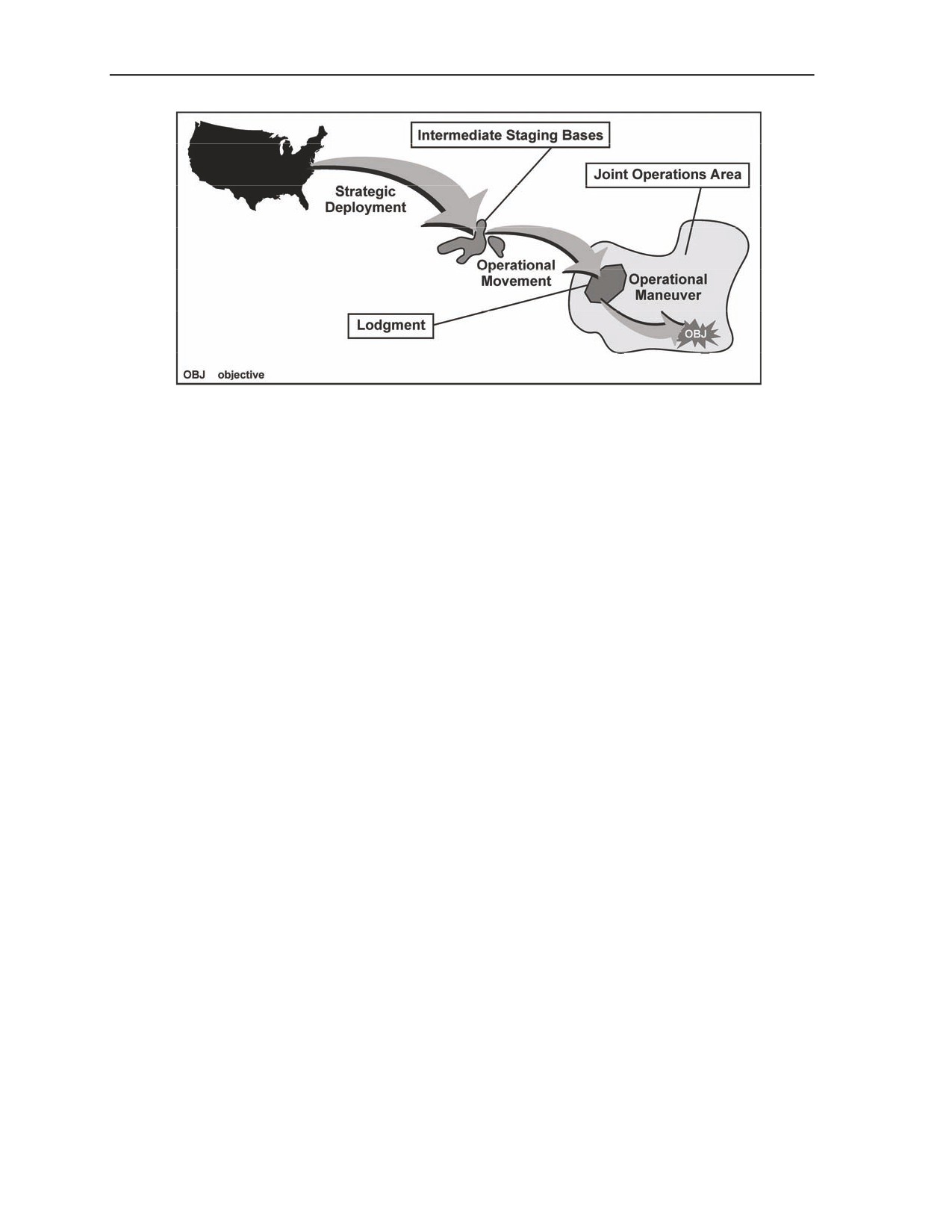
Chapter 4
FIGURE 4-4 BASING
DISTRIBUTION
4-94. Distribution is the key component for executing sustainment. It is based on a distribution system
defined as that complex of facilities, installations, methods, and procedures designed to receive, store, maintain,
distribute, and control the flow of military materiel between point of receipt into the military system and point
of issue to using activities and units.
4-95. The Joint segment of the distribution system is referred to as global distribution. It is defined as the
process that synchronizes and integrates the fulfillment of joint requirements with the employment of joint
forces. It provides national resources (personnel and materiel) to support the execution of joint operations. The
ultimate objective of the process is the effective and efficient accomplishment of joint operations. The Army
segment of the distribution system is theater distribution. Theater distribution is the flow of equipment,
personnel, and materiel within theater to meet the CCDR’s mission. The theater segment extends from the
ports of debarkation or source of supply (in theater) to the points of need (Soldier) (FM 4-01.4).
4-96. Theater distribution is enabled by a distribution management system. Distribution management is the
function of synchronizing and coordinating a complex of networks
(physical, communications,
information, and resources) and the sustainment WFF (logistics, personnel services, and HSS) to achieve
responsive support to operational requirements. Distribution management includes the management of
transportation and movement control, warehousing, inventory control, materiel handling, order administration,
site and location analysis, packaging, data processing, accountability for people and equipment, and
communications. It involves activities related to the movement of materiel and personnel from source to end
user, as well as retrograde operations.
DISTRIBUTION MANAGEMENT CENTER (DMC)
4-97. Theater distribution management is conducted by the DMCs located within the support operations
(SPO) section of the TSC and ESC. The DMC develops the theater distribution plan and monitors distribution
performance in coordination with strategic distribution process owners and the support operations staffs in Sust
Bdes and BSBs, This coordination ensures timely movement and retrograde of sustainment within the CCDR’s
area of responsibility. The DMC coordinates distribution with the HRSC and ASCC G-4/G-1/G-8 to ensure
personnel and resources are linked. It exercises staff supervision of movement control units in a theater.
4-98. The DMC orchestrates the distribution of all classes of supply and manages all aspects of theater
distribution by maintaining visibility of requirements, managing the capacity of the system, and controlling the
execution of distribution operations. The DMC considers the impact of unit movement requirements on the
distribution system. It provides current information on location of mode assets and movement of critical
4-16
FM 4-0
30 April 2009
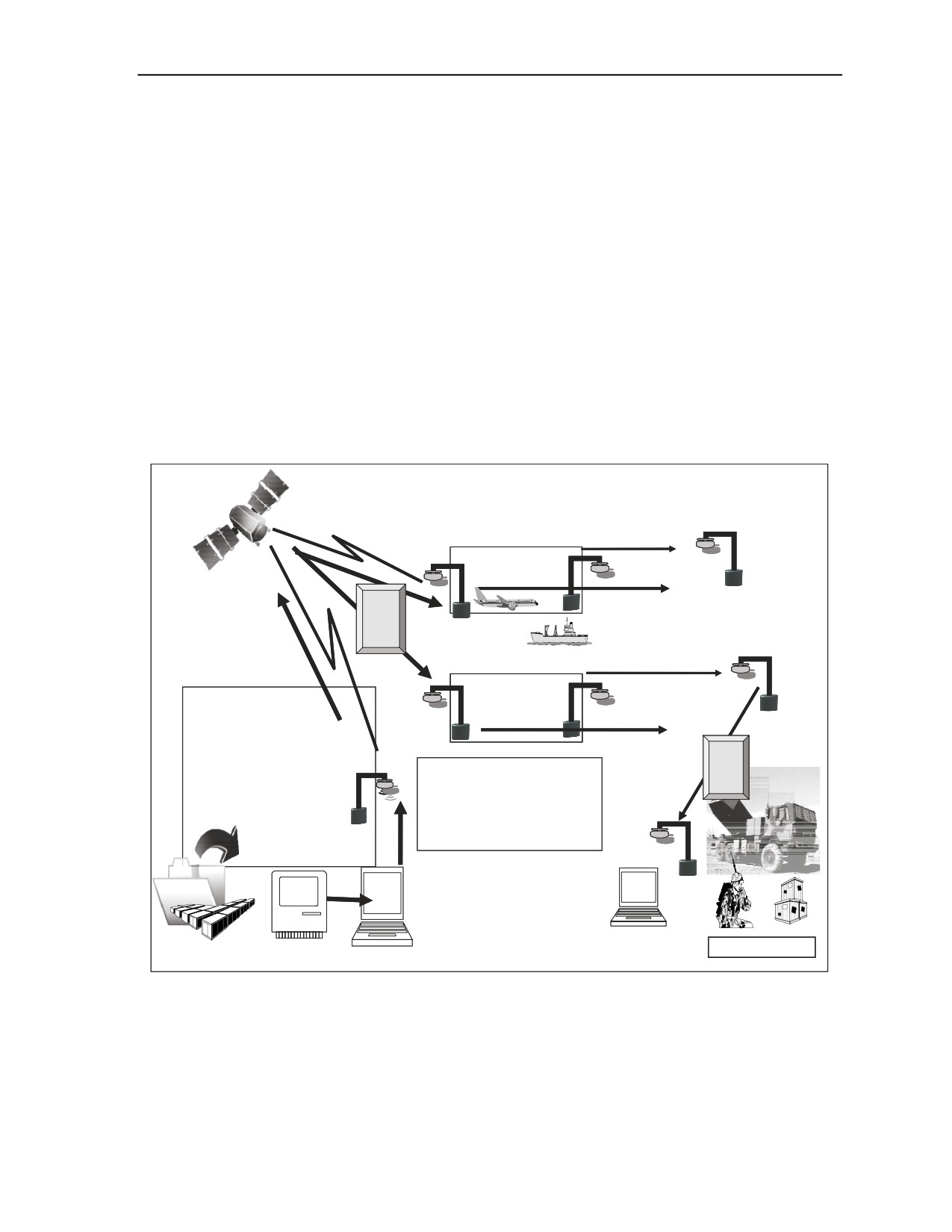
Integrating Sustainment into Operations
supplies along main supply routes. They provide staff recommendations to direct, redirect, retrograde, and
cross-level resources to meet the distribution mission and user mission requirements.
4-99. The distribution management of medical materiel is accomplished by a support team from the MLMC.
The MLMC support team collocates with the DMC of the TSC/ESC to provide the MEDCOM (DS) with
visibility and control of all Class VIII.
IN-TRANSIT VISIBILITY (ITV)
4-100. ITV is the ability to track the identity, status, and location of DOD units, and non-unit cargo
(excluding bulk petroleum, oils, and lubricants) and passengers; patients and personal property from origin to
consignee, or destination across the range of military operations (JP 3-35). This includes force tracking and
visibility of convoys, containers/pallets, transportation assets, other cargo, and distribution resources within the
activities of a distribution node.
4-101. Visibility begins at the point where personnel and materiel enter the distribution system. Data
concerning personnel and materiel are entered into the appropriate automated system. This data is updated by
subsequent ITV systems until it reaches its final destination (automation systems are listed in Appendix A). The
information is accessible to all users regardless of the military service or echelon of command. Figure 4-5
shows the ITV process.
Intransit Visibility Architecture
APOE
Node
Air
APOD
RF
TAG
Supply
EE22
Activity
In-Transit
SPOE
Satellite/Feed
Node
Sea
Tag Point/of Origin
SPOD
Depot/Container/Vendor
RF
Shipments of supplies will move
TAG
Consolidation Point/
from the depot, CCP, or vendor
(CCP)
to the POE.
The RF tags will be read when
READ/WRITE
they arrive at the POD, Supply
STATION
Point Activity and the Unit.
Unit
In-Storage
In-Theater
Figure 4-5. ITV Architecture
4-102. ITV provides the distribution manager the ability to assess how well the distribution process is
responding to supported force needs. Distribution managers gain and maintain visibility (items, personnel,
units, transition hubs, and transport modes) at the earliest practical point in the management process. This
allows managers to operate with timely information. ITV of personnel and materiel is continuous throughout
the distribution process.
30 April 2009
FM 4-0
4-17
Chapter 4
RETROGRADE OF MATERIEL
4-103. Retrograde of materiel is the return of materiel from the owning/using unit back through the
distribution system to the source of supply, directed ship-to location and/or point of disposal (FM 4-01.4).
Retrograde includes turn-in/classification, preparation, packing, transporting, and shipping. To ensure these
functions are properly executed, commanders must enforce supply accountability and discipline and utilize the
proper packing materials. Retrograde of materiel can take place as part of theater distribution operations and as
part of redeployment operations. Retrograde of materiel must be continuous and not be allowed to build up at
supply points/nodes.
4-104. Early retrograde planning is essential and necessary to preclude the loss of materiel assets, minimize
environmental impact, and maximize use of transportation capabilities. Planners must consider environmental
issues when retrograding hazardous materiel.
4-105. Contractor or HNS may be used in the retrograde of materiel. This support is planned and negotiated
early in the operation. HNS must be identified early enough to ensure they are properly screened and present no
security risk. Leaders at all levels are responsible for the adherence of all policies and safety measures by
contractors and HNS.
4-106. The theater distribution system provides the ASCC the ability to monitor and manage retrograde
materiel through the system. Retrograde materiel flows through the distribution system in the reverse order
from the tactical to strategic levels. Retrograde materiel is consolidated at the lowest supply support activity
(SSA) and reported up through the support operations for distribution instructions. When released by the
maneuver commander, USAMC assumes responsibility for providing disposition instructions, accounting, and
shipment of retrograde materiel from the theater.
4-107. An approved military customs inspection program must be in place prior to redeployment to pre-clear
not only redeployment materiel but also the shipment of battle damaged equipment out of theater. The ASCC is
responsible for establishing the customs inspection program to perform U.S. customs pre-clearance and United
States Department of Agriculture inspection and wash down on all materiel retrograded to the United States in
accordance with DOD 4500.9-R.
IN-THEATER RECONSTITUTION
4-108. In-theater reconstitution is extraordinary actions that commanders take to restore a degraded
unit to combat effectiveness commensurate with mission requirements and available resources. In-theater
reconstitution should be considered when the operational tempo, mission, or time, does not allow for
replacements by an available unit. Reconstitution requires both generating and operating force involvement.
Generally it should be conducted in a relatively low stress environment.
4-109. The combat readiness of the unit, mission requirements, risk, and the availability of a replacement unit
are the keys for considering reconstitution operations. Commanders must closely evaluate the combat
worthiness of a unit to determine whether a reconstitution operation should be ordered. He/She must also
decide what type of reconstitution effort would be best for the organization based on METT-TC factors. The
three major elements of in theater reconstitution are reorganization, regeneration, and rehabilitation.
REORGANIZATION
4-110. Reorganization is action to shift resources within a degraded unit to increase its combat
effectiveness. Commanders of all types of units at each echelon may conduct reorganization. Reorganization
may be conducted when the operational tempo is such that the risk for removing a unit from the operation may
jeopardize the mission. Depending on METT-TC factors there are two types of reorganization operations,
immediate and deliberate.
Immediate Reorganization
4-111. Immediate reorganization is the quick and usually temporary restoring of degraded units to minimum
levels of effectiveness. Normally the commander implements immediate reorganization in the combat position
4-18
FM 4-0
30 April 2009
Integrating Sustainment into Operations
or as close to that site as possible to meet near term needs. Immediate reorganization consists of cross leveling
personnel and equipment, matching weapon systems to crews, or forming composite units (joining two or more
attrited units to form a single mission-capable unit).
Deliberate Reorganization
4-112. Deliberate reorganization is conducted when somewhat more time and resources are available. It
usually occurs farther away from hostile activity than immediate reorganization. Procedures are similar to those
for immediate reorganization. However, some replacement resources may be available. Also, equipment repair
is more intensive and more extensive cross-leveling is possible.
REGENERATION
4-113. Regeneration is the rebuilding of a unit. It requires large-scale replacement of personnel,
equipment, and supplies. These replacements may then require further reorganization. Regeneration involves
reestablishing or replacing the chain of command and conducting mission essential training to get the
regenerated unit to standard. Because of the intensive nature of regeneration, it occurs at a designated
regeneration site after the unit disengages from operations. The regeneration site is normally situated in a
relatively secure location.
4-114. Regeneration requires help from higher echelons and may include elements from the generating force,
contract support, and HNS. Since regeneration typically requires large quantities of personnel and equipment,
commanders carefully balance these needs against others in the command as well as the mission.
REHABILITATION
4-115. Rehabilitation is the processing, usually in a relatively quiet area, of units or individuals recently
withdrawn from combat or arduous duty, during which units recondition equipment and are rested, furnished
special facilities, filled up with replacements, issued replacement supplies and equipment, given training, and
generally made ready for employment in future operations (JP 1-02).
4-116. Rehabilitation will most likely require similar high levels of support to execute. The main difference is
that rehabilitation may occur when time is not a critical factor. If the conditions are such that forces will rotate
in and out of operations on a regular basis, commanders may choose to establish a semi-permanent
rehabilitation site.
SUSTAINMENT OF IN-THEATER RECONSTITUTION OPERATIONS
4-117. Regardless of the type of reconstitution operation, sustainment of the operation will be intense.
Reconstitution of a unit will require involvement by most, if not all, of the sustainment functions to execute.
Logistics support will require a full range of capabilities including field services, maintenance, supply,
transportation, contract support, and general engineering. From a personnel service perspective, the full range
of HRS will be required in addition to FM, legal, and religious support. Likewise, robust medical support will
be required and in some circumstances combat and operational stress control may be a key element.
4-118. The Sust Bde will be crucial to providing the logistical support to reconstitution. It may require
support from the AFSB, CSB, and USAMC capabilities to provide the full range of required sustainment. The
MEDCOM (DS) will be the sustainment organization responsible for AHS support.
SUSTAINMENT OF INTERNMENT RESETTLEMENT OPERATIONS
4-119. The Army is DOD‘s EA for all detainee operations. Additionally, the Army is DOD‘s EA for long-
term confinement of U.S. military prisoners. I/R operations are defined as operations that take or keep selected
individuals in custody or control as a result of military operations to control their movement, restrict their
activity, provide safety, and/or gain intelligence (FM 3-19.40).
4-120. I/R operations comprise those measures necessary to guard, protect, sustain, and account for people
that are captured, detained, confined, or evacuated from their homes by the U.S. armed forces. I/R operations
30 April 2009
FM 4-0
4-19
Chapter 4
require detailed advanced planning to prevent the degradation of operational momentum while providing a safe
and secure environment for prisoners. U.S. policy mandates that all individuals captured, interned, evacuated,
or held by U.S. armed forces are treated humanely. This policy applies from the moment they are under the
control of U.S. armed forces until they are released, repatriated, or resettled.
4-121. The Army MPs are tasked with coordinating shelter, protection, accountability, and sustainment for
detainees. I/R functions, though under the sustainment WFF, address MP roles when managing detainees and
dislocated civilians during operations.
4-122. Sustainment to I/R operations involves a wide range of support including logistics, personnel services,
and medical treatment to detained persons. It encompasses providing all classes of supplies and materiel, health
and personnel services, and general engineering support. General engineering provides horizontal and vertical
construction, as well as repair and maintenance of the infrastructure (see FM 3-34.400).
•
Personnel services include the FM of negotiable instruments of applicable detainees. They also coordinate
for payroll, disbursement, and repatriation settlement processing (see FM 1-06).
• The Judge Advocates monitor the treatment of detainees ensuring that U.S. Soldiers are adhering to the
applicable standards for detainee treatment.
•
The chaplain or unit ministry team assists the commander in providing religious support for
I/R operations. The chaplain or UMT: serves as the chaplain for detention facility personnel,
which does not include detainees, advises the commander on detainee religious issues and
support, serves as a moral and ethical advisor to the Detention Facility Commander,
exercises supervision and control over Retained Personnel religious leaders within the
facility, and is prohibited from privileged communications with detainees.”
• AHS support ensures personnel in U.S. custody receive medical care consistent with the standard of
medical care that applies to U.S. armed forces in the same area. Medical personnel are responsible for the
health care of the interred and resettled population. Preventative medicine personnel inspect water for
potability, conduct pest management activities, ensure food service facilities meet sanitation requirements,
inspect facilities for sanitation, and monitor communicable diseases.
ASSESSING THE SUSTAINMENT OF OPERATIONS
4-123. Assessment is the continuous process that occurs throughout the operations process. Sustainment
commanders and staffs monitor and evaluate the current situation and the progress of the operation and
compare it with the concept of support, mission, and commander’s intent. Based on their assessment,
commanders direct adjustments to sustainment operations, ensuring that they remain focused on the mission
and commander’s intent.
4-124. The primary tools for assessing are the staff running estimates (see FM 6-0). A running estimate is a
staff section’s continuous assessment of current and future operations to determine if the current operation is
proceeding according to the commander’s intent and if future operations are supportable (see FM 3-0, FM 5-0,
and FMI 5-0.1).
4-125. During planning, assessment focuses on understanding the current condition in the operational
environment and developing relevant courses of action. During preparation and execution, it emphasizes
evaluating progress toward the desired end state determining variance from expectation and determining the
significance of these variances.
SUMMARY
4-126. Integrating the many elements of sustainment into operations is essential for mission success. The
operations process of planning, preparation, execution, and assessment applies to sustainment in support of full
spectrum operations.
4-127. Sustainment commanders integrate and synchronize sustainment with the operations plan.
Sustainment commanders across all levels of war prepare to effectively execute the plan. Commanders must
follow procedures to prepare for the execution of the operation. One of the means for preparation is sustainment
4-20
FM 4-0
30 April 2009
Integrating Sustainment into Operations
preparation of the operational environment. This may entail host nation agreements, cross-service
arrangements, and contracting. Other preparations include prepositioned stocks, facilities, ports, medical
preparations, and an array of rehearsals. The execution of sustainment includes the deployment and distribution
processes.
4-128. Integration of sustainment into operations optimizes operational reach and endurance. Distribution is
the largest single process in the execution of sustainment operations and is controlled through distribution
management centers and in-transit visibility enablers. The continual assessment of sustainment operations
ensures mission success and allows commanders to adjust to changing situations as required.
30 April 2009
FM 4-0
4-21
Chapter 5
Functions of Sustainment
This chapter explains in greater detail, the functional elements of the sustainment
WFF. The sustainment WFF is the related tasks and systems that provide support and
services to ensure freedom of action, extend operational reach, and prolong
endurance. This chapter explains the basic building blocks of sustainment, with its
elements, fundamentals, and main activities. The broad functional areas were outlined
and defined in Chapter 1.
SUPPLY AND FIELD SERVICES
5-1. Supply and Field Services are essential for enhancing Soldiers quality of life. Supply provides the materiel
required to accomplish the mission. Field service provides life support functions, including field laundry,
showers, light textile repair, FP, MA, aerial delivery support, food services, billeting, and sanitation.
FUNDAMENTALS OF SUPPLY OPERATIONS
5-2. Supply operations include the requisitioning, receipt, storage, issue, distribution, protection, maintenance,
retrograde, and redistribution of supplies. Levels of supply are broadly classified under the levels of war as
tactical, operational, and strategic.
z
Tactical level supplies are those items provided to and carried within each maneuver or support
brigade to sustain operational endurance. They also consist of those supplies held by Sust Bdes
to provide area support.
z
Operational supplies are theater stocks positioned to replenish tactical stocks, when strategic
replenishment is not feasible.
z
Strategic supplies are items under the control of strategic managers and are available for
worldwide materiel release. These supplies are considered inventory in motion and part of the
distribution system.
5-3. Supply operations with total asset visibility enablers merge the tactical, operational, and strategic levels
into a seamless supply system. The automated management systems allow units to place their requests and
assists sustainment units in providing responsive support in a timely manner. Table 5-1 lists the U.S classes of
supply.
5-4. While munitions is a class of supply, it is unique due to the complexities of activities associated with its
handling. Munitions are a dominant factor in determining the outcome of full spectrum operations. Munitions
provide the means to defeat and destroy the enemy. Planning munitions support is considered and
synchronized from strategic to tactical levels. The results of planning and integrating munitions operations is to
ensure munitions arrive in the right quantities and proper types where and when needed.
5-5. The ASCC has overall responsibility for in-theater receipts, accountability, and management of munitions
stocks. The ASCC is also responsible for establishing a Theater Support Area and Ammunition Supply Points
(ASPs). It is also responsible for coordinating distribution between storage sites, forward Ammunition Transfer
and Holding Point (ATHP), and direct issue to using units on an area support basis.
5-6. The ASP is run by an ordnance company assigned to a sustainment brigade. ASPs receive, store, issue, and
maintain a one- to three-day supply of ammunition to meet a routine surge and emergency requirements for
supported units. ASP stockage levels are based on tactical plans, availability of ammunition, and the threat to
the supply operations.
30 April 2009
FM 4-0
5-1