FM 1-04 LEGAL SUPPORT TO THE OPERATIONAL ARMY (MARCH 2013) - page 3
Chapter 11
claims, and legal assistance. Given the high demand for CA personnel in current operations, CJAs assigned
to CA units are well versed in preventive law and Soldier readiness processing. They are also prepared to
provide predeployment training to CA forces. This training should include: law of war, human rights
violations and reporting requirements, rules of engagement, military justice, legal assistance, and, if
applicable, pertinent information concerning status-of-forces agreements.
11-8. In a deployed environment, the CJA provides the commander with expertise and insight on the legal
aspects of civil affairs operations. This may include supporting activities designed to rebuild, reform, or
assist in the administration of the judicial sector of a host nation. Judge advocates assigned to CA
functional specialty teams provide legal expertise to commanders. Within each functional specialty area,
technically qualified and experienced individuals, known as CA functional specialists, also advise and
assist the commander and may assist or direct their civilian counterparts at the operational and strategic
levels. For more information on CA functional specialty teams and CA organizations, see FM 3-57.
11-9. In virtually all cases, CA units are task organized to other commands. These commands will
routinely have organic legal support. While not working directly for the staff judge advocate (SJA) of the
supported command, the CJA still coordinates with the SJA for legal oversight, technical guidance, and
information sharing purposes. (See chapter 4.) In the event that the other commands create rule of law
teams, the SJA and the CJA facilitate bringing the CA judge advocates responsible for supporting rule of
law operations into the existing rule of law operations structure. Effective communications between the
CJA and the SJA is critical as it ensures that both individuals maintain situational understanding and
ultimately provide synchronized and mutually supporting legal support in an often dynamic operational
environment.
11-10. CJAs assigned to CA units are responsible for providing accurate legal advice to the commanders
and staffs of CA units and CA-based joint task forces, and to the members of the functional specialty teams
as they carry out their missions. Due to the nature of the CA mission, judge advocates assigned to CA units
will need to be particularly competent in issues of fiscal law, humanitarian assistance, security assistance,
and host-nation support.
CIVIL AFFAIRS OPERATIONS
11-11. Civil affairs operations are those military operations conducted by civil affairs forces that (1)
enhance the relationship between military forces and civil authorities in localities where military forces are
present; (2) require coordination with other interagency organizations, intergovernmental organizations,
nongovernmental organizations, indigenous populations and institutions, and the private sector; and (3)
involve application of functional specialty skills that normally are the responsibility of civil government to
enhance the conduct of civil-military operations (JP 3-57). CA forces plan, support, execute, or transition
these military operations to modify behaviors, mitigate, or defeat threats to civil society, and assist in
establishing the capacity for deterring or defeating future civil threats in support of U.S. objectives. Forces
conduct these operations through, with, or by the indigenous population and institutions, intergovernmental
organizations, nongovernmental organizations, or other government agencies. The five core tasks of CA
operations are:
z
Support to civil administration.
z
Populace and resources control.
z
Foreign humanitarian assistance.
z
Nation assistance.
z
Civil information management.
11-12. CA operations contain a number of unique legal and cultural issues. The following list outlines
many of the major duties and responsibilities of CJAs supporting CA operations:
z
Assisting in the preparation and reviewing of CA plans for consistency with the law as well as
any strategic and operational planning.
z
Preparing the legal section of the CA area study and assessment.
z
Providing predeployment CA training as required.
11-2
FM 1-04
18 March 2013
Civil Affairs Units
z
Providing guidance on—
Population control measures.
Targeting to minimize unnecessary collateral damage or injury to the civilian population.
Treatment of dislocated civilians, civilian internees, and detainees.
Requests for political asylum and refuge.
Acquisition of private and public property for military purposes.
Military information support operations and their effects on the civilian populace.
z
Providing advice on and disposing of claims submitted by local civilians.
z
Providing advice on the jurisdiction of local courts over U.S. military personnel and activities.
z
Providing advice on humanitarian and civic assistance issues.
z
Providing advice on disaster relief.
z
Assisting in the creation and supervision of military tribunals and other activities for the proper
administration of civil law and order.
z
Assisting civil administration activities, including—
The establishment and operation of local judicial and administrative agencies.
The closing and reopening of local courts, boards, agencies, and commissions.
Defining the jurisdiction, organization, and procedures of local government institutions.
11-13. One of the principal missions of CA judge advocates is to support rule of law operations. Rule of
law is the main focus for those judge advocates assigned to one of the rule of law functional specialty
teams. For more information on rule of law, see chapter 10.
18 March 2013
FM 1-04
11-3
Chapter 12
Defense Support of Civil Authorities Operations
This chapter provides a synopsis of legal principles to consider in defense support of
civil authorities operations. Given their complex and fact-specific nature, defense
support of civil authorities operations require planners and Judge Advocate General’s
Corps personnel to work closely to ensure operations do not violate Federal law, state
law, or international treaties.
OVERVIEW
12-1. State and local governments have the primary responsibility for protecting life and property and
maintaining law and order in the civilian community. Supplementary responsibility is vested by statute in
specific agencies of the U.S. Government other than the Department of Defense (DOD). Defense support of
civil authorities is defined as support provided by US Federal military forces, Department of Defense
civilians, Department of Defense contract personnel, Department of Defense component assets, and
National Guard forces (when the Secretary of Defense, in coordination with the governors of the affected
states, elects and requests to use those forces in Title 32, United States Code, status) in response to requests
for assistance from civil authorities for domestic emergencies, law enforcement support, and other domestic
activities, or from qualifying entities for special events (DODD 3025.18).
12-2. Defense support of civil authorities includes operations that address the consequences of natural or
man-made disasters, accidents, terrorist attacks, and incidents in the United States and its territories. The
military’s role in defense support of civil authorities operations is well defined and is limited by Federal
law and regulation in scope and duration. Based on the limited authorities and express limitations placed on
scope of the military’s role, U.S. personnel should know the legal considerations. Furthermore, Judge
Advocate General’s Corps (JAGC) personnel should integrate themselves into the planning process to
ensure staff plans properly account for the parameters set forth by U.S. laws and DOD directives. In so
doing, these legal restrictions will serve as critical screening criteria during course of action development,
analysis, comparison, and approval. More detailed information on defense support of civil authorities
operations and the role of the judge advocate in support of these missions can be found at FM 3-28 and the
Domestic Operational Law Handbook for Judge Advocates.
AUTHORITY OF A STATE GOVERNOR
12-3. Governors serve as commanders in chief of their state National Guard forces and may assume special
powers upon the declaration of a disaster, emergency, enemy attack, or riot. The authority of the governor
is circumscribed or limited by United States Code (USC) and each state’s law and statutes.
12-4. Governors also issue executive orders declaring “states of emergency” and ensure that state agencies
plan for actions in the event of a disaster. Once a disaster occurs, the governor determines how to respond
to a local government’s request for assistance. If appropriate, the governor declares a state of emergency,
activates the state response plan, and may call up the National Guard under the governor’s own authority
for state active duty or with Secretary of Defense approval under Section 502(f) of Title 32, USC. The
governor gives the National Guard its missions and determines when to withdraw National Guard forces.
AUTHORITIES FOR FEDERAL MILITARY SUPPORT
12-5. The U.S. military has provided support to civil authorities in response to civil emergencies and
natural disasters throughout its history. While defense support of civil authorities (DSCA) is the current
terminology used to describe this function, the terminology—military assistance or military support to civil
18 March 2013
FM 1-04
12-1
Chapter 12
authorities, military support of civil defense, and employment of military resources in natural disaster
emergencies within the United States—has varied over the years. The change in terminology reflects the
evolving changes in authorities granted to DOD by the President and the Congress.
12-6. The primary authorities to provide DSCA reside with the President and the Secretary of Defense. The
President derives Constitutional, inherent, and statutory authorities from Articles II and IV of the
Constitution, Supreme Court case law, and Federal statutes such as the Stafford Act (see paragraph 12-7
and 12-8). The Secretary of Defense derives his authority from Federal statutes.
THE ROBERT T. STAFFORD DISASTER RELIEF AND EMERGENCY ASSISTANCE ACT
12-7. The Robert T. Stafford Disaster Relief and Emergency Assistance Act (known as the Stafford Act) is
the primary federal statute giving the President the authority to direct federal agencies to provide assistance
to state and local authorities during an incident. The purpose of this assistance is to save lives, alleviate
human suffering, protect public health and safety, and lessen or avert the threat of a catastrophe. The
Stafford Act allows four ways for the President to provide federal—including military—support to civil
authorities. Within these four categories, military support may include aviation, communications,
engineering, logistical, medical, public affairs, and other capabilities.
12-8. The President provides Federal support by declaring a major disaster, declaring an emergency, or
exercising DOD ten-day emergency work authority. These three categories require a request from the
governor of the affected state before the President can initiate assistance. The differences between the two
declarations involve the types of events covered, amount of Federal assistance provided, duration, and
degree of damage. Finally, the President may, without a request for assistance from a governor, unilaterally
issue an emergency declaration and send federal assets, including federal military forces, to an area or
facility over which the federal government exercises exclusive or primary responsibility by virtue of the
Constitution or a federal statute. This may include federal missions, personnel, equipment, and property.
AUTHORITY OF THE SECRETARY OF DEFENSE
12-9. The Secretary of Defense, subject to the direction of the President, has the statutory authority to
direct and control DOD. The Secretary of Defense also has the statutory authority to issue regulations to
manage federal military personnel, property, and facilities. This includes the authority to delegate to
subordinate officials the authority vested in the Secretary of Defense. Under these authorities, the Secretary
of Defense has issued DOD directives pertaining to defense support of civil authorities, such as
DODD 3025.18. The Secretary of Defense designated the Assistant Secretary of Defense for Homeland
Defense and Americas’ Security Affairs as the DOD domestic crisis manager (see DODD 5111.13). The
Assistant Secretary of Defense for Homeland Defense and Americas’ Security Affairs has policy, planning,
advice, and approval authority for defense support of civil authorities operations. The Secretary of Defense
retains the authority for civil disturbance and chemical, biological, radiological, nuclear, and high-yield
explosives incidents; direct support to civilian law enforcement agencies; and the use or potential use of
lethal force by federal military forces.
Immediate Response Authority
12-10. Immediate response authority provides authority for installation commanders, DOD component
heads, or responsible DOD civilian officials to temporarily employ resources under their control, subject to
any supplemental direction provided by higher headquarters, and provide those resources to save lives,
prevent human suffering, or mitigate great property damage in response to a request for assistance from a
civil authority, under imminently serious conditions when time does not permit approval from a higher
authority within the United States. Immediate response authority does not permit actions that would subject
civilians to the use of military power that is regulatory, prescriptive, proscriptive, or compulsory.
12-11. This authority is derived from the Secretary of Defense’s statutory authority and authorized in
DODD 3025.18. Further information regarding the use of this authority involving requirements for
immediate notification, reassessment of continued response, and cost reimbursement are contained in
DODD 3025.18. Additionally, this directive addresses state immediate response.
12-2
FM 1-04
18 March 2013
Defense Support of Civil Authorities Operations
Emergency Authority
12-12. DODD 3025.18 authorizes emergency authority for the use of military force, under certain dire
situations. This authority authorizes federal military commanders in extraordinary emergency
circumstances where prior authorization by the President is impossible and duly constituted local
authorities are unable to control the situation. Second, it authorizes commanders when they cannot engage
temporarily in activities that are necessary to quell large-scale, unexpected civil disturbances because: (1)
such activities are necessary to prevent significant loss of life or wanton destruction of property and are
necessary to restore government function and public order; or, (2) when duly constituted Federal, State, or
local authorities are unable or decline to provide adequate protection for Federal property or Federal
governmental functions.
12-13. Normally, federal military forces are not used to quell civil disturbances unless specifically
authorized by the President. Given the requirements necessary to utilize emergency authority, it is clear that
only under the most extreme circumstances will emergency authority apply. Further guidance on
emergency authority can be found at DODD 3025.18 and DODI 3025.21.
THE POSSE COMITATUS ACT
12-14. In common law, the Latin phrase “posse comitatus” refers to the authority wielded by the county
sheriff to deputize any able-bodied male over the age of fifteen to assist in keeping the peace or to pursue
and arrest a felon. U.S. marshals were also known to form a posse of able-bodied males to enforce Federal
law. Due to friction of the use of posse comitatus during the reconstruction era in the South after the
American Civil War, Congress passed the Posse Comitatus Act. The Act remains the primary Federal
statute restricting military support to civilian law enforcement. The Posse Comitatus Act, found at Section
1385 of Title 18, USC, states—
Whoever, except in cases and under circumstances expressly authorized by the
Constitution or Act of Congress, willfully uses any part of the Army or Air Force as a
Posse Comitatus or otherwise to execute the laws shall be fined under this title or
imprisoned not more than two years or both.
12-15. Although a plain reading of the Posse Comitatus Act reflects that it only applies to the Army and
Air Force, Section 375 of Title 10, USC, requires the Secretary of Defense to “prescribe regulations
restricting the use of equipment and the direct participation of Army, Navy, Air Force, or Marine Corps
personnel in supporting civilian law enforcement agencies unless otherwise authorized by law.” The statute
defines direct participation as “search, seizure, arrest or similar activity.” Consequently, through Section
375 of Title 10, USC, and resulting DOD directives, the Posse Comitatus Act applies to all U.S. forces, as
well as each of their respective Reserve Components serving in a Federal Title 10 status. The applicable
DOD directives/instructions are as follows:
z
DODD 3025.18, Defense Support of Civil Authorities.
z
DODI 3025.21, Defense Support of Civilian Law Enforcement Agencies.
12-16. The Posse Comitatus Act does not apply to the Coast Guard except during times of war when
under the command and control of the Navy (Title 14).
12-17. Whether the Posse Comitatus Act applies to Army or Air National Guard personnel depends upon
the Soldier’s or airman’s duty status. National Guard personnel may be ordered to duty under one of three
statutory frameworks: Title 10, Title 32, and State active duty.
12-18. When in a Title 10 status, National Guard personnel are federally funded and under Federal
command and control. Consequently, they are subject to the Posse Comitatus Act.
12-19. When in a Title 32 status, National Guard personnel are federally funded but remain under the
control of the state. Although federally funded, because National Guard members in a Title 32 status fall
under state control, they do not fall under the posse comitatus restrictions and may perform those law
enforcement duties authorized by state law.
12-20. National Guard personnel performing state active duty missions are state-funded and under state
control. This is typically the status in which National Guard personnel perform duties when a governor
18 March 2013
FM 1-04
12-3
Chapter 12
“calls out the National Guard” to respond to emergencies, civil disturbances, or disasters or to perform
other duties authorized by state law. The Federal government may reimburse costs associated with a state
active duty response pursuant to a Presidential major disaster or emergency declaration. National Guard
personnel on state active duty status do not fall under posse comitatus restrictions and may perform those
law enforcement duties authorized by state law.
12-21. Civilian employees of the military are only subject to the prohibitions of the Posse Comitatus Act
if they are under the direct command and control of a servicemember in a Title 10 status.
12-22. Posse Comitatus Act restrictions applying to the Federal military personnel through Section 375 of
Title 10, USC, and implementing directives (see DODI 3025.21) prohibit the following forms of direct
assistance:
z
Interdiction of a vehicle, vessel, aircraft, or other similar activity.
z
Search or seizure.
z
Arrest, apprehension, and stop and frisk.
z
Surveillance or pursuit of individuals or as undercover agents, informants, investigators, or
interrogators.
12-23. Sections 371-382 of Title 10, USC, and DOD directives allow various forms of indirect assistance
to civilian law enforcement agencies such as—
z
Sharing information collected during the normal course of military training or operations.
z
Using military equipment.
z
Training and advising on use of equipment.
z
Providing personnel for maintenance and operation of equipment.
z
Providing weapons of mass destruction support.
12-24. DODI 3025.21, Enclosure 3, states that the following forms of direct assistance are not prohibited
by the Posse Comitatus; therefore, they are considered exceptions to the Act:
z
Actions taken for the primary purpose of furthering a military or foreign affairs function of the
United States; also known as the “military purpose doctrine.” Such actions include—
Investigations and other actions related to the commander’s authority to maintain law and
order on a military installation or facility.
Protection of classified military information or equipment.
Protection of DOD personnel, DOD equipment, and official guests of the DOD.
z
Actions taken under emergency authority as authorized by DODD 3025.18. See paragraphs 12-9
through 12-13 for a discussion of this authority.
z
Actions taken pursuant to insurrection statutes (Sections 331-334 of Title 10, USC). These
statutes permit the President to use the armed forces to enforce the law under the following
circumstances:
There is an insurrection within a state and the state legislature (or governor, if the legislature
cannot be convened) requests assistance from the President.
Whenever the President considers that unlawful obstructions, combinations, or assemblages,
or rebellion against the authority of the U.S. make it impracticable to enforce the laws of the
U.S. by the ordinary course of judicial proceedings.
An insurrection or domestic violence opposes or obstructs Federal law, or so hinders the
enforcement of Federal or state laws that residents of the state are deprived of their
constitutional rights and the states are unable or unwilling to protect these rights.
z
Other actions taken under express statutory authority to assist officials in executing the laws,
subject to applicable limitations.
RULES FOR THE USE OF FORCE
12-25. Within the U.S. and its territories, Soldiers follow the rules for the use of force (RUF), not rules of
engagement (ROE). While ROE are permissive measures allowing the maximum use of force appropriate
12-4
FM 1-04
18 March 2013
Defense Support of Civil Authorities Operations
for the mission, RUF are restrictive measures intended to allow only the minimum amount of force
necessary to accomplish the mission. For more discussion of the RUF see chapter 7.
INTELLIGENCE OVERSIGHT
12-26. Intelligence oversight refers to the law and regulations that balance the Constitutional right of
individuals to privacy with the need for the federal government to collect intelligence for national security
purposes. Judge advocates must understand and ensure that commanders understand that DOD directives
and Service regulations restrict the military from collecting or possessing information on U.S. citizens,
whether individuals or groups. The following individuals and groups are protected by intelligence oversight
rules:
z
U.S. citizens.
z
Lawful permanent resident aliens.
z
Unincorporated associations substantially composed of U.S. citizens or permanent resident
aliens.
z
Corporations incorporated in the United States, except for those directed and controlled by a
foreign government.
12-27. Domestic operations are similar to missions conducted overseas in that they require situational
awareness for mission success. Overseas, intelligence assets normally provide this understanding. Judge
advocates must recognize that collecting domestic intelligence by necessity entails collecting information
on U.S. citizens. Therefore, the rules regarding intelligence collection in the U.S. must comply with
Constitutional protections against unlawful search and seizure. Judge advocates involved in planning or
executing defense support of civil authorities missions should not hesitate in seeking out expertise to assist
in this complicated area.
12-28. The restrictions put in place by intelligence oversight directly affect specific Army elements and
organizations conducting authorized intelligence activities. The following documents contain the core legal
authorities for intelligence oversight and must be read by judge advocates before advising commanders on
the collection of information in a domestic support operation:
z
AR 380-13, Acquisition and Storage of Information Concerning Non-Affiliated Persons and
Organizations.
z
AR 381-10, U.S. Army Intelligence Activities.
z
DOD 5240.1-R, Procedures Governing the Activities of DOD Intelligence Components that
Affect United States Persons.
z
DODD 5200.27, Acquisition of Information Concerning Persons and Organizations not
affiliated with the Department of Defense.
z
DODD 5240.01, DOD Intelligence Activities.
z
Executive Order 12333 (1981), United States Intelligence Activities, as amended by Executive
Order 13470 (2008).
z
Foreign Intelligence Surveillance Act of 1978 (Public Law 95-511).
z
National Security Act of 1947.
z
U.S. Constitution.
12-29. Airborne sensors and unmanned aircraft systems pose particular challenges for intelligence
oversight. These systems provide commanders and civil authorities with powerful tools to help them assess
the situation on the ground, particularly in the initial stages of response. However, information gathered by
these systems can conflict with the intelligence oversight restrictions. See DODD 3025.18 for additional
guidance on the use of unmanned aircraft systems in defense support of civil authorities operations.
SENSITIVE INFORMATION
12-30. Any information acquired on individual citizens and specific civilian organizations by military
intelligence personnel and capabilities or by DOD law enforcement antiterrorism or personnel protecting
the force is extremely sensitive. Its collection must be authorized, and all information collected must be
18 March 2013
FM 1-04
12-5
Chapter 12
provided directly to the supported law enforcement agency, unless separate exceptions exist permitting
retention by the DOD. Otherwise, the military unit may not retain it. Sensitive information includes
criminal intelligence generated by civilian law enforcement agencies and passed to military units involved
in defense support of civil authorities; similarly it includes information and reports from Soldiers who
witness what they believe to be criminal activity.
12-31. There are legal restrictions on using information about individuals and organizations physically
located within the United States and its possessions unless they are part of DOD (military, civilian, or
contractor). The core regulations pertaining to these restrictions are DODD 5200.27 and AR 380-13. The
restrictions on the use of law enforcement information govern the activities of all members of DOD
(uniformed members and civilians).
SHARING INFORMATION
12-32. Because of these restrictions, commanders should ensure intelligence and sensitive information is
not only lawfully collected or acquired, but is also lawfully retained and disseminated. DOD operates under
the common Congressional mandate to ensure all agencies, including DOD, share homeland security and
homeland defense information and intelligence with the proper authorities to identify threats rapidly and
effectively. However, the process requires careful compliance with existing laws and regulations. The key
is to understand these requirements, their inherent complexities, and the requirement to protect civil rights.
JUDGE ADVOCATE RESPONSIBILITIES
12-33. Judge advocates know that all requests from civil authorities for assistance are evaluated for—
z
Legality - compliance with the law.
z
Lethality - potential use of lethal force by or against DOD forces.
z
Risk - safety of DOD forces.
z
Cost - including the source of funding and the effect on the DOD budget.
z
Appropriateness - whether providing the requested support is in the interest of the DOD.
z
Readiness - impact on the DOD’s ability to perform its primary mission.
12-34. Judge advocates advising commanders and staffs on defense support of civil authorities operations
must be familiar with the variety of legal issues that might arise. Equally important is the need for judge
advocates to know where to go to find answers. In addition to the statutes, policies, directives, regulations,
case law, field manuals, and other documentary sources, judge advocates should establish close working
relationships with the legal advisors of supporting agencies and organizations, all of whom can provide
expert assistance in resolving legal issues.
12-35. In conclusion, defense support of civil authorities is governed by different laws and regulations
than military operations conducted in foreign counties against a hostile force. Legal issues will often arise
and necessitate timely legal advice throughout a defense support of civil authorities operation. The
character of the Constitution and laws enacted by successive Congresses create a complicated legal
environment. Commanders and judge advocates should note that this chapter only provides a brief
introduction and summary. This chapter does not provide a comprehensive review of every requirement
and restriction. Commanders should always seek legal advice. Judge advocates should not hesitate in
coordinating to consult subject matter experts within the JAGC or other agencies if appropriate.
12-6
FM 1-04
18 March 2013
Chapter 13
Financial Management and Deployment Contracting
This chapter addresses the issues related to financial management and expeditionary
contracting in which judge advocates may become involved. Specifically, it discusses
the fiscal triad and deployment contracting.
OVERVIEW
13-1. Robust resource support to contingency operations forces, especially in the early stages of a
contingency operation, relies not only on the traditional stock-fund logistic supply system, but also on the
effective and efficient execution of theater procurement support. This execution is made possible by the
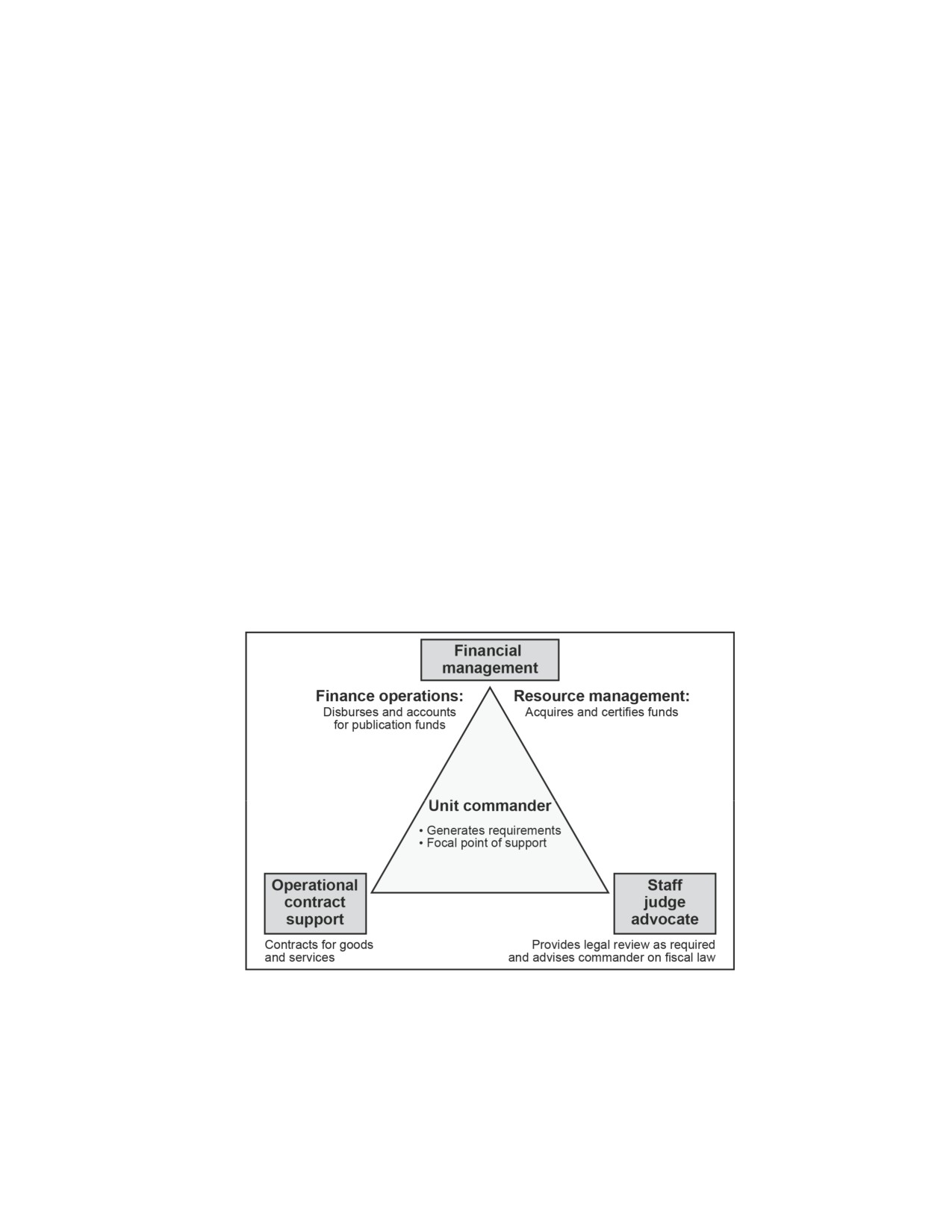
fiscal triad comprised of financial management, contracting, and legal counsel. See figure 13-1. The center
of the fiscal triad is the unit commander who generates mission requirements driving the procurement
process. All work in the procurement process is directed toward generating, sustaining, and preserving
combat power. The fiscal triad represents the legally-binding process that governs the critical path between
contracting and financial management for acquisition management, internal controls, and fiscal law
prescribed by the procurement process. Financial management, contracting, and legal counsel comprise a
system that fulfills required fiscal support, from the acquisition and certification of funds, to the legal
review of the proposed contracting action, to the contracting for goods and services, and finally to the
disbursing and accounting of public funds. See FM 1-06 for more details related to financial management
and the role of the fiscal triad.
Figure 13-1. Fiscal triad
FISCAL TRIAD
13-2. The fiscal triad is formed by the financial manager, the contracting agent, and the judge advocate.
Each member of the fiscal triad must coordinate to prevent fraud, waste, and abuse of government funds.
To ensure separation of duties, each element of the triad is independent, yet each element works closely
18 March 2013
FM 1-04
13-1
Chapter 13
with the other to obtain products or services to meet the commander’s needs in compliance with applicable
laws and regulations.
FINANCIAL MANAGER
13-3. The financial management mission is to ensure that proper financial resources are available to
accomplish the mission in accordance with commanders’ priorities. It is comprised of two mutually
supporting core functions, resource management and finance operations. Key resource management tasks
are providing advice and recommendations to the commander; identifying sources of funds; forecasting,
capturing, analyzing and managing costs; acquiring funds; distributing and controlling funds; certifying
funds, tracking costs and obligations, establishing and managing reimbursement processes; and establishing
and managing the Army Managers’ Internal Control Program. Key finance operations tasks are to provide
timely commercial vendor and contractual payments, various pay and disbursing services, oversee and
manage the Army’s Banking Program and to implement financial management policies and guidance as
prescribed by the Office of the Under Secretary of Defense
(Comptroller) and national financial
management providers. Fiscal law is of primary concern to financial managers. Failure to apply fiscal law
principles properly may lead to unauthorized expenditures of funds and consequently administrative or
criminal sanctions against those responsible.
CONTRACTING OFFICER
13-4. The contracting officer is the only authorized (warranted) procurement agent legally capable of
entering the U.S. Government into a contract.
LEGAL COUNSEL
13-5. Judge advocates at all command levels provide fiscal law and contracting advice to the commander
and conduct legal reviews of proposed contracts and other proposed procurement actions. As a member of
the fiscal triad, judge advocates can assist the commander, financial manager, and contracting officers by
proactively identifying resource requirements and shortfalls for units and the mission throughout the
operations process.
COORDINATION
13-6. Synchronization of the fiscal triad requires constant coordination. Measures to facilitate coordination
range from co-locating financial managers, contracting, and legal assets; conducting fiscal triad meetings at
a regular time; to participating in any pre-deployment site survey to establish initial procurement support
capabilities or coordinate with currently existing procurement assets in theater.
DEPLOYMENT CONTRACTING
13-7. Judge advocates are involved throughout the deployment contracting process. They play a key role in
the preparation for deployment and assist in handling any contracting issues that arise before, during, and
after the deployment.
PREPARATION FOR DEPLOYMENT
13-8. Deploying judge advocates are identified at the earliest possible time to ensure they receive the
contract and fiscal training necessary to succeed in their contingency mission. Such training includes the
contract attorney course offered by The Judge Advocate General’s Legal Center and School. Operational
commanders and their legal advisors recognize the impact of contracting and contractors in their
expeditionary operations and on their missions. Units develop plans to integrate contracting personnel and
teams into their organization and plan for deployment. Judge advocates should be especially alert for the
authorized use of emergency acquisition flexibilities in support of expeditionary operations. Whether
supported by a contracting support brigade or some other nonorganic organization, units plan and train the
other organizations to help meet the unit’s needs. Judge advocates should take the lead in advocating
expeditionary contracting preparation. Generally, the contracting element consists of contracting officers,
13-2
FM 1-04
18 March 2013
Financial Management and Deployment Contracting
field ordering officers, legal personnel, financial managers, pay agents, and logistic and other support
personnel.
13-9. Judge advocates review existing or proposed plans, paying particular attention to the financial
management tab to the Personnel Service Support appendix to the Sustainment annex. This annex—
z
Prescribes funding responsibility and financial management support, acquisition, and contracting
appendixes that should address the identification and training of contracting officer
representatives.
z
Ensures contracting and financial management assets are among the first deployed.
z
Evaluates the availability of any Reserve Components contracting assets.
z
Considers establishing an acquisition review board for major deployments.
13-10. Failing to adequately plan for and deploy contracting and financial management assets at the initial
stages increases the chances for procurement mistakes and abuse with long lasting, negative effects.
13-11. Judge advocates review combatant command policies and procedures, determine and seek
emergency acquisition flexibilities as appropriate, and establish contact with overseas and higher
headquarters’ contracting activities. If possible, they establish early contact with counterparts already in
combatant command completing contracting actions. Regardless of the existence of any prior deployment
to the area, they establish contact with higher headquarters contracting activities. These might include Joint
Theater Support Contracting Command, Army Contracting Command, Expeditionary Contracting
Command, Army Sustainment Command, Medical Command (Deployment Support) or Medical Brigade,
and Defense Contract Management Agency.
13-12. Unit predeployment funding concerns include the following:
z
Certified funding.
z
Government purchase cards.
z
Availability of funds.
z
Imprest funds.
A deployable unit coordinates to have funds certified as available in bulk to support deployment purchases.
13-13. Commanders can use government purchase cards during expeditionary contracting. Units should
remember that the funding tied to their credit card at home station will not remain the same during
deployments. Units coordinate to adjust the funding or receive separate charge cards through resource
management channels.
13-14. Judge advocates should assist in researching the availability of specific appropriations and
authorizations for the particular operation. Congress may provide specific funds for purposes not otherwise
routinely found for non-expeditionary Department of Defense missions. Provision of this funding authority
will depend on the operation.
13-15. For deployments into immature areas, commanders consider establishing an imprest fund in
advance of deployment notification. An imprest fund operates like a petty cash fund; it is replenished as
payments are made from it. The imprest fund should include local currency if available before deployment.
CONTRACTING DURING DEPLOYMENT
13-16. Competition is the law. Absent statutory authority, full and open competition is required by the
Competition in Contracting Act even during deployments overseas. Generally, the expected cost of the
goods or services required determines the extent of competition required. Most units in expeditionary
contracting use simplified acquisition procedures. Judge advocates should identify or request emergency
acquisition flexibilities, which may increase thresholds and otherwise streamline competition requirements.
Normally, higher headquarters handle large-scale acquisitions with specially trained contracting
professionals. Contracting officers work closely with contract law attorneys to ensure the required
contracting procedures are followed with respect to the funding source.
18 March 2013
FM 1-04
13-3
Chapter 13
13-17. Existing ordering agreements, indefinite delivery contracts, and requirements contracts may be
available to meet recurring requirements, such as fuel and subsistence items. Some of these standing
contracts include the civil augmentation programs (CAPs) and other existing contracts.
13-18. CAP is designed primarily for use where no treaties exist are standing, long-term external support
contracts designed to augment service logistic capabilities with contracted support in both preplanned and
short notice contingencies. Examples include Army Logistics Civil Augmentation Program, Air Force
Contract Augmentation Program, Navy Global Construction Capability Contract, and Navy Global
Contingency Service Contract. Contracting officers can use these contracts inside as well as outside the
continental United States. CAP is a service contract designed to provide sustainment, including base
operations support, for an arriving force in an austere environment. The funding restrictions applicable in
all other areas of procurement apply to the CAP contract as well. Commanders should use CAP judiciously
with command oversight of requirements, contractor performance, and surveillance.
13-19. Other existing contracts may also be available to meet a unit’s needs. Several statutory authorities
provide the flexibility to use other Army contracts or contracts through other government agencies. Judge
advocates may consider use of these other existing contracts.
13-20. New and existing contracts are not the only methods for meeting the needs of deployed military
forces. The military supply system is the most common source of supplies and services. Acquisition and
cross-servicing and host-nation support agreements exist with North Atlantic Treaty Organization
(commonly known as NATO), Korea, and other major U.S. allies. Finally, Secretaries of the Army, Navy,
and Air Force retain substantial residual powers they can use to meet critical requirements that cannot be
fulfilled using normal contracting procedures.
13-21. The Army is authorized to lease foreign real estate for military purposes. This authority is
delegated on an individual lease basis. Billeting services are acquired by contract, not lease. True leases
normally are completed by the Army Corps of Engineers using contingency real estate support teams.
EXPEDITIONARY CONTRACTING ISSUES
13-22. Only warranted contracting officers can legally bind the U.S. Government in contract. Contracting
officers may provide limited authority to field ordering officers to complete on-the-spot purchases under
the micropurchase threshold. This authority is limited to the terms specified by the contracting office. It
does not provide the field ordering officers any warranted contracting authority.
13-23. Sometimes government officials without contract authority purport to bind the government by
arranging for the delivery of goods or services. An unauthorized commitment is an agreement that is not
binding solely because the United States Government representative who made it lacked the authority to
enter into that agreement on behalf of the Unites States Government (JP 4-10). Individuals making
unauthorized commitments may be personally liable to the contractor for the cost of the goods or services.
Subject to dollar limitations, certain officials including the chief of a contracting office, senior contracting
official, and the head of contracting activity may ratify an unauthorized commitment, which then binds the
U.S. Contracting officials have no obligation to ratify any unauthorized commitment.
13-24. Contracts shall not be used for the performance of inherently government functions. Examples of
inherently government functions include:
z
Direct conduct of criminal investigations, control of prosecutions, and performance of
adjudicatory functions.
z
Command of military forces, especially the leadership of military personnel, or direction or
control of other government employees.
z
Actions that bind the government such as contracts, policies, or regulations.
z
Actions that significantly affect the life, liberty, or property interests of private persons.
z
Ultimate control exercised over government property or money.
13-25. Contracting for personal services is illegal, absent specific statutory authority. A personal services
contract is one that, by its express terms or as administered, makes the contractor personnel appear to be
government employees. Normally, the government is required to obtain its employees through civil service
laws. A personal services contract is generally characterized as one creating an employer-employee
13-4
FM 1-04
18 March 2013
Financial Management and Deployment Contracting
relationship between the government and the contractor’s personnel. One indicator of personal services is
the continuous supervision and control of the contractor employees by government employees.
13-26. Planning is critical to the success of contracting operations. Identification and proper training of
personnel before deployment is critical. In addition to understanding the basic contracting rules that will
apply during U.S. military operations, judge advocates, field ordering officers, and contracting personnel
must also know fiscal law principles. Only warranted contracting officers and designated personnel with
express written authorization to make micropurchases have authority to bind the government by contracting
with vendors. Purchase agreements made by someone lacking that express actual authority to contract are
unauthorized commitments. The government has no obligation to pay for the purchases and a contracting
officer is not obligated to ratify the purchases. Judge advocates should ensure that any unauthorized
commitments that do occur are identified and reported as early as possible while they are easier to rectify.
18 March 2013
FM 1-04
13-5
Chapter 14
Special Operations Forces
Special operations forces play a number of key roles across the entire spectrum of
conflict. Special operations often entail a wide variety of legal issues, many of which
cannot readily be discerned without a working knowledge of special operations
doctrine, capabilities, and organization. This chapter provides judge advocates with
general information about special operations forces and describes some of the
distinctive tasks that legal personnel in special operations units may be called upon to
perform.
OVERVIEW
14-1. Special operations are operations requiring unique modes of employment, tactical techniques,
equipment and training often conducted in hostile, denied, or politically sensitive environments and
characterized by one or more of the following: time sensitive, clandestine, low visibility, conducted with
and/or through indigenous forces, requiring regional expertise, and/or a high degree of risk (JP 3-05). These
operations often require covert, clandestine, or low visibility capabilities. Special operations are applicable
across the spectrum of conflict. They can be conducted independently or in conjunction with operations of
conventional forces or other government agencies and may include operations with and through indigenous
or surrogate forces. Special operations differ from conventional operations in degree of physical and
political risk, operational techniques, mode of employment, independence from friendly support, and
dependence on detailed operational intelligence and indigenous assets. Likewise, special operations forces
(SOF) limitations include austere logistic support systems that require extensive support from conventional
forces, host-nation, and contracted support. SOF are not used as a substitute for conventional forces.
14-2. The geographic combatant commander often plans a joint special operations effort. This is frequently
done through a theater special operations command, or a separately-formed joint special operations task
force. These commands have responsibility to execute the operations in accordance with the joint plan or
theater security cooperation plan. It is important to recognize that the joint special operations task force and
the forces comprising it form a separate joint task force. Nevertheless, the geographic combatant
commander may place the joint special operations task force under the operational control or tactical
control of another joint task force, or designate elements to serve in direct support of subordinate unit
commanders for portions of the theater operations. In support of these possible mission command structures
or relationships, special operations mission command elements and special operations liaison elements may
be created to assist in coordination, deconfliction and integration with conventional operations. At times,
missions may also be planned and executed by elements of the United States Special Operations Command,
in coordination with the affected geographic combatant command.
CORE TASKS OF SPECIAL OPERATIONS FORCES
14-3. The eight core tasks of SOF are:
z
Unconventional warfare.
z
Foreign internal defense.
z
Direct action.
z
Special reconnaissance.
z
Counterterrorism.
z
Military information support operations.
18 March 2013
FM 1-04
14-1
Chapter 14
z
Civil affairs operations.
z
Counterproliferation of weapons of mass destruction.
14-4. As collateral activities, SOF may participate in security assistance, security force assistance,
humanitarian assistance, antiterrorism, counterdrug operations, personnel recovery, and other special
activities. Most of these terms have technical meanings. Detailed information about special operations is
contained in JP 3-05.
TYPES OF SPECIAL OPERATIONS FORCES
14-5. Legal personnel provide legal support to special forces groups, ranger regiments, special operations
aviation regiments, military information support operations, and civil affairs.
SPECIAL FORCES GROUPS
14-6. Special forces plan, prepare for, and when directed, deploy to conduct unconventional warfare,
foreign internal defense, special reconnaissance, and direct actions in support of U.S. national policy
objectives within designated areas of responsibility. Special forces units continually train to conduct
unconventional warfare in any of its forms—guerrilla warfare, evasion and escape, subversion, and
sabotage. A special forces group legal office is composed of a command judge advocate (major), a senior
paralegal noncommissioned officer (sergeant first class), and a paralegal noncommissioned officer (NCO).
Each special forces battalion within the group has its own legal office consisting of a judge advocate
(captain) and a paralegal NCO.
RANGER REGIMENT
14-7. Rangers are the masters of special light infantry operations. These include attacks to temporarily
seize and secure key objectives and other light infantry operations requiring unique capabilities. Like their
Special forces counterparts, rangers can infiltrate an area by land, by sea or by air. The ranger regiment
legal office is composed of a command judge advocate (major), assistant judge advocate (captain), senior
paralegal NCO (sergeant first class), and a paralegal specialist. Each battalion legal office within the
regiment contains a paralegal NCO and a paralegal specialist.
SPECIAL OPERATIONS AVIATION REGIMENT
14-8. Special operations aviation is a unique unit that supports SOF on a worldwide basis with three types
of modified rotary wing platforms. The capabilities of the special operations aviation units include
inserting, resupplying, and extracting U.S. and Allied SOF personnel. They also assist in SOF Search and
Rescue, and Escape and Evasion activities. In addition to general aviation support to the SOF community,
these units provide airborne mission command, and fire support. The composition of a special operations
aviation regiment legal office consists of a command judge advocate (major), one operational law judge
advocate (captain), and one senior paralegal NCO (sergeant first class).
MILITARY INFORMATION SUPPORT OPERATIONS GROUP
14-9. A military information support operations group disseminates truthful information to foreign
audiences in support of U.S. goals and objectives. Specifically, military information support operations
units enable SOF to conduct in-depth analyses of foreign target audiences. SOF concentrate on the
cultural, historical, political, social, economic, and religious characteristics for exploiting the psychological
vulnerabilities of foreign target audiences to support U.S. objectives. Military information support
operations units can accomplish these tasks by disseminating messages in the form of leaflets, posters,
broadcasts, audiovisual means, and other developing mediums based on emerging technology. Each unit
has its own intelligence and audiovisual specialists. A military information support operations group
(airborne) legal office consists of a command judge advocate (major), an administrative law judge advocate
(captain), a trial counsel (captain), one senior paralegal NCO (sergeant first class), and five paralegal
NCOs.
14-2
FM 1-04
18 March 2013
Special Operations Forces
CIVIL AFFAIRS BRIGADE
14-10. Civil affairs seeks to prevent civilian interference with tactical operations, assist commanders in
discharging their responsibilities toward the civilian population, and provide liaison with civilian
government agencies. In depth discussion of civil affairs operations are discussed further in Chapter 11.
The majority of civil affairs units are reserve units which report to United States Army Reserve Command
and these are not SOF units. The Regular Army civil affairs brigade (airborne) legal office contains one
command judge advocate (major) and one paralegal NCO.
CONSIDERATIONS OF SPECIAL OPERATIONS FORCES
14-11. Legal practice in special operations unit covers the six core legal disciplines as in any other Army
legal office. The practice of international and operational law is of particular emphasis as special operations
missions are legally and politically sensitive, especially in the absence of international armed conflict.
Judge advocates advise the commander on traditional law of war issues, as well as the requirements of
domestic United States law (such as fiscal, security assistance, and intelligence oversight laws) and broader
international law requirements
(such as those in mutual defense treaties and host-nation support
agreements). Army SOF legal personnel receive support and technical supervision from the staff judge
advocate (SJA), United States Army Special Operations Command, and other SJAs for the commands to
which the SOF unit is attached or assigned or under the administrative control. For example, special forces
would receive support and technical supervision from the SJA, United States Army Special Forces
Command (Airborne). Paragraphs 14-12 through 14-17 illustrate unique considerations that may arise
during legal support to SOF.
UNCONVENTIONAL WARFARE
14-12. During unconventional warfare, establishing, training, and operating with surrogate forces will
often have specific funding authorities and policy guidance in addition to an analysis of such concepts of
operations in light of the law of war. Military source operations conducted by SOF will require an
understanding of advanced special operations training and skill craft.
FOREIGN INTERNAL DEFENSE
14-13. Legal practice in special operations unit during foreign internal defense have fiscal law
considerations associated with joint combined exchange training. In addition close coordination with the
regional security officer within the concerned American Embassy may be required depending on the
training requirements and physical security issues for the military advisory team. Familiarity with guidance
and policies governing foreign disclosure can be vital when transparent targeting becomes a focal point
between the U.S. combat advisory element and the partnered host-nation security force.
DIRECT ACTION
14-14. Due to the political sensitivities associated with many SOF direct action missions, judge advocates
thoroughly understand the rules of engagement. While intense planning may support an approved SOF
concept of operations, the time that exists between the trigger—human intelligence or signals
intelligence—and actions on the objective may be measured in minutes. Soldiers will not have an
opportunity to overcome a learning curve for the rules of engagement. The complexity is compounded
during combined direct action missions with a partnered host nation force. Hence, the legal advisor must
thoroughly understand the concept of operations.
SPECIAL RECONNAISSANCE
14-15. Often the area of operations will require SOF conducting special reconnaissance to wear
nonstandard uniforms. Sometimes they do this for physical security and other times the low visibility of the
operation dictates this requirement. Again, a thorough understanding of the applicable theater policies
along with a law of war analysis will be vital for competent and effective legal advice.
18 March 2013
FM 1-04
14-3
Chapter 14
COUNTERTERRORISM
14-16. In many instances, special forces will conduct counterterrorism operations unilaterally due to the
political sensitivities of the United States as well as the host nation. This will often present issues of
sovereignty. Of equal importance will be any issues addressing associated detention operations and
intelligence exploitation.
MILITARY INFORMATION SUPPORT OPERATIONS
14-17. The realm of psychological influence spans the spectrum of conflict and all types of operations that
often have very distinct approval processes and approval authorities. A clear understanding of these
approval processes and approval authorities will ensure this enabling capability is effective and timely.
Additionally, understanding the distinct missions between military information support operations and
public affairs will ensure legal advisors apply the correct spirit and letter of the law when reviewing
concept of operations that involve information operations.
14-4
FM 1-04
18 March 2013
Chapter 15
Security Force Assistance
This chapter provides judge advocates with general information about security force
assistance and describes some of the distinctive tasks that legal personnel supporting
security force assistance missions may be called upon to perform.
OVERVIEW
15-1. The security force assistance (SFA) mission is part of a larger scope of activities that may include
security cooperation, security assistance, foreign internal defense, and security sector reform. Many of
these mutually supporting activities rely on different funding authorities and different executive agencies
for policy and guidance. As the employment of conventional and general purpose forces for SFA missions
increases, the number of judge advocates that may be tasked to address the associated legal issues is
expected to grow over time. See FM 3-22 for more information about SFA.
SECURITY FORCE ASSISTANCE CONCERNS
15-2. Legal support is provided to SFA concerning fiscal authorities, human rights, international law and
agreements, host-nation police, planning, and transparent targeting.
FISCAL AUTHORITIES
15-3. The fiscal authority to conduct SFA resides either in Title 22, United States Code or in Title 10,
United States Code. Title 22 contains the Foreign Assistance Act and the Arms Export Control Act. These
funds are generally managed by the Department of State and constitute the majority of fiscal authorities
related to SFA. Title 10 authorizes limited types of military-to-military contacts, exchanges, and exercises
as well as limited forms of humanitarian and civic assistance. These limited Title 10 authorities are for
purposes of interoperability, safety, and familiarization training. In larger SFA missions, Congress may
authorize specific appropriations. Likewise, the President may sign a National Security Presidential
Directive that makes the geographic combatant commander responsible for coordinating all United States
government efforts in a particular theater of operation. Without these limited exceptions, the executive
agency for training and equipping host-nation security forces resides with the Department of State.
HUMAN RIGHTS
15-4. Intrinsically linked to the fiscal authorities for SFA is the issue of human rights. The Foreign
Operations Appropriation Act, commonly referred to as the Leahy Amendment, prohibits the United States
government from providing funds and training to a unit of a host-nation security force if credible evidence
exists that the unit has committed gross violations of human rights. Once implemented, this restriction can
only be lifted when the Secretary of State determines that the concerned host nation is taking effective
measures to bring the responsible members of the host-nation security force unit to justice and that
corrective training has been implemented.
INTERNATIONAL LAW AND AGREEMENTS
15-5. Familiarity with applicable international law and applicable agreements with the concerned host
nation is vital for any judge advocate supporting SFA. Especially in dealing with internally focused SFA,
familiarity with Geneva Conventions Common Article 3 is critical, for this common article is specifically
intended to address those armed conflicts not of an international character. Another body of laws directly
applicable to SFA encompasses status-of-forces agreements, administrative and technical agreements,
18 March 2013
FM 1-04
15-1
Chapter 15
diplomatic notes, and diplomatic exchange of letters. These various agreements will discuss the legal status
of military personnel as well as cover topics involving criminal and civil jurisdiction, taxation, and claims.
Targeting methodology and detention operations may also be addressed. Using these agreements in support
of SFA missions can be highly complex and require extensive innovative thought coupled with critical
analysis.
HOST-NATION POLICE
15-6. In many nations, the distinction between military, paramilitary and police within their security forces
can be hard to define, especially in SFA missions where the focus is toward internal threats. The Foreign
Assistance Act specifically prohibits assistance to foreign police forces by the Department of Defense
except within specific exceptions or under a Presidential directive. Generally, the executive agency for
security assistance to foreign police resides with the Department of State through its Bureau of
International Narcotics and Law Enforcement Affairs.
PLANNING
15-7. Planning SFA missions has legal implications. The development of the rules of engagement not only
for the United States forces but also for the host-nation security force is of critical importance. Once the
commander approves the rules of engagement effective training must be developed. Forces tailor this
training culturally acceptable method for the host-nation security force to ensure immediate effectiveness.
This also pertains to the training on human rights, detention operations, and intelligence exploitation. Judge
advocates also integrate applicable criminal law and criminal procedures into detention operations and
intelligence exploitation to foster legitimacy of the host-nation security force. Practical considerations
during planning include interpreter and linguist support when United States forces and the host-nation
security forces do not share a common language. Another practical consideration is to ensure the proposed
military solution is supported by the technology and infrastructure of the host-nation security force as well
as being culturally acceptable, such as the use of forensic evidence.
TRANSPARENT TARGETING
15-8. Recent experiences within SFA missions have demonstrated the challenges of warrant-based
targeting where the targeting methodology must comply with the host nation’s criminal laws and
procedures. In attempting to overcome this challenge, judge advocates work closely with their intelligence
counterparts to seek processes that will either efficiently declassify information or develop a similar
intelligence capability within the host-nation security apparatus without classification constraints. To
mitigate compromising intelligence processes and products, judge advocates conduct key leader
engagements with host-nation principals associated with the host-nation criminal justice system and build
professional rapport that fosters mutual trust and confidence.
15-2
FM 1-04
18 March 2013
Appendix A
Army Reserve Legal Structure and Organization
This appendix discusses the structure and organization of legal support within the
U.S. Army Reserve. With the transformation of the U.S. Army Reserve into an
expeditionary force following September 11, 2001, the U.S. Army Reserve has
likewise adapted its Judge Advocate General’s Corps assets to provide an agile,
expeditionary capability. These changes include restructuring of the U.S. Army
Reserve judge advocate force to better support today’s modular, brigade-centric
Army. The transformed legal units more fully integrate large numbers of small teams
consisting of deployable reserve judge advocates who perform legal support in
contingency operations.
OVERVIEW
A-1. Judge Advocate General’s Corps (JAGC) personnel in the Regular Army and Reserve Components
train and operate to achieve one integrated and balanced Corps. United States Army Reserve (USAR) judge
advocates train with the expectation of deployment. They provide legal services in the JAGC core
competencies on active duty, in areas of operations, as well as in reserve status. Legal support to operations
includes the civilian legal skills that Army Reserve judge advocates bring to the fight and that traverse
decisive action in diverse areas such as finance, interagency government operations, civilian law
enforcement, court house operations, and municipal law. These skills, among others, enable Army Reserve
judge advocates to provide effective support to all types of operations. Planners should consider and
integrate these skills into planning legal support for all phases of military operations.
U.S. ARMY RESERVE LEGAL COMMAND
A-2. The U.S. Army Reserve Legal Command exercises mission command for Army Reserve legal units
when they are not mobilized. This command provides individual personnel fill capabilities while it also
provides deployable unit structure. The management of deployable unit structure as an operational force
requires the integration of the Army Reserve Judge Advocate Legal Services (JALS) into standard Army
processes for the deployment of units as well as the use of unit personnel to fill individual mobilization
requirements. The following principles guide the standardization of mobilization and training processes and
procedures for Army Reserve legal units:
z
The Judge Advocate General (TJAG) or the delegee receives and validates all taskings for judge
advocate and other legal personnel requirements for unit or individual mobilizations.
z
The Army Reserve Legal Command uses established unit rotation methodology to source
validated requirements. The Army Reserve JALS uses a unit rotation methodology consistent
with the unit rotation methodology in use by the Army Reserve G-3, in support of the overall
Army G-3 unit rotation methodology.
z
TJAG or delegee retains approval authority—under the provisions of 10 U.S. Code 806 and 10
USC 3037(c)(2)—for personnel assignment actions related to filling judge advocate mobilization
requirements.
z
Where possible, training opportunities for Army Reserve judge advocates should be coordinated
with the Regular Army unit to which the judge advocate personnel will likely mobilize. Such
coordination promotes habitual relationships and enhances familiarity and integration of the
Army Reserve personnel into their projected active duty unit and mission.
18 March 2013
FM 1-04
A-1
Appendix A
LEGAL OPERATIONS DETACHMENTS AND TEAMS
A-3. The Legal Operations Detachment-Multifunctional
(LOD-M) provides a package of modular,
mission-tailorable, individually deployable judge advocate teams that provide legal capabilities in support
of modular units. LOD-M subordinate team capabilities support decisive action, including support to joint,
interagency, intergovernmental, and multinational operations. The subordinate elements of the LOD-M are
the Headquarters, the Legal Operations Team-General (LOT-G) and the Legal Operations Team-Special
(LOT-S). The LOT-S and LOT-G mobilize and deploy in conjunction with the Headquarters, LOD-M, or
individually, depending upon the operational need.
A-4. Headquarters LOD-M are deployed worldwide to provide legal support or direct augmentation, as
required, in the six core disciplines, as well as emerging legal areas, to commands and units of all Services
and components in support of mobilization and military operations.
A-5. LOT-S units provide specialized legal services to United States and Allied forces joint operations.
Mission-focused areas for the LOT-S include specialized applications of core legal capabilities in emerging
areas of judge advocate practice. These areas can include, but are not limited to, rule of law, security force
assistance, occupation law, governance issues, detainee and internment operations, legal support to military
information support operations, cyber law, and intelligence law.
A-6. LOT-G units provide legal services in theater or in CONUS. LOT-G missions vary in length from
single day events in CONUS to lengthy overseas deployments. LOT-G operations focus on all core legal
disciplines as discussed in this field manual: military justice, international and operational law,
administrative and civil law, contract and fiscal law, claims, and legal assistance.
A-7. The Legal Operations Detachment-Trial Defense (LOD-TD) supplements U.S. Army Trial Defense
Service assets as described in this field manual. See paragraphs 4-39 through 4-46. The LOD-TD consists
of regional trial defense teams and trial defense teams. The LOD-TD and its subordinate teams are
deployable assets.
A-8. The Legal Operations Detachment-Judicial
(LOD-J) provides worldwide judicial services to
commanders and Soldiers in support of mobilization and military operations, as directed by the Chief
Judge, U.S. Trial Judiciary. Judicial unit assets preside at general and special courtsmartial, perform duties
as military magistrates, and serve in various other judicial capacities. LOD-J assets have a secondary
capability set of providing legal support to joint, interagency, intergovernmental, and multinational
operations. The LOD-J and its subordinate components are deployable assets.
A-9. The Legal Operations Detachment-Individual Augmentee provides mission-tailored packages of
deployable senior judge advocates to provide legal capabilities in a joint, interagency, intergovernmental,
and multinational environment. Members mobilize and deploy to fill specific capabilities requests. While
not mobilized members of this detachment support diverse and geographically distinct Army activities.
A-2
FM 1-04
18 March 2013
Appendix B
National Guard Legal Structure and Organization
This appendix describes legal support to the operational Army within the Army
National Guard. It outlines the basic legal support structure and describes the
implementation of the Army National Guard Trial Defense Service.
OVERVIEW
B-1. Legal support in the Army National Guard (ARNG) is primarily embedded in its divisions and
brigades, and in the state joint forces headquarters. Each state commands and controls its ARNG units.
When these units are ordered to active duty or called into federal service and while in the continental
United States (CONUS), they fall under the mission command of United States Army Forces Command
(FORSCOM) or a subordinate FORSCOM command. The FORSCOM staff judge advocate (SJA) and
subordinate FORSCOM command SJAs exercise technical supervision of these federalized National Guard
judge advocates and paralegals. When ARNG units are assigned, attached, or under the operational control
of other commands, the SJA of the gaining command exercises technical supervision over the assigned
Judge Advocate General’s Corps (JAGC) personnel.
B-2. The National Guard Bureau, while not in the chain of command, serves as the channel of
communication between the state National Guards and federal entities, and formulates and administers
programs to ensure the development and maintenance of ARNG units. With the exception of the selection
and assignment of regional and senior defense counsel, each State selects, appoints, and assigns its officers,
noncommissioned officers, and enlisted personnel. Regional and senior defense counsel are selected
through a nomination process originating in the State, then sent through the Chief, ARNG Trial Defense
Service (TDS) and Chief, United States Army Trial Defense Service (USATDS) to The Judge Advocate
General (TJAG). Notwithstanding the State’s broad appointment authority, TJAG authorizes appointments
to the JAGC, and ensures that judge advocates in the ARNG are subject to the same training, educational
standards, and supervision as other members of the JAGC.
B-3. Each of the fifty States, the District of Columbia, Guam, Puerto Rico, and the Virgin Islands appoints
or elects an adjutant general (Commanding General in the District of Columbia) who serves as the
commander of its joint forces headquarters, and oversees the State’s Army and Air National Guard units.
The adjutant general of each State selects a senior judge advocate of either the Air or ARNG to serve as the
state judge advocate. ARNG units are structured like Regular Army units. The major ARNG units are
divisions, brigade combat teams, and combat support brigades. The mission of the Office of the Staff Judge
Advocate (OSJA) in ARNG units is the same as that of an OSJA in its Regular Army counterpart. ARNG
brigade combat teams are the principal reserve component ground combat maneuver forces of the United
States Army. The brigade legal section of a brigade combat team is modeled on—and has the mission of—
the brigade legal section of a brigade combat team in the Regular Army.
B-4. Members of the JAGC in the National Guard hold dual membership. Each is a member of the
Reserve Component of the Army through the Army National Guard of the United States (known as
ARNGUS) and a member of the federally recognized militia of their state, the ARNG. ARNG judge
advocates support the State mission and the State’s federal mission. The State mission is to provide trained
and disciplined forces for domestic emergencies, or as otherwise required by the governor. The State’s
federal mission is to maintain properly trained, equipped, and disciplined units available for prompt
mobilization.
ARMY NATIONAL GUARD TRIAL DEFENSE SERVICE
B-5. The Chief, ARNG TDS is an officer of the National Guard Bureau and is affiliated with, but operates
independent of, the Office of the Chief Counsel, National Guard Bureau. The Chief, ARNG TDS provides
the technical supervision, management, direction, and legal defense training for all members of ARNG
18 March 2013
FM 1-04
B-1
Appendix B
TDS while in Title 32 (non-federal) status consistent with professional responsibility and state ethics
limitations. State adjutants general retain operational authority over their respective regional trial defense
teams
(RTDTs) and trial defense teams
(TDTs) for non-TDS missions during State or National
emergencies. The Chief, ARNG TDS shall have staff officers and paralegals assigned as necessary.
B-6. The RTDT provides the technical supervision, performance oversight, legal defense training, and
management for up to four TDTs. State Adjutants General retain operational authority over their respective
TDTs for non-TDS missions during State or National emergencies. The RTDT consists of a regional
defense counsel, a senior defense counsel, and a paralegal noncommissioned officer. The RTDT organic to
a theater sustainment command has an additional paralegal specialist. When not mobilized, RTDTs are
assigned to their respective States and perform their TDS mission under the technical supervision of the
Chief, USATDS through the Chief, ARNG TDS. Upon mobilization, RTDTs come under operational
control of the USATDS. The regional defense counsel and senior defense counsel assign cases, provide
training and general supervision, and assist trial defense counsel in counseling clients and preparing actions
for State courts-martial, administrative boards, investigations, nonjudicial punishment, or other adverse
administrative actions.
B-7. The TDT provides trial defense services for State courts-martial, administrative boards,
investigations, nonjudicial punishment, or other adverse administrative actions. A TDT consists of a senior
defense counsel, three defense counsel, and one paralegal noncommissioned officer. The TDTs organic to
the sustainment brigades have an additional paralegal specialist. When not mobilized, TDTs are assigned to
their respective States and perform their TDS mission under the technical supervision of the Chief,
USATDS through the Chief, ARNG TDS. Upon mobilization, TDTs come under operational control of the
USATDS.
ARMY NATIONAL GUARD JUDICIARY
B-8. Military judges in the ARNG are trained and certified by TJAG similar to the military judges in the
Regular Army and United States Army Reserve. While in State status, an ARNG military judge may, when
authorized by applicable State law, preside over courts-martial convened under State law. Upon
federalization of an ARNG military judge, the chief trial judge will review the ARNG military judge's
training, background, experience, and qualities (demonstrated mature judgment and high moral character)
to determine the officer's suitability to serve as a member of the Army trial judiciary. ARNG officers who
qualify for such service may be assigned, as needed, to the Army trial judiciary.
B-2
FM 1-04
18 March 2013
Appendix C
Lessons Learned
This appendix provides the format the Judge Advocate General’s Corps uses to
capture legal lessons learned.
OVERVIEW
C-1. To standardize the production of lessons learned across many different legal offices, use the format
of figure C-1 when writing a report capturing lessons learned during deployments.
SAMPLE FORMAT
C-2. Judge advocates base the format upon the six core legal disciplines, the emerging areas that U.S.
forces practice in multinational, interagency, and defense support of civil authorities operations, and the
Joint Vision 2020 concept of doctrine, organization, training, materiel, leadership and education, personnel,
and facilities.
C-3. Judge advocates draft the report using the issue, decision, and recommendation methodology. The
report addresses particular issues in discrete areas of the law the command and legal community faced
during deployment. The report states what decisions were made and why a particular decision was reached.
Finally, the report recommends courses of action to assist others that may face similar issues in the future.
Clarity ensures the proper context is stated so commanders understand the issue, decision, and
recommendation.
18 March 2013
FM 1-04
C-1
Appendix C
JAGC Lessons Learned Format
Issue: Define the issue that was confronted.
Discussion: How was the issue resolved and what was the rationale?
Recommendation: What should be improved in this particular area to assist addressing this issue
in the future?
I. International and Operational Law
A.
Chemical, biological, radiological, nuclear, and high-yield explosives
B.
Artifacts and war trophies
C.
Civil affairs
D.
Civilians on the battlefield or contractors
E.
Detention operations or prisoner of war issues
F.
Environmental
G.
International assistance or relations
1. U.S. Government or host-nation interaction
2. U.S. Government or multinational interaction
3. U.S. Government or international organization interaction
4. U.S. Government or nongovernmental organization interaction
H.
Human rights law
I.
Information operations
J.
Intelligence law
K.
Interrogations
L.
Law of war or law of armed conflict
1. Training
2. Violations
M.
Legal basis for conducting operations
1. Security council resolutions
2. Bilateral agreements
N.
Rule of law
O.
Stability operations
1. Security transition teams
2. Humanitarian and civic assistance
P.
Rules of engagement or targeting
1. Rules of engagement training
2. Collateral damage estimation
3. Escalation of force
Q. Treaties and other international agreements and arrangements
1. Asylum
2. Status-of-forces agreements
3. Other international agreements
R. Weapons systems
1. Legal review on weapons
2. Lethal weapons
3. Less than lethal weapons
II. Administrative and Civil Law
A. Army and Air Force Exchange Service
B. Customs and passports
Figure C-1. Sample lessons learned
C-2
FM 1-04
18 March 2013
Lessons Learned
C.
Ethics or joint ethics regulation
1. General
2. Financial disclosure filing
3. Gifts
D. Freedom of Information Act or Privacy Act
E. Internet use
F. Investigations
1. AR 15-6 investigations
2. Line of duty
3. Mishap and safety investigation
4. Financial liability investigations of property loss
G. Labor and employment law
H. Law of military installations
I.
Medical issues
J.
Military personnel law
1. Administrative separations
2. Conscientious objectors
3. Evaluation reports
4. Females in combat
5. Homosexuality
6. Lautenberg amendment
7. Letters of reprimand
8. Relief for cause
K. Morale, welfare, and recreation
L. Miscellaneous administrative law issues
III. Contract and Fiscal Law
A. Contract and Fiscal Law Training
B. Deployed contracting
1. Contract review
2. Contract administration
3. Performance work statements
4. Logistics civil augmentation program contracting
C. Fiscal law
1. General
2. Acquisition cross-servicing agreements
3. Operations and maintenance
4. Commander’s Emergency Response Program
5. Security forces funds
6. Construction funding
7. Other funding sources
8. Donation and disposal of property
Figure C-1. Sample lessons learned (continued)
18 March 2013
FM 1-04
C-3
Appendix C
IV. Claims
A. Foreign claims
1. Foreign Claims Act
2. Real estate claims
3. Other claims
B. Personnel claims
C. Solatia or condolence payments
V. Legal Assistance
A. Children
1. Adoption
2. Custody
3. Paternity
4. Child support
B. Citizenship
C. Debtor or creditor issues
D. Divorce
E. Powers of attorney
F. Voting assistance
G. Servicemembers Civil Relief Act
H. Uniformed Services Employment and Reemployment Rights Act
I.
Wills
J.
Tax preparation
K.
Miscellaneous legal assistance issues
VI. Military Justice
A. General orders
B. Judiciary
C. Jurisdiction
D. Magistrates
E. Provisional units
F. Inspections or searches
G. Trial defense service
H. Trial logistics
I.
Urinalysis program
J.
Victim witness liaison program
K.
Hazing
L.
Miscellaneous military justice Issues
VII. Multinational Operations
VIII. Interagency Operations
A. Interagency coordination
B. Provincial reconstruction teams
Figure C-1. Sample lessons learned (continued)
C-4
FM 1-04
18 March 2013
Lessons Learned
IX. Homeland Security Operations
A. Homeland defense
1. Defense support of civil authorities
a. Military support to civilian law enforcement and Posse Comitatus Act
b. Special events
c. Civil disturbances
2. Port security and customs
B. Consequence management
1. Disaster relief
2. Weapons of mass destruction
C. Counterdrug operations
D. Counterterrorism
E. Intelligence law and policy considerations
F. Rules for the use of force
G. Status and relationship of different agencies and subagencies participating in homeland
security operations
H. Funding
X. Doctrine, Organization, Training, Materiel, Leadership and Education, Personnel, and Facilities
(DOTMLPF) and Country Materials
A. Doctrine
B. Organization (force structure)
C. Training, the military decisionmaking process, and readiness
1. Army
a. Annexes
b. Field standard operating procedures
c. The military decisionmaking process
d. Office mission-essential task list
2. Combat training centers
a. Mission Command Training Program
b. Joint Multinational Readiness Center
c. Joint Readiness Training Center
d. National Training Center
3. Predeployment training materials
4. Training Courses
D. Materiel
E. Leadership and Education
F. Personnel
G. Facilities
H. Country materials
Figure C-1. Sample lessons learned (continued)
18 March 2013
FM 1-04
C-5
Glossary
The glossary lists acronyms and terms with Army or joint definitions, and other
selected terms. Where Army and joint definitions are different, (Army) follows the
term.
SECTION I - ACRONYMS AND ABBREVIATIONS
AAR
after action review
ADP
Army doctrine publication
AR
Army regulation
ARNG
Army National Guard
ARSOF
Army special operations forces
ASCC
Army Service component command
BCT
brigade combat team
CA
civil affairs
CAP
civil augmentation program
CJA
command judge advocate
CJCSI
Chairman of the Joint Chiefs of Staff instruction
CJCSM
Chairman of the Joint Chiefs of Staff manual
CLAMO
Center for Law and Military Operations
COA
course of action
CONUS
continental United States
DA
Department of the Army
DD
Department of Defense (form)
DOD
Department of Defense
DODD
Department of Defense directive
DOS
Department of State
DSCA
defense support of civil authorities
e-JAWS
electronic Judge Advocate Warfighting System
EPW
enemy prisoner of war
FM
field manual
FORSCOM
United States Army Forces Command
G-3
operations staff officer
GCMCA
general court-martial convening authority
GWS
Geneva Convention (I) for the Amelioration of the Condition of the Wounded
and Sick in Armed Forces in the Field
GWS Sea
Geneva Convention (II) for the Amelioration of the Condition of Wounded,
Sick, and Shipwrecked Members of the Armed Forces at Sea
HMMWV
high-mobility multipurpose wheeled vehicle
HN
host-nation
I-D-D-T
interpret-draft-disseminate-train
J-2
intelligence directorate of a joint staff
18 March 2013
FM 1-04
Glossary-1
Glossary
J-3
operations directorate of a joint staff
J-5
plans directorate of a joint staff
JAGC
Judge Advocate General’s Corps
JAGCNet
Judge Advocate General’s Corps Information Network
JAGU
Judge Advocate General’s University
JALS
Judge Advocate Legal Services
JTF
joint task force
LOD-J
Legal Operations Detachment-Judicial
LOD-M
Legal Operations Detachment-Multifunctional
LOD-TD
Legal Operations Detachment-Trial Defense
LOT-G
Legal Operations Team-General
LOT
legal operations team
LOT-S
Legal Operations Team-Special
MDMP
military decisionmaking process
METT-TC
mission, enemy, terrain and weather, troops and support available, time
available, civil considerations
NCO
noncommissioned officer
NIPRNET
Nonsecure Internet Protocol Router Network
OCONUS
outside the continental United States
OPCON
operational control
OPLAN
operation plan
OPORD
operation order
OSJA
Office of the Staff Judge Advocate
Pam
pamphlet
ROE
rules of engagement
RTDT
regional trial defense team
RUF
rules for the use of force
S-3
operations staff officer
SFA
security force assistance
SIPRNET
SECRET Internet Protocol Router Network
SJA
staff judge advocate
SOF
special operations forces
SROE
standing rules of engagement
SRUF
standing rules for the use of force
TACON
tactical control
TDS
trial defense service
TDT
trial defense team
TJAG
The Judge Advocate General
TJAGLCS
The Judge Advocate General’s Legal Center and School
TSC
theater sustainment command
U.S.
United States
UCMJ
Uniform Code of Military Justice
Glossary-2
FM 1-04
18 March 2013
Glossary
USAR
United States Army Reserve
USARCS
United States Army Claims Service
USATDS
United States Army Trial Defense Service
USC
United States Code
SECTION II - TERMS
ARFOR
The Army component and senior Army headquarters of all Army forces assigned or attached to a
combatant command, subordinate joint force command, joint functional command, or multinational
command. (FM 1-02)
civil affairs operations
Those military operations conducted by civil affairs forces that (1) enhance the relationship between
military forces and civil authorities in localities where military forces are present; (2) require
coordination with other interagency organizations, intergovernmental organizations, nongovernmental
organizations, indigenous populations and institutions, and the private sector; and (3) involve
application of functional specialty skills that normally are the responsibility of civil government to
enhance the conduct of civil-military operations. (JP 3-57)
civilian internee
A civilian who is interned during armed conflict, occupation, or other military operation for security
reasons, for protection, or because he or she committed an offense against the detaining power.
(DODD 2310.01E)
defense support of civil authorities
Support provided by US Federal military forces, Department of Defense civilians, Department of
Defense contract personnel, Department of Defense component assets, and National Guard forces
(when the Secretary of Defense, in coordination with the governors of the affected states, elects and
requests to use those forces in Title 32, United States Code, status) in response to requests for
assistance from civil authorities for domestic emergencies, law enforcement support, and other
domestic activities, or from qualifying entities for special events. (DODD 3025.18)
detainee
A term used to refer to any person captured or otherwise detained by an armed force. (JP 3-63)
enemy combatant
In general, a person engaged in hostilities against the United States or its coalition partners during an
armed conflict. (DODD 2310.01E)
protection
Preservation of the effectiveness and survivability of mission-related military and nonmilitary
personnel, equipment, facilities, information, and infrastructure deployed or located within or outside
the boundaries of a given operational area. (JP 3-0)
rule of law
A principle under which all persons, institutions, and entities, public and private, including the state
itself, are accountable to laws that are publicly promulgated, equally enforced, and independently
adjudicated, and that are consistent with international human rights principles. (FM 3-07)
rules of engagement
Directives issued by competent military authority that delineate the circumstances and limitations
under which United States forces will initiate and/or continue combat engagement with other forces
encountered. (JP 1-04)
18 March 2013
FM 1-04
Glossary-3
Glossary
running estimate
The continuous assessment of the current situation used to determine if the current operation is
proceeding according to the commander’s intent and if planned future operations are supportable.
(ADP 5-0)
special operations
Operations requiring unique modes of employment, tactical techniques, equipment and training often
conducted in hostile, denied, or politically sensitive environments and characterized by one or more of
the following: time sensitive, clandestine, low visibility, conducted with and/or through indigenous
forces, requiring regional expertise, and/or a high degree of risk. (JP 3-05)
stability operations
An overarching term encompassing various military missions, tasks, and activities conducted outside
the United States in coordination with other instruments of national power to maintain or reestablish a
safe and secure environment, provide essential governmental services, emergency infrastructure
reconstruction, and humanitarian relief. (JP 3-0)
tactical questioning
Direct questioning by any Department of Defense personnel of a captured or detained person to obtain
time-sensitive tactical intelligence information, at or near the point of capture or detention and
consistent with applicable law. (JP 3-63)
unauthorized commitment
An agreement that is not binding solely because the United States Government representative who
made it lacked the authority to enter into that agreement on behalf of the Unites States Government.
(JP 4-10)
working group
A grouping of predetermined staff representatives who meet to provide analysis, coordinate, and
provide recommendations for a particular purpose or function. (ATTP 5-0.1)
Glossary-4
FM 1-04
18 March 2013
References
Field manuals and selected joint publications are listed by new number followed by
old number.
REQUIRED PUBLICATIONS
These documents must be available to intended users of this publication.
FM 1-02 (101-5-1). Operational Terms and Graphics. 21 September 2004.
JP 1-02. Department of Defense Dictionary of Military and Associated Terms. 8 November 2010.
RELATED PUBLICATIONS
These documents contain relevant supplemental information.
JOINT AND DEPARTMENT OF DEFENSE PUBLICATIONS
Most joint publications are available online: <http://www.dtic.mil/doctrine/jpcapstonepubs.htm.>
CJCSI 3121.01B. Standing Rules of Engagement/Standing Rules for the Use of Force for U.S. Forces
(S). 13 June 2005.
CJCSI 3160.01A. No-Strike and Collateral Damage Estimation Methodology. 12 October 2012.
CJCSM 3500.04F. Universal Joint Task Manual. 1 June 2011.
DOD 5240.1-R. Procedures Governing the Activities of DOD Intelligence Components That Affect
United States Persons. 7 December 1982.
DODD 2310.01E. The Department of Defense Detainee Program. 5 September 2006.
DODD 2311.01E. DOD Law of War Program. 9 May 2006.
DODD 3025.18. Defense Support of Civil Authorities (DSCA). 29 December 2010.
DODD 3115.09. DOD Intelligence Interrogations, Detainee Debriefings, and Tactical Questioning.
11 October 2012.
DODD 5111.13. Assistant Secretary of Defense for Homeland Defense and Americas’ Security Affairs
(ASD[HD&ASA]). 16 January 2009.
DODD 5200.27, Acquisition of Information Concerning Persons and Organizations Not Affiliated
With the Department of Defense. 7 January 1980.
DODD 5240.01. DOD Intelligence Activities. 27 August 2007.
DODI 3025.21. Defense Support of Civilian Law Enforcement Agencies. 27 February 2013.
DODI 5515.08. Assignment of Claims Responsibility. 11 November 2006.
JP 1-04. Legal Support to Military Operations.17 August 2011.
JP 3-0. Joint Operations. 11 August 2011.
JP 3-05. Special Operations. 18 April 2011.
JP 3-57. Civil-Military Operations. 8 July 2008.
JP 3-63. Detainee Operations. 30 May 2008.
JP 4-10. Operational Contract Support. 17 October 2008.
ARMY PUBLICATIONS
Most Army doctrinal publications and Army regulations are available online:
ADP 3-0. Unified Land Operations. 10 October 2011.
ADP 5-0. The Operations Process. 17 May 2012.
ADP 6-0. Mission Command. 17 May 2012.
18 March 2013
FM 1-04
References-1
References
AR 15-6. Procedures for Investigating Officers and Boards of Officers. 2 October 2006.
AR 27-3. The Army Legal Assistance Program. 21 February 1996.
AR 27-10. Military Justice. 3 October 2011.
AR 27-26. Rules of Professional Conduct for Lawyers. 1 May 1992.
AR 190-8. Enemy Prisoners of War, Retained Personnel, Civilian Internees and Other Detainees.
1 October 1997.
AR 380-13. Acquisition and Storage of Information Concerning Non-Affiliated Persons and
Organizations. 30 September 1974.
AR 381-10. U.S. Army Intelligence Activities. 3 May 2007.
AR 385-10. The Army Safety Program. 4 October 2011.
ATTP 5-0.1. Commander and Staff Officer Guide. 14 September 2011.
DA Pam 611-21. Military Occupational Classification and Structure. 22 January 2007.
FM 1-06. Financial Management Operations. 4 April 2011.
FM 2-22.3. Human Intelligence Collector Operations. 6 September 2006.
FM 3-07. Stability Operations. 6 October 2008.
FM 3-22. Army Support to Security Cooperation. 22 January 2013.
FM 3-24. Counterinsurgency. 15 December 2006.
FM 3-28. Civil Support Operations. 20 August 2010.
FM 3-57. Civil Affairs Operations. 31 October 2011.
FM 3-60. The Targeting Process. 26 November 2010.
FM 3-90. Tactics. 4 July 2001.
FM 3-90.6. Brigade Combat Team. 14 September 2010.
FM 3-92. Corps Operations. 26 November 2010.
FM 4-02.12. Army Health System Command and Control Organizations. 26 May 2010.
FM 4-94. Theater Sustainment Command. 12 February 2010.
FM 7-15. The Army Universal Task List. 27 February 2009.
FM 27-10. The Law of Land Warfare. 18 July 1956.
OTHER PUBLICATIONS
Arms Export Control Act of 1976.< http://uscode.house.gov/>.
Competition in Contracting Act of 1984 < http://uscode.house.gov/>.
Detainee Treatment Act of 2005.< http://uscode.house.gov/>.
DOD Appropriations Act.< http://uscode.house.gov/>.
Foreign Assistance Act of 1961.< http://uscode.house.gov/>.
Foreign Claims Act of 1942.< http://uscode.house.gov/>.
Foreign Intelligence Surveillance Act of 1978 (Public Law 95-511).< http://uscode.house.gov/>.
Foreign Operations Appropriation Act.< http://uscode.house.gov/>.
Freedom of Information Act of 1966.< http://uscode.house.gov/>.
Military Extraterritorial Jurisdiction Act.< http://uscode.house.gov/>.
National Security Act of 1947.< http://uscode.house.gov/>.
Operational Law Handbook. Charlottesville, Virginia: The Judge Advocate General’s Legal Center
handbook_2011.pdf>.
Posse Comitatus Act of 1878.< http://uscode.house.gov/>.
References-2
FM 1-04
18 March 2013
References
Privacy Act of 1974.< http://uscode.house.gov/>.
Robert T. Stafford Disaster Relief and Emergency Assistance Act of 1974.< http://uscode.house.gov/>.
Rule of Law Handbook. Charlottesville, Virginia: Center for Law and Military Operations.
Servicemembers Civil Relief Act of 2003.< http://uscode.house.gov/>.
The Geneva Conventions of 1949.< http://uscode.house.gov/>.
Uniformed Services Employment and Reemployment Rights Act.< http://uscode.house.gov/>.
Law of War Documentary Supplement. Charlottesville, Virginia: The Judge Advocate General’s Legal
Center and School.< http://www.loc.gov/rr/frd/Military_Law/pdf/law-of-war-documentary-
supplement_2009.pdf>.
Title 10, U.S. Code. Armed Forces.< http://uscode.house.gov/>.
Title 14, U.S. Code. Coast Guard.< http://uscode.house.gov/>.
Title 18, U.S. Code. Crimes and Criminal Procedure.< http://uscode.house.gov/>.
Title 22, U.S. Code. Foreign Relations and Intercourse.< http://uscode.house.gov/>.
Title 32, U.S. Code. National Guard.< http://uscode.house.gov/>.
REFERENCED FORMS
DA Form 2028. Recommended Changes to Publications and Blank Forms.
DA Form 4137. Evidence/Property Custody Document.
DD Form 2745. Enemy Prisoner of War (EPW) Capture Tag.
WEB SITES
18 March 2013
FM 1-04
References-3