FM 1-04 LEGAL SUPPORT TO THE OPERATIONAL ARMY (MARCH 2013) - page 2
The Core Legal Disciplines
z
Transfer individual cases to new convening authorities when necessary.
z
Publish a general order for the operation when not withheld by higher headquarters. Mission
training will include briefings to deploying and home station commanders concerning military
justice operations and briefings to deploying Soldiers concerning the terms of the general order
for the operation.
INTERNATIONAL AND OPERATIONAL LAW
5-14. International law is the application of international agreements, U.S. and foreign law, and customs
related to military operations and activities. Operational law is the body of domestic, foreign, and
international law that directly affects the conduct of military operations.
INTERNATIONAL LAW
5-15. Within the Army, the practice of international law includes the interpretation and application of
foreign law, comparative law, martial law, and domestic law affecting military operations overseas. The
SJA’s international law responsibilities include the following:
z
Implement the Department of Defense (DOD) Law of War Program, which includes law of war
training, advice concerning the application of the law of war (or other humanitarian law) to
military operations, the determination of enemy prisoner of war
(EPW) status, and the
supervision of war crime investigations and trials.
z
Assist with international legal issues relating to deployed U.S. forces, including the legal basis
for conducting and funding operations, status-of-forces and other international agreements, and
the impact of foreign law on Army activities, contractors, and dependents.
z
Monitor foreign trials and confinement of Army military and civilian personnel and their
dependents.
z
Assist with legal issues in intelligence, security assistance, counterdrug operations, and rule of
law activities.
z
Advise the command concerning the authority to negotiate and execute international agreements,
including United Nations resolutions.
z
Serve as legal liaison with host or multinational legal authorities.
5-16. Normally, the SJA provides international law support at the main and tactical command posts in the
divisions and corps, TSC headquarters, theater army headquarters, and each joint and multinational
headquarters. In addition, international law support may be required at brigade and battalion headquarters.
International law tasks vary from phase to phase but are designed to ensure operational capability and
support international legitimacy through all phases of an operation.
5-17. The SJA and international law attorneys thoroughly understand the contingency plan and the
international laws affecting operations. They ensure the contingency plan complies with international legal
obligations, including obligations to EPWs and civilians. They also identify requirements for additional
agreements, forward these requirements through higher headquarters to the proper negotiation authority,
and, when authorized, undertake negotiation of such agreements. They also identify and obtain relevant
international agreements such as status-of-forces agreements, exchanges of diplomatic notes, and
acquisition and cross-servicing agreements. International law planning objectives include informing the
commander and staff of the international legal obligations on the force, minimizing legal obligations or
their effects on the force, protecting the legal status of unit personnel, ensuring rights of transit, and
providing responsive and economical host-nation support.
5-18. The SJA will liaise with the International Committee of the Red Cross; the Department of State
(DOS) country team for the operational area; legal officials in the host-nation and coalition forces; and
other government, nongovernmental, and international organizations as directed by the commander. These
liaisons are to establish working relationships that help sustain the operation; to coordinate the legal aspects
of the deployment and entry; to confirm understanding of agreements concerning status of forces, rights of
transit, basing, and host-nation support; and to ensure compliance with international legal requirements.
18 March 2013
FM 1-04
5-3
Chapter 5
5-19. Advice to the commander may involve the law of war, including advice to the EPW team;
interpretation of international agreements; treatment of civilians or foreign diplomats; assistance to
international organizations, U.S., or host-nation government organizations, or nongovernmental
organizations; and other international legal matters. Legal processes include the investigation and trial of
war crimes, Article 5 tribunal proceedings, due process procedures for detainees, foreign criminal trials of
U.S. personnel, foreign civil or administrative proceedings, and proceedings conducted under occupation or
martial law.
OPERATIONAL LAW
5-20. Operational law encompasses the law of war but goes beyond the traditional international law
concerns to incorporate all relevant aspects of military law that affect the conduct of operations. Judge
advocates provide operational law support in all military operations. The operational law judge advocate
supports the military decisionmaking process
(MDMP) by preparing legal estimates, designing the
operational legal support architecture, writing legal annexes, assisting in the development and training of
rules of engagement (ROE), and reviewing plans and orders. The operational law judge advocate supports
the conduct of operations by maintaining situational awareness as well as advising and assisting with lethal
and nonlethal targeting, with particular emphasis on ROE implementation, and detainee operations. In
stability operations, judge advocates perform activities to establish civil security, civil control, essential
services, economic and infrastructure development, and governance. Operational law also involves the
provision of the core legal services that sustain the force. In order to perform these functions, the legal
advisor must have a dedicated seat in the operations center.
5-21. Brigade legal sections normally provide operational law support at each brigade headquarters
whereas the OSJAs provide operational law support at each key operational cell at every higher level of
command. Operational law support is also provided at each joint and multinational headquarters. Some
missions also require operational law support at the battalion level or in specialized units or operational
cells.
5-22. Paralegal NCOs and Soldiers help investigate and report alleged law of war violations. They provide
critical support in implementing the DOD Law of War Program by teaching law of war and code of
conduct classes. Paralegal NCOs and Soldiers, under the supervision of judge advocates, conduct stability
operations by directly participating in tasks to establish civil security, civil control, essential services,
economic and infrastructure development, and governance. Paralegal NCOs and Soldiers support the
MDMP by preparing legal estimates and other operational law memoranda, designing the operational legal
support structure, writing legal annexes and appendixes to base operation orders, assisting in the
development and training of ROE and law of war, and reviewing plans and orders. Paralegal NCOs and
Soldiers, as key members of the staff, provide support during the conduct of operations by maintaining
situational awareness and assisting with targeting and ROE implementation. Paralegal NCOs and Soldiers
provide support for the accurate and timely processing of EPWs and detainees. Paralegal NCOs and
Soldiers with the additional skill identifier 2S are trained to serve on unit staffs. In addition to the above
duties, they may serve as a legal representative in the targeting cell for brigade-level units and higher; be
integrated in key command planning cells; and deploy as an integral member of the staff for brigade-level
units and higher. Paralegal NCOs and Soldiers do not provide legal advice.
5-23. Prior to operations, operational law judge advocates, paralegal NCOs, and Soldiers conduct
contingency planning, deployment preparation, and training. Operational law judge advocates develop staff
skills and working relationships at all times, not merely before deployment. Deployment preparation is a
cooperative effort among the operational law judge advocate, the command or chief paralegal NCO, the
legal administrator, and other key personnel. It includes developing standard operating procedures,
identifying deploying personnel, marshaling resources, and establishing liaisons. This predeployment
training develops the Soldiering and legal skills of legal personnel, provides mission-related legal
information to unit personnel, integrates legal personnel into the unit, and establishes working relationships
with Reserve Components legal personnel who will support the deployment. Briefings to deploying
personnel should cover the legal basis for the operation, the legal status of deploying personnel, the
relevant country law, guidance on the treatment of civilians in the operational area, and the applicability of
the law of war or other humanitarian law.
5-4
FM 1-04
18 March 2013
The Core Legal Disciplines
5-24. Operational law judge advocates, with the assistance of paralegal NCOs and Soldiers, conduct
mission briefings for deploying personnel regarding ROE, general orders, code of conduct, law of war, and
other appropriate legal topics; conduct final mission planning; and coordinate legal support for individual
deployment readiness.
5-25. During a deployment, operational law tasks related to the conduct of operations become more
critical. Operational law judge advocates maintain situational awareness to provide effective advice about
lethal and nonlethal targeting, ROE, proposed plans for information operations, and legal aspects of current
operations. For this reason, operational law judge advocates deploy with their automation equipment,
vehicles, radios, and global positioning devices in a sequence that ensures their presence in key operational
cells at all times. Deployed paralegal NCOs and Soldiers help the operational law judge advocate maintain
situational awareness by attending briefings, monitoring e-mail traffic, tracking the battle, and providing
other required assistance. Upon arrival in the area of operations, operational law judge advocates organize
and coordinate the delivery of legal services in all core legal disciplines in accordance with the legal annex
to the operation plan or operation order.
5-26. Legal administrators manage several support systems during deployment and redeployment. They
deploy with the OSJA cell to ensure quality legal services forward. They coordinate with staff elements and
higher headquarters to ensure that the OSJA is properly manned, equipped, trained, and funded to support
legal operations. Legal administrators acquire adequate facilities and resources for the OSJAs, including
separate facilities for the military judge, defense counsel, trial counsel, and legal assistance functions. They
frequently manage resources in both the deployed office and the office in garrison to ensure that the
delivery of legal services is uninterrupted. When necessary, legal administrators represent the OSJA in the
tactical operations center, serve as convoy commanders, field ordering officers, and duty officers, but legal
administrators do not provide legal advice.
5-27. Rule of law activities create security and stability for the civilian population by restoring and
enhancing the effective and fair administration and enforcement of justice. Stability operations are a core
U.S. military mission, and rule of law activities are critical to the success of stability operations. Rule of
law activities are particularly significant in the immediate aftermath of major combat operations. At this
time, military forces must restore order to the civilian population that almost inevitably results when
combat disrupts the routine administration of the society. Many tasks associated with rule of law require
specialized legal expertise. See chapter 10 for more information on rule of law activities.
5-28. Intelligence law addresses legal issues in intelligence activities and interrogation operations. As the
commander’s advisor on the legal aspects of all warfighting functions, operational law judge advocates
ensure that they understand and consider intelligence law when planning and reviewing operations.
Detainee operations law is composed of those policies and national and international laws that address the
treatment and status of persons detained by U.S. forces. An operational law judge advocate supporting
detainee operations may perform the following functions:
z
Advise the commander and other personnel responsible for detention operations on all matters
pertaining to compliance with applicable policy, international, and national law.
z
Provide legal advice on the proper composition and function of tribunals required to determine
detainee status in accordance with the Geneva Conventions.
z
Provide initial and refresher training regarding treatment standards for detainees to all personnel
involved in detainee operations including the detaining Soldiers, interrogators, and the
internment facility commander.
z
Advise the appropriate commander regarding investigation of suspected maltreatment or abuse
of detainees or other violations of applicable law or policy.
ADMINISTRATIVE AND CIVIL LAW
5-29. Administrative and civil law is that body of law containing the statutes, regulations, and judicial
decisions that govern the establishment, functioning, and command of military organizations as well as the
duties of military organizations and installations with regard to civil authorities. Availability of personnel,
resources, and office space often affects how a legal office covers this core discipline. Larger legal offices
often separate administrative law and civil law into separate branches within the office.
18 March 2013
FM 1-04
5-5
Chapter 5
ADMINISTRATIVE LAW
5-30. A number of DOD and Army regulations govern and regulate military command decisions and
policies. Generally, the practice of administrative law involves legal support and advice to commanders in
various specialized areas concerning DOD and Army regulations. These specialized areas include military
personnel law, investigations, relationships with private organizations, military installations, and
government ethics.
5-31. Administrative law attorneys perform the following tasks:
z
Advise commanders and staff, review administrative actions, and litigate cases involving
military personnel law.
z
Advise summary court-martial and investigating officers, review investigations for legal
sufficiency, and advise appointing authorities concerning investigative findings and
recommendations.
z
Advise Army officials concerning support for and relationships with private organizations.
z
Advise installation commanders concerning the legal authorities applying to military
installations.
z
Advise Army personnel concerning government ethics.
z
Supervise the command financial disclosure and ethics training programs.
5-32. Administrative law support is usually provided at brigade headquarters, main and tactical command
posts in the modular divisions and corps, TSC headquarters, Army Service component command
headquarters, and each joint and multinational headquarters. Because of the many issues they face,
administrative law attorneys complete technical legal research and writing. The legal research capabilities
and technical support structure are robust to provide specialized legal knowledge and flexibility to solve
different problems as an operation progresses.
5-33. During operations, administrative law attorneys spend considerable time and effort on command
investigations, as these may significantly impact the unit and mission. They advise on the release of
information pertaining to safety or mishap investigations in accordance with AR 385-10. They also
supervise the government ethics program, including filing financial disclosure forms, even in a deployed
environment.
5-34. Paralegal NCOs and Soldiers help judge advocates and civilian attorneys review documents
including financial liability assessments, AR 15-6 investigations, and other administrative documents.
Additionally, they prepare legally sufficient documents related to these and other matters. Paralegal NCOs
and Soldiers ensure that all actions are tracked, processed, and filed to ensure the prompt and efficient
delivery of services to the commander and staff.
CIVIL LAW
5-35. The practice of civil law includes those specialized areas of the law that are concerned with statutes
and regulations that apply across all agencies of the Federal government and are not simply internal to the
Army or DOD. The practice of civil law also includes matters that are subject to civil litigation in various
forums. Some specific areas of the law that fall into this category include environmental law, the law of
federal employment, federal labor relations, government information practices, federal litigation, regulatory
law, and intellectual property law.
5-36. Civil law attorneys perform the following tasks:
z
Provide advice on environmental law matters concerning statutes, regulations, and judicial
decisions relating to Army activities affecting the environment—including navigable waters,
near-shore and open waters and any other surface water, groundwater, drinking water supply,
land surface or subsurface area, ambient air, vegetation, wildlife, and humans. Overseas, host-
nation law may also affect Army operations.
z
Monitor state and Federal environmental legislative and regulatory developments.
z
Provide advice concerning the appropriateness of any environmental enforcement activities.
5-6
FM 1-04
18 March 2013
The Core Legal Disciplines
z
Represent Army activities in environmental litigation and at hearings before local, state, or
Federal agencies in coordination with the Chief, Environmental Law Division, Office of The
Judge Advocate General; United States Army Legal Services Agency; and the Department of
Justice.
z
Advise Army officials regarding their obligations under the Freedom of Information Act and the
Privacy Act.
z
Advise Army officials concerning labor relations, including certifying and negotiating with labor
unions, grievances and arbitration, and unfair labor practice allegations.
z
Advise Army officials concerning the recruiting, hiring, evaluating, and disciplining of
employees.
z
Represent the Army in litigation arising from employee grievances and discrimination
complaints.
z
Provide legal advice and counsel to Army officials concerning all matters involving appropriated
and nonappropriated fund civilian employees, including hiring, evaluation, discipline, reductions
in force, whistleblower protection, and complaint processing.
z
Represent the Army in third-party proceedings arising from employee grievances, appeals,
discrimination complaints, and labor relations matters.
z
Review all draft environmental orders, consent agreements, and settlements with Federal, state,
or local regulatory officials before signature.
5-37. Paralegal NCOs and Soldiers help judge advocates and civilian attorneys review documents
including Freedom of Information Act requests, subpoenas and other documents related to civil litigation,
and documents processed for release to ensure compliance with the Privacy Act. Additionally, they assist
by preparing legally sufficient documents related to these and other matters. Paralegal NCOs and Soldiers
track, process, and file all actions to ensure the prompt and efficient delivery of services to the commander
and staff.
CONTRACT AND FISCAL LAW
5-38. Contract law is the application of domestic and international law to the acquisition of goods,
services, and construction. Fiscal law is the application of domestic statutes and regulations to the funding
of military operations and support to nonfederal agencies and organizations.
CONTRACT LAW
5-39. The practice of contract law includes battlefield acquisition, contingency contracting to include
contracting for services, bid protests and contract dispute litigation, procurement fraud oversight,
commercial activities, and acquisition and cross-servicing agreements. The SJA’s contract law
responsibilities include furnishing legal advice and assistance to procurement officials during all phases of
the contracting process and overseeing an effective procurement fraud abatement program. The
responsibilities also include providing legal advice to the command concerning battlefield acquisition,
contingency contracting, use of logistics civil augmentation program, acquisition and cross-servicing
agreements, the commercial activities program, and overseas real estate and construction.
5-40. Legal counsel participate fully in the acquisition process, make themselves continuously available to
their clients, involve themselves early in the contracting process, communicate closely with procurement
officials and contract lawyers in the technical supervision chain, and provide legal and business advice as
part of the contract management team. To accomplish these actions, SJAs usually provide contract law
support at the main and tactical command posts in the modular divisions and corps, TSC headquarters,
theater army headquarters, and each joint and multinational headquarters.
5-41. Contract law advice may also be required at brigade or battalion headquarters, focusing mainly on
simplified acquisitions, emergency acquisition flexibilities, requirements definitions, and on the use of
already existing contracting methods such as the logistics civil augmentation program. SJAs should deploy
a contract law attorney with early entry command posts. Judge advocates assigned to sustainment brigades,
contract support brigades, theater sustainment commands, and expeditionary sustainment commands should
18 March 2013
FM 1-04
5-7
Chapter 5
be trained in government contract law and fiscal law. Expertise may be required at the multinational
command headquarters to give advice concerning international acquisition agreements.
5-42. Contract lawyers assist operational contract support planning by identifying the legal authorities for
contracting, obtaining relevant acquisition agreements or requesting their negotiation, helping the requiring
activity to define requirements, helping the contracting officer to establish procurement procedures for the
operation, and reviewing the contract support integration plan for legal sufficiency. Fiscal lawyers assist the
planning by identifying funding authorities supporting the mission. In preparation for deployment, these
judge advocates or civilian attorneys marshal resources; assist the early entry command post’s final
coordination, including confirming warrants, funding sources and other legal requirements; and establish
liaison with the contracting support brigade or joint theater support contracting command, if one exists, and
the DOS country team in the theater of operations. Upon arrival in theater of operations, the contract and
fiscal lawyers support the early entry command post missions of facilitating the deployment and entry of
forces.
5-43. Because contracting and fiscal issues will increase in number and complexity, SJAs plan for
additional contract law and fiscal law support as operations progress to include the creation of joint
contracting centers. SJAs encourage the use of acquisition review boards since they promote prudent
management of resources and proactive resolution of logistic support issues. See chapter 13 for more
information on financial management and deployment contracting.
FISCAL LAW
5-44. Fiscal law applies to the method of paying for obligations created by procurements. The SJA’s fiscal
law responsibilities include furnishing legal advice on using and spending funds properly, interagency
agreements for logistic support, security assistance, and support to nonfederal agencies and organizations.
Usually, SJAs provide fiscal law support at the main and tactical command posts in divisions and corps,
TSC headquarters, theater army headquarters, and each joint and multinational headquarters. At the
multinational command headquarters, experts may also be required to provide advice concerning
international support agreements. Brigade judge advocates provide fiscal law support at the brigade level.
CLAIMS
5-45. The Army claims program investigates, processes, adjudicates, and settles certain claims on behalf of
and against the United States worldwide. This program works under the authority conferred by statutes,
regulations, international and interagency agreements, and DOD directives. The Army claims program
supports commanders by promoting the morale of Army personnel by compensating them for property
damage suffered incident to service, facilitating successful operations, and promoting good will with the
local population. In short, this program provides compensation for personal injury, wrongful death, or
property damage caused by Army or DOD personnel.
5-46. Claims fall into four categories. First is claims for property damage of Soldiers and other employees
arising incident to service. Second is torts alleged against Army or DOD personnel. Third is claims for
personal injury or property damage caused by noncombat military operations. Lastly is claims by the
United States for injury of Army personnel or their dependents or for the damage or destruction of Army
property.
5-47. TJAG supervises the Army claims program and settles claims in accordance with delegated authority
from the Secretary of the Army. The United States Army Claims Service (USARCS) administers the Army
claims program and designates area claims offices, claims processing offices, claims attorneys, and foreign
claims commissions. SJAs or other supervisory judge advocates operate each command’s claims program
and supervise the area claims office or claims processing office designated by USARCS for the command.
Area claims offices and claims processing offices are the claims offices at Army installations that normally
investigate, process, adjudicate, and settle claims against the United States. These offices also identify,
investigate, and assert claims on behalf of the United States. Claims attorneys at each level settle claims
within delegated authority and forward claims exceeding that authority to the appropriate settlement
authority.
5-8
FM 1-04
18 March 2013
The Core Legal Disciplines
5-48. When the mission dictates, legal administrators perform additional claims-related duties. These
duties include coordinating with USARCS to establish foreign claims commissions, serving as claims
investigating officers and foreign claims commissions, and processing claims in their unit’s operational
area. Legal administrators can also serve as paying agents for foreign claims.
5-49. Paralegal NCOs and Soldiers’ duties include claim intake, investigation, adjudication, and carrier
recovery. In the deployed environment, paralegal NCOs and Soldiers often conduct claims missions or run
claim offices where they receive foreign claims from foreign nationals, investigate and adjudicate claims,
and serve as claims paying agents.
5-50. Claims are investigated and paid in an operational area. In multinational operations, unless otherwise
specified in applicable agreements, a troop-contributing nation is generally responsible for resolving claims
arising from its own operations. Foreign claims against the United States will normally be resolved by the
Service that is assigned single-service tort claims responsibility for the area. Claims attorneys should
consult DOD Instruction 5515.08. Normally the parent Service will resolve U.S. personnel claims. Army
claims services are normally provided in the main and tactical command posts in the modular divisions and
corps, TSC headquarters, and theater army headquarters. While claims are centrally processed at these
locations, claims personnel travel throughout the operational area to investigate, negotiate, and settle
claims.
5-51. Commanders should appoint unit claims officers prior to deployments. Unit claims officers
investigate, document, and report incidents to claims offices that might result in a claim by or against the
United States.
5-52. The SJA and the chief of claims should develop the claims procedures for the operation and provide
training for claims attorneys, paralegals, and unit claims officers. The claims procedures should identify
additional required claims processing offices or foreign claims commissions and describe the claims
procedures applying during the operation. Additionally, foreign claims commissions members should be
identified, nominated, and appointed prior to deployment. Due to the qualifications needed to serve as a
foreign claims commissions member and the required coordination with USARCS, initiation of this process
should occur immediately upon identification of the need for a foreign claims commissions.
5-53. Claims procedures planning factors include the type and duration of deployment, the area to which
the unit is deployed, the existence of international agreements governing the presence of U.S. personnel,
and the processing of claims, host-nation law, and Service claims responsibility. These procedures describe
how claims are received, investigated, processed, adjudicated, and paid. Prior to deployment, the deploying
claims judge advocate should coordinate with the installation claims office and the USARCS to arrange for
payment of personnel claims for lost or damaged personal property that have been approved in theater of
operations by electronic fund transfer. This is the only approved method by which personnel claims will be
paid. Training for claims personnel should cover foreign claims procedures, prevention of property damage
and personal injury, investigative techniques, and documentation of preexisting damage. SJAs and chiefs of
claims coordinate with USARCS to facilitate the appointment of foreign claims commissions or claims
processing offices.
5-54. During operations, claims personnel establish claims operations and perform claims services. When
establishing claims operations, the senior claims attorney in theater of operations informs host-nation
authorities how to process claims, provides information to the local population about claims procedures,
and obtains translation services and local legal advice. It is critical for claims personnel and unit claims
officers to document the existing condition of base camps, unit locations, or transportation routes when
establishing claims operations. Good documentation at the beginning of an operation enables accurate
payment of legitimate claims and prevents payment of fraudulent or inflated claims. When performing
claims services, the senior claims attorney coordinates with unit claims officers to assist them with claims
investigations. The senior claims attorney coordinates with the civil affairs staff to facilitate liaison with
local officials, learn about local customs, and provide civil affairs and financial management personnel
information about claims procedures. The senior claims attorney coordinates with military police and
military intelligence personnel to share information. Throughout the operation, claims personnel travel
throughout the operational area to receive, investigate, and pay claims.
18 March 2013
FM 1-04
5-9
Chapter 5
LEGAL ASSISTANCE
5-55. Legal assistance is the provision of personal civil legal services to Soldiers, their dependents, and
other eligible personnel. The mission of the Army Legal Assistance Program is to assist those eligible for
legal assistance with their personal legal affairs quickly and professionally. The program assists eligible
people by meeting their needs for help and information on legal matters and resolving their personal legal
problems whenever possible. The legal assistance mission ensures that Soldiers have their personal legal
affairs in order before deploying. See AR 27-3 for more information on the Army Legal Assistance
Program.
5-56. Once Soldiers deploy, legal assistance attorneys and other judge advocates need to resolve their legal
assistance needs quickly and efficiently. Providing competent legal assistance prior to and during
deployments is among the JAGC’s most important functions. The Army Legal Assistance Program aims to
enhance operational efficiency by assisting Soldiers with their legal issues. Legal assistance attorneys, and
paralegals working under their supervision, provide legal assistance in many settings—combat readiness
exercises, predeployment preparation, and Soldier readiness processing and operational or deployed
settings —and through other venues—client appointments, informal requests for assistance, Federal and
state income tax assistance, and preventive law programs. Regular Soldier readiness processing ensures that
Soldiers and emergency-essential civilian employees have their legal affairs in order and are ready to
deploy. Soldier readiness processing should review, at a minimum, Servicemembers’ Group Life Insurance
beneficiary designations, requirements for wills or powers of attorney, Servicemembers Civil Relief Act
issues, any pending civilian or military charges, and family care plan concerns.
5-57. Legal assistance attorneys provide extensive legal services, including ministerial and notary services,
legal counseling, legal correspondence, negotiation, legal document preparation and filing, limited in-court
representation, legal referrals, and mediation. They handle many legal issues, including family law, estates,
real property, personal property, financial, civilian and military administrative matters, immigration and
naturalization matters, and taxes. Legal assistance attorneys provide legal assistance at every level. While
each Service and each troop contributing nation is responsible to provide legal assistance for its personnel,
some Army legal assistance may be required at joint or multinational headquarters.
5-58. Paralegal NCOs and Soldiers’ legal assistance duties include interviewing and screening clients,
coordinating and administering the legal portion of Soldier readiness and predeployment processing,
maintaining the client records database, and preparing powers of attorney and other legal documents. Under
the supervision of a judge advocate, they provide income tax assistance, manage electronic filing of income
tax returns, and provide notary services. Paralegal NCOs and Soldiers may assist with will preparation, but
wills themselves are prepared by judge advocates. Paralegal NCOs and Soldiers maintain the
confidentiality of legal assistance clients and client information.
5-59. SJAs and command judge advocates are prepared to resolve the full range of legal assistance cases in
garrison as well as in the operational area. Due to the special attorney-client relationship and the possibility
of conflicting interests between commanders and Soldiers, the SJA generally designates specific judge
advocates as legal assistance attorneys. Because of the increased demand for legal assistance services
during deployments, the SJA may assign judge advocates who normally do not provide these duties as legal
assistance attorneys. Such assignments are consistent with professional standards. Likewise, brigade judge
advocates and command judge advocates face the possibility of conflicting interests between commanders
and Soldiers in the course of providing legal assistance. Brigade judge advocates and command judge
advocates are responsible for ensuring that deployed Soldiers receive legal assistance while simultaneously
ensuring that providing such support does not conflict with their duty to provide legal support to the
brigade.
5-60. Given the likelihood that conflicts will arise between the interests of Soldiers and their commanders, judge
advocates responsible for providing legal assistance need to plan carefully for this mission. They may seek
working arrangements with the legal offices of different commands for mutual support. They might rely on
Reserve Components legal units and attached personnel for legal assistance augmentation in support of the
deployment. The senior defense counsel, who may assign trial defense counsel to provide legal assistance
consistent with the trial defense mission and policies, may also provide support. The garrison or higher
headquarters’ legal assistance office may also serve as a resource for deployed legal assistance attorneys.
5-10
FM 1-04
18 March 2013
Chapter 6
Planning
This chapter outlines the basics of planning to include design and the seven steps of
the military decisionmaking process. It highlights the importance of integrating Judge
Advocate General’s Corps personnel into the planning staff and the planning process
as early as possible. This chapter builds on the overview and discussion of doctrine
and legal support to operations in Chapters 1 and 2 of this manual. Taken together,
these three chapters will help Judge Advocate General’s Corps Soldiers better
understand legal support to Army planning and the operations process. (See FM 5-0
for more details on planning.)
THE JUDGE ADVOCATE GENERAL’S CORPS SUPPORT TO
PLANNING
6-1. Judge advocates and paralegals participate in all phases of planning. Planning is the process by which
subordinate commanders and support staff translate the commander’s visualization into a specific course of
action for preparation and execution, focusing on the expected results. Judge advocates assist in the
planning process by providing analysis and contemporaneous legal advice during the plan development
phase.
6-2. To provide meaningful input and effective legal support to planning, Judge Advocate General’s
Corps (JAGC) personnel understand their role and the roles of the other staff representatives. Similarly,
they have a sound working knowledge of the different planning procedures, including a fundamental
understanding of design and the military decisionmaking process (MDMP) and a basic understanding of
Army operations and legal issues attendant to each type of operation.
THE PLANNING PROCESS
6-3. Planning is a part of the operations process that reflects a commander’s analytical efforts to make
decisions. The analytical approach aims to produce the optimal solution from among the solutions
identified. Effective battle command requires commanders to continuously assess and lead. Assessment
helps commanders better understand current conditions and broadly describe future conditions that define
success. (See FM 5-0 for more details.)
6-4. Judge advocates assist commanders by providing legal advice throughout the operations and
planning processes. Legal advice is based upon an understanding of the commander’s intent and is shaped
by situational awareness of events occurring in the operational environment.
6-5. Operational planning intends to produce an order that does the following:
z
Fosters mission accomplishment by clearly conveying the commander’s visualization of the
mission.
z
Assigns tasks and purposes to subordinates.
z
Contains the minimum coordinating measures necessary to synchronize the operation.
z
Allocates or reallocates resources.
z
Directs preparation activities and establishes timelines or conditions for execution.
z
Is executable in a legally, morally, and ethically correct manner.
6-6. The Army standard analytical approach to planning is the MDMP. Commanders at all levels will also
employ an intuitive assessment in making decisions. At echelons below the brigade, manpower limitations
18 March 2013
FM 1-04
6-1
Chapter 6
may constrain a commander’s ability to fully employ an analytical approach to decisionmaking. At the
company level and below, commanders will generally use a more intuitive approach to planning by using
troop leading procedures. (Troop leading procedures are discussed in FM 5-0.)
DESIGN
6-7. Design is a methodology for applying critical and creative thinking to understand, visualize, and
describe complex, ill-structured problems and develop approaches to solve them. It enables commanders to
view a situation from multiple perspectives, draw on varied sources of situational knowledge, and leverage
subject matter experts while formulating their own understanding. Design provides an approach for how to
generate change from an existing situation to a desired objective or condition.
6-8. The design methodology focuses on defining, analyzing, and synthesizing the characteristics of the
operational variables through collaboration and dialogue with subordinate commanders, coordinating
authorities, representatives from various staff disciplines, and the higher commander. Design emphasizes
developing a holistic understanding of the operational environment and framing the problem. Based on this
understanding, design continues by considering an operational approach for problem resolution and
developing a design concept. The design concept consists of the problem statement, initial commander’s
intent, commander’s planning guidance, and mission narrative. The staff uses the design concept as the
foundation for more detailed planning, including course of action development and the production of orders
using MDMP. Depending on the situation, commanders may conduct design before, in parallel with, or
after MDMP.
6-9. The operational variables used to understand, analyze, and describe the operational environment
consist of the following eight interrelated variables (known as PMESII-PT):
z
Political.
z
Military
z
Economic.
z
Social.
z
Information.
z
Infrastructure.
z
Physical environment.
z
Time.
6-10. Judge advocates support the design process by developing an understanding of the operational
environment and collaborating with the commander and other staff sections to assist in framing the
environment and the problem. Particularly important is the judge advocate’s ability to identify legal issues
that may assist in describing the context of the operational environment, those that must be addressed as
part of the problem frame; and others possibly existing in the operational approach to reach the desired end
state. (Design is discussed in more detail in FM 5-0.)
THE MILITARY DECISIONMAKING PROCESS
6-11. The MDMP is a standardized, step-by-step planning methodology used primarily by staffs at battalion
level and above. The MDMP is an adaptation of the Army’s analytical approach to problem solving that applies
across the spectrum of conflict. (FM 5-0 contains detailed information regarding the MDMP.)
6-12. The MDMP consists of seven steps:
z
Step 1: Receipt of mission.
z
Step 2: Mission analysis.
z
Step 3: Course of action (COA) development.
z
Step 4: COA analysis (war-gaming).
z
Step 5: COA comparison.
z
Step 6: COA approval.
z
Step 7: Orders production.
6-2
FM 1-04
18 March 2013
Planning
STEP 1: RECEIPT OF MISSION
6-13. As soon as a new mission is received, the unit’s operations section issues a warning order to the staff
alerting them of the pending planning process. Unit standard operating procedures identify who is to attend
and where they should assemble. The staff (which includes the judge advocate) prepares for the mission by
gathering the tools needed to do mission analysis. These tools include the following:
z
Higher headquarters order with all annexes, appendixes, tabs, and exhibits.
z
Map of the area of operations.
z
Appropriate field manuals.
z
Current running estimates (to include legal estimates).
z
Any design products, including the design concept.
6-14. In addition, judge advocates should have the following:
z
A copy of any existing rules of engagement (ROE) with any changes and any requests for
changes.
z
A copy of the relevant status-of-forces agreement or relevant local law in the anticipated area of
operations.
z
A copy of the legal appendix to the higher headquarters’ order.
z
The Operational Law Handbook; FM 27-10; and the Law of War Documentary Supplement.
z
The Deployed Judge Advocate Resource DVD. [Note: This resource may be obtained by e-mail
request to CLAMO@conus.army.mil.]
6-15. After receiving the mission, the staff and commander allocate time for planning, ensuring
subordinates have time for their own planning. During the planning process, judge advocates ensure that
they do not allow legal issues to unnecessarily impede the planning process. Commanders should not use
the majority of their allotted planning time waiting for legal responses, nor should legal issues result in the
commander’s subordinate leaders losing their much-needed planning time. This requires judge advocates to
identify and resolve legal issues quickly as they arise in the planning process.
STEP 2: MISSION ANALYSIS
6-16. Mission analysis is integral to the MDMP. During mission analysis, the staff scrutinizes the mission
and gathers information necessary for more detailed planning. As a part of mission analysis, the staff
determines the availability of personnel and resources and identifies specified, implied, and mission-
essential tasks.
6-17. Mission analysis is conducted in terms of factors of the area of operations that may impact the
mission. (See FM 6-0 for details on mission analysis.) These factors, known as mission variables, include—
z
Mission.
z
Enemy.
z
Terrain and weather.
z
Troops and support available.
z
Time available.
z
Civil considerations.
6-18. The staff also outlines any constraints that could potentially affect the mission. Constraints are
restrictive or limiting factors imposed upon operations. Judge advocates assess missions based upon
situational awareness of the operational environment combined with their understanding of the
commander’s visualization. Within the MDMP, a judge advocate’s ability to identify possible constraints is
extremely important. Constraints could include such things as ROE provisions that preclude or limit the use
of certain weapons systems, requirements based upon the presence of noncombatants in the area of
operations, or external obligations such as host-nation laws or curfews that may affect operations. After
identifying constraints, the judge advocate works with the other staff to devise legal, moral, and ethical
solutions. These solutions lessen, mitigate, or eliminate the constraints and facilitate mission
accomplishment.
18 March 2013
FM 1-04
6-3
Chapter 6
STEP 3: COURSE OF ACTION DEVELOPMENT
6-19. After receiving the commander’s guidance and intent, the staff develops COAs for analysis and
comparison. The commander involves the entire staff in COA development. Typically, the staff develops at
least three different COAs for the commander to consider. The judge advocate identifies the relevant legal
issues in each COA, brings them to the attention of the planning staff, and, if necessary, briefs the
commander. Judge advocates carefully scrutinize each COA as it is being discussed and identify early any
legal issues that may affect the feasibility of the COA. During COA development, judge advocates pay
particular attention to the planned use of indirect fires and the presence of civilians and civilian objects.
They should work with fire support personnel to ensure the COA includes control measures to help
minimize collateral damage.
STEP 4: COURSE OF ACTION ANALYSIS (WAR-GAMING)
6-20. COA analysis enables commanders and staffs to identify difficulties or coordination problems as
well as probable consequences of planned actions for each COA being considered. It helps them think
through the tentative plan.COA analysis is completed using a technique known as “war-gaming.” War-
gaming is a disciplined process with rules and steps designed to help the commander and staff visualize the
flow of the battle or operation. The judge advocate should actively participate in the war-gaming process
for several reasons. First, the judge advocate has unique training, expertise, and experience critical in a
legally intensive area of operations. Second, many key legal issues first appear during the free-flowing
discussion of the war game. Judge advocates begin working toward acceptable solutions to legal issues
early in the process, before the plan is more fully developed. Finally, Army doctrine provides that the war
game should be characterized by objectivity and a lack of emotional attachment to any one COA. Judge
advocates’ legal training enables them to assist in analyzing COAs and to offer sound practical input.
STEP 5: COURSE OF ACTION COMPARISON
6-21. After the COAs are developed, the staff compares them. When necessary, judge advocates participate
in the COA decision brief to the commander, outlining critical legal issues in each COA.
STEP 6: COURSE OF ACTION APPROVAL
6-22. At the conclusion of the COA decision brief, the commander chooses a COA, provides the staff with
guidance, and then directs them to develop the COA into a final plan.
STEP 7: ORDERS PRODUCTION
6-23. Based on the commander’s decision and final guidance, the staff refines the COA, completes the
plan, and prepares an operation order. The operation order also includes a number of annexes and
appendixes, including a ROE annex and a legal appendix. After it is produced, judge advocates read the
entire order—along with annexes and appendixes—and scrutinize it carefully for legal sufficiency. Often
issues discussed during the MDMP will be “added on” by other staff. If judge advocates identify additional
legal issues after the base order is published, judge advocates address them in subsequent fragmentary
orders.
6-24. Judge advocates and paralegals assigned to operational units are expected to participate in the
MDMP. To be effective, they get involved in the process as early as possible. Early participation enables
JAGC personnel to identify and resolve legal issues before they become “mission stoppers” and ensures
that the plan is not built around premises or COAs that are not legally supportable.
6-25. Judge advocates are responsible for producing the ROE appendix to the operations annex and the
legal support tab to the personnel services support appendix (See FM 5-0). Additionally, judge advocates
often contribute to the production of the law and order operations, internment and resettlement operations,
and targeting appendixes, but may assist or draft others as necessary given the situation.
6-4
FM 1-04
18 March 2013
Chapter 7
Rules of Engagement, Rules for the Use of Force, and
Targeting
This chapter discusses rules of engagement, rules for the use of force, and targeting—
three critically important areas for Judge Advocate General’s Corps Soldiers assigned
to operational units. Because rules of engagement, rules for the use of force, and
targeting are integral to the conduct of operations, judge advocates and paralegal
Soldiers are prepared to offer input, insight, and expertise in these areas.
OVERVIEW
7-1. Rules of engagement (ROE) are a critically important aspect of military operations overseas. Rules of
engagement are directives issued by competent military authority that delineate the circumstances and
limitations under which United States forces will initiate and/or continue combat engagement with other
forces encountered (JP 1-04). ROE contribute directly to mission accomplishment, enhance protection, and
help ensure compliance with law and policy. While ROE are ultimately commanders’ rules to regulate the
use of force, Judge Advocate General’s Corps (JAGC) personnel nonetheless remain involved in ROE
drafting, dissemination, interpretation, and training.
7-2. ROE help commanders accomplish the mission by regulating the use of force in operations. ROE are
implemented to help ensure that force is applied in a disciplined, principled manner that complies with law
and policy and minimizes collateral damage while facilitating mission accomplishment.
7-3. ROE are driven by three primary sets of considerations: policy, legal, and operational. An example of
a policy-based rule is Executive Order 11850. It prohibits first use of riot control agents and herbicides
without Presidential approval (except in specific circumstances). An example of a legally based rule is the
law of war provision regarding protected places. It states that hospitals, churches, and shrines will not be
engaged except if they are used for military purposes. An example of an operationally based rule is the
commonly encountered requirement for direct observation of indirect fires in populated areas.
7-4. Soldiers follow ROE when performing military operations overseas. Within the U.S. and its
territories, Soldiers performing defense support of civil authorities missions or land-based homeland
defense missions follow rules for the use of force (RUF) and not ROE.
STANDING RULES OF ENGAGEMENT
7-5. The keystone document in the area of ROE and RUF is CJCSI 3121.01B. It provides the baseline
ROE, known as the standing rules of engagement (SROE), for U.S. forces performing military operations
outside U.S. territory and outside U.S. territorial seas. It also provides the baseline for the standing rules for
the use of force (SRUF) for U.S. forces performing defense support of civil authorities missions within
U.S. territory and U.S. territorial seas and land-based homeland defense within U.S. territory. The SROE
establish fundamental policies and procedures governing the action U.S. commanders and their forces take
during all military operations and contingencies and during functions assigned under U.S. law occurring
outside U.S. territory. U.S. forces will always adhere to the SROE unless they are superseded by other ROE
approved by the President or the Secretary of Defense.
7-6. The SROE portions of CJCSI 3121.01B are divided as follows:
z
Enclosure A - SROE. This unclassified enclosure details the general purpose, intent, and scope
of the SROE, emphasizing a commander’s right and obligation to use force in self-defense.
18 March 2013
FM 1-04
7-1
Chapter 7
Critical principles are addressed as foundational elements of all ROE, such as unit, national, and
collective self-defense; hostile act and intent; and the determination to declare forces hostile.
z
Enclosures B through H. These classified enclosures provide general guidance on specific types
of operations: maritime, air, land, space, information, and noncombatant evacuation operations,
as well as counterdrug support operations outside U.S. territory.
z
Enclosure I - Supplemental Measures. Supplemental measures found in this enclosure enable a
commander to obtain or grant those additional authorities necessary to accomplish a mission.
z
Enclosure J
- ROE Process. This enclosure provides guidelines for incorporating ROE
development into military planning processes. It introduces the ROE planning cell, which may
be utilized during the development process.
z
Enclosure K - ROE References.
7-7. The SROE contain technical definitions of self-defense: inherent right to self-defense, national self-
defense, and collective self-defense. Unit commanders always retain the inherent right and obligation to
exercise unit self-defense in response to a hostile act or demonstrated hostile intent. Unless otherwise
directed by a unit commander, U.S. forces may exercise individual self-defense in response to a hostile act
or a demonstration of hostile intent. When individuals are assigned and acting as part of a unit, individual
self-defense should be considered a subset of unit self-defense. As such, unit commanders may limit
individual self-defense by members of their unit. Both unit and individual self-defense includes defense of
other U.S. military forces in the vicinity. National self-defense includes the defense of U.S. forces, and in
certain circumstances, U.S. persons and their property, or U.S. commercial assets, from a hostile act or a
demonstration of hostile intent. Collective self-defense includes the defense of designated nonmilitary
forces, or designated foreign nationals and their property, from a hostile act or a demonstration of hostile
intent. Only the President or Secretary of Defense may authorize collective self-defense.
RULES OF ENGAGEMENT DEVELOPMENT
7-8. As the commander’s subject matter expert on domestic and international law, the law of war, and the
protection of noncombatants, the judge advocate helps the commander draft effective ROE. This can only
be done when the judge advocate understands the commander’s intent, the unit’s capabilities and
limitations, and the type of mission or operation that the unit will be performing. When developing ROE,
judge advocates carefully study existing ROE and ensure that the rules they are creating nest with those
promulgated by higher authorities. If the rules they seek to promulgate are not nested in higher authorities,
judge advocates request and justify ROE modifications. Similarly, judge advocates work closely with
subject matter experts from all relevant staff sections during ROE development.
7-9. ROE evolve with mission requirements and are tailored to mission realities. They are a flexible
instrument designed to support the mission through various operational phases. Commanders and judge
advocates are prepared to change or modify ROE in response to changing situations and new threats.
RULES OF ENGAGEMENT DRAFTING CONSIDERATIONS
7-10. Operational requirements, policy, and law shape ROE. When drafting or supplementing ROE, the
emphasis should remain on practical application. It does no good to draft ROE that are so complex that
Soldiers cannot understand them or apply them when Soldiers are under pressure.
7-11. Normally ROE impose political, operational, and legal limitations on commanders. Withholding
employment of particular classes of weapons or exempting the territory of certain nations from attack both
illustrate such limitations. At the tactical level, ROE may extend to criteria for initiating engagements with
certain weapons systems, or they may address reaction to attack. ROE always comply with domestic and
international laws, including the law of war; however, they should never simply restate the law of war.
7-12. Effective ROE do not assign specific tasks or drive specific tactical solutions. Commanders at all
levels continually review the ROE to ensure their effectiveness in light of current and projected conditions
in their operational area.
7-2
FM 1-04
18 March 2013
Rules of Engagement, Rules for the Use of Force, and Targeting
OPERATION-SPECIFIC VERSUS STANDING RULES OF
ENGAGEMENT
7-13. Geographic combatant commanders routinely seek approval to supplement the SROE with ROE
tailored to operations in their respective areas of responsibility. As such, most large-scale operations—such
as Operation Enduring Freedom or Operation New Dawn—have their own operation-specific ROE. These
ROE will routinely be based, in large measure, on the SROE; however, they will be tailored as necessary to
help forces in the geographic combatant commanders’ areas of responsibility more effectively accomplish
their mission. Operation-specific ROE may include the authorization to engage and destroy a specific
enemy force, or they may list specific approval authorities in the chain of command of the units operating
in that area of responsibility who can approve certain actions.
SPECIFIC RULES OF ENGAGEMENT PROVISIONS
7-14. Commanders sometimes insert specific rules into ROE that dictate precise terms or restrictions on the
use of force. The following types of rules may be included in ROE:
z
Hostility criteria.
z
Escalation of force or challenging procedures.
z
Protection of property and foreign nationals.
z
Approval to use weapons systems.
z
Observed indirect fires.
z
Territorial or geographic constraints.
z
Restrictions on point targets and means of warfare.
z
Detention criteria.
7-15. Hostility criteria provide Soldiers a set of objective factors to assist in determining whether an
individual’s conduct constitutes a hostile act or a demonstration of hostile intent.
7-16. Rules for escalation of force or challenging procedures specify graduated measures of force that
Soldiers may use, if warranted, in ambiguous situations before resorting to deadly force. Such measures
could include giving a verbal warning, using physical force, or perhaps firing an aimed warning shot at a
vehicle. Commanders ensure that Soldiers understand that escalation-of-force measures do not limit the
inherent right of self-defense, nor do they restrict the use of deadly force when necessary to defend against
a hostile act or a demonstration of hostile intent.
7-17. Rules for protection of property and foreign nationals detail what and who may be defended with
force aside from the lives of Soldiers and citizens. They include measures that Soldiers can take to prevent
crimes in progress or the fleeing of criminals.
7-18. Rules for approval to use weapons systems designate what level commander must approve use of
particular weapons systems. Such rules may prohibit use of a weapon entirely.
7-19. Rules for observed indirect fires require that one or more persons or electronic means observe an
indirect fire target.
7-20. Rules for territorial or geographic constraints create geographic areas into which forces may not fire.
These rules may designate a territorial—perhaps political—boundary, beyond which forces may neither fire
nor enter except perhaps in hot pursuit of an attacking force. They include control measures that coordinate
fire and maneuver by means of graphic illustrations on operation plan map overlays.
7-21. Rules for restrictions on point targets and means of warfare prohibit targeting of certain individuals
or facilities. Such facilities and individuals may include those found on a no-strike list or a restricted target
list. These rules may restate basic rules of the law of war for situations in which a hostile force is identified
and prolonged armed conflict ensues.
7-22. Rules for detention criteria designate what the applicable criteria are for detaining individuals, how
they should be treated, and where they should be taken.
18 March 2013
FM 1-04
7-3
Chapter 7
INTERPRET-DRAFT-DISSEMINATE-TRAIN METHODOLOGY
7-23. Commanders and staffs at all echelons use the interpret-draft-disseminate-train
(I-D-D-T)
methodology to incorporate ROE into the conduct of military operations. Judge advocates participate in all
four facets of this methodology. Each facet connects with and influences the others. Together the facets
describe a process of continuous refinement and revision. The facets of the I-D-D-T methodology are
interactive rather than sequential. In joint task force and higher echelons, a ROE planning cell performs the
I-D-D-T methodology. The cell consists of the J-2, the J-3, the J-5, and a judge advocate, in addition to
other special staff officers as appropriate. The J-3 is responsible for ROE in crisis action planning. The
ROE planning cell provides a formal planning structure through which the J-3 can effectively perform this
responsibility. At corps and divisions, the I-D-D-T methodology is used in the targeting process. At the
brigade combat team
(BCT) level, the brigade judge advocate coordinates throughout the military
decisionmaking process with the S-3 and with all staff members engaged in targeting to ensure units follow
the I-D-D-T methodology.
INTERPRET
7-24. At operational and tactical levels of war, commanders and staffs interpret the ROE issued by higher
headquarters. At the theater level, combatant commanders and their staffs interpret the SROE and any
mission-specific ROE that the Chairman of the Joint Chiefs of Staff or the Secretary of Defense may issue.
Interpretation of ROE demands skills that are well honed in the legal profession and specifically cultivated
by attorneys. Thus, while commanders ultimately determine what a rule issued by higher headquarters
demands of their commands, judge advocates provide expert assistance.
7-25. The interpretive expertise of judge advocates begins from a thorough familiarity with the SROE. It
relies upon aggressive research to find all operation plans
(OPLANs), operation orders (OPORDs),
messages, standard operating procedures, treaties, coalition documents, directives, and regulations that
purport to establish or change the ROE. It demands careful organization of these documents
(chronologically by issuing headquarters) to determine which document is authoritative on which point. It
requires skill at reconciling two rules that appear to contradict one another. Judge advocates do this by
considering broader imperatives contained in the text of the rules or other guidance as well as by applying
reasoning from available precedents as to how the contradictory rules have been interpreted in the past. It
presumes detailed knowledge of the military operations and staff organization and procedures to gather
information from those who can provide additional needed facts.
7-26. The judge advocate’s contribution to the interpretation of ROE sometimes requires more than the
skills of textual construction and factual analysis, however. In some situations, the judge advocate is the
sole member of the ROE planning cell, the fires cell, or the staff who possesses the necessary law of war
training to correctly interpret higher headquarters ROE in light of governing legal constraints. This
interpretation requires constant situational awareness. Judge advocates gain this awareness through
communication nodes, mobility, and the commander’s task organization.
DRAFT
7-27. In some operations, ROE are top-driven. In this case, a higher echelon commander—for instance a
combatant commander—establishes ROE that are disseminated verbatim to all lower echelons. The
preference of military doctrine, because it preserves lower echelon initiative, is for ROE to be top-fed. In
these ROE, a higher echelon commander establishes rules for immediate subordinate echelons. These
subordinate echelons in turn disseminate ROE that are consistent with those of higher headquarters but
tailored to the particular subordinate unit’s mission. These methods may also coexist within a particular
operation, as some rules may be top-driven while others may be subject to discretion on the manner of
dissemination and, thus, top-fed. When the rules are not top-driven, commanders and staffs from theater of
operations to BCT level draft ROE for their commands.
7-28. At theater and joint task force levels, the drafting of ROE results in Appendix
11 (Rules of
Engagement) to Annex C (Operations) of the OPLAN or OPORD. At corps, division, and BCT level, the
drafting of ROE results in Appendix 12 to Annex C to the OPLAN or OPORD in accordance with Army
doctrine. Army doctrine also calls for the integration of ROE in the coordinating instructions subparagraph
7-4
FM 1-04
18 March 2013
Rules of Engagement, Rules for the Use of Force, and Targeting
of paragraph 3 (Execution) of the body of the OPLAN or OPORD. Army doctrine provides minimal
guidance as to the contents and format of these ROE documents. Standard operating procedures (SOPs),
which exist in part to enable OPLANs or OPORDs to be brief, frequently provide extensive content and
format guidance. This guidance in turn typically draws heavily upon the SROE, incorporating both
standing rules and supplemental rules according to a command-specific format that is periodically updated
and continuously trained. Appendix E to Enclosure B of the SROE contains a message format by which
combatant commanders request and receive supplemental ROE.
7-29. The drafting of ROE in the context of multinational operations presents additional challenges. The
SROE state that U.S. forces assigned to the operational control (OPCON) or tactical control (TACON) of a
multinational force will follow the ROE of the multinational force if authorized by the Secretary of
Defense. The SROE further state that apparent inconsistencies between the right of self-defense in the U.S.
ROE and the ROE of the multinational force will be submitted through the U.S. chain of command for
resolution. Until a resolution is made, the U.S. force will follow the U.S. ROE. When U.S. forces under
United States’ OPCON or TACON operate with a multinational force, reasonable efforts will be made to
establish common ROE. If such ROE cannot be established, U.S. forces will operate under U.S. ROE.
7-30. Participation in multinational operations may be complicated by varying national obligations derived
from international agreements. For example, other members in a coalition may not be parties to treaties that
bind the United States, or they may be bound by treaties to which the United States is not a party. U.S.
forces still remain bound by U.S. treaty obligations even if the other members in a coalition are not parties
to a treaty and need not adhere to its terms. A multinational partner’s domestic law, policy, and social
values may also affect planning. Lessons learned from recent multinational exercises and operations reflect
significant differences in how various countries understand and view the application of military force
through ROE. Legal advisors in multinational headquarters assess the impact of specific national domestic
laws and policies on ROE and operational ability. These factors can severely limit or expand a
multinational force commander’s ability to use a national contingent’s capabilities. Legal advisors at all
levels of planning assist in the interpretation and drafting of ROE. The United States places an importance
on ROE that other nations may not share, attaches meaning to terms with which other nations’ forces may
not be familiar, and implements ROE within a context of doctrine that may differ markedly from that of
other nations. When operating with forces from non-English-speaking countries, these differences are
magnified. Energetic participation by judge advocates in the drafting process helps ensure that final ROE
products reflect the legitimate interests of all sides. In such circumstances, U.S. forces benefit by having a
completed draft (such as SROE) available as a basis for discussion. When developing ROE with the United
Nations, diplomatic or policy constraints occasionally dictate language peculiar to United Nations
operations. In these cases, the availability of a complete, preferred alternative (again, the SROE) gives U.S.
forces a medium with which to communicate their concerns.
7-31. The sound drafting of ROE adheres to several principles:
z
Consider METT-TC.
z
Push upward on the drafting process.
z
Avoid restating strategy and doctrine.
z
Avoid restating the law of war.
z
Avoid restating tactics.
z
Avoid safety-related restrictions.
z
Avoid excessively qualified language.
7-32. Judge advocates consider METT-TC. The mission will drive the ROE, and as an operation unfolds in
phases, the mission may trigger significant shifts in the ROE. The existence of enemy forces or other
threats may change the ROE from conduct-based rules to status-based rules with respect to those threats
that have been declared hostile forces. The terrain will limit the feasibility of certain force options. The
capabilities and level of training of friendly troops will determine whether certain ROE need to be spelled
out in the OPORD. The presence or absence of civilians will inevitably raise questions about whom
friendly forces can protect under ROE.
7-33. Judge advocates push upward on the drafting process. SROE provides the means to request
supplemental ROE. If the METT-TC suggests a ROE that is not contained in the higher headquarters
18 March 2013
FM 1-04
7-5
Chapter 7
annex, judge advocates forward a suggested rule up to the higher headquarters for approval, keeping in
mind that the SROE are permissive. ROE should not be used as the means to set forth strategy or doctrine.
7-34. Judge advocates avoid restating the law of war. ROE should not simply restate the law of war.
Commanders may desire to emphasize an aspect of the law of war that is particularly relevant to a specific
operation. (See Desert Storm ROE regarding cultural property.) Commanders refrain from including an
extensive discussion of The Hague Regulations and Geneva Conventions in ROE.
7-35. Judge advocates avoid restating tactics. Sometimes the purposes of ROE (political, legal, military)
are difficult to discern. To alleviate this problem, a boundary line drawn upon an operations overlay results
from a commander’s concept of operations while simultaneously transmitting a rule of engagement
stemming from political considerations. Still, many phase lines, control points, and other control measures
have no meaningful connection to political or legal considerations. These measures belong in other portions
of the OPLAN or OPORD, not in the ROE.
7-36. Judge advocates avoid safety-related restrictions. ROE should not address safety-related restrictions.
Certain weapons require specific safety-related, pre-operation steps. These should not be detailed in the
ROE but may appear in the tactical or field SOPs.
7-37. Judge advocates avoid excessively qualified language. ROE are useful and effective only when
understood, remembered, and readily applied under stress. Well-formulated ROE anticipate the
circumstances of an operation and provide unambiguous guidance to U.S. forces before confronting a
threat.
DISSEMINATE
7-38. The OPLAN or OPORD annex is only the minimum means of disseminating the ROE. The annex at
each echelon will build upon the command’s SOP, which is the primary, continuous means of
disseminating those ROE that tend to appear in successive operations. Various methods effectively capture
dissemination across a command. Commanders, S-3 or G-3 staff, and judge advocates develop procedures
to disseminate changes quickly and efficiently in the ROE and train staffs and subordinate commanders
accordingly. When particular ROE issued by higher headquarters are not anticipated in the tactical SOP, the
OPORD annex should state these rules outright, without reference to a ROE menu item. Commanders and
staffs also provide mission-specific ROE training for deploying Soldiers. While never a substitute for
training, a ROE card often helps Soldiers at the lowest level as a ready reference and is issued to Soldiers in
virtually every instance.
TRAIN
7-39. ROE are disseminated throughout the force and reinforced by training and rehearsal. Judge advocates
are prepared to assist in this training. Soldiers execute in the manner they train; they will carry out their
tasks in compliance with the ROE when trained to do so. Since a single Soldier’s action can change not
only the tactical, but also the strategic and political setting, commanders and judge advocates must
disseminate and train ROE to the lowest levels. All training opportunities should reinforce ROE and teach
Soldiers how to apply the basic rules of self-defense. Individual and unit preparation for specific missions
incorporate training that challenges Soldiers to apply mission-specific ROE. In crisis-response situations,
ROE training may consist of leaders and Soldiers receiving and training on the mission-specific ROE en
route to the departure airfield. In that case, the knowledge gained on the basic rules of self-defense and
scenario-specific, situational ROE during past scheduled training enables commanders and Soldiers to
better understand and adhere to the crisis ROE.
7-40. When preparing for stability operations, commanders plan for Soldiers to use greater constraint and
discipline than in offensive or defensive operations. Situational training should challenge Soldiers in
employing weapons, levels of force, and other ROE. Situational training focuses on one or a small group of
tasks—within a particular mission scenario—and requires that Soldiers practice until they perform the tasks
to standard. Trainers refer to these scenarios unofficially as “vignettes,” and to this type of training as “lane
training.” To conduct situational training on ROE, a commander, judge advocate, or other trainer places
Soldiers in a simulated scenario and then confronts them with an event, such as the crashing of a traffic
checkpoint barrier by a speeding vehicle. The trainer evaluates the Soldier’s response and afterward
7-6
FM 1-04
18 March 2013
Rules of Engagement, Rules for the Use of Force, and Targeting
discusses alternative responses available within ROE. Situational training brings to life abstract rules
contained in written ROE, giving Soldiers concrete terms of reference within which to determine their
responses. In this way, Soldiers achieve the balance between initiative and constraint that is so important to
success, particularly in stability operations. Judge advocates prepare to provide ROE training, including
vignette-driven training.
STANDING RULES FOR THE USE OF FORCE
7-41. SRUF establish fundamental policies and procedures governing the actions U.S. commanders and
their forces follow during all defense support of civil authorities operations and routine military department
functions occurring in the United States and its territories. SRUF also apply to land homeland defense
missions occurring within U.S. territory and to U.S. forces, civilians, and contractors performing law
enforcement and security duties at all Department of Defense (DOD) installations. They also apply to
duties off-installation while conducting official DOD security functions, within or outside U.S. territory,
unless otherwise directed by the Secretary of Defense. Domestic policy concerns, host-nation laws, and
international agreements may limit U.S. forces’ means of completing their law enforcement or security
duties in these environments.
7-42. The SRUF are located at Enclosures L through Q of CJCSI 3121.01B. Enclosure L sets out the basic
self-defense posture under the SRUF. Enclosures M through O provide classified guidance on maritime
operations within U.S. territory; land contingency and security-related operations within U.S. territory; and
counterdrug support operations within U.S. territory. Enclosures P and Q provide a message process for
RUF, as well as RUF references.
7-43. The SRUF apply to active duty and National Guard forces operating in a Title 10 status performing
missions for homeland defense and defense support of civil authorities. The SRUF do not apply to National
Guard forces operating in either state active duty or Title 32 status. In those two cases, the law of the states
where the Army National Guard forces are operating governs the RUF.
7-44. Individual state laws vary in the National Guard’s authority to use force. Depending on the language
of the state statutes involved, these grants of or limitations on the National Guard’s authority to act as peace
officers may apply to National Guard personnel conducting operations in a Title 32 status, state active duty
status, or both. Some states grant National Guard members (in a Title 32 or state active duty status, or both)
the authority of peace officers, while others only authorize those powers enjoyed by the population at large,
such as “citizen’s” arrest. National Guard judge advocates should ensure that RUF are tailored to the
mission as well as to the law and policies of the states in question.
TARGETING
7-45. Judge advocates play a critically important role in targeting. As subject matter experts on the law of
war, ROE, the protection of noncombatants, detainee operations, and fiscal and contract law, they provide
commanders with essential input on plans, directives, and decisions related to lethal and nonlethal
targeting. Judge advocates are part of lethal and nonlethal targeting cells or working groups and their input
may be a major factor in decisions. Most commands require an operational law judge advocate to review all
lethal targeting packets.
PREDEPLOYMENT
7-46. The judge advocate’s understanding of the targeting process and integration into the targeting cell
should begin long before deployment. As a first step, judge advocates must understand their units’ missions
and capabilities. Next, they seek out information, training, and doctrine to understand the targeting process
thoroughly. Finally, judge advocates understand and internalize how their unit staff conducts targeting.
Without a sound working knowledge of these concepts, judge advocates cannot contribute fully to planning
and targeting. Judge advocates need to understand the current methodology for estimating collateral
damage. See FM 3-60 and CJCSI 3160.01A for more information.
7-47. The targeting process uses step-by-step procedures. First, the commander and staff decide what
objects to target. Next, they determine the best tactic for locating and pinpointing the targets. Third, they
18 March 2013
FM 1-04
7-7
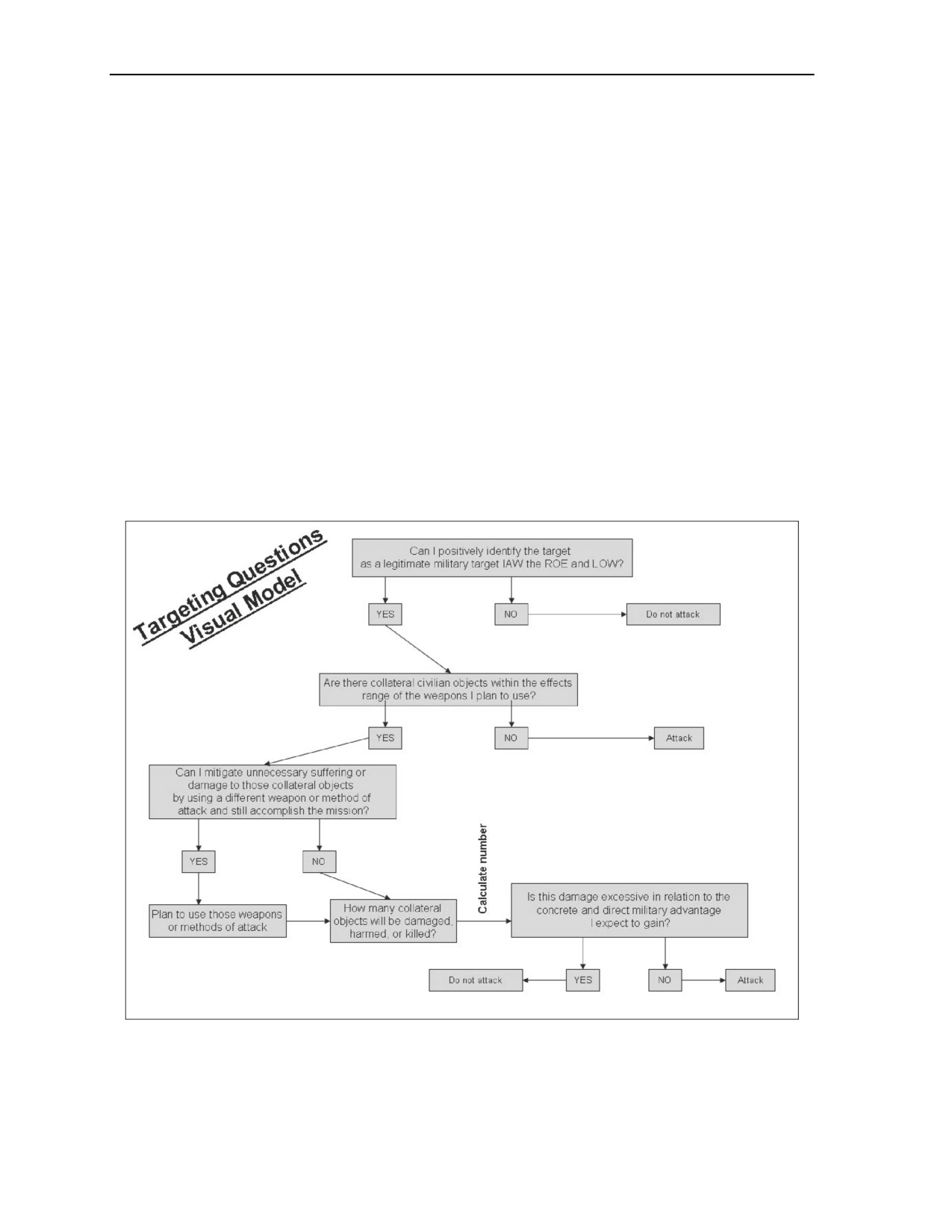
Chapter 7
analyze the resources available and choose the best means for striking or affecting the target. Finally, they
determine the most effective means to assess or measure the effects that the action has had on the target.
This methodology is often referred to as decide, detect, deliver, and assess. FM 3-60 discusses each of these
steps. A similar approach is used for nonlethal targets.
7-48. Judge advocates participate actively in planning from the moment an initial warning order notifies a
unit of a potential contingency deployment. Participation in the planning and targeting development
process enables judge advocates to prevent the inclusion of legally questionable actions into the OPLAN.
Judge advocates attend all planning sessions, provide direct input into the decisionmaking processes, and
introduce relevant legal considerations into the lethal and nonlethal targeting processes.
DEPLOYMENT
7-49. Once deployed, judge advocates are included in the lethal and nonlethal targeting cell so they are
available to provide timely legal input on key targeting decisions. Typically, the brigade legal section
cannot provide a full-time representative to the targeting cell. Accordingly, judge advocates may not be
present when impromptu targeting meetings or huddles with the commander are called. Being fully
integrated into the staff and the targeting cell is the key to mission success.
7-50. The rapid pace and changing nature of modern warfare, together with the expanded role of military
lawyers in war planning, raises unprecedented issues for military lawyers. Several tools exist that judge
advocates use to help them walk though the targeting process. The lethal targeting visual model in
figure 7-1 may help judge advocates to assess lethal targeting decisions accurately and thoroughly.
Figure 7-1. A sample targeting decision model
7-8
FM 1-04
18 March 2013
Rules of Engagement, Rules for the Use of Force, and Targeting
NONLETHAL TARGETING
7-51. Judge advocates participate as members of nonlethal targeting cells or working groups. The names of
these groups may vary, but in general they focus on the application of assets, as opposed to lethal
munitions, to achieve or set the conditions to achieve a desired outcome not resulting in the kinetic
destruction of the target. Nonlethal targeting is applicable in all operations but is most prevalent during
stability operations or the transition to stability operations.
7-52. By providing legal expertise on issues surrounding nonlethal targeting, judge advocates play a key
role in the nonlethal targeting process. In some cases, judge advocates may find themselves in the lead of a
working group categorized as supporting nonlethal targeting.
7-53. An example of judge advocate participation in nonlethal targeting at the division level provides a
way this integration might work. The division plans cell develops division targets that correspond to the
campaign plan and flow from the lines of effort. Because improving the rule of law among the populace is
inherent in stability operations, the plans officer looks to the Office of the Staff Judge Advocate to build
targets to accomplish the rule of law mission. The operational law attorney, or some other designated judge
advocate, participates in targeting synchronization meetings to discuss and debate proposed targets. A
judge advocate might also lead the rule of law operational planning team meetings in preparation for a
weekly or bi-weekly targeting brief to the division commander. In this capacity, the judge advocate must be
able to articulate attainable goals as they relate to the expenditure of assets to improve policing, the
judiciary, and correctional capacity in the area of responsibility. In coordination with the other members of
the working group or planning team, the judge advocate makes sure targets are realistic and meaningful and
the method lawful so they directly contribute to rule of law improvement.
18 March 2013
FM 1-04
7-9
Chapter 8
Detainee Operations
This chapter addresses the legal aspects of detainee operations. It outlines the basic
rules for detainee treatment and the requirements for treating detained persons in
accordance with the Geneva Conventions and other applicable international
agreements.
INTRODUCTION
8-1. U.S. forces will detain people during military operations. Detainee is a term used to refer to any
person captured or otherwise detained by an armed force (JP 3-63). A detainee is classified, in accordance
with U.S. policy (see DODD 2310.01E and JP 3-63) as an enemy combatant—either lawful or unlawful, an
enemy prisoner of war (EPW), a retained personnel, or civilian internee. International law confers certain
legal rights to detainees depending upon which status they hold.
8-2. Humane treatment of all detainees is mandatory regardless of their legal status under the Geneva
Conventions or U.S. policy (such as DODD 2310.01E). Soldiers treat all detainees in accordance with
applicable domestic and international law, national policy, and the law of war. When conducted properly,
detainee operations set conditions for success by demonstrating the United States’ genuine commitment to
justice, human rights, fundamental fairness, and respect for all people. When detainees are abused or
mistreated, it does significant damage to U.S. credibility, and encourages enemies to abuse and mistreat
detained or captured U.S. and coalition personnel. Moreover, mistreatment of detainees by U.S. or host-
nation personnel substantially undermines the legitimacy of U.S. forces and, if it occurs in the context of
stability operations, the host-nation government. (See chapter 9 and chapter 10 for more information.)
8-3. The Army has Title 10 responsibility for detainee operations policy. Within the Army and through
combatant commanders, military police may conduct internment and resettlement operations when
conducting offensive, defensive, and stability or defense support of civil authorities operations. Internment
and resettlement operations are part of the sustainment warfighting function.
THE JUDGE ADVOCATE’S ROLE IN DETAINEE OPERATIONS
8-4. Judge advocates play a key role in each stage of detainee operations. Prior to deployment, they train
Soldiers on the law of war and the legal aspects of detainee operations. During operations planning, they
advise commanders and staffs on the legal aspects of detainee issues likely to occur on the battlefield.
During the execution of operations, they help monitor the treatment of detainees and assist commanders to
ensure that U.S. Soldiers are adhering to the applicable standards for detainee treatment. During stability
operations, judge advocates help commanders develop and implement effective systems for ensuring the
health, welfare, and ultimate disposition of detainees under U.S. control.
8-5. Judge advocates are trained on all aspects of detainee operations to include interrogation techniques
and the proper standards of treatment for detainees during interrogation. This training enables judge
advocates to recognize prohibited conduct and provide relevant advice to commanders and Soldiers on
interrogations.
8-6. Judge advocates play an important role in training commanders and Soldiers on their responsibilities
when performing detainee operations. They—
18 March 2013
FM 1-04
8-1
Chapter 8
z
Work with commanders to ensure that Soldiers are trained and that proper safeguards are in
place to help prevent detainee abuse from the point of initial detention through the duration of
time a detainee is under U.S. control.
z
Advise commanders and other personnel responsible for detainee operations on all matters
pertaining to compliance with applicable law and relevant national policy directives and
regulations, such as AR 190-8 and FM 2-22.3.
z
Provide legal advice on the proper composition and function of Article 5 tribunals to determine
detainee status per Geneva Conventions.
z
Advise the commander regarding investigations of suspected maltreatment, abuse of detainees,
or other violations of applicable law or policy.
z
Assist commanders with developing and implementing systems and procedures that address the
ultimate disposition of persons detained under U.S. control.
z
Coordinate with the provost marshal, supporting financial management unit, and other working
groups and staff cells related to detainee operations.
8-7. Commanders ensure all Soldiers understand the basic rules of detainee treatment. Judge advocates
assist commanders and train Soldiers, at a minimum, on these basic rules:
z
Soldiers treat all detainees humanely and in accordance with U.S. law, policy, and the law of
war.
z
Soldiers, including interrogators, treat all detained persons consistent with the Geneva
Conventions. The standards set forth in Common Article 3 are the minimum standards for care
of detainees and apply to all detainees, regardless of status. The Geneva Conventions, however,
require a higher standard of care for certain types of detainees such as EPWs.
z
Soldiers bring detainees to secure areas as soon as practicable after capture. Soldiers
immediately account for their possessions and personal property and log in possessions and
property on DA Form 4137 (Evidence/Property Custody Document). Commanders ensure
detainees are safeguarded from the effects of the environment (such as providing overhead
cover).
z
Soldiers complete DD Form 2745 (Enemy Prisoner of War [EPW] Capture Tag) for all detainees
as close to the point of detention as possible. The capture tag serial number differs from the
internment serial number. The commander of the detainee operations has responsibility for
ensuring issuance of the internment serial number (see JP 3-63).
z
Soldiers maintain and safeguard detainee records.
z
Department of Defense
(DOD) personnel may accept custody of a detainee from DOD
personnel. Custody of a detainee cannot be accepted if the transfer of custody is from some
person or entity not a part of DOD (such as another U.S. Government department or agency, or
coalition forces) unless the transfer is conducted under applicable law and policy.
(See
DODD 2310.01E.)
z
No detainee may be transferred from the custody of DOD unless the transfer is conducted under
applicable law and policy. (See DODD 2310.01E.)
z
If the command doubts a detainee’s status, a competent authority will determine the detainee’s
status. An Article 5 tribunal convened pursuant to the Geneva Conventions may be required to
make the determination.
z
Those detainees who lack EPW status will have their detention reviewed periodically by
competent authority. (See DODD 2310.01E.)
z
Only trained, qualified interrogators may interrogate detainees.
(See DODD 3115.09 and
FM 2-22.3.)
z
All Soldiers, regardless of rank or specialty, have a moral and legal duty to report detainee
abuse.
z
Interrogation is the systematic effort to procure information by direct questioning of a person
under the control of the questioner. (See also FM 2-22.3). Commonly, this is thought of as
questioning with the use of authorized intelligence questioning approaches. Tactical questioning
is direct questioning by any Department of Defense personnel of a captured or detained person
8-2
FM 1-04
18 March 2013
Detainee Operations
to obtain time-sensitive tactical intelligence information, at or near the point of capture or
detention and consistent with applicable law (JP 3-63). (See also DODD 3115.09.)
z
Only trained, qualified interrogators may interrogate detainees.
(See DODD 3115.09 and
FM 2-22.3.)
z
Soldiers are not authorized to “soften up” detainees or to “set the conditions for interrogations.”
(See DODD 3115.09 and FM 2-22.3.)
THE GENEVA CONVENTIONS
8-8. The four treaties comprising the Geneva Conventions are fully applicable as a matter of international
law to all military operations that qualify as international armed conflicts involving signatory states. DOD
policy applies the law of war, including the Geneva Conventions, during all armed conflicts, however such
conflicts are characterized, and in all other military operations unless otherwise directed by competent
authority. (See DODD 2311.01E.) At a minimum, the provisions of Common Article 3 to the Geneva
Conventions apply in all non-international armed conflicts. Although often referred to collectively as the
“Geneva Conventions,” there are four specific treaties:
z
Geneva Convention (I) for the Amelioration of the Condition of the Wounded and Sick in
Armed Forces in the Field (GWS).
z
Geneva Convention
(II) for the Amelioration of the Condition of Wounded, Sick, and
Shipwrecked Members of the Armed Forces at Sea (GWS Sea).
z
Geneva Convention (III) Relative to the Treatment of Prisoners of War (GPW).
z
Geneva Convention (IV) Relative to the Protection of Civilian Persons in Time of War (GC).
8-9. GWS provides protection for members of the armed forces and other persons on the battlefield
associated with the armed forces. These particular persons are no longer actively participating in hostilities
as the result of becoming wounded or sick. This convention also regulates the conduct and treatment of
medical and medical support personnel treating persons protected under the GWS and protected medical
transportation. It mandates humane treatment for wounded and sick personnel who fall into enemy hands. It
contains an express mandate that such individuals be protected against pillage and ill treatment and be
provided necessary and adequate care.
8-10. GWS Sea mandates humane treatment and protection. This convention applies to members of the
armed forces and other persons associated with the armed forces who are at sea and wounded, sick, or
shipwrecked. It also protects medical and medical support personnel as well as medical transport including
hospital ships.
8-11. GPW provides for the humane treatment of EPWs. It regulates the treatment of EPWs (care, food,
clothing, medical care, and housing), discipline and punishment, labor and pay, external relations,
representation, the international exchange of information, and the termination of captivity.
8-12. GC protects civilians who find themselves under the control of an enemy nation. It regulates the
treatment of such civilians, to include establishing procedures governing the deprivation of liberty (arrest,
internment, or assigned residence), and provides a legal framework for the relationship between civilians
and the enemy authorities controlling them.
DETAINEE CATEGORIES
8-13. In accordance with U.S. policy, a detainee falls within one of the following categories: enemy
combatant—either lawful or unlawful, enemy prisoner of war, retained person, or civilian internee. The
definition of detainee does not include persons being held primarily for law enforcement purposes, except
where the United States is the occupying power.
8-14. In general, an enemy combatant is a person engaged in hostilities against the United States or its
coalition partners during an armed conflict (DODD 2310.01E). The term enemy combatant includes both
lawful enemy combatants and unlawful enemy combatants.
8-15. Lawful enemy combatants include members of the regular armed forces of a State engaged in
hostilities against the United States. They include members of militia, volunteer corps, and organized
18 March 2013
FM 1-04
8-3
Chapter 8
resistance movements belonging to a State party. This party engages in such hostilities (which are under
responsible command), wear a fixed distinctive sign recognizable at a distance, carry their arms openly, and
abide by the laws of war. Lastly lawful enemy combatants include members of regular armed forces who
profess allegiance to a government or an authority engaged in such hostilities but not recognized by the
United States. Lawful combatants are afforded combatant immunity. (See DODD 2310.01E.)
8-16. Unlawful enemy combatants are persons not entitled to combatant immunity. These persons engage
in acts against the United States or its coalition partners in violation of the laws and customs of war during
an armed conflict.
8-17. An enemy prisoner of war is an individual or group of individuals detained by friendly forces in any
operational environment who meet the criteria as listed in Article 4 of the Geneva Convention Relative to
the Treatment of Prisoners of War. (See FM 2-22.3.)
8-18. A retained person consists of enemy medical personnel, medical staff administrators, who are
engaged in either the search for, collection, transport, or treatment of the wounded or sick, or the prevention
of disease, and chaplains, retained with a view toward assisting enemy prisoners of war by providing
medical care and religious ministration. (See JP 3-63.)
8-19. A civilian internee is a civilian who is interned during armed conflict, occupation, or other military
operation for security reasons, for protection, or because he or she committed an offense against the
detaining power (DODD 2310.01E).
DETAINEE TREATMENT ACT OF 2005
8-20. The Detainee Treatment Act of 2005 is found in Title 10. Judge advocates must be familiar with this
statute and understand its application to U.S. forces and military operations. In summary, the act states—
z
No person in the custody or under the effective control of the Department of Defense or under
detention in a Department of Defense facility shall be subject to any treatment or technique of
interrogation not authorized by and listed in FM 2-22.3.
z
No individual in the custody or under the physical control of the United States Government,
regardless of nationality or physical location, shall be subject to cruel, inhuman, or degrading
treatment or punishment.
8-4
FM 1-04
18 March 2013
Chapter 9
Stability Operations
This chapter discusses the specific tasks and responsibilities Judge Advocate
General’s Corps personnel have during stability operations. It also discusses legal
considerations that Judge Advocate General’s Corps personnel consider during
stability operations.
OVERVIEW
9-1. Stability operations is an overarching term encompassing various military missions, tasks, and
activities conducted outside the United States in coordination with other instruments of national power to
maintain or reestablish a safe and secure environment, provide essential governmental services, emergency
infrastructure reconstruction, and humanitarian relief (JP 3-0). Army forces engaged in stability operations
establish or restore basic civil functions and protect them until the host nation or other agency can capably
provide these services. In a world characterized by persistent conflict driven by scarce resources and
conflicting cultures, victory is likely to be measured not by military superiority but rather by the ability to
provide for the essential needs and aspirations of a particular population. Stability operations are an
essential component of any campaign seeking to successfully resolve conflict through prosperity rather than
military conquest.
9-2. Stability operations leverage the coercive and constructive capabilities of the military force to
establish a safe and secure environment; facilitate reconciliation among local or regional adversaries;
establish political, legal, social, and economic institutions; and facilitate the transition of responsibility to a
legitimate civil authority. Through stability operations, military forces help to set the conditions that enable
the actions of the other instruments of national power to succeed in achieving the broad goals of conflict
transformation. Providing security and control stabilizes the area of operations. These efforts then provide a
foundation for transitioning to civilian control and, eventually, to the host nation. Stability operations are
usually conducted to support a host-nation (HN) government. However, stability operations may also
support the efforts of a transitional civil or military authority when no legitimate government exists.
(FM 3-07 discusses stability operations in detail.)
9-3. Stability operations may be performed across the spectrum of conflict. Although all operations
require a mixture of lethal and nonlethal action, stability operations emphasize nonlethal action while
retaining a focus on initiative. Initiative is critical to stability operations because time is of the essence in
establishing or restoring essential services to the population. The period during which a population is
deprived of essential services provides a space for conflict and insurgency to grow. The primary source of
essential services is the HN government. Stability operations are intended to provide the time necessary for
the HN government to become established and capable of providing those services itself. The Army’s
strategic approach to stability operations emphasizes unity of effort, conflict transformation, legitimacy,
rule of law, and capacity building.
9-4. Unity of effort requires that stability operations be conducted across the whole U.S. Government,
integrating the capabilities of the military with civilian agencies (a “whole of government approach”) as
well as integrating U.S. Government efforts with those of international agencies, nongovernmental
organizations, multinational partners, and private entities. Such integration is likely to raise substantial
legal issues that Judge Advocate General’s Corps (JAGC) personnel should be prepared to address.
9-5. The emphasis on conflict transformation recognizes that U.S. forces frequently conduct stability
operations simultaneously with offensive and defensive operations. JAGC personnel must anticipate the
role that stability operations have in conflict transformation and must plan for conflict transformation prior
to deployment. There is likely to be little time once in the area of operations to engage in such planning
18 March 2013
FM 1-04
9-1
Chapter 9
from the beginning. It is easier to adapt and adjust a plan to a new situation in the area of operations once
the situation develops. JAGC personnel not only prepare for their own changing roles, but also as staff
officers assist the commander in planning for these changes for the entire unit. JAGC personnel cannot
clearly distinguish their support to stability operations from their support to other types of operations.
Stability operations frequently play a major role in irregular warfare, in conditions that require a flexible
approach to conducting a mix of stability, offensive, and defensive operations.
9-6. Legitimacy is a principle central to all stability operations. JAGC personnel are well versed in the
relationship between legitimacy and operations, including combat operations. Law connects the
government to the people. Judge advocates serve a central role in advising commanders or assisting civilian
agencies and HN government entities; judge advocates clarify the role of legitimacy in the operation of
government programs and stability operations. Inextricably tied to the concept of legitimacy is the role of
the rule of law in areas subject to stability operations. Chapter 10 describes the rule of law in detail.
9-7. Capacity building focuses on developing HN institutions, building community participation,
developing human resources, and strengthening managerial systems. While it is important to provide
essential services to the HN population in the short term, the goal of U.S. forces is not to provide services
but rather to help build HN institutions that can provide services. Many civilian government agencies and
nongovernmental organizations specialize in capacity building, reinforcing the need for a comprehensive
approach to stability operations.
ROLES OF JUDGE ADVOCATE GENERAL’S CORPS PERSONNEL
9-8. Just as stability operations do not fundamentally differ from other types of operations, the roles of
JAGC personnel in stability operations do not fundamentally differ from the roles they fill in the conduct of
offensive and defensive operations. Rather than requiring a distinct set of skills and tasks, stability
operations require a shift in emphasis among the various roles that JAGC personnel commonly fill in any
operational environment. Some aspects of stability operations, though, call upon judge advocates to act not
only as staff officers, but also as participants in the operational aspects of stability operations.
TRADITIONAL JUDGE ADVOCATE GENERAL’S CORPS TASKS
9-9. Legitimacy touches upon every aspect of stability operations. JAGC personnel assist commanders in
adopting policies that reflect the importance of legitimacy in the conduct of stability operations. The legal,
ethical, and moral advice provided by judge advocates helps ensure all actions undertaken by U.S. forces
comply with established notions of legitimacy, including the forms of international, U.S. domestic, and HN
legal obligations and norms.
9-10. Similarly, stability operations frequently touch directly on the degree to which the rule of law
operates in the host nation. As with regard to legitimacy, JAGC personnel have a major role to play in
ensuring that the command’s actions in a stability operation both comply with and encourage the
development of the rule of law. Indeed, the two efforts cannot be separated; it is impossible for a command
to encourage the development of the rule of law without itself complying with applicable law. Chapter 10
discusses rule of law in detail.
9-11. Judge advocates can further legitimacy and the rule of law in their role of advising the commander
on rules of engagement (ROE). As it does with regard to all U.S. military operations, the law of war applies
to stability operations, and judge advocates need to fill their normal role as advisors on the law of war.
However, stability operations frequently require specific ROE that are more restrictive and detailed when
compared to those for sustained combat operations. Moreover, to be legitimate, such ROE need to comply
with both international and (depending on the type of stability operation) existing HN law. Judge advocates
need to understand the local culture to assist the command in addressing the inherent tension of armed
Soldiers operating amongst the local population.
9-12. In circumstances in which the HN government has failed or has been deposed, U.S. forces may be
required to establish a transitional military authority to protect the HN population during the transition to a
new, legitimate civil government. The governance of HN territory by U.S. forces is subject to many legal
constraints, including international and domestic U.S. law and potentially even United Nations Security
Council resolutions. Any judge advocate participating in the establishment of a transitional military
9-2
FM 1-04
18 March 2013
Stability Operations
authority must conduct extensive legal research to determine the applicable law and limits on U.S. military
authority to serve as a transitional government. (For more information on the role of transitional military
authorities in stability operations, see FM 3-07.)
9-13. Because stability operations engage HN populations in constructive relationships, JAGC personnel
prepare for an increase in the types of interactions they normally have with the HN population. These
interactions may include handling claims under the Foreign Claims Act, making condolence or solatia
payments, and establishing Foreign Claims Commissions. Maintaining good will is particularly important
in stability operations. JAGC personnel increase good will by responding to the legal needs of the HN
population. Moreover, because stability operations will frequently accompany an improving security
situation, JAGC personnel should expect that the populace’s demand for such attention will increase.
9-14. The conduct of stability operations also involves increasing interoperation with local, private, and
HN institutions. JAGC personnel frequently support the stabilization efforts led by others, such as civil
affairs or U.S. Government agencies. As that interoperation increases, JAGC personnel need to increase
their awareness of HN law and contract with local institutions. Such contracts support U.S. forces and the
conduct of tasks necessary to the conduct of the campaign. These include contracts with local construction
firms for the reconstruction of infrastructure in the host nation. Moreover, types of assistance that
frequently accompany stability operations are governed by specific funding restrictions as a matter of U.S.
domestic law, and judge advocates examine projects for compliance with those restrictions. (Paragraphs
9-24 through 9-31 discuss those restrictions in more detail.)
9-15. Often during stability operations, the security environment will be such that other U.S. Government
agencies, international organizations, and nongovernmental organizations will be active in the operational
area. Such organizations provide invaluable assistance to a host nation’s needs. Frequently, forces will
conduct stability operations during a period of increasing security, and with that increasing security, the
number of such organizations and their diffusion throughout the operational area will necessarily increase.
As they do, JAGC personnel prepare to increase the work they do to interface with such organizations.
9-16. Modern stability operations involve many DOD civilians, as well as civilian personnel employed by
government contractors. Again, as the security situation improves, the number and diffusion of these
individuals throughout the operational area is likely to increase. In addition to the normal issues that arise
from the presence of civilians engaged in stability operations with U.S. forces, the dynamic legal and
security environment is likely to present additional challenges. The means of disciplining these persons
differ from the means of disciplining uniformed personnel. In some circumstances, civilians accompanying
the force may be subject to the Uniform Code of Military Justice or the Military Extraterritorial Jurisdiction
Act as well as administrative action by the United States or contractor employers. However, JAGC
personnel ensure commanders have effective oversight mechanisms to control these civilians in the
sensitive area of operations in which stability operations normally occur. Coordination with the responsible
contracting officer is essential when dealing with contractor personnel. DOD directives contain further
policy and guidance pertaining to civilians accompanying U.S. forces during operations.
9-17. Stability operations aim to build HN capabilities. JAGC personnel may also be instrumental in
reviewing capacity-building projects for compliance with both U.S. and HN law. For instance, JAGC
personnel might determine the legality of certain reforms or the legal authority of nascent HN government
agencies to carry out certain forms of reform or reconstruction.
SPECIFIC JUDGE ADVOCATE GENERAL’S CORPS TASKS
9-18. Stability operations require a distinct set of primary stability tasks, some of which call upon the
specialized knowledge that JAGC personnel possess. Especially within the tasks associated with the
restoration of order and the operation of government, commanders may call upon JAGC personnel for their
legal expertise in conducting stability operations. Chapter 3 of FM 3-07 details the primary stability tasks
along with descriptions of the many subtasks. The primary stability tasks are—
z
Establish civil security.
z
Establish civil control.
z
Restore essential services.
18 March 2013
FM 1-04
9-3
Chapter 9
z
Support to governance.
z
Support to economic and infrastructure development.
9-19. Establishing civil security requires a comprehensive set of rules to govern the legitimate employment
of HN security forces, rules that judge advocates may be called upon to help draft or implement.
9-20. Establishing civil control includes establishment of a criminal justice system, providing support to
law enforcement and police reform, judicial reform, corrections reform, the development of property
dispute resolution processes, and even to war crimes courts and tribunals. It also requires the establishment
of public outreach so that the HN population can actually engage justice institutions.
9-21. Restoring essential services can require extensive contracting and negotiations, and even includes
assistance to displaced persons, which must be handled in compliance with HN and international law.
9-22. Support to governance may involve legal expertise only tangentially related to the areas JAGC
personnel traditionally practice in, such as election reform and anticorruption.
9-23. Support to economic and infrastructure development, like restoring essential services, will likely
require close interaction between the military and civilian agencies not traditionally associated with
military operations, especially the private sector. Moreover, security and the rule of law are both critical
ingredients to economic development. JAGC personnel often play important roles in programs designed to
bring about security sector reform. Chapter 6 of FM 3-07 provides important information on security sector
reform.
LEGAL CONSIDERATIONS
9-24. Stability operations affect many areas of the operational area, areas not traditionally associated with
major combat operations. The conduct of stability operations requires close coordination among military,
civilian, international, nongovernmental, and HN actors, raising important legal issues. Since stability
operations aim to build HN capacity rather than simply to provide services, legal limits on the ability of
U.S. forces to interact and train HN forces may be implicated.
AUTHORITY TO ASSIST A FOREIGN GOVERNMENT
9-25. U.S. forces have limited authority to provide assistance to foreign governments. The Department of
State is the designated lead agency of U.S. Government efforts to coordinate stabilization, security,
transition, and reconstruction activities. The Army conducts stability operations in support of these
activities. Such support promotes the broader U.S. Government effort to advance U.S. interests in two
ways. First, it assists an existing government with internal challenges or helping establish a new social,
economic, and political domestic order in the short term. Second, it assists in the long term by establishing
conditions for a sustainable peace.
9-26. Congress specifically appropriates funds for foreign assistance. The United States Agency for
International Development expends such funds under the legal authorities in Title
22, U.S. Code.
Provisions of Title 10 authorize small amounts of money. These funds are appropriated annually for
commanders to provide humanitarian relief, disaster relief, or civic assistance with military operations.
These standing authorities are narrowly defined and generally require significant advance coordination
within the DOD and the Department of State (DOS).
AUTHORITY FOR FOREIGN INTERNAL DEFENSE
9-27. Without receiving a deployment or execution order from the President or Secretary of Defense, U.S.
forces may be authorized to make only limited contributions during operations that involve foreign internal
defense. If the Secretary of State requests and the Secretary of Defense approves, U.S. forces can
participate in foreign internal defense. The request and approval go through standing statutory authorities in
Title 22, U.S. Code. Title 22 contains the Foreign Assistance Act, the Arms Export Control Act, and other
laws. It authorizes security assistance, developmental assistance and other forms of bilateral aid. The
request and approval might also occur under various provisions in Title 10. Title 10 authorizes certain types
of military-to-military contacts, exchanges, exercises, and limited forms of humanitarian and civic
9-4
FM 1-04
18 March 2013
Stability Operations
assistance in coordination with the U.S. ambassador to the host nation. In such situations, U.S. forces work
as administrative and technical personnel as part of the U.S. diplomatic mission pursuant to a status-of-
forces agreement or pursuant to an exchange of letters with the host nation. This cooperation and assistance
is limited to liaison, contacts, training, equipping, and providing defense articles and services. It does not
include direct involvement in operations. Assistance to foreign police forces by U.S. forces is permitted but
not with the DOD as the lead government department.
GENERAL PROHIBITION ON ASSISTANCE TO POLICE
9-28. Usually, the DOD is not the lead government department for assisting foreign governments. The
DOS is the lead when U.S. forces provide security assistance—military training, equipment, and defense
articles and services—to HN military forces. The Foreign Assistance Act specifically prohibits assistance
to foreign police forces except within specific exceptions and under a Presidential directive. When
providing assistance to training, the DOS’s Bureau of International Narcotics and Law Enforcement Affairs
provides the lead role in police assistance. The President, however, may delegate this role to other agencies.
For example, in 2004, President George W. Bush signed a decision directive granting the commander,
United States Central Command, authority to train and equip Iraqi police.
TRAINING AND EQUIPPING FOREIGN FORCES
9-29. All training and equipping of foreign security forces is specifically authorized. U.S. laws require
Congress to authorize expenditures for training and equipping foreign forces. The laws of the United States
also require the DOS to verify that the host nation receiving the assistance is not in violation of human
rights. Usually, DOD involvement is limited to a precise level of man hours and materiel requested from
the DOS under the Foreign Assistance Act. The President may authorize deployed U.S. forces to train or
advise HN security forces as part of the mission. In this case, DOD personnel, operations, and maintenance
appropriations provide an incidental benefit to those security forces. All other weapons, training,
equipment, logistic support, supplies, and services provided to foreign forces are paid for with funds
appropriated by Congress for that purpose. Moreover, the President gives specific authority to the DOD for
its role in such “train and equip” efforts. Absent such a directive, DOD lacks authority to take the lead in
assisting a host nation to train and equip its security forces.
GENERALLY APPLICABLE FUNDING CONSTRAINTS
9-30. In stability operations, like all operations, commanders require specific authority to expend funds.
Normally, that authority is found in the DOD Appropriations Act, specifically, operation and maintenance
funds. Congress may appropriate additional funds to commanders for the specific purpose of conducting
stability and counterinsurgency operations. Examples of these appropriations from Operation Iraqi
Freedom and Operation Enduring Freedom include the Commander’s Emergency Response Program, the
Iraq Relief and Reconstruction Fund, Iraq Freedom Fund, and Commander’s Humanitarian Relief and
Reconstruction Program funds.
HUMAN RIGHTS VETTING
9-31. Congress typically limits when it will fund training or equipment for foreign security forces. If the
DOS has credible information that the foreign security force unit identified to receive the training or
equipment has committed a gross violation of human rights, Congress prohibits funding. Such prohibitions
impose a requirement upon DOS and DOD. These departments vet the proposed recipient units against a
database of credible reports of human rights violations.
18 March 2013
FM 1-04
9-5
Chapter 10
Rule of Law
This chapter provides judge advocates with general information about rule of law
activities. It describes some distinctive tasks that legal personnel supporting rule of
law activities may be called upon to perform. It also discusses considerations in rule
of law activities and personnel augmentation.
RULE OF LAW ACTIVITIES
10-1. Rule of law activities involve subordinate tasks that support the five primary stability tasks of
stability operations. The primary stability tasks are fundamental to decisive action and are conducted across
the spectrum of conflict. As subordinate tasks in support of stability operations, rule of law activities may
be executed to support a legitimate host-nation government, to assist a fragile state, or in the absence of a
functioning civil authority. These activities often entail a wide variety of issues inherently legal or framed
by the practice of law. Paramount to success is the coordination amongst units, agencies, and other
organizations involved in the planning and execution of rule of law activities. Rule of law is a principle
under which all persons, institutions, and entities, public and private, including the state itself, are
accountable to laws that are publicly promulgated, equally enforced, and independently adjudicated, and
that are consistent with international human rights principles (FM 3-07).
10-2. Many rule of law activities will occur as components of stability operations helping to establish (or
reestablish) the host nation’s capacity to maintain the rule of law. Stability operations are a core U.S.
military mission; establishing the rule of law in the host nation is often critical to the success of all five
primary stability operations tasks discussed in FM 3-07. Rule of law activities support establishing a safe
and secure environment by developing, reforming, or enhancing the capacity of the host nation’s security
institutions and thereby providing security the civilian population views as legitimate.
10-3. Rule of law activities are likely to be part of an interagency effort. Rule of law activities will rarely,
if ever, be exclusively a military or a U.S. Government responsibility. The Department of State (DOS) is
charged with leading and coordinating U.S. Government efforts to conduct reconstruction and stabilization
operations, including operations to establish and support the rule of law. The primary U.S. interagency
partners with the DOS for these efforts are the U.S. Agency for International Development and the
Department of Justice. Normally, DOS coordination falls to a country team under the direction of the U.S.
ambassador to the host nation. Any rule of law activities undertaken at the tactical (local) level should be
coordinated with the rule of law country team.
10-4. Experience indicates that while the DOS is charged to lead and coordinate with respect to rule of law,
the Army, and judge advocates in particular, are actively engaged in preparing, planning, and conducting
rule of law activities. Lessons learned and collected by the Center for Law and Military Operations
demonstrate that responsibility for these activities continually falls to judge advocates at various levels of
command. Judge advocates should expect to be significantly engaged in rule of law activities involving law
enforcement, judicial systems and processes, and corrections. These specific activities of the rule of law,
often referred to as “courts, cops, and corrections,” should be areas of focus for judge advocates based upon
Judge Advocate General’s Corps (JAGC) core competencies and training.
10-5. The JAGC recognizes this and acknowledges that preparing, planning, and executing rule of law
activities is a mission that judge advocates are prepared to conduct. This acknowledgment also recognizes
that conducting rule of law activities in a semi or non-permissive area of operations, where freedom of
maneuver is constrained due to security concerns, is often most easily executed or coordinated by judge
advocates belonging to the unit responsible for that area of operations.
18 March 2013
FM 1-04
10-1
Chapter 10
10-6. Judge advocates will train, prepare, and plan in anticipation of conducting rule of law activities in
support of operations. While the categories of activities supporting rule of law are broad, judge advocates
should focus their efforts towards those activities involving law enforcement, judicial systems and
processes, and corrections. These activities include, but are not limited to, preparing, planning, and
coordinating rule of law activities involving the judiciary, judicial process, practice of law, law
enforcement, and prisons. Often judge advocates are involved in rule of law activities that relate to other
aspects of operations at the tactical and operational level such as detainee operations, interrogations, and
exploiting intelligence.
10-7. Although many major rule of law programs will occur as part of stability operations, rule of law
activities occur across the spectrum of conflict. A special relationship exists between the rule of law and the
legitimate exercise of force. As a result, rule of law activities not only include formal projects to rebuild
host-nation (HN) capacity, but also actions to ensure U.S., multinational, and HN security forces operate to
encourage respect for the rule of law while engaged in all operations.
10-8. The rule of law limits the power of government by setting rules and procedures that prohibit
accumulating autocratic or oligarchic power. It dictates government conduct according to prescribed and
publicly recognized regulations while protecting the rights of all members of society. It also provides a way
to resolve disputes nonviolently and an integral method to establish enduring peace and stability. Generally,
rule of law exists when—
z
The state monopolizes the use of force in resolving disputes.
z
Individuals are secure in their persons and property.
z
The state is bound by law and does not act arbitrarily.
z
The law can be readily determined and is stable enough to allow individuals to plan their affairs.
z
Individuals have meaningful access to an effective and impartial legal system.
z
The state protects human rights and fundamental freedoms.
z
Individuals rely on the existence of legal institutions and the content of law in the conduct of
their daily lives.
10-9. Rule of law activities are broad categories of actions designed to support HN development of
institutional capacity, human capacity, functional effectiveness, and popular acceptance of the host nation’s
legal system and related government areas. The activities help create the rule of law conditions listed in
paragraph 10-8. The phase of operations determines which rule of law activities are appropriate. Often rule
of law activities undertaken in the wake of major combat operations are limited to enhancing security; as
the operational area becomes more mature and secure, rule of law activities will move beyond questions of
security to focus on law as a means to broader stability objectives. In other cases, rule of law activities
beyond security occur simultaneously with major combat operations.
10-10. Rule of law activities relate to both U.S. and HN policies. Such policies are established by higher
headquarters or civilian agencies in both the U.S. and HN governments. In addition, the Department of
State will likely have a rule of law plan even in environments in which its civilian employees are not
operating. Judge advocates continually look to such outside authorities and resources for guidance in the
conduct of rule of law activities. Because they are closely related to policy, even local rule of law activities
remain part of a single, nationwide rule of law plan. For example, a local effort to vet and appoint judges to
quickly reestablish the court system could easily work counter to a system in which judicial appointments
are carried out nationwide by a central authority.
10-11. Given their close relationship to policy, rule of law activities are likely to be particularly sensitive
to the civilian population. They should be planned and executed while taking careful account of the
populace’s response. The essence of the rule of law is legitimacy, and rule of law activities undertaken
without regard to local political sensitivities are likely to be counterproductive. Rule of law activities are
intended to build HN capabilities and therefore should always be undertaken with HN legal institutions and
with a view toward increasing their capabilities and legitimacy.
10-2
FM 1-04
18 March 2013
Rule of Law
CONSIDERATIONS IN RULE OF LAW ACTIVITIES
10-12. Judge advocates fall under the statutory technical supervision of The Judge Advocate General and
are the only persons within the Army authorized to provide legal advice to commanders. With respect to
rule of law activities, legal interpretation is often required to provide legal advice to commanders on the
planning or execution of such activities. In cases involving the provision of legal advice to commanders or
Soldiers conducting activities involving the practice of law, judge advocates must provide the legal advice
that governs these individuals’ activities. When Department of State personnel perform rule of law
activities, they follow the guidance given to them from their supervisory chain.
10-13. Rule of law activities involving the practice of law include, but are not limited to—
z
Evaluating and assisting in developing transitional decrees, codes, ordinances, courts, and other
measures intended to bring immediate order to areas in which the HN legal system is impaired or
nonfunctioning.
z
Evaluating HN law, legal traditions, and administrative procedures in light of international legal
obligations and human rights standards and, when necessary, providing appropriate assistance to
their reform.
z
Evaluating training given to HN judges, prosecutors, defense counsel, legal advisors, court
administrators, and police and corrections officials in light of international legal obligations and
human rights standards.
z
When necessary, serving as legal advisors for transitional courts.
z
Advising commanders and others on the application of international, U.S. domestic, and HN law
considered in restoring and enhancing rule of law in the host nation.
z
Advising commanders and U.S., international, and HN authorities on the legality, legitimacy,
and effectiveness of the HN legal system including its government’s compliance with
international legal obligations and domestic law.
z
Supporting the training of U.S. personnel in the HN legal system and traditions.
10-14. Judge advocates engaging in rule of law activities should consult current civil affairs doctrine for
additional guidance (see FM 3-57), and the current Rule of Law Handbook, as well as lessons learned
gathered by the Center for Law and Military Operations.
10-15. To be effective, the Department of State, civil affairs personnel, and judge advocates coordinate
their rule of law efforts. Regardless of the operational environment and the level of involvement of the
various interagency partners and the Army in conducting rule of law activities, all parties, to include HN
authorities, achieve unity of effort through coordination and synchronization.
10-16. U.S. forces reflect the rule of law in their actions, including compliance with applicable domestic
and international law. The civilian population as well as the international community will scrutinize
military compliance with the rule of law in the conduct of operations. Thus, judge advocates normally
undertake a role to ensure commanders understand and enforce U.S. compliance with legal obligations in
the conduct of military operations.
10-17. Rule of law planners should utilize established frameworks for assessing HN legal institutions and
measuring the progress of rule of law activities. Generic rule of law assessment and metrics frameworks,
which are tailored to specific circumstances, are available from the Department of State. In many cases,
judge advocates will have frameworks already tailored to specific HN legal systems. They should rely on
those frameworks when planning rule of law activities.
10-18. Rule of law activities are necessarily highly contingent on the operational environment. The
appropriate course of conduct for a rule of law activity depends on—
z
How well the HN legal system supports the relationship between the populace and the HN
government.
z
The ability of the HN government to function as it supports the cultural, religious, and social
norms.
z
Ethnic, religious, political, or social divisions among the populace.
z
Campaign objectives.
18 March 2013
FM 1-04
10-3
Chapter 10
z
The nature of the legal authority for U.S. action.
z
The degree to which U.S. civilian agencies are present in the area of operations and active in the
rule of law effort.
10-19. Because rule of law activities rely so highly on the operational environment, they are not amenable
to checklist solutions. Judge advocates need to adapt even established frameworks to be useful when
assessing the operational environment.
10-20. Prior to deployment, judge advocates should formulate basic, flexible rule of law plans. Once
deployed, information and time will likely be in short supply. Judge advocates need to maximize both when
preparing to commence rule of law activities.
10-21. Rule of law activities require continuity. Judge advocates deploying to replace a force already in
the operational area rely on their predecessors for information regarding the operational environment. This
information can detail the host nation, its legal system, existing rule of law activities, lessons learned, and
opportunities identified for future rule of law activities. Even judge advocates serving as part of an entering
force familiarize themselves with basic information about the host nation and its legal system.
10-22. Judge advocates cannot know everything about a host nation’s legal system prior to engaging in
rule of law activities. However, judge advocates should acquire the following as an essential part of the
overall intelligence preparation of the battlefield:
z
Knowledge, understanding of, and respect for the existing HN legal system and its international
legal obligations.
z
Knowledge of the conditions, capabilities, and locations of HN legal institutions (with emphasis
on security-related legal institutions).
10-23. Planning factors affecting rule of law activities may include but are not limited to:
z
The need to restore a legitimate, basic security apparatus as quickly as possible. A short window
of opportunity exists to perform this task. Sometimes commanders refer to it as the golden hour
following combat. During this golden hour, commanders and judge advocates concentrate their
efforts on the basics and expand capability, capacity, and goals.
z
The ability to secure and protect key infrastructure—courthouses, police stations, public records
facilities, and prisons. Doing this as soon as possible minimizes the damage to those institutions
and helps expedient reconstruction.
z
Information from HN attorneys, judges, law enforcement personnel, corrections officers,
administrative personnel, and others with understanding as to how the HN legal process and
their institutions functioned previously.
z
Information on the strengths and weaknesses of existing systems, including information from
political specialists, sociologists, and anthropologists, as well as specialists on transnational
crime.
z
Information on how the country team organized its rule of law mission and objectives. This
information allows judge advocates to coordinate with the country team and others engaged in or
leading rule of law activities in the host nation.
z
Unit staffing and Soldier support to plan and execute rule of law activities.
10-24. Judge advocates at a variety of levels of command will execute rule of law activities based on a
number of factors after assessment of the operational environment. Some of the activities judge advocates
should be prepared to execute include:
z
Planning, coordinating, and synchronizing rule of law activities with interagency, HN, multi-
national, DOD, and superior, subordinate, and parallel Army organizations. The importance of
planning and synchronizing rule of law efforts is paramount to success.
z
Leader engagements with members of the judiciary, legal practitioners, law enforcement, and
corrections officials.
z
Developing measures of effectiveness (MOE) and measures of performance (MOP) to assess the
adequacy of rule of law activities planning and execution. For more on MOE and MOP see
FM 5-0.
10-4
FM 1-04
18 March 2013
Rule of Law
z
Developing and improving capacity amongst systems and processes in support of law
enforcement, judicial systems and processes, and corrections. For example, developing criminal
investigation laboratories, developing capacity to utilize scientific evidence such as fingerprints
and DNA in trials, and introducing reform to the HN criminal code.
z
Judicial conferences with HN judges addressing areas of the law or judicial process determined
as focus areas through assessment and with HN judges’ input.
z
Attorney conferences with HN practitioners addressing identified issues to improve the delivery
of legal services.
z
Training local law enforcement personnel on human rights responsibilities.
10-25. Current operations demonstrate the value of translators and HN attorneys in support of rule of law
activities. If possible, translators should understand legal terminology and the legal concepts of the host
nation. Additionally, HN attorneys provide knowledge and experience of the actual practice of law and the
unique nuances of the host nation legal system. This experience greatly assists judge advocates and others
involved with planning and executing rule of law activities.
10-26. No single body of law regulates the conduct of rule of law activities. Numerous bodies of law are
relevant: international law, including the law of war, human rights law, refugee law, and HN and U.S.
domestic law. Several sources of reference material are available to the rule of law practitioner. (See Rule
of Law Handbook, FM 3-24, and FM 3-07.)
10-27. U.S. forces remain aware of the international legal obligations of the host nation, including its
international human rights obligations. For example, the host nation may be party to the International
Covenant on Civil and Political Rights. If not, customary international law, which is reflected in the
Universal Declaration of Human Rights, still binds the host nation. HN compliance with its international
legal obligations should be the goal. Failing to respect human rights often undermines HN legitimacy,
weakens the international community’s commitment to the HN government, and it may restrict the ability
of multinational forces to cooperate with HN authorities.
PERSONNEL AUGMENTATION
10-28. The requirement for judge advocate augmentation to support rule of law activities is dictated by
the situation in the operational environment. An assessment of the scope of rule of law activities in a unit’s
area of responsibility should be made prior to deployment or prior to assuming responsibility for rule of law
activities. Judge advocates should make this assessment with other staff elements in the supported
command. Factors to consider in requesting augmentation include, but are not limited to, the current types
of rule of law activities in the unit’s area of responsibility, the permissiveness of the operational
environment, the amount and type of interagency rule of law support, assessment of HN legal institutions,
organic judge advocate responsibilities and capability to perform rule of law activities.
10-29. Prior to deployment, staff judge advocates or brigade judge advocates of units that will control an
area of operations (particularly where the interagency has not taken the lead or have a substantial rule of
law presence) should request augmentation from the U.S. Army Reserve Legal Command for operational
law teams of rule of law specialists. Where there is an interagency presence, staff judge advocates or
brigade judge advocates should still consider requesting augmentation of U.S. Army Reserve Legal
Command teams and optimize use of team capacity throughout supported brigades and the Office of the
Staff Judge Advocate.
10-30. Sources for judge advocate augmentation include individual personnel augmentees, Legal
Operations Team-General (LOT-G), and Legal Operations Team-Special (LOT-S) from the U.S. Army
Reserve Legal Command. For more information on the LOT-G and LOT-S see appendix A.
10-31. Judge advocate augmentation whether individuals or teams will usually work for the Office of the
Staff Judge Advocate or brigade judge advocate of the unit supported. This relationship is required to
preserve and respect the professional working relationship between the staff judge advocate or brigade
judge advocate and the supported commander. In unique instances where augmentees work decentralized, a
supervisory-support relationship will exist with the Office of the Staff Judge Advocate or brigade legal
section of the unit responsible for the area of operations.
18 March 2013
FM 1-04
10-5
Chapter 11
Civil Affairs Units
This chapter addresses the roles and responsibilities of judge advocates assigned to
civil affairs units. This chapter also highlights legal issues unique to civil affairs
missions.
OVERVIEW
11-1. The operational environment is characterized by both military and civil components. In modern
operations, the relationship between diplomats, civilian agencies, and military organizations continues to
grow in relevance. Civil affairs (CA) organizations play a critical role in these relationships.
11-2. CA units are organized, trained, and equipped to support missions requiring extensive interaction
between military forces and indigenous populations and institutions, intergovernmental organizations, and
nongovernmental organizations. CA personnel assist commanders in planning and executing stability
operations and other initiatives involving civil-military interface that are designed to develop the capacity
of friendly governments to care for and govern populations effectively. These operations and initiatives
help to effectively deny sanctuary for insurgents and terrorists, diminish the underlying conditions for
conflict and crisis, and set conditions for follow-on stability operations and reconstruction.
11-3. The modular force structure includes Regular Army, reserve CA brigades and reserve CA
commands. CA brigades and commands are supported by a brigade judge advocate or command judge
advocate (CJA), respectively, (brigade judge advocates and CJAs will be referred to collectively as CJAs
for purposes of this chapter only), and a paralegal noncommissioned officer. In addition to the CJA and
paralegal positions, CA commands also have judge advocate billets in some of their “functional specialty
teams.” These exist in each of the CA commands, designated as rule of law teams and governance teams,
with a number of both types in each command.
11-4. Each CA brigade also has one CJA and one rule of law judge advocate. Each CA battalion has a
judge advocate who is designated as the international legal officer. The Civil Affairs Command rule of law
teams often operate at the strategic level, working with the force in charge of a mission, or with the
Department of State, but may also serve with units deployed to the field and supporting rule of law
operations. CA judge advocates working as rule of law officers at the CA brigades serve at the operational
level.
11-5. The authority to provide legal advice rests solely with judge advocates and civilian attorneys under
The Judge Advocate General’s supervision. Judge advocates provide legal advice to commands; other
attorneys, regardless of branch or unit of assignment, may not provide legal services.
11-6. Rule of law is one of the six core competencies of CA. That mission is often performed by judge
advocates assigned to CA battalions, brigades and civil affairs commands and their paralegals. Non-judge
advocates who are CA branch qualified officers and enlisted Soldiers with a legal or law enforcement
background can and do work on rule of law teams providing assistance in the development of rule of law
operations in a commander’s area of operation.
DUTIES AND RESPONSIBILITIES
11-7. Judge advocates serving as CJAs for CA units perform the same duties as other command legal
advisors. They serve as the primary legal advisors to their respective unit commanders and serve as a
member of the commander’s personal and special staff. CJAs provide mission-essential legal services to the
units they support, providing or coordinating for support and services across the six core legal disciplines:
military justice, international and operational law, administrative and civil law, contract and fiscal law,
18 March 2013
FM 1-04
11-1