FM 3-34 ENGINEER OPERATIONS (August 2011) - page 3
Chapter 6
keeping up with these types of multiple changes. This is exacerbated when, as is often the case, engineer
missions are conducted in austere environments while infrastructure is being established or improved.
6-8. The requirements for engineer units and assets almost always exceed the capacity of available
engineer units. This inevitably imposes pressure to delay preventive maintenance, checks, and services to
avoid work stoppages, which only increases the likelihood and length of future equipment failures and
further compounds maintenance difficulties. It also frequently leads to the procurement of locally available
construction materials, repair parts, and construction services. These bring their own unique challenges
along with the need for financial management and contract management support. Most engineer units (less
FEST-A teams) do not have any dedicated contingency contracting teams, and this support is provided on a
GS basis from the supporting contracting support brigade (or joint command if established).
6-9. Some key differences between contracted and military support include—
z
Contractor personnel authorized to accompany the force are neither combatants nor
noncombatants. They are civilians "authorized" to accompany the force in the field.
z
Contractors are not in the chain of command. They are managed through their contracts and the
contract management system which should always include a unit contracting officer
representative.
z
Contractors perform only tasks as specified in contracts by the terms of their contract. .
6-10. All of these challenges are predictable and none of them should catch engineer leaders, or the staffs
that support them, by surprise. Engineers and staffs must anticipate such challenges, work to prevent them,
and be prepared to overcome them. Because of the critical impact that sustainment has on engineer
missions, engineer commanders and staff must be thoroughly familiar with sustainment doctrine and
organizations as described in FM 4-0 and subordinate publications. The importance and unique challenges
of contracted support require engineer commanders and staffs to fully understand their role in planning for
and managing contracted support as described in FM 4-92 and FM 4-94.
ORGANIZATIONS AND FUNCTIONS
6-11. Sustainment support for engineers is provided by different organizations based on various factors
such as the echelon of the supported unit and command and support relationships. Although engineers
should be familiar with all the sustainment organizations described in FM 4-0, some organizations provide
support to engineers more frequently than others.
6-12. Engineers operating in support of headquarters above the BCT level will work closely with the
sustainment brigade. In an HBCT and IBCT, the organic engineer companies are supported by the BSTB.
In an SBCT they are supported by the BSB and headquarters and headquarters company of the BCT. Other
engineer units operating within the BCT will work closely with the BSB or BSTB. If an engineer battalion
headquarters is task-organized to a BCT, it should be accompanied by appropriate sustainment support that
has been task-organized to the battalion to provide necessary augmentation of the sustainment capabilities
of the BSB or BSTB. Engineer battalions provide logistics support to subordinate units through organic
forward support companies.
PRINCIPLES OF SUSTAINMENT
6-13. As discussed in FM 4-0, the principles of sustainment (integration, anticipation, responsiveness,
simplicity, economy, survivability, continuity, and improvisation) are essential to maintaining combat
power, enabling strategic and operational reach, and providing Army forces with endurance. The
sustainment challenges for engineer support (described at the beginning of this chapter) make it essential
that engineer leaders and staff effectively apply these principles. This section describes some ways that
engineers apply the principles of sustainment.
6-14. Engineers must integrate sustainment with engineer plans. Sustainment must not be an afterthought.
Engineers must coordinate and synchronize their operations with the elements of sustainment. This must
occur at all levels of war and throughout the operations process at all echelons. Engineer planners evaluate
the sustainment significance of each phase of the operation during the entire planning process. They create
a clear and concise concept of support that integrates the commander's intent and concept of operation. This
6-2
FM 3-34
4 August 2011
Sustainment Considerations for Engineer Support to Operations
includes analyzing the mission; developing, analyzing, wargaming, and recommending a COA; and
executing the plan.
6-15. Engineers must visualize future operations and identify appropriate required support. They must then
start the process of acquiring the materiel or placement of support that best sustains the operation. As early
as possible, engineers must forecast requirements for Class IV and V supplies (and the transportation and
material handling support needed to move them) and initiate actions to acquire and place them where they
will be needed. Engineer staff officers must do this long before specific engineer missions are assigned to
specific engineer units. Otherwise, sufficient resources likely will not be available when needed. Engineers
must also anticipate requirements for financial management and contract management support for local
procurement of construction materials and services and repair parts. They must anticipate requirements for
fuel and for maintenance support and other supplies and services common to all units.
6-16. The planner who anticipates is proactive—not reactive—before, during, and after operations. The
ability of the force to seize and maintain the initiative, synchronize activities along the entire depth of the
AO, and exploit success depends on the abilities of the commanders, logisticians, and engineers to
anticipate requirements. Engineers consider joint, multinational, contract civilian, and interagency assets
when planning support for engineer missions. They—
z
Use all available resources to the fullest, especially HN assets.
z
Prioritize critical engineer activities based on the concept of operations.
z
Anticipate engineer requirements based on wargaming and rock drills incorporating experience
and historical knowledge.
z
Do not think linearly or sequentially; they organize and resource for simultaneous and
noncontiguous operations.
z
Participate in and evaluate the engineer significance of each phase of the operation during the
entire command estimate process, to include mission analysis and COA development, analysis
and wargaming, recommendation, and execution.
6-17. The engineer staff officer must anticipate likely task organization changes that will affect the flow of
sustainment to engineer organizations. Additional missions will be created by the sustainment plan (for
example, clearing an LZ for aerial resupply). These missions and tasks must be anticipated and planned for
during the mission analysis.
6-18. Engineers must develop and maintain responsiveness. They must seek to ensure that sufficient
resources are identified, accumulated, and maintained to meet rapidly changing requirements. For example,
engineers conduct reconnaissance to identify local materials and other resources that could be used to
support potential engineer missions. They establish preconfigured loads, pre-position supplies and
equipment, and ensure that trained and certified personnel are available to support local purchase of
materials and services.
6-19. Contracting support obtains and provides supplies, services and construction labor and materiel—
often providing a responsive option or enhancement to support the force (see FM 4-92 and FM 4-94).
General engineers will often be required to provide subject matter expertise for the supervision of
contracted materials and services.
6-20. Engineers use mission-type orders and standardized procedures to contribute to simplicity. Engineer
commanders and staffs establish priorities and allocate classes of supply and services to simplify
sustainment operations. They use preconfigured loads of specialized classes of supply to simplify transport.
6-21. At some level and to some degree, resources are always limited. When prioritizing and allocating
resources, the engineer commander and staff may not be able to provide a robust support package. Priority
of effort will be established while balancing mitigation of risk to the operation. Engineer commanders may
have to improvise to meet the higher intent and mitigate the risks. Commanders consider economy in
prioritizing and allocating resources. Economy reflects the reality of resource shortfalls, while recognizing
the inevitable friction and uncertainty of military operations.
6-22. Engineers must protect the resources they need to sustain their units and accomplish their mission. In
addition to protecting their own units, personnel, and equipment, engineers must also emphasize security
4 August 2011
FM 3-34
6-3
Chapter 6
and protection for Class IV and V supplies. These supplies are not easily replaced and can be tempting
targets for enemy action.
6-23. Engineers contribute to ensuring that sustainment means are survivable by constructing sustainment
bases and clearing LOCs. They may also construct ammunition holding areas and provide revetments or
other types of hardening for petroleum, oil, and lubricants products.
6-24. The tempo of operations requires a constant vigilance by the logistician and engineer commander to
ensure a constant flow of support. Supplies are pushed forward (unit distribution method) whenever
logistically feasible. Maneuver units rely on lulls in the tempo of an operation to conduct sustainment
operations, while engineers may not. Engineers usually do not have this opportunity since many of their
missions occur during a lull in operations, and this may deny them the opportunity to use the supply point
method. This increases the need for engineers to plan for continuous, routine, and emergency logistics
support.
6-25. When faced with unexpected situations or circumstances, engineers must improvise. They must be
aware of the resources available in the local area and must regularly train on using improvised methods of
accomplishing engineer tasks.
ENGINEER LEADER AND STAFF RESPONSIBILITIES FOR
SUSTAINMENT
6-26. Successful sustainment of engineer organizations and capabilities requires active involvement by
engineer staff and commanders at every echelon. In addition to ensuring the sustainment of their units,
engineers must work closely with their supported units. This is because the supported unit is responsible for
providing the fortification, barrier, and construction materials, and the mines and demolitions needed for
the tasks they assign to the supporting engineer unit, regardless of the command and support relationship
between them. The higher echelon engineer staff officer must retain an interest in the sustainment of
subordinate engineer units and capabilities, regardless of their command and support relationships with the
units they support. Within a supported unit, the engineer staff officer must work closely with the logistics
staff to assist in planning, preparing, executing, and assessing operations requiring engineer materials and
resources. Within engineer or multifunctional modular headquarters units, the logistics staff provides
sustainment planning for the engineer force under its mission command.
6-27. Within engineer units, leaders and staff must monitor, report, and request requirements through the
correct channels and ensure that sustainment requirements are met when sustainment is brought forward to
the engineer unit. Accurate and timely submission of personnel and logistics reports, and other necessary
information and requests, is essential.
Note. Sustainment responsibilities specific to various echelons are discussed in ATTP 3-34.23
and FM 3-34.22.
ENGINEER STAFF OFFICER
6-28. The engineer staff officer at each echelon is responsible for engineer logistics estimates and plans
and monitors engineer-related sustainment support for engineer capabilities operating at that echelon. When
an engineer unit or capability is task-organized in support of the unit, the engineer staff officer recommends
the most effective command or support relationship, including considering the impact of inherent
sustainment responsibilities. The engineer staff officer—
z
Writes the engineer annex and associated appendixes to the OPLAN or OPORD to support the
commander’s intent. Included in these is a recommended distribution for any engineer-related,
command-regulated classes of supply and special equipment.
z
Assists in planning the location(s) of the engineer forward supply point for the delivery of
engineer configured loads of Class IV and V supplies. This site(s) is coordinated with the unit
responsible for the terrain and the appropriate logistics staff officer (S-4) or assistant chief of
staff, logistics (G-4).
6-4
FM 3-34
4 August 2011
Sustainment Considerations for Engineer Support to Operations
z
Assists in planning the location(s) of the engineer equipment parks for pre-positioning of critical
equipment sets, such as tactical bridging. This site(s) is coordinated with the unit responsible for
the terrain and the appropriate S-4 or G-4.
z
Works closely with the sustainment staff to identify available haul assets (including HN) and
recommends priorities to the sustainment planners.
z
Identifies extraordinary medical evacuation requirements or coverage issues for engineer units
and coordinates with sustainment planners to ensure that the supporting unit can accomplish
these special workloads.
z
Identifies critical engineer equipment and engineer mission logistics shortages.
z
Provides the appropriate S-4 or G-4 with an initial estimate of required Class III supplies in
support of construction.
z
Provides the appropriate S-4 or G-4 with an initial estimate of required Class IV and V supplies
for the countermobility and survivability efforts.
z
Provides the appropriate S-4 or G-4 with an initial estimate of required Class IV supplies in
support of construction. Monitors and advises, as required, implications of statutory, regulatory,
and command policies for the procurement of construction materials. The critical issue for the
engineer staff officer is the timely delivery at required specifications, whatever the source for
construction materials.
z
Tracks the flow of mission critical Class IV and V supplies into support areas and forward to the
supporting engineer units. Coordinates to provide engineer assistance as required to accept
delivery of construction materials.
z
Coordinates MSR clearing operations and tracks their status at the main CP.
z
Coordinates for EOD support and integration as necessary.
z
Considers environmental impacts of all decisions.
ENGINEER UNIT COMMANDER
6-29. The unit commander ensures that sustainment operations maintain the mission capabilities of the unit
and its ability to provide combat power. The unit commander provides critical insight during the supported
unit’s planning process. The unit commander—
z
Coordinates for sustainment support requirements external to the engineer unit.
z
Anticipates problems, works to avoid delays in planning and transition, and conducts
sustainment battle tracking.
z
Communicates with subordinate leaders to identify the need for push packages, ensures their
arrival, and tracks their expenditure.
z
Determines the location of the unit resupply points and monitors the operation.
z
Ensures that the unit is executing sustainment operations according to the supported unit’s
standing operating procedure and OPORD.
z
Monitors equipment locations and maintenance status.
z
Updates the engineer-specific Class IV and V supply requirements based on reconnaissance of
mission sites.
z
Tracks engineer equipment use, maintenance deadlines, and fuel consumption.
z
Receives, consolidates, and forwards all logistical, administrative, personnel, and casualty
reports to the parent or supported unit.
z
Directs and supervises the medical support within the unit, coordinating for additional support as
required.
z
Supervises and monitors the evacuation of casualties, detainees, and damaged equipment.
z
Orients personnel replacements and assigns personnel to subordinate units.
z
Conducts sustainment rehearsals at the unit level.
z
Maintains and provides supplies for unit field sanitation activities.
z
Integrates EOD support as necessary.
4 August 2011
FM 3-34
6-5
Chapter 6
SUSTAINMENT PLANNING CONSIDERATIONS
6-30. The engineer staff officer, the engineer unit commander, the supported unit S-4 or G-4, and the
supporting sustainment unit work closely to synchronize sustainment for engineer capabilities. When the
supported unit receives a warning order (directly or implied) as part of the MDMP, the engineer staff
officer initiates the engineer portion of the logistics estimate process. The engineer staff officer focuses the
logistics estimate on the requirements for the upcoming mission and the sustainment of all subordinate
engineer units that are organic and task-organized in support of the unit. Class I, III, IV, and V supplies and
personnel losses are the essential elements in the estimate process. Close integration with the sustainment
support unit can simplify and accelerate this process through the use of the automated systems logistics
status report to ensure that the sustainment support unit is able to maintain an up-to-date picture of the
engineer unit sustainment requirements. During continuous operations, the estimate process supporting the
RDSP may need to be abbreviated because of time constraints.
6-31. The engineer staff officer uses the running estimate to determine the requirements for unit and
mission sustainment and compares the requirements with the reported status of subordinate units to
determine the specific amount of supplies needed to support the operation. These requirements are then
coordinated with the supporting sustainment unit or forward support element to ensure that the needed
supplies are identified and resourced.
6-32. The engineer staff officer then translates the estimate into specific plans that are used to determine
the supportability of supported unit COAs. After a COA is selected, the specific sustainment input to the
supported unit base OPORD and paragraph 4 of the engineer annex is developed and incorporated.
6-33. In each of the different types of BCTs, the engineer staff officer, working with the appropriate
sustainment planner and executor, tracks essential sustainment tasks involving all engineer units supporting
the brigade. Accurate and timely status reporting assists the engineer staff officer in providing the overall
engineer status to the brigade commander and allows the engineer staff officer to intercede in critical
sustainment problems when necessary. The engineer staff officer also ensures that supplies needed by
augmenting EAB engineer units to execute missions for the brigade are integrated into the brigade
sustainment plans. For the engineer staff officer to execute these missions properly, accurate and timely
reporting and close coordination between the engineer staff officer, sustainment planners and providers, the
TF engineers (or in some cases the engineer unit commander in the SBCT), and supporting EAB engineers
are essential. Supporting EAB engineer units must affect linkup with the existing engineer sustainment to
ensure their synchronization of effort.
6-34. Some important considerations for engineer planners include—
z
Coordinating for a field maintenance team to support each engineer unit to ensure quick
turnaround of maintenance problems.
z
Coordinating closely with the logistics staff to assist in management of required construction
materials. The engineer staff helps the logistics staff identify and forecast requirements to ensure
a quality control process is in place for receipt of the materials. The management of Class IV
supplies for survivability and countermobility is most efficient when there is a shared interest
between the maneuver and engineer logisticians.
z
Using expeditionary support packages of barrier materials. See FM
3-90.6 for additional
information on expeditionary support packages.
z
Coordinating closely with the theater support command or sustainment commands
(expeditionary) support operations officer, the ARFOR G-4, the supporting contract support
brigade, and the associated LOGCAP planner to ensure that engineer requirements are properly
integrated and captured in the contracting support plan and/or specifically addressed in the
engineer support plan.
6-35. Engineers must consider the environmental impacts of their actions. They must weigh the
implications of holding out for logistical support against environmental collateral damage that they will
cause. They must ensure that a proper environmental risk assessment is done before beginning any action.
6-6
FM 3-34
4 August 2011
Appendix A
Multinational, Interagency, Nongovernmental Organization,
and Host Nation Considerations
Military engineers may need to coordinate their activities with other nations’ forces,
U.S. government agencies, NGOs, United Nations, and HN agencies according to the
operational mandate or military objective. In all cases, authority must exist for direct
coordination. Military engineers must establish interagency relationships through
negotiation. The specific agency will vary, depending on who has federal or state
proponency for the situation
(for example, disaster relief versus a firefighting
mission). Agreements should be written as memorandums of understanding or terms
of reference to ensure understanding and avoid confusion. Most agreements are made
at the combatant command or JTF level and normally place serious legal restrictions
on using military personnel and equipment. These agencies and organizations may
have unique engineer capabilities that could be used as part of the overall operational
effort. However, these agencies and organizations often request extensive engineer
support of their activities and programs. It is critical that an effective engineer liaison
is established with the force headquarters CMOC to coordinate and execute any
engineer support exchanged with these agencies.
SECTION I - MULTINATIONAL CONSIDERATIONS
UNITS AND ORGANIZATIONS
A-1. When military operations are considered, the United States seeks to develop coalitions rather than
conduct unilateral operations. The United States may participate in a U.S.-led coalition, such as Operation
Restore Hope (Somalia), or a non-U.S.-led coalition, such as Operation Able Sentry (former Yugoslav
Republic of Macedonia). The agencies involved in each of these operations are both consumers and
possible resources of engineer activity. Army engineer units may be subordinate to, collocated, and
working alongside, or directing engineer activities and providing oversight or support for the missions
assigned to these organizations. The engineer forces’ effectiveness to operate within the varied framework
surrounding a collective international enterprise can be greatly enhanced by respecting the multinational
partners; their construction and engineering techniques; and their ideas, culture, religion, and customs.
Equally important and parallel to operating within a U.S. unilateral joint environment is understanding
multinational unit or organization capabilities and training. This understanding ensures the assignment of
appropriate missions and avoids the risk of offending national honor or prestige by allocating unsuitable
tasks to partners in the multinational endeavor.
MULTINATIONAL ENGINEERS
A-2. The engineer organizations available from deployed national armies are generally a mix of combat
and construction engineers in company- and battalion-size units. The training and experience levels and
equipment fielding vary among these units. National engineers from Britain, Canada, and Australia have
been involved in numerous missions outside their territorial boundaries. The political impact of these
missions is important to understand. When German engineers deployed into Somalia in 1992, it took a
national legislative amendment to their constitution to allow them to participate in operations off German
soil. This was their first experience in multinational efforts outside of NATO. Smaller countries have more
4 August 2011
FM 3-34
A-1
Appendix A
regional restrictions on their involvement, and their experience is correspondingly narrow. However, they
are also more likely to be attuned to the special circumstances that are relevant to the AO.
MULTINATIONAL ENGINEER CAPABILITIES
A-3. NATO and American, British, Canadian, and Australian New Zealand Armies Program engineer
capabilities are well known, and data about them is readily available. Standardization agreements between
national armies facilitate engineer interoperability and cooperation. The capabilities of other nation’s
engineers are normally available through intelligence channels or formal links with the nations concerned.
Several nations have engineers that are experts in specific combat engineering tasks, such as mine detection
and removal. Other national engineers are focused on specific missions, such as disaster relief. Engineers
must have an appreciation for the engineer capabilities and limitations of other nations. AJP 3.12 and
Allied Tactical Publication-52(B) provide a necessary starting point for working with allied engineers.
MULTINATIONAL ENGINEER MISSION COMMAND
A-4. Depending on the multinational force arrangement in theater, Army engineers may control or work
closely with engineers from other nations. Command and control relationships for multinational engineer
forces are established to foster cooperation and share information. Critical to this process is providing
adequate U.S. engineer liaison officer support, including linguist support, communications equipment, and
transportation.
MULTINATIONAL ENGINEER CONSIDERATIONS
A-5. During force projection operations, the initial engineer capabilities in theater will most likely be a
mix of HN, contracted, and multinational capabilities. As Army engineers deploy into a theater, they may
be joined by multinational and joint engineers. When coordinating multinational engineer plans and
operations, the theater army engineer staff should consider including the following (in addition to joint
considerations addressed in JP 3-34):
z
Requesting the latest intelligence information concerning the HN or multinational engineers’
structures and logistics requirements.
z
Requesting the latest engineer intelligence data from the HN or deploying multinational engineer
elements to help identify force projection theater army engineer requirements and enemy
engineer capabilities. Requirements include threat mine and obstacle data, soils data,
construction materials availability, and HN construction support.
z
Establishing multinational engineer staff links between the theater army, HN, and multinational
engineer force staff sections through the JTF or combatant command engineer staff and
headquarters.
z
Executing NATO multinational mission command with the NATO OPORD format and the
NATO decisionmaking process.
z
Providing necessary Army engineer liaison officer support.
z
Developing the multinational task-organization relationships that enhance HN and multinational
engineer capabilities following the deployment of Army engineers.
z
Assessing the need for HN and multinational engineer support following the arrival of Army
engineer units in theater.
z
Determining if multinational engineer units need augmentation from Army engineer units.
z
Developing procedures for Army engineer units to support multinational engineers with
additional Class IV construction materials and engineer equipment.
A-2
FM 3-34
4 August 2011
Multinational, Interagency, Nongovernmental Organization, and Host Nation Considerations
SECTION II - INTERAGENCY AND NONGOVERNMENTAL ORGANIZATION
CONSIDERATIONS
INTERAGENCY OPERATIONS
A-6. Interagency operations expand the scope and capabilities of any given response because of the wide
variety of expertise and funding resources potentially available. Not only do interagency operations
increase the resources engaged in an operation, they also increase and complicate the coordination
necessary to conduct operations. Engineer support to operations may be significantly impacted by the
participation of interagency organizations. In civil support operations, Army forces provide mission
command, protection, and sustainment to government agencies at all levels until they can function
normally. Engineer support may be a key enabler to such operations. In stability operations, interagency
organizations will employ contract or other construction capabilities concurrently with ongoing military
engineer support. Coordination can identify and avoid conflicting issues and unify the effect of these
efforts. The following are some of the interagency organizations that could be involved:
z
Federal Emergency Management.
z
Environmental Protection Agency.
z
Drug Enforcement Administration.
z
National Oceanic and Atmospheric Administration.
z
United States Geological Survey.
z
Public Health Service.
z
Civil Air Patrol.
z
Department of Agriculture.
z
Department of State and the United States Agency for International Development.
z
Office of Foreign Disaster Assistance.
z
Department of the Interior, Fish and Wildlife Agency.
z
General Accounting Office.
z
National Geospatial Intelligence Agency.
A-7. USACE routinely operates with many of these organizations and may, through FFE, provide
assistance in coordination. See JP 3-08 for an in-depth discussion of interagency coordination during joint
operations.
NONGOVERNMENTAL ORGANIZATIONS
A-8. Relationships with international and domestic NGOs must be established through negotiation. Most
agreements are made at the strategic level (combatant command); however, the operational commander
may have some latitude delegated to him. All agreements normally have serious legal restrictions on using
military personnel and equipment. Some of these agencies may have unique and significant engineer
capabilities that could be used as a part of the overall operational concept. These capabilities may be a
useful source of Class IV supplies, not only for the agency’s own projects, but also as a negotiated barter
for services rendered in support of its mission. More often than not, however, these agencies and
organizations may request extensive engineer support for their activities and programs. As these
organizations play an important part in the CCDR’s achievement of strategic objectives, their demands
must be coordinated. Therefore, it is critical that an effective engineer liaison be established and maintained
with the force headquarters CMOC.
A-9. The United Nations may designate a regional organization with a greater vested interest and
appreciation for the forces at work in a given region as its operational agent to exercise control. Each of
these organizations has different operational concepts and organizational procedures; U.S. forces are
familiar with some of these concepts and procedures, such as those of NATO. However, there are others
with which they are not familiar.
4 August 2011
FM 3-34
A-3
Appendix A
SECTION III - HOST NATION CONSIDERATIONS
HOST NATION INTERFACE
A-10. In a forward-deployed theater, the ASCC (in conjunction with the other component commanders, the
CCDR, allies, and HNs) identifies wartime facility and construction requirements for the Army as part of
the deliberate war planning effort. Doctrinal construction requirements for the ASCC may be identified
using the planning module in the TCMS. Subsequent analyses further refine construction requirements and
provide a basis for—
z
Force structuring.
z
Procurement.
z
Leasing provisions and establishing HN agreements.
A-11. The product of these analyses is the engineer support plan. The goal is to reach HN support
agreements in peacetime to provide as many of the facilities as possible that are needed within the theater.
Advanced planning and the commitment of resources by HNs reduce the early lift requirements needed to
support RSOI. Engineering support from the HN usually involves providing—
z
Land.
z
Facilities.
z
Construction support.
z
Manpower.
z
Equipment.
z
Materials.
z
Services.
z
Hazardous-waste disposal.
A-12. Written agreements with HNs regarding support items foster an understanding of the assistance
levels and increase the likelihood of execution.
REAL ESTATE CONSIDERATIONS
A-13. Real estate is required for most military operations. Examples of real estate requirements include—
z
Air bases.
z
Base camps.
z
Medical and logistics complexes.
z
Ranges and training sites.
z
Quarry and borrow sites.
z
Trailer transfer points.
z
Traffic control points.
A-14. Acquiring land and facilities not owned by the U.S. government is accomplished through assignment,
international agreements such as Status of Forces Agreements, memorandums of agreement, leases from
the HN, or direct leases from the private sector. Real estate acquisition requires special contracting
procedures that are performed by USACE, NAVFAC, or a designated executive agent. Early deployment of
real estate personnel is essential to acquire land and facilities in a timely manner.
A-15. Real estate authorities throughout the world have been assigned to components along similar lines
corresponding to the designation of DOD construction agents (DOD Directive 4270.5). Within regions
designated to the Army, USACE establishes policies for the acquisition, maintenance, and disposal of real
estate, to include leased and rent-free facilities. Real estate teams may be assigned to each sustainment
brigade or centrally controlled at the senior engineer headquarters. These teams coordinate with HN
agencies and private owners to acquire and dispose of real estate and establish the terms of lease
agreements.
A-4
FM 3-34
4 August 2011
Multinational, Interagency, Nongovernmental Organization, and Host Nation Considerations
A-16. Real estate planning and surveys must be initiated as campaign plans are developed to provide timely
and adequate facilities to sustain the combat force. Local HN officials can help identify available facilities
or land that meets military requirements. Thorough documentation of lease agreements and property
conditions at the time of the lease, to include environmental baseline survey data and expectations of
property conditions at the termination of the lease, is crucial to expedite a fair and amiable conclusion of
lease activities. CA and real estate personnel may be required to work through HN governments to settle
agreements with property owners. Real estate acquisition is more difficult in contingency operations due to
the lack of preparation to identify probable sources of and confirm legal ownership. Property is generally
acquired by requisition, with all transactions documented thoroughly under the provisions of the CCDR’s
directives. Procedures are used that provide the property required for missions while protecting the property
owner’s legal rights. Using rent-free facilities provided by the host government or a host agency require the
same legal responsibilities as using facilities leased from private owners. Real estate policies and
procedures are discussed in more detail in FM 3-34.400.
HOST NATION SUPPORT
A-17. Wartime HN support agreements in forward-presence theaters (Europe and Korea) have been
negotiated to provide HN construction support, such as facility modifications, LOC maintenance and
repair, and utility services. In Southwest Asia, the agreements are less formal and lack the practiced
application that accompanies the full-time presence of U.S. forces in Europe and Korea. However, these
agreements are no less critical to mission success in the event of an operation in this region. Such host
nation support (HNS) is used whenever possible to free U.S. engineer units for critical missions where
HNS alternatives are not viable. Support agreements are negotiated in peacetime on an asset basis. Assets
may be facilities, contracts, or equipment. Again, this support is particularly critical during the initial stages
of a contingency when RSOI requirements are high and engineer assets are limited.
A-18. Pre-positioning engineer equipment within the region reduces the response time into a particular
theater by allowing engineer forces to deploy by air and fall in on war stocks within the region. These
pre-positioning locations are a critical element of the U.S. force projection national strategy and represent a
significant contribution of HNS. Beyond direct HNS, multinational elements directly or indirectly involved
in the crisis may provide other support. Other nations sympathetic to the cause may be limited in their
direct participation because of constitutional restrictions or political sensitivities. However, these nations
may provide engineer equipment, supplies, or funding, much like the Japanese provided during the Gulf
War.
A-19. During a conflict, the HN may provide construction organizations to repair or construct facilities.
Construction materials (such as cement, asphalt, aggregate, timber, and steel) and contract labor may also
be available. HN assets may also be available for local security and for transporting construction materials
and equipment. Third-country nationals may also be available by request through the HN or direct contact
with nationals to support engineer activities. Engineer reconnaissance and assessment teams engaged in
planning during peacetime or dispatched early in contingency operations are the key to identifying and
accessing available HN assets.
4 August 2011
FM 3-34
A-5
Appendix B
Army Engineer Operations
The modular construct of the Army engineer operational force is a complementary
and interdependent relationship between four major categories of units (and includes
USACE-provided technical engineering and contract support as already discussed).
The four categories include organic engineers
(and staff elements) and three
categories in an engineer force pool (all operational force engineer units not organic
to a BCT or in a headquarters staff). The assets in the force pool exist to augment
organic BCT engineers and provide echelons above the BCT with necessary engineer
capabilities. The force pool is organized into engineer headquarters units, baseline
units, and specialized engineer units.
ORGANIC ENGINEER UNITS
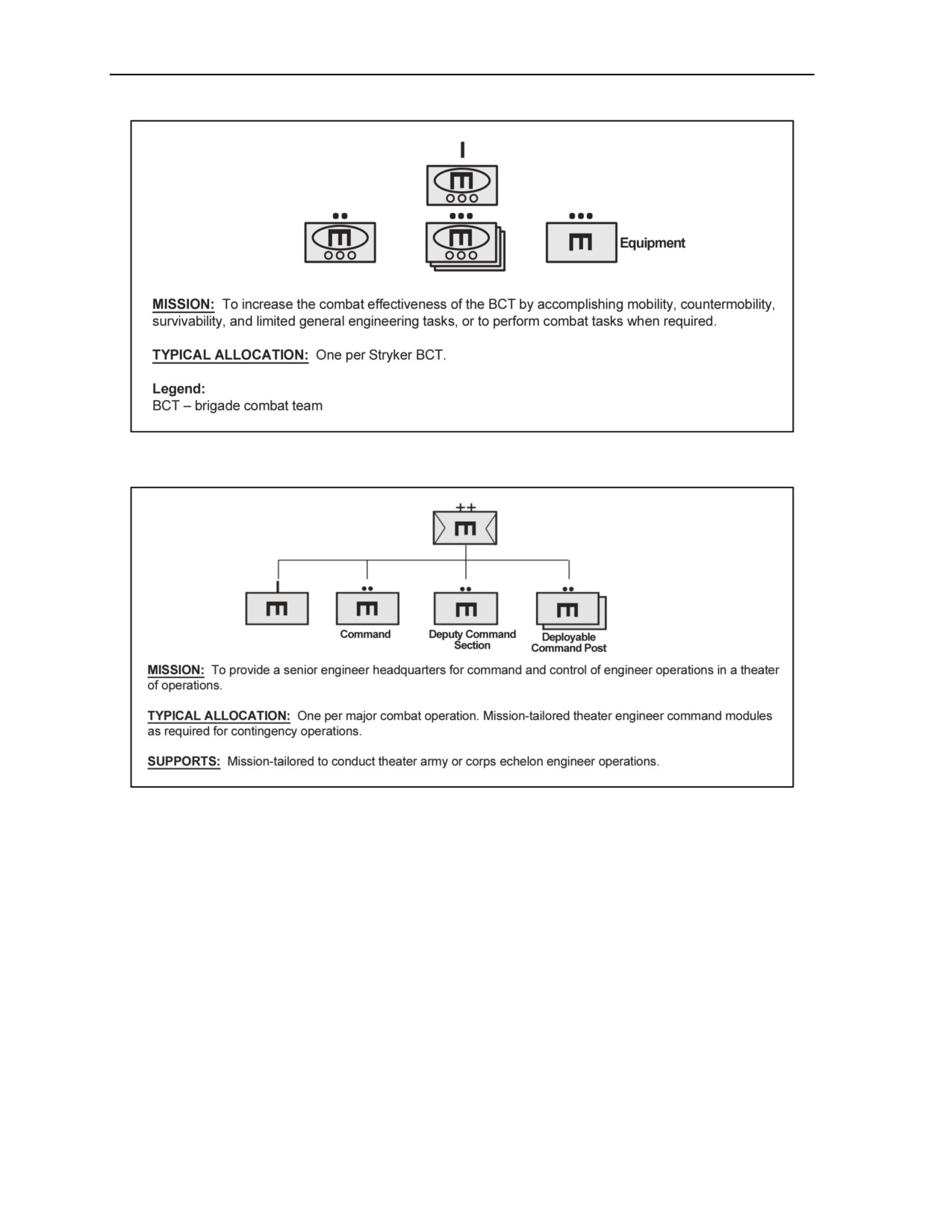
B-1. Table B-1 provides a quick reference index for the organic engineer units described in this appendix.
(For information about geospatial engineer teams, see ATTP 3-34.80, appendix E.)
Table B-1. Organic engineer units
Unit
Figure Number and Page
HBCT engineer company
B-1, B-3
IBCT engineer company
B-2, B-3
SBCT engineer company
B-3, B-4
ENGINEER HEADQUARTERS UNITS
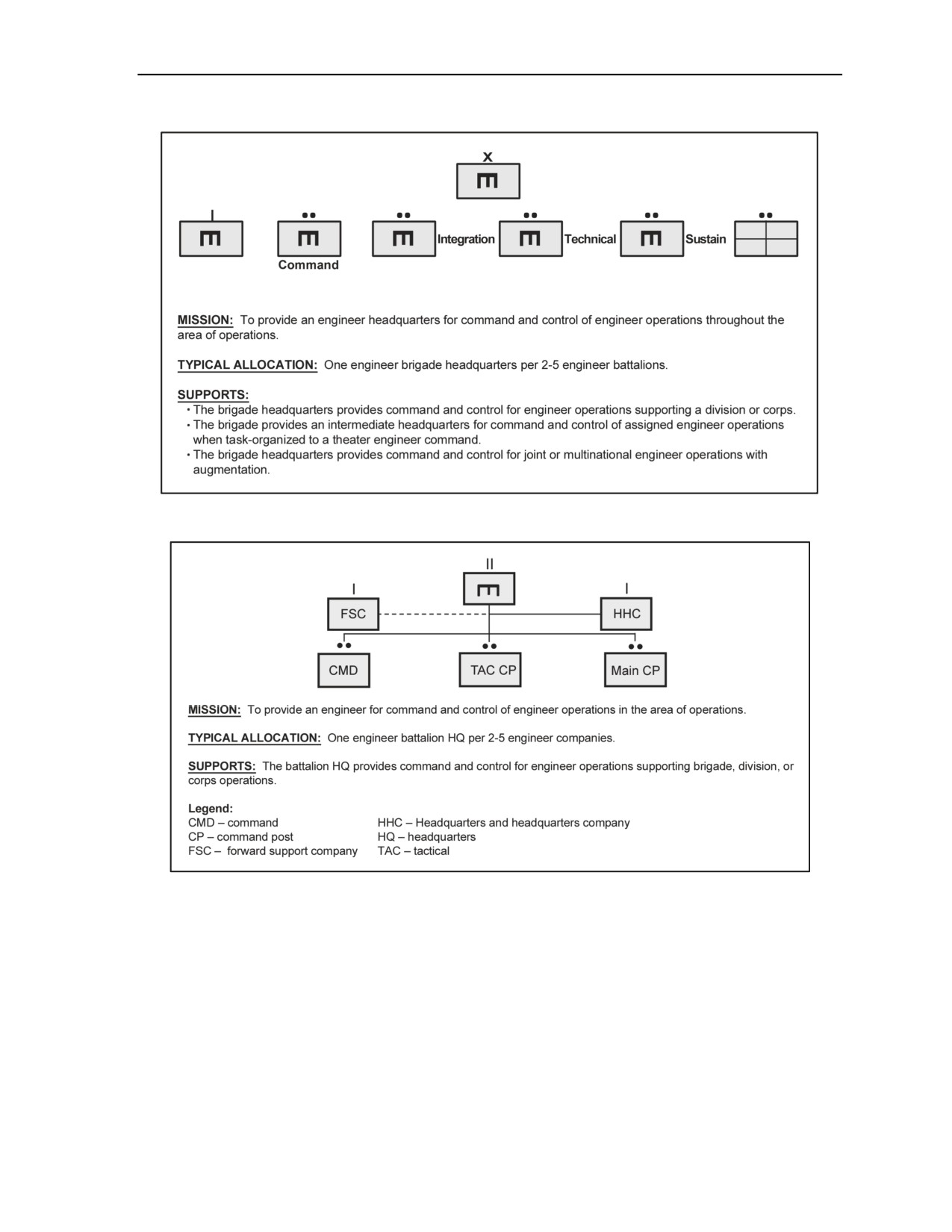
B-2. Table B-2 provides a quick reference index for the engineer headquarters units described in this
appendix.
Table B-2. Headquarters units
Unit
Figure Number and Page
Theater engineer command
B-4, B-4
Engineer brigade
B-5, B-5
Engineer battalion
B-6, B-5
BASELINE ENGINEER UNITS
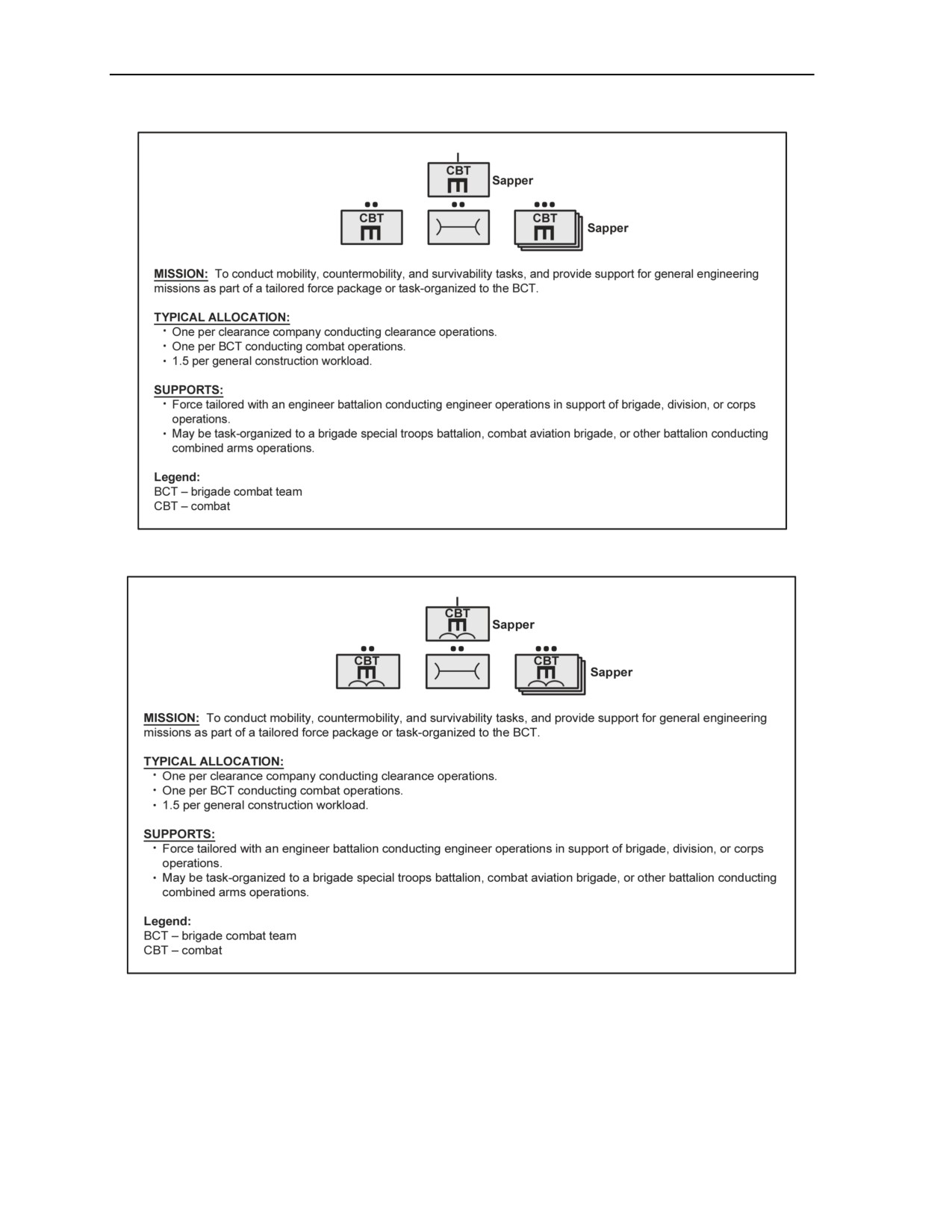
B-3. Table B-3 provides a quick reference index for the baseline engineer units described in this appendix.
Table B-3. Baseline engineer units
Unit
Figure Number and Page
Sapper company and sapper company
B-7, B-6
(wheeled)
Sapper company (airborne)
B-8, B-6
Mobility augmentation company
B-9, B-7
Multirole bridge company
B-10, B-7
Clearance company
B-11, B-8
4 August 2011
FM 3-34
B-1

Appendix B
Table B-3. Baseline engineer units
Unit
Figure Number and Page
Horizontal construction company
B-12, B-8
Vertical construction company
B-13, B-9
Engineer support company
B-14, B-9
Engineer support company (airborne)
B-15, B-10
SPECIALIZED ENGINEER UNITS
B-4. Table B-4 provides a quick reference index for the specialized engineer units described in this
appendix.
Table B-4. Specialized engineer units
Unit
Figure Number and Page
Prime power company
B-16, B-10
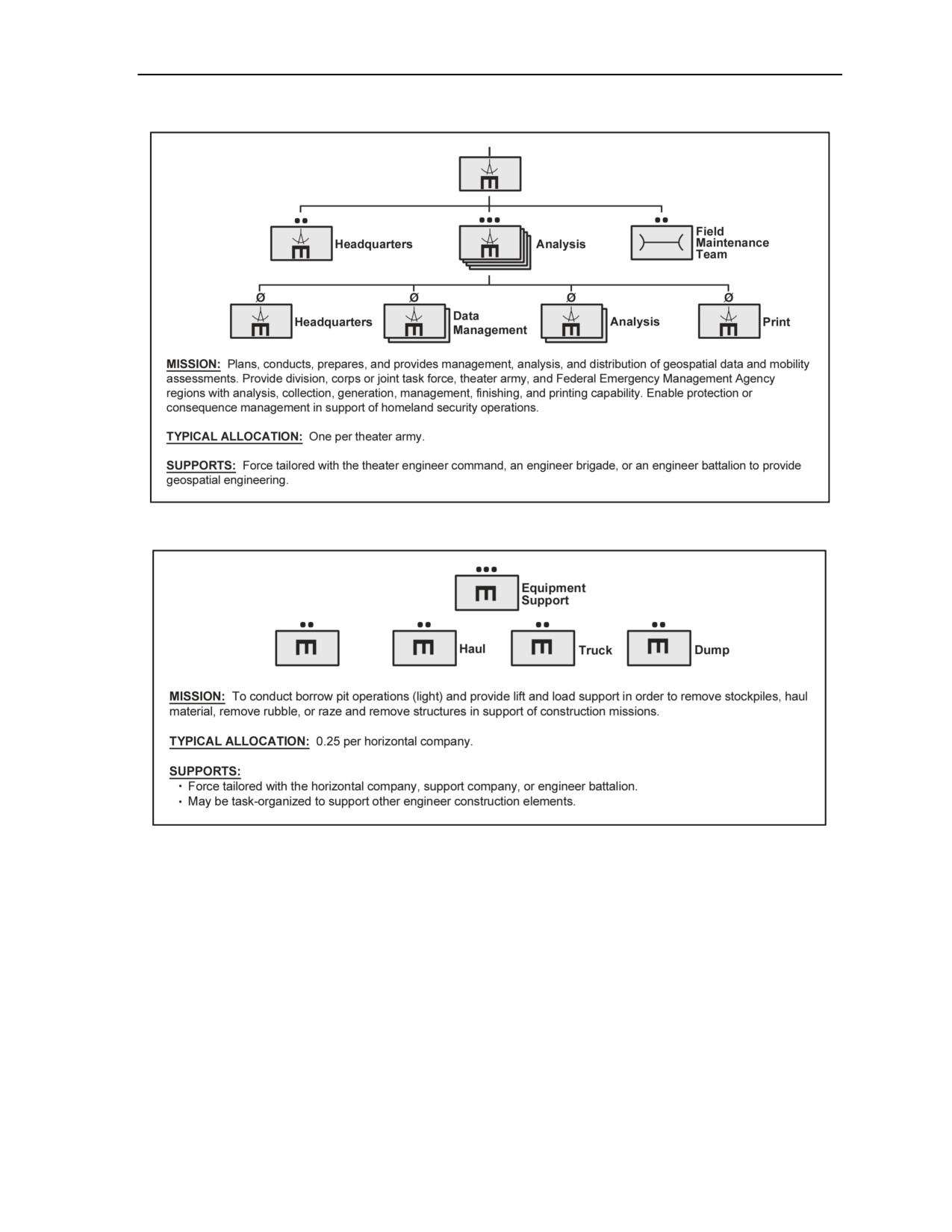
Topographic engineer company
B-17, B-11
Equipment support platoon
B-18, B-11
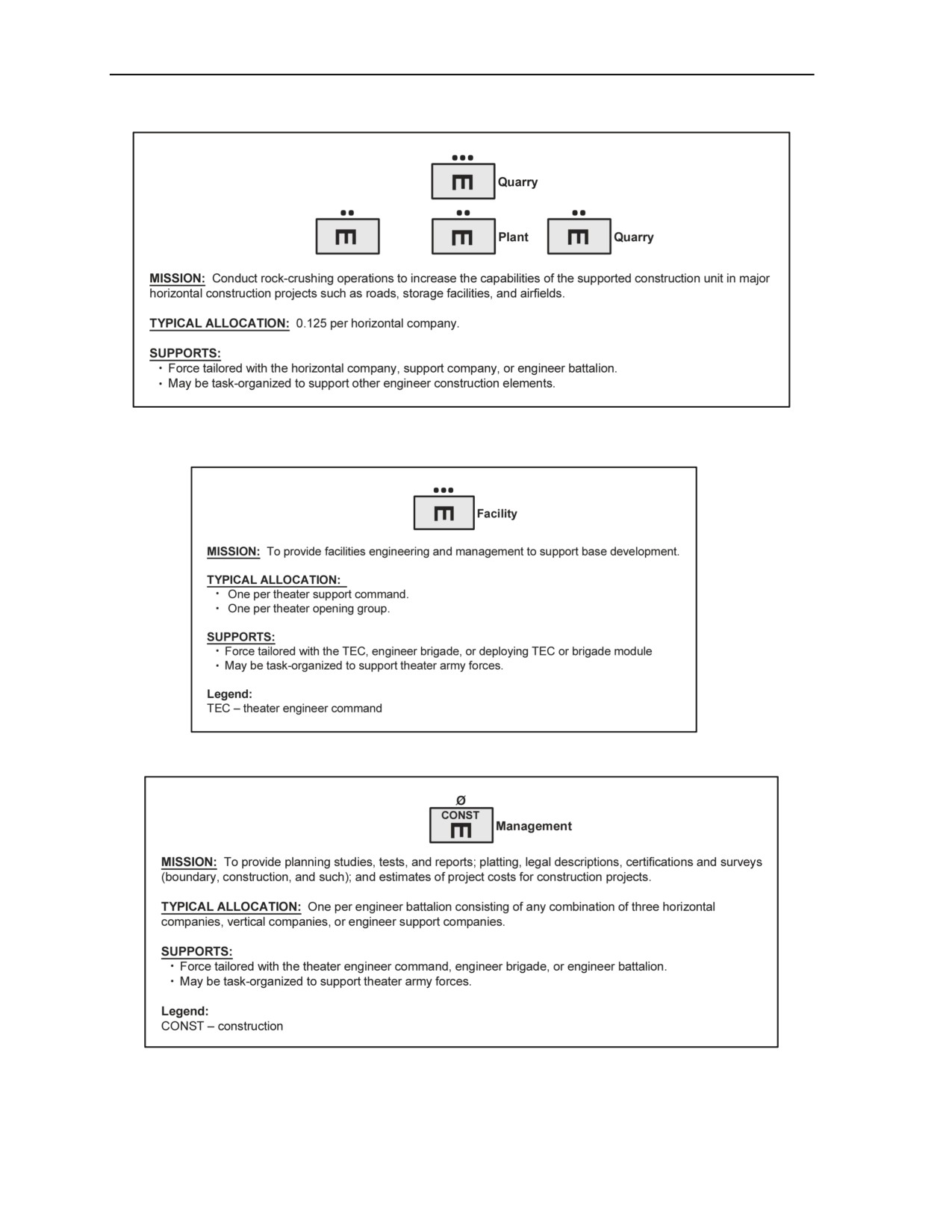
Quarry platoon
B-19, B-12
Facility engineer detachment
B-20, B-12
Construction management team
B-21, B-12
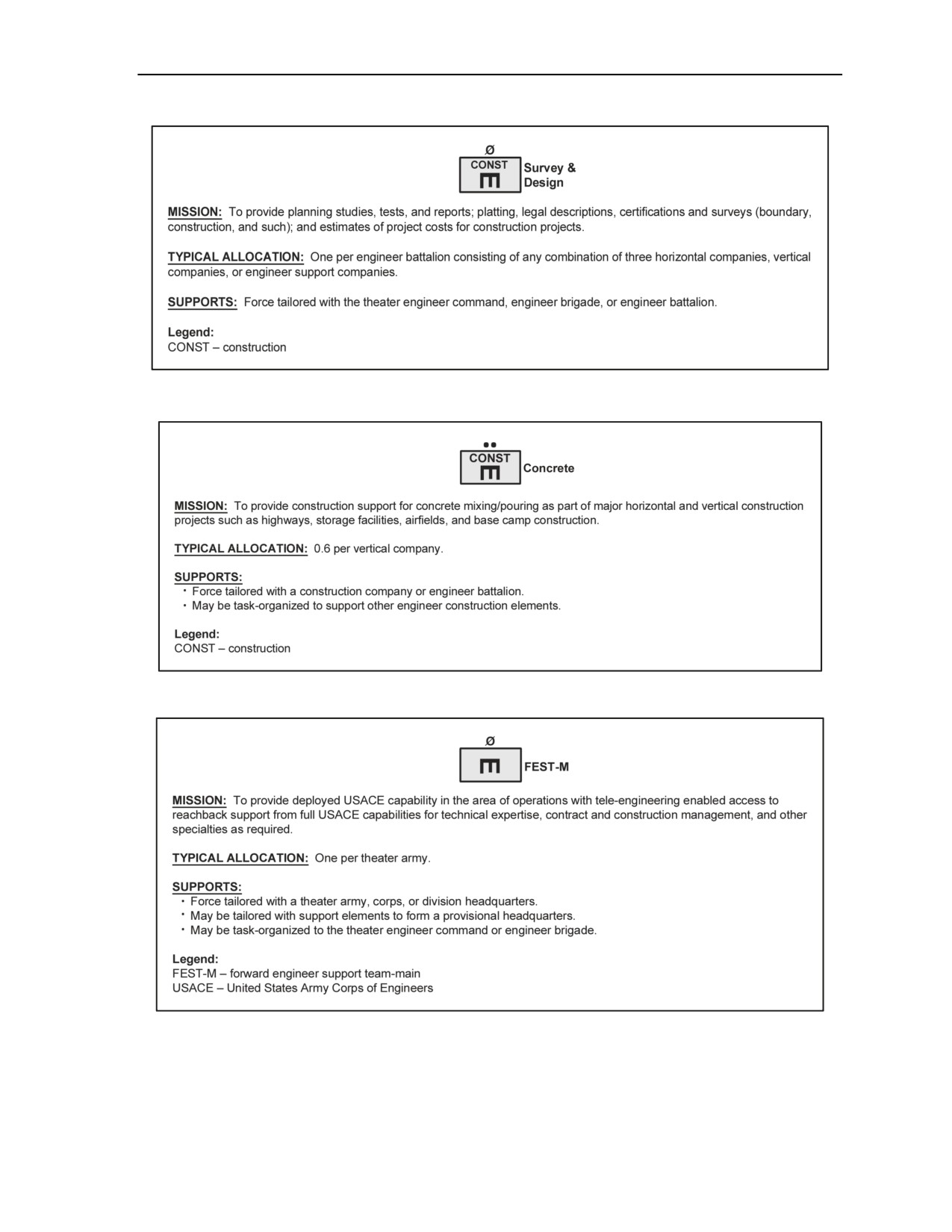
Survey and design team
B-22, B-13
Concrete section
B-23, B-13
Forward engineer support team-main
B-24, B-13
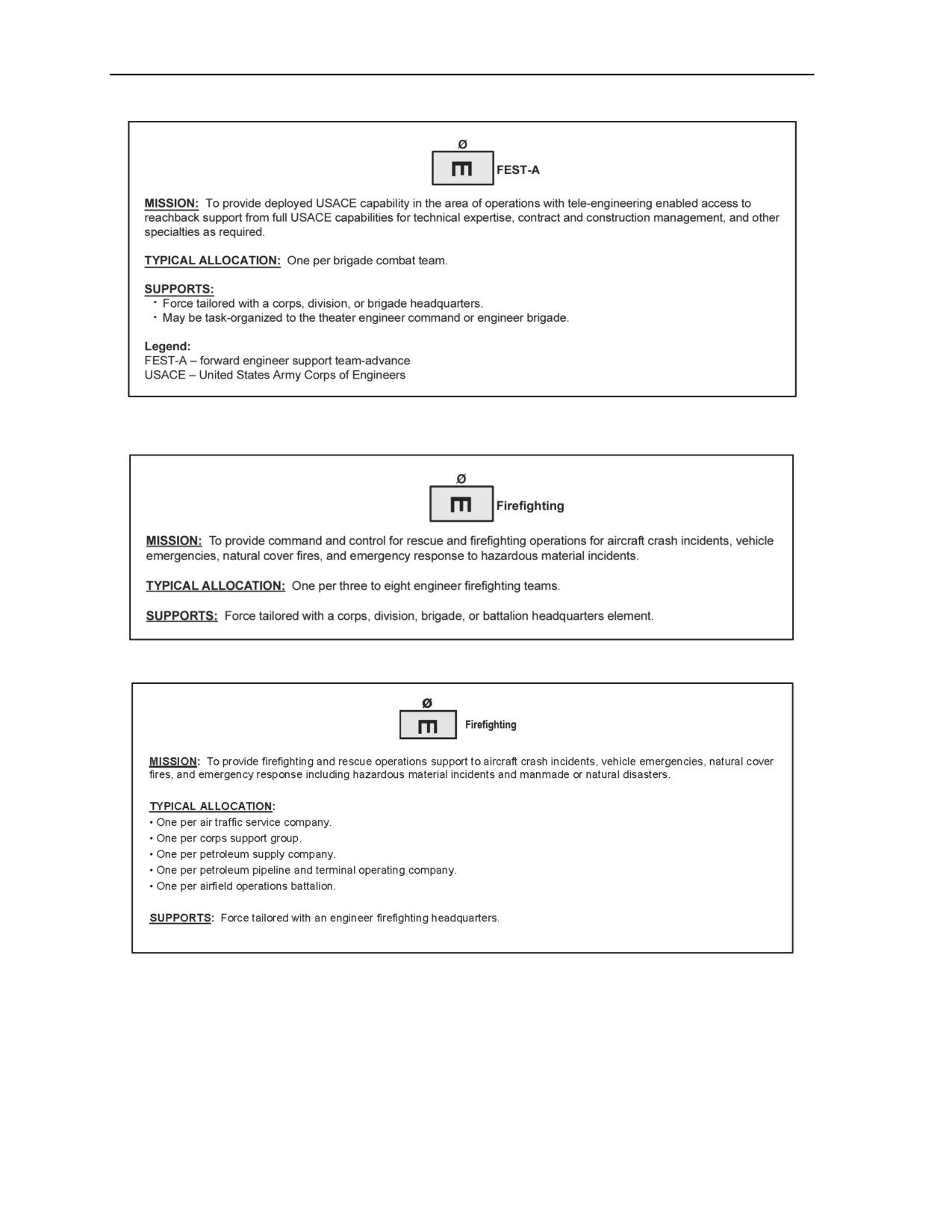
Forward engineer support team-advance
B-25, B-14
Firefighting headquarters
B-26, B-14
Firefighting team
B-27, B-14
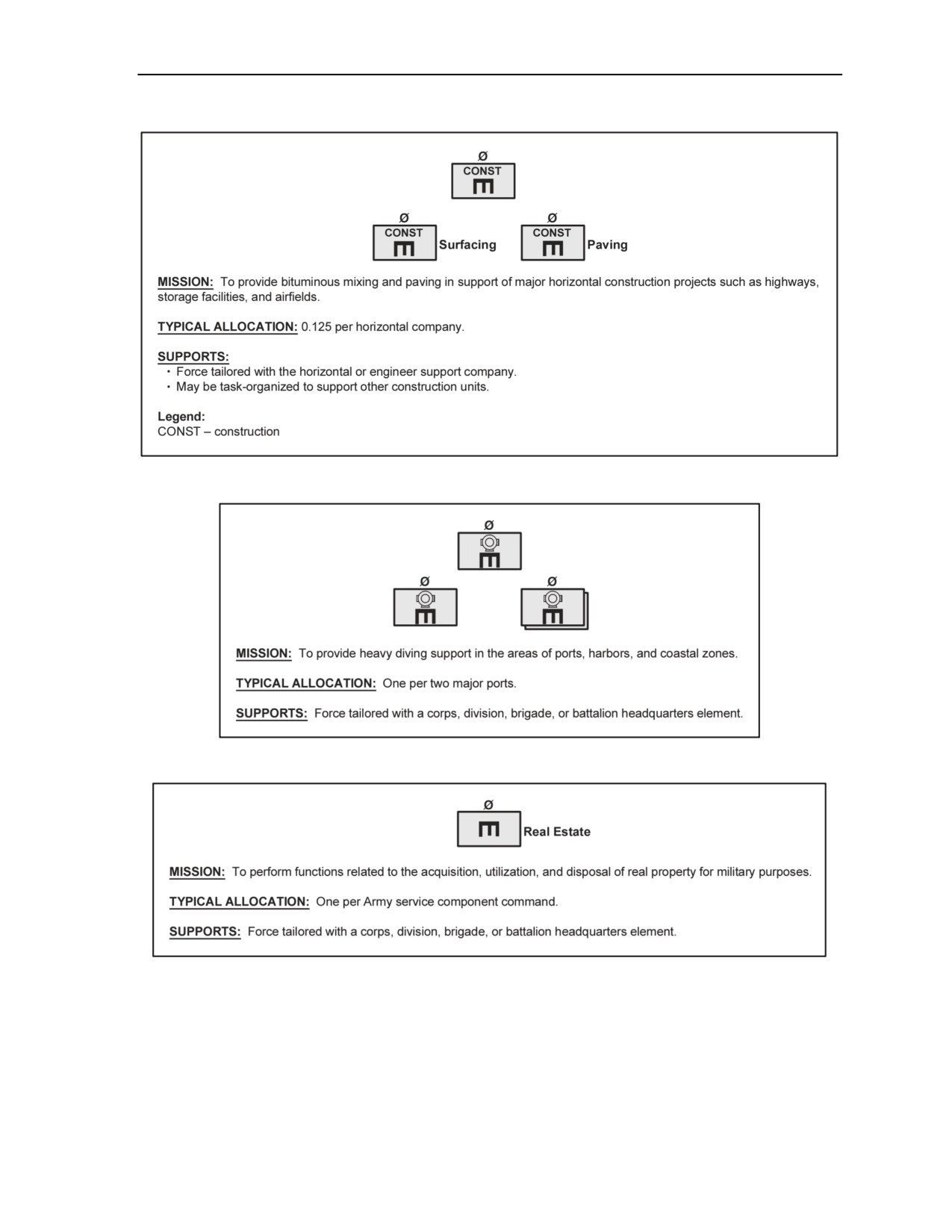
Asphalt team
B-28, B-15
Diving team
B-29, B-15
Real estate team
B-30, B-15
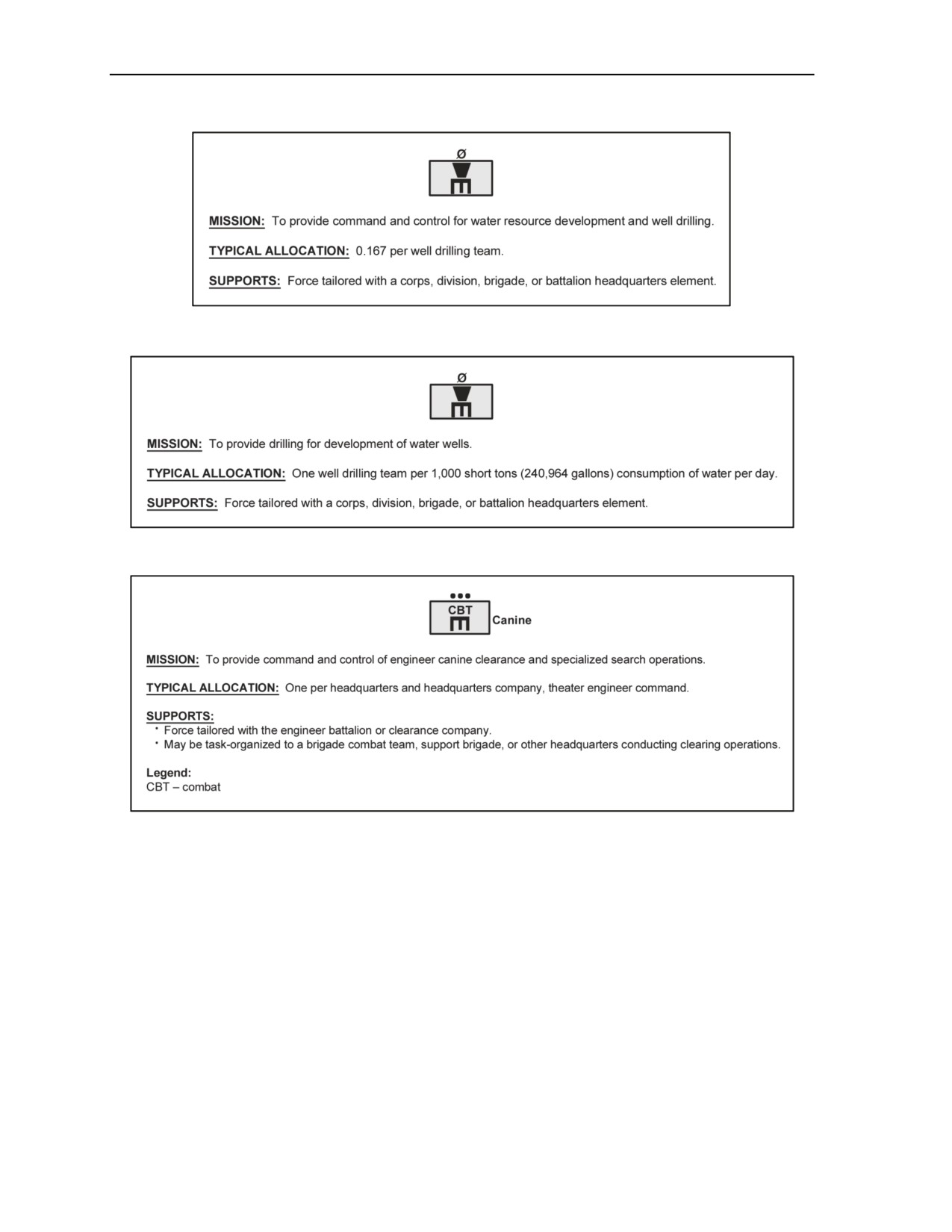
Well drilling headquarters
B-31, B-16
Well drilling team
B-32, B-16
Engineer detachment headquarters (canine)
B-33, B-16
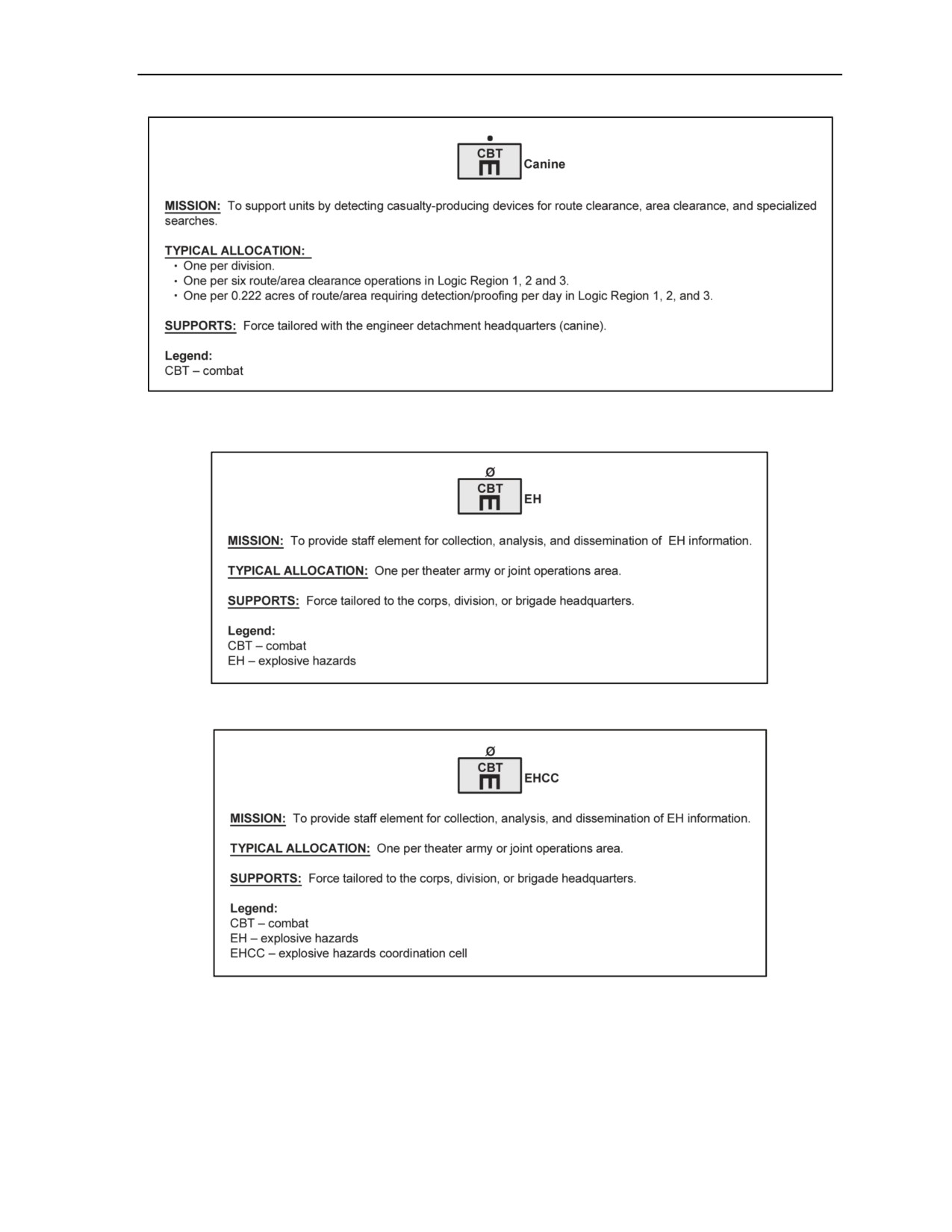
Engineer squad (canine)
B-34, B-17
Explosive hazards team
B-35, B-17
Explosive hazards coordination cell
B-36, B-17
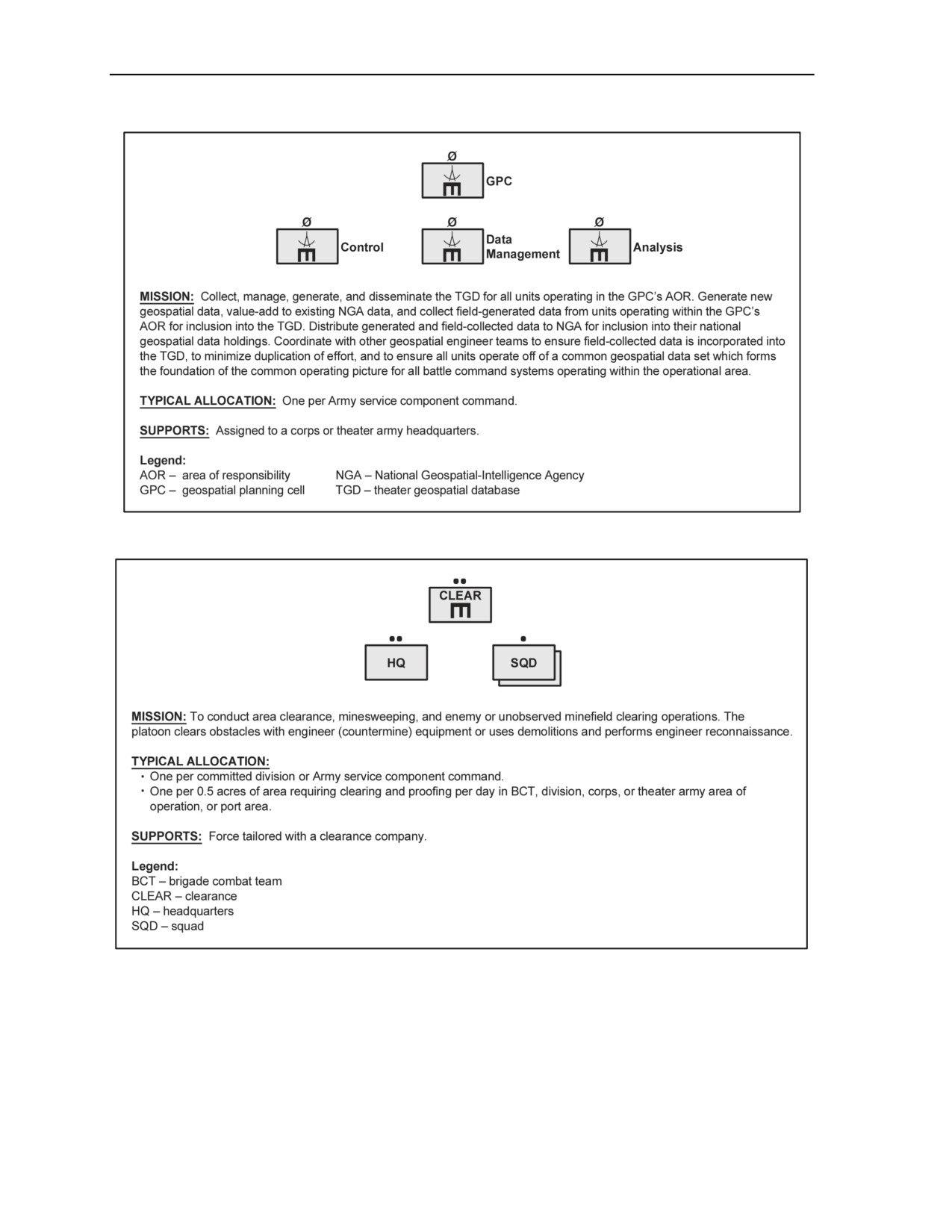
Geospatial planning cell
B-37, B-18
Area clearance platoon
B-38, B-18
B-2
FM 3-34
4 August 2011
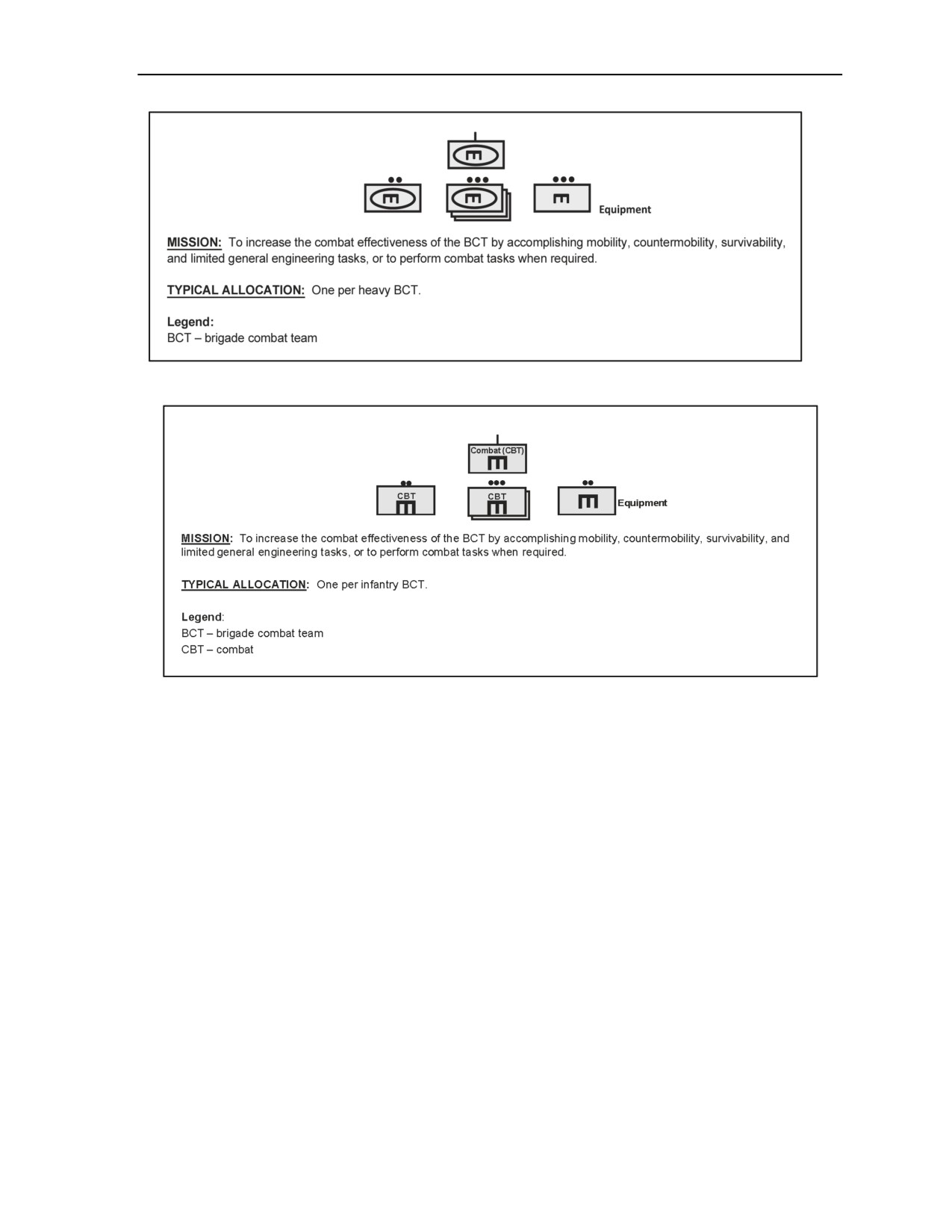
Army Engineer Operations
Figure B-1. HBCT engineer company
Figure B-2. IBCT engineer company
4 August 2011
FM 3-34
B-3
Appendix B
Figure B-3. SBCT engineer company
Figure B-4. Theater engineer command
B-4
FM 3-34
4 August 2011
Army Engineer Operations
Figure B-5. Engineer brigade
Figure B-6. Engineer battalion
4 August 2011
FM 3-34
B-5
Appendix B
Figure B-7. Sapper company and sapper company (wheeled)
Figure B-8. Sapper company (airborne)
B-6
FM 3-34
4 August 2011
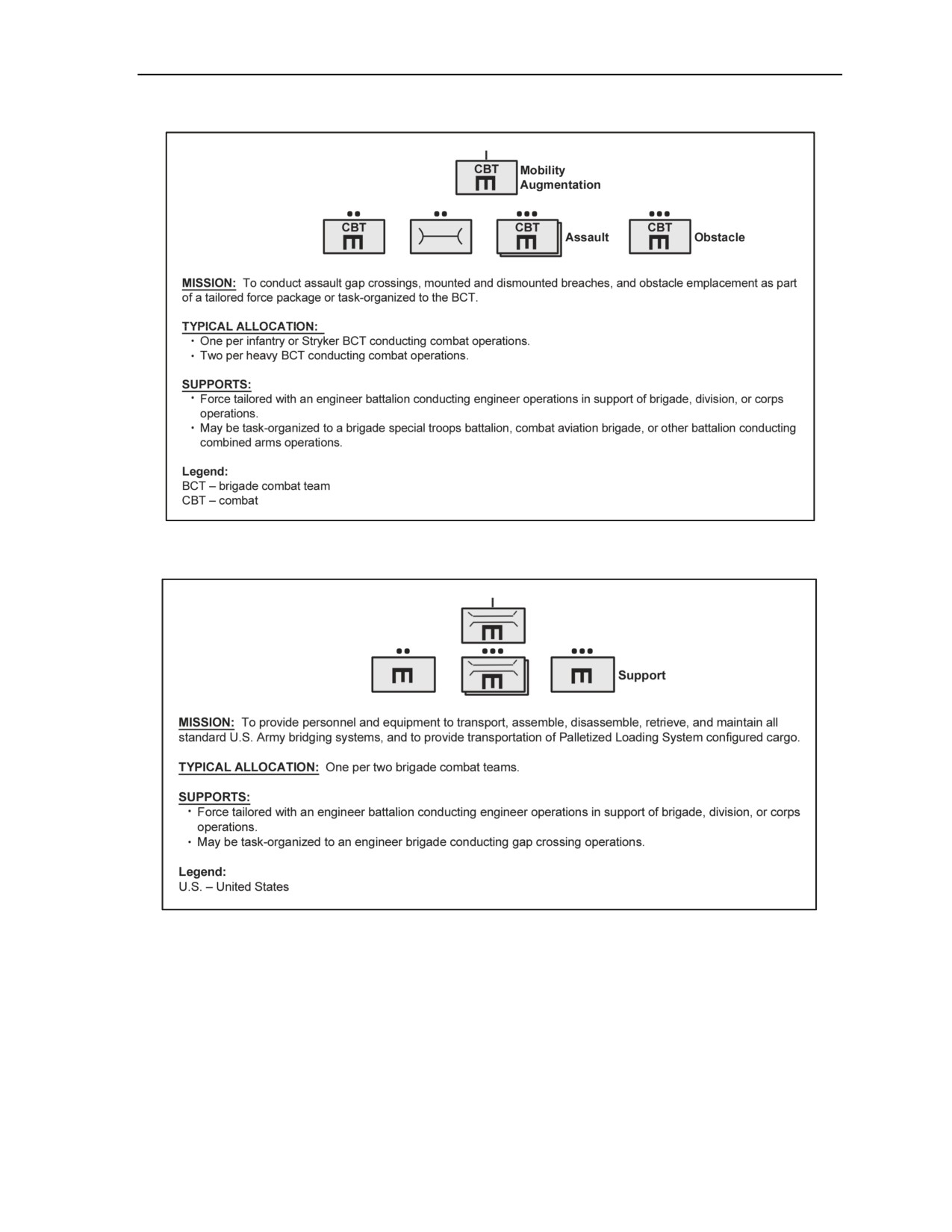
Army Engineer Operations
Figure B-9. Mobility augmentation company
Figure B-10. Multirole bridge company
4 August 2011
FM 3-34
B-7
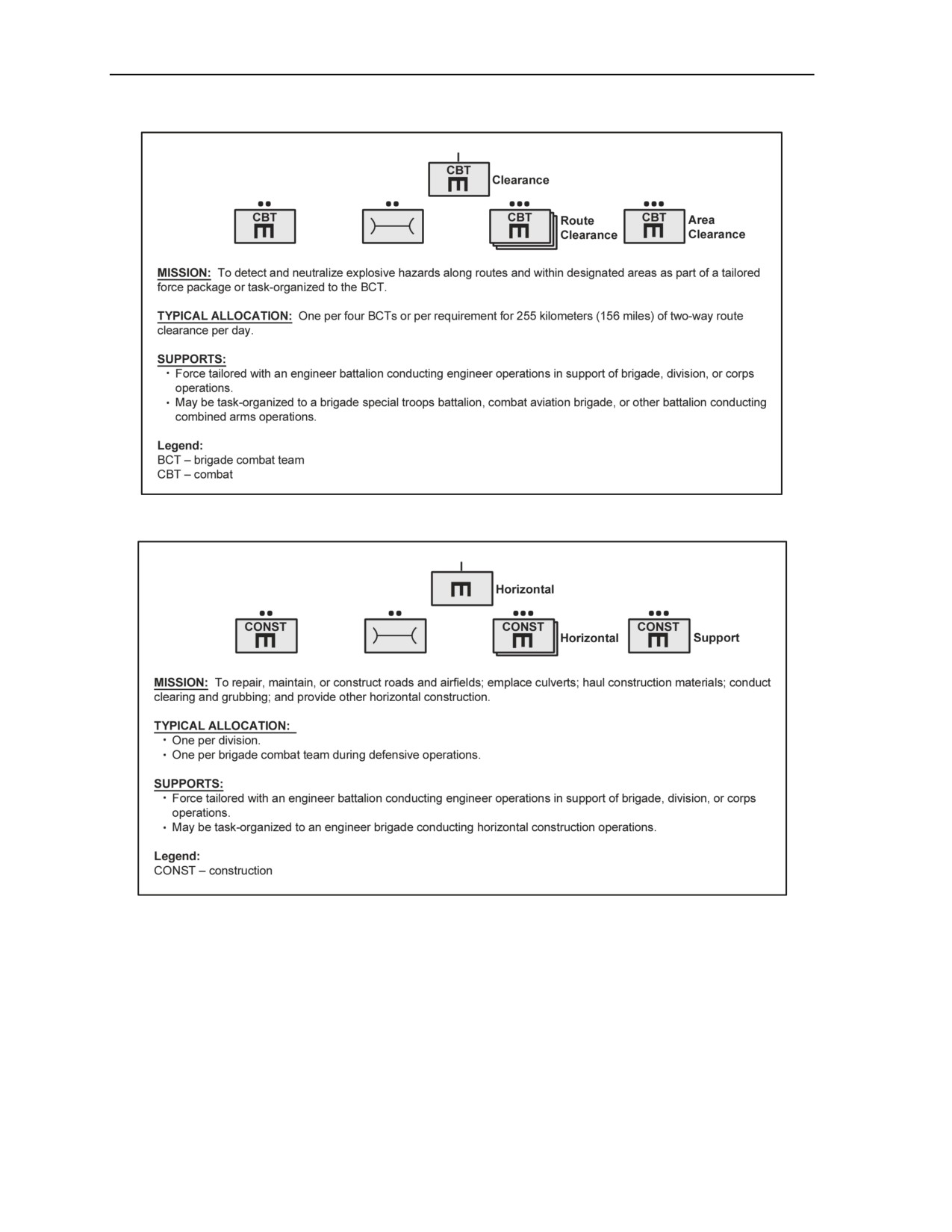
Appendix B
Figure B-11. Clearance company
Figure B-12. Horizontal construction company
B-8
FM 3-34
4 August 2011
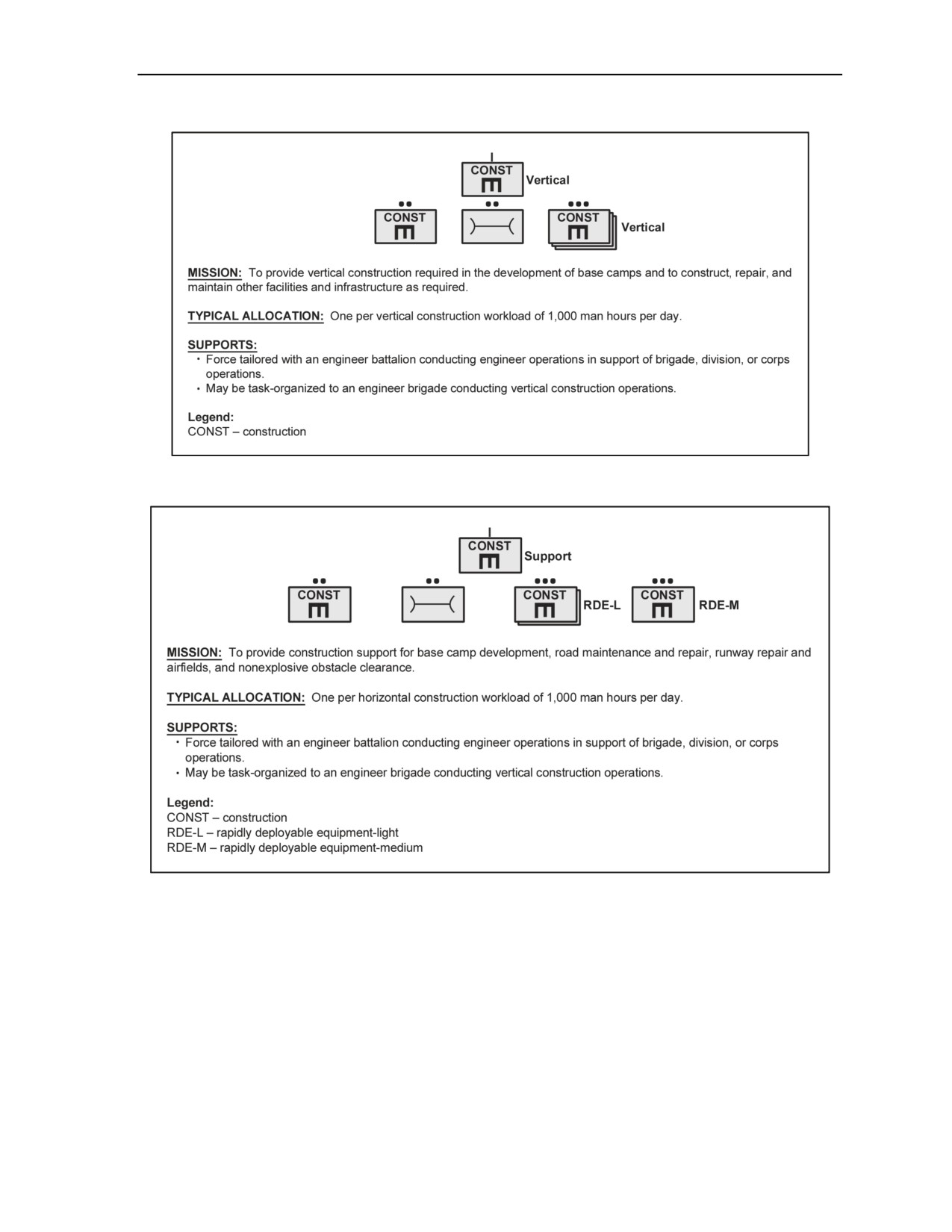
Army Engineer Operations
Figure B-13. Vertical construction company
Figure B-14. Engineer support company
4 August 2011
FM 3-34
B-9
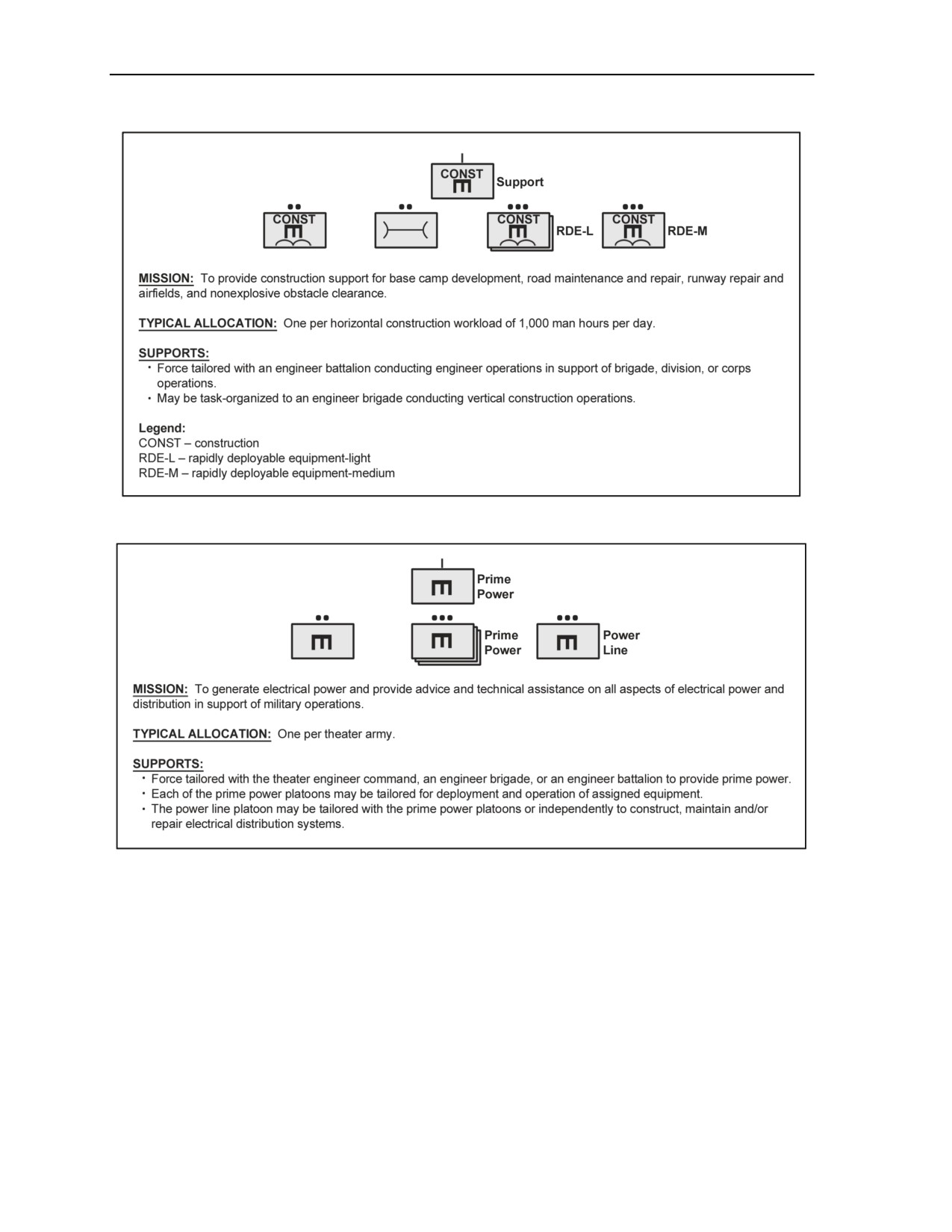
Appendix B
Figure B-15. Engineer support company (airborne)
Figure B-16. Prime power company
B-10
FM 3-34
4 August 2011
Army Engineer Operations
Figure B-17. Topographic engineer company
Figure B-18. Equipment support platoon
4 August 2011
FM 3-34
B-11
Appendix B
Figure B-19. Quarry platoon
Figure B-20. Facility engineer detachment
Figure B-21. Construction management team
B-12
FM 3-34
4 August 2011
Army Engineer Operations
Figure B-22. Survey and design team
Figure B-23. Concrete section
Figure B-24. Forward engineer support team-main
4 August 2011
FM 3-34
B-13
Appendix B
Figure B-25. Forward engineer support team-advance
Figure B-26. Firefighting headquarters
Figure B-27. Firefighting team
B-14
FM 3-34
4 August 2011
Army Engineer Operations
Figure B-28. Asphalt team
Figure B-29. Diving team
Figure B-30. Real estate team
4 August 2011
FM 3-34
B-15
Appendix B
Figure B-31. Well drilling headquarters
Figure B-32. Well drilling team
Figure B-33. Engineer detachment headquarters (canine)
B-16
FM 3-34
4 August 2011
Army Engineer Operations
Figure 3-34. Engineer squad (canine)
Figure B-35. Explosive hazards team
Figure B-36. Explosive hazards coordination cell
4 August 2011
FM 3-34
B-17
Appendix B
Figure B-37. Geospatial planning cell
Figure B-38. Area clearance platoon
B-18
FM 3-34
4 August 2011
Glossary
SECTION I - ACRONYMS AND ABBREVIATIONS
ADCON
administrative control
AFCESA
Air Force Civil Engineer Support Agency
AJP
allied joint publication
AO
area of operations
AOR
area of responsibility
APOD
aerial port of debarkation
ARFOR
See ARFOR under terms
ARNG
Army National Guard
ASCC
Army service component commander
AT
antitank
ATP
allied tactical publication
ATTP
Army tactics, techniques, and procedures
BCT
brigade combat team
BDT
base camp development team
BSB
brigade support battalion
BSTB
brigade special troops battalion
CA
civil affairs
CBRN
chemical, biological, radiological, and nuclear
CCD
camouflage, concealment, and deception
CCDR
combatant commander
CJCSM
Chairman, Joint Chiefs of Staff Manual
CMOC
civil-military operations center
COA
course of action
CONUS
continental United States
COP
common operational picture
CP
command post
CREST
contingency real estate support team
DA
Department of the Army
DCP
deployable command post
DOD
Department of Defense
DOTMLPF
doctrine, organization, training, materiel, leadership and education,
personnel, and facilities
DS
direct support
EAB
echelons above brigade
EH
explosive hazards
EnvST
environmental support team
EOD
explosive ordnance disposal
ERT
engineer reconnaissance team
4 August 2011
FM 3-34
Glossary-1
Glossary
*EWL
engineer work line
FEST
forward engineer support team
FEST-A
forward engineer support team - advance
FEST-M
forward engineer support team - main
*FFE
field force engineering
FM
field manual
FRAGO
fragmentary order
G-4
Assistant Chief of Staff, Logistics
GCC
geographic combatant commander
GEOINT
geospatial intelligence
GS
general support
HBCT
heavy brigade combat team
HN
host nation
HNS
host nation support
IBCT
infantry brigade combat team
IED
improvised explosive device
IPB
intelligence preparation of the battlefield
JFC
joint force commander
JOPES
Joint Operation Planning and Execution System
JP
joint publication
JTF
joint task force
LOC
line of communications
LOGCAP
logistics civil augmentation program
LSE
logistics support element
LST
logistics support team
LZ
landing zone
M/CM/S
mobility, countermobility, and survivability
MCRP
Marine Corps reference publication
MCWP
Marine Corps warfighting publication
MDMP
military decisionmaking process
MEB
maneuver enhancement brigade
METT-TC
mission, enemy, terrain and weather, troops and support available,
time available, civil considerations
MSR
main supply route
NATO
North Atlantic Treaty Organization
NAVFAC
Naval Facilities Engineering Command
NGO
nongovernmental organization
OE
operational environment
OPCON
operational control
OPLAN
operation plan
OPORD
operation order
Glossary-2
FM 3-34
4 August 2011
Glossary
PMESII-PT
political, military, economic, social, information, infrastructure,
physical environment, time (operational variables)
RDSP
rapid decisionmaking and synchronization process
ROE
rules of engagement
RSOI
reception, staging, onward movement, and integration
S-4
logistics staff officer
SBCT
Stryker brigade combat team
SCATMINE
scatterable mine
SPOD
seaport of debarkation
SU
situational understanding
TC
training circular
TCMS
Theater Construction Management System
TEC
theater engineer command
TF
task force
TSC
theater support command
TTP
tactics, techniques, and procedures
UFC
unified facilities criteria
U.S.
United States
USACE
United States Army Corps of Engineers
USAES
United States Army Engineer School
USAR
United States Army Reserve
SECTION II - TERMS
Term
Definition
ARFOR
The Army Service component headquarters for a joint task force or a joint and multinational force.
(FM 3-0)
*combat engineering
(Army) The engineer discipline that is focused on affecting terrain while in close support to maneuver
forces that are in close combat.
*countermobility operations
(Army) Those combined arms activities that use or enhance the effects of natural and man-made
obstacles to deny an adversary freedom of movement and maneuver. (Upon its publication, FM 3-90.8
will become the proponent manual for countermobility operations.)
*engineer disciplines
The interdependent areas of expertise within the Engineer Regiment. The three engineer disciplines are
combat, general, and geospatial engineering.
*engineer work line
A coordinated boundary or phase line used to compartmentalize an area of operations (AO) to indicate
where specific engineer units have primary responsibility for the engineer effort. It may be used at
division level to discriminate between an AO supported by division engineer assets and an AO
supported by direct support or general support corps engineer units. Also called EWL. See also area
of operations; boundary; direct support; general support; phase line in FM 1-02.
4 August 2011
FM 3-34
Glossary-3
Glossary
*field force engineering
(Army) The application of the Engineer Regiment’s capabilities from the three engineer disciplines
(although primarily general engineering) to support full spectrum operations through both reachback
and forward presence.
*general engineering
(Army) The engineer discipline that is focused on affecting terrain while not in close support to
maneuver forces that are in close combat.
*geospatial engineering
(Army) The engineer discipline that is focused on applying geospatial information to improve
understanding of terrain for military operations.
*lines of engineer support
Categories of engineer tasks and capabilities that are grouped by purpose for specific operations.
*survivability operations
Those military activities that develop and construct protective positions, such as earth berms, dug-in
positions, overhead protection, and countersurveillance means, to reduce the effectiveness of enemy
weapon systems. See also survivability in FM 1-02. (Upon its publication, ATTP 3-34.XX will
become the proponent manual for survivability operations.)
*terrain reinforcement
The emplacement of obstacles or the construction of fighting positions and cover to degrade enemy
mobility or to enhance friendly survivability. See also countermobility operations; obstacle;
survivability operations in FM 1-02
Glossary-4
FM 3-34
4 August 2011
References
SOURCES USED
The following sources are either quoted or paraphrased in this publication.
ARMY PUBLICATIONS
ATTP 3-34.23 (FM 5-71-100, 5-100-15, 5-116). Engineer Operations - Echelons Above Brigade
Combat Team, 8 July 2010.
ATTP 3-34.80. Geospatial Engineering, 29 July 2010.
Engineer Pamphlet 500-1-2. Emergency Employment of Army and Other Resources—Field Force
Engineering—United States Army Corps of Engineers Support to Full Spectrum Operations,
1 August 2010.
FM 1-0. Human Resources Support, 6 April 2010.
FM 1-01. Generating Force Support for Operations, 2 April 2008.
FM 2-0. Intelligence, 23 March 2010.
FM 3-0. Operations, 27 February 2008.
FM 3-05.40 (FM 41-10), Civil Affairs Operations, 29 September 2006.
FM 3-06. Urban Operations, 26 October 2006.
FM 3-07. Stability Operations, 6 October 2008.
FM 3-13 (FM 100-6). Information Operations: Doctrine, Tactics, Techniques, and Procedures,
28 November 2003.
FM 3-28. Civil Support Operations, 20 August 2010.
FM 3-34.2. Combined Arms Breaching Operations, 31 August 2000.
FM 3-34.22. Engineer Operations: Brigade Combat Team and Below, 11 February 2009.
FM 3-34.210 (FM 20-32). Explosive Hazards Operations, 27 March 2007.
FM 3-34.400. General Engineering, 9 December 2008.
FM 3-35. Army Deployment and Redeployment, October 2009.
FM 3-37. Protection, 30 September 2009.
FM 3-90. Tactics, 4 July 2001.
FM 3-90.6. The Brigade Combat Team, 4 August 2006.
FM 3-90.31, Maneuver Enhancement Brigade Operations. 26 February 2009.
FM 3-90.61, The Brigade Special Troops Battalion. 22 December 2006.
FM 4-0. Sustainment, 30 April 2009.
FM 4-92 (FM 100-10-2), Contracting Support Brigade. 12 February 2010.
FM 4-94. Theater Sustainment Command, 12 February 2010.
FM 5-0. The Operations Process, 26 March 2010.
FM 5-102. Countermobility, 14 March 1985.
FM 5-103. Survivability. 10 June 1985.
FM 5-412. Project Management, 13 June 1994.
FM 5-415. Fire-Fighting Operations, 9 February 1999.
FM 6-0. Mission Command: Mission Command of Army Forces, 11 August 2003.
FM 6-22. Army Leadership, 12 October 2006.
FM 7-0. Training Units and Developing Leaders for Full Spectrum Operations, 23 February 2011.
4 August 2011
FM 3-34
References-1
References
FM 90-7. Combined Arms Obstacle Integration, 29 September 1994.
GTA 90-01-011. Joint Forward Operating Base (JFOB) Survivability and Force Protection
Construction Handbook, 1 October 2009.
JOINT AND DEPARTMENT OF DEFENSE PUBLICATIONS
AJP 3.12. Joint Engineering, December 2003.
CJCSM 3122.01A. Joint Operation Planning and Execution System (JOPES) Volume I (Planning
Policies and Procedures). 29 September 2006.
CJCSM 3122.03C. Joint Operation Planning and Execution System (JOPES) Volume II (Planning
Format), 17 August 2007.
DOD Directive 4270.5. Military Construction. 12 February 2005.
JP 1. Doctrine for the Armed Forces of the United States, 14 May 2007.
JP 1-02. Department of Defense Dictionary of Military and Associated Terms, 8 November 2010.
JP 2-03. Geospatial Intelligence Support to Joint Operations, 22 March 2007.
JP 3-0. Joint Operations, 11 August 2011.
JP 3-08. Interorganizational Coordination During Joint Operations, 24 June 2011.
JP 3-15. Barriers, Obstacles, and Mine Warfare for Joint Operations, 17 June 2011.
JP 3-34. Joint Engineer Operations, 30 June 2011.
JP 3-35. Deployment and Redeployment Operations, 7 May 2007.
JP 5-0. Joint Operation Planning, 11 August 2011.
Joint Forward Operations Base (JFOB) Handbook. December 2006.
MULTI-SERVICE PUBLICATIONS
FM 1-02/MCRP 5-12A. Operational Terms and Graphics, 21 September 2004.
FM 3-34.5/MCRP 4-11B. Environmental Considerations,16 February 2010.
FM 3-34.170/MCRP 3-17.4 (5-170). Engineer Reconnaissance, 25 March 2008.
FM 3-90.12/MCWP 3-17.1 (FM 90-13), Combined Arms Gap-Crossing Operations. 1 July 2008.
FM 3-90.119/MCIP 3-17.01, Combined Arms Improvised Explosive Device Defeat Operations.
21 September 2007.
OTHER PUBLICATIONS
NATO Military Committee Policy 05-60.
Standardization Agreement 2394/ATP-52(B). Land Force Combat Engineer Doctrine. October 2006.
The United States Central Command’s CCR 415-1. Construction and Base Camp Development (Sand
Book).
The United States European Command’s Camp Facilities Standards for Contingency Operations (Red
DOCUMENTS NEEDED
DA Form 2028. Recommended Changes to Publications and Blank Forms.
READINGS RECOMMENDED
None.
References-2
FM 3-34
4 August 2011