FM 3-34 ENGINEER OPERATIONS (August 2011) - page 1
*FM 3-34
Field Manual
Headquarters
Department of the Army
No. 3-34
Washington, D.C., 4 August 2011
Engineer Operations
Contents
Page
PREFACE
v
INTRODUCTION
vii
Chapter 1
THE OPERATIONAL CONTEXT
1-1
The Operational Environment
1-1
Unified Action
1-4
Spectrum of Conflict
1-5
Chapter 2
THE ENGINEER REGIMENT
2-1
The Military Engineer Profession
2-1
Engineer Organizations
2-4
The Engineer Branch
2-4
Operational Force Engineers
2-6
United States Army Corps of Engineers
2-13
Department of Defense Construction Agents
2-16
Chapter 3
FOUNDATIONS OF ENGINEER SUPPORT TO OPERATIONS
3-1
Overview
3-1
Lines of Engineer Support
3-1
Assure Mobility
3-2
Enhance Protection
3-5
Enable Logistics
3-6
Develop Infrastructure
3-7
Engineer Reconnaissance
3-8
Engineer Support to Warfighting Functions
3-9
Engineers in Close Combat
3-12
Chapter 4
MISSION COMMAND CONSIDERATIONS
4-1
Overview
4-1
Engineer Force Tailoring
4-1
Mission Command of Engineer Forces
4-5
Chapter 5
INTEGRATING ENGINEER SUPPORT
5-1
Distribution Restriction: Approved for public release; distribution is unlimited.
*This publication supersedes FM 3-34, 2 April 2009.
i
Contents
Section I - Integrated Planning
5-1
Planning at Each Level of War
5-1
Considerations for Full Spectrum Operations
5-3
Parallel Planning
5-4
Staff Planning
5-4
Section II - Planning Processes
5-4
The Military Decisionmaking Process
5-5
Engineer Staff’s Running Estimate
5-6
Plans and Orders
5-8
Assured Mobility
5-9
Essential Tasks for Mobility, Countermobility, and Survivability
5-9
Section III - Other Processes
5-11
Force Projection
5-11
Facilities and Construction Planning
5-11
Project Management
5-13
Section IV - Preparing, Executing, and Assessing Engineer Support
5-13
Simultaneous Combinations
5-14
Operations Process Activities
5-14
Offensive Operations
5-14
Defensive Operations
5-16
Stability Operations
5-17
Civil Support Operations
5-20
Special Considerations
5-21
Chapter 6
SUSTAINMENT CONSIDERATIONS FOR ENGINEER SUPPORT TO
OPERATIONS 6-1
Sustainment Challenges for Engineer Support
6-1
Organizations and Functions
6-2
Principles of Sustainment
6-2
Engineer Leader and Staff Responsibilities for Sustainment
6-4
Appendix A MULTINATIONAL, INTERAGENCY, NONGOVERNMENTAL ORGANIZATION,
AND HOST NATION CONSIDERATIONS
A-1
Section I - Multinational Considerations
A-1
Units and Organizations
A-1
Multinational Engineers
A-1
Section II - Interagency and Nongovernmental Organization
Considerations
A-3
Interagency Operations
A-3
Nongovernmental Organizations
A-3
Section III - Host Nation Considerations
A-4
Host Nation Interface
A-4
Real Estate Considerations
A-4
Host Nation Support
A-5
Appendix B ARMY ENGINEER OPERATIONS
B-1
Organic Engineer Units
B-1
Engineer Headquarters Units
B-1
Baseline Engineer Units
B-1
ii
FM 3-34
4 August 2011
Contents
Specialized Engineer Units
B-2
GLOSSARY
Glossary-1
REFERENCES
References-1
INDEX
Index-1
Figures
Figure
1. Engineer framework
vii
Figure
2-1. Engineer disciplines
2-1
Figure
2-2. The Engineer Regiment from the tactical to operational level
2-5
Figure
2-3. The Engineer Regiment and the engineer disciplines
2-6
Figure
3-1. Lines of engineer support
3-2
Figure
3-2. Engineer application of combat power
3-10
Figure
4-1. Mission command for engineer units
4-2
Figure
4-2. Notional division engineer force
4-4
Figure
4-3. Notional theater engineer command
4-5
Figure
5-1. Engineer planning at each level of war
5-2
Figure
5-1. Engineer considerations in the military decisionmaking process
5-5
Figure
5-3. Notional engineer support to offensive operations
5-15
Figure
5-4. Notional engineer support to defensive operations
5-16
Figure
5-5. Notional engineer support to stability operations
5-18
Figure
5-6. Notional engineer support to civil support operations
5-20
Figure B-1. HBCT engineer company
B-3
Figure B-2. IBCT engineer company
B-3
Figure B-3. SBCT engineer company
B-4
Figure B-4. Theater engineer command
B-4
Figure B-5. Engineer brigade
B-5
Figure B-6. Engineer battalion
B-5
Figure B-7. Sapper company and sapper company (wheeled)
B-6
Figure B-8. Sapper company (airborne)
B-6
Figure B-9. Mobility augmentation company
B-7
Figure B-10. Multirole bridge company
B-7
Figure B-11. Clearance company
B-8
Figure B-12. Horizontal construction company
B-8
Figure B-13. Vertical construction company
B-9
Figure B-14. Engineer support company
B-9
Figure B-15. Engineer support company (airborne)
B-10
Figure B-16. Prime power company
B-10
Figure B-17. Topographic engineer company
B-11
Figure B-18. Equipment support platoon
B-11
Figure B-19. Quarry platoon
B-12
4 August 2011
FM 3-34
iii
Contents
Figure B-20. Facility engineer detachment
B-12
Figure B-21. Construction management team
B-12
Figure B-22. Survey and design team
B-13
Figure B-23. Concrete section
B-13
Figure B-24. Forward engineer support team-main
B-13
Figure B-25. Forward engineer support team-advance
B-14
Figure B-26. Firefighting headquarters
B-14
Figure B-27. Firefighting team
B-14
Figure B-28. Asphalt team
B-15
Figure B-29. Diving team
B-15
Figure B-30. Real estate team
B-15
Figure B-31. Well drilling headquarters
B-16
Figure B-32. Well drilling team
B-16
Figure B-33. Engineer detachment headquarters (canine)
B-16
Figure 3-34. Engineer squad (canine)
B-17
Figure B-35. Explosive hazards team
B-17
Figure B-36. Explosive hazards coordination cell
B-17
Figure B-37. Geospatial planning cell
B-18
Figure B-38. Area clearance platoon
B-18
Tables
Table 1. FM 3-34 term changes
viii
Table 2-1. Baseline engineer units
2-9
Table 2-2. Specialized Army engineer force pool units
2-10
Table 2-3. Elements of the Engineer Regiment
2-12
Table 5-2. The military decisionmaking process and the engineer estimate
5-7
Table B-1. Organic engineer units
B-1
Table B-3. Baseline engineer units
B-1
Table B-4. Specialized engineer units
B-2
iv
FM 3-34
4 August 2011
Preface
Field Manual (FM) 3-34 is the Army’s keystone doctrinal publication for the Engineer Regiment. It presents
overarching doctrinal guidance and direction for conducting engineer activities and shows how they contribute
to full spectrum operations. It provides a common framework and language for engineer support to operations
and constitutes the doctrinal foundation for developing the other fundamentals and tactics, techniques, and
procedures (TTP) detailed in subordinate doctrinal manuals in the FM 3-34 series. This manual is a key
integrating publication that links the doctrine for the Engineer Regiment with Army capstone doctrine and joint
doctrine. It focuses on synchronizing and coordinating the diverse range of capabilities in the Engineer
Regiment to successfully support the Army and its mission. FM 3-34 provides operational guidance for
engineer commanders and trainers at all echelons and forms the foundation for Army Engineer School curricula.
To comprehend the doctrine contained in FM 3-34, readers must first understand the elements of full spectrum
operations, operational design, and the elements of combat power as described in FM 3-0 and addressed in
FM 2-0, FM 3-13, FM 3-37, FM 4-0, FM 6-0, and FM 6-22. In addition, readers must be familiar with FM 3-07,
FM 3-28, and FM 3-90. They must understand how offensive, defensive, and stability or civil support
operations complement each other. Readers must also understand the operations process described in FM 5-0,
and the terms and symbols in FM 1-02/MCRP5-12A.
This edition of FM 3-34 provides keystone doctrine on engineer support to operations with a chapter for each of
the three major sections of the engineer framework and chapters on mission command considerations, engineers
in the operations process, and sustainment considerations.
Chapter 1 draws from the right side of the engineer framework in figure 1, page vii, examining the context
within which engineer support to operations occurs, focusing on those aspects that are most significant to
engineers. It provides an engineer view of the following: the operational environment (OE), the operational and
mission variables used to describe the OE, unified action, the continuum of operations, the levels of war, and
the Army’s operational concept—full spectrum operations. The chapter highlights the requirement to
simultaneously support offensive, defensive, and stability or civil support operations.
Chapter 2 addresses the left side of the engineer framework, providing an overview of the Engineer Regiment,
its organizational modularity, and its capabilities. It defines and discusses the engineer disciplines (combat,
general, and geospatial engineering), highlighting their interdependence.
Chapter 3 addresses the middle portion of the engineer framework, defining the four lines of engineer support
and describing their relationships to the engineer disciplines, full spectrum operations, and the warfighting
functions. It describes engineer contributions to combat power linked through the lines of engineer support, the
capabilities inherent in the engineer disciplines, and the warfighting functions.
Chapter 4 provides mission command considerations for engineer support, to include the use of various
functional and multifunctional headquarters, describing how the Engineer Regiment “organizes for combat,”
and synchronizes engineer support to operations with those of other forces. It discusses engineer force tailoring,
task organizing, and mission command of engineer forces.
Chapter 5 describes how engineer support is integrated into the supported commander’s overall operation
throughout the operations process. It describes engineer planning activities and considerations for preparing,
executing, and continuously assessing engineer support.
Chapter 6 discusses sustainment of engineer capabilities. Successful engineer support to operations includes
effective incorporation of sustainment support. This chapter describes the integrated sustainment effort required
for engineer support to operations.
4 August 2011
FM 3-34
v
Preface
Appendix A expands on the discussion of the engineer view of unified action in chapter 1. It describes engineer
considerations for multinational and interagency operations and for working with nongovernmental
organizations (NGO) and in host nations (HNs).
Appendix B supplements the information about operational force engineers in chapter 2. It provides information
in a quick reference format about each type of engineer unit, including the unit symbol, mission, typical
allocation and other information.
This manual applies to all Army engineer forces. The principal audience for this manual is engineer
commanders and staff officers, but all Army leaders will benefit from reading it. Trainers and educators
throughout the Army also use this manual, as do combat developers.
Terms that have joint or Army definitions are identified in both the glossary and the text. Glossary references:
The glossary lists most terms used in FM 3-34 that have joint or Army definitions. Terms for which FM 3-34 is
the proponent field manual (the authority) are indicated with an asterisk in the glossary. Text references:
Definitions for which FM 3-34 is the proponent field manual are printed in boldface in the text. These terms and
their definitions will be incorporated into the next revision of FM 1-02. For other definitions in the text, the
term is italicized and the number of the proponent FM follows the definition.
FM 3-34 applies to the Active Army, the Army National Guard (ARNG)/Army National Guard of the United
States, and the United States Army Reserve (USAR) unless otherwise stated.
The proponent for this publication is the United States Army Training and Doctrine Command. Send comments
and recommendations on Department of the Army (DA) Form 2028 (Recommended Changes to Publications
and Blank Forms) directly to Commandant, United States Army Engineer School, ATTN: ATZT-CDC, 320
MANSCEN Loop, Suite 270, Fort Leonard Wood, Missouri 65473-8929. Submit an electronic DA Form 2028
or comments and recommendations in the DA Form
2028
format by e-mail to
<leon.cdidcodddengdoc@conus.army.mil>.
Unless this publication states otherwise, masculine nouns and pronouns do not refer exclusively to men.
vi
FM 3-34
4 August 2011
Introduction
The Engineer Regiment exists to provide freedom of action to ground forces and to loosen these forces
from the grips of the enemy and all aspects of the terrain. This was true in 16 June 1775, when the
Continental Congress organized an Army with a chief engineer and two assistants, and it remains true
today, 235 years later in this 22nd edition of this keystone document. This manual provides a body of
thought that explains how (not what) to think about how to use the capabilities of the Engineer Regiment to
provide freedom of action and shape civil conditions in support of the Army and its missions.
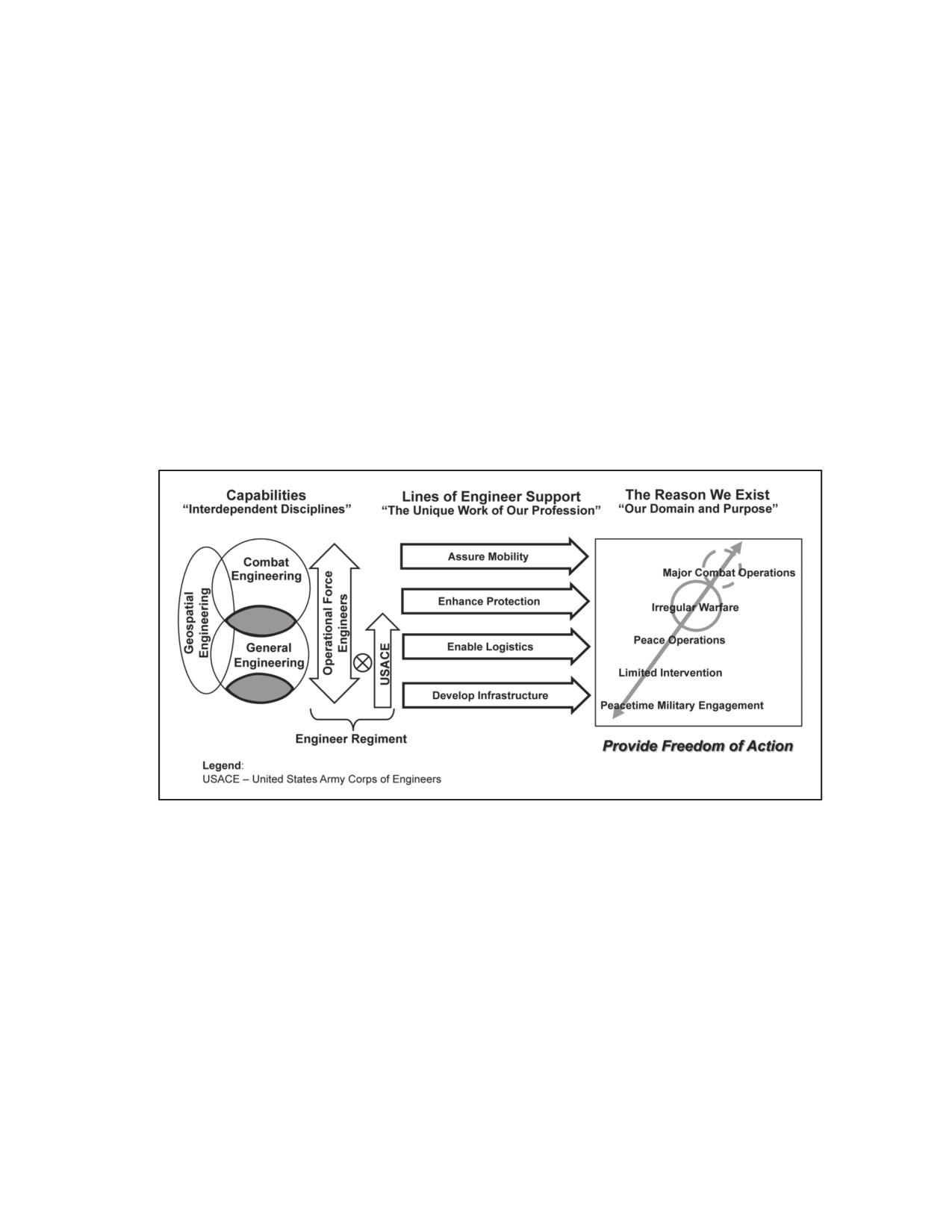
This version of FM 3-34 introduces an updated doctrinal framework (see figure 1) that provides the
intellectual underpinnings for the Engineer Regiment and better articulates its purpose and activities. It
describes how engineers combine the skills and organizations of the three interrelated engineer disciplines
(combat, general, and geospatial engineering) to provide support that helps ground force commanders
assure mobility of the force, enhance protection of the force, enable logistics, and develop infrastructure
among afflicted populations and nations.
Figure 1. Engineer framework
The development of this framework was driven by several factors, including the—
• Addition of stability operations as a core mission for the United States (U.S.) military. Throughout
much of the Army’s history in the 20th century, its focus has often been on major combat
operations. Today, however, the focus has shifted toward irregular warfare with an increased
emphasis on shaping civil conditions. As a result, the Engineer Regiment finds itself supporting
simultaneous combinations of offensive, defensive, and stability or civil support operations.
• Recognition that it is no longer sufficient to describe engineer operations only in terms of
mobility, countermobility, and survivability. Such a construct, by itself, is inadequate for
describing how engineers combine their diverse capabilities to help solve the problems faced by
commanders and staffs in full spectrum operations. To address this shortcoming, this framework
introduces four lines of engineer support to further align tasks according to their purpose for a
specific operation.
• Need for the various disciplines (formerly known as functions) of the Engineer Regiment to be
more interdependent and the recognition that these disciplines are areas of broad expertise within
4 August 2011
FM 3-34
vii
Introduction
military engineering. They drive training, leader development, personnel management and
organizational design.
• Recognition that improving the interdependence between operational force engineers and the U.S.
Army Corps of Engineers (USACE) provides greater synergy within the Engineer Regiment and
enhanced support to the Army, joint forces, and governmental agencies.
• Imperative to foster adaptive leaders with the cognitive skills to make transitions and who can
think in “combinations.” The engineer leaders of today must be comfortable clearing improvised
explosive devices (IEDs), fighting to gain and maintain a stronghold within an urban center, and
then immediately integrating the full range of general engineering capabilities to establish a
combat outpost using existing structures and set about the work of improving essential services to
the surrounding populace to build trust and squash local support for insurgent combatants.
Today’s commander requires an engineer who is better equipped mentally to handle a broader
array of engineering challenges, both simultaneously and sequentially.
The doctrinal engineer foundations provided in this manual, together with related engineer doctrine, will
support the actions and decisions of engineer commanders at all levels. But, like FM 3-0, the manual is not
meant to be a substitute for thought and initiative among engineer leaders. No matter how robust the
doctrine or how advanced the new engineer capabilities and systems, it is the engineer Soldier that must
understand the OE, recognize shortfalls, and adapt to the situation on the ground. It is the adaptable and
professional engineer Soldiers and civilians of the Regiment that are most important to our future and that
must be able to successfully perform their basic skills and accomplish the mission, with or without the
assistance of technology.
In addition, this manual has been affected by recent changes in FM 3-0 and by maturation of the terms
“field force engineering” and “assured mobility.” It also includes the addition, modification, and rescission
of several Army terms. (See table 1 which list changes to terms for which FM 3-34 is the proponent FM.)
Table 1. FM 3-34 term changes
New Army Terms
combat engineering1
general engineering1
lines of engineer support
engineer disciplines2
1 Adds a second definition (Army only) to an existing joint term.
2 Replaces engineer functions in Army doctrine.
Modified Army Definitions
assured mobility1
geospatial engineering
survivability operations
countermobility operations
geospatial information2
terrain reinforcement
field force engineering
mobility operations1
1 FM 3-90.4/MCWP 3-17.8 is now the proponent.
2 ATTP 3-34.80 is now the proponent.
Rescinded Army Definitions
engineer coordinator
Engineer Regiment
tele-engineering
engineer functions1
terrain reinforcement
1 Replaced by engineer disciplines. Army doctrine will not use this term; joint doctrine will continue to use this term.
Legend:
ATTP - Army Tactics, Techniques, and Procedures
FM - field manual
MCWP - Marine Corps warfighting publication
viii
FM 3-34
4 August 2011
Chapter 1
The Operational Context
Understanding the operational context is essential if engineers are to achieve their
purpose—providing freedom of action. Engineers must understand the OE because it
fundamentally affects their activities and outcomes. The recent shift in focus from
major combat operations to irregular warfare highlights the importance of
understanding the entire continuum of operations
(see figure
1, page viii).
Understanding the Army’s operational concept—full spectrum operations—is critical
to effective engineer support to those operations. This chapter examines the context
within which engineer support to operations occurs, focusing on those aspects that
are most significant to engineers.
THE OPERATIONAL ENVIRONMENT
1-1. As discussed in FM 3-0, a complex framework of environmental factors shape the nature of military
operations and affect their outcomes. This requires a broad understanding of the strategic and operational
environment and their relevance to each mission. Army forces use operational variables to understand and
analyze the broad environment in which they are conducting operations. They use mission variables to
focus analysis on specific elements of the environment that apply to their mission. This is true not only for
Army operations in general, but also for engineer support to operations. An understanding of the OE
underpins the commander’s ability to make decisions.
UNDERSTANDING THE OPERATIONAL ENVIRONMENT
1-2. Joint doctrine defines the operational environment as a composite of the conditions, circumstances,
and influences that affect the employment of capabilities and bear on the decisions of the commander (Joint
Publication [JP] 3-0). The OE encompasses physical areas and factors (including geography, weather,
infrastructure, and population), the information environment (including adversary, friendly, and neutral
forces), and other variables relevant to a specific operation.
1-3. Understanding the OE is essential to the successful execution of operations and is one of the
fundamentals of the design methodology described in FM 5-0. To gain this understanding, commanders
will normally consult with specialists in each area. Engineers are one of the specialists available to add
breadth and depth to the overall understanding of the OE. See JP 3-34 for additional discussion of
operational engineering at the joint level.
1-4. An engineer view of the OE is in addition to the common understanding being gained through the
application of analytical tools by other specialists and leaders. The engineer view shares a common general
understanding of the OE, while adding a degree of focus on those aspects within the purview of an
engineering background (see figure 1-1, page 1-2). Guided by the common general understanding, the
engineer view seeks to identify potential challenges and opportunities associated with variables of the OE.
Within each critical variable of the framework being employed, the engineer view shares a common level
of understanding while seeking the added specialty view.
OPERATIONAL AND MISSION VARIABLES
1-5. Army doctrine describes an OE in terms of the following eight operational variables: political,
military, economic, social, information, infrastructure, physical environment, and time (PMESII-PT). The
following examples are provided to show the added focus sought within each of the operational variables
by the engineer view of the OE. The examples are not meant to restate the more complete treatment of the
4 August 2011
FM 3-34
1-1
Chapter 1
variable in general terms provided in FM 3-0 or to be an all inclusive treatment of the engineer aspects
within each of the variables.
z
Political. Understanding the political circumstances within an OE will help the commander
recognize key actors and visualize their explicit and implicit aims and their capabilities to
achieve their goals. The engineer view might add challenges associated with political
circumstances permitting or denying access to key ports of entry or critical sustainment facilities.
Opportunities in the form of alternative access routes might be added. The engineer and others
may be impacted by the effect of laws, agreements, or positions of multinational partners such as
restrictions on shipment of hazardous materials across borders or a host of similar political
considerations that can affect engineer planning and operations.
z
Military. The military variable explores the military capabilities of all relevant actors in a given
OE. The engineer view might add the challenges associated with an adversary’s capability to
employ explosive hazards (EHs) or other obstacles as well as the capability to challenge
traditional survivability standards. Opportunities in the form of existing military installations and
other infrastructure would be added. The engineer view includes a necessarily robust and
growing understanding of engineer capabilities in a joint, interagency, and multinational context
within this variable of the OE. Additional discussion of the military variable and engineer
capabilities are discussed in chapter 2.
z
Economic. The economic variable encompasses individual behaviors and aggregate phenomena
related to the production, distribution, and consumption of resources. The engineer view might
add challenges associated with the production or availability of key materials and resources.
Opportunities in the form of potential for new or improved production facilities might be added.
z
Social. The social variable describes the cultural, religious, ethnic makeup, and social cleavages
within an OE. The engineer view might add challenges associated with specific cultural or
religious buildings or installations. Opportunities in the form of potential to provide for
culturally related building requirements might be a consideration.
z
Information. This variable describes the nature, scope, characteristics, and effects of
individuals, organizations, and systems that collect, process, disseminate, or act on information.
Engineers assist the commander in using information engagement to shape the operational
environment through their capability to improve infrastructure and services for the population.
The engineer must consider how construction projects, especially in stability operations, will
support informational themes consistent with friendly military goals and actions. The engineer
view might also add challenges associated with deficiencies in the supporting architecture or
nodes. Information flow may be affected by the available infrastructure to include power
considerations.
z
Infrastructure. Infrastructure comprises the basic facilities, services, and installations needed
for the functioning of a community or society. The engineer view might add challenges
associated with specific deficiencies in the basic infrastructure. Opportunities in the form of
improvements to existing infrastructure and specific new projects might be added. The engineer
view provides for a detailed understanding of infrastructure by subcategories in the context of
combat operations, as well as both stability and civil support operations, and this topic is
discussed in detail throughout this manual, FM 3-34.170/MCRP 3-17.4 and FM 3-34.400.
Physical environment. The defining factors are urban settings (supersurface, surface, and
subsurface features), and other types of complex terrain, weather, topography, hydrology, and
environmental conditions. An enemy may try to counteract U.S. military advantages by
operating in urban or other complex terrain requiring greater engineer effort to provide freedom
of action. The engineer view might add challenges associated with natural and man-made
obstacles. Insights into environmental considerations are also a concern (see FM 3-34.5/MCRP
4-11B). Opportunities in the form of existing routes, installations, and resources might be added.
The engineer view supports a broad understanding of the physical environment through
geospatial engineering, which is discussed in detail in chapter 2 of this FM, Army Tactics,
Techniques, and Procedures (ATTP) 3-34.80, and JP 2-03.
z
Time. The variable of time influences military operations within an OE in terms of the decision
cycles, operational tempo, and planning horizons. The duration of an operation may influence
engineer operations in terms of whether to pursue temporary or enduring solutions for facilities
1-2
FM 3-34
4 August 2011
The Operational Context
and infrastructure. The methods and standards engineers use will often be markedly different,
depending on whether the construction is contingent or is intended to have an enduring presence.
The engineer view might add challenges associated with completing required construction
projects on time and opportunities to accelerate priority projects.
1-6. Engineers review the OE using operational variables to add to the shared common understanding by
identifying potential challenges and opportunities within the operation before and during mission
execution. The resulting understanding of the OE (an engineer view of the OE) does not and is not intended
to be limited to considerations within the OE that may result in engineer functional missions. The resulting
engineer view of the OE is instead organized by lines of engineer support and linked to the common overall
understanding through the warfighting functions. (See chapter 3 for discussion about lines of engineer
support.)
1-7. The engineer view of the OE is synchronized to support combined arms using the warfighting
functions to create combat power as described in FM 3-0. Chapter 3 provides a more detailed discussion of
the application of engineer capabilities through the warfighting functions to synchronize support to
combined arms operations.
MISSION VARIABLES
1-8. While an analysis of the OE using the operational variables (PMESII-PT) improves situational
understanding (SU) at all levels, when commanders receive a mission they require a mission analysis
focused on their specific situation. The Army uses the mission variables of mission, enemy, terrain and
weather, troops and support available, time available, and civil considerations
(METT-TC) as the
categories of relevant information used for mission analysis. Similar to the analysis of the OE using the
operational variables, the engineer uses the mission variables to seek the shared common understanding
from an engineer perspective.
1-9.
The following are some examples of the engineer perspective for each of the mission variables:
z
Mission. Commanders analyze a mission in terms of specified tasks, implied tasks, and the
commander’s intent (two echelons up) to determine their essential tasks. Engineers conduct the
same analysis, with added focus on the engineer requirements, to determine the essential tasks
for engineers. Early identification of the essential tasks for engineer support enables the
maneuver commander to request engineer augmentation early on in the planning process.
z
Enemy. The engineer view of the enemy concentrates on enemy tactics, equipment, and
capabilities that could threaten friendly operations. This may include an analysis of other factors
within the AO or area of interest (AI) that could have an impact on mission success.
z
Terrain and weather. As the terrain visualization experts, engineers analyze terrain (man-made
and natural) to determine the effects on friendly and enemy operations. Engineers analyze terrain
using the five military aspects of terrain (observation and fields of fire, avenues of approach, key
terrain, obstacles, and cover and concealment
[OAKOC]). Engineers integrate geospatial
products to help commanders and staffs visualize aspects of the terrain to support
decisionmaking.
z
Troops and support available. Engineers consider the number, type, capabilities, and condition
of available engineer troops and support (joint, multinational, and interagency forces). Chapter 2
provides a more complete discussion of engineer capabilities.
z
Time available. Engineers must understand the time required in planning engineer operations
and the importance of collaborative and parallel planning. Engineers realize the time needed for
positioning critical assets and the time associated with performing engineering tasks or projects.
z
Civil considerations. The influence of man-made infrastructure; civilian institutions; and
attitudes and activities of the civilian leaders, populations, and organization within the AO
impact the conduct of military operations. At the tactical level, they directly relate to key civilian
areas, structures, capabilities, organizations, people, and events (ASCOPE). This engineer view
provides a detailed understanding of the basic infrastructure needed for a community or society.
The engineer view might identify challenges associated with specific deficiencies in the basic
infrastructure and opportunities for improvement or development of the infrastructure.
4 August 2011
FM 3-34
1-3
Chapter 1
UNIFIED ACTION
1-10. Unified action is the synchronization, coordination, and/or integration of the activities of
governmental and nongovernmental entities with military operations to achieve unity of effort (JP 1-02).
Engineer capabilities are a significant force multiplier in joint operations and unified action, facilitating the
freedom of action necessary for the joint force commander (JFC) to meet mission objectives. This section
provides an overview of non-Army engineer capabilities typically available within a multinational and
interagency environment and of the integration of those capabilities. See appendix A for multinational,
interagency, and HN considerations.
JOINT/INTERAGENCY/MULTINATIONAL CAPABILITIES
1-11. In full spectrum operations, Army engineers operate as part of a joint force and often within a
multinational and interagency environment. Army engineers should be familiar with the core engineering
units in each Service to include their combat, general, and geospatial engineering capabilities and
limitations. It is also important to understand multinational, interagency, NGO, and intergovernmental
organization engineer capabilities. The engineering capabilities of each Service component may provide
engineering support to the other components to meet joint force requirements. See North Atlantic Treaty
Organization (NATO) Military Committee Policy 0560; JP 3-08; JP 3-34; Allied Joint Publication (AJP)
3.12; and Standardization Agreement 2394/Allied Tactical Publication (ATP) 52(B) for further discussion
of engineer participation in joint, interagency, and multinational operations. JP 3-34 provides information
on other Service engineer capabilities, and discusses other engineering capabilities such as multinational
military units, HN capabilities, and civil augmentation programs. Army engineers should be aware that
some capabilities that reside in other (nonengineer) branches of the Army are categorized as engineering by
other Services. Explosive ordnance disposal (EOD) and chemical, biological, radiological, and nuclear
(CBRN) capabilities are two examples.
INTEGRATION OF CAPABILITIES
1-12. Integrating the variety and special capabilities of engineer organizations requires an understanding of
the various capabilities and limitations of the engineer assets available for any given mission. Integration
also requires a common understanding of the mission command structure and processes in place to employ
the engineer capabilities in unified action. It also requires an understanding of the chain of command,
interagency coordination, and multinational operations.
Chain of Command
1-13. As described in JP 1, the President and the Secretary of Defense exercise authority and control of the
Armed Forces through two distinct branches of the chain of command—one branch for the conduct of
operations and support and the other branch to carry out the military service departments’ Title 10
responsibilities of recruiting, manning, equipping, training, and providing service forces to the combatant
commanders (CCDRs). Although the service branch of the chain of command is separate and distinct from
the operating branch, the Army Service component commander (ASCC) and the Army forces operate
within the CCDR’s chain of command in the theater.
1-14. At the theater level, when Army forces operate outside the United States, they are assigned to an
ASCC under a JFC (see JP 1 and JP 3-0). The ASCC provides administrative and logistic services to
assigned Army forces and the ARFORs of subordinate JFCs. (An ARFOR is the Army Service component
headquarters for a joint task force or a joint and multinational force [FM 3-0]. See ARFOR under terms).
When appropriate, the ASCC may delegate authority for support tasks to a single theater support command
(TSC) or another subordinate Army headquarters, such as the theater engineer command (TEC) or the
United States Army Medical Command, when the focus of support suggests this as the best solution. The
USACE is often involved with supporting the ASCC as well and will generally operate through the TEC, if
one is present. Chapter 4 provides additional discussion of joint mission command considerations and
options.
1-4
FM 3-34
4 August 2011
The Operational Context
Interagency Coordination
1-15. Because Army engineers will often be required to coordinate with government agencies to
accomplish their mission, they should have an understanding of the capabilities of these agencies and their
support functions. While government agencies may increase the resources engaged in a given operation,
they may also increase and complicate the coordination efforts. Stability operations are now regarded as a
core U.S. military mission and are given priority comparable to combat operations. Since integrated civilian
and military efforts are key to successful stability operations, Department of Defense (DOD) engineer
personnel must be prepared to conduct or support stability operations by working closely with U.S.
departments and agencies, foreign governments and security forces, global and regional international
organizations, United States organizations, foreign NGOs, private sector individuals, and for-profit
companies.
1-16. Because engineers are likely to operate with other agencies, foreign governments, NGOs, and
intergovernmental organizations in a variety of circumstances, their participation in the JFC’s interagency
coordination is critical. Two methods for facilitating such coordination are the civil-military operations
center (CMOC) and the joint interagency coordination group. Additional information on the CMOC and the
joint interagency coordination group is provided in JP 3-0, JP 3-34, and JP 5-0.
Multinational Operations
1-17. During multinational operations, U.S. forces establish liaison with multinational forces early. Army
forces exchange specialized liaison personnel in fields such as aviation, fire support, engineer, intelligence,
military police, public affairs, and civil affairs
(CA) based on mission requirements. Missions to
multinational units should reflect the capabilities and limitations of each national contingent. Some
significant factors are relative mobility and size, intelligence collection assets, long-range fires, special
operations forces, and organic sustainment capabilities. Effective operational-level engineer planning
requires an engineer staff to support the multinational commander, providing advice on all engineer aspects
of the operation. When assigning missions, commanders should also consider special skills, language, and
rapport with the local population, as well as the national pride of multinational partners. Multinational
commanders may assign HN forces home defense or police missions, such as sustainment area and base
security.
1-18. Commanders should give special consideration to “niche” capabilities, such as mine clearance that
may exceed U.S. capabilities. Multinational engineer forces may possess additional engineering specialties
that exceed or enhance U.S. capabilities. See FM 3-17 for additional discussion of the employment of
multinational forces.
SPECTRUM OF CONFLICT
1-19. Engineers provide support throughout the continuum of operations and across all levels of war. Their
support is critical for full spectrum operations at all points along the spectrum of conflict and in all
operational themes.
ENGINEER SUPPORT WITHIN THE CONTINUUM OF OPERATIONS
1-20. While the magnitude of violence varies over the spectrum of conflict, the magnitude of requirements
for engineers may remain consistently high from stable peace through general war. This magnitude
provides a menu of actions available to support military operations.
1-21. Engineer requirements at the end of the spectrum characterized as stable peace may include
geospatial engineering support to provide a clear understanding of the physical environment. Military
engagement, security cooperation, and deterrence activities sometimes require large numbers of forces.
These forces will need infrastructure, facilities, LOCs, and bases to support their sustainment. Even in areas
with well-developed existing infrastructure, significant engineer effort will often be required to plan,
design, construct, acquire, operate, maintain, or repair it to support operations in theater. Assistance in
response to disaster and humanitarian relief usually includes significant engineering challenges and
opportunities to immediately and positively impact the situation.
4 August 2011
FM 3-34
1-5
Chapter 1
1-22. Engineer activities at the far end of the spectrum, characterized as general war, require support for
ground combat (or the possibility of ground combat). This requires integrating engineer and other support
activities with the fires and maneuver of ground combat forces to assure the mobility of friendly forces,
alter the mobility of adversaries, and enhance the survivability of friendly forces. It also involves
significant challenges associated with sustaining the operation.
1-23. Between these two ends of the spectrum—stable peace and general war—engineers are often
required to improve stability through projects to develop infrastructure, efforts to create or improve HN
technological capacity, or other engineering projects (see chapter 3). There may also be requirements to
provide specialized engineer support to other agencies. Engineers involved in unconventional warfare
(which includes counterinsurgency and support to insurgencies) help overcome challenges to the
commander’s ability to move and maneuver freely, protect the forces employed, and sustain the operation.
Other requirements include directly impacting the adversaries’ freedom of action and improving stability.
1-24. Engineers will be challenged to understand the OE they face and apply their knowledge and
background to add to the overall understanding. The engineer view must be consistent with the shared
framework and variables employed to analyze the OE. But while the levels of conflict and corresponding
politically motivated violence may vary in different areas of the world and within a theater, the challenges
and opportunities identified by an engineer understanding of the OE remains consistently high across the
spectrum of conflict. Similarly the engineer view of the OE provides relevant and sometimes unique
understanding at each level of war.
ENGINEER ACTIVITIES SPANNING THE LEVELS OF WAR
1-25. The challenges of planning, preparing, executing, and continuously assessing operations within
diverse theaters are numerous and varied. The engineer staff must be involved in the operations process
activities at each level of war, described in FM 3-0 as strategic, operational, and tactical. Understanding the
challenges and opportunities identified from an engineer view equips the staff with relevant information to
form a more comprehensive understanding. The omission of engineer considerations at any level may
adversely impact the effectiveness of the operation. Engineer support to operations must be synchronized
from strategic to the tactical level. Strategic engineer decisions affect tactical engineer support and tactical
engineer support will affect strategic.
1-26. Engineer planning at each level of war is not limited or constrained to the development of engineer
functional tasks. The warfighting functions and the parallel joint functions are used to synchronize engineer
support at every level of war. While there are significant linkages to each of the warfighting functions,
planning support at the strategic to operational level is focused primarily within the movement and
maneuver, intelligence, sustainment, and protection functions. At the operational to tactical level, planning
support focuses primarily on the movement and maneuver, intelligence, mission command, sustainment,
and protection warfighting functions. While the primary focus and, in many cases, the staff organization for
engineer considerations vary among levels of war, the engineer Soldier remains consistently central to the
capability to provide and integrate an engineer view of the OE. Chapter 3 includes a more detailed
discussion of engineer support to combined arms and the linkages to all of the warfighting functions.
Chapter 4 discusses the engineer staff organization. The following paragraphs briefly describe some of the
engineer considerations at each level of war, and more information is provided in ATTP 3-34.23 and
FM 3-34.22.
Strategic Level
1-27. Engineer activities at the strategic level include force planning, engineer policy, and the support of
campaigns and operations, focusing primarily on the means and capabilities to generate, deploy, employ,
sustain, and recover forces. Additionally, infrastructure development is a critical aspect of enabling and
sustaining force deployments and places a heavy demand on engineer requirements. Engineers at the
strategic level advise on terrain and infrastructure, including sea ports of debarkation (SPODs) and aerial
ports of debarkation (APODs), force generation, priorities of engineer support, LOCs, air base and airfield
operations, base camp placement and design, joint targeting, foreign humanitarian assistance,
environmental considerations, engineer interoperability, input to the rules of engagement (ROE), rules for
the use of force, and support to protection.
1-6
FM 3-34
4 August 2011
The Operational Context
1-28. Environmental issues can have strategic implications and affect mission success and end states if not
recognized early and incorporated into planning and operations. Natural resource protection can be a key
strategic mission objective important to HN reconstruction. Failure to recognize environmental threats can
result in significant risk to the joint task force (JTF), adversely impacting readiness. If not appropriately
addressed, environmental issues have the potential to negatively impact local community relations, affect
insurgent activities, and create diplomatic problems for the JTF.
Operational Level
1-29. Engineer activities at the operational level focus on the impact of geography and force-projection
infrastructure on the CCDR’s operational design. Engineer planners must determine the basic yet broad
mobilization, deployment, employment, and sustainment requirements of the CCDR’s concept of
operations. Operational planning merges the operation plan (OPLAN) or operation order (OPORD) of the
joint force, specific engineer missions assigned, and available engineer forces to achieve success. JFC
engineer planners also need to understand the capabilities and limitations of Service engineer forces.
1-30. Many of the engineer activities conducted for strategic operations are also performed at the
operational level. At the operational level, engineers prioritize limited assets and mitigate risks. Engineers
conduct operational area and environmental assessments and work with intelligence officers to analyze the
threat. They provide master planning guidance that incorporates the construction of contingency base
camps and other facilities. Engineers anticipate requirements and request capabilities to meet them. They
develop geospatial products and services and make recommendations on joint fires and survivability for the
forces employed. As the link to tactical engineer integration, operational planning ensures that adequate
engineer capabilities are provided to accomplish combat engineering support requirements.
Tactical Level
1-31. Engineer activities at the tactical level focus on support to the ordered arrangement and maneuver of
forces—in relationship to each other and to the enemy—that are required to achieve combat objectives. At
the same time, engineer support is critical to achieving necessary stability tasks, involving activities such as
those described in paragraph 1-28.
1-32. Tactical planning is conducted by each of the Services; in the context of engineer support to
operations, this translates to a primary focus on combat engineering tasks and planning done within tactical
organizations (see chapter 2 for a discussion of the engineer disciplines including combat engineering).
Operational planners set the conditions for success at the tactical level by anticipating requirements and
ensuring that capabilities are available. Engineer tactical planning is typically focused on support to combat
maneuver (mobility and countermobility), survivability, and sustainment support that is not addressed by
the higher-echelon commander. Construction planning at the tactical level will typically focus on
survivability in support of the protection warfighting function and infrastructure development in support of
primarily the sustainment warfighting functions. Engineer planners at the tactical level use the engineer
assets provided by operational planners to support the tactical mission tasks assigned to those combat
maneuver units they support. With the support of the engineer, the subordinate JFC ensures that engineer
capabilities are effectively integrated into the scheme of maneuver and the performance of assigned tasks.
Tactical missions are complex, and planning must consider threat capabilities.
1-33. Special consideration includes performing terrain analysis with an understanding of these threat
capabilities. Engineer reconnaissance (both tactical and technical) is a critical capability to the combat
maneuver commander at the tactical level. Threat information must be very specific. Engineers discern and
identify patterns and plan specific detection strategies based on the threat. The proliferation of mines and
improvised explosive devices
(IEDs) requires engineers to continuously develop new countering
procedures. The tactical integration of EOD capabilities has become an increasing requirement.
ENGINEER SUPPORT TO FULL SPECTRUM OPERATIONS
1-34. The Army’s operational concept is full spectrum operations: Army forces combine offensive,
defensive, and stability or civil support operations simultaneously as part of an interdependent joint force to
seize, retain, and exploit the initiative, accepting prudent risk to create opportunities to achieve decisive
4 August 2011
FM 3-34
1-7
Chapter 1
results. They employ synchronized action—lethal and nonlethal—proportional to the mission and informed
by a thorough understanding of all variables of the operational environment. Mission command that
conveys intent and an appreciation of all aspects of the situation guides the adaptive use of Army forces
(FM 3-0). Engineer support requires a thorough understanding of full spectrum operations as described in
FM 3-0.
1-35. Engineer support contributes significant combat power, both lethal and nonlethal in nature, to the
elements of full spectrum operations. Organic engineer capabilities in each of the brigade combat teams
(BCTs) provide close support to the maneuver of those forces. Based on a METT-TC analysis, the BCTs
will be task-organized with additional modular engineer capabilities to meet mission requirements. For
offensive and defensive operations, engineer augmentation may consist of additional combat engineer
capabilities, as well as an engineer battalion headquarters to provide the necessary mission command for
the mix of modular engineer units and capabilities augmenting the BCT. Other more technically specialized
engineer capabilities support the BCT’s requirements related to primarily the movement and maneuver,
protection, and sustainment warfighting functions. These same capabilities may be employed at division,
corps, and theater army echelon to enable force mobility, survivability, and sustainment. Force-tailored
engineer capabilities from the force pool can provide critical nonlethal capabilities to conduct or support
stability or civil support operations. Geospatial engineering capabilities, both organic and from the force
pool, support all elements of full spectrum operations by adding to a clear understanding of the physical
environment.
1-36. Engineer capabilities are a significant force multiplier in full spectrum operations, facilitating the
freedom of action necessary to meet mission objectives. Full spectrum operations require simultaneous
combinations of offensive, defensive, and stability or civil support operations. Higher-echelon engineer
activities are intrinsically simultaneous—supporting combinations of operational components, occurring at
every echelon, impacting each level of war, influencing the entire spectrum of conflict. Engineer activities
modify, maintain, provide understanding of, and protect the physical environment. In doing so, they enable
the mobility of friendly forces and alter the mobility of adversaries. This enhances survivability and enables
the sustainment of friendly forces, contributes to a clear understanding of the physical environment, and
provides support to noncombatants, other nations, and civilian authorities and agencies. Indeed, engineer
activities may be so widespread and enveloping that they may be viewed as a standalone objective, but they
are not standalone. Engineer applications are effective within the context of the supported objective.
Military engineer support is focused on the combined arms objective. To identify and maintain that focus
for the widespread application of engineer capabilities, engineer support is integrated within the combined
arms operation. See chapter 5 for a further discussion on engineer planning considerations for full
spectrum operations.
1-8
FM 3-34
4 August 2011
Chapter 2
The Engineer Regiment
Engineer Soldiers are the centerpiece of the Engineer Regiment. They are the
foundation of engineer forces and the repository of both expertise and skills required
to provide engineer support to the combined arms team. Regardless of the importance
of equipment or the expansion of technological capabilities, engineer Soldiers, not
equipment or technology, carry out engineer support. Engineer Soldiers, and the
engineer organizations that are built around them, focus on three engineer disciplines
(combat, general, and geospatial engineering).
THE MILITARY ENGINEER PROFESSION
2-1. Military Engineering is a sub-profession within the greater profession of arms. The Engineer
Regiment is the manifestation of this profession within the Army. It is a body of people—not just
equipment, organizations or technology—with a passion or calling to serve as a Warrior with unique
technical skills. These technical skills set the Engineer Regiment apart, providing unique knowledge,
services and capabilities that the Army needs to accomplish its missions.
2-2. The Army has a broad range of diverse engineer capabilities, requiring many different types of units,
personnel, and equipment. These capabilities are grouped together into three engineer disciplines (see
figure
2-1). Engineer disciplines are the interdependent areas of expertise within the Engineer
Regiment. The three engineer disciplines are combat, general, and geospatial engineering. (Joint
doctrine refers to these as engineer functions.) The engineer disciplines are interdependent, each one
focused on capabilities that support, or are supported by, the other disciplines. The Army categorizes
engineer units, personnel, and systems based on the engineer disciplines to provide focus to unit leaders
and personnel in the doctrine, organization, training, materiel, leadership and education, personnel, and
facilities (DOTMLPF) functions (for example, organizational developers, training developers, and combat
developers), Engineer reconnaissance, although not a separate engineer discipline, is a critical part of each
one. See FM 3-34.170 for additional discussion of engineer reconnaissance.
Figure 2-1. Engineer disciplines
4 August 2011
FM 3-34
2-1
Chapter 2
COMBAT ENGINEERING
2-3. Combat engineering is the engineer discipline that is focused on supporting the maneuver of
land combat forces while in close support to those forces. The characteristic that differentiates combat
engineering from the other engineer disciplines is its focus on operating while in close support to maneuver
forces that are in close combat.
2-4. In the past, combat engineer units have been much more likely than general engineer units to be
faced with close combat. However, close combat is insufficient to distinguish combat engineering from
general engineering, since all engineer units must be prepared to operate while in close combat. (See
chapter 3 for more information about engineers in close combat.) The condition of operating in close
support to maneuver forces that may be in close combat requires that combat engineer units be able to
integrate and coordinate their actions with the fire, movement, or other actions of such forces. To do that,
combat engineer units must be organized, manned, equipped, and trained differently than general engineer
units, who are not designed to operate in such conditions. For example, combat engineer units are
organized similarly to infantry squads and platoons, manned with additional medical personnel, equipped
with different weapons and vehicles that general engineers don’t need, and trained in a close habitual
relationship with their supported close combat force. However, these requirements also limit the ability of
combat engineer units to perform many tasks to the same standards as general engineering units. This can
be overcome, in some cases, with additional equipment and training, along with augmenting technical
expertise.
2-5. Combat engineering is integral to the ability of combined arms units to maneuver. Combat engineers
enhance the force’s momentum by shaping the physical environment to make the most efficient use of the
space and time necessary to generate mass and speed while denying the enemy maneuver. By enhancing
the unit’s ability to maneuver, combat engineers accelerate the concentration of combat power, increasing
the velocity and tempo of the force necessary to exploit critical enemy vulnerabilities. By reinforcing the
natural restrictions of the physical environment, combat engineers limit the enemy’s ability to generate
tempo and velocity. These limitations increase the enemy’s reaction time as well as physically and
psychologically degrading his will to fight.
2-6. Many engineering tasks associated with mobility, countermobility, and survivability operations are
more frequently performed under combat engineering conditions (that is, while in close support to
maneuver forces that are in close combat) than are other engineering tasks, especially when performed in
offensive and defensive operations in support of the tactical level of war. See chapter 3 for more discussion
about mobility, countermobility, and survivability operations and their relation to the tactical, operational,
and strategic levels of war.
GENERAL ENGINEERING
2-7. General engineering is the engineer discipline that is focused on affecting terrain while not in
close support to maneuver forces. General engineering is distinguished from geospatial engineering by its
focus on affecting terrain (rather than improving understanding about terrain). General engineering is
distinguished from combat engineering by its focus on conditions other than close support to maneuver
forces. Tasks that are most frequently performed under general engineering conditions include the
construction, repair, maintenance, and operation of infrastructure, facilities, LOCs, and bases; protection of
natural and cultural resources; terrain modification and repair; selected EH activities; and environmental
activities. These are the primary focus for general engineer units.
2-8. General engineer units can also conduct mobility, countermobility, and survivability operations,
when not under combat engineering conditions. Although organized, manned, equipped, and trained to
perform their tasks in combat, they are not organized, manned, equipped, and trained to do so while in
close support to maneuver forces that are in close combat. General engineer units are not designed to
perform as combat engineers without significant augmentation and training.
2-9. General engineering is the most diverse of the three engineer disciplines and is typically the largest
percentage of all engineer support provided to an operation, except in offensive and defensive operations at
the tactical level, when combat engineering will typically be predominant. It occurs throughout the AO, at
all levels of war, during every type of military operation, and may include the employment of all military
2-2
FM 3-34
4 August 2011
The Engineer Regiment
occupational specialties within the Engineer Regiment. For more information on general engineering, see
FM 3-34.400. General engineering—
z
May include construction or repair of existing logistics-support facilities, LOC and other supply
routes
(including bridging and roads), airfields, ports, water wells, power generation and
distribution, water and fuel pipelines, waste management systems, and base camps or force
beddown. Firefighting and engineer dive operations are two aspects that may be critical enablers
to these tasks.
z
May be performed by modified table of organization and equipment units or through the
USACE.
z
May also be performed by a combination of joint engineer units, civilian contractors, and HN
forces or multinational engineer capabilities.
z
Incorporates field force engineering (FFE) to leverage all capabilities throughout the Engineer
Regiment. This includes the linkages that facilitate engineer reachback.
z
May require various types of reconnaissance and assessments to be performed before, or early
on in, a particular mission (see FM 3-34.170).
z
Includes disaster preparedness planning, response, and support to consequence management.
z
Includes the acquisition and disposal of real estate and real property.
z
Includes those survivability planning and construction tasks that are not considered under
combat engineering.
z
May include camouflage, concealment, and deception tasks.
z
Includes the performance of environmental support engineering missions.
z
May include base or area denial missions.
z
Usually requires large amounts of construction materials, which must be planned and provided
for in a timely manner.
z
May include the production of construction materials.
z
Requires the integration of environmental considerations (see FM 3-34.5).
GEOSPATIAL ENGINEERING
2-10. Geospatial engineering is the engineer discipline that is focused on applying geospatial
information to improve understanding of terrain for military operations. Geospatial engineering
focuses on applying information to improve the understanding of terrain, while general engineering focuses
on affecting terrain. Geospatial engineering is the art and science of applying geospatial information to
enable understanding of the physical environment for military operations. The art is the ability to
understand METT-TC and the geospatial information available, including intent of use and limitations, to
be capable of explaining the military significance of the terrain to the commander and staff and creating
geospatial products for decisionmaking. The science is the ability to exploit geospatial information,
producing spatially accurate products for measurement, mapping, visualization, modeling, and all types of
analysis of the terrain.
2-11. Geospatial engineers generate, manage, analyze, and disseminate positionally accurate terrain
information that is tied to some portion of the earth’s surface. This includes mission-tailored data, tactical
decision aids, and visualization products that define the character of the zone for the maneuver commander.
Key aspects of the geospatial engineering mission are databases, analysis, digital products, visualization,
and printed maps.
2-12. Geospatial engineers enable the commander and staff to visualize the OE discussed in chapter 1.
They collect, create, and process geospatial information and imagery that support analysis of the OE, either
by the operational or mission variables. Additionally, geospatial engineers provide foundational
information, enabling a more efficient and functional approach to analysis, resulting in a quicker shared
common understanding of the OE at all echelons, thereby preserving the critical resource of time.
2-13. Geospatial information that is timely, accurate, and relevant is a critical enabler for the operations
process. Geospatial engineers assist in the analysis of the meaning of activities and significantly contribute
to anticipating, estimating, and warning of possible future events. They provide the foundation for
4 August 2011
FM 3-34
2-3
Chapter 2
developing shared situational awareness and improve understanding of our forces, our capabilities, the
adversary, and other conditions of the OE.
2-14. The geospatial engineer uses analysis and visualization capabilities to integrate people, processes,
and tools using multiple information sources and collaborative analysis to build a shared knowledge of the
physical environment. ATTP 3-34.80 and JP 2-03 are the primary references for geospatial engineering.
ENGINEER ORGANIZATIONS
2-15. The Army organizes Soldiers and equipment into a variety of organizations, each with particular
capabilities. Engineer units are organized based on the engineer disciplines. Organizations that have
engineer capabilities comprise the Engineer Regiment, which represents the Army’s engineer capabilities in
both the operational Army and the generating force. The Engineer Regiment consists of all Active Army,
Army National Guard, and USAR engineer organizations (as well as DOD civilians and affiliated
contractors and agencies within the civilian community) with a diverse range of capabilities that are all
focused toward supporting the Army and its mission. The Engineer Regiment’s Active Army organizations
include USACE and active duty Army military engineer units within the combatant commands and Army
commands. Three-fourths of the Army’s military engineer units are in the Reserve Component, which
provides both TEC headquarters and includes a wide range of specialized capabilities in its ARNG and
USAR components. In addition, certain types of engineer units are found only in the Reserve Component.
The Regiment has joint integration capabilities and supports the planning, preparing, executing, and
assessing of joint operations. The Regiment is experienced at interagency support and in leveraging
nonmilitary and nongovernmental engineer assets to support mission accomplishment.
2-16. The Chief of Engineers leads the Engineer Regiment and is triple-hatted as the Chief of the Engineer
Branch, the Commander of USACE, and the staff officer advising the Chief of Staff of the Army on
engineering matters and force capabilities. The chief is assisted in these roles by the Engineer Branch;
Headquarters, USACE; and the Office of the Chief of Engineers. The Engineer Branch and USACE are
discussed later in this section. The Office of the Chief of Engineers is a staff element assigned to the Army
Staff to assist the Chief of Engineers in advising the Chief of Staff of the Army and the Army Staff. Figure
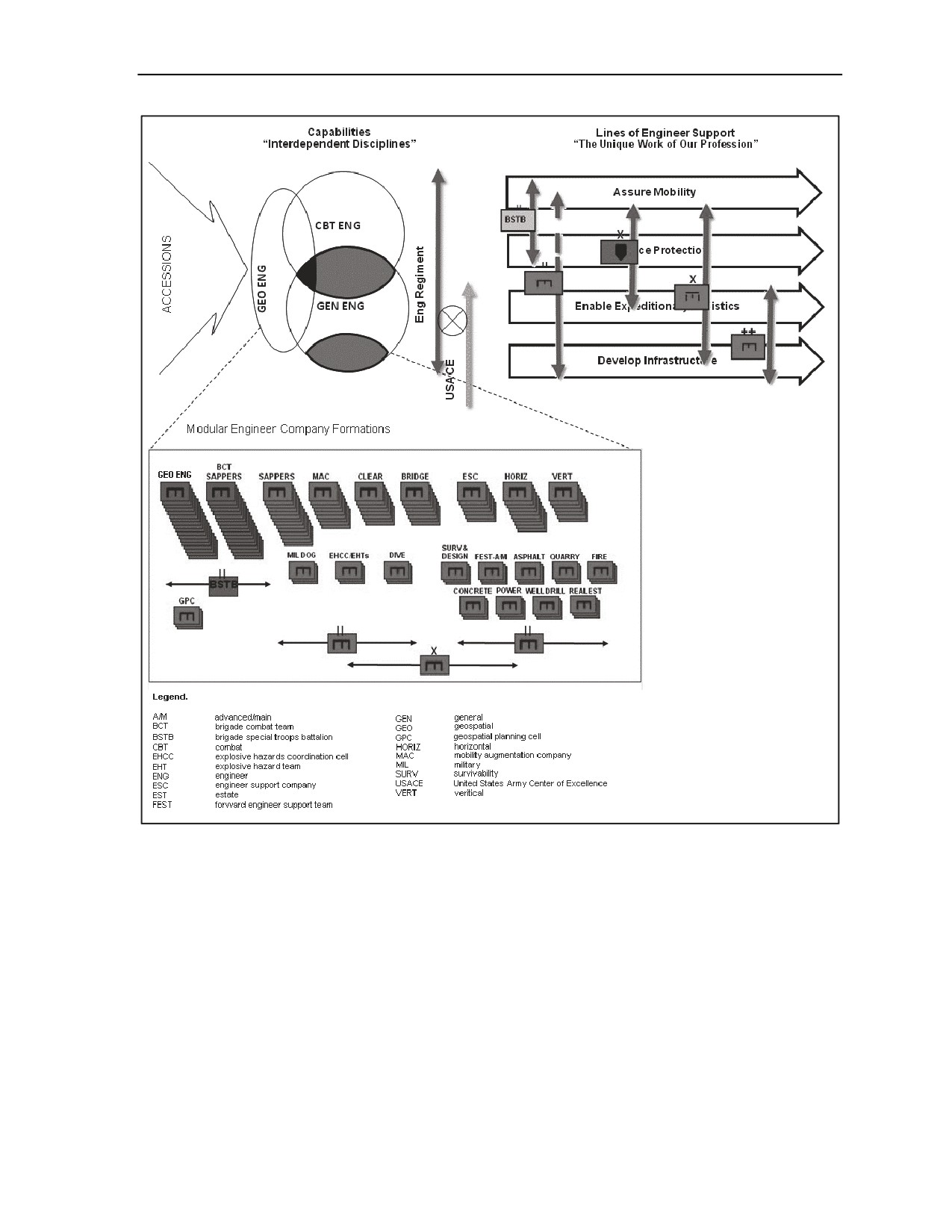
2-2 shows how engineers are organized from the tactical to the operational level.
THE ENGINEER BRANCH
2-17. The Engineer Branch includes both the human resource managers in Human Resources Command
and the Engineer Branch proponent under United States Army Training and Doctrine Command. Together
these components generate and manage engineer Soldiers—the centerpiece of engineer forces. The
Engineer Branch proponent is the United States Army Engineer School (USAES) which trains, educates,
and manages engineer Soldiers in a variety of military occupational specialties.
2-18. In addition to providing core, tactical, technical, and leader education for engineer Soldiers of all
ranks, USAES also provides specialized training. Of particular interest to units are courses such as the Joint
Engineer Operations Course, the Explosive Ordnance Clearance Agent Course, the Search Advisor Course,
and the Sapper Leader Course. Additional training is developed and provided as required.
2-4
FM 3-34
4 August 2011
The Engineer Regiment
Figure 2-2. The Engineer Regiment from the tactical to operational level
2-19. USAES also hosts and manages several boards, centers, conferences, and cells, both standing and ad
hoc, which support and gather feedback from engineers in the operational force. One example of an annual
conference is the Engineer Force Conference that provides direct communication among senior engineer
leaders. The Counter Explosive Hazards Center at the Maneuver Support Center of Excellence coordinates
DOTMLPF solutions and integration for counter EH TTP. Operational support is provided to engineer
forces and staffs through reachback, mobile training teams, and other mechanisms.
2-20. The Engineer Branch produces tactically and technically competent engineer Soldiers capable of
serving in engineer forces or as engineer staff of a joint force assisting the JFC by furnishing advice and
recommendations to the commander and other staff officers. (Chapter 4 discusses engineer staff roles and
responsibilities in greater detail.) The engineer branch proponent works closely with USACE to leverage a
vast pool of additional technical competence provided by DOD civilians and affiliated contractors and
agencies within the civilian community working with USACE. Technical support is available directly in
support of engineer staff and forces through reachback. Significant technical development benefits those
engineer Soldiers assigned to work within USACE.
4 August 2011
FM 3-34
2-5
Chapter 2
OPERATIONAL FORCE ENGINEERS
2-21. Engineers in the operational force operate at the strategic, operational, and tactical levels across the
spectrum of conflict. Units are organized in a scalable, modular, adaptable manner to support combat,
general, and geospatial engineering requirements. Army engineer forces operate as an integral member of
the combined arms team during peace and war to provide a full range of engineering capabilities in
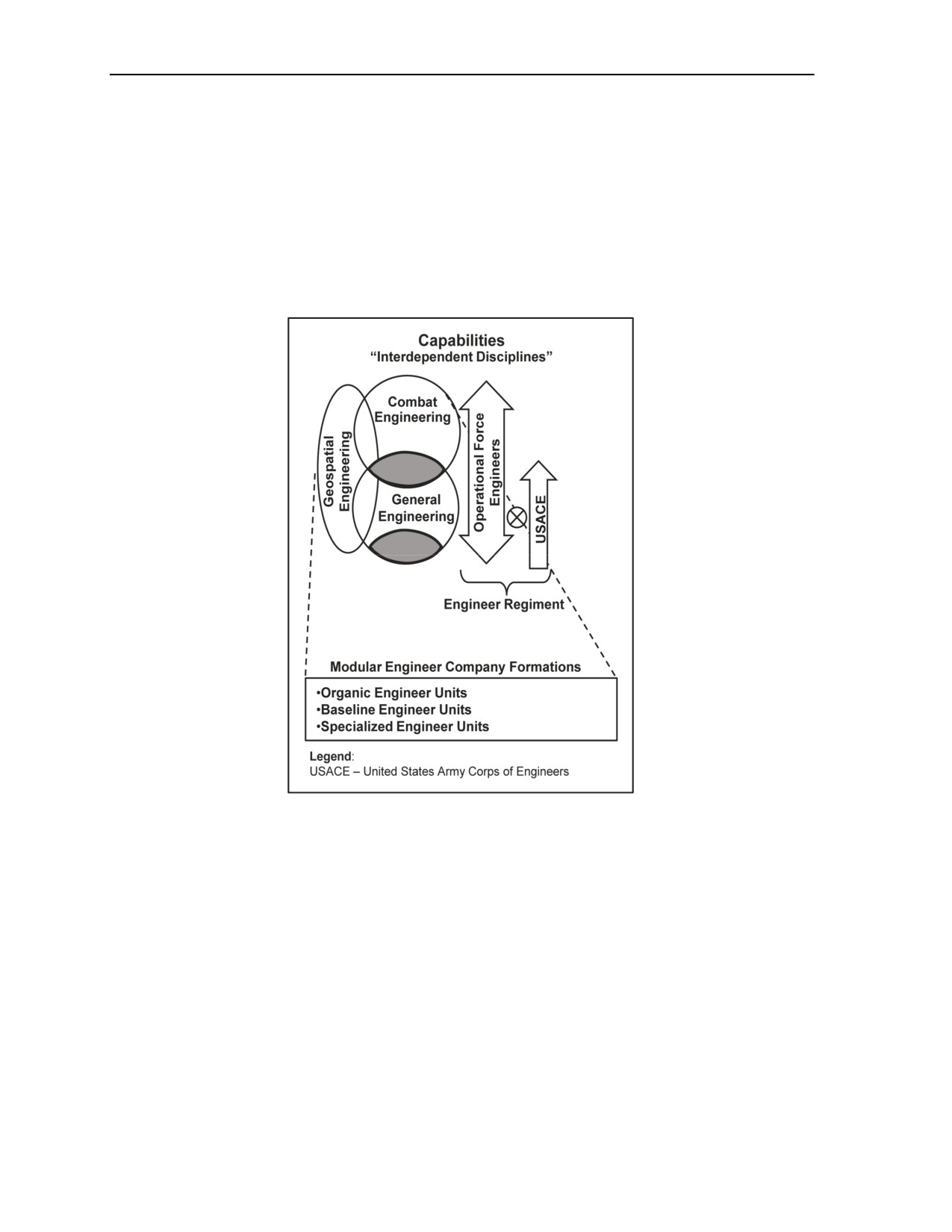
conjunction with USACE as shown in figure 2-3. They execute combat engineering tasks at the tactical and
operational levels of war in support of combined arms forces and execute general and geospatial
engineering tasks at the tactical to strategic levels throughout the joint operations area. This section
provides an overview of engineers in the operational force. See appendix B for more details about each
type of unit described in this chapter.
Figure 2-3. The Engineer Regiment and the engineer disciplines
MODULARITY
2-22. The Army’s operational force is modular, as are the engineers in that force. There are four
complementary and interdependent categories of engineer units in the operational force
(including
USACE-provided technical engineering and contract support as already discussed). (Figure 2-3 only
depicts three of the four categories [organic, baseline, and specialized]. The other category—engineer
headquarters units—is not shown.) The first category contains engineers organic to BCTs and
higher-echelon headquarters. The other three categories comprise the engineer force pool, which augments
organic engineers and provides engineer capabilities to echelons above the BCT. These categories
include—
z
Engineers that are organic to the BCTs provide the minimum combat and geospatial engineering
capabilities required to support BCT operations. These units have very limited general
engineering capability. Additionally, engineers are organic within the staffs of all echelons
above BCT, providing engineer staff planning functions and integrating geospatial engineering
support.
2-6
FM 3-34
4 August 2011
The Engineer Regiment
z
Engineer headquarters units provide mission command for engineer missions and elements. Each
has a staff that allows the commander to mission command assorted and various engineer
organizations and other selected nonengineer units to support multifunctional missions such as
combined arms breaching and combined arms gap crossing. The units in this category are the
TEC, the engineer brigade, and the engineer battalion.
z
Baseline engineer units provide combat and general engineering capabilities, focused primarily
on the tactical to operational levels. They are used to augment organic engineers and to provide
engineer capabilities to echelons above the BCT. When supporting a division or a corps, baseline
engineer units are typically under the mission command of the maneuver enhancement brigade
(MEB) or the engineer brigade. When supporting echelons above corps, they are typically under
the mission command of a functionally focused engineer brigade, TEC, or the multifunctional
MEB.
z
Specialized engineer units are technically oriented (and often low-density) units that provide
specialized capabilities in construction support, infrastructure development, EH mitigation,
geospatial support, well drilling, real estate management, and firefighting. They primarily
support the operational to strategic levels, but also provide selected support at the tactical level.
ORGANIC ENGINEER ELEMENTS
2-23. Each BCT has a combat engineer company. In the infantry brigade combat team (IBCT) and the
heavy brigade combat team (HBCT), the engineer company is organic to the brigade special troops
battalion (BSTB), but in the Stryker brigade combat team (SBCT) the engineer company is a separate
company. Engineer staff elements are organic to the headquarters of BCTs, divisions, corps, and theater
armies. Geospatial engineer teams are organic to the BCT, some modular support and functional brigades,
and headquarters of divisions and corps.
2-24. These organic engineer elements provide the minimum combat and geospatial engineering capability
to support BCTs. They can also perform a few general engineering tasks, but their focus is on maintaining
friendly freedom of maneuver and inhibiting the enemy’s ability to mass and maneuver.
2-25. Capabilities of organic engineers include—
z
Providing geospatial data management and analysis.
z
Conducting mobility, countermobility, and survivability operations.
z
Providing mobility assessments.
z
Detecting and neutralizing EH.
z
Providing mission command for engineer forces.
2-26. During offensive and defensive operations, organic engineer elements require augmentation by
baseline or specialized engineer units, or both. Often, this augmentation exceeds the mission command
capability of the organic engineers and requires that an engineer battalion headquarters also be provided.
Stability and civil support operations also require augmentation by mission-tailored engineer forces from
the force pool.
FORCE POOL UNITS
2-27. Force pool units include—
z
Engineer headquarters units.
z
Baseline engineer units.
z
Specialized engineer units.
Engineer Headquarters Units
2-28. There are three echelons of engineer headquarters units—the engineer battalion, the engineer
brigade, and the TEC. Multifunctional units, discussed later in this chapter, may also provide mission
command for engineer forces when engineer support is integral to the multifunctional mission. The
engineer battalion is most often found in the engineer brigade, in the MEB, or in support of a BCT. The
4 August 2011
FM 3-34
2-7
Chapter 2
engineer brigade, one of the Army’s functional brigades, provides mission command for up to five engineer
battalions at the divisions and corps level. The TEC provides mission command of engineer units for the
combatant or JTF commander.
Theater Engineer Command
2-29. The TEC is designed to mission command engineer capabilities for the theater army. It is the only
organization designed to do so without augmentation and can provide the JFC with an operational engineer
headquarters, if required. It can also form, or provide augmentation for, a JTF engineer staff. The TEC
provides mission command for all assigned or attached engineer brigades and other engineer units and
missions for the joint force land component or theater army commander. When directed it may also provide
mission command for engineers from other Service and multinational forces, and oversight of contracted
construction engineers. The TEC is focused on operational-level engineer support across all three of the
engineer disciplines and typically serves as the senior engineer headquarters for a theater army, land
component headquarters, or potentially a JTF.
2-30. Considerations for organizing and employing the TEC include—
z
The TEC provides support for all operational planning for the area of responsibility (AOR)
across all of the engineer disciplines. It synchronizes all engineer planning and support for the
geographic combatant commander (GCC) or JTF commander, providing peacetime training and
support of military engagement for their supported respective CCDRs. The TEC coordinates
closely with the senior contract construction agents in the AO.
z
The TEC is a modular organization that can be tailored based on mission requirements. It can
deploy modular staff elements and organizations to provide the operational commander with a
wide range of technical engineering expertise and support. Each TEC can deploy its main
command post (CP) and two deployable command posts (DCPs) to provide flexibility and
rotational capability. USACE can deploy its FFE assets to augment DCPs, bringing capabilities
in areas such as contracting, real estate, and interagency coordination. Their tele-engineering
capabilities enable their deployed elements to collaborate with subject matter experts in USACE,
other Service technical laboratories and research centers, and other sources of expertise in the
civilian community.
Engineer Brigade
2-31. The engineer brigade, one of the Army’s functional brigades, can control up to five mission-tailored
engineer battalions having capabilities from any of the three engineer disciplines. It may also provide
mission command for nonengineer units performing, for example, missions in support of a deliberate gap
(river) crossing. Considerations for organizing and employing the engineer brigade headquarters include—
z
A division or corps requires one or more engineer brigades whenever the number of engineer
units, or the functional nature of engineer missions, exceeds the mission command capability of
the multifunctional MEB. Once deployed, engineer brigades become the focal point for
apportioning and allocating mission-tailored engineer forces within the AO. The engineer
brigade can support a JTF or a Service or functional component command (land, air, or sea) and
provide mission command of all Service engineers and oversight of contracted engineering
within an AO. The engineer brigade can provide DCPs with staff expertise in engineer support
as required. With augmentation, it may serve as a joint engineer headquarters and may be the
senior engineer headquarters deployed in a joint operations area if full TEC deployment is not
required.
z
The engineer brigade has the capability to simultaneously provide two DCPs. It provides
engineer-specific technical planning, design, and quality assurance and quality control during
24-hour operations.
Engineer Battalion
2-32. The engineer battalion can conduct engineer missions and control up to five mission-tailored
engineer companies. The engineer battalion is typically found in the engineer brigade, in the MEB, or
supporting a BCT. Except for the prime power battalion, which performs a specialized role, all engineer
2-8
FM 3-34
4 August 2011
The Engineer Regiment
battalion headquarters, when appropriately task-organized, can provide mission command for both combat
and general engineering capabilities. Due to habitual training relationships, some battalion headquarters are
more capable in combat engineering than in general engineering, or vice versa. Some battalion
headquarters have additional capabilities such as airborne or air assault capabilities. Considerations for
organizing and employing the engineer battalion headquarters include—
z
Whenever two or more engineer modules are task-organized in support of a BCT, an MEB, an
engineer brigade, or another unit, an engineer battalion headquarters may be required for the
mission command and sustainment of those modules.
z
An engineer battalion may support an MEB for combat or general engineering missions. The
engineer battalion provides mission command for up to five assigned engineer companies,
including preparing them for deployment in support of the battalion or other organizations.
z
When in support of a BCT, an engineer battalion will provide mission command of engineer
missions. The battalion may be focused on a single mission, such as route clearance, security
construction, or cache interrogation and reduction. The engineer battalion may be organized to
perform as a breach force command when the BCT is conducting a combined arms breach.
During a gap (river) crossing operation, the engineer battalion provides the option to be
designated as the crossing site command.
z
When assigned construction or EH clearance missions, the battalion should receive construction
design and survey teams or explosive hazards teams augmentation.
BASELINE ENGINEER UNITS
2-33. Baseline engineer units include both combat and general engineer units (see table 2-1). They are the
primary building blocks for the organization of most engineer battalions. These units may augment the
organic engineer capabilities of a BCT, or they may be task-organized under an engineer battalion
headquarters to provide specific tailored capabilities to echelons above brigade (EAB). (See appendix B for
more detailed information on baseline engineering units.)
Table 2-1. Baseline engineer units
Combat Engineer Units
General Engineer Unit
Sapper company
Engineer support company
Mobility augmentation company
Horizontal construction company
Clearance company
Vertical construction company
Multirole bridge company
Combat Engineer Units
2-34. Baseline combat engineer units are focused on supporting combined arms operations at the tactical
level. They are designed to provide close support to maneuver forces that are in close combat. All have the
capability to fight as engineers or, if required, as infantry. An engineer battalion headquarters is typically
included to provide the necessary mission command, logistics, and staff supervision for attached and
assigned units when two or more are assigned to a BCT, an MEB, or another organization. Combat
engineer (Sapper) units may construct tactical obstacles, defensive positions, and fixed and float bridges;
repair CPs, LOCs, tactical routes, culverts, and fords; and conduct general engineering tasks related to
horizontal and vertical construction, when augmented with appropriate tools, equipment, and training.
Combat engineer units also provide engineer support for gap-crossing operations, assist in assaulting
fortified positions, and conduct breaching operations. Airborne- and air assault-capable engineer units also
have the unique ability to employ air-droppable, rapid runway repair kits to support forcible-entry
operations. The more specialized combat engineering capabilities of assault bridging, breaching, and route
and area clearance are added to the organic engineer capabilities in BCTs (or to deployed baseline Sapper
companies) when required by the mission.
4 August 2011
FM 3-34
2-9
Chapter 2
General Engineer Units
2-35. General engineer units include horizontal and vertical construction companies and engineer support
companies. They can construct, rehabilitate, repair, maintain, and modify landing strips, airfields, CPs,
main supply routes (MSRs), supply installations, building structures, bridges, and other related aspects of
the infrastructure. These units may also perform repairs and limited reconstruction of railroads or water and
sewage facilities. The basic capabilities of these units can be expanded by augmenting them with additional
personnel, equipment, and training from specialized engineer units or other sources. Such augmentation can
give them the capability to conduct bituminous mixing and paving, quarrying and crushing, pipeline
construction, dive support, and major horizontal construction projects such as highways, storage facilities,
and airfields.
SPECIALIZED ENGINEER UNITS
2-36. Specialized engineer units provide general and geospatial engineering capabilities at the operational
and strategic levels, and they augment those capabilities at the tactical level (see table 2-2). Many of their
capabilities are lower density than those of the baseline engineer units. These smaller, more specialized
units are designed to support technical aspects within larger engineer-related missions or to augment
selected headquarters elements.
Table 2-2. Specialized Army engineer force pool units
Explosive
Construction
Infrastructure
Geospatial
Field Force
Hazard
Support
Support
Support
Engineering
Support
• Explosive
• Survey and
• Prime power
• Topographic
• Forward engineer
hazard
design team
company, platoon,
engineer
support team;
coordination
• Construction
or detachment
company
advanced or main
cell
(with embedded
management
• Engineer facility
• Geospatial
environmental,
• Explosive
team
detachments
planning cell
hazards
contingency real
• Real estate
• Firefighting team
estate, and other
team
team
support teams as
• Military
• Diving team
needed) (see
working
• Asphalt team
paragraph 2-28)
dogs
• Concrete
section
• Well drilling
team
• Quarry platoon
Explosive Hazards Support
2-37. EH support provides mission command for specialized elements and integrates other EH capabilities.
These capabilities include the linkage to Army EOD capabilities found in the ordnance branch. The
engineer squad (canine) includes both specialized search dog teams and mine dog teams. These teams assist
in locating firearms, ammunition, and explosives in both rural and urban environments. They may be used
to augment a variety of route and area clearance capabilities found in the clearance company.
Construction Support
2-38. Construction support provides mission command for management and procurement and oversight of
contracted support. It also provides for enhanced performance for asphalt, concrete, and haul operations.
All of these capabilities have a role in infrastructure support.
2-10
FM 3-34
4 August 2011
The Engineer Regiment
Infrastructure Support
2-39. Engineer prime power units generate electrical power and provide advice and technical assistance on
all aspects of electrical power and distribution systems. Prime power units have limited electrical
engineering capability (design and analysis); provide electrical surveys; and operate, maintain, and perform
minor repairs to other electrical power production equipment, to include HN fixed plants. Engineer facility
detachments support theater opening and closing, base development, construction management, contract
technical oversight, base operations
(to include waste management functions), and master planning.
Firefighting teams provide first responder support for facilities and aviation operations.
Geospatial Support
2-40. Two specialized engineer units provide geospatial engineering capabilities (see ATTP 3-34.80).
Topographic engineer companies provide geospatial support to deployed units that require augmentation.
They provide modules tailored to support the GCC, JTF headquarters, theater army, corps and division
headquarters, sustainment brigades, other joint or multinational division- and brigade-size elements, and the
Federal Emergency Management Agency regions. Their geospatial engineering capabilities include
analysis, collection, generation, management, finishing, and printing. Geospatial planning cells generate,
manage, and disseminate geospatial data, information, and products in support of the ASCC headquarters
and GCC.
2-41. Although the Army has no dedicated engineer reconnaissance units, except for an element in the
combat engineer company of the HBCT, commanders routinely form mission-tailored engineer
reconnaissance teams (ERTs) to collect engineer-specific tactical and technical information. These teams
are a critical source of information for engineers and combined arms commanders and staffs, playing an
important role in the intelligence preparation of the battlefield (IPB). FM 3-34.170 provides detailed
discussion on the range of engineer reconnaissance capabilities.
2-42. Table 2-3, page 2-12, shows the Regiment’s various engineer organizations and capabilities at the
tactical to operational level. Appendix B provides a more in-depth view of the organizations depicted in
table 2-3.
4 August 2011
FM 3-34
2-11
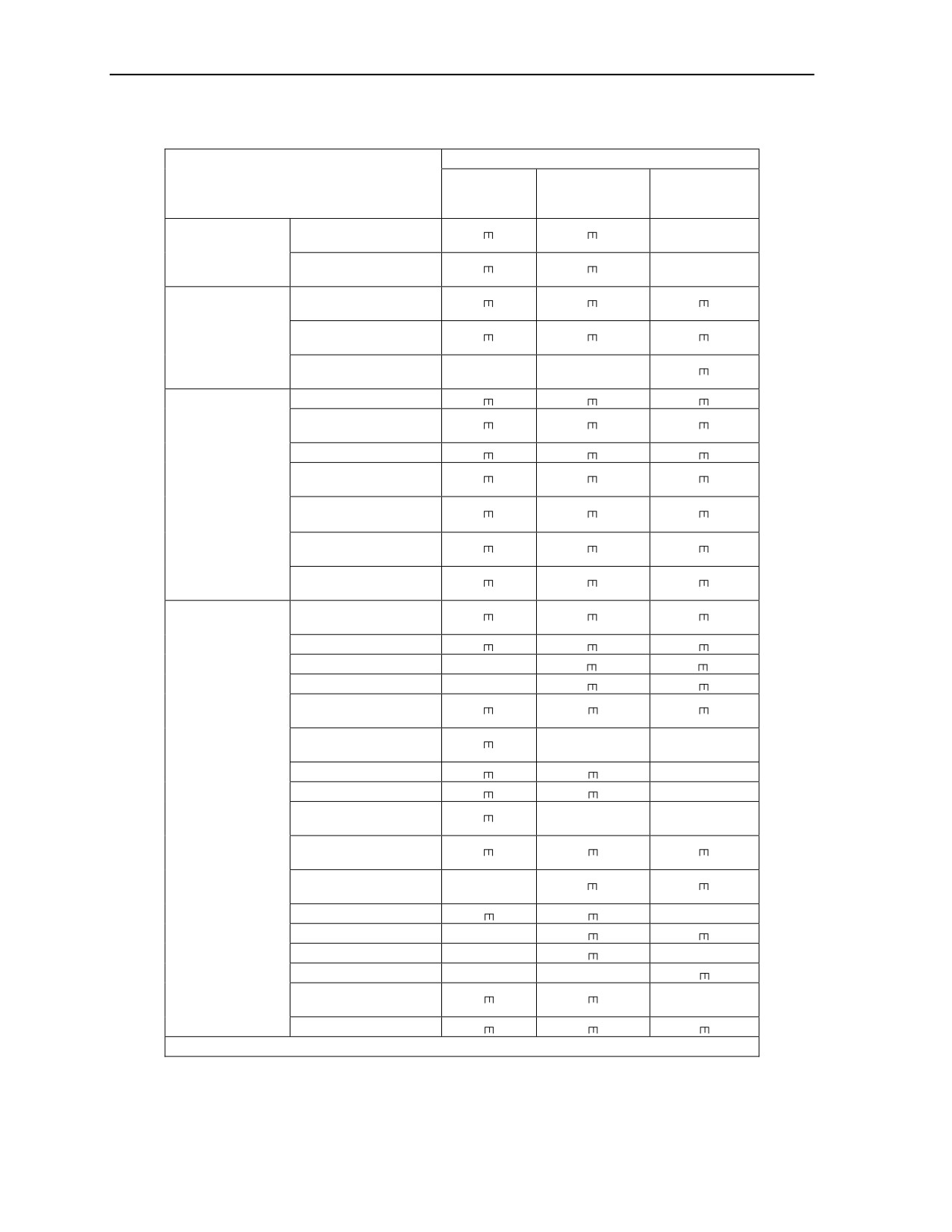
Chapter 2
Table 2-3. Elements of the Engineer Regiment
Component (COMPO)
Engineer Element
Active
Army National
United States
Component
Guard
Army Reserve
Brigade Combat Team
Engineer Company
Engineer Forces
Geospatial Engineer
Team
Engineer Battalion
Headquarters
Engineer
Engineer Brigade
Headquarters
Headquarters
Forces
Theater Engineer
Command
Sapper Company
Mobility Augmentation
Company
Clearance Company
Engineer Support
Baseline Engineer
Company
Forces
Horizontal
Construction Company
Vertical Construction
Company
Multirole Bridge
Company
Survey and Design
Team
Concrete Section
Asphalt Team
Firefighting Team
Explosive Hazard Team
or Coordination Cell
Engineer Squad
(Canine)
Diving Team
Topographic Company
Specialized
Geospatial Planning
Engineer Forces
Cell
Construction
Management Team
Engineer Facility
Detachment
Prime Power Company*
Well Drilling Team
Quarry Platoon
Real Estate Team
Forward Engineer
Support Team*
Area Clearance Platoon
*These units are assets of the United States Army Corps of Engineers
2-12
FM 3-34
4 August 2011
The Engineer Regiment
UNITED STATES ARMY CORPS OF ENGINEERS
2-43. USACE is the Army’s direct reporting unit assigned responsibility to execute Army and DOD
military construction, real estate acquisition, and development of the nation’s infrastructure through the
civil works program. Other services include wetlands and waterway management and disaster relief support
operations (USACE has primary responsibility to execute Emergency Support Function #3, Public Works
and Engineering, for DOD). Most of its assets are part of the generating force (see FM 1-01), but selected
elements support the operational Army, to include various FFE teams (see paragraph 2-28) and the 249th
Engineer Battalion (Prime Power). With its subordinate divisions, districts, laboratories, and centers,
USACE provides a broad range of engineering support to military departments, federal agencies, state
governments, and local authorities in a cost-reimbursable manner. USACE districts provide research,
design, contracting, construction, and operation of hydroelectric power generation and river navigation
while reducing overall environmental impact. USACE also provides technical assistance and contract
support to joint forces deployed worldwide. USACE operates the U.S. Army Engineer Research and
Development Center, a comprehensive network of laboratories and centers of expertise that includes the
following facilities:
z
Geotechnical and Structures Laboratory.
z
Coastal and Hydraulics Laboratory.
z
Environmental Laboratory.
z
Information Systems Laboratory.
z
Engineer Waterways Experiment Station.
z
Cold Regions Research and Engineering Laboratory.
z
Construction Engineering Research Laboratory.
z
Army Geospatial Center.
UNITED STATES ARMY CORPS OF ENGINEERS MISSIONS
2-44. USACE capabilities include access to the expertise of U.S. Army Engineer Research and
Development Center’s centers and laboratories and all of the resources within the divisions, districts, and
other sources. USACE has aligned its divisions with and assigned liaison officers to CCDR and Army
commanders (see figure 2-2, page 2-5) to enable access to USACE resources to support engagement
strategies and wartime operations. The USACE mission supports full spectrum operations with the
following five major functions:
z
Military support—provides engineering and contingency support for full spectrum operations.
z
Disasters—responds to and supports recovery from local, national, and global disasters.
z
Infrastructure—acquires, builds, and sustains critical facilities for military installations, theater
support facilities, and public works.
z
Environment—restores, manages, and enhances ecosystems, local and regional.
z
Water resources development—balances requirements between water resources development
and environment.
2-45. USACE support provides for technical and contract engineering support, integrating its organic
capabilities with those of other Services and other sources of engineering-related reachback support.
USACE may have assets directly integrated into the military mission command structure and linked to a
TEC or senior engineer headquarters or already operating under contract in-theater. Whether providing
construction contract and design support in the AO or outside of the contingency area, USACE can obtain
necessary data, research, and specialized expertise not present in-theater through reachback capabilities
using tele-engineering when necessary. Tele-engineering is the communications architecture that facilitates
reachback when the existing communications infrastructure will not support it. Tele-engineering is under
the proponency of the USACE and is inherent in FFE.
FIELD FORCE ENGINEERING
2-46. USACE is the primary proponent of FFE and related generating force support which enable engineer
support to the operational Army. Field force engineering is the application of the Engineer Regiment’s
4 August 2011
FM 3-34
2-13
Chapter 2
capabilities from the three engineer disciplines (although primarily general engineering) to support
full spectrum operations through both reachback and forward presence. It enables generating force
engineer support to deployed operating forces and is provided by technically specialized personnel and
assets (deployed or participating through reachback) or through operational force engineer Soldiers linked
to reachback capabilities. The engineer commander maintains his flexibility and determines the mix of
capabilities
(troop, USACE civilian, and contractor) based on the tactical situation, time-phased
requirements, capabilities required, available funding, and force caps. The USACE division commander
task-organizes the division’s capabilities to meet the varying time-phased requirements. The capability
relies heavily on reachback through communication systems such as tele-engineering. The FFE concept is
applicable in joint and multinational operations to provide technical engineer solutions that can be
implemented faster and with a smaller footprint. The United States Air Force and United States Navy have
similar capabilities—the Air Force uses its Geo-Reach program while the Navy has the capability to
conduct engineer reconnaissance with reachback to the Naval Facilities Engineering Command
(NAVFAC).
2-47. The USACE objective for FFE is to effectively leverage its generating force capabilities (engineering
expertise, contract construction, real estate acquisition and disposal, and environmental engineering) in
operations and maximize the use of reachback to provide technical assistance and enable operational force
engineers in their support to the CCDR or JTF commander. One of the ways USACE accomplishes this is
by training, equipping, and maintaining specialized deployable FFE teams. These deployable USACE
organizations provide technical assistance, enable operational force engineers, and access additional
technical support through reachback. Another way that USACE supports the operational force is through
nondeployable teams that provide dedicated engineering assistance in response to requests for information
from deployed teams or engineer Soldiers in the operational area. Focus areas for these teams include
infrastructure assessment and base camp development.
2-48. FFE teams are the primary elements within USACE that are organized, trained, and equipped to
provide technical solutions to engineering and construction-related challenges. These elements deliver FFE
to supported units through their engineer staff. FFE teams serve as forward planning, execution, or liaison
teams to support full spectrum operations or offer dedicated reachback support to deployed teams and
engineer Soldiers in need of technical support. FFE teams are flexible and can be tailored for specific
missions. They typically develop solutions employing their own available resources but have the option to
employ reachback to the entire array of expertise within the USACE laboratories or centers of expertise for
more complex engineering issues. USACE has expertise that may support the strategic, operational, or
tactical level in engineer planning and operations and can leverage reachback to technical subject matter
experts in districts, divisions, laboratories and centers of expertise; other Services; and private industry in
its role as part of the generating force. USACE FFE is a means to access specialized engineer capabilities
that can augment JFC planning staffs. Teams can rapidly deploy to meet requirements for engineering
assessments and analyses in support of the full array of engineer missions. Teams include forward engineer
support teams (FESTs), contingency real estate support teams (CRESTs), environmental support teams
(EnvSTs), logistics support teams (LSTs), and base camp development teams (BDTs).
z
A forward engineer support team-main
(FEST-M) is a deployable team that provides
construction management, real estate, environmental, geospatial, and other engineering support
(typically to the theater army) and can provide mission command for deployed FFE teams. This
team would typically support a JTF or the land component of a JTF, either task-organized to that
headquarters or to a supporting engineer headquarters. The FEST-M operates as augmentation to
either the joint force engineer staff or the engineer headquarters element or may operate as a
discrete headquarters element. It is designed to provide mission command for additional FFE
elements when task-organized with those organizations. In some cases, the FEST-M may
provide the base upon which a contingency USACE district is established in theater. The
FEST-M element conducts a variety of core essential tasks in support of stability operations,
consequence management or civil support, and technical engineering missions. It requires
sustainment and security support from the gaining or supported unit.
z
A forward engineer support team-advance
(FEST-A) is a deployable team that provides
infrastructure assessment; engineer planning and design; and environmental, geospatial, and
other technical engineering support (from theater army to brigade echelon) and augments the
2-14
FM 3-34
4 August 2011
The Engineer Regiment
staff at those echelons. This team could support any echelon configured as a joint force
headquarters for limited interventions or may be task-organized at corps, division, and brigade
echelons when configured as intermediate or tactical headquarters. The FEST-A operates as
augmentation to either the supported force engineer staff or to the supporting engineer
headquarters. It is designed to receive task-organized CREST and EnvST elements when those
capabilities are required. A FEST-A may also provide FFE support within an assigned area as a
subordinate element of a FEST-M. The FEST-A conducts a variety of core essential tasks in
support of stability operations, consequence management or civil support, and technical
engineering missions. The FEST-A requires sustainment and security support from the gaining
or supported unit.
z
A CREST is a deployable team which can acquire, manage, and dispose of real property on
behalf of the U.S. government. This team could support any echelon but will typically be
tailored to support an Army component headquarters configuration with support missions
requiring real estate management. The CREST operates as augmentation to the supported force
engineer staff or supporting engineer headquarters. It may also be task-organized to a tailored
FEST. The CREST conducts real estate management tasks and should be deployed early in a
contingency to facilitate acquisition of real estate in support of the development of facilities for
U.S. forces. It requires sustainment and security support from the gaining or supported unit.
z
An EnvST is a deployable team that conducts environmental assessments, baseline and other
surveys, and studies. This team could support any echelon, but will typically be tailored in
support of an Army component headquarters configuration with support missions requiring base
camp development. The EnvST operates as augmentation to either the supported force engineer
staff or to the supporting engineer headquarters. It may also be task-organized to a tailored
FEST. The EnvST conducts environmental management tasks in support of base camps and
other technical engineering missions. The team should be deployed as an initial element to
perform assessments, identify environmental hazards, and remain as one of the last elements to
provide remediation actions and support for base closure. The EnvST requires sustainment and
security support from the gaining or supported unit.
z
An LST is a deployable team that coordinates sustainment support for deployed FFE or
emergency management elements when those requirements exceed or are not provided by the
operational force logistics system. This team typically supports the FEST-M when that team
provides mission command for additional FFE elements. The LST could operate in support of
reception, staging, onward movement, and integration (RSOI) for deploying FFE elements. The
LST conducts generating force-specific sustainment tasks in support of consequence
management, civil support, and stability operations. The LST requires sustainment and security
support from the gaining or supported unit.
z
A BDT is a nondeployable team within a selected USACE district that can quickly provide base
development engineering, master planning, and facilities design in support of FFE and other
reachback requests for information. BDTs are trained and organized within the USACE
divisions and maintain a rotational readiness cycle. While these teams are capable of responding
to a variety of complex technical problems, they are also trained to exploit the entire array of
expertise within the USACE laboratories or centers of expertise, as needed, for more complex
engineering issues. Focus areas for the BDTs are engineering-related planning and development
issues involved in locating, designing, constructing, and eventually closing or transferring base
camps. Note that base camp operations and maintenance activities are not within the scope of
FFE support but may rely on FFE applications to address specific technical engineering
requirements when necessary. The BDT’s resources and expertise are available to support FFE
teams and operational forces through the USACE Reachback Operations Center, which can be
contacted via <https://uroc.usace.army.mil.>
Note. See Engineer Pamphlet 500-1-2 for additional information on FFE.
4 August 2011
FM 3-34
2-15
Chapter 2
DEPARTMENT OF DEFENSE CONSTRUCTION AGENTS
2-49. The Secretary of Defense has designated USACE and NAVFAC as contract construction agents for
the design and construction execution within assigned areas of responsibility for U.S. military facilities
worldwide. (The Air Force is the designated DOD construction agent for military construction in the
British Isles.) USACE and NAVFAC provide a significant engineering capability to be leveraged in joint
operations. Both USACE and NAVFAC have the capability to support general engineering operations with
technical assistance and contract support to joint forces deployed worldwide. They also maintain in depth
expertise in engineering research and development. Inherent in their mission support capabilities is a
planning and engineering capability for advanced base and infrastructure development. The CCDR may use
USACE and NAVFAC to provide technical engineering assistance for design and award of construction
contracts to civilian companies in support of military operations.
2-16
FM 3-34
4 August 2011
Chapter 3
Foundations of Engineer Support to Operations
Army engineer support to operations encompasses a wide range of actions requiring
many capabilities. Commanders use engineers in all elements of full spectrum
operations and in all operational themes across the spectrum of conflict. They use
them primarily to assure mobility, enhance protection, enable logistics, and develop
infrastructure. This chapter describes lines of engineer support, engineering tasks,
engineer support to combat power, and engineers in close combat.
OVERVIEW
3-1. All engineering tasks have providing freedom of action as their objective. These tasks provide
freedom of action by loosening the grip of the terrain and the enemy on our forces. Engineering tasks that
affect terrain deal with obstacles
(including gaps), bridges, roads, trails, airfields, fighting positions,
protective positions, deception positions, and a wide variety of other structures and facilities such as base
camps, ports, utilities, and buildings. Engineers affect these by clearing, reducing, emplacing, building,
repairing, maintaining, camouflaging, protecting, conserving, or modifying them in some way. Engineers
reduce the grip of the enemy through tasks such as reducing obstacles, route clearance, support to search
operations, infrastructure development in stability operations, and geospatial engineering support to
intelligence. Many of these tasks fall under the categories of mobility, countermobility, or survivability
operations.
3-2. Regardless of their category, engineering tasks have different purposes in different situations. For
example, a task to clear EH from a road that has been designated a direction of attack may have the purpose
of supporting the maneuver of a mechanized unit. But two days later, when that road has been designated
as an MSR, a task to clear EH from that same road may have the purpose of supporting sustainment. The
next month, when that road is needed by the population to get their goods to market or to get to the polls, a
task to clear EH from that same road may have the purpose of supporting the improvement of civil
conditions. In all three cases the same task is involved, but with different purposes. In addition to the
different purposes an engineering task can have at different times, engineer support often involves
simultaneous tasks with different purposes and supporting different warfighting functions (see below). This
chapter explains how engineering tasks are grouped by purpose into lines of engineer support, how they are
grouped into types of operations, how they contribute to the warfighting functions, and how engineers
operate in close combat.
LINES OF ENGINEER SUPPORT
3-3. Fundamental to engineer support to operations is the ability to anticipate and analyze the problem
and understand the operational context from chapter 1. Based on this understanding and the analysis of the
problem, engineer planners select and apply the right engineer discipline and type unit capabilities to
perform required individual and collective tasks. They must think in combinations of disciplines and
arrange actions in concert with maneuver. Finally they provide necessary mission command for these
combinations. The lines of engineer support are the framework that underpin how engineers think in
combinations, and these lines provide the connection between capabilities and operations.
3-4. Commanders use lines of engineer support to synchronize engineering tasks with the rest of the
combined arms force and to integrate them into the overall operation throughout the operations process.
Lines of engineer support are categories of engineer tasks and capabilities that are grouped by
purpose for specific operations. As depicted in figure 3-1, page 3-2, lines of engineer support help
commanders and staffs combine the capabilities from all three engineer disciplines and from throughout the
4 August 2011
FM 3-34
3-1
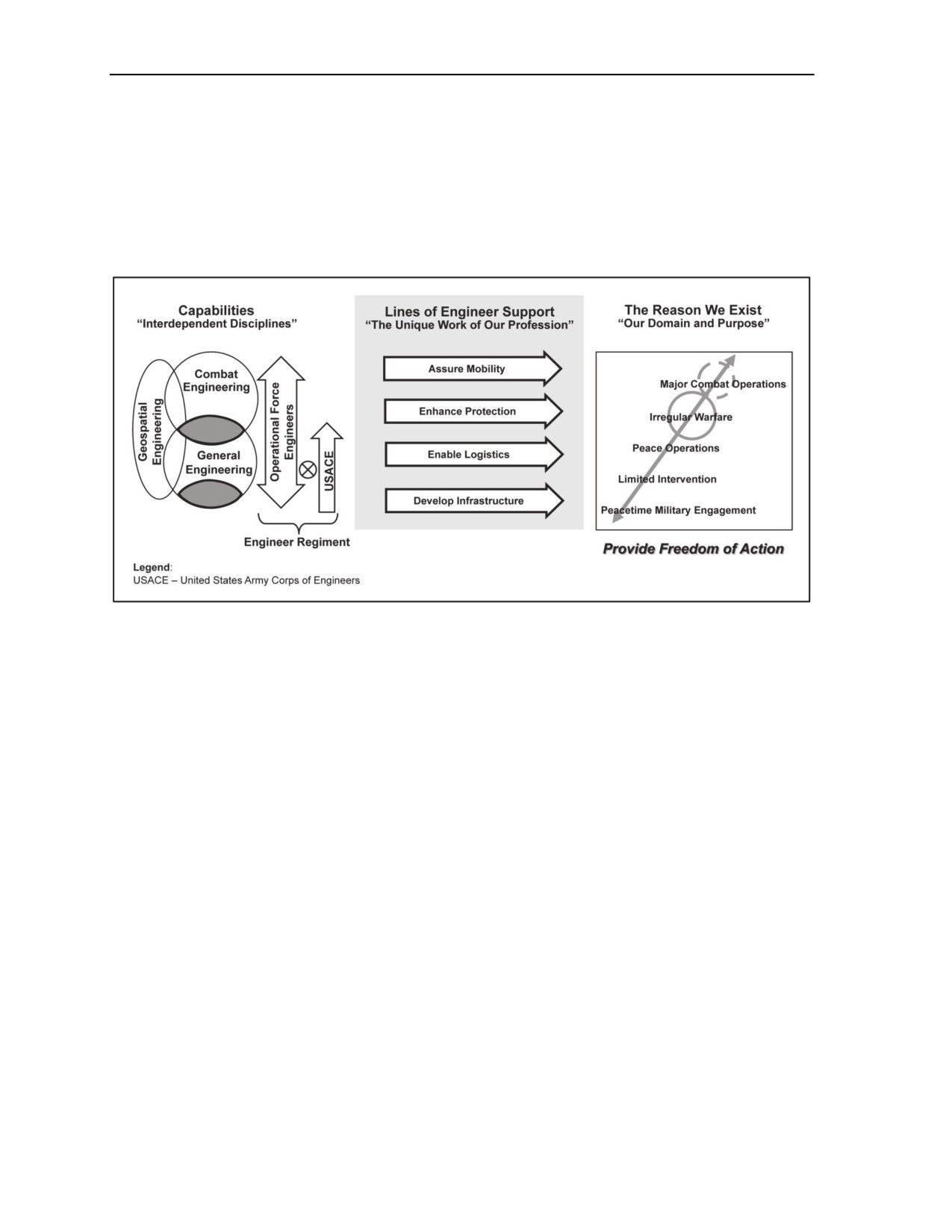
Chapter 3
Corps of Engineers and align their activities according to their purpose. The engineer disciplines are
capabilities, based on knowledge and skills, organized in units. These units, organized based on discipline,
execute individual and collective tasks. The combination of these tasks for a specific purpose, in the
context of full spectrum operations, achieve the lines of support.
3-5. Regardless of where a task falls within the Army universal task list, task alignment with an engineer
line of support is determined by the purpose of the task in a given situation. Engineer support is primarily
focused on achieving purposes along four lines of engineer support: assure mobility, enhance protection,
enable logistics, and develop infrastructure.
Figure 3-1. Lines of engineer support
3-6. All three engineer disciplines (see chapter 2) encompass tasks along the lines of engineer support.
The combat engineering discipline, due to its close support to maneuver forces that may be in close combat,
is primarily focused on tasks that assure mobility and enhance protection. The general engineering
discipline performs tasks along all four lines. Geospatial engineering provides essential support to all four
lines.
ASSURE MOBILITY
3-7. The assure mobility line of support is the orchestrating of combat engineering, general engineering,
and geospatial engineering capabilities in combination in order to allow a commander to gain and maintain
a position of advantage against an enemy. This includes denying the enemy freedom of action to attain his
own position of advantage.
3-8. Tasks in this line of engineer support are intended to support the ability of a force to move or
maneuver (see primarily FM 3-90, FM 3-90.4, and FM 90-7). This includes engineering tasks, primarily
related to mobility and countermobility
(see below), with a focus on the movement and maneuver
warfighting function.
3-9. When supporting tactical maneuver, this line of engineer support consists primarily of mobility and
countermobility tasks (though such tasks can be used in other lines, too). Both combat and general
engineers conduct these tasks, although the conditions described in chapter 2 may require that combat
engineers conduct them. When supporting operational maneuver or force projection, this line of engineer
support often involves tasks such as constructing, repairing, and maintaining bridges, roads, and airfields.
SUPPORT TO MOBILITY OPERATIONS
3-10. Engineers are essentially always involved with mobility operations to mitigate the effects of
obstacles and enhance freedom of movement and maneuver. While some mobility tasks are performed by
3-2
FM 3-34
4 August 2011
Foundations of Engineer Support to Operations
other disciplines, this section addresses only engineer-focused tasks that support mobility operations. (See
FM 3-90.4 for more information on mobility operations and the more comprehensive list of tasks that
support them.)
3-11. The engineering tasks that support mobility operations include those that reduce, clear, or mark
obstacles (including gaps); clear or mark lanes and trails; and build, repair, or maintain roads, bridges, and
airfields. Mobility operations include the following six primary tasks (see FM 3-90.4):
z
Conduct breaching operations.
z
Conduct clearing operations (see FM 3-34.210 and FM 3-90.119).
z
Conduct gap-crossing operations.
z
Construct and maintain combat roads and trails.
z
Construct and maintain forward airfields and landing zones.
z
Conduct traffic operations.
3-12. Engineering tasks to reduce, clear, or mark obstacles (including gaps) and tasks to clear or mark
lanes and trails, frequently occur under conditions that require combat engineer units (as discussed in
chapter 2) and most frequently occur when these tasks are conducted at the tactical level in support of
maneuver. These tasks are often considered combat engineering tasks, even though general engineer units
can perform them when the conditions allow.
3-13. Engineering tasks to build, repair, or maintain roads, bridges, and airfields usually do not occur under
conditions that require combat engineer units. As a result, these tasks are often considered general
engineering tasks, even though combat engineer units can perform them, given additional training and
augmentation if necessary. (Combat engineers perform these tasks if performed under conditions of close
support to maneuver forces that are in close combat.)
3-14. Engineer contributions to the planning of mobility operations occur at all levels of war (tactical,
operational, and strategic) and in all four elements of full spectrum operations (offensive, defensive,
stability, and civil support operations). The execution of engineering tasks in support of mobility
predominately occurs at the operational and tactical levels of war, but will often have strategic level
implications. At the tactical level of war, they frequently require combat engineer units, especially in
offensive and defensive operations. At the operational level, they are typically performed by general
engineer units. In offensive and defensive operations, they are focused on mobility of friendly forces. In
stability and civil support operations, they are often focused on mobility of the population.
3-15. Engineer tasks that support mobility operations typically support the assure mobility line of engineer
support, but may also support the other three lines. Similarly, a road constructed for a LOC has the purpose
of enabling sustainment. Likewise, a bridge might be constructed to develop infrastructure, allowing the
local population to transport goods to market. Engineers perform these tasks most frequently as part of the
movement and maneuver warfighting function, but also perform them in support of protection, sustainment,
or the other warfighting functions. Combat engineering is typically focused on mobility at the tactical level
while general engineering is typically focused on mobility at the operational level (although general
engineering may at times impact strategic mobility).
3-16. Mobility tasks are typically identified as essential tasks and may require integration into the
synchronization matrix to account for the assets and time required to implement them. See chapter 5 for a
discussion of planning considerations for mobility, countermobility, and survivability.
SUPPORT TO COUNTERMOBILITY OPERATIONS
3-17. Countermobility operations are those combined arms activities that use or enhance the effects of
natural and manmade obstacles to deny an adversary freedom of movement and maneuver. The
primary purpose of countermobility operations is to slow or divert the enemy, to increase time for target
acquisition, and to increase weapon effectiveness. Countermobility operations include the construction of
entry control points and other barriers to deny free access to fixed sites. The advent of rapidly emplaced,
remotely controlled, networked munitions enables engineers to conduct effective countermobility
operations as part of offensive, defensive, and stability operations, as well as during the transitions among
these operations.
4 August 2011
FM 3-34
3-3
Chapter 3
3-18. Countermobility operations typically involve engineers and must always include proper obstacle
integration with the maneuver plan, adherence to obstacle emplacement authority, and rigid obstacle
control. Combined arms obstacle integration, which is further described in FM 90-7, is the process that
synchronizes countermobility operations into the scheme of movement and maneuver and the scheme of
fires. The engineer advises the commander on how to integrate obstacles and coordinates for obstacle
emplacement authority, establishes obstacle control, recommends directed obstacles, supervises the
employment of obstacles, and maintains obstacle status throughout the operation. Most obstacles have the
potential to deny freedom of maneuver to friendly forces, as well as to enemy forces. Therefore, it is critical
that the engineer accurately understands the countermobility capabilities and limitations of the available
engineer forces and properly weighs the risks of employing various types of obstacles. The engineer must
also plan for clearing of obstacles at the cessation of hostilities and for minimizing obstacle effects on
noncombatants and their environment.
3-19. Countermobility operations are discussed in detail in FM 5-102. The engineering tasks that support
countermobility operations include those that emplace, build, repair, maintain, or camouflage obstacles
(including gaps). These tasks are often performed under conditions of close support to maneuver forces that
are in close combat, which require combat engineers units (as discussed in chapter 2). Such conditions most
frequently occur when these tasks are conducted at the tactical level as part of offensive or defensive
operations. They are often considered combat engineering tasks, even though general engineer units can
perform them when the conditions allow. Countermobility operations include the following tasks:
z
Site obstacles.
z
Construct, emplace, or detonate obstacles.
z
Mark, report, and record obstacles.
z
Maintain obstacle integration.
3-20. The effects of natural and manmade obstacles are considered during planning at every level of war.
At the tactical level of war, combat engineers play a more prominent role in the integration of tactical
obstacles in support of offensive and defensive operations. General engineers also may be involved in
countermobility operations intended to achieve operational (or even strategic) effects. Countermobility
operations typically block, fix, turn, or disrupt the enemy’s ability to move or maneuver, giving the
commander opportunities to exploit enemy vulnerabilities or react effectively to enemy actions. In stability
operations, countermobility tasks may support missions such as traffic control.
(See FM 90-7 for
information on combined arms obstacle integration and the integration of countermobility.)
3-21. Engineers usually perform these tasks under the first two lines of engineer support: to assure mobility
and to enhance protection, although they may also be applicable in selected cases for the other two lines of
engineer support. These tasks typically support the movement and maneuver and protection warfighting
functions.
3-22. In conducting mining operations, U.S. forces use rules of engagement (ROE) to ensure their actions
are consistent with current law and policy. Engineers must be familiar with the specific ROE concerning
mines. U.S. forces use ROE to ensure that the employment of conventional (persistent or nonself-
destructing) and scatterable mines (SCATMINEs) is consistent with the numerous international laws and
U.S. laws and policy governing their use. The current U.S. land mine policy acknowledges the importance
of protecting noncombatants while enabling legitimate operational requirements. Under this policy, the
United States has committed to end the use of persistent land mines of all types after the end of 2010 and
no longer uses nondetectable land mines of any type (see JP 3-15). The United States will continue to
employ self-destructing/self-deactivating mines, such as SCATMINEs, to provide countermobility for the
force. Additionally, newly developed weapon systems called networked munitions provide the flexible and
adaptive countermobility and survivability capability required by the Army conducting full spectrum
operations. Networked munitions are remotely controlled (man in the loop), ground-emplaced weapon
systems that provide lethal and nonlethal antipersonnel and antitank (AT) effects with the ability to be
turned on/off/on from a distance and recovered for multiple employments.
3-4
FM 3-34
4 August 2011
Foundations of Engineer Support to Operations
OTHER TASKS IN THE ASSURE MOBILITY LINE OF SUPPORT
3-23. Geospatial engineering provides the necessary geospatial information and products to help combat
and general engineers visualize the terrain and perform tasks along this line of engineer support. Terrain
analysis and visualization products provided by geospatial engineers are always important to this line, even
when no other engineer disciplines are involved.
z
Three-dimensional perspective views and fly throughs to enhance visualization of the terrain.
z
Mobility corridor and combined obstacle overlays to identify assembly areas , plan movements,
and develop engagement areas.
z
Fields of fire and line of sight analysis products to locate defensible terrain, identify potential
engagement areas, and position fighting systems to allow mutually supporting fires.
z
Urban Tactical Planner that displays keys aspects of urban terrain in thematic layers overlaid on
high resolution imagery or maps to facilitate mission planning in urban areas.
3-24. This line of engineer support does not include engineering tasks intended to support the
administrative movements of personnel and materiel. Such tasks are normally intended to enable logistics
(see below). The assure mobility line of engineer support is achieved through the assured mobility
framework, which is described in chapter 5 and in more detail in FM 3-90.4.
ENHANCE PROTECTION
3-25. This line of support is the combination of the engineer disciplines in order to support the preservation
of the force so the commander can apply maximum combat power. This line of engineer support consists
largely of survivability tasks, but also can include selected mobility tasks (for example, construction of
perimeter roads), countermobility tasks (for example, emplacement of protective obstacles), and explosive
hazard (EH) operations tasks. This line includes survivability and other protection tasks performed or
supported by engineers (see FM 5-103 and FM 3-37). Geospatial engineering tasks also support this line.
SUPPORT TO SURVIVABILITY OPERATIONS
3-26. Survivability operations are those military activities that develop and construct protective positions,
such as earth berms, dug-in positions, overhead protection, and countersurveillance means, to reduce the
effectiveness of enemy weapon systems. They also include other mitigation TTP, such as fire prevention
and firefighting (see FM 5-415). Survivability operations range from employing camouflage, concealment,
and deception (CCD) (including the supporting task of battlefield obscuration) to hardening facilities,
mission command nodes, and critical infrastructure.
3-27. While survivability operations are traditionally recognized as an engineering task, units at all
echelons have an inherent responsibility to improve their positions as part of their own protection. This
section focuses on engineering tasks in support of survivability operations, which include tasks to build,
repair, or maintain fighting and protective positions; and harden or camouflage roads, bridges, airfields, and
other structures and facilities. These tasks tend to be equipment intensive, and the use of equipment
timelines may be required to properly optimize the work performed. For more information on survivability
operations, see FM 5-103.
3-28. Engineers typically perform these tasks under this line of engineer support—to enhance protection—
and as part of the protection warfighting function (see FM 3-37). They frequently enable other protection
tasks and systems, including air and missile defense, operational area security, antiterrorism, and CBRN
operations. The concept of survivability (one of the protection tasks, see FM 3-37) in today’s OE includes
all aspects of protecting personnel, equipment, supplies, and information systems while deceiving the
enemy. Survivability considerations are applied in support of battle positions, combat outposts, forward
operating bases, base camps, and in many cases HN and other infrastructure support. Today’s OE requires
commanders to know all of the survivability tactics and techniques available to provide this protection. The
construction of fighting positions and protective positions by itself cannot eliminate vulnerability of
personnel and resources. It will, however, limit personnel and equipment losses and reduce exposure to
hostile enemy action.
4 August 2011
FM 3-34
3-5
Chapter 3
3-29. Engineering tasks that support survivability operations occur predominately at the operational and
tactical levels of war and in all four elements of full spectrum operations. At the tactical level of war, they
often occur under conditions of close support to maneuver forces that are in close combat, which require
combat engineer units (as discussed in chapter 2). This most often occurs for tasks to build, repair, or
maintain fighting and protective positions. Those tasks are often considered combat engineering tasks, even
though general engineer units can perform them when the conditions allow. At the operational level,
engineering tasks that support survivability operations are typically performed by general engineer units. In
offensive and defensive operations they are focused on protection of friendly forces, but in stability and
civil support operations they sometimes focus on protection of the population.
3-30. Two key factors in the development of defensive fighting positions are proper siting in relation to the
surrounding terrain and proper siting for the most effective employment of key weapon systems, such as
AT guided missiles (shoulder-launched munitions and close combat missiles), crew-served weapons, and
tanks. Defensive protective positions include mission command facilities or communications sites, critical
equipment (to include radars), supply and ammunition storage or holding areas, and other items that are
likely to be targeted first by enemy action. Consider protecting hazardous material and petroleum, oil, and
lubricants storage areas that present a threat to personnel if the storage containers are damaged or
destroyed. The degree of protection actually provided for these items is based on the availability of time,
equipment, and resources to the commander. An additional consideration is the probability or risk of
acquisition and attack and the risk assessment made for each site and facility. Facilities emitting a strong
electromagnetic signal or substantial thermal or visual signature may require full protection against
potential enemy attack. Electronic countermeasures and deception activities are mandatory considerations
and an integral part of planning for all activities in the defense. (See graphic training aid 90-01-011 for
additional considerations for survivability of forward operating bases.)
OTHER TASKS THAT ENHANCE PROTECTION
3-31. Engineers also enhance protection through explosive hazard operations (see FM 3-34.210). These
include area and route clearance; specialized search using engineer working dog teams; and the collection,
analysis and dissemination of explosive hazard information. These efforts to mitigate the effects of EH can
be performed by engineers at all echelons or be by specialized units such as the explosive hazard
coordination cells (see ATTP 3-34.23) and area clearance platoons.
3-32. Engineer mobility and countermobility tasks typically support the assure mobility line of engineer
support, but may also support this line of support. For example, if a trail is being constructed for the
purpose of being used as a perimeter road to secure a base, then its purpose is to enhance protection.
Countermobilty tasks can be used to provide protective obstacles for the protection of military bases (see
FM 3-37). Constructing an entry control points, a countermobility task, would also be included in this line
of support since its purpose is to provide protection to the base.
ENABLE LOGISTICS
3-33. Engineers combine capabilities from all three engineer disciplines to enable the movement and
support of forces. These capabilities are applied to establish and maintain the infrastructure necessary for
sustaining military operations in theater. Tasks in this line of engineer support are primarily intended to
support the logistics component of the sustainment warfighting function. This line consists largely of
building, repairing, and maintaining roads, bridges, airfields, and other structures and facilities needed for
APODs, SPODs, MSRs, and base camps. Mobility tasks sometimes support this line and geospatial
engineering tasks are also key enablers. For example, geospatial engineers would provide LOC overlays
that display road network, airfield, and port information and capabilities to facilitate movement planning.
3-34. Task in the enable logistics line of support are primarily general engineering tasks because they are
usually not performed under conditions of close support to maneuver forces that are in close combat. These
tasks, which are covered in more detail in FM 3-34.400, include—
z
Restoring damaged areas (including environmental damage).
z
Constructing and maintaining sustainment LOCs, including constructing and maintaining—
Roads and highways.
3-6
FM 3-34
4 August 2011
///////////////////////////////////////