FM 3-52 AIRSPACE CONTROL (OCTOBER 2016) - page 1
*FM 3-52
Headquarters
Field Manual
Department of the Army
No. 3-52
Washington, D.C. 20 October 2016
Airspace Control
Contents
Page
PREFACE
iii
INTRODUCTION
iv
Chapter 1
AIRSPACE CONTROL OPERATIONAL CONTEXT
1-1
Unified Land Operations and Unified Action
1-1
Airspace in Operational Environments
1-1
Joint Airspace Control
1-3
Theater Air-Ground System
1-3
Methods of Control
1-4
Airspace Control and Mission Command
1-4
Airspace Control and the Operations Process
1-5
Chapter 2
AIRSPACE CONTROL IN OPERATIONS
2-1
Airspace Control Integration
2-1
Airspace Control Principles
2-1
Army Air-Ground System
2-2
Airspace Responsibilities by Echelon and Role
2-4
Joint Air Ground Integration Center (JAGIC)
2-9
Chapter 3
AIRSPACE CONTROL—PLANNING AND PREPARATION
3-1
Planning
3-1
Preparation
3-11
Chapter 4
AIRSPACE CONTROL—EXECUTION AND ASSESSMENT
4-1
Execution
4-1
Assessment
4-2
Airspace Control—Execution and Assessment Collective Tasks
4-3
Appendix A
RISK
A-1
Appendix B
AIRSPACE COORDINATING MEASURES
B-1
Appendix C
AIRSPACE CONTROL CONNECTIVITY
C-1
Appendix D
AIRSPACE MESSAGES, REQUESTS, AND INFORMATION DISPLAYS
D-1
Appendix E
AIRSPACE ELEMENT COLLECTIVE TASKS
E-1
Distribution Restriction: Approved for public release; distribution is unlimited.
*This publication supersedes FM 3-52, dated February 2013.
i
Contents
Appendix F AIRSPACE CONTROL APPENDIX FORMAT
F-1
Appendix G AIRSPACE CONTROL DURING DEFENSE SUPPORT OF
CIVIL AUTHORITIES
G-1
GLOSSARY
Glossary-1
REFERENCES
References-1
INDEX
Index-1
Figures
Figure 2-1. Army air-ground system with key theater air-ground system components
2-3
Figure 3-1. Division Assigned Airspace
3-5
Figure 3-2. Development process for unit airspace plan
3-9
Figure 3-3. Notional 72-hour joint air tasking cycle
3-10
Figure A-1. Risk management aligned with the operations process
A-3
Figure A-2. Sample risk assessment matrix
A-4
Tables
Table 2-1. Air defense airspace management and brigade aviation element functions
2-10
Table B-1a. Types of airspace coordinating measures and their corresponding usage
B-2
Table B-1b. Types of airspace coordinating measures and their corresponding usage
B-3
Table B-2. Airspace coordinating measures(Air Corridor(AIRCOR))
B-4
Table B-3. Airspace coordinating measure(ACM) (Stand Alone)
B-6
Table B-4. Airspace Coordinating Measure Restricted Operations Zone (ROZ)
B-10
Table B-5. Fire Support Coordination Measure (FSCM)
B-13
Table B-6. Maneuver Control Measures (MAN)
B-16
Table B-7. Air reference measures (AIRREF)
B-17
Table B-8. Air defense measures (ADMEAS)
B-18
Table B-9. Marine defense measures (MARDEF)
B-20
Table B-10. Air traffic control measures (ATC)
B-20
Table D-1. Airspace control system shapes
D-3
Table E-1. Army tactical task 5.4 Control tactical airspace
E-2
Table E-2. Airspace control collective tasks
E-3
ii
FM 3-52
20 October 2016
Preface
FM 3-52, Airspace Control, provides commanders, staff officers, and airspace element personnel with tactics
essential for the exercise of airspace control. Using the backdrop of the Army air-ground system (AAGS), the
Army component of the theater air-ground system (TAGS), and the operations process, the manual addresses
roles and responsibilities, by echelon, between Army and air support agencies of other Services in the planning,
preparation, execution, and assessment of airspace use.
The principal audience for FM 3-52 includes commanders, leaders, and staffs across all Army echelons with
responsibilities for airspace control, airspace element personnel, controllers, and airspace users from tactical to
operational levels. Trainers and educators throughout the Army will also use this manual.
Commanders, staffs, and subordinates ensure their decisions and actions comply with applicable U.S.,
international, and, in some cases, host-nation laws and regulations. Commanders at all levels ensure their Soldiers
operate in accordance with the law of war and the rules of engagement. See FM 27-10.
FM 3-52 implements the standardization agreement entitled AJP 3.3.5.
FM 3-52 uses joint terms where applicable. Selected joint and Army terms and definitions appear in both the
glossary and text. Definitions shown in the text have the term italicized and the number of the proponent
publication following the definition.
This manual uses the terms command and control and command and control system as defined in JP 1 and JP 6-0
respectively when referring to joint or other Service processes. This manual uses the term mission command when
referring to U.S. Army processes.
FM 3-52 applies to the Active Army, Army National Guard/Army National Guard of the United States, and the
United States Army Reserve unless otherwise stated.
The proponent for FM 3-52 is the United States Army Combined Arms Center. The preparing agency is the
Combined Arms Doctrine Directorate, United States Army Combined Arms Center. Send comments and
recommendations on DA Form 2028 (Recommended Changes to Publications and Blank Forms) to Commander
U.S. Army Combined Arms Center and Fort Leavenworth ATTN: ATZL-MCK-D (FM 3-52), 300 McPherson
Avenue, Fort Leavenworth, KS
66027-2337, by e-mail to usarmy.leavenworth.mccoe.mbx.cadd-org-
mailbox@mail.mil, or submit an electronic DA Form 2028.
20 October 2016
FM 3-52
iii
Introduction
FM 3-52 Airspace Control, updates the previous 8 February 2013 version of FM 3-52 to reflect lessons learned
through recent operational experience and to adapt to the joint airspace community’s release of updates to JP 3-
52, and ATP 3-52.1 as well as ATP 3-91.1. Two significant changes occur from the previous manual. First, the
alignment of air support operation centers with active Army division headquarters allow for the greater
responsiveness and flexibility of responsive fires and division assigned airspace. The central idea of this
publication reflects the Army’s role within a larger framework (unified action) and its focus on maximum
flexibility through a philosophy of mission command and an operations process approach. The other significant
change from the previous FM 3-52 is a reorganization of airspace coordinating measures and fire-support
coordination measures aligning Army airspace doctrine with multi-service and joint doctrine.
To fully comprehend the doctrine contained in FM 3-52, readers must first understand how the Army conducts
operations as described in: JP 3-0, ADP 3-0, ADRP 3-0; JP 6-0, ADP 6-0, FM 6-0; ADP 5-0, ADRP 5-0 readers
should also understand doctrine for joint airspace control as described in JP 3-52.
Army forces operate as part of a larger national effort characterized as unified action. Army commanders
understand that they do not operate independently but as part of a larger force. They integrate and synchronize
their actions and operations within this larger framework, collaborating with entities outside their direct control.
Just as commanders manage terrain throughout their area of operations, they continuously collaborate with unified
action partners to integrate the use of airspace.
The Army air-ground system is used to coordinate and integrate Army airspace requirements. The Army air-
ground system, a component of the TAGS, provides for interface between Army and air support agencies of joint
air-ground operations and airspace use (see ATP 3.52.2). Army forces use the principles of airspace control, which
complement joint airspace control principles, to integrate all airspace users.
Airspace planning focuses on setting conditions for near-real-time airspace control during mission execution
thereby providing commanders flexibility while reducing risk. Airspace elements provide airspace control subject
matter expertise in the planning process. Near-real-time airspace control pertains to the timeliness of data or
information which has been delayed by the time required for electronic communication and automatic data
processing; near-real-time implies that there are no significant delays.
As in planning, airspace element personnel play an integral role in preparation activities that a unit performs as it
transitions from planning to execution. This is particularly relevant as it relates to improving situational
understanding and developing a common understanding of the plan.
During execution, near-real-time airspace control requires airspace elements and users to continually monitor and
assess the operations of all airspace users in support of their mission as well as those transiting through the air over
their ground area of operations. This continuous assessment provides situational understanding in the command post
and enables units to react to situations requiring immediate use of airspace.
Airspace elements assist commanders in assessing airspace operations. Airspace elements’ continuous assessment
of operations enables identifying shortcomings in key airspace planning documents. Based on these shortcomings,
airspace elements recommend needed adjustments to establish the conditions for future operations.
The four chapters and their associated seven appendices constitute the doctrinal framework for the Army’s use of
airspace within the joint force commander’s theater air-ground system. This framework leverages all the qualities
of detailed airspace planning. It also focuses on the dynamic integration of all airspace users during execution.
The framework ensures users follow the joint force commander’s and the combined arms commander’s (battalion
through theater army) intent, priorities, and risk guidance. Lastly, the framework describes how Army
capabilities—resident down to brigade level—expand airspace control options for the airspace control authority
and for the joint force commander.
iv
FM 3-52
20 October 2016
Chapter 1
Airspace Control Operational Context
This chapter refreshes the leader’s understanding of relationships. It discusses the
nature of unified land operations and unified action. Then it discusses airspace in
operational environments with joint airspace control. Next, it discusses theater air-
ground systems and methods of control. Lastly, it discusses airspace control through
mission command and the operations process.
UNIFIED LAND OPERATIONS AND UNIFIED ACTION
1-1. For Army forces, airspace control primarily aims to integrate airspace users during planning and in
near-real-time execution. Integration is one of the principles of unified land operations. Army commanders
must integrate their actions and operations in the airspace over an area of operations within the larger
framework of unified action. This integration occurs in accordance with the commander’s intent, priorities,
and acceptable levels of risk. Successful integration maximizes all airspace users’ capabilities while
minimizing adverse impacts.
1-2. Army forces conduct unified land operations as part of a larger national effort called unified action.
Unified action is the synchronization, coordination, and/or integration of the activities of governmental and
nongovernmental entities with military operations to achieve unity of effort (JP 1). See JP 3-0 for more
information on unified action. Unified land operations are how the Army seizes, retains, and exploits the
initiative to gain and maintain a position of relative advantage in sustained land operations to set the
conditions for favorable conflict resolution. This is accomplished through the simultaneous combination of
offensive, defensive, and stability operations that set conditions for favorable conflict resolution. The Army’s
two core competencies of combined arms maneuver and wide area security, provide the means for balancing
the application of Army warfighting functions within the tactical actions and tasks inherent in offensive,
defensive, and stability operations. See ADP 3-0 and ADRP 3-0 for more information on unified land
operations.
1-3. Unified land operations acknowledge that strategic success requires fully integrating U.S. military
operations with the efforts of interagency and multinational partners. As such, Army leaders integrate their
actions and operations within this larger framework, collaborating with entities outside their direct control.
This requirement to integrate actions is present at all echelons.
AIRSPACE IN OPERATIONAL ENVIRONMENTS
1-4. Army forces conduct unified land operations in operational environments that are complex, ever
changing, and uncertain. An operational environment is a composite of conditions, circumstances, and
influences that affect the employment of capabilities and bear on the decisions of the commander (JP 3-0).
An operational environment includes physical areas (air, land, maritime, space, and cyberspace domains) and
the information environment. See ADRP 3-0 for more information on an operational environment.
1-5. Army forces are assigned an area of operations by the joint force commander. An area of operations
is an operational area defined by the joint force commander for land and maritime forces that should be large
enough to accomplish their missions and protect their forces (JP 3-0). For land operations, an area of
operations includes subordinate areas of operations as well. The Army or land force commander is the
supported commander within an area of operations designated by the joint force commander. Within their
areas of operations, commanders integrate and synchronize the elements of combat power. To facilitate this
integration and synchronization, commanders have the authority to designate targeting priorities, effects, and
timing.
20 October 2016
FM 3-52
1-1
Chapter 1
1-6. Airspace is a component of an operational environment critical to successful Army or land operations.
Army forces use airspace over an area of operations to—
z
Collect information.
z
Conduct air operations.
z
Deliver direct and indirect fires.
z
Conduct air and missile defense.
z
Conduct sustainment.
1-7. Airspace is not owned by individual subordinate organizations in the sense that an assigned area of
operations confers ownership of the ground. Airspace over an Army area of operations remains under the
purview of the joint force commander (JFC). Other military and civilian organizations operating in the joint
operations area have airspace requirements over an Army area of operations. These organizations may require
airspace to—
z
Conduct joint air operations.
z
Conduct area air defense.
z
Deliver joint fires.
z
Conduct civil air operations (see appendix G).
1-8. Other commanders with a mission encompassing the joint operations area have the latitude to plan and
execute these operations in the airspace over an Army area of operations. Commanders with such a mission
must coordinate the operation to avoid adverse effects and fratricide. If those operations would have an
adverse impact within an Army or land area of operations, the commander assigned to execute functions that
extend across the joint operations area must readjust the plan, solve the problem, or consult with the JFC for
resolution.
JOINT AIR OPERATIONS
1-9. Normally, the JFC designates a joint force air component commander (JFACC) to synchronize the
joint air effort. Components retain organic capabilities (sorties) to accomplish missions assigned by the JFC.
Components also make capabilities, either JFC directed or excess, available to the JFC for tasking by the
JFACC. Generally, Army capabilities are normally included on the air tasking order, however, they are
normally considered organic to ground units and not available for tasking by the JFACC. The JFACC plans
for and tasks only those joint capabilities made available by the JFC for JFACC tasking. The JFACC has the
authority to direct and employ these joint capabilities for a common purpose based on the JFC’s concept of
operations and air apportionment decisions. See JP 3-30 for more information on joint air operations.
1-10. The responsibilities of the JFACC, the area air defense commander (AADC), and airspace control
authority (ACA) are interrelated and the JFC normally assigns them to one individual for unity of effort.
These responsibilities are normally assigned to the JFACC. Designating one Service component commander
as the JFACC, AADC, and ACA often simplifies the coordination required to develop and execute fully
integrated air operations.
AREA AIR DEFENSE
1-11. The AADC oversees defensive counterair (DCA) operations, which include both air and missile
threats. The AADC identifies airspace coordinating measures (ACMs) that support and enhance DCA
operations, identifies required airspace management systems, establish procedures for systems to operate
within the airspace, and incorporate them into the airspace control system. See JP 3-01 for more information
on the AADC.
JOINT FIRES
1-12. Joint fires are fires delivered during the employment of forces from two or more components in
coordinated action to produce desired effects in support of a common objective (JP 3-0). Often each Service
component commander has airspace requirements that require close coordination and integration with
another area of operations commander. See JP 3-09 for more information on joint fires.
1-2
FM 3-52
20 October 2016
Airspace Control Operational Context
CIVIL AIR TRAFFIC CONTROL
1-13. Typically, civilians use airspace alongside ongoing military operations. Civilian airliners,
nongovernmental organizations, and relief agencies require airspace to continue their operations. They must
have the ability to coordinate their activities with military airspace users (see aeronautical information
publications (AIPs) published by the host nation).
JOINT AIRSPACE CONTROL
1-14. Competing airspace users balance the demands for and integrate their requirements for airspace.
Airspace control includes the capabilities and procedures used to increase operational effectiveness by
promoting the safe, efficient, and flexible use of airspace (JP 3-52). Airspace control increases combat
effectiveness while placing minimum restraint upon airspace users. Airspace control relies upon airspace
management capabilities provided by airspace control elements and U.S. civil and host-nation air traffic
control.
1-15. Airspace management is the coordination, integration, and regulation of the use of airspace of defined
dimensions (JP 3-52). Airspace management supports airspace control through the coordination, integration,
and regulation of airspace users by airspace control elements within airspace of defined dimensions. See JP
3-52 for more discussion on airspace management.
1-16. The JFC is responsible for airspace control in the joint operations area. JFCs establish command
relationships and direct and guide subordinate commanders. They organize forces to accomplish the mission
based on their visions and a concept of operations. They develop this concept of operations with their service
component commanders and supporting organizations. Their direction and guidance enable effective spans
of control, responsiveness, tactical flexibility, and protection.
1-17. To help balance the various airspace user demands, the JFC usually designates an ACA responsible
for establishing an airspace control system. An airspace control system is an arrangement of those
organizations, personnel, policies, procedures, and facilities required to perform airspace control functions
(JP 3-52). The JFC tasks the ACA to assume overall responsibility for operating the airspace control system
in the airspace control area. The ACA, working with the other components, develops policies and procedures
for all airspace users. In addition, the ACA establishes an airspace control system that coordinates and
integrates airspace use under JFC authority.
1-18. The ACA approves, amends, or disapproves airspace requests according to the JFC’s guidance and
objectives. The ACA does not have the authority to approve, disapprove, or deny combat operations. That
authority is only vested in operational commanders. If the ACA and an affected Service component
commander cannot agree on an airspace issue, they refer the issue to the JFC for resolution. See JP 3-52 for
more discussion on the ACA.
THEATER AIR-GROUND SYSTEM
1-19. The theater air-ground system (TAGS) is the sum of the component systems that support the airspace
control system. The TAGS links decision makers and command posts from all components. The ACA may
delegate authority to control an assigned volume of airspace to elements of the TAGS. For more information
on the TAGS, see ATP 3-52.2.
1-20. The Army component of the TAGS is the Army air-ground system. The AAGS provides for interface
between Army and air support agencies of other Services in the planning, preparation, execution, and
assessment of airspace use.
1-21. The AAGS is used for coordinating and integrating air support requirements, joint air-ground
operations and airspace users. The AAGS enables Army commanders and staffs to coordinate and integrate
the actions of Army airspace users over the area of operations regardless of whether they have been assigned
airspace control responsibility for a volume of airspace. AAGS also provides Army commanders the ability
to control volumes of airspace when delegated control authority by the ACA. There are two methods of
airspace control, positive and procedural.
20 October 2016
FM 3-52
1-3
Chapter 1
METHODS OF CONTROL
1-22. Army commanders and staffs utilize positive control methods, procedural control methods, or a
combination of both methods. When delegated control authority by the ACA, the Army procedurally controls
assigned airspace—for example the airspace up to the coordinating altitude—and may use positive control
for small volumes of airspace.
1-23. While the Army’s airspace control methodology emphasizes procedural control of airspace use, it
includes the flexibility to utilize positive control or a combination of the two throughout a commander’s area
of operations. For example, within a commander’s area of operations, small areas of positive control as well
as large areas under procedural control exist. In areas requiring positive control, air traffic services units
provide positive airspace control. For all other areas, airspace users use procedural control. Current
technology enables procedural control to be flexible and responsive and allowing for rapid airspace
adjustments. There may be portions of an area of operations where preplanned airspace coordinating
measures and procedures are the sole means of procedural control. This can result from a lack of
communications (voice or digital) or electronically aided situational awareness due to terrain, mission profile,
distance, or adversary actions to degrade the network.
POSITIVE CONTROL
1-24. Positive control is a method of airspace control that relies on positive identification, tracking, and
direction of aircraft within an airspace, conducted with electronic means by an agency having the authority
and responsibility therein (JP 3-52). Army air traffic service units train, man, and equip to perform positive
control of established airfields and tactical landing sites.
PROCEDURAL CONTROL
1-25. Procedural control is a method of airspace control which relies on a combination of previously agreed
and promulgated orders and procedures (JP
3-52). Procedural control should be uncomplicated and
understood by all aircrew members, air traffic control personnel, air defense and fires weapon system
operators, and airspace element personnel. In addition to air traffic service personnel, the airspace elements
in the AAGS are organized, trained, and equipped to ensure Army forces can provide near-real-time
procedural control and balance airspace control system requirements with mission command. Near-real-time
procedural control pertains to the timeliness of data or information which has been delayed by the time
required for electronic communication and automatic data processing. Furthermore, the use of near-real-time
implies that there are no significant delays to the process.
AIRSPACE CONTROL AND MISSION COMMAND
1-26. Mission command is essential to the effective conduct of operations. Through mission command,
commanders initiate and integrate all military functions and actions toward a common goal of mission
accomplishment. Through the mission command warfighting function, commanders (supported by their
mission command system) integrate the other warfighting functions (movement and maneuver, intelligence,
fires, sustainment, and protection) into a coherent whole to mass the effects of combat power at the decisive
place and time.
1-27. Army airspace users are ground forces operating in an inherently joint environment. Commanders are
responsible for integrating Army airspace users, regardless of who controls the airspace, within the larger
unified action framework. Commanders continuously integrate airspace users throughout their areas of
operations while conducting operations. This affords commanders the flexibility and responsiveness to
capitalize on opportunities and operate in a manner consistent with mission command.
1-28. Commanders need support to exercise mission command effectively. At every echelon of command,
each commander establishes a mission command system—the arrangement of personnel, networks,
information systems, processes and procedures, and facilities and equipment that enable commanders to
conduct operations (ADP 6-0). The AAGS is a supporting component of the mission command system.
1-4
FM 3-52
20 October 2016
Airspace Control Operational Context
AIRSPACE CONTROL AND THE OPERATIONS PROCESS
1-29. Airspace control is an additional task of the mission command warfighting function and a continually
refined activity within the operations process. As a supporting task of the mission command warfighting
function, airspace elements belong to the mission command functional cell and cross functionally organize
into the integrating cells as required. As a continuing activity, commanders and staffs continuously plan for
and coordinate airspace use with other components of the TAGS and AAGS.
1-30. The Army’s overarching framework for exercising airspace control is the operations process. It consists
of the major mission command activities performed during operations: planning, preparing, executing, and
continually assessing the operation. The commander drives the operations process through leadership.
1-31. Airspace elements play an integral role in planning by providing airspace control subject matter
expertise into the planning process. Airspace planning focuses on setting conditions for near-real-time
airspace control during mission execution and so provides commanders flexibility while reducing risk. See
Chapter 3 for more details.
1-32. Airspace elements participate in certain preparation activities performed by units to improve their
ability to execute an operation. Planning revision and refinement as well as rehearsals are the particular
preparation activities that airspace element personnel support. See Chapter 3 for more details.
1-33. By exercising mission command, commanders empower leaders to develop the situation, adapt, and
act decisively to changes during mission execution. Using near-real-time procedural control, airspace element
personnel can direct Army airspace users to shift airspace use to a different route, altitude, or volume of
airspace. See Chapter 4 for more details.
1-34. Airspace elements continually monitor and assess operations, airspace use, and future airspace use as
part of their running estimate. These running estimates provide the analytical basis for airspace use
recommendations. These recommendations focus on near-real-time airspace control or on posturing for
future use airspace. See Chapter 4 for more details.
20 October 2016
FM 3-52
1-5
This page intentionally left blank.
Chapter 2
Airspace Control in Operations
This chapter describes the Army’s approach to airspace control. The chapter addresses
exercising airspace control, the principles of effective airspace control, and delineates
the key roles and responsibilities, by echelon, of the Army air-ground system.
AIRSPACE CONTROL INTEGRATION
2-1. Commanders exercise airspace control to integrate Army forces with all airspace users. Integration
aligns the commander’s intent, priorities, and risk guidance; maximizes all airspace users’ capabilities; and
minimizes adverse impacts. Commanders understand that they do not operate independently but as part of a
larger force. They integrate and synchronize their actions and operations within this larger framework,
collaborating with entities outside of their direct control. Just as commanders manage terrain throughout their
areas of operations (AOs), they continuously collaborate with unified action partners to integrate the use of
airspace. In essence, this affords commanders the same flexibility and responsiveness for airspace use as for
ground operations. Army commanders are the supported commanders within their designated AOs. As such,
other commanders must coordinate their airspace use to avoid adverse effects and fratricide.
2-2. Army commanders exercise mission command to control Army airspace users—commander-to-
commander—while airspace elements control airspace use. This is a subtle but important distinction. Army
commanders direct the employment of Army assets while airspace element personnel direct the best use of
the airspace. To exercise mission command, Army commanders have the authority to direct (control) the
maneuver of all Army airspace users within their designated AOs, so that the best use of airspace is made. If
the airspace control authority assigns airspace control responsibility to the Army for a volume of airspace in
the airspace control plan (ACP) or airspace control order (ACO), Army commanders exercise airspace control
over all airspace users. This authority to exercise airspace control for an assigned volume of airspace does
not include the authority to approve, disapprove, or deny joint combat operations.
2-3. Airspace elements do not routinely manage the flight path or trajectory of individual airspace users.
Rather, airspace elements integrate airspace use for flight paths and trajectories in planning and execution to
manage risk. Only when two or more airspace users conflict do airspace elements direct changes in flight
path or, in the case of fires, coordinate with the fires cell to alter the trajectory or timing of fires. These
changes are based on the commanders’ mission priorities and risk guidance. Pilots, unmanned aircraft system
operators, and weapon system controllers still maintain the responsibility to make the directed changes to
their flight path or trajectory.
AIRSPACE CONTROL PRINCIPLES
2-4. Effective airspace control enables commanders to respond effectively to changing operational
environments with appropriate, flexible, and timely actions. Army forces use the principles of airspace
control, which complement joint airspace control principles, to integrate all airspace users. The five principles
of Army airspace control are:
z
Airspace control is action executed through combined arms formations.
z
Airspace control is a commander’s responsibility based on the commander’s intent, priorities, and
risk guidance.
z
Airspace control is continually planned for and coordinated throughout the operations process.
z
Airspace control is an integral part of risk management.
z
Near-real-time airspace control requires continuous assessment.
20 October 2016
FM 3-52
2-1
Chapter 2
2-5. Airspace control is action executed through combined arms formations. Airspace is a crucial part of
the operational area and is inherently joint. The Army has fielded airspace element personnel and capabilities
down to brigade level. These capabilities enable effectively integrating airspace use into operations. These
capabilities are fully integrated with joint airspace control processes thereby providing the Army and joint
force commanders with expanded airspace control options.
2-6. Joint aircraft control processes facilitate the integration of Army airspace users within airspace.
However, ground commanders require greater responsiveness to defeat the enemy. Army air-ground
operations are defined as the simultaneous or synchronized employment of ground forces with aviation
maneuver and fires to seize, retain, and exploit the initiative. These type of operations require deliberate
planning by the units conducting the operations in order to mitigate the risk posed from joint airspace users
as well as ground fires. See FM 3-04 for additional information regarding Army air-ground operations.
2-7. Airspace control is a commander’s responsibility. Commanders drive the operations process and
airspace control is an additional task of the mission command warfighting function. To successfully
command, commanders at all echelons must be capable of integrating and synchronizing forces and
warfighting functions, both ground and air. The commander is the central figure in mission command,
essential to integrating the capabilities of the warfighting functions to accomplish the mission.
2-8. Airspace control is a continuing activity of the operations process. Commanders use the operations
process to help them decide when and where to make decisions, control operations, establish priorities, and
provide command presence. Throughout the operations process, commanders, assisted by their staffs,
integrate numerous processes and activities. Airspace control is an activity that commanders integrate and
synchronize with other activities into operations. To be most effective, the airspace element must ensure
deliberate airspace planning is conducted based on guidance from the commander. During the preparation
phase of the operations process, the commander must ensure the staff conducts a thorough wargame and
rehearsal of the airspace control plan. These actions help to validate the airspace control plan, as well as to
identify any necessary changes prior to executing the plan. Airspace elements continually monitor and
evaluate the situation and make recommendations or take action to integrate airspace users.
2-9. Airspace control is an integral part of risk management. Commanders at every echelon continuously
assess risk of conflicts among airspace users and consequences of these conflicts, then they determine which
consequences or conflicts they can accept based on an operational environment. Commanders determine
what risks they can accept and include the risks in orders issued to subordinate units. When airspace conflicts
arise between different airspace users or when users exceed a commander’s risk guidance, the airspace
element attempts to integrate the requirements by modifying planned airspace use without degrading the
mission effectiveness of any airspace user. If airspace elements cannot resolve an airspace conflict without
degrading the mission effectiveness of an airspace user or if the risk still exceeds risk guidance, airspace
elements seek a decision from the operations staff officer (S-3/G-3) or commander. When risk involves forces
not under tactical control of that commander, airspace elements share the risk assessment with affected
component commanders, time permitting. Appendix A addresses risk considerations for airspace control.
2-10. Near-real-time airspace control requires continuous assessment. Airspace elements continually
monitor all airspace users to support their operations and those transiting through the airspace over their
ground AOs. This continuous situational awareness ensures that commanders can react to any situation
requiring immediate use of airspace, such as immediate fires or close air support (CAS) missions, unplanned
unmanned aircraft system launch, or diversion of aviation assets in near-real-time.
ARMY AIR-GROUND SYSTEM
2-11. AAGS is used to coordinate Army airspace requirements. The AAGS, a component of theater air-
ground system, provides for interface between Army and air support agencies of other Services in the
planning, preparation, execution, and assessment of airspace use. The AAGS, comprised of elements organic
at theater army level to brigade level, enhances situational awareness and understanding of all airspace users
to reduce fratricide and assists in navigation and the location of airspace users.
2-12. Army components of the AAGS consist of airspace elements, fires cells, air and missile defense
sections, and coordination and liaison elements embedded in Army command posts. Collectively, they
coordinate and integrate airspace use—joint, coalition, nonmilitary and Army manned and unmanned aircraft
2-2
FM 3-52
20 October 2016
Airspace Control in Operations
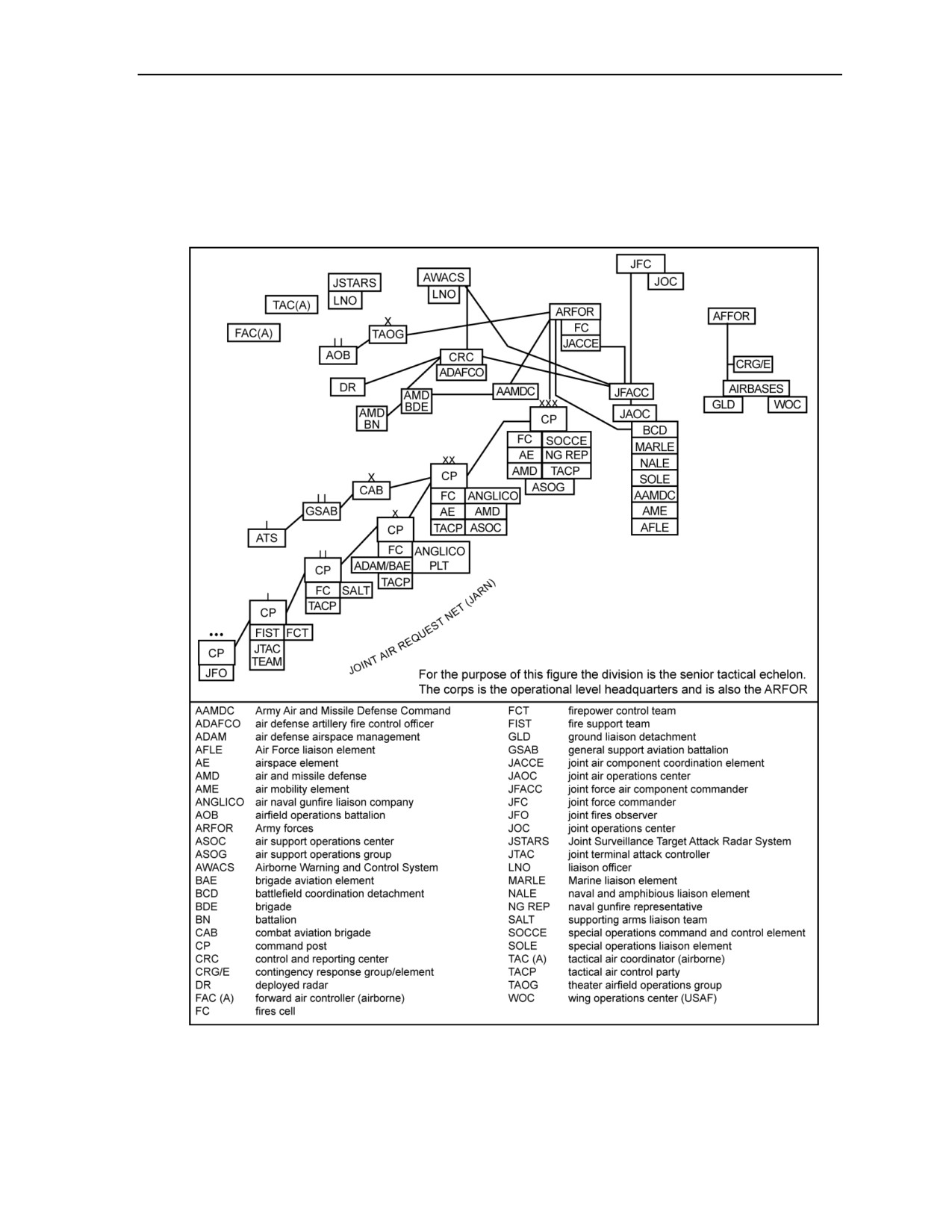
systems, directed energy, and munitions—for the echelons they are assigned. Specifically, these participants
(see Figure 2-1) consist of airspace elements, fires cells, air defense airspace management/brigade aviation
elements (ADAM/BAEs), an Army Air and Missile Defense Command (AAMDC), battlefield coordination
detachments (BCDs), ground and reconnaissance liaison detachments, and the air defense artillery fire control
officer (ADAFCO). Some participants of the TAGS, such as the tactical air control party and the air support
operations center, remain under operational control of different Services but provide direct support during
the conduct of operations.
Figure 2-1. Army air-ground system with other key theater air-ground system components
20 October 2016
FM 3-52
2-3
Chapter 2
AIRSPACE RESPONSIBILITIES BY ECHELON AND ROLE
2-13. Airspace elements are organic to Army brigades and higher. Corps and division airspace elements are
the same and are usually located in the forward command posts. Brigade Combat Teams, division artilleries,
and field artillery brigades contain an airspace element referred to as an ADAM/BAE. Combat aviation
brigades (CAB), and maneuver enhancement brigades contain an air defense airspace management ADAM.
Sustainment brigades have no airspace control staff personnel. Sustainment brigades often occupy terrain in
a maneuver brigade’s area of operation. Any airspace requirements the sustainment brigade has are integrated
with the requirements of the unit to which airspace control has been delegated. These airspace elements
integrate brigade airspace, including air and missile defense (AMD) and aviation functions. Each of these
elements coordinates with higher, subordinate, and adjacent elements to maximize the effectiveness of
airspace control.
2-14. The airspace element also manages the airspace control working group. A working group is a grouping
of predetermined staff representatives who meet to provide analysis, coordinate, and provide
recommendations for a particular purpose or function (FM 6-0). For airspace control, the airspace control
working group facilitates and synchronizes contributions from all the elements that perform the airspace
collective tasks (see table E-2). The airspace control working group is led by the airspace control officer,
warrant officer, or senior non-commissioned officer in the airspace element and typically consists of an air
liaison officer (ALO) and representatives from: the airspace element, aviation element, AMD element, fires
cell, tactical air control party, unmanned aircraft systems element, and other staff sections as required.
Organizations without organic airspace elements accomplish airspace control through their airspace control
working group.
THEATER ARMY
2-15. The theater army retains responsibility for contingency planning and coordination. This includes
developing and maintaining operation and contingency plans while updating regionally focused intelligence
estimates and supporting plans to a geographic combatant commander's theater campaign plan. In terms of
airspace, the theater army primarily establishes airspace policy and standards and provides the Army’s
airspace requirements developed into operation plans and contingency plans. The theater army contingency
command post has airspace, aviation, and air and missile defense elements roughly equivalent to a brigade
combat team’s (BCT’s) ADAM/BAE. The contingency command post has the airspace control capability to
support small, short-duration contingencies. As a joint operations area and subsequent Army operating forces
are established, airspace control responsibilities transition to the operational Army force headquarters. As
such, the operational Army force then provides the Army’s input into the JFC’s ACP and order as well as
special instructions.
2-16. An operational Army force is the Army component headquarters for a joint task force (JTF) or a joint
and multinational force. It consists of the senior Army headquarters and its commander (when not designated
as the joint force commander) and all Army forces that the combatant commander subordinates to the JTF or
places under the control of a multinational force commander. The senior Army headquarters identifies
requirements and establishes priorities of support for Army forces within the operational area.
FIRE SUPPORT
2-17. The theater army fires cell plans, coordinates, integrates, and synchronizes the employment and
assessment of all strategic theater fires to support current and future theater operations.
Army Air and Missile Defense
2-18. Army air and missile defense commands (AAMDCs) are placed under operational control (OPCON)
to the joint force land component commander (JFLCC) or operational Army force and in direct support of
the AADC for military operations. Other Army air defense artillery units in the area of responsibility are
normally assigned, attached, or OPCON to the AAMDC. The JFC establishes AMD priorities, allocates
forces, and apportions air power. The JFC typically assigns overall responsibility for counterair and airspace
control to the JFACC and responsibility for defensive counterair operations to the AADC. The AADC
oversees coordination with joint and multinational partners to develop procedures for a combined theater air
2-4
FM 3-52
20 October 2016
Airspace Control in Operations
and missile defense (TAMD) plan. Typically, the AADC has the preponderance of AMD capabilities in
theater and the ability to provide joint command and control.
2-19. The AAMDC has overall responsibility for planning Army AMD operations supporting the JFC. The
AAMDC task organizes and assigns missions to the subordinate ADA brigades once planning is complete.
The AAMDC has dedicated liaison teams that can deploy to liaise with major theater and Army forces
elements (such as JFACC, JFLCC, joint special operations task force, and BCD) to facilitate and integrate
Army forces AMD planning and operations. In some cases, the AAMDC conducts split-based operations that
preclude them from being in theater. If the AAMDC is not located in theater, the responsibility for planning
falls to the highest echelon ADA organization in the theater as well as for providing liaisons to the JFLCC,
BCD, and AADC. FM 3-01, ATP 3-01.7, and ATP 3-01.94 provide a more in-depth explanation of the
command and support relationships for theater AMD.
Air Traffic Service
2-20. Army air traffic service (ATS) units control airspace necessary to support airfield operations and can
operate a fully instrumented airfield with control tower and airport surveillance and precision approach radar
capabilities. ATS units are organic to either the CAB or the theater airfield operations group. Airfield
operations battalions provide additional ATS forces that support theater-level requirements. One theater
airfield operations group can support three theater airfields and operate from a single base or conduct split-
based operations in multiple locations within the theater AO. These units establish and operate airfields as
needed in the theater AO. The theater airfield operations group consists of an ATS standardization element
that provides oversight, technical expertise, standardization to Army airfields at theater level and quality
assurance for training and certification of controllers and ATS maintenance personnel.
Coordination and Liaison Elements
2-21. The JFACC establishes one or more joint air component coordination elements (JACCEs). JACCEs
co-locate with the joint force commander’s headquarters and other component commanders’ headquarters.
Such physical locations enable the JFACC to integrate air and space operations with component operations
and the JTF headquarters to better integrate air and space operations within the overall joint force. When
established, these elements act as the JFACC’s primary representatives to the respective commanders and
facilitate interaction among the respective staffs. The JACCE facilitates integration by exchanging current
intelligence, operational data, and support requirements. It also aids integration by coordinating JFACC
requirements for airspace coordinating measures (ACMs), joint fire support coordination measures, CAS, air
mobility, and space requirements. As such, the JACCE is a liaison element, not a command and control node
and thus, the JACCE normally has no authority to direct or employ forces. The makeup of the JACCE
depends on the scope of the operation and the size of the staff with whom they will liaise. If the JACCE
performs liaison duties for the commander, Air Force forces and JFACC staff, then it tailors the duties with
the expertise necessary to perform effectively. Element expertise includes plans, operations, intelligence,
airspace management, logistics, space, and air mobility, as needed. The JACCE also communicates the
component commander’s decisions and interests to the JFACC. However, the JACCE does not replace,
replicate, or circumvent normal request mechanisms already in place in the component or JTF staffs, nor
supplant normal planning performed by the Army operations center and Air Force forces staff. The JACCE
director is the JFACC’s personal and official representative.
2-22. As the Army liaison to the JFACC, the BCD is located in the joint air operations center (JAOC). The
Army Service component commander provides the BCD as a liaison element to the Service component
commander designated as the JFACC. The BCD personnel work with their counterparts in the JAOC to
facilitate planning, coordination, and execution of joint air-ground in support of Army operations (see FM 3-
94, FM 3-09, and ATP 3-09.13). BCD participates in airspace coordination by ensuring that—
z
The JFACC understands the operational Army commander’s intent, priorities, and objectives.
z
BCD facilitates the exchange of operational and intelligence data between the air and ground
component commanders.
z
Process pre-planned Army airspace coordinating measure request
(ACMREQ) with the
appropriate JAOC elements.
20 October 2016
FM 3-52
2-5
Chapter 2
z
The air tasking order (ATO) accurately reflects scheduled Army aircraft and fire missions and
ensures Army aircraft have valid identification friend or foe (IFF) or selective identification
feature codes on the ATO.
z
Ensure the airspace coordinating order identifies airspace requirements for the conduct of
operations.
z
Disseminate changes to theater-wide air defense warnings, weapons control status, rules of
engagement, and aircraft identification standards among the JAOC, Army force headquarters, and
senior land-based air and missile defense headquarters.
z
Assist with informing other agencies changes to fire support coordination measures that impact
joint operations such as the fire support coordination line.
z
Coordinate the development of the airspace control plan on behalf of the ARFOR as directed.
z
Maintains capability to digitally exchange information between the ARFOR and the JAOC.
2-23. The air defense artillery fire control officer provides a single point of contact between Army AMD fire
direction centers and the regional or sector air defense commander who typically locates with the control and
reporting center (CRC). However, based on theater requirements, these officers co-locate at the tactical air
operations center, Air Electronic Guidance Information System, or Airborne Warning and Control System
(AWACS). These officers advise and assist the controlling authority with integrating Army AMD capabilities
into that part of the integrated air defense system. They identify and deconflict air tracks; provide early
warning and cueing information to air and missile defense units, target weapons paring, and rapid engagement
of targets; assist in airspace deconfliction between AMD fire and aircraft; and send engagement orders to
AMD units.
CORPS AND DIVISION LEVELS
2-24. The corps headquarters oversees airspace control policy and standardization of tactics, techniques, and
procedures throughout the corps AO. The senior Army airspace element (either corps or division depending
on the force structure deployed) coordinates with the BCD’s airspace section to ensure the joint airspace
policies and documents incorporate the Army airspace priorities and requirements.
2-25. The corps and division airspace elements are designed to execute airspace responsibilities when a
headquarters serves as an intermediate tactical headquarters, an operational Army force, a joint force land
component headquarters or a JTF headquarters. Airspace element personnel integrate airspace operations
with the functional cells and with the integrating cells. The airspace element also coordinates with the tactical
air control party (TACP) and the air support operations center (ASOC) co-located with the headquarters.
2-26. As the airspace functional lead for the corps and division staff, the airspace element develops standard
operating procedures and airspace control annexes that help standardize airspace control operations among
subordinate units. These procedures and annexes ensure consistency with joint airspace procedures, the
theater ACP, aeronautical information publications, and associated plans and orders. To support the corps
and division mission, airspace elements in the main command post—
z
Provide airspace control expertise for the commander.
z
Monitor joint airspace operations.
z
Plan and update input to the joint ACP.
z
Integrate the airspace control architecture into the joint airspace control architecture.
z
Develop the airspace control architecture to support plans.
z
Draft all airspace control input for operation orders, operation plans, appendices, and estimates.
z
Plan and request ACMs.
z
Deconflict airspace through the appropriate authority.
z
Coordinate with the movement and maneuver (for aviation), intelligence
(for information
collection), and fires and protection (for air and missile defense) cells.
z
Provide ATS expertise to the headquarters.
2-27. The corps can function as a tactical headquarters subordinate to a joint force land component or JTF.
In this case, the airspace element provides airspace requirements to the higher headquarters’ airspace section
2-6
FM 3-52
20 October 2016
Airspace Control in Operations
for integration into its airspace plan (see paragraph 3-34). This integration applies to the next ACO and the
higher headquarters’ airspace control appendix.
2-28. Normally the corps headquarters delegates airspace control to subordinate divisions within their
respective AOs. Corps headquarters may also authorize direct liaison between subordinate divisions and other
theater air-ground system airspace control nodes provided by other Services. These entities include United
States Air Force (USAF) CRCs and AWACS, Marine Corps direct air support center and tactical air
operations center, and other airspace control entities for rapid resolution of airspace issues. For headquarters
subordinate to the corps which may be attached, OPCON, or under tactical control of subordinate BCTs or
for other brigades assigned their own AO, the corps may delegate control over Army airspace users within
the respective AOs. In these instances, the corps retains responsibility for integrating airspace users. The
corps integrates all airspace requirements for corps BCTs and other brigades not assigned an AO. The corps
airspace element retains responsibility for airspace control over portions of the AO not assigned to
subordinate units.
2-29. The corps may have OPCON of a Marine air-ground task force (MAGTF). A MAGTF integration with
the corps airspace element depends on the size and capabilities of the MAGTF. The MAGTF’s aviation
combat element includes Marine air command and control system capabilities tailored for the size of the
aviation combat element. Smaller MAGTFs, a Marine expeditionary brigade with a regimental-based ground
combat element and a composite group-based aviation combat element (with unmanned aircraft systems)
may integrate in a similar manner with BCTs. Large MAGTFs bring the full joint capability to control
airspace over the MAGTF AO. Large MAGTFs include a division-based ground combat element and wing-
based aviation combat element with Marine rotary- and fixed- wing aviation as well as a robust Marine air
command and control system. In this case, the MAGTF requires authorized direct liaison to coordinate
airspace and air operations directly with the JAOC.
2-30. The corps and division headquarters provide airspace control to support multinational forces under
OPCON to the corps if needed. If these forces lack airspace control capabilities, they require assistance from
the corps airspace element. They receive support similar to Army functional brigades working directly for
the corps. See paragraph 2-42.
2-31. The division airspace element oversees airspace control for all of the division’s assigned airspace,
regardless of whether the division AO has been further assigned to subordinate brigades. When a division
allocates part of its AO to a subordinate brigade, it delegates some airspace management responsibilities too.
However, the division airspace element still integrates airspace users over the entire division AO. If the
division has an unusually large AO or if the division AO is noncontiguous, then it can delegate more airspace
control responsibilities to subordinate units. Normally, delegation of airspace control for unified action
partner airspace users requires augmentation of the brigade with ATS elements from the combat aviation
brigade.
Fires Cell
2-32. The fires cell is responsible for targeting coordination and for synchronizing fires delivered on surface
targets by fire support means under the control of or in support of the corps or division. This cell coordinates
and deconflicts fire support coordination measures (FSCMs) with ACMs through close interface with
ADAM/BAE and airspace elements, the ASOC, and the TACP. The airspace element works with the fires
cell to integrate FSCMs with the unit airspace plan. Although the airspace element reviews and integrates the
fire support overlay with other airspace requirements, FSCMs are normally sent to higher, lower, and adjacent
headquarters through fire support channels. In some cases, both the fires cell and the airspace element send
related control or coordination measures through their respective channels. The airspace element and the fires
cell ensure the standard operating procedures and the airspace control appendices address the procedures for
forwarding FSCMs and associated ACMs through appropriate coordination channels. Other complex control
measures—such as kill boxes, counterfire restricted operations zones, and airspace coordination areas—also
require this parallel teamwork. The airspace element and the fires cell need to review the ACO to ensure that
ACMs avoid unnecessarily interfering with fires and that the ACMs are in a format that the fires digital
information systems can process. If a conflict exists between the fire support plan and the ACO, the airspace
element coordinates with the higher airspace elements to correct or modify the appropriate ACM. As Army
rocket and missile based fires continue to increase in range and altitude, effective integration of fires and
20 October 2016
FM 3-52
2-7
Chapter 2
other airspace users must occur during the planning and preparation phase in order to ensure efficient use of
airspace.
Air and Missile Defense Element
2-33. The AMD element is the lead staff element for integrating the joint tactical data informational link
network for the employment of Sentinel air defense radars and for the production of the air picture. See
Appendix C for more details. The airspace element links with the AMD element for air track data. The
airspace element depends on the AMD element for integrating the airspace element’s joint data network
systems. In turn, these airspace element systems provide backup support to the AMD element. The airspace
element ensures that AMD airspace requirements integrate with the corps and division airspace plans.
Coordination and Liaison Elements
2-34. Some elements of the theater air-ground system are Air Force liaisons provided to the division, the
corps, or operational Army forces. These liaisons include the ASOC, TACP, and air mobility liaison officer.
Air Force liaisons function as a single entity in planning, coordinating, deconflicting, and integrating air
support operations with ground elements. These liaisons work with Army airspace elements, fires cells, AMD
elements, and aviation elements of the corps and division command posts. They also coordinate with liaison
elements such as the BCD, AMD coordinator for the operational Army forces, and officers.
2-35. Ground-based liaison elements of the theater air-ground system subordinate to the JAOC provide
similar capabilities as airborne elements but with reduced range, flexibility, and mobility. However, ground-
based liaison elements do not depend on high-value assets for continuous operations. Additionally, they offer
an important interface between the theater air-ground system and ground-based air defense activities.
Ground-based liaison elements of the theater air-ground system include CRCs, tactical air operations centers
(TAOCs), ASOCs, direct air support center (DASCs), and TACPs, and air mobility liaison officers.
2-36. The ASOC is the element responsible for planning, coordination, control, and execution of air
operations that directly support the Army’s ground combat forces. Each ASOC reports to the JAOC. The
senior air director maintains the on-scene OPCON of the ASOC. The ASOC is directly subordinate to the
JAOC and coordinates air operations directly supporting Army forces. Air operations include CAS, air
interdiction, intra theater airlift, joint intelligence, surveillance, and reconnaissance, suppression of enemy
air defenses, and combat search and rescue. The ASOC processes immediate requests submitted through
TACP channels, utilizing the joint air request net (JARN), while synchronizing efforts with Army fires
elements. While Army airspace elements normally control air assets organic to maneuver commanders, the
ASOC normally controls all joint air allocated from the JFACC to support the Army component.
2-37. . The USAF TACPs are subordinate to the ASOC and are the single points of direct USAF interaction
with supported ground combat units. Each maneuver battalion, brigade, division, and corps headquarters will
have an aligned TACP. Staffed with ALOs and other terminal attack controllers, TACPs perform liaison and
control functions appropriate to the level of combat maneuver force supported. Only joint terminal attack
controllers (JTACs) or forward air controllers (airborne) (FAC[A]s) personnel have the authorization to
perform terminal attack control of CAS aircraft during operations (combat and peacetime) within proximity
of their supported ground combat units. For airspace use, TACPs integrate with fires cells and the Army
airspace elements. TACPs assist ground maneuver units in the planning and coordinating of FSCMs and
ACMs needed to integrate air and ground operations. TACPs assist the ASOC for tactical control of CAS
and FAC (A) aircraft transiting from the ASOC to the JTAC contact point.
2-38. The air mobility liaison officer is a USAF officer specially trained to implement the theater air control
system and to control airlift assets engaging in combat tactics such as airdrop. Air mobility officers are highly
qualified, rated air mobility officers with experience in combat tactics and assigned duties supporting Army
and Marine Corps units.
2-8
FM 3-52
20 October 2016
Airspace Control in Operations
JOINT AIR GROUND INTEGRATION CENTER (JAGIC)
2-39. Beginning in fiscal year 2011, the United States Air Force began aligning its ASOC capabilities with
each active duty Army division. The Air National Guard will have two non-aligned ASOCs to support Army
National Guard divisions. Aligning ASOCs provides an effective method to command and control close air
support, intelligence, surveillance, and reconnaissance, as well as dynamic and deliberate interdiction
operations and to provide an effective means to coordinate suppression of enemy air defenses in division-
assigned airspace. An effective technique to integrate the ASOC within the division command post is to form
a joint air ground integration center (JAGIC). The JAGIC is a method to effectively organize personnel and
equipment to build personal relationships and teamwork between Soldiers and Airmen. This is accomplished
through the physical integration of ASOCs and tactical air control parties with division fires, airspace, air
and missile defense, and aviation personnel and functions within the current operations integration cell
(COIC). This gives the division a powerful joint team capable of collaborative fires while maximizing the
use of airspace.
2-40. All JAGIC functions are in support of COIC. Specific functions of the JAGIC include fires, airspace
control, interdiction coordination, friendly force identification, and information collection. These functions
are fully described in ATP 3-91.1, The Joint Air Ground Integration Center.
2-41. The JAGIC provides the division with the capability to control joint airspace delegated by the ACA in
accordance with the airspace control plan (ACP) and the airspace control order (ACO). The JAGIC’s
collocation of division and ASOC airspace personnel enables shared understanding and collaborative
integration of airspace users. The JAGIC’s control of airspace allows the division to effectively integrate
fires and airspace control during operations with appropriate flexible and timely actions.
BRIGADE LEVEL
2-42. Brigades are responsible for airspace management of Army airspace users within their AO. The
authority of the brigade over unified action partner airspace users varies and is specified in the higher
headquarters airspace control appendix. All Army airspace users transiting a brigade AO coordinate with the
brigade responsible for the AO they are transiting. The division only integrates Army airspace use between
brigades if adjudication between brigades is necessary. Brigades normally contact the JAGIC to coordinate
with joint airspace elements controlling airspace over the brigade (CRC, AWACS, and TAOC). In some
situations, for example, very lightly used airspace or airspace with few unified action partner airspace users,
the division may delegate this authority.
2-43. BCTs are not normally delegated control of joint airspace as they lack trained and equipped controllers.
Rather BCTs are responsible for integrating airspace users supporting BCT air ground operations.
Sometimes, the brigade requests approval to control a volume of airspace such as a high-density airspace
control zone (HIDACZ). However, for a brigade to control airspace for an extended period, it needs to
augment the ADAM/BAE with assets from the ATS company organic to the CAB. See paragraph 2-51
for more details on ATS assets available to the CAB and brigade.
2-44. Functional brigades without an organic ADAM/BAE still retain brigade responsibilities for some
airspace tasks (see appendix E) but rely on their higher headquarters for complete airspace control. If a
functional brigade falls under the control of a support brigade (for example, a military police brigade under
a maneuver enhancement brigade), the support brigade integrates the functional brigade airspace
requirements. If the functional brigade falls directly under the control of a corps or division, then the corps
or division airspace element integrates the brigade airspace requirements.
2-45. Several multifunctional support brigades such as the combat aviation brigade or field artillery brigade
do not routinely control AOs but conduct operations throughout the corps AO. Normally these brigades
coordinate their airspace use with the divisions and brigades whose AOs they will transit (or with corps
airspace elements for portions of the corps AO unassigned to a division or brigade). Airspace control becomes
more complex when a corps tasks these brigades to accomplish a mission (such as Army aviation attacks or
fires strikes) that affects airspace use by other divisions or brigades. The brigade conducting the operation is
the lead airspace control planner with the higher headquarters airspace element providing planning and
airspace control support to the brigade’s ADAM element. The division or corps airspace element checks that
it adjusts the airspace plan to account for the brigade commander’s priorities and concept of operations.
20 October 2016
FM 3-52
2-9
Chapter 2
Air Defense Airspace Management/Brigade Aviation Element
2-46. All brigade combat teams and multifunctional brigades (except sustainment) have an organic ADAM
or ADAM/BAE. This staff element is composed of air defense artillery and aviation personnel and performs
the airspace management, AMD, and aviation functions for the brigade. It also provides added capability into
the theater air-ground system at the tactical level.
2-47. Compared to an ADAM, an ADAM/BAE has additional aviation personnel and a larger aviation
planning capability. Members of the brigade staff consist of key members of the airspace control working
group—fires cell TACP and the ADAM/BAE. The brigade aviation officer is the airspace control officer for
the brigade S-3.
2-48. The ADAM/BAE supports the brigade commander by providing situational understanding of the
airspace and early warning via connectivity with airspace users as well as with unified action partner’s
sensors and command networks. This element also continuously plans and executes airspace management
requirements and integrates Army AMD and aviation requirements consistent with the brigade commander’s
intent, priorities, and acceptable risk levels.
2-49. The ADAM and ADAM/BAE continuously plan for, control, and monitor the operations of all airspace
users to support their operations and those transiting through the air over their ground AOs. This continuous
situational understanding is critical to ensure that the brigade can react to any situation requiring immediate
use of airspace, such as immediate fires (offensive and defensive), CAS missions, unplanned unmanned
aircraft system launches, or a diversion of aviation assets in real time. Table 2-1 illustrates ADAM/BAE
functions. Note that ADAM capabilities resident in a CAB and maneuver enhancement brigade do not have
an aviation operations component and therefore have a very limited capability to perform brigade aviation
element (BAE) functions. The level of effort spent on core tasks (ADA tasks by the ADAM and aviation
operations by the BAE) affect how much effort can be provided to airspace control. Recent stability
operations were in a low air defense threat environment and permitted a significant level of effort to BCT
airspace control. Future operations may face a significant unmanned aircraft system (UAS) air threat
combined with high supporting Army aviation operations. While airspace control tasks will still be
accomplished, the BCT will increasingly rely on the division JAGIC to support airspace control.
Table 2-1. Air defense airspace management and brigade aviation element functions
ADAM
SHARED
BAE
• Plans and synchronizes air
• Plans for airspace use and
• Plans and synchronizes
and missile defense
executes near-real-time
aviation with the concept of
operations with the concept of
control during execution and
operations.
operations.
monitors operations of
• Advises and plans the use of
airspace users.
• Produces the integrated air
unmanned aircraft systems,
picture.
• Analyzes airspace use to
reconnaissance, attack,
• Plans low-level sensor
determine and resolve
assault, air movement,
employment.
conflicts.
sustainment, and medical
evacuation.
• Reviews immediate airspace
• Develops and maintains air
coordinating measures
• Standardizes brigade combat
defense artillery overlay to
include unit locations,
requests for conflicts with
team unmanned aircraft
current operations.
system employment.
weapons control status, and
weapon system coverage.
• Requests, maintains, and
disseminates joint airspace
coordinating measures.
• Develops and coordinates
airspace control appendix.
Legend
ADAM air defense airspace management
BAE brigade aviation element
2-10
FM 3-52
20 October 2016
Airspace Control in Operations
Fires Cell
2-50. The fires cell at brigade level is responsible for coordinating activities and systems that provide the
collective and coordinated use of Army indirect fires and joint fires through the targeting process. The fires
cell makes every effort to ensure that FSCMs and ACMs are coordinated and deconflicted through close
interface with ADAM/BAE and the TACP. If this is not possible, the fires cell formulates and prepares to
execute acceptable alternatives.
Air Traffic Service
2-51. Each CAB has an organic ATS company as part of the general support aviation battalion. The ATS
company establishes and operates airfields to support CAB operations. The ATS company contains a terminal
control platoon and an airspace information services platoon. The terminal control platoon can operate a fully
instrumented airfield with a control tower and airport surveillance radar and precision approach radar
capabilities. It also has communications resources available to facilitate the control of the local airspace
necessary to support airfield operations. The airspace information services platoon, with two tactical aviation
control teams each, can control up to two tactical landing sites (rotary-wing, fixed-wing, or both) while the
airspace information center provides enroute flight management support.
Coordination and Liaison Elements
2-52. The TACP helps maneuver brigades integrate air-ground operations. The TACP coordinates ACMs
and FSCMs with the ADAM/BAE, fires cells, and the ASOC during the accomplishment of CAS missions
to support ground operations. This coordination includes assisting the ASOC and JTAC for tactical control
of CAS and — FAC (A) — aircraft transitioning to the JTAC contact point.
BATTALION LEVEL
2-53. The operations section plans and coordinates airspace requirements for the battalion. The major actions
include:
z
Establishing and leading the airspace control working group.
z
Establishing staff responsibility for airspace management from personnel assigned to the S-3
section.
z
Receiving and disseminating airspace coordinating measures requests for approvals, changes, and
disapprovals for small unmanned aircraft system.
z
Reviewing and resolving planned and immediate airspace coordinating measures requests.
z
Monitoring and analyzing aviation, small unmanned aircraft system, lethal miniature aerial
munition systems, field artillery, air defense, and maneuver operations to determine and resolve
conflicts.
z
Submitting to ADAM/BAE all planned and immediate airspace coordinating measures requests
including small unmanned aircraft systems (see Appendix C).
z
Immediately communicating any deviations from pre-planned missions to the ADAM/BAE or
higher headquarters.
z
Informing airspace users at each echelon of any communication loss during operations.
z
Tracking and reporting aviation, field artillery, air defense, small unmanned aircraft systems,
lethal miniature aerial munition systems, and personnel status.
z
Monitoring rotary- and fixed-wing aircraft in the battalion AO to aid in deconflicting small
unmanned aircraft systems, lethal miniature aerial munition systems, and other air traffic.
z
Managing separation and frequencies of battalion and below small unmanned aircraft system
operations.
Fires Cell
2-54. The fire support officer and the fires cell are responsible for planning, coordinating, and synchronizing
fire support operations to include joint fire support. The major actions of the fires cell include the following:
20 October 2016
FM 3-52
2-11
Chapter 2
z
Planning, controlling, and synchronizing all fire support.
z
Establishing priorities and allocating available fire support resources to support the battalion.
z
Participating in and supervising the routine activity and coordination of the targeting process
within the main command post.
z
Coordinating with the ADAM/BAE regarding airspace clearance, artillery, and mortar firing unit
locations as well as changes to FSCMs, and ACMs and aviation support.
z
Coordinating air support through the USAF TACP.
z
Coordinating suppression of enemy air defenses.
Coordination and Liaison Elements
2-55. The TACP consists of the ALOs and two JTACs. The TACP has two primary missions: advise ground
commanders on the capabilities and limitations of airpower and provide the primary terminal attack control
of CAS to support ground forces. At the battalion level, the TACP provides the primary link for commanders
to joint CAS assets made available to support the battalion’s mission. Depending on the tactical situation,
terminal attack control teams consisting of one JTAC, may co-locate with each maneuver company.
COMPANY OR TROOP LEVEL
2-56. The company commander is responsible for ensuring that airspace users (organic or in support)
coordinate and share information concerning company airspace use by aircraft and fires. Airspace control
information that should be shared with battalion and the fire support team (to include JFO’s and JTACs)
includes use of small unmanned aircraft systems, micro UAS, and lethal miniature aerial munition systems.
If there is time to request that the BCT ADAM/BAE build ACMs for planned airspace use, the use of ACMs
will simplify air ground operations. However, if the company must employ its systems for immediate combat
missions (and is authorized by standard operating procedures and rules of engagement), then as a minimum,
the company should notify the battalion ADAM/BAE so it may better synchronize airspace use.
2-57. The field artillery fire support personnel (fires cells and fire support teams) are organic to the BCT’s
field artillery battalion. However, these cells and teams are typically attached or fall under OPCON to
maneuver battalions, companies or troops for tactical operations. Fire support teams provide fire support
coordination, precision targeting, and assessment capabilities. These teams have responsibility for planning
and coordinating all supporting fires including mortars, field artillery, naval surface fire support, and CAS
integration through close coordination with JTACs.
2-58. A joint fires observer is a trained service member who can request, adjust, and control surface-to-
surface fires, provide targeting information in support of Type 2 and 3 close air support terminal attack
control, and perform autonomous terminal guidance operations (JP 3-09.3). In type 2 control, the observer
can see either target or attacking aircraft. In type 3 control, the observer can see neither target nor attacking
aircraft. The joint fires observer also performs autonomous terminal guidance operations. Joint fires
observers are typically members of a fire support team. A joint fires observer adds a joint warfighting
capability without circumventing the need for qualified JTACs. These observers provide the capability to
exploit those opportunities that exist in the corps AO where a trained observer could be used to efficiently
support air-to-surface fires and facilitate targeting for the JTAC.
2-59. The JTAC, when employed by TACP at the company or troop level, directs the action of or controls
aircraft engaged in CAS and other offensive air operations. The JTAC also provides the ground commander
with recommendations on the use of CAS and its integration with ground maneuver. The JTAC and fire
support team or joint fires observer may develop informal ACAs to coordinate attacking aircraft and surface
fires.
2-12
FM 3-52
20 October 2016
Chapter 3
Airspace Control—Planning and Preparation
The operations process consists of the major mission command activities performed
during operations: planning, preparing, executing, and continuously assessing the
operation. This chapter discusses airspace control planning and the documents
necessary for planning. It also discusses preparation activities. These activities, which
are continuous, underpin successful unified land operations.
PLANNING
3-1. Planning is the art and science of understanding a situation, envisioning a desired end state, and laying
out effective ways of bringing that future about (ADP 5-0). To operate successfully, commanders at all
echelons must be capable of integrating and synchronizing forces and warfighting capabilities on the ground
and in the air. Planning not only underpins this capability but also helps commanders reduce uncertainty and
risk, providing the flexibility commanders need to conduct operations. Planning is both conceptual and
detailed. Conceptual planning includes developing and understanding an operational environment, framing
the problem, defining a desired end state, and developing an operational approach to achieve the desired end
state. Detailed planning translates the broad concept into a complete and practical plan. Detailed planning
works out the scheduling, coordination, and technical issues involved with moving, sustaining, administering,
and directing the activities of forces in time, space, and purpose.
3-2. Commanders drive the operations process through understanding, visualizing, describing, directing,
leading, and assessing operations. During planning, staff sections perform essential functions and activities
that enable commanders to understand, visualize, and describe tasks. This results in the commander’s intent
and planning guidance. Refer to ADRP 5-0 for details on conceptual and detailed planning.
KEY DOCUMENTS
3-3. The JFC provides essential airspace planning documents to components to facilitate component
planning and joint force standardization. These documents include plans, orders, messages, and any
international agreements and letters of instruction. Although this publication lists these key documents in the
discussion of planning, commanders and staffs also use or refer to these documents while they prepare,
execute, and assess operations.
Joint Air Operations Plan
3-4. The joint air operations plan (JAOP) is the JFC’s approved plan for integrating and coordinating joint
air operations. When designated by the JFC, the JFACC is responsible for developing a JAOP to guide the
employment of joint air capabilities and forces made available to accomplish missions assigned by the JFC.
The JAOP encompasses air capabilities and forces supported by, and in support of, other joint force
components. To ensure proper force integration, all service and functional components must participate in
the development of the JAOP. The JAOP provides the air strategy, objectives, and a desired end state for
each phase of the operation. This plan—
z
Integrates the efforts of joint air and space capabilities and forces made available for JFACC
tasking.
z
Identifies desired end state objectives and tasks to be achieved through air operations.
z
Identifies measures or indicators of success used to determine if air operations meet assigned
objectives.
z
Accounts for current and potential adversary offensive and defensive courses of action.
20 October 2016
FM 3-52
3-1
Chapter 3
z
Synchronizes the phasing of air and space operations with the JFC’s operation or campaign plan.
The first phase normally involves counterair operations to attain and maintain the required degree
of air superiority to accomplish other joint actions.
z
Specifies capabilities and forces required to accomplish operational and tactical objectives.
z
Used to coordinate joint air operations with all other relevant lines of operations and lines of effort.
z
The JAOP should be developed concurrently with the airspace control plan and the area air defense
plan to facilitate the maximum combat effectiveness while minimizing risk.
Airspace Control Plan
3-5. An ACP details the broad policies and procedures for airspace control within the JFC’s operational
area. The ACA, working with other components, develops this plan. Effective ACPs include transitions
between phases or are updated as phase transitions occur. When the JFC signs the ACP, this plan becomes
the JFC’s airspace policies and procedures. This plan—
z
Describes the operational area within which airspace applies.
z
Lists current existing capabilities within the operational area to provide airspace control.
z
Describes and lists duties of the ACA, each airspace user (including requirements for liaisons to
and coordination with the ACA), and elements used in airspace control system.
z
Describes the interface among the ACA, the AADC, and fires elements with procedures for
deconflicting air defense and operational requirements.
z
Describes interface with the Federal Aviation Administration, host-nation air traffic control
system, and International Civil Aviation Organization.
z
Describes the interface between U.S. and multinational forces to coordinate and deconflict
airspace requirements.
z
Provides for continuity of airspace control operations under degraded conditions.
z
Describes the airspace control procedures for the joint force including requesting, approving,
modifying, and promulgating procedures.
z
Describes identification friend or foe selective identification feature procedures.
Area Air Defense Plan
3-6. With the support of the component commanders, the AADC develops, integrates, and distributes a
JFC-approved joint area air defense plan (AADP). This plan protects assets on the defended asset list, other
critical assets, friendly forces, and civilian population centers according to JFC guidance. It details defensive
counterair priorities, authorities, procedures, tasks, and actions throughout the joint operations area. This plan
includes:
z
A layered and overlapping defense to allow for multiple engagement opportunities.
z
Information engagement strategies for counterair.
z
Detailed weapons control and engagement procedures and authorities integral to a joint counterair
operation.
z
Specific airspace coordinating measures (ACMs) required to accomplish the mission.
z
All surface-to-air capabilities assigned, attached, and supporting.
z
Provisions for protecting high-value airborne assets.
z
Guidance on electronic warfare to disrupt or destroy guidance systems.
3-7. Planners carefully integrate air defense in the AADP with the appropriate sections in the ACP. A viable
ACP requires locations of specific types of air defense operations and exact procedures for the identification
of aircraft. The AADC writes the AADP with detailed engagement procedures consistent with the ACP and
operations in the joint operations area. Planners of the AADP understand the capabilities and limitations of
fielded equipment used by the joint or multinational forces. When writing, planners anticipate using airspace
control and area air defense operations in a degraded command network environment.
3-2
FM 3-52
20 October 2016
Airspace Control—Planning and Preparation
Airspace Control Order
3-8. An ACO directs the use of joint airspace and details the approved requests for ACMs. The combat
plans division of the JFACCs air operations center, together with other components, develops this plan.
Component commanders consolidate, deconflict, and forward their airspace requests to the ACA for further
consolidation with other theater-wide inputs. While the air operation center’s combat plans division develops
and disseminates the ACO, the combat operations division executes the planned ACO and develops and
executes changes to the ACO during the execution period. The ACO implements precise ACMs for specific
times, adding or activating ACMs for the missions and times needed. All airspace users review their daily
requests for ACMs, removing unnecessary ACMs that unduly restrict other airspace users. Staffs disseminate
ACMs with expiration times. The ACO activates and deactivates procedural control measures and updates
positive control procedures. Normally, the combat plans division publishes this order as a stand-alone
document but sometimes as part of the air tasking order special instructions.
Air Tasking Order
3-9. An ATO is the daily operation order listing all aviation assets (component capabilities) directed by the
JFC or made available to the JFC for JFACC tasking. It also includes other component’s direct support
missions. These direct support air missions that appear on the ATO are not under control of the JFACC but
their presence on the ATO provides visibility to assist in overall coordination, deconfliction, prevention of
duplication of missions, and prevention of fratricide. This document shows all missions operating in theater.
Special Instructions
3-10. The special instructions (SPINS) section of the ATO provides supplemental, corrective, or exact
amplification to the general mission tasking of the specific ATO period. This information is not contained in
other operational documents (such as JAOP, ACP, operation order, regulations, and precise directive U.S.
message text format messages). These general instructions pertain to the theater as a whole. The staff ensures
that the instructions are brought to the attention of readers up front and are of general interest to all executors
of the ATO. Special instructions avoid specific units or topics that other operational documents more
appropriately cover. Some theaters deviate from this general purpose as staffs publish numerous airspace
procedures and airspace usages in the special instructions.
3-11. Special instructions contain a section that lists the airspace procedures. Other special instructions
sections, such as tanker procedures or cruise missile procedures, also address airspace procedures within
those particular sections. Special instructions often include rules of engagement and combat identification
criteria for air defense. These instructions also include additional guidance, directives, or information that
weapons system operators or aircrews require such as host-nation restrictions, base defense zone procedures,
and special weapons systems control procedures (such as unmanned aircraft or cruise missiles). The combat
plans division publishes special instructions as baseline, weekly, and daily.
Airspace Coordinating Measures Request
3-12. An ACMREQ is a request to reserve airspace for a specific use. An originator requests airspace for an
operation within their assigned AO. An ACMREQ can consist of single or multiple ACMs. Appendix B has
more details.
Air Operations Directive
3-13. The air operations directive (AOD) translates the JFC’s JAOP into guidance for the planning and
execution of joint air operations for a specified ATO period. Published by the JFACC, it describes the
JFACC’s implementation of JFC’s intent for the use of joint air power. This document is reviewed by
components and their liaisons to ensure that it meets unit requirements within the context of the JFC guidance
and priorities. The daily AOD gives planners the priority of effort, operational constraints, and any other
specific guidance governing the planning and execution of air and space operations during a particular ATO
period. Airspace personnel review the AOD to gain an overall perspective of those priorities the ATO
development planners will follow and to understand daily priorities for airspace deconfliction. In addition,
20 October 2016
FM 3-52
3-3
Chapter 3
the AOD often has specific guidance which impacts the use of airspace (such as a plan for high-value airborne
asset retrograde procedures due to threat).
3-14. The AOD contains the JFACC’s intent, concept of operations, objectives, tactical tasks and priorities
of effort for a specific ATO or period of time that guides the daily joint air tasking cycle. The AOD can also
be used to communicate the priorities for airspace use for each air tasking order and airspace coordination
order period.
3-15. The strategy guidance team within the air operations center’s strategy division develops the air
operations directive. The team distributes the directive via the theater battle management core system and the
air component network, typically the SECRET Internet Protocol Router Network (SIPRNET). Though the
air operations directive is not authoritative for Army forces, effective airspace element personnel read and
understand the air operations directive to understand the JFACC’s airspace priorities and guidance.
Tactical Operational Data
3-16. Tactical operational data is required to establish an integrated air defense (such as defense sectors,
combat air patrol stations, and missile engagement zones). A joint operational commander uses this data to
establish air defense and anti-air warfare responsibilities in a tactical area and to permit an area commander
to provide supplementary orders for an area of operations. The AADC disseminates the tactical operational
data.
3-17. The tactical operational data establishes command and control alignments of Air Force and Army air-
and ground-based air defense systems as well as the tasking for air defense assets to include locations. The
joint interface control officer coordinates the development of the tactical operational data message and
manages all tactical data link interfaces to create a consolidated air picture.
Operations Task Link
3-18. The operations task link (OPTASK LINK) is a message used to report changes to tactical data link
operations. These changes are considered permanent. The operations task link provides detailed instructions
regarding the operations of tactical data links, including information required to establish data links. The
AADC disseminates the operations task link.
AIRSPACE CONTROL PLANNING
3-19. Airspace elements provide airspace control subject matter expertise into the planning efforts. Airspace
planning focuses on setting conditions for near-real-time airspace control during mission accomplishment
thereby providing commanders flexibility while reducing risk.
3-20. Army airspace planners at the senior tactical and operational levels must actively assist in the
development of the joint airspace control plan. This is critical if the divisions intend to request the authority
to control division-assigned airspace using the JAGIC technique. Division-assigned airspace is a volume of
airspace in which the airspace control authority (ACA) has delegated the responsibility for control of that
volume, in accordance with the airspace control plan and airspace control order (ACO), to the division.
Division-assigned airspace is typically between the lateral boundaries of the division’s area of operations,
and up to the coordinating altitude (CA). This delegation of authorities does not include authorities vested in
the area air defense commander (see Figure 3-1). A JAGIC enabled division is suitably manned and equipped
to procedurally control the tactical airspace over the division AO up to the CA.
3-4
FM 3-52
20 October 2016
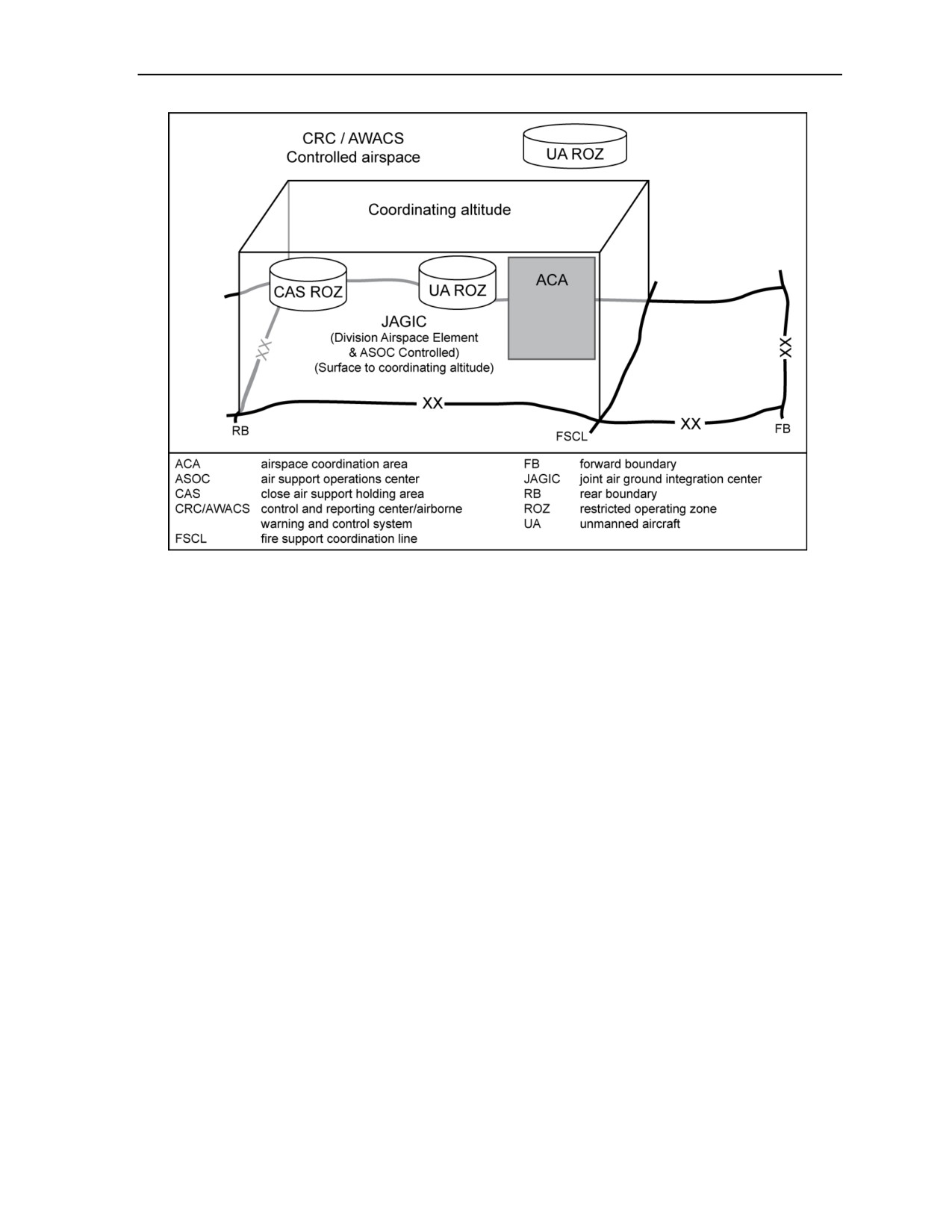
Airspace Control—Planning and Preparation
Figure 3-1. Division Assigned Airspace
3-21. A corps as a tactical headquarters is normally resourced with an ASOC and can employ the JAGIC
technique. However, even with a JAGIC, the corps should manage airspace as described in paragraph 2-28
and delegate airspace control to the divisions within their respective AOs rather than trying to request corps
assigned airspace. Controlling assigned airspace over the very large corps AO given the large numbers of
non-corps airspace users operating over the corps AO would fully occupy the JAGIC and distract the JAGIC
from enabling joint and Army fires supporting corps operations. Assigned airspace does not significantly
enable corps fires and aerial surveillance. Corp fires are mostly long range fires requiring coordination for
high altitude airspace above the CA, while, corps aerial surveillance platforms also will often be operating
above the CA. The JAGIC’s airspace control effort should be to establish immediate airspace coordination
links with appropriate joint airspace control elements in order to rapidly coordinate airspace for corps fires
and for dynamic repositioning of corps aircraft.
3-22. Using planning data from the fires and aviation planners Army airspace planners can integrate Army
airspace requirements into the overall airspace control plan. Integrated planning ensures that the location
and altitude of key ACMs, that define division assigned airspace such as the coordinating altitude, balance
both JFACC and JFLCC requirements for airspace
3-23. At the brigade level, the ADAM/BAE’s officer in charge leads the airspace control planning effort.
The BAE represents Army aviation (manned and unmanned), ADAM personnel represent Army air defense
and fires cell personnel represent fire support. Tactical air control party personnel represent the air component
assets to include the unmanned aircraft system and defensive counterair. To increase flexibility and reduce
risk, airspace element planners should do the following:
z
Consider the echelon commander’s priorities for airspace use.
z
Keep the plan for integrating airspace users simple and flexible.
z
Maximize the use of procedural means of control.
z
Limit (in number, size, and duration) ACMs to the minimum required for mission accomplishment
to maximize flexibility for airspace users.
z
Structure ACMs to facilitate recognition by ground forces and aircrew members through
alignment with major terrain features.
20 October 2016
FM 3-52
3-5
Chapter 3
3-24. During course of action (COA) development and collaborative planning, airspace element planners—
z
Ensure planned airspace use supports the commander’s intent and concept of operations.
z
Comply with the commander’s airspace risk guidance.
z
Address airspace conflict resolution procedures and war game to verify.
z
Develop ACMs when ground units utilize Army aviation to conduct attacks when in close
proximity to friendly forces.Address airspace conflict resolution procedures and war game to
verify.
3-25. Airspace control planning is central to facilitating a shared understanding of joint air-ground
integration. Planning contributes directly to the staff’s ability to assist the commander to execute commander
tasks: understand, visualize, and describe. As commanders visualize an operation during planning, they
describe it to their staffs and subordinates. Commanders describe their visualization in their initial
commander’s intent, planning guidance, and operational approach that arranges warfighting function
capabilities in time, space, and purpose.
3-26. Facilitating a shared understanding of joint air-ground integration and airspace use spans all aspects of
planning. The staff facilitates understanding by translating all higher headquarters airspace guidance and risk
guidance from the ACP, AADP, ACO, special instructions, higher headquarters airspace appendices, and
other needed documents into airspace constraints for incorporation into the planning effort. This shared
understanding also involves participating in COA development and war-gaming of joint air-ground
integration using higher headquarters airspace constraints, commander’s airspace priorities, airspace risk
guidance, and conflict resolution guidance. The staff facilitates a shared understanding to utilize COA
development and war-gaming. Using COA development ensures commanders understand that they normally
are the final decision authority for assigning the mission and taking responsibility for prudent risk during
combat operations. Commanders assess any higher commander constraints on the authority to accept prudent
risk during COA development and war-gaming. If these constraints adversely impact mission success, they
address constraints with higher headquarters through airspace and necessary operations channels. The staff
facilitates a shared understanding by supporting the AMD and fires cells with their running estimates and
appendix development. Lastly, the staff helps by shaping theater-level airspace planning to accommodate
Army requirements. Establishing a shared understanding of joint air-ground integration and airspace use not
only guides further planning but enables informed timely decisions during mission accomplishment.
Note: Lessons learned have shown that a detailed wargame of the selected COA is necessary to
identify potential airspace conflicts between Army aviation, organic UAS, artillery and joint air
assets. A detailed COA wargame also allows the development of a collaborative unit airspace plan
(UAP) that resolves the conflicts in accordance with the commander's airspace priorities and risk
guidance.
AIRSPACE CONTROL COLLECTIVE TASKS DURING PLANNING
3-27. Airspace elements perform a series of collective tasks during staff planning. Airspace elements may
not perform all the tasks listed below but should be trained to conduct all of them. These tasks result in the
production and refinement of the daily UAP and an Appendix 10 (Airspace Control) to Annex C (Operations)
of the Army plans and orders. See appendix F of this publication and FM 6-0 for Army plans and orders.
Commanders must ensure the airspace plan is deliberate and supports the ground tactical plan. Additionally,
the UAP must be rehearsed to validate integration of airspace users and support of the commander’s intent.
3-28. Airspace control is an integral part of planning. Airspace elements at all echelons perform collective
tasks during planning:
z
Determine integrated airspace user requirements.
z
Develop airspace usage priorities.
z
Coordinate ATS, sensor emplacement, and data links.
z
Determine combat identification authority and procedures for airspace users.
z
Develop rules of engagement and early warning procedures for air defense operations.
z
Determine reporting requirements and monitoring methods for manual reporting.
3-6
FM 3-52
20 October 2016
Airspace Control—Planning and Preparation
z
Integrate airspace use within the area of operations.
z
Develop ACMs to support planned operations.
z
Develop the airspace control appendix to the operation annex.
Determine Integrated Airspace User Requirements
3-29. During COA development, airspace control elements at all echelons solicit airspace user requirements
from each of the functional and integrating cells as they develop airspace plans that support each COA.
During COA analysis, airspace elements modify and synchronize each airspace plan to support each COA.
Once the commander has selected a COA, they perform the final integration of airspace user requirements.
Commanders submit the necessary ACMs, proposed risk guidance, and airspace priorities to higher
headquarters for approval and integration into the higher headquarters UAP. Early and timely airspace
planning at all echelons is a necessity. Airspace element personnel in Army operating forces remain actively
and continually engaged with all higher echelons (such as joint force commander, joint force air component
commander, AADC, and airspace control authority) while preparing key airspace planning documents. By
staying engaged, these personnel ensure documents accommodate all Army airspace requirements and
procedures and that airspace used by other components does not inadvertently constrain Army operations.
Develop Airspace Usage Priorities
3-30. Army airspace elements develop airspace usage priorities. First, the airspace elements determine and
confirm the commander’s intent and guidance, mission priorities, and risk guidance for airspace utilization.
Then they examine pertinent airspace orders, directives, and the ground commander’s concept of operations
to develop recommended airspace usage priorities according to ground operations and ACA directives.
Lastly, they synchronize plans, orders, and special instructions to facilitate current operations and future
planning to promote situational understanding and to detail the future integration decision basis. The echelon
commander’s priority of airspace use prominently appears in Appendix 10 (Airspace Control) to Annex C
(Operations) of the respective echelon operation plans and orders.
Coordinate Air Traffic Service, Sensor Emplacement, and Data Links
3-31. Controlling assigned airspace over the very large corps AO given large numbers of non-corps airspace
users would fully occupy the JAGIC and distract from enabling joint and Army fires supporting corps
operations.
Determine Combat Identification Authority and Procedures for Airspace Users
3-32. The AADP (see paragraph 3-6) contains the combat identification authority and associated procedures.
The AMD element at the corps and division level, supported by the airspace element, makes inputs into the
AADP. Based on this plan, the AMD element uses combat identification criteria to process and assign tracks
as friend, neutral, hostile, or unknown. The AADP details—
z
The authorities delegated to AMD fire controllers in individual areas of operations.
z
The authorities delegated to execute identification of tracks in the joint data network.
z
The airspace element’s capability to provide identification friend or foe, precise position location
information, and visual identification.
z
The locations, number, and type of AMD sensors employed in the area of operations.
z
The completeness of the low-level air picture.
3-33. The AMD element analyzes information from these documents. It determines if higher echelons retain
combat identification authority or are delegated to lower echelons. If delegated to lower echelons, the AMD
element determines whether the information is suitable for determining the identification of tracks in a unit’s
area of operations. AMD personnel determine whether to further delegate the responsibility of combat
identification to subordinate units or retain at the highest tactical level.
20 October 2016
FM 3-52
3-7
Chapter 3
Develop Rules of Engagement and Early Warning Procedures for Air Defense Operations
3-34. The AMD element at the corps and division levels, supported by the airspace elements, develops rules
of engagement and early warning procedures for air defense operations in the area of operations. The element
recommends rules of engagement for current and future operations within the unit controlled airspace or
high-density airspace control zone. The AMD element forwards these recommendations to the AADC for
inclusion in the JFC’s rules of engagement. The airspace element and AMD element analyze all airspace
documents and the JFC’s rules of engagement to extract pertinent data for dissemination to all subordinate
ADAM/BAEs. Based on the AADP, the AMD element identifies and establishes liaison with the appropriate
air defense artillery fire control officers and establishes procedures to process engagements through these
controllers. In coordination with the airspace element, the AMD element establishes early warning
procedures.
Determine Reporting Requirements and Monitoring Methods for Manual Reporting
3-35. An airspace element, supported by the aviation and AMD elements, determines which agencies
operating in the area of operations lack self-reporting capabilities and equipment for identification, friend or
foe. An airspace element establishes procedures for those agencies to manually report their locations. This
airspace element also ensures dissemination of this information to unified action partners operating air
platforms in the area of operations. The airspace element ensures all manually reported tracks are integrated
into the common operational picture. Integration maximizes the freedom of maneuver and all airspace users’
capabilities as well as minimizes the potential for fratricide and adverse impacts on operations.
Integrate Airspace Use Within the Area of Operations
3-36. Airspace element personnel at all echelons integrate airspace use within the area of operations. They
receive airspace control guidance (ACP, ACO, and special instructions) from the ACA and distribute the
guidance through appropriate electronic systems to all subordinate airspace elements. The airspace element
identifies all airspace users in the area of operations and then coordinates their airspace use. Coordination
involves determining the length of time those users will require airspace, determining the altitude and type
of airspace volume for each user, synchronizing all user requirements into a cohesive plan, and planning for
airspace conflict resolution. The airspace element also identifies airspace control enablers such as ATS, AMD
units, and unified action partner airspace elements in the area of operations.
Develop Airspace Coordinating Measures to Support Planned Operations
3-37. During planning, airspace element personnel at all echelons develop ACMs to support planned
operations. These personnel use an airspace coordinating measures request to integrate and nominate planned
ACMs to higher headquarters as part of a future ACO. Consolidated at each echelon, airspace coordinating
measures requests form the basis of a unit’s UAP. Lower echelons initiate UAPs on a schedule dictated by
the battle rhythm. As these UAPs migrate up the chain of command, each higher echelon coordinates,
consolidates, and integrates the plans until a single Army UAP exists. Airspace element personnel send this
last UAP to the battlefield coordination detachment for coordination with the ACA and inclusion in the
appropriate ACO (see Figure 3-1 on page 3-5). At each succeeding echelon, the staff coordinates the plan
across the warfighting functions to ensure complete integration of fire support coordination measures and
AMD planning. Timely feedback from each echelon throughout the process is essential for planning at lower
echelons.
3-38. The corps and division airspace elements and ADAM/BAE develop ACMs to support the
commander’s concept of operations. The corps and division airspace elements and ADAM/BAE also ensure
fire support coordination measures and AMD control measures are integrated with the UAP at each level.
The staff disseminates these measures to higher, lower, and adjacent headquarters through fires and AMD
channels.
3-39. To support planned operations, planners identify ACMs at each level and plan for the type of control
required (positive, procedural, or a mix of both). Planners use tailored ACMs that minimize the necessary
time and volume of airspace to accomplish each individual mission. Once they identify the required ACMs,
airspace element personnel at each echelon develop and submit the UAP up the chain of command (see Figure
3-8
FM 3-52
20 October 2016
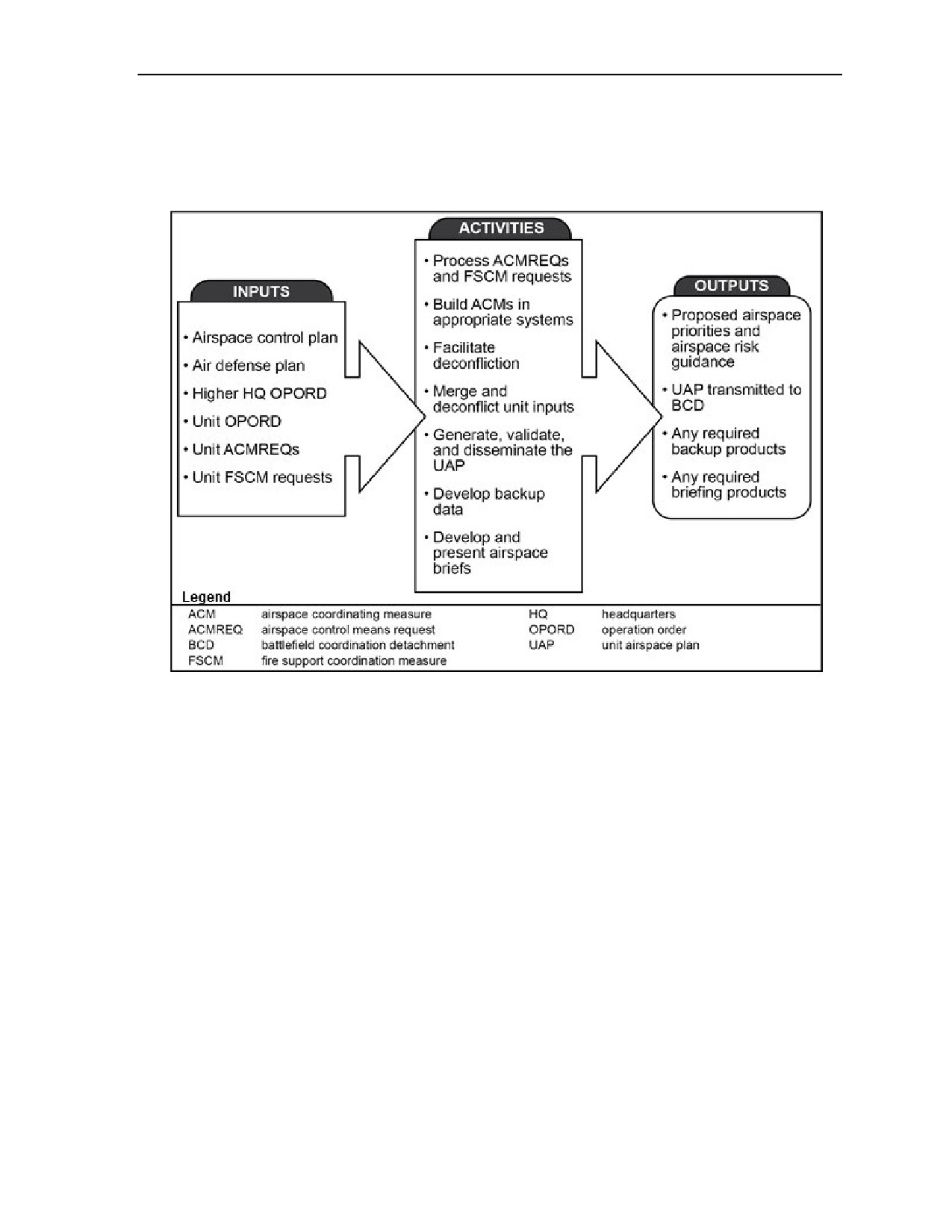
Airspace Control—Planning and Preparation
3-2). Each echelon integrates fire support coordination measures and AMD control measures into the UAP.
As these individual UAPs move through the higher echelons, planners deconflict, coordinate, integrate, and
collate them with other UAPs until a single Army UAP evolves. Planners submit this final UAP to the ACA
via the battlefield coordination detachment for inclusion in the appropriate ACO. For detailed information
on ACMs, see appendix B.
Figure 3-2. Development process for unit airspace plan
Develop Airspace Control Appendix to the Operation Annex
3-40. The airspace element develops an airspace control appendix to the operation annex. The result of the
unit performing the collective tasks in paragraphs 3-27 through 3-37 is Appendix 10 (Airspace Control) to
Annex C (Operations) of the unit’s operation plan or operation order (see FM 6-0). The airspace control
appendix articulates the airspace the commander is responsible for and states the commander’s airspace
priorities and the ACA’s priorities and directives by phase. This appendix articulates the airspace element or
ADAM/BAE mission. It lists the control authorities for each echelon as delegated or retained by the ACA
and delineates the authority exercised at each echelon for each phase of the operation. It describes positive
and procedural control requirements.
3-41. The airspace control appendix outlines the considerations of a radar versus a non-radar environment
as well as airspace control in a degraded network environment. It includes the number and type of organic
and joint sensors available in the area of operations to provide an air picture. Available sensors are addressed
by phase as nonorganic assets flow in and out of the theater. Sensor availability or the risk associated with a
lack of sensors may be addressed in OPLANs, OPORDs, or FRAGORDs.
BATTLE RHYTHM
3-42. Commanders establish and utilize a battle rhythm to synchronize operations. A battle rhythm is a
deliberate cycle of command, staff, and unit activities intended to synchronize current and future operations
(FM 6-0). As a practical matter, a headquarters’ battle rhythm consists of a series of meetings, report
requirements, and other activities synchronized by time and purpose. Planners logically sequence battle
20 October 2016
FM 3-52
3-9
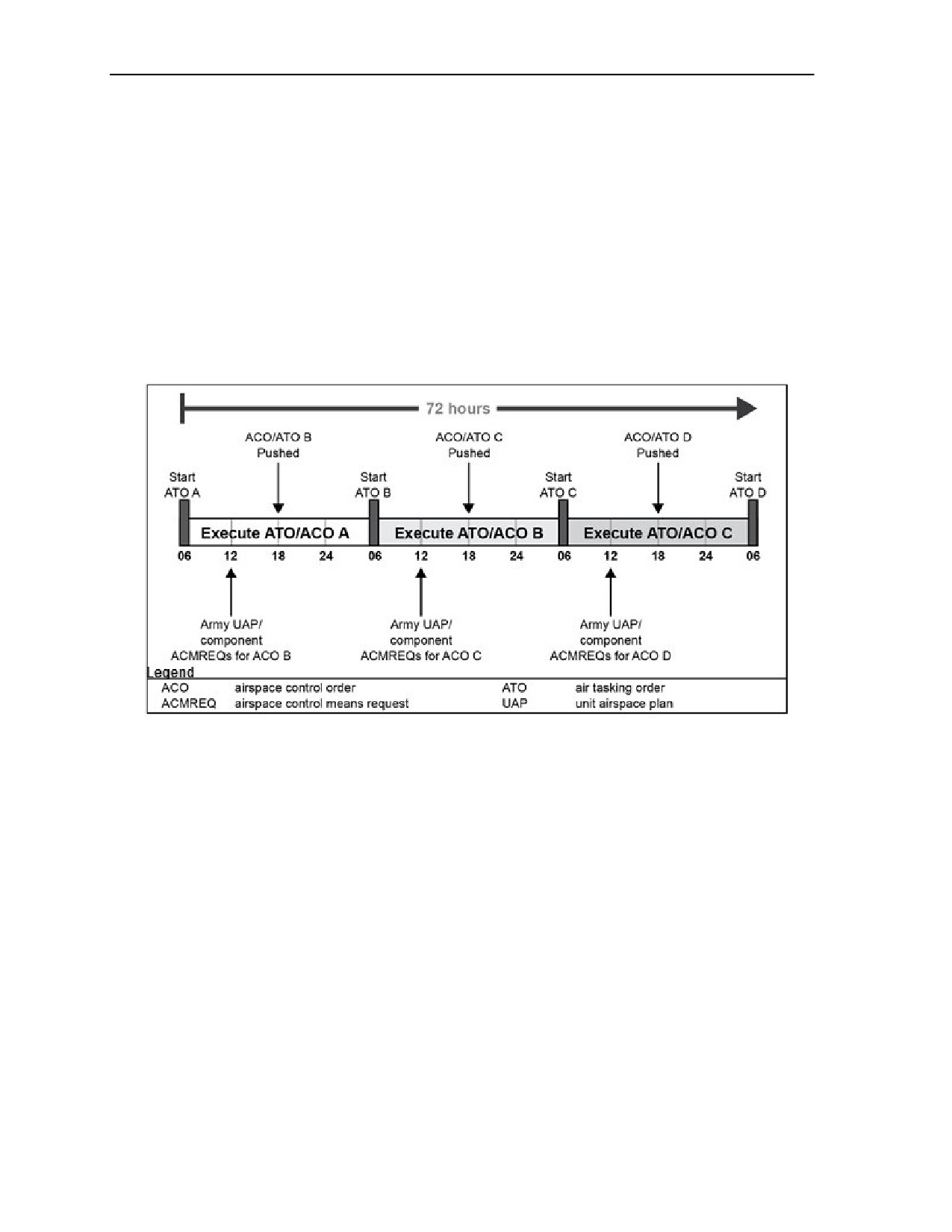
Chapter 3
rhythm events so that one meeting’s outputs are available as another meeting’s inputs to include higher
headquarters meetings. The battle rhythm facilitates integration and collaboration between the commander
and staff, synchronizing activities of the staff in time and purpose, and facilitates planning by the staff and
decisionmaking by the commander. In developing the unit’s battle rhythm, commanders and the chief of staff
or executive officer consider—
z
Higher headquarters battle rhythm and report requirements.
z
The duration and intensity of the operation.
z
Planning requirements of the integrating cells (current operations, future operations, and plans).
3-43. Airspace control planning is driven by not only higher headquarters battle rhythm but by external battle
rhythm constraints. For example, the joint air tasking cycle (Figure 3-3), drives when UAP inputs are due,
which in turn influences the battle rhythm of airspace control working groups. Planners disseminate the joint
air tasking cycle, ACO timelines, and other pertinent airspace coordination instructions (specified in the ACP
and the JAOP) into Appendix 10 (Airspace Control) to Annex C (Operations) of the Army plans and orders.
Figure 3-3. Notional 72-hour joint air tasking cycle
3-44. Working groups are types of meetings. Their cross-functional design enables working groups to
synchronize contributions from multiple command post cells and staff sections. For airspace planning, the
airspace control working group facilitates and synchronizes airspace collective task contributions from all
the airspace elements. The airspace control working group, at a minimum, consists of the air liaison officer
and representatives from: the airspace element, aviation cell, AMD element, fires cell, tactical air control
party, unmanned aircraft systems element, and other staff sections as required. Airspace elements are integral
participants in other working groups and provide expertise on how to maximize airspace use for information
collection, targeting, and protection purposes. Some examples of working groups which airspace elements
support are listed below.
z
Operations and Intelligence working group (intelligence cell).
z
Targeting working group (fires cell).
z
Protection working group (protection cell).
z
Assessment working group (plans or future operations functional cells).
Airspace elements also assist the S-3 and S-5 or G-3 and G-5 plans and future operations cells in assessing
airspace integration of air-ground operations.
3-10
FM 3-52
20 October 2016
Airspace Control—Planning and Preparation
PREPARATION
3-45. Airspace elements participate in certain preparation activities performed by units to improve their
ability to execute an operation. Preparation helps the force transition from planning to execution and normally
begins during planning and continues into execution by uncommitted units.
3-46. Preparation activities help commanders, staffs, and Soldiers to understand the situation and their roles
in the upcoming operation. As in planning, airspace element personnel play an integral role in preparation
activities that a unit performs as it transitions from planning to execution. This is particularly relevant as it
relates to improving situational understanding and developing a shared understanding of the plan. Depending
on the situation, airspace elements participate in all of the unit’s preparation activities. Most notably, airspace
elements actively participate during rehearsals, facilitating a shared understanding of joint air-ground
integration, potential ground operations effects on airspace use, and potential airspace use effects on ground
operations. Plan revision and refinement as well as rehearsals are particular preparation activities that airspace
personnel support.
PLAN REVISION AND REFINEMENT
3-47. Plan revision and refinement is a key activity of preparation. The airspace element supports this activity
as planners validate planning assumptions or find them to be false, as enemy activities change in the area of
operations, and as friendly capabilities expand or contract. The airspace element continually assesses the
operation and makes recommendations for changes to unit plans and joint documents such as ACP and JAOP.
REHEARSALS
3-48. Rehearsals enable leaders to practice synchronizing operations and identify shortcomings (errors or
omissions) while preparing to execute operations. A rehearsal is a session in which the commander and staff
or unit practices expected actions to improve performance during execution (ADRP 5-0). Leaders use
rehearsals to practice synchronizing operations, including airspace control requirements, at times and places
critical to mission accomplishment. Commanders use this tool to ensure staffs and subordinates understand
the concept of operations and commander’s intent. Effective rehearsals imprint a mental picture of the
sequence of the operation’s key actions and improve mutual understanding and coordination of subordinate
and supporting leaders and units.
3-49. Rehearsals are conducted by units at the lowest possible level. They vary with the complexity of the
mission, the type and technique of rehearsal, and the level of participation. Four types of rehearsals exist:
backbrief, combined arms rehearsal, support rehearsal, and battle drill rehearsals. Airspace elements
participate in combined arms rehearsals enabling subordinate units to synchronize their plans with each other
and support rehearsals that synchronize each warfighting function with the overall operation. FM 6-0
discusses rehearsals in detail.
3-50. Commanders integrate airspace use and key air-ground actions into larger combined arms and support
rehearsals such that leaders and Soldiers build a lasting mental picture of the sequence of key air-ground
actions and airspace use. During rehearsals, airspace elements ensure planned airspace use is consistent with
the commander’s intent and supports the concept of operations. Airspace elements ensure that all leaders and
Soldiers understand the risk guidance. During rehearsals, staffs and units exercise key actions or procedures
to achieve near-real-time airspace control to resolve events that cause airspace conflicts. Rehearsing these
events builds requisite skills to successfully integrate airspace users and to quickly resolve conflicts.
Examples of when near-real-time airspace control is required includes:
z
Supporting troops in contact.
z
Providing immediate fires or close air support.
z
Engaging time sensitive targets.
z
Engaging emerging or fleeting targets.
z
Conducting casualty evacuation.
z
Conducting personnel recovery.
z
Supporting a mission change.
20 October 2016
FM 3-52
3-11
Chapter 3
z
Supporting mission delays (initiation or execution).
z
Responding to enemy actions or reactions.
3-51. A rehearsal provides subordinates a final opportunity to identify and fix unresolved issues. Thorough
preparation for rehearsals underpins successful outcomes that help commanders visualize conditions
associated with decisionmaking. This visualization before and during operations affords commanders an
opportunity to make necessary changes essential to mission success and risk mitigation. Following the
rehearsal, based on the commander’s guidance, airspace elements make or recommend necessary adjustments
to appropriate ACMs, UAPs, the airspace control appendix, and the Fires annex including the AMD appendix
of operation plans at all echelons as well as to the ACP, JAOP, and AADP.
3-52. Successful airspace elements participating in rehearsals—
z
Complete the airspace control appendix and airspace overlays that underpin air-ground operations
that units rehearse.
z
Clearly describe the ACMs that support air-ground operations.
z
Clearly describe airspace constraints.
z
Clearly describe near-real-time control and conflict resolution procedures.
3-12
FM 3-52
20 October 2016
///////////////////////////////////////