The Army Universal Task List (March 2011) - page 2
∞ART 1.0: The Movement and Maneuver Warfighting Function
No.
Scale
Measure
01
Yes/No
The unit was in the correct position at the correct time.
02
Time
Of force delays due to poor trafficability or environmental conditions.
03
Time
Of force delays to assume appropriate mission-oriented protective posture.
Of decrease in rate of movement resulting from actual terrain trafficability differing from
04
Percent
that in the plan.
05
Percent
Of force no longer fully mission capable resulting from terrain accidents.
06
Percent
Of force delayed due to terrain conditions.
07
kph
Rate of movement.
ART 1.6.4 PROVIDE DIVER SUPPORT
1-81. Provide diving equipment and personnel to conduct underwater operations. Engineer dive teams
provide underwater reconnaissance, salvage, recovery, construction, demolition, repairs, inspections, and
hydrographic survey operations in support of the full spectrum operations. (FM 3-34.280) (USAES)
No.
Scale
Measure
Engineer diving support increased available berthing positions to on load and off-load
01
Yes/No
cargo from ships.
Engineer diving team conducted hydrographic surveys and established navigational
02
Yes/No
waterways.
Engineer diving teams eliminated underwater obstacles in support of bridging
03
Yes/No
operations and ships traffic.
Engineer diving teams inspected underwater structures to aid in military load class
04
Yes/No
analysis.
Engineer diving teams supported mobility and countermobility along inland waterways,
05
Yes/No
ports, and harbors.
Engineer diving teams located and recovered submerged personnel, equipment,
06
Yes/No
weapon systems, or all of these.
07
Yes/No
Engineer dive teams conducted damage survey and repair operations.
Unit conducted joint logistics over-the-shore operations by time specified by higher
08
Yes/No
headquarters.
09
Time
To repair underwater portions of waterfront facilities.
10
Time
To conduct hydrographic survey of 1,000 square meters.
11
Time
To remove obstacles to navigation and bridging operations.
12
Time
To plan and inspect underwater structures.
13
Time
To clear debris and wreckage from underwater structures.
14
Time
To repair underwater structures.
15
Time
To install physical security systems.
16
Percent
Of underwater pipelines inspected, maintained, or repaired.
17
Percent
Of channels and waterways surveyed in an area of operations.
18
Percent
Of identified obstacles emplaced or reduced.
19
Percent
Of port facilities open, construction completed, and rehabilitation completed.
20
Percent
Of vessel underwater hulls inspected during security swim operations.
21
Percent
Of vessels with current in-water hull inspections completed.
22
Percent
Of mooring systems inspected and repaired in a specified area.
Of offshore petroleum distribution pipeline and components inspected and maintained
23
Percent
in a specified area.
24
Percent
Of construction completed on underwater structures.
18 March 2011
FM 7-15, C6
1-45
Chapter 1
No.
Scale
Measure
25
Number
Of fording sites identified and reported to higher headquarters.
26
Number
Of rafting sites identified and reported to higher headquarters.
27
Number
Of wet gap crossing operations conducted by a specified time.
28
Number
Of bridge inspection and repairs conducted by a specified time.
29
Number
Of hydrographic survey products rendered in a specified time.
30
Number
Of salvage operations completed in a specified time.
31
Number
Of search and recovery missions completed in a specified time.
Of security inspection missions of bridges, ports, locks, and dams missions completed
32
Number
during rotation.
33
Number
Of ships husbandry missions completed in a specified time.
34
Number
Of in-water maintenance missions conducted in a port facility.
ART 1.6.5 CONDUCT NONTACTICAL MOVEMENTS
1-82. Execute a movement in which troops and vehicles are arranged to expedite their movement and
conserve time and energy when no enemy interference, except by air, is anticipated. Environmental
considerations are applied as appropriate. (FM 3-90) (USACAC)
No.
Scale
Measure
01
Yes/No
Completed unit movement by time specified in operation order.
02
Yes/No
Used transportation resources and assets efficiently.
03
Time
To initiate movement.
04
Time
To complete movement.
05
Percent
Of force completing the movement.
06
kph
Rate of movement.
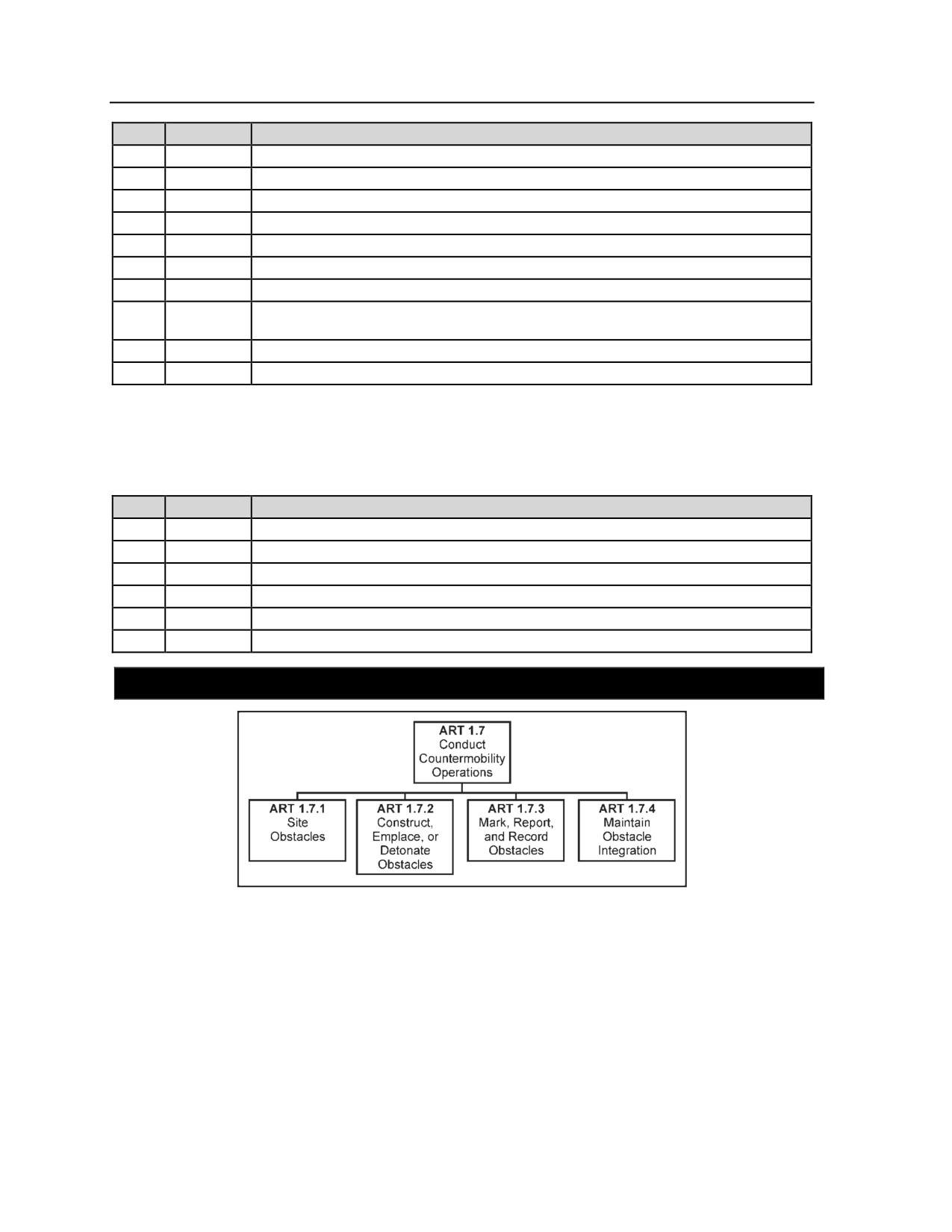
SECTION VII - ART 1.7: CONDUCT COUNTERMOBILITY OPERATIONS
1-83. Countermobility operations involve constructing reinforcing obstacles integrated with fires to inhibit
the maneuver of an enemy force, increase time for target acquisition, and increase weapon effectiveness.
Commanders integrate obstacle planning into the military decisionmaking process (see FM 5-0); integrate
obstacles into the concept of operations (primarily through proper siting); and maintain integration through
obstacle turnover, protection, and tracking. The force constructs, emplaces, or detonates tactical and
protective obstacles to reinforce existing obstacles. Tactical obstacles are designed and integrated with fires
to achieve a tactical effect—disrupt, fix, turn, or block. The three types of tactical obstacles are directed
obstacles, situational obstacles, and reserve obstacles. They are distinguished by the differences in
execution criteria. Protective obstacles are a key component of survivability operations. (See ART 6.7,
Conduct Survivability Operations.) The force may employ any type of individual obstacle as a tactical
obstacle. (FM 5-102) (USAES)
1-46
FM 7-15, C6
18 March 2011
∞ART 1.0: The Movement and Maneuver Warfighting Function
Note: The term “countermobility systems” used in this section is generic in nature and includes
both manual and mechanical means, such as sapper units, cratering demolition kits, and mine
dispensing systems.
No.
Scale
Measure
Friendly obstacle effect accomplished commander’s guidance (block, disrupt, fix, or
01
Yes/No
turn).
Unit emplaced obstacles per restrictions established by higher headquarters, to include
02
Yes/No
obstacle control measure graphics and rules of engagement.
Unit integrated fires (direct and indirect, lethal and nonlethal) in the obstacle plan and
03
Yes/No
were effective when required.
That enemy forces are delayed in the conduct of their movement and maneuver due to
04
Time
friendly obstacles. (Delay time depends on type of effect.)
Required by the enemy to repair and replace facilities (such as bridges, railroad
05
Time
switching yards, dockyard cranes, and airfield runways) damaged and destroyed by
friendly countermobility efforts.
06
Time
To conduct area reconnaissance of proposed locations of obstacle complexes.
For staff to format and disseminate information obtained by the area reconnaissance to
07
Time
subordinate units, to higher headquarters, and laterally.
08
Time
To conduct terrain analysis to assist in selecting obstacle locations.
09
Time
To plan construction of the obstacle effort.
To establish conditions necessary for construction of obstacles, such as establishing
10
Time
security and moving class IV and class V material to obstacle locations.
11
Time
To move countermobility systems to work site.
12
Time
To emplace obstacles.
To employ appropriate lethal and nonlethal fires when enemy is engaged in friendly
13
Time
obstacles.
14
Percent
Of countermobility effort completed.
Of total available countermobility effort in a given time not used because of poor
15
Percent
management.
16
Percent
Of enemy forces unable to reach their objective due to obstacles.
Of mobility corridors and avenues of approach closed to enemy maneuver by friendly
17
Percent
obstacles.
18
Percent
Of enemy casualties inflicted by friendly obstacles.
19
Percent
Of available countermobility assets that are mission capable.
20
Percent
Of enemy sustainment capability interdicted by friendly obstacle efforts.
Of enemy engineering capability devoted toward enhancing enemy mobility and
21
Percent
maneuver.
22
Percent
Of friendly capability devoted to conducting countermobility operations.
23
Percent
Of friendly fires systems used to emplace field artillery- and air-delivered obstacles.
Of enemy main supply routes and lines of communication interdicted by friendly
24
Number
obstacles.
25
Number
Of friendly and civilian casualties during the conduct of countermobility operations.
26
Number
Of available countermobility assets that are mission capable.
Of potential enemy courses of action no longer feasible due to friendly countermobility
27
Number
efforts.
18 March 2011
FM 7-15, C6
1-47
Chapter 1
ART 1.7.1 SITE OBSTACLES
1-84. Determine the location of individual obstacles based on the enemy force (target), desired location of
massed fires, tentative weapon system positions, and the intended effect (disrupt, fix, turn, or block). ART
1.7.1 includes verifying that the obstacle is covered by fires, noting locations of fire control measures and
obstacles, and recording the appropriate data on range cards. (FM 90-7) (USAES)
No.
Scale
Measure
01
Yes/No
Obstacle location accomplished intended effect when integrated with available fires.
Unit emplaced planned obstacles per restrictions established by higher headquarters,
02
Yes/No
to include obstacle control measure graphics, applying environmental considerations,
and rules of engagement.
Planned obstacles had a reasonable probability of being emplaced, given protected
03
Yes/No
availability of countermobility systems, supplies, manpower, and time.
04
Yes/No
Unit coordinated with supported unit to ensure obstacle coverage by fires.
05
Time
To conduct terrain analysis to support selecting locations for obstacles.
To conduct area reconnaissance of proposed obstacle locations applying
06
Time
environmental considerations.
For the staff to format and disseminate information obtained by the area
07
Time
reconnaissance to subordinate units, to higher headquarters, and laterally.
08
Time
To plan the countermobility effort.
Of mobility corridors and avenues of approach that will be closed to enemy maneuver
09
Percent
by friendly obstacles once they are emplaced.
Of enemy main supply routes and lines of communications that will be interdicted by
10
Number
friendly obstacles.
Of potential enemy courses of action that are no longer feasible due to friendly
11
Number
countermobility efforts.
ART 1.7.2 CONSTRUCT, EMPLACE, OR DETONATE OBSTACLES
1-85. Reinforce the terrain and combine obstacles with fires to disrupt, fix, turn, or block an enemy force.
ART 1.7.2 includes emplacing special purpose munitions; constructing wire obstacles, antitank ditches,
tetrahedrons and log obstacles; and detonating explosives to create road craters, destroy bridges, and
construct abatises. (FM 90-7) (USAES)
No.
Scale
Measure
Friendly obstacle effect accomplished the commander’s intent (block, disrupt, fix, and
01
Yes/No
turn).
Unit emplaced obstacles per restrictions established by higher headquarters, to include
02
Yes/No
obstacle control measure graphics, environmental considerations, and rules of
engagement.
Required to conduct area reconnaissance of proposed obstacle locations, applying
03
Time
environmental considerations.
For the staff to format and disseminate information from the area reconnaissance to
04
Time
subordinate units, to higher headquarters, and laterally.
05
Time
To plan the design of individual obstacles and obstacle complexes.
To establish the conditions necessary for obstacle construction, such as establishing
06
Time
security and moving class IV and class V materials to obstacle locations.
07
Time
That the obstacle construction effort is delayed due to insufficient engineer support.
08
Time
To move countermobility systems to the work site.
09
Time
To construct, emplace, or detonate (underwater) obstacles.
10
Percent
Of obstacle effort completed.
1-48
FM 7-15, C6
18 March 2011
∞ART 1.0: The Movement and Maneuver Warfighting Function
No.
Scale
Measure
Of total available countermobility effort in a given time not used because of poor
11
Percent
management.
12
Percent
Of available countermobility assets that are mission capable.
13
Percent
Of friendly fires systems used to emplace field artillery- and air-delivered obstacles.
14
Number
Of available countermobility assets that are mission capable.
Of friendly and civilian casualties during the construction, emplacement, or detonation
15
Number
of obstacles.
ART 1.7.3 MARK, REPORT, AND RECORD OBSTACLES
1-86. Mark all obstacles to aid in fratricide prevention. Report the intention to emplace obstacles (if
required), initiation of construction and emplacement, and completion and execution of obstacles. As a
minimum, record the obstacle location, type, and (if applicable) number and types of mines, placement of
mines, use of antihandling devices, location of lanes and gaps, and description of marking. (FM 90-7)
(USAES)
No.
Scale
Measure
01
Yes/No
Unit marked, reported, and recorded all obstacles per standing operating procedures.
02
Time
To identify and determine the limits of minefields and other obstacles.
03
Time
To mark obstacle limits per doctrine and international agreements.
04
Time
To transmit obstacle information to appropriate agencies in area of operations.
Of obstacle location and composition information correctly recorded in the unit
05
Percent
database.
Of obstacle location and composition information correctly transmitted to appropriate
06
Percent
agencies in area of operations.
07
Number
Of friendly and neutral casualties resulting from improperly marked obstacles.
ART 1.7.4 MAINTAIN OBSTACLE INTEGRATION
1-87. Ensure emplaced obstacles remain integrated into the concept of operations. ART 1.7.4 includes
turnover and transfer, protection, repair, and tracking of obstacles. Obstacle protection focuses on two
tasks: counterreconnaissance to prevent the enemy from gathering obstacle intelligence and enemy mobility
asset destruction to ensure maximum effectiveness of obstacles. Obstacle tracking includes supervising
achievement of key milestones as part of the unit’s timeline (class IV and V forward, initiate engagement
area development, siting complete), collation, and dissemination of obstacle information, and maintenance
of records. (FM 90-7) (USAES)
No.
Scale
Measure
Obstacle turnover and transfer occurred per doctrinal guidance and international
01
Yes/No
standardization agreements.
Friendly unit was able to prevent enemy reconnaissance elements from gaining
02
Yes/No
information on the obstacle.
Obstacle tracking occurred within an acceptable level of accuracy, as determined by
03
Yes/No
the unit commander.
04
Time
To plan and coordinate obstacle turnover and transfer.
05
Time
To restore a partially reduced obstacle.
06
Time
To conduct obstacle tracking.
07
Percent
Of enemy reconnaissance assets destroyed while maintaining obstacle integration.
08
Percent
Of enemy mobility assets destroyed before they could reduce friendly obstacles.
09
Number
Of enemy reconnaissance assets destroyed while maintaining obstacle integration.
18 March 2011
FM 7-15, C6
1-49

Chapter 1
No.
Scale
Measure
10
Number
Of enemy mobility assets destroyed before they could reduce friendly obstacles.
11
Number
Of friendly and civilian casualties during the maintenance of obstacle integration.
SECTION VIII - ART 1.8: EMPLOY OBSCURANTS
1-88. Use obscurants to conceal friendly positions and screen maneuvering forces from enemy observation.
An obscurant is a chemical agent that decreases the level of energy available for the functions of seekers,
trackers, and vision enhancement devices. ART 1.8. includes obscuring and screening in full spectrum
operations. Apply environmental considerations as appropriate. (FM 3-11.50) (USACBRNS)
No.
Scale
Measure
01
Yes/No
Use of obscurants improved unit survivability and maneuverability.
02
Yes/No
Use of obscurants compromised unit course of action.
To assess unit concealment requirements beyond that provided by camouflage
03
Time
systems.
To employ obscurants to screen personnel, major combat equipment, bridge sites, and
04
Time
obstacles in an area of operations (AO).
Of unit commanders and planners able to effectively plan the use of obscurants to
05
Percent
protect friendly personnel, equipment, and positions from enemy direct fire,
observation, and surveillance for deception operations.
06
Percent
Of units, installations, and facilities in the AO employing obscurants.
Of increased time to conduct operations in limited visibility conditions due to the use of
07
Percent
obscurants.
∞SECTION IX - ART 1.9 CONDUCT MANEUVER SUPPORT OPERATIONS
1-89. Maneuver support operations integrate the complementary and reinforcing capabilities of key
protection, movement and maneuver, and sustainment functions, tasks, and systems to enhance freedom of
action. The integrated and synchronized maneuver support related tasks shape the environment to protect
the force, enhance survivability, and support mobility and countermobility. Maneuver support operations
also provide selected sustainment support and generally expand the freedom of action of the supported
units while denying options and freedom of actions to the enemy. This allows combat power to be applied
at the decisive point and time and facilitates simultaneous actions at the operational level and rapid
transitions at the tactical level. (FM 3-90.31) (MSCoE)
No.
Scale
Measure
Unit coordinated with supporting and supported headquarters to fully integrate
01
Yes/No
maneuver support operations.
Unit planned and conducted preventative measures to enhance survivability of units
02
Yes/No
within the echelon area of operation.
Unit applied preventive measures to mitigate hostile action to moving and maneuvering
03
Yes/No
elements in the unit area of operation.
Unit integrated task-organized elements, capabilities, tasks, and systems to enhance
04
Yes/No
freedom of action.
Unit planned and conducted operations to support movement corridors and the staging,
05
Yes/No
onward movement, and integration of new elements.
06
Yes/No
Unit conducted specific sustainment tasks to enhance stability in the area of operation.
1-50
FM 7-15, C6
18 March 2011
Chapter 3
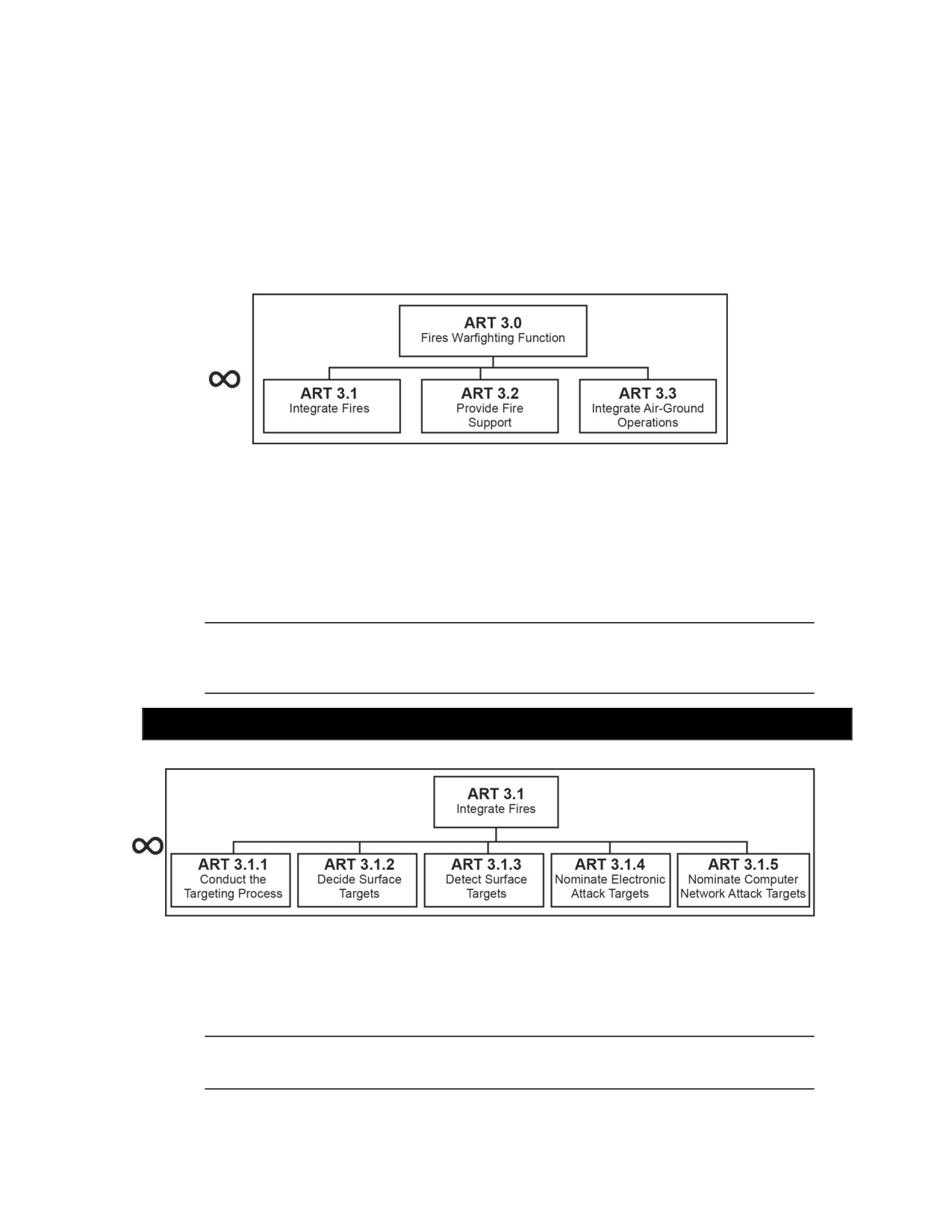
∞ART 3.0: The Fires Warfighting Function
The fires warfighting function is the related tasks and systems that provide collective
and coordinated use of Army indirect fires and joint fires through the targeting
process. It includes tasks associated with integrating and synchronizing the effects of
these types of fires with the effects of other warfighting functions. Commanders
integrate these tasks into the concept of operations during planning and adjust them
based on the targeting guidance. Fires normally contribute to the overall effect of
maneuver, but commanders may use them separately for decisive and shaping
operations. (FM 3-0) (USACAC)
Note: ART 5.1.1.4 (Conduct Fires Planning) addresses planning for fires conducted during the
operations process. ART 5.1.4.3 (Provide Combat Assessment) addresses combat assessment
(Battle damage assessment, munitions effects assessments, and reattack recommendation).
∞SECTION I - ART 3.1: INTEGRATE FIRES
3-1. Commanders integrate fires and maneuver through the operations process. Fire support personnel
from platoon through theater Army assist the commander by integrating and synchronizing related tasks
and systems that provide collective and coordinated use of Army indirect fires and joint fires with the
effects of other warfighting functions. These are integrated into the concept of operations during planning
and adjusted based on the targeting guidance. (FM 6-20) (USAFAS)
Note: ART 5.1.1.4 (Conduct Fires Planning) addresses planning for fires conducted during the
operations process.
18 March 2011
FM 7-15, C6
3-1
Chapter 3
∞ART 3.1.1 CONDUCT THE TARGETING PROCESS
3-2. Conduct the targeting process through the targeting working group in locating, identifying,
classifying, tracking, and attacking targets and assessing battle damage. Apply the parameters set at the
operational level, directed limitations, rules of engagement, rules for the use of force, the law of war, and
other guidance given by the commander to the targeting process to attain the commander’s objectives.
Synchronize the development of target matrices, target selection, and target list. ART 3.1.1 includes
coordinating the delivery and assessment of the fires order in support of the commander’s intent. (FM 6-20)
(USAFAS)
No.
Scale
Measure
Unit developed the fires paragraph or annex to the operation order that shaped the
01
Yes/No
battlefield to support the commander’s intent.
The targeting working group conducted daily operations to locate, identify, classify,
02
Yes/No
track, and attack targets and assess battle damage.
03
Yes/No
The targeting working group analyzed the mission and refined target priorities.
Unit synchronized the development of target matrices, target selection standards, and
04
Yes/No
target list in accordance with guidance.
The targeting working group briefed the commander. The commander selected a
05
Yes/No
course of action.
The targeting working group assisted the deputy commander, chief of staff, or executive
06
Yes/No
officer in the conduct of the targeting board.
∞ART 3.1.2 DECIDE SURFACE TARGETS
3-3. Determine the targets that, if successfully attacked, will contribute to the success of the mission
based on the commander’s concept of operations and targeting guidance. Recommend how each target
should be engaged in terms of the degree and duration based on commander’s intent. Construct a high-
payoff target list of prioritized targets. Determine target selection standards. Prepare the attack guidance
matrix for the commander’s approval. Prepare a targeting synchronization matrix. The matrix includes the
prioritized high-payoff targets; intelligence, surveillance, and reconnaissance assets; target acquisition
assets tasked to acquire them; attack resources tasked to attack them; desired effects and associated
measures of performance and measures of effectiveness for assessment; and assets tasked to conduct
assessment. Brief the targeting process products to the commander. Translate the commander’s decisions
into the operation order with annexes. (FM 6-20) (USAFAS)
No.
Scale
Measure
01
Yes/No
Targets selected allowed for accomplishing the unit mission and commander’s intent.
02
Yes/No
Unit reviewed selected targets for compliance with rules of engagement.
03
Yes/No
Unit integrated lethal fires into the targeting process.
04
Time
To create a target nomination list.
05
Time
To complete target prioritization.
06
Time
To determine moving target intercept points.
07
Time
To issue prohibited target guidance.
08
Time
To pass commander’s guidance to targeting agencies.
09
Percent
Of high-payoff targets discovered resulting in a reprioritized target list.
10
Percent
Of potential targets subjected to systematic analysis.
11
Percent
Of potential targets analyzed within an established time.
12
Percent
Of selected targets that completed duplication checks.
13
Percent
Of selected high-payoff targets nominated for engagement.
14
Number
Of resources identified to support acquiring and engagement of targets.
3-2
FM 7-15, C6
18 March 2011
∞ART 3.0: The Fires Warfighting Function
∞ART 3.1.3 DETECT SURFACE TARGETS
3-4. Detect high-payoff targets identified in the
“Decide” function of the targeting process. Detect
includes determining (by direction, reference point, or grid) where a potential target is located. ART 3.1.3
includes locating the target and its altitude to a minimum acceptable standard of a 6-digit grid location for
an area target. Planned targets engaged with precision munitions (coordinate seeking) require a mensurated
grid. (FM 6-20) (USAFAS)
Note: Contributions made by the intelligence warfighting function toward this task can be found
in ART 2.4.1 (Provide Intelligence Support to Targeting).
No.
Scale
Measure
Unit conducted target coordinate mensuration on planned targets attacked by
01
Yes/No
coordinate-seeking munitions (such as 155-mm Excalibur and Guided Multiple Launch
Rocket System).
To locate targets during surveillance and reconnaissance of defined target area of
02
Time
interest.
Of potential targets detected to targeting accuracy during surveillance and
03
Percent
reconnaissance.
04
Percent
Of target locations verified before next targeting cycle.
05
Percent
Of designated high-payoff targets that have correct location data.
Of high-payoff targets detected and located to targeting accuracy in the area of
06
Number
operations.
07
Number
Of suspect targets tracked for expedited engagement.
08
Number
Of targets identified within target location error during the analysis process.
∞ART 3.1.4 NOMINATE ELECTRONIC ATTACK TARGETS
3-5. Nominate targets to be destroyed, deceived, degraded, or neutralized. Targets may be state or
nonstate actors. (FM 3-36) (USACAC)
No.
Scale
Measure
Targets selected were required for accomplishing the unit mission and commander’s
01
Yes/No
intent.
02
Yes/No
Unit nominated electronic attack targets following rules of engagement.
03
Time
To submit electronic attack targets to operational echelons.
04
Time
To receive and assess results of electronic attack.
Of enemy systems not engaged by electronic attack that are targeted for physical
05
Percent
attack.
Of enemy systems not engaged by electronic attack that are targeted for collection or
06
Percent
exploitation.
∞ART 3.1.5 NOMINATE COMPUTER NETWORK ATTACK
TARGETS
3-6. Nominate targets to disrupt, deny, degrade, or destroy information in computers, computer networks,
or the computers and networks themselves. Targets may be state or nonstate actors. (FM 3-36) (USACAC)
No.
Scale
Measure
Targets selected were required for accomplishing the unit mission and commander’s
01
Yes/No
intent.
02
Yes/No
Unit nominated computer network attack targets following rules of engagement.
03
Time
To submit computer network attack targets to operational echelons.
18 March 2011
FM 7-15, C6
3-3
Chapter 3
No.
Scale
Measure
04
Time
To receive and assess results of computer network attack.
Of enemy systems not engaged by computer network attack that are targeted for attack
05
Percent
by lethal systems.
Of enemy systems not engaged by electronic attack that are targeted for collection or
06
Percent
exploitation.
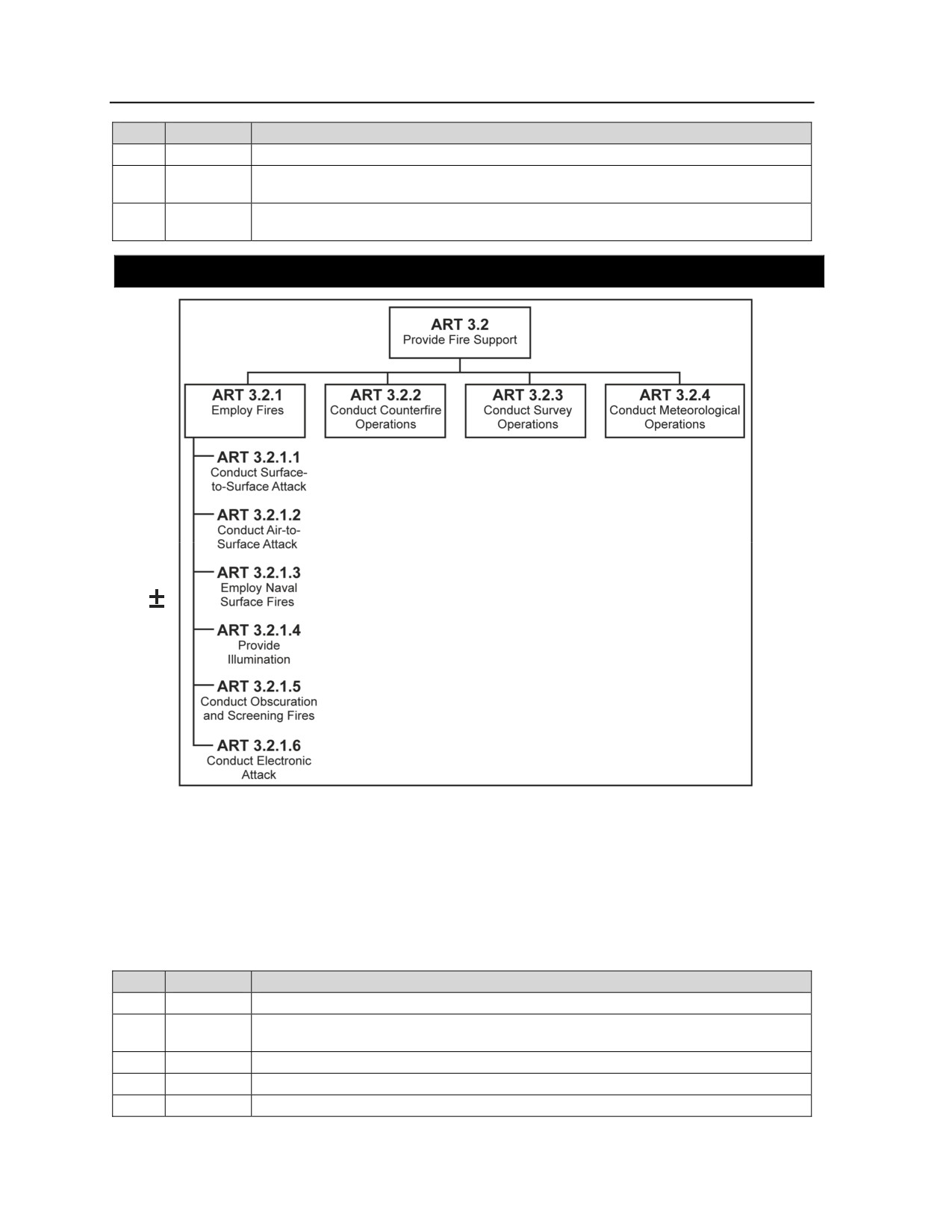
∞SECTION II - ART 3.2: PROVIDE FIRE SUPPORT
3-7. Provide collective and coordinated use of Army indirect fires, joint fires, and command and control
warfare, including nonlethal fires, through the targeting process to support operations against surface
targets. (FM 6-20) (USAFAS)
∞ART 3.2.1 EMPLOY FIRES
3-8. Employ fires weapon systems to create a specific lethal effect on a target. Provide collective and
coordinated use of Army indirect fires and joint fires throughout the targeting process to support operations
against surface targets. (FM 6-20) (USAFAS)
No.
Scale
Measure
01
Yes/No
Fires achieved the commander’s fires guidance.
Commander directed that contingency plans be developed for the employment of lethal
02
Yes/No
fires.
03
Time
For a given fires weapon system to respond.
04
Time
To reattack target after battle damage assessment.
05
Percent
Of target attacks that achieve desired effects.
3-4
FM 7-15, C6
18 March 2011
∞ART 3.0: The Fires Warfighting Function
No.
Scale
Measure
06
Percent
Of targets selected for engagement that were engaged.
07
Percent
Of friendly areas of operations within the range of supporting fires weapon systems.
08
Percent
Of fires missions synchronized with the maneuver of friendly units.
09
Percent
Of targets engaged that resulted in collateral damage.
Of enemy high-payoff targets requiring more than one type of weapon system to ensure
10
Percent
successful attack.
11
Percent
Of lethal fires effort diverted by higher commanders to support their targeting priorities.
12
Percent
Of fires systems available.
Of courses of action denied to an enemy force due to friendly fires efforts as
13
Number
determined from interrogations and after action reviews.
14
Number
Of fires systems available.
ART 3.2.1.1 CONDUCT SURFACE-TO-SURFACE ATTACK
3-9. Use ground-based, indirect-fire weapon systems to destroy, suppress, or neutralize enemy equipment
(including aircraft on the ground), materiel, personnel, fortifications, and facilities. (FM 6-20) (USAFAS)
No.
Scale
Measure
01
Yes/No
Surface-to-surface attack achieved desired effects.
02
Yes/No
Surface-to-surface attack followed rules of engagement.
03
Time
To complete attack after identifying target.
04
Time
To provide adjustment data.
05
Time
To prepare for surface-to-surface attack.
06
Percent
Of missions accomplished within a specified time.
07
Percent
Of missions fired that accomplished desired effect on target.
08
Percent
Of planned targets successfully engaged during operation.
09
Percent
Of time-on-target missions accomplished on time.
10
Percent
Of enemy high-payoff target delivery systems destroyed by friendly forces.
Of point target missions that achieve the desired effects (destroyed, delayed, disrupted,
11
Percent
or degraded) using guided munitions.
Of area target missions that achieved the desired effects (destruction or neutralization)
12
Percent
using area munitions.
13
Percent
Of targets of opportunity successfully engaged.
14
Percent
Of unit basic load of ordnance available for use in lethal attack.
15
Percent
Of selected targets for which accurate coordinates are available.
16
Percent
Of ground-based, indirect fire missions that resulted in collateral damage.
17
Number
Of fires systems available.
ART 3.2.1.1.1 Conduct Suppression of Enemy Air Defenses
3-10. Neutralize, destroy, or temporarily degrade surface-based enemy tactical air defenses by destructive
and disruptive means to increase aircraft survivability. Lethal suppression of enemy air defenses (SEAD)
seeks the destruction of surface-based enemy tactical air defenses, such as target systems or operating
personnel, by destructive means. Examples of destructive SEAD capabilities are bombs, air- and surface-
to-surface missiles, air-scatterable mines, and field artillery. Nondestructive SEAD seeks to temporarily
deny, degrade, deceive, delay, or neutralize surface-based enemy tactical air defense systems by disruptive
means to increase aircraft survivability. (FM 6-20) (USAFAS)
Note: Disruptive means include activities discussed in ART 3.2.1.6 (Conduct Electronic Attack).
18 March 2011
FM 7-15, C6
3-5
Chapter 3
No.
Scale
Measure
Friendly aerial platforms accomplished mission without unacceptable losses to enemy
01
Yes/No
air defense systems.
02
Time
To plan for the suppression of enemy air defense systems.
03
Time
To respond to new requirements to suppress enemy air defense systems.
04
Time
To complete execution of all phases of the plan to suppress enemy air defenses.
To prepare weapon systems and obtain munitions used in the suppression of enemy air
05
Time
defense systems.
06
Percent
Of available combat power dedicated toward SEAD.
Of enemy air defense systems neutralized, destroyed, or temporarily degraded by
07
Percent
destructive or disruptive means.
08
Percent
Of friendly air sorties attacked by enemy air defense.
09
Percent
Of enemy air defense systems that required reattack.
10
Percent
Of friendly air losses due to enemy air defense.
Of point target missions that achieve the desired effects (destroyed, delayed, disrupted,
11
Percent
or degraded) using guided munitions.
Of area target missions that achieved the desired effects (destruction or neutralization)
12
Percent
using area munitions.
13
Percent
Of SEAD missions that resulted in collateral damage.
14
Number
And types of weapon systems and munitions used for SEAD.
Of point target missions that achieve the desired effects (destroyed, delayed, disrupted,
15
Number
or degraded) using guided munitions.
Of area target missions that achieved the desired effects (destruction or neutralization)
16
Number
using area munitions.
ART 3.2.1.2 CONDUCT AIR-TO-SURFACE ATTACK
3-11. Employ fixed- and rotary-wing aircraft-mounted weapon systems to destroy, suppress, or neutralize
equipment (including aircraft on the ground), materiel, personnel, fortifications, and facilities. (FM 6-20)
(USAFAS)
No.
Scale
Measure
Air-to-surface attacks allowed the commander to accomplish the mission within
01
Yes/No
identified time and resource constraints.
02
Yes/No
Air-to-surface attacks followed rules of engagement.
To process air-to-surface attack requests through fires (fixed-wing) or maneuver
03
Time
(rotary-wing) channels, as appropriate.
04
Time
For aerial systems to respond to mission request.
05
Time
For aircraft to identify target.
06
Time
To get ordnance on target after initiating air-to-surface attack request.
07
Percent
Of requested missions accomplished.
08
Percent
Of available aerial weapon systems (fixed- and rotary-wing).
Of missions where the ordnance carried by aerial weapon systems is appropriate for
09
Percent
the target attacked.
10
Percent
Of missions requested directed to appropriate agency.
11
Percent
Of targets engaged by friendly aerial weapon systems (fixed- and rotary-wing).
Of friendly force operations delayed, disrupted, or modified due to lack of requested air
12
Percent
support.
13
Percent
Of targets attacked achieve the desired effects.
14
Percent
Of maneuver forces having aerial weapon systems available.
15
Percent
Of air-to-surface attack missions that resulted in collateral damage.
3-6
FM 7-15, C6
18 March 2011

∞ART 3.0: The Fires Warfighting Function
No.
Scale
Measure
16
Percent
Of air-to-surface missions cancelled due to weather restrictions.
17
Number
Of aerial weapon systems available to support the commander.
ART 3.2.1.2.1 Request Air-to-Surface Attack
3-12. Request employment of Army special operations forces; Marine Corps, Navy, and Air Force aircraft;
and other systems to deliver rocket, cannon, missile fires, and bombs on surface targets. (FM 6-20)
(USAFAS)
No.
Scale
Measure
Unit responded promptly to requests for an air-to-surface attack to provide support at
01
Yes/No
the appropriate time.
02
Time
To process air support request.
03
Time
To get ordnance on target after initiating air request.
04
Percent
Of missions requested by Army commanders accomplished.
05
Percent
Of availability of supporting air agencies for maneuver forces.
06
Percent
Of missions requested directed to appropriate agency.
ART 3.2.1.2.2 Employ Close Air Support
3-13. Employ aircraft in preplanned and immediate close air support (CAS) missions and joint air attack
team operations to destroy, delay, disrupt, or suppress targets to support land operations. CAS requires
positive identification, friend or foe and Army procedural or Army positive control of aircraft. (FM 6-20)
(USAFAS)
No.
Scale
Measure
01
Yes/No
CAS destroyed, delayed, disrupted, or suppressed targets to support land operations.
02
Yes/No
CAS followed rules of engagement.
03
Time
To process CAS requests through fires channels.
04
Time
For CAS aircraft to respond to mission request.
05
Time
For CAS aircraft to identify target.
06
Time
To get ordnance on target after initiating CAS request.
07
Percent
Of missions requested by Army commands accomplished.
08
Percent
Of CAS sorties allocated or distributed to the supported unit that were employed.
09
Percent
Of missions requested directed to the appropriate agency.
10
Percent
Of requested targets engaged with friendly air support.
Of friendly force operations delayed, disrupted, or modified due to lack of requested
11
Percent
CAS.
12
Percent
Of targets attacked achieved desired effects.
13
Percent
Of CAS missions that resulted in collateral damage.
14
Percent
Of preplanned CAS missions cancelled due to weather conditions.
15
Number
Of preplanned CAS missions cancelled due to weather conditions.
ART 3.2.1.2.3 Employ Air Interdiction
3-14. Employ air interdiction to divert, disrupt, delay, or destroy, the enemy’s military potential before it
can be brought to bear effectively against friendly forces, or to otherwise achieve objectives. (FM 6-20)
(USAFAS)
18 March 2011
FM 7-15, C6
3-7
Chapter 3
No.
Scale
Measure
Air interdiction destroyed, delayed, disrupted, diverted, or suppressed targets to support
01
Yes/No
land operations.
02
Yes/No
Air interdiction followed rules of engagement.
03
Time
To process air interdiction requests through fires channels.
04
Time
For air interdiction aircraft to respond to mission request.
05
Time
For air interdiction aircraft to identify target.
06
Time
To get ordnance on target after initiating air interdiction request.
07
Percent
Of missions requested by Army commands accomplished.
08
Percent
Of mission requests directed to the appropriate agency.
09
Percent
Of air interdiction enemy systems and targets engaged with friendly air support.
Of friendly force operations delayed, disrupted, or modified due to lack of requested air
10
Percent
interdiction.
11
Percent
Of targets attacked achieving desired effects.
12
Percent
Of air interdiction missions accomplished without incidents of fratricide.
13
Percent
Of air interdiction missions cancelled due to weather.
14
Percent
Of air interdiction missions that resulted in collateral damage.
ART 3.2.1.3 EMPLOY NAVAL SURFACE FIRES
3-15. Employ fires provided by naval surface gun fire and missiles to support units tasked with achieving
the commander’s intent. (FM 6-20) (USAFAS)
No.
Scale
Measure
01
Yes/No
Naval surface fires achieved desired effects.
02
Yes/No
Naval surface fires platform were within range.
03
Yes/No
Naval surface fires followed rules of engagement.
04
Time
To get ordnance on target after initiating fire mission request.
05
Time
To provide adjustment data after observing first rounds.
06
Time
To accomplish targeting for fires.
07
Time
To plan and coordinate for naval surface fires.
08
Percent
Of total fire missions requested by units executed.
09
Percent
Of missions accomplished within a specified time.
10
Percent
Of fire missions that achieved desired effects.
11
Percent
Of planned targets successfully attacked during operations.
12
Percent
Of naval cannon and missile systems available to deliver ordnance.
13
Percent
Of enemy forces destroyed, delayed, disrupted, or degraded.
14
Percent
Of total naval specific target list mission successfully engaged.
15
Percent
Of targets of opportunity successfully engaged.
16
Percent
Of the ship’s basic load of ordnance available for use in lethal attack.
17
Percent
Of naval surface fire missions that resulted in collateral damage.
18
Number
Of naval surface fires systems available.
ART 3.2.1.4 PROVIDE ILLUMINATION
3-16. Provide illumination fires (visible or infrared) to expose an adversary or enemy at night. (FM 6-20)
(USAFAS)
3-8
FM 7-15, C6
18 March 2011
∞ART 3.0: The Fires Warfighting Function
No.
Scale
Measure
01
Yes/No
Illumination support achieved desired effects.
02
Yes/No
Weather degraded the effectiveness of the illumination mission.
03
Time
To get illumination rounds on target after initiating the mission.
04
Time
To provide adjustment data after observing effect on target.
05
Time
To plan and coordinate for illumination missions.
06
Time
To prepare the firing unit for an illumination mission.
07
Percent
Of total illumination missions requested by units accomplished.
08
Percent
Of friendly fire systems available to deliver illumination.
09
Percent
Of illumination targets of opportunity missions accomplished.
10
Percent
Of unit basic load of illumination rounds available.
11
Number
Of fire systems available to accomplish illumination missions.
12
Number
Of illumination missions requested.
13
Number
Of illumination missions accomplished.
ART 3.2.1.5 CONDUCT OBSCURATION AND SCREENING FIRES
3-17. Conduct obscuration and screening fires to decrease the level of energy available for the functions of
seekers, trackers, and vision enhancement devices. These fires also limit detection, observation, and
engagement capabilities of the enemy. (FM 6-20) (USAFAS)
No.
Scale
Measure
01
Yes/No
Obscuration and screening fires achieved desired effects.
02
Yes/No
Weather allowed the obscuration and screening mission.
03
Time
To get smoke rounds on target after initiating the mission.
04
Time
To provide adjustment data after observing effects on target.
05
Time
To plan and coordinate smoke fire missions.
06
Time
To prepare the firing unit for smoke fire missions.
07
Percent
Of total smoke missions requested by units accomplished.
08
Percent
Of friendly fire systems available to deliver obscuration and screening fires.
09
Percent
Of smoke targets of opportunity fire missions accomplished.
10
Percent
Of unit basic load of smoke rounds available.
11
Number
Of fire systems available to accomplish smoke fire missions.
12
Number
Of smoke fire missions requested.
13
Number
Of smoke fire missions accomplished.
ART 3.2.1.6 CONDUCT ELECTRONIC ATTACK
3-18. Employ electromagnetic, directed energy, or antiradiation weapons to attack personnel, facilities, or
materiel to degrade, neutralize, or destroy targeted capability. (FM 3-36) (USACAC)
Note: This task supports multiple ARTs including ART 3.2.1.1.1 (Conduct Suppression of
Enemy Air Defenses) through the use of offensive electronic attack to deceive, disrupt, deny,
degrade, or destroy the enemy’s command and control capabilities, radar capabilities, or
capabilities within the integrated air defense system.
No.
Scale
Measure
01
Yes/No
Unit achieved electronic attack objective.
02
Yes/No
Electronic attack followed rules of engagement.
03
Time
To initiate electronic attack.
18 March 2011
FM 7-15, C6
3-9
Chapter 3
No.
Scale
Measure
04
Time
To create a frequency deconfliction plan.
05
Time
To plan electronic attack and assess collateral damage.
To prepare to conduct electronic attack including moving systems into place and
06
Time
completing rehearsals and precombat inspections.
07
Percent
Of operation plans and orders that integrate electronic attack with scheme of maneuver.
08
Percent
Of electronic attacks that achieve desired effects.
09
Percent
Of tasked electronic attacks conducted.
10
Percent
Of degradation of targeted systems after electronic attack.
11
Percent
Of enemy air defense systems temporarily neutralized by nondestructive means.
12
Percent
Of systems that required reattack.
13
Number
Of available electronic attack systems available for on-call missions.
14
Number
Of systems identified for collection or exploitation.
∞ART 3.2.2 CONDUCT COUNTERFIRE OPERATIONS
3-19. Conduct counterfire to destroy or neutralize enemy weapons, which includes counterbattery and
countermortar fire. Counterfire will protect friendly forces, combat functions, and facilities from enemy
indirect fires by disrupting, neutralizing, or destroying enemy indirect fire weapons systems. (FM 6-20)
(USAFAS)
No.
Scale
Measure
01
Yes/No
Counterfire achieved desired effects.
02
Yes/No
Counterfire platforms were within range.
03
Yes/No
Counterfire followed rules of engagement.
04
Time
To respond to counterfire targets of opportunity.
05
Time
To complete execution of all phases of the plan to conduct counterfire.
06
Time
To prepare weapon systems and obtain munitions used in counterfire.
07
Time
To get ordnance on a target after producing a counterfire target.
08
Time
To provide adjustment data after observing effects on target.
09
Time
To accomplish targeting for planned counterfire.
10
Percent
Of total counterfire missions executed.
11
Percent
Of counterfire missions accomplished within a specified time.
12
Percent
Of counterfire missions fired accomplishing desired effects.
13
Percent
Of counterfire planned targets successfully attacked during operations.
14
Percent
Of counterfire systems available.
15
Percent
Of counterfire targets successfully engaged.
16
Percent
Of the firing unit’s basic load of ordnance available for use in lethal attack.
17
Percent
Of counterfire missions that resulted in collateral damage.
18
Percent
Of available combat power dedicated to counterfire.
19
Number
Of counterfire systems available.
20
Number
Of counterfire missions that resulted in collateral damage.
21
Number
Of counterfire missions executed.
∞ART 3.2.3 CONDUCT SURVEY OPERATIONS
3-20. Conduct survey operations provide a common grid that will permit the massing of fires, delivery of
surprise observed fires, delivery of effective unobserved fires, and transmission of target data from one unit
to another to aggressively neutralize or destroy enemy targets. (FM 6-2) (USAFAS)
3-10
FM 7-15, C6
18 March 2011
∞ART 3.0: The Fires Warfighting Function
No.
Scale
Measure
01
Yes/No
Unit completed survey by time specified in order.
Survey order detailed priorities and accuracies for primary, alternate, and
02
Yes/No
supplementary positions for firing units and target-locating elements.
03
Yes/No
Unit coordinated survey efforts with external and internal resources.
04
Time
To plan survey operations to include traverse, triangulation, and three-point resection.
05
Time
To prepare for survey operations.
06
Time
To execute survey operations.
07
Time
To enter a new survey control point into the database.
08
Time
To update survey control point in the database.
09
Time
From requesting information to providing desired survey information to firing units.
10
Percent
Of accuracy of survey operations.
11
Percent
Of accuracy of survey control available.
12
Percent
Of improved positioning and azimuth determining systems operational.
∞ART 3.2.4 CONDUCT METEOROLOGICAL OPERATIONS
3-21. Conduct meteorological operations to enhance accuracy of indirect fires, downwind predictions,
intelligence preparation of the battlefield, and forecast capabilities. Employ meteorological measuring
instruments to determine necessary adjustments to individual weapon firing tables. Determine current
atmospheric conditions that effect firing units. Distribute meteorological data as required. (FM 3-09.15)
(USAFAS)
No.
Scale
Measure
01
Yes/No
Unit completed meteorological operations by time specified in order.
Operation plan or operation order detailed the frequency of meteorological
02
Yes/No
observations.
Meteorological data was obtained from other approved sources when organic
03
Yes/No
meteorological measuring capabilities were not available.
04
Time
To prepare for meteorological operations.
05
Time
To execute meteorological operations.
From requesting information to providing desired meteorological information to units for
06
Time
firing operations.
07
Percent
Of meteorological measurement systems operational.
08
Number
Of improved positioning and azimuth determining systems available.
09
Number
Of meteorological measurement systems operational.
∞SECTION III - ART 3.3 INTEGRATE AIR-GROUND OPERATIONS
3-22. Integrating air-ground operations requires continuous coordination between the air and land
commanders. It requires interfacing with the appropriate joint air operations center or combined air
operations center to exchange current intelligence and operational data, support requirements, and
coordinate Army forces’ requirements for airspace coordinating measures, fire support coordination
measures, and theater airlift. (ATTP 3-09.13) (USAFAS)
No.
Scale
Measure
01
Yes/No
Unit established liaison.
02
Yes/No
Unit used information systems and collaborative tools to establish liaison.
Unit processed operation orders, fragmentary orders, situational reports, mission
03
Yes/No
reports, and flight reports to obtain and pass pertinent operations and intelligence
information between the land component and the air component.
04
Yes/No
Unit maintained current theater-level fire support and airspace picture.
18 March 2011
FM 7-15, C6
3-11
Chapter 3
No.
Scale
Measure
Unit coordinated the establishment and updating of airspace coordinating measures
05
Yes/No
and fire support coordination measures between the land component and air
component.
Unit coordinated air component commander requests for Army forces (ARFOR) and
06
Yes/No
land component assets.
Unit coordinated ARFOR and land component requirements for theater airlift with the
07
Yes/No
joint force commander, including the joint movement center deployment and distribution
operation center.
Unit coordinated for ARFOR and land component support during joint search and
08
Yes/No
rescue operations.
Unit coordinated with ARFOR and land component to react to the launch of a theater
09
Yes/No
ballistic missile.
Unit provided operations and intelligence information to ground liaison detachments
10
Yes/No
and aerial reconnaissance liaison officer support detachments.
3-12
FM 7-15, C6
18 March 2011
≠ART 6.0: The Protection Warfighting Function
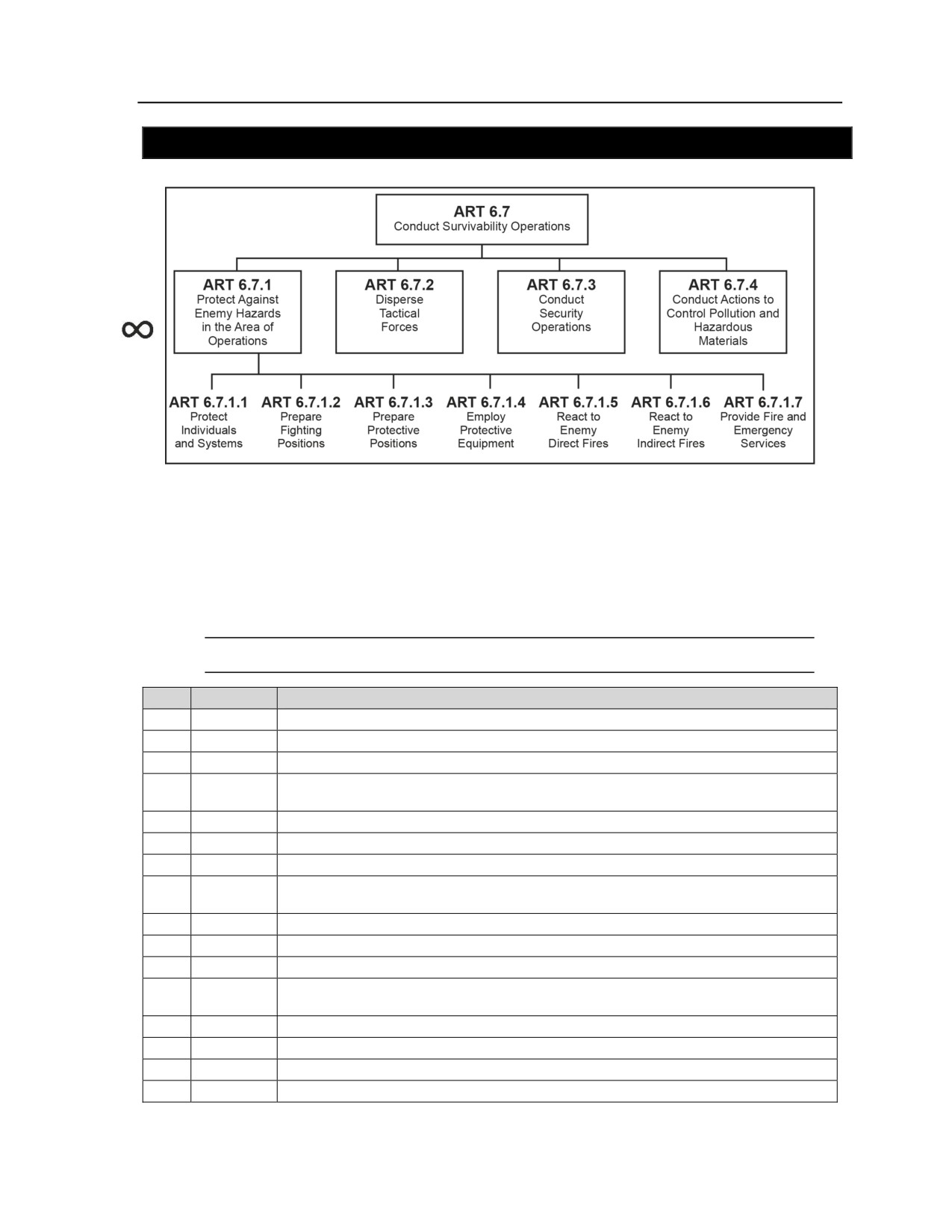
SECTION VII - ART 6.7: CONDUCT SURVIVABILITY OPERATIONS
6-80. ART 6.7 is a concept that includes all aspects of protecting personnel, weapons, and supplies while
simultaneously deceiving the enemy. Survivability tactics include building a good defense; employing
frequent movement; using concealment, deception, and camouflage; and constructing fighting and
protective positions for both individuals and equipment. Included are those assessments and surveys
completed as a part of focused engineer reconnaissance support that includes infrastructure reconnaissance.
(See FM 3-34.170.) Survivability operations are the development and construction of protective positions,
such as earth berms, dug-in positions, overhead protection, and countersurveillance means, to reduce the
effectiveness of enemy weapon systems. (FM 5-103) (USAES)
Note: This task branch is supported by ART 2.2.3 (Provide Intelligence Support to Protection).
No.
Scale
Measure
01
Yes/No
Unit could continue to conduct operations.
02
Yes/No
Unit losses from hazards were at acceptable levels.
03
Yes/No
Unit could determine when contaminated area was at a level with acceptable risk.
Unit performed risk assessment of all areas in the area of operations (AO) that
04
Yes/No
underwent chemical, biological, radiological, and nuclear (CBRN) weapons attack.
05
Time
Required to conduct an area reconnaissance.
06
Time
To determine that unit has been attacked by CBRN weapons.
07
Time
To predict downwind hazard from the use of CBRN weapons.
To disseminate hazard information to all units in the AO and appropriate headquarters
08
Time
and agencies outside the AO.
09
Time
To harden unit equipment, facilities, and positions.
10
Time
To acquire equipment and supplies necessary to harden a unit or installation.
11
Percent
Of U.S. military and civilian casualties.
Of increased time it takes the unit to conduct its operations due to the need to protect
12
Percent
against identified hazards.
13
Percent
Of unit that has completed risk management and safety training.
14
Percent
Of friendly casualties due to failure to report the existence of hazards.
15
Percent
Of on-hand, mission-capable equipment necessary to protect the unit against hazards.
16
Percent
Of on-hand supplies necessary to protect the unit against hazards.
18 March 2011
FM 7-15, C6
6-45
Chapter 6
No.
Scale
Measure
17
Percent
Of planned fighting positions completed.
18
Percent
Of planned protective positions completed.
19
Number
Of planned fighting positions completed.
20
Number
Of planned protective positions completed.
21
Number
And types of on-hand equipment necessary to protect the unit against hazards.
22
Number
And types of friendly equipment destroyed or damaged by enemy action.
Of incidents of damage to units and facilities in the AO that impact the commander’s
23
Number
concept of operations.
24
Number
Of U.S. military and civilian casualties due to enemy hazards.
ART 6.7.1 PROTECT AGAINST ENEMY HAZARDS IN THE AREA OF
OPERATIONS
6-81. Protect the friendly force in an area of operations (AO) by reducing or avoiding the effects of enemy
weapon systems. (FM 3-0) (USACAC)
No.
Scale
Measure
01
Yes/No
Unit could continue to conduct operations.
02
Yes/No
Unit losses from hazards were at acceptable levels.
03
Time
To conduct an area reconnaissance to identify hazards.
04
Time
To disseminate hazard data to all elements operating in the AO.
05
Time
To analyze the impact of identified hazards.
06
Time
To obtain necessary equipment and supplies to protect against hazards.
07
Time
To protect the unit and its facilities, equipment, and supplies against hazards.
Of increased time it takes the unit to conduct its operations because of the need to
08
Percent
protect against identified hazards.
09
Percent
Of unit that has completed risk management and safety training.
10
Percent
Of friendly casualties due to failure to report existence of hazards.
Of on-hand, mission-capable equipment that is necessary to protect the unit against
11
Percent
hazards.
12
Percent
Of U.S. military and civilian casualties.
Of on-hand supplies (chemoprophylaxis, pretreatments, and barrier creams) necessary
13
Percent
to protect the unit against hazards.
14
Percent
Of planned protective positions completed.
15
Number
Of planned protective positions completed.
16
Number
And types of on-hand equipment necessary to protect against hazards.
17
Number
And types of friendly equipment destroyed or damaged by enemy action.
Of incidents of damage to units and facilities in the AO that impact the concept of
18
Number
operations.
19
Number
Of U.S. military and civilian casualties due to enemy hazards.
ART 6.7.1.1 PROTECT INDIVIDUALS AND SYSTEMS
6-82. Use protective positions (natural or artificial), measures, or equipment—such as armor, detection
equipment, mission-oriented protective posture gear (MOPP), and collective protective equipment—to
reduce effects of enemy weapon systems. ART 6.7.1.1 includes construction of fighting and survivability
positions, conduct of chemical, biological, radiological, and nuclear defense, and responding to enemy
fires. (FM 3-0) (USACAC)
6-46
FM 7-15, C6
18 March 2011
ART 7.0: Full Spectrum Operations, Tactical Mission Tasks, and Operational Themes
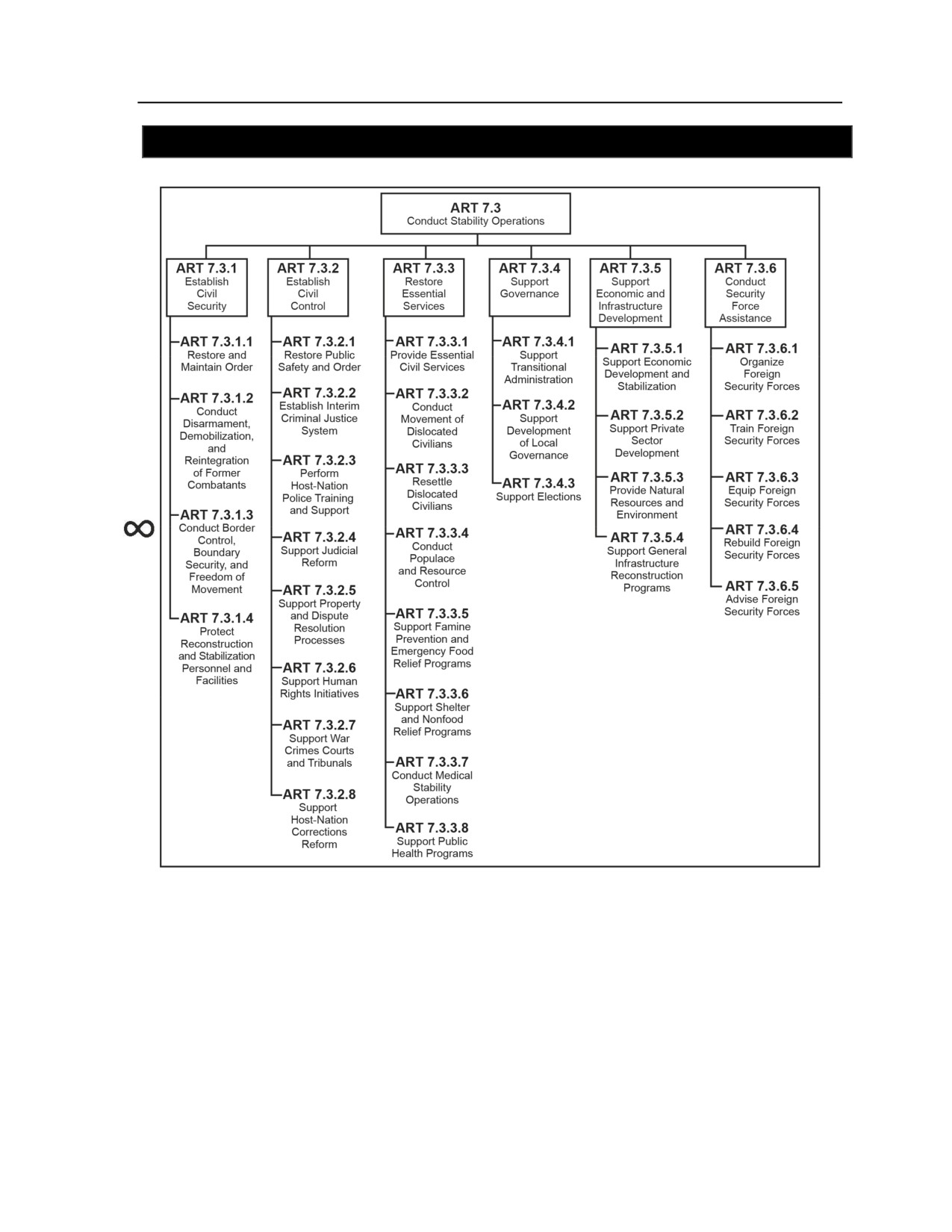
SECTION III - ART 7.3: CONDUCT STABILITY OPERATIONS
7-30. Stability operations encompass various military missions, tasks, and activities conducted outside the
United States in coordination with elements of combat to maintain or reestablish a safe and secure
environment, provide essential government services, emergency infrastructure reconstruction, and
humanitarian relief. Stability operations can be conducted in support of a host-nation or interim government
or as part of an occupation when no government exists. Stability operations involve both coercive and
constructive actions by the military force. They are designed to establish a safe and secure environment;
facilitate reconciliation among local or regional adversaries; establish political, legal, social, and economic
institutions; and facilitate the transition to legitimate local governance. Army forces conduct five stability
tasks: civil security, civil control, restore essential services, support to governance, and support to
economic and infrastructure development. (FM 3-0) (USACAC)
18 March 2011
FM 7-15, C6
7-7
Chapter 7
Note: This task branch only addresses those tasks that support the conduct of Army stability
operations. Other tasks that support stability operations are addressed elsewhere in the AUTL:
ART 6.5.4 (Provide Protective Services for Selected Individuals) addresses the protection of personnel.
ART 6.5.2 (Conduct Critical Installations and Facilities Security) addresses the protection of facilities.
ART 6.12 (Provide Explosive Ordnance Disposal Protection Support) addresses the conduct of
unexploded ordnance disposal.
ART 7.3.1 ESTABLISH CIVIL SECURITY
7-31. Civil security involves providing for the safety of the state and its population, including protection
from internal and external threats. Civil security includes a diverse set of activities, ranging from enforcing
peace agreements to executing disarmament, demobilization, and reintegration. For the other stability tasks
to be effective, civil security is required. Establishing a safe, secure, and stable environment for the local
populace is key to obtaining their support for the overall stability operation. To help establish civil security,
military forces enforce ceasefires, supervise disengagement of belligerent forces, and neutralize potential
adversaries. As soon the host-nation security forces can safely perform this task, Army forces transition
civil security responsibilities to them. (FM 3-0) (USACAC)
Note: ART 7.6.3.4 (Conduct Peace Enforcement Operations) addresses the measures that help
military forces establish a sustained peace.
No.
Scale
Measure
Unit protected vulnerable elements of population—refugees, internally displaced
01
Yes/No
persons, women, children.
02
Yes/No
Unit provided interim security programs for at-risk populations.
03
Yes/No
Unit established and maintained order in refugee camps and population centers.
04
Yes/No
Unit ensured safety of quartered personnel and families.
05
Yes/No
Unit ensured adequate health, food provisions, and security for demobilized belligerents.
06
Yes/No
Unit protected and secured places of religious worship and cultural sites.
Unit protected and secured critical infrastructure, natural resources, civil registries, and
07
Yes/No
property ownership documents.
Unit identified, secured, and protected stockpiles of conventional, biological,
08
Yes/No
radiological, nuclear, and chemical materials.
09
Yes/No
Unit secured military depots, equipment, ammunition depots, and means of communication.
Unit protected and secured strategically important institutions such as government
10
Yes/No
buildings, museums, religious sites, courthouses, and communications.
Unit secured records, storage, equipment, and funds related to criminal justice and
11
Yes/No
security institutions.
12
Yes/No
Unit provided security for negotiations among host-nation belligerents.
13
Yes/No
Unit protected private property and factories.
14
Time
To begin ceasefire enforcement.
15
Time
To reintegrate combatants and promote civilian control.
16
Time
To establish public order and safety
To develop integrated command, control, intelligence and information sharing
17
Time
arrangements between international military, constabulary, and civilian police forces.
To create host-nation capacity to protect government sponsored civilian stabilization
18
Time
and reconstruction personnel.
19
Time
To create host-nation capacity to protect host-nation individuals, infrastructure, and institutions.
7-8
FM 7-15, C6
18 March 2011
ART 7.0: Full Spectrum Operations, Tactical Mission Tasks, and Operational Themes
No.
Scale
Measure
13
Yes/No
Unit established sanitary practices and procedures (production and processing).
14
Yes/No
Unit improved food safety systems to facilitate agricultural trade.
To identify policy makers in the agricultural, natural resources, and environment areas
15
Time
and discuss their priorities for their respective sectors.
ART 7.3.5.4 SUPPORT GENERAL INFRASTRUCTURE RECONSTRUCTION PROGRAMS
7-66. General infrastructure reconstruction programs focus on rehabilitating the state’s ability to produce
and distribute fossil fuels, generate electrical power, exercise engineering and construction support, and
provide municipal and other services to the populace. As with the restoration of essential services, support
to general infrastructure programs requires a thorough understanding of the civil component of the area of
operations. Civil affairs personnel support this information collection to inform the prioritization of
programs and projects. (FM 3-07) (USACAC)
No.
Scale
Measure
Unit assessed overall condition of national transportation infrastructure (airports, roads,
01
Yes/No
bridges, railways, and coastal and inland ports, harbors, and waterways).
Unit initiated immediate improvement to the transportation and distribution networks of
02
Yes/No
the host nation.
03
Yes/No
Unit assessed overall condition of national telecommunications infrastructure.
04
Yes/No
Unit assessed overall condition of national energy infrastructure.
05
Yes/No
Unit assessed overall condition of existing power generation and distribution facilities.
Unit assessed overall condition of existing natural resources conversion and distribution
06
Yes/No
facilities.
Unit assessed overall condition of existing facilities integral for effectively executing
07
Yes/No
essential tasks in other sectors.
Unit assessed overall condition of existing local, municipal facilities that provide
08
Yes/No
essential services.
09
Yes/No
Unit determined and prioritized essential infrastructure programs and projects.
10
Yes/No
Unit conducted expedient repairs or built new facilities to support stabilization.
11
Yes/No
Unit conducted expedient repairs or built new facilities to facilitate commercial trade.
Unit conducted expedient repairs or built new facilities to support local populace (such
12
Yes/No
as schools, medical clinics, and municipal buildings).
+ ART 7.3.5.4.1 Support Host-Nation Telecommunications Infrastructure Reconstruction
Program
7-67. Support to Host-Nation Telecommunications Infrastructure Program focuses on providing initial
assessment of the operational readiness and capabilities of the host nation’s official public communications
systems (and when or if necessary private telecommunications systems.) The systems enable a government
to communicate with its populace. This includes mass media systems including radio station equipment and
antennae systems, television stations and antenna systems, data network equipment and servers which
connect to the wider internet, and wired or wireless telephone central systems and antennae. This requires
thoroughly understanding the technical operation of commercial off-the-shelf equipment and systems used
in providing mass communications systems. (FM 3-07). (USACAC)
No.
Scale
Measure
Unit assessed and prioritized television broadcast telecommunications capabilities
01
Yes/No
available to the host-nation government authority.
Unit assessed and prioritized radio broadcast telecommunications capabilities available
02
Yes/No
to the host-nation government authority.
Unit assessed and prioritized internet system capabilities available to the host-nation
03
Yes/No
government for internal and external communications.
18 March 2011
FM 7-15, C6
7-23

Chapter 7
No.
Scale
Measure
Unit assessed and prioritized wired and wireless telephonic telecommunications
04
Yes/No
capabilities available to the host-nation government authority.
Of state or geographic region’s government authorities which can complete two-way
05
Percent
electronic communications with the host-nation government authority and supporting
US nongovernmental organizations.
Of state or geographic region’s government authorities with which the host-nation
06
Percent
government authority can communicate with one-way communications.
∞ART 7.3.6 CONDUCT SECURITY FORCE ASSISTANCE
7-68. Security force assistance is the unified action to generate, employ, and sustain local, host-nation or
regional security forces in support of a legitimate authority. Security force assistance improves the
capability and capacity of host-nation or regional security organization’s security forces, collectively
referred to as foreign security forces (FSF). (FM 3-07.1) (USACAC)
No.
Scale
Measure
Unit organized foreign security assistance forces to assist FSF in improving its
01
Yes/No
organizational structure, processes, institutions, and infrastructure.
Unit developed programs and institutions to train and educate FSF within the nature
02
Yes/No
and requirements of their security environment.
Unit exerted all required efforts to assess and assist FSF with procuring equipment that
03
Yes/No
fit the nature of the operational environment.
Unit exerted all required efforts to assess and assist FSF with fielding equipment that fit
04
Yes/No
the nature of the operational environment.
Unit exerted all required efforts to assess and assist FSF with the sustainment of
05
Yes/No
equipment that fit the nature of the operational environment.
Unit conducted an in-depth analysis of the host nation’s ability to meet the desired end
06
Yes/No
state within the operational environment.
Unit established a professional relationship providing a positive influence to the foreign
07
Yes/No
security force.
Unit provided the required supporting or sustaining capabilities so FSF can meet
08
Yes/No
objectives and the end state.
09
Yes/No
Unit gave advice and assistance until FSF could establish required systems.
∞ART 7.3.6.1 ORGANIZE FOREIGN SECURITY FORCES
7-69. U.S. forces assist the host nation to organize its security forces to meet the needs of its security
environment. Provided assistance must improve their organizational structure, processes, institutions, and
infrastructure. (FM 3-07.1) (USACAC)
No.
Scale
Measure
01
Yes/No
Unit coordinated with the host nation on criteria for organizing their forces.
02
Yes/No
Unit had an appropriate host-nation vetting and screening process in place.
Unit had a recruitment plan for each type of security force element, such as military,
03
Yes/No
paramilitary, police, and intelligence element.
04
Yes/No
Unit had a plan to monitor recruits of (formerly) illegal organizations.
Unit’s recruiting plan incorporated disarming, demobilizing, and reintegrating former
05
Yes/No
enemies or other armed groups.
06
Yes/No
Unit’s recruiting plan screened for potential leaders.
Unit had a plan to coordinate personnel accounting procedures with host-nation
07
Yes/No
leadership.
7-24
FM 7-15, C6
18 March 2011
ART 7.0: Full Spectrum Operations, Tactical Mission Tasks, and Operational Themes
No.
Scale
Measure
08
Yes/No
Command provided proper compensation tools to minimize opportunities for corruption.
09
Yes/No
Unit established a system for promotion based on objective criteria.
∞ART 7.3.6.2 TRAIN FOREIGN SECURITY FORCES
7-70. U.S. forces assist foreign security forces (FSF) by developing programs and institutions to train and
educate FSF. These efforts must fit the nature and requirements of their security environment. The
imperatives of U.S. forces for facilitating a comprehensive approach and engaging the threat discriminately
apply to the train task. Training incorporates the individual and collective skills performed in conventional
military operations. (FM 3-07.1) (USACAC)
No.
Scale
Measure
Unit assessed degrees of preparation necessary for trainers and advisors to succeed in
01
Yes/No
selected host nation.
Unit assessed nontechnical skills (such as culture, language, and situational
02
Yes/No
understanding) necessary for trainers and advisors to succeed in selected host nation.
Unit determined levels of proficiency necessary for trainers and advisors to succeed in
03
Yes/No
selected host nation.
Unit established processes to identify assigned personnel with existing skills or
04
Yes/No
experience necessary for training and advising host-nation FSF.
Unit established processes to track assigned personnel with existing skills or
05
Yes/No
experience necessary for training and advising host-nation FSF.
Unit established processes to prepare assigned personnel to train and advise host-
06
Yes/No
nation FSF.
Unit consulted with the appropriate country teams to establish baselines for preparation
07
Yes/No
of trainers and advisors.
08
Yes/No
Program included host-nation assistance in preparing U.S. trainers and advisors.
09
Yes/No
Program utilized joint resources to prepare trainers and advisors.
10
Yes/No
Program utilized Army resources to prepare trainers and advisors.
11
Yes/No
Plan considered the host nation’s desired end state.
Unit adapted unit mission-essential task list to support a security force assistance
12
Yes/No
mission.
13
Yes/No
Plan addressed the training—individual and collective—of host-nation instructors.
14
Yes/No
Unit assessed the capabilities of the various host-nation forces.
15
Yes/No
Unit synchronized U.S. military activities with the host-nation activities.
16
Yes/No
Training plan had elements devoted to human rights training.
17
Yes/No
Training plan had elements devoted to law of armed conflict training.
18
Yes/No
Training plan had elements devoted to rules of engagement training.
Unit developed programs and institutions to train and educate FSF within the nature
19
Yes/No
and requirements of their security environment.
∞ART 7.3.6.3 EQUIP FOREIGN SECURITY FORCES
7-71. The equipping of foreign security forces
(FSF) is accomplished through several mechanisms
including traditional security assistance, foreign military support, and donations. Equipment must be
appropriate for host-nation sustainment and property accountability procedures. The equipping of foreign
security forces encompasses efforts to assess and assist FSF with the procurement, fielding, and
sustainment of equipment. All equipment must fit the nature of the operational environment. The security
force assistance principle of ensuring long-term sustainment is a vital consideration for the equip task.
(FM 3-07.1) (USACAC)
18 March 2011
FM 7-15, C6
7-25

Chapter 7
No.
Scale
Measure
01
Yes/No
Unit had a current or initial FSF equipping plan.
02
Yes/No
Unit had a long-term (beyond four years) FSF equipping plan.
03
Yes/No
Equipping plan reflected the current and anticipated threat to the host nation.
04
Yes/No
Unit had an approved budget for FSF sustainment.
05
Time
Between assessments that may require equipping plan to be adjusted.
Of contracts established with host-nation local suppliers for logistics, maintenance,
06
Number
support, and materials.
07
Number
Of staff assistance visits per year conducted to assess FSF sustainment programs.
Of training programs for core logistics functions (logistics, maintenance, health
08
Number
services, etc.) been established.
Of host-nation sustainment facilities considered suitable to support FSF training or
09
Number
basing.
∞ART 7.3.6.4 REBUILD FOREIGN SECURITY FORCES
7-72. U.S. forces assist the host nation to assess, rebuild, and build the existing capabilities and capacities
of foreign security forces (FSF) and their supporting infrastructure. This task requires an in-depth analysis
of the capability, capacity, and structures required to meet the desired end state within the operational
environment. Some FSF may require assistance in building and rebuilding, while other FSF may only need
assistance in building.
(FM 3-07.1) (USACAC)
No.
Scale
Measure
Unit modified anticipated and prepared capacity building in accordance with current
01
Yes/No
host-nation infrastructure.
02
Yes/No
Unit coordinated host-nation infrastructure requirements with country teams.
03
Yes/No
Unit coordinated host-nation infrastructure requirements with host nation.
04
Yes/No
Staff assessed constraints and limitations in host-nation resources.
05
Yes/No
Staff assessed constraints and limitations in host-nation funding.
Unit considered potential training facilities and areas (such as ranges, urban terrain,
06
Yes/No
and training sites).
07
Yes/No
Unit developed a prioritized list of assessment criteria.
Assessment team possessed at least one member trained to antiterrorism force
08
Yes/No
protection level II.
09
Yes/No
Unit prioritized host-nation infrastructure requirements for U.S. support efforts.
10
Yes/No
Unit conducted a vulnerability assessment on FSF facilities.
11
Yes/No
FSF had a long-term basing plan.
∞ART 7.3.6.5 ADVISE FOREIGN SECURITY FORCES
7-73. U.S. forces advise foreign security forces (FSF) to improve their capability and capacity. Advising
establishes a personal and a professional relationship where trust and confidence define how well the
advisor can influence the foreign security force. Assisting is providing the required supporting or sustaining
capabilities so FSF can meet objectives and the end state. The level of advice and assistance is based on
conditions and should continue until FSF can establish required systems or until conditions no longer
require it. (FM 3-07.1) (USACAC)
No.
Scale
Measure
01
Yes/No
Unit had a security force assistance integrated program.
02
Yes/No
Unit determined the method of advising FSF.
03
Yes/No
Unit identified relevant training—such as language, regional, and cultural— required for
7-26
FM 7-15, C6
18 March 2011
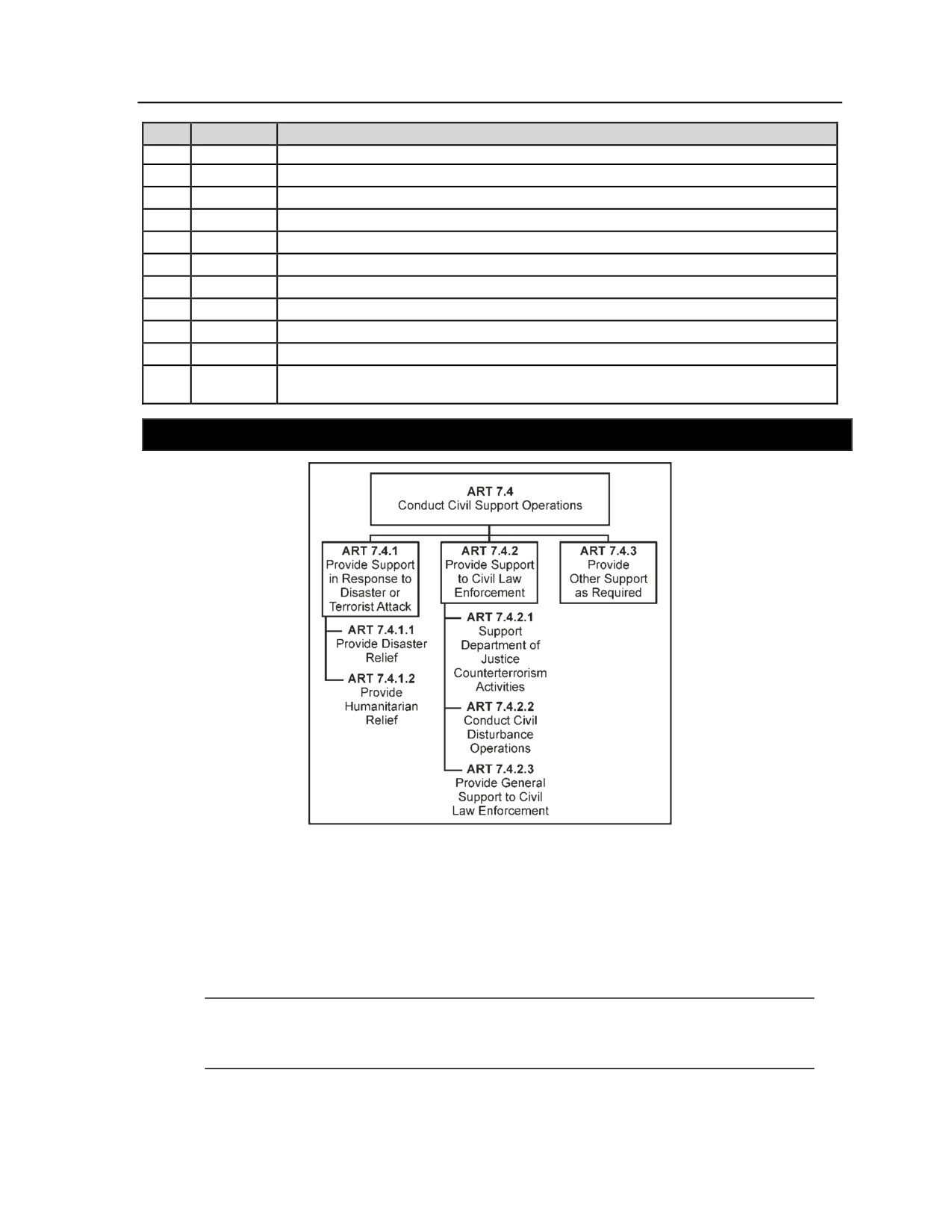
ART 7.0: Full Spectrum Operations, Tactical Mission Tasks, and Operational Themes
No.
Scale
Measure
advisors.
04
Yes/No
Unit developed sustainment and contingency plans in support of an advisory team.
05
Yes/No
Unit assessed constraints and limitations in host-nation funding.
06
Yes/No
Unit assessed the host-nation program of internal defense.
07
Yes/No
Unit assessed host-nation doctrine.
08
Yes/No
Unit assessed host-nation organization.
09
Yes/No
Unit assessed host-nation instructors’ capabilities.
10
Yes/No
Unit considered language differences that may impact FSF capabilities.
11
Yes/No
Unit considered cultural differences that may impact FSF capabilities.
12
Yes/No
Unit assessed internal and external threats to the host nation.
Unit had the personnel and tools to determine effectiveness for FSF before, during, and
13
Yes/No
after training.
SECTION IV - ART 7.4: CONDUCT CIVIL SUPPORT OPERATIONS
7-74. Civil support is Department of Defense support to U.S. civil authorities for domestic emergencies,
and for designated law enforcement and other activities. Civil support includes operations that address the
consequences of natural or manmade disasters, accidents, and incidents within the United States and its
territories. Army forces conduct civil support operations when the size and scope of events exceed the
capabilities of domestic civilian agencies. The Army National Guard is often the first military force to
respond on behalf of state authorities. Army civil support operations include three tasks: provide support in
response to a disaster, support civil law enforcement, and provide other support as required. (FM 3-0)
(USACAC)
Note: Chemical, biological, radiological, nuclear, and high-yield explosives weapons and
explosive ordnance disposal support provided in civil support are tasks addressed elsewhere in
the AUTL:
18 March 2011
FM 7-15, C6
7-27
Chapter 7
ART 6.9.5 (Conduct Chemical, Biological, Radiological, Nuclear, and High-Yield Explosives
Consequence Management) discusses the coordination of essential services and activities
required to manage and mitigate damage resulting from the use of chemical, biological,
radiological, and nuclear weapons or the release of toxic industrial materials or contaminants.
ART 6.12.8.5 (Provide Explosive Ordnance Disposal Support to Civil Authorities) addresses
assistance to include providing explosive ordnance disposal service when requested by local,
state, or federal authorities in the interest of public safety.
ART 6.12.8.6 (Provide Specific Training to Personnel on Explosive Ordnance Disposal)
addresses training for military personnel, federal agencies, and public officials involved with
civil emergency preparedness, law enforcement, and fire protection as requested.
ART 7.4.1 PROVIDE SUPPORT IN RESPONSE TO DISASTER OR
TERRORIST ATTACK
7-75. Disaster relief operations focus on recovery of critical infrastructure after natural or man-made
disasters. Humanitarian relief focuses on the well-being of supported populations. Both normally occur
simultaneously. In the case of a disaster, state, and local authorities are responsible for restoring essential
services. (FM 3-07) (USACAC)
ART 7.4.1.1 PROVIDE DISASTER RELIEF
7-76. Disaster relief restores or recreates essential infrastructure. It includes establishing and maintaining
the minimum safe working conditions, less security measures, necessary to protect relief workers and the
affected population. Disaster relief allows effective humanitarian relief and creates conditions for long-term
recovery. It may involve consultation on and provision of emergency medical treatment and evacuation;
repairing or demolishing damaged structures; restoring or building bridges, roads, and airfields; and
removing debris from supply routes and relief sites. (FM 3-07) (USACAC)
Note: Disaster relief includes the submissions of military assistance to civilian disaster
organizations, natural disaster relief, oil and hazardous substances incident or emergency, public
health emergency, as well as technological or man-made disaster relief.
ART 7.4.1.2 PROVIDE HUMANITARIAN RELIEF
7-77. Humanitarian relief focuses on lifesaving measures that alleviate the immediate needs of a
population in crisis. It often includes providing medical support, food, water, medicine, clothing, blankets,
shelter, and heating or cooking fuels. In some cases, it involves transporting affected people from a disaster
area. Civilian relief agencies, government and nongovernmental, are best suited to provide this type of
relief. Army forces conducting humanitarian relief usually facilitate civil relief efforts.
(FM 3-07)
(USACAC)
ART 7.4.2 PROVIDE SUPPORT TO CIVIL LAW ENFORCEMENT
7-78. Support to domestic civil law enforcement involves activities related to the Department of Justice’s
counterterrorism activities, counterdrug activities, military assistance during civil disturbances, and general
support. Army support involves providing resources, training, or augmentation. Federal military forces
remain under the military chain of command while supporting civil law enforcement. The supported law
enforcement agency coordinates Army forces activities per appropriate civil laws and interagency
agreements. Army National Guard units in state status can be a particularly useful military resource. They
may be able to provide assistance to civil authorities when federal units cannot due to the Posse Comitatus
Act. Title 10 U.S. Code prohibits the military from directly participating in arrests, searches, seizures, or
other similar activities unless authorized by law. (FM 3-07) (USACAC)
7-28
FM 7-15, C6
18 March 2011
ART 7.0: Full Spectrum Operations, Tactical Mission Tasks, and Operational Themes
Note: Support to civil law enforcement includes border protection enforcement, combating
terrorism, critical infrastructure protection as well as Department of Defense support to
counterdrug operations.
Army missions related to supporting civil law enforcement in counterdrug operations are
discussed under ART 7.6.1.5 (Provide Military Support to Counterdrug Efforts).
ART 7.4.2.1 SUPPORT DEPARTMENT OF JUSTICE COUNTERTERRORISM ACTIVITIES
7-79. When directed by the President, Army forces may provide assistance to the Department of Justice in
the areas of transportation, equipment, training, and personnel. When terrorists pose an imminent threat,
Army forces may be used to counter these threats. Army forces may also support crisis management. Crisis
management of a terrorist incident includes measures to resolve a situation and investigate a criminal case
for prosecution under federal law. The Federal Bureau of Investigation is the lead agency and has
responsibility for crisis management within the United States. Army forces may provide specialized or
technical capabilities to assist in defusing or resolving a terrorist crisis. Support of crisis management
includes opening lines of communications for military assistance, evacuating casualties, executing
reconnaissance, and decontaminating or assessing the effects of weapons of mass destruction. In the
aftermath of a terrorist incident, Army forces may be involved in consequence management activities.
These activities include casualty and medical assistance, evaluation and repair of damage to structures and
utilities, explosive ordnance disposal, and mortuary affairs. (FM 3-07) (USACAC)
ART 7.4.2.2 CONDUCT CIVIL DISTURBANCE OPERATIONS
7-80. Army forces assist civil authorities in restoring law and order when state and local law enforcement
agencies are unable to control civil disturbances. The Army National Guard is the first military responder
during most civil disturbance situations. It usually remains on state active-duty status throughout the
operation. When conditions of domestic violence and disorder endanger life and property to the extent that
state law enforcement agencies, to include the Army National Guard, cannot suppress violence and restore
law and order, the President may federalize Army National Guard units under Title 10, U.S. Code, Chapter
15. The President may use federalized Army National Guard and federal forces to restore law and order.
Restrictions may be placed on federal military forces either in the executive order directing their use or
through the rules for the use of force outlined in the Department of Defense Civil Disturbance Plan.
(FM 3-07) (USACAC)
ART 7.4.2.3 PROVIDE GENERAL SUPPORT TO CIVIL LAW ENFORCEMENT
7-81. Provide limited military support to law enforcement agencies. Department of Defense may direct
Army forces to provide training to federal, state, and local civilian law enforcement agencies. Such
assistance may include training in the operation and maintenance of military equipment. (FM 3-07)
(USACAC)
ART 7.4.3 PROVIDE OTHER SUPPORT AS REQUIRED
7-82. Community assistance is a broad range of activities that provide support and maintain a strong
connection between the military and civilian communities. Community assistance activities provide
effective means of projecting a positive military image, provide training opportunities, and enhance the
relationship between Army forces and the American public. They should fulfill community needs that
would not otherwise be met. Community assistance activities can enhance individual and unit combat
readiness. Army assistance to the community can include air ambulance support, search and rescue
activities, firefighting capability, explosive ordnance disposal, emergency or broad-based medical care,
wildlife and domestic animal management, assistance in safety and traffic control, emergency snow
removal, temporary supplemental housing for the displaced or disadvantaged, and postal augmentation.
(FM 3-0) (USACAC)
18 March 2011
FM 7-15, C6
7-29
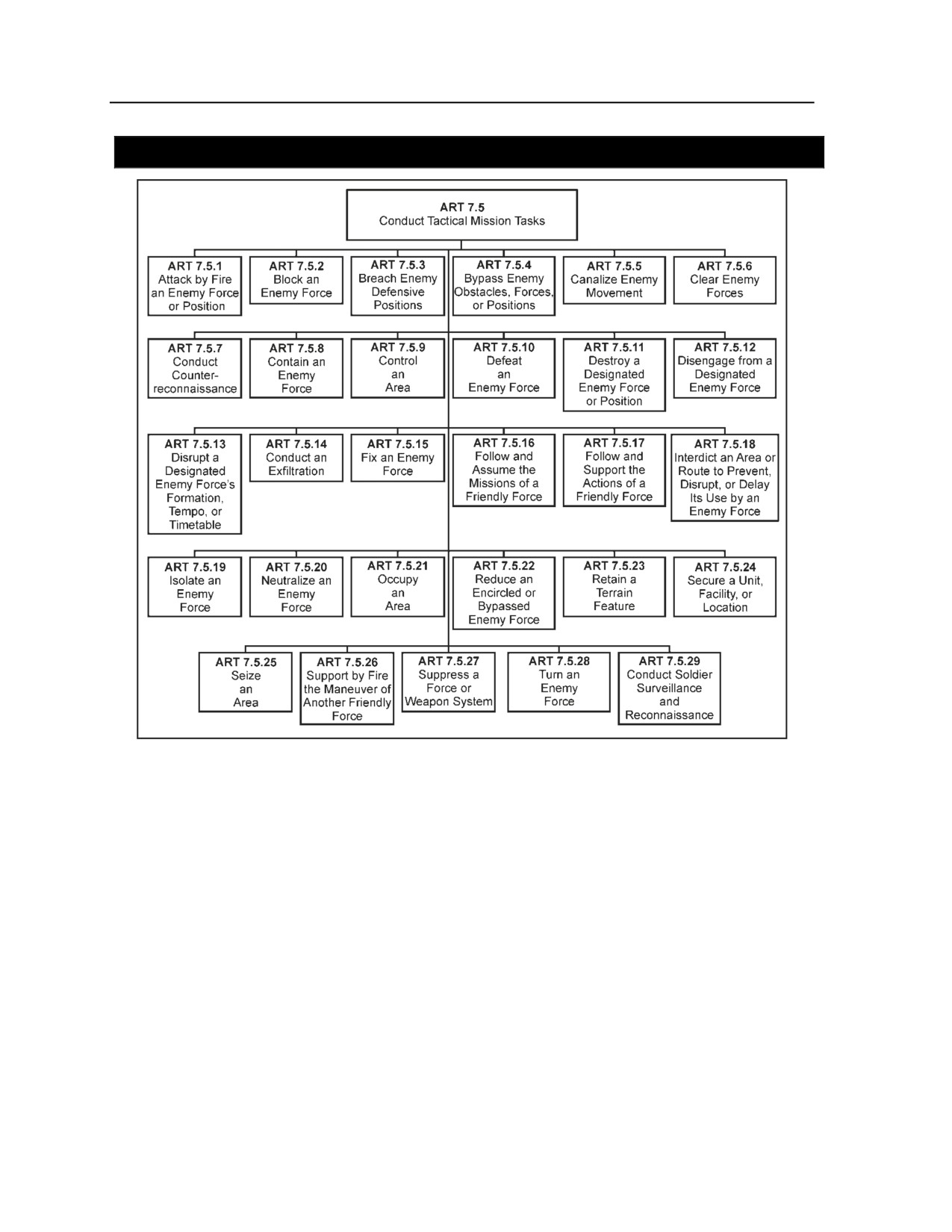
Chapter 7
SECTION V - ART 7.5: CONDUCT TACTICAL MISSION TASKS
7-83. Tactical mission tasks describe lethal and nonlethal results or effects the commander wants to
generate or create to accomplish the mission (they are the what or why of a mission statement). The tasks in
this section are often given to units as the tasks or purpose parts of their mission statement. (FM 3-90)
(USACAC)
ART 7.5.1 ATTACK BY FIRE AN ENEMY FORCE OR POSITION
7-84. Attack by fire uses direct fires, supported by indirect fires, to engage an enemy without closing to
destroy, suppress, fix, or deceive the enemy. (FM 3-90) (USACAC)
ART 7.5.2 BLOCK AN ENEMY FORCE
7-85. Block denies the enemy access to an area or prevents an advance in a direction or along an avenue of
approach. (FM 3-90) (USACAC)
ART 7.5.3 BREACH ENEMY DEFENSIVE POSITIONS
7-86. Breach employs all available means to break through or secure a passage through a defense, obstacle,
minefield, or fortification. (FM 3-90) (USACAC)
7-30
FM 7-15, C6
18 March 2011
ART 7.0: Full Spectrum Operations, Tactical Mission Tasks, and Operational Themes
ART 7.5.4 BYPASS ENEMY OBSTACLES, FORCES, OR POSITIONS
7-87. Bypass is when the commander directs the unit to maneuver around an obstacle, position, or enemy
force to maintain the momentum of the operation, while deliberately avoiding combat with the enemy
force. (FM 3-90) (USACAC)
ART 7.5.5 CANALIZE ENEMY MOVEMENT
7-88. Canalize is when the commander restricts enemy movement to a narrow area by exploiting terrain,
obstacles, fires, or friendly maneuver. (FM 3-90) (USACAC)
ART 7.5.6 CLEAR ENEMY FORCES
7-89. Clear requires the commander to remove all enemy forces and eliminate organized resistance within
an assigned area. Physical conditions of the area will affect the specific tactics, techniques, and procedures
employed. (FM 3-90) (USACAC)
ART 7.5.7 CONDUCT COUNTERRECONNAISSANCE
7-90. Counterreconnaissance encompasses all measures taken by a commander to counter enemy
surveillance and reconnaissance efforts. Counterreconnaissance is not a distinct mission but a component of
all forms of security operations. See ART 6.7.3 (Conduct Security Operations). (FM 3-90) (USACAC)
ART 7.5.8 CONTAIN AN ENEMY FORCE
7-91. Contain requires the commander stop, hold, or surround enemy forces; or cause them to focus their
activity on a given front and prevent them from withdrawing any element for use elsewhere. (FM 3-90)
(USACAC)
ART 7.5.9 CONTROL AN AREA
7-92. Control requires the commander to maintain physical influence over a specified area to prevent its
use by an enemy. (FM 3-90) (USACAC)
ART 7.5.10 DEFEAT AN ENEMY FORCE
7-93. Defeat occurs when an enemy force has temporarily or permanently lost the physical means or will to
fight. The defeated force’s commander is unwilling or unable to pursue an adopted course of action,
thereby yielding to the friendly commander’s will and can no longer interfere to a significant degree with
the actions of friendly forces. Defeat can result from the use of force or the threat of its use. (FM 3-90)
(USACAC)
ART 7.5.11 DESTROY A DESIGNATED ENEMY FORCE OR
POSITION
7-94. Destroy involves the physical rendering of an enemy force to combat ineffectiveness until it is
reconstituted. Alternatively, to destroy a combat system is to damage it so badly that it cannot perform its
function or be restored to a usable condition without being entirely rebuilt. (FM 3-90) (USACAC)
ART 7.5.12 DISENGAGE FROM A DESIGNATED ENEMY FORCE
7-95. Disengagement is when a commander has the unit break contact with the enemy to allow the conduct
of another mission or to avoid decisive engagement. (FM 3-90) (USACAC)
18 March 2011
FM 7-15, C6
7-31
Chapter 7
ART 7.5.13 DISRUPT A DESIGNATED ENEMY FORCE’S
FORMATION, TEMPO, OR TIMETABLE
7-96. Disrupt is when a commander integrates direct and indirect fires, terrain, and obstacles to upset an
enemy formation or tempo, interrupt the timetable, or cause forces to commit prematurely or attack in a
piecemeal fashion. (FM 3-90) (USACAC)
ART 7.5.14 CONDUCT AN EXFILTRATION
7-97. Exfiltrate is where a commander removes personnel or units from areas under enemy control by
stealth, military deception, surprise, or clandestine means. (FM 3-90) (USACAC)
ART 7.5.15 FIX AN ENEMY FORCE
7-98. Fix is where a commander prevents the enemy from moving any part of the force from a specific
location for a specific time. (FM 3-90) (USACAC)
ART 7.5.16 FOLLOW AND ASSUME THE MISSIONS OF A FRIENDLY
FORCE
7-99. Follow and assume is when a second committed force follows a force conducting an offensive
operation and is prepared to continue the mission of that force when it becomes fixed, attritted, or otherwise
unable to continue. (FM 3-90) (USACAC)
ART 7.5.17 FOLLOW AND SUPPORT THE ACTIONS OF A
FRIENDLY FORCE
7-100. Follow and support is when a committed force follows and supports the mission accomplishment
of a leading force conducting an offensive operation. (FM 3-90) (USACAC)
ART 7.5.18 INTERDICT AN AREA OR ROUTE TO PREVENT,
DISRUPT, OR DELAY ITS USE BY AN ENEMY FORCE
7-101. Interdict is where the commander prevents, disrupts, or delays enemy use of an area or route.
(FM 3-90) (USACAC)
ART 7.5.19 ISOLATE AN ENEMY FORCE
7-102. Isolate requires a unit to seal off—physically and psychologically—an enemy force from its
sources of support, deny it freedom of movement, and prevent it from contacting other enemy forces.
(FM 3-90) (USACAC)
ART 7.5.20 NEUTRALIZE AN ENEMY FORCE
7-103. Neutralize results in rendering enemy personnel or materiel incapable of interfering with friendly
operations. (FM 3-90) (USACAC)
ART 7.5.21 OCCUPY AN AREA
7-104. Occupy involves moving a force into an area so that it can control the entire area. Both the
movement to and occupation of the area occurs without opposition. (FM 3-90) (USACAC)
7-32
FM 7-15, C6
18 March 2011
ART 7.0: Full Spectrum Operations, Tactical Mission Tasks, and Operational Themes
ART 7.5.22 REDUCE AN ENCIRCLED OR BYPASSED ENEMY
FORCE
7-105. Reduce involves the destruction of an encircled or bypassed enemy force. (FM 3-90) (USACAC)
ART 7.5.23 RETAIN A TERRAIN FEATURE
7-106. Retain is when the commander ensures a terrain feature already controlled by a friendly force
remains free of enemy occupation or use. (FM 3-90) (USACAC)
ART 7.5.24 SECURE A UNIT, FACILITY, OR LOCATION
7-107. Secure involves preventing the enemy from damaging or destroying a unit, facility, or
geographical location. (FM 3-90) (USACAC)
ART 7.5.25 SEIZE AN AREA
7-108. Seize involves taking possession of an area using overwhelming force. (FM 3-90) (USACAC)
ART 7.5.26 SUPPORT BY FIRE THE MANEUVER OF ANOTHER
FRIENDLY FORCE
7-109. Support by fire is when a maneuver force moves to a position where it can engage the enemy by
direct fire to support another maneuvering force. (FM 3-90) (USACAC)
ART 7.5.27 SUPPRESS A FORCE OR WEAPON SYSTEM
7-110. Suppression results in the temporary degradation of the performance of a force or weapon systems
below the level needed to accomplish its mission. (FM 3-90) (USACAC)
ART 7.5.28 TURN AN ENEMY FORCE
7-111. Turn involves forcing an enemy force to move from one avenue of approach or mobility corridor
to another. (FM 3-90) (USACAC)
ART 7.5.29 CONDUCT SOLDIER SURVEILLANCE AND
RECONNAISSANCE
7-112. Every Soldier, as a part of a small unit, is a potential information collector and an essential
component to answer commander’s critical information requirements and facilitate the commander’s
situational understanding. Each Soldier develops a special level of awareness simply due to exposure to
events occurring in the area of operations
(AO) and has the opportunity to collect information by
observation and interaction with the population. These observations and interactions provide depth and
context to information collected through surveillance and reconnaissance. Collecting and reporting this
information within an AO is a critical element to achieve situational understanding of the AO. Leaders
must create a climate that allows all Soldiers to feel free to report what they see and learn on a mission.
(FM 2-0 and FM 2-91.6) (USAIC)
Note: This task is supported by ART 2.3.5.1.1 (Establish a Mission Intelligence Briefing Plan)
and direct support ART 2.3.5.1.2 (Establish a Debriefing Plan).
18 March 2011
FM 7-15, C6
7-33
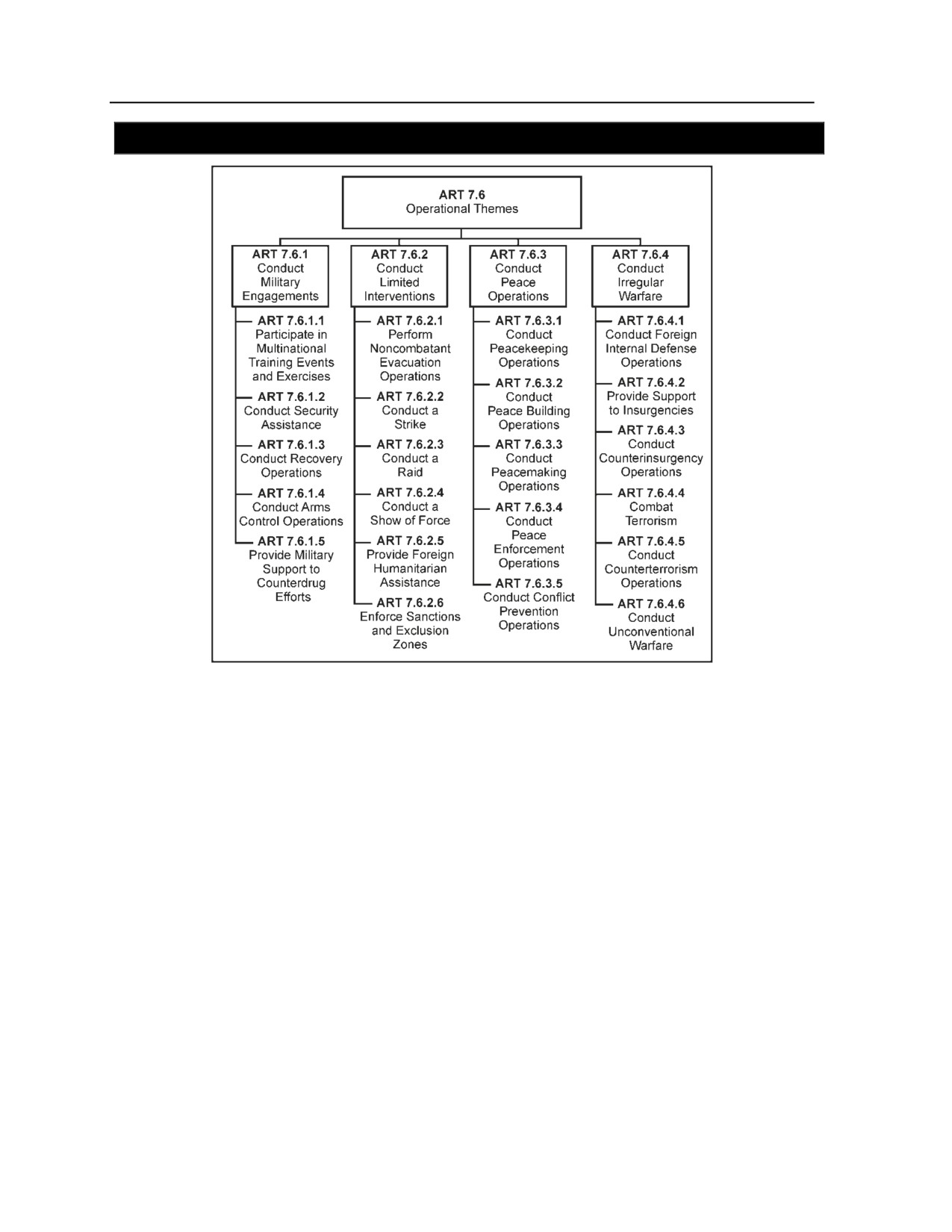
Chapter 7
SECTION VI - ART 7.6: OPERATIONAL THEMES
7-113. An operational theme describes the character of the dominant major operation being conducted at
any time within a land force commander’s area of operations. The operational theme helps convey the
nature of the major operation to the force to facilitate common understanding of how the commander
broadly intends to operate. (FM 3-0) (USACAC)
ART 7.6.1 CONDUCT MILITARY ENGAGEMENTS
7-114. Peacetime military engagement comprises all military activities that involve other nations and are
intended to shape the security environment in peacetime. It includes programs and exercises that the U.S.
military conducts with other nations to shape the international environment, improve mutual understanding,
and improve interoperability with treaty partners or potential coalition partners. Peacetime military
engagement activities are designed to support a combatant commander’s objectives within the theater
security cooperation plan. (FM 3-0) (USACAC)
ART 7.6.1.1 PARTICIPATE IN MULTINATIONAL TRAINING EVENTS AND EXERCISES
7-115. Army forces support the Chairman of the Joint Chiefs of Staff Exercise Program that is the
Chairman of the Joint Chiefs of Staff’s principal vehicle for performing joint and multinational training.
The program provides combatant commanders with their primary means to train staffs and forces in joint
and combined operations, to evaluate war plans, and to execute their engagement strategies. (FM 3-07)
(USACAC)
7-34
FM 7-15, C6
18 March 2011

ART 7.0: Full Spectrum Operations, Tactical Mission Tasks, and Operational Themes
ART 7.6.1.2 CONDUCT SECURITY ASSISTANCE
7-116. Security assistance refers to a group of programs that support U.S. national policies and objectives
by providing defense articles, military training, and other defense-related services to host nations by grant,
loan, credit, or cash sales. Army forces support security assistance efforts through military training teams,
maintenance support personnel and training, and related activities, such as humanitarian mine removal
operations. (FM 3-07) (USACAC)
No.
Scale
Measure
01
Yes/No
Unit trained and equipped host-nation military forces.
02
Yes/No
Unit provided conventional military assistance programs.
03
Yes/No
Unit established military-to-military programs with host-nation forces.
04
Yes/No
Unit trained and equipped border security personnel.
05
Yes/No
Unit trained and equipped host-nation de-mining capability.
06
Yes/No
Unit created host-nation capacity to protect private institutions and key leaders.
07
Yes/No
Unit created host-nation capacity to protect critical infrastructure.
08
Yes/No
Unit created host-nation capacity to protect military infrastructure.
09
Yes/No
Unit created host-nation capacity to protect public institutions.
Unit created host-nation capacity to protect government-sponsored civilian stabilization
10
Yes/No
and reconstruction personnel.
Unit created host-nation capacity to protect contractor and nongovernmental
11
Yes/No
organization stabilization personnel and resources.
12
Yes/No
Unit identified military infrastructure modernization needs and means to achieve them.
13
Yes/No
Unit monitored compliance with and reinforced regional security arrangements.
14
Time
To develop host-nation arms control capacity.
15
Time
To develop host-nation capacity to assure and regulate movement.
To transfer de-mining and unexploded explosive ordnance removal operations to host-
16
Time
nation personnel.
17
Time
To establish mechanisms for implementing regional security arrangements.
ART 7.6.1.3 CONDUCT RECOVERY OPERATIONS
7-117. Recovery operations are conducted to search for, locate, identify, recover, and return isolated
personnel, human remains, sensitive equipment, or items critical to national security. (FM 3-0) (USACAC)
Note: See ART 6.2 (Conduct Personnel Recovery Operations) for tasks as they relate to
personnel recovery.
ART 7.6.1.4 CONDUCT ARMS CONTROL OPERATIONS
7-118. Army forces normally conduct arms control operations to support arms control treaties and
enforcement agencies. Army forces can help locate, seize, and destroy weapons of mass destruction after
hostilities. Other actions include escorting deliveries of weapons and materials (such as enriched uranium)
to preclude loss or unauthorized use, inspecting and monitoring production and storage facilities, and
training foreign forces to secure weapons and facilities. Army forces may conduct arms control operations
to prevent escalation of a conflict and reduce instability. This could include the mandated disarming of
belligerents as part of a peace operation. (FM 3-07) (USACAC)
No.
Scale
Measure
01
Yes/No
Unit established and enforced weapons control regimes, including collection and destruction.
02
Yes/No
Unit cooperated with legal authorities to prosecute arms dealers.
03
Yes/No
Unit collaborated with neighboring countries on weapons flows.
04
Yes/No
Unit apprehended illegal arms dealers.
18 March 2011
FM 7-15, C6
7-35
Chapter 7
ART 7.6.1.5 PROVIDE MILITARY SUPPORT TO COUNTERDRUG EFFORTS
7-119. The Army participates in counterdrug operations under provisions of the national drug control
strategy. Army forces may be employed in various operations to support other government agencies
responsible for detecting, disrupting, interdicting, and destroying illicit drugs and the infrastructure
(personnel, materiel, and distribution systems) of illicit drug-trafficking entities. When conducted inside the
United States and its territories, they are civil support operations. When conducted outside the United
States and its territories, counterdrug operations are considered stability operations. Army forces do not
engage in direct action in counterdrug operations. Units that support counterdrug operations comply with
U.S. and foreign legal limitations concerning the acquisition of information from civilians and the conduct
of law enforcement activities. (FM 3-07) (USACAC)
ART 7.6.1.5.1 Support Detection and Monitoring of Drug Shipments
7-120. Provide aerial and ground reconnaissance to support counterdrug operations by law enforcement
agencies. The goal is to provide early notification to—and, as necessary, prolonged tracking of—aerial and
surface targets for appropriate law enforcement agencies. This support enables law enforcement agencies to
intercept, search, and arrest traffickers, and seize illegal drugs and illegally obtained property. Aerial
reconnaissance may be conducted with fixed- or rotary-wing aircraft, unmanned aircraft systems, or
ground-based radars. Land reconnaissance may be executed by observation posts, patrols, ground
surveillance radars, and remote ground sensors. (FM 3-07) (USACAC)
ART 7.6.1.5.2 Provide Command, Control, Communication, Computer, and Intelligence
Support to Counterdrug Efforts
7-121. Army personnel and equipment may assist law enforcement agencies and host nations in
designing, implementing, and integrating command, control, communication, computer, and intelligence
systems. Army personnel support national and departmental drug operations and law enforcement agency
analytical centers. In addition, Army forces provide liaison to law enforcement agencies and host nations to
facilitate smooth and successful integration of military support. Army units and personnel provide
intelligence support targeted at the full range of narcotics traffickers’ operations. The principal means of
providing this support is through tactical analysis teams. These teams co-locate with the U.S. country team,
support law enforcement agencies, and provide focused detection and monitoring of narcotics trafficking
activities. (FM 3-07) (USACAC)
ART 7.6.1.5.3 Provide Planning Support to Counterdrug Efforts
7-122. Army personnel support counterdrug planning of both law enforcement agencies and host nations.
Understanding the supported agency or host nation, including its culture and people, is critical. Planning
support provided to law enforcement agencies must take into account the organization’s mission, current
goals, structure or chain of command, measures of success, and relationships with other government
agencies or countries. Planning support provided to host nations is similar to that provided to domestic law
enforcement agencies. However, the host-nation culture, historical perspectives, political climate, and
economic conditions are also considered. (FM 3-07) (USACAC)
ART 7.6.1.5.4 Provide Logistic Support to Counterdrug Efforts
7-123. Army forces can assist law enforcement agencies or host nations during their conduct of
counterdrug operations with logistic management and execution. This includes transportation, maintenance,
engineer design and construction, use of facilities, equipment loans, or military working dog support. Army
forces can provide supplies and field services directly, if authorized, or assist other agencies in procuring
and managing them from other sources. Commanders who assist law enforcement with transportation of
evidence, seized property, or contraband ensure a law enforcement officer accompanies the shipment to
maintain continuity of the chain of custody. (FM 3-07) (USACAC)
7-36
FM 7-15, C6
18 March 2011
ART 7.0: Full Spectrum Operations, Tactical Mission Tasks, and Operational Themes
ART 7.6.1.5.5 Provide Training Support to Counterdrug Efforts
7-124. Training support to law enforcement agencies and host nations includes basic military skills, such
as basic marksmanship, patrolling, mission planning, medical, and survival skills. Commanders provide
support using a mix of mobile training teams; participation in operational planning groups, joint or
combined exercises, institutional training, noninstitutional training, and training simulations; and extended
training service specialists. (FM 3-07) (USACAC)
ART 7.6.1.5.6 Provide Manpower Support to Counterdrug Efforts
7-125. Army forces may provide various individuals or units to support interagency and host-nation
counterdrug efforts. Categories of manpower support are eradication, administrative—including staff judge
advocate officers, legal specialists, and accounting specialists—linguist, liaison officer, inspection, military
police, and intelligence analyst. (FM 3-07) (USACAC)
ART 7.6.1.5.7 Provide Research, Development, and Acquisition Support to Counterdrug Efforts
7-126. The Army Counterdrug Research, Development, and Acquisition Office makes military research,
development, and acquisition efforts available to law enforcement agencies. It informs them of new
technical capabilities that have possible law enforcement application. It can also assist them in contracting
and procuring technical equipment. (FM 3-07) (USACAC)
ART 7.6.2 CONDUCT LIMITED INTERVENTIONS
7-127. Limited interventions are executed to achieve a clearly defined end state, limited in scope.
Corresponding limitations are imposed on the supporting operations and size of the forces involved. These
operations may be phased but are not intended to become campaigns. Although limited interventions are
confined in terms of end state and forces, their execution may be lengthy. Joint task forces usually conduct
these limited interventions. (FM 3-0) (USACAC)
ART 7.6.2.1 PERFORM NONCOMBATANT EVACUATION OPERATIONS
7-128. Noncombatant evacuation operations relocate threatened civilian noncombatants from locations in
a host nation to secure areas. Normally, these operations involve U.S. citizens whose lives are in danger,
either from the threat of hostilities or from a natural disaster. They may also include host-nation citizens
and third-country nationals. Army forces, normally as part of a joint task force, conduct noncombatant
evacuation operations to assist and support the Department of State. Noncombatant evacuation operations
usually involve swift insertions of a force, temporary occupation of an objective, and a planned withdrawal
upon accomplishment of the mission. This operation can occur in three environments: permissive,
uncertain, or hostile. The environment in which a noncombatant evacuation operation occurs can quickly
change from one to another with little warning. The commander prepares to operate in all three
environments. This task includes sustainment functions involving emergency medical treatment,
transportation, administrative processing, and coordination with the Department of State and other agencies
involved in the evacuation. Task organization for noncombatant evacuation operations is based on the
operational environment in which the action is performed. However, since the environment can change
rapidly, the permissive form of noncombatant evacuation operations can become uncertain or hostile.
(FM 3-07) (USACAC)
ART 7.6.2.2 CONDUCT A STRIKE
7-129. Strikes are attacks conducted to damage or destroy an objective or capability or to compel a hostile
government or force to defer from taking hostile actions. Strikes are usually planned and executed as part
of or in support of a joint operation. (JP 3-0) (USJFCOM JWFC)
ART 7.6.2.3 CONDUCT A RAID
7-130. A raid is an attack, usually small scale, involving a swift entry into hostile territory to secure
information, confuse the enemy, or destroy installations. It usually ends with a planned withdrawal from
18 March 2011
FM 7-15, C6
7-37
Chapter 7
the objective area upon mission accomplishment. Raids have narrowly defined purposes. They require both
detailed intelligence and deliberate planning. Raids may destroy key enemy installations and facilities,
capture or free prisoners, or disrupt enemy command and control or other important systems. (FM 3-90)
(USACAC)
ART 7.6.2.4 CONDUCT A SHOW OF FORCE
7-131. Shows of force are flexible deterrence options designed to demonstrate U.S. resolve. They involve
increasing the visibility of U.S. forces to defuse a situation that, if allowed to continue, may be detrimental
to national interests or objectives. The United States conducts shows of force for three reasons: to bolster or
reassure allies, deter potential aggressors, and gain or increase influence. Shows of force demonstrate a
credible and specific threat to an aggressor or potential aggressor. They involve increasing the visibility of
U.S. forces in the eyes of the target audience through establishing an area presence and performing
exercises and demonstrations. Presence patrols executed by small tactical units are one technique of
conducting shows of force. Although actual combat is not desired, shows of force can rapidly and
unexpectedly escalate. Therefore, units assigned a show of force mission assume that combat is probable
and prepare accordingly. All actions ordinarily associated with the projection of a force to conduct combat
operations pertain to show of force deployments. (FM 3-07) (USACAC)
ART 7.6.2.5 CONDUCT FOREIGN HUMANITARIAN ASSISTANCE
7-132. Foreign humanitarian assistance operations occur outside the United States and its territories.
Army forces usually conduct them to relieve or reduce the results of natural or man-made disasters before,
during, or after the event. They also relieve conditions—such as pain, disease, hunger, or privation—that
present a serious threat to life or loss of property. Army forces supplement or complement efforts of host-
nation civil authorities or other agencies that provide assistance. Army forces participate in foreign
humanitarian assistance operations that may be unilateral, multinational, or United Nations-coordinated
responses. Foreign humanitarian assistance is limited in scope and duration. It focuses exclusively on
prompt aid to resolve an immediate crisis. Long-term activities designed to support full recovery and a
return to predisaster conditions normally will become part of a combatant commander’s theater engagement
plan. In such cases, a foreign humanitarian assistance operation transitions to a stability operation.
(FM 3-07) (USACAC)
No.
Scale
Measure
Unit surveyed the disaster area; prioritized needs; conducted medical assessments;
and provided medical services, communications, shelter, subsistence, water,
01
Yes/No
engineering support, transportation, fire fighting, mass care, urban search and rescue,
hazardous materials response, and energy distribution.
02
Percent
Of mission with host-nation health provider participation.
03
Percent
Of missions coordinated with command civil affairs and surgeons guidance.
Of programs which conform to guidance from Department of Defense and National
04
Percent
Security Council.
05
Percent
Of subversive acts, lawlessness, or insurgent attacks in target area.
Of program mission and patients seen per assistance mission and their medical
06
Number
surveillance.
07
Number
Of patients trained in public health.
ART 7.6.2.6 ENFORCE SANCTIONS AND EXCLUSION ZONES
7-133. Enforcement of sanctions includes a broad range of possible missions. Commanders must
understand that actions to enforce sanctions, while endorsed by the United Nations Security Council, have
traditionally been considered acts of war and should posture their forces accordingly. (FM 3-07.31)
(CASCOM)
7-38
FM 7-15, C6
18 March 2011
ART 7.0: Full Spectrum Operations, Tactical Mission Tasks, and Operational Themes
No.
Scale
Measure
01
Yes/No
Unit established checkpoints and control measures and occupied key terrain.
02
Yes/No
Unit provided sufficient force to ensure deterrence.
03
Yes/No
Unit established appropriate rules of engagement.
04
Yes/No
Unit supported with information operations.
05
Yes/No
Unit established communications with controlling authorities.
06
Yes/No
Unit established a quick reaction force.
07
Yes/No
Unit ensured coordination and negotiation mechanisms were established.
ART 7.6.3 CONDUCT PEACE OPERATIONS
7-134. Peace operations is a broad term that encompasses multiagency and multinational crisis response
and limited contingency operations involving all instruments of national power with military missions to
contain conflict, redress the peace, and shape the environment to support reconciliation and rebuilding and
facilitate the transition to legitimate governance. Peace operations include peacekeeping, peace
enforcement, peacemaking, peace building, and conflict prevention efforts. (FM 3-0) (USACAC)
No.
Scale
Measure
01
Yes/No
Unit physically occupied key terrain to establish control over urban and rural areas.
02
Yes/No
Unit separated belligerent forces.
03
Yes/No
Unit disarmed, demobilized, and reintegrated belligerent forces.
04
Yes/No
Unit controlled weapons and borders.
05
Yes/No
Unit regulated movement of persons and goods across borders.
06
Yes/No
Unit secured key sites.
07
Yes/No
Unit established visible control measures and made them known to the local population.
08
Yes/No
Unit established public security and freedom of movement.
09
Yes/No
Unit established protected areas and secure bases.
ART 7.6.3.1 CONDUCT PEACEKEEPING OPERATIONS
7-135. Peacekeeping operations are military operations undertaken with the consent of all major parties to
a dispute. They are designed to monitor and facilitate implementation of agreements (cease fire, truce, or
other such agreements) and support diplomatic efforts to reach a long-term political settlement.
Peacekeeping operations usually involve observing, monitoring, or supervising and assisting parties to a
dispute. To achieve their objectives, Army forces conducting peacekeeping operations rely on the
legitimacy acknowledged by all major belligerents and international or regional organizations. They use or
threaten the use of force only in self-defense or as a last resort. (FM 3-0) (USACAC)
No.
Scale
Measure
01
Yes/No
Unit supervised disengagement of belligerent forces.
02
Yes/No
Unit monitored exchange of prisoners of war.
03
Yes/No
Unit developed confidence-building measures between host-nation belligerents.
04
Yes/No
Unit investigated alleged breaches of agreements.
05
Yes/No
Unit supported and sustained confidence-building measures among belligerents.
06
Time
To transfer monitor requirements to host-nation security institutions.
ART 7.6.3.1.1 Conduct Observation
7-136. Observation missions are performed primarily by unarmed military observers but may also be
performed by peacekeeping forces. In either case, observers forces help ensure that parties to the dispute
follow the agreements. (FM 3-07.31) (CASCOM)
18 March 2011
FM 7-15, C6
7-39
Chapter 7
No.
Scale
Measure
Unit established observation posts, mounted and dismounted patrols, and aerial
01
Yes/No
reconnaissance.
Unit observed, monitored, verified, and reported any alleged violation of the governing
02
Yes/No
agreements.
03
Yes/No
Unit confirmed or supervised a cease-fire.
Unit investigated alleged cease-fire violations, boundary incidents, and complaints. The
04
Yes/No
observer force investigated alleged infractions to gain evidence regarding agreement
violations.
05
Yes/No
Unit conducted regular liaison visits in the area of operations.
Unit planned for uncooperative local officials, demonstrations, and other forms of civil
06
Yes/No
disturbance preventing mission accomplishment.
To verify the storage or destruction of certain categories of military equipment specified
07
Time
in the relevant agreements.
ART 7.6.3.1.2 Supervise Cease Fires, Withdrawals, and Disengagements
7-137. Lightly armed forces normally perform supervision and assistance missions. The force undertaking
these tasks requires large service support organizations, equipment, and finances. In addition to those tasks
being performed by military observers in observation missions, peacekeeping forces may perform other
tasks when they are within the scope of the military mission, such as supervising cease fires. (FM 3-07.31)
(CASCOM)
No.
Scale
Measure
Unit established observation posts, mounted and dismounted patrols, and aerial
01
Yes/No
reconnaissance.
02
Yes/No
Unit deployed on the territory of the disputing parties between contending parties.
03
Yes/No
Unit supervised demilitarized zone or buffer zone.
04
Yes/No
Unit observed and reported on the disputing parties’ compliance with a cease-fire.
05
Yes/No
Unit investigated alleged cease-fire violations, boundary incidents, and complaints.
Unit planned for uncooperative local officials, demonstrations, and other forms of civil
06
Yes/No
disturbance preventing mission accomplishment.
Unit verified the storage or destruction of certain categories of military equipment
07
Yes/No
specified in the relevant agreements.
08
Yes/No
Unit conducted regular liaison visits in the area of operations.
Unit assisted in prisoner of war exchanges between the parties to include
09
Yes/No
transportation.
ART 7.6.3.2 CONDUCT PEACE BUILDING OPERATIONS
7-138. Peace building operations are post-conflict actions, predominantly diplomatic and economic, that
strengthen and rebuild governmental infrastructure and institutions to avoid a relapse into conflict.
(FM 3-07) (USACAC)
Note: The tasks in ART 7.3 (Conduct Stability Operations) describe the tasks that pertain to
peace building.
ART 7.6.3.3 CONDUCT PEACEMAKING OPERATIONS
7-139. Peacemaking is the process of diplomacy, mediation, negotiation, or other forms of peaceful
settlements that arranges an end to a dispute and resolves issues that led to it. (FM 3-07) (USACAC)
7-40
FM 7-15, C6
18 March 2011
ART 7.0: Full Spectrum Operations, Tactical Mission Tasks, and Operational Themes
Note: Selective tasks in ART 7.6.1 (Conduct Military Engagements) can support peacemaking
operations.
ART 7.6.3.4 CONDUCT PEACE ENFORCEMENT OPERATIONS
7-140. Peace enforcement operations are the application of military force, or the threat of its use, normally
pursuant to international authorization, to compel compliance with resolutions or sanctions designed to
maintain or restore peace and order. Unlike peacekeeping operations, peace enforcement operations do not
require the consent of all parties. Peace enforcement operations maintain or restore peace and support
diplomatic efforts to reach a long-term political settlement. Army forces assigned a peace enforcement
mission must be able to apply sufficient combat power for self-defense and to perform tasks forcibly. Units
must also be prepared to transition to peacekeeping operations. Peace enforcement operations normally
include one or more of six subordinate operations: forcible separation of belligerents, establishment and
supervision of protected areas, sanction and exclusion zone enforcement, movement denial and guarantee,
restoration and maintenance of order, and protection of humanitarian assistance. (FM 3-07) (USACAC)
No.
Scale
Measure
01
Yes/No
Unit enforced ceasefires.
02
Yes/No
Unit identified and neutralized potential spoilers.
03
Yes/No
Unit established and controlled buffers, including demilitarized zones.
04
Yes/No
Unit supported and enforced political, military, and economic terms arrangements.
Unit established and enforced weapons control regimes, including collection and
05
Yes/No
destruction.
06
Yes/No
Unit provided reassurances and incentives for disarmed factions.
07
Yes/No
Unit disarmed belligerents.
08
Yes/No
Unit reduced availability of unauthorized weapons.
09
Yes/No
Unit secured, stored, and disposed of weapons.
10
Yes/No
Unit monitored and verified demobilization.
11
Yes/No
Unit ensured full freedom of movement.
12
Time
To transfer enforcement requirements to host-nation authorities.
13
Time
To establish monitoring regime.
ART 7.6.3.5 CONDUCT CONFLICT PREVENTION OPERATIONS
7-141. Conflict prevention consists of actions taken before a predictable crisis to prevent or limit violence,
deter parties, and reach an agreement before armed hostilities begin. Conflict prevention often involves
diplomatic initiatives. It also includes efforts designed to reform a country’s security sector and make it
more accountable to civilian control. Conflict prevention may require deploying forces to contain a dispute
or prevent it from escalating into hostilities. (FM 3-0) (USACAC)
No.
Scale
Measure
01
Yes/No
Military activities were tailored to meet the political and situational demands.
Military efforts had the desired result in achieving the mission specifically assigned to
02
Yes/No
the force.
03
Yes/No
Commanders were provided with a means to evaluate the contribution of military efforts.
04
Yes/No
Trouble spots were isolated in time and space from outside influence or interaction.
05
Yes/No
Unit dominated the situation through force presence.
06
Yes/No
Unit maintained situational awareness.
07
Yes/No
Unit used all available resources to influence the outcome.
Commander planned for transition and termination before deployment or as soon as
08
Yes/No
possible during the initial phase.
18 March 2011
FM 7-15, C6
7-41
Chapter 7
ART 7.6.4 CONDUCT IRREGULAR WARFARE
7-142. Irregular warfare is a violent struggle among state and nonstate actors for legitimacy and influence
over a population. U.S. Army forces operations grouped under irregular warfare are foreign internal
defense, support for insurgencies, counterinsurgency, combating terrorism, and unconventional warfare.
(FM 3-0) (USACAC)
ART 7.6.4.1 CONDUCT FOREIGN INTERNAL DEFENSE OPERATIONS
7-143. Foreign internal defense is participation by civilian and military agencies of a government in any
of the action programs taken by another government or other designated organization to free and protect its
society from subversion, lawlessness, and insurgency. Foreign internal defense missions are applicable to a
wide variety of operational environments. U.S. policy currently deals with threats through the indirect use
of military force in concert with the diplomatic, informational, military, and economic instruments of
national power. Direct use of military force is the exception rather than the rule. This approach relies on
supporting efforts of the government of the nation in which the problem is developing. (FM 3-05.202)
(USAJFKSWCS)
ART 7.6.4.1.1 Provide Indirect Support to Foreign Internal Defense
7-144. Indirect support builds strong national infrastructures through economic and military capabilities
that contribute to self-sufficiency. This can include unit exchange programs, personnel exchange programs,
individual exchange programs, and combination programs. (FM 3-05.202) (USAJFKSWCS)
No.
Scale
Measure
01
Yes/No
Commander understood authorities, funding, and restrictions.
02
Yes/No
Unit developed measures of effectiveness to ensure objectives were met.
03
Yes/No
Unit acquired mission approval.
04
Yes/No
Unit coordinated plan with host nation.
05
Yes/No
Unit facilitated transitions to civil authorities or other agency.
06
Time
To identify national objectives.
07
Time
To evaluate host-nation capabilities.
08
Time
To develop a plan to provide required assistance to host nation.
ART 7.6.4.1.2 Provide Direct Support to Foreign Internal Defense (Not Involving Combat
Operations)
7-145. In direct support, U.S. forces provide direct assistance to the host-nation civilians or military. This
support can be evaluation, training, limited information exchange, and equipment support. (FM 3-05.202)
(USAJFKSWCS)
No.
Scale
Measure
01
Yes/No
Commander understood authorities, funding, and restrictions.
02
Yes/No
Unit developed measures of effectiveness to ensure objectives were met.
03
Yes/No
Unit acquired mission approval.
04
Yes/No
Unit coordinated plan with host nation.
05
Yes/No
Unit facilitated transitions to civil authorities or other agency.
06
Time
To identify national objectives.
07
Time
To evaluate host-nation capabilities.
08
Time
To develop a plan to provide required assistance to host nation.
7-42
FM 7-15, C6
18 March 2011
ART 7.0: Full Spectrum Operations, Tactical Mission Tasks, and Operational Themes
ART 7.6.4.1.3 Conduct Combat Operations in Support to Foreign Internal Defense
7-146. The President must approve combat operations. Combat operations are a temporary solution until
host-nation forces can stabilize the situation and provide security for the populace. Emphasis should be placed
on host-nation forces in the forefront during these operations to maintain host-nation legitimacy with the
population. Combat operations can include counterinsurgency operations. (FM 3-05.202) (USAJFKSWCS)
No.
Scale
Measure
01
Yes/No
Commander understood authorities, funding, and restrictions.
02
Yes/No
Unit developed measures of effectiveness to ensure objectives were met.
03
Yes/No
Unit acquired mission approval.
04
Yes/No
Unit coordinated plan with host nation.
05
Yes/No
Unit facilitated transitions to civil authorities or other agency.
06
Time
To identify national objectives.
07
Time
To evaluate host-nation capabilities.
08
Time
To develop a plan to provide required assistance to host nation.
ART 7.6.4.2 PROVIDE SUPPORT TO INSURGENCIES
7-147. Insurgencies are movements organized to overthrow a constituted government through subversion
and armed conflict. By order of the President, Army forces support insurgencies that oppose regimes that
threaten U.S. interests or regional stability. While any Army force can be tasked to support an insurgency,
Army special operations forces usually receive these missions. The training, organization, and regional
focus of Army special operations forces make them well suited for these operations. Army forces
supporting insurgencies may provide logistic and training support. They can, but normally do not, conduct
combat operations. (FM 3-07) (USACAC)
ART 7.6.4.3 CONDUCT COUNTERINSURGENCY OPERATIONS
7-148. Counterinsurgency is those military, paramilitary, political, economic, psychological, and civic
actions taken by a government to defeat insurgency. In counterinsurgency, host-nation forces and their
partners operate to defeat armed resistance, reduce passive opposition, and establish or reestablish the
legitimacy of the host-nation government. Counterinsurgency is the predominant joint operation in
Operations Iraqi Freedom and Enduring Freedom. (FM 3-24) (USACAC)
ART 7.6.4.4 COMBAT TERRORISM
7-149. Terrorism is the calculated use of unlawful violence or threat of unlawful violence to inculcate
fear. It is intended to coerce or intimidate governments or societies in pursuit of goals that are generally
political, religious, or ideological. Enemies who cannot compete with Army forces conventionally often
turn to terrorist tactics. Terrorist attacks often create a disproportionate effect on even the most capable
conventional forces. Tactics used by terrorists range from arson to the use of weapons of mass destruction.
Army forces routinely conduct operations to deter or defeat these attacks. Offensively-oriented operations
are categorized as; defensively-oriented operations are antiterrorism. (FM 3-07) (USACAC)
Note: This task branch only addresses counterterrorism operations. ART
6.6
(Apply
Antiterrorism Measures) addresses antiterrorism measures.
ART 7.6.4.5 CONDUCT COUNTERTERRORISM OPERATIONS
7-150. Counterterrorism are operations that include the offensive measures taken to prevent, deter,
preempt, and respond to terrorism. By law, the counterterrorism mission is assigned to designated special
operations forces that are organized and trained to combat terrorism. Those forces conduct counterterrorism
outside the territory of the United States. Relevant National Security Decision Directives, National Security
18 March 2011
FM 7-15, C6
7-43
Chapter 7
Directives, contingency plans, and other relevant classified documents address sensitive and
compartmentalized counterterrorism programs. Commanders who employ conventional forces against
organized terrorist forces operating in their AO are conducting conventional offensive operations, not
counterterrorism operations. (FM 3-07) (USACAC)
ART 7.6.4.6 CONDUCT UNCONVENTIONAL WARFARE
7-151. Unconventional warfare is a broad spectrum of military and paramilitary operations, normally of
long duration, predominantly conducted through, with, or by host-nation or surrogate forces that are
organized, trained, equipped, supported, and directed in varying degrees by an external source. It includes,
but is not limited to, guerrilla warfare, subversion, sabotage, intelligence activities, and unconventional
assisted recovery. Unconventional warfare is operations conducted by, with, or through irregular forces in
support of a resistance movement, insurgency, or conventional military operations.
(FM 3-05.202)
(USAJFKSWCS)
7-44
FM 7-15, C6
18 March 2011
References
Field manuals and selected joint publications are listed by new number followed by
old number
REQUIRED PUBLICATIONS
These documents must be available to intended users of this publication.
FM 1-02. Operational Terms and Graphics. 21 September 2004.
JP 1-02. Department of Defense Dictionary of Military and Associated Terms. 28 August 2008.
RELATED PUBLICATIONS
These sources contain relevant supplemental information.
JOINT AND DEPARTMENT OF DEFENSE PUBLICATIONS
CJCSM 3500.04E. Universal Joint Task Manual. 25 August 2008.
DOD 4140.25-M. DOD Management of Bulk Petroleum Products, Natural Gas, and Coal.
16 May 1997.
DOD Civil Disturbance Plan 55-2. Operation Garden Plot. 15 February 1991.
DODD 2310.1E. The Department of Defense Detainee Program. 5 September 2006.
DODD 5100.1. Functions of the Department of Defense and Its Major Components. 1 August 2002.
JP 3-0. Joint Operations. 17 September 2006. (Incorporating change 1, 13 February 2008.)
JP 3-02. Joint Doctrine for Amphibious Operations. 19 September 2001.
JP 3-05. Doctrine for Joint Special Operations. 17 December 2003.
JP 3-07.3. Peace Operations. 17 October 2007.
JP 3-15. Barriers, Obstacles, and Mine Warfare for Joint Operations. 26 April 2007.
JP 3-18. Joint Forcible Entry Operations. 16 June 2008.
JP 3-28. Civil Support. 14 September 2007.
JP 3-35. Deployment and Redeployment Operations. 7 May 2007.
∞JP 3-57. Civil-Military Operations. 08 July 2008.
JP 3-60. Joint Targeting. 13 April 2007.
JP 4-02. Health Service Support. 31 October 2006.
JP 4-05. Joint Mobilization Planning. 11 January 2006.
JP 4-06. Mortuary Affairs in Joint Operations. 5 June 2006.
JP 6-0. Joint Communications System. 20 March 2006.
ARMY PUBLICATIONS
AR 5-22. The Army Proponent System. 3 October 1986.
AR 15-6. Procedures for Investigating Officers and Boards of Officers. 2 October 2006.
AR 25-400-2. The Army Records Information Management System (ARIMS). 2 October 2007.
∞AR 95-2. Airspace, Airfield/Heliports, Flight Activities, Air Traffic Control and Navigational Aids.
10 April 2007.
AR 195-2. Criminal Investigation Activities. 30 October 1985.
AR 200-1. Environmental Protection and Enhancement. 13 December 2007.
AR 380-5. Department of the Army Information Security Program. 29 September 2000.
AR 870-5. Military History: Responsibilities, Policies, and Procedures. 21 September 2007.
AR 870-20. Army Museums, Historical Artifacts, and Art. 11 January 1999.
18 March 2011
FM 7-15, C6
References-1
References
∞ATTP 3-09.13 (FM 100-13). The Battlefield Coordination Detachment. 21 July 2010.
DA PAM 710-2-1. Using Unit Supply System (Manual Procedures). 31 December 1997.
FM 1-0 (12-6). Human Resources Support. 21 February 2007.
∞FM 1-04 (FM 27-100). Legal Support to the Operational Army. 15 April 2009.
FM 1-05 (16-1). Religious Support. 18 April 2003.
FM 1-06 (14-100). Financial Management Operations. 21 September 2006.
FM 1-20. Military History Operations. 3 February 2003.
FM 2-0 (34-1). Intelligence. 17 May 2004. (Incorporating change 1, 11 September 2008.)
FM 2-91.6. Soldier Surveillance and Reconnaissance: Fundamentals of Tactical Information
Collection. 10 October 2007.
FM 3-0. Operations. 27 February 2008.
≠FM 3-01 (FM 44-100). U.S. Army Air and Missile Defense Operations. 25 November 2009.
FM 3-04.104. Tactics, Techniques, and Procedures for Forward Arming and Refueling Point.
3 August 2006.
FM 3-04.126 (1-112 and 1-114). Attack Reconnaissance Helicopter Operations. 16 February 2007.
∞FM 3-04.300. Airfield and Flight Operations Procedures. 12 August 2008.
FM 3-05.30. Psychological Operations. 15 April 2005.
FM 3-05.40 (41-10). Civil Affairs Operations. 29 September 2006.
FM 3-05.60. Army Special Operations Forces Aviation Operations. 30 October 2007.
FM 3-05.202 (31-20-3). Special Forces Foreign Internal Defense Operations. 2 February 2007.
FM 3-05.231. Special Forces Personnel Recovery. 13 June 2003.
FM 3-06.11 (90-10-1). Combined Arms Operations in Urban Terrain. 23 February 2002.
FM 3-07. Stability Operations. 6 October 2008.
FM 3-07.31. Peace Operations: Multi-Service Tactics, Techniques, and Procedures for Conducting
Peace Operations. 26 October 2003.
FM 3-09.15. Sensitive Site Operations. 25 April 2007.
FM 3-09.32. JFIRE: Multi-Service Tactics, Techniques, and Procedures for the Joint Application of
Firepower. 20 December 2007.
FM 3-11 (3-100). Multiservice Tactics, Techniques, and Procedures for Nuclear, Biological, and
Chemical Defense Operations. 10 March 2003.
FM 3-11.3 (3-3 and 3-3-1). Multiservice Tactics, Techniques, and Procedures for Chemical,
Biological, Radiological, and Nuclear Contamination Avoidance. 2 February 2006.
FM 3-11.4 (3-4). Multiservice Tactics, Techniques, and Procedures for Nuclear, Biological, and
Chemical (NBC) Protection. 2 June 2003.
FM 3-11.5 (3-5). Multiservice Tactics, Techniques, and Procedures for Chemical, Biological,
Radiological, and Nuclear Decontamination. 4 April 2006.
FM 3-11.19 (3-19). Multiservice Tactics, Techniques, and Procedures for Nuclear, Biological, and
Chemical Reconnaissance. 30 July 2004.
FM 3-11.21. Multiservice Tactics, Techniques, and Procedures for Chemical, Biological,
Radiological, and Nuclear Consequence Management Operations. 1 April 2008.
FM 3-11.50 (3-50 and 3-101-1). Battlefield Obscuration. 31 December 2008.
FM 3-13 (100-6). Information Operations: Doctrine, Tactics, Techniques, and Procedures.
28 November 2003.
FM 3-14 (100-18). Space Support to Army Operations. 18 May 2005.
FM 3-19.1 (19-1). Military Police Operations. 22 March 2001.
FM 3-19.4 (19-4). Military Police Leaders’ Handbook. 4 March 2002.
FM 3-19.12. Protective Services. 11 August 2004.
References-2
FM 7-15, C6
18 March 2011
References
FM 3-19.13 (19-20). Law Enforcement Investigations. 10 January 2005.
FM 3-19.15. Civil Disturbance Operations. 18 April 2005.
FM 3-19.30. Physical Security. 8 January 2001.FM 3-19.40. Internment/Resettlement Operations. 4
September 2007.
+ FM 3-19.50. Police Intelligence Operations. 21 July 2006.FM 3-20.15. Tank Platoon.
22 February 2007.
FM 3-21.5 (22-5). Drill and Ceremonies. 7 July 2003.
FM 3-21.10 (7-10). The Infantry Rifle Company. 27 July 2006.
FM 3-21.20 (7-20). The Infantry Battalion. 13 December 2006.
FM 3-21.75 (21-75). The Warrior Ethos and Soldier Combat Skills. 28 January 2008.
FM 3-21.91 (7-91). Tactical Employment of Antiarmor Platoons and Companies. 26 November 2002.
FM 3-24 (3-07.22). Counterinsurgency. 15 December 2006.
FM 3-25.26. Map Reading and Land Navigation. 18 January 2005.
FM 3-27.10 (3-26-10). Army Ground-Based Midcourse Defense (GMD) Systems Operations.
24 April 2008.
FM 3-34 (5-100 and 5-114). Engineer Operations. 2 January 2004.
FM 3-34.170 (5-170). Engineer Reconnaissance. 25 March 2008.
FM 3-34.210 (20-32). Explosive Hazards Operations. 27 March 2007.
FM 3-34.214 (5-250). Explosives and Demolitions. 11 July 2007.
FM 3-34.230 (5-105). Topographic Operations. 3 August 2000.
FM 3-34.280 (5-490). Engineer Diving Operations. 20 December 2004.
FM 3-34.343 (5-446). Military Nonstandard Fixed Bridging. 12 February 2002.
FM 3-34.400 (5-104). General Engineering. 9 December 2008.
FM 3-34.480 (5-422). Engineer Prime Power Operations. 4 April 2007.
∞FM 3-35 (FMI 3-35 and FM 4-01.011). Army Deployment and Redeployment. 21 April 2010.
∞FM 3-36. Electronic Warfare in Operations. 25 February 2009
+ FM 3-39. Military Police Operations. 16 February 2010.
+ FM 3-39.40. Internment and Resettlement Operations. 12 February 2010.
FM 3-50.1. Army Personnel Recovery. 10 August 2005.
FM 3-52 (100-103). Army Airspace Command and Control in a Combat Zone. 1 August 2002.
FM 3-90. Tactics. 4 July 2001.
FM 3-90.12 (90-13). Combined Arms Gap-Crossing Operations. 1 July 2008.
≠FM 3-90.31. Maneuver Enhancement Brigade Battalion. 26 February 2009.
FM 3-90.119 (3-34.119). Combined Arms Improvised Explosive Device Defeat Operations.
21 September 2007
FM 3-100.4. Environmental Considerations in Military Operations. 15 June 2000.
FM 4-0 (100-10). Combat Service Support. 29 August 2003.
FM 4-01.30 (55-10). Movement Control. 1 September 2003.
FM 4-01.41 (55-20). Army Rail Operations. 12 December 2003.
FM 4-01.45. Multi-Service Tactics, Techniques, and Procedures for Tactical Convoy Operations.
24 March 2005.
FM 4-02 (8-10). Force Health Protection in a Global Environment. 13 February 2003.
FM 4-02.1. Combat Health Logistics. 28 September 2001.
FM 4-02.2 (8-10-26 and 8-10-6). Medical Evacuation. 8 May 2007.
FM 4-02.7 (8-10-7). Health Service Support in a Nuclear, Biological, and Chemical Environment
Tactics, Techniques and Procedures. 1 October 2002.
18 March 2011
FM 7-15, C6
References-3
References
FM 4-02.10. Theater Hospitalization. 3 January 2005.
FM 4-02.17. Preventive Medicine Services. 28 August 2000.
FM 4-02.18 (8-10-18). Veterinary Service Tactics, Techniques, and Procedures. 30 December 2004.
FM 4-02.19 (8-10-19). Dental Service Support in a Theater of Operations. 1 March 2001.
FM 4-02.51 (8-51). Combat and Operational Stress Control. 6 July 2006.
FM 4-20.07 (42-424). Quartermaster Force Provider Company. 29 August 2008.
FM 4-20.41 (10-500-1). Aerial Delivery Distribution in the Theater of Operations. 29 August 2003.
FM 4-20.64 (10-64). Mortuary Affairs Operations. 9 January 2007.
FM 4-30.1 (9-6). Munitions Distribution in the Theater of Operations. 16 December 2003.
FM 4-30.3. Maintenance Operations and Procedures. 28 July 2004.
FM 4-30.31 (9-43-2). Recovery and Battle Damage Assessment and Repair. 19 September 2006.
FM 4-90.7. Stryker Brigade Combat Team Logistics. 10 September 2007.
FM 5-0 (101-5). Army Planning and Orders Production. 20 January 2005.
FM 5-19 (100-14). Composite Risk Management. 21 August 2006.
FM 5-34. Engineer Field Data. 19 July 2005.
FM 5-102. Countermobility. 14 March 1985.
FM 5-103 (5-15). Survivability. 10 June 1985.
FM 5-430-00-2. Planning and Design of Roads, Airfields, and Heliports in the Theater of
Operations—Airfield and Heliport Design. 29 September 1994.
FM 5-480. Port Construction and Repair. 12 December 1990.
FM 5-482. Military Petroleum Pipeline Systems. 26 August 1994.
FM 6-0. Mission Command: Command and Control of Army Forces. 11 August 2003.
FM 6-02.40 (24-40). Visual Information Operations. 24 January 2002.
FM 6-02.72 (11-1). Tactical Radios: Multiservice Communications Procedures for Tactical Radios in
a Joint Environment. 14 June 2002.
FM 6-2. Tactics, Techniques, and Procedures for Field Artillery Survey. 23 September 1993.
(Incorporating, change 1, 16 October 1996.)
FM 6-20. Fire Support in the Airland Battle. 17 May 1988.
FM 6-20-10. Tactics, Techniques, and Procedures for the Targeting Process. 8 May 1996.
FM 6-22 (22-100). Army Leadership. 12 October 2006.
FM 6-22.5. Combat Stress. 23 June 2000.
FM 7-0. Training for Full Spectrum Operations. 22 December 2008.
FM 7-1 (25-101). Battle Focused Training. 15 September 2003.
FM 7-85. Ranger Unit Operations. 9 June 1987.
FM 10-1. Quartermaster Principles. 11 August 1994.
FM 10-16. General Fabric Repair. 24 May 2000.
FM 10-23. Basic Doctrine for Army Field Feeding and Class I Operations Management.
18 April 1996.
FM 10-27. General Supply in Theaters of Operations. 20 April 1993.
FM 10-52. Water Supply in Theaters of Operations. 11 July 1990.
FM 10-67. Petroleum Supply in Theaters of Operations. 18 February 1983. (Incorporating change 1,
10 October 1985.)
FM 10-67-2 (10-70 and 10-72). Petroleum Laboratory Testing and Operations. 2 April 1997.
FM 19-10. Military Police Law and Order Operations. 20 September 1987.
FM 20-3. Camouflage, Concealment, and Decoys. 30 August 1999.
References-4
FM 7-15, C6
18 March 2011
References
FM 27-100. Legal Support to Operations. 1 March 2000.
FM 34-60. Counterintelligence. 3 October 1995.
FM 34-130. Intelligence Preparation of the Battlefield. 8 July 1994.
FM 38-700. Packaging of Materiel: Preservation. 1 December 1999.
FM 42-414 (10-280). Tactics, Techniques, and Procedures for Quartermaster Field Service Company,
Direct Support. 3 July 1998.
FM 44-8. Combined Arms for Air Defense. 1 June 1999.
FM 44-100. US Army Air and Missile Defense Operations. 15 June 2000.
FM 46-1. Public Affairs Operations. 30 May 1997.
FM 55-1. Transportation Operations. 3 October 1995.
FM 55-30. Army Motor Transport Units and Operations. 27 June 1997. (Incorporating change 1,
15 September 1999.)
FM 55-50. Army Water Transport Operations. 30 September 1993. (Incorporating change 1, 22 March
1995.)
FM 55-60. Army Terminal Operations. 15 April 1996.
FM 90-4. Air Assault Operations. 16 March 1987.
FM 90-7. Combined Arms Obstacle Integration. 29 September 1994. (Incorporating change 1, 10 April
2003.)
FM 90-26. Airborne Operations. 18 December 1990.
FM 100-9. Reconstitution. 13 January 1992.
FM 100-10-1. Theater Distribution. 1 October 1999.
FM 100-10-2. Contracting Support on the Battlefield. 4 August 1999.
FMI 3-01.60. Counter-Rocket, Artillery, and Mortar (C-RAM) Intercept Operations. 16 March 2006.
(Incorporating change 1, 12 March 2008.)
FMI 3-90.10. Chemical, Biological, Radiological, Nuclear, and High Yield Explosives Operational
Headquarters. 24 January 2008.
FMI 4-93.41 (63-11). Army Field Support Brigade Tactics, Techniques, and Procedures. 22 February
2007.
FMI 6-02.60. Tactics, Techniques, and Procedures (TTPs) for the Joint Network Node-Network
(J-NN-N). 5 September 2006. (Incorporating change 1, 7 May 2008.)
TRADOC Pamphlet 350-70-1. Training: Guide for Developing Collective Training Products. 17 May
2004.
TRADOC Regulation 350-70. Systems Approach to Training Management, Processes, and Products. 9
March 1999.
OTHER PUBLICATIONS
Detainee Treatment Act of 2005.
Geneva Convention of 1949.
Posse Comitatus Act.
Prompt Payment Act of 1982.
REFERENCED FORMS
DA Form 2028. Recommended Changes to Publications and Blank Forms.
DA Form 2627. Record of Proceedings Under Article 15, UCMJ
DA Form 3953. Purchase Request and Commitment.
DD Form 1494. Application for Equipment Frequency Allocation.
SF 135. Records Transmittal and Receipt.
18 March 2011
FM 7-15, C6
References-5